




AI in science: the promise, perils and path forward – AI in science and research
In this panel discussion, experts from diverse corners of the research ecosystem will discuss how AI is accelerating innovation, the opportunities and challenges it presents, and what this means for trust in science.

From predicting protein structures to analysing complex data, AI is profoundly changing the way scientists work and generate new knowledge.
In this panel discussion, experts from diverse corners of the research ecosystem discussed how AI is accelerating innovation, the opportunities and challenges it presents, and what this means for trust in science.
- Dr Stefan Harrer (Data61, CSIRO) connects safe and trustworthy AI systems with human decision-makers in health, biotech and pharma.
- Professor Karin Verspoor (RMIT University) researches AI methods for biological discovery and clinical decision support, using machine learning to extract insights from the academic literature.
- Associate Professor Michelle Riedlinger (Queensland University of Technology) is an expert in public engagement and research communication.
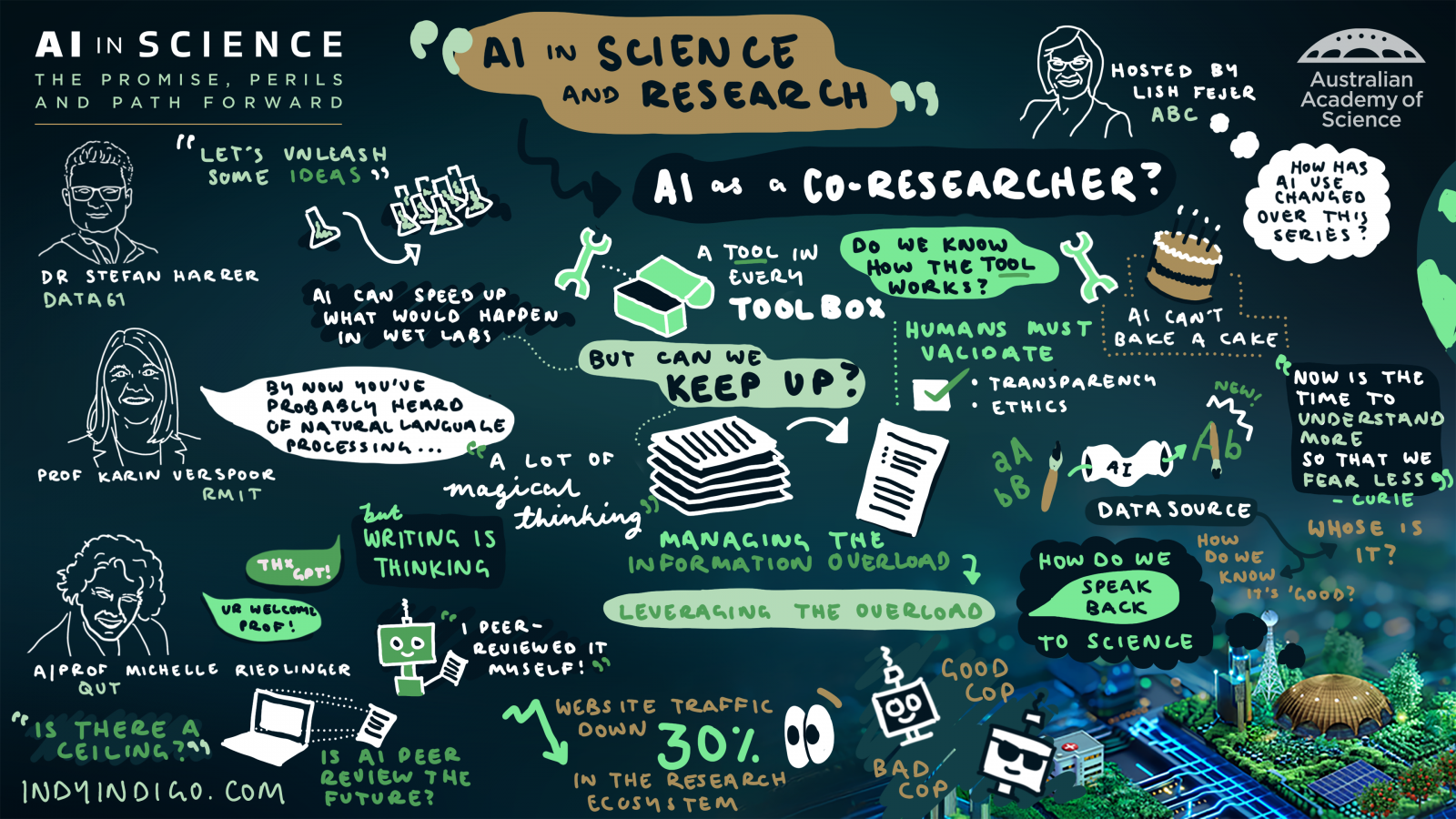
The above illustration was created by graphic scribe, Indigo Strudwicke, who joined us live to capture the event summary.
Event details
Date: Tuesday 9 December 2025
Time: Canapes and drinks are served from 5.30pm, with the talks (and the livestream) starting at 6.00pm AEDT
Venue: The Shine Dome, 15 Gordon Street, Acton ACT (and online livestream)
Cost: $20pp ($15pp for students)
Panel members
Dr Stefan Harrer, CSIRO’s Data61
Stefan is a scientist, incubator, strategic advisor and executive manager. He builds and works with interdisciplinary, diverse technical and commercial teams at the intersection of digital health, neurotech, the life sciences and AI. Integrating safe and trustworthy AI systems into cloud and edge platforms to bring assistive data analytics and scalable data management tools to human decision makers in health, biotech, medtech and pharma is his core skill. He is an expert in producing and commercialising innovations in AI and science across complex, highly regulated environments spanning industry, academia and government.
Professor Karin Verspoor, RMIT University
Karin is Dean of the School of Computing Technologies at RMIT University. Her research primarily focuses on the use of artificial intelligence methods to enable biological discovery and clinical decision support, through extraction of information from clinical texts and the biomedical literature and machine learning-based modelling. She is also the Victorian Node lead and co-founder of the Australian Alliance for Artificial Intelligence in Health.
Associate Professor Michelle Riedlinger, QUT
Michelle is based at QUT’s School of Communication. Her research interests include the emerging environmental, agricultural and health research communication practices, roles for ‘alternative’ science communicators, online fact checking and public engagement with science. Her research is informed by theories of media, cultural approaches to science, social identity, and pragmatic linguistics. As a communication consultant, she has worked on projects focused on climate variability, dryland salinity, ecology, catchment management and river health. She has facilitated over two hundred communication training workshops for researchers.
Series details
Series dates
The events are held at the Shine Dome in Canberra on the second Tuesday of every second month:
Tuesday 11 February: What is AI?
Tuesday 8 April: AI and our health
Tuesday 10 June: AI and our environment
Tuesday 12 August: AI and our food
Tuesday 14 October: AI and our safety
Tuesday 9 December: AI in science and research
Series host

The Academy is pleased to welcome ABC's Lish Fejer as the host for all the events across this series. As a seasoned radio broadcaster and passionate science communicator, Lish will deliver illuminating sessions with her engaging style and thought-provoking questions.
Series convenors
Thank you to the convenors supporting the series in 2025:
- Professor Bob Graham AO FAA FAHMS, Vice President and Secretary for Biological Sciences, Australian Academy of Science
- Professor Ian Chubb AC FAA FTSE, Fellow, Australian Academy of Science
Series supporters


Location
For more information about the series and the other events, please visit the series webpage. For all enquiries, please email events@science.org.au.