


Anton Hales Medal

Award highlights
- Awarded for outstanding contributions to research in the Earth sciences for researchers up to 10 years post-PhD in the calendar year of nomination.
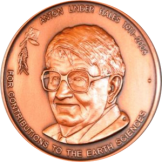
- Recognises research in the Earth sciences and honours the contributions to the Earth sciences by the late Professor Anton L Hales FAA.
The Anton Hales Medal recognises research in the Earth sciences and honours the contributions to the Earth sciences by the late Professor Anton L Hales FAA. Professor Hales was the founding director of the Research School of Earth Sciences at the Australian National University.
Its purpose is to recognise outstanding contributions to research in the Earth sciences. It will be awarded to researchers up to 10 years post-PhD in the calendar year of nomination, except in the case of significant interruptions to a research career. The award may be made annually and is restricted to candidates who are normally resident in Australia. Relevant research undertaken outside Australia may be considered, provided the researcher has conducted the majority of their research career—defined as periods of employment or study primarily involving research activities or research training—in Australia, and has been resident in Australia for at least the past two years.
This award is open to nominations for candidates from all genders. The Australian Academy of Science encourages nominations of female candidates and of candidates from a broad geographical distribution.
Candidates may be put forward for more than one award. If a proposed candidate is already the recipient of an Academy early-career honorific award, they will not be eligible for nomination for another early-career or mid-career honorific award. A mid-career honorific award recipient will also not be eligible for nomination for another mid-career honorific award. Fellows of the Academy are ineligible to be nominated for early and mid-career awards.
Background on Professor Anton Hales can be found through the related links below and his biographical memoir at Historical Records of Australian Science.
Key dates
Below are the key dates for the nomination process. While we aim to keep to this schedule, some dates may change depending on circumstances.
GUIDELINES
The following guidelines and FAQs provide important information about eligibility, submission requirements, and assessment processes. Please review them carefully before submitting a nomination.
How to nominate a scientist for the Academy’s honorific awards
The following guidelines contain detailed information for nominators.
These guidelines contain information for honorific award nominators.
The following guidelines contain information for honorific award referees.
These guidelines contain information for honorific award referees.
See below for specific relevant conferral dates for the current award round.
This document contains specific PhD conferral dates for early and mid-career honorific awards in the current award round.
Please submit your nominations using the Nominate button found on the top right of this webpage when nominations are open.
Please note the Academy uses a nomination platform that is external to the main Academy site. Nominators will be required to create an account on the platform. Even if you are familiar with the nomination process, please allow extra time to familiarise yourself with the platform.
Early-career, mid-career and career medals
Can I nominate myself?
- No – you must be nominated by someone else. Self-nominations are not accepted.
Can I submit a nomination on behalf of someone else?
- Yes – you can submit a nomination on behalf of someone else if you are not the nominator. An example would be a university grants office or personal/executive assistant completing the online nomination form on behalf of a nominator. Once the form is submitted, the nominator will be sent an email confirming that the nomination has been completed. If a nominee submits a nomination for themselves on behalf of a nominator it will not be considered a self-nomination.
Residency requirements
- Winners of all awards except the Haddon Forrester King Medal should be mainly resident in Australia and/or have a substantive position in Australia at the time of the nomination deadline. Unless explicitly stated in the awarding conditions, the research being put forward for the award should have been undertaken mainly in Australia. Some awards have more specific conditions that the relevant selection committee must apply and nominators are advised to read the conditions associated with each award very carefully.
Honorific career eligibility (more specific details found in the honorific awards nominator guidelines and the honorific award post PhD eligibility guidelines)
- Career eligibility is calculated by calendar year.
- Early career awards are open to researchers up to 10 years post-PhD.*
- Mid-career awards are open to researchers between eight and 15 years post-PhD.*
- Please note that the Awards Committee may consider nominees with post PhD dates outside of these ranges if a career exemption request is being submitted with the nomination, further guidelines on career exemption requests can be found in the nomination guidelines.
- See the post-PhD eligibility guidelines document for relevant conferral dates.
- *Or equivalent first higher degree e.g. D.Phil., D.Psych., D.Sc.
Academy fellowship requirements in award nominations
- Fellows and non-Fellows of the Academy can provide nominations for either Fellows or non-Fellows for all awards.
Women only awards
- The Dorothy Hill, Nancy Millis and Ruby Payne-Scott Medals are for women only. These medals are open to nominees who self-identify as a woman in the award nomination form. The Academy does not require any statement beyond a nominee’s self-identification in the nomination form.
- This practice is consistent with the Sex Discrimination Act 1984, which has recognised the non-binary nature of gender identity since 2013, and gives effect to Australia’s international human rights obligations. The Academy remains committed to the fundamental human rights principles of equality, freedom from discrimination and harassment, and privacy, as well as the prevention of discrimination on the basis of sex and gender identity.
PREVIOUS AWARDEES
Dr Mark Hoggard, Australian National University
Dr Mark Hoggard is an observational geodynamicist whose research links evolution of Earth's surface to dynamic processes within its interior. He is passionate about working on fundamental Earth science problems that are of societal and economic importance. Examples include forecasting sea-level change, identifying mineral resources, and distinguishing underground nuclear tests from naturally occurring earthquakes.
What sets Dr Hoggard apart is his willingness to cross traditional discipline boundaries, integrating field observations and inverse modelling frameworks from diverse fields that include seismology, geochemistry, rock physics, geomorphology and paleoclimate. Dr Hoggard is embedded within an extensive network of academic and government collaborators that has produced several foundational contributions to geodynamics. He has authored more than 50 peer-reviewed publications, been recognised through international awards, and takes pride in a research record that has demonstrated practical impacts across government and industry.
Associate Professor Stijn Glorie, University of Adelaide
Associate Professor Stijn Glorie studies the interplay between the thermal history of Earth’s crust and large-scale tectonic processes that drive plate deformation and mountain building. Associate Professor Glorie employs novel mineral-based geochronometers to unravel the cryptic records of ancient geologic events, including the formation of metalliferous mineral deposits, which in turn can assist mineral exploration efforts. His research has focused on the protracted crustal deformation in Central Asia, and vast areas of central Australia, thereby filling crucial gaps in our knowledge of the geological evolution of our continent. At the University of Adelaide, he is currently leading ground-breaking method development work to determine the age of a vast range of minerals that were previously considered undatable. This revolutionary geochronology work now allows for unlocking of records of Earth’s ancient history at unprecedented rates and scales.
Dr Andrew King, University of Melbourne
Dr Andrew King is an outstanding early-career researcher with an extensive body of high-impact work focused on climate extremes and climate risk. He has a prolific record of significant first-authored publications, including landmark studies on climate change projections in high-impact journals. He has been very active in the public discourse on climate change through frequent opinion pieces based on his research and interviews in newspapers, TV and radio. The significance and impact of his research and engagement have been recognised in a number of ways. He received an ARC Discovery Early Career Researcher Award in 2018. He was the only early-career climate scientist on the author team for the Academy of Science’s report ‘The risks to Australia of a 3°C warmer world’ in 2021. He was the inaugural winner of the Science Outreach Award of the Australian Meteorological and Oceanographic Society in 2018. Dr King was promoted to Senior Lecturer in 2021.
Dr Teresa Ubide, University of Queensland
Dr Teresa Ubide studies volcanoes by looking at the crystals in previously erupted volcanic rocks. Using the chemistry of the tiny crystals she can decipher the inner workings of volcano plumbing systems and what triggers volcanic eruptions. The aim of this research is to ultimately forecast future eruptions. The research is of utmost importance to millions of people living close to, or visiting, active volcanoes around the world. Her research also explores the link between volcanoes and critical metals that are essential for the development of renewable energy technology, such as wind and solar energy. Dr Ubide loves to communicate her science and was part of the Superstars of STEM program, and has given national and international talks and media interviews about her work on volcanoes.
Associate Professor Jenny Fisher, University of Wollongong
Understanding of the sources, transport and fate of trace atmospheric species is crucial for the development of evidence-based policies for the management of air pollution and to evaluate their contribution to future climate scenarios. Associate Professor Jenny Fisher’s research leads international efforts to model the atmospheric concentrations and transport of these species and to predict their response to future emissions and environmental change, and to quantitatively evaluate impacts of Australian and global environmental policies. The species include mercury, a neurotoxin that is distributed globally through the atmosphere. In recognition of its adverse effects, mercury is now regulated by the UN Minamata Convention on Mercury. Her work also provides new and crucial information on biogenic emissions and atmospheric chemistry of trace species from vegetation which play important roles in air pollutant formation.
Dr Nicolas Flament, University of Wollongong
Dr Flament works at the interface between geodynamics and geology by novel 4D mathematical modelling of flow deep in Earth’s interior. He makes significant contributions to understanding our planet by connecting the evolution of the deep Earth with the evolution of its surface. He shows Earth was largely a water world for the first half of its history with little emerged land, with important implications for the oxidation of the atmosphere and the evolution of early life. He linked the evolution of Earth’s topography, including the Australian landscape and the formation of the Great Dividing Range, to the motion of tectonic plates over Earth’s dynamic interior. He also recently used an innovative synthesis of global geodynamic models with geophysical data to show how the evolution of the deep Earth is dynamic and linked to past configurations of tectonic plates, which is of fundamental importance to understanding the evolution of our planet.
Dr Jan Zika, University of UNSW Sydney
Dr Jan Zika is an outstanding young physical oceanographer with a clear view of the role and importance of the ocean in the global climate system. He’s revolutionised the quantitative approach to determining the ocean’s circulation and mixing by reformulating the problem in water mass properties (rather than in fixed geographical coordinates). This resulted in improved understanding and more accurate estimates of the ocean’s storage and transport of heat and freshwater. Dr Zika’s ideas have found direct application in understanding changes in global-scale atmospheric processes and in using ocean observations to more accurately quantify increases in the global hydrological cycle. The combination of Dr Zika’s deep insight, record of innovation, leadership and collegial approach is being recognised globally.
Professor Isaac Santos, Southern Cross University
Professor Santos works at the interface between coastal oceanography, hydrology and geochemistry. He is a world leader in groundwater-surface water connectivity research, and has developed innovative analytical approaches that put him at the forefront of the field. He has created disciplinary bridges to reveal that submarine groundwater discharge is a major hidden water pathway driving water quality and significant carbon fluxes in iconic Australian estuaries, mangroves, beaches, and coral reefs. His research linked water worlds that are often investigated separately but require integration for optimal management. His influential contributions and extensive engagement with research end users have real world applications, resulting in more effective management of coastal water quality. Isaac is not only a highly regarded Earth scientist, but also an outstanding mentor of students and a candid advocate on environmental issues of major public interest including water quality, carbon sequestration and draining of wetlands.
Dr Rhodri Davies, Australian National University
Dr Rhodri Davies has made outstanding contributions to understanding solid Earth structure and evolution through the development and implementation of powerful computational tools for simulating geodynamical processes. His work builds on a multi-disciplinary base, combining a keen geological insight with a clear understanding of geophysical processes and exploitation of advances in mineral physics under conditions of high temperature and pressure. He has made fundamental contributions by testing controversial hypotheses relating to the nature of the variations in material properties in the Earth's mantle and the way in which these interact with the patterns of flow, showing that purely temperature effects can explain more of the behaviour than hitherto recognised. His recent work on intra-plate volcanism in eastern Australia and the evolution of Pacific hot-spot chains has achieved a very high profile around the world, by its innovative synthesis of careful geodynamic modelling with geophysical and geochemical input.
Associate Professor Juan Carlos Afonso, Macquarie University
Associate Professor Afonso is at the forefront of revolutionising the way that geoscientists interpret the signals they obtain from deep in the Earth by geophysical methods. Up until now, each individual method was treated separately and the results were often incompatible with each other. His approach follows a long-term interdisciplinary program to develop a rigorous computational model that unifies diverse sub-disciplines of the solid earth sciences. This method irons out anomalies that may occur in the individual sub-disciplines, producing a self-consistent whole picture of the physical and chemical state deep in the Earth.
Professor John Paterson, University of New England
Professor Paterson is a world-leading researcher on the earliest animals in the fossil record, using exceptionally preserved Australian fossils to answer major questions relating to evolution, biogeography and palaeoecology during the two greatest radiations in the history of animal life – the Cambrian explosion and the Great Ordovician Biodiversification Event. He has made major contributions to the relative dating and correlation of strata around the globe in order to refine the geologic timescale for the Cambrian Period. He has published innovative research on how exceptional fossils come to be preserved. His rigorous field-based investigations of Cambrian rocks on Kangaroo Island and in the Flinders Ranges, South Australia, have brought Australian fossils to the forefront of understanding the evolutionary significance of Burgess Shale-type fossil assemblages and “small shelly” fossils, two of the most informative toolkits for identifying the roots of modern animal diversity in the Cambrian.
Dr Yingjie Yang, Macquarie University
Dr Yang is responsible for a major breakthrough in the treatment and interpretation of seismic data, which has opened up the use of ambient noise signals to decipher structures in Earth’s crust and upper mantle. Up to now, earthquakes or explosions had been necessary to generate seismic data; with Dr Yang’s method the background creaks and groans of Earth can be used to make images of the internal structure of Earth.
Dr Julie Michelle Arblaster, Australian Bureau of Meteorology
Julie Arblaster has been involved in, and initiated, distinguished research in the Earth sciences. Her research focuses on many aspects of the workings of the global climate system and its sensitivity to changes. The importance of her research lies in, amongst other things, how it serves to explain many of the causes of climate variability and change. Much of her research pertains directly to the climate of the Australian region, particularly with respect to the ozone hole, El Niño, the monsoon, and Australian rainfall variability.
Associate Professor Wouter Schellart, Monash University
Associate Professor Wouter Schellart has provided fundamental understanding on the evolution and dynamics of the solid Earth. His research breakthroughs have resulted in the development of a new global theory of Earth Dynamics, describing how the size of subduction zones affects the Earth's evolution and geodynamics. The theory explains several fundamental geological observations including the variety in velocity of the tectonic plates and their boundaries, the curvature of deep-sea trenches and volcanic island chains, and the formation of backarc basins and Cordilleran mountains. His work has quantified energy dissipation and flow patterns in the mantle, has identified a Global Terrestrial Reference frame for plate tectonics and provides new understanding for the geological evolution of the Southwest Pacific, Western North America and East Asia.
Dr Todd Lane, University of Melbourne
Dr Todd Lane is an atmospheric scientist at the University of Melbourne. Using state-of-the-art computer models he examines processes such as thunderstorms, airflow over mountains, heavy precipitation events, and bushfire weather. He has also conducted extensive research on turbulence near thunderstorms and the hazards they pose to commercial aircraft, and is currently working on improving methods for turbulence avoidance. He is currently supported by an Australian Research Council Future Fellowship.
Professor Craig Simmons, Flinders University
Craig Simmons is an international expert in hydrogeology recognised for his contributions to variable density groundwater flow phenomena. He has greatly advanced our understanding of computer modelling used to solve variable density flow problems, was involved in pioneering work which first detected density driven convection in a field based groundwater system, has developed innovative laboratory equipment for the visualisation of dense plume migration, and has contributed major theoretical advances on how geologic heterogeneity controls dense plume migration. His work continues to transform the discipline of hydrogeology.
Professor David White, University of Western Australia
David White has developed models for the behaviour of the weak and mobile seabed sediments on which the pipelines and infrastructure required to develop Australia’s oil and gas resources must be built. He has led the design and deployment of new instruments to characterise the shifting sands and liquefiable muds found offshore Australia, and his design methods for pipelines and foundations have been rapidly adopted by industry.
Associate Professor Jeffrey Walker, University of Melbourne
Jeffrey Walker is an expert on remote sensing of soil moisture and data assimilation. He did the first study for guidelines on the key requirements for remote sensing of soil moisture by satellite – accuracy, repeat time and spatial resolution. Jeffrey has developed airborne passive microwave remote sensing capability in Australia, and is developing the only imaging active–passive simulator world-wide for use in a satellite scheduled for launch in 2012.