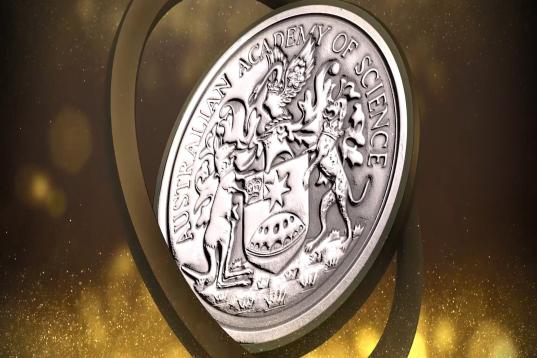



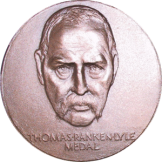
Thomas Ranken Lyle Medal

Award highlights
- The award recognises outstanding achievement by a scientist in Australia for research in mathematics or physics.
- This award commemorates the contribution of Sir Thomas Ranken Lyle, FRS, to Australian science and industry generally and in particular to his own fields of physics and mathematics.
The Thomas Ranken Lyle Medal is a career award that commemorates the contribution of Sir Thomas Ranken Lyle FRS, to Australian science and industry generally and in particular to his own fields of physics and mathematics. The purpose of the medal is to recognise outstanding achievement by a scientist in Australia for research in mathematics or physics.
Research carried out in countries other than Australia may be taken into consideration if the researcher has spent three of the last five years in Australia. Work carried out during the whole of the candidate's career may be taken into consideration but special weight will be given to recent work. The award is normally made every two years.
This award is open to nominations for candidates from all genders. The Australian Academy of Science encourages nominations of female candidates and of candidates from a broad geographical distribution.
Career awards recognise achievement over a career of whatever length.
Candidates may be put forward for more than one award. If a proposed candidate is already the recipient of an Academy award, the second award must be for a distinct, additional, body of work undertaken since the first award, and/or work in a different field.
Key dates
Below are the key dates for the nomination process. While we aim to keep to this schedule, some dates may change depending on circumstances.
GUIDELINES
The following guidelines and FAQs provide important information about eligibility, submission requirements, and assessment processes. Please review them carefully before submitting a nomination.
How to nominate a scientist for the Academy’s honorific awards
The following guidelines contain detailed information for nominators.
These guidelines contain information for honorific award nominators.
The following guidelines contain information for honorific award referees.
These guidelines contain information for honorific award referees.
Please submit your nominations using the Nominate button found on the top right of this webpage when nominations are open.
Please note the Academy uses a nomination platform that is external to the main Academy site. Nominators will be required to create an account on the platform. Even if you are familiar with the nomination process, please allow extra time to familiarise yourself with the platform.
Early-career, mid-career and career medals
Can I nominate myself?
- No – you must be nominated by someone else. Self-nominations are not accepted.
Can I submit a nomination on behalf of someone else?
- Yes – you can submit a nomination on behalf of someone else if you are not the nominator. An example would be a university grants office or personal/executive assistant completing the online nomination form on behalf of a nominator. Once the form is submitted, the nominator will be sent an email confirming that the nomination has been completed. If a nominee submits a nomination for themselves on behalf of a nominator it will not be considered a self-nomination.
Residency requirements
- Winners of all awards except the Haddon Forrester King Medal should be mainly resident in Australia and/or have a substantive position in Australia at the time of the nomination deadline. Unless explicitly stated in the awarding conditions, the research being put forward for the award should have been undertaken mainly in Australia. Some awards have more specific conditions that the relevant selection committee must apply and nominators are advised to read the conditions associated with each award very carefully.
Honorific career eligibility (more specific details found in the honorific awards nominator guidelines and the honorific award post PhD eligibility guidelines)
- Career eligibility is calculated by calendar year.
- Early career awards are open to researchers up to 10 years post-PhD.*
- Mid-career awards are open to researchers between eight and 15 years post-PhD.*
- Please note that the Awards Committee may consider nominees with post PhD dates outside of these ranges if a career exemption request is being submitted with the nomination, further guidelines on career exemption requests can be found in the nomination guidelines.
- See the post-PhD eligibility guidelines document for relevant conferral dates.
- * or equivalent first higher degree e.g. D.Phil., D.Psych., D.Sc.
Academy fellowship requirements in award nominations
- Fellows and non-Fellows of the Academy can provide nominations for either Fellows or non-Fellows for all awards.
Women only awards
- The Dorothy Hill, Nancy Millis and Ruby Payne-Scott Medals are for women only. These medals are open to nominees who self-identify as a woman in the award nomination form. The Academy does not require any statement beyond a nominee’s self-identification in the nomination form.
- This practice is consistent with the Sex Discrimination Act 1984, which has recognised the non-binary nature of gender identity since 2013, and gives effect to Australia’s international human rights obligations. The Academy remains committed to the fundamental human rights principles of equality, freedom from discrimination and harassment, and privacy, as well as the prevention of discrimination on the basis of sex and gender identity.
PREVIOUS AWARDEES
Professor George Willis FAA, University of Newcastle
Beyond solving problems, Professor George Willis is a true creator of new mathematics. Through his invention of ‘the scale’ and its function, Professor Willis gave an entirely new insight into the unexpected structure and classification of totally disconnected locally compact groups, a previously intractable area. This novel approach, now known as ‘Willis Theory’, has broad implications for diverse fields of mathematics. Professor Willis’s research extends beyond theoretical elegance, leading to unexpected and pivotal real-world applications related to symmetric infinite networks. By describing how finite patterns might continue indefinitely, his work informs the growth and optimisation of real-world networks like computer systems and global social networks. In a lifetime of achievement, Professor Willis has ensured Australia is at the frontier of knowledge in pure mathematics. His ongoing contributions add to his already remarkable legacy of innovative academic research and dedicated education leadership in pure mathematics at the regional University of Newcastle in Australia.
Professor Susan Scott FAA, Australian National University
Professor Susan Scott is an internationally recognised mathematical physicist who has made fundamental advances in our understanding of the fabric of space-time in general relativity, and in gravitational wave science. Her ground-breaking discoveries probe the existence and nature of singularities and the global structure of space-time, and possible initial and final end states for cosmological models representing our Universe. Professor Scott has also been a pioneer in the analysis of astrophysical signatures in gravitational wave experiments, including the searches for gravitational waves from asymmetric neutron stars and from inspiralling binary systems of black holes and neutron stars. She has played an important role in the development and promotion of gravitational research worldwide, and a leading role in Australia’s participation in the first direct detection of gravitational waves in 2015.
Professor Nick Wormald FAA, Monash University
Technological, biological, social and logistical networks are a ubiquitous feature of modern life. Professor Nick Wormald is a world leader in the field of random graph theory, which combines advanced probability theory, combinatorics and theoretical computer science to produce deep insights into the nature of such large and complex networks. The mathematics that he produces leads to greater understanding of the structure of real-world networks and to new methods for modelling them. This in turn leads to versatile tools of widespread use in algorithmic computer science and network optimisation, with other applications in physics, coding theory for communications, underground mine design and genetics. Professor Wormald is responsible for an impressive number of major breakthroughs in these areas and several standard methods used today were his invention.
Professor David McClelland FAA, Australian National University
Gravitational waves were predicted by Einstein’s general theory of relativity more than 100 years ago. After 40 years of sustained experimentation, on 14 September 2015, the Laser Interferometer Gravitational-wave Observatory (LIGO) detected the death spiral of two stellar-mass black holes as the gravitational waves they emitted almost a billion years ago passed through two detectors in the US. Remarkably, the wave moved the mirrors in the 4 km-long detectors by a fractional amount equivalent to 1/1000th of the width of a proton, in so doing verifying one of the most challenging predictions of Einstein’s General Relativity.
Professor David McClelland carried major responsibility as the lead Australian investigator in LIGO and has made major contributions to this famous detector including work on ‘quantum enhancement’ which increased the observable volume of the Universe significantly.
Professor Chennupati Jagadish AC FAA FTSE, Australian National University
Professor Jagadish has made pioneering contributions to semiconductor physics in particular materials physics and optical physics. He has developed semiconductor growth, processing and characterisation techniques to achieve many world firsts in terms of innovative optoelectronic devices such as semiconductor lasers, infrared and terahertz detectors based on quantum wells, quantum dots and nanowires. He has developed quantum well and quantum dot atomic intermixing techniques to develop integrated optoelectronics devices being used in industry. His work has led to the development of innovative optoelectronic and nanophotonic devices used in optical communication systems, biomedical imaging, defence and security applications. He has trained a large number of PhD students and early-career researchers and they are in leading positions in industry and academia.
2017
Professor Joss Bland-Hawthorn FAA, University of Sydney
Professor Bland-Hawthorn has excelled in both astronomical research and cutting-edge instrumentation, helping to keep Australia at the forefront of optical astronomy over the past 25 years. His legacies include establishing two astronomical fields – galactic archaeology and near-field cosmology (with Professor Kenneth Freeman FAA FRS) and astrophotonics, resulting in awards in astronomy, optics, and photonics. His innovative contributions to astronomical technology and instrumentation have been very influential and have been widely adopted in experimental astronomy and have also been applied to other fields, such as telecommunication, food safety and the farming industry.
2015
Professor Michelle Y Simmons FAA, University of New South Wales
Professor Simmons has pioneered a radical new technology for creating atomic-scale devices producing the first ever electronic devices in silicon where individual atoms are placed with atomic precision and shown to dictate device behaviour. Her ground-breaking achievements have opened a new frontier of research in computing and electronics globally. They have provided a platform for redesigning conventional transistors at the atomic-scale and for developing a silicon-based quantum computer: a powerful new form of computing with the potential to transform information processing.
2013
Professor Cheryl Elisabeth Praeger AM FAA, University of Western Australia
Professor Cheryl Praeger has transformed our understanding of groups acting on large systems, producing new theories, algorithms and designs that have advanced every field that exploits the symmetry of large systems. Her research has led to significant new directions taken up by mathematicians internationally. Her algorithms have enhanced powerful computer algebra systems which have transformed research and teaching of algebra.
2011
Professor James Stanislaus Williams FAA, Australian National University
James Williams developed ion implantation processes which are widely used in the microelectronics industry for manufacturing computer chips. He has developed phase change memory technology based on silicon which is expected to play an important role in next generation of high density memory devices. His work on compound semiconductors has made an impact in optoelectronic device technology. He has provided exceptional leadership in materials science in Australia and is highly regarded internationally for his contributions in electronic materials.
2009
Professor Victor Flambaum FAA, University of New South Wales
Victor Flambaum has performed pioneering research in the area of the violation of fundamental symmetries and tests of unification theories of elementary particles. With collaborators he developed a new method to perform the most accurate atomic calculations of parity violation. These calculations allowed the standard model of elementary particles to be tested. Recently he proposed new ideas which have led to fresh directions in the search for variations of the fundamental constants of nature, including astrophysics (Big Bang nucleosynthesis, quasar spectra), nuclear physics (nuclear clock), and atomic and molecular spectroscopy (atomic clocks).
2007
Professor Yuri Kivshar, Australian National University
Yuri Kivshar is a world leader in nonlinear physics and optics, widely recognised for his contributions to our understanding of self-trapping and energy localisation, pioneering results in the theory of optical solitons and vortices, and the world-first predictions of many important effects in nonlinear physics of periodic photonic structures. Most of his theoretical predictions have been verified and demonstrated experimentally. Yuri is a leading figure in the interchange of ideas between nonlinear optics and atom optics. His research is multidisciplinary in background and focus.
2005—A.J. Guttmann
2003—G. Dracoulis
2001—I.H. Sloan
1999—E.O. Tuck
1997—A.W. Thomas
1995—C.C. Heyde
1993—N.H. Fletcher; E. Weigold
1991—B.H.J. McKellar
1989—R. Delbourgo; P.G. Hall
1987—D.B. Melrose
1985—A.W. Snyder
1983—R.J. Baxter
1981—J.R. Philip; D.W. Robinson
1979—E.J. Hannan
1977—K. Mahler
1975—J.P. Wild
1972—H.A. Buchdahl
1970—R.Hanbury Brown
1968—G. Szekeres
1966—S.T. Butler
1963—G.R.A. Ellis; P.A.P. Moran
1961—H.O. Lancaster
1959—E.S. Barnes
1957—B.Y. Mills
1953—J.L. Pawsey
1951—T.M. Cherry
1949—K.E. Bullen
1947—J.C. Jaeger; D.F. Martyn
1941—G.H. Briggs; T.G . Room
1935—J.R. Wilton