




Pacific excellence harnessed at science congress
New Fellows were formally inducted, and the Pacific Research Hub was launched at the inaugural Pacific Academy of Sciences Congress.
- 3 mins read

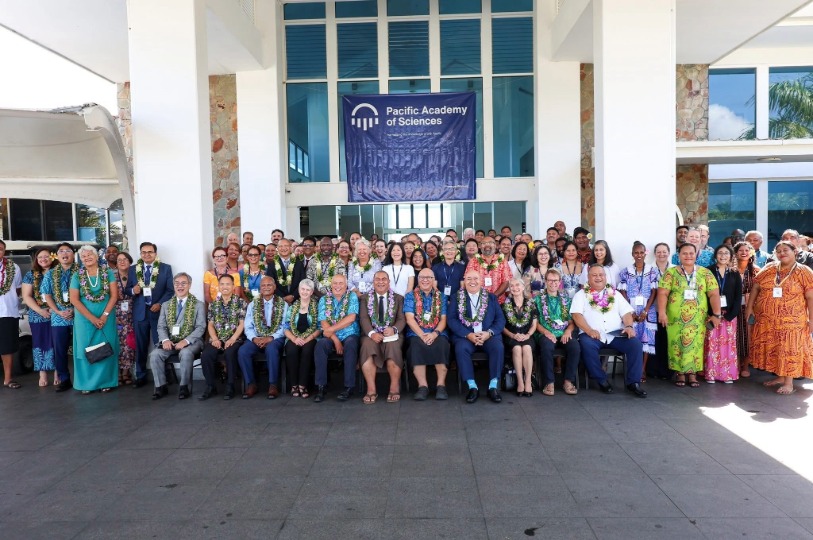
Pacific Academy Congress delegation.
'Harnessing the strength of the Pacific' was the theme of the inaugural Pacific Academy of Sciences Congress, held from 16 to 18 February 2026. True to its focus, the gathering brought together scholars from across the region to exchange ideas on empowering Pacific nations, uplifting communities, and influencing the international science system with Pacific perspectives and knowledge systems.
Keynote addresses included Hon Aiono Dr Alec Ekeroma, who delivered a compelling reflection on the collective power of Pacific nations and the importance of Indigenous knowledges working alongside western science to reinforce one another.
“For many years, the voices of the global south have rarely made it to an international stage. This is also true when it comes to science. The result has been decisions about the Pacific being made by those who do not represent us. Research on the Pacific has excluded us and our Indigenous knowledges. And our communities have been unable to equally share in the benefits of science.
That tide has now changed.
“Our Pasifika community has shown that meaningful change can only come from self-determined, regional-based solutions. The establishment of the International Science Council’s Regional Focal Point for Asia and the Pacific reflects global recognition of this fact. And the Pacific Academy of Sciences demonstrates our region’s strong scientific capacity and growing knowledge generation.
We now have a clear, unified way for Pacific scientific voices to be heard on the world stage."
Professor Frances Separovic, representing the Australian Academy of Science and serving as Co-Chair of the International Science Council (ISC) Regional Focal Point’s (RFP's) Advisory Council, reflected on the speed at which the Pacific Academy was established; a testament to the depth of expertise across the region. She also underscored the solidarity between Australia and Pacific states, exemplified by collaboration between the RFP and the Pacific Academy.
“Since 2023, the ISC Regional Focal Point has worked hand-in-hand with Pacific partners to support the emergence of the Pacific Academy of Sciences. Along the way, our teams have become deeply enmeshed, working across organisations, time zones, and mandates so closely that it is often hard to tell where one team ends and another begins."
New Fellows were formally inducted, joining the ranks of the Pacific’s most distinguished researchers.
The Academy also launched the Pacific Research Hub, the first Pacific-specific online research platform powered by artificial intelligence.
Day two featured rich knowledge exchange from across the region, with sessions spanning interdisciplinary work in climate health, biomedical research, governance, and science diplomacy.
The day also saw the launch of An assessment of research and development investment and capacity in ten Pacific small island developing states, a UNESCO-funded report examining research and development ecosystems across 10 Pacific countries.
The evening program included Hon Kinoka Feo, Papua New Guinea’s Minister for Higher Education, Research, Science and Technology, and Sport. His impassioned address grounded Pacific science in Indigenous knowledges, research ethics, and collective capacity building. Proceedings concluded with traditional Samoan performances by the talented young people of EFKS Apia.
On the final day, attendees heard from Professor Letuimanu’asina Emma Kruse Va’ai, Pro Chancellor of the National University of Samoa, who spoke about safeguarding culture and language in education through children’s books that tell Pacific stories. Educators from across the region then shared research challenging deficit models in science and education, highlighting innovative, localised and place-based approaches to teaching Pacific and Indigenous students. Additional sessions explored Pacific ethics governance mapping, community-led research frameworks, and data sovereignty to complement and empower local communities.
Preliminary discussions also laid the groundwork for the first Pacific Young Academy.
Congratulations to the Pacific Academy of Sciences (PAS) on a landmark Congress that provided a platform for diverse Pacific scholars to showcase knowledge strengthening science across the region. The RFP-AP is proud to support this initiative and looks forward to deepening collaboration with the PAS as it continues to grow.
Support for the Pacific Academy of Sciences comes from the Australian Government Department of Industry, Science and Resources, through the International Science Council Regional Focal Point for Asia and the Pacific.