




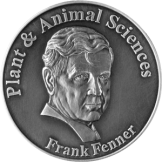
Fenner Medal

Award highlights
- The award recognises outstanding research in biology (excluding the biomedical sciences) by researchers up to 10 years post-PhD in the calendar year of nomination.
- This award recognises the contributions to science by the late Professor Frank J Fenner AC MBE FAA FRS.
The Fenner Medal recognises outstanding contributions to science by the late Professor Frank J Fenner AC MBE FAA FRS. Its purpose is to recognise outstanding research in biology (excluding the biomedical sciences) by researchers up to 10 years post-PhD in the calendar year of nomination, except in the case of significant interruptions to a research career.
The award is made annually and is restricted to candidates who are normally resident in Australia. Relevant research undertaken outside Australia may be considered, provided the researcher has conducted the majority of their research career—defined as periods of employment or study primarily involving research activities or research training—in Australia, and has been resident in Australia for at least the past two years.
This award is open to nominations for candidates from all genders. The Australian Academy of Science encourages nominations of female candidates and of candidates from a broad geographical distribution.
Candidates may be put forward for more than one award. If a proposed candidate is already the recipient of an Academy early-career honorific award, they will not be eligible for nomination for another early-career or mid-career honorific award. A mid-career honorific award recipient will also not be eligible for nomination for another mid-career honorific award. Fellows of the Academy are ineligible to be nominated for early and mid-career awards.
Key dates
Below are the key dates for the nomination process. While we aim to keep to this schedule, some dates may change depending on circumstances.
GUIDELINES
The following guidelines and FAQs provide important information about eligibility, submission requirements, and assessment processes. Please review them carefully before submitting a nomination.
How to nominate a scientist for the Academy’s honorific awards
The following guidelines contain detailed information for nominators.
These guidelines contain information for honorific award nominators.
The following guidelines contain information for honorific award referees.
These guidelines contain information for honorific award referees.
See below for specific relevant conferral dates for the current award round.
This document contains specific PhD conferral dates for early and mid-career honorific awards in the current award round.
Please submit your nominations using the Nominate button found on the top right of this webpage when nominations are open.
Please note the Academy uses a nomination platform that is external to the main Academy site. Nominators will be required to create an account on the platform. Even if you are familiar with the nomination process, please allow extra time to familiarise yourself with the platform.
Early-career, mid-career and career medals
Can I nominate myself?
- No – you must be nominated by someone else. Self-nominations are not accepted.
Can I submit a nomination on behalf of someone else?
- Yes – you can submit a nomination on behalf of someone else if you are not the nominator. An example would be a university grants office or personal/executive assistant completing the online nomination form on behalf of a nominator. Once the form is submitted, the nominator will be sent an email confirming that the nomination has been completed. If a nominee submits a nomination for themselves on behalf of a nominator it will not be considered a self-nomination.
Residency requirements
- Winners of all awards except the Haddon Forrester King Medal should be mainly resident in Australia and/or have a substantive position in Australia at the time of the nomination deadline. Unless explicitly stated in the awarding conditions, the research being put forward for the award should have been undertaken mainly in Australia. Some awards have more specific conditions that the relevant selection committee must apply and nominators are advised to read the conditions associated with each award very carefully.
Honorific career eligibility (more specific details found in the honorific awards nominator guidelines and the honorific award post PhD eligibility guidelines)
- Career eligibility is calculated by calendar year.
- Early career awards are open to researchers up to 10 years post-PhD.*
- Mid-career awards are open to researchers between eight and 15 years post-PhD.*
- Please note that the Awards Committee may consider nominees with post PhD dates outside of these ranges if a career exemption request is being submitted with the nomination, further guidelines on career exemption requests can be found in the nomination guidelines.
- See the post-PhD eligibility guidelines document for relevant conferral dates.
- * or equivalent first higher degree e.g. D.Phil., D.Psych., D.Sc.
Academy fellowship requirements in award nominations
- Fellows and non-Fellows of the Academy can provide nominations for either Fellows or non-Fellows for all awards.
Women only awards
- The Dorothy Hill, Nancy Millis and Ruby Payne-Scott Medals are for women only. These medals are open to nominees who self-identify as a woman in the award nomination form. The Academy does not require any statement beyond a nominee’s self-identification in the nomination form.
- This practice is consistent with the Sex Discrimination Act 1984, which has recognised the non-binary nature of gender identity since 2013, and gives effect to Australia’s international human rights obligations. The Academy remains committed to the fundamental human rights principles of equality, freedom from discrimination and harassment, and privacy, as well as the prevention of discrimination on the basis of sex and gender identity.
PREVIOUS AWARDEES
Dr Kai Xun Chan, Australian National University
Dr Chan has led breakthroughs in our understanding of plant cellular communication during environmental stresses such as drought and intense sunlight. He identified how a sensor protein perceives stress in chloroplasts to produce a chemical signal. He then co-led a series of breakthroughs demonstrating how this chloroplast signalling pathway intersects with plant hormones and other cellular signals to fine-tune stomatal closure and water preservation in all land plants.
His team further showed that this chloroplast signalling pathway has its genesis in aquatic algae, and its function in water preservation could have facilitated the transition of plants from water to land. Furthermore, this chloroplast signal has adopted specialised functions in different leaf cell types, including in plants that have evolved heat-resilient photosynthesis. These findings have significantly advanced fundamental chloroplast biology beyond photosynthesis, providing a novel pathway for engineering future climate-resilient crops.
Associate Professor Katherine Moseby, University New South Wales
Associate Professor Katherine Moseby is a conservation biologist who specialises in desert ecology. She researches ecosystem restoration and threatened species reintroductions. She is passionate about conducting research and applying the results to improve conservation outcomes. Her work includes co-founding four conservation research initiatives, and she partners with government, NGOs and industry groups to ensure her research is relevant, timely and has impact.
Associate Professor Daniel Noble, Australian National University
Research findings are rapidly accumulating across science. This has caused a revolution in data synthesis (meta-analysis) driving evidence-based advancement of fundamental science, applied research and policy. Ecological data is especially challenging to handle because studies are highly variable (such as different species, ecosystems), but synthesis is essential to predict how climate change, invasive species and human activities affect biodiversity. Associate Professor Daniel Noble is spearheading global initiatives to improve biostatistical analyses of ecological and evolutionary studies. He has developed analytical approaches to deal with existing data; methods to estimate missing data; and user-friendly software for data extraction. His new tools are invaluable to biologists but are also used globally by scientists in fields as diverse as psychology and genetics. Associate Professor Noble is also an effective advocate for open and transparent science, reflected in his collaborative approach to research and his altruist service to the scientific community. This includes curating preprint archives, providing free software, and organising conferences and workshops.
Associate Professor Ana Martins Sequeira, Australian National University
Associate Professor Ana Martins Sequeira is a world-class researcher in marine ecology, focused on the development and application of innovative analytical methods to assist conservation of marine megafauna species such as whales, sharks and turtles. She is interested in understanding patterns of marine biodiversity across the entire planet, particularly those with relevance to assist conservation management. She pioneered the development of statistical models to predict the global occurrence of highly migratory species, and provided the first global assessment of potential human impacts on marine megafauna. She also built large international teams to promote data collection on the global movement of marine megafauna, which has ensured better evidence-based policy to conserve these threatened, charismatic species. Associate Professor Martins Sequeira’s research has helped to change the conservation status of vulnerable species, driven international efforts that shaped the discipline of marine biologging, and championed data sharing of marine megafauna tracks. Her ability to translate academic science to practical outcomes has deep implications for how we sustain biodiversity in our oceans.
Associate Professor Emily Wong, Victor Chang Cardiac Research Institute
Associate Professor Emily Wong’s work contributes to our understanding of an overarching question in genetics – how does the genome specify animal form and function. This is a complex problem because, unlike genes that encode proteins, gene regulatory elements cannot be easily defined based on comparative analysis of their DNA sequence alone. The elements that make up these regions remain unclear despite our ability to sequence genomes and map active regions that control gene expression. Associate Professor Wong has used systems biology approaches combining evolutionary, computational and molecular biology skills to interrogate how the non-coding genome determines cell identity. Her work has provided detailed understanding of the complex relationships between the genome and gene activity, including insights into how cis-regulatory elements evolve, and the non-linear relationship between genetic variations and their impact on chromatin structure and gene expression.
Associate Professor Chris Greening, Monash University
Associate Professor Chris Greening’s remarkable discovery that bacteria can live on air has redefined what constitutes life. When bacteria exhaust organic energy sources, they can survive indefinitely by scavenging the unlimited supply of hydrogen and carbon monoxide gas present in the atmosphere. This survival mechanism has broad-reaching consequences for global biodiversity, infectious disease, climate change and public health research. Chris has revealed it supports the biodiversity of life’s soils and oceans, regulates greenhouse gases in the atmosphere and enhances agricultural productivity. He has also shown that these gas-eating bacteria provide a basis for life in continental Antarctica, where conditions are too extreme for plants to prosper. Yet similar survival mechanisms are also used by devastating human pathogens, including causative agents of tuberculosis and dysentery. By integrating his One Health microbiology laboratory with large-scale applied programs, Professor Greening is translating these fundamental insights into applied interventions that improve environmental and human health.
Associate Professor Eve McDonald-Madden, University of Queensland
Associate Professor Eve McDonald-Madden aims to improve sustainable policy decisions in the face of inherent complexity in environmental problems – numerous, diverse interacting species, lack of knowledge about how systems work, the impacts of climate change and competing demands for energy, food, water, health, money and nature. The foundation of her work is to maximise the effectiveness of scarce resources while dealing with deep uncertainties. Associate Professor McDonald-Madden has pioneered new approaches to decision-making for key environmental concerns – deciding how to act under uncertainty about climate change, accounting for the reliability of predictions, evaluating the trade-offs in global land use planning to achieve sustainability goals and knowing when spending money to monitor or to learn about ecological systems is not helpful. Her work has far reaching implications for governments, NGO’s and others who manage the environment.
Associate Professor Michael Bode, Queensland University of Technology
Associate Professor Michael Bode develops new mathematical theory and tools to better understand the Earth’s threatened ecosystems to more effectively conserve them into the future. His work has repeatedly overturned established beliefs about the best solution to common conservation problems and has used mathematical logic to convince scientists and managers to re-think conservation dogma and decision-making approaches to conservation across the world, especially of coral reef ecosystems. His marine science work has focused on developing new statistical tools to measure dispersal patterns, and new mathematical theories to understand the implications of these patterns. These new mathematical tools have given coastal marine science the first solid empirical understanding of how larval dispersal varies across space and species and have been highlighted in critical reviews of the field.
Dr Daniel Falster, UNSW Sydney
Walking through any forest, one is struck by the variety of plant forms coexisting. Given that all plants compete for the same basic resources, why is there not a single winner? Through explicit modelling of community assembly, driven by physiological trade-offs and competition for light, Falster’s work shows how particular trade-offs in the functioning of leaves and allocation of energy to reproduction enable distinct species to coexist, even while competing for a single resource. Combining multiple trade-offs predicts correctly the proliferation of shade-tolerant species and enables forests of considerably greater diversity than was previously thought possible. By adding selection into vegetation models, Dr Falster is pioneering a framework that makes first-principles predictions for the combination of traits favoured under any given environment. Combined with the large-scale datasets he has compiled, this work promises to transform community ecology into a predictive and data-oriented science, underpinning effective ecosystem management and restoration.
Dr Ceridwen Fraser, Australian National University
Dr Ceridwen Fraser’s research combines genetic with environmental and ecological data to discover the processes that drive biodiversity patterns. She has contributed extensively to our understanding of how plants and animals can travel long distances to colonise new lands, and to our knowledge of how species responded to past climate change. For example, her work has revealed evidence that, during past ice ages, many shallow-water marine species were scoured from sub-Antarctic shores by sea ice, while land-based Antarctic species sheltered near warm volcanoes. Her research has also helped us to understand how established populations can block immigrants, and how large-scale disturbances (such as earthquakes) that wipe out communities can thus create opportunities for immigration and change. Her research is grounded in assessment of how past processes have influenced contemporary biodiversity patterns, but has important implications for management of biodiversity into the future, particularly in the face of rapid environmental change.
2017
Professor Simon Ho, University of Sydney
Professor Ho has transformed the use of ‘molecular clocks’ in biology – a way of estimating evolutionary rates and timescales from DNA sequences using statistical models. Professor Ho’s most important and influential work has been on models of evolutionary rate variation through time. His research has critically changed the way in which biologists use molecular clocks, especially when studying the timescales of recent events in evolution and human prehistory. This has had important impacts on a broad range of studies in conservation genetics, speciation and diversification, domestication of animals and plants, and the population dynamics of pathogens.
2016
Associate Professor Jane Elith, University of Melbourne
Associate Professor Elith specialises in developing and evaluating species distribution models, statistical models that describe relationships between the occurrence and abundance of species and the environment. These models are used to predict where species occur in the landscape, or where they might occur in the future. Associate Professor Jane Elith has rapidly become one of the world’s most influential researchers in applied ecology. In addition to her major academic impacts, her guides and novel tools for modelling species and ecological communities have been used by government and environmental management agencies in Australia and internationally. The interface between environmental management and science makes extensive use of her research to plan management of invasive species, improve conservation of biodiversity, and contribute to strategic land-use planning. In this way, Associate Professor Elith has substantially influenced academic research, but also impacted environmental management nationally and internationally.
2015
Dr Ian Wright, Macquarie University
Plants grow by investing in leaves, which return revenue by photosynthesis. In Australian field studies and also through international collaborations, Dr Wright has elucidated major patterns governing investment in leaves. He has found there is an economic spectrum for leaves running from cheap to expensive leaf construction, with returns correspondingly running from quick to slow. On low nutrient soils, there is more expensive construction which confers a longer leaf lifespan. In dry environments, there is more nitrogen invested in leaves which economises on water use.
2014
Professor Katherine Belov, The University of Sydney
Professor Belov's research on immunity in marsupials and monotremes provides new understanding of mammalian immune systems and has great potential for managing wildlife diseases. She overturned the paradigm that Australian mammals have primitive immune systems and demonstrated they have immune gene complements similar to our own. She discovered that it is low diversity in the major histocompatibility complex that allows the spread of Tasmanian devil facial tumour disease, and has identified novel antimicrobial and venom peptides of potential biomedical relevance.
2013
Dr Ulrike Mathesius, Australian National University
Ulrike Mathesius is investigating how soil microbes shape the plant. She developed and applied techniques at a molecular, cellular and whole plant level to define mechanisms that symbiotic and pathogenic organisms use to manipulate plant development. A central idea of her work is that microbes have ‘hijacked’ plant signalling pathways for their own purposes. This has implications for utilising microbes to alter crop plant performance and for trying to develop nitrogen-fixing symbioses in non-legumes.
2012
Professor A Harvey Millar, University of Western Australia
Professor Harvey Millar’s research focuses on energy production in plants and how the process of respiration is affected by harsh climates. His work has shown how respiration can be protected in plant cells during environmental stress, how production of the antioxidant vitamin C is controlled in plants, and how the complex links between respiration and plant growth can alter plant yields. His discoveries underpin our understanding of respiratory damage in cell ageing and disease, relevant to both plants and animals.
2011
Dr Bryan Fry, University of Melbourne
Bryan Fry's multidisciplinary research examines the molecular evolution of protein toxins across the full geographical and taxonomical range of venomous animals, from the baking heat of the desert habitat of Australia's inland taipan (the world's most venomous snake) to the deep-sea giant octopus from Antarctica. His research has enabled formulation of a general theory of venom evolution and it has the potential to contribute substantially towards the area of drug development based on peptides from venomous animals.
2010
Professor Robert Brooks, University of New South Wales
Robert Brooks has combined insights from the fields of evolution, genetics, ecology and behaviour to understand the evolution of sex differences. He has achieved insights into the evolution of sex chromosomes, the biology of ageing and longevity, risks of extinction and the genetic benefits of mate choice. He has fundamentally changed the way scientists and the public think about the relationships between sex, death and diet.
2009
Associate Professor Sean Connolly, James Cook University
Sean Connolly’s research pioneers new approaches to understanding the generation and maintenance of biodiversity. He incorporates physiological and biomechanical processes that influence population dynamics, ecological interactions and their effects on the maintenance of biodiversity, and the global dynamics of biodiversity in the fossil record. He produced a modelling framework that has led to the identification of an important aspect of the future effects of ocean acidification – storm-induced dislodgement of coral colonies.
2008
Dr Michael McCarthy, The University of Melbourne
Michael McCarthy is an international leader in theoretical ecology having substantially contributed to risk models for threatened species, disturbance ecology, environmental decision-making and Bayesian methods in ecology. He has developed risk measures, approaches to model testing and validation, and numerical techniques to solve some long standing problems in ecology. He recently produced a book on Bayesian methods in ecology and has been researching decision-making models examining the mathematical structure of decisions.
2007
Dr Peter Dodds, CSIRO
Peter Dodds is an exceptional and highly creative young researcher in the area of the molecular biology of host-pathogen interactions, specifically the interaction between the flax plant and its flax rust pathogen. He has isolated several genes from flax related to resistance to rust, providing insights into the evolution of these genes and the molecular basis for the specificity of plant-pathogen interaction. He has also isolated the first rust pathogen avirulence genes and developed a general method for isolating and recognising these genes. These discoveries have provided a route towards engineering new rust resistance genes for use in agriculture.
2006
Dr Barry Brook, Charles Darwin University
Barry Brook is internationally recognised for excellence and innovation in conservation biology. His work has raised awareness of the relevance of past extinctions for present biodiversity loss. His research using analytical and computer simulation modelling has contributed to the modern understanding of species extinction dynamics. He gained his PhD from Macquarie University, Sydney on the subject of population viability analysis.
2005—B.A. Neilan
2004—G.D. Edgecombe
2003—A.G. Young
2002—S. Orgeig
2001—B.J. Pogson
2000—H. Possingham