



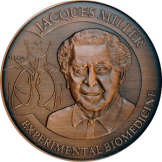
Jacques Miller Medal

Award highlights
- The award recognises research of the highest standing in the field of experimental biomedicine by researchers eight to fifteen years post PhD in the calendar year of nomination.
- This award honours the contributions made to science by Professor Jacques Miller AC FAA FRS.
The Jacques Miller Medal for Experimental Biomedicine has been established to honour the contributions made to science by Professor Jacques Miller AC FAA FRS that include the discovery of the function of the thymus and the identification, in mammalian species, of the two major subsets of lymphocytes and their functions.
The award recognises research of the highest standing in the field of experimental biomedicine and is open to researchers eight to fifteen years post PhD in the calendar year of nomination, except in the case of significant interruptions to a research career.
Funds were donated by Lady Tania Feldmann and Professor Sir Marc Feldmann AC FMedSci FAA FRS to establish this award over a 20 year period. The award will be awarded annually from 2015 and biennially from 2019 and is restricted to candidates who are normally resident in Australia. Relevant research undertaken outside Australia may be considered, provided the researcher has conducted the majority of their research career—defined as periods of employment or study primarily involving research activities or research training—in Australia, and has been resident in Australia for at least the past two years.
This award is open to nominations for candidates from all genders. The Australian Academy of Science encourages nominations of female candidates and of candidates from a broad geographical distribution.
Candidates may be put forward for more than one award. If a proposed candidate is already the recipient of an Academy early-career honorific award, they will not be eligible for nomination for another early-career or a mid-career honorific award. A mid-career honorific award recipient will also not be eligible for nomination for another mid-career honorific award. Fellows of the Academy are ineligible to be nominated for early and mid-career awards.
Key dates
Below are the key dates for the nomination process. While we aim to keep to this schedule, some dates may change depending on circumstances.
GUIDELINES
The following guidelines and FAQs provide important information about eligibility, submission requirements, and assessment processes. Please review them carefully before submitting a nomination.
How to nominate a scientist for the Academy’s honorific awards
The following guidelines contain detailed information for nominators.
These guidelines contain information for honorific award nominators.
The following guidelines contain information for honorific award referees.
These guidelines contain information for honorific award referees.
Please submit your nominations using the Nominate button found on the top right of this webpage when nominations are open.
Please note the Academy uses a nomination platform that is external to the main Academy site. Nominators will be required to create an account on the platform. Even if you are familiar with the nomination process, please allow extra time to familiarise yourself with the platform.
Early-career, mid-career and career medals
Can I nominate myself?
- No – you must be nominated by someone else. Self-nominations are not accepted.
Can I submit a nomination on behalf of someone else?
- Yes – you can submit a nomination on behalf of someone else if you are not the nominator. An example would be a university grants office or personal/executive assistant completing the online nomination form on behalf of a nominator. Once the form is submitted, the nominator will be sent an email confirming that the nomination has been completed. If a nominee submits a nomination for themselves on behalf of a nominator it will not be considered a self-nomination.
Residency requirements
- Winners of all awards except the Haddon Forrester King Medal should be mainly resident in Australia and/or have a substantive position in Australia at the time of the nomination deadline. Unless explicitly stated in the awarding conditions, the research being put forward for the award should have been undertaken mainly in Australia. Some awards have more specific conditions that the relevant selection committee must apply and nominators are advised to read the conditions associated with each award very carefully.
Honorific career eligibility (more specific details found in the honorific awards nominator guidelines and the honorific award post PhD eligibility guidelines)
- Career eligibility is calculated by calendar year.
- Early career awards are open to researchers up to 10 years post-PhD.*
- Mid-career awards are open to researchers between eight and 15 years post-PhD.*
- Please note that the Awards Committee may consider nominees with post PhD dates outside of these ranges if a career exemption request is being submitted with the nomination, further guidelines on career exemption requests can be found in the nomination guidelines.
- See the post-PhD eligibility guidelines document for relevant conferral dates.
- * or equivalent first higher degree e.g. D.Phil., D.Psych., D.Sc.
Academy fellowship requirements in award nominations
- Fellows and non-Fellows of the Academy can provide nominations for either Fellows or non-Fellows for all awards.
Women only awards
- The Dorothy Hill, Nancy Millis and Ruby Payne-Scott Medals are for women only. These medals are open to nominees who self-identify as a woman in the award nomination form. The Academy does not require any statement beyond a nominee’s self-identification in the nomination form.
- This practice is consistent with the Sex Discrimination Act 1984, which has recognised the non-binary nature of gender identity since 2013, and gives effect to Australia’s international human rights obligations. The Academy remains committed to the fundamental human rights principles of equality, freedom from discrimination and harassment, and privacy, as well as the prevention of discrimination on the basis of sex and gender identity.
PREVIOUS AWARDEES
Professor James Hudson, QIMR Berghofer Medical Research Institute
Professor James Hudson is a rising star of Australian health and medical science who has already made a significant impact in translational medical science, and looks set to continue to do so into the future. Professor Hudson was awarded his PhD in 2011, and most of his research has been conducted in Australia. He is engaged in stem cell and organoid research with a clear translational focus. Professor Hudson sits at the very top of the highest rank of the next generation of Australian medical researchers. Evidence for this assessment is manifold, and includes such things as the quality and impact of his publications, recognition through awards and prizes, invitations to present at leading international meetings, the clear clinical and commercial potential of his discoveries, and his demonstrated capacity for leadership.
Professor Di Yu, University of Queensland
Professor Yu is an immunologist whose research focuses on the function of T cells. He is internationally renowned as a leader in follicular helper T cells, a specialised subset of T cells that essentially control B cells to produce antibodies. His landmark discoveries reveal the key molecules (transcription factors and post-transcriptional regulators) and pathways (differentiation and cell death) for T cell function in health and diseases. Based on his fundamental research breakthrough, he partnered with physician-scientists and led clinical research on lupus, rheumatoid arthritis, allergic rhinitis, influenza and HIV infections, which have enabled new and improved diagnoses and therapies for autoimmune, allergic and infectious diseases, and the improvement of human vaccine efficacy.
Professor Mark Dawson, Peter MacCallum Cancer Centre
Professor Dawson is a clinician-scientist whose research spans the breadth of basic discovery science to translational medicine and clinical trials. He is internationally renowned as a leader in epigenetics, which is the study of the processes that regulate access to the cell’s DNA template for gene expression, DNA repair or DNA replication. Epigenetic processes are conserved in all animals and plants and underpin normal development, tissue regeneration and ageing. When these processes are corrupted by DNA mutations, diseases such as cancer result. Professor Dawson’s ground-breaking research has provided several novel first-in-class cancer therapies which he has taken from laboratory discovery through to clinical application by leading several international clinical trials as Principal Investigator.
Associate Professor Michele Teng, QIMR Berghofer Medical Research Institute
Associate Professor Teng’s research aims to harness the immune system to fight cancer. Her group performed the first preclinical experiments demonstrating that scheduling of immunotherapy before surgery to remove a tumour (called neoadjuvant immunotherapy) was much more effective in eradicating metastatic disease, compared to giving immunotherapy (called adjuvant immunotherapy) after surgery. This seminal finding served as the rationale to set up new comparative trials of neoadjuvant and adjuvant immunotherapy in many human cancer types. Recent neoadjuvant clinical trials of various cancers have verified the translatability of her research.
Professor Nicholas Huntington, Walter and Eliza Hall Institute of Medical Research and Monash University
Using cutting-edge screens whereby each gene of the genome is deleted individually in white blood cells, Professor Huntington established that the gene Cish impaired white blood cells from responding to the growth factor, IL-15. By deleting Cish in NK cells, his team made a breakthrough discovery that Cish acted as a ‘checkpoint’ or switch that shutdown the ability of NK cells to become activated and kill cancer cells. As such, ablation of this gene in pre-clinical models prevented melanoma, breast, prostate and lung cancer metastases from developing and reduced the onset and growth of solid tumours including sarcomas, breast and colon cancer. The discovery’s breakthrough status was sealed when inhibiting Cish function alone was more effective than the current gold-standard immunotherapies that have revolutionised cancer outcomes.
Professor Killugudi Swaminathan Iyer, The University of Western Australia
Professor Swaminathan Iyer in the School of Molecular Sciences at the University of Western Australia, leads an internationally recognised research program in the field of bionanotechnology. His transdisciplinary research program focuses on integrating fundamental concepts of cell and molecular biology with bioengineering to develop innovative nanoformulations that are designed for the treatment of currently untreatable medical emergencies like traumatic brain injuries, cardiovascular diseases, placental disorders in pregnancy and cancers (breast, cervical, colorectal). The nanoformulations developed by Iyer’s research group are able to track the localisation of the drug and pathological process simultaneously during treatment: a single procedure potentially leads to both diagnosis and therapy in one hit. The ultimate goal of his research is to enable an overall increase in quality and length of life for patients, through informed decisions about timing, dosage, drug choice, and treatment strategies for personalised medicine, with improved efficacy and lower off-target toxicity.
2017
Professor Jian Li, Monash University
Professor Li’s research targets multidrug-resistant bacterial ‘superbugs’. At a time of “Bad Bugs, No Drugs”, his work is of fundamental importance to global health and saves patients’ lives. He is a world-leading expert on last-line antibiotics called polymyxins. His research has generated the majority of modern polymyxin pharmacological data and the first scientifically-based dosing recommendations.
His research has significantly changed clinical practice world-wide and represents scientific excellence in an urgent global medical challenge.
2016
Associate Professor Katherine Kedzierska, The Peter Doherty Institute for Infection and Immunity
Associate Professor Kedzierska combines cutting-edge basic research with unique clinical studies to define how to generate protective immunity against pandemic and newly emerged influenza viruses. Her research identifies key factors that drive the severe and fatal influenza disease in high-risk groups, including the young, elderly, pregnant women, immunosuppressed individuals and Indigenous Australians. Her findings on the optimal human immunity to influenza viruses have implications for vaccine design and development, and are applicable to other infectious diseases and tumours.
2015
Professor Michael Cowley FTSE, Monash University
Professor Cowley has discovered how the body informs the brain about the amount of body fat we have and how much sugar there is in our blood. Through his understanding of these metabolic pathways in the brain, he has devised new drugs to treat obesity. He has also recently discovered why obesity causes high blood pressure. He has received several awards for his research, and now leads a global effort to find new drugs to treat diabetes.