




Moran Medal
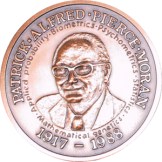

Award highlights
- The award recognises outstanding research by scientists up to 10 years post-PhD in one or more of the fields of applied probability, biometrics, mathematical genetics, psychometrics and statistics.
- This award recognises the contributions to science of the late P.A.P. Moran FAA FRS.
The Moran Medal recognises the contributions to science of the late P.A.P. Moran FAA FRS. Its purpose is to recognise outstanding research by scientists up to 10 years post-PhD in the calendar year of nomination, except in the case of significant interruptions to a research career, in one or more of the fields of applied probability, biometrics, mathematical genetics, psychometrics and statistics. The award is normally made every two years. Relevant research undertaken outside Australia may be considered, provided the researcher has conducted the majority of their research career—defined as periods of employment or study primarily involving research activities or research training—in Australia, and has been resident in Australia for at least the past two years.
This award is open to nominations for candidates from all genders. The Australian Academy of Science encourages nominations of female candidates and of candidates from a broad geographical distribution.
Candidates may be put forward for more than one award. If a proposed candidate is already the recipient of an Academy early-career honorific award, they will not be eligible for nomination for another early-career or mid-career honorific award. A mid-career honorific award recipient will also not be eligible for nomination for another mid-career honorific award. Fellows of the Academy are ineligible to be nominated for early and mid-career awards.
Key dates
Below are the key dates for the nomination process. While we aim to keep to this schedule, some dates may change depending on circumstances.
GUIDELINES
The following guidelines and FAQs provide important information about eligibility, submission requirements, and assessment processes. Please review them carefully before submitting a nomination.
How to nominate a scientist for the Academy’s honorific awards
The following guidelines contain detailed information for nominators.
These guidelines contain information for honorific award nominators.
The following guidelines contain information for honorific award referees.
These guidelines contain information for honorific award referees.
See below for specific relevant conferral dates for the current award round.
This document contains specific PhD conferral dates for early and mid-career honorific awards in the current award round.
Please submit your nominations using the Nominate button found on the top right of this webpage when nominations are open.
Please note the Academy uses a nomination platform that is external to the main Academy site. Nominators will be required to create an account on the platform. Even if you are familiar with the nomination process, please allow extra time to familiarise yourself with the platform.
Early-career, mid-career and career medals
Can I nominate myself?
- No – you must be nominated by someone else. Self-nominations are not accepted.
Can I submit a nomination on behalf of someone else?
- Yes – you can submit a nomination on behalf of someone else if you are not the nominator. An example would be a university grants office or personal/executive assistant completing the online nomination form on behalf of a nominator. Once the form is submitted, the nominator will be sent an email confirming that the nomination has been completed. If a nominee submits a nomination for themselves on behalf of a nominator it will not be considered a self-nomination.
Residency requirements
- Winners of all awards except the Haddon Forrester King Medal should be mainly resident in Australia and/or have a substantive position in Australia at the time of the nomination deadline. Unless explicitly stated in the awarding conditions, the research being put forward for the award should have been undertaken mainly in Australia. Some awards have more specific conditions that the relevant selection committee must apply and nominators are advised to read the conditions associated with each award very carefully.
Honorific career eligibility (more specific details found in the honorific awards nominator guidelines and the honorific award post PhD eligibility guidelines)
- Career eligibility is calculated by calendar year.
- Early career awards are open to researchers up to 10 years post-PhD.*
- Mid-career awards are open to researchers between eight and 15 years post-PhD.*
- Please note that the Awards Committee may consider nominees with post PhD dates outside of these ranges if a career exemption request is being submitted with the nomination, further guidelines on career exemption requests can be found in the nomination guidelines.
- See the post-PhD eligibility guidelines document for relevant conferral dates.
- * or equivalent first higher degree e.g. D.Phil., D.Psych., D.Sc.
Academy fellowship requirements in award nominations
- Fellows and non-Fellows of the Academy can provide nominations for either Fellows or non-Fellows for all awards.
Women only awards
- The Dorothy Hill, Nancy Millis and Ruby Payne-Scott Medals are for women only. These medals are open to nominees who self-identify as a woman in the award nomination form. The Academy does not require any statement beyond a nominee’s self-identification in the nomination form.
- This practice is consistent with the Sex Discrimination Act 1984, which has recognised the non-binary nature of gender identity since 2013, and gives effect to Australia’s international human rights obligations. The Academy remains committed to the fundamental human rights principles of equality, freedom from discrimination and harassment, and privacy, as well as the prevention of discrimination on the basis of sex and gender identity.
PREVIOUS AWARDEES
Professor Margarita Moreno-Betancur, Murdoch Children’s Research Institute and University of Melbourne
Contemporary health and medical research studies need statistical innovation to tackle important and increasingly complex questions concerning the causes of ill-health. Professor Margarita Moreno-Betancur’s research creates both new and improved biostatistical methods that enable novel and more accurate analyses of a wide range of data collected from people over time. These analyses can elucidate the complex causal pathways that lead to disease, for example through the interaction of multiple chronic conditions, and inform what types of interventions could prevent or cure ill-health while accounting for real-world data limitations and complexities such as missing data. Her work has powerful global reach beyond the field of biostatistics, via application of these methods in studies that advance knowledge in multiple health areas across many countries. Her methods have enabled the use of existing data resources to inform public policies, treatments and interventions for preventing cancer, cardiovascular disease, mental health disorders and allergy.
Associate Professor David Frazier, Monash University
A web of complex models underpins modern life. Models are used to predict traffic patterns, help control invasive pest populations and mitigate the spread of disease. These models are driven by unknown quantities, and so statistical inference is used to quantify and understand these unknowns, with Bayesian statistical inference methods often applied in such settings due to their interpretability. However, in many cases the underlying models and data are so complex as to render standard Bayesian methods intractable. In such cases, the best we can hope to do is perform statistical inference using ‘approximate’ Bayesian methods, which seek to deliver tractable Bayesian inferences in challenging modeling settings. Much of Associate Professor David Frazier’s research has focused on establishing the statistical behaviour of approximate Bayesian methods in a wide variety of contexts, including approximate Bayesian computation, Bayesian synthetic likelihood, and variational Bayes methods. The overarching goal of his work is to ensure practitioners can reliably apply these approximation methods to derive meaningful inferences, make reliable decisions and obtain reproducible results.
Dr Rachel Wang, University of Sydney
Working at the interface of theoretical statistics, computational statistics and data-driven applied fields, Dr Rachel Wang has pursued a diverse research trajectory emphasising both rigorous theoretical development and practical relevance to interdisciplinary scientific problems. She has made contributions to statistical inference problems in network models, enabling model selection and parameter tuning to be performed with provable guarantees. Her theoretical work on local convergence issues in variational approximation and scalable MCMC has led to a deeper understanding of how algorithms navigate a high dimensional, non-convex landscape, addressing a prevalent problem in all large-scale machine learning tasks. Leveraging her expertise in theory and computation, she has developed novel statistical and computational tools for extracting new biological knowledge from genomics data, seeking to improve our understanding of gene regulatory mechanisms and the inner workings of cells.
Professor Christopher Drovandi, Queensland University of Technology
Almost every field of science requires sophisticated data analysis, and this in turn requires increasingly sophisticated methods for intelligent data collection and efficient computation. Professor Drovandi's research contributes substantively to both of these areas. He has created new methods for optimal design of experiments that facilitate more cost-effective, data-substantiated decision-making. His innovative research into synthetic likelihood estimation have freed traditional constraints of likelihood-based statistical modelling and computation. His application of these methods to diverse problems in computational biology and exercise science have generated new insights for scientists and managers in these fields.
Dr Janice Scealy, Australian National University
Dr Scealy’s research focuses predominantly on developing new statistical analysis methods for data with complicated constraints including compositional data (vectors of proportions which sum to one), spherical data, directional data and manifold-valued data defined on more general curved surfaces. Her work has led to important new insights in a diverse range of applications. Her new flexible compositional model was applied to predict the proportions of total weekly expenditure on food and housing costs in Australia. Janice used a manifold data transformation to help identify geochemical processes acting on the surface of the Australian crust. She has developed multiple new statistical techniques for analysing noisy paleomagnetic datasets and her methods have led to improvements in uncertainty measurements of Earth’s magnetic field.
Dr Kim-Anh Lê Cao, University of Melbourne
The main focus of Dr Lê Cao’s research is to develop statistical and computational methods that are applicable to high-throughput biological data arising from frontier technologies. The emergence of these new platforms is generating a vast amount of data with enormous potential to help understand the functioning of the human body in health and disease, as well as the health of animals, plants and our environment more generally. Her expertise in multivariate statistics, combined with her deep understanding of molecular biology, put her at the forefront of cutting-edge biological research. Dr Lê Cao has a track record of success in biological data analysis, in developing novel statistical methods, in implementing them in efficient software, and in disseminating the software and encouraging its uptake by the relevant research community. She plays a critical role in several local, national and international collaborative studies with researchers from diverse bioscience disciplines.
Associate Professor Stephen Leslie, University of Melbourne
Associate Professor Leslie has made major contributions to mathematical genetics. The thrust of his research is developing methods for analysing modern genetic/genomic data, focusing on understanding the role of genetics in human disease and how genetics informs studies of human population history. He applies novel approaches to genetic data to understand the history of populations and infer past migration events. Stephen’s work on the British population is a landmark in the field, impacting history, archaeology, anthropology, and linguistics. It is a blueprint for studies in other populations and a benchmark for understanding natural genetic variation in human populations, crucial for disease studies. In other work he has revolutionised the study of immune-system genes, particularly those crucial to the body’s mechanism for detecting ‘self’ (one’s own tissues) from ‘non-self’ (such as viruses and bacteria), by enabling these genes to be included in large studies for the first time. This work has led to important discoveries associating these genes to serious diseases.
2017
Associate Professor Joshua Ross, University of Adelaide
Associate Professor Ross has made important and influential contributions to Applied Probability and Statistics, and through application to Conservation Biology and Public Health. His research has focused predominately on addressing problems arising in infectious disease epidemiology and conservation biology, though the methodological developments that he has provided to solve such problems are more widely applicable. These application topics are of great importance, and his contributions to these fields are significant.
2015
Associate Professor Yee Hwa Yang, University of Sydney
Associate Professor Yang is an applied statistician who has made significant contributions to the development of statistical methodology for analyzing molecular data arising in contemporary biomedical research. Her work on removing extraneous variability for microarray data has been incorporated in major software packages used worldwide to identify gene expression patterns. She has also developed novel methods for integrating molecular and clinical data and has already made an impact on Melanoma research by identifying potential genes that help with predicting survival outcome.
2013
Dr Aurore Delaigle, University of Melbourne
Dr Delaigle's has made influential contributions to contemporary statistical problems, including deconvolution, regression with measurement errors, functional data analysis, analysis of high dimensional data, group testing, and a wide variety of contributions to function estimation. She is remarkably adept at transforming complex and highly abstract methods into easy to understand concepts, and at developing fully applicable techniques that work in a wide variety of settings. An advantage of her approach to developing methodology is that her techniques apply at once to many practical problems, in both the biological and physical sciences.
2011
Dr Scott Sisson, University of New South Wales
Scott Sisson has made highly significant contributions to computational statistics and extreme value modelling. His research in approximate Bayesian computation has enabled researchers at the leading-edge of many scientific disciplines to examine realistic models and hypotheses, rather than be forced to use simpler, less credible alternatives. His research on extreme value modelling has enabled improved inferential procedures and highlighted the dangers of poor statistical modelling. In applying these techniques to challenging problems in other disciplines, Scott has had a very positive impact on furthering scientific research in a wide range of applications.
Dr Mark Tanaka, University of New South Wales
Mark Tanaka’s research concerns the evolution and population biology of microorganisms. He uses mathematical and statistical methods to study the dynamics of bacteria and viruses. A particular focus of his research is the transmission patterns of infectious diseases. He has investigated key parameters in the epidemiology of tuberculosis in published research which has led to conclusions with public health policy implications that were hitherto unavailable. Tanaka’s research is highly original and excellent, judged by the highest international standards.
2009
Dr Melanie Bahlo, The Walter and Eliza Hall Institute for Medical Research.
Melanie Bahlo is an applied statistician working in genetics and bioinformatics. She is highly regarded for her work in theoretical population genetics, in genetic epidemiology, and in gene mapping. She began her career with some very strong work in theoretical population genetics. Subsequently she moved into epidemiological applications and has grown into an outstanding statistical geneticist and biometrician.
2007
Professor Robin Hyndman, Monash University, Melbourne
Rob Hyndman has made major contributions to a wide range of fields, especially to forecasting, time-series, graphical methods and computational statistics. His research in forecasting challenged the appropriateness of the most fundamental of Bayesian forecasting models for exponential-family time series and on state-space models for exponential smoothing. Rob has recently proposed a new methodology for forecasting age-specific mortality curves and all official Australian cancer forecasts now use this method. His research on graphical methods has produced an ingenious method for visualising conditional probability densities, and a remarkably useful tool for data analysis – the ‘highest density region’ box plot.
2005—M.W. Blows
2003—N.G. Bean
2001—A. Xia
1997—M.P. Wand
1993—P.K. Pollett
1990—A.H. Welsh