


Academy fellowships link conservation and climate expertise worldwide
Three researchers – with work spanning human behaviour, invasive species and ancient climate patterns – will share conservation and climate science across Australia and internationally thanks to prestigious Academy fellowships.
- 3 mins read

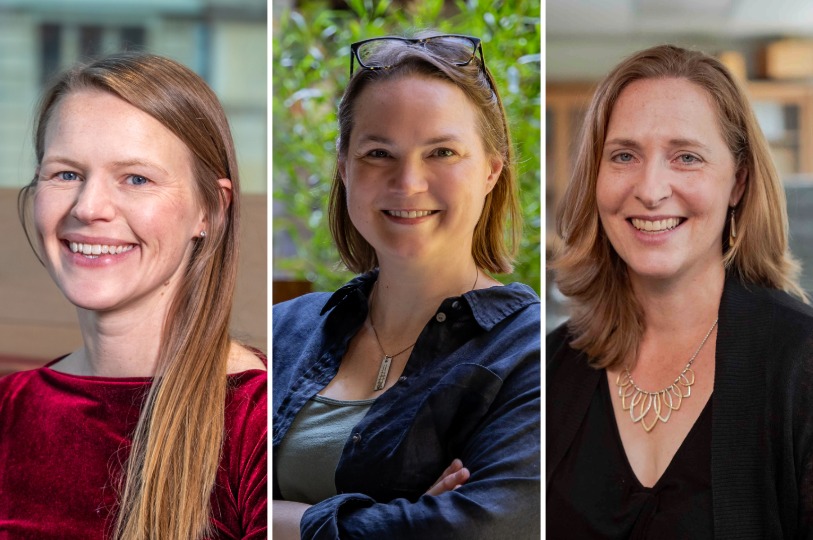
Left to right: Dr Lily van Eeden, Professor Katrina Dlugosch and Professor Andrea Dutton.
Combining conservation biology and social psychology
Dr Lily van Eeden, RMIT University
Successful wildlife conservation is not just about managing wildlife but also managing people, according to Dr Lily van Eeden from RMIT University
As one of the few scientists in Australia to combine conservation biology with social psychology, she studies and teaches how human behaviour impacts the environment.
Dr van Eeden is working with the Victorian government in Australia to design ‘behaviour change’ strategies that help communities and nature thrive together.
The Academy’s Graeme Caughley Fellowship will support Dr van Eeden’s travel to India, Germany and the United Kingdom to share her unique approach to conservation.
“Awarding me this fellowship is not only recognition of my work, but also an indication that the Australian environmental research field is recognising the critical importance of understanding the human dimensions of environmental challenges,” Dr van Eeden said.
The Fellowship commemorates the work of Dr G.J. Caughley FAA in ecology and wildlife management and is financed through the generosity of his friends and colleagues.
Combatting invasive species
Professor Katrina Dlugosch, University of Arizona
Professor Katrina Dlugosch is a leading expert on invasive species – plants and animals that move into new areas and often cause environmental or agricultural damage.
She will visit Australia thanks to the Academy’s Rudi Lemberg Travelling Fellowship.
Her research focuses on genetic variation, exploring how the DNA within invasive species populations allows them to adapt and evolve incredibly fast to survive in new homes.
Recently, her team has been investigating the microbiomes of invasive plants to see if the tiny microbes living on them give them an unfair advantage.
By uncovering these genetic secrets, Professor Dlugosch is helping to develop new biocontrol methods to manage pests more effectively.
Professor Dlugosch said she will share her work at universities, botanical gardens, and government centres across the country.
“I look forward to these conversations sparking new ideas and insights for me, as I hope they will for others.”
The Fellowship honours the memory of Professor M.R. Lemberg FAA FRS, a pioneer in Australian biochemistry and molecular biology, and is made possible by a generous gift from his wife, Mrs Hanna Lemberg, and the Australian Society for Biochemistry and Molecular Biology.
Coastal evolution under a warming climate
Professor Andrea Dutton, University of Wisconsin-Madison
Recipient of the Academy’s Selby Fellowship, Professor Andrea Dutton’s research focuses on understanding the dynamics of past climate and sea level change to project predict future coastal evolution.
Her work focuses on the behaviour of ancient ice sheets and sea level changes during past warm periods in Earth's history, using coral reefs as key archives of sea level fluctuations.
Professor Dutton is renowned for her highly interdisciplinary work, and her ability to bridge diverse disciplines has enabled her to produce groundbreaking discoveries.
The Selby Fellowship will support Professor Dutton’s visit to Australia, where she will share her work with audiences in Sydney, Brisbane, Canberra and Perth.
“This award provides the opportunity for me to develop new collaborations and strengthen existing ones to better address important questions about the past and the future of our coastlines,” Professor Dutton said.
Dates and locations of Professor Dutton and Professor Dlugosch’s public lectures will be published on the Academy website once confirmed.