




Academy honours Australia's eminent scientists
The Academy has elected 28 new members for 2026, recognising outstanding contributions from ancient dinosaur discoveries to next-generation electronics.
- 4 mins read

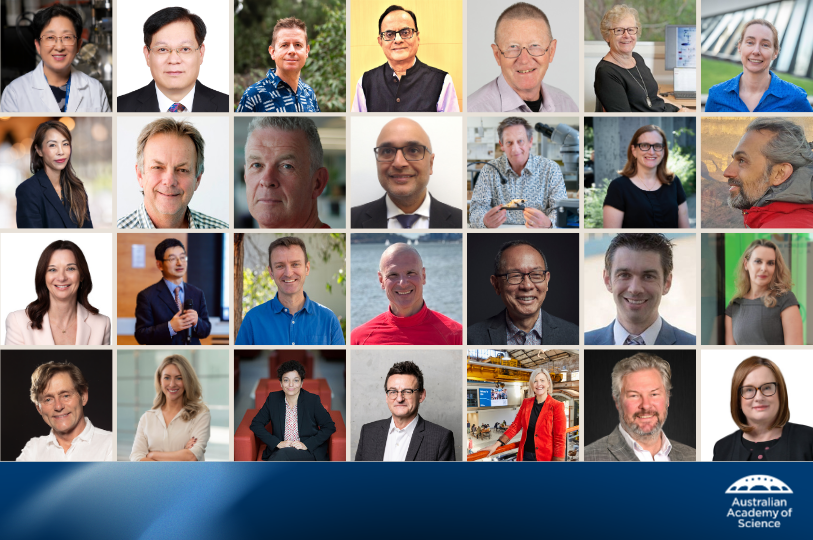
Today 26 Fellows and two Corresponding Members join the Australian Academy of Science’s Fellowship of 647 distinguished Australian scientists working across fields from fundamental physics to biomedical research.
President of the Academy Professor Chennupati Jagadish AC said this year's cohort demonstrated both the depth of Australian science and the path from discovery to impact.
“This cohort includes scientists whose work is rewriting the textbooks and has changed the world,” Professor Jagadish said.
“Professor Andrew Dzurak led the team that built the world's first silicon quantum bits and is now scaling them toward manufacturable quantum computers.
“Professor Sherene Loi's research has changed how breast cancer is diagnosed in hospitals worldwide.
“Emeritus Professor John Long has identified 90 previously unknown prehistoric taxa, reshaping our understanding of vertebrate evolution.
“Their work, and that of all 26 new Fellows, shows what Australia is capable of when its scientists are supported from fundamental discovery through to global application.”
Diverse research fields represented
Another of this year’s elected Fellows is Professor Yun Liu (Australian National University), an applied materials chemist whose pioneering research in defect and crystal chemistry has revolutionised materials design for future technologies, driving progress in electronics, energy and environmental applications.
Professor Liu’s research relies on world-class facilities, including neutron and synchrotron sources, high-resolution electron microscopes and atomic force microscopes.
“These tools allow us to probe matter at the atomic scale and solve complex problems in ways that were unimaginable decades ago,” she said.
“Every material you study is different, which means every day brings new challenges, and you are constantly acquiring new knowledge and skills.
“There is a sense of exploration, discovery and excitement that never fades.”
Palaeontologist Professor John Long (Flinders University) is also among this year’s new Fellows. His research has helped shape our understanding of vertebrate evolution and established him as a global leader in palaeontological research.
From Antarctica to Africa, Professor Long has discovered and formally identified 90 previously unknown prehistoric taxa. His discoveries include new kinds of ancient fishes, the world's oldest reptile tracks, and Australia's oldest theropod dinosaur.
Research by world-leading immunologist Professor Katherine Kedzierska (The University of Melbourne), another new Fellow for 2026, has significantly advanced our understanding of how the human immune system responds to dangerous viral threats including pandemic, avian and seasonal influenza viruses.
Professor Kedzierska was among the first researchers to investigate immune responses during the 2009 H1N1 influenza pandemic and avian H7N9 influenza in 2013. She has made important contributions to our understanding of immunity during the COVID-19 pandemic, work that underpins Australia's preparedness for future pandemic threats.
From discovery to global application
The work of this year's cohort moves Australian science from discovery to global application.
Professor Andrew Dzurak (University of New South Wales) led the team that demonstrated the world's first silicon quantum bits and now leads Diraq, scaling that technology toward manufacturable quantum computers.
Professor Sherene Loi (Peter MacCallum Cancer Centre) established a breast cancer biomarker now used in routine pathology worldwide and included in the World Health Organization Classification of Tumours.
Professor Robert Furbank (Australian National University) leads international work to redesign rice and wheat for higher yields and Professor Huanting Wang (Monash University) has licensed his membrane technology to companies across three continents.
Together, the 28 new members admitted to the Academy in 2026 span fundamental discovery, translational research and the commercial application of Australian science.
New Fellows of 2026
- Professor Nicole Bell FAA, The University of Melbourne
- Professor Céline Bœhm FAA, The University of Sydney
- Professor Philip Boyd FAA FRS, University of Tasmania
- Professor Cyrille Boyer FAA, University of New South Wales
- Professor Jochen Brocks FAA, Australian National University
- Professor Graeme Cumming FAA, The University of Western Australia
- Professor Kishan Dholakia FAA, Adelaide University
- Professor Andrew Dzurak FAA, University of New South Wales
- Professor Aleksandra Filipovska FAA FAHMS, The University of Western Australia
- Professor Jennifer Flegg FAA, The University of Melbourne
- Professor Robert Furbank FAA, Australian National University
- Professor Katherine Kedzierska FAA FAHMS, The University of Melbourne
- Distinguished Professor Yun Liu FAA FTSE, Australian National University
- Professor Sherene Loi FAA FAHMS, Peter MacCallum Cancer Centre
- Emeritus Professor John Long FAA, Flinders University
- Professor Laura Mackay FAA FAHMS, Walter and Eliza Hall Institute of Medical Research
- Professor Stefan Maier FAA, Monash University
- Professor Paul Martin FAA, The University of Sydney
- Distinguished Professor Nicolle Packer FAA, Macquarie University
- Professor David Raubenheimer FAA, The University of Sydney
- Professor Timothy Schmidt FAA, University of New South Wales
- Professor Enrico Valdinoci FAA, The University of Western Australia
- Professor Huanting Wang FAA FTSE, Monash University
- Professor Alpha Yap FAA, The University of Queensland
2026 Special Election
Each year the Academy’s Council may elect up to four persons whose election would expand the diversity of the Fellowship and be of significant benefit to the Academy and the advancement of science.
Specially elected members this year are:
- Dr Deborah Rathjen FAA FTSE, Carina Biotech
- Ms Sally-Ann Williams FAA FTSE, Board member with the Australian Research Council, Bank Australia and the Australian Ocean Lab
2026 Corresponding Members
The Academy has also elected two Corresponding Members, eminent international scientists with strong ties to Australia who have made outstanding contributions to science:
- Professor Ajay Sood FAA FRS (India), Indian Institute of Science, Bangalore India and Government of India, New Delhi
- Professor Yongguan Zhu FAA (China), Research Center for Eco-Environmental Sciences, Chinese Academy of Sciences