


From Melbourne to Kyoto: How an early-career researcher is building international collaborations
A Japan Society for the Promotion of Science Postdoctoral Fellowship catalysed Dr Dingchen Wen’s research career.
- 3 mins read

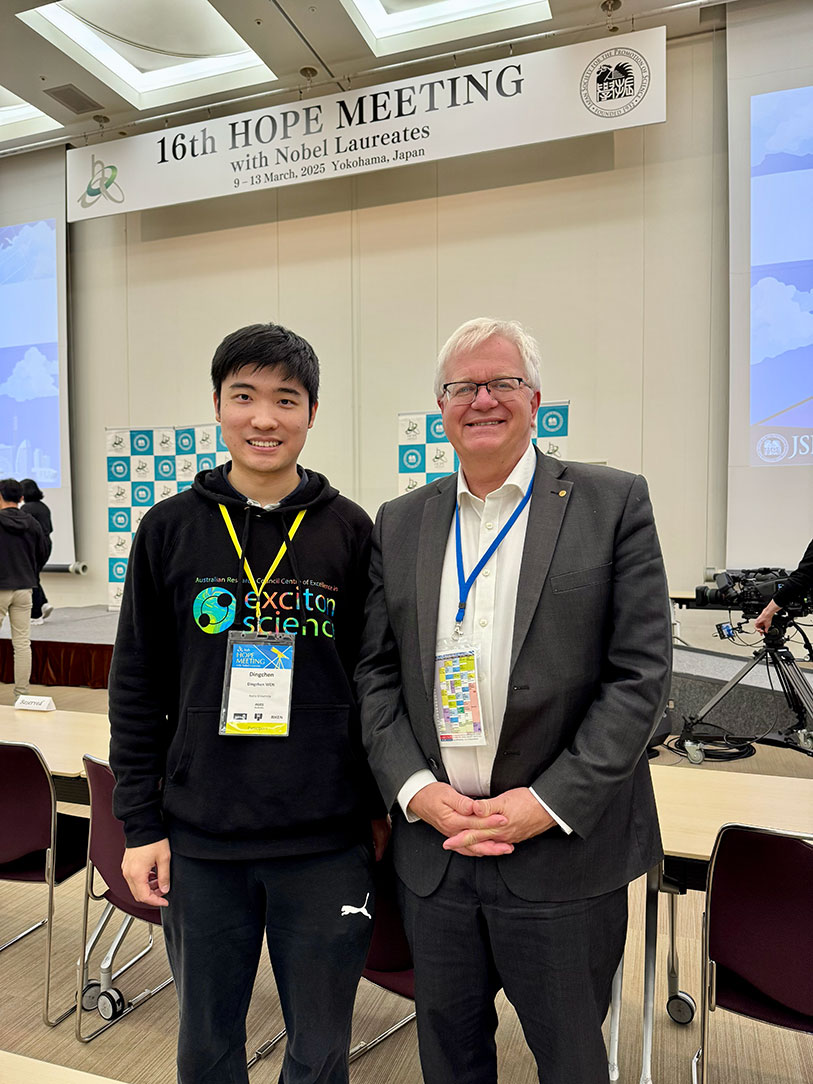
Dr Dingchen Wen with Professor Brian Schmidt AC FAA FTSE FRS Nobel Laureate at the 16th JSPS HOPE Meeting.
From meeting Nobel Laureates to advancing nanoparticle catalysts, early-career materials scientist Dr Dingchen Wen’s career has been transformed by a postdoctoral fellowship in Japan.
Dr Wen spent two years at Kyoto University and came away with both promising research results and a growing network that stretches between Australia and Japan.
“My time in Japan was an important period in my development as an independent researcher,” he says. “I am now working in a research position in Japan while continuing to maintain close contact with my former group at the University of Melbourne.”
Dr Wen’s experience, from 2024 to 2026, was supported by the Japan Society for the Promotion of Science (JSPS) Postdoctoral Fellowship and a KAKENHI research grant. He worked at Kyoto University’s Institute for Chemical Research under the supervision of Professor Toshiharu Teranishi, developing palladium-based nanoparticle catalysts.
Alongside an exciting research result – a previously unreported crystal phase for the palladium–copper alloy system – Dr Wen built an extensive network through attending eight conferences, presenting his work at five. He also attended the 16th JSPS HOPE Meeting, where young researchers from across the Asia-Pacific and Africa engage with Nobel Laureates and other leading scientists. Here, he had the rare opportunity to speak directly with six Nobel Prize winners, gaining advice on research careers and funding and hearing their visions for the future.
“This was probably the closest I’ve ever been to a Nobel Prize – at least for now!” he says.
As a result of these experiences, Dr Wen has established more than 30 international contacts. Several connections have developed into active collaborations with groups at Kyushu University, Hokkaido University and Meio University. He also hosted his former supervisor, Professor Paul Mulvaney of the University of Melbourne, to discuss future joint projects, building lasting connections between Australia and Japan.
This raft of new professional relationships has proved valuable, providing insight into the Japanese academic landscape and potential pathways for future collaboration and employment.
“Working in Japanese on a daily basis, including in technical and administrative settings, improved my ability to communicate professionally and to understand Japanese laboratory practices, funding systems, and institutional procedures,” he says. “Having experience in both the Australian and Japanese research environments is now particularly useful when discussing collaborations between the two countries.”
Dr Wen’s day-to-day experimental work was enhanced by specialist infrastructure, including the SPring-8 synchrotron and high-resolution scanning transmission electron microscopy. He was also immersed in a different research culture, and appreciated the strong emphasis Japanese researchers placed on experimental thoroughness and careful examination of results.
Beyond the laboratory, Dr Wen took part in the JSPS Science Dialogue program, visiting a Japanese high school to speak with students about scientific research – a valuable chance to explain complex ideas in a different way from an academic presentation.
Dr Wen hopes to use his experience and networks to support future joint projects, researcher exchanges and collaborations between Australian and Japanese institutions.
“What started as an opportunity to conduct research in Japan has turned into an experience that has shaped both my career and my personal life,” he says.
“I've met wonderful people, experienced a different culture, and gained a new perspective on research and life.”
His JSPS Fellowship shows how an international research placement can do more than advance a single project. It can build independence, create enduring professional connections and open new pathways for scientific exchange.
The 2027–2028 Japan Society for the Promotion of Science Fellowships are open for applications until 21 October 2026. Find out more and apply here.