



Pacific experts take sea level rise concerns to the UN
Climate change is already ‘an irreversible present loss’ but communities and researchers have developed locally grounded solutions.
- 3 mins read

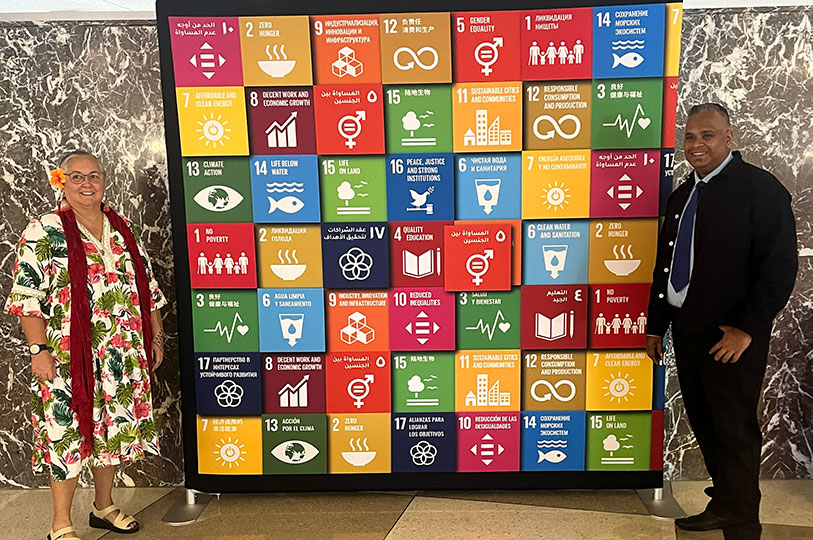
Dr Christina Newport and Dr Awnesh Singh at the United Nations.
Pacific Island communities are already losing freshwater, farmland and food security due to climate change, experts told a high-level side event at the United Nations Headquarters in New York on 6 May.
The discussion, titled ‘At the water’s edge: Sea level rise, water security and livelihoods in the South Pacific’, brought together Pacific scientists, policymakers, and climate negotiators at a critical moment for international climate and sustainable development processes.
Dr Awnesh Singh from the University of the South Pacific in Fiji and Dr Christina Newport, a Rarotonga and Mangaia researcher from the Cook Islands, presented the latest scientific evidence on the compounding threats that rising seas pose to Pacific Island communities.
Saltwater intrusion is already contaminating freshwater sources and wells, reducing arable land, and undermining the reef fisheries that coastal communities depend on for food security.
Around 70% of Pacific Island households rely on agriculture for their livelihoods, and progress on the Sustainable Development Goal (SDG) 6 ‘Clean Water and Sanitation’ remains off track across much of the region.
“Climate change in the Pacific is not a future threat. It is an irreversible present loss. Not just of land, but of language, identity, and the continuity of who we are across generations,” said Dr Newport, scholar at the University of Auckland and Principal Researcher at Akairo Consulting.
“Research that doesn't speak to lived experience stays on the shelf. Policy that doesn't speak to research causes harm. The bridge between them is community,” Dr Newport added.
The speakers emphasised that the challenge is not a lack of knowledge. Pacific communities and researchers have developed locally grounded solutions in water management, coastal adaptation and food system resilience. These innovations remain under-resourced and disconnected from international climate finance mechanisms.
The event was held alongside the 2026 UN Science, Technology and Innovation Forum. It was convened by the International Science Council (ISC) and the ISC Regional Focal Point for Asia and the Pacific (ISC RFP-AP), as well as the Permanent Missions of Australia and Tuvalu to the UN and the Pacific Small Island Developing States (PSIDS) group.
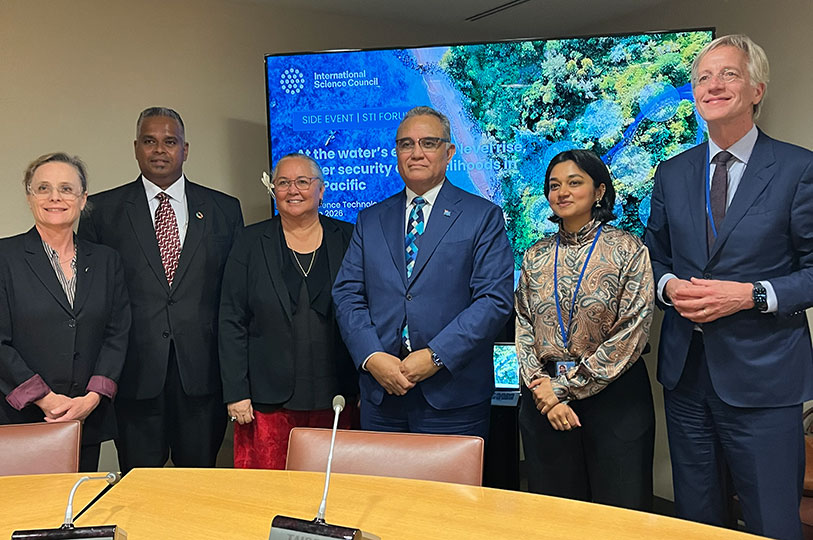
‘At the water's edge’ panellists, left to right: Her Excellency Ms Beth Delaney, Deputy Permanent Representative of Australia to the United Nations; Dr Awnesh Singh; Dr Christina Newport; His Excellency Dr Tapugao Falefou, Ambassador and Permanent Representative of Tuvalu; Arunima Sircar, Intergovernmental Panel on Climate Change and Climate Analytics; and Dr Robbert Dijkgraaf, President-elect of the ISC.
About the International Science Council Regional Focal Point for Asia and the Pacific
As the regional arm of the ISC, the ISC RFP-AP works to ensure that regional needs and priorities are adequately represented in the ISC’s global agenda, that regional voices are actively engaged in the governance and management of the ISC’s work, and that the region benefits from the results of that work.
The RFP is supported by funding from the Australian Government Department of Industry, Science and Resources.