


Sixty years of illuminating the history of Australian science
Tracing the origins and stories of the Academy's journal, Historical Records of Australian Science, in its 60th year of publication.
- 6 mins read

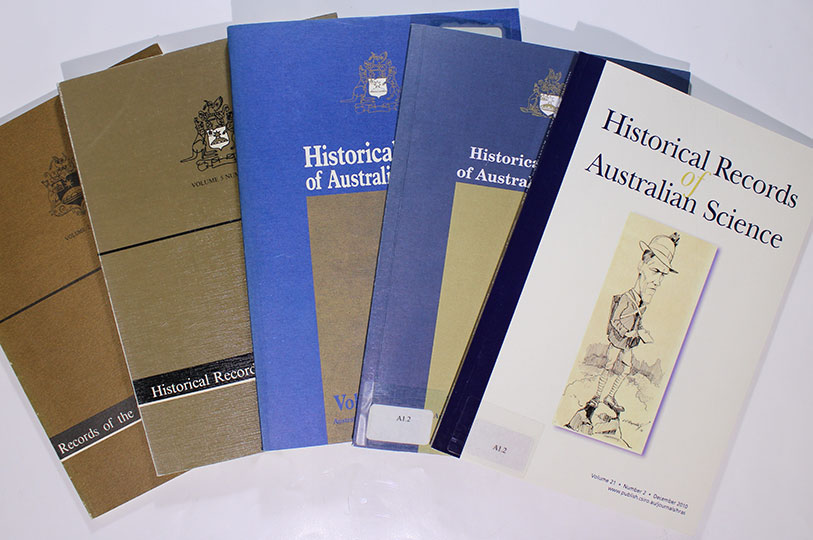
This year marks the 60th anniversary of the Academy’s journal Historical Records of Australian Science (HRAS).
Established in 1966, the journal has transformed from an Academy-specific publication to a respected, peer-reviewed journal. It remains the only dedicated history of science journal published in the Southern Hemisphere.
The journal’s beginnings
Originally known as the Records of the Australian Academy of Science, the journal’s establishment was not without difficulty.
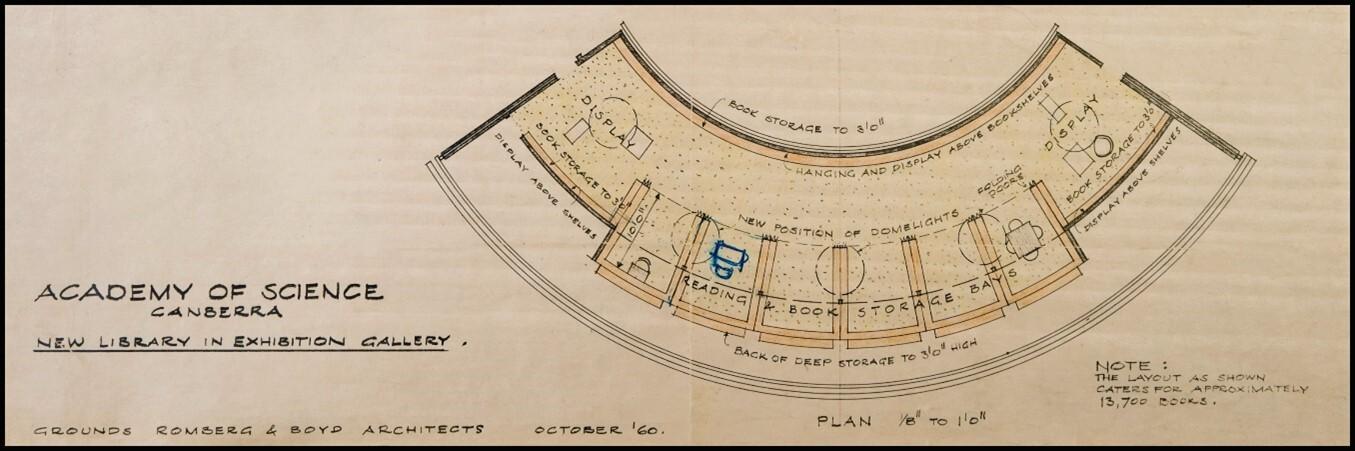
Mrs Ann Mozley, later known as Ann Moyal, was hired as a part-time research associate at the Academy’s Basser Library in 1962.
Having arranged for the biographical memoir of respected Professor of Anatomy Professor James T. Wilson FRS to be written, Moyal advocated for the Academy to establish its own journal in which it could be published.
In June 1964 she noted, “The Council of the Academy now finds that we lack the finance for this publishing venture at this stage ...”
But just five months later, she noted in a letter that “the Council of the Academy has agreed, in principle, to establishing a journal of the history of science and the question of costs and estimates is now being budgeted. It therefore seems as if we will have our own journal before the end of 1965.”
The first volume was eventually published in 1966.
It is fitting that the impetus for the journal centred around a memoir, as this remains a cornerstone for HRAS.
The journal’s first issue included a biographical memoir for geologist and Antarctic explorer Frank Stillwell.
The Academy’s then-president, Sir Frank MacFarlane Burnet, summarised this priority in the foreword of the inaugural issue:
“In the first place, our journal will provide a suitable place where the personality and achievements of deceased Fellows may be placed on record in a form equivalent to that of the Obituary Notices of our parent body [Royal Society].”
However, he also expanded the journal’s function beyond the Academy, writing,
“The lasting justification of the ‘Records’, however, will be as a repository for articles of scholarship and distinction on the history of science and scientists in Australia ... gradually become a forum for discussion of the interaction of science and the community and where necessary to help resolve tensions of motive, prestige and expediency within science itself.”
First decade of eclectic material
Despite the first issue in 1966 being met with praise and copies requested by libraries and Fellows alike, it also had its critics.
Moyal, who departed the Basser Library in 1964 and went on to become a respected author and science historian, wrote two letters to the Academy assessing the first issue, noting:
“The two articles are good; but I confess to keen disappointment in the Journal ... The saddening thing to me is that it makes no pretensions to standards; no editor, no Board, and no attempt to find a systematic method for its referencing. It is not a scholarly journal ...”
In fact, the Academy did have an established editorial board which included Professor John La Nauze, Sir Keith Hancock, Sir Harold Raggatt, Sir Robert Price and Dr Maxwell Day. Sir Mark Oliphant, the Academy’s first president, was also listed as a member.
Despite Moyal’s misgivings, the journal continued and over the next decade was summarised as an “eclectic collection of lectures, reports, articles and memoirs rather than as systematic scholarship.”
Dr John Phillip, an Academy Fellow and member of the editorial board, noted in 1978 that the future success for the journal would “require a level of professionalism not always achieved in the past. Regular, rapid, publication is a first desideratum … success would demand thorough-going professionalism and … careful and responsible refereeing.”
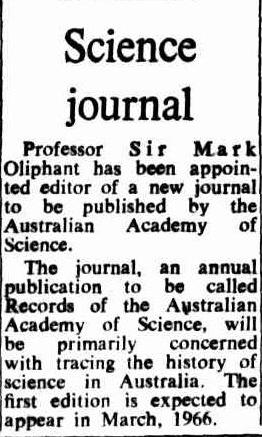
Newspaper excerpt, The Canberra Times, ‘Science journal’, 4 November 1965 reporting that Sir Mark Oliphant was the Academy journal’s new editor.
Professionalism and scholarly output
The year 1979 marked a turning point. Science historians Dr Lyndsay Farrall and Professor Roderick Home joined the editorial board and the next issue was published under the new title, Historical Records of Australian Science.
The new direction inspired confidence with an early special edition marking the Academy’s silver jubilee sent to Prince Charles.
CSIRO Publishing was also engaged to publish the journal, providing further support and expertise.
The journal was expanded to include book reviews and bibliographies, while lectures and presidential reviews were no longer included.
Professor Home attributes this revitalisation to the direction and support of then Academy president Dr Lloyd Evans AO FAA FRS. Indeed the 1979 Academy’s Council, led by Evans, “resolved to retain the historical focus of the journal and endeavour to expand its role in this area.”
Since then, the journal has continued to adapt to changes in the publication scene and technology. In 2015, the publication transitioned solely to online. A hybrid publishing model allowed open access options, with increasing 'Read and Publish' agreements allowing a larger proportion of content to be published open access. From 2024, HRAS moved to continuous publication and became available to researchers from lower-income countries free of charge through the Research4Life initiative.
From 2006, winners of the Mike Smith Student Prize had their research essays published in HRAS, representing a sustained effort to foster the next generation of historians of science.
Material variety
More than 784 pieces of content about Australian science history have been published since the first issue in 1966, including peer-reviewed research articles, book reviews, historical documents, biographical memoirs and bibliographies.
Research covers a wide variety of topics and areas of science from women scientists studying coral to efforts to stop disease in Australia’s fruit industry.
Content also goes beyond Australia’s shores with articles diving into forest surveys in Papua and New Guinea and earlier scientific endeavours in the Pacific.
The journal’s most cited article is ‘On visiting the 'Moving Metropolis': Reflections on the architecture of imperial science’.
Another notable article that attracted popular attention was Russell McGregor’s 2021 article, ‘Alex Chisholm and the extinction of the paradise parrot’.
The team
The success of the journal is due to its dedicated team. HRAS has had nine editors and co-editors over the last six decades. Many of these editors provided stability through their long terms. Professor Home served a total of 28 years as editor and then co-editor. Another long-term guiding-hand has been Professor Ian Rae, the journal’s current co-editor alongside Dr Ruth Morgan. Rae has been co-editor for more than 11 years, and was previously (from 2006) a member of the journal’s editorial board.
The Academy’s partnership with CSIRO Publishing has also proved integral to success, enabling HRAS to stay current with changing publishing trends and provide access to a variety of audiences.
The Academy thanks the Fellows and wider community who have supported HRAS over the last 60 years by editing, reviewing, serving on the editorial board, and submitting articles and memoirs for publication.
All Academy Fellows have free online access to HRAS articles through the Fellows Portal and more content is being released as open access.
Read through some highlight articles from the past 60 years:
- ‘On the Oliphant Deign, Now to Sound the Blast’: How Mark Oliphant secretly warned of America’s post-war intentions of an atomic monopoly
- Alex Chisholm and the extinction of the paradise parrot
- Robert Kirk: blood, genetics, race and rights in the twentieth century
- Building the history of Australian science: Five projects of Professor R.W. Home (1980–present)