




Professor Steve Redman, Neuroscientist
Professor Stephen Redman reflects on his journey from growing up on a farm in New South Wales to becoming a leading neuroscientist at the Australian National University.
Interviewed by Professor Hans Bachor at Ian Potter House on 05 September 2025.

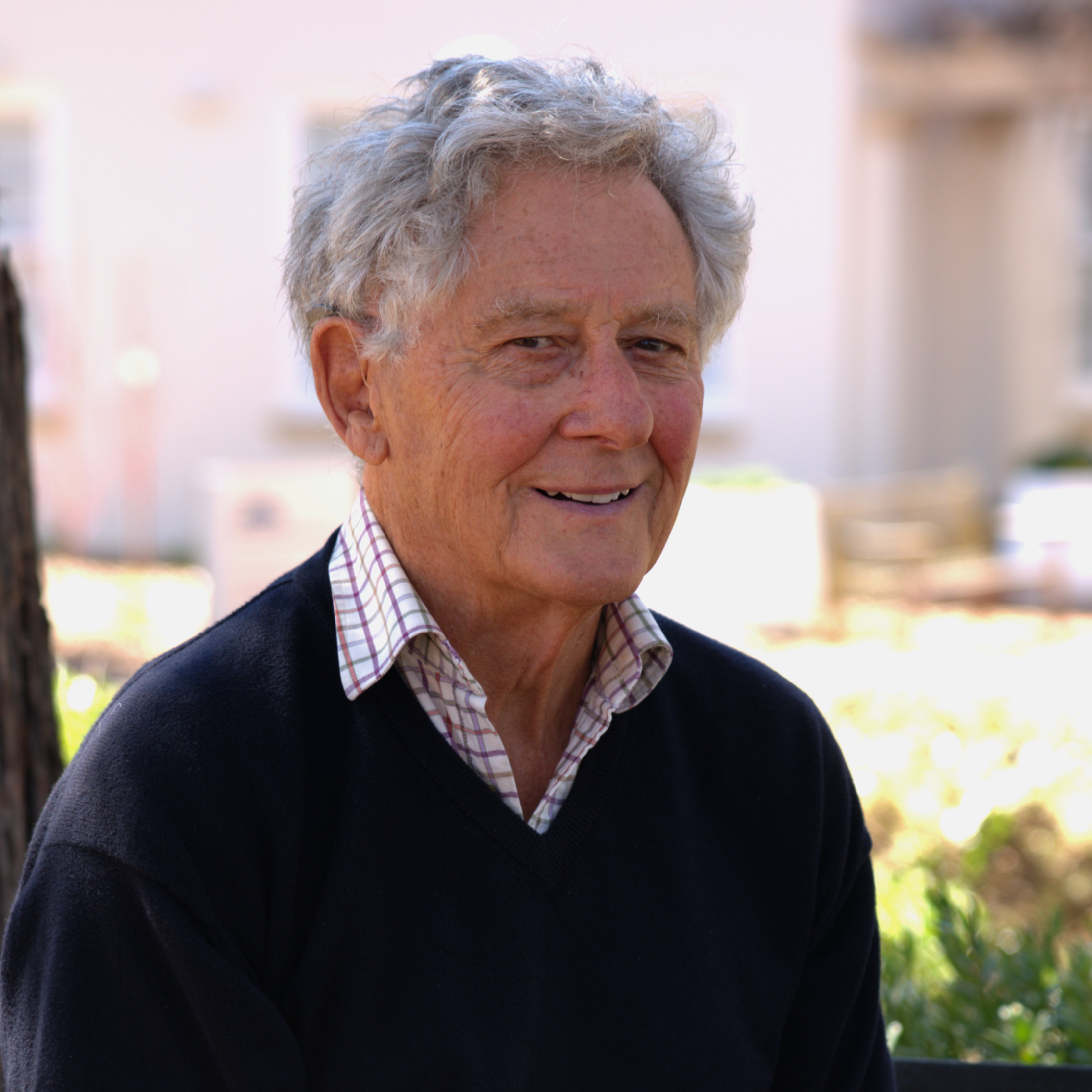
Professor Steve Redman
Professor Stephen Redman reflects on his journey from growing up on a farm in New South Wales to becoming a leading neuroscientist at the Australian National University. He discusses his transition from electrical engineering into neuroscience, including his interactions with figures such as Professor Doug Lampard, Professor Archie McIntyre, Professor Julian Jack, Professor Bob Porter, Dr Alan Finkel and Sir John Eccles. He reflects on mentorship and the value of scientific institutions such as the Australian National University and the process of developing the Single Electrode Voltage Clamp.
Welcome to Conversations with Australian Scientists, where we explore the minds behind scientific discoveries. I'm Hans Bachor and today we are delving into the intricate world of neuroscience. How nerve cells communicate, how the brain processes information, and the fundamental research that has shaped our understanding.
Our guest has played a crucial role in advancing our understanding of the complexities of excitatory synaptic transmission. But beyond the science, his personal journey is just as fascinating. What led him to the lab, the challenges he faced, and the moments that defined his career.
Joining us today is Academy Fellow Emeritus Professor Stephen Redman. He's a pioneering neuroscientist whose research has left a lasting impact on brain science. We will discuss his groundbreaking discoveries, his journey into neuroscience, and his thoughts on where this field is headed. Steve, welcome to our podcast.
Thank you, Hans.
Please, let us start at the beginning. Please tell us about your early years in life.
I was born in a very small town called Murrurundi, which is in the Hunter Valley in New South Wales. My father was the Anglican Clergyman, the vicar, there.
And I think the population was probably in the several hundreds max. My parents came from farming backgrounds, and my grandparents on both sides were all farmers. The only people I really knew in my young life were people who had farms. We moved from Murrurundi to Cessnock, and the Second World War had started. My father went in the army as a padre, and my mother took me and my little baby brother up to her parents' farm near Singleton for some of that time while he was away. And that's where I started school.
There was a little one-room school about five miles [in those days] away, and the only way to it was to ride a horse. I had to get up at age five and have my breakfast and saddle the horse and ride to school. At school there was a horse paddock and a saddle room where all the things went. It was a one-room school, and I was the only one in my class, and that meant I was the only one on the bench for my year.
Anyway, that was an experience, but eventually that ended. We all gathered again at Cessnock, and really the only influences in my life were farming people apart from my parents.
Eventually we moved to Maitland where there was an excellent high school, state high school, and I did all my secondary education there. And in retrospect, the maths and physics and chemistry teachers I had were outstanding, and I think that was where I started to love science. I was so enamoured with chemistry that I built my own chemistry laboratory at home. I salvaged building materials, I saved up, and I built this one-room building with a sink in it and a gas connection in it, and I made explosives. The time came at the end of school to decide what to do, and again my role models were very limited. Farmers were everywhere in my role models. High school teachers were also important role models. And as far as science went, that was it.
I really didn't know anything about scientific research, science as an occupation, let alone engineering. So I thought [I was] destined to be a science teacher and go to the University in Armidale but that didn't really feel right. I didn't want to be a teacher somehow.
Anyway, one day my father came home and he said, "I've just met this man who is an engineer, an electrical engineer working for what was then the Postmaster General's department, and he and his group look after all the telephone equipment in the Hunter Valley. And he said that you might like to come and talk to him," which I did. And that was really a very important turning point.
One day I hopped in the car with this chap, and we went on the rounds. We went to see new telephone exchanges being installed; using bi-motional switches rather than people with plugs. And most importantly, he stopped at a river I knew at lunchtime and pulled out his fishing rod. I love fishing. I thought, "This is some job. I'm going to be an electrical engineer." He told me about the cadetships that the Postmaster General's department had [that I could] apply for. And that was important because my parents couldn't send me to Sydney and keep me there unless I had financial support. Commonwealth scholarships paid fees, but they didn't pay board. I applied for a cadetship and got one.
I went to Sydney to do electrical engineering. And that was a big experience going to Sydney. I'd been to Sydney once in my life. To go there and become a university student in Sydney was a real culture shock. And I was terrified I was going to fail.
I worked like a navvy [for four] years. Engineering was a tough gig in those days. It was 40 hours a week, [with] lectures and laboratory work. [Reports had to be prepared for every laboratory session]. There wasn't much time to do anything else, but I made it.
So the cadetship means it was simultaneously studying at the university, but also some practical work probably.
There was only time for practical work in the long vacation. And that was interrupted by national service training. And for two summers I was in the Navy. I didn't want to be a soldier. [When] they interviewed me for national service training, I said I'd like to be in the Navy. And they said, do you know which side of the boat is starboard and which is port? But I did. I got in the Navy. And I spent both summers, one summer on an aircraft carrier, being a radar mechanic, because that's what they thought I should be. And the other summer learning to be just a navy dog's body.
So university, that probably was a master's degree in those days. So what was the end of that?
That was a bachelor's degree in electrical engineering. [At the] end of that, the postmaster general's department people who were looking after us selected a couple of us and [asked if we would] like to go and do a higher degree? Because we'd done well in our bachelor's course. And in those days, engineers didn't do PhDs. It was unheard of. They did master's degrees by research … and I had virtually no supervision. I was floundering. I was not getting anywhere. I was trying to work on digital communication in its various forms, because in those days, everything was analogue.
And along came a new professor. He was appointed early in that year I'd started, a fellow called Doug Lampard, who'd come from CSIRO. And he was transformational. That man pulled me into his office and got me on the whiteboard and said, what are you trying to do? I went through it.
Bang. Everything exploded from then. It was quite a tectonic shift. It then became an enjoyable experience rather than a frustrating experience. And he really taught me a lot about research.
You know, when the day was over, he'd take me over to the pub and he'd spill beer on the pub counter, smear it out, and then he'd solve equations with his finger in the beer. This was some man.
Certainly an inspiration.
He was.
And then from there, how did the neuroscience come into that?
Well, he had a friend who was a physiologist, a neuroscientist effectively, up at Sydney University, working on the visual system.
And he took me up there one day to see this man doing an experiment. His name was Bill Levick. [Both Lampard and Levick became Fellows of this Academy] in due course.
Bill was recording [at] the back of the eye [from] retinal ganglion cells that send their signals to the visual part of the brain while he stimulated the eye with moving images. This [was] in cats. And the messages coming out of the retinal ganglion cell were all impulses. It was digital coding and [I was] working on digital systems. I was absolutely stunned. I thought, wow, I've got to solve the coding behind this. I [asked] Lampard, is there any way [he see how] I could become a physiologist? He said, you [are] bonded to the postmaster general's department [and I am not sure how] you're going to get out of [that]. Anyway, that lingered.
I had to go to work eventually. They gave me a job, which was not uninteresting. It was to convert three-channel modulation systems, trunk systems, from vacuum tube technology to transistor technology. And transistors had only recently become available. I redesigned these three-channel systems with transistors. And they were germanium transistors that were heat sensitive. The test would be to go to the hottest telephone exchange in New South Wales and install them and see if they worked. The hottest telephone exchange was in a place called Tibooburra, which is a long way from anywhere.
They packed me and all my equipment into a DC-3. And off we went to Tibooburra, where I stayed for about two weeks in the hottest summer I can remember. And I had real problems [with temperature stability]. I eventually got everything [working], but it was a struggle. So that was my first big job, and it was a challenge. I took this equipment to [three] other exchanges and it [worked reliably].
And then I can't remember exactly the sequence of events, but not long afterwards, Doug Lampard was appointed as the foundation professor of electrical engineering at Monash University, a brand new university, [in the] early 60s. He said to me, "Would you like to join me down there?"
And, well, I said, "I would, but I would like to study neuroscience."
He said, "Oh, we can arrange that." So that was the deal.
Eventually I resigned from the PMG. I had to pay money to get out of the bond. And I became a lecturer at the age of 25 without a PhD, and I'd never taught anyone before. This was a big challenge.
So we were in your transition now from really practical engineer to neuroscience to PhD. You just mentioned you had taught, but the research seems to be the more attractive part.
Yes, I think I should mention Monash because it was, well, it was my first university job, but it was also a brand new university. The students were arriving within months of me arriving. They had to be taught.
They had to have laboratories to go to. Forget about doing neuroscience. I had an [urgent] job in front of me. I had to get courses ready and labs ready, which I did for the first year. It was exciting. It was intense, and committees just didn't occur. You made decisions in the corridor with one other person, and you got on with it. Money wasn't an issue. There was plenty of money. Fortunately, the number of students involved was very small. So that was my first year, and I look back on that first year as a very exciting year.
But eventually, this quest to become a neuroscientist surfaced again, and I knew nothing about the nervous system except I wanted to work on it. I talked to the professor of physiology, a man called Archie McIntyre, who was a neuroscientist and a very distinguished one. I think he looked at me somewhat quizzically because it was not common for people without medical backgrounds to do this sort of work.
He said, "I think you should sit in on the medical lectures." He [also] said, "I'm prepared to help you," which was wonderful. That was how it started.
Doug Lampard had some instincts as well as to how things should be done, but it was really the blind leading the blind between Doug Lampard and me with Archie McIntyre [giving us advice from time to time].
But a very important event occurred after about a year of this. We had a sabbatical visitor from Canberra, a man called Jack Coombs, who was Eccles’ right-hand man, as far as technical things went. He wanted to convert all his equipment from vacuum tubes to transistors. He thought he would learn how to design [electronic] equipment using transistors. And while he was there, he taught me dissections. He taught me about the equipment I needed, and he taught me a lot about the basics of doing a neurophysiological experiment. And that really kick-started me.
So there were both domains, right? So there probably were big open questions how the brain worked, but there were also challenges on the equipment side.
There were challenges on all fronts. I hadn't got up to the brain at this stage. I was on the spinal cord, and I was [studying] simple things like spinal cord reflexes, how we make movements. I found what I thought were some shortcomings [in the literature on spinal reflexes].
I went to Archie McIntyre and told him what I thought were shortcomings. He said, "These are wonderful ideas. Go and do some experiments on it." That became my PhD.
But I was very much the engineer and not the neuroscientist [in the way I was thinking], I hadn't really become a neuroscientist. I came to the end of that PhD. It was a tough time because I had to find time to do experiments. I had a lot of student work to deal with.
At the end of the PhD, I thought [I needed to work with a neuroscientist]. Archie McIntyre said, 'I've got one of my ex-students who now has an Oxford appointment, a man called Julian Jack, and I can arrange for you to go to his laboratory.' It was going to be a blind date. But he said, "You'll need a fellowship." And he suggested I apply for Nuffield fellowship, would fund me for two years in Oxford, which I did and which I got.
And after I got [the Fellowship] and I was getting ready to go away for a couple of years, this man walked into my laboratory whom I'd never met before, and it was Sir John Eccles, who'd won the Nobel Prize a couple of years before, I was a bit taken aback, I can tell you. He had decided to leave the ANU and go to Chicago. He said to me, "I want you in Chicago." Like that.
What was I going to do? I couldn't say no. I told him I had a Nuffield fellowship to go to Oxford, and he'd spent his formative career in Oxford, so he couldn't really say that's a bad idea. So he said, "Well, why don't you do both? Why don't you come to Chicago and then go to Oxford?"
I [talked it over to with] Archie, and he said, "Be careful. You'll learn a lot more in Oxford than you will in Eccles' lab." So in the end, a compromise was made, and I spent I think four or five months in Chicago and the rest of the time in Oxford.
And in retrospect, I'm very glad that's how it was, because while Eccles was very good to me and supportive, I must say that I think he'd come to the end of the exciting part of his career. And the experiments that I did in Chicago were not at all exciting and not at all stimulating. They ended up with publications, but nothing that really made me feel, "This is what I want to do."
Then I went to Oxford, and that was a - I must spend a little bit of time talking about that, because that was a transformative experience in my career. This man, Julian Jack, [whom] I'd never met before, only a few years older than me, had been a Rhode scholar to Oxford. He'd done medicine and then -- and done a PhD in neuroscience in Dunedin with Archie McIntyre. He had the intellectual skills to be able to read the literature, synthesize it, find the weaknesses in things that people had done and published and propose ways of [overcoming] those weaknesses. He had -- it was like a searchlight, an intellectual skill at reading the literature and picking the faults with it in a way that I've never met before and have never met since.
He's still alive, and he's still got that intellectual skill. [His lab needed an electrical engineer to make the equipment work reliably] I had the ability to make things work. We got on [very] well. We were both antipodeans in this Oxford environment where they all thought people from the antipodes were a bit weird. Oxford was a really wonderful experience, not only with Julian, but I went to lectures, I went to seminars, went to journal clubs with other people, and I [was] exposed to all kinds of ideas and ways of thinking about [neuroscience]. I think I came back from Oxford, a totally different person ready to take off…
With your own ideas now or with the vision –
They were somewhat derivative. I can't say they were all entirely my own. They were formed by the things that I was doing at Oxford, but hadn't done, things I wanted to do.
[Before going] back to Monash, I applied for a Queen Elizabeth Fellowship, which I got, and they were nominally for two years, but I had mine extended by another year, so I had three years. And that three years allowed me to get my own lab going, to get my own students [and] to really establish myself, because it was three years full-time research, [with] no teaching.
So you could pick any lab in Australia?
Well, I picked Monash. I went back to my old lab, and Lampard let me develop my own laboratory. I had wonderful workshops. I had a physiology department with lots of people I could talk to. I didn't have to give any lectures. It was heaven. Really, that's how my career took off.
And then John Curtin --
Well, no, no, John Curtin didn't come straight away. Those three years ended. All the good times had to come to an end. I had to go back to the teaching grind. And I taught engineers again, and the teaching load became heavier and heavier and I became more and more unhappy, because I couldn't get into my laboratory. I had some excellent PhD students, and they were my salvation. But eventually I started thinking, "I’m not going to spend the rest of my life this way.” I started looking for jobs, and I was nearly going to Seattle, but I didn't really want to leave Australia. Then Bob Porter, who'd been at Monash for quite a lot of the time I was there, and who'd become the director of John Curtin School, found a job for me.
So obviously people knew about you and your work, and they were looking for talent at ANU.
I had to pinch myself daily that I was in this [ANU] environment. It was so good. I didn't have to teach. I didn't have to write a grant. [I had the time to do experiments, I had access] to superb workshops, there was money to buy things that I wanted. I remember the day I was washing up my surgical instruments after an experiment the previous day. Bob Porter came down and saw me washing up instruments. He said, "You shouldn't be doing that. You should have a technician to do that." I'd never thought that I'd have a technician to wash my instruments. Well, that's how it worked. [Bob] would come [into my lab, watch us doing experiments, and if] he saw a way he could help me with some support facilities or a technician or a postdoc, he did it. [He was so supportive]. This went on for 10 years. Look, it was the most productive time of my career, and I'm so glad it happened.
So it was the environment, the type of people.
It was the supportive environment, the equipment, the technicians, the money that was available, and the students, the PhD students. I had some wonderful PhD students. They came from everywhere. [Not only from ANU]. They came from other universities. And postdocs.
You had a postdoc who followed you from Monash, didn't you?
Oh, yes. We mustn't forget him. He was my last PhD student at Monash. His name is Alan Finkel. Really a wonderful PhD student, but he wasn't so much interested in how the nervous system worked. He was interested in the equipment that we could use to do really fancy experiments.
We started developing a piece of equipment at Monash, which we called the single electrode voltage clamp. I should explain this. Up till that time, all measurements made in neurons, particularly neurons of mammalian nervous system, involved inserting one microelectrode into the neuron. And when you do that, you can measure the voltage inside the neuron, and you can pass current through the neuron, but you can't measure the voltage and the current that's causing that voltage at the same time. [To do that], you need two electrodes. [Well, inserting two electrodes into mammalian neurons without damaging them was not possible] so we had the idea that we [would] use one electrode to do it, and we'd switch its functions.
For a brief period of time, microseconds, it would be a voltage electrode, and for another brief period of time, it would be a current passing electrode. And because we're switching so fast, that switching was invisible [within the bandwidth needed]. That would behave like two electrodes. Well, we did it. It took a bit of work, and we had to design some [very] fancy [shielded] electrodes. [ANU provided the splendid support and environment for developing this instrument].
And of course, once we started using it and publishing [results], everyone around the world wanted one. There were no emails in those days. There were phone calls, and there were letters. And Alan decided he should set up a factory to make the single electrode voltage clamp. Most of his customers were going to be in the U.S. Most of the equipment that he needed, and the components, would be made in the U.S. So that's where he went.
He started a business called Axon Instruments, which was very successful. [Alan] worked hard [and made it into a superb instrument. [It became] the signature piece of equipment that people [used for electrical measurements in neurons] to this day.
So the idea obviously opened up new possibilities for the experiments, but it also became a commercial success at the same time. And then Alan had many roles after he did that.
Yes, it was an interesting time because we knew it was a goer. We knew everyone wanted one, so Alan decided he was going to go, and he said to me one day, "Do you want to come?" And I really thought about that, and I thought, "No, I've got such a wonderful job here at ANU, and I'm so excited by doing experiments and finding out more about the nervous system. Building a piece of equipment and selling it's not my thing." And I'm glad I made that decision.
Now, in those days, we also had this old-fashioned concept of sabbatical, so you could actually travel. Did you make use of that?
Not really. I was so happy where I was. I had so much time to myself. I didn't have to give lectures and be distracted by university things. I had virtually no administrative jobs. I'd go for little trips and maybe spend a week in a lab to see how people were doing things, but no, I didn't do that.
But still, an international network obviously appeared.
Oh, yes, that was important.
And then you moved up in John Curtin School.
Yeah, well, they changed the administrative arrangements from little groups like mine to divisions. And David Curtis was the first head of the Division of Neuroscience, and he was supportive, and he eventually became the director, and there had to be another head of the Division of Neuroscience, and that was me.
Stephen, while you were in your now administrative role at John Curtin your opportunities opened up for the facilities for the people and you were involved in that area as well.
Yes, I became acting director after Judy Whitworth was appointed [as Director] and it became very clear early on that to get research money for laboratory experiments that required the containment of viruses; we had to have a new building. My main role as acting director to Judy was to get the architecture competition going to decide on the design of a new building, and then once we decided on the design and shape of a new building to help raise the money. It was fun getting the design and choosing the design and now the building's there, you can see how great it is. Getting the money was not fun, it was tough, and it was decided we would have to build it in [stages], because [you'd] never get all the money in one go. We needed $35 million for stage one. Judy had a promise of $3 million from the Department of Health, where she'd previously worked, if we used it in the next couple of years. And we got another million dollars from the ACT government. The bargaining chip with the University was that $3 million was going to go if we didn't get the rest. Well, we tried all kinds of things. Eventually, the university got a loan for the first stage of the building. Once he first stage was up, the rest more or less followed, but it took a lot of legwork and a lot of my time, and I suppose that meant I just didn't do science in the same way that I'd done it before. But I don't regret that, because I think the end result is quite inspirational, and it's great for the people who came after me. [Being head of Neuroscience] wasn't a tough job until money became scarce, and it started to become scarce in the 90s. Scientists feel that they deserve more than other scientists when money's short, and those sorts of things lead to difficult times. I don't look back on that as if I did anything wonderfully creative as far as administrative things were concerned, but we kept neuroscience going in a pretty good way at John Curtin School."
And then at the same time, you obviously explored new ideas for instrumentation.
Yes.
I remember that you got into the optical [side] and started to work with physicists on campus, so that was probably also an opening up towards new technologies.
It was. And I was fortunate to meet a man called Hans Bachor a physicist who was an expert in optics. And here we are talking together, which is wonderful. But I went [to him] with a request to be able to make a microscope which would be good at the one micron level where I could use it to place electrodes onto synapses. And well, this was going to be a very expensive exercise and we were very fortunate that the Vice Chancellor [Professor Ian Chubb] was enamoured of our plan. [He liked the concept of] a physicist and a neuroscientist from different parts of the university talking to each other and planning things together. He came up with half a million dollars and that allowed us to hire a person and to get the project started. And it was successful. But unfortunately, I'd reached the stage of retiring by the time this was going, and I didn't capitalize on this wonderful instrument. And one of my regrets is that it happened too late in my career.
But I can compliment [you] that the instrument was built. You asked me, Is it possible? Yes. And it's been used, many copies of it in different countries. So it certainly contributes to science. And you had other young creative people coming through.
Oh, yes, and I actually had enough money to make some really good appointments.
So that continues for many of us.
I should mention along the way two key people that came in the '90s. One person, [who came] on sabbatical, was a chap called Per Anderson from Oslo. Per Anderson was the international figure for understanding part of the brain called the hippocampus. [The] hippocampus is where we make short-term memories, and there was some preliminary data indicating that the way short-term memories were made was by changing the strength of synapses at neurons in the hippocampus. I had developed techniques for studying synapses in the spinal cord on motor neurons and how the release of transmitter was probabilistic from these synapses and how conditioning stimulation could change the probabilities of release. He thought I should do this [in] the hippocampus because if [synapses on hippocampal neurones behaved in a similar way], that would be the basis of memory. I did that with a lot of help from him because it was not an easy preparation to learn to use. But in the end, we showed that we could, with conditioning stimulation, change the probabilities of release at the key synapses on pyramidal cells in the hippocampus. With different conditioning stimulation, we could either increase the probability of release or decrease the probability of release, and that to this day is the basis of making short-term memories.
And the other person who came was Meyer Jackson from Wisconsin. And Meyer taught me a lot about calcium buffering in neurones. I knew how to image calcium, but [Meyer understood] the theory behind calcium buffering and sequestration. And that, again, was a wonderful experience because the way in which synapses change their probabilities of release depends upon the way calcium is buffered when it comes into the nerve terminal.
So there was quite a progression of what could be observed as well as what could be understood at the same time. And John Curtin had both types of people, which is a great place to be. Let me make a little detour. Young people always ask, you know, we have these outstanding academics. We know about their results. We can read their paper. HANS: But they also had family or life balance or something like that. Did that ever play a major role in your personal story? How did you do that?
Well, going back to Monash days when I had two young children and trying to find time to do experiments, to do all my normal academic work, play rugby on weekends. I think I was a bit selfish. I think I didn't spend enough family time as I should have spent. Would I do it differently if I had it over again? I can't answer that.
But in a way, it's always an issue, isn't it? With creative people, you have to somehow find this balance and try to get it right.
My kids have grown up nicely, so maybe it didn't hurt.
So maybe look, let's look a little where we are now in neuroscience. We hear the word impact. Everybody asked for impact nowadays. How would you describe impact from your work? Was it the publications? Was it something else? Was it a combination of things?
Yes, I think my experiments with my students changed the way people thought about how synapses work in the central nervous system. The model synapse we used was the one that was so accessible, which was the connection between the stretch receptors in our muscles and the spinal cord motor neurons. Stretch receptors were easy to activate. They made what's called a monosynaptic connection with motor neurons. There were no other neurons in between. And motor neurons were the largest neurons in the central nervous system, so they were easy to record from. It was an ideal preparation for studying synaptic transmission. [We showed that] synapses didn't release the transmitter every time [they were activated]. Some were silent, unless they were conditioned. Some released transmitter every time. Some were intermittent. That was a new way to think about synaptic transmission.
[We] showed that synapses made on the dendrites of neurons could be as least as effective, if not more effective, in changing the voltage at the soma. That made people think about dendrites and the role of dendrites on neurons in a completely new way, because up to that stage, the general thought was that if a synapse is made on the dendrites, it's going to be ineffective compared with a synapse on the soma. Those two things, I think, changed [concepts] about how information is processed, if you like, at neurons in the nervous system. And now, those ideas, particularly the way in which synaptic input on dendrites gets to the soma, is a major area of research, not on motor neurons, but on principal neurons in the cortex.
So, on that foundation, is it now, again, ideas, or is it technology?
It's a combination. When I did it, I considered the membrane properties of the dendrites to be voltage independent. That is, they behaved as linear transmission lines. Once you make the voltage change by a significant amount, that's now been shown to be incorrect.
And so, the processing of synaptic input onto dendrites of most neurons is non-linear. It's extremely complex. And to measure what's going on in dendrites requires different technology from the technology I used. It's a combination of optics and different kinds of microelectrode recording.
And that's obviously very active field, not just here, but everywhere.
Everywhere.
So, in a way, you set a foundation that's spread widely and still motivates. We're doing this interview here in the Academy and you're an Academy fellow. Can you tell us a little bit how you got in touch with the Academy, or how this happened?
I don't think I'd ever heard of the Academy when I was at Monash University until my first mentor, Doug Lampard, was elected to the Academy. And I [asked him] "What's the Academy?" So, it didn't really feature in my life much when I was at Monash. I knew there were people at Monash who belonged to the Academy, Archie McIntyre and Bob Porter.
But I started to understand it a little more, or recognize its existence when I moved to Canberra in 1981. And I think when I was elected in 1983 or '84, probably sometime before then I started to take notice. I thought, "Oh, it wouldn't be too bad if I got elected to the Academy. That'd be fun." But, no, it was really after my election that I started to [learn] about the Academy.
Immediately I was put on a sectional committee. That was a revelation. How the Dickens, did I ever get elected to the Academy? And then on other committees like Council. So, it wasn't something I knew about in my early career.
But once you got involved, you saw what was possible.
Yes, I did.
Can you give us a tip what the Academy could do now? Maybe better than it does in the moment?
Well, yes. It's just my observation. I've just been to the scientific meeting, listening to some absolutely stunning science by people who have been elected to the Academy this year or by people who have been awarded prizes. And apart from people in the Academy, no one knows about this. And I think they should know about it. I mean, some of it would be very hard to explain to lay public, but some of it wouldn't.
And I think it would be so exciting to put it out there as a sort of, not so much an auditory radio program, but as a television program. You don't need to go into all the nitty-gritty details. People want to know what the practical application of discovery is. And there are so many things I heard in the last couple of days that have great practical application. So, I think the Academy could do a whole lot more there. And the support that the Academy has always given to young people through scientific education or through their postdoctoral experiences, that continues and that's important.
Steve, I'd like to thank you for the time you gave today and for telling your story. As we wrap up this episode of Conversations of Australian Scientists, we extend our heartfelt thanks to Emeritus Professor Stephen Redman for sharing his remarkable journey from his early days in electrical engineering to his pioneering work in neuroscience at the Australian National University. This interview is part of the Australian Academy of Science initiatives to preserve and celebrate the voices of our most influential scientific minds. You can listen to more interviews capturing important moments in the history of Australian science by searching for conversations with Australian scientists.
If you enjoyed today's conversation, don't forget to share this episode with fellow science enthusiasts.
Until next time, thank you for listening.
Conversation transcript
Transcript of Professor Stephen Redman's 2025 interview. Some changes have been integrated at request of Professor Redman to improve clarity.
Additional information
© Australian Academy of Science
Some re-use permitted (Creative Commons BY-NC-ND)