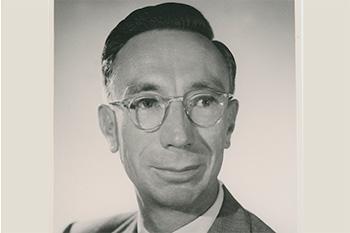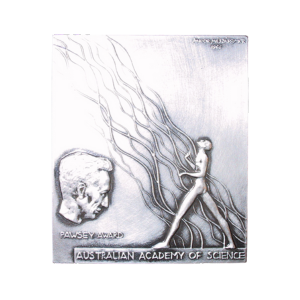



Joseph Lade Pawsey 1908–1962
Professor Joseph Pawsey FAA FRS founded Australia's radio astronomy program, detecting solar radio emissions and pioneering interferometry techniques that became standard tools worldwide.

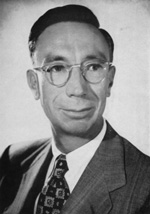
Joseph Lade Pawsey (1908–1962) was the founding leader of the radio astronomy group within CSIRO's Radiophysics Division, and a central figure in establishing Australia as a world leader in the field. After research training at Cambridge under J. A. Ratcliffe and wartime radar work at CSIRO, Pawsey turned to solar radio emission in 1945, and with L. L. McCready and Ruby Payne-Scott detected intense, non-thermal radiation from sunspot regions using the Lloyd's mirror technique – work that also introduced the principle of Fourier synthesis via two-beam interferometry, later developed into a cornerstone method of radio astronomy. His group went on to invent instruments including the swept-lobe interferometer, swept-frequency receiver, and grating interferometer, and contributed to early neutral hydrogen surveys that revealed the Milky Way's spiral structure. Pawsey co-authored the standard text Radio Astronomy with R. N. Bracewell (1955), presided over the International Astronomical Union's Radio Astronomy Commission (1952–58), and was elected a Fellow of the Royal Society in 1954 and a Foundation Fellow of the Australian Academy of Science. He died in 1962, shortly after accepting the directorship of the US National Radio Astronomy Observatory.