




William Sydney Robinson 1876–1963
W.S. Robinson was an influential industrialist who shaped Australian policy on metals during both World Wars, advising prime ministers and ensuring vital supplies of raw materials.

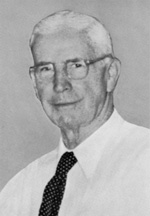
Born 3 October 1876, Melbourne. Educated at Hawthorn Grammar School, Scotch College and Longerenong Agricultural College; graduated with Diploma of Agricultural Science, 1894. Spent three years farming and orcharding before joining the Melbourne Age as a junior journalist; Financial Editor, 1900–1907. Visited Broken Hill 1905; commenced career of extensive travel in Australia and overseas. From 1908 engaged in financial and business affairs in London; a career which became worldwide; especially versed in the non-ferrous metal industry. He was advisor to the Hughes, Curtin and Chifley administrations during two world wars.
Robinson, universally known as "W.S.", has been described as the "titan of Australian industry and finance". Partly due to his vision, Broken Hill was revitalised. He promoted a policy of British Imperial self-sufficiency in the mining, processing and marketing of non-ferrous metals. "W.S." fostered many Australian industries including zinc refining, smelting, aircraft manufacturing and gold mining. He was associated with the Zinc Corporation successively as a Director (1920); Managing Director (1926) and President until 1952; became Managing Director of Broken Hill Associated Smelters 1915, and was associated administratively with the Burma Corpora tion, 1924–1945. He was a moving force behind the establishment of the Electrolytic Zinc Company of Australasia in Tasmania.
Robinson steadfastly eschewed honours and publicity. He was, however, awarded the Gold Medal of the Institute of Mining and Metallurgy (London), 1929; the Medal and Honorary Membership of the Australasian Institute of Mining and Metallurgy, 1949; and the Platinum Medal of the British Institute of Metals, 1952. Many individuals and many sectors of Australian industry owed him a great deal. Lord Chandos, an early associate, describes him as "a remarkable man" with "an originality far in advance of his times". Winston Churchill and Brendan Bracken acknowledged that his "services manifold ... to the British Commonwealth were beyond computation".