


2026 J G Russell Award recognises diverse research projects
Four early-career researchers will receive top-up grants to advance their experimental work.
- 3 mins read


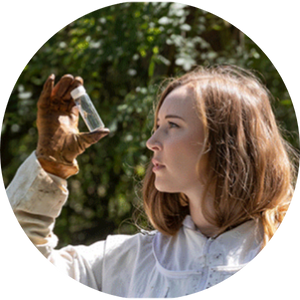
Clockwise from top left: Dr Jing He, Dr Jake Robinson, Dr Rocio Camacho Morales and Dr Jackie Webb.
Innovative projects spanning high-tech microscopes and sustainability will make further advances thanks to top-up funding from the J G Russell Award.
The 2026 award, administered by the Australian Academy of Science, will support experimental research costs for four talented early-career researchers.
Tiny tech, deep vision
Dr Rocio Camacho Morales, Australian National University
Standard microscopes have opened a new world of cells and molecular structures, but Dr Rocio Camacho Morales is developing a new bioimaging platform to see even deeper into living tissue.
Her approach uses ultra-thin nanostructures that make a device that's compact and easy to integrate with existing technologies. By capturing infrared light – which can penetrate deeper into tissue – and converting it into visible light that regular cameras can detect, she aims to produce richer, more detailed images of biological specimens.
This will unlock new opportunities for deep-tissue, non-invasive imaging and pave the way for early-stage patient diagnostics.
The J G Russell Award funding will enable Dr Camacho Morales to present her work at an international conference and to acquire equipment essential for high-resolution imaging of bio-samples.
She says she is honoured to receive the prestigious J G Russell Award.
“This award serves as a catalyst to accelerate the progress of my research, strengthen its impact and support my establishment in a new research direction.”
Reaping clean power: Making greenhouses greener
Dr Jing He, Adelaide University
Glasshouses and vertical farms – known as ‘protected cropping’ – make year-round harvesting possible, but rely heavily on expensive electricity for cooling, heating and, in some cases, lighting.
Dr Jing He’s research will help make this method of growing crops cleaner, cheaper and more resilient by showing how farms can combine renewable energy with smarter operating strategies. Using real operating data and trials with lettuce and tomatoes, she will develop guidelines that incorporate technical feasibility, environmental footprint and costs.
“The award feels like a vote of confidence that this research direction matters: making protected cropping more climate-resilient and lower-emission without losing productivity,” Dr He said.
Bad vibrations
Dr Jake Robinson, Flinders University
How does human-generated noise pollution affect soil health? Dr Jake Robinson is combining cutting-edge acoustic and DNA technologies in the field and the lab to investigate how noise impacts soil organisms.
Dr Robinson’s research will improve strategies for land management and ecosystem restoration, ultimately supporting nature conservation, climate resilience and food security.
“The outcomes will benefit environmental policy, agriculture and urban planning, helping to position Australia as a leader in soil health research,” Dr Robinson said.
Humanmade water bodies: Emissions source or sink?
Dr Jackie Webb, University of Southern Queensland
Dr Jackie Webb will undertake the first Australian assessment of farm dams, stormwater ponds and ditches to reveal the role of humanmade waterways in climate change.
These artificial water bodies serve as the first line of defence for capturing nitrogen run-off. Excess nitrogen produces nitrous oxide (N2O), a greenhouse gas 270 times more potent than carbon dioxide. Despite this climate link, artificial aquatic ecosystems remain absent from national and global emissions accounting.
Dr Webb will assess N2O emissions and nitrogen sinks in humanmade water bodies in Australia, closing this data gap.
Dr Webb said the funding will support both her field campaigns and her goal of being an emerging leader in aquatic science.
About the J G Russell Award
The J G Russell Award assists talented younger researchers in the basic sciences to meet the costs involved in experimental research.
Supported by the generosity of the late Miss J G Russell, the award provides top-up grants of up to $7,000 to be used on equipment, maintenance and travel.
Application for the J G Russell Award is by invitation only. Each year, highly ranked recipients of the Australian Research Council Discovery Early Career Researcher Award are invited to apply.