


Learned Academies and ACOLA: Joint response to the Strategic Examination of R&D
In a joint media conference, the Australian Council of Learned Academies and Australia’s five Learned Academies respond to the 'Ambitious Australia' report.
- 12 mins read

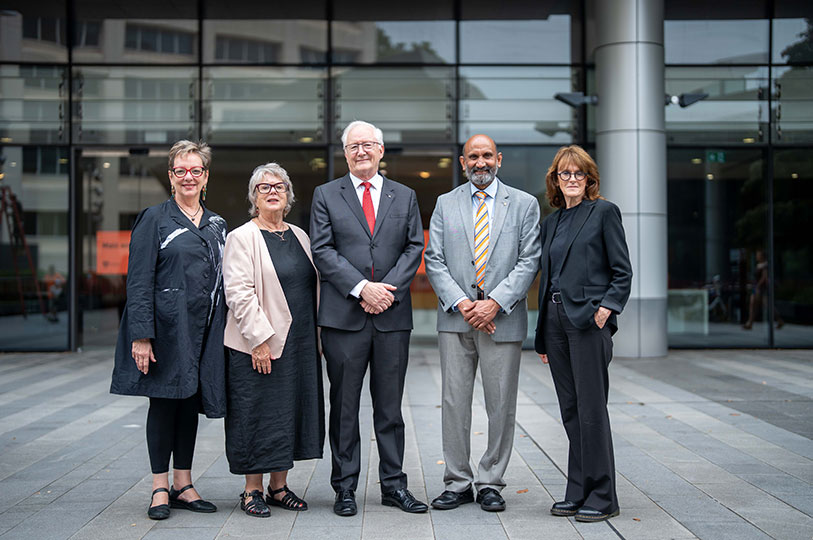
From left to right: Professor Louise Baur AM PresAHMS, President of the Australian Academy of Health and Medical Sciences; Professor Kate Darian-Smith FASSA, President of the Academy of Social Sciences in Australia; Professor Stephen Garton AM FAHA FASSA, President of the Australian Academy of the Humanities and Chair of the Australian Council of Learned Academies; Professor Chennupati Jagadish AC PresAA FRS FREng FTSE, President of the Australian Academy of Science; and Dr Cathy Foley AO FAA FTSE, President of the Australian Academy of Technological Sciences and Engineering.
This is a transcript of a joint media briefing held by Australia's five Learned Academies and the Australian Council of Learned Academies (ACOLA).
Check against delivery.
Professor Stephen Garton AM FAHA FASSA
President, Australian Academy of the Humanities, and Chair, Australian Council of Learned Academies
I'm Stephen Garton, President of the Australian Academy of Humanities, and also Chair of the Australian Council of Learned Academies. And we are here to talk about the Strategic Examination of Research and Development paper that has just been delivered in Canberra.
On behalf of all of the Academies, singly, and collectively through ACOLA, we want to express our support and endorsement of this strategic paper – a very important initiative for Australia's R&D environment. Something that will set us up for the future and ensure the future prosperity, improve productivity and sustainability of Australian economy and society in the future.
I'm going to ask each of the presidents of the five Learned Academies to say a few things and then we will wrap up. But first of all, I'm going to pass on to the President of the Academy of Sciences, Professor Chennupati Jagadish.
Professor Chennupati Jagadish AC PresAA FRS FREng FTSE
President, Australian Academy of Science
Thank you very much, Stephen. My name is Chennupati Jagadish. I'm currently serving as the President of the Australian Academy of Science, and we want to thank the Australian Government for commissioning the Strategic Examination of R&D and also the independent panel, which has made a comprehensive consultation with the universities, industry, government and the broader community.
This report has looked at, in a comprehensive way, the R&D system in the country and particularly the research and innovation system. This report makes certain recommendations, and if we implement those recommendations, we can really set the future for the next generation with excellent quality of life. But we are not the only ones saying this. Australia's Treasurer Jim Chalmers last year said that this is the defining decade for Australia to make defining decisions. The decisions we make in 2020 [are] going to determine the standard of living and then also the intergenerational justice we can create for the generations to come.
This report really looked at, in a very comprehensive way, the R&D system. And it's very important to make sure that we really implement that one. And particularly, looking at the research sector and the Government and also industry, how all of us can work together in order to be able to make the difference to the world and particularly to [our] Australian future for the next generation.
And again, this report has looked at: what are the gaps in the system, what are the overlaps and how do we make sure that our system is working, fit for purpose, in the current environment which we are living in [with] geopolitics.
This report has looked not [at] one program or one institution or one issue, but they really looked at in a comprehensive way, how do we make Australia a future leader? And also be able to really create the system such that our research and innovation system is going to make a big impact in terms of the future of our country, in terms of the growth of the economy, productivity, quality of life, and living standards we can really maintain for the next generation or so. And again, it's very important for us as a nation and particularly we need to work together, particularly this is a time that the Government need to act on this one.
The R&D system has been in decline for a long time. Investment in R&D has been going down for the last decade or so. We are at the bottom of the OECD countries. It is a time to act now and be able to change this direction from going down to the positive direction so that we can be able to reach the OECD country average or so. Without that action, what's going to happen is that our quality of life is going to go down, our economy continues to suffer, and our productivity continues to suffer as well. So that is why we really need to act now.
We hope the Government really looks at this report and then implements it in full because of the fact that this particular report has looked at the various aspects of the research and innovation system. It is very important to make sure that this package will be fully implemented in an effective way so that the entire system can be improved and in order to be able to reach this OECD average of 2.7% of GDP. It is very important for the industry, universities and government to work together constructively so that we can set the nation in the future direction so that we can really provide excellent quality of life for the next generation.
And also, I just would like to point out that the May Budget is really critical and I hope that the Government really acts on this report and then starts implementing some of these policies. So that this May Budget is a starting point for the next decade or so in terms of pushing Australia in the right direction.
Dr Cathy Foley AO FAA FTSE
President, Australian Academy of Technological Sciences and Engineering
Hello, I'm Cathy Foley. I'm the new President of the Academy of Technological Sciences and Engineering. And I think it's really fantastic to see the evaluation of the science, research and development community in Australia. It has been really important. Because what it has identified is that for our country to be as successful as the most successful countries on our globe, they all rely on research and development that is well funded and is supported – but not just at the end of the fundamental work research, which we need to keep going. And also the breadth of research. So it's looking at all the different disciplines that contribute and make a contribution, both from the fundamental sciences through to the applied sciences and the social sciences and humanities.
So that's really important, but also making sure that we have the good pathways to allow that research, which is world class in Australia, that could be funded and supported more so that we end up with greater outcomes – as we heard from the other presidents – that will lead to the prosperous nation that we want and that we have the potential to have.
So that's the first thing. But one of the things that's always tricky is: how do you actually implement something like that, where there's a massive, ambitious program put forward? And the details of being able to implement that in a way that will allow us to have a system that is not adding to the complexity and making sure that all the research dollars that are invested are used in a way that leads to the outcomes we are seeking. And that we also recognise roles and responsibilities so that we have everyone in the research sector and in industry and in government understanding how they contribute to be able to achieve the research right through to commercialisation or policy impacts.
And then I guess the final thing I just want to say is that it's really important that the science, research and development that's done here provides a lot of information that we need to make available as trusted advice. We need to make sure that we don't mix up the two different paths of being able to provide independent advice.
That is very important – through the Chief Scientist role and through the National Science and Technology Council is one pathway of giving trusted advice, and we need to make sure that that is something that is not mushed in unexpectedly with other areas so that we have the funding and the doing of the research being mixed together. So that's something we need to watch and I'm really hopeful that we're going to see great pathways forward, which will allow us to be able to turn the commitment, the passion, and the desire of not just the researchers, but also industry and government to be able to be the country we want to be.
Professor Louise Baur AM PresAHMS
President, Australian Academy of Health and Medical Sciences
Hello, I'm Louise Baur. I'm the President of the Australian Academy of Health and Medical Sciences.
The Academy of Health and Medical Sciences welcomes the ambition of the Strategic Examination of Research and Development [SERD], and its recognition that Australia's research, development [and] innovation system requires structural reform.
Many of the challenges outlined in the review are acutely felt by the health and medical research sector, including fragmented funding, workforce pressures, poor system coordination, and ongoing barriers to translating research into real-world benefit. This is an important moment. The SERD has given us an opportunity for a national conversation about Australia's research, development and innovation system.
Australia cannot continue to ask more of a system that is already under strain without addressing the systems that shape its performance. The health and medical research [system] is a vital national capability. It contributes not only to discovery and innovation, but to better health outcomes, a stronger health system and greater national resilience in the face of future health threats. What matters now is that this leads to serious reform.
The Academy will consider the SERD closely and provide a more detailed assessment of its implications for health and medical research in the coming weeks.
Thank you.
Professor Kate Darian-Smith FASSA
President, Academy of the Social Sciences in Australia
I'm Kate Darian-Smith, the President of the Academy of the Social Sciences in Australia. From the social sciences perspective, we really welcome the report, [and] congratulate the Australian Government and the expert panel members for their very considerable work in bringing this together.
Australia has a very proud history of research, development and innovation that has allowed our small nation to punch well above its weight in the global economy. And to provide a lifestyle and a quality of life for Australians that is the envy across the world. We support very strongly the focus in the report on improved coordination, the prioritisation of effort, increased funding to support the full costs of research, and in particular a renewed focus on research training for the next generation of researchers to step forward.
We also support the inclusion of First Nations knowledge in Australia's research and development. The SERD report has identified several pillars or priority areas, but these are just some of the important challenges facing Australia. We have many others that sit both under and across those pillars. They include social cohesion, regional security, resilience to economic shocks and international conflicts, challenges to democracy, just to name a few. And it's important, and I think the report does make this point, that Australia's research be broad and that blue-sky thinking and innovation be enabled both within those identified pillars as well as without it. So that we can continue to have that great record of innovation.
Each of those pillars and our research and development system will require input from across all of the disciplines of research. In some cases, that will be a heavier emphasis on physical and natural sciences. In other instances, the weight of research will lie with the social sciences and the humanities. Scientific and technical advances are not enough by themselves. They're very important, but they also require social, economic, and political insights coming from the social sciences and humanities so that they are embraced by our community and they can be fully transformative for Australia's future generations.
And it's important that these major reforms, signalled in this landmark report, to the research, development and innovation system ensure that governance and the implementation process for our national research and development is driven by different perspectives along with industry and other research stakeholders.
Thank you.
Professor Stephen Garton AM FAHA FASSA
Thanks Kate.
And from the perspective of the Academy of Humanities, let me also welcome and embrace the report. As the colleagues have indicated, this is a very important report and I think it strikes a very important balance between the notion of sustaining a foundational ecology for research across all disciplines, and then thinking through the challenges of where to allocate specific forms of research around particular items. I think getting that balance right is crucial and the future is multidisciplinary. The big challenges of the 21st century are definitely multidisciplinary and we need to bring all the disciplines to bear. It's important to drive much greater investment in science and technology and medicine and health, but each of those innovations always land in a society, a culture, and a human context. And therefore bringing the humanities and social sciences into that multidisciplinary perspective is part and parcel of really driving the agenda for the SERD report.
In summary, I want to say that each of the individual Academies and collectively through ACOLA, we warmly endorse this report. As you have heard, we think it's vital for Australia's future.
We think it has a series of very important recommendations and we urge the Government to think through these challenges swiftly. The Academies and ACOLA collectively and individually are prepared to step up to the mark to assist Government. Picking up Cathy's point about independent scientific advice, we see that as a crucial element of making sure the Government has the right support and the right advice to drive this agenda.
And although this is a bit portentous, let me say that 85 years ago, the Curtin–Chifley Government had to face a significant challenge about transforming the Australian economy in the context of war, and in it invested heavily in the knowledge infrastructure to set up Australia for the coming future. And interestingly, it got bipartisan support. The liberal opposition led by Menzies supported those initiatives and carried them forward when they got into government. That knowledge economy, that investment in the knowledge economy and research economy really set up Australia. I think we are facing another challenge now of similar moment, and I think the time is ripe for a significant investment in the knowledge and research economy to drive Australia forward in order to ensure increased productivity, social wellbeing, harmony, and social cohesion for the nation. It's a very important moment. And we are here to support the Government in this important initiative.
Ends.