




Review of Australia’s climate science capability reveals a mixed picture
Australia can improve coordination of national climate science programs to deliver better climate information to farmers and infrastructure planners, and to guide national efforts to mitigate the future impacts of climate change, according to a review by leading scientists.

MEDIA RELEASE
Australia can improve coordination of national climate science programs to deliver better climate information to farmers and infrastructure planners, and to guide national efforts to mitigate the future impacts of climate change, according to a review by leading scientists.
The Australian Academy of Science report recommends that government consider mechanisms to ensure better coordination of climate research across Australia’s universities and climate agencies. It also recommends increasing climate science capability in a number of critical areas, amounting to around 80 new research positions over the next four years.
The review surveyed all of Australia’s climate research agencies and centres, including the Bureau of Meteorology, the CSIRO, the Australian Antarctic Division and universities to identify how many Australian researchers are working across the various disciplines and sub-disciplines of climate science, and how well these different areas are performing.
It reports that while Australia is strong in areas such as thermodynamics and extreme weather events, there are some significant weaknesses in areas such as climate model development. This includes the Australian Community Climate and Earth System Simulator (ACCESS), micrometeorology (the branch of meteorology that deals with weather conditions on a small scale), boundary layer dynamics (the dynamics of the lowest part of the Earth’s atmosphere) and the modelling of two-way human/climate interactions.
Academy Fellow Professor Trevor McDougall, who led the review, said under-resourcing in specific areas detracts from Australia’s ability to deliver necessary climate and weather information to domestic end users and national and international organisations.
“Australia’s climate research sector is a fraction of the size of those in America or Europe, but we cover most of the Southern Hemisphere in terms of climate modelling and understanding,” Professor McDougall said.
“Many of our universities are considered to be world-class in this effort, but as a country we are falling behind in areas such as climate modelling.”
The report found that there are around 420 dedicated climate scientists across all of Australia’s universities and research agencies, with their research providing constant improvements in weather prediction and climate models in Australia and throughout the world.
The area most in need of attention is climate modelling, where critical under-resourcing means that Australia’s climate models are failing to keep pace with world’s best practice. To address this issue, the review estimated that around 30 new climate modellers and scientists would be needed over the next four years.
“These capability requirements are brought into sharper focus when you consider that our country is potentially more exposed to the impacts of climate change than most developed nations,” Professor McDougall said.
“Our location means that key factors that influence the climate in our region are not well represented in climate models developed by other countries. It is in our national interest to ensure our national climate science capability, built up over the past 50 years, is maintained. This will also mean Australia maintains its custodianship of many aspects of climate science research in the Southern Hemisphere.”
Other key recommendations from the report include ensuring the work of the Antarctic Climate and Ecosystems Cooperative Research Centre is funded beyond 2019 and that a broader review of climate-related research capabilities is undertaken by the Australian Government.
For a copy of the report visit the Australian Academy of Science website.
Media note: The Australian Science Media Centre will host an embargoed media briefing regarding the report at 10am AEST, Wednesday, 2 August 2017. The expert panel includes Professor Trevor McDougall Associate Professor Julie Arblaster and Dr Graeme Pearman.
Questions and answers
Is there a difference between climate science and climate change science?
Climate change science refers to the study of the long-term changes to the climate caused by natural and human factors. Climate science in contrast looks at climate processes more broadly. For example, one of the most significant natural influences on the variability of climate in the Australia is the El Niño – Southern Oscillation (ENSO). Climate science studies how the ENSO operates and a significant scientific challenge remains in extended prediction of ENSO events. Climate change science studies look at, for example, how ENSO may change under future emissions.
What does Australia’s current climate science workforce look like?
Climate science activity in Australia is carried out by approximately 420 full-time equivalent research staff working across four broad areas: 1) climate observation, 2) climate understanding, 3) climate modelling and 4) climate services. This figure takes into account the 15 full-time staff employed at the CSIRO Climate Centre in Hobart and staff at the new ARC Centre of Excellence for Climate Extremes.
Why was the review conducted?
The Academy instigated the review to assess how well Australia’s climate science sector is positioned to meet current and future demands for weather and climate knowledge, in the context of increasingly powerful and sophisticated tools and methodologies. Domestic and international changes in the way in which climate science is undertaken mean that there are both challenges and opportunities for Australia’s future climate science efforts, and this review is aimed at assisting the Australian government and the broader community to best manage this planning, by identifying those climate science capabilities of critical importance to the national interest.
Who conducted the review and what is their expertise?
The review was overseen by a steering committee including Professor Trevor McDougall FAA FRS (chair), Associate Professor Julie Arblaster, Dr Helen Cleugh, Professor David Griggs FTSE, Professor Rod Keenan, Professor Neville Nicholls FAA and Dr Graeme Pearman AM FAA FTSE. Members of the committee have expertise in meteorology, international research hubs, atmospheric research, climate adaptation and other areas of climate research.
How many submissions were received?
The Australian Academy of Science received 71 individual submissions and 14 organisational submissions to the review, including from organisations such as the CSIRO, Bureau of Meteorology, Antarctic Climate and Ecosystems CRC and the Great Barrier Reef Marine Park Authority.
What were the terms of reference for the review?
The review committee reported on:
- The extent and size of climate science in Australia.
- Current arrangements and characteristics of support of climate science in Australia, and the appropriateness of these arrangements for Australia’s future interests in climate science.
- Australia’s potential to sustain its climate science workforce in the future.
- Australia’s ability to respond to new developments in climate science.
- The means by which Australia’s climate science is disseminated to its users, and the appropriateness of the current arrangements for its dissemination.
Climate impacts and climate adaptation research were not part of this review.
Mentoring inspires donation to honour outstanding Earth sciences research
A humble backyard barbeque in Canberra four decades ago sowed the seeds for a generous donation that honours one of Australia’s greatest Earth scientists and recognises outstanding research into the structure and workings of our Earth.
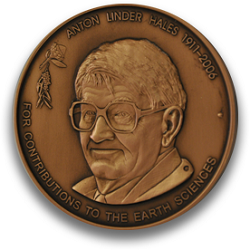
The Anton Hales Medal gives career encouragement to young earth scientists.
A humble backyard barbeque in Canberra four decades ago sowed the seeds for a generous donation that honours one of Australia’s greatest Earth scientists and recognises outstanding research into the structure and workings of our Earth.
The Australian Academy of Science’s Anton Hales Medal is named in honour of the late Professor Anton Hales FAA. Originally from South Africa, the geophysicist’s impressive career spanned three continents and covered nearly nine decades.
What remains unknown to many is the gift that made the medal possible.
That story begins in 1973 when Professor Hales, aged 62, moved to the ANU from the United States to become foundation Director of the Research School of Earth Sciences (RSES).
Professor Hales relocated with his wife Denise, who recalls being welcomed to Canberra with a BBQ invitation from Professor Ian McDougall FAA and his wife Pam. That gesture initiated friendships that continue today.
McDougall was one of the first members of staff recruited to Hales’s new school, where they worked together over the following decades. Like Hales, McDougall is also an internationally distinguished earth scientist.
Following Hales’s death at the age of 95 in 2006, a gift from the McDougalls saw the establishment of the award named in his honour, following discussions with Kurt Lambeck, then President of the Academy and also Director of RSES.
Pam McDougall says the idea behind the award was to not only honour Hales but give career encouragement to young Earth scientists.
The first recipient in 2009 was Professor Jeffrey Walker, a leading Australian expert on the remote sensing of soil moisture.
Walker has gone on to make further significant contributions in the field, including developing algorithms to derive high resolution soil moisture imagery from the Soil Moisture Active Passive (SMAP) satellite of NASA. The orbiting observatory measures the amount of water in the top five centimetres of soil everywhere on Earth’s surface.
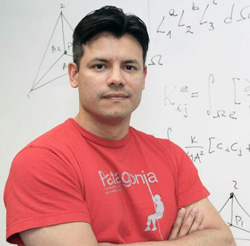
Associate Professor Juan Carlos Afonso was awarded the medal in 2017.
The ninth and most recent recipient of the Medal is Associate Professor Juan Carlos Afonso. He is at the forefront of revolutionising the way that geoscientists interpret the signals they obtain from deep in the Earth by geophysical methods.
Denise believes Anton would be pleased to see the boost that Ian’s gift has given to the recognition of Earth sciences research, his life-long passion.
“When I asked Ian recently what prompted the gift he spoke about Anton’s great capacity for mentoring,” Denise says.
“I hadn’t realised until now the great respect that Ian had for Anton. I know that Anton also held Ian in high regard because he was humble and a quiet achiever.”
Find out more about supporting the Academy
Past awardees
Academy welcomes state and territory commitments to zero carbon emissions
The Australian Academy of Science has welcomed commitments announced today by the Victorian, Queensland, South Australian and ACT governments to achieve net zero carbon emissions by 2050.

Photo by Karsten Würth
The Australian Academy of Science has welcomed commitments announced today by the Victorian, Queensland, South Australian and ACT governments to achieve net zero carbon emissions by 2050.
These commitments are consistent with the 2015 Paris Climate Accord committing 195 countries, including Australia, to action on climate change.
In particular, the Paris Accord marked international agreement that limiting global warming to 1.5–2.0 degrees above pre-industrial levels would require the world to achieve zero carbon emissions by the second half of the century, and reduce absolute levels of atmospheric carbon thereafter.
Australia is one of the highest per-capita emitters in the world, and our coastal infrastructure, agricultural and health sectors, and national treasures such as the Great Barrier Reef, are highly vulnerable to climate change.
The Academy has previously called on Australian governments to implement policy measures to reduce carbon emissions over the coming decades with the ultimate goal of reaching net zero carbon emissions by 2050, and the announcements by the three state premiers and the chief minister today are a very welcome commitment to achieving this goal.
Tri-nation gender equality recommendations released
A workshop convened in India late last year by the Australian, Indian and UK governments has led to the publication of cross-national recommendations for achieving gender equality in STEMM. The recommendations are designed to progress work done individually and collectively by the partner nations and recognise the diversity and inclusion benefits to all.
A workshop convened in India late last year by the Australian, Indian and UK governments has led to the publication of cross-national recommendations for achieving gender equality in STEMM. The recommendations are designed to progress work done individually and collectively by the partner nations and recognise the diversity and inclusion benefits to all.
Workshop attendees identified recommendations for each country to action either individually or collectively:
- Develop a proposal to the Indian Science Academies’ inter-academy panel to introduce an Athena SWAN framework to India
- Develop a strategy to leverage corporate social responsibility to support female internships across all three countries
- Develop a common set of messages for a digital campaign to promote women in STEMM across Australia, India, and the United Kingdom
- Consider developing a proposal to expand trilateral cooperation on promotion of Women in STEMM to the Commonwealth
- Strengthen coordination and development of and support for bespoke professional leadership programs for Women in STEMM
- Build an entrepreneurial support network under the STEMM professional and academic associations in India, Australia, and the United Kingdom
- Explore opportunities for University/Industry collaboration between India, Australia, and the United Kingdom
- Identify common gender STEMM regional and international data sources that provide consistent, systematic reporting of gender data and are available for the three countries.
Read the full report
Young Australian researchers collaborate with emerging scientific superpower
Can exposure to relaxing music help in the recovery of patients with heart failure? That is the question Dr Samia Toukhsati, Cardiology Research Fellow at Austin Health, is asking as part of an Australian Academy of Science Australia–India EMCR Fellowship.
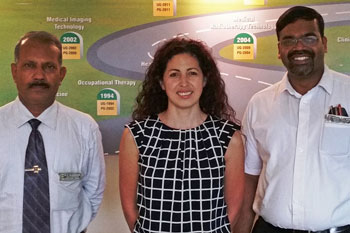
Dr Samia Toukhsati (centre) is being hosted by Dr B Rajashekhar, Dean, School of Allied Health Sciences, Manipal University (left). One of her co-investigators is Dr Abraham S Babu, Dept of Physiotherapy (right).
Can exposure to relaxing music help in the recovery of patients with heart failure? That is the question Dr Samia Toukhsati, Cardiology Research Fellow at Austin Health, is asking as part of an Australian Academy of Science Australia–India EMCR Fellowship.
Heart failure is a major global public health problem. Up to 60% of patients do not adhere to their prescribed medication, partly due to perceived side effects.
Dr Toukhsati’s research aims to reduce the risks associated with poor medication adherence in Indian heart failure patients, through music therapy. The trial builds on recent evidence of a positive effect of music exposure in Indian cardiovascular disease patients. Her co-investigators in the trial are Dr Abraham S Babu and Dr Padmakumar R from India’s Manipal University and Kasturba Medical College and Hospital.
Dr Toukhsati is one of four Australian scientists selected by the Academy from a competitive field of applicants to conduct research in 2017 at some of India’s leading research institutions.
The other Fellowship recipients are:
- Dr Md Shahriar Hossain (University of Wollongong), investigating superconductors for low-cost fusion power for a sustainable future, with the Institute for Plasma Research.
- Dr Vicki Thomson (University of Adelaide), working with the Tata Institute of Fundamental Research to study the disease risk from black rat species in India.
- Dr Mike Williams (CSIRO Land and Water, SA), identifying antibiotic and antimicrobial resistance in the Moosi River near Hyderabad using chemical and biochemical markers, with the Indian Institute of Chemical Technology.
Academy President, Professor Andrew Holmes, said that the Fellowships are an important component of Australia’s engagement with global scientific enterprise and serve to strengthen existing ties between researchers in Australia and India, the world’s second-most populous country and an emerging scientific superpower.
‘These Fellowships support high-performing Australian researchers to work with leading Indian scientists at major institutions. They facilitate greater collaboration between our two countries on science, technology and innovation,’ said Professor Holmes.
Australian early- and mid-career researchers are invited to apply now for the 2018–19 Australia–India Strategic Research Fund (AISRF) Early- and Mid-Career Researcher (EMCR) Fellowships.
They provide up to $40,500 for Australian researchers to travel to India and work with leading researchers at major Indian science and technology organisations for a period of between three and nine months. Applications close 11 September 2017.
Scientists lay out plan to future proof Australia’s agricultural sector
Australia’s leading agricultural scientists are calling on industry and government to establish a $100 million agricultural translation fund to help boost productivity and profitability, future-proofing Australian farmers against looming shocks like climate variability or major disease outbreaks.
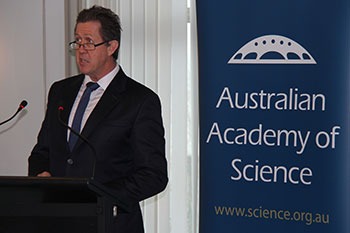
Assistant Minister to the Deputy Prime Minister, Luke Hartsuyker MP launching the Academy’s ten-year strategic plan for Australian Agricultural Sciences.
Australia’s leading agricultural scientists are calling on industry and government to establish a $100 million agricultural translation fund to help boost productivity and profitability, future-proofing Australian farmers against looming shocks like climate variability or major disease outbreaks.
The recommendation is one of five in a ten-year strategic plan for Australian Agricultural Sciences developed by the Australian Academy of Science.
Dr Jeremy Burdon, Chair of the Academy’s National Committee for Agriculture, Fisheries and Food, said that a new research translation fund supported by public and private equity would fast-track investment in the development of applications for the most promising Australian research and boost Australia’s economy through new and improved agricultural products and services in domestic and international markets.
The 10-year plan outlines strategies to capitalise on emerging technologies to create ‘digital paddocks’ that draw on a range of data sources to optimise planting, water, fertilisers and herbicides for various crops, depending on conditions.
It also outlines strategies to improve the strength and efficiency of agricultural research in Australia in ways that will increase the ability of governments and producers to maintain productivity and efficiency in the face of evolving natural challenges.
“Australia has repeatedly faced invasions of plant and animal diseases that, once established, consume large amounts of resources in order to regain control. Yet there are unfortunately plenty more to come,” said Dr Burdon.
“We know for instance that it’s only a matter of time until we see an outbreak of an aggressive invasive species such as the Varroa destructor mite that would devastate bee colonies and crop pollination.
“If the status quo is maintained, Australia will be unable to marshal well-coordinated research teams to prepare for and respond to these kinds of shocks. This will dramatically impact the Agriculture Minister’s vision to turn our agricultural sector into a $100 billion sector by 2025.”
The Academy’s report has also identified opportunities to improve efficiencies in the sector by streamlining governance arrangements between Commonwealth, state and territory governments, research agencies and universities.
“There remains a distinct lack of coordination of agricultural research and innovation in Australia and a culture of competition over collaboration,” Dr Burdon said.
“The scientific and research community must form stronger partnerships across sectors and industries, focusing on better-integrated global data, modelling and analytical capacities, to better respond to new opportunities and prepare for major threats to agricultural production.”
The full ten-year strategy is available from the Academy website. The Academy acknowledges the support of the Australian Research Council in the development of this plan.
Academy Fellow Dr Graham Farquhar awarded prestigious Kyoto Prize
Academy Fellow Dr Graham Farquhar AO FAA FRS has become the first Australian to win a Kyoto Prize—the most prestigious international award for fields not traditionally honoured with a Nobel Prize.
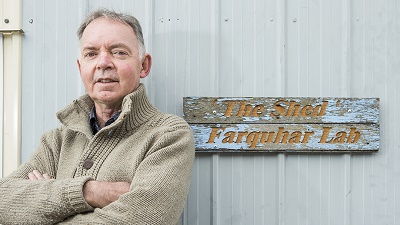
Academy Fellow Dr Graham Farquhar is the first Australian to win the prestigious Kyoto Prize. Photo: Stuart Hay, ANU
Academy Fellow Dr Graham Farquhar AO FAA FRS has become the first Australian to win a Kyoto Prize—the most prestigious international award for fields not traditionally honoured with a Nobel Prize.
Dr Farquhar has won the 2017 Kyoto Prize in Basic Sciences for his life’s work in plant biophysics and photosynthesis, which has involved research on water-efficient crops and the impacts of climate change.
He has helped develop new water-efficient varieties of wheat, improved global food security, and found evaporation and wind speeds are slowing as the climate changes.
‘It’s wonderful to get this kind of international recognition,’ said Dr Farquhar, from the Australian National University Research School of Biology.
‘The work that this prize recognises has really been a team effort, so I’d like to acknowledge my colleagues, students and the ANU, where I have worked for my whole career. It’s a wonderful honour for all of us.’
Academy President, Professor Andrew Holmes, said the Academy is delighted at the news of the award.
‘Dr Farquhar is renowned for his scientifically and economically important research into plant physiology and biology and further contributions to understandings of Earth’s climate systems,’ Professor Holmes said.
‘The Kyoto Prize has been awarded to such eminent people as Jane Goodall, John Maynard Smith and Masatoshi Nei in the past. This forms Graham's hat-trick of prizes—PM’s Science Prize 2015, Macfarlane Burnet Medal 2016 and Kyoto Prize 2017.’
Dr Farquhar will receive $600,000 as part of the award.
Kyoto Prizes have been awarded annually since 1985 in three categories—Advanced Technology, Basic Sciences, and Arts and Philosophy—to people ‘who have contributed significantly to the scientific, cultural, and spiritual betterment of mankind’.
Australia’s highest accolade for three Fellows in Queen’s birthday honours
Three Academy Fellows are among only 15 Australians to receive Australia’s highest accolade in this year’s Queen’s birthday honours, named as Companions (AC) in the General Division of the Order of Australia.
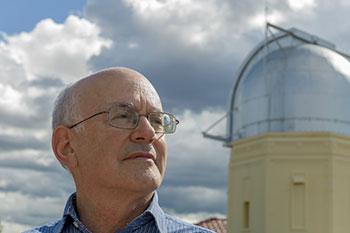
Professor Ken Freeman AC FAA FRS was one of three Fellows named as a Companion (AC) in the General Division of the Order of Australia. The others were Professor Peter Colman AC FAA FTSE FRS and Professor John Shine AC FAA. A total of 10 Fellows received Queens birthday honours.
Three Academy Fellows are among only 15 Australians to receive Australia’s highest accolade in this year’s Queen’s birthday honours, named as Companions (AC) in the General Division of the Order of Australia.
Professor John Shine AC FAA received the honour for eminent service to medical research, particularly in the area of biopharmaceuticals and molecular biology. He was among the first researchers to clone the insulin gene and the human growth hormone. Professor Shine was also recognised for his contributions to higher education as an academic, to professional medical organisations, and as a supporter of the advancement of innovation in science.
Professor Peter Colman AC FAA FTSE FRS was recognised for eminent service to medical research, as a leader in the commercial translation of scientific discoveries and as a mentor of young scientists. His research has had a major impact on our understanding of the epidemiology of influenza and led to the development of Relenza, an antiviral medication to treat the flu.
Professor Ken Freeman AC FAA FRS was recognised for eminent service to astronomy through pioneering contributions in the field of galactic archaeology and as a leading astrophysicist and researcher.
Regarded internationally as Australia's most renowned astronomer, Professor Freeman introduced the concept of dark matter, a finding that changed the course of astronomy. Dark matter makes up about 27% of the universe, which is not in the form of stars and planets that we see.
Professor Freeman was also recognised for his contributions to tertiary science education, to professional academies, and as a mentor of young scientists.
Fellows of the Academy recognised as Officers (AO) in the General Division of the Order of Australia are:
- Emeritus Professor Geoffrey Fincher AO FAA
- Professor Andrew Gleadow AO FAA
- Professor Ian Hume AO FAA
- Professor Angel Lopez AO FAA
- Dr Phillip McFadden AO FAA
- Professor Stephen MacMahon AO FAA
Emeritus Professor Robert Vincent AM FAA has been made a Member (AM) in the General Division of the Order of Australia.
Statement from the Australian Academy of Science—withdrawal of the US from the Paris Accord
“The Paris Accord in 2015 was a landmark in global acceptance of the need to avoid the worst impacts of climate change.
“The Paris Accord in 2015 was a landmark in global acceptance of the need to avoid the worst impacts of climate change.
“Signatories accepted that to limit global warming to 1.5-2.0-degrees above pre-industrial levels, we needed to reach net-zero carbon emissions by the second half of the century, and reduce atmospheric greenhouse gas levels thereafter.
“The withdrawal of the world’s largest economy from the Accord will certainly have an impact on global climate change efforts. However it shouldn’t affect the resolve of the many countries already committed to reducing greenhouse gas emissions. We acknowledge the Australian government's resolve to maintain its own commitment.
“Australia is one of the highest per-capita emitters in the world, and our coastal infrastructure and water resources in parts of southern Australia are highly vulnerable to climate change.
“By virtue of our position in the southern hemisphere, Australia also has primary stewardship for monitoring and understanding half of the world’s climate, so climate change must be central to public discussion and policy thinking.
“The Australian Academy of Science has a number of publications that help people understand the science of climate change, both our best understanding of the current situation and what is uncertain. The challenge is monumental—even more so following this announcement—and will require the very best science from around the world to provide understanding, to adapt to the existing impact of climate change; to suggest solutions and to evaluate the success of efforts to combat this global challenge."
Quotes attributable to Professor Andrew Holmes, President of the Academy.
Academy climate change publications
Nova: science for curious minds
- The enhanced greenhouse effect
- Climate change and rising sea level
- Climate change and human health
- Climate change and biodiversity
- The problem with methane
- Climate change and ocean acidification
- Climate change and coral bleaching
- Feeding a hot, hungry world
- Blue carbon
Australian Academy of Science welcomes changes to NHMRC grant funding
The Australian Academy of Science welcomes the changes to the National Health and Medical Research Council’s (NHMRC) grant funding program announced today.
The Australian Academy of Science welcomes the changes to the National Health and Medical Research Council’s (NHMRC) grant funding program announced today.
Professor Andrew Holmes, President of the Academy, is optimistic that the reforms will assist the NHMRC to fund and support health and medical research in a more targeted and equitable way in the future.
“The changes will provide better opportunities for outstanding early- and mid-career researchers, and will address concerns about the potential for loss of creativity in research. Previously, funding applications for new ideas that pushed the boundaries may have had less prospect of success,” Professor Holmes said.
“Of course adjustments will need to be made to the new system and we recognise some researchers will not be able to apply for the same number of grants as before.
“The new two-step review of applications will take pressure off both applicants and reviewers. Currently, applicants invest extraordinary amounts of time to apply for grants with a relative low chance of success. Time spent on unsuccessful grant applications is better spent on doing valuable research. These reforms free up researchers to get on with solving health and medical research challenges.
“I am encouraged that assessment of some grants under the new arrangements will be blinded to gender, age, career stage and institution.”
The reforms include replacing the longstanding Fellowship scheme and the Project and Program grants programs with three new streams, through which the majority of the NHMRC’s research budget will be allocated.
“Australia is a world leader in many areas of health and medical research, from the Nobel Prize winning discovery of the cause of gastric ulcers, to spray-on skin and the cervical cancer vaccine. The investment of taxpayers’ dollars in health and medical research by the NHMRC has had direct, beneficial outcomes for all Australians,” Professor Holmes said.
“As the size and complexity of research required to improve health outcomes increases, these changes will go some way to ensuring that the funding structures in place to support our highly trained and specialised medical researchers are as robust as possible.”
Media contact: Dan Wheelahan. dan.wheelahan@science.org.au ph: 0435 930 465