


Australia expands horizons for scientists through association with the world’s largest research program

The Australian Academy of Science welcomes the government’s confirmation of Australia’s association to Horizon Europe in early 2027, unlocking the world’s largest research funding program and strengthening global collaboration opportunities for Australian scientists.
Horizon Europe is the European Union’s flagship research and innovation funding program, worth approximately A$155 billion.
The Academy has advocated for Australia’s association to Horizon Europe since 2024, including through convening a 2025 dialogue on Australia–Europe research collaborations. This focused on the strategic benefits of deepening Australia’s research and industry relationship with Europe, in particular via association with Horizon Europe.
“We congratulate Minister Tim Ayres and the Government on concluding negotiations for Australia’s association to Horizon Europe,” said Academy President Professor Sam Berkovic AC PresAA FAHMS FRS.
“Joining Horizon Europe opens the door for Australian scientists to deepen participation in world-leading collaborative research, and places us among other associated countries like Canada, New Zealand and Japan.
“The benefits of this research will flow to Australia’s productivity and economy.
“Association also diversifies our international collaborations in an era of geopolitical uncertainty that can leave our research and innovation base vulnerable.
“Access to Horizon Europe is a win for science and is the result of sustained leadership, diplomacy and advocacy efforts by the Australian Academy of Science and other research sector allies.
“We also acknowledge the significant co-investment by Australia’s Group of Eight universities to make this happen.
“But association alone is not enough. It must be accompanied by sustained domestic investment in research and development and implementation of reforms to strengthen and restore Australia’s science system,” Professor Berkovic said.

Australia–Vietnam Science, Technology and Innovation Cooperation Initiative (AVSTICI) Grants

Program highlights
- Up to $1.3 million in funding to support Australian and Vietnamese universities, research institutions, businesses and industry to collaborate on mutually beneficial research projects.
- Grants of between $100,000 and $300,000 are available to eligible Australian organisations to support their project costs.
- Projects will focus on the priority areas of new and renewable technologies, a sustainable blue economy, and recycling and waste management.
- Projects will be for between 24 and 36 months long and support genuine collaboration.
- The program is a joint initiative of the Australian and Vietnamese governments, with each country managing its own funding and guidelines.
The Australia–Vietnam Science, Technology and Innovation Cooperation Initiative provides up to A$1.3 million in funding to support eligible Australian organisations to undertake collaborative research projects with Vietnamese universities, research institutes, businesses and industry partners. The initiative strengthens bilateral cooperation by supporting projects that build lasting science, technology and innovation linkages consistent with the Australia–Vietnam Enhanced Economic Engagement Strategy (AVEEES).
Funded projects are expected to contribute to one of three shared priority areas:
- new and renewable technologies
- a sustainable blue economy
- recycling and waste management.
Projects may run for two to three years and receive funding of between A$100,000 and A$300,000 per grant. The funding will support the eligible Australian organisation's component of collaborative research within the criteria set out in these guidelines. Vietnamese partners will be funded separately under arrangements administered by the Ministry of Science and Technology of Vietnam (MOST).
The initiative is jointly owned by the governments of Australia and Vietnam, noting that each country administers its side of the program independently. In Australia, program delivery is managed by the Australian Academy of Science with funding from the Department of Industry, Science and Resources (DISR). Vietnamese delivery arrangements will be implemented by the MOST. All applicants and partners must comply with their respective national requirements and obligations.
Key dates
Below are the key dates for the application process. While we aim to keep to this schedule, some dates may change depending on circumstances.
GUIDELINES
The following guidelines provide important information about eligibility, submission requirements and assessment processes. Please review them carefully before submitting an application.
Program eligibility
This program funds collaborative research projects that strengthen science, technology and innovation partnerships between Australia and Vietnam. To be eligible, applications must meet all project, applicant, and partnership requirements outlined in this section.
Each project must have a connected proposal from an eligible Vietnamese partner submitted within the coordinated call period. Both proposals must be assessed as eligible by their respective administering bodies and must use an identical project title to ensure they are treated as a matched bilateral submission.
If the collaborating Vietnamese partner proposal is assessed as ineligible, the Australian proposal will also be ineligible for funding.
Project eligibility
Eligible project types need to:
- be a genuine collaborative research project with an eligible Vietnamese project partner who has submitted a connected proposal
- address one of the research priority areas of:
- new and renewable technologies
- a sustainable blue economy
- recycling and waste management
- promote knowledge-sharing and strengthen science and research capabilities in both countries
- support mutually beneficial partnerships between Australian and Vietnamese businesses, universities, and/or research institutions
- enhance diversity, inclusion and equality, including mentoring and skills development opportunities
- deliver measurable outcomes such as new business and research collaborations, workshops and student participation.
Eligible project activities
To be eligible, activities must relate directly to the project, and can include:
- joint research activities between the Australian and Vietnamese primary partners
- conferences, workshops and symposia
- exchanges and secondments of personnel working solely on the project between the Australian and Vietnamese primary partners
- other activities as approved by DISR.
Alignment with Australia–Vietnam Enhanced Economic Engagement Strategy (AVEEES) priorities and bilateral science, technology and innovation intent
- Projects must demonstrate clear alignment with the AVEEES.
- Funded activities must contribute to shared science and technology priorities and support long-term knowledge exchange between Australia and Vietnam.
- Applicants should articulate how the proposed research reflects mutually beneficial collaboration in areas of strategic importance to both countries.
Project duration and collaborative structure
- The program requires projects to run for a minimum of 24 months and no longer than 36 months.
- Applications must also include a connected proposal from an eligible Vietnamese partner submitted within the designated call period with an identical project title. This collaborative structure ensures that both countries’ proposals are assessed as part of the coordinated bilateral process.
- There is no limit on applications from eligible Australian organisations, but each Australian project lead researchers may submit only one project application.
Eligible Australian lead organisations
- Australian tertiary education institutions under the Higher Education Support Act 2003
- Australian cooperative research centres
- Publicly funded research agencies
- Australian state and territory research organisations
- Australian public companies
- Australian private companies
- Australian not-for-profit research organisations
- Other Australian incorporated entities.
Australian project lead eligibility requirements
To be eligible for consideration, the Australian project lead must:
- be an Australian citizen or permanent resident based in Australia (including the Special Category Visa, Subclass 444) at the time of application
- be living in Australia both at the time of application and throughout the duration of the project
- be employed in an ongoing basis by the eligible lead Australian research organisation submitting the application.
Project partner eligibility
- Vietnamese partner organisation eligibility:
- As per any requirements and obligations applying to the Vietnamese project partner.
- Personnel eligibility for Vietnamese project leads and researchers:
- As per any requirements and obligations applying to the Vietnamese project partner.
- Additional project partners:
- Projects may involve multiple Australian and Vietnamese partners; however, applications must nominate a single, Australian lead organisation and a single, primary Vietnamese partner organisation.
- Only one eligible Australian organisation may submit an application as the Australian lead partner.
- The Australian lead partner will execute the funding agreement with the Academy and will be responsible for all aspects of grant administration, project management and reporting.
- All project partners, and associated project activities, must comply with current Australian Government sanctions to be considered eligible to apply for funding.
- Applicants must provide evidence of partner commitment, such as letters of support with confirmation of contributions to the project from partner organisations.
AVSTICI grant funding supports the Australian lead organisation’s delivery costs for the approved collaborative research project and enables activities that strengthen the partnership between the Australian and Vietnamese collaborators.
Approved grant funding will be released to the Australian lead organisation following execution of a funding agreement with the Academy. Grant funds cannot be used for activities or costs incurred before the funding agreement is executed. All expenditure must comply with the eligible and ineligible cost requirements outlined in these guidelines, and eligible expenditure must be incurred by the Australian lead organisation. All costs must contribute directly to the delivery of the project and be managed in accordance with the financial, reporting and governance obligations set out by the Academy.
Vietnamese project partners will receive funding separately under a program administered by the MOST in Vietnam. Each country manages its own funding allocations, governance and reporting requirements, and Australian organisations are responsible only for the administration and reporting of their own grant funds.
All project costs must meet the funding use requirements outlined above to be considered eligible. Expenditure must be incurred by the Australian lead organisation and contribute directly to the delivery of the approved Australian component of the collaborative research project. The following lists outline the types of expenditure that are eligible and ineligible under the program.
Eligible expenses
- Direct support costs for research activities, translation and promotion of outcomes undertaken in Australia and incurred by the Australian lead organisation. The supported activities must be approved in the project application and comply with the funding use requirements. Joint activities are eligible only to the extent that the Australian lead organisation incurs the cost and the expenditure relates to its Australian component of the project.
- Direct labour costs of the lead Australian organisation’s employees directly employed on the core elements of the project. Personnel are considered employees when a regular salary or wage is paid to them, out of which there are regular Australian tax instalment deductions.
- Up to 30% labour on costs to cover employer paid superannuation, payroll tax, workers compensation insurance, and overheads such as office rent and the provision of computers for staff directly working on the project.
- Contract expenditure covering the cost of eligible project activities that are contracted to approved Australian project partner organisations. All contractors must have a written contract prior to starting any project work. Invoices from contractors must contain a detailed description and breakdown of the work including hours and hourly rates.
- Travel expenses for employees of the Australian lead organisation, or approved Australian contracted project partner organisations travelling within Australia or to Vietnam to work directly on the project, including:
- domestic economy class airfares within Australia
- international economy class airfares between Australia and Vietnam for personnel working directly on the project
- internal long-distance transport, such as domestic flights or rail, to meet international flights in Australia or Vietnam
- accommodation costs in Australia and Vietnam, utilising long-stay, self-contained accommodation where possible
- daily per diem at Table 1 rates of the relevant financial years ATO Tax Determination for domestic and international travel – TD 2025/4
- Vietnamese visa costs.
Other direct project expenditure for the lead Australian organisation, as approved by the Department of Industry, Science and Resources.
Ineligible expenses
- Costs associated with research, personnel, travel or any other expense of a Vietnamese partner organisation
- Indirect costs of research not listed as eligible expenditure, such as salary for administrative staff, institutional overheads or other general operating costs
- Labour charges, contract costs or any other personnel related expenses incurred by organisations other than the Australian lead organisation
- Capital or operational facility costs, including purchase of non-program related assets, construction or renovation of facilities, and costs such as rental, utilities or similar operating expenses
- Costs involved in the purchase, upgrade or hire of software (including user licences) and ICT hardware
- Activities that would be undertaken in the normal course of business, such as website development, the purchase or development of standard business software, or debt financing and related financial charges
- Costs associated with the internal preparation of finance and audit statements
- Any activities, equipment or supplies that are already being supported through other sources
- Insurance costs, including any travel or medical insurance costs for individuals who are not personnel of the Australian lead organisation. Project partners must maintain their own insurance or similar coverage for any liability arising from their participation in the project
- Costs relating to the consumption or purchase of alcoholic beverages
- Staff recruitment and relocation costs
- Any costs incurred prior to the signing of a funding agreement
If your application is successful, we will ask you to verify project costs that you provided in your application. You will need to provide evidence such as quotes for major costs.
Not all expenditure on your project may be eligible for grant funding. The Department of Industry, Science and Resources makes the final decision on what is eligible expenditure and may approve other activities.
Applications must be submitted through the Good Grants online portal. All information requested in the application form must be provided, and the required supporting documents must be uploaded in the specified format.
Applications must be submitted by the deadline of 11.59pm AEST Monday 20 July 2026.
Supporting documentation requirements
Applicants must upload all required supporting material in the format specified in the application form. Applicants are responsible for ensuring that all documents are correct at the time of submission. Corrections or replacements will not be accepted after the application deadline. Applications with missing or incomplete supporting material may be deemed ineligible.
Required supporting documentation will include:
- a recent CV (maximum six pages including publication list) for the project lead at the Australian lead organisation
- a recent CV (maximum six pages including publication list) for the project lead at the primary Vietnamese partner organisation
- a recent CV (maximum six pages including publication list) for the project lead at each partner organisation, if relevant
- a letter of support from the Australian lead organisation
- a letter of support from the primary Vietnamese partner organisation
- a letter of support from each additional partner organisation
- a brief risk management plan and any supporting documentation, describing how you propose to monitor, manage and report identified risks
- additional documents that address your institution’s foreign interference policy and other national security requirements.
The brief risk management plan should outline how identified risks will be monitored, managed and reported, and must include consideration of cybersecurity and national security risks. The lead Australian organisation should describe how they will address risks relating to foreign interference and the unwanted transfer of technology, data or knowledge, including their approach to due diligence on partner organisations. Successful applicants may be required to provide a more detailed risk management plan following the award outcome, should further specific information be required.
Applicants will also be required to respond to questions on foreign affiliations in the application form. This information will be used by the Department to conduct due diligence checks, and additional information may be requested if needed. Applications may be declined if requested information is not provided or is insufficient.
For an application to be considered eligible, all required questions in the application form must be answered in full and all relevant attachments included at the time of submission. Incomplete or ineligible applications will not be considered.
All applications will first undergo an eligibility screening conducted by the Academy. Eligibility screening is based solely on the information and supporting documentation submitted in the application form. Applications that do not meet the eligibility requirements will not proceed to assessment.
Eligible applications will then be assessed for scientific merit by a panel of Academy Fellows with relevant subject expertise. Assessment will be based on the criteria outlined below.
Criterion 1: Collaborative research in priority areas (40 points)
Assessment will consider:
- the clarity of alignment with one of the priority areas
- the coherence and feasibility of the proposed research design
- the defined and complementary contributions of the Australian and Vietnamese partners
- the extent to which the project will strengthen science and research capabilities in both countries.
Criterion 2: Bilateral linkages and long-term collaboration (40 points)
Assessment will consider:
- the strength and credibility of the proposed bilateral collaboration
- the potential for lasting linkages beyond the project period
- alignment with the bilateral science, technology and innovation intent of the AVEEES
- opportunities for broader sector engagement or benefits, including future research, industry or commercial pathways where appropriate.
Criterion 3: Skills development, mentoring and inclusion (20 points)
Assessment will consider:
- the quality of opportunities for students, EMCRs and researchers to participate in skill-building and mentoring activities
- the measures proposed to support diversity, inclusion and equitable access to research and training opportunities in both countries.
Award decision and outcome notification
Final award decisions will be made by the Program Delegate within the Department of Industry, Science and Resources, following a joint decision-making meeting with the Vietnamese government. Once decisions are confirmed, the Academy will notify applicants of the outcome. Successful applicants will be subject to a media embargo and must not publicly announce their award until the Department has released the outcomes.
Following the scientific merit assessment, the Department will undertake due diligence checks on all applications and national security checks on the successful applicants. These checks form part of the overall eligibility assessment. Although the due diligence responses are not scored, the information provided, or not provided, may affect an application’s eligibility and whether it can proceed.
National security risk considerations
Applicants will be asked questions to help understand the risks to national security in the projects to enable personnel to implement mitigations and conduct research as safely as possible.
Risks to the national interest are broad and varying in their nature and impact. In science and technology research, they include foreign interference and espionage, intellectual property theft and the application of science and technology.
Eligible activities under this grant may have national security implications. It is your responsibility to consider any such implications of the proposed project and identify, assess and appropriately manage any such risks as reflected in your risk management plan, particularly relating to export controls, intellectual property rights protection, espionage and foreign interference and unwanted transfer of technology, knowledge, data or information.
You must inform the department if you identify any material risks relating to national security. To assist with managing security risks, you are strongly encouraged to review the department’s Guide to undertaking international collaboration and the Guidelines to Counter Foreign Interference in the Australian University Sector by the Department of Education.
Due diligence
We will conduct due diligence on your application to assess its suitability for this Grant Opportunity. Our due diligence will include an assessment of financial, legal/regulatory, governance or other related risks.
The scope of our due diligence will cover you and any Australian organisations that you may partner with to perform, facilitate or deliver the eligible activities under this Grant Opportunity (Partner Organisations). This may include Partner Organisations’ directors, officers, senior managers, key personnel and related bodies corporate (as defined in the Corporations Act 2001).
We may also consider any matters relating to you or your grant application more generally that could bring the Australian Government into disrepute under this Grant Opportunity.
Our due diligence will include reviewing the information that you provide to us as a part of your grant application, and may also include (but may not be limited to) reviewing:
- Australian Securities and Investments Commission (ASIC) or international company searches, including organisational extracts and searches of the banned and disqualified register, as well as bankruptcy and personal name searches
- adverse media searches
- search of matters before courts.
When we assess your application, we may consider and take into account any risk that your application could conflict with Australian Government policy.
We may ask you to provide us with further information to assist us in assessing risks identified during this due diligence process.
We may exclude your application from the assessment process if we determine that it presents an unacceptable level of risk.
Know your partner
You should ensure that you know who you are collaborating with by undertaking appropriate due diligence, proportionate to the risk and subject to available information, on all partners and personnel participating in the project. This should take into account any potential security, ethical, legal and reputational risks, and, where necessary, you should be prepared to demonstrate how you will manage and mitigate any identified risks.
Export controls
Australia’s export control regime limits the overseas transfer of goods and technologies listed on the Defence and Strategic Goods List (DSGL). The regime may apply to the export of products, and to any situation involving the overseas transfer, sharing, publication or brokering of controlled goods, technology, software or related knowledge.
It is your responsibility to consider whether the export control regime applies to your activity. If you are unsure whether your activity may require an export license, you should review the self-assessment guide for ‘controlled items’ and/or contact Defence Export Controls (DEC).
Foreign Affiliations
Eligible activities under this grant may involve partners or personnel with foreign affiliations. You must inform us of any relationships between project participants and foreign parties that could influence or benefit from the proposed activity. Such relationships may include foreign ownership or sponsorship, connections to foreign governments, militaries, political parties, or other organisations, and membership of foreign talent programs. You must also inform us of the establishment of any such relationships throughout the life of the grant.
This grant will not fund any procurement, commercial, business development or supply chain activity by a lead, partner or subcontractor from:
- any countries listed on the Autonomous Sanctions Regulations (this includes any goods or services originating from a sanctioned source);
- listed terrorist organisations for the purposes of the Criminal Code Act 1995 (Cth) (details are available here.);
- any entity listed on the ‘World Bank’s Listing of Ineligible Firms and Individuals’ posted on the World Bank Listing of Ineligible Firms and Individuals webpage;
- any entity, individual or organisations owned, controlled by, acting on behalf of, or at the direction of individuals, entities or organisations listed above; or
- any entity, individual or organisation that provides support, resources or assets (directly or indirectly) to any of the individuals, entities and organisations listed above.
Foreign Government Affiliations
Eligible activities under this grant may involve partners or personnel with connections to foreign governments. You must inform us if you, your project partners or any project personnel are receiving funding or benefits from, or otherwise affiliated with, a foreign government, including:
- a foreign state or local government
- a foreign military, intelligence organisation or police force
- an organisation owned or sponsored by a foreign government (such as a state-owned corporation or state-sponsored university)
- a foreign government talent program.
You must give proper detail to enable us to evaluate your relationship with the foreign government, and we may request further details from you. You must also inform us of the establishment of any such relationships throughout the life of the grant.
Intellectual property rights
Applicants must provide details of Intellectual Property (IP) arrangements in their applications. This includes both the use of IP in the project and the proposed ownership rights to IP generated by the project as well as strategies for protecting Australia’s interests. You and your project partners must negotiate arrangements and procedures for using and handling all IP created through the project, in a manner that is fair to all partners and beneficial to Australia. This may include the allocation of IP rights, or of income from IP, between you and your partners. The agreements should be in accordance with laws and regulations in Australia and provide for:
- adequate and effective protection and equitable distribution of any benefits from IP rights created in or resulting directly from cooperative activities (foreground IP rights)
- ownership of foreground IP rights to be allocated on the basis of respective contribution and equitable interests
- terms and conditions for the commercialisation and other forms of dissemination of the foreground IP rights
- adequate and effective protection of IP rights provided by the organisations, enterprises and institutions prior to or in the course of such cooperative activities, for example, the licensing or utilisation of such IP rights on equitable terms (background IP rights).
Australian participants should approach IP negotiations in line with the principles outlined on business.gov.au and the National Principles of Intellectual Property Management for Publicly Funded Research.
Disclosure of Commonwealth, state or territory financial penalties
You are responsible for ensuring that your application is complete and accurate. Giving false or misleading information to the Department is a serious offence under the Criminal Code Act 1995 (Cth). We will investigate any false or misleading information and may exclude your application from further consideration.
You must disclose whether you, any Partner Organisations, Relevant Parties or other persons of authority have been subject to any pecuniary penalty (not including penalty decisions under appeal or penalties paid), whether civil, criminal or administrative, imposed by a Commonwealth, State, or Territory Court or a Commonwealth, State, or Territory Entity. If this is the case, you must provide all relevant details to the Department regarding the matter(s) for consideration.
You must also inform us of any such penalty imposed against you, any Partner Organisations, Relevant Parties, or relevant persons of authority throughout the life of the grant.
Disclosure of International Financial Penalties
You must disclose whether any of you, any Partner Organisations, Relevant Parties or other persons of authority, have been subject to any pecuniary penalty (not including penalty decisions under appeal or penalties paid), whether civil, criminal or administrative, imposed by a foreign government or international regulation entity (e.g. WTO). If this is the case, you must provide advice to the Department regarding the matter for consideration.
You must also inform us of any such penalty imposed against you, any Partner Organisations, Relevant Parties, or relevant persons of authority throughout the life of the grant.
Successful applicants will be required to submit progress reports at the end of the first and second years of the project, where applicable, and a final report within six months of project completion. Reporting obligations will include updates on project activities, expenditure and outcomes including whether, and in what ways, the project has contributed to post‑COVID‑19 recovery objectives. Detailed reporting requirements will be outlined in the grant funding agreement.
Applications are to be completed through an online form found by clicking on the Apply button on the top right of this webpage when the round is open.
This program is supported by the Australian Government through the Department of Industry, Science and Resources.

Restore Science

- Nine in 10 Australians believe science is a force for good that makes our lives better, safer and healthier.
- When we produce our own scientific research on home soil, we can trust in how it's done and what it delivers. It strengthens our national security and our ability to solve our own uniquely Australian problems, rather than relying on the rest of the world.
- Restoring science investment is a shared national responsibility – because the industries, jobs and innovations it creates benefit everyone.
- Australia has the scientific talent, we need to back their ability.
Australia is at a defining moment for its future. Despite a long history of world-leading discoveries, Australia's science system is going backwards – at the very moment the world is moving forward, fast.
Artificial intelligence, clean energy, advanced manufacturing, biotechnology, quantum – these are not optional extras. They are the foundations of a secure, prosperous and self-reliant nation. A country that cannot generate its own knowledge cannot determine its own future.
Find out more on the Restore Science campaign website.
Australians back scientists as new national campaign calls for urgent action to stop the brain drain
New research commissioned by the Australian Academy of Science reveals that 9 in 10 Australians believe in the value of science.
Yet despite being one of the world’s most prosperous nations, investment in Australian science has fallen behind, raising concerns that our nation will be left without the sovereign capability it needs and our best and brightest minds will continue to seek opportunities overseas.
Today, the Academy launches Restore Science, its largest campaign in 70 years, calling for urgent action to restore investment in Australian science. This comes as funding in research and development continues to slide backwards – just 1.69% of GDP, compared to the OECD average of 2.72%.
Academy President Professor Sam Berkovic AC FAA FAHMS FRS said that as Australians, we’re proud of our homegrown success stories and restoring investment in Australian science is critical to put Australia back on a level playing field and ensure it can continue to compete on the global stage.
“From creating Wi-Fi and sunscreen to developing the cochlear implant and the cervical cancer vaccine, Australia is known for its cutting-edge innovation, research and development. However, the reality is that it spends a third of what its global peers do when it comes to backing scientists, researchers and doctors,” Professor Berkovic said.
“We are being consistently told that AI is the future, but without backing the research and development that will help realise the capabilities of AI, Australia will get left behind.”
Professor Berkovic said Australians agreed more needs to be done, after a national independent study showed:
- 89% believe homegrown science has a positive influence on our society
- 82% said they’ve personally benefitted from science
- 80% support public funding even when the payoff is not immediate
- 65% want funding restored once they know how far behind Australia has fallen.
“We are pleased the community, like us, believes in the power of science developed on home soil because we know science done here is science done right,” Professor Berkovic said.
“We’re talking about unlocking the latest technology for our farmers so they can continue to put food on our tables without us paying more in the supermarkets. We’re talking about protecting our greatest asset, our environment – like the Great Barrier Reef. We’re talking about discovering the latest cures to combat diseases and supporting preventive health to alleviate the rising pressure on our hospitals and frontline services.
“Australian scientists are world leading, and they deserve funding that matches the ambition and funding of our global peers. At a time of growing global uncertainty, adequate funding ensures we have control over our own destiny. The gap between public support and current levels of investment is now impossible to ignore.”
Dr Hayley Teasdale, from the Academy, said that close to 40% of early- and mid-career researchers are considering leaving the sector because of funding uncertainty.
“We’re hearing about scientists moving overseas or telling their children not to get into the profession because of funding uncertainty. We are sounding the alarm now and calling on our decision-makers, business groups and community to keep science going on Australian shores,” Dr Teasdale said.
“This is about what kind of country Australia wants to be – one that backs its own talent, builds its own capability and shapes its own future, or one that falls dangerously behind and pays more to catch up. If nothing else, our funding should be restored to the levels of our peers. We owe it to the next generation.
“Australia cannot deliver on AI, critical minerals and advanced manufacturing as priority areas that will shape our future without sustained investment in science. You cannot build the industries of the future without the scientists to power them.
“The solution is clear: it is time for the Government and business to recognise that funding science is a priority for Australians and a matter of urgent national interest.”
Submission – National Environmental Standard for Environmental Offsets
Australia's new environmental laws should be clear about environmental offsets being the last resort in the mitigation hierarchy (avoid, mitigate, repair and offset).
Australia’s environmental law reform will fail to halt biodiversity decline unless environmental offsets are made measurable, enforceable, and outcome focused.
The current Standard risks enabling offsets that meet process requirements but fail to deliver real ecological outcomes.
In order to achieve this, the Academy recommends:
- enforcing the Standard through outcome-based requirements, focused on measurable environmental protection and recovery outcomes, rather than process-based language alone. Enforce outcomes rather than principles
- amending the Standard to ensure offsets account for temporal lag and deliver equivalent biodiversity outcomes within ecologically relevant timeframes
- requiring rigorous, enforceable, transparent monitoring to ensure each direct environmental offset is demonstrably linked to relevant measurable ecological outcomes, and to prevent an offset from being treated as successful despite being ecologically ineffective
- clear definition of the terms ‘net gain’ and ‘compensate’, including a test of outcomes
- compulsory public reporting and enforceable obligations to ensure offsets achieve intended outcomes, including for projects of national interest.
Fellows celebrated in King’s Birthday Honours
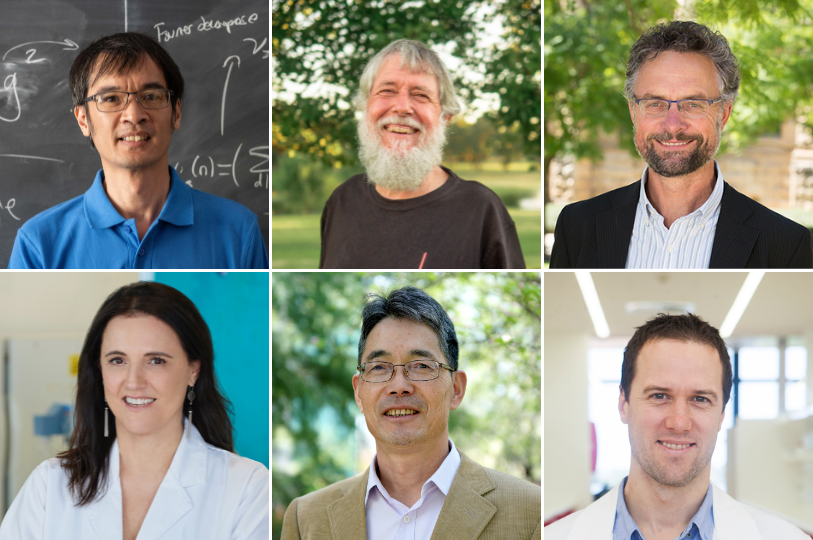
Top row, left to right: Professor Terence Tao AC FAA FRS (image credit: David Esquivel/UCLA), Emeritus Professor David Blair AO FAA, Professor Jozef Gécz AO FAA FAHMS. Bottom row, left to right: Professor Mariapia Degli-Esposti AM FAA FAHMS, Emeritus Professor Zheng-Xiang Li AM FAA, Professor Ryan Lister AM FAA.
Six Academy Fellows have been recognised in the King’s Birthday 2026 Honours list for their outstanding contributions to science, tertiary education and leadership.
Professor Terence Tao AC FAA FRS (Corresponding Member) – appointed a Companion of the Order of Australia (AC) for eminent service to the mathematical sciences, to the global mathematics community and to tertiary education and academia.
Professor Terry Tao, a Corresponding Member based at the University of California Los Angeles (UCLA), was just 30 years old when he was elected to the Academy in 2006 – the same year he won the Fields Medal. Known as the ‘Mozart of Maths’, Professor Tao’s mathematics research is renowned for its depth and breadth, often making unexpected connections between fields to solve long-standing problems.
Emeritus Professor David Blair AO FAA – appointed an Officer of the Order of Australia (AO) for distinguished service to physics, to precision measurement science, to gravitational wave research and to scientific education.
Emeritus Professor David Blair is a physicist at The University of Western Australia who pioneered the science that enables gravitational wave detection – a feat first achieved in 2015. This groundbreaking work earned him and three other physicists the 2020 Prime Minister’s Prize for Science. Professor Blair’s discoveries span three different precision measurement concepts, including inventing an ultra-precise sapphire clock. He also co-developed an award-winning education initiative, Einstein-First, that teaches children about modern physics.
Professor Jozef Gécz AO FAA FAHMS – appointed an Officer of the Order of Australia (AO) for distinguished service to human translational genetic science, to genomic research, to child health and to neurodevelopmental disability.
Molecular geneticist Professor Jozef Gécz, of Adelaide University, has discovered more than 350 different genes linked to brain function, including genes involved in intellectual disability, autism and cerebral palsy. These findings have revealed new and unexpected biological pathways for brain development and led to better management and treatment of neurological conditions.
Professor Mariapia Degli-Esposti AM FAA FAHMS – appointed a Member of the Order of Australia (AM) for significant service to immunology, to microbiology and to clinical research and education.
Professor Mariapia Degli-Esposti is an immunologist at Monash University who investigates how the immune system responds to viruses without causing damage to the body. Her findings inform improved treatment strategies – for example, her team developed a preclinical strategy to prevent cytomegalovirus infection in bone marrow and organ transplant patients, work which won the 2019 Eureka Prize for Scientific Research.
Emeritus Professor Zheng-Xiang Li AM FAA – appointed a Member of the Order of Australia (AM) for significant service to geoscience and Earth dynamics research and to tertiary education.
Emeritus Professor Zheng-Xiang Li, of Curtin University, is a geoscientist who has transformed our understanding of the large-scale forces that shape Earth's tectonic movements. He played a key role in discovering two pre-Pangea supercontinents called Rodinia and Nuna, extending our palaeogeography knowledge back to two billion years ago.
Professor Ryan Lister AM FAA – appointed a Member of the Order of Australia (AM) for significant service to biochemistry, to genetic science and to neuroscience.
Professor Ryan Lister is a genome biologist at The University of Western Australia who has made major advances in understanding the epigenome – the molecular code layered on top of DNA that controls how genetic information is read and used. He developed techniques that enabled the first precise map of the complete human epigenome. In 2020, he was awarded joint Scientist of the Year at the WA Premier’s Science Awards.
Submission – National Environmental Standard for Matters of National Environmental Significance (MNES)
National Environmental Standards (‘Standards’) are a key component of reforming Australia’s national environment laws. Together with the other National Environmental Standards and bioregional plans, the MNES Standard underpins Australia’s environmental protections under the Environment Protection and Biodiversity Conservation Act 1999 (EPBC Act).
The Academy has contributed scientific expertise and advice to Australia's environment law reform process over the past six years. Many of the Academy’s previous recommendations remain unaddressed and must be implemented to achieve better outcomes for our environment and biodiversity.
The main issue with the MNES Standard is that it creates a process-based compliance test through elevating adherence to the Principles and assuming outcomes will be achieved, regardless of whether the environmental outcomes are actually achieved. As drafted, the MNES Standard also only protects “irreplaceable habitat” and does not adequately address monitoring and cumulative impacts.
As drafted, the MNES Standard risks enshrining, rather than reforming, a system that has been independently and widely recognised as broken. The National Environmental Standards should be clear, unambiguous, measurable and enforceable. They must be the clearest possible statement of the government’s responsibility to Australia’s environment.
To achieve this, the Academy recommends the Australian Government:
- amend the MNES Standard so that compliance requires demonstrated, measurable environmental outcomes rather than consistency with the Principles alone
- provide clear assessment thresholds and guidance for key concepts such as “residual significant impacts” and application of the mitigation hierarchy
- refine or remove discretionary language in the MNES Standard to improve clarity, consistency, and enforceability under the EPBC Act
- clearly define key terms (e.g. “viable”, “net gain”), and ensure these definitions are used consistently and are aligned with current science
- explicitly require the assessment of cumulative impacts under the MNES Standard, including baseline assessment, compounding impacts across projects, species, landscapes, bioregions and environmental trends over time
- address key omissions: monitoring obligations and accounting for the impacts of climate change on MNES
- align the MNES Standard with the principles of the United Nations Declaration on the Rights of Indigenous Peoples, and including recognition of Indigenous Cultural and Intellectual Property.
Supercomputing investment welcomed but long-term certainty for research infrastructure needed
The Australian Academy of Science welcomes $323.8 million invested through two National Collaborative Infrastructure Strategy (NCRIS) funding rounds, which will support Australia’s ability to predict natural disasters, develop new technologies and remain competitive in a data-driven world.
The funding includes investments in areas of critical national importance including coastal monitoring, climate modelling, and uplift to supercomputing, artificial intelligence and data capability.
President of the Academy, Professor Sam Berkovic AC, said when Australia invests in research infrastructure, it invests in our country’s future security.
“Facilities for climate modelling, coastal monitoring and advanced computing are not luxuries, they are essential parts of the nation’s decision-making machinery,” Professor Berkovic said.
The announcements had some notable omissions, particularly related to Australia’s astronomy capability.
“International collaborators we are building instruments with need confidence that Australia can sustain its commitments over the life of the projects. Funding arrangements that do not align with the operational realities of research infrastructure place both national capability and global partnerships under strain,” Professor Berkovic said.
“Australia cannot build infrastructure like supercomputers, monitoring systems and astronomy instruments through isolated, short-term decisions alone. In some cases, these projects are decadal in timeframe.
“The governance reforms proposed in Ambitious Australia would support a more coordinated model where research infrastructure planning would be placed at the centre of Australia’s industrial and science agenda.
“This would align Australia's national interests with the science capability we need, and the research infrastructure to support that science.”
John Michael Arthur Chappell 1940–2018
John Chappell was a geoscientist whose work on Quaternary sea-level change, landscapes, and climate helped to link Earth’s ice volume, sea levels, and past climates. Elected a Fellow of the Australian Academy of Science in 1992, he made enduring contributions in geomorphology, coastal science, and environmental history. Colleagues describe him as a polymath, gifted with a prodigious memory, always ready to explain complex ideas with clarity, and unfailingly generous in his support of students and peers. Beyond his professional achievements, he was a devoted family man and a loyal friend to many.
Download the memoir
Supplementary material
About this memoir
This memoir was originally published in Historical Records of Australian Science, vol. 37(1), 2026. It was written by Brad Pillans.

Science at the Shine Dome 2026 Diversity and Inclusion Grant

Program highlights
- The Diversity and Inclusion Grants support eligible costs that enable participation in Science at the Shine Dome between Tuesday 15 and Friday 17 September 2026, including private childcare, travel for an accompanying support person, family-style accommodation, specialised accessibility services, and other participation support needs as approved by the Academy.
- Offered annually by the Australian Academy of Science, the grants aim to support more equitable and inclusive participation in the Academy’s flagship science event.
- Applications are assessed daily in the order complete applications are received, subject to available funding.
The Australian Academy of Science diversity and inclusion grants are designed to allow everyone the opportunity to attend Science at the Shine Dome between Tuesday 15 and Friday 17 September 2026.
Assistance grants are available for participants who face barriers in attending the event due to caring responsibilities, accessibility needs, or mobility-related support. This grant is designed to support expenses such as childminding expenses, accessibility expenses, travel for support person, family style accommodation, professional support services and may include other expenses as approved by the Academy.
The Academy will endeavour to support as many applications as possible. Applications will be assessed in the order that complete applications are received daily, subject to available funding. An application is only considered complete when all required information and supporting documentation have been provided.
Once the available grant funding is exhausted, the application portal will close. Any incomplete or unsubmitted applications will not be accepted.
If you wish to apply for assistance, please submit your event registration first, then complete the grant application form by clicking the yellow ‘Apply’ button on the right-hand side of this webpage. You will be redirected to Good Grants, where you will be required to create an account to complete and submit your application.
Proudly supported by the University of Queensland.
Key dates
Below are the key dates for the application process. While we aim to keep to this schedule, some dates may change depending on circumstances.
GUIDELINES
The following guidelines provide important information about eligibility, submission requirements and assessment processes. Please review them carefully before submitting an application.
Participation Support
Funding may be requested for reasonable, necessary costs that are directly related to enabling attendance at the event and fall within the eligible expense categories listed below.
Eligibility
Eligible applicants must:
- be registered to attend Science at the Shine Dome 2026
- require additional support to attend due to caring responsibilities or accessibility needs
- be applying for eligible costs directly related to event participation.
Applicants, in their grant application must provide:
- a description of the support required
- an itemised estimate of costs (including GST and other taxes)
- supporting documentation, such as a quote, invoice, service agreement, or other evidence showing anticipated cost of services.
- Childcare and dependent care: Costs of formal care arrangements required to enable attendance at the event, including childcare, outside school hours care or other paid care services. This does not include unpaid or informal care provided by family members or friends.
- Travel for an accompanying support person: Reasonable travel costs for one accompanying support person where that support is necessary to enable the attendee to participate in the event.
- Family style accommodation in Canberra to accommodate a dependant or informal carer.
- Professional accessibility or support services: Costs of services required to support participation, such as Auslan interpreting, disability support work, specialised transport or similar approved services.
- Other approved participation support costs: Other reasonable and necessary costs directly related to attendance may be considered where they are clearly explained and approved by the Academy.
Ineligible expenses
- Costs not directly related to attendance to the Science at the Shine Dome 2026 event.
- Costs are already covered by another source.
- Upgrades or premium travel expenses.
- Expenses incurred without prior approval.
- Expenses for accompanying family members who are not part of the approved support need.
- Everyday personal expenses, including meals and general personal items, unless expressly approved as part of an eligible support need.
- Ordinary costs of attending the event that all attendees would normally bear, unless expressly approved.
- Funding will only be provided for approved eligible expenses.
- Reimbursement will be made only for actual costs incurred, on receipt of appropriate documentation, and up to the approved amount.
- Recipients must notify the Academy as soon as possible if their circumstances change or if they are no longer able to attend the event.
- Where cancellation results in funds no longer being required, recipients may be asked to return any recoverable amount to the Academy.
- Successful applicants must provide a tax invoice issued by the service provider for each itemised expense outlined in the funding request where the transaction value is $82.50 or above (including GST). The tax invoice must clearly state:
a. sale amount
b. sale type (taxable and non-taxable items)
c. ABN
d. business name and contract number. - GST and other applicable taxes, including airfare taxes, will be covered for reimbursement by this grant. Applicants must provide a valid tax invoice that itemises all taxes and GST associated with the expense.
- Parents/guardians are welcome to bring dependent children with them to the event.
- Additional caregivers are also welcome to attend the event, if preferred. Please contact us to discuss options, such as apartment-style accommodation for families.
- Those breastfeeding are welcome to breastfeed anywhere at the event, and a quiet room will be available if privacy is preferred. Kitchen facilities can be made available for parents, if required.
- The Ian Wark Theatre is equipped with an infrared hearing loop. For those requiring this hearing assistance, a device can be obtained at the event from the Information Desk.
- The Shine Dome has allocated and reserved disability parking. Please contact us at events@science.org.au to discuss any special parking requirements.
Applications must be submitted via the Academy’s Good Grants online portal and must be completed in full and include the following attachments as supporting evidence:
- a description of the support required
- an itemised estimate of costs (including GST and other taxes)
- supporting documentation, such as a quote, invoice, service agreement or other evidence showing anticipated cost of services.
Applications must be complete at the time of submission to be considered. Incomplete applications, including those missing any required supporting material, will be deemed ineligible and will not proceed to merit assessment.
Applicants are encouraged not to incur significant costs until they have received written approval from the Academy.
Applications will be assessed in the order that complete applications are received daily, subject to available funding.
If an application for support is declined for any reason, including ineligibility, any prepaid registration to attend Science at the Shine Dome 2026 can be fully refunded by written request to events@science.org.au. If you have any queries, please email events@science.org.au.
Applications will be assessed in the order that complete applications are received daily, subject to available funding.
The amounts outlined below represent the maximum reimbursement limits available under the grant for each eligible expense category. Reimbursements are capped at the approved amount and must be supported by appropriate documentation, including tax invoices, receipts or equivalent evidence of expenditure.
Important: If a chosen provider does not hold a current ABN, they must complete an ATO Statement before reimbursement can be processed.
Applicants may use the provider suggested below or source their own provider. Reimbursement will only be provided for the actual approved cost incurred, up to the maximum rates and event allocations outlined below.
Important: If a chosen provider does not hold a current ABN, they must complete an ATO Statement by a Supplier before reimbursement can be processed.
Provider suggested by the Academy
Little Cherubs Support Services
E: nicole@littlecherubs.com.au | P: 0482 629 300
Approved capped rates
Day rate: up to $82.50 per hour
Evening rate: up to $93.50 per hour
Maximum reimbursable amounts during the event
- Tuesday 15 September – full day (up to 6 hours): capped at $495
- Tuesday 15 September – evening (up to 3 hours): capped at $280.50
- Wednesday 16 September – full day (up to 9 hours): capped at $742.50
- Wednesday 16 September – evening (up to 5 hours): capped at $467.50
- Thursday 17 September – evening (up to 7 hours): capped at $577.50
Economy class return airfares within Australia may be reimbursed up to the capped amount below per person. Airfare costs fluctuate depending on travel dates and booking times.
Maximum airfare reimbursement caps
- Sydney: up to $900
- Melbourne: up to $1,100
- Brisbane: up to $1,300
- Adelaide: up to $1,300
- Perth: up to $1,700
Family-style accommodation in Canberra may be supported where required to accommodate an eligible dependant or approved support arrangement.
- Up to $300 per night.
- Maximum of three nights.
Specialised services may be reimbursed where required to support participation and engagement in the event.
As no standard suppliers or rates are currently established, applicants must provide:
- a description of the service required
- an estimated or quoted cost where available.
Reimbursement will only be processed upon receipt of a valid tax invoice or equivalent documentation.
Where a private vehicle is used instead of air travel, mileage may be claimed at the applicable ATO cents-per-kilometre rate.
- Calculated at 88 cents per kilometre travelled*
- Maximum reimbursement capped at $600
*Rate current up to 30 June 2026, as set by the Australian Taxation Office (ATO).
Applications are to be completed through an online form found by clicking on the Apply button on the top right of this web page when the round is open.

Proudly supported by The University of Queensland to help foster more inclusive participation in Science at the Shine Dome 2026.