



Supercomputing investment welcomed but long-term certainty for research infrastructure needed

The Australian Academy of Science welcomes $323.8 million invested through two National Collaborative Infrastructure Strategy (NCRIS) funding rounds, which will support Australia’s ability to predict natural disasters, develop new technologies and remain competitive in a data-driven world.
The funding includes investments in areas of critical national importance including coastal monitoring, climate modelling, and uplift to supercomputing, artificial intelligence and data capability.
President of the Academy, Professor Sam Berkovic AC, said when Australia invests in research infrastructure, it invests in our country’s future security.
“Facilities for climate modelling, coastal monitoring and advanced computing are not luxuries, they are essential parts of the nation’s decision-making machinery,” Professor Berkovic said.
The announcements had some notable omissions, particularly related to Australia’s astronomy capability.
“International collaborators we are building instruments with need confidence that Australia can sustain its commitments over the life of the projects. Funding arrangements that do not align with the operational realities of research infrastructure place both national capability and global partnerships under strain,” Professor Berkovic said.
“Australia cannot build infrastructure like supercomputers, monitoring systems and astronomy instruments through isolated, short-term decisions alone. In some cases, these projects are decadal in timeframe.
“The governance reforms proposed in Ambitious Australia would support a more coordinated model where research infrastructure planning would be placed at the centre of Australia’s industrial and science agenda.
“This would align Australia's national interests with the science capability we need, and the research infrastructure to support that science.”
John Michael Arthur Chappell, 1940–2018
John Chappell was a geoscientist whose work on Quaternary sea-level change, landscapes, and climate helped to link Earth’s ice volume, sea levels, and past climates. Elected a Fellow of the Australian Academy of Science in 1992, he made enduring contributions in geomorphology, coastal science, and environmental history. Colleagues describe him as a polymath, gifted with a prodigious memory, always ready to explain complex ideas with clarity, and unfailingly generous in his support of students and peers. Beyond his professional achievements, he was a devoted family man and a loyal friend to many.
Download the memoir
Supplementary material
About this memoir
This memoir was originally published in Historical Records of Australian Science, vol. 37(1), 2026. It was written by Brad Pillans.

Science at the Shine Dome 2026 Diversity and Inclusion Grant
Program highlights
- The Diversity and Inclusion Grants support eligible costs that enable participation in Science at the Shine Dome between Tuesday 15 and Friday 17 September 2026, including private childcare, travel for an accompanying support person, family-style accommodation, specialised accessibility services, and other participation support needs as approved by the Academy.
- Offered annually by the Australian Academy of Science, the grants aim to support more equitable and inclusive participation in the Academy’s flagship science event.
- Applications are assessed daily in the order complete applications are received, subject to available funding.
The Australian Academy of Science diversity and inclusion grants are designed to allow everyone the opportunity to attend Science at the Shine Dome between Tuesday 15 and Friday 17 September 2026.
Assistance grants are available for participants who face barriers in attending the event due to caring responsibilities, accessibility needs, or mobility-related support. This grant is designed to support expenses such as childminding expenses, accessibility expenses, travel for support person, family style accommodation, professional support services and may include other expenses as approved by the Academy.
The Academy will endeavour to support as many applications as possible. Applications will be assessed in the order that complete applications are received daily, subject to available funding. An application is only considered complete when all required information and supporting documentation have been provided.
Once the available grant funding is exhausted, the application portal will close. Any incomplete or unsubmitted applications will not be accepted.
If you wish to apply for assistance, please submit your event registration first, then complete the grant application form by clicking the yellow ‘Apply’ button on the right-hand side of this webpage. You will be redirected to Good Grants, where you will be required to create an account to complete and submit your application.
Proudly supported by the University of Queensland.
Key dates
Below are the key dates for the application process. While we aim to keep to this schedule, some dates may change depending on circumstances.
GUIDELINES
The following guidelines provide important information about eligibility, submission requirements, and assessment processes. Please review them carefully before submitting an application.
Participation Support
Funding may be requested for reasonable, necessary costs that are directly related to enabling attendance at the event and fall within the eligible expense categories listed below.
Eligibility
Eligible applicants must:
- be registered to attend Science at the Shine Dome 2026
- require additional support to attend due to caring responsibilities or accessibility needs;
- be applying for eligible costs directly related to event participation.
Applicants, in their grant application must provide:
- a description of the support required
- an itemised estimate of costs, (including GST and other taxes);
- supporting documentation, such as a quote, invoice, service agreement, or other evidence showing anticipated cost of services.
- Childcare and dependent care: Costs of formal care arrangements required to enable attendance at the event, including childcare, outside school hours care, or other paid care services. This does not include unpaid or informal care provided by family members or friends.
- Travel for an accompanying support person: Reasonable travel costs for one accompanying support person where that support is necessary to enable the attendee to participate in the event.
- Family style accommodation in Canberra to accommodate a dependant or informal carer.
- Professional accessibility or support services: Costs of services required to support participation, such as Auslan interpreting, disability support work, specialised transport, or similar approved services.
- Other approved participation support costs: Other reasonable and necessary costs directly related to attendance may be considered where they are clearly explained and approved by the Academy.
Ineligible expenses
- Costs not directly related to attendance to the Science at the Shine Dome 2026 event.
- Costs are already covered by another source.
- Upgrades or premium travel expenses.
- Expenses incurred without prior approval.
- Expenses for accompanying family members who are not part of the approved support need.
- Everyday personal expenses, including meals and general personal items, unless expressly approved as part of an eligible support need.
- Ordinary costs of attending the event that all attendees would normally bear, unless expressly approved.
- Funding will only be provided for approved eligible expenses.
- Reimbursement will be made only for actual costs incurred, on receipt of appropriate documentation, and up to the approved amount.
- Recipients must notify the Academy as soon as possible if their circumstances change or if they are no longer able to attend the event.
- Where cancellation results in funds no longer being required, recipients may be asked to return any recoverable amount to the Academy.
- Successful applicants must provide a tax invoice issued by the service provider for each itemised expense outlined in the funding request where the transaction value is $82.50 or above (including GST). The tax invoice must clearly state:
a. sale amount
b. sale type (taxable and non-taxable items)
c. ABN
d. business name and contract number - GST and other applicable taxes, including airfare taxes, will be covered for reimbursement by this grant. Applicants must provide a valid tax invoice that itemises all taxes and GST associated with the expense.
- Parents/guardians are welcome to bring dependent children with them to the event.
- Additional caregivers are also welcome to attend the event, if preferred. Please contact us to discuss options, such as apartment-style accommodation for families.
- Those breastfeeding are welcome to breastfeed anywhere at the event, and a quiet room will be available if privacy is preferred. Kitchen facilities can be made available for parents, if required.
- The Ian Wark Theatre is equipped with an infrared hearing loop. For those requiring this hearing assistance, a device can be obtained at the event from the Information Desk.
- The Shine Dome has allocated and reserved disability parking. Please contact us at events@science.org.au to discuss any special parking requirements.
Applications must be submitted via the Academy’s Good Grants online portal and must be completed in full and include the following attachments as supporting evidence:
- a description of the support required
- an itemised estimate of costs, (including GST and other taxes);
- supporting documentation, such as a quote, invoice, service agreement, or other evidence showing anticipated cost of services.
Applications must be complete at the time of submission to be considered. Incomplete applications, including those missing any required supporting material, will be deemed ineligible and will not proceed to merit assessment.
Applicants are encouraged not to incur significant costs until they have received written approval from the Academy.
Applications will be assessed in the order that complete applications are received daily, subject to available funding.
If an application for support is declined for any reason, including ineligibility, any pre-paid registration to attend Science at the Shine Dome 2026 can be fully refunded by written request to events@science.org.au. If you have any queries, please email events@science.org.au.
Applications will be assessed in the order that complete applications are received daily, subject to available funding.
The amounts outlined below represent the maximum reimbursement limits available under the grant for each eligible expense category. Reimbursements are capped at the approved amount and must be supported by appropriate documentation, including tax invoices, receipts, or equivalent evidence of expenditure.
Important: If a chosen provider does not hold a current ABN, they must complete an ATO Statement before reimbursement can be processed.
Applicants may use the provider suggested below or source their own provider. Reimbursement will only be provided for the actual approved cost incurred, up to the maximum rates and event allocations outlined below.
Important: If a chosen provider does not hold a current ABN, they must complete an ATO Statement by a Supplier before reimbursement can be processed.
Provider suggested by the Academy
Little Cherubs Support Services
E: nicole@littlecherubs.com.au | P: 0482 629 300
Approved capped rates
Day rate: up to $82.50 per hour
Evening rate: up to $93.50 per hour
Maximum reimbursable amounts during the event
- Tuesday 15 Sep — full day (up to 6 hours): capped at $495
- Tuesday 15 Sep — evening (up to 3 hours): capped at $280.50
- Wednesday 16 Sep — full day (up to 9 hours): capped at $742.50
- Wednesday 16 Sep — evening (up to 5 hours): capped at $467.50
- Thursday 17 Sep — evening (up to 7 hours): capped at $577.50
Economy class return airfares within Australia may be reimbursed up to the capped amount below per person. Airfare costs fluctuate depending on travel dates and booking times.
Maximum airfare reimbursement caps
- Sydney: up to $900
- Melbourne: up to $1,100
- Brisbane: up to $1,300
- Adelaide: up to $1,300
- Perth: up to $1,700
Family-style accommodation in Canberra may be supported where required to accommodate an eligible dependant or approved support arrangement.
- Up to $300 per night
- Maximum of three nights
Specialised services may be reimbursed where required to support participation and engagement in the event.
As no standard suppliers or rates are currently established, applicants must provide:
- a description of the service required; and
- an estimated or quoted cost where available.
Reimbursement will only be processed upon receipt of a valid tax invoice or equivalent documentation.
Where a private vehicle is used instead of air travel, mileage may be claimed at the applicable ATO cents-per-kilometre rate.
- Calculated at 88 cents per kilometre travelled*
- Maximum reimbursement capped at $600
*Rate current up to 30 June 2026, as set by the Australian Taxation Office (ATO).
Applications are to be completed through an online form found by clicking on the Apply button on the top right of this web page when the round is open.

Proudly supported by the University of Queensland to help foster more inclusive participation in Science at the Shine Dome 2026.
Pacific experts take sea level rise concerns to the UN
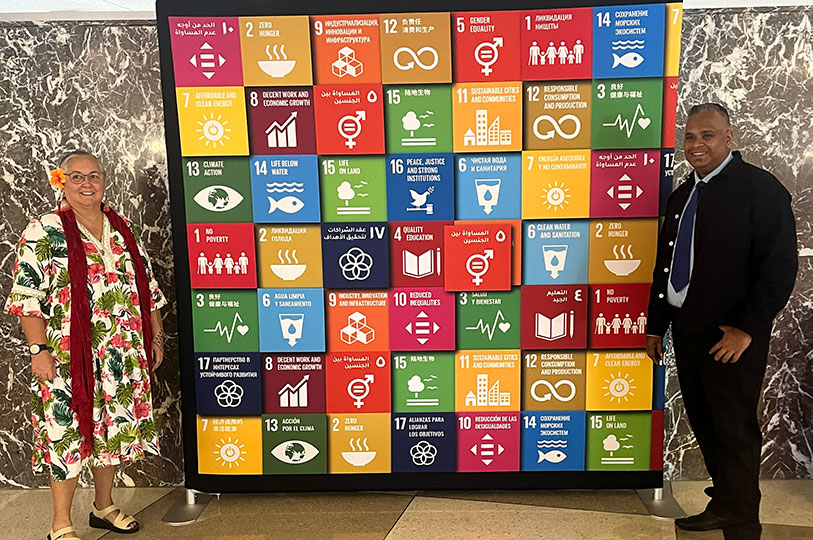
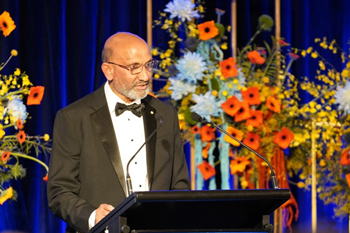
Dr Christina Newport and Dr Awnesh Singh at the United Nations.
Pacific Island communities are already losing freshwater, farmland and food security due to climate change, experts told a high-level side event at the United Nations Headquarters in New York on 6 May.
The discussion, titled ‘At the water’s edge: Sea level rise, water security and livelihoods in the South Pacific’, brought together Pacific scientists, policymakers, and climate negotiators at a critical moment for international climate and sustainable development processes.
Dr Awnesh Singh from the University of the South Pacific in Fiji and Dr Christina Newport, a Rarotonga and Mangaia researcher from the Cook Islands, presented the latest scientific evidence on the compounding threats that rising seas pose to Pacific Island communities.
Saltwater intrusion is already contaminating freshwater sources and wells, reducing arable land, and undermining the reef fisheries that coastal communities depend on for food security.
Around 70% of Pacific Island households rely on agriculture for their livelihoods, and progress on the Sustainable Development Goal (SDG) 6 ‘Clean Water and Sanitation’ remains off track across much of the region.
“Climate change in the Pacific is not a future threat. It is an irreversible present loss. Not just of land, but of language, identity, and the continuity of who we are across generations,” said Dr Newport, scholar at the University of Auckland and Principal Researcher at Akairo Consulting.
“Research that doesn't speak to lived experience stays on the shelf. Policy that doesn't speak to research causes harm. The bridge between them is community,” Dr Newport added.
The speakers emphasised that the challenge is not a lack of knowledge. Pacific communities and researchers have developed locally grounded solutions in water management, coastal adaptation and food system resilience. These innovations remain under-resourced and disconnected from international climate finance mechanisms.
The event was held alongside the 2026 UN Science, Technology and Innovation Forum. It was convened by the International Science Council (ISC) and the ISC Regional Focal Point for Asia and the Pacific (ISC RFP-AP), as well as the Permanent Missions of Australia and Tuvalu to the UN and the Pacific Small Island Developing States (PSIDS) group.
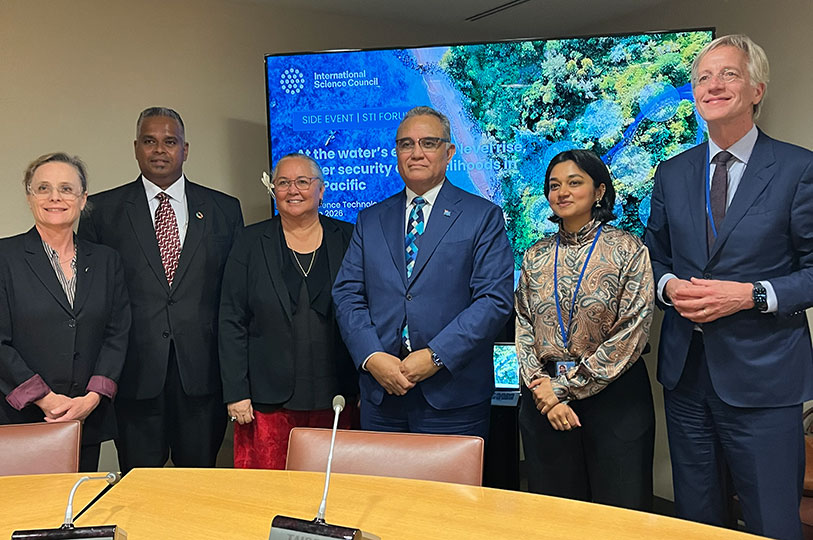
‘At the water's edge’ panellists, left to right: Her Excellency Ms Beth Delaney, Deputy Permanent Representative of Australia to the United Nations; Dr Awnesh Singh; Dr Christina Newport; His Excellency Dr Tapugao Falefou, Ambassador and Permanent Representative of Tuvalu; Arunima Sircar, Intergovernmental Panel on Climate Change and Climate Analytics; and Dr Robbert Dijkgraaf, President-elect of the ISC.
About the International Science Council Regional Focal Point for Asia and the Pacific
As the regional arm of the ISC, the ISC RFP-AP works to ensure that regional needs and priorities are adequately represented in the ISC’s global agenda, that regional voices are actively engaged in the governance and management of the ISC’s work, and that the region benefits from the results of that work.
The RFP is supported by funding from the Australian Government Department of Industry, Science and Resources.
Fellows update: May 2026
Honours and awards to Fellows
Royal Society – Fellows elected in 2026
- Professor Bostjan Kobe FAA FRS
- Professor Alex McBratney AM FAA FRS
- Professor Malcolm Sambridge FAA FRS
Read more about the Academy Fellows elected to the Royal Society
Obituaries
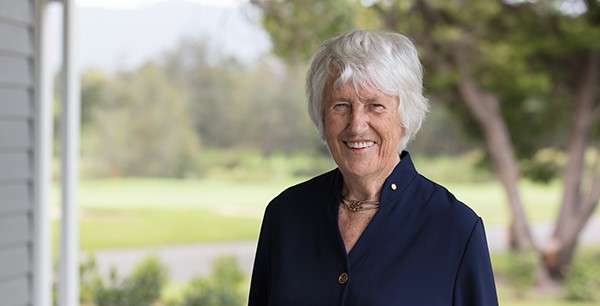
Dame Bridget Ogilvie AC DBE FAA FRS
24 March 1938 – 27 April 2026
Dame Bridget Ogilvie was one of the most distinguished scientists of her generation – a pioneering parasitologist, a visionary science leader, and a tireless advocate for global health. Born in Glen Innes, New South Wales, she rose from rural Australia to the very forefront of international science, embodying the curiosity and determination that define the finest scientific minds. She completed a Bachelor of Rural Science degree with First Class Honours at the University of New England, graduating with the university medal in 1960. She was awarded a Commonwealth Scholarship to attend Girton College, Cambridge. She was Lord High Steward of the University of Cambridge from 2001 to 2009. She was the first and still the only woman to be elected to this prestigious honorary position.
Her research at the Medical Research Council's National Institute for Medical Research made foundational contributions to our understanding of the immune response to parasitic infections, work of enduring significance to both human and animal health. As Director of the Wellcome Trust from 1991 to 1998, she oversaw the establishment of the Sanger Institute, which played a central role in the sequencing of the human genome, and greatly expanded the Trust's support for tropical medicine research across Africa and the Asia–Pacific. She also advocated for and led substantial investments in research infrastructure, understanding that the conditions for great science matter. After stepping down from the Trust she served as a Director of Lloyds Bank and AstraZeneca and gave her time and expertise to various charities including as Chair of Medicines for Malaria and Sense about Science.
Dame Bridget was elected a Fellow of the Royal Society in 2003 and a Fellow of the Australian Academy of Science in 2008. She was appointed a Dame Commander of the Order of the British Empire in 1996 and a Companion of the Order of Australia in 2007. She was also recognised with honorary degrees from a number of Australian and British universities.
Beyond her research and leadership, she was deeply committed to communicating science to the public and to nurturing the next generation of researchers. Many Australian scientists were fortunate to benefit from her mentorship in the UK, and later years through her involvement at the University of Wollongong. Her influence on Australian and international science will be felt for many years to come.
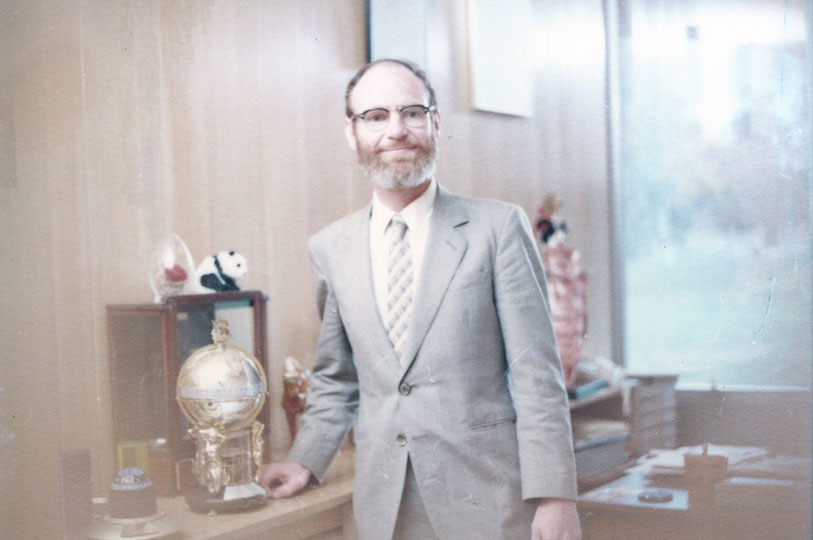
Dr Donald Charles Morton FAA
12 June 1933 – 26 April 2026
Dr Donald Morton was born in Canada and studied at the University of Toronto (BA in mathematics and physics 1952–1956) and Princeton University (PhD in Astronomy 1959). On completion of his PhD, he worked as an astronomer at the US National Research Laboratory for two years before taking a position as research associate at Princeton in 1961. Dr Morton remained at Princeton until 1976 when he left his position as Senior Research Astronomer, Lecturer and Professor to move to Australia as Director of the Anglo–Australian Telescope in Epping and Coonabarabran. As the telescope’s second director, he oversaw the facility’s early rise to prominence as it opened up the southern skies for optical research, consolidating its position among the finest of the world's large telescopes with a dominant influence in British and Australian optical astronomy.
Dr Morton was a pioneer in optical astronomy. From instruments mounted on rockets in 1965, he obtained the first ultraviolet stellar spectra, and deduced the existence of stellar winds – now recognised as a major phenomenon in the evolution and structure of giant stars. From Copernicus satellite data, he made landmark measurements of the chemical abundances in the interstellar medium – the gas and dust that exists between stars.
Dr Morton was elected as a Fellow of the Australian Academy of Science in 1984 and served on the National Committee for Astronomy (1979–1980 and 1984–1986).
After ten years in Australia, he returned to Canada to take up the position of Director General of the Herzberg Institute of Astrophysics. He held this position until 2000 when he was appointed Researcher Emeritus at the Institute.
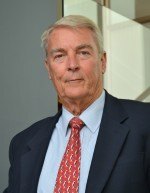
Professor Garth William Paltridge FAA
24 April 1940 – 1 May 2026
Professor Garth Paltridge was elected to the Academy in 1980 for his contribution to atmospheric sciences. These range from stratospheric electricity to the modelling and analysis of growth and form of plants as determined by atmospheric variables. They also include pioneering studies of the radiation properties of clouds and of the interaction of radiation with cloud growth and decay.
He was born in Brisbane and completed a BSc with honours at the University of Queensland (1961) before moving to Melbourne. Professor Paltridge was awarded an MSc and PhD (1965) from the University of Melbourne. In 1966, he took up a postdoctoral fellowship at the New Mexico Institute of Mining and Technology in the US. He changed continents again in 1967 and became a senior science officer at the Radio and Space Research Station in the UK.
Professor Paltridge returned to Australia in 1968 to the CSIRO Division of Meteorological Physics (eventually renamed as the Division of Marine and Atmospheric Research), rising to the level of Chief Research Scientist. In 1990, he became Professor and Director of the Institute of Antarctic and Southern Ocean Studies at the University of Tasmania (1990–2002). He was instrumental in setting up one of the first Cooperative Research Centres, the CRC for Antarctica and the Southern Ocean (1991). He was director of the Antarctic CRC until his retirement in 2002. He then became Emeritus Professor and Honorary Research Fellow at the University of Tasmania and a Visiting Fellow at the Australian National University Research School of Biology.
Professor Paltridge gave his time very generously to the Academy. He served on the Sectional Committee for Terrestrial and Planetary Sciences (1982–1985, Chair 1985–1986), the Elizabeth and Frederick White Research Conferences Program (1984–1987 and 1988–1999), Council (1994), Regional Group for Tasmania (1991–1997, as Chair), several medal committees including the Frederick White Medal (2001), Jaeger Medal (2004 and 2008–2016), Selby Fellowship (2005) and the Anton Hales Medal (2008–2012). He also served on the National Committee for Antarctic Research (including as Chair 1994–1999), National Committee for Atmospheric Sciences (1981–1986, as Chair) and the National Committee for Climate and Atmospheric Sciences (1992–1996).
Recently published biographical memoirs
Alongside the many fascinating history of science articles published in our journal, Historical Records of Australian Science, we publish biographical memoirs – biographies of deceased Fellows commissioned by the Academy. We are very grateful to all the authors who go to great lengths to make these articles as complete as possible.
Recent biographical memoir:
Message from the President: May 2026

I am delighted to write to you for the first time as Academy President, and I want to begin with thanks.
To Professor Chennupati Jagadish AC, who handed over the Presidency at our AGM on 21 May after four years of distinguished leadership: thank you.
Professor Jagadish leaves the Academy stronger, more visible and more confident in its public voice than he found it. Australian science, Australia’s future and the Academy's central role in shaping the Strategic Examination of R&D both bear his fingerprints. We are in his debt.
I take up the Presidency at a consequential moment for Australian science. Technological change is accelerating faster than our policy settings can absorb. Climate pressures are intensifying. Geopolitical shifts are reshaping how we collaborate and with whom.
Through all of this, science is central to how Australia navigates, adapts and leads. The Academy's job is to make sure that scientific knowledge shapes the decisions that matter for every Australian.
That will mean speaking clearly, confidently and, when necessary, uncomfortably. The old instinct in our sector toward quiet modesty no longer serves us. Australians are looking for trusted voices, and the Academy is a truly independent one. We will use it.
This month has already given us plenty of opportunities to do so. The 2026–27 Budget took genuine first steps on R&D reform – in particular, the National Resilience and Science Council is a foundation worth building on. The release of the National Health and Medical Research Strategy has added further momentum, and we welcomed it. But this is a starting point, not a solution. A decade of underinvestment will not be undone in one Budget cycle. We will keep making that case.
Last week we announced the election of our 2026 Fellows – an extraordinary cohort whose work spans the breadth of Australian science. I extend a warm welcome to each of them. The Fellowship is the source of this Academy's authority, and every newly elected Fellow brings additional energy, expertise and strength.
Becoming the Academy's 21st President is a profound honour, and I do not take it lightly. There is much to do. Whether you are a scientist, an educator, a policymaker or simply someone who believes Australia is stronger when science is at the table, the Academy's work in the years ahead will matter to you. I look forward to sharing it with you.
Professor Sam Berkovic AC PresAA FAHMS FRS
President
Three Australians elected to the world’s oldest scientific academy
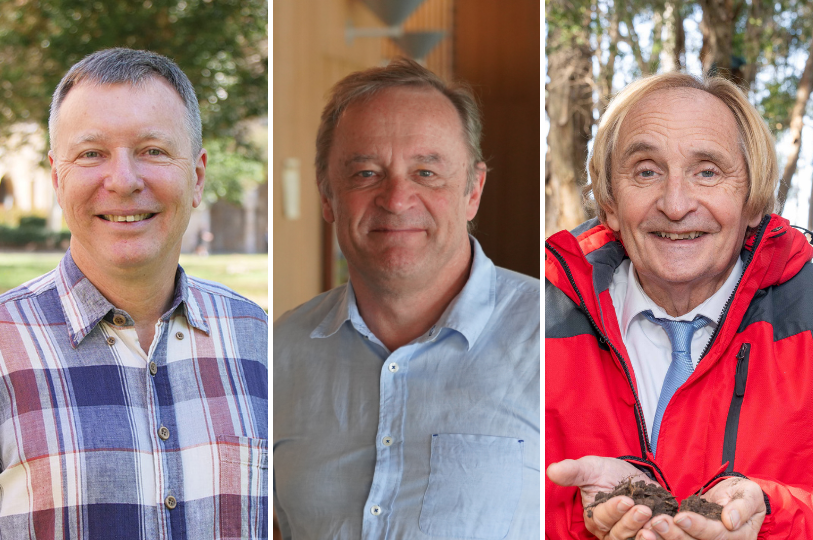
Left to right: Professor Bostjan Kobe FAA FRS, Professor Malcolm Sambridge FAA FRS and Professor Alex McBratney AM FAA FRS. Credits: The University of Queensland | Australian Academy of Science | Emlyn Crockett/The University of Sydney.
Three Fellows of the Australian Academy of Science are among 94 scientists from across the globe elected to the Royal Society in 2026.
They join many of history’s most influential scientists including Stephen Hawking, Isaac Newton, Charles Darwin, Albert Einstein, Lise Meitner and Dorothy Hodgkin.
The Academy Fellows are:
- Professor Bostjan Kobe, from the University of Queensland – elected for his landmark contributions to structural biology. His research has advanced understanding of protein structures and signalling mechanisms. He has also established innovative tools including fusion proteins and microcrystal electron diffraction.
- Professor Alex McBratney AM, from the University of Sydney – elected for his pioneering contributions to soil science, environmental earth science and precision agriculture. His groundbreaking work in pedometrics and digital soil mapping has transformed global understanding of soil variation, improving agricultural efficiency, land management and environmental sustainability.
- Professor Malcolm Sambridge, from the Australian National University – elected for his fundamental contributions to understanding the Earth and its internal processes through the development of new mathematical approaches for analysing complex geophysical data. His work has reshaped the interpretation of seismic waves, landscape evolution and mineral analysis through innovative nonlinear inference methods.
Founded in the 1660s in the UK, the Royal Society is the world’s oldest scientific academy in continuous existence.
The Academy and the Royal Society share a long and significant history. In the early 1950s, Australia-based Fellows of the Royal Society played a central role in establishing the Academy to support and champion scientific excellence in Australia.
Since then, both organisations have continued to recognise outstanding scientific achievement through the election of distinguished researchers to their Fellowships.
View the full list of Fellows elected to the Royal Society in 2026.
Thank you
Your support is critical to helping us deliver our mission as an independent, evidence-based institution.
With your generosity, the Academy can provide Australia with secure foundations based on evidence to guide decisions, advance the nation, and strengthen our global standing.
Australian perspectives of early- and mid-career researchers: 2025 survey report
This report presents the findings of a 2025 survey of 334 early- and mid-career researchers (EMCRs) working across Australian universities and research organisations.
The survey was developed by members of the Executive Committee of the EMCR forum at the Australian Academy of science in order to capture the perspectives of the EMCR community on key aspects of the research system.
The survey explores EMCR experiences across a range of areas, including:
- access to research funding through the Australian Research Council and the National Health and Medical Research Council
- experiences with higher degree research supervision and peer review
- career progression and mobility.
Responses were collected anonymously to enable candid feedback on the challenges and conditions shaping this career stage.
Three key themes emerged from the survey:
- Career uncertainty is widespread. While many EMCRs remain committed to research and academic careers, this is often conditional on access to stable roles and clear progression pathways, with many reporting uncertainty about their long-term future.
- Barriers to participation are consistent across the cohort and are closely tied to the structure of research funding. High competition, emphasis on track record and insecure employment limit access to funding and constrain the ability of EMCRs to build independent research careers.
- Mobility and attrition risks are increasing. Frequent movement to secure roles is common and is accompanied by growing uncertainty about remaining in academia or Australia, raising concerns about workforce retention and future research capability.
Taken together, the findings suggest a misalignment between the aspirations and capabilities of EMCRs and the structural conditions in which they operate. They identify a set of persistent structural barriers that influence career progression and talent retention. Addressing these challenges will be important to strengthening career pathways and sustaining Australia’s future research capacity.
This survey is the first in a planned series of annual consultations with the EMCR community. Over time, it will allow the Academy to track workforce trends and build an evidence base to inform ongoing policy engagement.
Find out more in the 2025 EMCR survey data dashboard
Ten-year strategy a promising step for health and medical research
Australia has a new blueprint for health and medical research – a genuine opportunity to strengthen the research system and support discovery science, says the Australian Academy of Science
The National Health and Medical Research Strategy offers much-needed direction, coordination and funding, alongside guidance for how new funds available through the Medical Research Future Fund (MRFF) will be invested.
“Together, the strategy, funding and investment guidance mark a significant milestone towards building a thriving research system that improves and saves Australian lives,” says Professor Sam Berkovic AC, Academy President.
“There are many positive proposed actions in the strategy, such as $210 million towards the Australian Cancer Research Program and Precision Health Research Program, which will advance genetic tests and treatments for Australians.
“It is also encouraging to see strong alignment with structural reforms proposed in Ambitious Australia.
“In particular, the strategy establishes a National Strategy Advisory Council to oversee implementation and monitor progress.
“This explicit connection to the Strategic Examination of Research and Development is exactly the kind of systems thinking our research sector needs – but that connection must be maintained through implementation, not just on paper, and the Academy will be watching closely.”
Key initiatives in the strategy reflect recommendations made by the Academy, including:
- establishing a high-risk, high-reward funding stream for blue-sky research
- a nationally coordinated approach to horizon scanning and priority setting
- a proposed Health and Medical Research Workforce Plan
- a coordinated approach to management of the Medical Research Endowment Account (MREA) and MRFF
- an emphasis on international collaboration and partnerships in the Indo-Pacific.
The Academy also welcomes the inclusion of $128 million from the MRFF to cover the indirect costs of research. The strategy only applies the uplift in support to MRFF grants – which is important, but only the first step in acknowledging the burden indirect costs on research have on organisations.
“We are pleased to see a coherent direction for how these new funds will be deployed, including the acknowledgement of the significant burden that indirect costs of research put on medical research institutes in particular,” Professor Berkovic says.
The Academy thanks Rosemary Huxtable AO PSM for her work in developing the strategy and her thorough and consultative approach.