



The importance of advanced biological science to the Australian economy

The Centre for International Economics found that the advanced biological sciences, directly and indirectly:
- account for 5% of Australian economic activity, or around $65 billion per year
- provide 4% of total Australian employment (about 464,000 jobs)
- generate 4% of our exports, or about $12 billion per year.
In addition, the economists estimated the value of health improvements:
- there would be 18% to 34% higher burden of disease without the advanced biological sciences
- the advanced biological sciences deliver $83 billion to $156 billion worth of health improvements.
This report follows and complements a 2015 report that quantified the contribution of the advanced physical and mathematical sciences to the Australian economy.
Both reports were commissioned by the Office of the Chief Scientist and the Australian Academy of Science and prepared by economists from the Centre for International Economics.
A synthesis report presents combined estimates derived from both reports.
Download the infographic
Beyond 2000: The way ahead – Mid-term review
In 1995, Australian astronomers prepared Australian astronomy: Beyond 2000 – a strategic plan laying out the community’s vision for the decade ahead.
The years since Beyond 2000 have seen a revolution in international astronomy, with major overseas investments in new facilities dramatically increasing competitiveness.
In the period 2001–2005, the major nations with which Australian astronomers work are planning to invest US$0.5 billion per annum in new facilities.
This review updates the priorities of Beyond 2000, so that Australian investment in astronomy leads to the greatest national benefits.

Australians need geography
Through geography’s holistic approach, bringing together the natural and social sciences, students better understand important challenges facing our world.
This report notes a sharp decrease in the number of students studying geography in Australian schools, and advocates for the importance of geography education.
This report was endorsed by the National Committee for Geography (now the National Committee for Geographical Sciences).
Australian astronomy: Beyond 2000 – Astronomy decadal plan 1996–2005
Australian astronomy: Beyond 2000 is the 1996–2005 decadal plan for astronomy.
Vision
As the Prime Minister of the time commented at the opening of the Anglo-Australian Telescope twenty years ago, Australia is an astronomical nation: it has been so throughout its entire history. In the present century, astronomy in Australia has contributed demonstrably to the scientific and cultural life of the nation. In the 21st Century, Australia, as the most technologically advanced nation in the southern hemisphere, should build on this astronomical heritage, by exploiting the synergy between science and technology in this oldest and most far-reaching of the sciences.
In the coming decade, we envisage Australia as a partner in what is clearly emerging as the world's foremost astronomical observatory – the European Southern Observatory, an international observatory based in the Southern Hemisphere – and playing a key role in the technological and scientific advances flowing from the new generation of international facilities. In this way, Australia can continue to enjoy the scientific, technological and cultural benefits of a successful astronomy program well into the 21st Century.
Strategy
The review committee identified a number of essential elements to develop Australian astronomy as one of the country's premier areas of fundamental research and a technological driving force. These are:
- to foster Australia's special scientific and technological strengths
- to take full advantage of Australia's southern hemisphere location
- to exploit advanced technologies across the full electromagnetic and particle spectrum
- to integrate domestic and international facilities
- to continue to develop a comprehensive educational program which introduces large numbers of students to the excitement of fundamental discoveries
- to continue to train high quality PhD graduates for the discipline and related areas
- to develop a funding strategy commensurate with the above requirements.
Decade plan
This document, the first of two volumes of the review report, presents a research strategy for Australian astronomy for the next decade. The second volume contains reports of the scientific subcommittees and other supporting documents. This ten-year plan was developed by means of a thorough and tough prioritisation of proposals, to determine those facilities which are absolutely essential for the maintenance of Australia's excellence in astronomy. A key step in this process was the ranking by the review committee of proposals for construction of, and access to, major national and international facilities in order of their scientific merit, and their importance to the astronomical community as a whole. The strategy embodied in this document was strongly endorsed by the Australian astronomical community at large at an open meeting held at the University of New South Wales (UNSW) in December 1994. The facilities identified will enable Australian astronomers to continue making important advances in a broad array of fields such as the detection of planets around stars other than the sun, the formation of stars and galaxies, the power sources of quasars, and the physics of the early universe itself.
The plan envisages Australia's partnership in an integrated set of national and international astronomical facilities in the southern hemisphere. In this plan, the role of first-ranked national facilities, such as the Anglo-Australian Observatory (AAO) and the Australia Telescope National Facility (ATNF), is defined in terms of their uniqueness, and that of national resources in the universities (principally Mount Stromlo and Siding Springs Observatories [MSSSO]) is to provide essential support for the frontline facilities. Furthermore, in this approach, universities combine their strategic strength in developing pioneering facilities with their traditional role of educating students in a broad and expanding range of disciplines.
Top priority
The first priority of the astronomical community remains the same as it was in 1989, viz. to obtain significant access to a large optical/infrared telescope. To achieve this end the Review Committee believes that Australia should immediately accept the European Southern Observatory's (ESO) invitation to join ESO and participate in the world's premier astronomy project, the Very Large Telescope (VLT). Through ESO, the Australian share of a $500 million project is affordable, feasible and timely. Membership of ESO (~$5 million per annum) will maintain Australia's place among its peers for the foreseeable future, promoting Australian leadership of the organisation in some technologies.
Other priority capital projects
Consistent with this strategy, there are three further projects awaiting funding. The first is ready to commence at once, and the other two are awaiting design studies. They are, in order of priority after the proposal to join ESO:
- an upgrade of the Australia Telescope to millimetre wavelengths
- development of instrumentation for space astronomy
- involvement of Australia in construction of an extremely high energy cosmic ray facility.
Existing facilities
Access to, and active participation in, major international facilities as predicated by the decade plan, require a significant home base of support to maintain a solid foundation of research and training of research students. The Review Committee therefore places a high priority on the maintenance of existing front-line national facilities through the timely upgrading of instrumentation as technology and astronomical imperatives evolve.
Theoretical astrophysics
Over the past five years, support for theoretical astrophysics has increased as recommended in the 1989 Australian Science and Technology Council (ASTEC) report The future of Australian astronomy, notably through the creation by the Australian Research Council (ARC) of the Research Centre for Theoretical Astrophysics (RCfTA). The review committee recommends that operational support for theoretical astrophysics be maintained at least at the current proportion of funding for astronomy as a whole.
Next-generation international facilities
There are two major international projects planned for commencement later in the decade which have wide support within the local astronomical community. Because of our strategic interests and expertise, Australia should endeavour to play a significant role in these, which are:
- an international astronomical observatory on the Antarctic Plateau
- a one-kilometre aperture cm-wave radio telescope (1kT).
These are both grand challenge projects, and there are conditions to be satisfied before commitments can be made. Successful completion of a site-testing program is a prerequisite for Antarctic observatory funding. Internationally endorsed selection of a viable design for a cm-wave project is a prerequisite for proposed 1kT funding. Furthermore, it is possible that ESO itself might be interested in joining one or other of these multinational projects, following completion of the VLT and the Very Large Telescope Interferometer (VLTI) early in the first decade of the 21st Century.
A further grand challenge project for the future is an international gravity wave observatory. For next-generation facilities for astronomy, the review committee sets a higher priority on Antarctic and radio astronomy developments, but recommends:
- continuing technology development for gravity wave detection (which is of special significance to the physics community).
International partners
As implied above, the development of new world class astronomical facilities is now almost exclusively the province of international consortia, with site selection being a prime consideration. This is a basic premise of our strategy. Australian membership of ESO would be synergistic with continued Anglo-Australian collaboration in the Anglo-Australian Telescope (AAT). Both parties' interests in the AAT remain symmetric in the era of 8m telescopes on a superior site in Chile. Australian national facilities can also be shared with the Asia–Pacific region, especially as a learning resource for scientifically developing nations. A Very Long Baseline Interferometry (VLBI) network is already functioning in the region. International collaboration is currently very strong with some 350 overseas astronomers visiting Australia each year for research.
Australian astronomy consortium
A formal body based on the structure of the Australian Institute of Nuclear Science and Engineering (AINSE), with memberships available to tertiary institutions and state and national facilities, should be established to promote Australian astronomical education and research. This body would be complementary to the highly successful astronomical society of Australia.
Women in STEM decadal plan
Attracting women and girls to STEM and providing an environment for them to thrive and progress is a shared responsibility of government, academia, the education system, industry, and the community.
The Women in STEM decadal plan, developed by the Australian Academy of Science in collaboration with the Australian Academy of Technology and Engineering, offers a vision and opportunities to 2030 to guide stakeholders as they identify and implement specific actions they must take to build the strongest STEM workforce possible to support Australia’s prosperity.
The opportunity to achieve a transformative, systematic and sustained change in Australia’s STEM sector begins with this plan.
Decadal plan champions
The decadal plan provides a framework to ensure the STEM ecosystem is moving towards a shared vision. It outlines six opportunities for all stakeholders – government, academia, industry, education and the broader community – who have the power to act and create change.
The six opportunities are:
- leadership and cohesion
- evaluation
- workplace culture
- visibility
- education
- industry action.
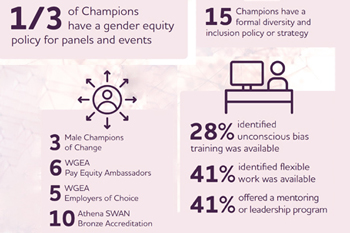
Women in STEM Decadal Plan Champions are STEM organisations that have agreed to publicly align their gender equity journey with the decadal plan. The champions process builds on the efforts already underway across many STEM organisations, providing a platform to share knowledge, act, evaluate and create accountability.
Download the 'One year in' report
The Academy's report, One year in – Women in STEM decadal plan champions, analyses the gender equity activities highlighted by Champions and key stakeholders between August 2019 and August 2020 and defines the next steps to improving gender equity.
Background to the decadal plan
At the request of the Australian Government, the Australian Academy of Science and the Australian Academy of Technology and Engineering worked together to develop the Women in STEM decadal plan, with the purpose of creating a 10-year roadmap for achieving sustained increases in girls and women’s STEM participation and retention from school through to careers.
Overseen by an Expert Working Group comprised of representatives from across the STEM sector, the decadal plan is the result of an extensive research and national consultation process covering every state and territory and involving written submissions, stakeholder interviews and roundtable discussions.
Download discussion documents
The Women in STEM decadal plan was launched in April 2019 and was accompanied by the Pathways to Equity in STEM symposium, the first implementation step for the plan.
The symposium brought together leaders from across the STEM ecosystem to begin turning the recommendations of the decadal plan into actions and to make commitments to equity in STEM in Australia.
The decadal plan aims to remove barriers for anyone who identifies as a woman, including cisgender (personal gender identity corresponds with sex assigned at birth) and transgender (personal gender identity does not correspond with sex assigned at birth). It also extends to intersex and non-binary individuals.
Catalysing Gender Equity 2020
The Academy, in collaboration with Science in Australia Gender Equity (SAGE), hosted the event Catalysing Gender Equity 2020 in Adelaide on 20–21 February 2020.
The conference brought together 400 representatives from academia, industry, government and education to advance the opportunities of the Women in STEM Decadal Plan.
Read the summary report and the report appendix to learn more.
Reflecting on Catalysing Gender Equity: one year on
On 30 March 2021, 73 representatives gathered in an online forum hosted by the Australian Academy of Science to reflect on the Catalysing Gender Equity 2020 conference held in February 2020 and the two years since the launch of the Women in STEM decadal plan.
Participants in the forum considered how the experience of 2020 would shape approaches in 2021, including identifying small-scale/big-impact ideas and ways the group could connect and collaborate going forward. This report outlines what was captured in the discussions and provides an action agenda for next steps.
*The April 2019 version of the Women in STEM decadal plan, available to download on this page, contains small changes from the original March 2019 publication, including page numbering. No substantive changes were made.
A vision for space science and technology in Australia
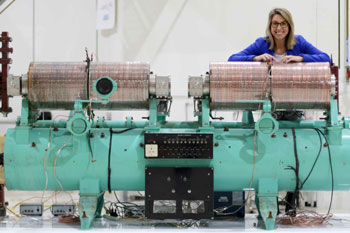
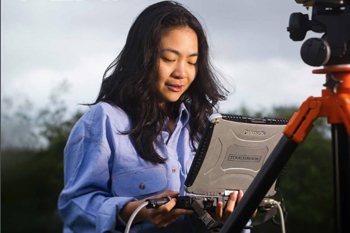
The plan outlines strategies to lead Australia into a future that embraces a vibrant space sector and space industry, underpinned by space science and technology, and in due course supported by a national space agency.
Australian space science and technology has significant strengths that play into global efforts such as space situational awareness, space weather, disruptive space technology developments based on small satellites, planetary science, and STEM outreach.
Australia needs a coordination framework for space science and technology and for its translation to innovation, that positions the sector as a unified contributor to the national economy
The National Committee for Space and Radio Science consulted extensively with broad a representation of researchers and organisations to create this plan.
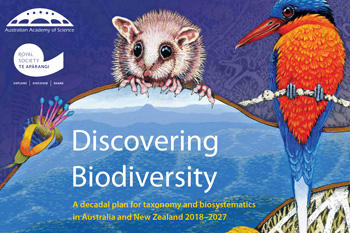
Discovering biodiversity: A decadal plan for taxonomy and biosystematics in Australia and New Zealand 2018–2027
It is estimated that 70 per cent of Australian and New Zealand species remain undiscovered, unnamed and undocumented. Taxonomy and biosystematics – the disciplines of biology that study, document, name and characterise biodiversity – provide the framework for this much-needed understanding of life on our planet.
This decadal plan seeks to use new and emerging technologies, develop key infrastructure, and create a unified and dynamic science that will serve the needs of society, government, industry and our unique biodiversity.
Download high-resolution version
2021 Deloitte report: Cost–benefit analysis of a mission to discover and document Australia's species
This report by Deloitte Access Economics found every $1 invested in discovering all remaining Australian species will bring up to $35 of economic benefits to the nation. The cost–benefit analysis supports a mission to discover and document all Australian species that remain undiscovered and unnamed, within a generation.
Download the report
Watch: The race to identify Australia's unknown species

The mathematical sciences in Australia: A vision for 2025
This is the first ten-year plan representing the strategic vision for the mathematical sciences – encompassing mathematics, statistics, and mathematics-based disciplines such as teaching and educational research.
Executive summary
The mathematical sciences sit squarely at the centre of modern life. They underpin our financial systems and all our information and communication technologies. They form the core of our attempts to predict the future of economic, social and environmental systems. They also drive new advances across a growing array of fields in science and technology.
The importance of the mathematical sciences is expected to increase over the next decade. To ensure that Australia benefits fully from the substantial strength of its mathematical sciences community during this decade, this plan sets out the following four objectives.
- Give all Australian schoolchildren access to outstanding mathematics teachers.
- Guarantee high standards of mathematical sciences teaching at Australian tertiary institutions.
- Achieve both global and local impact for Australian research in the mathematical sciences.
- Ensure that Australian society is capturing the benefits of mathematics-based technologies.
The plan makes 12 recommendations that align with these objectives. These recommendations are the product of extensive consultation with mathematical scientists working in schools, universities, government agencies and industry. They are based on an analysis of opportunities and challenges and are accompanied by commitments made by the mathematical sciences community. The discipline, through the Australian Academy of Science’s National Committee for Mathematical Sciences, will be formally monitoring progress on the recommendations on an annual basis.
Of the 12 recommendations, the following three stand out for their particular urgency and importance.
- Australian governments, schools and universities should urgently increase their provision of professional development for existing out-of-field school teachers of mathematics and enhance their commitment to the recruitment and retention of new, properly qualified staff.
- Australian universities should immediately plan for the staged reintroduction of at least Year 12 intermediate mathematics subjects as prerequisites for all bachelors programs in science, engineering and commerce.
- Australian universities should collaborate with the discipline to source seed funding for a new national research centre in the mathematical sciences with the objective of enhancing connectivity with industry and strengthening the international collaboration and visibility of Australian research in mathematics and statistics.
These are the plan’s three key priorities. In pursuing the objectives of this plan, the mathematical sciences community makes the following commitment.
We undertake to work closely with universities, school authorities and the Australian Government to achieve our objectives for mathematics education in schools and universities, and to ensure the growth and impact of Australian research and its social benefits. We take principal responsibility for creating public awareness and understanding of our work, to enable the realisation of its benefits and to inspire tomorrow’s teachers, students and researchers.
It is the strongly held belief of Australia’s mathematical sciences community that by implementing the decadal plan with specific emphasis on these three key priorities, we can achieve the following outcomes.
- Australian students at all levels will receive the mathematical education they need to lead fulfilling lives and to maximise their contribution to Australian society in an increasingly mathematical world.
- There will be a vibrant community of mathematicians and statisticians who advance the frontiers of the discipline for the broader benefit of Australian society.
These outcomes will contribute significantly to Australia’s growth through to 2025 and beyond.
Annual reports on implementation progress
Decadal plan for mathematical sciences
Decadal plan for mathematical sciences
Decadal plan for mathematical sciences
Grow. Make. Prosper. The decadal plan for Australian agricultural sciences 2017–2026
This plan outlines strategies to improve the strength and efficiency of agricultural research in Australia in ways that will increase the ability of governments and producers to maintain productivity and efficiency in the face of evolving natural challenges.
Successfully identifying, developing and deploying the next generation of game-changing scientific advances remains an active and ongoing challenge.
This plan also outlines strategies to capitalise on emerging technologies that will affect the agricultural sciences.
The National Committee for Agriculture, Fisheries and Food consulted extensively with a broad representation of researchers and different organisations to create the plan.
Preparing for Australia's digital future
Information and communication sciences cover a range of disciplines, including computer science, software engineering, information systems, telecommunications, and networking.
Developments in these areas underpin the broad technology area commonly known as information and communication technology, which is the engine room of much of today’s and tomorrow’s economy.
Future advances in areas such as data, the internet of things, virtual reality, e-health, automation and smart cities will provide great opportunities for new and existing businesses in Australia.
The strategic plan specifically addresses how researchers in Australia’s information and communication sciences (ICS) can assist in furthering these opportunities.
The strategic plan aims to identify implementable actions that will:
- enable Australia’s education, research, and industry sectors to increase national capacity and performance in all aspects of ICS
- translate this enhanced capacity into increased hardware and software innovation and increased industry participation in the development of new information and communication technology products and services
- develop a shared, sector-wide understanding of the challenges and opportunities for ICS in Australia, and a sector-wide commitment to respond
- encourage greater collaboration in areas that are identified as priorities.
This strategic plan is a partnership between the Australian Academy of Science’s National Committee for Information and Communication Sciences and the Australian Academy of Technological Sciences and Engineering.
Download a two-page summary
Download a policy primer
Published September 2021.
Implementation of the strategic plan
The National Committee for Information and Communication Sciences is working on three focus areas, from the recommendations in Preparing for Australia’s digital future.
- Making the case for digital innovation as a national science priority
Research into the fundamental aspects of digital technologies is underrepresented in the Australian research landscape. In an increasingly digital global environment, Australia must recognise digital innovation as a central, yet independent, sector that warrants research investment to ensure Australia remains competitive as digital nation.
In collaboration with the Australian Academy of Technology and Engineering, the National Committee for Information and Communication Sciences is preparing a policy document to summarise the key ideas in support of recognising ‘digital innovation’ as a national science priority for research investment.
- Identify and break down systemic disincentives for transdisciplinary and translational work
Establishment of a 'consortium/group' of IT adoption/diffusion researchers/practitioners from across the ICS disciplines (and the country) as a focus on ICS research innovation, translation and training – i.e. focused on existing ICS, new, reused, at different development phases (innovation to maturity) and implementation at different levels of scale and scope (very small to very large organizations, vertical industry sectors, simple to complex supply chains, government/NGO/commercial etc.).
We see a natural alignment with current discussions in Focus Area 3 regarding the leverage of the expert database extension and promotion to support these activities.
The sector has also undergone significant staffing and budgetary changes in 2020 due to the impacts of COVID-19, including Senate approval of the Federal government’s 'JobReady' legislation. This provides an opportunity and impetus to develop multi-university systemic approaches to transdisciplinary and translational research and teaching.
- Support the university-industry interface
Australian universities and industry organisations can benefit from a greater level of collaborations and making research competencies across the Australian digital sector more readily accessible to accelerate innovation across all sectors. The National Committee for Information and Communication Sciences is pursuing practical ways in which such collaboration can be improved and has responded to specific initiatives of the government in relation to the improved university-industry collaboration.
The National Committee for Information and Communication Sciences is focusing its effort to the development and expansion of database of experts who can contribute to the broader challenges faced by Australia and to allow such research competencies across the Australian universities and other organisations be more readily accessible. The committee has also identified the need for a systematic, longitudinal study of evolving and maturing state of university–industry collaboration across Australia and welcomes the recent proposal from the government to establish a survey aligned with this focus. In addition, the committee has been looking at mechanisms and processes to assist researchers to form better relationships with industry.