



Academy manuscript collection of ‘immense research significance’

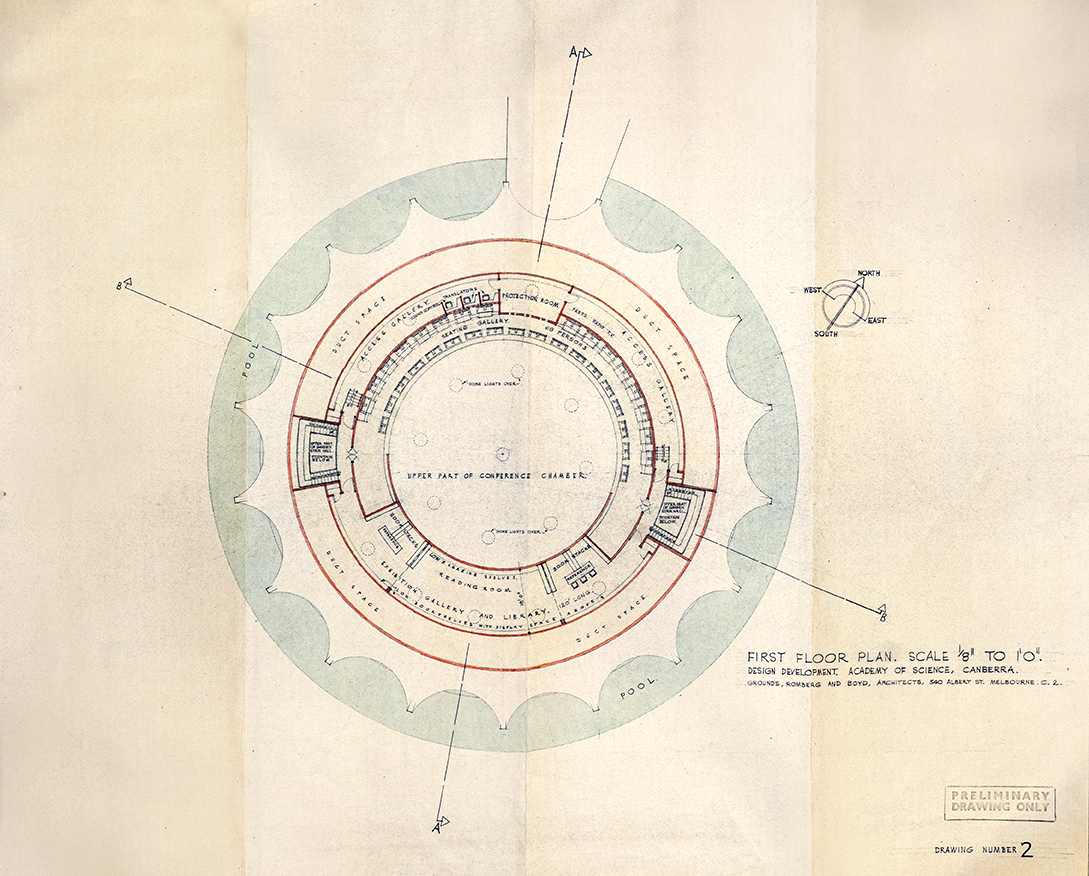
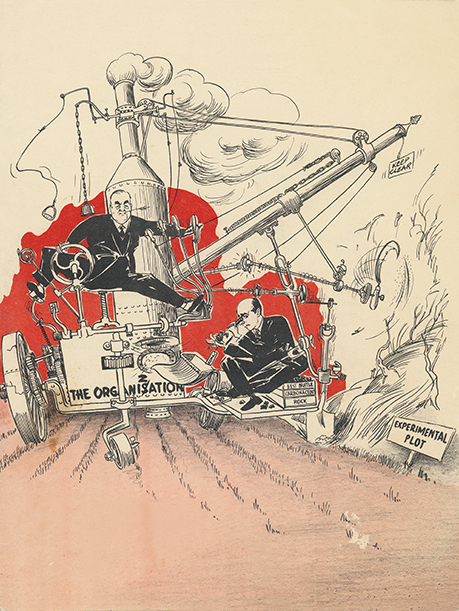
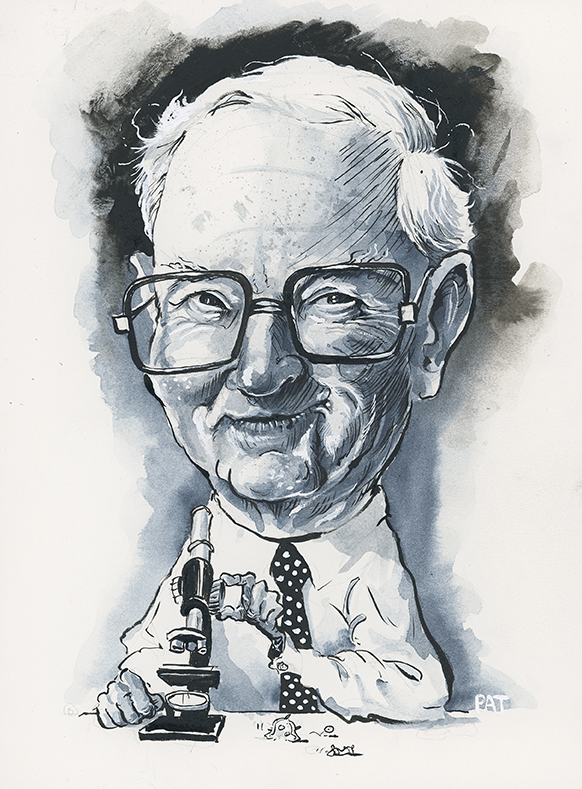
The archives of the Australian Academy of Science hold a rich and varied collection of unpublished and primary source materials documenting the history of science in Australia. Over its 60-year history, the collection has evolved into a substantial resource providing a rare and valuable window into Australian scientific discovery in the nineteenth and twentieth centuries.
The Community Heritage Grants (CHG) program assists with the preservation of locally owned but nationally important cultural heritage collections. Over the past year, a grant from this program has supported the Academy in undertaking a Significance Assessment of its archive, or manuscript, collection.
This appraisal by external consultant Dr Roslyn Russell stresses the archives’ ‘immense research significance’, making it ‘a natural starting point for any research into Australian science and scientists’. Collections are notable for their historical and social significance as a major repository for records of Fellows of the Academy – leaders in their respective scientific communities. Their manuscript collections document discoveries across fields as diverse as physics, astronomy, biology, geology, mathematics and chemistry and a host of specialisations within these broader subject categories. The assessment points to examples of artistic and aesthetic significance, with hand-drawn cartoons, fine graphic design, illustrations and photography present in many collections, and suggests a high degree of interpretive potential can be found in its myriad stories of scientific discovery.
Highlights include the collection of microbiologist Professor Frank Fenner, who is widely known for his role as the Chair of the Global Commission for the Certification of Smallpox Eradication, and for his significant contribution to the control of the rabbit plague in Australia. A small but significant collection of papers by Sir Frank Macfarlane Burnet, winner of the 1960 Nobel Prize in Physiology or Medicine, reaches back into his early career with technical documents dating from 1928 to 1940. The record hints at mid-century anxiety around virology, immunology and germ warfare sparked by the Cold War, continuing until 1985 with thoughts on nuclear weapons testing in the Pacific.
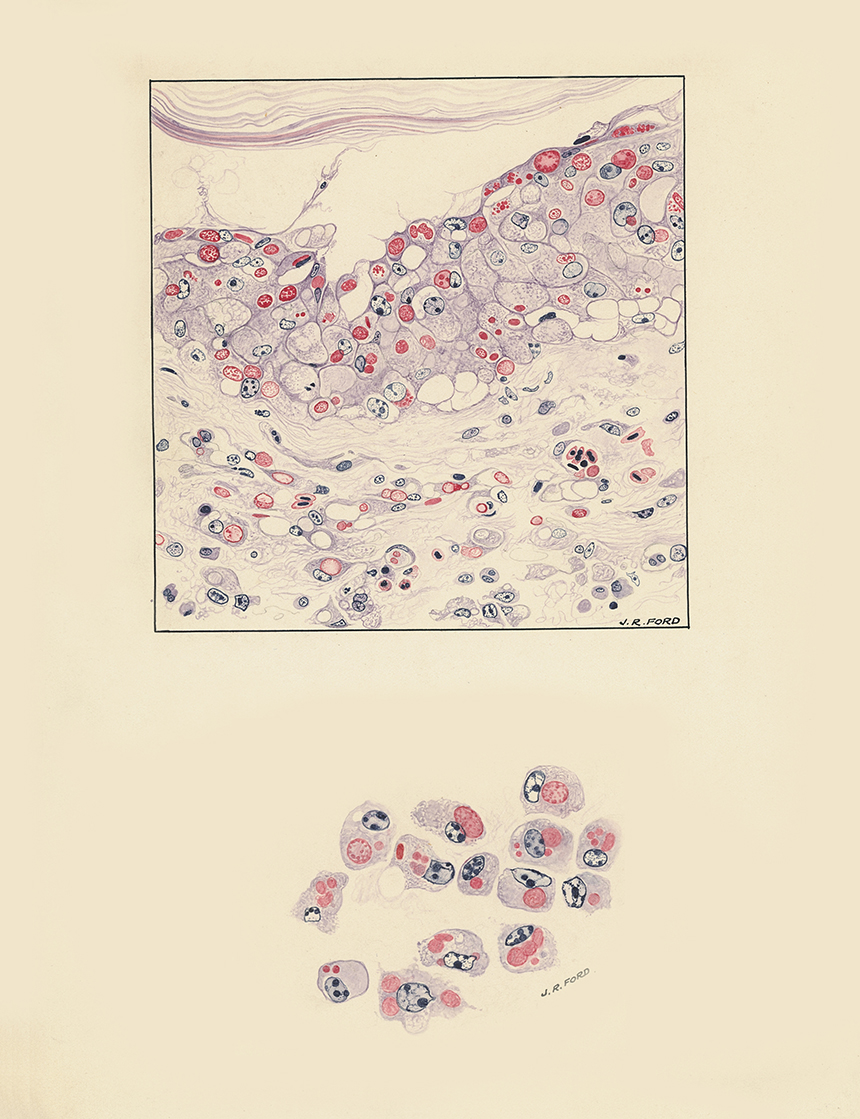
The assessment touches on the papers of Sir Ernest Titterton, a member of the Manhattan Project whose controversial role in British nuclear testing in South Australia was felt at the highest reaches of Australian government and diplomacy. There is also a wealth of material documenting early Antarctic exploration, our national interest in astronomy and solar observation, and breakthroughs in medical science and chemistry, alongside resources compiled for biographies of Australian botanists and plant scientists – with material focused on some of the most celebrated names in the field and others, including several pioneering women scientists, who have not been well recognised by history.
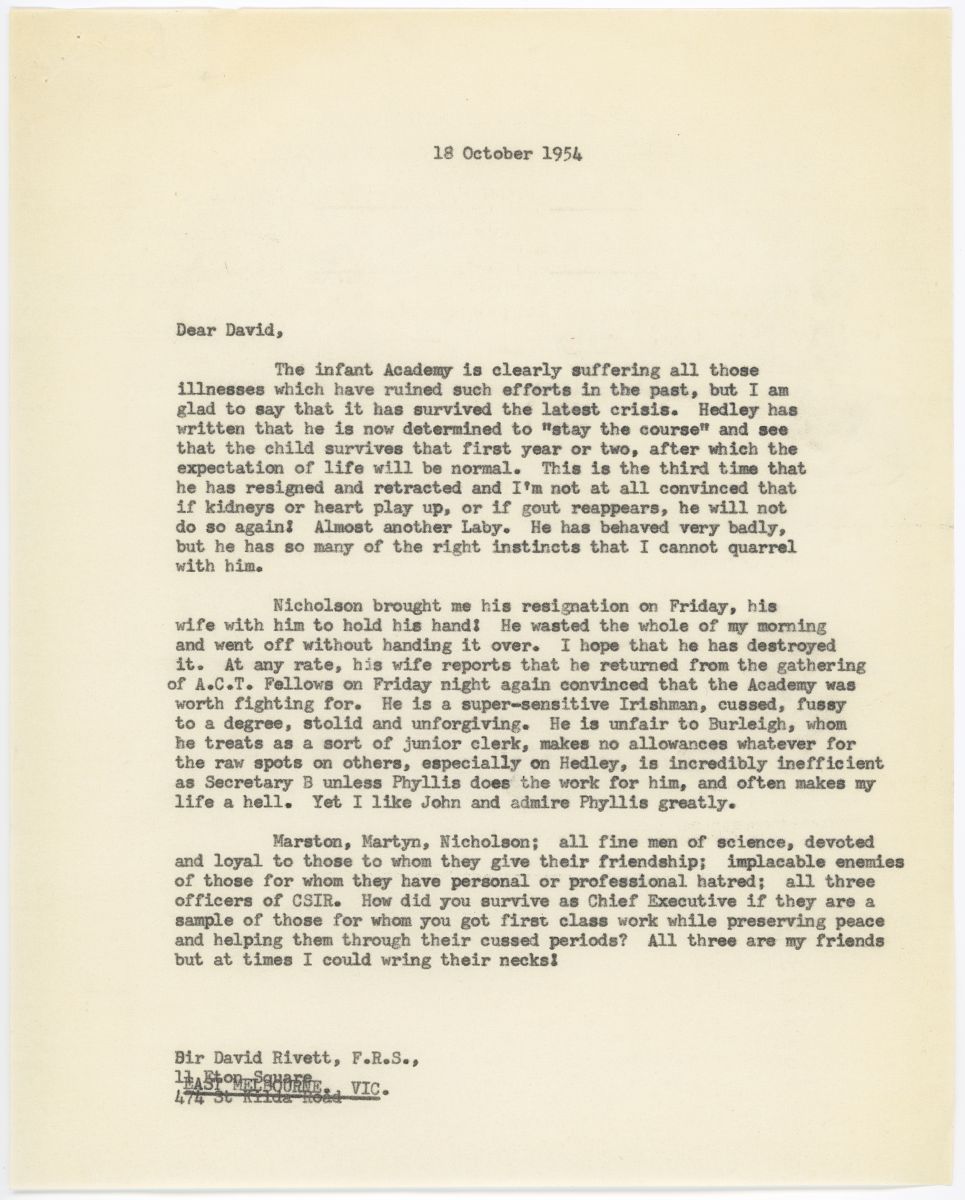
Many records of the Academy itself, and the formal documents of its constitution, are included in the archives. The papers provide an in-depth view of behind-the-scenes discussion taking place as the organisation came into being, featuring the various protagonists – both institutional and individual – and the competing interests that were instrumental in shaping the Academy that has now existed for almost 70 years. The manuscript collections of Sir Marcus Oliphant, Dr Max Day, Sir David Rivett and others provide detailed accounts of the debates, stresses and triumphs of the early years of Academy operations.
The Basser Library and Fenner Archives
Accessing the collection
A searchable catalogue of archive and library collections, including those mentioned above, can be accessed via the Academy website. Some material may only be available by special permission.
Search Academy collections or contact the Academy to enquire.
Make history with us
Conversations with Australian Scientists
Oral history provides a rare opportunity for archives to create rather than merely acquire material, and the Academy is committed to reintroducing its Conversations with Australian Scientists program. Supporting this project in recording stories enriches and inspires the next generation of exceptional scientists and provides a unique and personal insight into the challenges and progress of science in Australia.
Digitising the archives
Digitisation of collections will protect and preserve them for many generations and open access to researchers from around the world. This project is funded primarily by donations from Fellows and friends of the Academy and would not be possible without this support. Donations from organisations and individuals are welcome and can be made via the Academy website.
Antarctica, geology and the Frank Stillwell Collection
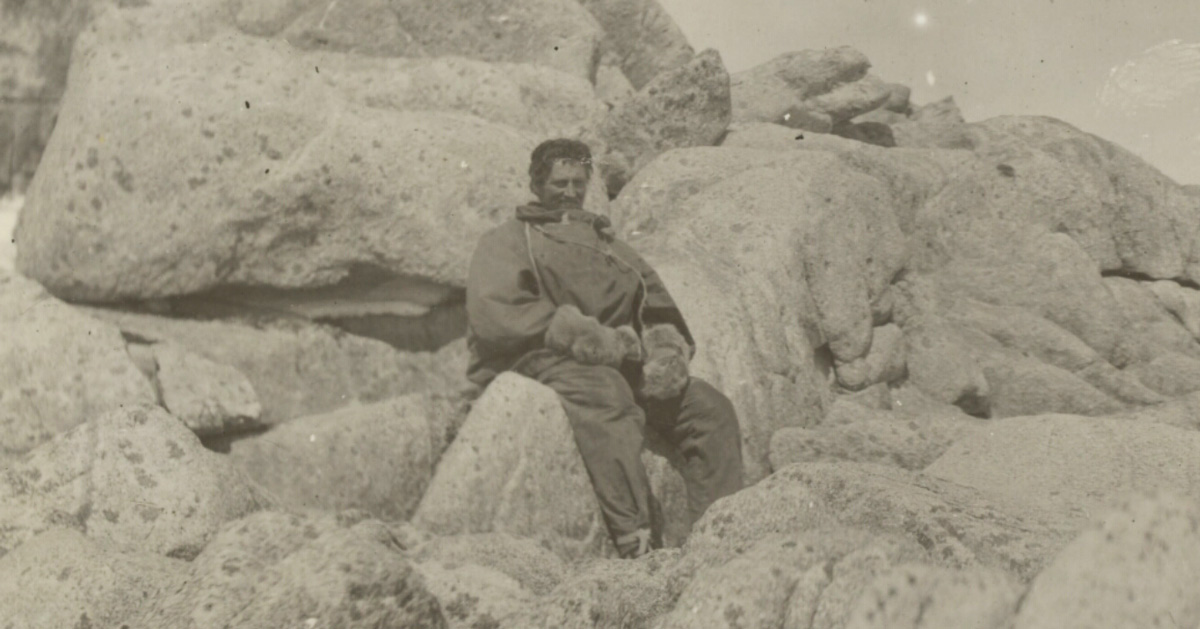
Rare manuscripts and photographs documenting early Australian exploration of Antarctica and its connection to developments in geology and mineralogy have been digitised as part of an ongoing collaborative project between the Australian Academy of Science and the National Library of Australia.
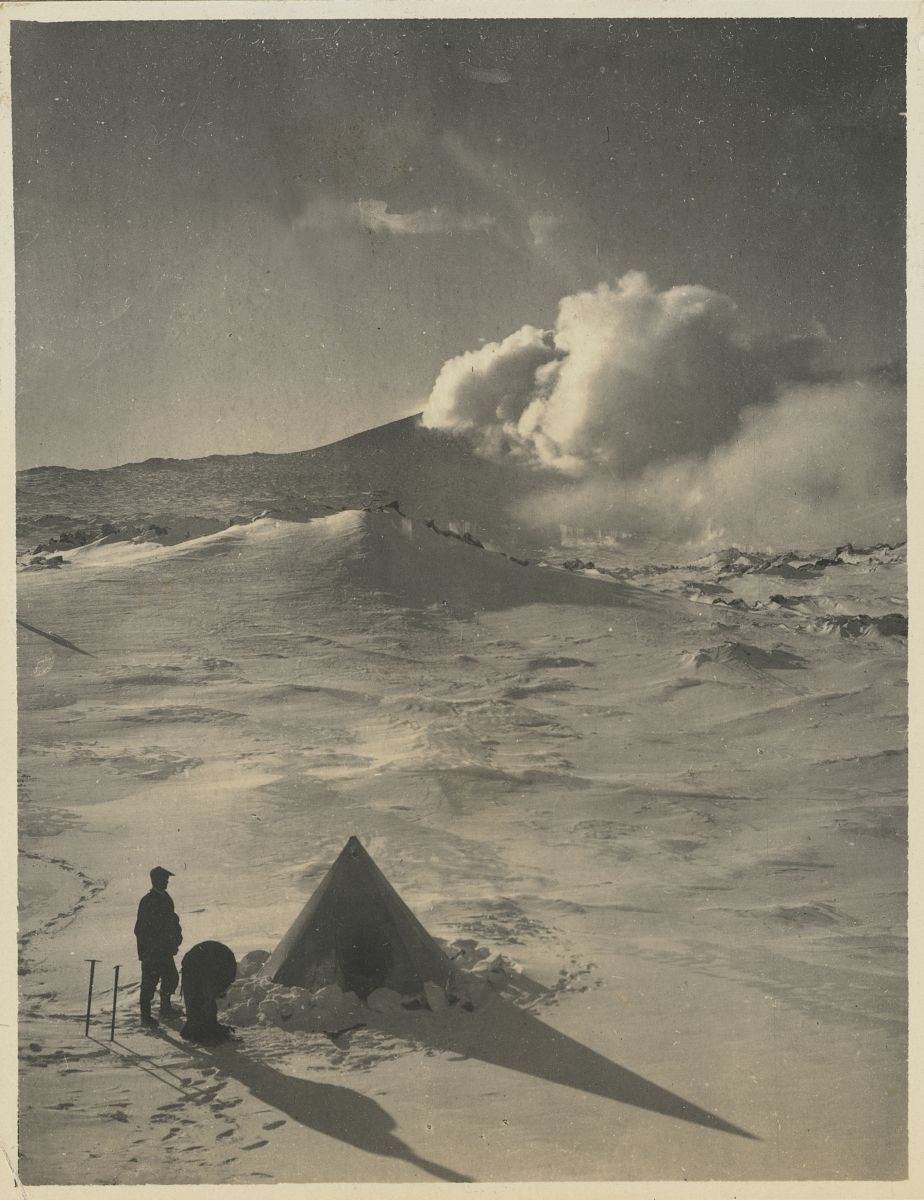
The material consists of a small collection of photographs and illustrations depicting the British Antarctic (Nimrod) Expedition 1907–09 led by Sir Ernest Shackelton and the ill-fated Terra Nova Expedition 1910–13 led by Captain Robert Scott, and the larger Stillwell collection covering the first and most famous of Australian polar exploration missions.
Australasian Antarctic Expedition 1911–14
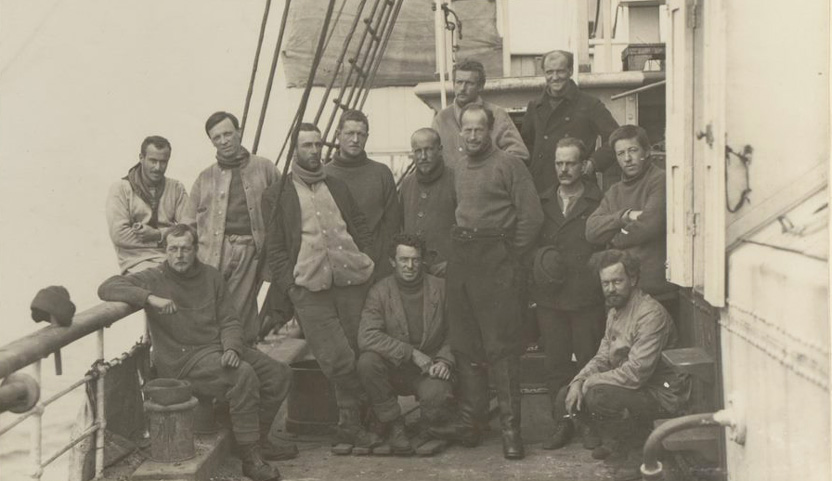
Frank Stillwell OBE FAA (1888–1963) was only 23 when Sir Douglas Mawson invited him to join the Australasian Antarctic Expedition (AAE). The expedition was primarily a scientific and geographic venture, and Stillwell was one of three geologists to make the journey.
The party sailed from Hobart to Antarctica aboard the Aurora in December 1911 and established their Main Base at Cape Denison on the shore of Commonwealth Bay, Adelie Land – an especially remote part of the Antarctic coast. Stillwell and his companions spent the next 17 months in what has since been described as a ‘river of wind’ with gusts of up to 200 miles per hour recorded – the blizzards were almost constant.
The Frank Stillwell Collection in the Academy’s archives includes fragile diaries, field journals, notes and photographs from his time in Antarctica. An otherwise intensely private man, Stillwell was conscientious about his diaries. He records the expedition’s scientific success, their coastal and inland journeys, and his observations of the region’s geography, geology, meteorology and magnetism. Stillwell’s papers paint a picture of everyday life at Main Base, the expedition’s absolute preoccupation with the wind – ‘a blizzard roar in our ears’ – the complete lack of privacy and the importance of shared meals in maintaining social cohesion. He fills gaps in Mawson’s published record, particularly from mid-December 1911 until the end of February 1912, when Mawson’s diary is almost empty.
Still no Mawson
Stillwell’s diaries and field journals cover the Spring and Summer of 1912 when six expedition parties set out on journeys of varying lengths. Stillwell led two shorter field trips along the coast of Commonwealth Bay while Mawson’s famed Far Eastern Shore Party began their far riskier journey to survey glaciers east of Cape Denison. Here he began his study of metamorphic differentiation to explain the contrasting mineral assemblages which formed during metamorphism from the initially uniform parent rocks of Adelie Land. This remains a widely accepted concept that improved our understanding of how minerals, including ore minerals, are formed.
These trips were perilous, and Stillwell writes of coming close to death due to carbon monoxide poisoning one night in December 1912. He records his safe return to Main Base in January 1913 and his joy at seeing the expedition’s ship Aurora return for them – ‘Excitement, news, bustles, once more the outside world…The saints could never be more happy – and creeping fear as days pass without the arrival of Mawson and his party’.
Mawson eventually made it back to base after a harrowing journey, sadly without his companions, Lieutenant Belgrave Ninnis and Swiss mountaineer Xavier Mertz, who had perished. He was just in time to see the Aurora on the horizon, returning to Australia. Six men had stayed behind to search for the missing party and remained with Mawson another ten months until the ship could return. Stillwell was not among them.
Geology, petrology and ore mineralogy
Frank Stillwell never returned to Antarctica. He lectured in mineralogy and petrology at the University of Adelaide in 1914, then dedicated himself to the analysis of the geological collections of the Australasian Antarctic Expedition. His papers trace the development of his study in The Metamorphic Rocks of Adelie Land, which was published in the AAE Reports and earned him a University of Melbourne DSc in 1916.
The Academy’s Stillwell collection covers virtually his entire career, beginning with student work and ending with Stillwell - a world-leading authority in ore mineralogy. Records document his post-Antarctic research into the lead-zinc-silver ores found at Broken Hill, New South Wales, the gold reefs at Bendigo, Victoria and the remapping of Western Australian gold deposits that resulted in the revival of the Kalgoorlie field. This inspired Stillwell’s later work with telluride ore minerals and prompted his travel to study mining operations in Europe, Africa and North America in 1922 and 1923. This overseas travel brought to his attention the emerging field of mineragraphy, the study of opaque minerals – particularly ore minerals – under the reflecting microscope, that would occupy the rest of his career.
The collection shows Stillwell was withdrawn from military service during World War I to assist in the development of the Commonwealth Advisory Council of Science and Industry and his subsequent Research Fellowship at the University of Melbourne, where his investigation into Australian ores led to his appointment as Research Petrologist and later head of the Mineragraphic Section at the newly formed Council of Scientific and Industrial Research, a predecessor of CSIRO. Stillwell and his team investigated nearly every major ore deposit in Australia, including the urgent but ultimately futile exploration of uranium at Mt Painter, South Australia, for potential use in allied nuclear weapons projects in 1944.
Rich social history
The Stillwell collection is also unexpectedly rich in social history, with maps and photographs documenting life and industry in small mining towns across Australia. It touches on the decades Stillwell spent teaching mineralogy at the University of Melbourne alongside his work at CSIR, and his extensive correspondence with others in his field shows how science and industry intersected in the early to mid-twentieth century. Records touch on the profound influence of Stillwell’s time in Antarctica on the rest of his career and his lifelong friendships with other expedition members. Letters found elsewhere in the Academy’s archives reveal that Douglas Mawson was behind Stillwell’s nomination to the Australian Academy of Science, where he was elected a Fellow in 1954.
The Frank Stillwell Collection is now freely accessible via Trove and the Academy online catalogue.
To learn more about Stillwell, see Still no Mawson, a transcription and annotation of his Antarctic diaries edited by Bernadette Hince, and read the biographical memoir by E. S. Hill.
The Academy thanks philanthropist Mr David Anstice, whose support made digitising these collections possible. If you would like more information about supporting the archive digitisation project, please contact our Philanthropy Manager at philanthropy@science.org.au.
David Shepherd North Collection now available online
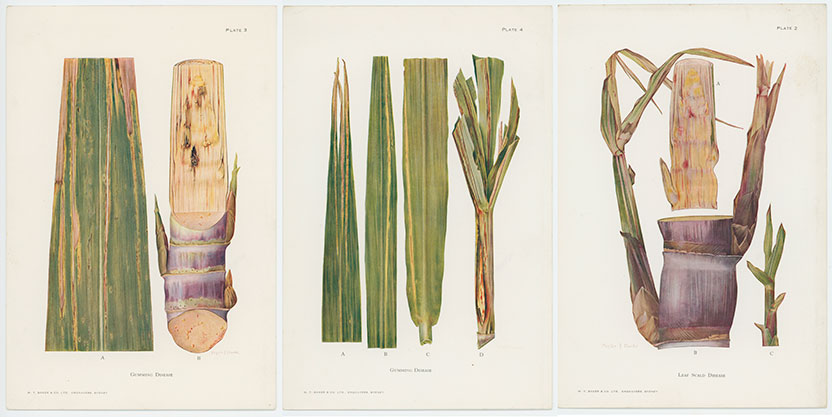
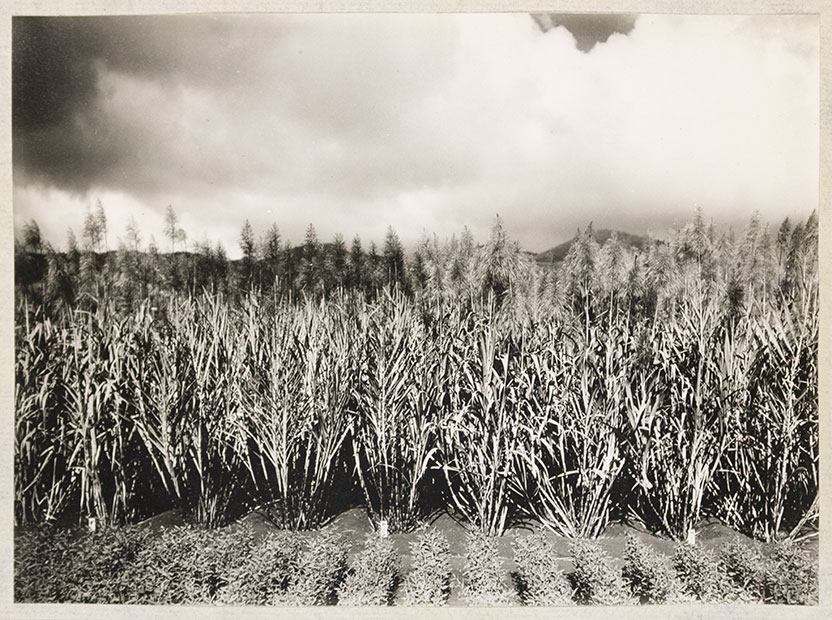
Agricultural scientists today know that sugar cane crops regularly succumb to pests and diseases and need to be replaced by new varieties. A century ago, Australian cane growers were slowly coming to this realisation as one crisis after another led to Queensland and New South Wales becoming a home for almost every known ailment that plagued the plants.
A collection of manuscripts held in the Australian Academy of Science archives showcases a little-known multi-decade effort by science, industry and the farming communities of north-eastern Australia to combat the problem.
The material has been digitised and is now freely available through the Academy online catalogue.
David Shepherd North and the Colonial Sugar Refining Company (CSR)
David Shepherd North (1882–1967) started his career as a laboratory assistant with the Colonial Sugar Refining Company (CSR) in 1900. CSR was the dominant sugar-producing firm in the country at the time, and much of its success was due to the deliberate instilling of scientific literacy among its workers. The company was in the habit of recruiting overseas-trained graduate engineers and industrial chemists and regularly sending staff out of the country to learn about the newest agricultural research developments.
The uncontrolled outbreak of sugar cane diseases was an existential threat, and CSR quickly recognised the need for a university-trained plant pathologist. They had no luck finding one in Australia. Instead, David North was given special training by the University of Sydney and the Linnean Society of New South Wales—the question of what precisely he learned was never spelt out and has long troubled researchers.
The only hint appears to be in North's handwritten notebooks at the Academy, which reveal a broad and eccentric study of botany, bacteriology, entomology, and plant science.
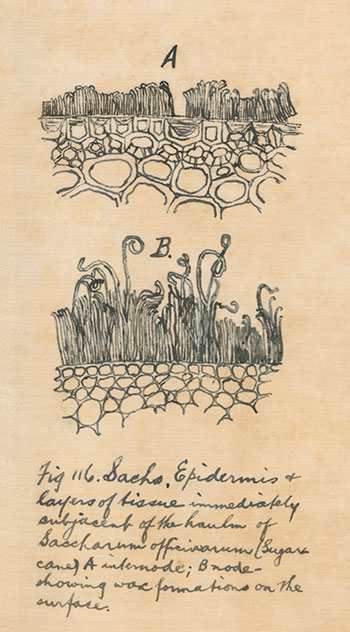
It is tempting to think that all science of significance naturally makes its way into the published sphere, but North left very few papers on his work. Instead, he produced many thousands of pages of correspondence, reports and photographs showing the slow progress of his research over almost 40 years.
Research, control strategies and collaboration
The North Collection reveals communication between the Australian sugar industry and other cane sugar-producing countries. It covers North's early career study of cane cultivation, pests, and diseases in Hawaii and Indonesia and touches on his work to identify Fiji disease and the subsequent development of a control scheme often credited with saving the Fijian sugar industry.
Records describe efforts to identify the many diseases plaguing Australian sugar cane. They show research undertaken into the cause of these diseases, methods for their control, and the breeding of new cane varieties. North’s work inspired the sugar industry to train and employ plant pathologists in increasing numbers. His correspondence with Arthur Bell, the pathologist at the Bureau of Sugar Experimentation Stations in Queensland, was particularly significant and helped foster many years of collaboration between the two organisations.
The success of cane disease control methods like quarantine zones and planting of approved disease-resistant varieties hinged on cooperation with nearly 8,000 sugar cane growers scattered across the north-eastern Australian landscape. CSR held farm demonstrations on recognising healthy planting material, and North travelled between sugar-producing districts, reporting on cane cultivation competitions designed to popularise improved practices and demonstrate their benefits.
Cooperation between plant pathologists and sugar cane farmers over the following decades eradicated many agricultural diseases and underpinned a considerable expansion in sugar production and export. The North Collections follows this story as it unfolds, describing how Australia went from an epicentre for sugar cane disease to a country where science led the way in sustaining one of its most critical industries.
The Academy thanks philanthropist Mr David Anstice, whose support made digitising this collection possible. If you would like more information about supporting the archive digitisation project, please contact Kate Groves, our Philanthropy Manager at philanthropy@science.org.au.
Digitisation of the Academy archives
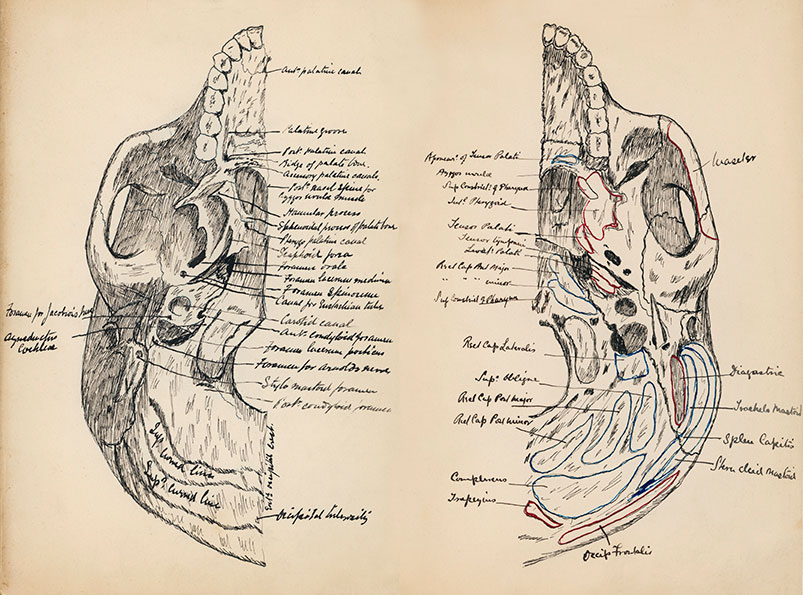
Digitisation at the Academy is opening new pathways into the historic archive and library collections donated by numerous Fellows of the Academy, other prominent scientists and scientific organisations.
The digitisation project began in late 2020 and has focused on evaluating the condition of fragile collection material, improving conservation and capturing images and associated descriptive data in a way that is searchable and freely available online to researchers around the world.
Already the project has captured some extraordinary material, including Professor Frank Fenner’s diary entry from 8 May 1980, when he stood before the World Health Organization Assembly in Geneva and officially declared smallpox eradicated.
There are exquisite hand-drawn anatomy diagrams by Charles Fenner, diary entries written by geologist T.W. Edgeworth David halfway up an active Antarctic volcano, and correspondence from Walter George Duffield—the first Director of Mount Stromlo Observatory in the ACT—to his wife Doris that begin as love letters before swerving into an analysis of solar physics research in early twentieth-century Australia.
Accessing the digital collection
A new searcheable catalogue of archive and library collections and images can be accessed via the Academy website, though some material is only available by special permission. Contact the Academy to enquire.
Volunteering at the archives
The Academy is seeking volunteers to work with the archivist. Opportunities exist to assist with digitisation, and to work online to transcribe and extract vital information from our nationally significant history of science collection.
Interested volunteers should contact the archivist at library@science.org.au
Digitisation project donation appeal
The Academy digitisation project is largely funded by donations from Fellows and friends of the Academy and would not be possible without this support. Donations from organisations and individuals are welcome and will contribute toward the costs of digitising the archives. Donations may be made via the Academy’s website or through contacting the Academy’s Philanthropy Manager, Isobel Griffin, by email or phone on 02 6201 9471.
Library and Archives Committee
Current members:
Hans Bachor
- AM FAA
- Chair

Steve Simpson
- AC FAA FRS
- Member
TJ Higgins
- AO FAA FTSE
- Member
Chris Dickman
- FAA
- Member
About our governance
The operations of the Australian Academy of Science are overseen by a Council of 17 Fellows from across a range of disciplines who are elected at the Annual General Meeting. Seven of these Fellows are elected as Officers with different areas of responsibility who act under delegations from Council to make and implement decisions on the routine business of the Academy.
The Academy was founded on 16 February 1954 by Australian Fellows of the Royal Society of London. It was granted a Royal Charter, establishing the Academy as an independent body with government endorsement. The Academy’s Constitution was modelled on that of the Royal Society of London. Today, the Academy remains an independent organisation with Deductible Gift Recipient status.
Standing Committees assist the Council to set policy and make decisions around specific areas of Academy activity, including awards, research conferences, development activities, and travelling fellowships.
The Academy’s annual reports outline its activities against its mission statement and strategic plan, focusing on its four main program areas with an underlying goal of operational excellence:
- excellence and diversity in science
- influential voice for science
- scientific literacy
- international engagement.
The Academy’s financial performance is overseen by a Finance Committee and is subjected to regular independent audits. Its operations are underpinned by a range of funding sources, including philanthropic income, sponsorships and partnerships, government grants, investment income, and the sale of publications and event tickets.
Page not found
Theo Murphy Initiative (Australia): highlights of 2023–24 activities

OVERVIEW
More than 1,564 participants, including 751 EMCRs from 57 universities and research institutions spread across Australia benefited from TMIA-funded activities.



-
ECMRs and grantee organisations made linkages with more than 13 industry partners, and conducted or attended more than 11 symposiums and conferences, some of which were critical for research endeavours.


-
Participation Support grants enabled 19 EMCRs to travel to 11 countries for research presentations and conferences.
-
The activities engaged EMCRs, academia, industry partners, policy makers, government representatives, research agencies and health professionals.
-
Thematically, the activities were in the areas of artificial intelligence, indigenous genomics, healthcare, optimisation, plant-soil ecosystems, bioinformatics, computational biology, lipid research, science communication, suicide prevention and data mining.
-
In addition to TMIA grant funding totalling $296,952, the initiatives secured additional support, both financial and in kind, valued at $138,922 from more than 17 partners, maximising impact and expanding EMCR networks. In some projects, minimal event registration fees were applied to supplement the event budget.
FLAGSHIP ACTIVITY HIGHLIGHTS
Artificial Intelligence (AI) in science
The AI in Science Conference, hosted by the Australian National University and CSIRO, brought together more than 75 EMCRs to explore AI’s ethical, social, and environmental dimensions in scientific research. Expert speakers from academia, industry and government addressed AI’s sustainability challenges, industry applications, ethical considerations and productivity benefits.
Discussions highlighted AI biases, ecological impact, and the need for ethical standards. A networking activity provided diverse perspectives on AI’s role in science over the next decade. Outreach events have commenced, with the both the outreach events being highly successful and well attended.
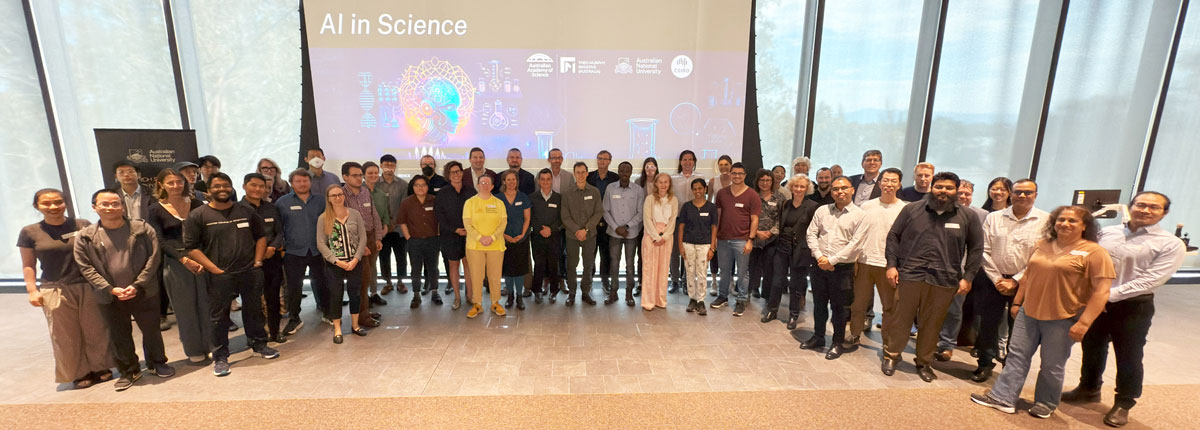
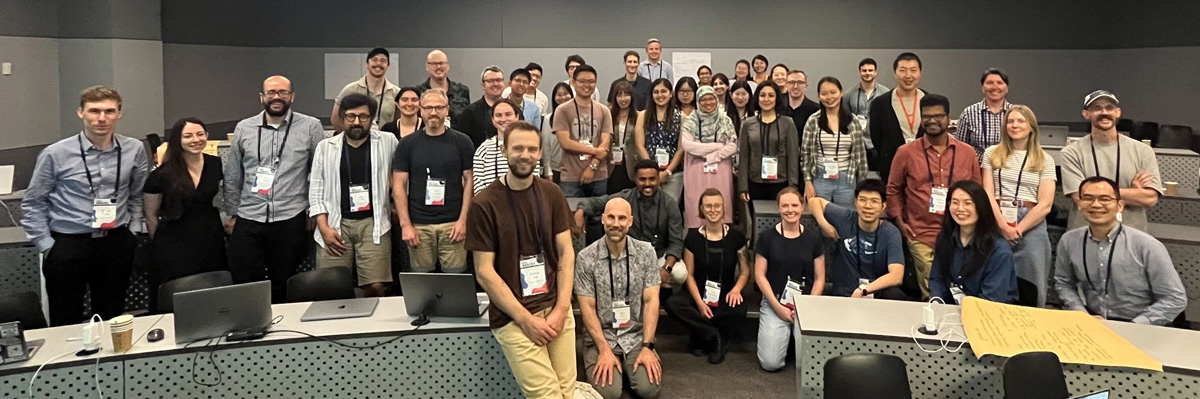
AI in Science conference participants at the Australian National University, November 2024
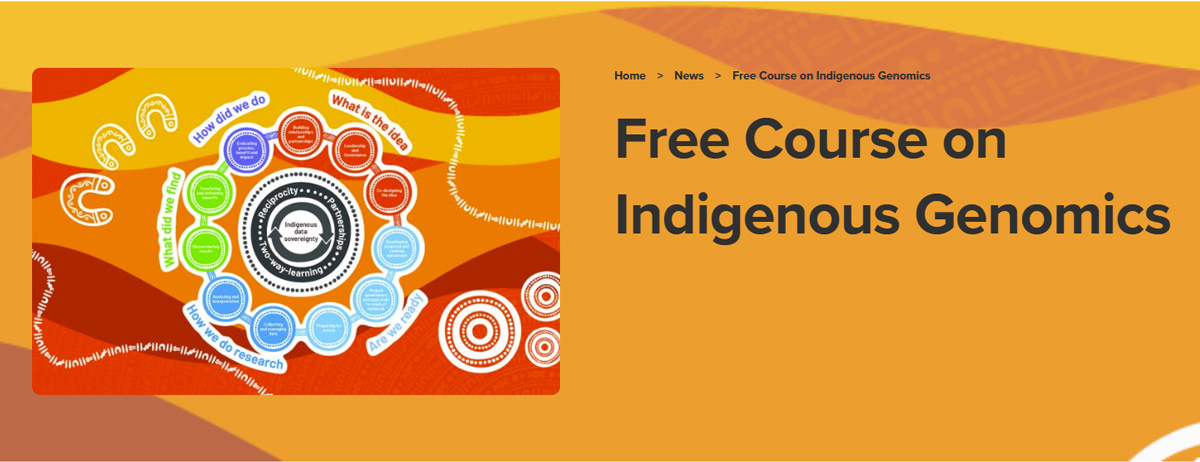
Indigenous Genomics and Responsible Research: Bridging the Knowledge Gap through a Massive Open Online Course (MOOC)
The Genomics Our Way online course, launched on 31 March 2025, is the first of its kind, developed through the Australian Alliance for Indigenous Genomics (ALIGN) and the University of Adelaide. This free course intends to equip EMCRs with the knowledge and skills to conduct ethical and culturally respectful genomics research with Aboriginal and Torres Strait Islander communities. As of 27 August 2025, the course had seen 490 enrolments. Registrations are also expected from Aotearoa New Zealand, Canada, the Americas, Africa and Europe.
The course introduces the Indigenous Research Lifecycle, ensuring Indigenous communities are active stakeholders throughout research. It also provides technical training in advanced genomics techniques and serves as an ongoing professional development resource.
To reinforce cultural safety and Indigenous leadership, the team collaborated with the Australian Alliance for Genomic and Health’s governance board, engaged Indigenous businesses for course production, and partnered with Kaurna Yerta Aboriginal Corporation for cultural context. The course has been reviewed and approved by the ALIGN National Indigenous Governance Council, with registration now open for EMCRs and students.
Charting the Future of Healthcare: Making Research Core Business of Early- to Mid-Career Nursing and Midwifery Researchers
Held on 11 November 2024 at the Australian Catholic University North Sydney campus, the National EMCR Nursing and Midwifery Research Symposium brought together nearly 100 participants, including 70 EMCRs from six states and territories. The event fostered collaboration between researchers, industry leaders and consumers, with travel grants supporting EMCRs from other states.
Key discussions addressed the post-PhD research cliff and the need for greater national funding to support EMCRs. With nurses and midwives forming 54% of the healthcare workforce, the symposium highlighted the potential of nursing and midwifery-led research to improve patient care. A major outcome is the National Nursing and Midwifery EMCR Advocacy Roadmap, launched in April 2025, to guide research expansion and workforce planning.
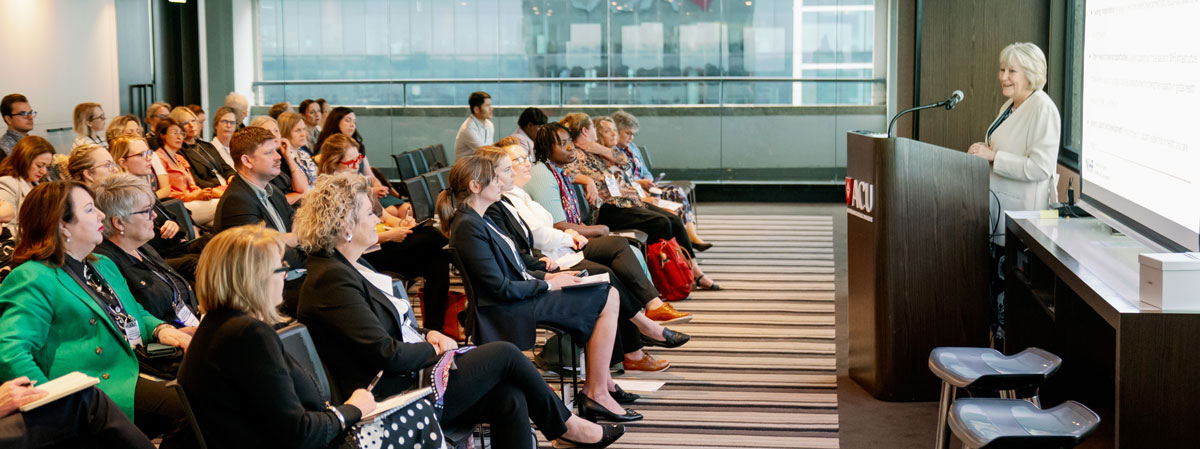
OPTIMA-CON 2024
A conference held in July 2024 brought together 180 attendees from research and industry to explore optimisation technologies across multiple sectors. The event featured 53 talks, three keynote addresses, case studies and networking sessions – engaging 45 EMCRs, with 25 presenting their research.
The conference strengthened industry-academia collaboration, highlighted career pathways and facilitated new research opportunities. A special edition of the journal Optimization Letters will publish key findings, reinforcing the event’s success in advancing optimisation research and fostering impactful partnerships.
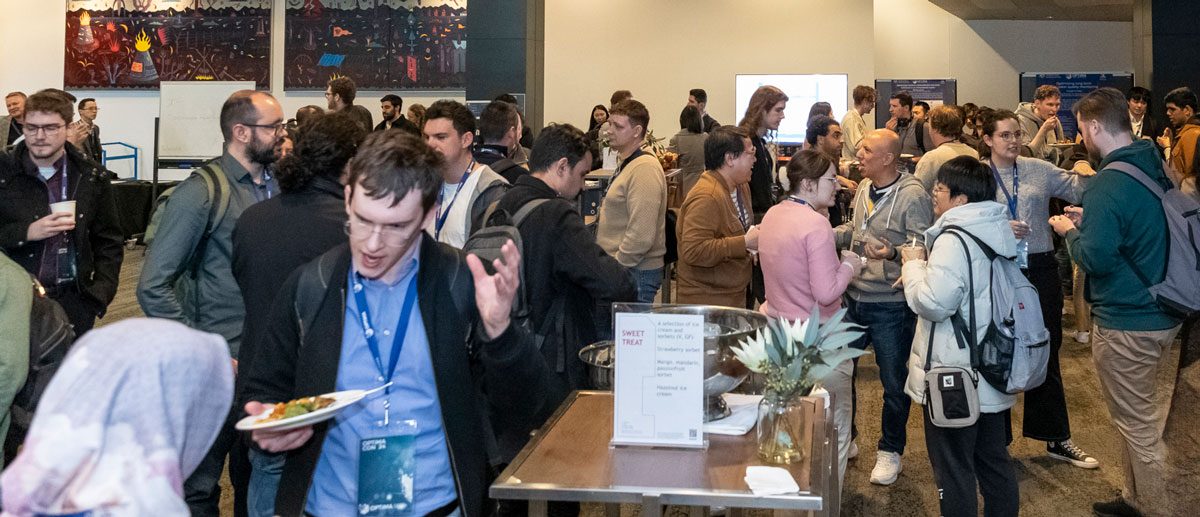
AMPLIFY ACTIVITY HIGHLIGHTS
A horizon scan of future priorities to support the sustainability of plant-soil ecosystems in Australia
The plant-soil ecology horizon scan activity ended with a workshop on 8 December 2024 in Melbourne. The project engaged 64 experts from academia, industry, government and research agencies. Two online surveys helped identify key issues in plant-soil ecology, which were further refined at the workshop attended by 33 participants, 70% of whom were EMCRs.
The project benefited 61 EMCRs, fostering national and international collaboration, with representation from multiple Australian states and one New Zealand researcher. As the first application of horizon scanning methodologies in Australian plant-soil ecology research, this initiative has strengthened EMCR engagement, research networks and priority setting for future studies. It is expected to drive collaborative publications and inform grant proposals, shaping the future of plant-soil ecology research.
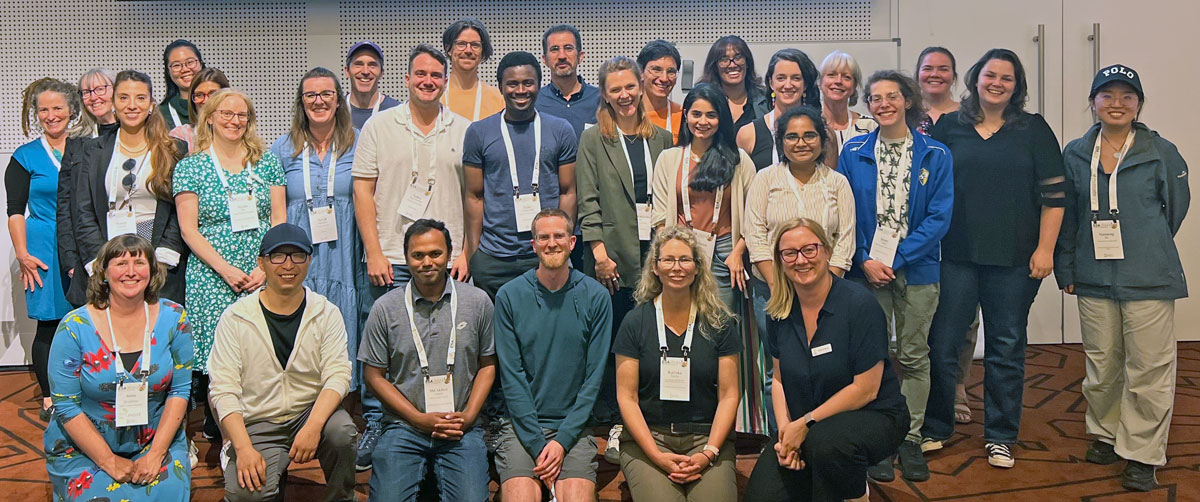
Masterclass in Communication for Early-Mid Career Researchers
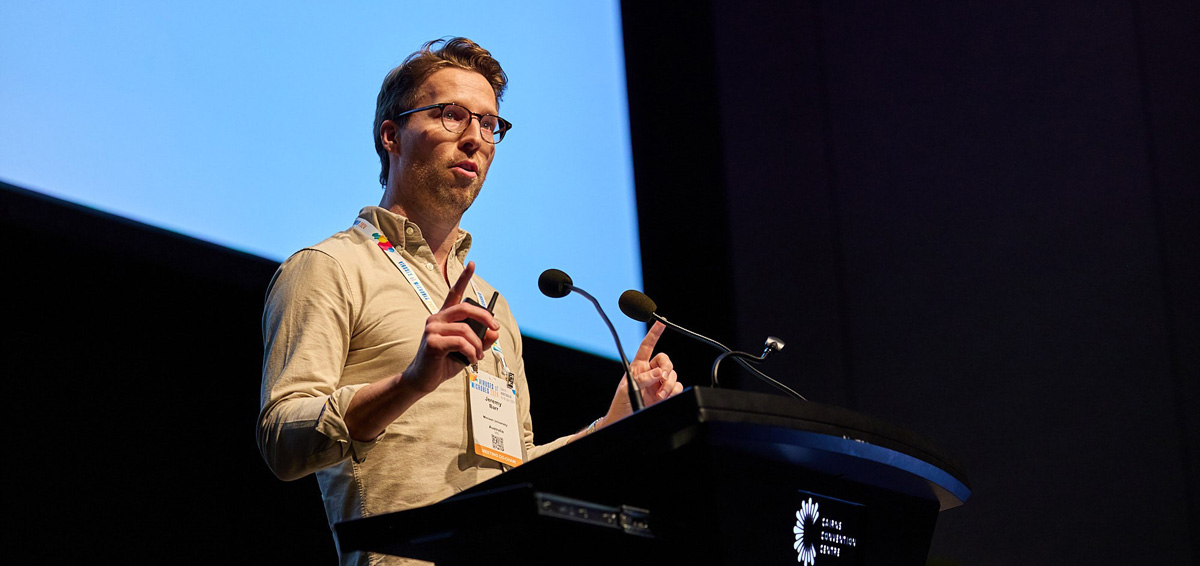
The Viruses of Microbes 2024 meeting, held in July 2024, featured a pre-meeting workshop: Masterclass in Communication for EMCRs. The session trained 85 EMCRs in science communication, grant and job applications and presentation skills, addressing a key gap in professional development.
Attendees commended the high-quality practical training, with many applying the techniques during the conference, and the event’s broader success was highlighted in a Cairns Convention Centre media post.
Australian Bioinformatics and Computational Biology Society (ABACBS) EMCR Hackathon
The EMCR Hackathon took place at the 2024 ABACBS Conference, successfully engaging 50 EMCRs and four established researchers. The event, organised by a diverse committee of 10 EMCRs, facilitated networking, leadership development and interdisciplinary collaboration. Nineteen postdoctoral researchers received scholarships to attend the event. Due to its success, the Hackathon has been established as an annual event, ensuring continued support for EMCRs through networking, peer learning and leadership training in the bioinformatics and computational biology community.
Establishing The Lipid Network: an online platform that links researchers, clinicians, industry and societies
The Lipid Network (TLN) aims to build a global database of researchers, clinicians, industry and societies. The network was soft-launched at the Australian Lipids Meeting from 30 September to 3 October 2024, where a draft website, database entry form and search tool were showcased. TLN was also promoted through the conference program, social media and visuals during the meeting, reinforcing its visibility and engagement with industry and society representatives.
The TLN working group has transitioned into a formal committee, and interest from the lipid research community has grown. TLN is now positioned to support collaborative efforts, expand its database and become a central resource in lipid science.
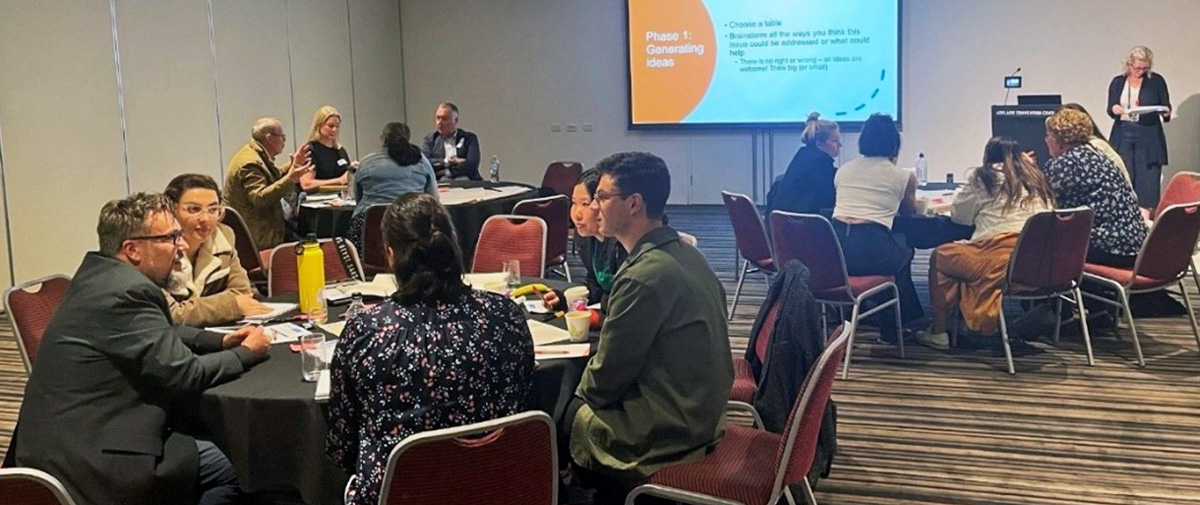
National Suicide Prevention Conference (NSPC) pre-conference event: Clinician-Researchers in Suicide Prevention
A pre-conference workshop for clinician-researchers in suicide prevention was held on 29 April 2024 featuring presentations, a panel discussion, a priority-setting hackathon and networking opportunities, all aimed at supporting early- and mid- career clinician-researchers.
The event resulted in a peer-reviewed journal article published in 2025, and the creation of a community of practices that participants have actively engaged with since the event. This initiative has laid a strong foundation for sustained collaboration and career development within the suicide prevention clinician-researcher community.
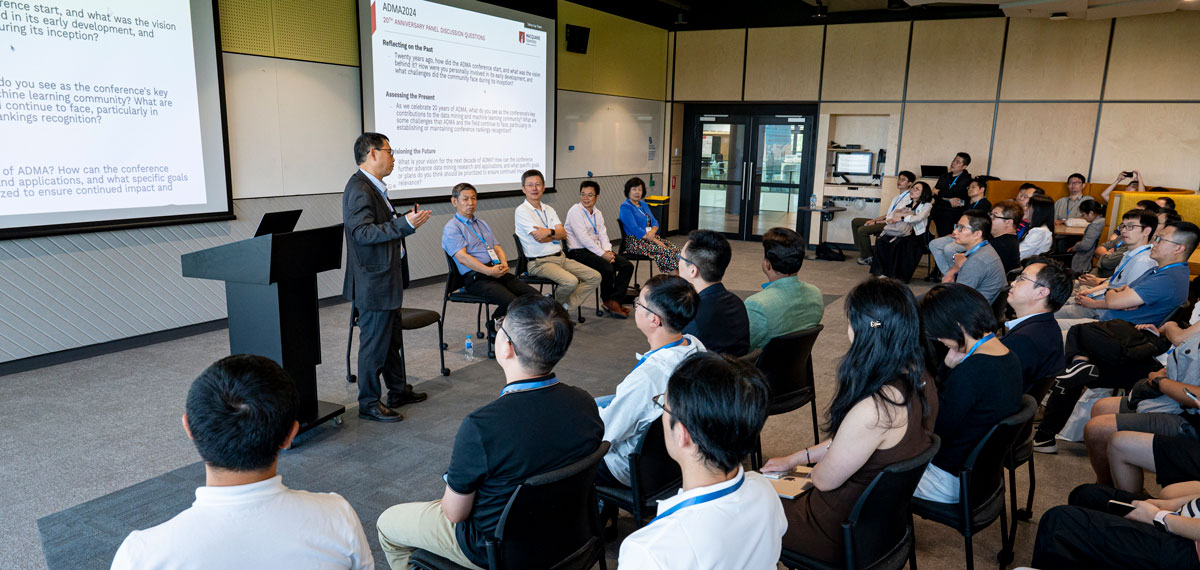
Australian EMCRs support the 20th International Conference on Advanced Data Mining and Applications (ADMA 2024), Sydney, Australia
To mark the 20th anniversary of the Advanced Data Mining and Applications (ADMA) Conference, a series of first-time initiatives were introduced to support EMCRs. These included six travel grants, a distinguished young scientist panel and a networking event.
All six EMCR travel recipients participated in a panel discussion with five invited distinguished young researchers, where they engaged in in-depth dialogue on research and leadership. This marks the first implementation of EMCR travel grants and the first distinguished young scientist panel in ADMA’s history, all contributing to enhanced engagement, visibility and development opportunities for EMCRs.
PARTICIPATION SUPPORT ACTIVITIES
Nineteen EMCRS participated in a range of international and national conferences, symposiums and research visits across 11 countries, including Australia, presenting their research and engaging with global leaders in fields such as ecology, neuropsychology, agriculture, chemistry, cryptography, neuroscience and more.
These events offered critical opportunities for knowledge exchange, expert feedback and professional development. EMCRs benefited from expanding their international networks, forming new research collaborations, gaining exposure, and refining research and teaching directions. Participation also enhanced visibility and strengthened contributions to both academic and policy-impactful research.
Testimonials from Participation Support recipients of the 2023–24 grant round
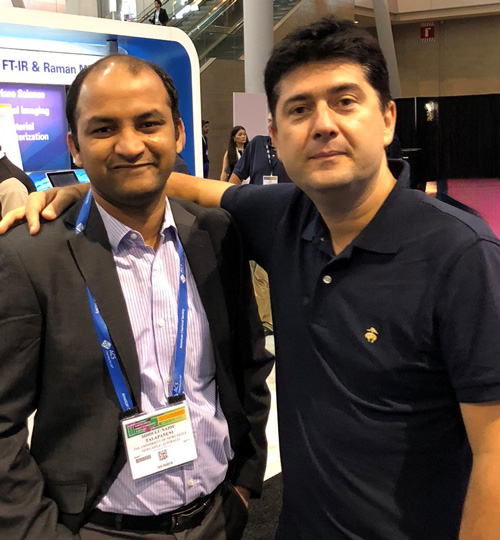
Engaging in the ACS National Meeting Fall 2024 has significantly contributed to my career development as an early-career researcher. Presenting my research at such a prestigious platform enhanced my communication skills and increased the visibility of my work among leading scientists and industry professionals. The opportunity to attend talks and panel discussions exposed me to cutting-edge advancements across diverse fields, broadening my knowledge and sparking new ideas for future research. Additionally, the conference provided an excellent networking platform, enabling me to connect with experts, potential collaborators, and mentors who offered valuable insights and advice.
— Dr Siddulu Naidu Talapaneni, Research Fellow, University of New South Wales
My presentation at the Cephalopod Neuroscience Conference 2024 and the workshop showcased the most updated knowledge of cephalopod neuroanatomy and connectomics, along with valuable feedback throughout the discussion during the conference. Attending this event gained recognition of my work and increased my visibility in the cephalopod neuroscience community. This also led to two new international collaborations with experts from Switzerland and USA after the conference.
— Dr Wen-Sung Chung, Postdoctoral Research Fellow, Queensland Brain Institute, University of Queensland
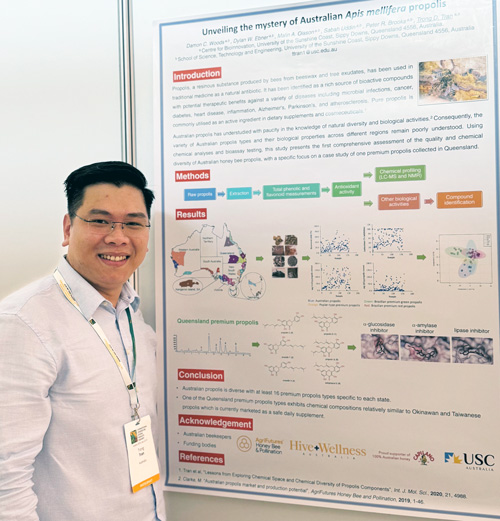
Participation in the International Congress On Natural Products Research provided me with several opportunities to share my Australian propolis research to international researchers, to learn and update new knowledge in the field of natural product research, and to network with new colleagues from other countries. The use of mass spectroscopy-based metabolomic and advanced nuclear magnetic resonance techniques in natural product research I learned from the congress will be applied in my teaching and research activities to train my undergraduates, including honours students and PhD students, on my return to Australia.
— Dr Trong Tran, Senior Lecturer, University of the Sunshine Coast
With the Participation Support grant, I was able to bring my nearly-three-year-old daughter and 12-year-old son with me while attending the International Conference on Nanoscience and Nanotechnology 2024 in Melbourne. This has provided opportunities for me to fully engage with conference activities without worrying about my little girl or feeling guilty to be away from my children. The grant really helps researchers with primary care responsibility to balance between work and life.
— Dr Bin Guan, Research Associate, University of South Australia
This grant has significantly contributed to my development as an EMCR by providing the opportunity to attend two international conferences. These events were invaluable for networking and fostering collaborations with international delegates. Notably, my attendance at the Global Neuropsychology Congress allowed me to establish a new collaboration with researchers from the Murdoch Children's Research Institute (MCRI) in Melbourne. This engagement has expanded my professional network and enriched my knowledge, positioning me to contribute more meaningfully to the field while strengthening my research profile.
— Dr Jack Nguyen, Research Fellow, Monash University
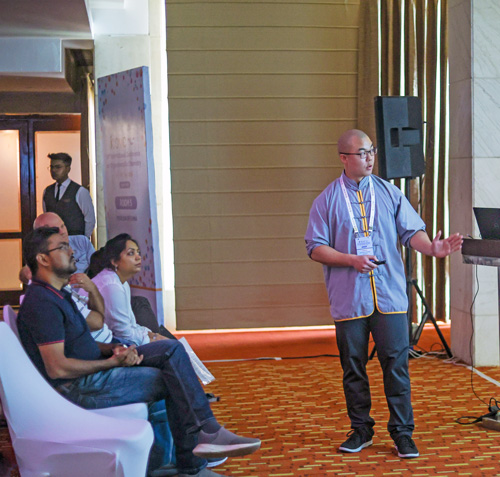
The International Conference on Organometallic Chemistry gathered experts from all sub-fields within the field of organometallic chemistry. As such, exposure to these sub-fields at this conference otherwise beyond the local Australian organometallic chemistry community has greatly expanded my field-of-view and allowed me to develop world-class research projects that are competitive and innovative on an international level. The greatest benefit I have received from engaging in this conference is exposure to international experts in my field and experience firsthand their research and the way in which their research has been developed and curated.
— Dr Curtis Ho, Lecturer, University of Tasmania
Text description of the graphic: ‘Gaps in capability at a glance’
Introduction
This is the text description of a key graphic in the Australian Academy of Science 2025 publication, Australian Science, Australia’s Future: Science 2035, and should be read in conjunction with that web page. This text description aims to improve the accessibility of the graphic for a broad audience. We’ve included the graphic at the bottom of this page, for reference.
There are eight science capabilities increasing most in demand over the coming decade. In alphabetical order they are (column headers in the graphic):
- Agricultural science
- Artificial intelligence
- Climate science
- Biotechnology
- Data science
- Epidemiology
- Geoscience
- Materials science
For each of these eight science capabilities, we rate their current situation using the following 13 measures (rows headers in the graphic):
- Year 12 enrolments
- Vocational education and training (VET) completions
- VET enrolments
- University graduates
- Undergraduate completions
- Postgraduate completions
- Undergraduate enrolments (commencing)
- Postgraduate enrolments (commencing)
- Current workforce
- Projected workforce
- R&D expenditure
- Publications
- Patents
The graphic is set up like a table with rows and columns to convey information. The graphic can be read both down columns and across rows. If you read down columns, you see how each one of the eight science capabilities is performing for each of the 13 measures. If you read across rows, you can compare how each one of the 13 measures is performing for each science capability.
How the measures are performing is show graphically, not using data. The following is used as the rating scale for the performance of each of the 13 measures:
- Green thumb (drawing of a thumb up, meaning good): A green thumb means no trends decreasing. No gap or unlikely to have a gap in capability.
- Amber thumb (drawing of a thumb sideways, meaning so-so): Some trends decreasing or no majority of increasing trends. Some gap or likely gap in capability.
- Red thumb (drawing of a thumb down, meaning poor): Most trends decreasing. Existing gap or certain gap in capability.
- Grey question mark (drawing of a question mark): Insufficient data available.
In summary, the green indicates no capability gap is expected by 2035, amber (orange) suggests some existing gaps with likely future shortfalls, and red signifies existing gaps with certain future problems if the causes aren’t addressed. The grey question mark indicates insufficient data or codes to define this capability, which makes it more difficult to measure.
Text description of the graphic
Ok, from here down is all the information from the graphic as text, grouped by the eight science capabilities (column headers).
Agricultural science
Overall impression: Almost all amber, two green, no red or grey
- Year 12 enrolments: Amber (some gap or likely gap in capability)
- Vocational education and training (VET) completions: Amber (some gap or likely gap in capability)
- VET enrolments: Amber (some gap or likely gap in capability)
- University graduates: Amber (some gap or likely gap in capability)Undergraduate completions: Amber (some gap or likely gap in capability)
- Postgraduate completions: Amber (some gap or likely gap in capability)
- Undergraduate enrolments (commencing): Amber (some gap or likely gap in capability)
- Postgraduate enrolments (commencing): Amber (some gap or likely gap in capability)
- Current workforce: Amber (some gap or likely gap in capability)
- Projected workforce: Green (no gap or unlikely to have a gap in capability)
- R&D expenditure: Amber (some gap or likely gap in capability)
- Publications: Green (no gap or unlikely to have a gap in capability)
- Patents: Amber (some gap or likely gap in capability)
Artificial intelligence
Overall impression: About half green, three amber, then two red and two grey
- Year 12 enrolments: Red (existing gap or certain gap in capability)
- Vocational education and training (VET) completions: Red (existing gap or certain gap in capability)
- VET enrolments: Amber (some gap or likely gap in capability)
- University graduates: Green (no gap or unlikely to have a gap in capability)
- Undergraduate completions: Green (no gap or unlikely to have a gap in capability)
- Postgraduate completions: Green (no gap or unlikely to have a gap in capability)
- Undergraduate enrolments (commencing): Amber (some gap or likely gap in capability)
- Postgraduate enrolments (commencing): Amber (some gap or likely gap in capability)
- Current workforce: Grey (insufficient data available)
- Projected workforce: Grey (insufficient data available)
- R&D expenditure: Green (no gap or unlikely to have a gap in capability)
- Publications: Green (no gap or unlikely to have a gap in capability)
- Patents: Green (no gap or unlikely to have a gap in capability)
Biotechnology
Overall impression: Majority grey, three green, one amber and one red
- Year 12 enrolments: Red (existing gap or certain gap in capability)
- Vocational education and training (VET) completions: Grey (insufficient data available)
- VET enrolments: Grey (insufficient data available)
- University graduates: Green (no gap or unlikely to have a gap in capability)
- Undergraduate completions: Grey (insufficient data available)
- Postgraduate completions: Grey (insufficient data available)
- Undergraduate enrolments (commencing): Grey (insufficient data available)
- Postgraduate enrolments (commencing): Grey (insufficient data available)
- Current workforce: Amber (some gap or likely gap in capability)
- Projected workforce: Grey (insufficient data available)
- R&D expenditure: Grey (insufficient data available)
- Publications: Green (no gap or unlikely to have a gap in capability)
- Patents: Green (no gap or unlikely to have a gap in capability)
Climate science
Overall impression: Around half red, three amber, two green and two grey
- Year 12 enrolments: Amber (some gap or likely gap in capability)
- Vocational education and training (VET) completions: Grey (insufficient data available)
- VET enrolments: Red (existing gap or certain gap in capability)
- University graduates: Green (no gap or unlikely to have a gap in capability)
- Undergraduate completions: Red (existing gap or certain gap in capability)
- Postgraduate completions: Red (existing gap or certain gap in capability)
- Undergraduate enrolments (commencing): Red (existing gap or certain gap in capability)
- Postgraduate enrolments (commencing): Amber (some gap or likely gap in capability)
- Current workforce: Grey (insufficient data available)
- Projected workforce: Red (existing gap or certain gap in capability)
- R&D expenditure: Amber (some gap or likely gap in capability)
- Publications: Green (no gap or unlikely to have a gap in capability)
- Patents: Red (existing gap or certain gap in capability)
Data science
Overall impression: Mostly green and amber, two red, no grey
- Year 12 enrolments: Red (existing gap or certain gap in capability)
- Vocational education and training (VET) completions: Red (existing gap or certain gap in capability)
- VET enrolments: Amber (some gap or likely gap in capability)
- University graduates: Green (no gap or unlikely to have a gap in capability)
- Undergraduate completions: Green (no gap or unlikely to have a gap in capability)
- Postgraduate completions: Green (no gap or unlikely to have a gap in capability)
- Undergraduate enrolments (commencing): Amber (some gap or likely gap in capability)
- Postgraduate enrolments (commencing): Amber (some gap or likely gap in capability)
- Current workforce: Amber (some gap or likely gap in capability)
- Projected workforce: Green (no gap or unlikely to have a gap in capability)
- R&D expenditure: Amber (some gap or likely gap in capability)
- Publications: Amber (some gap or likely gap in capability)
- Patents: Green (no gap or unlikely to have a gap in capability)
Epidemiology
Overall impression: Nearly half green, then three amber, three red and two grey
- Year 12 enrolments: Amber (some gap or likely gap in capability)
- Vocational education and training (VET) completions: Red (existing gap or certain gap in capability)
- VET enrolments: Amber (some gap or likely gap in capability)
- University graduates: Green (no gap or unlikely to have a gap in capability)
- Undergraduate completions: Red (existing gap or certain gap in capability)
- Postgraduate completions: Green (no gap or unlikely to have a gap in capability)
- Undergraduate enrolments (commencing): Amber (some gap or likely gap in capability)
- Postgraduate enrolments (commencing): Green (no gap or unlikely to have a gap in capability)
- Current workforce: Grey (insufficient data available)
- Projected workforce: Grey (insufficient data available)
- R&D expenditure: Green (no gap or unlikely to have a gap in capability)
- Publications: Green (no gap or unlikely to have a gap in capability)
- Patents: Red (existing gap or certain gap in capability)
Geoscience
Overall impression: Mostly amber and red, one grey, no green
- Year 12 enrolments: Amber (some gap or likely gap in capability)
- Vocational education and training (VET) completions: Grey (insufficient data available)
- VET enrolments: Red (existing gap or certain gap in capability)
- University graduates: Red (existing gap or certain gap in capability)
- Undergraduate completions: Red (existing gap or certain gap in capability)
- Postgraduate completions: Amber (some gap or likely gap in capability)
- Undergraduate enrolments (commencing): Amber (some gap or likely gap in capability)
- Postgraduate enrolments (commencing): Amber (some gap or likely gap in capability)
- Current workforce: Red (existing gap or certain gap in capability)
- Projected workforce: Red (existing gap or certain gap in capability)
- R&D expenditure: Amber (some gap or likely gap in capability)
- Publications: Amber (some gap or likely gap in capability)
- Patents: Amber (some gap or likely gap in capability)
Materials science
Overall impression: Mostly amber, four red, no green or grey
- Year 12 enrolments: Amber (some gap or likely gap in capability)
- Vocational education and training (VET) completions: Amber (some gap or likely gap in capability)
- VET enrolments: Amber (some gap or likely gap in capability)
- University graduates: Amber (some gap or likely gap in capability)
- Undergraduate completions: Red (existing gap or certain gap in capability)
- Postgraduate completions: Amber (some gap or likely gap in capability)
- Undergraduate enrolments (commencing): Red (existing gap or certain gap in capability)
- Postgraduate enrolments (commencing): Amber (some gap or likely gap in capability)
- Current workforce: Amber (some gap or likely gap in capability)
- Projected workforce: Red (existing gap or certain gap in capability)
- R&D expenditure: Red (existing gap or certain gap in capability)
- Publications: Amber (some gap or likely gap in capability)
- Patents: Amber (some gap or likely gap in capability)
The graphic, for reference
Gaps in capability
The findings indicate gaps across all eight capabilities, shown below.
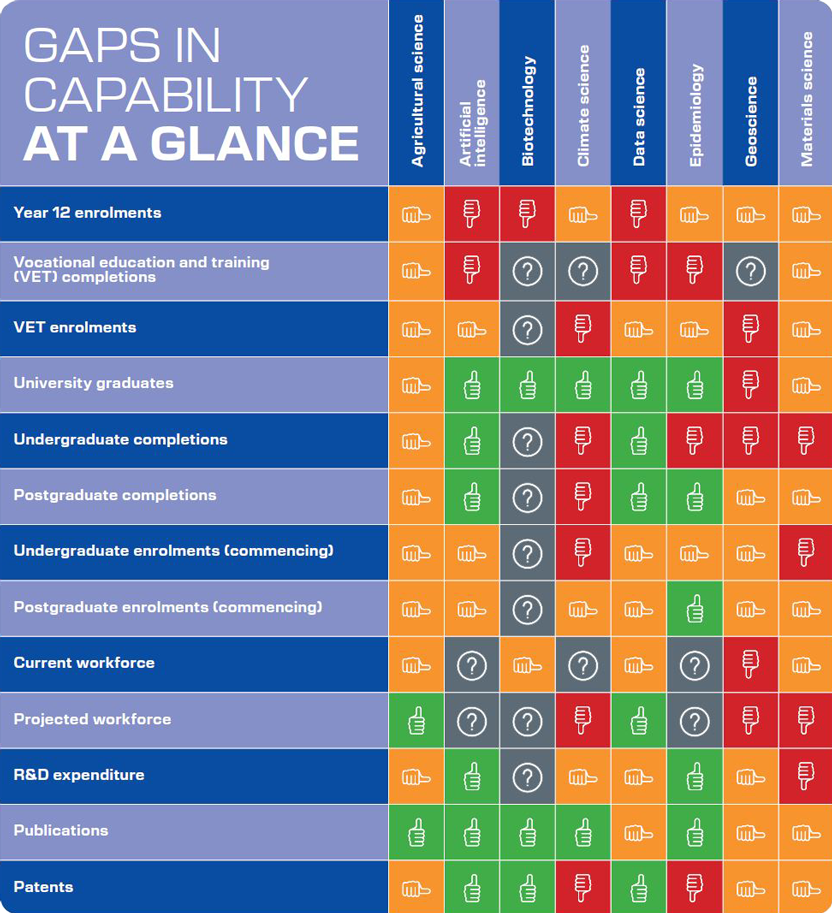
Rating scale for the graphic above:
- Green thumb: No trends decreasing. No gap or unlikely to have a gap in capability.
- Amber thumb: Some trends decreasing or no majority of increasing trends. Some gap or likely gap in capability.
- Red thumb: Most trends decreasing. Existing gap or certain gap in capability.
- Question mark: Insufficient data available.
‘Wheel of time’ artwork for Science at the Shine Dome 2025

To celebrate Science at the Shine Dome 2025, our ‘Wheel of time’ artwork pays homage to Australian scientific milestones: from the nation’s first scientists to how AI might help shape the smart cities of the future.
It recognises the contributions of many Academy Fellows and other leading scientists – with all images brought together to resemble the shape of the iconic Shine Dome building as seen from above.
The concept, design and animation were created by graphic designer Leah Albert for the Australian Academy of Science.
The Australasian Antarctic Expedition image was sourced from the Academy archives, as were the images of the newly built Shine Dome theatre and exterior.
Help make history with us by supporting the digitisation of our valuable and unique archives. We also invite you to support our Conversations with Australian Scientists series, where the personal lives and careers of some of Australia’s most eminent scientists are being documented.
About the images
Each of the following images is represented in the artwork, starting clockwise from above the word ‘Science’. Click on the image for a large version.
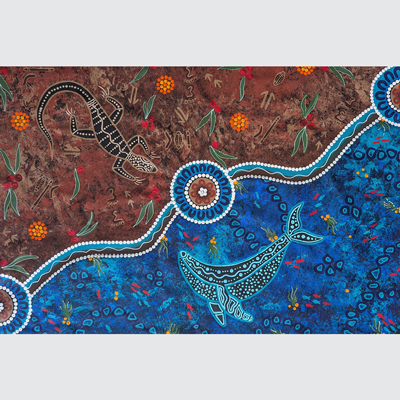
Australia’s first scientists
Artwork: ‘Mirning Country’. Credit: Presten Warren
Rooted in the ancestral heritage of the Mirning people of the far west coast, this artwork serves as a tangible link to ancestral roots. Inspired by the land and waters, it incorporates elements of native plants and animals, symbolising a spiritual connection to Country. — Presten Warren
Reconciliation between non-Indigenous peoples and Australian Aboriginal and Torres Strait Islander peoples is essential to progressing the Academy’s vision of a scientifically informed community that embraces excellence in science and is guided by, and enjoys the benefits of, scientific endeavour. Embracing the Traditional Knowledges and cultures of Australia’s First Nations peoples, forged over thousands of years, will build a stronger, more innovative and more sustainable nation.
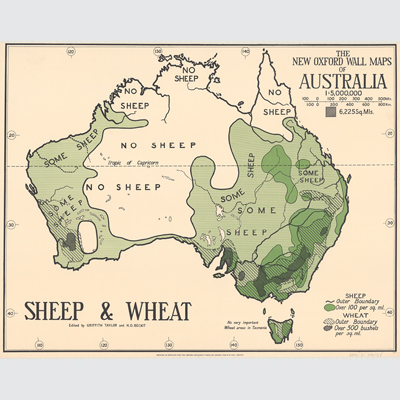
‘Federation’ wheat
Image: ‘Sheep & wheat’ cartographic material by George Philip & Son, showing wheat growing and sheep grazing areas in 1920s Australia. Source: National Library of Australia
After the introduction of wheat crops following the British colonisation of Australia, William Farrer experimented in crossbreeding to produce ‘Federation’ wheat. This was the first specifically Australian variety that was resistant to both rust and drought.
Several Academy Fellows subsequently made significant contributions to wheat research. They include Professor Irvine Watson (1914–86), a world leader in the study and breeding of rust resistance in wheat, and Professor Graham Farquhar, who in 2017 became the first Australian to win the prestigious international Kyoto Prize for his development of new water-efficient wheat varieties.
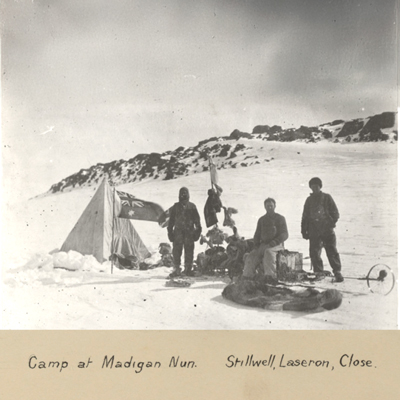
Australasian Antarctic Expedition 1911–14
Image: ‘Camp at Madigan Nun[atak] – Stillwell, Laseron, Close’. Source: Fenner Archives, Australian Academy of Science
Frank Stillwell (1888–1963) was invited to join the Australasian Antarctic Expedition by Sir Douglas Mawson (1882–1958), during which Stillwell kept careful diaries.
These diaries, along with other field notes and photographs of Stillwell’s broader career, were digitised as part of an ongoing collaborative project between the Australian Academy of Science and the National Library of Australia.
Both Stillwell and Mawson went on to be elected Fellows of the Academy.
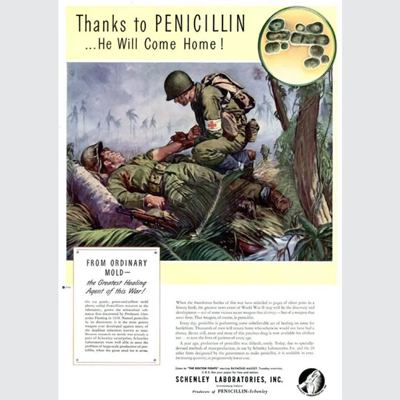
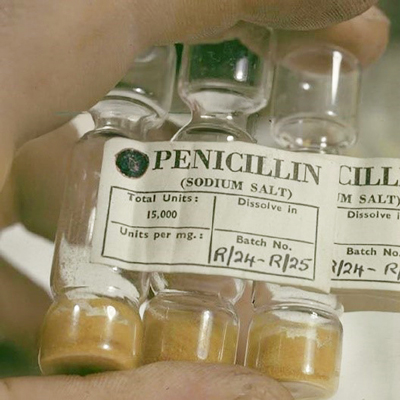
The development of penicillin
Image: 1944 WWII Vintage Schenley Lab advertisement. Source: RetroAd Archives, Alamy Stock.
Image: The synthetic production of penicillin during WWII. Source: Wikimedia Commons
Howard Florey (1898–1968), an Australian Nobel Prize-winning scientist, is one of many Academy Fellows whose contributions have changed the world.
After the discovery of penicillin by Alexander Fleming in 1928, it was a team led by Florey and German refugee Ernst Chain that made the drug medically useful in the 1940s.
This is thought to have saved thousands of lives during WWII, and afterwards – when it was made publicly available – changed the prognosis for many illnesses that were previously fatal.
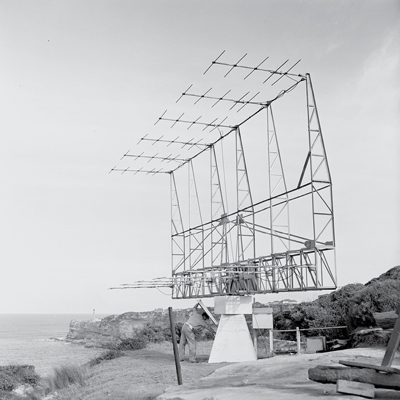
First use of radio astronomical interferometry
Image: The final 12-Yagi 100 MHz antenna at Dover Heights in Sydney, with John Bolton checking the receiving equipment at the base. Source: CSIRO
Realising Australia’s vulnerability to air attack following the Japanese air raid on Darwin in 1942, the Radiophysics team at the Council for Scientific and Industrial Research (CSIR, later CSIRO) developed a radar station at Collaroy Plateau in Sydney, based off the existing shore defence radar at Dover Heights.
Towards the end of WWII, the team could then pivot to new fields of civil research – including investigating the sources of unknown and nuisance radio ‘noise’ detected with radar by several countries during the war. It was here that in October 1945, Academy founding Fellow Joseph (Joe) Pawsey, with Ruby Payne-Scott and Lindsay McCready, performed the first successful radio astronomy observations in Australia.
The trio continued monitoring the Sun until March 1946, making surprising discoveries, including that significant fluctuations in emitted radiation were correlated with sunspots on the Sun’s surface, as well as detecting a base level of thermal radiation around 100 times higher than expected.
The team went on to develop new instruments and techniques at Dover Heights and other stations, ultimately cementing Australia’s reputation as a leader in the emerging global field of radio astronomy.
Pawsey’s life’s work, including his role mentoring younger scientists such as Payne-Scott and McCready, was described in a 2023 biography ‘Joe Pawsey and the Founding of Australian Radio Astronomy’.
The Ruby Payne-Scott Medal and Lecture for women in science is one of the Academy’s most prestigious awards, while the Pawsey Medal for outstanding contributions to research in physics was the second medal struck by the Academy.
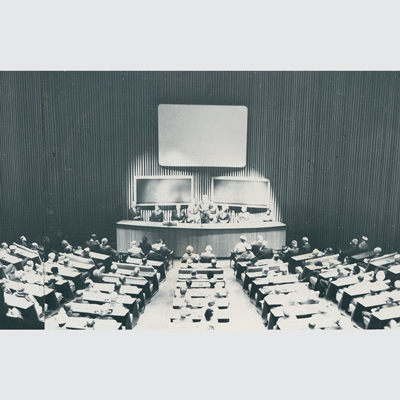
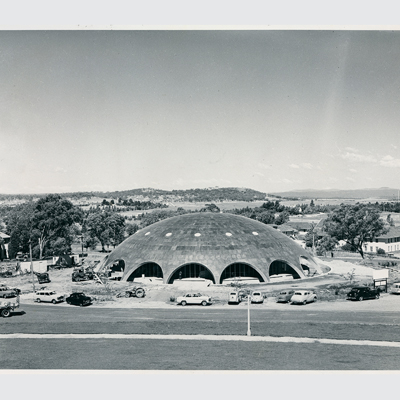
The opening of the Shine Dome
Images: The opening of the Shine Dome (previously known as Becker House). Source: Fenner Archives, Australian Academy of Science.
The Shine Dome, the Academy’s unique heritage-listed building, was built to provide the Australian Academy of Science with a home. Sir Mark Oliphant, the founding president of the Academy, led the charge in the early 1950s to find funds for the project.
At the opening ceremony in May 1959, luminaries of science and politics gathered to witness then-Governor-General Sir William Slim officially open the building.
In his speech on the day, Academy president Sir John Eccles described the building as looking like “a home for magicians” and presciently imagined the many national and international gatherings that would be held under its roof in the years to come.
“So the Academy goes forward into the future like some great caravan of exploration and discovery, always being joined by new recruits, always enlisting the help of other scientists best fitted for any particular project so that we can continue to command the cooperative effort of the scientists of Australia,” Sir John said.
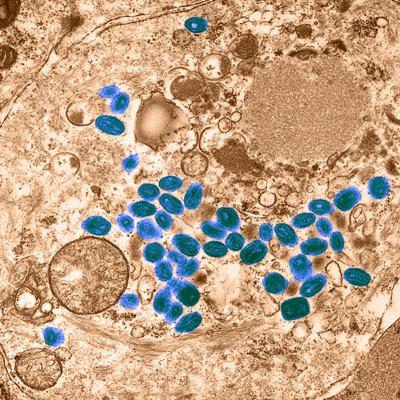
Frank Fenner’s role in the eradication of smallpox
Image: A color enhanced transmission electron micrograph of a cell containing variola (smallpox) viruses.Source: Science History Images / Alamy
Smallpox, the contagious viral disease responsible for millions of deaths, remains the only infectious disease to be eradicated by humanity. It was making the announcement of its eradication to the World Health Assembly in Geneva on 8 May 1980 that Australian virologist and Academy Fellow Professor Frank Fenner (1914–2010) described as the proudest moment of his life.
The Academy’s archives include Professor Fenner’s diaries documenting his role as Chair of the Global Commission for the Certification of Smallpox Eradication and his efforts towards the control of the rabbit plague in Australia.
The Fenner Collection was added to the UNESCO Australian Memory of the World Register in 2019.
Professor Fenner was also interviewed by Dr Max Blythe in 1992 and 1993 for the Academy’s Conversations with Australian Scientists series.
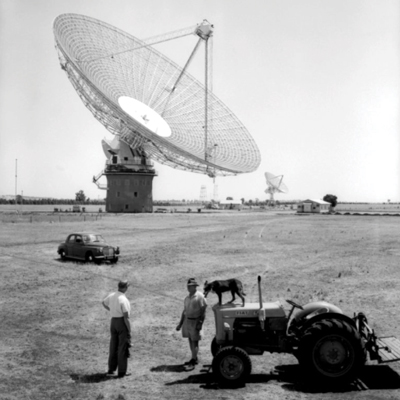
Murriyang / Parkes Radio Telescope
Image: Farmer Australia ‘Austie’ Helm (right), former owner of the land on which the telescope is built, talking with engineer Maurice Puttock. Source: CSIRO
Murriyang, the 64-metre Parkes Radio Telescope also affectionately known as ‘The Dish’, is part of CSIRO’s Australia Telescope National Facility.
Since beginning operation in 1961, it has become one of the most cited radio telescopes in the world: more than half of all currently known pulsars were discovered using it, and re-examination of pulsar observations (from 2001) led to the discovery of the first fast radio burst in 2007.
It was this discovery of fast radio bursts that saw Academy Fellow Professor Matthew Bailes (elected 2022) awarded the 2024 Prime Minister’s Prize.
Following many upgrades since its initial construction, the telescope is now 10,000 times more sensitive than when it was first commissioned.
Local Wiradjuri elders named the telescope Murriyang in 2020, after the ‘Skyworld’ where a prominent creator spirit of the Wiradjuri Dreaming, Biyaami (Baiame), lives.
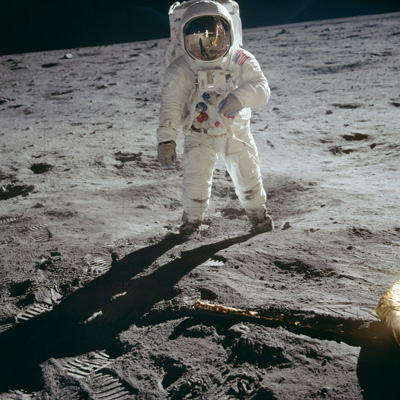
Apollo 11 ground tracking and broadcasting support
Image: Astronaut Buzz Aldrin on the moon during the Apollo 11 mission. Source: NASA.
Murriyang / the Parkes Radio Telescope also played a key role in tracking Neil Armstrong and Buzz Aldrin’s first steps on the Moon, in July 1969.
The video and telemetry downlink received at Parkes was recorded onto 1/2-inch magnetic tapes that had to be changed every 15 minutes throughout the entire duration of the hours-long moonwalk.
The telescope’s role was originally to provide back-up to NASA’s other tracking stations (in Goldstone, California, and Honeysuckle Creek near Canberra) but was later upgraded to be prime receiver. Many CSIRO staff were involved, at Parkes and elsewhere, in this massive tracking operation.

Geology pioneer and first woman President of the Academy
Image: The Great Barrier Reef, QLD. Source: Adobe Stock
At a time when the Great Barrier Reef was viewed purely as a tourist attraction, Professor Dorothy Hill (1907–1997) saw the possibility for studying it to reveal insights into the Quaternary Period (the most recent 2.6 million years of Earth’s history).
She went on to discover the use of fossil corals in sorting out the correlations of Palaeozoic rocks in Australia and expand the knowledge of stratigraphy of eastern Australia, using this information for a revitalised interpretation of continental geology.
Professor Hill was a trailblazer in many ways: she became Australia’s first woman professor in 1959 when appointed a Professor of Geology at the University of Queensland. She also became the first woman Fellow of the Australian Academy of Science in 1956, before going on to serve as Vice-President in 1969 and President in 1970.
Professor Hill was a powerful supporter of women’s educational rights, and the Academy’s Dorothy Hill Medal recognises her contributions to science as well as her work opening up tertiary science education to women.
A biographical memoir of Professor Hill noted that she gained a pilot’s license while she was in England, and that she later had an interest in car rallying. She also served as a Second Officer in the Women’s Royal Australian Naval Service during WWII, where her work included cypher and coding.
Professor Hill was interviewed by Dr John Cole in 1981 for the Academy’s Conversations with Australian Scientists series.
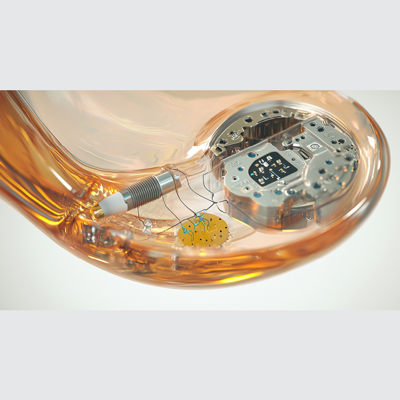
The cochlear ear implant
Image: Digital rendering of a cochlear implant showing components and functionality. Source: Adobe Stock, spyrakot
As a child, it was witnessing his pharmacist father struggle with hearing loss that first sparked Professor Graeme Clark’s interest in becoming “an ear doctor”.
He went on to conduct pioneering research into electrical stimulation of the auditory pathways. Working with electrical engineers and other specialists, he led the invention of the Bionic Ear, the first multiple channel cochlear implant. This device provides speech recognition in profoundly deaf adults as well as children, even those who have been deaf since birth, and has been implanted into more than 15,000 people around the world.
Professor Clark was elected a Fellow of the Australian Academy of Science in 1998. He was interviewed by Professor Stephen O’Leary in 2011 for the Academy’s Conversations with Australian Scientists series.

Revolutionising solar cell efficiency
Image: Solar panels. Source: Adobe Stock, Scanrail.
Professor Martin Green’s work has revolutionised solar cell efficiency, resulting in a more than 50% relative improvement in the energy conversion efficiency of the commercially dominant silicon solar cells from 1983 to 2008.
His team was the first to demonstrate two different approaches to improving silicon cell performance that now underpin all modern silicon cell designs. The Passivated Emitter and Rear Contact (PERC) solar cell invented by his team in 1983 continued to be refined and claim global records for cell efficiency; in 2021 it accounted for 91% of worldwide silicon solar module production.
Professor Green was elected a Fellow of the Australian Academy of Science in 1990.
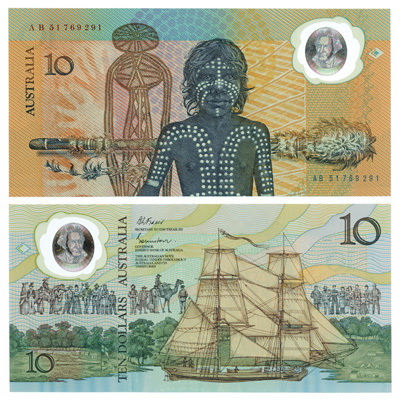
The first polymer banknote
Image: The first polymer banknote was a commemorative $10 banknote issued in 1988 to celebrate Australia’s bicentenary. One side symbolises the original discovery and settlement of Australia by First Nations peoples some 40,000–60,000 years ago; the other side symbolises European settlement. Source: Alamy, Editorial Image LLC
Australia transitioned from the pound to the dollar in 1966, but by the end of that year, authorities had detected more than $100,000 worth of forged $10 notes that were later traced back to a group of forgers in the suburbs of Melbourne.
In response, the Reserve Bank enlisted top scientists from CSIRO to find a solution, including Professor David Solomon – at the time a young, award-winning polymer scientist. Professor Solomon wrote that he came up with an idea after being given a business card printed on plastic by a visitor from Japan, but the entire undertaking involved 20 years of research and development before the release of the first polymer banknote in 1988.
The invention involved the creation of a unique polypropylene material that isn’t commercially available, as well as other security devices such as clear windows, which are difficult to counterfeit.
Professor Solomon was elected a Fellow of the Australian Academy of Science in 1975. He was an expert reviewer for the Academy’s educational article ‘Making Money’.

The foundation of WiFi
Image: A generative AI depiction of the WiFi icon over a city skyline. Source: Adobe Stock, tonktiti.
Today, WiFi is used around the world – but the technology underpinning it came from radio astronomy researchers at CSIRO.
While working in the Netherlands in the 1970s, Australian engineer Dr John O’Sullivan invented a Fast Fourier Transform computer chip, which could more rapidly interpret radio signals than existing Fourier Transform chips.
Decades later, Dr O’Sullivan joined a new team back in Australia, including Graham Daniels, Terence Percival, Diethelm Ostry and John Deane. They realised this Fast Fourier Transform technology could be directed at low power radio waves rather than cosmic radio waves – to address the challenge of transmitting large quantities of data wirelessly, which then must be reassembled in the correct order by the receiver. The team invented wireless LAN (WLAN), the precursor to modern WiFi.
Dr O'Sullivan was awarded the Australian Prime Minister’s Prize for Science in 2009 and elected a Fellow of the Australian Academy of Science in 2010.

Looking to the future of science with artificial intelligence
Image: AI Smart city. Source: Adobe Stock, Tackey, edited by Leah Albert (created for the Australian Academy of Science Public Speaker series using Photoshop generative AI with a stock image base.)
Artificial intelligence is changing the world around us.
Throughout 2025, the Australian Academy of Science is presenting six public talks on ‘AI in science: the promise, perils and path forward’ to explore the current and future implications of AI.
The events look at how AI is helping scientists make breakthroughs in health and medicine, the environment, food and agriculture, safety and security, and science and research. The series also delves into potential risks, limitations and ethical issues as AI becomes increasingly prominent in science and our society.
The series is convened by Academy Fellows Professor Bob Graham and Professor Ian Chubb. A recording of each event is on the event page.