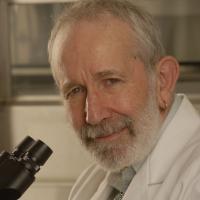


Joseph Mark Gani 1924–2016
Joe Gani, as he was universally known, was born in Cairo, Egypt, on 15 December 1924 and died in Canberra on 12 April 2016. A visionary leader, mentor, and brilliant organiser, he created the Journal of Applied Probability, and was Chief of the Commonwealth Scientific and Industrial Research Organisation (CSIRO) Division of Mathematics and Statistics.
A distinguished academic career included posts at the Universities of Sheffield, Kentucky, California at Santa Barbara, and the Australian National University. His numerous research contributions are dominated by stochastic modelling, especially epidemic theory.
Download the memoir
Supplementary material
About this memoir
This memoir was originally published in Historical Records of Australian Science, vol. 30(1), 2019. It was written by Eugene Seneta.
John Stewart Turner 1908-1991
Written by David H. Ashton and Sophie C. Ducker.
- Family background and education
- Cambridge years
- The University of Melbourne
- The war effort
- Important botanical initiatives
- Post-war changes
- Physiological research
- Ecological research
- John Turner and public education
- Turner's vision for conservation and heritage
- University achievements
- Family life and retirement
- About this memoir
Family background and education (1)
John Stewart Turner was born in Middlesborough, England on 9 September 1908, second son of Thomas Stewart and Ellen Turner (née Spice). His father was a Government inspector of armour plate. Apart from an older brother he had one sister and two younger brothers. His early childhood was spent in Stockport, Cheshire, where the family lived in a big rambling house with a large garden wonderfully suited to playing games and going for secret walks.
John's first school was the Stockport Primary School in Cheshire. Here an elderly Scottish teacher encouraged him and was responsible for his getting a scholarship to secondary school, namely the Boys' High School at Sheffield. At Sheffield, where the family had moved, they frequently walked and picnicked in the Derbyshire dales. Later, bicycle excursions were very much in fashion and took John and his friends far into the countryside. Bicycles were ridden daily to school but were also great on holiday trips to the Lake District, to Cambridge, and to the seaside.
As a boy he played the piano and sang with his family. He enjoyed going to concerts and to the opera and when the teachers arranged Shakespeare's plays John was involved, mostly backstage. All members of the Turner family were interested in drawing and painting and John liked particularly to make pencil sketches. A sketch-book was his steady companion on hikes and bicycle rides.
During some school holidays the Turner children were invited and stayed with relatives in London, where they visited the Kew Gardens. They had a grandfather who had been head gardener at a large estate and later started a nursery in London.
Botany was not a school subject, but there were some dedicated teachers who taught the subject to small groups of interested students during weekends. These sessions were often out in the countryside and later in life Turner remarked frequently how much he owed to these masters. He was very much interested in the world about him, especially in nature: he collected tadpoles, newts, birds' eggs and, in particular, plants. Although he was shy of adults he was always teaching and demonstrating to his brothers, sister and other children the wonderful things to be found in the garden and the countryside.
From an early age John and his brothers and sister were great readers, and many a tale Turner had read in his youth was cited and retold more than half a century later to his friends in Australia. It was a delight to be in the company of John Turner, especially for me [SCD], as, being bilingual, I was not so fluent in English. It was one of the greatest pleasures to listen to him recalling episodes from books or from his life. He was a wonderful story teller, painting the scene with good words in vivid colours. When in high spirits he often broke into a ditty. Words flowed easily from John Turner, both spoken and from his pen.
Cambridge years
In 1927 Turner went up to Cambridge, having won in 1925 the undergraduate State Scholarship to Selwyn College. He took an Honours degree in the Natural Sciences Tripos after three years, reading for Part I Botany, Chemistry and Zoology, and for Part II in Botany. He was placed First Class in the Intercollegiate Examination and in both parts of the Tripos. During the years 1930 to 1934 he carried out research in plant physiology under the supervision of F.F. Blackman, F.R.S., holding during this time, a renewed State Scholarship (1931), a grant from the Department of Scientific and Industrial Research (1932) and the University Frank Smart (1933) and University Allen (1934) Studentships. A thesis embodying some of his research and entitled 'On the relation between respiration and fermentation in excised carrot tissue, with special reference to the effect of sodium mono-iodoacetate on the metabolism of tissue slices'(2) was accepted for the degree of Doctor of Philosophy in 1936. His essay discussing this subject was awarded the University Gedge Prize, which was open to physiologists and biochemists in the University. Turner was a member of Selwyn College, Cambridge, during his undergraduate and postgraduate years.
In the years 1934 and 1935, Turner was Demonstrator in Botany at the Botany School in Cambridge and, from 1936 to 1938, Senior Demonstrator. His love of the outdoors allowed him to develop ecology as a counterpoise to laboratory experimentation. He organized very successful botany excursions to the oakwoods of Killarney and the alpine Cairngorms of Scotland in close association with two first-rate ecologists in the Botany School, A.S. Watt and P.W. Richards. He also carried out field work on fenlands with his life-time friend Harry Godwin (later Professor Sir Harry Godwin). Turner published his first paper on the fens in 1933.
The University of Melbourne
In November 1937 Turner applied to the University of Melbourne for the Chair of Botany and was appointed by University Council on 3 March 1938.(3) He arrived in Melbourne on the ship Strathaird on 8 August 1938 and was met by Dr Ethel I. McLennan, the long-standing Associate Professor who had been in charge of the department for the preceding year, and the Senior Lecturer, Dr Reuben Patton.
One of the youngest professors to be appointed to a chair at the University of Melbourne, Turner took up his position as Professor of Botany and Plant Physiology later in August 1938. He succeeded the foundation professor, Alfred James Ewart (1872-1937) who was appointed in 1906 when the School was first housed in the Zoology Department. Under Ewart's guidance the first Botany School was built and the new building opened in November 1929. For its time, the building was very modern, and reflected the taste of both Ewart and McLennan, who held the position of Associate Professor while the School was being built. The School had not only a large lecture theatre, a constant temperature room, up-to-date sterilizers, glasshouses and a wonderful library, but was furnished very tastefully entirely from Tasmanian Blackwood (Acacia melanoxylon). The benches, the cupboards, and all the furniture made of Australian timber were for seventy-five years a showpiece and the pride of Australian workmanship.
Turner must have liked what he saw in the Botany School. In an early letter to Professor W. Stiles in Birmingham he wrote: 'Ewart has built up a very fine school and the laboratory is very well planned and well equipped. And we rejoice in the possession of quite a large and very fine garden at the back'.(4)
Professor Sam (later Sir Samuel) Wadham, Turner's predecessor as demonstrator at Cambridge University, became a close and valuable friend in a neighbouring department across the System Garden. Wadham had been appointed to the chair of Agriculture at Melbourne in 1926 and was able to introduce him to the scientific community and to point out the state of the countryside under the effects of a century of exploitation. He introduced Turner to the problems and importance of catchments and the consequences of mismanagement.
Not long after his arrival in Australia, in January 1939, Turner attended the Australian and New Zealand Association for the Advancement of Science in Canberra. This was an important occasion for him in more ways than one. He drove up to Canberra with several members of his staff who introduced him during the journey to the Australian vegetation, for Turner an unknown botanical environment. The vegetation was strange and new, his familiar flora echoed only as weeds, horticultural species, or cosmopolitans of strand habitats. He was never completely at home with the new flora, so many times more diverse than that of Britain, but with his solid grounding in European botany, he soon mastered it sufficiently. He was assisted in his endeavours by the best of teachers in the Australian flora, Ethel McLennan. During this stage, Turner was delighted to see European weeds; they were, so to speak, the old friends from back home.
The trip to Canberra was also important because Turner hosted it for his former colleague from Cambridge, Professor F.T. Brooks and, in his letters of invitation, showed the pride and interest he had in his newly adopted country. It was also a crucial test for Turner because it was one of the hottest summers ever, with raging bushfires all over south-eastern Australia. He never forgot this and when he took students and visitors out in later years he would often point to reminders of the 1939 summer.
The war effort
Turner had brought with him from England elegant equipment to continue the plant physiology work which he had done in Cambridge. However, less than a year after his arrival in Australia, war broke out, and the School under his leadership diverted all its energy towards the war effort. Turner drew ably on the personnel in the University and assembled different working groups in his Department. He made Ernst A.F. Matthaei (1904-1966), who had trained at Zeiss and the University of Jena, officer-in-charge of a small workshop where graticules for sighting telescopes and binoculars were made. After Japan entered the war in December 1941 and the theatre of war moved to the Pacific, the Botany workshop and staff were enlarged to accommodate an additional wartime effort to stem bio-deterioration of instruments. It was necessary to 'tropic-proof' equipment against fungal infections which occurred even within optical instruments. As part of this effort, fungi growing on optical equipment were cultured and assessed. This involved the mycologist Ethel McLennan, the physicist J.S. Rogers and the microscopist Ernst Matthaei. Turner was the head of this team. The publication 'Tropic proofing of optical instruments by a fungicide' (with E.I. McLennan, J.S. Rogers and E. Matthaei), and later the report The Tropic Proofing of Optical Instruments, published by the Australian Ministry of Munitions, are both classics in this field and show the importance of the work in the Department under Turner's direction.
The other very important war work undertaken in the Botany School occurred following the discovery of penicillin, the antibiotic substance produced by a soil fungus. This stimulated world-wide research during the later years of the Second World War into the soil fungi, including in Turner's department where work commenced to investigate the then completely unknown soil microflora of Victoria and to test the isolates for antibiotic activity. In addition, in the closing months of the war, a collection of soil mould cultures was brought to Melbourne from the Northern Regional Research Laboratory of the Department of Agriculture at Peoria, Illinois, to be housed and curated in the Botany School. This occurred due to Turner's contact with F.G. Morgan at the Commonwealth Serum Laboratories in Melbourne, who visited the Botany School in November 1943. The two men developed a plan for collaborative research on penicillin and antibiotically active fungi found in the future. Staff at the Botany School were to undertake the mycological side of penicillin production. The overall supervision of this aspect was to be by Ethel McLennan working with two assistants. The team was also to undertake a new survey of Australian moulds and larger fungi to determine if more organisms could be found that yielded antibiotics. To fund this research, Turner secured grants from the National Health and Medical Research Council and the National Research Council. These arrangements are documented in his correspondence with H.L. Cumpston, the Commonwealth Director-General of Health.(4) The School became a hive of industry with the project teams overcrowding the building. Financed to a large degree by munitions funding, a new wing was added to the Botany School. It housed two new laboratories, one for mycology and one for the optical work. A large number of papers was published during this period, on the mycological work in particular, and this could not have been undertaken but for the overall involvement of J.S. Turner.
The extent of his care and commitment can be judged by his correspondence, as exemplified by a letter from Turner to the Director of Rationing:
Dear Sir,
Following my letter of 8th September, you were good enough to grant me a permit to buy 3 lbs. of sugar for this laboratory during each month, October, November and December, 1942.
We are still using sugar in these quantities, largely for research on war problems, and I would be grateful for a further supply of monthly ration tickets.
Yours sincerely,
[signed J. S. Turner]
Professor of Botany
Director of Rationing
Flinders Lane
Melbourne C.1.
The sugar was required for the preparation of culture media in which to grow the fungi. Every ounce of sugar and malt-extract used by the assistant [SCD] during the process had be accounted for.
The full involvement of the Botany School in the war effort can best be judged by a letter written by Turner to the then University Registrar, Mr. F.H. Johnston:
14th June, '43.
Dear Mr. Johnston,
re request from Scientific Liaison Bureau
The following work pertaining to the war is going on in this department. Some of it is production, but coupled with this is research into the various problems that arise from time to time.
- Ruling and etching of graticules (information available on acid proof resists, and on ruling machines, properties of glass in relation to etching (O.M.P.).( 5)
- Photographic production of graticules (O.M.P.).
- Photo etching of graticules (also see under Chemistry Department( 6) (O.M.P.).
- Optical cleaning and assembly of binoculars (Army).
- Growth of fungi on optical components of instruments (O.M.P. and Scientific Liaison Bureau).
- Control of timber rotting by fungi (Forestry Commission; Broken Hill Pty. Ltd.).
- Production of mannitol by native shrubs (with C.S.I.R.).
- Growth, and hyoscine and hyoscyamine content of Duboisia (with Physiology School of University).
- Control of virus diseases on vegetable crops (with Department of Agriculture, for Army).
- Survey of Australian fungi as sources of the drug Penicillin (suggested by Dr Kellaway, of Walter & Eliza Hall Institute).
It is difficult to appreciate fifty years later the importance and the commitment of Turner and his Department towards the war effort. The goal in the University of Melbourne, and indeed in Australia at large, was to win the war. All other occupations and research were of no significance compared to the final victory. It has been said frequently that in a totalitarian state like Germany the war effort was more serious than in the other countries during the war. Observations show that this was not so, and that elsewhere too there was a total commitment towards the war effort, as exemplified by the Botany School led by Turner.
Important botanical initiatives
On 2 March 1945, the Miss M.M. Gibson Trust, later known as The Maud Gibson (Gardens) Trust, was established. This was to be a Research Trust to aid the National Herbarium of Victoria. The first Trust Committee comprised the Professor of Botany at the University of Melbourne as Chairman, the Director of the Gardens, Mr A.W. Jessep, as Secretary, Mr Russell Grimwade, Mr F. Grassick and Mr A.G.M. Mitchell. Turner chaired this important committee until his retirement. On the death of Grimwade in 1955, he selected his friend Professor S. Wadham to fill the vacancy on the committee. The Trust was a welcome vehicle that allowed Turner to set in motion some important botanical projects for Victoria. James H. Willis, Government Botanist at the National Herbarium, wrote the two-volume Flora of Victoria (published by the University of Melbourne) under the auspices of the Gibson Trust. Miss Margaret Stones, the internationally recognized Australian flower painter, who owed much of her fame to early recognition by Turner, was brought out from England with Trust funding to illustrate the vanishing flora of Victoria's basalt plains. Turner also arranged for Dr Ronald Melville, head of the Australian section at the Kew Herbarium, Royal Botanic Gardens, London, to be financed to study the Australian flora for a year.
Post-war changes
After the war, there was a tremendous influx of students taking Botany due to the many returned servicemen and women entering the university. This brought about a completely changed atmosphere in the Department, effected not only by the rapid growth in student numbers, most of whom were relatively older students, but above all by the arrival of new staff and a subsequent rearrangement of classes and duties.
Turner had inherited a department of older staff who were used to the authoritarian, volatile personality of Professor A.J. Ewart. To this extent his job was difficult, but he initiated changes in structure and outlook. The complement of staff and the courses taught were completely remodelled according to Turner's ideas and wishes. When Turner took up his appointment, every staff member in the Department was older than he: Dr Ethel McLennan, Dr Reuben Patton, Dr B.J. Grieve; only the junior tutor, Dr Eileen Fisher was almost his age. After the war he selected new staff fostered by his former friends in England. This gave him a feeling of superiority, because he was no longer the 'new boy' and, in particular, no longer the only staff member who had not been born and bred in Australia. Turner got on with the teaching and research he had originally planned to do on his arrival in Australia.
Some other important changes occurred in the Botany School at this time. There was a change of strength of leadership, direction and student control, from McLennan to Turner. There was also a change of research thrust to physiological and ecological work. Turner also moved to foster more personal community and environmental interests outside the University.
Physiological research
Plant physiological research was resumed with great vigour after the war and, with Vera Hanly (later Vines) as his research assistant, Turner made great advances into the physiological processes of respiration and fermentation. At this time he collaborated with his great friend Dr Bob Robertson (now Sir Rutherford Robertson) in research on salt respiration. During this period and the following decades John Turner wrote numerous thoughtful reviews on the direction and perspectives of plant physiology - in particular the pasteur effect, photosynthesis, starch and phosphorus metabolism.
New physiological work was also developed by two of the bright post-graduates of that time, both returned soldiers: Dr (then Mr) Kingsley Rowan and the late Mr Bert Overell. The research later led to a valuable liaison with scientists in the Commonwealth Scientific and Industrial Research Organisation (CSIRO) Fruit Physiology Research Unit. Turner's interests continued on the effect of oxygen on photosynthesis with Dr Ed Brittain, and on protoplasmic streaming with Judy Kelso, Stella Ovenden (later Dr Stella Thrower) and Mr (later Dr) Garth Everson. In the latter work he employed optical equipment developed by Mr Ernst Matthaei.
An early and important appointment after the war was that of Dr David Goodall. He was the first of a long line of plant physiologists engaged by Turner to fulfil his interest in plant physiology and at the same time his commitment to the title of Professor of Botany and Plant Physiology. Goodall provided an enormous stimulus to research in nutritional physiology and later became a world leader in quantitative ecology. He had a direct and important impact on the ecological assessment of the Bogong High Plains (see later).
After the departure of Dr Goodall in the early 1950s, two further English plant physiologists were appointed: Dr Denis Carr who taught the Science students - due to the increase in student numbers, courses had to be duplicated and diversified - and Dr Tom Neales who initially was to teach the Agriculture students only but later taught whole plant physiology to both streams of students. Neales' research in this branch of botany flourished at a time when Carr had left the Department and Turner's interests were more ecologically directed. Rowan and Neales represented plant physiology teaching and research in the Botany School until recently. The historical connotation of the Professorship of Plant Physiology in the Botany School ceased with Turner's retirement in 1974.
Ecological research
Early in the war years, Turner was fortunate in having in the department a first-rate junior botanist Maisie Fawcett (later Carr), who had completed her Master's degree several years before. She was unable to continue research involving microscopic studies for medical reasons. Turner created the opportunity for her to study the effects of grazing, fire and rabbit depredations on soil erosion in the Hume Catchment, as the first field officer for Victoria's newly created Soil Conservation Board. She was based at Omeo and travelled the area by car, foot and on horseback, finally producing a penetrating and careful report of catchment conditions. The work led directly to investigations of the important subalpine and alpine areas of the Bogong High Plains which were earmarked for hydro-electricity development. Turner threw his weight and influence behind this work, and in 1945-6 was instrumental in obtaining funding to study the ecological problems of catchment maintenance under a regime of summer cattle grazing. He was an overseer of this work and its power base and organized logistical support from within the Botany School to help Fawcett in regular assessments of vegetation by point quadrats. Fenced plots established by her in 1944 and 1945 proved to be ecological benchmarks, and are still being monitored today. Turner missed few of the excursions into the High Plains, trips which were made the more enjoyable by his good spirits and camaraderie. He resented keenly the suggestion later made by D.J. Carr (1989)(7) that he was just another notable person who attended some of the High Plains field excursions.
In 1959 Turner co-authored two papers on the progress of the High Plains work with Stella G.M. (Maisie) Carr. She later developed themes of dynamics based on the pivotal work of A.S. Watt in Cambridge. In 1964 Turner met the costs of Carr's impending visit to re-assess the progress of the work, and also of relatively mundane items such as re-fencing of the plots before the return of the cattle to the High Plains.
In the late 1940s, Turner saw the need for ecological research nearer to Melbourne and the need to communicate this to the public, and for such study to be of direct use in land management. From Wadham he had heard of the magnificent Mountain Ash forests at Wallaby Creek on the Great Divide immediately north of Whittlesea. The effects of past fires had created large areas of dense young forest as well as areas of brackenland and scrub. The water supply for Melbourne is derived from this and similar areas to the east. Therefore, a knowledge of water use by different sorts and different ages of vegetation was an important basic study. John Brookes, an ex-serviceman, proved to be an ideal choice to study such water relations which he did in 1948 under the co-supervision of Associate Professor Leeper from Agricultural Chemistry. The work indicated the importance of fog drip and the large water use by young forest. It led subsequently to extensive research by hydrologists of the Melbourne and Metropolitan Board of Works (now regrettably called 'Melbourne Water'). The tract of mature, non-regenerating Mountain Ash in the Wallaby Creek catchment was of particular significance. Turner believed that the key to the stability of the vegetation was its ability to regenerate. It fell to David Ashton to spend the subsequent forty years studying this and the post-fire vegetation dynamics.
John Turner also regarded as essential descriptions of vegetation close to Melbourne and in 1948 persuaded Trevor Clifford (later Professor) to study eucalypt distributions in the Dandenong Ranges and to relate these and the associated flora to soils and climate. He also started others on ecological programmes at this time: heathlands (R. Winkworth) and dry eucalypt woodland (C. Elliott). Turner once confided that he wished he had made every student study the plant ecology of a different area in much the same way as Professor Edwin Hills had done in Geology. In this way the ecology of the state would have been all but covered in the span of his professorship.
In 1950, after a sabbatical year in the United Kingdom, Turner arranged with the CSIRO to finance a reciprocal sabbatical year for Dr A.S. (Sandy) Watt from Cambridge. This was a master stroke, for it stimulated Australian ecologists to focus attention on stability and regeneration - cornerstones in ecology.
John Turner was a renewed man on field trips and his camaraderie, Gilbert and Sullivan doggerel and sense of fun are legendary among his old students and staff. His outlook undoubtedly promoted loyalty and cohesiveness in the Department. He was instrumental in raising money and having a Botany Laboratory, named McLennan, built at Tidal River, Wilson's Promontory, in 1960 and opened in 1961. Here, generations of students went on memorable excursions that involved floristic, heathland productivity, dune succession, and algal studies of both the rocky shore and river.
Turner represented Australia at international scientific meetings on two occasions: in 1964 in Paris for the International Biological Program, and in 1972 in Banff for the Eleventh International Union for the Conservation of Nature and Natural Resources.
John Turner and public education (8)
No less important but less recognized than Turner's scientific achievements are his many contributions to public education.(9) He was one of the pioneers of science education in Australian schools. At the outset of mass secondary education in the 1940s, Turner and Samuel Wadham attempted to crystallize the ideal of a popular science curriculum for the compulsory years that had its roots in children's common experiences and that sought to elucidate the general principles observable in nature without emphasizing traditional academic divisions. The introduction of a prescribed General Science syllabus in Victoria to replace five specialized subjects (Physics, Chemistry, Physical Science, Botany, and Animal Biology) for the new Intermediate Examinations in 1943 was decisive in the formation of a community of science educators in Australia.(10) Turner wrote a text for the course, General Science for Australian Schools, and introduced a new undergraduate course structure for Science at Melbourne that permitted a broader scientific preparation for science teachers.
Turner was the first President of the Science Teachers' Association of Victoria(11) and for twenty-five years chaired the General Science Standing Committee of the Schools Board that controlled both the syllabus and the examinations. All Australian states adopted a General Science syllabus during that period.
In 1945 Turner introduced Biology as a senior school subject in Victoria, replacing both Botany, and Animal Morphology and Physiology. He chaired the Biology Standing Committee of the Schools Board for thirty years, culminating in the production, through the Australian Academy of Science, of 'The Web of Life'(12) course that completely re-conceived the purpose, structure and function of biology teaching in Australia. In his inaugural address to the Australian Association of Scientific Workers in 1940, entitled 'Biology in Schools', Turner expressed his concern that in Victoria just before the war, fewer than two hundred boys in any year studied any biological subject at Year 10 or beyond. His achievements are a testimony to his commitment to public education and nature conservation. That he was able to bring these together is remarkable. His fine aesthetic sensibilities and skills as writer and diplomat for science made this accomplishment possible. Writing of this mission he concluded:
I have tried to bring home a sense of the miracle of evolution. I have argued that our environmental problems are not to be solved by a return to mysticism but by scientific investigation and a change of heart - a renewal of an old tradition of stewardship. Preaching the virtues of conservation would be unnecessary if only we could open people's eyes to the interest, the beauty and majesty of the planet on which we live: only if we love a place do we wish to save it.
Turner's vision for conservation and heritage
In the mid-1950s and beyond, Turner became increasingly involved in conservation issues. He was concerned with what natural resources still existed and the best way to protect them from commercial development. He was very clear that proper conservation required ecological research to sustain it. This required money and money required persuasion of people in high places. In this regard he was supremely successful. He was not an aggressive extrovert but rather a backroom person who, through much diplomacy, set up the right climate for progress to be made. This was invaluable for the conservation cause.
In 1952 Turner became a foundation member of the Victorian National Parks Association, which began as a sub-committee of the Field Naturalists' Club of Victoria. He became the Association's Vice-President from 1969 to 1973 and was on its Council from 1960 to 1975. In 1954 the Australian Academy of Science was established and two years later John Turner was elected to its fellowship and was a member of its Council from 1967 to 1970. The Academy was instrumental in focusing conservation issues, especially those involving the High Country of south-eastern Australia. Turner was chairman of the committee that, in 1957, was instrumental in publishing a paper describing the effects of sheep and cattle grazing in the alpine and sub-alpine zones. In 1961 he and A.B. Costin, R.L. Crocker and J.W. Evans published a paper on the proposal to establish a primitive area in the Kosciusko National Park.
The conservation movement received a great impetus in the 1960s. In 1965 the Australian Conservation Foundation was established, Turner being one of the eighteen people involved with its inception. He resigned in 1973 after politicization of the Executive Council. The Foundation promoted important conservation studies such as that on Norfolk and Phillip Islands by himself, R.D. Hoogland and C.N. Smithers. He was without doubt influential in the directions taken by the Conservation Council of Victoria which was set up in 1969 following the public awareness and debate centred around the conservation status of the Little Desert in Victoria. In the 1970s many conservation initiatives bore fruit. John Turner and John Landy were early members of the Victorian Land Conservation Council set up in 1970, an impartial body the aim of which was to assess the best use of land for future generations. It began operating in 1971. Turner's influence led to the proclaiming of an Act of Parliament for the preservation of reference areas in each major plant community, an idea well ahead of its time. He was similarly influential in the setting up of the Environmental Studies Association by D.M. Calder and I. Hore-Lacy, with its main aim directed at conservation education through public courses and school curricula.
Turner's activities on public matters were wide-ranging since he was intensely interested in the heritage - whether natural or historic - of human activities. The National Trust (Victoria) was set up in 1956 and he was one of the original ex officio members. In 1964 the Trust acquired 'Como', an early mansion in inner Melbourne, and created an awareness of Victoria's nineteenth-century heritage. From 1968 Turner was chairman of the Como gardens sub-committee and, with landscape and garden consultants, advised on the grounds, purchases and employees at Como. His interest in landscape was very deep and almost passionate. In 1960 the Landscape Preservation Council of the National Trust was set up. He was a founding member and the chairman from its inception. Likewise, in 1972, he was on the Landscape Classification Committee and in 1973 he became its chairman. In this year he was commissioned by the Northern Territory Administration to report on ecological, aesthetic and social problems at Gove. In 1976 he and Professor George Seddon reported to the State Electricity Commission of Victoria on the landscape assessment of the new brown coalfields proposed in the La Trobe Valley. Much earlier, he was involved with the Scientific Sub-committee of the National Gallery of Victoria (1943) and was on the Civic Advisory Panel for the City of Melbourne (1955).
Turner also threw his weight behind smaller, local conservation issues such as the Albert Park Protection League, the Blackburn Tree Preservation Society, the Beaumaris Tree Preservation Society, the Native Plant Preservation Society and the Heytesbury Historical Society. The most important of these was the Save the Dandenongs League. Turner had become interested very early in the Dandenong Ranges east of Melbourne because of the beauty of their scenery, gardens and forests. It was clear after the war that they were under threat from runaway development, and no doubt he was also influenced by the benefits of sensible control in England in such places as the Lake District. In 1950 Turner and a prominent conservationist, Miss May Moon, set up the League and subsequently lobbied hard for conservation and aesthetics. He was president of the League from 1970 to 1972. A plaque commemorating his role in this movement was erected at Kalorama in 1993.
Turner still maintained his interests in plant physiology and ecological research but in the decade before his retirement in 1973, he became increasingly involved in the conservation movement and was uncompromisingly demanding that exploitation be accountable and fully restorative. He saw landscape in terms of beauty as well as science. He was a staunch advocate of the revegetation of much agricultural land in the most sensitive way possible, for he was well aware of the salinity problem that had developed as a result of uncontrolled agricultural practice before and between the last wars.
In 1938, soon after his arrival in Australia, Turner joined the Royal Society of Victoria. He was president of the Society in 1951 and 1952, and became a life member in 1981. In 1941 he also became a valued member of the Wallaby Club, a convivial group of intellectual ramblers. He was elected president of the Club in 1962 and became a life member in 1982. In both groups, Turner was therefore in contact very early with important and influential members of the community. He joined the Melbourne Club in the year of his retirement, 1973.
University achievements
As well as his many important and time-consuming activities outside the University including conservation, heritage and literary interests, Turner maintained a high profile within the academic sphere. His university activities included a full teaching load which, in the early years, embraced the whole of first-year Botany. His research activities tapered off in the 1960s and he wrote more reflective papers and reviews. Administration in an enlarged Department and University increased. He was Chairman of the Professorial Board and a member of the University Council in 1953 and 1954, acting Vice-Chancellor in 1953, and Dean of Science in 1944-46 and 1967-1968. He was on the Board of Forestry Education from 1954 to 1973, having regularly examined at the Creswick Forestry School since the war years. He frequently acted as examiner for other universities in the 1950s and 1960s, in New Zealand (Auckland and Dunedin), Malaysia and Hong Kong. He was on the Grounds Committee of the University of Melbourne from its inception in 1958 until his retirement in 1973. He was largely responsible for the remodelling of the precincts into the showpiece they are today. Turner's literary interests took him to Melbourne University Press for which he was Chairman of the Board of Management from 1963 to 1973.
In 1960, with the departure of Dr and Mrs Carr to Queen's University, Belfast, John Turner saw the need for new directions and new staff in the Botany School. Dr Ray Specht was hired, a brilliant ecologist from Adelaide who was interested in ecosystems and productivity, and under this new influence physiology and ecology were blended in Melbourne. In 1965 he left the Department to take up the chair of botany in Brisbane. Turner replaced him with Dr Peter Attiwill who provided a great boost to both the teaching and research of environmental physiology and the processes of forest ecology. Dr (later Professor) Carrick Chambers brought in much expertise in general botany and electron microscopy, Dr Malcolm Calder provided a link between plant physiology and conservation with his expertise in population plant biology, and Sophie Ducker laid the foundations of an important phase of phycological research in Victoria. With the new staff appointments, new horizons of botanical science were introduced, stimulating students and influencing school curricula. Many post-graduates from the Department in this decade subsequently were appointed to the staff of other Australian universities.
Turner's myriad administrative duties required attendance at many weighty and important meetings. Yet even in these he retained a human touch and sense of humour. On the back of his agenda notes for what was probably a long session on Physics Projects for a sub-committee of the Australian Academy of Science, he wrote an apology for Gray's Elegy:
Dusk tolls
Herds flee
Hinds scoot
Not me.Light dims
No row
Bug skims
Snores cow.From tower
Owl's hoot
Bower's ours
Yor scoot.'Neath trees
Turf clad
Tight squeeze
Lies dad.No fire
No fuss
No sire
No buss.
In John Turner's professional life there were three main streams: plant physiology, education in schools and universities, and ecology and conservation in their broadest interpretation. An analysis of his publications shows the shift in emphasis with the years: in the 1940s and 1950s, Turner was committed to his great scientific interest, plant physiology. However, the subsequent two decades revealed his deep interest in ecology and conservation and the care of our heritage for the future. His attitude is best exemplified by his closing remarks in 'The Decline of the Plants':
Reserves for our fauna and flora are with some difficulty conjured out of Governments wherever the land is of little use for any other purpose. The probable fate of the Kosciusko Tops indicates only too clearly that it will be long (and often too late) before the people and their Governments come to recognise such reserves as competing for land on equal terms with agriculture, forestry or secondary industry.
Family life and retirement
On his retirement in 1973 John Turner threw his weight into the problems confronting the Land Conservation Council. In 1982 the Turners moved to Castlemaine, and here John's love of art flourished to its fullest extent. He gave lectures to the University of the Third Age and developed expertise with scraperboard and lino and wood cuts. To his great satisfaction, he successfully exhibited his work in local galleries in the 1980s. Until his death he was promoting to the civic leaders of Castlemaine a new vision of their landscapes and streetscapes.
At the outbreak of the Second World War Turner's fiancee Kaye Jones was still completing her studies in Cambridge, but she later came to Australia in a darkened ship to be married, at Christmas 1939, in Melbourne. John and Kaye were keen and assiduous gardeners. Together they toured much of the countryside appreciating landscapes, old buildings and gardens as well as savouring the joy of wildflowers and birdlife. He loved music, played the piano, and painted landscapes until ten days before his death. Above all he was a family man absorbed with the successes and lives of his children, Peter and Sue, both graduates of the University of Melbourne, and of his several grandchildren.
On his retirement, at the beginning of January 1974, Turner was awarded in the New Year Honours list the OBE for 'Service to Botany'. There are several letters in his correspondence congratulating him on this occasion, all of which echo the sentiment that 'Service to Botany' should read 'Service to the people of Victoria towards the preservation of their natural heritage'. Turner was awarded a Doctor of Laws honoris causa by Melbourne University in 1987.
John Turner died in the Alfred Hospital in Melbourne on 9 May 1991. After an Anglican service in Castlemaine he was cremated and his ashes scattered.
As a professor of botany, John Turner's greatest success lay in his choice of people for the right job and in his vision for research directions. His appreciation of the needs of future generations for conservation and for contact with the earth and with living things was profound. In his department at the University he may have often appeared to look outwards, but the coherence of his staff ensured the Department's very successful functioning. The benefit to Victorian and Australian botany and to conservation in the broadest sense from his public-spirited activity may never be fully appreciated. He stimulated many to do their best and his clear thinking and lucid writing were some of the finest attributes he passed on to generations of students. John Turner will be missed by many as an elder statesman in his field, and as a trusted link between conservationists and resource managers. In conservation and education he was enormously influential. His epitaph may well read: look, think, and see the present in order to conserve the future.
About this memoir
This memoir was originally published in Historical Records of Australian Science, Vol.9, No.3, 1993. It was written by David H. Ashton and Sophie C. Ducker, retired Readers from the School of Botany, University of Melbourne.
Notes
- (1) Information about John Turner's early life was supplied by his sister, the late Mrs. K. Logan.
- (2) Letter, dated 6 March 1992, from G. Waller, Manuscripts Department, Cambridge University Library.
- (3) Council Notes, Melbourne University.
- (4) Turner Collection, Melbourne University Archives.
- (5) Optical Munitions Panel
- (6) Professor E.J. Hartung, Head of the Chemistry Department, was very much involved with the Botany School in both the graticule work and the forays of the larger fungi for antibiotic production.
- (7) Carr, D.J., Aust. Syst. Bot. Soc. Newsletter, 58 (1989), 21-27. See also L. Gillbank, 'Scientific exploration of the botanical heritage of Victoria's Alps: nineteenth and twentieth-century contributions of Ferdinand Mueller and Maisie Fawcett', pp. 211-234 in Babette Scougall, ed., Cultural Heritage of the Australian Alps (Canberra, 1992).
- (8) This summary of John Turner's contribution to public education has been supplied by Dr. R.A. Fawns, Institute of Education, University of Melbourne.
- (9) Fawns, R.A., 'The Maintenance and Transformation of School Science', Ph.D. Thesis, Monash University, 1987.
- (10) Fawns, R., 'General science and the community of science teaching', Australian Science Teachers Journal, 34(2) (1988), 80-84.
- (11) Anon., 'Professor John Turner: first President of the Science Teachers' Association of Victoria' (Obituary), LabTalk, 36(1) (1992), 3-5.
- (12) Morgan, D.G., (ed.), Biological Science: The Web of Life (Canberra: Australian Academy of Science, 1967).
John Robert Philip 1927-1999
Written by David Smiles.
Introduction
John Philip was struck by a car and killed on Saturday 26 June 1999 in Amsterdam where he was visiting the Centre for Mathematics and Information Science. He was a Fellow of the Royal Society, a Fellow of the Australian Academy of Science, a Fellow of the American Geophysical Union, a Foreign Member of the All-Union (later Russian) Academy of Agricultural Sciences, and only the second Australian Foreign Associate of the US National Academy of Engineering. He was the first non-American recipient of the Robert E. Horton Medal, the highest award for hydrology of the American Geophysical Union. In 1998 he was made an Officer of the Order of Australia for ‘service to the science of hydrology, to scientific communication in promoting the interests of science for the community, and to Australian culture through architecture and literature’. This memoir discusses John Philip’s character and his work as Australia’s most distinguished environmental physicist. It explores his management of science and his role in the Australian Academy of Science as well as his poetry and his fascination with architecture.
Early life
John Philip’s father, Percy, was a farmer from Franklinford, near Castlemaine in Victoria, who moved to Foster after his marriage and became a stock and dairy inspector. John’s mother Ruth (née Osborne) was a schoolteacher and a Methodist lay preacher who had a deep commitment to education and very high expectations for John and his younger brother, Graeme. With his mother’s encouragement, John duly developed a love of learning, a fund of biblical quotations, a smattering of Greek, and snatches of hymns with which he would irritate audiences in later years. Under his mother’s influence, he developed a precocious mathematical talent and he won an open scholarship to Scotch College in Melbourne at the early age of eleven. The family then moved to Carnegie on the outskirts of Melbourne so that John could attend Scotch as a day boy. At the age of twelve, John demonstrated his independence by walking out of an evangelical service when asked to promise his life to Christ. Frances (Fay) Julia Long from the girls’ side of the assembly was his sole fellow dissident. They were married ten years later.
At Scotch College, John was placed in a class where he was almost three years younger than his fellow students and where his intellectual world expanded enormously. He also discovered that his English teacher would accept poetry in place of an essay; his lifelong love of poetry was born, he said, from his discovery that poetry brought the greatest results for the least effort. He matriculated at 13 and spent a further two years studying ‘leaving Honours’ before he could enter the University of Melbourne. John said later that mathematics was his favourite subject at Scotch although he was not identified as exceptionally talented. This was probably because, in his class of six students, R. H. Dalitz, A. K. Head and John himself became Fellows of the Royal Society, J. B. Swan and S. N. Milford became professors of physics and N. D. Symonds became a biophysicist who later worked with Max Delbrück and Erwin Schrödinger.
John entered Queen’s College in the University of Melbourne to study Engineering in 1943. There, a colleague recalled, his life was characterized by brief periods of intense activity interspersed with indolence and Frances seemed the one fixed point in his restless world. Neither the Master of Queen’s nor G. H. Vasey, his academic supervisor, identified him as an outstanding student. Vasey, however, warmly supported his early appointments because of his originality, his ability to apply himself and to work extremely hard in areas that attracted his interest, and his above-average competence in English usage. Furthermore, at 19 years of age, he was, and remains, the youngest Civil Engineer ever to graduate from the University of Melbourne. John later asserted that, at graduation, the message he took away from the course was that ‘all things are understood, and all a young engineer needs to know is what handbook to use’.
When he graduated, John was too young to be paid the Victorian Public Service Engineer’s adult wage but the University, for the first time ever, advertised for a graduate assistant in agricultural engineering at adult rates. He was appointed and seconded to the Irrigation Research Station of the forerunner of CSIRO, the Council for Scientific and Industrial Research at Griffith, New South Wales. It was a revelation to John that, for agricultural scientists struggling with the hydraulics of furrow irrigation, all things were not understood and no handbook existed. With his acute mathematical and physical insights he quickly identified a range of problems concerning water movement in the soil–plant–atmosphere environment that provided the scientific focus and sense of purpose that had previously eluded him. His original approach to these problems, his engineering aptitude, and his newly discovered enthusiasm to apply it prompted a comment from Vasey that ‘when he left Griffith he left in the minds of the Extension Organization and quite a number of farmers a regret that the service did not employ a full time engineer of the Philip type’. John, for his part, recalled that ‘I blundered into a vocation that turned out over the past 50 years to be more fun than work’.
In 1948, John joined the Queensland Water Supply Commission with responsibilities for design in the Burdekin and Mareeba Irrigation Schemes. His supervisor, T. A. Lang, in his later role of Associate Commissioner with the Snowy Mountains Authority, recorded that during this time John was ‘faced with an almost entire lack of basic information and exhibited considerable intelligence and aptitude in handling irrigation problems’. He also commented: ‘He is apt to be a little untidy in his appearance. This may be the result of his hobby, which is writing poetry and his tendency toward a certain Bohemian outlook in his private life. This in no way affects his work which is technically of a high standard’. Lang was referring to John’s link, through the magazine Barjai, to Brisbane bohemia, including the artist Charles Blackman, the poet Barrie Reid, and Charles Osborne, now a London music critic and writer. Vida Horn, another member of the group, remembered John as ‘possessing a maturity at age 20 most of us lacked. It was as if his life was precisely laid out and he was in charge’. She said that she knew of ‘no other poet who could transmute the language of science to that of poetry with such simplicity and elegance’.
In 1949, while working in Brisbane, John married Frances in Queen’s College Chapel at the University of Melbourne. Frances’s practical and sweet nature together with her artistic ability contrasted with and complemented John’s personality. As John said in his retirement speech in 1992: ‘My greatest piece of luck is to have fallen in love with someone of such keen intelligence, lively wit, independence of spirit, and downright courage. I cannot imagine anyone who could have helped me so much, or kept me on the rails so well’.
After his experiences in Griffith where he had had free intellectual rein, John became increasingly unhappy working within the constraints of a state engineering bureaucracy, however. The general ignorance of the theory behind his work worried him and he yearned for the freer and more creative environment of CSIRO where he could deal with more basic issues of science. In his words ‘liberation came’ with a research appointment in 1951 to the Regional Pastoral Laboratory of the CSIRO Division of Plant Industry at Deniliquin, New South Wales. With post-war housing still in very short supply, John and Frances spent the summer at the end of 1951 living in a tent in an orchard at the edge of Deniliquin. This accommodation was described in official correspondence as ‘so primitive that the arrangements had to be abandoned’ and they were moved to the Royal Hotel. That was also temporary and, by June 1952, with Frances seven months pregnant, it was suggested by the Officer-in-Charge at Deniliquin that the post-mortem room at the town’s ancillary hospital be converted to a temporary residence for the young family. John later asserted that, throughout this period, he was so enchanted with the freedom to be creative that he was quite unaware of these privations although he disliked camping and barbecues to the end of his life.
In Deniliquin, the family developed a pattern of behaviour where Frances, at the cost of her career as a talented painter, took full responsibility for their three young children and maintained a stable home so that John was completely free to pursue his career. This freedom of action, coupled with his extraordinary ability to discern fundamental physical elements of an environmental problem, to formulate the problem mathematically, and to focus huge energy to find practicable solutions were the keys to his genius.
CSIRO career
Shortly after John’s appointment, Sir Otto Frankel became Chief of the Division of Plant Industry. Frankel identified with the research ethos of Sir David Rivett’s CSIRO, ‘to find the best person for the task and give them the freedom to get on with it’, but he was ill at ease with John’s mathematical and physical approach to environmental problems. Professors Pat Moran and John Jaeger at the Australian National University reassured him, however, and John Philip followed his scientific instincts. John regarded Jaeger as the closest person he had to a scientific mentor and was delighted to receive the Jaeger Medal of the Australian Academy of Science in April 1999.
John’s intellectual associations in Deniliquin were strengthened in 1956 by the appointment of Dan de Vries to Deniliquin. Dan had just completed his doctorate at Leiden based on research in the physics laboratory of what is now Wageningen University and his strong physical sciences background, his enthusiasm to apply physics to real-world problems and his sound experimental skills complemented and extended John’s horizons.
John Philip’s Deniliquin years were enormously productive and from 1953 until 1960 he published more than forty scientific papers, although his work habits, as in his undergraduate days, still varied between periods of intense activity when he often worked all night and periods when he was a quite disruptive influence in the laboratory. Nevertheless, he was gaining an international reputation. His interests ranged from population dynamics to heat and mass transfer in the biosphere, and a scan of his first ten years of publications reveals how catholic his commitments were. A critical step came with a visit in 1956 to Dr E. C. Childs at the Agricultural Research Council Unit of Soil Physics in Cambridge. Ernest Childs’ ‘clear thinking and decent rigor in a field where scientific standards have seemed, all too often, to have received little consideration’ strongly influenced him, as he later acknowledged.
On his return to Australia, John’s reputation, as well as that of de Vries, was established by the joint paper (14) on heat and mass transfer in unsaturated soil that won the Horton Medal of the American Geophysical Union in 1958. A brief visit to the California Institute of Technology also resulted in an effusive letter from Professor James Bonner to Otto Frankel with an invitation for John to spend sabbatical leave at Caltech. This proposal confirmed in CSIRO that, while he had a difficult personality, John was very able and an asset to be nurtured. Otto therefore agreed that, on their return from Caltech, the Philip family should move to Canberra where John would establish an Agricultural Physics Section in the Division of Plant Industry.
Following Otto’s advice to forgo a PhD, John took a DSc (physics) from the University of Melbourne in 1959 for the extraordinary set of papers (5, 12, 16, 17, 19–21, 29) that brought unity to the existing approaches to water movement in soil.
John’s reputation, as a very able young man in a hurry, was growing. In 1963, when John Falk succeeded Otto Frankel as Chief of the Division of Plant Industry, John became one of his four Assistant Chiefs and, in 1967, at the comparatively early age of 40, he was elected to the Australian Academy of Science. Then, in 1969 when John Falk became very ill, John became Acting Chief of Division. In 1971, however, Lloyd Evans was appointed substantive Chief and John became Chief of a new, small and autonomous Division of Environmental Mechanics. The new Division’s objectives emerged from those of the Agricultural Physics Section and sought to link laboratory experiments with field behaviour and to develop practical mathematical descriptions of environmental processes. The Division was created about three small groups set up to investigate and bring together the components of the soil–plant–atmosphere continuum that was conceived by Gradmann and van der Honert to unify the terrestrial hydrological cycle. This concept (15) recognised that water in the soil, the plant and the atmosphere forms a thermodynamic continuum. Water flows from one domain to the next along gradients of water potential, so its flow could be analysed in a mathematical–physical framework. Coupled with the concept of a critical water potential at which plants lose turgor and stomata begin to close, the analysis could be used to predict how the properties of each domain controlled transpiration and water extraction by plants and the onset of wilting. A fourth group, called Applied Mechanics, which John himself led, provided theory complementing the three more experimental groups. John insisted on scientific quality and his support for a series of very distinguished Pye Fellows ensured that Environmental Mechanics was recognised internationally as a centre of excellence. Except for a three-year period as Director of the CSIRO Institute of Physical Sciences, John was Chief until his retirement in 1992. He then became the first CSIRO Fellow Emeritus.
John’s retirement saw no diminution in his research. He continued to collaborate internationally and delivered his last paper in Amsterdam, two days before his death.
The science
Modern theories of mass and energy movement in the biosphere, focused on water, were generally accepted by the mid-twentieth century. They tended to be reductionist in character and flow equations combined macroscopic material, force and energy-balance equations with flux laws based on space gradients of potential. These equations were difficult to solve because the transfer coefficients tended to be strongly related to the local concentration of the entity of concern, the location, or both. The architecture of the crop canopy and the root system complicated their formulation as well as the scale of their application and test. Nevertheless, their solutions were required to deal with important problems of land and water management and crop and forest production. When computers were in their infancy, John sought practical methods for description and measurement in each phase of the soil–plant–atmosphere continuum but his principal interest was in soil water and his initial focus in Deniliquin in 1951 was on border and furrow irrigation.
Soil water physics
John concentrated on the Lewis–Milne equation, which had been developed in 1938 to describe the advance of an irrigation front across the soil surface and which requires an explicit description of local infiltration of water into the ponded soil behind the advancing front. Infiltration equations then in use were largely empirical and John’s first journal paper on the topic (2) analysed border irrigation using such equations. At the same time, he sought more physically based formulations and, in the process, rederived an infiltration equation of Green and Ampt (1911), Australia’s first soil physicists, although he was unable to use it for the border irrigation problem because it does not calculate the infiltration rate explicitly. He therefore returned to the basics of infiltration theory and focused on the Richards equation.
L. A. Richards (1931) had formulated a general flow equation for water in unsaturated soil, although, as John later said, ‘for more than 20 years, Richards’ equation lay around like some strange object fallen from the sky. The natives looked at it with some awe, but knew not what to do with it’. It combined material balance for the water with Darcy’s law applied to unsteady water flow in unsaturated soil and, by 1951, it was generally recognised that this equation could be written, in John Philip’s terminology, as
In these equations q is the volumetric soil water content, t is time, Ñ is the vector differential operator, K is the water-content-dependent hydraulic conductivity, z is the vertical co-ordinate, and y is, essentially, Edgar Buckingham’s (1907) capillary potential of the water.
The first term on the right-hand side in these equations represents water flow due to capillary and surface forces; the second term describes the effects of gravity. The solution of these equations is complicated because of the gravity term and also because both K and q are material characteristics that depend strongly on y. Furthermore, q (y) is hysteretic.
John Philip brought order to the solution of these equations. He used the Childs and Collis-George (1948) definition of a soil water diffusivity, D(q) = K dq/dy, in equation (1) and improved an approach of Arnold Klute in his PhD studies at Cornell. Klute’s (1952) approach ignored the gravity term on the right-hand side so, for non-hysteretic flow, equation (1) becomes a non-linear diffusion equation describing flow due only to capillarity. John developed an iterative, quasi-analytical solution for this equation for the particular case of a step change in water content at one end of a long horizontal uniform column of dry soil. His approach converged rapidly and was more general than that of Klute. It was also agnostic about the forms that D(q) might take and required only that the water retention and hydraulic conductivity characteristics of the soil existed and were measurable. He then included gravity by formulating a series solution for equation (1) in powers of t1/2. This followed his realisation that his gravity-free solution could be considered the first term in such a series for one-dimensional flow and that the effect of gravity could be seen as a perturbation on this solution represented by subsequent terms in the series. The coefficients of the terms were the solutions of linear equations and the series converged rapidly. John also perceived that a travelling wave represented the long-term asymptote of his series. He accomplished this work during his early days at Deniliquin and reported it in the papers for which he was awarded his science doctorate.
This analysis was mathematically and physically novel and it identified general patterns of behaviour that are now recognised and used across all manner of systems. An early outcome, for example, was the recognition that during the ‘initial’ stages of infiltration, when the diffusion equation appears to prevail, cumulative infiltration is proportional to t1/2 with the slope of this line a characteristic of the material and experimental conditions. John termed this characteristic the sorptivity (20). It predicts the initial response of soils to rain or irrigation and, because it is readily measured, it is often used to infer the K(y) characteristic of porous media.
These insights for one-dimensional flow with concentration boundary conditions were extended to multidimensional flow in his ‘Theory of infiltration’ of 1969 (89). This citation classic explored not only the origins and the formal solution of the basic equations but also discussed operationally useful approximate solutions and the limits to their application. John’s illustrative calculations were based on experimental data of Moore (1939) for a soil identified as a Yolo light clay and his intuitive extension of Moore’s data to very low water contents led him to anticipate that a total diffusivity of the soil water would have a minimum in a region of transition from predominant movement in the vapour phase to predominant movement in the liquid phase. This phenomenon has since been verified experimentally for a wide variety of soils and other porous media.
He also illustrated how material properties permit estimation of the time before the diffusion approximation becomes inappropriate in one-dimensional (vertical) flow, and when a one-dimensional approximation ceases to be appropriate for two- and three-dimensional flow. These general insights are conceptually and practically beneficial although they are obscured by brute-force computer solution of the Richards equation that characterizes modern modelling.
The behaviour of swelling soils and other porous media was also amenable to this theory. John Philip’s interest in these materials arose in 1967 when he was asked his opinion of filtration experiments on swelling clay that had been analysed using solid-based space-like co-ordinates. Within a week, John had asserted that there was no future in the use of material co-ordinates for this class of problem and had re-analysed the experiments in physical space and time although he expressed his ‘considerable debt to Dr Smiles and Miss Rosenthal for interesting me in this topic’. His paper (90) on the physics and mechanics of the problem remains a paradigm of clear analysis and is honoured by at least one verbatim, but unacknowledged, reiteration in the chemical engineering literature. Papers by Pieter Raats and Klute (1968) from the University of Illinois, however, forced him to revise his opinion of the use of material co-ordinates. He also realized that use of material co-ordinates resulted in an equation of exactly the same form as that of Richards for water flow in non-swelling materials so he could immediately apply his one-dimensional theory of infiltration of water in unsaturated non-swelling soils to many swelling systems. A flood of papers on equilibrium and flow in swelling materials followed (eg, 111).
In swelling systems, too, vertical displacement of wet soil accompanies water content change and, where the solid specific gravity is greater than one, there results an increase in the gravitational potential energy of the system during infiltration. This contrasts with the decrease that is observed in non-swelling soil, so vertical infiltration in these materials is analogous to capillary rise in non-swelling ones. The magnitude of this effect is moderated by the volume–water content–load relationship of the swelling system. John’s analysis of the phenomenon relied on the work of Croney and Coleman of the British Road Research Laboratories and is operationally and mathematically practical although not formally exact (107). Nevertheless, he delighted in this significant bouleversement, as he called it, of conventional wisdom and it provided many free lunches.
At this time, too, he and John Knight (120) improved Yves Parlange’s (1971) novel solution of the Richards equation. John’s disparaging treatment of Yves’ paper, however, resulted in more than a decade of ill feeling. The simple, rapidly converging Philip/Knight amendment extended analyses of equilibrium and flow during filtration, sedimentation and centrifugation in chemical engineering. He also explored the nature of stress in colloidal suspensions and applied the approach to systems where particle-to-particle interaction occurs ‘at a distance’ (101).
Hydrodynamic dispersion and chemical reaction studies in soils followed a visit to David Elrick of the University of Guelph. The common approach then, based on the Saffman and Taylor theory of flow of solution in capillary tubes, was to perform ‘breakthrough’ experiments where emerging solute concentrations were measured following steady flow of solution through saturated soil. These integral measurements, however, gave little information about transient behaviour. John Philip and John Knight realized that transfer of solute in soil during absorption of solution by dry soil would permit analysis of hydrodynamic dispersion during unsteady, unsaturated soil-water movement (152) and this led to analysis of dispersion and chemical reaction during unsaturated water flow in non-swelling and swelling materials.
John’s recognition of an analogy between the mathematical physics of light scattering and quasi-linear water infiltration in soil provides another example of the way he considered problems. His interest was attracted by the work of Trevor Waechter and, with Waechter and Knight (222), he illustrated the analogy in studies of the ‘watertightness’ of cavities designed to store noxious materials in essentially unsaturated soils.
Micrometeorology and physical ecology
While John Philip’s principal interests lay in water movement in porous materials, his experiences with Dan de Vries in the semi-arid climate of Deniliquin led them to study advection, the horizontal transport of heat and moisture due to changes in surface wetness, and the way in which soil and atmosphere interact to control evaporation from soils and plants.
Surface heterogeneity and advection
Both Philip and de Vries rejected what John called ‘flat-earth micrometeorology’ where the surface is a homogeneous, semi-infinite plane and steady flux-gradient relationships in the vertical dimension are the focus of analysis. Instead, they tackled, head-on, the complexities that arise from the surface heterogeneity of agricultural landscapes, which are associated with limited fetches and sharp contrasts at boundaries and which give rise to evolving concentration fields and surface fluxes downwind of boundaries. As he said in his ‘theory of local advection’ (38), ‘In this real world, irrigated fields adjoin deserts, reservoirs are of finite extent, dry lands exist beside seas, and cornfields beside close-grazed pasture’. This work extended an analysis of de Vries (1957) by describing the vertical profiles of both the wind speed and the eddy diffusivity by power laws and solving numerically the two-dimensional atmospheric diffusion equation, subject to surface radiation, concentration and flux conditions downwind of a change in surface properties. He was concerned particularly with the partitioning of solar energy downwind of a change in surface wetness. This arose in relation to the influence of the size and position of an irrigated field within a more extensive dry area, on evapotranspiration. Frank Bradley and Norman Rider (52) tested the approach downwind of the junction between tarmac and grass in landmark experiments conducted at Canberra airport.
Problems related to surface roughness and the scales of application were evident at the time. Surface roughness effects, in particular, could be large, especially close to the leading edge, and drag plate technology developed by Frank Bradley to measure them became the standard against which other methods were assessed. John worked on other problems later. They included diffusion across the upwind edge, boundary-layer development and blending heights for checkerboard patterns, where the wind blows across many alternating surfaces with different properties (eg, 291). This work increasingly is realising its potential, and advection-type solutions are sought, for example, in long-term flux measurements where fetches are changeable, in scaling fluxes from local to regional scale where blending heights must be defined, and in dispersal of pollutants from small source areas.
The plant canopy
John was also interested in ways to describe foliage distribution in plant stands, their light climate (70) and interactions between canopy geometry and the distributions of sources and sinks for heat, water vapour and carbon dioxide (73). In the process, he challenged John Monteith’s approach to diffusive resistances in the biosphere (129). Monteith had suggested that micrometeorological measurements could be used to infer a crop resistance. John Philip felt that the simplification of canopy exchange processes inherent in Monteith’s one-dimensional, ‘big leaf’ model was unrealistic and misleading. John Philip never published a promised detailed critique of the concept but his vehemence in attacking it led to a rejoinder in Monteith’s (1973) Principles of Environmental Physics that not only did the experimental evidence support the use of crop or surface resistance as an index of the physiological control of water loss by a crop canopy, but also no more appropriate index had yet been devised despite attacks based on armchair speculation divorced from field experience.
The soil–plant–atmosphere continuum
John Philip extended this concept to include simultaneous transfers of energy and heat (73) and his analysis of water transfer helped explain why transpiration could be restricted and plants might wilt over a wide range of soil moisture contents depending on root density, the soil hydraulic properties and the evaporative demand of the atmosphere. These ideas set the scene for a dynamic approach to plant–water relations. John’s treatment of evaporation from bare soil (18) complemented these studies and provided a physical explanation for the different phases observed in the drying of initially wet soil profiles. This phenomenon is characterized by a constant-rate phase in which the evaporation rate is that from a saturated surface and is determined only by atmospheric conditions, and a falling-rate phase that is controlled by the hydraulic properties of the soil and is essentially independent of atmospheric conditions. John’s simple either/or description of evaporation from drying soils allows relatively easy parameterization of the time course of soil evaporation from field experiments and provides for simple and robust modelling of the soil water balance.
Measurement
John Philip was not good with his hands but he attached great importance to good measurement. The strong interaction in his Division of Environmental Mechanics between theory and field measurement reflected this view, and he invested substantially in methods of measurement in the very messy context of the biosphere. Personally, he analysed and proposed methodologies of soil and micrometeorological measurement and, with Dan de Vries, he explored ways to correctly measure soil heat flux, heat storage in the soil above the flux meter and evaporation-induced transfer of heat by vapour and mass flow of water (194). His last journey was to include a visit to Gerard Kluitenberg in Kansas after visiting Amsterdam, to continue work on errors in thermal conductivity probes in heterogeneous soils (304).
General applied mathematics
John Philip was alert to opportunities to develop mathematical methods throughout his studies of the natural environment and, characteristically, he used a continuum approach at a scale that he believed was appropriate to the practical problem of concern. This required that his analyses be based on macroscopically measurable average values of the entities of concern. At the same time he was aware that there might be no simple correspondence between these values and those at other scales and he explored ways to justify the form of the macroscopic and phenomenological equations from considerations of lesser scales. In his soil-water studies, for example, he sought to relate flow at the macroscopic scale to that at a pore scale. His interest in the foundation of the Richards equation led him to explore the basis of Darcy’s law in the linearity of the pore-scale Navier–Stokes equation in the limit of zero Reynolds’ number, and with sufficient homogeneity to allow averaging (13). He recognized the problem posed by the liquid–solid or liquid–gas boundary at the fluid interface (22) and later found a justification for treating such interfaces as if they were rigid (118).
He explored implications of energy dissipation associated with flow in porous media (41) and the definition of absolute, rather than the familiar differential, thermodynamic functions in soil-water studies (42). He sought to unify notions of capillary condensation and adsorption of water at surfaces (156) and was also interested in flow and transport in aggregated and heterogeneous media (196).
His mathematical methods originated largely in nineteenth-century classical physics and his style resembles that of G. I. Taylor, except that John was entirely mathematically inclined and, unlike Taylor, experimentally inept. His analysis of divergent–convergent flow in a plane region bounded by a circular wall from a point source in the wall to a point sink located diametrically opposite (91) exemplifies this approach. He showed that a solution first given by Lord Rayleigh in 1893 implied that this flow, in distinction to flow at the Darcy scale, deviates strongly from Poiseuille flow and, in particular, that on the pore scale, there is no one-to-one correspondence between the potential gradient and the flow direction.
Another example is his illustration (53) that the Taylor–Aris expression for the longitudinal dispersion coefficient associated with laminar flow in a tube corresponds to retention of only the leading term of an Eigenfunction expansion of the full solution. He also showed that, for periodic systems, the dispersion coefficient becomes a complex function of the frequency. Motivated by the problem of clogging of porous media during liquid flow, John later extended the analysis to situations where a dispersing substance is adsorbed by the wall (280). Other problems pioneered by G. I. Taylor included instability of displacement fronts in porous media (139).
In his development of analytical solutions of equations describing flow and transport, he tended to shy away from numerical solutions, although an exception was his early work on the numerical solutions of equations of the diffusion type with concentration-dependent diffusivity (5). He also, later, sometimes resorted to such solutions after reducing the problem to a simpler, more transparent form. He pursued a wide variety of methods: similarity solutions, asymptotic time-invariant travelling waves, linearization by appropriate specialization and/or transformation. This often meant solving rather complicated differential equations. In this context he was obliged to explore a wide variety of sometimes rather exotic mathematical functions, and this led to several contributions to the mathematical literature as by-products. His early work on concentration-dependent diffusion, for example, led him to a detailed study of the inverse error function and of its derivatives and integrals (46). A study of diurnal cycles in the lower atmosphere led him to resolve some problems with the definition and tabulation of Kelvin phase functions. He studied the convergence and partial convergence of alternating series and this in turn led to a more elegant and accurate form of the 250-year-old Euler–Maclaurin summation formula (204).
John’s lectures to applied mathematicians (eg, 411) tended to emphasize that he was an applied physicist and his excursions into mathematical details were always related to concrete problems in environmental physics, in line with his pragmatic approach to science and life in general. He teased mathematicians for being too pure and in the process sometimes annoyed them. As an invited speaker at an international meeting on free boundary problems, for example, he pointed out that the mathematicians’ emphasis on free boundaries arose from their fascination with generalized functions. He then showed for a number of cases that, physically, this meant emphasizing special cases, i.e. he demonstrated that mathematical generality in such cases demanded physical peculiarity! His strong feeling on this originated from his early experience reconciling the Green and Ampt type of free surface models with the Richards equation. Nevertheless, John Philip recognized very early that a free surface does arise in connection with infiltration if the diffusivity corresponding to the initial water content vanishes (17, 21). His last lecture, on 24 June 1999 in Amsterdam, dealt with a related problem in two-phase flow (306).
John enjoyed and carefully nurtured his contacts with practically minded mathematicians. Sometimes he stimulated mathematicians to work on practical problems, and he would regularly get new ideas from his contacts with them. Typically he would work out in detail or particularize their ideas and would himself, or have others do, concrete calculations. He realized that the focus on the particular would not necessarily impress the mathematicians, but would certainly be appreciated by other colleagues interested in concrete physical applications.
Applied mathematicians appear to have been most impressed by two original contributions to non-linear diffusion theory. First, he identified a large class of diffusivity functions that lead to exact solutions of the non-linear diffusion equation subject to certain boundary conditions (45). Second, he provided a detailed study of n‑diffusion, that is, diffusion where the diffusion coefficient is proportional to some power of the concentration gradient (51); this study was motivated by his interest in unsteady turbulent vertical heat transfer from a horizontal surface by free convection and in unsteady turbulent flow of a liquid with a free surface over a plane.
In summary, John Philip was a highly original applied mathematician. He developed his skills in a period when numerical models were clumsy and when his almost unique ability to relate quasi-analytical mathematical analysis to physical reality provided insights into physical processes that remain central to discriminating analysis of real-world problems. His contributions to applied mathematics were significant but his overwhelming contribution remains his ability to provide a mathematical framework to generalize limited but systematic physical observations. In this regard his ability to pick up, and run with, good experimental data derived by others was a source of great wonder and greater irritation, and his ability to expose systematic and characteristic behaviour that no amount of experiment or numerical analysis could reveal was very special.
Science administration and policy
John Philip’s first excursion into policy and management was as secretary of a committee set up to recommend ways to manage hydrology research in CSIRO. This committee, chaired by Professor E. Sherborn Hills of the University of Melbourne, recommended, in 1953, the formation of a Section of Hydrology that brought together the scientific components of the terrestrial hydrologic cycle. The proposal threatened territory of the CSIRO Chiefs and John was disillusioned when the Executive did nothing but agree ‘to record that there was some support for the development of hydrology as a science in its own right both in its pure and applied aspects and that there is both support and opposition to the establishment of a separate hydrology group either in CSIRO alone or in collaboration with a university’.
John also chaired the Science Task Force of the ‘Coombs’ Royal Commission on Australian Government Administration in 1975. The Rivett ethos strongly influenced his report, which argued for government science characterized by freedom of action, accountability to taxpayers and strong links with users. The report also argued that, because science was a central tool of policy across many departments of state, scientific strength should be established where it was to be used and facilitated by flexibility of employment and mobility of scientists. He believed that this structure should be supported by a competitively funded teaching and research environment within and outside government. He argued that research should be ‘applicable’, without specifying the time frame too closely and he argued most persuasively that it was self-defeating for society or government to erode the autonomy of the scientific community. Notions of ‘basic’ and ‘applied’ research and the needs of ‘stakeholders’ were cornerstones of John’s philosophy long before scientific institutions began to draw these distinctions. The Whitlam government that had commissioned the report was dismissed before it saw the light of day so political reaction was never tested. Nevertheless, many of its recommendations have been realized in principle although John’s hopes for quality control might have been disappointed.
John’s three years as foundation Director of the CSIRO Institute of Physical Sciences from 1979 were energetic and idealistic and Institute meetings were wonderful forums for interdisciplinary discussion among ten Divisional Chiefs of wide-ranging persuasion. John’s aspirations, based on scientific quality, were evident in the four major divisional reviews he conducted, although his impatience with so-called Standards measurement raised disquiet among staff who felt that he did not understand the challenge of fine measurement. His aspirations were also challenged by the ambitions of fellow Directors and some Chiefs who did not share his vision for CSIRO as set out in the Task Force Report. The ultimate factor, which he deplored, arose, however, from political pressure to use ‘external income’ as a measure of scientific achievement and for CSIRO thence to operate, as former Minister for Science Barry Jones put it, like an upbeat panel-beating shop.
John’s contributions to the Australian Academy of Science were similarly energetic. He was proud of the distinction that his Fellowship was considered by four of the six Section Committees of the Academy; those of mathematical, physical, terrestrial and biological sciences. He served on the Council from 1972 to 1978. In Council meetings John’s contributions were wide-ranging, witty and irreverent in presentation but balanced in their recommendations. He was an activist Secretary (Biological Sciences) from 1974 to 1978, and played a major role in planning the intellectual (as opposed to the ceremonial) activities of the Academy’s 25th anniversary in 1978. As part of those activities, he introduced the symposium ‘Science and the polity: Ideals, illusions and realities’ and contributed significantly to discussion of issues of scientific accountability and autonomy that featured in the Science Task Force report.
Art and the man
John Philip was an enthusiastic traveller, a connoisseur of architecture, a catholic reader and a published poet. He loved cooking and eating and he was a charming host and vivacious dinner guest. He played chess with a computer, watched sport on television and admired and loved his cats.
His passion for literature developed at Scotch College in what he describes as the magnificent library created when Wesley and Scotch Colleges combined during the Second World War. His favourite subject was mathematics but his most rewarding achievement, in his opinion, was his period as Assistant Editor of the Scotch Collegian in 1942. His interest in poetry and literature sustained him during his engineering course and continued throughout his life. His first poems were published in 1943 when he was 16 years old. Subsequent poems appeared regularly in Australian Poetry, in Overland, in Quadrant and in at least four Australian anthologies, the most recent of which was The New Oxford Book of Australian Verse edited by Les Murray. The poet and the scientist in John tended to be quite distinct. A note, for example, in an anthology of Australian poetry edited by Inglis Moore focused on his poetry but conceded that ‘He also contributes papers to scientific journals’. An obituary of Philip Jones (1999) observed that John was ‘a rare creature of two cultures’ but most of his scientific and artistic friends were brought together for the first time at his grave.
John’s architectural interests appeared with the design of the Philip home in Canberra, one of three complementary houses in Vasey Crescent, Campbell. Frances conceived the design and John and the architect, Sir Roy Grounds, supported her ideas. In 1998 the triptych won a coveted 25 Year Award from the Royal Australian Institute of Architects. John’s next architectural experience was CSIRO’s Pye Laboratory. This was made possible by a bequest from Fred Pye, a New South Wales grazier, and was to be John’s workplace for thirty years. In this case Frances’ vision of an airy building with offices looking down into a naturally lit native garden courtyard surrounded by glass-walled laboratories was developed by John and realised by architect Ken Woolley. Australian Department of Works bureaucrats were unwilling to accept that so elegant and functional a building might be constructed at so little cost and resisted its open design, so cleverly planned to promote interaction between the occupants. It was always considered a joy and a privilege to work there.
These architectural interests resulted in John’s lay membership of the committee that awarded the Sulman Prize for Architecture and his fascination for design much strengthened the Australian Academy of Science’s Precinct and House Committee.
Personally, John Philip was competitive and self-opinionated with rigorous standards of academic excellence that he also expected of his fellows. Early in his career he was known to be ‘difficult’ and Fred (F. W. G.) White, the then Deputy Chairman of CSIRO, delicately observed in 1957 that ‘Philip’s personality does not attract everyone’. Otto Frankel noted at the same time that ‘He seems to thrive in an environment where he is an intellectual king pin in a machine which is not quite as alive to his own way of thinking as he is himself’. John’s use of personal hyperbole in argument was understood and even appreciated by some of his colleagues but it antagonized many more and he comprehensively and frequently failed his own much-repeated aphorism, that ‘it is unforgivable to be rude by accident’.
Difficulties in the early days of computers also made him, forever, impatient of their use and he relied on an electro-mechanical Monroe calculator, called Marilyn, for much of his career. When a problem really attracted his attention, he worked at a prodigious rate, generally lying, lightly clad, on the floor. He tabulated all his results often to seven places of decimals and he drew graphs by hand. He used the computational skill of others, particularly John Knight, later in his career.
A staff survey in the mid-1980s rated John second to none as a scientist and second-last as a manager of people. He claimed that he never wanted to be loved, but the latter ranking cut deep and it was unfair. In particular, his discriminating appreciation of excellent data, and his wholehearted support for skilled experimentalists more than compensated for what he recognised as his own clumsiness. CSIRO managers did not love him much either. His election to the Royal Society in 1974, for example, was not widely publicized by the organization because, as the Chairman said in response to criticism from Bill (C. H. B.) Priestley, ‘While a Fellowship of the Royal Society is of very great significance to us, it does not mean much to the average newspaper reader and consequently is only of minor interest to the press.’
At the same time, John could be very kind, although he concealed his mothering of a collection of acquaintances. His devoted care for his aged father and his deep and abiding gratitude and love for his wife of fifty years, Frances, were also private.
Frances, their children Peregrine, Julian and Candida and others of his family and friends buried him near his parents in a small graveyard at Franklinford, near Castlemaine, Victoria, on 9 July 1999. His last poem, published in Quadrant in 1998, is inscribed on his grave:
Against cremation
Indigestible in life, indeed obtuse,
prone to argument and even clashes
my body please do not reduce
to an old tin of greasy ashesBut take a measure less obscene:
throw my remnants in the earth,
let worms and microbes pick me clean,
angular, indigestible, as at birth
Honours and awards
- 1957: Robert E. Horton Award of the American Geophysical Union
- 1966: David Rivett Medal, Australian Academy of Science
- 1967: Fellow, Australian Academy of Science
- 1974: Fellow, Royal Society of London
- 1981: Thomas Ranken Lyle Medal, Australian Academy of Science
- 1982: Robert E. Horton Medal
- 1983: D.Eng. (hon. causa), University of Melbourne
- 1991: Foreign Member, All-Union Academy of Agricultural Sciences
- 1991: CSIRO Fellow Emeritus
- 1992: DPh (hon. causa), Agricultural University of Athens
- 1995: DSc (hon. causa), University of Guelph
- 1995: Foreign Associate, US National Academy of Engineering
- 1998: Officer of the Order of Australia
- 1999: Jaeger Medal, Australian Academy of Science
About this memoir
This memoir was originally published in Historical Records of Australian Science, vol.16, no.2, 2005. It was written by David Smiles, CSIRO Land and Water, Canberra, Australia.
Numbers in brackets refer to the bibliography.
Acknowledgments
Access to CSIRO and National Library of Australia archives is gratefully acknowledged, as are observations by Drs Frank Bradley, Tom Denmead, David Elrick, Lloyd Evans, Phillip Ford and Ian White and by Dr Jim Mitchell, Co-Archivist of Scotch College, Melbourne. I include, almost verbatim, Peter Raats’ perceptions of John Philip as a mathematician. John’s wife, Frances, and his family made personal contributions.
References to other authors
- Buckingham, E. (1907). Studies on the movement of soil water. USDA Bureau of Soils Bulletin No. 38, pp. 9–61.
- Green, W.H., Ampt, G.A. (1911). Studies on soil physics: Flow of air and water through soils. Journal of Agricultural Research 4, 1–24.
- Childs, E.C., George N.C. (1948). Soil geometry and soil water equilibria. Discussions of the Faraday Society 3, 78–85.
- de Vries, D.A. (1957). The influence of irrigation on the energy balance and the climate near the ground. Journal of Meteorology 16, 256–270.
- Jones, P. (1999). Physicist with a poet’s soul. Obituary of John Robert Philip, AO, FRS, FAA. The Australian 21 July 1999, p. 15.
- Klute, A. (1952). Numerical method of solving the flow equation for water in porous materials. Soil Science 73, 105–116.
- Monteith, J.L. (1973). Principles of Environmental Physics. (Edward Arnold: London.)
- Moore, R.E. (1939). Water conduction from shallow water tables. Hilgardia 12, 383–426.
- Parlange, J.-Y. (1971). Theory of water movement in soils: 1. One-dimensional absorption. Soil Science 111, 134–137.
- Raats, P.A.C., Klute, A. (1969). One dimensional, simultaneous motion of the aqueous phase and the solid phases of saturated and partially saturated porous media. Soil Science 107, 329–333.
- Richards, L.A. (1931). Capillary conduction of liquids through porous mediums. Physics 1, 318–333.
Bibliography
- Philip, J.R. (1953). Diffusion of water vapour in a soil mass with periodic variation in surface temperature. In Proc. Aust. Conf. Soil Sci., Adelaide, 1953 2, 4.4.1–4.4.7. (CSIRO: Melbourne)
- Philip, J.R., and McIntyre, G.A. (1953). Analysis of border irrigation. Agric. Eng. 34, 33.
- Philip, J.R. (1954). An infiltration equation with physical significance. Soil Sci. 77, 153–157.
- Philip, J.R. (1954). Some recent advances in hydrologic physics. J. Inst. Eng. Aust. 26, 255–259.
- Philip, J.R. (1955). Numerical solution of equations of the diffusion type with diffusivity concentration-dependent. Trans. Faraday Soc. 51, 885–892.
- Philip, J.R. (1955). The concept of diffusion applied to soil water. Proc. Natl Acad. Sci. India A 24, 93–104.
- Philip, J.R. (1955). Note on the mathematical theory of population dynamics and a recent fallacy. Aust. J. Zool. 3, 287–294.
- Philip, J.R. (1956). An application of the diffusion equation to viscous motion with a free surface. Aust. J. Phys. 9, 570–573.
- Philip, J.R. (1958). Evaporation from soil. Proc. UNESCO Symp. ‘Climatology and Microclimatology’, Canberra, 1956. Arid Zone Res. 11, 117–122.
- Davidson, J.L., and Philip, J.R. (1958). Light and pasture growth. Proc. UNESCO Symp. ‘Climatology and Microclimatology’, Canberra, 1956. Arid Zone Res. 11, 181–187.
- Philip, J.R. (1957). Sociality and sparse populations. Ecology 38, 107–111.
- Philip, J.R. (1957). Numerical solution of equations of the diffusion type with diffusivity concentration-dependent. II. Aust. J. Phys. 10, 29–42.
- Philip, J.R. (1957). Transient fluid motions in saturated porous media. Aust. J. Phys. 10, 43–53.
- Philip, J.R., and de Vries, D.A. (1957). Moisture movement in porous materials under temperature gradients. Trans. Am. Geophys. Union 38, 222–232.
- Philip, J.R. (1957). The physical principles of soil water movement during the irrigation cycle. Proc. Congr. Int. Comm. Irrig. Drain. 3rd, San Francisco, 1957, 8, 125–154.
- Philip, J.R. (1957). The theory of infiltration: 1. The infiltration equation and its solution. Soil Sci. 83, 345–357.
- Philip J.R. (1957). The theory of infiltration: 2. The profile at infinity. Soil Sci. 83, 435–448.
- Philip, J.R. (1957). Evaporation, and moisture and heat fields in the soil. J. Meteorol. 14, 354–366.
- Philip, J.R. (1957). The theory of infiltration: 3. Moisture profiles and relation to experiment. Soil Sci. 84, 163–178.
- Philip, J.R. (1957). The theory of infiltration: 4. Sorptivity and algebraic infiltration equations. Soil Sci. 84, 257–264.
- Philip, J.R. (1957). The theory of infiltration: 5. The influence of the initial moisture content. Soil Sci. 84, 329–339.
- Philip. J.R. (1957). Remarks on the analytical derivation of the Darcy equation. Trans. Am. Geophys. Union 38, 782–784.
- Philip, J.R. (1957). The boundary conditions governing fluid motions in porous media. Aust. J. Phys. 10, 587.
- Philip, J.R. (1957). The role of mathematics in soil physics. J. Aust. Inst. Agric. Sci. 23, 293–301.
- Philip, J.R. (1957). Fluid flow in porous media from the viewpoint of classical hydrodynamics. Proc. 2nd Aust. Conf. Soil Science, Melbourne, 1957. 1(Part II), 63.1–63.9. (CSIRO: Melbourne)
- Philip, J.R. (1957). Some physical topics in plant water relations. In Water Relations of Plants: Proc. CSIRO Div. Plant Ind. Symp., Canberra, 1956 52–55. (CSIRO: Melbourne)
- Philip J.R. (1958). The theory of infiltration: 6. Effect of water depth over soil. Soil Sci. 85, 278–286.
- Philip, J.R. (1958). Discussion of ‘Permeability and infiltration relationships in one dimensional infiltration in a uniform soil’ by W.A. Hall. Trans. Am. Geophys. Union 39, 123–124.
- Philip, J.R. (1958). The theory of infiltration: 7. Soil Sci. 85, 333–337.
- Philip J.R. (1958). The osmotic cell, solute diffusibility, and the plant water economy. Plant Physiol. 33, 264–271.
- Philip, J.R. (1958). Propagation of turgor and other properties through cell aggregations. Plant Physiol. 33, 271–274.
- Philip, J.R. (1958). Osmosis and diffusion in tissue: half-times and internal gradients. Plant Physiol. 33, 275–278.
- de Vries, D.A., and Philip, J.R. (1959). Temperature distribution and moisture transfer in porous materials. J. Geophys. Res. 64, 386–388.
- Philip, J.R. (1958). Physics of water movement in porous solids. Special Report No. 40, Highway Research Board, 147–163. (Washington, DC)
- Philip, J.R. (1959). The early stages of absorption and infiltration. Soil Sci. 88, 91–97.
- Philip, J.R. (1959). Analysis of turbulent boundary layers with zero pressure gradient. J. Appl. Math. Phys. (ZAMP) 10, 478–501.
- Philip, J.R. (1958). Physical approach to the problems of microhydrology. Int. Union Conser. Nature Natural Resourc. Proc. Pap. 7th, Athens, 1958, 8 pp.
- Philip, J.R. (1959). The theory of local advection: I. J. Meteorol. 16, 535–547.
- Philip, J.R. (1959). Atmospheric diffusion and natural radon. J. Geophys. Res. 64, 2468.
- Philip, J.R. (1960). Energy dissipation during absorption and infiltration: 1. Soil Sci. 89, 132–136.
- Philip, J.R. (1960). Energy dissipation during absorption and infiltration: 2. Soil Sci. 89, 353–358.
- Philip, J.R. (1960). Absolute thermodynamic functions in soil-water studies. Soil Sci. 89, 111.
- Philip, J.R. (1961). Water movement in porous solids: some recent progress. In Discussions on Water and its Conduction in Soils, Bull. No. 287, Highway Research Board, 32–34. (Washington, DC)
- Philip, J.R. (1960). A very general class of exact solutions in concentration-dependent diffusion. Nature (London) 185, 233.
- Philip, J.R. (1960). General method of exact solution of the concentration-dependent diffusion equation. Aust. J. Phys. 13, 1–12.
- Philip, J.R. (1960). The function inverfc q. Aust. J. Phys. 13, 13–20.
- Rider, N.E., and Philip, J.R. (1960). Advection and evaporation. Int. Assoc. Sci. Hydrol. 53, 421–427.
- Philip, J.R. (1960). Effect of aquifer turbulence on well drawdown—Discussion. Proc. Am. Soc. Civ. Eng. 86(HY5), 179–181.
- Philip, J.R. (1960). Advection and the arid zone: theoretical. In Proc. Arid Zone Tech. Conf., Warburton, 1960. Vol. 1, 41.1–41.9. (CSIRO: Melbourne)
- Philip J.R. (1961). The theory of heat flux meters. J. Geophys. Res. 66, 571–579.
- Philip, J.R. (1961). n-Diffusion. Aust. J. Phys. 14, 1–13.
- Rider, N.E., Philip, J.R., and Bradley, E.F. (1963). The horizontal transport of heat and moisture—a micrometeorological study. Q.J.R. Meteorol. Soc. 89, 507–531.
- Philip, J.R. (1963). The theory of dispersal during laminar flow in tubes. I. Aust J. Phys. 16, 287–299.
- Philip, J.R. (1963). The theory of dispersal during laminar flow in tubes. II. Aust. J. Phys. 16, 300–310.
- Philip, J.R. (1963). The damping of a fluctuating concentration by continuous sampling through a tube. Aust. J. Phys. 16, 454–463.
- Philip, J.R. (1964). The gain, transfer, and loss of soil-water. In Water Resources, Use and Management: Proc. Symp. Aust. Acad. Sci., Canberra, 1963 257–275. (Melbourne University Press: Melbourne)
- Philip, J.R., and Farrell, D.A. (1964). General solution of the infiltration-advance problem in irrigation hydraulics. J. Geophys. Res. 69, 621–631.
- Philip, J.R. (1964). Similarity hypothesis for capillary hysteresis in porous materials. J. Geophys. Res. 69, 1553–1562.
- Philip, J.R. (1963). Review of ‘The Department of Scientific and Industrial Research’, by Sir Harry Melville. Vestes 6, 216–217.
- Philip, J.R., and Wooding, R.A. (1964). On the validity of a proposed transformation. Br. J. Appl. Phys. 15, 609–610.
- Philip, J.R. (1964). Sources and transfer processes in the air layers occupied by vegetation. J. Appl. Meteorol. 3, 390–395.
- Philip, J.R. (1964). Errata for Lebedev-Federova-Burunova guides to mathematical tables. Math. Comput. 18, 536.
- Peck, A.J., and Philip, J.R. (1964). Some mathematical aspects of soil-water. Paper presented to Aust. Math. Soc. General Meeting, Adelaide, 1964, 21 pp.
- Philip, J.R. (1964). Kinetics of capillary condensation in wedge-shaped pores. J. Chem. Phys. 41, 911–916.
- Philip, J.R. (1964). Transient heat conduction between a sphere and a surrounding medium of different thermal properties. Aust. J. Phys. 17, 423–430.
- Mclntyre, D.S., and Philip, J.R. (1964). A field method for measurement of gas diffusion into soils. Aust. J. Soil Res. 2, 133–145.
- Philip, J.R. (1965). Kinetics of growth and evaporation of droplets and ice crystals. J. Atmos. Sci. 22, 196–206.
- Philip, J.R. (1964). Review of ‘Physics of Plant Environment’ Ed. W. R. van Wijk. Q.J.R. Meteorol. Soc. 90, 504.
- Philip, J.R. (1965). The distribution of foliage density with foliage angle estimated from inclined point quadrat observations. Aust. J. Bot. 13, 357–366.
- Philip, J.R. (1965). The distribution of foliage density on single plants. Aust. J. Bot. 13, 411–418.
- Philip, J.R. (1966). The use of point quadrats, with special reference to stem-like organs. Aust. J. Bot. 14, 105–125.
- Philip, J.R. (1966). Some integral equations in geometrical probability. Biometrika 53, 365–374.
- Philip, J.R. (1966). Plant water relations: some physical aspects. Annu. Rev. Plant Physiol. 17, 245–268.
- Philip, J.R. (1969). A linearization technique for the study of infiltration. In Water in the Unsaturated Zone (Eds R.E. Rijtema and H. Wassink), Proc. IASH/UNESCO Symp., Wageningen, 1966. Vol. 1, 471–478. (UNESCO: Paris)
- Philip, J.R. (1969). The dynamics of capillary rise. In Water in the Unsaturated Zone (Eds R.E. Rijtema and H. Wassink), Proc. IASH/UNESCO Symp., Wageningen, 1966. Vol. 2, 559–564. (UNESCO: Paris)
- Philip, J.R. (1969). Absorption and infiltration in two- and three-dimensional systems. In Water in the Unsaturated Zone (Eds R.E. Rijtema and H. Wassink), Proc. IASH/UNESCO Symp., Wageningen, 1966. Vol. 1, 503–525. (UNESCO: Paris)
- Philip, J.R. (1968). Mathematical-physical approach to water movement in unsaturated soils. Proc. Int. Soil Water Symp. (Ed. P. Dvorak), Czechoslovak National Committee of ICID, Prague, 1967. Vol. II, 309–319. (Czechoslovak Scientific-Technical Society for Water Management: Prague)
- Philip, J.R. (1967). The second stage of drying of soil. J. Appl. Meteorol. 6, 581–582.
- Philip, J.R. (1967). Sorption and infiltration in heterogeneous media. Aust. J. Soil Res. 5, 1–10.
- Philip, J.R. (1967). Relation between Eulerian and Lagrangian statistics. Phys. Fluids 10, S69–S71.
- Mahony, J.J., and Philip, J.R. (1967). Equations modeling spatially variable stochastic processes. Phys. Fluids 10, 1403–1405.
- Philip, J.R. (1967). Dead-end pore volume and diffusion measurements. Soil Sci. Soc. Am. Proc. 31, 711–712.
- Philip, J.R. (1968). The theory of absorption in aggregated media. Aust. J. Soil Res. 6, 1–19.
- Philip, J.R. (1968). Diffusion, dead-end pores, and linearized absorption in aggregated media. Aust. J. Soil Res. 6, 21–30.
- Philip, J.R. (1968). Comments on ‘Unsteady flow in unsaturated soil-water movement from a cylindrical source’ by R. Singh and J.B. Franzini. J. Geophys. Res. 73, 3968–3970.
- Philip, J.R. (1968). Extended techniques of calculation of soil-water movement, with some physical consequences. Trans. Int. Congr. Soil Sci. 9th, Adelaide, 1968. Vol. 1, 1–9. (International Society of Soil Science and Angus & Robertson: Sydney)
- Philip, J.R. (1968). Diffusion by continuous movements. Phys. Fluids 11, 38–42.
- Philip, J.R. (1969). The soil–plant– atmosphere continuum in the hydrological cycle. W.M.O. Hydrological Forecasting, Tech. Note No. 92 (1969), W.M.O. No. 228. TP No. 122, 5–13.
- Philip, J.R. (1969). Theory of infiltration. Adv. Hydrosci. 5, 215–296.
- Philip, J.R. (1968). Kinetics of sorption and volume change in clay-colloid pastes. Aust. J. Soil Res. 6, 249–267.
- Philip, J.R. (1969). Theory of flow and transport processes in pores and porous media. In Circulatory and Respiratory Mass Transport (Eds G.E.W. Wolstenholme and J. Knight), Proc. Ciba Foundation Symp., London, 1968, 25–44. (Churchill: London)
- Philip, J.R. (1968). Steady infiltration from buried point sources and spherical cavities. Water Resour. Res. 4, 1039–1047.
- Philip, J.R., and Smiles, D.E. (1969). Kinetics of sorption and volume change in three-component systems. Aust. J. Soil Res. 7, 1–19.
- Philip, J.R. (1969). Comments on “Moisture movement in a horizontal column under the influence of an applied pressure” by W.W.-G. Yeh and J.B. Franzini. J. Geophys. Res. 74, 1709.
- Philip, J.R. (1972). Hydrostatics and hydrodynamics in swelling media. In Fundamentals of Transport Phenomena in Porous Media: Proc. IAHR Symp., Haifa, 1969 341–355. (Elsevier: Amsterdam)
- Philip, J.R. (1969). Moisture equilibrium in the vertical in swelling soils. I. Basic theory. Aust. J. Soil Res. 7, 99–120.
- Philip, J.R. (1969). Moisture equilibrium in the vertical in swelling soils. II. Applications. Aust. J. Soil Res. 7, 121–141.
- Philip, J.R. (1969). Discussion of ‘Light interception and radiative exchange in crop stands’ by J.L. Monteith. In Physiological Aspects of Crop Yield (Eds J.D. Eastin, F.A. Haskins, C.Y. Sullivan, and C.H.M. van Bavel), 113–115. (American Society of Agronomy: Madison, Wisconsin)
- Philip, J.R. (1969). Hydrostatics and hydrodynamics in swelling soils. Water Resour. Res. 5, 1070–1077.
- Philip, J.R. (1970). Diffuse double-layer interactions in one-, two- and three-dimensional particle swarms. J. Chem. Phys. 52, 1387–1396.
- Philip, J.R. (1970). Hydrostatics in swelling soils and soil suspensions: unification of concepts. Soil Sci. 109, 294–298.
- Philip, J.R. (1969). Early stages of infiltration in two- and three-dimensional systems. Aust. J. Soil Res. 7, 213–221.
- Philip, J.R., and Wooding, R.A. (1970). Solution of the Poisson-Boltzmann equation about a cylindrical particle. J. Chem. Phys. 52, 953–959.
- Philip, J.R. (1970). Flow in porous media. Ann. Rev. Fluid Mech. 2, 177–204.
- Bradford, E., and Philip, J.R. (1970). Stability of steady distributions of asocial populations dispersing in one dimension. J. Theor. Biol. 29, 13–26.
- Bradford, E., and Philip, J.R. (1970). Note on asocial populations dispersing in two dimensions. J. Theor. Biol. 29, 27–33.
- Philip, J.R. (1970). Reply to note by E.G. Youngs and G.D. Towner on ‘Hydrostatics and hydrodynamics in swelling soils’. Water Resour. Res. 6, 1248–1251.
- Philip, J.R. (1970). Some reflexions on natural philosophy. Search 1, 336–340.
- Philip, J.R. (1971). Limitations on scaling by contact angle. Soil Sci. Soc. Am. Proc. 35, 507–508.
- Philip, J.R. (1971). Hydrology of swelling soils. In Salinity and Water Use (Eds T. Talsma and J.R. Philip), Proc. Symp. Aust. Academy of Science, Canberra, 1971 95–107. (Macmillan: London)
- Philip, J.R. (1972). Recent progress in the theory of irrigation and drainage of swelling soils. Proc. Congr. Int. Comm. Irrig. Drain. 8th, Varna, Bulgaria, 1972, C.13–C.28.
- Philip, J.R. (1971). Physics and biology. Overland 48, 20–21.
- Philip, J.R. (1971). General theorem on steady infiltration from surface sources, with application to point and line sources. Soil Sci. Soc. Am. Proc. 35, 867–871.
- Philip, J.R. (1971). Newton’s health and confusion to mathematics. Search 2, 224–228.
- Philip, J.R. (1972). Steady infiltration from buried, surface, and perched point and line sources in heterogeneous soils: I. Analysis. Soil Sci. Soc. Am. Proc. 36, 268–273.
- Philip, J.R. (1972). Future problems of soil water research. Soil Sci. 113, 294–300.
- Philip, J.R. (1972). Erratum for ‘Elliptic Functions with Complex Arguments’ by F.M. Henderson. Math. Comput. 26, 599.
- Philip, J.R. (1972). Flows satisfying mixed no-slip and no-shear conditions. J. Appl. Math. Phys. (ZAMP) 23, 353–372.
- Philip, J.R. (1973). On solving the unsaturated flow equation. 1. The flux-concentration relation. Soil Sci. 116, 328–335.
- Knight, J.H., and Philip, J.R. (1973). On solving the unsaturated flow equation. 2. Critique of Parlange’s method. Soil Sci. 116, 407–416.
- Philip, J.R. (1972). Review of ‘Dynamical System Theory in Biology’ Vol. 1, by R. Rosen. Search 3, 225.
- Philip, J.R. (1972). Integral properties of flows satisfying mixed no-slip and no-shear conditions. J. Appl. Math. Phys. (ZAMP) 23, 960–968.
- Philip, J.R., and Knight, J.H. (1974). On solving the unsaturated flow equation. 3. New quasi-analytical technique. Soil Sci. 117, 1–13.
- Philip, J.R. (1973). Flow in porous media. In Theoretical and Applied Mechanics (Eds E. Becker and G. K. Mikhailov), Proc. 13th Int. Congr. Theor. and Appl. Mech., Moscow, 1972 279–294. (Springer-Verlag: Berlin)
- Philip, J.R. (1973). Science and the word. Search 4, 112–115.
- Philip, J.R. (1973). Periodic nonlinear diffusion: an integral relation and its physical consequences. Aust. J. Phys. 26, 513–519.
- Philip, J.R. (1973). Chief architect of Australian science. Review of ‘David Rivett: Fighter for Australian Science’ by R. Rivett. Nation Review 3, 464.
- Philip, J.R. (1973). Reviews of ‘Dynamics of fluids in Porous Media’ by J. Bear; ‘Fundamentals of Transport Phenomena in Porous Media’, by International Association for Hydraulic Research; ‘Differential Equations of Hydraulic Transients, Dispersion, and Ground Water Flow’ by Wen-Hsiung Li. J. Fluid Mech. 61, 206–208.
- Philip, J.R. (1974). Review of ‘Principles of Environmental Physics’, by J.L. Monteith. Boundary-Layer Meteorol. 5, 518–519.
- Philip, J.R. (1973). Review of ‘Advances in Environmental Science and Technology’ Vol. 2. (Eds J.N. Pitts and R.L. Metcalf.) Search 4, 395.
- Knight, J.H., and Philip, J.R. (1974). Exact solutions in nonlinear diffusion. J. Eng. Math. 8, 219–227.
- Philip, J.R. (1974). Recent progress in the solution of nonlinear diffusion equations. Soil Sci. 117, 257–264.
- Philip, J.R. (1974). Fifty years progress in soil physics. Geoderma 12, 265–280.
- Philip, J.R. (1975). Water movement in soil. In Heat and Mass Transfer in the Biosphere. I. Transfer Processes in the Plant Environment (Eds D.A. de Vries and N.H. Afgan), Proc. Int. Centre for Heat and Mass Transfer 7th Int. Seminar, Dubrovnik, Yugoslavia, 1974 29–47. (Scripta Book Co.: Washington, DC)
- Philip, J.R. (1975). Soil-water physics and hydrologic systems. In Computer Simulation of Water Resources Systems (Ed. G.C. Vansteenkiste), Proc. Int. Fed. Inform. Process Working Conf., Ghent, 1974 85–97. (North-Holland Pub. Co.: Amsterdam)
- Philip, J.R. (1975). Samuel Johnson as antiscientist. Notes Rec. R. Soc. Lond. 29, 193–203.
- Philip, J.R. (1975). Contributions to Discussions. In Health and Industrial Growth, Proc. Ciba Foundation Symp. 32 (new series), London, 1974, 44–46, 167, 176, 239, 245. (Associated Scientific Publishers: Amsterdam)
- 138 Philip, J.R., and Forrester, R.I. (1975). Steady infiltration from buried, surface, and perched point and line sources in heterogeneous soils. II. Flow details and discussion. Soil Sci. Soc. Am. Proc. 39, 408–414.
- Philip, J.R. (1975). Stability analysis of infiltration. Soil Sci. Soc. Am. Proc. 39, 1042–1049.
- Philip, J.R. (1975). Some remarks on science and catchment prediction. In Prediction in Catchment Hydrology (Eds T.G. Chapman and F.X. Dunin), Proc. Symp. Aust. Acad. Science, Canberra, 1975 23–30. (Australian Academy of Science: Canberra)
- Philip, J.R. (1975). The growth of disturbances in unstable infiltration flows. Soil Sci. Soc. Am. Proc. 39, 1049–1053.
- White, I., Colombera, P.M., and Philip, J.R. (1977). Experimental study of wetting front instability in porous materials. In Proc. 2nd Australasian Conf. on Heat and Mass Transfer, Sydney, 1977 107–113. (University of Sydney: Sydney)
- Philip, J.R. (1976). Review of ‘Mathematics of Diffusion’ by J. Crank, 2nd edn. Bull. Inst. Math. Applic. 12, 93.
- Philip, J.R. (1979). A physical approach to hydrologic problems. Proc. Columbia Univ. Seminar on Pollution and Water Resources, Vol. VI (Eds G.J. Halasi-Kun and G.W. Whetstone), Columbia, 21 April 1975, D1–D12. (Columbia University and US Department of the Interior: Washington, DC)
- White, I., Colombera, P.M., and Philip, J.R. (1976). Experimental study of wetting front instability induced by sudden change of pressure gradient. Soil Sci. Soc. Am. J. 40, 824–829.
- Philip, J.R. (1976). Occurrence and transport of water in cold planetary regoliths. Proc. Colloquium on Water in Planetary Regoliths, Hanover, New Hampshire, 1976 59–63. (US Army Cold Regions Research and Engineering Laboratory: Hanover)
- White, I., Colombera, P.M., and Philip, J.R. (1977). Experimental studies of wetting front instability induced by gradual change of pressure gradient and by heterogeneous porous media. Soil Sci. Soc. Am. J. 41, 483–489.
- Philip, J.R. (1977). Unitary approach to capillary condensation and adsorption. J. Chem. Phys. 66, 5069–5075.
- Philip, J.R. (1978). Water on the Earth. In Water: Planets, Plants and People (Ed. A.K. McIntyre), Proc. Symp. Aust. Acad. Science, Canberra, 1977 35–59. (Australian Academy of Science: Canberra)
- Philip, J.R. (1977). Adsorption and geometry: the boundary layer approximation. J. Chem. Phys. 67, 1732–1741.
- Philip, J.R. (1977). Jack Mundey, Leonie Kramer and a few others. Review of ‘Man and Landscape in Australia’ edited by G. Seddon and M. Davis. Canberra Times, 30 July 1977, 13.
- Smiles, D.E., Philip, J.R., Knight, J.H., and Elrick, D.E. (1978). Hydrodynamic dispersion during absorption of water by soil. Soil Sci. Soc. Am. J. 42, 229–234.
- Philip, J.R. (1977). Inverse power law potentials about polygonal prisms and in polygonal cavities. J. Aust. Math. Soc. B 20, 241–253.
- Philip, J.R. (1978). Inverse power law potentials in rectangular configurations. J. Appl. Math. Phys. (ZAMP) 29, 631–643.
- Smiles, D.E., and Philip, J.R. (1978). Solute transport during absorption of water by soil: laboratory studies and their practical implications. Soil Sci. Soc. Am. J. 42, 537–544.
- Philip, J.R. (1978). Adsorption and capillary condensation on rough surfaces. J. Phys. Chem. 82, 1379–1385.
- Philip, J.R. (1979). Note on the Kelvin phase functions. Math. Comput. 33, 337–341.
- Philip, J.R. (1978). Concluding remarks. Presented at ‘Chance in Nature: The Role of Probability in the Natural Sciences’, a Symposium held by the Australian Academy of Science, Canberra, 1978, 1 p.
- Philip, J.R. (1979). Some remarks on monitoring and pollution. In ‘Research on Environmental Pollution and its Effects on the Biosphere’, Abstracts, Proc. UNESCO Workshop, Project 14 on Man and the Biosphere, Tashkent, USSR, 1978, 11–12. (Gidrometeoizdat: Leningrad)
- Philip, J.R. (1978). Towards diversity and adaptability: an Australian view of governmentally supported science. Minerva 16, 397–415.
- Smiles, D.E., and Philip, J.R. (1981). Salt transport during absorption of water by soil. Proc. Conf. Groundwater Pollution, Perth, 1979 71–82. (Aust. Water Resource Council: Canberra)
- Philip, J.R. (1979). Remarks on Comment by B.V. Derjaguin and N.V. Churaev. J. Chem. Phys. 70, 598.
- Philip, J.R. (1979). Diurnal and annual water cycles in cold planetary regoliths. In Proc. 2nd Colloquium on Planetary Water and Polar Processes, Hanover, New Hampshire, USA, 1978 32–39. (US Army Cold Regions Research and Engineering Laboratory: Hanover)
- Philip, J.R. (1979). Angular momentum of seasonally condensing atmospheres, with special reference to Mars. Geophys. Res. Lett. 6, 727–730.
- Philip, J.R. (1980). Field heterogeneity: some basic issues. Water Resour. Res. 16, 443–448.
- Philip, J.R. (1980). The convergence and partial convergence of alternating series. Math. Comput. 35, 907–916.
- Philip, J.R. (1981). The symmetrical Euler–Maclaurin summation formula. Math. Scientist 6, 35–41.
- Philip, J.R. (1980). Thermal fields during regulation. Cold Regions Sci. Technol. 3, 193–203.
- Philip, J.R. (1981). This week’s citation classic (notes on publication 187 of this list). Current Contents 12, 18.
- Philip, J.R. (1982). More on Euler– Maclaurin. Math. Scientist 7, 67–68.
- Philip, J.R., and Smiles, D.E. (1982). Macroscopic analysis of the behaviour of colloidal suspensions. Adv. Colloid. Interface Sci. 17, 83–103.
- Philip, J.R. (1981). Trapping the Heffalump. Review of ‘Oliphant: The Life and Times of Sir Mark Oliphant’ by S. Cockburn and D. Ellyard. Aust. Book Review 37, 19–20.
- Philip, J.R. (1982). Free convection at small Rayleigh number in porous cavities of rectangular, elliptical, triangular and other cross-sections. Int. J. Heat Mass Transfer 25, 1503–1509.
- Philip, J.R. (1982). Axisymmetric free convection at small Rayleigh number in porous cavities. Int. J. Heat Mass Transfer 25, 1689–1699.
- Philip, J.R. (1982). Acceptance speech, 1982 Horton Medal. EOS Am. Geophys. Union Trans. 63, 588.
- Philip, J.R. (1983). Infiltration in one, two, and three dimensions. In Advances in Infiltration: Proc. Nat. Conf., Chicago, USA, 1983 1–13. (Am. Soc. Agric. Eng.: St Joseph, Michigan)
- Philip, J.R. (1984). Steady infiltration from circular cylindrical cavities. Soil Sci. Soc. Am. J. 48, 270–278.
- Philip, J.R. (1984). Aspects of quasilinear infiltration from surface sources, especially the case a = 0. Water Resour. Res. 20, 633–635.
- Philip, J.R. (1984). On ‘Lyman J. Briggs Revisited’. Bull. At. Sci. 40, 63–64.
- Philip, J.R. (1984). Steady infiltration from spherical cavities. Soil Sci. Soc. Am. J. 48, 724–729.
- Philip, J.R. (1984). Nonuniform leaching from nonuniform steady infiltration. Soil Sci. Soc. Am. J. 48, 740–749.
- Philip, J.R. (1984). Travel times from buried and surface infiltration point sources. Water Resour. Res. 20, 990–994.
- Philip, J.R. (1984). Free convection without tears. In Convective Flows in Porous Media (Eds R.A. Wooding and I. White), 33–48. (DSIR Science Information Publishing Centre: Wellington, New Zealand)
- Philip, J.R. (1984). Mathematics, soil, and water. New Zealand Math. Soc. Newsletter 31, 28–35.
- Philip, J.R., Knight, J.H., and Mahony, J.J. (1984). Mechanics of colloidal suspensions with applications to stress transmission, volume-change, and cracking in clay soils (abstract). In ‘Abstracts of Lectures’, 16th Int. Cong. Theoretical and Applied Mechanics, Lyngby, Denmark, 1984, No. 784.
- Philip, J.R. (1985). Reply to Comments on ‘Steady infiltration from spherical cavities’. Soil Sci. Soc. Am. J. 49, 788–789.
- Philip, J.R., Knight, J.H., and Mahony, J.J. (1985). Mechanics of colloidal suspensions with application to stress transmission, volume change, and cracking in clay soils. In Water and Solute Movement in Heavy Clay Soils (Eds J. Bouma and P.A.C. Raats), Proc. ISSS Symp., Wageningen, The Netherlands, 1984, 39–44. (International Institute for Land Reclamation and Improvement: Wageningen)
- Philip, J.R. (1985). Reply to Comments on ‘Nonuniform leaching from nonuniform steady infiltration’. Soil Sci. Soc. Am. J. 49, 1595.
- Philip, J.R. (1985). Steady absorption from spheroidal cavities. Soil Sci. Soc. Am. J. 49, 828–830.
- Philip, J.R. (1985). Approximate analysis of the borehole permeameter in unsaturated soil. Water Resour. Res. 21, 1025–1033.
- Philip, J.R. (1987). Water on the third planet. In Water and Water Policy in World Food Supplies (Ed. W.R Jordan), 349–354. (Texas A&M University Press: College Station, Texas)
- Philip, J.R. (1985). Scattering functions and infiltration. Water Resour. Res. 21, 1889–1894.
- Waechter, R.T., and Philip, J.R. (1985). Steady two- and three-dimensional flows in unsaturated soil: the scattering analog. Water Resour. Res. 21, 1875–1887.
- de Vries, D.A., and Philip, J.R. (1986). Soil heat flux, thermal conductivity, and the null-alignment method. Soil Sci. Soc. Am. J. 50, 12–18.
- Philip, J.R. (1986). Steady infiltration from buried discs and other sources. Water Resour. Res. 22, 1058–1066.
- Philip, J.R. (1986). Issues in flow and transport in heterogeneous porous media. Transp. Porous Media 1, 319–338.
- Philip, J.R. (1987). The quasilinear analysis, the scattering analog, and other aspects of infiltration and seepage. In Infiltration Development and Application (Ed. Y.-S. Fok), 1–27. (Water Resources Research Center: Honolulu)
- Philip, J.R. (1986). Quasilinear unsaturated soil-water movement: scattering analogue, infiltration and watertightness of cavities and tunnels. In Proc. 9th Australasian Fluid Mech. Conf., Auckland, NZ, 1986 140–143. (University of Auckland: Auckland)
- Philip, J.R. (1986). Linearized unsteady multidimensional infiltration. Water Resour. Res. 22, 1717–1727.
- Philip, J.R. (1987). Advection, evaporation, and surface resistance. Irrig. Sci. 8, 101–114.
- Philip, J.R. (1986). Frontinus, Leonardo, and you. In Ockham’s Razor, 44–48. (Australian Broadcasting Corporation: Sydney)
- Philip, J.R. (1988). Diurnal and annual cycles of H2O in the Martian regolith. In MECA Workshop on Atmospheric H2O Observations of Earth and Mars: Physical Processes, Measurements, and Interpretations (Eds S.M. Clifford and R.M. Harberle), LPI Tech. Rep. 88-10, 75–79. (Lunar and Planetary Institute: Houston)
- Philip, J.R. (1986). Steady infiltration from spheroidal cavities in isotropic and anisotropic soils. Water Resour. Res. 22, 1874–1880.
- Philip, J.R. (1987). Table errata for ‘The symmetrical Euler-Maclaurin summation formula’ by J.R. Philip. Math. Comput. 48, 851.
- Philip, J.R. (1987). Steady three-dimensional absorption in anisotropic soils. Soil Sci. Soc. Am. J. 51, 30–35.
- Philip, J.R. (1986). Similarity analysis of the Martian polar caps. Geophys. Res. Lett. 13, 1137–1140.
- Philip, J.R. (1987). Atmospheric heat engines on Earth and Mars. J. Atmos. Sci. 44, 1666–1668.
- Philip, J.R. (1987). Atmospheric pressure and polar CO2 caps on Mars. Search 18, 40–42.
- Philip, J.R., and Knight, J.H. (1987). Table errata for ‘Field Theory Handbook’ by P. Moon and D.E. Spencer. Math. Comput. 49, 651–653.
- Philip, J.R. (1987). An analog for infiltration and unsaturated seepage. EOS, Trans. Am. Geophys.Union 68, 153–154.
- Philip, J.R. (1990). How to avoid free boundary problems. In ‘Free Boundary Problems: Theory and Applications’ (Eds K.H. Hoffman and J. Sprekels), Research Notes in Mathematics 185, 193–207. (Longman: London)
- Philip, J.R. (1987). A physical bound on the Bowen ratio. J. Climate Appl. Meteorol. 26, 1043–1045.
- Philip, J.R. (1987). The infiltration joining problem. Water Resour. Res. 23, 2239–2245.
- 214 Knight, J.H., and Philip, J.R. (1988). Table errata for ‘Tables of Integral Transforms’, Vol. I, by A. Erdélyi, W. Magnus, F. Oberhettinger, and F.G. Tricomi (1954). Math. Comput. 50, 653.
- Philip, J.R. (1988). Quasianalytic and analytic approaches to unsaturated flow. In Flow and Transport in the Natural Environment: Advances and Applications (Eds W.L. Steffen and O.T. Denmead), 30–47. (Springer-Verlag: Heidelberg)
- Philip, J.R. (1988). The fluid mechanics of fracture and other junctions. Water Resour. Res. 24, 239–246.
- Philip, J.R. (1988). Parsimonious but creative gastronomy. In But the Crackling is Superb (Eds N. Kurti and G. Kurti), 41–46. (Adam Hilger Ltd: London)
- Philip, J.R. (1988). Review of ‘Advances in Soil Science’, Vol. 4 (Ed. B.A. Stewart). Irrig Sci. 9, 157–158.
- Philip, J.R. (1988). Free convection in porous cavities near the temperature of maximum density. Physicochem. Hydrodyn. 10, 283–294.
- Philip, J.R. (1988). Steady unsaturated seepage above a sloping impermeable base. Water Resour. Res. 24, 1192–1196.
- Philip, J.R. (1988). Free convection in elliptical cavities near the temperature of maximum density. Physicochem. Hydrodyn. 10, 429–439.
- Philip, J.R., Knight, J.H., and Waechter, R.T. (1989). Unsaturated seepage and subterranean holes: conspectus, and exclusion problem for circular cylindrical cavities. Water Resour. Res. 25, 16–28.
- Knight, J.H., Philip, J.R., and Waechter, R.T. (1989). The seepage exclusion problem for spherical cavities. Water Resour. Res. 25, 29–37.
- Philip, J.R. (1988). Water penetration from downward seepage into macropores, cavities, and tunnels. In Validation of Flow and Transport Models for the Unsaturated Zone: Conference Proceedings (Eds P.J. Wierenga and D. Bachelet), 306–319. (Department of Agronomy and Horticulture, New Mexico State University: Las Cruces, NM)
- Philip, J.R. (1988). Infiltration of water into soil. ISI Atlas of Science: Plants and Animals 1, 231–235.
- Philip, J.R., and Knight, J.H. (1988). Comments on ‘Upper and lower bounds of the ponding time for near-constant surface flux’. Soil Sci. Soc. Am. J. 52, 1517.
- Philip, J.R. (1989). Multidimensional steady infiltration to a water table. Water Resour. Res. 25, 109–116.
- Philip, J.R., and de Vries, D.A. (1988). Transport processes in plant environment. Arch. Heat Transfer 1, 193–194.
- Philip, J.R., Knight, J.H., and Waechter, R.T. (1989). The seepage exclusion problem for parabolic and paraboloidal cavities. Water Resour. Res. 25, 605–618.
- Philip, J.R. (1988). Mercator’s deception persists (letter). Cartography 17, 48.
- Philip, J.R. (1989). Asymptotic solutions of the seepage exclusion problem for elliptic-cylindrical, spheroidal, and strip- and disc-shaped cavities. Water Resour. Res. 25, 1531–1540.
- Philip, J.R. (1989). The seepage exclusion problem for sloping cylindrical cavities. Water Resour. Res. 25, 1447–1448.
- Philip, J.R. (1989). Reply to Comment on ‘A physical bound for the Bowen ratio’ by E.L. Andreas. J. Appl. Meteorol. 28, 1255.
- Philip, J.R. (1990). Some general results on the seepage exclusion problem. Water Resour. Res. 26, 369–377.
- Philip, J.R. (1989). The scattering analog for infiltration in porous media. Rev. Geophys. 27, 431–448.
- Philip, J.R. (1989). The watertightness to unsaturated seepage of macropores and underground cavities and tunnels. In Comparisons in Austral Hydrology: Proc. Hydrology and Water Resources Symposium, Christchurch, NZ, 1989 66–70. (Institution of Engineers, Australia: Canberra)
- Philip, J.R. (1990). Conjectures on certain boundary-layer equations and natural coordinates. Proc. R. Soc. Lond. A 428, 307–324.
- Philip, J.R. (1990). The watertightness to unsaturated seepage of underground cavities and tunnels. In Proc. GEOVAL–90, Stockholm, 1990, 8 pp. (Swedish Nuclear Power Inspectorate/OECD Nuclear Energy Agency: Paris)
- Philip, J.R. (1993). Certain boundary-layer equations and natural coordinates: some conjectures. In Free Boundary Problems in Fluid Flow with Applications (Eds J.M. Chaddam and H. Rasmussen), Proc. Int. Colloq. Free Boundary Problems, Montreal, 1990 127–135 (Longman: Harlow)
- Ford, P.W., Philip, J.R., and Knight, J.H. (1989). Optimum shape of repositories for watertightness. In Proc. Environmental Workshop, Canberra, 1989 1, 92–111. (Australian Mining Industry Council: Canberra)
- Philip, J.R. (1990). Inverse solution for one-dimensional infiltration, and the ratio A/K1. Water Resour. Res. 26(9), 2023–2027.
- Philip, J.R. (1991). Hill slope infiltration: planar slopes. Water Resour Res. 27(1), 109–117.
- Nash, J.E., Eagleson, P.S., Philip, J.R., and van der Molen, W.H. (1990). The education of hydrologists. Report of an IAHS/ UNESCO Panel on hydrological education. Hydrol. Sci. J. 35(6), 597–607.
- Philip, J.R. (1991). Hillslope infiltration: divergent and convergent slopes. Water Resour. Res. 27(6), 1035–1040.
- Philip, J.R. (1991). Soils, natural science, and models. Soil Sci. 151(1), 91–98.
- Philip, J.R. (1992). Exact solutions for redistribution by nonlinear convection-diffusion. J. Austral. Math. Soc. Ser. B 33, 363–383.
- Philip, J.R. (1991). Infiltration and downslope unsaturated flows in concave and convex topographies. Water Resour. Res. 27(6), 1041–1048.
- Philip, J.R. (1992). Comment on ‘An explanation of scale-dependent dispersivity in heterogeneous aquifers using concepts of fractal geometry’ by S.W. Wheatcraft and S.W. Tyler. Water Resour. Res. 28, 1485.
- Philip, J.R. (1991). Horizontal redistribution with capillary hysteresis. Water Resour. Res. 27(7), 1459–1469.
- Philip, J.R. (1991). Upper bounds on evaporation losses from buried sources. Soil Sci. Soc. Am. J. 55, 1516–1520.
- Philip, J.R. (1991). Effects of root and subirrigation depth on evaporation and percolation losses. Soil Sci. Soc. Am. J. 55, 1520–1523.
- Philip, J.R. (1992). Flow and volume change in soils and other porous media, and in tissues. In Mechanics of Swelling: From Clays to Living Cells and Tissues (Ed. T.K. Karalis), 3–31. (Springer-Verlag: Berlin)
- Philip, J.R. (1991). Constant rainfall infiltration into bounded shallow profiles. Water Resour. Res. 27, 3265–3270.
- Philip, J.R., and Knight, J.H. (1991). Redistribution of soil water from plane, line, and point sources. Irrig. Sci. 12, 169–180.
- Philip, J.R. (1991). Conrad Martens, Charles Darwin, and the Dumpy Ostrich. ABC Science Show.
- Philip, J.R. (1992). What happens near a quasi-linear point source? Water Resour. Res. 28, 47–52.
- Philip, J.R. (1991). Report to Education Workshop on IAHS/UNESCO Panel. Newsletter, International Association of Hydrological Sciences 43, 11–12.
- Philip, J.R. (1992). A linearized solution of the slope crest infiltration problem. Water Resour. Res. 28, 1121–1132.
- Philip, J.R. (1992). Falling-head ponded infiltration with evaporation. J. Hydrol. 138, 591–598.
- Philip, J.R. (1992). Falling-head ponded infiltration. Water Resour. Res. 28, 2147–2148.
- Philip, J.R. (1992). Hydrology and the real world. In Advances in Theoretical Hydrology (Ed. J.P. O’Kane), 201–207. (Elsevier: Amsterdam)
- Philip, J.R. (1993). Constant-rainfall infiltration on hillslopes and slope crests. In Water Flow and Solute Transport in Soils: Developments and Applications (Eds D. Russo and G. Dagan), Advanced Series in Agricultural Sciences, Vol. 20, 152–179. (Springer-Verlag: Heidelberg)
- Philip, J.R. (1993). Reply to Comment on ‘What happens near a quasilinear point source?’ by A.W. Warrick. Water Resour. Res. 29, 3301.
- Philip, J.R. (1993). Opportunities in basic soil science research—review. Irrig. Sci. 13, 197–198.
- Philip, J.R. (1996). Mathematical physics of infiltration on flat and sloping topography. In Environmental Studies: Mathematical, Computational and Statistical Analysis (Ed. M.F. Wheeler), IMA Volumes in Mathematics and its Applications, Vol. 79, 327–349. (Springer-Verlag: New York)
- Philip, J.R. (1993). Reply to Comment on ‘A linearized solution of the slope crest infiltration problem’ by D. Short and W.R. Dawes. Water Resour. Res. 29, 549–550.
- Philip, J.R. (1995). Desperately seeking Darcy in Dijon. Proc. J.R. Philip Symposium, Soil Science Soc. of Am. J. 59(2), 319–324.
- Philip, J.R. (1993). Variable-head ponded infiltration under constant or variable rainfall. Water Resour. Res. 29(7), 2155–2165.
- Philip, J.R. (1993). Gödel 1, God 0 (Review of ‘The Mind of God’ by Paul Davies). Overland 130, 80–81.
- Philip, J.R. (1993). Approximate analysis of falling-head lined borehole permeameter. Water Resour. Res. 29(11), 3763–3768.
- Philip, J.R. (1994). Exact solutions for nonlinear diffusion with nonlinear loss. J. Appl. Math. Phys. (ZAMP) 45, 387–398.
- Philip, J.R. (1993). Comment on ‘Hillslope infiltration and lateral downslope unsaturated flow’ by C.R. Jackson. Water Resour. Res. 29(12), 4167.
- Philip, J.R. (1994). Exact solutions for nonlinear diffusion with first order loss. Int. J. Heat Mass Transfer 37(3), 479–484
- Philip, J.R. (1995). Fast diffusion with loss at infinity. J. Aust. Math. Soc. Ser. B 36(4), 438–459.
- Philip, J.R. (1994). Reply to ‘Falling-head ponded infiltration with evaporation’ by D.A. Barry et al. J. Hyd. 162, 215–221.
- Philip, J.R. (1994). Some exact solutions of convection-diffusion and diffusion equations. Water Resour. Res. 30(12), 3545–3551.
- Philip, J.R. (1994). Reply to Comment on ‘Horizontal redistribution with capillary hysteresis.’ by D.E. Smiles and J.M. Kirby. Water Resour. Res. 12, 3563.
- Philip, J.R. (1995). Reply to Comment on ‘Falling head ponded infiltration’ by D.A. Barry et al. Water Resour. Res. 31(3), 791–794.
- Philip, J.R. (1995). Deposition in narrow channels. Chem. Eng. Sci. 50(5), 793–802.
- Philip, J.R. (1995). Microscopic analysis and macroscopic models: deposition–dispersion continuum. Chem. Eng. Sci. 50(16), 2571–2578.
- Philip, J.R., and van Duijn, C.J. (1996). Slumping of brine mounds: bounds on behaviour. J. Hyd., 179, 159–180.
- Philip, J.R. (1995). Phenomenological approach to flow and volume change in soils and other media. Applied Mechanics Review 48(10), 650–658.
- Philip, J.R. (1995). Review of ‘Soil–water interactions: mechanisms and applications’ by S. Iwata, T. Tabuchi, and B.P. Warkentin. Irrigation Science 16, 99–100.
- Philip, J.R. (1996). Reply to Comment ‘Some exact solutions of convection-diffusion and diffusion equations’ by C.-T. Wang and H.‑D. Yeh. Water Resour. Res. 32(2), 489.
- Philip, J.R. (1996). One-dimensional checkerboards and blending heights. Boundary-Layer Met. 77, 135–151.
- Philip, J.R. (1996). Reply to Comment ‘Variable-head ponded infiltration under constant or variable rainfall’ by D.A. Barry. Water Resour. Res. 32, 1471–1472.
- Philip, J.R. (1998). Water movement in unsaturated soils. In Encyclopedia of Hydrology and Water Resources (Ed. R.W. Herschy and R. W. Fairbridge), 699–706. (Kluwer: Dordrecht)
- Philip, J.R. (1998). Infiltration. In Encyclopedia of Hydrology and Water Resources (Ed. R. Herschy and R.W. Fairbridge), 418–426. (Kluwer: Dordrecht)
- Philip, J.R. (1996). Two-dimensional checkerboards and blending heights. Boundary-Layer Meteorol. 80, 1–18.
- 290. Philip, J.R. (2000). Instantaneous point source solutions in nonlinear diffusion with nonlinear loss or gain. J. Aust. Math. Soc. Ser. B 41, 281–300.
- Philip, J.R. (1997). Blending heights for winds oblique to checkerboards. Boundary-Layer Meteorol. 82, 263–281.
- Ford, P.W., Philip, J.R., and Knight, J.H. (1992). Groundwater flow patterns in the vicinity of underground openings in unsaturated rock—comment. J. Hydrol. 138, 599–601.
- Philip, J.R. (1994). An innumerate president of the Royal Society? Notes Rec. R. Soc. Lond. 48(1), 1–10.
- Philip, J.R. (1997). Review of ‘Physical principles of the plant biosystem’ by G.E. Merva. Irrigation Science 17, 93–94.
- 295. Philip, J.R. (1997). Effect of root water extraction on wetted regions from continuous irrigation sources. Irrigation Science 17, 127–135.
- Philip, J.R. (1997). Windward diffusion. J. Appl. Meteorol. 36, 974–977.
- Philip, J.R. and Knight, J.H. (1997). Steady infiltration flows with sloping boundaries. Water Resour. Res. 33, 1833–1841.
- Philip, J.R. (1997). Blending and internal boundary-layer heights, and shear stress. Boundary-Layer Meteorol. 84, 85–98.
- Philip, J.R. (1998). Reply on ‘Deposition in narrow channels’. Chem. Eng. Sci. 53, 1319–1320.
- Philip, J.R. (1998). Full and boundary-layer solutions of the steady air-sparging problem. J. Contaminant Sci. 33, 337–345.
- Philip, J.R. (1998). Infiltration into crusted soils. Water Resour. Res. 34, 1919–1927.
- Philip, J.R. (1998). Seepage shedding by parabolic capillary barriers and cavities. Water Resour. Res. 34, 2827–2836.
- Philip, J.R. (1998). Physics, mathematics, and the environment: the 1997 Priestley lecture. Aust. Meterorological Mag. 47, 273–283.
- Philip, J.R. and Kluitenberg, G.J. (1999). Errors of the dual thermal probes due to soil heterogeneity across a plane interface. Soil Sci. Soc. Amer. J. 63, 1579–1585.
- Kluitenberg, G.J. and Philip, J.R (1999). Dual thermal probes near plane interfaces. Soil Sci. Soc. Amer. J. 63, 1585–1591.
- Philip, J.R. and van Duijn, C.J. (1999). Redistribution with air diffusion. Water Resour. Res. 35, 2295–2300.
- Evans, L. and Philip, J.R. (1998). Eminent prophet of biodiversity. Obituary of the geneticist Sir Otto Frankel. The Australian 27 November 1998, p. 16.
Books
- Talsma, T., and Philip, J.R., Eds (1971). Salinity and Water Use. viii + 296 pp. (Macmillan: London)
- Philip, J.R., and Conlon, T.J., Eds (1979). Science and the Polity: Ideals, Illusions, and Reality. vii + 108 pp. (Australian Academy of Science: Canberra)
John Robert Booker 1942-1998
Written by J.P. Carter, H.G. Poulos and R.I. Tanner
- Introduction
- Early years and influences
- Academic career at the University of Sydney
- Research achievements
- Developments and applications in plasticity theory
- Time-dependent soil behaviour and soil-structure interaction
- Finite layer methods
- Environment geomechanics
- Other research contributions
- Professional contributions
- Distinctions and honours
- A caring man
- About this memoir
Introduction
Professor John Robert Booker died in Concord Hospital in Sydney on the 13 January,1998, after a long and courageously fought battle against cancer. His death cut short a brilliant academic career and deprived the Australian geotechnical and engineering mechanics communities of one of its most eminent members.
At the time of his death John Booker held a personal chair in engineering mechanics in the Department of Civil Engineering at the University of Sydney, and he was widely regarded as one of the finest researchers of his generation working in the field of theoretical geomechanics. His long battle with cancer did not deflect him from his life's work. While understandably, he was unable to hold formal classes during the last months of his life, it is significant that he was active in research until his very last weeks, such was his love for and dedication to his work.
John Booker was a warm, friendly, caring man who touched many lives. He was mentor to most with whom he came into close contact, students and colleagues alike. He is survived by his second wife Elizabeth, daughters from his first marriage, Katie and Lucie, sister Judith and mother Joan.
Early years and influences
John Booker was born at Crown Street Hospital in Sydney on the 24 July,1942. His mother was Beryl Joan Booker (née Nagle) and his father was Jack Edgar Booker, an accountant and teacher. John had a younger sister Judith, who was born in 1950.
John Booker spent his early life in Sydney and it was clear from the memories he often recounted that his was a very happy childhood. He attended Chatswood Primary School until the family moved to Wollongong in 1952. There he became a student at Wollongong High School, where his exceptional talent and flair for mathematics blossomed. He achieved one of the top passes in the New South Wales Leaving Certificate in 1959.
In 1960 John Booker entered the University of Sydney and, as he often liked to say, he never left it. He arrived at the university armed with a cadetship from the New South Wales Department of Main Roads (DMR). His initial aim was to graduate with a degree in civil engineering, but this was later modified due largely to his abiding interest in mathematics, and instead he completed an Honours degree in science, majoring in mathematics.
One of the people who had a very important influence on John Booker early in his career was Austen Keane, who was later to become the foundation Professor of Mathematics at the University of Wollongong. Austen Keane had taught for a time at the Wollongong Technical College where he was a colleague of Jack Booker, John's father.
When John Booker began his studies at Sydney University he was in residence at St John's College. Unfortunately he failed his second year of the Engineering degree and had to repeat it. This was devastating for John, and when his cadetship was suspended whilst he repeated the year, he was forced by financial constraints to relinquish his place at St John's. This proved a very 'black' time for John and for a while he had difficulty coming to terms with this temporary setback. Austen Keane was by now on staff at the University of New South Wales (UNSW) in Sydney. John's father appealed to Austen to help John through this time and, in response, Austen took John 'under his wing'. At that time John had been boarding some distance from the University and found his working conditions less than satisfactory. Austen suggested John move in with Austen's mother.
This was a crucial move for John and his friendship with Austen Keane developed on a new plane. No longer the son of a colleague, he became a valued friend, and Austen offered him a different view of himself as well as practical help in becoming his own person. Although he lived with Austen's mother he spent much of his leisure time with Austen and Lorna Keane. Austen used to refer to John affectionately as 'The Claret Kid'. John would frequently arrive on their doorstop for a meal with a bottle of claret under his arm. He and John used to mull over a bottle (sometimes more than one) discussing life, death and the universe. Austen's enormous intelligence and devastating wit had a profound effect on John. His affable humour allowed John to reflect gently on himself and his direction in life. Austen made it comfortable for John to deviate from the very practical and applied direction to which the cadetship with the DMR had been directing him. John was inspired by Austen's passion for mathematics. He succeeded brilliantly in the repeated academic year and made the crucial decision to pursue Mathematics.
Following success in his undergraduate Science degree, John Booker began some part-time tutoring work for Austen at UNSW. He continued this when Austen moved to the University of Wollongong, travelling weekly to Wollongong in his beloved Volkswagen car. John's feet were firmly planted on an academic path by now and, when decisions needed to be made about his future direction, John would seek the wise counsel of Austen Keane.
It is clear that Austen Keane had an enormous capacity to nurture people and to inspire in others the desire to excel. He encouraged them to take risks and never doubted in their ability to persevere and overcome difficulties. Austen was a seminal influence on John Booker both professionally and personally. His enormously incisive wit resonated with John, and they were formidable practitioners who sparred mentally and verbally. Austen also taught John to be very accepting and non-judgmental of people.
With Austen Keane's encouragement, applied mathematics became John Booker's major academic interest. After he graduated in Science he made another crucial decision to return to his first choice, Engineering, not to complete an undergraduate degree, but to apply his mathematical skills in research. By then he knew that academic research was what he loved best, what he wanted to do most, and where he could have greatest effect.
By a happy coincidence, the late Professor Edward (Ted) Davis FAA was working in Civil Engineering at the University of Sydney at that time (1965), and John became Ted's PhD student. Thus began a very fruitful research career, the outcomes of which have been far reaching in the fields of soil mechanics, foundation engineering and environmental geomechanics. Ted recommended John should work in the field of plasticity theory as applied to the mechanical behaviour of soils, and this led to a life-long interest in the solution of problems in engineering plasticity.
John Booker was awarded a PhD in 1970 for his dissertation entitled 'Applications of Theories of Plasticity for Cohesive Frictional Soils'. The PhD work was a source of some pride to John's colleagues, and to Ted Davis in particular. Ted was known to express as much, particularly the fact that John had managed to obtain rigorous solutions to problems that until that time had eluded more illustrious workers in the field of plasticity. Having completed a major treatise on plasticity, John would return to this field to make further contributions on numerous occasions during his research career.
For a period in 1969 and 1970, coinciding with the end of John Booker's PhD studies and the beginning of his term as a Research Fellow, Professor R. E. (Bob) Gibson of Kings' College, London, was on sabbatical leave in the School of Civil Engineering at the University of Sydney. He and John immediately struck up a friendship, which remained close until John's death. They corresponded regularly, and as both were blessed with formidable mathematical skills, they helped each other in the solution of many problems in engineering mathematics. Curiously, this association never led to a joint publication, but there can be no doubt that the mutual influence was strong. In particular, John Booker acknowledged that he had learned from Gibson the merits of being a 'true primitive' in his own research.
Academic career at the University of Sydney
After completing his PhD in late 1969, John Booker was appointed until February 1971 as Research Fellow and then from February until the end of 1971 as a temporary Lecturer in Civil Engineering at the University of Sydney. These first academic appointments were funded by the Civil Engineering Post-Graduate Foundation of the university, an organisation with a fine record of sponsoring the introduction of bright young civil engineers into academia at Sydney University.
In 1972 John Booker was invited to join the permanent staff of the Department where he moved quickly through the academic ranks. He was promoted to Senior Lecturer in 1975, then Reader in 1978, and subsequently he was appointed to a personal chair in Engineering Mechanics in 1985. As well as appointments at the University of Sydney, he was also a Senior Fulbright Scholar at the University of California at Berkeley (1976), and he held Visiting Research Fellowships at Kings' College London (1976), Cambridge University (1979, 1983) and the University of Western Ontario (1984).
From 1989-1994, John Booker served as Head of the School of Civil and Mining Engineering at the University of Sydney, and from 1990 he was Pro-Dean of the Faculty of Engineering. He was always a very good judge of people, a skilled and thoughtful administrator, and a shrewd predictor of the likely outcomes of actions and decisions, particularly and obviously those taken by him but also those beyond his direct control. His advice was often sought. These qualities combined with his friendly unassuming nature meant that he was a very popular academic leader, within his own department as well as in the wider university community. Indeed, he was invited to stand on a variety of important committees at the University of Sydney, including its Policy Advisory Committee, Research Committee, and numerous Central Promotions Committees. His work for the Research Committee was widely regarded as outstanding. He served the academic community unselfishly for many years, bringing fairness, important insight, great commonsense and an infectious sense of humour to all such activities. Until just before his death, John Booker was chair of one of the Engineering Panels of the Australian Research Council.
Research achievements
Geotechnical Engineering practice has traditionally been empirical in nature and has relied on relatively simplistic and unsophisticated analysis. Over the second half of the twentieth century considerable extension in the concept and scale of geotechnical works occurred, and this was accompanied by a growing realisation that, in many projects under consideration, the limits of applicability of the traditional methods were being approached rapidly and in some cases, surpassed. Consequently there was a movement to place geomechanics on a sound scientific basis, both to assess more rigorously the range of validity of traditional approaches, and to develop new methods of analysis capable of dealing with proposed new developments. John Booker played an important role and made notable contributions in the development of this more soundly based scientific approach.
It was Booker's extraordinary skill in devising rigorous theoretical solutions to many important but difficult practical problems that set him apart from most other researchers in his field, and also provided the theoretical underpinning to the research of the geotechnical group at the University of Sydney for many years. His solutions to these problems were both elegant and accessible and are in widespread use in engineering practice today.
Booker's research was primarily concerned with the time-dependent and inelastic response of soil and rock in so far as it affected engineering structures, engineering works and the environment. His research was characterised by a careful selection of topic with the aim of advancing both the science and the art of the subject, and was distinguished by both a great rigor of thought and a great clarity of exposition.
During his career, John Booker produced a large body of important published research in almost 250 technical papers. His output in a shortened lifetime was more than many top academics in his field produce in much longer careers. He authored and co-authored many seminal papers in the fields of soil mechanics, rock mechanics, foundation engineering and environmental geotechnics. His specific research interests included:
- applications of plasticity theory to stability problems in geomechanics;
- analysis of soil-structure interaction;
- time-dependent problems in soil including consolidation and creep;
- predictions of the thermomechanical behaviour of soil and rock; and
- analysis of pollution migration through groundwater.
He was a co-author, with R. K. Rowe and R. M. Quigley of the influential textbook Clayey Barrier Systems for Waste Disposal Facilities. He was awarded a higher doctorate in Engineering in 1983 by the University of Sydney for his 'Selected Papers on Analytic Geomechanics'.
Developments and applications in plasticity theory
Booker's early research work was concerned with the application of the mathematical theory of plasticity to problems of soil stability. As indicated, he was originally encouraged to research problems in plasticity theory by his PhD supervisor, Professor Ted Davis. While they engaged his full attention during the early part of his research career, he returned to the topic to make contributions on numerous other occasions, finding the challenge of solving problems in plasticity a great fascination.
Some of his early work in this field is primarily of a theoretical nature, such as the fundamental study of the plasticity of a perfectly plastic anisotropic solid (5), which is a basic reference in this area and predates the studies of both Rice and Hill into this problem. It is interesting to note that this highly theoretical work has found a subsequent and important practical application in the study of the bearing capacity of fissured clay and rocks (174), another fundamental problem Booker revisited towards the end of his foreshortened career (220, 242).
In this early period, during the 1970s, Booker and Davis tackled some of the difficult problems in the field and together they produced a number of definitive papers. At that time the few rigorous studies of soil stability that existed were restricted to homogeneous soils. This was an unduly restrictive assumption and meant, for instance, that it was not possible to analyse effectively the behaviour of offshore structures, which are often founded on soils the strength of which increases approximately linearly with depth from a relatively low value at the mud-line. There had been some previous investigations of such materials using approximate engineering methods (for example, limiting equilibrium techniques such as the slip circle method), but it had not been demonstrated that such methods were adequate for structures of the type and scale envisaged at that time. There was a need for a more rigorous approach based on a sound theory. This was provided in two fundamental papers (4, 14). These papers were important for several reasons. They contained the useful and elegant result of demonstrating that the failure pressure that can be applied at the mud-line increases linearly from a value of zero at the edge of the loaded region at precisely the same rate as the soil strength increases with depth. They also supplied the key results necessary for estimation of the safety factor of offshore gravity platforms. Perhaps more importantly, these papers established for the first time that there were situations where conventional engineering approaches, such as the slip circle method, yielded results which were unacceptable engineering approximations (for example, an overestimate of approximately 450% in bearing pressure, in the worst case).
Booker's early work in the theory of plasticity was acknowledged by an invitation to contribute a paper to the prestigious Symposium on the Role of Plasticity in Soil Mechanics at Cambridge (12). After this time, the emphasis of his work changed from classical plasticity to a concern with time-dependent and load-path-dependent phenomena. Nevertheless, he continued to make significant and innovative contributions, as previously indicated. Other examples of his attraction to problems in this field, and his fondness for returning to them from time to time, include his application of shakedown analysis to the design of road pavements (85), and the development of the exact solution to the problem of the expansion of cylindrical and spherical cavities in cohesive frictional soils (129), which has application in the theory of ultimate capacity of deep foundations.
Time-dependent soil behaviour and soil-structure interaction
Saturated soil is a two-phase material consisting of a solid skeleton and water-filled voids. When a load is applied to a soil, the water pressure in the pores in the vicinity of the load is increased, which subsequently dissipates as pore water flows from regions of higher excess pore pressure to regions of lower excess pore pressure. The soil subsequently deforms or consolidates with time. The analysis of this time-dependent behaviour and its effect on engineering structures is one of great practical importance and poses some of the most interesting and challenging problems of geomechanics, since it combines the difficulties of a boundary-value problem in the theory of elasticity or elastoplasticity with the complexities of a diffusion process. Throughout his career, John Booker made sustained and significant contributions in this area.
Some of these contributions were primarily analytic in nature. Booker is credited with the solution of a number of the classic problems. For example, he developed the solution for the time-settlement behaviour of a surface footing resting on a layer of finite depth that overlaid rigid bedrock (15). Prior to this study, the only rigorous solutions available were those relating to very deep layers (a half-space), or those which assumed the somewhat artificial condition of a perfectly smooth interface between consolidating soil and bed-rock. He was also the first to develop analytic solutions that took into account the anisotropic behaviour of both the deformation and flow properties (89). Other important solutions were those developed for consolidation around both lined and unlined tunnels (70, 87). These investigations were of intrinsic interest in their own right, as well as having direct application to the interpretation of bore-hole testing.
Booker also conducted important investigations into interaction between structures and a consolidating soil. His 1975 paper with Chiarella investigating the behaviour of a rigid footing certainly represents the first such analysis (21). The results were further extended to account for the flexibility of the foundation (107), and the possible impermeability of the foundation (122). These investigations involve the solution of rather difficult mixed-boundary value problems and are not amenable to a purely analytic approach. In many ways they carry the hallmark of Booker's approach: a careful idealisation of a significant engineering problem, made in such a way that the problem remains tractable without losing practical significance, followed by a careful analytic investigation culminating in innovative numerical analysis. These investigations were not restricted to conventional surface footings. For example, Booker and Poulos (27) investigated the creep behaviour of piles. This paper represented the first satisfactory analysis of this important practical problem that elucidates the effect of sustained or non-terminating creep, and its effect on the design life of such structures. Other results of practical importance are related to an examination of the generation and dissipation of pore pressure during cyclic loading. For example, Seed and Booker (37) established that gravel drains can be used to dissipate pore pressures that are generated during earthquakes and thus to stabilise loose sand deposits that might otherwise liquefy during earthquakes. This method was used subsequently to stabilise a number of sites in the United States and elsewhere.
A similar appreciation of the mitigating effects of pore pressure dissipation was applied in the investigation of storm loading on offshore structures (40). This investigation established that the then current design practice which assumed undrained conditions (no pore pressure dissipation for the duration of the storm) was unduly conservative, and it is interesting to remark that the computer program GADFLEA developed during this investigation is still used in engineering practice for the analysis of offshore gravity structures.
Booker was always conscious of the fact that although analytic and semi-analytic methods can be used to gain great insight into the relative importance of various effects in engineering behaviour, many investigations must be site- or project-specific, and that consequently it is necessary to develop effective numerical and computer techniques for their solution. He made notable contributions in this area. One important contribution was the development of the criterion for the stability of 'forward marching methods', in the finite element integration of Biot's equations of consolidation (22). This is a key paper in which he and Small not only established theoretically important variational principles, but established that certain integration strategies were unconditionally stable. This finding removed the necessity of the previously adopted and unsatisfactory practice of investigating each particular case by trial and error. This work has contributed either directly or implicitly to all subsequent investigations of the finite-element analysis of the consolidation process.
Another important contribution to the analysis of consolidation of elastoplastic media was provided by Small, Booker and Davis (29). Until that time, consideration of the short-term stability, the long-term stability and the time-settlement behaviour of foundations had been treated completely separately. Such a procedure was clearly artificial and neglected the possibility of important time-dependent effects occurring during the construction process and the possibility of plastic-yielding occurring subsequent to construction. Small, Booker and Davis made the breakthrough of being able to incorporate non-linearity and inelasticity into an analysis that also accounted for pore pressure redistribution and dissipation, and so provided a unified approach that was able to approximate closely the real construction path.
Finite layer methods
There are circumstances, such as in preliminary or low budget investigations, where there is considerable uncertainty about site conditions or the likely range of material properties or behaviour. In such cases it is not feasible, or desirable, to conduct a full non-linear three-dimensional finite-element analysis. It is however important to provide engineers with efficient methods of analysis which can deal with relatively simple geometries and material behaviour, thus enabling them to explore a number of design options rapidly.
John Booker played an important role in the development of finite layer methods. These methods are particularly suited to the analysis of the important practical case of a horizontally-layered deposit consisting of a number of different soil layers, which can be adequately characterised as having linear (but possibly time-dependent) behaviour. The finite layer method represents a development of the finite strip techniques of structural mechanics. These latter methods, in their simplest form, had been based on the use of a Fourier series that automatically satisfied certain of the structural boundary conditions. It was found that the Fourier modes uncoupled and hence could be determined individually, thus reducing dramatically the dimensionality of the problem.
Booker realised that such methods could be applied to layered soils subjected to loads spaced periodically on the surface, and also saw that this restriction on the loading form could be overcome easily by representing the field quantities as Fourier integrals. He also saw that it was possible to introduce a 'time marching' scheme, so that the method could be used to analyse the time-dependent settlement behaviour of foundations on layered deposits (44).
The finite layer method was generalised to take into account three-dimensional loading conditions by using repeated Fourier transforms, or Hankel transforms in the axi-symmetric case (76, 77). The methods developed during this period have been incorporated into a number of computer programs (FLEA and FLAC), which are now widely used in the design of surface foundations and pavements.
An interesting adaptation of this approach is one in which the variation of modulus throughout each layer is approximated, by assuming that the modulus varies exponentially with depth within each layer, rather than making the usual assumption that it is uniform. This approach has been found to be much more efficient in dealing with crusted deposits and has been used to provide a definitive parametric study of these difficult and complex materials (61, 62).
Environmental geomechanics
Booker made numerous contributions in the field of environmental geomechanics and geotechnics. It was a field of investigation that held his interest for at least the last twenty years of his life. His theoretical work made possible the solution of a number of major problems in the design of environmentally sensitive engineering ground works. Examples include the investigation of schemes for the disposal of radioactive waste, the development of analytical and numerical methods for the design of containment systems, and the development of solutions that aid understanding of schemes proposed for the remediation of contaminated soil and rock sites. Some examples of his contributions are described as follows.
One option that has been suggested for the disposal of radioactive waste is burial offshore in parts of the sea floor that are remote from strong ocean currents and remote from tectonic movement. Serious concerns have been expressed about the feasibility of such schemes, for a variety of reasons. One such concern arose because it was thought that when the water saturating the marine sediments was heated by the decaying radioactive waste it would expand at a far greater rate than the solid soil skeleton, and this expansion of the pore water could lead to fracturing of the soil, thus damaging the integrity of the geological barrier, to allow the possibility of radionuclide migration into the biosphere.
Booker was able to develop a relatively simple theory of thermally-driven consolidation that took into account the dominant physical phenomena (the difference of coefficients of expansion of the pore water and the soil skeleton). He then developed a simple analytic solution for the pore pressure generation and dissipation that occurs around a rigid spherical heat source buried deep below the surface of a saturated porous thermoelastic soil (90). This solution was most revealing. It showed that, although the increase in temperature in the soil surrounding the heat source caused the pore pressure to rise and thus created the potential for fissuring, there was an accompanying process of flow of water from regions of high water pressure to regions of low water pressure. This water flow caused the thermally-generated pore pressures to dissipate and thus acted to mitigate the severity of the effect. Once the feasibility of the process had been established, Booker went on to develop an effective numerical method for the investigation of specific cases. This was carried out on two fronts, firstly by development of a finite element approach which allowed non-linear and inelastic aspects of the problem to be investigated (158, 203, 209), and secondly by the development of a boundary element analysis which enabled the analysis of complex configurations for linear materials to be carried out (161, 174).
As indicated previously, Booker was also actively concerned in the investigation of contaminant migration from waste repositories into the groundwater. A significant portion of this work, particularly his earlier achievements in this field, was the result of very fruitful collaboration with Professor R. Kerry Rowe, then of the University of Western Ontario. This particular association had continued from the mid-1970s, when Rowe was a PhD student in civil engineering at the University of Sydney. A characteristic of these investigations into contaminant migration is always the great degree of uncertainty that exists with respect to physical data. There is uncertainty about the precise nature of the leachate in any landfill and about the type and distribution of the underlying soils. There is also uncertainty with the selection of suitable values for their physical properties, such as the hydraulic conductivity, the diffusion coefficient, and the distribution coefficient. Design engineers require access to effective methods of analysis in order to assess the sensitivity of predicted environmental impacts to likely parameter variations.
To date, finite element packages have generally not provided the required design tool, largely due to the fact that they are usually based on 'time marching schemes'. The necessity of monitoring pollutant impact over very long periods; the fact that the tolerance levels of contaminants is often small; and the numerical dispersion that seems inevitably to accompany 'time marching' schemes have mitigated against the effectiveness of finite element techniques.
Booker was in the forefront of attempts to provide engineers with effective and efficient methods of analysis that they could use as a basis for routine rational design. His philosophy was always to model the dominant features of the problem. The majority of initial investigations of pollution migration in soil were based on the Ogata-Banks solution which predicts that, in the long term, the concentration of contaminant in the soil (which is assumed to be infinitely deep) reaches the level that existed in the landfill when it was first placed. This is obviously unrealistic, and the anomaly was overcome by developing an analysis which recognised that if a contaminant is transported from a landfill to the underlying soil, there will be an accompanying diminution of the concentration of that contaminant in the landfill (133). This analysis was subsequently generalised to provide a realistic analysis of deep waste repositories in the presence of groundwater seepage (155). Booker provided further insight into this important environmental problem by establishing, by simple analytic means, the effect of limited solubility of contaminants on pollution migration from surface landfills (174).
More generally, he realised that in many practical situations an assumption of horizontal stratification was a reasonable idealisation of the site. This observation enabled him to draw on the finite layer techniques that he had developed for the analysis of foundation behaviour, to develop effective semi-analytic approaches that reduced the three-dimensional pollution migration problem to a succession of one-dimensional problems (135). One important feature of these methods was that the numerical analysis was performed in the Laplace Transform domain and the solution in the physical domain was recovered by numerical inversion. This meant that there was no difficulty in dealing with extended periods of time, nor was there any spurious numerical dispersion in the results. A second feature was that these methods could be implemented in fast-running computer codes, and so provided design engineers with the basis for effective assessment of the implications in the variation of physical conditions and parameters on design and environmental impact.
Concern has also been expressed by many environmental engineers about the uncertain behaviour of landfills that overlie fissured soil and rock deposits. In a typical response, Booker was able to gain insight into the interaction between landfills and fissured soils by developing a simple model which encapsulated many of the dominant physical features, but which was simple enough to be incorporated into finite layer analyses (169). The computer program POLLUTE, developed by Rowe and Booker, has been used extensively to assess environmental impact at a number of sites (both fissured and non-fissured) around the world.
Other research contributions
One distinctive feature of Booker's research was the large amount of collaboration it involved. A glance at his list of publications is all that is required to deduce how important it was to him, as well as those whom he attracted and with whom he enjoyed working. He often remarked how he derived enormous pleasure from such productive collaboration. Yet all who worked with him recognised a distinctive pattern. It usually involved discussion of the general problem, and then a period, often as short as overnight, in which Booker would formulate the governing equations and decide how best they might be solved. The collaborator would then be presented with an elegant, concise exposition of the theory, written in John Booker's own distinctive hand, invariably with a soft pencil. These notes would often be accompanied by suggestions on how the solution might be implemented. Although on occasions he would implement and evaluate the solution himself, usually this task was left to the collaborators. He had a very well developed sense of how best he could contribute and how best to make use of the combined talents of those involved in a research project. For the many who worked with John Booker, this was not only invaluable training, it was also was a source of inspiration and pleasure.
While Booker relished the challenge of solving the 'big' problems in geotechnical engineering and mathematical physics, such as the boundary and initial value problems he tackled in plasticity theory, time-dependent soil-structure interaction and environmental geotechnics, he also took pleasure in making significant contributions in other ways. Often the need for a solution to a tricky numerical problem would be brought to his attention by a colleague, and then together they would explore the possible means for solving the dilemma. This usually led to important advances in numerical analysis. For example, he pointed out a fundamental error that many had made in the numerical analysis of excavation problems (108), and he indicated how to deal numerically with singularities in yield surface calculations (125, 184). While these may not have been major boundary value problems, they were essential steps leading to the numerical solution of some important boundary and initial value problems.
Professional contributions
John Booker embraced the idea that fundamental theory and practical engineering are symbiotically related, as both are important components for the solution of complex technological problems. While regarded as one of the pre-eminent academic researchers in civil engineering, John Booker's advice on practical engineering problems was often sought by the engineering profession. In particular, he was a regular advisor to Coffey Partners International (Coffey), a major Australian geotechnical consulting company.
Booker's work for Coffey brought him into close contact with practising engineers and a variety of important practical problems. He welcomed the opportunity to bring his formidable talents to bear on the solution of real-world problems. Many were in the field of environmental geomechanics, and some of the more notable engineering projects he worked on with Coffey are summarised as follows.
John Booker provided professional advice in relation to a wide range of contaminant transport assessments throughout Australia, involving contamination of groundwater by heavy metals, hydrocarbons and industrial chemicals. Examples include:
- an industrial facility at Kooragang Island, NSW. Coffey carried out an assessment of potential impact of chemical waste leaching from a storage area to the Hunter River. John Booker developed the analytical method used to carry out this work and provided advice on its implementation;
- an aluminium refinery (Tomago Aluminium refinery, NSW). Coffey carried out assessment of the impacts of a spill of chemical waste containing cyanide and ammonia on the Hunter River. Contaminated rainwater from a storage shed with a leaking roof had entered the groundwater system. Booker worked with Coffey engineers to analyse the transport and dispersion of contaminated water through the groundwater system and to design a containment system involving groundwater extraction;
- an operating oil refinery (Caltex Kurnell refinery, NSW). Coffey carried out an assessment of hydrocarbon contamination near the boundary of an operating oil refinery. Assessment of the migration of contaminated groundwater toward nearby houses was carried out. John Booker provided the theoretical basis for numerical tools for modelling transport, dispersion and biological decay of the contamination. The results were used to assess risks to human health within the residential area potentially affected.
In addition to high level technical and theoretical input to groundwater and contaminant transport studies, Booker also provided high level advice in relation to statistical assessment of geotechnical and environmental data, assessment of dynamic wave and tide pressure loadings on coastal structures, dam design, wedge-type slope stability analysis, dewatering for major mining and civil construction projects, coal mine pillar stability and foundation design for heavily loaded earth retaining structures.
One of the more high profile and technically challenging projects he worked on was the Sydney Opera House car park. Coffey carried out geotechnical design of the rock chamber excavated to house the Opera House car park. A particularly challenging element of this design was the excavation of a wide span chamber leaving intact a relatively thin rock cover. Booker provided important input to the design of the roof support measures and indeed established an original method of roof analysis, which was subsequently adopted for the design of coal mine roof support systems.
He also worked on a major project in Hong Kong, relating to the effects of cavities in limestone on foundation performance. For this project John Booker developed an elegantly simple closed form solution that assisted engineers to compute the additional settlement arising from the presence of the cavities.
What most characterised his professional engineering work was also a dominant feature of his academic research. John Booker had a unique ability to develop and implement useful theoretical approaches that addressed the essential elements of engineering problems. He had an uncanny ability to recognise early the most significant factors and to discard those of lesser importance. He could be both engineer and mathematician.
Aside from his consulting assignments, John Booker also made many other professional contributions. From 1977 until his death, he was a member of the Advisory Board for International Journal for Numerical and Analytical Methods in Geomechanics, and in 1987 he was appointed as an Associate Editor. From 1983 he was a member of the Australian National Committee on Theoretical and Applied Mechanics and a member of the International Committee for Numerical Methods in Geomechanics. From 1988 until his death he was Chairman of the Awards Committee, International Association for Computing Methods and Advances in Geomechanics.
Distinctions and honours
The high calibre of John Booker's research and educational work was recognised in a variety of important ways, nationally and internationally. In addition to being elected a Fellow of the Institution of Engineers Australia, he received a number of other prestigious awards and distinctions, including the Medal for Distinguished Contributions to Geomechanics awarded by the International Association of Computer Methods and Advances in Geomechanics in 1994, and an invitation to present the E.H. Davis Memorial Lecture to the Australian Geomechanics Society in 1995. He was invited to present the 39th Rankine Lecture to the British Geotechnical Society, which was to have been delivered in 1999, but he was unable to fulfil this singular honour because of his failing health. In recognition of his distinguished research in geomechanics, he was granted an Australian Research Council Special Investigator Award in 1995. In the same year, he was elected a Fellow of the Australian Academy of Science. In 1997 John Booker was appointed an Officer of the Order of Australia for his life-long services to geomechanics and education, a particular distinction that was unexpected by this private man of genuine modesty. While he felt honoured and proud to receive the awards and recognition that came to him, John Booker did not seek them, and he did not place undue importance on them. Indeed, he found little need for public affirmation.
To celebrate John Booker's many achievements and to honour his memory, the Booker Memorial Symposium was held in Sydney, Australia, on 16-17 November, 2000. The Memorial Volume contains a record of the papers presented at the symposium [1]. Those who knew and respected John Booker were invited to pay tribute to his remarkable contributions in geomechanics in a way that he would have most appreciated, by high-quality engineering research. The symposium itself was relaxed and informal, friendly and convivial, reflecting some of the qualities that many came to know and love in the man himself. It presented an opportunity for the participants to pause and reflect together on the richness of John Booker's life: his love of family, his brilliant research, his generosity of spirit, his forbearance in adversity, his love of the arts, his support for the disadvantaged, his friendship and his wit.
A caring man
All who came into close contact with him acknowledged John Booker as a wonderful friend and colleague. He always supported and encouraged his students and his colleagues, not only in their professional careers but also in their personal lives. In many ways he provided a model for mentoring and for caring. For the last few years of his life he was a committee member of the Colostomy Association in NSW, providing support for others and helping them with their own difficult experiences. All this, while he himself was battling with cancer.
John Booker's kind and gentle approach to all people could be seen very clearly in his role as a father. He never seemed to instruct his children, he simply set the example by his own behaviour and attitudes. He impressed his colleagues by his amazing productivity, while also finding so much time for the family he loved so dearly. His academic and personal lives appeared seamlessly interconnected, although it was clear that John always placed his family first. As well as family and work, John Booker was also a great lover of literature, classical music and opera. All who had contact with him will remember that John possessed a wonderfully wicked wit. His dry, punchy, 'one liner' jokes were often on him, and always the message in the humour was not to take oneself too seriously.
John Booker was a most reasonable man who possessed an ever-even temper. He was simply imperturbable and unselfish. Many can attest to the generous way in which he would always give willingly of his time and effort, regardless of any other pressures that were on him. He had the strength of character not to change the course of his life when diagnosed with cancer. This was because he already knew what was important to him – friends and family, research and scholarship. Because he led a simple and honest life, he had no need to rearrange it when death was close by. As John Booker was facing his own death, it seems he drew on the model of his remarkable friend from earlier in his life, Austen Keane. John saw Austen shortly before Austen's death and remarked on his courage in dealing with his loss of function as a result of a stroke. He also noted Austen's serenity at this difficult time. Some have described John Booker as a Stoic transported to another age, and this was never more evident than at the end of his own life. In his last days he remarked that he would simply like to be remembered as a kind man. His wish was never in doubt.
John Booker has left an amazingly rich legacy to geotechnical engineering and to academia. The large number of his former students who are now in academic and high-level positions, both in Australia and abroad, is testament to his legacy. He and his work have had a tremendous influence on the education and development of a large number of individuals, many of whom continue to spread John Booker's philosophy and approach.
About this memoir
This memoir was originally published in Historical Records of Australian Science, vol.14, no.2, 2002. It was written by:
- J.P. Carter, Challis Professor of Civil Engineering, University of Sydney
- H.G. Poulos, AM, FAA, FTSE, Coffey Geosciences Pty Ltd; Emeritus Professor, University of Sydney, and
- R.I. Tanner, FAA, FTSE, FRS, Peter Nicol Russell Professor, University of Sydney.
Acknowledgments
The authors gratefully acknowledge the members of John Booker's family and his numerous colleagues and friends who provided information, and in some cases even suggested passages of text, for this memoir. Some also read and provided useful comments on its early drafts. They include Ross Best, who collaborated closely with John Booker on his consulting work for Coffey Partners International; Professor Jim Hill who provided details of John Booker's association with Professor Austen Keane; Dr David Smith who made a number of valuable suggestions and additions that were all incorporated in the final manuscript; and Professors Mark Randolph, Kerry Rowe and John Small, and Dr Nigel Ballam, each of whom provided valuable comments on and direct and indirect input to this memoir. Judith Joukador, John Booker's sister, also provided valuable factual information, comment and insight into Austen Keane's influence on the young John Booker. Much of her comment has been repeated here almost verbatim, and permission to include it is gratefully acknowledged.
References
- D.W. Smith and J.P. Carter (eds), 'Developments in Theoretical Geomechanics', in Proceedings of the John Booker Memorial Symposium, Sydney 2000, (A. A. Balkema, Rotterdam, 2000), p. 761.
Bibliography
- N.S. Trahair and J.R. Booker, 'Optimum elastic columns', International Journal of Mechanical Science, 12 (1970), 973-983.
- J.R. Booker and S. Kitipornchai, 'Torsion of multi-layered rectangular section', Journal of Engineering Mechanics ASCE 97, EM5 (1971), 1451-1468.
- E.H. Davis and J.R. Booker, 'The bearing capacity of strip footings from the standpoint of plasticity theory', in Proceedings of the 1st Australian-New Zealand Conference in Geomechanics, 1 (1971), p. 276.
- J.R. Booker and E.H. Davis, 'A note on a plasticity solution to the stability of slopes in inhomogeneous clays', Géotechnique, 22 (1972), 509-513.
- J.R. Booker and E.H. Davis, 'A general treatment of plastic anisotropy under conditions of plane strain', Journal of Mechanical Physical Solids, 20 (1972), 239-250.
- J.R. Booker, 'A method of integration for the equations of plasticity of a weightless cohesive frictional material', Quarterly Journal of Mechanical Applied Mathematics, 24(1) (1972), 63-82.
- H.G. Poulos, J.R. Booker and G.J. Ring, 'Simplified calculation of embankment deformations', Soils Foundations, 12(4) (1972), 1-17.
- J.R. Booker, B.S. Frankham and N.S. Trahair, 'Stability of visco-elastic structural members', in Proceedings of the 4th Australian Conference on Mechanical Structural Material, Brisbane, Australia (1973), pp. 34-40.
- D.Campbell-Allen, J.G. Kass and J.R. Booker, 'Size effects in drying and shrinkage of concrete', Rilem, 6(32) (1973), 151-152.
- J.R. Booker, 'A method of solution for the creep buckling of structural members of a linear visco-elastic material', Journal of Engineering Mathematics, 7(2) (1973), 101-113.
- J.R. Booker, 'A numerical method for the solution of Biot's consolidation theory', Quarterly Journal of Mechanical Applied Mathematics, 26(4) (1973), 457-470.
- E.H. Davis and J.R. Booker, 'Some adaptations of classical plasticity theory for soil stability problems', Symposium on the Role of Plasticity in Soil Mechanics, Cambridge, UK, (1973), pp. 24-41.
- J.R. Booker, 'The finite element solution of consolidation problems using the Laplace transform', in Proceeding of the 8th International Conference on Soil Mechanic Foundations, Moscow, USSR, (1973), p. 3.
- E.H. Davis and J.R. Booker, 'The effect of increasing strength with depth on the bearing capacity of clays', Géotechnique, 23(4) (1973), 551-563.
- J.R. Booker, 'The consolidation of a finite layer subject to surface loading', International Journal of Solid Structures, 10 (1974), 1053-1065.
- J.R. Booker, B.S. Frankham and N.S. Trahair, 'Stability of visco-elastic structural members', Transactions of the Institution of Engineers Australia, CEI6(1) (1974), 45-51.
- E.H. Davis, G.J. Ring and J.R. Booker, 'The significance of the rate of plastic work in elasto-plastic analysis', in Proceedings of the Conference on Finite Element Methods in Engineering, Sydney, Australia, (1974), pp. 327-335.
- J.R. Booker and J.C. Small, 'The numerical solution of visco-elastic problems using Laplace transforms', in Proceedings of the Conference on Finite Element Methods in Engineering, Sydney, Australia, (1974), pp. 315-326.
- J.R. Booker and H.G. Poulos, 'Embankment deformations due to water loads', Geotechnical Engineering, 5(2) (1974), 73-87.
- E.H. Davis and J.R. Booker, 'Application of plasticity theory to foundations', in Proceedings of the Symposium on Recent Developments in Soil Mechanics, Sydney, Australia, eds. S. Valliappan, S. Hain and I. K. Lee, (1975), pp. 83-112.
- C. Chiarella and J.R. Booker, 'The time-settlement behaviour of a rigid die resting on a deep clay layer', Quarterly Journal of Mechanical Applied Mathematics, 28(3) (1975), 317-328.
- J.R. Booker and J.C. Small, 'An investigation of the stability of numerical solutions of Biot's equations of consolidation', International Journal of Solids and Structures, 11 (1975), 907-917.
- J.R. Booker and J.C. Small, 'The economical solution of elastic problems for a range of Poisson's ratio', International Journal of Numerical Methods in Engineering, 9 (1975), 847-853.
- J.P. Carter, H.G. Poulos and J.R. Booker, 'Effect of seepage on embankment deformations due to water loading', in Proceedings of the 2nd Australian-New Zealand Conference on Geomechanics, Brisbane, Australia, (1975), 159-163.
- N.P. Balaam, H.G. Poulos and J.R. Booker, 'Finite element analysis of the effects of installation on pile load-settlement behaviour', Geotechnical Engineering, 6(1) (1975), 33-48.
- J.R. Booker, J.P. Carter and J.C. Small, 'An efficient method of analysis for the drained and undrained behaviour of an elastic soil', International Journal of Solids and Structures, 12 (1975), 589-599.
- J.R. Booker and H.G. Poulos, 'Finite element analysis of piles in a viscoelastic soil', in Proceedings of the 2nd International Conference on Numerical Methods in Geomechanics, Virginia, USA, (1976), pp. 425-437.
- J.R. Booker and H.G. Poulos, 'Analysis of creep settlement of pile foundations', Journal of Geotechnical Engineering, Division of ASCE, 102(GT1) (1976), 1-14.
- J.C. Small, J.R. Booker and E.H. Davis, 'Elastoplastic consolidation of soil', International Journal of Solids and Structures, 12 (1976), 431-448.
- J.R. Booker and J.C. Small, 'Finite element analysis of primary and secondary consolidation using Laplace transforms', in Proceedings of the International Conference on Finite Element Methods in Engineering, Adelaide, The University of Adelaide, Australia, (1976), pp. 32.1-32.19.
- P.T. Brown and J.R. Brown, 'Numerical solution of rafts on visco-elastic media using Laplace transforms', in Proceedings of the International Conference on Finite Element Methods in Engineering, Adelaide, The University of Adelaide, Australia, (1976), pp. 27.1-27.19.
- N.P. Balaam, J.R. Booker and H.G. Poulos, 'Analysis of granular pile behaviour using finite elements', in Proceedings of the International Conference on Finite Element Methods in Engineering, Adelaide, The University of Adelaide, Australia, (1976), pp. 29.1-29.13.
- J.R. Booker and J.C. Small, 'Finite element analysis of primary and secondary consolidation', International Journal of Solids and Structures, 13 (1977), 137-149.
- J.P. Carter, J.R. Booker and E.H. Davis, 'Finite deformation of an elasto-plastic soil', International Journal for Numerical and Analytical Methods in Geomechanics, 1 (1977), 25-43.
- J.M. Duncan, Y. Ozawa, P.V. Lade and J.R. Booker, 'An elasto-plastic stress-strain relationship for cohesionless soils', in Proceedings of the 9th International Conference on Soil Mechanical Foundation Engineering, Tokyo, Japan, (1977), pp. 45-50.
- J.R. Booker and J.C. Small, 'Methods for the numerical solution of the equations of viscoelasticity', International Journal for Numerical and Analytical Methods in Geomechanics, 1 (1977), 139-150.
- H.B. Seed and J.R. Booker, 'Stabilization of potentially liquefiable sand deposits using gravel drains', Journal of Geotechnical Engineering, Division of ASCE, 103(GT7) (1977), 757-768.
- J.P. Carter, J.C. Small and J.R. Booker, 'A theory of finite elastic consolidation', International Journal of Solids and Structures, 13 (1977), 467-478.
- J.R. Booker and J.C. Small, 'An investigation of the stability of numerical solutions of the equations of viscoelasticity', International Journal of Numerical Methods in Engineering, 11 (1977), 1819-1830.
- M.S. Rahman, H.B. Seed, and J.R. Booker, 'Pore pressure development under offshore gravity structures', Journal of Geotechnical Engineering, Division of ASCE, 103(GT12) (1977), 1419-1436.
- J.R. Booker, 'A theorem for limiting lines in a perfectly plastic material', Archives of Mechanics, 29(1) (1977), 187-191.
- J.R. Booker and E.H. Davis, 'Stability analysis by plasticity theory', in Numerical Methods in Geotechnical Engineering, eds. C.S. Desai and J.T. Christian (McGraw-Hill, New York, 1977), pp. 719-748.
- R.K. Rowe, J.R. Booker and N.P. Balaam, 'Application of the initial stress method to soil-structure interaction', International Journal of Numerical Methods in Engineering, 12 (1978), 873-880.
- J.R. Booker and J.C. Small, 'Finite element analysis of the consolidation of layered soils', in Proceedings of the 3rd International Conference on Australian Finite Element Methods, (1979), pp. 485-500.
- R.K. Rowe and J.R. Booker, 'A method of analysis for horizontally embedded anchors in an elastic soil', International Journal for Numerical and Analytical Methods in Geomechanics, 3 (1979), 187-203.
- J.P. Carter, J.R. Booker and J.C. Small, 'The analysis of finite elasto-plastic consolidation', International Journal for Numerical and Analytical Methods in Geomechanics, 3 (1979), 107-129.
- P.T. Brown and J.R. Booker, 'Numerical analysis of rafts on visco-elastic media using eigenvector expansions', International Journal for Numerical and Analytical Methods in Geomechanics, 3 (1979), 63-78.
- J.C. Small and J.R. Booker, 'Analysis of the consolidation of layered soils using the method of lines', in Proceedings of the 3rd International Conference on Numerical Methods in Geomechanics, Aachen, Germany, (1979), pp. 201-211.
- R.K. Rowe and J.R. Booker, 'The analysis of inclined anchor plates', in Proceedings of the 3rd International Conference on Numerical Methods in Geomechanics, Aachen, Germany, (1979), pp. 1227-1236.
- J.C. Small, J.R. Booker and P.G. Redman, 'The behaviour of circular tanks on deep elastic foundations', in Proceedings of the 3rd Australian-New Zealand Geomechanics Conference, Wellington, New Zealand, 2 (1980), pp. 2-215-2-219.
- R.K. Rowe and J.R. Booker, 'The elastic response of multiple underream anchors', International Journal for Numerical and Analytical Methods in Geomechanics, 4 (1980), 313-332.
- J.P. Carter, J.R. Booker and C.P. Wroth, 'The application of a critical state soil model to cyclic triaxial tests', in Proceedings of the 3rd Australian-New Zealand Geomechanics Conference, Wellington , New Zealand, 2 (1980), pp. 2-121-2-126.
- R.K. Rowe and J.R. Booker, 'The analysis of multiple underream anchors', in Proceedings of the 3rd Australian-New Zealand Geomechanics Conference, Wellington, New Zealand, 2 (1980), pp. 2-247-2-252.
- J.P. Carter, J.R. Booker and C.P. Wroth, 'A critical state soil model for cyclic loading', in Proceedings of the International Symposium on Soils Under Cyclic and Transient Loading, Swansea, UK (1980), pp. 433-434.
- J.P. Carter and J.R. Booker, 'Consolidation due to lateral loading of a pile', in Proceedings of the 10th International Conference on Soil Mechanics Foundation Engineering, Stockholm, Sweden (1981), pp. 647-650.
- R.K. Rowe and J.R. Booker, 'The elastic displacements of single and multiple underream anchors in a Gibson soil', Géotechnique, 31(1) (1981), 125-141.
- J.R. Booker and R.K. Rowe, 'One-dimensional consolidation of a soil exhibiting periodic layering', in Proceedings of the International Symposium on the Mechanical Behaviour of Structured Media, Ottawa, Canada (1981), pp. 319-334.
- N.P. Balaam and J.R. Booker, 'Analysis of rigid rafts supported by granular piles', International Journal for Numerical and Analytical Methods in Geomechanics, 5 (1981), 379-403.
- J.R. Booker and J.C. Small, 'Finite element analysis of problems with infinitely distant boundaries', International Journal for Numerical and Analytical Methods in Geomechanics, 5 (1981), 345-368.
- P.T. Brown and J.R. Booker, 'Numerical solution of rafts on visco-elastic media using flexibility expansions', International Journal of Solids and Structures, 17 (1981), 433-441.
- R.K. Rowe and J.R. Booker, 'The behaviour of footings on a non-homogeneous soil mass with a crust: I – strip footings', Canadian Geotechnical Journal, 18(2) (1981), 250-264.
- R.K. Rowe and J.R. Booker, 'The behaviour of footings resting on a non-homogeneous soil mass with a crust: II – circular footings', Canadian Geotechnical Journal, 18(2) (1981), 265-279.
- R.K. Rowe and J.R. Booker, 'Finite layer analysis of non-homogeneous soils', Journal of Engineering Mechanics, Division of ASCE, 108(EM1) (1982), 115-132.
- I.D. Moore and J.R. Booker, 'A circular boundary element for the analysis of deep underground openings', in Proceedings of the 4th lnternational Conference on Numerical Methods in Geomechanics, Edmonton, Canada, (1982), pp. 53-60.
- M.F. Randolph and J.R. Booker, 'Analysis of seepage into a cylindrical permeameter', in Proceedings of the 4th lnternational Conference on Numerical Methods in Geomechanics, Edmonton, Canada, (1982), pp. 349-357.
- K.Runesson and J.R. Booker, 'Efficient finite element analysis of 3D consolidation', in Proceedings of the 4th International Conference on Numerical Methods in Geomechanics, Edmonton, Canada, (1982), pp. 359-364.
- J.C. Small and J.R. Booker, 'Finite layer analysis of primary and secondary consolidation', in Proceedings of the 4th International Conference on Numerical Methods in Geomechanics, Edmonton, Canada, (1982), pp. 365-371.
- J.P. Carter and J.R. Booker, 'The analysis of consolidation and creep around a deep circular tunnel in clay', in Proceedings of the 4th International Conference on Numerical Methods in Geomechanics, Edmonton, Canada, (1982), pp. 537-544.
- R.K. Rowe, J.R. Booker and J.C. Small, 'The influence of soil non-homogeneity upon the performance of liquid storage tanks', in Proceedings of the 4th International Conference on Numerical Methods in Geomechanics, Edmonton, Canada, (1982), pp. 757-766.
- J.P. Carter and J.R. Booker, 'Elastic consolidation around a deep circular tunnel', International Journal of Solids and Structures, 18(12) (1982), 1059-1074.
- J.P. Carter, J.R. Booker and H.G. Poulos, 'Finite element analysis of the creep behaviour of laterally loaded piles', in Proceedings of the 4th International Conference on Australian Finite Element Methods, Melbourne, Australia, (1982), pp. 99-103.
- J.P. Carter, J.R. Booker and C.P. Wroth, 'A critical state soil model for cyclic loading', in Soil mechanics – transient and cyclic loads, eds. G. N. Pande and O. C. Zienkiewicz, (John Wiley & Sons, New York, 1982), pp. 219-252.
- J.C. Small and J.R. Booker, 'Analysis of layered elastic viscoelastic materials', in Proceedings of the 8th Australian Conference on Mechanical Structural Material, Newcastle, Australia, (1982), pp. 38.1-38.6.
- K.R. Runesson and J.R. Booker, 'On mixed and displacement finite element methods in perfect elasto-plasticity', in Proceedings of the 4th International Conference on Australian Finite Element Methods, Melbourne, Australia, (1982), pp. 85-89.
- K.R. Runesson and J.R. Booker, 'Exact finite layer method for the plane strain consolidation of isotropic elastic layered soil', in Proceedings of the International Conference on Finite Element Methods, Peking, China, (1982), pp. 781-785.
- J.R. Booker and J.C. Small, 'Finite layer analysis of consolidation, part 1', International Journal for Numerical and Analytical Methods in Geomechanics, 6 (1982), 151-171.
- J.R. Booker and J.C. Small, 'Finite layer analysis of consolidation, part 2'. International Journal for Numerical and Analytical Methods in Geomechanics, 6 (1982), 173-194.
- J.R. Booker and J.C. Small, 'The analysis of liquid storage tanks on deep elastic foundations', International Journal for Numerical and Analytical Methods in Geomechanics, 7 (1983), 187-207.
- J.P. Carter and J.R. Booker, 'Consolidation of axi-symmetric bodies subjected to non-axi-symmetric loading', International Journal for Numerical and Analytical Methods in Geomechanics, 7 (1983), 273-281.
- K.R. Runesson and J.R. Booker, 'Finite element analysis of elastic-plastic layered soil using discrete Fourier series expansion', International Journal of Numerical Methods in Engineering, 19(12) (1983), 473-478A.
- J.P. Carter and J.R. Booker, 'Creep and consolidation around circular openings in infinite media', International Journal of Solids and Structures, 19 (1983), 663-675.
- J.R. Booker and R.K. Rowe, '1-D consolidation of periodically layered soil', Journal of Engineering Mechanics, Division of ASCE, 109(6) (1983), 1319-1333.
- J.C. Small and J.R. Booker, 'Finite layer analysis of layered elastic materials using a flexibility approach, part I – strip loading', International Journal of Numerical Methods in Engineering, 20 (1984), 1025-1037.
- J.R. Booker and J.C. Small, 'The time-deflection behaviour of a circular raft of finite flexibility on a deep clay layer', International Journal for Numerical and Analytical Methods in Geomechanics, 8 (1984), 343-357.
- R.W. Sharp and J.R. Booker, 'Shakedown of pavements under moving surface loads', Journal of Transportation Engineering ASCE, 110(1) (1984), 1-14.
- J.R. Booker and J.P. Carter, 'The analysis of deformations caused by loading applied to the walls of a circular tunnel', International Journal for Numerical and Analytical Methods in Geomechanics, 8 (1984), 445-455.
- J.P. Carter and J.R. Booker, 'Elastic consolidation around a lined circular tunnel', International Journal of Solids and Structures, 20(6) (1984), 589-608.
- R.K. Rowe and J.R. Booker, 'Deformation analysis for periodically layered soils', Journal of Geotechnical Engineering ASCE, 110(2) (1984), 217-230.
- J.R. Booker and M.F. Randolph, 'Consolidation of a cross-anisotropic soil medium', Quarterly Journal of Mechanical Applied Mathematics, 37(3) (1984), 479-495.
- J.R. Booker and C. Savvidou, 'Consolidation around a spherical heat source', International Journal of Solids and Structures, 20(11/12) (1984), 1079-1090.
- J.R. Booker, J.C. Small and N.P. Balaam, 'Application of microcomputers to the analysis of three dimensional problems in geomechanics', in Proceedings of the Conference on Engineering Software for Microcomputers, Venice, Italy, (1984).
- J.R. Booker and J.C. Small, 'Solutions of some mixed boundary problems in consolidation theory', in Proceedings of the Computational Techniques and Applications Conference, Amsterdam, North Holland, (1984), pp. 742-752.
- J.P. Carter and J.R. Booker, (1984) 'The behaviour of a lined circular tunnel in viscoelastic ground', in Proceedings of the Computational Techniques and Applications Conference, Amsterdam, North Holland, (1984), pp. 753-768.
- J.R. Booker, 'Soil structure interaction', in Proceedings of the 4th Australian-New Zealand Geomechanics Conference, Perth, Australia, (1984), pp. 123-127.
- J.R. Booker and C. Savvidou, (1984) 'Consolidation around a heat source', in Proceedings of the 4th Australian-New Zealand Geomechanics Conference, Perth, Australia, (1984), pp. 551-554.
- J.P. Carter and J.R. Booker, 'Determination of the deformation modulus of rock from tunnel and bore-hole loading tests', in Proceedings of the 4th Australian-New Zealand Geomechanics Conference, Perth, Australia, (1984), pp. 509-513.
- J.R. Booker and J.P. Carter, (1984) 'Steady state response of elastic ground containing a heat source', in Proceedings of the 9th Australian Conference on Mechanical Structural Materials, Sydney, Australia, (1984), pp. 86-91.
- J.R. Booker and J.P. Carter, 'Consolidation of a saturated elastic half space due to fluid extraction from a point sink', in Proceedings of the Engineering Foundation Conference on Understanding the Compaction Phenomena in Subsidence, New Hampshire, USA, (1984), pp. 31-64.
- R.K. Rowe and J.R. Booker, 'A novel technique for the analysis of 1-D pollutant migration', in Proceedings of the International Conference on Numerical Methods for Transient and Coupled Problems, Venice, Italy, (1984), pp. 699-709.
- J.C. Small and J.R. Booker, 'Surface deformation of a layered soil deposit due to extraction of water', in Proceedings of the 9th Australian Conference on Mechanical Structural Materials, Sydney, Australia, (1984), pp. 33-38.
- P.T. Brown and J.R. Booker, (1984) 'Simulating excavation by finite elements', in Proceedings of the 9th Australian Conference on Mechanical Structural Materials, Sydney, Australia, (1984), pp. 44-47.
- R.K. Rowe and J.R. Booker, 'The analysis of pollution migration in non-homogeneous soils', Géotechnique, 34(4) (1984), 601-612.
- J.R. Booker, N.P. Balaam and E.H. Davis, 'The behaviour of an elastic non-homogeneous half space. Part 1 – line and point loads', International Journal for Numerical and Analytical Methods in Geomechanics, 9 (1985), 353-367.
- J.R. Booker, N.P. Balaam and E.H. Davis, 'The behaviour of an elastic non-homogeneous half space, part 2 – circular and strip footings', International Journal for Numerical and Analytical Methods in Geomechanics, 9 (1985), 369-381.
- R.K. Rowe, C.J. Caers, J.R. Booker and V.E. Crooks, 'Pollutant migration through clay soil', in Proceedings of the 11th International Conference on Soil Mechanical Foundation Engineering, San Francisco, USA, (1985), pp. 1293-1298.
- J.R. Booker and J.C. Small, 'The use of micro-computers to solve problems in geomechanics using finite layer methods', in Proceedings of the 5th International Conference on Numerical and Analytical Methods in Geomechanics, Nagoya, Japan, (1985), pp.1683-1689.
- J.C. Small and J.R. Booker, 'Analysis of foundation behaviour using finite layer methods', in Proceedings of the 11th International Conference on Soil Mechanics and Foundation Engineering, San Francisco, USA, (1985), pp. 725-728.
- P.T. Brown and J.R. Booker, 'Finite element analysis of excavation', Computational Geotechnics, 1 (1985), 207-220.
- R.K. Rowe and J.R. Booker, 'The analysis of multiple-contaminant migration through a homogeneous soil', in Proceedings of the 5th International Conference on Numerical Methods in Geomechanics, Nagoya, Japan, (1985), pp. 581-588.
- J.P. Carter and J.R. Booker, (1985) 'Thermomechanical analysis of some proposed schemes for radioactive waste disposal', in Proceedings of the 5th International Conference on Numerical Methods in Geomechanics, Nagoya, Japan, (1985), 1249-1256.
- R.K. Rowe and J.R. Booker, 'Two-dimensional pollutant migration in soils of finite depth', The Tenth Canadian Congress of Applied Mechanics, London, Ontario, Canadian Geotechnical Journal, 22 (1985), 429-436.
- N.P. Balaam and J.R. Booker, 'The effect of stone column yield on settlement of rigid foundations in stabilized clay', International Journal for Numerical and Analytical Methods in Geomechanics, 9 (1985), 331-334.
- R. K. Rowe and J.R. Booker, '1-D Pollutant migration in soils of finite depth', Journal of Geotechnical Engineering, ASCE, 111(4) (1985), 479-499.
- J.R. Booker and J.C. Small, 'Finite layer analysis of settlement, creep and consolidation using micro-computers', in Proceedings of the 5th International Conference on Numerical Methods in Geomechanics, Nagoya, Japan, (1985), pp. 3-18.
- J.R. Booker and J.C. Small, 'Finite layer analysis of layered viscoelastic materials under three-dimensional loading conditions', International Journal of Numerical Methods in Engineering, 21 (1985), 1709-1727.
- I.D. Moore and J.R. Booker, 'Simplified theory for the behaviour of buried flexible cylinders under the influence of uniform hoop compression', International Journal of Solids and Structures, 21(9) (1985), 929-941.
- I.D. Moore and J.R. Booker, 'Behaviour of buried flexible cylinders under the influence of non-uniform hoop compression', International Journal of Solids and Structures, 21(9) (1985), 943-956.
- J.R. Booker, J.C. Small and J.P. Carter, 'Prediction of subsidence caused by pumping of groundwater', in Proceedings of the 21st Congress of International Associations Hydraulic Research, Melbourne, Australia, (1985), pp. 129-134.
- J.R. Booker and C. Savvidou, 'Consolidation around a point heat source', International Journal for Numerical and Analytical Methods in Geomechanics, 9 (1985), 173-184.
- J.R. Booker and J.C. Small, 'The consolidation of a deep clay stratum subject to an impermeable axisymmetric surface loading', Computational Geotechnics, 1 (1985), 245-261.
- R.K. Rowe and J.R. Booker, 'Pollutant transport through clayey soils and underlying aquifers', in Proceedings of the 21st Congress of International Association of Hydraulic Research, Melbourne, Australia, (1985), pp. 160-164.
- J.R. Booker and J.C. Small, 'The behaviour of an impermeable flexible raft on a deep layer of consolidating soil', International Journal for Numerical and Analytical Methods in Geomechanics, 10 (1986), 311-327.
- J.R. Booker and J.C. Small, 'Finite layer analysis of layered elastic materials using a flexibility approach. Part 2 – circular and rectangular loadings', International Journal of Numerical Methods in Engineering, 23 (1986), 959-978.
- J.R. Booker and J.P. Carter, 'Long term subsidence due to fluid extraction from a saturated, anisotropic, elastic soil mass', Quarterly Journal of Mechanical Applied Mathematics, 39(1) (1986), 85-97.
- S.W. Sloan and J.R. Booker, 'Removal of singularities in Tresc and Mohr-Coulomb yield functions', Communications and Applied Numerical Methods, 2 (1986), 173-179.
- J.R. Booker and J.P. Carter, 'Analysis of a point sink embedded in a porous elastic half space', International Journal for Numerical and Analytical Methods in Geomechanics, 10 (1986), 137-150.
- R.K. Rowe and J.R. Booker, 'A finite layer technique for calculating three-dimensional pollutant migration in soil', Géotechnique, 36(2) (1986), 205-214.
- J.R. Booker and J.C. Small, 'Finite layer analysis of viscoelastic layered material', International Journal for Numerical and Analytical Methods in Geomechanics, 10 (1986), 415-430.
- J.P. Carter, J.R. Booker and S.K. Yeung, 'Cavity expansion in cohesive frictionless soils', Géotechnique, 36(3) (1986), 349-358.
- C. Savvidou and J.R. Booker, 'Consolidation around a heat source', Transport Institution of. Engineers Australia, Civil Engineering, CE28(1) (1986), 41-44.
- J.R. Booker and J.C. Small, 'The behaviour of layered soil or rock containing a decaying heat source', International Journal for Numerical and Analytical Methods in Geomechanics, 10 (1986), 501-519.
- R.K. Rowe and J.R. Booker, 'Computer and physical modelling in geotechnical engineering', in Proceedings of the International Symposium on Computer and Physical Modelling in Geotechnical Engineering, Bangkok, Thailand, (1986), pp. 509-520.
- J.R. Booker and R.K. Rowe, 'One-dimensional advective-dispersive transport into a deep layer having a variable surface concentration', International Journal for Numerical and Analytical Methods in Geomechanics, 11 (1987), 131-141.
- J.R. Booker and J.P. Carter, 'Elastic consolidation around a point sink embedded in a half space with anisotropic permeability', International Journal for Numerical and Analytical Methods in Geomechanics, 11(1) (1987), 61-77.
- R.K. Rowe and J.R. Booker, 'An efficient analysis of pollutant migration through soil', Numerical Methods of Transient Coupled Problems, (1987), 13-42.
- J.C. Small and J.R. Booker, 'The time-deflection behaviour of a rigid under-reamed anchor in a deep clay layer', International Journal for Numerical and Analytical Methods in Geomechanics, 11(3) (1987), 269-281.
- J.R. Booker and J.P. Carter, 'Withdrawal of a compressible pore fluid from a point sink in an isotropic elastic half space with anisotropic permeability', International Journal of Solids and Structures, 23(3) (1987), 369-385.
- J.P. Carter and J.R. Booker, 'Finite element analysis of coupled thermoelasticity', in Proceedings in the Conference on Finite Element Methods in Engineering, Melbourne, Australia, (1987), pp. 340-345.
- J.R. Booker, J.P. Carter, J.C. Small, P.T. Brown and H.G. Poulos, 'Some recent applications of numerical methods to geotechnical analysis', in Proceedings in the Conference on Finite Element Methods in Engineering, Melbourne, Australia, (1987), pp. 123-132.
- J.R. Booker and J.C. Small, 'A method of computing the consolidation behaviour of layered soils using direct numerical inversion of Laplace transforms', International Journal for Numerical and Analytical Methods in Geomechanics, 11 (1987), 363-380.
- J.P. Carter and J.R. Booker, 'Analysis of pumping a compressible pore fluid from a saturated elastic half space', Computational Geotechnical, 4 (1987), 21-42.
- D.W. Smith and J.R. Booker, 'Boundary element analysis of time dependent thermoelasticity', in Proceedings in the Conference on Finite Element Methods in Engineering, Melbourne, Australia, (1987), pp. 346-350.
- R.K. Rowe and J.R. Booker, 'New theoretical models for waste disposal sites with clay liners', Proceedings of the Symposium on Environmental Geotechnics and Problematic Soils and Rocks, Bangkok, Asian Institute of Technology, (A. A. Balkema, Rotterdam, 1988), 409-419.
- J.P. Carter and J.R. Booker, 'Finite element analysis of fully coupled transient thermoelasticity', in Proceedings of the International Conference on Numerical Methods in Engineering: Theory and Applications, NUMETA87, Swansea, UK, 2 (1987), T25/1.
- D.W. Smith, J.P. Carter and J.R. Booker, (1987) 'Numerical analysis of linear quasi-static coupled transient thermoelasticity', Computational Techniques and Applications, CTAC-87, Amsterdam, North Holland, pp. 599-609.
- C.Savvidou and J.R. Booker, 'Consolidation around a spherical heat source with a decaying power output', Computational Geotechnical, 5 (1988), 227-244.
- J.R. Booker, 'Application of analytic and semi-analytic techniques to geotechnical analysis', in Proceedings of the 6th International Conference on Numerical Methods in Geomechanics, Innsbruck, Austria, (1988), pp. 23-36.
- D.W. Smith and J.R. Booker, 'Boundary element analysis of linear quasi-static coupled transient thermoelasticity', in Proceedings of the 6th International Conference on Numerical Methods in Geomechanics, Innsbruck, Austria, (1988), pp. 1017-1022.
- J.R. Booker and J.C. Small, 'Consolidation of layered soils under time dependent loading', in Proceedings of the 6th International Conference on Numerical Methods in Geomechanics, Innsbruck, Austria, (1988), pp. 593-597.
- J.R. Booker and J.C. Small, 'Finite layer analysis of layered pavements subjected to horizontal loading', in Proceedings of the 6th International Conference on Numerical Methods in Geomechanics, Innsbruck, Austria, (1988), pp. 2109-2113.
- J.P. Carter and J.R. Booker, 'Geomechanical application of fully coupled transient thermoelasticity', in Proceedings of the 6th International Conference on Numerical Methods in Geomechanics, Innsbruck, Austria, (1988), pp. 541-547.
- R.K. Rowe and J.R. Booker, 'Modelling of contaminant movement through fractured or jointed media', in Proceedings of the 6th International Conference on Numerical Methods in Geomechanics, Innsbruck, Austria, (1988), pp. 855-862.
- M.F. Randolph and J.R. Booker, 'The effect of anisotropy on consolidation in a soil layer', in Proceedings of the 6th International Conference on Numerical Methods in Geomechanics, Innsbruck, Austria, (1988), pp. 689-696.
- C. Savvidou and J.R. Booker, 'Consolidation around a heat source buried deep in a porous thermo- elastic medium with anisotropic flow properties', International Journal for Numerical and Analytical Methods in Geomechanics, 13 (1989), 75-90.
- M.S. Rahman and J.R. Booker, 'Pollutant migration from deeply buried repositories', International Journal for Numerical and Analytical Methods in Geomechanics, 13 (1989), 37-51.
- J. P. Carter and J.R. Booker, 'Finite element analysis of coupled thermoelasticity', Computational. Structures, 31(1) (1989), 73-80.
- J. R. Booker, J.P. Carter, J.C. Small, P.T. Brown and H.G. Poulos, 'Some recent applications of numerical methods to geotechnical analysis', Computational Structures, 31(1) (1989), 81-92
- A. M. Britto, C. Savvidou, D.V. Maddocks, M.J. Gunn and J.R. Booker, 'Numerical and centrifuge modelling of coupling heat flow and consolidation around hot cylinders buried in clay', Géotechnique, 39(1) (1989), 13-25.
- M. S. Rahman, J.R. Booker and C.W. Hwang, 'A boundary integral formulation for modelling pollutant migration in groundwater', in Proceedings of the International Conference on Solving Groundwater Problems with Models, Indianapolis, USA, (1989).
- R. K. Rowe, A. Hammoud and J.R. Booker, 'The effect of multi-directional matrix diffusion on contaminant transport through fractured systems', in Contaminant Transport in Groundwater, (Rotterdam, 1989), pp. 259-266.
- D. W. Smith and J.R. Booker, 'Boundary integral analysis of transient thermoelasticity', International Journal for Numerical and Analytical Methods in Geomechanics, 13 (1989), 283-302.
- R. K. Rowe and J.R. Booker, 'A semi-analytical model for contaminant migration in a regular two or three-dimensional fractured network: conservative contaminants', International Journal for Numerical and Analytical Methods in Geomechanics, 13(5) (1989), 531-550.
- J. C. Small and J.R. Booker, 'The effects of a decaying heat source in a rectangular-shaped rock repository', Journal of Energy Resources Technology, 111 (1989), 262-270.
- R. K. Rowe and J.R. Booker, 'Analysis of contaminant transport through fractured rock at an Ontario landfill', in Proceedings of the 3rd International Symposium on Numerical Models in Geomechanics, (NUMOG III, 1989), pp. 383-391.
- J. R. Booker and D.W. Smith, 'Behaviour of a heat source in a fully coupled saturated thermoelastic soil', in Proceedings of the 3rd International Symposium on Numerical Models in Geomechanics, (NUMOG III, 1989), pp. 399-407.
- I. D. Moore and J.R. Booker, 'Geometrically nonlinear analysis of buried cylinders', in Proceedings of the 3rd International Symposium on Numerical Models in Geomechanics, (NUMOG III, 1989), pp. 716-724.
- J. P. Carter and J.R. Booker, 'Sudden excavation of a long circular tunnel in elastic ground', International Journal of Rock Mechanics and Mining Science Geomechanics, 27(2) (1990), 129-132.
- J. R. Booker and R.J. Best, 'Analysis of layered aquifer systems', in Institution of Engineers Australia Conference on Hydraulics in Civil Engineering, Sydney, NSW, (1990), pp. 1-5.
- R. K. Rowe and J.R. Booker, 'A semi-analytic model for contaminant migration in a regular two or three dimensional fracture network: reactive contaminants', International Journal for Numerical and Analytical Methods in Geomechanics, 14 (1990), 401-425.
- R. K. Rowe and J.R. Booker, 'Contaminant migration through fractured till into an underlying aquifer', Canadian Geotechnical Journal, 27(4) (1990), 484-495.
- J. P. Carter, H. Alehossein, J.R. Booker and N.P. Balaam, 'Elastic solution for tunnels near excavations', Institution of Engineers Australia Civil Transportation, CE32(2) (1990).
- J. Y. Lai and J.R. Booker, 'A residual force finite element approach to soil-structure interaction analysis', International Journal for Numerical and Analytical Methods in Geomechanics, 15 (1991), 181-203.
- J. Y. Lai and J.R. Booker, 'Application of discrete Fourier series to the finite element stress analysis of axi-symmetric solids', International Journal for Numerical and Analytical Methods in Geomechanics, 31 (1991), 619-647.
- J. R. Booker, 'Analytic methods in geomechanics', in Proceedings of the 7th International Conference on Computational Methods in Advanced Geomechanics, Cairns, Australia, 1 (A. A. Balkema, Rotterdam, 1991), pp. 3-14.
- W. S. Kaggwa and J.R. Booker, 'Model of cyclic behaviour of calcareous sand and its application to wave loading', in Proceedings of the 7th International Conference on Computational Methods in Advanced Geomechanics, Cairns, Australia, 1 (A. A. Balkema, Rotterdam, 1991), pp. 753-758.
- C. Savvidou and J.R. Booker, 'Consolidation around a heat source buried at a finite depth below the surface of a deep clay stratum', in Proceedings of the 7th International Conference on Computational Methods in Advanced Geomechanics, Cairns, Australia, 2 (A. A. Balkema, Rotterdam, 1991), pp. 1085-1089.
- J. R. Booker, R.J. Best and B.C. Burman, 'Fully coupled finite element flow modelling of layered aquifer systems with compressible aquitards', in Proceedings of the 7th International Conference on Computational Methods in Advanced Geomechanics, Cairns, Australia, 2 (A. A. Balkema, Rotterdam, 1991), pp. 1535-1540.
- G. Beer, J.R. Booker and J.P. Carter (eds.), 'Computer methods and advances in geomechanics', in Proceedings of the 7th International Conference on Computational Methods in Advanced Geomechanics, Cairns, Australia, 1 (A. A. Balkema, Rotterdam, 1991).
- G. Beer, J.R. Booker and J.P. Carter, eds. 'Computer methods and advances in geomechanics', in Proceedings of the 7th International Conference on Computational Methods in Advanced Geomechanics, Cairns, Australia, 2 (A. A. Balkema, Rotterdam, 1991).
- G. Beer, J.R. Booker and J.P. Carter, eds. 'Computer methods and advances in geomechanics', in Proceedings of the 7th International Conference on Computational Methods in Advanced Geomechanics, Cairns, Australia, 3 (A. A. Balkema, Rotterdam, 1991).
- R. K. Rowe and J.R. Booker, 'Pollutant migration through liner underlain by fractured soil', Journal of Geotechnical Engineering, 117(12) (1991), 1902-1919.
- W. S. Kaggwa, J.R. Booker and J.P. Carter, 'Residual strains in calcareous sand due to irregular cyclic loading', Journal of Geotechnical Engineering, ASCE, 117(2) (1991), 201-219.
- C. Savvidou and J.R. Booker, 'Consolidation of a deep homogeneous clay stratum subjected to a surface temperature change', in Proceedings of the 9th Asian Regional Conference on Soil Mechanical Foundation Engineering, 1 (1992), pp. 425-428.
- S. W. Sloan and J.R. Booker, 'Integration of Tresc and Mohr-Coulomb constitutive relations in plane strain elastoplasticity', International Journal of Numerical Methods in Engineering, 33 (1992), 163-196.
- A. M. Britto, C. Savvidou, M.J. Gunn and J.R. Booker, 'Finite element analysis of the coupled heat flow and consolidation around hot buried objects', Soils Foundation, 32(1) (1992), 13-25.
- D. W. Smith, R.K. Rowe and J.R. Booker, 'Contaminant transport and non-equilibrium sorption', in Proceedings of the 4th International Conference on Numerical Models in Geomechanics, (NUMOG IV, 1992), pp. 509-518.
- D. W. Smith, M. Dimmock, M. Lambert and J.R. Booker, 'Time dependent oxygen sag in streams', in Proceedings of the International Conference on Numerical Methods in Engineering, Singapore, eds. A. A. Tay and K.V. Lay, (1992), pp. 624-629.
- C. J. Leo and J.R. Booker, 'Boundary element analysis of contaminant transport from waste repositories', in Proceedings of the International Conference on Numerical Methods in Engineering, Singapore, eds. A. A. Tay and K. V. Lay, (1992), pp. 1285-1291.
- H.S. Yu, J.P. Carter and J.R. Booker, 'Analysis of the dilatometer test in undrained clay', in Predictive Soil Mechanics, Proceedings of the Wroth Memorial Symposium, 1992, Oxford, eds. G. T. Houlsby and A. N. Schofield, (Thomas Telford, London, England, 1992), pp. 783-795.
- H. Alehossein J.P. Carter and J.R. Booker, 'Finite element analysis of rigid footings on jointed rock', in COMPLAS III, Proceedings of the 3rd Conference on Computational Plasticity Fundamentals and Applications, Swansea, UK, 1 (1992), pp. 935-946.
- J. C. Small and J.R. Booker, (1992) 'Finite layer methods in geotechnical analysis', in Advanced Geotechnical Analyses Developments in Soil Mechanics and Foundation Engineering, eds P. K. Banajee and R. Butterfield, 4 (Elsevier, Amsterdam, Holland 1992), pp. 273-329.
- J. P. Hsi, J.R. Booker and J.C. Small, 'Transient and steady-state pressures on structures due to cyclic wave loading', Computational Geotechnical, 14 (1992), 85-101.
- D. W. Smith and J.R. Booker, 'Green's function for a fully coupled thermoporoelastic matenal', International Journal for Numerical and Analytical Methods in Geomechanics, 17(3) (1993), 139-164.
- D. W. Smith, R.K. Rowe and J.R. Booker, 'The analysis of pollution migration through soil with linear time dependent sorption', International Journal for Numerical and Analytical Methods in Geomechanics, 17(4) (1993), 139-164.
- R. J. Best, J.R. Booker and C. Mackie, 'Analysis of contaminant transport', in Proceedings of the Conference on Geotechnical Management of Waste and Contamination, Sydney March 1993, eds. R. Fell, A. Phillips and C. M. Gerrard (1993), pp. 39-58.
- C. J. Leo and J.R. Booker, 'Boundary element analysis of contaminant transport in fractured porous media', International Journal for Numerical and Analytical Methods in Geomechanics, 17(7) (1993), 471-492.
- D. W. Smith, R.K. Rowe and J.R. Booker, 'Decontamination of a polluted aquifer using an interception/sorption trench: dispersion-advection analysis with linear hereditary sorption', Computational Geotechnical, 15 (1993), 163-186.
- D. W. Smith and J.R. Booker, 'Contaminant transport through waste used as reclamation material' in Proceedings of the IEAust Hydrology and Water Resources Conference, Newcastle, Australia, (1993).
- D. W. Smith and J.R. Booker, 'Decontamination of a polluted aquifer by interception and sorption', in Proceedings of the Conference on Environmental Geotechnics, Paris, France, (1993).
- J. R. Booker and C.J. Leo, 'A Fourier-Laplace transform boundary integral equation method for analysis of contaminant leakage from waste repositories in porous medium', in Proceedings of the 2nd Asia Pacific Conference on Computational Methods, Sydney, Australia, (1993).
- D. W. Smith and J.R. Booker, 'Applications of boundary integral analysis involving thermoporoelastic materials', in Proceedings of the 2nd Asia Pacific Conference on Computational Methods, Sydney, Australia, (1993).
- J. P. Carter and J.R. Booker, 'Analysis of anisotropic rock masses', Application of computer methods in rock mechanics, in Proceedings of the International Symposium on Applications of Computer Methods in Rock Mechanics and Engineering, Xian, China, 1 (1993), pp. 25-42.
- H. N. Seneviratne, J.P. Carter, D.W. Airey and J.R. Booker, 'A review of models for predicting the thermomechanical behaviour on soft clays', International Journal for Numerical and Analytical Methods in Geomechanics, 17 (1993), 715-733.
- E. E. Hellawell, C. Savvidou and J.R. Booker, 'Clean up operations in contaminated land', in Proceedings of the International Conference on Environmental Management, Geo-water and Engineering Aspects, Wollongong, Australia, eds. R. N. Chowdhury and M. Sivakumar, (A. A. Balkema, Rotterdam, 1993), pp. 357-362.
- J. R. Booker, 'Analytic and semi analytic methods for the analysis of contaminant migration in soils', in Proceedings of the 8th International Conference on Associated Computational Methods in Advanced Geomechanics, Morgantown, West Virginia, USA, May 1994, eds. H. J. Siriwardane and M. M. Zaman, (A. A. Balkema, Rotterdam, 1994), pp. 3-19.
- J. R. Booker and C.J. Leo, (1994). 'Boundary element analysis of diffusive contaminant transport with linear competitive sorption in porous media', in Proceedings of the 8th International Conference on Associated Computational Methods in Advanced Geomechanics, Morgantown, West Virginia, USA, May 1994, eds. H. J. Siriwardane and M. M. Zaman, (A. A. Balkema, Rotterdam, 1994).
- J. R. Booker and C.J. Leo, 'A boundary element method for analysis of contaminant transport in heterogeneous porous media', in Proceedings of the 1st International Congress on Environmental Geotechnics, Edmonton, Canada, ed. W. D. Carrier III (1994), pp. 147-152.
- J. R. Booker and C.J. Leo, 'Contaminant leakage from deeply buried cylindrical repositories', International Journal for Numerical and Analytical Methods in Geomechanics, 18 (1994), 565-580.
- H. N. Seneviratne, J.P. Carter and J.R. Booker, 'Analysis of fully coupled thermomechanical behaviour around a rigid cylindrical heat source buried in clay', International Journal for Numerical and Analytical Methods in Geomechanics, 18 (1994), 177-203.
- M. S. Rahman, Khalid El-Zahaby and J.R. Booker, 'A semi-analytical method for the wave-induced seabed response', International Journal for Numerical and Analytical Methods in Geomechanics, 18 (1994), 213-236.
- R. K. Rowe, R.M. Quigley, and J.R. Booker, Clayey Barrier Systems for Waste Disposal Facilities, (E & F.N. Spon, Chapman & Hall, 1995), 400 pp.
- R. K. Rowe and J.R. Booker, 'A finite layer technique for modelling complex landfill history', Canadian Geotechnical Journal, 32 (1995), 660-676.
- M. A. Lav, J.P. Carter and J.R. Booker, 'The effect of fissures on the bearing capacity of clays', in Proceedings of the 14th Australian Conference on Mechanical Structural Material, Hobart, Australia, (1995).
- J. R. Booker, 'Application of plasticity theory to Geotechnical engineering', Part I of E.H. Davis Memorial Lecture, Australian Geomechanics, 29 (December 1995), 20-31.
- D. W. Smith and J.R. Booker, 'Boundary element analysis of linear thermoelastic consolidation', International Journal for Numerical and Analytical Methods in Geomechanics, 20 (1996), 457-488.
- J. R. Booker, 'Heat flow and contaminant migration in soils'. Part II of E.H. Davis Memorial Lecture, Australian Geomechanics, 29 (June 1996), 14-36.
- I. A. Hosking, R.J. Best, J.R. Booker and B.A. Stephens, 'Using a site-specific, risk-based approach to design and reduce the cost of landfill liners', in WMA Waste Management Conference, Sydney (1996), pp. 567-573.
- A. Verruijt and J.R. Booker, 'Surface settlements due to deformation of a tunnel in an elastic half plane', Technical Note, Géotechnique, 46(4) (1996), 753-756.
- C. J. Leo and J.R. Booker, 'A time-stepping finite-element method for analysis of contaminant transport in fractured porous media', International Journal for Numerical and Analytical Methods in Geomechanics, 20 (1996), 847-864.
- M. A. Lav, J.P. Carter and J.R. Booker, 'The bearing capacity of clays weakened by fissures', in Proceedings of the 7th Australian-New Zealand Conference on Geomechanics, Adelaide, Australia, eds. M. B. Jaksa, W. Kaggwa and D. A. Cameron (1996).
- J. Singh, D.W. Airey, J.P. Carter and J.R. Booker, 'Model studies of the bearing capacity of an orthogonally jointed medium', in Proceedings of the 1st International Forum on Distinct Element Analysis, Berkeley, California, USA, (1996).
- R. F. Stark and J.R. Booker, 'Surface displacements of a non-homogeneous elastic half-space subjected to uniform surface tractions. Part I: Loading on arbitrarily shaped areas', International Journal for Numerical and Analytical Methods in Geomechanics, 21 (1997), 361-378.
- R. F. Stark and J.R. Booker, 'Surface displacements of a non-homogeneous elastic half-space subjected to uniform surface tractions. Part II: Loading on rectangular shaped areas', International Journal for Numerical and Analytical Methods in Geomechanics, 21 (1997), 379-395.
- J. R. Booker and C.J. Leo, 'A boundary integral equation formulation of contaminant transport in fractured and non-fractured porous media', in Proceedings of the 9th International Conference on International Association on Computer Methods and Advances in Geomechanics, Wuhan, China, ed. Yuan, J.-X., (A.A. Balkema, Rotterdam), 2 (1997), pp. 1195-1200.
- A. Elzein and J.R. Booker 'Groundwater pollution by organic chemicals with non-equilibrium partitioning in two-dimensional stratified media', in Proceedings of the International Symposium on Engineering Geology and the Environment, Athens, Greece, (1997).
- A. Elzein and J.R. Booker, 'A three-dimensional model of contaminant transport in non-homogeneous saturated media', in GeoEnvironment 97, Proceedings of the 1st Australian-New Zealand Conference on Environmental Geotechnics, (Australian Geomechanics Society and New Zealand Geotechnical Society, Melbourne, Australia, 1997).
- R. K. Rowe and J.R. Booker, 'Keynote paper: Recent advances in modelling contaminant impact due to clogging', in Proceedings of the 9th International Conference of the Association for Computer Methods and Advances in Geomechanics, Wuhan, China, November, 1 (1997), pp. 43-56.
- A. Verruijt and J.R. Booker, 'Reply to discussion on: Surface settlements due to deformation of a tunnel in an elastic half plane', Géotechnique, 48(5) (1996), 709-713.
- J. R. Booker and X. Zheng, 'Application of the theory of plasticity to the analysis of bearing capacity problem in fissured materials', Fracture in Rocks, ed. M.H. Aliabadi, (Computational Mechanics Publications, WIT Press, Southampton, 1998).
- C. J. Leo and J.R. Booker, 'A boundary element method for analysis of contaminant transport in fractured and non-fractured porous media', Computer Geotechnics, 23 (1998), 165-181.
- J. C. Wang and J.R. Booker, 'A Laplace transform finite element method for the analysis of contaminant transport in porous media', in Proceedings of the 3rd International Conference on Fluid Mechanics, Beijing, China, (1998).
- A. H. Elzein, and J.R. Booker, 'A time-dependent three-dimensional model of stress state of soil and rock near heat sources', in Proceedings of the 4th International Symposium on Environmental Geotechnological Global Sustainment Development, Boston, USA, (1998).
- R. K. Rowe and J.R. Booker, 'Modelling impacts due to multiple landfill cells and clogging of leachate collection systems', Canadian Geotechnical Journal, 35(1) (1998), 1-14.
- C. J. Leo and J.R. Booker, 'A boundary element method for analysis of contaminant transport in porous media I: Homogeneous porous media', International Journal for Numerical and Analytical Methods in Geomechanics, 23 (1999), 1681-1700.
- X. Zheng, J.R. Booker and J.P. Carter, 'Bearing capacity factor Ng for vertically and horizontally fissured soil and jointed rocks', in Proceedings of the 8th Australian-New Zealand Conference in Geotechnics, Hobart, Australia, (Australian Geomechanics Society, Canberra, 1999), pp. 353-359.
- C. J. Leo and J.R. Booker, 'A boundary element method for analysis of contaminant transport in media. II: non-homogeneous porous media', International Journal for Numerical and Analytical Methods in Geomechanics, 23 (1999), 1701-1716.
- A. H. Elzein, and J.R. Booker, 'Groundwater pollution by organic compounds: a two-dimensional analysis of contaminant transport in stratified porous media with multiple sources of non-equilibrium partitioning', International Journal for Numerical and Analytical Methods in Geomechanics, 23 (1999), 1717-1732.
- A. H. Elzein and J.R. Booker, 'Groundwater pollution by organic compounds: a three-dimensional boundary element solution of contaminant transport equations in stratified porous media with multiple non-equilibrium partitioning', International Journal for Numerical and Analytical Methods in Geomechanics, 23 (1999), 1733-1762.
- J. C. Wang and J.R. Booker, 'A Fourier Laplace transform finite element method (FLTFEM) for the analysis of contaminant transport in porous media', International Journal for Numerical and Analytical Methods in Geomechanics, 23 (1999), 1763-1796.
- C.J. Leo and J.R. Booker, 'Semi-analytic solutions of contaminant transport from deeply buried cylindrical repository surrounded by zoned media', International Journal for Numerical and Analytical Methods in Geomechanics, 23 (1999), 1797-1815.
- J. C. Wang, J.R. Booker and J.P. Carter, 'Analysis of the remediation of a contaminated aquifer by a multi-well system', Computer Geotechnics, 25 (1999), 171-189.
- X. Zheng, J.R. Booker and J.P. Carter, 'Limit analysis methods for bearing capacity of fissured materials', International Journal of Solids and Structures, 37 (2000), 1211-1243.
- A. Verruijt and J.R. Booker, 'Complex variable analysis of Mindlin's tunnel problem', Developments in Theoretical Geomechanics, in Proceedings of the John Booker Memorial Symposium, Sydney 2000, eds. D. W. Smith and J.P. Carter, (A. A. Balkema, Rotterdam, 2000), pp. 3-22.
- R. J. Best and J.R. Booker, 'Groundwater flow in layered aquifer systems', Developments in Theoretical Geomechanics, in Proceedings of the John Booker Memorial Symposium, Sydney 2000, eds. D. W. Smith and J.P. Carter, (A. A. Balkema, Rotterdam, 2000), pp. 511-523.
- R. K. Rowe and J.R. Booker, 'Theoretical solutions for calculating leakage through composite liner systems', Developments in Theoretical Geomechanics, in Proceedings of the John Booker Memorial Symposium, Sydney 2000, eds. D.W. Smith and J.P. Carter, (A. A. Balkema, Rotterdam, 2000), pp. 589-602.
- M. Zaman, G. Gioda, and J.R. Booker, (eds.), Modeling in Geomechanics, (John Wiley and Sons, Chichester, 2000).
- R. K. Rowe and J.R. Booker, ' Chapter 19: A practical modelling technique for assessing potential contaminant impacts due to landfills', in Modeling in Geomechanics, eds. M. Zaman, G. Gioda and J.R. Booker, (John Wiley and Sons, Chichester, 2000), pp. 493-504.
- J. R. Booker and X. Zheng, 'Chapter 14: Application of the theory of classical plasticity to the analysis of the stress distribution in wedges of a perfectly frictional material', in Modeling in Geomechanics, eds. M. Zaman, G. Gioda and J.R. Booker, (John Wiley and Sons, Chichester, 2000), pp. 329-358.
John Robert Anderson 1928–2007
Neil R. Avery, W. Roy Jackson and Thomas H. Spurling
- Family Background
- Secondary education
- Early employment and tertiary education
- University of Cambridge and Queens University Belfast
- New South Wales University of Technology
- University of Melbourne
- Flinders University
- Career at CSIRO
- Monash University
- Professional and post-retirement activities
- Acknowledgements, references and bibliography
- Download memoir
John Anderson was born in Sydney on 5 March 1928 and died in Melbourne on 26 February 2007. He was educated at Sydney Boys’ High School, Sydney Technical College, the New South Wales University of Technology (now the University of New South Wales) and the University of Cambridge. He was at Queens University Belfast as a Ramsay Memorial Fellow, 1954–5, was a Lecturer in Chemistry at the New South Wales University of Technology, a Reader in Chemistry at the University of Melbourne and Foundation Professor of Chemistry at Flinders University in South Australia.In 1969 he was appointed Chief of the CSIRO Division of Tribophysics and managed the Division’s transition to become the Division of Materials Science. He was a Professor of Chemistry at Monash University, Melbourne, from 1987 until his retirement in 1993. He will be remembered for his contributions to the understanding of gas–solid interactions with particular emphasis on fundamental heterogeneous catalysis on metals, but also embracing other adsorption and oxidation processes.
Family Background
John Robert Anderson was born in Sydney on 5 March 1928 and died in Melbourne on 26 February 2007. He was the only child of John Anderson, an electrical fitter, and Annie Caroline née Billington, a saleswoman. John’s father died in August 1940 during John’s first year at secondary school. The family lived in a flat in Liverpool Street, Darlinghurst, and after his father’s death his mother returned to work to support them. John married Betty Martha Spinley (known as Martha) in Sydney on 3 March 1956. Martha was the daughter of Charles William Spinley, a master butcher, and Emma Margaret née Jordan. John and Martha had two sons, Matthew John Anderson (1959) and Charles Nicholas Anderson (1961).They were divorced in 1978 and John never remarried.
Secondary Education
John gained admission to Sydney Boys’ High School, a competitive-entry state public school, in 1940. There he met Arthur Pulford, a fellow student, who has kindly provided information regarding John’s early life. John’s results in the 1944 Leaving Certificate Examination would not have led anyone to predict the distinction of his later career. At that time he obtained B class passes in English, French, and Mathematics II; A class passes in Mathematics I and Physics; and Second Class Honours in Chemistry (The Record, 1944).
Early Employment and Tertiary Education
When John left school it was not financially possible for him to go to university, so he took a job as a research assistant at the Australian Wool Realization Commission Testing House in Randle Street, Sydney. The Australian Wool Realization Commission was the Australian subsidiary of the United Kingdom-Dominion Wool Disposals Ltd, an organization established after the Second World War to buy, hold and sell wool on behalf of the UK, Australia, New Zealand and South Africa. At that time wool promotion and research was the responsibility of the Australian Wool Board and research was largely conducted by the Council for Scientific and Industrial Research in temporary facilities in Randle Street. The situation of the laboratory was excellent, for it allowed John to study for a Diploma in Chemistry in the evenings at the nearby Sydney Technical College. He commenced his studies in 1945. Even before doing so, he had a publication in Nature, ‘Twist in Wool’(1), based on his work at the laboratory. While John was still studying for his diploma, the Sydney Technical College became the New South Wales University of Technology and A. E. Alexander arrived as Professor of Chemistry. This was highly fortunate for John in that Alexander took him under his wing and persuaded him to convert from a diploma to a degree course. He graduated with First Class Honours in Chemistry in 1950. In 1952 Alexander encouraged him to apply for the newly created postgraduate scholarship established by the Australian subsidiary of the Royal Dutch Shell company, to go the University of Cambridge. John was a strong candidate for he already had two publications in preparation or in press in addition to the earlier paper in Nature. One was with Alexander, ‘The surface tension and surface potential of aqueous solutions of aliphatic alcohols’ (3) and the other with S. E. Livingston, ‘Halostannates (IV) of some complex cations’ (2). Livingston went on to become a very distinguished inorganic chemist. In an Australia-wide competition, John was one of the two inaugural winners of the Shell Scholarship.
University of Cambridge and Queens University Belfast
The award of the Shell Scholarship allowed John to study for a PhD at Cambridge. His supervisor there was Charles Kemball who was establishing himself as an expert in the field of heterogeneous catalysis. John enthusiastically participated in this work and gained enormous expertise in the catalysis of reactions of organic compounds on metal films. At Cambridge, Kemball used a continuous bleed of the gas phase into a mass spectrometer in a seminal study of the exchange of deuterium into methane over a good selection of transition-metal film catalysts. From the extent of deuteration, this work gave a good insight into the efficacy of dissociative adsorption and accordingly carbon-metal bonding on the various metal catalysts. When John arrived in Cambridge, he was given the task of extending this approach to the higher alkanes and in particular, ethane. While the same general principles for dissociative adsorption were evident, dissociative ethane adsorption was envisaged as occurring in a manner whereby bonding to the surface flipped between the two carbon atoms during a molecule’s sojourn on the surface. Kemball was appointed to theChair of Chemistry in the Queen’s University at Belfast in 1955 and John went with him, spending some time working at Queen’s to complete his PhD after being awarded a highly competitive Ramsay Memorial Fellowship. Overall this fruitful collaboration led to papers in Proceedings of the Royal Society (4, 5), Transactions of the Faraday Society (6) and Advances in Catalysis (7, 10).
New South Wales University of Technology
A letter from the Bursar of the University of New South Wales to CSIRO dated 10 July 1970 indicates that John had continuous service at the University from 7 March 1949 until his resignation on 1 February 1957. Until September 1954 he was regarded as employed in some capacity, though presumably for most of the time unpaid, while studying in Sydney and Cambridge. He was appointed a Lecturer in Chemistry in September 1954, but was immediately granted leave without pay to take up his Ramsay Memorial Fellowship in Belfast. He returned to the New South Wales University of Technology in 1955 to take up his Lectureship. (The University became the University of New South Wales in 1958.)
University of Melbourne
John was appointed a Senior Lecturer in the Department of Chemistry at the University of Melbourne commencing on 4 February 1957 and earned rapid promotion to Reader. The University of Melbourne already had a strong solid state-surface chemistry group under the leadership of Professor J. S. Anderson—no relative of John’s but probably the reason John was commonly known as ‘JRA’. John immediately recommenced his research, publishing a review on catalytic exchange between deuterium and saturated hydrides (8), a single-author paper on the hydrogenation of benzene and toluene over evaporated films of nickel and tungsten (9), and a practical description of a pressure gauge (11). This last paper is written affirmation of John’s skill as a hands-on experimental scientist. He soon built up a research group with PhD students who themselves went on to distinguished careersin chemistry, including Bruce Baker, Neville Clark and Neil Avery. Bruce Baker set about extending the general approach that John and Kemball had exploited in the UK, studying the hydrogenolysis of the higher alkanes over metal-film catalysts similar to those used byKemball.At temperatures higher than those needed for deuterium exchange, ethane, propane and the isomeric butanes were shown to hydrocrack to lower alkanes. This work also demonstrated an unexpected facile isomerisation of the butanes over platinum and, to a much less extent, palladium. For this work, Bruce used gas chromatography to separate the alkane products, which were then detected with a (thermal conductivity) cathetometer detector. Prior to this, the only known involvement of platinum in catalytic alkane isomerisation was as the hydrogenation-dehydrogenation component of the Houdry bi-functional acid catalyst developed in the 1930s, a technology that had become very important to the allies during the Second World War for the production of high-octane petrol. During this time, John embarked on a major project to build a mass spectrometer. The task was prodigious but fortunately he had established, with a series of tutorials, a strong rapport with the ICIANZ Research Laboratories at Deer Park, and was able to garner a grant from the company to buy an AEI MS10 mass spectrometer instead. With the MS10 commissioned, Neville Clarke set about studying the exchange of deuterium with amines over the familiar suite of metal-film catalysts. When Neil Avery joined John’s group in 1962, he was assigned the task of probing the mechanism of the butane isomerisation reaction over platinum, discovered in Bruce Baker’s time. As a result of John’s association with ICIANZ, he would have been aware of their newly invented (McWilliam and Dewar 1958) flame ionization detector. John soon assembled one in an inverted toffee tin and, with a new Keithley 610 MOSFET electrometer (costing the equivalent of the then current-model Holden car) and replacing Bruce’s adsorption gas chromatography column with a partition column, the analytical capability of the rig was much improved. In those days of improvization, these columns were packed by hanging 1/4-inchdiameter copper tubing down the stair well of the Chemistry Department—its mere four floors limiting the maximum length of the column. Initial kinetic work was extended to the pentanes where the observed facile isomerisation of neopentane immediately excluded the possibility of a π-bonded reaction intermediate. Significant progress came with two entirely new experimental approaches, unprecedented in catalytic research of this kind. In 1964, nbutane-1- 13C was synthesized and reacted over standard platinum-film catalysts that had been shown, by John Sanders at the adjacent CSIRO Division of Tribophysics, to expose randomly orientated surfaces. To facilitate these experiments, a gas chromatography massspectrometer was developed as a serious research tool. This was probably the first such unit to be made and deployed in Australia, although it was not then referred to as a GCMS. Operationally, it involved collecting the separated alkanes from the gas chromatograph column in u-traps chilled by liquid air for transfer to the MS10. Of prime interest was the fate of the 13C during the isomerisation reaction; this could be determined by a quantitative analysis of the propylion fragments produced during ionization within the MS10. The first results indicated that the isomerisation product was mainly the improbable iso-butane-2- 13C. The problem was eventually traced to carbon dioxide contamination during collection of the separated fractions. Once this wasremoved, the 13C in the iso-butane was shown to reside exclusively in the terminal methyl groups. Interestingly, it was also shown that in a fraction of the n-butane-1- 13C, the 13C had move to the 2 position. A reaction mechanism based on a 1,3 diadsorbed (bridge-bonded) intermediate was able to quantitatively predict the ratio of isobutane-1- 13C to n-butane-2- 13C seen experimentally. Geometrically, the C1-C3 distance in the proposed intermediate matched very closely the Pt-Pt distance on the catalyst surface, indicative of very low strain in this bonding configuration. By this time, Bruce Baker had moved to the CSIRO Division of Tribophysics where part of his work involved growing metal films epitaxially on cleaved mica and evaporated sodium chloride substrates.The resulting films exhibited preferred (111) and (001) surface orientations, respectively. Platinum films prepared in these ways were then used for reactions with both the isomeric butanes, where it wasshown that only iso-butane over the (111)-orientated films resulted in a considerable enhancement of the isomerisation to n-butane. This was entirely consistent with the previously established bridge-bonded intermediate in that the iso-butane molecule could now triadsorb in a relatively strain-free manner on the close-packed trigonal array of platinum atoms presented at the (111) surface. Probably for the first time, the reactive intermediate and its modus operandi in a heterogeneous catalytic reaction had been established with a satisfying degree of certainty. This reaction became known as the ‘Anderson and Avery’ reaction and garnered widespread international interest. This interest extended beyond the identification of a credible mechanistic intermediate to the tantalizing prospect that catalytic pathways could be tuned by judiciously manipulating the geometric structure of the catalyst surface. To this end, the generic term ‘demanding reactions’ was coined. John was later to commit much of his research to this end, particularly in collaboration with Dr Karl Foger. John Anderson’s postgraduate students at the University of Melbourne have themselves made significant contributions to Australian science. Bruce Baker spent a few years in the CSIRO Division of Tribophysics before being appointed by John in 1966 to the academic staff of the Physical Sciences Department at the new Flinders University of South Australia. In 1984 he was promoted to Professor of Physical Chemistry. His research interests remained close to surface science until his retirement in 1997. Neville Clark became a post-doctoral fellow with J. S. Anderson at Oxford until appointed by John in 1967 to the academic staff at Flinders University. His research interests moved to the chemistry of troposphere pollution. In 2002 he retired as Professor from the School of Chemistry, Physics and Earth Sciences. Neil Avery held post-doctoral fellowships at the new University of East Anglia (with ProfessorNormanSheppard FRS) and theUniversity of Chicago (with Professor Robert Gomer) before returning to Melbourne in 1968 as a Research Scientist at the CSIRO Division of Tribophysics. His research interests remained largely in the realm of the physics and chemistry of surfaces although he was later to move more to materials science and energy-related electrochemistry. Bruce McConkey worked with John on alkyl halide reactions on metal films. He was later to develop a professional career in industrial polymers with Fibremakers (in both Australia and the UK) and Nylex. After leaving Nylex he established his own business in manufacturing and distributing a range of polymeric products, culminating in boat-building epoxies that necessitated a move to Brisbane. With John,Andrew Swanson studied the nonstoichiometry and catalytic activity of cuprous and plumbous oxides. He went on to complete a DPhil at Oxford with J. S. Anderson. After a brief stint with Nalco in Chicago he returned to Australia to work with ICIANZ, largely in senior managerial positions at Osborne, South Australia, and Botany, New South Wales. He later moved to New York as Vice-President and Director Chemicals with Nextant Inc. Ian Ritchie commenced his PhD part-time in 1962. In 1972 he moved to the University of Western Australia as Associate Professor of Physical and Inorganic Chemistry and in 1984 was appointed Professor of Chemistry at Murdoch University. He retired in 2002.
Flinders University
In 1965 John was appointed to a Chair of Physical Sciences at the newly created Flinders University of South Australia, Adelaide’s second university. He threw himself into the demanding task of setting up an exciting new School of Physical Sciences that integrated the disciplines of physics and chemistry, and took on the chairmanship of the School from 1967 to 1969. John together with Professor Max Brennan built up superb workshops to support John’s catalysis work and Brennan’s plasma research, which Neville Clarke believes were the best in any Australian university at the time. With this facility John soon re-established his research group, benefiting from strong financial support from the Australian Research Grants Committee (later the Australian Research Council) and further technical support from the university. He thus continued to produce high quality work in surface chemistry and catalysis that resulted in a series of papers (25–34, 37–41). In addition, he maintained his interest in practical techniques, publishing a paper on a new injection device for gas chromatographic samples in micron pressure range (33). In addition to his research and his helping to build up a new university, John contributed to the general promotion of science and was the inaugural Chair of the Royal Australian Chemical Institute’s Solid State Division, overseeing its first meeting, in Adelaide, in 1968.
Career at CSIRO
In September 1967 John was asked to give his views on the future activities of CSIRO’s Division of Tribophysics following the retirement of the then Chief, Dr Walter Boas. He wrote a three page letter outlining his opinion. He noted that the Division was doing work in: (a) Properties and behaviour of defects in metals (b) Studies of metal surfaces including adsorption and catalysis, and (c) Preparation and properties of thin metallic films. He suggested that the Division should stay in these areas but expand its work in (b) and (c). He noted that these two areas span chemistry and physics and are difficult to do in a university. He also suggested that developments in Transmission Electron Microscopy should help research in catalytic chemistry. ‘My general conclusion’, he wrote,‘is that a research group in catalysis and surface science should have a two pronged program directed towards fundamental and towards applied objectives. The applied work should be carefully thought out and not merely embarked upon on an ad hoc basis.’ The position of Chief of the Division of Tribophysicswas advertised on 13 December 1968. Walter Boas retired on 9 February 1969 but a successor had yet to be appointed when John Anderson put in a late application dated 21 July 1969. He was subsequently offered the position and accepted it on 18 September 1969. There is some curious correspondence relating to this appointment on the CSIRO file. John was invited to a discussion with the CSIRO Chairman, Dr J. R. Price, in early September and mistook the outcome of this to be an offer of appointment. His acceptance letter dated 18 September said that he was willing to come but wanted to be appointed as a Chief Grade 3, not the Chief Grade 2 that was mentioned by Dr Price. Dr Price wrote back to him saying that he had accepted a position before it had been offered to him and that it was unlikely that it would be offered at Chief Grade 3. It was eventually offered at that level, however, and John commenced on 21 May 1970. He remained at that level for his whole term as Chief. The Division of Tribophysics started as the CSIRO Lubricants and Bearings Section, established in 1939 as a wartime laboratory to do research related to the manufacture and maintenance of aircraft bearings, the nature of the initiation and propagation of explosive reactions, the measurement of the muzzle velocity of projectiles, and improvements in oils and lubricants. It was renamed the Tribophysics Section in 1946 and afforded Divisional status in 1948. The post-war research programme of the Division concentrated on two main areas: the behaviour of solids under stress and the relation between structure and properties of crystalline surfaces, particularly the performance of such surfaces as catalysts. The Division that John joined in 1970 was quite small even by the standards of those days. It had a scientific staff of 27 and a total staff of 54. This increased considerably in the second half of 1970 when the Organisation decided to transfer some of its mineral research activities to Western Australia.The first Division to be transferred was the Division of Applied Mineralogy, then located at Fishermens Bend in Melbourne, but not all of the Division was transferred: the small polymer group led by Dr D. H. Solomon went to the Division of Applied Chemistry, and the Engineering Ceramics and Refractories Group went to the Division of Tribophysics. At the same time the Organisation’s small Physical Metallurgy Section, located at the University of Melbourne, was also transferred into the Division ofTribophysics (Schedvin and Trace 1978). The 1970s was a time of great change for CSIRO. The Birch Report (Birch 1977) recommended that its principal type of research should be ‘strategic mission oriented’ and that its research users should be more involved in determining the research programmes. It also recommended that Divisions be grouped into Institutes. The Division of Tribophysics became part of the Institute of Physical Sciences. In addition to these changes the staff and facilities of the Materials Research Laboratories of the Department of Defence in Adelaide were transferred to the Division. To reflect these changes the name of the Division was changed from ‘Tribophysics’ to ‘Materials Science’. By 1978 the Division had expanded to a total of 142 staff with 35 research scientists.
There were four components:
- the Catalysis and Surface Science Laboratory, at Parkville
- the Engineering Ceramics and Refractories Laboratory at Fishermens Bend
- the Production Technology Laboratory, at Fitzroy, and
- the Production Technology Laboratory, at Woodville.
It is not clear what part John played in this expansion. It would appear that to some extent the changes were thrust upon him. The large Division did not last long. In 1980 the Organisation decided to form a new Division of Manufacturing Technology from the more industrially orientated parts of the Division and John was retained as the Chief of the much smaller Division of Materials Science. In 1985 the Government asked ASTEC (the Australian Science and Technology Council) to advise it on the future directionsfor CSIRO.The report released in November of 1985 (ASTEC 1985) recommended radical changes to the Organisation including establishing a Board with an independent Chairman.The Government accepted all the report’s recommendations and in December 1986 appointed a former Premier of New South Wales, Mr Neville Wran, as the first Chairman of the Board. The ASTEC report recommended that ‘CSIRO’s main role be the conduct of applications oriented research combined with a commitment to ensuring the effective transfer of its research results to end users’. As part of this new direction the Organisation decided to merge John’s Division of Materials Science with the former Division of Chemical Physics to form a new Division of Material Science and Technology. John was not appointed Chief of the new Division. John was one of the last Chiefs appointed on an indefinite basis. This meant that the Organisation had to keep him either as a Chief or as a Chief Research Scientist until he was 65. His Division ceased to exist on 31 December 1986 but he would not turn 65 until March 1993. The Organisation arranged for him to resign as Chief on 31 December 1986 and to be reappointed as a Chief Research Scientist Grade 2 on 5 January 1987. He served out this appointment at the School of Chemistry at Monash University. John was very active as a scientist while he was the Chief of the Division. He recruited several bright young chemists and enhanced his international reputation in catalysis by helping to establish the correlation between surface structure and reaction specificity. This involved extending his chemistry of catalysis on metal films (see for example 39, 45, 50, 60, 64) and contributing to an overview of the subject by being involved in several reviews (a, b, 43, 44). He also became interested in looking for new methods of preparing highly dispersed supported-metal catalysts, for example starting with metal cluster carbonyls (52) and bi-molecular metallic cluster compounds (49). His major research interest in his final years at the CSIRO laboratories was in catalytic chemistry involving zeolites (for examples 55, 62, 63, 66, 67, 69, 70, 74–76, 78, 81–83, 85) and intercalated materials (71, 91, 93). His authority in this field is demonstrated by his involvement in authoritative reviews, many with Professor M. Boudart (c–g and i–n) and a book, Introduction to Characterisation and Testing of Catalysts, with K. C. Pratt (h).
Monash University
While at the School of Chemistry at Monash University, John shared an interest with Professor Roy Jackson in the ways in which homogeneous catalysts could be immobilized on or in solid supports, thus making them recoverable and reusable heterogeneous catalysts with greater commercial potential. The catalysts were designed to be used for reactions carried out in water, leading to increased potential commercial gain and reduced environmental impact. Attention focused on enantioselective homogeneous catalysts, which usually contain not only expensive metals but also expensive chiral ligands, making their recovery and reuse of even more commercial interest. It was also thought that constraining the catalyst within the pores of a mesoporous material might well lead to a restricted number of geometries in the transition states of these reactions, hopefully leading to higher enantioselectivity. The project was dependent on the availability of chiral catalysts and the expertise of Professor Ron Dickson wassought and a joint ARC grant obtained. The results obtained were as good as or better than those obtained by other groups, but the lack of reproducibility removed all chance of commercial exploitation although several papers were accepted for publication by international journals(90–96).
Professional and Post-retirement Activities
John was Chairman of the Royal Australian Chemical Institute’s Solid State Division in 1967–8. He was elected a Fellow of the Australian Academy of Science in April 1972 and awarded a ScD degree by the University of Cambridge inApril 1973. He gave the RACI Victorian Branch’s Hartung Youth Lectures in 1971. Outside chemistry, John’s quiet but friendly personality led him to develop many friendships with people with whom he shared a range of interests. He loved music, being a regular concert-goer and opera buff. He was a keen bushwalker and in later years walked with the Jackson research group and his old friend Peter Fensham. He was ‘un-Australian’ in that he showed no interest in organized sport but his son Charles says that in his early years he was a keen chess player. As stated above, he was a practical man who enjoyed working with his hands and this extended beyond his enthusiasm for making scientific instruments. His home in the Melbourne suburb of Eltham was a testimony to this interest: he created gardens supported by sturdy retaining walls and a splendid self-constructed pagoda. John maintained his interest in chemistry and his enthusiasm for research until the time came when he could no longer get in to Monash. He still asked how research was going when colleagues visited him in his nursing home.
References
- ASTEC, Future Directions for CSIRO: A Report to the Prime Minister by the Australian Science and Technology Council, AGPS, Canberra, 1985.
- Birch, A. J., Report of the Independent Inquiry into CSIRO (Parliamentary Paper 283/1977, Canberra). McWilliam, I. G. and Dewar, R. A., ‘Flame IonizationDetectorforGasChromatography’,Nature 181(1958) 760.
- Schedvin, C. B. and Trace, K., Historical Directory of Council for Scientific and Industrial Research and Commonwealth Scientific and Industrial Research Organisation, 1926 to 1976 (CSIRO, Canberra, 1978).
- The Record, the Sydney Boys High School Annual Journal, 1944, p. 10.
Bibliography
Books
- Anderson, J. R., Editor, Chemisorption and Reac- tions on Metallic Films (1971) Vol. 1, Academic Press, London & New York.
- Anderson, J. R., Editor, Chemisorption and Reac- tions on Metallic Films (1971) Vol. 2, Academic Press, London & New York.
- Catalysis: Science and Technology, Vol. 1, Ander-son, J. R. and Boudart, M., Editors. Springer, Berlin (1981), 309 pp.
- Catalysis: Science and Technology, Vol. 2, Ander-son, J. R. and Boudart, M., Editors. Springer, Berlin (1981), 282 pp.
- Catalysis: Science and Technology, Vol. 3, Ander-son, J. R. and Boudart, M., Editors. Springer, Berlin (1982), 289 pp.
- Catalysis: Science and Technology, Vol. 4, Ander-son, J. R. and Boudart, M., Editors. Springer, Berlin (1983), 289 pp.
- Catalysis: Science and Technology, Vol. 5, Ander-son, John R. and Boudart, Michel, Editors. Springer, Berlin (1984), 280 pp.
- Introduction to Characterization and Testing of Catalysts, Anderson, J. R. and Pratt, K. C., Aca- demic Press, Sydney (1985), 457 pp.
- Catalysis: Science and Technology, Vol. 6, Ander-son, J. R. and Boudart, M., Editors. Springer, Berlin (1985), 312 pp.
- Catalysis: Science and Technology, Vol. 7, Ander-son, J. R. and Boudart, M., Editors. Springer, Berlin (1985), 223 pp.
- Catalysis: Science and Technology, Vol. 8, Ander-son, J. R. and Boudart, M., Editors. Springer, Berlin (1987), 262 pp.
- Catalysis: Science and Technology, Vol. 9, Ander-son, John R. and Boudart, M., Editors. Springer, Berlin (1991), 190 pp.
- Catalysis: Science and Technology, Vol. 10, Ander-son, J. R. and Boudart, M., Editors. Springer, Berlin (1996), 216 pp.
- Catalysis: Science and Technology, Vol. 11, Ander-son, J. R. and Boudart, M., Editors. Springer, Berlin (1996), 312 pp.
Patent Application
Anderson, J. R., Rajadhayaksha, R. A., Weiss, D. E., Mole, T., Wilshier, K. G. and Whiteside, J. A., ‘Zeolite catalysts’, International application published under the Patent Cooperation Treaty, WO 81/00062. International Publication Date: 22 January 1981.
Papers
- Freney, M. R., Deane, K. R. and Anderson, J. R., ‘Twist in Wool’, Nature 157 (1946), 664.
- Anderson, J. R., Livingstone, S. E.; Plowman, R. A., ‘Halostannates (IV) of some complex cations’, Journal and Proceedings of the Royal Society of New South Wales 84 (1951), 184–187.
- Posner, A. M., Anderson, J. R., Alexander, A. E., ‘The surface tension and surface potential of aqueous solutions of normal aliphatic alcohols’, Journal of Colloid Science 7 (1952), 623–644.
- Anderson, J. R., Kemball, C., ‘Catalysis on evap- orated metal films. III The efficiency of differ- ent metals for the reaction between ethane and deuterium’, Proceedings of the Royal Society of London, Series A: Mathematical, Physical and Engineering Sciences 223 (1954), 361–377.
- Anderson, J. R., Kemball, C., ‘Catalysis on evap- orated metal films. V. Reactions between cyclic hydrocarbons and deuterium’, Proceedings of the Royal Society of London, Series A: Mathematical, Physical and Engineering Sciences 226 (1954), 472–489.
- Anderson, J. R. and Kemball, C., ‘Catalytic reac-tion between aliphatic alcohols and deuterium’ Transactions of the Faraday Society 51 (1955), 966–973.
- Anderson, J. R. and Kemball, C., ‘Catalytic exchange and deuteration of benzene over evapo- rated metallic films in a static system’ Advances in Catalysis 9 (1957), 51–64.
- Anderson, J. R., ‘Catalytic exchange between deu-terium and saturated hydrides’ Reviews of Pure and Applied Chemistry 7 (1957), 165–194.
- Anderson, J. R., ‘The catalytic hydrogenation of benzene and toluene over evaporated films of nickel and tungsten’ Australian Journal of Chem- istry 10 (1957), 409–416.
- Anderson, J. R., Kemball, C., ‘Catalytic exchange and deuteriation of benzene over evaporated metallic films in a static system’ Advances in Catalysis 9 (1957), 51–64.
- Anderson, J. R., ‘Pressure gage for corrosive gases in the micron and submicron range’ Review of Scientific Instruments 29 (1958), 1073–1078.
- Anderson, J. R., ‘The adsorption of halogens on metal film. I Adsorption measurements and sur- face potentials for chlorine on nickel’ Physics and Chemistry of Solids 16 (1960), 291–301.
- Anderson, J. R., Baker, B. G., ‘Hydrocracking of neopentane and neohexane over evaporated metal films’ Nature 187 (1960), 937–938.
- Anderson, J. R. and Baker, B. G., ‘Adsorption of xenon and hydrogen on evaporated films of tung- sten and nickel’ Journal of Physical Chemistry 66 (1962), 482–489.
- Anderson, J. R., ‘Diode measurement with thick chloride layers on nickel’ Journal of Applied Physics 33 (1962), 3089–3093.
- Anderson, J. R. and Gani, M. S. J ‘Adsorption of halogens on metal films. II. Adsorption measure-ments and surface potentials for Cl2 and TiCl4 on titanium and some other metals’ Physics and Chemistry of Solids 23 (1962), 1087–1098.
- Anderson, J. R., Baker, B. G. and Sanders, J. V. ‘Structure and properties of evaporated metal films’ Journal of Catalysis 1 (1962), 443–457.
- Anderson, J. R. and Baker, B. G. ‘The hydroc-racking of saturated hydrocarbons over evaporated metal films’ Proceedings of the Royal Society of London, Series A: Mathematical, Physical and Engineering Sciences 271 (1963), 402–423.
- Anderson, J. R. and Clark, N. J., ‘The reac- tion between oxygen and evaporated films of sodium’ Journal of Physical Chemistry 67 (1963), 2135–2141.
- Anderson, J. R. and Avery, N. R., ‘The isomer-ization of isobutane and neopentane over evapo- rated films of platinum and palladium’ Journal of Catalysis 2 (1963), 542–544.
- Anderson, J. R. and Barraclough, C. G., ‘Evalua-tion of lattice sums for metals and metalloids using Morse potentials’ Journal of Chemical Physics 41 (1964), 2453–2454.
- Anderson, J. R. and Tare, V. B., ‘The effect of monovalent and trivalent impurities on the oxi- dation of lead in the very thin layer region’ Proc. First Australian Conf. Electrochem. (1965), 813–819.
- Anderson, J. R. and Clark, N. J. ‘Interaction of chlorine and of oxygen with evaporated films of sodium’, Proc. First Australian Conf. Elec- trochem. (1965), 25–34.
- Anderson, J. R. and Clark, N. J., ‘Reactions of hydrogen cyanide over evaporated metal films’ Proc. Intern. Congr. Catalysis 3rd, Amsterdam 1964 2 (1965), 1048–1062, discussion 1062–1063.
- Anderson, J. R. and Clark, N. J., ‘Reactions of aliphatic amines over evaporated metal films’ Journal of Catalysis 5 (1966), 250–263.
- Anderson, J. R. and Avery, N. R., ‘Isomerization of aliphatic hydrocarbons over evaporated films of platinum and palladium’ Journal of Catalysis 5 (1966), 446–463.
- Anderson, J. R. and Ritchie, I. M., ‘Kinetics of the reaction at low temperatures between sodium films and thermally activated hydrogen’ Journal of Physical Chemistry 70 (1966), 3681–3687.
- Anderson, J. R. and Clark, N. J., ‘The adsorp-tion of hydrogen cyanide on evaporated films of nickel and tungsten’ Journal of Catalysis 6 (1966), 20–25.
- Anderson, J. R. and Avery, N. R., ‘Mechanism of isomerization of aliphatic hydrocarbons at a platinum surface’ Journal of Catalysis 7 (1967), 315–323.
- Anderson, J. R. and Avery, N. R., ‘Reaction of deuterium with cyclopropane and methylcyclo-propane over evaporated metal films’ Journal of Catalysis 8 (1967), 8(1), 48–63.
- Anderson, J. R. and Swanson, A. B., ‘Catalytic oxidation of propylene, isobutene, and benzene over lead monoxide’Journal of Catalysis 8 (1967), 41–47.
- Anderson, J. R. and Ritchie, I. M., ‘A random-walk theory of tarnishing reactions’ Proceedings of the Royal Society of London, Series A: Mathematical, Physical and Engineering Sciences 299 (1967), 354–370.
- Anderson, J. R. and McConkey, B. H., ‘A gas- phase chromatography sample injection device for use with gas samples in the micron pres- sure range’Journal of Chromatography 27 (1967), 480–481.
- Anderson, J. R. and Ritchie, I. M., ‘Effect on a tarnishing reaction of an electric field across the growing product layer’ Proceedings of the Royal Society of London, Series A: Mathematical, Physical and Engineering Sciences 299 (1967), 371–382.
- Anderson, J. R. and McConkey, B. H. ‘Reactions of methyl chloride and of methylene chloride at metal surfaces. I ‘Reactions at a sodium surface’ Journal of Catalysis 9 (1967), 263–277.
- Anderson, J. R. and McConkey, B. H. ‘Catalytic carbon-carbon bond formation from methylene chloride over evaporated titanium films’ Nature 216 (1967), 681.
- Anderson, J. R. and McConkey, B. H., ‘Reactions of methyl chloride and of methylene chloride at metal surfaces. II Reactions over evaporated films of titanium and other metals’ Journal of Catalysis 11 (1968), 54–70.
- Anderson, J. R. and MacDonald, R. J. ‘Relation between catalytic properties and structure of metal films I Deuterium exchange of methane, ethane, and propane over nickel’ Journal of Catalysis 13 (1969), 345–359.
- Anderson, J. R. and McConkey, B. H. ‘Photo-tarnishing reactions on metals’ 6th Int. Symp on Reactivity of Solids, Proc., Mitchell, J. W Editor (1969), 533–542.
- Anderson, J. R. and MacDonald, R. J. ‘Preparation and use of ultrathin metal films as model systems for highly dispersed supported catalysts’ Journal of Catalysis 19 (1970), 227–231.
- Anderson, J. R., Ritchie, I. M. and Roberts M. W. ‘Rate of hydrogen dissociation at a hot tungsten surface’ Nature 227 (1970), 704.
- Anderson, J. R. and Thompson, N., ‘Adsorption of molecular chlorine on titanium studied by field emission microscopy’ Surface Science 28 (1971), 84–94.
- Anderson, J. R. and Baker, B. G. ‘Adsorp- tion, kinetics, and surface structure in catalysis’ Chemisorption and Reactions on Metallic Films (1971) Vol. 2, Anderson, J. R., Editor, Academic Press, London & New York, 1–62.
- Anderson, J. R. and Baker, B. G. ‘Catalytic reac- tions on metal films’., Chemisorption and Reac- tions on Metallic Films (1971) Vol. 2, Anderson, J. R., Editor, Academic Press, London & New York, 63–210.
- Anderson, J. R. and Thompson, N. ‘Study of adsorption of titanium on tungsten and rhenium by field electron emission’ Surface Science 26 (1971), 397–414.
- Anderson, J. R., MacDonald, R. J. and Shimoyama Y. ‘Relation between catalytic properties and structure of metal films II. Skeletal reactions of some C6 alkanes’ Journal of Catalysis 20 (1971), 147–162.
- Anderson, J. R. ‘Metal catalyzed skeletal reactions of hydrocarbons’Advances in Catalysis 23 (1973), 1–90.
- Anderson, J. R. and Shimoyama, Y., Effect of plat- inum particle size on hydrocarbon hydrogenolysis’ Catalysis., Proc., 5th Int. Congr. Hightower, J. W, editor 1 (1973), 695–715.
- Anderson, J. R. and Mainwaring, D. E., ‘Use of a bimetallic molecular cluster compound for the preparation of a dispersed bimetallic catalyst. Methylcyclopentane hydrogenolysis’ Journal of Catalysis 35 (1974), 162–165.
- Anderson, J. R. and Shimomura, K., ‘Reac-tion of methylcyclopentane and n-hexane over evaporated platinum film catalysts’ Bulletin of the Chemical Society of Japan 47 (1974), 2327–2328.
- Huang, Y. Y. and Anderson, J. R., ‘Reduction of supported iron catalysts studied by Moessbauer spectroscopy’ Journal of Catalysis 40 (1975), 143–153.
- Anderson, J. R. and Howe, R. F. ‘Generation of a supported iridium catalyst of extremely high dispersion’ Nature 268 (1977), 129–130.
- Anderson, J. R., Elmes, P. S., Howe, R. F. and Mainwaring, D. E., ‘Preparation of some sup-ported metallic catalysts from metallic cluster car-bonyls’ Journal of Catalysis 50 (1977), 508–518.
- Anderson, J. R. and Breakspere, R. J., ‘Tem-perature programmed desorption from dispersed platinum and platinum-gold catalysts’ Proc. 7th Int. Vac. Congr.,Dobrozemsky, R., Ruedenauer, F. and Viehboeck, F. P, editors 1 (1977), 823–826.
- Foger, K. and Anderson, J. R., ‘Reactions of neopentane and neohexane on platinum/Y-zeolite and platinum/silica catalysts’ Journal of Catalysis 54 (1978), 318–335.
- Anderson, J. R. and Mainwaring, D. E., ‘Reac-tions of n-hexane and methylcyclopentane over dispersed cobalt-rhodium catalysts: synergism in catalysis by alloys’ Industrial & Engineering Chemistry Product Research and Development 17 (1978), 202–204.
- Larkins, F. P., Hughes, M. E., Anderson, J. R. and Foger, K., ‘An electron spectroscopy study of platinum/Y-zeolite catalysts’ Journal of Electron Spectroscopy and Related Phenomena 15 (1979), 33–37.
- Anderson, J. R., Foger, K. and Breakspere, R. J., ‘Adsorption and temperature-programmed des- orption of hydrogen with dispersed platinum and platinum-gold catalysts’ Journal of Catalysis 57 (1979), 458–475.
- Foger, K. and Anderson, J. R., ‘Temperature programmed desorption of carbon monoxide adsorbed on supported platinum catalysts’ Appli- cations of Surface Science (1977–1985) 2 (1979), 335–351.
- Foger, K. and Anderson, J. R., ‘Hydrocarbon reac- tions on supported iridium catalysts’ Journal of Catalysis 59 (1979), 325–339.
- Foger, K. and Anderson, J. R., ‘Skeletal reactions of hydrocarbons over supported iridium-gold cat- alysts’ Journal of Catalysis 64 (1980), 448–463.
- Rajadhyaksha, R. A. and Anderson, J. R., ‘Activa- tion of ZSM-5 catalysts’ Journal of Catalysis 63 (1980), 510–514.
- Anderson, J. R., Mole, T. and Christov, V., ‘Mech-anism of some conversions over ZSM-5 catalyst’ Journal of Catalysis 61 (1980), 477–484.
- Foger, K. and Anderson, J. R., ‘Skeletal reac- tions of neopentane over supported platinum- gold catalysts’ Journal of Catalysis 61 (1980), 140–145.
- Anderson, J. R., ‘Nature of metallic catalysts and skeletal reactions of hydrocarbons’ Preprints - American Chemical Society, Division of Petroleum Chemistry 26 (1981), 361–372.
- Anderson, J. R., Foger, K., Mole, T., Rajadhyaksha, R. A. and Sanders, J. V., ‘Reactions on ZSM-5-type zeolite catalysts’ Journal of Catalysis 58 (1979), 114–130.
- Tsai, P. and Anderson, J. R., ‘Reaction of acetylene over ZSM-5-type catalysts’ Journal of Catalysis 80 (1983), 207–214.
- Anderson, J. R., ‘Particle size effects in metal catalysts’ Science Progress 69 (1985), 461–484.
- Anderson, J. R. and Tsai, P., ‘Oxidation of methane over H-ZSM5 and other catalysts’ Applied Catal- ysis 19 (1985), 141–152.
- Mole, T., Anderson, J. R. and Creer, G. ‘The reac- tion of propane over ZSM-5-Zn zeolite catalysts’ Applied Catalysis 17 (1985), 141–154.
- Foger, K and Anderson, J. R., ‘Thermally sta- ble SMSI supports: iridium supported on titania- alumina and on cerium-stabilized anatase’Applied Catalysis 23 (1986), 139–155.
- Anderson, J. R. and Tsai, P., ‘Methanol from oxi-dation of methane by nitrous oxide over FeZSM5 catalysts’ Journal of the Chemical Society, Chem- ical Communications 19 (1987), 1435–1436.
- Anderson, J. R., ‘Methane to higher hydrocarbons’ Applied Catalysis 47 (1989), 177–196.
- Anderson, J. R., Chang, Y. F. and Hughes, A. E., ‘Surface deacidification of ZSM5 by tetrachlorosilane treatment: assessment of sur- face specificity by methylene blue adsorption’ Catalysis Letters 2 (1989), 279–285.
- Anderson, J. R., Chang, Y. F. and Western, R. J. ‘Retained and desorbed products from reaction of 1-hexene over H-ZSM5 zeolite: routes to coke precursors’ Journal of Catalysis 118 (1989), 466–482.
- Anderson, J. R., Chang, Y. F. and Western, R. J., ‘Retained product from reaction of 1-hexene on SAPO-34: formation of adamantanes’ Journal of Catalysis 124 (1990), 259–267.
- Anderson, J. R., Chang, Y. F. and Western, R. J., ‘Formation of phenazine from azobenzene over
- H- ZSM5: reaction control by a molecular con- strained environment’ Catalysis Letters 6 (1990), 59–66.
- Anderson, J. R., Chang, Y. F. and Western, R. J., ‘Effect of acidity on the formation of retained residue from 1-hexene over USY zeolite cata-lysts’ Studies in Surface Science and Catalysis 68 (1991), (Catal. Deact. 1991), 745–751.
- Anderson, J. R., Chang, Y. F. and Western, R. J., ‘Retained and desorbed products from reaction of 1- octene over H-ZSM-5 zeolite’Applied Catalysis 75 (1991), 87–91.
- Dong, Q. N., Anderson, J. R., Mole, T., Chang, Y. F. and Western, R. J., ‘Reaction of benzene and toluene in the presence of oxygen over H-ZSM5 zeolite: aromatic oxygenates in the product’ Applied Catalysis 72 (1991), 99–107.
- Whittington, B. I. and Anderson, J. R., ‘Vanadium-containing ZSM5 zeolites: reaction between vanadyl trichloride and ZSM5/silicalite’ Journal of Physical Chemistry 95 (1991), 3306–3310.
- Anderson, J. R., Dong, Q. N., Chang, Y. F. and Western, R. J., ‘Retained products from the reac-tion of benzene and toluene over H-ZSM5 zeolite’ Journal of Catalysis 127 (1991), 113–127.
- Anderson, J. R., Campi, Eva M. and Jackson, W. R., ‘Hydroformylation of olefins with water-soluble rhodium catalysts in the presence of α-cyclodextrin’ Catalysis Letters 9 (1991), 55–58.
- Drljaca, A., Anderson, J. R., Spiccia, L. and Tur- ney, T. W., ‘Intercalation of montmorillonite with individual chromium(III) hydrolytic oligomers’ Inorganic Chemistry 31 (1992), 4894–4897.
- Whittington, B. I. and Anderson, J. R., ‘The reten-tion of copper ions by AlPO4–5/VAPO-5 and their effect on reactant access’, Catalysis Letters 16 (1992), 1–9.
- Whittington, B. I. and Anderson, J. R., ‘Nature and activity of some vanadium catalysts’ Journal of Physical Chemistry 97 (1993), 1032–1041.
- Anderson, J. R., Chang, Y. F., Pratt, K. C. and Foger, K., ‘Reaction of methane and sulfur: oxida- tive coupling and carbon disulfide formation’ Reaction Kinetics and Catalysis Letters 49 (1993), 261–269.
- Jackson, W. R., Anderson, J. R., Campi, E. M., Ciptati, McCubbin, Q.J. and Yang, Z., ‘Three approaches to catalytic aqueous organometallic chemistry involving water soluble ligands, some modified cyclodextrins as ligands, and reactions in an aluminophosphate cavity’ NATO ASI Series, Series 3: High Technology (1995), 5 (Aque-ous Organometallic Chemistry and Catalysis), 187–194.
- Anderson, J. R., Jackson, W. R., Hay, D., Yang, Z. and Campi, E. M., ‘Optimization of a VPI-5 synthesis’ Zeolites 16 (1996), 15–21.
- Anderson, J. R., Jackson, W. R., Yang, Z. and Campi, E. M., ‘Olefin oligomerization/ polymerization reactions in the presence of gaseous H2/CO over rhodium catalysts’ Catalysis Letters 45 (1997), 197–201.
- Drljaca, A., Spiccia, L., Anderson, J. R. and Turney, T. W., ‘Intercalation of montmorillonite clay with individual oligomeric rhodium(III) aqua cations’ Inorganica Chimica Acta 254 (1997), 219–224.
- Anderson, J. R., Campi, E. M., Jackson, W. R. and Yang, Z. P., ‘Reactions in aqueous media using VPI-5 micropore impregnated with rhodium complexes’ Journal of Molecular Catalysis A: Chemical 116 (1997), 109–115.
- Drljaca, A., Anderson, J. R., Spiccia, L. and Turney, T. W., ‘A new method for generat-ing chromium(III) intercalated clays’ Inorganica Chimica Acta 256 (1997), 151–154.
- Anderson, J. R., Baklien, A., Djajamahadja, V., West, B. O. and Tiekink, E. R. T., ‘Crystal structure of nitro(N,N’-4-aza-4-methylheptane-1,7- diyl-bis(salicylaldiminato)cobalt(III) benzene solvate (1/1), C27H31CoN4O4’ Zeitschrift fuer Kristal- lographie – New Crystal Structures 213 (1998), 49–50.
- Jamis, J., Anderson, J. R., Dickson, R. S., Campi, E. M. and Jackson, W. R., ‘Aqueous enantioselective hydrogenations involving silica- heterogenised catalysts’ Journal of Organometal- lic Chemistry 603 (2000), 80–85.
- Jamis, J., Anderson, J. R., Dickson, R. S., Campi, E. M. and Jackson, W. R., ‘Modified silica-heterogenized catalysts for use in aque- ous enantioselective hydrogenation’ Journal of Organometallic Chemistry 627 (2001), 37–43.
About this memoir
This memoir was originally published in Historical Records of Australian Science, vol.25, no.1, 2014. It was written by Neil R. Avery,W. Roy Jackson and Thomas H. Spurling.
Acknowledgements
The authors are grateful to John’s sons, Matthew and Charles, together with their partners Janice and Tiziana, for providing family information. We thank Neville Clarke for personal recollections of the early days in Melbourne and Ian Rae for his comments. The family gave the authors permission to access John’s CSIRO files relating to his career.
Download memoir (PDF)
John Philip Baxter 1905-1989
Written by S.J. Angyal.
- Early years
- Imperial Chemical Industries
- Professorship
- The University of New South Wales
- Administration and innovation
- The arts
- Australian Atomic Energy Commission
- Sydney Opera House Trust
- Family life and retirement
- Honours, awards and affiliations
- About this memoir
Early years
John Philip Baxter was born on 7 May 1905 in Machynlleth, North Wales. His father, John Baxter, was the oldest of four children left fatherless at an early age. He began work as a telegraphist with the British Post Office, studied at night school to become an engineer and eventually, after a series of promotions, was in charge of the South West Region, based in Bristol. Philip's mother, Netta Morton, was also employed by the Post Office, as a telegraphist, before her marriage. Her parents, John and Emily (née Houghton), lived in Birmingham – her maternal grandmother had a Russian father and a French mother.
By the time young Baxter went to school, the family had moved to Hereford. There he finished high school and passed the Northern Universities Matriculation at an age of 14, too early to enrol into a university. He passed it again at the age of 15, and then the London University Matriculation Examination when he was 16. By special permission, he then enrolled at Birmingham University. While in high school Baxter excelled in tennis. He was also keen to work with his hands: amongst other things, he built a canoe which was 'moderately successful' (1). Money was not abundant in the Baxter household and Baxter acquired, and retained throughout his life, the habit of economizing and spending carefully (2).
Baxter was interested in metallurgy and enrolled in the Science course at Birmingham. In 1927 he graduated in chemistry with first class honours. A friend of his then transferred to mechanical engineering; Baxter thought that this was a good idea and followed suit. With the financial assistance of the James Watt Research Fellowship, worth £250 per year, he completed his Ph.D. in 1928, working on the propagation of flames in the combustion of carbon monoxide. Thus, the B.Sc. in chemistry and the Ph.D. in mechanical engineering produced a chemical engineer; in those days there were no degree courses in chemical engineering.
While studying in Birmingham, Baxter lived with his maternal grandparents. They were very strict Wesleyans, and this experience may have caused a reaction in Baxter: in his later life he had no affiliation with, nor interest in, religion. During his student days, he played tennis in public tournaments all over England.
Imperial Chemical Industries
Jobs were difficult to obtain at that time, but on the recommendation of his professor, F.H. Burstall, Baxter was offered a position as Research Engineer with the recently-formed company Imperial Chemical Industries Limited (ICI) at Billingham in County Durham, where a new factory was being established for the manufacture of sodium hydroxide. It was there that he met, in 1931, his future wife, Lilian May Thatcher. Her father, Arthur John Thatcher, came from Somerset; he was a railway foreman at the time of his marriage to Mary Richards, from Wales. During the first World War the family lived in many places, as he was a conscientious objector and found it difficult to find employment. He was involved in the labour movement and eventually became the political secretary of the Labour Party in Stockton-on-Tees. Lilian was a secretary before her marriage, as were her two sisters. She also had a brother, who was a mathematics teacher and eventually become a headmaster.
After a short courtship, Philip and Lilian decided to marry, but ICI intervened. Baxter attracted the attention of Dr A. (later Lord) Fleck; a new Division – General Chemicals – was being formed in Widnes and Fleck arranged for Baxter to be transferred there as Research Manager of the Central Laboratory. The wedding was postponed; Baxter went to Widnes to establish himself in the new job, rented a 100-year-old house in a nearby village, Farnworth, and the wedding then took place on 17 August 1931. Three years later they designed and built a new home on the outskirts of the same village in pleasant farm surroundings, in which they lived until leaving England in 1949.
The Central Laboratory had a long history. It was built in 1881 by the United Alkali Company, itself a conglomeration of eight plants, using mainly the old Le Blanc process for the manufacture of sodium hydroxide. The merger facilitated the introduction of the modern Mond process, and the Central Laboratory was to concentrate on chlorine and chlorine derivatives. One of the plants was originally in Liverpool, but it was moved up the Mersey to Widnes because it caused much air pollution. The Central Laboratory, under its founder, the brilliant Ferdinand Hurter, developed important industrial processes, and also laid the foundation of scientific photography. It was one of the first laboratories to be built specifically to carry out original research for industry. The Laboratory and the plants were taken over by ICI in 1926 and the scope of research was increased.
Baxter was only 26 years of age when he was appointed head of this celebrated laboratory, responsible to the Group's Research Manager at Head Office in Liverpool. He found the establishment to be in a run-down condition, and so was Widnes: 70% of its inhabitants were unemployed. Baxter showed great organizing ability, a determination to expand research, and an exceptional talent, already so early in his career, to extract large sums of money from boards (and later from governments). In 1935 he was promoted to Research Manager of ICI General Chemicals, a division which employed 12,000 people. New plants and buildings were erected, the staff greatly increased, and Widnes became a prosperous town.
The main task of the Central Laboratory was to develop processes for new products, especially those containing chlorine and/or fluorine. The electrolysis of sodium chloride solution, which was the basic activity of the General Chemicals Division, produces sodium hydroxide and chlorine, but the demand for the former was usually the greater, and so there was a drive to find new uses for chlorine. Many new products were made and marketed, amongst them a variety of solvents, chlorinated rubber, and the (then) important insecticide gamma benzene hexachloride (Lindane), discovered through the collaboration between the Widnes Laboratory and ICI's Pest Control Station at Jeallot's Hill. This research resulted in numerous patents, some of which carry only Baxter's name, indicating that he was the originator of the invention.
Baxter showed great initiative in supporting new developments. He gave his subordinate managers considerable authority, which by and large they used wisely, but he did allow a somewhat rigid hierarchical structure to develop which may have been detrimental to progress. Around 1938 he reorganized the Central Laboratory into seven sections, each under an Assistant Research Manager; this was facetiously referred to as 'Baxter and the seven dwarfs' and was not considered very successful at the time, although it seemed to settle down later. The general attitude of others to Baxter was one of either white or black; that is, either greatly admired or otherwise, with few shades of grey. This appears to have been the general attitude towards him in his later positions too.
An Australian who worked in the Central Laboratory in 1953 recalls that he was treated kindly by Baxter, without the haughtiness that could be found in other parts of the company (3). However, Baxter's passion for organizing caused some tensions. He played tennis in the Works Club, but was distinctly unpopular there: while acknowledging his professional role in the Company's research, members were unwilling to be organized by him at the tennis court too.
Baxter also showed some interest in politics. Initially he appeared to have had leftist tendencies, possibly under the influence of his family, particularly his mother, but then he shifted towards the right at a time when the general trend was in the opposite direction. He stood as a candidate for local government and was a member of the City Council from 1939 until 1950. Soon he became the leader of the Conservative Party in the Council and chairman of the Party organization. He prided himself that the Conservative Party retained the seat during that period; after Baxter left England, the seat was lost and never regained.
One day in 1940, travelling by train to London, Sir James Chadwick, then Lyon Jones Professor of Physics at the University of Liverpool, asked Baxter whether uranium hexafluoride existed and, if it did, could he supply some? This was a reasonable request, since the Central Laboratory had a reputation for work on fluorine compounds. As a result of this conversation, ICI supplied a sample of the substance. Some time later Chadwick wanted much more, but Baxter replied that he could not put ICI to the expense of setting up a plant without knowing what the material was to be used for. He was then told about the program to construct an atomic bomb. Thus ICI became involved in what was known as the Tube Alloy Project; they supplied 3 kg of uranium hexafluoride to Chadwick, and then set up a plant and manufactured a substantial proportion of the uranium hexafluoride used by the project. The Laboratory also contributed significantly to the foundation of the analytical chemistry of uranium and its derivatives. This work, as well as other classified work related to the atomic energy program, was carried out for the British Govemment. There was also development and construction work on a factory to produce poison gases which, fortunately, were never used.
It is appropriate to quote here from a history of the Widnes plants:
Perhaps the most important single chemical development in Widnes during the Second World War was the application of the accumulated knowledge of fluorine chemistry to the manufacture of uranium metal and its fluoride, essential raw materials in atomic warfare and atomic energy projects. In Widnes Central Laboratory the foundation of the analytical chemistry of uranium was largely worked out, and much of the knowledge then gained was put at the disposal of atomic scientists in America who were engaged upon the production of the atomic weapon itself (4).
On 10 August 1942, during the last of the air-raids on the Merseyside, a bomb fell on the Laboratory causing considerable damage but fortunately no casualties. The end of the main wing was demolished. Baxter apparently persuaded the authorities to permit this to be replaced by a new building beyond the demolished one, thereby allowing a claim later for the gap to be filled by another building.
In 1944 Baxter was promoted to the position of Research Director for General Chemicals. In the same year the British Government seconded him for three months to Oak Ridge, Tennessee, at the request of the American Government. Obviously this arrangement proved successful because, after its completion, Baxter was again sent to the States, with three collaborators, for an indefinite period. Lilian soon followed him with their four children, travelling on a cargo boat in a convoy. Baxter became Deputy Manager of a factory which then employed 23,000 people. The factory was involved in the separation of uranium isotopes; Baxter was there when the first pure sample of uranium-235 was produced. The material for the Hiroshima bomb was made there; Baxter knew when and where it was to be dropped but he could not tell even his own wife. Lilian asked no questions.
Baxter was greatly impressed by American efficiency. He used to tell the story of his first meeting at Oak Ridge to discuss plans for his future activities. He was asked to outline his laboratory requirements and he provided an overall idea of the area. When the meeting finished, much later in the evening, and he left the building, he found a huge bulldozer excavating under floodlights on a nearby site. On inquiring, he was told that it was preparing the site for his future laboratory. This 'get up and go' attitude was very much in accord with Baxter's own style. Undoubtedly Baxter would have received offers to stay in America but, despite his admiration for some of the features of that country, he considered it unsuitable for bringing up there his young family.
After the War the Baxters returned to Widnes. Baxter resumed his position as Research Director of the General Chemicals Division; he was also a director of Thorium Ltd. and a consultant on the British post-war Atomic Energy program. He was involved in the construction of facilities at Harwell and Windscale and was directly responsible for some of the research work on separation processes, being a member of the Chemical Separation Plant Committee. He was well-off and certain of further rapid advancement in ICI, but apparently he became restless and began to look for greener pastures. He was disappointed when ICI withdrew from the production of nuclear energy; having four young children, he was unhappy about the political and economic situation in post-war England. At the end of 1949 he resigned from ICI and left England for Australia.
His departure was received, by most of the staff of ICI, with real regret and great surprise because a bright future at ICI would have been certain. He left behind an active, well equipped laboratory, eager to explore new techniques, that subsequently proved its abilities in the intense post-war development of processes and products.
Professorship
In 1949 Baxter read that a new university, just being established in Sydney and specializing in technology, was seeking a Professor of Chemical Engineering. He expressed an interest and, in due course, was offered the position. Australia was a continent he had not visited – he consulted Dr F.T. Meehan (who was later to become Chairman of ICIANZ) and other Australians, and their answers must have been reassuring because Baxter accepted the offer. The Baxter family sailed on the Orcades and arrived in Sydney on 16 January 1950. He bought a large house in the once-fashionable suburb of Enfield, renovated it, and lived there for the rest of his life.
Seeing the university was a bit of a shock: there was no university – only some buildings of the Sydney Technical College being used temporarily by the University. Baxter was not unduly worried; it was not as bad as it had been to arrive in Widnes 20 years earlier. As it turned out, Chemical Engineering was the first School to move to the permanent site in Kensington in 1953 but, by that time, Baxter had become Director of the University.
The Department of Chemical Engineering, part of the School of Chemistry in the Technical College, conducted diploma courses of a professional level in chemical engineering and in industrial chemistry, established by the farseeing and energetic Dr R.K. Murphy. There was adequate equipment for these courses but only one permanent staff member; most of the teaching was carried out by part-time staff. Baxter took over these courses and upgraded and extended them to degree standard. The University also offered conversion courses to allow diplomates of the College to gain a B.Sc. degree by two years' part-time study. When Baxter was appointed, the Department was separated from the School of Chemistry and established as a School of Chemical Engineering. Baxter had new staff appointed, enlarged the scope of teaching, and introduced new subjects for research. The first chemical engineering students of the University enrolled in 1949, and at the first graduation ceremony in 1952 nine students were awarded the degree of B.Sc. in Chemical Engineering.
The Technical College also offered a course in Food Technology. On the recommendation of Dr F. Reuter, and after discussion with various food industries, Baxter established an Associate Professorship in Food Technology and created a Department of Food Technology, the only such department in an Australian university until recent times. Degree courses in Food Technology started in 1952. In the same year Baxter arranged to conduct an ad hoc, two-year course in food technology under the Colombo Plan. This was the beginning of an enterprise, still operative after 40 years, by which many hundreds of students from these countries, mostly postgraduates have been educated in food science and technology and are now working there in universities and in industry.
Although Baxter had had no previous academic experience, his lecture course was carefully prepared, well delivered and popular with the students. He had several higher degree students who received much attention from him; their subjects being mainly extensions of Baxter's work in England. He fostered connections with industry, particularly with ICIANZ, and he raised money for research projects. And he gave numerous lectures to outside bodies, particularly to high school students. Altogether, he was a good professor.
Baxter often stated later that his intention in coming to Australia was to settle down to a quiet academic life (5). Few people would believe this. In the early 1950s he told a colleague that he always wanted to build a new university and that this was his opportunity to do so. In fact, it soon became clear that his experience and ability in administration was of more immediate value to the new University than his knowledge of chemical engineering. In 1952 he was appointed Deputy Director and in 1953 Director of the University; this title was changed to that of Vice-Chancellor in 1955. He remained Vice-Chancellor until his retirement from the University in 1969; that is, during the whole crucial period of its rapid growth.
The University of New South Wales
It is necessary to give some background here on the University of New South Wales (6). It was set up, under the name of New South Wales University of Technology, by an Act of the NSW Parliament, on 22 March 1949. It was the first time that a second university was established in an Australian state, and most of the people were not convinced that a second university was necessary. It was to have been modelled mainly on M.I.T. in the USA to provide higher education in science, technology and engineering. The university took over some high-level diploma courses from the Sydney Technical College, together with the staff teaching them, and it was temporarily housed in buildings of the Technical College.
Six professors were appointed in 1950; Baxter was one of them. The first years were not easy. The Act of Incorporation provided for the university to be autonomous from a date to be determined (the 'appointed day'); in the meanwhile it was administered by the Department of Technical Education; that is, by the Public Service. The Head of the university administration, as Acting Director, was Arthur Denning, who was also Director of Technical Education. Dissatisfaction soon arose with this administration (Baxter once described it as 'distant and dictatorial bureaucracy'), mainly amongst the professors, and it culminated in a long and outspoken letter, addressed to the University Council, signed by four of the professors, demanding immediate steps to achieve autonomy for the university.
Baxter was not asked to sign this letter. His views were known: he was not one to rebel against authority; he believed in planned progress rather than precipitate action. Council, however, responded to the letter by setting up a committee to recommend on steps leading to autonomy. The committee suggested, a year later, the immediate appointment of a full-time Director of the University. Council accepted this recommendation and called for applications. There were only two applicants: Denning, the Acting Director, and Baxter, the Deputy Director. By a secret vote, Council decided to appoint Baxter and he took up his appointment as Director on 1 January 1953. His title was changed to Vice-Chancellor in 1955.
Baxter later claimed that the Chancellor, Wallace Wurth, asked him to take over the job of Director (7). This is probably true. While it cannot be denied that Baxter built up the University, it must be acknowledged that he had powerful backers. Wurth, who was Chairman of the Public Service Board, was a man of great power and could provide facilities and services to the new university which would otherwise not have been available, and he was a keen supporter of the university from its very beginnings. Baxter kept very good relations with Wurth, and also with R.J. Heffron, then Minister of Education and later Premier of New South Wales, who was also a great supporter of the university. The three of them made a formidable team.
Professor Baxter took on an unenviable task. The university had no buildings and insufficient land at its proposed site in Kensington; its funds, in common with those of other universities, were allocated annually and there was no guarantee of continuing funds; staff morale was low owing to the delay in granting autonomy; and there was little public support for the new university. The Sydney Morning Herald told its readers from time to time that the new university was unnecesary and, in any case, would never be on a higher level than a technical college.
Baxter was not daunted by this task. He prodded and coaxed and pushed the new university into rapid growth, both in size and in stature. This prodding was necessary because the rate of growth was too rapid even for some of the academic staff; they would have preferred a more leisurely pace. When Baxter became Vice-Chancellor in 1955 the University had 3751 students; when he retired in 1969 there were 15,988. Even that was not enough for Baxter; he talked about reaching 25,000. In the fifties this horrified some of the staff; now when, for example, Monash University may have 27,000 students, such numbers have become acceptable. This is yet another example of Baxter being ahead of his times. Fortunately for the University of New South Wales, the size of its campus and the tightening of funds in the seventies prevented it from continuing its rapid growth: student numbers stabilized around 18,000.
Baxter supervised the university's move to Kensington. This was not easy. With a constant shortage of accommodation, some departments moved into temporary huts (which still stand on the campus); the layout of the first building was revised several times during and after its construction. The Chemistry building, one of the first to be built, housed the library for several years and the Schools of Anatomy and Physiology for one year, while the staff of the School of Chemistry was split between Kensington and Ultimo. The ingenuity and the persuasive powers of the Vice-Chancellor were sorely taxed to keep the staff reasonably happy. Suggestions that the number of students be restricted were firmly rejected by Baxter.
Colleges of the University were established in Newcastle and Wollongong. Baxter was inclined to spread the University all over the State – he talked of 25 colleges – but such ideas found no support. Ultimately he greatly assisted the two colleges to become independent universities.
The break in these difficult times came with the advent of the Murray Committee, set up by R.G. Menzies, in 1957. Two of its recommendations, which were accepted by the Government, were vital for the new university. Triennial funding allowed, at last, forward planning with assurance of funds; and the Committee recommended that a second medical school be established in Sydney, located at the New South Wales University of Technology. There was considerable opposition to this proposal, even within the university; it was considered that such a move would thwart the original purpose of the university to cater mainly for applied science and technology. Nobody mentioned the fact that medicine is a branch of applied science and technology. Baxter, however, persuaded Council that, even if a medical school were added, the university would still retain its character; it had the largest engineering schools of all Australian universities and offered a number of applied science courses not available at other universities. The medical school was established, and also a Faculty of Arts; the State Government provided additional land; in deference to medical sensitivity, and as recommended by the Murray Commission, the name of the university was changed to University of New South Wales; and for the next dozen years there was constant building activity on the campus.
The University had been in existence for over three years when Baxter took control, but little progress had been made. Baxter's successor, Sir Rupert Myers, described him as its 'essential founder' (8).
The first years of the Baxter regime were not easy. He had to administer some bitter pills for the sake of the university's health, the kind of pills that are now administered by governments to all universities. There were also some disturbing incidents.
In 1956 a selection committee recommended the appointment of Dr Russel Ward to the position of lecturer in history in Professor R.M. Hartwell's department. The recommendation was not acted upon, despite Hartwell raising this matter in Council. Hartwell then claimed that he was told that Ward was regarded as a security risk, presumably because at one time he had been a member of the Communist Party. Baxter denied this and issued a statement that the university had never applied any political or religious tests to its lecturing staff. Ward was not appointed; Hartwell resigned in protest and left the country; and much acrimonious debate resulted in the University and in the press. Years later, in his reminiscences, Baxter claimed that, at that time, all appointments to the university were made by the Public Service Board and that he had no say in the matter. This is not correct: the incident occurred after the 'appointed day' (1954), when the university had sole control of its affairs. The reason for Ward's non-appointment is not known; Baxter claimed, rightly, that reasons for appointment or non-appointment are confidential and their disclosure would be a breach of confidence. It is likely that the appointment was vetoed by the Chancellor, Wallace Wurth, who was also Chairman of the Public Service Board. Baxter probably went along without attaching much importance to the case; but once the decision was made, he defended it vigorously, though it appeared to be indefensible. This cause celèbre caused much damage to the university's morale and reputation (9).
In 1958 strain developed between the Vice-Chancellor and the academic staff, the reason being the position of the deans. The Act specified that deans were appointed by Council. This was a procedure different from that in most Australian universities where the deans were elected by the faculties. Nobody appeared to be concerned by this provision; it was generally assumed that Council would appoint as deans the persons elected by the faculties. This was not, however, Baxter's view of university governance; he visualized the deans as the people to whom he would delegate authority and who would work with him in close collaboration – something like a cabinet. He claimed that faculties would sometimes elect people who, though excellent and popular, might not be able or willing to carry the heavy administrative responsibility Baxter would place on them – those he sometimes described as being 'good merely at teaching and research'. He insisted that he could run the university efficiently only with the deans he selected himself. However, the by-laws provided for the dean to be the Chairman of the Faculty. The faculties would not give up their power to run their business under chairmen elected by them. Baxter addressed the faculties but to no avail; committees were formed to report on the matter; and finally, at a meeting of the Professorial Board in 1959, Baxter proposed a compromise. The job of the deans was to be divided into two. The faculties would elect their own chairmen, who would look after academic matters; and the deans, appointed, would deal with administrative matters, such as finance and personnel. The by-laws were changed accordingly. This system proved to be workable; in fact, as the University grew, there was found to be sufficient work for two people. This dual system of faculty administration, probably unique to the University of New South Wales, has been retained by Baxter's successors.
Baxter, however, was still unhappy abort the faculties. He claimed that bodies as large as the faculties (and the Professorial Board) were inefficient and took months to make a decision. He would have liked to replace them by smaller bodies. Ultimately both the faculties and the Board set up executive committees which carried out the detailed discussions and made recommendations to the larger bodies, but the power of decision remained with the parent bodies. Shortly before he retired, in March 1969, Baxter made another attempt to change the system. He submitted a paper to Council in which he reiterated his earlier views on the inefficiency of faculties and recommended sweeping changes. The submission also raised another controversial issue, that of the pass rates, which he considered to be too low. There was strong opposition to Baxter's proposals, and the matter came to a head at a meeting of the Staff Association, where there was a heated exchange between the Vice-Chancellor and his audience. Baxter walked out of the meeting. The issues remained to be settled by his successor.
With his 64th birthday approaching, Baxter decided in 1969 that it was time to retire from the Vice-Chancellorship; he had two other jobs to look after. In particular, nuclear energy appeared to require more of his attention. He retired on 30 June 1969; an era came to its end. A newspaper announced: 'Even his enemies concede that he'll be hard to replace' (10). The coarse headline was essentially true; it is doubtful if anyone else but Baxter could have achieved such rapid progress of the university in 17 years. It was well on its way to becoming Australia's largest university. As it turned out, a suitable successor was found in the person of Professor R.H. (now Sir Rupert) Myers, who had been working, as Pro-Vice-Chancellor, in close collaboration with Baxter for eight years. But Myers's job was different: Baxter's retirement coincided with the cessation of the ready flow of funds to universities. His job was that of consolidation, rather than controlling rapid growth.
Myers succinctly summarized the Baxter years: 'History will show Sir Philip Baxter to have been a great educational administrator who built a fine university and made many beneficial changes in the ways universities handled their business and interacted with governments and the community' (11).
Administration and innovation
Baxter, indeed, proved to be a great educational administrator. When one of his chemical engineering students asked him how to succeed in his job, he replied: 'Make your job your hobby'. Undoubtedly that is what he did himself. He had a tremendous capacity for work. His secret was good organization, extensive delegation, and a clear view of the objectives to be achieved and of the best way to achieve them.
He was often described as authoritarian but that is a misinterpretation of his behaviour. Rather, he was sure of his ground, felt that he knew the right solutions to his problems and was not easily diverted from them; but he usually achieved his objectives by persuasion. He was very good at persuasion. Often a delegation, seeking to talk to him about some grievance, left satisfied, only to realize hours or days later than their demands were not met. It has been said that, even if he fired you, he would have done it so kindly, so helpfully and convincingly that you would have thanked him for it.
Baxter was a tall man, erect, with easy manners. He was a good conversationalist though he did not seek social life. He was an efficient chairman: business was dealt with promptly and thoroughly under his chairmanship. He put his cards on the table and then pointed out that he had a good deck. He was a very skilled negotiator. He rarely lost his temper, but when his path was crossed he could be ruthless. He delegated authority extensively, but he then expected it to be used to produce results. He rarely lost sleep over the decisions he made; he believed that decisions should be upheld even if possibly better ones appeared later – this being better than admitting weakness or errors in the system. He made himself available to staff and students. He maintained good relations with the University Council: he would not submit to it any proposals unless he was sure that they would be accepted (if necessary, by prior consultation with influential members). He had a gift for seizing opportunities to correct errors of the past.
Baxter's style of administration, however, was not the usual one of Australian Vice-Chancellors. His background was industrial, not academic, and he learned some good lessons there. As a result he introduced practices which were novel and not always well received. He used to refer to the eleventh commandment of universities: 'Thou shalt never do anything for the first time'; and he boasted that his university was distinguished for the number of occasions on which it broke that commandment.
The appointment of deans, already referred to, was one of these innovations. Another was the Vice-Chancellor's Advisory Committee (VCAC). Originally set up as the Deans' Committee, it was renamed VCAC in 1960. Its members were the Vice-Chancellor, the Pro-Vice-Chancellors, the Deans, the Chairman of the Professorial Board, the Bursar and the Registrar. VCAC met every Wednesday of the year; after some formal businss any problem could be raised by any member. This meant that any problem that occurred in the university could be discussed at the highest level within a week. There was no agenda and only the briefest records were kept; the Vice-Chancellor could, and did, take the members into his confidence. VCAC had no legal standing and no powers whatsoever; however, since its members were powerful, its decisions could promptly be put into practice. In fact, VCAC was the core of the administration of the university. After Baxter's retirement, VCAC was retained by his successors.
In 1959 Baxter established Unisearch Ltd. a wholly owned subsidiary company of the university to offer the experience and the facilities of the university to industry and commerce. It was the first organization of this kind in the British Commonwealth. The company arranges contracts between staff members and outside organizations, directs outside enquiries to suitable staff members, and takes out patents on behalf of staff. Its profits are distributed to research groups within the University. There was quite a lot of criticism of such practical use of university research but, as usual, Baxter was merely ahead of his times. Unisearch proved to be a success and, by now, every major university in Australia has set up a similar organization.
In accordance with the university's special technological character, Baxter established a number of unusual schools. Since he firmly believed that Australia should build nuclear power plants, he established a School of Nuclear Engineering; after the Government decided not to build one, this School was allowed to decline. A School of Textile Technology was established; it was very active in research, particularly in the first two decades of its existence. The Department of Food Technology later developed into a School of Food Technology. Schools of Highway Engineering and Traffic Engineering were founded. The School of Wool Technology was already in existence before Baxter became Director. Other novel courses were those in Naval Architecture, Health Administration and Landscape Architecture. When the Faculty of Arts was established, Baxter wanted it to be a small elite faculty and thought that the University of Sydney should carry the big load of pass students as his University had done in sciences and engineering. Ultimately this aim was defeated by the growing pressure of student numbers. He believed that all Arts students should have a grounding in science in their university course – the converse of compulsory humanities for science and engineering students, which was a feature of all University of New South Wales courses. This philosophy was adopted by Council.
At times Baxter found it necessary to apply some diplomacy or even cunning to achieve his aim; two examples are given here. The university had no building suitable for graduating ceremonies and other large-scale events. Graduation ceremonies were held outdoors; fortunately the weather was fine until 1959 – then it rained. The prospect of obtaining finance from the government for a 'Great Hall', at a time when accommodation was so scarce, seemed hopeless. Baxter requested funds for a large multi-purpose lecture theatre to provide economy in the handling of the rapidly increasing numbers of students. When it was built in 1960, the new hall, named Science Theatre, was found to have 1000 seats, a stage with good lighting and audio facilities, with wooden panelling throughout. It was ideal for graduation ceremonies and other ceremonial occasions and has been thus used ever since.
In 1956 the School of Chemical Engineering – Baxter's own school – submitted proposals for an undergraduate degree course in paint technology. The Faculty of Applied Science rejected the course, arguing that it was too specialized, lacking basic science in its content, and would restrict the graduates to a very small segment of the chemical industry. Soon after, Baxter submitted proposals to Council for the division of the Faculty of Applied Science into two faculties (Science and Technology), arguing that the Faculty was too large for efficient administration. Council accepted the proposals: the more technological schools, including that of Chemical Engineering, became part of the new Faculty of Technology. The proposal for the paint technology course was submitted to the new faculty, and was accepted (12).
A few other innovative arrangements may be mentioned. When the medical school was set up, Baxter insisted that the professors of medicine should not merely have access to hospital departments but should be responsible for running them – a very sensible arrangement but new to Australia at that time. Baxter established a School of Business Administration and also an Institute of Administration in 1960; the latter provided no undergraduate courses but arranged ad hoc courses for industry, commerce, government, and also for university staff. The standing the university thus established in administration was the main reason why the Cyert Committee, established by the Commonwealth Government in 1969, recommended that the Australian Graduate School of Management be located on the campus of the University of New South Wales. An Institute of Languages was also established to provide language courses for students, including courses in English. Sites for these institutes were found outside the Kensington campus.
The university also pioneered the use of radio in instruction. Initially it had difficulties in obtaining a broadcasting licence, and then it was given one for a station of very low power, covering only a small district around the University. The wavelength was outside the broadcasting band and the University provided students with an adaptor to enable them to receive the broadcasts on commercial radio equipment. A charge was made for the adaptor; this was, in fact, a charge for the course. When the university could show that it had 6000 paying students for the broadcasts, it was ultimately issued a licence for a station with a wide range. Later the University set up a television station too. These programs covered not only university subjects but also courses to update the knowledge of people outside the university. The university also pioneered the use of closed-circuit television for the teaching of large classes.
The arts
Apart from work, there was very little to do in Billingham in 1930. Looking for some diversion, Baxter joined the drama club of the Literary and Philosophical Society in nearby Stockton-on-Tees, and this action had a profound effect on his life. There he met his future wife, Lilian, and there he also acquired a lifetime interest in the theatre. He was later Deputy Chairman of the Works Dramatic Club in Widnes. Even when he became Vice-Chancellor, he took part in the activities of the University Drama Club; on one occasion he was producer of a play in which his wife, his daughter Valerie and his future son-in-law Brian Craven were playing parts. On another occasion he played the hero in a play, while Valerie was the heroine.
This interest in the theatre undoubtedly played some part in the foundation of the National Institute of Dramatic Art (NIDA). In 1958 the Australian Broadcasting Corporation and the Elizabethan Theatre Trust were having discussions about ways to improve the training of actors in Australia. They approached Baxter and Sir George Paton, Vice-Chancellor of the University of Melbourne, about possible cooperation. Melbourne University, which had an excellent theatre, was much better equipped for this task, and Baxter stood aside. However, Paton made a mistake: after making all necessary arrangements with the ABC and the Trust, he put the proposals to the Professorial Board which rejected them, arguing that the training of actors was not a function of the university. The bat was handed back to Baxter; he put similar proposals to his University Council which accepted them.
In fact, there was no question of the university training actors. Baxter's proposal was for a company of limited liability in which the ABC, the university and the Trust would jointly appoint directors. Baxter became one of the directors nominated by the university. NIDA is independent of the university; its students do not take any university courses and do not receive university degrees. The Trust provided funds, the ABC experts and tutors, and the university provided accommodation and services; that is, a home in Kensington. This home initially consisted of old huts in a secluded corner of the campus, providing rather spartan accommodation; ultimately, when the Federal Government provided funds, an excellent and attractive building was erected, still on the university grounds.
NIDA proved to be a great success. Many of Australia's present leading actors, directors and theatre designers are graduates of NIDA. The university also provided the Director of NIDA in the person of Robert Quentin, who was also the founding Head of the university's Department of Drama. He set up the now legendary Old Tote Theatre Company, which gave many Australian plays their first performance. Baxter arranged for a rather unsuitable lecture theatre to be converted into a pleasant stage theatre for the Old Tote Company.
In 1966 an enterprising group of ladies, the U Committee, staged a concert at the university as part of their fundraising program. They invited the music critic of the Sydney Morning Herald, Roger Covell, who met Baxter on this occasion and was impressed by the concert and by the university. Baxter did recognise a good thing when he saw it. There was no department of music at the University, nor any plans to create one; but Baxter established a Senior Lectureship of Music in the Vice-Chancellor's Unit and offered it to Covell. Covell has done wonders to the musical life of the university: his University of NSW Opera Company performed many operas that would otherwise not have been seen in Sydney, established the Grainger Singers and ultimately the prestigious Australia Ensemble. In due course, naturally, this led to the creation of a Department of Music and Covell became its Head and Professor of Music.
Vice-Chancellors (and Chancellors) have the privilege of having their portraits painted for hanging in the Council (or Senate) Chambers by a painter of their choice. Baxter had the inspiration to choose Judy Cassab for this job. Cassab appeared to gain a deep insight into Baxter's character and painted a magnificent portrait. Curiously, she painted him not as he then was (in 1963) but as he appeared some fifteen years later.
Baxter also started the University's collection of paintings. He considered the purchase of works by young Australian artists a good investment – both financially and culturally – for the University. With the Bursar, J.O.A. Bourke, he used to visit art galleries and auction rooms to pick a bargain. His favourite acquisition was John Passmore's 'The Wave'.
Australian Atomic Energy Commission
In 1950 the Australian Government established the Industrial Atomic Energy Policy Committee; Baxter was an obvious choice for its membership. His participation was responsible for much of the detail of the Atomic Energy Act which, on 15 April 1953, set up the Australian Atomic Energy Commission (AAEC). Baxter became its Deputy Chairman; the Chairman was Major-General J.E.S. (later Sir Jack) Stevens, formerly Secretary of the Department of Supply. The expert on uranium mining on the Commission was Dr H.G. Raggatt FAA.
When Sir Jack resigned from the AAEC in 1956, Baxter was offered the Chairmanship on a full-time basis. He declined, not wishing to leave the university. However, the search for another potential chairman was unsuccessful and Baxter was asked in 1957 to become part-time Chairman; after consulting the Chancellor, Baxter accepted the job. It suited him well; it allowed him to retain an interest in a field in which he had experience while working in an administrative position. He believed that having two different jobs is an advantage; that when the problems in one job become overwhelming, it is good to concentrate on the other one – and that when one returns to the first one, the problems appear less formidable (13).
Thus, again, Baxter was thrust into building up an organization from its initial stage. He spent every Friday with AAEC, either at the head office or at the Research Establishment. The actual time spent on AAEC was somewhat more than one fifth, because he travelled extensively overseas on AAEC business. Through his part-time job he left an indelible impression on Australian nuclear activities, which were dominated by his ideas, initiatives and enthusiasm (14). Most of the developments in AAEC started as Baxter's ideas. Baxter's persuasive powers were again set into operation. He insisted that the Commission's decisions be unanimous, not wanting to have any dissenting opinions on record.
In 1953 nuclear science and technology were practically non-existent in Australia. Staff were recruited and sent for training to England, mostly to the Atomic Energy Research Establishment at Harwell. It was Baxter's influence, with his early connections with atomic energy research in the USA, Canada and the United Kingdom and his close contact with Sir John Cockcroft, Director of the Establishment at Harwell, which led to the necessary security clearances and to the secondment of Australian staff to work as members of the Harwell groups. They were accepted as full working members of the UK team. Baxter personally arranged the details and he had the confidence of the UK authorities. He believed that the only way for Australia to enter the nuclear age was for its staff to work as members of a team in an established nuclear research centre. By 1956 there were about 60 AAEC scientists and engineers working at Harwell, including the Chief Scientist, Charles Watson-Munro (later FAA). Baxter visited them several times. AAEC research began at Harwell.
The Commission moved into its Headquarters, an old building in Coogee no longer required by the Government. The initial plans called for building a small Research Establishment in nearby Long Bay, but Baxter persuaded the Government that a nuclear reactor was essential for the activities of AAEC. Baxter was willing to site this reactor in Long Bay, but his colleagues on the Commission persuaded him that this would be unwise. A site was then selected at Lucas Heights, south of Sydney, on a hill offering solid foundations, surrounded by valleys, uninhabited, with a good water supply. Construction of a substantial research establishment was commenced in 1955 and progressed with remarkable speed.
It must be realized that in the early fifties nuclear technology was still the perquisite of a few nations and was shrouded in secrecy. Only members of the 'club' had access even to restricted information. Hence Baxter insisted that AAEC carry out original research, the results of which could be traded for the knowledge of others, and that staff of AAEC regularly attend overseas conferences and visit overseas establishments.
The reactor system chosen for study was the high temperature gas-cooled reactor, using beryllium oxide as moderator, a system not studied elsewhere. This program was terminated in 1966; it was then clear that it was not competitive with others established overseas, but it served its purpose of building up a group of experts in nuclear science. Australia was then recognized as the leading nation in South-East Asia in atomic energy. It appeared at that stage that there was a good chance of Australia building nuclear power plants in the late seventies. Hence the established nuclear reactor systems were studied and teams were sent to Canada and Britain, where they were regarded as equals and were given information freely. Extensive studies by AAEC indicated that a nuclear power plant in Australia would be economically feasible.
AAEC's interest, however, was not restricted to power generation. During its early stages there was urgency to mine and extract uranium at Rum Jungle; the mine in the Northern Territory was operated under contract to the AAEC. When the contract expired, Baxter insisted that the mine should continue operation until it exhausted its ore supply. The resultant yellowcake was stored at Lucas Heights and proved to be of considerable value at a later stage.
Baxter realized that it was not good economic policy to sell uranium in its natural state. Uranium enriched in the isotope 235 would command a much higher price and could be the basis of an important export industry for Australia. Hence the Research Establishment paid much attention to processes of uranium enrichment. The policy of AAEC was to work only on peaceful uses of atomic energy, and none of its projects was secret. However, the uranium enrichment work remained unannounced for quite a while because Baxter was worried about the possible effect of newspaper headlines connecting the work at Lucas Heights with atomic weapons. Despite all the successful work there, construction of a commercial enrichment plant was prevented by political considerations – and also, possibly, by the high cost of the project.
In 1954 Baxter and his research team at Harwell decided to centre the Lucas Heights Establishment around a high-flux heavy-water-moderated reactor. The high-flux reactor erected there was named HIFAR (high-flux Australian reactor). It not only provided a very high flux (1014 neutrons/cm2.sec) of neutrons for radioisotope production but also served as a materials testing reactor for the reactor systems for commercial use that were studied at Lucas Heights. It went 'critical' on Australia Day in 1957, and it is still in operation after several refurbishments, a life much longer than the average. HIFAR was essential to the AAEC research program; the results obtained on this system led to AAEC's international reputation.
Once the atomic reactor was installed at Lucas Heights, much attention was devoted to the production of radioisotopes. Some of these cannot be imported from overseas owing to their short lifetimes. From 1960 on, Lucas Heights produced innumerable samples of radioactive substances for medical, industrial and research purposes.
At its peak in 1967-68, the Research Establishment had about 1300 staff, including 400 graduates, and an annual budget of 4 million dollars. The spin-off to Australian science and technology was enormous. The high scientific standing of AAEC was recognized internationally too. The International Atomic Energy Agency was founded in 1957, with headquarters in Vienna, in order to exploit the uses of atomic energy for the betterment of mankind and to restrict its use for military purposes. Australia has been a Member State and a member of its Board of Governors since its inception. Baxter became Australia's representative on the Board and attended most of its meetings; he was elected Chairman of the Board of Governors for 1969-1970. He enjoyed these visits to Vienna. Some of the members of the Board were not scientists but politicians, and Baxter found some of the meetings 'illuminating and fascinating' (15).
Baxter, with his great organizing ability, made sure that the expensive facilities of Lucas Heights were widely used. In 1958 he established the Australian Institute of Nuclear Science and Engineering (AINSE), involving all Australian universities, to make the facilities of the Research Establishment available to research workers in the universities and to facilitate contact of the AAEC staff with the universities. Thus many research projects at universities could make use of the unique facilities (for example, neutron irradiation) at Lucas Heights. Two years later Baxter established the Australian School of Nuclear Technology at Lucas Heights as a cooperative venture betwen AAEC and the University of New South Wales. This School has trained many Australians, and also visitors from South-East Asia, in reactor technology, radiation protection and the applications of radiation and radioisotopes.
Baxter established a private dining room at Lucas Heights for the use of senior staff, and he entertained there a variety of important people, including politicans and overseas visitors. Food, wine and service were of high quality but not ostentatious. Baxter considered this as an important part of his effort to establish nuclear science and technology in Australia: it helped to engender goodwill and the support of important people in an unobtrusive way.
When he retired from the university, Baxter became full-time Chairman of AAEC in 1969. He then had time enough to do what he liked to do: to discuss in detail the work of each research worker and to make useful suggestions to them. But he was very scrupulous always to report his conversations to the Director of AAEC, K.F. Alder, so as not to create the impression that he was trying to bypass his authority.
Baxter was dedicated to the grand nuclear plan of nuclear science: uranium mining and refining, and nuclear power generation. He had the confidence and support of most of the influential Liberal and Country Party politicians. True, the cost and resources may have been beyond Australia's grasp at that time but Baxter's vision was of a gradual accomplishment, which ultimately would have been of enormous value to Australian science and technology in the 21st century. Studies of nuclear power plants continued and strong recommendations were forwarded to the Government for one to be erected in Australia. In 1968 Prime Minister J.G. Gorton announced that Australia would build its first nuclear power plant. Baxter then became full-time Chairman of AAEC, and much preparatory work was carried out on the specifications for the power station. A site was selected at Jervis Bay remote from population and close to plentiful supply of cooling water; preparatory ground works were carried out and an access road was constructed. However, in June 1971 the Government deferred the project. The grounds for this decision were not environmental – in the sixties this was not yet a decisive factor. Prime Minister W. McMahon, still a treasurer at heart, found the expense – some 1300 million dollars – too high. This was the death-knell for Jervis Bay and a heavy blow for Baxter; in July 1972 the project was further deferred and, after Whitlam came to power in December 1972, it was never revived.
Baxter retired from AAEC on 15 April 1972.
Sydney Opera House Trust
In 1961 the Sydney Opera House Trust Act established the Trust as a body of eminent citizens to advise the Government on policy matters related to the Opera House. By 1969, the Government realized that action was needed, rather than advice: the Act was amended to make the Trust a smaller body with greatly increased responsibilities. A completely new group of people were appointed to the Trust, making it a strong body representing business, industry, law, banking, the performing arts and the public service. Baxter was appointed Chairman; he was just about to retire from the Vice-Chancellorship. Thus, for the fourth time, Baxter was called upon to take the helm of a vessel already launched but floundering, not ready to take to the high seas. The first meeting of the Trust took place on 27 May 1969.
The objects and functions of the Trust were, first of all, the administration, care, control, management and maintenance of the Opera House; that is, complete responsibility for everything in, and concerning, this new cultural centre. It was also charged with the provision of facilities for the production of music, opera, ballet, theatre and a number of related activities in the building. Curiously, the objects also included 'promotion of artistic taste and achievement' (in any branches of the arts referred to elsewhere) and 'scientific research into, and the encouragement of, new and improved forms of entertainment and methods of presentation of entertainment'.
This was probably Baxter's most challenging job. Before, during and after its opening, the Opera House was going to have world-wide coverage, and had to be a success: one could not afford to make a single mistake. In 1969, however, the prospects were not bright. After the initial enthusiasm, the dismissal of Utzon and the continuing delays in construction and increase in the cost caused the public to become frustrated with the Opera House project. The Government was worried, the potential hirers of the halls were unenthusiastic, the construction authority was uncertain and members of the Trust were far from unanimous. Baxter had more difficulty imposing his will on the Trust than he had had with the University Council; he had to use all his administrative skills and tricks. He was respected as a Chairman but not popular.
The Trust met only once a month, but committees were soon set up to deal with specific subjects; by 1973 there were five of them. Baxter was a member ex officio of each committee. There were plenty of matters to attend to between these meetings, and Baxter worked closely with the General Manager, Frank Barnes. It is interesting to note that Barnes also had a background of academic administration; only the Deputy Manager, David Lloyd Martin, had managerial experience in the performing arts. Nevertheless, they worked well together in establishing administrative procedures for running the multifarious activities of the Opera House. There were difficulties in recruiting staff; it took several years to find a suitable Manager. The Opera House is a very complex building and has many functions; there is nothing comparable to it in Australia, and very few anywhere in the world. To mention one example: there are 31 plant rooms in the building complex, each of a specialized nature (compared with 2 or 3 in a multistorey office building).
The opening ceremony was not Baxter's responsibility; another committee was set up for this task under the chairmanship of Sir Asher Joel, but Baxter was the Deputy Chairman of this committee. As the date (20 October 1973) approached, the difficulties increased. In January the staff numbered only 23; this had to be increased more than tenfold in less than a year. There was no way to train new staff because space in the Opera House was not yet available. In April the staff moved into the new building, but only office space could be occupied; any activities in the theatres would have hindered the builders. There were particular difficulties with the box office: no people could be found with training enabling them to handle up to eight different productions a day. Initially there were sudden changes in programs and dates. Baxter, a part-time and unpaid Chairman, was kept busy. Under his authority, staff worked far beyond the demand of duty.
Baxter enjoyed these activities very much. He loved the atmosphere of the Opera House; he liked to stroll along the many corridors and inspect various rooms and activities. After the Opera House had been opened, he attended most of the concerts and operas. It must have caused him great satisfaction that the Old Tote was chosen as the theatre company resident in the Drama Theatre.
Baxter retired from the Trust in 1975, on his 70th birthday, in accordance with the provisions of the Act.
Family life and retirement
After his retirement, Baxter spent much time with his family. His daughter, Valerie, a teacher and artist, married Dr B.R. Craven, a Senior Lecturer at the University of New South Wales. Three years after Valerie's birth the Baxters adopted a boy, Peter. He was killed in a car accident in the late sixties, leaving his widow, Annette, with four children. The second son, Denis, an architect, lived next door for a number of years, so Baxter saw a lot of three of his thirteen grandchildren. The third son, Roderick, is a computer technician and lives in Canberra. Baxter's sister Muriel, unmarried and five years his senior, still lives in England.
Lilian gave him unfailing support for 58 years. Her role in his achievements is best summarized in Baxter's own words: 'A great deal of the success I've had...I owe to [my wife's] complete and loyal support on every occasion and to the fact that she has always been able, particularly in the University, to move among the staff, to be popular, never to be critical of them, never get herself into any arguments or into disputes of any kind. People often say that, in the case of a clergyman, his wife is the most important person he has if he is to be successful. This is equally true of a vice-chancellor' (16).
In Who's Who in Australia, Baxter listed tennis as his hobby. In fact he stopped playing tennis before he became Vice-Chancellor. His main hobby was gardening; he spent his weekends, and after his retirement much of his time, in the garden. He was a keen orchid-grower. He had another hobby: model trains. Beginning in 1952, he built an extensive set of railways, ostensibly to entertain his children and later his grandchildren; in fact, he enjoyed his trains himself. The tracks occupied a whole room in his house; there were all types of engines, bridges, tunnels etc., all of great technological sophistication. What he enjoyed most was not so much running the trains but constructing the tracks and the electronic controls. He was Patron of the Model Engineering Society of New South Wales. Baxter was also a keen carpenter and handyman; he liked making things with his own hands.
Other relaxations were playing chess, reading – particularly books on history and detective stories, listening to music – he had a good collection of records, attending concerts, opera and the theatre. His taste was conservative. He would not attend a performance of 'My Fair Lady' because he did not want to see Shaw's great play in an adulterated form.
While his health was good, he kept active. He was a Rotarian and he gave many talks, particularly on atomic energy. He was President of the Benevolent Society, Australia's oldest charitable institution, and he put new life into it. He was a Director of A.W.A. However, his health declined, and in 1983 he was found to suffer from Parkinson's disease, with its inevitable debilitating effects. When he started having difficulties in walking, he no longer left the house; he did not want to be seen hobbling about. During the last year of his life he was bedridden. Then Lady Baxter, his beloved Lilian, died suddenly, after a short illness, of heart failure on 27 July 1989. Baxter then said that he no longer wanted to live. As in so many anther instances during his life, things happened just as he wanted them to happen. He died five weeks later, on 5 September 1989.
Baxter was a very private person. Those who only met him officially never learnt to know him. The writer of this memoir was surprised to find now many people asked him: What was Baxter really like? The few who worked closely with him and knew him well described him as rather shy, modest, kind, emotional, caring, compassionate, anguishing over decisions about staff and students who were 'problems'. To most people this description is puzzling; they only knew him as an efficient administrator: tough, determined, crafty, even Machiavellian.
Baxter did not aspire to fame. He was not seeking personal publicity: the paragraph he submitted for publication in Who's Who in Australia is remarkably short for a man of his standing. He did not amass a fortune; he did not gather a collection of valuable objects; he did not join a club; he did not move into a more modern home or a more fashionable suburb. He had no social ambitions. What he ardently wanted to do was to build up, enlarge and improve the organizations for which he was responsible.
Honours, awards and affiliations
- Knight Commander of the Order of the British Empire, 1965
- Companion of the Order of St. Michael and St. George, 1959
- Officer of the Order of the British Empire, 1945
- Fellow of the Australian Academy of Science, 1954
- Fellow of the Academy of Technological Sciences and Engineering
- Fellow of the Royal Australian Chemical Institute
- Fellow of the Institution of Engineers, Australia
- Member of the Institute of Chemical Engineers
- Fellow of the Royal Society of Arts
- Priestley Research Fellowship, 1925-27
- James Watt Fellowship, 1927-28
- Franklin Metal, 1928
- James N. Kirby Award, 1965 (awarded annually by the Institution of Production Engineers)
- Kernot Medal, 1966 (awarded annually by the University of Melbourne for excellence in engineering) (17)
- Doctor of Laws, honoris causa (Montreal), 1958
- Doctor of Science, honoris causa (Newcastle, New South Wales, Queensland), 1969
- Doctor of Technology, honoris causa (Loughborough), 1969
About this memoir
This memoir was originally published in Records of the Australian Academy of Science, vol.8, no.3, 1991. It was written by S.J. Angyal, Emeritus Professor, School of Chemistry, University of New South Wales.
Acknowledgements
The main sources of information for this memoir were footnote references 1, 5, 6 and 14. I am grateful to the National Library of Australia for permission to use unpublished material contained in ref. 1. I acknowledge gratefully the help and information given by Dr and Mrs B.R. Craven (family background), L.W. Weichhardt, Professor H.R.C. Pratt and Dr Charles Suckling FRS (ICI), Professor F.W. Ayscough, Professor F. Reuter, C.L. Samways and Professor A.H. Willis (University of NSW), K.F. Alder, Professor L. E. Smythe and Professor C .N. Watson-Munro (AAEC) and Sir Asher Joel (Opera House Trust). I am also indebted to Sir Rupert Myers and Valerie Craven who read the entire manuscript and offered their comments, and to the archivist of the University of New South Wales, L.T. Dillon, for his help in locating source materials.
Notes
- (1) Interview with Sir Philip Baxter, recorded by Mrs Hazel de Berg, 16 March, 1970, National Library of Australia, tape 466.
- (2) For example, the NSW Branch Committee of the Royal Australian Chemical Institute usually meets in the late afternoon and then adjourns to a nearby restaurant for dinner. While Baxter was the NSW President in 1962, the Committee ate sandwiches during the meeting.
- (3) Personal communication from L.W. Weickhardt.
- (4) D.W.F. Hardie, A History of the Chemical Industry in Widnes (ICI Limited General Chemicals Division, 1950), p.210.
- (5) 'John Philip Baxter: Vice-Chancellor of the University of New South Wales', an interview conducted by Laurie Dillon, February 1982, University of NSW Archives (1987).
- (6) A.H. Willis, The University of New South Wales: The Baxter Years (Sydney: New South Wales University Press, 1983)
- (7) 'John Philip Baxter: Vice-Chancellor of the University of New South Wales', an interview conducted by Laurie Dillon, February 1982, University of NSW Archives (1987).
- (8) Foreward to A.H. Willis, The University of New South Wales: The Baxter Years (Sydney: New South Wales University Press, 1983)
- (9) Russel Ward later became Professor of History at the University of New England.
- (10) Daily Telegraph, 29 March 1969.
- (11) Foreward to A.H. Willis, The University of New South Wales: The Baxter Years (Sydney: New South Wales University Press, 1983)
- (12) The course proved to be a failure and was no longer offered in 1961.
- (13) Interview with Sir Philip Baxter, recorded by Mrs Hazel de Berg, 16 March, 1970, National Library of Australia, tape 466.
- (14) K.F. Alder, 'Sir Philip Baxter – Founder of Lucas Heights', Nuclear Australia, 7(1) (1990) 1-4.
- (15) Interview with Sir Philip Baxter, recorded by Mrs Hazel de Berg, 16 March, 1970, National Library of Australia, tape 466.
- (16) Interview with Sir Philip Baxter, recorded by Mrs Hazel de Berg, 16 March, 1970, National Library of Australia, tape 466.
- (17) The date given in Who's Who in Australia is erroneous.
John Paul Wild 1923–2008
Paul Wild stands tall among the founding fathers of modern radio astronomy. His early work became the foundation for all future research on solar radio bursts. He established the theory and identified the different types of radio bursts. He developed new types of instrument including the dynamic spectrograph and a radioheliograph to make two-dimensional movie images.
His early interest in the radio spectrum of hydrogen led to analysis of the hyperfine structure of hydrogen emission and a publication that became a classic paper in the field. Recognition that the 21 cm hydrogen line could be used to measure the Zeeman effect and through that magnetic fields in astronomical sources was another key contribution to modern astronomy.
He became Chief of the CSIRO Division of Radiophysics and developed and demonstrated an outstanding microwave landing system for aviation. As Chairman of CSIRO he led the organisation through a major restructuring and adapted CSIRO to bring it closer to industry while maintaining a high standard of excellence and originality. Throughout his career, Paul Wild provided great leadership at all levels of science in Australia.
About this memoir
This memoir was originally published in Historical Records of Australian Science, vol. 23(2), 2012. It was written by R. H. Frater and R. D. Ekers.
John Maxwell Cowley 1923–2004
Written by A. F. Moodie and J. C. H. Spence.
John Cowley contributed significantly to all of the fields that relate to electron diffraction and electron microscopy, and helped to found not a few of them. His name is associated in particular with n-beam dynamical theory, high-resolution electron microscopy, scanning transmission electron microscopy, instrumental design, and the application of the techniques of electron scattering to structure analysis. His experimental work was not, however, confined to the scattering of electrons: to take but one instance, his seminal work on the theory of short-range order was stimulated initially by his experiments using X-rays, and it was only later that he extended the technique to include electron diffraction. Finally, to all those who practise the techniques of scattering electrons, X-rays, or neutrons in the study of solids, liquids or gases, his book Diffraction Physics remains not only eminently readable but authoritative.
With the death of John Cowley the worlds of crystallography, microscopy and materials lost a great scientist, those who knew him personally lost a friend, and those of us who had the privilege of working with him lost, in addition, a mentor. For working with John was a remarkable experience. His insight into the fundamental physics underlying some, frequently confused, phenomenon was eerie and allowed him to describe and then analyse the situation in often deceptively simple but in fact decisive mathematical language.
Under those circumstances it might very well be imagined that collaboration with John would only have been possible for those few with commensurate abilities. As many of us can testify, however, this was not the case, for John was possessed not only with a gift for exposition, but also with the patience to impart what frequently must have seemed obvious to him, in an enlightening rather than in a demoralizing way. Few have not experienced the illusion unwittingly created by a brilliant speaker that an intricate subject has now become transparent, but the insights that John imparted proved permanent. How this was achieved is far from clear, but an important contributing factor must have been his extraordinary ability to relate key steps in a process to experimentally realisable situations, a facility he possessed from very early in his career. Nor were the experiments that he invoked a theorist's abstractions for, like so many of the great crystallographers, he was equally at home at the bench, at the desk and, indeed, as a designer in the workshop.
John's abilities were appreciated by his family early in his life. His forebears, mostly wheat and sheep farmers, settled in South Australia in 1845, and the tradition of country living persisted into his parents' generation. As a consequence, John's early education was pursued in a succession of small country state schools as his father, a Methodist minister, was called to a succession of circuits. His parents were determined that their four children should enjoy the educational opportunities that circumstances had denied them, and in this they succeeded handsomely with three graduating from the University of Adelaide. John started his secondary education in a country state school but almost immediately won a scholarship to Prince Alfred College, where, in turn, he won the scholarship that took him to the University of Adelaide in 1940 at the age of seventeen. He obtained a first class honours in physics in 1943 and an MSc in 1945. At that time, while the physics department had few staff and limited resources, it enjoyed a well-deserved reputation in the training of its students. In particular, both John and an earlier student, Sir Mark Oliphant, both acknowledged that they benefited greatly from the guidance of the Senior Lecturer, Dr R. S. Burdon.
It was in those years that John first encountered electron diffraction and came into direct contact with wave-particle duality. While he was always mindful of Bohr's assessment of those who believed that they understood quantum mechanics, John never appeared to have any doubt as to how he might set about describing a quantum system, relishing and by no means being dismayed by anti-intuitive outcomes. As many of his colleagues can attest, the wave nature of the electron was no remote or discouragingly abstract conception to him. Peering at the viewing screen while he manipulated the controls of an electron microscope, he could be seen to be thinking in terms of wave functions.
His work in Adelaide brought him to the attention of Dr Ian (later Sir Ian) Wark, Chief of the Division of Industrial Chemistry of Australia's Council for Scientific and Industrial Research (CSIR, later CSIRO); and of Dr Lloyd Rees, who encouraged him to join the Chemical Physics Section, just then being set up in the Division under Rees' leadership. The broad intention behind the formation of this Section was to ensure that expertise in emerging techniques in physics that were likely to find application in chemistry should be available within CSIR. In addition, Lloyd Rees laid a particular emphasis on the development of novel instruments.
Since staff were expected to combine long-term research with collaborative work on short-term projects of immediate application, both Wark and Rees devoted a good deal of consideration to the selection of those who might be supposed to possess both the ability and the temperament appropriate to such varied activities. John Cowley fitted happily into this category and his impact was immediate. Within the next three years he had designed and brought into operation an X-ray diffractometer, collaborated in the design and operation of a high-resolution electron diffraction camera (1,18)* and, along with a number of colleagues, published papers on subjects ranging from the structure of industrially significant minerals (1,5), through aspects of yielding in steel (1,3) to lubrication (1,7), solid-state rectifiers (1,8) and the refraction of electrons in polyhedral crystals (1,2).
To undertake the design of a high- resolution electron diffraction camera in many ways typified John's outlook. It was the conventional wisdom of the time that nothing significant remained to be resolved, but John, while giving due weight to tradition, never allowed himself to be dominated by it. In this he was in entire agreement with his section leader, Lloyd Rees, and, though neither knew it at the time, with a brilliant young Japanese theorist, Norio Kato.
At this juncture John was granted leave of absence to study for a PhD under the direction of Professor R. Warren at Massachusetts Institute of Technology in the United States; and it was here that, arguably, he first attracted wide international attention with his work, both experimental (1,9) and theoretical (1,10), on order in alloys. This was a subject that he had not previously encountered but, starting from the Bragg–Williams foundations, a penetrating analysis led him to a quantitative description that has proved to be of central importance to the entire subject. Few metallurgists would fail to recognise the patterns deriving from the memorable analysis of Cu3Au. Indeed these patterns have an aesthetic as well as a scientific appeal. They have been incorporated in the decoration of fabrics and, memorably, form the dust jacket of Professor Warren's Festschrift.
On his return to Melbourne, John again became involved in a variety of what might seem to be unusually diverse projects. To appreciate the reasons for this, it is relevant to recall something of the policy obtaining in CSIRO at that period. The organization addressed problems and opportunities, industrial, agricultural and social, of relevance to Australia. This was interpreted, as it proved with great success, by Lloyd Rees as inclusive of approaches that might range from routine competence in, say, analysis, to the devising of completely novel techniques. John was adept and enthusiastic in work of direct application as well as in the wider fields with which he is usually associated and he was, accordingly, in great demand as a collaborator in, for instance, mineralogy, metallurgy and catalytic, inorganic and clay chemistry.
Two main themes emerged, however, in his longer-term work, namely the extraction of structural information from single- crystal electron diffraction patterns (1,13) and the quantitative analysis of dynamical scattering data. The motivation for both those lines of inquiry derived from the desire to extract structural, as distinct from merely geometric, information from electron diffraction patterns. In particular, John's intention was to exploit advantages deriving from either electron optics or scattering processes peculiar to electrons.
In addressing structure-analytical problems in electron diffraction at this juncture, John was continually mindful of the limitations imposed by the first Born approximation and what later became known as the phase-grating approximation, but within those limitations he not only established a framework for analysis, he illustrated his approach by the determination of a wide variety of structures. This work exemplifies equally his powerful grasp of structure-analytical technique, of the niceties of electron interaction, and of order–disorder phenomena. The investigation into various structural aspects of boric acid constitutes a particularly striking example (1,15).
A very different but equally influential example is the work undertaken with Professor J. Ibers, a colleague from America, and Dr Robert Croft, a chemist from within CSIRO, on the determination of the structure of that prototypic intercalate, ferric chloride-graphite (1,25). Here the advantages to be gained, relative to X-ray diffraction, stemmed largely from the inherently limited order in the compound. Electron optics could be employed to illuminate a relatively small area so that quasi- single-crystal patterns could be obtained, and since the order in the direction of the beam was also limited, dynamical effects were such that, with discretion, structural information could be successfully extracted. The word discretion is important here, for in this type of work, John did not establish prescriptions; rather he demonstrated what was possible, and moreover possible for a range of materials not accessible to conventional approaches.
The second theme is best represented by his collaborative work with Peter Goodman and Lloyd Rees on dynamical fine structure (1,27). Here, contact was made with the theoretical work of Norio Kato who, without using the column approximation, predicted the nature of dynamical fine structure from a wedge, using Bethe's formulation in the two-beam approximation. Kato, who had been assured that the patterns that he predicted could never be observed, always regarded the utilization of his theoretical predictions in the subsequent publication in Acta Crystallographica as a turning point in his career. Resolution of the dynamical fine structure stemmed directly from the insight shared by Lloyd and John in assessing the need for high angular resolution in electron diffraction, and in their skill in achieving it. Dynamical theory at this juncture had become virtually synonymous with the two-beam approximation introduced by Ewald in his dynamical theory of X-ray scattering, and by Bethe in his dynamical theory of electron diffraction. This was far from the initial intention of either of these men but a variety of historical misconceptions, deriving largely from experimental deficiencies, led many to this view. However, any direct extension to many beams certainly raised formidable difficulties.
The opportunity to initiate an oblique approach arose as a result of a chance observation of a distant sodium street light in the Melbourne suburb of Oakleigh, when observed through a nylon kitchen curtain of rather precise weave. This raised questions about the imaging of periodic objects (1,28), questions that had scarcely been examined since Lord Rayleigh won a medal presented by the Royal Society for a description of scattering from a simple one-dimensional acoustic grating. (The calculation was undertaken in response to a question raised by Fox Talbot on the origin of the difficulty in obtaining precise focus on an optical grating.)
In order to describe in compact form, say, the scattering of light by a general two- dimensional phase grating illuminated by a source of finite size, it was found convenient, working in the paraxial approximation, to rewrite the standard equations in a form where the techniques of the Fourier transform could be readily exploited (1,32). The multiple focal planes that were found to be generated – in fact, the planes of the Fourier images – could then be assessed in relation to the electron microscopy of crystals at atomic resolution. This development, in turn, raised in acute form the need for an explicit solution to the problem of the scattering of electrons by a crystal into an arbitrary number of beams.
The technique that had been found effective in the description of scattering from periodic objects was therefore generalized so that scattering by a sequence of objects was described in co-ordinate space by alternating multiplication by transmission functions with convolution by Fresnel propagators. A crystal is then envisaged as being cut into parallel slices of arbitrary thicknesses, not necessarily equal. The contents of the slices are projected on to planes that act as two-dimensional mixed phase and amplitude gratings to modulate the wave function, which, in turn, propagates between the planes.
In practice it was found convenient to work in momentum space, where the operators for multiplication and convolution are interchanged and act on the Fourier transforms of the transmission functions and the propagators. Symmetries inherent in the propagators greatly simplify the calculations. The calculation is then carried through and the impulse limit taken; that is, the number of slices is taken to infinity as the thicknesses of the slices go to zero, in such a way that the product of number and thickness remains finite and equal to the thickness of the crystal. An explicit solution is obtained in the form of an infinite series in ascending order of interaction (1,31) – in effect, a Born series. In retrospect, various transformed versions of the solution seem almost obvious,1 but various delicate mathematical points are involved in the limiting process and these were not explored in the initial submission. A good deal later it was shown that this 'multislice' method, as it became known, is closely related to that of Feynman quantum mechanics, that the problems in measure are equivalent and by no means trivial, but that the procedure ultimately leads to the Schrödinger equation.2 It was not, in the event, for reasons related to measure that John's manuscript was initially rejected, but basically because of misconceptions over the role of eigenvalues and eigenvectors in quantum mechanics. Intervention by one of the originators of dynamical theories reversed the decision, however, and the paper was published unchanged.
Within a few years the same solution had been obtained by other techniques, all of which could be shown to be equivalent (1,43). The solution that emerged, in its many and varied forms, along with its theoretical, experimental and numerical ramifications, still occupies many in the disciplines of electron diffraction and in the equally diverse field of electron microscopy.
At this juncture, a development that was to extend over the years began to emerge, with collaborators in significant numbers and from all quarters of the world gathering round John. His high abilities as a teacher became increasingly apparent, and his accession to the Chamber of Manufactures Chair of Physics in the University of Melbourne in 1962 seemed not only appropriate but virtually inevitable. Here he set up a highly individual school of extraordinary productivity, numbering amongst its graduates some of the most distinguished current workers in the field. During this period he also wrote Diffraction Physics (4,1), one of the central texts in crystallography and one that has remained indispensable, equally to two generations of students and to their supervisors. In its directness, clarity and simplicity it bears, as all great scientific books do, an unmistakable personal stamp.
The work carried through on many- beam scattering had treated inelastic interactions by assigning an absorption coefficient to each structure amplitude. This is limited to providing only phenomenological descriptions of, say, Borrman effects. John set about repairing this deficiency and, in a series of papers (1,52) with his post-graduate students, laid the foundations for what has evolved into a field in its own right, extending into microscopy as well as diffraction.
The development of n-beam theory had been stimulated equally by diffraction and microscopy and central points having been established in diffraction, applications could be confidently undertaken in microscopy. The resolution now available in commercial electron microscopes was just sufficient to explore crucial points raised by Wadsley's seminal work in inorganic chemistry and X-ray diffraction.3,4 This work had been carried through in CSIRO and it was again in this organization that central results – for instance, confirmation of the existence of Wadsley defects and the coexistence of a range of phases in the block oxides – was established by electron microscopy, necessarily utilizing many beams.5,6 The Wadsley defect constitutes a delicate test since typically there is only a change in stoichiometry, with little or no attendant strain across the 'shear plane' with vertex sharing changing into edge sharing, say, so that near-atomic resolution is required, even for detection. John, in part through his students,7 collaborated at an early stage in the research and this extended to incisive work undertaken later in America on high-resolution lattice imaging, initially of the block oxides. It was characteristic of John that his entire attention, on this as on other occasions, was directed towards the scientific outcomes of the inquiry. Collaboration, as ever, was therefore very straightforward. The all too familiar difficulties involving personalities and, above all, institutions, simply never arose.
Concurrently with these activities, John revisited his seminal work on short-range ordering and, along with his collaborators, substantially extended its range of application. This, among other matters, led to the development of a graphic model involving the curvature of the Fermi surface and its relation to the diffuse scattering observed in the electron diffraction patterns of certain groups of materials (1,63).
From the time of von Laue, reciprocity, a subtle symmetry which, as it later emerged, is associated at a fundamental level with wave equations, has at various times occupied a great variety of crystallographers. John emphasised the importance of this symmetry to his students, two of whom, in a key paper, invoked Green functions to establish that reciprocity is inherent in Schrödinger's equation and applies to n-beam, not merely to two- beam, diffraction.8
John had always been particularly adept at exploiting this symmetry, a notable example being afforded by a particularly important, apparently simple and certainly short paper that he published in 1969. This generalized previous results and, in a stroke, revealed the relationship between images generated by transmission electron microscopy and those generated by scanning transmission microscopy, a matter much canvassed at that time (1,59).
The paper has an added significance in that it reveals the direction in which John's approach to research was turning, namely towards the development and utilization of a highly individual, generalized scanning instrument. In designing this instrument, John's formidable array of varied abilities were deployed in profusion; from workshop practice through solid state physics to light and electron optics, and to the mathematical physics of vibration and of quantum mechanics. These efforts laid the foundations for some of the seminal work that lay in the future.
At a conference on solid state chemistry in Scottsdale, Arizona in 1969, Cowley was approached by Professor Leroy Eyring about the possibility of establishing an electron microscopy group in the Center for Solid State Science at Arizona State University (ASU) in Tempe, near Phoenix in the United States. Cowley moved in 1970 to take up the Galvin Chair of Physics at ASU, taking with him from Australia his colleague Professor A. Strojnik, a mechanical workshop instrumentation specialist, four PhD students and several postdoctoral associates. Five other Melbourne physics PhD students also visited for shorter periods. Supported by ASU funding and an Area Development Award from the National Science Foundation, Cowley immediately appointed Dr S. Iijima as his postdoctoral assistant, purchased new electron microscopes, and rapidly established one of the leading international groups in electron microscopy and diffraction physics. John Spence, who completed his PhD in physics at Melbourne under Allan Spargo during Cowley's time there, was to join the group as a faculty member in 1977 following postdoctoral work in Oxford. In 1971, Cowley took on the co-editorship of Acta Crystallographica for about a decade and the directorship of the Electron Microscopy Society of America from 1971 to 1974. He served as the International Union of Crystallography's representative on the Commission for Solid State Physics from 1969 to 1978.
In 1970, more than ten years after Menter's first lattice images, the resolution of the best high-resolution electron microscope (HREM) images was about 0.34 nm. In Chicago, Albert Crewe had just demonstrated that individual, well-separated heavy atoms could be imaged using a scanning transmission electron microscope (STEM), with the aim of applying the method to biology. (Cowley's reciprocity paper mentioned above had established the intimate connection between STEM and HREM, using Helmholtz's reciprocity theorem.) Cowley in 1959 had written perhaps the first paper to analyse the effect of multiple scattering on simple lattice images such as Menter's, using two-beam theory. In Australia, the CSIRO group led by A. Moodie had begun to demonstrate the usefulness of HREM for the observation of planar defects in oxide crystals, in which entire planes of atoms were missing, and to develop the appropriate imaging theory with full allowance for multiple scattering (dynamical) effects. Dr M. O'Keefe, who had previously worked with the CSIRO group, had also moved to ASU and was closely involved in the early HREM projects at ASU with Cowley and Iijima. Cowley was convinced that by improving the resolution of the microscopes to the atomic level for the much smaller spacings present in crystals, a large scientific payoff could be obtained in the solid state sciences. His view was that since most of the electronic, thermal, mechanical and magnetic properties of condensed matter – for example in first-order phase transitions, plasticity and non-stoichiometry – are controlled by defects such as atoms missing from the periodic arrangement of a crystal, it followed that HREM was the ideal tool for their study, and the challenge was to improve image resolution accordingly. He was one of the first to appreciate the full power of HREM in materials science, solid state chemistry and condensed matter physics, and he devoted extraordinarily energetic efforts to its development over several decades.
By taking advantage of a specially modified pole-piece fitted to a Japanese electron microscope, Iijima and Cowley were able to publish a series of papers in the early 1970s that both laid down the theoretical principles for high-resolution imaging of thin crystals in various modes, and applied this theory to Iijima's remarkable experimental images of defects in crystals.9 At that time, following earlier work in the late 1960s by Wadsley, Moodie, Bursill, Allpress, Sanders and co-workers at slightly lower resolution, it was realised that non-stoichiometry in complex oxides could be accommodated by planar faults. Non-stoichiometry refers to local deviations in the ratio of the amounts of the various types of atoms present in a crystal, usually taken to be constant for a given chemical formula. Planar faults, in addition to the point defects previously assumed, were discovered. These point defects may consist of individual missing atoms or groups of atoms. This finding had important implications for thermodynamics, for our understanding of the structural relationships between oxides, and for the mechanisms of oxygen uptake in minerals and catalysts. The instruments of that time provided 'unit-cell' resolution, so that the arrangement of the fundamental building blocks of many transition metal oxides could be determined in projection by high-resolution electron microscopy. Iijima and Cowley published the first clear two-dimensional image of Wadsley's defect (1,64), giving confidence in the earlier theoretical and experimental work of the Australian groups on the type of mistakes that can occur in the periodic arrangement of atoms in these crystals. This analysis of planar faults in oxides expanded rapidly in the hands of many experts around the world, and has continued since. Its origins at CSIRO and later ASU represent probably the first occasions on which scientifically significant high- resolution information had been extracted at the near-atomic scale from crystals by the new method of HREM 'lattice imaging'. Disorder of various kinds in oxides remained a theme in all Cowley's HREM work, including the classic study with Yagi using combined HREM images and point diffraction patterns of potassium ion ordering in KSbO3 in 1978 (1,91), which is typical of this interest of Cowley's. It shows Cowley's natural flair for the interpretation of diffuse scattering (which is a continuous function of scattering angle, rather than the sharp Bragg peaks normally generated by crystals) in terms of ordering in real space, and of the effects of multiple scattering on it. Following publication of a major review article on electron diffraction for structure analysis (1,56), it is clear that in these years Cowley's main interest had turned to imaging in all modes – transmission, reflection and scanning. He was to return to diffraction in new and imaginative ways in the 1980s, in the development of the nanodiffraction method.
In a remarkable burst of energy, with generous support from ASU, the National Science Foundation and other agencies, Cowley took on a large number of students at ASU and established new instrumentation and theory projects in several areas. At one point his group numbered more than a dozen PhD students. With A. Strojnik (and later D. Smith, another Melbourne graduate arriving from a post-doc at Cambridge), a 1-MeV STEM was constructed at ASU, intended for imaging thicker inorganic samples and, amongst other things, to allow high-resolution imaging of biological samples in air. (These were to be attached to a thin carbon membrane that formed the vacuum seal at the electron beam focus.) In other work in biology, Cowley had in 1971 (1,61) investigated the assumption of absorption contrast (rather than phase contrast), and the neglect of multiple scattering, in the tomographic transmission electron micoscopy work then just starting in Cambridge and elsewhere. Cowley's monograph Diffraction Physics, which first appeared in 1975 (4,1), is now in its third edition, and set the agenda for much of the physics of electron microscopy that was to follow. The book, which treats electron, X-ray and neutron diffraction, covers his main interests up to that time – the theory of multiple elastic and inelastic scattering, scattering from defects in crystals, HREM and STEM imaging, and the statistical mechanics of ordering in alloys. A second major novel instrumentation project started in the early 1970s with G. Hembree and others consisted of a field- emission reflection high energy electron diffraction (RHEED) system that produced scanning reflection images and micro-diffraction patterns from atomically clean surfaces (1,152). This pioneering work occurred in the very early days of the field- emission electron source.
Just as mistakes in atomic positioning and species within otherwise periodic crystallline material may control its bulk properties, irregularities on the surfaces of crystals control the chemical interactions of crystals with their environment. This can be crtically important in areas of science as diverse as catalysis and corrosion. Yet prior to 1980 there were no methods that provided atomic-resolution images of extended crystalline surfaces. Cowley saw clearly, a decade before the invention of the scanning tunnelling microscope, the potential power of a high- resolution imaging method in surface science, to complement the then-popular broad-beam Low Energy Electron Diffraction (LEED) and RHEED methods. He understood at an early stage how the difficult interpretation of LEED patterns might be assisted by a method that combined imaging and diffraction. With his student A. Moon, Cowley published a new theoretical approach to dynamical RHEED theory at about this time (1,65). Papers on the theory of RHEED for defective surfaces followed, a topic in which he remained interested for the rest of his life, and was to return to in his application (with L. M. Peng) of the multi-slice approach to the reflection geometry (1,167). This in turn supported experimental work on the Reflection Electron Microscopy (REM) imaging technique, which he developed rapidly from its earlier primitive form. Here an image is formed from a Bragg electron beam reflected at a low angle from a crystalline surface. In a series of papers, he established a dynamical (multiple-scattering) theory of REM imaging for defective surfaces, while his PhD students produced many of the most striking images of crystal surfaces using this method (1,167). Cleaved oxides and semiconductors and facetted gold spheres were studied, amongst other materials, at a resolution of about one nanometer. These images showed the predicted surface defects, including surface steps, in some cases terminating at emerging dislocations. The effects of image foreshortening, of elastic energy filtering, and of dynamic focusing were all investigated, while his elegant treatment (with L. M. Peng and P. Liu) of diffraction at a surface step has since been widely adopted (1,190). His own experimental work at this time produced the scanning reflection electron microscopy (SREM) method, which is conveniently combined with reflection microdiffraction analysis (1,136; 1,257). Using this, by combining reflection microdiffraction patterns from nanometer-sized areas with the corresponding scanning images, he was able to explain many of the diffuse scattering effects seen in RHEED (1,226), and to distinguish, for example, streaking due to surface steps from that due to inelastic scattering. This work led to studies on the surface resonance effect with his students Z. L. Wang, L. M. Peng and others (1,214). His earliest work on REM began during a visit to ASU from Professor K. Yagi in the early 1970s. Yagi and his student Takayanagi were to use similar methods to powerful effect in Japan soon afterwards in solving the famous silicon (111) (7 × 7) reconstruction, often described at that time as the last great problem in surface crystallography.
Cowley's early paper on STEM/TEM reciprocity kindled an enthusiasm for the STEM mode that remained to the end of his life. (In simplest form, this reciprocity theorem allows ray-paths to be reversed in an optical system, suggesting interesting new scientific instrument designs and signals to be detected.) During the 1970s, Cowley also produced a series of papers on novel imaging modes in STEM (1,88), culminating in the arrival in 1978 of a Vacuum Generators HB-5 STEM electron microscope, funded by his National Science Foundation grant, that he personally operated from that time until the last week of his life. Cowley designed an ingenious optical-image dissection device that converted electron nanodiffraction patterns produced by a vacuum-coupled image intensifier to optical images, portions of which could be led off to various detectors, with a flexible masking system (3,27). A typical project (with G. Butler, M. Strahm and later G. Fan, from 1980) using this system involved the automated collection of many coherent microdiffraction patterns from nanometer-sized areas of thin glassy films, in order to characterize their structure. For the problem of short and medium range order in glasses, Cowley was convinced of the value of nanodiffaction for the extraction of information on angular correlations between bond angles, thus going beyond the limitations of the radial distribution function commonly used (3,27). In other work at this time with Spence, the theory of atomic resolution imaging by STEM in thin crystals was elaborated (1,93), emphasising the role of interference between overlapping coherent covergent-beam electron diffraction (CBED) orders, an effect previously detected by Dowell and Goodman.10 This dynamical 'ptychography' (from the Greek 'to fold') results when a cone of illuminating rays is used so large that the Bragg diffraction orders overlap and interfere. The analysis of coherent nanodiffraction patterns from thin crystals (1,104) soon led also to his work on in-line electron holography, from which he developed an elegantly simple relationship between in-line holograms in STEM, shadow images and the Talbot self- imaging properties of thin crystals (1,250). This work in turn led to the development of the theory of electron Ronchigrams in the early 1980s (1,165). These electron interferograms, similar to those used to characterize astronomical optical elements, have become the standard method of automated alignment and aberration measurement in modern aberration-corrected magnetic lenses. The recent attainment of sub-Ångstrom-resolution STEM imaging depends heavily on Cowley's development and analysis of these patterns.
The early 1980s were an exciting time for the ASU group, with the influx of several new faculty appointments and outstanding postdoctoral researchers in Cowley's field. These appointments by a supportive ASU administration followed the National Science Foundation's award in 1979 of about $US1,500,000 (for three years) for a continuing grant for a regional and later national instrumentation facility for high-resolution electron microscopy at ASU, directed by Cowley. Ondrej Krivanek, David Smith, Ray Carpenter and Peter Rez, as new appointments, worked with existing professors Leroy Eyring, Peter Buseck and John Spence, and later John Venables, on lively management meetings of 'the facility', in which many new scientific projects were devised and funded. These spanned the scientific interests of the faculty, from the earth sciences to solid state physics and chemistry and surface science. Additional supportive appointments for tenure-track full-time researchers made in the Center for Solid State Science included G. Hembree and later M. Scheinfein. Postdocs included J. Tafto, Y. Bando, N. Long, D. Shindo and D. Veblen, amongst many others. The mission of the facility, the development and application of HREM, required an extensive user programme, an annual international conference ('workshop'), and a winter school each year to teach the practical methods of HREM. Cowley took on this considerable workload with the support of the management committee and particularly that of the laboratory manager John Wheatley and his assistants, who were responsible for the upkeep of the transmission electron microscopes of various types, eventually eight in number. The dedication of the four technical staff of the facility was crucial to its success, which saw a continuous stream of national and international visitors and microscope users that has continued ever since. The idea was to teach the methods of HREM to scientists in universities, national laboratories and companies in the USA and elsewhere, to develop new related techniques, and to apply them to all areas of solid state and surface science. The ambitious aim was to explain the properties of matter in terms of the atomic structures and processes seen in the electron microscopes, by combining these experimental results with a vigorous programme of theoretical analysis. This was Cowley's bold vision during the 1980s, during which the resolution of the transmission electron microscopy instruments improved from about 0.26 to 1.4 nm. In most cases this was not quite sufficient to resolve individual columns of atoms in projection, so that a considerable theoretical effort was devoted to image interpretation. Unlike other groups, Cowley's approach included all multiple scattering effects from the beginning. Following Iijima's return to Japan, David Smith in later years took on the job of running the schools and workshops. Following Cowley's death in May 2004, the facility has been re-named the J. M. Cowley Center for Electron Microscopy and is directed by Smith.
Cowley fostered a vigorous programme of instrumentation development – early versions of what would later become the commercial Gatan electron energy loss spectrometer, and an electronic imaging system also taken up by Gatan, were developed by Krivenek and Spence, respectively, at that time. Much more ambitious projects, later in the 1980s, included a special ultra-high-vacuum version of the Vacuum Generators field-emission STEM instrument (1,227) dedicated to imaging and anlaysis of surfaces, and an ultra-high- voltage transmission electron microscope developed with the Gatan company. The design and development of these two novel instruments involved much detailed collaboration between company and ASU researchers (especially Cowley, Venables, Long, Hembree and Krivanek). The Auger imaging system on the Vacuum Generators, for example, developed by Venables and co-workers and based on a novel magnetic extraction field that collected Auger electrons generated by the sub-nanometer probe over a very large solid angle, subsequently produced record-breaking 1-nm resolution Auger images.
The annual workshops, first held in the Arizona desert at Castle Hot Springs and later at Wickenburg, were memorable events. It was a remarkable achievement of Cowley's to attract to the Arizona desert, each winter for well over a decade, leading scientists from all around the world in fields other than electron microscopy for a small, specialized workshop. The workshops, which quickly gained a reputation for scientific excitement and high quality, covered some aspect of condensed matter science to which it was thought that electron microscopy could contribute, with papers subsequently collected together and published in the journal Ultramicroscopy. Topics covered a wide range, from metal clusters to the imaging of clean surfaces, solid state chemistry, diffraction and channelling methods, interfaces, ceramics, semiconductors, mineralogy and catalysts.
The arrival of several groups of first- rate Chinese PhD students under the China–United States Postgraduate Exchange Agreement programme in the mid-1980s had a stimulating effect on the group comparable only to the original influx of Australian students fifteen years earlier. Projects included theory and practice of REM and SREM imaging (with T. Hsu, N. Yao and L. M. Peng), and energy- loss spectroscopy in the reflection mode (with Z. L. Wang), and work on REM and SREM imaging of steps (1,214). In the STEM, Cowley also embarked on an analysis of planar faults by coherent microdiffraction in the transmission geometry with Zhu and Pan (1,135). The method was applied to antiphase domains in copper- gold alloys and to platelets in diamond, and was later extended to the faulting found in small metal particles and catalysts. Cowley's interest in modulated, intergrowth and incommensurate structures continued in work with N. Tanaka, culminating in his organization of an international conference on this topic in Hawaii and a subsequent Gordon conference.
The publication by Pennycook and Boatner in 1988 of high-resolution STEM images using high-angle scattering, as proposed by Howie, led to a burst of activity at ASU and Cornell, in which the effects of temperature and other effects on the thermal diffuse and Bragg scattering used to form these images was investigated by Cowley, Liu, Wang and others (1,231). The final years of Cowley's career were devoted to microdiffraction studies of individual nanotubes (1,322), to work on ferroelectrics, to an idea he and Smirnov had of using strings of atoms as electron lenses (1,305), and to work with M. Scheinfein and M. Mankos on electron holography of magnetic materials (1,283). His last project returned him to his early interest in the structure of ferritin (1,331). Cowley became convinced from nanodiffraction evidence that the conventionally accepted form of the iron oxide core in ferritin was incorrect, and he proposed mechanisms for oxygen uptake based on his novel structure, relevant to Alzheimer's disease. His belief in the unique power of coherent electron nanodiffraction for the study of various forms of disorder in crystals and glasses, and his ability to record and interpret these patterns in terms of correlations amongst atom positions, remained to the end (1,324).
Cowley received many honors during his lifetime. These included the Edgeworth David Medal, the Research Medal of the Royal Society of Victoria, the Warren Award of the American Crystallographic Association (with S. Iijima), the Distinguished Scientist Award of the Microscopy Society of America and the Ewald Prize (with A. Moodie) of the International Union of Crystallography. He was a Fellow of the American Physical Society, of the Royal Society of Victoria, and of the Institute of Physics, and a member of the US National Committee for Crystallography. He was elected a Fellow of the Australian Academy of Science in 1961 and of the Royal Society of London in 1979.
John's life was almost entirely devoted to his family and his work, and to the extensive international travel it involved during which, in China, Japan, Europe or Australia, he would frequently encounter the extended family of his many devoted ex-students. Apart from classical music, his main hobby was painting in oils; a display of his fine work was mounted at a memorial meeting held in his honour at ASU in mid-2004, attended by his daughters. Throughout his career in Melbourne and Arizona, John Cowley's calm confidence, scientific vision and sustained industry were an inspiration to those about him. John continued experimental work to the last day of his life. A visit to his office always left the visitor stimulated with new ideas and inspiration – always encouraging, he had a characteristic ability to take a student's imperfectly formed ideas and to turn them towards new and exciting possibilities with his familiar manipulations and facility in analysis. The intimate relationship between experiment and his intuitive theoretical insight, combined with his unflappable manner, his generosity with ideas and support for others, and his unflagging conviction that electron scattering and imaging were the most powerful tools for understanding atomic processes in solids – these were the characteristics that have left so many of his colleagues in his debt. He is survived by his daughters Jillian and Deborah and his devoted wife Roberta.
About this memoir
This memoir was originally published in Historical Records of Australian Science, vol.17, no.2, 2006. It was written by:
- A. F. Moodie, Department of Materials Engineering, Monash University, Melbourne (corresponding author); and
- J. C. H. Spence, Physics and Astronomy, Arizona State University, USA
References
- A. F. Moodie, 'Reciprocity and shape functions in multiple scattering diagrams', Z. Naturforsch. Teil A 27 (1972), 437–440.
- P. Goodman and A. F. Moodie, 'Numerical evaluation of N-beam wave-functions in electron scattering by the multi-slice method', Acta Cryst. A30 (1974), 280–290.
- A. D. Wadsley, Rev. Pure Appl. Chem. 5 (1955), 165–193.
- A. D. Wadsley and S. Andersson, in Perspectives in Structural Chemistry, Vol. 3.1, ed. J. D. Dunitz and J. A. Ibers (New York: Wiley).
- J. G. Allpress, J. V. Sanders and A. D. Wadsley, 'Multiple phase formation in binary system Nb205-W03. 6. Electron microscopic observation and evaluation of non-periodic shear structures', Acta Cryst. B25 (1969), 1156.
- J. G. Allpress, E. A. Hewat, A. F. Moodie and J. V. Sanders, 'n-Beam Lattice Images. 1 Experimental and computed images from W4Nb26O77', Acta Cryst. A28 (1972), 528–536.
- E. A. Chidzey, MSc thesis, University of Melbourne, 1970.
- A. P. Pogany and P.S. Turner, 'Reciprocity in electron diffraction and microscopy', Acta Cryst. A24 (1968), 103–109.
- S. Iijima, 'High resolution electron microscopy of crystal lattice of titanium-niobium oxide', J. Appl. Phys. 42 (1971), 5891–5893.
- W. C. T. Dowell and P. Goodman, 'The influence of source size on CBED patterns', Optik 45 (1976), 93–96.
Bibliography
Papers in refereed scientific journals
- J. M. Cowley and A. L. G. Rees, 'Refraction effects in electron diffraction', Nature 158 (1946), 550–552.
- J. M. Cowley and A. L. G. Rees, 'Refraction effects in electron diffraction', Proc. Phys. Soc. 59 (1947), 287–302.
- J. M. Cowley and M. S. Patterson, 'X-ray diffraction studies of yielding in mild steel', Nature 159 (1947), 846–847.
- J. M. Cowley and T. R. Scott, 'The nature of precipitated sodium fluo-aluminates', J. Am. Chem. Soc. 69 (1947), 2596–2598.
- J. M. Cowley and T. R. Scott, 'Basic fluorides of aluminum', J. Am. Chem. Soc. 70 (1948), 105–109.
- N. S. Bayliss, J. M. Cowley, J. L. Farrant and G. L. Miles, 'The thermal decomposition of synthetic and natural alunite: investigation by X-ray diffraction, electron diffraction and electron microscope methods', Aust. J. Sci. Res. A1 (1948), 343–350.
- J. M. Cowley, 'Electron diffraction by fatty acid layers on metal surfaces', Trans. Farad. Soc. 44 (1948), 60–68.
- J. M. Cowley and J. L. Symonds, 'Electron diffraction and rectification from silicon and pyrite surfaces', Trans. Farad. Soc. 44 (1948), 53–60.
- J. M. Cowley, 'X-ray measurement of order in single crystals of Cu3Au', J. Appl. Phys. 21 (1950), 24–30.
- J. M. Cowley, 'An Approximate theory of order in alloys', Phys. Rev. 77 (1950), 669–675.
- J. M. Cowley, A. L. G. Rees and J. A. Spink, 'The morphology of zinc oxide smoke particles', Proc. Phys. Soc. 64 (1951), 638–649.
- J. M. Cowley and A. L. G. Rees, 'Secondary elastic scattering in electron diffraction', Proc. Phys. Soc. 64 (1951), 609–619.
- J. M. Cowley, 'Structure analysis of single crystals by electron diffraction. I. Techniques', Acta Cryst. 6 (1953), 516–522.
- J. M. Cowley, 'Electron diffraction study of hydrogen bonds in boric acid', Nature 171 (1953), 440–442.
- J. M. Cowley, 'Structure analysis of single crystals by electron diffraction. II Disordered boric acid structure', Acta Cryst. 6 (1953), 522–529.
- J. M. Cowley, 'Structure analysis of single crystals by electron diffraction. III. Modifications of alumina', Acta Cryst. 6 (1953), 846–853.
- J. M. Cowley, 'Stacking faults in gamma-alumina', Acta Cryst. 6 (1953), 53–54.
- J. M. Cowley and A. L. G. Rees, 'Design of a high-resolution electron diffraction camera', J. Sci. Inst. 30 (1953), 33–36.
- J. M. Cowley, 'A new microscopy principle', Proc. Phys. Soc. 66 (1953), 1096–1100.
- J. M. Cowley, 'Intensity anomalies in electron diffraction patterns of CuO', J. Electrochem. Soc. 101 (1954), 277–280.
- J. M. Cowley, 'Electron diffraction patterns of CuO', J. Appl. Phys. 27 (1956), 422.
- J. M. Cowley, 'A modified Patterson function', Acta Cryst. 9 (1956), 397–398.
- J. M. Cowley, 'Stereoscopic three-dimensional structure analysis', Acta Cryst. 9 (1956), 399–401.
- J. M. Cowley, 'Electron diffraction study of the structure of basic lead carbonate, 2PbCo3.Pb(OH)2', Acta Cryst. 9 (1956), 391–396.
- J. M. Cowley and J. A. Ibers, 'The structure of some ferric chloride-graphite compounds', Acta Cryst. 9 (1956), 421–431.
- J. M. Cowley, 'On order-disorder structures', Acta Cryst. 10 (1957), 141.
- J. M. Cowley, P. Goodman and A. L. G. Rees, 'Crystal structure analysis from fine-structure in electron diffraction patterns', Acta Cryst. 10 (1957), 19–25.
- J. M. Cowley and A. F. Moodie, 'Fourier images, I. The point source', Proc. Phys. Soc. B 70 (1957), 486–496.
- J. M. Cowley and A. F. Moodie, 'Fourier images, II. The out-of-focus patterns', Proc. Phys. Soc. B 70 (1957), 497–504.
- J. M. Cowley and A. F. Moodie, 'Fourier images, III. Finite sources', Proc. Phys. Soc. B 70 (1957), 505–513.
- J. M. Cowley and A. F. Moodie, 'The scattering of electrons by atoms and crystals. I. A new theoretical approach', Acta Cryst. 10 (1957), 609–619.
- J. M. Cowley and A. F. Moodie, 'A new formulation of scalar diffraction theory for restricted aperture', Proc. Phys. Soc. 71 (1958), 533–545.
- J. M. Cowley and A. F. Moodie, 'The scattering of electrons by atoms and crystals. II. The effect of finite source size', Acta Cryst. 12 (1959), 353–359.
- J. M. Cowley and A. F. Moodie, 'The scattering of electrons by atoms and crystals. III. Single-crystal diffraction patterns', Acta Cryst. 12 (1959), 360–367.
- J. M. Cowley, 'The electron-optical imaging of crystal lattices', Acta Cryst. 12 (1959), 367–375.
- J. M. Cowley and A. F. Moodie, 'Electron diffraction and imaging effects for superimposed thin crystals', Acta Cryst. 12 (1959), 423–428.
- J. M. Cowley, 'Short- and long-range order parameters in disordered solid solutions', Phys. Rev. 120 (1960), 1648–1657.
- J. M. Cowley and A. F. Moodie, 'Fourier images, IV. Phase gratings', Proc. Phys. Soc. 76 (1960), 378–384.
- J. M. Cowley, A. F. Moodie, Shizuo Miyake, Satio Takagi and Fuminori Fujimoto, 'The extinction rule for reflections in symmetrical electron diffraction spot patterns', Acta Cryst. 14 (1961), 87–88.
- J. M. Cowley and A. F. Moodie, 'Out-of- focus electron microscope images of edges of crystal lattices', Nature 189 (1961), 477–478.
- J. M. Cowley, 'Diffraction intensities from bent crystals', Acta Cryst. 14 (1961), 920–927.
- J. M. Cowley and A. Goswami, 'Electron diffraction patterns from montmorillonite', Acta Cryst. 14 (1961), 1071–1079.
- J. M. Cowley and A. F. Moodie, 'The scattering of electrons by thin crystals', J. Phys. Soc. Japan 17, Supplement B-II (1962), 86–88.
- J. M. Cowley and Shigeya Kuwabara, 'Electron diffraction intensities from polycrystalline materials containing heavy atoms', Acta Cryst. 15 (1962), 260–270.
- F. Aragon de la Cruz and J. M. Cowley, 'Structure of graphitic oxide', Nature 196 (1962), 468–469.
- F. Aragon de la Cruz and J. M. Cowley, 'An electron diffraction study of graphitic oxide', Acta Cryst. 16 (1963), 531–534.
- J. M. Cowley, 'Electron diffraction study of evaporated beryllia', Nature 204 (1964), 1082.
- J. M. Cowley, 'The derivation of structural information from absorption effects in X-ray diffraction', Acta Cryst. 17 (1964), 33–40.
- J. M. Cowley, 'Short-range order and long- range order parameters', Phys. Rev. 138 (1965), A1384–A1389.
- J. M. Cowley, 'Atomic ordering: short-range order in alloys', J. Aust. Inst. Metals 11 (1966), 258–263.
- J. M. Cowley, 'Irradiation effects in beryllia and zinc oxide', Acta Cryst. 21 (1966), 192–196.
- J. M. Cowley and A. P. Pogany, 'Diffuse scattering in electron diffraction patterns. I. General theory and computational methods', Acta Cryst. A24 (1968), 109–116.
- J. M. Cowley, 'Diffuse scattering in electron diffraction patterns. II. Short-range order scattering', Acta Cryst. A24 (1968), 329-.
- J. M. Cowley, 'The channelling of fast charged particles through crystals', Phys. Lett. A 26 (1968), 623–625.
- J. M. Cowley, 'Kinematical diffraction from solid solutions with short-range order and size effect', Acta Cryst. A24 (1968), 557–563.
- J. M. Cowley, 'The determination of structure factors from dynamical effects in electron diffraction', Acta Cryst. A25 (1969), 129–134.
- P. S. Turner and J. M. Cowley, 'The effects of n-beam dynamical diffraction on electron diffraction intensities from polycrystalline materials', Acta Cryst. A25 (1969), 475–481.
- J. M. Cowley, 'Electron diffraction intensities of Kossel and Kikuchi lines', Zeits. f. angewandte Physik 26 (1969), 149–154.
- J. M. Cowley, 'Image contrast in transmission scanning electron microscope', Appl. Phys. Lett. 15 (1969), 58–59.
- J. M. Cowley and S. Kuwabara, 'Information on excited states of crystals from inelastic electron diffraction intensities', Phys. Lett. 34A (1971), 135–136.
- G. R. Grinton and J. M. Cowley, 'Phase and amplitude contrast in electron micrographs of biological material', Optik 34, 221 (1971), 221–233.
- David J. Smith and J. M. Cowley, 'Line patterns in wide-angle convergent beam electron diffraction', J. Appl. Cryst. 4 (1971), 482–487.
- J. R. Castles, J. M. Cowley and A. E. C. Spargo, 'Short-range ordering of vacancies and Fermi surface of TiO', Acta Cryst. A27 (1971), 376–383.
- J. M. Cowley and Sumio Iijima, 'Electron microscope image contrast for thin crystals', Zeit. f. Naturforsch. 27A, 445 (1972), 445–451.
- A. R. Moon and J. M. Cowley, 'Medium energy electron diffraction', J. Vac. Sci. Tech. 9 (1972), 649–651.
- J. R. Sellar and J. M. Cowley, 'Resolution and contrast in high voltage scanning electron microscopy', in 'Scanning Electron Microscopy, 1973', ed. Om Johari, IIT Research Inst., Chicago (1973), 243–250.
- J. M. Cowley and H. Shuman, 'Electron diffraction from a statistically rough surface', Surface Sci. 38 (1973), 53–59.
- J. M. Cowley, 'High resolution dark-field electron microscopy: Useful approximations', Acta Cryst. A29 (1973), 529–536.
- J. M. Cowley, 'High resolution dark-field electron microscopy. II. Short-range order in crystals', Acta Cryst. A29 (1973), 537–540.
- P. L. Fejes, Sumio Iijima and J. M. Cowley, 'Periodicity in thickness of electron microscopy crystal lattice images', Acta Cryst. A29 (1973), 710–714.
- Shigeya Kuwabara and J. M. Cowley, 'The effects of energy losses in aluminum on electron diffraction intensities', J. Phys. Soc. Japan 34 (1973), 1575–1582.
- Sumio Iijima, J. M. Cowley and Gabrielle Donnay, 'High resolution electron microscopy of tourmaline crystals', Tschermaks Mineralogische und Petrographishe Mitteilungen 20 (1973), 216–224.
- W. H. Massover and J. M. Cowley, 'The ultrastructure of ferritin macromolecules. II. Lattice structure of the core crystallites', Proc. Nat. Acad. Sci. 70 (1973), 3847–3851.
- J. M. Cowley, W. H. Massover and Bing K. Jap, 'The focussing of high resolution dark- field electron microscope images', Optik 40 (1974), 42–54.
- J. M. Cowley, David J. Smith and H. T. Pearce- Pearcy, 'The optimization of STEM contrast for thick specimens', in 'Scanning Microscopy/1975', ed. Om Johari, IIT Research Institute, Chicago (1975), 71–78.
- J. M. Cowley, 'Coherent and incoherent imaging in the scanning transmission electron microscope', J. Phys. D: Appl. Phys. 8 (1975), L77–L79.
- J. M. Cowley, J. L. Albain, G. G. Hembree, P. E. Højlund Nielsen, F. A. Koch, J. D. Landry and H. Shuman, 'System for reflection electron microscopy and electron diffraction at intermediate energies', Rev. Sci. Instr. 46 (1975), 826–829.
- David J. Smith and J. M. Cowley, 'Aperture contrast in thick amorphous specimens using scanning transmission electron microscopy', Ultramicroscopy 1 (1975), 127–136.
- J. M. Cowley and P. E. Højlund Nielsen, 'Magnification variation in electron microscopy using diffracted beams', Ultramicroscopy 1 (1975), 145–150.
- H. T. Pearce-Pearcy and J. M. Cowley, 'On the use of energy filtering to increase the contrast of STEM images of thick biological materials', Optik 44, 3 (1976), 273–288.
- P. E. Højlund Nielsen and J. M. Cowley, 'Surface imaging using diffracted electrons', Surface Sci. 54 (1976), 340–354.
- J. M. Cowley and Bing K. Jap, 'The use of diffraction information to augment STEM imaging', in 'Scanning Electron Microscopy/1976', ed. Om Johari, IIT Research Institute, Chicago (1976), 377–384.
- J. M. Cowley, 'Diffraction by crystals with planar faults. I. General theory', Acta Cryst. A32 (1976), 83–87.
- J. M. Cowley, 'Diffraction by crystals with planar faults. II. Magnesium fluorogermanate', Acta Cryst. A32 (1976), 88–91.
- J. D. Landry, G. G. Hembree, P. E. Højlund Nielsen and J. M. Cowley, 'SEM imaging of crystal surfaces using diffracted beams', in 'Scanning Electron Microscopy/1976', ed. Om Johari, IIT Research Institute, Chicago (1976), 239–246.
- A. J. Skarnulis, Sumio Iijima and J. M. Cowley, 'Refinement of the defect structure of 'GeNb9O25', by high resolution electron microscopy', Acta Cryst. A32 (1976), 799–805.
- J. M. Cowley, 'The extension of scanning transmission electron microscopy by use of diffraction information', Ultramicroscopy 1 (1976), 255–262.
- J. M. Cowley, 'Scanning transmission electron microscopy of thin specimens', Ultramicroscopy 2 (1976), 3–16.
- Shigeya Kuwabara and J. M. Cowley, 'Calculation of inelastic scattering effect in the bend contour electron microscopic images of aluminum single crystals by n-slice approximation', J. Phys. Soc. Japan 42 (1977), 1973–1979.
- S. Iijima and J. M. Cowley, 'Studies of ordering using HREM', J. de Phys. 38, Colloque C7 (1977), 135–144.
- P. M. Fields and J. M. Cowley, 'Computed electron microscope images of atomic defects in F.C.C. metals', Acta Cryst. A34 (1978), 103–112.
- Katsumichi Yagi and J. M. Cowley, 'Electron microscopic study of ordering of potassium ions in cubic KSbO3', Acta Cryst. A34 (1978), 625–634.
- J. C. H. Spence and J. M. Cowley, 'Lattice imaging in STEM', Optik 50, 2 (1978), 129–142.
- J. M. Cowley and A. Y. Au, 'Image signals and detector configurations in STEM', in 'Scanning Electron Microscopy, 1978', ed. Om Johari, Scanning Electron Microscopy, Inc., Illinois, Vol. I (1978), 53–60.
- J. M. Cowley and Yu-Jeng Chang, 'Diffraction by small crystals on a single crystal substrate', Surface Sci. 72 (1978), 379–389.
- J. M. Cowley, 'Electron Microscopy', Anal. Chem. 50 (1978), 76R–80R.
- J. M. Cowley and Andrew Y. Au, 'Diffraction by crystals with planar faults. III. Structure analysis using microtwins', Acta Cryst. A34 (1978), 738–743.
- J. M. Cowley, 'The configuration of atom defects from High Resolution Transmission Electron Microscopy', J. Nucl. Mat. 69 & 70 (1978), 228–239.
- G. G. Hembree and J. M. Cowley, 'Electron channelling and microdiffraction from crystal surfaces', in Scanning Electron Microscopy, 1979, Vol, I, ed. Om Johari, SEM Inc., AMF O'Hare, Illinois (1979), 145–152.
- H. Brigette Krause, J. M. Cowley and J. C. Wheatley, 'Short-range ordering in PbMgNbO', Acta Cryst. A35 (1979), 1015–1017.
- J. M. Cowley, 'Adjustment of STEM instrument by use of shadow images', Ultramicroscopy 4 (1979), 413–418.
- J. M. Cowley, J. C. Wheatley and William L. Kehl, 'High resolution electron microscopy of LaPO4 catalysts', J. Catalysis (1979), 185–194.
- G. G. Hembree, J. M. Cowley and M. A. Otooni, 'The oxidation of copper studied by electron scattering techniques', Oxid. Met. 13 (1979), 331–351.
- J. M. Cowley and J. C. H. Spence, 'Innovative imaging and microdiffraction in STEM', Ultramicroscopy 3 (1979), 433–438.
- J. M. Cowley and P. M. Fields, 'Dynamical theory for electron scattering from crystal defects and disorder', Acta Cryst. A35 (1979), 28–37.
- J. M. Cowley, 'Coherent interference in convergent beam electron diffraction and shadow imaging', Ultramicroscopy 4 (1979), 435–450.
- J. M. Cowley and R. E. Bridges, 'Phase and amplitude contrast in electron microscopy of stained biological objects', Ultramicroscopy 4 (1979), 419–429.
- J. C. H. Spence, J. M. Cowley and R. Gronsky, 'The effect of lens aberrations on lattice images of spinodally decomposed alloys', Ultramicroscopy 4 (1979), 429–433.
- J. M. Cowley, 'High resolution studies of crystals using STEM', Chem. Scripta 14 (1978–1979), 33–38.
- J. M. Cowley, 'Direct imaging of atoms in crystals and molecules: Status and prospects for physics', Chem. Scripta 14 (1978–79), 279–285.
- G. Schiffmaker, H. Dexpert, P. Caro and J. M. Cowley, 'Elliptical electron diffraction patterns from thin films of 'turbostratic' graphite', J. Microsc. Spect. Elec. 5 (1980), 729–734.
- J. M. Cowley, 'A facility for high resolution electron microscopy', B. Electron Microsc. Soc. Am. 10, 1 (1980), 20–24.
- J. M. Cowley, 'Interference effects in a STEM instrument', Micron 11 (1980), 229–233.
- J. M. Cowley, M. Strahm and J. H. Butler, 'Recording and processing of STEM images', Micron 11 (1980), 285–286.
- J. M. Cowley, 'The prospects for high resolution imaging', Micron 11 (1980), 223–227.
- J. M. Cowley, 'Optical processing of diffraction information in STEM', in Scanning Electron Microscopy/1980, ed. Om Johari, SEM Inc., AMF O'Hare, Illinois, Vol. 1 (1980), 61–72.
- J. M. Cowley and M. Disko, 'Fresnel diffraction in a coherent convergent electron beam', Ultramicroscopy 5 (1980), 469–477.
- Fumio Watari and J. M. Cowley, 'The study of oxide formation on (001) (011) (111) and (113) surfaces of Cr thin films using STEM- microdiffraction methods', Surface Sci. 105 (1981), 240–264.
- J. M. Cowley and D. J. Walker, 'Reconstruction from in-line holograms by digital processing', Ultramicroscopy 6 (1981), 71–76.
- P. S. Turner and J. M. Cowley, 'STEM and CTEM observations of interference between Laue- and Bragg-diffracted electrons in images of polyhedral crystals', Ultramicroscopy 6 (1981), 125–138.
- R. A. Roy, R. Messier and J. M. Cowley, 'Fine structure of gold particles in thin films prepared by metal insulator co-sputtering', Thin Solid Films 79 (1981), 207–215.
- J. M. Cowley, 'Coherent interference effects in STEM and CBED', Ultramicroscopy 7 (1981), 19–26.
- J. M. Cowley and J. C. H. Spence, 'Convergent beam electron microdiffraction from small crystals', Ultramicroscopy 6 (1981), 359–366.
- J. M. Cowley, 'Coherent convergent beam microdiffraction', Kristallografiya 26 (1981) 965–973 (in Russian); Soviet Phys.–Crystallog. 26 (1981), 549–533 (in English).
- J. M. Cowley, 'Electron Microdiffraction studies of the potential field at crystal surfaces', Ultramicroscopy 7 (1981), 181–188.
- P. Goodman, J. M. Cowley and A. Higgs, 'Inelastic scattering contrast in beam-rocking electron diffraction experiments', Ultramicroscopy 6 (1981), 377–382.
- J. M. Cowley and R. A. Roy, 'Microdiffraction of gold microcrystals', in Scanning Electron Microscopy 1981, ed. Om Johari, SEM, Inc., AMF O'Hare (Chicago) (1982), 143–152.
- J. M. Cowley, 'Surface energies and surface structure of small crystals studied by use of a STEM instrument', Surface Sci. 114 (1982), 587–600.
- J. M. Cowley, 'Energy losses of fast electrons at crystal surfaces', Phys Rev. B 25, 2 (1982), 1401–1404.
- J. M. Cowley, 'The accomplishments and prospects of high resolution imaging methods,' Ultramicroscopy 8 (1982), 1–12.
- Jing Zhu and J. M. Cowley, 'Microdiffraction from anti-phase boundaries in Cu3Au', Acta Cryst. A38 (1982), 718–724.
- J. M. Cowley, 'Microdiffraction, STEM imaging and ELS at crystal surfaces', Ultramicroscopy 9 (1982), 231–236.
- P. R. Buseck and J. M. Cowley, 'Modulated and intergrowth structures in minerals and electron microscopy methods for their study', Am. Mineral. 68 (1983), 18–40.
- J. M. Cowley, 'Scanning transmission electron diffraction and microdiffraction techniques', B. Mater. Sci. 6 (1984), 477–490.
- Jing Zhu and J. M. Cowley, 'Microdiffraction from stacking faults and twin boundaries in F.C.C. crystals', J. Appl. Cryst. 16 (1983), 171–175.
- J. M. Cowley, 'The STEM approach to the imaging of surfaces and small particles', J. Microsc. 129 (1983), 253–261.
- J. M. Cowley, 'Microdiffraction in a STEM instrument and application to surface structures', in Scanning Electron Microscopy/1982, ed. Om Johari, SEM Inc., Chicago, Vol. 1 (1983), 51–60.
- J. M. Cowley and Z.-C. Kang, 'STEM imaging and analysis of surfaces', Ultramicroscopy 11 (1983), 131–140.
- Tung Hsu and J. M. Cowley, 'Reflection electron microscopy (REM) of F.C.C. metals', Ultramicroscopy 11 (1983), 239–250.
- J. H. Butler and J. M. Cowley, 'Phase contrast imaging using a scanning transmission electron microscope', Ultramicroscopy 12 (1983), 39–50.
- W. Bryan Monosmith and J. M. Cowley, 'Pattern recognition techniques for the analysis of electron microdiffraction patterns', Ultramicroscopy 12 (1983), 51–58.
- J. M. Cowley, 'STEM imaging of thick specimens with off-axis detectors', J. Electron Micr. Tech. 1 (1984), 83–94.
- 143 W. Bryan Monosmith and J. M. Cowley, 'Electron microdiffraction from very small gold particles', Ultramicroscopy 12 (1984), 177–184.
- C.-S. Tan and J. M. Cowley, 'Surface potential study of Au(111) surfaces', Ultramicroscopy 12 (1984), 333–344.
- J. M. Cowley and K. D. Neumann, 'The alignment of gold particles on MgO crystal surfaces', Surface Sci. 145 (1984), 301–312.
- J. M. Cowley, 'Microdiffraction and STEM of interfaces', Ultramicroscopy 14 (1984), 27–36.
- Elizabeth A. Lodge and J. M. Cowley, 'The surface diffusion of silver under high resolution imaging conditions', Ultramicroscopy 13 (1984), 215–226.
- Tung Hsu, Sumio Iijima and J. M. Cowley, 'Atomic and other structures of cleaved GaAs (111) surfaces', Surface Sci. 137 (1984), 551–569.
- J. M. Cowley, 'Nanodiffraction: electron diffraction from nanometer size regions', Denshi-Kembikyo 18 (1984), 128–133 (in Japanese).
- J. M. Cowley, Mohamed A. Osman and P. Humble, 'Nanodiffraction from platelet defects in diamond', Ultramicroscopy 15 (1984), 311–318.
- J. M. Cowley and Lian-mao Peng, 'The image contrast of surface steps in reflection electron microscopy', Ultramicroscopy 16 (1985), 59–67.
- C. Elibol, H.-J. Ou, G. G. Hembree and J. M. Cowley, 'An improved instrument for medium energy electron diffraction and microscopy of surfaces', Rev. Sci. Instr. 56 (1985), 1215–1219.
- J. M. Cowley, 'High resolution electron microscopy and microdiffraction', Ultramicroscopy 18 (1985), 11–17.
- Jing Zhu, H. Q. Ye and J. M. Cowley, 'Effect of anti-phase domain boundaries on microdiffraction: Computer simulation', Ultramicroscopy 18 (1985), 111–116.
- N. Tanaka and J. M. Cowley, 'Studies of planar defects in silver plate-like crystals by CBED and HRTEM techniques', Mater. Res. 41 (1985), 155–162.
- Tung Hsu and J. M. Cowley, 'Surface characterization by reflection electron microscopy (REM)', Mater. Res. 41 (1985), 121–127.
- Guo-You Fan and J. M. Cowley, 'Auto-correlations analysis of high resolution electron micrographs of near-amorphous thin films', Ultramicroscopy 17 (1985), 345–355.
- N. Tanaka and J. M. Cowley, 'High resolution electron microscopy of disordered lithium ferrites', Ultramicroscopy 17 (1985), 365–377.
- Jing Zhu and J. M. Cowley, 'Study of early- stage precipitation in Al-4%Cu by microdiffraction and STEM', Ultramicroscopy 18 (1985), 419–426.
- P. A. Bennett, H.-J. Ou, C. Elibol and J. M. Cowley, 'Domain structure of the Si(111) 2x1 surface studied by reflection electron microscopy', J. Vac. Sci. Technol. A3 (1985), 1634–1635.
- J. M. Cowley, 'The future of high resolution electron microscopy', Ultramicroscopy 18 (1985), 463–468.
- J. M. Cowley and Z. L. Wang, 'Defocussed dark field images of crystal surfaces', Ultramicroscopy 19 (1986), 217–223.
- J. M. Cowley, 'Electron diffraction phenomena observed with a high resolution STEM instrument', J. Electron Micr. Tech. 3 (1986), 25–44.
- T. Tanji and J. M. Cowley, 'Interactions of electron beams with surface of MgO crystals', Ultramicroscopy 17 (1985), 287–302.
- J. A. Lin and J. M. Cowley, 'Calibration of the operating parameters for an HB5 STEM Instrument', Ultramicroscopy 19 (1986), 31–42.
- J. A. Lin and J. M. Cowley, 'Reconstruction from in-line electron holograms by digital processing', Ultramicroscopy 19 (1986), 179–190.
- L. M. Peng and J. M. Cowley, 'Dynamical diffraction calculations for RHEED and REM', Acta Cryst. A42 (1986), 545–552.
- N. Tanaka, J. M. Cowley and K. Ohshima, 'High resolution electron microscopy observations of disordered Au–15at% Mn alloys', Acta Cryst. A43 (1987), 41–48.
- S.-Y. Zhang and J. M. Cowley, 'HREM and nanodiffraction study of MgO-Al Interface', Thin Solid Films 148 (1987), 301–310.
- Z. L. Wang and J. M. Cowley, 'Surface plasmon excitation for supported metal particles', Ultramicroscopy 21 (1987), 77–94.
- G. Y. Fan and J. M. Cowley, 'The simulation of high-resolution images of amorphous thin films', Ultramicroscopy 21 (1987), 125–130.
- J. A. Venables, D. J. Smith and J. M. Cowley, 'HREM, STEM, REM, STEM - and STM', Surface Sci. 181 (1986), 235–249.
- J. A. Lin and J. M. Cowley, 'Aberration analysis by three-beam interferograms', Appl. Optics 25 (1986), 2245–2246.
- J. M. Cowley, 'Electron microscopy and surface structure', Progr. Surface Sci. 21 (1986), 209–250.
- Tung Hsu, J. M. Cowley, L.-M. Peng and H.‑J. Ou, 'Reflection electron microscopy methods for the study of surface structure', J. Microsc. 146 (1987), 17–27.
- G.-Y. Fan, J. M. Cowley and J. C. H. Spence, Comment on 'Submicrocrystallites and orientational proximity effects', Phys. Rev. Lett. 58 (1987), 282–283.
- C. Mory, C. Colliex and J. M. Cowley, 'About an optimum defocus for STEM imaging and microanalysis', Ultramicroscopy 21 (1987), 171–177.
- N. Tanaka and J. M. Cowley, 'Electron microscope imaging of short range order in disordered alloys', Acta Cryst. A43 (1987), 337–346.
- L. M. Peng and J. M. Cowley, 'A geometric analysis of surface resonance conditions in RHEED', J. Electron Micr. Tech. 6 (1987), 43–53.
- J. M. Cowley and D. J. Smith, 'The present and future of high resolution electron microscopy', Acta Cryst. A43 (1987), 593–612.
- J. M. Cowley, 'High resolution imaging and diffraction studies of crystal surfaces', J. Electron Microsc. 36 (1987), 72–81.
- H.-J. Ou and J. M. Cowley, 'SREM of MgO crystal surface structure and in-situ deposited metallic particles on MgO surface', Ultramicroscopy 22 (1987), 207–216.
- Z.-L. Wang and J. M. Cowley, 'Generation of surface plasmon excitation of supported metal particles by an external electron beam', Ultramicroscopy 21 (1987), 347–366.
- Z.-L. Wang and J. M. Cowley, 'Excitation of the supported metal particles surface plasmon with external electron beam', Ultramicroscopy 21 (1987). 335–346.
- M. Pan, J. M. Cowley and I. Y. Chan, 'The structure of Pt particles on a-Al2O3', J. Appl. Cryst. 20 (1987), 300–305.
- Z.-L. Wang and J. M. Cowley, 'Size and shape dependence of the surface plasmon frequencies for supported metal particle systems', Ultramicroscopy 23 (1987), 97–108.
- Z. L. Wang, P. Lu and J. M. Cowley, 'Electron resonance channeling on crystal surfaces in reflection high energy electron diffraction geometry', Ultramicroscopy 23 (1987), 205–222.
- J. M. Cowley, 'Imaging and diffraction on the atomic scale', Aust. Physicist 24 (1987), 264–268.
- L.-M. Peng and J. M. Cowley, 'Diffraction contrast in reflection electron microscopy. I. Screw dislocation', Micron Microsc. Acta 18 (1987), 171–178.
- L.-M. Peng, J. M. Cowley and Tung Hsu, 'Diffraction contrast in reflection electron microscopy. II. Surface steps and dislocations under the surface', Micron Microsc. Acta 18 (1987), 179–186.
- J. M. Cowley, 'High resolution electron microscopy', Ann. Rev. Phys. Chem. 38 (1987), 57–88.
- M. Pan, J. M. Cowley and R. Garcia, 'STEM and microdiffraction studies of Rh/CeO2', Micron Microsc. Acta 18 (1987), 165–169.
- J. Liu and J. M. Cowley, 'High resolution SEM of surface reactions', Ultramicroscopy 23 (1987), 463–472.
- Jing Zhu, L.-M. Peng and J. M. Cowley, 'Effects of the coherence of illumination in electron microdiffraction pattern intensities', J. Electron Micr. Tech. 7 (1987), 177–183.
- J. M. Cowley and R. J. Plano, 'A microdiffraction study of gold-ruthenium catalyst particles', J. Catalysis 108 (1987), 199–207.
- H.-J. Ou and J. M. Cowley, 'Study of freshly deposited metallic particles on MgO crystal surfaces by scanning reflection electron microscopy', Ultramicroscopy 23 (1987), 263–270.
- Z.-L. Wang and J. M. Cowley, 'Reflection electron energy-loss spectroscopy (REELS): a technique for the study of surfaces', Surface Sci. 193 (1988), 501–512.
- J. Liu and J. M. Cowley, 'High resolution SEM in a STEM instrument', Scanning Microscopy 2 (1988), 65–81.
- L.-M. Peng and J. M. Cowley, 'Errors arising from numerical use of the Mott formula in electron image simulation', Acta Cryst. A44 (1988), 1–5.
- G. Y. Fan and J. M. Cowley, 'Assessing the information content of HREM images', Ultramicroscopy 24 (1988), 49–60.
- Z. L. Wang and J. M. Cowley, 'Atomic inner shell excitations for EELS in the reflection mode', J. Micros Spectros. Electr. 13 (1988), 184–204.
- L. M. Peng and J. M. Cowley, 'A multislice approach to the RHEED and REM calculation', Surface Sci. 199 (1988), 609–622.
- L. M. Peng and J. M. Cowley, 'Experimental studies of surface resonance scattering processes in RHEED', Surface Sci. 201 (1988), 559–571.
- M. Pan and J. M. Cowley, 'Computer-simulated electron microdiffraction patterns from MgO crystal surfaces', Ultramicroscopy 26 (1988), 205–216.
- Z. L. Wang and J. M. Cowley, 'REELS and RHEED characterizations of electron resonance channelling in crystal surfaces', Ultramicroscopy 26 (1988), 233–238.
- L. M. Peng, J. M. Cowley and N. Yao, 'The observation of surface resonance effects in RHEED patterns', Ultramicroscopy 26 (1988), 189–194.
- L. M. Peng and J. M. Cowley, 'Surface resonance effects and beam convergence in REM', Ultramicroscopy 26 (1988), 161–167.
- L. M. Peng and J. M. Cowley, 'Diffuse diffraction spots in RHEED patterns', Ultramicroscopy 26 (1988), 227–232.
- L.-M. Peng and J. M. Cowley, 'EELS analysis of surface-channelled electrons', Surface Sci. 204 (1988), 555–567.
- H. J. Ou and J. M. Cowley, 'The surface reaction of Pd/MgO studied by scanning reflection electron microscopy', Phys. Status Solidi 107 (1988), 719–729.
- J. M. Cowley, 'High resolution electron microscopy of the solid-vacuum interface', J. Vac. Sci. Technol. A6, 3 (1988), 1.
- J. M. Cowley, 'Electron microscopy of crystals with time-dependent perturbations', Acta Cryst. A44 (1988), 847–853.
- J. Liu and J. M. Cowley, 'Contrast and resolution of secondary electron images in a scanning transmission electron microscope', Scanning Microscopy 2, 4 (1988), 1957–1970.
- Z. L. Wang, J. Liu, Ping Lu and J. M. Cowley, 'Electron resonance reflections from perfect crystal surfaces and surfaces with steps', Ultramicroscopy 27 (1988), 101–112.
- H.-J. Ou, S.-C.Y. Tsen, K. T. Tsen, J. M. Cowley, J. I. Chyi, A. Salvador and H. Morkoc, 'Determination of the local Al concentration in Alx Ga1-xAs-GaAs quantum well structures using the (200) diffraction intensity obtained with a 10Ä electron beam', Appl. Phys. Lett. 54, 15 (1989), 1454–1456.
- Nan Yao, Z. L. Wang and J. M. Cowley, 'REM and REELS identifications of atomic terminations at a-Alumina (011) surface', Surface Sci. 208 (1989), 533–549.
- Takayoshi Tanji, Hideki Masaoka, Jhota Ito, Keiji Yada and J. M. Cowley, 'Charging effect on the HRTEM imaging of small MgO crystals', Ultramicroscopy 27 (1989), 223–232.
- J. M. Cowley and H.-J. Ou, 'Observation of microdiffraction patterns with a dedicated STEM instrument', J. Electron Micr. Tech. 11 (1989), 143–154.
- J. M. Cowley, 'Observation of surface channelling phenomena with a STEM instrument', Ultramicroscopy 27 (1989), 319–329.
- J. Konnert, P. D'Antonio, J. M. Cowley, A. Higgs and H.-J. Ou, 'Determination of atomic positions using electron nanodiffraction patterns from overlapping regions: Si[110]', Ultramicroscopy 30 (1989), 371–384.
- Z. L. Wang, J. Liu and J. M. Cowley, 'Electron inelastic plasmon scattering and its resonance propagation at crystal surfaces in RHEED', Acta Cryst. A45 (1989), 325–332.
- L.-M. Peng, J. M. Cowley and T. Hsu, 'Reflection electron imaging of free surfaces and surface/dislocation interactions', Ultramicroscopy 29 (1989), 135–146.
- L.-M. Peng and J. M. Cowley, 'Thermal diffuse scattering and REM image-contrast preservation', Ultramicroscopy 29 (1989), 168–174.
- J. M. Cowley, 'Imaging and analysis of surfaces with high spatial resolution', J. Vac. Sci. Technol. A7 (1989), 89–94.
- M. Pan, J. M. Cowley and J. C. Barry, 'Coherent electron microdiffraction from small metal particles', Ultramicroscopy 30 (1989), 385–394.
- Nan Yao and J. M. Cowley, 'The parabolas and circles in RHEED patterns', Ultramicroscopy 31 (1989), 149–157.
- G. G. Hembree, P. A. Crozier, J. S. Drucker, M. Krishnamurthy, J. A. Venables and J. M. Cowley, 'Biassed secondary electron imaging in a UHV-STEM', Ultramicroscopy 31 (1989), 111–115.
- Z. L. Wang, J. Liu and J. M. Cowley, 'Sensitivity of the ELNES in REELS to the beam reductions at the TiO2 (110) surfaces', Surface Sci. 216 (1989), 528–538.
- Z. L. Wang and J. M. Cowley, 'Simulating high-angle annular dark-field STEM images including inelastic thermal diffuse scattering', Ultramicroscopy 31 (1989), 437–454.
- J. M. Cowley, 'Surface channelling effects in electron holograms', Ultramicroscopy 31 (1989), 223–232.
- Z. L. Wang and J. M. Cowley, 'Dynamic theory of high-angle annular dark field STEM lattice images for a Ge/Si interface', Ultramicroscopy 32 (1990), 275–289.
- J. Liu and J. M. Cowley, 'High Angle ADF and High resolution SE imaging of supported catalyst clusters', Ultramicroscopy 34 (1990), 119–128.
- M. Pan, J. M. Cowley and I. Y. Chan, 'HREM imaging of small Pt clusters dispersed in Y‑zeolites', Catalyst Lett. 5 (1990), 1–12.
- M. Pan, J. M. Cowley and I. Y. Chan, 'Study of high dispersed Pt in Y-zeolites by STEM and electron micro-diffraction', Ultramicroscopy 34 (1990), 93–101.
- H.-J. Ou, J. M. Cowley, J. I. Chyi, A. Salvador and H. Morkoc, 'Microanalysis on the (200) diffraction intensity to determine the Al concentrations for AlGaAs-GaAs MQWS structures', J. Appl. Phys. 67, 2 (1990), 698–704.
- N. Yao and J. M. Cowley, 'Electron diffraction conditions and surface imaging in reflection electron microscopy', Ultramicroscopy 33 (1990), 237–254.
- J. M. Cowley, 'High Resolution side-band holography with a STEM Instrument', Ultramicroscopy 34 (1990), 293–297.
- M. Gajdardziska-Josifovska and J. M. Cowley, 'Brillouin zones and Kikuchi lines by crystals under electron channelling conditions', Acta Cryst. A47 (1991), 74–82.
- J. Liu and J. M. Cowley, 'Imaging with high- angle scattered electrons and secondary electrons in the STEM', Ultramicroscopy 37 (1991), 50–71.
- M. Gajdardziska-Josifovska, P. A. Crozier and J. M. Cowley, 'A (3x3) R30° reconstruction on annealed (111) surfaces of MgO', Surface Sci. Lett. 248 (1991), L259–L264.
- P. Lu, J. Liu and J. M. Cowley, 'Theoretical and experimental studies of electron resonance effects in reflection high energy electron diffraction', Acta Cryst. A47 (1991), 317–327.
- Nan Yao and J. M. Cowley, 'Observation of double-line contrast in surface imaging', Micros. Res. Tech. 20 (1992), 413–425.
- Godfrey C. Ndubuisi, J. Liu and J. M. Cowley, 'Characterization of the annealed (0001) surface of sapphire (_‑Al2O3) and interaction with silver by REM and SREM', Micros. Res. Tech. 20 (1992), 439–449.
- P. A. Crozier, M. Gajdardziska-Josifovska and J. M. Cowley, 'Preparation and characterization of MgO surfaces by reflection electron microscopy', Micros. Res. Tech. 20 (1992), 426–438.
- J. Liu, Y. Cheng, J. M. Cowley and M. B. Stearns, 'High-angle annular dark-field microscopy of Mo/Si multilayer structures', Ultramicroscopy 40 (1992), 352–364.
- Godfrey C. Ndubuisi, J. Liu and J. M. Cowley, 'Stepped surfaces of sapphire (a-Al2O3) with low Miller indices', Micros. Res. Tech. 21 (1992), 10–22.
- J. M. Cowley and Yi Huang, 'De-channelling contrast in annular dark-field STEM', Ultramicroscopy 40 (1992), 171–180.
- J. M. Cowley, 'Resolution limitation in the electron microscopy of surfaces', Ultramicroscopy 47 (1992), 187–198.
- J. Liu, L. Wang and J. M. Cowley, 'Alumina- induced reconstruction on annealed (001) surfaces of rutile', Surface Sci. 268 (1992), L293–L299.
- J. M. Cowley, 'Twenty forms of electron holography', Ultramicroscopy 41 (1992), 335–348.
- Feng Tsai and J. M. Cowley, 'Observation of ferroelectric domain boundaries in BaTiO3 single crystals by reflection electron microscopy (REM)', Ultramicroscopy 45 (1992), 43–53.
- Feng Tsai, Victoria Khiznichencko and J. M. Cowley, 'High resolution electron microscopy of 90° ferroelectric domain boundaries in BaTiO3 and Pb (Zr0.52 Ti0.48)O3', Ultramicroscopy 45 (1992), 55–63.
- M. A. Gribelyuk and J. M. Cowley, 'Computer analysis of side-band holography in STEM', Ultramicroscopy 45 (1992), 103–113.
- M. A. Gribelyuk and J. M. Cowley, 'Determination of the imaging conditions in off-axis side-band STEM holography', Ultramicroscopy 45 (1992), 115–125.
- Yi Huang and J. M. Cowley, 'A study of Cu3Au (110) surface structure by RHEED', Surface Sci. 285 (1993), 42–58.
- M. Gajdardziska, P. A. Crozier, M. R. McCartney and J. M. Cowley, 'Ca segregation and step modification on cleaved and annealed MgO (100) surfaces', Surface Sci. 284 (1993), 186–199.
- J. Liu and J. M. Cowley, 'Scanning reflection electron microscopy and associated techniques for surface studies', Ultramicroscopy 48 (1993), 381–416.
- Mingqi Liu and J. M. Cowley, 'Particle/dislocation interactions in dispersion strengthened tungsten alloy at ultra-high temperatures', Scripta Metall. Mater. 28 (1993), 307–312.
- Mingqi Liu and J. M. Cowley, 'Hafnium carbide growth behavior and its relationship to the dispersion hardening in tungsten at high temperatures', Mater. Sci. Eng. A160 (1993), 159–167.
- J. M. Cowley,'Configured detectors for STEM imaging of thin specimens', Ultramicroscopy 49 (1993), 4–13.
- M. A. Gribelyuk and J. M. Cowley, 'Determination of experimental imaging conditions for off-axis transmission electron holography', Ultramicroscopy 50 (1993), 29–40.
- J. C. H. Spence, J. M. Cowley and J. M. Zuo, 'Comment on: Electron holographic study of ferroelectric domain walls', Appl. Phys. Lett. 62 (1993), 2446–2447.
- F. Tsai and J. M. Cowley, 'Observation of ferroelectric domain boundaries in BaTiO3 by transmission and reflection electron microscopy', Ferroelectrics 140 (1993), 203–210.
- S. Kraut and J. M. Cowley, 'A simplified mode of differential phase contrast Lorentz microscopy', Microsc. Res. Tech. 25 (1993), 341–345.
- Y. Huang and J. M. Cowley, 'Structure of sulfur-adsorbed Cu3Au(110) surface', Surface Sc. 289 (1993), 340–356.
- J. M. Cowley and J. Liu, 'Contrast and resolution in REM, SEM and SAM', Surface Sci. 298 (1993), 456–467.
- J. M. Cowley, 'Electron holography and holographic diffraction in surface science', Surface Sci. 298 (1993), 336–344.
- J. Liu and J. M. Cowley, 'High resolution scanning transmission electron microscopy', Ultramicroscopy 52 (1993), 335–346.
- Feng Tsai and J. M. Cowley, 'Observation of planar defects by reflection electron microscopy', Ultramicroscopy 52 (1993), 400–403.
- Marian Mankos, J. M. Cowley, R. V. Chamberlin, M. R. Scheinfein and M. B. Stearns, 'Scanning transmission electron microscopy of thin magnetic films', IEEE Trans. Magnetics 30 (1993), 720–722.
- L. Wang, J. Liu and J. M. Cowley, 'Studies of single crystal TiO2(001) and (100) surfaces by reflection high energy electron diffraction and reflection electron microscopy', Surface Sci. 302 (1994), 141–157.
- Yimei Zhu and J. M. Cowley, 'Three-dimensional structural modulation in doped YBa2Cu3O7-d', Phil. Mag. A 69 (1994), 397–408.
- J. M. Cowley and M. A. Gribelyuk, 'High resolution coherent imaging and holography in STEM', Microsc. Soc. Am. B. 24 (1994), 438–450.
- Ming-qi Liu and J. M. Cowley, 'Structure of carbon nanotubes studied by HRTEM and nanodiffraction', Ultramicroscopy 53 (1994), 333–342.
- Ming-qi Liu and J. M. Cowley, 'Growth behavior and growth defects of carbon nanotubes', Mater. Sci. Eng. A185 (1994), 131–140.
- J. M. Cowley and Ming-qi Liu, 'The structure of carbon nanotubes impregnated with yttrium', Micron 25 (1994), 53–61.
- Ming-qi Liu and J. M. Cowley, 'Structures of the helical carbon nanotubes', Carbon 32 (1994), 393–403.
- L. Wang and J. M. Cowley, 'Electron channelling effects at high incident angles in convergent beam reflection high energy electron diffraction', Ultramicroscopy 55 (1994), 228–240.
- Tung Hsu and J. M. Cowley, 'Study of twinning with the reflection electron microscopy (REM)', Ultramicroscopy 55 (1994), 302–307.
- Marian Mankos, M. R. Scheinfein and J. M. Cowley, 'Absolute magnetometry at nm transverse spatial resolution: STEM holography of thin cobalt films', J. Appl. Phys. 75 (1994), 7418–7422.
- J. M. Cowley, M. Q. Liu, B. L. Ramakrishna, T. S. Peace, A. K. Wertsching and M. R. Pena, 'A new type of metal-fulleride structure: C60Pd3', Carbon 32 (1994), 746–748.
- Feng Tsai and J. M. Cowley, 'Thickness dependence of ferroelectric domains in thin crystalline films', Appl. Phys. Lett. 65 (1994), 1906–1908.
- J. M. Cowley, M. Mankos, M. R. Scheinfein and Z. J. Yang, 'Absolute magnetometry of thin cobalt films and Co/Cu multilayer structures with nanometer spatial resolution', IEEE Trans. Magnetics 30, 6 (1994), 4497–4499.
- M. Gajdardziska-Josifovska, J. K. Weiss and J. M. Cowley, 'Studies of Mo/Si multilayers with coherent electron beams', Ultramicroscopy 58 (1995), 65–78.
- Marian Mankos, A. A. Higgs, M. R. Scheinfein and J. M. Cowley, 'Far-out-of-focus electron holography in a dedicated FEG STEM', Ultramicroscopy 58 (1995), 87–96.
- J. M. Cowley, M. S. Hansen and S. Y. Wang, 'Imaging modes with an annular detector in STEM', Ultramicroscopy 58 (1995), 18–24.
- Shi-Yao Wang and J. M. Cowley, 'Shadow images for in-line holography in a STEM instrument', Micros. Res. Tech. 30 (1995), 181–192.
- Yi Huang, M. Gajdardziska-Josifovska and J. M. Cowley, 'REM in a UHV TEM for the observation of dynamic phase transformation processes on the Cu3Au(111) surface', Ultramicroscopy 57 (1995), 391–408.
- Mingqi Liu and J. M. Cowley, 'Encapsulation of lanthanum carbide in carbon nanotubes and carbon nanoparticles', Carbon 33 (1995), 225–232.
- J. M. Cowley, 'Chromatic coherence and inelastic scattering in electron holography', Ultramicroscopy 57 (1995), 327–331.
- Mingqi Liu and J. M. Cowley, 'Encapsulation of manganese carbides within carbon nanotubes and nanoparticles', Carbon 33 (1995), 749–756.
- Yi Huang and J. M. Cowley, 'SEM and SAM study of sulfur segregation on a Cu3Au(110) surface', Surface Sci. 328 (1995), 277–286.
- Marian Mankos, J. M. Cowley and M. R. Scheinfein, 'Absolute magnetometry using electron holography: Magnetic superlattices and small particles', MRS Bulletin 20, 10 (1995), 45–48.
- M. Mankos, M. R. Scheinfein and J. M. Cowley, 'Absolute magnetometry of small particles using electron holography', IEEE Trans. Magnetics 31 (1995), 3796–3798.
- R.-J. Liu and J. M. Cowley. 'Dark-Field and Marginal Imaging with a Thin-Annular Detector in STEM', J. Micros. Soc. Am. 2 (1996), 9–19.
- J. M. Cowley and Scott D. Packard, 'Coherent nanodiffraction from phase objects: Carbon nanotubes', Ultramicroscopy 63 (1996), 39–47.
- J. M. Cowley, M. Mankos and M. R. Scheinfein, 'Greatly-defocused, point- projection, off-axis electron holography', Ultramicroscopy 63 (1996), 133–147.
- Marian Mankos, J. M. Cowley and M. R. Scheinfein, 'Quantitative micromagnetics at high spatial resolution using electron holography', Phys. Status Solidi A 154 (1996), 469–504.
- J. M. Cowley, V. I. Merkulov and J. S. Lannin, 'Imaging of light-atom nanocrystals with a thin annular detector in STEM', Ultramicroscopy 65 (1996), 61–70.
- Yi Huang and John M. Cowley, 'Contact potential contrast in SEM images observed on sulfur-adsorbed Cu3Au (110) surfaces', Ultramicroscopy 66 (1996), 211–220.
- J. M. Cowley, M. Mankos and M. R. Scheinfein, 'Quantitative micromagnetics: electron holography of magnetic thin films and multilayers', IEEE Trans. Magnetics 32, 5 (1996), 4150–4155.
- J. M. Cowley, Pavel Nikolaev, Andreas Thess and Richard E. Smalley, 'Electron nanodiffraction study of carbon single-walled nanotube ropes', Chem. Phys. Lett. 265 (1997), 379–384.
- A. Amali, P. Rez and J. M. Cowley, 'High- angle annular dark-field imaging of stacking faults', Micron 28 (1997), 89–94.
- J. M. Cowley and F. A. Sundell, 'Nanodiffraction and dark-field STEM characterization of single-walled carbon nanotube ropes', Ultramicroscopy 68 (1997), 1–12.
- J. M. Cowley, J. C. H. Spence and Valery V. Smirnov, 'The enhancement of electron microscope resolution by use of atomic focusers', Ultramicroscopy 68 (1997), 135–148.
- J. M. Cowley, 'Applications of STEM instruments for surface studies', Surface Rev. Lett. 4, 3 (1997), 567–575.
- Michael Sanchez and J. M. Cowley, 'The imaging properties of atomic focusers', Ultramicroscopy 72 (1998), 213–222.
- J. M. Cowley, R. E. Dunin-Borkowski and Michele Hayward, 'The contrast of images formed by atomic focusers', Ultramicroscopy 72 (1998), 223–232.
- Max V. Siderov, Michael D. McKelvy, John M. Cowley and William S. Glaunsinger, 'Novel guest-layer behavior of mercury titanium disulfide intercalates', Chem. Mater. 10 (1998), 3290–3293.
- R. E. Dunin-Borkowski and J. M. Cowley, 'Simulations for imaging with atomic focusers', Acta Cryst. A55 (1999), 119–126.
- J. M. Cowley, Newton Ooi and R. E. Dunin- Borkowski, 'Moiré patterns in electron microscopy with atomic focuser crystals', Acta Cryst. A55 (1999), 533–542.
- Dawn E. Janney, J. M. Cowley and Peter R. Buseck, 'Transmission electron microscopy of synthetic 2-and 6-line ferrihydrite', Clays Clay Miner. 48 (2000), 111–119.
- J. M. Cowley, 'Atomic-focuser imaging in electron nanodiffraction from carbon nanoshells', Ultramicroscopy 81 (2000), 47–55.
- Dawn E. Janney, J. M. Cowley and Peter R. Buseck, 'Structure of synthetic 2-line ferrihydrite by electron nanodiffraction', Am. Mineral. 85 (2000), 1180–1187.
- J. M. Cowley and J. B. Hudis, 'Atomic- focuser imaging by graphite crystals in carbon nanoshells', Microsc. Microanal. 6 (2000), 429–436.
- J. M. Cowley, 'Electron holography with atomic focusers', Phys. Rev. Lett. 84, 16 (2000), 3618–3621.
- J. M. Cowley and Ching-Hwa Kiang, 'The structures of near-spherical carbon nano- shells', Carbon 38 (2000), 1437–1444.
- J. M. Cowley, Dawn E. Janney, R. C. Gerkin and Peter R. Buseck, 'The structure of ferritin cores determined by electron nanodiffraction', J. Struct. Biol. 131 (2000), 210–216.
- V. V. Kovalevski, Peter R. Buseck and J. M. Cowley, 'Comparison of carbon in shungite rocks to other natural carbons: an X-ray and TEM study', Carbon 39 (2001), 243–256.
- J. M. Cowley, 'Comments on ultra-high resolution STEM', Ultramicroscopy 87 (2001), 1–4.
- Dawn E. Janney, J. M. Cowley and Peter R. Buseck, 'Structure of synthetic 6-line ferrihydrite by electron nanodiffraction', Am. Mineral. 86 (2001), 327–335.
- J. M. Cowley and Jamie Winterton, 'Ultra- high-resolution electron microscopy of carbon nanotube walls', Phys. Rev. Lett. 87, 1 (2001), 1–4.
- J. M. Cowley, 'STEM imaging with a thin annular detector', J. Electron Microsc. 50 (2001), 147–155.
- J. M. Cowley, 'Electron nanodiffraction methods for measuring medium-range order'. Ultramicroscopy 90 (2002), 197–206.
- V. V. Smirnov and J. M. Cowley, 'In-line electron- holography with an atomic-focuser source', Phys. Rev. B65 (2002), 064109.
- R. C. Mani, S. Sharma, M. K. Sunkara, J. Gallapalli, R. P. Baldwin, R. Rao, A. M. Rao and J. M. Cowley, 'Synthesis and electrochemical characteristics of a nanocomposite diamond electrode', ECS Lett. 5, 6 (2002), E32–E35.
- Carolyn Jones Otten, Oleg R. Lourie, Min- Feng Yu, John M. Cowley, Mark J. Dyer, Rodney S. Ruoff and William E. Buhro, 'Crystalline boron nanowires', J. Am. Chem. Soc. 124, 17 (2002), 4564–4565.
- J. M. Cowley, 'Ultra-high resolution with off- axis STEM holography', Ultramicroscopy 96, 2 (2003), 163–166.
- J. M. Cowley, 'Off-axis STEM or TEM holography combined with four-dimensional diffraction-imaging', Micros. Microanal. 10, 1 (2004), 9–15.
- J. M. Cowley, 'Applications of electron nanodiffraction', Micron 35, 5 (2004), 345–360.
- C. Quintana, J. M. Cowley and C. Marhic, 'Electron nanodiffraction and high resolution electron microscopy studies of the structure and composition of physiological and pathological ferritin', J. Struct. Biol. 147, 2 (2004), 166–178.
- J. M. Cowley, R. C. Mani and M. K. Sunkara, 'Structures of carbon nanocrystals', Chem. Mater. 16, 24 (2004), 4905–4911.
- M. Loan, J. M. Cowley and R. Hart, 'Evidence on the structure of synthetic schwertmannite', Am. Mineral. 89, 11 (2004), 1735–1742.
- R. C. Mani, M. K. Sunkara, R. P. Baldwin, J. G. Gullapalli, J. A. Chaney, G. Bhimarasetti, J. M. Cowley, A. M. Rao and R. H. Rao, 'Nanocrystalline graphite for electrochemical sensing', J. Electrochem. Soc. 152, 4 (2005), E154–E159.
Papers in conference proceedings (two or more pages)
- J. M. Cowley and A. F. Moodie, 'The imaging of crystal lattices and their imperfections', Proceedings of European Regional Conference on Electron Microscopy (1961), 199–202.
- J. M. Cowley, 'Electron diffraction from unresolvable defects', Proceedings of Conference on Electron Diffraction and Crystal Defects, Melbourne 1965, J-5 (1965).
- J. M. Cowley and A. P. Pogany, 'Dynamical diffraction from perturbed and disordered crystals', Electron Microscopy, 1966, Proceedings of 6th International Conference for Electron Microscopy, Kyoto (1966), 75–76.
- S. Kuwabara, P. S. Turner and J. M. Cowley, 'Variation of electron diffraction intensities of BiOC1 lamellar polycrystals with wavelength, crystal thickness filtering', Electron Microscopy, 1966, Proceedings of the 6th International Congress for Electron Microscopy, Kyoto (1966), 59.
- J. M. Cowley and A. Strojnik, 'A 600kV transmission scanning electron microscope', Electron Microscopy, 1968, Proceedings of the 4th European Regional Conference on Electron Microscopy, Rome (1968), 71–72.
- J. M. Cowley and A. Strojnik, 'A 600kV transmission scanning electron microscope', Scanning Electron Microscopy 1969, Proceedings of 2nd Annual Scanning Electron Microscopy Symposium, I. I. T. Research Institute (1969), 13–17.
- J. M. Cowley and A. Strojnik, 'Design and application of a high-voltage transmission scanning electron microscope', Proceedings 27th Annual Meeting EMSA (1969), 27–28.
- J. M. Cowley, 'High-voltage scanning electron microscopy', Proceedings of the 28th Annual EMSA meeting (1970), 6–7.
- J. M. Cowley and G. R. Grinton, 'Calculations of contrast from model biological systems', Proceedings 28th Annual Meeting EMSA (1970), 30.
- J. M. Cowley and Sumio Iijima, 'The interpretation of crystal lattice images', Proceedings 29th Annual Meeting EMSA (1971), 168–169.
- J. M. Cowley, 'New possibilities for electron diffraction', Proceedings 29th Annual Meeting EMSA (1971), 172–173.
- J. M. Cowley, 'Analysis of dark-field images of disordered materials', Proceedings 30th Annual Meeting EMSA (1972), 560–561.
- J. M. Cowley and Sumio Iijima, 'The interpretation of crystal lattice images', Proceedings 30th Annual Meeting EMSA (1972), 550–551.
- J. R. Sellar and J. M. Cowley, 'Contrast and resolution in alfresco microscopy and thick specimens', Proceedings 30th Annual Meeting EMSA (1972), 570–571.
- J. M. Cowley, F. A. Koch and J. L. Albain, 'Medium energy electron diffraction and scanning electron microscopy for surface studies', Proceedings of 33rd Conference on Physical Electronics, Berkeley (1973), 13–16.
- J. M. Cowley, F. A. Koch and J. L. Albain, 'An experimental system combining medium energy electron diffraction and scanning electron microscopy', 31st Annual Proceedings EMSA (1973), 136–137.
- W. H. Massover and J. M. Cowley, 'High resolution lattice images of ferritin core crystallites', in 31st Annual Proceedings EMSA (1973), 598–599.
- J. M. Cowley, 'A comparison of scanning and fixed beam high voltage electron microscopy', 31st Annual Proceedings EMSA (1973), 6–7.
- J. M. Cowley, 'Contrast in high resolution bright-field and dark-field images of thin specimens', 31st Annual Proceedings EMSA (1973), 222–223.
- J. M. Cowley, 'High voltage SEM: Contrast theory and applications', in High Voltage Electron Microscopy, ed. P. R. Swann, C. J. Humphreys and M. J. Goringe (Academic Press, London and New York, 1974), pp. 76–84.
- J. M. Cowley, 'The interpretation of electron diffraction patterns of faulted structures', in 32nd Annual Proceedings EMSA (1974), 342–343.
- J. L. Albain, J. M. Cowley, P. E. Højlund Nielsen, F. A. Koch and H. Shuman, 'Surface studies with medium energy electron diffraction (MEED)', 32nd Annual Proceedings EMSA (1974), 414–415.
- H. Shuman and J. M. Cowley, 'Surface diffraction imaging of lattice defects', 32nd Annual Proceedings EMSA (1974), 344–345.
- J. M. Cowley, 'Scanning transmission electron microscopy of thick and crystalline specimens', in Electron Microscopy/1974, Vol. I, pp. 18–19 (Proceedings of Eighth International Conference on Electron Microscopy, Canberra, 1974).
- J. L. Albain, J. M. Cowley, P. E. Højlund Nielsen, F. A. Koch and H. Shuman, 'Reflection electron microscopy using diffracted beams', in Electron Microscopy/1974, Vol. I, pp. 62–63 (1974).
- H. T. Pearce-Pearcy and J. M. Cowley, 'Application of energy analysis to STEM', in Electron Microscopy/1974, Vol. I, pp. 394–395 (1974).
- J. M. Cowley, 'A comparison of scanning and fixed beam high voltage electron microscopy', in Electron Microscopy and Microbeam Analyses, ed. B. M. Siegel and D. R. Beaman (John Wiley & Sons, New York, 1975), pp. 17–28.
- J. M. Cowley, 'Contrast in high resolution bright field and dark field images of thin specimens', in Electron Microscopy and Microbeam Analyses, ed. B. M. Siegel and D. R. Beaman (John Wiley & Sons, New York, 1975), pp. 3–15.
- J. D. Landry, P. E. Højlund Nielsen, G. G. Hembree and J. M. Cowley, 'Medium energy electron study of surface structures formed upon oxidation of copper', 33rd Annual Proceedings EMSA, ed. G. W. Bailey (1975), 66–67.
- P. E. Højlund Nielsen and J. M. Cowley, 'Reflection electron microscopy', 33rd Annual Proceedings EMSA, ed. G. W. Bailey (1975), 122–123.
- J. M. Cowley, 'Potentialities and problems of high resolution', in High Voltage Electron Microscopy/1975, Fourth International Conference, Toulouse (1975), 129–134.
- J. M. Cowley, 'Intensity distributions in high resolution images of thin crystals', Microscopical Society of Canada, Vol. III (1976), 14–15.
- J. M. Cowley, 'Image Contrast for Dark-field STEM', 34th Annual Proceedings EMSA, ed. G. W. Bailey (1976), 466–467.
- J. M. Cowley and Bing K. Jap, 'The use of diffraction pattern information in STEM', 34th Annual Proceedings EMSA, ed. G. W. Bailey (1976), 460–461.
- G. G. Hembree, M. A. Otooni and J. M. Cowley, 'Studies of oxide formation on copper thin films by reflection electron microscopy', 35th Annual Proceedings EMSA (1977), 316–317.
- P. M. Fields and J. M. Cowley, 'Computer simulation of the imaging of atomic defects in metals', 35th Annual Proceedings EMSA (1977), 14–15.
- J. M. Cowley, 'High voltage STEM – contrast theory and applications', in High Voltage Electron Microscopy, 1977, Proceedings of the 5th International Conference on HVEM, Kyoto (1977), 9–14.
- J. M. Cowley, 'The imaging of crystal structures and crystal defects', in Electron Microscopy 1978, Vol. III: State of the Art Symposia, ed. J. M. Sturgess (Microscopical Society of Canada, Toronto, 1978), pp. 207–217.
- G. G. Hembree, J. M. Cowley and M. A. Otooni, 'A RMEED and SEM investigation of metal oxidation phenomena', Electron Microscopy 1978, Vol. I, ed. J. M. Sturgess (Microscopical Society of Canada, Toronto, 1978), pp. 444–445.
- J. M. Cowley and Andrew Y. Au, 'Bright-field image contrast and resolution in STEM and CTEM', Electron Microscopy 1978, Vol. I, ed. J. M. Sturgess (Microscopical Society of Canada, Toronto, 1978), pp. 172–173.
- J. M. Cowley and P. M. Fields, 'Imaging and diffraction from localized defects and disorder in crystals', Electron Microscopy 1978, Vol. I, ed. J. M. Sturgess Microscopical Society of Canada, Toronto, 1978), pp. 240–241.
- Fumio Watari and J. M. Cowley, 'Study of oxidation on the surface of chromium by STEM', 37th Annual Proceedings EMSA (Claitor's Publication Division, Baton Rouge, LA, 1979), 472–473.
- J. M. Cowley, 'STEM imaging with an optical analyzer detection system', 37th Annual Proceedings EMSA, ed. G. W. Bailey (Claitor's Publication Division, Baton Rouge, LA, 1979), 472–473.
- J. M. Cowley, 'Application of a STEM instrument to the study of crystals', in Electron Microscopy and Analysis 1979, ed. T. Mulvey (Institute of Physics, London, 1980), pp. 239–355.
- J. M. Cowley, P. Goodman, P. S. Turner and M. Disko, 'Interference effects in shadow image electron microscopy (STEM) and in STEM and CTEM of surfaces', 38th Annual Proccedings EMSA, ed. G. W. Bailey (Claitors Publication Division, Baton Rouge, LA, 1980), 164–165.
- Fumio Watari and J. M. Cowley, 'STEM and ELS observation of early oxide formation on the surface of Cr thin films', 38th Annual Proceedings EMSA, ed. G.W. Bailey (Claitor's Publication Division, Baton Rouge, LA, 1980), 412–413.
- P. S. Turner and J. M. Cowley, 'Reflection and refraction imaging of oxide surfaces in TEM and STEM', Electron Microscopy 1980, ed. P. Brederoo and G. Boom (Seventh European Congress on Electron Microscopy Foundation, Leiden, 1980), Vol. 1, pp. 390–391.
- J. M. Cowley and Fumio Watari, 'Application of Microdiffraction with a STEM instrument', in Electron Microscopy 1980, ed. P. Brederoo and G. Boom (Seventh European Congress on Electron Microscopy Foundation, Leiden, 1980), Vol. 3, pp. 176–177.
- J. M. Cowley, 'Imaging and analysis of surfaces using diffracted electrons', 39th Annual Meeting EMSA, ed. G. W. Bailey (Claitor's Publication Division, Baton Rouge, LA, 1981), 211–215.
- J. M. Cowley, 'Rapid recording of microdiffraction with a STEM instrument', 39th Annual Proceedings EMSA, ed. G. W. Bailey (Claitor's Publication Division, Baton Rouge, LA, 1981), 348–349.
- J. C. H. Spence and J. M. Cowley, 'An X-ray laser at electron microscope voltages?', 39th Annual Proceedings EMSA, ed. G. W. Bailey (Claitor's Publication Division, Baton Rouge, LA, 1981), 380–381.
- I. Y. T. Chan and J. M. Cowley, 'Microdiffraction study of short-range ordering in LiFeO2', 39th Annual Proceedings EMSA, ed. G. W. Bailey (Claitor's Publication Division, Baton Rouge, LA, 1981), 350–351.
- F. Watari, J. H. Butler, A. Higgs and J. M. Cowley, 'Application of STEM-Digital system for ELS mapping', Electron Microscopy 1982, ed. Congress Organizing Committee, Deutsche Gesellschaft für Elektronenmikroskopie eV, Frankfurt/Main, 1982), Vol. 1, pp. 593–594.
- J. M. Cowley, Jing Zhu and Z. C. Kang, 'Microdiffraction studies of planar defects and surface reactions of crystals', Electron Microscopy 1982, ed. Congress Organizing Committee, Deutsche Gesellschaft für Elektronenmikroskopie eV, Frankfurt/Main, 1982), Vol. 1, pp. 633–634.
- H. Q. Ye and J. M. Cowley, 'High resolution imaging of Mo5O14 and Mo17O47', Electron Microscopy 1982, ed. Congress Organizing Committee, Deutsche Gesellschaft für Elektronenmikroskopie eV, Frankfurt/Main, 1982), Vol. 2, pp. 9–10.
- J. M. Cowley, 'Surface channelling effects in microdiffraction, STEM and EELS', Electron Microscopy 1982, ed. Congress Organizing Committee, Deutsche Gesellschaft für Elektronenmikroskopie eV, Frankfurt/Main, 1982), Vol. 2, pp. 283–284.
- R. W. Carpenter, I. Y. T. Chan and J. M. Cowley, 'CBED shadow images and Cs-aberration measurement', 39th Annual Proceedings EMSA, ed. G. W. Bailey (Claitor's Publication Division, Baton Rouge, LA, 1981), 56–57.
- J. M. Cowley and W. B. Monosmith, 'STEM studies of small metal particles', Proceedings of the 41st Annual Meeting EMSA, ed. G. W. Bailey (San Francisco Press, San Francisco, 1983), pp. 332–333.
- J. M. Cowley, W. B. Monosmith and M. M. Disko, 'Pattern recognition techniques applied to microdiffraction patterns', Proceedings of the 41st Annual Meeting EMSA, ed. G. W. Bailey (San Francisco Press, San Francisco, 1983), 302–303.
- C.-S. Tan and J. M. Cowley, 'A micro-refraction study of the potential field outside a gold crystal', Proceedings of the 41st Annual Meeting EMSA, ed. G. W. Bailey (San Francisco Press, San Francisco, 1983), 300–301.
- C. E. Warble and J. M. Cowley, 'Pd/MgO Reaction Study', Proceedings of the 41st Annual Meeting EMSA, ed. G. W. Bailey (San Francisco Press, San Francisco, 1983), 330–331.
- J. M. Cowley, 'Reflection electron microscopy and diffraction from crystal surfaces', Proceedings of the Materials Research Society Symposium, Vol. 31 (1984), 177–188.
- Nobuo Tanaka, Ken-ichi Ohshima, Jimpei Harada and J. M. Cowley, 'High resolution observations of short-range ordering in disordered Au4Mn alloys', Proceedings of the 42nd Annual Meeting EMSA, ed. G.W. Bailey (San Francisco Press, San Francisco, 1984), 426–427.
- Nobuo Tanaka and J. M. Cowley, 'High resolution electron microscopy of disordered LiFeO2', Proceedings of the 42nd Annual Meeting EMSA, ed. G.W. Bailey (San Francisco Press, San Francisco, 1984), 430–431.
- J. M. Cowley and Z. L. Wang, 'The deflection of electron beams traversing a crystal face', Proceedings of the 43rd Annual Meeting EMSA, ed. G.W. Bailey (San Francisco Press, San Francisco, 1985), 62–63.
- J. A. Lin and J. M. Cowley, 'In-line electron holography in a STEM instrument', Proceedings of the 43rd Annual Meeting EMSA, ed. G.W. Bailey (San Francisco Press, San Francisco, 1985), 136–137.
- G. Y. Fan and J. M. Cowley, 'Auto-correlation analysis of high resolution electron micrographs of near-amorphous thin films', Proceedings of the 43rd Annual Meeting EMSA, ed. G.W. Bailey (San Francisco Press, San Francisco, 1985), 60–61.
- J. M. Cowley, 'A new detector system for the HB5 STEM instrument', Proceedings of the 43rd Annual Meeting EMSA, ed. G. W. Bailey (San Francisco Press, San Francisco, 1985), 134–135.
- S. Y. Zhang and J. M. Cowley, 'The observation of MgO–Al interface by HREM and microdiffraction', Proceedings of the 43rd Annual Meeting EMSA, ed. G.W. Bailey (San Francisco Press, San Francisco, 1985), 240–241.
- J. M. Cowley, R. Glaisher, J. A. Lin and H.‑J. Ou, 'Imaging and diffraction modes in scanning transmission electron microscopy', Proceedings of the 44th Annual Meeting EMSA (1986), 684–687.
- G.-Y. Fan and J. M. Cowley, 'Soft-ware pattern recognition applied to microdiffraction patterns from a STEM instrument', Proceedings of the 44th Annual Meeting EMSA (1986), 694–695.
- G.-Y. Fan and J. M. Cowley, 'Simulations of high resolution images of amorphous silicon films', Proceedings of the 44th Annual Meeting EMSA (1986), 544–545.
- L. M. Peng and J. M. Cowley, 'A multislice approach to the RHEED and REM simulation', Proceedings of the 44th Annual Meeting EMSA (1986), 380–381.
- J. M. Cowley, 'High resolution imaging and diffraction studies of crystal surfaces', Electron Microscopy 1 (1986), 3–8.
- J. M. Cowley, 'Scanning electron microscopy and electron diffraction', Electron Microscopy 1 (1986), 71–74.
- H.-J. Ou and J. M. Cowley, 'Investigation of electron-beam induced nucleation by scanning reflection electron microscopy', Electron Microscopy 2 (1986), 1361–1362.
- 78a. T. Tanji, H. Masaoka, K. Yada and J. M. Cowley, 'Interactions of electron beams with surfaces of small MgO crystals', Electron Microscopy 2 (1986), 1353–1354.
- L.-M. Peng, J. M. Cowley and Tung Hsu, 'The surface step: Its strain field and REM image contrast splitting', Proceedings of the 45th Annual Meeting EMSA, ed. G. W. Bailey (San Francisco Press, San Francisco, 1987), 34–35.
- L.-M. Peng, J. M. Cowley and Tung Hsu, 'Effects of surface stress relaxation on reflection electron microscopy images of normal emerging edge dislocations', Proceedings of the 45th Annual Meeting EMSA, ed. G. W. Bailey (San Francisco Press, San Francisco, 1987), 36–37.
- J. Liu and J. M. Cowley, 'Electron beam radiation effects on NiO crystals', Proceedings of the 45th Annual Meeting EMSA, ed. G. W. Bailey (San Francisco Press, San Francisco, 1987), 176–177.
- M. Pan, J. M. Cowley, I. Y. Chan and R. Garcia, 'Structure studies of supported metal catalyst particles by microdiffraction technique', Proceedings of the 45th Annual Meeting EMSA, ed. G. W. Bailey (San Francisco Press, San Francisco, 1987), 202–203.
- Z.-L. Wang and J. M. Cowley, 'Atomic inner shell excitations with EELS in REM: Pt and Au M4.5 edge shapes modifications in REM', Proceedings of the 45th Annual Meeting EMSA, ed. G. W. Bailey (San Francisco Press, San Francisco, 1987), 402–403.
- Z.-L. Wang and J. M. Cowley, 'EELS characterization of bulk crystal surfaces in REM: Surfaces microanalysis and surface channelling effect', Proceedings of the 45th Annual Meeting EMSA, ed. G. W. Bailey (San Francisco Press, San Francisco, 1987), 398–399.
- Z.-L. Wang and J. M. Cowley, 'The dependences of the surface plasmon frequencies on the supported metal particle sizes and shapes', Proceedings of the 45th Annual Meeting EMSA, ed. G. W. Bailey (San Francisco Press, San Francisco, 1987), 130–131.
- Z.-L. Wang and J. M. Cowley, 'Generation of surface plasmons in a supported metal particle with an external electron beam. I. Quantum theory', Proceedings of the 45th Annual Meeting EMSA, ed. G. W. Bailey (San Francisco Press, San Francisco, 1987), 404–405.
- Z.-L. Wang and J. M. Cowley, 'Generation of surface plasmons in a supported metal particle with an external electron beam. II. Classical energy loss theory', Proceedings of the 45th Annual Meeting EMSA, ed. G. W. Bailey (San Francisco Press, San Francisco, 1987), 406–407.
- P. R. Swann, J. S. Jones, O. L. Krivanek, D. J. Smith, J. A. Venables and J. M. Cowley, 'UHV conversion of a 300 kV high-resolution electron microscope', Proceedings of the 45th Annual Meeting EMSA, ed. G. W. Bailey (San Francisco Press, San Francisco, 1987), 136–137.
- J. A. Venables, J. M. Cowley and H. S. von Harrach, 'A field-emission STEM for surface studies', Inst. Phys. Conf. Ser. No. 90 (IOP Publishing, London, 1987), Chapter 4, 81–84.
- J. Liu and J. M. Cowley, 'SEM and microdiffraction study of the reduction of metal oxides in a STEM instrument', Proceedings of the 46th Annual Meeting EMSA, ed. G. W. Bailey (San Francisco Press, San Francisco, 1988), 516–517.
- J. Liu and J. M. Cowley, 'Ultra-high resolution SEM in a STEM instrument', Proceedings of the 46th Annual Meeting EMSA, ed. G. W. Bailey (San Francisco Press, San Francisco, 1988), 182–183.
- J. M. Cowley and P. A. Crozier, 'Surface resonance channelling in scanning reflection electron microscopy', Proceedings of the 46th Annual Meeting EMSA, ed. G. W. Bailey (San Francisco Press, San Francisco, 1988), 692–693.
- L.-M. Peng, J. M. Cowley and Tung Hsu, 'Identification of dislocations on crystal surfaces', Proceedings of the 46th Annual Meeting EMSA, ed. G. W. Bailey (San Francisco Press, San Francisco, 1988), 688–689.
- L.-M. Peng and J. M. Cowley, 'Reflection monolayer scattering and RHEED diffraction conditions', Proceedings of the 46th Annual Meeting EMSA, ed. G. W. Bailey (San Francisco Press, San Francisco, 1988), 962–963.
- H.-J. Ou and J. M. Cowley, 'High resolution STEM imaging study on high Tc superconductor YBa2Cu3O7-x', Proceedings of the 46th Annual Meeting EMSA, ed. G. W. Bailey (San Francisco Press, San Francisco, 1988), 680–681.
- M. Pan and J. M. Cowley, 'The effects of surface absorbed monolayer on electron microdiffraction patterns', Proceedings of the 46th Annual Meeting EMSA, ed. G. W. Bailey (San Francisco Press, San Francisco, 1988), 32–33.
- N. Yao and J. M. Cowley, 'REM and RHEED investigation of the epitaxy of evaporated gold film on a GaAs (110) surface', Proceedings of the 46th Annual Meeting EMSA, ed. G. W. Bailey (San Francisco Press, San Francisco, 1988), 690–691.
- N. Yao and J. M. Cowley, 'Characterization of double contours and twin images in REM', Proceedings of the 46th Annual Meeting EMSA, ed. G. W. Bailey (San Francisco Press, San Francisco, 1988), 686–687.
- M. Gajdardziska-Josifovska and J. M. Cowley, 'A novel technique for studying interface abruptness in a STEM', Proceedings of the 47th Annual Meeting EMSA, ed. G. W. Bailey (San Francisco Press, San Francisco, 1989), 524–525.
- M. Gajdardziska-Josifovska and J. M. Cowley, 'Geometrical explanation of parabolas and resonance in electron diffraction', Proceedings of the 47th Annual Meeting EMSA, ed. G. W. Bailey (San Francisco Press, San Francisco, 1989), 498–499.
- H.-J. Ou, A. A. Higgs, P. R. Perkes and J. M. Cowley, 'High spatial resolution microanalysis on the (200) nanodiffraction intensity to determine Al concentration of AlGaAs-GaAs MQWS', Proceedings of the 47th Annual Meeting EMSA, ed. G. W. Bailey (San Francisco Press, San Francisco, 1989), 232–233.
- G. C. Ndubuisi, J. Liu and J. M. Cowley, 'Annealing effects on the sapphire (0001) surface', Proceedings of the 47th Annual Meeting EMSA, ed. G. W. Bailey (San Francisco Press, San Francisco, 1989), 544–545.
- J. Liu and J. M. Cowley, 'SREM imaging of copper (110) vicinal surfaces', Proceedings of the 47th Annual Meeting EMSA, ed. G. W. Bailey (San Francisco Press, San Francisco, 1989), 542–543.
- M. Pan, R. Garcia, D. J. Smith, J. M. Cowley and G. A. Cifredo, 'Electron microscopy study of metal-support interaction in Rh/CeO2 catalysts', Proceedings of the 47th Annual Meeting EMSA, ed. G. W. Bailey (San Francisco Press, San Francisco, 1989), 478–479.
- Nan Yao and J. M. Cowley, 'Acceleration voltage effect on electron surface channelling', Proceedings of the 47th Annual Meeting EMSA, ed. G. W. Bailey (San Francisco Press, San Francisco, 1989), 530–531.
- Nan Yao and J. M. Cowley, 'Convergence of the incident beam in reflection electron microscopy', Proceedings of the 47th Annual Meeting EMSA, ed. G. W. Bailey (San Francisco Press, San Francisco, 1989), 378–379.
- J. Liu and J. M. Cowley, 'Valence electron energy loss spectroscopy in reflection geometry', Proceedings of the 47th Annual Meeting EMSA, ed. G. W. Bailey (San Francisco Press, San Francisco, 1989), 146–147.
- J. Liu and J. M. Cowley, 'Scanning reflection electron imaging of crystal surfaces', Proceedings of the 47th Annual Meeting EMSA, ed. G. W. Bailey (San Francisco Press, San Francisco, 1989), 538–539.
- P. A. Crozier, J. Liu and J. M. Cowley, 'Secondary electron imaging of MoO3 reduction in a UHV STEM', Proceedings of the 47th Annual Meeting EMSA, ed. G. W. Bailey (San Francisco Press, San Francisco, 1989), 86–87.
- P. A. Crozier, J. Liu and J. M. Cowley, 'Microdiffraction from very small crystals', Proceedings of the 47th Annual Meeting EMSA, ed. G. W. Bailey (San Francisco Press, San Francisco, 1989), 520–521.
- H.-J. Ou, R. W. Glaisher, J. M. Cowley and H. Morkoc, 'Using the (200) thickness contour to measure the absolute Al concentration of AlxGa1-xAs-GaAs MQWS structures', Proceedings of the Microbeam Analyses Society Meeting (San Francisco Press, San Francisco, 1989), 480–482.
- N. Tanaka, K. Mihama, M. Skiff, R. Graham and J. M. Cowley, 'EELS of nano-crystals embedded in MgO', Proceedings of the Materials Research Society 139 (1989), 38–43.
- H.-J. Ou, A. A. Higgs and J. M. Cowley, 'High resolution STEM images and nanodiffraction patterns on high-Tc superconductor YBa2Cu3O7-x', Proceedings of the Materials Research Society 139 (1989), 223–228.
- J. M. Cowley, 'High resolution scanning electron microscopy of surfaces', Proceedings of the XIIth International Congress for Electron Microscopy, ed. L. D. Peachey and D. B. Williams (San Francisco Press, San Francisco, 1990), Vol. 1, 296–297.
- M. Gajdardziska-Josifovska, P. A. Crozier and J. M. Cowley, 'The influence of annealing on the Topography of (100) and (111) surfaces of MgO', Proceedings of the XIIth International Congress for Electron Microscopy, ed. L. D. Peachey and D. B. Williams (San Francisco Press, San Francisco, 1990), Vol. 4, 232–233.
- G. C. Ndubuisi, J. Liu and J. M. Cowley, 'REM observation of the prismatic faces of sapphire', Proceedings of the XIIth International Congress for Electron Microscopy, ed. L. D. Peachey and D. B. Williams (San Francisco Press, San Francisco, 1990), Vol. 1, 330–331.
- P. A. Crozier, M. Gajdardziska-Josifovska and J. M. Cowley, 'Observation of reconstruction on (111) surfaces of MgO', Proceedings of the XIIth International Congress for Electron Microscopy, ed. L. D. Peachey and D. B. Williams (San Francisco Press, San Francisco, 1990), Vol. 4, 280–281.
- Nan Yao and J. M. Cowley, 'Characterization of surface resonance conditions for surface imaging', Proceedings of the XIIth International Congress for Electron Microscopy, ed. L. D. Peachey and D. B. Williams (San Francisco Press, San Francisco, 1990), Vol. 1, 332–333.
- Nan Yao and J. M. Cowley, 'Inelastic electron scattering and total reflectivity in RHEED', Proceedings of the XIIth International Congress for Electron Microscopy, ed. L. D. Peachey and D. B. Williams (San Francisco Press, San Francisco, 1990), Vol. 2, 392–393.
- J. Liu, P. A. Crozier and J. M. Cowley, 'Secondary electron imaging of crystal surface steps', Proceedings of the XIIth International Congress for Electron Microscopy, ed. L. D. Peachey and D. B. Williams (San Francisco Press, San Francisco, 1990), Vol. 1, 334–335.
- J. Liu, P. A. Crozier, G. G. Hembree, F. C. H. Luo, J. M. Cowley and J. A. Venables, 'Variation in secondary electron emission from MgO characterized by secondary electron spectroscopy', Proceedings of the XIIth International Congress for Electron Microscopy, ed. L. D. Peachey and D. B. Williams (San Francisco Press, San Francisco, 1990), Vol. 1, 336–337.
- Shiyao Wang, M. Gajdardziska-Josifovska and J. M. Cowley, 'Calculation and experimental observations of shadow images from multilayers', Proceedings of the XIIth International Congress for Electron Microscopy, ed. L. D. Peachey and D. B. Williams (San Francisco Press, San Francisco, 1990), Vol. 4, 440–441.
- J. Liu, G. E. Spinnler, M. Pan and J. M. Cowley, 'STEM characterization of supported catalyst clusters', Proceedings of the XIIth International Congress for Electron Microscopy, ed. L. D. Peachey and D. B. Williams (San Francisco Press, San Francisco, 1990), Vol. 4, 294–295.
- J. Liu and J. M. Cowley, 'RHEED investigation of oxygen-annealed sapphire (1120) surface', Proceedings of the 49th Annual Meeting EMSA, ed. G. W. Bailey (San Francisco Press, San Francisco, 1991), 630–631.
- P. A. Crozier, M. Gajdardziska-Josifovska and J. M. Cowley, 'High spatial resolution elemental analysis of annealed MgO surfaces by reflection energy-loss spectroscopy', Proceedings of the 49th Annual Meeting EMSA, ed. G. W. Bailey (San Francisco Press, San Francisco, 1991), 622–623.
- M. Gajdardziska-Josikfovska, J. K. Weiss and J. M. Cowley, 'Energy-filtered convergent beam RHEED rocking curves for cleaved (100) surface of MgO', Proceedings of the 49th Annual Meeting EMSA, ed. G. W. Bailey (San Francisco Press, San Francisco, 1991), 626–627.
- M. Gajdardziska-Josifovska, M. R. McCartney and J. M. Cowley, 'UHV electron microscopy study of in-situ annealed (100) surfaces of MgO', Proceedings of the 49th Annual Meeting EMSA, ed. G. W. Bailey (San Francisco Press, San Francisco, 1991), 624–625.
- M. A. Gribelyuk and J. M. Cowley, 'Computer analysis of side-band holography in STEM', Proceedings of the 49th Annual Meeting EMSA, ed. G. W. Bailey (San Francisco Press, San Francisco, 1991), 684–685.
- J. Liu, L. Wang and J. M. Cowley, 'REM Observation of Oxygen-annealed rutile (001) Surfaces', Proceedings of the 49th Annual Meeting EMSA, ed. G. W. Bailey (San Francisco Press, San Francisco, 1991), 646–647.
- J. M. Cowley, 'Resolution limitations in the electron microscopy of surfaces', Proceedings of the 49th Annual Meeting EMSA, ed. G. W. Bailey (San Francisco Press, San Francisco, 1991), 482–483.
- J. M. Cowley, 'Alternative approaches to ultra-high resolution imaging', Proceedings of the 49th Annual Meeting EMSA, ed. G. W. Bailey (San Francisco Press, San Francisco, 1991), 650–651.
- Y. Huang and J. M. Cowley, 'Observing dislocations with ADF STEM', Proceedings of the 49th Annual Meeting EMSA, ed. G. W. Bailey (San Francisco Press, San Francisco, 1991), 668–669.
- Shi-Yao Wang and J. M. Cowley, 'Probe- shifting method in in-line holography', Proceedings 49th Annual Meeting EMSA, ed. G. W. Bailey (San Francisco Press, San Francisco, 1991), 682–683.
- Feng Tsai, Shi-Yao Wang and J. M. Cowley, 'Preliminary study of domain boundaries in barium titanate with high-angle annular dark- field (HAADF) imaging', Proceedings of the 49th Annual Meeting EMSA, ed. G. W. Bailey (San Francisco Press, San Francisco, 1991), 940–941.
- M. A. Gribelyuk and J. M. Cowley, 'Determination of imaging conditions in electron holography', Electron Microscopy, Vol. 1, EUREM 92, Granada, Spain (1992), pp. 649–650.
- N. Yao and J. M. Cowley, 'Diffraction conditions in reflection electron microscopy', Electron Microscopy 1 (Proceedings of the 5th Asia-Pacific Electron Microscopy Conference), ed. K. H. Kuo and Z. H. Zai (World Scientific, Singapore, 1992), p. 31.
- F. Tsai and J. M. Cowley, 'Reflection electron microscopy (REM) of ferroelectric domain boundaries in BaTiO3', Electron Microscopy 1 (Proceedings of the 5th Asia-Pacific Electron Microscopy Conference), ed. K. H. Kuo and Z. H. Zai (World Scientific, Singapore, 1992), pp. 46–47.
- J. Liu and J. M. Cowley, 'Scanning reflection electron microscopy and secondary electron microscopy of crystal surfaces', Electron Microscopy 1 (Proceedings of the 5th Asia- Pacific Electron Microscopy Conference), ed. K. H. Kuo and Z. H. Zai (World Scientific, Singapore, 1992), pp. 56–59.
- F. Tsai, V. Khiznichenko and J. M. Cowley, 'Characterization of domain boundaries in BaTiO3 by transmission electron microscopy', Electron Microscopy 1 (Proceedings 5th Asia-Pacific Electron Microscopy Conference), ed. K. H. Kuo and Z. H. Zai (World Scientific, Singapore, 1992), pp. 426–427.
- L. Wang, J. Liu and J. M. Cowley, 'Characterization of rutile (110) surface structure by REM', Proceedings 50th Annual Meeting EMSA, ed. G. W. Bailey, J. Bentley and J. A. Small (San Francisco Press, San Francisco, 1992), Vol. 2, 1462–1463.
- M. Mankos, S.-Y. Wang, J. K. Weiss and J. M. Cowley, 'New detection system for HAADF and holography in STEM', Proceedings of the 50th Annual Meeting EMSA, ed. G. W. Bailey, J. Bentley and J. A. Small (San Francisco Press, San Francisco, 1992), Vol. 1, 102–103.
- S.-Y. Wang, M. Mankos and J. M. Cowley, 'Configured detectors in STEM holography', Proceedings of the 50th Annual Meeting EMSA, ed. G. W. Bailey, J. Bentley and J. A. Small (San Francisco Press, San Francisco, 1992), Vol. 2, 982–983.
- S.-Y. Wang, J. K. Weiss and J. M. Cowley, 'Shadow images for in-line holography in STEM', Proeedings of the 50th Annual Meeting EMSA, ed. G. W. Bailey, J. Bentley and J. A. Small (San Francisco Press, San Francisco, 1992), Vol. 1, 142–143.
- Yi Huang and J. M. Cowley, 'A RHEED study of Cu3Au (110) surface', Proceedings of the 50th Annual Meeting EMSA, ed. G. W. Bailey, J. Bentley and J. A. Small (San Francisco Press, San Francisco, 1992), Vol. 2, 1460–1461.
- Yi Huang and J. M. Cowley, 'Sulphur induced reconstruction on Cu3Au (110) surface', Proceedings of the 50th Annual Meeting EMSA, ed. G. W. Bailey, J. Bentley and J. A. Small (San Francisco Press, San Francisco, 1992), Vol. 1, 330–331.
- J. Liu and J. M. Cowley, 'Imaging dislocations with an annular dark-field detector', Proceedings of the 50th Annual Meeting EMSA, ed. G. W. Bailey, J. Bentley and J. A. Small (San Francisco Press, San Francisco, 1992), Vol. 2, 1224–1225.
- F. T Sai and J. M. Cowley, 'Observation of ferroelectric domain boundaries in PZT (52/48) with transmission electron microscopy (TEM)', Proceedings of the 50th Annual Meeting EMSA, ed. G. W. Bailey, J. Bentley and J. A. Small (San Francisco Press, San Francisco, 1992), Vol. 1, 370–371.
- Feng Tsai, Victoria Khiznichenko and J. M. Cowley, 'In-situ observation of the behaviors of ferroelectric domains in BaTiO3 under applied electric fields with transmission electron microscopy (TEM)', Proceedings of the 50th Annual Meeting EMSA, ed. G. W. Bailey, J. Bentley and J. A. Small (San Francisco Press, San Francisco, 1992), Vol. 1, 348–349.
- J. M. Cowley and M. A. Gribelyuk, 'High- resolution coherent imaging in STEM', Proceedings of the 51st Annual Meeting MSA, ed. G. W. Bailey and C. L. Rieder (San Francisco Press, San Francisco, 1993), 1082–1083.
- L. Wang, J. Liu and J. M. Cowley, 'Zero-loss energy filtered REM and RHEED observations on rutile (110) surface', Proceedings of the 51st Annual Meeting MSA, ed. G. W. Bailey and C. L. Rieder (San Francisco Press, San Francisco, 1993), 968–969.
- M. Liu and J. M. Cowley, 'TEM study on the thermostability of hafnium carbide dispersoids in tungsten at ultrahigh temperatures', Proceedings of the 51st Annual Meeting MSA, ed. G. W. Bailey and C. L. Rieder (San Francisco Press, San Francisco, 1993), 1170–1171.
- M. Liu and J. M. Cowley, 'Growth behavior and structures of carbon nanotubes', Proceedings of the 51st Annual Meeting MSA, ed. G. W. Bailey and C. L. Rieder (San Francisco Press, San Francisco, 1993), 752–753.
- M. Mankos, J. M. Cowley, R. V. Chamberlin, M. Scheinfein and J. D. Ayers, 'STEM of order and dynamics in novel magnetic materials', Proceedings of the 51st Annual Meeting MSA, ed. G. W. Bailey and C. L. Rieder (San Francisco Press, San Francisco, 1993), 1026–1027.
- F. Tsai and J. M. Cowley, 'Contrasts of planar defects in reflection electron microscopy', Proceedings of the 51st Annual Meeting MSA, ed. G. W. Bailey and C. L. Rieder (San Francisco Press, San Francisco, 1993), 1004–1005.
- F. Tsai and J. M. Cowley, 'Grain boundaries in ceramics for solid oxide fuel cells', Proceedings of the 51st Annual Meeting MSA, ed. G. W. Bailey and C. L. Rieder (San Francisco Press, San Francisco, 1993), 960–961.
- M. R. Scheinfein, J. S. Drucker, J. Liu, J. K. Weiss, G. G. Hembree and J. M. Cowley, 'The origins of high spatial resolution secondary electron microscopy', Proceedings of the Materials Research Society Symposium 295 (1993), 253–259.
- M. Liu, J. M. Cowley, B. L. Ramakrishna, T. S. Peace, A. K. Wertsching and M. R. Pena, 'A bonded metal fulleride structure in the PdnC60 system', Proceedings of the 52nd Annual Meeting Microscopy Society of America, ed. G. W. Bailey and A. J. Garratt- Reed (San Francisco Press, San Francisco, 1994), 768–769.
- F. Tsai and J. M. Cowley, 'Thickness dependence of ferroelectric domains in thin ferroelectric crystals', Proceedings of the 52nd Annual Meeting, Microscopy Society of America, ed. G. W. Bailey and A. J. Garratt- Reed (San Francisco Press, San Francisco, 1994), 562–563.
- F. Tsai and J. M. Cowley, 'Reflection electron microscopy of ferroelectric domains', Proceedings of the 52nd Annual Meeting, Microscopy Society of America, ed. G. W. Bailey and A. J. Garratt-Reed (San Francisco Press, San Francisco, 1994), 568–569.
- Y. Huang, M. Gajdardziska-Josifovska and J. M. Cowley, 'Surface morphology change induced by bulk order-disorder transition in Cu3Au alloy', Proceedings of the 52nd Annual Meeting, Microscopy Society of America, ed. G. W. Bailey and A. J. Garratt- Reed (San Francisco Press, San Francisco, 1994), 804–805.
- Y. Huang and J. M. Cowley, 'SEM and SAM observation of S-absorbed Cu3Au(110) surface', Proceedings of the 52nd Annual Meeting, Microscopy Society of America, ed. G. W. Bailey and A. J. Garratt-Reed (San Francisco Press, San Francisco, 1994), 812–813.
- Y. Huang and J. M. Cowley, 'The long-period structure on ordering-alloy surfaces', Proceedings of the 52nd Annual Meeting, Microscopy Society of America, ed. G. W. Bailey and A. J. Garratt-Reed (San Francisco Press, San Francisco, 1994), 816–817.
- M. Mankos, G. Matteucci, M. R. Scheinfein and J. M. Cowley, 'STEM holography of small magnetic particles', Proceedings of the International Conference on Electron Microscopy, 13, Paris (1994), 1179–1180.
- L. Wang and J. M. Cowley, 'REM and RHEED observation of superstructures on reduced rutile surfaces', Electron Microscopy (Proceedings of the 14th International Congress on Electron Microscopy, Cancun, Mexico, 1998), ed. H. A. C. Benavedes and M. J. Yacaman, Volume III, 717–718.
Review articles and book chapters
- J. M. Cowley and A. L. G. Rees, 'Fourier methods in structure analysis by electron diffraction', Rep. Progr. Phys. 21 (1958), 165–225.
- J. M. Cowley, 'Crystal structure determination by electron diffraction', Progr. Mater. Sci. 13, 6 (1967), 269.
- J. M. Cowley, 'Dynamical effects in electron diffraction', Acta Geologica et Geographica Universitatis Comeniae, Nr. 14 (1968), 86.
- J. M. Cowley, 'Intensities of single-crystal electron diffraction patterns', Acta Geol. Geograph. Universitais Comeniae 14 (1968), 104–115.
- J. M. Cowley, 'Electron diffraction by crystal imperfections and disorder', Acta Geol. Geograph. Universitais Comeniae 14 (1968), 117–124.
- J. M. Cowley and P. M. Warburton, 'Intensities in reflection electron diffraction patterns', in The Structure and Chemistry of Solid Surfaces, ed. Gabor A. Somorjai (John Wiley and Sons, New York, 1969), pp. 61–69.
- J. M. Cowley, 'Short-range ordering in crystals', in Advances in High Temperature Chemistry, Vol. 3, ed. L. Eyring (Academic Press, New York, 1971), pp. 36–85.
- J. M. Cowley and Stephen Wilkins, 'Derivation of long-range interaction energies from diffuse scattering in diffraction patterns', in Interatomic Potentials and Simulation of Lattice Defects, ed. P. C. Gehlen, J. R. Beeler and R. I. Jaffee (Plenum Press, New York, 1972), pp. 265–280.
- J. M. Cowley, 'High resolution electron microscopy of defects and disorder in crystals', in Defects and Transport in Oxides, ed. M. S. Seltzer and R. I. Jaffee (Plenum Press, New York, 1974), pp. 205–224.
- J. M. Cowley, 'The principles of high resolution electron microscopy', in Principles and Techniques of Electron Microscopy: Biological Applications, Vol. 5, ed. M. A. Hayat (Van Nostrand Reinhold, New York, 1974), pp. 40–84.
- J. M. Cowley, 'Implications of non-kinematic and inelastic scattering of electrons for structure analysis', in Anomalous Scattering, ed. S. Ramaseshan and S. C. Abrahams (Munksgaard, Copenhagen, 1975), pp. 113–125.
- W. H. Massover and J. M. Cowley, 'Ultrastructure of ferritin and apoferritin', in Proteins of Iron Storage and Transport in Biochemistry and Medicine, ed. R. R. Creighton (North Holland Publishing, 1975), pp. 237–244.
- J. M. Cowley, 'High resolution electron microscopy of inorganic materials, in Annual Reviews of Materials Science, Vol. 6, ed. R. A. Huggins (Annual Reviews, Palo Alto, 1976), pp. 53–81.
- J. M. Cowley and Sumio Iijima, 'The direct imaging of crystal structures', in Electron Microscopy in Mineralogy, ed. H.R. Wenk (Springer-Verlag, Heidelberg, 1976), pp. 123–136.
- J. M. Cowley and Sumio Iijima, 'Electron microscopy of atoms in crystals', Phys. Today 30, 3 (1977), 32–40.
- J. M. Cowley, 'Diffraction by crystalline solids', Trans. Am. Crystallog. Assoc. 13 (1977), 15–30.
- J. M. Cowley, 'Crystal structure determination using electron diffraction', in Electron Diffraction 1927–1977, ed. P. J. Dobson, J. B. Pendry and C. J. Humphreys (Institute of Physics Conference Series, London, No. 41, 1978), Ch. 3, pp. 156–166.
- J. M. Cowley, 'High resolution electron microscopy of crystal defects and surfaces', in Annual Reviews of Physical Chemistry 29 (1978), 251–283.
- J. M. Cowley, 'Electron microdiffraction', in Advances in Electronics and Electron Physics 46, ed. L. Marton (Academic Press, New York, 1978), pp. 1–53.
- J. M. Cowley, 'Scanning transmission electron microscopy', Am. Laboratory 10, 10 (1978) 59–67.
- J. M. Cowley, 'High resolution electron microscopy of crystals, today and tomorrow', J. Crystallog. Soc. Japan 20 (1978), 241–259.
- J. M. Cowley, 'Retrospective introduction: What are modulated structures', in Modulated Structure–1979 (Kailua Kona, Hawaii), ed. J. M. Cowley, J. B. Cohen, M. B. Salamon and B. J. Wuensch (American Institute of Physics, New York, 1979), pp. 3–9.
- J. M. Cowley, 'Principals of image formation', in Introduction to Analytical Electron Microscopy, ed. J. J. Hren, J. I. Goldstein and D. C. Joy (Plenum Press, New York, 1979), pp. 1–42.
- J. M. Cowley, 'High resolution electron microscopy of crystalline materials', Am. Laboratory 12 (1980), 21–30.
- J. M. Cowley, 'Surface imaging and analysis with reflection diffracted electrons', in Microbeam Analysis 1980, ed. D. B. Wittry (San Francisco Press, San Francisco, 1980), pp. 33–35.
- J. M. Cowley, 'Optical processing of diffraction information in STEM', Scanning Electron Microscopy, ed. O. Johari (Illinois, AMF O'Hare, 1980), pp. 61–72.
- J. M. Cowley, 'Electron microdiffraction and microscopy of amorphous solids', in Diffraction Studies of Non-crystalline Substance, ed. I. Hargittai and W. J. Orville-Thomas (Akademia Kiado, Budapest/Elsevier Scientific Publishers, Amsterdam, 1981), pp. 847–891.
- I. Y. T. Chan, J. M. Cowley and R. W. Carpenter, 'Instrumentation and applications of convergent beam microdiffraction', in Analytical Electron Microscopy 1981, ed. R. H. Geiss (San Francisco Press, San Francisco, 1981), pp. 107–116.
- J. M. Cowley, 'Electron microscopy', Anal. Chem. 54, 5 (1982), R83–R86.
- J. M. Cowley, 'High energy electron diffraction in America', in Crystallography in North America, ed. D. McLachlan and J. P. Glusker (American Crystallographic Association, 1983), Chapter 9, pp. 241–245.
- J. M. Cowley, 'The crystallographic aspects of electron microscopy', in Crystallography in North America, ed. D. McLachlan and J. P. Glusker (American Crystallographic Association, 1983), Chapter 10, pp. 246–249.
- J. M. Cowley, 'The use of scanning transmission electron microscopes to study surfaces and small particles', in Catalytic Materials: Relationship between Structure and Reactivity, ed. T. E. Whyte, R. A. D. Betta, E. G. Derouane and R. T. K. Baker (American Chemical Society, Washington, DC, 1984), pp. 353–366.
- Tung Hsu and J. M. Cowley, 'Reflection electron microscopy studies of crystal lattice termination at surfaces', in The Structure of Surfaces, ed. M. A. Van Hove and S. Y. Tong (Springer-Verlag, Berlin, 1984), pp. 55–62.
- J. M. Cowley, 'Electron microscopy and diffraction techniques for the study of small particles', in The New Surface Science in Catalysis, ACS Symposium Series no. 288, 1985, pp. 329–340.
- J. M. Cowley, 'Principles of image formation', in Principles of Analytical Electron Microscopy, ed. D. C. Joy, A. D. Romig and J. I. Goldstein (Plenum Press, New York, 1986), pp. 77–122.
- J. M. Cowley, 'Electron microscopy (non- biological)', Anal. Chem. 58 (1986), 65R–68R.
- J. M. Cowley, 'Reflection electron microscopy', in Surface and Interface Characterization by Electron Optical Methods, ed. A. Howie and U. Valdre (Plenum Press, New York/London, 1988), pp. 127–158.
- J. M. Cowley, 'Reflection electron microscopy in TEM and STEM instruments', in Reflection High Energy Electron Diffraction and Reflection Electron Imaging of Surfaces, ed. P. K. Larsen and P. J. Dobson (Plenum Press, New York/London, 1988), pp. 261–284.
- J. M. Cowley, 'Imaging', in High Resolution Transmission Electron Microscopy (Oxford University Press, New York/Oxford, 1988), pp. 1–37.
- J. M. Cowley, 'Imaging theory', in High Resolution Transmission Electron Microscopy (Oxford University Press, New York/Oxford, 1988), pp. 38–57.
- J. M. Cowley, 'Elastic scattering of electrons by crystals', in High Resolution Transmission Electron Microscopy (Oxford University Press, New York/Oxford, 1988), pp. 58–108.
- J. M. Cowley, 'Elastic scattering theory', in High Resolution Transmission Electron Microscopy (Oxford University Press, New York/Oxford, 1988), pp. 109–128.
- J. M. Cowley, 'Multislice methods for surface diffraction and inelastic scattering', in Computer Simulation of Electron Microscope Diffraction and Images, ed. W. Krakow and M. O'Keefe (The Minerals, Metals and Materials Society, 1989), pp. 1–12.
- J. M. Cowley, 'Scanning microscopy at ASU', EMSA Bulletin 21, 1 (1991), 57–61.
- M. Gajdardziska-Josifovska, P. A. Crozier and J. M. Cowley, 'Characterization of (100) and (111) surfaces of MgO by reflection electron microscopy', in The Structure of Surfaces III, ed. S. Y. Tong, M. A. Van Hove, K. Takayanagi and X. D. Xie (Springer-Verlag, Berlin/ Heidelberg, 1991), pp. 660–664.
- J. M. Cowley, 'Introduction: principles and practice of electron microscopy', Chapter 1 of Physical Methods of Chemistry, Volume 4, ed. B. W. Rosseter and J. F. Hamilton (John Wiley & Sons, New York, 1991), pp.1–50.
- J. M. Cowley, 'Electron microscopy of defects in crystals (medium resolution)', Chapter 3 of Physical Methods of Chemistry, Volume 4, ed. B. W. Rosseter and J. F. Hamilton (John Wiley & Sons, New York, 1991), pp. 85–114.
- J. M. Cowley, 'Special electron microscopy techniques', Chapter 7 of Physical Methods of Chemistry, Volume 4, ed. B. W. Rosseter and J. F. Hamilton (John Wiley & Sons, New York, 1991), pp. 239–284.
- J. M. Cowley, 'Electron diffraction', in Encyclopedia of Applied Physics, Vol. 5, ed. George L. Trigg (VCH Publishers, 1993).
- J. M. Cowley, 'Powder and related techniques: Electron techniques', Section 2.4.1 of International Tables for Crystallography, Vol. C, ed. A. J. C. Wilson (Kluwer Academic Publishers, Dordrecht, 1992), pp. 80–82.
- J. M. Cowley, 'Scattering factors for the diffraction of electrons by crystalline solids', Sections 4.3.1 and 4.3.2 of International Tables for Crystallography, Vol. C, ed. A. J. C. Wilson (Kluwer Academic Publishers, Dordrecht, 1992), pp. 223–245.
- J. C. H. Spence and J. M. Cowley, 'Crystal structure determination by high-resolution electron microscopy', Section 4.3.8 of International Tables for Crystallography, Vol. C, ed. A. J. C. Wilson (Kluwer Academic Publishers, Dordrecht, 1992), pp. 365–373.
- J. M. Cowley, 'Electron diffraction: an introduction', Chapter 1 of Electron Diffraction Techniques, Vol. 1, ed. J. M. Cowley (Oxford University Press, Oxford, 1992), pp. 1–74.
- J. M. Cowley, 'Diffraction and imaging in electron microscopy', Chapter 3 of Electron Diffraction Techniques, Vol. 1, ed. J. M. Cowley (Oxford University Press, Oxford, 1992), pp. 152–169.
- J. M. Cowley, 'Coherent convergent beam diffraction', Chapter 9 of Electron Diffraction Techniques, Vol. 1, ed. J. M. Cowley (Oxford University Press, Oxford, 1992), pp. 439–464.
- J. M. Cowley and A. F. Moodie, 'Paul Ewald and the dynamical theory of electron scattering', in Paul Ewald and His Dynamical Theory of X-ray Diffraction, ed. D. W. J. Cruickshank, H. J. Juretschke and N. Kato (Oxford University Press, Oxford, 1992), pp. 76–89.
- J. M. Cowley, 'Electron crystallography: an introduction', MSA Bulletin 23 (1993), 1–10.
- J. M. Cowley, 'Electron diffraction and electron microscopy in structure determination: Foreword', Section 2.5 of International Tables for Crystallography, Vol. B, ed. U. Shmueli (Kluwer Academic Publishers, Dordrecht, 1993), pp. 280–281.
- J. M. Cowley, 'Electron diffraction and electron microscopy', Section 2.5.1 of International Tables for Crystallography, Vol. B, ed. U. Shmueli (Kluwer Academic Publishers, Dordrecht, 1993), pp. 281–289.
- J. M. Cowley and J. Gjønnes, 'Diffuse scattering in electron diffraction', Section 4.3 of International Tables for Crystallography, Vol. B, ed. U. Shmueli (Kluwer Academic Publishers, Dordrecht, 1993), pp. 434–440.
- A. F. Moodie, J. M. Cowley and P. Goodman, 'Dynamical theory of electron diffraction', Section 5.2 of International Tables for Crystallography, Vol. B, ed. U. Shmueli (Kluwer Academic Publishers, Dordrecht, 1993), pp. 481–486.
- J. M. Cowley, 'Electron microscopy', in Handbook of Surface Imaging and Visualization, ed. A.T. Hubbard (CRC Press, Boca Raton, FL, 1995), pp. 131–155.
- J. M. Cowley, 'Applications of electron holography', in Handbook of Advanced Materials Testing, ed. N. P. Cheremisinoff and P. N. Cheremisinoff (Marcel Dekker, New York, 1995), pp. 155–180.
- M. Mankos, P. de Haan, V. Kambersky, G. Matteuci, M. R. McCartney, Z. Yang, M. R. Scheinfein and J. M. Cowley, 'STEM holography of magnetic materials', in Electron Holography, ed. A. Tonomura, L. F. Allard, G. Pozzi, D. C. Joy and Y. A. Ono (Elsevier Science BV, 1995), pp. 329–341.
- Marian Mankos, M. R. Scheinfein and J. M. Cowley, 'Electron holography and Lorenz microscopy of magnetic materials', Adv. Imaging Electron Phys. 98 (1996), 323–426.
- J. M. Cowley, 'Electron nanodiffraction: progress and prospects', J. Electron Microsc. 45 (1996), 3–10.
- J. M. Cowley, 'Bragg's Law', in MacMillan Encyclopedia of Physics, ed. J. S. Rigden (Macmillan Publishing, New York, 1996), Vol. 1, pp. 144–147.
- J. M. Cowley, 'Scanning transmission electron microscopy', in Handbook of Microscopy: Vol. 2, Methods II, ed. S. Amelinckx, D. Van Dyck, J. F. Van Landuyt and G. Van Tenderloo (VCH Verlag, Weinheim, 1997), pp. 563–594.
- J. M. Cowley, 'Reflection electron microscopy', in Handbook of Microscopy,Vol. 1, Methods I, ed. S. Amelinckx, D. Van Dyck, J. F. Van Landuyt and G. Van Tenderloo (VCH Verlag, Weinheim, 1997), pp. 407–424.
- J. M. Cowley and J. C. H. Spence, 'Principles and theory of electron holography', Chapter 2 in Introduction to Electron Holography, ed. E. Vólkl, L. F. Allard and D. C. Joy (Kluwer Academic, Dordrecht/Plenum Publishers, New York, 1998), pp. 17–56.
- F. Lenz and J. M. Cowley, 'A plus or minus sign in the Fourier transform', in Introduction to Electron Holography, ed. E. Vólkl, L. F. Allard and D. C. Joy (Kluwer Academic, Dordrecht/Plenum Publishers, New York, 1998), pp. 333–338.
- J. M. Cowley, 'Electron nanodiffraction and STEM imaging of nanoparticles and nanotubes'. in Advances in Metal and Semiconductor Clusters, Vol. IV, Cluster Materials, ed. Michael A. Duncan (JAI Press, Greenwich, CT, 1998), pp. 68–11.
- L. Wang and J. M. Cowley, 'REM and RHEED observation of superstructures on reduced rutile surfaces', in Electron Microscopy 1998 (Proceedings of the 14th International Congress on Electron Microscopy, Cancun, Mexico, 1998), ed. H. A. C. Benavedes and M. J. Yacaman, Volume III, pp. 717–718.
- J. M. Cowley and J. C. H. Spence, 'Nanodiffraction', in Handbook of Nanostructured Materials and Nanotechnology, Vol. 2, ed. H. S. Nalwa (Academic Press, San Diego, 2000), pp. 1–87.
- J. M. Cowley, 'The quest for ultra-high resolution', in Progress in Transmission Electron Microscopy. I. Concepts and Techniques, ed. Xiao-feng Zhang and Ze Zhang (Springer- Verlag/Tsinghua Umiversity Press, 2001), pp. 35–79.
- J. M. Cowley, 'Electron microscopy and diffraction of surfaces', in Encyclopedia of Surface and Colloid Science, ed. A. Hubbard (Marcel Dekker, New York, 2002), pp. 1951–1964.
- J. M. Cowley, 'Nanodiffraction of carbon nanotubes', in Electron Microscopy of Nanotubes and Nanowires, ed. Z. L. Wang and C. Hui (Kluwer Academic, 2003).
- J. M. Cowley, 'Electron diffraction', in Optics Encyclopedia, ed. A. Grossmann (Wiley VCH Verlag, Berlin, in press).
Authored books
- J. M. Cowley, Diffraction Physics (North Holland Publishing Co., Amsterdam, 1975). 410 pp.
- J. M. Cowley, Diffraction Physics, second revised edition. (North Holland Publishing Co., Amsterdam, 1981). 430 pp.
- J. M. Cowley, Diffraction Physics, third revised edition. (North Holland Publishing Co., Amsterdam, 1995). 481 pp.
Edited books
- J. M. Cowley, J. B. Cohen, M. B. Salamon and B. J. Wuensch, eds, Modulated Structures–1979 (Kailuakona, Hawaii) (American Institute of Physics, New York, 1979).
- P. R. Buseck, J. M. Cowley and L. Eyring, eds, High Resolution Transmission Electron Microscopy and Associated Techniques (Oxford University Press, New York/Oxford, 1988). 645 pp.
- J. M. Cowley, ed., Electron Diffraction Techniques, Vol. 1 (Oxford University Press, Oxford, 1992). 584 pp.
- J. M. Cowley, ed., Electron Diffraction Techniques, Vol. 2 (Oxford University Press, Oxford, 1993). 423 pp.
John Conrad Jaeger 1907–1979
Written by M. S. Paterson
- Introduction
- Family background
- Early life and schooling; Sydney University
- The Cambridge years
- First marriage
- Tasmania
- Carslaw and Jaeger
- The war years
- Back to Tasmania: Books
- Second marriage
- Canberra and geophysics
- Personal research at ANU
- Retirement
- Personal qualities
- About this memoir
Introduction
John Conrad Jaeger was born in Sydney on 30th July, 1907. He lived most of his life in Australia and died in Canberra on 15th May 1979 at the age of 71. He had been a Fellow of the Australian Academy of Science since 1954, being among the group first elected after the foundation of the Academy. He was a member of Council of the Academy in 1957–1959 and Vice-President 1958–1959. In 1970 he was elected a Fellow of the Royal Society. His career was a full one and his interests diverse. However, he was a reticent person in many respects, especially in regard to his personal life and background. Therefore, while the following account will attempt to present the main features of his life, work and personality, some aspects will necessarily be more sketchy than others.
Family background
The Jaeger parental line appears to have originated in Germany. John Jaeger's father, Carl Jaeger, was born in Frankfurt-am-Main in 1869 or 1870; one account says that Carl's parents were visiting relatives in Germany at the time. It is not clear where Carl Jaeger grew up but as a young man he lived in South Africa and fought in the Boer war on the British side. Also it was in Johannesburg that he married Christine Louisa Sladden on 7th November 1905. Carl and Christine Louisa then moved to Sydney where Carl set up as a cigar manufacturer. I have very little information on Carl Jaeger's later life. John Jaeger rarely mentioned his father. However, I have been told of him giving recollections of his father's cigar factory and of the sight of girls rolling cigars on their thighs.
John Jaeger's mother and her family figured much more prominently in his early life and subsequent family contacts. His maternal grandfather was John Spiers Sladden, who came from a Kentish family. John Spiers Sladden ran a private school in Stockton-on-Tees, County Durham, and married Margaret Hannah Martin of that town. They had nine children, of whom John Jaeger's mother, Christine Louisa, was the seventh, born in 1869 or 1870. The first three children were Arthur, Frank and Harry, all of whom became engineers. Arthur Sladden remained in County Durham, living in Norton-on-Tees. John Jaeger spent many holidays in Arthur's household during his time in Cambridge. Miss Margaret Sladden, the second of Arthur's eight children, born in 1896 and still living in the district, has generously given me much of the information about the Sladden family recorded here. Arthur's brother, Harry Sladden, went to South Africa around 1898 and was manager of one of the earliest gold mines in Johannesburg before 1900, after which he started the firm of Sladden and Milne, engineers and importers. His sister Christine Louisa is said to have gone to South Africa for reasons of health, and it was presumably there that she first met Carl Jaeger whom she married. Also Carl Jaeger's sister, Elizabeth, described by Margaret Sladden as the most handsome woman she ever met, married Harry Sladden, thus making a double alliance between the two families. Although the latter marriage was later dissolved, it had as issue a daughter, Doris Sladden, John Jaeger's cousin. She married W.W. Gallie, who took over control of the Sladden and Milne firm after Harry Sladden's death in 1940, and she was frequently visited by John Jaeger in Johannesburg in later years. He is said to have felt very close to her, regarding her almost as a sister. Thus it is seen that the South African connection was an important one in John Jaeger's life, as well as the connection with his mother's family in the Stockton-on-Tees district.
Early life and schooling; Sydney University
John Jaeger was born in Sydney and was an only child. His parents were both aged 37 when he was born and one imagines much attention being lavished on him in his childhood. It is said that even in later years his mother fussed over him a great deal when he visited her. Little is known about the home environment of his childhood although it seems to have been a cultured one. The young Jaeger was at that time known as Conrad, a name which his mother retained for him throughout her life although in later years he became known generally as John, or sometimes Jack, except that to most of his junior colleagues he was 'The Prof'. (Also the German pronunciation of the surname was used in his youth, including in his undergraduate years in Sydney, but after returning from Cambridge he insisted on the English pronunciation).
In 1912, when he was five, John was taken by his parents on a visit to England where they stayed for some time with the Sladden relatives. Margaret Sladden has written the following recollection of John at this time: 'He was an exceptionally bright youngster. At the age of five he was interested in any engine; many he knew by name. My father, Arthur Sladden, was secretary of the South Durham Steel and Iron Works; when he realised how interested John was in the Works and engines he gave him one of the South Durham Steel and Iron Works Annual reports, with many photos as well as all the details. The youngster could read and understand a great deal of what he read and asked the most intelligent questions. He knew the various parts of the engines and where they should be placed.' And of John's parents at this time: 'John's mother was charming, like all my father's sisters and brothers well versed in the classics, Greek and Latin. I remember her well when they all came over to England in 1912. She was artistic and full of fun. So was Uncle Carl Jaeger, a handsome man.'
Where John was born his parents were living in the inner western suburb of Stanmore in Sydney but they seem to have soon moved to the northern suburbs where John spent his formative school years (his mother lived in Chatswood in later years). He was evidently a very precocious student, taking his Qualifying Certificate at Altham College, Wahroonga, in 1917 at the age of 10, and his Intermediate Certificate at Wahroonga Grammar School in 1919 at the age of 12. After another year, he entered Sydney Church of England Grammar School (SCEGS) in February 1921 on a scholarship and spent three years there, where he is recalled as 'a very distinguished scholar'. He was dux of the school in 1923 and during his period there gained an extraordinary number of prizes in subjects ranging from mechanical drawing, through English, mathematics and physics, to divinity. The present headmaster of SCEGS writes that 'apparently he was not a top class games player or the Registrar would have recorded his prowess in this area'. To my knowledge, he was never much interested in organised sport but his very early interests in engineering mentioned previously seem to have persisted during his school days. In the family collection there are photographs dated September 1923 of the erection of a wireless mast, indicating an interest in the early days of radio, and in his private study in later years he had a model steam engine which I believe he made himself in his youth; there is also a 1923 photograph of him in uniform, with a rifle, suggesting that he belonged to a school cadet corps.
In 1924, at the age of 16, John Jaeger entered Sydney University where he was to have a brilliant record. He was enrolled in the Faculty of Engineering during 1924 and 1925, achieving high distinctions in most of his subjects and being awarded the principal prizes and scholarships in physics and mathematics, including the Barker Scholarship No. 1 for Mathematics II. In 1926, he changed to the Faculty of Science, probably already as a result of the influence of Professor H.S. Carslaw, the professor of mathematics, who subsequently played an important role in his life. He continued his studies in mathematics and physics for another two years, being awarded first class honours and the University Medal in Mathematics in 1926 and first class honours and the University Medal in Physics in 1927, jointly for which the degree of Bachelor of Science was conferred on him in April 1928. He was also awarded the Barker Graduate Scholarship which was to take him to Cambridge. In the course of his studies in physics, he carried out experimental research under Professor V.A. Bailey on the motion of electrons in pentane which led to his first publication.' He also demonstrated in physics in the latter part of his period at Sydney University; a student of that time, Dr Germaine A. Joplin, remembers him as tall, slim and 'terribly shy', especially with the women students.
The Cambridge years
Jaeger, now 21, travelled to England in 1928 for further mathematical studies at Cambridge University, where he entered Trinity College. In Cambridge he studied for two years for the Mathematical Tripos. In Michaelmas Term 1928 he was listed at Trinity College as a 'Dominion and Colonial Exhibitioner' but in 1929 he was elected to a Senior Scholarship and was awarded a Walker Prize in 1930. He completed Part II of the Mathematical Tripos in 1930, being listed as Wrangler (Class I) with special distinction in subjects in Schedule B (b*) and awarded the Mayhew prize for proficiency in Applied Mathematics. The b* evidently gave Carslaw great satisfaction because several contemporaries have mentioned to me his elation in Sydney on receiving the news of it.
After his Tripos success, Jaeger stayed on in Cambridge to do research in theoretical physics, although at some time in the year following his completion of the Tripos he is said to have had a visit back to Australia. In 1931 he was elected to a Research Scholarship at Trinity College. In 1933 he was a candidate for a Research Fellowship at Trinity College but was unsuccessful, losing out to S. Chandrasekhar, the celebrated astrophysicist. Jaeger never took out a PhD degree, although the competition for the Research Fellowship required the submission of a thesis describing original research. He took out an MA in 1934 but in Cambridge this does not require further academic examinations.
Jaeger's research at this time, under R.H. Fowler, seems to have been mainly on the theory of metals, in particular the photoelectric effect, but he was also involved with research on the propagation of electromagnetic waves in ionised media and on circuit theory. It was evidently, on the whole, rather unsuccessful. In references, Fowler speculates that there was a 'lack of drive' or possibly 'bad luck' and Carslaw that 'he has perhaps suffered by the eagerness with which he has followed modern work in many fields'. However, Jaeger stayed on and his last two years in Cambridge, 1934 and 1935, under grants from the Royal Society and DSIR, were more successful. Fowler describes him as then having been 'most industrious and cheerful'. He worked in part as an assistant to Fowler but also to some extent independently and in collaboration with H.R. Hulme, and a number of publications resulted on interactions amongst electrons and positrons. Fowler describes the work as 'computing work of a nature far removed from "routine" [which] could only be undertaken by an accomplished mathematician ... able to face laborious calculations with equanimity'.
In describing his Cambridge work when seeking appointment in the University of Tasmania, Jaeger wrote that, while his research there had been almost entirely in quantum mechanics, he had also read extensively in both pure and applied mathematics, in the latter chiefly in hydrodynamics and elasticity and in the former in differential and integral equation theory, analysis and the theory of Bessel and general hypergeometric functions. He pointed out that it was in the application of these branches of pure mathematics to problems of applied mathematics that his chief interest lay. He had already acted as a supervisor in mathematics at Emmanuel College for three years from about 1931 to 1934 which would have helped to sustain these mathematical interests.
Regarding his more general interests at this time I have very little information. One contemporary, Sir Mark Oliphant, remembers him as a 'loner' and another, Dr E.G. Bowen, as 'very shy', although he was known amongst the Cambridge-London Australian fraternity in the early thirties. He seems to have had an interest in archaeology, including that of Sutton Hoo. There also exists a lengthy description, in his hand, of a journey in the Middle East which encompassed such places as Baghdad, Damascus, Aleppo and Istanbul, as well as Bulgaria and Yugoslavia; and he made other visits to Europe. In later years he mentioned from time to time his vacation visits to his mother's relatives in Stockton-on-Tees, which he enjoyed very much during his Cambridge years; thus I have heard him speak of old customs surviving in that part of the country, such as beer for breakfast, and he obviously found the family environment congenial.
First marriage
Before leaving England for the Tasmanian post, Jaeger was married to Sylvia Percival Rees. The marriage took place in St. John's Church, Notting Hill, London on 23 December 1935 and the newlywed couple left the same day for Australia. Sylvia's address was given as a London one but it has been suggested that she originally came from the north country of England. The marriage did not turn out to be very successful in the long term and it is now difficult to learn much about it. Jaeger is recalled by one acquaintenance as having said of Sylvia that she 'insisted on marrying' him and as having remarked that he 'married her in a peasoup fog; it was a great mistake'. To my knowledge Jaeger never spoke about his first wife in later years and some of his Canberra colleagues were unaware of the earlier marriage. He did not even list it in his 'Who's Who in Australia' entry, although it was listed later in the British 'Who's Who'. There seem to have been no children of the marriage.
Early acquaintances in Hobart remember Sylvia as being 'very nice' and 'very pretty' but 'of a different world' and 'out of place in academic circles', 'more interested in ballroom dancing'. It is recalled that she kept a dog (Jaeger's passion was for cats). She lived with Jaeger for a time in Hobart but seems to have returned to England some time in the later thirties, coming back to Tasmania again when World War II broke out. It is not clear where she lived during the war but, judging from remarks in Carslaw's letters to Jaeger about 'the Lady Sylvia', she was involved in the Land Army in Tasmania and later lived for some time with Jaeger in Sydney during his period there in the wartime. She evidently returned to England again after the war and divorce proceedings were completed in 1950 following Jaeger's study leave in England in 1949.
Tasmania
In August 1935, Jaeger applied for a post as lecturer in mathematics at the University of Tasmania. His mathematical interests motivating this step have already been mentioned but it would seem also to have been influenced by the attraction of Tasmania itself. He had had a three-day sojourn in Hobart while en route to England in 1928 and, as he wrote when accepting the appointment, he had thought it 'one of the most delightful places in Australia'. In choosing to go to such a small university there may also have been an element of reaction to his Cambridge experience but it must be remembered as well that jobs were scarce in the mid-thirties. In December Jaeger received a cable confirming the appointment and he and Sylvia set out late that month for Australia, sailing in S.S. Moldavia from Marseille to Burnie in order to take up the appointment by February 15, 1936.
Thus in Hobart in 1936 Jaeger joined Professor E.J.G. Pitman to make up the staff of two who constituted the whole Mathematics Department of the University of Tasmania until the post-war years. Jaeger's arrival in Hobart also began a close association with Tasmania which continued, despite the later years away in Sydney and Canberra, for the rest of his life.
The Jaegers at first lived next door to the Pitmans in Davey Street, Hobart, and shared social life with them, including games of tennis. However, the relationship between Pitman and Jaeger never became a close one, even though they shared the same office until the post-war years. Each spent such time at the university as was necessary for teaching or administration but otherwise generally worked at home, and there was very little communication between them about their own researches. Pitman recalls that 'they got on well by not worrying each other' and that he was even unaware that Jaeger was writing a book at one time when he was working on one. To their contemporaries the relations between Pitman and Jaeger appeared to be rather distant, especially in Jaeger's later years at University of Tasmania, but the two men had a high professional respect for each other and remained in touch after Jaeger moved to Canberra, where on at least one occasion Pitman stayed with Jaeger when visiting there, and there were other contacts.
In the pre-war years, Pitman and Jaeger shared the whole teaching of both pure and applied mathematics and complemented each other very well. Pitman recalls that they each gave some 16 lectures per week. Jaeger enjoyed teaching and his lectures were popular. Although he mainly taught applied mathematics in the advanced years, he gave the lectures in first year pure mathematics. However, he regarded the latter very much as pure mathematics for engineers and presented it with the aid of many examples. As will be remarked upon further later, he is remembered by his former students as an excellent lecturer and teacher.
After settling down in Hobart, Jaeger continued with some of his interests in quantum mechanics and published a few short notes and papers following up his Cambridge work, but he stated at the time of his appointment to a chair in 1950 that his work was pursued 'with difficulty and much of it was never published because of the war'. However, after returning to Australia, Jaeger's links with Carslaw, although never broken during the Cambridge years, became closer and there began the famous collaboration on operational methods in applied mathematics and on the mathematical theory of the conduction of heat. Beginning with a joint paper with Carslaw in 1938, a remarkable upsurge in Jaeger's output occurred, setting a pattern for the remainder of his career. We must therefore now consider the connection with Carslaw more closely.
Carslaw and Jaeger
In an address at the 1975 celebration of the centenary of Carslaw's birth, Jaeger paid tribute to Carslaw in these words: 'I, of course, owe more than any other person to him. He was the ideal Mentor, human, kindly, knowledgeable about everything, interested in the problems and advancement of his students'. Clearly Carslaw was the most important figure in Jaeger's professional formation and would seem also to have been a powerful influence in the development of his personality.
Horatio Scott Carslaw (1870–1954), a Scot by birth, was educated in Glasgow and Cambridge, worked for a year under Sommerfeld in Göttingen, lectured in mathematics at Glasgow University for a few years, and became a Fellow of Emmanuel College, Cambridge, before being appointed to the Chair of Pure and Applied Mathematics in the University of Sydney in 1903. He held this post until retirement in 1935. He had married in 1907 but his wife died within a year of his marriage and he never remarried. One can speculate that his students became, in a projected sense, his family and the one to benefit most from this was John Jaeger, whose contact with Carslaw presumably began in his first year at the University of Sydney. In his obituary of Carslaw in The Australian Mathematics Teacher, Jaeger writes:
Carslaw's attitude to all students was one of combined kindness and firmness, so that one always knew precisely where one was. In my first and second years I was told that it was just possible that I had mathematical ability – I was not to get any exaggerated ideas about this, it was just possible, but only just – and certainly I would have to work a great deal harder than I was doing. At the end of third year, the prospect of a scholarship to Cambridge appeared, and with it the touch of the iron hand in the velvet glove: I must not complete my engineering course, but must do physics honours – engineering would spoil my mathematics.
In fourth year I learnt a little from Carslaw of the enormous amount of reading and experiment which goes into the understanding of any branch of rnathematics. He was working on the third edition of his Fourier's Series and in particular on the Appendix on the Lebesgue integral; for perhaps three months he worked through a treatment of L.C. Young's tract, and four times a week he would write out in front of me his treatment of various aspects of this. It was a wonderful education for an impatient youth who felt that he ought to be able to understand anything in a week or two.
In Cambridge like many other Australian students including many who were not mathematicians, I profited on two of his sabbatical leaves from his habit of taking us with him on motor tours as chauffeur-companions ... On these trips everything was settled – you drove to such and such a place, stayed in the right hotel, were supplied with the right books to read, and drove along to the accompaniment of a continuous series of random reminiscences of mathematics and things in general.
In later years this education in serene living was continued for many of us with visits to his home at Burradoo ... I was fortunate in enjoying working in the garden and the wood heap and was more valued as an axeman than as a mathematician. Everything went comfortably to rule ...'
Thus contact with Carslaw had been maintained during Jaeger's Carnbridge years and so was readily continued when he moved to Tasmania. Carslaw had by this time retired to his country property at Burradoo, near Bowral in New South Stales where Jaeger describes him as following 'the leisurely life of an XVIII century gentleman with his retainers for garden and farm, visits with his neighbours, mathematics, correspondence and books.' Jaeger visited him there from time to time and clearly found it very congenial. They also carried on a voluminous correspondence, of which unfortunately only a few of Carslaw's letters to Jaeger in the 1940s seem to have survived.
The active collaboration in mathematical research that began in the prewar years arose in the context of operational methods, a topic marked with controversy since the time of Heaviside. Jaeger writes that their collaboration dates from Carslaw's sending him a copy of a manuscript for criticism: 'Now I had been to Jeffrey's lectures and read his book and a good deal else on the subject but was never happy with it. I can still remember reading Carslaw's manuscript and everything suddenly appeared simple – this was the good treatment at last ... From this time, Carslaw and I collaborated extensively and soon decided to write our own book'. This was in about 1937 and eventually led to their joint book Operational Methods in Applied Mathematics, published in 1941 which 'was intended to show off the paces of the Carslaw method with the minimum of theory and the maximum number and range of examples. Carslaw was responsible for the "Pure" chapters and that on conduction of heat. He remarked that "the discerning reader" would be able to decide on the authorship of the various chapters by their literary style and, in particular, punctuation'.
From 1938 to 1941 Carslaw and Jaeger wrote a number of joint papers on the application of the Laplace transformation method, a particular operational method, to problems on the conduction of heat. This work represents the beginning of Jaeger's long-continued involvement with the conduction of heat, an involvement that he thus inherited from Carslaw whose publications on the topic date back to 1902. Concurrently with the Carslaw and Jaeger papers, Jaeger also wrote several papers on other applications of the Laplace transformation method. Jaeger's own work on the theory of the conduction of heat continued during the war years and for the remainder of his years in Tasmania with a series of papers on the solution of specific problems of practical interest, making extensive use of the Laplace transformation methods. In many of these papers numerical results were an important feature, again revealing Jaeger's skill and perseverance in computation using manual machines, although by now he had some assistance in this work.
In the later war years, the collaborative efforts of Carslaw and Jaeger tapered off, presumably due to failing health and advancing age on Carslaw's side and increasing involvement in wartime work on Jaeger's side. Thus, at the end of the war, when the task of preparing a new book based on Carslaw's Introduction to the Mathematical Theory of the Conduction of Heat in Solids (1921) was taken up in 1945, it was Jaeger who carried the main responsibility. In a letter written to 'My dear Jaeger' on 28 July 1945, Carslaw says 'I felt that K.S. [Sisam] should know that I am really only by courtesy one of the authors of Carslaw and Jaeger's Conduction of Heat ... It is true that it is to be a continuation of Carslaw's Conduction of Heat and in that sense it is fitting that my name remain with yours; but, as I have impressed on you, the work will really be yours ... I shall be happy to go through the finished script and to give my views on changes and so forth, when you ask for them. I am ever so glad that you have taken on the job and that my old work will live again, thanks to you'. The new Conduction of Heat was published in 1947. From 1948 Carslaw's eyesight began to fail, limiting his activities, and there seems to have been no further active mathematical collaboration with Jaeger up to Carslaw's death in November, 1954. In a letter to Jaeger on July 30, 1949, Carslaw responds to the receipt from Jaeger of a copy of his just-published An Introduction to the Laplace Transformation by saying 'I am greatly pleased with it and very much touched by the inscription J.C.J. to his Master H.S.C. Thank you very much for this and also for the joy work with you has given me always but most of all, since 1937 when our C and J co-operation started'.
The war years
In the perverse way in which war often enlarges opportunities for individuals, the Second World War years saw Jaeger involved in a number of projects of an applied nature which gave scope to his deeply-rooted interest in engineering, rather neglected since he was diverted at the University of Sydney into the direction of mathematics and physics. The practical projects and consulting connections that now arose were also to establish something of a pattern for the post-war years. In the earlier years of the war, the two main problems that he became involved in were, first, the production of charcoal and, second, the fracture of sandstone rollers used in newsprint production. Later he transferred to Sydney to work for the Council for Scientific and Industrial Research (CSIR, the predecessor of CSIRO) in applied theoretical work.
The scarcity of liquid fuels during the war years had led to the use of gas producers on motor vehicles, which required supplies of suitable charcoal. Research in this area had been initiated by Professor A.L. McAulay and others in the University of Tasmania in 1940 or earlier, before McAulay became involved in the well-known optical munitions work at the university, and laboratory space had been made available in the Physics Department. Jaeger's participation in the work around 1940–1941 was centred on the properties of the charcoal itself and their dependence on the methods of production. Apart from laboratory work at the university, the project also involved actual production of charcoal in pits in the country. Much of the latter work was done on 'Lottah', near Nubeena on the Tasman Peninsula, the family property of the Clarkes, where Patty Clarke, whom he was to marry later, had grown up. With the aid of Miss Cynthia M. Johnson (later Mrs Alexander) as laboratory assistant and a grant from the Tasmanian Technical Committee on Fuels, the work led to two publications, one on the ash content of charcoal from various Tasmanian timbers and the other, more sophisticated, on the internal temperatures attained during carbonization; he was able to show that control of the temperature history within the piece of wood through control of the size of the log and of the external temperature was vital in determining the size and friability of the pieces of charcoal produced, properties that are important in its use in gas producers. He also later did some work on methods of measuring the dust content in the gas.
When the Australian Newsprint Mills began operations in Boyer, Tasmania, in 1941, trouble was soon experienced with cracking of the grindstones used, which at that time were made of a natural sandstone. Through Professor A. Burn, professor of engineering at University of Tasmania, Jaeger was contacted by Mr J.L. Somerville, then chief chemist of the Mills, and asked to study the problem since it was thought to involve the effects of heat production in the grinding, a matter that had not previously been worried about in this connection. Jaeger's attack on the problem took two directions. On the one hand, he used the theory of the conduction of heat to calculate the temperature profile developed in the grindstone in operation and from this calculated the thermal stresses, and on the other hand he conducted experiments on the mechanical properties of sandstones under the water-saturated conditions (again with the aid of Miss Cynthia Johnson). Apart from any reports that may have been written for the company on this work, it stimulated a number of papers by Jaeger, both alone and in co-authorship with Somerville, on the general principles; there were three papers on the first aspect and one on the second. But perhaps the most interesting feature of this work lies in the way it reveals the effective combination of Jaeger the engineer singling out the essential elements of the problem and Jaeger the applied mathematician dealing with the theoretical questions posed. It may also be mentioned at this point that the interaction with Somerville and the Australian Newsprint Mills continued after the war, leading to a further paper on the calculation of the maximum temperature attained in the wood itself just prior to the removal from the log in the grinding process. This study involved both a macroscopic model and a discussion of the grinding process on the microscopic scale.
Concurrently with the applied work just mentioned, Jaeger managed to keep up as well a flow of mathematical papers on conduction of heat; and other topics as mentioned previously. In December 1941, he was admitted to the DSc degree by Sydney University for a thesis entitled 'A study of the mathematical theory of heat conduction', confirming his now considerable standing as an applied mathematician. At this point a new call was made upon him.
In October 1942, at the instigation of Dr F.W.G. (later Sir Frederick) White, head of the CSIR Radiophysics Laboratory in Sydney, the Vice-Chancellor of the University of Tasmania, Professor Miller, was approached by the chairman of CSIR, Sir David Rivett, requesting the full-time services of Jaeger at the Radiophysics Laboratory for the duration of the war, to engage in 'experimental and mathematical researches connected with the generation and propagation of radio waves'. Although this would leave the entire mathematics teaching load to Pitman, the request was agreed to and Jaeger took up duties in Sydney in about January, 1943.
At the Radiophysics Laboratory, the centre for radar research and development in Australia during the war, Jaeger was involved in a variety of theoretical problems. Sorne of these, such as the calculation of currents and potentials in electrical circuits, arose out of equipment design and development. However, Jaeger's main contributions were in the two areas of antenna patterns and radio wave propagation. He became involved in the wave propagation and absorption work initially through White, whose responsibilities for ionospheric prediction had come to include the problem of predicting the lowest usable high frequency for radio transmission above 2 MHz, a requirement of the armed services. Australia in the War of 1939–1945 (Series 4, Vol. 5, p. 540: Australian War Memorial, Canberra, 1958) also mentioned a 'mathematical group under Dr Jaeger' as being involved, with Pawsey's group, in a study of the anomalous propagation or superrefraction phenomenon (F.J. Kerr, Aust. J. Sci. Res. 1948, A1, 433), but I have found no evidence that Jaeger himself worked directly on this problem, and Sir Frederick White's recollection is that Jaeger worked as an individual at Radiophysics rather than as leader of a group. However, Jaeger did write two meteorological papers while at Radiophysics, which probably related to the climatological origins of the superrefraction problem since one of the processes identified as leading to superrefraction was the movement of nocturnally-cooled air out to sea. Thus Jaeger published one paper on the effect of wind on nocturnal cooling and also pursued this topic further after the war. The other paper, on diffusion in turbulent flow between parallel planes, is related but of wider application.
The following radiophysics technical notes (T.I.) and reports (R.P.) were written in this period:
- T.I. Report No. 86/1—Jaeger, J.C.: Vertical field patterns of R.D.F. stations. 5pp. September 20, 1943.
- T.I. Report No. 87/1—Pawsey, J.L and Jaeger, J.C.: Notes relating to performance factors in specification on A272 MkII. September 27, 1943.
- Report No. R.P.172—Jaeger, J.C.: Theoretical calculations of the currents and voltages in the elements of a Bartlett pulse forming network. 7pp. March 4,1943.
- Report No. R.P.174—Jaeger, J.C.: Theory of the vertical field patterns for R.D.F. stations. 16pp. March 17, 1943.
- Report No. R.P.184—Jaeger, J.C.: Atmospherics and noise level. 18pp. July 27, 1943.
- Report No. R.P.185—Jaeger, J.C.: Theoretical calculations of currents and potentials in low-pass filter circuits used as pulse forming networks. 5pp. August 16, 1943.
- Report No. R.P.192—Jaeger, J.C. and White, F.W.G.: Equivalent path and absorption in an ionospheric region. 7pp. December 22, 1943.
- Report No. R.P.210/1—Jaeger, J.C.: Equivalent path and absorption for oblique incidence on a curved Chapman ionosphere. 11pp. April 28, 1944.
The radio wave propagation work was subsequently published, as well as a short related paper on diffusion in the ionosphere, and a paper on switching probably also arose out of the radiophysics work.
Another wartime problem in which Jaeger became involved soon after his transfer to Radiophysics was that of determining the temperature reached in the retina of the eye when looking into the sun. This problem had arisen because eye damage was being suffered by anti-aircraft gunners attempting to intercept dive bombers attacking from the direction of the sun, and it was being studied by Dr G.H. Briggs and collaborators of CSIR National Standards Laboratory, then in the same building as Radiophysics. Briggs arranged for Jaeger to make calculations on the heating of the retina under the solar radiation, taking into account the conduction of heat in the blood-filled tissue of the retina. The calculated temperatures were consistent with values measured in the eyes of rabbits and monkeys by J.C. Eccles and J. Flynn (Medical J. Aust. 1944, 20, 339), working at the Kanematsu Institute in Sydney at the time. Special goggles were then designed by the CSIR scientists to give sufficient absorption of the visible and infrared radiation to avoid eye damage on looking into the sun (Australia in the War of 1939–1945, Series 4, Vol. 5, pp. 271–2: Australian War Memorial, Canberra, 1958). Jaeger's calculations on the heating of the retina were not published but in a related paper somewhat later he refers to them.
During the period in Radiophysics, in spite of his involvement in the variety of problems just described, Jaeger managed in addition to continue some work on the theory of the conduction of heat and had several papers published, as well as the paper on thermal stresses arising out of his earlier work on sandstone rollers mentioned above, and a few short papers published after returning to Tasmania may be assigned to this period. A conspicuous feature of these papers and, indeed, of most of the theoretical studies that he undertook in this period, was the use of Laplace transformations in solving the differential equations concerned. It was therefore natural that he should be asked to give a course of lectures on the application of the Laplace transformation of the National Standards Laboratory in Sydney in 1944. These lectures were very well received and are still recalled clearly by people who attended them. They were published in a mimeographed edition by CSIR in 1946 and subsequently went through three editions with Methuen.
Back to Tasmania: Books
In September 1944, at Pitman's instigation, the University of Tasmania wrote to CSIR requesting that Jaeger be allowed to return to the university where he was badly needed because of the teaching load. His return was agreed to in October, although he does not appear to have actually made the move back to Hobart until April 1945. Meanwhile, in December 1944, the university raised his status from lecturer to senior lecturer, dating the change from 1 July 1944.
Jaeger's post-war years in Tasmania saw a remarkable production of books. From 1946 to 1951 four books were published. One was a substantially augmented new edition of Operational Methods in Applied Mathematics with Carslaw, and the other three were new books: Conduction of Heat in Solids with Carslaw; An Introduction to the Laplace Transformation and An Introduction to Applied Mathematics.
Conduction of Heat in Solids was written within a period of not more than a year, mainly by Jaeger himself as previously noted. Of course, a framework existed in Carslaw's earlier book, and some of the new material had already been worked through in the form of papers in previous years. However, to complete the book in this period was an impressive achievement. A considerable amount of new material was added in the 1959 edition, done entirely by Jaeger after Carslaw's death in 1954. This book represents a summing up of the work of both Jaeger and Carslaw on the mathematical theory of the conduction of heat in solids. It remains the classical source to this day and is the work through which Jaeger's name is most widely known.
An Introduction to the Laplace Transformation, published in 1959 as a Methuen Monograph, was essentially the same as the mimeographed edition of Jaeger's 1944 lectures already mentioned. It went through two further editions, the third being reworked by G.H. Newstead.
The third book of this period, An Introduction to Applied Mathematics, published in 1951, was an entirely new book, derived from Jaeger's lectures at the University of Tasmania. It was completed during a sabbatical leave in 1949–1950. The Jaegerean philosophy underlying it was well expressed on the dust jacket as follows: 'This undergraduate textbook is concerned mainly with the means of applying mathematics (particularly differential equations) to the study of physical and engineering problems. It is intended as a course which is more interesting and useful to students of engineering and physics than those usually followed by specialist mathematicians but which is not inferior in developing mathematical technique'. It was sufficiently successful to be reprinted several times and a second edition was later prepared by A.M. Starfield.
At the beginning of 1948, the University of Tasmania was again approached by CSIR, this time with a request that Jaeger be allowed to work part-time with CSIR, visiting from time to time in vacations especially to the Division of Radiophysics. This was agreed to and led to Jaeger's involvement in several areas, including the propagation of radio waves in the solar corona, the nature of the moon's surface, and the design requirements for electronic computers.
In the post-war dramatic expansion in radioastronomy, radio emission from the sun came under close study. Jaeger, with experience already in problems of the propagation of radio waves in the earth's ionosphere, was drawn into this work by Dr E.G. Bowen, then chief of Radiophysics, who encouraged a collaboration with Dr K.C. Westfold. The first Jaeger and Westfold study was concerned with the production of transient oscillations resulting from a sudden disturbance in an ionized medium such as the sun's atmosphere. The second paper dealt with the propagation of radio waves through the sun's atmosphere, involving considerations very similar to those that Jaeger had applied to the earth's ionosphere in the war-time work and giving an explanation of the 'double-humped' profile of the observed solar noise bursts. Again, the application of the Laplace transformation method played an important part in the work.
Another extra-terrestrial problem that Jaeger became interested in at this time was that of the nature of the moon's surface. It was already known from the rate at which the thermal radiation from the moon's surface drops off during an eclipse that the thermal conductivity of the surface layers must be relatively low, and a similar observation applies to the variations from lunar 'day' to 'night' (the lunation or lunar month). J.H. Piddington and H.C. Minnett in 1949 extended these observations into the microwave range on the timescale of the lunation. Jaeger's entry into the subject seems to have been sparked off by a paper by A.J. Wesselink in 1948 on the calculation of the rate of cooling at the moon's surface during an eclipse or a lunation but he was able to use Piddington and Minnett's observations. In order to choose reasonable values for the thermal conductivity of a dust without air between the particles he approached Mr A.F.A. Harper at National Standards Laboratory, Sydney. This led to a joint paper in Nature by Jaeger and Harper in which they concluded that over most of the surface of the moon there was a layer of dust of only about 2mm thickness, overlying a granular layer similar to pumice or gravel; a more detailed analysis of the question was given later by Jaeger. The idea of a layer of dust on the moon's surface was not new (Wesselink and Piddington and Minnett had discussed it) but a new precision of analysis was introduced, permitting the conclusion that the layer was quite thin – a conclusion that became very significant some years later when the landing of spacecraft on the moon was being planned.
Mention has already been made of Jaeger's skill in computing. This led in the post-war years to his involvement in the two different directions in computing machine development. In these years, he had a small laboratory or workshop in the University of Tasmania, possibly the same as that which he earlier had the use of for the charcoal work. This enabled him to work on devices for analogue computation and for teaching demonstrations in his classes. The laboratory also became something of a gathering place for engineering students, some of whom assisted with the work there. One in particular, J.D. Clarke, assisted Jaeger in constructing several analogue machines. A joint paper with Clarke describes an integrating device using anti-aircraft predictor parts, and another paper describes a link mechanism made with Clarke's help. Also an eight-integrator mechanical differential analyser was developed. Professor D.R. Hartree evidently visited Jaeger at University of Tasmania around this time and would have helped to stimulate Jaeger's interests in computer developments. One of Jaeger's machines was used subsequently by Professor A.R. Oliver in the Engineering Department, but of course before long the advent of electronic digital computers displaced its use. In the latter connection, Dr T. Pearcey and collaborators during the post-war years were developing an electronic computer at Radiophysics (CSIRAC, one of the earliest such computers later moved to Melbourne). The concepts of a programme and of subroutines were being evolved and Pearcey recalls long conversations with Jaeger on the requirements of a computer and on what was necessary to perform a calculation, which affected the design and procedures of CSIRAC. There was even some discussion at one stage of setting up a mathematical division of CSIRO under Jaeger to include computing but it did not come to fruition.
During the year 1947, Jaeger received two distinguished medals, the Thomas Ranken Lyle Medal for Physics and Mathematics from the Australian National Research Council, and the Walter Burfitt Prize from the Royal Society of NSW. In 1948 he acted as professor of mathematics during Pitman's absence on sabbatical leave. Then he himself took sabbatical leave for about a year from mid-1949, probably with assistance from the British Council. I have found no record of where he spent this year but it seems that at least a substantial part of it was spent in Cambridge. The writing of the textbook on applied mathematics, mentioned earlier, was done during this time. Jaeger had been promoted to associate professor in January 1949 and was finally appointed Professor of Applied Mathematics from July 1950. This appointment, however, was to be short-lived and a year later he wrote his letter of resignation following appointment to a chair at the new Australian National University. Although he was obviously deeply attached to Tasmania one can infer from some remarks in Carslaw's letters to him that he had not felt altogether settled after the war and had been considering other posts: 'why do you say you will not get the St. John's Coll. Fellowship?' (H.S.C. to J.C.J., 23/3/48); discussion of whether there will be any openings at Sydney University, and reply to a request about a possible Fellowship at St. Andrew's (28/7/45). The ANU appointment was to initiate a new phase in his career.
Before leaving Jaeger's period at the University of Tasmania some remarks on his teaching of mathematics are appropriate. I have spoken with many people whom he taught there and he is invariably remembered for the clarity, the inspiration, and the relevance of his teaching in applied mathematics: 'one of the best lecturers there ... kept attention and made it all real ... really interested in examples ... examples that were highly practical, which was appealing ... exceptionally good teacher, very clear and good in communicating ... very interested in students'. This good relationship with students arose at least in part out of his own driving interest in the practical application of mathematics. He particularly enjoyed the stimulus of teaching the engineering students and I have heard him remark regretfully a number of times during his period at ANU that he missed the teaching there. He has also said that he found the routine of teaching as something helpful for continuity when research was not going well. His practical outlook is well summarised in the introduction to his short paper on 'Demonstration apparatus in the teaching of applied mathematics': 'Although it is true that most students can visualize the behaviour of a mechanical system quite well from a proper description or a good drawing, I find that all students, and particularly engineers, seem to be greatly stimulated by an occasional demonstration related to their work. For some time I have been trying to construct courses in applied mathematics in which all the examples studied have obvious practical applications. This need not involve any lowering of the standard of the mathematical work ...'.
Second marriage
Jaeger's friendship with Martha Elizabeth (Patty) Clarke began in his early years in Hobart and developed into his most important and enduring personal relationship. Patty was born in Tasmania in 1901 of an old Tasmanian family. Her grandfather, a Congregational parson, had married a daughter of Henry Hopkins, an early entrepreneur in Hobart, whose mansion 'Summerhome' came into Clarke ownership and later served as a gathering point for the Clarke families. Patty's father, George Clarke, owned a farm, known as 'Lottah', near Nubeena on the Tasman Peninsula, from which Patty used to travel by boat to school in Hobart in her childhood. She shared her strong attachment to this region with John Jaeger and it attracted them back there in retirement. In earlier years, during Jaeger's University of Tasmania time, Patty already owned a property known as 'Frogmore' deep in the bush near Lottah which she and John used for many years as a holiday retreat; stories are told of the primitiveness of life there and of the vicissitudes of transporting such things as furniture into its nearly inaccessible cottage.
Patty joined the staff of the University of Tasmania as a typist in 1927 and worked there until her resignation in 1950, being chief clerk from 1943 onwards. She was an attractive person, very well known within the university circles, and it was widely acknowledged that she effectively 'ran' the university during the war years when the Registrar was called up. Jaeger presumably knew her from soon after his arrival in Hobart. By 1943, acknowledgement is appearing in his papers of her assistance with computations, and she is a co-author in two papers on numerical results. The choice of Lottah for carrying out the charcoal work in the early war years also indicates a close friendship with Patty by this time. And many years later, in his Carslaw Oration, Jaeger recalls her assistance in typing around the same period; he attributed the fact that Carslaw's letters to him were 'so good' as being due to Patty 'who typed our books and my replies to him and, even in the difficult war years, supplied stationary'. In a letter in October 1942, Carslaw refers to 'your Private Secretary' and says 'You have been most fortunate in having so ardent and keen a worker and C.H. [Conduction of Heat] owes her a great deal'.
John and Patty were married in Hobart on 24 October 1950 almost immediately after the dissolution of his previous marriage was completed. Dr E.G. Bowen of CSIRO Division of Radiophysics, on a visit to Tasmania in connection with cloud-seeding experiments at the time, acted as 'best man' and arranged a suitable celebration. John Cruickshank, an engineering student at that time, also recalls a memorable party with John the previous night. John and Patty were at that time living in separate halves of an old house in Prospect Place, Hobart, which was well-known as the venue of parties and the meeting place of visitors and students. The house was also notable for its old furniture and machinery (a mangle is often mentioned), of which they were keen collectors. They lived on there until they moved to Canberra.
Patty brought to John a feeling of family and of connection with Tasmania that seems to have had deep meaning for him. He is remembered as liking to sit among the family in Summerhome, with plenty of children around, although his relationship with children was not a particularly easy one and he talked with them as adults. I have heard him remark several times in later years that he and Patty married too late in life to have children, as if he regretted it, but on other occasions he seemed somewhat intolerant of children. Patty was very devoted to him and used to work very hard for him. After their marriage, and during their years in Canberra, her energies were entirely directed to his welfare and the maintenance of their home at Oaks Estate, ACT; and he was very attached to her and became very dependent on her. Their interests in country-style living and in antiquarian pursuits were shared in a remarkable degree. They were also well known as generous drinkers and stories are told of the remarkable stamina of John on occasion in the company of colleagues.
Most of John and Patty's married years were spent in Canberra where they soon moved into 'The Oaks' in Oaks Estate, near Queanbeyan, a few kilometres from Canberra. This was a notable early Australian stone house, dating from about 1837, where they were able to develop the style of living congenial to their interests. Some internal modifications were made, largely by John himself, who enjoyed such activities as carpentry, and the house was furnished with very fine antique furniture, amongst which a four-poster bed is particularly memorable. The interest in furniture was perhaps stronger with Patty, while John indulged his passion for old machinery by accumulating a remarkable collection of steam engines and early farm machinery which was a source of much interest to visitors. Some of us of the earlier days of the University well remember the day when a newly acquired steam traction engine was driven under its own steam from Hall, through the suburbs of Canberra, to Oaks Estate, with John standing on the footboards supervising and Patty driving the utility behind with a load of fuel. Many visitors were entertained at The Oaks and Christmas parties were held for the entire department when it was still relatively small, with horse rides for the children. However, except in their first years in Canberra, John and Patty did not take a very active part in the social life in the University as a whole, and in later years they entertained less at home, becoming quite reclusive by the time of John's retirement.
Canberra and geophysics
The idea of including geophysics as one of the areas of research in physics in the proposed Australian National University was already discussed by an advisory committee early in 1946, possibly with atmospheric physics in mind, but they finally decided that the choice of areas should be left to the director of the research school. Geophysics does not figure in the proposals of Professor M.L.E. (later Sir Mark) Oliphant, advisor on physical sciences to the new university after its foundation and subsequently first Director of the Research School of Physical Sciences, until he took up residence in Canberra in August 1950. However, soon after this, Oliphant arranged for Professor J. Tuzo Wilson of the University of Toronto to lead a seminar at the university on September 25–26, 1950 on 'Geophysics: Earth Structure' under the auspices of the university's Visiting Scholar programme. Oliphant's interest in geophysics had arisen through contacts with E.C. (later Sir Edward) Bullard, then a professor in Toronto, whose enthusiasm for solid earth geophysics suggested a similar pursuit at ANU. In November 1950, Oliphant obtained from Tuzo Wilson a report on the aspects of geophysics most suitable for development in Canberra and he began moves to establish a department of geophysics in the School. Both D.F. Martyn and K.E. Bullen having indicated that they were not interested in starting geophysics at ANU, Oliphant approached Jaeger whom he had known from Cambridge days and whom he knew to have some interest in geophysics through heat flow work which had been commenced in Tasmania in collaboration with G.H. Newstead and S.W. Carey.
In February 1951, Jaeger accepted the invitation to the foundation chair of geophysics at the Australian National University, commenting that it afforded a 'magnificent opportunity'. There was criticism of his appointment at the time on account of his lack of experience in geophysics but the choice turned out to be an inspired one. His breadth of outlook and ability to penetrate quickly to the essence of fresh subjects soon showed itself as he entered his new field with enthusiasm. As preparation, one of his first steps was to attend some of Professor S.W. Carey's geology lectures at the University of Tasmania during the ensuing year, before he moved to Canberra in January 1952 to take up the chair.
The new chair was the first geophysics chair at an Australian university. Oliphant's view was that the new department should concentrate on one or two topics, with the emphasis on the physics as applied to the earth. On the other hand, Jaeger felt a broader responsibility in view of the wide range of the subject and the position in Australia at the time. However, he accepted that the scope of the department should be limited to the physics of the crust and the interior of the earth, thus excluding atmospheric physics from consideration; he also excluded oceanography on account of the expensive nature of research in that field, although this was with regret and he did dabble around the edge of the subject subsequently in connection with the International Geophysical Year. Thus, the new department was to concentrate on solid earth geophysics, still a broad field in itself, and Jaeger's view was that the approach should be closely integrated with geology, also a subject not yet pursued at ANU.
In his inaugural lecture in July 1953 Jaeger reviewed the various aspects of geophysics, presenting them in the framework of the traditional divisions of classical physics. He then stated that, in appointing a 'mathematical physicist' to the chair, the University was putting the emphasis on developing the subject directly from the fundamentals (his own predilection was to approach the subject from the applied side but Oliphant was opposed to any involvement in exploration geophysics and Tuzo Wilson had recommended a laboratory approach). Hence, he explained, since he viewed petrology and crystal physics as the essential fundamentals, his first two appointments had been in these areas (G.A. Joplin, August 1952, and M.S. Paterson, June 1953). His own immediate interest was in heat conduction, and a combined field and laboratory study of heat flow in the earth had been commenced in the first year, with A.E. Beck as the first research student in the department in July 1952. This was the state of the department in July 1953. The next appointment (E. Irving, November 1954) was in rock magnetism. Thus, apart from the petrological studies, the geophysical topics started up in the first three years were geothermy, rock deformation and palaeomagnetism. In some unpublished retrospective notes written after his retirement, Jaeger recalls that the decision as to what subjects to enter had been 'to some extent a matter of opportunism. There are certain core subjects which will expand radially into related ones provided one has a first class man at the core ... I wished to go into geothermal studies and rock deformation. I had a background in geothermal work and could organise it immediately and rock deformation seemed the fundamental link with structural geology. A third subject with enormous possibilities was palaeomagnetism with its possibilities of elucidating the problems of continental drift. I was introduced to the subject of continental drift by one of its very few champions (at the time) Professor S.W. Carey'. In these notes he also states 'I began with two strongly held but rather controversial opinions: firstly the importance of the applied side and secondly the importance of integrating geology with the subject'.
In initiating a new branch of work in the department in the earlier years, Jaeger tried as far as possible to work in it himself at first in order to gain a better feel for the subject. Geothermy was of course his own special interest, and his work in rock mechanics only developed seriously some years later (although he had already ordered some equipment in the first years), but he involved himself successively in research in petrology, rock magnetism and seismology – in the last two cases prior to making appointments in these subjects. His petrological interests initially centred around the differentiation of the Tasmanian dolerites and the rock magnetic measurements were related to these, for which he set up a simple astatic magnetometer in a small hut outside the original Geophysics building. His involvement in seismology arose out of consulting for the Sydney Metropolitan Water Sewerage and Drainage Board (MWB) and the Snowy Mountains Hydro-Electric Authority (SMA), in the course of which a plan was developed in 1955 to instal a network of seismographic stations around the MWB dam site at Warragamba and the SMA works in the Snowy Mountains, as well as a station near Canberra; the records from all stations were to be centrally processed in Canberra. H.A. Doyle was appointed in June 1956 to take charge of this seismological activity. Apart from the immediate interest in dam-filling effects, the aim was to study the modern tectonic activity of South-Eastern Australia.
This personal approach to new topics became less easy to pursue as the department broadened. Geochemical activities were introduced with the appointment of J.F. Lovering in January 1956 as a development of the petrology area, and they were intensified with the appointment of A.E. Ringwood in November 1958, introducing high pressure experimental petrology. Meanwhile, rock magnetism was strengthened with the appointment of F.D. Stacey in April 1956, and G. de Q. Robin was added to seismology in January 1957, although he only stayed for about a year. Thus there had been a substantial development of the department by the late 1950s. However it had not been achieved without some conflicts. There were some differences of opinion with Oliphant about whether to get into applied fields and there were cut-backs in projected finding from time to time. On occasion Jaeger threatened to resign over lack of support for new ventures. Such experiences, together with his regret at no longer being able to teach, led him seriously to consider returning to Tasmania to the then-vacant chair of applied mathematics in the latter part of 1958. However, he finally withheld his candidature, in part because he felt that the Department of Geophysics at ANU was flourishing and that there was a very important job to be done here'.
The early concepts of the department had not been greatly departed from up to the end of the 1950s. However, new geochemical directions were introduced in 1960 and a substantial reorientation of the Department was to occur in this decade. In discussions within the School in 1959 it was decided that the Department of Radiochemistry should be dissolved and its rock dating activity incorporated into the Department of Geophysics as part of a move into the area of geochronology and isotope geology in the latter department, and that Jaeger should visit USA and Canada for discussions and recruiting in this connection (the creation of a chair or readership had been recommended). Jaeger was conscious of the need of rock dating especially in conjunction with the palaeomagnetic work; he therefore agreed to these arrangements on condition that the subject be entered into in a whole-hearted way. The new activities came in in 1960 with the transfer of H. Berry and J.R. Richards to the Geophysics staft and an extended visit by J. Evernden from University of California, Berkeley, and they were strengthened with the appointments of W. Compston in January 1961, and I. McDougall in August 1961. The geochemical activities were further strengthened with the appointment of S.R. Taylor in January 1961, D.H. Green in April 1962 and K.S. Heier in August 1962. Geochemistry was now, if anything, stronger than geophysics in the balance of the department and this was recognized in 1964 by renaming it the Department of Geophysics and Geochemistry.
With the appointment of J.R. Cleary in 1965 in seismology and M.W. McElhinny in 1967 to replace Irving, the main staff structure of the department which persisted for the remainder of the decade and into the 1970s was established. The high calibre of the work of the department over these years reflects great credit on the remarkable perspicacity of Jaeger in selecting people.
Another important aspect of Jaeger's development of his department was the establishing of links and joint arrangements with other organizations, notably in seismology, geochronology, palaeomagnetism and rock mechanics. An early example was the setting up of a line of seismic recording sites in 1956 to take advantage of the nuclear bomb tests at Maralinga for exploring crustal and upper mantle structure, an operation that put heavy demands on the technical and manpower resources of the fledgling department at the time. A similar arrangement was made to take advantage of a large quarry blast at the Eucumbene dam site in the Snowy Mountains in 1957. Jaeger's role in the setting up of a network of seismic stations in the Snowy Mountains to Sydney region and its monitoring from Canberra has already been mentioned. He was later to arrange for the department to take on the responsibility for operating the British seismic array for nuclear test detection, near Tennant Creek, Northern Territory, in return for access to the records (this operation was at first done jointly with the department of Engineering Physics and later taken over entirely by Geophysics).
Since the time of his appointment Jaeger had maintained contacts with the Bureau of Mineral Resources but, except for an arrangement for three of their staff to be attached to the department for a period as research students in the mid-1950s, the first major collaboration arose in the fields of geochronology and palaeomagnetism from 1961. An agreement was made whereby the Bureau contributed substantially to the cost of equipment and maintained several workers in the department so as to provide geochronological and palaeomagnetic services for the Bureau.
In rock mechanics, the outside links came mainly through his consulting, an activity that very well suited his liking for being involved in applied problerns. Thus he had an involvement over many years with the Snowy Mountains Hydro-Electric Authority, first with heat flow measurements and triaxial testing of rocks and then, more significantly, with in situ measurement of rock stress. In the latter connection, new field procedures were pioneered in conjunction with the Authority and also with the Chamber of Mines in Johannesburg during visits on study leave. This work was integrated with the rock mechanics research that he was conducting in the department. A similar close relationship between the consulting activity and the research of him and his students arose from work with other organizations; apart from the Snowy Mountains and South African connections he at various times was consultant to NORAD, Colorado Springs, USA, Broken Hill South Limited at Kanmantoo, South Australia, CRA at Bougainville, Mt. Isa Mines at Mt. Isa, and Bechtel Corporation at the Manapouri hydroelectric project in New Zealand.
An example of Jaeger's drive in promoting significant geophysical measurements in the face of considerable financial and administrative hurdles can be seen in his organizing of the drilling of boreholes to aid direct physical and geological measurements in parts of the crust otherwise inaccessible. Although boreholes are often drilled for engineering and mineral prospecting purposes and Jaeger sought access to these wherever possible and appropriate, other holes are required in regions where no direct economic incentive exists for commercial drilling and he did not shrink from deploying the considerable funds required in these cases. In this way, holes came to be drilled for research purposes in Tasmania, near the coast in New South Wales and, notably, under the auspices of the Australian Upper Mantle Project, in Western Australia (a traverse of four holes).
When Oliphant relinquished the Directorship of the Research School of Physical Sciences at the end of 1963, Jaeger was appointed as Acting Head for two years, with the title of Dean, at the same time continuing as head of the Department of Geophysics. One of his main acts as Dean of the School was to reorganize the former Department of Particle Physics as the Department of Engineering Physics and bring in G.H. Newstead as its head. At the same time the Diffusion Research Unit was created, completing the redirection of the resources of the former Department of Radiochemistry. Otherwise, his period as Dean is recalled as one of effective management without dramatic highlights, a 'vintage period' according to the laboratory manager (A.A. Robertson) at the time.
After completing the term as Dean, Jaeger remained as head of the department until September 1971. There were no major developments in the structure of the department during this time, but it was a period that saw a heavy involvement in research on lunar samples from the American missions, and also the completion in 1969 of the building, later named the 'Jaeger Building', which was to house the whole department together for the first time since 1956 (an earlier stage had been completed in 1965, prior to which the department had been spread through as many as five buildings). The last two years of this period also saw intense negotiations that were to lead finally to the creation of the Research School of Earth Sciences, noted below. It was also a period when Jaeger began to be troubled by illnesses, which were affecting his mobility by 1971. However, 1970 finally saw the recognition which probably gave him the greatest satisfaction as the pinnacle of his career, his election to Fellowship of the Royal Society. After retiring as head of department, Jaeger stayed on as professor of geophysics until his retirement from the University in December 1972. He was then given the title of Emeritus Professor.
During Jaeger's years at ANU he served on many national committees concerned with earth science and allied fields, notably on the National Committee for Geodesy and Geophysics and the National Committee for the International Geophysical Year (1957/1958). He was particularly active in the Academy committees on research in oceanography, emphasizing the glaring inadequacy of the Australian effort and attempting to promote a much greater activity in this field, although the support for oceanographic research continued to be meagre during his years in Canberra. He also served on a committee that was set up in 1966 to review Antarctic research under the Department of External Affairs. However, the most important legacy of his efforts to promote research in the earth sciences in Australia was the Research School of Earth Sciences at the Australian National University.
The original intention in starting a department of geophysics within the Research School of Physical Sciences had been that it would be a small group with a staff of three or four, housed within the main buildings of the School. However, difficulties of accommodation had led almost immediately to a small separate building being constructed for the Department, giving it the appearance of a degree of independence. That this was to become more than an appearance was soon foreshadowed in Jaeger's plans for development. Already in January 1955 he was writing to the Vice-Chancellor that 'it will be apparent that a much larger staff than is usual in a department is necessary to cope with Geophysics and my hope is that the present department might be regarded as an embryo School of Earth Sciences'. This seems to have been the first proposal for a School although in his first year, in June 1952, he had already written to the Vice-Chancellor about possible collaboration with CSIRO or the Bureau of Mineral Resources, in these terms: 'At the present time the Department of Geophysics is envisaged as a small unit which will specialize in one or two branches of the subject ... If it is really to cover Geophysics, it will need to have a larger staff and the problem in my mind is how to get it'. He raised the issue of a School again in July 1956 in connection with capital estimates, evidently with some effect since the site consultant Professor D.W. Winston wrote to the Registrar in November of that year that, inter alia the present School site 'would be suitable for a new School of Geophysics' and for some years the building development on the site was labelled 'Earth Sciences', although this was later changed to 'Geophysics'. The issue was pressed further by Jaeger in 1961 and 1962, with a detailed 'Case for a Centre of the Earth Sciences at the ANU', when it was taken as far as the board of the Institute. Final success came after the re-opening of the issue in 1969. Jaeger again pressed the case hard but, with his retirement imminent, he now also took the view that the exact arrangements in any outcome were more appropriately negotiated by the members of the Department, who would be most affected by them. The final campaign was therefore mainly led by Professor Ringwood with the backing of the, by then, large and flourishing Department of Geophysics and Geochemistry. The inauguration of the Research School of Earth Sciences in July 1973, just after Jaeger's retirement, thus represented the culmination of a persistent effort carried on by him for two decades to build up a major centre of the earth sciences.
Personal research at ANU
Although he moved into new fields at ANU, Jaeger retained his involvement in the theory of heat conduction and it continued to occupy him a good deal until well into the 1960s, being represented in at least one half of the papers which he published in the first ten years in Canberra. Also in this period he did the extensive revision of Conduction of Heat in Solids published as the Second Edition in 1959. However, heat conduction became increasingly an adjunct to his geophysical interests and the Canberra papers tend to be more concerned with applications than with new solutions. There were two main themes, firstly, problems in transient heating and, secondly, the study of problems with cylindrical geometry, especially involving boundary conditions at an internal cylindrical surface. In addition there were a number of papers on heat conduction or diffusion where complicated shapes were concerned, mainly in connection with the cooling of intrusive igneous bodies, mentioned later, and there were several excursions into physiology.
The treatments of transient heating were particularly concerned with applications to such problems as 'the temperatures developed in rotating anode X-ray generators and the frictional heating at sliding contacts'. They included cases of pulsed or periodic heating and so were also applied to the diurnal heating of the earth's surface, and to the lunar problem mentioned earlier. The papers on problems with cylindrical geometry dealt with three types of applications, all deriving from the basic theory, set out in the 1956 papers. One of the applications was to the transient heating of electrical cables. Then there were a number of papers concerned with geothermal problems, such as the use of cylindrical probes in boreholes for the determination in situ of the thermal conductivity of rocks, and the analogous hydrological problem of draw-down of wells. And finally there was the application to mine ventilations, a topic that Jaeger became involved in with both the Broken Hill and the South African mines.
Since the differential equation governing diffusion is identical with that for heat conduction, the mathematics developed for the latter applies equally to the former. Jaeger therefore on occasion became involved in applications to diffusion problems. In this connection, he was drawn into the theory of diffusion in a physiological situation by Professor J.C. (later Sir John) Eccles with whom he wrote a paper on the diffusion of transmitter substance in the junction regions of nerve cells. This work led on to two further papers on diffusion in physiological situations, including more complicated geometries. Heat conduction itself in biological tissue was dealt with in an earlier paper in which the effect of blood flow was taken into account; this paper covered similar ground to his unpublished war-time work on the heating of the eye by infrared radiation, already mentioned. Finally, there was a further paper of some relevance to physiological research which dealt with temperature distribution where a highly conducting wire is in contact with a poorly conducting mass, of particular application where thermocouples are used to determine temperatures in biological tissue.
Jaeger's entry into actual geophysical research at ANU was with the measurement of the geothermal flux, that is, the rate of heat flow from the Earth's interior to its surface. This subject continued to involve him throughout his period in Canberra and into his retirement, and his influence extended further through a series of students who worked with him on it: A.E. Beck, L.E. Howard, J.H. Sass and R.D. Hyndman. It represents his most important direct contribution to geophysical research, covering the methodology of the subject, the determination of the regional heat flow pattern itself, and its interpretation.
The determination of the geothermal flux involves two measurements, firstly of the vertical temperature gradient at a given locality, usually made in a bore hole or a tunnel, and secondly of the thermal conductivity of the rock in which the temperature gradient exists, usually made on drill-core taken from the borehole. In the first connection, Jaeger gave careful attention to the question of how long one should wait after drilling for the perturbing effect of the drilling itself to decay before making the temperature measurements, particularly taking into account the circulation of drilling fluid in the hole. Corrections for topography and climatic history were also worked out and the question of how deep a hole should be was considered. In connection with the determination of thermal conductivity, Jaeger made a particular study of transient heat-source methods, suggested by his theoretical work on heat conduction. With various collaborators, probably beginning with a visitor in the department, J.H. Blackwell, he studied both laboratory and in situ techniques involving transient heat sources. However despite the elegant theoretical basis for these methods, practical difficulties (primarily the problems of achieving satisfactory thermal contact and tolerable levels of undetected heat loss) proved to be such that, rather than replacing the conventional steady state divided bar method, they are only used in special cases as an adjunct. But the study did have indirect benefits in improving the knowledge of water movement in boreholes, a topic which is of some engineering interest.
The early discovery of relatively high heat flow in Tasmania and in the Snowy Mountains of New South Wales and then of low-to-normal heat flow in the Precambrian shield of Western Australia stimulated efforts to gain as wide a coverage of measurements as possible throughout the continent, an effort that continued in later years especially through a joint programme with the US Geological Survey under Jaeger's former student Sass in the late 1960's and early 1970s. Published results that included Jaeger's authorship and a number that did not are summarized together with those of the later joint ANU-USGS work in the 1975 US Geol. Survey Open-File Report No. 75-567 by R.J. Munroe, J.H. Sass, G.T. Milburn, J.C. Jaeger and H.Y. Tammemagi, entitled 'Basic data for some recent Australian heat flow measurements', and their interpretation is discussed in the 1976 US Geol. Survey Open-File Report No. 76-250 by J.H. Sass, J.C. Jaeger and R.J. Munroe, 'Heat flow and near-surface radioactivity in the Australian continental crust'. Further summaries appear in F.E.M. Lilley, M.N. Sloane and J.H. Sass, 'A compilation of Australian heat flow measurements' ( J. Geol. Soc. Aust. 1977, Vol. 24, 439–445) and in J.H. Sass and A.H. Lachenbruch, 'Thermal regime of the Australian continental crust' (pp. 301–351 in The Earth: Its Origin, Structure and Evolution, Ed. M.W. McElhinny, Academic Press, London, 1979). The outcome has been to delineate three broadly distinct regions in respect of heat flow; one is a region of high heat flow trending roughly from the Northern Territory to South-Eastern Australia, and it separates the other two, the Western and North-Eastern regions, which are of relatively low heat flow.
As regional variations in heat flow began to emerge, Jaeger became aware that their interpretation would involve taking into account the near-surface radioactive heat production. He therefore sought the cooperation of various people (especially K.S. Heier and I.B. Lambert) to measure the radioactivity of representative granitic and metamorphic rocks using gamma-ray spectroscopy. Correlation of these measurements with heat flow measurements supported the idea that the heat of radiogenic origin was mainly generated in a shallow layer of a few kilometres in the crust and that, in a given region, the variation in heat flux can be related to the variation in concentration of radioactivity in this layer. A summary of this and later work on the relation of Australian heat flow figures to radiometric heat production is given in the context of work elsewhere by Sass and Lachenbruch (1979, quoted above).
Jaeger's interests in heat flow also led him into various studies concerned with igneous intrusions and their effects. The earlier work was on differentiation in dolerite sills, partly in conjunction with G.A. Joplin and, later, R. Green. The heterogeneity of the sills was revealed by various physical observations (magnetization, susceptibility, density), done in part to demonstrate the possible contribution from simple physical measurements. Some ideas about the short life of settling crystals and about the possible role of the stoping of partly-solidified crystalline mushes gave rise to some healthy controversy at the time and in a later review Jaeger admitted that neither had 'found favour'. A farther-reaching contribution, founded in Jaeger's experience in the theory of heat conduction, comes from a series of papers on the cooling history of intrusive bodies and the thermal effects in their neighbourhood. These papers refined and extended the previous theories in this area and paid particular attention to the implications for such matters as melting, metamorphism and argon loss near the contacts and jointing and differentiation within the intrusive body. Finally, Jaeger's interests in magmatic bodies were not confined to theory and laboratory observations on intrusives. He took the opportunity whenever possible to see field occurrences of both intrusives and extrusives. On a number of occasions when on study leave he visited volcanic regions and intrusive complexes (in particular, Mauritius-Reunion, Hawaii and the Bushveld) in connection with columnar jointing, lava temperatures and solidification patterns, and differentiation. Thus in one study leave report following a trip in 1966 he comments that a new lava lake in Hawaii was solidifying as he had predicted.
Coming now to Jaeger's other geophysical research, his brief excursion into rock magnetism has already been alluded to in connection with the petrological differentiation of dolerite. While he was primarily concerned with elucidating the geological history of the bodies concerned, he was also conscious of geophysical aspects, for example, in discussing observations on reversed magnetization and possible secular variation. He did not himself follow the subject into its palaeomagnetic applications except for taking part in some of the early discussions in the relative movement of continents in association with Irving. However, his readiness to espouse the notion of continental drift at that time, in which he was at least partly influenced by Carey, put him in the forefront of geophysical thinking in this area. Jaeger's activity in seismology was mainly entrepreneurial but of considerable significance in connection with the early measurements on crustal thickness using nuclear and other large explosions and with the establishment of the seismic station networks, already mentioned. Several publications deal with these activities and the significance of results arising from them, both in relation to the seismicity of Australia (he had a special interest in its connection with geological structure) and to engineering developments. Finally, the installation of long ocean wave recorders for the International Geophysical Year permitted some observations on the nature of these waves, as well as of the arrival of the tsunami from the 1960 Chilean earthquake (the only tsunami detected in four years of recording). Jaeger concluded that it was possible to detect long ocean waves in relatively sheltered harbour sites even though modification occurs.
The 15 years prior to retirement saw yet another phase in Jaeger's scientific orientation, when he concentrated most strongly on rock mechanics. There had been an incidental interest in rock fracture at one time in Tasmania, and an intention to enter the field more seriously was shown by his purchase of a 500 ton compression testing machine soon after taking up his appointment in Canberra. By this time he was already involved in rock mechanics consulting with the Snowy Mountains Hydro-Electric Authority and he later attributed his fascination with rock mechanics as coming from T.A. Lang, then Assistant Commissioner of the Authority and a great friend. However, he did not become extensively involved in experimental rock mechanics until about 1958. From this time onwards he spent considerable time in conducting his own experiments in this field, helped by Mr W. McIntyre. He later had several research students working in the same area (E. Hoskins, K.J. Rosengren and B.A. Chappell) and collaborated from time to time with South African workers (N.G.W. Cook and N.C. Gay), as well as engaging in engineering consulting in rock mechanics. His work was almost entirely concerned with the brittle field of rock behaviour, with emphasis generally on the macroscopic aspects rather than the study of microscopic mechanisms, partly because the latter were not readily accessible with the techniques available at the time and partly because of his interest in engineering application. In connection with the practical application, he obviously enjoyed relating that 'the engineering approach goes back to the architects of the Pantheon in Paris who designed the stone columns on the basis of tests in a testing machine which they built for the purpose'. On the development of his interests he writes: 'My own interest in the subject came from contact with the SMA [Snowy Mountains Authority] who were concerned with problems of the design and construction of underground power stations. The problem arose of what were the stresses around such openings; they were usually calculated on the assumption of ideal elasticity which was obviously far from correct. I can remember the pleasure with which I received Talobre's La mécanique des roches [Dunod, Paris, 444pp.: 1957] which first set out (for me) the principles that the fundamental things to study were (i) the properties of joints and (ii) that the fundamental building blocks were the irregular pieces of rock between the joints which would be very irregularly loaded. This suggested the importance of studying the behaviour of rocks under complicated systems of loading rather than the conventional tests. Much of my work has been directed toward the study of the effects of unusual types of loading'. Typically, his approach involved simple but perceptively designed experiments and was marked by his extraordinary ability to penetrate to the fundamental order in the rather scattered and complicated experimental results. Broadly one can distinguish three areas which his work spans: the exploration of various types of laboratory tests, especially in respect to the nature of the failures produced and the determination of the tensile strength of rock; the study of friction at rock interfaces and the extension of this to the behaviour of jointed or broken rock; and some aspects of applied rock mechanics such as slope stability and in situ stress measurement.
In the first area, an early paper on axial splitting versus shear failure in triaxial tests at low confining pressure and an important, seminal paper on shear failure in anisotropic rock preceded a series of papers on a wide variety of tests complementary to the conventional triaxial test, involving punching, pinching-off (Bridgman), and diametral loading of solid and hollow specimens, and including combination with superimposed hydrostatic or uniaxial loading. The results of such tests were compared with those of conventional tests, usually in terms of the Coulomb criterion of failure and a special study was made of the indirect ways of obtaining the tensile strength of rock, showing, for example, that the Brazilian test (diametral loading of a solid cylinder) gave reliable results whereas diametral loading of hollow cylinders did not. The analysis of the pinching-off test was extended to explain the disking of drill core during drilling of deep holes and some of the earliest observations on the role of the intermediate principal stress were made. This phase of the work was summarized in two admirable review papers.
In the work on friction, there was again careful attention to the methods of test and a number of important observations were made, in conjunction with several collaborators, on the role of surface finish, on gouge formation, and on the stick-slip phenomenon. This work probably had more immediate scientific impact than any of the other rock mechanics work and it established Jaeger as one of the principal authorities on friction in rock at the time. This position was reinforced by his Rankine lecture to the British Geotechnical Society in which a comprehensive survey of knowledge on friction in rock was given. The friction work was related to the study of joined rock, both directly through the study of friction in natural joints and indirectly, in its role in the movement on joints in the deformation of joined rock. Studies on the latter topic involved the modelling of interlocking joints by the use of thermally disaggregated marble, the direct triaxial testing of large cylinders of closely-jointed rock from Bougainville and Mt. Isa, and the study of granular material under confinement. Jaeger also supervised a student, B. Chappell, who worked on photoelastic models of jointed rock but was not involved in any publications with him. At the same time Jaeger was interested in the application of studies on jointed rock to practical design problems, also dealt with in his Rankine lecture.
In no area did Jaeger's interest in engineering applications find fuller expression than in his consulting work in rock mechanics and its integration with his experimental work. Early contact with design problems in the Snowy Mountains project and in the South African mines fired his interest and some of the first triaxial tests done in the Canberra laboratory were on granitic gneiss samples from the first underground power station excavation in the Snowy Mountains (the present writer was drawn into doing these in about 1954). The Snowy Mountains Hydroelectric Authority soon developed their own testing facilities but Jaeger retained a strong connection with their rock mechanics and engineering geology work, especially through T.A. Lang and D. Moye, and he participated particularly in the development of techniques of in situ stress measurement, both there, where the SMA had developed their own flat jack method, and in South Africa. Only one paper was published on the subjects but he made considerably more contribution in consultation and in calibrating particular techniques in his own laboratory so as to check on their reliability, a matter of some concern, especially in jointed rock.
This and other activities in rock mechanics consulting have already been mentioned (Mt. Isa, Bougainville, Manapouri, Kanmantoo). Finally, again arising out of practical requirements, it may be mentioned that, with Rosengren, he also designed a simple device for borehole surveying.
Jaeger's most far-reaching influence in rock mechanics has again been through books. In 1956 he published Elasticity, Fracture and Flow in the Methuen Monograph Series. This gave a very concise account of the elements of the theories of elastic and non-elastic behaviour, with which was integrated just sufficient of the fundamental physics of mechanical behaviour to give the reader a reasonably well-balanced view. It was a very successful book, well-suited for students with minimal mathematical background and for quick reference, and particularly oriented towards geology and engineering. He significantly enlarged and updated it in two subsequent editions in 1962 and 1969. Rather similar material appears in a later, larger book entitled Fundamentals of Rock Mechanics, also published by Methuen in 1969. This book was written in collaboration with N.G.W. Cook and it contains, in addition to the basic material just mentioned, a more detailed development of the applications of the theory of elasticity, a much fuller account of mechanical testing of rocks in the laboratory and of the nature of the brittle behaviour of rock, and several chapters on in situ stress measurement and on geological applications. It has become a standard textbook in the field and has been revised, largely by Cook, in a second edition in 1976, and again by Cook for a third edition in 1979. It was recognized by the award to Jaeger and Cook of the first Rock Mechanics Award of the American Institute of Mining, Metallurgical and Petroleum Engineers in 1969. In his last two years before retirement Jaeger wrote a number of sections for a large collaborative work, with N.G.W. Cook and T.A. Lang, intended to be an encyclopaedia or handbook of applied rock mechanics, but this work is still being prepared for publication. He also left some sketched-out chapters for a book on structural geology, a project that seems to have been in his mind for many years but which never came to fruition.
Retirement
At the end of 1972, when Jaeger retired from ANU at the age of 65, he and Patty left Canberra and returned to Tasmania. They sold 'The Oaks', together with the collection of steam engines and agricultural machinery, and bought another early stone house at Saltwater River, on the Tasman Peninsula about 100km from Hobart. This house had been built as part of the convict settlement there. It had at one time been in Patty's family, and was not far from 'Lottah' where she had grown up. It was in a beautiful and tranquil setting overlooking Norfolk Bay but was very remote from most services. Jaeger's colleagues deplored the retreat into isolation but Patty was very keen to return to Tasmania and Jaeger shared its lure although he later admitted that he regretted being so cut off from the world of scientific affairs.
Back in Tasmania, Jaeger carried on some writing, mainly clearing up some collaborative papers, and he kept up some correspondence on heat flow, rock mechanics and his books. He had intended to prepare a further edition of Heat Conduction in Solids but made little progress on it. In March 1975, the University of Tasmania honoured him for his distinguished career and his long connection with that university by conferring on him the honorary degree of doctor of science; the citation welcomed him 'back to the Tasmanian scientific and education community, in which he played so prominent a part during his previous sojourn in this state'. Jaeger also made a few short trips back to ANU during the first year or so of retirement. However, his health soon proved to be a serious impediment to these activities.
Jaeger's health had troubled him for a number of years even before retirement. He had had an operation in late 1965 from which he was slow to recover and from about 1971 he used a stick for walking. There were some three further operations in 1971–1973 for various reasons, during one of which he suffered a heart attack. Then from about 1973 his eyesight began to fail seriously, which limited his work and made correspondence more difficult, although he continued to be able to read clear print even in later years. The remoteness of Saltwater River made access to good medical services difficult and added to make his condition more miserable in his last years. It was perhaps in this context that he is reported to have said, replying to an enquiry as to why he had called the house there 'Thule', that it meant 'the ultimate bloody end'. In December 1974 he wrote 'I couldn't have chosen a worse place than this for being ill in'. He was persuaded to make a further visit to Canberra in November 1976 in the company of Professor Gordon Newstead but declined to come again in the following year, saying that his sight had deteriorated so that he could no longer do 'any useful work'.
Patty had remained active until July 1978, when now aged 77, she had to be taken to hospital where she died within about two weeks on 31 July. This was a great blow to John who was devastated by her loss, having seemingly decided that he was to die before her. He lived on by himself at Saltwater River in poor health and miserable circumstances, although helped by visits from Patty's nieces, especially Mrs Christine Dobner. However, possibly in desperation because of lack of medical attention, he agreed to move to Canberra in late 1978. Here he alternated between Canberra Hospital and University House, with much support from Mr and Mrs J.H. (Gus) Angus, until he died on 15 May, 1979.
Personal qualities
Having completed the narrative of his life and work, it is now time to recall in more detail the sort of man that Jaeger was. Physically, he was tall and slim in his youth, but his ample frame filled out very much in his middle years and, although in his last years he shed much weight, he is mainly remembered as a very large man, slightly stooped, with large head and receding hair, and aptly described on occasion as a 'large, teddy-bear sort of man'. In casual encounter and in the greater part of his relations with his associates he showed a genial personality, warm although never effusive. However, when he was busy or preoccupied, he tended to present a rather gruff front, and at times he could be downright grumpy, but his moods represented a sort of withdrawal and were never of a malicious kind; once this external barrier was overcome, he was generally easily approachable and accommodating. Although he liked there to be clear cut rules to guide administrative decisions, he was intolerant of unnecessary bureaucracy and organisation. For example, when a student of mine, seemingly to ensure being in good grace, asked him what hours he should keep in the laboratory, Jaeger replied that it did not matter and that the less he saw of him the better. Jaeger also had an aversion to the telephone, although he made good use of it when it suited him; the telephone at 'The Oaks' used to be kept under a meat-dish cover.
Jaeger is generally remembered by early associates as being very shy and this was probably an underlying quality affecting his personality throughout his life, although he could appear quite outgoing at times. There was, in fact, something of a paradoxical contrast between his widely-felt presence on the scientific scene and his retiring nature in the presence of people. He tended to seem ill-at-ease with his peers and to have easier relationships with junior colleagues or subordinates. There was an occasional appearance of favouritism in treatment of staff, which in turn could involve a dramatic reversal of fortunes when circumstances changed, but on the whole he was fair-minded. Women played a particularly significant role in his life. Looking back on what one knows of his private life, it would appear that in his more productive periods there was always a woman who played an important part or on whom he depended considerably, notably his mother in early years and Patty in latter years, and it was also characteristic of him that he sought out and enjoyed the company of women.
Of Jaeger's interests outside science, two immediately come to mind. The first was his passion for cats, which seems to have been with him all his life. Thus there is an early photograph of him, still in short pants, holding a cat. He is remembered as having arrangements for cats in his laboratory at University of Tasmania, and in ANU days and in retirement there were always large numbers of cats in the Jaeger household. He also had a considerable collection of books about cats, especially literary works such as T.S. Eliot's poems. The second passion was for old machinery, including steam engines. This was part of a general antiquarian interest, probably also reflected in his earlier interest in archaeology. In his Cambridge and Tasmanian days he enjoyed walking as a recreation and he also enjoyed cooking. His interests in reading tended to be in the nineteenth century. He had a particular liking for Dickens and also enjoyed such writers as Byron and Walpole. He had been fairly strictly brought up in the religious observances of his day but in later years he had little interest in religion and was cynical about conventional religious ideas. His political views were largely on the conservative side.
Conclusion
Jaeger clearly emerges as a major figure in Australian science, remarkable for the breadth and multifacetedness of his career in teaching, in administration and in research. He made major contributions in at least three fields – applied mathematics, earth science and engineering – not to mention lesser contributions in a number of other fields. First he achieved fame as an applied mathematician, especially through his books and his teaching; Conduction of Heat in Solids alone would have ensured continuing international recognition. Then he became one of the major moving forces in solid-earth geophysics and geochemistry in Australia, founding a school of high international standing and making important contributions in geothermal studies and rock mechanics. In addition, much of his research in rock mechanics and his advisory activities in this and other fields must be regarded as substantial contributions to engineering, representing a link to the practical world.
Jaeger's scientific work was especially notable for its practical or applied aspect. His brilliance lay not so much in the origination of new ideas or insights but in the perceptive development and application of existing concepts, both in theoretical and practical directions, and mainly in the areas of classical physics. In this, he brought to bear an extraordinary intuition for the essence of a problem. A similar intuition served him in his role as administrator, including in the selection of people.
As a person, Jaeger is remembered with affection and respect by his colleagues and acquaintances, and many have benefited by his kindly interest. Yet in spite of his wide influence and connections he was rather shy and retiring and relatively few people were on intimate terms with him. He was at the same time conservative and unconventional in his views on life, but with deep cultural roots. In all, he was a remarkable and original man.
About this memoir
This memoir was originally published in Historical Records of Australian Science, vol.5(3), 1982. It was written by Dr M.S. Paterson FAA, Reader in Crystal Physics, Research School of Earth Sciences, Australian National University.
Acknowledgements
Many people have helped me with material for this memoir, too numerous to mention them all. However, I should like to thank especially Miss Margaret Sladden, Mrs Christine Dobner, Mr & Mrs Peter Shoobridge, Mrs Cynthia Alexander, Mrs Joan Parks and Mrs Joan Thorp for personal details, and E.J.G. Pitman, S.W. Carey, G.H. Newstead, E.G. Bowen, Sir Mark Oliphant, Germaine Joplin, E. Irving, I. McDougall, J.H. Sass, A.L. Hales, R.A. Hohnen and N.G.W. Cook for extensive information on other aspects of John Jaeger's career. Access to records at the University of Tasrnania and the Australian National University has also been very helpful.
John Carew Eccles 1903-1997
Written by David R. Curtis and Per Andersen.
Introduction
Sir John Eccles, internationally recognized for his remarkable and outstanding impact on the neurosciences for more than six decades, died on 2 May 1997 at the age of 94. He carried out his research in Oxford, Sydney, Dunedin, Canberra, Chicago and Buffalo from 1927 until 1975 (441). His numerous scientific papers and books, arising from detailed and pioneering experimental studies of synaptic mechanisms and the organization of neurones in the mammalian central nervous system, continue to have a major influence on brain research. Furthermore, his writings on the mind-brain interaction generated wide interest and debate. Eccles also made his mark as an administrator, particularly at the Australian National University and the Australian Academy of Science, of which he was a Foundation Fellow and the second President.
Early years and family background
John Carew Eccles was born on 27 January 1903 at Northcote, a suburb of Melbourne. Both his father, William James Eccles, and his mother, Mary (née Carew) were born in Victoria and were school teachers. The Eccles family came from Lancashire in England, his paternal grandfather Henry Basil Eccles having migrated to Victoria in 1849 and his grandmother Mary Jane Ingram from Limerick in Ireland in the same year. His maternal grandfather John Carew migrated to Victoria from Tipperary in Ireland in 1852, his grandmother Harriet Elizabeth Merry from Berkshire in England in 1858. Eccles's sister, Rosamond, to whom he was closely attached, was born in 1904.
At the age of 12, Eccles began his secondary schooling at Warrnambool High School. After four years, prior to entering the University of Melbourne, he studied science and mathematics for another year at Melbourne High School. He headed the school at the final State-wide examination, shared the State geometry prize and gained a Senior Scholarship to the University. Although deeply interested in mathematics, Eccles chose medicine and commenced his five-year course early in 1920 at the age of 17. He lived at home and attended tutorials at Newman College. His continuing academic successes attracted the attention of a number of professors, including W.A. Osborne (Physiology). As a medical student he was active in university societies and sport, gaining a full blue in athletics for his Australian universities record in pole vaulting.
Eccles also developed his interests in the arts. His reading of Darwin's Origin of Species in the first-year zoology course led to wide reading of classical and contemporary works in philosophy dealing with the mind-brain problem. Unable to obtain a satisfactory explanation of the interaction between the mind and the brain and realizing that so little was known about the brain itself, he decided as a medical student to become a neuroscientist (see 425). After reading CS Sherrington's 1906 book, The Integrative Action of the Nervous System, Eccles resolved to achieve a Rhodes Scholarship to work with him at Oxford University. He later described Sherrington as 'the one man in the world whom I wished to have as my master' (441).
Eccles completed his medical course in February 1925, gaining First Class Honours and First Place, the exhibition in eight of ten subjects and several clinical prizes, and graduated with the degrees of Bachelor of Medicine and Bachelor of Surgery. He had already been awarded the Rhodes Scholarship for Victoria in November 1924. After six months as a Resident Medical Officer at St Vincent's Hospital, he left Melbourne at the end of August 1925 and arrived in Oxford early in October.
Oxford
Eccles had been accepted by Magdalen College, of which Sir Charles Sherrington was a Fellow. A letter of introduction from Sherrington's friend Professor Osborne initiated Eccles's close and deeply influential friendship with Sir Charles, which continued until the latter's death (441,468, 505). Initially, he spent two years studying for the Final Honours School in Physiology and Biochemistry, and over this period at Magdalen he read widely in the neurophysiological, biochemical, philosophical and theological literature. In mid-1927 he was awarded First Class Honours, the Christopher Welch Scholarship and a Gotch Prize. He commenced his DPhil under the supervision of Sherrington in the autumn of 1927 and moved to Exeter College, having been appointed a Junior Research Fellow for five years.
Eccles has vividly described 'life in Sherrington's laboratory' over the period 1925-1935 which was enriched by numerous visitors from Europe and North America (441, Chap.5 of 468, and 505). At this time there was much speculation regarding the nature of the transmission process at central synapses. Strong evidence for chemical transmission at peripheral excitatory and inhibitory synapses had been provided, particularly by the findings of O Loewi and of HH Dale and his colleagues. Nevertheless, central synaptic transmission was widely considered to be similar to the electrical propagation of impulses along nerve fibres, although Sherrington (1925) had suggested that the inhibition of spinal reflexes might be mediated by a chemical agent.
Eccles's introduction to research was with EGT Liddell and D Denny-Brown in a study of the effects of electrical stimulation of the cerebellar cortex on spinal reflexes in the cat (3). Later in 1927 he joined RS Creed in a study of inhibition in the spinal cord (1), and in 1928 investigated crossed extensor reflexes with RA Granit. Reflex responses were measured as muscle contractions by means of an optical isometric myograph, the design of which was improved after Eccles discovered that friction in the bearing distorted the records (4).
In mid-1928 Eccles joined Sherrington in a series of experiments. The first led to the discovery of two distinct populations, based on diameter, of motor fibres in peripheral muscle nerves (7). It was not until later that L Leksell (1945) showed these to be the axons of alpha- and gamma-motoneurones, the latter innervating muscle spindle stretch receptor organs. Sherrington and Eccles (see 14) also examined the time course of the 'central excitatory state' (c.e.s.) which Sherrington had proposed underlay the excitation of motoneurones by afferent volleys to the spinal cord, and also of the active 'central inhibitory state' (c.i.s.) associated with the inhibition of flexor reflexes by volleys in contralateral muscle nerves (17). The latter observations provided no support for the then current theory that the inhibition of reflexes resulted from interference with the access of excitatory impulses to the cord.
These experiments finished early in 1931, and were the last in which Sherrington, then aged 74, took an active part. In 1932 the influential monograph Reflex Activity of the Spinal Cord was published by Creed, Denny-Brown, Eccles, Liddell and Sherrington (21) giving an account of studies carried out in the Sherrington 'School' in Oxford over the previous decade. That year Sherrington and ED Adrian from Cambridge shared the Nobel Prize for Physiology or Medicine for 'their discoveries regarding the functions of the neurone'.
Sherrington's Nobel Lecture, entitled 'Inhibition as a coordinative factor', had a major influence on the future research activities of John Eccles, then aged 29. His own 1963 Nobel Lecture (267) was entitled 'The ionic mechanism of postsynaptic inhibition'.
In 1931 Eccles was appointed to the Staines Medical Fellowship at Exeter College. A study with GL Brown of the acetylcholine-mediated vagal inhibition of the heart apparently reinforced his belief that only an electrical process could account for the much shorter delays and duration of transmission at central synapses. In 1932, Eccles, JZ Young and Granit showed, for the first time, that action potentials were conducted in both directions along earthworm giant nerve fibres (20), an observation which, when later extended by others to the giant axon of the squid, was of fundamental significance to the understanding of impulse conduction along axons.
Eccles returned to the study of synaptic transmission in 1935, selecting the superior cervical sympathetic ganglion as a simpler system than the spinal cord. Although he accepted that acetylcholine (ACh) released by presynaptic impulses was the chemical mediator for slow excitation, the failure of the ACh esterase inhibitor physostigmine to prolong the fast component of ganglionic responses strengthened his doubts that the fast excitatory process could be chemical. Accordingly, he introduced the concept of a rapid 'detonator' response by which the action currents of presynaptic impulses directly excited cells at synaptic regions, causing ganglion cells to discharge (41, 506). This proposal was extended to synaptic excitation of striated muscle, of smooth muscle and in the spinal cord (50). The ensuing controversy between Eccles and adherents of chemical synaptic transmission considerably enlivened many meetings of the Physiological Society (429, 506, see Dale 1954).
Eccles continued demonstrating, tutoring, lecturing and supervising undergraduate and DPhil students, and in 1934 achieved a permanent position in Oxford as a Tutorial Fellow at Magdalen College and as a University Demonstrator. In 1935, however, Sherrington retired and was replaced by J Mellanby. Eccles was disappointed about the new directions research in Oxford would take, and was also concerned about the increasing political uncertainty in Europe. Accordingly, he applied successfully for the Directorship of the Kanematsu Memorial Institute of Pathology at Sydney Hospital, then the largest general hospital in Sydney. He resigned his Oxford appointments and arrived in Sydney with his family in August 1937.
Sydney
The Kanematsu Institute (see Courtice 1985) opened in April 1933, initially as a department of diagnostic pathology for the Sydney Hospital. The part-time Director, Dr WK Inglis, had persuaded the Hospital Board that research should be an integral function of the Institute, and funds were sought from the Nuffield Foundation and the government of New South Wales. The position of Director was advertised in August 1935, and the appointee was expected to devote most of his time to some field of medical research, whilst exercising general supervision of the routine work of the Institute. The Hospital Board, however, retained administrative control of the Institute.
Eccles proposed to continue his research on the central and peripheral nervous systems and, by the end of 1937, he had established research facilities on the top floor of the building with the assistance of a grant from the Australian National Health and Medical Research Council (NHMRC). Throughout his period in Sydney he was very concerned about his academic isolation from physiologists at the Medical School of the University. Although he had been elected a Foundation Fellow of the Royal Australasian College of Physicians in 1938 in recognition of his scientific achievements, Eccles and his colleagues never had any formal association with the University. In 1938, 1939, and jointly with B Katz in 1940, however, he gave a series of lectures to the third-year medical students at the University. Thereafter, and until 1943, lectures, demonstrations and discussions took place for interested students at the Institute.
In 1938 Eccles and WJ O'Connor for the first time recorded end-plate potentials electrically from the surface of striated muscle strips. The belief that these were preceded by muscle action potentials, coupled with the effects of physostigmine and the ACh receptor antagonist curare, led Eccles to deny a role for ACh as the neuromuscular transmitter and to claim support for his detonator theory (59). The subsequent detailed study of neuromuscular transmission with B Katz and SW Kuffler, however, led to Eccles's apparent acceptance that ACh was responsible for end-plate potentials set up by motor nerve impulses (68). An investigation of transmission in the cat stellate ganglion appeared to confirm his earlier proposal of dual fast and slow excitatory processes in ganglia, only the latter being mediated by ACh (69,71).
In accord with a Hospital Board desire for clinically relevant research, Eccles also investigated the atrophy of striated muscle which follows disuse or tenotomy (74). The outbreak of war in Europe in 1939 led to some reduction of the Institute's research, and its continuation was severely curtailed from late 1941 by the war in the Pacific region. Eccles, who had been elected FRS in March 1941, became involved in a number of committees and research projects dealing with the problems of vision (70), hearing, noise and communication in aircraft and tanks. He also actively participated with an Army unit responsible for the supply of blood and serum for the armed forces.
In the meantime, however, Eccles's relations with the Hospital Board became less than harmonious. He believed that the Board and the Hospital's honorary medical staff lacked an understanding of the basic neurophysiological research being carried out and of its long-term relevance to clinical medicine. Early in 1943, without consulting Eccles, the Board proposed to add two floors to the Institute building to accommodate resident medical staff. Since this would prevent any future expansion of the research laboratories, Eccles resigned in October 1943 and accepted appointment to the Chair of Physiology in the Medical School of the University of Otago, New Zealand.
Dunedin
Eccles arrived in Dunedin with his family in January 1944. The university, the first in New Zealand, was founded by the Presbyterian Church in 1869 when Dunedin was New Zealand's principal city. The Medical School, the only one in the country, was established in 1876. The Professor of Physiology was also responsible for teaching biochemistry, and Eccles appointed N Edson as Senior Lecturer in Biochemistry. The teaching load was heavy, and considerable changes were made to provide students, over two pre-clinical years, with a scientific basis for the practice of medicine similar to the Final Honours School in Oxford. Eccles also introduced in 1945 a BMedSci degree whereby at the end of the second year a number of the best students spent twelve months on a research project before returning to their medical studies.
A research laboratory was set up with financial support from the Medical Research Council of New Zealand, and Eccles commenced experimentation late in 1944. He recorded ventral root responses to dorsal root stimulation (76) and, with J.L.Malcolm, potentials and 'reflexes' from dorsal roots (77) which had been described earlier by Barron and Matthews (1938). All results were considered to be consistent with an electrical hypothesis of synaptic and neuromuscular transmission that Eccles published in Nature in December 1945 (75), and presented in February 1946 at the New York Academy of Sciences during his first visit to the United States.
Eccles's formal enunciation of his electrical hypothesis was primarily the consequence of his meeting in May 1945 with KR Popper (see Miller 1997). Popper had been a member of the staff of Canterbury University College in Christchurch, New Zealand, since 1937. At the invitation of Eccles and Edson, he spent a week in Dunedin lecturing on, and discussing his views about, the philosophy of science. Eccles was deeply impressed by Popper's main tenet, that scientific hypotheses should be both clearly formulated and testable by experiment, and that the strength of a hypothesis depended on the failure of rigorous investigation to falsify it rather than on evidence which apparently supported it. This meeting, and subsequent meetings in Christchurch, not only led to Eccles's continuing friendship with Popper (see 450, 515, 516), but additionally had a marked impact upon his future research (see 359). To quote Miller, when referring to Popper's lecture course in Dunedin: 'It had the notable effect also of converting a naive believer in induction (as Eccles described himself [see 515]) into one of the most vigorous of all scientific advocates of the method of conjectures and refutations'.
At the time, Eccles considered chemical transmission to play a subordinate or negligible role in sympathetic ganglia, at the neuromuscular junction and in the spinal cord, despite the strong evidence, particularly from the investigations of Dale and his colleagues, that ACh mediated both ganglionic and neuromuscular transmission. Eccles's experimental evidence that ACh was unlikely to be a transmitter in the spinal cord (80) reinforced his opinion that central synaptic transmission was an electrical process. Accordingly, influenced and encouraged by Popper, he stated his hypothesis of electrical excitatory transmission at central and ganglionic synapses, and the neuromuscular junction, in precise terms, and proposed a number of crucial physiological and pharmacological tests (75).
In essence, Eccles replaced his earlier 'detonator' theory with the proposition that presynaptic action currents initiated depolarizing local responses at specialized regions of the postsynaptic membrane. Above a critical level of depolarisation action potentials would be generated. The synaptic delay and the time course of the synaptic potential were accounted for in terms of the time course of the presynaptic action currents and the electrical properties of the postsynaptic membrane. The terminal regions of presynaptic fibres were also proposed to be similarly specialized, so explaining dorsal root potentials (DRPs) and reflexes (DRRs). He also provided explanations for some of the difficulties his hypothesis faced.
Early in 1946 Eccles and C.McC.Brooks tested this hypothesis by recording the electrical events associated with monosynaptic excitation of cat spinal motoneurones. Enamel-insulated metal electrodes were used to record extracellular synaptic and action potentials (focal potentials) generated by presynaptic impulses. The results were interpreted as 'agreeing closely with the predictions of the electrical hypothesis of synaptic transmission' (82, 86). The following year, Brooks and Eccles published in Nature (81) an electrical hypothesis of central inhibition, developed to account for the 'direct' inhibition of spinal reflexes by impulses from antagonistic muscles. Earlier, both B.Renshaw and DPC Lloyd at the Rockefeller Institute had suggested that direct inhibition had the same central latency as that of the monosynaptic excitation of motoneurones.
Eccles's electrical hypothesis proposed that the inhibitory pathway included a short-axon interneurone (Golgi cell) that synapsed upon motoneurones but did not discharge an impulse when excited by inhibitory afferent volleys. Synaptic potentials caused currents to flow through Golgi cell axon terminals and to passively depress motoneurone excitability. This hypothesis was tested by recording synaptic potentials near motoneurones and ventral root reflexes. The results, together with the interaction between synaptic inhibition (88) and antidromic invasion of motoneurones (89), were regarded as being consistent with the Golgi cell hypothesis.
In 1949 Eccles reviewed and restated his electrical hypotheses of synaptic excitation and inhibition in the spinal cord in a slightly modified form (92). His study with W.V.Macfarlane in 1948 of the effects of a number of ACh esterase inhibitors on the end-plate potentials of frog muscle (90), together with the results of Kuffler and others, had by then convinced him that transmission at the neuromuscular junction was a chemical process mediated by ACh. He was uncertain, however, about the application of the electrical hypothesis to transmission in ganglia, and confined his restatement to monosynaptic excitation and direct inhibition in the spinal cord. He saw no need to postulate specialization of the postsynaptic membrane at excitatory synapses, and outlined the situation if Golgi cells discharged an impulse. This revised electrical hypothesis, however, could not account for the prolonged inhibition of motoneurones by impulses in cutaneous afferent fibres (92).
With colleagues including Malcolm, Brooks, CBB Downman, TH Barakan, AK McIntyre, LG Brock, W Rall, K Bradley and DM Easton, Eccles undertook a number of studies of spinal cord excitation and inhibition. These investigations set the stage for the later breakthrough intracellular experiments. He and his colleagues investigated motoneurone orthodromic and antidromic action and after-potentials (95), and synaptic potentials generated during and following repetitive excitation of low-threshold afferent fibres (103). The effects on spinal monosynaptic transmission of dorsal root section peripheral to the ganglia (115) and during chromatolysis after ventral root section (110) were also studied. The electrical thresholds, conduction velocities and central actions of impulses in Groups I, II and III muscle afferent fibres were characterized (101), and Group I fibres from thigh muscles were found to include two sub-types (Ia and Ib) (118). Both direct and poly-synaptic inhibition were found to be reduced by intravenous sub-convulsive doses of strychnine (119), an antagonism later to be of critical significance to the identification of glycine as a spinal inhibitory transmitter.
The outstanding achievement of Eccles's eight years in Dunedin, however, was undoubtedly the pioneering success he and his colleagues Brock and JS Coombs had in using microelectrodes to record intracellularly from cat spinal motoneurones in vivo. He was aware of the advances just achieved by the introduction of intracellular recording from squid giant axons and isolated muscle fibres, and wanted to use this technique in the central nervous system. Furthermore, his experimental skills and broad anatomical and physiological knowledge of the spinal cord were essential. So was his experience with recording extracellular potentials in the cat spinal cord in vivo using insulated metal electrodes. Brock developed techniques for making and filling glass microelectrodes, and Coombs, a physicist aptly described by Eccles as a 'shy genius', designed a versatile and readily operated electronic stimulating and recording unit, later widely known as the 'ESRU', together with amplifiers and a cathode-follower input stage essential for recording with high resistance electrodes.
Success came in June 1951 with the recording of resting, action and depolarizing excitatory synaptic potentials from motoneurones. The recording on 20August 1951 of membrane hyperpolarizations having time courses similar to that of direct inhibition was sensational (see 429), as the potential had the opposite polarity to that predicted by the Golgi cell hypothesis (105). Eccles immediately considered his hypothesis to have been falsified, and accepted that spinal synaptic inhibition and excitation were both chemical in nature, and mediated by two specific chemical transmitters. This rejection of electrical transmission (425, 429) was a most dramatic conversion by one of the strongest critics of chemical transmission in the mammalian central nervous system. Dale, a long-standing friend of Eccles, was later to write (1954): 'A remarkable conversion indeed. One is reminded almost inevitably of Saul on his way to Damascus when sudden light shone and the scales fell from his eyes.'
Eccles was committed to travel abroad from Dunedin in November 1951, and also expected to be without research facilities for at least a year. In 1950, concerned that the heavy teaching load in Dunedin limited his competitive edge in the rapidly advancing field of neurophysiology, he had accepted an invitation to the Chair of Physiology in the John Curtin School of Medical Research (JCSMR) in Canberra. Since no laboratories were then available in Canberra, arrangements were made for him to continue working in Dunedin after January 1951, and he took up his appointment in December that year. Meanwhile, in June 1950, the President and Fellows of Magdalen College had invited him to deliver the 1952 Waynflete Lectures. Leaving Dunedin in November 1951, Eccles flew via North America to visit colleagues and give lectures before arriving in Oxford in January 1952.
The eight Waynflete Lectures, delivered at weekly intervals, attracted large audiences. The first five dealt with basic membrane and synaptic neurophysiology, and the final three were concerned with plasticity, memory, conditioned reflexes, the cerebral cortex and the mind-brain problem. His dualistic approach to the latter, a neurophysiological hypothesis of will, first published in Nature in July 1951 (99) and elaborated further in the final Waynflete Lecture, created intense discussion. The lectures were published in 1953 as a monograph, The Neurophysiological Basis of Mind: The Principles of Neurophysiology (111), which had a considerable influence on the development of neuroscience.
In late February, Eccles visited Sherrington at a nursing home in Eastbourne. Following Sherrington's death on 4March he returned to Dunedin via the United States where he contributed to a Cold Spring Harbor Symposium on the neurone, at which there was much discussion and controversy related to intracellular recording (441). In September 1952 he and his family moved to Canberra.
Canberra
The Australian National University (ANU) and the JCSMR were established in August 1946 (Fenner 1971, Foster and Varghese 1996). Initially the Department of Physiology was located in a temporary one-storey building completed in March 1953. Eccles then began a remarkable and intense period of research activity that continued for over thirteen years. During this time, 74 investigators from 20 different countries worked in the Department (441). Of these, 41 from 14 countries collaborated and published with Eccles. He later wrote about this period: 'Without doubt it was the high point of my research career' (441), and in 1989 described it as 'my 14 golden years, scientifically speaking' (Letter to RA Hohnen, ANU Registrar during Eccles's period in Canberra). Early in 1957 the Department of Physiology moved into the permanent building of the JCSMR. The additional space, which included six large research laboratories, enabled expansion of the research staff and increased interest in neuropharmacology and neurochemistry.
With Coombs, who had accompanied him from Dunedin, and P.Fatt, Eccles began his research in Canberra with a biophysical study of the motoneurone membrane, and of synaptic excitation and inhibition in the cat lumbar spinal cord, using single and double-barrel glass intracellular electrodes (127-131). Inhibitory postsynaptic potentials (IPSPs), initially recorded as hyperpolarizations, were observed to gradually diminish and reverse to depolarizing potentials. The recognition that this was the consequence of the leakage of ions from microelectrodes containing potassium chloride led to the use of electrical currents to inject anions and cations of different hydrated ion diameter into motoneurones. Together with the first measurement of the reversal potential for IPSPs in the mammalian central nervous system, these findings suggested that an increased permeability to potassium and chloride ions occurred at the inhibitory synapses of the direct and recurrent pathways in the spinal cord (128). In contrast, excitatory postsynaptic potentials (EPSPs) were generated by a non-selective increase in the permeability to all species of ion (129), as had been demonstrated earlier for muscle end-plate potentials by Fatt and Katz (1951). Later studies by Eccles also indicated the involvement of both chloride and potassium ions in generating spinal (252) and hippocampal IPSPs (445, see 465).
Eccles, with Coombs and D.R.Curtis, analysed the antidromic, orthodromic and directly evoked action potentials of motoneurones in terms of the morphology of these cells (149, 150). Direct measurement of the specific membrane resistance and capacitance (164) enabled the time course of synaptic currents underlying EPSPs and IPSPs to be calculated (165). The rapid decline of these currents was ascribed to the diffusion of transmitter from the synaptic cleft, consistent with a theoretical analysis that Eccles published in 1957 with J.C.Jaeger (154).
Early in 1953 Eccles and Fatt (see 425) made two very significant discoveries. The first, with K.Koketsu, showed that the spinal recurrent inhibitory pathway was disynaptic. Impulses in motor axon collaterals excited, at nicotinic cholinergic synapses, interneurones which were appropriately named 'Renshaw' cells in memory of B.Renshaw who first recorded their high-frequency discharge in response to ventral root stimulation (Renshaw 1946). In turn Renshaw cells monosynaptically hyperpolarized motoneurones (123). This, the first direct evidence that ACh was a central transmitter (see 134), exemplified what Eccles called Dale's 'principle' (540), namely that the same transmitter is released at all synapses made by one neurone (Dale 1935). Renshaw cells were the first central inhibitory interneurones to be identified physiologically and pharmacologically. Later, Eccles and his colleagues recorded intracellularly from Renshaw cells, and examined their connectivity in order to elucidate the functional significance of this inhibitory mechanism (204, 205).
In 1953, direct spinal inhibition was still thought to be monosynaptic since its central latency appeared to be similar to that of the monosynaptic excitation of motoneurones. Although Brock, Coombs and Eccles had earlier found that the central latency of direct IPSPs exceeded that of monosynaptic EPSPs by as much as 1ms, this difference was ascribed to a longer intraspinal pathway of the 'inhibitory' fibres. Eccles and Fatt, with S Landgren, however, showed that direct inhibition was disynaptic (133), the inhibitory interneurones being located in the spinal intermediate nucleus. The disynaptic nature of direct inhibition was later confirmed in 1960 by Eccles, with T Araki and M Ito. Direct and recurrent inhibitions had been shown to be blocked by strychnine and Eccles, with VB Brooks and Curtis, found that tetanus toxin had a similar effect (138).
These 1953-55 investigations led Eccles to postulate that a central neurone had either an excitatory or an inhibitory action on other neurones (120, 133, 441). This proposition included inhibition of inhibitory neurones as the basis for disinhibition (see 343). Synapses of all primary afferent dorsal root fibres were excitatory, any subsequent inhibitory action was mediated by excitation of interposed inhibitory interneurones. In later investigations Eccles and his colleagues identified and established the role of other inhibitory interneurones in the spinal cord, dorsal column nuclei, the thalamus, hippocampus and cerebellum (see 343).
Eccles was invited to present the Twenty-Ninth Course of Herter Lectures at the Johns Hopkins School of Medicine, Baltimore, in October 1955. The four lectures, largely based on research carried out in Canberra, were revised for publication in 1957 as a monograph, The Physiology of Nerve Cells (137), one of the most influential books in neurobiology.
With his daughter R.M.Eccles and A.Lundberg, Eccles initiated in 1956 a series of papers on the neuronal organization within the lumbar spinal cord using intracellular recording of postsynaptic potentials, a technique that was more discriminative than the recording of neuronal discharges (208). The monosynaptic connections between Groups Ia, Ib and II afferent fibres from muscle and different types of alpha motoneurone (142, 144, 148), intermediate nucleus interneurones (191) and gamma motoneurones (187) were examined, the latter study also involving A.Iggo. He also examined the properties of chromatolysed motoneurones with B.Libet and R.R.Young (159), and the effects on monosynaptic EPSPs of peripheral section of afferent fibres with K. and R.Miledi (163). In collaboration with O.Oscarsson, Eccles also studied the cells of origin of the ventral (196) and the dorsal (197) spinocerebellar tracts, a prelude to his later investigations of the cerebellar cortex.
In 1956-1957 Eccles, with R.M.Eccles and Lundberg, discovered that significant differences existed in both the axonal conduction velocity and the after-hyperpolarization (AHP) of motoneurones innervating slow- and fast-contracting muscles. The maximum firing frequency of a motoneurone was controlled by the duration of its AHP, and matched the contraction response of its motor unit (157). Subsequently, in 1958 with A.J.Buller and R.M.Eccles, neural influences from the spinal cord were found to affect the post-natal differentiation of slow but not fast muscles in the cat hind limb (182). The crossing and subsequent regeneration of nerves to fast and slow muscles changed their contraction properties, suggesting that specific substances secreted at motoneurone axon terminals both caused and maintained differences in the contractile properties of fast and slow muscles (183).
Because of his continuing interest in plasticity (see 158), Eccles searched with R.M.Eccles and F.Magni for changes in the monosynaptic connections of cat hind limb motoneurones after various regenerations of muscle afferent nerves in kittens (190). There was, however, relatively poor synaptic plasticity of spinal cord connections in mature cats (217).
In 1960 Eccles began a comprehensive study of the mechanism and organization of what came to be called 'presynaptic' inhibition in the spinal cord. K.Frank and M.G.F. Fuortes (1957) had reported that stimulation of a flexor muscle nerve depressed monosynaptic EPSPs of extensor muscle motoneurones without recordable changes in membrane potential or excitability. The prolonged inhibitory process could be due to either a presynaptic reduction of transmitter release, or a membrane conductance increase at distal dendritic sites (Frank 1959). Eccles was in a unique position to explore the nature and significance of this type of inhibition. He had, in 1948, with C.McC.Brooks and Malcolm, observed that presynaptic spikes and excitatory synaptic potentials recorded near spinal motoneurones were reduced by a prior inhibitory input. This reduction, considered at the time to be of little physiological significance, was attributed to depolarization of excitatory presynaptic fibres (88), later to be referred to as primary afferent depolarization, PAD. Additionally, with in 1958, Eccles had recorded dorsal root potentials (DRPs) intracellularly from intraspinal afferent fibres, and also prolonged EPSPs from dorsal horn interneurones possibly involved in the generation of DRPs (179).
Over the period 1961-1965, 29 full papers dealing with various aspects of presynaptic inhibition, 21 of which Eccles co-authored, were published in refereed journals from his department, and also 13 review articles and one book (245) in which presynaptic inhibition was featured. Eccles's collaborators in studies of this inhibition in the lumbar and cervical spinal cord and dorsal column nuclei were RM Eccles, Magni, Willis, WM Kozak, RF Schmidt, PG Kostyuk, P Andersen, TA Sears, T Oshima and T Yokota. The investigations were carried out on barbituate anaesthetised cats, often cooled to accentuate the inhibition and PAD. In addition to recording DRPs, DRRs and extra- and intra-cellular potentials from intraspinal primary afferent fibres and neurones, changes in the excitability of intraspinal afferent fibres indicating PAD were determined using the extracellular microstimulating technique developed by PD Wall (1958).
Prolonged depression of monosynaptic EPSPs (and of reflexes, 212) of extensor muscle motoneurones was produced by impulses in flexor muscle Group I afferent fibres without changes in motoneurone membrane potential, excitability or EPSP time course as would be expected from a membrane conductance increase. These results suggested that the depression of monosynaptic EPSPs and reflexes was entirely a presynaptic inhibitory phenomenon (193), and PAD became synonymous with presynaptic inhibition (203).
Presynaptic inhibition, hitherto not considered a significant factor influencing spinal reflex activity, provided a negative feed-back control of sensory information into the cord and supraspinal centres. Eccles's extensive investigations (see Schmidt 1971) dealt with the organization and mechanism of PAD in the spinal cord (202, 207, 210, 211, 212, 215, 231, 232) and dorsal column nuclei (248, 268, 269). Electrical stimulation of the sensorimotor cerebral cortex also produced PAD and reduced excitatory transmission from spinal (246) and cuneate (248) afferent fibres.
PAD was considered to be generated by an increase in the ion conductance of primary afferent fibre terminals, both this increase and the depolarisation reducing the amplitude of terminal action potentials and thus affecting transmitter release (228). Eccles had proposed in 1961 that PAD may be generated by the prolonged action of a chemical transmitter at synaptic contacts on terminal boutons of afferent fibres (195). Morphological evidence for such axo-axonic synapses upon boutons in the cat spinal cord was first reported by E.G.Gray (1962). The observation with Schmidt and Willis in 1961 that picrotoxin but not strychnine reduced both PAD and the presynaptic inhibition of spinal monosynaptic reflexes led to the proposal that 4-aminobutyric acid (GABA) was the depolarizing transmitter at these axo-axonic synapses (237).
With an early exception (3), Eccles had mainly examined synaptic mechanisms in, and the organization of, the spinal cord. From late 1961, however, he concentrated upon supraspinal regions, including the somatosensory system, the hippocampus and the cerebellum. This change in direction reflected his interests in cognitive functions, and was coupled with collaboration with a number of colleagues from abroad with similar interests, including Andersen, CMc Brooks, Schmidt, Sears, Oshima, Yokota, Y Løyning, PE Voorhoeve, R Llinás, K Sasaki, P Strata, DM Armstrong, RJ Harvey and PBC Matthews. Although the effects of stimulating the cerebral cortex on transmission in the spinal cord (246), dorsal column nuclei (248) and ventrobasal thalamus (271) were examined, Eccles never studied neurones and their interconnectivity in the neo-cortex itself.
After a study of synaptic transmission and inhibitory processes in the dorsal column nuclei (269), Eccles turned to the ventrobasal complex of the thalamus (271, 272) where two interesting observations were made: a prominent recurrent postsynaptic inhibition and large post-inhibitory 'rebound' depolarizing responses with superimposed bursts of action potentials. The pivotal role of this response, labelled by Eccles 'post-anodal exaltation' (see 222), in the rhythmic and synchronized activity of thalamic cells and of various types of cortical neurone was later confirmed by others.
Taking advantage of the laminar arrangement of hippocampal synapses, Eccles's group found in 1962 that the large and prolonged chloride-dependent IPSPs recorded from pyramidal cells were generated at the soma, suggesting that basket cells, with synaptic terminals clustered around the somata of pyramidal cells, were inhibitory interneurones (253,254). This discovery served as a guide for identifying other central inhibitory neurones and synapses (see 284). The subsequent finding that cerebellar basket cells inhibited Purkinje cells through synapses located on the soma (270) led to a hypothesis that postsynaptic inhibition is largely mediated by somatic synapses (230). Later, however, cerebellar stellate cells, which synapse upon medium-size Purkinje dendrites, were also found to be inhibitory (288). Inhibition of hippocampal pyramidal cells, cerebellar Purkinje cells and ventrobasal thalamo-cortical relay cells were all found to be insensitive to strychnine (239).
Eccles's last period of experimental neuroscience, concerned with the synaptic organization and mode of operation of the cerebellum, began in Canberra in 1963 and continued in Chicago and Buffalo until his retirement from direct involvement in laboratory experimentation in 1975. In large measure due to him and his colleagues Janos Szentágothai in Budapest and Masao Ito in Tokyo, a comprehensive view of the cellular organization of the mammalian cerebellar cortex became available in the late 1960s, summarized in the influential monograph, The Cerebellum as a Neuronal Machine (317), published in 1967. It will be convenient here to give an account of Eccles's cerebellar research carried out in Canberra, Chicago and Buffalo.
In a remarkable series of letters to Nature, and subsequent detailed publications, Eccles and his collaborators described the essential properties of all major types of cerebellar neurone. Each cell type was categorized and its synaptic effect on target cells determined. Somewhat surprisingly, only the granule cells were excitatory while all other neurones were inhibitory. While Ito and his colleagues had shown that Purkinje cells monosynaptically inhibited neurones in the intracerebellar and vestibular nuclei, Eccles found that basket, stellate and Golgi cells were also inhibitory. In a series of papers inaugurating the new journal, Experimental Brain Research, for which Eccles was a founding co-editor, he observed that all of these different inhibitory interneurones had similar functional properties and could only be distinguished by their location in the cerebellar cortex (288-290).
The large inhibitory postsynaptic potentials of Purkinje cells were attributed to the activity of basket cells, terminating on Purkinje cell somata (233, 270), similar to the situation in the hippocampus. Comparing basket and Golgi cell inhibition, the latter was more focussed (0.2mm on either side of the cerebellar folia) and faster than basket cell inhibition which could spread as far as 1mm to either side (292, 312). Basket and Golgi interneurones had roughly the same threshold to parallel fibre activation. Golgi cell inhibition, however, had the lowest threshold to mossy fibre stimulation, largely due to the effective mossy fibre/Golgi cell synapses. Powerful climbing fibre excitation of Purkinje cells was elicited by stimulation of the contralateral inferior olive (255). Eccles stressed the one-to-one connectivity between one climbing fibre and a given Purkinje cell (291). Climbing fibre responses could be evoked by peripheral nerve stimulation and also occurred spontaneously.
Eccles discovered a major organizational principle by activating a thin strip of parallel fibres (288). With an ingenious de-afferented preparation, an excited strip of Purkinje cells was flanked on either side by a band of inhibition mediated by basket and stellate cells. The discovery of this arrangement became a hallmark of cerebellar cortical activation. Transmission through the mossy fibre-granule cell glomeruli was also analysed (311). Mossy fibre stimulation efficiently activated granule cells which in turn excited Purkinje cells and the three types of inhibitory neurones mentioned above (290, 316). The activity of granule cells was strongly depressed by parallel fibre activation, most likely through parallel fibre activation of Golgi cells which in turn had an inhibitory effect on granule cells. This first comprehensive analysis disclosed the mode of operation of the main cellular elements of the cerebellar cortex (311, 317, 318).
An important part of Eccles's cerebellar studies was to dissect the extra- and intra-cellular potentials recorded in the cerebellar cortex in response to activation of known afferent pathways, including the topography of the activation pattern. Using his wide experience from spinal cord work, Eccles activated specific afferent fibres from muscle, joint and skin, charting surface and depth potentials, and determined whether the afferent signals were mediated by climbing or mossy fibre inputs (335). The afferent inputs to the cerebellum showed a notable somatotopical organization, although much more widely distributed than in the somatosensory thalamo-cortical system (390). The connectivity showed a remarkable mosaic pattern and a large variation in the response sizes from different afferent nerves. A cluster of papers discuss how natural activation, like taps to the foot, produced purely excitatory responses from many mossy fibres, very similar to those elicited by electrical stimulation of the nerves (386, 387). The Purkinje cells, surprisingly, were most readily excited by impulses in cutaneous fibres, and particularly in low threshold fibres. The responses to mechanical stimulation of the skin produced by climbing fibre inputs were analysed by depressing the mossy fibre contribution with pentothal anaesthesia (384, 385). Eccles also studied the activation of intracerebellar and associated nuclei by afferent impulses in peripheral nerves. Again, impulses in cutaneous nerves of all four limbs were particularly effective (374, 382, 384, 401, 403).
Eccles was awarded a Royal Medal in 1962, and the award in 1963 of the Nobel Prize in Physiology or Medicine, shared with AL Hodgkin and AF Huxley, recognized his fundamental contributions to the ionic mechanisms of synaptic transmission in the brain. His 1964 monograph The Physiology of Synapses (245) surveyed research carried out since 1951, in his and other laboratories, on excitatory and inhibitory synapses. In the preface he acknowledged the influence on his writings of three great scientists: Ramon y Cajal, Sherrington and Dale.
Faced with retirement as Head of the Department of Physiology in 1968 at the age of 65, Eccles became concerned that the research facilities, personnel and financial support that would then be available would severely limit continuation of his research. In the absence of assured funding to support collaborators, he did not regard as acceptable a three-year appointment as a University Fellow together with his own equipment in a new laboratory in the John Curtin School. Consequently, in 1966, he resigned from the Chair of Physiology, which he had occupied since 1951, to take up an appointment as a member of the Institute of Biomedical Research, recently established by the American Medical Association in Chicago. An important factor in Eccles's decision to leave Australia was his feeling of intellectual isolation, especially in relation to his increasing interests in philosophy and the mind-brain interaction.
Chicago and Buffalo
Eccles described his period in Chicago (1966-1968) as 'the briefest, the least successful, and the most unhappy (stage) of my research career' (441, p.15). Although he established a research laboratory and continued his study of the cerebellar cortex, his understanding that adequate financial support would continue after the age of 68 failed to materialize, and problems within his group apparently created considerable dissension. Accordingly, he accepted an invitation from the State University of New York at Buffalo to establish a research unit as a Distinguished Professor of Physiology and Biophysics. His laboratories were located in temporary buildings some distance from the main university, and he described his research facilities as the best he had ever had although on a smaller scale than in Canberra (441).
In the United States, from 1966 until he retired at the end of 1975, Eccles had 20 collaborators from 11 countries including the USA, and co-authored 43 papers reporting experimental results with the following (in alphabetical order) G.I.Allen, D.S.Faber, S.T.Kitai, H.Korn, J.T.Murphy, R.A.Nicoll, L.Provini, T.Rantucci, I.Rosén, F.J.Rubia, N.H.Sabah, P.Scheid, D.W.F.Schwarz, T.Shimono, H., N.Tsukahara and T.J.Willey, and also Strata, Schmidt and Oshima who had worked with him in Canberra. Their cerebellar research has been described above, and was an important component of the very large amount of new and detailed information, including the discovery of several governing principles and cellular mechanisms, that Eccles contributed to the understanding of the cerebellum and its associated structures.
In Buffalo Eccles revisited hippocampal inhibition, the subject of his three last experimental papers. He and his colleagues reported that barbiturates prolonged postsynaptic potentials (427). He also studied the anionic permeability underlying hippocampal IPSPs, by polarization of the membrane and anion injection. The permeant anions were identical to those reported in motoneurones (444). The observations hinted at the dichotomy of hippocampal IPSPs, an early GABA-A part and a later GABA-B part, as later demonstrated by one of Eccles's coworkers on this paper, R. A. Nicoll. The Eccles group found no evidence for an outwardly directed chloride pump and concluded that an inward chloride current is the likely source for the hippocampal IPSPs (445). This was the last experimental paper from John Eccles's hand.
Switzerland
In 1975, Eccles voluntarily retired and moved to Contra in the Swiss canton Ticino, in what he described as 'idyllic mountain surroundings' (441), to dedicate himself to work on the mind-brain problem. From here he travelled extensively, attending scientific meetings, lecturing in continental Europe, the UK, Japan and North America, and playing a prominent role in the International Physicians for the Prevention of Nuclear War organization. He had visiting appointments at the University of Basle, the Max-Planck Institute for Biophysical Chemistry in Göttingen and the Max-Planck Institute for Brain Research in Frankfurt. With his books, journals and reprint collection he was able to continue his academic life, completing scientific papers and writing numerous influential reviews and books, alone and in collaboration. A particularly important concept introduced in 1978 by Eccles and PL McGeer was the recognition of two general types of the postsynaptic action of transmitters: 'ionotropic', in which the transmitter increases postsynaptic membrane conductance by directly opening ion gates, and 'metabotropic', in which the transmitter acts indirectly through intracellular metabolic reactions (465, 475).
The mind-brain problem, however, was the topic which by far occupied most of Eccles's time in the period between 1975 and his death. He wrote extensively on the subject, sought new views and explanations, and discussed the issue at numerous conferences and meetings. His final book, How the Self Controls its Brain, was published in 1994 (567).
The mind-brain problem: Philosophical considerations
Eccles recounted how, when 18 years old, he was struck by an awesome feeling of uniqueness (450, p.357). He marvelled at his own brain and its capacity for thoughts and emotions, and started a life-long search for the explanation of human achievements. Without further details, he gave this special experience as the cause for 'spending his life in the neural sciences with some continuing involvement in philosophy'. Throughout his adult life he was a declared dualist, and searched relentlessly for mechanisms by which the mind controls the body. In fact, no fewer than 18per cent of his 568 publications dealt with this issue.
Although not explicitly stated, his family's religious belief must have been important. A second reason was his own scientific curiosity and wide reading. A third, strong influence came from his mentor Sir Charles Sherrington, in particular his book Man on his Nature (1940). A final driving force may have been his scepticism towards materialism. In a letter enclosed with complimentary copies of his last book (567), Eccles wrote about scientific materialism: 'A most important program for this book is to challenge this materialism and to reinstate the spiritual self as the controller of the brain.'
Although Eccles was 'a believer in God and the supernatural' (450, p.VIII), his approach to the mind-brain problem was neither purely religious nor philosophical, but largely neurobiological with a Cartesian influence. In this respect, MacKay (1987) remarks: 'Though they [Eccles and Popper] differ in important respects from that of Descartes, they agree with him that "the brain must be open to non-physical influences if mental activity is to be effective" '. In a letter to us, BIB Lindahl (1999) concurs: 'One could say that he was a follower of Descartes. Like Descartes, Eccles's point of departure in the mind-brain field was partly religious, partly scientific, but in practice Eccles's approach was, as I see it, primarily scientific.'
Eccles first discussed mind-brain interactions in relation to voluntary actions and used the term will for the mental force he saw as the initiator (111). Later, he used mind and, later again, the term self-conscious mind. In his book The Human Psyche (482, p.2) he defined the term self-conscious mind: 'it implies knowing that one knows'. He continues: 'One can also use the term self-awareness instead of self-consciousness, but I prefer self-consciousness because it related directly to the self-conscious mind'.
Eccles searched for answers to a set of essential questions:
- how can Man's enormous capacity for thinking, memory, and emotional feeling and expression be explained?
- how can the 'Will' have such a strong and precise effect on our skeletal muscles during voluntary movement?
- since our intentions ('Will') appear so strong, can they lead to a change of brain substrates, both structurally and functionally?
- can a mind-brain interaction be localized to certain, selected parts of the brain, or even to specific cells or synapses?
- which physiological, chemical and physical processes are associated with the mind-brain interaction?
His intention was to develop testable propositions in relation to these questions. In The Self and Its Brain (450, p.355) he summarized his views on the mind-brain interaction: 'It is a very strong dualism and raises the most severe scientific problems in relationship to the interface between the world of matter-energy, in the special instance of the liaison area of the brain, and the world of states of consciousness that is referred to as the self-conscious mind. Briefly, the hypothesis states that the self-conscious mind is an independent entity that actively engages in the reading out from a multitude of active centres in the modules of the liaison areas of the dominant cerebral hemisphere.'
Eccles maintained that conscious experience is provided by the self-conscious mind by itself, and not by the neural machinery of the brain with its excitatory and inhibitory synaptic interactions (450, p.362). He further proposed that the mind-brain liaison has traffic in both directions, from the brain to the mind in perception and from mind to brain in willed action (111, p.281). His term liaison brain included all those areas of the cerebral cortex that are potentially capable of being in direct liaison with the self-conscious mind, and he located this liaison brain in the cerebral cortex of the dominant hemisphere, but only in those areas which have linguistic and ideational performance. Further, he felt that a small part, maybe less than a tenth of the cortex, in the right state of activity would be enough to give an effective mind-brain liaison (111, p.283). To illustrate the mind-brain interaction in the liaison areas, Eccles used an analogy: 'a multiple scanning and probing device that reads out from and selects from the immense and diverse patterns of activity in the cerebral cortex and integrates these selected components, so organizing them into the unity of conscious experience' (450, p.363). The language Eccles used here is similar to that used by a neuroscientist to explain neuronal interaction in an activated cortical area. He stated, however, that the self-conscious mind is not identical to some physical part of the cerebral cortex like cells or synapses.
He proposed that 'the self-conscious mind exercises a superior interpretative and controlling role upon the neural events by virtue of a two-way interaction across the interface between World1 and World2' (450, p.355), using Popper's nomenclature: World 1, the world of physical objects, and World2, the world of subjective experiences. As to possible mechanisms, he proposed: 'An attempt is made to show how the operative features of modules of the cerebral cortex can result in properties of such subtlety that they could be recipients of the weak action that are postulated to be exerted by the self-conscious mind across the interface. These actions are evident by voluntary movements as described in chapter E3 and also by the recall of memories on demand by the cognitive processes, as described in Chapter E8.' (450, p.356)
In the second-last chapter of How the Self Controls its Brain (567), and in (556), Eccles and Friedrich Beck postulated that the self-conscious mind interacts with the brain on aggregations of cortical pyramidal cell dendrites, forming structures named dendrons, and further that the self-conscious mind acts by reciprocally linking each unit of mental experience, labelled a psychon, to its specific dendron. The action of psychons was considered to involve an enhancement of the release probability of transmitter vesicles at excitatory dendritic synapses, an interaction they regarded as consistent with the laws of quantum physics.
Eccles was strongly influenced by Popper's philosophy, stemming from their contact in New Zealand in 1945. In the chemical/electrical controversy about synaptic transmission, Eccles took Popper's advice, wrote several reviews summarizing the evidence and concluded that the process was electrical (75,92). Ironically, he subsequently, in 1951, came to the opposite conclusion based upon his own intracellular recordings from spinal motoneurones. Conversely, Eccles also deeply influenced Popper. In a Festschrift article to Eccles, Popper described their first encounter as creating immediate and reciprocal sympathy, and how their common interest in the mind-brain problem made them write a book together (450), about which Popper testified: 'It became an important event in both our lives' (Creutzfeldt et al. 1984). In fact, it was Eccles who made Popper change his initial formulation to the terms World1, 2 and 3 (450, p.38). Their co-authored book The Self and its Brain (450) is by far the most cited of all Eccles's philosophical contributions.
Eccles's views on the mind-brain relationship have not been accepted by a large section of the neuroscientific community. Many opponents regarded his formulation of hypotheses as too imprecise or as untestable, and some colleagues interpreted some of the underlying experiemental observations differently from Eccles. His claim that perception is an effect of the conscious mind leaves most neuroscientists with the impression that 'the conscious mind' describes a neural entity: many do not accept that there is a distinction between the conscious mind and the activity of neurones on which it plays. There are, however, arguments in favour of Eccles's belief that mental states can influence the activity of neurones. Whatever the judgement of posterity between these two positions, Eccles deserves much credit for bringing into the open the relation between mind and brain, and for putting forward hypotheses about it which he hoped and believed would be testable.
In spite of the criticisms of his mind-brain views, there can be no doubt that he used his vast knowledge and imagination to foster real understanding. In grappling with the mind-brain problems he showed the same broad knowledge displayed in his experimental activities. He covered aspects as wide apart as conscious perception, voluntary movement, language centres, effects of brain lesions and memory functions. From this wide perspective he extracted principles of importance for his philosophical ideas. In these efforts he combined his vast knowledge with skills as a writer and lecturer.
Personality
As an individual, John Eccles combined a remarkable talent with the strong motivation and stamina necessary for an outstanding scientific career. His energy was nearly overwhelming, as was his appetite for new knowledge, particularly of the brain and its mode of operation. He was actively involved in laboratory-based research from 1927 until 1975, and was closely associated with numerous scientific collaborators and with neuroscientists in other laboratories world-wide. Eccles was indeed fortunate in being able to develop his experimental expertise during the last years of the Sherrington 'School' in Oxford, using electrophysiological stimulating and recording equipment that would now be regarded as relatively crude, and to have the opportunity to hone his skills during the next forty years of increasing technical sophistication resulting from the introduction of thermionic 'valves', cathode ray tubes, glass microelectrodes, transistors, integrated circuits and computers. In Sydney he attracted investigators of the stature of Katz and Kuffler, and later he established contact with Popper in New Zealand. Furthermore, after the pioneering achievement of recording intracellularly from motoneurones in vivo, the unrivalled opportunities and facilities provided in Canberra, including academic positions for many distinguished investigators, enabled him to exploit his new-found support of central chemical neurotransmission at both a synaptic and an organizational level, the latter interest continuing in the United States.
The following remarks apply particularly to Eccles's time in Canberra, with which we are both most familiar (D.R.C., 1954-1966; P.A., 1961-1963), and to our later encounters at meetings abroad. Colleagues from the Buffalo period confirm that the same congenial atmosphere also characterized Eccles's laboratory there. Much of his success depended on an exceptional ability to create productive research teams that were usually a blend of experienced investigators and new recruits. Often he undertook projects of interest to new arrivals in the laboratory, while some of his visitors worked on their own projects. Eccles was a prolific writer, his bibliography listing 568 items, including nineteen books of which he was the sole author of twelve. His name on a publication invariably indicated his personal participation in all aspects of the investigation. His infectious enthusiasm over a new or unexpected finding, his extensive knowledge of virtually all experimental neurophysiology, which he gladly shared, and, above all, his ideas for further experimentation were both instructive and formative for his younger colleagues. With the passage of time, the term 'Prof', used by his younger colleagues to combine respect with admiration and friendship, was replaced by 'Jack'.
As a team leader Eccles was demanding, every member of the team being expected to contribute fully in a co-operative fashion. His ambition was that his groups should make solid and substantial progress. He did, however, welcome opposition provided that the evidence for an alternative view was sound or at least reasoned. Most major investigations involved at least two long experiments each week, beginning very early in the morning and often lasting for 16-20 hours, occasionally longer and extending well into the following day. He regularly participated in the animal preparation, and took considerable pride in his anatomical knowledge and surgical expertise. He also ensured that the technical equipment available for experimentation was the best available, and insisted on having first-class electronic and mechanical workshop personnel and facilities within his own department.
A particular event appreciated by his collaborators in Canberra was a late 'tea-break' in his study, usually around 11pm. This provided an opportunity for relaxed discussion, in which he provided glimpses of his scientific life including his travels to conferences abroad, his mentors, other scientists and previous colleagues. Eccles's comments were always honest, albeit at times quite terse. Those who had made significant discoveries or other progress were, however, unreservedly praised, including his strongest competitors. Interwoven in these reminiscences was advice, including the need to remember the importance of experimental design: 'Put yourself in control of the experiment, do not let the findings run away with you!' His own experiments were always carefully planned and executed, but there was always sufficient flexibility to exploit an unexpected finding.
The mixture of scientific ambition and stimulation from Eccles as leader, coupled with the satisfaction of making interesting and significant new contributions, provided his collaborators with an experience never to be forgotten. Most established life-long friendships with Eccles and each other, as did their families, and many have made their own impact on neuroscience. To commemorate Eccles's Nobel award, 48 of his colleagues contributed brief papers to a book, Studies in Physiology, presented to John C. Eccles (Curtis and McIntyre 1965). In 1983, over 200 colleagues met in the Max-Planck Institute for Biophysical Chemistry in Göttingen to celebrate Eccles's 80th birthday, of whom 52 contributed to the commemorative volume, Sensory-Motor Integration in the Nervous System (Creutzfeldt et al. 1984). In May 1993 a similarly large number of his former colleagues and associates contributed to a Scientific Symposium held at the Max-Planck Institute of Brain Research in Frankfurt to honour Eccles's 90th birthday. Eccles gained considerable personal satisfaction from the award of a knighthood in 1958 when he was President of the Australian Academy of Science, and later, in 1990, from being appointed a Companion in the Order of Australia.
Family
John Eccles married Irene Francis Miller, whom he had met in Melbourne, on 3July 1928 in Oxford. They had five daughters and four sons, of whom their eldest daughter, Rosamond Margaret, became a neurophysiologist. She spent three years in Cambridge from 1951 as an ANU PhD scholar and subsequently was a very productive member of her father's department in Canberra from 1955 until her resignation in 1966.
In Sydney the family lived in Mosman, a short ferry trip across the harbour from the Circular Quay terminal which was close to the Sydney Hospital. Following the move to Dunedin, they also lived relatively close to the university. The acquisition in Canberra of almost a hectare of land enabled Eccles to establish an orchard and vegetable garden that were the envy of his colleagues, apart from the area of lawn which required frequent mowing. In Canberra, as earlier in Sydney and in Dunedin, he and his wife were gracious hosts, particularly at weekend tennis parties on the family court and at regular country dancing sessions for members of his staff, research students, visitors and their families. Eccles was an enthusiastic participant in both forms of exercise.
When Eccles decided to move to Chicago in 1966, his wife preferred to remain in Australia close to her family, and their marriage was dissolved in 1968. In April of that year he married Helena , a neurophysiologist who collaborated closely with him from 1966 until he ceased experimentation in 1975, after which they moved to Switzerland. Here, in a majestic mountainous landscape, Eccles concentrated on the mind-brain problem. In spite of his considerable age, he continued writing on this and related themes (for example 452, 456, 464, 467, 482, 492, 509, 515, 528, 529, 531, 535, 548, 549, 555, 556, 567). A long series of books, articles, reviews, comments, book reviews, and obituaries flowed from his hands, all hand-written, until well beyond his 90th year. In all of this activity, he was efficiently and caringly assisted by his wife Helena. Eccles's activities, however, were severely curtailed by ill health from 1994, and he died on 2May 1997 in the Hospital La Carita in Locarno. He was buried on 3May 1997, following his own wish, in Contra.
Australian Academy of Science
From 1951, Eccles was one of 23 distinguished Australian scientists, including 14 Fellows of the Royal Society of London, whose successful petitioning of the Queen led to the granting of the Charter of the Australian Academy of Science on 16February 1954 (441, see Fenner 1995). He was a member of the Provisional Council in 1953, and of the first Council of the Academy from 1954 until 1957 under the Presidency of the physicist M.L.Oliphant, and was himself President from 1957 until 1961. During his Presidency the Academy's distinctive 'dome' building (Becker House, now the Shine Dome) was constructed and opened in May 1959. Major activities of the Academy in which he was involved as President included the beginnings of the Anglo-Australian Telescope Project, the establishment of a Fauna and Flora Committee to advise on major research projects in the biological sciences, a report proposing preservation of the Kosciuszko summit area as a primitive reserve, recommendations to the Prime Minister concerning science and technology, and recommendations to the Government of a policy on oceanography. In 1963 he delivered the Academy's Matthew Flinders Lecture, established to be given as a mark of distinction by scientists of the highest standing (235).
Education
University of Melbourne, MB, BS (1925); Oxford University, BA (1927), MA, DPhil (1929).
Positions held
- 1925-1928 Rhodes Scholar, Oxford.
- 1927-1929 Christopher Welch Scholar, Oxford.
- 1927-1932 Junior Research Fellow, Exeter College, Oxford.
- 1932-1934 Staines Medical Fellow, Exeter College, Oxford.
- 1934-1937 Tutorial Fellow, Magdalen College, Oxford; University Lecturer in Physiology, Oxford.
- 1937-1943 Director, Kanematsu Memorial Institute of Pathology, Sydney Hospital, Sydney.
- 1944-1951 Professor of Physiology, University of Otago Medical School, Dunedin, New Zealand.
- 1951-1966 Professor of Physiology, John Curtin School of Medical Research, Australian National University, Canberra.
- 1966-1968 Member, Institute for Biomedical Research, American Medical Association, Chicago, Illinois, USA.
- 1968-1975 Distinguished Professor of Physiology and Biophysics, State University of New York at Buffalo, Buffalo, New York, USA.
- 1975-1997 Distinguished Professor Emeritus, State University of New York at Buffalo, New York, USA.
Honours and awards
Decorations
- 1958 Knight Bachelor. 1987 Order of the Rising Sun, Gold and Silver Stars (Japan). 1990 Companion in the Order of Australia.
Membership of learned academies and professional bodies
- 1928 Member, The Physiological Society, U.K.
- 1938 Foundation Fellow, Royal Australasian College of Physicians.
- 1941 Fellow, The Royal Society, London.
- 1950 Fellow, Royal Society of New Zealand.
- 1952 Honorary Member, The American Physiological Society.
- 1954 Foundation Fellow, Australian Academy of Science; President, 1957-1961.
- 1957 Honorary Member, Neurosurgical Society of Australasia.
- 1958 Honorary Member, Australian Association of Neurologists.
- 1959 Foreign Honorary Member, American Academy of Arts and Sciences.
- 1960 Foundation Member, Australian Physiological Society.
- 1961 Member, Pontifical Academy of Science.
- Member, Deutsche Akademie der Naturforscher Leopoldina.
- 1963 Foreign Honorary Member, Accademia Nazionale dei Lincei.
- 1964 Honorary Member, American Philosophical Society.
- Honorary Member, American Neurological Society.
- Honorary Member, Australian Physiological Society.
- Honorary Member, Société Française de Neurologie.
- 1965 Member, World Academy of Arts and Sciences.
- Honorary Member, New York Academy of Sciences.
- 1966 Foreign Associate, U.S. National Academy of Sciences.
- 1967 Honorary Member, Academia Medica Lombarda.
- Honorary Fellow, American College of Physicians.
- 1968 Honorary Fellow, Indian Academy of Sciences.
- Honorary Member, Czechoslovak Medical Society J.E. Purkyně
- 1969 Associate Member, Académie Royale de Belgique.
- 1971 Honorary Member, The Physiological Society, U.K.
- 1976 Honorary Member, European Brain and Behaviour Society.
- 1977 Honorary Member, European Neuroscience Association.
- 1982 Honorary Member, Society for Neuroscience.
- 1983 Honorary Member, Japanese Physiological Society.
- 1984 Honorary Member, Indian Physiological Society.
- Honorary Member, Australian Neuroscience Society.
- 1985 Member, Bavarian Academy of Sciences.
- 1986 Member, Academia Europoea.
Honorary degrees
- Doctor of Science: Cambridge, Tasmania, British Columbia, Marquette, Loyola, Oxford, Fribourg and Yeshiva Universities, Gustavus Adolphus College.
- Doctor of Medicine: Charles, Torino, Madrid, Ulm, Basel, Georgetown and Tsukuba Universities.
- Doctor of Laws: Melbourne University
Awards
- 1925 Rhodes Scholarship, Victoria.
- 1927 Gotch Memorial Prize, Oxford.
- 1932 Rolleston Prize, Oxford.
- 1961 Baly Medal, Royal College of Physicians.
- 1962 Royal Medal, Royal Society of London. Cook Medal, Royal Society of New South Wales.
- 1963 Cothenius Medal, Deutsche Akademie der Naturforscher Leopoldina.
- Nobel Prize in Physiology or Medicine.
- Australian of the Year.
- 1991 Cortina-Ulisse Literary Prize.
- 1993 Gold Medal of the Charles University, Prague, Czech Republic (first since 1348).
International lectureships
- 1952 Waynflete Lecturer, Magdalen College.
- 1955 Herter Lecturer, Johns Hopkins University.
- 1959 Ferrier Lecturer, The Royal Society. (delivered June 1960).
- Squibb Centenary Lecturer.
- 1963 Flinders Lecturer, Australian Academy of Science.
- Rennie Lecturer, Royal Australasian College of Physicians.
- 1965 Eddington Memorial Lecturer, University of Cambridge.
- Boyer Lectures, Australian Broadcasting Corporation.
- William G. Lennox Memorial Lecturer.
- 1966 Sherrington Lecturer, University of Liverpool.
- 1968 Alexander Forbes Lecturer, Grass Foundation.
- 1968 Dunning Trust Lecturer, Queen's University, Kingston,Ontario.
- 1969 Foerster Lecturer, University of California at Berkeley.
- 1972 Patten Memorial Lecturer, Indiana University.
- 1973 Compton Lecturer, Washington University, St.Louis.
- 1973 Phi Beta Kappa Lecturer, U.S.A.
- 1976 Pahlavi Lecturer, Iran.
- 1977 Phi Beta Kappa Lecturer, U.S.A.
- Botazzi Lecturer, Società Italiana di Fisiologia.
- 1978 Gifford Lecturer, University of Edinburgh.
- 1979 Gifford Lecturer, University of Edinburgh.
- 1980 Lecturer of 'Werner Heisenberg Vorlesungen', Carl Friedrich von Siemens Stiftung, Munich.
- 1981 Carroll Lecturer, Georgetown University.
- Lecturer, '100-Jahr-Feier Walter Rudolph Hess', Zurich.
- 1990 Idrios Lecture, Oxford.
Other marks of recognition
- 1960 Member, Research Advisory Committee, CSIRO.
- 1961 Honorary Fellow, Exeter College, Oxford.
- 1961 Kempner Visiting Professor, University of Texas Medical School.
- 1964 Honorary Fellow, Magdalen College, Oxford.
- 1966 Visiting Professor, University of California, Davis.
- 1967 Distinguished Visiting Professor, University of British Columbia.
- 1978 Visiting Professor, Department of Biology, New York University.
- 1979 Green Visiting Professor, University of Texas Medical Branch at Galveston.
- 1991 Eccles Fellowships established by Australian NHMRC.
- 1992 Eccles Lectureship established in Canberra.
- 1995 Eccles PhD Scholarships established in JCSMR.
- 1997 ANU Medical Library in the JCSMR named the Eccles Medical Sciences Library.
- 1998 The John Eccles Neuroscience Laboratory opened in JCSMR.
- 1999 Postgraduate courses at Ettore Majorana Foundation and the Centre for Scientific Culture, Erice, Sicily, Italy, named Sir John Eccles School of Neurophysiology and Neurology.
About this memoir
This memoir was originally published in Historical Records of Australian Science, vol.13, no.4, 2001. A shorter version will appear in Biographical Memoirs of Fellows of the Royal Society of London, 2001. It was written by:
- David R. Curtis AC, FRS, FAA, Emeritus Professor of the Australian National University; and
- Per Andersen, Professor of Neurophysiology, Institute for Basic Medical Sciences, University of Oslo, Norway.
Acknowledgements
We are indebted to John Eccles's daughters, Dr Rosamond Mason and Mrs Mary Mennis, and to Mrs G.Mathur (Librarian, Eccles Medical Sciences Library, JCSMR), Professors F.Beck, F. Jackson, B. Libet, B.I.B. Lindahl, R.Nicoll, S.J.Redman, R.F.Schmidt and P.Strata for their assistance in the preparation of the memoir, and thank Lady (Helena) Eccles for her comments on a draft text.
References
- Barron, D.H. & Matthews, B.H.C. 1938 The interpretation of potential changes in the spinal cord. J.Physiol.Lond. 92,276-321.
- Courtice, F.C. 1985 The Kanematsu Memorial Institute of Pathology: the Inglis era, 1933-60. Historical Records of Australian Science 6,115-136.
- Creutzfeldt, O., Schmidt, R.F. & Willis, W.D. 1984 (Eds) Sensori-Motor Integration in the Nervous System. Berlin, Heidelberg, New York, Tokyo : Springer-Verlag.
- Curtis, D.R. & McIntyre, A.K. 1965 (Eds) Studies in Physiology, presented to John C. Eccles. Berlin, Heidelberg, New York: Springer-Verlag.
- Dale, H.H. 1935 Pharmacology and nerve endings. Proc.R.Soc.Med. 28, 319-332.
- Dale, H.H. 1954 The beginnings and prospects of neurohumoral transmission. Pharmacol.Rev. 6, 7-13.
- Fatt, P. & Katz, B. 1951 An analysis of the end-plate potential recorded with an intracellular electrode. J.Physiol.Lond. 115, 320-370.
- Fenner, F. 1971 The history of the John Curtin School of Medical Research. Med.J.Aust. 1971, 2, 177-186.
- Fenner, F. 1995 (Ed) The Australian Academy of Science: The First Forty Years. Canberra: The Australian Academy of Science.
- Foster, S.G. & Varghese, M.M. 1996 The Making of the Australian National University. St.Leonards: Allen & Unwin Pty. Ltd.
- Frank, K. 1959 Basic mechanisms of synaptic transmission in the central nervous system. I.R.E.Trans.Med.Electron. ME6, 85-88.
- Frank, K. & Fuortes, M.G.F. 1957 Presynaptic and postsynaptic inhibition of monosynaptic reflexes. Fedn.Proc. 16, 39-40.
- Gray, E.G. 1962 A morphological basis for pre-synaptic inhibition? Nature, 193, 82-83.
- Leksell, L. 1945 The action potential and excitatory effects of the small ventral root fibres to skeletal muscle. Acta Physiol.Scand.Suppl. 31, 1-84.
- MacKay, D.M. 1987 Soul, brain science and the. In: The Oxford Companion to the Mind (ed. R.L. Gregory), pp. 723-725. Oxford: Oxford University Press.
- Miller, D. 1997 Sir Karl Raimund Popper, C.H. F.B.A., 1902-1994. Biogr.Mems.Fellows R.Soc.Lond. 43, 369-409.
- Renshaw, B. 1946 Central effects of centripetal impulses in axons of spinal ventral roots. J.Neurophysiol. 9,191-204.
- Schmidt, R.F. 1971 Presynaptic inhibition in the vertebrate central nervous system. Ergebn. Physiol. 63, 19-101.
- Sherrington,C.S. 1925 Remarks on some aspects of central inhibition. Proc.R.Soc.Lond.B 97,519-545.
- Sherrington, C.S. 1940 Man on His Nature. Cambridge: Cambridge University Press.
- Wall, P.D. 1958 Excitability changes in afferent fibre terminations and their relationship to slow potentials. J.Physiol.Lond. 142, 1-21.
Bibliography
1928
- (with R.S. Creed) The incidence of central inhibition on restricted fields of motor units. J.Physiol. 6,109-120.
1929
- (with R. Granit) Crossed extensor reflexes and their interaction. J.Physiol. 67, 97-118.
- (with D. Denny-Brown & E.G.T. Liddell) Observations on electrical stimulation of the cerebellar cortex. Proc.R.Soc.Lond.B 104, 518-536.
- (with C.S. Sherrington) Improved bearing for the torsion myograph. J.Physiol. 69, i.
- (with S. Cooper) Isometric muscle twitch. J.Physiol. 69, iii.
1930
- (with C.S. Sherrington) Reflex summation in the ipsilateral spinal flexion reflex. J.Physiol. 69, 1-28.
- (with C.S. Sherrington) Numbers and contraction values of individual motor units examined in some muscles of the limb. Proc.R.Soc.Lond.B 106, 326-357.
- (with S. Cooper) The isometric responses of mammalian muscles. J.Physiol. 69, 377-385.
- (with C.S. Sherrington) Flexor reflex responses to successive afferent volleys. J.Physiol. 70, xxv.
1931
- (with C.S. Sherrington) Studies on the flexor reflex. I.Latent period. Proc.R.Soc.Lond.B 107, 511-534.
- (with C.S. Sherrington) Studies on the flexor reflex. II.The reflex evoked by two afferent volleys. Proc.R.Soc.Lond.B 107, 535-556.
- Studies on the flexor reflex. III.The central effects produced by an antidromic volley. Proc.R.Soc.Lond.B 107, 557-585.
- (with C.S. Sherrington) Studies on the flexor reflex. IV. After-discharge. Proc.R.Soc.Lond.B 107, 586-596.
- (with C.S. Sherrington) Studies on the flexor reflex. V. General conclusions. Proc. R.Soc.Lond.B 107, 597-605.
- (with H.E. Hoff) Rhythmic responses of motoneurones. J.Physiol. 71, xxi.
- (with H.E. Hoff) Stimulation of the mammalian heart. J.Physiol. 72, 31P.
- (with C.S. Sherrington) Studies on the flexor reflex. VI. Inhibition. Proc.R.Soc.Lond.B 109, 91-113.
- (with H.E. Hoff) The rhythmic discharge of motoneurones. Proc.R.Soc.Lond.B 110, 483-514.
- (with G.L. Brown & H.E. Hoff) The action of the vagus on the nodal rhythm of the mammalian heart. J.Physiol. 75, 9P.
1932
- (with R. Granit & J.Z. Young) Impulses in the giant nerve fibres of earthworms. J.Physiol. 77, 23P.
- (with R.S. Creed, D.E. Denny-Brown, E.G.T. Liddell & C.S. Sherrington) Reflex activity of the spinal cord. London: Oxford University Press.
1933
- Action potentials from the superior cervical ganglion. J.Physiol. 80, 23P.
- The effects of eserine and atropine on the vagal slowing of the heart. J.Physiol. 80, 25P.
1934
- Synaptic transmission through a sympathetic ganglion. J.Physiol. 81, 8P.
- (with H.E. Hoff) The rhythm of the heart beat. I. Location, action potential and electrical excitability of the pacemaker. Proc.R.Soc.Lond.B 115, 307-327.
- (with H.E. Hoff) The rhythm of the heart beat. II. Disturbance of rhythm produced by late premature beats. Proc.R.Soc.Lond.B 115, 327-351.
- (with H.E. Hoff) The rhythm of the heart beat. III. Disturbance of rhythm by early premature beats. Proc.R.Soc.Lond.B 115, 352-368.
- Inhibition in the superior cervical ganglion. J.Physiol. 82, 25P.
- (with G.L. Brown) The action of a single vagal volley on the rhythm of the heart beat. J.Physiol. 211-241.
- (with G.L.Brown) Further experiments on vagal inhibition of the heart. J.Physiol. 82, 242-257.
1935
- (with J.H.C. Thompson) An investigation on the visco-elastic properties of rubber. Proc.R.Soc. Lond.A 148, 171-185.
- After-discharge from superior cervical ganglion. J.Physiol. 84, 50P.
- Actions of antidromic impulses on ganglion cells. J.Physiol. 85, 32P.
- The action potential of the superior cervical ganglion. J.Physiol. 85, 179-206.
- Facilitation and inhibition in the superior cervical ganglion. J.Physiol. 85, 207-238.
- Slow potential waves in the superior cervical ganglion. J.Physiol. 85, 464-501.
1936
- (with J.W. Magladery) The action potential of smooth muscle. J.Physiol. 86, 57P.
- The action of preganglionic impulses on ganglion cells. J.Physiol. 87, 81P.
- (with J.W. Magladery) Pharmacological investigations on smooth muscle. J.Physiol. 87, 87P.
- The actions of antidromic impulses on ganglion cells. J.Physiol. 88, 1-39.
- Synaptic and neuro-muscular transmission. Ergebn.Physiol. 38, 339-444.
1937
- Potentials from the superior cervical ganglion. J.Physiol. 89, 41-43P.
- (with J.J. Pritchard)Action potential of motoneurones. J.Physiol. 89, 43-45P.
- (with J.W. Magladery) Responses of denervated smooth muscle. J.Physiol. 89, 45-46P.
- (with J.W. Magladery) The excitation and response of smooth muscle. J.Physiol. 90, 31-67.
- (with J.W. Magladery) Rhythmic responses of smooth muscle. J.Physiol. 90, 68-99.
- Premature beats and the heart rhythm. J.Physiol. 90, 11-13P.
- (with G.L. Brown) Vagal inhibition of the cardiac pacemaker. J.Physiol. 90, 14-15P.
- The responses which nerve impulses evoke in nerve and muscle cells. Proc.R.Soc.Lond.B 123, 412-414P.
- Synaptic and neuro-muscular transmission. Physiol. Rev. 17, 538-555.
- The discharge of impulses from ganglion cells. J.Physiol. 91, 1-22.
1938
- Anticholinesterases and the rate of decay of the synaptic transmitter in the superior cervical ganglion. J.Physiol. 94, 6-7P.
- (with W.J. O'Connor) Responses evoked by a nerve volley in mammalian striated muscle. J.Physiol. 94, 7-9P
- (with W.J. O'Connor) Action potentials evoked by indirect stimulation of curarized muscle. J.Physiol. 94, 9-11P.
1939
- The spinal cord and reflex action. A.Rev.Physiol. 1, 363-384.
- (with W.J. O'Connor) Excitatory actions at neuromuscular junction. J.Physiol. 95, 32-33P.
- (with W.J. O'Connor) 'Inhibitory' actions at neuromuscular junction. J.Physiol. 95, 34-36P.
- (with W.J. O'Connor) Action of eserine on striated muscle. J.Physiol. 95, 36-38P.
- (with W.J. O'Connor) Responses which nerve impulses evoke in mammalian striated muscle. J.Physiol. 97, 44-102.
1941
- (with B.Katz & S.W.Kuffler) Electric potential changes accompanying neuro-muscular transmission. Biol.Sympos. 3, 349-370.
- Changes in muscle produced by nerve degeneration. Med.J.Aust. 1, 573-575.
- Disuse atrophy of skeletal muscle. Med.J.Aust. 2, 160-164.
- Physical problems in neurology. Aust.J.Sci. 4, 4-8.
- (with B. Katz & S.W. Kuffler) Nature of the 'endplate potential' in curarized muscle. J.Neurophysiol. 4, 362-387.
- (with S.W. Kuffler) Initiation of muscle impulses at neuromuscular junction. J.Neurophysiol. 4, 402-417.
- (with S.W. Kuffler) The endplate potential during and after the muscle spike potential. J.Neurophysiol. 4, 486-506.
- (with W.J. O'Connor) Abortive impulses at the neuro-muscular junction. J.Physiol. 100, 318-328.
1942
- (with B.Katz & S.W.Kuffler) Effect of eserine on neuro-muscular transmission. J.Neurophysiol. 5, 211-230.
1943
- Synaptic potentials and transmission in sympathetic ganglion. J.Physiol. 101, 465-483.
- (with A.J. Flynn) Experimental photoretinitis. Med.J.Aust. 1, 339-342.
1944
- The nature of synaptic transmission in a sympathetic ganglion. J.Physiol. 103, 27-53.
- Synaptic transmission in the spinal cord. Nature 153, 432.
- Catelectronic potentials in the dorsal roots of the spinal cord. Nature 154, 395-396.
- Investigations of muscle atrophies arising from disuse and tenotomy. J.Physiol. 103, 253-266.
1945
- An electrical hypothesis of synaptic and neuromuscular transmission. Nature 156, 680-682.
1946
- Synaptic potentials of motoneurones. J.Neurophysiol. 9, 87-120.
- (with J.L. Malcolm) Dorsal root potentials of the spinal cord. J.Neurophysiol. 9, 139-160.
- An electrical hypothesis of synaptic and neuromuscular transmission. Ann.N.Y.Acad.Sci. 47, 429-455.
1947
- Man and freedom. Twentieth Century 2, No 2, 5-23.
- Acetylcholine and synaptic transmission in the spinal cord. J.Neurophysiol. 10, 197-204.
- (with C.McC. Brooks) An electrical hypothesis of central inhibition. Nature 159, 760-764.
- (with C.McC. Brooks) Electrical investigation of the monosynaptic pathway through the spinal cord. J.Neurophysiol. 10, 251-274.
- (with C.McC. Brooks) A study of the effects of anaesthesia and asphyxia on the monosynaptic pathway through the spinal cord. J.Neurophysiol. 10, 349-360.
1948
- (with C.McC. Brooks & J.L. Malcolm) Responses of inhibited motoneurones. Fedn.Proc. 7, 15.
- Conduction and synaptic transmission in the nervous system. A.Rev.Physiol. 10, 93-116.
- (with C.McC. Brooks) An analysis of synaptic excitatory action. J.Neurophysiol. 11, 365-376.
- (with C.McC. Brooks) Inhibitory action on a motor nucleus and focal potentials generated therein. J.Neurophysiol. 11, 401-416.
- (with C.McC. Brooks & J.L. Malcolm) Synaptic potentials of inhibited motoneurones. J.Neurophysiol. 11, 417-430.
- (with C.McC. Brooks) Inhibition of antidromic responses of motoneurones. J.Neurophysiol. 11, 431-444.
1949
- (with W.V. Macfarlane) Action of anti-cholinesterases on endplate potential of frog muscle. J.Neurophysiol. 12, 59-80.
- (with T.H. Barakan & C.B.B. Downman) Electric potentials generated by antidromic volleys in quadriceps and hamstring motoneurones. J.Neurophysiol. 12, 393-424.
- A review and restatement of the electrical hypothesis of synaptic excitatory and inhibitory action. Archs.Sci.physiol. 3, 567-584.
1950
- (with C.McC. Brooks & C.B.B. Downman) After-potentials and excitablity of spinal motoneurones following antidromic activation. J.Neurophysiol. 13, 9-38.
- (with C.McC. Brooks & C.B.B. Downman) After-potentials and excitability of spinal motoneurones following orthodromic activation. J.Neurophysiol. 13, 157-176.
- The responses of motoneurones. Br.Med.Bull. 6, 304-311.
- (with W. Rall) Post-tetanic potentiation of responses of motoneurones. Nature 166, 465-466.
1951
- 1951 (with A.K.McIntyre) Plasticity of mammalian monosynaptic reflexes. Nature 167, 466-468.
- (with C.B.B. Downman & A.K. McIntyre) Responses of motoneurones undergoing chromatolysis. Proc.Univ.Otago Med.School 29, 4-5.
- Hypotheses relating to the brain-mind problem. Nature 168, 53-57.
- (with L.G. Brock & J.S. Coombs) Action potentials of motoneurones with intracellular electrodes. Proc.Univ.Otago Med.School 29, 14-15.
- (with L.G. Brock & W. Rall) Experimental investigations on the afferent fibres of muscle nerves. Proc.R.Soc.Lond.B 138, 453-475.
- (with W.Rall) Repetitive monosynaptic activation of motoneurones. Proc.R.Soc.Lond.B 138, 475-498.
- (with W Rall) Effects induced in a monosynaptic reflex path by its activation. J.Neurophysiol. 14, 353-376.
- Interpretation of action potentials evoked in the cerebral cortex. Electroenceph.Neurophysiol. 3, 449-464.
1952
- (with L.G. Brock & J.S. Coombs) The recording of potentials from motoneurones with an intracellular electrode. J.Physiol. 117, 431-460.
- (with L.G. Brock & J.S. Coombs) Synaptic excitation and inhibition. J.Physiol. 117, 8P.
- (with L.G. Brock & J.S. Coombs) The nature of the monosynaptic excitatory and inhibitory processes in the spinal cord. Proc.R.Soc. Lond.B 140, 169-176.
- Sir Charles Sherrington, O.M., F.R.S., 1857-1952. Br.J.Philos.Sci. 3, 298-301.
- The electrophysiological properties of the motoneurone. Cold Spring Harb.Symp.Quant. Biol. 17, 175-183.
1953
- (with C.B.B. Downman & A.K. McIntyre) Functional changes in chromatolysed motoneurones. J.Comp.Neurol. 98, 9-36.
- The neurophysiological basis of mind: The principles of neurophysiology. The Waynflete Lectures, 1952. Oxford: Clarendon Press.
- (with L.G. Brock & J.S. Coombs) Antidromic propagation of impulses into motoneurones. In: The Spinal Cord. Ciba Foundation Symposium, pp.120-129. London: Churchill.
- (with K. Bradley) Strychnine as a depressant of primary inhibition. Nature 171, 1061.
- (with J.S. Coombs & P. Fatt) The action of the inhibitory transmitter. Aust.J.Sci. 16, 1-5.
- (with A.K. McIntyre) The effects of disuse and activity on mammalian spinal reflexes. J.Physiol. 121, 492-516.
- (with P. Fatt & K. Koketsu) Cholinergic and inhibitory synapses in a central nervous pathway. Aust.J.Sci. 16, 50-54.
- (with L.G. Brock & J.S. Coombs) Intracellular recording from antidromically activated motoneurones. J.Physiol. 122, 429-461.
- (with K. Bradley) Analysis of the fast afferent impulses from thigh muscles. J.Physiol. 122, 462-473.
- (with K. Bradley & D.M. Easton) An investigation of primary or direct inhibition. J.Physiol. 122, 474-488.
1954
- 1954 (with P. Fatt & S. Landgren) The 'direct' inhibitory pathway in the spinal cord. Aust.J.Sci. 16, 130-134.
- A note on Professor Sir Henry Cohen's Manson Lecture 'The status of brain in the concept of mind'. Philosophy 29, 158-159.
- (with P. Fatt, S. Landgren & G.J. Winsbury) Spinal cord potentials generated by volleys in the large muscle afferents. J.Physiol. 125, 590-606.
- (with P. Fatt & K. Koketsu) Cholinergic and inhibitory synapses in a pathway from motor-axon collaterals to motoneurones. J.Physiol. 126, 524-562.
1955
- (with V.B. Brooks & D.R. Curtis) Mode of action of tetanus toxin. Nature 175, 120-121.
- The central action of antidromic impulses in motor nerve fibres. Pflügers Arch. 260, 385-415.
- (with R.M. Eccles & P. Fatt) The action of drugs on central cholinergic synapses. J.Physiol. 129, 40-41P.
- (with J.S. Coombs & P. Fatt) The electrical properties of the motoneuronal membrane. J.Physiol. 130, 291-325.
- (with J.S. Coombs & P. Fatt) The specific ionic conductances and the ionic movements across the motoneuronal membrane that produce the inhibitory post-synaptic potential. J.Physiol. 130, 326-373.
- (with J.S. Coombs & P. Fatt) Excitatory synaptic action in motoneurones. J.Physiol. 130, 374-395.
- (with J.S. Coombs & P. Fatt) Inhibitory suppression of reflex discharges from motoneurones. J.Physiol. 130, 396-413.
- (with J.S. Coombs & P. Fatt) The ionic permeability of the motoneurone membrane. J.Cell.Comp.Physiol. 46, 362-363.
1956
- (with D.R. Curtis & R.M. Eccles) Pharmacological studies on reflexes. Am.J.Physiol. 183, 606.
- (with P. Fatt & S. Landgren) Central pathway for direct inhibitory action of impulses in largest afferent nerve fibres to muscle. J.Neurophysiol. 19, 75-98.
- (with R.M. Eccles & P. Fatt) Pharmacological investigations on a central synapse operated by acetylcholine. J.Physiol. 131, 154-169.
- (with P. Fatt & S. Landgren) The inhibitory pathway to motoneurones. In: Proceedings of the First International Meeting of Neurobiologists, pp.73-82.
- (with J.S. Coombs & D.R. Curtis) Time courses of motoneuronal responses. Nature 178, 1049.
1957
- The physiology of nerve cells. The Herter Lectures, 1955. Baltimore: Johns Hopkins Press. (Translated into Russian.)
- (with V.B. Brooks & D.R. Curtis) The action of tetanus toxin on the inhibition of motoneurones. J.Physiol. 135, 655-672.
- (with R.M. Eccles & A. Lundberg) Durations of after-hyperpolarization of motoneurones suppling fast and slow muscles. Nature 179, 866-868.
- (with D.R. Curtis & R.M. Eccles) Pharmacological studies on spinal reflexes. J.Physiol. 136, 420-434.
- Excitatory and inhibitory synaptic action. Harvey Lectures 51, 1-24.
- (with R.M. Eccles & A. Lundberg) Synaptic actions on motoneurones in relation to the two components of the GroupI muscle afferent volley. J.Physiol. 136, 527-546.
- The clinical significance of research work on the chemical transmitter substances of the nervous system. The Bancroft Memorial Lecture. Med.J.Aust. 1, 745-753.
- (with R.M. Eccles & A. Lundberg) The convergence of monosynaptic excitatory afferents onto many different species of alpha motoneurones. J.Physiol. 137, 22-50.
- The generation of impulses by nerve cells. Aust.J.Sci. 19, 161-168.
- Tonic and phasic motoneurones and the gamma loop. Ist.Congr.Internat.Neurol., 81-87.
- Abnormalities in the behaviour of chromatolyzed moto- neurones. Ist.Congr.Internat.Neurol., 149-150.
- (with R.M. Eccles & A. Lundberg) Synaptic actions on motoneurones caused by impulses in Golgi tendon organ afferents. J.Physiol. 138, 227-252.
- (with J.S. Coombs & D.R. Curtis) The interpretation of spike potentials of motoneurones. J.Physiol. 139, 198-231.
- (with J.S. Coombs & D.R. Curtis) The generation of impulses in motoneurones. J.Physiol. 139, 232-249.
- (with J.S. Coombs & P. Fatt) Propriétés électriques de la membrane de surface d'un motoneurone. In: Microphysiologie comparée des éléments excitables, Colloques Internationaux de CNRS 67, 73-90.
- (with J.S. Coombs & P. Fatt) Nature du potential post synaptique inhibiteur. In: Microphysiologie comparée des éléments excitables, Colloques Internationaux de CNRS 67, 281-297.
- Some aspects of Sherrington's contribution to neurophysiology. Notes Rec.R.Soc. 12, 216-225.
- (with J.C. Jaeger)The relationship between the mode of operation and the dimensions of the junctional regions at synapses and motor-end organs. Proc.R.Soc.Lond.B 148, 38-56.
1958
- (with B. Libet & R.R. Young) Responses of single chromatolysed motoneurones. Fedn.Proc. 17, 96.
- The behaviour of nerve cells. In: The Neural Basis of Behaviour (ed. G.E.W. Wolstenholme & C. O'Connor), pp.28-47. London: Churchill.
- (with R.M. Eccles & A. Lundberg) The action potentials of the alpha motoneurones supplying fast and slow muscles. J.Physiol. 142, 275-291.
- Problems of plasticity and organization at simplest levels in the mammalian central nervous system. Persp.Biol.Med. 1, 379-396.
- (with B. Libet & R.R. Young)The behaviour of chromatolysed motoneurones studied by intracellular recording. J.Physiol. 143, 11-40.
- The physiology of imagination. Scientific American 199, 135-146.
- (with A.J. Buller & R.M. Eccles) Controlled differentiation of muscle. J.Physiol. 143, 23-24P.
- (with D.R. Curtis & A. Lundberg) Intracellular recording from cells in Clarke's column. Acta Physiol.Scand. 43, 303-314.
1959
- (with K. & R.Miledi) Delayed effects of peripheral severance of afferent nerve fibres on the efficacy of their central synapses. J.Physiol. 145, 204-220.
- (with J.S. Coombs & D.R. Curtis) The electrical constants of the motoneuronal membrane. J.Physiol. 145, 505-528.
- (with D.R. Curtis) The time course of excitatory and inhibitory synaptic action. J.Physiol. 145, 529-546.
- Reflections on the relationship of medical research to the physical and biological sciences. Australasian Ann.Med. 8, 95-97.
- (with K. ) Afferent fibre potentials in the spinal cord. J.Physiol. 146, 31-32P.
- (with A.W. Liley) Factors controlling the liberation of acetylcholine at neuromuscular junctions. Am.J.Physical Med. 38, 96-103.
- The development of ideas on the synapse. In: The Historical Development of Physiological Thought (ed. C.McC. Brooks & P. Cranefield), pp.39-66. New York: Haffner.
- Neuron physiology-Introduction. In: Handbook of Physiology, Neurophysiology I (ed. J. Field, H.W. Magoun & V.E. Hall), pp.59-73. Baltimore: Waverly Press.
- Monosynaptic excitatory patterns and connections of group Ia afferent fibres from muscle. XXI Internat.Congr.Physiol.Sci.:Symposia & Special Lectures, pp.87-93.
- (with A.J. Buller & R.M. Eccles) The influence of motoneurones on the differentiation of fast and slow muscles. XXI Internat.Congr. Physiol.Sci.: Abstracts of communications, p.45.
- Excitatory and inhibitory synaptic action. Ann.N.Y.Acad.Sci. 81, 247-264.
- Problems in neuropharmacology. In: Symposia et Conferences Generales, Collegium Internationale Neuro-Psycho-Pharmacologicum, pp.57-58. Amsterdam: Elsevier.
- Plasticity at the simplest levels of the nervous system. Squibb Centenary Lectures, pp.28. New York: G.P. Putnam's Sons.
- (with K. ) Some post-tetanic changes in primary afferent fibres. J.Physiol. 148, 22-23P.
- (with A.J. Buller & R.M. Eccles) Further observations on the controlled differentiation of muscle. J.Physiol. 148, 78P.
- (with D.R. Curtis) Repetitive synaptic activation. J.Physiol. 149, 43-44P.
- (with K. ) Potential changes recorded inside primary afferent fibres within the spinal cord. J.Physiol. 149, 250-273.
- (with K. ) Presynaptic changes associated with post-tetanic potentiation in the spinal cord. J.Physiol. 149, 274-287.
1960
- (with D.R. Curtis) Synaptic action during and after repetitive stimulation. J.Physiol. 150, 374-398.
- (with A.J. Buller & R.M. Eccles) Differentiation of fast and slow muscles in the cat hind limb. J.Physiol. 150, 399-416.
- (with A.J. Buller & R.M. Eccles) Interactions between motoneurones and muscle in respect of the characteristic speeds of their responses. J.Physiol. 150, 417-439.
- (with R.M. Eccles & F. Magni) Development of monosynaptic paths following changed motoneurone function. J.Physiol. 152, 29-30P.
- (with W. M. Kozak & F. Magni) Dorsal root reflexes in muscle afferent fibres. J.Physiol. 153, 48-49P.
- The properties of dendrites. In: Structure and Function of the Cerebral Cortex (ed. D.B. Tower & J.P. Shadé), pp.192-203. Amsterdam: Elsevier.
- (with R.M. Eccles, A.Iggo & A.Lundberg) Electro- physiological studies on gamma motoneurones. Acta Physiol.Scand. 50, 32-40.
- (with R.M. Eccles & F. Magni) Presynaptic inhibition in the spinal cord. J.Physiol. 154, 28P.
- (with T.Araki & M.Ito) Latency of central inhibition. J.Physiol. 154, 29P.
- (with R.M. Eccles & F. Magni) Monosynaptic excitatory action on motoneurones regenerated to antagonistic muscles. J.Physiol. 154, 68-88.
- (with R.M. Eccles & A. Lundberg) Types of neurones in and around the intermediate nucleus of the lumbo-sacral cord. J.Physiol. 154, 89-114.
- (with T. Araki & M. Ito) Correlation of the inhibitory postsynaptic potential of motoneurones with the latency and time course of inhibition of monosynaptic reflexes. J.Physiol. 154, 354-377.
1961
- The nature of central inhibition. The Ferrier Lecture. Proc.R.Soc.Lond.B 153, 445-476.
- Membrane time constants of cat motoneurones and time courses of synaptic action. Expl.Neurol. 4, 1-22.
- The mechanism of synaptic transmission. Ergebn.Physiol. 51, 299-430.
- (with J.I. Hubbard & O. Oscarsson) Intracellular recording from cells in the ventral spino-cerebellar tract. J.Physiol. 158, 486-516.
- (with O. Oscarsson & W.D. Willis) Synaptic action of Group I and II afferent fibres of muscle on the cells of the dorsal spino-cerebellar tract. J.Physiol. 158, 517-543.
- The effects of use and disuse on synaptic function. In: Brain Mechanisms and Learning (ed. J.F. Delafresnaye), pp.335-348. Oxford: Blackwells.
- The effect of frequency of activation on transmission across synapses. In: Bioelectrogenesis (ed. C. Chagas & A. Paes-de-Carvalho), pp.297-309. Amsterdam: Elsevier.
- Inhibitory pathways to motoneurones. In: Nervous Inhibitions (ed. E. Florey), pp. 47-86. Oxford: Pergamon.
- The synaptic mechanism of postsynaptic inhibition. In: Nervous Inhibitions (ed. E. Florey), pp.70-86. Oxford: Pergamon.
- (with W. Kozak & F. Magni) Dorsal root reflexes of muscle Group I afferent fibres. J.Physiol. 159, 128-146.
- (with R.M. Eccles & F. Magni) Central inhibitory action attributable to presynaptic depolarization produced by muscle afferent volleys. J.Physiol. 159, 147-166.
- (with R.M. Eccles, A. Iggo & A. Lundberg) Electro-physiological investigations on Renshaw cells. J.Physiol. 159, 461-478.
- (with R.M. Eccles, A. Iggo & M. Ito) Distribution of recurrent inhibition among motoneurones. J.Physiol. 159, 479-499.
- (with O. Oscarsson) Specificité des connections synaptique dans le système nerveux central. Actualités neurophysiologiques 3, 1-21.
1962
- (with F. Magni & W.D. Willis) Depolarization of central terminals of GroupI afferent fibres from muscle. J.Physiol. 160, 62-93.
- Central connections of muscle afferent fibres. In: Muscle Receptors (ed. D. Barker), pp. 81-101. Hong Kong: Hong Kong University Press.
- (with P.G. Kostyuk & R.F. Schmidt) On the nature and functional significance of the electrotonic potential of the dorsal root of the spinal cord. J.Physiol. Kiev, 8, 21-37.
- (with P.G. Kostyuk & R.F. Schmidt) Central pathways responsible for depolarization of primary afferent fibres. J.Physiol. 161, 237-257.
- (with P.G. Kostyuk & R.F.Schmidt) Presynaptic inhibition of the central actions of flexor reflex afferents. J.Physiol. 161, 258-281.
- (with R.F. Schmidt & W.D. Willis) Presynaptic inhibition of the spinal monosynaptic reflex pathway. J.Physiol. 161, 282-297.
- (with P. Andersen & T.A. Sears) Presynaptic inhibitory action of cerebral cortex on spinal cord. Nature 194, 740-741.
- (with P. Andersen & R.F. Schmidt) Presynaptic inhibition in the cuneate nucleus. Nature 194, 741-742.
- (with P.G. Kostyuk & R.F. Schmidt) The effect of electric polarization of the spinal cord on central afferent fibres and on their excitatory synaptic action. J.Physiol. 162, 138-150.
- (with R.M. Eccles & C.N. Shealy) An investigation into the effect of degenerating primary afferent fibres on the monosynaptic innervation of the spinal cord. J.Neurophysiol. 25, 544-558.
- (with R.M. Eccles, C.N.Shealy & W.D.Willis) Experiments utilizing monosynaptic excitatory action on motoneurones for testing hypotheses relating to specificity of neuronal connections. J.Neurophysiol. 25, 559-579.
- Bases neurophysiologiques de l'esprit.In: La vie de l'homme (ed. H. Gregoire), Chapt.4. Geneva: Rene Kister.
- Abnormal connections in the central nervous system. In: Abnormal Nervous Function (ed. R.G. Grenell), pp.16-38. New York: Harper & Row.
- (with R.F.Schmidt & W.D. Willis) Primary afferent depolarization of Group Ib afferent fibres of muscle. XXII Internat.Cong.Physiol. Sci: Abstracts Communicat. 919.
- (with R.M. Eccles & W. M. Kozak) Further investigations on the influence of motoneurones on the speed of muscle contraction. J.Physiol. 163, 324-339.
- (with P. Andersen) Inhibitory phasing of neuronal discharge. Nature 196, 645-647.
- Spinal neurones:synaptic connexions in relation to chemical transmitters and pharmacological responses. In: Proc.Int.Pharmacol.Meeting 8 (ed. B. Uvnäs), pp.157-182. Oxford: Pergamon Press.
- Homeostatic mechanisms in the nervous system. In: Perspectives in Biology (ed. C.F. Cori, V.G. Foglia, L.F. Leloir & S. Ochoa), pp.361-368. Amsterdam: Elsevier.
1963
- (with R.F Schmidt & W.D. Willis) Depolarization of central terminals of Group Ib afferent fibres of muscle. J.Neurophysiol. 26, 1-27.
- Presynaptic and postsynaptic inhibition in the central nervous system. Dai 16 Kai Nihon Igakukai Sokai Kakujitsu Koenschu IV, 95-110.
- (with R.F. Schmidt & W.D. Willis) The location and mode of action of the presynaptic inhibitory pathways onto Group I afferent fibres from muscle. J.Neurophysiol. 26, 506-522.
- (with R.F. Schmidt & W.D. Willis) The mode of action of the synaptic mechanism producing presynaptic inhibition. J.Neurophysiol. 26, 523-538.
- (with I.A. Boyd) Fast- and slow-conducting small motor fibres in nerves to mammalian skeletal muscle. J.Physiol. 165, 29P.
- (with P. Andersen & Y. Løyning) Recurrent inhibition in the hippocampus with identification of the inhibitory cell and its synapses. Nature 198, 540-542.
- (with R.F. Schmidt & W.D. Willis) Inhibition of discharges into the dorsal and ventral spinocerebellar tracts. J.Neurophysiol. 26, 635-645.
- (with R.F. Schmidt & W.D. Willis) Depolarization of central terminals of cutaneous afferent fibres. J.Neurophysiol. 26, 646-661.
- (with P. Andersen & P.E. Voorhoeve) Inhibitory synapses on somas of Purkinje cells in the cerebellum. Nature 199, 655-656.
- (with P. Andersen & Y. Løyning) Identification of inhibitory neurones in the hippocampus. Nature 199, 699-700.
- Modes of communication between nerve cells. Fourth Matthew Flinders Lecture, Aust.Acad.Sci. Year Book 1963, pp.87-107.
- Mind, the ultimate expression of the living state. In: The Living State, pp.34-38. Cleveland: Western Reserve University.
- (with R.F. Schmidt & W.D. Willis) Pharmacological studies on presynaptic inhibition. J.Physiol. 168, 500-530.
- Researches on the central nervous system. Pontificia Academia Scientiarum, Commentarii 1, 1-16.
- (with P. Andersen, Y. Løyning & P.E. Voorhoeve) Strychnine-resistant central inhibition. Nature 200, 843-845.
- Physiological investigations on neuromuscular transmission. Dai 16 Kai Nihon Igakuki Sokai Kakujitsu Koenshu I, 656-668.
- Postsynaptic and presynaptic inhibitory actions in the spinal cord. In: Brain Mechanisms, Prog.Brain Res. 1, (ed. G. Moruzzi, A. Fessard & H.H. Jasper), pp.1-18. Amsterdam: Elsevier.
- Interrelationship between nerve and muscle cell. In: The Effect of Use and Disuse on Neuromuscular Functions (ed. E. Gutman & P. Hnik), pp.19-28. Prague: Czechoslovak Academy of Sciences.
- Specificity of neural influence on speed of muscle contractions. In: The Effect of Use and Disuse on Neuromuscular Functions (ed. E. Gutman & P. Hnik), pp.111-128. Prague: Czechoslovak Academy of Sciences.
- Specificity of monosynaptic innervation of motoneurones. In: The Effect of Use and Disuse on Neuromuscular Functions (ed. E. Gutman & P. Hnik), pp.229-246. Prague:Czeckoslovak Academy of Sciences.
1964
- The physiology of synapses. Berlin, Göttingen, Heidelberg: Springer-Verlag. (Translated into Japanese, Polish & Russian)
- (with P. Andersen & T.A. Sears) Cortically evoked depolarization of primary afferent fibres in the spinal cord. J.Neurophysiol. 27, 63-77.
- (with P. Andersen, R.F. Schmidt & T. Yokota) Slow potential waves produced in the cuneate nucleus by cutaneous volleys and cortical stimulation. J.Neurophysiol. 27, 78-91
- (with P. Andersen, R.F. Schmidt & T. Yokota) Depolarization of presynaptic fibres in the cuneate nucleus. J.Neurophysiol. 27, 92-106.
- (with P. Andersen & C.McC. Brooks) Electrical responses of the ventro-basal thalamus. In: Lectures on the diencephalon, Prog.Brain Res. 5 (ed. W. Bargmann & J.P. Schadé), pp.100-113. Amsterdam: Elsevier.
- The controls of sensory communications in the brain. G.E.Rennie Memorial Lecture, 1963. Australasian.Ann.Med. 13, 102-113.
- (with R.M. Eccles & M. Ito) Effects of intracellular potassium and sodium injections on the inhibitory postsynaptic potential. Proc.R.Soc.Lond.B 160, 181-196.
- (with R.M. Eccles & M. Ito) Effects produced on inhibitory postsynaptic potentials by the coupled injection of cations and anions into motoneurones. Proc.R.Soc.Lond.B 160, 197-210.
- (with P. Andersen & Y. Løyning) Location of postsynaptic inhibitory synapses on hippocampal pyramids. J.Neurophysiol. 27, 592-607.
- (with P. Andersen & Y. Løyning) Pathway of postsynaptic inhibition in the hippocampus. J.Neurophysiol. 27, 608-619.
- (with R. Llinás & K. Sasaki) Excitation of cerebellar Purkinje cells by the climbing fibres. Nature 203, 245-246.
- Der Mechanismus der postsynaptischen Hemmung. Agnew Chem. 76, 674-681.
- Inhibitory controls on the flow of sensory information in the nervous system.In: Information processing in the nervous system (ed. R.W. Gerard & J.W. Duyff), pp.24-40. Amsterdam: Excerpta Medica.
- Editor with J.P.Schadé. Organization of the spinal cord. Prog.Brain Res. 11. Amsterdam: Elsevier.
- The neurophysiological basis of experience. In: The critical approach to science and philosophy: Essays in honour of Karl Popper (ed. M. Bunge), pp.266-279. Glencoe: Free Press.
- Editor with J.P. Schadé. Physiology of spinal neurones. Prog.Brain Res. 12. Amsterdam: Elsevier.
- The excitatory responses of motoneurones. In: Physiology of spinal neurones. Prog.Brain Res. 12 (ed. J.C. Eccles & J.P. Schadé), pp.1-13. Amsterdam: Elsevier.
- Presynaptic inhibition in the spinal cord. In: Physiology of spinal neurones. Prog.Brain Res. 12 (ed. J.C. Eccles & J.P. Schadé), pp.65-91. Amsterdam: Elsevier.
- Neuroanatomical basis of behaviour-the ultimate units. In: Unfinished tasks in behavioural sciences (ed. A. Abrams, H.H. Garner & T.E.O. Toman), pp.12-32. Baltimore: Williams & Wilkins.
- The ionic basis of postsynaptic inhibition. Science, N.Y.145, 1140-1147.
- Modes of transmission within the nerve cells and between nerve cells. In: Die nervenphysiologie in gegenwartiger sicht. Nova Acta Leopoldina 28, 33-57.
- The identification of postsynaptic inhibitory cells and synapses. Pontifica Academia Scientiarum, Commentaria 1, 44.
- The ionic mechanism of postsynaptic inhibition. Nobel Lecture, 1963, pp.261-283. Stockholm: Nobel Foundation.
- (with P. Andersen, R.F. Schmidt & T. Yokota) Identification of relay cells and interneurones in the cuneate nucleus. J.Neurophysiol. 27, 1080-1095.
- (with P. Andersen, T. Oshima & R.F. Schmidt) Mechanisms of synaptic transmission in the cuneate nucleus. J.Neurophysiol. 27, 1096-1116.
- (with P. Andersen & P.E. Voohoeve) Postsynaptic inhibition of cerebellar Purkinje cells. J.Neurophysiol. 27, 1138-1153.
- (with P. Andersen, C.McC. Brooks & T.A. Sears) The ventro-basal thalamus: potential fields, synaptic transmission and excitability of both presynaptic and postsynaptic components. J.Physiol. 174, 348-369.
- (with P. Andersen & T.A. Sears) The ventrobasal complex of the thalamus:types of cells, their responses and their functional organization. J.Physiol. 174, 370–399.
- The ionic mechanisms of postsynaptic inhibition. Nobel Lecture, 1963. Aust.J.Sci. 27, 121-131.
- (with R. Llinás & K. Sasaki) Golgi cell inhibition in the cerebellar cortex. Nature 204, 1265-1266.
1965
- The synapse. Scientific American, 212, 56-66.
- Pharmacology of central inhibitory synapses. Br.Med.Bull. 21, 19-25.
- Presynaptic inhibition in the central nervous system. Acta Physiol.Hung. 26, 163-180.
- Functional meaning of the patterns of synaptic connections in the cerebellum. Persp.Biol. Med. 8, 289-310.
- Conscious experience and the human brain. Trans.R.Soc.N.Zealand., Gen. 1, 175-182.
- Inhibition in thalamic and cortical neurones and its role in phasing neuronal discharges. William G.Lennox Memorial Lecture, 1964. Epilepsia, 6, 89-115.
- Conscious experience and memory. Recent Adv.Biol.Psychiatr. 8, 235-236.
- The control of neuronal activity by postsynaptic inhibitory action. XXIII Internat.Cong. Physiol.Sci: Invited Lectures, pp.84-95. Amsterdam: Excerpta Medica.
- Possible ways in which synaptic mechanisms participate in learning, memory and forgetting. In: Anatomy of memory (ed. D.P. Kimble), pp.12-87. Palo Alto:Science and Behaviour Books.
- (with P. Andersen) Locating and identifying postsynaptic inhibitory synapses by the correlation of physiological and histological data. In: Modern trends in neuro-morphology. Symp.Biol.Hung. 5, 219-242.
- The brain and the unity of conscious experience. Eddington Memorial Lecture, 1965. Cambridge: Cambridge University Press.
- The brain and the person. The Boyer Lectures, 1965. Sydney: Australian Broadcasting Commission.
- (with R. Llinás & K. Sasaki) Inhibitory systems in the cerebellar cortex. Proc.Aust.Assoc. Neurologists. 3, 7-13.
1966
- (with R. Llinás & K. Sasaki) The inhibitory interneurones within the cerebellar cortex. Expl.Brain Res. 1, 1-16.
- (with R. Llinás & K. Sasaki) Parallel fibre stimulation and the responses induced thereby in the Purkinje cells of the cerebellum. Expl.Brain Res. 1, 17-39.
- (with R. Llinás & K. Sasaki) The mossy fibre-granule cell relay in the cerebellum and its inhibitory control by Golgi cells. Expl.Brain Res. 1, 82-101.
- (with R. Llinás & K. Sasaki) The excitatory synaptic action of climbing fibres on Purkinje cells of the cerebellum. J.Physiol. 182, 268-296.
- (with R. Llinás, K. Sasaki & P. Voorhoeve) Interaction experiments on the responses evoked in Purkinje cells cells by climbing fibres. J.Physiol. 182, 297-315.
- (with R. Llinás & K. Sasaki) The action of antidromic impulses on cerebellar Purkinje cells. J.Physiol. 182, 316-345.
- (with R. Llinás & K. Sasaki) Intracellularly recorded responses of the cerebellar Purkinje cells. Expl.Brain Res. 1, 161-183.
- Brain and the development of the human person. Impact, 16, 93-112. Paris: UNESCO.
- Functional organization of the cerebellum in relation to its role in motor control. In: Muscular afferents and motor control: Nobel Symposium I (ed.R.Granit), pp.19-36. Stockholm: Almquist & Wiksell
- Properties and functional organization of cells in the ventrobasal complex of the thalamus. In: The thalamus (ed. D.P. Purpura & M.D. Yahr), pp.129-141. New York: Columbia University Press.
- Cerebral synaptic mechanisms. Pontifica Academia Scientiarum, 30, 41-87.
- Conscious experience and memory. Pontifica Academia Scientiarum, 30, 469-513.
- Editor. Brain and conscious experience. New York: Springer-Verlag.
- Cerebral synaptic mechanisms. In: Brain and conscious experience (ed. J.C. Eccles), pp.24-58. New York: Springer-Verlag.
- Conscious experience and memory. In: Brain and conscious experience (ed. J.C. Eccles), pp.314-344. New York: Springer-Verlag.
- Some observations on the strategy of neurophysiological research. In: Nerve as a tissue (ed. K. Rodahl), pp.445-455. New York: Harper & Row.
- The fundamental importance of brain research. Naturwissenschaften, 53, 165-166.
- (with K. Sasaki & P. Strata) The profiles of physiological events produced by a parallel fibre volley in the cerebellar cortex. Expl.Brain Res. 2, 18-34.
- Conscious experience and memory. Recent Adv.Biol.Psycht. 8, 235-256.
- The ionic mechanisms of excitatory and inhibitory synaptic action. Ann.N.Y.Acad.Sci. 137, 473-494.
- What is an individual? (Panel presentation with R.M. Gerard, K.M. Colby & W.R. Dennes) In: Mental health in a changing community, pp.129-134. USA: Grune & Stratton.
- The fundamental importance of brain research. In: Conflict resolution and world education (ed. S. Mudd), pp.253-258. The Hague: Dr. W.J. Junk.
1967
- Functional organization of the spinal cord. Anaesthesiology, 28, 31-45.
- (with K. Sasaki & P. Strata) Interpretation of the potential fields generated in the cerebellar cortex by a mossy fibre volley. Expl.Brain Res. 3, 58-80.
- (with K. Sasaki & P. Strata) A comparison of the inhibitory actions of Golgi cells and of basket cells. Expl.Brain Res. 3, 81-94.
- The challenge of the brain – interview with MacKay. Science Journal, April 1967, 79-83. London: Assoc.Press.
- The functioning of neural machinery in the central nervous system. Naturw.Rdsch.Stuttg. 20, 139-151.
- Long-loop reflexes from muscle afferents to the brain-stem and cerebellum. Atti Acad.Med., Lombarda, 21, 158-176.
- Excitatory and inhibitory actions of cerebellar mossy fibres on Purkinje cells. Actual. Neurophysiol.Paris, 7, 91-108.
- (with M. Ito & J. Szentágothai) The cerebellum as a neuronal machine. New York: Springer-Verlag.
- Circuits in the cerebellar control of movement. Proc.Natn.Acad.Sci.USA. 58, 336-343.
- The inhibitory control of spinal reflex action. Electroenceph.Neurophysiol., Suppl. 25, 20-34.
- (with L. Provini, P. Strata & H. ) Patterns of climbing fibre input to the cerebellar anterior lobe. Brain Res. 5, 425-430.
- Evolution and the conscious self. In: The human mind (ed. J.D. Roslansky) pp.3-28. Amsterdam: North Holland.
- Postsynaptic inhibition in the central nervous system. In: The neurosciences (ed. G.C. Quarton, T. Melnechuk & F.O. Schmitt), pp.408-427. New York: Rockefeller University Press.
- Neurosciences, achievement and promise. The Sciences, 7, 16-19.
- Book review of 'Of molecules and men', by Frances Crick. Zygon, 2, 281-83.
1968
- The effect of nerve cross union on muscle contraction. In: Exploratory concepts in muscular dystrophy and related disorders, pp.151-163. Amsterdam: Excerpta Medica.
- (with D.M. Armstrong. R.J. Harvey & P.B. Matthews) Responses in the dorsal accessory olive of the cat to stimulation of hind limb afferents. J.Physiol. 194, 125-145.
- Professor Ragnar Granit's contributions in the field of motor control. Am.J.Phys.Med. 47, 3-7.
- Experiméntation sur l'homme en neurophysiologie. Table ronde: La science biomedical devant le dileme de l'expérimentation sur l'homme. p.19. Paris: UNESCO.
- The way in which the cerebellum processes sensory information from muscle. In: Neurophysiological basis of normal and abnormal motor activities (ed. M.D. Yahr & D.P. Purpura), pp.379-406. New York: Raven Press.
- Postsynaptic inhibition in the central nervous system. In: Structure and function of inhibitory neuronal mechanisms (ed. C. von Euler, S. Skoglund & U. Söderberg), pp.291-308. Oxford: Pergamon Press.
- Integration of information in the cerebellum. Proc. Internat.Union Physiol.Sci.XXIV Cong. 6, 19-20.
- (with H. , L. Provini & P. Strata) Fine patterns of projection from hindlimb afferents to the cat cerebellar anterior lobe. Proc.Internat. Union Physiol. Sci. XXIV Cong. 7, 326.
- Two hitherto unrecognized publications by Sir Charles Sherrington, O.M., F.R.S. Notes Rec.R.Soc.Lond. 23, 86-100.
- (with L. Provini, P. Strata & H. ) Analysis of electrical potentials evoked in the cerebellar anterior lobe by stimulation of hindlimb and forelimb nerves. Expl.Brain Res. 6, 171-194.
- (with L. Provini, P. Strata & H. ) Topographical investigations on the climbing fibre inputs from forelimb and hindlimb afferents to the cerebellar anterior lobe. Expl.Brain Res. 6, 195-215.
- The importance of brain research for the educational, cultural and scientific future of mankind. Persp.Biol.Med. 12, 61-68.
- (with H. & N.Tsukahara) Excitation and inhibition of cells in the cerebellum of Mustelus canis. Biol.Bull. 135, 418.
- (with N. Tsukahara & H. ) The responses of granule cells in the cerebellum of Mustelus canis. Biol.Bull. 135, 440.
- (with S.T. Kitai, H. & N. Tsukahara) The distribution to the cerebellar anterior lobe of climbing and mossy fibre inputs from plantar and palmar cutaneous afferents. Expl.Brain Res. 7, 1-10.
- Influence of spino-cerebellar pathways on the cerebellar control of spinal motoneurones. Electroenceph.Neurophysiol. 25, 394.
1969
- Central cholinergic transmission and its behavioural aspects. Historical introduction. Fedn.Proc. 28, 90-94.
- The coordination of information in the cerebral cortex. In: Modern neurology papers in tribute to Denny-Brown (ed. S.Locke), pp.135-147. Boston: Little, Brown & Co.
- The inhibitory pathways of the central nervous system. The Sherrington Lectures, IX, 1966. Liverpool: Liverpool University Press.
- (with D.S. Faber, J.T. Murphy. N.H. Sabah & H. ) Firing patterns of Purkinje cells in response to volleys from limb nerves. Brain Res. 14, 222-226.
- The future of brain sciences. In: The future of the brain sciences (ed. S. Bogoch), pp.xxxiii-xxxix. New York: Plenum Press.
- The experiencing self. In: The Human Mind (ed. J.D. Roslansky), pp. 2-28. Amsterdam: North-Holland Publishing.
- (with H. Korn, H. & N. Tsukahara) Slow potential fields generated in cerebellar cortex by mossy fibre volleys. Brain Res. 15, 276-280.
- The necessity of freedom for the free-flowering of science. Dunning Trust Lecture, Queens University. Queens Quarterly, Kingston, Ontario.
- Excitatory and inhibitory mechanisms in the brain. In: Basic mechanisms of the epilepsies (ed. H. Jasper, A. Ward & A. Pope), pp.229-261. Boston: Little, Brown & Co.
- The development of the cerebellum of vertebrates in relation to the control of movement. Naturwissenschaften, 56, 525-534.
- The topography of the mossy and climbing fibre inputs to the anterior lobe of the cerebellum. In: The cerebellum in health and disease (ed. W.S. Fields & W. Willis, Jr.), pp.231-262. St Louis: Warren H. Green.
- The dynamic loop hypothesis of movement control. In: Information processing in the nervous system (ed. K.N. Leibovic), pp.245-269. Berlin: Springer-Verlag.
1970
- (with H. & N. Tsukahara) Responses of the cells of a selachian cerebellum (Mustelus canis). Brain Res. 17, 57-86.
- (with H. & N. Tsukahara) Responses of the granule cells of the selchian cerebellum (Mustelus canis). Brain Res. 17, 87-102.
- (with D.S. Faber, S.T. Kitai, T. Shimono & H. ) Inhibition of antidromic invasion of cells in the selachian cerebellum. Brain Res. 17, 360-365.
- Alexander Forbes and his achievements in electrophysiology. Persp.Biol.Med. 13, 388-404.
- Neurogenesis and morphogenesis in the cerebellar cortex. Proc.Natn.Acad.Sci.USA 66, 294-301.
- (with D.S. Faber, J.T. Murphy, N.H. Sabah & H. ) The integrative performance of the cerebellar cell. In: Excitatory synaptic mechanisms (ed. P. Andersen & J.K.S.Jansen), pp.223-236. Oslo: Oslo University Press.
- Facing reality: Philosophical adventures of a brain scientist. New York: Springer-Verlag. (Translated into German, Spanish, Italian).
- Some implications for the scientiae for the future of mankind. Studium Generale, 23, 917-924.
- (with D.S. Faber & H. ) Antidromic invasion of cerebellar cells. J.Physiol. 210, 173P.
1971
- (with D.S. Faber & H. ) The action of a parallel fibre volley on the antidromic invasion of cells of the cerebellum. Brain Res. 25, 335-356.
- Animal experimentation versus human experimentation. In: Defining the laboratory animal. IVth Symposium, Internat.Committee on Laboratory Animals, pp.285-293. Washington D.C.: Natl.Acad.Sci.USA.
- (with N.H. Sabah, R.F. Schmidt & H. ) Cutaneous mechanoreceptors acting on cerebellum via climbing fibres. Fedn.Proc. 30, 664.
- (with N.H. Sabah, R.F. Schmidt & H. ) Cerebellar cell responses to cutaneous mechanoreceptors. Brain Res. 30, 419-424.
- (with D.S. Faber, J.T. Murphy, N.H. Sabah & H. ) Afferent volleys in limb nerves influencing impulse discharges in cerebellar cortex. I. In mossy fibres and granule cells. Expl.Brain Res. 13,15-35.
- (with D.S. Faber, J.T. Murphy, N.H. Sabah & H. ) Afferent volleys in limb nerves influencing impulse discharges in cerebellar cortex. II. In cells. Expl.Brain Res. 13, 36-53.
- (with D.S. Faber, J.T. Murphy, N.H. Sabah & H. ) Investigations on integration of mossy fibre inputs to cells in the anterior lobe. Expl.Brain Res. 13, 54-77.
- Neurobiology:the new wave leading on from molecular biology. Fedn.Proc. 30, 1413-1415.
- The cell: its physiological properties and performance. In: Jan Evangelista Purkynê, 1787-1869. Centenary Symposium, Prague, 1969 (ed. V.Kruta), pp.151-165. Brno: Bruno University.
- Physiological significance of the cutaneous mechanoreceptor input to the cerebellum. Proc.Internat.Union Physiol.Sci., XXV Cong. p.156.
- Physiologie der Nervenzelle und ihrer Synapsen. In: Allegmeine Neurophysiologie, Band 10, Physiologie des Menschen. pp.108-148. Munich: Urban & Schwarzenberg.
- (with N.H. Sabah, R.F. Schmidt & H. Táboříková) Significance of dual input to cat cerebellum via mossy and climbing fibres. J.Physiol. 218, 90-91P.
- (with N.H. Sabah & H. ) Responses evoked in neurons of the fastigial nucleus by cutaneous mechanoreceptors. Brain Res. 35, 523-527.
- Functional significance of arrangements of neurones in cell assemblies. Arch.Psychiatr. Nervenkr. 215, 92-106.
- Jan-Friedrich Tönnies. J.Neurophysiol. 34, 937.
- British physiology:some highlights, 1870-1940. In: British contributors to medical science (ed. W.C.Gibson), pp 173-193. London: Wellcome Institute of the History of Science.
1972
- Editor with A.G. Karczmar. Brain and human behaviour. Heidelberg: Springer-Verlag.
- Possible synaptic mechanisms subserving learning. In: Brain and human behaviour (ed. A.G. Karczmar & J.C. Eccles), pp.39-61. Heidelberg: Springer-Verlag.
- (with N.H. Sabah, R.F. Schmidt & H. ) Mode of operation of the cerebellum in the dynamic loop control of movement. Brain Res. 40, 73-80.
- The role of the cerebellum in controlling movement. In: Modern trends in physiology (ed. C.B.B. Downman), pp.86-111. London: Butterworth.
- (with I. Rosén, P. Sheid & H. ) Cutaneous afferent responses in interpositus neurones of the cat. Brain Res. 42, 207-211.
- Unconscious actions emanating from human cerebral cortex. Philosophic Exchange, 1, 249-252.
- (with N.H. Sabah, R.F. Schmidt & H. ) Cutaneous mechanoreceptors influencing impulse discharges in cerebellar cortex. I. In mossy fibres. Expl.Brain Res. 15, 245-260.
- (with N.H. Sabah, R.F. Schmidt & H. ) Cutaneous mechanoreceptors influencing impulse discharges in cerebellar cortex. II. In cells by mossy fibre input. Expl.Brain Res. 15, 261-277.
- (with N.H. Sabah, R.F. Schmidt & H. ) Cutaneous mechanoreceptors influencing impulse discharges in cerebellar cortex. III. In cells by climbing fibres. Expl.Brain Res. 15, 484-497.
- (with N.H. Sabah, R.F. Schmidt & H. ) Integration by cells of mossy and climbing fibre inputs from cutaneous receptors. Expl.Brain Res. 15, 498-520.
- Ideology and motivation: an attempt towards an anthropological prognosis. Universitas, 10, 1023-1029.
- Specific ionic conductances at synapses. In: Perspectives in membrane biophysics, a tribute to Kenneth S. Cole (ed. D.P. Agin), pp.219-243. London: Gordon & Breach.
1973
- 1973 The cerebellum as a computer: patterns in space and time. J.Physiol. 229, 1-32.
- A re-evaluation of cerebellar function in man. In: New developments in electromyography and clinical neuro-physiology. Vol.3 (ed. J.E.Desmedt), pp.209-224. Basel: Karger.
- Brain, speech and consciousness. Naturwissenschaften 60, 167-176.
- The discipline of science with special reference to the neurosciences. Daedalus 102, 85-99.
- (with P. Scheid & H. ) Responses of red nucleus neurones to cutaneous afferent inputs. Brain Res. 53, 440-444.
- The understanding of the brain. New York: McGraw-Hill (Translated into Spanish, German, Italian, Japanese, Mexican).
- Reflexions on mind. Review of The nature of mind by A.J.P. Kenny, H.C. Longuet-Higgins, J.R. Lucas & C.H. Waddington. Nature 244, 183-184.
- Brainwaves. Review of Explorers of the brain by L.A.Stevens. Nature 246, 363-364.
- Trophic influences in the mammalian central nervous system. In: Development and aging in the nervous system (ed. M.Rockstein), pp.89-103. New York: Academic Press.
- Cultural evolution versus biological evolution. Zygon 8, 282-293.
- How conscious is the brain? Review of The conscious brain by S.Rose. Times Higher Educ.Suppl. 102, 15.
- (with R.A. Nicoll, D.W.F. Schwarz & H. ) Cerebellospinal pathway via the fastigial nucleus and the medial reticular formation. Brain Res. 66, 525-530.
1974
- Our brains and our future. In: The greatest adventure (ed. E.H. Hone & H.J. Jordon), pp.70-83. New York: Rockefeller University Press.
- (with N.H. Sabah & H. ) Excitatory and inhibitory responses of neurones of the cerebellar fastigial nucleus. Expl.Brain Res. 19, 61-77.
- (with N.H. Sabah & H. ) The pathways responsible for excitation and inhibition of fastigial neurones. Expl.Brain Res. 19, 78-99.
- (with T. Rantucci, N.H. Sabah & H. ) Somatotopic studies on cerebellar fastigial cells. Expl.Brain Res. 19, 100-118.
- Trophic interactions in the mammalian central nervous system. In: Trophic functions of the neuron (ed. D.B.Drachman), Ann.N.Y.Acad. Sci. 228, 406-423.
- The world of objective knowledge. In: The philosophy of Karl Popper (ed. P.A. Schilpp), pp.349-370. The Library of Living Philosophers, XIV. La Salle, Ill: Open Court Publishing.
- The physiology and physics of the free will problem. In: Progress in the neurosciences and related fields (ed. S.L. Mintz & S.M. Widmayer), pp.1-40. New York: Plenum Press.
- Culture: The creation of man and the creator of man. In: Modern science and moral values. Proc.2nd.Internat.Conf. on the Unity of the Sciences, Tokyo, pp.23-62. New York: International Cultural Foundation.
- Falsifiability and freedom. Debate with Sir Karl Popper. In: Reflexive water (ed. F. Elders), pp.69-131. London: Souvenir Press.
- (with I. Rosén. P. Scheid & H. ) Temporal patterns of responses of interpositus neurons to peripheral afferent stimulation. J.Neurophysiol. 37, 1424-1437.
- (with I. Rosén, P. Scheid & H. ) Patterns of convergence onto interpositus neurons from peripheral afferents. J.Neurophysiol. 37, 1438-1448.
- (with T. Rantucci, I. Rosén, P. Scheid & H. ) Somatotopic studies on cerebellar interpositus neurons. J.Neurophysiol. 37, 1449-1459.
- (with P. Scheid) Physiologie der Nervenzelle und ihrer Synapsen. In: Allgemeine Neurophysiologie, 2nd edn., vol. 10, Physiologie des Menschen (ed. O.H.Gauer, K.Kramer & R.Jung), pp. 109-64. Munich: Urban & Schwarzenberg.
- Cerebral activity and consciousness.In: Studies in the philosophy of biology (ed. F.J.Ayala & T.Dobzhansky), pp.87-107. London: Macmillan Press.
1975
- Hierarchical concepts in the control of movement. In: The creative process in science and medicine (ed. H.A. Krebs & J.H.Shelley), pp.61-85. Amsterdam: Excerpta Medica.
- (with R.A. Nicoll, D.W.F. Schwartz, H. & T.J. Willey) Reticulospinal neurons with and without monosynaptic inputs from cerebellar nuclei. J.Neurophysiol. 38, 513-530.
- (with R.A. Nicoll, H. & T.J. Willey) Medial reticular neurons projecting rostrally. J.Neurophysiol. 38, 531-538.
- Some aspects of the dialogue between biologists and philosophers in the 20th century: Communication systems of the brain. Académie Royale de Belgique: Connaissance scientifique et philosophie, pp 251-290. Brussels: L'Académie Royale de Sciences, letters et des beaux- arts de Belgique.
- (with I. Rosén, P. Scheid & H. ) The differential effect of cooling on the responses of the cerebellar cortex. J.Physiol. 249, 119-138.
- (with P. Scheid & H. ) Responses of red nucleus neurones to antidromic and synaptic activation. J.Neurophysiol. 38, 947-964
- (with T. Rantucci, P. Scheid & H. ) Somatopic studies on red nucleus: spinal projection level and respective receptive fields. J.Neurophysiol. 38, 965-980.
- (with N.H. Sabah, R.F. Schmidt & H. ) A study of the cutaneous mechanoreceptive modalities projecting to the cerebellum. In: The somatosensory system (ed. H.H. Kornhuber), pp.125-134. Stuttgart: Thieme.
- Letters from C.S. Sherrington, F.R.S. to Angelo Ruffini between 1896 and 1903. Reprinted from Notes Rec.Roy.Soc.Lond. 30, 69-88.
- Under the spell of the synapse. In: The neurosciences: paths of discovery (ed. F.G. Worden, J.P. Swarzey & G. Adelman), pp.159-179. Cambridge, Mass.: MIT Press.
- (with P. Scheid) Music and speech: artistic functions of the human brain. Psychology of Music 3, 21-35.
- (with R.A. Nicoll, T. Oshima & F. Rubia) Prolongation of hippocampal inhibitory postsynaptic potentials by barbiturates. Nature 258, 625-627.
1976
- The plasticity of the mammalian central nervous system with special reference to new growths in response to lesions. Naturwissenschaften 63, 8-15.
- From electrical to chemical transmission in the central nervous system. Notes Rec.Roy.Soc. Lond. 30, 219-230.
- (with R.A. Nicoll, D.W.F. Schwarz, H. & T.J. Willey) Medial reticular and perihypoglossal neurons projecting to cerebellum. J.Neurophysiol. 39, 102-108.
- (with R.A. Nicoll, T. Rantucci, H. & T.J. Willey) Topographic studies on medial reticular nucleus. J.Neurophysiol. 39, 109-118.
- The coding of stimulus intensity by the frequency of impulse discharges from receptors. Trends Biochem.Sci. 1, 68.
- Keynote address. In: The centrality of science and absolute values. pp.1-5. New York: International Cultural Foundation.
- Hemispheric function in the human brain. Persp.Biol.Med. 19, 290-293.
- Brain and free will. In: Consciousness and the brain (ed. G.G. Globus, G. Maxwell & I. Savodnik), pp.101-121. New York: Plenum Press.
- How dogmatic can materialism be? In: Consciousness and the brain (ed. G.G. Globus, G. Maxwell & I. Savodnik), pp.155-60. New York: Plenum Press.
- The brain-mind problem as a frontier of science. Prog.Sci.Culture 1, 7-17.
- The three joint winners of the 1975 Nobel Prize in Medicine. Prog.Sci.Culture 1, 93-96.
- Cerebellar cortex: Chairman's remarks. In: Afferent and intrinsic organization of laminated structures in the brain. Expl.Brain Res., Suppl. 1, 3-7.
1977
- Brain-mind problem as a frontier of science. In: The future of science: 1975 Nobel Conference (ed. T.C.L. Robinson), pp.73-104. New York: Wiley.
- My scientific odyssey. A.Rev.Physiol. 39, 1-18.
- An instruction-selection theory of learning in the cerebellar cortex. Brain Res. 127, 327-352.
- (with P. Buser) Paul Dell (1915-1976). Expl.Brain Res. 27, 233-235.
- (with G.I. Allen, R.A. Nicoll, T. Oshima & F.J. Rubia) The anionic permeability of the inhibitory postsynaptic membrane of hippocampal pyramidal cells. Proc.R.Soc.Lond.B 198, 345-361.
- (with G.I. Allen, R.A. Nicoll, T. Oshima & F.J. Rubia) The ionic mechanisms concerned in generating the i.p.s.p.s of hippocampal pyramidal cells. Proc.R.Soc.Lond.B 198, 363-384.
- Chairman's address. In: The search for absolute values: harmony amongst the sciences. Proc.5th.ICUS Meeting, pp.13-18. New York: International Cultural Foundation.
- Objectivity in the neurobiological sciences: the dialogue between philosophers on the mind-brain problem. In: The case of objectivity. Proceedings of the 3rd. International Symposium at Athens & Pelion, pp.295-305. Athens: Hellenic Soc. Humanistic Studies.
- Reflections on a life time of experiences in scientific publications. In: Semper attentus. Beiträge für Heinz Götze zum 8 August 1977, pp.95-102. Berlin: Springer-Verlag.
- Cerebellar function in the control of movement (with special reference to the pioneering work of Sir Gordon Holmes). In: Physiological aspects of clinical neurology (ed. F.C. Rose), pp.157-178. Oxford: Blackwell Scientific Publications.
- (with K.R. Popper) The self and its brain. An argument for interactionism. Berlin, New York: Springer International. (Translated into Spanish, German, Italian, Portuguese).
- Evolution of the brain in relation to the development of the self-conscious mind. Ann.N.Y.Acad.Sci. 299, 161-179.
- Hirn und Bewusstsein. In: Mannheimer Forum, 77-78, pp.9-63. Mannheim: Boehringer.
- Learning and memory in human brain and conscious mind. Hexagon, 5. No.8, 1-10. Basel: Hoffmann-La Roche.
- Edgar Douglas Adrian, 1889-1977. Expl.Brain Res. 31, 153-154.
1978
- An instruction-selection hypothesis of cerebral learning. In: Cerebral correlates of conscious experience (ed. P.A. Buser & A. Rougel-Buser), pp.155-175. Amsterdam: Elsevier.
- A critical appraisal of brain-mind theories. In: Cerebral correlates of conscious experience (ed. P.A. Buser & A. Rougel-Buser), pp.347-355. Amsterdam: Elsevier.
- An approach to neurobiology. Review of The purposive brain by Ragnar Granit. Persp.Biol. Med. 21, 466-469.
- Another approach to neurobiology. Review of Local circuit neurones by Pasko Rakic. Persp. Biol.Med. 21, 469-470.
- Climbing fibre inputs from the interosseus and knee joint nerves. In: Studies in neurophysiology, presented to A.K. McIntyre (ed. R. Porter), pp.105-108. Cambridge: Cambridge University Press.
- Lo sviluppo della persona umana: il ruola della deprivazione e della sofferenza. In: L'Uomo della sindone. Roma: Orizzonte Medica.
- Chairman's addresses. In: The search for absolute values in a changing world. Proc.6th. ICUS Meeting, pp.13–16 & 1271-1272. New York: International Cultural Foundation.
- The evolution of altruism. In: The search for absolute values in a changing world. Proc.6th.ICUS Meeting, pp.827-831. New York: International Cultural Foundation.
- A critical appraisal of brain-mind problems. In: The search for absolute values in a changing world.Proc.6th. ICUS Meeting, pp.961-966. New York: International Cultural Foundation.
- Das Problem von Gehirn und Geist. In: Die psychologie des 20 jahrhunderts, pp.1131-1177. Zurich: Kindler-Verlag.
- (with P.L. McGeer & E.G. McGeer) Molecular neurobiology of the mammalian brain. New York, London: Plenum Press.
- (with W. Feindel) Wilder Graves Penfield (1891-1976). Biogr.Mems.Fellows Roy.Soc.Lond. 24, 472-513.
1979
- The human mystery. The Gifford Lectures, 1977-78. Berlin: Springer-Verlag. (Translated into Italian, German, French)
- (with W.C. Gibson) Sherrington, his life and thought. Berlin, New York: Springer International.
- Creation of the self. In: The early development of the affects and moods. Bull.Menninger Clinic, 43, 3-19.
- Synaptic plasticity. Naturwissenschaften 66, 147-153.
- Der Nervenapparat des Gehirn und des Wissen und Macht. In: Europaisches Forum, Alpbach 1978 (ed. O.Molden), pp.90-107. Wien: F.Molden Verlag.
- Two approaches to neurobiology. Bioscience 28, 204.
- Introductory remarks. In: Cerebro-cerebellar interactions (ed. J.Massion & K.Sasaki), pp.1-18. Amsterdam: Elsevier.
- Hippocampal plasticity. In: Development and clinical specificity of neurons. Prog.Brain Res. 51, (ed. M. Cuenod, G.W. Kreutzberg & F.E. Bloom), pp.133-138. Amsterdam: Elsevier.
- (with P.L. McGeer) Ionotropic and metabotropic synaptic transmission. Trends Neurosci. 2, 39-40.
- The human brain and the human person. In: The re-evaluation of existing values and the search for truth. Proc.7th.ICUS Meeting, pp.1125-1140. New York: International Cultural Foundation.
- Nei meandri del cervello alla scoperta delle mente. Scienza e Vita nuova, 1, 18-25.
- The human person and the brain. Civilta delle Macchine Diretta da Francesca d'Arcais, Anno 26, Nr 1-6, 20-26.
- La realizzazione del 'Se'. Revista Medica della Suizzera Italiano, Dec.1979, 537-544.
1980
- The discipline of biological science with special reference to the neurosciences. Riv.Biologica, 73, 11-20.
- Altruisms und pseudaltruisms. In: Der Mensch in der unvollkommen Gesellschaft. Europäisches Forum Alpbach 1979 (ed. O. Molden), pp.72-81. Wien: F.Molden.
- The human psyche. The Gifford Lectures, 1979. Berlin: Springer-Verlag. (Translated into Italian, German)
- (with H. Zeier) Gehirn und Geist. München: Kindler.
- Event-related potentials in the cerebral cortex. In: Nerve cells, transmitters and behaviour (ed. R. Levi-Montalcini), pp.551-561. Vatican City: Pontifica Academia Scientiarum.
- Brain, freedom and moral responsibility. Proceedings 8th. Internat Conf. Unity Sciences, pp.147-155. New York: International Cultural Foundation.
- The emotional brain. Bull.Mem.Acad.R. Med.Belg.125, 697-713.
- Review of Evolution and consciousness: Human systems in transition, ed. by E. Jantsch & C.H. Waddington. Zygon 15, 438-440.
- Values and decisions. Review of The biological origins of human values by G.E. Pugh. Higher Educ.Rev. 12, 84-87.
- New text asserts psychobiology as an independent science. Review of The psychobiology of mind by W.R. Uttal. Bioscience, 29, 482–483.
1981
- Modular organization principles in the central nervous system. In: Regulatory functions of the CNS subsystems. Advances in Physiological Sciences, 2, 55-57. Budapest: Akademia Kiado.
- In praise of books. Für Klaus Pipper zum 70 Geburtstag, pp.48-50. München: Pipper & Co. Verlag.
- The self-conscious mind and the meaning and mystery of personal existence. Teachers College Record, 82, No.3, 403-426.
- Die Menschliche Personlichkeit: ein wissenschaftliches und philosophisches Problem. Naturw.Rdsch.Stuttg. 34, 227-237.
- The modular operation of the cerebral neocortex considered as the material basis of mental events. Neuroscience, 6, 1839-1856.
- Physiology of motor control in man. Appl.Neurophysiol. 44, 5-15.
- Review of Programs of the brain by J.Z. Young. Quart.Rev.Biol. 54, 361.
- More on the body-mind problem. Review of The brain's mind: A neuroscience perspective on the mind-body problem, ed. by D. Bendra. Trends Neurosci. 4, No.9, xx.
- The story of the International Neurobiology Society. IBRO News 9. No.2, 1-3.
- Obituary: Derek Denny-Brown (1901-1981). IBRO News 9, No.4, 9-10.
- Sprache, Denken und Gehirn. In: Kindler's Enzyklopädie 'Der Mensch', vol.6, pp.275-304. München: Kindler.
- Mente. In: Enciclopadie del novecento, 4, 91-102. Instituto Enciclopedie Italiana.
- Voluntary movement. Freiburger Universitätsblätter, 74, 24-28.
- Language, thought and brain. Epistemologia 4, 97-126.
1982
- Cerebral mechanisms in pain perception. Panminerva Med. 24, 1-13.
- Life in Sherrington's laboratory, his last decade in Oxford (1925-1935). Trends Neurosci 5, 108-110.
- The synapse: from electrical to chemical transmission. A.Rev.Neurosci. 5, 325-339.
- The initiation of voluntary movements by the supplementary motor area. Arch.Psychiatr. Nervenkr. 231, 423-441.
- Review of Organization in the spinal cord by A.G.Brown. Naturwissenschaften, 69, 560.
- The liaison brain for voluntary movement:the supplementary motor area. Acta Biol.Acad. Sci.Hung. 33, 157-172.
- Some circuit operations in the mammalian brain. Acta Anat. 113, 325-339.
- The future of studies on the cerebellum. Expl.Brain Res.Suppl. 6, 607-620.
- Review of Chemical transmission – 75 years, by L. Stjärne, P. Hedqvist, H. Lagercrantz & A. Wennmalm. Neuroscience 7, 2561-2562.
- Bewusstsein der Tiere und Ich-bewusstsein des Menschen: Ein Ratsel der Evolution. Naturw.Rdsch.Stuttg. 35, 393-399.
- Our fragile brains. Review of A Christian perspective in brain research by D.G. Jones. Zygon 17, 219-223.
- My living dialogue with Popper. In: In pursuit of truth. Essays in honour of Karl Popper's 80th birthday (ed. P. Levinson), pp.221-236. Atlantic Highlands: Humanities Press.
- Sir Karl Popper. Arch.Psychiatr.Nervenkr. 232, 1-3.
- Biographical notes on Janos Szentágothai. Trends Neurosci. 5, 418-419.
- How the self acts on the brain. Psychoneuroendocrinology, 7, 271-283.
- Animal consciousness and human self-consciousness. Experientia, 38, 1384-1391.
- Editor. Mind and brain: the many-faceted problems: selected readings from the Proceedings of the International Conferences on the Unity of the Sciences. Washington: Paragon House.
- L'uomo e la scienza. In: La cultura strumento di ripresa della vita. pp.24-32. Milano: Jaca Books.
1983
- The human mystery:a lifelong search for truth. Civitas, 38, 301-305.
- The horizontal (tangential) fibres system of lamina I of the cerebral cortex. Acta Morphol.Hung. 31, 261-284.
- Neurobiologia de la intencionalidad: la iniciacion des movimientos voluntarios. Campus, Revisita de la Universidad de Alicante, Primavera, 7-14.
- Closing remarks. In: Towards the illimitable future in nervous system regeneration (ed. B. Haber, J.R. Perez Polo, G.A. Haslim & A.M.G. Stella), pp.397-405. New York: Alan R. Liss.
- Das Zeitgefuhl. Naturw.Rdsch.Stuttg. 36, 427-432.
- The mystery of personal existence. Scholar and Educator, 7, 5-18.
- Calcium in long-term potentiation as a model for memory. Neuroscience, 10, 1071-1081.
- The human brain: the challenge to science. IBRO News 11, 13-16.
1984
- Physiological and pharmacological investigations on pain control. Schweiz.Mschr. Zahnmed. 94, 1004-1013.
- (with D.N. Robinson) The wonder of being human: our brain, our mind. New York: Free Press; London: Collier Macmillan. (Translated into German and Italian.)
- Review of Local cortical circuits by M. Abeles. Naturwissenschaften, 71, 54.
1985
- In: Nobel Prize conversations with Sir John Eccles, Roger Sperry, Ilya Prigogine, Brian Josephson, with a commentary by N. Cousins. San Francisco: Saybrook.
- Mental summation the timing of voluntary intentions by cortical activity. Behav.Brain Sci. 8, 542-543.
1986
- Do mental events cause neural events analogously to the probability fields of quantum mechanics. Proc.R.Soc.Lond.B 227, 411-428.
- L'uoma e il suo cervello. Fondmenti, 5, 133-149.
- The investigations of N. Tsukahara on relocation of synapses on red nucleus neurones. Neurosci.Res. 3, 476-486.
- Learning in the motor system. Prog.Brain Res. 64, 3-18
- Chromatolysis of neurones after axon section. In: Recent achievements in restorative neurology 2: Progressive neuromuscular diseases (ed. M.R. Dimitrijevic, B.A. Kakulas & G. Vrbova), pp.318-331. Basel: S. Karger.
- Chemical transmission and Dale's principle. Prog.Brain Res. 68, 3-13.
- Reductionism and upward and downward causation. Biology Forum 79, 381-405.
- Mechanisms of long-term memory. J.Physiol. Paris 81, 312-317.
1987
- The effect of silent thinking on the cerebral cortex. In: The brain-mind problem: philosophical and neurophysiological approaches (ed. B. Gulyas), pp.31-60. Leuvin: Leuvin University Press.
- Mechanisms of learning in complex neural systems. In: Handbook of Physiology, Sect.1. The nervous system, part 1, 137-167. Bethesda: American Physiol.Soc.
- Neurologically effective nerve growths in the mammalian brain: recent work of Tsukahara and Kawaguchi. In: Clinical aspects of sensory motor integration (ed. A. Struppler & A. Weindl), pp.317-323. Berlin: Springer-Verlag.
- Recollections on the early concepts of the synapse. Synapse, 1, 131-132.
1988
- Mammalian systems for storing and retrieving memory. In: Cellular mechanisms of conditioning and behavioural plasticity (ed. C.D. Woody. D.L. Alkon & J.L. McGaugh), pp.289-302. New York: Plenum Press.
1989
- The evolution of the brain: creation of the conscious self. London, New York: Routledge.
1990
- A unitary hypothesis of mind-brain interaction in the cerebral cortex. Proc.R.Soc.Lond.B 240, 433-451.
- Physics of brain-mind interactions. Behav.Brain Sci. 13, 662 .
- Editor with L. Deecke & V.B. Mountcastle. From neuron to action: an appraisal of fundamental and clinical research. Berlin, New York: Springer-Verlag.
- Editor with O. Creutzfeldt. The principles of design and operation of the brain. Vatican City: Pontificia Academia Scientiarum.
- The mind-brain problem revisited. In: The principles of design and operation of the brain (ed. O. Creutzfeldt & J.C. Eccles), pp.549-572. Vatican City: Pontificia Academia Scientiarum.
- Developing concepts of the synapses. J.Neurosci. 10, 3769-3781.
- Evolution of consciousness. Proc.Natn.Acad.Sci. USA 89, 7320-7324.
1992
- (with F. Beck) Quantum aspects of brain activity and the role of consciousness. Proc.Natn.Acad.Sci.USA 89, 11357-11361.
- Keynote address. In: Rethinking neural networks: quantum fields and biological data. Part 6 of 13 video cassettes, in Ist Appalachian Conference on Neurodynamics (org. K.H. Pribram). Radford University Telecommunications Bureau.
- The implications of nuclear war on the human being. In: The world-wide implications of nuclear war (ed. E. Etim & S. Stipcich), pp.163-169. 1st Internat. Sem.Nucl.War (1981). River Edge, NJ: World Scientific Publ.Corp.
- A NATO policy of strengthening conventional weapons and forces. In: How to avoid a nuclear war (ed. E. Etim & S. Stipcich), pp.61-71. 2nd Internat.Sem.Nucl.War (1982). River Edge, NJ: World Scientific Publ.Corp.
- Planning for peace. In: The technical basis for peace. (ed. S. Stipcich & W.S. Newman), pp.335-340. 3rd Internat.Sem.Nucl.War (1983). River Edge, NJ: World Scientific Publ.Corp.
- Global cooperation. In: The nuclear winter and new defence systems: problems and perspectives. (ed. W.S. Newman & S. Stipcich), pp.468-471. 4th Internat.Sem.Nucl.War (1984). River Edge, NJ: World Scientific Publ. Corp.
- Global freedom for scientific interchange. In: SDI, computer simulations, new proposals to stop the arms race (ed. W.S. Newman &Aamp; S. Stipcich), pp.355-357. 5th Internat.Sem. Nucl.War (1985). River Edge, NJ: World Scientific Publ. Corp.
- East-West, North-South. In: The great projects for scientific collaboration east-west-north-south (ed. M.Dado), pp. 153-155. 7th Internat.Sem.Nucl.War (1987). River Edge, NJ: World Scientific Publ. Corp.
- Features of the brain which are of importance in understanding the mode of operation of toxic substances and the radiation. In: From confrontation to co-operation (ed. M. Dardo), pp 154-165. 8th Internat.Sem.Nucl.War (1988). River Edge, NJ: World Scientific Publ. Corp
- The closing session. In: The new emergencies (ed. M. Dardo & K. Goebel), p. 325. 9th Internat.Sem.Nucl.War (1989). River Edge, NJ: World Scientific Publ. Corp
1994
- How the brain gives the experience of pain. Int.J.Tissue React. 16, 3-17.
- How the self controls its brain. Berlin, New York: Springer-Verlag.
1998
- (with F. Beck) Quantum processes in the brain: A scientific basis for consciousness. Cognitive Studies 5, 95-109.