




Experts share latest on Plants in Space

For more than 30 years, NASA has been working on how to grow crops in space, to support human life in orbit or on other planets. Plants could provide not only fresh food for human space travellers, they could remove CO2 and provide oxygen in enclosed habitats, as well as turning waste water into drinking water. They can also have a positive psychological effect, enhancing the environment of small and often stark space stations.
Three experts from the USA presented some of the latest research in the area at the Academy recently, sharing insights into the challenges faced when growing plants anywhere off Earth. Watch their talks below.
The speakers
Dr Gioia Massa, NASA
Gioia Massa is a NASA scientist at Kennedy Space Center in Florida who works on food production for the International Space Station (ISS) and future exploration endeavours. She also heads an interdisciplinary group to study fertiliser and light impacts on nutrition and flavour of space-grown crops. She also helps with science needs for other space station hardware and works with external investigators to get their science to function on the station. Dr Massa’s goal is to give residents of a future Mars habitat a better quality of life through green growing plants. Her passion is to enable NASA’s grand challenge of space colonisation as humanity transitions from a planet-bound to a spacefaring civilisation.
Dr Ray Wheeler, NASA
Ray Wheeler is a plant physiologist at NASA’s Kennedy Space Center (KSC) where he leads Advanced Life Support research. Ray did his graduate work at Utah State University studying plant gravitational responses, and then went to postdoctoral research at the University of Wisconsin, where he studied potatoes as a candidate crop for space life support systems. His NASA research has focused on hydroponic cultivation approaches, studies of CO2 and light responses in plants, and whole canopy photosynthetic measurements.
Dr Cary Mitchell, Purdue University, USA
Cary Mitchell has taught environmental plant physiology, plant growth and development, controlled environment agriculture, photobiology, and aquaponics. He’s worked with NASA’s Space Biology, Controlled Ecological Life-Support System (CELSS), and Advanced Life-support (ALS) programs. He’s been Director of two NASA Specialised Centers of Research and Training (NSCORTs) in bioregenerative and advanced life support, and served as Program Scientist for the Gravitational Biology and Ecology program at the NASA Ames Research Center. Dr Mitchell credits NASA with providing the leadership and funding for advances in lighting technology that have enabled CEA development on Earth to develop into a current growth industry with importance for food production on Earth as well as in space.
New reports outline bright future for energy and accelerators in Australia
The Australian Academy of Science has launched two new reports on the future of Australian science in the areas of accelerator science and energy.
The reports, supported by the Defence Science and Technology Group, were produced by some of the country’s most influential scientists, and seek to highlight leading research from around the world, and make recommendations on how research and innovation in these areas can be enhanced in the future.
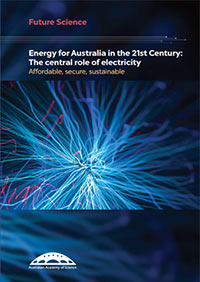
The first report, Energy for Australia in the 21st Century: The central role of electricity, outlines the challenges posed by Australia’s aging infrastructure when trying to respond to rapidly evolving technologies.
Focusing on three key drivers—affordability, security and sustainability—the report examines the science and technology that will drive and enable a transformation in Australia’s electricity system over the coming decades.
As part of the report, the following recommendations were made:
- Develop an overarching National Energy Research Institute, to link the diverse and dispersed energy research being conducted in Australia
- Overhaul energy structures to cope with rapid changes in energy technologies and end-use behaviour since its initial establishment in the 1990s
- Enhance information technology, communications and electronic control expertise
- Better collaborate with international partners.
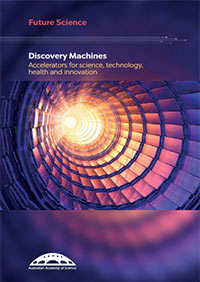
The second report, titled Discovery Machines: Accelerators for science, technology, health and innovation, explores the science of particle accelerators, the machines that supercharge our ability to discover the secrets of nature and have opened up new tools in medicine, energy, manufacturing, the environment and research.
Particle accelerators are now an essential ingredient in discovery science because they offer new ways to analyse the world (by probing objects with high energy x-rays and beams of electrons for example). They also have a huge—but often unnoticed—impact on all our lives; medical imaging, cancer treatment, new materials and even the chips that power our phones and computers have all been transformed by accelerators of various types. Research accelerators also have a knack of encouraging better collaboration between international and domestic scientists, organisations and governments.
This report outlines recommendations around the need to ensure ongoing operation of Australia’s existing world-class accelerator infrastructure; developing programs that attract the best and brightest students and further encourage international collaboration; and a call for a combined state and federal examination of the value and feasibility of hadron therapy as a promising cancer treatment.
The full reports can be accessed in the Reports and Publications section of our website.
Academy congratulates 2016 Eureka Prize winners
The Australian Academy congratulates all the recipients of the 2016 Eureka Prizes, including Academy Fellow Professor Gordon Wallace, and EMCR Executive member Associate Professor Sharath Sriram.
Professor Gordon Wallace received the CSIRO Eureka Prize for Leadership in Innovation and Science.
The award citation said Professor Wallace “is an internationally renowned researcher in the field of electromaterials science and has cultivated a research vision in the area of ‘intelligent polymers’. Through his leadership and ability to inspire, his collaborative team has pioneered the use of nanotechnology and additive fabrication in renewable energy and medical science.”
Associate Professor Sharath Sriram was awarded the 2016 3M Eureka Prize for Emerging Leader in Science.
The award citation said that Sharath’s work “harnesses the functionality of materials and objects at extremely small scales. His leadership transcends science, to include team mentorship, the establishment of a $30 million research facility and national science advocacy for early- and mid-career researchers.”
A full list of winners can be found on the Eureka Prize website.
Image credit: Engineering at Cambridge
Join the EMCR Forum executive in 2017
Applications have now closed. Please apply next year.
The Australian Early- and Mid-Career Researcher (EMCR) Forum is now accepting expressions of interest from early and mid-career researchers to join the executive committee in 2017.
The EMCR Forum is the national voice of Australia's emerging scientists, representing researchers who are up to 15 years post-PhD (or other research higher degree), irrespective of their professional appointment. The Forum’s mission is to be the voice of Australia's early- and mid- career researchers (EMCRs), championing improvement in the national research environment through advocacy.
The executive committee is looking to recruit new members who can bring enthusiasm and new ideas to the executive. New members will be expected to be able to commit a minimum of 5% time to the Forum. Examples of EMCR Forum committee activities include:
- annual face-to-face meeting and quarterly teleconferences
- organisation of the biennial Science Pathways meeting for EMCRs
- preparation of detailed submissions for consultations and public inquiries
- gathering demographic data on EMCRs and identifying discipline-specific issues
- examining the career structure and related issues for EMCRs within universities, government agencies (e.g. CSIRO, DSTO), industry and research institutes
- evaluating the attrition rate for research careers and evaluating alternate career paths available to EMCRs
- identifying specific issues that lead to many women failing to progress to the highest levels in research.
In 2017, three spaces will be available on the executive and all EMCRs are eligible to apply (<15 years since PhD award, taking into account career interruptions), but preference will be given to those who represent states and subject backgrounds that are not currently represented on the Forum. The Forum has a strong belief in gender equity and the executive will endeavour for balanced gender representation.
Applications closed on the 10 October 2016. Thank you for your interest. Please look out for the call for applications again next year.
Download the flyer to advertise this opportunity in your department.
Enquiries about expressions of interest please email emcr@science.org.au.
First Australian ‘Falling Walls Lab’ brings together young Australian and New Zealand innovators
The internationally renowned event, Falling Walls Lab, will be held in Australia for the first time next week, hosted by the Australian Academy of Science.
20 Australian and 5 New Zealand young contestants will each give a three-minute presentation on their innovative research, a business model or an initiative based on the concept: ‘Which walls will fall next?’.
The Australian event will serve as a qualifying round, and the winner will be sponsored to compete in the Falling Walls Lab final in Berlin, pitted against academics from all over the world.
President of the Australian Academy of Science, Professor Andrew Holmes, said he was proud to see the event held in Australia this year.
“Any event such as this, which encourages local and international cross-discipline collaboration and the sharing of knowledge, is extremely valuable for Australian science and innovation,” Professor Holmes said.
The 25 presentations will look to address issues relating to carbon emissions, obesity, breast cancer, corporate fraud, cerebral palsy, dam disasters, and much more.
“To have so many young researchers addressing such a variety of issues faced by our society is truly inspiring,” said Professor Holmes.
“The Falling Walls Lab will be a showcase of the vast talent in the Australian and New Zealand research and innovation community, and the potential it has to address some of the biggest problems facing people around the globe.”
Jury members for the event include Australia’s Chief Scientist, Dr Alan Finkel; Nobel Laureate and ANU Vice Chancellor, Professor Brian Schmidt; New Zealand’s Deputy Chief Scientist, Professor Stephen Goldson; and many other distinguished Australians working in the research, innovation and business sectors.
The Falling Walls Lab Australia is organised by the Australian Academy of Science, in association with the Embassy of the Federal Republic of Germany in Australia and the Australian National University.
Media are invited to attend the event on Wednesday, 24 August between 2:00pm and 8:00pm at the Shine Dome in Canberra.
Interviews with the winner of Falling Walls Lab Australia will be available from 9am, Thursday 25 August.
Contact: Dion Pretorius | 0418281777 | dion.pretorius@science.org.au
STEMM gender equity pilot appoints Elizabeth Broderick; accepts new institutions
Australia’s Science in Australia Gender Equity (SAGE) Pilot today announced former Sex Discrimination Commissioner Elizabeth Broderick as Chair of its Expert Advisory Group, and the acceptance of eight new institutions into its Pilot of the UK-based Athena SWAN Charter.
The additional institutions bring the total number of participants to 40, with 30 universities (representing 75% of Australian universities), six medical research institutes and four publicly funded research agencies joining the Pilot.
The new participants and Ms Broderick’s appointment will be announced today at the first national SAGE Symposium in Sydney. The new participants are:
- The Australian Astronomical Observatory
- Bond University
- Burnet Institute
- The Defence Science & Technology Group
- Federation University Australia
- James Cook University
- Macquarie University
- The University of the Sunshine Coast
The SAGE Pilot of the UK-based Athena SWAN Charter is a partnership of the Australian Academy of Science and the Academy of Technology and Engineering (ATSE). It promotes equity and inclusion through an evaluation and accreditation framework to identify and address gender inequity in science and research organisations.
Institutions are graded by a panel of experts against this framework to determine areas that need to be addressed to improve gender equity and diversity in Science, Technology, Engineering, Mathematics and Medicine (STEMM). The pilot includes a two-year program of training and advice to develop an action plan. Successful organisations will be awarded an Athena SWAN Bronze award indicating they are well placed to improve gender equity and diversity across their academic and professional staff.
Academy of Science President Professor Andrew Holmes said he was proud of SAGE’s rapid adoption and early progress.
“In just over a year, the SAGE program has generated significant interest and enthusiasm across the entire higher education and research sector. There are high hopes that this will finally achieve a level playing-field in research to improve the promotion and retention of women and gender minorities within STEMM,” he said.
Executive Director of SAGE, Dr Wafa El-Adhami said Ms Broderick’s appointment would bring a broader perspective to the Expert Advisory Group.
“Ms Broderick has an outstanding track record in addressing gender equity across a breadth of sectors, most particularly as Sex Discrimination Commissioner and through her leadership of the Male Champions of Change program. We look forward to her leadership on gender equity in STEMM,” Dr El-Adhami said.
Ms Broderick will address the Symposium today, as will 2013 Australian of the Year Ita Buttrose, Human Rights Commissioner Dr Tim Soutphommasane, and a range of STEMM leaders. The SAGE symposium brings together the 40 organisations in the SAGE Pilot together for the first time since it was initiated in 2015.
The SAGE symposium is supported by principal sponsor Universities Australia and by Office for Women in Prime Minister and Cabinet, La Trobe, EY, L’Oréal Australia and Flinders University. More information about SAGE and its participating institutions is at www.sciencegenderequity.org.au
Professor Andrew Holmes, Professor Susan Pond from ATSE, and Dr El-Adhami will be available for interview during the SAGE Symposium, held at the National Maritime Museum in Sydney on Friday 24 June 2016. Please contact Bill Mackey (below) to organise interviews.
Contact Bill Mackey | T (03) 9864 0902 | M0418 923 370 | E bill.mackey@atse.org.au
Fellows recognised in Queen's Birthday honours
Former Academy President Professor Brian Anderson and polymers pioneer Professor David Solomon have been recognised with Australia's highest honour, Companion in the General Division of the Order of Australia, in the 2016 Queen's Birthday Honours list.
Professor Anderson AC received the award for eminent services to information and communications technology, to engineering and higher education, as an academic, researcher and author, to professional scientific associations and as a mentor of young scientists.
Professor Solomon AC was recognised for eminent service to science in the field of polymer chemistry and plastics, and to professional scientific institutions.
Fellows recognised as Officers in the General Division of the Order of Australia were:
- Academy Vice President Dr TJ Higgins AO for services to agricultural biotechnology;
- Professor Nalini Joshi AO, for distinguished service to mathematical science and tertiary education, as a role model and mentor of young mathematicians;
- Professor Doug Hilton AO, for distinguished service to medical research and education, and to gender equity and mentoring;
- Professor John White AO for distinguished service to chemistry and for leadership of Synchrotron and neutron science projects in Australia and the Asia-Oceania region.
Fellows recognised as Members in the General Division of the Order of Australia were:
- Academy Council Member Professor Sue O'Reilly AM for significant service to the earth sciences;
- Professor Denis Evans AM for significant services to chemistry and tertiary education.
The late Professor Michael Raupach AO received a posthumous award for distinguished service to science in Australia and internationally as a leader in climate change research.
(Home page image Professor Nalini Joshi AO)
Changes to the Academy Council
Retiring members of the Academy’s Council have been honoured and new members appointed, following the Australian Academy of Science’s Annual General Meeting today.
Leading physicist and academic Professor C Jagadish has retired as the Academy’s Secretary Physical Sciences and Deputy President; materials scientist Professor Jim Williams has stepped into the role.
Other retiring Council members are ordinary members in the physical sciences, Professor Bob Vincent, and Professor Brain Schmidt and ordinary member of the biological sciences, Professor Peter Koopman.
Replacing them will be Professor Sam Berkovic (biological sciences), and physical scientists Professor Elaine Sadler, Professor Scott Sloan and Dr Steve Rintoul.
Academy President Professor Andrew Holmes welcomed the new members and thanked those retiring for their service to the Academy.
Academy announces new members of Council
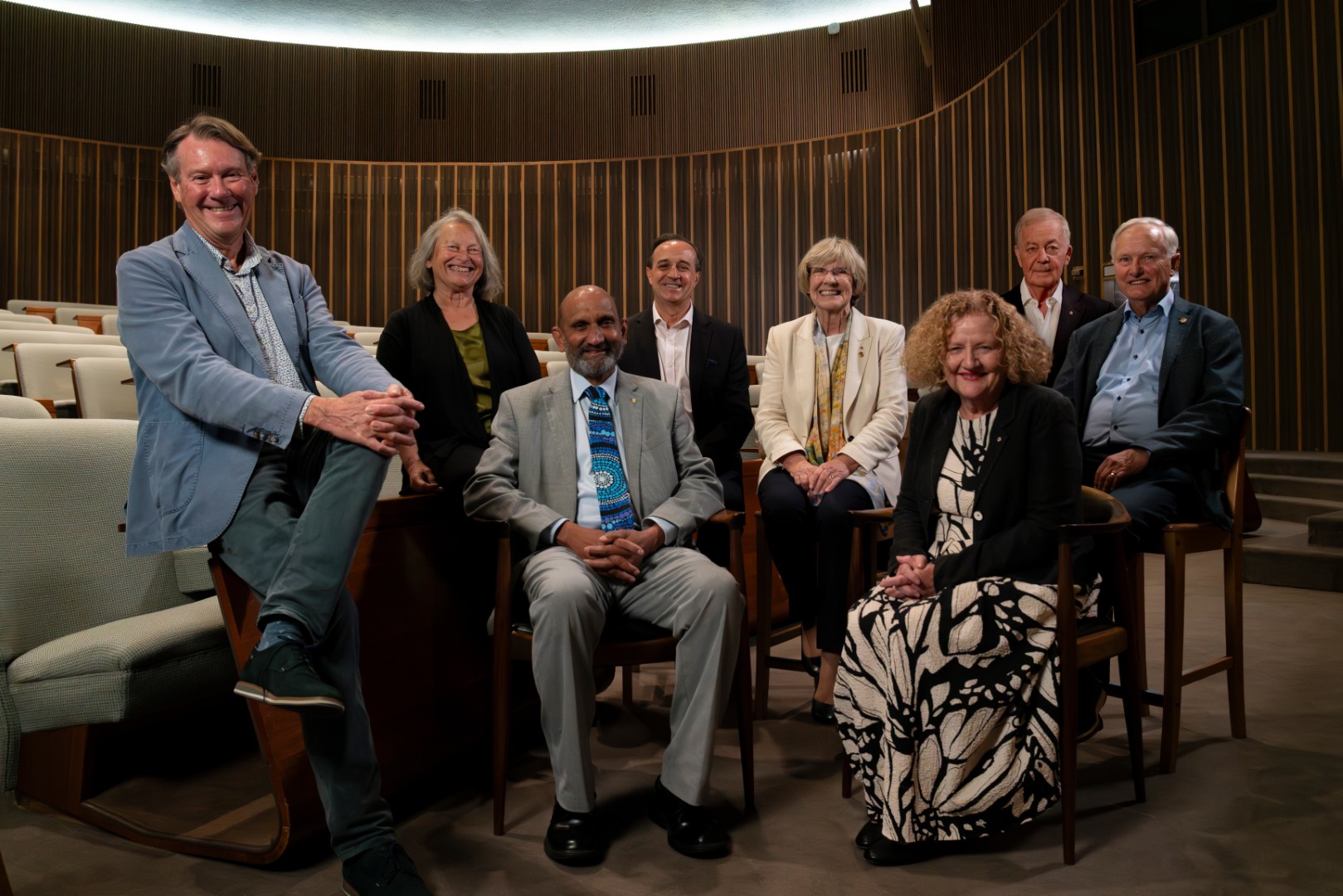
A Prime Minister’s Prize-winning epilepsy specialist, an internationally recognised astrophysicist, a geotechnical engineer and a Southern Ocean climate scientist have joined the Council of the Australian Academy of Science.
The new members have been elected to join Council for three-year terms that commence after the Academy’s Annual General Meeting, held as part of Science at the Shine Dome in Canberra this week.
Epilepsy specialist Professor Sam Berkovic AC FAA, winner of the 2014 Prime Minister’s Prize for Science, joins the Council as an ordinary member for the biological sciences. Astrophysicist Professor Elaine Sadler FAA, geotechnical engineer Professor Scott Sloan AO FAA FRS FTSE, and oceanographer and climate specialist Dr Steve Rintoul FAA will join as ordinary members for the physical sciences.
Leading nanotechnologist Professor C. Jagadish AC FAA FTSE is retiring from Council after a four year term as the Academy’s Secretary Physical Sciences and Vice President. Materials scientist Professor Jim S. Williams AM FAA FTSE will take his place. Also retiring are Nobel Laureate Professor Brian Schmidt AC FAA FRS, and Professors Bob Vincent FAA, and Peter Koopman FAA.
Academy President Professor Andrew Holmes AM PresAA FRS FTSE welcomed the new members and thanked those retiring for their service to the Academy.
“By joining the Council of the Academy these scientists are demonstrating a huge commitment not only to scientific research but also to participating actively in creating an Australian scientific culture,” Professor Holmes said. “I welcome each of the new members of Council and look forward to working with them.”
“On behalf of the Academy I express my deep gratitude to the outgoing members of Council, and in particular to the outgoing Vice President, Professor Jagadish, for his tireless efforts in the service of science and the Academy.”
Transcript: Science at the Shine Dome President’s Address, Professor Andrew Holmes
Delivered 9 am Wednesday 25 May 2016, Shine Dome, Canberra
E&OE: CHECK AGAINST DELIVERY
Australian Academy of Science President, Professor Andrew Holmes AM PresAA FRS FTSE
Fellows of the Academy, distinguished guests, ladies and gentlemen.
Before we begin the proceedings, I would like to acknowledge and pay respect to the traditional owners of the land on which we meet—the Ngunnawal people of the Wiradjuri Nation. It is upon their ancestral lands that the Australian Academy of Science is built.
As we share our own knowledge, teaching, learning, and research practices may we also pay respect to the knowledge embedded forever within the Aboriginal Custodianship of Country.
I welcome all the new Fellows including two Corresponding Members (Professor Sir Philip Cohen Dundee elected in 2014 and Professor Matthias Hentze Heidelberg elected this year) as well as the award holders who will present their lectures this morning.
In the year since I last had the privilege of delivering this annual address, Australian science and Australian scientists have experienced a range of highs and lows. On December 7 last year, just 65 days into his Prime Ministership, the Hon Malcolm Turnbull and the Minister for Industry, Innovation and Science the Hon Christopher Pyne announced the National Innovation and Science Agenda.
This ambitious policy was presented as an important first step towards a future economy based on scientific discovery and innovation, and was welcomed by the science sector with genuine excitement and enthusiasm.
Such commitments to science can be very fruitful. Bob Grubbs, who won the Chemistry Nobel Prize in the same year as Barry Marshall and Robin Warren won the Prize for Medicine/Physiology, described his scientific achievements as being a product of the ‘sputnik era.’ The Soviet Union launched the sputnik in 1957. Yuri Gagarin was the first human in space in April 1961, and on 25 May 1961 (exactly 55 years ago) President Kennedy announced the intention to place a man on the moon within a decade. The resulting commitment to investment in science and technology was the reason given by Professor Grubbs for his successful scientific career, and presumably for his nation’s prosperity.
The National Innovation and Science Agenda announced last December included many noble aspirations, with a new Cabinet committee for science and innovation chaired by the Prime Minister, and more than $1 billion in new funding for science education, for programs to promote gender equality in science and industry, and significant funding for research translation and commercialisation programs.
Of great interest to many in our sector, the package also included a commitment of $1.5 billion over ten years to support the National Collaborative Research Infrastructure Scheme—NCRIS—and $520 million in new funding for the Australian Synchrotron.
Given that just nine months previously the future of the NCRIS program had been in grave doubt, the announcement was welcomed particularly by the 35,000 Australian and international researchers who use these facilities and the 1,700 highly trained staff who operate them.
After significant ups and downs, 2015 had ended on a high for scientists in the country.
Climate science
However, less than two months later, some of this optimism was turned on its head with the CSIRO’s announcement of planned cuts to its oceans and atmosphere and land and water divisions; an announcement that reverberated in the media throughout Australia and the world.
On behalf of the Academy, I expressed great disappointment in the decision that appeared to have been taken, and while recognising that this was not a political decision, I did call on government to ensure that Australia retained its excellence and essential capabilities in research in climate and environmental science to meet national and international needs.
I took the opportunity to express to the Minister for Environment the Hon Greg Hunt that Australia is literally the custodian of the Southern Hemisphere in the body of climate knowledge it generates, and was heartened by his genuine willingness to listen. I am hopeful that the ongoing efforts of the Academy and others will lead to an acceptable solution.
2016 federal election
And now, two months later again, we are approaching a federal election in which for the first time in recent memory it seems that science is on the political agenda of both major parties.
With the election in mind the Academy has launched its statement, entitled Science Priorities for an Innovative Australia.
In this statement the Academy argues that science is the engine-room of innovation, and that Australia’s future economic and social prosperity depend above all else on improving achievements through science, technology, engineering and mathematics (STEM) education.
We propose that a long-term vision and stable funding for science is needed to ensure:
- that all Australians have the understanding and skills to use and apply STEM in their lives and careers
- that the most intellectually and experimentally able scientists are empowered to solve Australia’s current and future challenges, and:
- that Australia has a strong, secure and globally connected research capability.
Within these three overarching priorities there is a need for:
- continued support for evidence-based science and maths education programs
- relevant work-placement opportunities for university students in STEM disciplines
- equal opportunities for people of all genders and from all backgrounds to study and achieve a successful career in science
- stability in research funding; support for indirect costs of research and an increased investment in the basic and translational research supported principally by the ARC and the NHMRC
- continued support for public good research in areas of pressing national importance such as climate change and the environment.
The policy statement also recognises the need for targeted support to enable industry and academic researchers to engage more effectively. And we stress that innovation will quickly falter if support for the basic science that drives it is neglected or withheld.
And finally, it recognises that within the context of the National Innovation and Science Agenda, some of this work is already well underway. Under the leadership of Bill Ferris, Innovation and Science Australia has commenced an audit of the Australian innovation, science and research system that will inform the development of what is already being referred to as the 2030 Strategic Plan for science and innovation in Australia.
We appreciate that political leaders of all persuasions have shown their commitment to long-term planning and a continued focus on science in public debate.
The Academy
I’ll now turn to the achievements of the Academy during a very active year.
The Academy has embarked on new projects and has sought, found and taken up diverse opportunities.
Education programs
Among these is the new national education program reSolve: Mathematics by Inquiry. reSolve is a bold new program funded by government that aims to promote innovative mathematics teaching in Australian schools. The Academy is operating this program in conjunction with the Australian Association of Mathematics Teachers.
This is a timely initiative, given the recent results announcing Australia’s declining performance in maths and other subjects in comparison with standards in other countries (I refer here to the PISA tests).
We have sustained our commitments to growing and developing our primary school program, Primary Connections, with new course modules and development opportunities for pre-service and working teachers. Thanks to philanthropic support this year for the first time we have also been able to offer professional development to teachers from remote and disadvantaged schools.
This past year we’ve also proudly completed all the modules for our secondary school science education program, Science by Doing, whose number of users has grown exponentially.
And we’ve launched a new phase for our long-standing public education and explainer website, Nova—with the support of a generous donation from Telstra we have completely refreshed and redeveloped Nova, which is reaching new audiences daily with the wonder of science and igniting curiosity in the world around us.
SAGE
Our other new program—a joint initiative between the Academy of Science and the Academy of Technology and Engineering—is the Science in Australia Gender Equity—or SAGE—Initiative that has been established to improve gender equality in Australian universities and other research organisations.
It is doing so by piloting the Athena SWAN Charter in 32 Australian universities, medical research institutes and other publicly funded research organisations, with an intention of expanding the program to accommodate all Australian research organisations over the coming years.
For those of you unfamiliar with Athena Swan this is a program that was developed in the UK and has been operating there for over ten years. It offers research institutions and individual departments the opportunity to apply for accreditation at bronze, silver and gold levels to encourage and recognise commitment to advancing the careers of women in science, technology, engineering, maths and medicine (STEMM) employment in higher education and research.
The SAGE pilot was launched at Parliament House in September last year, just after we had formalised the partnership with ATSE, and I’d like to express my thanks to our new Chief Scientist and former President of ATSE, Dr Alan Finkel, for his support in helping to instigate and finalise this partnership.
I’m also delighted that the SAGE Initiative was given a significant boost from Government with funding under the National Innovation and Science Agenda to support expansion of the program in a shorter timeframe than would otherwise have been possible. The program is in the process of engaging with those 32 institutions who have signed up, and plans are in hand to strengthen the administration with the appointment of an Executive Director.
The Australian Council of Learned Academies
This year by rotation I have assumed the Presidency of the Australian Council of Learned Academies—or ACOLA. This organisation was established after a review of the original National Academies’ Forum, but it received its greatest boost when the former Chief Scientist Professor Ian Chubb arranged funding of $10 million to enable the four learned academies jointly to develop policy and foresight documents on multidisciplinary topics of interest to government under the collective title Securing Australia’s Future.
This program was modelled on the long-standing operations of the US National Research Council (the research arm of the National Academies of Science, Engineering and Medicine) in the development of scientific reports for government on matters of public policy.
We are coming to the end of this program with some thirteen reports produced by ACOLA, and are now planning how the organisation will proceed. We will aim to have commissioned up to three major reports per annum in areas that have a defined end user in government or other parts of civil society.
A feature of the Securing Australia’s Future reports has been the inter-disciplinary nature of the work, engaging Fellows from all four learned academies who can provide expert views on particular topics drawing on the knowledge of the experts, and where appropriate, using commissioned research to provide a collective body of information which is used and analysed in the report.
This model has worked well. The Academy of Science managed the preparation of a substantial report on Technology and Australia’s Future chaired by Professor Bob Williamson (of Data 61 and ANU) and Professor Rob Evans (from the University of Melbourne). Launched in September, the report raised powerful arguments about the importance of technology in driving new jobs and growth (do these words sound familiar?).
This theme will continue as we inform government and society on developing the National Innovation and Science Agenda. Another Securing Australia’s Future report—Skills and Capabilities for Australian Enterprise Innovation—is highly relevant in recognising features that can be identified with successful companies in a modern innovative society, while a Review of Australia’s Research Training System, commissioned by the Department of Education and Training and jointly managed by this Academy and the Academy of Technology and Engineering, has much to say about the need to align research training more effectively with industrial research needs.
Finally, the work of all the projects will be drawn together in a synthesis volume that will cluster various projects and try to draw out some common threads. The summaries of these projects will also be available in attractive brochure form for distribution to individuals in various environments including meetings with politicians or for casual visitors to the Academy.
One of the reasons that I devoted some considerable time to the mention of ACOLA and the Securing Australia’s Future program is that an external review of the work instigated by the ACOLA Council concluded that ACOLA could promote more effectively the existence of the SAF reports through our own Academy Fellows. As we draw to the phase of preparing a final report for ARC I hope you will make time to read these reports.
International collaborations
We note with some satisfaction that the introduction of funding for multilateral international scientific collaborations has been provided under the recently announced National Innovation and Science Agenda, and that the Academy will play a significant part in assisting with the administration of these programs. I welcome a group of six Brazilian PhD students who have been in Australia for the last few weeks under the auspices of the Academy to undertake research projects with a number of Australian host institutions.
Public funding for climate and environmental research
As I noted earlier, a particularly widely debated topic has been the decision of CSIRO to reduce its activities in the area of climate science and environmental research. Many Fellows have been keen to see the Academy take strong action on this decision. While I expressed great disappointment in the decisions that appear to have been taken, I do not believe it is appropriate to dictate to CSIRO how their operations are prioritised. I am reminded of some wise words that have stayed with me. You may have heard this yourself: “If you have to shout at them you have lost the battle”.
I took the view that what really matters is that Australia can continue to deliver the basic scientific knowledge to understand, mitigate and accommodate the effects of the change in climate imposed by anthropogenic carbon dioxide emissions. I was privileged to attend the conference CSIRO Greenhouse 2015: Atmosphere, oceans and ice in Hobart last October and was most impressed with the high quality of atmospheric physics and chemistry, glaciology, Antarctic research, oceanography, ecology and social science that is conducted in Australia.
This is a jewel in the crown of Australia’s knowledge base, and generation of excellent knowledge must be sustained and nurtured. I learnt that Australia is literally custodian of the Southern Hemisphere in the body of knowledge that it generates and in the discharge of its international obligations.
I support those who are speaking out loudly against reductions in investment in these areas of science. I also believe the Academy’s proper role is to work constructively with government and civil society to identify our needs and capabilities and to propose effective approaches to generate solutions to these requirements.
It is with this in mind that I proposed to Minister Hunt and the Chief Scientist that the Australian Academy of Science would conduct an assessment and review of the needs and capabilities in the area of climate science. The Minister and the Department of Environment welcomed this offer.
The review will be headed by Professor Trevor McDougall. It will determine which of Australia’s current climate science capabilities are critical to the national interest, and explore the capabilities that will need to be maintained or developed into the future. Between them, members of the committee have expertise from the Bureau of Meteorology, the CSIRO, international research hubs including the Hadley Centre in the UK and the National Center for Atmospheric Research in the USA, the Victorian Centre for Climate Adaptation Research and considerable expertise in university climate research.
However, I do understand that the needs are much broader and that an assessment of scientific knowledge and the provision of scientific advice in Australia by Australians for Australia is essential. This knowledge and advice must take into account the harsh and arid environment of our continent in the areas of ecology, evolution and sustainability. It is with this in mind that I am hoping that the Australian Council of Learned Academies will be invited to provide a comprehensive “deep dive” assessment of the issues needed to deliver the appropriate knowledge and scientific capability in the area of the Science and Research Priority “Environmental Change”. In the meantime I continue to maintain a dialogue with the Chief Scientist and CSIRO on these most important matters.
Science for the public good
Much of the debate about the need for research into climate science and the environment falls under the general subject of ‘science for the public good.’
In a number of conversations with Fellows who are concerned about this aspect of the nation’s science base I consider that it would be timely to propose that a national debate be held on this topic.
I started to do some reading on the topic and came across a publication by the US National Academies Press [The Role of Scientific and Technical Data and Information in the Public Domain: Proceedings of a Symposium (2003)] with a chapter entitled ‘Scientific Knowledge as a Global Public Good: Contributions to Innovation and the Economy.’ The authors argued that the notion of “public goods” is not new, although it has less often been strongly associated with the natural sciences.
Traditionally the acquisition of basic scientific knowledge has been the preserve of the public sector whereas the private sector has been more associated with applied research. We can all think of modern examples of knowledge for the public good related for example to high energy physics and cosmology as well as understanding control of disease, whereas an important applied focus of the public sector has been the improvement of agricultural production. It is against this background that CSIR (later CSIRO) was founded in 1926 (initially as the Advisory Council for Science and Industry in 1916).
Much of the scientific and technological advances in developed countries has been accelerated by military need, particularly in wartime. This just emphasises that the interpretation of the words ‘public good’ is still strongly influenced by society in general as the end users. The use of DDT as an insecticide in controlling the spread of malaria is another example of the ambiguity of the interpretation of what constitutes ‘the public good.’ Alongside this sits the concept of protection of intellectual property that is probably aimed directly at a national benefit that provides an incentive for individuals and entities.
The age of industrial enlightenment followed by the huge advances in scientific and technical knowledge in the period from the mid-19th to the mid-20th century afforded the opportunity to harness the knowledge in effective ways through the formation of national (and private) laboratories. It was only during this period that the collective ability and techniques to acquire knowledge and harness it for economic gain became a compelling necessity.
The justification of the added economic benefit to our nation’s economy through worldwide investment in the physical, biological and mathematical sciences has been convincingly demonstrated in the Academy’s recent publication The importance of advanced physical, mathematical and biological sciences to the Australian economy (2015).
Working with the Office of the Chief Scientist and the Centre for International Economics, we showed in this report that global advances in basic physical, mathematical and biological sciences over the past 30 years directly and indirectly underpin one quarter of Australia’s economic output.
It is clear that public investment in our national science laboratories is valuable to the economy. But we know that it is also extremely valuable for the acquisition of new knowledge, surely one of the most important activities of civilisation.
Dr Sue Meek
I now turn to recognise the enormous strides that the Academy has made over the last eight years under the leadership of Dr Sue Meek, our Chief Executive. I am very sad that Sue has decided to step down. I am constantly reminded of how much she has initiated that needs to be sustained. In doing so we shall have to learn to soldier on in her absence until her successor is appointed, a task that is well in hand. May I publicly thank you Sue for everything you have done for the Academy. Your dedication to getting everything working properly, your attention to detail and your personal investment are known to the Fellows and indeed well beyond the walls of the Shine Dome. We wish you much happiness and fulfilment in the next phase of your career.
Ladies and gentlemen, this brings me to the end of my address for the Annual Meeting 2016. Thank you very much.