




Academy welcomes long-term science planning in National Science Statement

The Academy welcomes the Government’s National Science Statement released today by the Minister for Industry, Innovation and Science Senator the Hon Arthur Sinodinos at the National Press Club.
Importantly, the comprehensive statement recognises:
- The criticality of basic research;
- The need for a long-term sustainable approach;
- The importance of strong community awareness about science; and
- The need to boost international science engagement .
In particular, the Academy acknowledges the Government’s leadership to address inequality in science education, participation and employment, particularly through support of the Science in Australia Gender Equity pilot.
"The Statement recognises the role of science in our society and economy. It highlights that new knowledge is the fuel that drives innovation and that support is required from basic to applied research," said Professor Les Field, the Australian Academy of Science’s Secretary for Science Policy.
"Not only does the Statement provide much needed long term direction and purpose for government activities in regards to science, it shows an understanding of the needs and realities of the sector," said Les.
"The Academy of Science stands ready to work with government to shape an investment strategy that supports this plan. It offers a comprehensive framework, and a guide to decision-making and investment," said Academy CEO Anna-Maria Arabia.
"The focus areas point to a solid foundation for science including infrastructure, education, engagement, and collaboration mechanisms – all important elements to create a strong science and innovation sector."
"It’s an important document that builds on the National Innovation and Science Agenda and recognises science’s role in driving Australia’s economic and social wellbeing," Anna-Maria said.
For more information or to arrange an interview contact Toni Stevens on 0401 763 130 or Melanie Bagg 0439 037 773.
For more information and to access the National Science Statement, visit: www.science.gov.au/NSS
Supporting research to improve the health of Indigenous children
The Academy has awarded the Douglas and Lola Douglas Scholarship to Dr Bianca Middleton for her research on improving the health of Indigenous children.
Dr Middleton was awarded the scholarship for her PhD work on ‘Strategies to reduce the burden of gastroenteritis in Aboriginal children’. She is jointly enrolled at the Menzies School of Health Research and Charles Darwin University.
Dr Middleton says she is honoured to be in the company of the many excellent researchers in the past awardees list. She is passionate about Aboriginal child health and works in both a clinical and research capacity.
The Douglas and Lola Douglas Scholarship in medical science is offered as a ‘top-up’ scholarship to a high-ranked PhD candidate awarded a National Health and Medical Research Council Training Scholarship in either Indigenous or primary health care, with preference given to Indigenous health research.
It is awarded initially for one year (currently $7,000 per annum) with funding available for a maximum of two years. The award covers costs of small items of equipment, research materials, travel, or research assistance.
The scholarship is made possible through a generous bequest made by Lola Rachel Maude Douglas, a philanthropist with a keen interest in medical research.
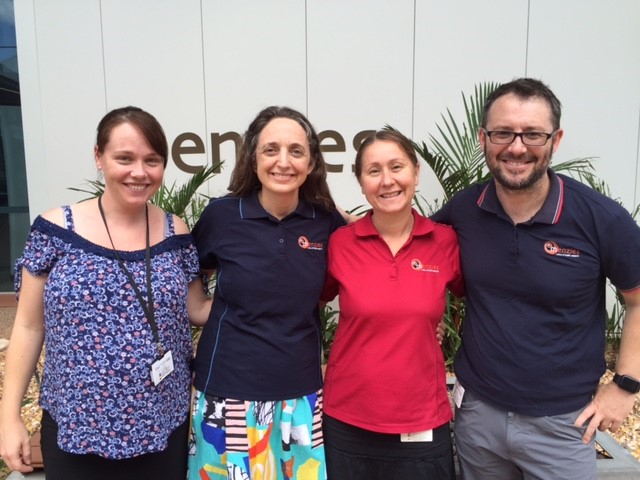
Bianca Middleton (second from left), with team members Clare McKay, Jane Nelson and Tom Snelling.
Academy welcomes new Director of Communications and Outreach Dr Melanie Bagg
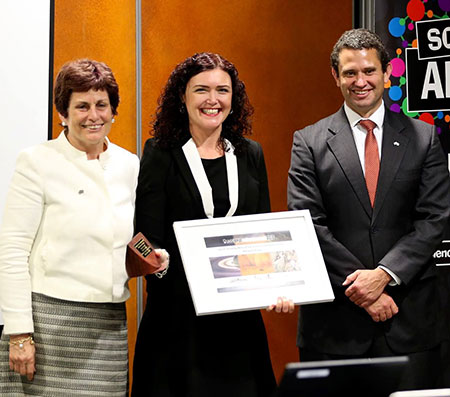
Melanie accepting the 2016 Unsung Hero of SA Science Communication Award.
Melanie is a PhD qualified medical research scientist turned professional science communicator. She joins us from the Australian Science Media Centre (AusSMC) where as Manager of Business Development she was a driving force in the launch of their new breaking science news venture, Scimex. A passionate champion for Australian science, Melanie has extensive experience in senior communications, fundraising, media and outreach roles within the not-for-profit and higher education sectors. In 2016, Melanie was awarded the Unsung Hero of SA Science Communication for her commitment to translating complex science into something we can all understand.
On her appointment, Melanie commented “I am so excited to join the Australian Academy of Science and promote the work of its Fellows, our nation’s top researchers. As a public, we need to be well informed on science and technology to make important decisions that affect us all. The Academy is the go-to place for independent, high quality scientific advice in Australia. It does so much to make science accessible, I look forward to growing and expanding on our current communications and engagement activities.”
The Academy’s Chief Executive Anna-Maria Arabia said that the appointment of one of Australia’s top science communicators will allow the Academy to continue bringing Australia’s best science to the public through the media, events and lectures, innovative learning platforms such as Nova (www.nova.org.au) and other social media and new technologies.
Melanie will take up the position in April. She replaces Kylie Walker who commenced as CEO of Science and Technology Australia in 2016 following five years with the Academy.
Kylie was named the 2015 National Unsung Hero of Australian Science Communication for her leadership and significant contributions to science communication and outreach. She leaves an impressive legacy and strong foundation for continued growth and development of the Academy’s science communication activities.
Polymer science making plastic fantastic
Smarter bank notes, health-protecting wearable electronics, and bendy solar cells are just some of the ways that polymer science is making plastic fantastic. Next week, three Australian researchers will tell audiences in Sydney and Melbourne how they are putting polymers to work.
Wearable patches that warn of sunburn and smart contact lenses that act as sunglasses are just the beginning for RMIT’s Associate Professor Madhu Bhaskaran who hopes her research into “stretchy electronics” will lead to wearable devices that can improve our health.
Printable solar cells—in our windows, curtains and even our clothes—are the future, according to Dr Scott Watkins. While at CSIRO he worked with the Victorian Organic Solar Cell Consortium (VICOSC) on developing new materials and printing processes to manufacture polymer-based solar cells.
And over in Adelaide, Associate Professor Drew Evans and his team at the Future Industries Institute created the world’s first plastic car mirror—over 3 million of which they’ve now exported to America. The process they’ve developed allows manufacturers to replace components made from traditional materials like glass, in cars, aircraft, spacecraft, and even whitegoods—making them lighter and more efficient.
In many ways, these innovations can be traced back to the humble $10 note. Fifty years ago—following a major forgery, CSIRO’s Professor David Solomon was invited to a meeting about how to make bank notes more secure. His solution became Australia’s world-famous plastic bank note and was based on Professor Solomon’s glittering career in the field of polymer science.
With Professor Ezio Rizzardo David Solomon went on to discover the first practical method of making controlled polymer structures by a simple method termed NMP.
“This represented a quantum leap in polymer science,” said Academy President Andrew Holmes, himself a chemist who led the VICOSC project.
“Controlled polymerisation allowed chemists to make polymers that were not accessible before. As we could stop and start the chain reactions, we could create all sorts of shapes and sizes, and make polymers with different properties. This has led to an explosion in commercial applications for these materials, from medicine to the environment, and paints to electronic materials,” said Andrew.
Polymers in a material world is the first event in the Australian Academy of Science’s 2017 National Speaker Series Plastic Fantastic. It comes to Melbourne on 28 February and Sydney on 2 March. Other talks will follow later in the year in Wollongong, Brisbane and Adelaide. The series is presented with the support of Professor David Solomon AC.
The event speakers and Professor Solomon are available for interview: please contact Toni Stevens on 0401 763 130 or media@science.org.au to arrange.
OPINION—Government needs advice from scientists in many spheres
Australia needs stronger STEM skills and knowledge in parliament so politicians can understand the basics underpinning today’s significant issues, writes Les Field.
Recently in Canberra, the chief scientists of Australia and New Zealand, Alan Finkel and Peter Gluckman, joined former British chief scientist John Beddington to discuss the intricacies of science policy. Their audience was a high-powered group of current and former politicians, ambassadors, academic leaders, departmental secretaries and bureaucrats.
An offhand comment by Dr Finkel regarding the Trump administration’s reported censoring of the US Environmental Protection Agency was widely reported, but there was also a serious discussion about the importance of “evidence” in public policymaking.
Sir Peter, a renowned biomedical researcher and science communicator, made the surprising statement that after seven years as New Zealand’s chief science adviser, he no longer used the term evidence-based policy.
This was not because he believes science isn’t critical to solving many public policy issues but, rather, he has come to realise that major policy decisions are almost always based on a mix of personal and party-political values, economic constraints, public attitudes, political expediency, diplomatic pressures, vested interests, anecdotes, media hype, and then (if you are lucky) on the scientific evidence. He also noted that science usually doesn’t have all the answers to the kind of complex decisions that policymakers grapple with everyday.
Sir Peter suggested the fastest way for science to lose its seat at the table would be to assert (or imply) to a non-scientist politician or bureaucrat that complicated and sometimes limited scientific evidence should take precedence in their decision-making.
All of the chief scientists agreed what was needed was a much more collaborative relationship between scientists and decision-makers where good science helps to evaluate options.
About 10 per cent of Australia’s 226 parliamentarians have a tertiary STEM qualification: 14 MPs and eight senators. This is a lower proportion than Germany, but significantly higher than in Britain, Canada and the US.
Not bad, perhaps, until you realise that unlike Australia, Britain and Canada have dedicated parliamentary offices of science and technology, and have chief scientific advisers embedded in each government department. And the advisers are not just in the obvious portfolios such as health, defence, industry and environment. Even the justice department considers the relentless march of forensics into the courtroom and the finance department watches the inevitable rise of automated computer trading in the financial markets. These advisers are able to provide technical expertise but they also boost the overall level of scientific literacy in the corridors of government.
You have to ask why we don’t have a similar machinery here so that a strong scientific evidence base could play a larger role in informing critical policy decisions.
We see our parliamentarians wrestling with what should be the right energy mix to fuel Australia’s future. Last year we saw the Turnbull government tie itself in knots over whether it would consider an emissions trading scheme as Australia’s way of containing greenhouse gas emissions. We witnessed the Environment and Energy Minister trying to reconcile the absolute need to deal with climate change with the reality of a sceptical backbench.
That incident followed a public showdown on the ABC’s Q&A program between Brian Cox, the British physicist and science communicator, and Malcolm Roberts, a newly elected One Nation parliamentarian. When Cox produced evidence on climate change, Roberts countered by alleging a global conspiracy led by NASA.
Being the odd country out on a major issue like climate change would be fine if we could plausibly argue that the rest of the world had somehow got it wrong. But we can’t. Australia’s position doesn’t have an intellectually sound base. This episode flies in the face of the unwritten consensus built up over perhaps eight decades: namely, that where it really matters, well-informed science should inform good government policy. We do need the skills base in parliament to understand the basics underpinning today’s significant issues.
Every one of us needs to make life-changing decisions at times and we need people with the right expertise to help properly weigh up the options. If it’s a question about planning retirement, you would consult a financial adviser or an investment manager. If you are building a new house, you would talk to an architect or an engineer. Similarly, when a family member is facing a medical crisis, you seek out the best doctors.
As a nation, we have got it right in the past. There have been real successes: universal immunisation was an important achievement based on sound scientific advice. Likewise the fluoridation of water has had a profound impact on public dental health.
But even a cursory glance at the challenges on the radar shows the need for evidence-informed policy has never been greater. How best to preserve the health of Great Barrier Reef? The impact of coal-seam gas or new methods of mining. And how to balance the needs of the environment and farmers in managing water flow in our rivers.
Do we need to regulate the impact of driverless cars, the intrusion of drones into our lives, and the medical, moral and ethical dimensions of genetically modified plants, animals and even people?
During the get-together in Canberra, Sir John described three very technical issues that confronted Britain during his tenure as its chief scientific adviser: the 2009 outbreak of swine flu; the 2010 incident where ash from an Icelandic volcano closed down airspace; and the 2011 Fukushima nuclear disaster. Any one of these chapters could have had profound consequences for Britain if not handled properly. Sir John’s accurate, sound and timely scientific advice played a decisive role in the government’s response.
Wouldn’t it be sensible if Australia developed a much stronger network of conduits for science advice around our chief scientist to actively advise government of options on complex public policy and technological issues?
And doesn’t it make sense, over time, to build scientific literacy among our parliamentarians and public servants so that they can better understand, respond to and plan for a future where technology will be ever more important?
So that when the needle is nudging the red on the next critical issue, we shouldn’t have to ask, “Who you gonna call?” We should be able to rest easy in the knowledge that our elected leaders have the skills and support they need to fully assess the situation, propose solutions and make the most of the opportunities?
Les Field is secretary for science policy at the Australian Academy of Science and Senior Deputy Vice-Chancellor at UNSW Sydney.
This article was originally published on The Australian. Read the original article.
Christmas wish granted for 'space nut' and his 9yo son
“I have Buzz Aldrin’s signature,” said Mars One Candidate Josh Richards. So what happened next?
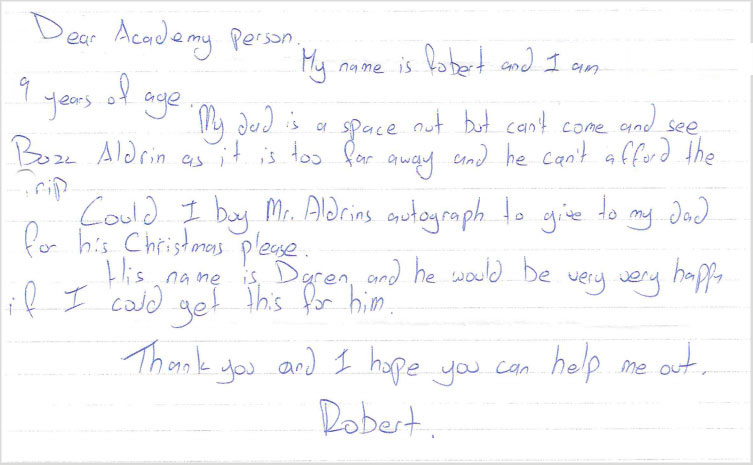
Dear Academy person…
So starts a handwritten letter from 9-year-old Robert from Adelaide who wrote to us with a special request for his ‘space nut’ dad.
Robert wanted to surprise his dad at Christmas with Buzz Aldrin’s autograph.
We love science here at the Academy, and we also love seeing others excited by science, so we put our thinking caps on.
Buzz Aldrin had toured Australia last year but it was too late to request an autograph. So, how could we honour the Christmas wish of this boy and his father?
While we couldn’t get a hold of the astronaut, we could think of no better space superstar than Academy Fellow Professor Brian Schmidt—the Australian Nobel Prize winner who discovered Dark Energy.
Professor Schmidt’s discovery that the universe is growing at an accelerating rate—not slowing down as most people had thought—completely changed our understanding of the universe. It led Brian and his team to propose that 70% of the universe must be made up of dark energy, a hypothetical energy that fills space and opposes gravity, and since then there has been a flurry of activity to understand more about this mysterious force.
Also keen to foster an interest in science in the young (and not so young), Brian was happy to have a poster with his autograph sent to Robert.
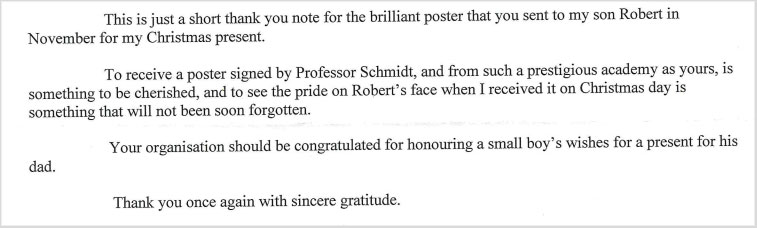
The response (above) brought a tear to our eye and we were pleased to be able to meet both Robert and his dad Daren when we invited them to attend our IMMORTALITY event in Adelaide last week.
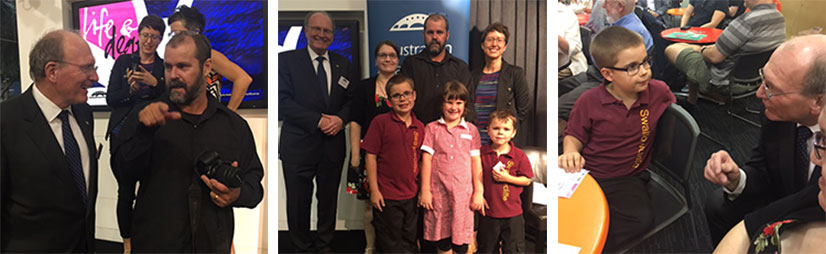
What happened next?
Through the powers of social media Mars One participant Josh Richards saw our story in February about Robert’s Christmas wish…
“I have Buzz Aldrin’s signature,” Josh wrote to us via Facebook “and I’d love to get it to the boy and his family.”
So, at his Planet Talk at WOMADdelaide on Saturday 11 March the Academy helped make this happen.
The Academy sent Robert and his family to Womadelaide on us so they could hear Josh speak about the Mars One mission, whether colonising Mars is the next giant leap for humanity, and how he’s practising and preparing to go and live on the Red Planet.
And then, Josh gave 9-yr-old Robert and his space-nut dad Buzz’s signature.
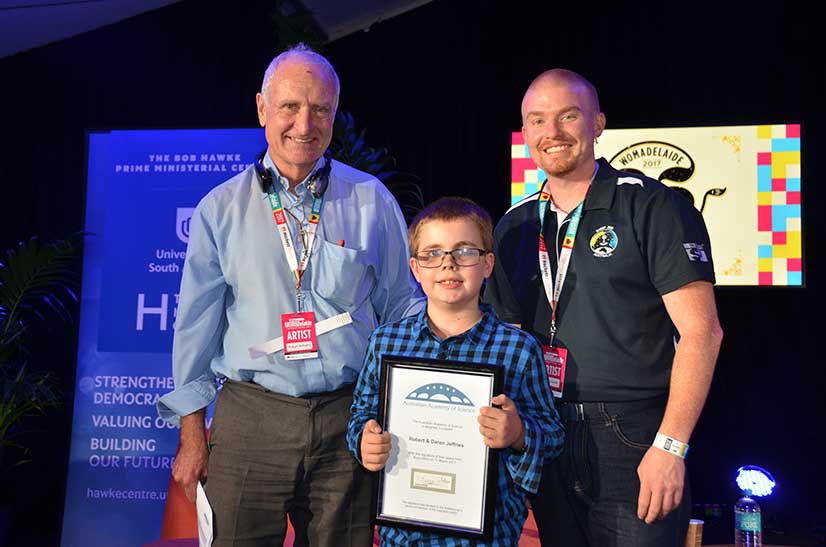
It was a touching moment and there weren’t many dry eyes in the room as Robert got his wish. Thank you so much to Josh for his generous and inspiring act of kindness and the many people who helped make this dream come true.
Another big highlight for Robert and his family was getting to meet radio legend and fellow of the Australian Academy of Science, Robyn Williams from the ABC Science Show.
Bringing space science to Parliament
A/Professor Alan Duffy asks Solange Cunin about the Cuberider program.
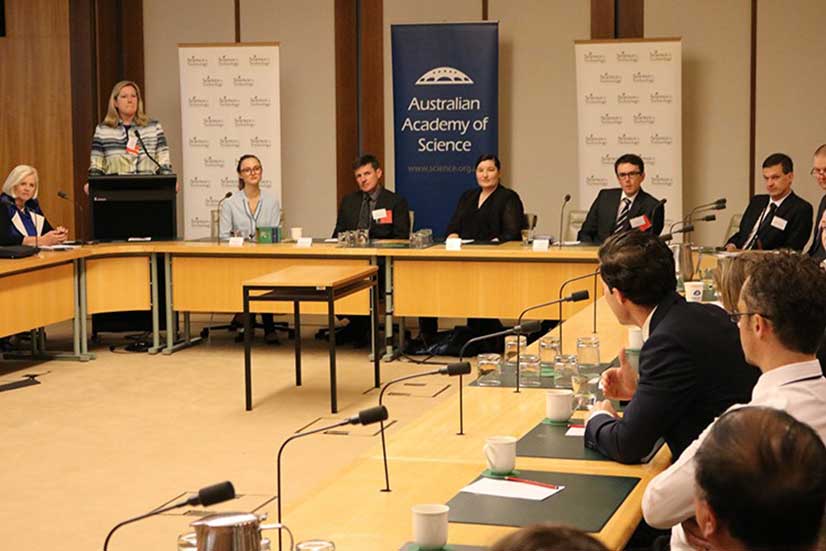
Space science and technology was on the political agenda following the Parliamentary Friends of Science breakfast held in Canberra on Tuesday 14 February.
Presented by Science & Technology Australia in partnership with the Australian Academy of Science, the event was hosted by the Parliamentary Friends of Science group, co-convened by the Hon Richard Marles MP and the Hon Karen Andrews MP.
Experts in space science and technology shared their work and unique perspectives on the sector in an effort to highlight Australia’s current contributions, and where the possibilities lie for space science in Australia moving forward.
Panellists included Director of UNSW Canberra Space, Professor Russell Boyce; UNSW Canberra Rector, Professor Michael Frater; CEO of space start-up Myriota, Alex Grant; co-founder of Cuberider, Solange Cunin; and International Space Station Flight Operations Engineer with the European Space Agency, Andrea Boyd. The panel was chaired by Professor Joan Leach, Director of the Centre for the Public Awareness for Science.
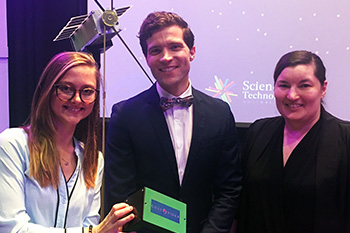
Panelists Solange Cunin, A/Professor Alan Duffy and Andrea Boyd at the Questacon event.
The event at Parliament House was followed by a public forum at Questacon, the National Science and Technology Centre. More than 100 members of the public joined in on the lively discussion on Australia’s future in space science, the benefits of a space agency, and the potential economic and scientific benefits of investing more in the sector.
The Australian Academy of Science and STA is grateful to all those who attended both events, and to the inspiring panellists for sharing their insights with Australian decision makers at all levels.
Story courtesy of Science and Technology Australia.
Australia joining the (new) space age
Sixty years ago, the dawn of the space age was marked by the launch of Sputnik. Fifty years ago this April, Australia joined in the space game with the flight of two Skylark rockets from Woomera in April 1967.
So where have we gone from there, and what’s next? As the world enters a new era of space science and technology, Australian researchers are:
- delivering experiments designed by high school students to the International Space Station
- facilitating communication between satellites and sensors to obtain data on climate, defence, agriculture and mining at locations not serviced by current communication networks
- giving satellites the ability to avoid each other and space debris in our increasingly busy skies
- speaking to astronauts on the International Space Station to make sure their experiments are on track.
Today in Canberra at an event convened by the Australian Academy of Science and Science and Technology Australia five Australian space experts and entrepreneurs are sharing their stories, and giving an insight into Australia’s contribution to space science and technology.
Academy President Professor Andrew Holmes said “Australia is highly regarded internationally in the fields of astronomy and space science. The next step is in commercialising the technologies that drive science and progress in space, and that is where we are headed.”
One of the speakers is Professor Russell Boyce, a leading space scientist from the University of New South Wales and chair of the Academy’s National Committee for Space and Radio Science. He said that Australia has a proud heritage of outstanding space science that helps the world operate the satellites we depend on, and helps us understand our origins,
“Our location on the planet makes us ideal partners for watching and listening to the skies. But we’re also reversing the brain drain. We have the talent pool to build highly capable spacecraft with the innovative payloads that can help meet national needs,” he said.
Solange Cunin, the 24 year old founder of Australian company Cuberider that recently launched a satellite to the International Space Station agrees. “This isn’t just a game for the big countries, from what I’ve seen a space industry would definitely be viable in Australia, we just need to foster it,” she said.
All panellists are available for interview and they will take part in a public forum at Questacon at 11am.
Contact
Toni Stevens | E: media@science.org.au | M: 0401763130
Dion Pretorius | E: dion.pretorius@sta.org.au | M: 0418 281 777
Young researchers win support from Academy
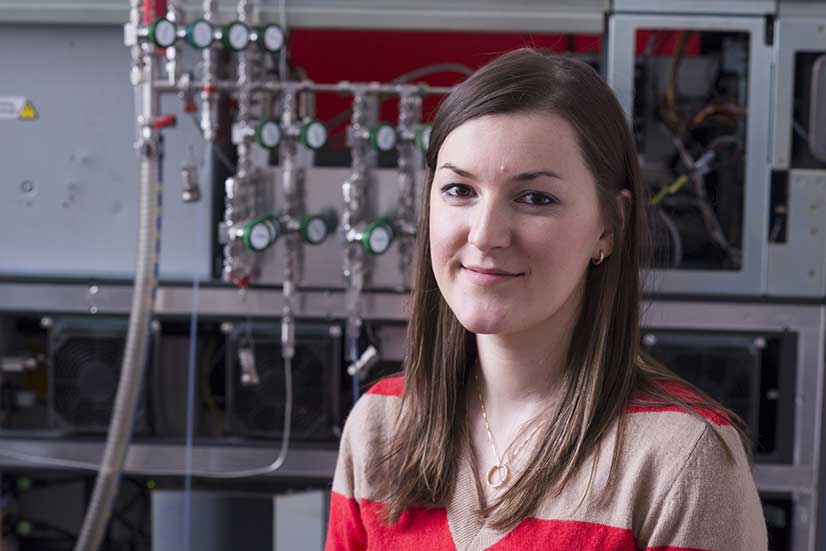
The Academy has announced the recipients of the J G Russell Award to help talented younger researchers in the basic sciences.
The four awardees are working towards cheaper solar cells, understanding brain plasticity, harnessing self-assembling molecules for manufacturing and employing computers to help make sense of the waves of data coming from modern biology.
Each researcher receives $6000 towards the costs of equipment, maintenance and travel as a top up to their Australian Research Council Discovery Early Career Researcher Awards, supported by the generosity of the late Miss J Russell.
Dr Brett Hallam, from UNSW Australia, is studying the process by which defects in cheap silicon solar cells can be ironed out with hydrogen.
Dr Pengyi Yang from the University of Sydney is employing machine learning to help find links between the studies of separate biological processes, such as epigenetics and protein and metabolic processes.
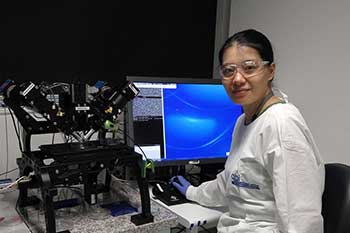
Dr Iris Tong Wang of Queensland - Brain Institute, UQ in action
At the University of Queensland, Dr Iris Tong Wang is exploring neural plasticity and how receptors for the amino acid L-glutamate are controlled in the communication between neurons.
Dr Nicole Rijs won her award for a project at the Queensland University of Technology to use advanced mass spectrometry techniques to explore how molecules assemble themselves, with the aim of more efficient manufacturing of high-technology materials.
Taking a gamble—report underlines the impact of risk on society’s decisions
We live in a risky world. Risks from antibiotic resistance, environmental impacts and international security are hot issues in research, but delaying action until the science is settled isn’t always feasible.
The Australian Academy of Science has today released a think tank report discussing how risk and uncertainty impact the decisions we make as a society.
The report addresses specific risks from antibiotic resistance, environmental challenges, international security, and also the challenges of making decisions when data is uncertain.
“Risks are part of life, and we need to learn how to make decisions when the data is uncertain,” said Professor Hugh Possingham, from the University of Queensland, who chaired the think tank steering committee.
“Some uncertainty is not worth resolving, it’s better to act sooner than wait until you are absolutely certain. Australians, as big gamblers, already love to embrace that uncertainty.”
Media are invited to attend the official launch of the report at the Shine Dome in Canberra today at 12.15 PM, by Academy President Professor Andrew Holmes AC PresAA FRS FTSE. It is the product of the 2016 Theo Murphy High Flyers Think Tank, which brought together 60 early and mid-career researchers from across the research sector from the humanities, social sciences and sciences.
“The think tank was a unique opportunity for the nation’s next generation of research leaders to inform the direction of Australia’s future,” Professor Holmes said.
Dr Roisin McMahon from Griffith University and Dr Maurizio Labbate from University of Technology Sydney attended the think tank and contributed to writing the recommendations report.
“Loss of effective antimicrobials could claim 10 million lives a year by 2050. We risk being unable to safely perform routine medical procedures such as hip replacements and caesarean sections,” Dr McMahon and Dr Labbate said.
They recommended changes to antibiotic prescription and usage, and proposed that antibiotic usage in foods be included on labels to inform and empower consumers.
The group also identified areas needing further study, such as the role of environmental pollution, including human and animal waste in the development of antimicrobial resistance.
The difficulty of adequately costing environmental impacts and factoring them into cost-benefit analyses when allocating resources for environmental projects was also discussed at the think tank.
The group flagged risks that unfold or change over long time periods as particularly difficult to grapple with.
They recommended that policy makers and scientists jointly develop a set of guidelines for cost-benefit analysis, and that tools used by scientists for sequential decision making could be simplified and adopted for policy makers.
“More data is not always better,” said Dr Kirsty Kitto from Queensland University of Technology.
“But sometimes uncertainty is misinterpreted as a lack of evidence by decision makers.”
The group found that even their own discussion of uncertainty was hampered by the differing language used between research fields. So they recommended the development of a common set of terminology to clarify communication between scientists and policy makers.
Uncertainty plays a large role in the risks inherent in negotiating international security concerns. The think tank also covered and offered recommendations on a broad range of international security issues such as global migration flows, Australia’s compliance with international legal obligations, environmental change and disruptive technologies.
The full report is available here /think-tanks/risky-world.
Professor Possingham, Dr Kitto and Dr Labbate are available for interview.
Contact Academy Media Manager Dr Phil Dooley on 02 6201 9452, media@science.org.au
Image: Cross section of advanced fibres produced by bi-component extrusion by CSIRO