




Asia–Pacific research and industry collaborations to address shared challenges

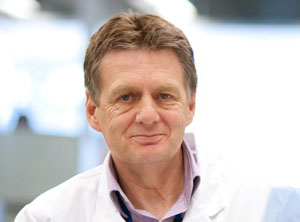
Academy Fellow Alan Cowman's team will work with Indonesia and Japan to research malaria and dengue fever.
Australian-led collaborative projects to help address the Asia–Pacific affordable housing crisis, tackle hepatitis B and monitor the impact of coastal climate changes are amongst five research organisations to receive $897,210 collectively in Australian Government funding today.
The funding is provided under the first round of the $3.2 million Regional Collaborations Programme, which is administered by the Australian Academy of Science and is part of the National Innovation and Science Agenda.
The grants will support Australian researchers and businesses who are collaborating with partners in our immediate region to develop innovative solutions to shared challenges.
The projects will build strong regional partnerships across a wide range of fields including agricultural and environmental sciences, transport and construction, health, manufacturing and materials sciences.
The biggest grant, $379,210 over three years, goes to Academy Fellow Alan Cowman FAA FRS and his team at the Walter and Eliza Hall Institute of Medical Research. Together with partners in Indonesia and Japan they will use the grant to understand mechanisms leading to immunity and resistance to malaria and severe dengue fever.
Other grants include collaborative projects between:
- the University of Melbourne, and partners in Vietnam, Papua New Guinea, India, Sri Lanka, Indonesia, Thailand and China to establish an Asia–Pacific research network on sustainable materials and prefabricated systems to address the housing crisis in the region through resilient affordable housing ($210,000 over two years).
- the University of South Australia, and partners in New Zealand and Japan to overcome barriers to the mass production of biomedical devices to promote improved health care outcomes for ageing populations ($180,000 over three years).
- the University of Melbourne, together with partners in China, Singapore, USA, Canada and France to establish an international coalition to support the discovery of a safe, affordable, scalable and effective cure for hepatitis B ($83,000 over 15 months).
- the University of Wollongong, and partners in Indonesia and the United Kingdom to develop regional monitoring of coastal climate change impacts using remote sensing technologies ($45,000 over three years).
The Regional Collaborations Programme is designed to build strong linkages between Australian researchers and businesses and their Asia–Pacific regional counterparts by supporting multi‑partner science, research and innovation collaboration activities that address issues of significance to our nation and the region.
The programme also supports greater mobility among our technical and research workforce, and builds Australia’s research capability by linking to global science and research networks and infrastructure.
Plant scientist first Australian to win top American award
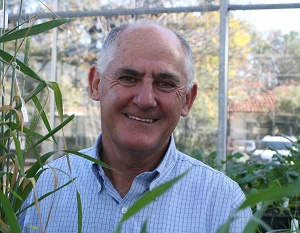
Academy Fellow Professor Stephen Powles is widely regarded as a foremost expert in herbicide resistance in plants.
Australian Academy of Science Fellow Professor Stephen Powles has won the American Chemical Society International Award for Research in Agrochemicals.
Professor Powles, an internationally recognised authority on herbicide resistance in plants, is the first Australian to win the award. It is given to a scientist who has made outstanding contributions to the field of agrochemicals at the international level, with their vision and sustained contribution having opened new horizons for investigators in their field and beyond.
Director of Australian Herbicide Resistance Initiative at the University of Western Australia’s School of Agriculture and Environment, Professor Powles was recognised for his long-standing research contribution to identifying the role of cytochrome P450 enzymes in endowing herbicide resistance in plants.
Professor Powles is one of the world’s most highly cited agricultural scientists and is widely regarded as a foremost expert in herbicide resistance in plants. Professor Powles and his team have more than 250 research papers published on herbicide resistance.
Professor Powles was nominated for the award by Dr Todd Gaines of Colorado State University. Dr Gaines is a former postdoctoral student of Professor Powles who spent three years as a researcher at UWA before returning to the US.
Professor Powles will receive the award at a special symposium organised in his honour at the meeting of the American Chemical Society in Boston in August 2018.
This is an amended version of a story originally published by the University of Western Australia
Academy hosts Belmont Forum through Future Earth Australia
A meeting hosted by the Australian Academy of Science this week, through its Future Earth Australia initiative, has reinforced the importance of close collaboration across Australia’s research sector both domestically and internationally.
The Academy hosted a meeting of the Belmont Forum, an international partnership that brings together key international funding agencies and the International Council of Science.
The Forum's core focus is to mobilise the funding of environmental change research and accelerate its delivery to remove critical barriers to sustainability.
Australia is currently a member of the Forum, with this meeting exploring how its commitment could be increased and focused. The meeting was chaired by Academy Fellow Professor Ian Chubb, who is Chair of the Future Earth Australia Advisory Council.
The meeting heard from the Forum’s Dr Maria Uhle (co-chair) and Dr Erika Key (Executive Director) about the work and influence of the group in encouraging collaborative research and communication efforts across borders to address common country, regional and international needs.
They emphasised the critical role that stakeholders play not only in the identification of issues but also in the co-design of the solutions. Other speakers included Professor Andrew Holmes, President, Australian Academy of Science; Dr Paul Bertsch, Acting Director Land and Water, CSIRO who currently manages Australia’s Belmont Forum relationship; and Professor Stephen Dover, Chair of the Future Earth Australia Steering Committee.
Participants included members of the learned academies, representatives of federal government departments and research funding agencies, and universities and research institutes.
Participants agreed that Australia should continue to extend its involvement in the Belmont Forum. The next step is to further explore and finalise the Australian representation on the Belmont Forum.
Read the communique
Joint winners at the second Australian Falling Walls Lab
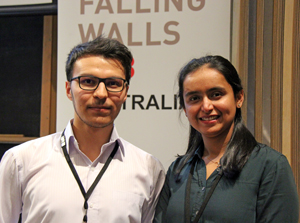
Winners of this year's Falling Walls Lab Australia are Mr Mortaza Rezae (left) and Dr Vini Gautam.
PhD student Mortaza Rezae from Curtin University is the winner of the second Australian Falling Walls Lab, hosted by the Australian Academy of Science.
In a surprise announcement, second placed competitor Australian National University’s Dr Vini Gautam, will join Mr Rezae to represent Australia at the Falling Walls Lab finale in Berlin on 8 November.
Mehdi Saeidi from the Auckland University of Technology placed third in the competition.
Mehdi Saeidi and his team are developing an implant to remove excessive load from the knee and to slow the progress of osteoarthritis, which effects millions of people worldwide. The implant aims to reduce the likelihood of a total knee replacement.
25 Australasian researchers and innovators gathered today at the Shine Dome in Canberra to present their work in three minutes on subjects including climate change impacts, quantum computing technology and preventing brain injury in pre-term babies.
Inspired to improve the quality his younger brother’s life, who was diagnosed with autism, Mortaza Rezae is working on a mobile application to enable independent public transport access for people with autism.
‘Public transport is a minefield of anxiety, distress and sensory overload for people with autism spectrum disorder. My research focuses on enhancing transport accessibly for people with autism to enable them to engage in community and social activities and employment.’
Currently there are no treatments to repair brain damage. Dr Vini Gautam is hoping her technique, using nano-scale scaffolds inserted into the brain as implants, can repair this damage by guiding the neurons to form connections with each other.
The Falling Walls Lab, which began in 2011, provides ‘emerging talents, entrepreneurs and innovators a stage to pitch their research work, initiatives or business models to their peers and a distinguished jury from academia and business’. Labs have taken place in 50 countries.
The Falling Walls Lab Australia is organised by the Australian Academy of Science, in association with the Embassy of the Federal Republic of Germany in Australia and the Australian National University.
Macfarlane Burnet Medal awarded to ‘Smooth Muscle Man’
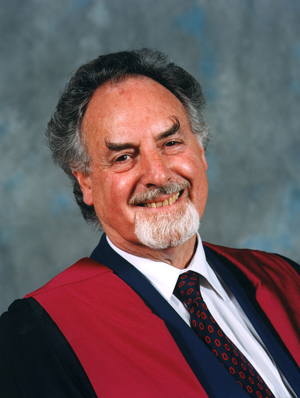
Professor Geoffrey Burnstock has been awarded the Macfarlane Burnet Medal.
Australian and British neurobiologist Professor Geoffrey Burnstock has been awarded the Australian Academy of Science’s Macfarlane Burnet Medal in recognition of his outstanding scientific research in the biological sciences.
Professor Burnstock, who was elected as a Fellow of the Academy 1971, is internationally recognised for the discovery of purinergic neurotransmission (i.e. ATP as an extracellular signalling molecule), a novel signalling system between cells that is of central importance for many biological processes.
His 1972 discovery, and later 1976 commentary in Neuroscience on cotransmission*, challenged established concepts of the biology of cell messengers and neurotransmission. The purinergic concept was not initially accepted by the scientific community, and it took twenty years for Professor Burnstock to prove his hypothesis.
More recently, Professor Burnstock has focused on the pathophysiology and therapeutic potential of purinergic signalling. This research has had an impact on the understanding of pain mechanisms, osteoporosis, chronic cough, hypertension, cancer, bladder, kidney and neurodegenerative diseases.
One drug to result from Professor Burnstock’s research is clopidogrel, which is used to reduce the risk of heart disease and stroke in high risk patients. Global sales are in the billions of dollars.
Emeritus Professor Derek Denton from the University of Melbourne, who nominated Professor Burnstock for the award, says he has been, and continues to be an inspiration for many.
“His vision and creativity have enabled and driven the research of a very large number of laboratories around the world,” Emeritus Professor Denton said.
“He has personally supervised over 100 PhD and MD students and over 60 post-doctoral fellows and since his first report published in 1957 in the journal Nature, he has published more than 1500 papers, which have been cited more than 101,000 times.”
The 88 year-old is returning to Australia later this year to continue his scientific investigations after a 42-year career at University College London. Between 1959 and 1975, Professor Burnstock also worked at the University of Melbourne.
“It is a particular pleasure on my return to live in Melbourne to have been honoured in this way,” Professor Burnstock said.

Geoffrey Burnstock with the late Mollie Holman looking at the records of their electrophysiology experiments of neuromuscular transmission in the guinea pig vas deferens in Melbourne in 1960. Photo: Supplied
Professor Burnstock is known as the ‘smooth muscle man’ due to his early research which focused on the biology of smooth muscle. In 1957 he developed a new method for recording the electrophysiology of smooth muscle cells.
Smooth muscle refers to a muscle of the human body that is part of an involuntary muscle group. They can be found in the walls of the stomach and blood vessels, intestines, bladder, veins, and prostate, among other places.
Professor Burnstock will deliver a lecture on his lifetime’s work at the Australian Academy of Science’s Science at the Shine Dome in May 2018. More information about Professor Burnstock.
The Macfarlane Burnet Medal and Lecture is named after Nobel Laureate and virologist Sir Frank Macfarlane Burnet. Past winners include Nobel Laureate Barry Marshall, former Academy president and molecular biologist Suzanne Cory, Sir Gustav Nossal and Emeritus Professor Derek Denton.
* The concept of cotransmission, in contrast to the generally held belief that one nerve only utilised one neurotransmitter, was formulated in a Commentary in Neuroscience in 1976. Initially, ATP was shown to be a cotransmitter with noradrenaline in sympathetic nerves, but it is now known that ATP is a cotransmitter with classical transmitters in most, if not all, nerves in both the peripheral and central nervous systems.
Medals for three honorific awards
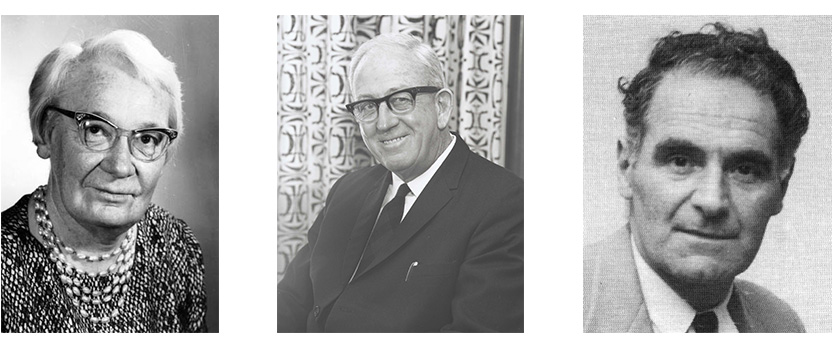
(L to R) Dorothy Hill, Frederick White and Raymond Le Fèvre.
The Academy is calling for design suggestions, portraits, images or wording to be considered in the design of medals for three of its honorific awards.
The Le Fèvre Memorial Prize, the Dorothy Hill Award and the Frederick White Prize medals will be designed and minted by the Royal Australian Mint for presentation to awardees in 2018. This means that all of the Academy honorific awards will have Academy medals associated with them.
If you'd like to contribute to the design, contact the Awards Officer by the end of October on awards@science.org.au or phone +61 2 6201 9407.
More about the Academy's honorific awards
Events and outreach—September 2017
Academy action in National Science Week
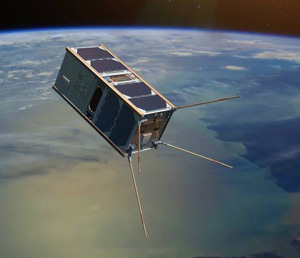
Australian satellites was just one of the many topics we explored in National Science Week
The Academy was flat out keeping up with the activities in this year’s annual celebration of science in Australia, National Science Week, on 12–20 August.
On Monday we challenged the knowledge of more than 120 trivia buffs with a packed Super Science pub trivia night in Canberra.
On Tuesday more than 140 people attended our public talk at the Shine Dome on Australian satellites and where to find them.
Wednesday saw the launch of UNCOVER—a roadmap for searching the deep earth and the role of geoscience in Australia.
On Thursday the Academy hosted the National Research and innovation Alliance and their speaker, the Leader of the Federal Opposition, the Hon Bill Shorten MP. In addition to those attending, many more tuned in via live-tweeting of the event and a video livestream.
Also on Thursday, 140 people attended the first of our ‘Making Better Humans’ talk in Wollongong as part of the Academy’s Plastic Fantastic National Speaker Series.
Exploration of emerging issues in science and society
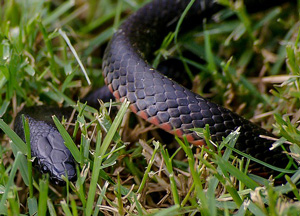
Are Australian snakes the deadliest in the world?
This unique event in early July covered a range of topics, from deadly snakes to the science of nutrition. We teamed a scientist with a researcher from the humanities and social sciences to cover the basic science behind the issues, implications for policy and society, and the challenges of science communication and public misconceptions.
The four questions explored were:
- Are Australia’s snakes the deadliest in the world?
- Can we predict bushfires?
- Does nutrition science (mis)inform our diets?
- How does the microbiome change what it is to be human?
The event was held in partnership between the Academy, the newly formed Deakin University Science and Society Network (a network of the Alfred Deakin Institute for Citizenship and Globalisation), and the Society for the Social Studies of Science (4S). It was opened by Academy President Professor Andrew Holmes and MC’d by science broadcaster Paul Willis.
Coming to Canberra: Journeying to the centres of the planets

Join us on a journey to the centre of the planets
In our next Canberra public talk, Dr Helen Maynard-Casely will take us on a journey to get to know the planets of our solar system more intimately through understanding their varied and downright dangerous insides. We’ve yet to actually dive under the clouds of the gas giants, crack through the ice of the dwarf planets or drill into the rocks of the terrestrial planets—so how do we know what lies beneath planetary surfaces? Every planetary interior a high-temperature and high-pressure environment and pressure can have amazing effects on even the simplest of materials.
To build up the pictures of planetary interiors requires the merging of keenly observed astronomy, complex theoretical calculations and the most elegant of experiments. Dr Maynard-Casely will explain how we’ve got to the pictures that we do have, how we can re-create these planetary conditions here in Australia, and where there’s work to be done.
International news—September 2017
- Lindau 2018 applications now open
- Postdoctoral Fellowships for research in Japan
- Summer program for graduate students expands
- Women in Science and Engineering, Asia
Lindau 2018 applications now open
Applications for the 68th Lindau Nobel Laureates Meeting with Nobel Laureates from the field of physiology or medicine are now open. Applications for Lindau close 3 October 2017.
The successful candidates will receive a grant-in-aid from the Academy up to $6,750 towards travel and accommodation costs.
Postdoctoral Fellowships for research in Japan
The Academy invites applications from Australian researchers for the Japan Society for the Promotion of Science (JSPS) Postdoctoral Fellowships commencing between 1 April and 30 November 2018.
Applications for the fellowships close 30 October 2017.
The JSPS Postdoctoral Fellowship Program for Foreign Researchers provides opportunities for Australian postdoctoral researchers to conduct, under the guidance of their Japanese hosts, cooperative research with leading research groups in universities and other Japanese institutions. The program aims to help such researchers advance their own research while contributing to the advancement of research in Japan and the counterpart countries.
Candidates must hold a doctorate degree when the fellowship goes into effect, which must have been conferred within six years prior to 2 April 2018. Alternatively, candidates should be scheduled to receive a doctorate degree before the fellowship commences. MD (medical doctor) holders without a PhD are not eligible. Applications are invited from suitably qualified researchers in any field of natural sciences (including technology, engineering and medicine), the humanities and social sciences.
More information and application form
Summer program for graduate students expands
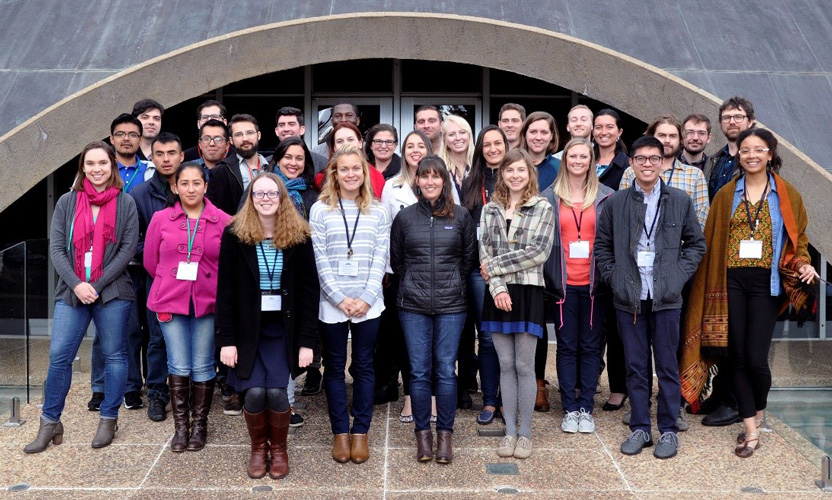
In June, 11 PhD students from Brazil and Mexico joined 21 students from the US in an expanded version of the summer program for graduate US students that the Academy has been coordinating since 2004.
The students were introduced to Australian culture and science during an orientation program in Canberra, with visits to the National Gallery of Australia and Parliament House, and learned about Australian geography and topography, wildlife, bush tucker and Australia’s Indigenous history at Tidbinbilla Nature Reserve.
They then travelled to cities around Australia to undertake two-month research projects at host institutions, including universities, CSIRO and Museum Victoria. Research areas ranged from investigating early career decisions by women in academia to analysing the use of drone technology to address key knowledge gaps in the life histories of sea turtles.
Science is too vast for any individual, institution or nation to go it alone, with the global nature of some challenges only possible to address through international efforts. For many of the students, this was the first time that they had travelled outside of their home country and certainly the first time they had had the opportunity to experience life in an Australian research environment. Programs for early- and mid-career researchers, such as this one, are crucial to opening the door to international collaborations.
Based on my experience here and the connections I have made, I am very interested in future PhD work based in Australia…Participating in this program as a masters student has been critical for my current and future success. I expect much of my career will be traced back to these 10-weeks—this is likely to become a turning point in my professional life!Ms Amber Datta at University of Montana
Women in Science and Engineering, Asia
Academy Fellow and Foreign Secretary, Professor Cheryl Praeger, chairs the Committee on Women in Science and Engineering (WISE) in the Association of Academies and Societies of Sciences in Asia (AASSA). Professor Praeger has finalised membership of the WISE committee with representatives from China, Georgia, Japan, South Korea, Malaysia, Nepal, Pakistan, the Philippines, Russia, and Sri Lanka.
Academy Fellow wins Eureka Prize for mentoring young researchers
Professor Justin Gooding (centre) has been awarded a 2017 Eureka Prize for mentoring young researchers.
Australian Academy of Science Fellow Professor Justin Gooding has been awarded the 2017 University of Technology Sydney Eureka Prize for Outstanding Mentor of Young Researchers.
“Through a program of individualised mentorship, Professor Justin Gooding has trained and developed an all-new breed of research leader in bionanotechnology and nanomedicine,” reads the award citation.
“He has focused on developing innovative, entrepreneurial and passionate researchers who become talented mentors in their own right.”
UNSW Medicine colleague Associate Professor Till Boecking said Professor Gooding’s key strength as a mentor is to create a buzz in the lab where people think big.
“He’s able to tailor his approach in mentorship to bring out the best in all of us.”
Professor Gooding was elected to the Academy in 2016.
Two other Academy Fellows were also selected as finalists at the Australian Museum Eureka Prizes awards: Professor Gordon Wallace and Professor Tom Davis. Professor Gooding was also a finalist in the ANSTO Eureka Prize for Innovative Use of Technology.
2017 Pawsey Medal winner, Associate Professor Igor Aharonovich, was a finalist in the Macquarie University Eureka Prize for Outstanding Early Career Researcher.
Four new institutions join Science in Australia Gender Equity initiative
Momentum to improve gender equity and diversity in Australia’s higher education and research sector continues to build with four new institutions joining The Science in Australia Gender Equity (SAGE) Initiative pilot of the UK-based Athena SWAN accreditation program.
The new participants are the Australian Institute of Marine Science, Murdoch University, Geoscience Australia and the University of Adelaide. The announcement will be made by Professor Hugh Bradlow, President of the Australian Academy of Technology and Engineering (ATSE) at the 2017 SAGE symposium today.
The new additions brings the total number of participants to 44, with 32 universities (representing 88% of Australian universities), six medical research institutes and six publicly funded research agencies joining the SAGE Pilot Program.
Executive Director of SAGE, Dr Wafa El-Adhami, said the addition of four new members reflects a strong commitment to reversing gender inequality and supporting diversity through effective systematic solutions like Athena SWAN.
“It is also a testament to the sector's confidence in SAGE and our service,” Dr El-Adhami said.
Geoscience Australia’s Chief Executive Officer, Dr James Johnson, said their organisation was inspired by the UK experience in implementing the Athena SWAN Charter, which has shown accredited organisations have a significant competitive advantage when it comes to attracting first-rate scientists.
“Our involvement in this program is a fantastic next step in our efforts to make our workplace more inclusive for everyone and to further Geoscience Australia as an organisation of scientific excellence and an employer of choice,” Dr Johnson said.
Murdoch University Deputy Vice Chancellor Education, Professor Romy Lawson, said their university is proud to be advancing the careers of women in higher education and research through participation in the pilot.
“This is an important step for our university in supporting a diverse and highly talented workforce,” Professor Romy Lawson said.
The SAGE initiative is a partnership of the Australian Academy of Science and ATSE. Institutions participating in the SAGE Pilot undergo an intensive two-year program of data analyses and review of policies and practices with the aim to develop actions that address the issues and barriers identified within the institution. The SAGE Symposium will feature keynote addresses from diversity champions UNSW Professor Veena Sahajwalla, Swinburne University of Technology's Professor Alan Duffy and Aboriginal and Torres Strait Islander Social Justice Commissioner June Oscar AO. It is on in Brisbane from 5-6 September. More information about the symposium can be found here.
Media contact: Melanie Bagg | PH: 0439 037 773 | E: melanie.bagg@science.org.au