




Review aiming to achieve excellence in schools

The Australian Government has initiated a review looking at ways to achieve excellence in Australian schools. The review will examine and report on how Australian schools could use additional funding to improve student performance.
Australia has remained one of the leading countries in terms of public investment in education—at the same time as students’ average performance in science and mathematics has declined in relative terms.
The Academy made a substantive submission to the inquiry, which was chaired by David Gonski, who also delivered the 2011 Gonski Review.
The core message of the submission was that a solid grounding in science and maths in both primary and secondary school is vital for younger Australians.
Beyond this key principle, the Academy noted that:
- fundamental science knowledge should continue to include a coherent understanding of scientific concepts, and generate experience and trust in the process of scientific inquiry
- education should build an appreciation of science as a human endeavour, as well as how science shapes society and how society shapes science.
The submission acknowledged the evidence that the average performance of Australian students in maths and science is falling behind that of their counterparts in other developed (and many developing) nations.
Policy responses will need to include more effective evaluation of programs intended to improve student performance (to see what works, and what doesn’t), and supporting new and existing teachers through best practice training and professional learning.
A solid grounding in science and maths … is vital for younger Australians.
Realising this broader and deeper culture of evaluation can be fostered and supported by a National Education Evaluation Agreement, as recommended by the Productivity Commission in its report into the National Education Evidence Base.
The Academy has developed evidence-based science and mathematics teaching and learning resources for primary and secondary schools teachers and students for a number of years.
Our flagship Primary Connections and Science by Doing programs are used by more than three-quarters of Australian schools and school science teachers, while our new reSolve: Mathematics by Inquiry program is quickly establishing a strong network of teacher Champions across the country.
These programs have a track record of being highly effective in improving student engagement and broadening teacher skills.
Academy events open up world of science
National audiences taken on polymer journey
The Academy’s national speaker series aims to deliver science around Australia in an engaging, accessible and positive way. Since August, the Academy has delivered Making Better Humans with Polymers in Wollongong, Brisbane and Adelaide, with audiences taken on a polymer journey by Dr Katherine Locock, Dr Georgina Such, Professor Martina Stenzel, Professor Gordon Wallace, Professor Christopher Barner-Kowollik and Professor Peter Murphy.
In addition to getting a taste for incredible science, audiences were also given the opportunity to network and engage with Academy President, Professor Andrew Holmes and many other key stakeholders.
The Academy thanks all the speakers as well as the series Chair, Dr Bobby Cerini of Inspiring Australia, and Convenors Professor San Thang and Professor Maria Forsyth.
In 2018 the Academy will continue to take science around the nation, diving into the world of ‘The Science Behind Sport’.
Canberra public speaker series out of this world
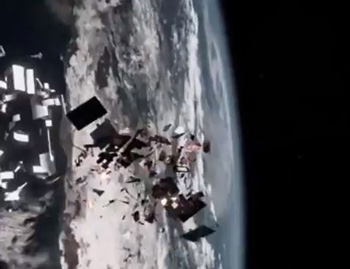
Tackling space junk is just one of the many challenges scientists are facing in the new space age.
This year’s Canberra speaker series in the iconic Shine Dome was, as always, a wonderful success. Convened by Professor Matthew Colless and Professor Tamara Davis, Dawn of the New Space Age brought together a collection of the top minds in space research in Australia.
Researchers Professor Dean Rickles, Professor McClure-Griffiths, Dr Ben Greene, Professor Iver Cairns, Dr Helen Maynard-Casely and Dr Carol Oliver wowed audiences with their work towards discovering life on Mars, tackling the huge issue of space junk, exploring the Milky Way, and much more.
With a record number of season passes sold, and sell-out crowds for almost all talks, it is clear there is an overwhelming interest and passion that exists for space and the incredible discoveries in this area of science.
The recordings of each of the six instalments of the series can be found on YouTube.
The Academy thanks each of the speakers, convenors and chairs, and also acknowledges the generous ongoing support of Edge Catering and Jirra Wines at Jeir Station to make these events possible.
The Academy will welcome audiences back in 2018 for ‘From Womb to Tomb: the science of our lives’.
Academy videos rocketing through Facebook
Multiple Academy videos have gone viral internationally on Facebook since the launch of the Academy’s new daily commitment to answer everyday questions and introduce people to science.
Volcanoes, animals in the wild, space and human health are some of the winning video topics so far. Academy Fellows, members of National Committees and other leading Australian and international scientists are contributing to the project through interviews, providing ideas and footage, and reviewing videos and articles for scientific accuracy before publication.
Several videos have been picked up by major national media outlets and included in relevant news stories, spreading the Academy’s influence even wider.
The Academy is also publishing an article a day on a wide range of topics, including seasonal ones such as bushfires, swimming pools and sunscreen. The articles are also being widely shared, with the majority being read to the end—an unusual occurrence on Facebook.
The number of people ‘liking’ the Academy’s Facebook page has skyrocketed and is now well over 100,000, a 12-fold increase since the project launched in mid October. The videos, images and articles are also promoted on Twitter and Instagram.
The Academy is responding to the widespread need for a trusted, credible source that can be relied on for scientific information but also stimulates interest and encourages exploration of science.
Chinese-speakers are also able to access much of the content, translated by the Academy for social media platforms Weibo and Toutiao.
Academy President launches Christmas 2017 Awards Fundraising Appeal
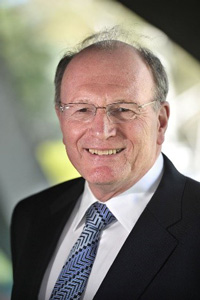
Professor Andrew Holmes: ‘It is hard to imagine where the Australian Academy of Science would be without the generosity and philanthropic support of many individuals and organisations.’
Central to the purpose of the Academy is the recognition and support of outstanding contributions to the advancement of science. The honorific awards were established to recognise distinguished research in three categories: awards of medals and prizes are made to early-career scientists up to 10 years post PhD, mid-career scientists 8 to 15 years post PhD, and the prestigious career awards which are made to scientists for life-long achievement.
It’s virtually impossible to imagine a world without science and without scientists striving every single day to understand the world around them. I often reflect on the collective impact on the world made by the Fellows of the Australian Academy of Science and remain quite awestruck at the difference their work has made to our wellbeing, our economy and our environment. The world simply would not be as we know it today in the absence of their contribution.
Equally, it is hard to imagine where the Australian Academy of Science would be without the generosity and philanthropic support of many individuals and organisations.
All of us share a desire for science and scientists to prosper and for future generations to benefit from discovery and to be empowered by knowledge. Yet each person has a unique reason for supporting the Australian Academy of Science.
It’s virtually impossible to imagine a world without science and without scientists striving every single day to understand the world around them.
I invite you to support the Australian Academy of Science through our Christmas 2017 Awards Fundraising Appeal so that together we can continue to build a strong and vibrant future for science in Australia.
The Christmas 2017 Awards Fundraising Appeal offers you the chance to support the Academy of Science through donations that are fully tax deductible.
Should you wish to discuss ways in which you can support the Australian Academy of Science and how you would like your support directed, please contact Ms Isobel Griffith, Manager Development and Stewardship on (02) 6201 9400.
Your support is deeply appreciated.
Yours sincerely
Professor Andrew Holmes AC PresAA FRS FTSE
Future Earth Australia urges collaboration to address sustainability issues
The urban built environment, the marine environment and energy transformation are key areas where Australian researchers and industry partners could collaborate more effectively to address issues of sustainability, according to Future Earth Australia.
“Future Earth Australia has a crucial role to play in the generation of enduring solutions to address the most urgent sustainability challenges facing humanity,” said Australian Academy of Science President, Professor Andrew Holmes.
“The challenges are complex but communities across the globe, including in Australia and our region, are capable of connected research approaches that find and deliver solutions.”
Hosted by the Australian Academy of Science, Future Earth Australia is a partnership of Australia’s learned academies, Australian universities, research institutes, industry and government agencies focused on advancing sustainability.
Professor Ian Chubb, former Australian Chief Scientist and current Chair of Future Earth Australia’s Advisory Council, said Australia can be an important element in global research initiatives aimed at ensuring the future of our planet.
“Australia needs to become a part of the international innovation community and it needs to mobilise its comparative advantages in research towards addressing the Sustainable Development Goals,” Professor Chubb said.
Dr Imran Ahmad, Director of Future Earth Australia, said integrated catchment management is a good example where Australian research institutions have come together to provide effective natural resource management solutions customised to local needs.
“Elsewhere however, integrated and collaborative approaches are less prominent. Nationally and internationally, connecting for sustainability still has some way to go, which is where Future Earth Australia comes in,” Dr Ahmad said.
[This news item was updated 28 June 2018. Contact Future Earth Australia if you would like more information about the program.]
Academy announces recipients of 2018 honorific awards
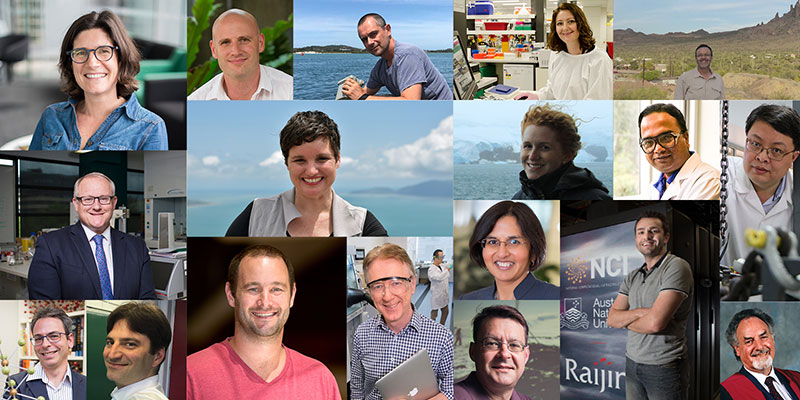
The Australian Academy of Science's 2018 honorific awardees
Outstanding contributions to science have been recognised by the Australian Academy of Science today with 18 of Australia’s leading scientists and future superstars receiving prestigious 2018 honorific awards.
The scientists’ discoveries cross the breadth of science, from the threat posed by the melting ice sheets of Greenland and Antarctica, to solving the mysteries of the universe and interpreting how disruptions of brain connectivity can lead to mental illness.
Professor David Cooke from the University of Tasmania has been awarded one of the top honours, the Academy’s Haddon Forrester King Medal and Lecture. Others recognised among the Academy’s lifetime achievement awards include Professor Douglas MacFarlane from Monash University, awarded the 2018 David Craig Medal.
Mid-career researcher Dr Marie-Liesse Asselin-Labat, from the Walter and Eliza Hall Institute of Medical Research, has been awarded the 2018 Nancy Millis Medal for Women in Science. Associate Professor Tracy Ainsworth from James Cook University has been awarded the Dorothy Hill Medal. She is one of 10 early career researchers to be recognised in this year’s annual awards.
Read more about the awardees and their research
Read the Academy's media release
Recipients
Career honorifics (for lifelong achievement)
- 2018 David Craig Medal—Professor Douglas MacFarlane FAA FTSE, Monash University
- 2018 Haddon Forrester King Medal and Lecture—Professor David Cooke, University of Tasmania
- 2018 Mawson Medal and Lecture—Professor Matt King, University of Tasmania
- 2018 Ian Wark Medal and Lecture—Professor Calum Drummond, RMIT University
- 2018 Macfarlane Burnet Medal and Lecture—Professor Geoffrey Burnstock FAA FRS, University of Melbourne (previously announced)
Mid-career honorifics (8—15 years post-PhD)
- 2018 Gustav Nossal Medal for Global Health—Professor Anushka Patel, UNSW Sydney
- 2018 Jacques Miller Medal for Experimental Biomedicine—Professor Swaminathan Iyer, University of Western Australia
- 2018 Nancy Millis Medal for Women in Science—Dr Marie-Liesse Asselin-Labat, Walter and Eliza Hall Institute of Medical Research
Early career honorifics (up to 10 years post-PhD)
- 2018 John Booker Medal—Associate Professor Shanyong Wang, University of Newcastle
- 2018 Frederick White Medal—Dr Alex Sen Gupta, UNSW Sydney
- 2018 Christopher Heyde Medal—Dr Zdravko Botev, UNSW Sydney
- 2018 Ruth Stephens Gani Medal—Dr Irina Voineagu, UNSW Sydney
- 2018 Fenner Medal—Dr Ceridwen Fraser, Australian National University
- 2018 Anton Hales Medal—Dr Rhodri Davies, Australian National University
- 2018 Gottschalk Medal—Associate Professor Alex Fornito, Monash University
- 2018 Pawsey Medal—Dr Paul Lasky, Monash University
- 2018 Dorothy Hill Award—Associate Professor Tracy Ainsworth, James Cook University
- 2018 Le Févre Medal—Associate Professor Amir Karton, University of Western Australia
The majority of the awards will be presented at the Academy’s annual signature science event, 'Science at the Shine Dome', on 24 May 2018.
Bright stars of Australian science recognised with Academy Awards
Outstanding contributions to science have been recognised by the Australian Academy of Science today with 18 of Australia’s leading scientists and future superstars receiving prestigious 2018 honorific awards.
The scientists’ discoveries cross the breadth of science, from the threat posed by the melting ice sheets of Greenland and Antarctica, to solving the mysteries of the universe and interpreting how disruptions of brain connectivity can lead to mental illness.
Professor David Cooke from the University of Tasmania has been awarded one of the top honours, the Academy’s Haddon Forrester King Medal and Lecture. His investigations into the geological processes that produce copper-gold deposits as a result of fluids released from magma deep within the Earth’s crust, have transformed geochemical exploration techniques used by mining and resource companies around the world.
Others recognised among the Academy’s lifetime achievement awards include Professor Douglas MacFarlane from Monash University, awarded the 2018 David Craig Medal. His discovery and research on ionic liquids (salt compounds that are liquid at or around room temperature) has resulted in major advances in solar cell and battery storage technology. His research group has also pioneered the use of ionic liquids in new pharmaceutical products which have opened up new treatments, including a topical treatment for skin cancer.
Mid-career researcher Dr Marie-Liesse Asselin-Labat, from the Walter and Eliza Hall Institute of Medical Research, has been awarded the 2018 Nancy Millis Medal for Women in Science. Combining data-crunching with a genetic approach, Dr Asselin-Labat’s research has provided new insights into the development of lung diseases such as lung cancer and emphysema. Her team has demonstrated for the first time that some lung cell types are more efficient than others in repairing their DNA following exposure to damage.
Associate Professor Tracy Ainsworth from James Cook University has been awarded the Dorothy Hill Medal. She is one of 10 early career researchers to be recognised in this year’s annual awards. Her research has improved our understanding of how stress responses and diseases occur in corals. Associate Professor Ainsworth has also discovered that while small increases in sea temperatures negatively impact the health of corals, under the right circumstances corals can acclimate to increased sea temperatures and survive the bleaching process.
President of the Academy of Science, Professor Andrew Holmes, congratulated all the award winners for their inspiring research.
“Research by this year’s awardees is addressing some of society’s biggest challenges and also changing the world for the better. It is absolutely crucial that we continue to recognise and support their outstanding contributions so that people continue to be reminded of the important role of science for humankind,” Professor Holmes said.
Read more about the awardees and their research.
The awards go to:
Career honorifics (for lifelong achievement)
2018 David Craig Medal—Professor Douglas MacFarlane FAA FTSE, Monash University
2018 Haddon Forrester King Medal and Lecture—Professor David Cooke, University of Tasmania
2018 Mawson Medal and Lecture—Professor Matt King, University of Tasmania
2018 Ian Wark Medal and Lecture—Professor Calum Drummond, RMIT University
2018 Macfarlane Burnet Medal and Lecture—Professor Geoffrey Burnstock FAA FRS, University of Melbourne (previously announced)
Mid-career honorifics (8—15 years post-PhD)
2018 Gustav Nossal Medal for Global Health—Professor Anushka Patel, UNSW Sydney
2018 Jacques Miller Medal for Experimental Biomedicine—Professor Swaminathan Iyer, University of Western Australia
2018 Nancy Millis Medal for Women in Science—Dr Marie-Liesse Asselin-Labat, Walter and Eliza Hall Institute of Medical Research
Early career honorifics (up to 10 years post-PhD)
2018 John Booker Medal—Associate Professor Shanyong Wang, University of Newcastle
2018 Frederick White Medal—Dr Alex Sen Gupta, UNSW Sydney
2018 Christopher Heyde Medal—Dr Zdravko Botev, UNSW Sydney
2018 Ruth Stephens Gani Medal—Dr Irina Voineagu, UNSW Sydney
2018 Fenner Medal—Dr Ceridwen Fraser, Australian National University
2018 Anton Hales Medal—Dr Rhodri Davies, Australian National University
2018 Gottschalk Medal—Associate Professor Alex Fornito, Monash University
2018 Pawsey Medal—Dr Paul Lasky, Monash University
2018 Dorothy Hill Award—Associate Professor Tracy Ainsworth, James Cook University
2018 Le Févre Medal—Associate Professor Amir Karton, University of Western Australia
The majority of the awards will be presented at the Academy’s annual signature science event, 'Science at the Shine Dome', on 24 May 2018.
Academy receives ARC grants for nutrition science and big data projects

What do we eat, and what should we eat? The Academy will develop a 10-year plan for nutrition science to help us answer these questions.
The importance of improving our understanding of the changing Australian diet has been recognised with a $118,000 grant to develop a national 10-year plan for nutrition science.
This is one of two Australian Academy of Science projects to receive Australian Research Council funding as part of the Council’s Learned Academies Special Projects (LASP) scheme.
The second project—to identify the challenges and opportunities associated with big data in Australian research—has received $210,000.
The two projects are among five to receive a total of $1.15 million from the scheme, announced today by Education Minister Simon Birmingham.
The objective of the scheme is to support the development of Australian research by providing funding to Australia’s learned academies.
The funding was announced alongside grants for the Discovery, Discovery Early Career Researcher Awards, Discovery Indigenous and Linkage Infrastructure, Equipment and Facilities programs.
‘Nourishing Australia: A decadal plan for nutrition science’ will be led by Chief Investigators and Academy Fellows Professor Stephen Simpson from the University of Sydney and CSIRO’s Dr TJ Higgins. They will develop a plan to address the complex health and environmental challenges associated with changes in food production and consumption.
‘Big data in Australian research: issues, challenges and opportunities’ will be led by Academy Fellow Professor Michael Barber from Flinders University. The project will explore better utilisation of big data for the research sector by mapping existing capability and infrastructure within and across disciplines and identifying challenges and opportunities.
Academy recognises young environmental scientists protecting Australia
PhD students Ms Melissa Houghton from the University of Queensland and Mrs Charlie Phelps from Edith Cowan University are the 2018 recipients of the Australian Academy of Science Max Day Environmental Science Fellowship Award.
The award provides up to $20,000 for early-career researchers working on the conservation of Australia’s flora and fauna, the ecologically sustainable use of resources and the protection of the environment and ecosystem services.
It is named in honour of Academy Fellow, the late Dr Maxwell Frank Cooper Day AO, who spent a lifetime championing entomology, conservation and forestry, as well as helping other scientists. He died in July this year aged 101.
Ms Houghton will use the award to conduct the first study of insects, spiders and other organisms without a backbone (invertebrates) on Macquarie Island since the eradication of rabbits, rats and mice in 2014. The World Heritage Listed subantarctic island is located in the Southern Ocean, approximately half way between Australia and Antarctica.
As a dog handler Ms Houghton took part in the successful eradication mission on the island. Now she is studying the island’s 300 native and 50 non-native invertebrate species and their interactions to determine how Macquarie Island’s complex ecosystem is recovering and changing following the conservation effort.
Ms Houghton said invertebrates are often overlooked in conservation science and rarely included in biodiversity monitoring or conservation management.
“Yet they are highly sensitive to environmental change and are great indicators for the health of an ecosystem. How they respond to environmental change enables meaningful assessments of benefit and return-on-investment for large-scale Australian conservation actions, such as island eradications,” Ms Houghton said.
Ms Houghton will return to the island in January for her third and final invertebrate survey. Ms Houghton is supported by the National Environmental Science Programme, Threatened Species Recovery Hub.
Mrs Charlie Phelps will study the effects of bacteria, increasing temperature and kelp-eating organisms (herbivory) on the ecologically-important kelp, Ecklonia radiata, sometimes referred to as the ‘biological engineers of temperate Australian reefs’.
The kelp provides habitat and shelter for many marine animals and juvenile fish, enhances biodiversity, assists in nutrient cycling and supports the fishing and tourism industries.
Bleaching of the kelp, where the surface tissue turns white, can have a drastic effect on its health and can lead to death. Increasing water temperatures and bacteria have been identified as possible causes. Mrs Phelps’ study will be the first to inoculate the kelp with microbial pathogens and use interactive stressors (temperature and herbivory) to help determine the extent of bleaching from a type of bacteria known as R10.
Mrs Phelps said she will put bacteria and sea urchins into 40 tanks containing the kelp and simulate several different environmental conditions to see how the kelp responds.
“This research will help inform how the kelp may respond to future heatwave scenarios and other factors, such as the impacts of a tropical herbivore species that could potentially over eat the temperate kelp,” Mrs Phelps said.
Ms Houghton and Mrs Phelps will receive their awards at the Academy’s annual signature science event Science at the Shine Dome on 23 May 2018.
Two researchers were also highly commended for the Max Day Environmental Science Fellowship Award:
- Dr Tatiana Soares Da Costa from La Trobe University for her project ‘Development of New Herbicide Cocktails for Effective Weed Management’.
- Dr Emma Camp from the University of Technology Sydney for her project ‘Set-Up For Survival – The Holobiont Signature Facilitating Australia’s Coral Communities In The Face Of Climate Change’.
More information about the awards can be found here.
Media contact: Dan Wheelahan – ph: 0435 930 465 – dan.wheelahan@science.org.au
Professor John Shine elected President of Academy
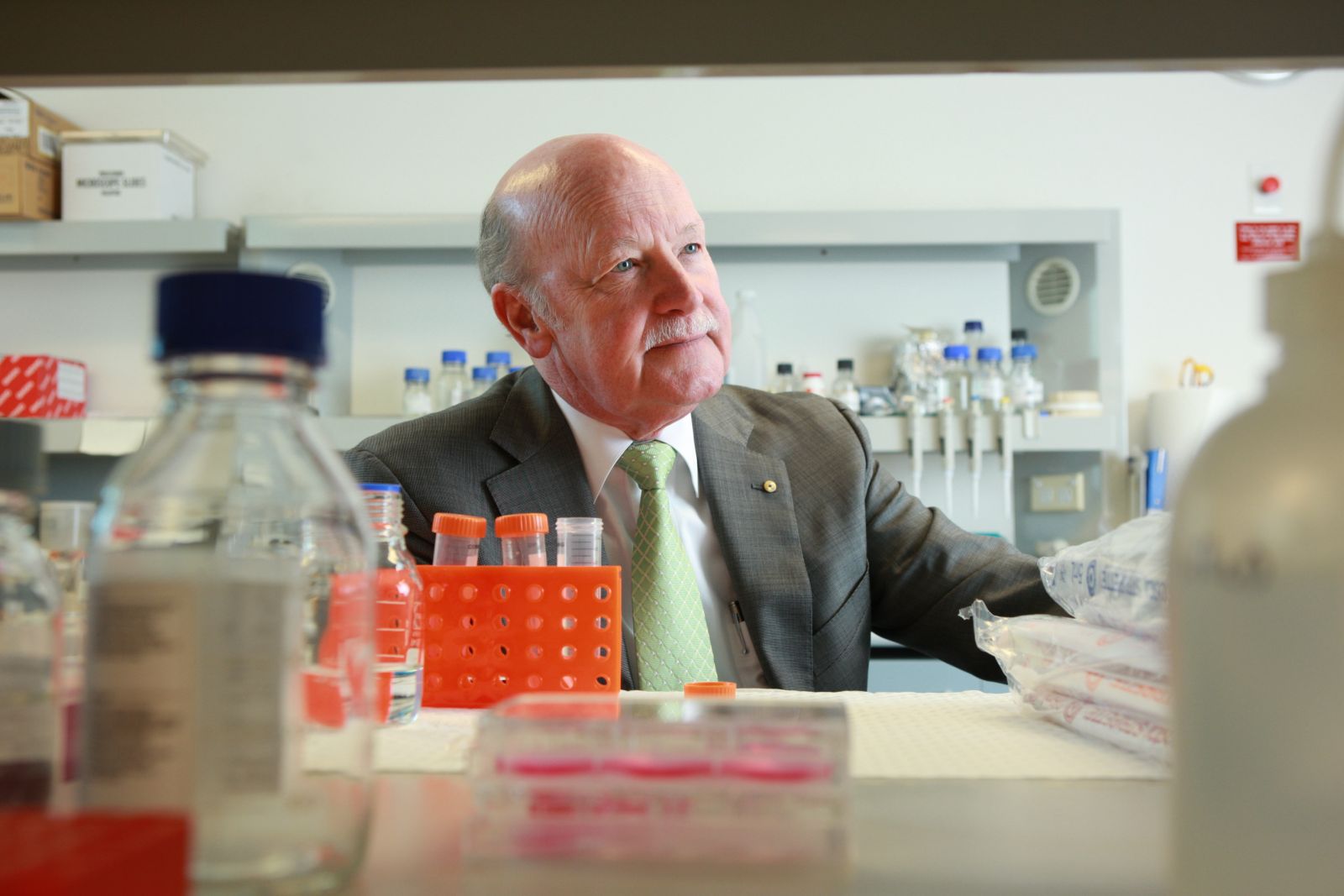
Professor John Shine AC has been elected President of the Australian Academy of Science.
Australian biochemist and molecular biologist Professor John Shine AC has been elected President of the Australian Academy of Science.
Professor Shine became world-renowned for a series of discoveries he made between 1975 and 1985 that furthered our understanding of genes.
He cloned the first human hormone genes, and in the process developed sophisticated gene cloning techniques that helped transform the world of biotechnology.
In his earlier roles in the US biotechnology industry and as Chairman of CSL for the past six years, Professor Shine has a long standing commitment to the translation of research discoveries into advances in health care for the social and economic benefit of the community.
Professor Shine was elected to the Academy in 1994. The Academy’s home, previously known as Becker House, was named the Shine Dome in 2000 in recognition of a $1 million donation made by Professor Shine to help restore the building, one of the most iconic and distinctive in Australia.
Professor Shine was also Executive Director of the Garvan Institute of Medical Research from 1990 to 2012. He still runs his own lab at the institute, investigating the gene mutations responsible for inherited kidney disorders.
Other Fellows elected to the Academy’s Council include:
- Professor Elaine Sadler—Foreign Secretary
- Professor Hans Bachor AM—Secretary Education and Public Awareness
- Professor Wendy Hoy AO—Member (Biological Sciences)
- Professor Marilyn Anderson AO—Member (Biological Sciences)
- Professor Frances Separovic—Member (Physical Sciences)
- Professor Halina Rubinsztein-Dunlop—Member (Physical Sciences)
Positions will commence after the AGM at the Academy’s annual signature science event ‘Science at the Shine Dome’ on 24 May 2018.