




Events and outreach—November 2017

Australia’s role in looking for life on Mars
In the final fascinating event of this year's Canberra speaker series, the Deputy Director of UNSW’s Australian Centre for Astrobiology, Dr Carol Oliver, will explain how Australia is involved in the search for life on Mars.
5 December at the Shine Dome, Canberra

Brains at the Dome is in Canberra on 7 December
Brains at the Dome
This one-day program will feature presentations and a panel discussion with senior representatives of the brain science programs in Europe, the US, China, Japan, Korea and Israel, along with Australian brain scientists and representatives of Australian and international neurotechnology companies, and industry groups.
7 December at the Shine Dome, Canberra
David Craig Medal lectures
Professor David St Clair Black AO FAA is the recipient of the 2017 David Craig Medal and Lecture and will be presenting lectures on molecular design and synthesis in Sydney, Adelaide, Hobart and Brisbane between November and March.
Selby Travelling Fellowship
Recipient of the 2017 Selby Travelling Fellowship, Professor Xi-Cheng Zhang, is presenting two lectures in three locations in December. The first is Next rays? T-rays! in Melbourne and Adelaide, and the second topic of Puzzle of Terahertz wave emission from liquid water with ultrafast laser pulses will be delivered in Wollongong.
Frew Fellowship Lectures
During November and December, Professor Albert Polman is delivering the 2017 Frew Lecture at the Australia New Zealand Conference on Optics and Photonics in New Zealand, as well as lectures on light management in photovoltaic materials in Melbourne, Sydney and Canberra.
Message from the Chief Executive—November 2017
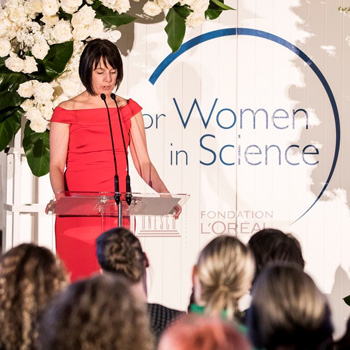
Anna-Maria Arabia delivering the keynote address at the 2017 L’Oréal-UNESCO For Women in Science Awards.
Dear Fellows and friends of the Academy
This month we are delighted to share with you news of the Academy’s recently elected incoming President, Professor John Shine AC FAA. Professor Shine will commence in the role in May 2018 and we very much look forward to working with him to continue to advance science in Australia. Read about Professor Shine’s work, as well as the newly elected Council members who will commence at the same time.
Joint meeting of the International Council for Science (ICSU) and the International Social Sciences Council (ISSC)
I attended the ICSU–ISSC joint meeting in Taipei at the end of October together with President Andrew Holmes, Foreign Secretary Cheryl Praeger, and colleagues Nancy Pritchard and Imran Ahmad.
It was a historic occasion as the meeting agreed to merge two international organisations to form the International Science Council (ISC) whose vision will be to advance all sciences as a global public good. The new council brings together some 40 international scientific unions and associations, and more than 140 national and regional organisations such as academies and research councils.
The newly formed organisation will continue to be involved in safeguarding the rights of scientists to undertake science freely, without discrimination and with integrity. The global organisation will also maintain a research program on global scientific matters.
ISC will continue to work closely with the Global Young Academy—a global network of early- and mid-career researchers who are genuinely inspirational. The future is in safe hands with young leaders like these!
I believe ISC’s outcomes will be greater by working with social scientists than by working alone and I very much look forward to maintaining and growing the Academy’s engagement with the newly formed body. Read the Academy’s story welcoming the merger
Prime Minister’s Prize for Science
We have celebrated the awarding to Academy Fellow Professor Jenny Graves AO FAA of the Prime Minister’s Prize for Science. Professor Graves is the first woman to win this prize in her own right. Her transformational scientific work in understanding how humans and all vertebrate animals evolved and function has been accompanied by a deep commitment to training and mentoring the next generation of scientists; progressing the science education agenda; and making progress towards gender equity in science. Congratulations Jenny! Learn more about Jenny’s work
Professor Graves has won many international awards including the 2006 L’Oréal-UNESCO Laureate Fellowship for Women in Science. Recently I had the opportunity to deliver the keynote address at the 2017 L’Oréal-UNESCO For Women in Science Awards.
This months’ newsletter also includes a snapshot of Australia’s involvement in the neutron star collision detection and lots of information about forthcoming opportunities for scientists and events.
I hope you enjoy reading this edition and please be free to contact me at any time.
Anna-Maria Arabia
Chief Executive
Academy Fellow wins Prime Minister's Prize for Science
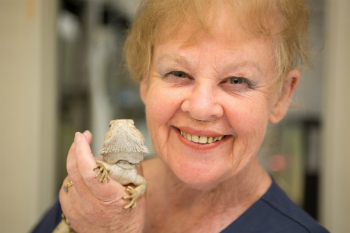
Professor Jenny Graves has used marsupials and monotremes, birds and lizards to understand the complexity of the human genome. Photo: Prime Minister’s Prizes for Science/WildBear
Academy Fellow Professor Jenny Graves AO has been awarded the prestigious 2017 Prime Minister’s Prize for Science for her pioneering investigations of the genetics of sex.
Professor Graves has transformed our understanding of how humans and all vertebrate animals evolved and function. She has kick-started genomic and epigenetic research in Australia, and predicted the disappearance of the male chromosome.
She has used marsupials and monotremes, birds and lizards to understand the complexity of the human genome and to reveal new human genes. She has transformed our understanding of how sex chromosomes work and how they evolved, predicting the decline of the Y chromosome.
Her research has contributed to a deeper understanding of the immune system, prion diseases and blood proteins, and helped understanding of the tumour driving the Tasmanian devil to extinction.
The wider scientific impacts of Professor Graves’s include deepening the understanding of animal chromosome and genome evolution and its relationship with speciation, finding the chromosome changes involved in the fatal transmissible facial tumour of the Tasmanian devil, and discovering 14 novel human genes, including one which is critical for brain development.
She has also pioneered the fields of comparative genomics and epigenetics globally, been the driving force behind sequencing the first marsupial and monotreme genomes, published more than 440 scholarly works which have been cited more than 17,000 times, and won many international awards.
Many of the scientists she has trained now occupy senior positions in science, medicine, industry and academia.
Knowing that engagement with science starts early, Professor Graves used her position as Secretary of Education at the Academy to advance inquiry-based school science programs in Australia. As the Academy’s Foreign Secretary and a member of international boards, she advocated progressive approaches in Asia.
She has been a role model for girls and women in science in Australia. She was first to introduce measures into the Academy to remove gender bias from election to Fellowship. This was the forerunner of several highly effective equity programs spearheaded by the Academy. Her Academy positions also allowed her to agitate for gender equity internationally.
Academy award winners recognised
Two recipients of Academy awards were also recognised in the Prime Minister's Prizes for Science.
Professor Jian Yang, winner of the Academy's 2015 Ruth Stephens Gani Medal, won the Frank Fenner Prize for Life Scientist of the Year for creating ways to understand inherited traits and the human genome, while Distinguished Professor Dayong Jin, winner of the Academy's 2017 John Booker Medal, won the Malcolm McIntosh Prize for Physical Scientist of the Year for creating new technologies to image the processes of life.
Professor Jin and Professor Yang are both former participants in the long-running Australia–China symposia series, and Professor Jin was the Australian nominee for the 2017 ASPIRE Prize.
More about the recipients of the 2017 Prime Minister's Prizes for Science
Academy uses Facebook to combat fake news
The Academy is launching an ambitious new social media initiative to connect more people with science.
Do baby simulators reduce pregnancies? What can Viking poo reveal about our past? Does the world have enough food? Could a black hole swallow Earth?
These are just some of the everyday questions the Australian Academy of Science will ask (and answer!) as it launches an ambitious new initiative to connect more people with science. Increasingly the public needs a trusted, credible source they can rely on for scientific information to inform their decisions.
Academy President, Professor Andrew Holmes, said no matter your background, age or education level, every person should be able to access and appreciate the wonders of science.
‘Science is all around us and we want people to discover that. However, we recognise that often the way science is presented can be hard to understand and somewhat dull—we’re about to change that,’ Professor Holmes said.
Using the latest digital grammar and a social-first publishing approach, the highest quality Australian and international science will be delivered globally on the Academy’s Facebook page. The Academy is the brains trust of science in Australia, meaning the best scientists in the country are ensuring content quality. Chinese speaking audiences will be able to access translated content on social media platforms Weibo and Toutiao.
The ANU’s 2017 Australian Beliefs and Attitudes Towards Science survey found just over half the Australian population (54%) reported having a conversation about science most days.
‘Through entertaining and informative content we hope to spark many more conversations about science—an engaged public is so important at a time when science is at the centre of so many critical public policy decisions,’ Professor Holmes said.
‘The rise of ‘fake news’ has also caught audiences in the middle of a tug-of-war between authenticity and click-bait. We believe credible and verified content has never been more important, to meet a renewed public appetite for scientifically sourced information.’
The Academy is working in partnership with Adam Boland, who reinvented Australian breakfast television and was head of video at NewsDNA (NewsCorp). Boland joins the Academy as Executive Producer of the Academy’s video content. Paul Richards, former Supervising Producer at Channel Seven’s Sunrise, has also joined the Academy and has thrown his talent and skill behind this project.
Find the new content on the Academy's Facebook page or at www.science.org.au/curious.
Print the flyer for the new project (PDF 1.5mb)
Australian maths teaching champions come together for ground-breaking program
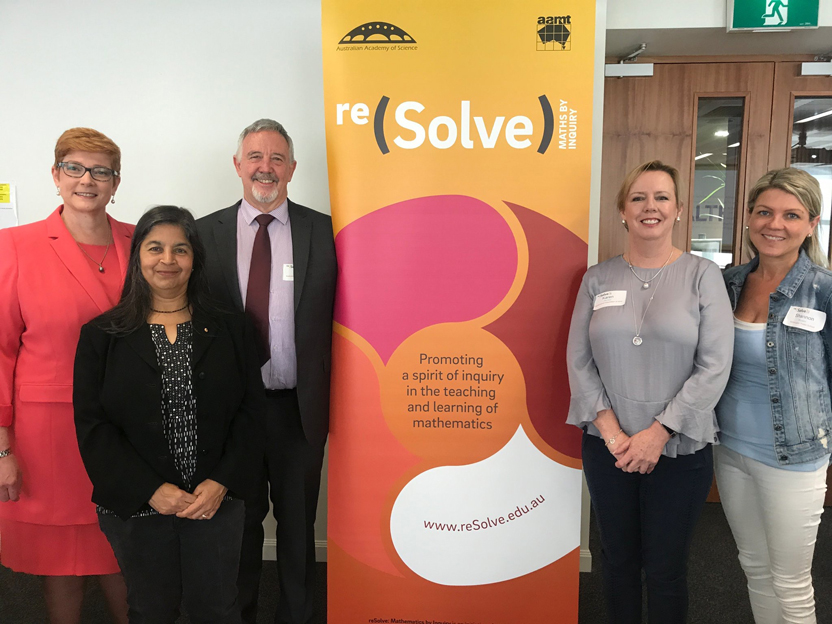
At the NSW Champion's workshop in Sydney, one of eight nationally, were (from left) Senator the Hon Marise Payne representing the Minister for Education and Training, Academy Fellow Professor Nalini Joshi, Executive Director of reSolve Dr Steve Thornton, Ms Karen McDaid from the AAMT, and reSolve Champion Ms Shannon Ruskin.
More than 300 mathematics teachers across the country are meeting this month to begin a 12-month journey to become Champions of reSolve: Maths by Inquiry, a new national program designed to transform the way the subject is taught in Australian schools.
A 2015 international assessment measuring 15 year-olds’ ability to use their maths knowledge and skills to meet real life challenges found Australia ranked equal 20th compared to the rest of the world, with Australian achievement in this area on a continuous downward trend since 2003.
The program, an initiative of the Australia Government Department of Education and Training, is managed by the Australian Academy of Science in collaboration with the Australian Association of Mathematics (AAMT). It provides Australian school teachers in Foundation to Year 10 with resources to help students learn mathematics in an innovative and engaging way.
Academy President Professor Andrew Holmes said the workshops, which are being rolled out across the country, mark an important milestone in the program.
“The workshops will provide an opportunity for the Champions to come together, learn from each other, and utilise the excellent reSolve resources,” Professor Holmes said.
“The Academy is delighted with the progress of the reSolve project to date. It has produced teaching and professional learning resources that are innovative, engaging and that promote a spirit of inquiry in school mathematics”.
The President of AAMT, Ms Allason McNamara, said AAMT is proud to partner with Australia’s leading scientific organisation to deliver the Champions element of the reSolve project.
According to Ms McNamara, the reSolve Champions have volunteered to undertake this program because they are committed to sharing their knowledge with colleagues as well as ensuring that all their students enjoy the best mathematics teaching.
AAMT counts among its members thousands of Australia’s leading mathematics teachers and university educators. It has a long history of promoting excellence in mathematics teaching and learning.
Executive Director of reSolve: Maths by Inquiry, Dr Steve Thornton, said the resources have been developed by Australian teachers and academics and informed by world best practice.
“Resources alone do not make the difference. That is why the Champions are such an important part of this project. They will promote the reSolve spirit of inquiry across Australia now and into the future,” Dr Thornton said.
Academy launches vision for space science and technology in Australia
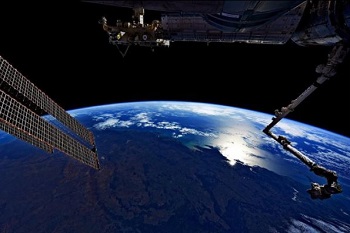
Australia will have a vibrant space sector and space industry underpinned by a national space agency. Photo: NASA
Leading scientists say bringing together the space industry under a strategic coordination framework must be the first order of business upon the establishment of a home-grown space agency.
The conclusion forms part of the Australian Academy of Science’s Vision for space science and technology in Australia, launched today at the International Astronautical Congress (IAC2017) in Adelaide.
The vision outlines a future—by 2027 or sooner—in which Australia will have a vibrant space sector and space industry, underpinned by a national space agency.
A national framework, advised by an expert panel, would provide coordination, priority setting, and a degree of strategic funding, to assist the Australian space sector to mature and flourish.
The vision statement suggests priorities for the Australian space sector could include leading the development of CubeSats as a national capability, understanding and managing the impacts of space weather and tracking and managing space junk.
Read the Vision for space science and technology in Australia
Coordination framework essential to the success of an Australian space agency
Leading scientists say bringing together the space industry under a strategic coordination framework must be the first order of business upon the establishment of a home-grown space agency.
The conclusion forms part of the Australian Academy of Science’s Vision for Space Science and Technology in Australia, launched today at the International Astronautical Congress (IAC2017) in Adelaide.
Professor Fred Menk, Chair of the Academy’s National Committee for Space and Radio Science, which compiled the vision statement, said much of the recent public discussion has focused on whether Australia should have a space agency.
“We certainly envisage a future—by 2027 or sooner—in which Australia will have a vibrant space sector and space industry, underpinned by a national space agency. Establishing a coordination framework for space science and technology in Australia must be a first order priority for our space agency,” Professor Menk said.
“Australia has already developed many of the ingredients required to reap the benefits of a space industry—indeed, some areas are excelling. Substantial progress has also already been made within and between some organisations including the Bureau of Meteorology, Geoscience Australia and the Department of Defence.”
“However, these contributors, including the smaller actors and organisations, do not yet form a cohesive and unified sector that is able to provide the full depth and breadth of rigour necessary to underpin operational sovereign space capabilities. They must be nurtured and grown in strategically prioritised and assisted ways. A key missing ingredient is a national space coordination framework,” Professor Menk said.
Professor Menk said Australia’s space industry is currently fragmented and comparatively small relative to opportunity.
“This is exposing scientific and technical gaps that are inconsistent with our sovereign interests,” Professor Menk said.
The vision statement cites the Chinese-based International Space Weather Meridian Circle Program, as an example. The program is proposing to establish space-based weather measurement instruments along the 120E/60W meridian, which passes through Australia and Antarctica, in order to provide a global picture of unfolding space weather events.
“The lack of a national coordination framework for space weather activities impacts on Australia’s engagement with and capacity to respond to strategic programs such as this one,” Professor Menk said.
“A national framework, advised by an expert panel, would provide coordination, priority setting, and a degree of strategic funding, to assist the Australian space sector to mature and flourish.
“A comprehensive earth systems science approach to the observation of the Australian continent, the Southern Ocean and the Southern Hemisphere will enable Australia to deliver good science policy and practice in a region where we are regarded as the custodians,” Professor Menk said.
The vision statement suggests priorities for the Australian space sector could include leading the development of CubeSats as a national capability, understanding and managing the impacts of space weather and tracking and managing space junk.
“With the right policy support Australia can mobilise the sector to create a significant space industry, based on innovative and niche products, in a relatively short time,” Professor Menk said.
Academy welcomes bipartisan support to establish an Australian space agency
The Australian Academy of Science has welcomed the bipartisan approach to establish an Australian space agency and says a national coordination framework must be a first order priority for the agency.
The framework would provide priority setting and strategic funding and enable Australia’s space industry sector to mature and flourish.
The lack of a national coordination framework impacts on Australia’s engagement with and capacity to respond to initiatives such as the Chinese-based International Space Weather Meridian Circle Program. The program is proposing to establish space-based weather measurement instruments along the 120E/60W meridian, which passes through Australia and Antarctica, in order to provide a global picture of unfolding space weather events.
With the right policy support and framework in place, Australia can mobilise the sector to create a significant space industry, based on innovative and niche products, in a relatively short time
Priorities for the Australian space sector could include leading the development of CubeSats as a national capability, understanding and managing the impacts of space weather and tracking and managing space junk.
The Academy’s Vision for Space and Technology in Australia, being launched on 27 September at the International Astronautical Congress in Adelaide, lays out the path to success for an Australian space agency.
Primary school learning resources win Educational Publishing Award
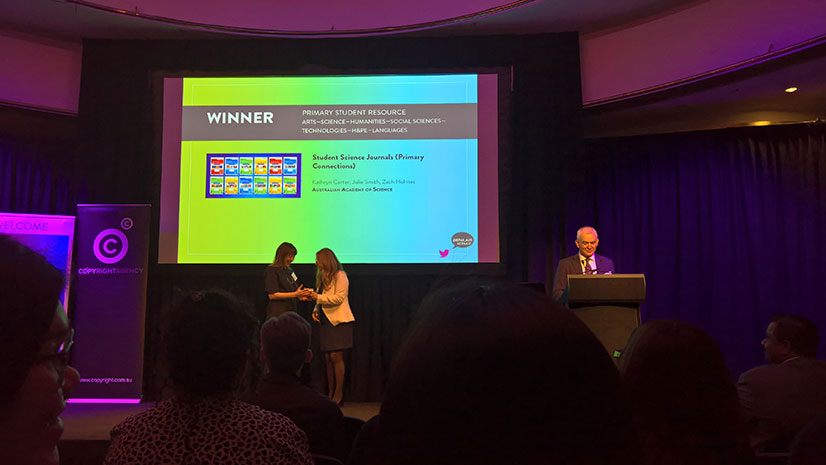
The Australian Academy of Science’s innovative approach to primary school science education has been recognised with a win at the Australian Publishers Association (APA)‘s 2017 Educational Publishing Awards.
The winners were announced at a ceremony at the Arts Centre in Melbourne last night.
The Academy’s Primary Connections team took out the award category Primary: Student Resource—Arts/Science/Humanities/Social Sciences/Technologies/Health and Physical Education/Languages for their Student Science Journals (Years 3 and 4).
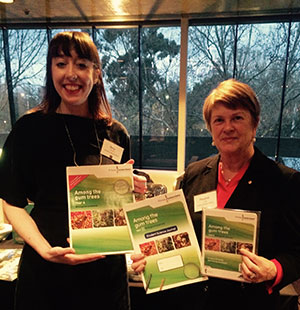
Primary Connections' Amy Stoneham (left) and the Academy's Secretary Education and Public Awareness, Professor Pauline Ladiges, with the Among the Gum Trees resource.
In awarding the prize, the judging panel said ‘the student science journals are functional and accessible, incorporating hands-on activities and a collaborative approach, allowing students to take ownership of their work. They are particularly helpful in building teachers’ confidence and competence in teaching science’.
Primary Connections was also highly commended in the Primary Teacher Resource category for its Among the Gum Trees curriculum pack, which has sparked students’ interest in learning about gum trees.
The Primary Connections: Linking science with literacy program is an approach to teaching and learning which aims to improve students’ learning outcomes by building teachers’ confidence and competence for teaching science
Academy awards travelling fellowships to international researchers
Prominent international scientists Dr Christina Kellogg, Professor Stefanie Dimmeler and Dr Graham Nugent have been awarded Australian Academy of Science Travelling Fellowships. The Fellowships foster the international exchange of scientific ideas and support lectures for the general public.
Professor Stefanie Dimmeler, a cell biologist based at Goethe University in Germany, has been awarded the Academy’s 2018 Selby Fellowship. Her research is focused on understanding the basic mechanisms underlying cardiovascular disease and vessel growth.
The Fellowship will see Professor Dimmeler based at the Victor Chang Cardiac Research Institute in Sydney. From there she will present lectures in Brisbane, Canberra, Melbourne, Perth and Sydney.
Dr Christina Kellogg, a research microbiologist with the United States Geological Survey, has been awarded the 2018 Rudi Lemberg Travelling Fellowship.
Dr Kellogg studies microorganisms within deep water coral ecosystems. As part of her Fellowship she plans to compare US deep sea coral samples with those found on the Great Barrier Reef to better understand bacterial organisms on coral reefs.
Dr Kellogg will work with coral reef experts at James Cook University, The Australian Institute of Marine Science, and the ARC Centre of Excellence for Coral Reef Studies and present lectures in Townsville, Brisbane and potentially also in either Canberra, Sydney or Melbourne.
Dr Graham Nugent, a wildlife ecologist with Landcare Research in New Zealand, has been awarded the 2018 Graeme Caughley Fellowship. His research is focused on the management, control, and eradication of introduced mammals in New Zealand, particularly deer, pigs, brush tail possums and rats.
Dr Nugent will travel to Canada, Mexico, Spain and the USA to collaborate on wildlife management and ecology in the fields of large scale mammal pest disease surveillance and eradication, primarily in relation to bovine tuberculosis.