




‘GI Jennie’, ‘Ant Man’, and the man who unboiled an egg to join Australia’s science luminaries

An Australian scientist who has revealed the hidden world of ants has become the first person from the Northern Territory to be elected a Fellow of the Australian Academy of Science.
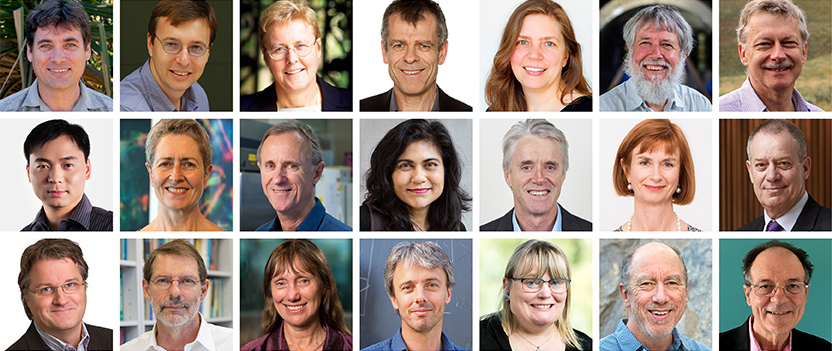
Dr Alan Andersen, the world’s leading ant community ecologist, is one of 21 scientists* who have been acknowledged today for their outstanding contributions to science. This list also includes mathematician Professor Geordie Williamson, who at age 36, becomes the youngest living Fellow of the Academy and Professor Anne Kelso, who has substantially strengthened Australia’s position in global influenza virus surveillance and pandemic preparedness and is currently leading the National Health and Medical Research Council.
The new Fellows’ pioneering contributions also include: revolutionising the way e-waste is recycled; changing the way we think about carbohydrate foods; research that led to the detection of gravitational waves; and new insights into how the immune system may be harnessed to devise new therapies for cancer and other diseases.
Australian Academy of Science President, Professor Andrew Holmes, congratulated the new Fellows for making significant and lasting impacts in their scientific disciplines.
“These scientists were elected by their Academy peers, following a rigorous evaluation process,” Professor Holmes said.
“From 23 Founding Fellows in 1954, the election this year of our new Fellows brings our total number of living Fellows to 568. They join a prestigious group—six Nobel Prize winners and luminaries including Sir Mark Oliphant, Professor Nancy Millis, Sir Douglas Mawson, Professor Frank Fenner and Sir David Attenborough.”
The new Fellows are:
NORTHERN TERRITORY
- Professor Alan Andersen, Charles Darwin University (ecologist)
AUSTRALIAN CAPITAL TERRITORY
- Professor Anne Kelso, National Health and Medical Research Council (Chief Executive Officer)
SOUTH AUSTRALIA
- Professor Colin Raston, Flinders University (chemist)
- Professor Greg Goodall, Centre for Cancer Biology (medical researcher)
QUEENSLAND
- Professor Kerrie Mengersen, Queensland University of Technology (statistician)
- Professor Bostjan Kobe, University of Queensland (structural biologist)
WESTERN AUSTRALIA
- Emeritus Professor David Blair, University of Western Australia (experimental physicist)
- Professor Kliti Grice, Curtin University (organic geochemist)
VICTORIA
- Professor David Bowtell, Peter MacCallum Cancer Centre (medical researcher)
- Professor Joseph Trapani, Peter MacCallum Cancer Centre (medical researcher)
- Professor Peter Cawood, Monash University (geologist)
- Professor Lloyd Hollenberg, University of Melbourne (quantum physicist)
- Professor Rachel Webster, University of Melbourne (astrophysicist)
NEW SOUTH WALES
- Professor Jennie Brand-Miller, University of Sydney (human nutrition researcher)
- Professor Geordie Williamson, University of Sydney (mathematician)
- Professor Christopher Dickman, University of Sydney (ecologist)
- Professor Dacheng Tao, University of Sydney (computer scientist)
- Professor Veena Sahajwalla, UNSW Sydney (materials scientist)
- Professor Richard Bryant, UNSW Sydney (medical scientist)
- Professor Martina Stenzel, UNSW Sydney (polymer chemist)
- Professor Noel Cressie, University of Wollongong (statistician)
Find out more about our new Fellows, including a video on each one
*Professor Jennie Brand-Miller is known as ‘GI Jennie’ for her research on the glycemic index, and Professor Colin Raston received an Ig Nobel prize for creating a way to unboil an egg using his invention, the Vortex Fluidic Device.
New Corresponding Members admitted to Academy
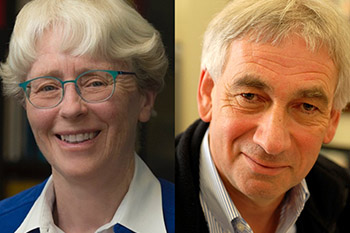
Professor Ruth J. Williams and Professor Richard Ellis have been admitted to the Academy as new Corresponding Members.
Professor Ruth J. Williams (United States) and Professor Richard Ellis (United Kingdom) have been admitted to the Australian Academy of Science for outstanding scientific contributions to their fields.
Professor Ruth J. Williams is an Australian-born mathematician at the University of California, San Diego. Her work has had a deep and lasting impact on heavy traffic analysis within the field of stochastic networks. This is the mathematical subject that describes real-world systems running at near-maximum capacity, such as the Internet when congested, assembly lines, customer service centres and freeways at rush hour.
In 2016, Professor Williams was awarded the John von Neumann Theory Prize ‘for seminal research contributions over the past several decades, to the theory and applications of stochastic networks/systems and their heavy traffic approximations’.
Professor Richard Ellis is a distinguished astronomer at University College London who has made landmark discoveries over several decades. His main area of research is in observational cosmology, studying the origin and evolution of galaxies, the growth of large scale structure in the universe and the nature and distribution of dark matter.
Australian astronomy has benefited greatly from Professor Ellis’s intellectual leadership and generous support. He conceived the award-winning ‘2 degree Field’ facility on the Anglo-Australian Telescope that produced some of the highest cited papers in cosmology. This instrument continues to advance Australian astronomy 25 years on. His observational campaigns and creative style opened up the distant Universe to direct observation, inspiring three generations of Australian astronomers to follow in his path.
Australian Academy of Science President, Professor Andrew Holmes, congratulated the new Corresponding Members.
“Professors Williams and Ellis join the Academy as Corresponding Members, a special category within the Fellowship, comprising eminent international scientists with strong ties to Australia who have made outstanding contributions to science,” said Professor Holmes.
The Australian Academy of Science will announce the election of 21 distinguished Australian scientists as New Fellows, to mark the start of Science at the Shine Dome, on 22 May 2018.
Two new Corresponding Members admitted to the Academy
Professor Ruth J. Williams (United States) and Professor Richard Ellis (United Kingdom) have been admitted to the Australian Academy of Science for outstanding scientific contributions to their fields.
Professor Ruth J. Williams is an Australian-born mathematician at the University of California, San Diego. Her work has had a deep and lasting impact on heavy traffic analysis within the field of stochastic networks. This is the mathematical subject that describes real-world systems running at near-maximum capacity, such as the Internet when congested, assembly lines, customer service centres and freeways at rush hour.
In 2016, Professor Williams was awarded the John von Neumann Theory Prize ‘for seminal research contributions over the past several decades, to the theory and applications of stochastic networks/systems and their heavy traffic approximations’.
Professor Richard Ellis is a distinguished astronomer at University College London who has made landmark discoveries over several decades. His main area of research is in observational cosmology, studying the origin and evolution of galaxies, the growth of large scale structure in the universe and the nature and distribution of dark matter.
Australian astronomy has benefited greatly from Professor Ellis’s intellectual leadership and generous support. He conceived the award-winning ‘2 degree Field’ facility on the Anglo-Australian Telescope that produced some of the highest cited papers in cosmology. This instrument continues to advance Australian astronomy 25 years on. His observational campaigns and creative style opened up the distant Universe to direct observation, inspiring three generations of Australian astronomers to follow in his path.
Australian Academy of Science President, Professor Andrew Holmes, congratulated the new Corresponding Members.
“Professors Williams and Ellis join the Academy as Corresponding Members, a special category within the Fellowship, comprising eminent international scientists with strong ties to Australia who have made outstanding contributions to science,” said Professor Holmes.
The Australian Academy of Science will announce the election of 21 distinguished Australian scientists as New Fellows, to mark the start of Science at the Shine Dome, on 22 May 2018.
Research Infrastructure Investment Plan welcomed but lack of detail concerning
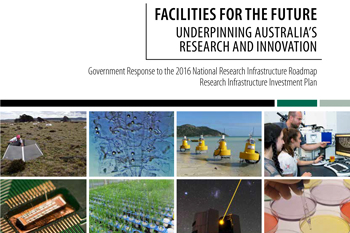
Upgrading, expanding and connecting many of Australia’s research facilities remains critical to finding solutions to challenges in industry, agriculture, health and environment.
The Australian Academy of Science welcomes the Research Infrastructure Investment Plan and its response to the Chief Scientist’s National Research Infrastructure Roadmap.
The Academy also welcomes the $393m budget allocation to national research infrastructure over the five-year period (2017/18 – 2021/22) of which $199m was allocated in the 2017/18 FY [Budget paper 2, page 92], however remains concerned that critical infrastructure investment may still be some years away.
President of the Australian Academy of Science, Professor Andrew Holmes said new investment in national research infrastructure is welcome however we remain concerned about the lack of detail as to when funding will be allocated.
“The Academy notes that many of the priorities for new infrastructure outlined in the Research Infrastructure Roadmap will be addressed through funded scoping studies, and will be incorporated in future (two-yearly) iterations of the Investment Plan along with five-yearly reviews of the Research Infrastructure Roadmap,” Professor Holmes said.
“The Academy looks forward to receiving further detail and certainty.
“Upgrading, expanding and connecting many of Australia’s research facilities remains critical to allow the research community to continue seeking solutions to some of our most pressing challenges in industry, agriculture, health and environment,” Professor Holmes said.
Academy Fellows elected to Royal Society
Five Academy Fellows and one Academy Corresponding Member have been elected to the Royal Society of London.
Professor Frank Caruso FAA FRS is a Melbourne Laureate Professor and an NHMRC Senior Principal Research Fellow at The University of Melbourne. He is Deputy Director of the ARC Centre of Excellence in Convergent Bio-Nano Science and Technology. He received his PhD in 1994 from The University of Melbourne and thereafter conducted postdoctoral research at CSIRO Division of Chemicals and Polymers. From 1997–2002, he was an Alexander von Humboldt Research Fellow and group leader at the Max Planck Institute of Colloids and Interfaces. Since 2003, he has been a professor at The University of Melbourne and has held ARC Federation and ARC Australian Laureate Fellowships. He was elected a Fellow of the Australian Academy of Science in 2009 and was awarded the CSIRO Eureka Prize for Leadership in Science in 2013. He has published over 400 peer-reviewed papers and was on Thomson Reuters’ 2014 list of World's Most Influential Scientific Minds. He is an Executive Editor of ACS Chemistry of Materials and is on the Editorial Advisory Board of ten other scientific journals.
Professor Graeme Jameson AO FAA FRS FTSE is a Laureate Professor of the University of Newcastle, Australia. His special interest is the mechanics of multiphase systems, especially the interaction of bubbles and particles in suspensions. He has a BSc from the University of New South Wales and a PhD from the University of Cambridge, both in Chemical Engineering. His focus is the froth flotation process for the recovery of valuable minerals from finely-ground ores. His researches led to the introduction of a radical new device, the Jameson Cell, for the recovery of very fine particles, and more recently, a new way of recovering coarse particles. He has won numerous awards, including the Ian Wark Medal of the Australian Academy of Science, the Gaudin Award of the US Society of Metallurgical Engineers, and the Prime Minister’s Science Prize for Innovation. He is a Fellow of the Royal Academy of Engineering, the US National Academy of Engineering, the Australian Academy of Science and the Australian Academy of Technological Sciences and Engineering. He is an Officer of the Order of Australia (AO).
Professor Ingrid Scheffer AO FAA FRS is an Australian clinician-scientist whose work as a paediatric neurologist and epileptologist has transformed understanding of epilepsy. She has defined many new epilepsy syndromes, and her work led directly to the identification of the first gene for epilepsy in 1995, and many epilepsy genes subsequently. In 2017, she led the first major revision of the classification of the epilepsies in 28 years, the major tool worldwide for the diagnosis and management of people with epilepsy. Her collaborative work has led to a deeper understanding of the biology of seizures and revolutionised scientific approaches to these disorders. Her clinical focus has shed light on the myriad of co-morbidities seen in people with epilepsy, particularly the severe infantile and childhood developmental and epileptic encephalopathies which often carry a poor prognosis. In 2014, she was appointed as an Officer of the Order of Australia and, in the same year, she won the Australian Prime Minister’s Prize for Science with Samuel Berkovic FRS. In 2012, she was awarded the L’Oreal-UNESCO Women in Science Laureate for the Asia-Pacific region. She is the founding Vice-President of the Australian Academy of Health and Medical Sciences and a Fellow of the Australian Academy of Science.
Professor Michelle Simmons FAA FRS FTSE is a UNSW Sydney Laureate Fellow and Director of the Centre of Excellence for Quantum Computation and Communication Technology. She has pioneered unique technologies to build electronic devices at the atomic scale, pushing the boundaries of global research in classical computing and opening up the prospect of developing a silicon-based quantum computer: a powerful new form of computing with the potential to transform information processing. She has received Federation and Laureate Fellowships, been named NSW Scientist of the Year and awarded the CSIRO Eureka Prize for Science Leadership. Recognised with the Pawsey and Lyle Medals from the Australian Academy of Science she was, upon her appointment, one of the youngest fellows of this Academy. In 2014 she was inducted into the American Academy of Arts and Sciences, and was awarded the Feynman Prize in Nanotechnology for ‘the creation of the new field of atomic-electronics’ in 2016. Recognised as a pioneer in quantum computing by the American Computer Museum, she is Editor-in-Chief of Nature Quantum Information and was the 2017 L’ORÉAL-UNESCO Asia-Pacific Laureate. She is currently the 2018 Australian of the Year.
Professor Peter Visscher FAA FRS is a quantitative geneticist who studies trait variation in populations. He has developed and applied statistical analysis methods to quantify and dissect the contribution of DNA polymorphisms to variation between individuals, thereby demonstrating the pervasiveness of polygenicity and pleiotropy for quantitative traits and risk of common diseases. His research has applications in medicine, evolutionary biology and agriculture. Peter trained in quantitative genetics at the University of Edinburgh and is currently Professor of Quantitative Genetics at the University of Queensland, Brisbane, Australia. He is an Australian National Health and Medical Research Council Senior Principal Research Fellow and was elected a Fellow of the Australian Academy of Science in 2010.
Professor Jillian Banfield FAA FRS is an earth scientist who studies the structure, functioning and diversity of microbial communities in natural environments and the human microbiome. Her laboratory and collaborators pioneered the reconstruction of genomes from natural ecosystems and community metaproteomic analyses. Through genomics, her group has provided insights into previously unknown and little known bacterial and archaeal lineages, leading to a new rendition of the Tree of Life. She has conducted extensive research on natural and synthetic nanomaterials, exploring the impacts of particle size on their structure, properties and reactivity. Her lab described the oriented attachment-based mechanism for growth of nanoparticles and its implications for development of defect microstructures. She has also studied microorganism-mineral interactions, including those that lead to production of nanomaterials. Jill is a Professor at the University of California, Berkeley, USA, with appointments in the Earth Science, Ecosystem Science and Materials Science and Engineering departments. She leads the Microbial Research initiative within the Innovative Genomics Institute, is affiliated with Lawrence Berkeley National Laboratory and has a position at the University of Melbourne, Australia. She is a Corresponding Member of the Australian Academy of Science.
The six are among 50 new Fellows from across the Commonwealth of Nations. They attended a ceremony in London to accept their election, alongside South African engineer and inventor, Elon Musk.
The Fellowship of the Royal Society are the most eminent scientists, engineers and technologists from or living and working in the UK and the Commonwealth. Each year up to 52 Fellows and up to 10 Foreign Members are elected from a group of about 700 candidates.
Good outcomes for science in Budget 2018
The 2018 Federal Budget contains good news for Australian scientists and research institutions with welcome investments in critical national research infrastructure and medical research.
The budget also includes new initiatives to support women in STEM, an Australian space agency and funding to conserve and protect the Great Barrier Reef.
“This is a good budget for science,” said Professor Andrew Holmes, President of the Australian Academy of Science.
“It reflects the long-term and strategic approach that is needed for Australia to benefit from science and innovation at a global scale."
A 12-year National Research Infrastructure Investment Plan will commit $1.9 billion to critical national research infrastructure, including $140 million for upgrades to the two most powerful computing facilities in the Southern Hemisphere.
“Australia’s national supercomputers give scientists across government, industry and universities the processing power for the complex scientific computations needed in an advance society including accurate weather forecasts, drug development, and large-scale astronomy,” Professor Holmes said.
Medical research is also a centrepiece of the Budget, with a new $1.3 billion National Health and Medical Industry Growth Plan that will play to Australia’s strengths in medical science and technology.
This plan includes a 10-year $500 million Genomic Health Futures Mission to develop ‘precision medicine’ approaches to a wide range of diseases.
It also includes 10-year investments of $248 million for rare cancers and diseases and $125 million for the Million Minds Mental Health Research Mission to support more research and better diagnosis and treatment of mental illness.
The Budget includes a $41 million space agency and investment program, $4.5 million in new measures to encourage girls and women to pursue STEM education and careers, and a $29.9 million research initiative on Artificial Intelligence and Machine Learning.
“We have a long way to go as a nation, particularly on big issues like STEM education and training at school and university and climate change,” said Professor Holmes.
“But we are moving forward together and the Government has made a clear commitment in this Budget to working collaboratively with the science sector to maximise the benefits for all Australians.”
Science budget highlights
- A 12-year $1.9 billion National Research Infrastructure Investment Plan - $393 million over five years from 2017-18. Investments will be guided by the National Research Infrastructure Roadmap, developed by Australia’s Chief Scientist, and will require co-investment by industry and other institutions.
- Initial investments include $140 million upgrades to the National Computational Infrastructure in Canberra (announced December 2017) and the Pawsey Centre in WA.
- A Science and Technology Growth Plan that will support:
- $26 million over four years to establish an Australian space agency, together with investment of $5 million per annum for three years to engage in international space research projects and attract investment to Australia.
- $4.5 million for a suite of new measures to encourage girls and women to pursue STEM education and careers, including a decadal plan for women in science, a toolkit to encourage girls into STEM studies, and a new National Women in STEM Ambassador.
- A $25 million research initiative on Artificial Intelligence and Machine Learning including new collaborative research delivered through the Cooperative Research Centres program, and a strategic roadmap and an ethics framework led by CSIRO’s Data61.
- A 10-year $1.3 billion National Health and Medical Industry Growth Plan, supported by proceeds from the Medical Research Future Fund. This plan includes:
- $500 Million Genomic Health Futures Mission that will develop new ‘precision medicine’ approaches to a wide range of diseases.
- $240 million for a Frontier Science program aiming to support innovative medical research, devices and treatments.
- $248 million for research on rare cancers and diseases.
- $125 million for the Million Minds Mental Health Research Mission to support more research and better diagnosis and treatment of mental illness.
- Changes to the R&D Tax Incentive that will improve transparency and accountability of the Government’s largest single research program, and provide better incentives for Australian and international companies to invest in cutting-edge research and innovation in Australia.
- $260 million investment in satellite positioning and imaging infrastructure through Geoscience Australia. This will improve GPS location accuracy to within 10cm throughout Australia, and to 3-5cm when combined with mobile phone infrastructure in urban areas.
- A $20 million Asia Innovation Strategy supporting Australian business and researchers to collaborate in our region. This includes funding to extend the Australia-India strategic research fund for a further four years.
- A welcome return to indexation of ARC Discovery and Linkage schemes after several years of flat funding, and stable funding for other major Australian research agencies including CSIRO, ANSTO, and Geoscience Australia.
- Continued funding to engage Australians in STEM through the Inspiring Australia program.
- New and continued funding of $536 million to protect the Great Barrier Reef. A large part of this funding will be delivered in partnership with the Great Barrier Reef Foundation, with a focus on improving water quality, funding research into coral restoration and adaptation and combating crown-of-thorn starfish.
Australia’s leading scientists welcome critical computer infrastructure funding
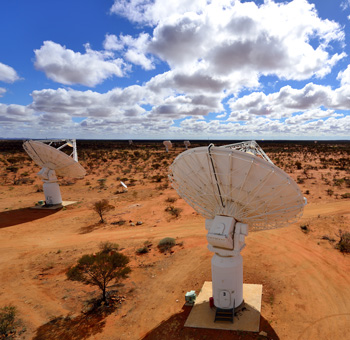
Precursor telescopes like the South African MeerKAT and HERA, along with the Murchison Widefield Array and CSIRO’s Australian SKA Pathfinder (above) are providing scientists with invaluable knowledge to assist in the design of the SKA’s main telescopes over the coming decade. Photo: CSIRO
The Australian Academy of Science welcomes the Federal Government’s announcement to invest $70 million to upgrade two supercomputers at the Pawsey Supercomputing Centre.
Secretary for Science Policy at the Academy, Professor David Day, said the new funding for the high performance computing facility will allow important research to continue in high priority areas of Australian science, including medical research, astronomy, agricultural science and geoscience.
“Increasingly, scientific research is generating large volumes of data, such as that coming from the Australian SKA Pathfinder—this requires sophisticated processing and analysis so researchers can derive most benefit from their work,” Professor Day said.
“Supercomputers, including this facility, are a critical piece of Australia’s economic, social and scientific infrastructure.
“The funding commitment provides more certainty for the future of Australia’s supercomputing capability, following the funding of the Pawsey’s sister facility, the National Computational Infrastructure (NCI), in December last year.”
Media contact: Dan Wheelahan – dan.wheelahan@science.org.au – ph: 0435 930 465.
Attenborough supports plan to capture Australia’s biodiversity
Naturalist, broadcaster and Fellow of the Australian Academy of Science, Sir David Attenborough, is endorsing calls for greater support for the scientists who study and name Australia’s plants and animals and other organisms, declaring that Australia’s current capacity is not adequate for the magnitude of the task.
Sir David says that at the very time that many species are under greatest threat, funding and other resources allocated to discovering and documenting species are declining.
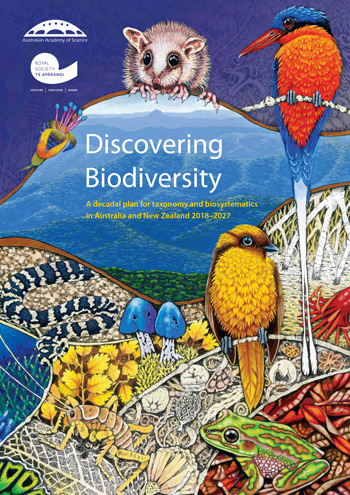
“This has serious consequences for the future of life on Earth,” he says in the foreword to the Australian Academy of Science and the Royal Society Te Apārangi’s 10-year plan for taxonomy and biosystematics, to be launched today at Parliament House, Canberra.
Australia has extraordinarily high levels of biodiversity. It is one of only two developed countries with ‘megadiversity’ of plant and animal life. However, of the more than 600,000 predicted species in Australia, only 30% have so far been discovered, documented and named.
If Australia doesn’t change its approach to documenting our biodiversity, it is likely to take about 400 years to document every plant, animal and other species. In that time, many will go extinct.
A sound understanding of biodiversity is critical, particularly as Australia seeks to achieve both environmental and economic sustainability in the face of rapid environmental change and an extinction crisis that threatens to change the face of Earth.
Taxonomy and biosystematics—the disciplines of biology that discover, document, name and classify species—provide the framework for this much needed sound understanding of life on our planet. Taxonomists literally name the living world.
The Academy’s 10-year plan was developed by an expert working group led by Australian plant taxonomist, Dr Kevin Thiele.
He says Australia discovers and names around 2,500 new species per year—more than almost any other country in the world.
Technological revolution
“A substantial increase in the current rate is possible if taxonomists and biosystematists are properly supported to take advantage of the technological revolution underway, in areas such as genomics, machine learning and 3D imaging, which would help speed up the mapping of our unique biodiversity,” Dr Thiele said.
“With careful planning and adequate capacity building, Australia could embark on a ‘hypertaxonomy’ program—we could completely document our biodiversity in a generation. This would put us at the global leading edge—and as the only developed nation in the world that is also biologically megadiverse, this is where we should be.”
“Documenting our biodiversity is important—for conservation, biosecurity, agriculture, human and animal health, and to understand the evolution of life on Earth,” Dr Thiele said.
President of the Australian Academy of Science, Professor Andrew Holmes, acknowledged that the plan was ambitious in scope.
“Australia and New Zealand are currently world leaders in managing and deploying biodiversity knowledge. This plan seeks to ensure that this leadership is not lost,” Professor Holmes said.
“With the appropriate investment and support from government, industry and society we can ensure that future generations, and the community at large, are able to enjoy and celebrate the unique value and immense potential of the plant and animal life in our country.”
The Academy would like to acknowledge the support of the Ian Potter Foundation in the development of ‘Discovering Biodiversity: A decadal plan for taxonomy and biosystematics in Australia and New Zealand 2018–2027’ on behalf of the Australian Academy of Science and the Royal Society Te Apārangi.
Mosquitoes and marine sponges
Mosquitoes and marine sponges highlight the need for enhanced support for taxonomy.
Mosquitoes cause more human deaths than any other animal on earth, yet there are an estimated 200 Australian species that have not yet been named or studied. Some of these may carry serious diseases, but we cannot assess this risk unless they are properly documented.
Marine sponges are extremely rich in compounds that are leading to new drugs and other pharmaceuticals, including new antibiotics that will be needed to help deal with multi-drug-resistant diseases. An estimated 3,000 more species are known but have not yet been documented, and many more await discovery. Any one of these species may provide a drug that saves human lives.
Time is running out to capture Australia’s biodiversity, but we have a plan
Naturalist, broadcaster and Fellow of the Australian Academy of Science, Sir David Attenborough, is endorsing calls for greater support for the scientists who study and name Australia’s plants and animals and other organisms, declaring that Australia’s current capacity is not adequate for the magnitude of the task.
Sir David says that at the very time that many species are under greatest threat, funding and other resources allocated to discovering and documenting species are declining.
“This has serious consequences for the future of life on Earth,” he says in the foreword to the Australian Academy of Science and the Royal Society Te Apārangi’s 10-year plan for taxonomy and biosystematics, to be launched today at Parliament House, Canberra.
Australia has extraordinarily high levels of biodiversity. It is one of only two developed countries with ‘megadiversity’ of plant and animal life. However, of the more than 600,000 predicted species in Australia, only 30% have so far been discovered, documented and named.
If Australia doesn’t change its approach to documenting our biodiversity, it is likely to take about 400 years to document every plant, animal and other species. In that time, many will go extinct.
A sound understanding of biodiversity is critical, particularly as Australia seeks to achieve both environmental and economic sustainability in the face of rapid environmental change and an extinction crisis that threatens to change the face of the Earth.
Taxonomy and biosystematics—the disciplines of biology that discover, document, name and classify species—provide the framework for this much needed sound understanding of life on our planet. Taxonomists literally name the living world.
The Academy’s 10-year plan was developed by an Expert Working Group, led by Australian plant taxonomist, Dr Kevin Thiele.
He says Australia discovers and names around 2,500 new species per year—more than almost any other country in the world.
“A substantial increase in the current rate is possible if taxonomists and biosystematists are properly supported to take advantage of the technological revolution underway, in areas such as genomics, machine learning and 3D imaging, which would help speed up the mapping of our unique biodiversity,” Dr Thiele said.
“With careful planning and adequate capacity building, Australia could embark on a ‘hypertaxonomy’ program—we could completely document our biodiversity in a generation. This would put us at the global leading edge—and as the only developed nation in the world that is also biologically megadiverse, this is where we should be.”
“Documenting our biodiversity is important—for conservation, biosecurity, agriculture, human and animal health, and to understand the evolution of life on Earth,” Dr Thiele said.
President of the Australian Academy of Science, Professor Andrew Holmes, acknowledged that the plan was ambitious in scope.
“Australia and New Zealand are currently world leaders in managing and deploying biodiversity knowledge. This plan seeks to ensure that this leadership is not lost,” Professor Holmes said.
“With the appropriate investment and support from government, industry and society we can ensure that future generations, and the community at large, are able to enjoy and celebrate the unique value and immense potential of the plant and animal life in our country.”
The Academy would like to acknowledge the support of the Ian Potter Foundation in the development of ‘Discovering Biodiversity: A decadal plan for taxonomy and biosystematics in Australia and New Zealand 2018–2027’ on behalf of the Australian Academy of Science and the Royal Society Te Apārangi.
Read the plan: www.science.org.au/taxonomyplan
MOSQUITOES AND MARINE SPONGES—examples that highlight the need for enhanced support for taxonomy
Mosquitoes cause more human deaths than any other animal on earth, yet there are an estimated 200 Australian species that have not yet been named or studied. Some of these may carry serious diseases, but we cannot assess this risk unless they are properly documented.
Marine sponges are extremely rich in compounds that are leading to new drugs and other pharmaceuticals, including new antibiotics that will be needed to help deal with multi-drug-resistant diseases. An estimated 3,000 more species are known but have not yet been documented, and many more await discovery. Any one of these species may provide a drug that saves human lives.
Media note: To interview Dr Kevin Thiele, for images from the plan or to request a copy of the video featuring Sir David Attenborough contact Dan Wheelahan: M 0435 930 465 | E dan.wheelahan@science.org.au
Australia’s leading scientists welcome COAG education report
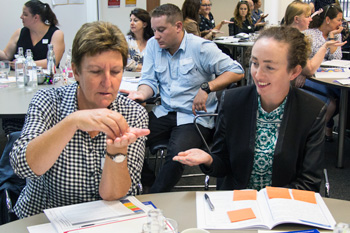
The Academy focuses on improving teacher quality through professional learning.
The Australian Academy of Science welcomes the Optimising STEM Industry-School Partnerships: Inspiring Australia’s Next Generation Final Report and is calling on Federal and State governments to work together to advance the report's 10 recommendations.
The Academy’s Education Committee Chair, Professor Ian Chubb FAA, said the Academy strongly supports the push for industry to play a greater and more constructive role in enhancing STEM in Australia’s education system.
“We are pleased to see a number of the Academy’s recommendations from its submission reflected in the final report,” Professor Chubb said.
The Academy strongly backs the report’s emphasis on the importance of STEM education to help solve real-world problems, and the development of initiatives at scale.
The Academy particularly welcomes the report’s recommendations to ‘review senior secondary system and university prerequisites (2)’ and ‘develop minimal national requirements for discipline specific professional learning to maintain ongoing teacher registration (3)’.
“The Academy has been advocating for some time for the staged reintroduction of at least Year 12 mathematics subjects as prerequisites for all bachelors programs in science, engineering and commerce,” Professor Chubb said.
The Academy’s Secretary for Education and Public Awareness, Professor Pauline Ladiges FAA, said the Academy’s long-standing experience in developing and delivering science and mathematics education programs supports the report’s focus on in-service and pre-service teacher professional learning.
“The Australian Academy of Science supports all efforts to collect data that help improve teaching and learning and that guide Australia’s future investment in STEM,” Professor Ladiges said.
Read the Academy’s full submission, including its recommendations
The Academy’s role in STEM education
Academy offers three STEM education programs to primary and secondary teachers and students: Primary Connections, Science by Doing and reSolve: Mathematics by Inquiry.
Each program includes features to improve teacher quality through professional learning and improve students’ skills through a guided inquiry approach that enhances problem solving ability, science literacy and numeracy. Teachers, schools and classrooms that have implemented the programs attest to their impact, and independent program evaluations support this finding. The resources and training are widely available to schools at low or no cost to them. The programs reach hundreds of rural and remote students and teachers.