




Australian scientists heading to India to kickstart research collaborations

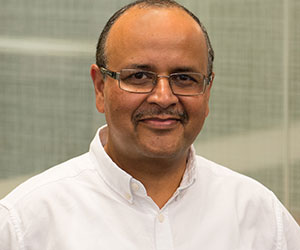
Deakin University’s Dr Rangam Rajkhowa has been awarded a 2018–19 Australia–India EMCR Fellowship.
Australian scientists researching emerging mosquito-borne diseases, drug resistant tuberculosis and childhood type 1 diabetes are among the latest recipients of 2018–19 Australia–India Early- and Mid-Career Researcher (EMCR) Fellowships announced today by the Australian Academy of Science.
The EMCR Fellowships are part of the Australia–India Strategic Research Fund (AISRF), a platform for bilateral science collaboration jointly managed and funded by the governments of Australia and India.
Under the program, Australian researchers are awarded up to A$40,500 to travel to India and work with leading researchers at major Indian science and technology organisations for between three to nine months. The total amount awarded for the 14 recipients awarded Fellowships in this latest round is $282,908.
Assistant Minister for Industry, Innovation and Science, Craig Laundy, welcomed the Fellowships.
“They give high-performing Australian researchers exciting opportunities to work with fellow scientists at leading Indian research institutions and to engage with a rising science superpower early in their careers,” Assistant Minister Laundy said.
“The Australian Government has committed more than $80 million to the AISRF since 2006 in recognition of India’s increasing prominence in the global research effort.”
President of the Academy of Science, Professor Andrew Holmes, said the Fellowships are designed to facilitate long-term science, technology and innovation collaboration between the two countries.
“Among this year’s recipients is Deakin University’s Dr Rangam Rajkhowa who is returning to India in 2018 after receiving his first Australia–India Early Career Fellowship in 2012,” Professor Holmes said.
Dr Rajkhowa is researching 3D printed functional composites, made from protein fibre particles, for biomedical applications. He will be collaborating with scientists at the Indian Institutes of Technology in Guwahati and Delhi.
See the list of successful recipients and more information about the awards.
World’s brain initiatives move forward together
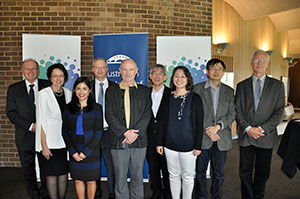
Representatives of some of the world’s major brain research projects met recently. Attendees included (from left) Professor Andrew Holmes (host), Professor Linda Richards, Dr Caroline Montojo, Dr Christoph Ebell, Professor Rafael Yuste, Professor Shigeo Okabe, Professor Sung-Jin Jeong, Professor Hideyuki Okano and Dr James Deshler.
A meeting of representatives of some of the world’s major brain research projects, hosted by the Australian Academy of Science in Canberra, has made a declaration to establish an International Brain Initiative.
The declaration, made by representatives from Japan, Korea, Europe, the United States of America and Australia, is designed to speed up progress on ‘cracking the brain’s code’.
‘Researchers working on brain initiatives from around the world recognise that they are engaged in an effort so large and complex that even with the unprecedented efforts and resources from public and private enterprise, no single initiative will be able to tackle the challenge to better understand the brain,’ according to the declaration.
Academy President, Professor Andrew Holmes, said the announcement of an International Brain Initiative was one of the most exciting days of his presidency to date.
‘It is very pleasing to see a global commitment to stronger collaboration on brain research. Challenges of this magnitude need a global effort,’ Professor Holmes said.
The first meeting of the International Brain Initiative steering committee will be held in January 2018. Brain research initiatives from other countries and regions are also invited to join the International Brain Initiative.
Read the ‘Canberra Declaration’ to create an International Brain Initiative
Recommended summer reading from our top scientific minds
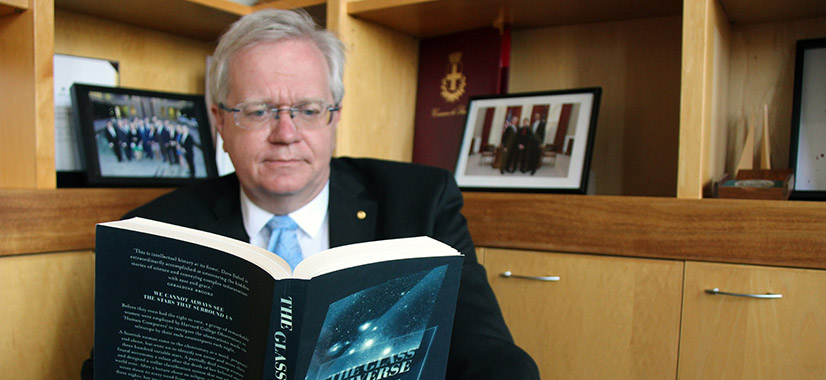
Academy Fellow Professor Brian Schmidt recommends The Glass Universe by Dava Sobel
There’s nothing like fully immersing yourself in a good book—so what do Australia’s top scientific minds recommend you read this holiday season?
The Australian Academy of Science’s second Annual Christmas Reading List, released today, contains 31 favourite reads submitted by the Academy’s Fellows.
Academy Chief Executive Ms Anna-Maria Arabia said while some Fellows recommend good reads for exploring science, there are plenty of suggestions for escaping it altogether.
‘Avid readers may find a few surprises not typically included on a holiday reading list,’ Ms Arabia said.
The Bad-Ass Librarians of Timbuktu, Joshua Hammer
Recommended by Professor Georgia Chenevix-Trench. ‘I knew there were a lot of important ancient manuscripts in Timbuktu, but I had no idea of the scale, and age of them. The book describes one man’s attempt to recover thousands of them from outlying districts and the race to save them from Al-Qaeda, including shipping them down river on pirogues to Djenne to be picked by taxis and re-hidden in Bamako.’
Sand, Wolfgang Herrndorf
Recommended by Professor Bryan Williams. ‘This is an engrossing read. It is a thriller, a conundrum and a comedy of circumstances. The concise chapters are headed by quotes from a wide array of literary figures that entice the reader to make the connection.’
Cold Light, Frank Moorhouse
Recommended by Professor Wendy Hoy. ‘The essence of the fledgling Canberra, its institutions and personalities; issues of gender and identity and empathy for the human condition; superbly intelligent and insightful.’
The Siege, Arturo Pérez-Reverte
Recommended by Professor David Black. ‘During the siege of Cadiz in 1811, a serial killer is on the loose, and to find the murderer, the police commissioner perceives the city as a vast chessboard trying to predict his unknown opponent’s next deadly move. Any novel by this author can be recommended, and the translations from Spanish are excellent.’
Fellows also recommend:
- Endurance, Alfred Lansing—recommended by Professor Nalini Joshi
- Sapiens: A Brief History of Humankind, Yuval Noah Harari—recommended by Professors Boris Martinac and Geoff Fincher
- Zen and the Art of Motorcycle Maintenance, Robert Pirsig—recommended by Professor Igor Bray
- Radio Astronomer: John Bolton and a New Window on the Universe, Peter Robertson—recommended by Professors Robyn Williams and Joss Bland-Hawthorn
- The Glass Universe, Dava Sobel—recommended by Professor Brian Schmidt
Read the complete Annual Christmas Reading List.
Fellows feature in online video resource
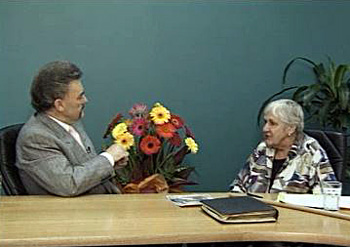
Dr Max Blythe interviewing Professor Mollie Holman. Image from the video
A collection of videotaped biographical interviews with more than 130 important figures in clinical medicine and science from the United Kingdom and Australia—including several Academy Fellows—is now available online.
The Medical Sciences Video Archive of the Royal College of Physicians and Oxford Brookes University has converted tapes to digital format and made them freely available on the Research and Digital Asset Repository.
The video archive is a collection of interviews created between 1985 and 2002 and initiated by Dr Max Blythe of Oxford Polytechnic (now Oxford Brookes University).
Academy Fellows interviewed include Alan Wardrop, Derek Denton, Max Day, James Lance, Mollie Holman, Donald Metcalf, Gustav Nossal, Gordon Ada, Bridget Ogilvie and Frank Fenner.
The archive is aiming to add transcripts and interactive indexes, to allow users to jump to particular parts of the interview, over the next year.
Academy resources
The Academy publishes substantial resources about Fellows on its website in addition to their citation at year of election. See its biographical memoirs (from Historical Records of Australian Science) and interview transcripts.
Journal features history of CSIRO research on greenhouse gases
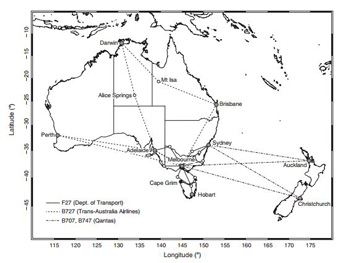
Aircraft air sampling routes for the collection of tropospheric air samples for CO2 analysis during the ’70s and early ’80s.
The December 2017 issue (Volume 28 Number 2) of the Academy’s journal, Historical Records of Australian Science, is now available. This issue contains five articles on the history of Australian science, four biographical memoirs of Fellows, and a selection of book reviews.
The historical articles include an account of the involvement of a physics professor in the development and use of the new medium—radio—in the 1920s and 1930s, a detailed review of the life and work of Australia’s first professor of biochemistry, T. Brailsford Robertson, and further details of the career of nineteenth-century plant scientist, Hermann Beckler.
Perhaps the most significant articles are by those who made their careers in CSIRO studying the influence of greenhouse gases on Earth’s atmosphere. The articles explore the modest beginning of the program, its increasing sophistication as the importance of the phenomenon became more apparent, and the way in which the results obtained have been integrated into a global research effort. The CSIRO work with other greenhouse gases will be covered in future articles.
The biographical memoirs published in this issue honour the contributions of mathematician Peter Hall, geologist Bruce Chappell, marsupial biologist Geoff Sharman and chemist David Craig. Craig’s memoir has also been published by the Royal Society, of which he was a Fellow.
Fellows’ access to the journal is free via a link on the Fellows’ page of the Academy website (requires log-in).
Virtual issue and online early
In a new development for the journal, the publisher and editors brought together articles and biographical memoirs from past issues that described the careers of nine Australian women scientists. This ‘virtual issue’ was made available without charge for three months to coincide with the Science in Australia Gender Equity (SAGE) conference in September.
Another strategy to make the journal more noticeable and accessible was to create the category of ‘online early’ publications. Once editorial processing had been completed, six articles were made available through the website so that they could be accessed before the formal publication of the journal issue. One of these, the biographical memoir of Bruce Chappell, was made available without charge for a month to participants in a conference on granite geology. This was the field in which Chappell was a world leader.
Change to publication months
From 2018, the journal will be published in January and July each year rather than June and December.
Funding awarded by Academy for research projects and conferences
The Academy has awarded more than $200,000 to a number of high-quality research projects and conferences, generously supported by donations to the Academy. In 2018 these will, among other things, fund cutting-edge Australian marine, soil and plant biology research and help the survival of some of Australia’s endangered species. There is also support for specialist conferences on subjects such as the rapid collapse of ecosystems in a changing world.
The Thomas Davies Research Grant for Marine, Soil and Plant Biology fund offers annual science grants of up to $25,000 to early-and mid-career researchers in the field of marine, soil and plant biology. The 2018 awardees are:
- Ashlea Doolette, University of Adelaide: How do Australian native plants survive on low phosphorus soils? New insights using 31P NMR spectroscopy
- Mark Farrell, CSIRO: An innovative method for probing active soil microbial function
- Manoj Kumar, University of Technology Sydney: Identification of the molecular response of seagrasses to heavy metal pollution and ocean acidification
- Zoe Richards, Curtin University: Enhancing coral threatened species management with integrated phylogenomics
- Isaac Santos, Southern Cross University: Coral reef calcification in the Great Barrier Reef following widespread bleaching
- Allison van de Meene, University of Melbourne: Dissecting mechanisms of cell wall deposition and variability for improved understanding of our crop plants and products
The Margaret Middleton Fund for endangered Australian native vertebrate animals offers annual science grants of up to $15,000 each to support field-based, high-quality ecological research of postgraduate students and early career researchers. The objective of the grant is to provide financial support for conservation-based research of Australian ecosystems that ultimately will lead to tangible outcomes for management. The 2018 awardees are:
- Dr Christopher Gordon, University of Wollongong: Interacting impacts of persistent fire regimes and predation on threatened mammals
- Ms Katharine Senior, University of Melbourne: Spatial solutions for managing fire and native mammal conservation
- Ms. Emma Spencer, University of Sydney: Does predation threaten the endangered night parrot (Pezoporus occidentalis)?
Boden Research Conference Award—up to $10,000 of funding is offered for specialist conferences in the biological sciences to enable active research workers in rapidly advancing fields to discuss current advances and problems. The 2018–19 conference is Ecological surprises and rapid collapse of ecosystems in a changing world.
Elizabeth and Frederick White research Conference Award—up to 10,000 of funding is offered for research conferences in the physical and mathematical sciences related to the solid Earth, the terrestrial oceans, Earth's atmosphere, solar-terrestrial science, space sciences and astronomy. The 2018–19 conference is Gas–solid reactions in earth sciences and astronomy.
Fenner conferences on the environment—up to $10,000 of funding is offered for conferences that bring together those with relevant scientific, administrative and policy expertise to consider current environmental and conservation problems in Australia, thereby contributing to the formation of policies that can alleviate some of these problems. The 2018–19 conference is The use of gene drive technology in conservation.
Science meets Business
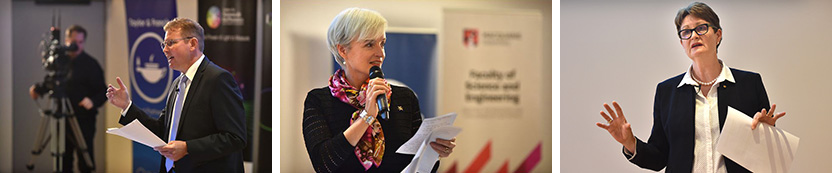
Attending the event were assistant Minister for Industry, Innovation and Science, the Hon Craig Laundy MP; President of Science & Technology Australia and Dean of Science at UNSW, Professor Emma Johnston; and Academy Fellow Catherine Livingstone, Chancellor of UTS and Chair of the Commonwealth Bank. Photos: Mark Graham
Australian science and technology is well placed to seize opportunities to commercialise at home and abroad, according to experts who gathered in Sydney in November.
Leaders in research and investment met at Science meets Business to discuss the future of Australia’s knowledge economy, including UTS Chancellor and Commonwealth Bank Chair, Catherine Livingstone; Assistant Minister for Industry, Innovation and Science, the Hon Craig Laundy MP; Shadow Minister for Industry, Innovation, Science and Research, Senator Kim Carr; and senior representatives from GE, Google, Austrade, and other influential business and research organisations operating in Australia.
Ms Livingstone shared her vision for Australia on the global stage and encouraged the business and research sectors to remain positive.
The event, of which the Academy was a sponsor, was the third time that Science & Technology Australia had brought together cross-sectoral leaders.
The Academy works with many businesses to advocate for science and innovation, and to increase support for school students, young researchers and the work of Australia’s leading scientists.
Australia represented at Falling Walls Lab finale in Berlin
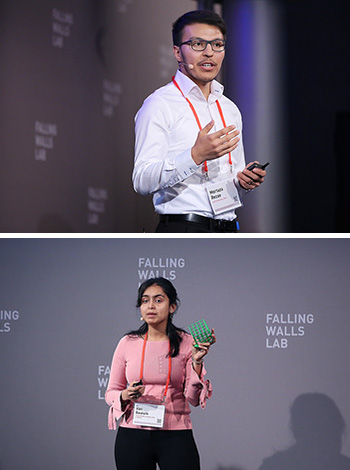
Dr Mortaza Rezae (top) and Dr Vini Gautam represented Australia at the international Falling Walls Lab in November.
The winners this year of Australia’s second Falling Walls Lab, Dr Vini Gautam from the Australian National University and Dr Mortaza Rezae from Curtin University, represented Australia at the international event in November. The Berlin event was attended by 100 finalists and winners from the 49 international Falling Walls Labs held during the year.
The Falling Walls Foundation is a non-profit organisation in Berlin, established in 2009, 20 years after the fall of the Berlin Wall. It asks ‘Which are the next walls to fall?’ as a result of scientific, technological, economic and sociological breakthroughs.
Each year, the foundation supports scientific organisations around the world to host a Falling Walls Lab to promote interdisciplinary connections between aspiring academics, innovators, entrepreneurs, investors and professionals. Participants have just three minutes to present their research work, business model or initiative to a broad audience from science and industry, and a jury selects the most innovative and promising idea.
The Australians received support and encouragement while in Berlin from Academy President Professor Andrew Holmes and Emeritus Professor Hans Bachor. Her Excellency Ms Lynette Wood, Australian Ambassador to Germany, also attended the event.
The winner of this year’s international event was Agnes Reiner from the University of Vienna, for her research on novel blood-based biomarkers for early detection of ovarian cancer.
The Falling Walls conference, held the day following the lab, involved world experts presenting on topics including food insecurity, refugee assistance, global security and ocean pollution. Dr Jennifer Lavers from the Institute of Marine and Antarctic Science, University of Tasmania, spoke on the accumulation of plastic waste in the oceans.
Primary Connections makes STEM connection
The Academy recently hosted a Primary Connections showcase professional learning workshop at Queensland University of Technology (QUT). This was the first workshop of its type, with key stakeholders in STEM education observing part of the workshop and engaging with the 30 primary school educators in attendance.
Primary Connections is an innovative approach to teaching and learning which enhances primary school teachers’ confidence and competence for teaching science. It develops students’ knowledge, understanding and skills in both science and literacy.
The 12 stakeholders at the workshop included representatives of the University of Queensland, QUT, Griffith University, the Queensland Government and Independent Schools Queensland. Professor Srini Srinivasan, a member of the Academy’s Council, and Academy Chief Executive Anna-Maria Arabia also attended.
Throughout the workshop educators considered STEM education in their contexts and delved deeper into the synergies between science and design and technologies.
The event provided a valuable opportunity to discuss the future of primary school STEM teaching and learning.
The learning space, generously provided by QUT, is innovative and inspiring. The Cube is one of the world's largest digital interactive learning spaces dedicated to providing an explorative experience of QUT's science and engineering research.
The Academy gained a great deal in hosting this diverse group interested in primary education.
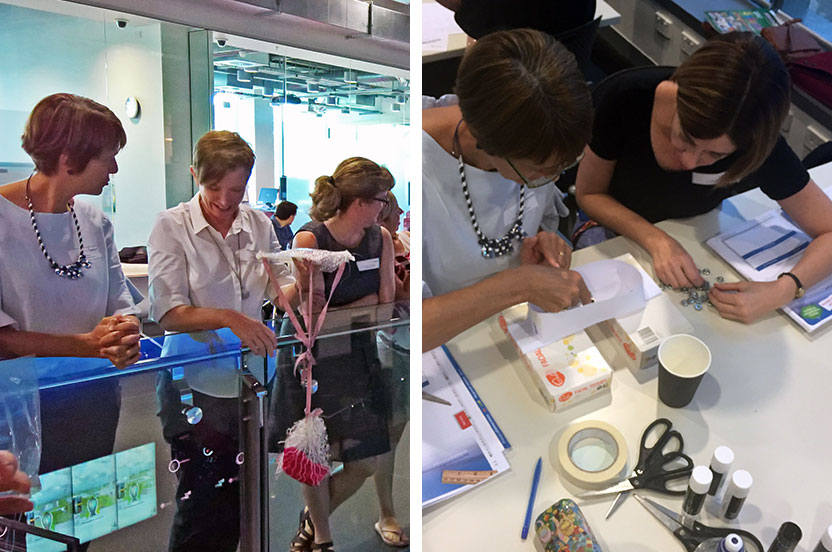
Queensland educators and STEM education stakeholders found the event a valuable opportunity to discuss the future of primary school STEM teaching and learning.
Correctly setting the dial on research

There is a need to improve the processes for, and the outcomes from, the teaching of students at Australian universities. Photo by Štefan Štefančík on Unsplash
The Productivity Commission has added its influential voice to the ongoing debate on the role of universities—in particular, their research and teaching roles.
The long-awaited Shifting the Dial report puts forward a number of proposals to improve the processes for, and the outcomes from, the teaching of students at Australian universities.
However, it emphasises that any changes must not come at the expense of the universities’ research capability.
It is a not a matter of either/or, but both: more and better teaching outcomes; more and better research capabilities.
The report notes that research undertaken at Australian universities has substantial economic and social dividends, in terms of promoting economic and employment growth, and creating new goods and services of value to consumers.
It is also vital for the business models which sustain our universities.
It points out that universities’ research capabilities and output drive their international rankings, which in turn attract international students.
In short, universities can, and do, regard research output (most notably their publications) and the standing of their star academics and faculty as ‘advertising beacons’ for student recruitment and retention showing that research supply drives student demand.
Research undertaken at Australian universities has substantial economic and social dividends.
An economic analysis commissioned by Universities Australia provides some useful estimates of the economic and social impacts of university research.
For example, investment in university research over the past 30 years has added around $10 billion a year to Australia’s national output. Associated improvements in our productivity performance are equivalent to nearly one-third of the growth in average living standards over the same period.
Looked at another way, the stock of knowledge generated by university research is about the same as the entire value-added of the much-higher profile mining, and of the building and construction sectors.
Similarly, research commissioned by the then Department of Education, Science and Training found publicly funded research in Australia generated an economy-wide social rate of return of between 25 and 40 per cent per annum—an enormous dividend by any measure.
Universities have to undertake both cutting edge, world-class research, and deliver teaching outcomes that are valued by their students and other key stakeholders; a mutually beneficial partnership.