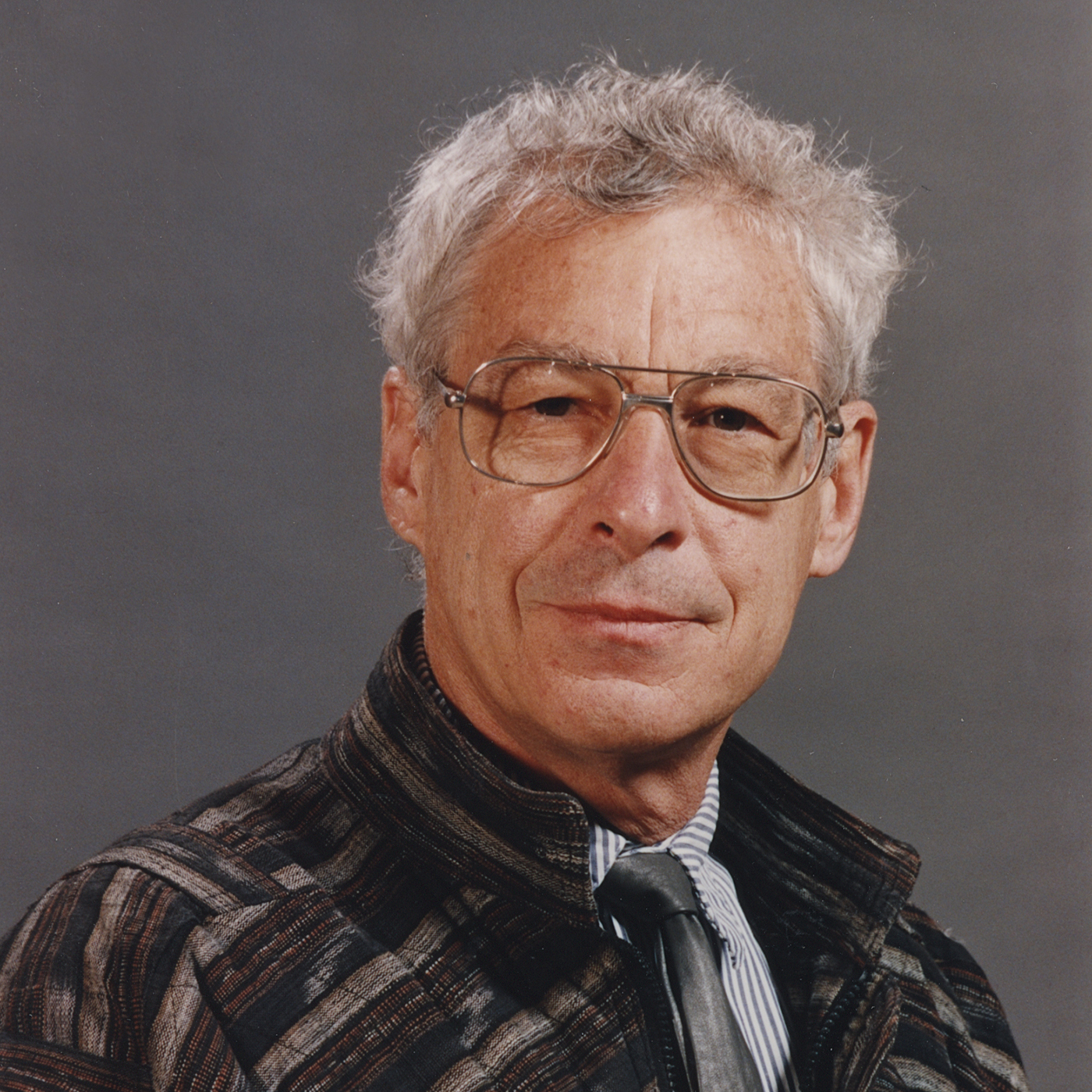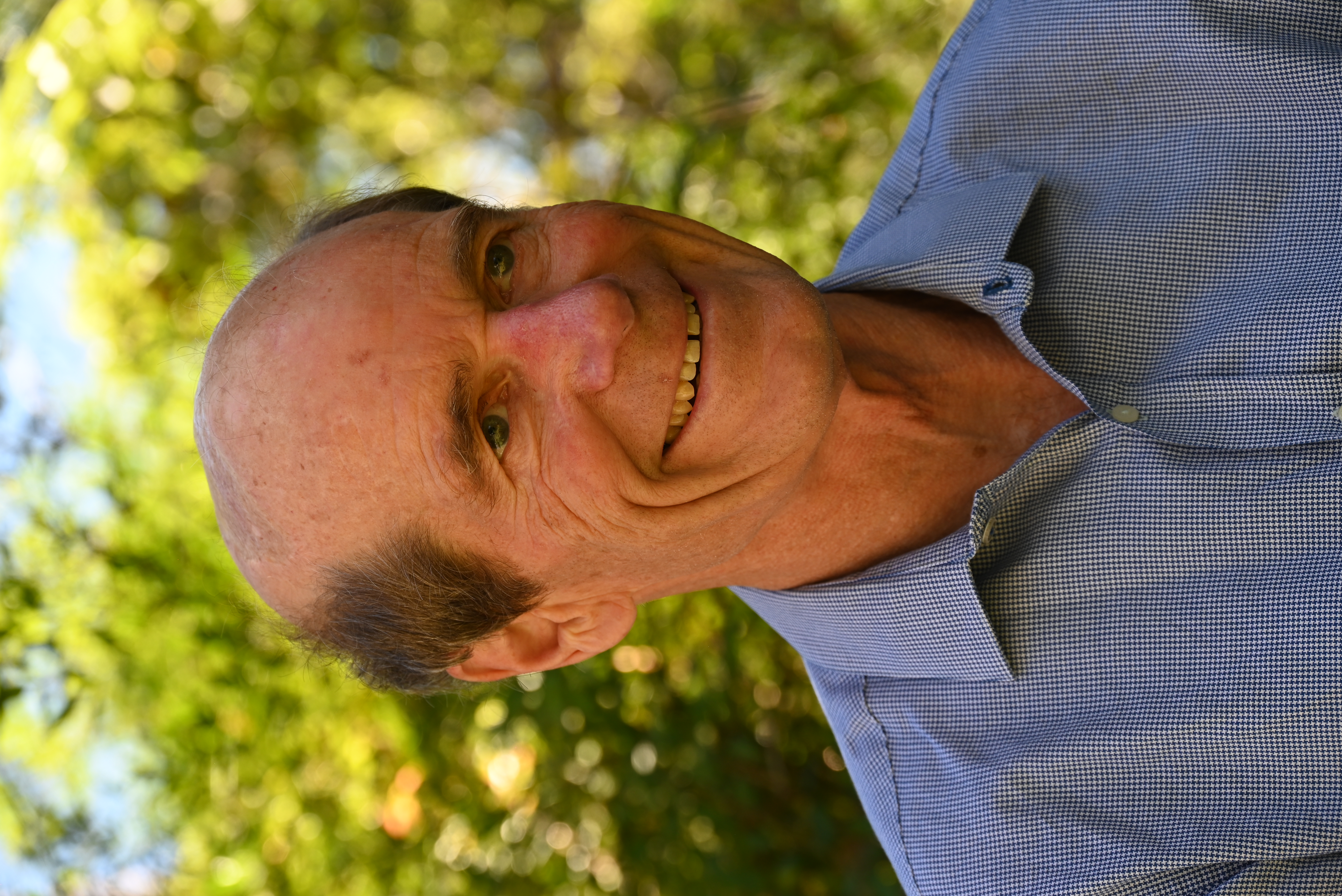


Professor Sam Carey, geologist
Professor Sam Carey received a DSc from the University of Sydney in 1939 for his work on the tectonic evolution of New Guinea and Melanesia. He worked in the petroleum industry in New Guinea and then served with the Australian Infantry Forces from 1942-44. After the war he became chief government geologist in Tasmania and later was appointed foundation professor of geology at the University of Tasmania.
Carey supported the theory of continental drift, explaining the movement of the continents through a model in which oceanic crust was formed at mid-ocean ridges and old oceanic crust underwent subduction at deep ocean trenches. The University of Tasmania became a leading university in tectonics and in 1957 he organised the Continental Drift Symposium, which influenced many scientists about the importance of continental drift.
More information about Professor Carey is available on the Academy's website at Biographical memoirs - Samuel Warren Carey, 1911-2002.
Interviewed by Professor Pat Quilty in 2000.
Contents
- Background and education
- Memories of Edgeworth David and Mawson
- Flotsam: drifting continents and a wayward thesis
- Friend or foe?
- Setting a southern course for geology
- Attracting attention to tectonics
- Dropping anchor in the right place
- A question of best fit: the expanding Earth
- Valued recognition and the art of recommendation
Background and education
Professor Carey, could you tell us a little bit about your family background and perhaps your schooling?
My father was a printer, but he went overseas and became a public lecturer. My mother was born in Australia, of Australian ancestry. I had two sisters and four brothers. One brother was killed by the Japanese during the war.
We lived on a farm three or four miles out of Campbelltown, in New South Wales, and when I started school I had to walk three and a half miles to get there and then walk back again – right from the age of five.
So you were fit from a very early age?
Well, I was fit enough to walk to school and back every day, until we moved almost into the centre of town.
Your interest in science was initially in the area of physics. What was it that got you interested in science, and when was that?
I was interested in science all through high school, because of a good science teacher. In fact, he was teaching physics. The system was that at school you could do physics or chemistry but not both, but I went to university intending to do physics and chemistry. And, although I went there with no chemistry whatsoever, I came top in first year.
To enrol in science at university I had to do mathematics, of course, but I didn’t have a fourth subject. When I asked my physics teacher what to do for a fourth subject, he said, ‘Well, try geology. I did geology under Professor Edgeworth David and I enjoyed it very much.’ I thought, ‘What’s geology?’ but I enrolled in it – and I came top that year!
As the years went by, you were very strong on the role of physics in geology. What changed you from physics itself?
I had no idea of becoming a geologist when I went to university, but I think it was the fieldwork – in geology, it interleaved with the lab work – which caught me. I enjoyed fieldwork, which you didn’t do in physics and chemistry, of course. By the end of first year I had no doubt about it: I was going to be a geologist, a rock-hopper.
What were some of your successes at the University of Sydney?
One of the things I started was the student geology club, the first one in Australia. They then moved for them in all universities. I suppose you could say I was a leader among students.
I understand that when you were going through university you didn’t have a great deal of money, and you took on some other activities to tide you over financially.
I did about 16 hours coaching a week.
Wasn’t there also a role as a magician there somewhere?
That’s right, I used to give magic shows. And they were well paid.
I remember an occasion when my wife Helen and I were going out for dinner one Friday night. We came into your room at the university with our two little boys, who were about five and three. They had been told to behave themselves and sit quietly, but you must have noticed that they were behaving too well. You pulled coins out of their ears and within five minutes the kids were out of control.
The coins would have been shillings. I loved pulling money out of ears, especially my own ear.
Memories of Edgeworth David and Mawson
What memories do you have of Edgeworth David? I noticed you always had a photograph of him in your room at the university.
I knew him quite well and saw a lot of him. When I formed the student geological club I invited him to give the inaugural lecture, which he did. He was already so famous that the theatre overflowed. Several rows of extra seats were brought in. And he came to inspect my rocks when I brought them back from fieldwork, to make sure I had identified them correctly and see how they correlated with others he was working on. David was a very gentle man, very kind and not obtrusive in any way. He wasn’t a big, bull-at-a-gate sort of man at all.
I wonder how David and Mawson would have got on. They were very different personalities. Did you ever meet Mawson?
Oh yes, I knew Mawson quite well. He was one of David’s students, and they would have got on perfectly well. The first time Mawson went to the Pole it was under David, who had gone to the Pole and then asked Mawson to take over, halfway through. Of course, David was a much older man. One of the strange things was that, as dominant a man as Mawson was and as dominant a woman as his wife was, they clicked perfectly – never any quarrels. They always got on very beautifully, although they were so obviously both leaders and obviously different.
Flotsam: drifting continents and a wayward thesis
When you graduated, you went to New Guinea and got involved in tectonics. Why?
Why New Guinea? I had no intentions of that. I intended to go to Cambridge after I had got my Master of Science. But when I was halfway through my year, G.A.V. Stanley turned up from New Guinea, looking for recruits. The only one that was available besides me was scared of the idea of going to New Guinea – he wouldn’t go. So the Professor said, ‘Well, there’s only one other man, that’s Carey. Try him.’ When I said, ‘Oh well, I’m going to Cambridge,’ Stanley said, ‘Come down to our office and look at our maps.’ I went down and looked at all the maps and things they were doing with the natives and so forth – and I was converted. I came home that night to tell my mother I was going to New Guinea.
In New Guinea I was doing ordinary fieldwork, mapping on streams, which were the only place you could get good outcrops. We had another team with a surveyor who worked on the ridges, but my work in New Guinea was entirely in the rivers. I had no idea then of going into tectonics as such; I was just mapping geology, a geologist pure and simple. I hadn’t worked out that I was interested in the tectonics in New Guinea. When I came back I started working on that.
When did you graduate with your Masters degree, and then your Doctorate?
I graduated in the minimum time for Masters – and minimum time for the Doctorate. Nobody has had a doctorate granted in Sydney, even since, in such a short time from graduation. There was no supervisor of any kind for my DSc. People who go for a doctorate now at university have a supervisor. I wrote my DSc thesis entirely myself. I paid a typist – she was very good, actually – and a draughtsman, and paid for my own thesis.
I thought I’d lost the thesis. Because I was writing on New Guinea, they wanted somebody who knew something about it as one of the examiners. They appointed a Dutchman who had worked all his life in New Guinea and in Timor, mainly. My thesis went to him by sea all the way to Holland, but when it got there he was in Timor. So it went by sea all the way back to Timor. By the time it got there, he was in Jakarta – Batavia as it was then – and so it went by sea all the way to Jakarta. And eventually it had to go back to Holland to catch him. But once you’ve appointed an examiner, he is the examiner.
I’d gone back to New Guinea, assuming that I had failed. But in 1938, after about 18 months, after those months of my thesis travelling backwards and forwards across the seas, I heard that my DSc had been granted.
How many examiners did you have?
There were just three examiners: Dr Woolnough, from Western Australia, this man from Holland, and the head of my department, Leo Cotton. He was a good man.
A very famous name in Australian science. How did you make that step from being a field geologist to going into a DSc and an interest in tectonics?
Well, the war pulled me out of New Guinea. All the women were evacuated, and every male in New Guinea had to enlist in the Army, but I and one other were sent back to work on rocks in the Gulf of Papua, looking for oil. It was thought that we might be cut off from American oil, and so we weren’t allowed to enlist. The rocks that we were working on were the ones that finally produced oil, but not there, further up on the highlands – in the same beds, but slightly different facies.
Friend or foe?
You did get involved in the war, becoming a bit of hero as one of the Commandos.
I was no hero. I ended up in Z Special Unit, whose job was to work deep behind the lines. Z was a thousand miles further north of the fighting; it would go along ahead of the front line. But McArthur had come from some other islands up there, had been kicked out of them. He had the island-hopping idea: he was all for going north, right up to Japan – so he changed the pattern of things. He would hop ahead, and once he started doing that, he made Z redundant. I resigned before the end of the war, because Z was no longer needed.
Tell us about putting dummy limpet mines on the American fleet when you were in Z.
That was in Cairns. A limpet is a charge attached to a magnet. The Americans didn’t believe in limpets, but oh, we’d show them that they worked. So we did the lot. Afterwards, the Admiral invited me to come aboard in the evening with such of my officers as I chose. Two other officers and I went aboard. Of course, we’d limpeted every one of his ships, and they would have been dead – sunk – by dawn. But he said, ‘Oh, you didn’t do anything. You couldn’t attach on my ship.’ ‘Oh, couldn’t we?’ I called Captain Cardew, who, being military, responded, ‘Sir!’ and introduced him: ‘My good friend, my 2IC.’ I said, ‘You personally limpeted this ship last night?’ ‘Sir!’ ‘Have you got anything for the Admiral?’ So he went down and de-limpeted the Admiral’s ship while he watched! We had wonderful fun out of that.
There was a lot of activity in science following the war, with a rush of key papers on geology being written in the early 1950s; for example, Anderson’s application of gravity to the classification of faults, and your own rheidity, folding, continental reconstructions. Would these ideas have been going over in your mind, and other serving people’s minds, during the war?
I expect so, but I wasn’t aware of it. I never thought positively about it. You can be unaware of things that are happening in your thinking. They don’t come right to the surface, but they’re still bubbling along in your mind.
Setting a southern course for geology
Near the end of the war, in 1944, you went to Tasmania. Where were you when you applied for the job there?
I was in Melbourne. I resigned from the Army to become Chief Government Geologist in Tasmania. There was an advertisement and I just applied for the job.
While I was Chief Government Geologist, I was appointed to the University of Tasmania's Faculty of Science as an external member, with no idea I would ever become a professor myself. There was no geology department then, or geophysics or anything like that, and I advocated the start of a geology school in the university. When eventually a school was started, in 1946, I applied for the Chair but without any illusions that I would get it. But I did get it and was the first Professor of Geology and Geography.
Geography was part of my department for a couple of years. A lot of school-children did geography to avoid mathematics, so there was a heavy enrolment and eventually geography was separated out. The man who had been my lecturer in geography, Peter Scott, resigned when they announced there was going to be a Department of Geography, so that he could apply from outside. He became the first professor. But he would have been even if he had not resigned, because I was on the selection committee and I knew he was a good man who could lecture well. He had plenty of ability. There was a big field. I think five of those people who were applicants at that time later became professors.
As Chief Government Geologist and then at the University of Tasmania, how did you work with the bureaucracy?
I had no problems, I just fitted in. That didn’t worry me.
Being an independent thinker, did you sometimes have problems with them?
I did what I wanted to! I set the rules.
You were at the university during some of its very turbulent years.
I didn’t know very much about the turbulence at first, because I was down at Sandy Bay and the main university was up at the Domain.
Between 1948 and 1965, the university did change quite dramatically, didn’t it?
Well, it grew, and shifted entirely to Sandy Bay. But I wasn’t deeply concerned about matters of staff appointments or the university’s reputation outside. I just made sure that the Department of Geology and Geography ran well. The two were together then.
Attracting attention to tectonics
You were interested in tectonics in the 1930s, and in Tasmania that became your specialty. Would you like to tell us a bit about the people you attracted to tectonics, people whose minds you changed?
I don’t know whose minds I changed. I know some have changed mine. A person who greatly affected me was Harry Hess, a professor from Yale. He came to Tasmania for the International Symposium I had conceived and organised and invited me to go to Yale. I had a year as professor at Yale, and during that time I lectured at practically every other university in the United States – I’d been invited around.
And then you attracted some students from Yale to Tasmania.
Yes, a few came – Kugler, Jan Smith, some others.
Tasmania was, because of your influence, a leading university in tectonics. In 1957 you had the Continental Drift Symposium. Would you like to talk about how you put that symposium together and some of the people you brought to it?
Oh well, I thought it was the right time to have a symposium on structural geology and tectonics, and we had one. Some people wanted to come but couldn’t. An important man who did come was Longwell, from Yale. That resulted in my being invited to Yale as professor.
That symposium was very, very important. By pulling all of those people together, you started to have an influence in tectonics on the rest of the world. The English-speaking world had not really taken on the idea of continental drift.
They did then. The symposium is still quite heavily quoted, and they made reprints of the volumes – just recently, another reprint.
Dropping anchor in the right place
Of the main characters who came to that 1957 meeting, you’ve referred to Chester Longwell. Was Tuzo Wilson there? I think you had a big influence on him.
He was invited to the meeting but I don’t think he was there. I probably did have an influence on him. He resented it at first and we quarrelled academically on a number of things. But he came round.
Another important person you met was Lewis Weeks, at Princeton University. It was Weeks who put Esso and BHP on to the exploration in Gippsland Basin, which has contributed enormously to Australia’s oil and gas production. He has said that you drew a map of projected anticlines out into Gippsland Basin for him in 1959.
I remember Lewis Weeks very well. I certainly influenced him, and he influenced me.
It is important for professors to know the leaders in other universities, so they can send their students there, but a lot of our professors don’t. They haven’t been there themselves. I don’t know how you can arrange for university men to go round the other universities and see what they are doing. They do so now via literature.
You must have had many opportunities to move to other parts of the world.
Yes, I’ve had many. I was invited to go to Yale, Princeton and California, and perhaps I should have. But no, when I came to the University of Tasmania I said in my application, ‘If I’m appointed, I will not be tempted to go anywhere else.’ And I have stuck to that.
Tasmania has benefited greatly from it. What do you think are some of the advantages of being in a university in a small, isolated state like Tasmania?
I don’t think it’s got any advantages, particularly – unless you make them.
So how did you generate the advantage of being here?
Oh, I don’t know – just by inspiring students.
That has been one of the really strong points in your career. You were very effective in attracting good students to geology, with an unusually high recruitment rate from first year into second year. Why do you think that was?
They must have liked the subject. Anyway, there hadn’t been a geology department and they wanted to get away from mathematics!
I think it is fair to say that you and the staff you recruited were responsible for the very good reputation for geology which your university had, right around Australia.
Perhaps, yes. And Tasmania had a good variety of rocks around, compared with poor old Sydney or Brisbane.
A question of best fit: the expanding Earth
The other thing that you’ve done – and you’re still a bit of a rebel in this regard – is to propose the question of the expanding Earth.
No longer a rebel – they now believe it! At least, they all will eventually. It takes some people a while to catch up.
What made you think of an expanding Earth as the explanation for what you saw? Was it purely that you were fitting the continents together and it didn’t fit?
Well, I put the continents together and there was a big hole. I had to have that or more than half the world as ocean. It seemed to be a better solution, because there was a great area where I believed the edges of those things belonged to each other, across the Pacific. And the north Pacific had rims which belonged to each other.
Valued recognition and the art of recommendation
You retired in 1976, roughly 24 years ago.
Correction: I was retired.
Okay – through the bureaucracy again. What have you been doing with yourself since? 24 years is almost time for another career.
I agree with you there. I am still a member of all the societies and get all their journals, which I read. I don’t throw them away after that; I present them to the university. In fact, quite a number of journals that the university have been getting for years are ones I’ve given to them. They haven’t subscribed. They’ll have to subscribe when I peg out!
During your career you’ve received many awards and been recognised by many different geological societies. Which are the awards that you value most?
I don’t know. There was the Geological Society of London, the Geological Society of India, where I was quoted quite a bit. I have travelled there and had quite a lot of Indian students. As to which I value most – the Geological Society of Australia, probably. I was there when that was first formed.
One of those Indian students was Ahmad, who played a role in a paper – now regarded as a classic – which you wrote on glacial marine sedimentation. In it you referred to Prydz Bay, in Antarctica, as an example of the environment that probably existed during some of the Permian sedimentation in Tasmania. What was Ahmad’s role in that study?
He was my student. I used to advise him perhaps every day. We had long discussions and that came out of them.
You maintained very close ties with industry, in both minerals and petroleum. It was very important to the careers of many young geologists that you recommended them to the various companies.
That’s right. I’d been in petroleum for years in New Guinea and also here, and so it was natural that I still had connections with these companies, and that was an advantage. I had been President of the Institute of Mining and Metallurgy. My background had been through the companies entirely. I started off with Oil Search Ltd – it’s still going now – and I was one of their geologists for a good number of years. I’ve always had contact with the industry. I agree that it was important because I could write to Mr X, in charge of that industry, ‘Such and such a student is a good man.’
It must have been difficult on occasions, though, because industry would have asked you for opinions about some students that weren’t necessarily your highest flyers. How did you handle those difficult situations?
Oh, I would give an honest assessment of their good points. If companies were very careful they would really look for omissions in my statements. The statements would be only of people’s good points, but if you hunted you’d find omissions. That’s the only way to deal with that. You can’t raise it, it’s not to the student’s advantage, but you omit saying anything about it.
You accepted Fellowship of the Australian Academy of Science a long time after it was first offered to you.
Yes. They invited me to become a Fellow but I was in disagreement with them about something I had done. But a good many years later, when they invited me again to become a Fellow, I accepted.
I would just like to say, as one who worked with you in the 1960s and who has kept in contact with you since – as many of your students have – that we look back with a great deal of affection to the role of Professor Carey in our lives. Thank you very much for your efforts this morning.
Thank you. Glad to help if I can. I was fond of my students at times. I tried to help them if I could.
And you were very successful.
Professor Athel Beckwith, organic chemist
Professor Athel Beckwith
Professor Athel Beckwith is an organic chemist whose work has covered a number of areas ranging from theoretical calculations to the synthesis of complex molecules. He is best known for his research into the structure and behaviour of organic free radicals. He is a Fellow of the Royal Society and of the Australian Academy of Science and is also a Fellow and Past President of the Royal Australian Chemical Institute. In the course of his research career he has been the recipient of many prestigious awards and honours.
Interviewed by Professor Bob Crompton in 2003.
Athel, may we begin with your family background?
My parents were both born in Western Australia. My father, Laurence Beckwith, grew up in Katanning, a small town about 200 kilometres from Perth, where his father was a builder and carpenter. My mother (Doris Johnson) grew up in Perth; her father was a joiner and cabinet-maker. At the age of 12 my father, having gained an entrance into Perth Modern School, moved to Perth to stay with his aunt. He never lived in Katanning again.
I guess I'm both Australian and very multicultural – all of my grandparents were born in Australia, but of my eight great-grandparents three were Scotch, one German, one Swiss, one Scandinavian, and two English. They seem to have come to Australia in the 1840s or '50s, the German group moving to the Barossa Valley and the rest to Victoria. My maternal great-grandfather's Scandinavian family owned a trading ship. As they happened to arrive in Melbourne at the time of the gold rush my great grandfather promptly left the family and went to Ballarat. He was never successful as a miner and he became involved with the ringleaders of the Eureka Stockade. He later became a successful professional musician.
I believe that when you went to Europe you delved into your family's history.
We know most about the Beckwiths – I have a detailed history of them back to the 1600s. They lived mainly in Leeds. In Yorkshire there are still many Beckwiths, apparently all descended from one lady, Catherine Beckwith. She had Anglo-Saxon aristocratic roots while the Norman next door had money and land but was not distinguished, so when they married (in Knaresborough, in about the 12th or 13th century) he took her name. The bells in York Minster are the 'Beckwith bells', down in the Minster crypt there are pieces of silver made by a John Beckwith in the 13th century, and there is a village of Beckwithshaw nearby.
Coming to the present Beckwiths, where were you born and when?
I can tell you precisely – on 20th February 1930, in Nurse Stockley's Nursing Home, Havelock Street, Perth. It is so deeply imprinted on my memory because whenever my mother took me, as a child, into Perth by tram down Havelock Street she would say 'That is where you were born'.
What sort of early childhood memories do you have?
I had a very happy childhood. Both my parents were gifted. My mother won a scholarship to go to university in Paris but because of the depression she didn't take it up. My father was awarded one of the few entrance scholarships to the University of Western Australia but he didn't take that up either, because he preferred to study pharmacy. They were good linguists and were very interested in reading and music. Both were excellent musicians. My father performed frequently on the ABC and with various choirs. As a child I was exposed to lots of music, including singing around the piano. My parents read to me in bed, and as I attended a good kindergarten I could already read when I entered primary school.
My maternal grandparents lived with us because of the Depression – both grandfathers had lost their businesses. My maternal grandfather had a great influence on me. He taught me how to use my hands, to do carpentry, to build models, to fish. When I was very young I spent many happy days fishing at Fremantle Wharf.
Where we lived is nowadays part of an inner Perth suburb, but at that time it was at the edge of nowhere. Between our house and the sea there was nothing but bush, where we could wander for hours on end. I came to know the Western Australian flora well and could name all the wildflowers. I fell in love with the Australian bush, and have remained so ever since.
So I spent my childhood building model aeroplanes, swimming, exploring the bush and doing all the things that kids do. It was a very good time, a very easy time.
Was all your primary schooling in Perth?
No. In 1942 families who lived close to the sea were evacuated because of the danger of invasion, so my mother, my grandmother, my two brothers and I went to live in the Porongurups, a beautiful part of Western Australia. I attended Mount Barker School, where a remarkable teacher, Mr Best, taught 6th, 7th, 8th and 9th standards, all in the one classroom. That was very good for us students. We were continually exposed to what was happening elsewhere, and although I was in 6th standard I picked up a lot of algebra, geometry and other subjects taught to higher classes.
Mr Best was the first person to show me a science experiment. He placed a four-gallon kerosene tin with some water in it over a Bunsen. When the water boiled, he quickly put the top on the tin and turned off the Bunsen. As we watched, the tin collapsed – an astonishing event! Air pressure. That first experiment left a lasting impression.
The tiny Mount Barker School had remarkable success in the Scholarship Examination taken by most Western Australian children in their 12th year. I was one of a number of pupils awarded a scholarship to go to Modern School.
As you entered secondary school you suffered a severe illness that could have cost you your life. It had a profound effect on you physically – it left you with persistent lameness – and on your philosophy of life.
That's right. It happened very suddenly. I went to school feeling well, intending to captain the basketball team, but by lunchtime I felt ill. By the afternoon I was virtually delirious and by evening I was unconscious. Because of the pain in my leg it was assumed I had poliomyelitis – infantile paralysis, as it was called – of which there was a serious epidemic at that time, and I was placed in quarantine in the infectious diseases hospital. That was something of a tragedy because by the time my doctors discovered it wasn't poliomyelitis but osteomyelitis, a staphylococcal disease in the bone, they couldn't get me out again. I lay in the infectious diseases hospital for about four weeks before treatment for the osteomyelitis could start, and during those weeks a great deal of damage occurred. I was then taken to the Mount Hospital and had a number of operations. I fell ill on April Fools' Day, 1943, and I did not get out of bed until Christmas Day, 1944.
What drugs were available for your treatment?
When I became ill all that was available in Australia for the treatment of osteomyelitis were sulfa drugs, and although they were partially effective, they were dreadful things to take. Meanwhile penicillin had been developed; if it was taken immediately osteomyelitis could be cured within a fortnight. But it was too late for me, because enormous damage had already occurred and a great deal of bone had to re-grow. Nevertheless, an American serviceman who was billeted with us was able to obtain some US Navy penicillin. It was used at home, under great secrecy because, of course, it was highly illegal (I suspect I may have been the first civilian in Australia to have penicillin – courtesy of the US Navy). It helped, but the disease kept recurring. It was about seven years before it was completely eliminated.
In the end it taught me two things. Having found out how close to death I was I have come to value every day that is available to me. I might not be here, so I should make the most of it. And going through such a great deal of pain has made me very careful about causing pain to any person or any creature. To endure that much pain at age 13 for something like two months leaves its mark.
When you were able to return to Perth Modern School, you did very well, I believe.
The headmaster wanted to put me back a year because I had lost so much time, but he didn't realise that whilst in bed I had busily been doing correspondence classes and reading a splendid book called Wonders of Modern Science, and hence had kept relatively up to date. My mother, who was usually a very mild person, could be rather aggressive regarding the rights of her children. After she had firmly told the headmaster I should stay in the correct class for my year they came to a deal that if I went into that class and succeeded in first term, I could remain there. Because of the schooling I had while in bed, I did remarkably well – apart from Latin. I stayed in the correct class for my age.
Modern School was a marvellous school. When it was called 'Modern' at the time of its creation in the early part of the century it must have seemed extraordinarily modern and it was still modern in the '40s. There was no corporal punishment, it was completely co-educational, a lot of the study was done individually as independent study, and all science was taught in a laboratory. That was really wonderful; I came to realise that the best way to appreciate science is to do it, or to see it being done, rather than simply to hear about it. At that stage I started doing my own science at home, because having a father who was a pharmacist gave me ready access to all the things one needs for the sorts of experiments that young chaps like doing – thermite mixture and explosions, smells, and bangs.
You had an outstanding final year result, didn't you – except for Latin, I suppose!
I dropped Latin as soon as possible, and concentrated on science and mathematics. In those days it was necessary to study English and Art, and I also took music for Matriculation. I obtained Distinction in all seven subjects – the only person to do so in that year. It was a rare event.
You formed many friendships at secondary school, some of your friends later becoming very well known in business and many other fields. And during those years your love of music turned toward jazz, didn't it, Athel?
Yes. I had studied music from about the age of six, and had become quite proficient as a classical pianist. Indeed, I could play Mozart's sonatas much better at age 12 than I can now! It was when I was about 14 or 15 that I became interested in jazz. I studied composition for a while, being taught by a friend of my parents. Knowledge of harmony is a splendid aid to improvisation. I might say that jazz was of great assistance at parties and occasions of that sort. That's the age when one is beginning to be interested in young ladies, and young ladies become interested in pianists who can play jazz!
Later you moved on from the piano to the clarinet.
Yes. Not much later on, probably about the time that I matriculated, I saw a film version of the life of George Gershwin, and I heard the marvellous opening glissando of the Rhapsody in Blue. I thought it was wonderful, and so I took up the clarinet. I was very fortunate in studying privately with Alan Rule, the principal clarinettist in the Western Australian Symphony Orchestra.
Later I joined the ABC Training Orchestra. It had been set up by the Australian Broadcasting Commission to give young people practice in orchestral playing, with the expectation that some of them would later become professional musicians. There were two second clarinets and two firsts, of whom all but myself did indeed become professional musicians.
I loved playing the clarinet, but strangely enough, although it is a jazz instrument, I was never as good at jazz on clarinet as I am on the piano. I often played in dance bands on the piano, but only once on the clarinet. When I left Adelaide, the Chemistry Department gave me a big farewell party, including a jazz band with which I played during the evening.
If only I'd known that, Athel, I would have brought a piano in here and you could have performed for us!
In the orchestra we played with top-class conductors. With Henri Krips we played the standards of classical music: Beethoven, Mozart, Dvorák, and so on. Another well-known conductor, Rudolf Pekarek, introduced us to light music such as operetta, and I came to realise that sometimes music which is regarded as 'light' is often very difficult to play well. I learnt a great deal about music through playing in that orchestra. I continued to play the clarinet in small groups or bands until a few years ago but I never played with a symphony orchestra again.
From secondary school you went on to the University of Western Australia. Can you tell us something about the people there who influenced your interests and career?
The staff of the University of Western Australia included a number of outstanding people. The Chemistry Department was particularly fortunate in having as its head Noel Bayliss, a physical chemist of high international reputation. Doug White, an organic chemist, was an extremely good lecturer who inspired us all by bringing into the lecture theatre samples of natural products, particularly those with interesting odours. He showed how high and low concentrations of compounds can sometimes have completely different odours and how the detection of odours varies from one individual to another. I loved his lectures. Doug White had grown up in the traditional mould and taught us a lot of classical chemistry, but Joe Miller, who had worked at University College with Sir Christopher Ingold, was well versed in the more modern electronic theory of organic chemistry. Robin Stokes, who became a Fellow of the Academy, was also in the Department. So we were very fortunate. It would have been difficult to find a better place in Australia for a chemical education.
It was in fact a particularly good time to be in that Department. During my Honours year Andy Cole came back from Canada, where they were developing the very new technique of infrared spectroscopy, and Doug White had recently been on sabbatical in Zürich where he mastered the new technique of chromatography. So we learnt both classical chemistry and modern theoretical chemistry, we were introduced to new techniques, and we did a lot of practical chemistry. I really liked experimental work – it was a joy to make compounds that had not previously been described. One wondered whether those atoms had ever before been assembled in precisely that way. Watching crystals form in a flask added a very aesthetically pleasing aspect.
You mentioned the electronic approach to organic chemistry. What is that?
The traditional approach to chemistry was to conduct experiments, to determine the nature of the products, and then to try to deduce what had happened. But very little was known of why it happened. Various typical types of reactions could be recognised; treatment of a compound of a known class according to an established recipe would be expected to give a certain type of product. What wasn't known was why one expected it. What were the underlying rules that govern the chemical behaviour of molecules?
Then Robinson and Ingold in the UK developed the notion that chemical behaviour is linked to electronic factors. Since most organic molecules are held together by chemical bonds comprising electron pairs, they suggested that the way in which an organic reaction proceeds is determined by where the charge lies and the way the electrons move. That is, when a new bond is formed electrons move in to form the new bond and away from bonds undergoing fission. Once one understands the electronic approach to chemistry, one can develop predictive rules for molecular behaviour. Instead of just remembering what happens in chemistry, one can predict what will happen and why it happens. That was a very important andvance in the development of modern organic chemistry.
I believe that another important approach you met at university was White's First Rule. What was that?
Doug White was very interested in practical chemistry, and I must say he made us work hard at the bench. We learnt lots of techniques students don't learn nowadays, like glassblowing, and of course all our experiments were done with gas heating and ordinary water baths (fires in chemistry laboratories were quite frequent!). Doug's First Rule was: 'All the best chemistry goes down the sink.' What he meant was that the most interesting chemistry occurs when there is an unexpected outcome. There is a tendency among young students to set up an experiment and then, if the expected outcome isn't obtained, to regard the experiment as a failure and to dispose of the reaction mixture.
Doug said, 'If something has happened that is not what you expect, that is what is really interesting. It may indicate something new. This is how new chemistry is found.' So he would come around and ask, 'Have you had an unexpected result?' If we said the experiment was a failure, he'd say, 'No, it wasn't a failure. There was an unexpected outcome. Tell me exactly what you did. What did you see? What do you think it meant?' He taught us to be curious, to look for the unexpected. I now tell all my students: 'An experiment that you think is a failure may indeed reward you with the greatest find of your life – if you look.'
After those interesting experiences it was on to Honours. Did you do that in WA?
Yes. My Honours project was in two parts. First I worked with Doug White on natural product chemistry, a traditional area of chemistry that was very popular and interesting. One learnt how to handle very small quantities of material, and to purify them by chromatography. This experience was very important for me later on.
One of the great attractions of natural product chemistry was the collection of samples; plants that grow in attractive places were usually carefully chosen. I worked on Pittosporum phillyraeoides, for which the best source near to Perth was Rottnest Island. That necessitated a trip to Rottnest every second weekend to collect more of the plant material.
I enjoyed working with Doug White very much indeed. We made some useful advances – a few papers came out of this work – and it was exciting. But after a couple of months Doug went back to Switzerland and I shifted to a new project with Joe Miller involving research on reaction mechanisms.
The new project fascinated me – I discovered this was really what I wanted to do. Because Joe was mainly interested in the theoretical and electronic aspects of organic chemistry, working with him involved trying to discover why and how reactions occur; to identify God's rules, so to speak, for molecules and atoms. What are the laws that govern their behaviour? How can one use them predictively? These are essentially the type of questions I have pursued for most of my working life.
You got your First Class Honours at the end of 1951 and then became a graduate assistant in your old department. Why didn't you do a PhD instead?
In those days the PhD degree was unavailable in many Australian universities including the University of Western Australia; one could do a Masters degree but not a PhD. I had decided I would probably take a Masters degree anyway. One of the easy ways to do this was to take a graduate assistantship – an academic position, but lowly paid. We did some teaching, including quite a lot of laboratory supervision, but we were also allowed to conduct independent research. It was very good experience.
I decided to keep on working on the mechanisms of reactions. I explored a reaction of some commercial importance, one of the ways by which dyes are manufactured; namely, reactions of substances called diazonium salts with various reagents. Although it was quite successful, there was a serious problem when a particular reagent was used. When one is studying reaction mechanisms, the reproducibility of the experiment is very important. When one measures how fast reactions occur one expects that there should be little variability. But in this case I repeated the experiment many times with completely different results on each occasion – it was utterly irreproducible. I couldn't understand what was going on. Later I returned to this problem.
Among the great joys of being in that university and in that department at that time was the interaction with interesting colleagues. In the university at large there were many returned servicemen from the Second World War. They were mature and gave the university a completely different feeling. My colleagues in our department included Lloyd Zampatti, Geoff Watkins, who then went to work in Great Britain and is now a Fellow of the Royal Society, Don Watts, who is well known in Australia as an academic administrator, Jim Parker, who became a professor at the Australian National University, and Brian Bolto, who became a leading figure in CSIRO. They provided a very a stimulating atmosphere in which to work.
While you were still a graduate assistant, you got a scholarship offer to go overseas. Was that a University of Western Australia scholarship?
Yes. Winthrop Hackett had left a vast bequest to the university, which his executor had thoughtfully tripled before it was used, so the university was relatively rich. It charged no fees and was able to offer overseas scholarships, called Hackett Scholarships. I won one of these to study natural product chemistry for the PhD with Derek Barton at Birkbeck College in London.
But towards the end of that year, before I took up the scholarship, Professor Bayliss told me that he had received a letter from Professor Macbeth saying that he would like me to come to Adelaide as a junior lecturer. Bayliss strongly recommended that I accept this offer. So I did. I wrote to Barton to say I wouldn't be coming to London after all, turned down the scholarship, and prepared to go to Adelaide.
By the time you went to Adelaide you had a wife to accompany you. And you have just recently celebrated your golden wedding anniversary. Tell us about your wife.
Kaye's maiden name was Marshall. She is even more Australian than I. Not only were all of her grandparents born in Australia but also many of her great-grandparents. In fact, one of her ancestors was born in Sydney in 1802, and her family goes back to Captain Cook. At the celebrations of the first centenary of Australia her great aunt was a guest of honour.
Kaye was a secretary and then an accountant. We had very similar interests. We both loved swimming and spent as much time as we could on the beach – hence my skin these days is not as good as it should be. We loved music. At that time I was still playing a lot, as well as singing in various choirs. We both liked books, we enjoyed walking in the bush and we were very keen on the environment. I think one of the reasons we have been very happy together is that we share so many mutual interests.
Kaye later became professionally involved with the environment, being employed as a field officer by the Nature Conservation Society in Adelaide. Then she became interested in local government and was elected as the first woman councillor in the city of Mitcham, and later as the first woman alderman. Those elections provided all of us with interesting times. As well as electioneering, I used to act as a scrutineer and was able from time to time to point out that a bundle of votes had been put on the wrong pile. You've got to watch these council elections! Kaye was very successful as a local councillor and later on it was difficult for us to decide to come to Canberra, because she had to leave all her community work behind.
Did you go by train to Adelaide to take up your new position?
No, we went on the MV Westralia. I don't know why I came later to enjoy sea travel, because that was really not a very good voyage. At that time, however, it was the easiest way as any of getting across the Bight to Adelaide.
The sea was extraordinarily rough. Every meal was served on wet tablecloths and the seats were tied down. Even when one lay on the deck there was a danger of rolling overboard. One passenger, like us, was on his honeymoon but without his wife, because she had become so ill en route from Adelaide to Perth that she had to return by train!
You had a very gracious introduction to academic and social life in Adelaide, I think.
Oh yes, much more gracious than it would be nowadays. On the first day I went in to the Chemistry Department to meet my new Professor, Killen Macbeth, who said, 'Well, before we get down to mundane matters like teaching and so on, I have some important things for you to do. I have an appointment for you with the Vice-Chancellor, who would like to meet his new member of staff, and then you should go to Government House to sign the Visitors' Book, because the Governor always likes to invite people from the University to come to dinner. And then you should take tea with Hedley Marston.'
So I did all of those things. It was very nice to meet the Vice-Chancellor, we were invited to receptions at Government House, and I was very pleased to meet Hedley Marston, one of this country's most colourful scientists. Perhaps I had an introduction to him because his division of CSIRO was next door to the Chemistry Department, and there was a good deal of collaboration between them.
What was it like to teach at Adelaide in those days, Athel?
My teaching load wasn't particularly heavy but it was a shock, because I came as an organic chemist but Professor Macbeth asked me to teach third-year inorganic chemistry and third-year spectroscopy. The spectroscopy was not too much trouble – I had received good training in that – but inorganic chemistry was probably the weakest branch of chemistry in Western Australia, and I knew little about it. So I kept one lecture ahead, leafing through Emeléus and Anderson, the textbook of the time. Also, I was so relatively young that many of the people in the class were older than me and it was pretty daunting. Not only were there ex-servicemen but also a number of refugees who had come to Australia to avoid the turmoil in Europe. One of them, Tom Kurucshev, who was certainly older than I, later became my best friend, and quite a distinguished physical chemist in Adelaide.
Round about this time you realised that you really ought to have a PhD.
Yes. During that time in Adelaide, almost two years, my own research went quite well. I continued to do natural product chemistry and some mechanistic work involving completely new systems. We found new ways of making some important compounds related to thyroxin, the natural hormone that occurs in the thyroid gland. That work was very interesting and also quite significant. But towards the end of the first year I decided that if I intended to continue with academic work, I really should go overseas to take a PhD.
I successfully applied for a CSIRO overseas scholarship (the expectation by CSIRO was that, in return, I would come back to work with them). Part of the deal was that I should discuss with the appropriate authorities in CSIRO what I wanted to do, so I went to Melbourne to see Ian Wark, Chief of the Division of Industrial Chemistry. He gave me some extraordinarily valuable advice.
First he asked just what I intended to do during my scholarship. I told him that I thought I should work with Derek Barton. I had already turned him down once. He was one of the great chemists of this century. Ian asked, 'And what will be your research area?' to which I replied that I would study natural product chemistry.
But Wark went on, 'Is there anything else you're interested in?' 'Yes' I said, 'I conducted some experiments during my Honours year that gave completely irreproducible results, and I am beginning to think they might involve free radicals. I wouldn't mind learning more about them at Oxford, with Professor Waters.' Wark said, 'Take my advice. Go to Oxford. In science you should always choose the new, the more adventurous area. Natural product chemistry is a well-ploughed field where many people have gone before. If you work on free radicals, you will be at the beginning of something new. It's dangerous, because nothing may ever come out of it. But if you want to do something really useful in science, always choose the field that is innovative and at the birth of a new area rather than at its middle age.' So I decided to follow his advice – it was a wise choice.
Perhaps this is the time to ask you to explain what is meant by free radical chemistry.
Free radicals, in solution, were first described in 1900, by an amazing pioneer called Moses Gomberg. Chemists had tried for years beforehand to make free radicals without success and had concluded that they didn't exist. Then Gomberg announced that he had successfully generated them, and indeed we now know that he had. He is also famous for a memorable footnote to the first paper, which was published in 1900 in the American Chemical Society Journal. Having described these new species, these free radicals, he notes, 'This work will be continued and I reserve the field for myself.'
In fact, he needn't have worried, because nobody else was very interested. Most scientists didn't believe he had actually generated organic free radicals in solution. And even at the time that I was entering the field, there were still many chemists who had similar doubts. There were a great many polemical articles in the scientific literature, with some chemists maintaining that organic radicals can't exist in solution. Others were convinced that they could. There were very few people seriously working in the field of organic radicals in solution – a couple in Great Britain, a couple in America – I suppose six people, in all, in the world.
Free radicals are very reactive molecules. All the more familiar organic compounds, such as sugar, alcohol and acetone, are stable; they can be stored for long periods without change. They are stable because they possess an even number of electrons arranged in pairs. The bonds between the atoms consist of pairs of electrons; a pair of electrons is a stable arrangement. Furthermore, around most of the atoms in such molecules there are eight electrons in four pairs. This is a very stable configuration.
However, if one of the two-electron bonds in such a molecule is broken by irradiation of a sample with light or by otherwise applying energy then one of the ways a bond may break is by each half taking one electron. There will then be two new molecules each of which has an odd number of electrons. Inevitably one of those electrons must be unpaired and that is a very unstable state. These newly formed highly unstable, and hence highly reactive, molecules are free radicals.
Are there now two free radicals, or one?
If a bond in an ordinary stable molecule is broken symmetrically, two free radicals are generated. Each new molecule has an unpaired electron, and the formal description of a free radical is 'any atom or molecule that contains an unpaired electron'. Hence any species that has an uneven number of electrons must be a free radical. Indeed any species that has an even number of electrons but has, for some reason or another, has two of the electrons unpaired is also a free radical (a diradical).
Because free radicals have an unpaired electron, they are inherently extremely reactive. To return to a stable state the unpaired electron must couple with another electron to form an electron-pair. One of the great virtues of free radicals is that they will often react with organic molecules at positions that are normally resistant to attack.
So your task in Oxford was to find out more about free radical chemistry?
Yes. The electronic theory that I have already mentioned was initially based on studies of ionic substitution reactions of aromatic compounds such as benzene. My obvious goal was to determine what happens when free radicals attack aromatic compounds. It was known that the reaction mixtures would be very complex but nobody knew exactly why, and there was great confusion about the precise reaction mechanism. That was my problem, and I think I solved it in the course of my DPhil work. The mechanism of radical aromatic substitution was more or less clarified.
You did extraordinarily well, getting your DPhil after two years.
This is where my background training became so important. Doug White had taught me all about chromatography during my Honours year. It was, however, still a fairly new technique when I went to Oxford and I found that I knew far more about it than any of the other members of the group. Without that technical expertise I think we would not have made the progress that we did. It is the method par excellence for separating the types of aromatic compounds we were dealing with. As they fluoresce under ultraviolet light they were easily detected on a chromatographic column.
Did you say you went to work with Professor Waters?
Yes. At that time there were two chemists in the UK working mainly on organic free radical chemistry. Waters had published a book in 1946 and a little later a review with Donald Hey. Both generated considerable controversy because they claimed that many well-known reactions in common use were actually free radical reactions. Many chemists didn't believe them, and there was a vigorous argument about it in the literature. Even in the department in Oxford there were some people who thought we were way out on the left field. Sir Robert Robinson, Nobel Laureate, one of the great men of organic chemistry said when he first met me, 'You're another one of these idiots who believe in free radicals.' What an introduction!
Waters was very knowledgeable and a wonderful supervisor to work with. By and large he left one alone as long as things were going well. He encouraged you to think for yourself. We would meet only once a week because he was busy with his college duties and his teaching. Every Saturday morning he would wander round and talk to each of the students separately about his research. The group that worked with Waters in an area that was regarded as rather dubious by some in the department was tight-knit, with a very good collegiate spirit. Many of them later became well-known chemists.
What were your impressions of Oxford?
It was wonderful. There were many interesting activities available, and many interesting people. Bob Hawke was there – I've known Bob since the age of nine when we were close friends at primary school. He was a year ahead of me at Perth Modern School, and was also at the University of Western Australia while I was there. In Oxford we went to many social events together.
My wife and I loved college life. Kaye became a 'licensed boarding-house keeper' so that we could keep one or two students there as boarders. They helped out financially, as the scholarship didn't go very far, and they were built-in sitters for our baby daughter, which meant we were able attend a variety of interesting cultural events in Oxford. We became very fond of Oxford City and the Oxfordshire countryside.
Was that the time when you gave your first talk to a fairly prestigious gathering?
Yes, that was at the Chemical Society and occurred straight after my time at Oxford. I finished my DPhil work and the degree was conferred somewhere about October 1956. We had arranged to come back on the Strathaird, leaving London in about November. We left Oxford with clothes for two weeks, having sent all the rest on ahead as we intended to have a final holiday in London before we sailed to Australia.
We had been in London for about three days when the Suez War broke out. The P&O Company wrote to me to say that the Strathaird was stranded in the Red Sea and that we couldn't expect to leave London for a considerable time. The CSIRO was very good and kept my scholarship going while we waited in a London flat. I started to work again. I used to commute to Oxford to work with Dick Norman and with Prof Waters, and I also worked at home in London.
During that period the Chemical Society wrote informing me that a special meeting was to be held in London and inviting me to attend to describe my DPhil work and related chemistry. That was the first time I addressed an important audience.
We didn't leave London until some time in February, so in many ways we were 'down and out in London'– it was an expensive place even then. We lived in a little flat in Chiswick. Rolf Harris, who I had known at secondary school, used to visit us fairly frequently and we would sit in the kitchen, all with our feet in the oven to keep warm! It became rather essential for us to get to know every free, warm place in London; the hothouses at Kew Gardens, the Butterfly House at the Zoo, and of course all the art galleries. My small daughter became very well trained in art appreciation.
At that time many students had volunteered to help the Hungarian Revolution. We joined the cause by raising money. We did quite a deal of doorknocking around London and through this became friends with many interesting people, including some politicians. We were invited to the House of Commons.
Eventually the Strathaird did take you to Australia?
Yes, but very slowly. We broke down on the way and had to spend a week in Cape Town when the Apartheid era was at its height. It was an interesting but depressing experience. We saw the flora of South Africa, which is very colourful, and visited the coast.
When you returned to Australia and got to CSIRO, what research did you do?
I worked in a team headed by Dr H H Hatt. My task was to find commercial uses for wool wax. He suspected, quite rightly, that wool wax would be very useful if one could find a way of functionalising it (ie, replace some of the hydrogen atoms with oxygen atoms, or other non-carbon atoms) at positions in the wax molecule remote from the normal reactive group. Typically a wax molecule is a long chain, comprised mainly of carbon atoms and hydrogen atoms with an acid or an ester group (the reactive group) at one end. Hatt wanted me to devise a method to replace a hydrogen atom at the remote end of the molecule with an oxygen substituent.
Now, that's a really difficult problem, because a wax molecule contains a large number of hydrogen atoms. Why should any reactant selectively displace only one hydrogen atom at the end far from the existing reactive group? We tried all sorts of ways of doing this, and were quite unsuccessful. But I did make one interesting discovery, which later turned out to be rather significant.
There are many components in wool wax, but perhaps the best known of them is lanosterol a compound rather similar to cholesterol, a large molecule consisting of carbon and hydrogen atoms with only one oxygen atom at one end. Browsing through the literature I found the surprising report that cholesterol, after prolonged storage, often contains 25-hydroxycholesterol, a compound that contains two oxygen atoms, one at each end of the molecule. The question was why should cholesterol on ageing be converted selectively into such an unexpected product. This was an unprecedented and quite astonishing transformation. Was the report accurate?
So I wrote to friends around Australia saying, 'Please have a look in your store. If you have any cholesterol in a sealed bottle please send me some, with the date when it was purchased.' I analysed all these samples of cholesterol by means of spot tests and paper chromatography and found that indeed most of them did indeed contain 25-hydroxycholesterol. Furthermore, the amount of 25-hydroxycholesterol increased with age.
I conducted experiments to see how this unexpected product could be formed. Since I considered that the reaction must occur on the surface of the cholesterol, we treated crystalline cholesterol with pure oxygen and radical precursors under forcing conditions, using UV light. I had some absolutely spectacular explosions while doing this. It was quite dangerous work. I found that 25-hydroxycholesterol was formed. We had, as it were, accelerated an oxidation process involving attack of oxygen at an unexpected position remote from the existing oxygen. When conducted under normal conditions, reactions of cholesterol in solution proceed at positions adjacent to the existing substituent – never at the remote end. Why should this reaction of crystalline cholesterol be so different?
The structure of crystalline cholesterol provided a clue. The crystals are long, very flat, and very thin and the surface layers comprise cholesterol molecules with their unsubstituted tails sticking out. You can imagine the surface as closely packed molecules, side by side, each with the normally reactive end within the bulk of the crystal, and the other end exposed. It then occurred to me that reactions of crystalline cholesterol with oxygen occur at the normally unreactive end (the 25-position) because that is the only part of the molecule that the gaseous reagent can approach.
This work led to two important conclusions. One that I pursued later is that reactions on solid surfaces can often be quite different from reactions in solutions. This has important implications. The second was that oxygen-centred free radicals (formed by UV irradiation) are capable of removing a hydrogen atom from an unactivated carbon-hydrogen bond, that is one remote from an activating substituent. This is a most useful feature of free radicals that distinguishes them from other reagents. The big problem with most radical reactions is to persuade them to selectively attack the chosen hydrogen. The experiments with crystalline cholesterol showed one of the ways in which it can be done, that is by having each molecule closely packed on a crystal surface with each sheltered, as it were, by its neighbours.
Despite that success you didn't stay very long in CSIRO, did you?
No. I'm not too sure why I moved, except that CSIRO had rather restrictive rules about lab work and when one could come and go. I was used to the academic approach – when one had a bright idea, even if it was at 7 o'clock at night, one could hop in the car, go to work and do an experiment. So when it was made clear to me that I would have a strong chance of getting a good job at Adelaide, I applied, and was appointed. I moved back to Adelaide in early 1958, this time as a lecturer, a fully tenured staff member.
This second sojourn in Adelaide, from 1958 to 1981, was longer than the first. Your research interests at this time, I gather, were in the general area of the properties and behaviour of reactive intermediates. What are reactive intermediates?
A reactive intermediate is a molecule that is much more reactive than normal, and will usually occur only as an intermediate in a chemical reaction. It is halfway between two stable molecules, the starting material and the product. A free radical is a typical intermediate. Organic free radicals typically have lifetimes in solution of something like 10-4 to 10-9 seconds. That's an extremely short time when compared with ordinary stable molecules.
Many reactive intermediates are electron deficient. A free radical is electron deficient by having one electron missing. Other reactive intermediates such as carbenes and nitrenes lack two electrons – they have only six electrons in the outer shell of the reactive atom. The electrons can be arranged in three pairs, in which case there are two missing from the outer shell, or in two pairs and two single electrons. In each case the intermediate is electron deficient. They are still highly reactive because essentially they seek to attain a stable configuration with eight electrons in four pairs.
Not every reactive intermediate is a free radical. Only those intermediates in which the electrons are unpaired are free radicals. For example, if a carbene has six electrons as three pairs, with one empty orbital, it is not a free radical – it doesn't have an unpaired electron. Alternatively, if a carbene has two orbitals, each with a pair of electrons, and two more orbitals each containing one electron it is a radical. In fact, it is a diradical. It has two unpaired electrons and hence exhibits radical behaviour.
I have a special interest in your early years in Adelaide, as we were contemporaries and I knew the people in your department, Badger and Jordan. How did your research progress?
It went pretty well. I had come back from Oxford imbued with the idea of free radical research. We studied new types of radicals, and were particularly interested in radicals containing sulfur. One reason was that they are of great theoretical interest. Another was their possible implication in the induction of cancer. Geoffrey Badger was very interested in carcinogenesis – the process by which some aromatic hydrocarbons, particularly the larger ones like benzpyrene, have the property of inducing cancer in the skin of an experimental animal (or, for that matter, of humans). The question was how does this come about.
Our first experiments showed that sulfur radicals have the capability of binding very quickly to such polycyclic hydrocarbons, and we began to wonder whether this was the basis of their carcinogenicity. So we carried out quite an extensive study. We found that aromatic hydrocarbons do indeed react very rapidly with thiols (sulfur-containing compounds) in the presence of oxygen by a radical mechanism, and that this reaction is not limited to simple chemicals but extends to naturally occurring compounds that contain thiol groups, like glutathione, cysteine (one of the amino acids), and proteins such as bovine serum albumin. Perhaps carcinogenicity arose somehow because of such bonding to sulfur in components of the skin. Our subsequent experiments showed that carcinogenic aromatic compounds do indeed react very well with naturally occurring thiols.
Eventually we found that such reactions are not involved with carcinogenesis. However, when we returned to this work later these reactions proved to be very useful synthetically. Also they were related to important biological processes.
Were you working closely with Badger in those days?
Not particularly closely but we did have similar interests. At that stage he was very interested in pyrolysis, and how carcinogenic compounds are formed at high temperatures possibly via radical intermediates, because it was known by then that tars and smokes have the capacity to cause cancer. For this reason chimney sweeps were very prone to cancer.
A somewhat lighter episode occurred at the University of Adelaide, concerning Vice-Chancellor Rowe. Would you like to tell us about that incident?
I was a fairly lowly member of staff so I don't suppose Mr Rowe affected me very much, but I do know that his ideas for changing the way in which the university operated aroused considerable resentment among many staff and students. I think he had managed to put the students off side by being quite rude to them at a meeting.
At that time there were scare stories in the media about the Abominable Snowman, a strange animal that supposedly lived in the Himalayas and left footprints in the snow. So the students called Mr Rowe the Abominable Roweman. One morning when I came to work, there was a great kerfuffle – people standing around everywhere, the Registrar looking very upset – because leading from the Vice-Chancellor's house (which in those days was on campus) were some large white footprints. They went from his house through the campus, dropped in at the ladies' lavatory, came out again, followed one of the paths and then went right up the side of the Bonython Hall. And, on the top of the little tower above the Hall, there was the Jolly Roger flying!
The Registrar said, 'Ah! We've got 'em!' and there was a great hue and cry up the stairs, but nobody was found in the tower. There was just an ingenious mechanism for hoisting the Jolly Roger, and some time later the ropes, ladders and other apparatus that had been used was found in the ceiling. It must have been a very dangerous exploit, painting the wall of the Bonython Hall in the middle of the night. I don't know to this day who actually did it, but at the time it was thought to be one of the better student japes.
Late in 1961 you felt it imperative to become acquainted at first hand with the work of Barton at Imperial College, London, so you applied for and were awarded a Nuffield Foundation grant. What was so exciting about his work?
Barton was a really outstanding scientist, one of the great chemists of his time. Only Woodward, from Harvard, could compare with him. Barton had a fresh way of looking at chemistry. He was a good theoretician and very intuitive. He had a comprehensive knowledge of chemistry, and great powers of deduction.
For example, after I joined his group I heard a visiting lecturer explain how he had been attempting for many years to deduce the structure of a certain natural product. He said he had not yet been successful but he would show us all his results to date. Barton said at the end of the lecture, 'I've considered all your results and I can now tell you what the structure is.' He then drew the correct structure on the board. The visitor had worked on this problem for many years without success, but Barton was able, in the course of a single lecture, to solve it.
Barton shared a Nobel Prize for introducing the concept of stereochemistry. We had all become accustomed to drawing chemical structures on paper and hence to seeing them in two dimensions. Similarly we would see a cyclic molecule such as cyclohexane (A) as a flat ring with the hydrogen atoms around it as being equivalent. Barton, together with a couple of other scientists, pointed out that this was wrong.
One has to envisage a molecule in three dimensions (structure B). When one does that, you observe that the hydrogen atoms are not all the same. Some are above the ring, some below, and some approximately in the plane – they are spatially different and hence they are chemically different.
Barton pointed out that this chemical difference really exists. He showed, using three-dimensional models, that the hydrogen atoms bonded orthogonally to the general plane of the molecule – called axial (Hax) – have reactivity different from that of the equatorial atoms (Heq) which are within the plane. This had profound implications. So I went to study with Barton to
learn more about stereochemistry and his approach to chemistry. His laboratory was a very exciting place in which to work.
After your year in Imperial College you came back to Adelaide. Was that when you first met Ian Ross?
Yes, indeed. I was working with carbenes at that time. Although during my life I have worked mainly with free radicals, from time to time I have examined other reactive intermediates such as carbenes and nitrenes. I explained to you a few moments ago that these compounds can exist in two forms – the singlet, which is still very reactive but has all its electrons in pairs, or the diradical form, the triplet. I found that I could generate these intermediates in one form or the other, depending on the experimental conditions, and hence could study the difference in reactivity between them.
We soon noticed that one form changed relatively slowly into the other. I consulted with Ian Ross, a spectroscopist and expert theoretician who was in Canberra at that time, to help me decide what controlled the rate of change. We reached interesting conclusions about the energy relationship between one form and the other.
In Adelaide you received rapid promotion to Senior Lecturer and then Reader, and finally – aged only 35 – to full Professor and Head of the Department of Organic Chemistry, replacing Geoff Badger. You introduced quite revolutionary innovations in departmental governance. Did your changes coincide with a general move in the University of Adelaide toward more democracy, under the leadership of Badger when he returned from his brief period at CSIRO in Canberra to become Vice-Chancellor? Or did you lead the charge?
I wouldn't say that I led the charge – I am not sure that there was a charge; it was more a single-handed approach. But I thought, being new to the Chair, that it was time to do things differently, and in particular to involve the staff much more in decisions about how the department was organised, how we taught, what we bought and, and so on. I set up a departmental committee that met about once a month to discuss all matters concerning the running of the department. Some decisions were relatively important, such as the ordering of chemicals, the siting of laboratories, and the buying of large equipment, but others were quite minor – entertaining visitors for example.
I took the view, which I still hold, that these sorts of committees should be advisory. I believe that if you are the head of an organisation you accept the responsibility for it. You take the blame for what goes wrong, so the final decision must be yours. But, although these were advisory committees, there were very few occasions when I didn't agree with what the committee recommended.
In 1968 you had a year's study leave in York, where you were introduced to electron spin resonance – yet another technique that became very important to your work.
That's right. Electronic spin resonance spectroscopy was a wonderful technique that had been developed immediately after the war. Essentially, it enables one to see the positions of unpaired electrons in radicals and to determine the nature of their environment. An electron spin resonance (ESR) spectrometer contains a very large magnet and a klystron, a device for generating microwaves that are led down a waveguide into a 'cavity'. The cavity is the area within the magnetic field where the sample goes. The results are recorded on a computer and can be printed.
The basis of ESR is that an unpaired electron can be regarded as a minute spinning electric charge and hence has its own magnetic field. In accordance with quantum theory, once an electron is placed in an external magnetic field it can take up only two orientations, either parallel to the external field or antiparallel, which have different energies. If an electron is irradiated in a specific magnetic field with microwaves of exactly the right frequency, some of the electrons in the lower energy form absorb microwave energy and move to the higher energy form. The ESR spectrometer detects the resulting absorption of energy.
The important thing from our point of view, however, is not just detecting a single electron. That gives only one absorption. In typical radicals there are many types of atoms that are also magnetic. The proton, for example also has a magnetic field, and hence assumes two energetically different orientations in an external magnetic field. The magnetic field of the proton affect the magnetic felt by the single electron. It will be sensitive to all of the nearby magnetic nuclei. Typically, in an organic radical these will be protons, deuteriums, carbon-13, oxygen-17 and others. Hence the microwave absorption spectrum reveals the molecular environment of the unpaired electron. This is a wonderful technique. Not only did it resolve for all time the arguments about the existence of certain organic radicals in solution but it also revealed details of the structure, shape, configuration and electron distribution that had not previously been available. A typical ESR spectrum, which is a plot of absorption of energy against magnetic field, has a multitude of lines.
Not frequency?
No. The spectrometer contains a large main magnet, which is set at a predetermined field, and some small subsidiary magnets, which allow this field to be changed. Normally the field is slowly increased over time, while the sample is exposed to microwave radiation led down the waveguide. When the field strength is exactly that required for the microwave energy to match the energy difference between the two orientations of the free electron absorption occurs, is detected, and is displayed as a plot of absorption against field strength. For various technical reasons it appears as a first derivative curve. The plot might then show, for instance, just two absorption peaks indicating that the unpaired electron is adjacent to a single proton. In other cases the plot can be very complicated.
The ESR spectrum of the allyl radical provides an illustration of the utility of the technique. The structure of the allyl radical is often depicted as having a double bond at one end and the unpaired electron (depicted as a small black dot) confined to the other terminal carbon atom (Structure A). However, ESR spectrometry shows very clearly that the unpaired electron interacts with a single proton (Ha), with a pair of equivalent protons (Hb), and with a second pair of equivalent protons (Hc). Hence in agreement with theory the true structure of allyl radical is planar and the unpaired electron is delocalised, that is to say it is spread over three atoms but resides mainly on the two terminal atoms. The two C-C bonds are equivalent (Structure B).
ESR spectrometry led to some enormous advances in radical chemistry. Not only did it confirm that radicals can exist in solution, but it also revealed their lifetimes, their compositions, their shapes, on which atoms the unpaired electron resides, and what reactions they can undergo. In short it revolutionised research on the structure and reactions of organic free radicals
Just before you returned from York, you were awarded a Carnegie Fellowship and made a very extensive tour in the United States, going to about 30 universities and giving lectures at nearly all of them. It must have been an exhausting time. You went to Canada too. Was that when you met Ingold for the first time?
Yes. On that trip I met many people who became close colleagues. One was Cheves Walling, from Columbia, and another one was Keith Ingold of the National Research Council in Canada who I met at a meeting at Santa Barbara. I was already aware of his work – we found that we had very similar interests and have worked closely together ever since.
Then it was back to Adelaide in 1969. Your work took a new direction now, because you could bring knowledge of this new technique. You had to buy an ESR spectrometer, which I am sure didn't cost tuppence ha'penny. How did you do it?
In those days, I seem to remember, one could submit ARGC applications more frequently than one can now. I suppose it must have been about March when I put in an application for an electron spin resonance spectrometer. Only a few weeks later I had a meeting with Bob Robinson, the Chairman of the ARGC. He said, 'This seems to be an important project. It just so happens we have some money left over from last year, so how would you like to go and buy a spectrometer now? Have the deal finished by June.' And I did. With the availability of the spectrometer we were able to explore many new aspects of radical structure and reactivity. It was a very productive time.
Your work in Adelaide collided unexpectedly with radical student politics, didn't it?
Yes. Before I went to York, I had discovered a completely new reaction involving lead tetra-acetate. It was one of those cases where White's Rule applied, where something completely unexpected happened and it turned out to be extremely useful synthetically. This was rearrangement chemistry, not free radical chemistry. Anyway, I published some papers – in fact, they were sent off for publication while I was in York.
When I arrived back to Australia there was a letter from the Maumee Chemical Co., in America, saying essentially that they were very interested in this work. If I were agreeable, they would take out the patent in my name so that I wouldn't have to do all the hard work of preparing it, and then I would assign the patent to them. There would be a nominal fee by law to you of exactly US$1, but they would make appropriate payments to the Department and the University. I asked the university authorities what I should do, and they said that I should first of all explore the possibility of this discovery being used in Australia. I did that, but the market for these chemicals was really a world-scale market and a world-scale plant would be needed to make them. As this was simply not feasible in Australia the University agreed to proceed with the deal with Maumee. So we did. The patent was prepared and sent to the University to be signed off.
At just this time, however, in response to a great deal of activism by the Students for Democratic Action, and other left-wing radical student groups, the University had decided it would open its Council meetings for the first time – observers would be allowed to attend (I should add that when we were in England and America in 1968 we had noticed a lot of student radicalism) 'But,' the University told the students, 'You must understand that some matters will be commercial-in-confidence. We will place those items on the agenda but you will not hear the discussion or the full details.'
The students at this time were very upset about the 'industrial-military complex', the way in which universities were 'helping the forces of evil'. And when they attended their very first open Council meeting, expecting to find out the worst, the first thing they saw on the agenda which was labelled 'Confidential' was an item: 'Agreement between Professor Beckwith of the Organic Chemistry Department and an un-named American company.' There was no way I could escape!
The activists attacked me ferociously and they attacked the Organic Chemistry Department. We had to introduce special security measures. I was defamed in the student newspaper. No matter what I said, they just didn't believe me. Even some of our own students became involved. It is interesting that when I asked one of my students, 'Why are you being so rude about this?' he said, 'Oh, you know we don't really mean it. We like you very much indeed, Professor, but the fact is that you are a symbol of authority.' One couldn't win. I was often in court standing bail for students from my own department who had become involved, but that didn't make the slightest difference. Eventually it all settled down when they found better targets to attack.
And so another five years went by. In 1974 you went on study leave again – back to Oxford, this time to Sir Ewart Jones. What drew you to him?
Well, by now a lot of advances had been made in our understanding of radical chemistry and we were able to carry out a variety of novel radical reactions. I have already mentioned the ability of radicals to attack unactivated carbon-hydrogen bonds, a reaction which is very difficult to do in any other way. We had now found out how to achieve this process with high selectively.
Meanwhile, in the wider world of chemistry, it had been found that many useful transformations could be carried out with microorganisms. By that time, for example, almost all the corticosteroids were made from simple steroids, by incubating them in a fermentation broth with microorganisms that have the capacity to selectively introduce oxygen into molecules in unexpected places. I thought such transformations looked rather like free-radical chemistry, and decided we should investigate them further.
Sir Ewart Jones was an expert in this sort of work. He had microbiologists working with him in Oxford who were examining such microbiological reactions. I decided to go there and learn all about them. I greatly enjoyed working with Sir Ewart. He was a magnificent man, a chemist of the old school – a scientist and a gentleman.
We studied a variety of molecules and found it was certainly true that micro-organisms have the capacity to bring about transformations such as we had previously observed with 25-hydroxycholesterol – the selective insertion of an hydroxyl group at an unexpected centre far away from the usual position of reactivity. This was very interesting in so far as it interacted with the work we had been doing on surfaces.
It was not in this instance an example of radical chemistry, was it?
No, I don't think so, although one can't be certain. If radicals are involved they must be linked to enzymes. Obviously, there are some very reactive intermediates involved.
The work was new and interesting, but I do not think it led to a major change in direction for your research interests.
No. I came back to Adelaide intending to continue similar work, but it was too difficult to conduct microbiological experiments without a trained microbiologist on hand. What it did encourage me to do, however, was return to the sort of early work I had done with cholesterol at CSIRO, involving reactions of molecules as close-packed films on surfaces. We found out that this worked very well and was quite useful synthetically – many such experiments gave results remarkably similar to those obtained with microbiological systems. This remains an area to be explored further.
As you entered your last five or six years as head of Organic Chemistry at Adelaide, what was the main thrust of your work? Was it still free radicals?
Yes, there remained some important outstanding problems especially concerning selectivity. In chemistry there are three types of selectivity. One is chemoselectivity, the ability to attack a specific group in a molecule. That is very easy to achieve. Another is regioselectivity, the ability to carry out a reaction at a predetermined point in a molecule. That is much more difficult, particularly if one hopes to attack a specific carbon-hydrogen bond, when there are normally many of them. Finally, there is stereoselectivity, the ability to attack a molecule not only at the chosen centre but also from the chosen direction in three-dimensional space.
By this time, radical chemistry was becoming more popular and some unexpected new phenomena were being recorded. Most chemical reactions, other things being equal, afford the most stable possible product. For example, radical ring formation, which may occur when the radical contains a suitably placed double bond, would be expected on these grounds to favour the most stable possible ring. In fact many experiments with suitable radicals showed the reverse outcome. For example when there was a choice between the formation of a five-membered or a six-membered ring the five-membered products were usually formed even though they were clearly less stable than the six. Other examples of free radical reactions that gave the less stable possible product were found. Why should this be so?
We wondered whether it might reflect the way in which new chemical bonds are formed by creating a new electron pair. Electrons don't always occupy spherical orbitals – often the orbitals have directions in space. So one could imagine that these unexpected products might be favoured because of the actual direction, in three-dimensional space, by which one reactive centre approaches another.
Leo Radom, a theoretical chemist, provided assistance. He examined how a new bond is formed by attack of a radical on a double bond and found that the preferred structure of the intermediate – the transition state – requires maximum overlap of the orbitals involved in bond formation. These are the orbitals of the double bond and that containing the unpaired electron of the radical. As shown below the acceptor double bond orbitals are orthogonal to the plane of the molecular framework. The required overlap seen here in cross section is readily attained for five-membered ring formation but not for six.
Clearly, if the radical approaches in the wrong direction it can't form a bond. If it approaches in the right direction it is possible to form a transition structure for five-membered ring formation. It is also possible to envisage formation of a six-membered transition structure but the energy is greater because of the strain engendered. Transition structures are intermediate energy states in chemical reactions – they define the eventual outcome. A chemical reaction normally involves an increase in energy as the reactants approach each other followed by a decrease as bond formation is completed.
In a review in 1970 I had initially suggested that such five-membered ring formation was favoured over six because of stereo-electronic effects. It is stereo because it has to do with three-dimensional space; it is electronic because it involves the interaction of electrons in molecular orbitals. We then set about determining the validity of this hypothesis both for ring formation and for many other reactions. The more experiments we conducted, the more support we found.
In this period you did a fairly major survey of the field with Ingold, I believe.
Yes, we published a major review on rearrangements of excited states. We visited each other frequently, we had some wonderful times together, and we experienced the real joy of making new discoveries.
There was one occasion I shall never forget. We had conducted similar experiments in Ottawa and Adelaide that that gave quite unexpected selectivity. The reactions occurred on only one face of certain molecules containing oxygen. Why was this so? One night, at dinner with our wives at a fish restaurant in Adelaide – a dinner at which we probably drank rather a lot – we discussed whether the unexpected selectivity of these reactions had something to do with the interaction of the orbitals. When we arrived home, we thought about it some more, and by midnight we were sure this was the case. These reactions were under stereoelectronic control.
This is a really wonderful time in science, the moment when suddenly one sees the solution to a difficult problem! And it is usually so simple. Most important problems seem to have simple solutions, and you kick yourself because you haven't seen them years before. Ingold said, 'Let's write the paper now.' So we did. We wrote until 3.30 or so in the morning. When we arose next morning we wondered what sort of rubbish we had written. To our surprise it was just fine and went into the literature almost without change.
During your final years in Adelaide you went again to Oxford for some months, in 1979, and made some other visits while you were overseas. Why Oxford this time?
It was becoming increasingly clear that radicals are very important outside of the test tube as well as in it, and particularly in natural systems. One of the things I used to ask my students was, 'Why don't we go rancid?' It's a good question. Our bodies contain lots of fat. If one leaves a bit of fat lying out in the sun for a couple of days, it smells to high heaven. Why don't you and I go rancid? Well, we now know that fats go rancid because of free radical attack. Indeed, free radicals are everywhere. Whenever a chemical bond is broken by ultraviolet light, cosmic rays or beta radiation free radicals are formed. So radicals are ubiquitous. When they attack fats oxidative processes involving oxygen occur. The reason we don't go rancid is that we are protected while we are alive by natural anti-oxidants such as vitamin E and vitamin C. Because of this I became very interested in the mechanisms of metabolic reactions possibly involving the attack of radicals on the constituents of living organisms.
Jack Baldwin, the Professor of Organic Chemistry at Oxford, was interested in penicillin production. Even though it is so important, the way in which penicillin is formed in nature was completely unknown. The starting material, a simple dipeptide, had been identified but all attempts to identify the intermediates between it and penicillin had failed. What was going on? Baldwin asked me to set up some experiments to see whether radicals might be involved.
Those particular experiments gave ambiguous results, but we were so enthused with this work that with Jack's agreement I continued it when I came to Australia, and we did find evidence that radicals might be involved. The most recent biogenetic scheme now indicates that the formation of penicillin does indeed involve enzyme controlled radical reactions.
In your last two years in Adelaide you wrote some very influential papers, one of which led to the recognition of 'Beckwith's Rules', as they are called. What are they?
They are about using stereoelectronic ideas to develop guidelines – we never called them rules – that explain how and why free radical reactions behave as they do, and that can be used to predict their outcomes. We said that virtually all free radical reactions involve the interaction of the unpaired electron with some acceptor molecular orbitals and that this occurs under stereoelectronic control. It must occur in such a way that the orbitals involved achieve maximum overlap.
We had already started to deal with this hypothesis theoretically, by using what are called force field calculations. They supported the original hypothesis of stereoelectronic control. We set down the guidelines for radical reactions in four simple papers which showed the expected course of such processes as ring formation, ring opening, the abstraction of hydrogen atoms from stable molecules, and regiospecific atom-transfer processes. As outlined above, they predicted that if cyclic products are formed the smaller ring will often form more easily than the larger even though it is not the thermodynamic product, or that if a reaction occurs next to an oxygen atom it will usually proceed selectively on one face of the molecule. The predictions agreed with experimental observations thus indicating the utility of the guidelines in designing selective syntheses. Later, after I had moved to the Australian National University (ANU), we set about showing what all these rules meant in an extensive series of different reactions.
In 1981, after 22 years in Adelaide, you felt it was time to look for fresh pastures. You were successful in your application for one of the two chairs of chemistry at the ANU, in the Research School of Chemistry, where you followed immediately on the retirement of Professor Birch. You remained there until you retired in 1995. Did you find that the facilities available to you in Canberra were different from in Adelaide?
The facilities were better, there was more up to date equipment including better gas chromatographs and a new ESR spectrometer that was much more powerful than the one in Adelaide, and there was a large number of highly proficient and extremely helpful technical staff.
We started a number of new projects and made great progress. During 1981, for the first time a well-known synthetic chemist, Gilbert Stork, used free radical chemistry in synthesis. I was pleased that our results were being noticed and used but I also recognised that there would now be much more competition – and there was. Our work immediately began to attract the attention of a large number of synthetic chemists and I spent a lot of time travelling and speaking. It also meant that our work now took the direction of discovering new radical reactions that would be useful in synthesis. We began to examine the application of our rules to the preparation of complex molecules.
Did you propose, from what you knew, the way to go about getting a particular reaction, and then prove it yourself? Or did you just suggest it for somebody else?
Oh no, we always tried to prove it, but we didn't always conduct a complete synthesis of complex molecules such as alkaloids. Sometimes we were satisfied if we could efficiently prepare the essential framework of the molecule by radical methods. Also we showed that radical chemistry could be very specific – we could achieve very high stereoselectivity, and we observed outcomes that were quite unexpected.
Your contributions to science have included attendance at many international conferences, including a series on the chemistry of organic free radicals. The first of those took place in the mid-1970s, and I think you have been to most of them.
Yes, I've been to almost all of them. The last one, the Gomberg centenary conference in 2000, was very important. I was due to give a plenary lecture there, but I was unable to do so because of ill health.
You have given plenty of plenary talks at those conferences!
Yes. It was really very important in the early days to escape from the isolation in Australia, where for a long time I was the only person doing organic free radical chemistry. Later, one of my Adelaide colleagues, Frank Hewgel, joined the field and we met frequently. I would go to those early conferences with a map of the world upside-down and I would say, 'Well, all of the other people at this conference represent the bottom half, the northern hemisphere, while I am the sole representative of the top.' And that was true – for many years I was the only Australian at those international conferences.
When was the first of the Gordon conferences you went to?
I was invited to my first Gordon conference in 1978. It was on free radical chemistry, and it was really wonderful. There was a conference every two years on free radical chemistry, alternating with conferences on radical ions. Because our ideas were becoming so popular I was invited to all of them. I was in America at least once a year giving a plenary lecture at one or the other of these conferences. They were very invigorating and stimulating, and I made lots of friends. And, of course, I was no longer scientifically isolated.
Since you entered the field of radical chemistry it has grown from about six people working on it in the whole world, to a great community of interested people. You have said that from the beginning of your research career the overall aim has been not only to show that radicals could be involved in some organic reactions but also to develop the use of radical chemistry in complex organic synthesis. Would you care to elaborate on that?
Well, I think we have done that. We have used radical chemistry as key synthetic steps in ways that we would earlier never have dreamed possible. For example, we have recently used radical methods for making new amino acids that are not only stereochemically pure but also enantiomerically pure. This means they can be specifically prepared in either the right-handed form or the left-handed form. Also we have found completely new reaction mechanisms that proceed through transition structures where the electron is delocalised over a five-membered ring. And we have played our part in making free radical chemistry well known to the whole community. Nowadays free radicals are commonly mentioned in the media – we know how important anti-oxidants are; we know that free radicals can induce cancer; we know that free radicals are absolutely essential for some metabolic processes such as the synthesis of prostaglandins; and we now know a great deal about the mechanisms of such processes.
I suppose not many people can set out at the beginning of their career wondering if anything will come of their chosen field and then watch it slowly develop into a whole new area of science – in this case from a small, neglected byway of science that was barely believed by the scientific majority, to a major area with profound implications for chemistry, biology, environmental science and medicine.
One very pleasant recognition of your scientific achievement and contribution was your election to this Academy in 1973.
That was a great honour, and quite unexpected. I had given a major lecture to the Chemical Institute some time previously. A senior Australian organic chemist who was there said afterwards, 'That was a great lecture. I didn't realise that radicals could be so important. Maybe there will be a place for you in the Academy.' I thought no more of it, but one day I came home from work to find on the outside of our house a large notice reading, 'Welcome home, FAA'. My wife had heard that I'd been elected! (In those days potential candidates were not advised that their names had been put forward for election.) I was thrilled.
A crowning recognition of your achievement surely was your election to the Royal Society in 1987.
It was indeed. On this occasion we had forewarning that I might be elected and so we planned a party on the appropriate day and I awaited the telex to confirm my election.
At that time the only telex machine was in the chancelry. At 9 o'clock in the morning I went to the front office to see if a telex had been delivered, but there was none. I went again at 10, and still there was none. At 11 there was none. I was getting a bit worried. At 1pm I rang up my wife and said, 'We might have to cancel this party. Something's gone wrong. It's now 3am in London, the election is over, and I haven't heard a thing.'
And then there was a phone call from my brother in Western Australia to offer congratulations as he had just heard on the ABC that I had been elected to the Royal Society. Eventually the telex did turn up – it had arrived overnight in the chancelry, it had been read, placed in an envelope addressed to the Research School of Chemistry, sent in the ordinary mail, and delivered at about half past 2 in the afternoon. The Royal Society had done their part but the chancelry of the ANU had been somewhat lethargic. Anyway, we had a good party.
Throughout your career you have been prodigiously active in science and tertiary education, but you have also had many other interests. We have heard a bit about some of them – environment and local government, including electioneering, the radical student movement, to which I suspect you were probably a contributor as well as trying to deal with it, and your contribution to this Academy. You have also been heavily involved with other professional societies, particularly the Royal Australian Chemical Institute (RACI) and the Federation of Australian Scientific and Technological Societies (FASTS). We have also your interaction with industry, your involvement with the Wine Research Committee, your commitment to indigenous affairs, and your interests in music – which we've touched on – literature, opera, theatre, ballet and politics. Would you like to pick up on just a few of the things we have not yet discussed?
I will briefly mention the Royal Australian Chemical Institute, because I have been involved with it all my working life. I think I have occupied every position one can possibly hold, having been Assistant Secretary, Secretary, State President, Federal President and Vice-President and so on. I think the most important thing I did in the Chemical Institute was to democratise it. Elections for the presidency became real rather than just determined within the council. We tried to make all the statutes and bylaws gender neutral, and we introduced other reforms.
One thing I have been very proud of is my association with the Science Olympiad. It does a tremendously important job. It also coincides with my interests in indigenous affairs, because through the Science Olympiad I discovered how much one of our sponsors, Rio Tinto, does for Aboriginal communities.
My wife and I have been closely concerned with indigenous affairs since we became interested in Aboriginal art during our Adelaide days. I guess Kaye became one of Australia's major experts in Aboriginal art. Through her work we came to know many Aborigines in Adelaide and we found out a great deal about the troubles that they experience.
The Carrington Hotel, in central Adelaide, was virtually the only meeting place in Adelaide for indigenous people. One of the more interesting things I did in the early 1970s was to go down to the Carrington every Friday night with a friend to see what was happening. Usually we were the only whites in the place. The police would come in, walk up to an Aborigine in a very confrontational way until they were only six inches or so apart, and just stand and stare at him. When someone intrudes on your space like that, inevitably you push him or her away. This was regarded as an assault! The police would then arrest large numbers of Aborigines. It was very discriminatory. As my friend said, 'Good heavens, if the police tried to do that in a hotel in Port Adelaide, the lumpers would slaughter them!'
When the police realised that we were watching them, this behaviour stopped. We discussed the situation with the Minister for Justice in the Dunstan government. New laws were passed. That was the start, I think, of our interaction with indigenous people. We've been interested and involved in Aboriginal affairs ever since.
You have been given many talents and you have used them all to the maximum possible extent. An interview of this length cannot possibly do justice to all your achievements, both within science and outside it. Although we have dwelt mainly on your involvement with and contribution to science, and where that has taken you, I hope that this interview has revealed not only the scientist but the person as well. Thanks for spending the time with us, Athel.
© Australian Academy of Science
Dr Lloyd Evans (1927-2015), plant scientist
President of the Australian Academy of Science 1978-82
Dr Lloyd Evans is a highly distinguished plant scientist whose research has focused on the physiology of flowering. After completing a DPhil at Oxford as a Rhodes Scholar, he worked at the California Institute of Technology before becoming a research scientist at the CSIRO Division of Plant Industry. During his time there he was the biologist in charge of the establishment of CERES, the controlled environment research facility known as the phytotron. He was Chief of the Division from 1971 to 1978. Elected a Fellow of the Australian Academy of Science in 1971, he served as its president from 1978 to 1982. He is the author of numerous published papers and reviews, mainly in the field of plant physiology, and has written several books, some of which have become standard textbooks.
Interviewed by Professor Bob Crompton, 2003
Contents
- British roots in a New Zealand environment
- Early lessons: self-reliance, thrills and poetry
- Collegiate School days
- Deciding to be an agriculturist
- Moving toward research
- Oxford life as applied mountaineering
- A sojourn in soil science
- Plant hormones, a phytotron and a new research focus
- From Rhodes Scholar to family man
- From Oxford to Caltech
- The attractions of photoperiodism
- An Australian phytotron is conceived
- Born in competition: the building of the phytotron
- Opened at last, and on display to the world
- From leaf growth to flower: daylength and on-off switches
- Defining the hormone messenger
- Daylength, geographic zones and crop yield
- Crop physiology: How can yield potential be increased?
- A CSIRO Chief: changes, collaboration and opportunities
- An Academy President: more links and a celebration
- An ANZAAS President too: Is science divorced from the community?
- Public musings on science and agriculture
- The 'suburban spirit' in science
- The Consultative Group on International Agricultural Research
- When kangaroos plant rice: linking photoperiodism to crop research
- Toward food production for everyone
- Indespensable colleagues
- Books to serve many purposes
- Induction into the Royal Society but not yet quite into retirement
British roots in a New Zealand environment
Good morning, Lloyd. Perhaps as a start you would tell us something about your antecedents. With a name like yours, you must have Welsh blood in your veins.
My paternal grandfather went from Wales to New Zealand in about 1867, but my grandmother was actually born in New Zealand, of English parents. My mother's father was born in Scotland, and her mother in Ireland. So I am a British hybrid.
When were you born, and where?
In 1927 – on 6 August, a date which assumed significance later when I was a student and became due to be called up in the Forces for the war (I had done some preliminary military training). It just happened that the first atomic bomb was dropped on the day of my 18th birthday and so after that I didn't have to worry about being called up; I could continue on being a student.
I was born in Wanganui, halfway up the North Island of New Zealand. Wanganui means 'the long river'. From an early pastoral settlement it had grown to about 30,000 people when I was there – the fifth biggest city in New Zealand and much the same size as Canberra was when we first came here, in 1956.
Your father was in the wool business, wasn't he?
Yes. My grandfather became a farmer in his own right and then managed the wool related activities of two refrigerating companies, ending up in charge of the whole New Zealand sector. My father, when he came back from the First War (during which he had been a prisoner), got into the same business in the same company. He eventually succeeded my grandfather as head of all the wool operations for New Zealand, but that was after I had left to go to England.
My father was two metres tall, a very tall man indeed – his father was also well over six feet, and actually my grandmother was almost six feet. I have a photograph of my father the day he signed up for the war. He was studying wool in Bradfordshire, England, and signed up at a camp on Salisbury Plain. All the other volunteers in the photo had been kitted out by then and were in uniform, but there was no uniform big enough for my father so he was still in mufti, sitting there among the others.
Although my mother died very young, my father lived to the ripe old age of 93. He very much enjoyed his old age.
What about your mother's side of the family?
My mother's father came from a family of printers but he had been a schoolteacher in England, as had my maternal grandmother, and in New Zealand he became an accountant. They married late, in their forties, and my mother was their only child. We got to know them when they were very old, and so not for very long, but my grandfather had a big influence on me: he had a great love of poetry and when he died we got all his poetry books. I used to read those quite a lot.
And you yourself write poetry still, I believe.
Well, yes. I don't do so much these days, but I am getting back into it a bit – just for me, just for the pleasure of writing it, not to have it published.
Early lessons: self-reliance, thrills and poetry
What did you do in early childhood?
Behind our house was the Wanganui River, a big river and often in flood. We had a rowing boat tied up immediately below the house, and from a very young age my brother and I were trusted by our parents to go off rowing.
Actually, my mother was a bit timid about it, but she died when I was only 10 and then my father allowed us a bit more freedom. In fact, he encouraged us to row off and explore the place. On one school holiday he allowed me, with a young friend from school, to row right up the river, as long as we stopped at farms where my father was known and the farmers could let him know that we were okay.
We got quite a long way up the river, camping on the banks at night. And it happened that tremendous rain fell, causing a heavy flood almost immediately. Cattle carcases were coming down, and uprooted trees, and we had to make our way back on a very fast-flowing river! We learnt our seamanship rather early.
Where did you go to school?
I went to a kindergarten first, because my mother was very keen on getting us properly educated, and then Gonville Primary School. It was close enough that we could walk there. I can't really say any of the teachers were outstanding; mainly I remember one who ruled with the ruler. I think everyone in our large class of boys suffered under his ministrations.
In those days you went on to an intermediate school for your last two primary years. We had a very colourful teacher there, Miss Cook, who had been to France – to us in New Zealand that made her seem wicked – and lived not in a house but in a hotel. She was a very exotic creature, but she gave us not only an education in French but a good education in English too.
From there I went on to Wanganui Collegiate School. My father had been very keen for me to get a scholarship, and he had employed a lady that I used to visit once a week to prime me in English and mathematics, particularly. She taught me a tremendous amount of poetry; I had to learn quite a long poem every week for her. I can still recall them – I forget what I learned yesterday, but they stay in my mind. With her coaching I got the scholarship to the Collegiate School, and I was there for four years.
Collegiate School days
Did you have any inspirational science teachers at the Collegiate School?
There was absolutely no good science teaching: there was no biology at all, physics and chemistry were weak, mathematics was all right. On the other hand, Latin, history, English and even divinity were well taught, as would be typical in a British public school.
The inspirational teacher was my headmaster, a fine man who had a huge influence on me. He was a brother of Arthur Gilligan, who had captained the English cricket team, and was himself a keen and very good cricketer. He was also good at hockey, which he loved so much that he used to play hockey with the boys.
What sports did you do there?
We all had to play Rugby and cricket, though I wasn't very keen on cricket. I was more interested in hockey, which could be done as an extra.
And in the holidays? Did you just continue going up the river?
Yes, often, and quite often I got small jobs to earn a bit of pocketmoney – mostly gardening jobs, because there wasn't much employment for a schoolboy in a place like Wanganui.
Did you get any prizes or scholarships to take you on further?
Well, having gone to the Collegiate School on a scholarship, and having had two years in the sixth form, I think I was expected to get a scholarship on to university. There was a very good system in New Zealand that the top 20 people got scholarships and rather more got bursaries. Both were government awards, but a bursary was not nearly as generous as a scholarship.
Unfortunately, I got hepatitis just a few weeks before the final exams, and I was still yellow and itchy doing the exams. I didn't get a scholarship but I did get a bursary, which allowed me to go on to university.
Deciding to be an agriculturist
Where did you go to university?
In Christchurch, halfway down the South Island. It was a long way from home (you had to take the ship across Cook Strait and all that) so I lived with my grandparents.
What were your aspirations on leaving school?
Well, my father was very keen for me to do forestry. But I had read a little book written in the early part of the war by Sir John Boyd Orr about the world food situation, in which he stated that one-third of the population was still grossly underfed. This statement so impressed me that I decided I really wanted to be an agriculturist.
The first year of an agricultural degree was chemistry, physics, botany and zoology, the same subjects that medical students and veterinary students also had to take. I happened to get very high marks in that first year and everyone thought I would do medicine, which was much more highly regarded than agriculture. Even Lincoln College, the agricultural college to which I went the next year, said, 'With such good marks, what on earth are you coming here for?' I was not deterred, though.
In those days the University of New Zealand had four colleges – Auckland, Wellington, Christchurch and Dunedin – and Lincoln College was an offshoot of the one at Christchurch, Canterbury College, but about 20 miles away from there. It is now an independent university, Lincoln University.
I must say that my first year at Canterbury was particularly formative. I made a lot of friends there and I got very keen on mountaineering. Two of my climbing companions for those years were Bill Packard and Norman Hardie. Bill Packard went on to reach the highest that anyone had reached on Annapurna, in 1950, before he got polio. He became warden of a college at my old university, Canterbury, and when Bruce Hall was to be opened as the first college of the ANU – and, to some uproar, the first mixed college at an Australian university – I suggested to Bill that he apply. He was subsequently appointed, and now the Evans Building of CSIRO, the phytotron, faces across the street to the Packard Wing of Bruce Hall, which is quite nice.
Norman Hardie, my other companion, subsequently was involved in the first ascent of Kanchenjunga. So we were quite a strong group of climbers and trampers, as they were called in New Zealand.
Was it perhaps your mountaineering and tramping, rather than university itself, that led you toward plant sciences?
It's hard to say, but certainly I enjoyed going up in the mountains. And New Zealand has quite varied subalpine plant communities so it is interesting country to walk through, with plenty of botany to do along the way. I got very interested in how they adapt and survive there. At Canterbury University we had very good chemistry teachers, Fred White was our physics professor although away most of the time, and we had brilliant teaching in zoology by Professor Percival, but – as seems to be my fate – botany, my chosen subject, had miserable teaching. I persisted with it in spite of the teaching.
Moving toward research
On the other hand, I understand, you attended some lectures by Karl Popper which influenced you greatly toward research.
Oh yes. He had been appointed a lecturer in philosophy and he gave wonderful lectures. He should have been made a professor, because he was already distinguished, he had already published some good books and he had incredible references from people like Niels Bohr, Carnap, Susan Stebbing. But as a Viennese Jew he wanted to escape the threat of Nazism and so he came out and accepted this somewhat lowly position in New Zealand. He instituted a series of Friday early evening lectures which welcomed the public as well as the students and were attended by the interested professors (the ones with any intellectual life in them). He was a dynamic natural lecturer, very persuasive and lively, with a very good feel for the whole of modern science and a challenging hypothesis which he kept putting forward to us: you advance in science not by proving something right but by disproving theories. That is what really made me want to do research, because the thought of proceeding in that way appealed to me.
You took some extra courses at Canterbury College while you were at Lincoln, didn't you?
Yes. We had to do 12 subjects for the agricultural degree, and by doing five instead of four in each of the first two years I had only a couple to do in the last year and so I had enough time to do more advanced botany and chemistry at Christchurch. A group of other students were doing similar things, and between us we bought an old car and we used to ride in and take our lectures at Canterbury. But we still lived and did our coursework at Lincoln.
So you completed a double degree, in both agricultural and pure science?
I did. Because I had got a scholarship in one of those subjects, I had a little extra funding and could take a full year at Canterbury College to finish my science degree.
Then I went back to Lincoln College to do my Master's degree, in the area of ecology. It was concerned with a huge lake not far away which is very important for birdlife and for conservation efforts. I was relating the change in the vegetation, as you moved away from the shore of the lake, to the different soil conditions – the amount of salt and things like that in the soil.
Oxford life as applied mountaineering
I think you must have had an outstanding undergraduate and postgraduate degree, Lloyd, because you were awarded a Rhodes Scholarship to Oxford. Isn't that awarded on sporting prowess as well as good scholarship?
Well yes. When the Rhodes Scholarship was first established, in 1904, it used to have a very heavy emphasis on sport – almost to the exclusion of brains, I think. But it quickly became for more rounded persons. 'A fondness for manly sports' was the phrase in Rhodes' will, that's all. I've been on Rhodes Scholar selection committees in Australia for quite a few years, and in recent years I think the emphasis on sport has been less enthusiastically interpreted.
What was your 'manly sport'?
Hockey I suppose was my first one, because neither mountaineering nor tramping quite fitted in, and also long distance running. I liked running marathons.
How did you choose which college to go into?
Well, you had to choose very quickly. Because I hadn't expected to get a Rhodes Scholarship I hadn't done any homework on the colleges, but we had to let them know, with a list of three, more or less immediately. I found from a map that Brasenose College was extremely central, right in the middle of the city and next to all the old buildings, so I chose that. And I was accepted.
But in those days Oxford did not formally recognise degrees from New Zealand or Australian universities, so although I had Bachelor's and Master's degrees I was still in statu pupillari, a pupil, and therefore had to be locked up at night for safety. Locking up really meant locking up: the doors were very big and thick, with no way of getting around them, and the walls were high and solid. In fact, if you came in after 10 o'clock at night you either paid a fine or climbed in.
Mountaineering experience would be very profitable!
It was valuable. In earlier times they had mounted revolving spikes and sharply spiked fences. One boy in my college, not many years previously, had been killed on a spike while climbing in. When I was first there, being keen and working late in the lab I came back too late to get in, and paying the fine just wasn't done. So I was told how to climb in. We had first to climb into the garden of the warden of the next college and then up a steep wall, negotiating a fence with revolving spikes on the top of it, and to slide down the slate roof of the bathroom. If we then managed to jump over another set of revolving spikes, we landed in college. It was very risky, and although I did it quite often, I learnt in the end that it really wasn't worth it. Some colleges, however, were much easier to climb into.
A sojourn in soil science
You had also to choose a supervisor. How did you make that choice?
Between graduating in December and going to Oxford for the beginning of term in August, I had worked for eight months for the DSIR, the New Zealand equivalent of CSIRO. This was a sort of educational roving commission, a way of finding out about the DSIR because they wanted to recruit me. And I happened to go to Palmerston North, to a division called Grasslands Research, just when one of my colleagues there was winding up a fascinating long-term experiment. He had set the whole thing up, but from my thesis I had all the soil analysis skills that were needed to put a cap on his work, so I spent a very intensive period doing a tremendous number of soil analyses – with a lot of sampling in the field – for the paper in the series on that experiment. It turned out to be an extremely productive piece of work; we got some quite strong and startling conclusions from that.
I was very interested in soil science, and the bible of soil science in those days was written by a Vice-President of the Royal Society, Sir John Russell, head of the famous Rothamsted station. His son Walter had taken over the editing and produced the 8th edition of that great work in 1950, just when I was doing this other work. So I read it avidly and corresponded with him, and when I got the scholarship I decided I would go and work with him in Oxford.
What was the actual topic of the thesis with Russell?
He had three students doing work in the lab at that time. One was working on the interaction between clay molecules of various sorts and iron and aluminium oxides, which is a very important aspect of soil formation, another was working on the interaction between clays and known organic molecules, and Walter wanted me to work on the interaction between clay particles and what we call soil organic matter. That topic suited me fine, because I had got interested in it, but in fact it wasn't very productive. It was too difficult to define soil organic matter: there were just a couple of ill-defined fractions and a few individually known compounds which were minor components. I was lucky, I think, to get out with a doctorate – not because I didn't work hard, but because it just wasn't a very tractable subject.
Plant hormones, a phytotron and a new research focus
The topic of your thesis was more soil science than plant physiology. What eventually took you into plant physiology, beyond a natural interest?
Well, I had been doing a lot of reading around because I knew I wanted to get to work with plants, and I had originally planned to go to Cambridge to work with a famous ecologist, Alex Watt. But when (unexpectedly) I got a Rhodes Scholarship it was more attractive, in a way. I maintained my interest, though. I read a lot of botanical works and plant physiological works, and in 1950 R O Whyte's Crop Production and Environment came out. It is not a particularly good book but it was very exciting for me at the time, partly because it discussed the whole concept of plant hormones.
Also, this was the time of the Cold War yet Whyte was fluent in Russian, he could read Chinese and he was aware of the Indian literature. So besides the American and the European work, this book brought in a lot of Russian work and other work, especially in India. It was the first time I really appreciated the internationalism of science, and that some poor chap in India could actually make an important discovery in those days which was a significant part of the jigsaw puzzle.
Thirdly, the book made me fall in love with the tiny shoot apex, the growing point, of grasses. I locked on to that and most of my own research since has been with grasses.
I believe another influence was a lecture by a man called Frits Went, with whom you eventually went to work. Can you tell us something about that?
Having become interested in the question of plant hormones I was aware that there was really only one known plant hormone, called auxin. It was a growth hormone, it made plants extend. Some Russians proposed in the mid-1930s that flowering was also caused by a hormone that moved from the leaves to the shoot apex, but Frits Went had been the man who discovered – in 1920 – the identity of auxin, the hormone that made plants bend towards light.
Frits built the world's first phytotron, at Caltech. A lot of physicists had done work on cyclotrons and one of them suggested to Frits that his building was a 'phytotron', a plant instrument. A phytotron is quite simple in concept, really, just a place where you can grow substantial numbers of plants under very closely defined conditions. You can vary the important climatic components that influence their growth and their development – light intensity, the spectral quality of light, the temperature (which is usually independently day temperature and night temperature, at which different things go on in the plants), the CO2 level, wind speed and all those other things.
You can make artificial night, can you?
Oh yes. In fact, artificial nights are a big part of the business that I am in now. Anyway, Frits Went gave a lecture at Oxford in 1952 on the work that had been done in that phytotron, and I found that absolutely fascinating. I went up to him after the lecture and asked whether, if I got some support, I would be able to come and work with him, because it was just the sort of thing I wanted to do. He said yes, certainly, and eventually I applied for a Harkness Fellowship, got one, and after a rather memorable interview went off to America with my wife. That was in 1954.
From Rhodes Scholar to family man
Mention of your wife brings me to your family. Where did you first meet Margaret?
We met as students at Canterbury College, in New Zealand, over the table tennis table. And we still play, with our grandchildren. We still play tennis, too, but Margaret is much better than I am. She plays regularly with Frank Gibson and others, whereas I just play on Sundays.
When were you married?
Very soon after university in New Zealand, Margaret went with her parents to Switzerland and then to England. I came along a few years later. I was very keen to visit Spain and so was she, and we had each been asked by my mountaineering friend Norman Hardie and his wife to go with them. We travelled in the back of the car together – in Spain, in spring – and we decided to get married. But Rhodes Scholars were not allowed to marry in those days, at least not until the last cheque was in the bank. One of my very close friends, a Rhodes Scholar, married the day after that cheque was in the bank, but I was a little more discreet about it and married a month later. We went almost immediately to the US.
And how many children do you have?
Three children. The oldest, Nicholas, was born in America. He studies Aboriginal languages, at the University of Melbourne and is a fellow of the Academy of the Humanities. Then we had twins: John is a plant physiologist, working in Graham Farquhar's group at the ANU, and Catherine is a graphic artist. It is curious, but they have all married children of professors. In fact, my daughter married a son of David Craig, a former President of the Academy, so we have a nice connection there.
From Oxford to Caltech
So you were off to Caltech for a year and a half. What were your first impressions of the United States and particularly of Caltech?
In those days the way you got to America was by ship, and I remember that the chap at the head of the gangplank, letting us off the Queen Elizabeth, asked – even before I had landed – 'You got a gun?' I answered, 'No. Do I need one?' And at Caltech on my first day there I saw the cops all standing around patting their hips, where they had their holsters. Then I noticed that the students had what I thought were holsters. It was a few days before I realised that these were indeed holsters but for slide rules! Slide rules ruled at Caltech.
No pocket calculators yet, of course. Did you notice any difference in scientific atmosphere as between Oxford and Caltech?
Oh yes. What struck me was not only the informality but also the tremendous enthusiasm about research. About the first Monday morning I was there, I heard a seminar at 8 o'clock in the morning with a lively discussion afterwards in which students could say to a professor, 'No, that's not right,' or whatever. In those days, it would never have happened in Oxford.
And at Caltech there was a galaxy of plant physiological stars in the department that I was in, besides Frits Went.
The attractions of photoperiodism
Was it at this point that you really became deeply interested in plant physiology?
Yes. Whyte's book had interested me in the whole phenomenon of photoperiodism – plants determining when they will flower by responding to the length of the day. That is not high light, it is just the period from dawn till dusk, including quite low intensity light. Some plants respond to long days, some to short days; some need short days and then long days, or the other way round. This governs what time of the year they flower. Also, some of them need their growing point to experience one to four months at low temperatures, before they will flower. And sometimes they need the right daylength as well. So I was keen to work on just how plants respond to the light period.
The distinction between long-day and short-day plants had been discovered in 1920 by Harry Allard, working at Beltsville, near Washington. He and Garner were puzzling over why one particular tobacco variety called Maryland Mammoth just grew and grew. The tobacco growers loved it because it didn't flower and it didn't stop producing leaves.
They experimented with it and with soybeans, but they couldn't work out what controlled flowering. They couldn't relate it to temperature, light intensity, water supply or any of the usual things. As Allard describes it, 'As a last resort, without believing it would work, I built a primitive doghouse and put some plants in it, in short days, and lo and behold! they flowered.' It wasn't a particularly elegant experiment but it was a very fertile one. So daylength became quite a hot topic, although no-one made much real progress.
For me one of the attractions of photoperiodism was the work in Moscow of a marvellous Russian, Mikhail Chailakhyan – a subsequent friend of mine. Despite conflict with Lysenko, Chailakhyan picked up the topic of daylength and made the simple but very original deduction that the leaf of the plant 'sees' the daylength while the growing point that makes the flower is tucked away well below, or in a bud, and so there must be a message. Chailakhyan got the idea that a specific floral hormone was made when the daylength and everything else was right, and it would move down to the growing point and switch the plant on.
Although people agreed that that was a viable hypothesis, no-one could succeed in chasing down and identifying the hormone itself. Most of the work was done with short-day plants, and that was all the rage at Caltech when I got there. One plant, cocklebur, was particularly good because it needed only one short day, i.e. one long night, to switch it on and make it flower. And in order to do timing experiments they could cut the leaf off at various times and see when the hormone was moving down towards the apex. I was so impressed at how much more they could do with a plant that was sensitive to one long night that I spent a lot of my time looking for a plant that needed only one long day. Most of our crops in a country like Australia – wheat, barley, rye – are long-day plants so I was interested in getting a model system for them.
Then you met your own plant, a long-day flowering plant?
That's right, L.T. = Lolium temulentum Evans. I wanted a plant that would respond to one long day in a reasonable time. You can cut this plant back for experimental purposes – you can get by with only a very small amount of leaf given to one long day – and you can track the hormone as it moves out and down to the shoot apex. By the next morning it is ready to go, to get switched on. And we are beginning to think that at last we know the identity of the substance that switches it on.
An Australian phytotron is conceived
What led to the creation of the Australian phytotron in which your Lolium work would be done? You became convinced that we must have one, I believe.
The person who should get the credit for thinking Australia should have a phytotron was Otto Frankel, who was actually very similar to his great friend Karl Popper.
I had worked with Otto in New Zealand just a little bit; he had been at Lincoln. There was a research institute just over the road from the college, and because he was active in research he brought to his division active researchers who would give seminars, right up to the minute, from England, from America – a sign of real scientific exuberance around the place. In fact, Hamner and Bonner (from Caltech) had come to Christchurch and visited him. Otto had them out to dinner and needed a plant physiologist who could talk to them, so he invited me, as a student who knew something of their work.
Then in 1953 Otto visited me in the phytotron at Caltech. He was telling me about the experiments all over Australia that his CSIRO division had to do, saying he wanted to be able to rationalise it a bit more, and as I showed him around he decided that this was what he needed. I think it was also the challenge of a big project. Taffy Bowen, his rival Chief in Radiophysics, was wanting to build a huge telescope, and Otto thought, 'Well, why not a bit of biological competition?' So he organised the head of CSIRO Engineering Section – Roger Morse, an engineer – to come across and visit me before I left the Earhart Laboratory. I explained what I thought were the weaknesses of the Californian design, because by then I knew them quite well, and we cooked up an alternative approach to a phytotron. Roger came back and worked on that, and Otto decided to recruit me and put me onto working with Roger to realise the concept.
Later on, together you wrote up that work on the birth of the phytotron, didn't you?
Oh yes. It was well received but I think it became a Citation Classic by default, mainly because whenever people did experiments, and many did use the phytotron, they wrote up their work and instead of describing the conditions in great detail they would just refer to our paper.
Born in competition: the building of the phytotron
By now we have reached 1956. As you flew in to Canberra to take up the new position to which Otto had recruited you, what were your and Margaret's first impressions?
We liked it right from the beginning. Coming straight from America via England we had to make some adjustment – Canberra had then only 35,000 people, though it has since multiplied 10-fold – but we very quickly got into the bushwalking and other activities here. Otto was trying to enliven the Division of Plant Industry and he had recruited a lot of young people to work in it, good people. It had an old establishment of people who had worked for the previous Chief, and all these young people vying with one another for resources and everything else, and it was a really lively, argumentative place.
The phytotron must have been still on the drawing board when you came. How long did it take you to get it actually built?
Roger had already begun testing mechanisms for shutters and cabinet design, which we had talked about in California. But of course it was a long process. We got backing from the Executive for the first stages and we built a pilot greenhouse where we were able to test all the equipment, find what faults there were and correct those. Also, however, we were able to work out what all the services were that we would need and how the building could be put together, while Otto searched for money. It was a big problem, because initially Clunies-Ross had said, 'Well, you'll have to get most of the money yourself,' and Otto was hopeful of getting it from the Rockefeller Foundation or other bodies like that. But he wasn't doing too well.
I laboured hard to produce a publicity booklet saying what a phytotron would do, so we could hand it out to people, and it seemed to work with the government if not with the private donors. The CSIRO Executive decided to put up the two projects to Cabinet at the same time: the radio telescope, for which Taffy Bowen was asking for a lot of money by Australian standards, and the phytotron. We were told by the Treasury representative on the Executive, 'Well, Otto hasn't got a chance. Taffy Bowen is reaching for the stars!' Otto pressed on and, thanks to Casey [our Minister], who was a great supporter on this, and the Prime Minister, Menzies, the money was provided. Taffy's 'reaching for the stars' rather annoyed Otto, who thought the earth we lived on was more important, so he concocted those words in the entrance to the phytotron: 'Cherish the earth for man will live by it forever'.
Have you any idea of the relative costs of the phytotron and the radio telescope?
They were comparable. In the end, ours ended up a bit more than we had expected. We were budgeting for half a million pounds, which in those days was a huge amount. The radio telescope was, I think, of the same order of magnitude, or a bit more. But if we thought the phytotron was quite a big project we were put in our place. It got a lot of publicity and some Air Force officers came round wanting to see what it was. When they heard we wanted half a million pounds to do it, they said, 'Oh, that's nothing. That's just a fighter.'
Opened at last, and on display to the world
Eventually Menzies performed the official opening. He did us proud. He had been a great supporter. Fred White spoke for the Executive of CSIRO: the project had appealed to him because he saw it as physics applied to plants. And Otto thanked them. Here we all are in our suits and ties, which we wore in those days.
Otto left the division at the stage when the phytotron was built. We had named it CERES, standing for Controlled Environment Research but also being the name of the goddess of agriculture. Otto was so keen on the phytotron and showed so many visitors around it that we arranged a 'wedding' between Otto and CERES, and when he left I presented him with a memento referring to his words: 'Cherish the earth for man will live by it forever.'
The phytotron had 15 glasshouses, all under natural light extended to a day-length of 16 hours but set at a wide range of day and night temperatures. Within each glasshouse there were shuttered cabinets which could provide a wide range of day-length x day temperature x night temperature combinations. And in the other half of the building there were cabinets in which all these conditions could also be combined with light intensity, relative humidity and other environmental factors for whatever climate you wanted.
In those days we had to keep insects and diseases out of it, the whole aim being to have healthy plants,
but we were bringing in seeds, and sometimes sugarcane plants from Queensland or something like that, so everything that came in was fumigated in one of the two special chambers.
The phytotron seems like a glorious version of Allard's 'doghouse'.
Well, it hasn't been described before like that, but yes!
Some five years down the track, in 1967, the phytotron featured in the first global TV link-up called One World, didn't it?
Yes. People now take TV link-ups round the world for granted, but in those days it was a colossal effort and took months of preparation. It involved the Americans getting together with the Russians, through the early stages at least – the Russians pulled out in the end, which almost destroyed the whole thing. Australia got bits and pieces of the night to deal with because daytime viewing in Europe and America corresponded with our night. There weren't many things going on in Australia at 3 o'clock in the morning.
Radio astronomy was one of them, so the Parkes telescope featured. We featured because I often did injections of plants or treatments, harvests and so on during the night. And the Melbourne tramways was the third element, at 6 o'clock in the morning. I think it was very successful, and for me the nice thing was that while my assistant was helping me in the phytotron segment, her mother in Vienna was enjoying seeing her daughter for the first time in 20 years.
From leaf growth to flower: daylength and on-off switches
I think now is the time to explain briefly, in layman's terms, your work on the physiology of flowering, one of the two principal lines of research which brought you international recognition and acclaim. Before this interview you wrote to me that 'questions about how plants sense and respond to daylength and the messages sent from the leaves that perceive it to the shoot apex that reacts to it, and how the apex shifts from leaf to flower formation' have dominated your life in science. Could you now tell us a little bit more about that?
Well, I found a suitable test plant, Lolium temulentum, which I am still working on. It is just an ordinary grass, darnel, the 'tares' of the Bible. It is a weed of wheat crops. It flowers at about the same time as the wheat crop and its seeds are about the same size as wheat seeds so it gets propagated along by being sown with the next lot of seed. But they may carry a fungal disease (not ergot) which can cause blindness and madness in people. In biblical times you separated the tares from the grain, and people in the Middle Ages knew that they needed to pick the seeds of tares out of the wheat samples before they made a loaf of bread or something like that. This old plant, well known in biblical times, has been a wonderful experimental plant for me.
For the first five to six weeks we grow our plants in short days, going into darkness at 4 pm, and they remain vegetative. But keeping the light on till midnight tonight, say, is enough to make this plant flower. Chailakhyan's explanation was that the leaf makes a long day floral hormone which goes off down to the shoot apex and switches it on. But there is an alternative explanation, that the leaf, in short days, is making something that stops the plant from flowering, and as soon as you give it a long day, away it can go. Flowering physiologists had not resolved which alternative was correct.
One of my early experiments in Canberra, even before I got set up with the phytotron and had more space, was to test those alternatives. So I would have a plant with one leaf out getting the long day, and at the same time all the other leaves wrapped up for the night in aluminium foil, which involved a lot of labour. Then I could cut off the one leaf, or the other leaves, at various times and see what the result was. The conclusion from the experiment was clearly that both processes operated. There was a message from the long-day leaf to the shoot apex, switching it on, and there was a message from the short-day leaves that reduced the flowering response or would stop it, in the absence of any positive stimulus.
I got into hot water with the high priest of flowering physiology, Anton Lang – a good friend of mine and colleague but we traded punches quite a lot – who 'gave me the works' in his criticism. But subsequently, 15 years later when he had convinced himself that my finding was correct, he was gracious enough in defeat to send me a postcard saying, 'In hindsight I should have done the anti-florigen grafts at the same time as we did the pro-florigen grafts.' His approach was not my kind of experiment but to graft different plants together, grafting the leaves from one plant that had had short days onto a plant that had not, or vice versa.
That was one question. We then were able to consider how fast this message moved. By cutting the sheaths at different heights and so on, we could work out when it arrived at the shoot apex. So that was the time when we should look for changes at the minute shoot apex. That work has been very productive. I have had a lot of colleagues in it – in all my work, really – but particularly all through that.
Defining the hormone messenger
The next question was what the messenger is, what it is that switches on the shoot apex to make leaves instead of flowers, and as I have said, we are getting towards that now.
In fact, Anton Lang was the person who set me on that trail. In 1956, just before I left America, he did an experiment with a small sample of a newly available plant hormone, gibberellic acid, which he put on his favourite experimental plant. The plants flowered in short days, and he was so excited that he called me over to see them in the glasshouse. I got so excited that on my way to Australia I visited ICI in England and they gave me a small sample – it was unobtainable otherwise. As soon as I could I tried it out on my Lolium, and it made them flower in short days. But there are now 150 different gibberellins and only a few of them cause the plant to flower. That is partly what we are working on at the moment, and that is where in recent years I have had a lot of very fruitful collaboration with Lew Mander, who is the world's authority on running up different gibberellins.
Does he make them, or just isolate them?
He makes them. If you want an exotic one he'll think hard – he's still thinking about some of the ones we have asked him for – but mostly after a while he's been able to supply us with all sorts of them, including some artificial ones.
So you have some idea of which ones work and which don't?
Well, around 1990, about the time I retired, we were concentrating on defining which parts of the molecule are important. It is quite a complex molecule, with four rings and various hydroxyl groups attached here and there. It depends very much on where the hydroxyl groups are. For example, if it is a hydroxyl group on carbon 2, no flowering. On carbon 3 and not on carbon 2, very good flowering. So Lew has been able to present us with all sorts of opportunities for defining the important elements of the structure.
There are various things we couldn't explain. For example, the two gibberellins that are most effective for making the plant elongate, GA1 and GA4, are not effective for making it flower. That is what we have been working on recently. We think a paper by a Japanese group has given us a key to why some of these gibberellins work, when some that we would expect to work don't work. That is just the way it often happens in science: there was an incidental observation to which the Japanese did not attach any significance in their paper because they were looking at other things. As Rod King, my colleague in all this work, and I read the paper – independently – we each thought immediately, 'Ah! That would be very helpful for us if the same thing applies in Lolium.'
Daylength, geographic zones and crop yield
You did some work on the adaptation of grasses to the environment, too, didn't you?
Well, it was just that when I first came to Australia I didn't really feel I knew what selective forces were at work in making plants grow in one place but not another. I had been very impressed by a piece of work in America with one grass species which showed that the various strains were beautifully adapted to the different latitudes in the USA and Canada through their daylength responses. So when I got here, quite soon I asked Nancy Burbidge, our taxonomist, if there was a grass that occurred over all of Australia. She said, 'Oh yes, kangaroo grass, Themeda australis.' So I wrote to people all over Australia and built up a collection of a lot of strains from New Guinea to Hobart and from Perth to Sydney – inland, coastal, mountainous, et cetera – and I started exposing them to different daylengths to see what sort of patterns emerged.
I found that the strains up north – where you get summer rain and the optimum time to flower is at the end of the summer, at the end of the wet season – needed the short days of early autumn to make them flower. They were strict short-day plants, down to Brisbane. By the time you had got to Brisbane they were intermediate-day plants: they flowered not in long days, not in short days, but in 12-hour or 13-hour days. From Sydney south, they needed long days, and the mountainous strains needed cold as well, which they got. As you moved towards the desert they didn't need anything: they flowered when they got rain. So daylength is very important. In wheat, rice and crops like that, the timing of flowering is absolutely crucial to crop yield.
William Farrer realised this. Australia was not doing well at growing wheat because mostly it was using old English varieties. Sydney's first bit of wheat crop, grew magnificently before it flowered – but it flowered at Christmas, which was too late. It didn't have a chance. That magnificent crop dried off without setting any decent grain, and the people were almost starving. It was Farrer who brought in the Indian and South African strains adapted to shorter days, hotter temperatures and lower rainfall receipt. By introducing those genes he brought the flowering time forward.
Farrer's days required entirely empirical research. You just had to be very observant.
Yes, and he was.
Crop physiology: How can yield potential be increased?
If one major strand of your research interests is the physiology of flowering, the second would be crop physiology. Would you tell us about that?
Well, I suppose people would say we are being paid to do something useful, but in the short term the Lolium temulentum work is giving us understanding rather than practical results. So I did a lot of work with crop plants, but particularly with wheat because Lolium is a good model for wheat and barley. The question was, what limits crop yields, which in the 1950s and '60s was a hot topic. Mostly people were interested because they felt it was photosynthesis that limited crop yields: more photosynthesis led to more crop yield. There was lots of work on such things as crop photosynthetic rates, which varieties were better than others, and models of how light penetrated plant communities. And yes, photosynthesis is of course a major driving force for yields.
But I was arguing, 'That's all very well, but the other half of the equation is that the wheat ear has to have the capacity to store the starch in the grain, and the demand from the wheat ear for sugars to build its starches could also be an important component in yield development.' That may also limit the yield potential: how much grain can you squeeze out of this plant if you provide the perfect conditions for it?
So I was very much involved in trying to define yield potential. I went to the Plant Breeding Institute at Cambridge, and with John Bingham did a quite major trial on finding out how yield potential had increased, by comparing varieties under standard conditions out in the field – varieties introduced in the 1880s compared with varieties introduced in the 1970s, for example. What we were wanting to see is how much, under ideal conditions, can this variety and that variety produce?
Also I spent a lot of time trying to define what was involved in yield potential, in the characteristics of the grain. The early models focused on producing sugar by photosynthesis and they just assumed that yield would reflect that, but it doesn't always because other things might be limiting. The sugars have to be moved from the leaves to the ear, so the translocation system can be a limitation, as we showed. And then what characteristics of the ear attract all these sugars to it instead of to the competing roots, tillers, leaves or whatever? I did a lot of work on what makes an effective sink for these compounds.
These were quite complicated experiments with wheat which I did with Mary Cook. In essence what we found is what you would find in a human community: you have got to be big, you have got to be close to the source and you have got to have good connections!
In one interesting experiment I was trying to get the plants to set more grains than they normally would. Each spikelet of the wheat ear has up to seven or nine florets, and they could each set a grain. The question was what would happen if we bred wheats with the capacity to set more grains. So I sterilised the bottom two flowers by putting little hats over them so the third, fourth, fifth flowers could set grains. Then I came back, took the hats off and pollinated the two bottom ones, which were still receptive, so that now they suddenly had five or six grains to support. What would happen in a situation like that? And yes, we could increase the grain yield, showing that demand was as important as supply.
It would be very tedious for farmers to be putting those hats on! Don't advocate that.
I have seen a lot of research as tedious as that, but also informative.
A CSIRO Chief: changes, collaboration and opportunities
In 1971 you were appointed Chief of your division. Who were your predecessors?
The first, B T Dickson, was Chief for 23 years. Otto Frankel succeeded him, completely revamping the division, for 10 years. John Falk, a Fellow of the Academy, succeeded Otto for 11 years. And then I was asked to become Chief.
Did you go willingly to do this job?
I didn't apply for the job and I didn't want it. I wanted to get on with my research, but I was under some pressure from Otto and the Executive actually invited me to become Chief. So I said I would do it, but on two conditions. One was that it would be for seven years only, because I really believed that you should get in, do a job and move on, let someone else have a go, and that it is not good for a division to have the one Chief for too long. And I was still quite young, in fact at that stage the youngest Chief there had been. Jim Peacock was subsequently even younger. The second condition was that I could return to full-time research within the division, because that is where all the facilities and my colleagues were.
They agreed to the first one, although they would rather have had me stay for a full term – until I was 65, essentially. Some of the other Chiefs were very annoyed, saying that I was spoiling the game, because up to then all Chiefs had been appointed till retirement. But I felt it was important and I said I'd do it that way, and I had to sit out the criticism.
As to the return to research, in America that is a perfectly common thing but in those days in CSIRO it was unheard of. You went on to higher flights of administration.
Did you make any major changes to the division, in emphasis and so on?
Yes. Some were wished on me by circumstance. When Clunies-Ross was Chairman of CSIRO he had put great emphasis on the pastoral industries, because that was what he was interested in. There was a great deal of work on pastures and not much on crops, and our division reflected that. We had a huge effort on various aspects of pasture growth, productivity and breeding, but very little on crops.
One reason was that when CSIRO was set up, the State Departments of Agriculture were very chary about this new body and didn't want it horning in on their crop research – wheat, barley, et cetera – which brought them a lot of support from farmers. If we were going to change that, I would have to take the heads of the various state departments in plant matters along with me. So I suggested we should form a committee for plant production which included, with me, the heads of plant research of all the state departments, so we could iron these things out. I think it worked well in the early years, freeing us to develop our crop research – which we did very heavily. Cotton work came into our division with a bang while I was Chief, and we did a lot more research on wheat and other major crops. Up to that time we had only been authorised to work on pastures, oranges, apples and tobacco.
I suppose another driver was the decrease in funds from the wool levy.
Yes. In my first week as Chief I was told I had to reduce our staff by 40. In the end that figure was reduced quite a lot, by negotiation, provided they went into other areas of research. One lucky thing was that Gough Whitlam's government put great emphasis on the 'National Estate', allowing us to divert people into work on such things as Australian vegetation, burning and so on, mining and revegetation, and forestry. That created opportunities for people to move from working on the grazed pastures to working on natural vegetation.
An Academy President: more links and a celebration
With your change in role from, in effect, bench science to administrative responsibilities came a lot of national responsibilities. One was the presidency of the Australian Academy of Science during the celebration of its first 25 years. What other major things occurred while you were President?
I hadn't expected or even particularly wanted to be President, so when I was nominated by the Council I had not thought through what I would do, but even before my election I knew I wanted to improve our relations with the scientific societies and the scientific community in Australia. It seemed to me we were getting a bit elitist and separate from them, and that the best approach would be to look at our national committee structure – quite a lot of scientific areas were not even covered by it – and to bring the various relevant scientific societies into the fold through representation on the relevant national committees. Bob Porter and Neville Fletcher did a terrific job, and a lot of work, restructuring our national committees so that we had more intimate, effective relations with the various scientific societies.
Then in 1980, after I had been President two years, we had a one-and-a-half-day meeting here with all the national committee chairmen and all the presidents of the scientific societies to discuss any issues of common concern. Beyond those discussions, though, I think the really important things were the getting together, the fact that we were recognising them and encouraging them to interact with the Academy. And also the national committees saw that one of their jobs was to foster the relevant scientific societies – which are often quite powerful and senior in their own right, but it seemed to me there was a gap which we needed to bridge. Previously the main focus had been on links with international scientific committees and we had rather neglected the national ones.
For this interview we are sitting in the elegant building which used to be called Beauchamp House, next to the Shine Dome. Didn't you have something to do with its acquisition by the Academy?
Yes. I was looking one day at an aerial photograph that a colleague of mine had taken, showing both buildings. There was a lot of talk about our needing a second building, and it occurred to me that this building and the Dome belong together. From the air that is very striking. And so, after discussing it with Council, I started negotiations with Sir Peter Lawler, Secretary to the Department of Administrative Services, because the government was wanting to unload Beauchamp House.
The building had been a boarding house and when we came to Canberra it was a place where people stayed when they came for a few nights; by the 1970's it was used as offices by various local societies and groups. But it just seemed to me to belong with us. Rudi Kohlhauser, a senior bureaucrat, helped enormously, and a letter of agreement from Sir Peter Lawler arrived in my last week as President, so Arthur Birch then had to pick up the business of funding the project!
And what about the celebrations for the Academy's 25th Jubilee? That was in 1979, right in the middle of your presidency.
Well, we had all the Fellows and their wives we could fit in, and a lot of friends of the Academy – friends from the Science and Industry Forum, for example – and of course public figures. Malcolm Fraser spoke as Prime Minister, and Mark Oliphant opened the speeches as the first President.
Prince Charles was admitted as a Royal Fellow and made quite a nice speech in which he quoted Solzhenitsyn. One group of guests were presidents or vice-presidents of overseas academies – China, France, the Royal Society and so on. We had Tom Malone from the USA, and we had Ovchinnikov, Vice-President of the Russian Academy. And afterwards, when I had to introduce these other presidents to Prince Charles, he said to Ovchinnikov, 'Oh dear, I hope you didn't mind my quoting Solzhenitsyn,' and the reply was, 'Oh, not at all. I never get a chance to read him.'
An ANZAAS President too: Is science divorced from the community?
You were responsible for the beginning of the Australian Journal of Plant Physiology, and you were President of the Australian Society of Plant Physiologists and Chairman of the board of the CSIRO Australian journals of scientific research. You were also President of ANZAAS. Perhaps you could say something now about that.
I had been a supporter of ANZAAS but at the same time I was also a supporter of the specialised Australian societies. Mine, Plant Physiology, had always met within ANZAAS but after the biochemists left it, I felt that annual meetings in the same city as the biochemists were more important, so we eventually split from ANZAAS ,much to John Turner's disappointment. But I actively supported ANZAAS as well, and I used to go to its meetings. I was President of ANZAAS one year, and President of its Botany Section the next year. And of course as President you have to be around with your wife at the Congress each year, to play a major role in it and give a major address.
My address in Melbourne was entitled 'The Divorce of Science', and I took seven or eight causes of public disaffection with science, or doubts about science, and tried to examine them, aspects like – the scale of science, the ethos of science, etc. I just tried to analyse what the antagonism to science in the ordinary community was, what the elements were and what we might do about it. Is the huge growth rate of science, for example, a sustainable one and is it in proportion to the way the economy is growing, or not?
They are very real questions. Also, the more science becomes specialised, the more difficult it is to interpret to the public.
And for something like a Presidential Address at ANZAAS you've got people from many disciplines present, and the public. You must take a rather broad sweep.
Public musings on science and agriculture
You have been asked to prepare and deliver orations for a number of other occasions also. They include the Meredith Memorial Lecture in Armidale in 1976 – 'The Two Agricultures: Renewable or Resourceful' – a memorial lecture for Professor J G Wood, the Adelaide botanist, and a memorial lecture for Walter Murdoch. What was your theme in the Meredith Memorial Lecture?
It was about whether the 'two agricultures' – the renewable, traditional one that went on with low inputs but was self-sufficient, and the resourceful one that required a lot of resources, including fertilisers – could learn from one another, because the two had gone their separate ways. It was a question of to what extent we could learn from the traditional agricultures (I gave a few instances of things I thought we might learn) but equally to what extent we could have halfway systems improving the local ones, because the big problem is that the developing country farmers can't really afford inputs and often they can't get them. The most scandalous thing is that they have to pay more for them than we do. Nitrogenous fertiliser at Mombasa, in Africa, costs something like eight times more to put on than it would cost an American farmer. The reason is partly subsidies, but it is also shipping costs and excessive handling costs all the way along the line. It is too easy to say, 'Well, let them put fertiliser on.'
It is not an artificial loading of any description on the expenses?
On the whole, no, but of course everybody is getting their cut along the way. It makes things extremely difficult for developing country farmers.
The memorial lecture for J G Wood appealed to me a bit, because in it you describe an imaginary interview with Frits Went, who had influenced you so long ago.
I called it 'The Plant Physiologist as Midwife', meaning the midwife as a way of finding insights that would help in a practical sense with agriculture and horticulture. I used Frits Went as an example at one point, because he had done the very informative piece of work which has shaped physiology for a long while: identifying the plant growth hormone. That had an enormous influence, for example on the design of herbicides. All the early weed-killers were outgrowths of modifications of that hormone.
I wanted to highlight the fact that seemingly absolutely pure research could result very quickly in big practical applications, so I had Frits being interviewed by a research panel about his work. They kept plugging away at, 'What uses will there be when you find this hormone?' et cetera, and they overwhelmed him, because really the case seemed closed: there wouldn't be any uses from it – you couldn't predict any at all. Before I gave the paper I sent it to Frits, asking, 'Is this all right by you?' and he said, 'I'm delighted. Present-day scientists are under too much pressure to be useful.'
A physicist once said he was absolutely delighted because he couldn't think of any possible application for the work he was doing! It did turn out to be useful, though.
The 'suburban spirit' in science
We come now to the memorial lecture for Walter Murdoch. I found an interesting disconnect there. I well remember his wonderful essays which appeared weekly in the Saturday morning papers, but how did you come to be giving a lecture for him?
It was given at Murdoch University, which has an annual lecture in his honour. His wife and daughter came to the one I gave, and I think they go every year. I suspect it was as President of the Academy that I was invited to talk, and I didn't really know much about Murdoch. Zelman Cowan had given the lecture before mine, and they'd had quite a lot of very good lecturers. I wasn't quite sure what to do. But in reading Murdoch's writings I loved the way he demonised what he called the 'suburban spirit' of conformity. He was all for nonconformity, for sitting about and thinking.
So I built my talk around the suburban spirit in science, the drive to make it seem useful before you funded it, and I took a lot of examples not only from Frits Went but from Charles Darwin. For example, Darwin, in the last year before he died in 1882, did a wonderful, simple experiment with his son, in which he had oat plants growing inside a box which had a tiny pinhole of light, and one in a box with no pinhole. Darwin found that the plants bent and grew towards the pinhole, and he concluded even then, before there was any talk of plant hormones that – in something like his words – 'a substance must be produced at the tip which migrates down the leaf away from the light, causing the plant to bend towards the light', a remarkable deduction.
Was that the lecture in which you quoted from Francis Bacon?
Yes. I have often quoted his 'experiments of fruit and experiments of light', light being the light of understanding and fruit the useful research.
Actually, that's a quotation from the History of the Royal Society, written by Thomas Spratt. Perhaps you could read the whole piece here, because I think it's lovely.
It is, I agree. It reads:
It is strange that we are not able to inculcate into the minds of many men the necessity of the distinction of my Lord Bacon's, that there ought to be experiments of light as well as of fruit. It is their usual word: what solid good will come from hence? They are indeed to be commended for being so severe exactors of goodness, and it were to be wished that they would not only exercise this vigour about experiments but on their own lives and actions, that they would still question with themselves in all they do: what solid good will come from hence? But they are to know that in so large and so various an art as this, of experiments, there are many degrees of usefulness. Some may serve for real and plain benefit, without much delight; some for teaching, without apparent profit; some for light now, for use hereafter; and some only for ornament and curiosity. If they will still persist in condemning all experiments except those which bring them immediate gain and a present harvest, they may as well cavil at the providence of God, that He has not made all seasons of the year to be times of mowing, reaping and vintage.
Thomas Spratt, History of the Royal Society London, 1722
The Consultative Group on International Agricultural Research
You have played an enormously influential role in international scientific affairs. One example is provided by the Consultative Group on International Agricultural Research, an umbrella body for a lot of institutes with which you had direct interaction. Could you talk about that, and also some of those institutes with which you have been closely associated?
It's called CGIAR [pronounced 'cigar'], for short. One of the architects of the whole concept was Sir John Crawford, who was very active through early meetings with the Rockefeller Foundation, Ford Foundation and others. I had been backing this, and some of the centres that ultimately belonged in it, for some time. When I gave the memorial lecture in honour of John Falk in 1975, I made quite a point about its being time Australia made a financial contribution to CGIAR and its centres. That was picked up by Sir John, and in fact the next year Australia did make a contribution. It still makes a significant financial contribution, but it has made an even bigger contribution in the Australian scientists who have been on the staffs of its centres.
It had started much earlier, really, in 1960. The Rockefeller and Ford Foundations got together to try and do something for the undernourished peoples of the world. They agreed to establish a centre in the Philippines to work on rice (it was called the International Rice Research Institute, IRRI) and then they turned a Rockefeller group in Mexico working on wheat and maize into a centre, and it grew well. That is where Borlaug did all his Nobel Prize-winning wheat breeding work, but the rice people had effected just as big a transformation of the world food supply for South-East Asia by improving rice through crop physiology and breeding.
These were so successful that people started thinking about other crops. Eventually they had a network of centres around the world, covering all the main crops and cropping systems. One in India, for example, worked on the crops of the semi-arid tropics; one in Lebanon worked on the cooler semi-arid areas. Australia could contribute a lot of nous to them. The network started off with one centre, and had six centres when the consultative group was established. It is now 17 centres, specialising in different crops or regional problems.
I was impressed by how effective they were, but particularly that they did their thing and yet they did it very much in collaboration with scientists from the developing countries. Those scientists couldn't afford to come together in the usual way, but the international centre would pay for their fares and bring them together once a year or so to talk about getting their new materials out into the field and properly tested locally, and how they might have to be varied to perform, say, in this part of Vietnam or that part of Thailand or whatever. The whole focus is on the developing countries, not the developed ones. But developed countries like Australia have profited enormously from the work. Although we ourselves don't host one of these centres, a lot of our modern wheats derive from dwarf wheats bred at CIMMYT, the International Maize and Wheat Improvement Center.
When kangaroos plant rice: linking photoperiodism to crop research
You have had several prestigious appointments overseas. What were some of them?
They were CSIRO sabbaticals, mostly. On the first one I went to Beltsville, where the original discovery of photoperiodism was made by Allard – that is, daylength was recognised as a major controlling factor. There I worked with Sterling Hendricks.
Sterling Hendricks is, I think, the cleverest man I have ever worked with, quite outstanding. He was Linus Pauling's first student as a physical chemist. Sterling and I became great buddies because he had built a spectrograph using large prisms from the Smithsonian Institution and borrowing equipment here and there, including a high-powered projector from a local cinema, with which he could project a spectrum large enough that we could position plants at various wavelengths. It is crude in the sense that it is hard to get equal quanta all the way along, and you had to adopt various tricks to allow for that. But he and I worked on that. Because my plant is a long-day plant, we had to work through the night on it, changing the carbon arcs and having valuable discussions in between.
By the next time I took leave I had got heavily into crop research, so I went to Cambridge, to the Plant Breeding Institute, and worked with several people there but particularly with John Bingham, a very successful wheat breeder who had bred many very productive wheat varieties.
I spent two sabbaticals there, doing a lot of experiments, but on the first visit we decided that although we were keen to compare the yield potential of a historical series of wheat varieties, we couldn't control diseases in the field well enough to do it meaningfully. When I went back seven years later, crop protection had become much more efficient, so we could really test the potential under semi-ideal conditions.
Actually, I spent half of that second sabbatical at the International Rice Research Institute (IRRI), at Los Banos in the Philippines, and then the second half on this experiment in England. I went to the Philippines in January, and by June I had two crops of rice pass through our hands. When I got to England I found that although my experiment there had been sown before I left Australia, the crop was just coming into flower – after two crops of rice in the Philippines. That indicates the potential productivity of tropical agriculture.
IRRI was the first international crop research institute I had contact with, and the one with which I had my longest association. I went there on my way back from sabbatical in 1970, to see what they were doing, and I was very impressed. I was asked back the next year, and then they wanted to get a phytotron for their rice work. Australia eventually provided one for them, and Otto and I were there for the opening. The finance for it was multilateral, but a lot of the ideas and equipment and design came from Australia.
Over many years but particularly through that phase I had a lot of input at IRRI, and when I went to the phytotron opening I was surprised to see that they had represented my input with a beautifully carved wooden panel depicting a kangaroo leaping over the rice paddies.
As well as advising IRRI on the phytotron, I was in a team which did a five-yearly review of them, I represented them on TAC, the technical advisory committee for the whole group of centres, and then I was on their board of governors. I had a lot of friends there, and quite often Margaret came with me, as shown here with their librarian, Lina Vergara.
Toward food production for everyone
You mentioned the International Wheat and Maize Research Center, CIMMYT. Whereabouts is it located?
That is in Mexico, at Texcoco. Although wheat was my main crop, I didn't have such early relations with CIMMYT as I had with IRRI. But after a while I had a lot to do with them, and interacted with their people. I was on their board for six years or so.
And then there is the institute in India, which I had to review in 1978. The most recent review I did, which was very educational for me, was of the IFPRI, the International Food Policy Research Institute, in 1984. It is based in Washington and does a wonderful job, keeping tabs on undernutrition throughout the world.
You also had dealings with ACIAR, the Australian Centre for International Agricultural Research, didn't you?
Oh yes. Sir John Crawford had a small group discussing its establishment and pushing for it for a long while, and Malcolm Fraser announced government support for it at the meeting in Australian of the Commonwealth Heads of State. The centre was modelled by Sir John on a Canadian institution, which supports research by Canadians – or in our case Australians – in collaboration with scientists from the developing countries. So it provides the developing country scientists with resources, with connections and with access to expertise. It is also a very effective way of harnessing Australian expertise to help them. The whole emphasis is on collaborative research in agriculture: anything to do with food production, mostly. I was quite heavily involved, with Sir John Crawford and Jim Ingram, who was the first director. That was in the 1980s.
A list of your activities would fill pages. Of the international ones, which would you say means most to you?
The CGIAR centres are very close to my heart, because the people there have made a colossal difference to the world food situation. The important question is whether they can continue to do it fast enough. Boyd Orr, in the early 1940s, had written that one-third of the world's population was chronically undernourished. That figure is now one-eighth, and a lot of the reduction has come from the work of the international centres. Admittedly, in that time the population has increased from two and a half billion to over six billion, and FAO [Food and Agriculture Organisation] figures over the last 40 or 50 years show that the absolute number of people chronically undernourished has not actually diminished much, but certainly the proportion has diminished a great deal. It is still too high, whatever it is. The interesting thing is that even the USA has a small proportion of its people chronically undernourished. So it is not just in the poor countries.
Indispensable colleagues
Let's turn to your scientific writings. With co-authors, you have a couple of hundred papers.
I would like to emphasise the co-authors, Bob. People have wondered why I am always reluctant to have an interview like this, but I have always felt strongly that, as Claude Bernard put it, 'Art is I; science is we.' I have been lucky to have a huge number of collaborators, some for a long time, some for a short time, and they have brought skills, techniques, problems of their own.
For example, Ola Heide was a Norwegian colleague from the days when we were both on a review team for the whole CGIAR system. At that time, I had already stepped down as Chief of the division and gone back to research, he was in the throes of contemplating returning to research. He wasn't sure how it would go for him, so he said, 'Well, you've been through it. Why don't I come and join you?' That's the way collaborations spring up.
So we worked together, he and I and my colleague Rod King, on Pharbitis, the Japanese morning glory, which needs only one short day – one dark period of more than 13¼ hours – and it will go ahead and flower. And it is a wonderful tool, a very manageable system: within a week of sowing, the plants can be induced to flower. Ola, being from Norway, was the perfect colleague for work where you stay up all night – we do intensive work through two nights running. We had to take breaks, and Ola always took the dogwatch, the worst bit, midnight to 4 a.m. Remember: 'Art is I; science is we.' Just about everything was really done with colleagues.
Books to serve many purposes
As I understand it, you have written three books and edited a number of others. You were a major contributor to The Induction of Flowering, in 1969, and you edited the volume.
Yes. I had edited a book on a symposium that we had at the opening of the phytotron, in 1963, and I had had to think about an introduction and conclusion for that. I decided I would quite like to do a book containing a series of case histories in flowering, with the expert authors writing about their favourite plant and photoperiodism. I would do a historical introduction and a concluding chapter, and one of the case histories along the way, which actually worked extremely well. The book has been quite a lot referred to and is still used.
After some years, sales of the book slowed down and it was remaindered, so every now and then I would buy a couple of copies from Academic Remainders to give to people. But one day I found there were no copies left. There had been a rush on them. Every chapter had a beautiful photograph of the plants and described how to grow them, and people had discovered the chapter on Indian hemp, cannabis! So books may serve purposes that you don't altogether expect.
I applied the same structure to Crop Physiology, writing a central chapter and a beginning and an end to it.
Is that the book that got translated into Chinese?
Yes – and into Arabic and Spanish and I've forgotten what else. Those other translations were with the agreement of Cambridge University Press, who published it. But when I went to China on one occasion, I was confronted by people asking me to autograph copies of a Chinese translation of my book about which the publisher and I had known nothing at all. I think my book had sold a few thousand copies through Cambridge University Press, but estimates of copies that had been sold in China ranged between 35 and 50 thousand, with no royalties to Cambridge Press. I was just happy that it was being read.
And what about the others you edited?
When Sir John Crawford was about to step down as Chancellor of the ANU and I realised the ANU did not have a celebration of his life in mind, I suggested to Bruce Miller that we might have a meeting of people to discuss Sir John's contributions in various areas. Bruce agreed, so we tackled Sir John about it. He said 'No', most definitely, but when we said, 'Well, here are the topics and these are the speakers we thought of having,' he got straight into it and said, 'Oh no, you should have So-and-so doing that topic. And I'll be there to check on you at the meeting!'
Sadly, he died just before we held the meeting. But Policy and Practice: Essays in Honour of Sir John Crawford is a wonderful little book in celebration, a very good picture of his contribution to Australia. Before the book could be published, however, the ANU Press was taken over by Pergamon, who obviously weren't interested in the book and pulped it after only 200 copies were sold. It is quite a rare book now.
Similarly, I edited a book of papers given at a symposium that we designed for Otto Frankel's 80th birthday – which was expected to be his retirement but it wasn't.
Of the three books that I wrote by myself, one was a little book on daylength and flowering for American university students, looking at the whole flowering process and the history of it, at a more elementary level. That seemed to sell quite well. Another was my big book on crop physiology, Crop Evolution, Adaptation and Yield – it was a 10-year effort to write that. Then, in honour of the 200th anniversary of Malthus's 'Essay on Population' I published a book in 1998 called Feeding the Ten Billion, looking at the problem from a Malthusian perspective and from a crop production/physiology perspective.
Did that take 10 years also?
No, that was a delight to write.
Induction into the Royal Society but not yet quite into retirement
In 1976 you were elected a Fellow of the Royal Society. No doubt you had to go to London, like every other Fellow who is inducted, for the ceremony. It must have been a great occasion.
Yes. When the President inducts you it's a bit like being confirmed by the bishop, but I think the most impressive part is signing the old manuscript book. And you have to fiddle with the pen because it is a very old nib that sprays ink all over the place.
Well, Lloyd, as we wrap this interview up, I wonder if you would say a few words about what you do in your retirement. Your research still goes on, doesn't it?
Oh yes. Lolium has been my life. That is why it is Lolium temulentum Evans.
There are now nine grandchildren to look after, and you play tennis and table tennis. Are there any other things in your retirement that you would like to comment on?
Well no, because I keep thinking I am not retired yet: there is always another experiment that you want to do, to find out just what is going on. I have been very lucky indeed to be able to stay on in CSIRO, and to have a long-standing colleague like Rod King to work with. I have said to myself – as I have said at times before – that this is the last experiment and after this I will quit. But if this hunch about the Japanese work comes off, I probably will call it quits. I'll be 77 then, and that's probably a good time.
I'll predict that something else will crop up as a result of that experiment, positive or negative, and you will still go on. Thanks very much indeed for sharing your life with us, Lloyd.
Thank you, Bob, for giving me the chance.
Professor James Morrison, physical chemist
James Douglas (Jim) Morrison was born in Glasgow, Scotland in 1924. Morrison completed his higher education at Glasgow University with a BSc (Hons) in chemistry (1945) and a PhD in X-ray crystallography (1948). Morrison was also awarded a DSc from Glasgow University in 1958. In 1949 Morrison left the cold and gloom of Scotland for sunny Australia and a position as a research officer in the division of Industrial Chemistry at the Council for Scientific and Industrial Research (CSIR). At CSIR Morrison changed his focus from x-ray crystallography to mass spectrometry, with great success. One of his major achievements in the field of mass spectrometry was the use of a theoretical deconvolution computer program to sharpen the peaks in mass spectra in 1959. While at CSIR, Morrison was promoted to senior research officer (1953), principal research officer (1956), senior principal research officer (1960) and finally chief research officer (1964).
The newly established La Trobe University in Melbourne offered Morrison the foundation chair of physical chemistry, which he took up in 1967. In 1985 Morrison became the chairman of the Chemistry Department at La Trobe University and was made emeritus professor in 1989, upon his retirement. During his career Morrison went on several fruitful sabbaticals, visiting the University of Chicago (1956-57), Princeton University (1964) and the University of Utah (1971-72), where he became an adjunct professor of the Chemistry department (1973-2001). He was also the first master of Chisholm College at La Trobe University (1968-70).
Interviewed by Professor Anthony Klein in 2010.
Contents
- Scottish upbringing
- Bilingual schooling
- Glasgow University shrouded in mist
- Post-graduate studies in X-ray crystallography
- New opportunities in a sunlit country
- What is a mass spectrometer?
- One bad apple….
- Challenges in methodology
- A year in Chicago
- Better machines + clever mathematics = clearer data
- International recognition and the dawn of computers
- Separating mixtures at La Trobe
- Computers again to the fore
- Turbulent 60’s
- Dinosaurs in Utah
- Artificial nose
- Cardboard flavoured milk, cucumber smelling fish, the odour of fear…
- Fossil dating
- Aboriginal pharmacopoeia project and Byzantine coins
- Workshop people
- Physicist or chemist?
Scottish upbringing
When and where were you born?
I was born on 9 November 1924 in Glasgow, Scotland—and, very shortly after that time, my parents moved to Broughty Ferry, a small place near Dundee, on the estuary of the River Tay where it flows into the North Sea on the east coast of Scotland.
Tell us a little about your parents.
My father was Scottish and he was a soldier in World War I. That’s when he met my mother, who came from Yorkshire, and they got married in 1923. At that time he was a clerk in the Vacuum Oil Company, which subsequently turned into Mobil. In fact, he started off as an office boy and rose to be a very senior executive of that firm.
What about your boyhood and the influences that turned you towards science?
I spent a lot of time roaming on the sands near Broughty Ferry and had a marvellous time. I made friends with a local scrap merchant and he gave me bits of machinery, like old car magnetos, which were able to produce large electric sparks. I think my favourite reading matter at that time was the Boy’s Own Paper, which had jolly good yarns. And, what was more important to me, they told you how to make your own fireworks and how to build your own crystal radio sets. Of course, in those very happy days, you could go to a chemist’s shop and buy all the materials to make your own gunpowder. This was a great help to a boy who might think of becoming a chemist. Another thing I learned from the Boy’s Own Paper was how to do bookbinding, which has been a hobby that I’ve enjoyed right up to the present time.
And the influences that brought you towards science?
I had an uncle who was an engineer in charge of what was effectively a small town. He was in charge of an electric generating plant, a water supply, a cinema—everything—and I used to go and stay with him quite often. He showed me how to use a lathe and other tools in the workshop. I was always tremendously impressed by the workmen; by the way they looked after their machines.
Then, of course, another person who had a great influence on my life was my English grandfather. My Scots grandparents were a grim pair, but not my English grandfather. He’d been born in the Cotswolds by a small river called the Windrush, near Bourton-on-the-Water. In those days, people who lived in the country in England gathered their own herbs to make their medicines. He used to take me out to find herbs and gather them. He also knew how to find wild animals, like otters and badgers and hedgehogs, and I enjoyed my time with him very much.
I think the favourite books I had to read—well, there, I think I was most keen on HG Wells’ science fiction and how science was going to save the world. My Scottish great-uncle gave me books on archaeology, one rather odd one: at age nine, he gave me Adam Smith’s The Wealth of Nations, which I must admit I found pretty heavy going.
Bilingual schooling
What can you tell us about the schools that you went to?
I went to the Scottish academies—the Morgan and Grove academies, near Dundee. Then, when my parents moved to the west of Scotland, I went to the Lenzie Academy; that was when I was 13. I liked school very much; it was a wonderful time for me. But one thing I discovered in the west of Scotland was that you had to be bilingual. That is, I had to speak English at home but at school I had to learn to speak Scots. Otherwise, you’d have your head knocked off.
Well, that explains it, because so many of your Scottish scientist colleagues in Australia need subtitles, they speak with such a thick Glasgow accent, which you don’t have.
I think people are a little kinder here than they were in the west of Scotland [laugh].
And what about your teachers?
I enjoyed them very much. In Scotland, teachers that taught up to the last year of school had to have what was called ‘chapter 5 qualifications’. This meant that as a minimum they had to have an honours degree in the subject that they taught. I liked them very much. Of course, another aspect of education in Scotland was that they believed very much that a leather strap was a jolly good inducement to learning and memory. In fact we had an English master who thought that every Scots boy only used a tenth of a percent of his brain power, and that if you belted him, you could enliven another tenth of a percent. As a result, I can recite to you most of Chaucer’s prologue: “Whan that Aprille hath his shoures sote, the droghte of Merche had perced to the rote”, and so on.
The war started in my third form at school, which made a difference to life. There was no sport at school any more. We all had to do two nights of fire watching in the school, every week. This meant that you were given a bucket of sand and a long handled shovel and told that, if an incendiary bomb fell through the roof, you had to cover it with sand and get rid of it. Luckily, we didn’t get any incendiary bombs at our school, but we did get a shower of shrapnel from the anti-aircraft shells. Another very good thing for me during my school days: I had a friend whose father worked with Barr and Stroud, an optical company. He gave me reject lenses, with which I was able to make my own telescope and my own camera and enlarger.
Glasgow University shrouded in mist
And, towards the end of your schooling, you caught a glimpse of Glasgow University and you decided that you were going to get there, if you possibly could.
Yes. When I was about 13, my father and I drove to Glasgow and I saw this wonderful building in the mist. At that time in Scotland you got a lot of mist—there were these beautiful buildings in the mist—and I’d made up my mind, by hook or by crook, I was going to get there, if possible.
And you did.
I did. I entered university in 1942, in the middle of the war. What was a great help to any Scottish boy at that time was that the Carnegie Trust gave £50 to any Scottish boy who wanted to go to university, and that was a tremendous help to my parents. At the time I started university, there were only science, engineering and medical students, because all the arts ones had been conscripted into the army, Also, we were given only two years and nine months deferment from military service—that was to complete a fouryear honours degree. The way the university achieved this was by cutting out all the vacations. Thus, the minute you’d finished the nine months of one year, you then started immediately the next year. So that, they reckoned, in two years nine months you could cover the whole four-year degree.
Well, even at university it was pretty tough because you had lectures and labs on Mondays, Tuesdays, Thursdays and Fridays, and on Wednesdays, Saturdays and Sundays you had to do military parades, where you got military training as well. In a way I quite enjoyed the military service. They taught you how to use explosives. I think they had some idea of turning us all into guerilla fighters because they showed us how to use plastic explosives and shaped bombs. I never found any use for it later, but it was useful information at the time.
What impressed you most in your undergraduate years?
I think it was my first-year professor, JM Robertson. He’d been at the Royal Institution in London and came to Glasgow as his first teaching job. He was a very shy, retiring man, but he showed us a wonderful slide of a huge molecule; [whose structure was determined] using X-ray crystallography. He’d managed to show every single atom in the molecule. Nobody had ever seen anything like it. You see, at that time molecules were hypothetical things. We knew what their structure was, but nobody had ever seen one. Here, suddenly, JM showed us a picture of one that he’d actually produced by this means and this, of course, inspired me to go for X-ray crystallography.
Anything else?
I also met this very charming young lady in the same lab, doing the same honours course of chemistry. I was very attracted to her and she subsequently became my wife.
Wonderful. So, when did you graduate—after the war?
I graduated in 1945. By that time, the war had just ended in Germany, so we were told that we weren’t needed for the army any more and instead we had to go and find a job in industry. But I’d set my heart on research, so I applied for a PhD degree.
Post-graduate studies in X-ray crystallography
How did that come about?
I went to see JM Robertson, whom I’d admired all through my course. I think JM must have been impressed by my enthusiasm because, after thinking about it, he said, ‘I can only offer you £50 for the year as a scholarship, but you’d be welcome to come and join my research group.’ In that way, I joined six other research PhD students in his group, one of whom was Sandy Mathieson, who became a very good friend, best man at my wedding and, subsequently, came to Australia. He influenced me to come to Australia and then he also became a member of this academy.
So did you do well in your research?
In my first year, I discovered that you could find hydrogen atoms by X-ray crystallography. You see, hydrogen’s only got one electron and, since X-rays only see electrons, nobody had ever thought that you could find hydrogen. I did manage to find it! I think this must have impressed JM because he almost at once gave me an assistantship—a very junior post in the university. In those days to get an X-ray structure it needed huge calculations. You didn’t have computers; you had to do it all with mechanical computing machines. So, to get a single structure, it would take you, oh, up to six months to do it.
And then you wanted to marry Christine?
Well, I had kept up with Christine. She’d gone off into industry to work for ICI (Imperial Chemical Industries). I went to see JM to see what he thought about getting married. Well, poor old JM gave me an hour’s talk on the evils of early marriage for young scientists, but he seemed to give in, in the end and, in fact, he gave me a small promotion.
So what were your job prospects then?
I didn’t know. It had already dawned on me that good jobs in Britain went to Oxbridge graduates and all the rest were second-raters. So, I wasn’t going to put up with this; I was prepared to look elsewhere.
Further afield, like Australia.
Yes, indeed.
New opportunities in a sunlit country
How did that come about?
At that time, from 1944 to 1948, the weather in Scotland had been dreadful. It was mist and rain all the time and the sun never shone in Glasgow. Also, there was a young Australian ICI fellow in Glasgow, called Geoff Badger, and his wife, Edith. They became friends with us and they showed us a book of pictures of sunlit Australian beaches, which had a tremendous impression on us in Scotland. Then, in 1948, we had a visit to the lab of a little chap, Ian Wark, who told us about a new lab he was setting up in Melbourne. Sandy Mathieson and I were very impressed by Ian Wark. We thought he sounded like a good sort of fellow. Sandy, was just finishing his PhD, so he applied for a job and was appointed in CSIRO—or CSIR in those days. I’ve got letters still from him writing back, telling us about this wonderful new land. When I got my PhD the next year, I applied also and also got a job in CSIR.
Tell us about CSIR and how you found it.
CSIR was the Council for Scientific and Industrial Research and it had been set up in 1924 to carry out research in primary and secondary industry. In those days there wasn’t much secondary industry in Australia, even in 1948-49, when I joined it. But Ian Wark had been put in charge of chemistry and he set up a section, which later became a division called Chemical Physics, and this is the one that I was to join.
We’d better clarify just exactly what is meant by ‘Chemical Physics’.
In the 1940s, chemistry and physics were taught in the universities but were pretty well mutually exclusive. You either did a degree in chemistry or you did a degree in physics. I think it’s a great credit to Ian Wark that he realised that physics could be used more widely. During the war, there’d been tremendous advances made using physics to make weapons of warfare of all sorts, and I think it was Ian’s idea that you could perhaps find lots of other ways in which physics could be used, particularly in chemistry. He was fortunate to find another young fellow called Lloyd Rees, to set up this new section. What Ian then did was to invest in all the latest pieces of physical instrumentation of all sorts and then set about finding young men who would come to do something with these instruments and see how they would turn out.
And what was your task? Was it in X-ray crystallography, which you trained in?
There were not many of us in that section. Sandy was doing X-rays and we had John Cowley and Alec Moodie who were doing electron-diffraction and Alan Walsh doing spectroscopy. All of these were very successful. Sandy had come out to do X-ray crystallography. I was an expert in crystallography too, but Ian Wark took me aside in his office and said, ‘You know, we’ve just acquired a mass spectrometer from the United States and we think your job should be to see if a mass spectrometer would be of any use in chemistry.’ There were very few mass spectrometers in the world at that time; I think there were ten in the United States, one in Britain and none in Australia. The only place where you could find such things was where there was lots of money, which were oil companies and governments. One huge mass spectrometer had been built in America—in fact, not just one; I think they built several huge mass spectrometers called calutrons in order to separate uranium 235 from uranium 238 to make the first atom bomb.
At that time the United States government had placed an embargo on mass spectrometers. They said, ‘You could maybe use a mass spectrometer to make atom bombs, so we’re not going to sell them to anybody else.’ It so happened that Ian Wark managed to get John Curtin, our Prime Minister at the time, to write to Harry Truman. I believe there was some correspondence back and forth, after which Curtin got back a letter from Truman saying, ‘In recognition of our successful collaboration in the Battle of the Coral Sea, we’re going to give you one.’ So that’s how we acquired the machine that I was given.
But I think that machine would have taken 250 million years to make a gram of uranium!.
Well, not quite. I once did a few calculations just to see and I reckoned it would have taken me 500,000 years to produce enough 235U to make us a successful bomb. So I think they were a little bit overworried about it.
What is a mass spectrometer?
I think we’d better describe exactly what a mass spectrometer is.
It’s really not a very complicated machine. JJ Thomson, an English ‘physicist’—I guess you would call him—in 1910 or so discovered that, if you struck an electrical discharge in gas at low pressure, you got a coloured glow and this coloured glow consisted of ions of atoms or molecules that had lost an electron and had an electric charge. He also discovered that these particles could be deflected in a magnetic field and that heavier particles were deflected less than light particles, like hydrogen. Hydrogen particles were deflected very easily and the heavier atoms less so. So, by that means, he discovered that there were two kinds of neon. Up till then, they’d just known of a rare gas called neon. Here he suddenly found two neons, one at mass 20 and one at mass 22, which they called isotopes.
JJ Thomson had two research students—one, Aston, a young Englishman; and Dempster, a young Canadian—and they took this idea of JJ Thomson’s and developed it. Aston built what are called mass spectrographs, where they used photographic plates to detect the ions, whilst Dempster used electrical methods of detection to produce what are called the mass spectrometers. By 1944, these machines had been made with a mass resolution of about one in 250. That is, you could separate atoms with masses up to molecular weight 250, which was just enough to separate the uranium for the atom bomb. But like radar and so many discoveries that were made in England, the commercial applications of it took place in America. In fact, this was where commercial mass spectrometers, while there were very few, were being produced at that time.
So your first task was to tame this new beast that was imported from America.
There was a little more to it than that because they were very difficult machines to get working at all. You see, they have to have a high vacuum and the vacuum pumps that we had were very primitive. They used a lot of electronics—and, in those days, electronics itself was a black art. As a result, I think there were only 25 of us in the world who had mass spectrometers and we all became very close friends. Unlike today, where somehow people are all out for themselves, in those days we helped each other with advice on how to keep your machine working.
So, for chemistry, what could one do? If you take an atom and ionise it, all you get is the atom with a plus charge on it. But, in the case of molecules, they break up so that, for example, if you have carbon dioxide (CO2), you don’t get an ion just at mass 44 corresponding to the mass of CO2 but you also get an ion at mass 28, which is carbon monoxide (CO), an ion at mass 16, which is oxygen (O), and another one at 12 for carbon (C). If you had a more complicated molecule, nearly every chemical bond broke and you got this pattern of ions, which we call a mass spectrum. Here again, these were very characteristic and could be used for identification. But it wasn’t as simple as that either, because the spectra that you got were not always the same; they depended on the temperature of the ion source we were using, they depended on the gas pressure and they depended on the voltages that you used in the instrument. My first job was just to study how ions are made and see if we could produce reproducible mass spectra.
So these mass spectra are essentially a graph with particular lines showing the different fragments.
When you put a molecule into the mass spectrometer, some of the molecules just produce an ion with the plus charge and some of them break bonds so that you get all these various fragments. The mass spectrum comes out as a piece of paper with a list of peak heights versus mass number, which is characteristic of a given molecule.
One bad apple….
So what was your first great success?
Bob Robertson, who ran the CSIR division of Food Preservation and Transport in Sydney, came to us. They’d been studying the way apples in storage tended to go bad. It was his idea that the apples breathed and that something in the apples’ breath was causing decay. So his chemists had separated out the breath of Granny Smiths and sent it to us and we put it in the mass spectrometer. It was a bit of a job because one drawback to a mass spectrometer is that a sample has to be pure. If you have a mixture of two things, you don’t just get one parent ion and a whole lot of fragments; you get two parents and all the various fragments that both of them could break up into. So trying to interpret it was rather like trying to solve two sets of jigsaw puzzle bits that had been tipped out into the one tray, and sorting out which was which was quite difficult. But, even so, we managed to find out that the apple breath consisted of a mixture of esters and some ethylene, which apparently made the food preservation folk very happy.
So the esters are what give the green apples their smell and the ethylene is what makes them ripen.
Apparently. Ethylene has since been found to be very effective for food ripening. If you have ethylene gas given off by one fruit, it will make all the other fruit in its neighbourhood start to ripen.
And you were the discoverer of that?
Well, I wouldn’t say that, but we certainly found the ethylene.
Challenges in methodology
So what were the challenges? Obviously it was much more complicated with all these fragments and different masses and so on to put it all together to deduce what molecules were in the gas.
Yes. First of all we had to discover what was the mechanism of ion impact. To make an ion, you have to bombard the molecules with a beam of electrons. When you do this, first of all, if the energy is low, you just produce the molecular ion. Then, as the energy gets a little bit more, you break the weakest bond in the molecule. Then, as you turn up the energy of the electrons more and more, you can find more and more bonds and break them until you’ve finally knocked about every atom off the molecule and found all these various bits. Well, I thought it would be a wonderful way to measure bond energies. By varying the energy of the electrons, you could control them in this way: gradually, as you find the weakest bond and break it, you find that fragment and so on.
It turned out to be a bit more complicated than that because none of the thresholds were sharp, for example. They all seemed to start off with a slow curve that rose up from a threshold, and we had to find out what it was about the impact process that did this. I suspected that it was due to the fact that, when you pass an electron through a hole in a metal plate at 10 volts, you thought you’d got 10-volt electrons; well, you haven’t. You’ve got electrons with a spread from 10 to 12 volt, and I think this was partly what was smearing out our structure. So I spent years trying to build monoenergetic electron sources, where you got a beam of electrons with one energy.
So that the mass spectra are sharper lines rather than broader peaks which overlap and confuse the issue?
Yes, and we built a lot of electronics. That’s where, in fact, I was very fortunate to be given two young female assistants, who I trained to use a soldering iron, and they turned out to be very successful at building electronics for me.
A year in Chicago
So in this process you made some important contributions to this discipline. What was the effect of this on your international reputation?
In 1956, I was very fortunate to be awarded a Harkness Fellowship—in those days, it was called the Commonwealth Fund Fellowship—which was a wonderful opportunity to go to America for a year. In fact, I was following in old JM’s footsteps because my old professor had held a Harkness Fellowship in his time, when he was a young man. He always told me that it was the most wonderful year of his life. They sent me to the University of Chicago. That, again, was a wonderful choice because there I went to work with a chap called Mark Inghram, who was one of the most wonderful machine builders in the world; and yet, you know, as a professor of physics at Chicago, he’s had no particular recognition.
However, as a graduate student, Mark had worked with Al Nier and Dempster on the Manhattan Project, building these huge mass spectrometers, making the atom bomb. Mark gave me Dempster’s old original lab at the University of Chicago in the physics department. That even had a story connected with it. I thought I’d clean up the new lab I was given and I saw this pile of what looked like old junk on one table, which was a very crudely built magnet and a vacuum system made with bits of brass stuck together with black wax. I’d loaded it on to a trolley to be taken away to the tip, when Mark came in and said, ‘Oh, for God’s sake, don’t do that; that’s Dempster’s original mass spectrometer.’ He said, ‘I’d better take it away from Philistines like you.’ So it was sent off to the Smithsonian.
So this was a very useful experience for you when you came back to Australia.
I should really have told you something about Mark’s machines, because Mark’s machines were a thousand times more sensitive than the machine I had got originally. It had resolutions of one in 4,000, which meant you could go up to much higher molecular weights. It had vacua at 10,000 times better than what we had in our old machines. No more glass and black wax; it was made with argon arc welded inconel and held together with gaskets of pure gold. It was wonderful. We built a machine there in Chicago, using photons to produce our ionisation instead of electrons. That was, again, a thousand times better than anything we’d done before.
Better machines + clever mathematics = clearer data
So, as soon as I got back to Melbourne, in a few months, with a bit of help from CSIRO, I’d built another, better machine. That’s one thing you find out when you build machines: as soon as you build one machine, you know how to build a better one. My machine now had a resolution of one in 5,000. Single ion peaks, like that peak at CO, for example, at mass 28, which used to be just one peak, now you’ve got a triplet of three peaks for it instead. Because carbon monoxide (CO), nitrogen (NO2) and ethylene (C2H4) are all nominally mass 28 but because of the tiny differences in isotopic masses, are not whole numbers.
So you could separate them out.
Yes. I was still trying to get monoenergetic electrons, and here is where I had another idea. I’d become a bit of an electronics man by that time. And there is a principle in electronics called negative feedback, which means that a circuit that you think will do one thing will do exactly the opposite. What the spread in electron energy did was to mess up my curves by smearing them out; so I smeared them even more and then tried to use the principles of negative feedback to cancel this out—and, to my absolute astonishment, it worked.
To unsmear them?
Yes, to unsmear them. It took an enormous calculation. That’s where I had made a friend of an old chap called Professor Eric Hercus, who used to be a professor of physics at Melbourne but by that time had retired and was looking after CSIRAC. CSIRAC was one of the first electronic computers in the world, built by CSIRO. By that time they’d put it in the physics department at Melbourne, and Eric Hercus suggested: ‘Why don’t you try doing your calculations on that?’ He helped me to write the program for CSIRAC, we ran it and, to our astonishment, it worked like a charm and did wonderfully.
This is a very important theoretical contribution to the business, not only building better and better mass spectrometers; you also improved the techniques theoretically.
This technique was called deconvolution. There, again, there’s rather a funny story because an awful lot of people didn’t believe it and they told me that I was trying to break the first and second laws of thermodynamics and all sorts of other sins. But, in fact, the United States Air Force took up the idea to sharpen up pictures of Mars! This technique has turned out to be very successful. These days if you buy a program for improving your photographs called Photoshop, you’ll find that they use deconvolution to improve your images.
International recognition and the dawn of computers
With this advance, another important contribution to mass spectrometry, your international reputation grew and you got some very good offers overseas.
In 1962, I think, in what was really the highlight of my career, I was invited to give a talk about my work at the Solvay Conference. This is a most unusual conference. They’re held in Belgium and they’re convened by the King of Belgium and they’re a gathering of almost all the most important physical chemists in the world. There was I, having to go and give my talk to them. That was, as I say, a marvellous experience for me, to meet all these people.
Then, in 1964, I was invited as a visiting professor at Princeton to continue my work. But, here again, to my surprise, the friend who invited me had gone off to be presidential adviser and I discovered that Princeton didn’t even have a mass spectrometer, even though it was one of the wealthiest universities in the United States. But they did have a marvellous computer, which had all of 32K of memory, which at that time was a tremendous advance. So I did a lot of computation, with some help from experts there, and wrote programs to identify mass spectra. More importantly we wrote a program which allowed you to show where the ions went to, when they went into a mixture of electric and magnetic fields. This developed into our suite called SIMION, which has been very widely used since in the design of mass spectrometers.
So you really were one of the pioneers introducing computational methods into chemistry.
Well, in a way. Nowadays, you can do wonderful things with computers. I should have shown you, when I was using CSIRAC, that was an enormous machine (I forget how many kilowatts of power it used) but nowadays you can buy a little chip for about two dollars which will do the whole job for you.
Yes. CSIRAC, by the way, is now in the Melbourne Museum.
That’s true, but it’s still a wonderful achievement. It’s very tragic that the farmer members of the CSIRO executive decided that there was no future in computing. That’s why they stopped work on computing in Australia. Australia was one of the leaders at the time, back in the late-1950s, 1960s. And yet, to me, nothing that they’ve done in computing has impressed me so much as what Eric Hercus did for me with old CSIRAC. When something that used to take me perhaps six weeks to do suddenly poured out of the machine in 10 seconds; there’s been nothing equivalent to that since.
Did you enjoy the university environment after Princeton?
My family and I loved it at Princeton; it was a beautiful place. We had many job offers in America but there were problems in American life. We talked it over with the family and my wife and I decided that Australia was a far better place to bring up children than America. So we came back. At that time, about 1966 or so, we heard that there was a new university being set up in Melbourne called La Trobe, and I was offered a foundation chair in chemistry. I wanted to get back and see how I’d manage in teaching, so with some regrets I left CSIRO, where I was very happy, and went to La Trobe. That was an eye-opener for me because learning was not the sole purpose of a university; I also got an education in university politics. In CSIRO, we had been a collection of gentlemen; suddenly, when you got into a university environment, it was boots and all. A real eye-opener to me as to what life in the raw was like!
So you had to compete for resources?
Yes, you had to compete for just about everything; but I managed somehow. I had to build up a workshop from scratch—because to me, if you’re a machine builder, you have to have a good workshop. Within a year, we’d managed to get a little workshop established and I’d built another mass spectrometer to get on with my research.
Separating mixtures at La Trobe
How did your research develop in this new environment; what was the next challenge?
We still had this disadvantage. A mass spectrometer is a wonderful instrument, but your samples have to be pure; you can’t put a mixture of things into it. What was, I think, the most wonderful breakthrough in chemistry at that time was the invention by two fellows called Martin and Synge of the gas chromatograph, which was very simple. They got a Nobel Prize for it, but it was an extremely simple device. It was a length of glass tubing about, eight feet (two metres) long, about an eighth of an inch (three millimetres) in diameter and it was filled with dust. Any old dust would do; powdered brick dust would do in the first experiments.
If you put a sample of a mixture at one end of this tube and then started to flow hydrogen gas through it, they discovered that molecules of different molecular weights travelled through this tube at different speeds. So that, at the other end of the pipe, you could collect them one after another as they came out over a period of time. Here again, there’s a rather sad story about Australia. There was a wonderful detector for this, the flame ionisation detector for gas chromatography, invented by a young Australian, called Ian McWilliam, at ICI, who’d had no recognition whatsoever for the work that he did—but it was a wonderful thing.
So the effect of this was that, in a mixed gas sample, the constituents would emerge one after another, separated in time but they still had to be identified.
You still had to collect these samples one by one, as they came out of the end of the pipe, and then put them into your mass spectrometer. And here’s the other problem: as they came out of your pipe or gas chromatograph, they were at atmospheric pressure, whereas the mass spectrometer had to have samples at about a millionth of an atmosphere pressure or less—and how on earth did you convert a sample from one pressure to another?
We spent several years in trying to find ways of joining the outlet pipe of the gas chromatograph on to the inlet of our mass spectrometer. We finally achieved that and this gave us a thing called a GC-MS (Gas Chromatograph – Mass Spectrometer). This was a wonderful device, except that it had another problem, and this was the fact that you now had a flood of information. You see, with a typical mixture when you put it into a gas chromatograph, it might take half an hour for all the various samples to come out one by one and then go into your mass spectrometer. Each one of those samples, produced a mass spectrum of maybe 50 peaks of ion fragments in it, and you had to record all this mass of information. Each peak came out for about 30 seconds, and you’d like to have three or four mass spectra of it, so you had to have a means of scanning through a mass spectrum in about three or four seconds.
You had to speed up the mass spectrometer?
You had to speed up the electronics to make it work fast enough. We scanned by varying the magnetic field and we found ordinary solid iron magnets wouldn’t do it. This was because in a chunk of iron there are things called eddy currents, which slowed down its response. So we developed laminated magnets. We built our magnets out of sheets of thin iron put together to produce a laminate. These, we found, would scan at a rate of perhaps a twosecond scan to get a mass spectrum.
But, then again, the ions were recorded on a pen recorder, and the pen wouldn’t go up and down fast enough to record the peaks in the mass spectrum. To begin with, a run would produce about 200 metres of paper from the pen recorder, with peaks all over it. You’d give that to the organic chemist who’d brought a sample to you for analysis and say, ‘Look, here’s the answer to all your problems. You’ve got to go away and measure up all those peaks, assign a mass scale to them and then you’ve got to interpret those mass spectra.’ Well, of course, we wouldn’t see him again for a couple of years, with luck.
Computers again to the fore
Really, the whole job is much more suited to computers to sort out this data!
It was very obvious that, with this flood of information, it wasn’t going to work to do it that way. Up till then, the only way you could communicate with computers was by means of a typewriter or a Flexowriter and results came back on sheets of computer paper. But then Digital produced a new kind of computer called a PDP8 that allowed you to get voltages out of your computer instead. So you could tell it to scan a voltage and instead of numbers, a time dependent voltage would come out. I was very lucky: the Australian Research Grants Committee gave me a small computer and, with that, we first of all managed to make it control our magnet sweep; then we got it to record the ion peaks and measure up their heights; and then it assigned a mass scale to them and wrote it all into memory.
But that still presented us with a problem, because now you’ve got, say, 50 mass spectra for each substance and you’ve maybe got 200 or 300 samples in your run of a mixture, so you’ve still got an enormous amount of data. What could we do to interpret the data? Whilst I was at Princeton, I’d been writing programs to interpret or at least recognise a mass spectrum. By that time, mass spectrometrists all over the world had gathered mass spectrum information for about 20,000 molecules. So we had a catalogue of mass spectra and we managed to put this all on to a disc of the computer. We then found, if a new unknown was fed to it, it would run a pattern recognition program and, in 10 seconds, you could scan 20,000 mass spectra and identify one—if it was there in the catalogue.
So what we’re seeing here is the beginnings of GC-MS, the combination of a gas chromatograph and a mass spectrometer, one of the most important analytical tools that you helped develop.
Yes; but I haven’t told you the whole story about this computer and its uses. We still had the unknowns, those molecules that the mass spectrometer had never seen before. What do you do with them? This is when we got an idea! If you look at a mass spectrum of CO2, for example, you’ll see that there’s a peak at 44, which is the molecule, there’s one at 28, for CO, there’s one at 16 for oxygen and then there’s carbon at 12. Any mass spectrometrist who looked at that would say, ‘Aha, CO2.’ But can you write down a computer program that, if the computer saw that mass spectrum, would also say, ‘Aha, CO2’ or ‘NO2’ or whatever the molecule happened to be?
So you’ve got to teach it human skills.
We managed to write some artificial intelligence programs that would take a completely unknown spectrum and tell us, within a matter of five seconds, everything that it could figure out about it. We were surprisingly successful with that; it worked quite well.
And what about new developments in mass spectrometry?
Yes, there was another great discovery. A German, Professor Paul, discovered a kind of mass spectrometer called a quadrupole, which was an extremely simple instrument. When I saw one for the first time, I went back home to my lab and in two weeks I’d built one for myself out of brass in the workshop. With a quadrupole, you could scan a mass spectrum 50 times a second, which was a tremendous improvement. It wasn’t as good at resolution as the magnetic machines; but, nevertheless, for a lot of purposes, it was perfectly adequate. We must have built 30 or 40 quadrupole mass spectrometers in the lab, they were so easy to build.
And they worked much faster. But they worked by a different principle: not magnetic separation, but ion frequencies.
It’s that you put an alternating voltage on the ions, they then vibrate back and forth and, depending on their frequency, the heavy ions move more slowly than the light ones. So, that’s the principle on which this machine works—and it works very well.
Turbulent 60’s
During the time when all this interesting research was going on and all these marvellous results came out, La Trobe University, like all other universities, was in a very turbulent state with all the student riots and dope smoking—a very difficult environment. Can you tell us a bit about how you survived that?
I was lucky because, when you’re working with science students, they tend to be much more conventional people—old-fashioned in their attitudes, you might say. It was mainly the humanities and sociology students with which we had most of our problems.
David Myers, the vice-chancellor at La Trobe, asked me to design a university college for them and then to be its master and live in it for six years. So we had quite an experience. You see, HG Wells had always said that science would save the world; but having to deal with a population of something like 360 people in the 18-to-21 year age group gave me a different story of what saving the world was going to be like.
But you survived all right.
Yes, we managed it, although I must say that it was a blessed relief when I was invited for a while to go to stay at the University of Utah.
Dinosaurs in Utah
You’d been there before, I think, during an earlier visit, so you were a known quantity in the business.
Yes. You see, there had been a very famous mass spectrometrist at Utah, Henry Eyring, and I must have made a good impression on Henry because they used to invite me back almost every year to Utah and I had made many friends there. This turned out to me to be one of the happiest chemistry departments in the world—and I don’t know why, but I always liked Utah very much. It was a blessed relief to get away from our student problems to the much more conventional students of Utah, with the Mormons.
Christine and I had always been rockhounds and Utah is a rockhounds’ paradise. I had been very lucky to make friends with an old prospector that I met in the deserts north of Salt Lake City, and he used to take me dinosaur hunting up into the San Rafael Swell, near Capitol Reef. All of the most elegant dinosaurs lived in what was called the Morrison Formation, which intrigued this fellow very much. It wasn’t me; it was another Morrison, an itinerant geologist, that used to wander through those parts—but, just the same, I got some of the credit for it with him.
And you picked up some marvellous samples of dinosaurs. I saw some at your place: dinosaur bones and fossils.
That’s quite true. I got very interested in dinosaur bones generally. This is a slice of a dinosaur’s leg bone, I think they used to call them brontosauruses; I don’t think they call them that now. You’ll see that there’s all the cell structure of the bone there. This is one of the vertebrae of the tail of a small dinosaur and, if you cut through the middle of this with a diamond saw, you’ll find that there’s a reddish deposit. I got very intrigued by this red. I thought, ‘Could it be dinosaur’s blood—some remnant of it?’ So I thought I’d get some samples. Using a clean diamond saw, I cut through one of these bones, took this sample and put it in the mass spectrometer, and I looked for haemoglobin—well, I looked for heme, one of the deposits of haemoglobin. I didn’t find haemoglobin, but I did find porphyrins, which are another molecule of life. So it was interesting that there are still some residues of the organic material in a bone which is, say, 200 million years old.
You were strongly tempted to stay in Utah but, nevertheless, you returned to Australia.
We liked Utah very much; in fact, I’ve held a honorary professorship there ever since and taught there frequently. But I still felt that Australia gave me all the chances in my life and I think we felt we owed Australia a great deal because of that.
You came back and continued your research in both aspects: the building of better and bigger mass spectrometers, or higher resolution mass spectrometers, and also the computational aspect of the work.
That has rather a funny story connected with it. You see, dating from my X-ray crystallographic days, I’d always dreamed of being able to determine the structure of a gaseous ion. It’s much more difficult than with a crystal, because you’ve got molecules sitting in space with a charge on them. So I got the idea of building a new mass spectrometer of three quadrupole mass spectrometers in a row, one after another—one to separate out one species of molecule ion and one to irradiate the ions with light from a tuneable laser, and then a third mass spectrometer to examine if there were any products. We did manage to get a spectrum and to produce a set of the bond lengths and bond angles, which was very nice. But, to my astonishment, we also discovered that we’d invented a new kind of mass spectrometer: the so-called Triple Quad, which allows you to produce two-dimensional mass spectra. In fact, this machine has found a lot more use recently detecting drug use by athletes.
And it’s all over the world!
Artificial nose
But now let’s just get back to the GC-MS, the gas chromatograph mass spectrometer system, and the business of odours, which formed a large part of your applied science work apart from all these theoretical computational developments. Let’s talk a bit about the detection of odours; give us some examples or tell us more about that aspect of your research.
I should first say something about the sensitivity—why GC-MS is so good for odours. It’s a wonderful analytical tool—the GC-MS-computer combined. You can analyse very complicated mixtures with enormous sensitivity. If you see a beam of sunlight in a darkened room, you’ll see tiny little motes of sun light. That is these little tiny particles of dust which reflect the sunlight, which is how you see the beam of light. These particles would weigh about 100 millionth of a gram. And we are able to analyse something 100 million times even smaller than that: about a 10-16 of a gram of sample. Now, even then, it’s still 100,000 molecules, but it’s pretty good. This makes it particularly good for analysis of odours, where you’re looking for extremely low concentrations of chemicals.
I got fascinated by odour because your eyes are a message to your intellect but odour is a chemical message to your emotions. Odour can convey all sorts of messages to you. It can tell you of home, pleasure, food, appetite, decay, illness, warning, even fear. It’s also a fantastic trigger to memory. I remember going back to Broughty Ferry, where I’d been as a child, and suddenly recognising the smell of the North Sea, which is quite different to that of any other ocean in the world. And everybody loves the odour of flowers. Women in particular have always appreciated the odour of perfumes; and, I think the reason they wear perfumes is because perfumes are such triggers to memory. I can remember my mother and the kind of perfume she used to use. My wife had Chanel No. 5, which always reminds me of her when I smell that particular perfume. My mother-in-law had Fleurs de Roccailles.
So you’re saying that the GC-MS computer system is really an artificial nose?
The average human can only distinguish about 800 odours; a good chemist can distinguish about 20,000 different odours; and with the gas chromatograph mass spectrometer, you’re very much better off. The average human is not particularly good. The maximum sensitivity to odour, I think, is due to the smell of old football socks, which is isovaleric acid, which people can smell at a lower concentration than just about anything else. But, by comparison with a good dog…. a good dog can follow a trail laid by a man wearing three-millimetre thick rubber gumboots and follow it along the ground. Even that fades into insignificance when you compare it with salmon, who can find their way back to the stream where they were hatched from an egg—to go, in turn, to lay their eggs. Eels find their way back to the Sargasso Sea by a particular chemical mixture. Of course, you can hardly say an eel or a salmon is smelling—they do it through their skin—but it is the same sensation of chemical detection. And sex pheromones in insects, a good male moth can detect a lady moth five miles downwind, from the tiny amount of chemical that she liberates.
Cardboard flavoured milk, cucumber smelling fish, the odour of fear…
It must have provided you with some interesting applied problems.
There was the dairy division; Geoff Loftus Hills ran that at that time. The dairy division were having a lot of trouble with a cardboard flavour in milk, which they thought was due to the fact that the milk bottles were stoppered with a little disc of cardboard at the top. At a lot of expense, they changed over to an aluminium top, but they still got a cardboard flavour. By examining it with the GC-MS, we found that it wasn’t due to cardboard at all; it was the effect of sunlight through the clear glass bottles that was producing the molecules that produced the cardboard flavour. Of course, you now can buy milk in cardboard cartons and there’s no trace of cardboard whatsoever; that’s because it keeps the sunlight out.
What about the fish?
That’s another story. A young zoologist came to see me. He’d been looking for a fish that was thought to be extinct, the Eastern Grayling that used to live in the Tambo River—and it was known to the locals as the so-called ‘cucumber fish’. He said, ‘Could we see what this is?’ He caught one and brought it back to the lab. We examined it in the GC-MS—not a trace of any smell that was anything like cucumbers. So we said, ‘What can be wrong?” We sent him back to the Tambo River again, this time with a small dewar of liquid nitrogen.’ He caught us an Eastern Grayling, popped it into the liquid nitrogen and brought that back to the lab. We then put it into our GC-MS and, to our great delight, we found a molecule which turned out to be exactly the same molecule that is the odour of long cucumbers. Tim went back to the stream and put some of this chemical in the stream—and, to his great surprise, he found that it frightened the other fish. We think it was a defence secretion: when one fish was injured, it liberated this chemical for a very short time, which frightened all the other fish away. This was a smell of fear.
This led me to another problem that had always intrigued me. How students, just before exams, would get into a state of panic, they had this phenomenon of fear. Horses, dogs and bees can detect if a person is afraid, and it seems to be infectious: if one person is afraid, somehow other people very rapidly become afraid also. This is the phenomenon of panic, and I spent a lot of time with the GC-MS looking for the odour of fear. Think of what a wonderful war weapon it would be, if you had the smell of fear. But so far we haven’t been successful and that’s something for the younger mass spectrometrists to get on with and do.
But, apart from these fun problems, there were some industrially important ones; right?
Some of those were quite good for us in the lab. One firm in Australia was trying to make a fat-free cheddar cheese, so we spent a lot of time investigating various sample batches of their cheese. We finally came to the conclusion that the fat was an essential part of making the flavour of a cheddar cheese; but the good thing was that it meant the whole lab was eating cheese for quite a while. Another problem was an analysis of the bouquet of wines. It’s only a few milligrams of chemical that makes all the difference between a Hermitage Grange and what’s known commonly as ‘plonk’. If you could find out what the right chemicals were and add them to a sample of poor wine, you could make it a very expensive one.
Another food firm wanted to find out why food doesn’t taste as good nowadays as it used to, and they were trying to make an old-fashioned fishcake. We put the fishcakes into the front end of our GC-MS, ran the gas over them into the gas chromatograph mass spectrometer. We found that there was a difference between the fishcakes they were making today and those of old-times (which an old lady had prepared). And there’s a very simple answer: in the old days the fish, when caught in the North Sea, were stuck into the hold and it took them two or three days to get back to land. Nowadays they’re popped into a freezer the minute they’re pulled out of the water—and it’s the bacterial action of decay in the fish over a two- or threeday period that produces those wonderful flavours. As with so many foodstuffs, the important flavours are produced by yeasts or bacterial action—and, with the GC-MS, it’s duck soup to analyse them and find out what the flavour was and why it’s no longer there.
I’ve also heard about your work in identifying the smell of things which are not supposed to have a smell, like rocks or metals.
Yes. With an awful lot of things, you wouldn’t think they had a smell; and yet, a woman I knew in CSIRO, Isabel (Joy) Bear, was working on the smell of wet rocks. Anybody who goes walking in the countryside can tell you that, if they’re in limestone country, they can smell the rocks. When the rain falls on a country road in Australia, an odour arises from the road which is quite distinctive; once smelled, you will never forget it. We were able to take the sample of wet rocks and find that every kind of rock has a different odour which your nose can detect.
In the case of money, that was rather amusing. I got talking to a little fellow called Nugget Coombs, who was at that time something to do with the Treasury. He had a forger who was making forged 10-dollar bills, and he said, ‘Can you smell the difference between a forged 10-dollar bill and a real one?’ Well, we put a 10-dollar bill into the GC-MS and, sure enough, we could detect different molecules there. I think it was the dye interacting with the paper that was doing it. But, as it turned out, they caught the fellow who was making the forged bills, so we didn’t manage to put a mass spectrometer into every bank.
Fossil dating
But there was also an application which was to do with fossils and the dating of fossils, which is an unusual application of mass spectrometry. Could you tell us a bit about that?
That’s another old friend, called Edmund Gill, at the Museum of Victoria; I have acquired a lot of friends through looking at different problems. In the 1950s, Harold Urey, a wellknown American chemist, had shown that the ratio of oxygen-16 to oxygen-18 isotopes in ocean water is pretty constant—about one part in 250 for the 18O. What Harold Urey had shown further was that a shellfish, when it grows in ocean water, locks up the ratio of the isotopes at the time that it grows and careful measurement of this will tell you the temperature of the water in which the oyster lived. So Edmund came along with a whole sample of fossil oysters going back for the last 40 million years, and we put them into our mass spectrometer and examined the oxygen 18O : 16O ratio. To Edmund’s great delight, we discovered that, for the last million years, temperatures were pretty much what they are now in the south of Victoria; before that, they were a little bit warmer; but then, 20 million years ago, temperatures were five degrees warmer. It turns out that was the period of the Oligocene or Miocene, when the brown coal beds were laid down with tropical forests. So it seemed to fit—this finding that ocean temperatures were quite a lot warmer at that time.
That led us to another problem. I had a young archaeologist that came to do a PhD with me on Aboriginal shell middens. As you know, a shell midden consists of a little pile of shells. The Aboriginal women went into the water to gather shell fish and then they lit a campfire. So what you find is a little trace of charcoal from the fire and the shells of the things they’d eaten. Michael [the PhD student] took these samples of shells from shell middens. As you go deeper into the midden, you go back in time. The carbon gave us a date for how long ago that fire had been lit, whilst the shell told us not only the temperature of the water—but, when you look at the isotope ratio from the growing edge of the shell, you could tell that every single shell in the midden had died and been eaten at the end of winter or beginning of early spring, all through those 40,000 years. It was fascinating that you could do that with mass spectrometry.
Aboriginal pharmacopoeia project and Byzantine coins
There was another fascinating application to do with plants used medically by Aborigines.
Ah, yes. Well, this arose from the fact that the government sent me, in the early 1980s, to China to see what the Chinese were doing with their herbal medicine. I think knowing of my interest in herbs was the reason they sent me and I took with me a small group. To our great surprise, we found that the Chinese were using mass spectrometers, which they’d been given, to examine their herbal medicine. One of the members of my party was Ella Stack, who had been in charge of Aboriginal medicine. It was Ella’s suggestion to say, ‘Why don’t we do a survey of what herbs the Aborigines have been using for 5,000 years and see if we can find out what chemicals are there?’ This started the Aboriginal Pharmacopoeia project, which, it turned out, the Aborigines in the Northern Territory took up enthusiastically. We got swamped with loads of samples of plant material from all over the Northern Territory and we did find some rather interesting chemicals in these and produced a book on the pharmacopoeia.
Give us an example of a chemical or an application of these chemicals.
There was one plant from the Centre and when they were fishing, they’d put the leaves of this plant in the water and all the fish would come up to the surface, unconscious, and they could be gathered up. It was also used for toothache, as they found it was an excellent substance.
What about the analysis of ancient coins?
I collect ancient coins and I got the bright idea: what if we could analyse a coin and see what sort of mixture of metals were there; we could work out where they got that metal from? There’s a new kind of mass spectrometer called laser ablation ICP-MS, which blasts a laser at a coin; you produce a tiny little crater, which is so small you can hardly see it. But all the metals in the coin are vaporised and go into the mass spectrometer to produce a mass spectrum.
To our surprise, we found nearly every element in the periodic table in the coin; they obviously weren’t very good metallurgists. I’d hoped to be able to show from which mine the metal had come; but, unfortunately, I found that with Byzantine coins, that are from about 700 AD, there was such a mixture in various coins that they must have scrounged any old metal they could get. Even in a bronze coin, there were measurable amounts of silver and gold.
Workshop people
In building all these mass spectrometers you must have had some pretty good workshop people involved.
Yes. That’s something I would like to say: I owe just about everything I’ve done in my life to the men in the workshop, who’ve turned ideas into machines. I’d like to mention Mr Colberg—I never knew his first name—at the University of Chicago; Sid Powell, Jock Mills, Dai Davies and Fred Box at CSIRO; and John Chippendale, Don Balaam, Daryl Huntington at La Trobe. You don’t need millions of dollars; you just need a good workshop. As I said before, the minute you build a good machine, you’d know how to build an even better one. The great discoveries of the future are going to come just from somebody seeing something odd and being curious about it. It helps, of course, if you’re good with your hands, if you know how to use a soldering iron and if you’re a good scrounger. The complicated electronics that we took so much trouble to build you can now buy for a few cents as silicon chips. The only other piece of advice I would give is: don’t pay too much attention to theoreticians who tell you that you can’t do it.
And what about the difference between the CSIRO and universities in the fact that you have research students?
That was rather interesting. CSIRO, as I said, was all fairly senior scientists or who became fairly senior, but you had very little in the way of assistants. You just had to do everything yourself, if you wanted something done in the lab. Then, when you go to a university, you’ll find a supply of graduate students that are pairs of hands that will help. Slowly, I think, the trend has been away from CSIRO into the universities, at the present time. But, nevertheless, it has been a very happy time for me, just the same.
Physicist or chemist?
Now, one final question: a lot of what you’ve described is really experimental physics applied to chemistry. Now, what are you really: are you a physicist or a chemist?
I wouldn’t worry too much about what you are. I think the vision of Ian Wark and Lloyd Rees in setting up the CSIRO Division of Chemical Physics, where they explored the application of modern physics to the problems of chemistry, was tremendously successful. As I say, it worked out not one of us cared whether it was physics or chemistry; you just had problems and solved them—and I think that was Ian Wark’s philosophy very much, and we all admired him for it. Nowadays, chemistry is moving into biology and also into physical methods.
I should have mentioned earlier that, up till about 1983 or so, you could never examine a molecule in a mass spectrometer at more than mass 3,000. But then a man, who was 70 years old at the time, made a remarkable discovery; what’s called electrospray ionisation. It is a new method of ionisation, which lets you ionise molecules up to a molecular weight of 10 million. This meant that, combining his source with our Triple Quad, we were able to study RNA and DNA, the molecules of life.
Even whole viruses.
Yes. There’s been a discovery made just a few years ago, which I’m very surprised more attention hasn’t been paid to, and that is molecules in space. What these young folk did was to take a sample of Tobacco Mosaic Virus, put it into an electrospray source, ionise it, then put it into the mass analyser at high vacuum, accelerate it with high voltage, collect it on a collector plate and then prove that it was still living and able to reproduce as a virus. Many years ago, there was a Swedish chemist, Arrhenius, who said that maybe life started on earth from spores that had come from outer space; and everybody said, ‘Oh, don’t be ridiculous; life couldn’t survive in space’! Here they have proved with this electrospray source that, yes, it can. So who knows?
So there are all these fantastic ramifications from what started out as a simple question of what can you do with a mass spectrometer?
Yes, I think, there’s no doubt that you can do quite a lot with mass spectrometry.
Well, thank you very much indeed, Jim, for sharing with us the story of such a brilliant career in science. Your innate modesty has prevented you from mentioning that you were elected a Fellow of the Australian Academy of Science as long ago as 1964 and a Fellow of the Royal Society of Edinburgh—the national academy of Scotland—and you were appointed an Officer of the Order of Australia in 1990. So a brilliant career indeed. Thank you very much for talking to us.
Thank you very much, Tony.
Professor John Newton, nuclear physicist
John Oswald Newton was born in 1924 in Birmingham, England. He won a scholarship to St Catharine’s College, Cambridge, where he completed the first two years of his bachelors degree (BA, 1944) before joining the war effort in 1943. During WWII Newton worked as a junior scientific officer at the radar facility in Malvern. In 1946, he was able to return to the Cavendish laboratory at Cambridge to finish his MA (1948) and later his PhD (1953).
Newton joined the Atomic Energy Research Establishment (AERE) in Harwell in 1951. He began as a fellow before promotion to principal scientific officer in 1954. Newton then accepted an appointment as senior lecturer (1959-67) and later, reader in physics (1967-70) at the University of Manchester. The first of Newton’s visits to the Lawrence Radiation Laboratory (LBL) in Berkeley, USA took place in 1956-58. He made subsequent visits in 1965-67, 1975 and 1980-81.
In 1970, Newton left England and became professor of nuclear physics and head of department at the Australian National University (ANU), Canberra. Newton was instrumental in the installation of a new accelerator at the ANU and introduced a new collaborative research ethos to the department. He was made emeritus professor in 1990 and continued as a visiting fellow in the Department of Nuclear Physics until 2008.
Interviewed by Professor George Dracoulis in 2010.
Contents
- Humble beginnings
- A Chemistry set, Meccano, Radio and Chess
- Road to Cambridge
- War time work on radar
- Three Arts Club
- Post-war Cambridge
- A short history of nuclear physics
- Life at the Cavendish
- PhD research – measuring gamma rays
- Harwell
- Exciting new world – San Francisco, California
- Double Coulomb excitation
- Manchester
- Berkeley revisited
- Setting up an accelerator in Canberra
- Drawn back to Berkeley
- A change of field
- Concerns for the future
Humble beginnings
So, John, can you tell us something about your family background—conditions at home and what it was like growing up?
I was born in 1924 in a rather poor suburb of Birmingham and my parents were not very well off. They lived in two rooms, rented in somebody else’s house. Later we moved to a corporation house, like a government house here in Australia. My father was a very intelligent man, but regrettably he had to leave school at the age of 14. He was also intensely shy, which unfortunately I inherited from him—and that’s been a burden for me throughout my life. He and my mother worked at the Dunlop Rubber Company, he as a clerk and she as a bookkeeper. I was an only child. I had a very happy childhood, much of it spent playing with other kids in the street, which one did in those days.
That was during the depression, wasn’t it?
That’s true. I lived through the Great Depression, which was a terrible experience. Every day when I met my father coming back from work, I asked him whether he’d had the sack— fortunately, he never lost his job.
When you went to primary school, you were quite young?
I went at the age of five, and the primary school was quite close to where I lived. They had graded classes, from A to D, in descending order of brilliance. I was in the A class, but I didn’t find it very stimulating, in spite of that. Probably one of the reasons for this was that many of the pupils were poverty stricken and I guess their parents didn’t give them much help in their schooling. I did well in that school and skipped one year, enabling me to leave at the age of 10. Consequently I was usually the youngest person in the class at all my later schools and at university.
Did you go from there to grammar school?
Yes. My parents had a rudimentary education but wanted to ensure that I had a good one. They enrolled me in Bishop Vesey’s Grammar School, which was in Sutton Coldfield and was founded in 1540. It had boarders as well as day students. It was not a wealthy school, but a good one. It required fees, which my parents couldn’t afford, but I managed to get a County Minor Scholarship, which paid them.
In the first four years at school, leading to the School Certificate, I took eight different subjects. In 1938 I took these in the school certificate examination, which I passed. They had sport at school as well. It was rugby in the winter, which I disliked intensely, cricket in the summer, and also running, at which I was quite good.
Did your teachers at primary school encourage you?
Not really. They were generally good, but didn’t inspire enthusiasm for anything in particular. My liking for science, which developed quite early, must have come more from within myself rather than from any external stimulation.
A Chemistry set, Meccano, Radio and Chess
Perhaps you had hobbies outside of school, John, which stimulated your interest in science?
Yes. My parents bought me a chemistry set and I had great fun with that, making smells, explosions, etc. One of the things that I particularly wanted to do was to make fuming sulphuric acid, which the instructions said you could do. But I never succeeded, which perhaps was fortunate—and that’s maybe why I’m still here.
I had another toy, a Meccano set, which I think is one of the best toys ever invented. It consists of a lot of strips of metal with holes in them, which you can screw together, and various accessories, like wheels and clockwork motors; so you could make a variety of models. It gave great scope for the imagination. Also, I think it helps one with engineering skills. I started off with a very little one; but you could get additional “add-on” sets, and it gradually built up.
I had a Meccano set too. In fact, I’ve still got parts of my Meccano set at home. I passed that on to my son many years later.
Good. Was he interested in it?
Oh, yes. Well, he’s a graphic designer now. But he was interested in building things out of the Meccano set and also the more modern varieties of those things, because there was a German version that was quite good—But I am probably deflecting you from your story, John.
Oh, that’s fine. Another thing I was very interested in was radio. At that time, you could buy valves pretty cheaply second hand; you had to use them as there were no transistors. So I made radio sets with them. I made a shortwave receiver so that I could listen to stations all over the world. I listened to Hitler’s speeches, which were rather terrifying; I couldn’t understand a word, but he drove his audience into a frenzy. Later on during the war, I was able to listen to German propaganda too.
A school-friend of mine introduced me to classical music, which soon appealed to me much more than pop-music. It became very important throughout my life, giving me both mental uplift and relaxation.
My father was a good chess player and he taught me the game. I was quite enthusiastic about it. I played at school and had some very long games, some lasting about eight hours. Eventually I did quite well. I went into the Warwickshire Junior Championship and won it on the second attempt. This entitled me to go into the British Boys Championship the following year; so in 1940 I went to take part in that. Unfortunately, it occurred immediately after the Higher School Certificate examinations, which left me very tired. The long and tedious journey to Hastings did not help. In spite of this, I did very well in winning my heat, which entitled me to go into the final round. But, by the time I got to the final round, I was so exhausted that I really didn’t do very well at all. In one game—it was really a ‘won game’—I offered a draw because I knew I would lose it by making some silly mistake. Anyway, I came sixth in the championship and was offered the choice of having a nice chess book with a beautifully inscribed plate or money. I took the money (ten shillings) so that I could buy a dynamo set for my bicycle.
Road to Cambridge
That was probably a good choice, I think. And what of the later years in grammar school?
After the School Certificate, I had the choice of going into either arts or science, and I chose the science option. I went into the sixth form, which was mainly for students who wanted to go to university. At that time, only about five per cent of children went to university — a small percentage compared with now. I enjoyed the courses very much. The chemistry and maths teachers were very good and both of them inspired me. Chemistry became my favourite subject. Unfortunately, the physics teacher was not so good. He used to sit down in front of the class with a textbook and read it to us. I could have got more out of it by reading it myself.
That sounds very much like my chemistry teacher in my final year at high school; he did the same thing and we essentially copied out his prac book. So I didn’t like chemistry. We had a good physics teacher, though.
Well I didn’t like physics for the same reason.
Well, there you are: it all goes to the teacher.
I agree.
So you were keen to go to university?
I was keen to go, as were my parents. In fact, they wanted nothing less than Cambridge University, which was quite a task.
Perhaps not many kids aspired to go to university, certainly not kids of your background.
That’s exactly right—and very few did; they wouldn’t even consider it. So I think I was very lucky that I had parents who encouraged me and supported me all the way. To go to Cambridge, you first had to be accepted by one of the Colleges in Cambridge; they wouldn’t accept you at the university otherwise. One of the ways to do this was to go and take the College scholarship examinations, which they held every year. At my school there was no special teaching for these examinations, so I used to sit in with the second year sixth form and the teacher used to talk to me occasionally, when he had time, and give me some problems to do. This put me at a disadvantage to kids who went to some of the very best grammar schools and the public schools, which were just for rich people, and had special classes to achieve it. I passed my Higher School Certificate after the two years and then spent a further year preparing for the scholarship examinations.
The scholarship examinations were held in Cambridge; is that right?
Yes.
So you eventually went to Cambridge; had you been there before?
No, I hardly travelled anywhere else before. So it was really a revelation—fantastically beautiful buildings, and you went to dinner in a very impressive hall and the waiters were all in evening-dress and served a magnificent meal, even though it was wartime. So the whole thing was really remarkable to me and very impressive indeed.
Two College Fellows told me that I did well in the scholarship examination and they would like to have me. I got my first formal invitation from St Catharine’s College. I accepted it on the condition that I would get a State Scholarship—because my parents couldn’t afford to send me there without a scholarship. I then had to prepare for the State Scholarship, and that was done by taking the Higher School Certificate examination again, together with a set of special scholarship papers. It was a competitive examination, but I passed it. My maths teacher congratulated me on this achievement. I got my State Scholarship, which paid for the university fees and about £175 per year for living expenses at the college. That seemed to be quite a lot, but Cambridge was an expensive place.
That was quite a lot of money in those times, I think.
Yes, it was.
So you eventually then went to Cambridge, having got a scholarship. Were your early impressions accurate?
Well, mostly, but not quite. Unfortunately, I got the worst room in the college. This was a very cold room; it had very thin walls. In the sitting room there was a hole in the wall and you could look outside and see the traffic in the street. Like in most College buildings there was no running water. A College servant brought a jug of hot water for washing each morning. To go to the toilet or have a bath, I had to walk across two courtyards. The bedroom was below the sitting room and there was a high wall that came up almost to the level of the window. Below that, there was a butcher’s yard and he used to throw his rotting meat into it. When I first went into the bedroom, I thought, ‘Oh, it smells rather musty in here; I’ll open the window to get some fresh air’—I won’t say any more about that.
Did they save that room for you, John?
It seems so.
Was it a stimulating atmosphere in Cambridge?
It was a very stimulating atmosphere and it was also very good for a person who came from a very narrow cultural background. In the college, where everyone lived together, there were students and College Fellows from many different disciplines. Talking and interacting with them broadened one’s outlook a great deal. I think that was very good for me.
For the first two years it was a fairly general course, with a choice of a number of subjects, leading to the Natural Science Tripos examination. I took physics, chemistry, mathematics and mineralogy, to start with. However, chemistry ceased to be my favourite subject because it involved endless amounts of memory work. I’ve never been very good at memory work, although I was quite good at working things out. My enthusiasm for physics increased considerably because the courses were very good. At that time, the lecturers came in with an assistant in a white coat and the assistant used to set up some experiments, which were exciting. I think that raised my enthusiasm and made the whole lecture more interesting. There were some very good lecturers at that time.
The Cavendish lab was very close to my College. It was in an old black building where there was still an aura from the great physicists who used to work there—like Rutherford, Maxwell, etc—and I found that quite stimulating.
When you were doing your courses at Cambridge, they introduced electronics, which I think was a new subject at the time.
It was an entirely new course; it hadn’t been given before. I didn’t realise at the time why it had been introduced. It was because of the development of radar, and the need to train people to work in it. I was always very interested in radio, so it was a great thing for me and I accepted it with enthusiasm. There were very young and enthusiastic lecturers too, which was very good. I probably should have given up some other subject to take electronics—but I didn’t, and that was perhaps unwise. Anyway, it was worth taking electronics; I’ve never regretted that.
War time work on radar
This interest in radar and electronics and Cambridge itself, in fact, led you to Malvern. How did that come about?
During the war, they allowed you to do only two years of the normally three-year course. After that, all the science students were interviewed by a board in order to be assigned to various war activities. I was interviewed by a board chaired by CP Snow, who was a famous author and also a scientist. He assigned me to the Air Ministry research establishment at Malvern, which worked on radar. It was called the Telecommunications Research Establishment (TRE) to mislead the enemy; there were lots of aerial arrays around and, if the Germans saw them, they might have guessed the true purpose of the Establishment.
How did radar develop at that time?
In 1935, Hitler came to power and started building up an enormous war machine. The British government began to get worried about it, and one of the officials in the Air Ministry decided that he would like to make a radio ‘death-ray’ to shoot down enemy aircraft—
It sounds like Ronald Reagan.
Yes—and he wrote to Watson-Watt, a physicist who worked on the ionosphere, and asked for his opinion. Watson-Watt didn’t think that the death-ray was a very good idea. Instead, he suggested that one might detect enemy-aircraft by having two radio transmitters sending out signals, which would be reflected back from the aircraft. If you measured the time taken for the signal to get to the aircraft and back, you would know the distance and, from triangulation, where the aircraft was. So this really was the beginning of radar—in Britain, anyway.
A significant scientific and industrial effort was put into this. By 1939, at the beginning of the war, there was a chain of 19 radar stations, working on a 10meter wavelength, established all around the East coast of Britain. These stations were powerful and could see enemy-aircraft take off from the coast of France. But it wasn’t sufficient just to have these radar stations. You had to assemble the data and correlate it so that you could tell the fighter squadrons where the enemy was, where they were going and so on. This was almost an equally important part of the system. It was established and it worked very well, enabling them to put fighter squadrons within visual range (about three kilometres) of enemy aircraft. Also the fighter planes didn’t have to stay up in the air all the time, but could be sent up at the right time and place. This was very effective indeed and, in 1940, ensured victory in the Battle of Britain. Had we lost that battle, we would have lost the war; the Germans would have had complete control of the air.
After the War began, the radar effort expanded dramatically; it became top priority for the Government. Scientists, engineers and others from various disciplines were directed into this gigantic project, which also involved the Army and Navy. Close collaboration with industry and with the armed services was vital for its success.
Were shorter wavelengths developed at the same time?
Yes, they were. It is important to have shorter wavelengths because they enable better directional definition. Work had already started doing that and about 1½ metres had been achieved by the beginning of the war. After the Battle of Britain and the bombing of London during the day, the Germans lost so many planes that they couldn’t carry on with that any more. Fortunately, some far-sighted people had realised, they would then turn to night bombing instead—which they did, with great effect. You could not use the chain stations to deal with night bombing, because it was pointless putting a fighter plane within three kilometres of the target at night, in the dark, because they couldn’t see it. It was essential to develop radar to put on night-fighters so that they could reach night-time visual distance (300 metres) of the enemy aircraft. It was also necessary to develop a new ground-based radar system to place the fighter aircraft within their radar range of a few kilometres.
The breakthrough in the search for an efficient pulsed high- power source of centimetre-waves came in February 1940. Mark Oliphant’s group at Birmingham University invented the cavity magnetron. It was a unique thermionic valve, incorporating crossed electric and magnetic fields and resonant cavities. They achieved a wavelength of 10 cm and a pulse-power of 10kW. This was promptly sent to Bell Laboratory for mass-production (as part of an ongoing military collaboration with the USA). By the end of the War more than a million were produced and a wavelength of about one centimetre and a peak pulse-power of one megawatt had been achieved.
So this had to be something that was light and compact and could go on a plane?
Correct, the invention of the magnetron and development of a 2 kilocycles/sec power generating system led to the birth of air-borne radar. It was small and required little power, so could be installed in the fighter planes. These didn’t have much power available and couldn’t carry much weight.
That wasn’t the end of the radar story, though, was it?
No, an equal danger to Britain, were the U-boat attacks. In the three months from December 1940, one hundred and ninety six ships were sunk without the sinking of a single U-boat. If this had continued, Britain would have been starved into surrender. So they had to develop specialised radar, which could be put on the Sunderland flying boats to enable them to detect the submarines.
They couldn’t detect them under the water?
That’s right; they were underwater all the time during the day. The U-boats (submarines) came to the surface at night, to recharge their batteries and because they could go three times faster on the surface—faster than most merchant ships. So sometimes they could sink up to 30 ships in one merchant convoy.
The early radar was able to detect submarines at night when they were on the surface, but the enemy realised that they were being detected, so they tended to remain underwater. It wasn’t until the advent of ten-centimetre radar, in conjunction with a powerful light on the front of the aircraft, that they could be found and sunk. By the end of 1942 the submarine menace was essentially over.
There was a complete turnaround.
Yes. At the beginning of the war, the British night-bombers were lucky if they got within 50 miles of their target; one pilot commented, ‘Immediately after we took off, we were lost.’ So TRE had to develop devices for precisely determining their location. One of them, a scanning system, was mounted on the bombers. Reflected signals from a rotating 10 centimetre radar beam (shown on a long-persistence cathode-ray tube) enabled a map of the terrain below to be seen by the navigator. This removed any distance limitation because previously, only the closest parts of Germany could be accurately targeted. It was first used, very successfully, on February 1943 for the raid on Hamburg.
The fame of the magnetron did not end with radar. An engineer in the US firm Raytheon (a manufacturer of military radar equipment) noticed one day, when standing near a magnetron tube, that a chocolate bar in his pocket melted. Then he showed the magnetron a bag of popping corn, which exploded all over the floor. Next, he tried a raw egg in the shell! Today, this very same magnetron, operating on 12 cm wavelength, powers the humble microwave-ovens in our homes.
What was your contribution, John, to this work at Malvern?
When I joined TRE, I first went to the training school, headed by Len Huxley, who later became Vice-Chancellor of the ANU. Then I was allocated to the Counter Measures Group. Its function was to counter enemy-radar by jamming, moving to different frequencies, etc. One of the great things that the Counter Measures Group did was to develop a technique called ‘Window’, where half-wavelength-long strips of aluminium foil were dropped from aircraft. These gave much stronger reflections to the German radar than aircraft did and, since there were so many of them, they masked the signals from the planes. This technique was also useful for deception. Just before the invasion of Europe on D Day, planes were sent over the French coast using ‘Window’ to give the impression that there was going to be an attack there when the attack was actually going to be somewhere else.
It’s a very simple jamming device! Looking back, this experience with radar and your own hobbies stood you in good stead with your future research.
It did indeed. I should mention that I worked on high-frequency receivers that scanned a wide range of frequencies to pick up enemy signals. Then, after the war in Europe ended, I was transferred to a group working on missile guidance systems.
Radar had top priority in the UK, involving most scientific brains in the country and significant industrial support. In the US, radar was second in priority only to the Manhattan project; it was essential for them to make an Atomic Bomb before Nazi Germany did. I feel very privileged to have had the opportunity to work on radar during the war. As in any scientific project, it was very exciting and rewarding. I learned a great deal about advanced electronics, pulse-circuitry, etc. This experience and knowledge was of great benefit to me throughout my scientific career.
Radar has had a fantastic impact for many years, not just during the war.
It did, indeed. Our modern enormously complex global air- and marine- transport networks would be impossible to operate without radar. The electronic pulse-circuitry, developed at TRE for radar, was the essential base for the development of computers. Williams and Killburn, from TRE, continued their work at Manchester University and in 1948 set up the very first electronic computer with digital storage, which marked the beginning of the computer age. Radar is even used to detect drivers breaking speed limits!
I hope that you are not breaking the speed limit, John.
I hope not too. An important spin-off from microwave technology in 1954 was the Maser, used today in atomic clocks and measurement of the cosmic background radiation from the Big Bang. Further developments led to the Laser in 1960. Since then this has been used in many human activities such as cutting metal, CD and DVD players, barcode scanners, ophthalmology, etc. Today, ultra high power lasers are being trialled to initiate nuclear fusion for power production. Also the military are working on air-borne lasers to shoot down enemy missiles.
After the war some of the people from TRE went back to their universities and started up radar astronomy. They built radio-telescopes and were able to see objects like quasars, which are the most distant things in the universe, and pulsars, which are neutron stars, with the mass of the sun, rotating around in a few milliseconds. They are cosmic clocks.
Three Arts Club
What about your social interactions in that period?
I was very fortunate that some of my friends back in Sutton Coldfield, where I lived, had started a club called the ‘Three Arts Club’. This had a very big influence on my life in the future. They were a very nice, intelligent group of people, who used to discuss plays, poems, arts, politics, etc. Also, we had lots of social activities, like playing tennis, going for walks, going to concerts, and cycling trips all over the country. Later on, after the war, we did a lot of hitchhiking trips on the continent, visiting many countries—France, Italy, Switzerland, etc—which was very interesting and educational as well.
It sounds like fun.
Post-war Cambridge
So you went back to Cambridge in 1946; why was that? Had the place changed?
I returned to take my third year, which was called Part 2 of the Natural Science Tripos. Many of us returning from war activities, which were quite different from studying for examinations, were allowed to take two years over Part 2, rather than the normal one.
Cambridge had changed a lot because the government gave financial support to people, who had been in the armed forces or in research institutions, to go to university. People, like me, returned to complete their degrees, while many others came for the first time. They were mostly not from rich homes and they were much more mature than the normal intake of students who were straight from school. They really changed the nature of Cambridge. Before the war, although it was a great university, it was in some sense something like a rich men’s club, with people mainly from Public Schools. After the war it became a meritocracy, which I think was a very good thing. Also, many of the people in the ‘Three Arts Club’ came up to do their undergraduate degrees. For me, being a shy person, that made things much easier. We enjoyed many social activities like balls, tennis and so on.
So you had lots of fun, John, but what about the physics?
The physics was great. There were some very brilliant people such as Dirac, Devons, Hartree, Hoyle and many others who gave excellent and stimulating lectures. However, one lecturer was so bad that we didn’t even know what he was talking about. It was only after the fourth lecture that I realised he was talking about statistical mechanics. I knew because I had been to Fred Hoyle’s lectures on that subject and I recognised an equation! They certainly stimulated my interest in physics and I ended up with a firstclass degree, which I was very happy about. A friend of mine also gained a first-class degree, and we celebrated by blowing soap-bubbles, which floated all over the main court of our College. The first-class degree entitled me to become a research student at Cambridge and also to get a grant from the Department of Scientific and Industrial Research for maintenance.
A short history of nuclear physics
You joined the Cavendish in 1948, and that was a time when nuclear physics in many ways was still in its infancy.
Indeed, it was. First a little history, in 1911, Rutherford demonstrated with his famous experiment on scattering of alpha-particles by a gold foil that the atom had a very small, dense, positively charged core, which he called the nucleus. He postulated that the central nucleus, which contains nearly all the atom’s mass, is surrounded by a rotating cloud of negatively charged electrons; the electron has a mass of about 1/2000 of the hydrogen atom. His atomic model is similar to the solar system, with the sun containing most of the mass, and the planets revolving around it. The radius of the nucleus is about 10,000 times smaller than the atomic radius of one hundredth millionth of a centimetre! This showed for the first time that the atom was not a solid-like object as previously envisaged.
Yes, it is mostly empty space.
Correct, it is hard to comprehend that a ‘solid’ table is not solid at all. After discovering the nucleus, Rutherford wished to find out its internal structure. He knew from his experiments with radioactivity that very high-energy alpha- and beta-rays must be emitted from the nucleus; also that there must be some very strong short-ranged force to prevent its positively charged components blowing it apart. The lightest nucleus, that of the hydrogen atom, is called the proton. In 1920, Rutherford realised, from a comparison of atomic mass and charge numbers, that all other atomic nuclei must be made up of a mixture of protons and neutrons, particles with similar mass but no electrical charge. In 1932, the neutron was discovered experimentally by Chadwick at the Cavendish Laboratory.
To study nuclei, he had to bang two nuclei together very hard, so that they would stick together or break apart, and observe what happened. For this he required high energy to overcome the repulsive force between the two positive charges. In 1919 he carried out the first artificial nuclear transmutation by bombarding nitrogen with alpha-particles and producing oxygen-17. Little could be learnt because alpha-particles from radioactive sources are not emitted at sufficient rates and they fly off in all directions. Rutherford realised that, because nuclei were so small, the probability of a collision between them was minute.
If they were to collide in sufficient numbers, a very intense, well focussed, ion-beam was required. He thought he could achieve this with an apparatus similar to an enormous cathode-ray tube. It required a hydrogen-ion-source, mounted in a terminal with high positive voltage; the resulting electric field would accelerate the positively charged ions. In 1927, he put his idea to the Royal Society, saying that, with it, we could do things never possible before. He obtained a grant from them and asked two junior colleagues, Walton and Cockcroft, to build such a machine, hopefully reaching several million volts. With great difficulty, due to primitive technology, they successfully completed it by 1932. They managed to get the accelerating voltage up to 200 kilovolts, giving a proton-beam with an energy of 200 kilo electron-volts (keV).
With Rutherford, they bombarded a target of lithium-7 with protons. They observed emission of two alpha-particles (helium nuclei), each with an energy of 8 million electron-volts (MeV). The difference between the initial and final atomic masses showed a deficit of 0.018 units. Rutherford explained that the ‘missing mass’ accounted for the huge liberated energy according to the energy-mass relation, E=mc2 (Einstein 1905). This was the very first proof that Einstein’s equation is correct. A small mass creates huge energy because c2 (the velocity of light, c = 300,000 km/s) is an enormous number. This reaction showed that the atomic nucleus is a vast storehouse of power.
Since then, accelerator technology has advanced with astonishing speed. By the early 1950s, accelerators reached energies high enough to produce new exotic particles. Nuclear Physics’ quest for understanding the building blocks of matter expanded into the entirely new and important field of Particle Physics. At Berkeley, the gigantic Bevatron, producing protons of 6.3 billion electron-volts (GeV), was specifically designed to produce the anti-proton. It was discovered in 1955 followed by the anti-neutron in 1956. Today the world’s largest and most powerful accelerator of 27 kilometres circumference is the Large Hadron-Collider (LHC, CERN, Switzerland). It collides two proton beams, one circling clockwise and the other anticlockwise, each reaching an energy of several TeV (trillion eV). Accelerators have been developed for radiation therapy and for producing radioactive isotopes for medical diagnostics and radiotherapy. Today, proton and carbon beams from cyclotrons are being used to destroy cancers with great precision. Some accelerators provide intense beams of infra-red, to X-rays and γ-rays, to study the structure of materials and molecules. None of these “spin-offs,” technological wonders, were envisaged in the early days of Nuclear Physics.
Just going back to 1948 for a moment, these ideas were around, but not very much was known about nuclear structure or nuclear reactions in detail.
That is exactly right. They knew that the nucleus was composed of neutrons and protons and it was rather like a conglomerate of billiard balls all stuck together. So at that time people often thought that it would behave like a liquid drop, which is rather similar; it has molecules very close to one another that can vibrate collectively together.
Enough was known to actually make nuclear weapons and nuclear reactors because that is about when they started.
That is indeed right. After the discovery of the neutron it was realised that even low-energy neutrons could be used to initiate nuclear reactions, because there was no electrostatic repulsion. In 1938, Hahn and Strassman in Berlin, bombarded uranium with the hope of making heavier elements. Instead, to their surprise, they produced lighter elements such as barium. This finding was interpreted by Lise Meitner and Otto Frisch (Sweden 1939) as the uranium being split by the neutron into two roughly equal ‘fission’- fragments. They thought that the nucleus behaved like a floppy liquid drop, oscillating and eventually splitting. An enormous release of energy (200 MeV) resulted from the Einstein mass-energy equivalence.
Of profound importance was the emission of several neutrons in addition to the fission- fragments. If, on average, more than one neutron is captured by other uranium nuclei, inducing further fission, a chain reaction occurs. This provided the possibility for the development of nuclear reactors and ‘atomic’ bombs. As soon as this was discovered, it all became highly secret and frantic efforts to make a nuclear weapon began in Britain, the USA and in Germany.
Nuclear fission is now a major source of power. As Rutherford’s experiment illustrated, fusion of two light nuclei also produces a vast amount of energy, which may become the power-source of the future.
When I began my research in 1948, there was some puzzling evidence. It was found that nuclei with certain ‘magic’ numbers of nucleons, either neutrons or protons, were especially stable. This was rather similar to the noble gases in atoms. It was the beginning of the study of excited states in nuclei. Nuclei can exist only in certain discrete states of energy, called ‘excited states’. If formed, these states decay down eventually to the lowest state, usually by emitting gamma-rays, which you can study. It was found that, rather than varying smoothly with nucleon number, as you would expect from a liquid-drop model, their energies varied wildly from one nucleus to another. This suggested that the liquid-drop model was inadequate for this purpose.
About two years after I started my research, Maria Mayer developed a rather simple form of independent-particle model, in which the nucleons move more or less independently of one another. Her model explained the magic numbers. It was later developed into the much more powerful Shell Model, which could explain more features; no model can explain all. At this stage, the effects of quantum mechanics, which are vital for understanding nuclear structure, were really not terribly well understood.
Life at the Cavendish
Who was the Head of the Cavendish at the time?
The Head of the Cavendish was Lawrence Bragg. He got a Nobel Prize for his work on the famous Bragg scattering law for X-rays. He very rarely spoke to research students; I think he felt that they were rather beneath him. But one day we heard a lecture by Cecil Powell, who had sent up photographic plates on a balloon to look at cosmic rays and discovered the pi-meson; it was a very simple experiment, of course. That inspired Bragg so much—because he liked such things—that he actually spoke to me when we were collecting our bicycles from the basement. He said to me, ‘I really think the days of these big machines are over now.’ I wonder what he would think of the Large Hadron Collider?
Who was your PhD supervisor?
At the Cavendish in those days, one had little interaction with one’s supervisor. He would suggest a problem on which to work but after that, a brief talk once a month or so would be the most one could expect. This system was excellent for the best students, fostering initiative and self-reliance, but could be disastrous for weaker students.
My PhD supervisor was Bill Burcham. He was in charge of an accelerator that reached up to about one million volts on its terminal, if you were lucky. This was the accelerator that I used. It was a development of the original Cockcroft-Walton machine. The impressive accelerator-hall had to be very big to minimise the chance of sparking to the walls or ceiling.
Was it open to the room?
Yes it was. Going into the accelerator-hall, when the high voltage was on, was very exciting; your hair literally stood on end. Often you would hear an enormous bang and see a brilliant flash. The accelerator was actually very primitive. Its voltage stability was very poor and the energy of the beam was spread over a range of plus or minus 30 keV. It had a very poor vacuum as well. You have to accelerate the ions in a vacuum; otherwise, they just lose all their energy in the air. The vacuum was full of oil vapour from the un-baffled oil-diffusion pumps. When the beam hit the target—which you hoped was very clean—it cracked the oil-vapour and produced a layer of carbon on it. Sometimes, these layers would get so thick that pieces fell off!
Probably most of the reactions were on the carbon rather than on the target.
Yes, that could be the case.
So the contrast with equipment today or even 20 years ago must have been something dramatic.
Oh, it really was incredible. In those days there were no electronic calculators, no computers, and no transistors. The electronics used valves, which were large and used a lot of power. The equipment was all large and heavy and it wasn’t very reliable. For instance, when we had to count pulses from detectors using a scaler, we usually put three scalers in parallel; if two of them gave the same result, we would assume that was the correct result. This is something that people these days wouldn’t think of. In fact, we had to make most of our electronics anyway, as there were only a few things that we could buy commercially. Most calculations were done with slide-rules and with pen and paper. Another hazard on winter afternoons was that the nominal supply voltage of 210 (50 Hz), would drop as low as 170 volts, making our electronics unusable. We had to raise it back to 210 volts with a manually operated variac. At 5 p.m., when the shops shut, the supply would shoot back up to 210 volts within a few minutes. Failure to quickly wind down the variac would overheat some components, causing damage and malfunction and a strong smell of selenium.
PhD research – measuring gamma rays
What did you actually work on in terms of the physics?
The accelerator had a low voltage, so we could only study light elements; there wasn’t enough energy to cause reactions in heavier ones. I studied mainly energy- states in light nuclei. Part of my thesis project was to measure gamma-rays in time- coincidence with particles from deuteron-induced reactions and try to learn about the energy levels from which the gamma-rays came. Unfortunately, when you bombard something with deuterons, it doesn’t produce just the reaction that you want; it produces many other reactions as well. So this gives a vast counting rate in your detectors. If you want to successfully measure time- coincidences between the particles and gamma-rays of interest, you really need a very short resolving time. At that time, a resolving time of about one microsecond, possible with available electronics of the radar period, was completely inadequate for this task. So I had to develop equipment that would enable me to produce nanosecond resolving times.
That is 1,000 times shorter.
Yes. Actually, I only managed to get 100 times shorter, but that was good enough; at that time, it was quite an achievement. I had to make instruments and equipment such as amplifiers, double-pulse generators, etc. I also had to make detectors that would produce fast pulses. It’s no use having fast electronics if the pulse from the detector rises very slowly. So I had to make scintillation detectors for both particles and gamma-rays. All this was a big challenge, which took a lot of time, but I succeeded by my own efforts.
And you got some good results?
Yes, I did. I bombarded lithium-6 with deuterons and was able to establish that the first excited state in lithium-7 had a spin or angular momentum of one half. With another proton-induced reaction, I measured the polarisation of the 6.1 MeV gamma-rays from the first excited state of oxygen-16 and showed that it had negative parity. At that time this was the highest energy gamma-ray whose polarisation had been measured, and this remained true for very many years afterwards.
There was also one other thing I did, which was not experimental, and that concerned a theoretical idea about angular correlations. It enabled one to get information from many reactions where, up until that time, you really couldn’t get any information at all. I rather unwisely thought I should do an experiment to demonstrate this theory. This was a very foolish idea, because I was unable to do it at Cambridge. I had hoped to do it at Harwell later, but I couldn’t do it there either, as I needed a helium-3 beam. I couldn’t do it until years later. But in the meantime, in 1961, Litherland and Ferguson published the same idea and got all the credit for it.
Do you think you were not very well advised about the importance of prompt publication?
I wasn’t advised at all but I think I should have had more sense.
So you just gave it away in a seminar somewhere.
Yes, in a seminar at Liverpool University, this was very foolish.
Well, I guess we learn about these things eventually. Who did you work with in the lab?
Apart from part of my first year, when I collaborated with a second year student, I mainly worked alone. There was a very cosmopolitan set of students from many countries at the Cavendish. Amongst them were three Australians: John Carver and Peter Treacy, from the ANU, and Joan Freeman. She was an Australian, but not from the ANU, who remained in England and eventually became Head of the tandem accelerator in Harwell.
Did you complete your thesis at the Cavendish?
I completed my experimental work and wrote part of my thesis at the Cavendish. However the grants were given strictly for three years. I didn’t have any money to stay there any longer, so I had to take a post at Harwell and complete my thesis there.
Harwell
Harwell is the Atomic Energy Research Establishment?
That’s right. It was located in Harwell, which is near Oxford. I was attracted there because they offered Harwell Fellowships, which enabled you to do whatever work you were interested in with the facilities that they had. Their facilities were very good. I was interviewed by a committee headed by Sir John Cockcroft, who was the Director.
His name keeps popping up.
Yes, he was a remarkable man with a fantastic memory. Although there were 3,000 employees in Harwell, I would meet him sometimes walking around the establishment and he always knew who I was and addressed me by my name. Sometimes he would come into the lab and talk to people about their research; he always seemed to be well up in what they were doing. He was an unusual man and a great director. Harwell was never the same after he left.
I went to the nuclear physics division, which was headed by Egon Bretscher, who had worked on the atomic bomb project in the US during the war. I got on with him very well, but he was quite an eccentric person. If he didn’t agree with some proposal, he delighted in an endless conversation of irrelevancies. My group leader often used to come out of these meetings with a white face and trembling.
A diversionary tactic. At Harwell, as well as experimentalists, you worked with some theoreticians?
Yes there was an excellent theoretical physics group there. It interacted strongly with the experimentalists. I started my research together with Basil Rose, who was a very good experimentalist, and I learned a lot from him. We worked on gamma-rays from radioactive nuclei. At Harwell it was possible to get such sources rather easily, either produced in the local nuclear reactors or sometimes in atomic bomb tests. Also, at that time we had some outstanding detectors; they were proportional counters filled with xenon or krypton, which had very good energy-resolution. To do these experiments, you really needed good energy resolution. For instance, if you wish to measure two gamma-rays close to one another in energy, you can distinguish them if the width of the peaks from the detector are less than the energy-spacing (good resolution), but not otherwise. So good resolution was essential for these measurements, and enabled us to achieve excellent results.
At that time there were some new theoretical developments. The old Shell-Model had been very much refined as a new model from Bohr and Mottelson came along. This indicated that not all nuclei were spherical, as previously thought, but could be deformed into rugby-ball shapes; they could exhibit collective motions, like vibrations or rotations. This was a very exciting theory at the time. So our experiments were directed at trying to see whether this theory was correct. We found that the nuclei uranium-234 and -238, and plutonium-239, behaved almost as perfect rotors, in agreement with the Bohr and Mottelson theory.
So you developed a better understanding of heavy nuclei.
I did. Particularly because, in 1952, Otto Frisch came to Harwell and asked me to write a review article for ‘Progress in Nuclear Physics’ on the topic of ‘the nuclear properties of the very heavy elements’. This greatly broadened my knowledge and understanding of this subject. In doing so, I noticed two aspects that had not been explained at all before. One was related to the spontaneous fission of odd-mass nuclei. Spontaneous fission occurs when a heavy nucleus, such as uranium-235, splits up into two by itself.
Without hitting it with a neutron?
Yes; no neutrons at all. The other one related to the alpha-decay of heavy odd-mass nuclei compared with doubly-even nuclei. I was able to provide two simple but basically correct explanations for both these phenomena and I published them in the review article.
But you didn’t get the credit for the ideas.
No. Unfortunately I never seemed to learn from my mistakes. I should have published it in a regular journal first.
But there were other discoveries to do with the excitation of heavy nuclei that would have a profound effect on your career.
In Copenhagen they discovered a new type of nuclear reaction. Previously, people thought that the two nuclei had to hit one another before any excitation could occur. But it turns out that, if they don’t actually hit but come fairly close, the time-varying electric field from the projectile can excite states in the target nucleus, or vice versa. This is called Coulomb excitation. It turned out to be a very valuable tool because not only does it excite the states but also you can learn various things about them, such as the strength of the gamma- ray transitions and so on.
By this time the original high-resolution proportional counters had been developed into high-pressure proportional counters, which had a much larger efficiency of detection and still gave very good resolution. It occurred to me that I could use these to study the Coulomb excitation of very heavy nuclei. This was very difficult to do, because the targets were radioactive, producing gamma-rays of their own, the gamma-rays of interest were very weak because of high internal conversion, and because a continuous background of gamma-rays was always generated. Anyway, I was successful in making the first observations of the gamma-rays from these nuclei. From the theory of Bohr and Mottelson I was also able to deduce, for the first time, the amounts of deformation of the rugby-ball shapes.
Stan Thompson, from the Lawrence Berkeley Laboratory (LBL) came to visit Harwell for a two days and I showed him around the establishment. He must have thought I would be a suitable person to go to their lab and start up a new field of Coulomb excitation. They were starting to build a new Heavy-Ion Linear Accelerator (HILAC). Such an accelerator is excellent for Coulomb excitation because the nucleus of a heavy ion has a very large electrical charge, giving a much bigger probability for exciting a target nucleus. So, after he had gone back, Bretscher got a letter from Glen Seaborg, who was the Head of the Nuclear Chemistry Division at LBL, saying that they wished to establish an exchange scheme with Harwell and that I would be the first person to be exchanged. He asked whether Bretscher would agree to this and he kindly did so. I was the first person to be exchanged—and the last one, as far as I’m aware.
Exciting new world – San Francisco, California
That was an important move in your career. You went to the US and specifically to San Francisco in 1956. The United States and Berkeley itself must have been quite a contrast to what you were used to in your life in England.
Yes it was, especially as England had still not fully recovered from the war. We sailed on a ship, the Orcades, which went through the Panama Canal. We went economy class; the food was excellent and the company great, so we had a wonderful time on the ship. We went through the US immigration formalities on the ship. These were rather curious. They asked questions such as, ‘Are you intending to enter the United States for the purpose of overthrowing the government of the United States by force?’ Another one was, ‘Are you entering the United States for the purpose of indulging in organised vice and prostitution?’
I think they are still asking the same sorts of questions.
Maybe they do; but I thought they were rather strange. When we got near to San Francisco, the coast looked very wild and desolate. Then suddenly we came to the entrance to the San Francisco Bay Area and went under the Golden Gate Bridge. There was an amazing view of all the skyscrapers in San Francisco, the enormous Bay Bridge, Alcatraz Island—where they kept violent criminals—and lots of cities across San Francisco Bay. It was a beautiful sunny morning, and was a wonderful beginning to our stay in the United States.
We were met at the dock by John Rasmussen and Stan Thompson, from the lab, and taken to a motel for the first night. That, in itself, was quite an experience because at that time there weren’t any motels in England; I had never seen one before. So we slept overnight and came down in the morning to breakfast. There, a very nicely dressed young lady came to wait on us. From my accent, she realised that I wasn’t American and asked, ‘Where did you come from?’ I said, ‘I came from England,’ and she then asked, ‘Do they speak English in England?’ Then she asked ‘Which way did you come here?’ and I said, ‘I came by ship through the Panama Canal.’ She then asked, ‘Did you have trouble getting through?’—and that again was surprising. At that time the Suez Canal was closed and she didn’t realise that the Panama Canal was then a US possession.
She probably thought that the Suez Canal and the Panama Canal were the same canal!
The US was quite amazing after Britain. We went into supermarkets, where there were enormous arrays of fantastically beautiful-looking food. If you went to a restaurant, they gave you meals that were sufficient for three people. I remember on one occasion that I saw a notice saying, ‘Breakfast served all day: 2½-pound (1.14 kg) steaks’. That’s changed a lot now.
The lab itself was very impressive and it had very good facilities. I was welcomed with open arms. It was so good to be addressed as ‘John’ rather than ‘Dr Newton’, as I was in England. Class distinction in England is appalling and humiliating. In Manchester University we had two separate tea rooms, one for technical and another for academic staff; neither would ever venture into the tea room of the other. Rutherford, one of the greatest scientists of all time, a bluff New Zealander, disliked snobbery and the Class System to which he became a tragic victim. In 1937 he developed a strangulated hernia, requiring urgent intervention. Because he had been made a Lord, only a surgeon of equal rank could operate on him. By the time a ‘noble surgeon’ was located and brought in, it was too late.
Seaborg was the Head of the laboratory. He was a Nobel Prize winner; he got his prize for discovering plutonium. He ran the lab very well indeed. Every lunchtime the senior staff, myself included, used to take sandwiches to his office. Here we would talk about everything that was going on in the lab and sometimes about American football, which was one of his favourite topics. This was excellent for fostering unity in the lab and for keeping everyone informed.
I shared an office with Sven Gosta Nilsson, a famous theorist, who came from Sweden. He developed the independent-particle model for deformed nuclei, which has been used extensively ever since. We became very good friends with him and his wife. He was a very informal chap, but his Swedish origins showed up very occasionally. On leaving his house and saying good bye, he would suddenly stiffen up, click his heels, put his hands out and said good bye. He was a wonderful person.
He was one of the many talented visitors at Berkeley.
Yes. Many visitors came to the lab, people like Bohr and Mottelson—very high-level scientists. There was an excellent theory group there, which interacted a lot with the experimentalists. It was a very beneficial arrangement altogether.
Just to talk a bit more about Berkeley, John, did you actually use the HILAC?
I did, but not for a year, because it wasn’t completed until then. In the meantime I had to do something else. I investigated the energy levels of some rhenium nuclei, produced in the decay of radioactive osmium. They were on the border of a deformed region of nuclei. The osmium was produced by bombarding tungsten in a cyclotron. They brought up this intensely radioactive piece of tungsten and I had to separate out the minute amount of osmium from it. So I had my first and only venture into radiation chemistry, eventually plating the osmium on to a thin platinum wire. This experiment was successful. I was able to show that these rhenium nuclei were deformed. I also learned something about the Auger electrons emitted in transitions between atomic excited states. So, after I had done all that, I eventually came to the HILAC.
Double Coulomb excitation
Was the HILAC a good machine when they got it going?
It wasn’t very good for what I wanted to do. It only produced two energies, 10 MeV and 1 MeV per nucleon. It didn’t give a continuous beam, like the accelerators I had worked with before. Instead it consisted of two millisecond pulses every 100 milliseconds. So 98 per cent of the time there wasn’t any beam. This meant that you couldn’t do coincidence experiments with it.
For Coulomb excitation, the required energies were less than 5 but not as low as 1 MeV per nucleon. Frank Stephens, a very bright person, who had just completed his PhD in Berkeley, was chosen to work with me on this project. We had a hard time in the beginning. One challenge was that the accelerator produced vast amounts of high-energy gamma-radiation all over the lab, including the counting areas, and a lot of high-frequency radio-radiation too. They were not used to doing online experiments there, so it was very difficult to persuade them to put in concrete shielding and a gamma-ray cave so that we could actually do some experiments.
Eventually we succeeded and I decided that it would be interesting to look at double Coulomb excitation; that’s when you Coulomb excite from the lowest state to the first excited state and then up to the second. This had never been observed before. In order to achieve the energies we wanted for this experiment, we passed the 10 MeV per nucleon beam through a tube full of hydrogen gas. This reduced the energy, which could be varied by changing the pressure of the gas. This spread the beam so the target had to be very large, because there were no focusing arrangements. Anyway, we were successful in doing this experiment and the results appeared in the first issue of Physical Review Letters.
Physical Review Letters is now the major journal in physics.
Yes, it is. After the double Coulomb excitation but only a few days before I had to go back to Harwell—Harwell had already been very kind in giving me an extra six months—I did some preliminary experiments trying to look at projectile-Coulomb-excitation. Coulomb excitation is more effective the larger the electrical charge you have on the exciting nucleus. So, if you bombard a very heavy target nucleus, which has a big charge, with a projectile, you can excite the projectile with a high probability. I did a couple of preliminary experiments and managed to see projectile excitation in aluminium-27 and neon-20. But unfortunately I couldn’t complete these measurements, because I had to return to Harwell.
Although you didn’t get a chance to use these things, John, multiple Coulomb excitation has become a powerful and very important tool in spectroscopy, as has projectile excitation. You didn’t get the chance to use it yourself, but they became a key part of later work by other people at Manchester and eventually in Canberra.
That’s absolutely right. I was rather sorry that I couldn’t pursue it further.
Manchester
When did you join Manchester?
In 1959 - Sam Devons had come to Berkeley on a visit and he asked me to apply for a senior lectureship there. I was rather attracted by this, partly because Sam himself was such a brilliant man—I think he was the most brilliant nuclear physicist in England after the war—and partly because he already had a six million volt accelerator there and had the money to build a new heavy-ion linear accelerator, similar to the one at Berkeley. So I went to Manchester. Unfortunately for me Sam Devons left after about a year and went to Columbia University in New York.
This post was not solely for pure research, as at Harwell and Berkeley, but also involved a lot of teaching, which was taken very seriously in Manchester. I had to give lectures, tutorials, practical classes, attend ‘Steering Committees’ and so on, which took a lot of time away from the research.
In 1961, we held an International Nuclear Physics Conference to celebrate the 50th anniversary of Rutherford’s discovery of the nucleus. Many of the pioneers of nuclear physics, like Niels Bohr, Lise Meitner, Walton etc, came to this historical event. They participated in a special session. I took Lise Meitner to her hotel and found her a most charming lady. At the end of the Conference, delegates were treated to a special concert by the Hallé Orchestra conducted by Sir John Barbirolli. I was on the Organising Committee then, and now, 50 years on, you, George are on the Organising Committee of the 100th anniversary conference, honouring Rutherford, to be held next year, again in Manchester.
Next year, yes. What was the direction of your research work at Manchester?
Initially I used the six-megavolt machine and I carried out the experiment to verify the theoretical idea in my PhD thesis, which I had hoped to do for many years; of course, it was much too late. Then I spent a lot of time with the new HILAC. As at Berkeley, there were lots of problems with vast amounts of gamma- and radiofrequency-radiation, all over the lab. I was involved in solving these problems, setting up the beam lines and so on.
In 1963 a new type of reaction was discovered by Morinaga and Gugelot. It was the fusion-evaporation reaction. In this, two heavy ions fuse together forming a ‘hot’, highly excited, compound nucleus. It loses its energy, first by evaporating several neutrons, similar to molecules from a hot liquid, and then, when there is not enough energy to emit further neutrons, it evaporates gamma-rays—they have so many different energies that you can’t distinguish one from another—and they form a continuum. Then, when the nuclear energy becomes low enough, one sees individual discrete gamma-rays coming from the decay of low-lying excited states.
I became interested in these reactions, which, for several decades, offered the most powerful method for studying excited states through measurement of the discrete gamma-rays. To study these you need a detector with good energy resolution, so that you can distinguish one gamma ray from another. There are two types of detectors which are suitable for this. One is the germanium detector, and the other a magnetic spectrometer. We didn’t have any germanium detectors at the time, so I got David Ward, who was a very bright and enthusiastic student, to make a single-gap wedge spectrometer and we used this as a tool to do a number of experiments with our HILAC.
Berkeley revisited
You were divorced in 1961, John, and remarried in 1964 and, not long after that, you went back to Berkeley for an extended visit. Was that a productive time?
The divorce was a most traumatic event, losing my three children to the United States. The visit to Berkeley was still very productive. The Berkeley lab had changed a lot since my last visit. There was now the 88-inch heavy-ion cyclotron, which was an excellent accelerator, as well as the HILAC. The HILAC had been upgraded, with its duty-cycle increased from two per cent to between 20 and 50 per cent. It consumed as much power as the whole City of Berkeley; they had to pour water over it to keep it cool!
Seaborg had left to become head of the Atomic Energy Commission, so there were no more lunchtime meetings. Isadore Perlman was his successor. He was a very bright and intelligent man and very modest. Once I was walking around the corridor with him, when one of the cleaners came up to Perlman and said, ‘Say, I haven’t seen you before; what’s your name?’ Perlman told him what it was and walked on quite unconcerned. To have that happen in the United Kingdom would be unimaginable.
Yes; he would get the sack.
He would indeed.
Had the lab changed since the previous time?
Yes, the lab had changed because of the new facilities. Frank Stephens and Dick Diamond had set up a very good group. Some of my old students came during my visit, David Ward and Jack Leigh. The facilities were far better than in Manchester, so one could really do great research.
I first became involved in a systematic study of angular distributions in heavy-ion fusion- evaporation reactions. We found a simple explanation for our results, which was very useful for future measurements. We made the first experiments with very heavy argon-40 projectiles, and compared the population of discrete gamma rays with those from lighter projectiles. This gave us a much better understanding of these reactions.
You were offered a chance to stay in Berkeley and you declined and returned to Manchester. Was that a decision you regret in retrospect?
Yes, I did regret it because my forte was more in doing research than in undergraduate teaching. Also, the facilities at Berkeley were much better than anywhere else in the world. It was the centre to which people from many countries came to work. So possibly I made a mistake in not accepting that.
Setting up an accelerator in Canberra
It wasn’t long after that before you moved again, with the prospects of new facilities and opportunities for full-time research being the attractions, when Sir Ernest Titterton invited you to apply for a position at the Australian National University.
Yes. Ernest Titterton came to Manchester and asked me to apply for the position of Head of the Department of Nuclear Physics at the ANU and he told me that he had $2.2 million to buy a new tandem-accelerator. This was very attractive because I had got thoroughly fed up in the UK. All the UK accelerators were outdated. We had been talking for years and years about getting a big new tandem accelerator, but discussion was still going on and much of the discussion was, ‘Should we put it in Oxford or should we put it in the North of England or somewhere else?’ I was very tired of this, so the attraction of having the $2.2 million to get a new one was quite appealing. Actually, it was 13 years before the new UK accelerator finally started to work.
Actually, I went to Manchester in late-1970, not long after you’d been there, and they were still discussing where to put such an accelerator, and I was involved in the committee to do with that. When did you actually come to Canberra then?
We arrived in February 1970, travelling on the liner Canberra, a nice ship—
Very appropriate.
Yes indeed—which went via South Africa. When we got to Sydney Harbour, it was a remarkable and impressive spectacle. Ernest Titterton met us at the dock and drove us back to Canberra. I was surprised that the outskirts of Sydney reminded me of Manchester. That summer was unusually wet, so all the fields were green, which was very uncommon in February. But in spite of this it didn’t look anything like the UK, so I could see that Australia was very different. Ernest had set up a very thriving laboratory that had a 6 MV tandem accelerator, which worked very well, and a good group of people. He was a very far-sighted and entrepreneurial person, which had been of great benefit in the past.
Were you involved in the development of the new facilities at the ANU?
Yes, I was. First of all, we had to decide on what sort of tandem accelerator we were going to get—
How to spend the money?
Correct—and we were able to get a very much better accelerator than originally anticipated. It was a vertical 14 megavolt terminal tandem accelerator (14 UD), built by the National Electrostatic Corporation (NEC), and with an entirely new and original design. I guess it was a bit of a risk taking it on, but it turned out to be very successful. NEC was to build the accelerator and then, in Australia, we had to build the pressure- vessel to contain the accelerator, the support system for this—which had to be very carefully positioned—the beam lines, vacuum systems and so on. So there was a lot of work for us to do; it wasn’t just buying something off the shelf.
At the time the Australian dollar had reached a remarkable value of US$1.4. So we had some money left over from this project. We bought a cyclotron that could inject negative ions into the six megavolt tandem and make it a more powerful machine with much higher energies. This proved to be very useful and I and many others worked with it, long before the 14 UD came into operation.
The period from 1970 to 1980 was one that saw a significant change in both the style and the program of research in the nuclear physics department that you were now the head of.
It was indeed. My primary objective was to initiate research in heavy-ion reactions, which had not been done previously in this lab. I also wanted to encourage people to work in larger groups. The tradition in Canberra—and in many other places—was that you had one staff member with, say, a couple of research students working on one project and other staff working on other projects, with little interaction between them.
Working in larger groups facilitates mutual interaction; it is stimulating and generates new ideas. With rapidly advancing technology, by 1970, the experiments and equipment had become much more complex and the amount of data to be analysed immensely greater. It was therefore becoming essential for people to work in a group. When I was a research student, we made everything ourselves; we did the experiments ourselves and didn’t discuss much with anyone else.
Also I had the ambition to make the lab more democratic. Ernest Titterton had been a very authoritarian leader and I felt a lot of people in the lab had resented it. I hoped to make the atmosphere a bit better.
A major success in your own research using the new accelerator, when it came on line in about 1975, was the first characterisation of continuum gamma rays in heavy-ion xn reactions, a subject that you had had a longterm interest in.
Yes –and the 14 UD gave me my first opportunity to do something that I wanted to do. It was actually the first observation of a particular type of continuum gamma-ray and it started an entirely new field of research. The work was published in Physical Review Letters and apparently caused a lot of consternation and distress in Berkeley, because they were hoping to do something similar.
I think it was called ‘Black Friday’ when they received the publication.
Drawn back to Berkeley
When things settled down in the research program, John, you embarked on another visit to Berkeley, a favourite place of yours, but also you produced some important results.
I liked LBL because I very much enjoyed working with Frank and Dick and with the fantastic facilities there; I liked the environment in Berkeley too. When I got there, both Frank and Bentt Herskind, who was a visitor from Copenhagen, were interested in continuum gamma-rays, as was I. We were all concerned with the possible effect the giant dipole-resonance might have on them. The giant dipole-resonance is a collective vibration of the neutrons against the protons. It’s a peculiar sort of resonance, but an important one. We designed an experiment to do this. It was a difficult experiment to carry out, but we were successful in the end. My previous research in Canberra enabled me to provide much of the theoretical input for interpretation of the results. This started an entirely new field of research into continuum gamma rays—completely different from the previous one.
A change of field
You came back to Canberra in 1982 and that corresponded again to another change in your research, still using heavy ions but now heavy-ion fusion.
That’s right. This line of research was in contrast to my previous work, which was concerned mainly with the independent-particle aspects of nuclei. This was concerned more with the collective aspects, such as in nuclear fission. I looked at previous studies in this area and found them to be very unsystematic and fragmentary; they really didn’t lead to any new physics. I felt that we could do much better. With Jack Leigh and some very capable students, one of whom was David Hinde, we succeeded in doing so.
One of the interesting results from this research was that, not only was collective motion involved in nuclear fission, but energy dissipation (viscosity) as well. This hadn’t previously been realised and it changed the nature of the subject. Fusion occurs when two nuclei fuse together. To understand the fission process it is necessary to understand fusion as well. If two nuclei move towards one another, they repel each other until they come close enough for the nuclear force to overwhelm the Coulomb force. The energy required to bring them together to that point is called ‘Coulomb-barrier energy’. It was previously thought that there was just one single Coulomb barrier. However, a new theory by Rowley and Satchler proposed that there wasn’t just one barrier but a distribution of barriers. This distribution depended on the independent-particle structures of the colliding nuclei and their shapes.
Jack Leigh led the group to try to verify this and possibly use it as a tool. He made a unique velocity-filter that enabled us to do this successfully. The 14 UD accelerator itself was essential to the success of these measurements; it has remarkable flexibility, stability and reproducibility. Much of the credit for this goes to David Weisser and to Trevor Ophel, who continually improved it since its acceptance in 1974.
An important factor in these measurements, as you say, is the flexibility of the accelerator, but they are also very precise measurements.
Yes, we needed about 10 times better precision than had previously been achieved, so the measurements were very difficult, but we succeeded. A lot of insights into fusion itself flowed from this work, in addition to helping an understanding of fission.
The group involved in this work, initially led by Jack Leigh but now led by David Hinde and Nanda Dasgupta, is the undisputed leader internationally. Many labs around the world have tried to emulate the work but probably not so successfully. This must be a source of some satisfaction to you.
Yes indeed - I think they’ve done a fantastic job and they’ve developed some excellent equipment and outstanding ideas to study this subject.
Concerns for the future
On a more general question, John, in recent times you’ve been concerned about issues broader than the ones that fascinated you about nuclear properties over many years—population, consumption and sustainability. Do you want to say something about this sort of thing?
Thank you George for this question.
Science is exciting and rewarding because it extends the horizons of our basic knowledge and it drives technology that leads to prosperity. Knowledge is now growing faster that ever before, far beyond the capacity of most people to comprehend it. However, the information concerning the threat to our civilisation should be presented clearly, objectively and without any prejudice, to the wide community.
I have been concerned about our global future for very many years. I spend a lot of time researching and thinking about the challenges of climate change, resource depletion and environmental destruction. I have given a number of talks and written articles addressing objectively these issues. For the last 200 years, human population and consumption has increased roughly exponentially. Politicians, businesses, banks, economists, etc, want this to go on forever. Governments are terrified by anything that threatens growth and now are pouring billions of public money into a failing financial system. Even a growth rate of 4% per annum, doubles growth in 18 years. Exponential growth depends on numbers. It is slow for small numbers but rises dramatically with increasing numbers.
An example is the fable of the Persian King, who agreed to pay for a beautiful chessboard in “rice currency”. The price was one grain of rice for the first square, two for the second, four for the third, and so on, doubling up for each square. The 10th square took 512 grains, the 15th 16,384, the 20th over half a million and the 46th 35 million-million grains (35,000 tonnes). The 64th square required 10 trillion tonnes of rice, far beyond the present global annual output of 450 million tonnes! The crunch strikes surprisingly suddenly.
Our planet is finite (limited) and continued growth, let alone exponential, is not possible; it would end in disaster. We are living unsustainably from nature’s capital, which is rapidly being depleted. To support present global consumption of food, water, resources and energy requires 1.4 Earths, far beyond the planet’s carrying capacity. We are exploiting the Earth’s life-support-base to exhaustion, at our peril. Phosphates are mined recklessly (for fertilizer) and rock deposits will be used up within 100 years. Phosphorous is essential for all life (DNA). Rainforests, the richest sources of biodiversity and climate stabilisers, are being ruthlessly destroyed. Pollination by bees contributes about 30% to world food production and bee colonies are collapsing worldwide. With the present global population of 7 billion, increasing by 9000 an hour, 80 million a year, current living standards cannot be maintained.
Rich countries must stop their gross over-consumption and waste of resources, energy and meat, whilst billions live in abject poverty. To produce one 1kg of beef requires 200 times more water (a scarce commodity) than 1 kg of wheat. Worldwide, livestock emit 18% of greenhouse gases, more than all forms of transport combined. We have to change our attitude to life, accepting a radical reduction in material living standards, a more equitable distribution of wealth and an eventual substantial reduction in population. We can’t wait for Governments to take the lead. We must make the change for our children’s children. If we fail to act now, James Lovelock might well be right that, by the end of the century, 80% of the human race will be wiped out.
That is probably a negative note to finish on, John, but I think we can be optimistic. It does, though, need a large change in the way that we think about our lives and our thoughts about the future. Getting people to reduce their consumption is something that has rarely happened in the past and really it is a serious challenge for society.
Thank you, John, for telling us about your life and your very long scientific career. Let me wish you good health and good luck in the future.
Thank you very much, George, for all the effort that you’ve put into this and in making it a very happy occasion.
It’s been a pleasure.
[The invaluable assistance of the Project Officer Dr Cecily Oakley is greatly appreciated by Professor John Newton.]
Professor Andrew Cole, chemist
Andrew Reginald Howard (Andy) Cole was born in Perth, Western Australia in 1924. He qualified for a place at Perth's only selective school, Perth Modern School, in 1937. After finishing secondary school in 1941, Cole was awarded a government university exhibition to study at the University of Western Australia (1942-46). Cole graduated with a BSc (Hons) in chemistry. In 1946, Cole received a Hackett studentship which enabled him to study in England. After spending a year doing further research in Western Australia, Cole took up this studentship at St John's College, Oxford (1947-49).
In 1950 Cole moved again, to take up a position as postdoctoral research fellow at the National Research Council of Canada in Ottawa. Cole was awarded a Nuffield research fellowship and returned to the University of Western Australia in 1952. He was subsequently appointed senior lecturer in chemistry (1955-57), reader in chemistry (1958-68), personal professorship in physical chemistry (1969) and head of department (1971-89) .
Interviewed by Professor Donald Watts 15 October 2010.
Contents
- A head-start
- Scholarships to the only free university in the British Empire!
- Honours in alunite and training in spectroscopy
- DPhil @ Oxford
- Advancing technology
- Postdoc in Ottawa
- Perth via London
- A teacher after all
- Determining structures of small molecules in fortresses of steel
- IUPAC infra-red book
- Deconvoluting spectra with clever mathematics
- Profitable scientific friendships
- Family, fun and games
- Teaching and administration
I’m Don Watts. I am a colleague and admirer of Andy Cole and I am very pleased to be here today to interview him.
A head-start
Andy, where did it all start? What were the early influences in terms of the way that you developed as a person?
I was born in the town of Midland, one of the eastern suburbs of Perth, where my father worked in the Western Australian government railways and I lived there for most of my early life. I went to the Midland Junction state primary school. I didn't study very much science in primary school, but there was one great event in my early education. My father and mother always felt that they had lacked a full education when they were young and they took a great interest in where my two brothers and I were educated and how far we could advance in education. At the end of primary school, I sat for a qualifying exam for entry to Perth Modern School. This was the only selective high school in Perth and, because of that, it was staffed with some of the very best teachers in the state education department. I was successful in that qualification, which pleased my family very much, and I then enrolled in Modern School in 1937, at the beginning of their five year course.
In your studies, when was the decision taken to concentrate on science?
I suppose that it was about halfway through the Modern School course. Some of the teachers I had – Jock Hetherington in maths and physics, Gordon Brown in chemistry and, later, Cliff Carrigg in chemistry – were extremely good among science teachers. Under their influence, I made the fairly early decision that I might become a science teacher – probably about third year in high school.
There is one little anecdote I would like to tie to that. At the end of third year of high school, we had to nominate which class we would go into for the final two years of high school. Thinking that I might become a teacher, I was influenced by the view among the education department that they liked teachers to have a fairly broad coverage in their high school education. There was the main science class, which took maths, physics and chemistry along with English. Then there was another one, which included physics and maths but not chemistry, but it included a foreign language such as French. Because of this impression I had picked up about the requirements for teachers, I thought perhaps I should go into that slightly broader class. So I put my name down for that and, on the very last day of third-year high school, the form master, one of our maths teachers, Mr 'Pips' Piper, asked me which class I had chosen and I told him, whereupon he was somewhat aghast and told me in words of rather strong emphasis not to be so stupid but to change and nominate for the main science class which took chemistry. I did that and I have never forgotten; I have never failed to thank him, because I spent the whole of the rest of my life in chemistry.
Scholarships to the only free university in the British Empire!
Of course, in those days there was no choice in which university you went to.
No, there was only one university in Perth, the University of Western Australia. Luckily, it was a free university in those days, I think the only free one in the whole of Australia, and I think we used to boast that it was the only free university in the whole British Empire; but I am not too sure of that particular comment.
Who were the most influential professors in the university, in terms of your future?
I think streets ahead of the rest was Noel Bayliss, the head of chemistry, whom you would also know extremely well.
Yes, undoubtedly the most influential of all the people in the faculty of science.
I’m certain that is right. I enrolled in first year in physics, chemistry, maths and biology and then, in second year, physics, chemistry and maths. In third year, I found that the lab load was getting pretty heavy, so I enrolled in chemistry and in statistical maths, the latter requiring only a few lectures a week and that meant that I was able to spend most of the time in the chemistry lab. In fact, most of us in the chemistry class in third year used the chemistry lab as our complete headquarters in university. We spent all day in the lab, just leaving it to go to a chemistry lecture, a maths lecture or a physics lecture, depending on our enrolments.
The decision to study chemistry was taken before first year?
On the Leaving exam at the end of high school, I was awarded one of the government university exhibitions; some of those were given for the highest marks in individual subjects. The particular one that I was given was called specifically a Science Teachers Exhibition. Firstly, it involved signing a bond with the education department stating that, after university, I would become a science teacher with them. It was awarded on the basis of aggregate marks in most of the science subjects at the leaving level. That exhibition gave me the huge sum of £32 pounds or $64 a year for three years in the university.
At the same time, I was offered a half-scholarship to go to live in St George’s College at the university. This had the great advantage that I didn’t have to travel to go to university each day. In going to Modern School for five years, I travelled about 30 miles – about 40 or 50 kilometres – each day, there and back, for five years and I had had enough of that sort of thing mixed up with my education. The half-scholarship that Josh Reynolds, the Warden, gave me at St George’s combined with my exhibition covered my full costs of living on campus for three years while I was an undergraduate. That was an enormous advantage because I was able to study with many other students who were living in college. We used to joke that, if we didn’t feel like studying, we could always go and stop someone else studying in the college. Anyway, that was the life that I lived as an undergraduate.
Honours in alunite and training in spectroscopy
When did you first perceive research as a possible way to develop a career?
With the enrolment in honours. At the end of third year, I decided I wanted to stay on to do the fourth-year honours course, which involved some research. I went to the Education Department and asked for leave from my bond with them for the fourth year to do honours, which they agreed to.
During honours, I was working on a project organised by Noel Bayliss; it was a very large research project in Western Australia carried out in collaboration with CSIRO and with the state government chemical research labs. This involved the chemistry of a clay called alunite, which occurred in a salt lake out near Merriden, out towards Kalgoorlie. The chemistry we were involved in had two main aims: one was to extract potash fertiliser from this clay; and the other was to possibly extract alumina as a source for aluminium from the clay. The whole project was very large. It involved, over three or four years, a total of something like 16 or 17 research students working with Noel Bayliss. Of those 16 or 17 students, about 11 subsequently became chiefs of sections in CSIRO or lecturers or staff members or heads of chemistry departments in some of the universities, and a number became heads of research labs in industry. So it had a great effect on the future of the research students out of our chemistry department.
I worked on a phase diagram involving a four-component system: potassium sulphate, sodium sulphate, magnesium sulphate and water – quite a complex system. That led me to think of taking up some sort of chemistry research as future employment. This then took me back to the education department to tell them that I wished to resign from my bond to become a science teacher because I wanted to go overseas to do a PhD. One couldn’t do a PhD in Australia in those days since the universities had not yet established the PhD degree. The Education Department took a rather nasty view of this and the first thing they said was, ‘Well, you can resign from it, but you’ll have to repay the money we’ve given you as part of your agreement to become a science teacher.’ I agreed to that repayment.
I applied for a Hackett Research Studentship from the university, which was awarded to me, but I didn’t take that up immediately. Noel Bayliss arranged a research appointment for a year on some funds that he was able to gather and this involved a research project collaborating with Eric Underwood in Agriculture. At that time, sheep in Western Australia were grazing on subterranean clover, which was grown because it was a source of nitrogen in improving the fertility of the soil. But the sheep eating this subterranean clover began to experience infertility among the ewes, the female sheep. One possible cause of this sort of disease was that there was a mineral deficiency in the clover due to the poor soil on which it was being grown. Eric Underwood had for years been studying mineral deficiencies in the Western Australian soils, so Noel Bayliss arranged that I should carry out a spectrographic analysis using emission spectra on the ash that we could get by charring and burning the clover. So I spent a year doing this and I used some of my salary to repay the Education Department. But the whole outcome was negative, because there turned out to be no mineral deficiency in the clover that could have caused this infertility in the sheep. Some years later Doug White in Organic Chemistry in our School of Chemistry solved the problem by isolating a hormone-like organic compound – I think it was called ‘genistein’ – which caused the infertility problem. Anyway, it was useful experience for me in spectrographic work.
At that stage I discussed in detail, with Noel Bayliss and Lloyd Rees (the head of Chemical Physics in CSIRO, who happened to be visiting our Chemistry Department), what field I might go into for a PhD. They both strongly recommended that I go into something related to molecular spectroscopy, particularly using the infrared part of the spectrum.
It was difficult in those days to develop a career from the undergraduate degree into research. I presume that you did a masters degree at that stage?
No, I didn’t. I was awarded first-class honours and, when I wrote to Oxford to ask whether I could enrol there for a PhD (which they called a DPhil) on the basis of my training, they agreed that I didn’t have to go through a masters stage first. I was accepted by St John’s College and by the Physical Chemistry lab to work on my DPhil with Dr Thompson, who was a fellow of St John’s. His name was actually Harold Thompson, but he was always called Tommy Thompson.
That association with the industrial projects that Bayliss managed to get funding for, that supported you, also supported Wilf Ewers, who remained a close friend of yours and became a colleague in the chemistry department.
Yes, that’s true. He was working for CSIRO but was stationed in our chemistry department working on part of this alunite problem. Later he went to Melbourne to join one of the divisions – the Division of Industrial Chemistry – in CSIRO. Much later again, he came back to Western Australia to be head of the mineralogical lab established here and was connected quite closely with the mining industry in Western Australia. But at that stage he worked for a year or two in our Chemistry Department again.
DPhil @ Oxford
Tell me about the early development at Oxford and who influenced you to commit to spectroscopy.
I had arranged to work with Tommy Thompson, who was their expert in infra-red spectroscopy, and he had quite a large group working on honours degrees and PhDs. The equipment in Oxford in those days was pretty crude. An infra-red spectrometer had, as its central point, a prism for dispersing the infra-red radiation. Ordinary spectrometers – by ‘ordinary’ I mean visible and ultraviolet – used prisms of glass or quartz in different wavelength regions, but neither of those prism materials was very transparent in the infra-red. Infra-red spectrometers were based on a prism of a very strange material in this respect: rock salt, sodium chloride crystal. For different wavelengths, other prisms of potassium bromide, lithium fluoride, calcium fluoride and caesium bromide and chloride were used. Many of these, other than lithium fluoride and calcium fluoride, are quite soluble in water. They could be polished to give a good optical surface, but water vapour in the atmosphere led to deterioration of the crystal polish. One had to be fairly careful not to breathe on the prism and to take some precautions to reduce the amount of water vapour in the air inside the spectrometer.
Later I’ll mention the design of some instruments that we made here where we evacuated the whole instrument, but in those days we tried to dry the air in the spectrometer using water absorption materials like phosphorus pentoxide and also soda lime, which would also reduce the amount of carbon dioxide. Carbon dioxide was a problem because molecules like water vapour and carbon dioxide had their own infra-red absorption, which interfered with whatever we were trying to measure, so we had to reduce the amount of those in the spectrometer.
Those instruments, as I said, were fairly crude, but they enabled spectra to be measured. There were very few industrial companies or instrumental companies making spectrometers at that time. The Grubb Parsons company in England began making spectrometers for the infra-red while I was a student, but we didn’t have one of those. The PerkinElmer company in America began making infra-red spectrometers at about that time; their instruments were particularly good, both optically and electronically. But the instruments I used were pretty crude. They didn’t have electronic recorders and they didn’t have very good amplifiers; but, we managed to measure spectra.
I carried out a number of projects as part of my DPhil program. One was measuring the intensities of infra-red absorption bands in a selected group of compounds related to benzene. The intensity of an infra-red absorption band is related to the change of dipole moment in the molecule while it’s vibrating. You can have stretching vibrations of the atoms and you can have bending vibrations etc. Anyway, I was measuring intensities of absorptions and calculating dipole moments from them. It wasn’t the normal method of measuring dipole moments, but it was a useful approach.
The other type of approach to infra-red absorption was the application to organic chemistry. Complex organic compounds had very complicated patterns of vibration. Some of those vibrations were localised in substituent groups, such as hydroxyl groups and carbonyl groups etc, and one could identify the presence of these substituent groups by the existence or otherwise of one or two strong absorption bands in the infra-red spectrum. I did a few of those types of measurement but not all that many.
The other things I studied were molecules with only six, eight or 10 atoms, things like the molecule of glyoxal. Glyoxal with two CHO groups, six atoms, was often described as the ‘simplest coloured organic compound’. By being coloured, it meant that it absorbed in the visible part of the spectrum, but I was studying its vibrations in the infra-red part of the spectrum. The two aldehyde groups making up the molecules could be oriented in the trans-form, where the substituent groups were opposite, or the cis-form, where they were turned over and existed in that other form. It wasn’t known exactly at that time which way the molecular structure lay. It was thought that it was a planar molecule; in the trans-form. If so, it had a centre of symmetry which influenced the number of vibrations which were active – that is, caused absorption – in the infra-red. In the cis-form of the molecule it would not have a centre of symmetry and more of the vibrations would be infra-red active than in the trans-form. As it turned out, the measurements that I made showed pretty clearly that the molecule had the trans structure. That, in itself, was useful information. But later, as we’ll see, I went into a much more detailed study of the infra-red and visible spectra of glyoxal which led to its full molecular structure.
Those instruments that you brought back to the University of Western Australia produced a new generation of thought for me. I think the thing that amazed me most was, in fact, the size of those prisms.
Yes, that’s true. The crystals of rock salt and the other substances were grown artificially from the melt, a very delicate process to get a large lump, but then they could be cut and polished. The order of magnitude that you are talking about was faces on the prisms of three or four inches.
Infra-red spectroscopy and Raman spectroscopy are related; when did you start using the results of both those areas?
The Raman spectrum depends on visible light scattering. You irradiate the sample with one wavelength of visible light, usually the blue light from a Mercury lamp. You could separate the blue light with filters and irradiate the sample. The light was not absorbed but, while it was going through the sample, it was scattered. Some energy was transferred from the light beam into the sample and this energy related also to the molecular vibrations in the sample. So that particular part of the light emerged from being scattered by the sample having lost a bit of energy and changed its wavelength. The Raman spectrum depended on the detection of these extra wavelengths coming out after scattering and being displaced from the ingoing energy by a vibration frequency. That complemented the infra-red measurements which measured the vibration frequency directly.
Coloured compounds were not easy to study by Raman spectroscopy. Also, it was a much more delicate technique to detect the very weak Raman lines. We didn’t actually do any Raman spectroscopy in the section that I worked in in Oxford, but there was a Raman lab in the physical chem lab where other people were studying Raman spectroscopy. So I didn’t do any measurements, but I had to study the theory of Raman to complement the theory of infra-red spectroscopy.
At this stage your career, of course, was punctuated by the examination of the DPhil and, in that examination process, you met two very significant scientists who gave your work so far the big tick.
Yes. One was Jack Linnett, who was in the inorganic department in Oxford; and the other one was Christopher Ingold, whom you would have known well in London.
He, in fact, supervised me, with Sir Ronald Nyholm, in my postdoctoral years. I was the only student who did postdoctoral work under the joint supervision of Nyholm and Ingold.
Ingold came into this because he had a group working on the molecular vibrations of benzene compounds, and the infra-red intensities that I had measured related to dipole moments in the bonds of the benzene compound, which were of interest to him.
Advancing technology
One of the things that I used for another part of my DPhil project was a reflecting microscope. A reflecting microscope is made with all mirrors and no lenses. It was too difficult to make the lenses of a normal microscope from the same optical materials as the prisms
I have mentioned. Luckily, at the time that I was getting towards the end of my DPhil program, a chap named Robert Barer had brought to Oxford from Bristol a reflecting microscope designed and made by a scientist named Burch. The Burch microscope looked to us as if it would be very valuable for illuminating an extremely small sample of material because it focused the light, either visible, infra-red or ultraviolet, into an extremely small spot in the centre of the microscope. We arranged to collaborate with Barer in infra-red measurements using this microscope on one of the spectrometers that we had at that time in the physical chem lab. This was a PerkinElmer instrument which had only recently been obtained by the infra-red lab. With that, we were able to measure infra-red spectra on extremely small crystals of the mass order of about one microgram, a very small sample. Or we could measure spectra of extremely small amounts of solution which we could enclose in a very small cell. That was a successful development.
I could say here that this was an invention. Nowadays, if someone invented a piece of equipment of that type, it would be patented for the benefit of the inventor and the benefit of the institution in which the invention took place. If a patent was granted, it could be licensed to instrument makers and license fees would be paid back to the inventor and the lab. We didn’t do that. In those days, people were satisfied to have a letter describing the invention published in Nature. So we wrote a letter on the application of the reflecting microscope to infra-red spectroscopy, which was published in Nature.
Also, in Thompson’s lab at that stage they were developing a grating spectrometer, which was capable of higher resolution of the spectrum of gases. The need for higher resolution came about because the vibrational bands that we measured were fairly broad in their structure. If one measured a vibration band of a gas, it was possible to resolve some rotational fine structure. From the rotational fine structure, we could calculate the moment of inertia of the rotating molecule and, from that, derive bond lengths in the molecular structure and something about the geometry of the molecular structure.
So these different topics made up my DPhil thesis. The examination was carried out by these two examiners who asked, in general, for further explanation or more information about what I had written in the thesis.
Postdoc in Ottawa
At the end of the DPhil period, you went to Canada to work in the National Research Council laboratories in Ottawa and you had an opportunity with Norman Jones and subsequently with Ramsay and had interplay with the great Herzberg.
Yes. I applied for a postdoctoral fellowship at the National Research Council in Ottawa during the last few months of my time in Oxford and I was awarded that postdoctoral appointment. My appointment was to a lab in the Chemistry Division in a section run by Norman Jones. He was originally an organic chemist who had specialised in the structure and properties of steroid compounds – fairly complex organic compounds. So I went to Ottawa after finishing at Oxford and joined Norman Jones and his group.
The structure of this postdoctoral program in the National Research Council was rather interesting. Most of the sections in chemistry, and some of them in physics, had only one or two permanent employees; the rest of the staff working under them were postdoctoral fellows employed there usually for a two-year period. This was probably the biggest and the best postdoctoral program anywhere in the world; it certainly competed well with some of the big research universities in North America.
Herzberg was the head of the Physics Division in the same building as we were working in. He had two or three permanent employees under him, one of whom was Don Ramsay. Don Ramsay had gone to Ottawa originally to work with Norman Jones in the same section that I joined but, after a year on organic applications, he moved into the Physics Division to take up physical spectroscopy in more detail.
It is interesting that only this week I read that the Australian government is going to lower, in relative terms, the investment in postdoctoral fellowships in Australia. Based on your experience, how do you view that decision?
I think it’s a very retrograde step to reduce the number of postdoc appointments. This group in Ottawa in one division of the National Research Council contained about 25 postdoctoral fellows. Most of those and the postdocs in American universities went on to permanent positions in universities or in groups like the National Research Council of Canada and CSIRO in Australia. That always has been, for the last 50 or 60 years or more, the recruitment path for high level scientists virtually all around the world.
There are enormous advantages in having postdocs working in a university department. The day-to-day supervision of PhD students occupies a fair bit of time of the academic staff. It is also an enormous advantage to those PhD students to have one or two postdocs ahead of them, working in the same lab. The postdocs can solve many of the difficulties in designing experiments for the PhD students with their research. So I would be very disappointed if the Australian government cuts down on postdoc employment here.
We have talked around the subject, but what exactly was the science you did and what was the contribution?
I took part in this large program on steroid structure. Norman Jones was working in collaboration with a group under Dr Dobriner, working in the Sloan-Kettering Institute attached to one of the hospitals – Memorial Hospital, I think it was called – in New York. Steroids are very common and very important in biology and medicine. The structure of steroids needed to be determined in fine detail so that new steroids could be synthesised with new and interesting medical and biological applications. What we were doing was organic infra-red spectroscopy, determining structures of many steroids and passing that information on to this lab in New York which was investigating the medical properties of the steroids and diseases related to steroid metabolism.
The infra-red spectra of complex molecules like steroids are rather interesting. Part of the spectrum contains absorption bands related to identifying the presence of hydroxyl groups, carbonyl groups and CH groups in special environments in the molecule. The other part of the spectrum is related to molecular vibrations which spread over the whole steroid skeleton. That gives a pattern of absorption which is very complicated and which is different for every molecule. We referred to that as the ‘fingerprint region’ of the molecular spectrum. We could use the fingerprint to identify a specific compound and we could use the specific group vibrations to identify parts of the molecular structure in the molecule. That was how it worked.
Were you already making a contribution in terms of the development of instruments at that time?
Yes. The instrumentation fundamentally was based on PerkinElmer spectrometers. By virtue of my experience in Oxford with the reflecting microscope, we designed and had constructed in Ottawa a new reflecting microscope for infra-red work. That allowed us to use, again, extremely small quantities of some compounds which were hard to obtain. We could get spectra on one or two micrograms of material, which were the equivalent of the spectra that we could obtain on very a much larger few milligrams of material in a normal infra-red spectrometer. That was really the extent of the instrumental development that I did at that time. Later I went on to the design and construction of very much higher resolution instruments.
Perth via London
At this stage, Bayliss chose to bring you back to Western Australia, a process that he used a number of times to make sure that he got good people back.
The position he generated to bring you back was interesting; how was it funded?
While I was working in Ottawa, Noel Bayliss came there on study leave from the University of Western Australia. As part of his overseas study, he worked at Florida State University in Tallahassee. He came to Ottawa to see me to say that he was organising or trying to organise a Nuffield Research Grant to set up an infra-red lab back in the University of Western Australia and he asked if I would be interested in returning there as a Nuffield Fellow to establish this lab.
At the end of 1952, when I finished my spell in Ottawa, I arranged for the construction of an infra-red spectrometer to bring back to Perth. There was a restriction at that time on spending money outside the ‘sterling area’, so I had to spend the money on the spectrometer in England rather than in America. I might have preferred to buy a PerkinElmer spectrometer, which I had been using, but it was made in America. Anyway, the best spectrometer in England was made by the Grubb Parsons Company. When we put in the order for that spectrometer, they said that they couldn’t fill the order for six months. So I arranged with Bayliss that I would take up the appointment on the Nuffield Fellowship but spend six months in London and then come back to Western Australia when the spectrometer was ready.
I went from Ottawa to London and, in order to do some scientific work there, I needed to get access to an infra-red spectrometer. Luckily, one of the PhD students from Tommy Thompson’s lab in Oxford had graduated and was working in a lab in London. This was a chap called Desmond Orr and he had an infra-red spectrometer, which he allowed me to use. So I spent six months in London, working partly with him.
Some of the compounds I worked on were triterpenoid compounds being studied by Professor Barton in London, a subsequent Nobel Prize winner. He gave me access to quite a lot of triterpenoid compounds which he had available there. They were different from the ones being studied by Doug White in Perth; but it meant that, while I was waiting for this spectrometer to be established, I was able to do some infra-red work on triterpenoids with Derek Barton.
When the spectrometer was ready, I returned to Perth and took up the rest of this Nuffield Fellowship. I was appointed with the status of a senior lecturer in the chemistry department. I established this lab; I was able to supervise one or two honours students and eventually one or two PhD students in the Nuffield lab that I established. I did that work with Doug White and his group in Perth on the triterpenoids for 2½ years, by which time I felt that I had been away from other centres of spectroscopic work for long enough and I really needed to catch up with some other work. Bayliss kindly arranged with the university that the time I had spent as a Nuffield Fellow should be counted towards study leave from the university. I was appointed to the academic staff in 1955 and I would then become eligible for study leave at the end of 1958, rather than having to wait for three more years.
You were a great influence on younger people around the place, such as me, who were heading into honours degrees and postgraduate experiences eventually, but you weren’t a member of the staff; those appointments are massively important in a university.
Yes, I think they are. That’s why I mentioned earlier the importance of postdoctoral appointments. But the chemistry department in UWA at that time was fairly small; everyone knew everyone else and I interacted with the students even though, at the beginning, I wasn’t on the teaching staff.
A teacher after all
For most of your career to this stage, you were, to some extent, solving problems agreed by a supervisor or a sponsor. When you became a senior lecturer at University of Western Australia, you were able to dictate what research you did. What were you aiming to do in research at that time?
I suppose that one of my aims was to establish my own research group as a member of staff where I would be free to follow other forms of investigation. But I was lucky to some extent as just at that time Robin Stokes, who had been on the chemistry staff for a few years, was appointed to the chair of chemistry at the University of New England in New South Wales; that left a vacancy on the Physical Chemistry staff and I was invited by the university to take that post. By being appointed to the teaching staff, I was following an earlier inclination to become a science teacher. I became a science teacher in Western Australia, albeit at tertiary level rather than at secondary level. I have never told the Minister for Education that he really owes me the money that I paid back on my government university exhibition, because here I was now a science teacher in Western Australia. I don’t intend to tell him that, because I gained so many advantages from my education in the state primary section, at Perth Modern School, at the free University of Western Australia and with the Hackett Studentship to go from that university to Oxford. I owe so much to the state of Western Australia in my education that I don’t feel at all badly about that part of my career involving the exhibition.
I became a member of the Physical Chemistry staff and I lectured at first year level and also at third year level on applications of spectroscopy to physical chemistry. I began more supervision of honours students and even of PhD students. I also made the decision that I should alter my main line of research away from direct application to organic chemistry structures. By this stage, I had trained quite a number of the organic chemistry research students in the techniques of infra-red spectroscopy and we began to collect other instruments which they could use in the Department of Organic Chemistry. I didn’t need to run spectra for them; I took part sometimes in the interpretation of the spectra but, in general, they could make their own infra-red measurements.
Determining structures of small molecules in fortresses of steel
As a long term project I decided that I should go back into the physical applications of infra-red spectroscopy related to the molecular structures of small molecules, rotational fine structures – the detail leading to molecular structures. This aspect involved the development of instruments suitable for high level, high resolution spectra in the infra-red.
In terms of the ambitions that you had for your research, how far had you progressed when you took your first study leave?
The answer to that question depends to some extent on equipment. I had adapted the equipment that we obtained under the Nuffield grant to more physical measurements for experiments where I needed higher resolution. Going back to the time I spent in London at the beginning of my Nuffield Fellowship, I had met at that time a Dr Sayce at the National Physical Lab at Teddington, where he had developed a new method of producing diffraction gratings for spectroscopy. Gratings were capable of giving higher dispersion and higher resolution to the spectrum, particularly when I wanted to study gases. However he had no facilities in the National Physical Lab at that time for testing the gratings that he was making, so I undertook to bring a few of his diffraction gratings back to Perth, incorporate them in the spectrometer that I had from Grubb Parsons and report back to him on the degree of higher resolution that we could obtain with them. This meant that, when I gave up the majority of that organic chemistry work, I had available in my spectrometer some of these gratings and I undertook the study of a number of small gas molecules where I needed the higher resolution to look at the rotational fine structure.
One of those I went back to was glyoxal, which I had studied in Oxford. Some of the vibrations of glyoxal were lower in frequency than we could study at that time. I could adapt the spectrometer in Perth to the study of low-frequency vibrations using these gratings from the National Physical Lab at long-wavelength infra-red. At the same time, Lloyd Rees and his people in Chemical Physics in Melbourne had begun making larger gratings for this same purpose and I was able to borrow and then to keep a few diffraction gratings from him for this higher resolution work. So that worked out quite nicely. The university agreed that the time I had spent on the Nuffield Fellowship should be taken into account in qualifying me for study leave and, at the end of 1958, they gave me study leave for a year.
That was to go and work with Dick Lord at MIT?
That’s right. I wrote to a number of spectroscopy labs, but the major one I was interested in was at MIT in Boston. Dick Lord had developed the techniques of far infra-red spectroscopy which I had become interested in and I went to work for him for the best part of a year learning the techniques of far infra-red spectroscopy. The amount of energy from the infra-red source in the far infra-red was extremely small and it was a difficult region to work in; it was also a region where water vapour had significant absorption. I came to the conclusion, working there, that I had to get rid of the water vapour inside the spectrometer, not because it related to the fogging of rock salt crystals, but to get rid of the water vapour absorption itself in order to facilitate the study of the absorption of other compounds in the far infra-red.
So in the end, as I recall, your instruments became fortresses; you had to evacuate large volumes in those days.
We designed a far infra-red spectrometer completely enclosed in a steel case which could be evacuated; that solved the water vapour problem. We also designed a very high resolution infra-red instrument for the near infra-red, again, in a vacuum chamber.
This not only placed demands on your ingenuity in design, but there was a lot of very intricate tooling and technical work that had to be done.
That’s very true. The design of the spectrometers themselves were not complicated, but luckily we had in the chemistry workshop a number of people, specifically Graham Reece – one of the machinists, who was extremely skilled in making detailed physical equipment of this sort. He studied publications in the literature describing instruments in this part of the infra-red and he took it upon himself to do everything from the design that I gave him to the full construction of the completely evacuated high resolution spectrometers for our lab.
IUPAC infra-red book
This period of your science – firstly with Tommy Thompson, who was a bit of an ‘international entrepreneur’, then into NRC with Herzberg, who I guess was the father of the area to some extent, and then back to Dick Lord – and the work you chose to do, greatly increased your international standing because you’d done that work in three different countries. You were then elected or invited to participate in the work of the International Union of Pure and Applied Chemistry and to work on the Commission on Molecular Structure and Spectroscopy. What were you doing then?
That was a commission that was responsible for the development of standards in measurements in physical chemistry. Dick Lord and Norman Jones were members of it and they arranged for me to join it. That meant that I could go to a meeting in Europe or America almost every year with fares being paid. It had two advantages: firstly, that I took part in their specific work; and, secondly, while
I was away, I could spend a month or two in another lab, usually in Canada or North America, participating in work that they were doing there.
The specific work that I undertook with that commission was the publication of a manual on accurate calibration of infra-red spectrometers. There were plenty of spectra which were suitable as calibrants and were available in the literature, but gathering them together, getting all the numerical data of the wavelengths or the wave numbers of the absorption lines and getting diagrams to publish in this book was quite a major task, and I undertook that publication on behalf of IUPAC. That came out in the late 1970s and was widely used for many years.
As part of the visits overseas, I joined with Don Ramsay in Herzberg’s lab into a further study of that glyoxal molecule. Don Ramsay had undertaken a high resolution investigation of the visible absorption of glyoxal and, in order to expand my interests, I joined him in that investigation. I could photograph an absorption band of glyoxal itself in the visible spectrum, or in addition, study mono-dutero or di-dutero glyoxal in the infra-red. Ramsey was also substituting isotopes of oxygen and carbon into the molecule so that we could get a large number of experimental values. If we wanted to solve the total molecular structure of glyoxal involving all the bond lengths and all the bond angles, we needed more physical information in the form of measurements than we had in the examination of just pure glyoxal itself. So I participated in that program. I could bring back the measurements to Perth, use one or two of my research students for the full analysis of the visible absorption bands and then send that information back to Don Ramsay in Ottawa and he could use it with his measurements for the total solution of the problem.
Deconvoluting spectra with clever mathematics
You had been committed to the use of instruments that improved the resolution. In addition, you used your mathematics to get better information from overlapping data – ‘deconvolution’, I think you called it. What was all that about?
Deconvolution is a numerical process where, after you have recorded the fine structure of an absorption band, you can improve the resolution mathematically by feeding into the process the contour of an individual absorption line.
An idealised contour?
A symmetrical contour, not so much idealised; that sounds a little artificial. It was the measured contour of an isolated absorption line. The absorption line had the characteristics of line width, half bandwidth and so on which could be used mathematically to improve the line structure of a complex band. In that line structure, some lines were not fully resolved; they appeared as shoulders on the sides of other lines, and this deconvolution process resolved them into sharper individual lines where you could measure the peaks more accurately. It sounds a bit artificial, but the process is real.
I’m sure that it is. It was just that most of us didn’t know that it was real at that time and thought you were probably doing some tricks on the rest of the world.
No, I assure you that we were not. The same process could be used in two dimensions to increase the resolution in photographs; so it had many, many applications. But, of course, it depended on the development of fairly large computers. When I started infra-red work, we had no computers. We had very few electrical recorders and our amplifiers were rather crude and had a fairly high noise level. During my career, there were enormous advances in computing, in the development of better electronics and in the development of liquid air cooled detectors with low noise levels. All of these things enabled us to get better spectra. The deconvolution process didn’t produce artificial results out of poor measurements; it produced excellent results out of good measurements.
I can remember that we gave up our cynicism when, as you improved your resolution, it agreed with the previous results that you had got from your mathematical methods. So you verified the truth of it all.
Yes, that’s quite true. Another advance I think I should mention while we are talking about instruments is that, some years after the periods that I have been talking about, there was a development in high resolution spectroscopy related to interferometry. A Michelson interferometer is a piece of equipment where you split the light into two beams and then reunite the beams, having altered the path length of one of them; so you generate an interference pattern. That interference pattern can be treated in a computer by a process known as a Fourier Transform. This Fourier Transform will turn the measurement of change of light intensity, as you change the path length in the interferometer, to a change of light intensity, as you change the wavelength of the light, which is an absorption spectrum. These interferometers were capable of very much higher resolution than the grating spectrometers that I was using.
Towards the end of my active career, I thought of obtaining one of these interferometers, but the costs were very high, some hundreds of thousands of dollars, and I couldn’t really justify getting that equipment in the department in Perth if I was on the point of retirement and I wasn’t sure whether anyone else would be appointed to use it. But Don Ramsay in Ottawa and Dr Guelachvili in Paris had access to these higher resolution instruments, so I was able to collaborate with them and get the results from the new interferometers without having to set one up in Perth. On some of my trips overseas, I then undertook some further measurements with Don Ramsay on the vibration spectrum of glyoxal and on ethane and deuterated ethanes using that sort of equipment in Ottawa rather than having to set it up here.
A later development under the IUPAC commission was that Dr Guelachvili was commissioned to publish a new calibration manual at very much higher resolution than I had gathered together in the manual that I produced some 20 years earlier. I took part in that collaboration with about 20 other spectroscopists around the world, and he produced a new manual at this very high interferometric resolution.
The techniques that you brought into infra-red spectroscopy had broad applications because I can remember two of your outstanding students, Andy Green and Frank Honey, who became well known themselves. Frank Honey is an inventor, which to some extent must have been one of your influences. They finished up in space measurements and used the techniques of deconvolution to unscramble the results that were coming back from satellites in earth observation.
Yes. They both went into CSIRO to use deconvolution and other infra-red techniques in the analysis of remote sensing measurements, either from aeroplanes or from satellites. The remote sensing enabled them to analyse the light reflected from the earth for purposes of mineral exploration and other purposes related to vegetation and possibly to the study of air pollution. I remember Frank Honey discovered a cloud of pollutants coming down on Western Australia from Indonesia after one of the volcanic eruptions several years ago.
That was the one that nearly caused the British Airways 747 to crash into the sea.
That’s right. This ash in the cloud interfered with the jet engines of aeroplanes in much the same way as that recent episode in Iceland did in Europe.
Profitable scientific friendships
At this time, you were working in the most isolated university in the world; the nearest university to us was the University of Adelaide. This tyranny of distance made scientific contact with people quite difficult for those in Western Australia. The IUPAC connections expanded the range of scientific contact that you had. It enabled you to make contacts when other people at the University of Western Australia were still isolated. How important was your natural collegiality and your capacity to get on well with colleagues in the work that you did and in your achievements?
I think it was most important. As I mentioned earlier, I was able to use a spectrometer in London which was being run by one of the ex-students from Tommy Thompson’s lab in Oxford. After I had had study leave at MIT, I was able to collaborate, on various periods of sabbatical leave and on other trips, with people I had known in Dick Lord’s lab in MIT. One of those went to the Bureau of Standards – this is Walt Lafferty; and one of them went to the University of South Carolina – that was Jim Durig. I retained contacts with people like that throughout my career and I collaborated with them. I don’t think forming enemies ever arose in my career; but I certainly formed friendships, and those friendships were extremely profitable in scientific work and I certainly tried to foster them. Most of the people I met at one university I followed to somewhere else. One of the students with Dick Lord was a Japanese chap named Ichiro Nakagawa; I later visited him and spent time in Tokyo under his wing. It was a very important part of my career.
I think we all, even those that were not in your field, benefited from the association with many of your friends who came here. I think an important part of that hospitality was Jack Mann and the ‘red wine’ aspect of life.
Yes. Many of the people I mentioned as being collaborators overseas have, in fact, visited me in Perth and we always like to entertain them. Walt Lafferty, Jim Durig, Don Ramsay and many others have been here.
Amongst those people with whom you worked closely, how would you seed them in terms of, say, the first six scientists in order of merit?
I don’t want to insult anyone by leaving them out, but the people at the top of the list are pretty easy to classify: Gerhard Herzberg in Ottawa, I suppose, was the king of the lot; and Dick Lord at MIT, Don Ramsay, Tommy Thompson and Norman Jones were all internationally known spectroscopists. I have put them in that order, but the order is just a little bit arbitrary. I think I should mention among this sort of group some of my own research students. We’ve touched on Andy Green and Frank Honey and we should also include a few of the names of the research students and postdocs who worked with me. I would like to mention especially George Osborne and Doris Braund, PhD students in our department; and Bob Pulfrey, John Cugley and Mike Heise, who came here as postdoc researchers under research grants given to us by the ARGC federal government grants.
You talked about leaving organic chemistry to some extent when you had your own path to choose and it was largely because the instruments that you provided had become commercially available; that is precisely what happened again with areas like NMR and X-ray crystallography. How do you see that?
Yes, that’s quite true. Instruments in those fields were developed in physics labs but eventually were taken over by chemists as routine molecular structure instruments.
Your research career and your achievements were, if you like, in two areas: one was as a technologist making instruments; and the other was your science. One depended upon the other. Which of the two aspects, the inventing or the science, gave you the best experiences and pleasure?
I think I would have to say the science, but it is a case of necessity; in order to do the science, we had to get the instruments. The instruments I have described were not available commercially, so it was a matter of designing them, having them made, testing them and then carrying out the science. I think I would have to conclude that the science was more important, but I did enjoy the instrumental development as well.
Family, fun and games
Your personal life is important: your wife, Ursula, and three very successful young people in their own areas. How important was that family life to the achievement of your scientific success?
It certainly has been an important part of my life. Ursula, before we were married, was the secretary to Noel Bayliss as head of the Chemistry Department. So she had a great appreciation of the life and work of very many academics and researchers and could always appreciate quite well the sorts of stresses that I put on the family due to my own life and work.
In the case of our children, we have two daughters and one son. The two daughters went into medicine and they have both been pretty successful. Judy is a specialist dermatologist; Cathy is a specialist oncologist dealing with children’s cancer and haematology. Cathy, incidentally, has just recently been appointed as Professor of Paediatric Oncology and Haematology in the UWA Medical School, which we’re very pleased about.
My son made an interesting comment when he was finishing at high school. He had seen the pressure that the girls had been under, in taking a six year course in medicine, and I used to hammer them all about the necessity to study chemistry properly. As he finished his high school exams, he said to me, ‘Well, Dad, I know that I want to go to university; I am not sure what I want to study though. But there are two things that I know I don’t want to study; one is medicine and the other is chemistry.’ He eventually went into engineering and he’s been very successful as a consulting engineer since then, working principally nowadays in the fields of oil and gas engineering.
Andy, you also had a very successful sporting career. How was that important in your life throughout this scientific period?
It has been important to me for relaxation. I played A grade cricket and hockey; I was captain of both of those at Modern School. Later in life I took up golf, but I haven’t been quite as successful at golf as I was with cricket and hockey. Going back to hockey, I was selected in the Combined Australian Universities Hockey Team after an intervarsity competition, although that particular team didn’t play any other team. In cricket, I suppose that I might have aimed at something like interstate cricket. But, at the time I was finishing at the university and going to Oxford, I virtually gave up Australian cricket. As it happened, I played cricket in Canada and played for Ontario in the Canadian Interprovincial Tournament.
I have also applied my scientific knowledge to an aspect of golf.
As you know, golf courses are rated in terms of difficulty of individual holes in connection with the handicap system, determining at which holes a player on a particular handicap will get one or two extra strokes. The method by which these holes are graded is a bit arbitrary. The committee usually asks one or two of the best golfers to grade the holes in order of difficulty. It’s quite clear to many golfers that the order of difficulty of holes on a golf course is not the same for a professional or a very good golfer as for the rather poor golfers on long handicaps.
So I decided, partly on the basis of having studied statistical mathematics, that what we should do is to take a very large number of golf scorecards, feed them into the computer and carry out a statistical examination which would show which was the most difficult hole for people on a handicap of one, which was the secondmost difficult hole for people on two and which was the third most difficult hole for the people on three, all the way down to which was the 18th most difficult hole – that is, the easiest – for people on 18 and follow onto those people who are on handicaps higher than 18, to grade the holes up to a total of 32 or 36 or whatever the maximum handicap happened to be at the time. This produced a very much better stroke index for the golf course than the arbitrary method of asking the good players for their order of difficulty. That system has been used quite a bit around Australia. I publicised it a bit with the big golf clubs in each capital city. Places like the Royal Sydney Golf Club, the New South Wales Golf Club, Lake Karrinyup Golf Club, the Royal Perth and the Royal Fremantle have all used it in addition to Cottesloe Golf Club, which is next door to my home, where I play.
Teaching and administration
At this time, teaching was a very important part of the responsibilities of a professor. How important was it to you to be involved in teaching and what do you think of the position today where many professors don’t teach undergraduate disciplines at all?
I think teaching is a very important part of university life and I always enjoyed teaching. I was always a little worried throughout my career that nearly all promotions within the university, particularly in science, were based on research rather than on teaching. We had some very fine lecturers in the university who deserved more promotion, just as much as the fine researchers did. I think some universities now are looking at teaching prowess a little more closely than they used to and I think that’s most important.
Perhaps I can insert another little anecdote here. For many years, in what they called ‘Orientation Week’ at the university, the Faculty of Science used to recruit some second-year students to act as guides to show new students around the campus and through some of the buildings. One of our staff members, Jack Cannon, reported to us at morning tea one day that he had heard a remark by a second year student showing a group of new students one of the lecture theatres in Chemistry. The guide said, ‘This is where you’ll have your chemistry lectures. Your lecturer will be a chap named Cole; he’s pretty old, but he seems to know what he’s talking about.’
I don’t think you were that old then, Andy; if you were teaching now, it would be relevant. But your contribution as a teacher was great. There are other important aspects of a professorial career; you not only had your research, but there was administration and planning. To what extent did you participate in those responsibilities in the University of Western Australia?
I became head of the Department of Physical and Inorganic Chemistry and Chairman of the School of Chemistry, both of which involved possibly too much administration but certainly quite a lot. Apart from that, I was Dean of the Faculty of Science for two years, which took me into fairly close contact with parts of the university administration. But one other major task I undertook was thrust upon me shortly after I had been promoted to a personal professorship. Before that time, most departments had one professor who was automatically Head of Department virtually for all his tenure. When they appointed one or two of us as personal professors, the university didn’t quite know what to do with us – because there we were, on the professorial board with the rank of professor but not having a personal department.
So the university asked me to carry out a planning task. It was just after the development of Murdoch University and there was some uncertainty among the governing boards of these universities just how the two should develop in relation to one another: should each university cover all disciplines; should they run in competition with one another, and so on? So I was asked to carry out this task and to draw up some sort of planning document for our university. I spent a year on that task interviewing the staffs of virtually all faculties and all departments, and I laid out a number of suggestions. I won’t go into detail here, but it covered such things as whether each university should develop some of its own specialties and exclude others which were covered adequately in the other university.
One of the things I was proud of recommending was an expansion of the crystallography centre, which you mentioned earlier; that was stationed in physics but its applications applied to chemistry. That certainly was expanded and it has been prospering ever since. It is now solving enormous problems on molecular structures and is now stationed as much in Chemistry instead of in Physics where it began.
Other than that, I don’t think I really got overwhelmed with administration in the university. Some of the suggestions I made in that task were taken up in other universities, as they were established around Western Australia.
This impacted on the two of us because I’d already started to take an interest in university administration. In that sense, I can remember that you wrote a lot about devolution of responsibility away from the centre. It was certainly something that I believed passionately in and we finished up, when we restructured WAIT in those first six months after I went there, constituting what I think was probably our attitude – but your published attitude – to devolution.
Yes. I think that is an important aspect. One of the things that I recommended was that the budgets should be broken down into large grants given to the deans of faculties rather than being administered in detail by the central university administration; I think that’s happened fairly well.
Okay, Andrew, that’s it. It has been a very great pleasure to be part of this.
I want to thank you particularly for taking part in this project and doing it so well.
Dr Cyril Appleby, plant biologist
Dr Cyril Appleby
Introduction
Cyril Angus Appleby was born in 1928 in the seaside country town of Victor Harbor, South Australia. After completing his schooling at Victor Harbor High School, Appleby received a State Government scholarship in 1945 to study at Adelaide High School and sit for the Leaving Honours Certificate. In 1946 he was awarded a Commonwealth Government scholarship which led him to study Science at the University of Adelaide.
Appleby went on to obtain a BSc Hons in Biochemistry from the University of Adelaide in 1950. After briefly working as a biochemistry demonstrator and medical laboratory technician, Appleby obtained at PhD at the Department of Biochemistry at the University of Melbourne for a thesis entitled: “The Cytochrome-linked Dehydrogenase Systems of Yeasts and Higher Plants”. His PhD research achievements included the first-ever crystallisation of a complex cytochrome. In 1956 Appleby became a Research Scientist in the Biochemistry Section of the Division of Plant Industry at CSIRO, Canberra. There he researched the structure, genetic origin and biological function of plant-kingdom and microbial haemoglobins and cytochromes, particularly within the nitrogen-fixing symbioses of legume and non-legume plants. His pioneer work demonstrated that haemoglobins were present throughout the plant kingdom and that plant and animal haemoglobin had a common genetic origin.
Whilst at CSIRO Appleby fostered several international partnerships with overseas laboratories. In 1959 he travelled to Boston as a Rockefeller Foundation Fellow at Brandeis University. In 1971 and many times later he worked at the Department of Physiology and Biophysics at the Albert Einstein College of Medicine, New York. Other international laboratory visits included the Institute of Organic Chemistry at the Bulgarian Academy of Science, Sofia (1978 and 1988); the Alberta Heritage Foundation for Medical Research and the Department of Chemistry at the University of Alberta (1983); Kings College, London and University College, Cardiff (1983); the Scripps Institute of Molecular Biology (1984 and 1986); the Department of Biochemistry of Cornell University (1984 and 1986); Carlsberg Laboratory, Copenhagen (1987); Swiss Federal Institute of Technology (E.T.H.), Zurich (1989).
Appleby was awarded the LKB Medal of the Australian Biochemical Society in 1979. He retired from CSIRO as Chief Research Scientist in November 1988 after which he continued as an Honorary CSIRO Research Fellow.
Interviewed by Dr Jim Peacock in 2011.
My name is Jim Peacock. I have been asked by the Academy to interview one of its illustrious fellows, Dr Cyril Appleby, about his research career and I am very pleased to be here to do that.
Good morning, Cyril. You’ve been known for most of your scientific life around the world as ‘Mr Leghaemoglobin’ but, in the latter part of your career, you became even more famous and were known as ‘Mr Plant Kingdom Haemoglobin’—and I feel privileged to have known you over both those times.
I want to go right back to your beginnings and ask you some questions about where you grew up and what the circumstances were that drew you into research.
I was born in the seaside country town of Victor Harbor in South Australia in 1928. My father was the carpenter. That is how big the town was; one carpenter was plenty. My mother looked after four fractious children, of which I am a reasonable example. She was also a magnificent soprano, head of the large Congregational Church choir, and also a leading singer at town hall concerts. That made me very proud. My father, besides being the carpenter, was also a non-conformist lay preacher. There were smaller churches within the parish and on Sunday mornings, if no ministers were available, he would get on his big bicycle, and ride out to such little churches and deliver fundamentalists sermons. ‘Fundamentalist sermon’ is the bit to remember here.
I should give some background to my heritage here. My paternal great grandmother had come from the Orkney Islands and married an English migrant in Adelaide. Their marriage certificate had been signed by crosses, so there was no suggestion of silver tailed background there; nor, indeed, had there been for the Wilkins family. My maternal great grandfather Harry Wilkins was the first European child to be born in the South Australian colony on 1 January 1837, the colony having been proclaimed by Governor Hindmarsh the previous week. Harry’s own youngest son was Captain Sir George Hubert Wilkins, who had been a World War I official photographer. He had twice been awarded the Military Cross for gallantry. After the war he had been the first person to fly an aeroplane over the North Pole and he had also been the first person to try, unsuccessfully, to get under the ice to the North Pole with a refurbished World War I submarine. He was also married to an actress. So just imagine what this sort of person was for me to look up to from my rather dour, non-conformist religious background.
When you were growing up and going through school, was there a particular event or a particular bit of excitement that really first planted in your mind that perhaps you would look to a career in science?
Yes, I was eight. I was looking at a neighbour burning leaves in the gutter and wondered, ‘Now, what is smoke all about; what is that magic stuff escaping from the leaves?’ So I thought, ‘Prayers tonight,’ and I asked God. There was no response and I thought again, ‘It is about time that I started to work a few things out for myself.’
Then, at the age of 11, I was reading this sixpenny magazine, a weekly called Modern Wonder, and there was an article about evolution in it. It was fascinating. I had never known anything about evolution. My father came up and said, ‘Son, what is that you are reading?’ I said, ‘Oh, look at this, Dad, an article about evolution.’ He replied, ‘My boy, that is the work of the devil. Have none of it!’ I guess it was at that point that I decided I was going to have to find things out for myself. I was not going to accept such stuff anymore.
Then at high school, for my science prize in the second or third year, instead of an English poetry book, which the headmaster thought I needed, I chose James Stokley’s recent book, Science remakes the world. In it was the description of sulphanilamide, the new wonder drug, of synthetic plastics that would last forever, and of the wonderful insecticide DDT.
Were you a Victor Harbor High School student, or did you attend another high school?
I went to primary school in Victor Harbor for seven years. The first five years were very pleasant, with gentle and polite teachers. For the sixth and seventh years, a merged class was run by the sadistic head master; AVG I will call him. Rote learning — this is even in the last year of primary school — was it. You questioned him and you were in big trouble. In fact, one day he said to me, ‘Appleby, go to the library, get the dictionary and look up the definition of “precocious” and read that word out to the assembled sixth and seventh classes’. I hope he rots in hell still!
So, at the end of your high school days, you were on your way to a university. Which university was that?
I went to Adelaide University as an undergraduate. Following my leaving certificate pass at the Victor Harbour High School, I had been awarded one of 24 scholarships — these were quite new and 12 were reserved for country students. This was very good and meant that I could proceed to leaving honours, the better matriculation year. One could go on from a leaving certificate pass to university. But the head master came to my father and said, ‘Mr Appleby, Cyril is not ready for university. He is not mature enough’.
He’s precocious?
Exactly. At primary or high school I was not a sporting hero; far from it. I was never the captain of a school team. In fact, I never found myself with any sort of team spirit, but I quite enjoyed going after something and understanding it. I did not want to be the boss of anything. But one had to sit on oneself. Here was this smart arse, no good at sport and not well tolerated.
I had to dumb down. But then I went to Adelaide High School which in 1945 was the only state school where one could study for the leaving honours exam. I found myself in the same classes as most of the other 24 scholarship winners at this first-rate school. It was a compact place, much bitumen and no fancy stuff. In lunchtime and recess discussions, the sky was the limit for questioning; indeed there were no limits. You could push it, which was fantastic — I was 15th out of 37 in my home class — and one could be commenting and asking questions the whole time. You could discuss anything with your teachers, although politely. This was 1945, still.
That really put you on the road ready to go to university.
Well, for the first year I made a few wrong choices, having thought earlier that I wanted to be a medical bacteriologist. Incidentally, my father thought that I should be a medical missionary, but I decided that was not on. It was something that I disagreed with. So at university I chose fairly easy subjects—well, useful ones — biology, organic chemistry, and bacteriology, which in Adelaide was taught by Nancy Atkinson, a genuine working microbiologist. For my first two years most of the other lecturers were of rather stodgy 1930s mindset; they maybe had been somehow famous then. But in my third year — that was 1948 — things looked up magnificently. Ken Pausacker came back from Oxford with a newly-awarded Doctorate in Philosophy. He had worked with Sir Robert Robinson on the structure of strychnine and he brought with him a new book called Remick: Electronic interpretations of organic chemistry. Suddenly we were into a middle-century mindset. Also, Nancy Atkinson, besides her formal medical bacteriology lectures, taught us about membranes, physical chemistry and charge separation — stuff that we should have heard about in Professor Mitchell’s second year biochemistry lectures — and, indeed, the fact that DNA, not protein, was the source of genetic information.
Yes, that was just exactly that time.
Also in third year we had a few lectures from a new appointee to the biochemistry department, Peter Nossal. He had just finished his Masters of Science degree in Sydney. He was, of course, the older brother of our sometime Academy chairman, Sir Gustav Nossal. Peter’s weekly lecture on biological organic chemistry to final-year chemistry students was so good that five of us sneaked in twice a week to Nossal’s regular biochemistry lectures. In turn, these were so good we decided that we wanted to do honours in biochemistry.
When did you sign up with Peter Nossal for honours study?
In 1949, on the first Monday of February, five of us assembled with great excitement in his lab. I think his brain — he died young — would have developed even better than Sir Gustav’s.
Cyril, I would like to interrupt with a question about your family, and that concerns Judy.
You met your future wife at the end of your degree in Adelaide, I think — and, just as in your research, things moved along rather quickly.
Well, it was at the end of the second term, the second-term vacation. I had been a good boy, not running around with girls very much. I had finished my organic chemistry practical schedule and Pausacker, who I just talked about, said 'Appleby, you can do what you like for the third term in organic prac'.
So I rode my bicycle from my home at Victor Harbor to the beach at Middleton, where there were these wonderful pink shells. I hoped to extract and identify their organic pigments. But, as I rode past Bradwell dairy farm gate near Port Elliot, out came Judith Basham on her bicycle. We had known each other at Victor Harbor High School but then had gone to separate schools in Adelaide for matriculation study. We stopped and talked — for two hours. We found out how much we had in common. We both liked reading books and beach walking. Neither of us could catch, hit or kick a ball, and we didn't like being the captain of anything or being captained. The courtship developed and we were married at St Jude's Church in Port Elliot on April 19, 1952. We had four wonderful daughters, with very different personalities.
We had a very, very strong family interaction, which Judy had influenced; my own background had been
somewhat fragmented. One day at the Port Elliot beach, with only the first three daughters, a former schoolteacher saw us together and said, 'My dear Judith, I had always pictured you as the perfect homebody'. This made Judy very angry because she was so much more than that. She was a lively, intelligent person.
When you were in honours did you have any idea of what you wanted to do after that?
By this stage, I thought that I might like to be a research biochemist discovering new drugs, even better than sulphanilamide or penicillin. Earlier, I was going to be happy as a diagnostic bacteriologist. But that early 1949 period, as one of Nossal's research apprentices, was very exciting. Although he had come from a fairly humdrum lab in Sydney, Peter had done some brilliant work on the Krebs tricarboxylic acid cycle.
But things didn't work out exactly as you might have planned and you went from Adelaide up to Brisbane.
In the middle of the honours year, something upsetting happened. We heard that Nossal had been accepted to go to Sheffield for PhD study with future Nobel Laureate Hans Krebs and that Professor Mitchell with his 1930s mindset was going to look after us for the rest of the year. We thought, 'Oh, it will work out,' but it didn't. I don't think any of us had a research discussion with the professor for that half year and, indeed, I misunderstood what he was going to require of us in one of his formal examination papers. I graduated with second-class honours, and this upset me a fair bit. Mind you, I talked to Hal Hatch, our former CSIRO colleague and eminent fellow of many academies sometime later, and found out that he, also, had been awarded second-class honours in Sydney. That made me feel quite a lot better.
So you went up to Brisbane as a technician?
Well, I had accepted a job as demonstrator in biochemistry back in Adelaide, and this worked for a while.I was looking after the animal house, getting class preparations ready then supervising such classes, and I invented for myself a little research project looking at nucleic acid metabolism of nucleated erythrocytes — I don't remember quite why — and the work went nowhere. I thought, 'I've had enough of this,' and I think Mitchell had had enough of me as well, although we never talked about my research program. It was a very odd place. I went to Brisbane and was accepted as a technical officer with John Callaghan, who had been appointed at the Queensland Institute of Medical Research — headed by a first rate person Ian Mackerras — to investigate the breakdown of haemoglobin in the parasitised erythrocyte.
Was it malaria?
Malaria, yes. I said to Callaghan, 'I don't care for this much; I don't like malaria, oh no'. But he explained that the mouse parasite Plasmodium berghei, with which he worked, does not infect humans and it has the considerable advantage that infections are synchronous. So, a couple of days after the mice were infected, one could do a heart puncture and begin work. Things were starting to look good. I thought, 'I'm enjoying being a research assistant in an interesting medical research institute'. But Callaghan, whom I knew already as a dedicated member of the Australian Communist Party, went with others on a junk from a north Queensland port to a peace conference in Shanghai in mid-June. This was the last year of the Korean war, 1952. He may have asked for a leave pass but didn't receive one. So he was absent without leave and this was only two months after I had arrived at the institute to start a new scientific life. At its annual general meeting in July, the Institute of Medical Research Council — dominated by heavies from a very, very right-wing state government — dismissed Callaghan and decided to shut down the biochemistry group. So, after escaping from a bad start in Adelaide, I suddenly found that all I had left were ten months of an agreed probationary year.
But you were saved in a way by a visitor; is that right?
Well, Ian Mackerras, the director, had been an entomologist in New Guinea during the Second World War. He and long-time colleague Doug Waterhouse, who by 1952 had become assistant chief of the CSIRO Division of Entomology in Canberra, used to meet every year. Mackerras came to Canberra in January 1953 and said, 'Doug, I have got this nice young man in my institute who is going to be without a job in May, through no fault of his own. Have you got a spot for him?' Doug — he and Mackerras being good mates — said, 'Well, Ian, as a matter of fact, I have snaffled all the available money from under the nose of my own ageing chief, Nicholson, and there would be none left for your boy'. Waterhouse said then to Mackerras, 'Come down the corridor to see Otto Frankel, recently appointed Chief of Plant Industry. Dead wood has been swept away there and he is making new appointments'. Mackerras was introduced to Frankel and I was perhaps boosted up to whatever quality I didn't quite have.
It was fantastic timing because the week before, Victor Trikojus, Professor of Biochemistry in Melbourne and his new Senior Lecturer in Plant Biochemistry, Bob Morton — just arrived from Cambridge — had come to Canberra and said to Frankel, 'We want to revive our moribund plant biochemistry laboratory. Could you endow a three-year fellowship, with the graduate then returning to CSIRO Canberra?'
From Frankel: 'Maybe Appleby would be interested'. Would I? I was on the next possible flight from Brisbane to Melbourne for an interview.
And you sort of had a promised role back in Canberra in Plant Industry.
I didn't yet know that. I was ushered into the professor's office in the old Tin-Alley Biochemistry Department — there have been two more biochemistry buildings, bigger and bigger, since then — and here was the grand Professor Trikojus, as well as a smaller, intense person. I realised, soon enough, that it was Morton.
He was an Australian who during the recent world war had become First Lieutenant on a frigate as a Royal Navy volunteer reservist — very crisp and eager — and I thought, ‘I don’t think I am caring for this. When they find out about my background of two wasted opportunities, I will be nowhere.’
But Morton didn’t think that was such a trouble?
Morton, in discussion, found out that in Brisbane I had learnt how to use a hand spectroscope to look at haemoglobin breakdown by the malarial parasite. This pleased him; I didn’t quite realise why. He said, ‘Well, now, I am interested in having my new appointee show that something called cytochrome b2 (which has been found in bakers’ yeast) is not related to an oxidase called yeast lactic acid dehydrogenase, because other such dehydrogenases are flavoproteins and I am determined to establish the situation for the yeast enzyme'. Then he said to me, 'Mr Appleby, you told me that your wife is pregnant,' and I said, 'Yes, Dr Morton'. 'When is the baby due?' 'Oh, the end of September.' 'Very well then, Mr Appleby, I challenge you to crystallise cytochrome b2, showing that it is not the dehydrogenase, as a present for your first born child.' I realised then that the job was mine.
I would like to cut to the crunch about this possible cytochrome.
Oh, yes, the story. At Cambridge in the early 1940s cytochrome em>b2, having been discovered in Delft (Dutch) bakers yeast, seemed to be associated with a lactic dehydrogenase enzyme. In the same Cambridge laboratory, after the war, Morton had found that an animal succinate dehydrogenase, supposed earlier to be a very similar cytochrome, was in fact a flavoprotein. Obviously he wanted the same to happen for the cytochrome b2 of yeast. So he said, 'Go and find every possible sample of our wild colonial yeasts', because Australian yeasts were still red, not like anaemic post-war English yeasts. My first samples looked good, their spectra indicating lots of cytochrome. 'Find out which one of them gives also the best yield of lactic dehydrogenase.'
So, to cut the story short, these yeasts used to come in one-pound packets, like butter, and I located 18 different brands. I would grind them one at a time and look at fresh and dried yeast extracts to see what their cytochrome and dehydrogenase contents were. Morton would watch every day as I used his microspectroscope and I would see the absorption bands of cytochromes a, b and c, which Cambridge Professor David Keilin had discovered in 1925 in yeast and insect muscle. But I could never see the minor band of cytochrome b2 although Morton could spot it every time. He anticipated, without letting me know, which of the yeasts might be any good. Finally I saw a trace of this cytochrome b2 in Barretts, a yeast manufactured in Melbourne. On hearing of our work the company owner, Mr Barrett said, 'All right, we will make and give you a whole seed yeast batch of the size we use for regular commercial production'.
We already knew that dried Barretts yeast was better than fresh yeast for our work so very generously the company made and air-dried this seed yeast batch and sealed it into metal drums which we then stored in our cold room. It lasted for two years.
I would extract these yeast samples using every available procedure. In the end I used as a first step the lipid solvent n-butanol. I would suspend pulverised dried yeast in smelly butanol at ambient temperature, and in a large, noisy, 1930s vintage Jouan centrifuge,
spin off a copious lipid-containing supernatant. This made the butanol-saturated yeast cells permeable to aqueous solutions, enabling lactic dehydrogenase and cytochrome b2 extraction. Again, to cut that story short, I found by large-scale acetone fractionation of such extracts at low temperature — this was in the 1950s, mind you, before invention of those compact procedures of ion-exchange and molecular-exclusion column chromatography –– that substantial purification of cytochrome b2 and of lactate dehydrogenase could be achieved.
It sounds a bit like bucket biochemistry.
It was real bucket biochemistry, involving small, then larger stainless steel beakers suspended in an ice-salt bath then later a large refrigerated ethanol-water bath kindly created and donated by a Melbourne domestic refrigerator company.
As I understand it, Cyril, when you were trying to crystallise this flavonoid cytochrome, which was something that was going to be very hard to do, you were a little bit naughty in terms of your lab duties and went off on a picnic; is that right?
Well, I had found that by acetone fractionation, first stirring in cold acetone to 30% in the steel beaker instead of having to centrifuge the curdy suspension (we did not have a large, refrigerated centrifuge), the precipitate would stick to the sides of the beaker. I would discard this first precipitate because the assay showed no cytochrome b2 and little enzyme activity. Then, at 35% acetone a lovely red oil would separate out. You didn't even have to centrifuge it; you just had to carefully decant the clear paler red supernatant. This lovely red oil could then be dissolved in a dilute lactate buffer. Lactate proved to be a very important protectant; in general terms, if one can keep a dehydrogenase enzyme reduced, it’s more stable.
I was getting on and on and the purification was getting better and better and already I could see that the lactic dehydrogenase, which was assayed using ferricyanide or cytochrome c as the electron acceptor, was being purified in exact parallel to cytochrome b2 which I was detecting with a microspectroscope or spectrophotometer. I thought, ‘I have got Morton; this dehydrogenase is a cytochrome’.
But one Wednesday I had finished some work trying to adsorb the enzyme on calcium phosphate gel and, by nightfall I’d had enough. I thought, ‘I really am going to go to the staff picnic in the Dandenongs tomorrow’. So I left the rest of the preparation, which had been dialysed to a very low salt concentration with lactate present, under nitrogen in a small tube in the cold room for a day and a half. I came back on the Friday morning and became worried because there was a turbid precipitate in the tube. I thought, ‘This is bad’. But then, when I looked carefully with a hand spectroscope, by moving down the tube I could see a lot of cytochrome c at the top, and down the bottom a different, intense red-pink band which was indicative of cytochrome b2. I thought, ‘My God, I have either done it or I have stuffed it’.
You had the tube with the apparent crystals and Dr. Morton became very excited. When did he actually see that?
Morton came in at about five past nine, just before his first lecture. He said ‘Mr Appleby, why are you looking so upset?’ Then I said, ‘Well, I think I have managed to precipitate all of the cytochrome b2’. ‘Mr Appleby, how careless of you. Instead of working yesterday, you went off to a staff picnic’. So he grabbed the tube out of my hand and flicked it and in doing so generated a schlieren, a reflectance pattern characteristic of a crystalline protein. This was something I had not seen before. ‘Mr Appleby, Mr Appleby, crystals, crystals!’ he cried. He grabbed the tube and raced down the corridor to the professor's office. ‘Professor, professor, I have crystallised — ah, ah — we have crystallised the first ever cytochrome’.
Later on I said to him: ‘There, Dr Morton, is your crystalline cytochrome b2 as the dehydrogenase’. But he said, ‘In a minute, Mr Appleby’. He took some of my suspension, shook the crystals up and added a few drops of hydrochloric acid, producing a red precipitate of denatured cytochrome b2 and a slightly fluorescent yellow supernatant. ‘There, Mr Appleby, is the second, flavin prosthetic group of lactate dehydrogenase. It remains for you to identify it as riboflavin phosphate or flavin-adenine dinucleotide’. I don’t know if or when he had already worked out that the crystal might be a double-headed enzyme.
So was this the first crystalline enzyme shown to have two prosthetic groups?
Exactly. A haem and a flavin. So, Morton profoundly stated: ‘Well, Mr Appleby, we should write a note to Nature’. This was in December 1953.
Was that your first published paper?
It was indeed my first paper.
Quite an important start.
Yes, in the Nature paper we described this crystalline enzyme with its two prosthetic groups in equal proportions. Twenty years later, when the protein crystal and gene structures had been determined by others, it was found that there was indeed only one gene involved, with a recognisable intervening sequence. It could be seen that the left side was where the flavoprotein resided. It was recognisable from other existing flavoprotein structures. The right side was recognisable as a classical cytochrome b fused to the flavoprotein.
So ultimately the gene story cemented a wonderful finding: that this enzyme probably came from two other existing molecules and was put together in a particular way.
Yes.
Now, am I right that you then went back to Canberra, having finished your studies with Morton, and took up a job in CSIRO Plant Industry under Frankel?
That is right, yes.
And you were a employed as a research scientist?
Yes. Morton and Trikojus had not told me that they would wait until the end of my first year to see how I was progressing. Then at the end of the year they said, ‘Well, Mr Appleby, we have been considering having you accepted as a PhD student.’ In truth, they had been recording everything so that, if it worked, I was enrolled, and eventually I was accepted back at Plant Industry as a research scientist with a nascent PhD.
It has always interested me, Cyril: when you were appointed into Plant Industry as a scientist, how was it that you initiated your work on plant haemoglobins?
I knew already that legume root nodules showed a red haemoglobin colour when they were cut open; that was all.
I guess that in those days the concept was that only legumes had haemoglobin in their nodules; and there was quite a world famous group in Plant Industry, working on nodule biology.
Well, yes. When Frankel became chief he appointed John Falk in 1956, a porphyrin chemist, as the head of the biochemistry section, which until then had a plant physiological bent. Also, Frankel had enticed Phillip Nutman, a senior scientist at the Rothamsted Experiment Station, UK, to come on a threeyear fellowship to get the microbiology group out of a mindset from way back.
Soon after my arrival in Canberra, Falk and Nutman asked if I would consider looking at the function of leghaemoglobin, known to be present in nitrogen-fixing legume root nodules but nowhere else in the plant kingdom — and this was indeed a magic opportunity. I already knew about haemoproteins, spectroscopy and spectrophotometry so was ready to go.
So did you try to decide why it’s there? Is that the question you asked?
Oh, sure. Another recent appointee was microbiologist Fraser Bergersen, with whom I established a very successful, although wary, long-term collaboration — we had very different personalities.
That particular colleague, I think, worked in association with Phillip Nutman, the prominent scientist from the UK, who was visiting Plant Industry and the nodule group at that time.
Yes, Bergersen was a ‘Nutman acolyte’; an acolyte in the best sense. Not a dumb follower, but a brilliant young man destined to be a high priest himself one day.
I’ve often wondered about your thoughts concerning haemoglobin in plants. I mean, this red stuff, which is like our red stuff in blood: why was it there in the nodules of legumes?
Bergersen showed me how to grow nodulated soy beans with roots inoculated by a specific Rhizobium strain. Then we would just crush the harvested nodules in a buffer and centrifuge them at low speed to separate the nitrogen-fixing Rhizobium ‘bacteroids’ from crude leghaemoglobin, which remained in the supernatant.
But when you isolated the bacteria, were they red?
No, no. The washed bacteroids were an ordinary tan colour. Then I found that, if I remixed these putative nitrogen-fixing bacteria with oxygenated leghaemoglobin, as the oxygen supply was cut off the respiration of the bacteria was enough to deoxygenate the leghaemoglobin. Whereas, if I had grown that same Rhizobium strain in a pure culture in air, it could not deoxygenate the oxyleghaemoglobin.
But, when the haemoglobin was deoxygenated, it still didn’t get into the bacterium.
Oh, no! Then I found that both the nodule bacteria (the so-called bacteroids) and free-living air-grown bacteria (which could not reduce nitrogen) could deoxygenate myoglobin. Now, myoglobin is half oxygenated at about 800 nanomolar dissolved oxygen. So, I thought ‘Ah! Maybe there’s a different oxidase in the bacteroids, able to grab the oxygen from oxyleghaemoglobin’.
What did I know about leghaemoglobin? I knew that Professor Keilin, my demigod from Cambridge, had taken a crude oxyleghaemoglobin solution and used a rotary vacuum pump in a procedure that would deoxygenate myoglobin or haemoglobin immediately. But the procedure could not deoxygenate the leghaemoglobin. So, leghaemoglobin had to have a much higher oxygen affinity. I decided then that I was going to find out the nature of the oxidase present in the nitrogen-fixing bacteroids and how it was different from the oxidase present in the freeliving bacteria. Also, I was going to measure the oxygen affinity of the leghaemoglobin.
Did you wonder if the action of the bacteroid oxidase enabled nitrogen fixation to proceed? Was that in your mind?
Yes; what might be the nature of such oxidase? People knew already that nitrogenase, the nitrogen-reducing enzyme complex, was extremely sensitive to oxygen.
So, in searching for the reason for leghaemoglobin, I guess a seminal point was that a high oxygen concentration killed the activity of the nitrogenase.
High oxygen for a minute or two does inactivate it. But there had to be a situation whereby enough oxygen got into the bacteroids at a low tension to help make all the ATP needed for nitrogen reduction. So I had several objectives in mind: to purify and characterise leghaemoglobin; to determine its oxygen affinity; to understand the nature of the bacteroid oxidase; and I think, most importantly, to understand how this ‘animal’ haemoglobin came to be present in the plant kingdom.
I think that was a very interesting story and things were beginning to fit together in the plant haemoglobin jigsaw puzzle. Then, I guess of particular importance was a trip that you made to New York — some time in the seventies, wasn’t it — which really helped to put some key pieces in place.
I had managed to measure for the first time the oxygen affinity of leghaemoglobin using an equilibrium procedure. This was easy with proteins such as vertebrate haemoglobin and myoglobin. One would use an instrument called a tonometer, which would have a little observation cuvette about this big (indicates) and a gas chamber maybe this big (indicates), and there would be a known concentration of oxygen in the gas chamber. You would roll the apparatus over to achieve equilibrium and, using a spectroscope or spectrophotometer, measure the degree of oxygenation of the haemoglobin. Then you would squirt in a bit more oxygen, roll the cuvette assembly around again and re-determine the spectrum. This is easy for something that is half saturated at high oxygen concentration. For instance, myoglobin is half saturated at about 800 nanomolar dissolved oxygen and vertebrate haemoglobin is half saturated at about 30 micromolar dissolved oxygen. But to do the same for leghaemoglobin, which we knew already had a high affinity, one would have needed a 100-litre or larger flask. So I developed a gas flow procedure to measure leghaemoglobin oxygen affinity. It was hard work, begun in Canberra over 50 years ago.
You were pretty good at scientific gadgets.
Well, okay. Indeed, in the final operation with half a year spent in Canberra using a hand spectroscope, then part of a year at Brandeis University in Boston using a ‘Rolls-Royce’ Cary 14 recording spectrophotometer to observe leghaemoglobin partial oxygenation while changing oxygen concentration in the gas stream, I achieved one part per million of gas accuracy. I could not tolerate one part in a million oxygen leakage. I found that leghaemoglobin was half saturated at about — I thought then — 80 nanomolar dissolved oxygen. Noone else in the world could manage this.
But then I was bypassed within two or three years when Quentin Gibson, whom I revered as the high priest of haemoglobin kinetics, developed a stopped-flow procedure. In one syringe there would be a solution of haemoglobin and in a second syringe a solution containing oxygen or other challenging ligand.
In the stopped-flow device, one could push the contents of these two syringes through a mixing chamber into a spectrophotometer cuvette. Then an exhaust syringe filled up and hit a stopping device with trigger — making a magnificent bang — causing a storage oscilloscope trace to begin.
I know that I’ve talked to you about your association with other haemoglobin aficionados around the world but of particular importance, I think, was your association with the two Wittenbergs in New York. Why was that so important and how come you hit it off so well with them?
When I had found that this legume haemoglobin had such a high oxygen affinity — I thought it was then about 80 nanomolar dissolved oxygen for half saturation — I realised that it might function in a process of facilitated oxygen diffusion. This had been proposed by Jonathan Wittenberg several years before for myoglobin in muscle. If there were a carrier protein present at a high concentration, such that on the oxygen loading site it could be substantially oxygenated and on the oxygen unloading site it could be substantially deoxygenated, you would have a magnificent oxygen supply system. You could call it an oxygen buffer system, or a facilitated diffusion system. You could get a continuing transfer of oxygen delivered at an instantaneous concentration that, in my imagined situation for the legume root nodule, would be low enough to not inactivate the bacteriod nitrogenase.
So you imagined that the leghaemoglobin soaked up the oxygen —
Yes, and held it like a buffer.
—and held but then delivered it —
Yes — dribble, dribble, dribble —
—at a stable, low level into the bacterium.
Exactly. In 1962 I published a paper in Biochimica et Biophysica Acta, where I proposed that leghaemoglobin acted in this way. I forgot all about this — I was busy worrying about the nature of the bacteroid oxidases — until in 1967, during a meeting in Japan, a wild, long-haired American came up and said: 'So you're Appleby. You must be stupid proposing that your leghaemoglobin can function in the process of facilitated oxygen diffusion. Everybody knows that such high-affinity haemoglobins, like the one from Ascaris, the intestinal worm, have this high affinity because their oxygen off rate is so slow that they couldnt facilitate anything'. So I said, 'Well, look, Wittenberg, they wouldnt know, because the only result on leghaemoglobin oxygen affinity is mine, determined by an equilibrium procedure. Why dont I send my pure leghaemoglobin to you in New York so that you can determine by your kinetics procedures if it is suitable for a facilitated diffusion process?' Jonathans response was: 'No, no; come yourself. Call in when you are on your way back to Australia'. So I thought, 'All right; this looks like a serious contest'. But, in fact, for the rest of that meeting, Wittenberg and I had a delightful time. I thought then and now, if I am an oddball, he would be a super oddball.
Yes, I would say so.
Indeed you could say so.
So I stopped over in New York during September 1967 and met Beatrice Wittenberg, then gloriously pregnant with her youngest child and hence unable to be at the Japan meeting. I could tell straight away that it was not going to be another dose of Jonathan, which was good, because one of him is plenty! Bea is another fantastic person. So Jonathan went over the essentials of facilitated diffusion with me again—high free oxygen at one end and low free oxygen at the other. Then Bea said, 'Now, Cyril, this is what it is all about. I am looking in heart muscle tissue at the myocytes where we think the facilitated flux of oxygen via myoglobin produces this steady supply of oxygen to the myocytes so that they can contract'. She then said, 'We have no way of measuring energy production and utilisation in the system, but your colleague Fraser Bergersen in Canberra, earlier this year, has done a magnificent thing. He has shown for the first time that, if one isolates the nodule bacteria anaerobically, washes them free of leghaemoglobin and of other nodule constituents, they would slowly reduce nitrogen to ammonia. Might all of us, together, set up the situation whereby we prove the process of facilitated diffusion by demonstrating an increased efficiency of nitrogen fixation by these bacteria in the presence of part-oxygenated leghaemoglobin'.
So that was the assay.
Yes. But then I said, 'Well, that is going to be difficult,' because Bergersen used to think, following a postdoc year in Wisconsin — then the Mecca for symbiotic nitrogen fixation research — that leghaemoglobin, being outside the bacteria, was acting as a reductant and perhaps it supplied electrons to the nitrogenase while itself going from a ferrous to a ferric state. I said also, 'When Bergersen finally got his washed bacteroids to reduce a little nitrogen, he added back some crude leghaemoglobin — his own preparation and not mine — which killed the reaction. So, it may take a little while to get him on board'.
To cut that story short, I went back to Australia, made very pure leghaemoglobin and measured its spectral properties.It was as well behaved as was myoglobin. It was nice stable stuff, so long as cupric ions were kept out of the way. They could degrade it via autoxidation processes.
I returned to New York in 1971 and the Wittenbergs and I kinetically measured the oxygen affinity of soybean leghaemoglobin using a stopped-flow apparatus.
The on rate for oxygen, reported as a second order rate constant, was 120µM-1.s-1.
And did you determine the off rate with them?
The off rate was easy. You squirt oxyhaemoglobin into the observation chamber from one syringe of the stopped-flow device and dithionite as oxygen reductant from the second syringe. The off rate for soybean leghaemoglobin was measured as 5.6.s-1, just right for oxygen transfer via facilitated diffusion. Division of the off rate constant by the on rate constant enabled us to calculate that soybean leghaemoglobin would be half oxygenated at only 48 nanomolars of dissolved oxygen — an ideal concentration for delivery to the Rhizobium bacteroid oxidase.
At any time that I have talked to you about plant haemoglobins or rather listened to you, which is often, you've inevitably mentioned Quentin Gibson. Why is that? Who was he really?
When the Wittenbergs and I measured the oxygenation kinetics for soybean leghaemoglobin, their stopped-flow apparatus was only just with it. The dead time between the last mixing in the reaction chamber and the oscilloscope trace trigger was three milliseconds and we were just on the edge of failure. The trace would start halfway down the oscilloscope screen, which made rate calculation difficult.
For lupin leghaemoglobin, the oxygen on rate was about three or four times as fast again, and the Wittenberg stopped flow machine — developed by Quentin Gibson many years beforehand — was useless. But by the early 1980s Gibson had developed a flash photolysis apparatus in which a 10 nanosecond pulse of laser light produced enough actinic energy to cause photodissociation of oxygen from the haem of oxygenated haemoglobins. Then in the dark at relative leisure an observation photomultiplier coupled to a computer could measure oxygen recombination at microsecond speeds. So, from Canberra I would take frozen lupin, soy and later many other plant haemoglobins to Cornell for Quentin's and my measurement of oxygen recombination rates; then on to New York for measurement of off rates. Notably, we found an oxygen on rate of ~500mM-1.s-1 for lupin leghaemoglobin, about 50 times faster than for vertebrate myoglobins and four times faster than for soybean leghaemoglobin.
During this time I had become something of a goodwill ambassador. Earlier there had been trouble between Quentin and Jonathan. Jonathan had resubmitted a rejected joint paper to a new journal without telling Quentin. Quentin himself (at the time a senior editor of the prestigious Journal of Biological Chemistry) had resubmitted the corrected paper to the original journal. Both versions were published. I was the person who brought these two together again, so I do have some tact.
That really was a wonderful partnership, wasn't it?
Yes, the interaction between Bea and Jonathan Wittenberg, Quentin Gibson and me, as much anything else, has led to the overall understanding of plant haemoglobin properties and function. But, to return to earlier discussion. How were the Wittenbergs and I going to get Fraser Bergersen on board for our planned investigation of leghaemoglobin involvement in facilitated oxygen diffusion? It happened that in the middle of our 1971 kinetics measurements there was a nitrogen fixation symposium being held at the Rockefeller Foundation in downtown New York. I, a former Rockefeller Fellow, attended this symposium and one night came with Bergersen and Mike Dilworth from Perth to the Wittenberg home for dinner. Bergersen and Dilworth got into characteristic heated discussion, and suddenly Bergersen found himself supporting the concept of a role for leghaemoglobin in nodule oxygen transfer. By the end of the night he realised how important facilitated diffusion might be, and effectively abandoned his earlier concept of leghaemoglobin as a direct nitrogen reductant. So he and I, after our separate returns to Canberra, set up a stoppered round-bottom flask with a magnetic stirrer, a strong light underneath and a hand spectroscope on top.
The flask contained a suspension of nitrogen-fixing bacteroids and a gas phase with variable oxygen concentration. Bergersen would perform nitrogen fixation assays by withdrawing gas samples via a porthole and measuring reduction of the artificial substrate ethylene — a recent Dilworth discovery — while I would use the spectroscope to estimate the degree of leghaemoglobin oxygenation as stirring rate or gas phase oxygen concentration were varied. The result was magnificent. As the leghaemoglobin became partly oxygenated, nitrogen reduction rate increased dramatically.
It was good that your two laboratories in Canberra came together.
Sure. But one point of that story is that it did not show us whether the leghaemoglobin was specifically reacting with some binding site on the bacterial surface or whether it was delivering free oxygen. On hearing this result Wittenberg said in grand style 'I will come with every possible oxygen-carrying protein and we will see whether they all do it; because, if so, it has to be facilitated diffusion'.
Of free oxygen, yes.
If just leghaemoglobin proved to be active this might have been at a specific binding site. I think we had
better cut that story short by saying that we tested a range of exotic oxygen carriers. We got them from crayfish — free from the Sydney Market — by bleeding them and purifying the copper protein haemocyanin. Bergersen dug earthworms from his compost pit for us to make Lumbricus haemoglobin. I got Ascaris haemoglobin from pig gut tapeworms. Jonathan and I went to Brisbane to get Gasterophilus haemoglobin from botfly larvae which were present in wild horse stomachs. Jonathan had brought from New York other vertebrate and invertebrate haemoglobins. They all functioned — some more efficiently than others — in the stimulation of bacteroid nitrogen fixation. So we proclaimed, in a complex Journal of Biological Chemistry paper, that the natural function of leghaemoglobin was the facilitated diffusion of free oxygen.
So, Cyril, I think it was at about that time that you first came, probably with some doubting steps—I don't know—to Liz Dennis and me to ask whether we would be interested in taking a look at plant haemoglobin genes and seeing if we could help solve some of the elements of the puzzle.
I tried as far back as 1978 — you might not remember this — and I said, 'Look, I have just isolated four different soybean haemoglobins: a, c1, c2 and c3. What about you working on their gene structures?' You said, 'No, no, no' — and just as well because already, at Aarhus in Denmark, Kjeld Marcker was doing just that. In 1981 he published a wonderful paper in Nature to show that the leghaemoglobin gene had three introns — three intervening sequences — whereas all of the known animal haemoglobin genes only had two. Here was another one in the middle. Knowing this, in my simple minded way I thought, 'Whoopee,' because introns for genes were supposed then to have arisen very early in the assembly of proteins as a glue, and sometimes they got lost as evolution proceeded. Here was leghaemoglobin with three introns; better than all those animal haemoglobins; so maybe plant haemoglobins had arisen first?
But the fewer animal haemoglobin introns were in exactly the same position as they were in plants.
The other two were in the same places, yes. These poor animals found that they could do without the third central intron — it was missing from animal haemoglobin genes — and in my mind this meant that animal haemoglobin might have evolved after plant haemoglobin. Well of course my dream was shattered eventually as the introns-early hypothesis was gradually abandoned because of many others work.
Now you became interested in another plant that wasn't a legume but it had nodules and haemoglobin.
Yes. Mike Trinick, a Perth then Canberra CSIRO colleague, had work in New Guinea during the 1960's. One day his technician said, 'Dr Trinick, I have found that this plant Parasponia' — which was an opportunistic Ulmaceae species growing between rows in a new coffee plantation — 'has nodulated roots'. Trinick established that the nodules contained Rhizobium and that they were involved in symbiotic nitrogen fixation. Today, it remains the only situation where a non-legume plant has been found to be associated with Rhizobium in a nitrogen-fixing symbiosis.
Yes; because others like Casuarina have a different bacterium symbiont.
Yes. Before Trinick's discovery of the Parasponia symbiosis, and with haemoglobin known to be widespread in animals but only once in plants (in legume nodules), it was thought that maybe it had got there by a unique act of horizontal gene transmission. Perhaps an insect, via a viral vector, had managed to stick the gene into the plant. I thought, 'Now, if I could get hold of Trinick's Parasponia nodules and show that they contained haemoglobin, we could purify and characterise it and show that it had the proper gene structure'.
So that is when you came to us.
Yes, if that supposed unique act of horizontal gene transmission to a primitive legume could be ruled out, then one had to start thinking about vertical descent of haemoglobin genes between the plant and animal kingdoms.
And we did it!
We did it, yes.
But not everything has been fully elucidated and I guess that we still have the mystery around the single haemoglobin in Parasponia and what it does. Do you want to say something about that?
Yes. Trinick, John Tjepkema from Maine and I extracted, identified and purified Parasponia haemoglobin. Its spectra were beautiful, just like those of leghaemoglobin and the myoglobins. I went to the Wittenberg's laboratory again and we found the oxygenation kinetics for the Parasponia to be just right for a function in facilitated oxygen diffusion.
We found the same thing in another nitrogen fixing genus, Casuarina, where the endophyte is not Rhizobium but the actinomycete Frankia. Research student Tony Fleming and I identified a membrane-bound haemoglobin in Casuarina glauca nodules, then extracted and purified it.
This Casuarina symbiotic haemoglobin had spectra and oxygenation kinetics much like others I had studied. So here were three very different situations: legumes with a Rhizobium endophyte; Parasponia, a non-legume with a Rhizobium endophyte, and Casuarina, a non-legume with an actinomycete entophyte, all with the same sort of haemoglobin. This is where I had to come to terms with you geneticists in the adjacent building.
Yes. We were able to look at the gene sequence of the Parasponia haemoglobin using a soybean leghaemoglobin gene as our marker.
You tried to.
Well, we could not find it at first.
You could not find it, because a gene probe made from the soybean symbiotic haemoglobin would not hybridise with extracts from nodules or other Parasponia tissues. Meanwhile in the early 1970s I had been working with an organic chemist in CSIRO Melbourne called Alex Kortt. Alex and I had worked halfway through the amino acid sequence of the Parasponia leghaemoglobin. When he came to Canberra on one of his quarterly visits he said, 'Cyril, I think I have got something. Look at this. Here are six adjacent amino acids near the end of the Parasponia haemoglobin protein chain that could be used to make a unique 18 mer'. I asked Alex what that that meant and he explained.
He was talking about the DNA triplet code for amino acids. We were able to make that oligomer, as it is called.
Oh, yes. But there is a little bit coming before this. I had said to Alex, 'I think I understand; one could make a unique 18 mer, which might capture that gene in a way that the Peacock group could not using probes modelled on soybean leghaemoglobin. I will bet you, when you tell this to Jim Peacock tonight at our 5 pm appointment, he will be on the phone immediately to Marcker in Denmark, and my prize will be a bottle of Coonawarra cabernet for dinner'. I won the bet!
Part of the complexity around Parasponia was that a related plant, Trema, which did not form nodules in association with bacteria, had a haemoglobin gene. What did you make of that?
Well, my version of that story is that Jörg Landsman from Germany who was first author on our Parasponia haemoglobin gene paper said to me one day when it was all over, 'Cyril, what is the closest plant to Parasponia which does not nodulate?' and I said, 'Oh, that is Trema'. How on earth would we get Trema? I said, 'It just happens that in his glasshouse, Mike Trinick has been trying desperately, with almost 100 different Rhizobium strains, to achieve nodulation of Trema'. 'Very well,' said Jörg in his slightly Teutonic mindset, 'I shall go to Trinick and ask him to make a great lawn of sprouted Trema. Landsman had seen me doing the same for Casuarina when we were at the beginning of the Casuarina haemoglobin gene work'. Well, knowing Trinick, this was not the way that one got anything from him. But calm was restored. Trinick, in fact, had many Trema seedlings growing already and also seedlings of Celtis, another member of the Ulmaceae. With heroic effort Trinick was able to germinate and grow for Jörg's successor Didier Bogusz, many young plants of Trema, Celtis and related members of the Ulmaceae. Also, wife Judy and I happened to own 11 hectares of rural property near Moruya — where we now live — with Trema growing as an opportunistic species after a 1980 bushfire. I would drive down with a liquid-nitrogen Dewar flask in the back of my car and, with a leather welder's apron on here (indicates) and a little flask here (indicates), I would be picking and freezing these little tiny Trema leaves. But progress was poor because every procedure we tried for extraction of leaflet genomic DNA or messenger RNA was wrecked because of very high polyphenol oxidase activity. None of the usual tricks worked. So the whole team was in your office one afternoon, when you said — in typical fashion — 'I have had enough of all this. Let's come to the glasshouse. Mike, show us your best young plants so that we can see what the roots look like'.
I can still remember that.
Here were these precious young plants from which we had been harvesting succulent leaflets from time to time, and with Trinick practically crying with rage as most were ripped out of their vermiculite beds for root harvest.
Well, we were able to isolate a clean preparation of the DNA then identify and determine the sequence of a Trema haemoglobin gene. That was it. There it was in the roots of a plant that was not able to nodulate. So it really cemented home the fact that all plants probably have haemoglobin and that the similarity in sequence and structure meant that animal and plant haemoglobins probably had a single origin back in a protoorganism.
That, indeed, is what we thought and has now been shown to be the case.
We all were involved in publication of that particular concept. That was really a very exciting time, I think. The protein chemist had been important, the haemoglobin biochemist was critical as was the microbiologist Trinick, and we molecular biologists concerned with nucleotide sequencing.
Of course.
So, Cyril, apart from having to let nucleic acids and genes come into your life, you also had to admit us, Liz and myself, even though we worked on that little weed Arabidopsis.
I already knew the virtues of that plant. When your predecessor Lloyd Evans was chief and his daughter and one of my own daughters, Diane, were in the same class at school, they had a project: who could be the first person to start with a seed and get a mature plant to make more seed? I knew that this little plant Arabidopsis had a very short life cycle. So I smuggled some Arabidopsis seeds home but, for some reason, Catherine Evans didn't. So, Diane won the contest.
I think you will agree that Arabidopsis was again important because we were able to define more than one haemoglobin gene in its genome and those genes fitted into class 1 and class 2 haemoglobins that had been postulated before.
These class 1 haemoglobins all seemed to be non-symbiotic, and with very high oxygen affinity and hexacoordinate structure.
In them you have an flattish centre with its active haem, and with distal and proximal histidines bound tightly to the haem iron. This makes it very hard for oxygen to get into and especially out of its haem binding site. The net effect is that they have enormously high oxygen affinities. Thus, such class 1 non-symbiotic haemoglobins, present in cereals, legumes and many other plants really could not function as oxygen carriers because they would not be able to manage the facilitated diffusion of oxygen. Well, they could transfer oxygen, if there was something adjacent to grab it. But no oxidase, even the high-affinity cytochrome cbb3 complex I helped to characterise in Rhizobium bacteroids, could be working at sub-nanomolar dissolved oxygen.
Yes; and the class 2 haemoglobin had very different kinetics again, didn't they?
Well, that was all very well and it was a nice little scheme that your group helped to create, which had something called presymbiotic haemoglobins in class 2 and the non-symbiotic haemoglobins in class 1. But, within class 1, there was just one symbiotic haemoglobin, which I had found in Parasponia root nodules. I knew very well that it was a symbiotic one: it had the right oxygenation traits. But most plant gene phylogenists would put all class 1 haemoglobins into a non-symbiotic box, including my Parasponia haemoglobin — very, very definitely a symbiotic one. That used to make me very cross. Even you in your papers used to say, 'Well, perhaps the Parasponia haemoglobin is a dual function haemoglobin,' and I used to think to myself, 'This is nonsense'.
You always thought — and I suspect that you still do — that Liz and I had missed another haemoglobin gene in Parasponia; we haven't, you know.
Some years later I thought to myself, 'I am going to get Peacock and his mob'. I had had a continuing long-distance interaction with USA colleagues Mark Hargrove and John Olson — the latter being a former student of my hero Quentin Gibson. One day I said: 'Mark, please could you make overexpressed Trema haemoglobin,' which had not been done. 'I will harvest and send seed for plant growth, and organise the probes that you might need from my former colleagues at CSIRO in Canberra'. Jean Finnegan was involved in this, incidentally.
Yes. I remember that this interaction led to the making large amounts of Trema and Parasponia haemoglobins using bacterial cultures to express the proteins.
Yes, Mark purified both and determined X-ray crystal structures as well as oxygenation kinetics.
His overexpressed Parasponia haemoglobin had oxygenation kinetics and oxygen affinity comparable with those symbiotic haemoglobins I had isolated naturally from Parasponia, Casuarina and legume root nodules.In contrast he found Trema haemoglobin to have the oxygenation kinetics and extreme oxygen affinity of other non-symbiotic haemoglobins. To me, this negated the idea of Parasponia as a dual-function haemoglobin.
Yet there was hardly any difference in amino acids.
There were only a few. By comparing the haemoglobin gene sequences of all identified Trema species with that of Parasponia symbiotic haemoglobin one could identify only seven critical base changes. The mutations of seven amino acid residues were enough to slide Trema nonsymbiotic haemoglobin into symbiotic Parasponia haemoglobin, and Mark Hargrove, by comparison of his X-ray crystal structures, thought that he could see the E and the EF helices sliding a little bit alongside each other, which was enough to change oxygen affinity dramatically.
So haemoglobin is really a fantastic protein. In animals, there are many special purpose haemoglobins and they are converted from one form to another with very few changes in sequence. It looks as though the plant haemoglobin is just as clever.
Yes, and Mark Hargrove with his delectable crystal structures and sequence analyses of our Parasponia and Trema showing just a little slip between these two helices to be enough — fantastic!
So I guess we felt — you and us, and our colleagues in different parts of the world that worked with us — that we had worked out a rather exciting new area of plant biochemistry. Then along came your retirement and along came other scientific interests for us. But, in fact, you had not really retired and we had not really heard the last of haemoglobin. But still it has been exciting, even until the present time. But, say, for the non-symbiotic haemoglobin: we dont really know what it does. It is in the roots of plants. It does not respond in the same way as the symbiotic haemoglobin, and you had suggested that it might be a sensor molecule for oxygen.
I had suggested that it might be a sensor molecule for oxygen because I had found in Trinick-grown Trema roots a tiny, tiny amount — maybe a nanomolar concentration — of haemoglobin, not nearly enough to be an oxygen carrier but certainly enough to be an oxygen sensor. But then, in a glorious slide that you showed at an Australian Academy of Science meeting in May 1989, you showed the result of smuggling artificial genes containing the promoter (a region of DNA that initiates transcription of a closely-following gene) for either Parasponia and Trema haemoglobin into tobacco. These artificial gene constructs, known as Gus reporters, contained also a specific glucuronidase gene, which meant that when tobacco tissues containing the expressed gene were exposed to a suitable dye precursor...
Yes, to make a blue colour.
…such blue colour would reveal where the doctored gene was being expressed. Here in the tobacco root the GUS reporter gene is being expressed in the very tip, where one might suspect from others evidence of high respiration rate, that there might be functioning haemoglobin.
So we took the promoter, the driving signal part of the gene, and hooked it on to the reporter gene.
Yes. I had thought previously that these non-symbiotic class 1 haemoglobins, if present in minute amounts, could be functioning as oxygen sensors. But when I saw that tobacco root with a reasonable amount of expression of a plant haemoglobin gene promoter region I realised that it probably had other functions.
It may also have a sensor function?
Well, maybe.
It might be a scavenger of nitric oxide.
Well, it might be. A believable concept is that these non-symbiotic, high-affinity haemoglobins can capture oxygen so tightly that it cannot get out fast enough to do anything useful at an external site. But then a molecule other than oxygen could perhaps come in through a different entrance channel and that transformation might occur inside the protein. The oxygen of the oxyhaemoglobin might combine with, say, nitric oxide, a potential toxin, and inactivate it. In fact, others are now showing that many non-symbiotic, high-affinity haemoglobins are concerned, in one way or another, with nitric oxide transformation. As far as I am concerned, that is all I know. Here again (indicates) is that picture of a tobacco root showing the relatively large amount of haemoglobin gene-promoter expression in the rapidly-developing tip, where there might well be an oxygen-stress situation. Mind you, that is not necessarily indicative of a need for nitric oxide or nitrite detoxification. But it was enough to suggest to me that plant nonsymbiotic haemoglobins might be something other than simple oxygen-sensing molecules.
So, Cyril, I suppose that you feel happy and satisfied with a lifetime of research centred around haemoglobin. One really important thing was to have demonstrated that it had a vertical evolution rather than a lateral transfer from some animal et cetera. Then, even though we don't know in detail perhaps all the roles of each of the different classes of plant haemoglobin, we have made progress in demonstrating at least some of their major purposes. Since you have been retired, can you comment on what you might regard as the high points and the low points?
Well, to make it very short, the nadir was that dreadful period after my honours degree supervisor disappeared to Sheffield and I drifted for several years. A late high point came when wife Judy and I — she from her school library job and I from CSIRO — decided to quit formal employment at 60 and have some fun. We went twice around the world. We ended up at the utmost point of the Butt of Lewis on the northernmost island of Outer Hebrides. Later we visited and sipped at every malt whisky distillery on Islay. We visited laboratories around the world where I interacted with former and future colleagues, urging them into collaborative studies on plant haemoglobins, some of which persist. Then we came back to Moruya where we now live, and we are still enjoying life very much.
Here we are, four years ago, during celebration of our 80th birthdays and our daughter Diane's 50th.
Cyril, thank you very much for agreeing to be interviewed today. I have really enjoyed it and I have felt privileged to do so.
Thank you, Jim. It is indeed an honour to have worked with somebody as stimulating and exciting as you, especially one who could see through my oddball style and realise that I had made useful contributions to knowledge.
Leghaemoglobin is an iron-containing porphyrin-protein that forms in the root nodules of leguminous plants infected with the nitrogen-fixing bacterium Rhizobium. (The word comes from LEGuminous + HAEMOGLOBIN.) It is the product of the symbiosis of two organisms: the legume plant itself and the Rhizobium bacteria present in the plant's root nodules. Leghaemoglobin has a very high affinity for oxygen. Its function is thought to be to transport oxygen to the bacterium (which respires aerobically) in such a way that the nitrogen-fixing enzyme, nitrogenase (which is destroyed by exposure to high oxygen), remains unaffected. Leghaemoglobin is chemically and structurally similar to animal haemoglobin and myoglobin, and like them is red in colour.
© Australian Academy of Science
Natasha Hendrick, geophysicist
Natasha Hendrick received a Bachelor of Applied Science (Hons) in geophysics from the University of Queensland. After this she worked in the geophysics research group at Oxford University for 12 months and was involved with the investigation of fault mapping using seismic wave-guides in the North Sea. She returned to Australia to broaden her practical knowledge of geophysics and to develop a better understanding of how her research could best be used in oil, gas and coal exploration.
In 1994-97 she worked for a seismic processing company, Veritas DGC (then called Digicon Geophysical) in Pinjarra Hills, Queensland. She returned to study at the University of Queensland in 1997, where her PhD research topic was multi-component seismic wavefield separation.
She began working as a senior geophysicist with MIM Exploration in 2001 and is searching for new ways to enhance and exploit the shallow, high-resolution seismic data acquired from the coalfields of central Queensland.
Interviewed by Ms Marian Heard in 2001.
Contents
- Learning to ask questions and follow dreams
- Becoming sold on the adventure of science
- Moving into seismic exploration
- An Honours project in seismic trace inversion
- Researching seismic wave guides and appreciating the facilities at home
- Weighing up the options
- A hot topic for a PhD: multicomponent seismic exploration
- Tracking a different seam: seismic exploration for coal
- Attitudes and skills that underpin a rewarding science career
- A satisfying range of interests
- Focusing on an exciting future
Learning to ask questions and follow dreams
Natasha, where and when were you born?
I was born in Brisbane in 1972, the year after my parents immigrated from England.
Were there any influences in your early life that led you into a career in science?
I guess so, because I have a brother and sister in science, too. My brother, Carl, is a civil engineer and my sister, Sarah, is an agronomist.
I grew up on property in the Redlands Shire, a relatively rural area south of Brisbane where I was always surrounded by animals and the outdoors. My father was an electrical engineer (he decided only 15 years ago to become a farmer) and he encouraged me to question the science behind my surroundings. So even without knowing it, I was developing the right attitudes for a scientist. I was also really strongly encouraged to read, and as a child I always loved books and reading.
My mother was a hairdresser in England, but since arriving in Australia she has worked towards achieving her Bachelor of Arts and her Masters in Sociology. From her I have learnt how important it is to work towards something you want and know you will enjoy, regardless of how much change that involves or how difficult it sometimes seems to reach your goal. She has inspired me to follow my dreams.
Becoming sold on the adventure of science
You were a good student at primary school, but you enjoyed your high school years more, I think.
Yes. I went to a relatively small school, Moreton Bay College, just south of Brisbane, and I had wonderful teachers. In particular, the science teachers knew how to ‘sell’ the adventure of science. I became hooked on science, and by my senior year I was studying physics, chemistry, maths I and maths II. (I never did really like the study of biology, though, which meant that although I loved animals I could not follow my career choice as a vet scientist.) I actually ended up studying ancient history as my other speciality field – an odd combination of subjects, but very enjoyable to study.
Physics and maths II became my favourite subjects. With only seven students in each of those classes, the teachers could adapt the subjects to what the students found interesting and challenging. We had some great field trips. We measured the acceleration of the roller-coaster at Dreamworld; we used to go to the park and try to measure the velocity of the clouds drifting across; and we would go to the beach and look at waves. It was really interesting – and it taught me that science could be fun.
Would you say your high school teachers were important mentors to you?
I would. They were the people who really got me to look at science and maths as a career. In particular, my maths and physics teachers, Elaine Rae and Richard Walding, encouraged me to think about where my scientific talents could lead me.
Did you have many interests outside your maths and science studies?
I had a lot. I enjoyed playing ballgames and volleyball for school teams, and during high school I discovered that I loved singing – I joined the school choirs and even performed in amateur musical productions. I was also heavily involved with Girl Guides (I was training as a junior leader during my time at school) and did some more singing when I joined the Brisbane Gang Show and other Scout and Guide musical shows. I was always very busy and had a lot of fun.
Moving into seismic exploration
Next, you enrolled at the University of Queensland. What degree did you choose?
Well, when I finished high school I knew I enjoyed maths and science, but I wasn’t certain about where I was headed professionally. I enrolled in an engineering degree, probably because my father had been an engineer, but it only took me a couple of weeks to realise it just wasn’t the course for me. There were hundreds and hundreds of students enrolled in engineering, and I really wanted to do something a little bit different.
Flicking through the university handbook, I found the interesting field of geophysics, the study of the physical properties of the Earth: things like how electrical current is conducted through rocks, how dense a rock is, and whether or not a rock is magnetic. The geophysics degree appealed to me as a combination of maths, physics, geology, computer science and a little bit of instrument engineering – a few subjects that I had studied before and some others that I hadn’t studied but seemed quite interesting. And so I switched to an applied science degree in geophysics.
My speciality within geophysics is seismic exploration, which involves recording artificially generated soundwaves, for example from a dynamite blast. These soundwaves travel down through the Earth and get reflected off different geological layers; as they bounce back towards the surface, we record them to map the subsurface of the Earth. Seismic exploration is typically used to search for oil and gas, and map the continuity of coal seams.
An Honours project in seismic trace inversion
What work did you do for the Honours component of your degree?
It involved seismic trace inversion. Because the amplitude of the soundwave that we record at the surface of the Earth during a seismic exploration survey is actually related to the type of rock that the soundwave gets bounced back from, the seismic data can help us to determine what rock types are below the surface of the Earth.
My Honours thesis used a variety of mathematical techniques – I looked at different ways we could invert seismic data to get a geological section of the Earth from the data – and I compared and contrasted the techniques and offered some recommendations for improving the technology.
My Honours supervisor, Steve Hearn, was (and still is) a great mentor to me. He has encouraged me all the way through to where I am now in my career, and I have really appreciated his support along the way.
Researching seismic wave guides and appreciating the facilities at home
What direction did you take after finishing your degree?
I found that I really enjoyed doing the research involved in my Honours thesis, and it was very exciting to be able to draw on all the knowledge I had been collecting through my undergraduate years so that I finally had the solutions to practical geophysical problems. I wanted to continue in research, so towards the end of my Honours year I applied for a Rhodes Scholarship. I was unsuccessful in obtaining the Queensland scholarship, but I made it to the second round and was awarded an Australia-at-Large Rhodes Scholarship. On completion of my Honours degree, I jumped on a plane and headed off for adventures in Oxford.
I became a member of University College, Oxford, and met some amazing young people from around the world. And I did a lot of travel around the UK and Europe. But I also did some research, working in the Department of Engineering Sciences on seismic wave guides. They are like low-velocity layers that trap the seismic energy beneath the surface of the Earth for a short time before the waves can come back up to the surface, where we record them.
The way that the seismic waves travel through a low-velocity layer gives us some information about that layer – about discontinuities, whether it’s fractured, whether it’s faulted. This is important because in the North Sea, off the coast of England, a lot of the oil and gas reservoirs sit within a low-velocity layer. If we can find the fractures and faulting within this layer, we can help the engineers design the best places to put the drill holes to extract the oil and gas most efficiently.
What are your lasting impressions of Oxford?
Oxford is full of tradition, including university life. Everybody belongs to a college. As an undergraduate you would actually study within your college and only attend lectures occasionally as part of a whole university. As postgraduates we tended to work more in our laboratories.
I guess the thing I noticed most was that Oxford is very, very old – the house I lived in was built in 1770, and the walls and floors were all crooked. And I suddenly realised how little I had appreciated the technical facilities that were available to me at my Australian university. Because of the age of the buildings and the great expense involved in keeping the university running, there never seemed to be enough computers or other modern-day technology to help the students study. But my year in Oxford was a great time.
Weighing up the options
What did you do on your return to Australia?
I came back hoping for work in the geophysical industry, to gain some more practical experience. But at first I was offered some temporary work as a research assistant in my old department, the Department of Earth Sciences, at the University of Queensland. The research involved shallow high-resolution seismic reflection surveying on the southern extremities of the Great Barrier Reef, to help the geological interpretation of how the Reef was formed. So I had some wonderful trips to Heron Island – a lot of fun. We were trying to image the subsurface of the ocean floor, but it was relatively shallow: we were only looking 10 to 20 metres down.
At the end of that year, 1994, I found a full-time position with Digicon Geophysical (now called Veritas), a seismic processing company. I worked as a special project geophysicist, which is probably the closest you can get to being a research scientist in a production/processing company. I did get to try out new seismic technologies and test new theories for the oil and gas clients that we worked for, but after two years in a production environment I really felt I needed to get back to research.
Does that have anything to do with the trip you made to the United States?
That’s right. During my time working for Digicon I went to the US and worked on a Girl Scout summer camp for three months. That was an amazing experience – not much of a holiday, but a chance to get out and build up my self-confidence. It gave me time and space to decide where I wanted to head. And what I decided was to go back to university.
After my trip to Oxford I knew that I had good facilities in Australia and there was no reason to head overseas to do a PhD, so I stayed at the University of Queensland and worked with Steve Hearn – who had supervised my Honours project – as my supervisor. I really enjoy working with him, and we publish papers well together.
My employers were very supportive. I was still working for them while I helped design the research project, and because they were so keen for this type of research to be undertaken they actually contributed financially to it. I got additional funding from the Australian Petroleum Production and Exploration Association, a peak industry body, and the fact that both Digicon and APPEA were putting in money indicated that the project was of real interest to the industry. So I started full-time study in ’97.
A hot topic for a PhD: multicomponent seismic exploration
What work did you do for your PhD?
It was all about multicomponent seismic – still a hot topic in the industry, generating a lot of interest. It differs from traditional seismic in how the soundwaves are recorded. Traditional seismic records them on a single microphone, called either a geophone when we are recording on land, or a hydrophone when we are recording in water. Multicomponent seismic records them on three microphones, orientated perpendicular to each other. It means that as well as recording the amplitude of the soundwave that comes to the surface of the Earth, we can also record its particle motion.
Particle motion is important because several different types of waves travel through the Earth. Two really important types are compressional (P) waves and shear (S) waves, and because each of these waves has a different particle motion orientation, by recording the direction of particle motion at the surface we can try to distinguish the compressional waves from the shear waves. When we are looking for natural gas or oil, our target is often a gas or a liquid. And because the two wave types respond differently to travelling through gas, liquid or solid, in seismic exploration we want to use the two wave types in partnership to help us determine whether we are actually looking at an oil or gas reservoir.
Did you have many field trips during your PhD?
There were not a lot of field trips for my research in particular, because most of it is computational programming. However, I have always been involved in the field trips for undergraduate students. I enjoy getting out and helping the undergrads realise the practical applications of what they’re learning in the field of geophysics, the reasons for learning these things. So that was my release.
Also, Steve Hearn has been really great in putting me in contact with people around the world. True, I’ve worked and studied at the University of Queensland, but in my research I network with people all over the world. I talk with young researchers in Europe, and I have contacts in America who provide data for my experiments and offer me technical assistance whenever I need it.
Tracking a different seam: seismic exploration for coal
You recently returned to full-time work, while still finishing off your PhD. Where are you working now?
I started full-time work in April of this year, working in coal seismic as a senior geophysicist for MIM Exploration. Seismic exploration for coal is a relatively new application. It has a slightly different emphasis from oil and gas applications, primarily because coal is only a few hundred metres below the surface of the Earth, whereas oil and gas is typically a few thousand metres below the surface.
The other difference is that whereas we tend to have to go and find oil and gas, in general we already know where the coal is, and what we’re doing with seismic in the coal environment is trying to map the coal seam. Mapping any discontinuities in the seam is going to make for more efficient mining, with better mine plans before the miners get underground. It’s also going to improve the safety of the mining environment, helping to avoid roof collapses and
so forth.
I suppose some of the machinery used in coalmining will rely heavily upon these sorts of techniques, as well.
Yes, certainly. One of the techniques that MIM Exploration, in particular, uses in mining coal is longwall mining, in which an automated shearing machine mines a panel about 250 metres across. It is set up to follow the coal seam, and because coal is a much softer rock than the sandstone and shales sitting around it, the machine needs to stay on line and track along the seam. If the coal seam suddenly disappears or jumps up or down, and the shearing tool is suddenly cutting harder rock, you can damage a lot of equipment. It is also unsafe when that happens.
My work with MIM involves the type of research I really enjoy – not purely theoretical but very much applied. I get to take the theory of things that have worked before in the oil and gas industry, and manipulate them and modify techniques to make them work for the coal industry. This is research to help design practical solutions, using theory that probably already exists but manipulating it to make a new application.
Attitudes and skills that underpin a rewarding science career
What skills do you think are needed in science today?
Certainly scientists need a strong background in their scientific field, but it’s also very important that they are enthusiastic about their topics, show initiative when they’re researching, and can persist when things don’t appear to go right the first time.
Scientists need computer skills, organisational and time management skills, and communication skills. Of these, I think communication is critical. It’s so important to be able to communicate what you’re doing. Your funding relies on it, and employment could rely on you being able to communicate accurately to other people what it is you actually do. It’s also really important to be able to communicate with scientists from other disciplines, because research projects these days are done, more often than not, by teams of people from different subdisciplines within science. You need to be able to work with each other to get the results you’re looking for.
What do you find are the most rewarding or exciting aspects of a career in science?
It’s exciting to be constantly trying to understand the environment around you. It is wonderful when the light switches on and you suddenly understand how something works. It is even better when you can use that additional knowledge to make life easier, cheaper or safer – or more enjoyable – for other people.
For me the most rewarding experience is being able to take something that is so theoretical, like how soundwaves propagate through the Earth, and turn it into something that’s so practical, such that a geologist can determine that there’s oil and gas 3000 metres below the surface of the Earth. That is really amazing, and I’m constantly excited by the prospect of how I can help people who are out in the field.
A satisfying range of interests
Your research is clearly a very important part of your life. Have you been able to continue your wide range of other interests as well?
Yes, I have. Through Guiding and Scouting I have continued with my singing, and have been a long-time cast member of the Brisbane Gang Show. I’ve actually had a couple of very interesting years on the production team, also.
One of my favourite pastimes is canoeing, and I’m a canoe instructor with the Australian Canoe Federation. I took up canoeing through Guiding – I teach Guides and their leaders how to canoe, and take them on expeditions and so forth. That’s a lot of fun. I do a lot of other outdoor activities, too, like low ropes, for which I’m an instructor, and camping. I like doing outdoor education and experiential-type learning activities with kids.
I love working and interacting with young people. That probably started (and continues now) because I am so heavily involved in Guiding. For three years I represented Guides Australia on the Australian Youth Policy and Action Coalition, in Canberra, and that sparked my interest in youth issues. I’ve been involved in setting up a support network for young people in Guiding, aged 18 to 30 years, around the country. That was really exciting. I’ve also been involved in organising camps and activities at a statewide level for young people.
On the professional side of things, I really enjoy tutoring undergraduate students and helping them find what it is that they’re looking for in a professional career. I enjoy getting out to high schools and talking to students about careers in science, helping them to sit down and think about where they want to go – and to realise that choosing a career is not scary but a great adventure. They can do anything they want to achieve.
Focusing on an exciting future
When you have submitted your PhD thesis, which is due in just a few weeks, will that make a difference to your career direction?
It will give me more time to focus on work, for one! I’m really looking forward to taking a break from the research topic to publish two or three papers from my thesis. Also I would like to focus more on industry applied research for a little while.
Where do you see yourself in 10 years’ time?
That’s a long time in a science career. In my industry, particularly, the trend in recent years has been for people to work on only two‑ or three-year contracts. But I have plans for what I’d like to do.
After a few years of working with MIM I would like to get back into some more research with my multicomponent seismic techniques, because the industry is just so interested in what is going on with multicomponent technology. The whole geophysical world is watching and monitoring what is going on, so it’s an exciting time to be involved in the research.
If that works, and the industry really starts taking off on multicomponent seismology, I guess I’ll be kept pretty busy working with those techniques. If it does not take off – and there is a chance of that, because of limitations in our current technology – I have the option to move into other fields of research within seismic exploration.
It is quite difficult, though, to get a research position in the industry, because funding for that has diminished over the last 10 years or so and you’re pretty lucky these days to be able to get a research position. I can probably get more of these applied research positions – half production, half research, applying different techniques to different situations. I’d like to work in that area, and chances are that within 10 years I may even have my own consultancy.
Gregg Suaning, neuroscientist and medical engineer
Gregg Suaning was born in 1963 in San Francisco, USA. He studied engineering at California State University (Chico) and received a BSc in 1986. In 1988 he received an MSc in mechanical engineering from California State University (San Jose). During 1985-87 he also worked as a mechanical engineer for Rexnord Incorporated (USA). As a member of the technical staff at Watkins-Johnson Company during 1987-1991, Suaning worked as a designer of semiconductor fabrication equipment, using chemical vapour deposition.
He moved to Australia in 1991. From 1991-92 he was a marketing systems specialist at Johnson & Johnson Medical. Following this he worked at Cochlear Limited from 1992-97 as a prosthesis designer, designing neurostimulators for the profoundly deaf and severely hearing impaired. In 1995 he became a lecturer in mechanical engineering (part time) at the Hunter Institute of Technology, Gosford, NSW, a position he still holds.
In 1996 Suaning was part of the team at Cochlear Limited that received the Australian Institute of Engineers Engineering Design Awards for Engineering Innovation, Engineering Products and Manufacturing and the Bradfield Award for engineering works of exceptional merit and community worth. In 1997 he became a research scholar in the Graduate School of Biomedical Engineering of the Department of Ophthalmology at the University of New South Wales. His PhD research project is to devise and test a vision prosthesis system (a neurostimulator) as a treatment to certain types of blindness.
Interviewed by Ms Alison Leigh in 2001.
Contents
- Inspired by parental skill and an omniscient computer
- An interesting balance between engineering studies and a party life
- Gaining fresh perspectives on the world
- Marriage, Australia and the medical applications of engineering
- What could an eye implant do?
- How much sight might be restored – and how can we know?
- How can an eye implant become a beneficial reality – and when?
- Staying up with the game and winning through
- Tenacity and versatility for successful science
- The personal imperatives and satisfaction of scientific work
- Great expectations and opportunities
- 'Go for it': getting the priorities straight
Inspired by parental skill and an omniscient computer
Gregg, would you say you had a conventional, suburban upbringing?
I would. I had a wonderful time as a child. I lived in a fairly leafy suburb in the eastern part of the San Francisco Bay area, with a stable family and lots of kids in the neighbourhood. I remember helping my parents build their own house – or getting in their way, more like! It was a good time and a good area to be growing up in. I went to school there and stayed around until I was about 18 and then went away to university.
When did your interest in gadgets and science start?
Very early on. My father is a tool and die maker who worked on the Danish train system before he migrated to the United States, where he worked for the Department of Defense. He is still extremely skilful. I used to take apart my toys, my little mechanical rabbits and so on, and not be able to put them back together, but he would come home – tired after a hard day's work – and do it for me. Just watching over his shoulder I learned a great deal about mechanical things, how things turn, how they work. I always sat in awe of what he could do. I remember telling my mother, 'I'll bet Dad could build a car,' because I was so impressed that he could change the oil and all that sort of thing. You always want to follow in your father's footsteps, and he was a big inspiration to me.
My real inspiration to do science began when I went to grammar school. Because I did a test which said that I was capable of more things than I realised, they put me in with a group of students who went to the University of California at Berkeley, and there we did little science-related projects like photography and growing plants. One of the rooms had very old-style computers, more or less typewriter-based, that made a dit-dit-dit-dit sound. I was sitting next to one when it started making this noise, and I saw with disbelief that it knew my name: it was saying, 'Hello, Gregg.' It told me to type something in, which eventually I did (I didn't know how to type) and then it set out my instructions and things to do on that day. From that moment I definitely wanted to be involved with these machines that knew what my name was! That entire gifted student program was a good thing for me to be involved with, and sent me in the right direction, I think.
An interesting balance between engineering studies and a party life
Was university a rewarding time for you?
It was wonderful. The university that I went to was voted the No. 1 'party school' in the United States at the time. MTV music television was just coming out, and it got hold of the fact that (a) this was a party school and (b) the school had a festival going on – a big, fairly traditional party called Pioneer Days, which was held annually. MTV broadcast it, and so hordes of people from throughout the United States converged on our town.
University life was a little wild at times, and it was difficult to concentrate on trying to be an engineer. While everyone else was out having fun, the engineering professors were saying, 'You don't have fun when you're an engineer. You have to do this.' So it was an interesting balance. But that was the time of my life. It was really a lot of fun.
Gaining fresh perspectives on the world
But afterwards you did 'goof off', and go travelling?
That's right. I guess when I got a dose of reality I became a little disillusioned with how wonderful it was going to be once I started making an income. I'd been thinking I would go out and buy my Porsche the first week, and my nice house on the hill the second week. I finished my Masters degree at a different university, in Silicon Valley, and after that I was working at a company in Santa Cruz, California, making semiconductor equipment. Although I was advancing and doing quite well there, I thought, 'If this is what it is, I might as well go and do other things. There's more to life than this.' I decided to take off and just see the world.
Going to Poland to be best man at the wedding of a friend of mine had given me the travel bug, so when I had gathered a little bit more money I took off for about two years straight, going through Africa for about six months and also through Eastern Europe when all the changes of government were taking place and Communism was falling. It was very exciting to be involved in those times – for example, to leave Romania and hear next day, as I did, that its government had toppled. Amazing times, and amazing things to see. And I guess 'goofing off' would be a good description.
What are your most lasting impressions from those days?
I guess my perspective on the world changed when I went to Russia for a short time. Everyone was interested in meeting us and seeing us, and lots of people wanted to trade things and discuss things with us. My view had always been, I guess because of my American upbringing, that Russia was the 'evil empire', but that turned around completely when I met these people and I thought, 'They're just ordinary people like everybody else and they're having a fairly tough time of it.' That was a defining time, when I realised that what you hear and what is real can be two different things.
Marriage, Australia and the medical applications of engineering
I suppose another defining moment in your travels was meeting your future wife, an Australian. Is that why you decided to come and work in Australia?
It hadn't crossed my mind that I would ever end up here. Under the American education system you don't learn much of any country other than the United States, and basically what I knew of Australia was what I learned from Crocodile Dundee – that there was dust on the road and kangaroos everywhere. It never entered my mind that I would be doing high-technology work in Australia.
My wife, Margaret, brought me here for about a month at Christmas time, before we were married, to meet her parents. I landed in Sydney and thought, 'Hey, this is all right' – I absolutely fell in love with the place, in a 180-degree turnaround on what I had thought of it. My future in-laws treated me as one of their own, and I enjoyed that whole experience of being here. I couldn't wait to come back as soon as we were married. So there was no kicking and screaming to bring me here. It was a good time.
Tell me about how you ended up doing this PhD at University of New South Wales.
I arrived here in the middle of the last recession, and when I looked at what I was qualified to do and what was available in the Sydney Morning Herald job ads, I got a little depressed and started applying for scholarships. One, in particular, was with a foundation which works with people who have movement disorders, and I was absolutely inspired by their idea of applying neuro-stimulation to paralysed limbs. I knew this was what I wanted to do. The scholarship was to go to the United States for a year and study, and then come back and set up something at the Royal North Shore Hospital. I missed out on that, but it set my mind in the direction of applying engineering towards medicine.
What could an eye implant do?
Let's talk now about the eye implant you are developing. Firstly, what do you hope to achieve with it?
Well, there are numerous conditions that cause blindness. Some of the more prevalent ones involve the retina itself, killing the photoreceptors – the things that are capable of receiving light and changing that into a response in the back of our head to say, 'Oh, there's light.' But if there is any nice thing about a disease, it is that this disease kills those photoreceptors only. There are basically 10 different layers of the retina. In retinitis pigmentosa and a couple of other related diseases, the nerves that are not the photoreceptor nerves basically stay alive. And when you stimulate them with electricity, they actually do whatever they used to do when you saw light. We wanted to implant some electronics (which we eventually shrunk into a silicon chip) within or around the eye, to stimulate the nerves of the retina and give some approximated vision back to some of these patients who still have the capability of seeing but no longer have the mechanism that starts it off.
But surely that won't suit people who have always been blind – none of it works.
It depends on how they went blind. The optic nerves of people with glaucoma, for example, are essentially dead. The retina itself becomes part of the optic nerve, and so those people would only be treated by a device called a cortical stimulator: a rather risky prospect in which you actually put implants in the brain to stimulate the nerves. (People who are blind don't have an awful lot to lose in eye surgery, so the risks are relatively low with stimulating the retina cells.)
How much sight might be restored – and how can we know?
How much sight do you think you could restore? Can you give some examples of what people might be able to see?
I think that a patient fitted with this is going to have to relearn how to see, just as cochlear implant patients have to relearn how to hear. And it's not going to be the way you and I see; it's not going to be 20/20 vision. Think of being at a sporting event where you can certainly see the numbers on the scoreboard, and where on some of the larger scoreboards that show pictures as well – rudimentary images, animations, that sort of thing – I guess you could make out faces if you had enough training. We may be able to get people to read; we may be able to get people to recognise at least that there is an object there, a person perhaps, movement, that sort of thing. But we are a long way off from being able to convey real images. Even so, it would be wonderful to be able to get past an obstacle without ramming into it. That is a big plus.
Light and dark perception is something that we are almost certain we are going to be able to convey. A lot of blind people suffer from horrible sleeping disorders because they lose synchrony with the 24-hour day. They don't know there is sunlight there, so they don't know when to wake up or when to go to sleep, and they shift into and out of synchronisation with us. Some of our studies have shown that the device we have is capable of at least evoking a physiological response in the brain that says, 'Yes, there is light there.' And because that is in the absence of any other light source, it has to result from our device.
So far your tests have been on sheep. How do you know what they are seeing?
The animals can't tell us what they see, but we can measure the electrical activity in their brains. When we stimulate the retina, that activity travels down the optic nerve to the centre of the brain, where it splits off and is processed in a number of ways before going to the vision centres of the brain, the visual cortex. If we can find where the visual cortex is on an animal (it's fairly well defined) we can put some recording electrodes immediately above that portion of the brain and when we stimulate it, some event is going to result if the animal is realising that it 'sees' something. And when we deliver numerous repetitive stimulations, the animal will come up with some sort of electrical pattern in its brain to tell you, ah! it sees something.
But to know what people are actually seeing – how big the light is, how bright it is, that sort of thing, which is called psychophysics – we are going to have to get some humans to tell us.
How can an eye implant become a beneficial reality – and when?
You say the device itself is a silicon chip. How big is it?
The chip can be extremely small. We are constrained more by cost than anything else, because it was an inexpensive process we happened to make a fairly large chip, about 6 millimetres in size. Beforehand, we built a similar circuit about half a metre by half a metre that had all of the components – you can go down to Dick Smith Electronics and buy the components there. We were able to shrink that to something substantially smaller, which we could put in or around the eye region in such a way that you probably wouldn't be able to tell by looking at a person fitted with this thing that they have it.
What obstacles have to be overcome before this can be implanted in a human eye?
There are some technical things. Engineering-wise, we have to make sure that this device is sealed. If any piece of electronics – a radio, say – gets into salt water or even around salt water, eventually it will stop working. The body is made mostly of salt water, so putting electronics in the body is a very difficult problem. And the signals that this chip is able to deliver have to be able to get out from the little implanted capsule to the electrodes that stimulate the nerves. That is a particularly difficult prospect, but we are making good progress on it.
There are also some medical aspects. We have serious problems with being able to fit substantial things within the eye. I have heard the retina likened to wet tissue paper. It is extremely delicate. So we have to develop techniques of surgery. We have made some good progress, actually implanting a few devices within the eye of an animal, and it seems to be a reasonable prospect to go into longer-term tests.
Probably one of the trickiest prospects is to convey the world image in a very pixelised version. By way of analogy, although cochlear implants have been around for 10 or 15 years, there is still a huge amount of activity going on, to figure out how you get sound that goes into a microphone into something that can actually stimulate people to hear. A similar thing is going to be happening with vision.
Using the retina itself we are, in fact, at an advantage, because it is all mapped – what you see on one side is actually on the other side of your retina. So we know where we stimulate and where we see. But there is still a long way to go to stimulate what we see: does it get bigger, does it get smaller, does it hurt, that sort of thing.
What is holding up the testing in humans that you need for that?
Patients overseas have been anaesthetised on the operating table and tested. But we felt that we could not yet say, 'If we get these results, then we can actually put a implant in someone's eye.' Other studies have been extremely preliminary, and we have been reluctant to use humans for things that would not benefit anybody. We want to be ready to start implanting things for real, not just for testing.
Staying up with the game and winning through
You have competitors around the world. Are you ahead of the game?
I think we are right up there with the game, but the others have a huge advantage over us with funding. The German government some years ago put in $A240 million or so, and I know that a group in America has just got a $US12 million grant. We started with a $5000 grant and worked up to a $15,000 grant, and then the Australian Research Council gave us about $260,000 for a period of three years. So we are definitely doing this on a shoestring. But I think we are up there with the best of them as far as the technology goes.
We have an edge, though, in our ability to do things on a shoestring. In some respects, that is faster than doing things the easy way. As one example, I have a stereo (no longer functional) that I have been taking parts out of. If I were to order those things, they would have to be shipped in and that would take probably three days, whereas I can go to my stereo, clip these things out and have them there instantly, for free. Using such tricks of the trade is how we are getting through on the budget that we have.
Clearly there is considerable commercial potential for a device like yours.
There has been a lot of publicity, even on our local television, about some of the groups in other parts of the world, but I don't think anybody is ready yet. No-one is ready to go into full-blown clinical trials, for instance. But we are getting there. All of the groups around the world are going at much the same blinding speed to fix this problem. I guess some of the incentive, aside from being a scientist for whom this happens to be your life's work, is the possibility of this being another cochlear, for example – something successful that can be of benefit to mankind.
Have you had to turn yourself into a businessman?
It is just starting now. We have gone through and done the hard yards, and we are getting to the point where we have got all these little gadgets that we can show people, but what to do next is the tricky bit. This sort of thing is quite difficult for me – I enjoy sitting in my laboratory and tinkering with my electronic toys, but now I have to go out and present this to people.
I guess all scientists find it difficult to convey what they do, but it is important – unfortunately – if you want to see these things to the end. We have a list of papers that we can be very proud of and we could stop now, but in order to take it the next step we have to play the game of going out to get money and courting people to commercialise it with us. So now I have to be a bit of a businessman.
Tenacity and versatility for successful science
What skills do scientists need besides an ability to promote their work, do you think?
They need lots of skills, but I guess the biggest one is tenacity. It is so easy to give up. Some of our experiments start at eight o'clock in the morning and go until three or four the next morning, but at about five or six o'clock at night you start to realise whether or not this is going to be a successful one. Sometimes when it gets to midnight and you are still trying and trying but nothing is happening, that is extremely discouraging. But on a number of occasions we have come away from an experiment thinking we've tried everything, there is nothing else. Then, fortunately, in the clear light of next day – in the shower, I guess, thinking about what happened – all of a sudden it is clear what to do on the next one. But it's so easy to give up. I guess that if you are a scientist and you want to see these things through to the end, you have got to be tough and take the punches.
You talked about working on a shoestring. You probably have to combine all sorts of skills to get everything done.
It's certainly tricky to do things on the cheap. It's also a challenge and sort of fun. We realise this is the situation we are in, so we are trying to make the best of it, even if we have to do crazy things like the time I had to go to a conference on a shoestring and stayed in a hotel that was absolutely infested with bedbugs.
A few times I've been asked to do things that are outside my mechanical engineering background. I recall sitting in a meeting with some people who were going to do the silicon chip for us, based on our design: it just appeared to us that yes, they were going to be able to help us, but no, that wouldn't be right now or in the near future. Then Professor Lovell, who works at the University of New South Wales with me, looked at these electrical engineers and said, 'What if Gregg did this?' I gasped in horror, thinking it was a little bit out of my field, but somehow I agreed to do it. And so I had to learn how to be a chip designer – and an electrical engineer and a physiologist and a surgeon. I guess that could be a stumbling-block for a lot of people who might be reluctant to take on these things. We have a lot of medical doctors, and some of them just want to do the medicine. But you have to also do the engineering. If you leave that to someone else, then you are relying on them to do it for you and to do it fast. So I prefer to be in there, if not doing it, at least playing a good strong role in helping it get done. It requires quite a number of skills to get through those situations.
The personal imperatives and satisfaction of scientific work
You've got three young children, and you live on the Central Coast of New South Wales. How do you balance your family life with your academic life as a researcher?
One of the advantages of being a researcher is that a lot of us like to work in the wee hours of the morning when people are asleep – I can start work at nine o'clock at night if I want to, and work until four next morning – and then go outside and play cricket. The Central Coast is quite a distance from the university, so at our home I have a little office with a sliding glass door. The kids know when it is Dad's worktime, but also you get the occasional face pressed up against the window and something to coax you into the house to have lunch. It's a wonderful thing, a great way to be doing work. You find yourself working much longer hours than you might in a business, but I have a very tolerant wife who puts up with my nonsense and we find it a good lifestyle. As long as I have the free time to spend with the family and kids, which is something I want to do, I really wouldn't change the way I do things at the moment.
So what is driving you to work so hard, to be so tenacious, to keep on with these projects?
I guess we all want to make our mark in the world and leave something behind. Having made my mark biologically with my three kids, I guess in that respect my job is finished. I still need to raise the children, but if it is our purpose in life to go on and make our mark, this work is hopefully going to be my mark and I will get some good papers out of it. Sometimes you are tempted to write papers on things where you could probably build up the results you give, making them look a lot better than they actually are, but some of the influences I have around me are preventing me from doing that. I will wait until I have the best results to present.
When you were travelling in the Third World you would have seen a lot of people afflicted by blindness. Is it an exciting prospect, to be able to make people see?
Definitely. Although I don't speak French, I travelled in the back of a truck through the Central African Republic. Médecins Sans Frontières, the Doctors Without Borders, were working in a town far ahead of where we were travelling, and along the way I noticed people with Coke-bottle glasses. They had all had cataracts, and the Doctors Without Borders had actually operated on them – at no cost, nothing. They were just there to do this nice thing for these people, and so people who were blind one day could see the next, all of a sudden. When I met some of these doctors in the next town that we went to, they asked, 'Well, what is your purpose here?' I felt a little embarrassed, because I was just there to look and they were there to do. I carry that with me: 'Well, are you here to do this?'
You asked me about commercial success. All things have a possibility of commercial success but the odds are well and truly against you. It would be a wonderful thing if we could do this, though. Even if we got nothing for it, I would be ecstatic.
Great expectations and opportunities
Do you think you would have made it this far if you had stayed in America?
To be honest, no. Australia and America are both free countries where you can express yourself and do things, but I have the impression that whereas America has a lot of inertia behind it, Australia is still very dynamic and able to move quickly in certain things, unhindered by inertia. My original university's reputation as a 'party school' is a stigma that you carry with you in America, and to get funding over there would be extremely difficult, if not impossible, for someone with my background. In Australia it doesn't matter where you come from, what you do – the person counts more. Here, what is important in getting grants and being taken seriously is my ability and my potential to do something, rather than my past. The funding isn't so great, but it is wonderful here to be given a chance.
Where do you think you will be in 10 years' time, and where do you think the device will be?
Ah, that's a tricky one. When I first started working on this, I read the literature from all of the groups that had ever worked on it, and those that are working on it. And all of them along the way from probably the 1950s have said, 'Within five years we'll have something.' I started this four years ago, so on those predictions I should have something in a year's time. But on those predictions we should already have had something in 1959, in 1964. There are a lot of things preventing this from happening. All are technology-related, all are overcomeable, but someone has to actually go through and fix these problems.
It can be done in 10 years, but we are getting to the point where we need money. It is not a matter of how smart you are; some of these things – chip fabrication, for example – are just extremely expensive to do. So some of the groups that are much better funded than we are might get to a point where we can't compete with them any more. I believe someone will have a device within five to 10 years. There will be people with eye implants. How well it works, how beneficial it is, I can't really tell you. But I would be very surprised if in 10 years there wasn't something on the market that could help people who are blinded by these conditions.
Where will I be within 10 years? I want to enter academia, but I also want to be involved in this project. I noticed that some of the researchers with the cochlear implant, although they were able to be involved, seemed to find themselves fairly frustrated by being pushed towards marketing and business instead of the raw science of it all. So I want to be involved in both of those aspects of it. I'll probably be happier in academia, doing the continued research on this.
'Go for it': getting the priorities straight
What advice would you give to young people who think they want to be scientists but are worried about the prospects?
I'd say, 'Don't be worried.' The happiest people I know went in the direction their heart told them to go, rather than the way the money told them to go. I remember consciously saying to myself, I guess when I started travelling, that from then on I would never make a decision based solely on money. That would have to be the second priority.
This is a rewarding field to be in. You can make a huge difference to humanity. You can make your mark in the world, write your publications, have the lifestyle that you want. I would say, 'Do it. If you don't like it, you're well able to do other things with those qualifications. So go for it.'
Professor Geoffrey Burnstock, neurobiologist
Neurobiologist
Geoffrey Burnstock was born in London, England, in 1929. He finished his secondary education at Greenford County Grammar School in 1946 and then spent 1947 doing National Service with the Air Force. Burnstock then enrolled in science courses at the Kingston Technical Institute and worked weekends in the graveyard. In 1950, he was accepted into King’s College, University of London. Here he completed a BSc degree (1953), majoring in mathematics and physics. He then went on to complete a PhD (1957) at King’s College and University College London, University of London. Burnstock’s PhD research was in the field of zoology, where he examined gut motility in fish. In 1956, he was invited to join the Physiology Department at the National Institute for Medical Research in Mill Hill, London (1956-57). Whilst there, he developed the ‘sucrose gap technique’ for recording from smooth muscle. This led to a position in the Department of Pharmacology at Oxford University (1957-59). After spending a year at the University of Illinois on a Rockefeller Travelling Fellowship (1959), Burnstock took the leap to Australia.
Burnstock took up a senior lecturer position at the University of Melbourne in the Department of Zoology (1959). He was then promoted to reader (1962) and finally Professor and Chairman of Department (1964-75). During his time in Melbourne, Burnstock made radical discoveries about the role of ATP (adenosine triphosphate) in neurotransmission. He returned to England and University College London in 1975 to take up a post as head of the Department of Anatomy and Developmental Biology. He held this position until he stepped down as Head of Department in 1997, whereupon he was made Emeritus Professor. In the same period, Burnstock served as President of the International Society for Autonomic Neuroscience (1995-2000) and Director (1997-2004) and then President (2004-today) of the Autonomic Neuroscience Institute (now Centre) at the Royal Free and University College Medical School. Professor Burnstock continues his research in the field of purinergic signalling, with links to both basic and applied research. He has supervised more than 100 PhD and MD students.
Burnstock has received many awards and honours throughout his career for his contributions to autonomic neurobiology, physiology and gastroenterology including a Silver Medal from the Royal Society of Victoria (1970), and a Gold Medal from the Royal Society (2000). His research has led to the publication of more than 1200 original papers, which have been cited over 80,000 times.
Interviewed by Professor Robyn Williams in July 2008.
Contents
- Smooth Muscle Man
- Working-class roots
- Theology, philosophy and ‘sliding doors’
- Fishy PhD
- Paving the way to Oxford with the sucrose gap technique
- Great mates in Australia
- Purinergic story
- Controversial ATP signalling
- One nerve, multiple transmitters
- New messenger, new receptor
- Scientists as artists at UCL
- Fabulous family of artists
- Retirement pains
- Therapeutic potential
- Despite the doubters the truth comes out
- Purine clubs and journals
- Recognition but not a ‘club man’
- Still call Australia ‘home’
- Advice: intelligence, imagination, resilience, courage and passion
Smooth Muscle Man
I am Robyn Williams. My guest today is Professor Geoffrey Burnstock, who is a Fellow of the Australian Academy of Science and a Fellow of the Royal Society of London.
I have also known Geoffrey Burnstock as The Smooth Muscle Man – that is the name of a film that we made back in the midseventies. It was fascinating. The ‘smooth muscle man’ was someone who did so many different things, he played the guitar, he was a sculptor and he did research. I remember filming in a graveyard. Do you remember that?
Yes. I used to walk in the graveyard. It seemed to be a good place to sort out my thoughts. It was peaceful and nice.
Absolutely. You also liked to be reflective and quiet.
Yes, I think that is true. Another hobby I have is carving wood and I find that very restful. I also do jigsaw puzzles the last thing at night and then I sleep like a baby.
Do you still sometimes play the guitar?
No. I was never very good. I wanted to be a flamenco guitar player. I went to Spain and learned there. Then they said, ‘Go down and play and, if they like it, they will dance’, and nobody danced. Then I knew I was hopeless. But, philosophically, that was important, everybody has strengths and weaknesses, and I realised that you have to go for your strengths and not flog your weaknesses. So I packed up. I sang songs and wooed a few women, but that is all I did on the guitar.
Working-class roots
How well did you know right from the beginning that science was going to be so important to you?
I have to say that I had no idea. After reading romantic novels, I wanted to do medicine, but I couldn’t get into med school. I had the wrong background for that.
What did science mean to you as a little boy?
The only memory I have is absurd. I can remember when I was about six lying down with my eyes half closed and seeing globules in the air, probably dust. I thought I had discovered oxygen, and that excited me at the time.
You had heard of oxygen?
Yes.
Tell us about your family.
Well, I had a father, who had run away to sea when he was 14 and was wounded in the battle of the Somme – he had had a lung blown out. So he was completely uneducated, but an intelligent man and a family man. I had a modest mother and a glamorous sister. We had a happy life but a very frugal one. We remember how we had chicken only once a year, at Christmas-time. This was during the war as well.
Was it a big family in the East End?
I had lots of uncles and aunties – something like 12 – one or two didn’t survive. But I wasn’t brought up in the East End. I was brought up initially in Portobello Road and then in Ealing.
More in the Notting Hill area?
Just for a while, when I was young. Then we went to Ealing and, during the war, I was at Greenford County Grammar School.
Was it any good?
I don’t think it was a great school, but it was okay.
Theology, philosophy and ‘sliding doors’
Most scientists who have been interviewed say that, at some stage, there was a special mentor or a teacher, who made all the difference. Was that the case with you as well?
No. I have never had a mentor or a special teacher at school. The only teacher that liked me was the religious teacher. I became atheist at the age of 13 and I made the religious sessions more exciting for people by challenging them.
So there were no mentors, but presumably your school course involved science as a matter of routine.
Yes. But then, not being able to get into medical school, I had to do national service. When I came out, I went to Kingston tech and did a couple of additional science subjects. But still I couldn’t get into medical school. The only place that would take me was Kings College, London – to do a course (AKC) in theology. I was allowed to do a degree in pure maths and physics simultaneously, which I was good at.
An atheist did theology?
Yes, exactly. It was pretty absurd, but at least it gave me a start. It wasn’t easy. The class system was pretty powerful at that time.
So you wanted to get into tertiary education at all costs.
Of course. It wasn’t easy. My father had died at that stage and I had to look after my mother. I worked every weekend in a graveyard – weeding, digging and so forth, to keep going. I had no contacts with influence. I missed out by one day in getting an ex-army grant to go to the university. Whereas, years later in Melbourne, I did have contacts. If I had been in Melbourne, somebody would have helped me – but at the time it was not possible.
By one day! You were late or they were late?
I don’t know what it was, in looking back. But I didn’t have any support, so I had to work for a living and make some money.
This is ‘sliding door’ stuff, isn’t it? Where an opportunity could come or not come within a terribly short time and could make a whole difference to the course of your life.
I was never unhappy about it. I don’t think I even realised that there were challenges.
Some people say that you can tell only at the end of someone’s life whether they have had a happy time. But you strike me as being happy constantly. Is that true?
My philosophy is ‘if you can’t do it one way, you find another’.
Exactly. So you do theology or maths and later put them together.
Fishy PhD
Was that first degree okay?
Yes. Then I switched to biology and I was on my way.
You managed to do zoology at London?
Yes. At London. But the PhD was quite extraordinary. These days I advise young people that finding the right supervisor is terribly important. You should find out whether they are active in science, whether they are getting grants and whether they are publishing papers. But when I started my PhD I didn’t know anything about this. And although the head of department wanted me to do a PhD with him, I went with the one person in the department who was nicest to me. She took me out to dinner. But she didn’t have a research record at all. On the first day I went there, I said, ‘I’m passionate to start doing research. Just tell me what to do’. She said, ‘I guess you’d better go away for six months and find the gaps in the literature’. That was brutal and idiotic: how can you find the gaps unless you read everything? So, in effect, I tossed a coin. I said, ‘shall I work on the brain or the gut? The gut. Shall I work on the biochemistry of the gut or shall I work on motility? Motility’. Then I started reading.
Then I did some weird things, because I had no proper supervision. I looked at the literature about motility and discovered that all the studies were using isolated bits of intestine put in an organ bath. I thought, ‘really, one wants to see motility in vivo’, and I thought, ‘fish are interesting because the goldfish eats continuously, whereas the pike eats only once every two months. So why don’t I compare the in vivo motility in these two fish?’
By ‘motility’ do you mean the movement of the food in the gut?
Yes. My first paper was in Nature in 1957 and it was of a fish with a condom on it. It had a condom because you had to cut a gap in the fish and then have something transparent in order to see the gut. It was an absurd paper. It wouldn’t get into Nature today.
Where did you get the condom?
That was absurd too. I wrote to Durex, and they sent me a mixture of condoms of different sizes with the ends cut off. In later years when I went to Oxford and then to America on a fellowship, they kept sending these things and the secretaries would open them up and think, ‘what on earth is this guy doing with huge condoms with the ends cut off?’ It was very embarrassing. Anyway, that’s another story’.
And you answered them and then they didn’t believe you.
Actually the condom didn’t work. It had to be a piece of plastic, because eventually a condom would shoot off the fish. I had to screw a piece of transparent plastic into the dorsal musculature of the fish.
Professor in the Royal Society says, ‘condoms don’t work’. Just imagine how far that would go.
I probably shouldn’t mention this, but I have another condom story which is funny. After my national service I was a medical orderly in Hamburg, Germany and one of my jobs was to dish out condoms. When they let me out to go to university early, I thought I might need some of these and I put several hundred in a box. When I got to Customs, the Customs man started taking these hundreds of condoms out of the box. People were watching and it was deadly silent and I was bright red – an 18-year-old boy. Then he put them all back and, without a word, just saluted me. I went on my way and everybody in the room cheered. I will never forget that. That was absurd but very interesting.
Anyway, you published in the journal Nature. That was the kickoff. Then in the end you obviously got your PhD.
The original female supervisor dropped out and JZ Young in anatomy at UCL was interested in fish physiology. He was a great man who worked with squid axons and so on. So I asked him if he would be my supervisor and he, in fact, finished me off for my PhD.
JZ Young is a legend and his textbooks were used for generations. In fact, I used two of them.
He was my final supervisor in the last six months or so, and I got my PhD.
Paving the way to Oxford with the sucrose gap technique
At the end of my PhD I wanted to learn physiology. I wanted to do this because I was the world expert on defecation in the brown trout – not exactly a highly competitive area. So I needed to learn more sophisticated techniques than organ bath pharmacology.
There weren’t world conferences on the defecation of the brown trout.
No, there were not. Feldberg, one of the founders of pharmacology and a great man, was at the National Institute for Medical Research. He didn’t mind oddballs like me. So I went to Mill Hill and Feldberg welcomed me into his physiology department. There I developed a technique called the ‘sucrose gap technique’ for recording correlated electrical and mechanical changes in smooth muscle. It was a wonderful technique that I developed with Ralph Straub, a guy from Switzerland.
The leading lab in smooth muscle at that time was Edith Bülbring’s in Oxford pharmacology. When she saw the result, she invited me to go to Oxford. They had been using microelectrodes in spontaneously active muscle and they got about a three per cent success rate during the year – and I can’t stand that level of failure. This new technique we developed appealed to her. So I went to Oxford pharmacology and developed the method there. That was a big break.
But smooth muscle itself: what is the difference between that and the kind of muscle that you have in your leg?
The muscles that you use for walking, moving and so forth are striated muscles. Smooth muscles are the muscles which control the movement of the gut, the uterus and the bladder. They don’t have striated biofilaments in them and they have a different physiology.
They are under remote control.
Right. Mostly they are automatically controlled through the
autonomic nervous system.
So there you are, in the great elite confines of Oxford, having kind of got into science by the skin of your teeth and escaping a working class family. Did you settle in all right?
Yes. I had just got married. Nomi and I lived in Park Town and it was delightful. I would walk across the park to work and I had good colleagues. It was a good department. I didn’t want to belong to the colleges though. I don’t like elitist systems very much.
Great mates in Australia
Then I got a Rockefeller Fellowship to go to America for a year. After that I had to decide whether to come back to Oxford or to stay in America. But the people I liked in Oxford were all Australians – people like Mollie Holman and Mike Rand.
They were great mates of mine. I liked them so much that I thought I would try to get a job in Australia, and that’s when I moved there in 1959. I had a senior lectureship in zoology at Melbourne University.
And were you right? Was it a good move?
It was a great move. In general, in England, if you want to do something new, the first response is, ‘it can’t be done. Don’t you know there’s a war on?’ Whereas, in Australia, the first thing they say is, ‘give it a go, mate’. They don’t necessarily help you, but somehow I felt at home immediately. I got the breaks, and it wasn’t long before I got the chair of zoology there.
It’s a great department, isn’t it?
It was not a great department in a way. It’s a good department now. It was an exciting time. I brought in lots of amazing PhD students who are now leading figures in Australia – Max Bennett, Julie Chamley and John Furness – these are all outstanding scientists.
But the weird thing is that you weren’t really a zoologist at all.
I was interested in mechanisms but not really in animals much. I liked marine biology because that was beautiful.
How did you get on in a department whose mere existence was dedicated to animals?
I supported everybody who was good and filled in the gaps that I couldn’t cover. I gave lectures in cell biology but not in other things in neuroscience. But that has always been the case with me. After all, then I went to anatomy and developmental biology in London and I hardly knew the difference between an arm and a leg. I have also been offered chairs in pharmacology. I have been No. 1 in the world for 12 years for citations in pharmacology. So what am I? Mostly I am interested in physiology and pathophysiology these days. You can’t label scientists so easily these days.
Not at all.
Purinergic story
Was it in Melbourne that the purinergic story took off?
Indeed. That was terribly exciting. The first conceptual step was in the sixties. At that time there were two established neurotransmitters in the autonomic system – acetylcholine and noradrenaline. We had an innervated smooth muscle preparation and my students, Max Bennett and Graeme Campbell, and I set up the sucrose gap. We stimulated in the presence of atropine and guanethidine. They are drugs that block classical adrenergic and cholinergic transmission. And, to our amazement, we saw hyperpolarisations. What we expected was to stimulate the muscle directly and to get depolarisation and contraction, but we got hyperpolarisation and inhibition. This was debated internationally.
Then I was very lucky. I had a Japanese postdoc and they had just discovered tetrodotoxin from the puffer fish. This is a marvellous tool because it blocks nerve transmission but not the action of smooth muscle. So we put tetrodotoxin on the preparation and this completely blocked the hyperpolarisation of the muscle. So we knew that the hyperpolarisations were inhibitory junction potentials in response to non-adrenergic non-cholinergic neurotransmission. That was a huge conceptual breakthrough. Obviously the next step was: if we had non-adrenergic, non-cholinergic nerves, what was the transmitter?
Exactly. Let’s put this into context. Various parts of the body may have five different functions. Look at the genitals: they do about four things, if you are lucky. Is it the case here? That maybe the neurotransmitter, the purinergic stuff, happens to have more than one function?
Well, we had criteria, which Jack Eccles had named, for proving that something was a neurotransmitter. We tried everything – neuropeptides, excitatory amino acids and monoamines – but none of them worked. Then I read a classical paper that Szent-Györgyi had published in 1929. He was a brilliant man, a Nobel Prize man. He described, for the first time, excitatory effects of extracellular purines – not ATP – on the heart and blood vessels. Up until then, ATP was owned by the biochemists. It was an intracellular energy source and nobody had thought of it as an extracellular signalling molecule as well. But by then we had found non-adrenergic non-cholinergic nerves in the bladder and ATP fitted exactly as this transmitter.
Controversial ATP signalling
But, with such a ubiquitous molecule involved in energy transfers, could it not just be there anyway rather than having a nervous function?
Well, you are quite right. First of all we published a paper in 1970 suggesting that ATP was the transmitter in the non-adrenergic, non-cholinergic nerves. Then I published a big review in 1972 called Purinergic Signalling. ATP is a purine nucleotide, so I invented the word ‘purinergic’. This was very controversial. For the next 20 years nobody believed in this story at all. The main reason they didn’t believe was exactly what you have implied – people felt it was very unlikely that if ATP was such a ubiquitous molecule, it would also be an extracellular signalling molecule. In fact, it is now quite clear that it is an early molecule in biological evolution. ATP was utilised both as an intracellular energy source and as an extracellular signalling molecule.
In the last year there have been some very exciting papers in which they have cloned and characterised the ATP receptor in amoeba, Schistosoma, and even green algae. And they found it is almost identical to that found in mammals and humans (the P2X ion channel receptor), which is astonishing. That means that it is perhaps the most primitive signalling molecule in the body. And that is why it is so important now and why the field is absolutely exploding in every direction.
So this became known as the ‘third nervous system’.
It was called the third nervous system, but this was misleading.
One nerve, multiple transmitters
Another thing happened, and it was disturbing at the time. I was on sabbatical leave in California and we discovered that ATP was released not only from these non-adrenergic, non-cholinergic nerves in the gut and bladder but also with sympathetic nerve stimulation. I was deeply shocked and I stayed up all night thinking that I had to reject my hypothesis. But, when the sun rose in the morning, I suddenly thought, ‘could it be that ATP is a co-transmitter with noradrenaline?’ This was another huge conceptual breakthrough.
When I came to England, I published a paper, a commentary, in Neuroscience: ‘Do some nerve cells release more than one transmitter?’ There was Dale’s principle: one nerve contains only one transmitter. Sir Henry Dale didn’t invent it, it was Eccles, but everybody accepted it. To come to England and challenge Dale’s principle – a cocky Aussie – was too much for most people. So I had a bad start again in England.
Before we get into your return to England, there is a fourth nervous system transmitter: nitric oxide. Does that fit into your story?
Yes. You can talk about adrenergic, cholinergic, peptidergic and purinergic transmission. But you can’t talk about adrenergic or cholinergic nerves, when there is more than one transmitter in there. Those original non-adrenergic non-cholinergic nerves in the gut turned out to release not only ATP but also nitric oxide. Some of them even release vasoactive intestinal polypeptide. But the amazing thing is that now we know that there is not a single nerve known in either the periphery or the central nervous system that doesn’t utilise ATP as a co-transmitter. The proportions vary in different physiological and developmental conditions, but all of them have both. It has taken the brain people longer than the peripheral people to realise this, but it is extremely important. Often these transmitters, ATP and glutamate or ATP and GABA, work synergistically. They enhance each other’s effect. This increases the peripheral manipulative possibilities.
New messenger, new receptor
An inevitable question that everyone asks is ‘applications?’ Knowing what you do about the basic science of transmission, can you apply it? Can it be used?
Well, this is evolution, and different transmitters and combinations of transmitters have been utilised depending on the physiology of survival. This is how evolution works. It is complicated. For example, the hippocampus scientists, who are interested in memory and learning, always stimulate a slice at 100 hertz, so they get glutamate out. But, if they stimulate at five hertz, they get ATP coming out. ATP affects memory because it affects the glutamate. Also, ATP breaks down very quickly with ectoenzymes to adenosine, and adenosine acts as a presynaptic modulator of release of excitatory transmitter. That is why caffeine works through this system – it blocks the adenosine receptor.
I see. So, knowing this, you can apply it. You can change the body in various ways, improving health and so on.
Yes, but this was only the start. If you have a new messenger, you have to have receptors for that messenger. So that was the next challenge. Soon after I got to London, I came up with another major hypothesis. This hypothesis was that there were two families of receptors, one for ATP and one for adenosine. Remember adenosine is the breakdown product. That overcame a lot of the confusion in the field because, if you put ATP on and it breaks down very quickly to adenosine, are you acting on an ATP receptor or an adenosine receptor? So that was the first step.
Then the turning point in people accepting the purinergic hypothesis was in the early nineties. We started cloning and characterising the receptors and the subtypes. I met with Eric Barnard, who was an expert in cloning nicotinic receptors, and tried to persuade him to work with me to clone the receptors for ATP. I couldn’t do it. Eric was a student with Lewis Wolpert and me at Kings College. We did work together and discovered and published in 1993 the first G protein-coupled P2Y receptor. A year later the ion channel P2X receptors were cloned and characterised. Then people started taking it very seriously.
Also, at about that time, the early nineties, it was discovered that there is purinergic synaptic transmission. That is, nervenerve transmission and not neuromuscular, which is what we’d focused on earlier. That awakened the neuroscientists for the first time.
Scientists as artists at UCL
And here you are back in the very department run by JZ Young, the person who looked after you at the end of your PhD. How did you transform this department at UCL?
To any new staff that I employed I said, ‘I think scientists are creative people exactly like artists. I am going to treat you like an artist. You can do anything you like – anything short of anarchy. If you interfere with other people, I’ll stop it immediately. But otherwise I want to let you express your creative spirit in whatever way suits you best. My main job is to keep the bureaucrats off your back. If you need anything, come and see me and I’ll try and get it for you’. I have a terrific sympathy for creative people, and it is the passionate people who are the ones who really succeed in the end. Slowly the department developed very well. By the time I stepped down in 1997, there were 26 full professors and seven Fellows of the Royal Society. It was a fivestar research department – very exciting.
The other part of the philosophy is that I felt that a head of department shouldn’t just be an administrator, even if he is a good one. He should set the example by being passionately involved himself. I had a group of 35 people working with me – PhD students and postdocs. That meant that I had to delegate some of the jobs of running a department – major teaching things. I kept a hold on the department, but I felt that I had to set an example in terms of being creative as well. So I was still very active in research, as well as supporting everybody else who wanted to be active. It seemed to be a good environment. People stayed and it was a happy, good department, full of life and passion and excitement. You don’t always see this when you visit labs, and it disappoints me when it’s flat.
Fabulous family of artists
One of the secrets of your success and happiness is the fact that you had not simply this hinterland of guitar, sculpting and the arts but also a fabulous family. How important has that been to your life?
Yes, a great family. Now, with seven grandchildren, it is an equally exciting and wonderful life. Next to work or equal to work is family. Social things are not so important to me any more.
Back to Nomi.
Yes. She has been wonderfully supportive all my life. But she is very tough. Recently I said to her, ‘you know I am well over 80 now and a lot of professors, when they get over 80, they go a bit funny. Will you let me know if this is the case?’ She said, ‘I’ll let you know, but you won’t believe me,’ which I thought was very clever, actually.
I like it. Nomi is an artist, but what kind of art?
In the last few years she has been a ceramic sculptor doing very interesting things. The oldest daughter is now head of art restoration at the Courtauld. The middle daughter is in Sydney. She went to the Sydney Film School and she writes and directs children’s movies. The third one did postgraduate sculpture at the Slade School of Fine Art at UCL. They are all in the arts, and that’s fine with me. And I carve wood. I love carving wood.
And the wood that you carve isn’t simply an exuberant expression of the positive side of life. You often have grim views as well, don’t you?
Well, I suppose so. I can’t draw, so I have to see a shape in a piece of wood. I look at it, look at the grain and feel it. Nearly always it turned out to be a mother and daughter. That seems to be a fundamental motif that I must see. Many of them are mothers and daughters. Also, there are abstracts which, looking back, look more like women and embracing figures than abstracts. But it is not a profession. It is an amateur thing. If I feel bad and can express it in the wood, I do that.
Retirement pains
I have to show you the one that I did when they closed my labs when I was 75. I still felt at the height of my creative power and I had to stop.
Why would they do that? Was it because of retirement age?
I don’t know. They were kind to me at UCL. Most people had to be retired at 65. I stayed on as head of department until they found somebody else, which was when I was 67. Then they set me up with a fine institute at the Royal Free, which is part of UCL. But, when I got to 75, they decided that was enough. If they had looked at what I was doing, I think they might have let me go on. People from all over the world still wanted to come to be postdocs or PhD students and I had to say no. They still do it to this day.
But the nice thing is that there are labs all over the world that still find me useful. So, in effect, I have postdocs and PhD students to work with in lots of different labs. I am still pretty active and publishing lots of papers. Also one of the roles of an old man like me is to try to help everybody else coming into the field. So I spend quite a lot of time advising and helping people – drug companies as well.
So you don’t think that being over 80 is the time to retire?
No. I jokingly say, ‘I think I’m coming up to my peak’.
It certainly is your peak, I must say.
Therapeutic potential
Perhaps I should mention that the first 30 years was mostly basic science, but now there is a huge interest in the pathophysiology of purinergic signalling and the therapeutic potential. Lots of drug companies are going to make money out of it. The first drug to come out of our work is called clopidogrel. It is used against stroke and thrombosis and it made $8.6 billion last year in America alone – very exciting.
We have been working with Roche and other companies and we are very close to getting a totally new approach to pain. One of the P2X receptors is involved in the initiation of pain, and we are developing antagonists which are going to make a huge difference to the pain field. In addition, there are drug companies interested in cystic fibrosis, dry eye, bladder incontinence, diabetes, the CNS and cancer. I have just written a Nature paper on neurodegenerative diseases and cancer, and there is lots of interest. So the exciting thing is that maybe, after all those years of just expressing my basic creative spirit, I might even do something useful before I’m finished. I would like that. That would be good.
You gave a fantastic list of diseases and of drug company development. Could you give me a few examples of the specific sorts of applications that have resulted from your kind of research?
Coming back to clopidogrel, it is one that is used very widely throughout the world against stroke and thrombosis. The platelets have a P2Y G protein-coupled purinergic receptor, P2Y12, which, when occupied, leads to platelet aggregation – clotting. Clopidogrel is an antagonist of the P2Y12 receptor, so it stops the clotting and it is better than aspirin. It is very successful.
For pain, morphine mostly acts by interrupting the pain pathways at the spinal cord level and it doesn’t work for all kinds of pain. We discovered that there is a P2X3 ion channel receptor on nociceptive pain fibres. For instance, when you get a stone in the ureter, it is incredibly painful and that is because the ureter is distending and releasing ATP. The ATP then acts on these pain fibres and sends the message up to the cortex that it hurts ‘down there’. It is the same with colic gut and the bladder when you need to pee badly. So this is going to be a big breakthrough in treatment. There are now drugs in clinical trials. The drugs are really good because they are small molecules, they are orally bioavailable and they are stable in vivo. This is what we have been waiting for. Many of the other antagonists are of no use clinically. You have to have ones which can be given by mouth and which are stable in vivo, and this is happening now.
You also mentioned cystic fibrosis, I think?
Yes. That involves a P2Y2 receptor which mediates the release of mucin. They have made a drug that lasts longer. The drug is also used against dry eye, where there were no other drugs for it.
The P2X7 receptor is a particularly interesting one, because not only does it open cation channels when it’s occupied but it also opens a huge pore which leads to cell death – apoptotic cell death. This is involved in inflammatory conditions in the brain, like all these neurodegenerative diseases: Alzheimer’s, Parkinson’s, MS, Huntington’s, ALS, epilepsy and migraine. P2X7 antagonists are being explored by a number of companies against inflammatory disorders. Against cancer however, an agonist to P2X7 receptors kills cancer cells. This is a very interesting approach to it.
The field is exploding. For me, it is wonderful. Imagine the pleasure I have. It is out of my hands now. Thousands of people are working on this system. I keep up with the literature. I have about 450,000 reprints in my office of every paper ever published on any part of the system of purinergic signalling. I can help people very quickly. I am often asked to assess papers and grant applications in the field. I can’t do them all, but I can quickly give them the names of people who can probably do a better job than me. So it is more active than it has ever been.
Despite the doubters the truth comes out
Tell me about those 20 years when things weren’t progressing and when you were held up to doubt. What happened?
First of all, when I left Melbourne to go to London, the professor of medicine at that time – a caustic figure whom I won’t name – at my farewell, said, ‘This is Geoff Burnstock, the inventor of the pure imagine hypothesis’. It was pretty tough. He also said, ‘he’s the only rat that I know who’s going to a sinking ship’, meaning England.
Charming.
He was a tough guy. He is not alive any more. I liked him. He was a good doctor.
How did you respond to that awful barb?
I laughed. But there was another thing that happened. People like to see blood so, at top international meetings – like IUPHAR – they put me in a workshop with three other people, who didn’t believe in the purinergic story. We had 10 minutes each, and the audience was entirely behind the three opponents. It was pretty unpleasant. I had already published about 100 papers on it and the others published nothing at all, but they felt that the audience was with them. But I stopped doing those meetings. I don’t mind being competitive, but one of the guys on the other side had a heart attack and died on the spot. So I decided not to do workshops any more. It was not easy. People used to come up, trembling, and say, ‘I’m going to devote my life to destroying the purinergic hypothesis'. It excited a lot of negative passion, and I have never understood this.
I did have a very painful experience at the Royal Society, as a matter of fact, before I was elected. I had only been in London for a few years and they had a meeting in which one of my students presented the purinergic case. They didn’t ask me to do it as they were asking young people. I think my student gave a fair presentation. Afterwards, there was a fiveminute discussion time. The chairman had obviously agreed that somebody else could show some slides. I had never heard of the person and they showed four incomprehensible slides which, he said, destroyed the purinergic hypothesis. People looked at me – there were 15 seconds left – and I said, ‘I have never seen this work, it has not been published and I need to study it carefully and take it into consideration, but it doesn’t look to me like a major thing’. But, for years after, people would come up to me and say, ‘wasn’t the purinergic hypothesis destroyed at that Royal Society meeting 10 years ago?’ It was so painful and so unfair.
You were ambushed.
I don’t know why it happened, but it did. Maybe it wasn’t deliberate. The person never published their result. I never heard of them again and they didn’t exist. It was just awful. That was one of the painful things for me, I have to say.
Most of the public would imagine that science is a kind of saintly pursuit of the truth and all you scientists work together very happily. Once you have had your very nice arguments everyone says, ‘yes, well, that was wrong and this was right and on we go’. But it’s not like that, is it?
Science stumbles along. It can be led astray by strong personalities in the wrong or the right direction. But, in the end the truth comes out, which is what is wonderful about science: it’s cumulative and eventually one does find out what is true.
After a few years, that kind of byplay eventually leads to a higher understanding.
Yes. Well, it did.
Purine clubs and journals
Now the situation is that the purinergic story is established and you got into journals.
There are Purine Clubs being setup. I have started a journal myself called Purinergic Signalling, which is extremely successful. It is going to have a high impact factor in no time at all.
What do the clubs do?
The clubs bring together all of the people in, let’s say, Germany or Italy or Japan who are working on purinergic mechanisms of one kind or another. It might be diabetes, it might be Alzheimer’s disease, and they bring these people together. I have just been in Brazil where 240 young people are working on purinergic signalling. And, being the grandfather, I had to give the opening talk, which is very nice. They have just set up a club in England as well. It’s great. It has not happened in Australia yet, but maybe it will happen.
Recognition but not a ‘club man’
Now we are looking at the last phase of a tremendous career. You have been elected to the Royal Society and here we are in this august place. What does it really mean to you?
It is a nice feeling to be recognised by your colleagues and friends for the work that you have tried to do through the years. It was even nicer when they gave me the Royal Gold Medal. It is awarded once a year in biology, in physics and in applied science. I got the biology one about eight years ago. That was very exciting. I think we all need a pat on the head, whether we are young and starting or an old man that’s trying to do his best through the years. It is very nice to be recognised.
When you come to the Royal Society, with all its various activities, do you enjoy that?
I don’t come as much as I used to. One always meets very interesting and exciting people here, because it is a home for gifted people. I have been on a few committees and so forth. But I have never been a club man. I like to be an individual who can have their own views. If you make loyalty to a club there can be a conflict of interest if you don’t agree with the philosophy of the club. I like to keep my personal integrity, so I am not great at clubs. I am very proud to be a member of the Royal Society, but I don’t use it like some people perhaps would.
Is it the same with nations and nationalism and politics? You don’t get embroiled in that at all?
For right or wrong, this is the way it is.
Still call Australia ‘home’
What about Australia? You remember that very fondly.
I do.
Do you go back occasionally?
I go back every single year. First of all we have inherited a beach house in New Zealand and we spend time there. Then I have two daughters and four grandchildren living in Sydney and we have our best friends all living in Melbourne. My wife would like to spend six months there, but I am still working hard. So I only spend two months. After 54 years of marriage, I have had to learn to cook, because Nomi doesn’t come back for another couple of months.
Fifty four years of marriage! And the secret is?
I don’t know that there is a secret. I think we respect the areas of excitement and development that each of us has. We are not critical of each other’s interests and excitements. We have a nice open marriage in that respect.
Advice: intelligence, imagination, resilience, courage and passion
Geoffrey Burnstock, here we are in slightly difficult times. Having yourself experienced coming up with very little background, little money and having to take a theology degree, what advice would you give to a young person with no idea of what a science career is like? What would you say about persevering in science?
It is very interesting. Since I have had over 100 PhD students and many postdocs, I was asked recently in Japan ‘what do you look for in a good scientist?’ It was an interesting question. I said the obvious things: intelligence, manipulative skills, imagination and resilience. Resilience because it is tough at times doing research and you don’t give in. Judgement is an interesting one. That is an intuitive thing – when to leave something alone that is not working and not to persist. Knowing that is an intuitive thing.
I have a lovely anecdote about that. I remember all my PhD students by one anecdote or another. It was in Melbourne. Von Euler, the Nobel Prize winner for noradrenaline, was visiting his daughter there, but he knew me and he said, ‘let’s have lunch’. I said, ‘can I bring a student?’ He said, ‘fine’. I went to the student and said, ‘you’re in luck. The best man in the whole world in the field of your PhD is here. Would you like to join us for lunch?’ He said, ‘impossible. I’ve bought my sandwiches already’. I knew that he would never succeed, and he never did.
Courage: if you find something that doesn’t fit established doctrines, you don’t hide it under the carpet. You make sure that that is right. That is the thing that is more important. In general, I find that Aussies are more prepared to have that kind of courage. The English tend to think, ‘it’s too big. There must have been something wrong with the drug’. But the one thing that is more important than anything else, and that’s what I look for, is passion. If you really don’t want to do it, it doesn’t work. It was very interesting in Japan. Because of the culture there, the women who were asking me about this were very gentle and modest but they tried to look passionate after I had told them this. People in Brazil or Italy are passionate and they show it. But it is vital. I always look for something in their lives – whether they were the captain of the hockey team, a collector of stamps or whatever – as passion is vital to succeeding in research.
There is one problem with that – the passion and the courage. You have shown that, after 20 years, you were proved right and the people who said that they were going to destroy your idea were proved wrong. What if you came to know after 20 years that you were wrong? How many people do not budge? What would you say to them?
That again is a very interesting point. I was standing next to von Euler once when one of these people came up and said, ‘I’m going to destroy you. I’m devoting my life to destroying your hypothesis’, and von Euler gave me some wonderful advice. He said two things. First of all, he said, ‘negative people vanish. Don’t worry about them. But look very carefully at the criticism’. He said, ‘you must be particularly careful, if you are being attacked on a hypothesis, to be objective. You mustn’t try to fit all the data to support your hypothesis. You must think of other possibilities. If it’s an emotional criticism, discard it. But, if it’s a real experiment, you have to do it yourself or at least take it very seriously. You have got to be objective. You have got to be the first one to give up your hypothesis, if the facts say that’. It was tremendously good advice for me. I was very careful, after that, not to get defensive but to always look very carefully at new data.
Going back to the rest of the story – which, in your case, was quite glorious – can I still think of you as the ‘smooth muscle man’?
I am still interested. But, again, I am not a club man, so I have never belonged to the ‘smooth muscle club’.
But you are smooth.
Yes, I suppose so! I still have a soft spot for the gut and for smooth muscle but mostly the nervous system.
And you remember putting condoms on fish, fondly. Thank you very much, Geoffrey Burnstock.