





Dr Fiona Wood, plastic surgeon

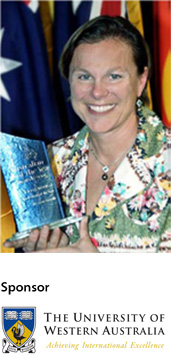
Dr Fiona Wood
Introduction
Fiona Wood was born in a Yorkshire mining village in England in 1958. In 1978 she was one of twelve women admitted to the St Thomas’ Hospital Medical School, London where she graduated with her M.B., B.S in 1981. Wood completed her internship and residency at several hospitals in London before immigrating to Australia in 1987. She then took up a registrar position in plastic surgery at the Sir Charles Gairdner Hospital, Perth. By 1991 Wood had passed the plastic surgery exam and become a consultant. She began working with medical scientist Marie Stoner in 1993 on a method for burns treatment at the Royal Perth (RPH) and Princess Margaret (PMH) hospitals. From this collaboration an entirely new, and more successful, method of treatment was developed. Thus, in 1995, Cellspray®, a spray-on solution of skin cells, was launched and in 1999 Wood and Stoner founded Clinical Cell Culture (C3). Wood’s expertise in burns treatment came to the world’s attention in 2002 in the wake of the Bali bombings but she hasn’t let fame stand in the way of her research or teaching which she continues at the RPH, the PMH and the University of Western Australia.
Interviewed by Dr Norman Swan in 2008.
Fiona, you’ve just sat down here after coming from the national trampolining championships. Tell me about that.
Oh, ho! Well, my youngest child has been a gymnast and now enjoys trampolining very much. I’ve got lots of children, four boys and two girls, and I really like being involved in what the kids are doing. I’ve been on more sporting trips interstate, I think, than you can count on one hand.
So you’re the team doctor?
Yes, I guess I could be. But I’ve been to all sorts of sports: rugby, triathlon, ice-skating. That was a perverse one –ice-skating in Perth was a little unusual! (That was my older daughter.)
It’s been a cold enough winter for it. How’s your orthopaedics?
‘Well,’ I thought, ‘I’ve got my brother, who is a professor of orthopaedics, on the other end of the phone.’ [laugh] But I used a lot of strapping while I was over there with the trampolinists.
You come from an era when it was not so common for women to go into surgery. Would you tell me a little bit about your entry into surgery?
Surgery, for me, was a no-brainer. I was very excited and interested by anatomy – which may sound strange, but it was one of those things that I really was interested in. And the obvious place to go from anatomy was into surgery. I simply thought, ‘It’s not a question of whether I’ll be a surgeon, it’s just where and when.’ So that was my approach. And my approach to people who told me that girls didn’t do that was that I was very good at needlework. Actually, I do like embroidery, when I have the time!
So you decided to concentrate on surface anatomy rather than deep anatomy?
Yes. Initially I looked around and did lots of different surgical specialties. In those days you had to, to do your general surgical fellowship before you specialised. But plastic surgery was always very much more interesting, in that it was innovative and at that time it was exciting, as the microsurgery wave was just starting. Lots of really different things were happening, whether it be microsurgery or tissue expansion. I realised that I had to have a CV that would get me the job – since I didn’t have the genes, I had to have the CV. [laugh] And so I got involved in research early and with plastic surgical teams.
What sort of research?
Anatomy, doing anatomical dissections and looking at the anatomy for free tissue transfer. I did that as a medical student, and then from that I got into an anatomy BMedSci which was a full year based around research.
I find it quite interesting that apparently researchers have discovered muscle layers in the face that they didn’t know existed, and so on.
Yes. At that stage we were focused on the blood supply. When I look at a standard anatomy text I find that, as with a lot of things, when you start to gain knowledge and you start to peel the onion it gets more and more interesting: the way the blood supply comes through various muscles and through into the skin, and how you can use different muscles in different ways, the blood supply to muscle ratio, and the pedicles, and then how the nerve supply comes in and whether you can use it for reanimation or just surface cover, padding – all different sorts of things. It was an exciting time to be involved in that, with straightforward dissections.
Where was that?
In St Thomas’, in London.
Did you make any discoveries of your own, or were you always the junior in somebody’s team?
Well, at that time I was very much the fly on the wall. I was just so keen to be involved and simply directed. Then I did a BMedSci equivalent. That’s when I started getting really interested in neuroanatomy and did some work on the evolution of the brain, from worms to elephants. (St Thomas’ has a great museum, the Hunterian Museum, where I spent a lot of time.) I suppose the time when I started teasing things out for myself and driving research was when as a junior registrar I did neurophysiology research on tissue-expanded skin. That was my first real step into driving that innervation.
Yours is a funny specialty to get into. It’s kind of bifurcated, with people like yourself who are more in the public sector doing the burns, the major reconstructions and so on, but also, in tandem, people who have flick-back hair and are going to do breasts and nose jobs for the rest of their life.
I know, and it is interesting. Because if you look at the extreme make-over or the extreme rebuild, I work on the latter end of the spectrum, I think there’s a place for everybody. I feel very strongly about that in lots of ways and in lots of areas. You can learn a lot from the meticulous, cosmetic-type surgery: the tissue handling techniques, the approach. There’s a lot of scar revision work, and the best of it is scar minimisation. Plastic surgeons are in the game of minimising scars, and what I want to do is eradicate the scarring, so their work is a very good, solid starting point from an education and training point of view.
The scarring you are talking about, though, is not caused by a scalpel but by extreme heat, by burns?
Yes, and it’s certainly at the top end of the scarring spectrum, the most aggressive.
Minimising that scarring would be a very different kettle of fish. What’s been learned about that research-wise, and in particular in the sort of work you have done?
Again you’ve got to step back and look at really solid, basic principles. I try to look at what we know and what we can apply from what we know, before we start to push the boundaries. You’ve got to have the basics such as infection control, because anybody who has a wound that is infected compared to a wound that isn’t…
One will scar and one will not?
Yes. If you have two animals with the same genetic make-up, but one has an infected wound, you’ll get a scar as opposed to no scar or reduced scar in the un-infected case. So infection control is top of the pile, along with nutrition, tissue handling, tissue destruction: removing tissue that is damaged beyond its ability to regenerate and repair, because it continues the inflammatory process that causes the scarring process to go on, way beyond the surface healing.
So we’re looking at solid, basic principles before we then start to look at, ‘Well, how can I actually use those principles and drive them forward?’ Actually, speed to healing comes up to the top of the pile. Interestingly, it is much more important than your genetic make-up.
Even if the patient is a keloid maker?
Yes. The quicker you close that wound, the less scar you’ll get. In fact, that was what drove us along the cell-culture story. But as we’ve investigated and looked more at what was happening in that environment, we find we’re looking really at the future of it. What’s exciting now, from the point of view of our team, is understanding where the cells come from for the intrinsic healing, and the bone marrow response, and how that is driven not just by a humoral response but by a neural response as well. And looking at the nerve response to injury is where I’m going to spend the rest of my research life.
I started that, I guess, in the early 1980s, with the neurophysiology and the changes in the peripheral nervous system and how plastic it was in the skin responding to pressure of tissue expansion.
So these are the trophic changes, if you like, the change effects of peripheral nerve stimulation?
Not necessarily. The theory, I guess, is that we have the three-dimensional spatial information of a given body site retained in our homunculus, in the cerebral cortex and deeper, in the hypothalamus, in similar mapping-type homunculi. That is how it is in other areas with memory and things. And so we have that retention of the three-dimensional spatial information.
Now, what keeps our morphology the way it is? I think it’s the feedback from the surface. That feedback can be direct, cutaneous innervation; it can be indirect, such as visual or auditory; and it can be a cognitive overlay. I believe that in order to have a regenerative repair we have to have an intact nervous system feeding back that information for self-organisation. If we have a self-organising surface we have to have that information driven back to the central repository.
So your hypothesis, then, would be that you’ve got to treat the nerves as well as the blood supply and the skin?
Yes. I think that the nerves actually form the hub. They form the leading edge, if you like.
It is the hardest thing to treat.
Indeed, yes. Why do we have pain? We are told it’s for protection, but if so, why do we still have pain five months after an injury?
So you’re going to become a neurosurgeon, are you?
Oh no, not a neurosurgeon. [laugh] But I’d like to know a lot more about neurophysiology and neuropathology. My great belief is that lots of people out there have got this information in their heads, but they’ve not necessarily made the connection. I’m very happy to join the dots and collaborate to seek out the pieces of the puzzle to put together.
I talked earlier about a bifurcation: the major reconstruction people versus the bouffant-hair ones who’d like to do the noses and the breasts. But there’s also another kind of bifurcation, in that surgeons notoriously like to ‘do’ but not to find out ‘why’ or to research. The research tradition is not strong in surgery.
I’d have to say you’re right, unfortunately. But I’m doing my very best to engage the surgeons and get people interested. My colleague, Suzanne Rea – who is going to be submitting her PhD on the bone marrow work that she has done – has been a consultant with me now for four years. Also, we’ve got medical students coming through and I’m very keen that they understand that they can actually change the way we think and the way we practise. I don’t believe that we will be practising simple skin grafting into the future. We need to think beyond, ‘Is that as good as we can get?’ We have to get better, as skin grafts cannot be the universal gold standard. Every skin graft I have ever done, however nicely I’ve been able to do it, has left a scar. The gold standard has to be the skin of that area of that person at that time of their life. Anything less means we will jump the hurdle with relative ease. We’ve got to raise the bar. We’ve got to bring our med students into the understanding that they don’t have to believe all they are told. They can actually go out there and find out things that are new, that are novel, that can change people’s lives in an innovative way.
Did you have somebody who taught you that?
Piecing it together, yes. I have been really fortunate in some of the surgeons I have met along the way. In particular, Harold McComb, more latterly as I came to Australia, taught me that however mature one is in one’s career – and he’s well in his 80s now – one can always think of doing it better. And one should never think today is as good as it gets. I think he had that very clear in his mind, as he was a great cleft surgeon. (That is where I worked with him, in cleft lip and palate work.) He advocated the maintenance of that interest in the subject through to way, way into your career, to make sure that you’re learning how to do it better tomorrow, always better consolidating, doing a series of cases, investigating them and analysing them and coming back or working out how to do it better. That’s what I hope to instil in a few – in many, I don’t know, in one? [laugh] – because it’s really important not to believe that today’s treatment is good enough. If we do that, we just all sink into mediocrity.
What is the bone marrow work?
It is looking at where the cells come from that heal the wound. The traditional thoughts were that the healing came from the adnexal structures of the skin, and that when that was overwhelmed you had to reintroduce skin, in terms of skin grafting or of things like the skin cells that we spray. But we’ve demonstrated that there’s a significant introduction into the wounds not just of inflammatory cells but of mesenchymal cells from the bone marrow.
So, cells like stem cells?
Yes, maybe. Interestingly, however, in our animal work those are not maintained over the long term, not beyond 120 days. We are now looking at biopsy work in our burns patients to see if we can understand what is happening, to see if it is really maintained or not.
Some work has come from looking at when our patients don’t survive. Patients that don’t survive come in three groups – almost in equal thirds. We analyse that very intensively, trying to work out how we could do better.
The first group of people we can’t even start to treat. The injury is so overwhelming that it’s beyond technology as we have it here, right now. Then there’s a group where we try, but by the end of about five to seven days it’s very obvious that the injury is overwhelming and we’re not going to be able to ensure survival in that individual.
But then there’s a third group, who survive for about three months. Sometimes it’s a matter of nutrition, sometimes it’s infection, sometimes it’s a race against time to close the skin integrity while the waves of infection keep coming over. And in those people the question we raised was, ‘Is it bone marrow failure? Is it because the bone marrow cannot respond?’ We know patients are immunocompromised, but is it simply an immunocompromise or is the bone marrow being overwhelmed? So we’ve gone back, and we’re working with other groups as well, looking at the quality of the survival.
Is it regenerative collapse?
Yes. Is it that we’re just stressing this system too much? Might there be other workplaces we can learn from – people treating HIV, for instance – that support bone marrow in a different way?
Tell me about the first high-percentage burns case you ever saw.
There are two that spring into my mind at that question. The adult person, in October 1992, was a 29-year-old who was in excess of 90 per cent body surface area burned. He was a high school science teacher who had been helping his friend, a roofing contractor, on the school holidays, and there’d been an explosion. It was just before lunchtime and by the time he was in Royal Perth Hospital, just under two hours post-injury, he had had appropriate first aid, all the lines were in, he was beautifully set up. And in the hospital he’d seen a senior registrar in anaesthetics who had worked in the same hospital, East Grinstead in the south of England, where I had worked in the burns unit.
That is the famous plastic surgery hospital, going back to the Second World War?
Yes. I remember thinking, ‘If anybody will survive this, he will.’ He was young, he was fit – and he did, but at a price. It was a really long, hard road for him, and for his family. It still is. But he’s a fantastic individual who’s done great things.
There wouldn’t be many of him around – 90 per cent is usually reported as 100 per cent death rate.
Yes. It is interesting: if as doctors we stand back and think about it, we realise there are certain people that influence how our lives move, and for reasons beyond our control our lives will be connected forever. He is one of those. He changed my opinion on lots of things, including myself, basically. [laugh] It was a tough time. And I thought that we hadn’t done well enough and that we could do better. At the time I thought, ‘Possibly I shouldn’t do this, because I’m not good enough.’
What, did you make a mistake?
No, not a mistake. He was healed very quickly. We used skin culture from Melbourne, and it was all working beautifully, and although he got peripheral neuropathy and had, basically, die-back of his nerves, they almost all regenerated. But it took him nine months and it was a long road.
So he was, effectively, paralysed?
For a period of time, yes, which is very unusual and had not been recognised in such cases before. It’s now termed the polyneuropathy of the critically ill. Well, people are really surviving in the ICU against the odds, with massive injuries, not just burns.
Why do you feel bad about him?
I guess I thought, ‘Oh, this just isn’t good enough.’ I didn’t know if he would recover. This was in December, on the 16th – I remember it really well because I went down south, camping, feeling, ‘Oh, this is all too hard. I’ve done everything I possibly could and yet there he is now, paralysed. How could I have done better? How could I have avoided that?’ And there were no answers.
I’d called in all our resources, got everybody to work really hard, but I thought, ‘If that’s the best I can do, then it’s not good enough.’ It took me about 48 hours to come to the realisation, ‘Well, that's actually all I can do.’ And so I kind of re-engaged on a very different level, with a very different appreciation of everybody around me. To be honest, I think it was good for me to be able to accept that we were not infallible; we had a lot of work to do.
There are two ways to look at that reaction. The easier one is to shrug the shoulders and say, ‘That’s all I can do, and therefore I’m not going to beat myself up.’ But the risk in that is that you let standards drop. How did you balance it out? You were, from the sound of it, ready to jack it all in and just do breasts and noses!
[laugh] Well, I don’t think it’s ever been in my head space to shrug the shoulders and say that near enough is good enough. But the question for me was whether I was prepared for the emotional energy. I have a great deal of respect for my colleagues in psychiatry and psychology, because it’s something I couldn’t do. And I went close to the edge. I thought, ‘That’s not a place where I want to be, because I am not effective in that space. That’s not where my skills lie. Yet, am I strong enough to cope with that?’ I was quite well aware that it wouldn’t be the only time. And I guess it did strengthen me. It strengthened my resolve that there will be answers and we will get better.
What was the other case?
That was a young boy. He was four, and now he’s 22 and lives with the scars that have compromised his life. I have had pictures of him, of his face particularly, over my desk for about four years, trying to work out how to fix it. I haven’t yet, but one day I will. But it was, oh, tough times in children, in different ways.
I treat both adults and children but we see a lot more major burns in adults than we do in children, and in the Children’s Hospital burn unit over the last 20 years we’ve only had one death. Death is much more frequent in adults because the injuries are bigger. The pressures in kids are very different, because of the family and the fact that then they grow! That’s really hard for the kids and families, because when they grow, they grow out of their skin. So that’s another challenge, the reconstructive work, which we continue – the service continues all the way through, and we do the reconstructive surgery as well.
Are you religious?
No.
So what’s your value system, and where does it come from?
My kids go to a Catholic school – my husband’s a Catholic – and when they ask me questions about what I believe, I talk about morals and ethics, that everybody knows what’s right and wrong. They choose to ignore it when it suits them. And that’s the choice you make.
Tell me, then, a little bit about your family and your upbringing.
I was born in a Yorkshire mining village. I had two older brothers so I was a sort of kid sister, but I did have a younger sister. My Mum and Dad left school when they were 13 and 14, and basically, I guess, my Mum realised that things weren’t going to go right for me from an educational point of view. They were very focused on education and sport, my parents.
What did they do?
Dad was a miner. Mum worked in the youth system until I was about 13. Then she saw a job advertised for a house mother in a Quaker boarding school. She’d been a PTI [Physical Training Instructor] in the WAAF [Women’s Auxiliary Air Force], in the era of National Service, and by this time she’d done lots of youth work. (She used to work nights and to pick brussel sprouts and so on in the daytime.) So she went off to have an interview at the school, and she came back as the phys ed teacher – which was most impressive.
I’m getting a sense here of where the energy comes from!
Yes. She went on and did great things. She was coordinator of the Duke of Edinburgh Awards for north England and things like that. She’s quite an energetic lady. She saw that what she wanted basically was for my sister and me to go to school, to the Quaker school. By then the education system had changed. My eldest brother had left school at 15, having been in the secondary modern system.
This is after they got rid of the Eleven Plus?
Yes. My next brother, who’s now a professor of orthopaedics, got through Eleven Plus and was rapid-streamed to the grammar school, so he was off and going. We girls were caught in the next stage. And so I went to the Quaker school, very aware that I’d been given an opportunity. My mother’s words were, ‘Grasp the nettle with both hands,’ and I thought, ‘Well yes, I will.’ That school was a very special place. I’d come from a comprehensive school, where I could run quite fast – for very good reason, to get away from the fighting. [laugh] My previous school had been rough, a really tough environment. I think I had a big mouth, as well, which probably didn’t help. Then I was in this Quaker school where they were all pacifists and wore long cloaks like Harry Potter.
You’re not pacifist!
Well, I certainly have a great deal of respect for my fellow human. If you ask me, ‘Are you a non-violent person?’ the answer has to be yes. I’m aggressive and competitive but, although I’m no pacifist, equally I see the results of interpersonal violence and how its changing. It’s in our society in a way that’s very uncomfortable for people working in trauma, like myself.
So what do you carry with you from those rough comprehensive times?
Nobody can tell you that you can’t do anything. It’s just a matter of how hard you’re prepared to work to do it. That’s really the bottom line. As I said, I can run fast. But my dad was very keen on sport and he’d played soccer for Notts Forest [Nottingham Forest] very briefly before he broke his leg and he went back down the mine. So he had a sort of sniff of the fresh air.
No child of mine is going downt’ mine – was that his attitude?
He was absolutely adamant about that. He used to say, ‘One of my boys will be in light blue, one in dark blue under Putney Bridge.’ One of my brothers did go to Cambridge, but it was a boxing blue in fact, not rowing. There wasn’t much rowing where we came from!
He must have been a very proud dad.
Yes.
Why did you go to medical school at St Thomas’?
I went there because my brother went there. My interview was interesting. He’s a very good rugby player and when they asked, ‘Is anybody in the family in medicine?’ I said, ‘Only my brother.’ The Dean turned then to the Professor of Anatomy and said, ‘Oh, did you see the try he scored on the weekend?’ So all we talked about was the very impressive try he scored. (That one was even in the newspaper, the Telegraph, I think: ‘Wood crashes over the try line draped in Welshmen.’) [laugh] And that’s how I went to Tommy’s, because my Mum and Dad thought I needed to have my brother look after me. Oddly enough, later on he followed me here. It was great when he and his family came to Australia.
And you came here to follow your heart?
Yes, I married a West Australian.
Did you arrive as a consultant or were you still training?
I came here with a couple of years still to go. I had got my general surgical fellowship and I was part way through my plastic surgical fellowship, so we landed here with about two years to go. But I ended up sidestepping – being sideswiped is probably a more accurate description – into general surgery for a year, before going back into plastic surgery. I then passed the plastics exam. So I was a consultant in ’91.
People often complain that it’s a small medical community in Western Australia, they’ve got tickets on themselves, they think they’re better than they are, it’s a bit of a cliquey set.
It took me a while to break in to the plastic surgery guys, but I’ve had nothing but great support from the vast majority of them since. As far as I was concerned I would always be a surgeon, it was just where and when: I thought ‘If it’s going to be here, then good.’
At what point of your career did you start having kids?
I had two when I arrived here. (The first one wasn’t planned, but then we thought, ‘Well, we’ve started now. Let’s just keep going. We want lots of these.’) Tom was born when I was at East Grinstead as a junior surgeon in training. Then I had a child shortly before I leaving the UK. I left Thomas’ as a lecturer of plastic surgery to come here. My second child was just five weeks old when I moved to Australia. Then my third was born after the first six months of my plastics training in Australia. And I had three children as a consultant.
Did it slow you down?
No, not really, not that I noticed. But you probably are asking the wrong person!
What would you have been like if you hadn’t had them?
Someone asked me what I did and how I managed when they were young. I said, ‘Oh gosh, I can’t remember actually how I did it, but with great support.’
Somebody who once sat beside you at a dinner was quite impressed that you were taking the same phone calls as she would have taken from her children and yet, as if it’s not bad enough being a surgeon on call, you’ve got a research career as well. If anything’s worse than surgery for having no boundaries, it’s research. There are never any boundaries to research. If you’re running a culture in the lab, you’ve got to be there. You might have postdocs and so on, but the lab keeps going 24 hours a day. At least in surgery you get days off. Can you give me a brief sense of how you organise your life?
I guess it’s just juggling: juggling all the time, working out bits of time here and there. I guess you’re asking the wrong person again, you should ask the kids – I don’t want to hear the answer – but I’ve always tried to make sure that they took priority, that their reasonable needs were at the top of the list.
Well, it must be okay if they accept the plastic surgeon to look after their broken bones.
Yes, it’s something like that: ‘Oh yeah, Mum can come.’ [laugh] But it is a matter of juggling. If I’ve got a board meeting or a research meeting and then there’s theatre, it’s working out how to dovetail it all in. When the kids were younger I used to work a lot at night while they were asleep. Then as they have got older they want their bit of time as well. So getting up early helps. And I like to stay fit.
Anybody with two or maybe three kids would know about the logarithmic increase in driving and everything else. Do you still do all the driving?
Not all of it. Today, one has just gone from uni so he’s picking up two from school, and another one can also drive. I’ve got three drivers now, and that does make a difference. The older kids remember the younger ones being in the car as we drove them to every sporting event you can poke a stick at, and so they’re very good at taking them to training as well. For example, a number of them will be swimming in the morning or riding their bikes or whatever. So they have that sort of, ‘Oh right, okay, I can take So-and-So’ – even to trampolining. Even though none of the others do that they pitch in, and when I’m away they will drive half an hour to the trampolining place.
Your mother must have provided a model for this juggling of multiple commitments?
I think so. She was very much the sort to see the gap – though now it’s interesting, because she says, ‘Oh gosh, you’re just so busy. You should take it easy. Slow down.’ And I go, ‘What’s wrong? Hang on! Is this pot calling kettle black?’ [laugh] She only says, ‘Oh no. I was never as bad as you.’ But I tell her, ‘Just because you didn’t have an academic role early, when you were picking brussels sprouts or whatever, that doesn’t mean to say it wasn’t time and it wasn’t effort, working things out and then getting home for us, and going out to the youth club later.’ It got easier for her when she worked at the school, because then she had school holidays and so on.
Tell me about the challenges of commercialising your research.
That sort of commercialisation is probably, in retrospect, the hardest thing I’ve ever been involved in, because I have no education or training in that regard.
Is there anything that can prepare you for it?
I’m not sure. It’s interesting: I speak now at innovation sessions and things like that for the university, and speak to the commercial science side, and I say that you can’t have one without the other, it’s a symbiosis. If you expect your idea to be the best thing since sliced bread and expect everything from it, you’ll be disappointed. Equally, if you expect to get everything out of others’ ideas without rewarding the inventors appropriately you will be disappointed, because they won’t support the commercialisation and they won’t give you the next idea. I don’t know whether that falls on deaf ears or whether people are listening.
It really was an exercise in communication, collaboration and mutual respect. I met people along the way that were difficult to respect and caused problems. So I had to move on. That was painful and difficult. I remember Harold McComb saying to me, ‘You know, Fiona, you believe what people say to you. If someone says they’ve got pain in the right iliac fossa, you think they’ve got appendicitis. And if they say they’ve got pain in the right iliac fossa but only on a full moon, you still believe them; you just change the diagnosis.’ [laugh] Ah-hah, I needed to change the diagnosis!
It was difficult, having to realise that not everybody coming to you saying that they would do things actually had the capacity or the intent to do those things. So it was an interesting journey.
The research you were seeking to commercialise was for spray-on cell grafts?
Yes, taking a piece of your skin, processing it and putting it back on you. It was changing the dynamics of the healing process and really speeding it up, because speed was the big issue that we identified as the first cab off the rank to be dealt with in reducing scars.
By, essentially, creating islands of cellular regeneration?
Yes, because we were taking skin from an area that is programmed for regeneration. We are regenerating all the time, so we harvest the regenerating capacity and introduce it into the area where that capacity has been overwhelmed.
It was a fascinating journey, apart from the difficulties, and the learning curve was extraordinary. And it’s ongoing. Understanding how to devise research programs that are suitable for TGA [the Therapeutic Goods Administration] and FDA [the US Food and Drug Agency] is quite different from doing the papers that you will publish. As for patent scrutiny, when someone comes back to you and asks some of the questions you think, ‘Why on earth would they want to know that?’ But there are matters of ‘prior art’ or whatever. And then there is having to establish an experimental framework to answer a specific question when you think, ‘Well, really that’s not the best question. I want to be over here looking at what’s tomorrow, but I’ve got to tidy up today.’ It’s a real discipline. You have to make sure that you are rigorous about the frameworks.
The regulators knocked you back at one point, I believe.
Another interesting thing about the whole business was dealing with the media and the perceptions of things. For us it was part of the process we were going through. We would say, ‘We’re working on this. We have done this,’ but the response would be, ‘Oh, but there’s that.’ We’d say, ‘Right, sure, we’ll get that fixed,’ and send it back, saying, ‘Yes, now we are okay.’ It was rather similar to a peer-reviewed process.
So the normal hurlyburly?
Yes, with things going backwards and forwards. But of course in a public, listed company that has to be disclosed to the market, and it’s picked up and run with in a way that says simply that we’ve been knocked back. ‘No, hang on,’ we had to say, ‘we just followed the process.’
Did you feel you were a victim of the great Australian tall-poppy tradition?
There are some people, a couple of colleagues, that have made life difficult for me, but that’s their prerogative and their choice. As far as I’m concerned, the amount of energy it would take to engage and put those individuals right in a public arena would be inappropriate. My energy, really, is focused on the patient care, the research that will back up better quality patient care.
I think it’s fascinating that negative energy has such a disproportionate impact by comparison with positive. The vast majority of people, though, are extraordinarily positive and supportive.
I have talked to people like Charlie Teo, the neurosurgeon in Sydney who takes on difficult cases and is largely hated by his colleagues. One wonders whether or not some of the opposition arises from self-reflection that you could have tried harder, whether people get threatened, in a sense, by somebody else who is trying harder. Do you think part of the story is that you might be going a little bit further than others, and they feel bad that they didn’t go further with their patients?
I feel very strongly that everybody makes their personal choice. I believe that every morning nobody is trying to do things badly; we are all trying to do our best. Whether you are doing breasts or burns, you’re doing your best for that individual. That’s what I respect. All I ask is, ‘Give me the opportunity and respect me for doing the best I do with my burns patients, because that’s all I am about.’ I respect that others have made their choice. My choice is to work on the extreme rebuild end of the spectrum as opposed to any other place in the spectrum. We have to respect each other. You can’t fight if nobody will fight you. And I won’t fight. I’ve got better things to do.
I have asked you about the memorable patients. But presumably the memory of the Bali bombing is one of just an overwhelming workload very suddenly. It can’t be often that one gets hit with that volume of work.
That episode was a fascinating time, on many levels – again one of those times when you learn a lot about people and about yourself. We’d planned things, we’d been into disaster planning, so it was something that we were prepared for on one level, especially when you are actually in the thick of it all and doing things. People kept saying to me, ‘Isn’t this terrible! Is it really hard?’ I would say, ‘No. It’s not really hard, because we’ve trained for this. This is what we do.’ There’s no greater motivator than to be actually doing something and helping. That’s a real energy maintenance sort of scenario: you are going forward and you are doing, all the time.
What we hadn’t expected, though, was something that came to the surface about three weeks later. I remember the three-week point very well, because we had a mass exodus and we had only four people left after that – we had the boys go to Germany, there were interstate transfers, etc.
It’s also the danger period for people with burns.
Well, by then most of them were healed. In fact, we are really aggressive. We really push hard with early surgery and all care. Two people had died but the majority were healed. Out of the 28, we had over 20 people healed by three weeks and we had four left in the hospital: one, who went on to die, and three who took a little bit longer to heal.
But that was the time when one of my colleagues said to me, ‘You know, we’ve lived through something very special. We’ve lived through something we will never see again – hopefully.’ And as I thought about the positive energy that was generated out of something so negative, that too really changed the way I looked at things. I thought, ‘Hang on, why do we only see such positive energy, so much helpfulness, people going so much out of their way, at times like this? We could do more of that all the time!’
And I have looked and I have connected, and I realise there are people doing amazing things all the time that we just don’t know about. That was the pleasure of 2005, meeting people doing amazing things.
This is when you were Australian of the Year?
Yes. That was a real eye-opening education, an inspirational year: ‘Wow, there’s all this that we don’t know about.’
It seems pretty weird for a Yorkshire lass to become Australian of the Year.
Warren Pearson, the CEO of the Australia Day Council, asked me, ‘Are you Australian?’ I said, ‘No. Does it matter?’ and he went white. So I said, ‘Just kidding! Of course I am.’ But that got him going a little bit. [laugh] It is amazing, though, that I can be the proud Yorkshire lass and also a proud Australian – which I am. I have had opportunities in Australia I cannot imagine having had in the NHS.
Did you get any work done in that year?
Yes, I worked. I held it together; the team held it together. It was tough. I did a lot of night flying. I can sleep sitting up on Qantas planes – just sit there, and I’m asleep before take-off!
Was it a life-changing year?
It was. It was a huge privilege to see all those people doing so many things and to be connected with so many different people. It was a bit of a blur as well. It got to be really quite intense at times.
It must be easy to be sucked dry by it – making the same speech perhaps three times a week.
And I never write things down. (I’ve no time for that because I’m working.) I’d suss things out in the room and think, ‘Right, it’s a science group,’ or, ‘Okay, a Rotary group,’ or whatever, and work out their purpose in having me there. I’d have a quick chat and think, ‘Right, okay, I’m in.’ And that was stressful. I kept thinking, ‘One day I’ll just stand there and I won’t know what to say.’ [laugh] It was actually quite a pressure, thinking, ‘What do I say next?’
To be brutally honest, I did forget to go to a leadership conference at the Curtin University. I was in pink ugg boots and a tracksuit at the ice-skating on a Sunday morning, when I got a call to let me know, ‘Sir Charles Court’s almost finished.’ I thought, ‘Well, that will be my turn then, won’t it! Ah, okay, right!’ So I rang around, I got on to my nephew. I had my kids and other kids there, so I got everybody picked up and sorted. And I went to the university and said, ‘You know, the first lesson of leadership is that you’ve got to get up early in the morning. Otherwise, in my house, you don’t get the pink ugg boots!’
I remember being a bit stressed that day and thinking, halfway through a sentence, ‘Where is this going?’ But suddenly it did come to me, just before I looked a complete turkey.
Looking forward 20 years, what is your ‘must have done’ by then?
Gosh. Looking forward now, the ‘must have done’ for me is that I really want to make a big hole in the research all around the self‑organising surface and the innervation, and the reinnervation and the training of that surface such that we connect the brain with our function. We are, at the moment, going through a fundraising campaign. If we get $10 million, we will do $10 million of work. If we get $10,000, we will do $10,000 of work. But by January 2009 I will stop asking, because I will do the work. That’s what I want to be able to look back at in 20 years and think, ‘Yes, I did it. I had the discipline to do the work.’
It’s hard to get the funds. You spend a lot of time spinning round with grants and things. So whatever we get, we’ll tailor to and we’ll do, and we’ll build on from there. If at first we have to shrink to build, that’s what we’ll do. It’s really important to me that we make the links with people internationally, nationally and locally that have this in their heads, that have the understanding of developmental neurobiology, the understanding of MRI/PET scanning interpretation in people with wounds, an understanding of acute pain pathways, so I can connect all these together to actually drive the healing – so that in 50 years’ time we won’t be skin grafting, we’ll be driving regeneration. I have recognised now it will not be in my surgical lifetime. I was overambitious and overoptimistic, I think, 20 years ago. In 20 years’ time I want to look back and be realistic, and know that I have truly made a serious contribution. It won’t be the end game, but I want to be a contributor. That’s the bottom line.
Fiona, thank you.
Thank you very much.
© Australian Academy of Science
Lord Robert May, physicist and ecologist
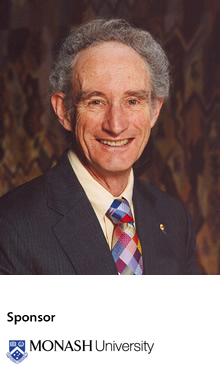
Robert McCredie May was born on 8 January 1938, in Sydney, Australia. He spent a solitary childhood playing puzzles and problem solving games. May attended Woollahra Primary School and Sydney Boys High School (1948–1952). There he became a champion in the school debating team and was greatly influenced by several excellent teachers, especially in science.
After topping his class and dismissing potential careers in law and medicine, May decided to pursue a degree in Chemical Engineering at the University of Sydney (1953). He divided his time between playing chess and snooker, and occasionally studying for chemistry, mathematics and physics exams, which he considered to be ‘interesting games’. Despite this approach he achieved incredible success, winning prizes in chemistry and physics. Contrary to advice received, he defied even more odds by successfully navigating a gruelling undergraduate combination of chemical engineering and physics in his second year. In his third year he forsook chemical engineering, simultaneously majoring in pure mathematics, applied mathematics, and physics (again despite contrary advice) and topping all three. After successfully completing his honours year in physics (1956), May decided on a career in science, and never looked back.
May’s PhD in physics at the University of Sydney focused on superconductivity. His supervisor, Robbie Schafroth, had shown that an ideal gas of charged bosons would be a superconductor, thus redefining the problem. May’s thesis aimed to show how one might get effectively bound pairs of electrons (which would be bosons). Bardeen, Cooper and Schrieffer outpaced the Sydney group in this quest, winning them the Nobel Prize.
After completing his thesis in 1959, May left Australia for a postdoctoral position in the Division of Engineering and Applied Physics at Harvard University, as Gordon MacKay Lecturer in Applied Mathematics (1959–61). During this time he met his wife, Judith, an event which he regards as the most important in his life.
May returned to Sydney University in Australia as a Senior Lecturer in the Physics Department at the end of 1961. In 1964 he was appointed Reader and in 1969 received one of the two first 'Personal Professorships' established at Sydney University. Around this time, partly as a result of involvement in the newly-formed movement for social responsibility in science, he developed an interest in animal population dynamics and the relationship between complexity and stability in natural communities. He further developed these interests during an 18-month sabbatical, first in the UK (at the Culham Plasma Physics Laboratories and the Imperial College Field Station at Silwood Park) and then at the Institute for Advanced Study in Princeton.
In 1973 May moved to take up a Professorship in the Biology Department at Princeton University. Here he used his skills as a theoretical physicist to make major advances in the field of population biology. Over the next three decades these tools were further extended to the study of infectious diseases and of biodiversity.
In 1988 May moved to Britain, taking up a post as Royal Society Research Professor at Oxford University. He served as the Chief Scientific Adviser to the UK Government and head of its Office of Science and Technology between 1995 and 2000, and was President of the Royal Society between 2000 and 2005.
Lord May has received numerous accolades, including Knight Bachelor in 1996, Companion of the Order of Australia in 1998, and the Order of Merit in 2002. His Fellowships include the Royal Society in 1979, Corresponding Member of the Australian Academy of Science in 1991, Foreign Member of the United States National Academy of Sciences in 1992, Academia Europaea in 1994, and Fellow of the Royal Society of New South Wales in 2010. He has received honorary degrees from Uppsala (1990), Yale (1993), Sydney (1995), Princeton (1996), the ETH Zürich (2003), Harvard (2013), Oxford (2004), and several other UK universities. His honours include the Weldon Memorial Prize by the University of Oxford (1980), the American Ecological Society MacArthur Award (1984), the Medal of the Linnean Society of London (1991), the Frink Medal of the Zoological Society of London (1995), the Royal Swedish Academy’s Crafoord Prize (1996), the Swiss-Italian Balzan Prize (1998), the Japanese Blue Planet Prize (2001) and the Royal Society’s Copley Medal (2007), its oldest and most prestigious award.
He is now an Emeritus Professor at Oxford University and a Fellow of Merton College, Oxford.
Interviewed by Professor Robyn Williams in July 2008.
- R-selected ‘ologist
- Solitary child and a brilliant chemistry teacher
- Debating a degree in Chemical Engineering
- Accidental physicist
- Twists of luck towards Harvard
- Nexus of romances
- Accidental ecologist
- Impressing Princeton
- Committee man
- Making sense of the chaos
- Politics of ecology and deciding to move to Oxford
- Accidental civil servant
- Tackling the climate critics
- President of the Royal Society
- On the tail end of the ‘luck distribution’ curve
- Taking maths to the banks
R-selected ‘ologist
One thing puzzles me, Bob, of all the “ologists” – physicist, chemical engineer, chemist and mathematician – what kind of “ologist” are you?
I would say that I am a scientist with a short attention span. To put it in more ecological terms, I think there are different kinds of people in science, not just theoreticians and experimentalists but people who like to pick on one problem and devote their life to it, and people who accidentally stumble across various things. There is a rough rather glib analogy with a distinction ecologists use between species that are weedy species, often called “R selected” and species that are “K selected”, “K” for carrying capacity. R selected means that rapid growth rate is all important: they find an empty space and swarm into it. As distinct from “K selected” organisms that are more skilled in competitive, crowded situations where they are one of the mob. I am an “early stage”, R-selected person. I like to get in early when you can do nice, simple things that are important. Then, as the field grows and it becomes more a matter of important and systematic elaboration, I find that less congenial. Perhaps that is over-interpreting it.
But my career is as much “accident” as anything else. It is not that I go around deliberately thinking of what is a different thing to do. It is just that my scientific career has been a sequence of accidents, from the fact that it even exists onwards.
What is the essential ingredient that has been the secret of it all? Is it maths?
I wouldn’t say that it is mathematics, to put a label on it, but it is mathematics in the sense of: “What is mathematics?” Mathematics is ultimately no more but no less than thinking very clearly about something. I like puzzles, so I am a mathematician. I am not a pure mathematician’s mathematician because I don’t like abstract, formal problems. I like tricks and devices. I am essentially a mathematician but in the sense that I like thinking about complicated things, asking what are potential simplicities hidden in them and expressing that tentative thought in mathematical terms and seeing where it leads me in testable ways.
Solitary child and a brilliant chemistry teacher
In many ways, what you describe seem to be the kinds of qualities a child has. Did you have that kind of interest when you were very small?
I don’t remember how I thought when I was very small. But I can tell you that I was a fairly solitary child. I really did enjoy mathematical puzzles and puzzles of other kinds from when I was fairly young. I have always enjoyed puzzles and games, and I think there is a connection.
What about the family influence? Your mother, your father?
My family influence is slightly complicated and I won’t go into it in detail. My father’s family moved from Northern Ireland, they were Protestants. My father’s father was involved with the Orangemen and they got out because some IRA people turned up and said that, if the family didn’t clear out within the week, they would come back and kill them. A week later, they were on a boat to Australia and my father went from middle-class prosperity to living initially in a place in Newcastle with a dirt floor. I think it marked him. I never knew him. The last time I was in Australia, Michael Kirby very kindly brought together some people who had known my father. Michael Kirby, himself, had known him because Michael’s law firm had engaged my father as a mentor. In his middle and late twenties, my father was seen as one of the brightest people at the bar, a rival of Garfield Barwick’s. But by his early thirties, he had collapsed in alcoholic ruin.
In the other bar.
Yes. You couldn’t hire him because you didn’t know whether he would turn up. My mother divorced him when I was seven and I essentially never saw him after that. This was an era when good, middle-class people didn’t get divorced. I saw him only a couple of times in my teens, the last time when I was 17. In retrospect, I regret that. It wasn’t realised as clearly then as it is now that alcoholism is not necessarily a character fault. It is a disease. It is the reason that I am a teetotaller – not because I have any disapproval of it, but I look very like him, and there is probably a genetic component to alcoholism. I have his gift of the gab, which ran in my father’s family.
My mother, on the other hand – her own father was an engineer. If you go back to her grandfather, my great-grandfather, he was one of four brothers from Stranraer in Scotland who built the Queen’s University Lanyon Building in Belfast. They were then the stonemasons and the quarry masters. When they had finished that, the four brothers emigrated to Australia and built the GPO and Customs House in Sydney. They now owned a quarry down at Moruya and they were very prosperous. Although that money had faded away by the time it got two generations down the line. So that was my mother’s background. I grew up from the age of seven with my grandparents. My mother and my younger brother and I went to Sydney High. Sydney Boys High, third generation: my grandfather, my mother went to Sydney Girls High and one of my great uncles was the architect for the school.
I have always heard that Sydney High was supposed to be one of the really great schools, was it?
It is. My wife, Judith, who grew up in Manhattan, is of the opinion that every other Australian she meets went to Sydney Boys High. That is based simply on empirical facts. It was in the era of grammar schools, where the top schools in Sydney were unambiguously the state schools. Sydney Boys High drew its intake from the eastern suburbs, and that is also where the Jewish diaspora out of Shanghai ended up. It had a lot of really bright people and it had superb teachers. The teachers I had in high school were uniformly excellent. One of the really formative influences on my life was the chemistry teacher, a chap called Lenny Basser. He now has a federal prize in Australia named after him. The education minister a few years ago wrote to various Australians asking for stories about their teachers and he found that a Nobel Laureate and the President of the Royal Society mentioned the same person. When you look into it, this teacher taught eight Fellows of the Royal Society, and he taught us by not teaching us. He said, ‘You people are going on to university. I’m not going to give you notes for a syllabus for the honours course. Here’s a list of the syllabus topics. Write me some essays on some of them. Here are books in the laboratory library of previous students who have done this’, and he would tell us stories about these people.
But this is a very strange deductive method. What if you got blocked?
I think it was brilliant. He would tell us stories about the stockmarket. As you can imagine, half the class loathed him because he didn’t give them a nice well-indexed set of things to learn for the exam. But then there were people like myself and my two particular friends in school. One of my friends was the state high jump champion. He and I both thought Lenny was wonderful. The other friend was a more scholarly person, who found him a pain in the neck. Lenny also coached the track team at Sydney Boys High. For 28 of the 33 years that he coached it, the team won the state Schools Athletic Championship. It was unbelievable. It was not that he coached them by making them work too hard, but he was ahead of the wave in new techniques and motivating people.
I just wonder: doing that for the very bright boys, letting them get on with it – did that leave the rest of the class behind?
Well, he got very good results, let’s put it that way. He never became the head of the science section at Sydney High because, to do that you had to move to another school, and he liked being at Sydney High.
I keep wondering whether some of those successes of the old days couldn’t even get to first base now, because none of it would be allowed.
Yes. I think it would be different. You wouldn’t have it quite the way it was. In each subject, the classes were streamed. I mean, people are mixed by different things. Even at Sydney High, the most esteemed characters were the sporting stars. I think that is really healthy. It is a great mixture because you rarely get someone who is both the top sportsperson and the top scholar.
Debating a degree in Chemical Engineering
Back to that question of what kind of “ologist” you are, was it chemical engineering at the University of Sydney?
I chose chemical engineering. The consistent advice to me from the career adviser at the school and from anybody I spoke to, with the exception of Lenny Basser, was that I should go into law. The school had a wonderful tradition of debating. It debated both in the consortium of the first eight “Great Public Schools” in Sydney – of which the other seven were all fee-paying private schools – and also in the state schools competition. Murray Gleeson was in our cohort. We had a good rivalry with St Joseph’s. They had Murray and we had both Hal Sperling and me, we were rather good. Hal was better than me. That was the main thing I did at school. We were really good.
I went back to it only once after I had left school. In my second year of graduate school, in 1958, I thought, ‘What the hell. Just for a lark, I’ll try out for the Sydney University team’. Not only did I make the team but we won intervarsity. I and the leader of the Sydney team were chosen for the combined Australian universities’ team, which that year didn’t get a trip to Britain.
Oh dear!
Debating skills were the main thing I took away from school. I believe that it is an undervalued talent in science. Not only am I reasonably good at doing the things I do, but also I am reasonably good at presenting them in ways that people find engaging.
Scientists don’t necessarily practise speaking like that, do they?
My students do. This debating thing is so different in Australia and the UK from the way it is in the United States. Here, you are given the topic 10 minutes or maybe half an hour beforehand and you toss a coin for which side you get. It is great training for being Chief Scientist.
Back to chemical engineering, how come?
I didn’t want to do law. Firstly, because it would have upset my mother, who brought a lot of baggage to it. And, secondly, because I felt that law is about humanity’s imperfections and do you really want to spend your life doing that? On my mother’s side of the family, there were quite a few cousins who were doctors. So the uniform advice from my mother and most of the family was ‘do medicine’. But I didn’t feel like doing that either. I talked with Lenny Basser about it and he said ‘Why not do chemistry?’ I thought, ‘chemical engineering’. So I went and talked with Rolf Prince at Sydney University, who was the newly appointed Professor of Chemical Engineering. He arranged for me to go and visit the Colonial Sugar Refinery to get an idea of what chemical engineers did. Some of my friends were also doing it and it seemed like a good thing to do, and it sure worked for me.
I had a wonderful time. I had lived at home and had been a relatively solitary younger child. Very luckily, going to university, I had a cohort of friends who had many of my own characteristics –very oddly, in retrospect. Essentially none of us drank and most of us didn’t go out with girls – we hadn’t worked out how you did it, as it were. We were a very close-knit set of people who did things together. I spent roughly half my university years playing chess or snooker in the union and just having a good time. I did not do my second-year laboratory chemistry very conscientiously, because it was too time consuming. I used various tricks and devices to abbreviate the time, which I think required more scientific insight than actually doing it honestly.
Accidental physicist
Presumably you did pretty well at that, but at what point did that key element, physics, come into it?
It was the first of the many lucky accidents that shaped my life. I have always been good at sitting exams. But, even when I was in school, I realised that being good at exams doesn’t have much to do with later life. It is a trick. It is like solving puzzles. It is a party trick almost, but I was very good at that party trick. I topped Sydney High in every subject I took. I got 794 out of 800 for the trial Leaving Certificate examination. The kid who came second was 100 points behind. It never occurred to me that this meant anything other than that I was better at this party trick.
When I went to university, I thought I would be one of the various types of engineers. You could do a pass or honours in different subjects. I decided to do chemical engineering, but in the first year all the engineers did the same courses. The first-year course involved chemistry, mathematics and physics, and I did honours mathematics, honours chemistry and pass physics.
But I sat in the honours class in physics because my mates were doing that. It was the last exam. We were going out to have a party after the last exam, so I turned up to wait. I thought, ‘I like taking exams. It’s an interesting game. I’ll take the exam, even though I haven’t swotted for it’. So I sat in on it and I ended up getting a prize that was awarded for chemistry and physics. The prize was worth a fair amount of money and my family was not at all well off – I used to walk from the railway station up to the university to save the tuppence on the fare. But taking the prize was contingent on my doing secondyear physics in addition to chemical engineering. Chemical engineering had a high failure rate and I was advised against doing this but I got permission. In my secondyear I did chemical engineering plus physics, in order that I could take the prize. I continued to do well, and I came to the attention of Harry Messel. This was the second hugely lucky accident.
Harry Messel had been brought into a rather moribund physics department at Sydney University, to be honest. He had brought with him the outside world and, in particular, he had brought together a worldclass trio of theoretical physicists. My intellectual grandfathers are three of the resonant names of physics of the golden age. My thesis supervisor was Robbie Schafroth, himself a student and then assistant of Wolfgang Pauli. Then there was Stuart Butler, who got his PhD in that golden group around Rudolph Peierls. Peierls was in Birmingham after the war with Freeman Dyson and so many other great people, such as Sam Edwards and Brian Flowers. And John Blatt, who had just written, with his thesis supervisor, Vicki Weisskopf, his generation’s definitive text on nuclear physics. Vicki Weisskopf was the first director of CERN. It was a wonderful group of people and Harry had brought them together. Harry was so good in getting good people and letting them get on with it. In fact, there is an adage in Australia: the reason that the physics department at Sydney was better than that at Australian National University was because Titterton never appointed anyone who was better than him and Harry never appointed anyone who wasn’t better than him.
Tell us about Harry Messel.
He was, and still is, hugely energetic. It is amazing how vital he still is at 80. I think he came, first to Adelaide and then to Sydney, because he saw it as an opportunity. The things he did are really almost beyond imagination. It was a different world. Nobody went looking for private foundations to fund things. Nobody went headhunting with the aggressive zeal with which he did, so he brought in a bunch of really distinguished people. He also brought in pots of money and then he simply gave it to people to get on with it. Unlike many people who bring in money and then want to control how it’s spent. I never knew him to say he would do something that he didn’t do. I am just hugely grateful to him because my life would have been entirely different had it not been for that accident.
From my second-year results and then my thirdyear results, it was clear – Messel, in fact, phoned me. We had played a prank on one of our fellow students in first year by putting up a fake notice signed by Harry. So when I picked up the phone and heard Harry’s voice, I believed that it was my friend who was a mimic pretending to be Harry and saying that he wanted me to come in and see him. I said, ‘Yeah; come on. You can pull that on other people, but you can’t pull that on me’, and slowly it dawned on me that it was Harry.
Engineering was a fouryear course. If you wanted to do honours in engineering, you usually took an extra year. You would take the third year out to do science so that you completed a BSc. Then you ended up doing a fiveyear course to get a bachelor of engineering and bachelor of science. With a Commonwealth scholarship paying for all of that and giving me a living allowance, I decided that I would do that and see how the third year went. In the third year you could major in pure mathematics, applied mathematics or physics, and against all advice, I majored in all three. I can remember John Blatt telling me, ‘This is crazy’. I said, ‘But I think I can do it and I’d like to do it. I just enjoy the subjects’. He said, ‘Well, you should be left to your folly’. And indeed I topped all three. Then I had a decision to make: ‘Am I going to go on and do physics honours and think about a life in academia, or am I going to go back to engineering and think about a life doing something down to earth and much more focused?’
Practical.
To a degree that I think too many graduate students these days don’t appreciate. At that time I was 19 but I recognised that there is no recipe for being a successful creative scientist. It is much easier to be a good, useful, professional, employable engineer than to embark on this journey into the unknown. Perhaps it is an unkind observation but I also saw that science is a profession that makes tough judgements about you and has clear hierarchies. So you are going into something where you have no guarantee of success and it is not all that well paid. On the other hand, it was clear to me that Blatt, Butler and Schafroth were having a good time. In the honours year you would have coffee with them and so on, and I decided that it was worth a shot. I thought about it again after I got the honours degree, but I decided that I would give science a shot and I have never looked back.
My thesis was on superconductivity. Robbie Schafroth, my supervisor, had had the critical insight that a charged gas of bosons would be a superconductor. He thought of this before anyone else – this is an unambiguous matter of record. That redefined the problem to: how do you get pairs of electrons, which are fermions, to be effectively bound to be bosons?’ The Sydney group had an idea of how you could do that. They wrote it up and sent it out for review. Bardeen, of Bardeen, Cooper and Schrieffer, sat on the paper and delayed its decision for 18 months and then rejected it. My thesis was to work on that, and it turned out that the idea wasn’t good anyway. So, during the second year of my thesis, Bardeen, Cooper and Schrieffer produced the explanation. In my view, had Robbie Schafroth lived, the Nobel Prize should have gone three ways, one to Bardeen, one to Cooper or Schrieffer and the third one had to be Robbie Schafroth.
Bob Bardeen ended up getting two Nobel Prizes, didn’t he?
Yes, he did. He was much more skilled in academic politics than Schafroth. I think, if Schafroth had lived, Bardeen would not have shared it. So I did bits and bobs around that.
Twists of luck towards Harvard
One of the things that again I can’t see as other than being lucky for me – because my life would have been different otherwise – was that I had done my PhD thesis in pretty short time. I also like to think that Robbie Schafroth was a huge influence on me because he was a wonderful human being.
Towards the middle of the third year, I was getting ready to go with him at the end of the year when he would take up the foundation chair in theoretical physics in Geneva. I was learning French again – I had learned it in school, ha, ha. But he was killed in a small plane accident – he, his wife and the pilot. Schafroth was going back to Switzerland from Australia sooner than he thought, and one of Harry’s grazier friends had said, ‘Let me show you some of the inland,’ and the plane crashed. My mother came in and showed me the paper and said, ‘I’ve got some bad news for you’. I just decided that I wanted to get out of Sydney as soon as I could after that.
It was arranged that I would go to the Institute for Advanced Study in Princeton. But then Stuart Butler thought of Max Krook, who was at Harvard. Krook was one of Butler’s contemporaries from his days in Birmingham with Rudy Peierls. Butler thought Harvard might be a more exciting place because Princeton is a little bit isolated, and that’s what I did. Again, moving there was a lucky accident. First of all, because Max Krook was a wonderful human being and, secondly, with his wife, his house was an open house for his postdocs. In particular, he was kind to me and had my friends over and so on.
Also, it was in my second year at Harvard that on a blind double date I met Judith, who is now my wife. I regard Judith as the luckiest of all the lucky things in my life. Amongst much else, Judith is so many of the things that are necessary for a good career and that I am not. Things like organised, focused, willing to bother, willing to move to Australia and thinking that it would be exciting to move from Australia to America and from America to Britain. Whereas I thought, ‘Oh God, we’ve got to sell the house. What a pain’. I don’t think I would have ever left Australia if it had been with somebody else.
I can imagine. Okay, here is a boy from Sydney, not necessarily with worldly qualities, landing in a place like Harvard. Harvard is not only a great centre of scholarly achievement but also, in terms of social activities, fairly demanding. How did you get on?
First of all, I did discover going out with girls, sort of slowly and clumsily. But also, I fell in with a very happy small group of friends. I was in the Division of Engineering and Applied Physics, which is where Max Krook was. The faculty was chaired by a person called George Carrier. He was a very distinguished applied mathematician. There were also a couple of other people, such as Bernie Budiansky, a civil engineer, and we were in the habit of all going out together at lunch. So that was one very nice, warm but professionally advantageous thing. I had done a rather good thesis and gave some seminars at Chicago and Duke shortly after I arrived and I was offered a couple of assistant professorships. I was actually offered an assistant professorship at Harvard fairly early on and I said, ‘No. I’m determined to go back to Sydney’. But they gave me a lectureship and I did teach courses.
Secondly, I had this group of graduate student friends – they were more my age than the faculty people. In particular, a chap called Gerald Guralnik. Two years ago, the American Physical Society gave its major Physics award to Gerald, along with Tom Kibble, Higgs of the Higgs boson, and three others. It was given essentially for the ideas of the Higgs boson, which were simultaneously arrived at by three different groups. The first of which was not Higgs but Kibble, Guralnik and Hagen. The other two groups proved the result – to be technical – in a special ‘gauge’. Kibble, Guralnik and Hagen had done it in that special gauge two years earlier. But Kibble is a really modest, meticulous person and he said, ‘We’re not publishing it until we’ve proved it with gauge generality’.
It is an unusual situation for six people to share the American Physical Society prize but for a Nobel, it may go to no more than three. If you go to the website of the discussion by people comparing this, you get the question ‘Well, if it’s going to go to only three, which three’. So that was someone whom I liked a lot, and that was good. Another thing that I never discussed with Gerald Guralnik when we were together was this ‘gauge’ thing. I thought he was doing elementary particle physics and I don’t know anything about that. But I had generalised the Bardeen-Cooper-Schrieffer (BCS) microscopic theory of superconductivity result from the special gauge, which they used, to a general gauge. So I was seen as reasonably good and that is why I was offered an assistant professorship at Harvard.
Another person with whom I was friendly I met through playing tennis. He was much better than me, being the Louisiana state junior champion, and also the US debating champion at school. His name was John Bahcall, the famous astrophysicist. Sadly he died recently while rather young. But I had this very small group of close friends and it was, for me, a growing-up experience
Nexus of romances
Okay. What was Judith doing at this time?
I met Judith, as I mentioned earlier, on a blind double date with Gerald Guralnik, who was dating Judith’s best friend. Judith and her best friend were both undergraduates at Brandeis on the outskirts of Boston. Brandeis is a relatively unusual example of a newly created university that is of notable distinction. We went on this date, at the end of which I was rather taken with Judith. I asked her whether she would like to go to the Harvard-Yale football game on Saturday, for which I happened to have a spare ticket. But she had promised to play tennis with one of her acquaintances from school who was visiting. She gave me what seemed to me to be an excessively circumstantial reason that she couldn’t and left me with the impression that she didn’t want to go out with me again, which rather upset me. Later in the week Judith’s friend told Gerald that Gerald should tell me that Judith would like it if I called her back. Within not a long time after that, I was going back to Australia. It was over that period of about six months that we got to know each other.
We both became convinced that we would like to get married. Judith felt that we should go ahead and do so. Our backgrounds were very different and Judith was quite a bit younger than me. The day I met her she was 17 and I would have been 24. She is six or seven years younger than me, depending on the day, and her background couldn’t have been more different. She grew up in Manhattan. She went to the New York High School of Music and Art. Her parents were Jewish. Her mother was the first woman professor at City University. Judith’s friend Joan – the same person from the blind double date – didn’t marry Gerald.
Gerald married Judith’s roommate and Joan married another of my small group of friends. They are all still married, which is sort of epsilon cubed! Interestingly, Joan had no idea at that time, back in the early sixties, that women had academic careers. It was encountering Judith’s mother that motivated her. In fact, Joan has just retired from the University of Maryland, where she ran the women’s studies program. They named an annual lecture after Joan Korenman. It is an interesting nexus of stuff.
On the other hand, I did feel that mine and Judith’s backgrounds were so different and Judith was that much younger. I thought that what ought to happen was that I go back to Australia and leave it alone for six months and then see if we still wanted to do it. Judith thought this was a dreadful idea, but we did it. After six months, I wrote and said, ‘I hope you still want to do it’, and she did. Her mother came out with her and Judith and I got married. It is the best and single most happy accident that ever happened to me.
Now she is Lady May. Who’d have thought?
Yes, that is right. We both regard our subsequent life as highly improbable.
Accidental ecologist
You have written so many seminal papers. Which was the very first that made the mark?
It wasn’t any of the things that I did in physics, although I did do one or two cute things. My favourite is the first thing I ever did in physics, which was in my first year as a graduate student. This thing is really rather startling although it was completely uninteresting until very recently. At morning coffee at Sydney, somebody mentioned, ‘You know, there can’t be two-dimensional superconductors, because the two-dimensional Bose gas doesn’t condense, and that is a critical phenomenon for getting superconductivity’. I thought, ‘That’s amusing. I’ll have a look at that’. I went home and I discovered that, indeed, it didn’t condense. But it only just didn’t and you couldn’t tell the difference. I came back and told my supervisor Robbie Schafroth this, and he was interested. I also told Pauli.
Then I thought more generally about two-dimensional ideal gases and I proved an amazing and wonderful theorem. It is not very interesting but really cute. In two dimensions, the specific heat of a two-dimensional Fermi gas is identical as a function of temperature with the ideal Bose gas. This is crazy, because the specific heat is determined by just the surface electrons in a Fermi gas and by everything in a Bose gas. But it is true and it is now an exercise in books. Now that we have two-dimensional grapheme, maybe you can actually do an elegant experimental check. I have talked to the people at Manchester about this. But I would never have got elected to the Royal Society for what I did in physics.
A few years after I returned from Harvard to Sydney, I accidentally got interested in problems in ecology. This was very much encouraged by Harry Messel. He said, ‘If you want to do that, by all means stay in the physics department. If you want to go somewhere else, you should do it’. But Harry had been telling me for quite a few years when I came back that I ought to get into bringing physics into biology. So he was very pleased when I did. The first thing I did in ecology is one of the most important things I have done.
What’s that?
Professor Charles Birch was head of biology at Sydney and a wonderful man. He was one of the founders of Social Responsibility in Science in Australia, and involved in all these “1998 things”. Also, in the Vietnam War, he was a willing source of counselling for people who wanted to not be caught up in it – in a very un-ego-gratifying way. In discovering what I was being conscience stricken and socially responsible about, I read a book by Ken Watt on “Ecology and Resource Management”. In it, was a clear articulation of an emerging theoretical notion in ecology. You have got to understand that ecology is a very young discipline. The word is only 100 years old. The oldest professional society, the British Ecological Society, is just about to celebrate its centenary. Its first half century was largely descriptive but with a little bit of theory.
At that time there was a belief articulated by one of the founding fathers of theoretical ecology, Evelyn Hutchinson at Yale. He was building on ideas by Elton and later work by Robert MacArthur at Princeton. The idea was that complicated ecosystems – ecosystems with more species and more interactions among them – would, by virtue of that complexity, be more stable. Hutchinson had formally asserted this as one of the fundamental principles. Ken Watt set that out. Then, very commonsensically, he said, ‘It’s pretty contrary to common experience’. As I read that that evening, I said, ‘Actually that’s right’. Elton gave a series of arguments. One was that mathematical models for twospecies systems are characteristically unstable. I thought, ‘That’s not an argument. That’s only half an argument. Let me look at not “one predator one prey”. Let me look at “N predator N prey” ’. I immediately could see that the corresponding system would be less stable.
To cut a long story short, I proved a rather nice theorem. That is, a generalisation of a physics theorem due to Wigner. I am delighted that my name is now coupled – it is the May-Wigner theorem. He proved it for special kinds of symmetrical matrices. But I said, ‘Let’s imagine an ecosystem in which each species by itself would be stable. So, I’ll put minus one down the diagonal to say that in unit time, left alone, each species would recover from a disturbance. Now I’ll start connecting them at random and putting other elements in the matrix. I’ll put plus or minus to give predatorprey, competitors or mutualists. I’ll let them be of different strengths but, on average, some strength – let’s call it alpha’. I proved an interesting generalisation of Wigner’s theorem that said: ‘Such a system will remain stable, stabilised by the intraspecific effects, provided that the average number of species a species is connected to, times the square on the strength, is less than one. One is the normalising time to recover. Otherwise the system will collapse, if “N” is big’. That turns the whole thing on its head and resets the agenda for ecology. I was connecting at random, and ecosystems are the winnowed product of evolution and are not random. So it says: ‘In the real world we see a lot of complicated systems. What are the special, non-random structures that they have, to reconcile exploiting more niches, having more species and being more complicated, with robustness against disturbance?’ We are still working on that, although we have made a lot of progress, particularly with the experimentalists. That was the first thing I did, which was one of the most important, the centrepiece of the monograph on “Stability and complexity in model ecosystems”.
The implication of your theorem is that, if you have a very big, complex population and you reduce it, even if it’s the loss of little creatures you can’t see or elements that you don’t take any notice of, if you reduce it too much, the whole system can break down.
According to what I’m saying, you don’t know what the hells’ going to happen! There has been a lot of subsequent work by some very able younger people too. There are interesting things going on as we speak. But yes, that is a good one sentence summary.
What was Professor Charles Birch’s reaction to that?
When I had this insight about stability and complexity, I immediately went to Professor Charles Birch because he was the co-author of what was then the world-leading text on ecology – Andrewartha and Birch. But he identified with the view that there is no place for mathematics in ecology – it is all about looking at nature. The wonderful thing about Charles was that I told him what I had done and he said, ‘You know that I think mathematics doesn’t have much to say about ecology, but who knows who’s right? My friend Ken Watt, whose book you’ve just read, would really love that. You write it up and send it to him and come and give a seminar in biology’. So I did all that and I had a nice letter from Ken Watt, who wrote ‘this is a milestone in ecology’.
I had already arranged later that year to go off on a roughly 18month sabbatical at the Plasma Physics Research Laboratories at Culham in Britain and then across to the Institute for Advanced Study to do some astrophysics things with my friend John Bahcall. But I was interested in these ecology things. So Charles wrote to Richard Southwood, who was the head of a very interesting group of people at Imperial College field station out near Virginia Water. He also wrote to Robert MacArthur in Princeton. He said, ‘There’s this physicist person. You might be interested in talking to him’. During the roughly eight or nine months that I was at Culham, I read more ecology and I did some more things. The chap who is currently the Secretary-General of the Third World Academy of Sciences, Mohamed Hassan, a lovely bloke, was there on sabbatical also. He remembers my saying, ‘This is probably going to be the last physics seminar I ever give’. So I did some stuff there, but I mainly did ecological things and met Dick.
Impressing Princeton
Then, when I went to Princeton, I went to talk with Robert MacArthur. After we had been chatting for about 10 minutes, Henry Horn, one of Robert’s colleagues, came in and called Robert away to the phone. He explained to me later that MacArthur at this point had quite recently been diagnosed with advanced pancreatic cancer and told he had probably less than a year to live. So he had said to Henry Horn, ‘There’s some physicist person that Professor Charles Birch thinks might be interesting. I’ll give him 10 minutes, but I don’t have that much time to waste, so come and call me away’. But he came back and we talked for another hour and a half. This is a true but amazing story. I don’t think it couldn’t happen today, even at Princeton. At the end of that, he said, ‘You do know that I’m going to be extinct in about a year and I’m very keen to find my successor’. This was the person who was seen as Hutchinson’s heir and the person who was at that time already the pre-eminent architect of theoretical ecology in the States and maybe anywhere. He said, ‘The person I really wanted to get was Jared Diamond, but he’s wedded to the west coast. Would you be interested in coming here to take my professorship?’
Wow.
I said, ‘That’s gobsmacking, but I really like Australia and I’m happy in physics. I’m going to go back there’. He said, ‘Give a departmental seminar so that people know you,’ so I gave a departmental seminar. One of the things we had talked about was a problem that he had been thinking about. He wasn’t much of a mathematician but I could instantly see the solution. So we published a paper on that and I gave a departmental seminar, which went down well. The chairman, John Bonner, more formally offered me the position and I more formally declined it. I went back to Australia and wrote the monograph on stability and complexity in model ecosystems. I am not into citations, but I happened to look it up the other day and it has about 5,000, which is not bad for a monograph in ecology.
Robert MacArthur also said to me, ‘Write all this up as a Princeton monograph’. It was the fourth in a series that he had started that has been hugely influential. In later years, after I had moved to Princeton, my wife was the commissioning editor for the series. She ended up knowing more of the community than I did.
I went back to Sydney and it was becoming increasingly clear to me that mathematical ecology was what I was going to do now. After all I am an R selected, weedy species. I had stumbled into something for which my particular talents in some ways were suited. Like the thirties in physics. I had stumbled into ecology in its golden age for theory and I seized that. But then Ralph Slatyer in Canberra said, ‘Why don’t you move to Canberra and join the ecology group there?’ It was Judith who said, ‘If we’re going to move, wouldn’t it make more sense to move to Princeton? It’s a more central place’. I would never have had the energy to do that.
Packing up and doing all those boring things.
Yes, that’s right. It wasn’t just because we would be nearer to her parents – she just thought of it as sensible. It was her behind our moving to Britain too. So I picked up the phone and rang the chairman, John Bonner. I said, ‘Have you fixed on Robert’s successor or are you still looking?’ I said, ‘I’ve changed my mind. I’d like to do it’. He said, ‘Great’. That was our negotiation. I swear this is true, it couldn’t happen today. Later on, when I was the Vice-President for Research at Princeton, I would spend hours putting together packages to attract people, dickering about retirement things and so on. But then I never even asked about the salary. I moved there. It was a wonderful place. The ecology group was very small but consistently ranked as one of the top six in ecology in the country, and still is today. But at that time it was one or two orders of magnitude smaller than anywhere else. There were only four faculty members.
By the way, is that the John Bonner who is the expert on slime moulds, Dictyostelium?
He was the chairman of the department and a wonderful person. He is not a member of the ecology group but a developmental biologist using Dictyostelium as a tool. The ecology department was Robert MacArthur, me, Henry Horn and John Terborgh. John was a very romantic person who worked in dense tropics and the founder of Manu National Park in Peruvian Amazonia. There was also a third, younger person who ended up, after a few rotations, being Dan Rubenstein. He is currently the chairman. During the 16 years that I was there, it was very small. We had a total of 48 graduate students and they were nearly all rather good. Today the department is still excellent, but it is much bigger and it has a standing crop of 48 graduate students and something like 60 postdocs. It is much bigger but still excellent.
Committee man
After I had been there for a few years, while I was on sabbatical, the GM thing all erupted. Genetically modified organisms, gene splicing and all the fuss at Harvard, where the council forbade the laboratories to work on this subject because it might be dangerous. Gerald Guralnik’s former thesis supervisor had to come across to the real Cambridge to do his work, because you couldn’t do it in Cambridge Massachusetts. While I was on sabbatical, I was put in charge of the committee in Princeton that was to look after the GM issues. All my life, I have avoided being a chairman of a department and I hadn’t had much experience of chairing things. That was my first experience. Judith remembers my coming home after the first meeting of this rather contentious committee, sitting on the stairs in our house and saying, ‘I don’t know how I’m going to do this’. I thought about it and I talked with people and it ended up with the whole thing going rather well. When I was asked to do it, the first thing that I said to the president, Bill Bowen, was, ‘I would like some citizens on the committee’, and he said, ‘We don’t do that’. Towards the end he realised that I was right and he was wrong, and we did engage with the township. In short, I was seen to do it rather well.
But then I thought, ‘If I’m going to do non-research work, I don’t want to be doing this committee. For not much more work, I’d like to do the thing that is the next step up’. It was very much part time at Princeton. So for the last 11 years that I was there, 1977 to 1988, I was ‘Chairman of the University Research Board’, which anywhere else would have been vice president for research. But unlike in England, where being the vice-chancellor or pro vice-chancellor of research means sitting on endless committees all day every day, at Princeton it was a day-and-a-half a week job. And my predecessors were very distinguished scientists, some of them were Nobel laureates. The role goes way back to post-World War II, when Princeton was ahead of the game in Henry DeWolf Smythe. He was the person responsible for civilian, rather than military, control of nuclear energy in the US. He came back to the university and said, ‘There’s going to be a lot more public money on the campus and we ought to have strict rules about what we do with it’.
It was an interesting job – a day and a half a week. The half day was Wednesday afternoon. The provost, who was the chief academic and financial officer, would meet with the dean of the graduate school, the dean of the faculty, the dean of undergraduates and the chairman of the research board. They would think about specific things in the university, what was wrong and what was right, who wanted to see us and so on. The rest were a couple of committees, but nothing like the corresponding job at most UK universities, which typically is much more administratively intensive. To the contrary, at Princeton, those 11 years, while I was doing that, were among the most productive of my scientific life.
Making sense of the chaos
Which brings me to chaos. How come?
Well, some of the things I dealt with administratively were, indeed, chaotic – a poor joke. Apart from that fact, one of the things I stumbled upon fairly early on, but not right at the beginning, concerned some of the very simple equations for populations of animals that had discrete non-overlapping generations. For example, relating the number of fish born this year in spring and the knapweed gall-flies hatched this year in Wytham Wood, with the same number next year. How is the number this year, T plus one, related to the number last year, T. You don’t treat time as continuous, unlike nearly all of the physical sciences. You use much neglected difference equations. I got interested in trying to understand what happened when the equations could give you stable solutions. Where the population tended to grow when it was at low density and decline if it was at too high a density (and ate itself out of house and home). So there would be some balance point, such that, if you fluctuated above or below, you would come back to that same point. What happened if the boom and bustiness got too steep so that that point wasn’t stable and, instead of it being like a ball at the bottom of the cup, it was like a ball on top of a billiard cue? What I could see was at first you would start getting the thing going in deterministic cycles – up, down, up, down. Then they would bifurcate to give you up down, different up, different down, up down. I could see this cascade of period-doubling bifurcations coming to a point where it just went bonkers and it just looked like random noise. I wanted to write a paper on it, but first I wanted to know what happened in the noisy-looking region.
By sheer good luck again, I happened to be giving a seminar at Maryland, where there was a chap called Jim Yorke. He is the person who gave us the word ‘chaos’. Jim Yorke was a mathematician’s mathematician from Berkeley. He hadn’t stumbled on this cascade of period doublings. He had been working in what we now call the ‘chaotic regime’. He had proved, with a student, a remarkable result, which he called Period Three Implies Chaos. So he gave us the word ‘chaos’. He was a very quiet man and he didn’t get enough recognition early. But he did end up getting the Japan Prize, along with Benoit Mandelbrot, for complexity. So I gave this seminar and I had written up on the blackboard outside my office in Princeton, ‘If anybody knows what happens beyond this, please tell me’. He said, ‘I know what goes on there, but I didn’t know that this went there’. I didn’t know the second bit and he didn’t know the first, period-doubling bit.
I then pursued that further and I wrote a review paper which I sent to Nature. The recommendation of the person who looked at it was, ‘This is too mathematical. Noone’s interested’. But one of the senior editors, Miranda Robertson, whom I had come to know a little bit because I was already writing ‘News and Views’ things for Nature, said, ‘Let me have a look at it’. She looked at it and said, ‘Send it to John Maynard Smith because I think it looks interesting’. JMS wrote a note to Miranda that she said looked ‘as if my mother had written it’, and they published it. It is my secondmost cited paper. It has almost 4,000 citations.
This kind of basis, this way of looking numerically at that change of populations, of diseases, AIDS, you name it. It has huge ramifications.
Mind you, nothing obeys an equation as simple as that one-dimensional difference equation. Next year’s population is some humpy curve related to this year’s – increasing at low density and decreasing at high density. But it is a metaphor for more complicated things. Simple though that equation is, it has many implications. One of them is the flip side. If I look at something that looks random now, like marginal rates of Treasury bonds, algorithmic trading means that maybe part of it is a deterministic signal.
One of the characteristics of chaos is that not only does it look random, even though it is being generated from something that is completely known, but also it is so sensitive to the starting point that you can’t make predictions beyond a few time steps. On the other hand, it does open a window to a new way of making short-term predictions. For example, in a paper I wrote, we showed a technique for doing that. I wrote it with one of my ex-students, a very creative American chap, George Sugihara. In particular, the random number generator that Von Neumann and Ulam used for generating random numbers for the first computer built was that particular equation. The computer was called the MANIAC and was built at the Institute for Advanced Study in 1948. The equation they used wouldn’t have been called the ‘quadratic map’ then and noone would have thought of it being chaos. But to generate their random numbers, they used that, being the chaotic regime. If you test their random number generator with any conventional test, it says they are random numbers. But George and I, with our technique, could tell you the next two or three or four random numbers to high precision, but we couldn’t go much beyond that. George parleyed that into running Deutsche Bank Securities (USA) for four or five years, making eight figures in bonuses. Then – typical George – having done it for four or five years, he decided that that was more money than he was ever going to need in this or any other lifetime and he liked being in a university better, so he is back working on fisheries in UCSD.
Politics of ecology and deciding to move to Oxford
Here is the puzzle: you are wonderfully set up at Princeton, getting on famously – why would you ever want to leave?
Bear in mind, when I first got interested in ecology, before I had even talked to MacArthur, I was at Culham at the UK’s Plasma Physics Laboratories. And I had met Richard Southwood, the Director of Imperial College’s Ecological Research Laboratories at Silwood Park, who had also invited me down to talk.
By the way, you know ‘FRS’ – we are in ‘Royal Society’ – means ‘friend of Richard Southwood’. You knew that, didn’t you?
That’s a digression and it’s an interesting one. The society does a pretty good job of electing people, but you can get from time to time cliques forming or even anti-cliques. In the years leading up to the early seventies, there were a lot of insect physiologists but only three ecologists who were fellows. Two of them were not interested in promoting other ecologists. They were very solipsistic people, Elton and Lack, and they didn’t speak to each other. Interestingly, they locked the door between their offices in the long corridor of their building and told their students not to talk to each other – brilliant people, but! The third, E.B. Ford, was an appalling person who actually wanted to preserve the singularity of his distinction and keep people out. So hugely distinguished people were years and years too late in being elected. Not only Dick Southwood but also John Maynard Smith and John Harper, the best plant biologist of his generation. Once Dick had got in with John Maynard Smith, he saw to it that other ecologists got their fair share – and I don’t think that just being a friend of Richard Southwood was quite enough! But Richard had been very good to me.
Also, I met Gordon Conway, who at that time had recently joined Imperial College but still had connections with the Ford Foundation. Later he ran the Ford Foundation in Asia, came back to be Vice-Chancellor at the University of Sussex and then went on to run the Rockefeller – the first non-American to do it. The first summer I was at Princeton Gordon had money to bring people across, and I did that for a month. I took to spending a month or six weeks every summer, while I was at Princeton, at Silwood, often with my daughter while Judith was still working. So I knew Britain fairly well. When Dick moved to Oxford, he kept trying to persuade me to come to Oxford in the summer. But my collaborations were more with Michael Hassell and other people, and Bill Hamilton was still there, so I used to go to Silwood. Nonetheless, why did we leave Princeton? I do believe – rather chauvinistically believe – that Princeton is simply the best place to be a faculty member or student of any university that I can think of. It has a very strong faculty, which is also fairly small. It doesn’t have the distraction of any professional school – no medical school, law school or business school – and everyone teaches undergraduates. It is not a status symbol, even if you wanted it to be, not to teach undergraduates. You are not allowed not to. It was probably my most productive time of life.
Nonetheless, Judith and I felt that, having been there for 16 years, we should really think about doing something different. We should do it while we still had the energy and while people would still want to hire us. We thought quite hard about going back to Australia, where there were some interesting opportunities. We thought quite hard about going to Berkeley, where I had in George Oster a particular friend but also other friends. And by that time, her family – her parents, cousins and sister – were living in the Bay Area. We thought about coming to Britain, where we had our friends. We decided, on the whole, that Britain would be the most different. I said to George Oster, ‘At the end of the day, Britain seems more different’, and he said, ‘At the end of the day, there is no place more different than Berkeley’.
Never mind.
But we moved. Again, I would never have had the energy to do it. I would have thought, ‘Maybe it’s a good idea, but we’ve got to close up the house and sell it’. But Judith did that with good cheer and, the year before we moved, she quit Princeton University Press and moved to Oxford University Press and she commuted back and forth to New York every day. We came across here into the department headed by Dick, itself a very strong and interesting department.
Accidental civil servant
Okay. You have got a very successful academic career and have even been running a big team of researchers. What made you think that was a good preparation for doing something as difficult as being a chief scientist in the bureaucracy?
Let me first just amplify what you have said. I am inclined to say that my friends fell into two categories at the time: those who were absolutely gobsmacked that the civil service would choose me to do this; and others for whom it confirmed their belief that the civil service didn’t have a clue about what it was doing. But I myself never felt that it was all that astonishing. It is true that I had spent a life essentially avoiding any form of engagement with administration. I never saw ‘Vice President for Research’ at Princeton as other than a very interesting and unusual minor supplement to my academic work. That would have been something that you couldn’t have felt at any other place. So I didn’t have the background for being Chief Scientific Adviser. It came out of the blue to me when the headhunters got in touch with me. It is true that, when I first came here, I had an acquaintance with other things. I was already one of the trustees of the Natural History Museum and then Chairman. Bill Stewart, my predecessor as Chief Scientist, had been instrumental in appointing me to the Joint Nature Conservancy Commission. Bill was a very nice man who went on to be President of the Royal Society of Edinburgh and headed up the Health Protection Agency for the Department of Health. When they split the Nature Conservancy into the four country agencies, people suddenly realised that there were some things that were international. I had had an acquaintance with this sort of committee work. But, even so, the invitation to apply was gobsmackingly out of the blue. But the headhunters rang me and it was Saxton Bampfylde, which is one of the priciest and, I myself think, one of the best. Saxton himself interviewed me to tell me what he thought it was about and why he thought I might do it. He said to me in the interview – which I thought was rather strange – ‘I’ve looked at all the people who are eligible and I think you’re the best’.
There is no question that you have got the intellect. But did you, Robert May, have the diplomacy?
I never did and I don’t.
How did Tony Blair and the other ministers react to that?
First of all, the committee that appointed me was an interesting one. It was Robin Butler – then the permanent secretary in the Cabinet Office, the chief ‘Sir Humphrey’ – and two external advisers. One of them was one of Margaret Thatcher’s much more informal chief scientific advisers, Robin Nicholson. The other was somebody who had been Chief Scientific Adviser to the Ministry of Defence and then Director of Imperial College, Ron Oxburgh. One of the questions put to me by Robin Butler was, ‘If you do this, you’ll be called upon to defend government things that you disagree with. Do you think you could do that?’ and I said, ‘It would depend. I would not ever misrepresent the science, because my job would be to speak truth to power and I would do so if I disagreed about the science. On the other hand, if it was strictly a policy thing that I could set in context, I said: ‘After all, if I go way back to my youth, my debating career was to be given a topic 10 minutes beforehand, arbitrarily be given a side and make a case for it. So I do have the skills, if they are needed and only if I think it is appropriate to use them’.
A good lawyer.
That’s right. Robin himself is an astonishing person. He was the top scholar and the top sportsperson at Harrow. It was clear that I liked playing games. I think Robin was a flanker (UK for breakaway) in rugby. He looked like a sportsperson and I don’t. He walked me to the lift and he said, ‘What are your sports?’ and I had to explain that they were wimpy things like tennis. But, again, I was lucky. Robin was wonderful. I found him so helpful. I was lucky that the job even existed. Part of the Labour Party manifesto under Kinnock was a proposal to create an office adequately staffed with 100 or so people, bring the research councils under its aegis and make the person a permanent-secretary-level appointment. This was instead of a sort of ad hoc, ad personam chief scientific adviser with a staff of two or three. When Kinnock lost the election, William Waldegrave persuaded John Major to implement it. So I was the first appointed that way. I had a lot of help from Robin. I had a lot of good luck in that John Major was the minister and that William Waldegrave at that point too was the Treasury secretary, much responsible for budget things. Indeed, we even conspired on some things about ways he wanted me and him to combine in helping to persuade his colleagues – but in a way where we weren’t seeming to combine.
Tackling the climate critics
Many of your friends, when they heard that you had been appointed, imagined that you would go to Whitehall and tell them that they were all talking crap. So how did they react to that kind of bluntness?
I did on rare occasions. I didn’t so much say they were crap. I may say that more recently as that is more British. I was inclined at that stage still to be saying, ‘That’s bullshit’. I do remember a meeting in the big Cabinet conference room in the Cabinet Office where I said, ‘That’s absolute bullshit’. As we went out, William Waldegrave said to me, ‘I suspect that’s the first time that anyone has ever said “bullshit” in the Cabinet Office, but it shouldn’t be the last’.
He was a minister who was very much pro-science. In fact, I seem to remember that at one stage he offered a bottle of champagne to the person who could ‘describe what a Higgs boson is or might be in two minutes’.
He was also the person who, at the annual British Science Association meeting in September, introduced the idea of having a special week in March to be themed around science and gave grant money to the British Science Association to run it. He said, ‘If you make a success of it, we’ll build on it’. That is something that has gone from a few hundred events to close to 5,000 or more.
If I remember rightly, I remember seeing something in Hansard where Lord Waldegrave was actually speaking critically of climate change. This was a bit puzzling for someone who had been a science minister. He seemed to be quite strong and not to go with the political tides. Did you find that many people go with the political tides?
I am very surprised at that. One of the things I did quite early on, when I was in the Lords, was to put forward a debate for climate change. Thursdays are reserved typically for two debates and they are typically 2½ hours each. There are various ways that you can put things forward and there is a competitive process. I put forward one for climate change, this is before the legislation, and so many people signed up to it that it was given the whole five hours. There were some of the naysayers, like Nigel Lawson. William Waldegrave spoke and made a comment critical of Nigel Lawson. He said, ‘You don’t really understand what you’re talking about, whereas many of the people whom you are criticising do’.
What do you make of someone like Lord Nigel Lawson, with whom you sit in the House of Lords, who for many years having been Chancellor of the Exchequer, a brilliant man yet nonetheless talks about climate change consistently over the years as if it’s highly questionable? What do you say to him?
What has been particularly amazing more recently is Andrew Turnbull, whom I always thought of as a very sensible person. He was the Cabinet Secretary, a civil servant and not a politician, and his career was taking advice from people who knew more about it than him – and he is right up there as a denier. Polly Toynbee wrote an extraordinarily cruel thing about him. I do find it puzzling, but I do have one, perhaps unsound, potential explanation. These people are all economists and I realise this subject is very largely sort of faith based. I don’t mean this in a sarcastic way, more recently I have come to learn a little bit more about economics. It is just a statement – that economics is sort of faith based. It doesn’t have much in the way of testable hypotheses. It does have things in the way of simple models, but they tend to be grounded on beliefs. And the discussions they have would have been more familiar in Socrates’ Athens than in today’s scientific colloquium. So, just as you may believe in perfect markets, general equilibrium or hidden hands, I have some sympathy that you could have a belief that the climate ‘can’t do that’. But that is a charitable explanation. There are less charitable ones, such as that it ultimately derives from other kinds of motives.
In fact, I have a message for you from Professor Jonathan Haskel at Imperial College, where he is an economist doing great research on the effectiveness of science funding, showing that there is a connection between the money you put in and the creation of wealth quite quickly. He was bemoaning the fact that he has heard you say that economists don’t really contribute much. You have downplayed their performance – but he says that some of them are doing quite well.
Okay. So what happens when you go into the bar – in your case, drinking orange juice – and talk to people like Lawson who have been critical of what you know is the effective science. What do you say to them?
On the subject of, as it were, drinking orange juice – Nigel Lawson is a very nice and interesting person to talk to about other things. He is a very bright person and a really sociable person. There is no sort of animus there, as I see it. Despite the fact that he can say very unkind things in a very graceful and forceful way. What do I say? I simply try to explain to people that here are the facts upon which this is based. Here is a community, surely you can’t believe that you have got 10,000 or more people signed up to some secret pledge to misrepresent the evidence? And that essentially 99 per cent of the people who work in the subject recognise uncertainties about time scales and other details but have unanimity in that putting a million years worth of fossil fuel carbon back into the atmosphere each year is thickening the greenhouse gas blanket and is going to make a difference. You should listen to them.
President of the Royal Society
When you were here at the Royal Society as president, you took a somewhat more belligerent role, did you not, where you thought you should meet the critics of science up front?
I felt that the Royal Society should be more involved in public affairs. The people who were in favour of my being president expected this but not everybody approved of it. One of the very first things I did when I was Chief Scientist was I persuaded Tony Blair and the Cabinet Secretary on the best way to have an inquiry into mad cow disease. I suggested they get some scientific peer who had not been involved to get a group of scientific experts to give an analysis of lessons to be learned. They agreed temporarily to that. Until it was borne in upon them by the permanent secretaries in the relevant ministries that maybe there would be law cases coming out of it and it would be much better to have a legalistic inquiry that would go on for years until everybody was safely retired. Although I don’t think they actually uttered that argument. So we had the Phillips inquiry. It went for several years, cost something like 30 million and produced a shelf of books. It was a good inquiry and it re-endorsed the guidelines that said ‘admit uncertainties when you have them’. It gave a beautiful example of the difficulty in doing that, in that its own report asserted unequivocally that the rogue prion had come as a spontaneous mutation. That is a controversial idea that is probably not right but was held by one of the three people on the committee.
Coming back then to the more general question. When I became President of the Royal Society it was at the time we had footandmouth. One of the first things I did was have the Royal Society put together a committee – at the government’s request, but one had solicited the request. It was a small committee chaired by Brian Follett. It produced a report in a little less than 12 months, if my memory is correct. It cost one per cent of the Phillips inquiry and it produced a very nice and effective report. Before it even convened, it recognised that, if it were to recognise vaccination as being used more next time, it would be a good idea to have the EU export rules changed. To that end, before it began, it met with the relevant people in the EU and had an EU observer sit with it and, as the report was published, the EU rules were changed. That was an example of aggressive engagement to be useful to government. Not everybody had a clear conscience about that aggressive engagement, but I think it was useful. And not everybody was happy with the sometimes quite in-your-face comments that the Royal Society or its president made. Comments made particularly by the head of the press office, Bob Ward, whom I found immensely valuable, although other people didn’t care for him so much. He had the knack of being able to capture my voice, so that he could write things that I got the credit for without having to do the work. I think the kinds of things that we did were entirely appropriate.
Indeed.
It was in contrast with the US National Academy of Sciences and made for some friction between us, because they are in an awkward position. They have a vast secretariat of about 1300 people. They produce a report roughly every working day. They are very good reports. Allegedly, they are asked for by government but, more often than not, they are solicited to keep all these people employed. There is a legitimate worry that, if they annoyed a President like Bush, it would have dire consequences. So they are in a trickier and more difficult position. The moral there is never to become too dependent on government.
On the tail end of the ‘luck distribution’ curve
A final word about something that has come up again and again about your life and your career, and that is “luck”. Wasn’t it Pasteur who said that ‘fortune favours the prepared mind’? In other words, you have to be in a good situation mentally to take advantage of luck. So you weren’t just lucky, were you?
No. I would rephrase it. The French are good at this. That is a good way of putting it, but I like not the sequence of one then the other. I like simply the conjunction from Jacques Monod’s Chance and Necessity. I see my life, liberally interpreting that, as extraordinarily lucky, unusually lucky and right out there in the tail of the distribution. But, yes, you also need to be able to perceive the opportunity that is being offered and have the equipment to follow it. And the ability to recognise something that might be a chance, but where you don’t have the techniques and the equipment to follow it. I don’t, on the other hand, see it as being prepared to look for luck. I see it as happenstance.
Sometimes you are asked for advice for young scientists, and I look at some of the interesting classic things. Peter Medawar and The Art of the Soluble said ‘Don’t do anything unless you can be sure it’s going to work out’. I am rather unkindly in the habit of saying, ‘What boring advice. What a dreary way to go’. Jim Watson said ‘avoid stupid people’. A great idea, but how do you do it? It is not useful advice. Mine is equally useless – it is ‘be lucky’.
Taking maths to the banks
Going back to somebody you mentioned before: George, who had been in Deutsche Bank for four to five years, with a lovely flash car and lots of money, has gone back to doing the maths of fishing and fish shoals. You have followed this example of taking maths to the bank to help them take on some of the impenetrable problems they have had in recent times. How has that worked out?
Another happy accident. In 2006, long before anything bad had happened, in a very prescient way the Federal Reserve Bank of New York and the US National Academy of Sciences put together a study group. They recognised that, with the increasingly elaborate things that banks were doing, noone was thinking about what effects they might have on the system as a whole. These things looked good for each individual institution but what about the system as a whole? In putting it together, they thought, ‘Maybe there’ll be some read-across from ecology, from infectious diseases, from the electricity grid’. It turns out that the electricity grid is completely useless because that is completely designed and we understand it. They brought in people such as George Sugihara, who was a natural. He worked on ecosystems and networks and, for four or five years, in a bank. George involved me in it.
When the report was issued, George and I, along with Simon Levin, who had also been involved in the thing at Princeton, wrote a short note about it in ‘News and Views’ in Nature. Then came 2008 and all of a sudden this wasn’t an academic think tank issue. While I was Chief Scientist and Mervyn King was Deputy Governor of the Bank of England, I had accidentally become acquainted with him. We got on together and took to having lunch together. The next time I had lunch with Mervyn, I said, ‘Why don’t we have a little seminar? We’ll bring George Sugihara across from Scripps and a couple of other of my graduate students who work on interesting things. I’ve been doing some little things, too, modelling the banking system and so on’. We did that. We put it together. By that time, I and a postdoc student, Nim Arinaminpathy – a very able second-generation Sri Lankan living in this country – had already written a paper on ‘our’ little model. Nim was doing the computing because I like someone else to do that. I then met Andrew Haldane, who is the director of systemic risk at the Bank of England, and, to cut a long story short, I have been working on that. Systemic risk is the main thing I have been doing for the last couple of years. I have been working with people at the Bank of England and most of the things are co-authored.
By this time we had formed one of these wonderful nexuses. It consisted of Nim, Sujit Kapadia, Nim’s friend from undergraduate physics in Cambridge, who by sheer coincidence, was now at the bank, and another collaborator, a chap called Gai, who is at ANU and who has done things with Kapadia. And we had done quite a few things bringing read-across from ecosystems. But the read-across is very different. In ecosystems, the node in a web is a species and it either eats other species or other species eat it. Here the node in the web is a bank, and banks are much more complicated. They have stuff coming in from outside, stuff coming in from borrowing off other banks, stuff going out to the outside and stuff going out to other banks. But, even so, there is a certain amount of read-across and a certain amount of general conclusion that helps buttress what common-sense alone could tell you. That is, that big banks ought to have relatively bigger capital reserves because the risk to the system of them going wrong is greater. They are like super spreaders of infection. Equally, the opposite has been the practice lately.
To let the money run down because you will make more.
Yes. The big banks say that they have got bigger reserves and they want all the money working. So they will have relatively smaller reserves because they are absolutely bigger. Another thing that has happened lately: in boom times, people ran down their capital reserves, so all the money was working. Now, in bust times, they are hoarding liquidity and charging exorbitant rates to lend or are not lending. What you ought to be doing is the exact opposite. In boom times, when you are taking bigger risks, you should have bigger reserves. In bust times, you should let the reserves run down to free up the system. That is what the Independent Commission on Banking, which I also have some engagement with through John Vickers, has recommended. And that is what the bankers are stubbornly going to resist. The bankers chant meaningless mantras like ‘just let equilibrium reassert itself’ and ‘let the invisible hand work’. Joe Stiglitz sums it up beautifully: ‘Why is the invisible hand invisible?’ Because it isn’t there.
Do you think, Bob May, you could help prevent the next Global Financial Crisis?
I would not go so far as to say that. I would not have the hubris to do that for one split second.
But if you wanted to help?
I would have the hubris to say that I believe common sense, helpfully illustrated by toy models, can point you in the direction that many others are pointing in. They can point you in ways which will not prevent bad things happening but will make them less likely.
And they are taking notice, are they? You said that the bankers aren’t. Are the other economists?
The Bank of England is. The banks in the United States are. The banking system that thinks about the system as a whole is. Perhaps some bankers think about the way the profits of their own individual banks are hinged on the increased leverage they have. A very interesting essay by a chap called Benjamin Friedman was just published in the Bulletin of the American Academy of Arts and Sciences. It documents a more than threefold increase in the relative cost of running the system from the profits being taken out of it, not for shareholders but for the bankers themselves.
It is a long way from chemical engineering, but it does make sense, doesn’t it?
Yes. Science and mathematics are really no more but no less than a way of thinking clearly. There is a lot of read-across.
Professor Bob Crompton, physicist
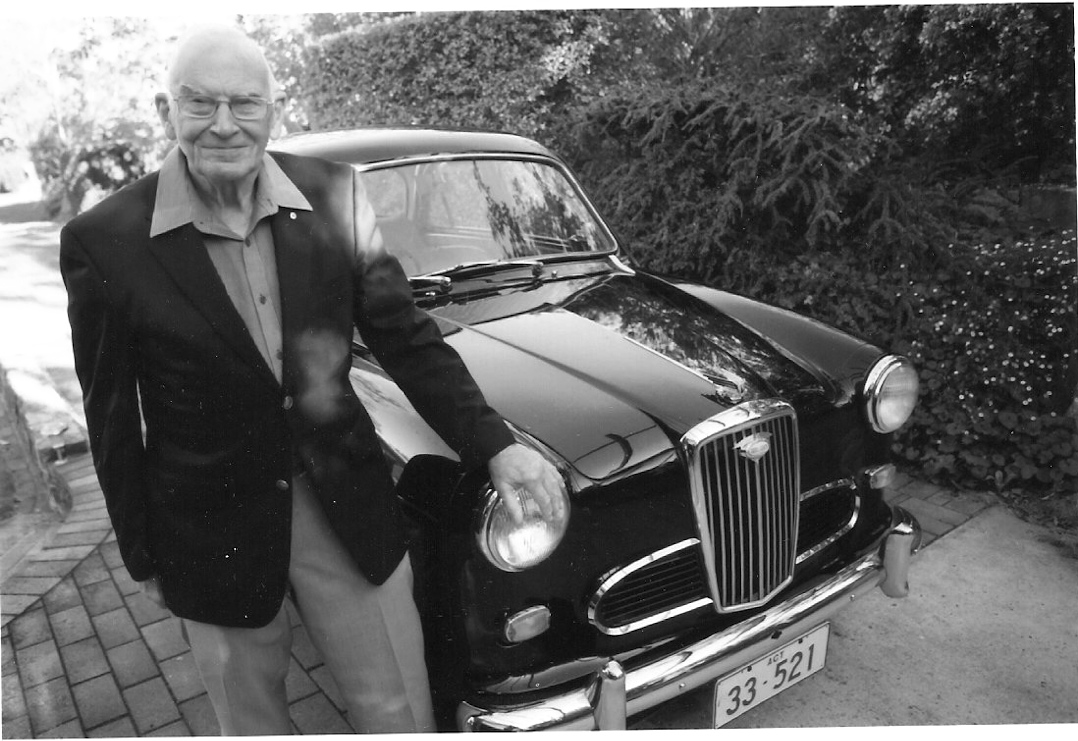
Professor Bob Compton
Robert (Bob) Woodhouse Crompton was born in Adelaide on 9 June, 1926. His childhood hobbies included building electric motors, and his creations included a clock, gramophone, and numerous small motors to power his toys. His hobby developed into academic success, and he graduated from Prince Alfred College in Adelaide top of the state in physics.
Crompton was awarded a cadetship at The University of Adelaide where he worked on his science degree in between making laboratory equipment for lecture demonstrations. He graduated with honours in 1949 and in 1954 he was awarded one of Adelaide’s earliest PhDs for his study of the collisions between slow electrons and gas molecules. Between 1950 and 1960, Crompton was a physics lecturer at The University of Adelaide. He formed a small research group, which was later invited to join the newly formed Research School of Physical Sciences at the Australian National University in Canberra. There he helped to shape a world renowned group in electron swarm physics, formed many international collaborations and took part in the creation of the Australian Journals of Scientific Research.
Crompton has received numerous prestigious awards and served in many professional organisations, including being elected to the Australian Academy of Science in 1979, the American Physical Society in 1995, and the British Institute of Physics for his work in atomic and molecular physics and low temperature plasma physics. He was appointed Member of the Order of Australia in 1999 for services to science and the community.
- A happy childhood making motors with Meccano sets
- Primary school, the war and an educational mentor.
- An introduction into science - making motors and electric clocks
- A great thrill
- Learning German on the soft couch
- An introduction to electron physics
- One of Adelaide’s earliest PhDs
- Helen
- World wars and lab wars
- Townsend’s scientific grandson
- Struggles in Swansea
- A production line for the Advancement of Science
- Great opportunity in a burnt out shell.
- Researching electron swarm physics
- Lecturing around the world
- Results that have stood the test of time
- Writing a fairly solid book.
- Great friends in Oklahoma
- Working on positrons and car engines
- Physical poetry
- A builder of equipment and overseas collaborations
- A wonderful family
- Secretary at the Australian Academy of Science
- Chair of the board
- Fellowships, honours and milestones
- Fulfilling a dream
My name is Erich Weigold and I am here today on behalf of the Academy to interview Professor Robert Crompton.
A happy childhood making motors with Meccano sets
Can you tell us where and when you were born?
I was born in Adelaide in June 1926 and I lived in Adelaide for many years until I came to Canberra in 1961. I should go back a bit. My father was in a family business that had a whole range of interests. His particular part of the business was to look after the manufacture of soap, but there were sheepskins being sold and goodness knows what else. It was a very wide-ranging family business, now unfortunately defunct. My mother was English. She had nursed in the First World War, and when the war was over, her nerves were pretty well shot to pieces because she had had a very strenuous and stressful job nursing soldiers in a surgical ward in the war. These poor chaps had had their faces shot off and there was a lot of plastic surgery that had to be done. One of the things which she could never get rid of was the extreme caution that one had to take against germs. Unfortunately that was still well and truly there in our young days. It simply came about because, if there was any infection in the wards, the surgery was undone and they lost the patient. In about 1919 my mother came out from England to Australia. She was looking after a young family of one of the doctors who she had nursed in England and met my father.
We had a very happy childhood, actually. I have a brother Jim, who is a couple of years older than I am, and we did a lot of things together. In those early days I used to make little electric motors which we used to drive our toys, which we built from our Meccano set.
In 1936 we went back to England to visit my grandmother, who was then getting quite elderly, and my mother's sister, whom my mother hadn’t seen since she had come out in about 1918 or 1919. That was the English era of wonderfully cheap toys. One of the things was that there was a lovely toy shop in Leicester, England. Jim and I went into this toy shop with eyes like millwheels. We had been saving hard because we had heard of the reputation of British toy shops. We each bought reasonable-size Meccano sets. He bought a rather large motor boat and I bought this one (indicates), which is now 75 years old and still goes beautifully.
It still goes, does it?
Yes, it still goes. I also bought a model aeroplane, which I had for a number of years. It was rather more fragile and didn’t last the distance, because it was always crashing.
How much money in the old units did something like that cost?
Five shillings. Yes, indeed. Those were the days!
Primary school, the war and an educational mentor
After we came back to Australia we went back to the upper years of primary school at Prince Alfred College, which was one of the boys’ schools in Adelaide. It is still going strong. I was getting towards the upper years of the preparatory school in those days and we had a change of regime. Around about this time, 1936, the prep school was rebuilt into a spanking new building. It is still there today. The prep school is on North Terrace ‒ the big white building with the white tower and terracotta roof. It was a great change from the old preparatory school, which was there before and so, too, were the staff. In those early days, we had rather a martinet of a headmaster of the preparatory school ‒ quite unsuitable for young boys. At the end of the year it was decided that the masters in the prep school 'couldn’t be trusted' to conduct the examinations, so masters from the “big school” came across to give us oral examinations. These were men in their 50s and 60s. It was absolutely petrifying to young kids of anywhere between 10 and 12, I can tell you.
During the war, we had to vacate those premises because the American troops moved in. There was a great invasion of American forces into Adelaide at that time, because everyone thought Australia was about to be invaded. The American troops took over the preparatory school and we all had to get out. So we went to a church hall in Kent Town nearby. We weren’t there all that long, because the Americans only stayed there under a year, and then we went back again. But there was a change of regime from the rather martinet headmaster who was there when I first went to the prep school, to a delightful man called Norman Mitchell. He came from Victoria with a completely different educational philosophy and way of handling boys. He was a delight. He became very firm friends with my family, so we saw a lot of him from that time and well after I had left school. As I mentioned, in those days there was this business of masters from the senior school coming across and examining us. It was awful. When Mitchell came, that changed. Another thing that changed was that woodworking was introduced to the school as a class. You could take it usually as a hobby. Certainly we took it seriously in the prep school. Some people carried on in the senior school, although I didn’t. So I learnt woodwork in those years at school. It is something that has stayed with me ever since and I thoroughly enjoy it. Mitchell used to have me there in the school holidays to work with him doing woodwork, which I just loved. It was a wonderful experience. I guess that he was my first educational mentor.
An introduction into science - making motors and electric clocks
After prep school, you went into secondary school. Did you find a mentor there?
Yes, certainly. That was our physics master, Raymond Smith. He was a wonderful teacher ‒ great with boys and also great with physics. One thing I did then, now getting up towards the senior end of the school, was to make for the school a parallel-plate polarimeter. I asked only recently whether that is still in existence. It doesn’t seem to be, which I am a bit sad about. It was quite robust, so I thought it could have stood the test of time, but it is apparently not to be found. I think it might be hidden away somewhere in a cupboard.
I assume that playing with electric motors and Meccano sets also led you into science?
It was sort of my introduction, yes. My brother and I used to make things in those days and some of the things that we ‒ or I ‒ made were electric motors. They were pretty primitive, but they did go, and we used them to drive our Meccano models. We cut the form of the rotating armature ‒ subsequently wound it with copper wire, of course ‒ out of cigarette tins that were available in those days. I suppose there might have been perhaps 30 leaves or pieces all cut to the same shape, put together and then wound with copper wire to make the armature. The commutator was a piece of copper tubing, which we split longitudinally into whatever number of poles the motors had – either three or four – and the current was conducted to the copper commutator via carbon brushes, which were pushed against the commutator by little springs. It was quite sophisticated. They went like the wind, those motors. They probably wound up to 2,000 or 3,000 rpm if you let them go.
I believe that you also went on to make a synchronous gramophone motor?
Yes. If you do your sums, you will find that if you have a large armature with 77 teeth and a stator that also has 77 teeth, as one tooth comes up against the corresponding tooth in the stator, it fortuitously spins at 78 rpm with an error of only 0.1 per cent. So the rotor and the stator had 77 teeth and the stator was wound to be energised. But, when we put the thing together, we found to our horror that it hunted. “Hunting” is a phenomenon whereby the rotor tends to go too fast for a bit, then drop behind and then go too fast again. That is not good when you are trying to listen to a gramophone record. We cured the problem by mounting the stator on ballbearings and damping it. Instead of the rotor-hunting, it continued going around at a constant speed, and the stator just jiggled around ever so slightly on its damped mounting. That was quite a successful venture.
A little bit later, I made an electric clock. The gramophone motor has gone to its father’s long ago ‒ it no longer exists, which is a bit sad ‒ but the little electric clock goes to this day. It also is synchronous. It starts off with a reduction from a worm drive to get down to some reasonable speed. I have forgotten what speed it spun at. It was relatively slow but too fast for a clock. The clock started off with a worm drive to reduce the rotation speed of the first wheel quite considerably then a gear-train down to the minute hand and the hour hand. It still sits in our living room and still keeps perfect time. It is still there.
So that was an AC motor?
Yes, it was run off the AC mains, as was the gramophone motor.
A great thrill
When you graduated from Prince Alfred College, what did you do then?
I don’t like to brag, but there was a great thrill at this time. I came top in physics for the public examinations that year – leaving honours. It was most unexpected, but it was a great thrill, for both me and my teacher, Raymond Smith. So I didn’t go on to a second year at leaving honours, which many people did. At this stage there were only 12 public bursaries to go to The University of Adelaide. If you didn’t get a place in one of those, your parents had to stump up with the fees. Even in those days they were quite steep. The alternative was to do what I did and that was to take a cadetship. A cadetship was the most junior position in the department of physics. It meant that you were the assistant to the lecturing staff. In those days the whole lecturing staff was three or four people. There was Professor Sir Kerr Grant, who was the head of the department, Dr Roy Burdon (I was his cadet), another lecturer, and another junior lecturer. That was the whole staff. It seems unbelievable, doesn’t it?
That was the whole staff?
Yes. So I went to the physics department as a cadet and had a wonderful time. It made very little difference to your course length. It only altered it from three to four years, with a year on top of that for honours. But it gave you a wealth of experience because what one did was to set out laboratory equipment for the lecture demonstrations – old Kerr Grant was very keen on those – and to make equipment. Around that time, there were two, perhaps three, things that I remember making of which I was very proud. One was an automated Wilson cloud chamber. This was made for one of a series of exhibitions which the department put on, called “conversazioni”. I don’t know where the name came from, possibly Italian. These were exhibitions put on for the sake of the public. The automated Wilson cloud chamber worked like this. At about every 10 minutes, the vacuum pump would evacuate the volume underneath the piston, the piston would drop and expand the air in the space above and make a cloud and you could see tracks of radioactive particles. It was fun.
I think that was still operating when I went through the University of Adelaide.
That was probably mine—almost certainly, I should think. Another piece of equipment I made was sort of a mock-up of an electron camera. It was an electron diffraction camera, for bouncing electrons off metal surfaces and looking at the diffraction patterns. This enables you to get information about the structure of the metal. John Cowley, who had a very eminent career later in the States, was doing his work at that stage in Adelaide on something which was called the Finch electron camera. He had sole charge of this. It was a devil of a machine because it was all put together with soft solder and pumped by mercury pumps. So, guess what? The mercury vapour dissolved the solder, so the thing was one mass of holes. The only way to keep it evacuated was to plaster it with plasticine and shellac and to wait for the next hole to appear. It was terrible. John Cowley did some quite famous work on that in those early days. To show the principal of electron diffraction at one of these exhibitions, I made one of these electron diffraction cameras out of an electron gun taken out of a TV tube and from an oscilloscope tube, a phosphorus screen of about that size (indicates). There was a way in which I could manipulate the specimen. The electron gun produced the electrons, which then bounced off the metal surface and you could see the pattern on a fluorescent screen, just as in the full-size instrument.
Learning German on the soft couch
Besides Kerr Grant, Burdon was also lecturing.
He was the reader. George Fuller, whom you will remember, Erich, I am sure …
I remember George very well.
Yes, he was a lovely fellow. He was a lecturer.
I also remember Roy.
Roy was really my boss. I was a cadet for Roy Burdon and not Sir Kerr. Roy did the serious physics around the place. Kerr Grant was much more of a showman. He was a very interesting old boy. I won’t try to reproduce his accent – well, not his accent, but his method of speech with a cleft palate. Nevertheless, he was a character, I must say.
There was still a requirement for language in honours degrees in those days. What language did you do?
There was indeed. The language requirement was to do French or German. We elected to do scientific German. What did scientific German consist of? It consisted of meeting the professor every Monday morning and making a rush to get a seat on his soft couch, which was getting very decrepit and could only take three or four of us. I think the honours class that I was in had at least six; it may have been eight or 10. It was an unusually large class because, in Adelaide in those days, there were usually only a couple of students in such a class. That year we had something like eight or ten. Barbara Potts – Ren Potts’s wife was a member of that class. Also a number of my colleagues that I kept up with later on, such as David Sutton, and so on were members of that class. We used to make a dive for this couch to have the luxury of sitting on it during these German lessons, which consisted of all of us trying to read German or of listening to Kerr Grant reading German with a cleft palate and us all having to translate it. It was hell, I can tell you!
Was that during the honours year?
During the honours year, yes.
An introduction to electron physics
Sir Kerr Grant must have retired around then.
Yes, he did. He retired at the end of 1948. That brought about a change in regime with the arrival of Sir Leonard Huxley, with whom I worked closely for many years subsequently, first as a PhD student in Adelaide and then here in Canberra. Sir Leonard was a completely different kettle of fish from old Sir Kerr – by no means a scintillating character but a very solid physicist who was determined to start some real physics research in Adelaide. He began three or four lines of research: seismic studies; biophysics; upper atmosphere research using radio waves; and – the thing that I became interested in – how electrons interact with atoms and molecules. Those were essentially the brand new research areas that he introduced when he came. Biophysics was introduced a few years down the track, when he imported a fellow called Stan Tomlin. He was an excellent physicist.
Yes. Stan taught me quantum mechanics.
He was a good fellow, wasn’t he?
Yes.
Remember that I had just completed honours and so was about to embark on the next stage of my career, and everyone was very anxious to see this new professor. So, one morning, which I remember so well, enter Len Huxley – Professor Huxley, as he was in those days – in a shabby tweed sports coat, flannel trousers and a felt hat. He was pretty well just off the boat, having come from England. Of course, academics in England in those days had appalling salaries, so he couldn’t have had two beans to rub together when they arrived in Adelaide. It so happens that he and I were thrown together more than we might have been in those early years because my father and mother went overseas to see my brother, who was in England at the time, and the Huxleys took our family house. They had a daughter, Margo, whom we still see. She was five in those days so she used to sit on my knee. She doesn’t do it now, but she used to then! She was a lovely girl. I used to have to look after the garden and so on in father and mother’s absence, and the Huxleys had the house. That was a sort of closer personal introduction to the Huxleys other than just the formal one through the university.
One of Adelaide’s earliest PhDs
Did you go on to do your PhD in Adelaide?
Next was the PhD, yes. I chose as a topic one of the subjects that Huxley was interested in, which was laboratory studies of electrons in gases. In those days, the physics department in Adelaide had virtually no money. I remember, for example, it was quite a day when we were allowed to go out and buy a coil of hook-up wire! You can’t believe it these days, but that was how bad it was. We had to make all our retort clamps and set up the vacuum systems from scratch – glass systems with glass taps in those days. I built those and did all the glass blowing myself, which really taught me a lot about glass blowing, and it was good fun. I also made the first of our diffusion apparatuses. I should say that Huxley brought out with him a very small apparatus with which he had been doing similar studies with a student of his, Zaazou, in Birmingham before he came to us. Had he known what we learned later on, he would have realised that it was an absolutely hopeless apparatus to do anything with, because (something we found out very soon was that) one of the most important things to avoid is contact potential differences between the various metal surfaces in the apparatus. They will move the electrons anywhere except where you want them to go! Very early on I made an apparatus out of brass, which we silver plated, the idea being that the silver plate would hopefully have a much more uniform contact potential than the brass. Later on, we went to gold plating, which was better still. That was cutting my teeth in research.
Yours must have been one of the earliest PhDs in Adelaide.
Yes, that is true. I think Sydney may have started PhD courses a little earlier but not much earlier. Nearly all of the other universities were just introducing them in 1949, when I began mine. It seems amazing now, but that is how it was. The highest that you could go to before that was an MSc.
Helen
Did you meet your wife, Helen, at that stage?
Helen came to the department as the departmental photographer. She became great friends with the three of us who worked very closely together – David Sutton, John Thomas and me. She was great friends with all three of us. But, shortly after that she went off to England, which was a sad day. Then we began a long period of letter writing. It ended up with a long-distance phone call – such calls were absolutely appalling in those days – in the middle the night for me. I got out of bed in a bit of a fuddle, immediately turned the wrong way and hit my head on the wall, and then had this telephone conversation in which I asked whether she would marry me! She said ‘yes’ and came home, and we were married in 1951.
World wars and lab wars
So what happened after your PhD? Did you stay in Adelaide or go somewhere else?
I had one period of study leave in Swansea in those early days. Helen and I had our first child quite quickly. He was six months old when we went off to England. That was an adventure in itself. If we thought Adelaide was a bit starved for funds, it was nothing compared to Swansea in those days. Swansea had taken a real battering during the war. It was an oil depot town that had been bombed to pieces during the blitzes in the Second World War and it was hardly recovering when we got there. The University College of Swansea was housed entirely in wooden huts, except for the administration building, of course! All the rest of us occupied wooden huts, and they were just the most decrepit things that you could possibly imagine. But that is where we did our research. My research – with two colleagues, who became very firm friends, Jack Dutton and Syd Haydon – was on the measurement of pre-ionisation breakdown currents.
At that time Llewellyn-Jones was in the middle of a fierce war between his group and his way of thinking, which was very quantitative, and an American group under Leonard Loeb, whose approach involved hand-waving and something called the streamer theory. Mention the streamer theory to Llewellyn-Jones and he was likely to blow his top! It was anathema to him, absolutely – with some justification, actually. Loeb enters our story later on and he and I became firm friends. But at that stage, if I had told Llewellyn-Jones that I was going to be a friend of Leonard Loeb, he would have cut my throat, I think!
Townsend’s scientific grandson
I think you were able to meet Townsend himself.
Absolutely, that was a highlight. Huxley came to England while we were there and we met in Oxford. Townsend was still alive but getting very near the end of his days and Huxley took me along to meet him. Llewellyn-Jones and Huxley were both students of John Townsend’s. JS Townsend was really one of the founders of gaseous electronics. He was an amazing man with a wonderful insight into what was going on, almost as though he could see the electrons that he was studying. Huxley studied under him and I studied under Huxley, so eventually I became Townsend’s scientific grandson as it were – of which I am very proud, incidentally.
Struggles in Swansea
You were also able to witness the coronation of the Queen.
Yes. I should say that, in Swansea in those days, not only was our laboratory accommodation, the equipment we had to work on, and our technical support very primitive, but our living accommodation was also very primitive. We were very fortunate that Helen had an elderly cousin living in Swansea at that time and she scouted around for some accommodation for us. There wasn’t any freestanding house that we could get. All Helen’s cousin could find for us was shared accommodation in the house of an elderly widow. So that is where we moved in. In a way, Malcolm, our son, who was then six months old, was our saviour. This elderly widow looked slightly sideways at us intruding into her house, but Malcolm was the darling. Malcolm was the oil in the works, so we were very lucky to have him!
I must say that one of the things I remember from those days was coming back from work, often fairly late and pretty tired. We lived about three to five miles away from the university in a suburb called the Mumbles, which was supposed to be a tourist trap. It is still not exactly a tourist trap – but I won’t go into that! Our house was at the top of a very steep hill. At the end of the day, I used to catch what was called their “electric train” – it was actually only a tram car – from the university. It went all around the bay from Swansea, and then I would have this large climb up a near-vertical hill to where our house was. It was quite a trek. Poor Helen had the job of taking Malcolm up and down that hill. Whenever she wanted to do any shopping , she had to take the pram – with Malcolm in it – down a flight of very steep steps to a somewhat lower area, walk down this steep hill into the shopping area and then walk all the way up again. With a pram and a baby, it was quite a task!
A production line for the Advancement of Science
Returning to some of your other activities back in Australia, you were involved in The Australian & New Zealand Association for the Advancement of Science (ANZAAS) even at that early stage.
Yes, I guess I was. One of the things I did in those early years – I think we must have been mad, but there wasn’t any money – was to make timing clocks for lectures. These became a necessity for ANZAAS because, like they are now, the sessions consisted of a whole lot of short talks and you wanted some sort of discipline in controlling the length of the talks, so you needed lecture timers. There wasn’t any money to buy any of these, so a group of my colleagues and I set about making them. There were somewhere of the order of 16 to 20 sections of ANZAAS, in a number of areas – physics, mathematics, various branches of the biological sciences and so on – so we made one timing clock per so-called section of ANZAAS. As I say, there were somewhere between 16 and 20 of these sections, so we made that number of electric timing clocks. Ten minutes before the end of a lecture, a light would light up, five minutes before the end it would change colour and at the end it would give a buzz. Those clocks were quite successful. We had a production line to make them. Again, there was no money to buy them.
Was that done in the physics workshop?
No, mostly they were made in our house. Some of the parts were machined in the physics shop, but the actual producing of them – putting them all together, and the wiring – was done in our house. Helen well remembers it because she says that she was vacuuming solder spackles out of the carpet for months afterwards!
So you went back and resumed your research on electron diffusion in gases.
Yes, until 1961.
Before you left Adelaide University – I want to bring you back to some aspects where we overlapped – you were my honours supervisor and taught me how to melt black wax to make vacuum systems. The honours project that we had was accelerating electrons to very high velocities so that we could measure the increase in the mass as their velocity increased. To do that, I used a Van de Graaff generator, which you also made, and I became an expert in black-wax melting.
So we did. That reminds me. Remember that I said I would have made two things at Adelaide University? The thing I had forgotten was that Van de Graaff generator. I have forgotten why it was made initially. It was not made for serious research but for one of those public demonstrations. It was quite a beast, wasn’t it?
It was.
It had a dome on the top consisting of two pieces of aluminium – about that size (indicates) in diameter, supported on a large insulating tube. Up the centre of this tube ran the Van de Graaff belt. Helen and I made the belt by sewing multiple layers of nylon shirting longitudinally and every which way. It was a devil of a job. Nylon in a single piece is bad enough, but in six pieces it is almost unmanageable. Between us we managed to fabricate this belt. It was driven by an electric vacuum cleaner motor at the bottom of the tube which drove the bottom drum, and the belt went up and down. It carried charge sprayed on to the belt by gramophone needles fed with a high-voltage motor car ignition coil, and it carried the charge up to the dome. On a good day when it was dry there would be a spark from the top to the bottom of this machine. It was about a metre high, wasn’t it?
Yes.
It was quite a terrifying brute, actually. Thank you for that reminder.
Great opportunity in a burnt out shell
I must also remind you that you were responsible for my career after that. You recommended that I come to ANU and do my PhD there, so I actually arrived at ANU ahead of you.
It is amazing, these crosses in our paths.
Yes.
Anyway, about 1961 or so Huxley left Adelaide and took a position for a year with CSIRO, on its executive. He had been at Adelaide for about 10 years. Then he was appointed Vice-Chancellor of the ANU. Not long after, I received an invitation from him asking would I bring the whole of our rather small research group across to Canberra if they found the funds to do it? That was a tremendous opportunity but also a tremendous challenge, at least for John Gascoigne our technical man. John was a very skilled fellow in the workshop right through to when I retired. It was a great decision to make because we had both just built our houses in Adelaide and had young families. Here we were, having to uproot everything we had done on the home scene and make the decision to come to Canberra. Well, John came over and surveyed the scene. He came back and reported that the lab that we were to go into was a burnt-out shell. It was at the end of the so-called Cockcroft Building, one of the only two buildings of the Research School of Physical Sciences then, and he brought back photographs of what state our laboratory was in. It was, indeed, a burnt-out shell.
I remember that fire very well, since I was doing my PhD at that end of the building with the high-tension Cockcroft-Walton accelerator – or HT2, as it was known. The fire started in the geophysics offices further down the corridor and it wiped out the rest of my PhD with that accelerator. I will never forget that day because I was sleeping at University House when some of my fellow PhD students woke me up to say that there was a fire in the building where I was doing my PhD. I came over to see that what the fire hadn’t destroyed the firemen had managed to destroy! After squirting water everywhere, they threw everything out of the window and all the equipment was either burnt or smashed – mostly smashed. Fortunately I was able to complete my PhD on another accelerator in the nuclear physics department and was able to save some of my PhD thesis because of the notes and files that I had kept back in my room. Anyway, I could vouch for the fact that this lab did not look very good at all.
The lab looked dreadful. John Gascoigne came back with pictures of it, but he said, ‘Don’t worry. We’ve been assured that it will be all fixed up by the time we come over in about March (1961)’. Guess what? When we arrived, it was exactly as John Gascoigne had seen it when he photographed it! In a way, that was a good thing because we were introducing a line of research which required clean conditions, and apparatus a little bit more, if I may say, “sophisticated” than some of the gear in the Research School of Physical Sciences was then. So this burnt-out shell provided us with an opportunity to build a laboratory from scratch. Gascoigne designed it and had it built. While it was being built we made the equipment to go in it. So here we were in 1961 at the beginning of a new era.
So you were able to start from scratch.
Yes, and with plenty of money. Sir Mark Oliphant was director of the school in those days. The Research School of Physical Sciences was just in transition from being in the old ANU, where it was purely a research and training institution for PhD students. It was moving from that phase to having an undergraduate section joined on to it as well. That was the so-called School of General Studies. In the old days, the ANU was simply what is now the Institute of Advanced Studies, and it was quite well funded. Our budget – although we thought we were asking for a heck of a lot – was just peanuts compared with what was being spent in other areas of the physical sciences school, so we were very lucky. We wanted to move into the era of ultra-high vacuum, which is a relatively expensive game. Malcolm Elford had just come back from overseas where he had learned the tricks of ultra-high vacuum technology. We were able to set up our vacuum systems partly to meet ultra-high vacuum conditions, and that was a great step forward. Just before that, John Gascoigne and I had built what was quite a novel and elaborate apparatus for those days and it came with us. I will describe it in a moment. It is still in the museum cupboards of the Research School of Physical Sciences.
Researching electron swarm physics
I think it is appropriate here for you to tell us a little about the research you did.
I have always been interested in a branch of research which is called electron swarm physics. First of all, let me describe what we mean by a cross-section. Perhaps it is best imagined by thinking of a ping pong ball being thrown at a basketball. The cross-section for the collision between the ping-pong ball and the basketball is really how big the basketball looks to the incoming ping-pong ball. If you were to cut a slice through the centre of the basketball you would have a disc. The cross-section, in very rough terms, is the size of that disc. They were the sorts of things we were measuring by different techniques.
When we do these kinds of measurements there is an electron gun. It is the same thing that is in a TV tube that produces an electron beam and hence the spot that goes backwards and forwards and draws the pictures on the screen. In the experiments, the electron beam is directed at some gas molecules emerging from a nozzle. The electrons hit, or may hit, one of the atoms or molecules in that molecular beam and they bounce off. We collect them on the circumference of a circle and find out how many go in this direction (indicates), that direction (indicates) and that direction (indicates). From that, we work out what is called the cross-section for the electron hitting your target molecule.
Swarm experiments are entirely different. In swarm experiments, we don’t have single electrons to study. Instead there is a whole ensemble of them in what we call an “electron swarm”. We generate the electron swarm in a gas by having, for example, a hot filament or a radioactive source to produce the electrons. Then we have apparatuses in which we draw the electrons through a very small hole. They enter what we call the “diffusion chamber” and the whole apparatus is filled with gas at anything from a very small fraction of an atmosphere to more than an atmosphere. So the electrons issuing through this small hole can no longer stay as a beam because, as soon as they emerge from the hole, they hit another molecule. I don’t know if anyone knows the term “Galton board”, but it is rather like a Galton board where a marble rolls down a peg board with an array of pins, hits a pin, goes here, hits another pin and goes there, so a group gradually spreads out. That is exactly what the electrons do. They hit molecules of the gas, bounce off them and go on and hit other molecules. Instead of ending up with a beam one millimetre in diameter, which is what we started with, we end up with a diffuse swarm of electrons.
One of the very simple measurements that we make is to measure the profile of that electron swarm. That is one measurement. The other is to chop the electron swarm into segments. Then we have slabs of charge moving down the apparatus and it is possible to measure how rapidly the slabs of charge move from one end of the apparatus to the other. I won’t go into the technicalities of how we do these things, but they are basically the two measurements that are made in swarm experiments. There are others, but they are the two basic ones.
It is a relatively simple matter to extract the cross-section from the kind of so-called cross-beam, even though the experiments themselves are challenging.
Swarm experiments are easier, but it is a very complicated business to get the cross-sections from what is really a very indirect process. It involves observing how this group of electrons drift and diffuse in the high pressure gas. It is done by solving what is called the Boltzmann equation, which relates the motion of the particles as a group to the motion of the individual electrons in the group, and, these days, through the use of computers. In this way, one can extract the so-called cross-sections, which is what we are trying to obtain.
In those early days at ANU, did you have any visitors from overseas?
We had quite a few over the years. One of the early ones was a fellow called Leonard Loeb. Leonard is certainly one of the grandfathers of gaseous electronics. He is dead now, sadly. He would be almost 100 if he were still alive. Huxley invited him to come to Canberra in those early days. There has always been a lot of controversy between the explanations that Loeb had for what happens in an electrical discharge and those of Llewellyn-Jones, which were based on Townsend’s theory, which we have already talked about. The two (Llewellyn-Jones and Loeb) were absolutely at loggerheads. As I have said, if you mentioned Loeb’s name to Llewellyn-Jones, you were likely to get an explosion! Nevertheless Huxley thought it would be a good idea to get Loeb out. Because he was a textbook writer, Huxley thought it would be a good idea to show him what we actually did. So Loeb came out, certainly in his latter life and, I must say, he seemed impressed with what we did. If only he had written some textbooks after that we would have scored well in them! Unfortunately, he didn’t write any more, but he obviously thought what we were doing was very sound. I guess it was as a result of his advocacy, as much as anything, that we had invitations to go to the States and spread the word.
Lecturing around the world
Was that in 1963?
Yes, that was in 1963 or a little later. About then I had a very extensive lecture tour. I think it involved visiting and lecturing at something like 20 institutions: universities and places like Westinghouse and Lockheed Aircraft Company. Westinghouse and Lockheed had people who were interested in how electrons interacted with the atmosphere. With Westinghouse, gaseous electronics was part of their bread and butter, since they made devices that relied on gaseous electronics. That was a very big tour and I suspect that really publicised our work more than anything else.
In 1963, you also went to your first International conference on the physics of electronic and atomic collisions (ICPEAC) conference.
Yes. I have bolted ahead a bit. I believe the lecture tour that I have just been talking about was in 1968. 1963 was my first International conference on the physics of electronic and atomic collisions [ICPEAC]; there is a bit added onto the name now. That conference was in London. I think it was only the third conference. I don’t know what number conference we are up to now, but it is a large number. It has been going on ever since. That was one of the big international conferences of which I attended quite a few in later years. The other was called ICPIG – the International conference on phenomena in ionized gases. It attracted a different sort of audience. We had a foot in both camps because we were extracting collision data, which were of interest to ICPEAC, out of experiments that were not quite gaseous discharges but something akin to them.
You also went to ICPEAC and ICPIG in Quebec and Belgrade.
Yes. One was ICPEAC and one was on ionised gases. Again, they were great experiences. I remember the first one in 1963. I was sat down in one of the rooms in Massey’s laboratory, at University College London, with some of his young bloods who were actually in charge of the organisation of this conference. They were asking me to help them sort out how the papers should be placed into this session or that. I was not a young man by any means then, but I felt terribly green in that sort of environment all the same. I got over that in the long run. In those days it was my first real exposure to overseas conferences. I don’t know that I contributed much, but I tried to help.
Following your overseas trip in 1963, you also went on a trip in 1968, funded by the Fulbright Foundation, to quite a number of universities and institutions.
As you can imagine, it was a very exhausting trip because I think there were something like 20 institutions that I was invited to visit and lecture at. At not at all of them, but at perhaps two thirds of them I had to give lectures. They were all over the United States. After that I went off to England and, on the way home, to Singapore. It was a very useful trip because firstly it was under the auspices of the Fulbright, which is a prestigious program. Secondly, it gave our work exposure to a large number of laboratories that were doing either the same or cognate work. The trip was exhausting but very useful.
I think you also went to Italy at that stage.
Yes, I did. I have forgotten exactly where I went to in Italy but I gave a lecture there too, if I remember rightly.
After that, you went overseas on short trips rather frequently.
Yes. The ANU had a generous study leave program. We were entitled to take one full year off in seven years. Rather than do that, I chose to take short conference trips of one or two months. In this way I met a lot of people and a lot of people learnt about our work because I nearly always lectured about it on these occasions. I think that was a more profitable way to use sabbatical leave than the more conventional way. I think that was a better way of using the funds available for that purpose.
Results that have stood the test of time
I think you are not beating your own drum enough, Bob. I know that you provided the most reliable and accurate cross-sections, which still provide benchmark measurements today.
I think that is right. We would probably never get away with it these days, but I think we must have spent somewhere between five and 10 years perfecting the techniques before we were really sure that we knew what we were doing. These days, if you spent that long, you wouldn’t get any funding! The ANU’s Institute of Advanced Studies was a wonderful place because you could investigate over long time periods to get things right. That was what we did.
There were two results from this period that have stood the test of time. One was a set of experimental data for the so-called “momentum transfer cross-section” – which is similar to the cross-section I described with the ping pong ball and the basketball – for electrons scattered off helium atoms. We reckoned that our cross-section was accurate to within error bounds of about plus or minus two per cent. Usually in absolute beam experiments, if you can normalise them and make them absolute, about 10 to 15 per cent error is considered quite good. But to really test theory, one would like to go a bit further. We were pushing these experiments to the point where we were getting results which we reckoned were accurate to within a couple of per cent over the energy range which we were probing, which was from almost zero electron volts out to about 15. Incidentally, the bottom end of that range requires one to do the experiments at liquid nitrogen temperature. The reason for that is, if you have electrons moving around in a gas at room temperature, the lowest energy is something of the order of 40 thousandths of an electron volt. By going down to lower temperatures, you can extend that down to about 10 thousandths. So our experiments at the low end were done at these lower temperatures.
At this time, another of our colleagues, RK (Bob) Nesbet was doing very accurate calculations. There are not many systems for which you can make really accurate wave mechanical calculations, but one of them, because of the simplicity of the atom, is helium. Nesbet claimed that he could theoretically calculate the cross-section to within one per cent. To our great delight, when we compared our results with his, they were right on top of each other. We both felt very gratified with that particular result. I think it is true to say that that particular result of his still remains as the benchmark?
It still remains as the benchmark, indeed. After that, you went on to do some work on molecular hydrogen.
Yes, that is true. We chose the simplest gases to do. Helium is the simplest atomic gas. We then moved to molecular hydrogen, which is the simplest molecule to tackle.
At low energies in helium one needs only be concerned with elastic scattering. However, when we are talking about electrons colliding with a molecule, the electrons can not only be elastically scattered but they can also set the molecule rotating or, at a little higher energy – about half an electron volt – can set it vibrating. What we wanted to do, if we could, was to measure the cross-sections for elastic scattering, for rotational excitation and for vibrational excitation. The threshold energies for setting the molecule spinning are very low. But the problem is that hydrogen is a mixture of two forms – so-called orthohydrogen and parahydrogen – and, because of that, unravelling the results is more difficult than it might be. It can be simplified if we can produce just one form of hydrogen, parahydrogen, normally only present to about 25 per cent. The technique for doing that is quite difficult. What we have to do first is to pass the gas over a catalyst, iron oxide, at very low temperatures - temperatures that are low enough to form solid hydrogen. If we do the conversion at that kind of temperature, we produce pretty well pure parahydrogen. By “pretty well”, I mean 98 per cent, which is about what we reckon we got. We measured the purity, that is, how much orthohydrogen there was left, by a technique which I won’t describe here that was developed by others. The complexity is that we not only had to produce hydrogen in this paraform but also that it had to be pure. By “pure”, I mean really pure, especially with respect to oxygen. We were aiming at an impurity level of one part in ten to the ninth – very pure! If it is not as pure as this, when the electrons go through the gas, they will not only collide with the hydrogen molecules but also attach to the molecular oxygen to form negative ions. Even though those oxygen molecules are present only in that very small proportion, they really complicate the interpretation of your experiments.
Ian McIntosh, a graduate student, and I did the conversion and these measurements. We were quite scared when we were doing this because it is not unknown for liquid hydrogen to blow up under certain conditions – probably electrostatically detonated, I don’t know how. Anyway, in the room at the ANU where they produce liquid helium, we had this gear set up and we were sitting behind large perspex sheets which, if the liquid hydrogen had blown up, were supposed to protect us. Whether they would have I have no idea! The perspex sheets were some sort of comfort in any case.
We produced the parahydrogen and made the measurements and, to our delight it turned out that those results for the rotational excitation from the threshold up to probably about half an electron volt fitted absolutely beautifully with theory. That was another highlight.
But there was a disappointment. In addition to finding the rotational cross-section, these experiments enabled the vibrational cross-section to be determined. Vibrational excitation occurs at a somewhat higher energy. The lowest energy at which we can produce vibrational excitation is about half an electron volt. There is enough separation between what happens at lower energies and what happens above half a volt to get a good handle on the rotational cross-section. Then, from half a volt up, we can determine the vibrational cross-section and the rotational cross-section, with decreasing accuracy for the rotational cross-section. But here is the disappointment: whereas the theoretical rotational cross-section and experiment match beautifully, the same is not the case for the vibrational cross-section. We have agonised over the experimental results for a long while. We have done the measurements in various different ways. Every way we do them, we get the same result. Theoreticians claim that they have got it right; we claim that we have got it right. We don’t fight over it, but there is an unresolved controversy. I doubt whether I will see it solved, but I would love to know what the answer is.
Writing a fairly solid book
Around this time, Sir Leonard Huxley retired from the vice-chancellorship at ANU. Did he go back to experimental work at all?
No. He never did any experimental work in Australia, but he was always interested in the work that we were doing. His great contribution to the work was on the theoretical side. That was not in scattering theory but in the theory behind analysing swarm experiments to get these cross-sections. That was his great contribution.
Various American publishers had been at us for some time to write a book, so now was the time to do it. Huxley had some free time – I didn’t have any! Nevertheless, we got together. I went afternoon after afternoon down to Huxley’s house in Hughes, where he had retired to, and we set about preparing the material for this fairly solid book ‘The Diffusion and Drift of Electrons in Gases’ by LGH Huxley and RW Crompton (indicates).
There is a bit of a pity about this book. It was published by a very notable publisher, Wiley InterScience, so it should have been right. But at that time they were just going over to computer typesetting. Horror of horrors, we went through the first proofs and corrected those. That is all an author can do. After that, it is up to the publisher. But, because it was computer typeset, there were slips between what we had as the proof and what came out in the book. I won’t tell you where the errors are, but there are some not very good ones, which I hope very few people ever spot. But it was “shock, horror” when we found them. It was just because this was probably one of the very first books that was computer typeset, I think.
Great friends in Oklahoma
I believe that you also spent quite a bit of time visiting the University of Oklahoma.
Yes. The first visit to Norman was as a result of an invitation from David Golden. David Golden had been appointed recently to the chair to succeed Richard Fowler, so he was a new young man coming in. He appointed a whole lot of young staff to the university and I shared a room with one of them, who became a very firm friend. Another, whom I didn’t share a room with but with whom I had a lot of interaction, was a fellow called Michael Morrison. This was in the year 1977-78 and it was a full sabbatical year for me. Two thirds of the year was spent at Norman Oklahoma. Morrison is one of those unusual theorists who are really interested in collaborating strongly with experimentalists, so he and I got on like a house afire. He really wanted to understand how swarm experiments worked and how the results were interpreted, and he and I formed a firm friendship and have worked together subsequently. That was the year when at the end of all that, we drove across the States to Canada. That group of new, then young, staff have now all entered retirement age. I am long past retirement age too, but, very kindly, they asked me to go back this year to the University of Oklahoma for their retirement dinner. It was a great occasion because I met all my old friends. I think they were all there. As you can imagine it was a terrific reunion, which I thoroughly enjoyed.
Working on positrons and car engines
I think at the conclusion of that stay in 1977-78 was the time that we had to drive up to Canada. I wanted to see something about the work on positrons, positive electrons – the complement to the sort of work that we were doing. The fellow who was doing some swarm work at that time on positrons was in Canada. His name was Derek Paul. It so happened that we had to drive across the Midwest of the United States in the tornado season. We were well aware of tornados because the tornado centre in the United States is in fact situated in Norman, so people there know all about tornados. They have shelters, which everyone is supposed to be able to bolt into if there is a tornado. We never saw one in Norman but we did when we were driving across the States to go up to Canada – in a terrible old car, which I should tell you something about. This old car was all I could afford. It was an old Toyota that I don’t think anyone had ever changed the oil in, so I was a fool to buy it. When I did change the oil, the engine clanked like mad, which meant it was in its dying days. Tom Rhymes was in Oklahoma at that time and he and his wife and I hauled the engine out of this car and put it in my study in the Physics Department, where it dripped oil all over the floor – luckily, linoleum – and I then rebuilt the engine. It went very well after that. It was in that car that we were driving up to Canada to see Derek Paul in Toronto and, lo and behold – I suppose what we part-dreaded – down from the sky were coming embryonic twisters and also up from the ground were coming embryonic twisters. If they meet, you have got a proper tornado. Luckily that part of the world is full of highways with overpasses and we were ready to bolt under one of these overpasses should anything happen. It didn’t and there was never any real tornado. However with these twisters coming up from the ground and down from the clouds, it was a very scary journey indeed.
Your mention of working on an engine reminds me of the time that you spent working on the parts of another car.
That is the little car that I had for 50 years. I bought it in Adelaide in 1959. It served us for 50 years and it now resides in the Museum of Australia, just over here. I have a photograph of it (indicates) and I think you can see that it looks exactly as it was when I bought it. I must say that I was a bit crazy, but I was very fond of the car and kept it right up to the mark, both mechanically and as far as the body work was concerned, all of its life. This included rebuilding the engine, rebuilding the differential and rebuilding the gear box. In fact, I think there is no nut or bolt on that car that I have not undone! It served us very well. It did about 180,000 miles and took the family here, there and everywhere, including our trips back to Adelaide – three kids in the back, in summer, sweating like little pigs, because there was no air-conditioning, and sometimes we did it in a day. It is quite a feat in a little car like that.
Physical poetry
Who is Mary Bradley?
Mary Bradley was a charming woman whom we met in Norman, Oklahoma. She befriended overseas students and particularly their families, so she and Helen got to know each other well. She wrote two poems for us and they are both here somewhere. The first she wrote while we were there. She knew that, because I was a visitor, we had to do a fair amount of entertaining of faculty to return hospitality that was extended to us. Knowing what wives have to put up with, she wrote this poem for us. It is called “The perennial host and what to do about him”. I will just read a couple of verses:
Husbands are a carefree lot
Who frequently surprise us
Extending hospitality,
Neglecting to apprise us.
Last Wednesday noon, Bob said to me,
(His tone your basic hearty)
‘Time to get the shopping done-
For Friday for our party.’
‘Party? Friday? Yours and mine?’
(My tone your basic flinty)
‘Our very own soiree - how grand!
How merry, madcap and unplanned!
Our guest list, 10 or 20?’
‘Well, Greg can’t come. He has a cold
Or maybe it is the flu.
That leaves 40 people, Luv,
Give or take a few.
A gifted lady. There is another poem that she wrote for us later on. I am not quite sure of the sequence of these two, but this obviously was written after the book with Huxley was published because it is called “Physics is forever”. It goes—I won’t read it all:
I have written a book to enlighten the masses,
“Diffusion and Drift of Electrons in Gases”
And Helen’s so proud I am reluctant to tell her
Electrons in gases won’t spark a bestseller.
Then there is a verse that I won’t read, but it goes on:
This volatile proton has infinite class –
By the way, this lady knows no physics, so I don’t know where she picked all this stuff up from –
This vital and viable unit of mass
Is positively charged in the fraught nucleus
Of the atom: the matter will ever be thus
And neutron uncharged reinforces our sense
Of nature’s well-ordered, unbroken sequence.
After this there are another two or three verses.
A builder of equipment and overseas collaborations
Bob, you also formed strong collaborations with Japan, I believe.
I got an Academy/Japan Society for the Promotion of Science (JSPS) grant. They sponsored an exchange program. Under this joint agreement I was invited to go for a lecture tour in Japan. That was a great occasion. It was my first introduction to Japan. I went to a number of centres that wanted to hear about our work. It started a collaboration which went on for quite a few years because the Japanese were doing swarm research at this time. They were one of the few countries left doing it. Later we had a so-called Japan-Australia workshop in Sydney, with something like 30 people in total with15 from Japan and 15 from Australia. Then we had a return conference in Japan near Tokyo a year later and yet another one in Brisbane. Those were good occasions because the people attending the conferences became a very tight knit group. We all got to know each other very well and got to know what each of us was doing.
Was it at about that time that Bob Watts joined the group?
Yes, about 1980, I think. I have forgotten how it came about, but it was probably because Bob was a protege of Ian Ross’s. They were really quite firm buddies. Bob was working with Reg Mills at the time doing Monte Carlo simulations and so on – general transport theory of neutrals. It was arranged that Bob would join our laboratory as one of a small group of two or three and we would build some equipment for him. Bob is essentially a theorist, but he wanted to tie in with experiments and he wanted to have a small experimental group. Enough money was found for us to start this so-called neutron-neutral beam laboratory. It actually required building some quite large equipment compared with the sort of stuff that we were used to making and using – vacuum chambers of this sort of diameter (indicates) and this sort of height (indicates) – and studying, this time, collisions between, not charged particles and neutral particles, but neutral on neutral. We really turned over the whole of our technical resources to that work for a year or two and built Bob’s equipment, which worked extremely well. He got a very talented young man across from Canada, a fellow called Roger Miller. Roger was a very talented fellow, a very good experimentalist. He drove the experiments, but we built the equipment. Then, after about eight years Bob accepted an appointment to go to the University of Washington in Seattle. He left and all that equipment went with him. As it happens, we had started something very well worthwhile. We didn’t get a huge benefit out of it, because Bob took it all to the States. Bob came back in due course – I am not quite sure how long he was in the States; probably for another 10 years – and he ended up being Chief Scientist for BHP.
A wonderful family
Now it is time to leave the science behind and talk a little bit about your family.
Helen has been a wonderful partner, as you can imagine from what I have already said and the tribute to her in the poems. Her role in life has been to support the family, and she has been a wonderful support to all of us. I have got three children. Malcolm, who rose quite high in the public service in a number of departments, going from this one to that one ever on the way up, eventually became the Commissioner for Privacy. He seems to have done very well in that role because he was sought after all over the place. Eventually, after a five-year term he could have renewed he decided to branch out on his own as a privacy consultant. These days he goes all over the world talking about privacy issues. He is practically never home. He lives in Sydney now with his wife. He is sometimes in Australia but nearly always overseas; in fact, it is very hard to catch him home. That is child number one. He will be 60 next year, so time is marching on.
The second member of the family is Graham. Graham elected not to do anything academic. He is an independent spirit, our Graham. He joined CSIRO, eventually, as a technical man in Entomology, on Black Mountain. He was there for a number of years. Now he is gone to headquarters, where he has an impressive title like service manager for the area. He is in charge of all technical services for CSIRO in the Canberra region.
Cathy, our daughter, did a psychology degree and is now in the process of doing what Helen says is her third degree. She is doing another one because she is interested now in teaching – she was in the Public Service too – English as a second language. That is what she is studying to do.
Getting down to the next generation, Malcolm and his wife, Heather, have two children. The elder one is a medico, now a country GP in South Australia. The second one is an economist who works for Medicines Australia. Graham has three kids, the oldest one is in her young 30s. She became a lawyer and is practising in Canberra. Then from the second family there are two younger girls. Graham has only girls in his family. The elder one of those is probably about 14. She has just had the honour of shaking President Obama’s hand. I have yet to find out what she said to him, but she said something to him! And then there is her younger sister who is just at the top end of primary school. Then there is Cathy. She married a man in IT and he has had a number of jobs in Telecom and several industrial firms. He is now just retired and I think he is wondering a little bit about what he is going to do next. They have two children, two boys, as it happens, both very gifted. One is a very gifted mathematician who is going rather along the lines of Bob May in mathematical biology. He is climbing through undergraduate years at the ANU. The second lad is a very gifted guitarist and he is going through the ANU music school at the present time. They are all well and truly launched – all of them.
Secretary at the Australian Academy of Science
You were elected to the Academy in 1979 and then became Secretary A: Secretary for physical sciences, from 1984 to 1988.
That was a job! I reckon there were two main things that occupied a lot of time, apart from the more routine matters that Sec A does. One of them was helping Bede Morris put on a major exhibition. Bede was a Francophile. He spent a lot of time in France and had a lot of French contacts. I don’t know quite what the motivation was or where it came from, but he decided to bring out a magnificent collection of French photographs from the French photographic academy and their Academy of Sciences – they were the two French sponsors – to exhibit all over Australia. He put on an exhibition in the National Library in Canberra, in the Art Gallery of New South Wales, in Victoria and in Queensland. It went all over the place, as a result of which this book was published (indicates). It is a beautiful book with many illustrations from the collection. It was edited by Bede and it also has a foreword by Arthur Birch, who was a senior chemist. Birch was Dean of the ANU Chemistry School and President of the Academy at that time. It is quite a glossy publication and it well lived up to the exhibition. It did very well.
The second thing that we tried to get off the ground – unfortunately this eventually flopped – was something which was to be called the Australian Science and Technology Information Service, (ASTIS). ASTIS was not our brain child. It was actually based on a very successful scheme being run at that time in the United States, where it linked members of the scientific community with the press so that they could give advice on controversial issues. If something hit the press and was a matter of controversy, you would get one person prepared to support one side of the argument and another person to support the other side. You would get them together in front of the newspapers and TV to talk it out. We got a grant from the Commonwealth Department of Science to try to get this thing up and running. I think we had a grant of something close to $20,000 to do this. Barry Jones was the Minister for Science at the time, and I had high hopes of this thing getting off the ground. The man behind it all was Peter Pockley, the science journalist. He had a good reputation in Sydney. He was pushing it and I was helping. We got a long way in the project but, in the end, what money there was in the department at that time the Minister spent on the first of the Australia Prizes. So, just at the point we thought it was about to start, the money vanished and so did the scheme.
Chair of the board
I remember another thing that you have been involved in for a long time and that is the Australian Journals of Scientific Research.
Yes. That was a long stint, indeed. I started off simply by being on, and then chairing, the Committee for the Australian Journal of Physics. I might say that that came about because, certainly swimming against the stream a bit, we decided that all the papers from our research group would go into that journal. Almost without exception, they did. I don’t know whether it was a wise move or not, but I think it certainly did lift that journal. At that stage they had a very high standard, so it was by no means a cinch to get your papers in there. They were well refereed and well edited. We put 80 per cent of our work into the Australian Journal of Physics. I chaired that board eventually. Then, for a number of years, I chaired the board for the whole journal series. That journal series, run jointly by the Academy and CSIRO, now extends to something like 10 or a dozen journal series – in botany, zoology, physics and so on. That was an interesting exercise, actually.
I think the physics one doesn’t exist any more.
I was very sad to see that go.
The CSIRO decided to run them on a commercial basis, I think.
Yes. That was one of the problems. The chemistry journal was always very well patronised and had no trouble getting authors and subscriptions. Physics didn’t do nearly so well probably because, I guess, some of the contributions to the chemistry journal came from the commercial side such as commercial chemists, CSIRO and so on. In physics, the discipline is rather more “pure”, so there wasn’t the readership for our journals. Unfortunately, very sadly – although I was proud of the papers that we put in there – eventually, after we had finished publishing in them, they finished.
Fellowships, honours and milestones
Beside your fellowship in the Academy, you are also a Fellow of the American Physical Society and of the British Institute of Physics.
Yes. The British Institute of Physics fellowship came relatively early on. But I was very surprised to get a fellowship of the American Physical Society – and very pleased, I might say. Three things of which I was surprised, honoured and very pleased with were fellowship of this Academy, fellowship of the British Institute of Physics and fellowship of the American Physical Society. Yes, I am pleased to have those particular ranks, I must say.
I think there is another honour that you might want to mention. What honour did you get in 1999?
Oh, yes. The thing that sits on my lapel, which is just a Member of the Order of Australia. Helen and I were trying yesterday to find out why I got it – in other words, to find the citation. I wasn’t able to find it, but I think it ran something like ‘for service to science and the community’. I think that is the very short form of it. The service to science is probably obvious. The service to the community was probably there because I spent many years on the board of a small group known as the National Brain Injury Foundation. There is nothing written about it but the link was made through Dorothy Sales, who was the Secretary/Manager of the ANU Credit Union for many years. When Dorothy Sales retired from her position at the Credit Union, somehow or other she roped me in to be involved with the Foundation. By this time she was quite heavily involved in brain injury and she dragged me in to be on the board. I was on that board for a number of years. It was by no means an easy task, because all the families of people with brain injury are highly stressed. Also the people who are afflicted with brain injury are not a group of people who are naturally attractive to the public. They can’t speak properly and often they look a little different. They are a very unfortunate group of people, but they really need great support. Dorothy Sales did a wonderful job with that organisation. I eventually became chairman for a very short time. Thank goodness that it was only a short time, because it wasn’t an easy job. One had to try to extract money from the government and popularise fundraising for it. It wasn’t easy. Nevertheless, it is a very well-deserving small group. It is still going and goes from strength to strength.
I think there is another honour that we ought to mention and that is the celebration of your 70th birthday, which was held here in the Academy at what is now known as the Shine Dome.
Yes, it was indeed. Quite a large number of people came to that. I think it was probably about 30. Here is a picture of that group (indicates) taken outside the front door. We had quite a few overseas visitors come for it. Yes, that was a great occasion. Now, if you please, it was 15 years ago that I turned 70, so it is getting to be ancient history!
Your father had also just had a memorable milestone, having achieved 100 years, and he received a telegram from the Queen.
It was a terrific occasion, that. My dad at 100 was just marvellous, quite frankly. He went down a little bit in the last 18 months or so. He lived on a bit after his 100th, but at 100, he was just terrific. We went across to Adelaide for the celebration. The then Governor of South Australia, Dame Roma Mitchell, came to see him. He got telegrams from the Queen, the Prime Minister and the South Australian Premier of the day. So it was quite an occasion. He was marvellous. He looked well, he was well and he thoroughly enjoyed it – and so did we. We took across the cake – which Helen made and had iced professionally here – with some trepidation in the aeroplane. It had to go into the overhead locker. We were sure that it was going to get ruined by the time it got there, but it didn’t. It arrived in good shape.
Fulfilling a dream
After you retired, you got sick of maintaining the Wolseley and so donated it to the Museum, but I believe you have had other activities to keep your hands busy.
Yes. I guess my last major project up to the present time was to fulfil a very old dream. When I was in the States in about 1965, I went to the Village in New York to a firm called Zuckermanns, which was just beginning to make harpsichord kits. I think at that stage the firm was only about five years old and its harpsichords were really basic. These days they build magnificent instruments. I have seen one here in Canberra with another friend of ours. They are really beautiful instruments. Mine was very rudimentary, nevertheless, it works. At least it does now! Although the kit was bought in 1965, it wasn’t put together until about 2002. Those bits and pieces lay in their cardboard boxes all over the house, much to poor Helen’s irritation, for years and years, gathering dust and goodness knows what else. Eventually there was time to put it together in 2002 and I had a great deal of fun doing it. First of all, surprisingly, all the bits were still there. Even though some of the cartons had been broken open, all the bits were there. I didn’t have to find a single thing and it plays. Now you have to ask an obvious question, Erich.
Can you play it?
No, but I hope one of these days to learn. I did begin a little while ago to try to learn music – I can’t even read music – and that is the challenge. Maybe I will give a really first-rate concert in the Llewellyn Hall one of these days, but I very much doubt it!
Thank you very much, Bob, for coming in today and letting us make this interview.
Thank you for a very kindly set of questions, Erich, and for this interview – and for the opportunity to talk.

Professor Graeme Clark, otolaryngologist
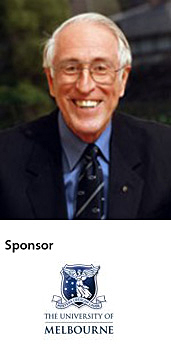
Professor Graeme Clarke
Graeme Milbourne Clark was born in Camden, NSW in 1935. He finished his secondary education as a boarder at Scots College in Sydney in 1951. Clark then went to the University of Sydney graduating with honours from an MB, BS degree (1957). Fresh from medical school, Dr Clark worked at the Royal Prince Alfred and North Shore Hospitals as a resident medical officer (1958-59) before specialising as a registrar in neurosurgery and otolaryngology (1961). Clark then left our sunny shores for England, where he worked as senior house surgeon at the Royal National Throat, Nose and Ear Hospital (1962) and senior registrar in otolaryngology at the Bristol General Hospital (1963).
Clark returned to Australia and the Royal Victorian Eye and Ear Hospital as assistant and then senior ENT surgeon (1963-66). He held this position concurrently with ENT surgery positions at the Alfred, Austin and Repatriation General Hospitals (1964-66). Not satisfied with the treatments available to profoundly deaf patients, Clark returned to the University of Sydney to embark on further study. He completed both an MS (1968) and a PhD degree (1969). During his studies, Clark also lectured in physiology at the University of Sydney and remained as senior honorary ENT surgeon at the Eye and Ear Hospital, Melbourne.
In 1969, Clark accepted the William Gibson chair of otolaryngology at the University of Melbourne (1970-2004). Whilst professor of otolaryngology, Clark established the Cochlear Implant Clinic at the Royal Victorian Eye and Ear Hospital and was the surgeon in charge (1985-2004). In 1984 Clark founded the Bionic Ear Institute and acted as its director until 2005. Clark was made laureate professor at the University of Melbourne in 1999, professor at the University of Wollongong in 2003 and distinguished professor at La Trobe University in 2008. He is now distinguished researcher at the ICT for Life Sciences.
Interviewed by Professor Stephen O’Leary in 2011
My name is Stephen O’Leary. I am the William Gibson Chair of Otolaryngology at the University of Melbourne. It is my very great pleasure to welcome Professor Graeme Clark, the first holder of this chair, back to the Royal Victorian Eye and Ear Hospital, to conduct an interview for the Australian Academy of Science.
Childhood is an inspirational time, so what influences from your childhood developed your passion to help people today?
Well, lots of factors. I think childhood is a very important time in anyone’s life. I must have been a fairly hard child to manage for my dear mother. I was hyperactive. I wanted to do many things.
I was into cubs, scouts and sport of all sorts, and I read widely. I was fairly hyperactive, I suppose. My mother was very creative and she inspired me with art and music. My father was the pharmacist, the more pragmatic person, who quietly was influencing me as a potential doctor, I think. So they were strong influences.
When you were a child, were you interested foremost in helping deaf people or were you more interested in how things worked?
Yes, well, I must have been interested in how things worked. At the age of ten I was doing biological experiments in my mother’s laundry. Also, having read the life of Louis Pasteur, I wanted to emulate him in some ways. Even in my vegetable patch! The tomatoes all seemed to have some disease, so I made a hypodermic syringe in my father’s chemist shop, and tried to transfer agents, like viruses, from one tomato plant to another. So there was for me an experimental aspect to it all as well.
Can you reflect upon your days in boarding school and any influences there?
Yes. Boarding school was a very influential period as well. I was shy and I was sent away from home to a boarding school in the city. It took adjustment and it was very lonely for a while, but it was a very maturing experience. It was a school where you had to play sport, unless you had lost a leg or something like that. I had to be one of the boys by being reasonable at sport.
I can remember playing rugby union at Scots College Sydney. Not being a solid boy, it was always a trauma to have to tackle charging boys. I remember one time I was in the under13As on the back line. The house I was in had all the best players, some of whom represented the state later. They wanted to win in both divisions, the firsts and the seconds. So they put me, this under-13A boy, on the wing where I could not do much and occasionally score a try. On one occasion, the opposite house back, a burly young fellow, broke loose and came charging down at me and there was only me between him and the goal line. I thought, ‘Oh no, what am I going to do?’ I was terrified. I thought, ‘I’ll make it look good. I’ll make it look like I’ve done a tackle.’ So I shut my eyes and I grasped the air and it just so happened that, at the moment I grasped the air, he jumped and I caught him around the ankles. He fell like a stone and I was a hero. They were the sorts of challenges that you had as a border.
I had three teachers who were outstanding. One, Rhys Jones, had written a book for schoolkids and he taught us logic. Instead of doing Shakespeare, for one whole year we learned logic and how to summarise. I will never forget how important summarising and logic were for me later in my career. The second person was Fred Pollock, who was a maths teacher. He trained at least four boys to top the state in maths. He gave us a basic understanding of the importance of maths. We had another one, Hoey Simmons, a doctor of philosophy, who had actually made a small contribution to the periodic table, and he was a very inspiring chemistry teacher. I don’t think we realise the important influence that teachers at that level have on us and on our lives. They were very memorable teachers.
Graeme, at what stage did you decide to dedicate your life’s work to treating deafness?
I think it was when I became aware of my father’s hearing loss. I came to realise how difficult it was for him as a pharmacist in the small country town of Camden. He would have trouble hearing his customers, and would have to say to them, ‘Speak up. What would you like?’ and they had to do so, and the whole shop would know what they were wanting. I was embarrassed, and I decided then that I would like to do medicine, and to be an ear, nose and throat doctor. Actually, an eye, ear, nose and throat doctor out at Orange in New South Wales. I didn’t quite achieve that. That was the first desire to be an ear doctor. But, during that time, when I was in Dad’s pharmacy, I got to see what the doctors were prescribing, and I thought, ‘I could make those ingredients up,’ and medicine itself became a goal. I did switch my desires during the course and wanted to be a cardiac physician and then a general surgeon, but I am glad that I returned to ear, nose and throat surgery.
At what age were you when you decided that you may like to make a career out of medicine?
I was ten when I wanted to be an ear doctor. When our local Methodist minister asked me what I wanted to be when I grew up, I was reported to have said that I wanted to be an ear doctor. That floored him, because boys of my age all wanted to be C-class steam train drivers. That was the very macho thing to do. So it was from an early age, and I think it was Dad’s influence as well.
When you went to medical school, did you still want to become an ear doctor, or had some other specialty, like cardiology, taken your interests?
When I went into medicine at Sydney University, my first goal was to get through medicine. I just enjoyed medicine for its own sake. It was an exciting, new era. Early on I didn’t focus on: ‘I’m directing my route to becoming an ear, nose and throat doctor.’
Except that, when I got to thirdyear medicine, I got really excited by physiology. I remember taking the whole textbook away on holidays by the sea, and reading the whole book. I got firstclass honours in physiology. One of the main questions was on the ear, strangely enough. I was offered an opportunity to do a bachelor of medical science degree, which I turned down, because at that stage I wanted to be a clinical doctor and then to turn around and do research.
Something happened in those first few years that drew you back to ear, nose and throat surgery. What was that?
Different circumstances, in a way. Firstly, I wanted to be a cardiologist for personal reasons and for the fact that, at that stage, our thinking was that physicians were the ‘thinking doctors’ and surgeons were the ‘doing doctors’. I wanted to be a thinking one. I wanted to go to London to work with Professor Wood, who was the leading cardiologist then and that fell through. In Sydney the opportunities for medicine weren’t there. All the good jobs were taken. I then settled for general surgical jobs, for which I was very grateful.
After that, I was keen to do surgery. I did my primary anatomy and learned all about the anatomy of the body. Then those jobs in general surgery were all taken, so I got ENT jobs. But I also had a father who had a friend in Melbourne who was an allergy ENT doctor, and that provided an opportunity to pursue my career in Melbourne. From there on, I came to love ENT. I might add: at the Prince Alfred Hospital in Sydney, as a general registrar in surgery, it always seemed odd what the ENTs were doing in the darkened rooms, and curiosity got the better of me. But it was a very exciting stage for ENT. Microscopic surgery was just coming in. I was there with Sir George Halliday, the leading ear surgeon in Sydney. Microscopic surgery was opening up a really fascinating world. We could look down the microscope and see what was going on inside the ear. This was very different from general surgery and opening up the abdomen and taking out infected appendices.
Something happened to draw you away from your flourishing clinical practice to do a PhD. What was your motivation for that?
I suppose that, deep down, I had never been drawn away from the ear. During medicine, when I had the opportunity to do a bachelor of medical science degree, I thought of doing hearing neurophysiology research with Professor Peter Bishop, a leading visual physiologist. But that didn’t appeal as vision was not my long term goal. I basically wanted to get through medicine and then decide whether and where to do ear research. So that was the first thing. Then I duly entered the clinical stream of training to be an ear, nose and throat surgeon and qualified with fellowships in both general surgery and ear, nose and throat surgery.
After returning to be a senior ENT surgeon here at the Eye and Ear hospital, I still was not satisfied. I had a ‘fire in the belly’ to do research, and it wasn’t satisfying enough just to do my routine clinical work. I then had an opportunity to go back to do research in Sydney. I remember writing to Sir John Eccles, who was a Nobel Laureate in neurophysiology, and asking him what would he recommend. This was when I was 31, and he said, ‘I think you’re too old to embark upon a career in research’. I did not take his advice. Some years later I had a dinner with his daughter and told her about the event and she said, ‘I’m glad that you didn’t take my father’s advice; I never do.’ But that was how I got into doing research.
It was a challenge to leave practice to go and do research for a PhD. It meant a significant drop in income. I had to take a young family to Sydney, and live really quite poorly. So much so that, when our second hand car broke down, I couldn’t afford another car, and had to go everywhere by public transport. It turned out to be a blessing because it meant that there were opportunities to think and to think research. In fact, one of my mentors at Sydney University, Professor Liam Burke, said that he spent most of his time thinking about research projects, which I learned to do.
Can you give us a bit of background on the plight of hearing impaired people when you started your ear research for a PhD? Why were you undertaking this research?
The plight of hearing impaired people was evident to me when I was a surgeon at the Eye and Ear Hospital and at the Alfred Hospital. I had four consultant jobs when I started and a little bit of time to do private practice. During that time, their plight was really evident. But we didn’t see them for treatment, because they were always told, ‘Nothing can be done,’ and they just merged into the woodwork. It was very difficult for them to be told that. I don’t think, as an ENT doctor, I fully realised how it affected these people.
It was obvious with children. When I did research at Sydney University, the deaf school was just across the road, and the children were signing. To me, it didn’t look like a very good way of communicating. The difficulties that I now know exist for a deaf person weren’t so obvious. I was just focused on doing the research, trying to help deaf people like my father, and getting a basic understanding of research. At the time I did this, Merle Lawrence, a well known physiologist in the United States, wrote in the journals saying that it would be not possible for people to develop speech understanding with electrical stimulation of the auditory nerve. Most people said that it was not possible to provide the sophisticated stimulation of the nervous system that would lead to hearing speech.
Could you elaborate for us on what people with even strong hearing aids, missed out on that guided your thinking to alternatives and, ultimately, to the cochlear implant?
Yes. People miss out on so much, and they will tell you this. They can’t communicate in groups, it reduces their social life and it leads to loneliness and despair. I know that in my father’s case not only did it create difficulties for him in his shop, it was also very fatiguing and he had to think very hard about what customers were saying. It also meant that, in social situations, he couldn’t participate. There were times when Mum would entertain, and Dad would be seen as dumb, because he really couldn’t communicate in the conversations. So, at a personal level, it really had quite a profound effect, which you don’t see in a clinical situation. With children, it is even more profound. Only when I started taking an interest in this did I go to deaf schools and see what was happening to deaf children and how it was affecting their language. It was then that I came to realise what an enormously profound effect it has on children.
When you started your research, did you have any inkling of how you might be able to help? I’m thinking particularly now about the ultimate development towards the cochlear implant. Were thoughts about cochlear implantation in your mind when you started your research, or did they come later?
When I started, I read a seminal article by Blair Simmons, which I managed to squeeze in through my surgical rounds, sitting in the park near Royal Melbourne hospital. I read that he had implanted one profoundly deaf person and he had heard some sounds. He could not get speech understanding. But, for some reason, that lit a ‘fire in the belly’ and made me want to do research. I did look at research options in Melbourne before leaving practice, but having had an association with Sydney University and physiology, I went back to a very significant department run by Peter Bishop.
As your PhD evolved, you no doubt became aware of other people working in the field. Can you tell us about the evolution of your thoughts on cochlear implantation at that time?
Yes. At first it was a learning experience in how the ear functioned. We are not taught, even when doing a fellowship in general surgery, a lot about the ear. So firstly I had to learn about how the brain functioned. It was clear, from early work that was just emerging from Nelson Kiang, Jerzy Rose and others that the ear was functioning on a place-coding basis. It wasn’t just getting timing information. That was a very important lesson that I learned when I did neurophysiology. I was surprised that many of the clinicians who were starting to take an interest in this area hadn’t really based it on a lot of fundamental research. I feel very strongly that good clinical research should always be underpinned by experimental researches. So, I guess, that’s the way I went. I went to see how to do the research experimentally and how that would affect the clinical outcomes and to try and keep the two in balance.
Even when you were doing a PhD, the idea of place coding was in your mind?
Well, it emerged. The first thing that I did and aimed to do with my research was to see whether or not the single channel system would work. That was the system that was being promulgated in the clinical domain. In other words, would timing alone through a single channel implant be enough to convey speech? It may seem surprising now but, in 1966-67, neurophysiologists weren’t sure which code would work. Coding frequencies, for example, whether a simple place code or a simple temporal code was the key and what frequencies they applied to. So my first challenge was to see whether electrical stimulation could reproduce the temporal coding sufficiently well to allow a single-channel device to be used. When I found that it didn’t, I realised that one had to do studies to look at place coding. I could see too that it was going to be essential to select out important frequencies of speech and try to get them to be perceived through place and temporal coding – these two systems for coding sound.
What was the next pivotal event in your career that allowed you to carry these ideas forward?
The next pivotal event was to get somewhere to do the research. That was difficult because most people said that it wouldn’t work. In fact, a good 95 to 99 per cent said this, and that meant no job. I hadn’t the training in basic physics to be appointed as a neurophysiologist and it wouldn’t have really helped. It was only due to the appointment to the first chair in otolaryngology that I had the opportunity to combine the basic research with the clinical research. Then I was able to try to see whether we could move to the next stage and validate whether place coding was important. And whether I could select out the important elements of speech to try to get them through what I like to call a ‘bottleneck’ between the outside world and the brain.
Can you reflect on what it was like setting up a department here, at the Royal Victorian Eye and Ear hospital?
It was seven or eight years before I got my first patient. And it was a very challenging experience to start up a new department from nothing, with no money – only $6,000 for two years from the Dean – and to be told that I would have to raise all money myself. Also, the department hadn’t been completely fitted out. It hadn’t been completed. I had to find money to build more rooms and labs in this department. So all of those things were pressing on me.
I was fortunate to get money to complete the building because, at that stage, I had only operated on a dog. I realised that maybe this was the way to get some publicity. It is interesting to be operating on a dog and that got front-page news in the papers. I found out that the Premier, Sir Henry Bolte, was an animal lover. So he welcomed me when I went down to ask for funds. We had a long chat in his office about dogs and horses and so on, and had a whisky. I kept drinking whiskies and I started to get drunk – it was the first time I had ever had that experience. I had trouble walking down the stairs afterwards – these were the backstairs. I actually had to sit on the bottom step for a good hour before I was sober enough to drive home. But I got the money! So that’s why we now have a department that is complete.
They were just some of the challenges in getting funds to do the work. But at the same time one had other things to do too. There was teaching to do – undergraduates but not much for postgraduates at that stage. Then along came the opportunity to establish the country’s first course in audiology. That was a very politically challenging exercise because lots of other people wanted it. I felt that it should be within the department of otolaryngology – that is a whole story of intrigue – but it came to be. There were lots and lots of fundraising activities. No money came from the National Health and Medical Research Council because all of the reviewers said that it wouldn’t work, and it wasn’t worth funding. So I had to get soft money. Sometimes it would be $100 or $200 from speaking at a Lions or Rotary luncheon. I could see that it was going to take a lot of luncheons to get enough money to do some substantial research. Then there were meetings and lots of other outside activities.
I have been told that you’ve been seen here on a street corner in Melbourne shaking a can for donations.
Yes. I don’t know how unique that is, but that came a little later. It wasn’t enough to get $100 for luncheons. That was not going to get us very far very fast. The big opportunity came when I got $2,000 from the Apex Club of Melbourne, and it got on to the ABC News. Sir Reginald Ansett saw this news item. He was establishing Channel 0 at the time and wanted a telethon. He always watched the opposition news and he thought, ‘That’s what I would like to have for a telethon for Channel 0.’ I got contacted by the senior people from the great man and summoned to his office and he agreed to underwrite three telethons to raise money. This gave us the opportunity to start the research and develop a prototype. Reg Ansett supported it, but we also had to raise funds ourselves.
I went around Melbourne putting up posters for gala concerts. Also, as a group here in the department, we raised funds through shaking tins, including down there in Collins Street. I had a competition with my PA. She always stood outside George’s and I went down to the other more-elderly ladies who were walking from Myers along Swanston Street. We had a competition to see who could get the most money and I won hands down. We had to be part of the fundraising effort. I always remember getting advice from Gus Nossal saying, ‘You will have to spend half your time raising money to make this thing work.’
Can you tell us a little more about what it was like to build a team and to develop the first cochlear implant that went into a patient?
It was a team effort. It was a multidisciplinary activity, varying from physiology to anatomy, pathology to surgery and then, later, to audiology and speech science. I think it must have been one of the most multidisciplinary research activities ever undertaken in this country. Personally, I felt that it was important to be across all disciplines. I have felt and learned that it is important to inject ideas into a team, so the team can set out to do good things. But, unless there is a clearly stated goal and unless one is prepared to go in and work with the team and, when there are difficulties, to help them get through those difficulties, it’s not going to be as effective.
There also needs to be a good spirit for working together. In those days we had Christmas parties – and still do. Everyone was young. We were all excited. There was a general sharing that we were going into the unknown. There were many times when I didn’t have enough money to support some of the staff members for more than a few months. I didn’t share this too much with them, but it was pretty worrying for me. We were playing a risky game and I think they all shared this. The work might not lead anywhere. But that is the way youth thinks. So we all worked together as a unified group.
I remember Jim Patrick, came to me in 1975 and said, ‘What’s the future for me, if I come and get a job here?’ I said to Jim, ‘I can’t promise you anything, but maybe one day, if it does work commercially, you just might get a job in industry.’ Well, he is the senior research scientist in Cochlear Limited now. But Jim looked back on those days and said that they were the most exciting and happy days of his life.
On the floor, in the laboratory, it was happy times. But externally there was criticism, was there not?
There was criticism externally, indeed. I was criticised from all directions. I suppose that you could divide the criticism into three categories. Firstly, there was criticism from the traditional scientists of the day. The good neurophysiologists that we had trained here in Australia did not think that it was possible, just as Merle Lawrence had said. Sometimes they picked up this negativity from surgeons in America, who hadn’t done the basic research. There was this general awareness: ‘How can you make the ear work with electrical stimuli when the research scientists had shown how sophisticated and complex it was? ’ It was not an unreasonable criticism, but that was the first and it affected all of my research grant applications. That’s why I have a whole file of unsuccessful applications.
The second criticism came a little later from my respected ear, nose and throat colleagues. Again it was a reasonable criticism. They said surgery would be dangerous and it could even lead to meningitis. Surgeons had embarked upon stapes surgery at that time. Stapes surgery, although not terribly well broadcast, did have risks and there were some people who died from meningitis after having stapes surgery. So it was almost a nono to operate on the inner ear and here I was, planning to put electrode wires into the inner ear. So they had concerns.
Then there was the third group. I always felt that we must work on adults first, for ethical reasons. But after working on adults who had hearing before going deaf, I started to work on children. This led to further hazards and problems. The Signing Deaf community said that I was doing something wrong and maybe even evil to operate on children when they should have been learning to sign. So there were many criticisms.
How did that feel personally? Was there a vulnerability for your reputation, for your position?
I am sure that it had an effect on my reputation. I tried not to think too much about it and to focus on the work rather than to be too concerned. But I know, from feedback, that there was a lot of criticism. My good friend and colleague, Professor Gerard Crock, and I both shared the problems of being the first professors of our specialty in a clinical domain. He would tell me that some of my colleagues had been to the vice-chancellor suggesting that I might take a new job or leave, as a reflection of the personal concern they had.
Some people were certainly critical, but you did have some supporters.
Yes, I had some wonderful supporters. In fact, they helped encourage me to keep going in spite of all the difficulties and criticisms. The people who were severely or profoundly deaf, who needed the device, were supportive in the hope that we would be able to do something for them. But there were others who helped or had children who had a hearing problem and wished to help as well. They helped in fundraising. It was great to feel that there was good support, and I thank them.
How did your family deal with what, at the time was public criticism? How did your wife and family deal with that?
It can affect the family. It was really my wife rather than the children. The children were a little young and I don’t think they were too aware of what was going on at that stage. My wife was an enormous support. I could go back and discuss all the difficulties with her. She was very wise, helpful and supportive, and I can’t thank her too much
Did you draw strength from any other people or sources?
Yes, I did. I had a Christian faith. Interestingly, I wasn’t doing this for personal ambition. I was doing it, firstly, to see whether it was scientifically possible but also, with prayer, to see whether I was able to be used to do some good to help deaf people.
It was in 1978 that the first multiple-channel cochlear implant was put in. What was it like when it was turned on?
It was a very turbulent experience. We were going into completely new ground. I think it was the first fully implantable device and it was being put in against a lot of criticism. The Eye and Ear hospital was very supportive. But they also went to see their legal advisers to make sure that they were covered legally if anything went wrong. It did mean quite a lot of extra effort. I was a little bit obsessive, trying to make sure that we didn’t get any infection, using filters in the theatres at times when the theatre infection rate was a little bit higher than it should have been. But the staff were fantastic.
Then the day came, 1st August 1978. Just beforehand I had been away for a weekend to recover and refresh. I came back on Monday morning for a Tuesday morning operation and I couldn’t believe it: engineers and staff were still running around putting all the finer things together. It was a bit of bedlam. Rod Saunders, our first patient, had been admitted and was being prepared for surgery. I went to see Rod and tried to reassure him that all would be well. He didn’t take in too much as he was well sedated with Valium and was quite relaxed about things.
The surgery started and we took quite a lot longer than we would now. We took every step fairly slowly and did a few unnecessary steps that wouldn’t really have been needed. But I wanted to do everything to prevent an infection. One mistake with that first operation would have stopped the whole thing. So I couldn’t afford to make a mistake.
Then I was operating on Rod. I was a little bit put off by the fact that the side I had chosen was the side he had had a craniectomy on. It was not in view, but I had to be so careful not to enter the cranial cavity. We then were able to put the electrode in without too much difficulty. The staff at the theatre were wonderful. I know that the sister was on tenterhooks. She thought that Brian and I were very relaxed. Anyway, Rod recovered. He went back from the theatre to the wards. I had a somewhat restless night. In those days, although I had done some neurosurgery, ENT surgeons didn’t want to get near the brain. It might lead to haemorrhage. And there was I, pressing onto the dura (the sac surrounding the brain). So I was a little concerned that night that all would be well, and that Rod would recover well the next day.
Then three days later there was a code blue in the hospital. I rang the switchboard and asked, ‘Where is the code blue for?’ They said, ‘On the 4th floor.’ It turned out to be where Rod was. This worried me a little. I flew up the stairs like a prime athlete. I got there and it was bedlam. It was Rod. He had collapsed. I thought, ‘Oh no!’ Fortunately, when I examined Rod, I knew that he had only fainted. Being an ear, nose and throat surgeon I had many patients faint in front of me when I was going to wash their sinuses out with a long trocar. So I knew well that Rod had fainted. Anyway, all was well. Sister had taken off his dressing and he had just collapsed. But such was the tension around the ward and their concern for this patient that it did cause quite a disturbance. Anyway, Rod recovered from that. The wound healed up well and Rod was sent home and asked to come back within four or five weeks. A little bit longer than it is now.
I positioned the coil over Rod’s implant so that we could stimulate it in the hope that he would get some hearing. We didn’t even know whether he would hear anything at all. When everything was lined up, he heard nothing. So day one was very disappointing. We all went home pretty dejected, I can assure you. We said to Rod, ‘Come back in a few days time and we can check a few things out and see if it will work.’ Anyway, he did. He came back and the same thing happened: it didn’t work. I thought, ‘Oh no, how terrible!’ Because he had had a head injury, I thought maybe the crack in his bone had cut through the nerve, even though had I tested it out beforehand by electrically stimulating it to see whether he heard. One last time – third time lucky – he came back. In the meantime engineers had checked the system and found that they had, believe it or not, a loose connection. So it worked! It was a wonderful experience when Rod heard, out of the tinnitus background of his head noises, this different sound. As we turned the electrical current up, it got louder and louder. So we knew that his system had worked.
That was only the first challenge. It was great that it worked. Then the next simple tests were to see whether he got different sensations for different sites of stimulation. This whole procedure was based on the premise of multichannel stimulation. In other words, would those electrodes give different pitchlike sounds, or had we wasted this whole effort on multichannel stimulation? Fortunately, he did have different pitch sensations that we needed to explore later.
The other thing that we did was to see whether he could respond to tones and stimulus rates, which was part of a single-channel system. We did this by giving him the melody or the rhythm of the National Anthem: God Save the Queen. In those days, when we played God Save the Queen, everyone stood to attention. That doesn’t happen now, but it did then. When we played God Save the Queen to Rod, he stood up and pulled all the leads out of his equipment, so we don’t have a recording. Nevertheless, after that, we settled him down and played him our alternative, Waltzing Matilda, and I have a wonderful recording of Rod singing Waltzing Matilda. Very interestingly, in his description, he said a lot about the psychophysics that we later learned. The song was a higher pitch than he could sing and he got rhythm not by the tone but by the variations in intensity and loudness. So, as happened later, the patients often were very good research subjects.
That was a next step forward, but it wasn’t enough. It didn’t show that device was going to give speech understanding. So, for the next two months, until the end of the year, we had to do a series of psychophysical tests to see just what he could hear, what he could make of sensations and whether I could bring it together as a speech processing strategy. At the last minute – almost at the end of the year – we did. Rod heard real speech sounds using electrical signals alone. When he did, I was so moved that I went into the next-door lab and burst into tears of joy because I knew then that all this effort probably had been worthwhile.
Who were the key people who worked with you to do the intellectual work?
The three of us who worked on it were Joe Tong, with whom I worked very closely, Bruce Millar from Canberra and me. We met and talked often about it. In addition, Jim Patrick and Ian Forster helped with the electronics, but it was the three of us who worked through the questions. Bruce Millar, who had been one of the students and postdocs of Bill Ainsworth, with whom I had worked at Keele University, was now a very good speech scientist. I had supervised Joe initially on developing models of how cochlears function. It was only when we had implanted a patient that I was able to work with Joe and develop an engineering type approach to psychophysics. But we really complemented each other.
I had personally been helped by having taken study leave, when the telethon was on, to work with a speech science laboratory at Keele University in the UK. My project was on formant analyses of fricative sounds like ‘v’, ‘s’, ‘th’. I had felt that one of the keys to all this was to understand speech, and in the Department we knew so little then about speech. I had this feeling that the key was not physiology alone, which is what I had set out to do, but it would be speech science. It turned out, for me, to be a very helpful approach. I came back from Keele in 1976 with a very strong interest in formants, which are key elements of speech. None of us knew much about formants. When I examined audiology students on formants, they said it was a very strange and unfair question. Of course, it is not now.
At this stage there was real promise with the implant and no doubt you had something to say on the international stage. What was it like coming into the cochlear implant field with your new data? Were you well received? Was it a collegial experience or was it more competitive in nature?
The first indication of success came at the end of 1978, just before the Christmas holidays. I asked our audiologist, Angela Marshall, if she would do an open-set test. Even then, people weren’t fully au fait with the importance of open-set testing as an indication that this would lead to running speech using electrical stimulation alone. Having been appointed as the senior examiner in audiology, I was well aware of the testing. But it wasn’t really until the next year after the holidays that I was able to carry out a series of more objective tests to establish my initial findings to satisfy the critics.
I needed an audiologist and Angela was on the teaching side. However, being the chief examiner, I had an inside running into who were the best audiologists. Lois Martin shone that year and, without all the niceties that you go through these days, I knew that Lois was a really likely person. After her examination, I remember running down the street to offer her a position. You wouldn’t do that today, but that is the way it happened. Lois did a great job to help develop tests and evaluate Rod in the next months. One had to not only show that this was true but also double-prove it, because the sceptics still wouldn’t believe it. It must have been about mid-1979 when the initial results were being presented. Someone said when I had used film, I had altered the sync between the lip-reading and the speech, such was the scepticism. So it did need quite a lot of proof. But that is one thing that we did do.
I was convinced that right way was to operate on a small number of people – in this case, at first one – and do this testing thoroughly. Not to skimp the testing. That proved, I believe, to be the right approach because then one could show the sceptics what the results were scientifically. But it did take quite a lot of time. It was not until July 1979 that I was prepared to operate on a second person, George Watson, to show that it was valid for other patients. Some people said that what we had done was: ‘You’ve just worked out some unique code for Rod’s brain. It doesn’t necessarily apply to others. Therefore, what’s the good of developing it for commercial use?’
At the same time, when I went to the press to say that we were getting some interesting results, I got approached by 3M. They are a well-known company who were interested in medical technology at that stage. 3M were interested, but they didn’t pursue it. They wanted to do something simple like the House single-channel implant. I wished they had offered money. I had to get money from some source and I turned to the Commonwealth Government of Australia. I was very fortunate that they had a new public interest scheme that was prepared to fund new, potentially interesting and commercially relevant research projects. That meant that they were prepared to fund our research back in 1979, after the initial results on Rod had come through. They did a wonderful job. I think they are an exemplar on how to fund this sort of research: one year at a time. They give you some money. They say ‘Please state what your objectives are and we’ll help you as much as we can that year. If you then meet your milestones, we’ll give you some more money.’ That is how I was able to afford to pay for Lois and to start the gradation between fundamental research at university and its commercial development.
Soon after these initial exciting results, we were planning to do its commercial development. This was carried out in an incredibly short time through Teletronics, the pacemaker firm, with Paul Trainer as CEO. It was then made as a commercial device in 1982.
I remember that well because I was a medical student and I was sitting here, watching the surgery. The whole focus changed when there was commercial involvement. How did that change the focus of your research?
That is a very important and fundamental question that nowadays is even more relevant than it was then. I have personal views on the subject about fundamental research and commercial research. Firstly, having been criticised for not doing pure enough research, it is odd that I am now someone who advocates more pure research rather than applied research. But there was a fundamental difference and I don’t think that should exist. I think Louis Pasteur summed it up nicely when he said, ‘There is only two sorts of research: good research and bad research.’ We should not be talking about pure and applied research. But I felt a commitment to bridging that divide. I knew that we hadn’t succeeded in giving perfect hearing and we still haven’t. There was more research to do. On the other hand, there was a responsibility and a need to get the device out into the marketplace as soon as possible. The first people that came wanted help. I felt a need to direct some important areas of research with Cochlear Pty Ltd or Nucleus Limited, as it was, towards the commercial outcomes, but at the same time to keep the research going here at the University of Melbourne.
The research wasn’t funded by anyone at that stage and, therefore, we had to apply to the NHMRC for research funds. That is a different ball game, as you know. To get funds for fundamentally supported research doesn’t always lead to a more direct, immediate outcomes. So, on the one hand, we had to do basic research with funds that we didn’t really have because we had no telethon and, on the other hand, we had to try to help Cochlear to get it into the marketplace. In those early days, Cochlear wasn’t involved in the hearing field at all and, being an ear, nose and throat surgeon, I had to advise them and even establish contacts with a number of people who were leading ENT surgeons to help get them started. So initially there was a very close relationship between me personally, the research here and Cochlear, as it became. But, as the company grew, it needed to be more industrially relevant. It had to have a wider audience.
How do you view the role of an academic in relating to a more mature industry?
It was a learning experience for me as an academic. It was something that I now realise that academics need to be involved in. It was new for me and it was new even for the University of Melbourne. We took out patents through the University of Melbourne. It was not the first time but near the first time that the University of Melbourne had taken patents out on a development. So it was a new and learning experience but one, I think now looking back, that can benefit both. It can benefit the university and it can benefit research to have that collaboration. But it is not easy when it gets to a mature situation, because companies then can feel themselves mature. But I’m not sure that that is true.
Arguably, the next pivotal event in the development of the cochlear implant was to bring this treatment to children. Can you tell us about what challenges that brought?
That brought lots of challenges, some of which I didn’t realise. I always started with the idea that I particularly wanted to help deaf children. That was my real special motivation. They have such a lot of life ahead of them, and it has such a profound effect on their language. The challenges were, firstly, solved in a way by our operating on adults. I was not prepared to experiment with children with things that could be tackled and established on adults. The main difficulties with children were to give them proper language, to decide at what age to operate, and also to decide whether we could diagnose the hearing at a level where we could safely say, ‘There is going to be no loss of useful hearing if we do a cochlear implant.’ The other challenge was that, at the time, tactile stimulation was seen as a good alternative. There were vibrotactile devices and electrotactile devices that were seen as just as good. So why do a cochlear implant on a child? One had to address all of those difficulties.
The first question was: ‘Could one operate on a child under four?’ which seemed to be the right way to go to give them the best result. At that time it wasn’t clear how to do that. It wasn’t clear how to diagnose a hearing loss accurately. In my office, in the 1980s, I sat with Professor Dan Ling, who was a well known audiologist. The consensus was that you cannot accurately diagnose a hearing loss in a child less than four years of age with the behavioural tests. In which case, one should be careful about operating on children.
Fortunately, one of the research projects I was supervising was Field Rickards’ PhD way back in 1971. Field and I would go and work in the lab until all hours of the morning. We were trying to see what the brains of the experimental animals would do with a modulated, varied signal. It was amplitude and frequency modulated. Then, after some while, Field felt that the best way to go was to do a Fourier analysis on it. I was for looking at the frequency variations, but I think Field was right. We used amplitude modulation to decide what the thresholds were at the low frequencies. Now, that needs a little bit of explanation.
(At the time) auditory testing was not effective in children for the low frequencies, for different reasons, and it was crucial to know those frequency losses before doing a cochlear implant. At about the time we were ready to operate on younger children, our findings were starting to be accepted. I was surprised at how reluctant our whole group was in using these ‘steady-state evoked potentials’, as they are called, for doing that analysis. So that was one problem.
The second question was to determine whether we should use tactile stimulation instead, and I really tried to have a bet both ways. While developing the research for cochlear implants for children, I also encouraged research on tactile stimulation. That had its own problems. The first problem was that vibrators for converting speech into stimulation were too heavy, too big and too power hungry. They could never really be used effectively in a child’s life. The second problem was that electrical stimulation of the skin stimulated the pain fibres, and that wasn’t very useful either.
I had a private grant from an industrialist to do this research, and on the last day of the work, when it looked as though it was going to go nowhere, I offered my arm sacrificially to doing the experiments. I noted that, when the electrical stimuli stimulated the medial cutaneous nerve of my forearm, it was pleasant enough and not painful. That meant putting two and two together and stimulating the nerves on either side of the fingers as being more acceptable. I found this true when I tested it out on our young son, who was also a sacrificial subject.
We achieved a commercial device through collaboration between our Cooperative Research Centre (CRC) and Cochlear Pty Ltd and named it as the “Tickle Talker”. It gave the best results of any around the world, and looked like it might be the right way to go. But at the same time, perhaps for other brain processing reasons, the cochlear implant results started to get a little better and better. It took quite a long while though before it became clear that language was being benefited by the cochlear implant in children. It’s easy to look back and say, ‘It all happened quickly’, but it didn’t.
The educators of the deaf played a key role in helping to develop the language in children and also in its assessment. It wasn’t really until these educators said that this implant was the best thing that they had ever seen in helping to get language for children that I came to realise that this was so. We had done a lot of testing with psychological and educational tests, but the tests are somewhat stereotyped and not personal. So when the educators said that this was something they hadn’t experienced before, I really thought it was time to make further announcements and to do further work.
Some of those announcements were not well received by all sectors of the community. How did the conversation with those people develop?
I remember it well. It was very traumatic in some ways. It was surprising to me in the first instance. Having done this work for adults, having shown that it was safe, having shown that it would work; I was really being enthusiastic now about helping children. But in trying to give signing children hearing with a cochlear implant the Signing Deaf Community, in particular, said that I was bad, or even worse. It affected the team. I had to encourage them and give them moral support, while all this criticism was going on. It was really quite traumatic and quite unfair in some ways. It came mainly from the signing community. I had been involved with this debate ever since I had been setting up and chairing the Deafness Foundation of Victoria in 1970. I knew there was a real issue with the educational method. But to have it brought home so personally was really a challenge, and it continued on. It got a little less as the years went by.
How did your family take that?
Fortunately, the family weren’t too involved in this. Sometimes I might ask some of the children what was going on, and they weren’t as clued up as you might imagine. In fact, sometimes they didn’t know what dad was doing. But Margaret was very supportive, as she was with the other work.
How about the children that received a cochlear implant? How did they influence the conversation with the deaf community, or how did they influence opinion within the deaf community?
The children that had it early enough have now grown up and they are wonderful. They have grown into self-reliant, mature individuals. One boy, if he is not a soccer player, wants to be a lawyer. Sophie Li is another great advocate for what impact implants have made in their lives. All of children that I know have not deteriorated or rejected it. They have found that it has added to their lives, and they have become very mature individuals. In many cases, even competing well with hearing children.
Have you had conversations with any of the children that received implants about how their cochlear implants were viewed within the deaf community?
In the early phases, yes, one did discuss with them how they were treated. Initially, they were seen not as outcasts, but they were not treated with welcoming arms. They were seen as being on the opposite side. That was in the early stages, but that changed. When it became clear that they could communicate so well with hearing people, that criticism changed. I must say that it surprised me how well these children do with language when they are operated on at a young age. It blows my mind. I went and saw some of the children out at Mount View Primary who have been taught to communicate in a fairly normal situation. They are so lovely and normal that I don’t think there is any need to be concerned. In fact, seven years ago we made a film of this group of children and, just recently, we made another film of the same group showing them seven years later, and they are just inspirational.
Can you reflect on being a researcher and a clinician? Have you any advice for young people, who aspire to follow in your footsteps, on how they could develop their careers?
It is a very important question: to what extent can a practising clinician, a surgeon in this case, be accepted as a basic scientist? It is not easy to be both. I remember Peter Bishop, professor of physiology at Sydney University, said that it was almost impossible to be both. Particularly today you have such big demands doing basic research and such big commitments doing clinical work. I think it is still possible to do both, but it means that one should be a basic scientist and at least be accepted into the basic scientific community, perhaps in a niche area, but certainly in a clear area where one is able to make a contribution. At the same time, specialise in one area of medicine. I don’t think it is possible to be a general surgeon or clinician. And it is not even possible for people in practice full time. So I think it is possible, but it is not easy. One of the difficulties too is that, in practice, one has to be on call for patients, whereas, in basic research, you have to give so much time to writing papers and grant applications.
How do you feel that your research training has enriched you as a clinician?
I believe that my research training has enriched me enormously. At first, when I went as a clinician to a very high powered neurophysiology lab and wrote my first paper, I couldn’t see my writing for red ink. I didn’t realise how exacting basic research scientists view their research. I learned to respect them because they spend a lot of time doing that. On the other hand, when I then applied that training to my research, at first my attempts to be more rigorous weren’t treated terribly seriously, but they are now. I think it has helped me to try to be more rigorous with my clinical research as well. I now see that they both complement each other. A much respected senior colleague of mine, who trained in medicine at Sydney University and went into a research career, he too, says how enriching his medical training was to his research background. I think the same applies. For me, I have tended to see most things through a neurophysiological filter as well as a surgical filter.
What do you think we need to do as a nation to help young doctors who want to go into research?
I think we have to make opportunities for them and we have to provide the funds for them to do this. They might need to do research halftime and clinical work halftime. There need to be more opportunities for them to develop their talents, and we need to reward them and to pick the ones that want to do it. But I must say that they have to have “fire in the belly”. I have tried to encourage some, over the years, to do research, but, if they are only half hearted, it is not good enough. Research, as you know, is a demanding career.
What has helped you to maintain the fire in the belly? When you become a successful leader in research or as a professor or a clinician, there are many things that weigh upon your time. There are many political and administrative concerns, and one is always fighting for money. So what is it that kept you passionate through all of these challenges?
I was amazed when I got involved there were so many other distracting areas like politics, fund-raising, interaction with colleagues and various bureaucratic delays and challenges. They can be very frustrating. My response has been single-minded, pig-headed and focused on trying to keep the distractions aside and to focus on the main game.
Professor Graeme Clark, thank you very much for your time today. Your single-mindedness has brought hearing and the gift of communication, language and speech to thousands of people around the world. We thank you very much for this great gift and we thank you for your contribution to Australian science.
Thank you for your comments and encouragement. I do thank not only you, but colleagues and Australians. Australians have a lot to offer, if we can get the adequate support that we see sometimes in other countries.
© Australian Academy of Science
Professor Fiona Stanley, epidemiologist
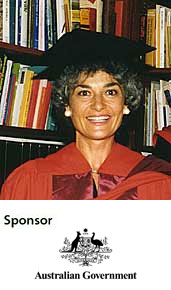
Professor Fiona Stanley
Introduction
Fiona Stanley was born in 1946 in Sydney, New South Wales and moved to Perth, Western Australia in 1956 where she received a Bachelor of Medicine and Surgery from the University of Western Australia (1970).
Stanley received an MSc in Social Medicine (1976) from the University of London and became a member of the Faculty of Public Health Medicine (MFPHM) of the Royal College of Physicians, UK. While studying there she was introduced to epidemiology, biostatistics and public health, the areas that became her life's research focus.
From 1978 through to 1990 Stanley had two significant roles; as senior medical officer (child health) for the Western Australian department of public health and as deputy director and principal research fellow of the National Health and Medical Research Council unit in epidemiology and preventive medicine at UWA. It was during this period she also received an MD from the university (1986).
In 1990 Stanley was appointed to the position of director, TVW Telethon Institute for Child Health Research, and professor, Department of Paediatrics, UWA.
What is your first memory of childhood?
One of my first memories is of the huge bush area around our house in Sydney. It was all bush from La Perouse to Long Bay Gaol and Bunnerong Power House, and that was our playground, especially just below Prince Henry's Hospital. With the rubbish dump and gaol it sounds terrible, but for a kid it was a fabulous playground. We had Botany Bay and Kurnell. My father had built a boat, so we had a yacht in which we used to sail at weekends. It was a very exciting, wonderful magic childhood.
What was exciting about it?
I was a pretty excitable little girl and I used to get excited about most things. But all those games we played in our bush cubbies are with me today, the things I used to dream up and do – a lot of it dominated by the elder brother. (My sister is 12 years younger than I, so it was not till we moved to Perth that I actually had a sister.)
How did you become interested in science? Did it just grow on you?
It did grow on me, and as a younger person I used to say, 'Oh no, my family had no influence on me at all.' Yet I had a father who was working on a polio vaccine, in the middle of the polio epidemics of the 1950s, when the Queen came to Australia and people weren't allowed to shake her by the hand. And you couldn't go to the Saturday afternoon pictures, one of our special treats. It was very scary, actually. I remember seeing all those people in the iron lungs up at Prince Henry's Hospital. In fact, among my first memories is watching Neville, my father, blowing a spinal cord out of a mouse and injecting polio virus into the baboons in his primate colony at the hospital.
Wasn't he one of the first virologists in Australia?
Probably Australia's first virologist, and one of the first anywhere. There were only about eight in the world then, and so we met Salk and Sabin and all those people – who I thought at the time were very boring, as one does at the age of six or so. That was a pretty fantastic environment in which to grow up. Neville absolutely loved his science, and for more than just virology. He used to read us fantastic stories by Jean-Henri Fabre about ant and bee colonies and other things which had me enthralled. When you think of it, we may have been a poor family – my father was still studying when I was born – living out near La Perouse in a little fibro house, but we were surrounded by intellectual excitement.
Presumably what your father was giving you was curiosity.
Yes, but probably a bit more than that. My brother has ended up in really curiosity-driven science: he is head of a cancer biology unit in New York and is very much a basic scientist. But I have a commitment to making a difference – perhaps because the iron lungs were so powerful and also I saw that science could be used to do good.
So you wanted to save the world?
Oh yes, very much. The dream I had when I was eight was that I would sail out to some islands – we did have a boat, but I don't know quite where these islands were – inoculate the 'natives', leap back on the boat, put the scuba back on board and sail to the next island. It was Marie Curie and Albert Schweitzer all rolled into one.
Reading Marie Curie's biography was an incredibly important influence on me as a person. There was romance, there was the wonderful relationship with Pierre, but most of all there was her intellectual commitment, the fact that she had to fight to get trained during her early life in Poland, when they weren't allowed to do things Polish or to get an education. She had to be educated in people's living rooms to get her degree. And then to get to Paris and the Sorbonne, and take that road struggling against the male domination of science, I thought it quite fantastic – apart from her devotion to finding out about radium and then using it to benefit mankind. I still think it's a fabulous story.
But it is the same as your fantasy about going round the islands. You've been to those islands now, you know what they're like, and you know you can't go back on the boat. Do you wonder about what happened between that fantasy and now?
Not a great deal, because that was something I left behind when the reality took over, the hard grind of getting where I had to get. Looking back, though, there is a sense that at least one's followed that road a bit, tried to bring the science into something that is going to make a difference. So there is still some part of the fantasy, if you like.
Keeping the faith can be hard. If you are a scientist, your PhD and post-doc experiences can undermine the vision. Your father was in a sense fortunate that he didn't go through medicine and have the professionalisation and socialisation of a medical education.
Absolutely. And I had to unlearn a lot of what I had learnt in medicine, even to become a researcher. My research career really started through my being influenced by the situation in Aboriginal health, with a real sense that the need was always there, so would that kind of research – almost social epidemiology – make a difference? The thing which started me properly on the road to epidemiology was trying to find out the cause of disease, rather than becoming a paediatrician to wait until kids got sick and then not being able to make them much better. Clinical medicine has such limitations. I thought that to help the world I needed to find out what causes disease. So for me there was very much an applied end of it, I guess.
Were you a rebel at medical school?
Yes. I nearly didn't get through. Going through medical school was a very difficult time for me, actually. For one thing, although I was very keen to do medicine, my parents didn't want me to do it.
By this time you had moved to Perth from Sydney, and your father had got the foundation Chair of Microbiology – a non-doctor in the medical school.
Yes, and not always loved as the 'members of the club' are. Here was a daughter who wanted to do medicine, and neither of my parents were particularly keen on it. It was such a long course, there were very few women doing medicine in those days – only six out of 100 in my course – and in my family doctors weren't beloved. I was the 'black sheep' going into medicine, because to them science was pure science and a PhD was the way to go.
Also, I wasn't a particularly socially well-adjusted teenager. I was a very late developer in being able to cope with how to handle boys, for example. And doing medicine didn't help, because you were seen as a freak. I don't know where that late development came from – perhaps from the way that we were brought up as kids, in a family which did not have a very open relationship about voicing fears or emotions. I wasn't particularly happy with how I related to other people at the age of 23 or 24. I thought I was quite delayed compared with other people, but maybe everyone felt like that and it was just our era. I think my own children now are very much more open and competent socially than I was. So I found medicine difficult from that perspective, and it wasn't really till the end of my course that I suddenly got very switched on because of a couple of people. One was Kevin Cullen.
I know of him as the general practitioner in the Busselton area who set up the Busselton Study – one of the large-scale, population-based studies in Australia – and also one of our better wineries.
Exactly. Kevin was the first MD in Western Australia, and he was a GP. He was a most unusual person: an enthusiastic, hypermanic guy. I opted to do my general practice weeks with him because he was so enthusiastic. I'd been up in Papua New Guinea as a medical student for the three months of the holidays, and had got very unhappy about where I was going in medicine. Kevin actually forgot about general practice and for the three weeks he just said to me, 'Look, you've got a brain, woman. Use it. Get your degree and start making something of your life.' He was the first person to say anything like that to me, and I just worked through that final year of medicine – inspired by Kevin and also by Bill McDonald, our Professor of Paediatrics. His inspiration was different. He kept saying, 'Yes, there is a child. But that child lives in a family, and it lives in a community, and it lives in a political structure.' So I started to get a much better idea of the social causal pathways to disease outcomes, and how profoundly important they could be. That has stood me in good stead throughout all of my epidemiological training.
Was the elective in Papua New Guinea a revelation, considering that you already had a family connection with that country?
Yes. For me it was both a pilgrimage and a revelation. My grandfather was one of Douglas Mawson's students in geology and got the Tate Medal in Adelaide around 1905. His first posting was to Papua New Guinea, as the first government geologist in the Territory. Imagine: he had to go up there in 1908 and build his own house, his own photographic equipment. Actually, he had first to go and find his boss, who had been lost for three months in the Highlands. They didn't know three million people lived in the Highlands at that time. I never met my grandfather – he died at the age of 36 – but he has been an inspiration to me because he was such an eclectic person. He had to know the languages; he was a geologist, obviously; he was a pioneer. And he was a beautiful-looking man.
Who died of what today would be a curable illness.
Yes. It's just amazing. He came down on 'furlough' – a three-month period every so often when the family would come to Adelaide – and he got an infected boil. Perhaps he was weakened by malaria and all the other things they got up there, but anyway he died within about four days of a septicaemia, which now is entirely preventable. My father was six at that time; his sister was nine. Perhaps that influenced my father in doing his doctorate in streptococcal diseases. You don't quite know how these things happen.
I was keen to go to Papua New Guinea for medical experience but also because I wanted to find some of my grandfather's original movie films from 1912 (they had been lost) and some of his maps. They are now all in the National Archives. It was a sort of a pilgrimage, and I really loved it. It was fantastic.
And the revelation, the conversion?
Well, that was getting back to the dream about the islands and the natives. Those three months of working in the Highlands showed me the hugely different problems that a country like Papua New Guinea faces in terms of diseases and in the disease spectrum, and it reinforced for me how limited medicine is as a means of coping with that. A seed started to grow in my mind: if only you could prevent disease, if only you could find out why it was caused. It seemed obvious, for example, that vaccines to prevent malaria are the way to go, rather than just treating such an expensive disease.
Generations of white Australians have grown up in big cities and on the coastal fringe, vaguely knowing about Aboriginal problems, maybe caring about them, but basically getting on with life. What made the difference for you?
It really started during my first year out as a resident doctor. Our Aboriginal Medical Studies Fellowship formed part of the New Era Aboriginal Fellowship. Also, we had an Aboriginal Advancement Council in East Perth. I was heavily influenced by two trips that we did around the state, not as a proper epidemiological survey but really as a fact-finding expedition. That was my education of social environments and health, in that we were seeing 19th century hygienic poverty.
Those trips were just amazing. We visited every mission, camp, reserve and fringe-dwelling group in Western Australia. We didn't quite do the south-west but we did the Eastern Goldfields and around right out to Warburton Ranges, and then a sweep round Balgo Hills, Halls Creek, Fitzroy Crossing. Talking to the old people, talking about what life had been like, trying to get a handle on the health issues and the environmental issues, I became absolutely involved in what was happening – and I have been from then on.
That was 1971–72, when there was a Black Power movement in Australia. It was very easy for me then: everything black was good, everything white was bad. I was very naive in many ways about the whole thing. But our group put up a lot of fantastic proposals: if Aboriginal people are 3 per cent of the population, there should be 3 per cent teachers, 3 per cent doctors, 3 per cent social workers, 3 per cent of all these people – encouraging that kind of thing. But it was paternalistic. We thought we knew the answers, so we didn't consult very widely with Aboriginal people. We were 'helping' them. We had a 'We're here to help you' kind of approach to things. Although some of my very best friends, such as [Aboriginal leader and writer] Jack Davis, were hugely influential on how I thought, I wasn't really capable of taking a lot of that in until much later on.
When you are young and enthusiastic, you imagine you can achieve things – as in your fantasy dream. But with Indigenous health it takes a long time, because you have to ask and listen to what people themselves want.
Yes. How I perceive that and how we run our Indigenous health research in the Institute has changed totally now.
After your medical studies at the University of Western Australia you went overseas. Why did you leave?
I was specialising in paediatrics, but I didn't finish. I was running the Aboriginal clinic from the children's hospital and we would bring kids into hospital. Working in Aboriginal health can make you very depressed, and I was extremely despondent about the Aboriginal situation. I didn't think it was going to improve. Also – reinforcing that whole bit about trying to make a difference, and doing epidemiology and investigating causal pathways to disease – I realised that trying to deliver health care to these Aboriginal kids was not really going to change the situation. I felt I had to go and do something else, and probably it was wrong that I had done medicine, I wasn't going to be a good doctor. I was going through all of these questions about what my role was going to be in life and I was very unhappy.
You might say that I ran away. I have heard Michael Marmott say that he turned down a registrar position at the top Sydney hospital. I turned down a registrar position at the Royal Melbourne Children's and went off to England to try and find out what I wanted to do with my life. And there I discovered epidemiology and social medicine, biostatistics and public health.
Did you think about leaving Australia for good?
Yes, but a whole lot of things happened which changed my attitude totally. I met Geoff Shellam, who is my husband.
And who now holds the Chair that your father used to have.
Yes, in Western Australia. Geoff became an incredibly important mentor for me. When we got to London he encouraged me, for example, to take up an opportunity to join the social medicine unit at the London School of Hygiene and Tropical Medicine, and to follow the route of becoming a researcher, doing a PhD. And the luck bit was that I walked into the London School of Hygiene when it had all of the top people in England – in epidemiology, biostatistics, social medicine. That's when all the lights turned on, when what Geoff calls my 'little motor' started. Once, when an interviewer asked me how I kept going, I said, 'I just have this little motor inside me,' so Geoff sometimes says to me, when I'm looking absolutely dreadful on Saturday morning, 'How's your little motor this morning, dear?' But it was just as if the little motor switched on. I realised then that epidemiology was extraordinarily powerful.
I was also lucky that in OPCS (the Office of Population Censuses and Surveys) at that time in the UK was another incredibly powerful and wonderful group of people, with databases for the whole of Great Britain, with record linkage, and the Oxford record linkage survey. It was the place: registers of diseases, like birth defects registries being set up and linked into databases. So I learnt the usefulness of not only epidemiology but biostatistics, even though two of the great people with whom I was working – David Clayton, now Professor of Statistics at Cambridge, and Peter Armitage – said to me, 'We tried, Fiona, to teach you statistics!!' I always had to have some very good biostatisticians around me – which is a good message for being a role model. You don't have to do everything really well; you can get those around you to help you.
Luck played a part again when we had a year in the United States at the National Institutes of Health, just after I had finished my thesis in London on low birth weight babies. When I lobbed into the National Institute of Child Health and Human Development they asked what I would like to do, and I said, 'Well, what about running a workshop on the epidemiology of prematurity, preterm birth?' I was extremely interested in the aetiologies of preterm birth and the outcomes of babies who were increasingly being treated in intensive-care units – and the very, very high rate (we didn't know just how high then) of preterm birth in Aboriginal mothers. In those days NIH was very good to its foreign visiting scientists. Although I was very junior, I was told, 'Here's a cheque. You can invite anyone in the world you want to for a three-day symposium and we'll publish the proceedings.' Can you imagine? I invited the world of perinatal epidemiology to this workshop: they all came to NIH.
Since your return to Western Australia, you and people like Michael Hobbs have set up an immense database to link hospital records and keep track of what happens to people. That is unique in Australia and one of the few in the world. In your use of those sorts of disciplines and data, what are you proudest of?
I guess there are two answers to that question. One is actually setting up the innovative methodologies – doing the record linkage and exploiting it, setting up really good cohort studies – and using the methodologies to address really important hypotheses. My approach with my people is still, 'What's the most important research question we can answer now in this area?' – be it neural tube defects, other birth defects, cerebral palsies, brain development, preterm births. I call 'What's the most important research question?' going for the jugular, and it's become a bit of a joke.
But also we went right in there and did it. Our first study for the birth defects registry was the folate hypothesis; our first study for preterm births was looking at whether social support in pregnancy was effective in reducing preterm births – a hugely difficult study to do; we looked at the issues of survival of the very low birth weight preterm neonate and what that has done in terms of cerebral palsy rates; and we looked at the whole area of birth asphyxia and cerebral palsy. Some of what we did in those four areas led straight into and furthered our interest in Aboriginal maternal and child health. The low birth weight, preterm birth story, and how that was important in Aboriginal health, is still a profoundly important aspect of our work.
So there have been two very important things. One was the methodologies and getting all of 'the' expertise, training people up in that area of epidemiology when there were very few epidemiologists in Australia. The other has been the specific areas we have worked in. I guess the two that we are best known for – whether I'm proudest of them I don't know – are the cerebral palsy work and the folate and spina bifida work.
The cerebral palsy work is showing, essentially, that birth asphyxia, certainly at the time of delivery, is not the most important factor. And that there are unknown factors.
Yes. Also, antenatal pathways – things like neuronal migration and placental effects, and infections and inflammation, and early human brain development and how it goes wrong – is probably going to be profoundly important in cerebral palsy. They're going to be more like birth defects than birth asphyxial causes.
But what I hope I'll be remembered for 10 or 20 years down the track is a whole new thinking about causal pathways to brain damage, or brain anomaly. You start with the population, yes, but you don't think of simple, single risk factors. I am excited that you can actually start to get into molecular epidemiology (cerebral palsy is a good example) and to look at the genetic/environmental interactions in terms of the ways brains might develop and develop badly, or go wrong, go off the track, off the program of normal development, and how that might happen – and social epidemiology, and how that all fits together.
We are becoming more rigorous in our epidemiological methodology and thinking, and causal pathways thinking means not just thinking of single risk factors. We are in a single risk factor epidemic: you must eat this or that. Yes, eating soy has been shown to be beneficial in breast cancer, but these are single risk factors. Look at the social, physical and environmental context in which risk factors arise, and then you might get a much better handle on true causal pathways – which are very complex and much more difficult to elucidate. If you analyse the causal pathways properly, not only will you get them right but you'll have better chances of knowing when to intervene, to prevent. These are very exciting new developments (even if I do summarise it all so briefly).
Having returned and developed powerful data in relation to cerebral palsy, spina bifida and those other major advances that you and your colleagues have made, you have found you need to enter the political arena if epidemiology is to be used for change. Someone you knew who actually manipulated things politically was Dougal Baird. But politics means taking a position, which is not very scientific.
The time away was very important: I came back with both the capacity to do epidemiology and the knowledge of databases and their power, and also it led to my network of international researchers. Some of them were incredibly important for me – Mervyn Susser and Zena Stein from New York, Eva Alberman, who had been my thesis supervisor from London, and Dougal Baird, as you say, from Scotland. He was an outstanding social epidemiologist/obstetrician and even after his death he is still an enormous influence on the social obstetric/epidemiology area. It was fantastic to have this kind of group.
I don't agree, though, that science must be compromised. When we go into that political arena, as you call it, we try and get evidence-based policies. People say I am very successful politically because I have pulled in government money, and money for our research institute building, and I've lobbied the federal government to double the medical research budget and so on. But I am very careful to come from an extremely credible position of data with which to inform and influence. This is again Geoff's mentoring: never step outside that, because you'll lose credibility.
So you don't jump on the ideological bandwagon?
Certainly not. When I retire it will be different: I am going to come out and speak on lots of things. For now, I stick to those issues on which I have some data and I won't go beyond that. I think you can only be a good politician for the kind of research you are doing if you stick to that message. Yes, we have tried to influence lots of things, but with very good data to support it. We might make some mistakes, because sometimes you have to make public health decisions on data which is imperfect. That's an issue, but I think we do the best job we can.
You referred earlier to being a role model. A woman planning a career in science might look at your success and say to herself, 'That's all very well, but the world is a lot more insecure now than it was then.' When in your career did you first feel you were in a position where you could feel secure?
Oh, that's been relatively recently, in the last 10 years. When we decided for family reasons to come back in 1977 after our year in the States at NIH, I wrote to the professors of paediatrics and obstetrics in Western Australia and said, in effect, 'Here I am, an epidemiologist.' But there was a resounding silence on that score. 'Very nice to see you again, Fiona,' they'd say – no offer of senior lectureship, research fellowships or anything. I'd been on an NH&MRC training fellowship, yet no-one mentored me about the possibilities of where my career should go.
But I needed to start my research career properly. The process was that I got a job in the Health Department, where I was reasonably well paid as the chief medical officer in child health. It may sound crazy, after this research career, to become a sort of mini-bureaucrat, but it set up my networks and databases all over Western Australia. I was very disappointed that I hadn't got a research job, but in my two years there I met every midwife in Western Australia and I was able to revamp the entire midwives database, I was able to link it with all perinatal and infant deaths, I was able to actually start my research – and research infrastructure, if you like.
So you had a budget and you used the system, essentially?
Absolutely. Every child health nurse still knows and works with us in amassing the fantastic database that we have built in Western Australia. Then I decided to move on. I'll never forget the interview with the chief bureaucrat in the Health Department, who said, 'What? You're going off to be a research officer with NH&MRC? You're going to decant yourself, go down the scale, de-evolve?' And I said, 'Yes, but this is my true love.' We were setting up an NH&MRC unit at that stage in epidemiology, and I went and set up my perinatal research group there.
When I went on enforced maternity leave to have my children, it was not very well paid and I had to take out a loan to continue research work. It was very fragile. Geoff was also only on a research fellowship at that stage. Perhaps people would not do that now – I don't think they should, actually – but we were committed to doing it because there wasn't any alternative. But I had a full-time mothercraft nurse looking after my children and giving quality care, which is very important to me. Paying off the mortgage, doing all these things, you didn't feel very secure at all. I've now paid off the loan, but it wasn't till I had already got into that NH&MRC senior fellowship level that I felt secure enough in my path.
I hear in your voice, even without your actually saying it, 'If you don't have that level of commitment, you're not going to be a good scientist.' But that's what really hampers women in getting on in science.
It worries me. I've always prided myself that my getting to where I've got has been good for other women – 'You can do it,' et cetera. But a woman said to me once, 'You're actually not a very good role model, Fiona. I want to do other things in my life as well as have this little motor going all the time.' I was shattered, because I did really want to be a good role model, but I could see what she meant.
You're more like Marie Curie than you like to admit. Perhaps you haven't discovered radium, but you have that utter commitment.
That's true. When I employ people in my Institute, one of the criteria I apply subliminally is whether they are passionate about their science. It is really important that you care very deeply about your science – that you would almost lie down and die for it.
And come in at 4 a.m. to look at the gel, and so on.
Yes, absolutely. If we want to attract the best minds into science, we're going to have to start paying people more and rewarding them more, creating environments in which they can have a family and do other things. I realise it is important. But without that passion for science, you might not pursue it fully. I know that subliminally I do look for that kind of commitment, because it is an important aspect.
In a way, the previous system sorted people out pretty early. You were either into that NH&MRC system or you weren't, and it was very tough. Now I believe it will be easier, there's more opening up for people in science. And if you're not quite there with the commitment, there will be other things you can do. You can go into industry, or into applying research into policy; you can be a good clinician that uses evidence and asks questions about 'Why am I doing this?'
The perennial funding problems are always going to be there. What else do you see as the biggest potential barrier to progress in the work you are doing?
I can see a threat when, every now and again, the issue of privacy raises its head because some very vocal minorities in the community don't understand the importance of data and how it is collected in epidemiology. I don't think we have been very good at selling the importance of public health research and its benefits. Most of the database is collected without consent, and if we had to go and get consent it would be scientifically invalid and cost the earth. It is terribly important that we can collect this information, link it and then take away the identifiers – with computing we can actually promise complete confidentiality and privacy now – but people don't seem to realise it is essential. We have not sold that very well. We've tended to keep quiet about it, I guess because we don't want people to criticise us.
The other challenge is getting the bright minds to go into research, particularly in an isolated place. It is hard to pull the people in and keep them. A lot of people are going not into science but into things that will earn them a buck. One of my biggest criticisms of the 'global economy' and economic rationalism is that greed seems to be pulling people into jobs rather than, 'Gee, isn't it going to be great to work for the community.' I am hoping there will be a bouncing-back, because when I talk to groups of people about what we do they find it inspirational, they love it. I know that there is a groundswell out there of people who care deeply about the community. But at the moment a lot of the brightest people are going out of science into medicine, not because they want to go into medical research but to earn a big buck or to be very prestigious.
So here you are now, one of the most senior women in Australian science. Whenever somebody wants a woman on a committee they come to Fiona Stanley and you're pulled every which way. Your life is as frenetic as ever. What would your daughters say about their Mum, if I were interviewing them?
Oh, I'd love you to interview them and tell me afterwards! I think they are actually proud of me in a way, although they also get worried about me now – which is very sweet of them. Of course the maternal guilt has been with me, but they're doing well and they're fine. They are wonderful young women.
Did you feel guilty that you were not there when you wanted to be? Did they lay that guilt on you?
Of course they did, and of course I laid it on myself. There I was in maternal and child health. I had my children at the height of the 'earth-mother' phase, you know – breastfeeding for five years and naked skin to skin contact – but there I was leaving them in the care of somebody else and going off to work. And also society laid guilt on us. That was difficult.
Did getting diagnosed with breast cancer slow you down at all, or did the little motor keep on running?
It slowed me down for a little while, but the motor kept on running. I was going to say to everyone that I was going to work less but, you see, I actually love my work. A lot of my self-esteem, my inner feeling of worth about myself, comes from doing things, and doing those sorts of things where I feel as though I am making a difference in doing my work.
Gus Nossal once said to me that one of the most important characteristics of an institute director was generosity. He's absolutely right. I think that one of the things I am good at as an institute director is being generous. And that means being generous with your time. Taking time out to mentor our young Aboriginal researchers is really important, taking time out to find out about what is happening to people in the Institute and where they are going – it takes time to be generous, actually, to do that job properly.
And in 25 years' time what would you like to have achieved? Are you still going to be the Institute director, or do you want to be overseas? 'What do you want to be when you grow up, Fiona?'
Those are interesting questions. If I could leave the Institute in good shape when perhaps I take a slightly early retirement, I'd quite like to do something to apply research at the international or the national level – say, having a greater role in how research is done and managed and being a very good advocate for research, or doing something in an international health arena, encouraging the use of data to improve health services or public health.
So you'll be on your boat, on the island, but with a computer.
That's it.
Fiona Stanley, thank you.
© Australian Academy of Science
Associate Professor Bryan Fry, biochemist and molecular biologist
Associate Professor Bryan Fry
Introduction
Bryan Grieg Fry was born in the USA in 1970. He graduated from the Portland State University Honours Program with a dual degree in Molecular Biology (BSc) and Scientific Philosophy, with a minor in Psychology (BA) (1990-95). Drawn to Australia by its numerous toxic creatures, Fry completed a PhD from the University of Queensland on the toxic natriuretic peptides of the inland taipan (1997-2000, awarded in 2002). In 2000 he worked as a research assistant at the Australian Venom Research Unit (AVRU) at the University of Melbourne. Fry then took up a postdoctoral fellowship at the National University of Singapore (2001-02) which allowed him to work on Asian snakes and build on his research into snake venom evolution. Fry returned to Australia and the University of Melbourne as deputy director and ARC postdoctoral fellow at the AVRU (2003-06). In 2007 Fry joined the Department of Biochemistry and Molecular Biology at the University of Melbourne as an ARC Queen Elizabeth II Research Fellow (2007-11). Fry is now associate professor at the School of Biological Sciences, University of Queensland where he is group leader of the Venomics Laboratory. His work at the University of Queensland is currently supported by an ARC Future fellowship.
Interviewed by Dr Cecily Oakley in 2011.
My name is Cecily Oakley and I am here at the Australian Academy of Science to talk to Dr Bryan Fry about his life in science. Welcome, Bryan, and congratulations on your Fenner medal.
Let’s start at the beginning. Where and when were you born?
I was born in the United States in 1970, just after my parents moved there from Norway.
When did you first get interested in venomous animals?
Toxins have been the abiding theme of my entire life. My first memory is of being torn apart by toxins. That memory is of being strapped to the bed at just under two years of age with spinal meningitis. I had full head and leg restraints and surgery to put tubes into my skull and legs. That’s my first memory – of being torn apart. I have a lingering reminder of that event in my right ear. That ear is useful for hanging sunglasses off and not much more than that. All the neurones have been wiped from that ear, except for one random mid-frequency peak where I have perfect hearing and then nothing either side of that. So I have a daily reminder of the power of toxins and a daily reminder of my own morality.
As a result of that toxins have always been a fascination of mine. I wondered why do these things do what they do and how do they do them? Then I fell in love with snakes and, from there on, it was a given that I was going to make this my career. I think I was around four years of age when I grandly announced that I was going to study venoms for a living.
That is a very early age to know what you wanted to do as an adult.
Yes. I have managed to turn a childhood passion into a career. I used my enthusiasm, my love and my wonderment for the area as my fuel during the very hard times. Science is an absolute emotional roller-coaster. You from thinking, ‘I’m a golden God’ to, ‘Whoops, I missed that piece of data and I’m actually wrong’ – and that’s all before 10am on a Monday. It is a manic-depressive existence. I don’t recommend going into it, unless you love what you are doing, and then it can be the most rewarding existence out there.
Did knowing what you wanted to do from such an early age help to drive you through school in order to get the grades that you needed for university?
Having a goal certainly helps. It gives you something to aim for. It also helped that I was absolutely in love with my area. A key to any successful scientist is that they are seduced by their chosen field. In my case, I kept venomous snakes, spiders, scorpions and centipedes as pets – and anything else I could lay my hands on. I had some very understanding parents. I grew up travelling all over the world because my dad was in the military. We would also go back to Norway in the summers. Because of that, I had a dramatic and unusual exposure to a wide diversity of animals. That gave me a deep and abiding understanding of the animals themselves, their ecology and their evolution. This was a competitive advantage while studying the biochemistry at university. But there are no courses specifically on snake venoms and no courses specifically on snake venom evolution, so a lot of that stuff I had to teach myself out of my own interest.
What did you study at university?
As an undergraduate I did a triple major. I did molecular biology, scientific philosophy and psychology. I then did a PhD at the University of Queensland in biochemistry.
Why did you choose to come out to Australia for your PhD?
Moving to Australia was always my longterm goal. I had decided that when I was about 16 and discovered how many venomous animals Australia had, and that was it. I just knew that I wanted to move to Australia, get my PhD and make Australia my home. I bought a oneway ticket. I have a little kangaroo passport and everything now.
What project did you work on for your PhD?
For my PhD, I worked on the inland taipan, which is the world’s most venomous snake. Specifically I worked on a unique type of toxin that I discovered in these snakes – these very small peptides called natriuretic peptides. These toxins are a mutated form of something that we naturally use in our cardiac system, but they have been tweaked so that they are more potent and long lasting. They are a good example of how venom is not a soloist or a collection of individuals. It is a full symphony, or you can think of it in terms of martial arts where it is a multiple combination of moves.
In the case of the natriuretic peptides, they are one of the first toxins in the venom to exert their effect on the body. They have a very devastating action on the blood pressure. They drop it so quickly that that is one of the things that renders prey unconscious. Natriuretic peptides on their own are not lethal. You could give a big injection of natriuretic peptides to an animal and the rat or whatever will wake up later on. But while it is unconscious, slower lethal toxins have time to do their job. So natriuretic peptides are an immobilising toxin while another toxin comes through and finishes them off.
What sorts of experiments did you do in studying these natriuretic peptides from taipans?
The main thing that we looked at was the effect on blood pressure. We showed that taipan natriuretic peptides acted quicker and lasted longer than the natural form of it. We did a lot of experiments using rat aortas, showing that they can relax the smooth muscle and open the aorta up really wide. So the taipan venom natriuretic peptides have a very specific action on the aorta (the aorta is basically the garden hose running from the heart to the lungs). If you increase the diameter of the aorta, your blood pressure is going to drop very quickly. It is quite simple math. Then I did a lot of different experiments using the snake natriuretic peptides and the human ones. I looked at where there are differences between them and worked out which areas of the peptide conferred a more active molecule. If you understand the structure function relationships, you can start tweaking the molecule and make a more improved version. We are continuing to work on those in trying to make a molecule that is useful as a therapeutic.
For medicinal purposes?
Exactly. It is the silver lining to the dark cloud.
After your PhD, you went to the University of Melbourne for a year. What were you working on there?
I moved to the University of Melbourne and continued wrapping up a few loose ends. After that, I moved to Singapore for two years. That allowed me to work with a lot of Asian snakes that I couldn’t work on in Australia. The import restrictions were just too much of a pain. So I went over there and caught king cobras and all kinds of kraits and weird vipers. As well as a lot of rearfanged snakes – the snakes that are traditionally not considered venomous. I showed that, while they are not medically important to a human, they have venom. That venom is toxic from the perspective of a five-gram frog. I even showed that the classic cobra-style neurotoxin was present in some of these nonvenomous snakes. That radically changed our view of the evolution of these animals and of how snake venom has evolved. It also revealed that there is an untapped Serengeti of animals available for drug design development research. Instead of their being 400 or 500 venomous shakes, there is more like about 2,200 venomous snakes. Then that set the platform to return to Australia on a postdoc fellowship from the ARC.
I continued working on the rear fangs and got lots of new stuff out of that. From there, I moved on to a QEII fellowship to develop a general theory of venom evolution. In the course of that, I got really intrigued by the suggestion that Komodo dragons had some sort of toxic bacteria. This never sat right with me. Bacteria don’t work that way. What has been going on all this time has been just breathtakingly simple. You have to view the Komodo dragon in two different ways as far as its predatory ecology is concerned.
Perhaps we should back up a little and you can tell us what the controversy is with the Komodo dragons and how they kill. I was taught that it was the bacteria in their mouths that made them lethal.
Basically, people have been overlooking the fact that the Komodo dragon is not from Indonesia. It is an Australian lizard. There are fossils in Australia from the Komodo dragon. They are forgetting that it is just a big lizard. There is nothing special about it. It is just a very large form of the lace monitor. And it is not even the biggest goanna to have ever lived. There are two larger ones that are extinct. Komodo dragons get to about three to 3½ metres. One of the larger goannas gets to four or 4½ and one of the extinct ones got up to about seven metres. They are all Australian giants. And as for the water buffalo, they are also introduced. They have been in Indonesia for only the last couple of hundreds of years. So there has been no evolutionary impact. It is an artificial situation. What goes on with this artificial situation, the only one that people are seeing, is that a Komodo dragon bites a water buffalo and it dies. But the water buffalo has a 100 per cent escape rate from the Komodo dragon after a bite. They never kill them right out. What do the water buffalo go and do? They go and stand in stagnant faeces-filled ponds.
We had a small boating accident on one of my expeditions researching the Komodo. I got shells driven up against my knee bone and some of that same water went into my leg. Thirty-six hours later I was unconscious, in the Bali SOS clinic, getting emergency intravenous antibiotics. So I know how quickly that infection can happen. But the infection is from an environmental source. It has nothing to do with the lizards themselves. It is no different than if I took a surgical knife and cut your leg and you went and stood in that same water. You would get infected. So that has been the source of that infection all this time. And, as I have said, that is an artificial man-made encounter that has no evolutionary basis.
Komodo dragons naturally evolved to feed on 40 to 50-kilo prey animals like pigs and deer. When they feed on their natural sized prey, they kill 90 per cent of that prey in the first three or four hours. 75 per cent of the prey bleed out in the first 30 minutes and another 15 per cent continue bleeding and die within three or four hours. That is one of the things that people have seen, but haven’t clicked on. When a dragon bites something, it keeps bleeding. Its victim seems to rapidly go into shock and bleeds and bleeds. That is what is the venom is doing. We have shown that the Komodo dragons have an anti-coagulant in their venom as well as other venom components that drop the blood pressure. It all combines to a steady march towards unconsciousness. The dragon can then tear the head off at its leisure.
The primary Komodo dragon weapon is actually the teeth. They have these very flat, large, double-serrated teeth. When they bite, they bite and they pull straight back, so they leave parallel deep cuts. It is like with a saw, each cut follows the other one and each notch goes a little deeper. It is the same thing with their teeth. It is basically grip and rip. The mechanical damage alone from the teeth wounds is enough to kill in some cases. For example, on Rinca, where we do a lot of our research, an eight-year-old boy was killed there a couple of years ago. He went and squatted in the bushes and a big dragon came up, got him and cut right here (indicates). The dragon sliced right through the boy’s femoral artery. That mechanical damage, the tissue damage, is enough to kill. The blood spurt was about two metres from his leg. But it was a little unclear whether he died from that or from when the dragon then grabbed him mid-body and smashed his head against a tree. That caved in his head and the dragon ran off with the body while being chased by the family.
They are very formidable animals and they can kill in a multitude of ways. The venom is that it is not like a death adder or a taipan venom, where the venom is the only weapon. The Komodo dragon bites, sits back and its victim dies. Here the venom is to support or to supplement the tooth damage. It is a combined arsenal system. You have the teeth as the primary weapon and the wounds which don’t close up. If you don’t die outright from cutting a femoral artery, you are going to keep bleeding until you are out of blood and then you are dead.
If the animal survives the initial attack, the Komodo dragon can follow afterwards?
Yes. It will hang around and do multiple attacks. It is a sustained, vicious attack. But the natural scenario for death is blood loss. And the same dragon that attacks will get that same animal. However, this fairytale of dragons all over the island, with buffaloes dropping dead randomly and other dragons benefiting... Nature doesn’t run a charity shop. There is no altruistic behaviour amongst dragons. The situation with the dragons and the buffalo is evolutionary irrelevant. It is a man-made situation and it has always had an environmental source.
Yes, the buffaloes do get infected. But all the studies that purported to show dragons having bacteria in their mouth didn’t sample the water that the dragons were drinking. Any bacteria in their mouth are a transient source of infection. Dragons actually have very clean mouths. After they have made a kill, they will sit there and lip lick for 15 or 20 minutes. Meanwhile they also rub their head inside the leaves and really clean everything up. Whenever I open up the mouth of even a wild Komodo, the gums are nice and pink and the teeth are shiny and white. They have much cleaner mouths than that of your average five-year-old brat chewing on your ankle.
Have you ever been bitten?
Not by a Komodo. I have had a couple of big monitor lizard bites. I had a lace monitor destroy my hand, so I got to see what arterial spurts look like. You get really excited and spurt just goes faster! I don’t want to see that again. It took two surgeries to put that back together. It sliced the tendon, nerve bundle and artery in two places, while splitting both knuckle capsules down to the bone and grooving the bone on both sides. I’ve had a few snake bites and I have broken 23 bones in the field, including my back. I’ve had 400 stitches, three concussions, a near fatal scorpion sting in the Amazon, a nasty centipede sting in Costa Rica, a stone fish sting and a few other things that I can’t remember off the top of my head.
That’s a lot of damage!
Oh yeah. By the time I’m done, we should just donate my body to science fiction! But I am having a great time. I am absolutely living every single day to its fullest. Certainly I have a daily reminder of my own mortality. But I am having a lot of fun. I am getting to play with the animals that I am absolutely in awe of and, because they are my passion, I have been able be successful.
Do you spend most of your time collecting samples or in the lab?
My travel rate can depend. Last year, I was away for 10 months of the year. I can be gone for very long periods. I am off to Heron Island next week, then home for a couple of days, then back off to Komodo Island and then over to East Java to play with slow lorises (the only venomous primate in the world), then over to Arizona to catch coral snakes and then off to a conference in Spain. So it’s a really tough gig!
Yes, I feel sorry for you.
You were awarded the 2011 Fenner Medal from the Australian Academy of Science for research in biology, specifically for advances in our understanding of venom protein evolution. How did venom evolve? What did you find?
Venom doesn’t come out of thin air. There isn’t a little intelligent design fairy that comes by and goes ‘Poof, have another venom molecule.’ The building blocks come from the body somehow. A perfect example or, two good examples are from tiger snakes. Their venom does absolutely devastating things to the blood chemistry. Their venom has a mutated form of a blood coagulation enzyme called factor 10. It has been mutated so that it is 1,000-fold more active and 100-fold more resistant to being broken down by the normal regulatory enzymes. It is a good example of a massive overdose. In fact it is no different than if we just kept infusing you with massive amounts of normal human recombinant factor 10. You would have the same clinical pathology as you would from a tiger snake bite, which ultimately can involve bleeding in the brain and other fun and exciting things like that. But it shows the very simple way that venoms evolve from other things.
Another way for the venoms to evolve is to make a molecule that gives you an underdose. With things like a death adder, their venom is chockers full of a modified neuropeptide, so instead of turning something off, it just sits there and blocks the receptor. Therefore none of our normal acetylcholine can get through and none of the messages can get through. You lose all control of the muscles and death is from respiratory arrest. If you can’t move the diaphragm, you can’t inflate the lungs. If you can’t inflate the lungs, you don’t get any air. If you don’t get any air, you are not going to live very long. So the tiger snake and the death adder are good examples of the two basic ways that venom evolution happens – an overdose scenario or an underdose scenario. The venoms evolved to use the body’s building blocks against its victim – weaponising the proteins. There are lots of different mutations selected by evolutionary processes after that, to confer entirely new activities.
I understand that there are also medical applications. Perhaps you could explain some of those.
Venoms already have had a very long and profitable history in drug design development. There are two good examples. If you know of anybody taking high blood pressure medication, the odds are that they are taking a class of compound called ACE inhibitors. The medical importance of the drug class cannot be overstated. A founding member of that entire multibillion-dollar drug class that has saved countless lives was a snake toxin. That has been one of the rampant drug development success stories not just of a venom-derived compound but of any drug class. That is one of the most successful. There is also now a new diabetes treatment that is from the venom of the Gila monster, one of the lizards. That is also drug yielding multibillion-dollar profits.
You have all these natural resources waiting for you. When people ask me, ‘What’s the best way that I can convince people to conserve?’ I say, ‘Your weakest argument is to talk about how beautiful and wonderful these animals are, because the only people who are going to appreciate that are the people who already think that way. You are preaching to the choir.’ Your strongest argument is basically conservation through commercialisation. People who don’t care about venomous animals or nature in general are not going to be swayed by the argument, ‘We need to conserve because they are awesome.’ That is not going to get them. But, if you talk to them about wiping out a forest being no different to taking our mineral wealth in the Kimberley and blowing it up or throwing it in the ocean – it is the same economic destruction. You can’t predict where the next wonder drug will come from. Often it is from the most unlikely of sources, like an ugly lizard or a horrible snake, that we have these wonder drugs that aren’t just saving lives but are making a lot of people a lot of money. You therefore need to view it as a resource. Imagine if we treated our banking sector the way we treat our environment. Oh yeah, the banking sector is a bit of a mess too, isn’t it?
Currently, yes.
Do you have other people that you work with in your experiments – collaborators perhaps or PhD students?
I have an extensive variety of collaborators. If you look at the papers I publish, often they have a cast of thousands. I have had a few papers with over 20 authors from 13 different labs and six different continents. That is very deliberate because I have a very simple philosophy of ‘why reinvent the wheel?’ If I want a certain technique done or a certain assay performed, I will find out who is the best in the world and I will go there and do it alongside of them. In that way, I can learn it and bring it back. I go there because there are always some little tricks that they have, their own little innovations, which you are not going to get just from reading the protocols in the paper. You have to see how they are actually working their magic. I end up collaborating on multiple studies with a lot of these people. I have some very good friends in Holland with whom I do my magnetic resonance imaging of the venom glands. We have had half-dozen papers so far on that imaging, including two Nature papers. So I like to collaborate. I don’t like to compete. I like the idea that, if you collaborate with the proper people, it becomes a case of one plus one equals three. You get this beautiful emergent property that happens and things get done faster and with greater efficiency, which is all that I’m after.
A lot of people are very insular. They try to do their own little empire building in a closed-door lab and everything is all hushed. But I have the luxury of having a monopoly on an area, so I can relax. I have samples that nobody else has. So I don’t need to worry about any competitors. I am the only person in the world with Antarctic octopus venom glands, courtesy of going down to Antarctica with the Australian Antarctic Division. I am the only person in the world with Komodo dragon venom glands. I have all these resources that are only mine. It means that I have something that other people want. And it also takes a lot of pressure off me. Versus if I was working on something like drosophila. My definition of a model species is that it is the same animal that everyone else is working on.
Most of the scientists who work on venoms are very restricted in the number of animals that they can work with, because they don’t go out and collect them themselves. They have to buy the venom from Sigma or from a serpentarium. This means that any of their potential collaborators have access to the same resources. That is not going to give you a competitive advantage. Also they don’t understand the animals. It is like they think: ‘All right, let’s keeping working on cobras,’ ‘Why?’ ‘Well, 80 per cent of the articles are on cobras. That must be the hot area.’ No, it just means that it has been raked pretty heavily. Also they don’t think about: ‘Well what about this remote population over here?’ For example the king cobras that we are working with over in the Andaman Islands off India. They are a very unique population. We have worked out that they are not from India. They have swept over on the oceanic currents from Burma. The Andaman Islands population is an isolated population. That is where you are going to find the greatest biodiversity.
I have a very simple philosophy with the drug development side of things: ‘that will naturally take care of itself’. That is basically my view of it. I am not motivated by that. I am motivated by working out the evolutionary hot spots. The venoms from the biodiversity hot spots are going to be the most unique. And they are naturally going to have the most novel compounds, which will therefore be of greatest use in therapeutic development. As opposed to finding a whole bunch of metoo compounds that are quite similar to the whole bunch of things that we have known about since 1930.
Your research has taken you from Antarctica to Norway and to the oilfields of Palestine. Could you share with us some of your experiences there?
Some of the things have been surreal. Like our safe house getting blown up in Karachi, Pakistan, three days after we left. That was interesting. There has been a long list of smouldering wreckages of rental cars along the way, but we don’t mind that. ‘Zero deductible’ means never having to say you are sorry. Going to Antarctica was as close to a religious experience as I am ever going to come. It was so breathtakingly beautiful. I was in awe of this place. I am very privileged in that I get to see a lot of these places before they’re wrecked. I get to see the disappearing natural world, and that is what motivates me. I want to get out and see and experience and live in the nature that is still there. I will spend the month of July tucked away in the rainforests of East Java playing with slow lorises, the only venomous primates. I get to have these wonderful experiences because of what I do as a scientist. That is what makes it all worthwhile. It makes the career uncertainty worthwhile – all the dramas that come with being a university scientist. There are a lot of very trying things that we have to put up with. But, done right, we also get the greatest benefits.
You recently moved from the University of Melbourne back up to Queensland. How did that come about?
It was always my grand plan to return to UQ. That is where I did my PhD and I would have to say that the happiest time of my life was doing my PhD at UQ. It is such a magical campus. But there came the sad day after I graduated that I had to go out and make my own name before I could return. It goes to the very heart of scientific discoveries – it has to be an exercise in intellectual pollination. People stay and they stagnate. People that I knew who did their degrees at the same time as mine at UQ and who have stayed have definitely stagnated. They are not getting the big papers out, they are not taking risks and they are not getting the rewards because of that. Because they are playing it safe they are not getting the fellowships and they are not moving up their career path. So I had to go out and take my risks, I had to do all that to make my own name. Now it’s sort of the prodigal son returning, and I am absolutely thrilled to be back up at UQ.
Where do you see yourself in 10 years time? Still at UQ or having moved on again?
I would be quite happy to stay at UQ. I love Brisbane. I have bought a house at the top of Mount Glorious, tucked back away among the trees. Suburbia stresses me out. I hate seeing neighbours. But I’m very happy to be back at UQ. It is a great campus. I have moved to a different department, so I haven’t moved back to the same one that I was at. I did that very deliberately. I am at the School of Biological Sciences now. It is a young department. I already knew some of the people there. Everyone is very like-minded and evolutionary driven. A lot of them are quite mad, so I am not the only inmate in the asylum. I am really happy to be back up there. That was my major goal. So, if it is the last university that I am at, I will be satisfied with that.
Do you have any interests outside of science?
Yeah. They seem to suspiciously involve large amounts of adrenaline. I race my motorcycle and sky dive. I do a lot of big wave surfing and other pedestrian, sane activities.
In preparing for this interview, I googled you and one of the first things that came up was a picture of you and your tattoos. When did you get those?
My first tattoo was a colourised version of the logo of the Australian Antarctic Division. That is over my heart. I got that after my trip to Antarctica because it was such a special trip for me. But I waited a year before I got that first tattoo. I had the idea of getting it while I was in Antarctica. I told myself, ‘Tattoos are forever. So it’s not going anywhere and time will pass regardless.’ So I waited a year and a year later I still wanted it. I knew that, once I had got one, I would get more. I just wanted to make sure that I properly wanted them. I have the chemical formula for adrenaline tattooed on my neck. I have two Komodo-dragon CT skulls on my shoulder blades like angel wings. They are actual data from one of our dragons. I have a very abstract snake that was drawn by a girlfriend in Italy. I also have biohazard symbols on each shoulder. I now have all tattoos that I want and I am done with that – I have got the imagery.
Actually, Carl Zimmer, a very well known science writer, is putting out a picture book of scientists and their tattoos. He has collected thousands of images from all over the world. People are very inventive and often these tattoos are very personal. All my tattoos are very personal in that way. But scientists and tattoos seem to go hand in hand. It is this little quiet secret.
Perhaps the tattoos are a bit more creative too?
Yes, exactly.
Finally, you work with creatures that are specifically and beautifully designed to kill. Are you mad?
Yeah, I would say that I am cheerfully insane. I think that is a fair description of me. Noone has ever accused me of being normal. But I am also one of the happiest people I know. I am doing what I love. If I had millions of dollars, I would be doing exactly the same thing. I am not motivated by money. In fact, I am dreadful with money. I make sure that my bank account doesn’t drop below an arbitrary number and then I have all the bills set to auto pay. As long as the balance doesn’t drop below that arbitrary number, I don’t care. Of course, it is easy not to care about money when you have money. But I am not driven by a need to buy another stock or another bond or a need to invest. I am not worrying about that. I am living. I am not working to survive. I am enjoying life. I think that I am one of the most self-fulfilled people that I know because I have stuck to my childhood dream. I have stuck to my passion. I haven’t used the same amount of academic training to go and become a doctor instead. I could have been very good at that, but I also would have been dreadfully unhappy.
It is lovely to talk to somebody who is so passionate about what they do. Thank you for coming and talking to me today, Bryan.
My pleasure.
© Australian Academy of Science
Professor Ian Frazer, immunologist
Professor Ian Frazer
Introduction
Professor Ian Frazer was born in 1953 in Glasgow, Scotland, into an academic family. He studied medicine at Edinburgh University and trained as a renal physician and clinical immunologist. He received a BSc(Med) in 1974 and an MB ChB in 1977. In 1974, as part of his studies, Frazer spent three months at the Walter and Eliza Hall Institute of Medical Research in Melbourne. In 1981 Frazer returned to the Walter and Eliza Hall Institute where he continued his clinical training and undertook studies in viral immunology and autoimmunity and became particularly interested in human papilloma viruses (HPV). In 1985 he took up a teaching position with the University of Queensland. When he moved to Brisbane he decided to continue his work with HPV, in particular HPV and cervical cancer. He was awarded a MD from the University of Melbourne in 1988. The work of Frazer with his colleague, the late molecular virologist Dr Jian Zhou, has led to the development of a vaccine which prevents infection with HPV and cervical cancer.
Frazer is currently CEO and Director of Research at the Translational Research Institute (TRI).
Interviewed by Robyn Williams in 2008.
Born in Edinburgh, or born in Glasgow – which is it?
Born in Glasgow, lived there for all of two years, moved to Edinburgh. They couldn't get rid of me fast enough from Glasgow!
There's tremendous tension between Glasgow and Edinburgh, isn't there?
There certainly was when I was a student, yes. But nothing too serious – just crossed knives at dawn! [laugh]
Yours is a professional family, with lots of science in it.
Yes. My father was trained as a doctor, and then ran a diagnostic pathology laboratory for most of his life until he became a professional administrator in his later years. My mother was a more conventional scientist – BSc, PhD. She was interested in zoology but eventually did a PhD in matters relating to the peripheral nerves of patients with diabetes.
Would you say you absorbed a culture of science at home, even at a young age?
Well, my father was (I guess he would forgive me for saying this) more of a technologist. He was interested in getting things to do things; he was into automation in the laboratory, and he certainly would be building things. He had a workshop in the house – still does, in his house up in Noosa – and he constructed things, usually from whatever was left over and lying around the place. Certainly there was a little bit of science taught, but a lot more of it was about how you would practically solve a technical problem.
Did you go ever into the surgery?
On several occasions I went in to the hospital where my father worked, and played round in the labs. I think he was hoping some of the scientific approach would rub off on me. And I suppose it did, although it's hard to identify exactly how and when the desire to be a scientist came out of my education.
Did your mother's work impinge on you at all?
Yes, I got much more practically involved in that. She was doing her PhD while I was at high school, and she used to bring her work home with her – not, fortunately, the nerves, but the electron micrographs of the nerves – and I would sit there and count the diameters of nerves for her, because it was a sort of routine and technical thing to do. But at the same time I was thinking, 'Well, why is this being done? And what are we learning by doing it?'
Going back as far as you can remember, what sort of kid were you?
A curious one, I guess. I liked to take things to bits and put them back together again – or usually not manage to put them back together again. I was curious about the way the world worked. I remember thinking, even when I was five or six years old, that I would be involved in the practicalities of science somehow.
Were you very friendly, or solitary, or what?
Oh, fairly friendly. I lived in a very friendly neighbourhood. When I was at primary school, one of my best friends lived in the house on one side of where I lived and another lived on the other side, and so we were always together and usually well away from our parents, roaming round the neighbourhood doing things we probably oughtn't to have been doing.
For example, we decided to build a tunnel through one of the Braid Hills, and we actually started in a quarry there, knocking rocks out [laugh] and gradually building a tunnel through. We didn't get very far, but it seemed like a great idea at the time. What we did manage to do was drill a hole through the wall between my house and my neighbours' house – they weren't very pleased about that [laugh] but it allowed us to talk to each other without having to go round.
Did you get into trouble at all?
Yes, I regularly got into trouble, I'm sure – hopefully, not serious trouble. But probably my parents were more concerned when I wasn't around than when I was.
At school, did your brains become obvious quite quickly?
Ah, I don't remember particularly thinking of myself as a bright kid when I was in primary school. Indeed, probably it wasn't until I was about 13 or 14 that I started realising that maybe I was a little bit higher up the path than the average. And by that time I'd already got a fairly strong focus on science and maths in my mind.
Physics was what I thought I was going to do when I went to university, and I did eventually enrol in physics, which I saw as a challenge. I had a strong interest in what I suppose nowadays would be called cosmology, how the Universe worked – you can't really answer that but I thought it would be interesting to find out.
I still retain that curiosity, and the interesting thing is that I probably did more outside of my own science than inside my present particular science area. Remember, this was the time when everybody wanted to be an astronaut, and maybe I thought I wanted to be one too. And then I realised that being an astronaut was just like being a car driver – there wasn't anything very exciting about it. But the science behind going out into space, that was interesting. I read a lot of science fiction when I was a kid, and in those days most of the science fiction was about exploring the outer Universe.
You'd have to be in the RAF [Royal Air Force], I suppose, if you were going to be selected as an astronaut, and I suspect you weren't that easy to discipline.
No, I wouldn't have fitted into that model at all. The idea of doing what I was told was never high on my priority list.
What about high school and exams? Many of us think of the Scottish and the British systems, especially, as being very tough in those days. Did you sail through?
I guess I have to be honest and say I did. I mean, everybody else used to work for exams, and I couldn't understand why they bothered. I took on subjects which I deliberately found difficult so that I would have something I could work at, simply because I recognised that if I didn't, I was seen as being a bit different from everybody else. So I studied Russian at high school. But for science and maths I couldn't see where the problems lay. It was kind of intuitive.
And did you ever find that you were outpacing even the teachers?
It's an interesting question. The Scottish syllabus in those days was one where conformism was expected, but I was actually going outside of that in my own stuff that I was doing on the side. I was interested a lot in electronics, and would build things at home to see how they would work – and you rediscover things that other people discovered.
I 'discovered' how to make a shocking-coil, for example, just by playing around with a transformer and seeing what I could do. It's a device which makes a very high voltage but very low current. As kids you used to hang on to the handle of one of these and when the thing was turned on you'd get a zzzz-zzzz zzzz-zzzz zzzz-zzzz and it really felt like you were in serious trouble, but you weren't. I found out that you could produce this by making a transformer in which you missed out one pole and just put something which was magnetically attracted to it as a switch to make the device vibrate at very high frequency. I converted an old TV set into a whole series of these things, which I gave away to friends. I don't think they were very popular with the parents, but they worked very well.
Were there any major upsets for you in your teenage years?
Education-wise, no, not really – except perhaps for when I moved from Edinburgh to Aberdeen, when I was about 11. The two school systems were sufficiently different that I was made to go back a whole year in the education system, so basically I was repeating what I regarded as old ground and found very boring. That I objected to, and I didn't work for a year. I didn't even try to do well in the exams, and that annoyed both my parents and my teachers. But after that I sort of settled in.
The school that I was at was very much a school of mixed ability, and the brighter kids were seen (well, as they are today) as nerdy. I realised that you weren't going to be very popular if all you ever did was work. So I had to actually adopt a plan to be something else besides the educated student, if you like.
I thought the Scottish system was better. It did value scholarship to some extent.
The school that I was at valued scholarship, there is no doubt. It was just that not all of my friends there valued scholarship in the same way as the school did.
The move to Aberdeen was one which I was reluctant to make, because I left behind my Edinburgh friends at what I guess was a critical age. When you're just pre-teen, the friendships that you have are very important to you. And really I went not to Aberdeen but to Aberdeenshire. My parents bought a very nice house about 10 miles out from Aberdeen – which in those days might have been about as far away from the city as the Moon. We were outside of the area that the city buses went to, and that was very important because it meant that I now found socialising more difficult.
Also, at that time I hadn't really taken up any particular sporting interest. I didn't have an outside interest, if you like, beyond going to school.
Even though you didn't necessarily want to be an astronaut, you could have been all sorts of other things in physics. What stopped you?
Oh, pragmatism. Having finished my high school in Aberdeen I came back to Edinburgh and went to university. But I found out what people who graduated in physics ended up doing – teaching physics or even doing something totally unrelated – and I realised that my chances of actually making a career in research in physics were pretty minimal, because the opportunities were scarce. So I decided that while I was really interested in physics, I could be really interested in other things as well. At high school I had become gradually more interested in biology, so that it seemed logical to maybe not do physics.
And therefore to do medicine. When did that loom?
I guess there was a sort of vacuum: 'If I'm not going to do physics, what am I going to do?' That, I think, was the point where my parents took a positive step in influencing me, saying, 'Well, why not do medicine?'
Weren't you put off by all those orifices and fluids and people with unfortunate tendencies wanting attention?
I suppose initially I was, because I wasn't sure what I was letting myself in for. I didn't have any practical experience of what it was like to look after somebody who was sick. But the first three years of the medical course in Edinburgh in those days was very much science, and that bit appealed to me. Fortunately, the people who design medical courses realise they have to rapidly desensitise people who haven't been through the process of being a doctor, to enable them to understand what it's about, and that's why they invented an anatomy course. You very rapidly get desensitised to the whole idea of worrying about people being sick, and dead bodies and such things.
And you coped with your first dissections and so on?
Yes. Again the scientist overtook the person, and I was just interested in how the body worked as a machine, I guess.
Did you not at any stage during that time wonder whether you should become an accountant or a businessman, and a rich person, instead?
Oh no, I always knew I wanted to be a scientist. And even when I went through medicine I thought that at the other end of that I would probably end up in science.
Why kidneys?
Well, because it was logical and physiological. Renal medicine, with the idea of fluids and fluid balance, was relatively science-based, whereas a lot of medicine in those days was not particularly scientific but rather empiric. Plus the training that I got in Edinburgh was focused round physiology, and the professor of medicine in those days was a renal physiologist. And Lambie, one of the professors of medicine, was a very good mentor when it came to thinking about the science behind medicine.
Medicine had become thoroughly scientific by the late 1960s and early '70s. Before the war, before Florey and so on, it was very much tender loving care and an awful lot of hope – if you discount the public health developments at the turn of the 19th–20th century. Then a revolution in the science took place, and you were caught up in the sweep of the really scientific part of medicine.
Yes. Fortunately, in Edinburgh there was a good school of science behind the medicine, and the physiology (and perhaps most importantly the pathophysiology, the systematic pathology that we were taught) was taught in such a way as to make me realise that if you could understand the science you could understand the medicine.
So what was the sporting interest that came along?
That was snow skiing. It was my first real sporting interest. In fact, I would quite happily have become a ski instructor. I enjoyed working up in the mountains and I enjoyed working with the people there, and indeed I did work for the Cairngorm Chairlift Company for a number of years as a part-time job.
It was through skiing that I met my wife. I was always the organiser, and the Edinburgh University Ski Club certainly needed organising. It had the largest membership of any university club but the vast majority joined to drink, because it had the best pub lunches – on a Friday afternoon, in an Edinburgh pub called the Yellow Carvel. To get the ski club to actually go skiing required some organisation, so I got involved in my second year at university and became what was called the Bus Convenor. In other words, I organised the trips to the ski slopes.
One of the advantages of being the Bus Convenor was that you got a chance to look over the 'talent', so to speak, and it was during one of the trips that I decided that I kind of liked one of the girls that was along on the trip. Unfortunately, she was already spoken for, but her girlfriend and I spent that weekend together, and that was the start of the relationship that led to my selecting my wife.
Always one for compromise!
Well, it was a good compromise. I'm very glad I ended up with her.
As for the work on kidneys: what stopped you from becoming a urologist outright?
By the time I was practising as a clinician, I was keen on the clinical aspects of the work that I was doing. I really enjoyed the business of doctor-patient relationships, much more than I could have ever imagined that I would. I was never the sort of doctor that wanted to tell the patient what to do; I wanted to discuss it with them, to solve problems. But the real problem with renal medicine was then – and still is now to some extent – chronic dialysis.
When I worked in the dialysis unit, which was a necessary part of the job of being renal physician, the first person I was introduced to was the resident psychiatrist. I thought that the psychiatrist was there to help the patients, but I very rapidly worked out that their major job was actually to help the staff. I realised that looking after patients on chronic dialysis was a stressful job, and that it wasn't really something I wanted to do for the rest of my life.
In those days being a patient on chronic dialysis was challenging, there is no doubt. Remember, this was just after the epidemic of hepatitis B went through the dialysis unit, and just at the time that the epidemic of aluminium-induced dialysis dementia went through the unit, so that the patients recognised that there were lots of things happening to them that were not in their control – and weren't much in the doctors' control either. On top of that, most patients on dialysis felt lousy most of the time. It was better than being dead, but it wasn't a great life.
This was before we got some of the technologies that allowed us to control the minor metabolites that created problems for dialysis patients. One of my patients was a walking exoskeleton: his whole skin was calcified because we hadn't got his calcium balance right. Parathyroid disease was very common. And the patients just didn't feel good. Looking after patients who just didn't feel good all the time and trying to persuade them that they really felt good enough to keep going with dialysis was quite a challenge.
Fortunately, towards the end of the time that I was a renal physician, ambulatory peritoneal dialysis was introduced routinely. That made a real difference for the majority of patients. They could actually start enjoying life again.
Had transplants come to be done so much then?
Oh yes, there was a fair transplant program. But, again, then as now there were not enough kidneys. We used to sit once a month in debate on what priority we would give to various people to get transplanted, and you just knew you were talking about people's lives: 25-year-olds who basically were not going to be transplantable for one reason or another, and were sentenced to dialysis for the rest of their life.
At what must have been around that time, I used to talk to Kevin Lafferty at the John Curtin School of Medicine about the transplantation of pig kidneys. And we're still talking about it, of course!
Yes, and we do still rely heavily on cadaver donors. In those days it was thought to be unethical to do living related transplants. We simply weren't even allowed to talk about doing that, and yet now that's the major source of kidneys for the majority of patients who need a transplant.
It was thought to be too risky to expose a relative to the risk involved in being a donor, and it was thought also that the moral compulsion to do something for your relative would preclude a sensible and balanced decision as to whether you should actually give the kidney. We had to get psychiatrists involved on the one or two occasions when we actually did living related donor kidneys because there simply was no other choice for the patient – they couldn't carry on on dialysis, and it was that or die – and all of that really put a lot of strain on the medical staff.
Was it hard to turn away from those kidney patients? Did you feel guilty at all?
Well, I'd always wanted to be an immunologist, and the reason I chose renal medicine (apart from the physiology side of things) was that it had the immunology component – transplantation – built in. I saw that as a way to get into immunology at a time when, at least in Scotland, there were no training programs in clinical immunology. Consequently it wasn't that hard to make the decision to go and train properly in clinical immunology.
So you actually came to Australia to go to the Walter and Eliza Hall Institute, WEHI, where you landed on your feet.
Yes. The Walter and Eliza Hall Institute had a clinical research unit, headed by Professor Ian Mackay, which basically was a training ground for clinical immunologists.
I had previously visited it as an undergraduate. When I was training in immunology, halfway through my medical training, I did an honours year in pathology with an interest in immunology. Every second paper we read came from the Walter and Eliza Hall Institute and you could see that the talent was there, and I really wanted to be part of that. It's a measure of what the institute thought of me, though, that I wasn't thought to be up to going directly there at that time. (They had too many students wanting to come.) Instead, I spent three months working in the Department of Medicine, next door, and during the time that I was working with John Mathews in that department I also visited the institute regularly. That gave me access to the institute and the people there. So I kind of knew what was on offer at the institute, and they got to know me during that time as well.
What was the atmosphere there? Was it relaxed and friendly, or was it very serious and self-important?
It was a very good place to work in. It was small enough that you could get to know everybody. The morning tea was the social scene. Turning up for morning tea was compulsory; Gus (Sir Gustav Nossal) was watching and he would know if you were there or not. But the most important thing was that whatever you wanted to talk about in technology, science, there would be somebody around the place who knew about that or knew somebody who knew about that, so over the morning tea you solved the problems that you wanted to get on and deal with.
I was a newcomer to the game. I had done a little bit of research when I had been an undergraduate, but not very much at the bench. But the old-timers, if you like, took that as a challenge – you know, 'Let's get this guy up to speed' – rather than trying to put me down for not knowing what I was talking about, and I was really very well looked after. The fact that I was a Scot might have helped a little bit too: I might have been seen as a foreigner who didn't speak the language very well and had to be shown how to do things! [laugh] I found it a great environment to work in.
Did you manage to meet Mac Burnet [Sir Macfarlane Burnet]?
Yes, I met Sir Mac. He came up once a week for afternoon tea until he got quite frail at the end of his life. He was always willing to talk about anything with anybody. He had some ideas then that vitamin C was the solution to all the problems of ageing, and couldn't really be easily dissuaded from those ideas, but he was also quite happy to talk about immunology at any time. You could see he was still the great theoretician.
Who else was there?
Jacques Miller, Graham Mitchell, Don Metcalf were there – all people whose papers I had read. And while some of the other people whose papers I read were no longer there, I got introductions to them, for example Gordon Ada. I was always interested in immunology of infectious disease, and while that wasn't the main flavour of the institute in those days, there were plenty of people who had been through the institute who were interested in that and also knew about immunology.
When did the study of genital warts arise?
That came out of the work that was going on in the WEHI. It's a complicated story.
I started working on chronic liver disease. Ian Mackay was interested in autoimmunity, and in this case the variety of liver disease which was driven by the immune system attacking the liver. (Autoimmune chronic active hepatitis is still as much of a mystery now – at least to me – as it was then in 1980.)
After a couple of years I realised that I wasn't going to get anywhere with autoimmune chronic active hepatitis, because we just didn't have the tools available to do the work that I thought ought to be done. Remember, this was just at the beginning of an era when we knew that T cells did what T cells do, and when monoclonal antibodies were a real novelty and you basically had to sell a child into slavery to buy enough to do a few lab tests.
But the interest in autoimmune liver disease lent itself very easily to a move to thinking about chronic active hepatitis caused by hepatitis B virus infection, which I thought would be more easily understood – clearly there was a virus at the bottom of it, and the immune system was doing something and damaging the liver, and hey, there were all these small round cells in the liver which were clearly immunocytes of one sort and another. We started staining with the monoclonal antibodies and looking to see what they were, but boringly they all turned out to be the same as in every other chronic inflammatory thing. There was a mixture of suppressor cells, as we then called them, and helper cells, as we still call them, and cytotoxic T cells, which all seemed to be basically much the same, whatever the disease was. But it got me interested in why some people got hepatitis B virus infection and cleared it, and some people didn't.
That's still some way from the warts, though.
Well, to find out a bit more about why people did or didn't clear hepatitis B virus infection we started studying men who had sex with men, because a lot of them became chronically infected with that virus. Of course, this was at a time when the epidemic of HIV AIDS was starting. We didn't know yet that that was the problem, but I realised very quickly, in about 1982, that among the men in the cohort of men who had chronic hepatitis B virus infection, some clearly had a damaged immune system. And I thought that was interesting: maybe that was why they were getting persisting hepatitis B virus infection. But it was clear that this was an evolving problem. It wasn't something that had been around for a long time; it was quite new.
Then a visitor came from Boston saying, 'Oh, that's interesting. This sort of thing's going on in Boston,' and told us all about it. We realised that the immunological disorder that was being described in Boston and San Francisco was also present in Melbourne, and indeed in about a third of all the patients in my cohort from what was called the Middle Park study, the group of men who had sex with men and who had hepatitis B infection. So that was amongst all the things that we looked at, and we eventually went on and did serology, with Bob Gallo and Sam-gadharan, which showed that those men were not positive for human T-cell lymphotropic virus type I (HTLV-I) (our first attempt at picking the virus). Subsequently, however, we did the HTLV-III test and found out that the men who had the immune problem matched across to the men who had the positive test. So we realised that that was likely the cause.
But also we looked to see what the consequences of being immunosuppressed were for other problems that they might have, and one of the things that leapt out at us was that these men were having a terrible problem getting rid of genital warts.
Had anyone else considered that possibility?
It seems not. I went and looked up the textbooks to see what was known about the immunology of genital wart disease [laugh] and, well, it wasn't a very long story and it all seemed to be pretty much incorrect.
Around that time I met Gabrielle Medley, who was running the Victorian Cytology Service and was very interested a connection between papilloma virus and cervical cancer that had been described just a couple of years previously by Harald zur Hausen, in Germany. He then had put forward the hypothesis that some papilloma viruses might actually be responsible for cervical cancer, and Gabrielle Medley asked me if I would look in the men who had sex with men to see if there was an equivalent papilloma virus disease in men.
So we started looking at the cytology of the cells from the back passage, from the anus, of these men who had sex with men. And lo and behold, we found all these precancer cells there, particularly in the immunosuppressed men. That really got me interested: it said, 'Hang on a tick, now we've got some proof of a hypothesis that Mac Burnet put forward, that the immune system is involved in protecting us against cancer.' He had no evidence to support his hypothesis, because there were no cancers that were clearly more common in people with damaged immune systems than in people with healthy immune systems. But now we had a cancer that appeared to be more common, and we thought that was really interesting.
We were wrong, because the problem was not that the immune system couldn't clear the cancer. Rather, the problem was that the immune system couldn't control the chronic virus infection – which, if we had thought about it, would have been more sensibly the conclusion we'd have reached. But we didn't know enough about the natural history of papilloma virus infection in these days to come to that conclusion, so we got really excited by the idea that we had found a cancer that was more common if your immune system wasn't working. We wrote it up and sent it to the Lancet, which accepted and published it.
Later, when I decided I was going to leave WEHI, I had to make a choice about which of all the different things I was doing I was going to take with me – whether to continue to work on autoimmune liver disease or hepatitis B virus associated liver disease, or to take this newfound interest in how the immune system dealt with HPV [human papilloma virus] infection with warts. I decided the latter looked much more interesting, because there was nothing in the literature [laugh], and the one thing I did learn from Ian Mackay was to get into a field early. He used to say, 'Look, get in while it's still breaking off in chunks,' and that was basically what I decided to do with it. I would take with me the interest in papilloma virus infection.
In 1985 you took that interest in the warts to Brisbane. Why Brisbane?
Ahh, I stayed at the Walter and Eliza Hall Institute for about four and a half years while Ian Mackay was head of the clinical research unit, but when it was clear that he was getting close to retirement I well understood that when he left there would be a clearout and it was better to go before you were pushed, so I started looking round for another job. I looked at jobs in Western Australia, Boston and Cambridge and then in Brisbane, and decided that Brisbane was the best bet.
Was the arrival a shock, or was it easy?
One thing I remember about the move was that we had to come up by train and then actually drive up from Murwillumbah, because the railway stopped at the New South Wales border. I thought, 'That's interesting. I didn't realise Queensland was quite that backward' – that they hadn't heard of railways. But it was just explained to me that the gauge was different.
The thing I most remember, though, was being told that Brisbane would be warm and we wouldn't need any clothing for cold weather. We arrived in July and the house that we were staying in had no heating. It was one of those nice July mornings, the whole house was at 4° centigrade and we had three screaming, freezing kids who had thought they were coming to somewhere nice and warm but it wasn't. So that is my immediate recollection of coming to Brisbane.
Lots of nasty jokes were made about coming to Queensland from Victoria and improving the average intelligence of both states, and about what it meant to go and join the banana-benders. But it was at the end of the era of Joh [former Premier Sir Joh Bjelke-Petersen], and things were beginning to change. It was clear, at least here at the Princess Alexandra Hospital, that there was a strong culture of wanting to get medicine to move forward, however reluctantly, into the second half of the 20th century, and to get a scientific basis to medicine and clinical practice.
What was the job you got?
I was appointed as director of clinical immunology in the hospital, and I had a lectureship in the university at that time as well. I was supposed to be everything for everybody. I was to run a clinical service in the hospital and also a diagnostic pathology laboratory for Queensland pathology services, and to teach medical students medicine…
And save lives, all the same time?
Oh yes, and to do a bit of research at some point: it was, 'By the way, if you don't perform in research you'll be out of a job.' But the job was paid by the hospital, so that although I was strictly an academic – my appointment was to the University of Queensland – I was really working largely for the hospital at that time. It was quite important that I was appointed to the University of Queensland, because I wanted to be seen to be doing academic medicine. Also, however, it had a practical significance. Some comments that I made about the ability of the Queensland government to deliver an AIDS service found themselves on the front page of the Sunday Mail. So I had a phone call from the then health minister saying that I'd be out of my job by Monday. Fortunately, he didn't realise that I was working for the university and wasn't quite so easy to get rid of as that. But I have survived 17 health ministers in Queensland now.
Did you still enjoy seeing patients at that stage?
Very much so, yes. And I was quite keen to set up a new diagnostic and clinical immunology service in the hospital here. Prior to that, an immunologist (Michael Robinson) had come in as a visiting specialist from time to time, but there hadn't really been an organised clinical immunology service, nor was there a diagnostic laboratory doing the clinical immunology work. My primary task right at the very beginning when I came here was to set up a clinical immunology service, to make sure that the hospital was aware that it was there, and then to get the diagnostic lab up to speed so it was doing the work that I thought was appropriate at the time. Previously it had been spread out amongst the other divisions of pathology – which was sort of okay, but wasn't really the state of the art.
What happened to the papilloma virus interest?
Very fortunately, when I came to Brisbane I managed to come with two National Health and Medical Research Council research grants which I had applied for while I was still working at the Walter and Eliza Hall Institute, with a view to the move that was coming up. I don't think it would necessarily have happened so easily nowadays, but it meant I came with enough money to get some research assistance off the ground. Also, the Lions Kidney and Medical Research Foundation, as it then was (funded by the Lions Clubs of Queensland and northern New South Wales), gave me money for a fellowship. I was able to appoint a research fellow pretty much within a month or two of my arriving here, and so to get a research group off the ground fairly rapidly. And while none of them particularly wanted to work on papilloma virus, I suppose I pulled rank. I encouraged them: 'Look, by all means carry on your own interests, but at the same time we're going to work on papilloma virus too.'
You had been looking at the papilloma virus in men. How did you begin looking further at the virus in women?
Well, what I wanted to do initially was just to understand how the immune system 'saw' human papilloma virus infection, because there was nothing useful in the literature at all about that. There were a couple of papers, obviously wrong, which predated the realisation that there were lots of different human papilloma viruses – they were written in an era when it was thought there was only one, causing warts.
There are about 30 of those viruses, aren't there?
Oh, about 200, and then a whole heap more that we just really don't know how to number, because they haven't been sequenced. But when it was thought there were about 30 I decided that what we should do first of all was to build up a set of reagents to actually look at the immune response to papilloma virus. After I'd gone to a few international papilloma virus meetings it was clear that, really, nobody apart from Margaret Stanley, in Cambridge, was working on papilloma virus immunology at that time. So I met up – in the bar, as I was wont to do in those days – with Margaret Stanley at a couple of papilloma virus meetings, and we talked through what was known and what wasn't known, basically working out what would be worth doing.
Then I got hold of some reagents from Lutz Gissman, in Germany, who was working on the mechanisms by which these viruses cause cancer, and started to use those to explore how the immune system might see the virus. We did a lot of work in mice and some in humans. I recruited Dr Robert Tindle from the UK, and he helped make some monoclonal antibodies that were able to react against the viral proteins so we could start to find out what was happening.
Initially we were just collecting the tools that you needed to do the work. My aim eventually was to look at the immune response in patients infected with the virus, to see if we could understand how people got rid of it, but I rapidly came to the conclusion that we really didn't know enough about the natural history of the disease. Nobody knew how long you got the virus for: was it a quick infection that most people got rid of? And how common was it? Nobody knew that either. Indeed, it wasn't until the mid-'90s that we developed the model we now have, that these infections are extraordinarily common – most people get them, most people take a couple of years to get rid of them, without knowing they've had them – and it's only a few people that get persisting infection and get into trouble. In those days we thought the infections were pretty rare; everybody got into trouble. And we didn't realise why the immune system couldn't control the infection.
I decided that we needed to get better reagents for working in humans rather than continuing the mouse work that we had been doing up till then, because the laboratory mouse and rat really don't get papilloma virus infection. They know what's good for them! So that drove me to do a sabbatical in Cambridge, in 1989, because I wanted to learn enough molecular biology that I could start to make reagents by deliberately producing human cells transfected with these viruses. I went to work with Martin Evans, who was working in those days on embryonic stem cells – for which he more recently got the Nobel Prize.
How did you find the environment in Cambridge?
It was quite an eye-opener for me, because here was Martin Evans working in Cambridge (in what was supposed to be the centre of a field of embryonal stem cell research) on the open bench, doing cell culture between two Bunsen burners. Even we were using fume hoods in those days to keep the cells clean. And he was just doing very basic stuff; he was making his own glassware. He quite rightly deserves the Nobel Prize, considering he did all his work on embryonal stem cells in that sort of environment and with virtually no resources.
I wanted to learn specifically how to make cells express these virus proteins, which is why I decided to go and work with Martin Evans. But because Martin was, at least in my mind, unapproachable – I felt that being a guru in the field he wasn't going to be interested in some poor hick coming from Brisbane to do the work – I decided to do the actual work for the sabbatical with Margaret Stanley, whom I'd been working with for several years by that time, at least by proxy. And so I took a place in her lab for six months in 1989. The aim was to make use of the expertise in molecular biology in Martin Evans' lab, which I did, and also in Lionel Crawford's lab, which was next door to Margaret Stanley's in Tennis Court Road, Cambridge.
Lionel probably wasn't too interested in having me around, because I was spending his money and using his bench space, but in Lionel's lab were a number of really good postdocs, people who are still good friends of mine – for example, John Doorbar and Alan Shaw – and who were working on papilloma virus infection. They were basically people who were doing the molecular biology of papilloma virus, so I just spent my time in their lab and was learning from them how to do all this stuff.
I wanted to get two things out of it. First, could I make cells expressing papilloma virus proteins from human cells? We managed to do that, and I was really pleased and brought that technology back to Brisbane. And the second thing I wanted to do was to make a mouse transgenic for papilloma virus proteins, so we could actually start exploring the immunology in the mouse. I failed completely to achieve that, because I didn't realise just how bad these proteins were for cells. They killed the cells very effectively. I couldn't understand why all my controls kept working perfectly but none of the experiments ever did. In retrospect, it's easy to see why, and I just wasn't bright enough at the time.
Aren't failures useful!
They always are – in retrospect. At the time they're merely a reason to curse. But basically I learned the tools of molecular biology over that six months, and how to use those tools to work with mammalian cells. Remember, this was in an era when most molecular biology was still being done in bacteria, and to move into mammalian cell culture at that time was very exciting for me. Also, it was fairly groundbreaking stuff. So that gave me a great head start when we started doing what we were going to do.
The other thing – perhaps the most important thing – that happened in Cambridge was that I met the late Dr Jian Zhou there, because he was also one of the team working in Lionel Crawford's lab. He was a visitor from China who had come as a graduate physician like myself, with an interest in papilloma virus like myself. He was the technologist; he was really good at working with gene cloning and gene expression. So if there was any gene cloning problem that I couldn't do, or indeed that anybody else in Lionel's lab couldn't do, we went always to Jian. And Jian could do it.
Did you click straight away?
I think we did. Jian, like myself, was on sabbatical, and therefore we tended to be in there doing things out of hours: nights, weekends. I had a limited time and I wanted to get a certain number of things done. Whenever I was there in the evening, Jian was there in the evening – and most of the other people were down at the pub. That meant we naturally hit it off, in the sense that we were around and trying to solve similar problems. He was interested in immunology and wanted to learn immunology, which I could help him with, and I wanted to learn molecular biology, which he was very good at. The two of us got on very well, because we were exchanging ideas all the time.
Did you bring him back to Brisbane?
Yes. I really wanted him to come back to Brisbane and work in my lab, and he really wanted to come, but it wasn't that easy. He finished up his time with Lionel Crawford, but he had to get a visa to come to Australia and that wasn't easy for a Chinese national in those days – he was there with his wife, but his son was in China still, with his wife's mother, and it was not easy to get all that fixed up. He was offered a job by CSIRO during the time I was trying to get him to come to work with me in Brisbane, but he really didn't want to go to them because they wanted him to work on something which wasn't of particular interest to him. Fortunately, he stuck it out and waited till I could get him a visa so that he could come and work on what he wanted to work on, papilloma viruses, and he came out about six months after I returned from sabbatical.
When did it occur to you both that a vaccine was possible?
Well, we set out to build reagents to work on the immune response and perhaps also on a vaccine, because even before I went to Cambridge I'd already been working on trying to get a vaccine to treat papilloma virus infection. We wanted to actually build the papilloma virus itself. We knew we couldn't grow it in the lab (other people had tried and failed) and we pretty much thought we knew why – although we were actually wrong about that too. We had the wrong reason. Anyway, it was clear that it wasn't going to work.
So what Jian set out to do, with my encouragement, was to try to make an infectious papilloma virus. And in due course, after about three years, he did that. But as part of that we really wanted to make the shell of the virus. We thought that that would be quite hard, but it turned out to be even harder than we imagined. Jian, however, had the ability to express viral genes using vaccinia virus, and that turned out to be a great asset, because of all the expression systems that we might have tried to do that work, only vaccinia worked. If we'd tried any of the other common expression vectors that people were playing around with at that time, it would have failed – for a whole range of reasons which Jian subsequently went on to discover and map out over the course of the six or eight years that he worked with me, and then in collaboration with me when he went overseas.
Vaccinia virus worked, and we made progress once we'd twigged to the fact that we needed to start expressing the viral gene from a start point different from the one that was self-evident from the sequence of the virus. I can remember actually writing the sequence out on bits of paper! Nowadays you'd get a computer to do it, but in the lab in those days we had an Amstrad which we cursed at because it never worked and we couldn't get it to do anything. So we worked on the sequence manually and decided that maybe the right place to start the gene expression from was the bit downstream of the initial start codon. Then Jian had the idea that if we put in the L2 capsid protein at the same time as the L1 capsid protein, maybe that would lead to better expression of L1 and it might form a virus-like particle. All that turned out to be true and it did, and in about March 1991 we eventually got this picture of the virus-like particle, the 'skin' of the virus.
The really interesting thing was not expressing the L1 protein – I had managed to do that, others had managed to do that, Jian managed to do that, and we all got the same result: we got the protein but it didn't assemble itself. What Jian managed to do with the various tricks that we put together was to get the L1 protein to assemble itself to make the shell of the virus.
Was this shell capable of looking at the 'universal' virus? We have hundreds of them to consider, so how do you narrow it down to get a vaccine that knocks them all off?
Well, we don't get a vaccine from that which knocks them all off. What we got was a vaccine. When we saw the shell, we knew we had the potential to make a vaccine, because I was aware that vaccines, to work, had to mimic the shape – not the protein sequence but the physical shape – of the virus. So as soon as we got something that looked like the virus, we were pretty sure that could be the basis of a vaccine. We didn't know it would work, but what we did know was that if there was going to be a vaccine, that would be how it would be made. (We couldn't make a vaccine by the conventional means, because if you can't grow the virus you can't make an attenuated virus, and neither can you make a killed virus.)
So we started with the tough one, HPV 16, the virus which is most associated with cervical cancer. In retrospect, we could have made life an awful lot easier for ourselves by starting with one of the other types, but because that was the one most associated with the cancer we thought we had better start with it. What we didn't realise was that HPV 16 was not very good at assembling itself. It still isn't. What we also didn't realise was that there was a mistake in the clone of the virus that was being routinely used in the lab for HPV 16. But fortunately Jian had decided in Cambridge that it would be better to start from scratch, rather than using the then circulating clone, to reclone the viral gene. We had to make the shortened version anyway that we wanted, a version that wasn't the whole length of the gene. So, actually, Jian used the technique called polymerase chain reaction to reclone the viral gene.
In those days, doing polymerase chain reaction over 1600 base pairs was, in effect, like climbing Everest – a very big task. People were thinking they were doing pretty well if they were getting 200 base pairs cloned, and he managed to get 1600.
Kary Mullis got the Nobel Prize for inventing that, didn't he?
That's right. It was a very exciting technology. Fortunately, all these technologies came together at the right place at the right time.
It was Jian's ability to get this gene cloned by putting it into the vaccinia virus that eventually led to the potential for making a vaccine. If we'd used another virus type it would have been quicker, but we wouldn't have had the right virus. We really needed HPV 16. That was the tough one. When we got 16, we knew all the others would follow, and indeed they did. We did some of them and other people did others of them, and basically we got a collection of different viruses cloned.
We also switched expression systems, because by the time we finished cloning HPV 16 in 1991 a new expression system had come along – in insect cells – which wasn't around when we started doing the work in 1990. We rapidly went on to express other types using that one, which turned out to be a good move because that was one of the bases of how the vaccine is now made.
That all came together over the course of about a year after Jian came out to the lab in Brisbane. And, as they say, the rest is history, because at that point the technology, the science bit, had been done and it wasn't so much a case of technology as just a few proof of principle experiments to show that these virus-like particles were immunologically interesting and made an immune response which looked like the virus's immune response. We did those very quickly in animals and showed that it worked. Then we handed it on to the companies and said, 'If you're going to have a vaccine this will be where it comes from.'
You've always been tremendously generous to Jian. How do you feel about that episode of the work together and his surprising death?
Well, Jian stayed working in our lab for about three and a half years after he came out to Australia, and then he went off to work with Lutz Gissman, who by that time was in Loyola University, Chicago. I visited him there a couple of times. He quite enjoyed working in Chicago but he didn't like the weather there very much, and also he recognised that he would get more independence if he came back to Australia. So he came back into the institute in 1996, and worked as head of his own research group for about three years.
He had had no particular health problems during that time, although he mentioned to me that from time to time he hadn't been feeling particularly well. But in the start of 1999, when I met up with him in a conference in South Carolina, he didn't look particularly well and he said he was feeling very tired. After the conference he went back to Brisbane, and when I got back to Brisbane a couple of weeks later it was obvious that he really wasn't very well, and he was tired and unable to work.
It was the time of year when you write grant applications, so he went home to do that. Most of us didn't see him from then on but he kept in touch with us by phone and by email. I arranged for him to go and see one of my medical colleagues to get some advice, but I never found out just what the result of that transaction was. (Really, I was only brokering it, if you like.) The next thing I heard, about a month later, he'd gone off to seek medical advice in China and to 'get a bit of a rest', as he put it. Three days later we got a phone call to say he was seriously ill in hospital – and the next day he was dead. So we don't know exactly what happened. He had had a number of minor chronic health problems, as Chinese people often do, some of which may have contributed to his demise, but even his wife Xiao-Yi doesn't know exactly what the cause of death was.
It was all very sudden, and obviously very upsetting for everybody in the institute. Jian had become a very popular scientist. He was generous in everything that he did – in his friendships and in his science – and had formed good working relationships with everybody within the institute, so that he was very much missed. Nobody could believe that that happened.
To return to the vaccine: huge numbers of women are susceptible to the virus and very large numbers die.
Yes. Cervical cancer is caused by a group of the human papilloma viruses. The cancer itself affects about half a million people every year worldwide, and half of them die. The infection is extraordinarily common. You've got one chance in three that you'll get it in your lifetime, if you're sexually active. The vast majority of people have it but never even realise it's there, and then they just get rid of it. But during the time they've got it they're infectious for other people and they pass it on, which is why this is such a successful virus. On average you have it for about two years. You get it, you've got it for two years, you don't know you've got it, you're infectious all the time during those two years, and mostly you just clear it, without ever knowing you've had it. But 2 per cent of people go on to get persisting infection which can then lead to cancer.
Those who are going to receive the vaccine need to receive it when they're quite young, presumably. For people who have got the infection it's too late, is it?
It is. The vaccine can only prevent infection with human papilloma virus. It can't cure you if you've already got it. We recommend that the vaccine is given to 12-year-olds in this country, largely because a significant number of people become sexually active from 14 onwards. And while it's true that you won't get the virus the first day you become sexually active, you don't know when you are going to get it, and once you've got it the vaccine doesn't make any difference. If you're going to get rid of the infection, you'll get rid of it anyway; if you weren't going to get rid of it, the vaccine isn't going to help. So it's really important to get the vaccine before you become sexually active.
Indeed, that's a big challenge worldwide. In Australia we reckon 12 is the right age; if you were in south east Asia, nine would be safer. And persuading people to take this vaccine is partly one of coming to terms with the fact that you're going to be sexually active some time. Parents never like to think their children will be sexually active, although the human race depends on it! That has created some problems in getting acceptance of giving this vaccine to younger people.
How serious has that been? The times of Joh Bjelke-Petersen in Queensland are over, but nonetheless there has been resistance around the world, with suggestions that you're a new person advocating permissiveness. How'd you cope with that?
Well, it surprises me a little that the [United States] Bush administration still promote the idea that celibacy is the best way to prevent sexually transmitted diseases. That is manifestly unsuccessful as a strategy, and just not in tune with the fact that people experiment sexually from a fairly early age. Probably the right comment on the idea of the vaccine promoting promiscuity was the one that was made by a correspondent for the New York Times, who wrote that ever since he had been vaccinated against tetanus, he really felt obliged to jump on every rusty nail he could find, simply to prove the vaccine was working.
I think that there is no connection between immunisation and human sexuality at all, but clearly it is important to get the message out there that this is a vaccine to be given before you're sexually active, and that vaccines and viruses do not discriminate according to your degree of promiscuity. This is such a common virus that you do not need to be in any sense of the word promiscuous to get it. One partner is quite enough to give you the virus.
We've talked mainly about Australia. What has the effect been in other countries?
Australia has led the world, let's be quite honest, in rolling out this vaccine program. We were very fortunate that our government chose early on to adopt a strategy of universal immunisation of young schoolgirls. I think they should be given a big tick for doing that. I think that it would have been – in the Sir Humphrey Appleby expression – a 'courageous decision', but that it was the right one.
How many of Australia's young women are now vaccinated?
A year and a bit into the vaccine program, about 80 per cent of schoolgirls have received at least two of the three shots. Obviously, we'd like to get that up to all three shots, but the coverage has been remarkably good and the vaccine has been taken up very quickly.
Worldwide the vaccine is licensed in over 80 countries now, and in Europe it is being used in programs similar to the one that was started in Australia last year. They're running about a year behind us. In the United States the uptake has been a bit more patchy. Some states have gone for 'mandatory' immunisation of schoolgirls. They don't really mean it is compulsory; what they mean is that it will be compulsory for the government to pay for it, so that it makes sure that everybody gets immunised. Other states have been more reluctant. And outside of what I guess you'd call the developed world, vaccine uptake has been (as you would expect) rather patchy. Some notable countries, including China and Japan, have not yet even licensed the vaccine.
Having found how a vaccine could be made, you would have had to file for a patent, to establish intellectual property, IP. But a slight dispute arose with the University of Rochester over priority and so on. What is the situation now?
Fortunately, that's all resolved now. In the United States, the way that the patent laws work, the American patents get looked at before the ones from overseas. There were in fact a number of patents filed in the United States with priority dates later than our priority date for the filing of the patent that we took out in April of 1991, and those patents were granted in the United States because they were examined first. Then when ours came up a thing called an 'interference' was filed, basically saying, 'Well, we don't really know who invented it first, so we're going to have to take it to court to find out.'
From the point of view of vaccine development that didn't really make any difference at all – the vaccine companies went on with the development program for the vaccine. And the whole thing was resolved in the courts over the period 2005–07. The end outcome, as it happens, was that our patent was granted as dominant in pretty much every jurisdiction in the world, including the United States. There are dependent patents that other people have for particular sequences of particular virus types, but the idea of making virus-like particles and a vaccine for cervical cancer based on those was, I think correctly, assigned to us.
Obviously, you don't want to claim that you did it first if you don't think you did. But I really think we taught people how to do it, because Jian and I went off to a meeting in September 1991 and published a paper in October 1991, on both occasions clearly disclosing what we'd done, how we did it and how other people could do it based on what we'd done. From talking with the people who went on and did it after that, who were involved in the patents – and who happened to be reasonably close friends – I think probably we were the ones that did it first.
What were the companies like to work with in the actual preparation of the vaccine?
Well, initially we worked through CSL with Merck, because we originally 'handed on' the right to use the patents to CSL and then to Merck. A large part of that work in the 1990s was just trying to understand a bit better about how papilloma virus was involved in cervical cancer – not that it caused the disease (we knew that already) but rather who got the infection, how common it was, what happened after you got the infection, how long it took to cause the cancer, all these questions which were really unanswered in 1990 but became clear through the work, mostly funded by the vaccine companies, that was done in the 1990s. CSL themselves didn't do too much, but Merck and subsequently GSK [Glaxo Smith Kline], the other company that has developed the vaccine, did large epidemiological studies so they could understand where a vaccine would fit into the natural history of the disease.
Working with the companies about all of that was really very interesting. Clearly, I was one of many people giving them advice, and quite often they were advising us rather than us them, but it was a way we learned about what the virus was all about.
What about the application for other areas – not simply for other manifestations of the virus, because presumably men might also be affected, but with other vaccines?
The vaccine isn't just a vaccine to prevent cervical cancer. And it can only prevent 70 per cent of cervical cancer as it's currently construed, because it has in it only two virus types that are responsible for about 70 per cent of the cancers. The next-generation vaccine, hopefully, will have more types in it and be able to get up to 95 per cent or maybe even 98 per cent of cervical cancer prevented.
But cervical cancer is only half of the burden of cancers caused by these viruses worldwide. Men and women equally can get cancer of the inside of the throat from these viruses, and also other cancers in the genital region. And it's possible that quite a large part of skin cancer is also caused by these viruses, and a few other cancers as well. There the evidence isn't quite so clear, and it'll take a little bit longer to work it out.
These viruses are bad news generally, and you don't want to have them if you can avoid them. So the vaccine should be able to prevent a whole slew of other diseases apart from cervical cancer. I'll just not live long enough to find the answer to that. You get these infections in your 20s, and most of the other cancers you're getting in the 50s and 60s, and so even if we immunise universally – and we've certainly not achieved that yet – it will be 40 years before we find out if the vaccines have really worked to prevent all these other cancer types.
What about work now? What about the prospects of curing the disease where it can't be prevented in the first place?
Our research work at the moment is focused on two areas. One is working out strategies for delivering the vaccine in the developing world, and the other one remains focused very heavily on developing immunotherapeutics to cure people already infected with the virus. Out there at the moment there are 20 million women who are already infected with the virus. They are the unlucky ones, who are going to go on over the next 20 years to develop cancer. It would be really nice to have something we could give to them in the way of a vaccine to prevent that from happening, because we can't screen for cervical cancer in the developing world in the way that we do through the pap smear program in Australia.
In the lab we are working on immunotherapeutics, and I have to say I am very encouraged that we're getting some much better results now than we were 10 or 15 years ago. In those days I thought it would be easy, and I was wrong – as I usually am in science [laugh] but that's how you learn. And what we've learned is that the real problem is not with the vaccines. We can get the right sort of immune responses with the vaccines, something to kill an infected cell. But, for some reason or other, the immune cells that we induce won't go and do the job in a real person in the way that they will in the lab.
We have learned that in principle that's because the local environment, where the virus is, instructs the immune system to ignore it. This seems to be a universal problem for immunotherapeutics, not just for papilloma virus infection but for other viruses, and also for cancer cells where there are proteins expressed which the immune system could be interested in. Basically, the immune system has a default 'off' position – in other words, it doesn't do anything unless it's specifically instructed to do it. So the vaccines make the right sort of response, but they don't go out and do anything.
So what we've been learning is strategies for overcoming that problem, and at least now in the animal models we can overcome it. We know what we need to do to get past this, and the nice thing is we could actually do it in a patient as well.
Even the men?
Yes, even the men. There are strategies which could be used in real people to do what we're doing in animals. A lot of the time you do something in a mouse and say, 'Well, you could never do that in a human.' But for these things we actually could do it in a human, so we're hoping to go into clinical trials with that next year.
The vaccine works. It has been a success. And you got all these prizes – the Florey Prize, the Eureka Prize, Australian of the Year et cetera. Were you slightly embarrassed by that? How did you cope with it?
Well, 'slightly embarrassed' is somewhat of an understatement. I was grossly embarrassed. I mean, Jian and I did a bit of the process of developing the vaccine, back in 1991. Sure it was an important bit, but if we hadn't done it, someone else would certainly have done it, and we would have got to a vaccine.
It's nice to get the recognition for science. I think it's very important to show the community at large that science contributes to society. I just felt embarrassed that it had to be me that was in the spotlight.
I didn't waste the opportunity. I'll be quite honest: I saw that as a great opportunity to go and promote science to politicians and the general public alike – and to promote some of my own more direct interests, like the building of a new research institute here. I was keen to show Australia that if we really wanted to get the benefit of the science that we were doing, then it was important to be able to translate it into practice here.
And while I'm delighted that we have got a vaccine, it bothers me slightly that it had to go to Merck and GSK in the United States to be made. We could have done that here if we'd had the appropriate facilities, and I think it's a great shame that we have to give our IP away to other people when in fact we could have done the work here.
Has anyone back in Edinburgh noted the fact that you are now famous, indeed the Australian of the Year, and do they send you up?
Yes, you get a bit of a ribbing for that. I managed to make it into the British edition of the Reader's Digest, so fame has arrived at last. But the Perthshire Advertiser I think had the right line about that. When I became Australian of the Year, the headline read, 'Perthshire woman's husband acknowledged in Australia.' That was my wife they were talking about – she was born in Perthshire.
You mentioned your father, living in Noosa. I believe your mother also is still alive. What do they think of young Ian?
Ahh well, when asked about what it was like to have a clever son, my mother's response was the correct one: 'All of my children are clever.' In other words, I'm not any different from the other two – which is fine as far as I'm concerned. Look, they've dined out on this, they became celebrities in their own right in Noosa, for sure, and indeed they are the ones that tell me about all the times I appear on television and where I've been and what they've read, because they scan the literature for me! (I don't have time to do that sort of thing.)
But I do think they are a little bemused by it all. They really enjoyed my becoming Australian of the Year – they got to go to all the best parties without having to get up and give the talks afterwards – but they clearly thought it was really quite something for someone who'd come from Scotland originally and was in their eyes 'just a scientist'.
Professor Ian Frazer, thank you very much indeed.
Thank you. It's been a great pleasure talking with you.
© Australian Academy of Science
Professor Barry Marshall, gastroenterologist
Professor Barry Marshall
Introduction
Barry Marshall was born in the mining town of Kalgoorlie, W.A. in 1951. Marshall gained his undergraduate medical degree at the University of Western Australia in 1974. He then completed his internship and residency years at the Queen Elizabeth II Medical Centre. In 1979 Marshall moved to the Royal Perth Hospital (RPH) where, in 1981 during a gastroenterology rotation, he met Dr Robin Warren. Marshall began to work with Warren in studying bacteria in the stomach. In 1982 Marshall took up a senior registrar position at Fremantle Hospital, Perth and continued his study of Helicobacter pylori infections and treatments. In 1984 he was able to prove that H. pylori infections caused peptic ulcers and it is for this body of work that Marshall and Warren were awarded the Nobel Prize in 2005. Also in 1984, Marshall moved back to RPH.
In 1985 Marshall began a successful partnership with US drug firm Proctor and Gamble and in 1986 moved to the USA to join the University of Virginia as a research fellow. A significant milestone for Marshall came in 1994 when the National Institutes of Health accepted that the key to treatment of duodenal and gastric ulcers was eradication of H. pylori infection. Marshall returned to the University of Western Australia in 1996 to set up his research laboratory. He still sees patients at the gastroenterology department at Sir Charles Gairdner Hospital.
Thanks for doing this interview, Barry. What’s your most dominant memory of your childhood?
Probably the days I spent in Kalgoorlie when I was aged four, five and six, in the first couple of years at school. I think that stamped me with a certain flavour – I suppose, as someone who likes to live dangerously. We don’t like kids to do that these days!
Tell me about your life as a preschool or early school-aged kid.
Well, you were more or less left on your own. My mother had another child and my father worked during the day. We lived at the hotel my grandfather ran in Kalgoorlie. He had a TAB as well, right next door, altogether a pretty successful business.
In the daytime, if you were a bit bored as a little kid you could follow the yardman around (his name was Bertie, I recall, and he was a pretty heavy drinker) and you would be cutting the heads off chooks or raking up the yard or looking around the beer garden for dropped 10-bob notes, stuff like that. You’d have a base at the pub, and venture out with your mates to go to different places within a few hundred yards around the neighbourhood. We’d be shooting things with gings [catapults] and bows and arrows and riding our bikes around. And once a year, on Guy Fawkes Night, all the kids would be down the shop buying crackers and then letting them off.
Was that country life or just a big town life?
I think it was a big town life. These days, I suppose, in Geraldton or even in Kalgoorlie you could probably still live that life, but you’d be a bit more cosseted.
Did you learn to be a risk taker, or did you watch other people taking risks?
I learned to be a risk taker. But I knew that it would always be risky and things could go wrong. Amongst other things in the neighbourhood, you had to watch out which kids you insulted, or who you won marbles from. And you had to look out for bad dogs. [laugh]
Wasn’t there a pretty strong ethnic mix among the kids in Kalgoorlie at that time?
Well, you got the mix of everybody all in the same place – a lot of Italians, Europeans, I suppose. I guess they and the English would have been the only immigrants.
What sort of kid were you – one of the crowd or just stand-offish?
I was simply a little kid who was always on the receiving end of punishment, that’s my recollection. For example, on my first day at school I won some marbles off a kid, but halfway home he thumped me and took his marbles back. I said, ‘Playing marbles is not all it’s cracked up to be! You need to have some strong friends.’ So I guess I had an exciting life in those first few years.
We moved down to Perth when I was about seven, and that was a bit of a shock for me. In Kalgoorlie I had been one of the top two kids in the class, always competing with a girl whose father was the bank manager, about as high as you could get in Kalgoorlie society, whereas my father was a tradesman. And I remember that a kid in Kalgoorlie, at 17 or so, won a scholarship to medical school. Everybody said, ‘He’s a genius. He’s going to medical school.’
But that was in the days when people had a lot of confidence in public schooling.
I guess they did, though I don’t know whether he went to a public school. I went to the nuns’ Catholic school. I always thought that Catholic school kids were punching-bags for the state school kids; again you had to be a bit careful there.
So competition at school got a bit more fierce when you moved into the big smoke?
That’s right. Suddenly I was only one of many, and there was more than one class – the top class and the not-so-top class. And in the top class I was just in the middle. It was much more competitive academically. But I could still do all the things that I liked to do out of school hours, because my father was a tradesman. He was a fitter, but he had worked on the whaling boats as a marine engineer, and then he was a refrigeration engineer. So we always had acetylene, oxyacetylene, electrical gear, machinery in our garage.
By then I had two brothers, and finally, 10 years younger than me, as the youngest one in the family, was my sister. As I was the eldest of this little team, if you like, I could rule the roost and pick what we were going to do each day.
Suppose I asked your brothers or your sister, ‘What was Barry like?’ What would they say?
They would tell you terrible stories of how we tied them up and then forgot about them, so when we came back six hours later they were still there. Or they would, on my instructions, jump out of a tree with a cape on and break their arm – stuff like that!
What school did you go to next?
I went to Marist Brothers in Subiaco. We ended up living very close to them, near the railway tracks. There were a lot of scrap metal yards around, and that was pretty interesting on weekends. The coincidence is that people have since sunk the railway line, got rid of all the scrap metal yards and built a new neighbourhood on top of it, and I live there now, about 300 yards from where I lived as I was a kid in Perth. It’s great.
What was the fascination with scrap metal?
Again it’s engines. The scrap metal yard company (which is now Sims Metal, a mega multinational company) used to have scrap from the Army, so you could find old torpedoes, beautiful little motors, ack-ack guns – you would sit there and wind the handles on them. It was pretty amusing for kids in the afternoons.
You spoke of ‘moving down’ to Perth. Had you been born there?
I was born in Kalgoorlie Hospital.
So you were born in Kalgoorlie, left Kalgoorlie and then returned to Kalgoorlie?
Yes. In Perth we lived in Scarborough, near enough to the beach. From about 12 or 13 years old I used to go surfing by myself, but I could never afford a big surfboard so I was just bodysurfing and snorkelling, things like that.
Were your parents from Perth originally?
No, both from Kalgoorlie. My mother’s family had come from Victoria in the Depression. The folklore is that my Mum’s dad was a bit of a pool shark: he worked on the mines, but as a young bloke during the Depression he could always make a few bob playing pool.
My father was a top tradesman, and still is. (He’s retired now.) He did his trade in [Kalgoorlie] School of Mines, and he could have got a job anywhere.
The story is that not long after I was born the parents moved right over to Carnarvon, where there was a big whaling station. Actually, Dad had a possible job at Rum Jungle in the Northern Territory digging uranium, which was the big thing in those days, but as they were heading up the coast in a model T Ford or something they had a flat tyre and went in to the whaling station at Carnarvon, and Dad became a tradesman there. My memories from back there are a bit fuzzy.
Would you say your childhood was tough to begin with but a bit more affluent as your father got into his own business?
Yes. He ended up being the chief engineer at a meat packing-chicken-refrigeration factory. Kentucky Fried Chicken was new in Perth, and within a few years this factory was producing 40,000 chickens a day. It became a major industry. We never had any shortage of red meat, chickens or ice-cream in our house.
Is your mother still alive?
She is, and she too is retired now. My mother was a nurse, but did only about a year of nursing after she left school. She went back to it, though, soon after I started medical school. I think a few things had changed a lot, and she wanted to find out if these new things were true. We used to have a lot of arguments about what was really true in medicine. She would ‘know’ things because they were folklore and I would say, ‘That’s old-fashioned. There’s no basis for it, in fact.’ ‘Yes, but people have been doing it for hundreds of years, Barry, therefore there must be some use in it. That can be true.’
And you were compromising, you met her in the middle?
If there was a cake on the table or I needed pocket money, I was very compromising to my parents! But once I had a full stomach and a few bob in my pocket, then I was off.
If I were to ask your parents about Barry in those days, what would they say – a pain in the neck or the apple of their eye?
Well, my mother said I was always a know-all – which is what happens, I guess, when you start high school. All of a sudden you probably know more than your parents, because their knowledge is based a generation earlier. And you’re not necessarily interested in the same things or the same careers. Also, I was very general: I had a bit of an interest in medicine, but also a broad interest in engineering, electronics, electrical stuff, anything to do with science.
My Dad used to get me afternoon and weekend jobs washing trucks (at his chicken factory, by then) and I used to meet some pretty strange people who were washing trucks and hadn’t got any further in their careers. That made me realise that although life in the outdoors is healthy and interesting and you’re getting plenty of sunshine, such a hard physical life was not what I wanted. It egged me on to head for university, if I could make it.
Some people say that somebody influenced them strongly when they were at school, changed their life. There is a bit of mythology about that sort of thing, but was there somebody like that for you?
I suppose that would be the Marist Brothers. The head of the school was Brother Gordon, from Victoria, I think, who might have been forty-ish. The Brothers seemed to be sort of a religious group, but they were just regular guys and they were still enjoying life. We used to be amazed that there seemed to be a lot of beer bottles stacked out at the back of their residence.
Brother Gordon taught us chemistry and physics, and sex education – that was a big hit for the boys at Marist. But the Brothers taught us all the basics at that time, when we were about 12 or 13 years old. There was always an emphasis on science and mathematics in that school, so it just seemed the natural thing to do those. We also used to do Latin.
But we never did our homework, so at any time half the class would be getting a couple of cuts on the hand. The Brothers used to carry canes around in their cassocks, and if they had one hand in a pocket you never knew whether or not a cane was there as well. The pocket had a hole in the side, I think, so they could very quickly pull the cane out and give you a couple if you were playing up. It was a good discipline – if painful.
Are you religious? Do you still see yourself as a Catholic?
I’m a very bad Catholic, my mother says, but I’ll go to church with her a few times a year.
Do you ever go by yourself?
Sometimes I do, actually, especially when I am travelling around the world. Maybe I’ve landed in San Francisco on a Saturday but I don’t start work till Monday, so what am I to do? If I go to the Catholic church at, say, 8.30 on the Sunday morning they’ll have Communion. They’ll have fantastic opera singers, if you go to the right Mass in San Francisco. And you see a bunch of people who are probably of Irish descent and ended up in San Francisco, where they are all doing exactly the same thing as you are used to ’cause the Pope says everyone has to do that. You can go to any country and find it’s very similar. Then you feel, ‘Hang on, America’s not as weird as I thought. There are normal people here, same as in Perth.’ So I have that advantage. I guess it’s like going back to your roots.
But I don’t really go along with all the Catholic stuff. I find that Catholics who went to nuns’ schools in their primary years and had the Catechism hammered into them, and all those rules, have done that religious stuff so intensively that when they grow up they say, ‘I’ve been there, done that. I can take it or leave it.’ By contrast, I feel that people who have never had any religion hammered into them think it’s exciting and new. My mother used to say, ‘Watch out for the converted Catholics. They’re much more staunch than the regular Catholics.’
As somebody who was pugnacious, who was willing to take on his parents and argue, ‘I’m right, you’re wrong,’ do you believe in God?
Ah, I’m neutral on it at the moment. [laugh] Actually, I like the stories about the Catholics who call the priest on their death bed: if you play your cards right you can possibly get it both ways. But I do think these days that there are reasons why you don’t commit crimes and why you do the right thing by people. I’ve learned over the years that, as life goes on, the thing that’s very valuable to you (although you don’t appreciate it as a young person) is your reputation. And your reputation for honesty, being able to do a deal on a handshake or over the phone, say, can really accelerate your career. People don’t feel they have to continually check up on you.
What would you say are the core values you’ve taken from your childhood and adolescence, from your parents and your peers around you, into the rest of your life?
The only thing you can do is to assume that most people are like you – I guess most of us are in the middle of a normal distribution – and so ‘do unto others as you would have them do unto you’. And you remember not to make enemies if you don’t have to. I learned that on the first day at primary school, from the guy who took his marbles back. Business people tell you this as well; the ideal business negotiation is one from which both people come away thinking they’ve had a fair deal. You know, ‘You do your bit, I’ll do my bit, and together we’ll be a team.’
Very early on I helped someone do some research, and in the middle of something that might have just been an abstract or a poster they put my name as one of many authors. I said, ‘Hahh, my first publication. Isn’t that great! I’m a scientist.’ Remembering that, quite often as my career has gone on I have wondered how many authors you should put on your paper. I don’t mind putting on a couple of extra authors who gone out of their way to help us, even if they are not in science or they weren’t expecting it. It is an issue of authorship, I suppose.
What was that first paper?
I can’t remember now, so maybe what I’ve been talking about is mythology. I suppose our first publication was a couple of abstracts about Helicobacter. I probably had a couple of abstracts as well, but I don’t really remember them.
Let’s go back. You went into medical school at the University of Western Australia.
Mm. I was going to do medicine or electrical engineering – the things I was interested in. I chose medicine instead of engineering because I didn’t think I was good enough at math. Now I think I am good at math but just lacked confidence. During my second last year of high school, just as we were starting various kinds of high level trigonometry and calculus, I had a bad flu and for the first two weeks into this new course I was at home, sick. I never caught up.
Doing medicine instead of engineering turned out to be a good choice. And once I got into medicine and started doing math and statistics, although I wasn’t all that great at it and I was still not confident I really did enjoy it. But my career might have been quite different if I hadn’t had the flu when I was in high school, 16 years old. (One of the things I’m working on now is flu vaccines, by the way!)
People often find that medicine is a bit of a grind, uninteresting. You’ve got to learn a heap of facts, and often lecturers are uninspiring. How did you find medical school?
It was very exciting. I hadn’t had the chance to do biology at high school – the Brothers didn’t have enough biology classrooms, so if you did chemistry and physics you couldn’t do biology. I was very interested in cells and anatomy, physiology, so at medical school I was in heaven.
I found I had a knack for making things work. A couple of times a week in medicine you’d do chemistry prac class in the afternoon, you’d do physics prac, and then you might do an anatomy prac, biology prac – practical classes with gadgets. I love gadgets. In the pracs we’d be measuring the blood pressure on a frog, or connecting up electric volts and making a frog leg twitch, for example. Typically, a lot of the medical students came from professional families, with dads who were lawyers or doctors or professors, and they’d never ever had a chance to play around with an electrical device or tubes or pipes and pressure and things like that. I felt that I was in demand, and straight away I could see that I was able to get things going.
What were your favourite subjects?
Ah, in first year, chemistry (I wasn’t brilliant at it, though; I found it hard work) and physics, and probably math as the third. You didn’t do anatomy until second year. I liked anatomy, and it helped that I had rather skinny legs – as I moved, I could actually see all the muscles in my legs and feet. If ever I was in an exam it was like having an open book: you could just look at your own anatomy and draw it and remember the names of things.
Are you sociable, or a bit of a loner?
Pretty sociable. Actually, in first year medicine I was a bit of a loner, in that I hung around with some guys who were repeating medicine that year and were a bit older than me, had girlfriends, et cetera. I didn’t have anybody at that stage, so I used to dream about having a girlfriend. But the main thing was passing medicine.
Some people were confident of passing and could slack off a bit, spend time in the coffee shop and be a bit more sociable. I didn’t have much money, and the main aim in my life was to pass first year medicine, because they culled a lot of the first year students. After first year it was okay, because then they only culled 10 students per year. I think we were down to a hundred. And they culled 10 and let five repeat, so five dropped out. That meant that instead of trying to be top of the class or to get an A, you could just look around and make sure there were 10 people you could beat! Being above that threshold was far more important than the actual pass mark. You didn’t really know what that was.
Were there any subjects you excelled at in medical school? Did you get a university medal or anything like that? Or did you keep in the ‘safe’ region?
I didn’t get any medals. I think I kept in the safe region. I’ve found that in academics the law of diminishing returns applies. You can do 50 per cent effort and get 80 per cent, and then if you do 75 per cent effort you might get 85 to 90 per cent. If you put in 100 per cent effort you might get 91 per cent. You ask yourself how much do you value your spare time, and what are your plans then? So in second year medicine I started being a bit more sociable and having a bit of luck on the social side of things.
Also, we felt a bit of pressure was off then. The med students became a bit more normal; they were not spending all the time in their books, and it was fun to do things that were more related to medicine – physiology, blood pressure, dissections on animals and human beings, anatomy. I liked all those kinds of things.
Is there a patient you remember from your medical school days?
Well, you first start seeing the patients in the third year, and I do remember a few pretty incredible ones. My first patient spoke no English, and was demented and very elderly. I was told, ‘Go and take a history from this patient,’ but the patient wasn’t speaking to me or anybody else. I was thinking on that day, ‘Gee, is this veterinary medicine that I have here, or human medicine?’ (I suddenly realised that in veterinary medicine you couldn’t get the history, and so it was probably a lot harder than human medicine.) You’ve then got to go back to basics: take the blood pressure, listen to the heart, listen to the lungs, grab the patient and move the patient around – be hands on.
That was a good lesson for me, that in the worst case scenario you can still put hands on the patient, examine the patient. And a lot of people feel that they haven’t got a proper consultation unless the doctor’s manipulating them, moving them around, being hands on. I still think that’s one of the basic tenets of medicine. A certain bond develops when a ‘stranger’, the doctor, comes and lays hands on your body. If he feels confident, the patient is immediately reassured. You've got over some kind of rapport threshold, and after that it is very easy and the patient has a lot of faith in you, if you’ve done a proper physical examination.
The other patient that really spooked me was a girl I met when I was doing psychiatry. She had schizophrenia or something, I wasn’t sure, and she was quite glamorous. She was very promiscuous, and was sitting on the bed and coming up close to me, and I thought, ‘My God! I’m getting out of here.’ I was very insecure with women in those days, and probably still am. I’d say, ‘Excuse me, I’ve got to go home to my wife’, or something like that. ‘Where’s my wedding ring? I’ll put it back on.’ [laugh] So it spooked me a bit, and I wasn’t particularly interested in psychiatry after that.
So when did you start going out with girls?
End of second year. I met Adrienne, my wife, in third year.
Was your wife in your class?
No, she was in psychology. The psychology girls were a lot more interesting, I thought in those days. We met at Rottnest, an island off Perth, at the end of third year medicine, and all because I used to scuba dive and catch crayfish, lobsters.
We used to have something like the American Beach Week after the final exams, when everyone would get on the ferry in Perth and go to Rottnest. All you could do over there is walk around, ride bicycles, lie on the beach and drink beer – if you were old enough or had an ID card.(Actually, people can start drinking at age 18, so after the first year in university you can drink beer. Maybe that’s why things became more sociable.)
I used to catch lobsters but I couldn’t eat them because I was allergic to them. I could trade these lobsters, however, for practically anything. One tent had a lot of psychology girls in it, and I visited them and said, ‘Do you guys want some lobster?’ Well, I was fed with sausages, and all the girls in the tent had lobster. Eventually they could see some value in that, and they all came over to our card party. And apparently that is where my wife and I first met.
I was just an innocent bystander on the card game, but I did have a lot of beer. So when she came up and spoke to me on the beach the next morning, I thought it was my lucky day – I didn’t remember her! Anyway, it was then ‘love at first sight‘. We got married a year later, while I was still in medical school.
When did you first have kids?
Just nine and a half months later. I think a lot of my friends, and perhaps even my children, suppose it was a shotgun wedding: we were married at Christmas time 1972, during the holidays after fourth year medicine, and when people saw me again at university the following year I had a new bride and she was obviously pregnant.
How many kids have you got now?
Four. The second, my son, was born during fifth year medicine. As a student you could get an extra $5 a week living allowance if you had a baby, so that was an incentive for us. But it was a crazy idea: we didn’t realise we’d be paying $5 a week in just the baby’s soap powder. And then we had another one when I was in my internship.
Did you have time to spend with the first baby, in particular, given that you were still at medical school?
Well, we did, because we had no money. You’d be surprised at how much time you have on your hands when you have no money to spend. You can’t go out, you can’t go to the pictures much. We used to run out of food on Friday, and so at the weekend we would go to my parents’ place or Adrienne’s parents’ place and trade the babysitting of the first grandchild in the family for a few free meals. Those were a very interesting and successful couple of years. We had a fantastic life.
Some people who have kids while at university decide to take the easy course and go into general practice, to earn money fast and get some financial stability. Did that go through your head?
Obviously, money was a big concern for us; even during my internship we already had several children. And at one point Adrienne was also working in psychology, as a child assessment psychologist for the education department, so we had busy years with childcare. That can get pretty chaotic, as you leave your work to pick the kids up and take them home, after getting them there early. I was doing some heavy clinical work and also would volunteer to do other people’s on-call to earn a few hundred dollars over a long weekend, for instance.
During medical school people often consider three different specialties, without a clue what they really want to do. What was your track?
I was a generalist; I didn’t have a vision of what my career was going to be. But I didn’t see research as something I was interested in. I wanted to get my ticket as quickly as possible and be out there looking after patients.
I used to do crazy university stuff on the side, a bit of shenanigans such as at the Prosh parade in Perth, when the uni students raise money for charity. I remember that for some reason we were up on the back of a truck, doing an ‘operation’ and squirting fake blood all over the crowd in Hay Street. I can’t remember what we made that out of, but I’m sure it would have stained their good clothing.
I had some ups and downs in medical school. I got through every year but didn’t do brilliantly; I had a supplementary once. I made some enemies, when I didn’t like the pathology course one year. At the end of the year a questionnaire was put out for all the med students to fill out anonymously, and I gave the Pathology people Fs in everything, wrote a whole page of insulting comments at the back of it, and handed it in.
Well, they traced my handwriting. And so we came to the final pathology exam, a week later, where you sit down and a CSI-type forensic pathologist on the other side of the table hands you a plastic bottle with a heart in it and says, ‘What’s that, Dr Marshall?’ So they did a bit of this with me.
Actually, they did decide I had passed that year. After that they said, ‘Okay, now we’re going to nail him.’ So they handed me my questionnaire, asking, ‘Have you ever seen this document?’ and had a go at me over that. The head of Pathology in my year was Len Matz. He’s retired now, but he became a big supporter of me years later when Robin and I were writing our papers and doing the Nobel work. So I made an enemy but a transient one.
Was Robin Warren one of the teachers you moaned about?
No, Robin’s off the hook! When I was a medical student he was a pathologist at Royal Perth, so I would have seen him in pathology sessions. But we didn’t have a relationship until about 10 years later.
Tell us about your internship and what happened as you moved into the hospitals.
Once I was in the hospitals, again I found that my practical ability was very useful. I could have done surgery or medicine, but things like putting in a tube, a catheter, a drip – doing a procedure on a patient, anything – or getting the ECG machine going, were all pretty easy for me, whereas a lot of young doctors didn’t feel confident with gadgets and equipment. And so quite often I could finish work rather early. Also, I had the idea of just getting to the heart of the problem, not beating around the bush but focusing on the diagnosis and getting the patient’s management pretty well wrapped up quickly. I was one of the interns that always got their afternoon off; others never finished their work and got an afternoon off.
And they thought Marshall was inefficient, or a slacker?
Well, I wasn’t perfect as far as diagnosis was concerned, but I made enough rare diagnoses and did enough important things, and saved enough lives, to be confident I was on the right track.
Once I really got into dealing with patients in the hospital I decided that hospital work was where I wanted to be, because these patients were seriously sick and it was life and death. Every time I did a six-month term I would come home and say, ‘This is it. This is what I want to be.’ Whether it was rheumatology, haematology, cancer – any of those medical things – I really loved it. And it seemed a lot more challenging than surgery. I could do surgery, but I felt that once I could take out an appendix, a gall bladder and whatever else, which was most of the surgical work, unlike medicine it would be the same, year in year out.
So you started to do a specialist physician’s training?
Yes. I was interested in endocrinology, diabetes, things like that – although, I have to admit, again it was a bit threatening because you used to meet ladies with hormone problems and you would have to ask them personal questions. Maybe my Catholic upbringing was welling up again, but I remember that once my boss, Don Gutteridge, sent me in to a patient who was a Marist Brother with a testosterone problem. So I had to ask this Marist Brother about his libido! I could do it nowadays, but that was a very difficult day for me.
You imagined the cane coming out of his cassock?
I did! But I think Don had warned him: ‘Oh, be gentle with the new intern. He has to ask you personal questions.’ Of course, if you’ve got a hormone problem and you’re on testosterone, say, you get those questions every time you go to the doctor.
Many people have said you are one of the most unlikely Nobel Laureates – no track record in research, essentially, and then boomp! Take us along the way to the ‘boomp’.
When you were training you had to do a research project on your patients each year and report it to the College of Physicians. I did a few interesting research projects, including one on heat stroke, where I worked out why marathon runners collapse about a mile before the finish line. (Heat stress is pretty relevant to Australia, so I could have gone into environmental medicine.)
While I was doing that, I did gastroenterology as one of the six-month terms. I had a number of different possibilities but, as a fluke, my boss showed me a letter from Robin Warren saying, basically, ‘We’ve got 20 patients with bacteria in their stomach, where you shouldn’t have bacteria living because there’s too much acid. Is there a doctor in gastroenterology who wants to work with me on this and find out what’s wrong with these people?’
I was curious, because the bacteria Robin had seen were called Campylobacter-like organisms; they looked like Campylobacters, which cause a common infection you can catch off chickens. As my Dad worked in a chicken factory, I knew a bit about that, and this seemed the most interesting thing I could get involved with.
Also, it would involve taking samples, trying to grow bacteria. I was interested in bacteria and infectious disease, because I knew of heroic stories such as that of John Hunter, the ancient professor who thought that syphilis and gonorrhoea were the same disease and infected himself with these bacteria. He ended up getting gonorrhoea but also syphilis, and that killed him years later.
So off I went to work with Robin. I had enough confidence in my ability to say, ‘If this has never been cultured before, I should try and I should be able to get it going.’ Although there was a lot of hocus-pocus – ‘It’s all very difficult and you have to have your microbiology licence,’ et cetera – I was never fazed by that. I felt there was nothing out there that I couldn’t do, if I had a go at it and learned enough about it. Within a week Robin had taught me everything there was to know about the stomach biopsy and the histology in gastritis. And then together we learned everything about bacteria related to the stomach, or the gastrointestinal tract.
Together, because he’s a pathologist, not a microbiologist?
That’s right, though actually he liked looking at bacteria. One of his favourite hobbies is looking at bacteria in different tissues. But nobody ever looked for bacteria in the stomach, and any seen there were thought to result from contamination. People who had seen them had always washed them off to look at the stomach cells underneath, and just ignored the bacteria stuck all over the surface.
So it was a different thing for us to look for bacteria. We were not looking for the cause of ulcers. We wanted to find out what these bacteria were, and we thought it would be fun to get a nice little publication, New Bacteria. We were saying, ‘Maybe this happens only in Perth. Maybe this is Australian, and you catch the bacteria from kangaroos or wombats or quokkas.’
Robin had not yet made the link to gastritis, to inflammation of the stomach?
Actually, he had seen that the bacteria were linked to gastritis and it was inflammation. But if you studied the literature on gastritis you found it was a mish-mash. Dozens of people were publishing on gastritis, but there was no disease connected with it except, maybe, cancer of the stomach. Most of the people who were studying gastritis believed that you just got it as you became older. They said, ‘Oh, spicy food, dirty food, too much alcohol, anti-inflammatory drugs, it runs in families, some countries have it, some don’t.’ There was no logic to it. But we were interested in whether it might result from bacteria. Other people were just studying the gastritis and in most of their papers they would not say anything about bacteria.
Did you manage to grow the bacterium at that point?
Robin and I started culturing it – this took over my life, because it was quite exciting to look at it under the microscope – but we couldn’t grow it for eight months or so, until in 1982 we started doing a culture from every single patient. After about 35 patients that year, suddenly we grew it.
What was the difference?
It was a bit of luck, with a lot of hard work. We were doing the right things; we were using the right culture media. But we didn’t realise our laboratory technician was getting so busy with other epidemics in the hospital that he or she would just look at our culture after two days and, if there were no new bacteria on it, throw it in the bin. But if you have got a new bacterium you really don’t know how long it’s going to take. Then, after we took a biopsy on the Thursday before Easter, the technician didn’t look at it two days later, on the Saturday, because he was too busy. (He was on call, not the regular technician.) He left it in the incubator, and it wasn’t looked at until after five days, on the Tuesday morning. And there were these unusual colonies, the first culture of Helicobacter.
Once we knew that one factor, that it takes five days, things took off. We cultured it from lots of people after that. Then we could say, ‘We know which antibiotic kills these bacteria.’ We figured out how they could live in the stomach and we could play around with it in the test tube, do all kinds of useful experiments.
By that time did you have a suspected causative link with gastritis?
When we were just testing patients randomly we couldn’t see any link. But then we tested every single patient until we had 100 patients, of whom 13 had a special kind of ulcer called duodenal ulcer. And all those 13 patients had the bacteria. We said, ‘Sure, that’s only 13, but it’s quite a coincidence,’ and so we looked at more.
At that stage, looking at the literature and thinking that maybe the bacteria caused gastritis, as Robin believed, suddenly I had the idea that you had to have gastritis to get ulcers. That is, perhaps the bacteria caused gastritis, and gastritis caused ulcers. That would explain why some people got ulcers all their life: they had the bacteria, which were damaging the stomach. It also explained why ulcers came and went: maybe the immune system was getting stronger or weaker at different times. You could heal the ulcer but you got it back because you didn’t get rid of the bacteria. Randomly some people with ulcers suddenly went into remission. Also, of course, people were getting treated with antibiotics by their GPs so they were getting cured. It explained so many different things about ulcers.
But then you had Koch’s postulates to fulfil?
Yes. The sceptics would say, ‘Oh, Dr Marshall, Dr Warren, we think that people with ulcers catch the bacteria. You have the weakness of the ulcer, then you catch the bacteria, and that explains why these bacteria are so common.’
That is the line the drug industry was taking. They didn’t want to lose their sales.
Well, yes. In retrospect, by then the ulcer drug business, globally, was worth three to five billion dollars. It was the first billion-dollar drug, if you like. The companies were selling a lot of this drug to ulcer patients, and they had all their shareholders to worry about. As far as they were concerned, people had ulcers all their life, and so their projection was, ‘If we start you on drugs for your ulcer you will need to spend $1 a day or $3 a day for the next 10 or 20 years to keep your ulcer under control.’ If suddenly ulcers could be cured and it became unnecessary to take ulcer drugs all the time, the share value would go down by three-quarters. So they didn’t want to support us, and they did all kinds of other research trying to prove that bacteria did not cause ulcers. They would be very sceptical.
We did some animal experiments, but we could not make the human bacteria infect animals such as rats or pigs. So I said, ‘I have to test it out on a human.’ (By this time I was at Fremantle Hospital, running my own mini-lab working on these bacteria.)
Where was the money for this research coming from?
We were doing it on the side! I had a little bit of money from some of the drug companies that made antibiotics, and a guy in Sydney, with one of the ulcer drug companies but a bit of a rebel, supported me. But when he presented my work in Philadelphia they told him to go away. They didn’t want to know about it.
Basically, in those days you could do research within the medical system, on hospital patients, provided you didn’t have private patients. You could do all kinds of testing, and if the pathologist on the other end didn’t raise a bill either, you could do it all for free – although obviously it was costing Fremantle Hospital thousands, because everyone would be working harder. There was also the advantage that you could write a paper and put someone’s name on it. (I realised how important it was for somebody who was helping you, doing you favours, to have their name on a paper. Occasionally I have been remiss and have accidentally left people off a paper, and I have always regretted it.)
Anyway, I decided that I was going to have to drink the bacteria myself. I thought I would just be having no symptoms for a few years, after which I would have an ulcer. And then, halleluiah, it’d be proven.
Actually, I was very shy about this experiment; I didn’t tell anyone, not even my wife or Robin, until afterwards. I might have said at some point, ‘We might have to get a human volunteer,’ and I had written it in my thesis proposal that I was going to use volunteers. But that was some other volunteer. Eventually I decided to do it on myself, because by then it was a very important experiment. If it was successful and I did develop an ulcer or stomach problems from the bacteria, that would prove they were harmful and indicate that possibly I was right, they could cause ulcers.
If nothing happened, my two years of research to that point would have been wasted. I would probably be wrong, and I was going to be a private practitioner, a physician or whatever.
Did you do it properly? Were you documented as not having Helicobacter already?
Yes. I asked my boss in Gastroenterology, Ian Hislop, to do an endoscopy on me one day. As he put the scope down me he was saying, ‘Barry, I’m not going to ask why I’m doing this.’ And, from around the tubing, I gritted out, ‘Just take the biopsy.’ So he took some biopsies from me, and they were all clear. No bacteria.
Then I infected myself with bacteria that I’d cultured from a patient who did not actually have ulcers, just indigestion and gastritis. I was able to eradicate his infection with some antibiotics, so already I knew that I could if necessary take a treatment which worked on this bug. I had some safety features built in, I thought.
Then this locomotive hit you?
You could say that. I drank the bacteria and at first I was okay. But instead of being perfectly well and having a silent infection, after about five days I started having vomiting attacks. Typically at dawn I would wake up, run to the toilet and vomit. And it was a clear liquid, as if you had drunk a pint of water and regurgitated it straight back. Not only that, there was no acid in it. I remembered from my medical student days that if you have a meal where you drink so much beer that it’s coming back up straight away, it doesn’t have any acid in it. I knew there was something unusual about vomiting and not having acid.
Yes, it’s normally quite bitter and unpleasant. Did you have a lot of pain?
There was not really pain, but each evening I was feeling very full after the evening meal. I was starting to take sips of water halfway through my meal to help get it down. I noted that, but it was a very vague kind of a symptom. And this is just one experiment on yourself and you say, ‘Am I imagining this?’ Until I had another biopsy I couldn’t know for certain that I had the bacteria. Finally, after 10 days, I had the biopsy, had another endoscopy – and the bacteria were everywhere.
In the lining of my stomach there were absolute millions of the white cells that we call pus cells, polymorphs. There was no acid being produced by my stomach. I was very uncomfortable with that endoscopy, gagging and throwing up, but I’d proven that the bacteria could infect a healthy person and cause gastritis. I’d proven Robin’s disease.
Robert Koch, who discovered TB and for whom Koch’s postulates are named, had had a similar problem: people didn’t believe TB was causing tuberculosis. They said, ‘It’s so common – whenever we see any kind of pneumonia we find these TB bugs.’ He said that to prove it’s a pathogen you have to culture it, put the culture into an animal and wait for the animal to get the same disease, and then culture the bacteria from that disease. So I had done that; I had developed the disease gastritis and cultured the bacteria from myself. I had fulfilled Koch’s postulates for gastritis, though not for ulcers.
Have they ever been fulfilled for ulcers with Helicobacter?
They were fulfilled 10 years later, using a gerbil, an animal rather like a big mouse. Gerbils get human diseases, and if you infect them with the human bacterium Helicobacter, 50 per cent of them will develop a stomach ulcer in six months. And about 20 per cent get stomach cancer after, say, a year.
I remember the days when you still had eminent gastroenterologists opposing you. How did you reach the point where your finding was accepted?
A big battle was still going on. I went to America to fight the battle there, because unfortunately the American medical profession was extremely conservative: ‘If it hasn’t happened in America, it hasn’t happened’. We needed people in the United States to take the treatment which we had developed.
We had some drugs we could use in Australia, and very quickly doctors around this country started using Robin’s and my treatment for their most severe patients. They would say, ‘I can’t think of anything else to do except surgery. But hang on a minute, before you have surgery and we take your stomach out, let’s just try this antibiotic.’ So I was happy with the Australian situation. At least people were not having permanent disability from surgery or being disfigured gastric-wise with things that couldn’t be undone. But when I went to America they would not even try antibiotics as a last resort, because they didn’t have the same brands as we had.
Presumably you had no randomised trial evidence either?
No. Well, to convince people in other countries you have to duplicate the study and get the same data. So in the US they tried research products and played around a bit, as we had done. And after four years they had a treatment they could use there. Then they did a double-blind study and got exactly the same results as we had in Australia – in fact, better.
But that study was not totally blinded, because the doctors knew which treatment was the good one or not the good one, even if the patients didn’t. It could still be said that this was a psychosomatic illness, that the patient could get positive vibes from the doctor and know that he was getting the best treatment. Of course his ulcer would heal, because he would be happier.
It wasn’t settled until people did a truly double-blind study, using an acid blocker and also amoxicillin and a third antibiotic called tinidazol. All of those antibiotics could be given in a placebo, so one group of patients could take the ‘real’ antibiotics and the others would take antibiotics that were absolutely identical but were ‘fake’, and even the doctors didn’t know which patient was getting which treatment. That trial was done in Austria and was then published in America, in the New England Journal [of Medicine], which would have the most stringent criteria for medical research.
One year later, at a big think-tank in Washington to which I was invited, it was declared proven: ‘The treatment for ulcers is now antibiotics.’ That was vindication, in effect. The implication, once you say that in the United States and the NIH [National Institutes of Health] or somebody like that puts a document out and everyone accepts it, is that you have to follow it. In 1994 there were thousands of professors and scientists in the US making a living off Helicobacter.
What were you doing by then?
I was the same! I was well and truly on the bandwagon. I had been on the lecture circuit for a few years, and having this same argument in debates at medical conferences for years. Now we were pushing the envelope – testing out new treatments, new cultures, finding out how the bacteria could live in acid, evaluating blood tests.
I had invented a breath test, and we were working with a pharmaceutical company in the US to bring that to market so that when the GPs started treated Helicobacter they could do a simple test on the patients and not need to have endoscopy every time. Endoscopy in the US was then costing about $700, and if you had had a new treatment which really cost antibiotics plus $700, it would be hard to use it: a lot of people who would have to pay that $700 would prefer to stay on the old drugs. They wouldn’t take the new ones and get followed up. The breath test was crucial.
So I worked on the development of the breath test, plus being a professor at the university and whatever else. I worked in the US for 10 years.
How different was that from Australia?
Well, it was good to see the two systems. In Australia you could do all kinds of research for free, so things could happen quickly in an embryonic stage. You wouldn’t have to apply for a research grant and be delayed by one or two years. If you have an idea which requires research funding, you’ve got to write an application and then get your funding, so it may be 18 months before you can actually start the research. If you can do it for free, you can start it next week, provided your mates are doing you a favour.
In the US you could not do any research unless there was money changing hands, because the pathologist had to pay salaries and he had to run his department at a profit. As soon as I got there I realised that I had to worry about funding and continually be working for funding a year or two in advance, so that each year I’d have some research assistants and I’d be doing my breath test and I’d have a salary – if you didn’t have a research salary you would have to spend all your time seeing patients in the clinic and you couldn’t do any research. Ideally, you want to be doing about 30 per cent clinic, because then you can test out your research on your patients. And you do only as much research as you have funding for.
By the way, where did the idea for a breath test come from?
I saw a breath test for something else, for malabsorption – you can basically give a chemical and see something coming out in the breath. By then I had a urease test on Helicobacter. We knew that probably the bacteria survived in the stomach by making lots of ammonia, which neutralises the acid. But, on the other side of the equation, it makes bicarbonate and CO2. So I said, ‘According to my reading of the literature you should be able to give somebody a urea and measure the CO2 coming out of their breath. If it’s coming in the first five or 10 minutes it must be coming from the stomach, it must be from the bacteria.’ I went to the nuclear medicine physician, Ivor Surveyor, who gave me his textbook, and as I read it with new eyes, if you like, I said, ‘This actually proves what I thought.’
As I recall it, the first person we did the breath test on was one of the nuclear medicine physicians, Agatha van der Schaaf. She was the first guinea pig, and I think she was negative. But I tested a few gastroenterologists and they were all positive. And, of course, that made sense.
They caught it from the patients!
What did it feel like when you were sitting in that Washington meeting room and realised that you’d crossed the threshold forever?
Well, people would always say, ‘Dr Marshall, do you feel vindicated?’ By then, Robin Warren and I had been fighting the battle for 10 years. And we’d say, ‘We won.’ But we knew we were going to win, because we had the truth and the best treatment. In medicine, the correct treatment, the correct strategy and the most efficient strategy will eventually win, whatever happens – but it may be delayed.
How nasty did the battle get?
[laugh] It did get quite nasty, but of course you have your troops around you and if there is nastiness going on you don’t always have to be there. America is big enough that you don’t actually have to see your enemies every single day!
Nevertheless, I found out that the first paper I tried to submit in the US had been rejected because people higher up in the US gastroenterology world had decided, as a policy, that this thing was too new and radical, too ‘out there’, and they weren’t going to accept any of those papers. In the year when I arrived in the US there were hardly any papers on Helicobacter.
The second thing was that my paper on the diagnosis was being rejected. The medical journal was just about to send it back to me with a rejection letter. But I happened to be sitting at the bar with a guy who turned out to be the editor of that journal, and telling him about it over a beer. He said, ‘You know, Barry, our reviewers said that was terrible. Maybe I’ll have another look at it.’ Then it was accepted, and it was a brilliant little diagnostic paper ‑ won a prize.
Did all this ever get personal?
It did. The personal stuff was usually said behind my back, and my wife used to catch a bit of it. For example, I was at a conference, presenting our work. By then I had a few converts, who would be saying, ‘Oh, Barry, this is exciting. What are you going to do next?’ So they would talk to me, but 90 per cent of the audience wouldn’t know enough about it. And my wife would be on the bus tour with all the other wives, sitting in behind some of them. One wife would be saying to another one, ‘My husband said he couldn’t believe it. They had that guy from Australia talking about bacteria in the stomach. What a load of rubbish. This drug company’s reputation is mud’ ‑ because that company would be funding the bus tour at the conference. So things like that used to go on behind the scenes.
After I won the Nobel Prize a lot of people told me, ‘Such-and-Such used to say that,’ and, ‘I went to this meeting where you were absolutely rubbished and the quality of your science was criticised.’
How did you take it?
By then I was pretty thick-skinned. In fact, the worst day in the whole lot of it was the day we had a rejection letter from the Australian gastroenterologists. Robin and I were keen to submit a paper at the Australian meeting of gastroenterology which was held in Perth that year. In those days $500 was a lot to spend on an airfare to Melbourne or somewhere like that, but if the meeting was in Perth we had a vision of presenting our amazing discovery about the cause of ulcers. But it was rejected.
We thought, ‘Oh, no!’ and I went to my boss at Fremantle Hospital, the microbiologist David McGechie. He was culturing the bacteria as well and he could see that they were real, even though he wasn’t in the ulcer business. He said, ‘Don’t worry about it, Barry. This is a hot subject. I know it’s going to go somewhere,’ and he called up someone in Europe and had my paper accepted for an international meeting. And a few crazy guys down at Fremantle, thinking-out-of-the-box type people who were not really trained scientists but were doing clinical research, said, ‘Barry, we’ll give you some money from the Fremantle hospital specialists’ special private practice fund’. So my wife and I went to Europe, where it was the top presentation at the whole meeting. After that we came back very thick-skinned; we had risen above it.
But you were seen as an outsider?
Yes, I was an outsider at that point. By the end of that year, Robin and I knew so much about ulcers and we knew the truth; we could see a pattern to it all, so we could make sense of it.
You weren’t card-carrying gastroenterologists, however.
That’s right. And nobody could tell us anything about ulcers, because we had an answer for every single sceptic.
Do you think you’re still seen as an outsider, despite having the gold medal?
Well, I am a bit. And I know I’m not good at writing research grants. If you look at, maybe, 100 publications listed in my CV, you see that they might include 30 or 40 good ones and 70 that are not so highly rated. By comparison, someone else in their fifties, who’s had a big career in research, might have 200 or 300. And I know that is because they have built up a lab with five scientists who each publish five papers a year. You can easily get your numbers up that way; that is really how you could be a professional researcher of professional standing.
I don’t want to denigrate that, but that is a research career. It is very hard, and I was never particularly good at it because I was interested in too many other things. I was interested in patients and interested in diagnostic methods and treatments. (It was my mechanical ability that brought me into the diagnosis part of it.) Also, thinking out of the box can be a good idea. Sometimes it’s better not to know all the dogma, all the things about a very difficult disease. If it’s very difficult, that means people have been working on it for years and they haven’t figured out the cure, which means they haven’t figured out the cause. So having all that knowledge that’s been accumulated in the last 10 or 20 years is really not an advantage, and it’s quite good to go and tackle a problem with a fresh mind when no-one else has had any luck.
What do you think now about that question, ‘Dr Marshall, have you been vindicated?’
Well, it was true, but although the vindication at that meeting was okay, it wasn’t the most exciting day in my life. That was the day Robin and I suddenly realised that we had discovered ulcers. And that was way back, probably in the first quarter of 1983.
Was there an ‘ah-ha’ moment or did it just come as a slow realisation?
For me there was an ‘ah-ha’ moment. When we had been cogitating over this for three or four months, I left Royal Perth, went to another hospital and tested out the theory on some new patients. At that other hospital the ulcer patients had the bacterium as well, and I started treating it and figuring out what the treatment could be. That locked it all in: ‘It works! I’ve got a treatment that works.’ And, lo and behold, things which we knew occasionally could cure ulcers, would kill the bacteria. So the secret behind the successful ulcer treatments was that they were also antibiotics.
Do you still see patients?
I do one session a week of the endoscopy, which is half a day, and a session of looking after their prescriptions, talking to them on the phone and a few things like that. Plus I get emails from all over the world, typically with a heartbreaking story such as, ‘Dear Doctor, My daughter has Helicobacter and she has ulcers and she has a bad breath and she’s always throwing up and we’ve tried every antibiotic. Can you help?’ You really have to do something about those emails, and we try to figure out something for that.
What are you working on now?
Well, thinking out of the box, I wondered, ‘What else can we do with Helicobacter?’
There are thousands of people doing research on this and sure, it causes ulcers and gastric cancer. But the other side of the coin is that 80 per cent of people with Helicobacter have no symptoms. Half the world’s infected without even knowing it. So, in some respects it’s harmful – if you have it all your life you may get cancer – but in other respects it’s controlling your immune system. It’s in there and you cannot get rid of it. I thought, ‘Hang on, why don’t we use it for something? We’re all worried about controlling the immune system. Helicobacter already does that. It lives in your stomach, and if your white cells become too vigorous it poisons them with a toxin and they all back off a bit, and then everything goes quiet for a while.’
I developed a theory that the reason you get ulcers is that your immune system is too vigorous and the white cells knock a hole in your stomach and cause the ulcer in the first instance. But the Helicobacter doesn't want you to have an ulcer so it keeps the white cells under control. Maybe we can use that.
It fits with the theory, for example, for why Jews didn’t get a lot of tuberculosis but did get a lot of ulcers, that they had some sort of protective mechanism against infection through the gut.
There are a lot of such theories. The big one right now is that if you’re too clean, your kids get asthma. You need to let your kids crawl around on the floor and so on, to get an immunity.
So how are you applying this knowledge?
We are taking Helicobacter and removing all the harmful bits, taking out the toxin that we don’t want, making it a bit weaker, and we’re cloning in a vaccine. The first thing we’re working on is influenza – maybe because I remember how sick I was and how influenza probably changed my career when I was in high school. I think that if you figured out how many billions of dollars are wasted because all of us are getting sick every few years, just with this really severe illness out of all the diseases in the Australian community, you would say there is a lot of value in making an influenza vaccine.
Are you assuming this would be a mucosal immunisation which would spread to the respiratory tract?
If we can make this Helicobacter weaker so that it lasts in your system for only a few weeks, and if we put an influenza vaccine in it, you could be drinking Helicobacter exactly as I did. And remember I wasn’t absolutely certain that I had it. If we could weaken it a bit, maybe you could drink it, you could have a temporary infection for a few weeks where you were not really sure there was anything going on, and meantime your immune system would become aggravated and fight against the Helicobacter and against the influenza vaccine stuck on the side of it. So, lo and behold, two weeks after drinking something you’d have had a vaccination against influenza. How great would that be!
As long as the Helicobacter didn’t hang around.
Yes, we have to get rid of the Helicobacter. There’s a lot of tricks involved with that; it’s very high technology to actually make a bacteria come and go as you wish. So that is the main thing that I’m working on; that is the big problem. Vaccination we think we’re going to have some success with.
The future of vaccination might be that you would just see the vaccine in the supermarket. Instead of buying your normal yoghurt or whatever you take – for instance, you might be taking various probiotics with all sorts of vague claims to promote general health, a healthy gut, et cetera – you would say, ‘Oh, there’s the influenza one. Why don’t we take that this week?’ The whole family would take it. You wouldn’t have to go to the doctor so you’d have saved $50 right there, with no time off or anything. You wouldn’t have to have the needle. If you ask people, ‘How much is it worth not to have a needle?’ they tell you, ‘About $50.’ You could have the vaccination for the same price, but you could, effectively, save everybody $50 if it was a food product. Everyone would have it, and not worry about influenza ever again.
Did you ever think, in your wildest dreams, even when you’d crossed the threshold and everybody accepted your idea, that you’d get the Nobel Prize for it?
I have to be honest there. [laugh] Robin and I took our wives out after our first publication in the Lancet in 1984. It was only about two weeks after I’d drunk the bacteria, and I said, ‘Robin, I’ve got to tell you a secret about this experiment I’ve done.’ So we were discussing it over a few wines. Then Robin’s late wife, Win Warren, said, ‘You know, you guys could win the Nobel Prize.’ Robin said, ‘Hmm, when do you think it’ll be, Barry?’ and I answered, ‘Oh, 1986. I reckon it will take a couple of years for this to catch on.’
We didn’t win it until just over 20 years later, in 2005 – exactly 100 years after Robert Koch won the Nobel Prize for his experiments with tuberculosis, describing how you would prove that a bacterium was a pathogen and discovering TB. So he had three anniversaries which, coincidentally, we duplicated 100 years later. (Some people believe that the Swedish professors at the Karolinska Institute were waiting for the 100th anniversary of Robert Koch, saying, ‘Tuberculosis was the 19th century disease; Helicobacter, that’s the 20th century disease.’)
Nobel Laureates often say, when they are honest with themselves, that they can’t believe how they are suddenly considered experts in everything, with some aura around them.
That’s true.
Since the Nobel, have any amazing experiences taken you out of your comfort zone?
Well, at that point you need some minders. My wife and my office manager keep an eye on me. Obviously, if you think too far out of the box, you’re very fringe – and I say the only difference between a genius, eccentric, and someone who’s mad is that someone who’s eccentric has money. With the Nobel Prize you get nearly a million dollars and so, luckily, you have the advantage of not having to worry too much about paying the bills. But you’ve got to be careful, you’ve got to have your friends around you and stay with your roots, and not start getting too full of yourself.
Over my career I have made mistakes and I’ve thought, ‘I’m too full of myself, I’m too confident. I need to pull my head in, work a bit harder and think about things a bit more instead of quick-response shooting from the hip.’ I still like to do that, and it is probably why I’ve been successful in a lot of areas. But you can’t be an expert in everything.
I do read a lot. I’ve always been addicted to the Internet – before other people had even heard about it, I had my own Internet sites – and so a lot of news just comes to me, and from surfing the web I know a lot of things that are going on. I have formed opinions about politics and health because I’ve seen two countries’ systems. If you ask me to give an opinion on health, I’m pretty good. If you want to talk about politics, I’m average.
So what are your politics?
I’m pretty conservative. I used to vote Labor when I didn’t have any money, and when I had some money and started earning a living I started worrying about tax, and I started voting conservative. It used to drive me crazy in those 10 years in America that I couldn’t vote here ; it would drive me nuts. The years between 1986 and 1996 were an exciting time in politics in Australia: the Labor Government was in and there were different Prime Ministers, et cetera. A lot of things were happening that I couldn’t be party to, and I felt I was missing out.
Are you happy being back in Australia?
I’m very happy back in Australia. (I’ve been back 10 years now.) When I left here, Australia was really getting me down. It felt very small. There were not enough experts who knew the global picture, and everybody was leaving to work overseas.
While I was away, the Internet developed, travel became cheaper and, basically, you could not do science or medicine or research without going to conferences and international meetings and everything. So when I came back I felt that here in Australia you could live the academic life that had been normal for a few years in the US. Australia, I felt, was three to five years behind when I first went to the US, but by the time I came back it was more like three to six months behind. And nowadays we actually get some technology and stuff like that before the US, because we’re very close to Japan, Taiwan et cetera.
Also, we live near where I grew up and we’ve got our friends around us. My wife and I were keen to come back because our parents, though still in good health, are getting older. It’s fun to have the family around. My problem is that I’ve always got some work to do when there’s some family gathering, and oftentimes I can’t relax because I’m worrying about some deadline on Monday – or about doing an interview with the famous Norman Swan!
Barry Marshall, thank you very much.
© Australian Academy of Science
Dr Fraser Bergersen, plant scientist
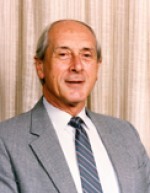
Dr Fraser Bergersen
Introduction
Dr Fraser Bergersen is a distinguished plant scientist whose research in the field of microbiology, particularly through the study of symbiotic nitrogen fixation in legumes, has led to improved crop performance in Australia and Asia. After completing an MSc (Hons) from the University of Otago he joined the CSIRO Division of Plant Industry in Canberra. Initially appointed as a Research Scientist, he remained with the organisation for the rest of his working life, retiring from his position of Chief Research Scientist in 1994. He received a DSc from the University of New Zealand in 1962. Elected a Fellow of the Australian Academy of Science in 1985, he served the Academy as a member of Council (1987-1993) and Foreign Secretary (1989-1993). Dr Bergersen is also a Fellow of the Royal Society.
Interviewed by David Salt in 2004.
Fraser, you were born in the large country town of Hamilton, New Zealand, in 1929. What are your memories of childhood there?
They are very clear. My paternal grandparents, for most of our time in Hamilton, lived only two or three houses away, so I had close contact with them. And the primary school was only one block away, within walking distance - I used to walk home for lunch. It was a congenial location.
I believe your father, grandfather and great-grandfather were all inventors, tinkerers. Do you think you inherited some of this from them?
I probably did. I had access to my grandfather's and my father's workshops and I was always making something, such as a boat for sailing on the lake or (less successfully) a radio. My grandfather had a small engineering business in Hamilton and had been in engineering all his life - his father had had a number of engineering enterprises in Palmerston North, where he was located. My father would have liked to be an engineer but was prevented by illness, so when he retired at the age of 65 he went to work in a foundry [laughs]. And I always like tinkering with things and making small apparatus for use in my science.
I believe your grandfather came up with potentially a quite important invention.
He invented a wheel which was patented. At that time most vehicles were either steel shod or shod with solid rubber, but pneumatic tyres were just coming onto the market. He invented a wheel made of steel with solid rubber outside and a pneumatic inner tube, which worked quite well and would have been very useful for mobile vehicles at war, I think. But the patent was bought up by a company and trashed, so the wheel was never built.
In primary school you were awarded a book prize for being Dux, and you chose Chemistry Today. You later commented that this was your introduction into science.
Yes. That book, with its shiny cover, stimulated my interest in science and chemistry, and when I went on to high school I used it as a source of material for my school work for a little while. But it was soon outdated. I don't even remember the author and the book no longer exists, so I can't tell you any more about it!
You attended Hamilton High School and once again you did very well. I gather that one of your science teachers, Fred Mason, had a most interesting style of teaching.
Fred was a very particular sort of a fellow. He laced his teaching with endless anecdotes and stories, many of which I remember. He had a way that caught my imagination and I found him interesting, although some of the students thought he was dreary. He was innovative: within a year and a half of the official release of information about atomic fission and the atomic bomb, he had copies of the documents and we studied them in the Lower Sixth. I found that a very challenging thing to be doing.
Fred had a practical bent, being from an engineering family and related to the Masons of Mason and Porters, the manufacturing firm in Auckland. He made us take an interest in things like internal combustion engines and learn how they worked, simply by taking an engine to pieces and studying it. Later I used what I had learnt from him about the internal combustion engine for servicing my car and motorbike.
Are science teachers important to the careers of budding scientists?
Oh yes, absolutely. Another of our teachers was Horrie Sayers, a biologist and a zoologist who taught those subjects. He had a friend who was the pathologist at the local hospital, and very early he would confront us with a bucket containing a human brain preserved in formalin. He was able to bring reality to things - this was certainly not just a skeleton of a cat on the sideboard.
You studied for a Bachelor of Science at the University of Otago, in Dunedin. Were you interested in microbiology from the beginning?
Well, I originally intended to be a medical student. But this was immediately after the war and access to the medical school was taken up 95 per cent by returned servicemen, so to enhance my chances of getting into medical school I decided to do full degree subjects. I did chemistry, physics and botany in the first year, but in the second year I began to specialise in chemistry, biochemistry and microbiology - things I thought would be useful when I went into medical school, which in fact I never did. I went into microbiology as a professional pretty well from that time.
You were also getting work experience in microbiology, weren't you?
Yes, at the University's Department of Bacteriology. This was the main diagnostic laboratory for the province of Otago, dealing with medical specimens from all over. (There was a pathology department as well, on the next floor.) The laboratory was staffed mainly with trainees and graduates of the program of medical technology, and it was sensible for me to learn my microbiology from the roots up in that way, so I spent my time doing sterilising and washing up and making media, just the same as all the other trainees. That became very useful when I advanced in microbiology.
Soon afterwards your first scientific paper was published in the prestigious journal Nature. Can you tell us a little bit about that?
A senior lecturer, Solomon Faine - who later became the Professor of Microbiology at Monash University and is now retired - saw the work I had been doing and said, 'This is quite important. Why don't you write a letter to Nature?' So I did and with the department's approval I sent it off, and it was published. The letter was about cross-resistance to antibiotics in Staphylococcus aureus, and it was one of the first reports of cross-reactions: that some strains resistant to penicillin were also resistant to aureomycin.
I see, this would be the bacterium that we commonly call golden staph. To get a letter in Nature when you have just finished your Bachelor of Science is fairly good going.
Well, it is nowadays, but then it was less exotic. [Laughs] It was a pretty unimportant thing but our department then became quite active in trying to prevent the overuse of antibiotics by clinicians just to remove symptoms. It is so easy to specify an antibiotic to relieve the symptoms of a sore throat, for example, but that impacts on the future usefulness of antibiotics. In those days we were using only four antibiotics - penicillin, chloromycetin, aureomycin and streptomycin - and they were important against infectious diseases. We could see that cross-resistance was going to be important, and I remember addressing seminars to clinicians in the hospital, trying to persuade them not to prescribe any antibiotic until it was known that the particular causative organism of any disease was sensitive to that one.
So we were warned 50 years ago about the massive, growing problems we now have?
Yes. Many people were involved in the story, but the clinicians were not persuaded by it. It seems more important to remove or relieve a patient's symptoms than to think of the long-term aspects.
For your Masters you did a microscopic study of bacterial structures. That may sound fairly straightforward, but when you did it, it was quite novel.
This was when almost all work in microbiology was still being done with the light microscope. Bacteriologists in clinical work just stained the bacteria and looked at their shape and colour - what was inside was thought to be below the resolution of the light microscope, and often it was. We were able to use some techniques such as staining in certain ways for nuclear material, for example, for nucleic acids and for sites of metabolic activity, but these were later discounted because of the artefacts introduced by the chemical reactions. Very soon after I did that study, the work with thin sections of bacteria for electron microscopy was first published and we moved on to that. In fact, I made use of it later when I came to Australia.
During your Masters you found out about a microbiology job in Canberra with CSIRO Division of Plant Industry. Did you think you had much chance of getting it?
Well, I just made an application and put it in the mail, but within a very short time I had an invitation from the Division to come over for an interview. So I was flown from New Zealand to Australia, which in those days was quite unusual. The aircraft, a DC4, was unpressurised and flew at about 4000 feet over the Tasman. It was a pretty rough journey and we arrived late in Melbourne. Then I had to transfer to a DC3 for Canberra. The plane was held for me and a meal was put on board because I hadn't had one on the trans-Tasman flight. In the DC3 I was seated next to a rather large gentleman, with another rather large gentleman behind: beside me was the Treasurer of the Commonwealth, Sir Arthur Fadden, and in front was the Prime Minister, Mr Menzies. And I had a dinner and they didn't!
In Canberra, the Chief of Plant Industry was Dr - later Sir - Otto Frankel. Can you tell us a little bit about him?
I'm not sure now about my first impressions, except that I thought he was a powerful little man. Perhaps I was terrified. But he soon passed me over to people who were a little more friendly and approachable.
Otto was a great man. He had a long view of science. He, like Rivett - the first Chairman of CSIR, which became CSIRO - had the philosophy that the job of the administrator of science was to give the scientists the things they needed and let them get on with it. And that came through.
He had taken over the Division two or three years before I came. Seeing that it was a heavily practical, not science oriented, division he took it as his first task to strengthen the scientific base for all of the agricultural work that was being done. He found that one of the strengths of the Division was a group of people looking at the mineral nutrition of plants - agricultural plants, pastoral plants - and that certain parts of their work had had a great impact. For example, Alf Anderson and his group had discovered, first in Adelaide and later in Canberra, the effects of deficiencies of molybdenum in soils, and had made the connection that this was expressed through the nitrogen status of the legumes in the pastures.
So Otto said, 'Well, we want to know more about that process. What's the link between molybdenum and pasture nitrogen status?' During an early trip to England soon after his appointment, he met Dr Phillip Nutman, who was working at Rothamsted Experimental Station, at Harpenden, in Hertfordshire. Otto Frankel was a geneticist; Phillip Nutman was working on the genetics of nodulation of legumes - of red clover, as a matter of fact. Otto made the connection that there was bound to be a genetic solution to the molybdenum-nitrogen link and he recruited Philip Nutman to come to Canberra for three years as a senior fellow of the Division.
Actually, there were two such positions in the Microbiology Section of the Division. The other one was held by Professor K O Müller, a graduate of Berlin who had worked in Cambridge during and just after the war. He was working on the mechanisms involved in disease resistance in plants. I was offered a position with either one or the other; I chose to work with Philip Nutman, and so I came to work on legume nodules.
Can you provide us with a bit of background on what nitrogen-fixing nodules are, why they are important and why you chose to study them?
After some initial work I moved on to soybean as a model system, growing the soybean plants in a glasshouse. The nodules on soybean roots are typically round bumps about 2 or 3 millimetres in diameter, filled with special tissue in which there are symbiotic bacteria - the agents of nitrogen fixation. The nitrogen which is fixed is moved out of the bacteria into the plant and translocated from the roots to the shoots, where it joins up with the photosynthetic system of the plant.
Nodules are very complex organs. If you cut through a root nodule on a soybean plant, you can see that the central part is pale pink and surrounded with a white or greenish white cortex. It is these pinkish cells in the centre which are the site of activity.
Isn't the nitrogen fixing role of nodules important in providing nutrients for agricultural plants?
Yes, and also for pasture, which I worked on first. At that time, pasture systems in much of Australia relied on subterranean clover - or, elsewhere in the country, other clovers and just a few other legumes - for the production of good balanced food for cattle and sheep, and to produce a vigorous growth of the plants. (Later, soybeans, lupins and other crops which were nodulated became important too.) In addition, the nitrogen which was fixed in the nodules became available, through the processes in the soil, for the grasses and other plants which grew in association with the legumes. This system was very important to Australia. Indeed, the world depends on nitrogen fixation by this system almost as much as on photosynthesis for its cycles of nutrition.
So it was known already that nodules, and the bacteria living within them, were important. But not much was known about how these bacteria functioned, what products they formed or how you could maximise their growth or interaction in a pasture system, and the Division of Plant Industry decided that it needed to get a greater understanding of the science behind it all. Is that right?
That's pretty right. Despite the lack of basic knowledge, there was quite an existing program in Australia on the nitrogen-fixing bacteria of pasture legumes. For instance, Professor Jim Vincent, in Sydney University, and Professor Lex Parker, in Western Australia, had active programs in selecting better bacteria for subterranean clover and other legumes. They knew that you could select better bacteria, but they didn't know what the functions of these bacteria exactly were. It was at about that time that all this knowledge began to come together, and I was a part of the scheme - but not the only one, by any means!
You were brought in, then, as a member - and, later, leader - of the group which Dr Frankel set up, the Rhizobium Research Group. What is rhizobium?
'Rhizobium' is a general term for the bacteria in the root nodule system. They live in the soil, from where they infect the roots of the leguminous plants and build the nodules in which they function. We now know that Rhizobium is only one of about six genera of soil bacteria involved, but loosely they are all called rhizobia.
And the initial work of the group was to examine the structures of the nodules?
Well, in a way. The first project I was given was to look at the red clovers that Phillip Nutman had selected and bred for nodulation differences. With him, I began to cut sections and look at the inside of the nodules of his plants - the defective ones and the better ones. But to do that first work, I had to learn how to grow sterile plants and to grow them with bacteriological controls; you had to be able to see that you were really getting the effects you thought you were working with.
When I came, there was already a small group. John Brockwell and Frank Hely had begun a good deal of work with nitrogen-fixing legumes. Frank was in fact involved in designing the modification needed so that you could grow these plants in a glasshouse in the Canberra summer, when it was very hot, without cooking them. He designed a louvre system which went over the roof of the glasshouse and could be adjusted with levers. It was oriented in the correct way so that with these louvres the plants growing in test tubes in the glasshouse experienced bands of sunlight and shade, sunlight and shade; it controlled the temperature in the tubes; and also - funnily enough, because that wasn't the intention - it enhanced the ventilation of the tubes, because as they heated and cooled they were able to pull air and expel it from the tubes, keeping them ventilated. Since that work was already under way, my first weekend job was to go and adjust the louvres of the greenhouse.
So that's where we started. But gaining an understanding didn't happen all at once. We were first involved with some field studies in the Armidale area of New England, where there was a nodulation problem. I participated in the discovery of some microbial factors in the soil which were preventing the successful inoculation of the plants in that area with good bacteria. The work was quite exciting at the time but later it was totally superseded, because Australians were learning how to make better inoculants - that is, better products which would produce populations of Rhizobium in the soil for the nodulation of the plants.
I think an important part of the next phase of the research was to understand the effects that oxygen had on the nitrogen fixation rates.
Yes. In about 1957 I decided that we should go to a model system which was tractable for laboratory work. Work with pasture legumes was very difficult because the nodules were tiny and you couldn't get enough material to do any biochemical work with any great ease. At much the same time, a lab in Wisconsin, America, had done some work with soybeans that showed what the early products of nitrogen fixation might have been. They were using the stable isotope 15N as a tracer to help with the study of the system, so I persuaded Otto Frankel to allow me to visit Wisconsin to learn how to use this technique and what its fundamentals were, because there was then no capacity in Australia to do 15N work. At about the same time other people developed it as well, but this was the first time in Canberra that we were able to get 15N to work. That was a key development, and for some years afterwards all of our mechanistic work was based on the incorporation of 15N from nitrogen gas into the plants and tracing the products and the mechanisms.
What did you find were the first products being made by the bacteria?
Among our early experiments were some very short-term experiments: you exposed root nodules in a little bottle to a gas containing some oxygen and some nitrogen gas containing 15N, for a short period - one or two minutes - and then stopped the reaction reasonably quickly and extracted the products from the nodules. The Americans had already found that the first product appeared in the soluble fraction, so I concentrated on looking at the soluble fraction. We found that ammonia was the first free product of nitrogen fixation which could be detected in the soluble fraction. And that was soon incorporated into amino acids and translocated to the plant. It was not until perhaps 20 years later, though, that the products after ammonia could be elucidated.
Didn't your visit to Wisconsin involve something that looked like a promising lead but actually went nowhere?
Yes. I have to backtrack to 1958, when the structural work which we were talking about began to develop into electron microscope work. An electron microscope was to have been bought by CSIRO in 1955, but we didn't get it because the budget was cut. Then Sir Ian Clunies Ross, the Chairman of CSIRO, was able to pull strings so that CSIRO helped to pay for an electron microscope which was installed in the John Curtin School of Medical Research, in the Australian National University, and in return was promised use of the machine. And we used it.
Prior to that we had had a few thin sections cut for us at the Division of Chemical Physics, in Melbourne, which had an electron microscope, and from using those thin sections we had the idea that the bacteria weren't just sitting in the nodules but were in a structure. That put us on the way, and with Margaret Briggs - who was very helpful in those early years - I took it further. Being able now to cut some thin sections for ourselves, we found that the bacteria were in fact done up in little packets, with a plant membrane between the bacteria and the plant cytoplasm.
Then, when I went to Wisconsin, I developed a hypothesis that this packet was the important thing. And we did 15N experiments which seemed to suggest that 15N was incorporated in the membrane around the bacteria. Wrong. It wasn't that way. So I developed a hypothesis about how the nodules functioned, based on the idea that the membrane was important. (Subsequent work has shown that it is very important, but not for those reasons!)
A number of research institutions around the world were trying to unravel the nitrogen fixing topic. Was there a collegiate approach among these different groups, all wanting to contribute? Or were each of you trying to beat the others to the punch?
It was both, really. There were not so many people looking at the legume system. While I was in Wisconsin there was a major breakthrough: a group at the Du Pont chemical company in Delaware succeeded in producing a nitrogen-fixing extract from the non-symbiotic bacterium Clostridium pasteurianum. So the basic biochemistry of the nitrogen fixing process, the nitrogenase action, began then. It was some time, though, before we were able to apply that to the nodule system, because it was harder to work with. You couldn't grow it in a big fermenter and get a pound of bacteria very easily.
Research on the basic mechanism of nitrogenase action went on elsewhere for quite a while. We were more concerned with how the bacteria were able to do this magic reaction, this 'black box' of nitrogenase. Some other people were working on that, but we concentrated on how it might work in the nodule system. Although it was suspected that the bacteria were the source of the nitrogenase, we didn't really know, so one of the first things to do was to make a preparation from active nodules, with which we could work separate from the nodules themselves. In the mid-'60s we succeeded in making our extracts of nodules which contained active bacteria, and the active bacteria were proved - for the first time - to be the source of the nitrogenase.
It was an accident that we found out how to do it. We knew from the work in America that the nitrogenase was very sensitive to oxygen, which inactivated it. So we tried to make anaerobic preparations. We found out how to make them and they were certainly anaerobic, but they didn't fix any nitrogen. Then one day, in one experiment, one flask - out of about 10 - had activity. Why? The clue came from the way in which we did our experiments, monitoring the gas phase of these flasks: we found that the one which was active had had a little air leak in it. We knew then that although the only way to make the preparation active was to make it anaerobically, the secret was to drive it with a smidgin of oxygen.
So that was the beginning of understanding that this whole nodule system is a microaerobic system. To make it go, you had to give the nodules oxygen, and we worked out what the oxygen responses were and what was needed. But obviously the air concentration of oxygen around the outside of the nodule was very much less than on the inside of the nodule.
About the same time, Cyril Appleby, who had joined the biochemistry group, had been extracting the haemoglobin, the pink material inside the cells of the central tissue, to find out some of its physical properties. He found that it was half-saturated with oxygen at a very low oxygen concentration. This was a key point. Human haemoglobin, which is vaguely similar to the nodule haemoglobin, and myoglobin (in muscles), which is very similar to it, are half-saturated with oxygen at quite high concentrations - several micromolar concentrations - but the pigment in these cells was half-saturated with oxygen at a thousand times lower concentration.
Cyril and I began to do a few experiments together. We shook bacterial suspensions, made from the nodules, in various concentrations of oxygen and with leghaemoglobin, the red pigment, added to them. We found that there was a specific effect: the respiration was stimulated a little bit but nitrogen fixation was stimulated very much more when partially oxygen-saturated haemoglobin was present. That was the beginning of quite a long series of experiments with Cyril and with visiting scientists, finding out what the mechanism was.
Also involved at that time was Nick Stokes, a physicist who worked in a different division of CSIRO and had certain ideas as to what was happening in these shaken assays. From our first experiments, however, it looked as if a specific interaction with partially oxygenated leghaemoglobin was driving the bacteria to fix nitrogen. But this idea vastly offended an American worker in New York. He came out and visited CSIRO and worked with Cyril, and together we did a lot of experiments from which we found that it was a mechanism which was delivering oxygen at a low concentration to the bacteria. It wasn't a specific reaction - other haemoproteins and oxygen-carrying proteins would work - but leghaemoglobin was the best, because it had the lowest-saturated oxygen characteristics. We have since worked for a long time with the interaction between the bacteroids (the symbiotic form of the bacteria in the nodule) and this partially oxygenated leghaemoglobin.
Do bacteroids normally exist in the soil?
No. Free living bacteria exist in the soil. Once they enter the tissue of the nodule, they are changed into a different form. Sometimes they are grossly enlarged; sometimes they are just the same size but their biochemistry changes. The bacteria in the soybean nodule are about the same size as those living in the soil but they have quite different biochemistry. And the changes in the biochemistry have been studied, both in our lab and elsewhere.
How long did the Rhizobium Research Group operate for? Was it ever given the status of a program?
The group operated before we had programs. Its name was actually an informal one: it was in the microbiology group, and the Microbiology Section was where the work was done, using central CSIRO funds. (Most of its projects did not require external funds.) We have had various heads of the Microbiology Section - I was the head for some time - but the rhizobium group remained constant from 1955 until about 1979, when the management of all CSIRO's science changed and these efforts had to be located within programs, in a formal structure which was much more rigid than originally. Nevertheless, we continued to follow many of the leads which came from the earlier work. For instance, for a while a program called Nitrogen in Agriculture embraced the work of the rhizobium group.
What had been some of the other major breakthroughs of the group?
The rhizobium group became quite large, with at one stage 12 people working in it, including Dr Alan Gibson, a graduate of Sydney University who was there from fairly early on, and Dr Bill Dudman, who had come to us from the UK via Jamaica and the CSIRO laboratories at Merbein. He worked on the use of serology - immunology - as a tool to look at the surfaces of bacteria involved in this process. I have already mentioned John Brockwell, who was in the group from a very early stage and still works on the subject as a research fellow at CSIRO Plant Industry. And Bob Gault was involved with the field work.
They worked together to develop several things. There were methods of inoculation, which they worked on very successfully: they were able to develop new techniques for adding the bacteria in an active form which survived the rigours of isolation in the soil from other things. And they developed very good techniques which involved pelleting of seeds and the way in which the inoculum was applied to the seeds, sometimes - in later developments - in the soil directly as a suspension of bacteria. Those sorts of things were done for practical reasons.
It was a numbers game, however. There were always bacteria present in the soil so you were trying to introduce a new member of the population in competition with a lot of things that were already there. And many of these bacteria were rhizobia from other plants, other systems, which were not useful on the plant of interest, so it was necessary to develop methods which would get a large, viable population present when the seed germinated, the roots grew out and the infection was able to proceed. Many of the other people in the microbiology group were involved in processes like that, with a lot of publications about counting the numbers of bacteria in various locations and how they interacted with the plants, and fertiliser systems and so on, just optimising the way in which they could be used. Many of those techniques are now a part of agricultural practice in Australia.
Can you tell us the secrets of the rhizobium group's success?
I find that very hard to answer. There were a lot of reasons, including the legacy of Otto Frankel's original far-sightedness, and the stubbornness of the people involved: they didn't want to change it unnecessarily when their work was being productive. There was a mix of fundamental and practical work, and as leader of the group I encouraged that from the start. We needed to keep our feet on the ground, so to speak - or in the soil, because this was a soil problem. The work developed very strongly in the direction of practical agriculture. For example, the new methods of inoculation had to be tested in the field before they could be applied properly in agriculture.
So there was demonstration work, there was work in collaboration with Departments of Agriculture right across the country but particularly in New South Wales, where many of the field experiments were done with members of the agriculture department. Collaborative work was an important feature - our people were good collaborators with people on the ground, and some of our work was done on farm, with the collaboration of interested farmers - and was one reason, I think, why the work was able to continue. And it supported my work in the lab on this highfalutin biochemical stuff, because I was able to draw the connection between that and the practical stuff. Irrigated soybeans, in particular, are quite an important agricultural crop now, and I was able to combine my fundamental work with an interest and expression in the field work with soybeans.
Similar work was done, very successfully, in Western Australia with lupins, which were an important agricultural crop there. That sort of pattern was able to be used for some time, and it wasn't until the 1980s that we needed to seek support from other sources of funding.
Did the group undertake any successful international collaboration?
Yes. We had joint projects in South-East Asia - in Malaysia and Thailand - as well as in Papua New Guinea and Indonesia, sponsored by funds from ACIAR, the Australian Centre for International Agricultural Research. This was truly collaborative work: we had partners in those countries and we were transferring the skills which we had in Australia to be used in those countries. That was a major objective of the work, but it also carried quite a bit of the fundamental work.
For example, we were able to put together a program of collaborative experiments on the translocation of fixed nitrogen from nodules into the rest of the plant - as I mentioned before, we didn't know much about the products that were translocated out of nodules - and that involved specific biochemistry which was studied both in Canberra and in other Australian laboratories. And an alternative method to 15N came up, which we were able to test and calibrate against 15N methods (which, by the way, had become quite different in the interim). This was the ureide method of measuring nitrogen fixation. Some plants translocate ureides from the roots to the shoots, and by analysing the content of the bleeding sap that is being translocated from the roots to the sap - you could cut the plant and sample what was coming out - the chemical nature of the products could be identified and the ratio of certain products in those could be correlated with the amount of nitrogen fixation which was going on. It was good to find an alternative method, because 15N methods were quite expensive to conduct and not many countries were able to use them.
You yourself have been involved in many international experiences. I believe there is even a Chinese version of a textbook you did on nitrogen-fixing nodules.
That's right! In about 1979 a visit to Australia by Chinese nitrogen fixing interests was sponsored by the agreement between the Academy of Sciences in China and the Australian Academy of Science. Then in 1983 a reciprocal visit to China by a party of Australian nitrogen-fixers was sponsored by this Academy. (I led this group.) Very early in our extensive travels in China we visited the headquarters of the Chinese Academy of Sciences in Beijing and were graciously received by the President, in sumptuous surroundings. I was able to present to him, as a memento of our visit, two books which I had authored or edited, and he graciously thanked us.
In later years, however, a Chinese researcher working in Sydney University visited China and found a copy of one of the books - in Chinese - in the library. It had been made without our knowledge and was available to Chinese students for a few American dollars, whereas the English original cost about $150. So those students were able to make use of the book. I'm sure the publisher was very unhappy about it!
Otto Frankel supported the work in CSIRO by bringing in good people, allowing excellent teams to be assembled and then making sure that you had well-equipped workshops and research infrastructure. I imagine that you needed several decades of understanding the field to come up with something like the apparatus you have just shown us, but you would also have needed access to workshop facilities and the ability to build laboratory equipment from scratch.
That was very important. These days it is much more difficult to maintain workshop facilities, because they are quite expensive. They have to be re-equipped with up-to-date equipment, just as a scientific lab has, and it can be very hard to identify an outcome in dollar terms. Otto saw the need for workshops, and that was generally appreciated. The Division of Entomology, next door, was another of the many divisions which saw it as essential to have their own workshops.
Within a year of my coming and beginning to work with the respiration of bacteria, the workshop helped me to make a useful microrespirometer. And then through the years they helped me to make an anaerobic press, which enabled me to make nodule extracts. They modified French Presses with Holden motorcar parts so that cheap disruptive presses for bacteria could be made, this flow chamber (pictured) which I used in my own work was another product, and there were many others. They helped me to make a gadget to measure the diffusion coefficients of leghaemoglobin in solution, and that produced a paper. It was absolutely crucial for our modelling work that we should know these things.
In all of these instances I took a concept to somebody in the workshop - the chief engineer, perhaps, or somebody working at the bench - and discussed what I wanted to do. They made or drew something, then they made what they thought would do the job, and I might say, 'Well, this isn't quite right, you need such-and-such.'
There was a close interaction with the staff who were making these gadgets. Along with the capacity for things to be made, that collaboration was really important. It applied also to the electronic side. The little controller of the speed at which this apparatus worked was just made very quickly by somebody in the electronic workshop, and we used it for years.
You have brought along today an experimental rig to demonstrate how you conducted some of your studies. Could you talk to us about that?
I mentioned that we were studying the role of leghaemoglobin. Out of that work evolved a system by which we were able to monitor the activities of bacteria obtained from nodules. Similar experiments could be done with any nitrogen-fixing bacteria, and in fact some have been done and some work has been published. But we were interested in getting to the nitty-gritty of what the interactions between bacteria were, as they functioned in the nodule, in relation to experimental systems.
We had already found that the most activity occurred in the bacteroids when leghaemoglobin bathing their surface was partially oxygenated, but we didn't have any good quantitative relationships. So I built this system, which evolved over several years. We had a flow chamber and a stirred chamber, with a little electric motor (M) driving the stirrer, and we had a conical chamber in which one could put a suspension of bacteria in a solution containing leghaemoglobin. We were able to inject bacteria into that solution through an injection port so that we knew how much was in there and exactly what its properties were.
By changing the flow rate of medium through another port, we could perfuse the contents of the chamber with a solution containing leghaemoglobin, whose state of oxygenation was known and whose concentration was known analytically. The solution passed through the stirred chamber (A) in which the bacteria were respiring and fixing nitrogen - just the solution, the bacteria were retained in the chamber (A) behind the membrane filter - and out through a flow cuvette (F), mounted in the sample beam of a spectrophotometer (S). So, we could scan the properties of the leghaemoglobin before and after it had gone through the chamber.
In that way we were able to make changes to substrates, to the degree of oxygenation of the leghaemoglobin. We could relate the concentration of the product - which was ammonia in the solution, with no transformation into anything else so you just monitored the amount of ammonia - and that was initially calibrated with 15N so we knew we were in the right direction.
In doing that we were able to study these very low concentrations of free oxygen in the solution, maintained by the action of leghaemoglobin. That is quite a complex matter. The leghaemoglobin binds oxygen very strongly and releases it slowly, and the physics of that process are well calibrated and known. So from the degree of oxygenation of the leghaemoglobin in the solution which came out, compared with the degree of oxygenation as it went in, we could calculate how much oxygen had been used and how much nitrogen had been fixed, by analysing for ammonia in the effluent solution. And we could do all sorts of experiments like that.
We were able to find that there was quite precise control of the conditions in the chamber - by the bacteria! We could influence those conditions by changing the rates of flow and so on, but within a certain period of a few minutes it would re-establish a new metabolic activity to cope with the increased level of oxygenation, or oxygen supply. We found that there is a cyclical control: you can produce a sine wave control just like a control system in an engineering set-up, simply by the changes in the activities of the bacteria. And those degrees of change of respiratory activity were correlated with changes in nitrogen fixation activity.
It seems that the bacterial response to different circumstances, different environments, is amazingly complex and intricate. Have we got a long way now towards understanding these nodules, or is most of it still to be figured out?
Well, we have been talking about the bacterial component, which I have studied exhaustively. But the plant component is very important as well. We had found in our structural work that plant mitochondria and plastids are also involved in the structure of these infected cells where the bacteria are sitting, and that it is a very specific structure. When I left CSIRO and became a Research Fellow at the ANU, the collaborative work on this developed further. We were able to go back and look at sections which had been cut in CSIRO in 1973 for electron microscopy, and we cut new sections off these same blocks and began using a different orientation to study the way in which mitochondria and plastids were arranged in the infected cells.
It is fascinating. They have quite enormous numbers of mitochondria, which are also involved in the oxygen demand of the central tissue, accounting for perhaps a half of the respiratory activity of the nodule. These mitochondrial bodies are lined up along the structures of the infected cell where there are intercellular spaces, so we have had to explore the three-dimensional structure of that cell and try to understand it rather better than we did. And we were able to collaborate with some graduate students working in the ANU to actually study the mitochondria which were isolated from nodules, looking at them in relation to the deoxygenation of leghaemoglobin. Because these mitochondria are lining the surfaces of the air spaces which ventilate the nodule tissue, they get first bite of the cherry, the first cut of the oxygen, and leghaemoglobin is competing with that sink at the surface of the cells.
One of the graduate students was able to measure the oxygen affinity of the respiratory activity of these mitochondria, and we have used that in a model system to explore how the plant cells are modifying the respiration and the distribution of oxygen within the affected cell. That work has been published as a simulation model of how the cell is working, and for me it has been a quite good exercise, combining the structural work which began 50 years ago and the recent, fascinating work on the activity of these mitochondria.
We seem to be good at pulling a system apart, isolating individual components and modelling them individually. Do we need also to be able to put the pieces of the jigsaw puzzle together to understand how the system works and where we should make a modification or whatever to achieve certain desirable outcomes?
Yes. It is very hard to know what modifications to seek, unless you understand the system better than we do at the moment.
In the new age of biotechnology we are asked to believe that understanding the genetic code of a cell may be enough to know that cell. Yet we are just beginning to realise how complex and intricate the system is in the way it behaves.
That's right. That applies to the nodule system, certainly, and to many systems. Gene expression is one thing, and the regulation of gene expression is very important; having the genes there is a primary requirement for any activity. But you can't derive information from a metabolic map to tell you about the regulation of activity and the way in which systems interact with each other.
You have been a part of CSIRO for about 43 years. What is it like to have been in charge of a research unit overseeing an entire area of research from its infancy to a mature science?
Well, such development is rare. Mostly present-day science is divided up into fundable-sized bits, and it is very hard to have a continuing topic studied. For reasons which are both practical and obvious, some science becomes stale. It takes a long time to come to conclusions, to have a mature piece of science, and few projects can be sustained for that long. Some people have been quite successful in being able to carry on a continuous series of experiments for perhaps 10 or 15 years, but that is rare and these days it is more difficult, because no funding agency wants to fund science that is going to make a continuing demand on its resources. This was easier in my day. I did most of my work in areas funded entirely through CSIRO's central structure, but now it is almost impossible to do that. I don't know of any current projects which are not funded, at least to a very large extent, by external funds from various sources.
Our funds from CSIRO were seldom enough but they were adequate to enable us to pursue our work pretty well free of interference, as long as we were responsible about it - always, of course, you had to have terms of reference and you had to do responsible work. But such freedom is now largely gone and it took some modifications of our approach as scientists in order to cope with those changes. Some of us didn't do it at all well. I was privileged not to have to do it very much, but others have found it very difficult and I believe the whole stream of scientific advance has been grossly affected by it.
Did you think the investment in you and your work was a great one?
From a scientific point of view I think it was. And it was a product of its time. We have to learn how to use the different funding structures better than we do at the moment. Long-term research is very difficult to fund, but every branch of science agrees that such research is necessary. It has been a little easier in the university system to maintain that, but it is increasingly difficult there and almost impossible in CSIRO.
I think there is too much emphasis on outcomes. Of course outcomes are important, but if you knew what the outcomes were going to be before you did the work, you wouldn't have to do it! It is important that flexibility remains, no matter how hard it is to maintain it in the current managerial atmosphere.
This is really the drift throughout the world, isn't it?
Oh yes. It has been so in America for many, many years. When I worked in America in 1958 and '59 I would not have been supported but for a continuing NSF [National Science Foundation] grant to the professor of the lab, who was able to work me into his program. In England and this country it has now followed the same pattern. It is just different and we have to learn to do our best with it. And we still need to interact with our masters, telling them constantly about the importance of long-term public-interest work which doesn't have an easily identified outcome but without which we will run out of steam very quickly.
Are there still any major gaps in our understanding of nitrogen-fixing nodules?
There must be, because you never finish science. There is always something new to find out. We know pretty well, having done a lot of work with soybeans, how the soybean system works. We know almost nothing about many other systems, some of which will become increasingly important as they are used in broadacre agriculture or even in farming systems in small countries. For instance, peanuts are grown in many countries, yet we know only a little bit about the systems of the peanut. And you could say that over and over again.
Also, we know very little about non-leguminous nitrogen-fixing systems which are important in an ecological sense in natural systems. What we do know has been growing steadily over the years, but we don't know enough to use those systems wisely. We don't even have a proper inventory in Australia of the nitrogen fixing capacity of the components of natural systems. I remember discussing this in Western Australia with people in the forestry systems. They knew that they had acacias and that these fix nitrogen, but they didn't know how much, or the acacia life expectancy in terms of the overall cycles of the systems - or anything about the enormous number of lichens, for example, and which are important for fixation in situ and on trees, rocks and so on.
I am reminded of some work by my former colleague Don Norris, who worked in Queensland. He went to Brazil before I did, and he said he was talking there about the use of legumes in the field. The people said, 'But we have no legumes that are capable of doing that,' when they were standing knee-deep in legumes which they knew nothing about. And that can be so at all stages of agricultural development.
Is there just less chance these days of setting up a long-scale research program that exhaustively studies such problems?
In this country, certainly, it is difficult. The Brazilians set up quite an advanced laboratory from 1970. I visited it in 1997 and found it astonishing: they had a mass spectrometer and very sophisticated work going on, even if it had taken 20 years or 30 years to come to fruition. That too was an international effort.
You moved to Canberra in 1954, when its population was much less than the present 350,000. What was it like as a place to live in?
It had only 23,000 people then, and because it was smaller you had more access to people. We used to see Bob Menzies and Dame Pattie shopping in J B Young's at Civic when we first came, and I remember once being nearly knocked over by the British premier as he ran down the stairs from the UK High Commission, in the Melbourne Building. You just saw these people all the time, and so in that sense it is quite different.
It is culturally different too. There was very little theatre. There were two (later three) movie theatres, and you used to have to front up to the frigid Albert Hall for any concert or play that was on. But it was a friendly place. I think everybody who comes to Canberra takes a couple of years to become really accustomed to it, but that's probably true wherever you go.
Has Canberra been a good place to do science?
Oh yes. I don't think anywhere would match it or exceed its usefulness in that direction. We've always had good relationships between the CSIRO and the ANU, and I have utilised those. We have done a great many joint things which over the years have been important. That's now expanded to include the ADF [Australian Defence Force] Academy and the University of Canberra, which is increasingly collaborating with CSIRO and other laboratories. So there is a great draw in bringing people to Canberra. When people have left Canberra for other places they have realised what a good place it was. Fortunately for me, I didn't have to leave.
© Australian Academy of Science
Professor Brian Schmidt, astronomer
Brian Schmidt was born in 1967 in Montana, USA. In 1989 he received a BSc in physics and a BSc in astronomy from the University of Arizona. He went to Harvard University for graduate work and received a PhD in astronomy in 1993. His thesis research was into Type II supernovae, expanding photospheres and extragalactic distance.
From 1993-94 Schmidt was a postdoctoral fellow at the Harvard-Smithsonian Center for Astrophysics. In 1995 he began work at the Mount Stromlo and Siding Spring Observatories (MSSSO) as a postdoctoral fellow. He has continued working there, being appointed in 1997 as a research fellow (MSSSO) and in 1999 as a fellow in the Research School of Astronomy and Astrophysics (MSSSO) of the Australian National University. His research interests and current projects include observational cosmology, studies of supernovae, gamma ray bursts and transient object searches.
Interviewed by Ms Marian Heard in 2001.
Contents
- A family love for science
- Deciding to go into astronomy
- University years: mixed blessings
- The sky is growing! PhD work
- Via marriage to Mount Stromlo
- Why is the sky growing so fast?
- A big-picture view of the universe
- Projects to explore the long-long-ago
- Science funding today for outcomes tomorrow
- Putting science to work in a crazy universe
- Skills and attitudes for good science
- Fun and fulfilment from scientific work
- The stimulus of awards and recognition
- Lifestyle interests and opportunities
- Hoping that great things will be done
A family love for science
Brian, you didn't grow up in Australia. Where were you born?
I was born in the western United States, in the State of Montana, in 1967. I lived in a variety of places when I was very young, but I grew up mostly in Montana and, during the second half of my childhood, in the State of Alaska. I was an only child – my parents had me when they were quite young, only 19, and so my Mom, my Dad and I sort of grew up together. I did whatever they did: I went to their parties, and we also had lots of camping and shared life together.
When I was a child my father was doing his PhD in biology and had a love of nature, and that was always something I enjoyed too. I used to go out with him and run around and help him do his research. For example, when he had to collect bugs for his classes, I would stick a big butterfly net out the car window and hold it there while we drove at about 30 kilometres an hour down the ditch. We'd go for about a kilometre, and then we'd stop and get out to look see what we'd have. And there would be amazing things in there, things you'd never know were in the grass. (Occasionally you'd break the net, but that's another story.) We used to do things like that all the time. The love my father had for science was very apparent, and so from the age of two or three I grew to love it the same way.
Deciding to go into astronomy
What influence did your schooling and your teachers have on you?
I always had pretty good teachers, very supportive of me in wanting to learn, and teaching me very well. When my sixth grade teacher had to teach an astronomy section, she realised that I knew a lot about science and specifically astronomy and so she decided that I would teach the astronomy. At the time I was horrified, but now I realise it was an act of sheer brilliance on her part – I had to learn and prepare so much. I had to follow the curriculum and I took it very, very seriously. (She of course took it very seriously too and made sure I did everything correctly.) That was a great thing for me.
I had good teachers as I moved into my high school years in Alaska, too. They pushed me; I had to really work hard to impress them. They didn't just let me think that doing very well was good enough. It was always, 'How much better can you do?' They were very good that way.
Was your decision to go into astronomy made as early as sixth grade?
Interestingly enough, it was not. By the time I was four or five I was sure I was going to be a scientist. Whenever people asked me what I wanted to be when I grew up, however, I always said, 'A meteorologist.' They used to laugh, but I was pretty much fixed on that view until the age of 17. Meanwhile I did do a little bit of astronomy, going out to look at comets and the Northern Lights in Alaska, but it wasn't until I did some work at the US National Weather Service that for some reason meteorology no longer rang as the thing I wanted to do.
Then, just before I went off to university, I went to career counselling. I didn't think much of it, but one talk finished with something useful: 'Ultimately you should do what you would do for free. That's the best career.' I was suddenly struck by that, and realised the only thing I would actually do for free was science, and specifically astronomy. And that is what I decided to go into.
University years: mixed blessings
Why did you choose the University of Arizona to do your degree?
That was in some sense just the easiest thing for me to do at the time. I was quite sure that I wanted to go to a public, state-run university, probably because that was where my parents went and private universities in the United States are so expensive. And they're all on the east coast, whereas I really did want to stay in the west. Also, my grandparents live only about two hours away from the University of Arizona. Fundamentally, though, that university is a very well-known school in astronomy and I went there for its research quality.
University life for me was the most challenging time I've ever had – not academically, but socially. I grew up in Alaska in a very interesting time when oil money had caused huge amounts of money to be spent on education, so the teachers and the schools were top-notch. But at university I found the teachers were not top-notch, actually. My high school experience had been more intellectual than my university experience was, and I had a lot of trouble dealing with that. I felt that rather than going from the little pond to the big pond it was the other way around: I had gone to a much less stimulating environment. So for the first couple of years there I was fairly unhappy and I just wandered through, making sure I did well in classes.
Eventually I found the older graduate students in astronomy, who in your first couple of years you don't get much chance to integrate with, and started hanging out with them. I had a lot more in common with them; they were much more like people I was used to. Once that happened I became quite happy. It was then a time to learn a lot, to have a bit of fun, and to find yourself and what it's like to be on your own.
You actually completed two science degrees during those four years, didn't you?
Well, being unhappy I was willing to work a lot harder on classes than normal people should – harder than I would recommend as a healthy experience. I was taking a lot of classes, seven and sometimes eight a semester, which allowed me to accumulate enough classes to get a degree both in astronomy and also in physics. Would I do it again? Probably not. I would probably try to spend more time being happy, rather than take out my unhappiness in doing all those extra classes. Doing them did not cause me to become a great scientist. It's common sense that allows you to do that. In retrospect, I would have preferred to spend my time doing something like hiking.
The sky is growing! PhD work
Did you then apply to graduate schools across the United States?
Yes. Unlike in Australia, in the United States you apply for everything. You then figure out where your best deal is and go there. You do not stay where you're at. During my last year at Arizona I was saying that I should stay there for graduate school, but they said, 'We're sorry, we don't allow that. We're not going to even allow you to apply here. You need to go out.' And so I applied to about 13 places in the United States, right through from Hawaii to Harvard. It's very tough to get into graduate school, very competitive, so my expectation was not really to get into many places. But I surprised myself by getting into a lot of places, so then I had decide what to do. Ultimately I went and visited Harvard, Caltech and Santa Cruz – which most people haven't heard of but which has a very strong astronomy department – and Harvard seemed to me like the best place to go. It wasn't where I had intended to go, but I really enjoyed the people there and I enjoyed the atmosphere: it was the only place I visited that actually had winter. Although most people like to avoid winter, I grew up in Alaska–Montana and winter is the core of my life. I liked the fact that it snowed in Boston.
Can you explain the work you did for your PhD at Harvard?
I worked with Robert Kirshner, who is a well-known astronomer there. We were measuring distances by using massive stars – probably 20 times the mass of our sun – which at the end of their lives explode as type II supernovae.
When an object is hot it glows. A light bulb glows because it's been heated up to about 3000 degrees centigrade. Well, a supernova when it explodes is more like 10,000 to 20,000 degrees. And the hotter something is, the brighter it glows and, as it turns out, the more it changes colour. So, for example, when you heat something up a bit, it glows red. But if you heat it up more and more, it becomes progressively white and, eventually, blue. When we looked at one of these exploding stars, its colour told us the temperature, and from that we were able to infer how bright the supernova was, how many watts – how much power – it was putting out. We were able to put all this together with the fact that the further away something is, the fainter it becomes, so that by observing one of these exploding stars we could figure out how far it was away from us.
Then, by measuring not only the distance to these objects but also how fast they are moving apart from us, we measured how fast the universe is expanding now. It turns out every object in the universe is moving away from us, and that brings us to conclude that the universe is expanding as a whole. That is, the further an object is away, the faster it is moving away. Imagine that you put spots on a balloon and you blow up the balloon. As the balloon expands, every spot moves away from every other spot. What we see in the universe is just like that.
Via marriage to Mount Stromlo
And after completing your PhD?
I finished my PhD in 1993. I had in the meantime gotten married, in 1992, and one of the challenges of modern-day life is finding something for both you and your spouse to do. My wife, Jenny, is an Australian economist who got her PhD at Harvard at the same time I did. When we did the first round of jobs, she got a job in Australia and one in Washington DC, and I got a job in Pasadena and one in Boston. We had made a decision that we were not going to live apart, so we basically cut a deal that I would get a job in Australia within two years, if she would take a job in Boston for the short term. (We had lived in Boston and knew it well, and it had a lot of jobs – not very good jobs, but jobs – that at least we could do in the short term. And so I spent 18 months working as a postdoctoral fellow at the Harvard–Smithsonian Center for Astrophysics, right next to Harvard, and then I was able to get a job at Canberra.
I arrived at Mount Stromlo at the end of 1994, and I've stayed there. My wife has also worked in Canberra – actually in this building that we're being interviewed in – since the same time. We both have excellent jobs now, so we're loath to change.
Why is the sky growing so fast?
So what are you currently working on at Mount Stromlo?
A lot of things – probably too many. One of them is a continuation of work which we did in 1998, when we used Type IA supernovae to trace what the universe is doing back into time. These tiny exploding stars end up being even brighter than the massive stars are when they explode, and the interesting thing about these tiny stars is if you've seen one of them, you've more or less seen them all. They're all the same brightness. And so simply by looking at how bright these objects are, we can measure their distance: the fainter they are, the further away they are.
In 1995, just after I arrived in Australia, we started using the biggest telescopes on Earth to discover these objects and figure out how bright they were, and then we would measure how fast each one was moving away from us. In the nearby universe, that allows us to know how fast the universe is expanding. But as we look at greater and greater distances, we're looking not just a long ways away but back into time.
That year, our work in Chile found our first object, Supernova 1995K – not a very exciting name – at 5 billion light-years away. (So it exploded 5 billion years ago, before the Earth was formed.) Finding that first object allowed us to measure how fast the universe was expanding 5 billion years ago, and it indicated to us that the universe was not doing much in the way of slowing down. Yet we expect the universe to slow down, because the universe is full of gravity. Gravity pulls on the universe as it expands, and that should s-l-o-w it down over time. Over the next three years we found a lot more of these objects, which all gave a similar answer to that first one, and that showed that the universe, instead of slowing down like we would have expected, has actually sped up its expansion. It is getting bigger faster and faster. So what we found in 1998 is quite a discovery, and not at all what we expected.
If the universe is speeding up over time, something has to be making it speed up. We had assumed that, basically, gravity was the only thing happening in the universe. This discovery has led us to believe that there is something else, some unknown form of energy which we now call 'dark energy', that is ripping the universe apart. Our 1998 discovery is sufficiently profound and unexpected that we really have to check our work very carefully, so that is one of the things I'm doing right now. Using the Hubble Space Telescope together with the biggest telescopes on Earth we're tracking down as many of these objects as we can and looking at them in fine detail, to make sure something hasn't changed over the last 5 billion years which is throwing us off.
A big-picture view of the universe
I'm excited about another thing that I'm just starting, for which we're using a very small telescope located up at Siding Spring. (It's owned by the University of New South Wales and has been put together by Michael Ashley.) The interesting thing about this telescope is that it looks at a huge piece of sky at a time, and it actually allows us to get a picture of the entire sky about three times a month. Sure, I could go out with my Nikon and do that as well, but this has a very precise look at the sky: it allows us to see things about a million times fainter than the human eye can see.
We can do a few things with this. The first is to make a catalogue of how bright every object is in the sky, and that's useful for a whole variety of purposes.
The second is to look for moving objects, such as near-Earth objects – objects which come screaming by the Earth. These things are typically 100 metres across or even larger, and one of the things astronomers really want to do is to find out where they all are, because objects which get close to the Earth can eventually crash into it. We can usually predict very accurately where these things are going for centuries into the future, so if we know that in 2200 a large one is going to hit the Earth, it would be nice to be able to put a rocket on it and give it a little tap for a couple of hundred years, and keep it from hitting the Earth.
Thirdly, this allows us to find every nearby exploding star in the universe and measure the distance to hundreds and even thousands of galaxies – I can only do tens or twenties now – and to map out the structure of the universe in a way that we've never been able to do before. So that's something that's quite fun to do locally.
Projects to explore the long-long-ago
I'm also working on two projects using the 50-inch telescope at Mount Stromlo, the world's first large automated telescope – we just turn it on and it goes. It figures out if it's cloudy or whatever, and it takes the data. In one project it is looking for new planets just outside of Pluto. We think Pluto is not a planet like the other planets are, but was probably formed from material left over after the formation of the other planets in our solar system. If that is correct, then according to the models predicting it, there should be a large number of objects a little bit smaller (or maybe even larger) than Pluto that we just don't know about. We're looking for these planets, but if we find one we will not be discovering 'another' planet; we'll probably be showing that there are only eight planets, not nine.
While that work is happening, occasionally gamma-ray bursts occur. These are the largest explosions in the universe but we don't really know yet what they are. We do know that with the satellite we suddenly detect a burst from the heavens, for a few seconds, of the highest energy bits of light: gamma rays. So once the satellite contacts us, we have the 50-inch telescope up at Mount Stromlo quit what it's doing and change project to go immediately to that location and try to pinpoint what's going on.
These things, we know now, occur not when the universe was 5 billion years old but when it was 10, 11 and even 12 billion years old. So they allow us to look back to the universe when stars were first forming. The idea is to figure out what's going on in the really early parts of the universe.
So that's more or less what I'm working on right now. It keeps me busy.
Science funding today for outcomes tomorrow
How is your huge range of research funded?
The Australian government has just funded me – only three days ago – through an Australian Research Council (ARC) grant, which people apply for to fund these little bits of research. In addition, the Institute of Advanced Studies, as part of the ANU (the only federal university) gets a sort of grant to pay my salary to help conduct the research. It's been a pretty rough time for the last five years for scientists in Australia. I do believe that things are beginning to turn, and it is my hope that worthy research will be funded. It is very satisfying that this research is beginning to be funded, rather than parts of it having to be paid for by me. It's nice to have a bit of support.
Personally, I think scientists don't need a huge amount of support. But we do need a little bit, because in some sense it is very foolish to pay scientists to do research but not give them any money to do it. That's a waste of money. So it is good to see that Australia is now beginning to give a reasonable level of support to research. It is not yet quite competitive with world standards, but it is heading that way, I hope.
What are your thoughts on the commercialisation of science?
The world has good reason to be so obsessed with commercialisation of science. The quality of life for the world has increased dramatically over the last century, almost entirely due to technology – which is based on science. Science is not the thing that brings the money; it is the first step in taking knowledge and converting it to things that make our life better. Often people get frustrated and say, 'Well, what is your research doing for us today?' The answer is that it's doing something for us tomorrow, not today. And you need to integrate the science we're doing today with things that we can look at and say, 'These are interesting.'
Putting science to work in a crazy universe
As a good example, 20 years ago my watch would not have existed. If I had worn it 20 years ago I would have been locked up as an alien, because the technology is so advanced it was just beyond comprehension. But the fundamental science that drives this watch was done in the 1920s, when we began to understand quantum mechanics. In those days people would have said, 'This quantum mechanics is just craziness. What good is it going to do for us?' Well, the entire computer revolution is based around quantum mechanics. It took 50 years to take hold, but that is the way science works – you have this huge lead time that builds onto what we can do.
Then you have an intermediate level where people use the quantum mechanics, and use physics or chemistry or biology, to develop things. That's another form of science, applied science. It is also very useful but again there is a five- to 10-year lead time before you get a product on the market.
And then there is the technology, where you convert that applied science into products. I think a lot of people expect scientists to do that, but scientists are not particularly well trained for it. Certainly technological people need to have science backgrounds, but to be effective they need business or other types of knowledge as well. Companies are very good at turning ideas to money, but governments are not – governments are very good at funding the ideas. I think that Australia is beginning to acknowledge that for governments to try to do the whole thing is not a particularly good way to go. Over the last five years, both parties seem to realise that what governments are very good at is supporting long-term science, while industry is very good at turning that science into money.
All of it requires scientists, but trained in different areas. For me to go out and try to convert one of my ideas to something that everyone in the street wants to buy would probably be a disaster. I'm not trained to do that type of stuff. But I hope that my research will eventually be converted, one way or another, into things that will benefit mankind. I hope, too, that people will find it interesting and then be interested themselves in doing science. The universe is a crazy place, and to really understand it you do need a little bit of physics and maths and science background.
Skills and attitudes for good science
You've touched on this a little bit, but what skills do you need in science today?
Science is not just for geniuses. I would even say that science has evolved to the point where you don't really need geniuses. They were useful before computers, where they had to do things that were just extraordinary. Doing good science is now based largely on having a good set of skills (maths, an understanding of physics or biology) and having imagination, being willing to say, 'Well geez, can I try this?' – something new – being able to put together different things, different bits of knowledge from your life.
But fundamentally you need to have common sense, to ask, 'Is this interesting? Is anyone going to care about this? What should the answer be? What makes sense? How do I go about solving this? How can I work with my friends in the most constructive way to get things done?' Science is not a job where one individual goes and does something great; it's actually a collection of 20 or 30 people, all working together to come to an end. So you're beginning to have to be a manager of people and ideas. People often say, 'Well, you must have been just way out there when you were in high school.' Yes, I was a very good student at high school, but I was not the valedictorian of my school and I certainly strove there not to be considered as someone who only thought about doing science. Successful scientists tend to be fairly normal people who enjoy life and have a wide range of interests. Unlike what people expect, scientists now are pretty normal people!
And the communication of science?
The communication of science is paramount. If you do the best work on Earth and no-one cares, you really haven't done much. Imagine that I made the observation that the universe is accelerating and no-one believed me. Would I actually have done anything? It's not clear to me that I would have. People have claimed in the past that the universe is accelerating, but no-one believed them – probably because their observations were incorrect. If you have a thousand people trying to do something and someone gets the right answer for the wrong reason, that's not considered doing science properly. So you have to be able to communicate what you've done effectively, to convince people what you've done is correct. It's becoming increasingly important to convince your fellow-scientists that what you've done is right, and then to be able to go out and tell people in the community that what you've done is important, and why they should be interested in it. Why should they spend money on telescopes? Such communication is something we're all being trained in more and more. It's becoming very important to our lives.
Fun and fulfilment from scientific work
What are the rewarding or exciting aspects of working as a scientist?
Scientists are often quick to criticise their lifestyle, but very few of us are willing to leave it – for many reasons. We have ultimate flexibility: if I decide not to go in to work for a day, I can work on Saturday instead. And scientists tend to work more than 40 hours a week, because they love what they do. Also, you get to meet a whole variety of people. One of the striking things in my first year at Harvard, when I first really began to do science, was that my adviser came up to me and said, 'You need to go to this conference in Les Houches, France' – in the middle of the French Alps. I looked at him and said I didn't have enough money to go, but he said, 'Oh no, no, I'll pay. You'll go there and you'll learn and you'll do stuff.' Science is so international, you have to travel. The internet is not perfect. You cannot spend six weeks in conferences with people via the phone; it does not work. You have to travel if you're going to communicate ideas. And so as a scientist you get to travel. I remember in 1990 being overwhelmed at being able to do that. It was quite an opportunity. Now I travel so much that it's almost a negative thing, but if you enjoy travelling, science is probably a good thing for you.
I also think that science gives you a chance to do something which people are interested in. (Not everyone is interested in astronomy, but a lot of people are.) To be a successful scientist you need to be able to explain to people what you're doing so that they also appreciate it. I think that scientists are increasingly doing something which people care about. And it's important to what our nation is doing as a whole, so it's very fulfilling in that way. It has a lot of rewards.
And it can be fun. I believe you had a brief Race Around the World touch with fame.
It came from trying to communicate with people about what we're doing. A couple of years ago I was going off to Chile, where the weather is very, very clear, to find supernovae. Quantum – an ABC program that no longer exists, unfortunately – wanted some film about the accelerating universe and I said, 'Well, you're not filming Race Around the World right now. Why don't you give me one of the program's cameras, and I'll go film myself.' So they handed me a Race Around the World digital video recorder and I got my chance to film our team in action, finding supernovae. That ended up being used on Quantum, and at the end of the program they actually labelled me as the cameraman. So you do get the chance for some fun things like that.
The stimulus of awards and recognition
You've won an impressive number of awards during your career, both overseas and here in Australia. How important have these been for you?
The awards are certainly very satisfying. My first was a scholarship at the University of Arizona. I had never received an award or anything of any significance throughout high school, and I didn't even get a scholarship when I went off to university. But while I was at home for the summer in Kodiak, Alaska, I got a letter from the University of Arizona and opened it up in the car on my way to work. It said, 'You have just won this scholarship.' That was the first thing I'd ever won, and I started crying because I was so happy. (I think it's the only time I've ever cried.)
And then as you win other awards you always feel very good about them. Sometimes they strike a special chord. Last year I was lucky enough to win the first Malcolm McIntosh Prize – an award which the government has put in place to honour this great scientist and leader of science in Australia, who died from kidney failure a couple of years ago. Until I got to the award ceremony it was another award and I was feeling very happy. When I got there, I met his family and then I was stuck up on the front of the stage. I'm used to just being able to talk, but suddenly I froze. I was just blown over by the situation, quite overawed by that award.
Awards are very important to scientists, to push us along, to say what we're doing is respected and liked by the community. Sometimes an award can just push you in a direction that you didn't think you would be able to go, and the significance of that particular award pushed me towards trying to help influence the way science is done in Australia, and to do all I personally can to excite Australians about what science can do for Australia and why they should be loving science.
Lifestyle interests and opportunities
Your research is clearly a very important part of your life, but you have a wide range of other interests as well.
I've got a family – two kids who are four and seven now, Kieran and Adrian, and my wife – and I love to spend time with my family and enjoy life together. Being in Canberra, the Bush Capital, presents you with certain opportunities. I live on an almost 90-acre farm just 15 minutes from the centre of town, which costs less than a flat does in Sydney. I've put a vineyard in and I'm going to start making wine, hopefully this year. That's a good occupation. I love to work on that before I go in to work in the morning.
I love to cook. Cakes, anything, I love to do. Last night I made a confit of duck: my freezer broke, I had a duck to get rid of, and so I cooked it up. (For the sake of the vegetarians, I won't even tell you what a confit of duck is!)
I've also been known in my early days to do a lot of running, and I used to play French horn. In a busy life, some things go. I wish running hadn't gone and I will eventually try to run again. I loved the French horn and I actually toured Australia in 1985, my last year of high school, playing in Canberra, Albury-Wodonga, Melbourne, Sydney and all these places. But it takes a lot of time, and unfortunately I just don't have time any more to concentrate on doing that. I'm always looking for new things to do, though.
Hoping that great things will be done
Where do you see yourself in 10 years' time?
Ten years is such a long time. I hope and I fully expect I'll still be actively working on science, doing stuff which is unlocking the fundamental mysteries of our universe. Scientists often get corralled into doing administration – running young scientists – and that's where I hope I do not go. I hope still to be able to go and talk to Australians about what's going on in science. Certainly I hope I'll be able to look back and say that in about 2000 Australia turned the corner and never looked back; it has become a great nation on the science front. If we do that, and we continue on where we're going, in 2010 I will be able to point to all the things that have happened to Australia – this great thing, this great thing, this great thing – since people started supporting science. That's what I expect to do if we continue heading as we are starting to go now, really supporting science.