

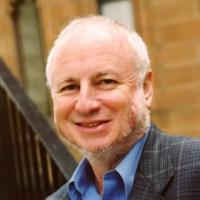

Neeman has produced a body of profound work of central importance in the core mathematical disciplines of algebraic geometry, topology and K-theory. He has pioneered developments in triangulated categories and their applications. His results on the K-theory of triangulated categories were startlingly original, and completely changed the subject. Neeman’s foundational work, extending the Brown representability theorem, has rendered techniques more powerful; applications include his new treatment of Grothendieck duality. Neeman has made notable contributions to algebraic geometry, especially geometric invariant theory. He has contributed importantly to the interplay of analytic and algebraic invariants of manifolds. His work has been very influential.
After receiving a PhD from Princeton University in several complex variables, Mike Eastwood spent eight years in Oxford working with Roger Penrose and others on differential geometry and twistor theory. He moved to Adelaide in 1985 and, beginning in 1991, has held three successive ARC Senior Research Fellowships. In 1992, he was awarded the Medal of the Australian Mathematical Society. He is known for his work in conformal differential geometry, especially the construction of invariant differential operators. He also works on representation theory, integral geometry, algebraic geometry, mathematical physics, CR geometry, affine geometry, and invariant theory.
Professor Bartnik is renowned internationally for the application of geometric analysis to mathematical problems arising in Einstein's theory of general relativity. His work is characterised by his ability to uncover new and anticipated phenomena in space-time geometry, often employing sophisticated tools from linear and nonlinear partial differential equations as well as elaborate numerical computations. He has contributed greatly to our understanding of the properties of the Einstein equations and gravitation.
Peter Forrester is a world expert on random matrix theory and related areas of mathematics, including the occurrence of identities of the Rogers-Ramanujan type in exactly solvable statistical mechanical lattice models. He applied the theory of Selberg integrals, generalized hypergeometric functions and Jack polynomials to the integrable l/r2 quantum many-body problem, obtaining perfect agreement with the new physical interpretation in terms of quasi-particle statistics. This enabled Forrester to successfully apply the theory of Painlevé equations to the very active topic of random matrix theory, with its relevance to the Riemann hypothesis and to the statistical analysis of large data sets.
Professor Hutchinson has made fundamental contributions in an unusually broad array of mathematical areas, ranging from logic, through analysis and geometry to computational methods. He is particularly famous for his pioneering mathematical research on fractals which has had an impact in many applied areas. Other important achievements include his generalised curvatures in geometric measure theory, joint work with Fusco on variational problems arising inelasticity and joint work with Dziuk on numerical techniques for the computation of minimal surfaces. In the collaboration with Dziuk new algorithms with optimal error estimates were discovered for the approximation of minimal surfaces leading to significant new developments in the computation of general variational problems.
Professor Baddeley has done outstanding work in the difficult area of statistical image analysis, and has solved a variety of important practical problems using mathematical methods. In particular, he has developed important new techniques for estimating surface area from sections. His work on anisotropic sampling design has broken the mould of previous theory, and led to further new developments by leading researchers in the field. He has introduced ways of measuring "error'' in image reconstruction or image transmission, and contributed to a wide range of other areas of spatial probability and statistics, from point processes and random sets to object recognition, sampling theory for stereology, censoring and edge effects, integral geometry, and, very recently, development of an exceptionally innovative spatial version of the Kaplan-Meier estimator in the context of spatial survival analysis.
Professor Rogers has made seminal contributions to the theory and application of reciprocal relations, Backlund transformations and Bergman series methods in Continuum Mechanics. He has pioneered their use in the solution of physically important boundary value problems. In Soliton Theory, he demonstrated that reciprocal transformations not only provide fundamental links between integrable hierarchies but also induce auto-Backlund transformations whereby multi-solitons can be constructed. His work on infinitesimal Backlund transformations has led to the discovery of an important new class of soliton equations. This contains the long sought 2+ 1 -dimensional integrable version of the classical sine Gordon equation.
Professor Lehrer is distinguished for his many significant contributions to the complex representation theory of the finite groups of Lie type. A mathematician of unusually broad outlook and wide knowledge, he has become increasingly interested in the links with such subjects as geometry and topology. His achievements include the parametrization of the characters of the finite special linear groups, a comprehensive theory with R B Howlett of the decomposition of characters induced from parabolic subgroups and the recent determination of the action of a complex reflection group on the cohomology of the complement of its reflecting hyperplanes.
Dr McKay is internationally renowned for his research on the difficult problem of graph isomorphism He has developed an algorithm which makes efficient use of properties of the automorphism group of a graph. He is wellknown internationally for his research on various combinatorial algorithms and asymptotic enumeration problems, and is a master at the art of computer generation and enumeration of combinatorial objects. He is noted for his originality and technical virtuosity in applying probabilistic methods, asymptotic analysis, graph theory, enumerative methods, and linear algebra techniques. He is a leader in the application of combinatorial methods to computer science.
Professor Praeger has established an enviable reputation for her highly original research in the theory of permutation groups, both finite and infinite, in algorithmic group theory, in graph theory, and in other combinatorial theories. She is the author or co-author of rather more than 100 papers and several monographs.