





Professor Ann Woolcock (1937-2001), medical scientist

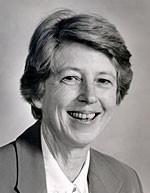
Professor Ann Woolcock was born in Reynella, South Australia in 1937. She graduated in medicine from the University of Adelaide and pursued postgraduate studies in respiratory medicine at the University of Sydney. Her MD thesis, awarded in 1967, was on the mechanical behaviour of the lungs in asthma.
From 1966 to 1968 she worked at McGill University in Canada then returned to the University of Sydney to continue her work on asthma. Her research in asthma and epidemiology showed that asthma was caused by allergens but that there is a genetic component. In 1989, she wrote, with others, the world's first national guidelines for asthma management, the Australian Asthma Management Plan.
In 1984 Professor Woolcock was appointed to a personal chair of Respiratory Medicine. She founded the Institute of Respiratory Medicine, based at the Royal Price Alfred Hospital in Sydney, and opened in 1985. The Institute was renamed the Woolcock Institute of Medical Research in her memory in August 2002.
Interviewed by Professor Jonathan Stone in 2000.
Contents
- Beginnings: from home through university
- The move into research
- Asthma research: the shape of things to come
- Terrific productivity
- Epidemiological contributions
- Most of asthma is driven by allergy
- But not all allergic people get asthma
- 'Breakthroughs' for asthma?
- Real breakthroughs
- Forging a career
- Ceilings and supports
- Sharing good times in an academic family
- Taking a research institute into a cooperative research centre
- The interface between clinical work and research
- The future: asthma
- The future: the whole gamut in respiratory disease
Beginnings: from home through university
Your life has been a great journey. Tell us about the beginnings—your family and Reynella.
Reynella is about 20 kilometres south of the Adelaide GPO. It used to be a country town where wine was grown, but is now part of suburbia. I went to Reynella Primary School and then to Walford House Church of England Girls Grammar School, in Adelaide. My family had lived in various parts of South Australia before settling in Reynella, where they had the general store.
Did your parents encourage you to go to university?
Yes. It was not quite clear what I would do, but it was accepted and they were very supportive. They didn't have very much money, so sending me and my two brothers and sister to private schools was quite a hardship for them. Following that, my sister and I went to Women's College—St Anne's—in Adelaide. My brothers, for various reasons, didn't go to the university but chose to do other things.
And you did medicine.
Yes. I started off in science, as it had been assumed I would, because at school I was much better at science than arts subjects. I was a really bad speller and I didn't write very good essays, and I used to come bottom in English—except in the Leaving Certificate, where I got a distinction, much to the consternation of my English teacher. But I could do science so I enrolled in that. After one year of science I wanted to do physiology and maths, but that combination was not offered in year 2. I investigated transferring to medicine, partly because I was having a really, really good time as an undergraduate (especially away from home) and I thought that six years of medicine would be much better than three years of science. I hadn't matriculated for medicine, however, because I did not have a foreign language—I was very bad at French, not only at English—and during the holidays after my first year at uni I had to swot up and sit for a supplementary in French. So I matriculated in medicine, and went into second year of that.
Did you find Adelaide University a quiet place, or a bit radical?
I was on the SRC and on the Union, and a member of at least six clubs, including the Dramatic Society. The university was much engaged with the town, and we used to have a huge amount of fun compared with students today, I think. We used to have Prank Day and Procession Day, and did things that would tease the Vice-Chancellor, like putting nude statues up flagpoles. Such things were daring and very funny, we thought then. It was a good place, small enough for us all to know each other—120 people (13 girls) in medicine.
The move into research
You graduated at a very high position in your year, and fairly soon came to Sydney. What brought you here?
After doing my first year as an intern at the Royal Adelaide Hospital I decided to leave, even though Mr Lendon said, 'They'll never have you back again, you know, if you leave.' I went to Broken Hill for my second year out: one of my friends was going, I had known the place as a small child because my grandfather had been working there, and the job in the Broken Hill and District Hospital seemed like a good one for me to learn how to do everything. Certainly I learnt how to do everything very quickly, from autopsies to cardioversions to diagnosis, through to deliveries of babies.
I had the best of both worlds there. I had fun with the miners—I could see them as outpatients and then go and see them at weekends—and the medical fraternity was part of the Establishment, so when any important ABC visitor came we were always invited to the concerts and things. I had a really great year in Broken Hill but I could not spend my life there. Yet, about halfway through that time, I decided not to go back to Adelaide. I wanted to do research, largely at the suggestion of Sol Posen, an older person with whom I became very good friends when he tutored me and some others during our final year of medicine in Adelaide. He was very interested in research and convinced me that it was good to ask questions.
So from Broken Hill I wrote to the professors of medicine at Melbourne, Sydney and Brisbane and said, 'Do you have any jobs doing medical research?' The only person who replied was Ruthven Blackburn, from Sydney, who made a list of the jobs going in research: one at Royal North Shore Hospital, one in pathology at the University of Sydney and one at the Page Chest Pavillion, at Royal Prince Alfred Hospital. I came down and had an interview for those three jobs. I could have probably chosen any of them, because in those days there were more jobs than there were people, but I chose the one in the Page Chest Pavillion—which I had seen advertised and thought was for a more senior person, because I didn't have any qualification except two years out. It was to set up a lung function laboratory in the Page Chest Pavillion. Until that time all the lung function tests had been done in the Blackburn Building, the patients having to be wheeled across from the Page and then back again.
Up and down the hill.
Yes. I was given a room in Page, started to buy some equipment and gradually set up a lab there.
Asthma research: the shape of things to come
In 1963, during my first year in Page, John Read (the Professor of Respiratory Medicine, who had employed me) said that John Colebatch and Denis Halmagy, who had been using a lab in the Blackburn Building, were leaving. There was a room and equipment, and I should set up to do some research experiments in asthma because the Asthma Foundation was just being set up. So I started to do some research on asthma at the same time as I was setting up the lab in the Page Chest Pavillion. The next year I transferred to an Asthma Foundation scholarship, and then I did three years for an MD thesis.
John Read would then have been close to the peak of his career. Were you able to interact with his forward thinking?
To some extent, although I was always regarded as 'the little girl from Broken Hill'. He already had several very bright people working with him as scholars, most of whom had first class honours from Sydney, but he was always very good to me. And then I was very good to him, gradually helping him with junior people as I got more senior, and helping him run the lab.
I suspect that doing that MD shaped much of the rest of your work.
Yes, but it was only an accident that I did the mechanical behaviour of the lungs in asthma: I had Asthma's grant, and the equipment available was for studying the mechanics of the lung. John Read was a gas exchange person, not a mechanics person, so bit by bit I had to teach myself how to use that very old equipment—four transducers, four transistors, and very old polygraph recorders.
What finding of your thesis do you remember most kindly?
Well, I used to wheel patients who were still having very severe asthma attacks, complete with their oxygen and everything, over to the Blackburn Building—my hair stands on end now—and measure their lung volumes. I showed that during acute severe asthma the lungs overinflate a lot and then come down again. Although chest X-rays are taken at total lung capacity and you can see the lungs big and getting smaller, it hadn't been realised how much bigger they actually get. Then I measured the elastic recoil of the lungs, showing that although the elastic recoil in chronic asthmatics stayed higher than usual, it could change too. The way in which that happens has still not really been explained. If you bring the lung up and hold it, it is a bit plastic, so you can actually stretch the whole thing and it will stay up there, but then gradually you can bring it back again. We are now going back to do some studies to see how much of that is irreversible.
Another interesting finding came about because my husband had started the Department of Nuclear Medicine—the first; there were no nuclear medicine bits in any other department of medicine. The professor there allowed us to do perfusion, mainly, but also perfusion ventilation scans (some of the first that were ever done). We did those during an acute asthma attack and showed that the perfusion was really very abnormal and got better as the patient got better from these acute attacks.
Terrific productivity
With so much under way, you went to McGill. What was that period like?
That was a terrific period of exactly two years (I arrived on 1 September '66 and left on 1 September '68) during which I published seven pretty important papers, mostly on dog work. I hadn't done any dog work here, and so that taught me how to do different things. I was looking at the large and the small airways, the mechanical behaviour of the lungs, and collateral ventilation and things like that in the lungs.
I understand you developed a test of the resistance in the airways.
That's right. The test, called 'frequency dependence of compliance', is not done much now, because it requires the patient to swallow a balloon through the nose. It's uncomfortable and there are probably other ways of doing it, but at that time it was the standard sort of test and it made everybody think about how to measure the small airways. That is the hardest part of the lung to get to and we still don't know how to do it very well. You can get to the alveoli through the pleura, and you can get to the large airways via a bronchoscope, but in between is difficult.
Such productivity and novelty in your work would probably have allowed you to stay over there, but you came back.
I had plenty of offers to stay in the lab at McGill or to go to other places in North America, because by that stage I knew a fair amount about the mechanics of the lungs and I had been fairly productive. But for a whole lot of reasons I decided to come back to Australia. Put it this way: it was better to be a big fish in a little pond than one of the many fish in a big pond.
Epidemiological contributions
When you returned to Sydney, the damaging effects of cigarette smoking were slowly beginning to be realised. You made major, influential epidemiological contributions in this country. Can you tell us a little bit about them?
This all started because my husband was interested in the epidemiology of liver disease in New Guinea, and I asked if I could come as a pair of hands when he was doing epidemiological studies. He said, 'Yes, but don't worry about the liver. It's not your subject. Why don't you think about why virtually everybody coughs?' In New Guinea, coughing is said to be part of aging. I started to learn some epidemiology and we found there was no asthma in Papua New Guinea but a lot of chronic obstructive pulmonary disease (COPD). It was quite severe and people died of it early. When we started to define this disease, we found some very interesting things: the COPD can arise in non-smokers, it may be more prevalent in women than men, and it is not just in people living in smoky houses. (It was present also in people living on the coast, where it is hot.) We did many studies and published a lot on this disease, and that is still the definitive work because studying asthma became more fashionable. People are only now starting to go back to measure COPD in developing countries.
Then, on one of our trips to New Guinea, we heard somebody giving a sermon at the Baptist mission at Baiyer River (and it sounded a pretty good sermon to me). The speaker was Stephen Leeder, who with his wife was there for a year. We started talking to him, asking what he was going to do, and so when he came back to Sydney he did a PhD with us on a project that we had started to do, to see if smoking in primary and secondary schoolchildren did in fact affect lung function.
That was a huge study funded by the Tobacco Foundation—it was all right to have Tobacco Foundation money in those days—from 1973 through '75. As research assistant to collect all the data we appointed Jenny Peat, an honours BSc from the United Kingdom who had just come out here with her husband, Derek Peat. (He ran the continuing education for a long time.) We set up with the Department of Electrical Engineering in 1972 to try to get this computerised, and you should have seen the funny computers we had. Having done that study for his PhD thesis, Stephen also published the results: there were effects on the lung function of children, very early, from smoking.
Most of asthma is driven by allergy
Perhaps your longest-term interest has been asthma. It is a challenging enigma of a disease, with all sorts of genetic and environmental factors. Clearly, one that has been important in your work is allergens, particularly those related to insects. How did that story unfold?
Working with my husband in New Guinea had taught me a lot about epidemiology, a useful tool to find out what things were changing and what the risk factors were. Then we started thinking about the epidemiology of asthma, setting up some epidemiological studies really properly to get a test of airway hyperresponsiveness which we could do in schools. We used a questionnaire and we had the skin prick tests to look at allergens, and airway hyperresponsiveness tests. We set up a protocol but we had lots of stops and starts in getting the methods right. By 1982 we had funding and things were ready. With Jenny Peat, we did studies in Wagga Wagga and a suburb of Newcastle, Belmont.
At about the same time, Wes Green was over in the Department of Medicine measuring house dust mites. Then Euan Tovey came to work with us too—he had done a doctorate with Brian Baldo at North Shore before working overseas with Tom Platts-Mills, the leading house dust mite person in the world, and had returned to North Shore. He was the person who discovered that the major allergen in house dust mite is in their faeces, and he has been interested in that ever since.
Do antibodies to that turn up in asthma patients?
Yes. So when we were doing these epidemiological studies, not only did we measure what was in the children but we went to their houses and vacuumed their beds, or got them to bring dust from their vacuum cleaners, so we could know how much house dust mite they were exposed to. Throughout the 1980s a big controversy raged about whether asthma caused allergy or allergy caused asthma, or whether they were two phenomena in the community that happened to be related. It was clear to me by 1990 that allergy is the hugest risk factor. If you do a logistic analysis on all this epidemiological data from children, there is no escaping that the major risk factor and therefore cause of asthma is being allergic. It is allergens.
I gave a talk at the 1990 meetings of the American Thoracic Society in which I dared to say that I thought asthma was caused by allergens. This was at a pulmonary meeting, not an allergy meeting, and pulmonologists are pretty conservative people. The audience gasped, that I would dare to say something so dramatic. But now, 10 years later, everyone accepts that most of asthma is driven by allergy, even though we don't understand the relationship.
But not all allergic people get asthma
What is the current buzz in allergens?
The problem is that up to 50 per cent of the population and 40 per cent of children are allergic, but only 10 per cent have asthma as we know it. Not all allergic people have asthma, and that is still not explained. There seem to have to be two abnormalities: being allergic and having some other abnormality that turns the airways on to being hyperresponsive.
It seems that to become allergic you have to have a gene (which runs in families) to make a specific IgE when you inhale an allergen. But that gene seems to be present in about half of the population—and it does not seem to be related to race. All races can become allergic, although there is some suggestion that Chinese might be more allergic. The ability to actually get asthma is much smaller, and it is infinitesimal to zero in some populations. For example, children of Australian Aborigines living in the desert in Central Australia virtually have no asthma. In Papua New Guinea village life, they have no asthma. In an Eastern Suburbs home in Sydney, however, you find that up to 30 per cent of the children have wheezed at some time, and probably 11 or 12 per cent of them actually have asthma.
The reason for the huge difference seems to be environmental. The Aborigines are less allergic as children but the parents have the same degree of allergy, of skin test positivity, as Caucasians. So it is as if they acquire the atopy later. And acquiring it later in life does not seem to have as big an effect as getting it as a child. So we know that if you could delay the onset of atopy it would be important.
Whether atopy is actually increasing in the world is not known, because no-one besides us has done serial measurements on the same population cohorts. In Australia it does not seem to be increasing much; it seems that what is happening is that more of the allergic people are getting asthma now. But some of the factors—not just genetic but environmental—associated with being atopic are becoming clearer. There's some interesting data. For example, in large families, the fourth and fifth siblings are very rarely atopic or allergic. If you send your child to child-care, they are less likely to get allergies than if they stay at home.
Some data from New Zealand shows that the more antibiotics given, the more likely children are to be atopic. And the fewer the antibiotics, the less likely they are to be atopic. That suggests that if you get infections, particularly bacterial infections, early in life, you are a bit protected from becoming atopic. More recently, the Italians found that recruits going into the army who were positive—had antibodies—to Hep A and to E. coli and other bacterial gut pathogens were less likely to be atopic. So something to do with eating a little bit of dirt or being exposed to bacterial infections seems to protect you from being atopic.
We still don't know what makes only some people who are allergic get asthma, but those things seem to be related to exposure and to diet. It's a bit complicated. If it was easy, someone would have solved it.
'Breakthroughs' for asthma?
Asthma being such a widespread, enigmatic disease, any number of hopeful 'cures' must have to be dealt with.
Every week the media report another 'breakthrough for asthma'. We just plough on. I still get an enormous number of people ringing up because Mrs Somebody said such-and-such, or somebody in the press heard this and is it true, or there has been a breakthrough because somebody has got some new cure. You have to take it all and say, 'Well, we'll wait and see when everybody else has repeated the work.'
Will the Russian breathing control method succeed, or is it going to die?
I think it is going to die scientifically, but not commercially. A lot of asthmatics are sick of doctors and sick of their steroids—they want something to do, don't mind paying the money, are part of a group feel-good—and so the breathing control people are offering a sort of service. It is possible that the way you breathe has an important influence in how severe asthma is. But they have the idea that CO2 is a bronchodilator, and if you hold your breath the CO2 goes up, dilates your airways and 'cures' your asthma. That doesn't make any sense. Although CO2 is a bit of a bronchodilator in animals, if you give people with asthma CO2 to breathe, put their CO2 up a bit, they do not bronchodilate very much.
There are many new theories about how the smooth muscle is controlled by ordinary tidal breathing, so the Harvard School of Public Health is working on the ordinary tidal breathing of rabbits, changing the rate and the frequency and their depth of tidal volume during stimulation to make their airways constrict, like an asthma attack. Actually, just our tidal breathing as we sit here now is enough to stretch the smooth muscle and the airways. If we stop doing that, the smooth muscle undergoes less and less hysteresis and gets stiffer and stiffer unless it is kept going by some means. It can go into a state of latch bridge—the actins inside the myosin—where the thing is contricted to its minimum size and all the bridges are acting so slowly it is stuck. To open it and pull it back to its original length takes a lot of force, a lot of stretching and probably a lot of beta agonists. So there is a doubt about the rate and depth of breathing in someone who has already got asthma—this is not going to bring on the disease, but someone with the disease—keeping all the muscle in a nice fluid state.
Real breakthroughs
For the individual asthma patient—forgetting about the community—death and morbidity rates have fallen. What have been the great breakthroughs?
During my career, the death rates went up in the early 1960s, down in the '70s, up in the '80s and down again in the '90s. This seems to be related to treatment and treatment ideas. Treatment now is excellent: the drugs available are really good, so virtually every asthmatic can be controlled if they get the right doctor who knows how to do it. The problem is that it takes time and effort.
Is the right treatment multifactorial—reducing the allergen exposure and so on?
Yes, but that's one of the things we really still don't know. If you take children and put them in the alps, or if you put people in hospital away from their allergens, they get better, irrespective of everything else. We know that allergen avoidance works.
In the real world, people are exposed to a lot of allergen all the time, and reducing it in a house and keeping it out (particularly in Sydney) is very difficult. It's in your clothes and everywhere. We do make an attempt to ventilate houses, to have covers and so on, to reduce it as much as possible, but the most important thing is the right treatment—which has to be begun early until control of the asthma is achieved, and then kept going. That means people taking inhaled corticosteroids if they have persistent asthma.
Most people are happy to do that these days, but when their symptoms go away they stop their treatment. Just stopping the symptoms doesn't get the whole thing under control. So it's a big effort to educate people about what we are aiming for. Asthma is such a variable disease that it's hard: it doesn't really matter what some people take, they're still going to live to 90 without much impairment, whereas other people are really going to have their life shortened or a lot of morbidity unless they undertake the treatment. They have to be found and time spent with them, just as in diabetes.
Forging a career
Let's look at how you forged your career. After university in Adelaide, clinical experience in Adelaide and Broken Hill, research in Sydney leading to your MD, and two years in Canada, you found yourself in Sydney again, working hard—and visiting Papua New Guinea for epidemiological research. How did you manage?
At the end of 1968 I was just married and I didn't really have a job. I did have the third year of a travelling scholarship from the Asthma Foundation, so I had money for a year. I came back to John Read's laboratory and set up some things I wanted to continue from overseas, particularly with excised lungs. After that I didn't really have any money. I got the Basser Fellowship from the College of Physicians for a while, but it didn't seem to worry me that I still didn't have a job. I did research but to earn money I went out and did clinical work at Concord Repatriation General Hospital, North Shore and the Prince Alfred. So I travelled a lot around Sydney, learning a great deal. But during those years, '69 through '73, I had two children and I had to pass my Fellowship exams, which I hadn't done before I went away. And I gave talks at meetings and things.
Not having a fixed job, I didn't have much teaching. Mainly I was looking after my two children but I became the Clinical Supervisor at Concord, looking after the students in the clinical school, which was fun and did involve a fair bit of teaching. I had quite a number of PhD students. And so my head was down, basically—I wasn't too worried about anything else except doing research.
They must have been extraordinary years.
Yes. But I should say that by 1969 I was 31, I had an MB BS MD FRACP (it was actually MRACP in those days), I had 30 publications, and I was married, with a child. No-one can do that at 31 any more. I had been able to go to university at 16, graduate, and then spend the year I was 22 as an intern. I could do three years here for my MD, then spend six months seeing the world and two years away, come back and sit for my membership, and nobody cared that I hadn't done all the set tasks that people have to do now.
They make you queue longer these days.
In 1971, John Read killed himself. That was very tragic, because his was a great mind. He was way, way ahead of his time in the experiments he did. He did ventilation perfusion and the distribution of ventilation with xenon, with Kemp Fowler, a long time before anyone else, and he made a rat model of five per cent hypersensitivity to pneumonitis before anyone else had even thought about it.
It was hard to replace such a bright man. Australia couldn't really afford the salaries, et cetera, to replace him with a professor who was overseas, such as John West. Eventually, in 1973, the job was advertised as a senior lecturer, and I applied and got it. That was my first full-time job. I just stayed there and then I became associate professor and later a professor. And that was that.
Ceilings and supports
Was there a 'glass ceiling' in those years?
No, I don't think there was. I just came up through the ranks and I don't think I was ever discriminated against because I was a woman. Perhaps I was unlucky, in that although John Turtle and I were the short list of two for my husband's job when he retired and it was a complete toss-up between us on our CVs, John Turtle got it and I didn't. You could sympathise with the university for not giving the job to the retiring person's spouse. That's a marriage ceiling, not a glass ceiling. I didn't appeal against it, because John Turtle is a great guy and he has done a lot, and he's been good at that Chair. And they gave me a Personal Chair in respiratory medicine at a time when they had only one other, in physics.
The man you married had a great career of his own—he was the great builder of his department. What was his intellectual influence on you?
Very early on, when we were first married, he said that if you wanted to be an academic you could be and you should be. He pushed me, saying that I should never say no until I had reached enough maturity and established myself that I could say no. So I said yes to everything. He helped me a lot. If I wasn't home for dinner or the children needed help, he was very supportive. There was never a problem. And he has been very helpful in giving me advice about how to proceed next—because I tell you, it's getting harder, not easier. He is unbelievably supportive of me.
Sharing good times in an academic family
In addition to your own children, your postgraduate students (I have a list of well over 20) could be called your academic children. They include our current Dean, Stephen Leeder, and Iven Young and Norbert Berend.
Iven has been the head of the unit at Prince Alfred since I stopped in 1993—after nearly 20 years, from 1974, a long time. Norbert Berend is the general manager of North Shore Hospital at the moment. He went there from the respiratory unit.
So yours has been a major influence. This must have been an extraordinary group and you must have a lot of bright memories of them.
We had a lot of good times: they shared a lot of data and worked very well together, and that's good. But in the days when those graduate students were coming through, there was more time. We could actually have morning and afternoon tea, and discuss politics—we could even go camping on weekends. Students these days don't get to do such things nearly as much.
You still have some postgraduate students, though.
Oh yes—a few too many. They're all very good. Some are women whom I persuaded to do their PhDs (part-time) because they needed to have had them years ago.
The thesis of one of your students was on ethnic variations in lung function. How did that come about?
That came about because we were very interested in why the lung function and the vital capacity, which we usually measure against age and height, was different in New Guinea. It was even different in the highlanders from the lowlanders. I got interested in the shape of the chest wall as a determinant of lung function. There are very big ethnic differences, but we have now come to the conclusion that lean body mass gives a very good correlation with vital capacity, and it seems to be totally related to growth hormone. The amount of growth hormone that is produced will result in a lean body mass and a size of lung which is exactly appropriate for your activity. So if you have a big lean body mass you're going to have big lungs. You can get a big lean body mass by living in the mountains, where you have to climb up and down, or becoming a swimmer or a rower, particularly in an Olympic team.
Such people look like highlanders, as it were?
That's exactly right, whereas some ethnic groups—particularly Indians, for some reason—who aren't necessarily very athletic have different shaped chests, and smaller lungs for their height. They fall off this curve of lean body mass versus vital capacity.
Have the groups who have lived such long periods at high levels evolved with a genetic difference, or is it really a response to where they live?
I don't know. The only way you could find that would be to study children of the highlanders who had only ever lived on the coast. There's a great deal of variation and you're looking for tiny differences. Vital capacity is reproducible to two or three per cent, so you have to do a large number of people.
Taking a research institute into a cooperative research centre
A major part of your career has been at the Institute for Respiratory Medicine. You have been its director since the mid-1980s. How was it founded?
Well, in about 1980 my husband said to me, 'Money is going to get difficult in the university and in the hospital. If you want continuity of funding for your different groups doing all these things, you need an independent source.' And so we set up the institute. He was very helpful: he went to Sir James Vernon and Mr Keith Steel, who at that stage were the heads of AMP and of CSR, and although they did not actually help raise much money they helped me establish a constitution, get incorporated, get a correct board and get all the nuts and bolts in place so we were totally independent. And we got MOUs with the university and the hospital so that we are in the hospital, from which we get our accommodation and certain things, and from the university we get salaries, like mine. We try to marry the two, to get the best of both worlds while being independent of either. So I can appoint a secretary and not worry about what the university's salaries are, but I put all my National Health and Medical Research Council grants through the university, so the university gets the kudos. We are like a department in the university, trying to pioneer a new kind of institute—practical and very clinical—separate from others like the Howard Florey or the Centenary.
Do you see a lot of patients?
Yes. We have clinics over in the medical centre, and many of the patients we see there we use for experiments or for clinical trials. We're very much into nurturing young clinicians who show an interest in research. That is very hard in this environment, and getting harder.
Is the Institute for Respiratory Medicine returning to epidemiology?
No, we've been doing it all the time. We have now about eight groups within the institute, from epidemiology through. We have an asthma group that does clinical trials and an asthma group that studies physiology mechanisms, an allergen group and an epi group (which studies mainly asthma but also, as a tool, does epidemiology of sleep disorders, COPD and TB). Then we have a cells group, which is quite small, and the molecular biology group which works a bit with Judy Black and with Immunology. We don't set that up separately: I'm very much for building networks and having people work together rather than reinvent the wheel. Then we have a sleep group, a paediatric group and a cystic fibrosis group, mainly over in the hospital. And—I've just been doing the finances—we have an 'other' group of all sorts of people who want to bring money in and find it's more sensible to work in the institute, where we've got a bit of space, than in a hospital or in the university. But it's a bit complex.
Sometimes the most creative things are not perfectly plain.
That's what's good about it. If we can get all the groups together, we have a meeting every Friday morning and everyone can say, 'This is what I am going to do. What do you think?' People from other things can come in and say, 'Look, from an epi point of view you should do this,' or 'This is the questionnaire you should use,' or 'Why don't you get some blood and send it to So-and-So.'
I understand that late last year the institute became part of a new cooperative research centre. Where is that going to take you?
A long way, I hope. It is a CRC for Asthma, one of four new CRCs given last year. It is between the University of Western Australia, Phil Thompson; Monash University, Robin O'Hehir; Sydney University, mainly at the Children's Hospital; ourselves; and the Garvan Institute. With 13 projects, over seven years, our aim is to reduce the burden of asthma—working mainly from what we know about asthma right now but a bit more on developing new techniques, new methods of diagnosis, new methods of drug delivery. We want to get better diagnostic tools for the GP. It is going to take us into the community more, and towards networking with other people. It has just started, and there is a huge amount of work to do to set it up.
The interface between clinical work and research
You mentioned nurturing young clinicians who are interested also in research. Having lived with the hospital, the university and the institute for some decades now, how do you assess the future of that relationship? Does it need working through?
Oh, it needs a lot of attention. The NH&MRC has just got some clinical fellowships to allow people, if they want to, to have a career like mine—doing clinical work and relating to patients, and doing clinical research plus basic research. Basically, 90 per cent of people differentiate themselves very quickly into pure clinicians who get their satisfaction (what I call their 'lollies') out of seeing Mrs Smith one to one, asking Mrs Smith her problems and getting her better. There's another group who get their lollies out of research: they really want to say, 'Well, how did this virus get in? Let's see if we can measure the virus,' and are quite interested in lots of viruses.
Very few medical graduates, perhaps only 10 per cent, are really quite good at and want to do the clinical bit—it's a pleasure to help Mrs Smith—while also asking some questions. It's very demanding, because clinical work and research each take a lot of time, and to do both well is quite hard. There is no mechanism for it. Even if you can get that balance, the university wants you to teach and administer on top of doing your clinic and research, and it's not possible any more. And if you get into the hospital, although some of them aren't too bad, mostly they're expecting you to do clinical work. A staff specialist job is very busy and you're just eaten up by the time—you need great strength to go home and then write up papers, or do experiments. We need a system that nurtures the interface between clinic and research.
The NH&MRC and the Wills committee addressed this to some extent, but we need it to be brought to everybody's attention more and more. Basic scientists and clinicians have their problems—not enough money and all that—but they can go off and do their basic things. But unless you have the interface, you don't have good teaching, you don't have good progress, you don't have good things coming back to the patients about what they should do. This is very evident in the United States, where there is a huge gap in respiratory medicine between the clinicians and the basic researchers. Australia has done well in preserving people like myself and the people I am trying to train. People like John Read, and before him Landy, really cared about this interface and nurtured the young ones who could do it, and that's what I want to keep doing.
How do you advise your postgraduate students now? Do you say, 'Come and enjoy these three years, but then life is going to be hard'?
They're all very different. Mostly I say, 'Come and try it. See how you like it.' And sometimes you get a surprise—you think someone is not going to like it but it fits them like a glove; you think other people are just turned out for it, but they don't like it. I've had people who have lasted only a week in the lab: they say they can't stand it and you find them back in the wards all the time, because wards is where they want. You have to acknowledge that and change the direction of what they do. And some people just get the training for a piece of paper so they can get a better job. You have to take the good with the bad. If I get one in four who is a real-life clinical academic, then I'm doing really well. That's what I am trying for.
The future: asthma
When you look forward to what you are going to do with the institute and the centre, what are your hopes for new steps that will decrease morbidity and mortality?
We have to make very simple protocols that people can understand. We are going towards giving people electronic diary cards, which people seem to love and which work very well: they record data about their symptoms in the last 24 hours and how much bronchodilator they have taken, and then they blow into this machine which records a month's worth of data and downloads it. They can see for themselves what has happened to them over the last month, and adjust their therapy. If you give people a peak flow meter and ask them to record the reading on a piece of paper, some obsessional people do it but some people don't do it at all, and others do it in a higgledy-piggledy way. If you can get rid of the paper and pencil and just have one piece of apparatus which they only have to press Yes/No on as an answer and blow into, it seems to work extremely well.
The drugs are getting much, much simpler. It used to be that you could take your choice of 10 drugs but doctors didn't know quite which one to give: 'Try this,' and 'Try that.' I think that guidelines will be there for the 'gold standard' of treatment and what you should expect if you use two kinds of drugs—you probably only need two kinds. It will become simplified: if you can't get control with other drugs, you'd better go back and use these two classes of drugs.
Is the strong genetic component going to offer a way through?
I wish it would. People know that allergies run in families, and which families have what. You can soon find that out with skin testing. There is clearly a genetic component to the other abnormality, the hyperresponsiveness or whatever it is that makes the airways narrow too much. On the island of Tristan da Cunha, everybody is related to one of the four men who established families there. Two of those men had bad asthma. A huge number of people on the island have airway hyperresponsiveness, but only some of those have the symptoms of asthma. It's clearly something that is inherited, but what that is we don't really know. It could be many, many things, such as the structure of the muscle or something to do with it—one of the enzymes such as MLCK isoforms or even isoforms of the muscle itself. Nobody knows what it is, but it does appear that apart from being genetic it is inducible by environmental factors as well. So our next NH&MRC grant is to look at this in a population to see if some people have this inherent abnormality before they have symptoms and before they have airway hyperresponsiveness. We are still gathering an understanding.
The future: the whole gamut in respiratory disease
What are your hopes for the institute's future?
That's a big problem. We incorporated in 1982 and actually opened in '85; in 2000 we've got a lot of people working for it. I would like to see it expand, to network with the other departments of respiratory medicine in the University of Sydney. We are already talking to Norbert Berend, and to Jonathan Wheatley at Westmead, about being much more involved. It's hard to do it physically, but you can do a lot by email, you can have meetings every little while, you can share research fellows, research assistants, patients, and we are doing that.
I would like to see us as the pioneer institute, not only bridging the gap between the university and the hospital, and being independent and giving people freedom, but also running the whole gamut in respiratory disease from basic science—cellular science, basic physiology—through clinical science, epidemiology through public health, and on into commercialisation.
Whether this survives is going to be up to the next generation, and up to having enough funding for that next level of people who are wanting to be not senior lecturers in the university or full-time staff specialists full time but on the interface. What is next is finding money for them so there are enough of them, a critical mass.

Professor Howard Worner (1913-2006), metallurgist
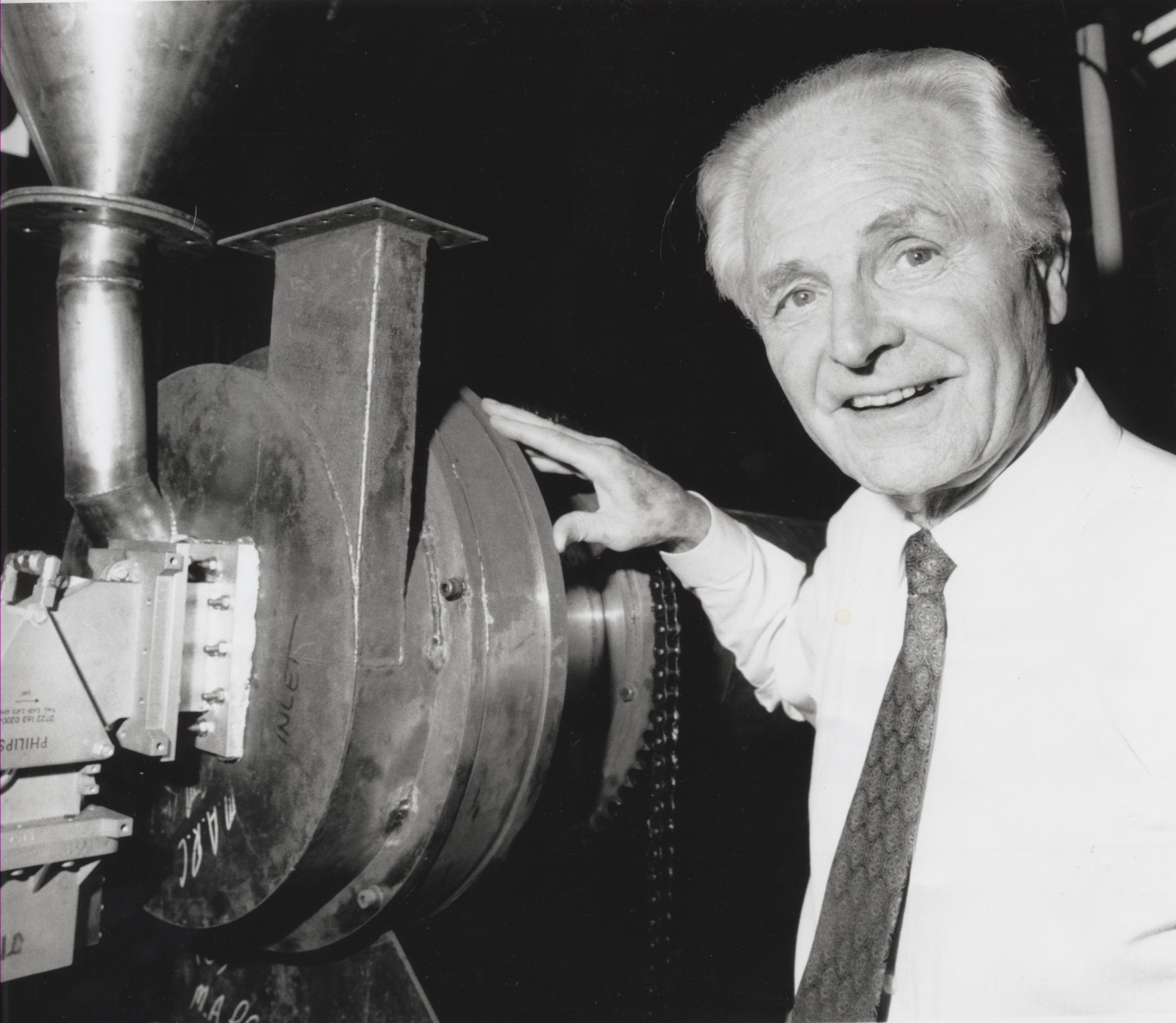
Professor Howard Worner had an extensive career and was a seminal individual in the field of metallurgy. He was born into a farming family in rural Victoria and he attended the Bendigo School of Mines in the early 1930s. He studied at university until 1942 when, at the age of 28, he became the youngest ever recipient of a Doctor of Science (DSc) from The University of Melbourne.
He began his career at the National Health and Medical Research Council. After 'cutting his teeth' on researching amalgam for fillings, he became a Professor of Metallurgy and later the Dean of Engineering at The University of Melbourne. He worked for the next 27 years in directorial research roles for BHP, Rio Tinto and Victoria Brown Coal Council. With retirement in mind he moved to Wollongong, where he became the founding Director of the Microwave Applications Research Centre at The University of Wollongong. It was at this time he also published a very successful book, The Minerals of Broken Hill, the result of a lifetime hobby of collecting. The Howard Worner Mineral Collection is held in the Geosciences Department of Wollongong University.
Interviewed by David Salt in 2005.
Contents
- Family background and early life
- Bendigo: to technical school and the School of Mines
- Science studies at the University of Melbourne
- Researching the creep of lead
- Dental materials research
- International consultant for a year
- New smelting processes at CRA, and new uses for brown coal
- 'They won't let me retire': research in Wollongong
- The Broken Hill origins of a major minerals collection
- Reflections on a creative and rewarding life
Family background and early life
Howard, your career has been strongly linked to the minerals industry, but I believe your connection to minerals goes way back to the gold rush days.
Yes. In 1852 my great-grandfather Worner went with an uncle up to Bendigo to look for gold – in those days there was no underground goldmining, only surface mining. They didn't succeed with their gold searching, and eventually they moved west to Swan Hill. I think my great-grandfather rode a horse part of the way, but mostly he walked, because the uncle had him leading one of their two horses.
You were born in 1913 at Swan Hill, in the Mallee district of Victoria. Your father was a farmer, wasn't he?
He was. All the way back that I can trace, on the male side there were farmers in Somerset and on my great-grandmother's side there were farmers' wives in southern Scotland.
What are your memories of living out there in the Mallee?
I very much enjoyed life on the farm, especially with my second brother, Neil, who followed 13 months behind me. I was particularly interested in new aspects of farming, new ways of growing finer and finer wheat, and methods of making better, stronger wool. I had no idea of becoming anything but a farmer.
Were you and your brothers, Neil and Hill, good friends as youngsters?
We were great friends, right through life.
Is it true that on the way home from Yarram West Primary School you and your brothers would catch snakes and have them fight each other?
Yes, that's right. It was stupid, and not a very nice thing to do to the snakes, but we managed to get a lot of fun out of making them fight – and kill – each other. They poisoned each other.
But we also climbed tall trees and collected birds' eggs. We were the champion tree climbers for a long way round.
And I believe a car was a very strange thing to see there in those days.
Oh, yes. My father owned the first car in the district, and when it came in the front gate (a little over a kilometre from our house) it seemed very strange that this 'choog, choog, choog' vehicle was coming without any horses drawing it. Both my second brother and I hid from this vehicle!
Bendigo: to technical school and the School of Mines
After Swan Hill, you moved back to Bendigo, where your great-grandfather had prospected for gold. What lay behind that move?
There was no water on the property – the area was in drought. This was in the late 1920s, and when the Depression of '29, '30, '31 came along, hard on the heels of the drought, it confirmed that the right thing to do was to go to Bendigo.
We went to a technical school there, which was appropriate because we learned welding, along with fitting and turning, carpentry and things like that, subjects to fit us to become better farmers.
Would you say that your interest in science, from a very early age, was mostly of an applied nature?
Yes, it was of an applied nature. But also, the gentleman who taught us science in the technical school – J Ayrton Bradbury, who was a marvellous teacher – captivated our minds with his stories about things that were happening in science. He was a major influence in the interest that my brothers and I took in things other than farming.
In fact, eventually Hill and I followed very similar careers. He even succeeded me, later in life, at the University of Melbourne. And Neil became a famous civil engineer, not only the chief engineer of the Snowy Mountains Authority but involved also with many other very large dams and hydro-electric schemes.
You all made a mark on the world. But before that the three of you went on from technical college to the Bendigo School of Mines. How did you actually get in?
We got scholarships. Bear in mind that it was in the depths of the Depression and you needed scholarships to be able to afford to go. Even £4 or £5 a year was a lot of money for a farmer that didn't earn very much off the land.
I still remember the wonderful teachers that we had. After Ayrton Bradbury in the primary school, we had Walker as the lecturer in chemistry in the School of Mines, and White was the lecturer in geology. Those men, and the principal of the School of Mines itself, J R B Anderson (whom we always used to call Jarba, from his initials JRBA), were very influential.
So it was at the Bendigo School of Mines that you really began your formal education in science, starting to study chemistry, metallurgy and geology.
That's right. I managed to do chemistry, metallurgy and geology, although I wasn't supposed to do all three. When I enrolled to take them as final year subjects I was told, 'You can't do that. The examination timetable is not designed to allow you to do that.' However, I did study them all. Our name went ahead of us to the University of Melbourne, so when we went down there and inquired about what courses we would do, and our timetable, we would not be strangers. When I went down, they said, 'Oh, you're the young fellow from Bendigo who amazed us all by the range of your knowledge.' So I had been preparing for university life without being aware of it.
And you excelled at the Bendigo School of Mines, gaining a Gold Medal in 1932.
Yes. I was apparently the student with the highest mark for many, many years in the technical education system.
Both Neil and I topped the state in our respective science subjects, Neil particularly in the engineering side. I don't think there was anything really between us in our results, although I was nominally a mark or two ahead of Neil. We enjoyed being at the School of Mines, and it was no burden for us to major in more than one subject.
Science studies at the University of Melbourne
From the Bendigo School of Mines you progressed to the University of Melbourne, where you gained a Bachelor of Science with First Class Honours in 1934. Can you tell us a little bit about this first degree?
I had the good fortune to have wonderful teachers. I had a very good professor, an Englishman who had graduated from Manchester and who was an excellent lecturer. Another fellow there was Percival Faraday Thompson (his parents must've thought there was something ahead of him!) who was completely different in personality. Together they cultivated the interest that I was developing in science and particularly in metallurgy, but the teachers in chemistry were also fascinated with the rate at which I could learn. I have heard it said, since I became a teacher myself, that it takes a good teacher and a good student to really make everything work. Perhaps that's so.
In my first year at the university, I got complete exemption for the first year because of the subjects I had done at Bendigo, and they permitted me to go straight into part 2, halfway through the year. I didn't have to do any subjects, including halfway through the second-year subjects. And it was wonderful. They treated me like a junior member of staff.
You went on to do research for your Masters. Is that when you began studying the properties of pure lead?
Yes, in my first MSc year. But let me divert to tell you how I came to be studying for the degree. Being a First Class Honours man, I was recommended to the top job for metallurgists out at Maribyrnong, at the Defence Standards Laboratory. And in the two first assignments that were given to me, I solved the problem in a matter of a few days. This caused the leader, Alan Robertson, to call me in and say, 'Worner, you're going to be an embarrassment to us, because we had a timetable for these projects that you were given and you've solved them in a matter of days. With your permission, I'm going to ring your professor and tell him I think this young fellow had better go back to the university and give up his job here.'
That was all very well but the job was paying about £400 a year, and when I went back, the maximum that my professor, Neil Greenwood, could rake together in scholarships for me was £150. He had to put two or three together to form this scholarship in metallurgy.
So one thing led to another. I made discoveries about the creep of lead (its continuous deformation under a steady load) which were absolutely fascinating both to me and to my professor. In this way I was encouraged to come to see research as a future career.
Researching the creep of lead
What sort of research into pure lead were you doing?
I was looking in particular at its properties under very low stresses but for long periods of time. I found that traces of some elements, such as bismuth and tellurium, altered the rate at which pure lead would creep. Some would actually accelerate it, some would slow it down, and others would first slow it and then cause it to start creeping at an increasing rate. These were all new discoveries.
This applied to steel at red heat, but lead creep would change at room temperature. Fortunately, the school where I graduated had a big underground room where the temperature didn't change very much, and that made a marvellous laboratory for me.
Even in my first year of research I began to produce research papers which caused a lot of interest. I went on to increase the range of elements beyond those that were commonly added in commercial lead, and I found that although tellurium, for example, made the lead seemingly creep very, very slowly, often after about a month or two months – depending on the weight I had added – the lead began to change its amount of creep. And I discovered that the creep was occurring by a phenomenon at the grain boundaries: if you had very fine-grain material you had a lot of creep at the grain boundaries.
This was all novel, quite new in this realm where we were dealing with parts per million. It was fascinating and made me feel I had picked the right area to research.
But one of its applications made you uneasy, didn't it?
That's true. It had been realised that the steady creep of lead when certain elements like tellurium were added to it could be applied to timing devices that would trigger off explosions after half an hour or five hours or whatever. I was a pacifist in those days, and I wasn't very enamoured to discover that one of my inventions was being used as a timing device in explosives.
It's the way of technology, I suppose, that often we don't know how it will actually be applied, down the line.
Yes. Anyway, the Japanese attack on Pearl Harbor caused me to drop my pacifism and become fully supportive of the war.
You were telling me during lunch that you used to do some dreadful things during your research.
Well, in particular, I used to chew lead, 99.99 pure metal. It had an astringent taste which I found very pleasant, and I would chew it like chewing gum. Even then lead was not thought to be a good thing to ingest, but I didn't think it was that bad. And nobody stopped me from doing it, although they should've said, 'Hey, hey, you shouldn't chew that stuff.' I later came to realise what a poison it was.
In 1936 you were awarded a Master of Science, again with First Class Honours, and in 1942 you received a Doctor of Science for your published work. You were only 28 years old at the time, and the youngest person ever to receive a DSc from the University of Melbourne.
That's right, and I think I still am.
To achieve so highly, you must have had an enormous passion for your science.
Yes. My earlier passion for agriculture was transformed into a passion for science subjects, and I remain to this day fascinated with applied chemistry, metallurgy and geology. Those three branches of science continue to entrance me.
Dental materials research
During the Second World War you were a research fellow working in the Dental Materials Research Laboratories in Melbourne, where you became a world expert in dental materials. What took you into such a field of research?
My research into adding trace elements to lead caused me to be given a problem in orthodontia, the branch of dentistry that deals with realigning teeth and things like that, where the arch wires used to straighten the teeth are affected by trace elements.
Consequently, the Professor of Dental Surgery said to the Professor of Metallurgy, 'Can you allow that young fellow to work with us? He's finding a lot of interesting things.' So I got a fellowship from the National Health and Medical Research Council, the first such fellowship ever awarded to a non-medical person.
Of course, by the time I came to work on dental materials I realised how dreadful it had been to chew lead! At the very least it would have ruined amalgam fillings in the mouth, which I was researching.
Anyway, I discovered that all sorts of fascinating things were to be found out about dental materials, and it allowed me to work as a scientist in new territory. This field was so novel and new that when I went to the British Dental Association's 1946 annual meeting, in Edinburgh, my reputation was such that they gave me a standing ovation. This Aussie boy was teaching them things in 'olde England'.
You were 33 when you made that first trip overseas in '46, on a Commonwealth Fellowship to England, so it had taken quite a while for you to start travelling.
Yes, but subsequently I've been overseas 70-odd times on trips for science.
I gather that you were quite shocked by the devastation that you could see the war had caused in England.
Oh, it was absolute devastation. All around St Paul's Cathedral was devastated. But I was amazed how the Germans, despite the Nazi atrocity, protected St Paul's. They demolished the fences around the cathedral but they didn't drop any bombs right on it, they didn't damage it. I think that, similarly, the Allies avoided demolishing Cologne Cathedral and a few other such things.
Did you meet the Queen when you were in England?
Well, I went to a garden party. I can't honestly say that I met the Queen. [Laughs] But I stood very near the present Queen – who was then only a little girl.
From university science and engineering posts to BHP in Newcastle
Following the war, you were offered the position of Professor of Metallurgy at the University of Melbourne. You served at the university for nine years, didn't you?
Yes. It was very thrilling to be appointed a professor in your old school. I succeeded Greenwood, who had elected to give up teaching and go into research. And I enjoyed teaching very much. It came naturally to me. I taught not only the science students but the engineering students about metals and alloys and so on.
During that time you were also asked to be the Dean of Engineering.
I was. I battled against it, on the grounds that I didn't think it appropriate that they appointed a Doctor of Science as Dean of Engineering. But the university said they wanted to make use of other qualities that they considered I had, and so I became Dean of Engineering.
This led to an unexpected move. I was chairing meetings with Mr McLennan – later Sir Ian McLennan – who became the chairman of BHP. And after a meeting of the Faculty he put a proposition to me that I should work for BHP, in Newcastle.
That must have been a fairly radical proposition for you.
Oh yes. Most people were moving the other way: a lot of people were being appointed professors after successful periods in applied technology. But I went the opposite direction, because I believed in applying science to technological problems.
So being appointed Dean of Engineering was perhaps a good indication of where you were seen to be taking your science?
That's right, although my academic colleagues didn't see it that way. They thought that moving out to industry was a slipping down rather than a step upwards.
You took the proposition very seriously, and in 1955 you and your family shifted to Newcastle. You would have found it quite different from Melbourne, I imagine.
Yes. There was no university there in those days. But I immediately joined the body that had set itself up to promote a University of Newcastle, and I got on its board. I was later on the first Council of the University of Newcastle.
Would you say your move to Newcastle started to put that city on the map of Australian science?
Well, it made the Novocastrians realise that their Steel City could produce good science as well as Sydney and Melbourne. And I enjoyed being the stimulator of that feeling. They didn't appoint me a professor, however, even though they would have liked to have me join the university in that role. But I enjoyed being on the Council of the university.
I've been very proud of the achievements of the University of Newcastle – and of the University of Wollongong. I stimulated both places to become full-blown universities.
What about your contribution to BHP in Newcastle?
I became the Director of Research for BHP. The site we selected for the BHP laboratories was right across the fence from the University of Newcastle, and it was a great experience to be living and working next door to the young, vigorous university.
International consultant for a year
In 1963 you left Australia and worked for a year as an international consultant.
Yes. I left BHP because I had begun to explore fields of work – new technologies for steelworks – that Mr McLennan didn't think were relevant to BHP's focus.
I went to the United States Steel Corporation, in Pittsburgh, but after three months there I got weary of their bureaucratic approach to deciding how they could fit this fellow Worner into their organisation. (I was to have a brand new laboratory in south Chicago which was going to cost them millions of dollars, even in those days.) They had a finance committee, a science committee and an engineering committee, which met separately and came together only once or twice to put their opinions together. This was all taking so long that I finally said, 'Look, I'm going to explore other territory. I'll leave my application with you.'
In the meantime I went across to Germany, where Krupps were trying to attract me to their equivalent of director of research, but I decided against working there because they were very militaristic. Every door had a guard who saluted when we went in. I didn't know whether I was supposed to salute back, but the fellow who was showing me round did. I decided, 'Well, that's not the life for me. I'm not a militarist.'
Anyway, I went to England, where I met up with the chairman of Rio Tinto. He rang Sir Maurice Mawby, head of the Australian division – whom I knew already – and said, 'I've got Howard Worner in my office, and as you may have heard, he's decided he'll leave BHP. Would you be interested in talking to him?' Maurie said he certainly would, and so I returned to Australia straight away and joined Rio Tinto's company here, CRA.
New smelting processes at CRA, and new uses for brown coal
Your new position as Director of New Process Development for CRA allowed you to explore some of the ideas and innovations that you had been considering. Had you thought about what you would like to focus on?
Yes. After I left BHP, new ideas began to flood into my mind and I started taking out provisional patents for a lot of them. And when I went to see Mawby I already had about half a dozen new patents in my mind. Anyway, Mawby was delighted to take me on, and he introduced me to his deputy on the technical side, Struan Anderson. So I was cast in my new role, and I went on to make a reputation for myself with novel ideas and so on.
During your time with CRA you worked on a revolutionary new process called WORCRA, for continuous smelting. How did this process get its name, and what was the challenge it involved?
WOR was the first part of my own name, and CRA was the abbreviation for Conzinc Riotinto Australia. The concept still hasn't been fully developed. Everybody agrees it is wonderful, but the difficulty is to scale it up. In Sweden, in relation to steel, I managed to do it at up to eight or nine tonnes per hour scale.
So, conceptually it can be done, but there is a lot of technical challenge?
That's right. I demonstrated that these things could be done on one, two, three, four and up to nine or ten tonnes per hour, but the difficulty was in going from there to 100 tonnes per hour, or 500 tonnes per hour.
And to develop these ideas that you had, you would sit down and start sketching out schematic drawings of how the actual technology might work?
Yes. I had a marvellous few years cultivating my ideas and working out how to transfer them from large bench scale to commercial scale.
You retired from CRA and left in 1975.
Actually, at first I didn't retire entirely from CRA. I worked in the head office and tried to stimulate people in the company to try new ideas. It was a stimulating period, but not as much as the period before Mr Arthur Roux, who put a dampener on research and development.
It seems that at several times you were a bit frustrated by the businesses you were associated with, when they did not want to work through with innovative ideas or try new things.
They didn't, but I realise that some of my ideas were ahead of their time. Those ideas would work better now, with all the multi endeavours of the computer scientists and so on. But I enjoyed my career. As I look back, I am very satisfied with it.
In 1975 you moved down to Melbourne, where you then held the position of Chairman of the Victorian Brown Coal Council until 1982.
Yes. A number of government bodies sought to have me join them, but the position that appealed to me was the one in the Victorian Brown Coal Council. I could see all sorts of new potentials for brown coal, other than just to generate power by burning it under boilers. And I had the satisfaction of having oil from coal proved up to a certain extent. It'll come good, but the time has to be right.
'They won't let me retire': research in Wollongong
In 1983 you moved to Wollongong, where you now live. What was behind this move?
It was largely family. My wife was in her 70s and beginning to get frail, and I wanted to be near our daughter. She had married the chief librarian of BHP, who had been moved from Newcastle down to Wollongong. So we kept our ears and eyes open for something nice to live in down here.
And you still had a bit of science left in you, because you started working – in your garage – on microwave applications.
[Laughs] It seems I couldn't leave science alone. Microwaves were known as a good means of cooking, and I thought that this rate at which you could cook things might be applicable to other carbonaceous materials besides food. I started to work in the kitchen but my wife said, 'This is not very pleasant,' and so I went down to the garage. I soon found I didn't have the space there to set up my equipment, but the technical college said, 'By all means come and use our foundry, and we'll give you our chief foundry man to help you.'
Then the Vice-Chancellor at the University of Wollongong, Ken McKinnon, heard that I was doing this work. He sent a message to say he wanted to talk to me, and he said, 'I hear you're doing some interesting experiments over in the technical college. You know, this is the place where you ought to be doing those sorts of interesting experiments.' So he arranged for me to get a research fellowship in this university, and I've been here ever since. They won't let me retire.
So in fact you were the founding Director of the Microwave Applications Research Centre, which was set up to explore these microwave technologies.
Yes, that's correct.
Also, in the early 1990s you developed a way of converting steelworks waste dust and sewage into usable iron compounds.
I got a lot of satisfaction out of that, but once again it's a matter of the costs of scale-up. Things worked marvellously on large bench scale, but they weren't easy to make economic at tonnes per hour.
The Broken Hill origins of a major minerals collection
At the University of Wollongong you are still asked occasionally to discuss research matters with students, aren't you?
Yes, I have the pleasure of being a research mentor to a number of people, including my own grandchildren and great-grandchildren. I am a born teacher, I think.
Just before this interview, when I was over in the sciences building, a young person came up and started asking me questions. And when she learned that I was the inventor of a lot of the things that were mentioned in the exhibits there, she was very obviously excited. That often happens. I get a lot of satisfaction out of it.
That would have been next to your minerals collection, which you began when you visited Broken Hill in 1932 and collected some mineral samples.
I became fascinated with the variety of minerals that occurred in the one ore body at Broken Hill, and I have continued that interest right through till this present day.
Earlier, you mentioned collecting birds' eggs. Perhaps collecting has been part of your passion for life.
It has, yes.
Your minerals collection is now displayed here at the university, and indeed is one of the finest such collections in all of Australia, isn't it?
Well, I wouldn't say in all of Australia. It's the finest minerals collection in a university school. This is the only university in Australia with a space given over to the knowledge of minerals, their classifications and so on.
I originally had three and a half to four thousand samples, but when we moved from Melbourne to Wollongong I realised it was unlikely that enough space would be available for all the specimens. So just a thousand have gone into that collection.
I believe that you still have a few at home.
Yes. They are favourites or they have sentimental connections, such as that I found them in unusual places.
So you've lugged this collection of minerals all across Australia. As you've moved from city to city, it's followed you around?
That's true. I've had the good fortune to be closely associated with several universities – Newcastle, Wollongong on the more applied side, Sydney and Melbourne. And I've had a lot to do with cultivating Adelaide and Western Australia, particularly the School of Mines side of activity. It's all been very rewarding for me.
In 1983, the year you moved to Wollongong, you put together a book entitled The Minerals of Broken Hill, which was a big success and was much sought-after overseas.
Yes. I went abroad with that book. We sent two and a half thousand copies over to Tucson, Arizona, but I found that they were all gone in two and a half days! We should have printed twice as many, even three times as many.
Copies of the book are probably as rare as hens' teeth now.
The book is still famous.
As is your minerals collection. It's great that things which gave you such great pleasure are in such high demand.
Yes. I have got the great satisfaction of seeing this university department of geology, or earth sciences, being proud to set up my collection. It attracts a lot of attention.
Reflections on a creative and rewarding life
You said earlier, in relation to being asked to take on the position of Dean of Engineering, that really you weren't an engineer. But perhaps you were, in many ways, an engineer in scientist's clothing.
Engineering and science were sisters or brothers to me. I have often puzzled over how the Australian Academy of Science discerned this work that I was doing, because it was outside the realm of pure science. But I think Sir Ian Wark must have had a hand in my election to the Academy of Science, which occurred in time for the great debate in the Academy as to whether they should cultivate people who had a knowledge of the fundamental sciences but also a very strong leaning toward the applied side.
And in fact you played an important role in the establishment of a new Academy focusing on the technological sciences.
Yes, because a lot of my friends in the Academy of Science said, 'Howard, it's going to take years for you to get sufficient support to create an applied category within the Academy of Science, so why don't you try to set up an Academy of Technological Sciences?' We subsequently added the words 'and Engineering' to avoid leaving the engineers out of the picture.
Howard, it seems to me that you have had a very full life.
I've had a very rewarding and interesting life and career. It may seem to have been a very long way from farming, but I can well remember sitting in the little private one-teacher school when the Better Farmers Association had their meetings about ways of improving the rate of growth of legumes and other crops, and ways of growing better, finer quality wheat, and finer quality wool. These were all taking place when I was in my early teens, so even as a farmer boy I was becoming interested in these sorts of areas. And then it wasn't really a huge step for me to go to the Bendigo School of Mines or to become the Director of Research for BHP.
Thank you for sharing a few of the golden moments of your life.
Thank you.
Professor Ralph Slatyer (1929-2012), ecologist
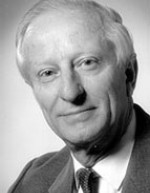
Ralph Slatyer was born in Melbourne in 1929. He was educated at the University of Western Australia where he received a BSc in 1951, an MSc in 1955 and a DSc in 1960. In 1951 he began work as a research scientist with the CSIRO in what became the Division of Land Research. He was part of a team that investigated the potential for agriculture in the north of Australia. From 1966-1967 he was the associate chief of the division.
In 1967 Slatyer became the foundation professor in Environmental Biology in the Research School of Biological Sciences (RSBS) at the Australian National University (ANU). His research at this time included how plants differ from each other in photosynthesis and transpiration rates. It was here that he began to look at ecological succession in disturbed ecosystems. Also while at the ANU he served as the director of RSBS (1984-89). On his retirement in 1993 he became distinguished scholar in residence at RSBS. Slatyer has had enormous influence in Australia's national science milieu. In 1989-92 he served as the Australian chief scientist. He was deputy chairman of the National Greenhouse Advisory Committee in the Department of the Arts, Sport, Environment and Territories (1989-93) and chairman of the Cooperative Research Centre Program in the Department of Prime Minister and Cabinet (1989-92). Professor Slatyer passed away in July 2012.
Interviewed by Dr Max Blythe in 1993.
Contents
- Early gifts: curiosity, a love of nature and an enjoyment of work
- A stimulating education
- Productive interactions
- The gift of a loving family
- Agriculture: could we really feed the world?
- An exciting first job
- Win/win: collaborative research links
- Linking plant/water relationships to climatology
- Gifts to a scientific 'adolescent'
- Looking further at arid zones
- Evaluating the rural potential of the Northern Territory
- Moving to a university base, but always within talking distance
- 'Ecology was my real love': investigating ecosystems
- Ecological succession simplified
- A total commitment to cooperative research
- The World Heritage concept
- International scientific cooperation for the environment
- Using multilateral politics to benefit the world's environment
- Coming home to a transformed role
- Reviewing and guiding science and technology in Australia
- The emergence of the chief scientist
- Truly cooperative ventures: the CRC program
Early gifts: curiosity, a love of nature and an enjoyment of work
Ralph, perhaps you would talk me through your early days. You were born in Melbourne in 1929.
I was, and I grew up in Perth, although my parents had rural backgrounds. They both had a very powerful influence on me. I was the fourth of five children – spread out over about 20 years, so we all got rather individual attention.
I realise now that my mother, in particular, had a remarkable ability to arouse curiosity in people. She combined that with a love of nature: whenever one was out of doors with her, some sort of a biology lesson was going on about a garden plant or a bird or whatever it happened to be. She would always ask the question that aroused your curiosity and made you think about the answer. And my father was a bank manager who thoroughly enjoyed work. He got across to us as children that enjoyment of work, of paying attention to detail and doing something well.
A stimulating education
Where did you go to school?
I went to the little local primary school and then began my secondary schooling at a selective high school, Perth Modern School – quite a remarkable school which took only 50 boys and 50 girls each year, based on IQ tests and things like that, in four classes of 25 children. Good teachers gravitated there and we had an excellent learning environment for all sorts of things. The science was very good (which later I became conscious wasn't always the case in those days) and gave us a very good grounding in physics, chemistry, mathematics. I went to Mod, as we called it, for two years.
When my Dad retired, my family moved out of Perth and I became a boarder at Wesley College (Mod was a day school only). Frankly, I thought that Wesley wasn't a particularly good school at encouraging excellence and achievement – although I should say that during those war years it was extremely difficult for the schools to keep good teachers when so many went into the Services or into other jobs. The redeeming feature was the science master, Vic Cooper. He was a remarkable teacher and the sort of person who aroused one's curiosity, rather as my mother did. He never gave you the answer but he gave you all the information you needed to go about finding the answer yourself. In that sense he influenced me more than any other teacher I had.
You must have finished school close to the end of the war.
Yes, in 1946, after the five years of secondary school.
When you moved on to the University of Western Australia in 1947, did your experiences influence you towards research?
Yes. The course was very good, very much hands-on. And the Dean of the Faculty, Eric Underwood, was another important influence on me. He was a really delightful person, a dynamic, influential teacher and very stimulating about science in general and agricultural science in particular. Andrew Stewart, another person on the faculty, encouraged me strongly to get into northern Australia, having had some experience there himself.
So I have been fortunate: right through primary and secondary school – both Modern School and to a lesser extent Wesley – I had stimulating teachers. Later, as an undergraduate, I was again privileged in having good teachers.
Productive interactions
You had been surrounded at Perth Modern School by people who went on to achieve quite impressive things. Was there some special influence behind that?
A number of people in that class of '46 did remarkably well, I think because we were the first group going on to university who encountered the enormous number of postwar ex-servicemen and women – people in their 30s and maybe 40s – in our undergraduate classes. They were all there because they knew they wanted to get an education. Without them we might have done the usual things that undergraduates do, with even less commitment than we had to the educational process! They were determined to beat us 'little kids'. So of course we were determined to beat them. It was a very powerful interaction, which I think was what made that whole class, around the countryside, do so well.
Would you like to mention any particular figures from your class at Mod?
Well, for example, the recent prime minister, Bob Hawke, was there. We knew each other, but the classes were divided alphabetically so he was in the A to Ms and I was in the N to Zs, and you mainly get to know your own classmates best. He did law at university; I did agricultural science.
But you had a working link with him when he became Prime Minister.
Yes. By then I had been appointed by Malcolm Fraser, the outgoing prime minister, as chairman of the Australian Science and Technology Council (ASTEC), a part-time job. When Bob Hawke came in it was possible to see him on the first day he was Prime Minister, and he agreed to continuing ASTEC and to my staying on. That led to a very enjoyable and productive interaction with him – and also, might I say, earlier with Mr Fraser and subsequently with Mr Keating. The interaction with Hawke was very satisfying. He was intensely interested in what you had to say and was a very good listener. And having been at school with him, you could say, 'Prime Minister, I think you should do this', whereas it is rather difficult to say that to someone you have never met. You knew that he was basically the Bob Hawke who was at school with you in 1942 or '43 or whatever it was. So that did make a difference.
The gift of a loving family
Your move to the University of Western Australia brought you a wife and subsequently a family life, didn't it?
Yes. My wife is a wonderful person. We met as undergraduates at the University of Western Australia when she was June Wade, an educationalist. She is absolutely part of me, and vice versa, I think. She's a fantastic person: very clear-headed, marvellous to argue with, interested in a lot of things – really complementary to me, I guess. From the very start she gets the human dimension right, whereas if I do get it right it takes me somewhat longer. She is prepared to put more time into getting the best out of a book or a new experience, whereas I've been sufficiently locked into my career, and enjoying it so much, that I haven't spread myself as broadly as she has.
We have three loving and self-confident children – a boy, then two girls. They are all doing different things and enjoying them. We think they're fine young people.
Agriculture: could we really feed the world?
You said you did agriculture science for your BSc. Why was that?
As a matter of fact, it was a toss-up as to whether I did engineering or agriculture. In those days, boys in Western Australia who had a mathematical inclination did either engineering or science of one form or another. Doing medicine or law was a bit of a soft option! It is interesting to see how things have changed since then. But because of the prerequisites for engineering, for example, you had to decide in your fourth year at secondary school what level of maths you were going to take. And the teaching at Wesley was such that I couldn't do the second maths – Maths B – at a level that I thought would be sufficient to do well in engineering. I was probably mistaken about that, but in fact with my parents and the headmaster I made that judgment, which led me to do agriculture rather than becoming an engineer – and I've not regretted it!
Very early on, I have read, you were excited by the prospects and the challenges of feeding the world.
Sure. It was very much the theme of the time. Indeed, one of the main reasons I did agriculture was that I saw a nice illustrated brochure with a person in a lab coat in a greenhouse, who clearly was going to help to feed the world. I regarded that as pretty stimulating stuff. I was very much dedicated to it. The general feeling, that science could address the enormous problem of the starving millions and that agricultural science was a primary vehicle for that, certainly drove me in that direction.
At the time, northern Australia was almost a blank map. It was thought to have enormous agricultural potential, but nobody knew. By the late 1940s, as an outcome of the war, there was an attitude here that we had to populate or perish – either we did something about northern Australia ourselves or somebody else would. So there was a lot of postwar activity to prove the rural potential of northern Australia.
Did that influence your BSc honours degree in agriculture?
It did. We had to spend the summer vacations either on a farm – in some area of agriculture – or on an agriculture research station. My interests in northern Australian and in feeding the world made the opportunity to go to northern Australia irresistible, and I spent my summer vacations on one or other of the CSIRO research stations. (One had been established at Kununurra, in northern Western Australia; one at Katherine, in the Northern Territory; and one at Alice Springs.) That gave me hands-on experience in those environments. In the wet season, with prolific growth of vegetation, one is emotionally convinced that it must be a very productive environment, and the idea of working up there and trying to assess whether it was a productive environment or not was very challenging.
An exciting first job
Didn't you later go into a full-time job with CSIRO?
Yes. Actually, jobs were quite difficult to get in the early 1950s when I finished my degree. Fortunately, because I had worked at the CSIRO research stations I was offered a job with what became the CSIRO Division of Land Research, headed by Chris Christian – another remarkable person and very important influence on me.
A man who let you have your head?
Indeed he did, but he told me subsequently that he had his eye on me. And I had my eye on him, I might say. I wasn't altogether surprised when I got a job offer, but it did mean choosing whether to go straight into a job with CSIRO as a research scientist, for which the normal entry requirement was a PhD, or to do a PhD. I guess I was cocky enough to think I could do research without being trained particularly. Almost certainly that was wrong, but the temptation to get straight into a research career rather than marking time for three years persuaded me to take the job.
My academic record looked quite impressive, and I could have had a job as a biochemist or as what was called an ecoclimatologist. It is a measure of the time, just as it is inconceivable now, that you could have a choice of jobs so far apart. I had done very well in biochemistry in my undergraduate course and Christian wanted to hire a biochemist to work on the downstream part of all this agricultural production. But I was very much attracted to the ecoclimatologist job, which was essentially to predict, from climatic and soil characteristics and other in situ characteristics, the length of the growing season for introduced crops and pastures – and, in the process, predict any other characteristics of the growing season which would make it either more or less reliable for a potential agricultural region. It was quite a challenge.
CSIRO had established a land research survey team and Christian had pioneered broad-scale survey techniques by which he mapped the whole landscape instead of just soils or vegetation or geology, as things used to be done. His approach, essentially geomorphological, became adopted throughout the world, particularly by the international agencies. It was all done with photo interpretation, with a field survey to validate the 'query points': difficult photo patterns which could not be interpreted accurately. I went along with those people occasionally for a few weeks at a time, but I wasn't actually involved with them. They were providing for CSIRO the information on the landscape, soils, geology and so on, and I was providing it on the climate and the growing season.
They were a great bunch of people to work with, and tremendously exciting. They too were conscious that they were doing important things. For the first time, the physical and biological attributes of northern Australia were being surveyed. It wasn't easy. We all recognised we had to develop a technology for the growing season studies that could be applied to broad areas. It was first-approximation stuff, but in a sense all the more challenging because of that. You were conscious of actually crafting that big canvas, and so my first job was really quite exciting.
Win/win: collaborative research links
For a start, Christian sent me off to Adelaide to sit at the feet of James Prescott, the head of the Waite Agricultural Research Institute, who had done some wartime climatological work. The great thing was that Prescott had two hats, one as Director of the Waite Institute and the other as Chief of the CSIRO Division of Soils. Indeed, the Division of Soils was contained almost entirely within the fabric of the Waite Institute buildings. As a young researcher during that visit, when I walked into a lab I didn't know whether the person I was talking to was a CSIRO researcher, a university researcher, a PhD student, a post-doc – there was just a group of people working together. It was a really marvellous collaborative atmosphere. Everybody won.
A few months later I went to the CSIRO Division of Physics, in Sydney. Exactly the same thing applied: university and CSIRO mixed up in the same lab, CSIRO people supervising graduate students and so on.
My whole philosophy in research, in any problem resolution, has been win/win – try and make everybody win to some degree. Unless you can do that, ultimately whatever you stitch up comes apart. And my experience with both Prescott and the Division of Physics made me realise how important it was to build collaborative research links between CSIRO and the universities. Rather sadly, those links fell away in the 1960s and '70s, but now we have set things in train to re-establish them very strongly with the Cooperative Research Centres program.
Linking plant/water relationships to climatology
After that period with Prescott, I really set to on the task of predicting growing season attributes. Initially I had to work with broad climatological statistics, but very quickly I realised that I had to know more about soil physics and things like soil water-holding capacity, and about micro-meteorology and such things as factors that affected natural evaporation. So my career changed from ecoclimatology to a heavy involvement in micro-meteorology and then in environmental plant physiology. In the process, I developed what were probably the first agroclimatological-ecoclimatological models, and they have now been used quite extensively right round the world. They have been greatly improved, by others, however, from the early models that I used to crank out with a hand-calculator.
But to get the response surfaces to put into the models, one had to know the degree to which a certain reduction in water content of the soil reduced the transpiration rate, for example. One had to know whether there were periods of sensitivity during the growth cycle of a particular crop when a period of water stress would have been disproportionately disadvantageous to the crop. Looking back on it, I think it did follow a fairly logical path.
Plant/soil-water relations has never stopped being an interest of yours, has it?
That's true, it's still there. And that really started a wonderful research career for me. I was able to build a group with two other people, initially, which grew to about 10 in the relatively short time of seven or eight years. The team consisted of plant physiologists, soil physicists and climatologists – people who were properly trained in climatology. Christian was marvellously supporting. He would give you all the responsibility you could take, so it was my team to build. I was responsible if it went wrong; equally, I got the plaudits if it went right, and I could carry on my own work.
You could extend your own research qualifications, doing an MSc in that time.
Yes, and a DSc degree. I regarded plant/water relations as the hard core, looking for the factors that affected water stress and how those factors mediated certain physiological responses – fruit-set, flowering, things like that – and I got more and more involved in setting plant/water relationships in a full environmental context in the soil/plant/atmosphere continuum. I guess it was reasonably pioneering at that stage to see the plant not in isolation but as part of a continuum.
We very quickly picked up the fact that the permanent wilting percentage, which had long been regarded as a soil constant, in fact wasn't. It was biologically determined by the osmotic potential of the plants. Therefore, while for many crop plants it occurred at much the same soil-water content, for native plants and woody evergreen perennials, in particular – of which Australia has many – it meant very little. The plants simply didn't know about it. It was great to unravel all that, with its obvious implications for irrigation practice, watering frequency and things of that sort.
And to publish a paper of immense importance on plant/water relations.
It seemed to be regarded that way, yes. Writing the monograph was a pleasure. That pulled it all together, looking at stomatal control of transpiration and linking the whole soil/plant/atmosphere continuum. It was necessary for the climatological models too. Unless you knew how those things were linked together, you couldn't really generate the response surfaces for the climatological models. Anyway, that ran through the 1950s and into the '60s.
Gifts to a scientific 'adolescent'
I should mention that in 1955 I was the beneficiary of what in CSIRO we used to call a Cook's Tour. In those days, after you had been in CSIRO a few years and if they were impressed with what you were doing, you would get an around-the-world air ticket (with travelling allowances and so on) and you could just write your own itinerary. You could do whatever you wanted to do for 12 months: you could visit 365 different labs around the world, or one lab for 365 days, or some mixture in between. That was a truly marvellous experience which let me match my own thoughts against those of the best people in the world – and to my delight and somewhat to my surprise I found that in many areas I was up with their thinking or even slightly ahead. For someone three or four years out of an undergraduate course it was powerful, heady stuff.
You must have met some impressive figures in that time.
Well, I did a mixture of things. I went to see a number of agricultural research stations in developing countries in Africa and the Middle East, often working not just with indigenous people but with expatriates – who, in many cases, because of all the postwar idealism, were prominent researchers in their own countries. You would be aware of the British influence in cotton research in Africa, for example.
I guess the most important person I was exposed to was Paul Kramer, at Duke University in the United States. His text on plant/soil-water relationships, published in 1949, had been a very important influence on me, and I had a list of 100 questions I wanted to ask him! When this 12-month Cook's Tour gave me the opportunity to go and sit at his feet for six months, he suggested that I ran an experiment to prove my hare-brained idea that the permanent wilting percentage wasn't very important. He also wanted me to demonstrate a few other things which I had by then published on and which had created a bit of interest. So I did all that. It was a fantastic six months.
Kramer was a delightful person. He was marvellous to work with, a very avuncular figure whose door was always open. He was 25 years older than I was and for the first few weeks we had a sort of parental relationship, but gradually it changed: we became good friends and he influenced me powerfully. He was another very curious person, one who always looked for the simple explanation rather than the more complex one, but didn't walk away from more complex ones when necessary. He was a member of the US National Academy of Sciences and he was still getting competitive NSF grants when he was 85. There can't be too many people doing that at such an age.
I feel I was very privileged right through my scientific 'adolescence', until I became myself a scientific adult, in being exposed to these people who were so generous with their time, their resources and so on, totally dedicated to the scientific principle and the scientific process in what they did, and enthusiasts for what they were doing.
Looking further at arid zones
At about that time, I think, you started to get some rapport with UNESCO, which quite soon used some of your models.
My relationship with UNESCO started in 1956 and then developed quite strongly, yes. They started a major program in arid zones, which internationally meant not only deserts but also sub-humid (seasonally dry) environments such as in northern Australia. Just after the war there had been an attitude that somehow science would 'make the deserts bloom' as important places for rural production and for people to live in. Australians already knew that idea was wrong; we knew how fragile the arid zones were. But UNESCO's program, more than any other single activity, really put the idea to bed.
Through a consciousness-raising exercise of symposia and reviews of various areas of research related to the use of arid zones, the program drew in many scientific people from developing countries and put them in contact with outstanding researchers from developed countries – these included Kramer, and Australians too were prominent in the program – and did a whole lot of bridge-building. It was one of the very best things UNESCO ever did.
Evaluating the rural potential of the Northern Territory
Your energy level was pretty high when you came back and built your team at CSIRO.
Everybody's was. It just went zoom. As a whole group we were very productive, publishing hundreds of papers over those years, and it very quickly became a place for people to come on their sabbaticals. Who wants to come and spend some time with you is a very good test of how well your lab is doing – and we simply had to ration people's time, and space too. We couldn't pack them all in.
You made some strong recommendations about agriculture in the north.
Yes. Our mission in CSIRO was all to do with evaluating the rural potential of northern Australia, which we showed was a highly precarious environment for agriculture. It was characterised by an unpredictable start to the growing season (which is always very difficult for farmers to cope with) and the prospect in every year of one or more significant periods of intraseasonal water stress – which would not infrequently hit determinant crops such as maize or sorghum just when their yield would be most affected. So the focus had to be on managed pastures, not agriculture.
The effect of those physiological attributes was compounded by the fact that the soils mostly had very poor water-holding capacity – which meant they were exposed more frequently to water stress than would otherwise have been the case – and, by and large, they were lateritic red earths and consequently very erodible. A mixture of erodible soils and an erosive climate, as we have in northern Australian, is not a good one. So the climatology reinforced our view that it was a very difficult environment for agriculture. People did take up our recommendations, and very sensibly went into pastures.
Those same technologies then became used around the world. As that CSIRO work ran on through the 1960s, my interest scaled down from the world to the community to the plant, until I was getting quite involved in the cellular aspects of plant/water relationships.
Moving to a university base, but always within talking distance
Then in 1966 the Australian National University (ANU) started the Research School of Biological Sciences. The first appointments were filled in '67, and I became the foundation Professor in Environmental Biology. It was called initially Environmental and Population Biology but we subsequently created another group in population biology. I now had the opportunity for rather more freedom than in CSIRO; I could be a little more starry-eyed about certain things and get involved in some areas that would not have been consistent with the broad CSIRO mission. But they were not too far away from it. I always regarded that sense of mission very seriously, and felt everybody should.
I took with me several people from CSIRO – not wanting to weaken that group but aware that we had done our job in evaluating the biophysical basis of plant production in northern Australia. (Also CSIRO was always ready to take the opportunity to reshape labs when a group leader leaves. Most good lab administrations do that, I think.) And eventually we were able to strengthen the ties between CSIRO and the ANU, which was marvellous. Two truly outstanding people who came with me were Barry Osmond, who is now the Director of the School, and Ian Cowan, who has just retired. The group also included Graham Farquhar, an outstanding student who later came back and is now an outstanding professor. There were too many others to mention, but most of them finished up with professorial chairs in this country and elsewhere.
I think the C4 photosynthesis story is one that you got into in an important way.
Indeed so. At that stage we were very interested in water use efficiency, and C4 plants differ from C3 plants in their transpiration and photosynthesis ratio. Also we had the opportunity to work through a number of facets of C4 metabolism that were relevant to our broad interests in the water/energy interaction in plants. We gave the research into that a flying start, and it reached a pretty high level of momentum. Barry and his immediate colleagues played a major role in that.
And there were funds at ANU for you to get the resources you needed.
Yes, there were. It was great, fantastic. I was able to build another group at ANU, and again we were flooded with visitors and exciting young students from everywhere. The lab became known around the world and we had quite a bit of throughput during those years. In getting these things going – but with other people very much leading the charge – I aimed for a group of people you can sit through a seminar with, people you can make some contribution to and gain some benefit from. If you get beyond that, it is hard to maintain and you have to form another little group. I always tried to keep everyone within talking distance.
'Ecology was my real love': investigating ecosystems
The exciting thing was that after coming from the great northern areas of Australia and honing down over the years to the plant, you began to spread out again to look at ecological succession. You became a really refined ecologist.
Ecology was my real love. The whole thing was ecological, really, whether it was crop plants or natural, native plants. By about 1973, numerically about half the group – mainly the more junior people, post-docs and research fellows – were working in some aspect of ecosystem structure or function. The challenge that I set the group was to work at a community or ecosystem level. It is relatively easy to work at the population level and relatively easy at a single plant ecophysiological level. But because of the incredible complexity associated with both temporal and spatial variation, it is very difficult to determine the factors affecting structure and function at a community level. I thought we should have a go at it.
Were you influenced by the enormous pressure at that time to deal with world ecosystem problems?
Yes, very strongly. In about 1968 the UN decided to hold a heads-of-governments conference on the human environment – the first major UN conference of that type – and that took place in Stockholm in 1972. (Since then they have had such conferences in a number of fields, including another one on the environment last year.) That focused the attention of international bodies, both UN and non-governmental, on the environment. This gave extra momentum to the work which followed UNESCO's Biosphere Conference of 1968, leading to the establishment of their 'Man and the Biosphere' (MAB) program in 1971. I was heavily involved in that program – together with a number of other Australians, but probably as the only one to have been involved right from the start – and I continued in it until just a few years ago when the Chief Scientist job was too demanding to have another interest.
International awareness of the importance of the environment was developing rapidly, and clearly the science-based contribution that people like me could make was in sorting out the important elements of ecosystem structure and function, enabling ecosystem management to be well planned.
Ecological succession simplified
One thing you looked at was how ecosystems recovered or failed after disturbances.
Yes. There is plenty of good raw material for that in Australia. In ecology, frequently you just don't have the time to run experiments. You have to look for either natural, or human induced, perturbations which have done your experiment for you, or have applied the treatments. Then the answer should be there and the challenge is to see if you can validate it. So disturbances associated with overgrazing or the effects of fire were very important perturbations by which to test the theories.
That was the challenge I set the group. I got pretty heavily involved in it myself, with Ian Noble – a remarkable, very impressive person who came from Adelaide to work with us. (He is now leader of the ecosystems group at the Research School of Biological Sciences. The Environmental Biology group did get to be beyond talking distance and so two separate groups were established, but still with a lot of interactions between them). In the mid-1970s Ian and I began to develop what you might call a phenological basis for understanding whether a plant is likely to persist through a disturbance or to arrive at the site of the disturbance afterwards. And then whether it can reach reproductive age and produce viable propagulus. In other words, whether it is going to be in with a chance in the subsequent series of events that lead to the redevelopment of a community.
Also, I had established a close working relationship with Joe Connell, at Santa Barbara. In about 1973 or '74 I began working with Joe on major mechanisms involved in ecological succession, the temporal change in species composition. The work was intermittent, with ideas, manuscripts and so on going backwards and forwards across the Pacific – plus periods of time in each other's labs. We didn't even have faxes then and telephone calls were too expensive, and neither of us were terribly good correspondents, nevertheless we gradually got our ideas together.
We proposed that the complex array of mechanisms that were involved in ecological succession could be seen as just three basic mechanisms: a community acts in such a way as to facilitate the entry of a new species – and there is evidence for that – or to inhibit the entry of another, new species, or to tolerate the entry of a new species. That seemed to sum up, to a considerable degree, the controlling mechanisms for the temporal variation in composition. It took us two years to put together a paper on this proposition, together with the experimental tests that we thought people could apply in assessing whether these mechanisms were operational or not. In about 1975 we sent the paper to American Naturalist, which was rather slow in refereeing it but published it in 1977.
Your proposition simplified a great problem area. People could now devote their attention to three mechanisms, instead of looking at a massive multifactorial array.
Well, it seems almost self-evident now, but it didn't seem so simple or obvious when we were involved in it.
A total commitment to cooperative research
As you have probably gathered, I am totally committed to cooperative research. I know that a lot of people like to work away almost monkishly by themselves, but I've been so stimulated by interaction with colleagues through my research career that I feel quite unhappy about people depriving themselves of that opportunity and that great experience.
The paper that Joe Connell and I wrote became a citation classic, as did my plant/water relations monograph – that's always a bit of a thrill. When you get a citation classic you are asked to write a little essay as to how it happened. As Joe and I thought about our work, I realised that the successful ingredient was the interaction of our backgrounds. Joe is a great conventional naturalist who knows the names of all the shells on the seashore and stuff like that, and he brought a broad naturalist, community ecologist view of the world to our association. I'm the world's worst taxonomist, but I brought a more physically rigorous background. I am more mathematically inclined, more inclined to look at the physiological mechanisms underlying behaviour or performance rather than simply the manifestation of the performance itself. It was perfect that we should have worked together, although when we started we didn't realise that; it just became apparent to us that we always threw sparks off one another.
Incidentally, Ian Noble and I do the same even now, because we have different backgrounds. He comes from a community background interest; I come more from the specific physiological interest.
The World Heritage concept
The 1970s were exciting years for you, in a range of ways. You have mentioned being heavily involved in the Man and the Biosphere program, which had arisen from the 1968 UNESCO conference, and there was a range of other international activities.
Yes. I was on the MAB executive bureau, in one role or another, from the very first meeting in 1971 through to '85. The bureau was an international coordinating council that ran the program. In the early days it was composed almost entirely of scientists: representatives of governments, but elected because of their scientific attributes, not because of the country they came from. (Although the US had a permanent seat, as it were, as did the Soviet Union, but they had good scientists involved.) For the period 1977-79 I was actually president of the program, and I was re-elected president for a second term 1979-81. And I was then past president for a period.
The World Heritage story was to have important repercussions in this country. Your involvement in it overlapped with your MAB work, I suppose.
It did. The World Heritage Convention started in the mid-1970s. The concept was that in biblical times we had the Seven Wonders of the World, but if we were starting again, maybe not all of those seven would feature and anyway there would probably be more than seven. So the World Heritage List is a modern-day list of the wonders of the world; the task was to identify them and try to ensure their protection. And on the World Heritage List we could have not just cultural properties but natural properties as well, to ensure their protection also.
As with Man and the Biosphere, Australians were active from the early days of the World Heritage Convention. I was involved virtually from the start, and served on their executive bureau continuously for a number of years. I became president of the World Heritage Committee in 1981 and served for about three years – about five meetings. For what it's worth, former prime minister Gough Whitlam tells me that I have chaired more meetings of the World Heritage Committee than any other person!
Australians nominated various areas for the list but it has been a controversial process in this country. There has been much political posturing and a lot of extravagant comments have been made about giving up national sovereignty and so on. Frankly, such comments are ridiculous – but that's politics. Some of the nominations could have been expected to be controversial, but they have been unnecessarily so. The three most controversial have been south-west Tasmania, Kakadu and the Wet Tropics of Queensland.
My feeling has been that it is important that the state in which the property is located should want the property to be nominated by the Commonwealth government. It shouldn't be done over the resistance of the state. The group of properties which went through the nomination process at the start had been proposed by the states in response to an invitation from the Commonwealth. After a process of evaluation, some of those proposals (including the Great Barrier Reef) went forward and they were all successful. But south-west Tasmania, for example, was proposed by a state government which subsequently fell. The incoming government opposed the nomination but it had already been made and went ahead. That sort of thing has certainly made for difficulties in Australia.
As chairman of the international body I wasn't involved in the national politics of it. I had to stand off a bit. Instead, I tried to advise both the federal and state governments as to how to find some middle ground.
I like to think that in all those international programs Australians have not just been active but have taken part in ensuring quality control, getting the terms of reference and selection criteria right – the rules of procedure, all those sorts of things that are very important for maintaining quality. With something like the World Heritage List, whenever you add a property that is slightly below the mark you raise the prospect of the addition of another whole group slightly below the mark. You must always maintain the standards at a very high level. It was very satisfying to do that work. It's certainly important for the benefit of future generations.
International scientific cooperation for the environment
You were also heavily involved in SCOPE. What is that, and when did it start?
It is the Scientific Committee on Problems of the Environment, the environment program of the International Council of Scientific Unions (ICSU) which started in 1970. I was president of SCOPE from 1982 to '85.
For the record: the SCOPE program and the Man and the Biosphere program should have worked more closely together. I did everything I could to make that happen, but not all of my colleagues in SCOPE wanted it. A number of people, for a variety of reasons, wanted to be international and non-governmental, rather than getting involved in intergovernmental activities. I was a little disappointed it wasn't possible to build closer links there – the programs had different objectives, sure, but a lot of common ground.
When it didn't seem to be working, I just tried to encourage SCOPE to work on things that were seen not to duplicate MAB programs. This was needed in a role which involved preparing state-of-knowledge reports rather than with getting things done 'out there'. SCOPE still does that today.
The SCOPE involvement was very enjoyable, although I did drop the ball a bit in those years because I was also chairman of ASTEC (the Australian Science and Technology Council, which we can come to later). Although that chairmanship was only part-time, on top of my full-time job at the university it was sufficiently demanding that I don't feel I really did quite as much for SCOPE as I should have.
At the 1982 SCOPE general assembly, at which I was elected president, a motion from the floor was accepted that the incoming executive should look at the possibilities of doing a project on the environmental consequences of nuclear war. I was delighted with how we, as an executive, got around to doing that extremely important project on such a sensitive, controversial issue.
At our first meeting after the election, I went around the table and had everybody say how comfortable or uncomfortable they felt about the idea of SCOPE taking this on. I said it could mean the end of SCOPE if it went bad and led to international rivalries – it could even have led to some countries withdrawing from ICSU, for example. Equally, there was no more important topic that could be considered. I guess the Soviet member of the executive, at least, had received some government briefing (perhaps they all had briefings from their governments) but everyone agreed we should do it. We set up a special task force under Sir Frederick Warner as chairman. It was such a big project that I had to go away and get the money: we raised about half a million dollars for it altogether, largely from various foundations. Ned Warner's chairmanship was marvellous and the task force ran as a self-contained entity within the SCOPE program.
You published a classical report on the nuclear war consequences.
It was the first international group to succeed in getting US and Soviet scientists working together. Those of us involved in SCOPE believe, I think, that it was a fairly important factor in a number of the developments associated with nuclear arms production. More than any other single report, it made it quite clear that nuclear war just could not be risked, and that there was massive overkill in the nuclear arsenals around the world. We launched the report in 1985 at a meeting in the National Academy building, in Washington – so we had all the right credentials for the job. The launch was very well attended by the US media, which helped considerably in getting the message around the world. It was extremely satisfying to be a part of that.
You must have put a lot of your energies, enthusiasm and diplomacy into it.
Mostly in trying to orchestrate it so it worked well. As I have said, Ned Warner really ran the project as a stand-alone exercise. I found my SCOPE association, which continued until about two years ago, very good indeed.
Using multilateral politics to benefit the world's environment
Something else happened in the 1970s. You had your big department, with a good team doing a lot of work. Then suddenly, it seems, you went off to Paris.
That was quite a remarkable event. I had been involved with UNESCO right from the start of its environmental activities in the major project on arid lands, and also I served on the Australian National Commission for UNESCO, becoming chairman of that in 1976.
In 1978 the Prime Minister, Mr Fraser, appointed a previous governor-general, Sir John Kerr, to be Australian ambassador at UNESCO. The media arose with an enormous clamour that this was a payoff for Kerr's earlier sacking of Gough Whitlam as prime minister. There was such great controversy and deep feeling about Kerr in the Australian electorate that he had to live in the UK instead of Australia. Kerr did accept the post, but it became impossible for him to take it up, so someone else had to be found for the job. After all, Fraser had said when making the Kerr appointment how important UNESCO was.
To my utter amazement, the phone rang one day and I was asked if I would take the job of Australian ambassador at UNESCO. Well, looking back afterwards, it does make some sense. There I was, chairman of the Australian National Commission for UNESCO, having been involved with the organisation since the mid-1950s, involved in its science, educational and cultural programs, and with the sort of scientific credentials that I had accumulated since then. But at the time it just came out of the blue.
My response was to knock back the approach, saying that I had never considered doing anything like that and I couldn't see that I would, thank you very much. When I went home for lunch I told my wife about it, 'Hey, you'll never guess what happened this morning!' She said, 'If they ask you again, just talk to me about it, will you?' Anyway, a week later the phone rang again and I was approached a second time. This time I said I would need to think about it more seriously. That was the day before Good Friday, they gave me four days to think about it – and we took it.
That was a marvellous experience, something totally different, being in a world of multilateral politics. In the UN and the OECD, at least, that is a matter of looking for situations in which everybody wins, and so the whole process greatly interested me.
Most of the ambassadors there were career diplomats, for whom UNESCO is merely another multilateral posting. By and large they know nothing about its programs, but if you are going to be influential at UNESCO you have got to get the politics and the programs coordinated. While I had enough self-confidence that I didn't go there with any trepidation, I was conscious of being a babe in the woods politically. I had excellent support from the Department of Foreign Affairs and my own small team, but nevertheless at the end of the day the ambassador has got to front up, and do and say various things. My program knowledge became adequate quite quickly, not just in areas like science and education but right through the UNESCO program, and I realised that consequently I had something to offer to my fellow ambassadors. It is always nice, in any sort of interaction, when you can say, 'Yes, what you've said is all very well, but how about these elements?' – things they would not have thought of.
So you enjoyed being a member of a team, and you made professional friendships.
Oh yes. Several of those ambassadors from other countries have since spent terms in Australia. We were very close friends with the German ambassador at UNESCO, Boff Fabricius, who subsequently came to Australia as ambassador for Germany. There were some very pleasant interactions like that.
Most importantly, as far as my career was concerned, it made me far more aware of the world as a whole, of the enormous challenges to getting things right internationally, and of the sheer importance of doing that in the interests of world peace and prosperity. I think if you are associated with UNESCO you become convinced that, for all its warts, it is an important organisation with a vital role to play in world peace – and in the meeting of people's minds across various cultural and other barriers. I became caught up in all of that.
Coming home to a transformed role
Ralph, I think you were asked to accept a second term as UNESCO ambassador, but you refused and came back to ANU to take up your professorship again.
Yes, I returned in 1982. I had become conscious that I was dropping away from science, that if I stayed another three years I would have become another diplomat and not a scientist. So it was important for me to get back. Also, I think June was pretty keen to get back, and obviously that was a factor. I hadn't realised, however, that when I got back I would be through with science in terms of a personal research career. (One has these rosy expectations, I suppose.)
My work at UNESCO had the interesting effect of making me 'trivialise' science to some degree, because I saw so clearly that science was just one element in the future of humanity – very important, but just one among many other important factors. I came back conscious that really I didn't want to put all my resources back at the bench, as it were. In fact, in my case the bench was now the field. So while I kept ecological work going for a few years after my return, I suppose it was no longer my main driving force.
In 1984 I became director of the Research School of Biological Sciences, even though I had resisted doing it some years earlier, because by then it was much easier to be a senior administrator and involved in other things than to be at the bench and involved in other things. My feeling is that unless you are obsessed about your science, it is very difficult for you to be a first-rate scientist. It has to be a whole commitment, essentially. But by now I was looking for broader responsibilities and a broader role to play.
Indeed, by this time you had become involved in a great many national and international initiatives, an invaluable continuation of your interest in environment.
Yes, they've all been linked to that. So becoming director of the School made a lot of sense. The other major commitment I had then was the chairmanship of ASTEC, to which Malcolm Fraser had appointed me in 1982.
Reviewing and guiding science and technology in Australia
Tell me about ASTEC. I think it was looking at where science and technology in Australia were going.
ASTEC was a very interesting organisation which Prime Minister Fraser established in 1978 because he wanted a think tank on science, and the chairman of ASTEC had direct access to him – which was essential for effectiveness. If a body like that reports to anyone but the prime minister, it can't be effective. At that time government-sponsored think tanks were being appointed around the world to do various things but now, in the '90s, those days are past: a government goes to one source for this advice, to another person for that advice, and to someone else for some other advice. It's much more selective. In the United States, very dynamic think tanks operate independently with their own funds, but frankly I don't think that is realistic here. So a body like ASTEC may have outlived much of its usefulness. But at that stage it was very much the way governments operated. Both Fraser and then Hawke, in his early years, took ASTEC's views seriously.
As an example, during the time I was chairman of ASTEC the government introduced the 150 per cent tax concession for research and development, a major fillip to industrial R&D in Australia. ASTEC was instrumental in that.
Also, during my chairmanship I was responsible for a review of CSIRO that set future directions for the organisation. We pushed quite strongly for a sense of mission and of industry involvement. I think CSIRO at its best has always been characterised by a very strong sense of mission, but in the '70s and early '80s, in my opinion, it lost track of that a little bit, drifting into becoming more and more like a university and tending not to do such good work. ASTEC's review of CSIRO set directions for the organisation and, I believe, put it back on the right path. Virtually all ASTEC's recommendations were accepted.
In addition, ASTEC laid the groundwork for the establishment of the Australian Research Council as a truly national research foundation, absorbing several other granting programs and with the Australian Research Grants Committee as its core. All those matters were ASTEC initiatives and one can take some satisfaction from that. But nowadays one doesn't find that sort of notice being taken of ASTEC.
You were still building a diplomatic brief in the '80s, weren't you?
Well, my involvement with SCOPE and MAB was interesting, as was the World Heritage Committee – a labour of love, in that I see the World Heritage Convention as extremely important. And then the chairmanship of ASTEC was extremely interesting as part of a post-UNESCO ambassador role, when my interests broadened very much from what they had been. Anyway, all those activities have been great fun.
The emergence of the chief scientist
Your role as a scientific adviser to government then grew even more, didn't it?
I finished my chairmanship of ASTEC at the end of 1987 and went back to the ANU, where I was still director of the Research School of Biological Sciences. In 1989, however, the government established new advisory machinery. The chairman of ASTEC was in a sense the prime minister's science adviser, even though the position was just a part-time one. Mr Hawke wanted to make that into a full-time post, to have an adviser 'on tap', and also to create a Prime Minister's Science Council and to establish a Coordination Committee on Science and Technology comprising officials at a very senior level. I was approached to fill the full-time position.
This time the phone call didn't come altogether out of the blue. It was from Mike Codd, the head of the Prime Minister's Department. He and his predecessor, Geoffrey Yeend, were two outstanding public servants, people of total integrity and broad commitment to all facets of Australian life and society – delightful people to work with. People like that give you a tremendous sense of satisfaction and support when you are working in a job like the chairmanship of ASTEC.
When Mike raised the possibility of the job as chief scientist I hesitated, saying that I had already been the chairman of ASTEC and I thought the new chairman ought to continue working the way I had. He said, 'No, this is going to be quite different. ASTEC is outside the bureaucracy; this is inside. The person in this job will have access to all the Cabinet papers and will be expected to be across all of them.' He said the new council would be very influential, with the prime minister and six other senior ministers involved. Also, there had been a great need for a coordination committee to bring the various bureaucratic elements together, avoid overlap and so on. 'It really is a challenge,' he said. 'Why don't you do it for three years?'
I was in Korea when I had that phone call – on 16 April, my birthday – and so I thought about it there. June said she could tell I was going to take the job, because on giving up the chairmanship of ASTEC 18 months earlier I had been left with so much energy but I hadn't quite expended it on other things. I did take the job, and it was great fun. And I really think we started something very important with the Council.
I was able to influence the character of everything that happened: the composition of the council, the working arrangements with the prime minister, the way in which the coordination committee worked. The prime minister himself chaired the Prime Minister's Science Council – now called the Science, Engineering and Innovation Council – and I chaired the coordination committee, so there was an almost seamless flow of information both ways.
It is early days, of course. How influential these bodies will be and whether they will last indefinitely is going to depend very much on the prime minister of the day and the person who is chief scientist. I am convinced – and I think everybody agrees – that we have put the necessary mechanisms in place to help science and technology, development and the environment, and it is really a matter of whether those things continue to appear valid and worthwhile.
So it was a continuation of everything you were about?
Yes. Being in a position to largely control the agenda of the Science Council meetings, through talking with Mr Hawke and subsequently Mr Keating, meant again that one was able to influence a very broad agenda. That has been good, and the relationships with both prime ministers have been good. They have both been very interested in science and very conscious of the importance of technological innovation in Australian industry sectors. I don't think one could have wanted better support at that level.
Truly cooperative ventures: the CRC program
Would you like to say something about the Cooperative Research Centres program? That would be your biggest project since the establishment of the Science Council.
I suppose I can't afford to be too immodest as I was largely responsible for it. I think people would agree it is the most significant development we have had in Australia since 1965 when the Australian Research Grants Committee was first established.
The seed was sown at the first meeting of the Science Council, when – not altogether unplanned – we had a parade of well-known scientists telling the prime minister and senior ministers that even in research areas where Australians had been leaders we were having trouble keeping up with the pace internationally, particularly in areas where you needed multifaceted teams to make progress. Individual research support was not too bad, and things were happening for the support of smallish teams, but there was no mechanism to build large multidisciplinary teams on the required scale.
Furthermore, during the 1960s, as both CSIRO and the universities grew rapidly, CSIRO labs that had been on university campuses moved off campus and that very important nexus – with the benefit of putting together researchers and students – was broken. Fortunately, in many cases the CSIRO labs didn't move very far, in effect only across the street; nevertheless, CSIRO and university people were no longer working in each other's labs. That affected both the research and the research training.
Even more generally, there is the reality that our Australian research enterprise is inevitably fragmented geographically because of the distribution of Australian centres of population, and also fragmented institutionally because of the separation of CSIRO and other government facilities from campuses. We have both arms tied behind our backs, in a sense, but because the institutional measures are not inevitable there was clearly a chance to do something about that aspect.
All of these ingredients added up to a case to the prime minister to create new centres that would be truly cooperative ventures – every one of them, I suggested, should have a university component because of the importance of the teaching element; and, wherever possible, researchers in centres should be together at the one location on a university campus, to recognise the universities' role as intellectual powerhouses in the country. In addition, we would try and link groups with common interests, even though they were geographically separated. So we were running a gigantic experiment in distance cooperation research as well. If ever a country needed to be very good at distance cooperation research – not just internally but internationally – it is Australia.
In the second part of 1989 I made sure I was up to speed with cooperative research ventures in the UK and other countries in Europe, the US and Canada because everybody has tried this in different ways and some have worked better than others. Then in about November '89 I put a proposal to the prime minister, and to my absolute delight he smiled on it. Although ultimately it got caught up in the 1990 election, believe it or not we had it all signed, sealed and approved before that. But just when it was to go to Cabinet for formal approval the opposition parties did something or other which was politically rather inept and the prime minister decided the time was propitious to call an election, so the whole thing got into the election context. In the event, the government won the election and the opposition gave the program bilateral support, despite having initially opposed it. So now all 50 centres are up and running. It was an enormous effort.
Has the funding been designed to facilitate the objectives?
Yes, it has. This is a very big project – $100 million a year. We wanted also to get matching funds from the participants, who would put up at least a dollar in either cash or in kind for each dollar the government put up. We in no sense regarded the contributions in kind as inferior; it is the contribution in kind – the people – that can bring with it a real commitment. Also, we wanted close links to be built with the user groups, whether they were government agencies, businesses or whatever, although I was a little apprehensive as to how successful we would be in building links with some of the businesses in Australian industry sectors that are not strong performers of R&D. (Some are very good performers of R&D, but most are not.) In fact, we have been overwhelmed with the response. Rather than one dollar of matching funds being contributed by the participants for every dollar of Commonwealth government funding, we have been getting an average of two dollars. And I am pleased to say a lot of experiments are under way, to do with better cooperation technologies.
On that point of achievement, which in itself illustrates why you have found so much enjoyment in your career, we must close this interview. It has been marvellous to talk with you and it would be good to talk again, perhaps when you next visit Oxford.
Okay, let's do that. It would be nice to talk about some broad global issues.
Professor Stewart Turner, geophysicist
Professor Stewart Turner is a geophysicist with a distinguished career spanning three continents. He began his research in theoretical nuclear physics before changing to cloud physics and finally to the physical processes in the ocean. After spending many years at Cambridge University and the Woods Hole Oceanographic Institution in Massachusetts, he returned to Australia as Foundation Professor of Geophysical Fluid Dynamics in the Research School of Earth Sciences at the Australian National University.
He established the connection between the physical processes in the ocean and liquid rocks (lava and magma), and wrote the influential book, Buoyancy Effects in Fluids. His research also discounted the suggestion of towing icebergs from Antarctica to arid coastlines as a source of freshwater. He has received numerous awards and continues to be active in research as Emeritus Professor and Visiting Fellow at the Australian National University.
Interviewed by Dr Trevor McDougall in 2004.
Contents
- Early years in Sydney, London and New York
- From engineering to physics
- A move to Cambridge
- New environments: marriage, and methane in coal mines
- A return to CSIRO leads to a US opportunity
- Back to Cambridge
- An influential monograph
- New opportunities in Australia
- Achievements at the Research School of Earth Sciences
- Finding a balance between research and administration
- Scientific recognition and replenishment
- Mechanisms for the funding of research
- Life in retirement: the excitement of doing something new
- Some advice for younger scientists
Early years in Sydney, London and New York
Stewart, would you tell us where you were born, and something about your family background?
I was born in Sydney in 1930, the only child of loving and very supportive parents. My father, being the son of a teacher in small, one-teacher schools, had grown up in little country towns around New South Wales. He eventually went to Sydney University on a Teachers' College scholarship and did a BSc and MSc. As a result, he was awarded an Overseas Scholarship and went to Cambridge to do another undergraduate degree, a BA in mathematics. He was the first member of the family ever to go to university.
My father returned to Australia to marry my mother, who was also trained as a teacher but (as was the custom) had to give up her job on marriage. He taught for a very short time in schools and then joined the Sydney Teachers' College staff, becoming head of the Mathematics Department and eventually the College's highly regarded Principal.
As I grew up, my father always made it clear that he wished he could have continued with more study and research in his first love, mathematics. He regarded an administrative job as second best, yet he did have a significant effect on the teaching of mathematics in Australia. Through his interest in comparative education he also affected the organisation of schools. A great advocate of decentralisation, he believed that it was ridiculous for teachers to be moved in and out of country areas as they got promotion: it made more sense for them to be able to make a career within a given country area. I believe he had a significant effect on the ACT getting its own education system, independent from New South Wales.
I guess that through all of these achievements my father remained a frustrated mathematician. But his background gave me an appetite for science and for travel.
Where did you go to school?
For the first two years I walked from our home in Mosman to Middle Harbour Public School. But when I was seven my father got a grant to study in Britain and the United States, so I went next to a state school in an outer London suburb. I have vivid memories of going to the Science Museum in London with my mother while my father was studying. After just under a year we moved on to New York, where my father did a PhD at Columbia University, and I went to a very different, very progressive school attached to the Columbia Teachers' College – where I did my first experiments!
We arrived back in Australia just two weeks after war had broken out, after we had spent 11 weeks driving across the United States and then travelled across the Pacific by ship. There is a family story that soon after I returned I got terribly upset because I failed an exam in geography (I didn't know the rivers in New South Wales. They didn't teach me that in New York!).
Tell us about your secondary school time.
I went to North Sydney Boys' High School, which was a short tram ride away from home – a selective school and very good, with a strict but excellent headmaster. The school was concentrated on academic studies and sporting activities, giving a much more narrowly based schooling, with far fewer options, than the schools that our children went to in Canberra 30 years later.
My sporting activities at high school were pretty limited. A recurring childhood illness took me away from school for quite a while, but I did well academically and finished the Leaving Certificate with honours in mathematics. My extracurricular activities included a lot of reading and also doing odd jobs about the house. I was good with my hands and enjoyed fixing things, and an old next-door neighbour taught me carpentry, which I have been very grateful for ever since. Also I belonged to the Scouts, enjoyed camping and quite often went swimming at the beach in Manly, where both my sets of grandparents lived.
From engineering to physics
You went to Sydney University as an engineering undergraduate but you graduated in physics. What caused you to change direction?
Well, I got a University Exhibition in engineering, which covered fees in those days. (At first I was living at home.) Like a number of my contemporaries, I chose engineering because it seemed to leave many more options open than going initially to a science degree. I had three science subjects at the advanced level plus four engineering subjects in the early years, including things like workshop practice and mechanical drawing, which have been useful background ever since.
In third year it was common for engineering students to spend a year doing their science and get a science degree on the way to engineering, so I did third year physics and mathematics. I then went on, however, to an Honours degree in theoretical physics, graduating with first class honours and sharing the University Medal and also the prize for general proficiency over the science course.
The general proficiency prize was shared with David Buckingham, a theoretical chemist, but the result in physics was a very curious one. The University Medal was split four ways, among Neville Fletcher and Brian Robinson – now also Fellows of the Australian Academy of Science – Bill Smith and me, and there were also four other first class honours graduates that year. It was a very good year. Professor Bailey, the Professor of Physics, was regarded as completely crazy for having given so many Medals to a class, but perhaps he was justified by the subsequent performance of those graduates.
Can you tell us something about the influences you felt as an undergraduate?
One very strong influence on me, then and since, was Owen Phillips, whom I met soon after going to the university. We became practical physics partners in our first year and actually won the prize for practical physics, and we decided to stay working as partners in our second and third years as well. (Owen did mathematics Honours, however, not physics.)
The two people who ran the laboratory courses – Phyllis Nichol in first year and Phillip Guest in third year – were very good. Phyllis Nichol gave me good habits of recording in experimental notebooks: you always write it down in a book, not on a piece of paper. And Phillip Guest set up a really good series of experiments for the third year class, to give a thorough general training. Of course, although I am throwing these Christian names around, in those days there was no way that anybody would call their lecturers by Christian names, nor did they call us by anything but surnames.
Another important thing was that after two years living at home I became a resident of Wesley College, in the University of Sydney. So for my final two Science years plus my Masters year I was living in college on the university campus.
Your Masters degree from the University of Sydney was also in physics rather than engineering. How did you choose the topic of that degree?
I had done so well in physics that it seemed worth continuing with that, and not to return to engineering, so I got a grant to do a Masters degree in the physics department. By reputation Dick Makinson was the brightest member of the physics staff, so I did an MSc with him on a theoretical nuclear scattering problem. It seems a rather odd choice, looking back, but I chose the supervisor rather than the subject. I published three papers, two with him and one on my own, which I am sure played a big part in my later getting an Overseas Scholarship.
Why didn't you continue with similar research after your Masters?
Towards the end of my Masters year I was invited by a new young lecturer in the theoretical physics department at the ANU to come and give a seminar. In the audience were both [Sir Ernest] Titterton, who was rather kind, actually – he asked a gentle question – and [Sir Mark] Oliphant, who was very sceptical of the whole problem I was working on. He said right out that he didn't think that was the way to solve problems in nuclear physics. This reinforced my own notion that although I got a good training and background from Makinson, it wasn't my thing. It was just too hard even to explain to my friends what I did! Much later, after I had been elected to the Academy, I told Mark Oliphant about this incident, and the negative but important effect it had.
You then moved into the Cloud Physics group at CSIRO. How did that come about?
The Chief of the Division of Radiophysics, Dr E G (Taffy) Bowen, was interested after the war in the use of radar in radioastronomy – things they had seen during wartime radar studies – and also to track clouds, to look at rainfall. By the time I was graduating, he had broadened the program to a general cloud physics group and he wrote to various members of the graduating Masters class asking if we would be interested to come and talk with him about joining the Division. It came at a very good time for me, when I thinking about changing subject anyway, so I went into his Cloud Physics group. (Brian Robinson went into Radioastronomy – and, later, Neville Fletcher came back to the Radiophysics Division after doing his PhD in Harvard.)
Your research project involved quite a lot of fieldwork, I believe.
Yes. I must say that Bowen was a marvellous first boss for a young researcher to have: he set me on a good problem and he let me loose. The problem was trying to understand how raindrops grow on salt nuclei, and this involved measuring the salt concentration in drops as a function of drop size. At first we set up two wind tunnels, a sort of raindrop spectrograph, to separate out the drops according to size. One of these was near the coast in the Radiophysics Division and the other up in the Blue Mountains. I spent the best part of a year collecting rain and measuring it.
But it turned out that rather little of the rain was of the kind we really wanted to study. We were interested in 'warm rain', which forms on salt nuclei, rather than the 'freezing rain' which forms higher up from the melting of ice particles. So Bowen decided that the place to do this study was in Hawaii, where the trade winds regularly come in from the sea in the right season and where, with several mountain stations, you could do what we had been trying so unsuccessfully to do in Sydney.
I went there on a Rockefeller Grant that Bowen had obtained, but in the first month I was there it didn't rain at all! Here was I, a young researcher with my first project, my whole career hanging in the balance, and the conditions were untypical. In the second and third months it did actually rain and I got some good results which turned into part of my PhD thesis in Cambridge, but the whole experience had another important, negative effect: it put me off fieldwork forever. I was driven back into the laboratory, where I have stayed ever since.
How long did you stay with CSIRO at that time?
Altogether it was about 18 months, during the latter part of which the award of an 1851 Exhibition Overseas Scholarship was announced. They were extremely flexible. I had applied on the basis of nuclear physics but I was able to persuade them to accept my change of field to cloud physics, and also to defer the tenure of the scholarship for a year until I had finished the work in Hawaii.
One other memorable thing for me was that I got a personal letter from the Chairman of CSIRO, Sir Ian Clunies Ross, congratulating me on the awarding of the scholarship. I wonder how many heads of CSIRO would still do that.
A move to Cambridge
When did you travel to Cambridge to begin your PhD studies?
I went by sea in 1954, in time for the October term. The shipping lines had a scheme whereby people who had got scholarships to support them in Britain were given free first class passages – in the off season, so it wasn't quite as high minded as it might have been! But we were required to dress for dinner, so I needed to buy a dinner jacket and attend a formal dinner every night with a group of people who were very different from the poor student travellers.
The custom in Cambridge is that you enrol in a college, not in a department, and it seemed very curious to enrol in a university where no department knows until term begins how many students it has got. Anyway, I enrolled in Trinity College – mainly for sentimental reasons, because it had been my father's college, although in fact it has the top reputation for science and mathematics. At that time even research students were under strict rules appropriate to undergraduates: they wore gowns after dark and had to be in with a curfew of 10 o'clock. It was a very different scene to the way students behave now!
Which group were you attached to in Cambridge?
Because of my connections with CSIRO Cloud Physics I had corresponded in advance with people in the Meteorological Physics group. I hadn't been there very long, however, when Owen Phillips – who had gone straight on to Cambridge two years ahead of me, without doing a Masters degree – persuaded me that the Fluid Mechanics group, where he was working, was much more distinguished and exciting.
George Batchelor and Alan Townsend had gone there to work with Sir Geoffrey Taylor (G I Taylor), and they had begun to build up a group of, particularly, overseas students around them. The group was a very loose kind of connection between Batchelor's students in mathematics and Alan Townsend's in the Cavendish Laboratory, which is in physics. But they all shared offices in the Cavendish space. There was no doubt; I was easily persuaded that that was the way to go.
Taylor had an enormous influence on that group and indeed everybody in Cambridge – a grand old man of fluid mechanics in so many different fields. Incidentally, his friends and senior colleagues called him 'GI' and I will probably refer to him that way too, but students were very much more formal: it was always 'Sir Geoffrey'.
Who supervised you, Stewart, and what projects did you work on?
Well, Batchelor, Townsend and GI all had a strong influence on me, but I was initially supervised by Alan Townsend, who was the experimenter. I started off on an experimental study of drop collisions, suggested by some of the things I had done in Sydney. After about a term, Alan came back to Australia on leave and GI became my temporary supervisor. It also seemed to be a good time at which to change direction.
George Batchelor had a theoretical student, Bruce Morton, working on a study of convection. (This was really following up a line that GI had pursued during the war and, without Batchelor's knowledge, was just coming back to.) George saw that some experimental tests of Bruce's theory would be useful, so I, by that time having a label 'experimenter', did the laboratory experiments. They turned out well, and there was a good correspondence between the theory and the experiment. It led to a paper – much quoted since – by Morton, Taylor and Turner; GI added his name to it at the last minute but made it very clear, in a very generous footnote, that he attributed the main work to Bruce and me.
After that, GI found it hard to suggest another problem for me to work on, but he showed me some correspondence with my boss in Sydney, Taffy Bowen, in which Taffy had sent photographs of explosions which formed vortex rings and had asked GI whether this was a possible way of seeding clouds with silver iodide. GI suggested that perhaps the cloud buoyancy played a part in sharp rings being formed.
So, using water and methylated spirits in a laboratory tank, I started an experimental study of buoyant vortex rings. I also came up with a theory which explained my results. GI, however, was not really very convinced that students could produce useful results. When I showed him the connection between my experiments and the theory, he looked at it for a while and said, 'But this is a definite result!'
This also had applications to the nuclear explosion clouds. I came across a photograph in Picture Post, an English magazine, which showed a very sharp red-hot core poking out the edge of an explosion cloud from an American test. Just at that time the Maralinga tests were being carried out in Australia, and – presumably spurred by GI – somebody from the Atomic Weapons Research Establishment came to see me and started asking about these vortex rings. It appeared that their predictions of the height to which the clouds had gone in the South Australian explosions were wrong by a factor of 2½. They had gone much higher than expected. My experiments and the theory showed why that could be so.
I narrowly avoided having my PhD thesis 'classified' as a result, but because I had been working on it from a totally different point of view it did see the light of day, being published as an internal report of AWRE.
What was the overall theme of your PhD thesis?
I worked on a number of problems, all vaguely related to cloud physics though not in name. After two years I had four pieces of work which were just about ready for publication: one with a fellow student, Philip Saffman, which then appeared as the second paper in the very first issue of the Journal of Fluid Mechanics; the two things that GI had started me off on; and my work in Hawaii. George Batchelor suggested that it might be time to write a thesis applying for a Fellowship at Trinity College, and we decided on the title that covered all the things I had done, 'Dynamical aspects of cloud physics' – very specific! I missed out on the Fellowship, but George suggested that I had done enough work to merit a PhD so I put it in again, as a PhD thesis, and the degree was awarded a few months later.
Would you like to say something about the friends you made in Cambridge, and your recreations there?
In addition to Owen and Merle Phillips and Bruce and Alison Morton, I became friendly with Harold Grant, a Canadian fellow experimental student, and his wife Teddy (they have remained our friends in Canada since then) and also particularly Tom Ellison. He was in the Meteorological Physics group when I arrived, and I kept going to their seminars although I had technically moved to the Fluid Mechanics group. Tom remained a good friend for many years after that, and later we worked together in Manchester.
Singing was a very important recreation for me. I was untrained but while I was at the University of Sydney I had enjoyed singing with the University Musical Society, and throughout my Cambridge years I was in the Cambridge University Musical Society – and later, at the Australian National University, I belonged to the choir for a while.
Walking in the Scottish hills was also a considerable recreation, with friends I had made through a Presbyterian youth group. Their families asked me to their holiday houses in Scotland during the vacations.
New environments: marriage, and methane in coal mines
You were married in England at that time. Tell us how you met Sheila, and where you went to after your PhD.
We met in London, where Sheila was a trainee nurse. We have both said since that we are glad we didn't meet until after I had finished my PhD; I have got too much of a one-track mind and I wouldn't have been a very good companion during those years! We became engaged after I had begun a post-doc at the University of Manchester, and we were married in the second year of that post-doc, in her home town of Formby, in Lancashire. Our honeymoon included walking in the Scottish hills; hill walking – or later, in Australia, bushwalking – has been a very important recreation for us both.
What project were you involved with at the University of Manchester, and how did it work out?
Before I left Cambridge after my PhD, I had a bit of extra time on the 1851 Scholarship so I started on another project, on mixing in stratified flows. This research then led the Safety in Mines Research Establishment to offer me a contract to work in the Department of the Mechanics of Fluids at the University of Manchester. The problem was to understand the mixing of methane in coal mines; the methane forms layers which still result in explosive mixtures and cause disasters in mines around the world. Tom Ellison joined me there. Being what was then called a 'gentleman of independent means', having inherited family money and not really having to work, he came and worked on the project purely through friendship to me, interest in the problem and an enjoyment of doing research, at no cost to the grant.
We did experiments, using salt water and fresh water, on the mixing of wall layers into a surrounding flow. The established practice was to try and ventilate mines in accordance with gravity: you ventilated uphill because the light methane layers were flowing uphill anyway. We came to the opposite conclusion – the most effective way of getting rid of the layers was to ventilate downhill; they mixed much more vigorously and went below explosive concentrations very rapidly. The monitoring laboratory in the Research Establishment repeated our experiments on a larger scale to check that we were talking sense, and within a year our recommendations were in the mining regulations in Britain. It was one of the most satisfying transfers of pure research into action, and certainly the most rapid, of anything I have ever done.
What led you to return to Australia when you did?
Well, during the whole time we were living in Manchester I had the notion that I wanted to come back to Australia soon. So, when Taffy Bowen happened to be in Manchester for discussions with the engineers there about the building of the Parkes telescope, I had a conversation with him about the possibility of returning to his Radiophysics Division – from which, incidentally, I had been on leave during the whole of my PhD. I also had some correspondence with Bill Priestley, the Chief of the Division of Atmospheric Physics at the time, who invited me to go there as an alternative. But for largely family reasons we decided to go back to Sydney, and I took up my job again in the Cloud Physics group.
A return to CSIRO leads to a US opportunity
What kinds of problems did you work on in Taffy Bowen's group when you returned?
There were various laboratory-based convection problems – mixing processes, with experiments and associated theory, and following up some of the PhD themes that I had begun in Cambridge. I also did my first numerical experiment, using the then very new computer, SILLIAC, in the Physics Department of the University of Sydney. (That involved detailed programming and punching of tapes, feeding them through, waiting for results and so on.) I worked on that problem with Pat Squires, another member of the Division. It was interesting and we got some good results out of it, but again it was not really to my taste and I have ever since been much more interested in analytical models than numerical ones.
I think you also did some lecturing at the university. How did that come about?
That too happened somewhat by chance. Tom Fink, who had been in the aeronautics department at the University of Sydney, was appointed to the chair of Mechanical Engineering, and within a very short time he had transformed the department, made the course much more attractive, and got very good students and so on. He also had the idea that he would bring in people to give specialised courses in various subjects related to mechanical engineering, and I gave a course to the final year on turbulence. In fact, two of those students turned up in Cambridge later, as students (but not mine) in the Department of Applied Mathematics and Theoretical Physics.
After only a couple of years in Sydney you were again given an opportunity to travel, this time to the USA. I would be interested to hear about that.
In September 1961, my second year back in Sydney, I gave my first talk in the Academy Dome – a review paper on theoretical and laboratory models of convective clouds – at an international cloud physics conference which brought rain and cloud physicists here from around the world. One of those people was Eric Kraus, from the Woods Hole Oceanographic Institution in the United States, who had previously worked in the Sydney group. He must have been impressed by my paper because a couple of months later, out of the blue, I got a letter from the Director at Woods Hole offering me a Rossby Fellowship, which was support for a year and return fares for myself and family. Sheila and I were very happy in Sydney at that time with our first son, Bruce, who was a year old. But an opportunity to be away for a year in an interesting place seemed just too good to miss.
We must have had an inkling, though, that it would turn out to be more than a year, because we decided to go in a manner that allowed us to stay away. We sold our house, which was already rather too small for us, and got immigrant visas – actually, on the basis of the British quota through Sheila, because at that time the Australian quota was tiny. And in fact it was another 13 years before we got back permanently.
What research did you get involved with at Woods Hole after you arrived?
Soon after I arrived I met a very significant influence on my career, Henry Stommel. He was then a Professor at Harvard, although he had been on the Woods Hole staff and still lived near Woods Hole. He had written a notable paper on convective mixing into cumulus clouds, which of course I knew about from the cloud physics days. But when I arrived in Woods Hole he was clearly much more excited about oceanographic problems he had been looking at recently, and in particular he told me about an experiment that he and two colleagues had just done on the 'perpetual salt fountain', which he called an oceanographic curiosity. It led to a paper by Melvin Stern a few years later which was the basis of the whole field of 'salt fingers' and 'double-diffusive convection' – which has formed a large part of what I have done ever since.
Henry was interested in another aspect of the work. In a situation where hot salty water lies on top of cold fresh water, you get long narrow convection cells which are called salt fingers. In the opposite case, where you have hot salty water below cold fresh water, you get a series of layers forming. This case had been predicted by Stern but nobody had actually looked at it. Henry was just about to do some experiments when I arrived, so we did them together, first in a very elementary way like putting a cylinder of stratified water on a radiator overnight – we decided the next morning that we had got layers but for the wrong reason, because of the heating from the side – and then properly with the heating just from below. We published a paper together.
I went on to do a study of the transport of heat and salt through a sharp interface called a 'diffusive interface'. But on that paper Henry declined to be a co-author. It was typical of him to dip into a subject and get people excited about it, and then for us to discover after a little while that he wasn't himself actually going to get involved. Having begun the problem he was content to let other people do it.
Tell us some more about your colleagues at Woods Hole at that time, and how you interacted with them then and in later years.
During that time I worked on a number of other problems: I followed up some of the cloud physics problems that I had done before, with models of evaporation and condensation, and did a laboratory model of a tornado vortex which I think was quite convincing, one of the few rotating experiments I have ever done in my career. At the time it caused quite a lot of interest.
I also had a fruitful collaboration with Eric Kraus, who had got me to Woods Hole in the first place. We did a theoretical and experimental model of the seasonal thermocline, which I think has stood the test of time. It has been the basis of a number of more detailed models.
A very stimulating group of theoretical meteorologists and oceanographers was there at the time: Henry Stommel, Melvin Stern, Duncan Blanchard, Eric Kraus and others including George Veronis, who has become a long-term collaborator. Shortly after I left, a number of these people moved to senior positions in US universities, but they kept coming back for summers. Many of them had houses in the area, and they formed a very stimulating group with a long-running geophysical fluid dynamics (GFD) summer school. So it was always a stimulating place to go back to.
Sheila and I soon decided that a year in Woods Hole would really not be long enough so I applied for, and was granted, a second year on the Rossby Fellowship – during which our daughter Sandra was born in the local hospital. Then for another 18 months I went on the staff at the Oceanographic Institution as an Associate Scientist.
Your next move was back to Cambridge but you had a continuing connection with the Oceanographic Institution, didn't you?
Yes. I accepted an invitation from George Batchelor to go back to Cambridge. When we left, there was no assurance that I would ever return to Woods Hole. But it turned out that for many of the years while I was in Cambridge I was offered my old job again for two or three months of the summer. I was supported by a small part of the large Office of Naval Research grant, and I wrote a one-page proposal about what I wanted to do and I did it. The stimulation of the place was that there were such productive interactions between the seagoing oceanographers, experimenters like me and the theoreticians. We would all be interested in different aspects of similar problems, particularly observations of layering and salt fingers in the ocean and so on.
Sometimes one person initiated the project – an observation triggered the experimenters to do something, or I would do an experiment and somebody would go out and look for it in the ocean. It was extremely important for me when I moved to a much more theoretical environment to have this continued contact with the variety of people who knew about the real ocean and kept me on track with real problems.
Another important collaboration during one of the summers was with Melvin Stern, when we did the first experiments by means of an analogue system to model temperature and salinity. We used instead two solutes with different diffusivities, salt and sugar. They have been used for many experiments since because you don't have any problems with heat losses from side walls. I also, incidentally, had one dive in the submersible Alvin, which was run by Claes Rooth, another summer visitor. But I was not tempted to keep going with the observational side of oceanography.
Back to Cambridge
What post did you return to in Cambridge, and how did your role develop?
When I left Woods Hole, Henry Stommel was very clear that double diffusion was exciting and I should continue working on it – which I certainly did, both in Cambridge and on visits back to Woods Hole. The post in Cambridge was initially a rather ill-defined one which George called Research Associate. It then became Assistant Director of Research, at first supported by a grant from the British Admiralty but later, after a few years, as a proper university post. By the time I left I had a personal Readership.
The contract had the broad title 'The Dynamics of the Upper Ocean', within which you could do practically anything, and my intended research certainly fitted in with it. The grant supported many distinguished people during about 14 years. George Batchelor was the first Principal Investigator, and then Owen Phillips, who wrote a notable book with the same title as the contract, Dynamics of the Upper Ocean. John Elder and I came next, and later the grant supported Adrian Gill and Herbert Huppert and Paul Linden, plus our technical staff. The output was increased by the students we had, although they were never supported directly under the grant.
My main administrative tasks were to run the laboratory and to be the overall administrator of the Admiralty grant. During my years away from Cambridge, the loose connection between Batchelor's mathematicians and Alan Townsend's experimental students had become formalised when George succeeded in establishing the Department of Applied Mathematics and Theoretical Physics (DAMTP).
The fact that it had a laboratory was most unusual for a department of that name. In order to get it at all, George had to fight very hard against opposition from the physics and engineering departments, who asked, 'Why would a theoretical department try and do things that we are already doing?' But he won through in the belief that applied mathematics, particularly in fluid mechanics, was best carried out with a detailed knowledge of the phenomena and, particularly, close to experiments happening in the same laboratory. This attitude has certainly been justified by the continuing success, both in that laboratory and in others (including mine) started by people who have been in that environment.
What were your most significant achievements in Cambridge at that time?
I was able to spend a very large fraction of my time doing research, with freedom to choose any problems in the broad context of ocean dynamics. So I followed up new ideas and earlier ones, some of them generated by the summer visits to Woods Hole. I worked on differential transports across interfaces due to both mechanical mixing and double diffusion; the structure of salt fingers; convection from sources in closed regions; and a theory of spilling breakers – a one-off, sideways thought. I collaborated and published with various colleagues in DAMTP: Adrian Gill, Francis Bretherton, Herbert Huppert and Michael Longuet-Higgins. I also particularly enjoyed working with a number of long-term visitors: Doug Baines, from Toronto, Tony Chen, then from Rutgers, but later at the Unviersity of Arizona, and Tim Shirtcliffe, from Wellington.
Would you like to comment on the students you supervised in Cambridge?
I have never had a large number of research students during my career, but many of them in Cambridge were from Australia and New Zealand. I will comment particularly on the ones who have stayed in fields close to mine.
Paul Linden was an early student who stayed on in Cambridge for many years, and in fact became the head of the laboratory after I had left. Peter Baines and Peter Manins returned to CSIRO Atmospheric Research, in senior positions, and stayed there for a long time. And you, Trevor, were my last student in Cambridge – I ran out on you to come back! But I think you would agree now that it was better to finish your PhD with Paul Linden and to come back later on a QEII Fellowship and Research Fellowship to the ANU, having the best of both worlds.
On the whole, I never actively worked with my research students in the laboratory. I set them what I hoped was a good problem and let them get on with it, and encouraged them to publish on their own. (Most of my own published collaborative research, both in Cambridge and at the ANU, has been with senior colleagues and visitors.)
Would you like to comment in more detail on the general style of research at DAMTP in Cambridge, and how it affected your research?
The style of research in fluid mechanics, both when I was a student and later when I went back to the new department set up by George Batchelor, developed directly as a consequence of George's contact with and his admiration of G I Taylor and his way of approaching research problems. GI had a unique style of investigating significant problems directly and simply, identifying the underlying physical processes and then studying them in as direct a way as possible.
Within his context he was a powerful but simple mathematician who didn't ever seek to learn new techniques. But he was a unique experimenter: he did lovely experiments, with simple apparatus. His approach is summed up in the title of a symposium which was held in Cambridge to celebrate the 100th anniversary of his birth, 'Fluid Mechanics in the Spirit of G I Taylor'. I learnt very early not to try to compete directly with the extraordinarily well-qualified mathematicians in Cambridge, but to complement their work by doing my own thing as an experimenter.
I strongly believe in a statement that GI made when he was asked to comment on how he would plan a strategy for research: '...in general it seems to me that it is through particular problems which can be subjected to experimental verification or compared with natural phenomena that most advances are made'.
How would you summarise your own experimental techniques, your own style?
I believe that laboratory experiments can usefully be carried out at three levels. The first is the qualitative, exploratory experiment, where you identify the important parameters underlying a phenomenon that you see in nature and, if you are lucky, even identify some new phenomenon.
The second stage is doing a careful series of quantitative experiments, with a small number of parameters controlled and varied, so that you gain real understanding in a quantitative way, in a way that can be extrapolated to the real world by getting your dimensions and parameters right. And I believe in simple, direct measurements – for example, temperature, salinity, conductivity and refractive index, density. I have used a lot of films, both still and time-lapse, not only to measure velocities but also for presenting the work at meetings and as a simple way of telling people about what I have done. It is important, too, to interpret such measurements in terms of theory, to relate the experiments to a simple theory.
But the third stage is one that I have rarely got into myself: to set up a much larger scale model, perhaps on engineering scale, with many more parameters operating at the same time, and to use much more sophisticated techniques to measure everything you can and compare the experimental results with numerical experiments. A number of colleagues in Cambridge and in Canberra have done that, but I haven't personally.
An influential monograph
While you were in Cambridge, you wrote a monograph which has become quite influential. Tell us about that.
It arose from an invitation to write a review article which appeared in the first volume of the Annual Reviews of Fluid Mechanics, in 1969, as 'Buoyant plumes and thermals'. That was well received by the editors and the readers, and shortly afterwards Owen Phillips – who was by then an editor of a series of monographs at Johns Hopkins University – asked if I would contribute to the series that he was editing for Johns Hopkins Press. The review gave me confidence that I could actually write that kind of thing, and in fact my Annual Reviews article became the basis for a chapter in my book. Over about three years I wrote three drafts, with long pauses while I was spending time in Woods Hole, and I also gave a series of lectures based on the material as the introductory lectures to the GFD summer school at Woods Hole in 1972.
The book was eventually published as a research monograph by the Cambridge University Press, in the series that George Batchelor edited, not by Johns Hopkins after all. That was in 1973. It has gone to a paperback edition since then, because after five years or so it was regarded as a graduate textbook. So in paperback form it has survived; it is still in print after 30 years. It was also published as a Russian translation – unauthorised, so I didn't get any royalties, but nice to have.
New opportunities in Australia
What led to your decision to come back to Australia, to the ANU?
Well, living in Cambridge was a good experience for Sheila and me and our family. Our second son, Ian, was born while we were there. And summer visits to Woods Hole were particularly good for the family – they had a subsidised summer holiday while I was allowed to talk to colleagues and have a great time doing science! By 1974 I had a Readership, I had just been elected a Fellow of Darwin College and I was feeling that I had specialised myself out of a possible job in Australia.
But then the Australian National University's Research School of Earth Sciences was set up, by the breakaway of the Department of Geophysics and Geochemistry from the Research School of Physical Sciences to become an independent research school, and the new Director, Anton Hales, came to Cambridge during an around the world recruiting trip. He was looking for people to lead a couple of new groups that were being set up, including geophysical fluid dynamics.
The advertisement was for large-scale GFD research but I knew that my interests were in small-scale processes so I didn't apply for the job. Some time later, Anton wrote to me, saying that he had not filled the post and inviting me to come to Canberra 'for discussion with the academic staff on the development of GFD within the School'. It was actually a sneaky way of getting me out there, because although I had taken the precaution of preparing a seminar, I discovered that a full-scale electoral committee meeting had been set up for the time I was there, and my 'advice' was really to answer the question, 'Do you want to come here?'
During that interview they had decided that small-scale experimental work was acceptable for the post, so by the time I left Canberra to go back to Cambridge I had been offered the job.
Sheila recognised, probably sooner than I did, that returning to Australia was such a long-held ambition of mine that this was an opportunity we really shouldn't miss. And the children were at a good stage for moving without disrupting their education.
After negotiations with Anton, the ANU allowed us to translate our customary airfares into passages by sea, on the Oriana. To travel that way on a cruise ship was really a marvellous experience for us all, and it certainly made it clear that we were making a big change in our lives – very different from getting on a plane and 24 hours later having to sort out everything at the other end.
Tell us about your early years in Canberra and your first appointments in the group.
I was appointed as Foundation Professor of Geophysical Fluid Dynamics – in fact, some months before I left Cambridge. Anton asked me to plan the new laboratory in an intended new building which no longer 'existed' by the time I arrived. (The funding priorities had changed.) One PhD student, Ross Griffiths, accepted before I had left England, so he was ready and waiting to start. And soon after my arrival I appointed two technical officers, Ross Wylde-Browne and Derek Corrigan, who have (in 2004) just both received their 25-year long service awards from the ANU: an indication of how important long-term technical staff have been to research schools in the ANU. In Earth Sciences, particularly, they have been the backbone of how we do our research.
The laboratory made do with smaller space in the old building, and gradually we expanded into other rooms along the corridor. But a purpose-built laboratory only appeared after I had retired, when a review of the group said, 'The work's great, but the laboratory space is hopelessly inadequate.' Now there is a marvellous laboratory designed largely by Ross Griffiths and his architect wife Candida, the best GFD laboratory that I know of anywhere.
What directions did your research take in those first few years at the Research School of Earth Sciences at ANU?
Because we weren't able to make any tenured junior staff appointments – which I was promised and which again didn't happen for many years – we relied a great deal on senior visiting fellows. Anton was able to give the group perhaps larger than our normal share of visitors' funds in order to make that happen. I continued with research on double-diffusive processes and Ross Griffiths worked in that area too for his PhD, as did a new Research Fellow Barry Ruddick and Tim Shirtcliffe, who had already been a visitor in Cambridge and came again to the ANU.
A more surprising appointment at that time was of David Stevenson, who had just finished his degree at Cornell. He applied but was quite frank about the fact that, being a theoretical planetary scientist, he didn't at all meet the criteria for an experimental oceanographer. But his referees' reports were outstanding, he was clearly the best applicant, and I persuaded Anton that he ought to be appointed in spite of the selection criteria. I am quite sure that couldn't happen now.
David has gone on to a meteoric career in UCLA and Caltech, so again something has been justified by subsequent events. And perhaps, in a way, in selecting David for appointment I was making use of the sort of flexibility that I had benefited from when I received the 1851 Scholarship and, later, when the ANU decided that research on small-scale processes was acceptable and relevant!
Stewart, you opened up several new areas of research during this time at ANU. Did you have those areas in mind when you arrived from Cambridge?
No, I didn't. Another significant but unforeseen change of direction came about through conversations with Lew Gustafson, who had been appointed as Professor of Economic Geology at the same time as I was appointed in GFD. He told me about various processes of ore formation on the sea floor, which involved hot saline solutions coming through the cracks in the sea floor and crystallising there, and I saw the strong connections with the double-diffusive processes that I had studied with the ocean in mind. So we wrote a review paper together, pointing out these analogies and suggesting that experiments ought to be done with that geological problem in mind. Also, we speculated at the end that similar processes might be important in liquid rocks – in magmas and lavas – because they too have significant temperature and concentration differences.
We then did some laboratory experiments explicitly exploring that idea and showing that you could make crystal columns and grow crystals at side walls in a way that differentiated the different components in a mixed fluid, just like the behaviour of magma chambers. I guess these experiments led to a new field that is now called Geological Fluid Mechanics, and we have broadened the scope of that to study other processes such as solidification of lavas as they flow.
One significant extension was to add crystallisation to the processes studied in the oceanographic context. Ross Kerr worked with me on a problem of crystallisation for six months before he went off to do his PhD in Cambridge, and after several other moves he is now back on the staff of GFD.
Achievements at the Research School of Earth Sciences
What would you regard as the most important research achievements of the GFD group that you led at RSES?
Most important to me is the interdisciplinary research, establishing the connection between the processes in the ocean and in liquid rocks. The experiments with Lew Gustafson demonstrated that you can produce density differences near boundaries due to crystallisation, and that can stratify the surroundings.
Also there were earlier experiments that I did with Herbert Huppert, a former colleague in Cambridge who came for many periods of sabbatical leave in Canberra. During his first sabbatical we did experiments on melting ice in stratified surroundings – spurred, actually, by a suggestion that you might tow icebergs from the Antarctic to arid coastlines. We showed that in fact the meltwater would not just rise to the surface where it could be scooped or pumped off; there would instead be considerable mixing with the surroundings, and in a stratified ocean none of the water would get to the surface at all. It would spread out in layers in the interior.
We later realised that the crystallisation or melting were essentially the same dynamical process. If you looked outside the boundary at the environment, then in each case you were producing a boundary layer of different composition: in one case with the solid boundary extending by crystallisation, in the other case with the boundary receding, but in both cases with dynamics of the flow outside that were exactly the same. That and some later experiments prompted Herbert and me to write a review article comparing the different processes in geological contexts and oceanographic ones in which double-diffusive convection was important. It appeared in an issue of the Journal of Fluid Mechanics which was the Editors' Volume – after 25 years of the journal, all editors were asked to write unrefereed papers.
But at the end of this review we asked ourselves: is it possible to deliberately organise crossover of information from one field to another? Is it likely that a geologist would read a paper on melting icebergs and draw the right conclusions about the importance in his field? We had to concede that, unfortunately, you can't organise such crossover. Really, that depends on individuals, on people with different perspectives on a common physical problem getting together. It helps if people work in multidisciplinary institutions like the Research School of Earth Sciences and others which have interests across the boundaries of the two fields, but I believe that you really can't organise such interactions from the top down. The boss can't say, 'Let's do this together,' and put people to do it. It has got to come from individuals.
What other interdisciplinary or multidisciplinary collaborations would you say were important to you?
One of the most rewarding collaborations I have had was again a very multidisciplinary one. Herbert Huppert, a mathematician, and Stephen Sparks, a perceptive field geologist, came for six months to Canberra and we worked in the laboratory together on problems of mixing in magma chambers. Each of us brought to the subject something that the others didn't have. We couldn't expect to become an expert in anybody else's field but we needed to understand enough of what they were talking about to be plausible collaborators.
Another important collaborator, Ian Campbell, at first was a visitor from Toronto and then came on the RSES staff. He was interested in replenished magma chambers – magma of different composition coming in to the bottom of the chamber and mixing with the surroundings in a way that caused the precipitation of ore. Particularly, platinum ores can be formed if you have enough mixing between the incoming magma and the resident magma.
A very unlikely interdisciplinary project arose out of that. At the same time Doug Baines – another person who had been a visitor to Cambridge and was on sabbatical in Canberra – had come with an interesting problem of heating large buildings such as aircraft hangars from the top, where you pump in hot air and form a layer which extends down towards the floor without obstructing the floor. We realised that these two problems are physically and dynamically exactly the same, except one is turned upside down. The mixing in magma chambers with a 'fountain' of dense fluid coming in from the bottom and the aircraft hangar with hot air coming from the top could both be studied by doing experiments in salt and fresh water. So we published a paper together which was applicable to both these rather unlikely different problems. (Ian Campbell later left the GFD group and went on to be head of the Ore Genesis group in RSES.)
Also, Ross Griffiths and I collaborated briefly on a study of viscous plumes impinging on a density interface, and you and I had common interests, Trevor, in both oceanographic and geological problems.
What were some areas of research that the GFD group developed without your personal involvement?
When Ross Griffiths first came back to the GFD group as a Research Fellow, he had spent time in Grenoble and Cambridge working on rotating flows and so he was responsible for building a rotating turntable. There are now two of them being used in the new laboratory to model the rotating Earth when people are looking at large-scale motions in the ocean. Incidentally, the design has been commercialised and is being sold around the world to other laboratories.
Ross has now become interested also in different geological applications like solidifying lava flows and so on. Another problem that Ross has worked on is large-scale convection in the Earth's mantle, plumes coming right through from the core–mantle boundary to the surface. And Geoff Davies has introduced another new element into the group with his numerical studies of mantle convection.
Finding a balance between research and administration
How do you react to administrative and committee work?
Well, I was never enthusiastic about committee work, though I think I served on my share of university committees of various kinds. I recall Anton Hales's advice to me just before he retired: 'It is important for people like you who are reluctant to go on committees to agree to do it, in order to keep those off who enjoy it'! I did quite enjoy my involvement in broader reviews of departments and research schools, because they were related to my scientific expertise, and I did this both at the ANU and in other institutions.
You also served on several national and international scientific committees. Did you feel differently about that kind of committee?
Yes, I did. I felt that on that kind of committee I could contribute more directly to the support of my area of science. A particularly satisfying one was the Australian Marine Science and Technology Advisory Committee (AMSTAC), which I was invited to join by its first chairman, Sir Rutherford (Bob) Robertson – a former President of the Academy. Government did translate a lot of the advice of that committee into action, and an associated funding committee gave some important support to oceanography.
I also served on the Academy's National Committee for Oceanic Research and was a member of the International Scientific Committee on Oceanic Research, and I was Vice-President of the International Association for the Physical Sciences of the Ocean (IAPSO) in the four years leading up to its meeting in Canberra in 1979. I chaired a review of the outcomes of grants in Fluid Mechanics for the Australian Research Council, and following my retirement I have also chaired an evaluation of the fields of Glaciology, Geosciences and Oceanography in the Antarctic Science Program.
I know you have declined several senior administrative positions in various research organisations. I'd be glad to hear what your current view is on doing those jobs.
I am sure that in preferring to avoid administrative positions I have been very strongly influenced by my father's experience and attitude. I have never sought to run any organisation larger than a group of scientists close to my own interests. When it was suggested that I might take on the Directorship of the Research School of Earth Sciences, I knew I could not comfortably handle that in addition to the two things that were important to me: doing my own research and spending enough time with my family. I also turned down an invitation (delivered in person by Bob Robertson and Sir Geoffrey Badger, the then President of the Academy – a high-powered committee) to become chairman of AMSTAC. I said no for, again, similar reasons. I did stay on the committee for another couple of years, but not as chairman.
At the Canberra meeting of IAPSO I declined the invitation of the nominations committee to become President for four years following my Vice-Presidency. That would have taken me into a commitment to overseas travel and to high-level committee work that was just not for me. You were sitting next to me at that meeting when Sir George Deacon, the chairman of the nominations committee, sent me a hand-written message saying, 'Congratulations on being nominated President of IAPSO,' and I think you were surprised at how rapidly I made up my mind to say no!
You did take on a big load of administrative work as Associate Editor of the Journal of Fluid Mechanics, after you arrived in Australia. Tell us about that.
George Batchelor was the founder and chief editor of the Journal of Fluid Mechanics. As I left Cambridge, he asked if I would be an Associate Editor to cover the Australian region and Asia and so on, as they had the policy that authors should send their papers to the nearest editor, one in their own country if they could. I had no doubt that I would agree, because it is arguably the prime journal in our field and has remained so. I stayed as an editor for 20 years until I retired, keeping in touch during that time with engineering fluid mechanics and a whole range of other things I wouldn't have otherwise known about – the broad spread of fluid mechanics in Australia.
The journal has a very unusual system of editing. Instead of an editorial board making joint decisions, each Associate Editor (after appointment by Batchelor and the senior people in Cambridge) had complete freedom about sending out papers, choosing referees, making decisions on whether to publish or not. Only twice in my 20 years as editor did I call on George Batchelor for some ruling on a matter of broader principle. The standards were kept consistent by the comparison of the acceptance rates of all the editors – a carefully guarded secret, which was revealed in six-monthly reports. If one editor was too lenient, he was told so. And if someone was being too tough, he was told to let a few more papers through.
Scientific recognition and replenishment
You have received many academic honours during your career. Which of those have given you the most satisfaction?
I must begin by mentioning again the 1851 Exhibition Overseas Scholarship, not only because of its long history and the distinguished people who have held it but because of the opportunities it opened up for my PhD studies. Also, the Rossby Fellowship taking me to the Woods Hole Oceanographic Institution was very important in starting me off on a new line of research which has been significant ever since.
Election to the Academy in 1979 and the Royal Society in 1982 were of course very important recognitions of the influence of the research that my colleagues and students and I had carried out over many years.
You have been invited to give several prestigious lectures in Australia and overseas, and you have made many trips overseas for conferences and also on sabbatical. Perhaps you could tell us, first, about some of the highlights of those trips.
Professors at the ANU received extremely generous support for travel and leave arrangements. I managed something like one major overseas trip a year during my ANU time, and I didn't use up all my sabbatical leave. Most of my periods of leave were taken in Cambridge, collaborating in particular with Herbert Huppert in my old department of Applied Mathematics and Theoretical Physics.
A particular highlight was a long period of leave in 1985, when I gave a couple of series of lectures as I travelled across the United States to take up an Overseas Fellowship at Churchill College, in Cambridge. I can say now that, of the three Cambridge colleges that I have been associated with, Churchill has been the most generous. I am still eligible for two weeks of free accommodation any year I care to go there – and I have taken it up several times since the longer period there as an Overseas Fellow.
I was also very pleased to be appointed a 'Sherman Fairchild Distinguished Scholar' at Caltech in 1993, another institution with high standards and great freedom for people to do what they wanted to do. I was sponsored by the Division of Geological and Planetary Sciences, but in fact I also managed to do an experiment involving people in two engineering departments.
What were your most memorable lectures?
The most memorable one was a 'Friday Evening Discourse' in 1985 at the Royal Institution of Great Britain. This is a private foundation, established in 1799 in a building in central London, which has had various long-term Directors, including Michael Faraday for something like 50 years. The Royal Institution supports research – some of Faraday's research, where he discovered electromagnetic induction, was done in the basement laboratory there – and also has a long tradition of public lectures such as a series of Christmas lectures and the Friday Evening Discourse series.
The Friday lectures are very formal occasions, both the speaker and the audience being in evening dress. The speaker is expected to do experiments in the hour of the lecture, which is given at the same bench where many important discoveries were announced by well-known names. It is the most daunting after-dinner speech that I have ever given. After dinner in the Director's suite, the speaker and the Director go to a room where they are locked away for 10 minutes, a tradition going back to the time when Wheatstone – of Wheatstone Bridge fame – disappeared out into the street before his lecture and wasn't seen again that night!
After this period of enforced chat with the Director, you process through the hall into the lecture room, arriving and starting precisely as the clock strikes nine. There is no introduction, only some literature as background to what you are supposed to be doing, and you just plunge straight in to your subject. I spoke on 'Models of Oceans and Volcanoes' and did experiments which were only possible because the people in my old department helped to put things together in Cambridge before I started. You are also expected to stop precisely at 10 o'clock. My demonstrations worked all right, I was pleased about that, but the pressure to get my timing right was rather extreme.
I was also very pleased to be asked to give the Matthew Flinders Lecture at the Australian Academy of Science. I chose the theme 'Models of Mixing in the Ocean', where the word 'mixing' meant different things and 'models' also meant different things to many people – numerical models, laboratory models or conceptual models of the mixing process.
A notable occasion also was the inaugural G K Batchelor lecture at the 1995 Australasian Fluid Mechanics meeting in Sydney. I talked about 'The Influence of Laboratory Experiments on the Development of Geophysical Fluid Dynamics'. During that conference my colleagues in RSES arranged a dinner marking my retirement, which happened a couple of months later.
Another memorable event was in Vancouver at the 5th International Symposium on Stratified Flows, in 2000. Friends and colleagues arranged a special session of talks to mark my 70th birthday, which occurred earlier that year, and introductory lectures were given on various themes in my research by old friends Owen Phillips, Herbert Huppert, Paul Linden and you, Trevor. A great occasion.
Mechanisms for the funding of research
Stewart, I'd like to ask a more general question about your research career. Would you care to comment on the way your research has been funded in the various institutions where you have worked?
In each organisation in which I have worked – the CSIRO Division under Bowen, Woods Hole, the University of Cambridge and finally the ANU – I have had extraordinary freedom to pursue my own research interests. In each place my collaborators and I have been funded by part of a large block grant, with a broadly defined area of interest but few detailed requirements to produce stated 'outcomes' at specified intervals.
Outstanding leaders and mentors have been terribly important in their positive approach to this mode of support. Their attitude has always been that they have appointed me because of my record and interests, and it has been up to me to decide exactly how my goals should be achieved. My performance has always been judged by the results and their significance, not by comparison with a defined goal. It was particularly important at the ANU, where I arrived with the label of oceanographer and within a few years Anton Hales had agreed to my moving sideways and doing geological problems. One thing led to another in a logical but totally unplanned way. And the Directors of RSES who followed Anton have also been very good about allowing the GFD group to change direction.
How has research funding changed over the years? In particular, do you think it would still be possible to conduct research in the way you did?
I was never comfortable with grand strategic plans, or individual detailed grant proposals, and luckily I retired before these became the norm. During visits to the USA I became familiar with the huge amount of effort spent by colleagues on writing proposals for the Office of Naval Research and the National Science Foundation, and how envious they were of the way in which my research at the ANU had been funded by a direct grant. All this has changed here too, and younger colleagues are forced to spend far too much of their time writing proposals and administering grants. I certainly couldn't behave now as I did throughout my research career.
Life in retirement: the excitement of doing something new
What have you have been doing in the years since your retirement?
Well, I have become an Emeritus Professor at the ANU and have been fortunate to be able to keep a room and access to the facilities, including the laboratory. (I spend most days in RSES when we are in Canberra.) It was particularly pleasing to be awarded a University Fellowship for a couple of years, which meant that during 1999–2000 I had some support to travel, to go to international meetings, without turning it into a very expensive retirement hobby.
During the other years I have been a Visiting Fellow in RSES and have continued to write papers and review articles, and to do experiments – a couple of them being done with George Veronis during his periods here on leave. Most of the problems I have worked on since 1995 have arisen from past work: unfinished business, things that had been left lying around without my really having the time to follow them up.
Sheila and I have also travelled more, both within Australia and overseas, especially to visit family. We have also added on extra trips, usually with sightseeing and a walking component, and we are fortunately still fit enough to enjoy these activities together.
I hope to continue interacting with colleagues and students both here and elsewhere, exploring interesting problems, as long as I am still able to do so. I have also begun to sort out my scientific papers and, particularly, my films, and to make some hard decisions about what should be kept and where. This process has been slow – it always seems more exciting to do something new than to spend time sorting through old things!
What has motivated you in your research career, particularly in moving from one place to another or in choosing a topic of research?
What I have enjoyed most is identifying and understanding various novel physical processes. The hands-on experience of making an experiment work in the laboratory, once I have devised it, is great fun.
It is satisfying to feel that I have had an effect on my field of science and have been able to influence individuals within that field. It has not been important to me to actually carry my work through to direct application. I have been content to produce applicable results, things of lasting value which people can pick up later and use, and I really enjoy having my research remembered and used by other people.
I am glad to have contributed to the understanding of various basic physical processes in fluid mechanics. Some of them now have generic names which summarise what the field is about, like entrainment into turbulent plumes; turbulent gravity currents; filling box behaviour (which I won't try and explain!); double-diffusive convection. Each of my moves, to new institutions or into new fields, has been made in order to follow up interesting research opportunities. I think it is fair to say that it has not been through any conscious desire to 'rise in my profession'. In fact, as I look back I realise I have never actually applied for a job; I have just said yes when attractive opportunities have come up!
Some advice for younger scientists
Do you have any advice for younger scientists?
As I've said earlier, I have been fortunate to have had freedom to pursue the most promising ideas as they have arisen – largely as a result of favourable and far-sighted funding structures and support from Directors and Chiefs. This may no longer be as easy in the present funding climate, but I would still offer young researchers some advice.
You should strive to:
- concentrate on the most difficult and fundamental problems in your field, but always using your particular training and expertise;
- collaborate with colleagues as your research develops, and seek people out who have complementary skills, if you see the need to apply different methods which you don't have expertise in; and
- follow through to publication as soon as possible at each stage of the project. Don't wait till you think you understand everything to your complete satisfaction.
Stewart, thanks for so generously sharing your career with us, and for your thoughts about the process of scientific discovery.
Thank you, Trevor, for helping me to prepare for the interview and guiding me through it this afternoon.
Professor Bernhard Neumann (1909-2002), mathematician
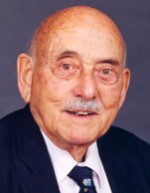
Professor Bernhard Neumann earned a D Phil from Friedrich-Wilhelms Universität in Berlin in 1932. He completed a PhD in mathematics at Cambridge University in 1935. In 1937 he took up a three-year temporary position as assistant lecturer at University College, Cardiff. From 1940 to 1945 he served initially with the Pioneer Corps, then the Royal Artillery and finally the Intelligence Corps. In 1946 he became a lecturer at University College, Hull. Neumann moved to the University of Manchester in 1948 and spent the next 14 years there. In 1954 he received a DSc from Cambridge University. In 1962 Neumann arrived in Australia to take up the appointment of Foundation Chair of the Department of Mathematics within the Institute of Advanced Studies of the Australian National University (ANU). He served as Head of the Department until retiring in 1974. In addition he was a Senior Research Fellow at the CSIRO Division of Mathematics and Statistics from 1975 to 1977 and then Honorary Research Fellow from 1978 until his death in 2002.
Interviewed by Professor Bob Crompton in 1998.
Contents
- Introduction
- Antecedents
- School years in Germany
- A very young Doktor in mathematics
- A doctorate in England
- The genesis of a remarkable partnership
- Wartime – from interned alien to British Army stalwart
- A return to Germany, then together again at last
- Writing about group theory
- Manchester highlights
- Signing on for Australia
- Two Neumanns at ANU
- Family careers
- Fostering mathematical talent
- 'Napoleon, my Father and I'
- Prizes and honours
- A lifelong musician
- Babbage's engine and the papers of Ada Lovelace
- A working retirement
Introduction
Professor Bernhard Neumann has played a dominant role in mathematics in Australia since his arrival in this country in 1962. He came to Australia to take up an appointment as the Foundation Chair of the Department of Mathematics within the Institute of Advanced Studies of the Australian National University. He and his late wife Hanna, also a Fellow of this Academy, who was Professor and Head of the Department of Mathematics in the then School of General Studies, now the Faculties, taught and influenced many young people with mathematical talent, at both the graduate and undergraduate levels, and their influence spread downwards into the schools.
Bernhard Neumann's distinguished contributions to mathematics are many and varied, mostly on the theory of groups. His original work is to be found in over 100 papers, but in addition he is the author of two books and numerous reviews, and he has written essays about a number of famous mathematicians. In his six-volume series, The Selected Works of B H Neumann and Hanna Neumann, are to be found fascinating commentaries of the life work of Hanna and himself, as well as about the many famous mathematicians and colleagues with whom they've been associated.
Professor Neumann's long and distinguished career began in pre-war England, following his early studies to the doctorate level in Germany. By the time he arrived in Australia, his eminence had already been recognised through his election to Fellowship of the Royal Society. In this interview we will follow his career from his early years to the present time, although there will be time to record only some highlights.
He continues his zest for life and his undiminished interest in mathematics and mathematicians. His work sees him attending his two offices daily – one in CSIRO and the other at the ANU. He commutes to them on his bicycle and there are few Canberrans who are not familiar with the sight of a blue-helmeted cyclist steadily pedalling here, there and everywhere, come rain or shine.
Antecedents
Good afternoon, Bernhard. I have been very interested to read about your work and that of your late wife Hanna, and the remarkable partnership between the two of you. I know that you were born in Berlin-Charlottenburg, Germany. Would you like to tell me about your antecedents?
My paternal grandfather, Bernhard Neumann, for whom I was named, was born in 1835, and he married into a steel firm in Karlsruhe, in the south of Germany. My paternal grandmother was born on 19th January, 1840. My maternal grandfather, Hermann Aronstein – from whom I have my middle name, Hermann – had a very large farm called a Rittersgut, in Westphalia. A Ritter is a knight, and knights had big farms whereas ordinary farmers had probably smaller farms. This Rittersgut must have been in the family since the early 19th century but it was later sold. Although I never knew my grandfathers, we went to my paternal grandmother's 80th birthday, in Karlsruhe, and I knew my maternal grandmother very well because she lived in Berlin not very far from us. She died in, I think, 1921.
Both families were Jewish, but my father was not a practising Jew. My mother would go to the synagogue for the high festivals. I'm not a practising Jew, but I'm aware of being Jewish and I've been to Jewish services and so on, wearing a hat or a cap.
My father's eldest brother was, in fact, the grandfather of Mike Newman, who is a very valued colleague, a professor and associate dean in the School of Mathematical Sciences at the Australian National University. My father's sister was killed in an accident in about 1926. The next brother was a medic who was interned during the war in the Camp de Gure in France with his first wife, who died there of natural causes. He married again, eventually migrated to England and lived out his life in Oxford.
My father was the youngest of the four, born on 15th January, 1876. My mother was born on 28th April, 1876, the third daughter of Hermann Aronstein and his wife. My parents married in 1905, in Berlin. My father studied engineering, spent two years in the United States as an engineer and then held a job until the 1930s in Berlin, in the AEG – Allgemeine Elektrizitätsgesellschaft.
My only sibling, my sister, was born in 1906. She studied physics at the University of Berlin, became a physicist and worked eventually in patent law and patent physics in one of the large firms, probably ICI, in the north of England, until she married a Swedish schoolteacher and eventually moved to Sweden. By the time she married she was 45 years old and so there were no offspring. She died of cancer.
School years in Germany
I was born in 1909 and so I lived through the First World War, when Germany was blockaded and food was in very short supply and severely rationed. We each got 20 grams of butter and 50 grams of marg a week, and a bread loaf of 1,000 grams. Some things such as potatoes were not rationed, and all kinds of dry beans were available. Coffee was hardly available. I remember being tremendously hungry during the war and well undernourished afterwards.
When the fighting was over, the Quakers – the Society of Friends – immediately came to Germany to do some good work by nourishing the undernourished children. One was measured for height, weight, age and so on, and my sister and I were, by their standards, undernourished so we both got the Quäkerspeisung – Quaker nourishment – which consisted of rice, milk, cocoa and sugar. This was distributed during school time in one of the 15-minute intervals. We would go with our plate and our mug, and queue up to receive it. It was usually too hot to have very quickly, so we got late to the next lesson. Into the doors of the classrooms little peepholes had been drilled by some of the pupils so that they could judge a good moment for their re-entry, and these were known as Quäkerlöcher – Quaker holes – even when I left school in 1928, when the new generation wouldn't have any idea why they were called that.
Did your schooldays influence you towards mathematics as a career?
I'm sure they did. I remember that when I was seven or eight years old we had just learned adding single-figure numbers and carrying – perhaps several times – when the sum was above 10. I went home, wrote down a long column of single-figure numbers and started adding them. The whole sum was something like 122, so the carrying went beyond 10 and I wasn't sure at all whether this was correct. When I showed it to my mother she gave it one glance and said, 'Yes, that's right,' and I still remember being very disappointed that she had not really checked it. I remember also that a little later in primary school we were doing mental arithmetic and when the teacher said, 'Eight times 108,' I shot up my hand, stood up and said, '864.' It really came so automatically. I was good at arithmetic, at mathematics, all through school life.
My father had two German volumes about differential and integral calculus – the then well-known Stegemann-Kiepert – which he had used as a student. I was fascinated by the beautiful curves depicted in them, so when I was about 12 years old I got hold of the first volume and started reading it, did all the exercises and so learned differential calculus, which at that time wasn't taught at school at all but at university. And when I was about year 10 or so, I invented three-dimensional analytic geometry and showed my teacher what I had done with it, but it was way beyond his training.
A very young Doktor in mathematics
When you began your tertiary education your parents were in Berlin, weren't they?
Yes, but my first two semesters were at Freiburg, in Breisgau. Many students moved every semester or so to a different university. This was entirely possible because all courses were acknowledged by all universities and all students were entered in one book, no matter what university they were in. My Professor at Freiburg was Lothar Heffter. When he approached his hundredth birthday I dedicated a paper to him, sent it to the periodical that is edited in Freiburg, and had a reply by return: the evening before my paper arrived, the editor had heard on the radio that Geheimrat Heffter had died – at 99½! So the paper was dedicated to his memory, and appeared rather later.
You were at Freiburg in 1928-29 and then at the University of Berlin until 1932.
Yes. It was called the Friedrich-Wilhelms-Universität, after the King of Prussia at its foundation in 1810 – now the Humboldt-Universität, and I have a degree from both!
I took my Dr.phil. at Berlin, very early. For a seminar there I had to read a paper by a Danish mathematician. Somebody else had to report on it but I was the second string to his bow. I found that I could do something slightly differently, because he had something with four generators and I could do it with two. I wrote that up and showed it to Heinz Hopf, who was then a Privatdozent in Berlin, and he immediately asked, 'Do you want to take your doctorate with that?' I said, 'No. For one thing, I'm much too young, and for another, it's much too slight,' so he said he would take it to Professor Issai Schur, who was founding editor of the Mathematische Zeitschrift. Professor Schur sent his assistant, Alfred Brauer, to ask if I wanted to take my doctorate with it but I gave the same answer, 'It's too slight and I'm too young.'
It was left at that. I then went on holidays with a cousin of mine to Greece, and on the way back we visited Heinz Hopf, who had got a call to be professor at the ETH – the Eidgenössische Technische Hochschule – in Zürich, going there in 1931. When I came back for the next semester Alfred Brauer came again, saying, 'But Herr Schur wants you to take your doctorate with it.' So I agreed to.
A little later Schur himself told me that perhaps it was a bit thin and suggested that I investigate, using the same methods, what was later called the wreath product of groups. This I did in two weeks and it more than doubled the bulk of the paper, which I submitted as my dissertation. But I did it very, very secretly and didn't let my parents know. My sister was in the know. She had just taken her doctorate, and she lent me money eventually to prepare for my oral examination, which was in November of 1931.
For my Dr.phil. – Doctor of Philosophy – I took mathematics as both my major subjects, with physics as one of my subsidiaries. At that time, the other had to be philosophy, which then included psychology. The Professor of Psychology was Köhler, very well known for his work on apes and on Gestalt psychology, on which he'd written a book in English. By that time I had good reading English, and I read his book. When the time for the examination came, he asked me some questions that I could have answered from the first pages of the book and I was very disappointed that he didn't dig more deeply into it.
My physics examiner was Peter Pringsheim, an experimental physicist. I forget what he examined me on, but that went well. In mathematics my two examiners were Issai Schur and Erhard Schmidt. All the examinations were officially on Thursday, 19th November, but in fact one went to the professors beforehand and agreed on some time before that, so I had my examinations for a Monday, Tuesday and Wednesday. The Wednesday was one of the big holidays – perhaps All Hallows, quite a big holiday in Protestant Germany – and so I'd invited a friend for lunch. But then Professor Schmidt wanted to examine me that morning.
For these examinations I had rented a room in the city and bought – with borrowed money from my sister – a dinner jacket so as to go in finery. I went there, still without my parents' knowledge, and during Erhard Schmidt's exam we both got terribly interested in what we were talking about so that it took about an hour and a half instead of the 40 minutes that were allocated, and by the time I came out my guest would have arrived for lunch. I phoned my mother, who was angry that I wasn't home yet, and surprised her by saying, 'No, but I've just finished my doctorate.' I was the youngest or the second youngest Doktor in Berlin in mathematics.
A doctorate in England
Almost immediately there came a major disruption to your life, when you had to leave Germany for England.
Yes. I left for England in August 1933. I had been waiting for some professor to spot me and appoint me assistant, but I was still quite unspotted and so I had no job. There were not many assistantships available at the time. But then I knew I couldn't get one, being Jewish. If I'd had a job at the time I might have thought, 'Oh, this is so mad it must blow over' and I might have stayed, perhaps for too long. As it was, I got out and at the advice of a friend went to Cambridge, where I became a research student again, under the supervision of Philip Hall. He was a Fellow of King's College, Cambridge, and very well informed about a wide variety of things. At that time I was a member of Fitzwilliam House (now Fitzwilliam College) and Hall's 'supervision' took the form that I would go in to dine once a week and then go to his rooms in King's College, where we would drink his sherry, smoke his cigarettes and talk about rhizomorphs of plants and political history in Germany and everything. And about 10 o'clock we would drift towards talking mathematics.
Hardy, who was a very prominent mathematician, advised you against doing a second PhD, didn't he?
He advised the émigré mathematicians, who all came with doctorates from Germany, against taking another doctorate, saying, 'If you do good work, that's all that's needed.' Of the many of us who were at Cambridge at that time, only Hans Heilbronn took his advice, producing a very good piece of number theory, on the strength of which he was elected a Fellow of Trinity College and later became Professor in Bristol and then in Toronto. During the war I got into the Intelligence Corps and we became friends and played bridge. I was an absolute rabbit at bridge and he was excellent. But he was exceptional, in that when we had played as partners he would say, 'It might have been better to have played the king of clubs at that time,' instead of shooting me, as other bridge players would have done!
A normal PhD in Cambridge took three years, I believe, but because of your German doctorate you were allowed to enrol for two years. I understand that you yourself weren't too happy with the progress you'd made at the end of the first year.
Not at all. I had tried something that really was much too difficult and was successfully tackled only 20 or 30 years later – and not by me. At Christmas 1934 I realised I wasn't getting anywhere so I went back to look again at something I'd done in Berlin. Within a few days I knew I'd struck oil, and it just went on and on. I got more and more results, and by May I had to stop myself because I had to write it up. So I typed it on my little portable typewriter, with as many carbon copies as might just be legible. If I made a mistake, which was quite frequent, I had to rub it out on all the carbon copies, and all the mathematical symbols I had to fill in by hand. So it took quite a time to write this thesis, which was about 180 quarto pages long.
I submitted it, and the oral examination was arranged over lunch in Philip Hall's rooms. The examiners were Philip Hall himself and M H A Newman, and I was their first PhD student. I was asked two questions. One was whether I preferred beer or wine for lunch, and I answered, 'Wine.' Afterwards I was asked would I take my coffee black or white. I said, 'Black.' These two questions clearly satisfied the examiners, and I passed.
You have written that Hardy commented on the 'German' style of some of your first papers. What exception did he take?
Hardy ran the Hardy-Littlewood Conversation Class in Littlewood's rooms in Trinity College. He usually had visiting speakers but once he himself talked on how not to write mathematical papers. He gave two examples, one a 'German' style and one a 'Japanese' style, and as a paradigm of the German style he used the first sentence of my first paper in English, which had just appeared in the Journal of the London Mathematical Society. I think he objected to the word order, saying that I put something in front which should have come later in the sentence.
What happened after you completed your PhD in 1935?
I stayed on in Cambridge and applied for every mathematical job that was going – at an agricultural college, at the University of Malta, even a tutorship for the children of a very rich and influential Indian steelmaking family.
But you did some lecturing in Cambridge during those two years.
The second year I was there, I was asked to give a preparatory course for one that Olga Taussky was giving in algebraic number theory. I was paid £10 and there was a student evaluation of lecturers at the end. When I got my secret envelope and opened it, it just said, 'No comment.' The year after, I was offered the same course for £50. If I'd continued like that I would be rich by now. But instead I had been short-listed for a temporary assistant lectureship at University College, Cardiff, where I then spent three years as temporary assistant lecturer in mathematics. I had a fairly heavy lecturing load but it taught me a lot. The professor advised me to teach a course in applied mathematics, because it would be good for me – and it was.
The genesis of a remarkable partnership
It was in England that you married Hanna, with whom you formed your mathematical partnership also. Hanna became ultimately a Fellow of this Academy, and volume 1 of the two-volume Selected Works of B H Neumann and Hanna Neumann has a splendid picture of her, which is exactly as I remember her.
Yes, it's a beautiful picture. It has been reproduced a number of times.
You met Hanna not long before you left Germany, I believe. How did that happen?
I met her in January 1933, at the cafeteria. A mutual friend introduced us. At the time I didn't take much notice, because her name, von Caemmerer, was junior gentry and suggested somebody very conservative. Later I met her in the Mapha, the Mathematisch-Physikalische Arbeitsgemeinschaft, which was a mathematical-physical working group within the university – a wonderful thing which had its own rooms and its own library. When we talked I found that although she was not Jewish at all, she was very much anti-Hitler – as I was, naturally. We talked quite a bit.
Then, at Easter, I invited her for a walk in a suburban forest near Berlin, and she came on a long walk. Later she explained that it was really that she wanted to escape from her mother! But then we played ping-pong at the university and suddenly, by a mistake that was not a mistake, she called me Du – the more familiar address – instead of Sie. So we became very fast friends. Well, I fell in love with her.
We went for a bicycle outing, but on a steep downhill her brakes failed and she fell. I think she tore her frock and was bleeding and so on, but she reminded me later that the first thing I did was look after her bicycle and get the front wheel into shape again – and then I asked her how she was. I had told my mother I would introduce this girlfriend to her, and when we arrived at our home my mother immediately took to her. That remained so. My parents very much liked her.
In England I remained in touch with Hanna but very, very secretly. We could not openly correspond as that would have been dangerous, but we had been engaged since 1934 and had once met in Denmark in 1936. Hanna came there ostensibly to visit some friends, I came back from the International Congress of Mathematicians in Oslo, and we spent some time there. But apart from that we had corresponded very secretly. In my weekly letter to my parents I included one sheet which started with an exclamation mark and ended without a signature, and my parents would send it on to Hanna. And Hanna corresponded the same way with me, through a former geography teacher of hers – a very good friend and very reliable.
Hanna had in 1936 been warned that the senior professor of mathematics in Berlin would examine her for the examination that teachers took, the Staatsexamen. He would examine her in political reliability, Gesinnung, and fail her because he suspected she was friendly with Jews. So during the holidays the main assistant there, Rohrbach, arranged that she was examined by somebody else. She passed the Staatsexamen very well but she knew she couldn't proceed to a doctorate in Berlin. So when Rohrbach went to Göttingen as assistant to Helmut Hasse, she got a small assistantship there to try to take her Dr.phil. in Göttingen with Hasse.
In 1938 Hanna decided that war was not unlikely, and if we wanted to get married it was time to get out. She came to England then and we got married, but because of my parents still being in Germany we did not move together yet. She lived in Bristol and I in Cardiff until my parents came out, in February 1939. The four of us moved together into a little house in a suburb of Cardiff – becoming the five of us when our eldest, Irene, was born in August of that year, just before the beginning of the war.
Wartime – from interned alien to British Army stalwart
When the war began, were you still in Cardiff?
Yes. I served my third year there, until the examination period about early June 1940. The British had learned from their experience in the First World War that there were Germans and Germans. They instituted small tribunals that interviewed all 'enemy' aliens and classified them A, B or C. A were the friends of the German régime, or at least not enemies of it, such as sailors who happened to be in a British port at the time, and they were interned for the duration. C were those who were clearly enemies of Hitler and they were treated as essentially friendly aliens – had the same restrictions as other aliens but nothing worse. The rest were B. We were all very clearly C and so could continue. I had thought of joining the Army but as a lecturer I was in a reserved occupation, and also my age group had not been called up yet.
Then in May 1940 the German forces overran the Netherlands and Belgium, and suddenly there was talk of a Fifth Column and the yellow press in Britain screamed, 'Intern the lot!' Eventually the government interned all B class adults and then C class aliens between 16 and 60. So I was interned, only a few days after we'd moved to Oxford from Cardiff, which was an aliens-protected area, being so near the water. After a few days at the Oxford police station I was sent to Southampton, probably to be shipped overseas, but just then a ship with some internees and, especially, some wounded Canadian soldiers, was dispatched to Canada but was almost immediately sunk by a torpedo. Quite some Canadian lives were lost, but apparently none of the internees. There were questions and lies in parliament about this.
Well, they decided they wouldn't send another ship from Southampton and transferred us to Lancashire, to a disused cotton mill with barbed wire around us. There were very interesting people there, including many academics and the Jesuit Fathers from a college near Windsor – one of whom, in hot discussion, fell into Latin. It was wonderful. Eventually we were transferred to the racecourse at York, where I joined a Privatdozent in classical studies in reading Latin, probably Virgil.
In about September-October many of the internees were released to the firms and universities who had asked for them back. Although University College, Cardiff, had asked me to serve a fourth year, I had been temporary because their top student had been sent to Cambridge to get a PhD but she needed a fourth year for it. When they didn't ask for me back, I thought, 'Well, I can't be so important as a lecturer.' I volunteered for the Army, joined in October 1940, and was trained in Yorkshire and then transferred to the south of England. Most of the time I was within reach of Oxford and I got my usual privilege leave and weekend leave, and even a special leave when my son Peter in Oxford was born at the end of December 1940.
After a while I joined the Auxiliary Military Pioneer Corps, the AMPC. Very soon it became just the PC, the Pioneer Corps – I believe after the war it became the Royal Pioneer Corps, but by that time I was long out of it. I was in the Pioneer Corps until 1943, when they decided they could trust some of us and allowed those who were fit mentally and physically to volunteer for combatant service. I was one of many who volunteered. Ralph Elliott, who was in my company in the Pioneer Corps, volunteered and eventually became a lieutenant in the infantry. I was sent to the Royal Artillery. I had to hand in my two stripes I had as a corporal in the Pioneer Corps but was given a 'local bombardier' stripe to keep me out of potato-bashing!
But then my Officer Commanding wanted me to go in for a commission. He sent me to a War Office Selection Board; they didn't select me. (I was a bit sore at the time but a few weeks later I was very glad, because all the potential officers they had selected were returned to unit because artillery officers were not being lost as fast as had been reckoned.) And so my Officer Commanding said, 'Oh, you are wasted here in anti-tanks.' It was very interesting. I learned to fire an anti-tank gun at a pretend tank. But he said I should do something more mathematical, and transferred me to Artillery Survey, where we used theodolites and did a bit of numerical work, but it was again outdoors. All my Army service during those years was outdoors.
It probably wasn't taxing your mathematical ability to its full, was it?
No, indeed not, but I did write a couple of papers while I was in the Army. Anyway, I was stationed not very far from Oxford, so I could cycle there for my weekend leaves and my privilege leave – and some French leave too, over the weekend – of course with the bicycle lamp blacked out. One hardly saw where one was going.
All this time, Hanna was beginning her DPhil, wasn't she?
Yes. In 1940 she had decided that with only two children to look after in Oxford she wanted to proceed to a DPhil, so she enrolled in the Society of Home Students – now St Anne's College – as a research student. She had to go in from time to time to see her supervisor, and she acquired a sidecar for her bicycle and became known all over Oxford as the lady with the two babies in a sidecar. She was supervised by Olga Taussky, who by then had married John Todd and was Olga Taussky-Todd, and had been evacuated with Westfield College to Oxford. She always told Hanna, 'Write it down so that I can read it,' but she found Hanna a tremendously unsatisfactory research student because Hanna never wrote it down until she'd finished her thesis – very, very long, very complicated, very outstanding. Olga Taussky then could read it.
Hanna finished that in late 1942 or early '43, and some time in '43 she was allowed to return to Cardiff – people were then much more relaxed about such things – to a little house we'd rented there, and from there she went to Oxford for her oral examination. I was by then in the Intelligence Corps and stationed not very far away, so I hitchhiked to Oxford and attended the lunch after her oral examination. By that time she was pregnant with our number three, Barbara, whom again she had in hospital, in Cardiff. There had been some haemorrhage during the pregnancy, so it was safer.
A return to Germany, then together again at last
When the European war was over, didn't you go across with the Forces into Europe?
Yes. We had to send a unit of the Intelligence Corps to Germany and I volunteered for it because I hoped to make contact with Hanna's family. Having missed out on the long weekend leave for VJ Day, I got a long weekend leave in Germany and hitchhiked to Lübeck, where I knew Hanna's elder sister was. I found her address through the Einwohnermeldeamt, the official registry of German residents. When I asked for her, 'Oh no, she's still at work. But go up to her room on the third floor and wait for her.' When she arrived she was told, 'There's a British Spiess' – sergeant-major – 'waiting for you in your room,' but she came up very courageously.
We had seen each other briefly in 1934, after Hanna and I had got engaged, but not since then so we naturally had a lot to talk about. First thing, she organised a bicycle for me so that next morning we could cycle the 10 or 15 kilometres to the village where my mother-in-law lived. I had taken the precaution of borrowing an American kitbag – bigger than a British kitbag – and filling it with all sorts of food tins from the NAAFI for my mother-in-law. Although she had not been very happy about my marrying her youngest child, Hanna, she was then consoled because I'd already produced three grandchildren for her and a fourth one was on the way. The NAAFI tins were an additional pleasure, and very useful when there was nothing like it available in Germany.
I was demobilised later that year and came back to England. Cardiff had wanted me back but I didn't want to go there because they hadn't helped me out of internment. But I had applied for a lectureship at Hull. I hadn't got it because I couldn't come for an interview (being still in Germany) but then they advertised a temporary lectureship which I applied for and got. It was temporary because Bronowski, who had been an assistant lecturer, had joined the Royal Air Force and was not expected back until the middle of the year. So for two terms I was a stand-in for Bronowski. Then they created another, more permanent lectureship and I got that.
Bronowski wrote to the professor, 'I'll come back if you give me a senior lectureship or a readership, not otherwise.' The professor said no, so Bronowski decided not to come back. Hanna applied for his lectureship and got it. I had been in Hull on my own, in digs, but in September Hanna moved to Hull too, with the nine-month-old baby and the other three children. That was a great moment. There we were at last together, in the same department, and we did things together. Hanna stayed for 12 years, but in 1948 I was enticed to Manchester by M H A Newman.
So the domestic bliss didn't last long, did it?
Well, the academic year was a little less than half a year and so I was home in all the vacations and for most of the weekends.
What is the distance between Hull and Manchester?
Just about 100 miles, 160 kilometres. And once a year I would cycle across the Pennines from Manchester to Hull, taking between 11 and 13 hours, depending on the prevailing wind. In Yorkshire it was very flat – and very windy. But I wouldn't cycle back, because spinning out the time to my arrival at home was all right but spinning out the time going back to Manchester was not. I put the bicycle on the train. At that time there were very good trains between Hull and Manchester and Liverpool.
Writing about group theory
This may be an appropriate time to say something about your research interests – perhaps in lay terms.
The theory of groups is the theory of some very fundamental algebraic structures. It had been started really at the beginning of the 19th century and had blossomed very much around the turn of the century and early in the 20th century, but mainly as the theory of finite groups and of continuous groups. Abstract, infinite groups only started up in the 1910s to '20s. When I started looking at them, Issai Schur asked me, 'Well, if you know the generators and relations of a group, what do you know about it?' It was a very shrewd question, because in fact one knows very little about it. That eventually became Hanna's field also and she wrote a book for the Springer-Verlag called Varieties of Groups. I had started on that subject in my Cambridge PhD thesis and eventually wrote my Adams Prize essay at Cambridge on it. That was our main field of endeavour.
I had also done some other things. During one boring talk in the Hardy-Littlewood Conversation Class I thought of a geometrical problem which I then pursued, and it gave rise to one of my geometrical papers. Also, early in the war I wrote a geometrical paper which drew a reply from H F Baker, the grand old man of geometry in Cambridge, showing how one of the things I had done could be done in two pages using his approach. Well, naturally I had to referee the paper for the Journal of the London Mathematical Society, so in a paper which followed his in the Journal I immediately showed how I could do it in less than a page.
You have just mentioned the very prestigious Adams essay prize of the University of Cambridge. What were the boundary conditions for the award of the prize?
The prize is awarded every two years. In the years when I worked for it the subject was group theory, in the hope – unfulfilled – of getting Philip Hall to write the book that was in him. My essay, which was a lengthy one, gave the then state of affairs in what later was called varieties of groups, on which Hanna wrote her text. Winning the prize was a great thing, and the £300 prize money was put to very good use. All the children got £20 each, Hanna got the price of a new formal frock, and I used the rest for my full-dress gown at Manchester, the Encyclopaedia Britannica and field-glasses. I sent the essay to the Acta Mathematica for publication but they sent it back by return, saying they were full up. They hadn't even sent it to a referee. So I sent it to the Royal Society, and it appeared in the Proceedings. And it's still being used.
Manchester highlights
You were 14 years in all at the University of Manchester, rising to the prestigious rank of Reader. What were the highlights of those times?
I will mention the fate of my Adams essay. I corresponded with Kurosch, a mathematician in Moscow. Hearing of my essay he wrote that he wanted a copy of it for his book on theory of groups, published in 1944. He sent me a copy of the first edition, possibly still the only copy in the Western world. When this became known, the Germans wanted a translation of both the book and my essay, which appeared as an appendix in the German edition of Kurosch.
Then a Hungarian colleague said he wanted the book and also my essay (for an appendix) translated into Hungarian. He couldn't get hold of a copy so he asked me to send him my copy, which he would photocopy and send back. So I sent it to him, insured for about £120! It did come back and I still have it. So my essay became the appendix also to the Hungarian translation, which I think eventually was made from the second edition of Kurosch's book. That already contained many of the results of the essay, which answered many of the questions that the first edition had asked.
Towards the end of your time in Manchester, Hanna did secure a job, didn't she?
She did, at the Manchester College of Science and Technology. It is now the University of Manchester Institute of Science and Technology, but at the time it was a half-independent part of the university, independently financed by the University Grants Committee. The College had its own department of mathematics and the professor wanted to start an honours course in mathematics, but he was in applied mathematics and needed somebody fairly senior in pure mathematics. So he advertised and Hanna applied. It took a long time because they had to get people together both from the College and from the main part of the University, but Hanna was appointed. This was quite late, after the International Congress of Mathematicians in Edinburgh – where all our family had gone on bicycles. So we had to hurry up to get a house in Manchester and sell our house in Hull.
This was a wonderful experience. I'd travelled up to Manchester, where Mike Newman had a car. He had driven me around several houses for sale there, and I'd chosen one. So I told my bank manager in Hull, 'We pay so-and-so much for the house. Can you lend us that?' He said, 'We'll send our valuer and see what he puts on it. We don't give you 100 per cent.' But next time I went he said, 'We'll give you so-and-so much' – £500 less than we had to pay – 'but we'll also give you another £1,000 because you'll need removal expenses and so on, and we'll take your house here in Hull as security.' I still have that account in Hull.
So I told Walter Ledermann, who wanted to borrow some money for a house he was buying on the outskirts of Manchester, 'Oh, bank managers are not the ogres they are said to be. They're wonderful.' He went to his bank manager, who was an ogre. Later I formed a theory why my Hull bank manager was so forthcoming. His son had taken a PhD in physics at Manchester, and father had come to the degree ceremony. There I had been in my scarlet gown, and he must have thought, 'Somebody with a scarlet gown like that is worth the credit'!
We moved to Manchester in '58. Hanna and, I think, Peter went by train after seeing off the furniture removal vans but Barbara, Walter and Daniel, the three youngest children, and I went by bike – across the Pennines. We took two days of it, and found a lot of lovely berries during our move to Manchester.
Signing on for Australia
By 1960, I understand, people were fishing for you to come to Australia. Who was doing the fishing and what was the background?
I'd visited Australia in 1959 for three months, which was an eye-opener. I visited all the universities, including the Australian National University in Canberra for a weekend. At about that time, without my knowledge, Pat Moran had called together the senior professors of mathematics in Australia to discuss the possibility of creating a mathematics department in the Australian National University, in what was to be the Institute of Advanced Studies. They had all been for it except T G Room, from Sydney, who said it would drain off all the junior talent from the State universities. But the university went ahead.
In about May 1960, Joe Moyal – who recently got an honorary degree from the Australian National University and who knew me from Manchester – wrote to me from Pat Moran's department in the Australian National University to say that they were creating a department of mathematics there. Was I interested?
I discussed it with Hanna and the children, but my parents lived in London and said, 'We are too old to move,' and Irene, who was nearly 21, was a student at Manchester and was clearly not going to move. I'm not sure that she was engaged already, but anyway she was clearly wedded to Britain. Peter had just gone to Queen's College, Oxford, and also would probably not move. Barbara was still finishing school and would go to university somewhere, but it was not clear if it would be in Australia. Walter had already said he wanted to go to university in Australia, without knowing that we were moving there. Daniel was so young, still at primary school, that he would certainly come to Australia. So it would clearly have disrupted the family and we decided 'no'. I wrote back to Joe Moyal, 'No, thank you,' but being very much attracted I wrote in the politest possible terms.
Next thing I had a letter from Mark Oliphant, who was the Director of the Research School of Physical Sciences in the Australian National University. He was 'much encouraged' by my reply. When could we talk it over? He came to London for the Tercentenary of the Royal Society , to which I'd been elected in '59, and we talked about it there, over lunch – he and his wife and Hanna and I. Later he reminded me that I'd said, 'Well, we are a housekeeper-gardener couple. You can have both of us or neither of us. And I don't want to be in a position to appoint Hanna to my department. You have to take up her credentials independently and make her an independent offer. Then we'll consider it.' They offered her a Professorial Fellowship, so in about October we signed on the dotted line. I had meanwhile talked to Pat Moran, who was on leave in Oxford and came to London. Well, we took it.
Just for the record: at that time the new Department of Mathematics was going to be within the Research School of Physical Sciences, which is where Mark's interest and part in the story comes in. And Pat Moran's Department was Statistics.
Yes, in the Research School of Social Sciences.
Two Neumanns at ANU
You took up the Foundation Chair at the Institute of Advanced Studies and held the position until your retirement at the end of 1974, a long stint. What were the highlights of that period? Certainly you built up a very successful department.
Well, Sputnik had gone up in 1957, shocking the whole Western world into giving science a lot of support, including financial support. Menzies had asked Murray, the Chairman of the University Grants Community in Britain, to report on the Australian universities. The burden of the Murray report – which was very good and very influential – was, 'If you want good universities, you have to put money into them.' That is just what Menzies wanted to hear, and he did. There was plenty of money about, but only a few mathematicians. Mathematicians were not easy to come by. So I did my recruiting. I leant over backwards not to encourage people from State universities to come here because, being aware of T G Room's reservations, I did not want to draw away the State talent. If they applied, they had to be judged with the others, but I did most of my active recruiting overseas. I had lots of members of my department from overseas, as well as research students.
Two early ones were from India, Narain and Kanta Gupta. Narain has written an introduction to the six-volume Selected Works in which he recalls how I recruited him as a research student and Kanta, his wife, came with him. He took his PhD with me. She took first a Master's degree in Hanna's department and then her PhD in my department but with Hanna and, I think, Mike Newman as her supervisors. Narain and Kanta went on to become Fellows of the Royal Society of Canada – very senior and successful mathematicians.
Group theorists?
Both. Very much so, yes.
I wonder why! Having come out as a Professorial Fellow to your department, Hanna was soon appointed head of the Department of Pure Mathematics in the School of General Studies. ways had a very good relationship, naturally, with the Department of Pure Mathematics, where Hanna was, but also with the Department of Applied Mathematics, where Archie Brown had been professor since before the Canberra University College was amalgamated with the Australian National University and became the School of General Studies. Whenever we had an application I would send it round to everybody who was senior to what the applicant was applying for, and that always included Archie Brown, who gave me wonderfully shrewd, good advice. So those parallel departments in the two branches of the ANU worked very well together.
Eventually the amalgamation became so close that after you had retired the School of Mathematical Sciences was formed, wasn't it?
That's right, yes. It was none of my doing but I very much approve of it because it brought us together – in the one building, in fact – and also the statisticians in the Institute. The statisticians in the Faculties are next door to us but not really part of us, officially having very close links with Economics. But we have an economic mathematician in the School of Mathematical Sciences. The people in Pat Moran's department came over to the School of Mathematical Sciences but not Barrie Ninham's applied mathematicians, because they are essentially applied chemists. The amalgamation did make quite some difference. Although we'd always worked very well together, it was very good to be together. We were first in the Hanna Neumann Building but that became too small for us so we moved over to the John Dedman Building, which is now the John Dedman Mathematical Sciences Building.
Family careers
All five of your children had very distinguished careers, taking higher degrees in tertiary education of one kind and another. Would you like to tell us about them? Perhaps you could start with your eldest child, Irene. You have told me about an incident when she was about 12 which told you in no uncertain terms that she, at any rate, wasn't going to follow her parents and become a mathematician.
In 1951 we travelled to Oberwolfach [a famous mathematical research institute], stopping off in Mainz where Erhard Schmidt and I each gave a talk. Afterwards there was a party for the mathematicians, and Irene and Peter sat next to Hans Rohrbach, who had fluent English and asked Irene did she like mathematics. She said, 'I hate mathematics!' Very definite, and in the hearing of all the mathematicians.
We tried to persuade her secondary school headmaster to let her drop mathematics. If he hadn't known that we were both lecturers in mathematics he would have exploded, because he was himself a mathematics teacher, but he had to be polite and so he said, 'Oh no, there are timetable difficulties.' She failed her O level mathematics but she had been coached a bit by Hanna and said, 'Well, if that is mathematics, it might be interesting.' And on her second attempt, coached by Hanna, she passed it at O level.
Irene took a Master of Arts in English literature and lived for many years in Aberdeen with her first husband, an Indian who had been brought up in Nairobi and then studied at Manchester, in England. He became a Fellow of the Royal College of Surgeons and, I think, of the Royal Edinburgh College of Surgeons. When the marriage broke up he took the three youngest children with him to Nairobi, but that was no longer a comfortable place for Asians so he accepted an appointment in Canberra as resident surgeon, and moved here with those three children. The two eldest remained with Irene in Aberdeen, where she taught high school.
Irene later married an American Jew, an Associate Professor of History at New Mexico State University, in Las Cruces, New Mexico, and eventually became a lecturer at that university. Not having a doctorate, for some time she couldn't get a tenured job there.
And Peter is a mathematician. He went with you to New York, didn't he, when you had a study leave there between leaving Manchester and coming to Australia.
In 1961-62 Hanna and I took up visiting positions at the Courant Institute of Mathematical Sciences, New York University. Peter had already got engaged to Sylvia Bull, a fellow student in Oxford, and wanted to invite her to New York for the Christmas holidays, so he applied for and got an immigrant visa, took a junior academic job at a different institution, and brought her out. They then decided to get married in 1962, in Oxford, by which time we were back in England. I warned Peter, 'To marry as an undergraduate is doing the Bachelor's degree with one hand tied behind your back. All your fellow students will come for a cup of coffee and to cry on your shoulder. Getting married as a research student is fine, even a help, but not as an undergraduate.' Sylvia took a first class honours degree at Oxford, so if he hadn't taken a first class honours degree he would have felt terribly bad. But he neglected my advice. They got married in 1962 and next year he took a first class honours degree. Honour was saved, and he's now a very senior Fellow at Queen's College.
What about Barbara?
Barbara came out to Australia about a month after I had come out in '62, when she'd finished school, and taught for a while at the girls grammar school in Canberra until she went back for the academic year to the University of Sussex. There she took her Bachelor's degree – I went to the degree ceremony, actually – and met her future husband, who took a Master's degree in chemistry. They are both quite senior teachers, in Slough, he in science at the local grammar school and she in mainly mathematics but some statistics also, at a private Catholic school. They have two sons, now both married, and a daughter who is a student in Cheltenham, I think.
And your fourth child?
Walter had taken the College Entrance Examination Board examination in Liverpool before we went to New York. He did exceptionally well and New York University accepted him, so he became a university student in mathematics before he was 16. He was on the Dean's list for both semesters. (My theory was he wasn't interested in girls yet.) He wanted then to become a student in Australia but first he went for a semester to the University of Freiburg – where Hanna's brother was – and he learned some more mathematics and skiing and drinking beer and quite some German.
Then he came to the University of Adelaide, which gave him credit in mathematics and I think also in physics but not German, as he hadn't got enough of the reading knowledge or the literature, so he did one year in German. He did all this in the Faculty of Arts so he got a BA rather than a BSc. He did extremely well and got a very valuable scholarship, but only for study outside Australia.
In '65, when Walter had just taken his Bachelor's degree and was still doing his Master's thesis by dissertation, in Adelaide, we ran an international conference on group theory here in Canberra and he and Peter came to it. Peter, who is in group theory, told his young brother – who had by then done his Master's work in group theory – 'There are too many Neumanns in group theory. You are still young enough to learn something else.' So Walter went to Bonn, in Germany, and did algebraic topology there with Hirzebruch, the senior professor. By the time he took his doctorate, Hirzebruch wanted to keep him there. But Walter wanted to go to America, first to California and then to Princeton, where he met his future wife.
With the help of my travel agent I was able to attend Walter's and Ann's wedding in Princeton and then go with them from John F Kennedy to London, travel in England, make a side trip to Eastern Europe for a conference, and even return via Nairobi, where I had friends, as well as visiting members of the family in Johannesburg and giving a talk at the Witwatersrand University. And all this was done on one round-the-world ticket with only one stay other than the nominal destination, London!
Walter became a full professor at the University of Maryland at an incredibly young age. His wife, Anne, had degrees in mathematics and mathematical education, and later took a PhD in English literature but couldn't get a suitable academic job in that. In 1984 Walter for the first time revisited Australia, with Anne, and oh, it was a homecoming for him. He loved it. He and Anne wanted their daughter to grow up in Australia, so he accepted a job in Melbourne at the university, where he is now a professor (in mathematics, of course) and he has, with his topology, drifted back to group theory. It's somewhere on the interface. He is very highly regarded and I hope that before many years have passed he will be a Fellow of this Academy.
Now there's Daniel.
The youngest, Daniel, came with us to New York, went to primary school there, and then came back to school in Sale near Manchester, where we lived. When I left in '62 to take up my appointment here, Hanna stayed for another academic year because Barbara was still at school and Hanna had two research students she wanted to look after. So she came with Daniel only in '63, arriving in Perth, where the mathematicians threw a party for her. Daniel was then 12 years old.
He went straight to Telopea Park High School and then to Monash University, where he took his Bachelor's degree in pure mathematics and classical Greek. He wanted to become a schoolteacher but eventually decided to concentrate on his music. He had been taught violin and viola by a very fine teacher who was for many years the leader of the Canberra Symphony Orchestra, and she then employed him as an understudy. He prepared young pupils for her, in violin, for quite a while.
Daniel's wife, Liz, is very much a daughter in the family. She is the youngest sister of Jim Wiegold, who took his PhD with me in Manchester, as did Jim's wife. Liz came out with the Wiegolds when they visited Hanna's department for two years, and stayed on as an ANU history student. Daniel is a viola player in the State Orchestra of Victoria, formerly the Elizabethan Melbourne Orchestra. Liz took library qualifications in Canberra and has become a senior librarian at the University of Melbourne. Their elder daughter is just entering her third year in psychology at the University of Melbourne and the younger is entering her first year in music at that university. Meanwhile Daniel has taken qualifications in psychology, up to the Master of Letters, MLitt, externally at the University of New England – essentially to become a psychoanalyst, I think. I'm not sure that that plan is still alive, but at least his elder daughter has inherited the interest in psychology.
Fostering mathematical talent
You and Hanna had a wonderful reputation not only for fostering mathematical talent at all levels but for your personal hospitality to your students and staff and also a concern for their families. Your policy of open house went right back to the earliest days of your marriage, didn't it?
Yes. In Hull we had an At Home on Saturday afternoon, where every student was welcome to come for refreshments. Hull was very small when I got there, with about 260 students – now it's a big university – and we knew all the students who took some mathematics, not just the honours students. They would come and we would talk about all sorts of things – football, and sometimes even mathematics. Hanna carried on this open house when I was already in Manchester, and eventually she found more and more that she was the only one who smoked. So in 1954 she gave up smoking, the first female I ever knew who successfully did so.
I believe you were in Hull when you had your Egyptian student Kamal Yacoub. I gather that he needed to be brought up to speed and you spent a lot of time with him over several weeks, during which he and Daniel – then quite a young child – became quite close.
Yes, that's right. Shall I tell you the whole story of Yacoub? A friend of mine in London wrote to me saying this Egyptian student had come to study with him for a doctorate, so he had said, 'Well, start reading the van der Waerden,' the wonderful book on modern algebra. The student had gone away and started reading the book, but never come back to him to ask questions and eventually had a nervous breakdown. The Egyptian government immediately hauled him back to Cairo, but then he wrote to this friend of mine asking for a research problem, probably specifying the theory of groups. My friend wrote to Philip Hall asking for a problem but Philip Hall answered, 'If he's read my papers and not come up with a problem, I can't help him.'
So he wrote to me. Did I have a problem for this Egyptian student? 'Well, here's a little problem that I had worked on before the war. I have a few answers but still it might be suitable for the student.' So he sent it to his student but I'm afraid he gave away from whom it came, so the student wrote to me, and from then on we had an enormous correspondence. He sent me sheaves of paper with calculations that were largely not very good, but eventually he went in for the Master's degree in London. For this he had to do some papers which were sent to the examiners with only a number to identify them. I got two of them and I knew both the handwritings. One was John Britton, who was one of our star pupils in Hull and then in Manchester; the other one was Yacoub. They both passed their Master's degree.
Then Yacoub wanted to go on to a PhD, and wrote pages and pages. Eventually he said, 'I can't go on like this. I must now submit,' even though I warned him that wouldn't be any good. He was called to London for an oral examination by my friend and me, and we decided the oral was all right but he would have to do a lot of work on the dissertation. He said, 'I can't go back to Egypt without my doctorate,' so I said, 'Well, come to Hull. We'll work together' – this was in the long vacation. He took a room in Hull and came seven days a week for something like seven weeks.
Every morning at about 9 o'clock we went up to the study and worked together, and about 10 o'clock Hanna would prepare coffee and would send Daniel up. He was about three at the time. He would come up and say, 'Father, 'Coub, coffee,' and we would go down and have a coffee, and then go on working. Well, because Yacoub took a fancy to his 'Danny', he always brought him some chocolate. Daniel was a quick learner, so after a while he would come up 10 minutes after we'd started: 'Father, 'Coub, coffee.' Unfortunately for him, we had watches.
In Australia you have continued to play a very influential part in promoting mathematics. You were involved in the Mathematics Competitions and you were very much concerned with establishing the Mathematical Olympiads in Australia, initially under the wing of the Academy. What part did you play in both of those?
The Australian Mathematics Competition is by far the largest in relation to population, with close to half a million Australian participants and about 540,000 in all. It's at school level, from year 7 to year 12, and is excellently done. I still admire Peter O'Halloran greatly for getting it going. All I did was encourage him.
What about the Olympiads?
I came to that through the ICMI , the International Commission on Mathematical Instruction, which is a subcommission of the International Mathematical Union. I was for a while on the governing committee, and at one time the Finnish delegation proposed that the International Mathematical Olympiads should have a site committee to determine where the next one was going to be, instead of a decision from year to year by just the people who ran any one of the Olympiads. I drew up some rules for it and so on, and I was made chairman of that committee.
At the next Mathematical Olympiad, in Budapest, I managed to sell the idea. That committee does some very good work, because the run-up time to these Olympiads is more than one year and they have to know several years in advance where it's going to be. I also wanted Australia to participate, and so the Australian Mathematics Olympiad and the Australian participation in the International Mathematical Olympiad were started. At the same time – this was about 1980 – I pleaded for the 1988 International Olympiad to be held in Australia, because it was then the Bicentenary.
Australians have done tremendously well in the Competition, especially in the last one, where we had only six participants and we got six medals – two Gold, two Silver and two Bronze, I think. That was outstanding, the best performance. China came tops and then probably Bulgaria or Romania or Hungary or the USA, but we beat all European countries. And the youngest Gold Medallist was an Australian.
'Napoleon, my Father and I'
When you arrived in Australia, weren't you already a Fellow of the Royal Society?
Yes. I had been elected in 1959, on a Thursday, and left on the Sunday afterwards for my first visit to Australia.
It wasn't long before you were elected to this Academy, in 1964, and Hanna was elected in 1970. You served on Council and were Vice-President between 1969 and 1971, and in 1984 you were invited to give the Matthew Flinders Lecture. I have often wondered how you selected a subject and a title in such a theoretical subject as yours for presentation to a general audience of scientists, many of whom would scarcely know what a group was.
I had for years had a number of talks for general audiences. Two of them were geometrical – very elementary, all two-dimensional geometry – and those I developed and gave again and again. And one on women in mathematics I have also given quite a number of times. I chose one of the geometrical ones but I had an audience response of nil. The Academy never published it; it was published later elsewhere. But the other one I gave often, under the title 'Napoleon, My Father and I'.
What was the theme there?
It comes from triangle geometry. If you take an arbitrary triangle – all in the plane – and erect equilateral triangles on the three sides, then take their centres and join them, you get another equilateral triangle, whatever you started with. This theorem my father had discovered when he was working on some transformer for three-phase electrical current, which had been invented in the '70s by Tesla and had developed into the natural way of transmitting electrical power. If you look at the high-tension power lines anywhere, you find they come in multiples of three except for the thin earth-wires on top, which shouldn't carry anything.
My father had published this theorem in two mathematical articles in an engineering journal before the war. At that time one still got an honorarium for publishing an article. In fact, he got an honorarium for each, and from that he had built for him a music cupboard and a music stand, both of which I still have. I knew about this theorem of his but didn't do anything about it until he wrote a book on polyphase electric currents. He had found a book by a Scottish author – in English – and asked the Springer-Verlag whether they wanted a translation of it, because it seemed interesting to engineers. They said, 'No, we want an original book. Will you write it?' So he wrote it. But this was already in the 1930s so they said, 'Sorry, we can't publish a book from a Jew. But you can have it. Do with the manuscript as you like.'
So he brought the manuscript with him to Wales when he and my mother came, translated it into English and offered it to a publisher. It was published late in '39, in English. I read the proofs of it, just to help him, and that reminded me of this theorem, which I thought surely must be capable of generalisation to other polygons in the plane. I found that generalisation, wrote it up as a paper and then, much later, after I'd already given some talks on it – it's very suitable for a popular talk – I found that somebody had called it Napoleon's Theorem. Since then, many historians of mathematics have been trying to trace it back to Napoleon, without success. It is known that Napoleon was very mathematically inclined and had many mathematicians round him, and it is entirely possible that he knew about the theorem and may even have found it, but there's no proof of that. The first reference that I now know of dates from 1826 but the first ascription to Napoleon dates from about the turn of the century. So that is why I call the lecture 'Napoleon, My Father and I'.
Prizes and honours
Your CV shows a very long list of honours and awards, the highest of which was Companion in the Order of Australia, which you received in 1994. We've heard from you about the Adams Prize, but of your many other prizes – and your six honorary doctorates – which would have special significance for you? I think some may stand out in your mind, if for no other reason than the dress that you were awarded!
The first honour was the prize of the Wiskundig Genootschap te Amsterdam, the Mathematical Society of Amsterdam, in about 1948. That was based on one of their Prijsvraagen, prize questions. It was a group theoretical question which was fairly easy to answer so I went on and answered more questions that they hadn't asked. That first prize had no money attached, just my name in their books.
Not like the Adams Prize?
No. The Adams Prize was certainly something very good. I much enjoyed every one of the honorary degrees. With quite a few I had to give the address, and here at the ANU I had once to give the address when Huxley got his honorary degree – but they've never given me a degree.
In Waterloo I got a Doctor of Mathematics honoris causa, and they gave me the hood for it. But even better, in 1955 the University of Western Australia gave me the gown and hood, which I now occasionally wear at formal occasions. The other formal gown I wear is the Manchester one. I have the Cambridge one but that is not very spectacular. Both Manchester and Western Australia are full scarlet.
Very impressive. Which has the nicer hat?
Ah, I think the Western Australian would go with a square, but I always wear it with a cartwheel.
May I tell you about something that I specially feel honoured about. The Australian Mathematics Trust commissioned Judy Cassab, a very famous portrait painter in Sydney, to paint my portrait. She did that last year, for which I had to travel a few times to Sydney. We had a preliminary session, then five sessions of two hours each, with a break for her lovely coffee, and she talked all the time and asked me questions, and I talked all the time. And so the portrait is not a photograph – it's myself.
A lifelong musician
You have had a lifelong interest in music. What instrument do you play?
Well, when I was very young I was stupid, so that at one time an aunt of mine consoled my mother, 'He might still make a reasonable craftsman.' This went on until my tonsils were cut, and I suddenly woke up and thought I had been really stupid. At school I had been 30th out of 36, and then suddenly I shot up to 9th, and my father noticed. He took me to an opera, Mozart's Seraglio, and I could then whistle the first bars of the overture. That remains with me to this day. And then he took me to a symphony concert, pointed to the cellos and said, 'That's what you want to play, isn't it?' So I said yes.
My sister had started violin, and I started cello from the age of nine. My father was self-taught on the piano but very keen, so we played piano trios, starting with Haydn. We took our instruments and one of Haydn's trios to play for the 80th birthday of my paternal grandmother.
I didn't do much with my cello while I was in Freiburg but I took it up again, with a teacher, when I came back to Berlin. When I went to Cambridge I did only a bit, and of course during Army service I couldn't do anything. In Cardiff I played in the college orchestra, and then when I went to Hull I played in the college orchestra.
When I went to Manchester I didn't want to take my cello back and forth all the time, but by that time the eldest children had been encouraged to ask their parents for recorders for Christmas so the children got descant recorders and Hanna and I bought ourselves treble recorders and I then played quite a bit of recorder in Manchester. I later bought myself a second cello but I never took to it. It was a French one that was a bit small for me, and eventually I gave it to my daughter Barbara.
Later I joined the Canberra Symphony Orchestra. Barbara, when she came out between school and university, also borrowed a cello, and we were at the same desk in the Canberra Symphony for the few months she was here. I was in that orchestra until I was 80 years old, when they eased Dorothea, my second wife, and me out because they had enough younger players. I was quite glad, because my eyesight was not too good. My left eye had always been pretty bad – astigmatic – and my right eye was also not too good. It was the beginning of cataracts in both. If I had a desk to myself I was all right, but if I had to share desks I couldn't really see the dots very well, so I was not sorry. But since then I've had both cataracts removed and my eyesight is enormously better than it's ever been in my life. Especially my left eye, which had been so useless, is now essentially my better eye, especially for distance vision.
Babbage's engine and the papers of Ada Lovelace
In recent years you've devoted considerable time to writing about famous mathematicians. From what I've read, your interest may have been stimulated in the first instance by your research into the papers of Ada Lovelace, during your time in Manchester. What was the trigger to all that?
Ada Lovelace was the only legitimate daughter of Lord Byron, the poet. Her mother had learnt mathematics and astronomy from William Frend, who was a bit of an academic maverick. One of the people in industry in Manchester, in writing an early history of computers, found that Ada Lovelace had been involved in popularising Babbage's engines, which were the forerunners of modern computers. One of her descendants still had papers in her attic that belonged to Ada Lovelace, so he asked for the loan of them, deposited them in the Manchester University library, and then came to the Mathematics Department, where he often came, and asked was anybody interested in looking at them.
I found that the papers were largely letters to her tutor, Augustus De Morgan, who was one of the great mathematicians of the 19th century in England. These letters were in some disarray and were not properly dated but I got their pages together and put practically all of them into chronological order. I was helped often by the watermark in the paper, which gave a lower bound for the date, and then by internal evidence such as the birth of the children of Ada Lovelace or of Augustus De Morgan, or replies to previous letters. There were also some papers that belonged to her daughter, who had been tutored by the first mathematics professor of Owens College [later the University of Manchester], and who later became an explorer.
I wrote a report on Augustus De Morgan's evaluation of Ada Lovelace's mathematics, which I got from the papers about him. Augustus De Morgan's widow had written a memoir of her husband which was a very good source, but there were other sources too. And so eventually I studied the whole history of that time. So I read about all these people and collected their biographies and everything I could about them, up to the generation of at least Augustus De Morgan's children, one of whom was William De Morgan.
William De Morgan was mainly in ceramics and found a kind of blue that is known as De Morgan blue. His blue tiles were used a lot in decoration of the dining halls of the steamships of the time and they are now collectors' pieces. When he retired he wrote, for his own amusement, a lovely novel set in 19th century England, and published it at his family's suggestion. And when I travelled to England my father gave me that novel by William De Morgan, which I read with great pleasure.
Ada described Babbage's 'wonderful analytical engine'. You've seen one of these. There are two, aren't there?
There are two. The earlier one is a difference engine, which eventually was built precisely to his specifications and is now in the Science Museum, in London. It works and it's very well worth seeing. Parts of the analytical engine were built and some parts made their way to Australia and New Zealand, where Garry Tee, at the University of Auckland, has written very interesting articles about them. He is in computer science but he's a very fine historian of mathematics.
If you're going to do computations you have to have some way of inputting information. How was it done?
With punched cards, like the Jacquard loom. In fact, Ada Lovelace wrote at one time, 'As the Jacquard loom weaves flowers and birds, so the analytical engine weaves mathematical formulae.' An Italian engineer wrote a description of the engine in French. That was translated into English, and Ada Lovelace wrote annotations which are very, very good, showing clearly that she understood what it was about.
A working retirement
In retirement you work very hard every day, still publishing and still encouraging mathematicians. You have two offices, don't you, one in CSIRO and another in the ANU School of Mathematical Sciences, for your different activities.
Yes. When I retired, Joe Gani had just become Chief of the CSIRO Division of Mathematical Statistics and he invited me to join the Division. So for three years I was a Senior Research Fellow, with an honorarium that was useful to have but not so big that I felt I had to spend my whole time there, so I spent my mornings there. After the three years were up, I became an Honorary Research Fellow, which I still am. That is to say, 'honorary' means no honorarium. The Division is now Mathematical and Information Sciences, and I have an office there where I do most of my editorial work. I have a typewriter there and a telephone, and a wastepaper basket.
I'm editor or on the editorial board or honorary editor of quite a number of journals, but my main editorial work is the Canberra circular of the IMU, the International Mathematical Union. After one of the general assemblies of the International Mathematical Union, the then committee decided to set up a subcommittee about communications between mathematicians. It appointed me chairman, but appointed nobody else and didn't even let me know. When I read about it in the proceedings a few months later, I said, 'Well, the best committee to run is a committee of one, because there's never any dissension. It's always unanimous.' It runs beautifully!
I wrote around to all the professors I could think of and the various organisations, the American Mathematical Society and so on, asking what was required. And on the strength of the answers I started a local newsletter, to be distributed widely four times a year, just as an encouragement to others to do the same and to exchange news. I sent it to all professors in Australia and New Zealand, all the members of the various international committees I could think of, and then everybody who asked for it – for free. The first one appeared early in 1972 and I'm now preparing No. 105.
The newsletter used to list future mathematical meetings all over the world, deaths of mathematicians as I became aware of them, and visitors to Australia and New Zealand. The visitors don't appear any more but later I added, at the suggestion of one of the recipients, honours awarded to mathematicians, such as honorary degrees, election to learned academies, and so on.
How many are on your distribution list?
Until No. 100 it grew from a bit more than 100 to over 1,100 but then the School of Mathematical Sciences found they couldn't really afford it any more. So now it is only electronically available, although hard copies go to countries where the World Wide Web is not readily accessible, and I've narrowed the numbers down to about 310 to 330. That is now financed by the International Mathematical Union.
What about your work in the School of Mathematical Sciences?
Well, I have a terminal there, where I receive and answer my email, and apart from that I mainly deal with my mail. What research I do, I do mainly at home.
There are still many facets in your long life that we haven't touched on but we must draw to a close. Thank you very much for giving us this interview.
Thank you for giving me the opportunity to talk so much!
Dr June Olley, fish technologist (1924–2019)
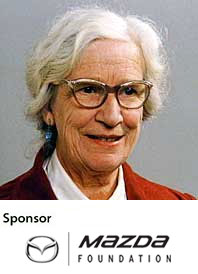
June Olley received a PhD from the London School of Hygiene and Tropical Medicine where she studied lipid metabolism. She then worked at Torry Research Station, Aberdeen, on various aspects of fish technology. Olley joined CSIRO in 1968, working at the Tasmanian Food Research Unit, and remained with this organisation throughout her working life. She started as an experimental officer and retired as a senior principal research scientist and leader of the unit. She contributed to numerous publications in different areas of fish and shellfish technology. After retirement from CSIRO, Olley became an Honorary Research Associate at the University of Tasmania, where she continues to pursue her research into aspects of fish technology and microbiology. She has contributed to a number of scientific papers and a microbiology textbook.
Interviewed by Ms Nessy Allen in 2001.
Contents
- Finding an interest in science
- A secondary education complicated by war
- From chemistry Honours to a custom-designed PhD
- A first fish project: why herring margarine was not such a good idea
- Balancing theoretical with practical seafood research
- Other coastlines, other seafood considerations
- Troubleshooting and a happy accident in phospholipid research
- A pH meter and all: transitions during an eventful year
- A fortunate appointment to CSIRO
- An unexpected environmental project
- The realistic application of models
- Contributing to international outcomes
- Around the world on sabbatical leave
- Research development at home and abroad
- The vital role of collaborative networks
- The information lamp shines on
- Sharing the knowledge: training, teaching, publishing
- Public acknowledgements, private satisfactions
Finding an interest in science
June, where and when were you born?
I was born in 1924, in a bungalow at the back of Croydon aerodrome – south of London – where my father was one of the early flyers. He and my mother were first cousins, and Mother fell in love with him when she was eight. She fitted her life to his, especially when in 1934 he started his own airline, which involved a lot of socialising with all sorts of people, and she was always there to support him.
Did your parents and your home life encourage you toward a science education?
Well, I think the only book my father ever read was Lawrence of Arabia. But my beloved Nanny was a Victorian in the true sense: she had all the classics and she taught me to spell and to write. She helped me tremendously in my childhood.
I was an only child, and my father didn't believe in education for girls. He would rather I'd been something like a film star. But Mother had been told by the Honourable Freddy Something-or-other that you should give your child the very best education you could, and then leave them completely alone to find their own way.
Neither of my parents was interested in science, and on the whole I wasn't either. But when I was about 10 I persuaded Mother to buy me the Zoo Magazine, volume 1, no. 1, and keep up the subscription. I solemnly listed every single animal mentioned in the magazine, putting them in alphabetical order. (I was interested in documentation, and was almost preparing for the computer.) But then when volume 2 came out, I didn't know how to handle that.
Did you take science at primary school?
Oh yes, I took chemistry and physics, with lots of practical experiments. I had a wonderful teacher. Actually, because I couldn't draw anything I had a lot of keep-ins, and so a bond developed and I got interested in science through a person who cared about me, in a way.
A secondary education complicated by war
You were then sent to a very good boarding school.
Yes. That was in keeping with what Mother had been told. I insisted on seeing the school laboratories to make sure they were up to standard. We visited Roedean and all these famous places, but as far as I was concerned they were hopeless. I chose Wycombe Abbey, one of the most expensive girls' boarding schools in Britain. My father was furious but Mother had a little weep and he eventually gave in.
School costs were an awful problem. My father was drafted into civil aviation – what little there was left during the war – which very much reduced his income. He used to put in my resignation every term, in case he couldn't pay. This was terribly disruptive, and the staff got very upset for me and assured my parents I'd get a scholarship. I never did, but we tottered on for the whole war.
What subjects did you take?
My science subjects were chemistry, physics, botany and zoology. I did English grammar, of course, but I failed. That put me back a bit, because you couldn't matriculate without it. My teachers were absolutely fantastic. They obviously saw I did have some potential, because they even blacked-out the science library during the Blitz so that I could go and work there at night.
From chemistry Honours to a custom-designed PhD
After you left school, what did you do?
I went to London University to do chemistry. I had really wanted to do biochemistry but the university had to be evacuated from London, the chemistry and physics going to Aberystwyth, the biochemistry to Cardiff and the zoology and botany to Bangor, in north Wales. So you just had to do whatever was where you were.
What did you do your Honours degree in?
During the war you were encouraged to do your actual Honours in a job. I went to the Human Nutrition Research Unit of the Medical Research Council, where I worked with Professor B S Platt. I developed a micro-method of estimating elemental sulfur in rats' skin. (I am talking about just the element, the flours of sulfur that Grandma would have had in bottles.) That enabled me to have an Honours degree in chemistry, in 1944.
Professor Platt was nutrition adviser to the Colonial Office and was very interested in trying to produce tropical diseases in animal models. He was trying to produce fatty livers, for example, such as babies in the West Indies got when they were living on too much sugar. This involved using radioactive compounds to look at the rate of turnover of these fats in the livers of rats. I wanted to go on with him to do a PhD – not in chemistry, however, but in biochemistry. I hadn't done that previously, though, because it was in Cardiff, so I didn't have the right qualifications.
I kept going to the London University Senate and complaining that it wasn't my fault I had been sent to a place where I couldn't do biochemistry. In the end they invented a new degree called the chemistry of nutrition, just at the time when Platt was appointed to the first Chair of Nutrition at the London School of Hygiene and Tropical Medicine. So in 1950, at last, I got my PhD in the new degree. In fact, there were only ever two in the world. My technician, who came out of the Navy, took it as well. And we both ultimately came to Australia.
Would you say that Professor Platt was a mentor to you?
Oh, very much so. I became a family friend and babysat his five children – aged from 13 to one – so that he and his wife got away occasionally for weekends. And he took me to all the early conferences after the war, where I could keep his wife company and also attend the social outings. In particular, I went to Geneva for the United Nations conference on starving Europe, at which all the world's notable people in nutrition were present. That was a tremendous start to give a young person.
A first fish project: why herring margarine was not such a good idea
What did you do after your PhD?
I wanted a change, so I went to the University Senate and said I'd like a job. The very next day I was on the train to Aberdeen, where the Torry Research Station wanted somebody to work on fish fats in non-fatty fish – very important these days, but a rare thing to study at that time. And because I'd done these fats in the livers of rats, I was qualified to do the job: I got it straight away.
Torry is the harbour of Aberdeen, and the research station had been set up in 1929 by the Department of Scientific and Industrial Research to work on the handling and preservation of fish as food. So I still had to go back and be accepted by the DSIR and interviewed by a government panel. I got C P Snow as my interviewer. After asking me what I had done already, he said, 'Ah, I see, a troubleshooter.' (He hit the nail on the head, actually.)
You were troubleshooting for the rest of your life, I think. At Torry, what did you begin by doing?
My first job was to try and turn surplus herring into margarine. Herring numbers had been able to build up because they were not fished during the war, and huge catch surpluses were stacked on airfields near Wick – just below John o'Groats, as in the old saying, 'Land's End to John o'Groats'. The factory was run by Scottish tinkers who lived in the caves, and the McPhee always stood at the cave entrance with arms akimbo so that his family was protected by a goatskin or something. And when they came to work, their wives all brought their meals in enormous old prams.
It was all very Mickey-Mouse; there weren't any thermometers or anything like that. We stewed up the fish with caustic soda and the oil floated to the top. But although it was thought that the real shortage in Europe after the war was in oils, on closer examination it turned out that an awful lot of people were short of protein, so the project didn't bring practical benefits. Anyway, by this time the trawlers had started and the herring began to disappear again.
Balancing theoretical with practical seafood research
Did Torry work on practical projects as a matter of policy?
It was an absolute policy. When you went to work there, it was made quite plain that you were to spend half of your time on practical projects and half on fundamental research.
The fundamental research was on the fats I mentioned. (We call them PUFAs (polyunsaturated fatty acids) now and you can buy capsules of tuna oil, full of omega-3, long-chain fatty acids et cetera.) When fish were frozen or were kept too long on ice, those fats would break down, and we wanted to know what that breakdown did to the proteins to make the fish tough, for example. It was very theoretical. I worked with Dr J A Lovern, a graduate of Liverpool, who was really one of the fathers of fish lipid chemistry.
The applied research was in fishmeal. If your fish isn't wanted for human food, you cook it, press the oil out of it and dry the presscake into a powder with about 10 per cent moisture, for feeding to pigs or poultry, or to mink – and now to fish in fish farms. At that time, 45 per cent of the world's fish catch was turned into fishmeal.
Other coastlines, other seafood considerations
And you visited the US during your time at Torry.
Yes. I went to the American Fisheries Laboratories at College Park, in Maryland, to see what was going on in a project which was being very much publicised. The idea was that the sea was just full of fish, and all you had to do was extract the fish with isopropanol to take out the water and the fats, and use the powder that remained to feed starving babies and so on.
I didn't have my trip arranged by any government agency but arranged it myself, and I thought I'd need a fortnight. But nobody else had stayed more than a couple of days. After almost two weeks they really had to show me the plant, and it certainly was magnificent. There were spark-proof telephones, beautiful tiled floors, solvent recovery plants – all gleaming, not a scratch on the paint anywhere. So I asked how often it had been used. 'Well, once,' they said. And of course it meant that they didn't know anything about solvent recoveries or how staff reacted to various hitches. It had been a political thing to get the unit in that State; it wasn't where the most suitable fish were. Then, when they'd got it, they didn't use it.
In any case, the process left you with a white, gritty, useless, tasteless, horrible powder which wouldn't mix with anything, and nobody wanted to eat it!
Did you go anywhere else?
I went to France, Belgium, Germany, Denmark, Norway, Sweden, Poland – places with a coastline and a fishmeal industry. The reasons for the visits varied. I went to Brussels, for example, for regulations to do with Britain's entry into the Common Market. But that was still fishmeal.
Troubleshooting and a happy accident in phospholipid research
Did you work overseas for any extended periods during this time?
Yes. The first was in 1956, when I got a Fulbright travel grant to work on phospholipids – fats that have glycerol as their backbone, then a phosphorus molecule and then other various molecules attached. They are the basis of cell membranes.
The opportunity arose when Professor D J Hanahan came over from Washington, Seattle. Being fairly straightforward and never polite, I said when he was introduced to me, 'Oh, your PhD student's last paper is all wrong, actually.' He looked a bit surprised, and two weeks later I got a letter saying, 'I've been back home, and yes, it was wrong. Would you like a Fulbright?' So I spent a year in Seattle looking at phospholipids, not only in fish but in yeasts and all sorts of things.
That was interesting, but really I did only one important thing. When I got there, all his PhD students had phospholipids with no glycerol. As the glycerol was the backbone of the molecule, they were all very puzzled. Rotary evaporators were just beginning to be fashionable, and I pointed out to them that they were sucking all their glycerol down the vacuum pump. It's trivial, but everybody's work was held up. I guess you could say that was an example of my 'troubleshooting'.
What was your second such period of work?
In 1961 I went to Jerusalem for three months to synthesise these phospholipids, using fish tissues to make them synthesise the compounds. You see, Torry had applied for money to look at long-distance trawling at Bear Island, up near Iceland, but then the Iceland cod war started. We couldn't go and get involved in the cod war, so I said that rather than have all this allocated money handed back to the Treasury, I'd like to use it to go to Jerusalem.
There I worked in the Biochemistry Department of the Hebrew University, with Professor B Shapiro. But I was doing my work in an old Arab harem, very cold and dark. My eyesight wasn't very good, and I put in all my reagents in the wrong order. So, although PhD students in the Department had been trying for about two years to synthesise these fats, when by accident I put in first the reagent which I should have put in last, that protected all the enzymes which were necessary for the synthesis to succeed. At least I knew what I'd done!
And four years later you went to Rome.
That was at my own expense. I had missed my holidays that year, and rather than lose them I put them together with the next year's holiday for three months in Rome. I was interested to know whether I'd like to go and work there at the Food and Agriculture Organisation of the United Nations. So I helped edit the proceedings of the first FAO fish technology conference, which I'd been to in Germany the previous year, and of course I met all the fishery scientists who passed through. I decided I would not like to work for the UN, because people were continuously on the move and there wasn't really enough continuity, but that did help to begin my network of fishery scientists.
A pH meter and all: transitions during an eventful year
In a way, the arrival of two senior Australian fisheries scientists in Aberdeen in 1967 led to the end of your 18 years of working at Torry, didn't it?
Yes. They had come to see the fishmeal industry of the north-east of Scotland. My colleague who was supposed to meet them forgot to go to the airport, and so I was sent instead. I took them in my red Triumph Herald convertible to see the fish factories all round the north-east of Scotland, and at the end of the day they said that I was the person they wanted, not the one who had forgotten to pick them up. Would I like to come to Hobart and say whether Tasmania should have a fishmeal industry?
As my future husband, Frank, whom I had met in Aberdeen two years before, was a barrister in Hobart and had been writing to me for about 18 months, I said yes, I'd come – even though I had to pay my own fare. And he proposed the third night after I arrived.
I told the scientists they shouldn't have a fishmeal factory in Tasmania because they couldn't rely on fish being available. The fish move inshore and offshore, and it's a big capital investment to put up a building if they're not going to stay put. Ultimately Tasmania got the federal government to pay for the factory. Some people were sent bankrupt, some people made money – it had a very chequered history. Now it makes fishmeal for fish farms.
Once you became engaged, how did you move yourself out here?
Well, while I was in Tasmania I was asked to go and look at the abalone factory at Margate. Its canned abalone were extremely tough, just like shoe leather. I told the factory I thought its pH was wrong. These things were far too acid, and that was because they weren't being processed properly.
You can use a pH meter to measure acidity (such as to show whether the soil in your garden is acid or alkaline) but they'd never heard of such a meter so I thought I'd better borrow one. I went to the CSIRO Regional Laboratory, on Battery Point, rang the bell and said I was June Olley and I'd like to borrow a pH meter. At that, the director had me in and talked to me for about an hour, after which he said, 'I think we need you here.' He rang up the CSIRO headquarters in Sydney and got me an interview, and I went back to lunch and surprised my fiancé by saying, 'Well, I've got a pH meter and a job.' Next, of course, I had to go home and give my resignation. Then I came on out here.
And in the same year, 1968, you were awarded a Doctorate of Science by the University of London, and you got married. Quite an eventful year.
A fortunate appointment to CSIRO
So you joined CSIRO.
Yes. The job was with the Tasmanian regional laboratory. It 'specialised' in anything that Tasmania needed to be done, so there were lots of little units, such as the rainmakers. I joined the Food Technology Group to work in the fish part of the unit. My one colleague there was away in Japan at the time and I hadn't yet met him.
Your appointment as a biochemist was initially in a position of experimental officer. Why was that?
Fortunately, the typist at Torry, in Aberdeen, had lost half of my CV when she posted it out. Otherwise I wouldn't have had a job, because as a DSc I'd have had to be the director of the place! So it was very good that I got in by mistake. And within a year I was reclassified as a research scientist, anyway.
My first job at CSIRO was to try and get the abalone softer in the cans, but then we went on to all the alternative ways that abalone could be used, apart from just canning them. We dried them – in fact, an awful lot of abalone fishermen were already drying abalone in their garages – trying to get the best way to make them look. You can make them look almost transparent, with the blood vessels visible inside them, or you can make them almost pitch black by heating them too hard. And we tried shipping them live in boxes, just in air, to Japan. We also tried making silage by mixing the viscera, the waste, from the canning factory with sulfuric acid from the zinc works, to make a silage which could be then neutralised and fed to pigs and poultry.
Within a year, I think, you'd been put in charge of a group of people specialising in fish and shellfish.
Well, it started off as just the two of us. To expand into products other than abalone, therefore, we had to apply for grants from the Fishing Industry Research Trust Account and so I was put on the committee. It was a bit difficult to be applying for grants while also choosing the people who got them: you had to be very fair.
We got grants for working on comminuted fish. For that you put the fish through a sort of meat and bone separator. The bones all go down a chute and the fish comes out as a mince. The idea was that fish that wasn't particularly marketable could be made into fish fingers. That project never took off.
We looked at substitution of fish, in which restaurants and shops were trying to sell cheap species as more expensive ones, and we caught a Sydney restaurant. Each species of fish has its own fingerprint, a bit like the DNA genetic ones that we're all getting used to today. If you take a water extract of a fish, run it down a strip of paper and then stain it, you get a whole lot of bands, from which it was obvious that the restaurant was selling ling as barramundi – not deliberately, of course. They were terribly upset. But they still got ling when they tried again. They were being swindled by an importer from Singapore. We did a lot of other species of fish, too.
One project we were asked to do, rather than applying for it, was whether rock lobsters should be drowned in their ice water after you caught them, or properly guillotined. The West Australians thought that the South Australians were ruining the trade by drowning them, but we were able to prove it didn't make any difference. So everybody was happy.
We also looked at vacuum packaging, or modified atmosphere packaging, of fish – so that you could sell it after a longer period than if you had just kept it on ice – and at how long any individual species would keep on ice. For this shelf-life work we had to develop sensory panels to smell the fish, assess their texture and odour, and so on.
An unexpected environmental project
Did that huge range of projects include any unexpected ones?
Yes. One unexpected project which ended up taking an enormous amount of time concerned the pollution of the Derwent. People started to grow oysters in Ralphs Bay, which is a sort of bag in the Derwent estuary – once the water gets in there, it has nowhere to come out again. And the zinc works had always just let their effluent go out into the river.
When people eating these oysters started being sick, it was pointed out to us that zinc is an emetic, and maybe the zinc in the oysters was coming from the zinc works. Some of the oysters had 10 per cent zinc on a dry weight basis. (They were quite happy, though.) We saw no point in doing an enormous amount of work to gather information on this, because surely the zinc works would already have it. So without asking anybody's permission I went up and saw the manager of the zinc works, who agreed to release a lot of information: they'd had a diver going round the whole of the estuary looking for zinc, cadmium and copper but they didn't know what to do with their data, how to assess its significance. We took that information on board, and when the powers-that-be thought that maybe we shouldn't be working with a polluting industry, I pointed out that we weren't – we were just trying to get the solution to the problems.
The deposits from the zinc works included not only zinc, cadmium, copper and lead, but also mercury. And we all know about what the famous Minamata Disease did to the Japanese. The mercury was turning up in the sharks here, so shark fishing in the actual estuary had to be stopped and the shark fishermen were put onto doing a survey of all the fish in the estuary.
That would have been an environmental project that CSIRO took on.
Yes, but sort of sideways on, unexpectedly. We appeared in the new magazine Ecos, volume 1 no. 1, which was rather nice. And then when it got to volume 50 they did a reprise to see how we'd got on with it all.
The realistic application of models
Weren't you involved in some mathematical modelling of spoilage?
Yes. This came about almost by accident, because in an obscure Japanese journal, the Memoirs of the Faculty of the Fisheries, Kagoshima University, I found an equation which seemed to have universal application to the breakdown of flavour compounds in fish. (Finding obscure references is still an enjoyable hobby for me.) I asked our statistician, 'Could you apply this equation to bacterial growth?' His response was, 'What for?' so I said, 'Oh, I don't know, David. Just apply it.' And the equation turned out to fit bacteria in the Antarctic, bacteria in hot geysers – we began to realise that with this equation you could predict the number of bacteria at a given temperature.
At that point I started to work with Professor T A McMeekin, the microbiology professor at the University of Tasmania, and 20 years later the work is almost into legislation. Professor McMeekin and I, with our statistician David Ratkowsky, wrote a textbook on it. But you could say that Tom Ross, a PhD student who was young and modern enough to do all the word processing, in fact 'wrote' the whole book.
Just to bring the story up to date: you and David Ratkowsky are still together in the Agricultural Science Department at the university, aren't you?
Yes. We have worked together since 1971, and since our retirement we've been sharing a room in the university.
It's obvious that you are still committed to the Torry approach of doing theoretical work but also solving real problems. Professor Allan Bremner, who was one of your junior colleagues and is now in the Department of Seafood Research at the Technical University of Denmark, said to me, 'While June has a theoretical, first-principles, fundamental approach, she also preferred working on real problems, not model systems. Real-life situations dealing with whole fish are far more difficult, and she loved that challenge.'
That's so. I try to persuade the PhD students in our department to do their model experiments within the limits that the fish or meat or piece of cheese they're looking at might have. It is no good wasting chemicals and time on parts of the model which just would never occur.
Contributing to international outcomes
You contributed to three international fisheries projects involving Indonesia, Malaysia, Thailand, the Philippines and Singapore.
Yes. We had a conference in Jakarta of the Indo-Pacific Fisheries Council (part of FAO) and another one in Melbourne. And I said that anything we found out was totally lost if none of these institutes had libraries. Also, you needed a librarian or some central, focal person to send all the material to. If you sent it to an individual scientist, they would just put it in their briefcase and take it away after the job.
At my suggestion, Frances Barnes – our librarian at the CSIRO Tasmanian Regional Laboratory – went to Rome for some briefing and then went round to do something about all these non-existent libraries: books in beautiful bookcases, locked with keys that you had to go and get and so on. And quite a lot of the books were very, very old. The first country to pay attention to her was Singapore, which sent somebody to the library school in Aberystwyth, and things have come a long way from then.
So that was the first project. What were the others?
The second was a project on fish drying and smoking that IUNS/IUFoST – the International Union of Nutritional Science/International Union of Food Science and Technology – wanted to set up. The conference was in Dublin. For family reasons I couldn't go, but I sent a tape saying that the most important thing with drying was the relative humidity, the water activity of the products. If fish is on ice, or meat is refrigerated, the temperature is the important thing. But once you start to dry something, the relative humidity can become even more important than the temperature. This tape formed the first chapter of the book which subsequently came out, and at the end of the project I persuaded people to send in the water activity of all their various products, from 12 different countries, for a table in the book. So that was my contribution to that.
The third project was funded by ACIAR, the Australian Centre for International Agricultural Research, for fish drying in Indonesia. My main contribution to that was to point out that you must have an overall picture and not focus on one particular thing. It's no good drying fish if they are then eaten by insects, you see. I said the project had got to have an entomologist, a microbiologist, an engineer, a biochemist and specialists in fungi. These people were drawn from the University of Tasmania – the Agricultural Science Department had the entomologist and the microbiologist, and that's why I am so welcome up there, because I brought quite a lot of money; the Engineering Department had the engineer, Peter Doe; and I'm an honorary research associate of engineering and of microbiology – and also from CSIRO Food Research, North Ryde, which provided the fungi experts. Peter Doe had worked with me at Torry Research Station (he did his PhD on the Torry fish-smoking kiln) and we ended up contributing a great deal to this book on fish drying and smoking which was published a couple of years ago.
And at the completion of the project the director wrote to you, 'I am quite sure the project wouldn't have happened without you. Let me thank you again for your very effective contribution and guidance throughout the period of the project.'
Around the world on sabbatical leave
In 1973–74 you took sabbatical leave, again at your own expense. What did you do?
My husband had just retired and wanted to go round the world. The first place he wanted to go to was South Africa. I got permission to work for three months at the Fishing Industry Research Institute in Cape Town, which is funded by trade, not government, and had never had an outsider in. But I had known the director, Dr S Dreosti, from the fishmeal days at Torry and also in Europe, and he said I'd be 'safe' to have there. Even so, I wasn't allowed to publish anything I found for two years. I worked on getting live rock lobster to France for the Christmas season.
From Cape Town we went on to England, and I worked at the Tropical Products Institute on making fish silage by mixing the fish with a cereal product such as cassava. That helped to bring down the relative humidity so that you could keep the mixture longer in tropical countries than you could have done otherwise.
Then we went to Sweden, where I discussed making fish silage; to Spain, for fishmeal conferences where I tied up again with all my old fishmeal colleagues; and to Poland, where I gave a couple of lectures for Professor Z E Sikorski, of the University of Gdansk (formerly Danzig).
Professor Sikorski is a master of fish technology, but until the Cold War ended he was not known in Western Europe. Actually, I managed to get him out on sabbatical for a year, to work here on denaturation of fish proteins in cold storage. Denaturation means they lose their ability to hold moisture – as we all know, an old piece of fish that's been in a cold store for years tastes like cardboard. He sent me a book last week, saying I'd completely altered his life.
Research development at home and abroad
Did you invite other research workers to come and work in Tasmania with you?
Yes. The first one we had was Professor Harold Olcott, who is really the father of food biochemistry. I met him when, during my Fulbright in Seattle, I went on a bus trip down to Berkeley, California. He spent one sabbatical with me at Torry; on the next one he came here and worked on the blueing of abalone; and his next was at the Fishing Industry Research Institute in Cape Town, because I persuaded them he was 'safe' for them to have. He is dead now, but we were very close.
The next person I had was the engineer from Torry, Jacky Graham. He came out and spent three months with Stephen Sykes, who had just graduated in engineering with Peter Doe and needed someone to teach him to be our engineer. He helped Stephen to start developing an air-blast freezer and assess the freezers in current use in Tasmania.
Somehow, you found time as well to help people in developing countries. You helped develop research centres in South-East Asia, didn't you?
Yes. I think the first one was a Danida – Danish aid – project tied in with the Food and Agriculture Organisation in Rome. We were teaching people from Malaysia, Burma and Thailand, and we went out for two successive years to Colombo, teaching them how to assess the quality of fish. I remember two little Burmese girls who were about the same size as the huge fish whose gills we were trying to teach them to smell, to assess how old they were. But that all folded because of the civil troubles in Sri Lanka, and that laboratory no longer exists.
The vital role of collaborative networks
It's quite clear from what you've been saying that you believe in collaborating with other scientists and other bodies.
That is absolutely vital.
So you believe in having a large network?
Oh, it's invaluable. My network started with Professor Platt and the United Nations, and it went on through David James, my first colleague at the Tasmanian Regional Laboratory. He had been in Japan, and in 1976 he became Australia's representative for the FAO Fisheries in Rome. And Peter Doe, also from my Torry days, became a lecturer here and was involved in these projects in South-East Asia, so that he now goes a lot to these countries to bring students to the university. All these people, along with those in South Africa and so on, are the beginnings of a very big network.
Someone I haven't mentioned is Professor Bonnie Sun Pan, from Taiwan. We met at the 50th Jubilee of Torry Research Station, in 1980, when I went back and gave a paper. When she became professor, she found she had money for a visiting scientist, but she didn't know many people in the West. Besides knowing me, she had been at university in the States with Norman Haard, and so at very short notice before the end of the financial year she asked the two of us to go to Taiwan and give a seminar.
I wasn't allowed to go officially to Taiwan because of the political situation in those days, but I went privately. Bonnie has also been here and she has the network through Norman Haard to America and Canada. We're all still collaborating.
But also you have to collaborate with your local industries and businesses. For example, George Mure had a little fish restaurant on Battery Point which became extremely famous, and then he launched out in a much bigger way and his huge fish complex now occupies an enormous area on the docks. George has his own trawler which catches blue-eye, and he came to us for advice on what smoking kilns to have and how long his fish would keep. He is at the moment writing a book on the history of the beginnings of the fishing industry here, and has asked me to make some contributions.
The information lamp shines on
Are you still involved in any work?
I'm still working on the predictive microbiology. And although I didn't go myself to the big conference we had last year in Leuven, in Belgium, I was one of the junior editors of the proceedings. They are out now.
Something I was especially interested in was the ASEAN Food Journal. That was started by the Association of South-East Asian Nations, and was coming along really well and providing an enormous amount of information for this area. I did a lot of refereeing for it and was getting very pleased with it. But then the main offices of ASEAN closed, and the journal was supposed to go to the University of Malaysia. Without the previous editor, however, they never really managed to get it off the ground and it has been in abeyance for the last few years.
You have referred in passing to being an honorary research associate of the Department of Agricultural Science and the Department of Civil and Mechanical Engineering at the University of Tasmania. I think you have also done some work with the Australian Maritime College.
Yes. I've just marked a Masters thesis there. I have a lot in common with Felicia Kow, who runs fish technology at the Maritime College at Beauty Point. Although she's from Taiwan, she did her PhD with colleagues from Professor Platt's unit, as I did. She asks me for advice all the time, and I mark theses and so on for the College.
Sharing the knowledge: training, teaching, publishing
Many of the staff you have trained are now making significant contributions to seafood technology, both in Australia and overseas.
Yes. When my unit closed in 1989, my staff were disbanded. Allan Bremner, my No. 2, went first of all to the Department of Primary Industries in Queensland and then became professor of fish technology in Lyngby, Copenhagen – one of the most prestigious fishery laboratories in the world. I was very proud of that. And Stephen Thrower, who had always wanted to be our information officer, also went to the DPI in Queensland. There he found all the computing facilities that I hadn't been able to provide, and a big library, and now he has done wonders with providing a booklet each year with information for people who want to buy fish or equipment, and who's doing what and so on. He's a real mine of information.
Have you ever taught at the University of Tasmania, or supervised PhD students there?
Well, I lectured. While I was engaged to my husband, Professor G Wade asked me up to talk about what I was doing – they had to alter the temperature of their cold-stores as a result! – and so I had the entrée into the university before I even moved here. They asked me to give third-year lectures in microbiology while Professor K Marshall was away on a sabbatical. I didn't know any microbiology but I got them making silage by microbiological means, and all the kinds of things I've talked about. You can make tempeh by fermentation and things like that. I wonder we didn't poison people.
Since I've joined the university as an honorary I don't supervise as such, but when people get a bit debilitated in the last year of their thesis – you know, when the prof says do one thing and their supervisor says do another – I come in as an energiser to buck them up again and suggest a few things they might do to improve the thesis. I read most of the Honours, Masters and PhD theses of people doing microbiology.
And you have published very widely. I found references to 160-odd papers under 18 main headings to do with fish technology.
That's not an awful lot, really.
I'm not so sure! But why is it that although so many were published by your seafood technology section from '69 to '89, when you were its head, your name appears on only about 95 of them?
I don't approve of always putting the director's name on, especially when he or she has not done anything. My criterion is whether I have had an important idea, or changed the purpose of the paper or done something which has made it other than it would have been if I hadn't interfered. I only consider that I should have my name on if I have done something of significance.
Public acknowledgments, private satisfactions
In 1972 you were elected junior vice-president of the Tasmanian Royal Society, and in 1973 the senior vice-president.
Yes. You can't be elected the president, because that's the Governor of Tasmania.
And in 1976 you were elected one of the two women Foundation Fellows of the Australian Academy of Technological Sciences and Engineering. In 1986 the Australian Institute of Food Science and Technology gave you their Award of Merit. Then in 1988 you got the Order of Australia and also an honorary DSc from the University of Tasmania. It is a very impressive list. Are you happy with these public acknowledgments?
Well no! I found them an awful lot of extra work. Also, at the time I was getting all these things, the logistics of getting my family to ceremonies and things was mind-boggling – my husband was only seven years younger than my mother, and their ages averaged about 85. So I found it all rather a strain.
There have been some very pleasing things, though. Recently I was thrilled to receive a book in Japanese about microbiology, especially food spoilage. The book's Japanese author wrote that he would be awfully pleased if I would update it. I had the letter translated – actually, by a Japanese woman whom my husband had given away in marriage to a Hungarian colleague of mine – and then another letter, this time in English, came the next week. Apparently Dr Usio Simidu had met me in 1963 at Torry and I'd invited him home for dinner and mah-jongg. I was certainly able to help him: you could tell which things he'd left out by the references he hadn't quoted.
Also, I'm very proud that when I retired from the CSIRO in 1989 I received an 'On Your Retirement' card from the International Association of Fishmeal Manufacturers. I had been their Scientific Secretary before I came out here to get married, and here was this card 23 years after I'd left the Association. It is signed by people from all over the world, anywhere that has a fishmeal industry – Peru, Chile, South Africa.
It doesn't sound as if the fact that you are a woman has made any difference to your career in science.
Oh, it has – I've been thoroughly spoilt!
June, your achievements in fish science and technology have been enormous, especially in making Australia a centre for these studies. Thank you very much for participating in this interview.
Professor Ken Campbell, palaeontologist
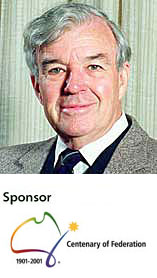
Professor Ken Campbell is one of Australia’s most distinguished palaeontologists, certainly the senior palaeontologist in Australia, and one who has made a remarkable contribution to the study of that subject, not only on Australian fossils but also worldwide. He began his geological career in Queensland, under Professor Dorothy Hill, at the University of Queensland. Ken Campbell’s life has been a steady progress in understanding fossil material that began with work on stratigraphy.
He is a person who has had many honours. His early years were punctuated by a Nuffield Dominion Travelling Fellowship to Cambridge University in 1958, and this was followed in 1965 by a Fulbright Fellowship to Harvard University. He was a Visiting Scientist at the Field Museum, Chicago in 1981, and at the School of Anatomy at Guy’s and St Thomas’ Hospital, London in 1985.
Interviewed by Professor John White in 2000.
Contents
- Introduction
- A childhood in variable circumstances
- An uncertain path toward science
- The 'one other' subject: beginning geology
- A beacon appears
- The world opens up
- A good area to map
- Jobs that seem not to add up
- An exciting chance: pursuing a palaeontological pattern
- Continents can move – the faunas say so
- Getting going on trilobites
- A story with more than one part
- Rates of evolution
- A fruitful encounter with a lungfish head
- Evolutionary areas to map
- A new set of mapping tools: geology, biogeography and genetics
- The process and outcomes of putting it all together
Introduction
Professor Ken Campbell is one of Australia's most distinguished palaeontologists, certainly the senior palaeontologist in Australia, and one who has made a remarkable contribution to the study of that subject, not only on Australian fossils but also worldwide. He began his geological career in Queensland, under Professor Dorothy Hill, at the University of Queensland. Ken Campbell's life has been a steady progress in understanding fossil material, that began with work on stratigraphy. He is a person who has had many honours. His early years were punctuated by a Nuffield Dominion Travelling Fellowship to Cambridge University in 1958, and this was followed in 1965 by a Fulbright Fellowship to Harvard University. He was a Visiting Scientist at the Field Museum, Chicago in 1981, and at the School of Anatomy at Guy's and St Thomas' Hospital, London in 1985. Professor Campbell has been honoured by the geological community in Australia, first in 1980 by the award of the Clarke Medal of the Royal Society of New South Wales. Then subsequently he became the Mawson Lecturer of the Australian Academy of Science in 1986.
A childhood in variable circumstances
Ken, could we perhaps start with where you were born and how you grew up.
I was born in Ipswich, 25 miles out of Brisbane. My family were clerks in a city store. During the Depression, both of them lost their jobs – my mother lost her job on marriage and a little later my father was sacked. I was only four then, but I remember the word 'sack' very clearly because it was so much a concern of the family: 'Where did he work? Oh, he's been sacked.' We found that all our friends were gradually losing their jobs. To me the word 'sack' meant the loss of family income. When my father was sacked, my mother's father put in some money and we bought a small newsagency in Boonah, a little place 35 miles further to the south-west. My father was a good tennis player and very good at cricket, so he gradually included a sports section in his shop, going to Brisbane to learn to do such things as stringing tennis racquets. He used to sing, as he said, 'in the great Cambrian Choir.' Ipswich being a coal-mining town, was full of Welsh people, and the Cambrian Choir was a very, very important part of his life, and so we got involved with selling music and that kind of thing. Music was part of my young life as well – not that I could sing, but I was always encouraged to try.
Did these difficult circumstances affect your early education?
Yes. It was very variable. I think I went to seven primary schools. We had to move to Boonah and to Brisbane and later we moved back to Ipswich. Every time I changed school I found myself at a different level, being asked all sorts of questions to which I had no idea of the answers. Nevertheless, I gradually worked through primary school. Cricket helped me tremendously to fit in. I was very keen on cricket and I always played for the school. But otherwise I'm no kind of an athlete, although I did represent my school as a high jumper – to look at me now, you'd never think it, would you? I was not allowed to play Rugby, though, because the fruiterer in Boonah had hurt his knee very badly, and my mother was much concerned about my knees.
Only about a month after the war began, my father enlisted in the Army – in the Militia, not in the AIF. He was a private in the national security group, with six bob a day and an allowance for wife and kids! That was important because it gave us a stable income for the first time in my parents' married lives, but it meant we had to move to Brisbane. Actually, in Brisbane I went to Coorparoo Primary School, which I found out much later was the school Dorothy Hill had been to.
An uncertain path toward science
How did you make the transition to secondary school?
I sat for the Scholarship Examination, as everybody did at age 12 or 13. That gave entrance to a secondary school. Provided you passed at a sufficiently high level you were funded to go to a state secondary school, or if you went to a private secondary school you were subsidised. Both my parents had been to Ipswich Grammar School and thought the grammar schools were the place to go, so I went to Brisbane Grammar School. Even with my Scholarship pass, as a day boy I paid three guineas a quarter to go to the Grammar School. I was very glad to go there – not that it was a wonderful school, but it had a status in Brisbane.
Did you have good masters there who influenced you towards science?
During the war it was very hard to get science masters. All the young, interesting blokes had gone off to join the Air Force and so on. The people who taught me were all in their sixties. One had a Science degree, the physics teacher had an Arts degree, the mathematics teacher had no degree at all. My feeling is that the masters decided they were not far ahead of us so they just gave us the book and said, 'Read that, chaps. If you have any difficulties, come and we'll show you.' So the real point of secondary school education wasn't to lead me into anything, but to throw me on my own resources to meet the requirements of the classes. That was a tough way to be brought up, academically, but I think that 28 of us out of a class of 32 went to university to do science-based courses. What's more, most of those were relatively successful: directors of the Queensland Medical Research Institute and of the Queensland Engineering Institute, medics, dentists and the like. One fellow, though, went to do an Arts degree, for the simple reason he wanted to become a minister of the Presbyterian Church. We thought he was the weirdest person out. Fancy going to do an Arts degree! We looked askance at this poor fellow, because nobody really did an Arts degree from the Brisbane Grammar School unless there was something peculiarly wrong with them.
Perhaps he was good at Latin. Were you?
I didn't like Latin at all. But if you got more than 75 per cent in your Scholarship Examination you were lined up and told by the headmaster that you would be doing Latin. All those under 75 did history instead. To be honest, doing Latin wasn't my scene. But then, at the end of the first half-year, all those who got more than 75 per cent in Latin were lined up again and told, 'You'll be doing Greek.' My father was away at the time and I managed to convince my mother to write a letter saying I wasn't suitable to be a Greek scholar. So I managed to avoid learning Greek.
At the end of secondary school, I had no idea of what it would be like to go to a university. I did know, coming from my background, that it was very important to get a job. So I applied for a number of jobs – in the Shell Company as a chemist, in the PMG, in an insurance company – none of which was successful. And thank heavens for that, because I don't know what I would have been like had I gone to work as a technician in the PMG, wiring up telephones. I suppose the Shell Company thought I was too junior to be trained as a chemist.
The man leading the Christian group I belonged to at the Grammar School said, 'Boy, you ought to go to the university.' I said, 'If it means I've got to do Latin and if I've got to do poetry, I won't go.' But he broke the news to me that you didn't have to do Latin and English at a university, that you could do science instead. And having done French I had a foreign language, which you needed then to matriculate. So I thought I would try science at university.
The 'one other' subject: beginning geology
What led you into geology?
I had a friend whose father was a jeweller, and he was interested in opals. He said that at university I'd better do some geology. Well, we went down to enrol and they said, 'Right, physics, chemistry, pure mathematics and one other. What's the one other going to be?' That's the choice that you had in those days. Botany, zoology or geology were the three options and so I said, 'It's going to be geology.' I thought zoology and botany were something that Girls' Grammar School students did – Boys' Grammar School students were much more solid in their science and did geology. And so we sat down and did geology together, starting in 1945, the last year of the war.
At that time the science teaching at Queensland University was abysmal, in all subjects. In mathematics, as in geology, there were three lecturers and a professor; chemistry did have more staff. I was thinking I might do physics. It wasn't long after the atom had been split, and all the journals were full of physical material. Looking at that I thought physics would be an interesting thing to do. Also, on a chemical side, people were interested in plastics. So I thought I would do geology as a side subject, concentrating on physics and chemistry.
Physics was almost mediaeval in its approach. We had to do practical experiments on equipment that should have been in the dump years ago. Most people were copying out experimental work that had been done the year before, because if you did that you would get an A. But if you were serious and tried to get results, as we did, you got a B. We were complaining, because even though we got lousy results, we got them by going back and repeating experiments, yet we were always marked down. I didn't think I was dishonest enough to be a physicist, actually, and so I dropped it at the end of first year. That left me with chemistry, geology and mathematics. The geological teaching was grim: 'Learn these facts and you'll be right.' We didn't see a pattern in the way geology I was taught. Nevertheless, my friend and I passed and decided to do second-year geology. I really wondered whether I was doing the right thing, in such a background.
The professor was H C Richards, a very distinguished man. But in the year before I started he had had a stroke. There was no money to replace anybody, so poor old Professor Richards – who couldn't even stand up – used to be wheeled in to sit in front of the class and give us lectures on crystallography. It didn't grab my attention, let's say.
A beacon appears
Well, was your attention grabbed at all as an undergraduate in geology?
Yes, it was, in second year, because Dorothy Hill came back to the university after being in the Naval Service and an adjunct to the director of the Port of Brisbane. She had been in Cambridge from about 1929 till 1937, and she understood what a university was all about, that research was an important aspect of university life. I'd never heard of research until then. A lot of the work that she did with us as undergraduates wasn't terribly inspirational, but the fact that she was there and that she had this experience and knew where the university ought to be going made her an alive person for me.
You were one of those who wrote her obituary for the Royal Society, beginning by saying that 'for Dorothy Hill, science and the attempt to develop the academic standards of Australian universities were the interests which dominated her life.' Did that shine through when you first met her and when she began to teach you?
Yes, though not exactly in those terms. What shone through was that she knew that here was an area to be studied and that she understood something about the way a university should work. The university was terribly backward. The Vice-Chancellor had been brought in from being a director of the Public Service Board, and ran everything on making sure the bottom line was okay and nothing else. Dorothy Hill's understanding came through in her teaching. I believe that the University of Queensland at the present time is largely as it is because of her original initiative in the late '40s. She really stirred the place up, and after she had been there a while they started to appoint professors who knew something about research, who weren't trying just to grow sugar in North Queensland or to do something useful to the Queensland Budget.
To illustrate how much she inspired me, I might mention that at the end of the war Freddie Whitehouse was appointed to the Queensland University staff. Freddie had preceded Dorothy in Cambridge and had done well. But my parents knew that Freddie's parents owned a cake shop in Ipswich, and they said to me, 'This fellow did so well at the university, he was chosen to go to Cambridge, yet he came back and couldn't get a job. Is that what you want to happen to you?' A job was terribly important to me then. My parents were thinking, 'Gosh, here he is, studying this pollero-pallyo-pollo whatever it is, and he's going to end up jobless!' My father said to me, 'Think carefully before you go into this kind of thing.' But by the time Dorothy Hill had taught me, 'job' wasn't terribly important.
The world opens up
I have read that Dorothy Hill herself was won into geology by the personality of Professor Richards, the old gentleman you were speaking about. She was impressed by his sense of humour, his sympathetic relationship with students and so on.
Yes. He had a social grip on the department. Everybody was invited to Professor Richards' place. He went to all the sporting events and so on, and he associated with the students in a social way which attracted her. It is interesting that Dorothy Hill had Richards in her highest regard throughout her entire life.
He did things like starting work on the Barrier Reef, for example. Although he was a petrologist, he realised that Queensland had this enormous resource sitting there and nobody was doing anything about it. He encouraged people to come out from England. People from the Royal Society came out and drilled a couple of holes at Funafuti. Who looked after that? Richards. And he was interested in drilling a hole on Heron Island and doing some work there. Coming back, she just fitted into that, as well as taking on other teaching work.
I think you believe that from the point of view of developing standards and academic quality, ideas come to 'stocked minds' and not to people who know where to get the knowledge if they need it. Was your mind 'stocked' in Queensland?
I think I should start my answer by saying that when I was in third-year, Dorothy Hill came to me and said, 'Look here, Campbell, if you want to do Honours I'll look after you.' I can remember that: 'I'll look after you.' I thought, 'Well, here's a chance. I'd better take that on.' She immediately started to teach me how to do research. She gave me material to work on and the relevant literature; she came and talked to me every day. It's hard to believe, isn't it, that every day she'd come down to me, an Honours student, and say, 'Well, Campbell, what's on today?' I had to explain what I'd done in the last 24 hours and try to get some idea across to her about where I was going in this particular project. It was that kind of stocking my mind with 'Here's the literature, here's the data. See what you can make out of that. Put it together, give me an answer, and I'll tell you what I think of it.'
When she showed me the possibility of an Honours project it opened the world for me – for the first time I saw that I could examine the world as an exercise in life. It wasn't just a matter of getting a job; but it was important for me to look at the world in a different way. She taught me how to look at a big variety of topics in an investigative way. This was very, very different from undergraduate work, of course, and it was her personal contact that taught me how to think about real-world issues.
A good area to map
Dorothy Hill gave you a good area to map, I understand.
Yes. I had two years to do Honours because I was helping her in a research project. Every Honours student had to make a map. It might seem like a trite thing to do, but in fact it's very difficult to walk out into the bush with an aerial photograph and so on, map the rocks and find where the faults are, the folds and so on, especially in a complex area. I got an area on the edge of the Brisbane Valley up around Esk and Toogoolawah, where Permian fossils were known to be, because I was interested in palaeontology. So I went and climbed up hill, down dale and round about, spending over 100 days in the field, mapping.
It was of great interest to me to make that map, because I found all sorts of interesting problems – where the faults were, why the faults were where they were, how it was related to the Brisbane Valley – and also some interesting wider geological processes. Not only did I learn where the fossils lay in the sequence and what it meant in terms of age, but Dorothy Hill said to me, 'Now look here. The Shell Company is working on Permian in Central Queensland. Why don't you go up there and see if you can find some material that you can use comparatively?' I wondered how on earth I was going to get to Central Queensland, but she said, 'I'll introduce you to Mr Bezere, who is the surveyor working there, and he can drive you up.' And so for a couple of weeks I stayed in homesteads up there and did some work. That opened out a tremendous number of possibilities to me.
I was also interested in major tectonics as it applied to my work on the edge of the Brisbane Valley. Dorothy Hill was very keen on publication, and she told me my Honours thesis should be published. So when I wrote up all this stuff, I published it in the University of Queensland Papers – which nobody ever reads much, but everybody got a copy of it because I was interested in making my name. And who should respond (the only person who did, I think) but Sam Carey, who was the professor in Tasmania and well known in the geological world. He said, 'I like that idea about the Brisbane Valley, the way you think that the boundaries were moving. That's a good idea and I want to congratulate you on it.' Nothing to do with palaeontology, just with the way this area fitted. I thought it was very generous of the man to say that. Of course, Sam's now a Fellow of our Academy.
Jobs that seem not to add up
I think you then had a pause in your career while you went off to teach in Albury. Is that correct?
Yes. I worked for a year with Dorothy Hill because she had money from the State Geological Survey to make a map of Queensland for a book on the geology of Queensland that she was going to write for the Geological Society of Australia. The whole place had been flown by the Air Force during the war, and the Lands Department now had the opportunity to fly, so we had masses of aerial photographs to interpret. I was employed to cover the area of Atherton Tableland down to Townsville and west over to Cloncurry. I spent days upon days putting out aerial photographs, trying to interpret the geology. I'd use little bits of information from the State Geological Survey; I'd go along and ask these fellows, 'When you crossed such-and-such a river on your trip to so-and-so, was that granite there?' So 'granite' got put on the aerial photograph and so on, and gradually we put it together.
It was a relatively unsatisfactory process, because you could never get to go anywhere. Nobody had a vehicle to send you up there, and flying anywhere with the Queensland Geological Survey was totally beyond thought. They used to come along and see how many red pencils you had, because they didn't want everybody to have two red pencils, let alone going by aeroplane up to North Queensland. It was an appalling state of affairs. After a year of this I gave up. I said to Dorothy, 'I appreciate the opportunity to do the work but I don't think it's going to lead anywhere.' That was quite wrong. It did lead somewhere. It led to a good state map and was the basis for a lot of subsequent geological exploration.
But I had done mathematics in my third year at the university – I'm an appalling mathematician but I had learned enough to do reasonably well in the examinations – and so I applied for a job as a teacher of mathematics. I tried in Brisbane: nothing there, but the headmaster of the Boys' College had a friend at the Albury Grammar School who was looking for a mathematics master, somebody who had learned some mathematics. 'Would you take that on?' he asked. Well, by that time I was 23 or 24, I was engaged to be married, and I thought, 'I have no job as a geologist. I will go and teach.' So I went down to Albury and taught there for a year.
That was an interesting experience, since many of the kids were going back to drive tractors on their father's property: 'What's the good of integration to me? It'll help me drive a tractor, won't it!' It was very, very hard to teach kids who had no interest in mathematics whatsoever, no interest in logic. I tried to teach them geology but the headmaster said, 'You won't stay here forever, old boy, and who am I going to get to teach geology after you go? No!' So I was concentrated on mathematics. The headmaster himself really had no academic training. He was not a graduate and depended on professional associations as his main qualification. He had no idea of the way to run that kind of a school. It was interesting to see that he was much more concerned with getting people through the Higher School Certificate than with building up the school.
But at the end of that year a message came from Brisbane, 'There's a possibility of a job in Armidale. When you come back to Brisbane for Christmas, call in and have a chat.' So I did.
An exciting chance: pursuing a palaeontological pattern
Tell us about your Armidale period. You were doing your doctoral thesis at the same time, if I am right.
That's right. That was a funny thing, because I had a Masters degree by that time, having worked up the stuff from the Shell Company's Central Queensland material at night-time while I was working on the state map.
In Armidale we were a college of Sydney University. We taught what Sydney told us to teach, which irked me no end: I had some ideas about teaching which I wasn't allowed to introduce because it didn't fit people for the Sydney examinations. But the head of Geology and Geography was Alan Voisey, who had been a student with Sam Carey at Sydney University. Alan Voisey was an exciting man, with his hands on a number of interesting problems. Kids came to Armidale from all over, even from Perth, to do a geology degree because Alan had such an influence in industry and to work with him was seen as such a good thing. We had a very active school there.
When I arrived, Alan said, 'Look, I've got a couple of kids here who really should go and do some fieldwork in the long vacation. For your first job would you like to take them down to the Werrie Basin and show them how to map a section?' That was fine by me, so off we went and I was introduced to that marvellous sequence. Those kids were very able people – one ended up as the dean of science in Newcastle, and the other became an associate professor at Stanford. To work with them first up was excellent.
That started me off on the Werrie Basin area, which is a standard area for the whole of western New South Wales. That's important, because the area goes under the Artesian Basin to come up in Queensland as the Yarrol Basin and the Bowen Basin. So I was able to tie in with Queensland. Someone who had been a student a little bit after me had been working in the Yarrol Basin and had got together a sequence up there, and I could see that I was going to find similar things in New South Wales. It was the allying of the Yarrol Basin with western New South Wales that I thought was an exciting thing to do.
This is part of your first big theme, as I remember. You managed to convince the Queenslanders that it was well worthwhile to look at the Permian and Carboniferous Eras, and that you'd found a very special group of animals in those fossils. You had gained an interest in these animals for themselves.
That's right. I said to the Queensland folk, 'I've got to get a PhD. How would it be if I tried to tie this section in New South Wales into the Queensland section?' 'Oh,' said Professor Bryan, 'I'm not too sure about that. It sounds a bit pedestrian to me.' I explained that it was not pedestrian; it would be the first time we had actually tried to tie a sequence like that into a sequence in Queensland, with the middle part covered up by the Artesian Basin. Anyway, Dorothy Hill said, 'I think it's a good thing to do, but concentrate on palaeontological work.'
I should say that Dorothy Hill's main teaching was that palaeontology is 'the handmaiden of stratigraphy'. That was in all the books then. Nobody would believe it anymore, but that was the way she was trained. But palaeontology is the study of the life of the past, and fitting it into a pattern. One of the features of this pattern is the stratigraphy associated with it. Other features of it are things like the way the animals changed according to environments. And thirdly, evolution is an important part of palaeontology.
Continents can move – the faunas say so
After you finished your thesis, you got a Dominion Travelling Fellowship to Cambridge. I will ask you later about the insights you gained there, but for now let us look at what happened when you returned to Australia. Working on the Gloucester region of New South Wales, for example, you found that the fauna and flora of the late Carboniferous was extremely interesting and quite significant.
Yes. It's a remarkable thing that many palaeontologists were against movement of the continents. Looking back, I think it was because the geophysicists could find no mechanism for the continents to move. Dorothy Hill, having been brought up in Cambridge, was influenced by a geophysicist named Jeffreys (author of a book called The Earth) who showed quite conclusively that there was no possible way of moving the continents. That stayed with her all her life, and as undergraduates we were taught that the continents were static.
On the other hand, faunas seemed to show something different. I have here a map on which I can show you something of the way in which the sequence was built up in the Gloucester area. You can see things dipping in this way, with the end of a syncline coming around; these are some of the stratigraphic units that you can map. Inter-stratified with these units were faunas which, by the time you got up to the highest part of the sequence, were very distinctive Levipustula faunas. To relate this to anywhere else was very difficult, because at that time the whole of Gondwana had moved southwards – Ted Irving thought by as much as 50 degrees. This meant we had changed from a tropical, Lower Carboniferous environment to a frigid, Upper Carboniferous environment, and so the fauna changed. Whereas we could compare our Lower Carboniferous faunas with the faunas in the northern hemisphere, we could not compare our Upper Carboniferous because it was the unique cold fauna.
So I started to publish on this material. By this time I wasn't publishing in the University of Queensland Press any more, but in the international journals, and it was picked up by the people working in the foothills of the Andes, in South America. They wrote me letters saying, 'Do these specimens that we are sending over look anything like yours?' I nearly had a fit – I could have collected them at Gloucester! They were virtually identical with that material. And then some other people started working in South America on similar faunas, and they were the same. It suddenly transpired, from considering the continents in terms of their Gondwana pattern instead of their present pattern, that we were looking at a margin of ancient Pacific Ocean, on one side South America, down through Antarctica, into Australia. To my mind this was a very strong example indeed of the way in which things had moved.
Fortunately, Ted Irving was in the Australian National University's Research School of Earth Sciences (RSES) at the time. Ted had applied for a PhD in Cambridge but had been failed because his work on palaeomagnetism wasn't considered good enough. He is now a most highly regarded scientist, and he is a Fellow of the Royal Society and a leader in palaeomagnetism around the world. I got Ted to come to Armidale and I took him out to the field and showed him all these things. He was very intrigued, particularly with the glacials and the Levipustula faunas. That was an enormous boost to me, because fossils dealt not only with stratigraphy, but were a very important aspect in biogeography, which fitted in with the ongoing pattern of development.
And all of this was about five years before the advent of the plate tectonic revolution. Yet, after 10 years in Armidale, you came to the ANU. Why was that?
The great advantage of Armidale was that I had ample opportunity to work; I had good students. But there were no other palaeontologists. The professor at ANU was David Brown, a palaeontologist – he knew what I was on about and I knew what he was on about. I would have somebody in the department to talk to, which was a great advantage after Armidale in isolation, so I decided it was time to come to ANU. I made a decision then: '10 years at one place is plenty good enough, and I'll move to another place.' That is why I've been here 38 years!
Getting going on trilobites
After you came to Canberra you got a Fulbright Fellowship to Harvard. Didn't that lead you to become one of the great experts in trilobites?
I wouldn't say I am an expert, but I did go to learn trilobites from Whittington. He had a National Science Foundation grant on which he employed me. Coming out of the Carboniferous, I'm now plonked in the middle of the Silurian and Devonian and there are ample trilobites here, and I needed to learn something about them to have my own PhD students here. Whittington was expecting a bloke from the southern hemisphere, coming from an area which is frozen, who would probably have a mind frozen in some way or other. But I knew a fair bit, and I think he was very much concerned that I was as far ahead as I was, so much further ahead than any of his other students. We became very good friends, and after I'd worked on Silurian trilobites from Oklahoma, he asked me to work with him on a project in Maine, for a joint paper. That's what got me going on trilobites.
And then led to your major work with the International Treatise on Palaeontology? It is a landmark piece of work.
That's right – and I'm still working on it. I'll never give it up. In fact, one of my students from Canberra and I are together doing a group for that Treatise. Also I had a remarkable student, Brian Chatterton, who came from Trinity College, Dublin, and worked with me on the material up on the Burrinjuck. He was working on brachiopods then, because that was my original field, and he started to find a whole series of things. He contributed a major section to the first volume on trilobites for the Treatise.
In addition, I had another Queenslander, Peter Jell, who worked on Cambrian tribolites, and he contributed several sections to the Treatise, and another man, David Holloway, who is also making major contributions. I am grateful that in a large international exercise three of my students have taken a leading role.
A story with more than one part
In view of the evolution of your work from stratigraphy into the animals themselves, let's return now to your Dominion Travelling Fellowship to Cambridge, where I think you developed a new way of looking at fossils. You said to me recently that you have always tried to make sure your students go overseas if at all possible.
That's certainly true. I had never been overseas before I went to Cambridge. We went on the Strathnaver – five weeks, it took – and we were the first people through the Suez Canal after the blow-up there. We were buzzed by Egyptian Air Force planes and wondered whether they were going to land on the top of the ship, and we weren't allowed ashore or anything of that sort. It was all interesting as part of the trip.
Being interested in stratigraphy, I took with me Permian specimens from Queensland and New South Wales – and Tasmania, and Western Australia – trying to fit together a stratigraphic pattern which would cover the whole area. In Cambridge, Martin Rudwick said to me, 'These are just relics of past life. What do you know about the way these things lived? What do you know about the way the feeding organisms worked? What about the perforations in the skeleton? What on earth are they for? You've described them all, but what on earth does it all mean?' This is functional morphology, and he suddenly raised for me the possibility that as well as getting the stratigraphy out of these animals, you could see the way in which they evolved. It was a real eye-opener to me: I had to start then and learn some zoology to put with the geology, to see how all these things fitted together.
It was Martin Rudwick who really started me off. He was doing some experimental work on animals, making up models to show how they might have fed and respired. That kind of work stirred me up to try to do something about function, and function as part of the history of life. Previously, most of the descriptions had been generalised, useful descriptions to enable people to identify the animals and put them in a stratigraphic column, but unfortunately that's only part of the story.
Rates of evolution
After you had got interested in the fossils of the south coast of New South Wales and so on, you became interested in rates of evolution and organised a conference with Max Day. Perhaps that was a pivotal point for you. Could you describe that, and also explain what is meant by 'rates of evolution'?
Max was also interested in the periodic way in which evolution was taking place. It wasn't a uniform process. Why did it happen in periods? He went to talk to Michael White, in the Research School of Biological Sciences (RSBS), who said, 'You ought to go and talk to Ken Campbell. He's interested in that' – because I had organised a symposium on this with the Bureau of Mineral Resources people, RSES, RSBS and so on. Until Max came over and knocked on my door, I'd never seen him before in my life. But when he asked whether we could organise something on rates of evolution, variation in rates, I said I'd be absolutely delighted.
From a look at present-day organisms you can get a great deal about the genetics, a great deal of morphology, a great deal about diversification into different environments. From this we draw up a schema of change which is based on present conditions, and we try to extrapolate these into the past. I don't think you see this uniformity of rates if you look back into the remote past. In the evolution of the Cambrian forms, for example, you see not a big variety of species but a big variety of body-plans. And after a short period of time, maybe 50 million years, you start to see these being weeded out and you end up with a limited number of body-plans, all diversifying in the environment. In other words, there is a difference in rate of production of body-plans from the rate of production of species.
So it's like a very broad start which contracts and then expands again, is it?
That's right. It contracts, but in contracting it speciates rather than producing more body-plans. That's the critical thing. The example I used in that symposium was the echinoderms such as fossil starfish and fossil crinoids. There were 21 basic plans of these things by the Middle Ordovician. There are four existing at the present time. But there are more species of them existing at the present time than in the early period. What we see is something happening genetically to expand the thing, but then selection taking place, removing a lot of forms which it seems weren't up to much but had expanded in an unpopulated environment. So the opportunity for the expansion of body-plans was good but then it restricted later on, and the best ones remained. The best ones then speciated into the environment.
How does that differ from classical Darwinian evolution?
In Darwinian evolution we tend to think of speciation producing two or three models, which then further modify and modify, by mutation. So, looking at a pattern of speciation, and speciation of body-plan, we ought to see a few species at the beginning, gradually diversifying up through time. But in fact you don't get to the new patterns until later on in evolution: earlier on, we see a great diversification of pattern and a weeding out of those afterwards. Darwinian evolution is exactly what you'd expect from studying modern animals and the way modern animals work, and modern genomes. But it may not be the way in which Cambrian evolution took place, when genomes were very different from the genomes we have at the present time.
Although this view is not yet generally accepted, there are now many people saying that the main problem of evolution is the evolution of body-plans, not the evolution of species as in the Darwinian idea of development from speciation. Stephen Gould is still a Darwinian in a sense, as we all are Darwinians in a sense, but it is not the basic problem of evolution. Evolution of body-plans is the distinctive thing.
A fruitful encounter with a lungfish head
The next big chapter in your career development is your work on lungfish and vertebrates. Would you like to say a few words about the part played by Frank Rhodes's visit to the ANU?
That was in 1964, when we had a series of Vice-Chancellors' visits from overseas. Len Huxley was the Vice-Chancellor here at that time. David Brown, the Professor of Geology, managed to convince him that it would be a good thing to get Frank Rhodes, a palaeontologist from Swansea, to come out. Frank had made an impact on the world not only in palaeontology but also in university administration – in fact, such an impact that he went on to be the President of Cornell, and he was at Cornell for many years.
Anyway, in those dim and distant days Frank wanted to go and see what the local geology was like. Huxley thought he'd better come too. As we were walking down a track I picked up a specimen, the like of which I'd never seen before – the head of a lungfish. I'd never worked on vertebrates but I had an interest in them and I had been doing a bit of reading on them, so I knew this was an important specimen. That started me off to do the work on lungfish, and it has been part of my research ever since 1965.
The bones are embedded in limestone. Bone is apatite, calcium phosphate, and the OH molecule is usually replaced by fluorine, so you get fluorapatite as the common preservation. That dissolves in acetic acid but only very, very slowly. We found by practical experience that by putting these things in acetic acid you could take away all the limestone and the fossil would be preserved. This is possible only if you etch it for two days, wash it for three days to get rid of any salts that had been deposited, dry it out, put it under a microscope and, using a highly penetrative plastic on the end of a camelhair brush, cover up all the exposed bone. By doing this over about four months you can get a specimen clear of the matrix.
I have with me a lungfish specimen, about 400 million years old, which is very heavily ossified. It has a lot of bone over the skull. The acetic acid goes right down all the tubes there, and by running the preservation plastic through them you can find out where the tubes go. You can see the nerves coming out of the brain and the position of the jugular vein as it comes in, you can see the notochord, the brain and so on – the degree of anatomical detail which became available with this technique opened up the neural and vascular system of these early vertebrates.
Evolutionary areas to map
Here is a Burrinjuck specimen, from Wee Jasper, which was found with the roof eroded off the top to expose the brain case. You can look inside and see where the brain was, and the canals coming out to the snout; you can see where the optic nerve comes out, where the jugular vein comes in – you can see the various parts and pieces, and you can prove they were there by getting a bit of fishing line, poking it in the hole and seeing where it comes out. So, aha! there's the pituitary gland in the bottom; you can poke a line down that and watch it come out of another hole. So it's a buccohypophyseal canal running through.
Working on this kind of information, we find a tremendous similarity between the earliest forms of the brain cases and modern forms, because in Australia we have one of the living species of lungfish. One can use some of the soft tissue from the living species – it is not ossified because it's all in cartilage, whereas the earlier species have everything preserved in bone – and one can observe the passage from a highly bony precursor up to a modern animal. That's another very interesting thing.
Why should an ancient animal be very bony and a modern one be a cartilage animal?
I have no idea. But obviously the genome first learned to lay down bone rather than laying down only cartilage to model everything in. Some cartilage does become bone as the animal develops, and that is what has happened with the modern ones. We can work out also that these creatures were long-living, because when we look at the X-rays of the individual plates we can see the laying-down of individual layers on the surface. But the interesting thing to me is that although the external characteristics in a modern lungfish and a Devonian one are very different, if you look at the brain case you can see that the nose, the eyes, the jugular match up almost exactly between them. It means you had the basic neural pattern first established, and then what encompasses the neural pattern gradually evolved through time.
That neural pattern is also highly genetically conserved, obviously. Have we any understanding of why some things are genetically conserved and others not?
Well, I think this is a wonderful future for palaeontology, an area where we should be working not with stratigraphers but with geneticists. I see this as the coming area, where palaeontology – the Cambrian business that I was talking about before, and all the business that we are talking about here – has to be matched with genetics. How we are going to do that, I don't know, but I suspect we are going to have to remodel primitive genomes. This can only be done by computer, which poses a very different aspect of palaeontology from my making a map of Queensland.
Would you say you have moved from making maps of the countryside to considering the making of maps which allow you to follow the evolution of the genome itself?
Exactly. That's what I hope will happen. This is a bit pie-in-the-sky at the moment, but our discussion on rates of evolution interested George Miklos, in the ANU's RSBS. He was very interested in the pattern formation arrangement and kept asking where the precursor of that massive bony material was. 'It must be round somewhere,' he said. And when I told him we had looked and looked around the world for Silurian lungfish but there weren't any so I presumed they weren't evolved in that particular format in the Silurian – this is something that happens in the Devonian, as a sudden genetic change – that really got George started, and he has written quite a bit on this aspect.
A new set of mapping tools: geology, biogeography and genetics
Your ideas on the relationship between morphology and evolution have not been without controversy. You told me once about a colleague's phrase 'this self-serving paper of Campbell' in this respect. What was that all about?
This fellow had a Chinese PhD student who, putting bits and pieces together, had come to the conclusion that the early fishes were all air-breathing. In my view he had no functional evidence to show this. He was saying, 'The relationships are this and this. That thing is air-breathing. You can't have air breathing developed independently, therefore it must have been a primitive character which has been carried all through.' There is no morphological support for that view.
Let me demonstrate what I mean with these fossil specimens. First, this is a palate of Neoceratodus, which comes from the Mary River, in Queensland. These are the teeth, this is where the lower jaw fits on, and the teeth match together for grinding. A structure in here (the parasphenoid) makes the roof of the palate. When these things breathe, they open their mouth and they take air into it. They close their mouth and the tongue slips in and acts as a valve to stop the air getting out again. They go down to the bottom and then come up, open their mouth again and take in another gulp of air. After they have done that four or five times, they just sink to the bottom, the muscles contract and the air is pushed from the mouth back into the lungs. They do that by the movement of the pectoral arch, which carries the pectoral fin, which moves out and up, and two special gill structures, the hyoid arch, which also moves as an arc. These two work in concert – one moves down, the other moves down, opens the space, the air comes in and they move up and shut it off again with the tongue.
Now let's compare that with a Devonian lungfish. It seems to me that the great bone of the parasphenoid is represented by a tiny little bone and leaves no space to hold air. The teeth come right back to occupy the posterior part of the palate and throat, but in the living fish it is way forward. And we know that the hyoid arch, which we have from these specimens, fits into this little space and there is no way it can move up and down because there is no space for it to move into. We can see that in this kind of an animal the teeth aren't suitably placed to have a tongue to act as a valve, the space in which the air is to be held is so small it is not going to work, and the functional movement of the relevant structures doesn't allow air to be pumped back in. That is very interesting.
All these things occur in a marine environment. How did they breathe? Fortunately, for these species we have the gill arches. These arches have grooves down them, down which the arteries can run, and you have little spaces which come out and carry the little filaments on which the oxygen exchange takes place. In other words, they had a fully functional gill apparatus. There is no need for them to have this apparatus that modern lungfish have for air breathing.
Is there a missing link, then, between the Devonian and the modern lungfish? Or can you trace a whole geological record of change in the breathing apparatus?
No, you can't trace a whole structural change geologically. But by the time you get to the Late Devonian and the Carboniferous, the next period up from the Devonian, you start to find a new kind of pattern appearing. In other words, it is a rapid change. It occurs with animals that are in freshwater deposits, and in the Coal Measures. What I see is a rapid change from marine organisms, which were gill breathing, to Coal Measure, freshwater environments in which air-breathing structures occur. Incidentally, aestivation burrows, in which animals live during dried-out periods, first appear in the record in the Late Carboniferous – you can see animals in burrows in these things. And so it seems to me that the stratigraphical, structural, biological evidence all fits together to make an interesting pattern.
I think, Ken, you have been one of the people much involved in getting a change in the mind-set that palaeontology is merely the hand-maiden of stratigraphy. Would you like to speculate on the future of palaeontology in bringing together the things you have just been talking about?
I do believe that's important. Stratigraphy remains very important. Because our data are geological data, we need to remain geologists. But it is the fact that these things are living animals which is becoming the important development. As I see it, we are developing things not only like biogeography but genetic studies which enable us to understand how changes can take place in organisms in ways which were previously unthought of. That is, gene modules can operate to make new designs very, very quickly, provided they are not under some kind of control mechanism.
The process and outcomes of putting it all together
I'd like now to turn more to Ken Campbell the man. Perhaps you would tell us something about your family – your wife and your children.
I met my wife in Brisbane. She was a secretary, with no scientific training. We were married halfway through my time in Albury. For Queenslanders who had never seen snow, Albury seemed quite a strange place to live. I remember that we arrived in the morning on the train, and when we put up the window my wife looked out and said, 'Oh, there's been a bushfire through the place! None of the trees have got leaves on.' To a Queenslander, that's strange.
Anyway, the rest of the family: we have three children. The eldest has a general practice, the second one is an architect who is also an assistant manager of a large shopping complex in Sydney, and the third one did history and politics at ANU.
They're all boys?
No, the middle one is a girl. The younger boy worked for IBM, worked in the Public Service, and finally decided he was going to be an Anglican minister. He spent some time in college, but suffered with chronic fatigue syndrome and had to give that up. He did a course then externally, and is now engaged in theological work in Brisbane.
In your university days you were with a whole lot of students, learning with and from them. You were also working with students in other disciplines, in various faculties, whose interests were reading philosophy, Christian studies and things of that kind. Being a geologist, you must have been challenged to some extent by the relationship of your Christian life to your geological, scientific life.
Yes indeed. That's another broadening aspect. I had some very good friends in King's College, the Methodist college there, and we used to get involved in discussions. I remember going along to the room of a fellow who had rows and rows of books. I'd never seen anything like it before in a private library. And it covered all aspects of understanding. He was reading philosophy, theology, science – incidentally, he was doing an Honours degree in zoology, in which he got first-class Honours and a university medal. Talking to him was a real eye-opener to me and it broadened my understanding of the world. It was a very important part of my university education to meet such people and to find that the poor old fellow who went off to do Arts, to be a Presbyterian minister, wasn't as stupid as I thought he was!
What are your reflections as you look back on your life and the way in which it has developed?
I would say that if you had asked me at age 17 was I going to become a geologist, I would have said, 'How ridiculous.' There was absolutely no way I would have become interested in geology but for the influence of people on me – in particular, Dorothy Hill's influence on me as a person to take account of Nature in a distinctive sort of a way, to investigate Nature and to find how Nature fitted in with an attitude to life. That has been a very important part of my existence.
Another personal influence was being sent to the university by somebody who told me what a university was all about, when I had no idea myself. To have had somebody talk to me and say, 'Look here, you've got the capacity to do some university work. Why don't you go and do just that?' is terribly important. The other personal impact on me was made by my students. I have had some very good students, who themselves have gone on and made an international reputation in the world, and the discoveries that those people made broadened my own attitude very much.
My Christian position also encourages me to look at the world in a different way. I think that gives a breadth of view which encompasses not only the material world but my other personal experience, my attempt to understand why it's important to be moral, why it is important to be aesthetic, why it is important to have philosophical views which match the rest of your views. They are tremendously important to me.
But as to me as a person, which is the question, I would like to put all these things together to make a Ken Campbell. It is that attitude which I think makes the whole of my life.
Thank you very much, Ken Campbell.
Dr Sally Stewart-Wade, plant pathologist
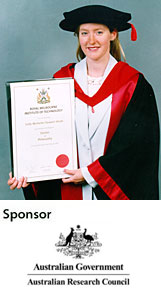
Sally Stewart-Wade was born in 1969 in Melbourne. She completed a Bachelor of Applied Science in Applied Biology (Hons) from the Royal Melbourne Institute of Technology (RMIT) in 1991, for which she studied a fungal disease of the genus Grevillea. She continued on at RMIT and in 1995 completed her PhD on the biological control of the weed thornapple. During her studies she was awarded an Australian postgraduate research award and a Rural Industries Research and Development Corporation scholarship.
In 1994-96 Stewart-Wade worked as a plant pathologist for the then Department of Agriculture, Victoria, where she investigated epidemiological and control aspects of fungal disease of chestnuts. From 1996-1999 Stewart-Wade was at the University of Guelph, in Ontario, Canada, as a postdoctoral fellow. As part of a large collaborative team, she researched biological control methods for broadleaf weeds, in particular dandelions.
In 2000 Stewart-Wade was appointed to her present position as research fellow in the Department of Agriculture and Food Systems in the Institute of Land and Food Resources at the University of Melbourne. She is developing programs for research into diseases of potato and canola. She is also doing some teaching and is involved in management aspects of the department.
Interviewed by Ms Nessy Allen in 2001.
Contents
- Introduction
- Family encouragement
- An increasing focus on science
- PhD work in weed control
- Support funding from scholarships and chestnuts
- Collaborating in Canada on broadleaf weed control
- Potato and canola disease research
- Commercial partners in science
- Does he who pays the piper, call the tune?
- Applying pure science insights to real questions
- The multiskilled scientist
- Both a mentee and a teacher
- Aiming to keep enjoying science
Introduction
Sally Stewart-Wade is a young scientist already making a major contribution in Australia and overseas to her discipline of plant pathology. She started her career at the Royal Melbourne Institute of Technology, completing a PhD on the biological control of the weed thornapple, using a mycoherbicide approach. From there she joined the Department of Agriculture (now called the Department of Natural Resources and Environment) at Knoxfield as a plant pathologist, studying a fungal disease of chestnuts. She then travelled to the University of Guelph, in Ontario, Canada, as a postdoctoral fellow, and with a large collaborative team investigated biological control agents for broadleaf weeds, in particular fungal pathogens for controlling dandelion. She is now in the Department of Agriculture and Food Systems in the Institute of Land and Food Resources at the University of Melbourne, developing programs for research into diseases of potato and canola.
Family encouragement
Sally, you began your career here in Melbourne. Were you born here?
Yes. After my parents got married, they travelled to Canada for two years and had a bit of an adventure there. They then settled in Melbourne, where they had grown up, and started their family. I came along in September of 1969 as the baby of the family – I've got two older brothers and an older sister. (It was always quite noisy in our household with four kids, so you often had to yell to be heard.)
Did your parents believe in education?
My father was a toolmaker and later a factory manager, and my mother was a secretary who gave up work when they started their family. They both thought that education was very important. They sent my brothers and me to a private school and always were very encouraging, offering to help us with our homework and so on. They were adamant that we got a good education.
My parents didn't particularly push us into science or anything else in particular, but just encouraged us in whatever we wanted to pursue. My brothers did science subjects – the eldest became a surveyor and the other one started as a physics teacher and then became a meteorologist. My sister I think got all the artistic genes of the family; she is more creative, into crafts and things. She is a full-time mother at the moment.
An increasing focus on science
Were you interested in science as a child?
I was. Right from an early age I was always a curious child, asking why things work and how things happen. I guess it began in primary school, when you do little science experiments in the classroom like growing plants in the cupboard without light and others on the shelf with light. I remember having to do a project for show-and-tell. It could be on anything, and I chose to do it on ants – I collected some from the garden and made a little ant farm. In early secondary school I was interested in learning about explorers and astronomers and that kind of thing. Then, towards the end of high school, I did maths, biology and chemistry for my VCE. So I really became very focused on science.
Did your teachers encourage you?
They were always encouraging, but not necessarily to follow science – the encouragement was just to do well at whatever I chose to do. My year 12 chemistry teacher, in particular, suggested that when I finished high school I shouldn't feel that I had to go to a large university and pursue a science degree if I wanted to do something at a smaller college, just as long as I was happy with what I was doing.
I ended up enrolling at the Royal Melbourne Institute of Technology (RMIT) in a Bachelor of Applied Science in Applied Biology, a three-year undergraduate degree. I completed that in 1990.
And then you went on to Honours?
Yes. Realising that with just a degree my job opportunities were limited, I thought, 'Well, I'll do an extra year and see how that goes, and see how I like research.' I decided to stay at RMIT for a one-year Honours year, based on an eight-month research project on a fungal disease of grevilleas. It was essentially finding out more about this fungal complex, which hadn't yet been identified – trying to characterise it and put a name to it.
PhD work in weed control
Did you go straight on to your PhD?
Yes. I enjoyed my Honours year and the independence of the research, so I decided to continue on with a PhD at RMIT. Fortunately, I got an Australian Postgraduate Research Award and that meant that I had a scholarship, some money to live off, to begin my PhD in '92.
I was looking at biological control of the weed thornapple, using a fungus – which is generally seen as an environment-friendly alternative to the usual chemical control. Thornapple is a weed in native vegetation and in horticultural and agricultural crops, and to control it I was looking at the fungus called Alternaria crassa.
I believe that work was so important that it may now be used for commercial purposes.
Yes. Several years later, a company is looking to commercialise the fungus to control the weed thornapple and use it in conjunction with other fungi to control other weeds.
Support funding from scholarships and chestnuts
I understand that you won a postgraduate scholarship during this time.
I did. For the first year I had the research award and then I applied for a Rural Industries Research and Development Corporation scholarship, which was worth more money and was also more prestigious because it was in my subject area. (Only four were given out that year, in an Australia-wide competition.) I was fortunate to be awarded that after quite a heavy interview – there were 12 stern-faced men around the table. At the end of it, when I found that I was successful, they said one of the reasons they gave it to me was my enthusiasm for the subject. It was good to know that, and to have the scholarship for the next two years to support my studies.
Then, while I was finishing my PhD, I had a job with the Department of Agriculture. I worked on an interesting project looking at fungal disease of chestnuts – the epidemiology of the fungus, to find out more about the fungus and how it interacts with its environment; and also control measures to try and stop the rot that the fungus caused in the actual chestnut. I was working full-time during the day and then coming home at night and writing up. I did that for about nine months, and finally got there. One enjoyable part of that job was that most of the fieldwork was in north-eastern Victoria and so I got to travel up to that very nice part of the state for my work.
Collaborating in Canada on broadleaf weed control
You then travelled to Canada. Why was that?
I was enjoying the project at the Department of Agriculture, but I really wanted to continue research into the biological control of weeds, so I applied for a postdoctoral position at the University of Guelph, in Ontario. The job was actually advertised on the internet and I was interviewed by email, which in the mid‑'90s was unusual. I was successful and went to Canada for three years.
This was quite a large collaborative project on biological control of broadleaf weeds, mainly focusing on dandelion. (It was an easy project to explain to people: 'I'm trying to control those weeds in your backyard that have the yellow flowers and the white heads.') There were many groups involved – three university groups, large industry groups, and also a government organisation.
I notice that your publications are all collaborative ones. Do you work in collaboration because your work dictates it, or because you enjoy it?
It's a bit of both. Mostly the work dictates it. It is very rare in my field to have a publication all by yourself – you're usually working in collaboration with others. The increased involvement of industry in science, too, leads to collaborative papers. But at the same time, I enjoy sharing ideas, bouncing ideas off other people.
Does this have something to do with the multidisciplinarity of your subject?
I guess so. I think the best way is to take a holistic, multidisciplinary approach, looking at a problem from all angles. And when you have different people, with different backgrounds and experience, involved in a project, that's when you get some good answers.
After your work in Canada you went travelling for another year.
Yes. I was offered a job in Orange, New South Wales, to work on biological control of weeds after my postdoc dandelion work. It was a very tough decision whether to take that job and come home straightaway, or to travel for a year. But it was only a one-year contract position, without a lot of security, and travelling won out. I thought, 'Well, I'm already halfway round the world. Before I head home, I may as well see some of it.' And I have no regrets at all. I travelled for about five months in North and South America and then about three and a half months in Europe. It was wonderful.
Potato and canola disease research
What are you working on now?
I have two research projects at present. One is in conjunction with scientists at the Institute for Horticultural Development, in the Department of Natural Resources [formerly the Department of Agriculture], where I worked before I went to Canada. We are looking at silver scurf, a fungal blemish disease of potatoes that just causes a mark on their skin but is a big problem in the industry. The project is mainly focusing on finding out more about the fungus and how it spreads from one tuber to another, and also how it survives in the soil or perhaps on other plant material to infect in the next year.
In the other project I am looking at the disease resistance of canola-quality Brassica lines. Brassica species are used to make canola oil and other products, and they are resistant to various fungal diseases, including blackleg (a big industry problem). But the industry is not sure if these Brassica lines are resistant to other fungal diseases such as Sclerotinia stem rot and Alternaria blackspot, both of which are becoming more important. So that is what I am looking at.
Commercial partners in science
Has your work ever been funded by large corporations, such as biotech companies?
There were actually three commercial partners in the project that I was working on in Ontario, the biological control of dandelions. They put in about half the money for the project, and the government of Canada put in the other half. Since I've returned to Melbourne there has been some interest in my PhD work, as I mentioned, so that a commercial sponsor – based in New South Wales – is involved in trying to get the fungus on the market as a product.
A lot of research, especially in my field, is funded by industry, and that's probably going to continue for a while. I guess generally the government has cut back and industry has stepped in, and funding opportunities where you have matching money – half from industry and half from government – are very common.
Does he who pays the piper, call the tune?
Does this influence the type of research you do, and whether you can publish it?
Industry involvement does make a difference to the type of research. If they're providing the money, you can expect them usually to want answers to specific questions, and to a certain extent they do drive the direction of the research project. You have to be able to strike a balance as to how much input they have. As long as you are making sure that the science is good, then that's all that counts.
As to publishing: most of the work I did at the University of Guelph was under confidentiality agreements, because the commercial partners really wanted to get a product on the market, something that they could sell to control dandelions and other broadleaf weeds. Basically you had to keep a secret, which was kind of exciting and you felt you were working on something important. But it did preclude any publications at the time, and that was a bit frustrating. Those confidentiality agreements are just starting to wind down now, so I am able to start to publish some work.
Did it worry you to be working under such conditions?
No, except that it might hurt my career as a scientist, because a good scientist has to publish. But I think that was outweighed at the time by the importance of the work – and I felt that anybody in that field would know that when you have industry partners involved, you often have to work under confidentiality agreements. It's the nature of many aspects of science these days.
Applying pure science insights to real questions
So do you think it is good for science to have industry input?
It's good, in that it keeps science focused on real-world issues. I think the general public have quite a scepticism towards scientists – if they see scientists working on something quite abstract that they don't understand, they lose confidence in them. But if the public can see science working on some real-world issues that require answers, then I think they see that there is value in it.
You are obviously interested in the practical applications of your research.
Yes. I like working on science that asks real questions and needs real answers. Fundamentally there's no difference between pure and applied science – good science is good science. But there is a difference when you are talking about questions and answers. I guess pure research is investigating something for the sake of it, and not necessarily looking for practical outcomes. My work is really more applied research, looking for answers to problems. In pure research, often, you aren't looking for an answer to a question, but the knowledge that you gain from doing pure research does lead to practical applications further on.
The multiskilled scientist
What skills are needed in science these days?
Oh, you have to be multiskilled these days. You have to be very flexible, for one, to be able to adapt techniques for use in different fields, and to adapt yourself as the job market changes and as faculties get restructured – practical things like that. You have to be able to adjust to fit in.
You have to be a very good communicator. You have to be able to communicate not only with your scientific peers but also with industry groups and grower groups such as farmers – and with the general public, again to encourage confidence in science.
As well, you have to be good at handling money, which is something I wish they had taught me in my science degree. You have to be able to manage the research funds that have been allocated to you.
Both a mentee and a teacher
Have you had any mentors?
I guess my main mentor was my senior supervisor for my PhD, Dr Ann Lawrie. She was very hardworking and had a good reputation. And throughout my years at the university, most of the lecturers that I had were very encouraging and you could see that they were hardworking and good scientists. I looked up to them.
Actually, I am now part of a formal mentoring scheme at the University of Melbourne which is trying to get women to progress further in their academic life so that there will be more senior academic women than at the moment. So I am a mentee, and my mentor is a senior lecturer. It is good to have somebody that I can bounce issues off and discuss academic life with.
And you have done some teaching. Did you enjoy that?
I have done just a little bit of teaching – a few guest lectures at this university and the University of Guelph, and also at RMIT when I was doing my PhD. I enjoy teaching, and I'm looking forward to doing some more in the future. Hopefully, I'll get a chance to teach a whole subject, rather than just some guest lectures. It's good to interact with the students, and you always learn something, that's for sure.
Aiming to keep enjoying science
Where do you see yourself in 10 years' time?
I guess I see myself with a research team of my own. I'm quite independent at the moment, in that I don't have any postgraduate students or direct staff working for me as, say, research assistants. I'd like to build up a team of postdoctoral fellows and research associates working closely with me, and have some postgraduate students to supervise and work together on projects. I guess my aim for the future, for 10 years' time, is to be enjoying science as much as I'm enjoying it now.
What kind of research would you like to be doing then?
Well, I'd like to still be in the field of plant pathology. Recently I've become a bit more mainstream – for example, my present potato and canola projects are working on more traditional plant pathology problems – and I've gotten away a little bit from the biological control of weeds, which is more of a fringe area, more daring and revolutionary. I'd like to have a balance between mainstream projects, working on disease problems of horticultural and agricultural commodities (with an applied angle, looking at real problems that need answers) and also some biological control of weeds work, which I think has real potential. There's been a lot of work done just to the point where people have trouble commercialising, say, a fungus to control a weed. I'd like to break through that barrier and actually try to get a product on the market. There have been very few products to date, and that's what I'd really like to work on.
I hope you're successful. Sally, it is clear that you've already made a significant contribution to plant pathology. Thank you very much for participating in this interview, and all the very best in your future career.
Dr Angus McEwan, oceanographer
Angus McEwan was born in Alloa, Scotland in 1937. In 1947, after the early death of his father, Angus McEwan immigrated with his mother and three brothers to Melbourne, Australia. McEwan attended Upwey High School and then Melbourne High School finishing with a leaving certificate. Too young for university, McEwan completed a diploma in engineering at Caulfield Technical School. After his National Service, McEwan got a job at the Aeronautical Research Laboratories in Melbourne. A cadetship enabled him to extend his studies at the University of Melbourne where he graduated with a BEMech (Hons) (1960). McEwan was then awarded a Vacuum Oil Scholarship to complete his masters, MEngSc (1962). McEwan again went to work for the Aeronautical Research Laboratories on heat transfer problems.
A desire to change direction in his research found McEwan on his way to Cambridge with a CSIRO Fellowship and, later, a Public Service Board Scholarship. He graduated with a PhD in 1966 for his work on the distortion changes in turbulence as flow goes over a step. He also worked with the legendary Sir Geoffery ('GI') Taylor on liquid surfaces in electric fields. McEwan then returned to Australia and the Aeronautical Research Laboratories to work on hypersonic re-entry problems (1966-69). He then joined the CSIRO Division of Meteorological Physics (later Atmospheric Research) supported by a Queen Elizabeth II Fellowship (1969-71). In 1971 McEwan was appointed as a senior research scientist with the task of creating a geophysical fluid dynamics laboratory within this Division (1971-81). During this period, in 1975, McEwan was invited as a Rossby Fellow to the Woods Hole Oceanographic Institution, USA where he worked on internal waves. In 1981 McEwan was appointed to chief of the new CSIRO Division of Oceanography (1981-95) to be established in Hobart. Following his term as chief, McEwan served as senior science advisor to the Commonwealth Bureau of Meteorology (1995-2005).
In addition to his research, and several roles in the advancement of Australian marine science, McEwan was active in the UNESCO Intergovernmental Oceanographic Commission (IOC). He served in a number of capacities including; Australian delegate to the (IOC) (1982-2004), member (1982-90) and then chairman (1987-90) of the IOC Committee on Climatic Changes and the Ocean, representative of the Global Ocean Observing System (GOOS) steering committee (1995-2003), chairman of the Intergovernmental GOOS committee (1998-2001) and chair of the Oceanographic Data Exchange Policy group (2001-02).
Interviewed by Dr Trevor McDougall in 2011.
Contents
- Introduction
- McEwan clan
- School and extra-curricula
- Get qualified and get employed
- Inspirations and influences
- Turbulence experiments
- Geophysical Fluid Dynamics and the Quasi-biennial Oscillation
- Cloudy Guinness
- CSIRO Chief of Division
- International acronyms: CCCO, IOC, SCOR, TOGA, WCRP, WOCE, GCOS and GOOS
- Achievements and no regrets
- From a position of experience
Introduction
Welcome. We are here today to interview Angus McEwan for the Australian Academy of Science video histories program. My name is Trevor McDougall and I will be conducting the interview. Angus has now retired, but his working life in science was in geophysical fluid dynamics. This is the study of fluid motion in geophysical fluids, such as the atmosphere and the oceans of earth. Also, he was Chief of the Division of Oceanography in CSIRO for 14 years and has played a major role in several international programs, coordinating marine science.
McEwan clan
Angus, let's start the interview with a discussion of your family background: your parents and where you were born.
I was born in Alloa, Scotland. It is a little town on the River Forth, about 25 miles North-West of Edinburgh. I was born the second of four brothers. My parents were David Nichol Reid McEwan and Annie Marion McEwan. My father was the chief chemist of the Patons and Baldwins Woollen Mills, which had its headquarters in Alloa. He was the inventor of the first commercial non-shrink wool process, which probably earned the company quite a lot of money at the time. My mother had a degree and was well educated.
My father collected antiques. I loved the clocks in particular. He had carriage clocks with glass sides, so I could see the works inside. Of course boys would be interested in that. But he also had gadgets and things that would interest a small child, like telescopes, for example. I made good use of a telescope once to invent a device to view my dinky toys from ground level. It required using the lens to invert the image and reduce it and then a mirror to rectify it or to put it upright again. I estimate that I invented this device at the age of nine.
Unfortunately, circumstances changed when I was about seven years old. My father died suddenly of cancer. We were now in a completely different situation. We were in austerity in postwar Scotland, with not much prospect of what we were going to do next. It was a very pessimistic time in northern Britain. So my mother decided that the best thing to do was to emigrate to Australia. We took a £10 Pom package and relocated ourselves into Melbourne in 1947.
School and extra-curricula
Angus, when you arrived in Australia, where did you go to school?
We arrived in Australia and we settled in Upwey, just to the east of Melbourne. And of course I went to Upwey high school. My mother was ambitious for me. I was a bright kid and she managed to persuade the headmaster that I should be moved up two years in class level. This was a bit of a disadvantage really. I think parents want to advance their children but it's not a good idea. You're smaller and less mature than your classmates. For example, I never made the sports team and, to this day, I have no interest in team sports at all.
So you were at Upwey for a few years.
I was at Upwey until my fourth year in high school. Then we moved to Melbourne and I did up to leaving certificate at Melbourne High School.
What kinds of things did you do as a young boy?
I was interested in doing and making things. I loved to build model aeroplanes, I had lots of model aeroplanes. I also built model boats. As I grew up or got older, I was able to build myself radio sets. I was always inventing and making things.
You mentioned a subscription to Scientific American.
Scientific American is a popular scientific publication. What appealed to me was the illustrations of it. It was very well illustrated. I don't know whether you remember it.
Yes, I do. It is probably an unusual present for a kid in high school.
I think I actually went and bought the subscription myself.
What subjects did you enjoy at school?
I enjoyed everything. But I was good at maths, science and English and I also liked things like woodwork. I still use the skills that I acquired in high school making things.
Were there any teachers that particularly inspired you at high school?
I can think of only one and that was Kenneth Jack, who was an arts teacher. He is also a successful artist. He was a very precise draftsman. I enjoyed that precision in his drawing and I discovered that my style of drawing was the same. He taught me techniques and basically led me in the right direction.
Get qualified and get employed
Angus, you left school at the end of year 5, before doing matriculation. That must have been unusual for a gifted student. You went straight to the Caulfield tech to do a diploma in engineering. Perhaps you could tell us why you made this unusual move.
By that stage, things were getting tough financially at home. We were short of money and there was an imperative to get qualified and employed as quickly as possible. I was unable to go directly to the university, so I decided to forgo the matriculation year and start on the third year of a tech diploma.
You were probably too young for university then, too.
Yes, that is correct.
Angus, what did you do after finishing the diploma at Caulfield tech?
I did national service training and then looked for a job. I found a job very quickly, as a lab assistant at the Aeronautical Research Laboratories (ARL) in Fishermen's Bend, near Melbourne.
What kinds of things were you doing at ARL then?
The job was to develop equipment to fatigue test metals. At about that time the first passenger jet, the Comet, had gone down in the Mediterranean and they were interested in knowing how it failed So metal fatigue became quite an important subject.
Inspirations and influences
Although your father died at a young age, Angus, do you think his research career had an impact on your choice of career?
I don't think so – he was an inspiration, I guess. I was proud of his occupation, his profession, and I suppose it inspired me to take a similar scientific career path.
You graduated with first-class honours in engineering at Melbourne University and went on to do a masters degree with a Vacuum Oil Scholarship. Was there anyone in particular that influenced you during this period?
Yes. Peter Joubert was a very strong influence upon me. He was a charismatic figure in a way. He inspired me to develop interests relating to aeronautics and aerodynamics.
And your topic was on the dishpan experiment?
No, but I was set an essay on the dishpan experiment. The dishpan experiment was a warmed water-filled annulus on a turntable and it produced interesting waves, which were thought to be similar to the atmospheric waves driven by temperature difference.
And Peter built boats as well?
Yes. I built parts of them, sailed them with him and endured them as well. So I developed an interest in boats and sailing and finally bought one.
After completing your master's degree, you went to work at the Aeronautical Research Laboratories at Fishermen's Bend. What were you working on there?
Since I had now developed a fluid dynamical interest, I went on to work on heat transfer problems. But not very interesting ones, and I decided that I would like to do something more and develop my scientific interests in a somewhat different direction. So I applied for and got a CSIRO Fellowship. Later I augmented that with a Public Service Board Scholarship.
The scholarship was to study overseas. Was it to go to Cambridge in particular?
Overseas. But Peter Joubert had made contacts with people in Cambridge and I naturally chose that as the best place I could have gone to. He, in particular, fixed up a place for me in the Cavendish Laboratory with Alan Townsend. But there was quite a host of Australians in Cambridge and another influential figure was George Bachelor. He ran the Department of Applied Maths and Theoretical physics.
That department had already formed at that stage?
Yes, it was there. But the Cavendish Laboratory had had a fairly long association with fluid dynamics through G I Taylor and Alan Townsend, who had gone there several years before.
Tell us about the environment of doing research in the Cavendish Laboratory in the Balfour Room. What was it like?
The Balfour Room was the only experimental laboratory for doing fluid dynamic experiments. It was for people both in the physics department and in the department of applied maths.
and Theoretical physics?
Yes, theoretical physics.
Would you call it a modern laboratory by today's standards?
I don't think you would call it a modern laboratory by any standards – maybe by medieval standards. It was a dark, crowded, dirty room. But, because it had very good resources, it was really quite good. It was the accumulation of equipment from decades of experimentation. It had a good darkroom. It had a talented and cooperative assistant to make equipment. It turned out to be where GI Taylor had his office and laboratory.
There is some story about a lost umbrella… you haven't told me this story.
As GI came and went from his office we PhD students got a glimpse of his inner working sanctuary. We noticed that his desk was extremely untidy. The assistant informed us that he had actually lost an umbrella on it in an open condition.
Angus, GI Taylor is one of the legendary figures in fluid mechanics and you ended up working with him in Cambridge. How did that come about?
That was a great stroke of luck. His long-time assistant had become ill and George Bachelor asked me whether I would serve as his assistant. George knew that I could do experiments. Because of my PhD requirements I had to say no to him. But I said I would assist as a collaborator if the work could be used towards my thesis. And that arrangement was accepted. The consequence was a good and fruitful association with GI Taylor. Over his long career GI had not had many students. He had worked on his own.
Was GI good at designing experiments and making them with his hands?
Yes, he was good at designing things. He didn't personally construct them, but he was an ingenious designer and he was very inventive in the way that he used his equipment. For example he was a very good photographer. In fact, I discovered there was a lot of similarity in our natures, and we had a close and fruitful association.
He was a lot older than you at the time.
Golly, at that time, yes. He was 55 years my senior. He was an old man, but he was nevertheless like a young man in his nature and enthusiasm. He loved simple and elegant experiments. He would try to go to the core of the physics of a problem, with the minimum number of variables to get to the point.
Yes. He was renowned for the seemingly simple experiments that revealed the physics.
Yes, that was quite right, and it became very quickly apparent to me that he had this talent.
I guess this was before the days of computers being in the laboratory.
There weren't any computers. But Cambridge had the EDSAC computer, the father of computers, really. It occupied the floor of a large laboratory. It was very hot because it had thousands of thermionic valves working away. It would break down about every five minutes. You programmed it by entering a punched paper tape, which had your program on it.
But you weren't using that computer for data acquisition.
No, not at all. You put the program and any data onto paper tape
And GI was also into boats.
Yes. He was quite an accomplished sailor. In fact, he embarked on a cruise across the North Sea with his wife and solved many problems on the way.
GI also designed an anchor. Tell us about that.
It was a revolutionary design of anchor. In fact, I have got an inferior imitation myself for my boat. It was revolutionary in having a very high ratio of holding-to-weight, so it was suitable for small boats. The design was taken over by the Navy in the war. If that hadn't happened he would have made a fortune on the anchor itself.
Turbulence experiments
Tell us about the work that you did for your PhD.
I was obliged to do my work with Alan Townsend on the turbulent flow over a step. As the flow goes over the step, it is distorted and the distortion changes the structure of the turbulence. I developed a laboratory experiment to study this.
Was that at about the same time as Julian Hunt was working on the rapid distortion theory?
Yes, it was at about the same time. He was a contemporary of mine. GI's work was also very interesting. He was interested in the effects of electric fields on liquids or fluids. If you take a droplet and put it in an electric field, a stream of charged liquid comes out of the droplet if the field strength is strong enough. This could be a cause for charge separation in thunder storms, for example. So we did a variety of experiments on this, which involved using high voltage and liquids like benzene and other inflammable materials. Dangerous but great fun.
After completing your PhD, in 1965 you returned to Australia and you worked at the Aeronautical Research Laboratories again. Tell us about what topics you were doing then.
I was studying hypersonic problems, including the problems of re-entry, which was fashionable at the time. Ablative surfaces and ablating bodies was my specialisation. An example of an ablated body is tektites. These are little balls of glass that are found in the dry plains of western Victoria. They are probably spatter from lunar impacts millions of years ago and have taken on a characteristic shape as they entered the Earth's atmosphere.
Is it like a teardrop shape, Angus?
No. Imagine a sphere that is then rubbed or worn away on one surface. You can imagine these things streaking into the atmosphere and melting and forming a particular shape.
Then something arose that really interested me. Bill Wood, who was a mathematician at ARL, asked me whether I would help him in testing his theoretical work on the behaviour of a liquid -filled spinning projectile. For example if you take a shell, filled with liquid, and spin it, it suddenly goes unstable. You can imagine that the motion inside this shell is composed of modes of oscillation. It's like a resonating cavity. At certain spinning speeds and depending upon the configuration of the chamber itself, you will get modes of oscillation inside this body of fluid. You will also have a frequency of disturbance, which is determined by the spinning of the object and the cavity will resonate at certain lengths.
But it's not initially turbulent.
It's very interesting because you can force these waves and they will grow and remain apparently completely steady in their behaviour, I made an experiment that did this. But then, after some quite long period, they will suddenly break into turbulence. I found that this phenomenon was very reproducible. You could reproduce it exactly. I said, 'While this is obviously looking turbulent, it's not turbulent, because it's so predictable.' This was a very interesting phenomenon.
In 1969, you moved from the ARL to the CSIRO Division of Meteorology, supported by a Queen Elizabeth II Fellowship. Tell us how that happened.
When I did this experiment, I thought, 'I'm on to something here. Is there another analog? Is there something that behaves like this that is easier to deal with?' I found an analog in internal waves in a stratified fluid. It had very similar equations and similar dynamics. But, in the internal wave example, it would be easy to make an experiment using a rectangular system, with a rectangular tank, to control the variables in a much more manageable way. So I sought some venue to do experiments on this subject and I thought of atmospheric science. In Melbourne, there was the CSIRO Division of Meteorological Physics, as it was known then. Bill Priestley, the chief, had just created a new laboratory space and needed to fill it with something, and I came along at just the right time.
Can you tell us about one of the experiments that you did at the Division of Meteorology on internal gravity waves?
There was a glass tank – a big fish tank, really – and you would fill this tank with water. The water was linearly stratified with salt so that there was a continuous variation in density from top to bottom, getting denser as you went go down. You could put layers of dye in the tank as you filled it up so that you would get sharp layers and you could see what was happening inside the fluid.
You forced a wave in it by moving a paddle at one end of the tank. And, lo and behold, if you forced this wave, the wave grew and suddenly other waves would appear in with this first original wave – waves that you weren't forcing. If you continued, you would get sharp irreversible changes in the density gradient and, ultimately, it would become turbulent. It was really doing exactly the same as the rotational experiment.
Are those waves parasitic waves?
You would think they were parasitic because they were growing from the energy of the original wave. What was more important was that you could analyse what was happening theoretically. I determined that these parasitic waves formed a triad with the original waves. So you have one original wave and you have two parasitic waves that gain their strength from the original, forming a triadwhose wave numbers altogether combined to be zero. Their frequencies also combined to be zero and the original wave had the highest frequency of the triad. So you had a resonant instability, a resonant interaction. You could describe it very accurately by a simple theory.
It has led on to a lot of studies in the area of stratified theories.
I believed at the time that the theory was going to prove to be an important mechanism in understanding how the oceans managed to take the energy that was being fed in by large-scale motions – wind and tides – and convert that ultimately into turbulence and mixing.
Angus, you moved from studying waves and stratified fluids to studying rotation and considering larger scale atmospheric waves and phenomena. Can you give us an example of that kind of experiment?
This came a little later, but I had a couple of interests in rotation. One of them was a simple fundamental question. If you take a rotating body of fluid and you mix it, what will happen? If the mixing produces an exchange of momentum, which is the normal situation, you would get a solid rotation. That is, everything would be rotating at the same speed as the mixing settles down. The alternative might be that you mixed angular momentum, in which case you would get a concentrated vortex and the rest of the motion would be distributed according to a uniform angular momentum.
So you had to do an experiment without forcing these vortices externally.
That's correct. Of course, this had occurred to other people and they'd tried it out. Even Stewart Turner had tried it out – but they didn't get very convincing results. Nothing happened particularly. I decided to use my experience of the spinning liquid-filled cylinder to produce turbulence by the process that I had now identified was probably a resonant wave interaction. So I used that resonant wave interaction to mix a rotating fluid strongly and see what happened. I made an experiment that produced inertia waves inside a container and, lo and behold, strong vortices occurred.
I also tried another experiment in which mixing was introduced by an array of jets whose axes were parallel to the rotation axis. This enabled the parameters of the mixing to be varied. Again, strong vortices were produced.
Geophysical Fluid Dynamics and the Quasi-biennial Oscillation
When your QEII Fellowship ended in 1971, you were appointed to a tenured position in CSIRO as a senior research scientist. You were charged with setting up the GFD laboratory, tell us about that.
I was tasked with creating a GFD lab at Aspendale. I equipped the lab in an appropriate way to do a variety of experiments: internal wave experiments, convection experiments and rotating experiments.
One of the techniques that I recall from that era in your papers was the Schlieren technique which you've used quite a bit. Tell us about that technique.
Schlieren is an important optical tool. Schlieren is a way of revealing differences in refractive index, using salinity or temperature differences. Schlieren uses a refractive index change to make altered density regions visible and quantifiable. You are able to see internal waves inside a tank of water without having dye layers.
Then there are other, similar methods such as 'shadowgraph'. Shadowgraph is simply making a shadow of the experimental tank, lit by a collimated light source. This will reveal the gradient of refractive index gradients.
In 1977, you worked with Alan Plumb, who was an import from the UK to Melbourne, on a new theory of the Quasi-Biennial Oscillation. This work turned out to be perhaps your biggest contribution to science and certainly a big output of the GFD laboratory that you had established there. Tell us about that.
The quasi-biennial oscillation is a phenomenon in the atmosphere. In the equatorial stratosphere there is a zonal jet of air circulating the globe. It has been found to alternate in direction between EastWest and WestEast, with a period of approximately two years. In other words, you get a quasi-biennial oscillation.
It occurs not exactly at two years. That annoyed everybody.
Yes, it annoyed everybody because people produced abundant theories about this thing, but it didn't fit the theories because the oscillation period was not exactly two years. During the early seventies, explanations were developed of how this change in direction might occur. One in particular by Holton and Lindzen was that there were upward travelling waves emerging from the tropopause. You can imagine that the turbulent troposphere is bumping around against the base of the stratosphere, and these waves travelling upwards would produce an alternating jet.
Alan Plumb improved on this by a few essential differences in the theory which took into account the fact that the waves, as they travel upwards, would be dissipated and their momentum would be deposited at elevated levels within the jets of the stratosphere. The important thing was that these waves bumping up and down on the bottom of the stratosphere were composed of waves that travelled in both Easterly and Westerly directions. The waves that were travelling in the same direction as the jet would be absorbed as a process of 'critical layer absorption'. Basically, what would be happening would be that the frequency of the waves would approach zero in relative terms, whereas the waves going in the opposite direction would go straight through the jet. So we got a preferential process of depositing momentum in the Easterly and Westerly directions. The consequence of that would be that the jet would grow, getting stronger at the lower altitudes, until it was reversed in sign, where the waves that were going in the other direction would then start to be absorbed.
Okay. So that was the theory.
The idea was to make an experiment which would prove this theory. Basically, we had an annular tank of water, stratified so that waves could be generated in it. We generated waves at the bottom of the tank by having a set of pistons which deformed the bottom, and waves would travel in both directions around the tank as a result. We threw the switch and waited for something to happen. What happened was exactly as predicted by the theory: a jet would form going in one direction and then, as we continued to force these waves, gradually the jet would be built up in strength at the bottom and then start flowing in the other direction. Click here to see video footage of the original experiment by Plumb and McEwan.
Why is it close to two years? Is it just happenstance?
Yes, it is happenstance. In other words, it is decoupled from the fact that the earth is rotating. So there is nothing special about the fact that it reverses direction every year and a little bit.
Tell us about the impact of this work on the field, Angus.
This stimulated a great deal of interest because theoreticians could actually see something happening. It had a big impact. To this day, people are still fiddling around with this. You could say: 'Why wasn't it modelled by a computer? Why couldn't the computer people do this?' The fact was that it required too much resolution in the models themselves to actually make this thing work. It wasn't until around 1995 that somebody did a successful numerical model of this process. The experiment described was published in 1978, so that was quite a few years before the computer model.
In 1975, you were invited to the Woods Hole Oceanographic Institution as a Rossby Fellow and you worked there for eight months. Tell us about that work.
The Rossby Fellowship was a prestigious fellowship. It had been given to several notable people in geophysical fluid dynamics before me. It was arranged by Peter Rhines. It gave me a great opportunity to work alongside the leading figures in physical oceanography of the time, and I decided to use it to extend my work on internal waves. I found that with a carefully designed experiment, I could show that the waves would be intrinsically unstable and they would evolve to form triads. In other words, they would change their own wave numbers to make a resonance that would strengthen the transfer to different wave numbers.
I recall Jack Whitehead telling me that he was impressed by how you made all your own laboratory equipment in Woods Hole rather than getting the staff to make it.
One thing that I did learn through my career was that, to the best extent possible, you should try to make your own things rather than rely on somebody else to make them for you.
Cloudy Guinness
Changing tack a bit, you came back to Melbourne after being in Woods Hole and you started working on simulating convection in clouds. Tell us about those experiments.
Clouds form and rise and are visible because the water vapour that is contained in the air at low levels condenses. The condensing process liberates heat inside the cloud and it encourages or helps it to grow to higher levels. People imagined that clouds were a bit like mushroom clouds and would rise with the buoyancy that they started with. Theories were produced to describe this. Stewart Turner, for example, worked on such things, as did Bruce Morton.
So the key difference to the theory of Morton, Taylor, Turner and so forth was that you were simulating the latent heat release and buoyancy production due to the cloud's rising.
If you are doing an experiment in water, which is what I was doing, you would be trying to release the buoyancy conditionally as it rose. In other words, you would be releasing more buoyancy the higher it got. The way I did that was to saturate the blob of fluid, which was supposed to be the cloud, with a fairly insoluble gas. Air is a fairly insoluble gas, but I used other gases as well. At a certain height, the gas in solution would come out of solution in the form of very fine bubbles. You can see this kind of thing happening in Guinness. If you look at a glass of Guinness after it has just been poured, you will see that there is a white layer which rises. I think it is nitrogen gas that they saturate Guinness with. I made experiments which would do just that – release the buoyancy as they rose. And sure enough, the clouds produced in this way closely resembled real cumulus clouds in the atmosphere. But there were measurement problems and, unfortunately, something intervened in my proceeding with this experiment.
So, Angus, you are making clouds in reverse. The water became the air and the bubbles were being used for water droplets. It is all back to front.
Yes, that's right.
CSIRO Chief of Division
Something intervened in 1981 and your career took a dramatic change, when you were appointed as foundation chief of CSIRO's Division of Oceanography. Tell us how that happened, Angus.
Yes. In Australia, sea-going oceanography had been pioneered by a couple of individuals in the CSIRO division of what was then fisheries and oceanography. Bruce Hamon in particular developed an instrument to measure the density of sea water as a function of depth. This was an essential piece of information to know about if you were going to study the dynamics of the ocean. But Bruce and others had lacked a dedicated ship or a vessel from which to do their investigations. With the pending declaration of the UN Convention on the Law of the Sea, it was becoming increasingly obvious that Australia, which had custodianship for a huge area of the ocean, was not equipped to do anything much at all. There were lots of reviews, as you can imagine, with governments saying, 'What are we going to do about this?' They dragged me in on their review panels and I wrote a couple of reports. The Fraser government finally declared that it was going to inject new resources into oceanography through CSIRO, into what would be a new Division of Oceanography. They were also going to buy or build a ship that would provide the scientists with the means to get to where they were going to study the ocean. The existing Division of Fisheries and Oceanography was to be split, and both these divisions would be relocated in Hobart.
But the site where the division was located in Sydney had been pretty ideal?
Yes, it was a very nice site. As you can imagine, the staff who were working in Cronulla were not terribly happy to move. At Cronulla, the laboratories were situated on the headland of the Port Hacking estuary, overlooking the sea. People would arrive at work by kayak or surf ski.
Yes. And there was a nudist beach just one beach away by surf ski. You could go there at lunchtime.
I never knew that! When we heard about this move to new laboratories in Hobart, people would say, 'What's the matter with you? What are you complaining about? Come and have a look.' For example, John Philip who was then the director of the institute in CSIRO, described Cronulla as a cross between Shangrila and the Marie Celeste, referring to the fact that nobody ever seemed to be there.
They were all wind surfing.
That was the impression. When the CSIRO executive committee visited shortly after my appointment, I was obliged to issue a directive to the staff to have surf boards and surf skis temporarily removed from the grassy banks, for fear of their possibly getting the wrong impression.
You must have been unpopular, Angus, having to move 100 or 200 people down from Cronulla to Hobart. What were your major tasks in the first two years as chief?
I had to move the people, which was a big task in itself – about 100 people altogether at the time. There were staff problems, including a couple of serious ones. There was a lot of work involved in building a new set of laboratories, the laboratories which are now on the waterfront down at Castray Esplanade. All those laboratories were designed and built. We also built the ship called the Franklin, in Cairns. It was 55 metres long.
It was operated as a national facility, wasn't it?
Yes. That was an important step because the ship was bought and built with the CSIRO budget but to get best use of it, it was decided that the vessel should be operated as a national facility. So it was made available to anybody who could put up a good proposal for the use of it.
It operated that way from the start?
Yes, right from the start. Most of the external use was by universities. There were lots of little groups doing oceanography and a couple of bigger groups too. They didn't have the facilities and the resources to equip themselves for a full range of experimental tasks. So CSIRO basically assisted in that regard too.
So you had the people moved, the buildings built, the ship designed and then recruiting.
That's correct. We recruited quite a few new staff. We got some good ones who are still around to this day.
How significant was setting up a whole new laboratory in Hobart in marine science? How significant for the country?
It provided the framework and facilities for expansion and development that has been going along for the last 30 years. Of course, the ship didn't remain just an important tool in itself, but what flowed from that in terms of equipment, techniques and collaboration with other people has made a huge difference.
It's actually hard to think of physical and chemical oceanography as being as small as it must have been back in Cronulla days.
Yes. You were talking about one individual, basically, or two perhaps.
Another development in the eighties was the establishment of the Marine Science and Technology Grants Scheme. Tell us about that.
That was introduced at about the same time as these other developments, including the creation of the division. This grants scheme was administered in the same fashion as the Research Council grants, but it had a couple of distinct features. One thing was that it wasn't limited in its scope to academic establishments and it enabled other people, whoever they were, to put up proposals for the use of the Franklin. Another important feature was that the candidates or applicants for grants were interviewed by a committee rather than just submitting an application that would in due course be passed or failed. So we not only got to know who the people were and what their strengths and weaknesses were, but we could also propose, where necessary, alliances or collaborations. Or to suggest to go back and do it a different way, to pool resources and this sort of thing.
The scheme itself didn't last very long, I think only four years or thereabouts. But it was followed by other initiatives that together resulted in a big build-up in Australian oceanographic science generally and in the Antarctic in particular. In the cooperative research centre (CRC) program, the Antarctic CRC was established in the first round. That was an alliance with the Division of Oceanography, the University of Tasmania and the Antarctic Division. It resulted in several further important staff appointments and it gave a quantum leap to the research in the Southern Ocean. For the rest of the world, while there was lots of oceanography going on, the Antarctic was a long way away. There was a limitation on what people could do from far away, and CSIRO or, I should say, Australian oceanography filled the gap.
It was a real growth era for CSIRO, for university groups and for the CRC in particular. You were actually a key man in terms of arranging a lot of those committees, interviewing people and selecting staff. I remember that at the time, in 1994, there was a political push to combine the marine divisions of CSIRO with the Australian Institute of Marine Science (AIMS) based in Townsville. I know that this was a turbulent time involving politics and it's now almost 20 years later. I wonder whether you could give us a perspective of that political push.
I suppose that it was a rude awakening to us about the way that politics work. It was politically inspired in order to give the appearance of a new government initiative without actually being one. Basically it was taking two parts of well-functioning research organisations, putting them together and saying, 'We've created a new initiative.' It was opposed because it was just a disruption to the division, as far as we were concerned. There may have been benefits, but they weren't immediately apparent to us in the arrangement of it. There was likely to be a reduction in funding efficiency and an increase in operational difficulty by forcing people to coordinate over long distances in programs that were constructed for appearance rather than function. It was strongly opposed by CSIRO. In fact John Stocker, who was CEO of CSIRO at the time, described it as akin to borrowing a bone from a Rottweiler.
CSIRO being the Rottweiler.
International acronyms: CCCO, IOC, SCOR, TOGA, WCRP, WOCE, GCOS and GOOS
Very soon after being appointed chief of the CSIRO Division of Oceanography, you also became involved in the international organisation of oceanography, particularly in regard to the ocean's role in climate change. Tell us how you got involved in that.
In 1982, I met Roger Revelle, who was a very revered senior oceanographer in the American scene. Roger pioneered studies on the influence of the ocean on atmospheric CO2. He was the first to sound a warning alarm about the capacity of the ocean to absorb carbon dioxide and to mask the effect of man's emissions. He had founded the Committee on Climate Changes and the Ocean (CCCO), an international and intergovernmental committee to discuss and develop largescale programs to study the world's oceans.
The CCCO was jointly sponsored by two international bodies. One was the Intergovernmental Oceanographic Commission (IOC) of UNESCO, and this provided the interface to governmental processes. Of course, developing largescale or international programs required governmental cooperation. At that stage there was still quite a lot of territoriality between countries about their waters. The other sponsor was the International Council of Scientific Unions, which had a committee on ocean research: the Scientific Committee on Ocean Research (SCOR). They provided the scientific interface. So these two organisations were brought together to form a body that would look after international oceanographic programs.
Was this before the World Climate Research Programme?
It was at about the same time.
But it had a similar role in the sense that it's partly intergovernmental and partly science.
That's correct.
What do you see as the major achievement of the CCCO, the Committee on Climate Changes and the Ocean?
The CCCO had one big job on its hands, which was to create and promote the Tropical Ocean Global Atmosphere program (TOGA). This was intended to determine the predictability of the El Nino southern oscillation by studying the equatorial Pacific Ocean. This involved both atmospheric and oceanic expeditions being coordinated together. Since really the objective was atmospheric in its nature, it was declared to be a priority program for the World Climate Research Program (WCRP). The WCRP was under the umbrella of the World Meteorological Organization, the intergovernmental meteorological organisation. As for the CCCO, the question was how to effectively bring this about, considering that every initiative had to be basically okay as far as the national participants were concerned. We created working groups of practising scientists from various nations and disciplines to work together towards the design and execution of the observations required. This working-group idea proved to be a major mechanism for resourcing small groups internationally and facilitating cooperation.
My division was strongly helped by this arrangement and we had scientists serve on the committee and participate as experimenters in their working groups. One person in particular I might mention is Gary Meyers. I think he worked originally in Hawaii, and he came to continue his work on the observational network of volunteer-observing ships and XBTs, expendable bathythermographs. These provided a major data source for what subsequently proved to be an important means of keeping an eye on the El Nino southern oscillation.
TOGA was certainly a very successful experiment and it has left us with a great legacy of moorings and other data acquisitions systems that we still use today.
Quite so. Those things are still being run as a continuing operational network, yes.
After TOGA, there was WOCE.
Yes. WOCE is the World Ocean Circulation Experiment. Having seen how TOGA was going to go, they were keen for a much more ambitious experiment to study the world's oceans. It might have been a bit too ambitious in some ways, as it turned out. But, in fact, it was very successful. It involved taking coordinated and synchronised deep oceanographic 'sections' of many parts of the ocean. I forget how many sections there were, but there must have been dozens, combined with all the other detailed studies. But these sections would cut the whole global ocean up into pieces, which would then enable the determination of the exchanges and transports between the ocean basins and also would reveal the dynamics of those basins at the same time.
So the CCCO was involved in getting it off the ground under WOCE.
Yes. But CCCO was a relatively small committee without much clout, as far as summoning large-scale national resources. It proved that the WCRP was really a more fit patron, even though the CCCO had initiated this effort.
Angus, after TOGA and WOCE, you then became involved with GOOS, another international committee. Tell us about that.
GOOS – the Global Ocean Observing System. TOGA and WOCE, in their execution, had established the notion of largescale cooperation between nations in the developing of observing systems which would advance the improvement of prediction for all sorts of purposes, including the greenhouse effect. GOOS was preceded by the Global Climate Observing System (GCOS) which had been developed by the WMO and we needed a similar scale of organisation in the oceans. But there were territorial difficulties in doing this. Not all countries were used to working cooperatively at a governmental level. Nor were they used to committing big resources – like ships and whole programs, satellite programs and satellite observing systems – to all work cooperatively for a larger scale goal. The goal being a comprehensive observing system that would serve the needs of the world by providing an ongoing understanding of what was going on in the oceans.
Thus GOOS was created and an organisation was developed within the IOC to observe its progress. I was invited to participate, firstly, as the representative of GOOS on GCOS. In due course, I became the Australian delegate to the IOC and was elected as the chairman of the Intergovernmental committee for GOOS, reporting to the IOC. My role was mainly to be an advocate for the various GOOS initiatives at the national and international level. In other words, to persuade bodies, whether they be governments or research organisations, to get involved. Of course, America's people were very cooperative, but smaller countries and some of the Pacific countries were not quite so amenable.
Angus, tell us about your work with the IOC policy on the oceanographic data exchange.
Data exchange was one of the besetting issues of organising an international program for collecting ocean data. Many of the seas are territorial seas and sometimes navies don't like the idea of people having unrestricted access to the data. One of my last contributions for the IOC was to chair a committee to develop or formulate a policy on oceanographic data exchange. In other words, an abiding statement of intent to share the data freely. I formulated that by committee and duly pressed it through, and it was adopted by the IOC in 2003. This was a high point on which I ended my association with the IOC.
Did the adoption of this policy require the unanimous support of all 141 countries of IOC?
I'm not sure that it required a unanimous vote, but those dissenters would have to speak up. That is, they would have to have registered their problems with the document as it was produced. As it happened, no dissent was registered. Ultimately it had been arrived at by a committee which was composed of the same people.
Achievements and no regrets
Angus, your job as Chief of the Division of Oceanography and then your many international committee responsibilities, including being Australia's representative on the Intergovernmental Oceanographic Commission, took you away from the research bench. Do you regret this?
Yes and no. I would have liked to have completed my research into clouds in particular; that was very much unfinished business. And there were a number of other things that I was interested in and would have liked to have followed further. But I have to remember that my life as a chief was an interesting time and an exciting period for the expansion of oceanographic research, particularly in Australia. I was also pleased to have the opportunity to develop and advance global cooperation in oceanographic research. I achieved satisfaction from helping to create situations and environments for other researchers to operate effectively, and I think I certainly succeeded in that. So I do not hang my head about what happened.
I remember you saying once that being a chief was a vicarious job and that you got enjoyment by seeing the achievements of the people you appointed. Tell us about that.
You certainly did have to ensure that the staff to whom you were giving an opportunity were using that effectively. In fact, in my case, I was immensely pleased by the success of my scientists on their own, as individuals in their chosen fields. I got a great deal of pleasure from that.
From a position of experience
In the first few years of your 14year reign as chief, the Division of Oceanography had no external income. All the money came from CSIRO. That has changed over the years, including during your time but more recently. Now it is very hard to do anything which is not half-sponsored from sources outside of CSIRO. What do you think of this development?
I suppose it was coming because research gets more expensive with passing years: bigger equipment, bigger quantums of staff, resources, salaries – everything. Getting the people who would benefit from the research to pay for it is, in principle, a perfectly good idea. It is good when there is a direct link between the science outcomes and the economic benefit. That is, if somebody can say, 'If you did a bit of research, we would be able to charge such-and-such.' Unfortunately, oceanographic research, and much of environmental research, lies at the end of the spectrum of public benefit versus earning potential. Ultimately, the real beneficiaries of oceanographic research are the world in general. The research informs the citizens of the world about their own environment.
CSIRO's acceptance of the universal user-pays principle is obviously politically necessary. Thus people don't feel like their money is wasted on things that don't interest them. But it fails to recognise intrinsic differences between disciplines and plays into the hands of the bean counters. In other words, something that has to be accounted for in economic terms. When there are debates about a research budget, not much is said about what the research has actually produced. It is more 'how much it is going to cost' or 'why it should be stopped'. By necessity, the scientist's time is consumed by proposal writing, review and conformity with organisational structures that might be quite inappropriate. What's the best structure for the organisation of a research laboratory? Probably it's going to be a lot simpler than what we had to put up with.
So, with a wider integration of effort, we can access big programs and more money. In fact, there has been an enormous increase in the budgets for things such as oceanography, Antarctic research and so on. A huge boost motivated largely by the spectre of climate change. In observing systems, for example, the government has put $50 million into ocean observing programs. But at what cost is this done to an individual scientist? He has the results, but I suppose he has sold his soul to the devil in a way.
Angus, do you have any pearls of wisdom that you could give to a younger scientist about to embark on a research career?
Make and take opportunities to work in different organisations and meet other researchers working in your field, both nationally and internationally. It is a terrifically broadening experience to see how other people do things and what things are like in other places.
The idea of going away for six months at a time is fantastic. Angus, thanks so much for doing this video history for the Academy of Science. You were the dominant figure in Australian oceanography in the eighties and nineties and it was a period of tremendous growth, both at CSIRO and at the universities. We have you to thank for that in a large measure. So thanks again, and we wish you all the best in your retirement and as you go sailing on your yacht.
As I sail past the marine laboratory's windows occasionally on a Wednesday, I think of what it was like in there.
Okay, and we'll salute you.
Professor John Sprent (1915-2010), parasitologist
Professor John Sprent was born in 1915, in Mill Hill, England. He received an MRCVS diploma from the Royal Veterinary College in London in 1939. In 1942 he was awarded a BSc in zoology with first class honours from the University of London. After receiving his degree, Sprent went to work at the Vom Veterinary Station in Nigeria. His work there, on Bunostomum phlebotomum (hookworms) in cattle, resulted in a PhD (1945) from the University of London, where he also received a DSc in 1953. In 1946 he went to the University of Chicago researching the parasitic nematode Ascaris suum. His studies of Ascaridoidea (nematode worms) continued while he was a senior research fellow at the Ontario Research Foundation in Toronto, Canada, where he worked from 1948 to 1952. Professor Sprent moved to the University of Queensland in 1952 as a lecturer in veterinary parasitology. He remained at the university for the rest of his career. In 1954 he became research professor of parasitology in the Department of Veterinary Anatomy and Parasitology and was professor of parasitology from 1956 to 1983. In 1961 a separate Department of Parasitology was established at the university.
Interviewed by Julie Campbell in 2008.
Contents
- Family and early life
- Opportunities: university and a future wife
- A single failure opens up a great future
- The place of worms in the life pyramid
- The move to Australia
- Broadening the parasitology scope
- Valued help in a great scientific achievement
- Personal achievements
- The next generation
Family and early life
John, firstly can you tell us where you were born, and a little of your family and your early life?
I was born in Mill Hill, which was then a small village north of London but is now, of course, an extension of London itself. And, well, my boyhood was just a normal sort of boyhood. We used to collect tadpoles and watch them change into frogs, and we used to sometimes go off to the seaside, where I liked to go to the fish shop and get a fish head – free – and attach it to a piece of string. You would then go out to one of the breakwaters and drop the fish head into the water, and when you pulled it up you had the most beautiful crabs attached to it. I think that, biologically speaking, those were my first experiences of animals.
My father was a keeper of ancient maps at the British Museum, in London. He died at a rather early age in 1931, when I was about 16, so I don't really remember terribly much about him. My mother and father were separated: he lived in London and my mother lived down in Sussex, which was the earliest home that I can remember.
I had a brother and a sister. My dear sister is still alive, the only member of my family that is left, because my brother died about five years ago and my mother died about 10 years ago at the ripe old age of 101. She was a remarkable woman.
At school, were you a good student?
Well, the answer to that question is no. I think I was a great disappointment to my father. Although he sacrificed quite a lot to send me to Shrewsbury, I didn't perform well at all. In fact, I remember that there were always three people at the bottom of the class when the marks were read out, and I was always two from the bottom, one from the bottom, or the bottom. But I enjoyed being at school, because I was keen on sport and I made a lot of friends.
And there were some famous people that went to the school.
[laugh] Yes. Charles Darwin was one, but too long before me. I wouldn't have appreciated him, I'm afraid. Another one that you might know about is Michael Palin, who was there a bit after I was. But I enjoyed school, again, for the friends I made.
Opportunities: university and a future wife
After school, what was your first job, and were you good at it?
I'm terribly sorry to say this, but I wasn't good there either. My father died in the time of the Great Depression and I had to find a job. I became an office-boy with WD & HO Wills, the cigarette people, and my job was to put invoices into envelopes so the address appeared in the right place. And even that I didn't seem to do terribly well, because I'd get letters sent back where it was all illegible. But again I made some very good friends. In particular I made one special friend who made a lot of difference to me.
He changed your life, didn't he? Just what happened?
I was feeling that I really didn't know what I was going to do. I didn't have any motivation at all. Then one day we were walking across the Thames, across Hungerford Bridge, which is by Westminster Bridge, and as we leant over the parapet he said that he wished he could have gone to university but he wasn't in the right class. (There was a lot of class distinction in England in those days.) He said, 'I'm just not in the right class. I haven't got the right background to do this. But I think you could do it.' And he made a proposal to me: 'If I paid for you to go to university for your first year, would you accept that?' I was quite overwhelmed that anybody could think that I was able to do it, because I didn't have very much in the way of good credentials.
I told my family about this. My mother was particularly keen on dogs and cats and animals of all kinds – guinea pigs, goodness knows what, you name it, she had 'em – and during the Depression she used to have boarding kennels. And she said, 'Why don't you become a vet?' I thought about that, and I thought, 'Why not?' So I left my job and went to Liverpool as an undergraduate veterinary student at the University of Liverpool. It was my mother who really had made that decision for me.
Then the whole tide seemed to change, because I had the motivation. As soon as I started the subjects in the first-year course, I was very keen on the course and study, and so I progressed well.
Another person who had a great influence on your life was your first wife, Muriel, to whom I believe you were married for 61 years, until her death. Can you tell us a little bit about Muriel?
Muriel I met when I was an office-boy and she was a telephone operator. We got together and we seemed to be 'an item', as they say these days. When I went off to Liverpool she stayed in London, but she was always very enthusiastic and immensely loyal, and wanted to participate in anything that I did. She had a great influence on me, because she spurred me on.
I only had to be in Liverpool for one year, and then I was able to transfer to London and it wasn't very long before we got married. That was in 1937.
A single failure opens up a great future
What job did you get after gaining your veterinary degree from the University of London, and where did it take you?
Well, I have to explain that around 1938, before the war, I was awarded a Colonial Service veterinary scholarship. I hadn't actually finished my veterinary course at that point, but I received my diploma (as it was in those days) in 1939.
Although I did pretty well in the course, there was one subject in which I failed. That was practical animal husbandry, a subject I didn't know anything about, I had to admit. But it did have a tremendous effect on my life, because I had to do that subject again. In other words, it was July when I took the final degree and it was December when I was supposed to take that extra subject.
Because it was wartime I had to do what I was told, and I was scheduled to go to Kenya to work on cattle ticks there. But a month after the end of my course, the war started. It was now impossible to go to Kenya, and I was told that when I'd finished my degree in zoology I must go to Nigeria. So I went to Nigeria because I'd failed in that one subject. And if I'd gone to Kenya, I would have been working on an entirely different subject from that which I pursued in Nigeria.
While you were not very academic during your childhood, in 1942 you were indeed awarded a Bachelor of Science degree in zoology with first class honours from the University of London. Also you were awarded the Coleman Silver Medal in Veterinary Medicine and a Gold Medal in Pathology. So your academic expertise obviously picked up quite a lot once you went to university.
Oh, absolutely, yes. Then, just after I received my degree, I went to Nigeria.
The place of worms in the life pyramid
Your work in Nigeria led you to write a PhD. What was it about?
I became interested in anaemia in cattle. And the anaemia that I was investigating was caused by hookworms, which gradually increased in numbers in the small intestine of the cattle. I did quite a bit of research on the blood picture, and the other aspect was: how did they get the worms? The worms landed up in the intestine and sucked blood and caused anaemia, but how did they get there?
Well, I showed that actually the eggs pass out in the droppings, the eggs hatch into little tiny larvae, and the larvae climb up the grass blades and penetrate through the skin of the cattle. When they have got through the skin they pass to the lungs and then they're coughed up and swallowed, and that's where they reach their final destination.
So that's really what I was doing in Nigeria. And when I had finished my tour, while the war was still on, I came back home to England and submitted my work for my PhD at the University of London.
Where did you go next, and why?
When I was in Nigeria I was very much impressed with the work of Dr WH Taliaferro [pronounced Tolliver]. Actually, he spelt his name T-a-l-i-a-f-e-r-r-o, but for some reason he called himself Tolliver, and everybody else called him Dr Tolliver. He was a great figure in the subject of immunity in parasitic infections, and he wrote an important book on the subject. I had seen that in Nigeria, and I had decided I wanted to go and work with him. So that's where I went next, to the University of Chicago. I was there for two years.
And after that?
After that, actually, I was offered a professorship in the University of Chicago. In order to accept it, however, I had to renounce my British subject status, and I didn't really want to do that. But, at a meeting, I had met somebody from the University of Toronto, and I became interested in the animals of the north, of the Arctic. This was because the particular group of worms that I was interested in by this time have an interesting life history: they start off at the bottom of what I call a life pyramid, where there are a lot of lowly animals such as earthworms, wood lice and various things like that, which take up the eggs of the worm. Those animals then get eaten by rats, mice and so on, which form the centre part of the pyramid. And then, finally, at the top there are the dominant carnivores – in this particular case, the polar bears, the lynxes, the bobcats, the wolves. I thought I'd like to go and work with them.
So I did, and I worked at several places up on Hudsons Bay. Actually, as my particular job at that time, I was assigned to investigate why the beaver had been dying. I had to go and collect their frozen carcasses. We used to go in a plane with skis, and then we would meet an Indian who would tell us where he had put the various beaver carcasses – which he'd been told to keep because we had this investigation going. But what we had to do was to go on snowshoes and find these carcasses. This was very interesting, and I stayed there for four years.
At the end of that time, in about 1950, although I had amassed quite a deal of information about the worms in that life pyramid I thought I'd like to get back to straight veterinary work. And I happened to see a job advertised for a lecturer in veterinary parasitology in the University of Queensland. It then took about two years to organise transport and everything.
The move to Australia
You came to Australia in 1952. What did you do once you were here?
Well, I didn't yet have a department, of course – I was just a lecturer in the Veterinary School. But in Canada I had been corresponding for quite a long time with the dean, Professor TK Ewer, over this job and he was immensely encouraging. I had all sorts of problems that I wanted to solve, because I didn't want to just teach veterinary parasitology; I wanted to teach all the branches of parasitology. He was very helpful in this, but of course it was a long struggle. In the early days, you see, the vet school wanted to spend all the money that came to it on veterinary science, whereas I wanted to branch out into other things like marine parasitology and medical parasitology.
But at the same time I was doing some research, as an extension of the work I was doing in Canada. Two of the worms which I had been studying in Canada also occurred in Brisbane, in dogs. And I had found that when I gave mice the eggs from worms in dogs, these eggs would hatch and then migrate around the tissues of the mouse, and some of them would end up in the eye and the brain.
The interesting thing was that, in New Orleans, Dr Paul Beaver had been working on somewhat similar lines and he had discovered the occurrence of one of these larvae in the eye of a patient. I did more work on this and published several papers about it. Apparently a blood vessel associated with the retinal artery turns a fairly sharp corner somewhere in the eye, and when the larvae that are circulating around in the blood come to this sharp corner, they penetrate through and produce a granuloma in the back of the eye which is sometimes confused with a retinoblastoma. And so I was working with some of the eye specialists – particularly Dr Greer, down in Melbourne – on the occurrence of this granuloma of the eye. That took up quite a bit of time of, say, the first two or three years while I was at the vet school.
Broadening the parasitology scope
In 1956 you became professor of parasitology in the Department of Veterinary Anatomy and Parasitology at the University of Queensland. And then you were appointed professor of parasitology, with a grant from the Reserve Bank. Can you tell us about those years in the late '50s and the early '60s, and how you came to establish a separate Department of Parasitology at the university?
This was all part of my original plan to produce teaching, and research, in parasitology in medicine and in marine and veterinary science. What I really wanted was to separate off my work from the veterinary science proper, so that I could find an individual, separate source of funds. On the invitation of the vice-chancellor I put up a scheme to the Reserve Bank for the endowment of a chair in parasitology, and I outlined what I wanted to do. Dr Nugget Coombs was the governor of the Reserve Bank then, and he was very supportive. He gave a grant to the university to endow the chair, a chair was formed and I was appointed to it.
That was the prelude. Whereas in the first place I was in the Department of Veterinary Anatomy and Parasitology, I was able to change that round to Department of Parasitology and Anatomy, and finally I shed the anatomy part and it was just parasitology. As soon as a Department of Parasitology was formed, in about 1962, I started off in the medical, marine and agricultural parasitology.
At that time your research interests related very much to immunology with respect to parasitism. You published some very important works at that time, and were influenced by some very well-known Australians. What can you tell us about that?
Well, I can tell you about the people I was influenced by. In particular, when I first came Dr Ian Mackerras was director of the Queensland Institute for Medical Research. He was a great influence on me. I admired him greatly. He was doing just the sort of things I would like to do. He was very encouraging, and it was through him that I became a fellow of the Australian Academy of Science.
The other person who was very influential – not so much in person but by his writing – was Sir Macfarlane Burnet. I set out to try to apply his speculations and his ideas on clonal selection et cetera to parasitology, and I produced a paper called 'Parasitism, immunity and evolution', which did evidently arouse some comment.
But it was all a long time ago, 40-odd years, and really I forget the niceties of the situation.
Valued help in a great scientific achievement
Among your many achievements in science, what do you think is the greatest?
I don't think I achieved any particular things. What I did do was to accumulate. And I did accumulate an enormous amount of information about a particular group of nematode parasitic worms known as the Ascaridoidea, of which the best known is the human Ascaris lumbricoides. There are an enormous number of species in this group, and they occur in different countries, different parts of the world. I wanted simply to accumulate a knowledge on that particular group of parasites – how they got into their hosts and what they did when they got there, their public health importance.
It was a gradual accumulation of knowledge about a particular group, and I think that is really what I would say was my greatest scientific achievement, because it took me to all sorts of countries. It took me to all the countries in South America, collecting specimens, and then to south east Asia and Africa. So I had an enormous collection, thousands of specimens, which I gave to the Queensland Museum.
You could not have done all your work without some help from other people. Can you tell us who they were, and how they helped?
I'm glad you asked me that question, because I do feel that in any scientific achievement one is dependent on technical assistance from people, and throughout my time in the University of Queensland I have received an enormous amount of help, of different kinds, from various people.
First of all there's my second wife, who was my assistant for about 40 years. She accumulated all the knowledge, all the reference work, all the reprints, all the literature necessary for me to study these things, and I simply couldn't have done it without her.
And then there was Ann McKeown. All the specimens that I collected, she collated them, labelled them and kept them, and these were the ones that were handed over to the Queensland Museum. Also John Mines gave a lot of time to sectioning specimens for me, and that kind of thing.
Personal achievements
Apart from your scientific achievements, you've had a number of personal achievements, haven't you?
Well, yes. My greatest personal achievement, I feel, was the building up of the Department of Parasitology in the University of Queensland. It was a great source of pride to me, and I have a photograph to show you that it is quite a sizeable department. We had students, and visitors, from all over the world. Although now, unfortunately, it doesn't exist any more, it is something that I feel proud of.
Also, going back a long way, when I was in Nigeria I had occasion not only to work with a number of African helpers but to be with quite a number of Africans. But there was a tendency in those days for whites and blacks to keep separate. The Europeans, as they were called, had a club where they all used to foregather, and I felt that it was important that the blacks had a club too. So I established the Vom African Club. I've got a letter which was written to me, dated 31st of August, 1945. Would it be appropriate for me to read something from that letter?
Certainly. Go ahead.
This is why I feel proud about it. The letter says: 'I was directed by the committee and the entire members of the club to express their deep appreciation and gratitude for your philanthropic spirit which has brought our club into existence. You are assured that as long as we remain to enjoy the fruits of universal brotherhood of man which you practically demonstrated in your activities among the African staff of this station, your memory as the founder of the Vom African Club will never be forgotten in the history of our progress.' I felt very pleased to get that letter.
John, I believe there are some other things that you are personally very proud of. What are they?
Firstly, I was for 20 years editor of the International Journal for Parasitology, and this was a source of pride to me – particularly to get the volume of the journal which I was presented with when I retired, when people said some nice things about the publication and so on.
The other thing that I feel proud about is the development of this property. When I first came in 1954, it was a dairy farm. I think I can say that the number of trees on this property you could count on your hand. It was just a mass of ring-barked gum trees, and I set about building a band of what they call dry rainforest, going across. That is still in existence, and next August there is going to be a special meeting here to mark the 10th anniversary of the launch of Land for Wildlife, of which this property 10 years ago was named number one.
There are also slightly less than a thousand hoop pines in a fairly advanced state of maturity, and I feel proud when I walk around amongst all those things. I feel pleased.
You have here 60 acres in Moggill, an outer suburb of Brisbane. Suburbia is at your doorstep now, but this is an oasis.
Yes, that's quite true.
The next generation
Finally, would you tell us about your children, and what they do for a living and how they've impacted on your life?
I have had three children. Unfortunately, my dear daughter – who had a property up in the Atherton Tableland – died about 10 years ago. But I have also two boys. (Well, I call them boys, but they're both over 65 now, I believe.)
The eldest, Jonathan, has done extremely well. He was a medical student in the University of Queensland, and then he went off to the Walter and Eliza Hall Institute, where he did his PhD. Next he went off to Basel, then to the University of London and after that the University of Pennsylvania, and then to the Scripps Clinic, in California. Now he's just come back to Australia as a holder of the Macfarlane Burnet Fellowship. I feel very proud of him. He is not only a fellow of the Australian Academy [of Science] but also a fellow of the Royal Society.
The other is Antony, who is remarkably energetic, innovative – quite brilliant, in many ways. He is at the University of Tasmania, where he is in surveying, which has been his work until he just recently retired. I feel very proud of both of them.
Thank you very much, Professor Sprent, for telling us about your interesting and very productive life.
It's a pleasure and a privilege.