





Professor David de Kretser, reproductive biologist and endocrinologist

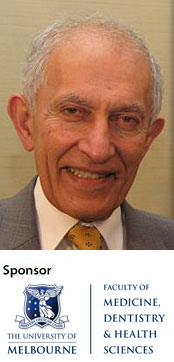
David de Kretser was born in Sri Lanka on the 27th of April 1939. He immigrated to Australia with his parents and brother in 1949. de Kretser was educated at Camberwell Grammar School and completed his university studies at the University of Melbourne (M.B.,B.S., 1962) and Monash University (M.D., 1969). de Kretser’s M.D. research was focused on the structure and function of the human testis. He began working as a demonstrator, then a lecturer, in Monash’s department of anatomy in 1965, before moving to Seattle, USA as a senior fellow of endocrinology at the University of Washington (1969-71). On his return to Australia de Kretser again worked in Monash’s department of anatomy as a senior lecturer (1971-75), reader (1976-78) and professor and chairman (1978-91). In 1991 he became the director for the Institute of Reproduction and Development, Monash University. de Kretser has published over 430 papers on male infertility, endocrinology and andrology and founded the educational information program, Andrology Australia. In 2006 he took up the appointment of Governor of Victoria.
Interviewed by Sir Gustav Nossal in 2008.
Contents
- From Sri Lanka to Melbourne
- Medical studies
- Moving into endocrinology, not surgery
- Fruitful experience overseas
- A medicine-anatomy appointment, back in Melbourne
- Significant FSH suppressants
- Institute-based versus university-based research
- Maximising the benefits of institute-based research
- The need to promote clinical research
- Family and ‘extracurricular’ interests
- A very scientific State Governor
- Achievements and potential in endocrinology
From Sri Lanka to Melbourne
This meeting is taking place in Victoria’s magnificent Government House, for the very simple reason that my interviewee just happens to be Governor of the State of Victoria. How wonderful, David, that you could spare the time to come and be interviewed.
I’m delighted to be able to do it.
I suppose we should begin at the beginning. Would you tell us a little bit about your early life?
I was born in Sri Lanka and lived there for the first nine years of my life, and migrated here in 1949 with my family. Basically, my father had decided that once independence occurred in Sri Lanka, in 1948, things would go downhill – the language would change from English to Singhalese and there was a possibility of racial strife. People thought he was crazy, but he was proven right and consequently he left behind not only his law practice but also his mother, who had had a stroke and was paralysed. So it was quite a decision for him to bring us all over here.
How many of you came over?
It was just my mother and my father, and my brother and myself: a family of four.
Where did you establish yourselves in Melbourne?
We stayed initially in a boarding house in St Kilda, having been met on Station Pier by a very distant friend of a grand-uncle of my father’s, a wee Irish lady called Lily Turner. But about two weeks after we got to Australia I caught pneumonia, and that galvanised her into action. She insisted that we would come to live with her in her Hawthorn house – which we did for a period of three months.
I’m wondering whether being a migrant had any influence on your early life in Australia.
Perhaps it did. I recognise now, in retrospect, what a major decision my father had to make, and that to some extent it must have been simply to give my brother and myself a better chance, a better education, and I think that might have influenced me to keep my nose to the grindstone. But, really, that wasn’t too difficult for me. I quite enjoyed schooling and academic life.
Tell us about your school life. Were there any individual teachers who might have had a particular influence on you?
I enrolled at Deepdene state school for fifth grade and sixth grade, and then went on to Camberwell Grammar. I must say that I look fondly on the year-and-a-half that I spent in the state school. It was a very interesting experience trying to assimilate as a migrant and to get used to a different culture and different games – although I had played cricket a lot in Sri Lanka and continued to do that here. A Ms Corbett was our sixth grade teacher. She was a tough lady but she gave us an important fundamental education in mathematics and English. I think that was extraordinarily helpful.
Camberwell Grammar was a very small school at the time when I went there. Those being postwar years, the quality of the teachers varied quite a lot. Some were fantastic. In particular, in form 1, where boys came together from different places, there was a man called Stan Brown who was a wonderful enthusiast. My nickname, by the way, was ‘Blondie’ because I had black hair and somewhat darker skin! (For me that was an introduction to typical Australian humour.) So I had a unique opportunity to get to know kids from a vast different array of backgrounds.
Some teachers later on in secondary school were perhaps not as good. For example, the lass who was my chemistry teacher in years 11 and 12 equivalent was an enthusiastic person but not a very good teacher. But the thing that that did, actually, was to teach me how to self-learn. That was an extraordinarily valuable lesson for me, especially for going on to university.
Also there was an interesting challenge, because I found that I quite liked biology but Camberwell Grammar didn’t teach biology. So in year 11 one of the teachers, a Viennese-educated linguistics and science teacher, actually tutored me after hours in biology for the Leaving. And then, in the HSC or matriculation year, because Camberwell Grammar still didn’t teach biology, I went down to Camberwell Girls Grammar – and the girls came up and did physics and chemistry with us. It was one way that small schools at that stage dealt with the real issue of the lack of skilled teachers.
It is amazing that as recently as one generation ago biology was thought of as a girl’s subject and the real ‘tough’ subjects were physics and chem. How things have changed.
Absolutely. And we had a wonderful teacher, Joe Perjes, who had migrated here at the time of the Hungarian Revolution and taught maths and physics at Camberwell Grammar for about 40 years. He was a marvellously enthusiastic guy – again he was not all that conversant with English, but his heart was in it. We had a lot of fun, and he taught us a lot.
Medical studies
I get the general impression that you might have been pretty good at physics, chem, maths and biology. When did you get the first inkling that perhaps you might want to do medicine?
It is interesting that probably, at year 11, I was thinking more about engineering – aeronautical engineering. But maybe the course in biology convinced me that medicine could be a good thing to do. Although I had a distant uncle who was a doctor, I didn’t really have any role models; it just seemed the right thing to do.
That was a good few years ago. Was it as tough to get into med as it is for the youngsters today?
[laugh] Well, when I started at Melbourne University that was the first year of a new quota system. Interestingly, in the year previously 200 or 300 people had started first year but a whole lot of them failed. And because there were no regulations they actually got automatic entry. So out of an entry of 200, only 120 new people started. It was competitive.
I imagine you would have been a pretty good student.
I was okay. I did okay in the HSC or matriculation year, but I certainly wasn’t Dux of Camberwell Grammar. Nevertheless, I finished reasonably well.
What can you tell us about your university years and the medical course?
Oh, I really enjoyed the medical course. To me it was a great introduction into the basic sciences, as medicine was in those days: you did three years of basic sciences before heading into the clinical area. And you had some formidable people there. Pansy Wright I can still remember to this day as being in the first lecture. He had the habit of stopping in the middle of his lecture, and he pointed directly at me with his very big long pointer and asked his first question, ‘What’s the derivation of the word “journal”?’ That came totally out of left field, in an early physiology lecture. It was quite striking! (Fortunately, having done some French, I was able to give him that derivation.)
Excellent. Having done medicine in Sydney, I know Pansy’s teaching only by reputation. It is said that he was a great teacher for those who wanted to learn and wanted to do a bit more, and not a very good teacher for those who were expecting to be spoonfed.
Absolutely. The notes you got from his lectures didn’t make a lot of sense until you actually sat down and thought about the topic, and went away and looked at the text and so on. But he was a great teacher. And I can still remember Jack Legge, a biochemistry lecturer there, coming in and shouting out in the lecture, ‘They’ve done it! They’ve actually identified how DNA works!’ It was an exciting time.
Does anyone stand out as a teacher in your clinical years?
In my clinical years I benefited from a range of people. I trained at Prince Henry’s Hospital, which was one of the smaller clinical schools, and that was fantastic. There was, for some reason, an intention to move away from the Royal Melbourne Hospital, and some of the brightest students in our year went down to Prince Henry’s, with a cohort of around 25 to 30 students. That was a great group of people to work with and, because this was a new teaching hospital, the tutors and the clinicians were extraordinarily keen to do well and nurtured us. We used to have lots of extra tutorials and things like that from some of the senior medical staff. They were extremely helpful.
Moving into endocrinology, not surgery
You got through med and then, presumably, like most of us you did your residency training?
Yes. I was going to be a surgeon, so I did two years of residency at Prince Henry’s. In my second year I did surgical rotations, and then I headed out, as people did in those days, to teach anatomy for a year and to improve my basic science knowledge even further, before coming back as a demonstrator and then taking up surgery to continue towards a qualification in that.
So what happened? Why aren’t you Victoria’s top neurosurgeon or, say, top orthopod?
Well, Monash University, where I did my demonstratorship, was a new university and Graeme Schofield, who was the Professor of Anatomy at that time, was a very persuasive person. He said, ‘Look, if you have enjoyed the year, how about staying on? I’ll give you a lectureship. You can do a degree by thesis and then go back and finish your surgical training.’
Actually, I enjoyed the year at the university – it was some respite from the 80 hours of first and second year. Also, at that stage we had our first child, after getting married pretty much straight after graduation, and there was the opportunity just to enjoy family life a little bit more. So I stayed on and, basically, started looking for a project.
That was where fate again intervened, in that I happened to meet Pincus Taft. He was an endocrinologist who was about to start treating men who had infertility with pituitary hormones which had been recently purified – actually, from human pituitary glands. He wanted to get somebody involved in helping him look at the research side of this trial, and because I had quite liked endocrinology in my physiological and also in medical training, I thought that would be a good idea for me. The idea was that we would treat these men with gonadotrophins and then look at their testes under the electron microscope, which was a new tool.
Schofield was very good at electron microscopy, wasn’t he?
Yes, he was. He was a good biologist and certainly had a department that was quite well equipped for that. So that was really where it all started off and where my surgical career went off the rails. [laugh]
Would you consider both Graeme and Pincus as early mentors in that regard?
Oh yes. Graeme was my notional supervisor for an MD thesis, which really didn’t need supervision. But Pincus was the person who actually taught me endocrinology. Beyond that, he taught me how to communicate with people in complex areas by using simple terminology – just for pleasure I used to sit with him in the infertility clinic at the Royal Women’s Hospital, which was where we recruited the men for these studies, and he would be managing their infertility. He was a great communicator.
Another fabled character from those early Monash days was Joe Bornstein. Did you have a lot to do with him?
Not a vast amount. Joe had taught me in biochemistry as well and, you know, I can remember in a viva [examination] for honours in biochemistry, where Joe was one of the examiners and asked some pretty curly questions – as he could, in a very quiet way. He was a great person in biochemistry at Monash.
I must say one of my best mates from those days, the redoubtable Hugh Dudley, would probably have persuaded me to become a surgeon. But by the time you got into full swing you’d signed off on surgery.
Yes. I found the project very, very interesting. At that stage I met Bryan Hudson and also Henry Burger, who had just come back from a period at NIH [National Institutes of Health] and he and I had started to work through the issues of what controlled testicular function, in addition to using electron microscopy, which was a wonderful tool to look at how a round cell became converted into a sperm with a tail and its sperm head – you know, areas of biology that still remain fascinating. Probably one of the most complex events in terms of cell biology is the reorganisation of that cell, and that still fascinates me. I don’t think we have all the answers yet.
But the project also got me into endocrinology at the grassroots level, where we were talking about using hormones from the pituitary. Nobody yet knew how they worked, and the general view was that we needed to find some sensors or receptors. We did some very fundamental work using labelled gonadotrophins and produced some of the first evidence that there were in fact specific receptors in the testis for the gonadotrophins.
That’s interesting because I associate the receptorology at Prince Henry’s Institute [for Medical Research] mainly with [John] Funder. Am I right or wrong?
Oh, no. The gonadotrophins actually preceded Funder. He was more interested in steroid hormone receptors. But it was an interesting time at Prince Henry’s Institute. It was very new, with people like Hugh Niall, Kevin Catt and Henry Burger, as well as Jack Martin at St Vincent’s Institute. I did some interesting work with Jack and also with Kevin and Henry on labelling parathyroid hormone and labelling gonadotrophins, showing that they bound by autoradiography to very specific cell types.
So maybe you were the first to introduce autoradiography as a tool in finding those receptors on specific cells?
Certainly. Yes, absolutely. That was work which I carried on partly when I went to the United States after completing my MD thesis.
Fruitful experience overseas
Having done your MD on these endocrinology and receptor related things, you zoomed off to the United States. What did you do there? Where did you go?
I went to Seattle, to the University of Washington. To work there was a fascinating journey for me, because I went to my first international meeting, an endocrine meeting in Mexico City.
I have mentioned Bryan Hudson, who was Professor of Medicine at Monash and a very good friend of Graeme Schofield’s. He was a mentor of mine and took it upon himself to guide me towards a mentor in the US. There were two people in Seattle with whom I could have worked, Carl Heller and Al Paulsen. They had worked together but had fallen out – but I didn’t know any of this history at all.
In Mexico City I met up with Al Paulsen, as had been agreed, because Bryan had suggested that he would be the most appropriate person. But Carl Heller found out that I was there and looking for a job, and he said, ‘Oh, why don’t you come and have dinner with me?’ Well, after Mexico I was to go up to Seattle to actually look at the labs and all that, and so I said, ‘I’ll come along and have a look at what you have to offer.’ It was arranged, then, that in Seattle I would meet Al Paulsen at the hotel for breakfast, after having dinner with Carl Heller the night before.
Now, I didn’t know the geography of Seattle. And Carl Heller lived on an island. Well, I caught the ferry over and had dinner with him. When the time came to get the last ferry back I said, ‘I need to be going to catch this ferry.’ He refused to drive me to the ferry, because he knew I was meeting with Al Paulsen the next morning for breakfast. [laugh]
You were being rather dishonestly wooed?
I was being kidnapped, you could almost say. Fortunately his wife was a much more reasonable person and agreed to drive me to the ferry, which I managed to catch, and I got to my breakfast meeting with Al Paulsen. And I went to work with Paulsen.
I wonder whether your experience has been somewhat similar to mine, namely, that on the whole Aussie postdocs do remarkably well when they go to the United States.
Oh yes. I think the Americans got some very good people.
To what do you attribute that?
I don’t know – perhaps just the quality of the medical education we had here, with a very strong fundamental emphasis on basic sciences. I guess to some extent it was a watershed time: previous to that era most people would have gone to the UK for their training, whereas Henry Burger went to NIH and then to the Middlesex Hospital. Bryan, having worked [on steroids] with Eik-Nes at Salt Lake City, had experience working in the United States and was particularly keen for me to go there. I was very fortunate, in that I managed to get a USPHS [US Public Health Service] Fogarty Fellowship so they paid for my time. And Monash was quite helpful, giving me leave of absence which included some study leave that had accrued for the three years I had been a lecturer. That, combined with the fellowship, made life in America reasonably okay in terms of the salary – rather important because by now we had three kids to look after as well.
Not the easiest thing on any kind of academic pay. But, obviously, you did well in the States. You had a good successful postdoc, plenty of papers, international experience.
Oh, we had a great time. Paulsen was a leader in his field of male reproductive medicine. I hadn’t done the formal medical training here, and I was still learning clinical endocrinology – and still very much general clinical endocrinology. So he enabled me to do that, to attend wards and clinics and so on. But at the same time he allowed me time to do research.
I was there for two years, during which I got a reasonably good training in clinical endocrinology as a whole, but obviously with a major focus in the male. Actually, that was the time when radioimmunoassays for the gonadotrophins started to be developed. That enabled a huge opportunity to explore the interrelationships between the pituitary and the testis, and the pituitary and the ovary, with regard to feedback relationships – starting me on a pathway which has been quite fundamental to my subsequent career.
A medicine-anatomy appointment, back in Melbourne
When you came back to Australia you then went to Prince Henry’s, did you?
Actually, Schofield and Hudson put their heads together and offered me a joint appointment. I had 70 per cent in medicine at Prince Henry’s Hospital, which was the Monash Hospital at that stage and was where the Department of Medicine was, and 30 per cent in Anatomy. So I maintained my basic science and my structural biology, which to me again has been one of the characteristics of my career, in trying to relate structure-function relationships.
A great combination, it seems to me.
Yes. It took me in several different directions, including following up my continuing interest in sperm production, just as a basic phenomenon and also in the compartmentalisation of the testis and how the components communicated. It was well known that testosterone was essential for sperm production, but what wasn’t known was that if you damaged the tubules you actually altered how the Leydig cells would function. So there was cross-talk in both directions. We produced some fascinating animal models which enabled us to explore that and to show that you could actually cause damage to small areas of the testis, and where that happened the Leydig cells enlarged and their function became different.
These feedback loops are the complete hallmark of the endocrine system, aren’t they – these quite complicated and, in some cases, geographically discrete feedback loops, e.g. in the islets of Langerhans.
Oh, absolutely. And some of the work took us into the paracrinology, the cell-to-cell communication, which actually was fundamental in that cross-talk between the tubule and the Leydig cells outside. But it also provided me with an opportunity to follow through on the fact that when we could measure FSH [follicle-stimulating hormone] we showed that there were some men where testosterone levels were normal but FSH was high. We could build then a case for the hormone Inhibin, which had been predicted in 1932 to be there, and we could set off on the long journey which started when I came back in 1972 and which ultimately, in 1984, resulted in our being able to purify the protein for the first time.
Significant FSH suppressants
David, the Inhibin accomplishment has been a major one for you and your colleagues. Would you take us over that story in a bit more detail, for lay people to get some appreciation of the hurdles you faced?
Well, in 1932 it had been postulated that, in addition to a steroid hormone which was ultimately purified as testosterone, the testis made something which was not a steroid but which actually suppressed the function of the pituitary. In those days they couldn’t measure gonadotrophin secretion. They were looking at castration cells in the pituitary. That was the bioassay that they used – a very laborious bioassay.
But with the advent of radioimmunoassays we were able to measure the hormones and look at what damage to the testis would do to feedback in terms of FSH secretion. And so we put together a collection of animal model data which said, really, that there had to be something other than testosterone controlling FSH secretion. That was critical in providing the fundamental base which set us off, trying to find Inhibin.
You know, it was a team effort. It involved Henry Burger; it involved Bryan Hudson for a while, until Bryan went to the Florey and left Prince Henry’s. And to some extent we then had a little bit of Australian competition between the Florey group, which had Hugh Niall there, and Henry and myself, and Frank Morgan, who was at St Vincent’s. There was also some competition from other places, which we didn’t actually know much about – it was kept very quiet. So it was a fascinating journey.
But one of the biggest issues was to work out a bioassay such that you could screen large numbers of fractions off columns, which was essential in the purification. Really, it was a graduate student working with us who developed pituitary cells in culture and was able then to measure FSH secretion and show that there were extracts in the testis, initially, which actually suppressed FSH secretion by those pituitary cells.
In the end, though, we purified Inhibin from follicular fluid in the ovary. We used to go down to the abattoirs and collect ovaries, bring them back and suck the fluid out from each follicle. We would put that together, and once you got a litre or so of it you had your starting material.
Does that suggest there’s not much species specificity to Inhibin?
There isn’t, we’ve subsequently found out, in that Inhibin turned out to be a dimer of an alpha and a beta subunit. In fact, there are two Inhibins: the alpha subunits are the same and the beta subunits are different. But it is all related. The beta subunit is conserved 100 per cent in its protein structure from the mouse to the human, and the only variation is one amino acid in the sheep. So it’s a highly conserved molecule.
And where do you actually place it in the grand physiological scheme of things? What’s the role of this blessed inhibitor?
Well, it’s part of the TGF-beta [transforming growth factor-beta] family of proteins to which both the alpha and beta subunits belong. And, interestingly, if you have an alpha and a beta you produce Inhibin, which suppresses FSH. If two betas join together you form activins, which stimulate FSH. The amount of alpha subunit turned out to be critical in driving it towards Inhibin or else in activin being formed. Further, since there is beta-A and beta-B, there are three types of activins that you can get: beta-A squared, if you like, beta-B squared or beta-A–beta-B. That has taken us on a huge journey, in addition to the stimulation of FSH. So the activins would stimulate FSH, whereas the inhibins would suppress it.
Also out of that follicular fluid that we started off with we found another protein that suppressed FSH, which we called FSH suppressing protein but which is now called follistatin. But, interestingly, we didn’t know what the issues were until the Japanese were studying an activin binding protein in the ovary and it actually turned out to be follistatin.
Basically, the reason follistatin suppresses FSH is that it binds activin so powerfully – it’s better than any antibody – that that activin is neutralised in terms of its action, and FSH suppressed. That again shows very clearly that these molecules don’t also act as endocrine feedback regulators but are actually local, because activin is produced in the pituitary and follistatin is also produced in the pituitary, by the folliculo-stellate cells. They bind locally and control FSH secretion.
A fascinating story, and one where I can readily see that there is still a lot to be unravelled.
Institute-based versus university-based research
I am anxious to explore with you some general issues relating to your research and to research generally. First, from your experience would you say a little bit about institute-based research versus university department-based research? My bias is to think that too many medical scientists in Australia have scurried to the protection of an institute, abstracting themselves from the university teaching enterprise.
That’s a very interesting topic, because the whole way universities were funded made me think quite hard about how to manage a research group. After being on joint appointment I went out and became the Professor of Anatomy, when Graeme Schofield became the Dean. That was a hard decision, but I insisted that I needed to continue my clinical work, because to me that was my ‘human laboratory’ and patients gave me wonderful directions and ideas in working things through.
I was in the Department of Anatomy at a time when Ministers of Education were removing money from universities, putting it into research grants and saying, ‘Go out there and compete.’ And, basically, the infrastructure within a university was disappearing. When I started as the Professor of Anatomy there were something like 12 research assistants available for research. When I went out to form the Monash Institute of Reproduction and Development there was one research assistant. If you didn’t get grants it meant that you actually weren’t able to continue your research. So the idea that you would go into a department and have technicians provided to you disappeared over that period of time. Therefore, you had to compete in a different way.
To me, the idea of forming an institute was really to bring together a critical mass to enable better competition. Medical research is now so multifaceted that you need teams of people, and we had that specific issue in mind in coming together with Alan Trounson’s group to form and build the institute.
But we decided we would keep this institute within the university. The reason is my personal view that Australia is actually too small to sequester the talented people who are in the institutes today – including your magnificent institute WEHI [the Walter and Eliza Hall Institute]. We need to get these people interfacing with the students, not destroying their research career with a vast amount of administration and teaching but getting them to come in and give lectures that turn-on the young people and really stimulate them. They certainly have the capacity to do that. I’m still trying to get that message through a bit more.
To some extent, the infrastructure in universities has been run down to a level where you really need to start to have support from the States – not for all university research but for where you have a concentration of very good people coming together. And you can define it on the basis of the number of fellows that are there on soft funding. I see also a real possibility for the showcase bits in universities to get some State Government infrastructure.
We were very lucky, to enabled that to happen. When we were building the space where we first started the institute, I met with the State Minister for Health and she was able to say, ‘I like what you’re trying to do. I’ll organise for you to get $100,000 from the infrastructure fund.’ And that has built up over a period of time and was absolutely essential in enabling the institute to get under way.
Maximising the benefits of institute-based research
I understand completely how, faced with a running-down university infrastructure, people would wish to join up with institutes. But explain to me how we are going to change the culture. I feel that in a place like the Walter and Eliza Hall Institute people are over-privileged. They are, to a certain extent, spoonfed with large grants and those brains don’t have any impact on the incredible talents going through the medical school and the various science departments. What can we do to begin to redress that and have more of the institutes behave like your institute?
Well, I think it has started already with the UROP program [Undergraduate Research Opportunities Program], where talented university students during their science careers spend time in relationship to some of the institutes – that’s how it started off, with one of the CRCs – where they come in and do some work during the year. So it’s not just a holiday job; you actually become part of the team. That’s now been extended to some university departments, and certainly to the Monash Institute of Medical Research. That is extraordinarily valuable, and I think it’s tending to build the relationship better.
The universities are partly to blame for the situation you describe, in that – rightly or wrongly – the senior lecturers and lecturers look upon the graduate student pool as ‘theirs’. They are dead scared that, if you have people coming in from WEHI or the Florey and giving stimulating lectures, their best students are actually going to go out and work in those other places. To me, those students need to work in the best place if we’re supposed to continue excellence in this country. There needs to be a bit more of a mix, the barriers need to go down on both sides.
More give and take, yes. You mentioned that when you formed your institute at Monash you wondered about yet one more institute. Are there too many medical research institutes in Australia? Is it time for some rationalisation or, at least, for more co-location?
Certainly more co-location. I perceive opportunities for fusion and amalgamation, and this has got to happen. I think the State Government could drive it quite well, in terms of putting some constraints on infrastructure support. I believe there are opportunities for that to happen and some money would help it along.
It has certainly been wonderful to see the governments of Victoria and Queensland, particularly, getting behind medical research. That seems a new phenomenon in the last 10 to 15 years.
Oh sure, no question about it. Those two State governments have led the way in terms of support of medical research, and it’s been fantastic.
The need to promote clinical research
Another subject I’d like to pick up is clinical research. You mentioned getting on-the-job training in clinical endocrinology in Seattle. Having experienced clinical research both within a classical university department and within a medical research institute, how would you relate the two?
It’s an issue of partly career pathways, partly exposure of young clinicians to research. I think the reason it was very successful at Prince Henry’s was that Prince Henry’s Institute was in the hospital, Henry Burger was the Head of endocrinology, the registrars went through the institute, and basically we recruited a huge number of people. They did their two years of endocrine training and then there was the third year option where you could do a project or you could start a PhD, and Henry and the people – John Funder, Don Cameron and myself – were there. We were able to convince some fantastic people to, say, do a PhD. And that model was extraordinarily valuable.
I think the biggest problem is that many of the hospitals now don’t actually have full-time medical specialists. That’s a tragedy, because they were the people who drove it. At Prince Henry’s it was heavily in that direction: you had cardiologists like Andy [Andris] Saltups and other clinicians who recruited young people to do that. But that model is not flourishing now.
Could the Royal colleges be more helpful, do you think?
Yes. I feel they’re reasonable in terms of supporting young people to do research and providing them with opportunities, and the College, in terms of the structure of its fellowship degrees, does enable this clinical year to take place. So I think they’re doing their bit. The need really is to get across the idea of the university-based teaching hospital, which actually employs specialist practitioners as Heads of the Unit and gives them professorial appointments.
Now, part of the problem there is that although a specialist can earn lucrative salaries and income, especially in the surgical side of things – but it’s not quite so dramatic in the medical side – and if you are an interventional cardiologist you can earn an awful lot of money, that is not so if you’re just in a staff specialist position. It’s a difficult issue.
Family and ‘extracurricular’ interests
Let’s explore a few personal matters. How did you meet your lovely wife Jan? Do you have any kids? Do you have any grandkids? Tell us all about that.
I first met my wife when I happened to go with another girl to the school that my wife was at, MLC. (She was involved in some sporting activities.) She trained as an occupational therapist and so our pathways continued to cross at various times. We used to meet quite regularly outside the Department of Anatomy while she waited to get into the building, and we would chat – and progressively we started going out. It’s now nearly 46 years since we married in 1962.
We have four sons: one who is a GP and two chemical engineers, one who did his PhD at University of Melbourne and is a Senior Research Fellow there in chemical engineering, and one who is a lawyer. And we have four grandchildren and one on the way.
I’d be interested to hear about your main ‘extracurricular’ interests beyond this wonderful world of medical research.
I’m interested in sport, and I used to play a lot of it. After I left school I played cricket at the Sub-District level, but medicine and academic life got in the way of that. I used to play regularly for a team called the Melbourne Cricket Club Competition, the Club 11, which meant you had a good game of cricket and afterwards enjoyed a beer and a glass of wine. And you had people like Alan Connolly, fast bowler from Victoria and Australia, bowling at you, which was quite scary.
After I gave that away, I played a lot of squash for a number of years, because it gave me a concerted period of exercise and no matter what the weather was like or what time of the day it was, you could get some good exercise. But then my partner’s body started to fall apart. So I gave that up about six years ago, and play tennis quite regularly now.
Also, we have done a lot of walking in recent times – Milford Track, Cradle Mountain, the Blue Mountains – and are continually doing more of that, trying to get around all the good walks before we get too old to do it.
So sport and outdoor activities play a big part in your life. When did you take up climate change issues?
Really, Gus, that came in because of this job. I can actually remember when it hit me. I was sitting in the car driving in from Monash, as I often did, for meetings in the city. And I happened to be listening to Radio National, where some layperson was talking very eruditely about climate change. As I listened, I wondered where he got all this information, and at the end the announcer indicated that a lot of this information had come from a report by the Lowy Institute in New South Wales, written by a couple of people, Alan Dupont and Graeme Pearman. So I downloaded that and started reading. It’s absolutely a passion now.
I just try, as Governor, to get across the message that it isn’t just about trying to removing CO2 and addressing global warming. By simply taking the facts about population, and the ill-health from pollution, and trying to get people to see that none of the things we do in modifying our lifestyle for climate change would actually be harmful in any way whatsoever. It would be extremely beneficial.
A very scientific State Governor
Did you have any inkling that you might be invited to become Governor of Victoria?
No, not at all. I had a message from my secretary that I had an appointment to see Steve Bracks, the Premier, and I thought I was going to talk about medical research funding and things like that. So I was a bit surprised when I found that it had very kindly been organised for me to park outside the Treasury buildings. And I didn’t have to go through security but was taken through a side door. I thought, ‘This is a bit strange.’ Anyway, the Premier offered me the job. He said I was looking shocked, and I said, ‘Well, what the hell do you think I should have done?’ [laugh]
Had you had much to do with Steve Bracks before?
When we changed from the Monash Institute of Reproduction and Development and called it the Monash Institute of Medical Research we had a relaunch of the name, and he came out and assisted in that event. And I’d met him a few times before that. But apart from that, no.
It was an inspired idea on his part. I already thought John Landy had been a very good appointment, with his strong agricultural interests married with the sport. It goes one step further, doesn’t it, to have a professional scientist in a role of that sort. Of course, Oliphant was Governor of South Australia for a while, wasn’t he?
Yes, he was. And Marie Bashir [Governor of New South Wales] is a psychiatrist.
She has done fabulously.
Absolutely. My colleagues certainly have been very pleased with the appointment. And I find that having my scientific background enables me to talk quite knowledgeably about climate change and so on.
Another passion is the area of men’s health, for which we formed the organisation called Andrology Australia – of which I am no longer the Director but the Patron. I talk freely about this at receptions and wherever I can, to try and get men to be a bit more proactive in terms of their health. That came purely by accident, through my taking the point of view that if an institute really needed support from the public then it had to give back something to society.
We had a session at the Sofitel Hotel on prostate cancer as an educational exercise on the day that the government’s report about PSA screening came down saying there should be no prostate screening. Well, I had 400 guys in the audience who were pretty irate about that. They said, ‘Why can women have cervical cancer screening, why can they have mammography, yet we can’t have this?’
Now, they didn’t really fully understand the nuances of PSA tests, but it led me to talk to [Federal Minister for Health] Michael Wooldridge. I said, ‘Michael, you just can’t leave these people there. You’ve got to educate them,’ but his answer was, ‘I don’t want to do something purely about the prostate.’ Being somebody who grabs every opportunity, I said, ‘How about an initiative in male reproductive health?’ He replied, ‘Go away and write something’ – which I did. I had to ask him, ‘When do you need it?’ so he said, ‘Oh, next Wednesday.’ And this was Friday! That was a busy weekend. But then it took about a year to be put into “departmental speak”. We finally got a million dollars a year and we set up Andrology Australia and it’s still going. The website gets a million hits a month now.
An excellent initiative. Is it too early to ask whether you have some reflections on the governorship, and on your role and Jan’s role therein?
Well, two-and-a-half years into the job, it’s been a very interesting exercise. You get a great insight into how society works. You meet such wonderful people – many volunteers who are doing fantastic activities which would totally cease if they stopped volunteering. And, obviously, it involves my wife a fair bit. On the positive side, I used to have difficulty finding time to go to the ballet or to the opera, and now it’s sort of part of my job description. [laugh] So I get to do those things.
But I get a little bit frustrated at having moved out of active science, because some of the research that came out of that feedback and those molecules that we purified has taken us into inflammation and tissue repair, which has been a very, very interesting journey with real possibilities for commercial development.
Would you offer any comments about scientists engaging more in public life? It is still somewhat unusual, isn’t it?
Yes and no. I think it comes back to the issue of: how do you educate people about science? We really need to do that. We don’t have enough people going into science and maths education in primary and in secondary school, and into university. This is where I keep trying to tell the young scientist, ‘Look, talk about it passionately. Talk about it in words that your parents can understand, that your friends can understand.’ That’s the way in which we build a strong case and put pressure on government to realise that they have to keep on funding people.
And I think we should be promoting recognition of these people. I’ve just come from the Olympic athletes’ parade. I’d love to be able to see a parade for our best scientists. The Tall Poppy Campaign is one way of developing it, but we don’t get anything like the publicity we need.
Achievements and potential in endocrinology
This might be an opportune time for you to say a wee bit more about how endocrinology shades into immunology/inflammation, tissue repair, et cetera.
It’s partly by setting up experiments and looking at the results critically. As an endocrinologist you want to know where something comes from. If you think it comes from the ovary or the testis, you remove it and see what happens. In the case of activin, instead of the levels of follistatin falling they actually went up. And it’s part of that acute phase response. But we had the controls that enabled us to do that, because in the sham-castrated animals the levels went up. That set us on a journey to ask, ‘Why is this happening? What is the reason?’ and to go on to say now, ‘Well, activin is really a major cytokine in the inflammatory cascade and follistatin blocks it. And if you block it you alter the whole cytokine cascade.’
More importantly, I can give you probably 10 examples of where follistatin will block fibrosis from things like burns, from inflammatory bowel disease, hepatic fibrosis, and now will even interface with some other proteins – follistatin not only blocks activin but actually blocks myostatin, and myostatin is involved in muscle inflammation and fibrosis. There is some fascinating data just emerging.
So sketch out for me a possible commercialisation scenario?
Basically, I think there’s enough experimental data in animals, and really the next step is to make this under GMP [Good Manufacturing Practice] conditions, do the toxicology and get into a phase 1 study – and, if we want to do something in a simple way, that could be topical therapy for burns. Activin is hugely expressed in keloids, and when the surgeon removes the burn scar he creates another inflammatory response, and you simply get a reoccurrence of the whole system.
David, looking back on a remarkable and hugely productive life, what are you most proud of?
Oh gee, that’s a tough question. You know, it’s been an interesting scientific career. I feel I’ve been extraordinarily privileged, in that I enjoy what I do. I think about all of the people who go to work and don’t enjoy it. And to me, even this job as Governor is really a privilege. It just gives you a wonderful insight into society. I wish I’d had that insight before, and I wish I had known about how you influence government, perhaps, as much as I do now – and the difference between influencing a Minister and influencing his Department – and about trying to work through the maze that is our society.
Obviously a good case for another incarnation. Finally, are there things that you might have done differently?
Sometimes I think that if I’d not done the administrative professor bit but stayed in a research institute – because I was in Prince Henry’s Institute and funded by the NH&MRC as a fellow – maybe I could have pushed the boundaries of research much harder.
But being in touch with students, being in touch with patients has been a great privilege. To me that mix has been really great. So much of medical research today, for instance in genetics, depends on good clinicians recording information. The set-up we had with our genetic repository of DNA samples for men with infertility is now turning out to be a goldmine in terms of new genes that are involved in those sorts of problems.
Thank you so very much for giving up your time for the Academy of Science and for the young people of Australia. I’ve enjoyed this interview tremendously. It’s been a real privilege.
My pleasure.

Dr Barry Pogson, biochemist and molecular biologist
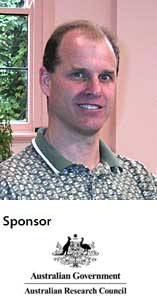
Dr Barry Pogson
Barry Pogson was born in 1962 in Moss Vale, New South Wales. After finishing high school, he worked as a bank clerk for 12 months before deciding to attend university. In 1986 he received a BSc from Macquarie University where he studied ecology and land management/geography. For his honours degree he moved to the University of New South Wales. Pogson worked jointly at Macquarie University and the CSIRO Division of Horticulture on his PhD research. Pogson was awarded his PhD in 1992 for his studies of how tomatoes ripen and soften, in particular how enzymes control these processes.
From 1992-94 as a postdoctoral scientist on a joint project between the CSIRO Division of Horticulture and New Zealand, Pogson worked to understand the process of senescence in broccoli and how it is controlled by ethylene. Pogson then moved to the USA and from 1994-97 was a postdoctoral scientist with Dr Dean DellaPenna, first at the University of Arizona and then the University of Nevada. During this time, he began his research into carotenoids and their function in photosynthesis. From 1997-99 he was an assistant professor in the Department of Plant Biology at Arizona State University. In 1999 Pogson was appointed to a lectureship in the School of Biochemistry and Molecular Biology at the Australian National University and in 2001 became a senior lecturer there. He continues to investigate carotenoids in plants and how they function in plants, with an additional focus on how antioxidants affect plant development and the way plants respond to environmental stress.
Barry, when and where were you born?
I was born in 1962, in Moss Vale – a small country town about halfway between Sydney and Canberra, with about 3000 people in those days. I have two brothers and two sisters. (I came somewhat down the list, number four in the pecking order.)
Your parents have professional backgrounds, I believe.
Yes. Mum is a physiotherapist and Dad is a dentist, and they both worked in the local town. We celebrated their 70th birthdays just yesterday, as a sort of tribute day when we all said something about how they impacted our lives. For me, it was through their love of taking on challenges, new things, and inspiring us to think broadly and not feel limited.
Mum’s great involvement in education during her life has probably been influenced by her father, Hector McGregor, who was the foundation head of Epping Boys’ High. I didn’t know him personally, but his enormous impact on my mother has affected me indirectly. I think he has influenced quite a few of us, in different ways. For example, Geoffrey Robertson, who does the Hypotheticals series on TV, commented in a recent interview on the influence my grandfather had on his life.
What are your best memories of your school years?
Mainly of just being a feral kid running around, riding my bike up and down – the freedom you had in a small country town was just wonderful – and of doing absolutely every single sport. There was not much else to do, so you played golf, cricket, soccer, football, basketball, whatever it was, the lot.
Of my schoolteachers, I think I’d be annihilated if I didn’t mention Miss Hole! She was my second grade teacher, another person who had an impact on a lot of people. She’s still alive today, having taught generations of us.
At the end of year 12 you were by no means sure, I gather, that you would head into a science career.
That’s right. In my senior years I did fairly typical subjects – physics, chemistry, maths, ancient history, economics, English – after a broad range of general sciences in the earlier years. At the end of year 12 I applied to different schools at different universities across the country: Law and Economics at the ANU, Electrical Engineering at the then Institute of Technology, maybe Science somewhere. I didn’t know what to do, so I deferred everything for a year and went to work as a clerk in the local bank.
Halfway through your time as a bank clerk, you decided this wasn’t the career for you. What did you decide on instead?
Banking didn’t quite appeal to me, so that helped to rule out economics as an option. I had always had an interest in the environment, even though it was less trendy at that stage, and I began to envisage myself as a park ranger with the National Parks and Wildlife Service, living in national parks across the state. That led me to look at biology, and eventually plant biology at Macquarie University appealed to me.
Was your undergraduate degree in ecology and land management as interesting as you expected?
Actually, more so. Academically the university was a good choice – a lot of good lecturers, a lot of enthusiasm from the staff. And the university life was fantastic. I made some lifelong friends there, and even met my wife. As members of the caving group we were crawling in overalls, covered in mud, through a cave which had really high CO2 so we were breathing rather heavily. I saw this person, and I figure if I could be attracted to her in those conditions there had to be something more to it! We became married some years later on.
Did completing your degree convince you that science was the career for you?
No, not really. I ended up with a short-term technician’s job at the University of New South Wales, working with Dr Anne Ashford. I was still reluctant about science, but she inspired me and eventually I studied my Honours year with her. She used to get so excited when you did something new or interesting that she gave me a real enthusiasm and love for the game. She was the first person to do that for me.
What did you do for your Honours project?
I looked at how seeds germinate: how they utilise their food reserves and break that down to take it to the growing embryo. This was important because seed germination affects yield, and also how seeds germinate – particularly, in this case, barley seeds – affects the malting quality of whiskies, beers and things like that. So understanding how seeds are kept dormant or start to malt (for the malting process in barley) is an important application for the industry.
You then took a year off study to consider what might be a good PhD project, before deciding to enrol at Macquarie University. What research did you do for your PhD?
That was a joint project with the CSIRO Division of Horticulture. The supervisor was Colin Brady, and the project again had some industry linkage. I was looking at how tomatoes ripen and soften, particularly which enzymes control that process and how the cell wall of a tomato is broken down. That is what makes it soften, and also develops some of its flavour.
Colin was an important mentor for me – quite an inspiring man, an extremely dedicated scientist who expected nothing less than perfection from himself and from the people around him. He definitely challenged you to think critically about your work, and he was the person who taught me most about the rigour of science: the need to be rigorous in testing your hypotheses and putting together sound experiments.
What did you do after completing your PhD?
Once again I took some time off! My wife and I went for some months’ backpacking holiday around various parts of the world, in particular South America. We walked the Inca Trail and went up to a few volcanoes and into the Amazon jungle. It was an amazing time. I looked out for tomatoes, too, because this is their ancestral home, where they are native to. So I’ve got a couple of photos of Machu Picchu and also of the occasional tomato plant growing in the wild.
When you came back you did a postdoc. Did you find postdoctoral work worthwhile?
Oh yes. Whereas in your PhD years and your Honours years you are clearly identified as a student in the learning process, the postdoc equates to an internship which doctors go through at the end of their medical training, where they actually work in the hospital while gaining skills to take them to the next level – management skills, grant-writing skills and so on that we need for a sustained career in science.
This postdoc was a joint CSIRO–New Zealand project. It was in some ways related to the tomato work – how fruit and vegetables get their marketable qualities – but it focused instead on broccoli, which is an immature flower. Broccoli, like other flowers, will open and senesce, but obviously we don’t want it to do that too fast or go yellow in our fridge. I worked on understanding the process of senescence, or programmed ageing (cell death), because while we want the broccoli to get to its optimal qualities for eating, we want also to regulate that. The process is controlled by a gaseous hormone called ethylene, which is produced by fruits and vegetables like broccoli. For example, putting a banana near an avocado helps ripen the avocado, because bananas produce most of this ethylene gas. So we are looking at controlling the timing of this hormone.
This is important for the marketing process. What we may not realise when we buy good fruit and vegetables off the shelf is that about 30 per cent of fruit and vegetable produce is lost in the marketing chain between harvest and our kitchen table. This is an enormous wastage, with both ecological and cost effects. Controlling the way fruit and vegetables deteriorate, and keeping them longer in the marketing chain, will help reduce the losses.
Also, if the shelf life can be extended long enough it will give us more export opportunities. New Zealand was particularly interested in this because they had quite a strong broccoli industry and they were looking to build more markets into Japan.
Your next postdoc took you to Tucson, Arizona, where you worked with another important mentor. What was special about him?
Dean DellaPenna was such an enthusiastic character. He was quite a young scientist –only a few years older than I was – but very successful. This was a new lab which he was just starting up, and also the project he put me onto was one that he hadn’t had going before, so we were both learning together, which was a fun way to do things. He is a very talented scientist, and a good friend. I had a lot of good times with him.
We were starting to look at much more molecular biology and genomics, although we wouldn’t have used the word ‘genomics’ at that time. The project was on the pigments called carotenoids. For example, beta-carotene is the orange colour of carrots; the red colour of tomatoes is another carotenoid. These are not just important for the colour in fruit and vegetables, but absolutely critical for plant function. Without them, plants would not survive on Earth and so there would be no life on Earth. Also, they are essential for our human diets. We get vitamin A from carotenoids, and their antioxidant properties are important for our health.
You followed Dean DellaPenna to Reno to continue this research, I believe.
That’s right. When he took a job there, I went from a low desert with extremely hot days to a cooler, high desert which had snow on the ground on Christmas Day – which was kind of fun. But by then the project was going well, Dean and I had had some good papers out of the work, and I was also starting to look for jobs elsewhere.
I got offered an assistant professorship at Arizona State University, in Phoenix, which is just a couple of hours north of Tucson. That was a great job. I was working with a centre which is quite famous internationally for its very large collection of people working on aspects of photosynthesis, for which carotenoids are essential. The team in my lab at that stage built up to about where it is now, about half a dozen people. And the centre as a whole had maybe 60 to 80 people in it – a dozen or so academic staff and then the various students and postdoctoral fellows and support staff involved with the program.
An ideal mix? American drive and Australian commonsense
By this time you’d had a fair range of experience in America. How would you compare working in Australia and working in America?
America definitely has more funding, and that is a real problem for Australian science. Australian science definitely punches above its weight, but it has had to do that more and more as funding has declined in the last decade.
America takes much more of a long-term view in science. Australia has got very heavily into immediate expected outcomes, whereas America is taking a longer-term attitude, with a vision, an understanding that basic science actually drives an economy. On my office wall I’ve got a letter which talks about the need to fund basic research. It says that basic research is fundamental, the engine for an economy, and we shouldn’t just be focusing on applied research. This was written in the mid-’90s, at a time when America’s economy was bleeding red ink, yet it is signed not by someone from a science academy or some frustrated professor but actually by the CEOs of about a dozen major multinational companies. And that is the difference.
It is no coincidence that Silicon Valley is next to Stanford University in Berkeley. It grew out of the basic research done on those campuses. In much the same way, genomics has grown out of the campuses and different places across the country; the biotechnology industry is closely linked to universities, and it has grown out of those links. So the applied money follows the basic money. If the basic research is cutting-edge, it leads to breakthroughs and innovations that bring the applied money.
Is the American environment more competitive because of the commercial aspects?
It is definitely more competitive – and more intense. It seems to be in the nature of Americans to be a more driven society. I have often joked that the strength and the weakness of Australia is our phrase, ‘She’ll be right, mate.’ Certainly it is healthy for us to have a more relaxed attitude at times, but it can also be our downfall. Sometimes things aren’t right; they need to be fixed. If we can find a balance between the drive and motivation of America and the relaxed and sensible attitude of Australia, this will be a very good place to live.
The roles of photosynthesis, antioxidants and carotenoids
What caused you to return from Phoenix to Australia?
Family reasons were strong. By that stage I had three children, and my wife and I were keen on letting them know who their grandparents were – that they lived not on an aeroplane but actually in a place not too far away from them. Academically, too, coming to the ANU was a great move. It’s a good place to be.
You currently have a lectureship at the ANU and are involved in research. What are you working on?
My project is still an extension of the work I started with Dean DellaPenna: how carotenoids function in plants. It is taking a broader view now, looking at how antioxidants as a whole affect both plant development and the way a plant can respond and survive under environmental stress – things like excess light, excess temperature, drought, all the sorts of things our farmers have to deal with routinely. Antioxidants act as safety valves for a lot of these processes, especially for photosynthesis, which is the key process for a plant. How much energy it makes is how fast it can grow. But if it doesn’t make the energy the right way, or if it is under too much light or extremes of temperature, then the photosynthesis process won’t function properly. And if it doesn’t function properly, the plant needs safety valves. These carotenoids and other molecules like vitamin C and vitamin E act as safety valves, giving a way to get rid of the excess energy and stop the formation of free radicals that damage the plant and impair growth.
Antioxidants play a similarly important role in our human diet. Carotenoids are linked to protection against certain cancers, for instance. The vitamin A role of carotenoids is critical for human health, absolutely essential. Another such process is macular degeneration of the eye. The same carotenoids that are involved in acting as a safety valve in plants are found in the centre part of our eye, the macula. Age-related blindness is the most common cause of blindness in the elderly, and that has been correlated with deficiencies in these two carotenoids. So animals – in particular, humans – have taken advantage of the same pigments as plants have adapted as safety valves, and it seems that we are using the safety valves too.
Attributes to bring to the profession of science
What skills and qualities do you think are important in science today?
There are some generic ones. Enthusiasm is important, and so is commitment. You have got to like what you do, and enjoy it, because this is a profession that can often take some personal sacrifices. But it can also be extremely rewarding.
Enjoying challenges is something that will attract people to science. I have mentioned that I did a lot of sport. In some ways, the challenge of doing something in science, and of achieving, takes the same attitudes of competition as in sport: it’s doing your best, finding a new way of doing something, a new way of getting to the edge.
In terms of techniques, a broad training is important. We encourage our biologists to come in with physics and chemistry – computing is going to be helpful too – and to learn a broad spectrum of biology and a broad spectrum of techniques. That is an advantage because we are in an explosive era for biology. Genomics programs, with the Human Genome Project, are happening across all areas of biology. The organism I have worked on has had its genome sequenced before the human genome, as have a lot of bacteria species. This has required massive amounts of data to be integrated and coalesced into a database, but you can only do so much with a computer. You need to be able to bring that knowledge together and then think of how to use it and how to apply different tools to answer questions – and all this in a much more rapid way, now that we have tools and technology that we didn’t have a decade ago. I think having those different techniques behind you will help you figure out the right questions and the right way to ask them, to get the answers.
The communication of science is another important technique, but I think the science community as a whole is bad at that. Individuals are very good at getting out into the media, but a lot of us spend too much time in our office and don’t know how to communicate well. Increasingly, it seems, we live in a country which wants to see a return for any dollar it invests. Agriculture has without doubt returned multiple-fold the dollars that have been invested in it over the years, but the community is not necessarily aware of that. We need to be much better at taking an economic rationalist approach, but in a genuinely rational way: not looking for returns in science on a 1-year time frame but on a 10-year, 30-year or 40-year time frame.
Sharing and building on scientific expertise
You have been fortunate enough to have several influential mentors. Now that you are in a teaching role and involved with students yourself, is it important for you, in turn, to be a mentor?
Absolutely. It’s one of the more enjoyable parts of the job, actually. I enjoy watching students develop and start to grow as a scientist, whether they are the graduates and Honours in my labs or the undergraduates I teach. To me, the mentoring role isn’t just about what goes on in the laboratory or teaching people to be scientists. It’s also nice just to feel helpful. At times, doing esoteric research or any research that feels important can be a fairly introspective thing, and it’s good to have the human contact again. I guess it comes back to the role of education and helping people, and the community service ethos my parents gave me, even just by talking to an undergraduate student who is stressed out about their work or having problems at home and things like that. And that part of the role I enjoy too.
Science today is very much a matter of teamwork. The days of being an individual in science are becoming shorter and shorter. In fields such as photosynthesis there are specialty groups and specialty equipment, which is why you tend to have centres like this one at ANU and the one we had at Arizona. It’s very multidisciplinary, going from physics through to biochemistry and molecular biology and to ecophysiology, ecology. You depend on each other, and the best groups work together as a team. The best scientists are going to be able to draw on each other’s expertise and grow bigger than the sum of their individual parts.
The enjoyment and rewards of a continuing life in science
Clearly you enjoy your research and teaching work. What else gives you enjoyment?
I’ve always enjoyed bushwalking and getting out for things like that, but now my primary interest is my life with my three kids and spending time with my wife. And it’s more watching soccer from the sideline than playing soccer or other sports as I used to. There’s a strong spiritual aspect to my life that is important for me, as well.
Travel is one of the rewarding aspects of a science career. It was a wonderful opportunity to be able to live in America, and it is wonderful to be able to attend conferences across the world in places as diverse as Europe (especially Hungary), America, the UK, Asia. You build up a network of friends and colleagues across the world, people that you work with but you may only see every year or two. And there are the challenges of science, and the discovery. To be able to feel the achievement side of it is very rewarding.
The profession still has a lot of freedom in it, too. I quite enjoy the autonomy, the fact that you can manage your own program, you can decide which areas of work interest you and follow those. In a way, it’s a bit like running your own small business and deciding which area of work you are going to focus on.
Where do you see yourself in 10 years’ time?
Hopefully, still here, doing more of the same. I think this area of research will interest me for quite a while. Increasingly it will diverge, I should think, into crop species such as wheat and barley.
Professor Adrian Horridge, neurobiologist
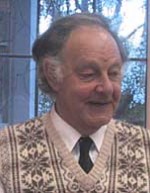
Professor Adrian Horridge’s research interests include the role of the nervous system in behaviour. His particular specialty was in understanding natural visual processing as an engineering problem. He was the Foundation Director of the Centre for Visual Studies at the Australian National University. In addition to his biological research he has published many titles on Indonesian traditional boats.
Interviewed by Professor Bob Crompton in 2002.
Contents
- An enterprising family background
- Wartime interludes
- Topping off the school years
- Appreciating the natural world
- Hectic times as an undergraduate
- A circuitous route to PhD studies
- Microscopy, electronics and nervous systems
- What is a biologist doing at an aircraft establishment?
- Wife bait: theatre tickets and a motorbike
- Naples in spring: the fascination of Ctenophores
- Moving north: a crucial recommendation
- Red Sea corals: an eventful diversion
- A great work on the invertebrate nervous system
- A marine laboratory's work turns to gold
- Teaching comparative nervous systems at Yale
- Inspections and revelations in Russia
- Can you teach a locust, and how does it learn?
- The insect ear and pitch discrimination
- The insect eye: compound benefits
- Light guides in insect eyes
- Moving a long way south: a nascent school
- Esteemed and estimable colleagues
- Development and potential in the visual sciences
- Visual flow applications: could a blind person's hand 'see'?
- The underpinnings of virtual reality
- Biologists building aircraft? Putting insect vision into aerospace
- To Indonesia aboard the Alpha Helix
- A scientific payoff: the fovea, visual resolution and sampling density
- An incidental discovery: boatbuilding surprises
- Construction stories: applying aircraft engineering insights to wooden boats
- A multifaceted retirement
An enterprising family background
Adrian, you were born in Sheffield, England. Your father was in business there, I believe.
Yes. My father was very mechanically minded, and during World War I he was an instructor in the assembly of small arms – too useful to be sent to France. When he came out of the Forces in 1919 he started a motorcycle business in his backyard, buying old motorbikes, repairing them, painting them and so on, and then selling them. And after a couple of years he rented premises with a partner and became the Sheffield agent for Triumph, Ariel and Douglas motorbikes. He became a substantial motorcycle agent, with repair shops and also a showroom and so on for new vehicles. He used to go down to Birmingham once a year and buy large quantities of motorbikes – 100 or 200 at a time – for sale in Sheffield.
So by then the family business of earlier years had been sold?
Yes. My grandfather was the last of the family horn firm of William Horridge and Company, Stag, Buck, Horn, Wood and Buffalo Handles, and Scale Cutters, which dated back to about 1750. At Pool Works, on the corner of two main streets in the centre of Sheffield, they manufactured ivory scales for piano keys, importing mammoth ivory from Russia in considerable quantities. They also made combs, handles for knives, and all kinds of other things out of buffalo horn and deer horn, shell, tortoiseshell and so on.
After World War I, when plastics began to come in, the firm did not want to retool and start in a completely new industry. Also, because this was an old family company there were too many fingers in the pie – about 10 part-owners were taking out profits all the time – and that was not economic. So in 1921 the factory was sold (for £15,000, when you could buy a house for £100) to the Provincial Cinematograph Theatre Limited, and became a picture palace.
Wartime interludes
What about your early schooling, Adrian?
I went to King Edward VII School – junior school and then senior school – which my grandfather had also gone to. And when I arrived, there were still three masters who had taught my father at the school, so it was a very stable situation. I remember that in junior school I didn't like compulsory games, and engineered ways of avoiding them.
When I was about 12, though, World War II broke out and so school was very disrupted. Sheffield was bombed several times, with heavy damage to the centre of the town, the factories and so on. Large numbers of people were homeless. Our school, which by then had closed, became a reception centre for bombed-out families. By the time I was about 14, I had become a Scout patrol leader and was used to running camps as a quartermaster, in charge of equipment and so on, so I had to report to the school as early in the morning as possible after an air raid to give out soap, towels, nappies and other things that were needed by people who had come in on the bus. We would do our best for them – even if that just meant being a waiter, taking round breakfasts!
We had no more school lessons until about 1943, when the German bombers were no longer coming. We had some lessons in people's houses, but mostly our schooling was very thin, so I decided simply to go down to the public library and work there, because it had lots and lots of interesting books.
I spent a lot of time running camps. I used to organise Scout camps and then farming camps – potato picking, pea picking and so on. One day when I was a cook, quartermastering, at a pea-picking camp near Bedford, I was sent to the POW camp down the road to get some prisoners as extra workers. So at the grand age of 15, I signed for 30 German prisoners, marched them up to the pea field and supervised their picking. (They didn't mind a bit; they actually got paid the same as the gipsies or us or anybody else.) At 5 o'clock they finished picking peas and I marched them back down to the POW camp and solemnly signed them off, the same number as I had taken out!
In another incident that year, I was cycling through Chatsworth Park when one of the long-distance British bombers just back from Norway crashed about 100 yards away. (It killed a few sheep, there was a lot of blood.) And as the aeroplane broke up, with aero-fuel dripping everywhere, the pilot dropped out of it, walked about 10 steps and lit a cigarette! I quickly moved him off, dousing his cigarette. The rear gunner was trapped in the aeroplane, and outside it I found a guy breathing frothy, rather red blood, so I knew he had broken ribs. I laid him down and undid his collar and so on. At that moment an Army convoy of trucks came along the road. I rushed down and stopped them, telling a dispatch rider on his motorbike to get back to the village – down the road about three miles – as fast as he could and come back with the doctor. Then I got the guys in the front truck to radio back to base and sound the alarm. But I never heard the outcome of it all.
Topping off the school years
You had about two more years at school when it resumed. What were they like?
They were really exciting and vigorous. I had a friend who was very interested in chemistry, and I did lots of that at home. We used to buy chemicals that you could never buy now – metallic sodium, yellow phosphorus, acetyl chloride, thionyl chloride, concentrated or fuming sulphuric acid – and we made all kinds of interesting things, but mostly dye-stuffs and tear gases. (I was a great synthesiser of tear gases. Bromacetone is the simplest.) Some of these were used rather stupidly, but still… And I made lots of fireworks.
For those last two years of school we had three masters who were superb. They all had PhDs from about 1931–32, but a PhD did not get them a job in that time except in teaching. Barton, the physics teacher, had been a PhD student of Rutherford, in Cambridge. Having worked in the Cavendish he was well up on the beginnings of quantum theory. We learned all about the 'new alchemy': the fission of heavy elements, and bombarding light elements with nuclei and knocking bits off them, and firing neutrons. For example, we learned about calibration of neutron fluxes by using a beryllium target and then a counter, as the neutrons hit the beryllium. So while Heisenberg in Germany was trying to count neutrons, we were learning about it in school. That was very unusual indeed.
Barton had written two books for school physics and Wheeler, the biology master, had written a large textbook for school biology. The chemistry master had been a research chemist, involved in the discovery of the detergents and the sulfonated fatty acids, sulphonated hydrocarbons and so on.
With that background you ended up with a scholarship, didn't you?
Yes. And as well, I had worked in the library a great deal and I had done quite a bit on my own account. Very fortunately, we had a good bunch of bright kids in that year – we were egging each other on to a considerable extent, and I think we got 10 Oxford and Cambridge scholarships. I won a State scholarship to Cambridge and also a college major award, so in a way that ensured my career. I just had to go with the stream for a few years!
Appreciating the natural world
As a child you had a deep curiosity about the natural world. Do you think that was innate, or did it come in some way from your background and early environment?
Oh, I don't think anything like that is innate. It was encouraged. We lived on the western edge of Sheffield, where the sites for new suburbs had been planned but were stopped by the war. Across the road from us was a few hundred yards of allotments for poor people who came from the city, and beyond that Ecclesall Woods stretched for miles. Then it was up to the moors, into Derbyshire. So, naturally, we all turned towards the countryside, not towards the city.
My father had a bright red MG (it was like a Meccano set) and every Sunday we would go out and picnic. I would take a fishing net and come back loaded with frogs and lizards and crayfish – all kinds of wildlife.
Then, when war broke out and rationing came in, I decided to keep rabbits. I had to find food for my 30-odd rabbits, and so every evening I was out with a wheelbarrow, collecting grass, putting food into the hoppers and so on. We lived quite well; we had rabbit meat regularly. My mother organised for the skins to be cured, and went to glove-making classes. Actually, we still have some of the gloves she made out of those skins.
As time went on, I had my own tent and spent a lot of time under canvas. And when I was 15 my father gave me a motorbike. (This gift was not without prejudice, in fact, because I rode my 250cc Ariel Red Hunter to school, and within three months my father had sold 20 of them!) So I was always out in Derbyshire, and then camping in the Lake District, which was only an hour or two away by motorbike, and north Wales. Later, when I went to Cambridge, I joined the mountaineering club and added climbing and mountaineering to my outdoor activities.
Hectic times as an undergraduate
Tell me about your undergraduate days in Cambridge.
I did four subjects, which meant a 9 o'clock lecture and then a practical, a 12 o'clock lecture and an afternoon practical, and sometimes a 5 o'clock lecture – every day, with some on Saturdays also. The only time to do anything, or meet or talk to anybody, was late in the evening or at breakfast time. We had four essays to write every week, and a tutorial which ran between 6 and 7 or 8 in the evening.
Life was extremely hectic, but in a way it was all very easy, because we were young and we had a long concentration span. We had nothing to do but study – if necessary, we could work all night. And the terms were short. In the vacations I went off expeditioning and camping. In 1947 I went with a friend to the Ecole de Ski Française, in Briançon. Learning to ski there was an incredible experience for young chaps like us, because the instructors were straight out of the French Maquis and had spent the war years on skis annoying the Germans in the mountains.
Only 10 per cent of the students in Cambridge in my year had come straight from school. The other 90 per cent were ex-servicemen who had come back from Japanese POW camps or from India or France, or who had desert experience and so on. If you are surrounded – almost squashed – by ex-servicemen comrades who are five or 10 years older than you are and who have war experience, then you mature quite quickly.
There were special concessions to enable people with war service to get a university place, but not necessarily at Cambridge or Oxford. Some of those chaps were very rusty after not having done any studies for four years, but they had to go straight into chemistry lectures and I remember explaining lots of things to my friends.
Were your interests turning towards biology in those undergraduate days?
Well, I already knew the chemistry so thoroughly I didn't have to go to organic chemistry lectures at all, although I found the physical chemistry practicals quite interesting. My tutor, Colin Bertram, was a biologist with a lot of experience in different places in the world – in the Persian Gulf throughout the war, and previously in Antarctica for three successive summers. He advised me to concentrate on biology, taking advantage of the fact that I could do the chemistry, and so I did zoology as a full subject. But in the first year I was interested mostly in biochemistry, physiology and animal function.
A circuitous route to PhD studies
Once you had got your First Class Honours, what happened next?
I organised an expedition to the Canary Islands in the summer of 1950. Four of us went by train to Cadiz and hunted around in the shipping offices until we found a ship to take us as deck passengers to Tenerife. Then we took the small inter-island steamer to the island of Gomera, where we spent the whole summer doing a survey of birds.
I got back to find that I had an offer of a PhD studentship in Cambridge. But when I turned up at the lab, not knowing exactly what to expect, things were rather quiet. (This was September, and the full term hadn't started.) I went to the chief technician's little office and was given a key to a room on the second floor – and that's all I got. The room was quite empty. My key would open one of its two doors, and another PhD student, Brian Schaffer, had the key to the other door. This room was next to Carl Pantin's room, by the way. I was quite interested in the sort of things he did.
As a research student you had to find yourself a topic and also find somebody who would supervise you in it. Then you had to collect your apparatus. You built it yourself or scrounged it from somebody who had just finished or some other member of staff who had got some stuff in his cupboard, and collected things from various places in the lab such as the chemical room in the corridor, the workshop and the electronics workshop. So eventually, having assembled everything you thought you wanted, you might start some experiments.
How did you find yourself a topic?
Well, I had been on a course in Plymouth, so I just got out my motorbike and went down to the Plymouth laboratory of the Marine Biological Association of Great Britain, which in those days was an independent body but was funded by the government. This laboratory was large and well known, and had two good-sized ships with which it explored the western fringes of Europe, the Atlantic Shelf and the English Channel, kept an eye on fisheries and ocean productivity, and supplied marine animals to all the universities in England – a big collecting set-up. The laboratory published its own journal and a lot of interesting people worked there, including at least three or four Fellows of the Royal Society.
The director allowed me to work at the lab for a bit while I looked around, and I discovered that Berrill, a famous Canadian zoologist, had worked there in the '20s on chopping up marine worms and letting them regenerate the head or the tail, or whatever, until the whole worm eventually came back to normal. I thought that if I could go back and look at the problem again, using modern techniques invented since those early days, I could work out how worms regenerate their nerves. I could make a cut in the spinal cord of the worm and let it grow across, and watch the redevelopment of the nervous system. So I did quite a bit on that.
One of the new techniques involved staining nerves, and in another lucky break I met an old chap called Alexandrowicz who had been a professor in Poland but had been given sanctuary from the war in the marine laboratory in Plymouth. As part of a complete revision of the nervous system of the crustaceans, he was staining – with methylene blue and other rather nice methods – the neuron structure of the nervous system. This is very much an art, with lots of little tricks in the technique, but he taught me how to do it. He taught me very well how to handle nervous systems in invertebrate animals, and showed me also where the literature was.
Microscopy, electronics and nervous systems
Then I went back to Cambridge, where I was able to use a phase-contrast microscope for the first time to look at transparent jellyfish, Aurelia, which I had collected by going on my motorbike to Brancaster Staithe, on the Norfolk coast. (The phase-contrast microscope was another recent invention at the time, and (Lord) Victor Rothschild had purchased some microscopy equipment out of his own private money.) The nerves of these jellyfish have a different refractive index, so although they are completely transparent you can see the nerves under phase. There they all were, living nerves. A very lucky break, I thought.
I spent the whole of that first year learning electronics – building electronic equipment and playing about, recording from snails and odd things that had some nerves in them. I built first of all a power pack, then a multivibrator stimulator and a variety of other stimulators with neon lamps in them, which flashed very slowly, and then a DC amplifier that gave me enormous trouble because it was totally unstable. After that I got a radar oscilloscope, which had a blue screen and fast time bases, and produced circles on the screen, but I changed the time base and the amplifiers inside so I had a new oscilloscope with a green screen that gave a long fluorescence. I had to learn a tremendous amount of stuff for the complete physical techniques for analysing nervous systems, but one result was that later whenever we had a problem in the lab I was able to solve it. Once you've made all the equipment and discovered the little details of exactly how to record nerve impulses, I suppose you become more confident.
I had help from several people in all this hard work. For example, there was good physiology across the road – Hodgkin and his assistants – and I got lots of instruction from Willie Rushton about how to make microelectrodes. Within our own lab, John Pringle was the Reader and he recorded nerve impulses.
What was the level of the signals that you had to measure?
Well, if you are extracellular you get about 10 microvolts, up to 50 microvolts if you're lucky, depending on the amount of insulation you can get round the nerve fibre. If you can get intracellular records it is quite a different story. You have 30 to 50 millivolts at about 100 hertz or so. Extracellular you've got to look at 1 to 10 kilocycles, but that helps you to eliminate hum from the mains. If you are recording slow potentials intracellularly, the enormous problem is the very high impedance, about 10 Megohms, and the hum from the mains, which is going at 50 cycles, right in the middle of the frequency range you're interested in. Not nice!
What is a biologist doing at an aircraft establishment?
At about this time you went to Farnborough, surely a very unusual place for a biologist. How did that come about?
Well, I was doing my PhD. I had done my recording of the nerve impulse from jellyfish and that was successful. In about 1952 I wrote a thesis for a fellowship for St John's College, where I was an undergraduate. Brian Schaffer had gone to Porton Down and worked on bacteriological toxins in a Defence laboratory, but I didn't really want to do that. Mark Pryor, however, was in Cambridge after working the whole of the war at the Royal Aircraft Establishment (RAE), Farnborough, in the remarkable group who had built the Mosquito aeroplane out of balsawood. (It turned out to be radar transparent and, because the frames were negligible in weight, extremely fast in acceleration.) He rang his friend Jim Gordon at Farnborough, and eventually I went down there on an appointment to the Scientific Civil Service in lieu of military service.
I was working on new materials for the rockets which were being invented at that time – Blue Streak and so on. Rockets for space were being made out of anything from steel to aluminium to glass fibre to asbestos, in experiments with all kinds of new materials. There were big efforts on the guidance, but very big efforts on the materials. One of the things I did there was to invent the material for the venturi, the bit at the back end of the rocket where the high velocity gases come out. In fact, I was invited to join a big company making rocket parts, simply on the strength of my invention of the right way to make that.
We used to do all kinds of things. We built helicopter blades out of fibreglass, linen fibre or silica. We pulled our own fibres, we persuaded glass companies to make peculiar weaves of glass fabric. We spun helicopter blades until they bust – which makes a lot of noise! – and we filled rockets with all kinds of explosives and then fired them to see what the rocket material would withstand.
It was a very practical kind of science, and it was another major learning experience. Jim Gordon, who led the group I was in, was a remarkable man. He had done his PhD in Glasgow University Maritime Department on the construction and design of wooden ships, and had then gone into the RAE and arranged all the material strengths and done all the testing for the Mosquito. He had stayed on to make new materials, and eventually, about the time I was there, he was into the carbon fibre story. We were looking very hard at ways of using the covalent bond to maximise the strength of materials, because if you use the covalent bond then your specific strengths, dividing by the specific gravity, jump by a factor of about 10.
Among other things I learned about at Farnborough from this group of amazingly competent engineers were sandwich structures and honeycomb structures, which I think were invented there. They are still used. And we used to wind rockets with glass fibre and silica fibre, winding at a particular angle so that when you filled the rocket with explosives and set it off, the tension in the direction around the body of the rocket was half what it is in the direction of the long axis of the rocket. (The ratio of the forces is 2:1 in the wall of a cylinder.) We had to wind them at exactly the right angle so that when explosive was put inside – and so the pressure increased, as it did enormously – the thing did not change shape, and shear stresses were not a problem.
Wife bait: theatre tickets and a motorbike
While you were at Farnborough you also had your fellowship at St John's. Were you doing any biological research?
No. There was no time for that. But because of the fellowship at St John's I had rights there: I could have a room with a bed in it, I could sleep in College, and I could have free meals whenever I was there. That was very useful and I was in Cambridge most weekends. The working week was spent in Farnborough, living in digs.
This must have been about the time you met Audrey. How did you meet her?
Well, some people would find this embarrassing, but for me it's a normal process. I decided I needed a wife, and so I purchased two tickets to the whole season for the Cambridge Arts Theatre, which put on excellent shows – some undergraduate shows but some which came up from London. Every week I had to go round and find somebody to take to the theatre, and quite a number of young ladies jumped at the chance of a good theatre ticket! (I can recommend this to anybody who wants a wife.)
One day I went with Martin Canny – a good friend who is now retired to Canberra – to a party in Girton College. Meeting this girl Audrey, I told her I 'happened to have' a ticket to the theatre and so we went to a play. Perhaps I shouldn't tell you the next bit. Anyway, there was a great hit line in the play in which some coarse woman said, 'Ah, men, they's lovely.' Audrey sort of quivered at this, and I thought, 'Gosh, there's a girl who likes men.' Oh, and I had a motorbike as well. There's nothing better than a motorbike for taking the girls for a ride.
I met Audrey in 1951 but we were not married until 1953 because she had another year as an undergraduate, reading English, and then she went to Barnett House, Oxford, to do a postgraduate degree in public administration.
When you married Audrey, did you live in Oxford or at Farnborough?
We rented a room at the back of a little house in Farnborough. The landlady was always grumbling at us and we didn't get on at all. Her room smelt. She never cleaned the place. It was awful. I left a kipper nailed on the underside of her kitchen table, and I've often wondered what happened to that.
Naples in Spring: the fascination of Ctenophores
And what after Farnborough? You had an 1851 Senior Scholarship, didn't you?
That got me back to Cambridge. And from there I started going to Naples at Easter, when it was cold in England. In fact, all the people in Europe who wanted to work on eggs of sea urchins and on development would come into the lab in Naples and fertilise sea urchin eggs furiously. At lunch – served in the lab – you could hear six to ten languages being spoken around the lunch table. I got to know quite a number of people from European labs while I was in Naples.
The Naples laboratory was supported by universities all over Europe who paid a sum and had table rights in exchange. (That is, they could send people to work there.) The lab was founded by Anton Dorn in about 1880 as a private organisation. The next director was his son, Reinhardt Dorn, and then the next was his son, Peter Dorn, so it was a family bailiwick – one of the great laboratories of the world until quite recently, with a magnificent library dating from the 1880s onwards, holding every possible journal and book and monograph you could hope to find. I spent a lot of time working in that library, reading through old literature.
A lot of fundamental work was done there. The main work that I saw was on the fertilisation story, the way that the sperm enters the egg and additional sperms are kept out, and then the process of formation of the first cleavage and second cleavage, and egg development. All of this was done on sea urchins, which was by far the most convenient material. You can get them in thousands at 9 o'clock in your lab every morning, fresh fertilisations. You can't do that, of course, with most animals.
The laboratory seems to have faded in recent times, partly because that kind of zoology no longer attracts funding and partly because universities are no longer prepared to spend money on a laboratory somewhere else.
What were you working on in Naples?
I went to work on coelenterates, on jellyfish and hydromedusae – especially the magnificent Ctenophores, a group of animals that are hardly known. Called 'comb jellies', they occur in all seas around the world. They have the most primitive nervous system of any group of animals. There is no major concentration of nerves anywhere, no 'brain', yet their behaviour is well organised and they do a lot of interesting things.
For example, Beroe is carnivorous and has big teeth composed of cilia multiplied up a million-fold. It puts a million sperm tails into one cell, all packed tight side by side, and makes them into teeth which are operating all the time. Another example is a little herbivore which is the food of Beroe. This one has an interesting behaviour: when you pass a shadow or any disturbance over it, instead of swimming upwards in the sea it turns over and swims down. And that's nervously controlled somehow.
A bigger Ctenophore, about a metre long, is called a Venus' girdle. It has waves of cilia activity that run all the way along from one end to the other as it slowly propels itself through the sea. Another one, called Mnemiopsis, has little bits sticking out. If one of the cilia on the ends of these detects a vibration, it expands by contracting circular muscles. It leaps out and sticks on to any copepod or anything similar that approaches it.
There are many, many kinds of Ctenophores, many of them deep-sea. I did more or less everything with them that one could think of, and published many papers.
Moving north: a crucial recommendation
Did that work lead to your move to the Gatty Marine Laboratory, at St Andrews?
Not directly. I was put on to that job by Pantin, who was by then Professor of Zoology in Cambridge. He had been Reader for many years and had worked in Naples for many years, especially before the war, leading to the publication of his great works in 1935–36.
In the spring of '55, I was in Naples while Pantin was there. He came along one day and said, 'I have a letter from a friend of mine in St Andrews (Scotland), Mick Callan. They have a marine laboratory and he's looking for a lecturer who will work with marine animals. It seems to me that you have to find yourself a permanent appointment somewhere, so would you like me to write to Callan and suggest that he appoints you?' I said, 'Oh yes, by all means do that.' I did write a letter myself to Callan, and learned afterwards that he'd thrown it in the wastepaper basket, but when Pantin's letter arrived he'd changed his mind and decided to invite me to St Andrews. And so I was eventually installed as a lecturer in the Gatty Marine Laboratory.
The laboratory was founded in 1887, originally in the fever hospital on the golf links on the East Sands of St Andrews. In 1896 a man called Gatty presented £2000 for a new building and the laboratory was called the Gatty Marine Laboratory. (A brochure was published in 1996 for the centenary of the new building.) It has since been taken over partly by the European Union, with a big extension to house work on all kinds of marine mammals, such as seals, whales and walruses. It is now permanently supported by the European Union, but in my day the university alone supported it, and we had to find lots of funds to support our research.
Red Sea corals: an eventful diversion
You were at the Gatty from 1956 to 1969, but I think you made a side trip to the Red Sea before starting to teach there.
Yes. I had written from Cambridge – on College notepaper – asking the Shell Oil Company whether they could help me to go and work on the coral reefs in the Red Sea. I had a very helpful letter back to say yes, if I presented myself at the Shell office in Port Said, they would look after me and take me down the Red Sea coast to the Egyptian marine station at Hurghada. That is about 200 miles south of Suez on the Egyptian coast of the Red Sea – lots of reefs everywhere, and a very good place to work on corals.
By June '56, Audrey was installed in a house we had bought for £2000 in a little village outside St Andrews (later we moved into a bigger house) but I did not need to start teaching until September or October. So I hitchhiked to Marseilles, found a Greek ship and went fifth class on it to Port Said. The ship was home-based at the docks a bit out of Athens, and we rested three days in Athens while the ship was reloaded and all the supplies – more than I realised – were replenished. I had not been to Athens before. Then we sailed for Cyprus, where there was a war going on – [Archbishop] Makarios and all that. We came in to Limassol at night. Being fifth class I had been allocated a bunk in the very bottom of the ship, although I slept on deck, so I went to see what was happening: they were taking up the plates at the bottom of the ship and unloading ammunition boxes for the rebels, the Greek patriots, in Cyprus. The ship was gunrunning!
When all the plates had been packed in again, we went off to Port Said, where a message awaited me: Would I meet the Shell representative in the first-class lounge? (He thought I had come first class, but actually I had to barge my way into the first-class lounge to meet him.) They provided me with a car and took me right down the Red Sea coast to Hurghada. On the way I stayed a night with Shell's manager at Suez, not an Englishman but a New Zealander who would be neutral if war broke out there – as it did a few months later, by which time I'd done my work on corals and left for the Gatty.
A great work on the invertebrate nervous system
I gather that shortly after you returned from the Red Sea and took up your appointment in St Andrews, you received an invitation to write a book in the United States. What led up to that?
When I was in Cambridge, Pantin had asked me to read a chapter of a book being written by Ted Bullock, who was quite a powerful professor at University of California at Los Angeles and was on many committees in the States. (He's still alive, by the way.) He had started to write a book which eventually had the title Structure and Function of the Nervous System of Invertebrates – a two-volume work of enormous proportions, with many hundreds of illustrations and thousands of references – to replace a much smaller book written in German by Hanstrom in 1928. That volume was very much out of date because an enormous amount of work had since been done.
The chapter I read was on coelenterates, the group of animals I had been working on for five or six years. I knew the literature on that, and also a great deal of unpublished stuff. Because I had worked on coral reefs and at Naples, and also at Millport and Plymouth, I'd seen lots of material that, simply, Bullock had missed. So I rewrote that chapter completely, and sent it back.
The result was that Ted Bullock invited me to be a co-author in the great work, and he arranged for us both to have fellowships at the Center for Advanced Studies in Behavioral Sciences, on the Stanford campus in Palo Alto, California. The fellowship meant full return fares, plus a full salary from the Center for Advanced Studies, which was a private foundation that funded people to go for a year and write. There were many Americans there.
We went in 1958, with our two children. At first we were offered a house by a friend of mine in Berkeley, up the hill in Euclid Street, above the campus. So for three months, a whole summer, I worked in the Berkeley library while Ted Bullock was still in Los Angeles. Then for the 12 months of the fellowship he and I went to Palo Alto, and my family and I lived in Menlo Park. I was still a lecturer at St Andrews and was still supposed to give my courses, so somehow I managed to shuttle to St Andrews, give my course and get back to California.
Those 15 months of solid writing didn't mean the book was finished, though. I remember that at the end of 1963, back at the Gatty, we had all the students doing the index, with cards spread around the big laboratory in rows on the floor. Writing, reviewing and indexing those volumes was so much work that they said I never need work again – which was totally untrue!
A marine laboratory's work turns to gold
You had a very large number of research students during your time at the Gatty, didn't you?
Yes. When I went back to St Andrews after California, I found that the director, Jimmy Dodd, was just in the final process of leaving. There was about 15,000 square feet of lab space for me, in effect totally vacant. I went in one day and found only one person there, an Israeli who said he worked on ticks. And when I asked what sort of animals his ticks lived on, he said, 'Camels.' He turned out to be one of Callan's students who was working on the chromosomes of camel ticks.
Anyway, it took me about a year to get the lab going again, but within nine years we were the largest research department in St Andrews. We produced more students, more PhD theses than any of the other departments. I was appointed director in 1960, and I was elected to the Royal Society in 1969 as a result of that nine years' work at the Gatty, plus a few other things I had done before.
Such as a large number of publications during that period.
Well, in 1966 I published 26 papers. That's one a fortnight. We were going like the clappers, I can tell you. We had a great deal of money coming in, lots of different government departments supporting us, because in a marine laboratory you can apply to the White Fish Authority and the Nature Conservancy and the National Development Commission, and the various research councils. The Medical Research Council supported us for work on nerve fibres, and the Diabetics Association supported us because of a very interesting fish that only has one islet of Langerhans in its pancreas. If you take that out, it becomes diabetic. And you can see the pituitary through the roof of the fish's mouth. If you take that out, it can no longer control its blood sugar. So you can do diabetic research on fishes.
Getting money from all these sources was learned from Ted Bullock, who schooled me very carefully in 1958–59 on how to apply for money, and how to build a lab, American-style. It was a great experience. He made me go to labs all around America and give seminars, and he really showed me how to do it. As a result, the Gatty just boomed. Everything we touched seemed to turn to gold. Everybody was very happy, and students were excited by the work. If you have a marine laboratory, you have enormous resources for a biologist.
There were a lot of good students there. I was fortunate in getting the PhD studentships funded by different government bodies and by the university, and we worked, for example, on crab eye movement. One student starting on that was David Sandeman, who became Professor of Zoology in Sydney and I think is retiring this year. Another was Malcolm Burrows, who is now Professor of Zoology in Cambridge and a Fellow of the Royal Society as a result of his work on crab eye and, later, the locust neuromuscle system.
So began my great collection of students who have passed through my hands over the years. They have been an enormously entertaining and productive lot. It was my custom in the middle years not to publish with my students, but always to insist that they publish their own papers in their own name. There must be a couple of hundred such papers. That would be unusual now, because these days no professor can afford to do that. To keep up the flow of grants, he has got to put his name on the papers. But I think it is an iniquitous system.
But you also have more than a hundred single-author papers yourself. To write so many papers while mentoring all those students is some achievement!
Teaching comparative nervous systems at Yale
Your next double appointment, so to speak, was an appointment in Yale, in 1965.
While I was at the Gatty I got a telegram from Clem Market, chairman of the biology faculty at Yale University: 'Our member of staff' – and he gave the name – 'has unfortunately run off with someone else's wife and is not likely to come back. The course on comparative nervous systems is due to start in one week's time. Would you please come and stand in to give the course? What are your terms?' I consulted Audrey, who pointed out that we needed to build a new house, we needed the money. I replied to Clem, 'Yes, I'll come if you pay me $10,000 plus expenses' – basically, the air fares in order to commute – and he immediately agreed.
At that time a professor's salary at Yale was about $20,000 to $25,000, so $10,000 for teaching one semester of about four or five months with Christmas back home in the middle of it was quite good. And the American and British tax laws at the time meant I got it tax-free as a capital transfer back to England. So I was able to build a house in St Andrews which was half paid for by the extra job I did at Yale. I rented a room, a digs, in a house at Yale and commuted about every three weeks back to St Andrews. It was quite hectic.
If you teach American students they demand extensive class sheets and literature. They really work on it, and at Yale they were especially keen in having it all laid out for them and written out. So since I had to write the class sheets, I wrote it up as a book – Interneurons – which became for a time a course book in America and did fairly well. But it went out of print.
Inspections and revelations in Russia
I understand that you also went to Russia a couple of times, firstly in '63. Where were you based?
In Moscow. It began when the Foreign Office telephoned me and said, 'We have a cultural agreement with Russia to send scientists on visits around labs. We have a problem, though: they are wanting us to send a scientist to Russia whom we don't want to go. We would like a substitute, and would you like to go instead?' So they arranged it, basically. The Russian Embassy sent me a visa, and the British Council lent me clothes – a big Russian greatcoat, with double fur inside and out, and a big fur hat and double boots, fur-lined inside – so I was dressed as a Russian.
My companion, Jones, had been working on the Russian wartime research on how to organise the troops efficiently – operational research. He was whisked off to visit physics laboratories, and I was to go to physiological laboratories. They turned out to be very dull, so I tried to change my program as much as possible. I asked the Russians if I could go to Tbilisi, in Georgia, to see a famous Russian biologist, Beritashvili, who had worked with Pavlov, and they agreed. In fact, a young medical doctor took me off in his motorcar and we had quite a good time looking at Orthodox monasteries in the Caucasus mountains.
In Moscow I found the labs very bad. In one lab I was shown some electron micrographs and a Russian electron microscope, but afterwards some research students told me, 'You know, those electron micrographs were not taken with that electron microscope. We took them with a Tesla electron microscope which we imported from Czechoslovakia, because the Russian one wouldn't work!' A lot of their research was very old-fashioned. I reported all this back to London later, and had a nice debriefing with the Foreign Office about the relative backwardness of the Russian research at that time. Mind you, at the same time they were preparing space research and all kinds of things. They would not allow me to go to Novosibirsk, although I tried very hard.
Can you teach a locust, and how does it learn?
Adrian, a couple of very interesting topics in your research have been summarised as 'Headless learning' and 'Insect pitch discrimination'. What about those?
These were some of our early discoveries. When I was at Palo Alto I had talked with experimental psychologists about how learning might occur, and the necessity of this or that for learning. When I went back to St Andrews and was working in 1962–63 on a very interesting story about locust eyes – using locusts which I had got my old lab in Cambridge to send me – I remembered those discussions.
I remembered that Pavlov had done lots of experiments with learning, such as sounding a bell and then feeding a dog, so the dog learns that at the sound of the bell it can expect food. Or you can train a dog to look behind something where there is a noise. So I thought, 'Let's see if we can teach locusts to avoid a shock at the sound of a noise.' A note has to be high-pitched, above 10 kilocycles or so, to excite the locust's ear, but even so the idea was to make a noise, stimulate the locust's ear (which the locust has on its thorax, at the base of the back leg) and see where the learning occurred. I didn't believe that the learning would be in the locust's head.
Well, try as we might, we could never get the locusts to associate the sound with a shock or anything else. The sound never taught them to expect the shock. Instead, they learned to stand with only one leg on the metal plate which gave them the shock. The circuit was arranged so that the plate was divided up into segments, and if a locust had a leg on one and the other leg on another, then it would get a shock. So the locusts would stand on one leg and support themselves on the roof of the cage or in some other posture such that there was no return circuit and they didn't get the shock
Then I found that if the locust was simply held on a clamp and you gave it a shock, it pulled its foot up so that it wouldn't get another. If its foot dropped, it would get a shock and it would learn to hold its leg up. And if you suspended a locust above a water surface and gave it a shock whenever it touched the water, in five minutes it would learn to hold its foot above the water. What's more, if you cut the head off after it had learned, the learning persisted. And if you taught the locust – headless – to hold a particular leg up, and then tested it on the other leg, the learning was transferred quickly to that leg.
So here we have a very simple learning preparation in an insect ventral ganglion – admittedly, with a few thousand nerve cells, but very simple. I published this in '62 as 'Headless learning in insects', and it got into all the elementary psychology textbooks that were published thereafter as an object lesson that learning does not require a large brain; it can be done by a very simple preparation. A number of other scientists took this up, particularly in America, although I don't think they ever got very far. But our experiment caused a big stir. For a psychologist, headless learning is quite something!
The insect ear and pitch discrimination
What about 'Insect pitch discrimination'?
When I read the literature in order to teach insect nervous systems to the class, I just could not believe what I was reading. Although many insects have ears – crickets, cicadas and so on sing to each other – the story was that insects did not have pitch discrimination: they detected only the amplitude of the wave-form, not its frequency. And they didn't detect either the original carrier wave or the square of the wave.
To me, however, an insect ear was so nonlinear that it would have to detect something more than just the amplitude. So I set to work recording from nerve cells in the central nervous system, and I showed the differential responses to high pitch, low pitch and so on, at the different frequencies of the carrier wave. Different nerve cells were responding in a very simple way to show that the thing had pitch discrimination.
To somebody used to doing experiments on a slightly larger scale, the idea of trying to pick up signals from an insect's ear sounds remarkably finicky. How do you do it?
Oh, it's not finicky at all. The resolution of the microscope is about half a micron and the nerve cells are about 20 microns. You've got a micromanipulator probe, with a fine screw. It's no problem at all, except for the impedances.
The insect eye: compound benefits
One of the topics you researched at the Gatty was the compound eye. What does the compound eye look like, and how did it evolve?
A compound eye is an eye of many facets. It is like an array of detectors, each with its own lens. The array itself is like a thistledown spray, with the axes pointing in all directions, and each unit acts as a miniature camera with one silver grain. In effect, it is one axis of detector. And you can have a great many of these. Some species of insects have very few facets, but some have tens of thousands.
Insects can have eyes like knobs on sticks. A nocturnal dragonfly, which catches mosquitoes at night, has its eye almost completely enveloping the whole head. And a mantid shrimp has three visual axes in each eye, so it has six visual axes looking at an object at the same time.
Compound eyes occur in the very first animals. Down in the Burgess Shale at four or five hundred million years ago there are animals with compound eyes. And this has evolved because it is extremely efficient for panoramic vision – 360° around, and over the top and underneath. It is impossible to make a panoramic eye with a single lens. Even if you make a wide-angle lens, the aberrations build up very quickly as you increase the field size.
Light guides in insect eyes
At about the same time there is the first mention of light guides in insect eyes.
That too came out of teaching, and also I had done the vision of the compound eye in the book with Bullock, covering all the literature on compound eyes. In 1962, two scientists in Britain published a paper saying that light comes in through several facets at the same time, and interferes behind the facets within the eye. Like one or two other scientists around the world, I just did not believe that eyes of things like bees, flies and grasshoppers work in this way. So, with microelectrodes, I recorded from locust eyes and showed basically that each facet has its own field, the field is generated by the interaction between the lens and the end of the light guide, and the rod-shaped structure containing the visual pigment acts as a light guide.
It is exactly the same in our eyes. Our rods are light guides. But in 1962 this was not a popular subject. There were perhaps two or three people in the world interested in the optics of rods and cones; nobody was interested in the optics of insect light guides.
I had a couple of good students at the time. One of them, John Scholes, used to get up so late that he had to work at night. And so he discovered that the locust eye sensitivity increases about a thousand-fold at night, and you can then record single photon arrivals. So one day he comes in and says, 'Look at these things I've recorded. You turn down the light to nothing, and this is the response to my white shirt!' This was in the dark room, with nothing but a glow from an oscilloscope indicator light to provide a bit of light. The facet of the locust eye is, say, 25 to 30 microns, so the area to catch photons is pretty small. The photon flux cuts down to about 10 a second with a very dim light.
Scholes said, 'What are all these little bumps?' They were random in height, and randomly spaced. I suppose someone said, 'They probably are photons.' Someone else probably said, either then or within a day or two, 'Are they Poisson distributed?' and of course they were. Then we did very careful measurements and showed that it was first-order Poisson system – there was no summation between photons required in order to get a response, and if two photons are required, then it is a second-order Poisson. And so on. We were onto that in 1962. You could do exactly the same thing with a photo-multiplier tube, of course, but we had an insect eye.
That caused a big stir. John Scholes discovered it, there's no doubt, and I sent him to a big conference in America to read his paper. He did very well out of that.
Moving a long way south: a nascent school
Wasn't it during yet another period overseas while you were still with the Gatty that you began to get overtures from the Australian National University?
Yes. I was working in Woods Hole, Massachusetts, at the biggest American marine laboratory on the east coast of America. I had a Grass Foundation fellowship to work for the summer on recording from dragonfly eyes. We all went, including our four children and my mother-in-law to look after them, and we rented a house on Cape Cod. My assistant, Steve Shaw, had a Lalor Fellowship; we had fixed it so that we had coinciding fellowships. And he took his wife with him as well.
That was the summer of '67, and I was using some of the money that I had earned at Yale two years before. While I was there I got a cable from Canberra: CONSIDERING YOU SERIOUSLY FOR CHAIR STOP PLEASE VISIT CANBERRA OUR EXPENSE STOP FIRST WEEK OCTOBER. So I wound up my effort at Woods Hole and came straight to Australia, where I was interviewed by a committee consisting of John Crawford, Doug Waterhouse, Frank Fenner and a few others, and I was offered a Chair as a founder professor for the Research School of Biological Sciences. At about the same time they offered similar appointment to Ralph Slatyer and Denis Carr; and David Catcheside was already here as a professor. The four of us had the job of setting up a new school.
I sent Ian Meinertzhagen as my agent about eight months ahead of me, to supervise the acquisition of furniture and microscopes and benches and amplifiers – all the things we would need. Our building was not yet up, so for about four years we occupied the old Nurses' Home, which became Property and Plans and then Earth Sciences, up on the hill opposite Physics. We moved into the RSBS building in '73.
Arriving at the ANU in 1969, did you continue your Gatty lines of work for which you had been so recently elected to the Royal Society, or did you begin anew?
We came with about eight scientists and set up immediately, with a bang, doing the jobs that we had been doing before. I brought with me several students who were in the middle of their PhDs, and two postdocs. Ben Walcott was appointed here, having come to work in my lab after hearing me give a seminar in America. (He became professor at the University of New York in Stony Brook and now he's retiring to Canberra, to come back and work with me here.)
I decided we would have a variety of things operating. I myself started out doing the compound eye, which I was already deeply into. We were looking at nocturnal eyes, we had a lot on the light-guide story and the photon story, the origin of noise in vision. The signal-to-noise ratio was determined by the shot noise of the photons, basically, which is limiting: as you increase the intensity, the signal-to-noise ratio changes as the square root and so on. There is a lot of physics involved in all of these things.
Is that the only source of the noise – nothing within the system itself?
Oh, there is intrinsic noise too. There is synaptic noise, linked to the irregular bursting of synaptic vesicles at the synapses. The release of transmitter is not uniform or linear.
What is the contribution of the two?
Roughly fifty-fifty, as Laughlin later measured. And the efficiency of the visual pigment is above 50 per cent. It's much better than a photo-multiplier. You can get 60 per cent efficiency out of a locust eye. So it's very good.
Esteemed and estimable colleagues
We worked all these things out, and I handed all that side to Simon Laughlin, whom I had appointed here as a research student from Cambridge. I handed on to him virtually all of the signal-to-noise ratio stuff and the function of the first synapse, and he in turn, with his students, worked out all the contributions of synaptic noise and shot noise. He was elected to the Royal Society for that in 2000.
I started also a group working on development of the nervous system of insects. Meinertzhagen, who had been working on that, was very keen on working on the development of the nervous system behind the eye. Working with him was Mike Bate, the first person to work out the cell lineage of the nervous system in the development of Drosophila, the common genetics fly which they all use. Mike Bate was elected to the Royal Society in 1997 for his work on embryonic cell lineages.
Alan Snyder worked on the mathematics of the light guide story – which we had brought with us – and eventually generated the principles by which modern long-distance light-guide transmission is used for communication. He was elected to the Royal Society for that in 1990. So you can see what a high level our work was at.
Barry Ninham, of Physics, had appointed Snyder, but as soon as he was appointed he turned up in my lab and started talking about light guides in insect eyes. He worked a great deal with Laughlin and later on with Joe Howard, Stavenga and others – there was a lot of interaction with Physics.
Ninham and I made some joint appointments as a defence arrangement when there was talk of cutting down on appointments. Joint appointments would require approval of both faculty boards and would be locked in, we thought – not easy to chop.
One such appointment in my department was Jacob Israelachvili, who worked on photo-pigment molecules. (His election to the Royal Society was actually on his atomic force microscope work, though.) I interviewed him in Cambridge, and he was a joint appointment with Srini [Mandyam Srinivasan].
Development and potential in the visual sciences
A lot of the work of your department at that time was on vision. Perhaps you could say something about the developments in that regard which are taking place now.
Well, in the late '80s Bill Levick, Alan Snyder and I got together and decided we would have a new centre and call it Visual Sciences. (It was another political defence measure: we knew that if we had a collaborative venture between three Schools we would be likely to fund it better than if we acted independently.) We applied to the university and got excellent funding, and established postdocs and students and so on, and the Centre for Visual Sciences is still running. Much of the work that went on in my department after 1987 actually was labelled as coming out of the Centre. It was a very good move. I think we were the second Centre within the university, followed by 10 or so others.
Meanwhile, I had been working on how insects – specifically, mantids – measure range. A mantid on a stick will walk along until it comes to the end and then stand, moving its head from side to side to measure the range to anything beyond the end of the stick. If then you tickle it on its behind and it's anxious to get onto something else, and if there is something else near, it will reach out with its arm. But it won't reach out unless there is something within range. So it can measure range.
To do this, I showed, mantids use relative motion. They are not triangulating and they are not using parallax as one thing goes behind another, they're using relative motion – just as we do. When you move one eye, things 'move'. Things that are near move a lot, and things that are far away move much less. The mantid is doing what the person with one eye would do in order to pick up something: just move a bit.
Insects are – like us – incredibly sensitive at that operation. They have sub-pixel sensitivity; they can resolve movements that are smaller than the width of a receptor field on a single receptor. So clearly it is very important.
Visual flow applications: could a blind person's hand 'see'?
I was then able to extend that work with Srini, who, when his research fellowship had come to an end had gone off to a laboratory in Zürich run by Rüdiger Wehner, to work on the behaviour of honey bees and ants. He was not particularly happy in Switzerland, so he wrote saying he'd like to come back and I secured for him the last tenured appointment in my department. (There was already talk that I would be retiring in six years' time or so.) He came back in '86 or thereabouts.
In Zürich one of the best bee-trainers in the world, Miriam Lehrer, ran all the bee training experiments for the laboratory, and Srini learned how to work with trained bees, marking them individually so that you can run a protocol on individual bees and test them to see what they have learned. And since you can work with trained animals which learn very quickly, you can ask the animal all sorts of questions. I saw immediately that this was going to be a real whiz, because we had so many things we wanted to ask the bees. Srini first of all worked on the resolution by behavioural methods, and then he worked on the motion resolution and how the bees can measure the speed of a motion.
So we did the experiments that came out of my mantid work; we used bees and trained them to measure range. We found that they clearly do that, and they do it by measuring the relative angular velocity of contrasts that cross the eye. As the insect moves, every part of the visual field moves, and every part moves differently because it's all cos functions and sin functions relative to the motion of the animal. It's not a simple matter to try to measure velocity when no single point is moving at the same speed as any other point. There were many, many experiments to be done, and from about 1987 or '88 I handed all that to Srini, to use his mathematical background on that visual flow problem.
Srini worked for about three years, very hard, and we showed that bees see parallax and they measure angular velocity. He flew bees down tunnels and showed that they measure the distance they have gone, by integrating the optic flow. He showed that this was independent of pattern, and many other things – a very rich research field, for which he was elected to the Royal Society in 2001. Since then he has won one of the senior awards for senior professors, and he has quite a reasonable size group putting all that now into hardware for applications.
That is a very interesting development out of some biology, isn't it?
Well, in '87 we had the basic theory. We got a GIRD [Grants for Industrial Research and Development] grant from the Department of Employment, Education and Training, appointed Nagle and Sobey, and built a gadget in conjunction with Guide Dogs for the Blind. We had to have a company to work in collaboration with, and they had a company for that. We were building gadgets to put on a blind person's hand so that they could measure range using a hand movement, with a touch output on the wrist. These gadgets worked a treat, and could easily have been manufactured in large numbers. We tried to sell it to industry, but there was no interest at all because most blind people are poor and can't afford gadgets, and also the numbers are not terribly great in wealthy countries. There are only 2000 Braille printing machines in all the world, so technology for blind people is not a moneymaking field.
The underpinnings of virtual reality
How did your work on insect vision come to be applied to robots?
In 1987 the Chernobyl reactor blew up. The Russians sent in men, many of whom died, either very soon or subsequently. The Japanese, having about 30 nuclear power stations, were very frightened, and the Japanese government gave more or less free rein to their big manufacturers to build robots that would go into nuclear power stations. Although they were offered tax breaks and so on to do this work, they lacked a system of vision which could control a freely moving robot that was self-managed, with a brain. So they sent engineers around, and eventually they found us.
The Japanese offered the Australian National University $5 million for our know-how, and there was some talk that ANU would get a supercomputer from them and that we would put some work into it as well. But that deal fell flat, and eventually Fujitsu simply gave ANU $10 million and took all our know-how. They went away and put a team on it, building a hardware box that did exactly what we had planned it to do. It functioned very well so the robot had information about the range of every object around it at all times, in real time, which is what they wanted. They sold a few, but I don't think they made much money.
Fujitsu used the software, however, playing the equations backwards. They were inventing a simulated environment, virtual reality, in which you have all the objects around you and if you make a movement everything 'moves'. In our system, you have the animal moving forward and it has to measure the range from the movements of all the objects around it. In virtual reality, you know the ranges and you have to calculate the apparent movement. The same set of equations govern the two things, but in reverse. The variables that were known are now unknown, and vice versa. So it was the same software, basically, and I think they made their money out of virtual reality.
There were no patents; I don't think we could have patented it. It was so simple that no-one had ever thought about it, and yet it is glaringly obvious, once you have seen it, that as you move around, everything 'moves' – and you can get the whole world from that.
Biologists building aircraft? Putting insect vision into aerospace
And now there are aircraft applications as well.
Somehow the American Air Force picked up that we were working on this, and in about 1992–94 they wrote to Srini that they wanted to put insect vision onto helicopters. It seems that the Americans want their infantry to have pocket helicopters. Suppose you land your force by parachute or something and when they come down they don't know what's immediately around them. What they need is a nice little spy helicopter to go off, search the district, see what's behind buildings and so on, and broadcast photographs back. So Srini went ahead and appointed some people. They purchased three or four nice little model helicopters with a range of a few kilometres, and they have now put insect vision onto them. They fly very nicely and they hold stable in a wind.
The next thing was to have a low-flying aeroplane, and low-flying aeroplanes are now built here, in the Research School of Biological Sciences, to fly at 150 kilometres an hour. They've got insect vision downward looking and they have another form of insect vision upward looking to stabilise against the horizon as they fly, to give them a general view of the whole horizon.
NASA then picked it up, perhaps through the American military, and now supports a similar program for Mars landing. If you want a vehicle to land on Mars, or to fly on Mars – and several of these are now being developed – since you have a half-hour gap, you can't control it from Earth. You need to have vision on board, with a brain installed, and it needs to control the vehicle. So all of that has gone ahead.
It's a most amusing development to come out of insect eyes. It wouldn't have happened if I hadn't worked at Farnborough, where we were aware of the massive requirements for technological advance and we knew about the pace and the funding that would become available when anything was obviously saleable and obviously could be done.
To Indonesia aboard the Alpha Helix
Let's go back to 1975, and your participation in the expedition on the Alpha Helix. What was the background to that?
After I came to Canberra I had to go back to Europe every year, to conferences or to find staff and students. And in 1971 I stopped off for the first time in Bali, staying at a little hotel in Denpasar where the son of the house wanted to learn English, to get a scholarship to Australia to study hotel management. In my good English accent I read all his English books into his tape-recorder, and he must have heard those tapes over and over again. He won his scholarship to Australia with no trouble. Eventually he went back to Bali and became the head of a fine hotel.
Bali is a very convenient stop-off on the way back to Australia from Europe or Japan, and eventually I learned Indonesian and even some Balinese from my young friend. He lent me his motorbike and I travelled all over Bali. In his gratitude for my help with his English he provided me with a home from home – I could go to Bali, dump my suitcase in his hotel and go backpacking round the Indonesian islands. By '75 I knew quite a bit about Indonesia. And my friends, including Jim Case, who was Professor of Biology at Santa Barbara, and Ted Bullock, who was professor at La Jolla, were aware of this.
The Americans had a ship called the Alpha Helix, a fine vessel. (Being all top and no keel, however, it's terrible in a rough sea.) Run by the National Science Foundation, it has about three labs on board, it has an electron microscope, an electrophysiological set-up, deep-sea equipment, photocopiers, charts of anywhere in the world, 12 useful American sailors and a huge freezer full of pre-cooked food – and Orange Julius on tap at all times of the day and night. The ship went through the Bering Straits and up the Amazon, and in 1975 it came across the Pacific, with three different groups of scientists. It was refurbished in Cairns and then went up through Indonesia to the Philippines and on into the sea north of Japan. And the operators asked me to be chief scientist for the Indonesian leg of the trip.
With a grant of something like $25,000 from the Minister for Science we took on quite a group of Australian scientists. Some boarded the ship in Cairns and some flew to Indonesia and picked up the ship in Ambon. We based ourselves in Banda, living at a fine house belonging to an Indonesian politician (Des Alui). We spent three months in Indonesia with a ship, inflatable runabouts and so on, and a full scientific backing.
A scientific payoff: the fovea, visual resolution and sampling density
What was the scientific thrust of that research?
The Banda Sea is one of the few places where you get extremely deep water close to land – a mile offshore it is at least a mile deep, and it goes to four miles deep – and you can work with upwelling currents. So, although I did some work on eyes of land insects on Banda, I was working mainly on eyes of deep-sea animals. For example, you can get magnificent deep-sea fishes with photophores all along them, and luminous jellyfish. We had a lot of scientists on board, coming and going. I don't know what the others discovered, but I came upon the fovea, the concentrated part of higher resolution, in compound eyes. There were cases described here and there in the literature, but this yielded much more information.
Is the fovea just an element within each element of the compound eye?
No, it's a concentration of axes. The visual axes are compressed together, which means there are fewer of them in other parts of the eye. The compromise is that the bigger the fovea, the worse the other parts of the eye. It's a sampling density problem. If you want a good picture of something, you have to have a high sampling density. To have that, do you sacrifice the other parts of the eye, which then lose receptors and lose sampling density? The compromise is determined by a whole set of interactions, and different animals have different compromises. We have a fovea in order to look at things, but a cow doesn't, beyond a visual streak or so.
Is there some reason why the animals you were looking at would need a fovea?
Well, as an example, a mantis shrimp has six visual axes looking at the same place, and it has huge foveas. The animal has a dagger and a club, but in order to stab or club its prey it needs to know exactly the range. I discovered that it has a very complicated set of visual axes by which to measure the range very accurately – by triangulation, of course, not by movement. I measured a large range of sampling densities in many eyes, and that was all published in 1978.
An incidental discovery: boatbuilding surprises
Wasn't there another extremely interesting development from your Alpha Helix trip?
Yes indeed. I happened to walk into a village on Banda where they built boats. I am interested in boats and construction – woodwork and stresses and aeroplane frames and all kinds of things like that. But they build these big boats by a most curious method. They cut relatively short planks in the forest to shapes that are in their heads, and make the boat out of these 10-centimetre thick planks, solid hardwood, cut with an adze and curved two ways. They build the shell first, putting the planks end to end, and side to side edge-joined with dowels. They then fit in the ribs, which look exactly like the ribs of boats built in the North Sea by the Dutch or the English in about 1880. Then they put in the deck supports, and build up the boat.
To us the basic structure is totally wrong. Western Europe mostly builds boats by building the frames first and then bending the planks over the frames. But these people do it the other way round. (It turned out that Europeans used to build shell-first till about Elizabethan times, and in Scandinavia they continued even into quite recent times to build shell-first and put the ribs in afterwards. But I didn't know that when I walked into that Banda boatyard.)
They called themselves Binonkos and didn't speak Indonesian. They had come in from Sulawesi and had put down their village on a stretch of sand which was nobody's else's coconut grove, and they lived by building boats and by using the boats for trading with other parts of Indonesia. These were gunter lug ketches, as we would call them these days, sometimes with a single mast and sometimes with two.
Construction stories: applying aircraft engineering insights to wooden boats
I came back to Australia with a wordlist for all the parts of the boat, photographs of each stage in construction, samples of the wood that was used, notes about the cost of the timber and the economics of the boats – how long they lasted, how much the people got from each trip and what was carried, such as copra to Surabaya. But I didn't know what to do with all this. I looked around in the literature; I asked people in the Anthropology Department. Nobody here knew anything about boats except David Lewis, who had worked in the Pacific on navigation. They just told me to write to So-and-So in Holland, or something like that.
I sent letters off to all the maritime and ethnology museums around the world, asking whether anybody knew anything about Indonesian boats, but when the letters came back they just said things like, 'We used to have an expert, but unfortunately he died in 1929.' Several of the Dutch museums said that since the war and the loss of Indonesia they had no further interest in Indonesia. 'We have 250 models in our store,' they would say, 'but nobody knows anything about them.'
I could see a marvellous opportunity. I had a good knowledge of engineering construction of things like aeroplanes and boats, I could sail, I could speak the language, I could read the languages of most of the colonial powers that had been there. And so, in the ensuing years, each time I went overseas I would go to a different museum – in Holland, Budapest, Hamburg, Berlin, Jakarta, Singapore, and in Salem, Massachusetts, and La Jolla, California, for example – looking everywhere for models of Indonesian boats. I built up an archive of photographs of every model that I could find, with the acquisition dates, the names and sometimes any attached notes.
On my way out of or into Australia each time, I went to a different island in Indonesia and took photographs of living boats. And I was very fortunate that a monk in the Philippines told me that the Atheneum in Manila had a manuscript written by a Spaniard in about 1660 about boat construction in the early Philippines. So, with one thing and another over the course of about 10 years from 1975 when I first walked in to the boatyard, I have had books about these boats published in '81 and '85, and a book about canoes published in about '86. All the photographs are taken by me, and in one of the books I did all the drawings. I have written about 10 papers, as well.
What I did was to bring together all the work on these boats into a cohesive story, encompassing the interesting methods the people use for construction and how they know the measurements and define the boat; the methods of using natural material so as to get optimum performance out of weak material; and how the influence of Western designs affected the Indonesian cultures, how the boatbuilders slowly adopted tricks from Western boat design, rig design and so on, and how different aspects were adopted in first one place and then another.
The story extended then to how the original design and construction methods of East Asian and Pacific boats was a compromise between the weak material and the forces they had to sustain, and how sailing upwind was no problem to the original Polynesians in their maritime invasion of the Pacific.
All this came out of my aircraft engineering experience, and it has been good fun.
A multifaceted retirement
Since your retirement in 1992, what have you been working on?
I have been writing another book on the outrigger canoes of the rest of Indonesia, but some places have been difficult to get to. One of them is Sulu, between the Philippines and Indonesia. It's always been a bad area, with pirates and desperadoes, and people getting kidnapped and even killed, but it has interesting boats. Although I couldn't finish that book, I've certainly been to many interesting, curious places north of Australia, looking at boats.
And what research have you been doing since you retired?
First I went to Cambridge again, for a year at Churchill College. I had been a Fellow there on a year's sabbatical in the '70s. Then I came back and started a new line.
On how honey bees recognise patterns, is that right?
Yes, basically to understand how a small brain recognises pattern. Suppose you are trying to draw down a picture on your computer. It takes quite a fast computer to bring down a decent sized picture in, say, one second. A picture may contain 100 million pixels, and if you want to collate that data in real time, say at 50 a second, you've got to do it at about 100 megahertz. Then, in order to process it, you have to look at the relations between every pixel and every neighbouring pixel, and you've got to do that between frames, or in real time – a totally impossible job even for us, with half our brain occupied by the visual system. So bees have got to be extremely cunning to be able to see any pattern at all in real time. Yet you can teach them patterns.
This poses a magnificent problem, a solution to which would be immensely useful for artificial vision, or even for indexing pictures so that you can look for a particular feature in any group of thousands and thousands of pictures. This is what interests and occupies me at the moment: how does a bee not only see pattern but remember it, learn it and remember it, and recognise it when it sees it again?
Miss Margaret Dick (1918-2008), food microbiologist
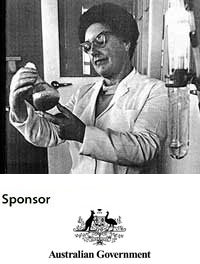
Margaret Dick has been described as a pioneer of Australian food microbiology. She made her outstanding career from the early 1940s as a microbiologist in Kraft Foods Australia, and rose quickly to become their Chief Microbiologist. In addition, she carried her research and expertise outwards to influence national standards in Australia and to influence education in her field of expertise, and to work with government bodies associated with public health.
Interviewed by Dr Ann Moyal in 2000.
Contents
- Introduction
- An engineering heritage
- The path into microbiology
- Joining the historic Kraft Walker Cheese Company
- Women microbiologists in a dynamic, challenging scene
- Emphasising quality
- Product research: 'It will all be used some day'
- New responsibilities: from preventing failed vats to inspecting factories
- Step by step to knowledge and influence
- Keeping ahead: testing for penicillin and enterotoxins
- Setting up the essential reference methods
- Listening, advising and teaching in a hidden world of food standards
- Promoting access to microbiology studies
- Academic recognition
- Helping others to understand more
Introduction
Margaret Dick carved out an unorthodox career and is exceptional in that her contribution to Australia's scientific development was made in the application of science to industry. She made her outstanding career from the early 1940s as microbiologist in Kraft Foods Australia, a leading company in food production in Australia. Joining the Kraft company in 1942, she rose quickly to become their chief microbiologist, and in her 40-year career there she was to play a pioneering role in establishing the standards and microbial quality of all the company's products.
In addition, she carried her research and expertise outwards to influence national standards in Australia and to influence education in her field of expertise, and to work with government bodies associated with public health. She has been described as a pioneer of Australian food microbiology.
An engineering heritage
Margaret, do you think your parents and your background influenced you toward a scientific career?
Well, my father came from a long line of Scottish engineers. His father had an engineering shop and all of the sons were engineers. My mother was a housewife – originally a dressmaker, in Glasgow. Her father was an accountant and her uncle was Professor of Physiology at Glasgow University.
My parents believed there was no substitute for education and they tried very hard to give us the best education they could, at the best schools they could afford to send us to. My father being an engineer, I guess we always had a feeling for mechanics, for science and engineering: my brother became an engineer, my two sisters went into teaching, and then I went on to do science.
You were born in Melbourne in 1918. When had your parents come to Australia?
About 1914, just before the war. One of my sisters had been born in Scotland, followed by a sister born in South Africa, and then my brother born in Scotland. I was the youngest.
You see, my father had been to the Boer War in South Africa, and he liked that country so much (especially the temperature, compared with Scotland's) that when he returned to Scotland he decided to look for a job in South Africa. There were so many engineers in Scotland that it was hard for them to get jobs there, and most Scottish engineers travelled overseas for jobs. My father went out to the goldmines and worked on the Rand gold mines, and my mother followed him when he got accommodation for her. They lived there for quite a few years.
The decision to move out of South Africa was made on two points. The doctor told my father that there was a chance he could get miner's phthisis if he continued working in the mines, and he should move out of that. Secondly, my father didn't believe that he should establish a family in South Africa, because he anticipated sooner or later there would be trouble. He believed that the South African should develop his own country. He had a great respect for the native South Africans, particularly the Zulus, whom he got to know because he employed them on the mines.
The path into microbiology
Where did you go to school?
I went to Kew State School, followed by Mont Albert Central School, which was then the leading central school in Melbourne, and on to Melbourne Girls' High School (which became McRobertson Girls' High School).
Did you begin to feel that you had a special direction in science while you were at school?
I always wanted to do science, without knowing which science. In those days you didn't brush up against the various disciplines of science as young children do now – they are sent into laboratories to experience these things while they are still at school. So I didn't really know that I wanted to do microbiology until I got to the university and actually did it.
We had very good scientific teachers right through Melbourne High School, which had the pick of the teachers. They used to want to go to either University High School or Melbourne High School, which were rated the highest. It was very good for a teacher to receive a position there. All our teachers were women; the boys had their own school and most of their teachers were men.
It is good that schools such as yours gave women opportunities in teaching science. Quite a number of women got their degrees in science at Melbourne University in the 1930s and '40s. What courses did you do when you went there, in the late 1930s?
I decided that I had better do the new dietetic course devised by Professor Young, who was a biochemist, and Professor Osborne, a physiologist who was always interested in nutrition. It was an interesting course, basically in science – majors in chemistry and biochemistry, plus nutrition. The nutrition ran for two years, and incorporated in it was a number of small subjects like the economics of food production, dental health, public health – very helpful subjects when I actually decided I was going to work in the food industry.
We started off with chemistry and maths, and in my case biology and physics. Then we went into the microbiology, biochemistry and dietetics. The actual course was a Bachelor of Science degree, and if you wanted to get your Diploma of Dietetics you had to go and do a hospital year.
The course was mostly designed for people who were going to work in hospitals, I suppose, but you had the fortuitous opportunity of using it to go in quite a different direction. Did you find university stimulating and enjoyable, or was it hard grind? Were you good at mathematics?
Oh, I could pass. I wasn't a very good student. I hated exams; they worried me. But if I was left on my own and could follow my own bent, I think I could manage.
Graduating from Melbourne with a BSc in 1941, the early part of the war, how did you find job prospects?
Not very good. Actually, Professor Rubbo, who was in charge of microbiology at that time, used to take in only about as many students as he thought there were jobs for. That was rather an interesting aspect of his courses, and I think it was a very good way to approach it. He always associated his intake with the jobs structure.
To get a job I had to go to Adelaide, where I worked with a group of doctors. Even as early as that they had a clinic of four or five doctors, as people have today, and I worked in their laboratory and occasionally helped in the radiology section.
Joining the historic Kraft Walker Cheese Company
How did you move into a career with the Kraft company? You were there for 40 years, and had a transforming effect.
I found things very restricting in Adelaide. There was no society for microbiology in those days and having come interstate I had no contacts. Although I enjoyed working with these people, I felt I was just going to stagnate, so I went back to Melbourne – and not very long after that the Kraft Walker Cheese Company had a position available, which I took.
Even then, in 1942, Kraft Walker was one of the major food producing industries in Australia, and today it is described as a 'food giant' in Australia. Could you tell us about the cheese company's origins? I understand that it was founded to ship canned butter to Asia and the Middle East, and then became diversified.
The company was started by Fred Walker, way back in 1902 or '03. A chemist he employed, Dr Callister, did all the work in preparing the way to make Vegemite, from yeast right through to a yeast paste, and for that he got his Doctor of Science. The company had originally made Bonox, which is a meat extract, and they also produced a range of canned food.
When Fred Walker heard that Mr J L Kraft, in America, was looking at a method of preserving cheese – which became known as processed cheese – he went over to see Mr Kraft and they came to some arrangement whereby Kraft got an interest in the company and we made processed cheese. (It was Dr Callister who worked on that in Australia, after Vegemite.) But the company is much more than a cheese processor – it's a food company, basically.
After Fred Walker died, the majority shareholding in the company continued to be held by Australians, but in about 1950 Kraft decided they wanted to make a takeover, and managed to get some of the shares to give them a majority holding.
Women microbiologists in a dynamic, challenging scene
The company, when I arrived there, was very dynamic. Fred Walker had been very innovative, and he left a large proportion of his shares to the people who had helped him build up the company, including Dr Callister, an engineer called Frank Daniel, two salesmen and two accountants. The first two of those were important people in the dynamic nature of the company, and that is what kept everybody going. There was always a challenge. I remember being called down to Mr Daniel's office, where he said, 'You know, there must be an easier way of making cheese. Why can't you just take some milk, add something to it and do something to it, and then we make processed cheese from it?' This was the sort of challenge that was going on all the time. Frank Daniel was challenging the engineers, 'Why can't you do this process more simply?'
Callister was the research man, and he believed in research within the company. He employed chemists and young people from school, putting them into the chemistry laboratory before they went into Production. The young people used to go to RMIT (Royal Melbourne Institute of Technology) and do their course, and eventually they became production managers. Even the manager of the production side when I arrived, H G Osborne, had gone into the laboratories when he was employed, and then into Production.
The person in charge of me was Keith Farrer, who was in charge of the laboratories. But I seemed to be caught between him and Gerard Osborne, the manager of production. Osborne was a very dynamic leader. He'd be in the factory any time after 6 o'clock in the morning, and he walked around in it an awful lot. He knew all his people by name. And it became very big, I can tell you. Where we started with a staff of 40 and perhaps 200 in the factory. We were up to 1000 in the factory and several hundred staff by the 1950s when we moved from the factory, on the banks of the Yarra opposite the railway station in Melbourne, to Port Melbourne.
Did you work with any other women when you arrived?
I worked for about a year with Joyce Griffiths, the microbiologist for the company. She was a graduate from Reading, in England, and she was setting up the procedures for testing the food. But it was wartime by then, and she was taken over by the Americans, who wanted the food quality control for their Australian bases looked after. That left me with nobody again.
The first bacteriologist to come into the company, though, had been Audrey Osborne – Professor Osborne's daughter – who was employed by Callister in 1929 when he got onto making processed cheese. She was probably one of the first microbiologists in industry, apart from perhaps the dairy industry. Her married name was Audrey Kahn. She became a very well-known nutritionist.
Emphasising quality
So, aged only 24, you go into this firm as one of the key people. It seems to me that they expected a great deal of you instantly.
Well, everything starts in a small way, and we started in a small way. Kraft was very particular about quality. From every batch that was made in the factory, every day, a sample was taken to be inspected the next morning – by everybody in production, from the directors down. So my emphasis had to be on quality too. We had to start testing the food and making sure the process was good enough. And if they decided they wanted to make a better product by reducing temperature, that all had to go through the hoops. We had to make sure that the product was quite safe and stable, and could sit in cupboards for a long time and so forth. So that was where it all started: people don't eat food unless it is good to eat. You look at texture, but in the background is the safety.
We didn't realise at first that microbiology was the most important thing in food science, did we? You were really there to focus and develop this whole concept. I suppose there weren't many textbooks then on the microbiology of food.
No. When I went into Kraft there were two textbooks which had a bit of microbiology in them in the dairy field, and a very big book by Tanner – virtually a compendium – on the microbiology of foods. That was just a collection of all the accounts and information on microbiology that had been published; Tanner had examined all these and had written up the subject from the results that he had collected. So, basically, all the methods we had to start with were medical methods.
Kraft did supply us with a lot of information; they had a very good library. As the years went on and people started publishing various methods – a lot of them from overseas – in the various journals, we had to pick out the methods that we wanted to use for our own products. We were all the time hunting for methodology and any information we could get on foods, examining it and deciding that one method was better than another, and whether to introduce a method to replace the previous one.
Product research: 'It will all be used some day'
The presence of Allied troops in Australia during the war brought some pressure to make different products. You were immediately linked into that, weren't you?
Oh yes. The Americans wanted food for the troops in their bases here, and they wanted their specialist lines, particularly for the officers' canteen. This presented another challenge to look at new products, as we were suddenly thrown into making things like chilli con carne and chicken in various sauces. In addition, they wanted dehydrated foods, particularly dehydrated vegetables. A vegetable dehydration factory was the first building on our Port Melbourne site, I think at the suggestion of the government. So we had to get into another lot of methodology and investigations into what organisms were in this new product too, until we could say, 'Everything is fine, we hope.' So these various products built up.
In the meantime, Kraft decided they would make mayonnaises, and then they needed more yeast for their Vegemite so they built a yeast factory on the Port Melbourne site near the dehydration factory. They put in consultants to set that all up. Although the consultants were supposed to present it to us as a final plant, they had problems with their yield of yeasts and they were looking round for the reason so they asked us to look at certain amino acids that were in the media. In the research labs we had been doing work on vitamins and amino acids. Dr Farrer was particularly interested in vitamin B1 and B2, but B2 could not be examined by chemical means. Ways of using microbiological methods to estimate these factors in B2 had been published, however, so that is where we started our work on the B2 vitamins.
You took that further and did your Masters degree on it over a period, didn't you?
Yes. We started off with riboflavin and the various other factors in B2, one of which was folic acid – which has recently interested a lot of people. We went on to folic acid because there was some talk of it being involved in pernicious anaemia, so we thought, 'Well, we'd better know about that.' And it was interesting that in the 1980s, after I had retired, when I went back to Kraft for the opening of the new laboratories they had built there, a young girl in the audience came up to me and asked, 'Why did you do work on folic acid, way back in the 1940s and '50s?' I said, 'Because we believed in knowing everything about our product. We wanted to have complete knowledge.' And, as Dr Callister always said, 'You never lose anything. It'll be used some day.'
Did you find in some of this early research that there were dangerous things happening in food? Did you ever have to discard, in those early stages?
No. We never went into production unless we were thoroughly sure. Not only did we test the product that was made, but we did shelf-life tests. We had large incubators with product in them, running at various temperatures, and we then brought the product out and re-tested it. If we had a blow in the incubators, the can would come out and be examined by microbiology, and all the seams of the cans would be examined. And in the most cases it was something to do with the seaming. Very rarely did you get other things. We did have odd organisms that caused problems, none of which were of health significance but which were of significance to keeping quality. And then it was on for good and all.
New responsibilities: from preventing failed vats to inspecting factories
When did you become the Chief Bacteriologist, in charge of quality control?
I was Senior Microbiologist for some years before I was made Chief Bacteriologist. The reason for that was that we had a male microbiologist at one of our country factories – Derek Shew, at Allansford factory – and he had been there longer than I had. He was the centre for the microbiology of most of the cheese factories we had.
He worked in the laboratory initially, doing some interesting work on the fact that when you make cheese you can get failed vats. That means that the cheese starters don't produce acid. The starters are cultures of organisms that are added to the vat to produce acid, which causes the moisture to come out of the cheese so that you get curds and whey. Then you can work on the curd and produce the bulk cheese as you know it today.
He could not understand the reason for these failed vats, but he found in a published article by Whitehead, in New Zealand, that he had discovered a particle which he believed attacked cheese starters. So Derek Shew went over to see Whitehead and worked with him, trying to sort out the problems with these bacteriophages, as they were called, to see how we could prevent them from causing the cheese vats to fail.
The bacteriophage is rather interesting. It is a virus-like particle which enters the cell, and instead of the cell multiplying itself, the phage multiplies within it to produce anything up to six to sixteen phage particles. That causes the cell to burst, releasing a whole lot of all these phage particles, which then can attack new starter cells. It is a big problem, and I think it is still with us. Derek Shew worked very hard on preventing failed vats, and eventually I got involved with it too when he had to leave because of his wife's health.
Then we got involved with all the cheese factories. Each cheese factory had its own manager, and of course it wasn't up to me to decide, 'I'm going down there to investigate their factories,' but I was soon told I had to do it. Mr Osborne walked into my office and said, 'Do you go round the cheese factories? I think you should' – just as he said later on, 'Do you go through all the new plant with the engineers while it is on the drawing board?' When I answered, 'No,' he said, 'Well, I think you should.' He was directing me in the factory area, to make sure that I went round everywhere.
I have a vision of you as a young woman suddenly thrust into this very complex and diverse experience, not just at the research bench but in the whole business of devising methodology and procedures, and formulating plans for better work and cleaner, more hygienic systems. I gather that once you began to go round the cheese factories you and your team were assessing their quality control.
Yes, we used to do technical audits. They always liked to know when I was coming. Particularly, at one stage we bought a fish factory at Eden and then we had to go and sort it all out. The engineers went in and devised ways of cutting tuna efficiently and easily so that the people didn't have back-breaking jobs to do. And we went in regularly to audit their cleanliness and sanitation. I remember one day driving down the hill towards the factory, with the wind blowing just in the right direction. You could smell the hypochlorite – they were getting ready for me!
Step by step to knowledge and influence
Did you encounter some opposition to your presence in these places?
Oh, you did. It varied with the people. Some men didn't like women working with them, particularly if they were reporting on their work, as I virtually had to do. I got on very well with the engineers that I worked with mainly, although some of the younger ones didn't like me looking at their plans or anything. They weren't having that. I had help behind me, however, in that if I said something was to be done and it wasn't done, Gerard Osborne would want to know why.
Perhaps you could get on with the engineers because of your family background. But what were the engineers doing in these factories?
There was always new plant going in, to produce new products. They had to do the whole planning of the factory area and the installations, and make sure that the process was efficient. A lot of the work was done by the Kraft engineers themselves. The Chief Engineer, Doug Lambert, was very good. Actually, he worked with our cheese-maker, Joe Sharkey, to mechanise cheese-making for the first time in the world. That was started at Kraft in Australia. Joe Sharkey was a very good cheese-maker. He knew his curd backwards. He used to say, 'Now, just look at that. Can't you just feel how silky it is?' Kraft owes much of its reputation to his knowledge.
It seems your own expertise was growing apace. Somewhere about the early 1950s you were involved in devising a scheme called Hazard Analysis by Critical Control Points. What was that?
Actually, it was so named in the 1970s by the International Commission on Microbiological Specification for Foods, an overseas group which put out a lot of books of which the last was on what they called HACCP [pronounced hassup] – but what I had been doing all over those years was basically the same. I had put in many procedures on the microbiological side, together with the engineers and production people, who decided, 'Yes, we have to have controllers here, and we have to have recorders here in the process, so that everything is completely covered.' And basically that became HACCP.
You see, I had started slowly in all this and it built up. As you got new products you got new knowledge, you worked with new plant, and so it just went on.
Keeping ahead: testing for penicillin and enterotoxins
As the Kraft company grew to pre-eminence in Australia, developing whole sets of new products, your microbiological work came to include research on penicillin and staphylococcal enterotoxins, for example. Was work on such a series of problems distinctive to that company, or was some of it going on in other places?
Well, we were always first. We never knew really what other companies were doing. We seemed to be always ahead of everybody, but that was our aim: we wanted to keep ahead of our opposition. Quality was always the first thing.
When penicillin became available, the vets started to use it for the treatment of mastitis in cows. This became a vital thing for us, because as part of our quality the suppliers were supposed to keep the milk back for two to three days before it was allowed to go into the factory. Kraft, at all their country locations, used to employ field officers who would go out to the dairies and watch the cleaning, the sanitation, and talk to the farmers about any problems they had. In other words, they were watching the quality of the milk coming in. (In my earliest days there, it came in milk cans; then it was stored in refrigerated milk tanks; and then refrigerated tankers used to bring it to the factory. So there were big changes.) But this penicillin was a problem, because it could stop the starters from working in the vats. So we started to test for it.
Originally, the testing was done with a methylene blue test. The standard assessment before milk would be paid for was that the quality had to be up to a certain standard of methylene blue. But when you had penicillin in the milk, the methylene blue never went white. So few organisms would grow in the milk that it stayed blue for days! We decided we needed a better way of testing for penicillin. A test was devised by Jill Naylor, who worked in my lab, and that was put into practice. We used to assess all the suppliers' milk to all country factories every so often for penicillin, and report back to the factories.
And what about the staphylococcal enterotoxin? Just what is enterotoxin?
Enterotoxin is a name devised to explain a material that is produced by the growth of staphylococci which upsets the stomach. It is not caused – this is important – by the organism growing in your stomach, as it does with salmonella, but by the toxin produced in the food by the staphylococci. When you eat that food, you eat the enterotoxin. That is why it is called 'entero' rather than an endotoxin.
Cases of staphylococcal food poisoning from blue cheese did occur somewhere in America, and although this was nothing to do with us specifically, it caused people here to think about how we could test for staphylococcal enterotoxins. Staphylococci may grow, but they don't necessarily produce enterotoxins except under special conditions. And when we hunted through the literature, we found that Bergdoll, at the Massachusetts Institute, had come out with a method for testing for enterotoxin. But the problem was that to do so you had to have enterotoxin, which he was producing in his own laboratory.
I imagine that you would find such a life fascinating and never want to leave it. You published some papers with your results in particular fields of microbiology, but did you feel constrained because confidentiality prevented you from publishing more?
One accepted that and didn't worry about it. There was always something else happening that you had to get on with, always a challenge. That is what kept you there, and an enormous number of people from around my time stayed for 40 years. You always had something to think about, something to do, something that was new.
Setting up the essential reference methods
You became quite involved with reference committees attending to standards in food. Would you like to tell us a little about that additional use of your expertise? I think the Australian Society of Dairy Technology was the first to set up a committee.
Yes. The dairy industry, to support their exports, had to keep up with what was going on in Europe. The Europeans were developing methods by which they were going to test Australian products, and so they would send out information for us to say whether we agreed with them. After a while it became clear that really we did not have enough details of reference methods. I particularly emphasise 'reference', because most people talk about them as 'standard' methods and think that is the way they have to work. They are reference methods. The dairy industry had two aborted attempts at setting up a committee to work on reference methods, but the first chairman died and the next one became very ill. The industry then put it to the Standards Association of Australia to get a committee together to work on these methods. I was on that from its start until I retired.
Also, you became involved very early in a group which the National Health and Medical Research Council got together to inquire into microbiological standards in foods in general. How did that come about?
The NHMRC's Committee for Standards for Foods had set chemical standards, and they began to think they might need microbiological standards as well. But they didn't know whether the time was right for that to happen, so they got together three people – Dr Bill Scott, the senior food microbiologist at Food Preservation, CSIRO; Dr Kevin Anderson, from the Adelaide Medical and Veterinary Institute; and myself. We had a little meeting in Canberra and went through the various aspects of organisms that could cause health problems in food. We decided there were one or two cases that might have merited standards at that stage, but we had no reference methods. How could we set a standard without reference methods? That decision went back to the main Foods Standards Committee, whose Chairman, Dr Vickery, put it to the Standards Association to set up a committee to prepare standard reference methods for food. And so that is how that began.
These committees are long-lasting and draw on people from the universities, CSIRO and so forth. You were always chosen to represent industry and manufacturing, weren't you?
Yes. I always seemed to be the nominee for industry – with the company's support. They wanted to see that the work was done satisfactorily for industry in total. And we contributed our tremendous database, containing all our testing results and knowledge of investigations for various organisms and so forth.
You built up close relationships with people working in CSIRO, didn't you?
Yes. CSIRO Food Preservation, with Dr Vickery heading it, made a great impression on industry. One could go to CSIRO and talk to them, and know you had confidentiality. That was the very big point in the days when I dealt with them.
Listening, advising and teaching in a hidden world of food standards
It has been commented that you kept these committees honest in commercial aspects, and that you were a tremendous contributor but also very strong. Did being a woman, perhaps the only one among those key scientists, lead you to be more outspoken?
I was not the only woman, not with those committees. But we did have our arguments at times. My friend John Christian, at CSIRO, and I were at loggerheads a couple of times. I wouldn't agree with him. So that would have resulted in that comment. I was never outspoken unless I was sure of my ground. I always like to be accurate. Other than that, what other people said was just as important as what I said. They'd have different ways of looking at things, and you must listen.
Serving on a number of committees for 25 years, in addition to your normal challenging work, must have kept you fairly occupied. You would have had to do a lot of homework for these things. And an involvement we have not yet mentioned is advising the Australian defence forces on their microbiological standards for foods.
Yes. The microbiologist they had working for them decided that really they should have standards for the various foods that they purchase for the Army and the other Forces – including dehydrated foods – so he set up a little group and we made standards for the Defence Force.
It's a hidden world that you were occupying. It is all too easy to take for granted the quality standards we have today, such as 'use by' dates on food. If there is an outbreak of poisoning anywhere we are very excited about it, yet we generally have no idea of the ongoing work to prevent such things. But the background to the precise standards that protect us has been your life.
Yes. We used to be worried about restaurants and also about groups of people having big picnics, where they didn't have refrigeration for the large amounts of food they had prepared. When they took it out, you would get cases of food poisoning because of the lack of refrigeration and such things. That area worried the Australian Institute of Food Science, which for years and years ran lectures for people who worked in factories and in restaurants. We tried to work with the food inspectors from the councils, to get people along to these lectures held every year on hygiene and sterilisation, disinfection and so forth.
Promoting access to microbiology studies
We have noted that microbiology was available at Melbourne University, but mostly for people who would serve in medical situations. You have been engaged in various attempts to set up new courses, haven't you?
Yes. One of the problems for girls coming from school to work in the laboratories was that they couldn't make a career and advance within the laboratories without a formal education. The firm used to give the girls working for me a half-day off per week to go to a course at the Royal Melbourne Institute of Technology for the chemistry diploma, and that got them so far, but what they really needed was microbiology. I was able to arrange with Professor Rubbo that a number of them, once they had completed so much chemistry, would be allowed to do microbiology at the university as a single subject. Several girls who had been in the laboratory for many years were then able, with their education, to advance up the tree.
I had a ring one day from Dr Eileen Fisher, who worked at Burnley Horticultural College, to say, 'I've got a problem. I've got people working for me, particularly girls, who cannot advance because they haven't got a course to do. What do you do with your girls?' When I explained what I did, she said, 'Well, really we need a course at somewhere like the RMIT to provide microbiology for these people.' (RMIT had microbiology, but it was used for the medical side.) So we got our heads together and thought out what we really wanted as a course. She wanted subjects like entomology and parasitology included in it; I wanted food microbiology. I rang Lucy Alford, at the Melbourne Metropolitan Board of Works, and asked, 'Lucy, are you interested in such a course for some of your people?' and she said she was. So we devised this course.
Then Eileen Fisher brought in John Roberts of the Australian Institute of Agricultural Science to act as a go-between with RMIT, and RMIT agreed to the course. But unfortunately, when they brought it out, they had cut out all the subjects that Eileen Fisher wanted, so it became very similar to a university degree course. At least it started general microbiology for a lot of other people.
You were more successful, I think, in your contribution to the course planning by Bendigo College of Advanced Education for their Diploma of Applied Science, which had microbiology in it.
Yes. Those country educational institutions were upgrading – Ballarat School of Mines upgraded their courses; Bendigo did the same and they introduced an applied science degree. Nancy Millis and I were asked to go up to the interviews for the appointment of the microbiologist for their course, and then when they formed an advisory committee they asked me to join that. (In the latter part of it I was the committee Chair.) The course was devised to cover all the types of work that might be involved for students working in the country. So as well as the microbiologists, they also had on their course advisory committee a veterinary person, an agriculturalist and so on to advise them. It was an interesting course, in that they managed to get the industry around them to participate with the students, giving industry people a chance to see what sort of students Bendigo were bringing out and also giving the students a chance to work within the industry.
Academic recognition
I am fascinated that whereas so many scientists, both men and women, go into a field and continue in a fairly straightforward way, never doing more than expand on the PhD thesis they have written, after you did your Masters degree a PhD was not relevant to your career. Instead, you have been occupied across a whole set of fields in a very dynamic company, building up expertise and applying your knowledge to the formulation of a wide range of procedures. We could say that you are a dynamo yourself, and your own dynamic activities stretched out across a whole spectrum of national and educational activities.
Even quite early in the piece, in the 1950s, you were being widely praised for your professionalism and your ability. In 1970 you were elected the first woman Fellow of the Australian Institute of Food Science and Technology, and that same year you won their Award of Merit. What was that for?
Well, the Fellow is the usual recognition of your input into the industry. The Award was awarded for my specific work within the food industry.
In 1977, you became a Fellow of the Australian Academy of Technological Sciences and Engineering, which had been set up in 1976 as a sort of counterpoise to the scientific research emphasis of the Australian Academy of Science. The Academy of the Technological Sciences became an independent organisation to recognise achievement of a very innovative and creative kind in applied science and industry. Women were not often elected to the Academy of Science, but at the founding of the Academy of the Technological Sciences two women were elected as Fellows, June Olley and Helen Newton Turner – and you were elected the following year. Within that Academy, have women had much of an influence?
I would say they have influence, certainly an interest. The person who I found was most interested in having women in the Academy was Sir Ian McLennan, the driving force in the formation of the Academy. It didn't matter where you saw him, he always recognised you, he always came and talked to you. He had no qualms at all about women being there, and I think that put their presence in good standing to start off with, because he was President. Although I don't get along to the Academy now because of my invalidity, I used to enjoy going to their seminars, annual meetings and so forth, because it seemed to me that their aim was, 'What can the Academy do for Australia?'
Helping others to understand more
In your career, did being a very important scientist in a very male industry create any difficulties for you? Or did your temperament, with your calmness and readiness to get on with any challenge, make that easier for you?
I think my temperament helped. There was always a division between the male and the female. I never could quite understand why, because we were all contributing, but from the time I started there was always a little barrier, right up to the time I left. I just ignored it.
Reflecting on the women that worked with you and the young ones you have trained, do you think women approach their scientific task differently from men?
Well, they did in my time. I always liked to employ women in microbiology because they had a sense of detail and accuracy, whereas I felt that the men liked to shortcut – and you can't do that in microbiology. I had a few men in the lab which was used as training for production jobs. They had always gone into the chemistry laboratory but it was decided they would come into my lab, and quite frankly, although I enjoyed having them, it was a nuisance. We would just get them trained and away they would go to Production, and then we would have to start all over again. In my time, the women in the food industry, particularly, knew they were probably never going to get to a top position, but the men always knew that they would want to be managers.
You retired in 1983, at a point where women should have been having an easier time. Did you serve as a mentor to the women you trained? Or would that word not have been in the vocabulary of the period?
No, I don't use the word 'mentor'. I help people. I helped the young ones get training and advance, and quite a number of them went out to find jobs in other companies. And it is interesting, I have had them come up to me since I retired and thank me for the training I gave them. It has been very pleasurable to receive such thanks.
The training side of it has been interesting. Just a little story, as an example, concerns a production manager we had in our dehydration factory in Tasmania. When I arrived over there he looked askance at this woman walking in. We did some work and I said quietly, 'John, I think these counts are too high. You can do better than that.' So he immediately went away and got Tanner, the compendium I mentioned, and showed me all the counts in Tanner. I said, 'Yes, I know all about those, but I'm sure you can do better.' Anyway, nothing more was said, and we worked away. After he left the company, he wrote to thank me for how I had helped him to understand more about the production of food. That was unusual, and I appreciated it very much.
Thank you, Margaret, for a wonderful story.
Professor George Rogers, biochemist
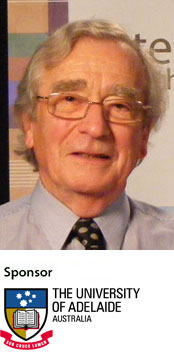
George Ernest Rogers was born in Melbourne, Victoria in 1927. He was educated at the University of Melbourne graduating with a BSc (1949) and MSc (1951). Rogers then went to the University of Cambridge in the UK on a CSIRO scholarship, graduating with a PhD in 1956. He returned to Australia and the Division of Protein Chemistry at CSIRO as a senior research officer (1957–62). He joined the Department of Biochemistry at the University of Adelaide in 1963 where he began as a reader (1963–77), before being promoted to professor (1978–92). Rogers also served as department head from 1988 to 1992. In 1992 Rogers became an emeritus professor at the University of Adelaide and in 1995 he was asked to be the program manager of Premium Quality Wool CRC (1995–2000). During his career Rogers made key findings in the field of hair research. In particular, he looked at the molecular structure of hair keratins and investigated how to manipulate their properties through gene expression and regulation.
Interviewed by Dr Bruce Fraser in 2008.
Contents
- Introduction
- Early years
- Moving into science research
- A transition to university research into hormones
- Applying electron microscopy to keratin fibres
- A productive interest in the inner root sheath
- Fibre structure and filament arrangement
- From Reader to department head
- Advances in technology and in fibre biochemistry
- Genes, proteins, skin and hair
- A Commonwealth centre for gene technology
- Organising an active retirement
- Harnessing biochemistry for economic advantage
- Fruitful contributions to teaching and research
- A life underpinned by family and research
Introduction
Professor George Rogers was elected to Fellowship of the Academy in 1977 for his outstanding contributions to our knowledge of the molecular structure of keratins and the biochemistry of keratinisation. I have been a colleague and a friend of George's for more than 50 years, and am privileged to have been invited to provide this introduction.
George's parents emigrated to Australia from England in the 1920s and he was born in Melbourne in 1927. When he was 15, he took a job as a laboratory assistant and enrolled for a diploma of chemistry at the Royal Melbourne Technical College. However, he was encouraged by the director of his laboratory to aim for a degree rather than a diploma and, after two years of study, gained admission to Melbourne University to study for a bachelor's degree in chemistry and biochemistry. After graduation, he was offered a scholarship to study for a master's degree in biochemistry. He investigated the purification of the protein hormone secretin and, after completing his MSc degree, was appointed as a research scientist in CSIRO's newly formed Wool Research Laboratories.
When I joined the same laboratory in 1952, George was working on the structure and biochemistry of the wool follicle, and over the next 10 years we collaborated on various aspects of the molecular structure and cellular structure of keratins such as wool, hair and feathers. After the Division acquired an electron microscope, George developed special techniques for sectioning keratins, and the quality of the micrographs that he obtained 50 years ago has still not, in my opinion, been bettered. During his years with CSIRO he was awarded an overseas studentship and completed a PhD at Cambridge.
In 1963 he left CSIRO to take up a readership in biochemistry at the University of Adelaide, where he continued his study on wool and other keratins. Over the next 30 years he fostered a large research group, and for five years served as head of department. When the new methods of gene manipulation came into use in the early 1970s, he pioneered their application to the proteins of wool, hair and feathers.
His research has been supported by various grants from the wool industry and, in 1952, he and three colleagues in the Department of Biochemistry were awarded funds to found a Commonwealth research centre for gene technology, which continued for nine years.
In 1976 George was awarded a DSc by the University of Adelaide and also the Lemberg Medal of the Australian Biochemical Society. He was a visiting fellow at Clare Hall in Cambridge in 1970, a visiting researcher at the University of Grenoble, France, in 1977 and a visiting scientist in 1985 at the National Institutes of Health, in Washington. He has been an invited speaker at scientific meetings in Europe, the United Kingdom and the USA, and has published over 170 papers and reviews and two books.
On retirement at the mandatory age of 65 he was made Emeritus Professor by the University of Adelaide, but he was able to continue his research interests after 1962 as a visiting fellow in the faculties of science and agricultural science. Currently, he continues his academic and bench research on the molecular structure of human hair, in a laboratory in the Medical School at the University of Adelaide.
Early years
George, we met first in 1952, and over the years I have learned quite a lot about your background. Could you tell me, however, about your childhood and early life?
I was born in Prahran, a suburb of Melbourne, in 1927. My parents had emigrated from England some four years earlier, together with their infant daughter, my only sibling.
My father, Percy, was born in London. When he was still an infant his father died, and so he and his younger brother, Ernest, were raised by their mother. Percy left school at the age of 14 and was thereafter largely self-educated. He served in the First World War as a transport driver in the Royal Naval Air Service, which later became the RAF, and after the war was a motor car buyer for a prominent export company in the City of London.
My mother, Bertha Baxter, came from Reading, Berkshire. Her father also died when she was an infant, so she too – with an older sister, Annie, and an older brother, George – was raised by her mother. During the war she was a shop assistant in Oxford Street, London.
My parents were married in 1916, a year my mother remembered for the bombing raids on London by German Zeppelins. She used to tell me how terrified she was by that. (She lived on her own while my father was away carrying out his duties.) Typically of many families in the United Kingdom at that time, my parents were devastated by the loss of their only brothers – one killed in France, and one lost at sea.
What are your earliest recollections?
They are partly of my home. When I was about a year old, the family moved to a new house in Caulfield, in Melbourne, where I grew up and lived until I left home. My father had been successful in the motor business in Melbourne and was, I believe, the first to establish second-hand car auctions. He later became a partner in a car dealership. Unfortunately, the 1929 Depression hit two years after I'd been born, and in the early '30s my father had some trouble with a mortgage, apparently. I remember that we had to leave our home and move temporarily to a friend's house.
One of the enduring memories I have of my early life is of some loneliness. We didn't have an extended family; for me, it was just my parents and my sister. I did have a grandmother in England, and one aunt, but I had no uncles or direct cousins who would have added to my early experiences. I think my parents too had quite a problem settling down in Australia, because they just didn't have family contacts. In fact, their original intention was to stay in Australia for only five years, but the Depression and the subsequent World War II rather stopped all that.
Where did you go to school, George?
At first I went to a kindergarten-primary school combination about half a kilometre from our home. I really enjoyed that, and I remember falling in love with my teacher. [laugh] When I was seven, however, the family finances had improved enough for a private education and I was enrolled at Caulfield Grammar School. I was there during the first half of the Second World War – those dark days. I remember digging air raid trenches and filling sandbags. We had blackouts, and I even had a shaded lamp on my bicycle, as the motor cars did. It was accepted as compulsory, really.
Did you develop any special interest in science at Caulfield Grammar?
Yes. I had no desire to follow my father into the business world, particularly his business; it always seemed to be full of balance sheets and sales, and it didn't really fascinate me as chemistry did. I was about 10 years of age when I got very interested in chemistry, although I can't remember now how it happened – my father was an avid reader, but my parents were not scientifically knowledgeable. I suppose it started when my mother bought me a Lott's chemistry set, produced by an English company. Also, I was doing chemistry and physics at school, and the masters in those subjects were excellent.
I then found that having a chemistry set was an outlet in the lonely hours that I, like many other schoolchildren, spent quarantined at home during the poliomyelitis epidemic of 1937. And I had rather severe childhood illnesses, such as measles, so the interest in chemistry occupied me during the time it took to recover.
I added to my chemistry laboratory over some years. I used to go to H B Selby & Co. in Melbourne to buy chemicals and equipment. I remember that a very nice man, a Mr Still, worked behind the counter and displayed quite a reasonable knowledge of chemistry. It is amazing that in those days I could purchase all sorts of dangerous materials like strong acids and mercury, and chemicals that were potentially explosive like iodine flakes and 880 ammonia, which make nitrogen triiodide, of course – and I used to do that – and I used to store them at home!
What was your overall experience of school life?
I enjoyed it very much, and I did reasonably well scholastically. I took part in the sports, including gymnastics, which I liked, and football, boxing and some cricket – although I wasn't all that good at that. But I left school earlier than originally intended, when I was still too young to excel in sport. I was a top player in table tennis, however; not ping-pong but really vigorous table tennis. And I had two years as a lance corporal in the cadet corps, where we recognised that we were training for a war that was very much still on. Sadly, quite a few of the older cadets were to lose their lives on active service.
I did well in the subjects I took, except French. The master for that was very nice, but he had served in France in the First World War and told us stories about his experiences rather than teaching us the language. When I was around 11, I think, I jumped a year into a higher class because of when my birthday occurred, and I fell behind. So I had special instruction in algebra, which I remember enjoying, and did all right in that. The downside was that the mechanism at that school caused me to go into the lower stream; that wasn't a good thing, because some pupils there were not particularly keen on learning. Later on, though, I moved into a higher stream. I recall one episode when I was sorely disappointed at failing a physics exam at the end of term. But I worked very hard and passed well at the end of the year, with prizes in English and chemistry.
Moving into science research
Did you continue at the grammar school?
No. My whole school life came to a rather abrupt end when my father's car business was in difficulty because of the war. This led to my early departure after completing only the Intermediate Certificate, when I had just turned 15. Because of the chemistry interest I had an ambition to be an industrial chemist. Really, it was very early in life to make such a definite decision, but that was where I thought I was heading. So, wisely or not, the headmaster advised me to apprentice myself in a chemical-type job, and I left private education and went looking for a job. In retrospect, I should have gone on to a public school; things might then have been different. On the other hand, of course, my career really began with all those events.
At the age of 15, in 1943, I started work as a laboratory assistant with Gordon Lennox, who was head of the fellmongery section of CSIR, as it was then. I quite enjoyed that, because I felt I was doing something for the war effort and I was working with adults who had a similar desire – it was the mission of the unit to do work for the war effort – and also it involved chemistry. I enrolled at the RMIT, when it was still the Royal Melbourne Technical College, to take the diploma of chemistry. I felt the loss of normal schooling, however, partly because the job was very hard, with long hours and little time for doing other things, and partly because at school one would have been doing things like sport and cultural activities.
I believe the research introduced you to the mysteries of skin and wool.
That's true. I was working on sheep skin and wool, not directly on sheep. We were looking at the early part of the process for making leather, and I enjoyed the biology–chemistry interface that existed at that time. Working with Gordon Lennox – who to me was then Dr Lennox, of course – I was able to be around in that lab when such interesting scientists visited as David Rivett, the head of the Executive of CSIR; Ian Wark, who was Chief; and Lionel Bull, the head of Animal Health. And Syd Rubbo, Professor of Microbiology at Melbourne, had quite a lot of interaction with the lab. There was Hedley Marston as well, from Adelaide.
I remember vividly that Gordon Lennox was very kind, fostering my interests and being a mentor to me, such a young lad. Also, in 1945 the famous Lord Florey came out to Australia and gave a lecture on penicillin at which the hospital lecture theatre was overflowing with people. That was a fascinating experience for me. (Florey was visiting because he was then going to set up the ANU.)
Gordon Lennox suggested you should change your study direction a bit, didn't he?
He did, yes. He'd had experience himself of doing a diploma and he said that, useful as it was, I would probably be better to circumvent that and go straight into getting my Leaving and Matriculation – which by then took two years. So, without giving up the chemistry component of the diploma, I went to a coaching college and took the necessary subjects to matriculate. We used to work five days a week from half past eight till something like six minutes past five, and also on Saturday until one o'clock. So that was a full week. I used to have a few hours off during the week to go to early classes, but mostly it was full on, and it was all very hard work. I used to go to the city, have a meal, go to school and then go home in the blackout. It was pretty tough because there was no time to do much for relaxation, but I did play tennis on Saturday afternoons.
A transition to university research into hormones
You then went to Melbourne University. How did you find that transition?
I thought it was fabulous, because it enabled one to learn full time and to socialise, and it was really quite a change in my life pattern. At times, I think, I felt rather guilty not to be working hard enough! I took a mix of chemistry and biochemistry, but I started off with the usual first-year subjects, including zoology and physics and chem. My mathematics was weak, and I'm always sorry about that.
There would have been a lot of ex-servicemen coming home at that time.
Yes. In 1946 there was a scheme to offer returned service men and women a university course if they wanted to take it, and they did. The university experienced great problems because of the enormous increase in student numbers, and introduced a kind of ballot for first year through which you were selected either to go to the new Mildura campus or to stay at Melbourne. I was lucky enough to stay at Melbourne. There was a flavour injected by the influx of service men and women: before the war universities had been a bit of a playground, but it became quite a serious matter to take your education there. Only a small percentage of school leavers attended university, and it was a privilege to be there.
How did you find biochemistry there?
I found it very stimulating. This was only just post-war, and there was a tremendous boost to science coming out from, particularly, Britain and the USA because there had been an influx of refugees and others from Germany before the war and they'd made an impact on the science in those countries. And new discoveries about metabolism and structure were flowing out.
I believe that you met up at Melbourne with Victor Trikojus, one of the very early Fellows of the Academy.
He was the Professor, having been appointed during the war, and he wanted to develop biochemistry at Melbourne in a major way. In the post-war environment money was restricted, but there was a lot of enthusiasm to really develop the subject at the campus. He appointed new staff when he could, and also he brought people in to lecture the senior students. Jack Legge was one who was appointed; I found him an excellent lecturer. And there was Hugh Ennor (later Sir Hugh), the foundation Professor of Biochemistry and Fellow of the Academy. They were examples of people who had been working overseas and came back with the latest to give to us.
I did three years of chemistry as well as biochemistry, but by then I didn't want to become a full-time chemist and so I didn't take Chemistry IV. I enjoyed the chemistry, though, because Hartung, the professor at that time, was another excellent lecturer. I went to his famous public lectures on chemistry.
You graduated in 1949, didn't you, and shared the biochemistry prize.
Yes, and I was awarded a scholarship to take an MSc degree as a precursor to a PhD, because there wasn't an honours course at that time. I enrolled for that, and my supervisor through the course of my MSc was Jack Legge, a brilliant man with a very agile mind. When I joined him, he was involved with writing, with the famous Lemberg, a very large and seminal work which for many years was the standard work on haematin compounds. Legge was great to be working with or alongside, but he didn't do much lab work at that time. As a Socialist he was involved very much against the politics of the Menzies era, and interfered with his academic work but not with my studies.
Legge gave me a research topic outside his prime interest, which was in bacterial and animal cell metabolism, saying, 'Why don't you have a go at purifying this polypeptide hormone?' He was referring to the first 'hormone', so-named by Bayliss and Starling, which they called secretin. It is a gastrointestinal hormone. That was a fairly adventurous project for those times, because the methods for purifying proteins and polypeptides were pretty primitive, but I got some way along. It entailed biological assay, there being no chemical assay for it at the time, so one had to work with cats and dogs: I would anaesthetise them and with fairly straitforward surgery, insert a cannula into the pancreatic duct, and measure the secretion by injecting fractionated material and then recording the drops on a chymograph. It was only approximate but, if I got an increased activity during purification, I could detect it. I used to weigh the amount of material at each step, make it up to a volume, inject it and count the number of drops. It was a crude method, certainly, but through it I gained some confidence in biological assays and surgical technique. These days a person at student level wouldn't be allowed to do all that unsupervised.
Applying electron microscopy to keratin fibres
What was the next step in your career?
Well, I graduated with first-class honours with my MSc in 1951. There was a prospect of carrying on to a PhD and of going overseas, and one of the major schools where I would have gone to work in this area of polypeptide hormones was in Sweden. But I ventured into my first marriage and that necessitated getting a job again.
Fortunately, there was an appointment available, and it happened to be in the Biochemistry Unit at the then Wool Research Laboratories of CSIRO – headed by my former boss Gordon Lennox. I was appointed a research officer, and renewed an association with wool, keratins and so on that has remained with me for the rest of my life. That was how I came to collaborate with you, Bruce, in those early days, on wool and hair structure. There was a lot to be discovered, and I'll always remember that the mission when we were appointed was to find out everything one could about wool. And in our various ways we slotted into doing that.
We knew that electron microscopy – TEM, as it's called now, transmission electron microscopy – with its new applications to biology in the 1950s, was essential for coordinating with your X-ray diffraction work, and there was also the protein chemistry going on. So there was a great unification of approach. For my part, I was very much interested in the biochemical events that produce a wool (hair) fibre; I wanted to delve into that 'black box', to combine morphology and biochemistry – and chemistry, for that matter. And the follicle is such a small structure that microscopy had to be an important part of it.
I remember you going out to the abattoirs and getting the skins from freshly killed sheep, and you plucking all the follicles out. It was quite a procedure.
Yes, it was fun. Luckily, around that time I was able to take some training in electron microscopy with Alan Hodge and John Farrant at CSIRO Chemical Physics Section, down in Fishermen's Bend. They had an RCA electron microscope that the late Lloyd Rees FAA had arranged to have shipped out from the USA to Melbourne just after the war. That became a superb machine, because Farrant was extremely clever with the electron optics and electronics and he improved its performance to be probably one of the best microscopes in the world at that time, as far as resolution was concerned. Alan Hodge had worked with F O Schmitt, a leading structural biologist at Caltech, and so it was good to work alongside him: I became familiar with the preparative techniques as well as using a TEM. And you and I used a very nice light microscope, a Leitz microscope, which was the best microscope we had around the place before our electron microscope came along.
You then realised, I think, that you could benefit from gaining a PhD.
I did, yes. I thought that at that time of my life – I was about 26 – I should really do that in order to progress properly in academic research. So in 1954 I applied for and gained a CSIRO scholarship and went over to England, via Italy, by sea. That was very interesting. I travelled on the Neptunia, which sailed from Melbourne through to Genoa.
Some people today may not know what a long time that would take.
I think it was nearly four weeks. But we stopped at various ports. This ship took a route via Jakarta, but the Italians on the ship wouldn't let people go ashore until several of us, of about my age, told an officer that we really wanted to go. He said, 'Well, you go at your own risk' – because the Dutch and Europeans generally weren't very much liked in Indonesia at that time and were getting out. Jakarta was interesting, and was very old world and underdeveloped compared with today.
George, which college did you go to in Cambridge?
I was admitted to Trinity College as a PhD candidate. I happened to arrive in Cambridge just at the time when Latin had been removed as a prerequisite – I was very relieved by that, because being required to have Latin would have been rather disastrous for me! I was admitted as a matriculant, and my supervisor was Arthur Hughes, A F W Hughes, a distinguished embryologist and cell biologist. The really important thing was that I was seconded to the electron microscopy group at the Cavendish Lab. Working there was a great experience.
I suspect that you benefited, as I did, from visiting Cambridge at a time when you could go to lectures by very famous scientists like Perutz, Kendrew, Sanger and Crick.
Yes, indeed. The head of the electron microscopy group at the Cavendish was V E Cosslett, a physicist who was distinguished by his contributions to the development of electron microscopy, and especially high-voltage electron microscopy. He was very keen on getting biological work going on in his group, and brought in people on secondment, you might say, from other laboratories.
We used an old, prewar Siemens microscope; it was horrible to use and there was no comparison between it and the machine in Melbourne at the time. But fortunately Cosslett obtained funding to buy the new Siemens Elmiskop, and when that was installed it made all the difference. I had access to it on limited time – it was a very popular machine and everybody who was interested in cell biology wanted to use it. It was excellently run by Bob Horne, an exRAF electronics person who had a great appreciation of biological preparations. In fact, he and Sydney Brenner devised the negative staining method for looking at viruses and other biological particles.
Wasn't it in Cambridge that you came into contact with the very first scanning electron microscope?
It was. At Trinity I was part of a group of research students who had a mentor; that was C E W Oatley, who became Professor of [Electrical] Engineering. As I talked to him I learned that he was developing the scanning microscope, the first one in the world, and I did a brief study with one of his students to look at hair and wool surfaces with this machine. We got a few pictures (I may even have sent them to you) but actually it was an interesting sidelight to what I was mainly doing. It didn't really attract me to continue there and do much about it. I was more interested in the internal structure of cells and so forth, and I didn't pursue that beyond taking a few micrographs – which were extremely good compared with the standard methods of making replicas of the surface and examining them in a normal electron microscope.
A productive interest in the inner root sheath
Having submitted your PhD, you came back to Australia but toured a bit on the way home, didn't you?
Yes. I corresponded with Gordon Lennox, the chief of the unit in Melbourne, and said, 'With so many things in this field going on in America, would it be possible to do a trip around, to visit the major labs and talk to the senior people in that area of biological electron microscopy?' He agreed and, thankfully, he was able to dig up some money for me to do that. It was fairly stringent; I had to go coach class and cattle class on aeroplanes which sometimes were a bit dodgy. But I flew around and went across to the West Coast, visiting some major labs. That left an indelible impression on me and also led to a network that was beneficial in later years. Afterwards I returned by ship to Australia and took up my job again in the group.
That was an exciting time: we were going to get our own Siemens electron microscope.
You played quite a role in that – probably you actually signed the order! You arranged things and when I got back from the other side of the world the microscope was going to be delivered about 10 months later in 1957. In fact, it ended up being delivered on the day Sputnik went up, a day I can readily remember. In the interim period I planned the layout of the lab and had to buy in ancillary equipment, but also I had time to think about doing other things.
You became interested in the inner root sheath at about that time, I believe.
That's true. The wool fibre, like hair fibres generally, grows up out of a follicle, and it has a surround of another cellular layer called the inner root sheath. This undergoes a differentiation process that resembles the hair cortex itself but, as I found out, is chemically widely different. Nothing really was known about the chemistry of that layer, but when I'd done some preliminary work on it, using histochemistry, it gave reactions which were markedly different from those of keratin. So I suspected there was something significant there, but I had to delve into it using some biochemical techniques.
In order to do that, I realised, after removing the follicle by plucking it out of the skin one could actually micro-dissect off the sheath – it would come away quite easily – under a dissecting microscope. But analytical techniques then were not what they are today, so it was a quantitative business, and I had to get enough material. The follicles in the sheep skin were too small to be dissected like that, and I had to go to something bigger. I had thought about getting seal whiskers or something like that, but in the end I used rats. I used the snout that has large whisker, vibrissae, follicles. I was able to obtain about 100 rats and dissected some hundreds of follicles to get enough of the inner root sheath. [laugh] I intended to clean up the tissue and then just hydrolyse it to obtain the amino acid composition; the cells fill up solidly with protein, in the same way as the fibre fills up with keratin. Our protein chemistry colleagues said, however, 'Oh, you're wasting your time; it's going to be like keratin'. In those days we knew very little about amino acid sequences of complex proteins like keratin.
I was delighted by the first qualitative analysis. It was done by the old method of paper chromatography, and, lo and behold, there was a pattern of spots of amino acids distributed on this twodimensional chromatogram that were different in intensity from what you see if you hydrolyse keratin and separate its amino acids. And there was a spot which was not in keratin. That was a moment for jubilation. I was able to show my protein chemistry colleagues that they were not right.
Then that strange spot was finally identified. I took a lot of pains to make sure the identification was correct, and it turned out to be the amino acid citrulline, which is related to arginine. There had not been any substantiated identification of citrulline in proteins. Arginine has a so-called guanidino side chain, which is basic, whereas citrulline has an ureido, urea-type side chain, which is not basic but neutral. The worry was that there might be some peculiar linkage between citrulline and a protein that was perhaps not covalent, but it proved to be definitely covalently linked.
So, where did it come from? In the late 1950s it was not known how proteins were synthesised. Although transfer RNA, which is one of the intermediates in the protein synthesis sequence, was known, the actual mechanism hadn't been worked out; we didn't know anything about the code at that time. There were all sorts of lateral thinking as to what might be going on. I will discuss that a little later.
Talking about wool proteins reminds me that Ian O'Donnell, when he dissolved up a seagull feather or emu feather, found only one protein, whereas the work done in your laboratory on the chick feather found dozens of proteins. How do you explain that?
The simplest explanation is that there is a family of genes and they are closely linked; they appear to have arisen, back in evolutionary history, through gene duplication. There are several tens of different genes, maybe 50, but the encoding DNA sequences differ only slightly. There have been mutations between these members so that in total properties, in terms of protein isolation and characterisation, you can't separate them; they behave very much the same. So, with his techniques at the time, he couldn't show the difference. He could now with techniques like mass spec, I suppose. But we were able to show that there are many genes encoding these families, and that was a major finding at that time.
Fibre structure and filament arrangement
To return to your story: would you tell us something about the research that you undertook after your beautiful new electron microscope had been set up?
It was a superb machine, a quality machine that was ahead of the market, as it were. In resolution it was, I think, the best. A filamentous structure had been shown years before to exist in hair, but the organisation was not known. Edgar Mercer and M S C Birbeck had published some work they did in the mid-'50s, where they could see some filaments in human hair follicles. But noone had tried to find what was in the mature fibre. So I undertook to have a look at this, and for that I had to devise some preparative methods.
One useful circumstance was that, when I was in Cambridge, I had become firm friends with Dr Audrey Glauert, who was on staff at the Strangeways laboratory, headed by Honor Fell (a cell biologist) who was one of the few female members of the Royal Society. Audrey spent a lot of time working on TEM of bacteria in the Cosslett group. Her brother Richard was a chemist nearby in Ciba-Geigy, at Duxford, the makers of Araldite so we went to him and explained that we wanted some sort of embedding medium that was better than what was available. We played around with bottles and made many mixes until we settled on an embedding medium. When I returned to Australia Araldite became very useful for doing the TEM studies. At Protein Chemistry we also had an ultramicrotome to cut thin sections so we could look at wool fibre structure.
The remarkable thing in the TEM examination of the para- and orthocortex was the contrasting orientation of the filaments. In the paracortex there is, in a sense, a quasi-crystalline arrangement, with the filaments fairly well aligned with the fibre axis. In the orthocortex part of the bilateral structure of a fine wool fibre, however, the filaments are organised in a 'whorly' pattern: they are twisted around, and in the image that one obtains in a TEM the pattern resembles a thumb print. The para- and the orthocortex had been discovered by Horio and Kondo some years before by staining with dyes and using a light microscope. They showed that the paracortex was inside of the curl of the wool fibre and the orthocortex was on the outside of it. So we had the correlation here between filament organisation and curliness. We still don't fully understand the physics of curliness, but the bilateral structure is sure to have some function.
One of the things I never got quite clear, George, was whether the one half being longer than the other was related to the supposed oscillation of the wool fibre within the back of the sheep, when it is growing. Do you know if that's been solved?
Well, I've had thoughts about it. It's not that something in the skin imposing the rotation or oscillation of the follicle; it's the cell proliferation and the hardening process that imposes this movement. But noone has actually seen the movement. It would be rather good if you could cinematograph the event, but I don't know how that could be done.
By the way, we had been working with quills off porcupines and echidnas, and I think you took a very nice picture of one of those, too.
Yes. Using these techniques it was a revelation to see the filament structure and the organisation in which the filaments are separated by a matrix. A matrix had always been suspected. Years before all of this, just by mushing up a fibre and homogenising it, breaking it into pieces and by examining it in TEM you could show that there was gluey stuff between the filaments. But we were able to show it more precisely, and also we used some knowledge of the chemistry of the sulphur bond to reveal the organisation. One of the tricks I introduced to display this structure was to partially reduce the disulphide bonds where they are more prevalent in this matrix material. I used the partial reduction and then applied electron stains – osmium tetroxide, lead salts and so on – and revealed this structure in all its beauty. And because you were using the quill tip we had a go at that too, obtaining some of the best pictures we had ever seen.
From Reader to department head
In 1963 you left CSIRO and moved to the University of Adelaide. What precipitated that?
Much as I was interested in structure, I was very much interested in the biochemistry of the formation of these keratinous tissues. We had done some work on feather keratin as well as mammalian keratin, and you were bowling along at a great rate with the highresolution cameras and all that sort of thing. I really wasn't looking around to move, but I was rather lucky, I suppose. There were few biological electron microscopists around in the late 1950s, early'60s, and I had a reasonable knowledge of how to use a TEM and to prepare tissues. And I gave some talks about the new cell components that had been discovered, such as endoplasmic reticulum, the Golgi apparatus and mitochondrial structure – that was all a hot topic and much discussed in those times. In the early '60s I received a letter from R K Morton, a Fellow of the Academy who was Professor of Agricultural Biochemistry at the Waite Institute, the agricultural campus of the University of Adelaide, on the outskirts of Adelaide. He had grants for work related to cancer and he wondered whether I'd be interested in applying for a job as a biological electron microscopist (which I suppose I was for that period). I turned it down, feeling I just wasn't ready. But a year later he asked me again and, I guess as a sort of carrot, the University had raised the appointment to a Readership. I decided to take the job, which entailed moving to the Adelaide environment in 1963.
I've often heard of the Darling Building. What can you tell us about that?
That is a heritage building on the campus of the university, and it's where the Biochemistry department began. In fact, the department was the first such department in Australia; it had the first Professor. And when Morton took the chair there, he started to change the building's internal arrangements and structure.
To digress for a moment: the construction of the Darling Building had been organised by the first Professor of Biochemistry, Thorburn Brailsford Robertson. He interacted with the Darling family, a rural family, which contributed the money. Robertson was a brilliant biochemist and was the first to manufacture insulin outside of Canada. He had been a very young professor at Toronto and knew Banting and Best, and when the isolation of insulin came about through their work – published in early 1922 – he wrote to them and requested the protocol. With that he immediately started making insulin in the Darling Building, and it was used for the first Australian to be so saved by insulin injection, at the then Adelaide Hospital. Robertson improved that protocol about a hundred or a thousand times. He would go to the abattoir, collect pancreases and put them into ice, but it was not cold enough to prevent the proteases in the pancreas from starting to digest the insulin before it could be extracted. In those days you didn't have cold rooms, you didn't have the low temperatures that you can get now with liquid nitrogen or even dry ice. So he put salt on the ice and reduced the temperature to minus 10, and the yield increased.
I was so impressed by this example of his entrepreneurial spirit that I investigated what he'd done and wrote a biography of him. I've been fascinated by the man ever since. Actually, he was the second chief of a division in CSIR. Rivett was the first Executive of CSIR, which was set up by the Commonwealth government in 1926, and in 1928 he asked Robertson whether he would like to set up a division on sheep nutrition – he knew that, in addition to all the insulin work, Robertson had done a lot on animal growth and wool growth. So Robertson had two jobs: he ran the biochemistry department, and taught science and medical biochemistry, and he ran the Division of Sheep Nutrition. He worked so hard, that he contracted influenza and died at the age of 42. I am quite sure that he would have been a leader in Australian science, had his life not been shortened.
Well, towards the end of 1963, R K Morton received fatal burns from a lab fire in the Darling Building and died at about the same age as Robertson did, 30 years earlier. There seemed to be a jinx on the building. Not only had both Robertson and Morton died but then we had earlier tragic deaths of a staff member in the department and our caretaker.
After Morton's death, since I was the senior member of the department I had to take over as Acting Head. That was a bit of a shock, when I had been there for only six months. It was a difficult time administratively, because Morton had been a very vigorous man who generated tremendous enthusiasm, got grants, had people appointed, and was changing the building. Everything was developing, but it all fell in a heap when he died. People left, grants were curtailed and so forth.
Despite all that, we got through all the problems for a couple of years. I had help from other heads of department to sort out the administrative matters, and I was able to establish my own research group and get on with the work. It was all solved by the appointment of Bill Elliott in 1965 as the Professor and Head of the department, leading to 25 or 30 years of fantastic science.
Did you undertake much teaching?
Those first two years after Morton's death were pretty busy and rather difficult. Because of the loss of staff, only four of us were left who could undertake the second- and thirdyear teaching, but we shared the load. Being a new boy anyway, I'd had to develop courses for my own teaching pretty rapidly, and I gave secondyear lectures on amino acid metabolism; the third year was on the rapidly changing field of protein chemistry.
Over the ensuing years the protein chemistry lectures changed, of course, and I could introduce new findings. One concerned the tertiary structure of proteins as worked out by X-ray crystallographic procedure. I decided that it would be a good idea for us in the third year to build a model of lysozyme, which was the first enzyme to have its tertiary structure solved in this way. I bought the various spoke-type components from Cambridge and – through you, I think – I got in touch with Tony North, in Leeds, who sent me the coordinates. (He was in the Oxford group where the structure had been solved by Phillips.) With some advice from you, the students and I put the thing together in 1968, 40 years ago, and after being used in teaching it is now a demonstration in the foyer of the molecular biosciences building. It has been refurbished a little bit, so it lights up with fluorescent tape.. [laugh]
Advances in technology and in fibre biochemistry
What was your main interest at that time?
Well, Morton had wanted me to work on egg development, or embryonic development, and he said that the frog embryo might offer a good way to approach it. As interesting as that might have been, I don't think the frog embryo would have been the best model. I wanted to develop my own ideas that I had initiated in Melbourne, and so I finally talked him round to look at the cellular and molecular events of hair growth, of wool growth. That slowly became the central focus.
You'd have had various students at that stage, no doubt.
At that early stage I had my first PhD student, an honours student and two technicians. I had a grant from the Australian Wool Corporation, as it was then, and also the Australian Research Council. That was for studies of the keratinisation process, which involved looking at mechanisms of protein synthesis that we were learning by studying other systems, and to enable us to examine the hardening process.
I have always been fascinated by that step in which the final changes take place, the disulphide bonds link up in the 'region of fibre hardening'.
I didn't get very far with that, but certainly on the protein synthesis side we made big advances. And I used the electron microscope for parallel studies of the morphology to integrate with the biochemistry.
Wouldn't it have been about that time when you got onto some new methods of looking at citrulline?
That's true. In addition to wanting to find how keratin was synthesised, which we certainly did as time went on, I wanted to jump straight in and see if we could solve the problem of how citrulline arose in the inner root sheath, in particular. It was quite clear to me that, because the precursor had to be arginine – its structure is the same, except it has an oxygen instead of a nitrogen on the side chain – there were two possibilities. The arginine could be converted at some level of protein synthesis, such as at the tRNA level, and then be incorporated. That is, an arginyl-tRNA could be converted to citrulline tRNA and that could be inserted on the same code as for arginine. But the alternative, which turned out to be what actually happens, was that when certain arginine residues in the protein were acted on by an enzyme that enzyme would lock into arginine residues in the main chain and convert the side chains to a citrulline-type side chains.
And this would occur later than the arginyl-tRNA possibility, would it?
Yes. It was a post-translational conversion. We had then to develop an assay for looking for the enzyme and we had to have not only an assay but a substrate, which had to be a protein substrate. So we bought and used argininerich histones which are present in chromatin. As our animal we used guinea pigs: having a colony of them, we were able to use young guinea pigs, in which all the follicles are active. We prepared follicle homogenates to look for the enzyme – which we found. It was a very interesting time. When we found the activity, we called it an arginine deiminase. That work was published in a conference.
Now, however, I really regret having focused only on the follicle and not spreading widely, because Japanese workers – especially Kiyoshi Sugawara, who became a friend of mine – looked at other tissues and found the enzyme similar to the hair follicle type. It was logical, then, to call it peptidylarginine deiminase (PAD) because the arginine had to be blocked at both the amino and carboxyl ends. The Japanese workers showed that this enzyme was ubiquitous and it turns out that there is a whole family of PADs. They have now been studied in considerable detail.
We had a stroke of luck, in that we were able to purify enough of the enzyme from guinea pig skin to do an N-terminal analysis, getting just enough sequence that we could make a nucleotide probe, probe DNA and isolate the gene. We were able also to sequence the coding region, and obtain the amino acid sequence of the enzyme. But I would have to say that, because we were doing so many other projects, it was a very long passage to reach that end point!
It is important to mention that PAD turns out to be an enzyme that causes proteins to denature. When it acts on the arginines there is a radical change in charge, and the protein changes conformation. What happens in the inner root sheath of the follicle is that this change occurs and the substrate in the inner root sheath is trichohyalin. It is an argininerich protein like a histone, in a sense, and has been known for decades, being first discovered by a German histologist. It is acted on by this enzyme and then just disperses and permeates as a matrix between filaments also present in the inner root sheath that belong to the same big family of intermediate filaments as are found in the keratin fibre. The chemistry of the events in the inner root sheath is entirely different from those in the fibre keratin because the matrix comes from trichohyalin but the morphological changes are similar, namely the formation of complexes of filaments and matrix.
How did the development of recombinant DNA technology affect your work?
Very greatly, as it turned out, because it was an incredible tool. It appeared gradually, but suddenly became accessible and ultimately was initiated in our Department. Bill Elliott, who had been appointed as the Professor of Biochemistry, was very keen to see it used. But that was in the early 1970s, when there was much discussion about the dangers of 'molecular engineering'. And following the Asilomar conference in 1975 where the famous Berg letter was revealed, there was an embargo put on the procedures. Meanwhile, Bill had been able to get money to send one research student, and a member of staff who was keen to follow this up, to Edinburgh to learn the methodology. Then that work was stopped, and they couldn't do very much there and had to come back to our department. They did learn how to do it, but couldn't bring it back to us. Some time had to pass before eventually it was given the green light.
After that my research benefited greatly in terms of gene discovery, in both mammalian and avian keratin systems. We were able to isolate genes through the cloning technique and then sequence them. A lot of excellent students joined our group and undertook that work, including Barry Powell, who was a PhD student of mine. He stayed on as a postdoc and continued with me for many years, becoming my major right hand.
Genes, proteins, skin and hair
At about that time, also, you went off to France for a break, didn't you?
I decided to go to France because of the work of a major contributor to the knowledge of induction of epidermal differentiation, Philippe Sengel. With his student Danielle Dhouailly – later a postdoc and, finally, a professor – he demonstrated the inductive power of the dermal component of the epidermal structure of skin.
They worked mainly on chick, but I and many others realised that this tied in with work already done on the mammalian system. We had found that the proliferation of cells in the follicle and the continuous proliferation to make a keratinous structure is dependent upon the vitality of the dermal papilla – which is a dermal component inside the bulb (an epidermal structure) of the hair follicle and is itself a modification of the general dermis: a collagenous fibroblastic tissue that is in skin, be it avian (chicken) or mammalian (sheep or human).
Sengel and his student had shown that, in simple terms, if you take embryonic chick skin and you dissect out the dermal part from the epidermal part of scales, feathers, beak, claw and implant the dermal component from one region under the epidermis from another region, the dermal tissue will induce the epidermal product belonging to where the dermis originally came from. You can turn scale into feathers, as it were, or vice versa.
I was very interested in what was going on molecularly in this – and we still don't know. I wanted to have a look at the process, using gel electrophoresis and looking at the protein compositions of the products. Does a scale that has been produced this way have scale proteins, or does it have feather proteins? Anyway, we did this work together and it was quite successful.
A nice thing about my time in France was that I was able to work in the labs that your friend Andrew Miller was heading up at the EMBL [European Molecular Biology Laboratory] outstation in Grenoble. Not only did he have space there, but he had equipment which I didn't have access to in Sengel's department. So, although I spent some time at the university, I spent most of my time in that lab, which was extremely fortunate. Our old colleague Hugh Lindley was there also, working on muscle proteins.
I believe that later, after returning to Australia, you worked for a while on amino acid sequences.
When I got back to Adelaide from study leave, our main thread of funding was for wool research so the mammalian keratin work was the main focus. As you know, there are two major families, the proteins that make the filaments and the proteins that make the matrix, in which again there are separate families. In the course of our studies we sequenced the genes for many of these. It was pioneering work – noone had done it before – and we could achieve a lot more than the protein chemists. That changes a little bit now because of mass spectrometry, but with gene cloning we gained a pretty good picture of the details of these sequences, their organisation and their chromosomal location.
Along the way with that work, we examined the expression of the genes of these keratin families during the growth phase. Intermediate filament proteins are expressed, very low down in the follicle. Next, another family comes in: the so-called glycine/tyrosine proteins are turned on. Of course, the others are still being expressed. And then the high-sulphur proteins start to be expressed, followed by the ones that are even richer in cysteine – the ultrahigh-sulphur proteins, as the protein chemists call them. They turn on late, and some of those are in the surface cells of the fibre cuticle. Our findings relate back to the point you were making about the establishment of the ortho-para condition that is in wool, in that the IF, the intermediate filaments, are turned on very early, low down, and the disposition on one side can be seen.
Were you able to extend your findings beyond animal keratin?
Well, the wool funding was very fortunate. But the work on wool had a downside, because it wasn't work on human material which was of much more interest to the biomedical people, and particularly dermatologists, who were interested in diseases associated with hair growth and with the epidermis. We didn't bridge that gap; we were confined to working on sheep. Even so, there is a very close relationship. Pioneering as that early work was, it was overwhelmed by subsequent work by German colleagues in Heidelberg, who did a superb job, an amazing amount of very fine work. They just had so many people working on the same things: the genes of the human hair and of the human epidermis.
Barry Powell and I published the major review in the field in the second half of the 1990s, when he was the senior scientist in my group. Helmut Zahn had written to me saying, 'We're producing a book on hair' – somewhat like the one you published in 1972 and of which I was an author, but with a slightly different aspect. So Barry and I wrote what we believed was a seminal review of everything we had done and what had gone before. It is still frequently referred to by other people. Although we were unable to do very much in the human model, I was able to go to conferences on differentiation in keratinising systems and to keep up with what was going on in the human field regarding hair growth, which is now seen as an amazing system with all sorts of regulatory factors. And it's actually a model for terminal differentiation regulation; it has become a model for people beyond those interested in hair. Going to Gordon research conferences, for example, I was able to interact with people who were in the human field and talk about our sheep work, so there was an interweaving of findings. That went on over the years until I retired. I still have photographs of two or three American colleagues in the field, and of Joe Rothnagel, who was a PhD student of mine and did a postdoc, and then went to the United States and stayed in Baylor [College of Medicine], in Houston, for nearly 10 years. He used to go to the conferences, so we met up there.
A Commonwealth centre for gene technology
The early 1980s brought a change in your research funding. How did that come about?
The Commonwealth government decided to establish special centres for research. Such a centre was a prestigious thing to gain and there weren't too many of them. Several of us were interested. Bill Elliott, the head of the department took up the whole idea and encouraged it, becoming part of the subsequent arrangement. Anyway, after discussion in the department, four of us applied for one of these Commonwealth special centres. It was a bit sad, in that we had to make a judgement about who would apply. I can't remember now whether there was a restriction, but we felt that we couldn't go beyond four because there would be just too much dilution of the funding. It had to be concentrated. Also, the projects from whoever participated had to be able to be interlinked. Gene technology was the underlying aspect of the application, although mainly it focused on differentiation and cell growth, and we successfully obtained a Commonwealth Special Centre for Gene Technology.
This was a bolus of money that made an enormous difference, because you could anticipate doing things that you couldn't do with normal funding. You could make big plans for five years, as against the threeyear cycle of much lower funding. We were able to take on many more postdocs and postgraduate students, and it brought in a new phase for the department. And even though other members of the department were not included, there was obviously a spillover of facilities and interactions.
With that sort of development, I myself was able to enlarge my group. I feel very fortunate that the people who wanted to come and work with us, and were then appointed, matched together in personality extremely well. I really never experienced any problems between students beyond one or two minor hiccups. That was by luck rather than planning, I think, but we gained a lot from that kind of established group culture.
To give an example of how we used to get on together: if anybody in the group had a very successful experiment that was quite significant, we used to have an afternoon tea with champagne or cake, or both, to celebrate the finding and discuss what was done. It was a great occasion.
The other thing we used to do was to have Lumberjack Day in June each year, in the middle of winter. We would all put on lumberjack jackets and sing the Monty Python lumberjack song, because most of the people in the group were Monty Python fans. But I remember that a postdoc we had from China at the time just couldn't understand what was going on.
Around that time, George, you had another period as head of biochemistry, didn't you?
Yes. Bill Elliott was the long-time head and in a major way the intellectual leader of the department – until he decided to retire about two or three years earlier than required, in order to write a textbook of biochemistry. He has been extremely successful in that and I'm glad it happened, but I wasn't so glad at the time, because I had to do a second stint as head. Because I wasn't far off retirement myself, I had a kind of watching brief rather than being able to do anything very positive. There was some stress, because the university was undergoing lots of changes because of money shortage, and a reduction in ancillary staff, in particular, caused difficulties. Also, we turned over to a semester system, which meant reorganising the system of teaching. The staff were a marvellous support and did a lot of the hard yakka, so it wasn't too bad, but it meant that there were a lot more committee meetings and such things to take one away from the lab.
Organising an active retirement
What about your retirement? You continued your work in the Commonwealth centre, I think.
I reached the age of 65 just a year before the rules changed – otherwise I might have stayed on! Actually, I felt I wasn't ready for retirement. Things were still bowling along with the wool research, in particular, and we still had funding from the Wool Corporation. We had funding from the South Australian Research and Development Institute (SARDI), a research branch of the agricultural department, as well. But the university was kind enough to recognise my 30 years of service at that time, 15 of them as Reader and 15 as Professor, and I was given the title of Emeritus, which I very much appreciated. And I was able to organise myself to continue, so retirement brought not only a change in my lifestyle, as it were, but also a change in research direction.
We had already decided that we would look at using the new method of transgenesis, of introducing new genes into animals to see what happens, you might say. (Barry Powell, in particular, had taken this on.) We were very interested to see what would happen if we introduced keratin genes and drove them with the promoter which is necessary to initiate expression – if we linked some of the keratin genes that we had sequenced to a promoter sequence which could target them to the follicle so that they would express there and nowhere else. Barry Powell, in particular, had taken this on.
Did you succeed in producing transgenic sheep?
Well, we started with mice, testing the idea to see what might happen. Indeed, we showed in various ways, morphologically and chemically and by gene sequencing approaches, that we were able to get expression of genes. It meant that, initially, we could overexpress certain genes, be they keratin or anything else, and target them to a follicle. When this happened in mice, and we got changes, I said to Barry that we'd better do the same with sheep, to see what would happen. So we set up a program, with the collaboration of SARDI because we already had links for other reasons with reproductive biologists at Turretfield research farm and a group there had been developing the transgenic technique. When, finally, SARDI agreed to allow some of that funding to go to a collaboration, we started introducing genes into fertilised sheep ova, using all the reproductive biological techniques that were necessary then to reimplant an injected ovum with the new DNA and look at the sheep when it was finally born and grew up, after 150 days of gestation. We were able to show that we could do it: we could get expression in the sheep and we could change the wool properties.
Of course, we were looking to do things that would be advantageous to the wool producer – to make finer wool or wool with different physical properties to overcome felting, say, and with improved dyeing properties. We presented all kinds of possibilities to ourselves. We could not only look at overexpressing a gene, or a number of genes, by coincident injection, but perhaps also look at ways and means of knocking them out. Knockout in mice is hard enough to do, but a knockout procedure in sheep was almost beyond belief. So that really wasn't an option, and we had to look for overexpression. These days, with microRNA and interfering RNA, you can knock out gene function in other ways. But we had to restrict ourselves to overexpression.
You had to move from the university, though, didn't you?
Yes. I had to move out of the biochemistry department at the Adelaide City campus and go to the Waite Institute, in the suburbs. I joined Animal Science and carried out my function as program manager of the transgenesis program from there. People moved with me, and we were able to set up a big lab.
We took on a program of introducing some of the keratin genes we'd characterised, and drove them with the appropriate promoter to make them function. One very interesting thing about the transgenic sheep was that, when we overexpressed one of the filament genes, it gave rise to a change from curliness to straightness. We didn't lose all of the crimp, but we lost most of it. Not only that, but the wool became more lustrous as a result of that overexpression. The counter-aspect was that the fibres were weakened, yet when we had a conference in which some textile manufacturers were present they said, 'Don't worry about that; we can handle that. If it has softness, in particular' – which this wool had – 'then we don't mind. It could be a good thing.' As time went on, however, I'm afraid we were unable to capture that, and a lot more work needs to be done. The number of parameters that one could investigate here was enormous. And so, even though over the time we had about $2 million to do this work, we just couldn't get far enough.
Harnessing biochemistry for economic advantage
Would you like to talk about any other work you did at that time?
In addition to looking at altering wool structure, when we got the Commonwealth centre we had an inside conference about what we might do, things that we could open up. One of the central things in wool growth is the availability of sulphur amino acids, cysteine in particular. When cysteine is absorbed down the lower gut, it goes into the blood and around the body to the follicles. But when the sheep eats the pasture, it takes the proteins into the rumen, where they are broken down by micro-organisms – and not only do these break the proteins down into amino acids; they start to demolish the amino acids, particularly cysteine. So the animal suffers a loss of cysteine input. The sulphur that comes away as H2S gets oxidised as sulphate and is excreted and is a sulphur loss. The idea was: could one devise a biochemistry in the rumen that would grab that sulphur and bring it back into metabolic use?
As I looked at the literature, I found that there were two steps where bacteria could do this. I set up a program with two or three postdocs to isolate the bacterial genes, and then we had to couple those with a promoter which would act in the wall of the rumen so the sulphur, as it was flowing through into the blood supply, would be grabbed by this biochemical pathway and turned back into cysteine, to be swept into the blood supply. We took that quite a long way, even as far as transgenic sheep that carried those genes, and we were able to show some expression – but very low.
Funding started to drop away, however, for two reasons. First, this work is very expensive; in addition, even genetic engineering in plants was having a difficult time being accepted but to have a genetically engineered sheep – harmless though that would be – was regarded as completely unacceptable to the public. Our funder said, 'We're not going to pursue this, because you won't be able to go through with it.' So that remains something for the future, Bruce.
I think that all of this transgenic work in engineering animals, particularly sheep, will happen eventually if it can be shown to be economically of advantage to the producer, if desirable changes to wool or to the metabolism of the sheep can be made. But it's a matter of the efficacy of the methodology one develops, and of economic applicability.
What happened about the Commonwealth research centre?
Well, we were able to use the money to really expedite my research and that of all the other members of our 'gang of four'. So it did enormous things. But, unfortunately, we just couldn't go beyond the nine years' funding we had. Then it had to come to an end.
In any case, the University of Adelaide decided to open up the Roseworthy campus, which was actually near Turretfield where we'd been working with the biologists, some 60 kilometres out of Adelaide. It was decided by the powers that be that Animal Science should move from the Waite campus, which was devoted mainly to plants, and go out to Roseworthy. In addition, there was an alliance between SARDI and the university to develop the Roseworthy campus. I was retired and I really didn't like facing up to such a move, with travel every day, nor did two of the people who were with me. So I said, 'Well, can we still stay in Adelaide?' and SARDI decided that we could. But that was only for a short time. I continued on in a honorary capacity and we still maintained our lab, but we had to move it to a site which was run by SARDI, and we became beholden to SARDI. Even that came to an end, because SARDI wanted the two people with me to go out to Roseworthy campus, which they did despite commuting problems. It has all turned out to be relatively successful, but I was then on my own after all those years and I had to do something about it. [laugh]
Did you do any contract research or anything like that?
I had discussions, with Peter Rathjen, a graduate of our department and who had become the Professor of Biochemistry. In 2002, when I spoke to him, he had been appointed as Executive Dean of the Faculty of Sciences. I said I would like to continue doing some research, he made it possible for me to have a lab in the new Molecular Biosciences Building and to share an office. And I was able to get some contracts from overseas companies to do hair-type investigations of the molecular kind. I have continued that to the present time.
I made another move in 2006, though, when I had to give up that office space. The Molecular Biosciences were growing very rapidly with new grants, some quite big, and there was not enough space. By then the school mechanism had come in, in which Molecular Biosciences consisted of biochemistry and genetics, and physiology and microbiology, and so all these groups were becoming bigger. The Head of the school, Professor Richard Ivell, said I would be welcome to move into his area, where he had spare office and lab space. I've been there for two years and it's been very successful, because I've had everything there in the one school for most of the work that I want to do, which is in gene discovery. (It sounds rather grand but it is of a limited kind, not all that grand.) I can go downstairs to do something there, and then come upstairs and do the rest, instead of having to cross campus or whatever. Physically, on an ageing body it has been good. That work is going quite well. It is funded from overseas – not a magnificent grant, but enough to keep the lab work going, with just my two hands. In addition, I've written several papers and chapters and lectures, and I intend to stay on until the money runs out. [laugh]
Good for you!
Fruitful contributions to teaching and research
When you look back over your academic studies and your research at the bench, what do you consider to be the greatest contributions you've made?
I suppose I'd start with teaching. I enjoyed lecturing to students – which was rather different, when I first moved, from what I had been used to in CSIRO. I don't think I was any more than in the middle range as a lecturer, although in my day there was no compulsory feedback from students. I was never hissed out of the lecture theatre; on the other hand, I didn't get any formal assessments such as are now compulsory for the staff. I taught protein chemistry and quite a lot of cell and molecular biology, but my teaching to senior years was restricted in that keratins were not a 'hot' topic compared to the reaearch of some other members of the staff who could actually draw on their research in giving their lecture course. But I got round that. I certainly enjoyed teaching, and from time to time I miss it somewhat. I think it's a very responsible job and we need really good teachers in universities to inspire students to continue on in science.
As to research, I had the advantage of full-time research in those early years in CSIRO, which included collaboration with you, and that was a good experience. I believe that the work my group did over so many years has been something which other groups in the area have drawn on. We pioneered some aspects which people have developed – not that we get all that much recognition, because we worked on sheep and not humans. We still do get referred to by workers in the field.
Citrulline has turned out to be something more than I ever thought it would be. It was the first time that this amino acid had been shown in a protein, but the arginine deiminase enzyme that we were able to find as well has led to an enormous amount of discovering of effects such as nerve degeneration by demyelination. It has been shown that the enzyme can work on the basic protein that is part of the myelin sheath and break it down. That's why the myelin sheath can disappear: it is the effect of that enzyme getting rid of the arginine of the basic myelin. And now there's all sorts of citrulline transformations of proteins – or citrullination, as it's now called –a post-translational event. Phosphorylation is the major modification in post-translational changes in proteins, but citrullination is also one, and has been shown to occur with transcription factors in the nucleus. The ramifications are quite enormous, which I could never have suspected because I had the very clear focus on the follicle.
I suppose, looking back, that the best thing has been the multidisciplinary approach which you and I have each enjoyed in investigating the biology of keratins, and their physical and chemical properties, and keratinisation. It was around 1961 that we first saw the internal structure of the wool fibre in a mature fibre, and that was really a day to remember. The transgenesis work didn't go as far as we would have liked, but I'm sure that if it's feasible to do it, it can be done, and real changes can be made to what happens in the growth of hair and wool.
A life underpinned by family and research
Perhaps we could turn for a few minutes to more personal things. Do you have any hobbies or other interests?
I'm not really strong on hobbies. I've always enjoyed fishing – but in the sea, not in rivers. In my 20s and 30s I took up fishing as a family thing. When I was in Melbourne, there were boats in which to go out into Port Phillip Bay, and later I was able to fish around the Adelaide environs. I've enjoyed sailing, and I built a small sailing boat in my late 30s and afterwards upgraded to something faster, which I had fun with. I couldn't be bothered competing, though. I just enjoyed sailing around reasonably close to the shore. When I had a small fishing craft I used to go out with neighbours or students and have some fun.
I've always liked swimming and so I've kept that up, right to the present time. And I used to have a tennis court on which I played on the weekends. Also, of course, I kept the house going and in order. As to hobbies, I'm a handyman – I keep things and maintain things – but I don't have any yearning to give up research. I think research is my hobby.
Would you tell me something about your family?
My wife, Lynn, is a graduate in biochemistry, and assisted in immunological research in the department of medicine at one of the hospitals in Adelaide. We met nearly 40 years ago at a Christmas party in one of the departments. (Christmas parties are very dangerous!) We later married and built a house in the foothills of Adelaide.
Of our two daughters, only one has shown any great interest in science; she ended up doing medicine. She is a renal consultant and does clinical work but is mainly at the bench doing science – she's doing molecular work in transplantation for a PhD degree.She can speak French, plays the piano beautifully. We all hope our children will do better than we did as we grew up and had our families, and for me and, I imagine, for you also that has happened. My younger daughter, in her early years, suffered from an illness, but she recovered from that and has done a BA at RMIT. She is now successful as an associate producer in television, doing freelance-type work. It is a very tough industry but she is skilled, and enjoys it, which is good.
Has your wife maintained any interest in biochemistry?
Yes, indeed. When the children were old enough to be looked after in a university creche, Lynn came and worked for me for a bit, because she had skills in using antibodies and doing immunochemistry at the light-microscope level. She helped us with some of our questions and identified the expression of some of the proteins, using those techniques. But one day when she was in the department she was asked if she would like to do some tutoring in biochemistry, and she said yes. So she deserted me and went to do tutoring, up on the top floor of the building. She made quite a good fist of it, and Bill Elliott asked her if she'd like to take over his bracket of second-year lectures on metabolic biochemistry. She has really developed that and has taught very successfully for nearly 20 years. She has graduated in a diploma course at the university in higher education and has won several prizes for her work. She is now a lecturer, although she doesn't have a PhD and has no postdoc or postgraduate students. She does do educational research and would like to do more, but she's too busy teaching. She has surpassed me in teaching excellence. [laugh]
George, thank you very much for giving us this unique insight into your career and the events that have shaped it.
Thank you, Bruce.
Professor Beryl Nashar (1923-2012), geologist
Professor Beryl Nashar was the first Australian woman to be awarded a Rotary Foundation Fellowship, which she took in Cambridge. At the University of Tasmania she became the first Australian to be awarded a PhD in geology from an Australian university. Initially appointed lecturer in geology at Newcastle University College (part of the then New South Wales University of Technology), she became Foundation Professor of Geology when the University of Newcastle was formed. Here, four years later, Professor Nashar became the first woman dean of science at an Australian university. Her early research addressed the geology of the Stanhope district in the Hunter Valley. This later included the mineralogy, geochemistry and genetic relations of the Carboniferous and Permian andesitic associations of eastern New South Wales. During her career, Professor Nashar's expertise in educational matters was used by her university, local expert boards and committees, and governments.
Interviewed by Ms Nessy Allen in 2001.
Contents
- Introduction
- An intelligent family
- Gravitating towards geology
- University studies: 'The rocks used to talk to me'
- Schoolteacher or geologist? The big decision
- To Cambridge on a Rotary Foundation Fellowship
- An international marriage
- Adventures in Tasmanian geology
- Admired mentors
- Lecturing at a fledgling university college
- Expanded roles in a fully-fledged university
- Administrative responsibilities + students – money = dreams of research
- Drawn into the committee sphere
- Post-retirement committee work: some mixed results
- The underpinnings of a major role in public affairs
- Reflections on discrimination
- The Federation of Business and Professional Women
- Publications for all ages
- Travel tales
- Public recognition
- Peer recognition
Introduction
Beryl Nashar, a specialist in petrology and mineralogy, achieved many firsts. With an outstanding academic record, she was the first woman in Australia to win a Rotary Foundation Fellowship, which she took in Cambridge. She was the first Australian to be awarded a PhD in geology from an Australian university. She was one of the first women professors in an Australian university, and she was the first woman dean of science in an Australian university.
Her early research addressed the geology of the Stanhope district in the Hunter Valley. This was later extended to embrace the mineralogy, geochemistry and genetic relations of the Carboniferous and Permian andesitic associations of eastern New South Wales, and the conditions of formation of secondary minerals in these andesitic and basic rocks.
Another of her major contributions has been in the public sector. Her expertise was used by her university, by many local expert committees and boards in the Newcastle area, and by governments in relation to educational institutions and courses.
An intelligent family
Beryl, to begin at the beginning, where were you born?
I was born in Maryville, a suburb of Newcastle, New South Wales, on 9 July 1923 – which meant I grew up during the Depression. I was the eldest of four children. Strange to say, we all succeeded professionally. For example, the brother next to me was the general manager for engineering in BHP in Melbourne. The brother next to him is now an Emeritus Professor. He was Professor of Education, Dean of the Faculty of Education and later Assistant Vice-Chancellor of James Cook University. My sister was a nursing sister, and I understand a very lovely one.
Were your parents professional people?
No, but they were very intelligent and I'm sure if they'd been born into today's society they would have been academics. My father, who was about 11 or 12 when he arrived in Australia from Glasgow, trained as a fitter and turner. When he retired he was maintenance engineer at Stewarts and Lloyds – it is now Tubemakers – and his job was taken over by a graduate.
Gravitating towards geology
How did you become interested in science?
I really can't remember when I first became interested in science. At primary school in Cardiff I enjoyed nature study classes, and I used to enjoy observing nature as I walked across the paddocks and paddled on the way to school. I did very well in primary school, topping the class every year, so it was obvious that I would get to Newcastle Girls' High School, which was the school for girls in those days.
I don't think I was ever meant to be a scientist. I was in the 'A' class, where we did not only English but French, German and Latin – a background of languages but very little science. I did chemistry and mathematics until third year, and then I dropped chemistry in favour of geology in fourth and fifth year. At the Leaving Certificate I was first in the state in geology.
Did your teachers, or your parents, influence you at all?
I suppose I had a kind of crush on the science mistress. She was a former graduate of Sydney University and had done geology, and she did influence me. And my mother was fantastic. She went without the niceties of life in the Depression to enable us to stay at school. I was very lucky in that respect.
University studies: 'The rocks used to talk to me'
Was it automatic that, having done so well at school, you would automatically go on to university?
No. I was the first of the generations to go to university. I was very conscious that I had three siblings behind me who had to be educated too, but I did win an Exhibition from Sydney University and also I had a teachers' college scholarship. So I had the wherewithal, as it were, to do a university degree in science.
I wanted to do the Earth sciences – geology and geography – and also it was compulsory to choose two subjects out of chemistry, physics and mathematics. I selected mathematics and chemistry, but I've always regretted I never did physics. I don't know where I'd have fitted it in, but I always wished I'd done it.
You topped your year in geology, didn't you?
Yes, I won the prize every year. At the end of third year, the end of my pass degree, I was asked to join the staff in a very junior position as a demonstrator. Doing that meant I had to defer my Honours course for one year, until 1946. And again I was very successful: I got First Class Honours and won the University Medal. Also,I got a research scholarship.
What work did you do for your Honours thesis?
The Honours course at the time entailed lectures, seminars and things like that, followed by an exam. (We even had to do scientific French and German so that we could read scientific papers in those languages.) The other part was a research project, and I did the geology of the Stanhope district, in the Hunter Valley.
I used to spend all the university vacations in the field, otherwise I'd never have got it done. I think I knew and loved every outcrop of rock. Dr W R Browne, my supervisor for the field work, told everyone the rocks used to talk to me! The first scientific paper I ever wrote was on my Honours work, the geology of the Stanhope district, and it was published in 1948 in the Journal and Proceedings of the Royal Society of New South Wales.
Schoolteacher or geologist? The big decision
So you decided to become a geologist.
In 1947 I was asked to join the staff again as a demonstrator, and I did. But in 1948 I had to decide: schoolteacher or geologist? I was bonded to the New South Wales Department of Education and I felt that to do the right thing I had to do my DipEd. And I had enjoyed the demonstrating at the university. On the other hand, I wasn't sure what life as a woman geologist would be like. So I did my DipEd – and once again I did very well, and was proxime accessit to the prize. I really enjoyed it. It's amazing how many of the students who did the DipEd hated it, but I enjoyed it!
You decided, then, to become a teacher?
I did. My first appointment was at the school which was called Hunter Girls' High School, in Newcastle. The headmistress was the science mistress who had influenced me in the early days at Newcastle Girls' High – just across the street – and she wanted me on her staff.
But I'd only been teaching one day when I received a telegram (are there any telegrams today?) offering me a position as a demonstrator in the University of Tasmania. I took it because I couldn't stand either playground duty or signing in and signing off each day. And I paid up my bond.
To Cambridge on a Rotary Foundation Fellowship
What happened when you took up the position at the University of Tasmania?
Although I was appointed as a demonstrator, it was virtually a lectureship. I carried a very full load of teaching as if I were a lecturer, and even helped design courses. That too was great experience.
It was a privilege to work under Professor Carey, the head of department. He was a man of vision – a thinker, an innovator. A lot of people suggested I shouldn't go down there, but I can honestly say I learned so much from that man. It was a pleasure to work with him. He became known worldwide as one of Australia's foremost geologists, and although he's an old man now, he still writes.
Well, before accepting the position there I had told him I had applied for a Rotary Foundation Fellowship. (He said it didn't matter.) Again I was lucky: I won the fellowship and Professor Carey was very happy to give me a project, enrol me in a PhD and become my supervisor. So off I went to Cambridge in 1949 for 12 months, to the Department of Mineralogy and Petrology.
You were one of the first women in the world to win such a fellowship.
I was actually one of the first recipients, because 1948 was when they were first given. I certainly was the first woman in Australia, and there wouldn't have been many women elsewhere in the world because Rotary was then a man's organisation.
An international marriage
I believe you met your future husband at Cambridge.
Yes. It's strange, because my husband Ali was Egyptian and a philosopher, not in any scientific field. The Department of Mineralogy and Petrology contained about 15 different nationalities, and we used to have coffee parties. Our Egyptian colleague brought Ali along one night to one of these, and I met him there. We were married in Cairo in 1952, after I'd finished my PhD – and only a matter of days later we went off to Madrid, where Ali was appointed Director of the Egyptian Institute.
I came home in late '53 to give birth to our son, and went back to Egypt at the beginning of 1954. By this time, Ali was appointed to Lebanon. It wasn't the best sort of place politically to bring up our son, so towards the end of '54 it was decided I would come back to Australia and Ali would follow me when he could. This turned out to be a long time, though. Ali died in 1980, never actually having lived in Australia – he'd only visited, and I used to visit over there.
Adventures in Tasmanian geology
You said your PhD was the first in Professor Carey's department. How did the year in Cambridge contribute to you getting a PhD from the University of Tasmania?
That year was allowed to be counted towards my PhD, which probably wasn't quite as usual then as it would be now. People used to have to go overseas to get a PhD, anyway. I ended up, in 1952, getting the first Australian PhD in geology.
What did you work on?
I worked on the Cambrian volcanic rocks of Tasmania. This meant having to first of all find out where they were – I had to go out into the field and map them if they hadn't already been mapped – and then collect them, bring them back into the laboratory, look at them under the microscope, and do chemical analyses and X-ray crystallography. Fortunately, in Cambridge I did a course in X-ray crystallography. (I ended up demonstrating in it. It was fairly new to me, but it's amazing how quickly you learn.)
Professor Carey loved to be first in bringing new equipment and ideas into the department, so he asked me to buy an X-ray camera for the department, one that you could use for powder photography. He had acquired an old medical generator from a friend, and this was supposed to have been changed a bit to produce suitable X-rays for the powder camera. Well, when I started to use it I got funny results, very foggy. I couldn't find out what went wrong, so I sent a copy and a letter to the company that I bought the camera from.
I can still remember to this day that one Sunday morning the police came to where I was staying in Hobart. They said, 'Are you Beryl Scott?' and one of them told me, 'You must stop using that camera immediately.' I looked at him, wondering why. He said, 'The X-rays are going right round the room and they're terribly dangerous.' I said I knew they were not very healthy things, but he insisted, 'You've just got to stop.' I found out later that the generator was the culprit. It was producing the long, soft X-rays that are used for medical purposes, whereas the X-rays that we use in crystallography are very short and very hard. That generator got short shrift!
Admired mentors
Did you have any mentors at university?
All the staff in the Sydney University department were wonderful. I went through during the war years, when the numbers were down. We were all friendly, and spending hours in the laboratory we got to know each other fairly well. But in particular I greatly admired Dr Germaine Joplin, who was a very, very able petrologist. In spite of only having sight in one eye, she did absolutely fantastic drawings of the rocks under the microscope. (There was no such thing as microphotography in those days.) She had gone to Cambridge as a Linnaean Macleay Fellow and studied there for her PhD in the Department of Mineralogy and Petrology. Professor Tilley, a former Australian, was head of department, and I later became one of many Australians who studied there under him.
Would you say Professor Carey, at the University of Tasmania, was a mentor to you?
I would. In supervising my PhD, he encouraged me to publish as I went along, as the work progressed. I wrote four papers, and he said, 'Right, they're going to be part of your thesis. No examiner will fail you if your work has been reviewed and accepted for publication in international journals.' And so at the start of my thesis I explain, 'You read them in this order,' to cover those four papers.
Also, this being his first PhD – the first higher degree, actually – in the department, he was very conscious that it had to be a high standard. He made sure I had three external examiners from throughout the world: England, the USA and South Africa.
After you completed your PhD did you ever have another mentor?
No – I became the mentor!
Lecturing at a fledgling university college
In about 1955, I think, you were offered a lectureship in what was then Newcastle University College.
That's right. It was an interesting story. I applied for a job I saw in the paper and three different lots of people wanted me. I took the one in the University College, which was a fledgling college, as only the second member of the geology staff.
My goodness, it was small. So how was geology taught by the two of you?
Geology was taught in the School of Mining Engineering and Applied Geology, and the students used to get a degree called Bachelor of Engineering – Applied Geology. The course was designed and examined in Sydney, because Newcastle University College was a college of the New South Wales University of Technology (which in 1957 became the University of New South Wales). It wasn't until about 1960, when Newcastle set up its academic board of studies, that we were allowed to design our own course and examine it. The only stipulation was it had to be of the correct standard, but we had no troubles there.
What research were you doing there?
It was an extension of the work I did for my Honours degree. I was always very interested in the andesitic rocks of the Hunter Valley, and what I had done in Stanhope became part of a bigger study in eastern Australia of the mineralogy of the rocks, their geochemistry, the genetic relationships of one to the other. I was also very interested in the secondary minerals that were associated with these rocks – how did they form, where did the solutions come from?
Expanded roles in a fully-fledged university
Five years after becoming the first woman member of the geology staff, you were promoted to senior lecturer, and only four years further on, in 1964, you became an associate professor.
Yes. And then on 1 January 1965, when we became the University of Newcastle, Geology became the Department of Geology within the Faculty of Science, and I became the foundation Professor of Geology in October 1965.
So your progress to full professor and head of the department was very fast. Were there other women professors on the staff?
Oh no. There was quite a big gap before that happened. There was no other woman professor until we got the Faculty of Medicine, if I remember correctly, and a woman psychiatrist had a Chair. There were very few women in the whole of the college to start with.
I believe your Chair was advertised not only in Australia but throughout the world.
It was, like all the others at that time. I was quite uncertain whether I would apply – don't forget I had a family to look after. But my male colleagues urged me to apply. (I think it was better the devil they knew than one they didn't!) This being one of the early Chairs in the university, great care was taken to be careful and very selective, to set high standards. They would set up a selection committee, say, in Britain for the European applicants, and probably one in America for the Americans. I understand that my closest competitor came from South Africa and they even brought him over to have a look at him. I was successful, however.
In 1969 you were elected Dean of the Faculty of Science, weren't you?
Yes. I've been told that it was the first time a woman had been dean of science. In fact, I could've been the first woman dean of anything in those days. But it was the men who elected me. Perhaps they didn't want the job!
Administrative responsibilities + students – money = dreams of research
All these administrative responsibilities must have drastically reduced the time available to you.
Oh, they did. All I could do was keep on encouraging my staff, trying to get the facilities, the equipment, money, to build up the department. I did the best I could under the circumstances.
Did you have many students?
The numbers dropped in 1967 when the Leaving Certificate ceased and the Higher School Certificate came in. Then we had a mineral boom from 1969 to about 1972, when geology became the subject that people wanted to do. We had huge numbers. Do you know, we needed three buses to take our first-year students on an excursion. But in 1973, when biology was introduced into the Faculty of Science, our numbers dropped again. You could say that geology, being a vocational-type subject, depended on the need for it in industry and the community, and our numbers fluctuated. It was very interesting.
Funding for the department depended upon the number of EFTS – effective full-time students. You can call them 'bods on seats' if you like, but most of our bods on seats were half-time. In Newcastle a lot of the students were coming from industry, so each had to be counted as a half EFTS.
I understand that you feel strongly about senior academics teaching first-year students.
Very much so, because sometimes there's a tendency to bring in the youngest or the most junior member of staff, who lacks experience. I was keen that most of us, and I in particular, should teach the first year. We taught in our speciality, but I always gave the first lecture – I told them, for example, they must never come into the department without their shoes. It sounds funny, but I didn't want them to drop a box of rocks on their feet. So you'd see them wait outside the door, take off their thongs or whatever and put their shoes on. I set the rules for the department in the very first lecture.
For the sake of the students from industry, we had to repeat our lectures at night. In the second- and third-year subjects there wouldn't have been enough students to warrant repeats, so we used to have those lectures around about 5 o'clock. When you've got a family to look after, it's not easy, but I always made sure that I did my share. I did not believe in asking others to do things I wouldn't do myself.
I also did my share of taking field excursions, which I used to enjoy – it's amazing what you learn round a campfire. We had a very happy department, I think because the students got to know us and we got to know them.
What research were you doing by then?
Gosh, you didn't have much time to do research. And the place was very much underequipped, understaffed, with no money for research. The thought of a research assistant was just a dream, miles off. It was my duty, any rate, to try and bring the department up, and as the staff started to grow I used to encourage them to do research, to take a vital role in the development of the department and apply for research money.
Drawn into the committee sphere
Once you became a professor, I understand you were put on a number of committees.
You're not kidding. Committees – bane of my life! At first they were university committees and then I was somehow or other put on quite a number of committees in the public arena.
I was on the board of directors of Royal Newcastle Hospital for 16 years and 4 months. And strangely enough, when we were fighting for a medical school, guess who was one of the leaders. In fact, I happened to be on the interim faculty board of the medical school – all rocks and that! – in the Faculty of Medicine.
On the board of directors of the Royal I worked, naturally, with the chairman, and as a result I was invited to join the board of directors of Greater Newcastle Building Society. I didn't even have any money with them, so what did I do? I had to go to my bank, very quickly, and transfer money to the society. I ended up giving them five years, which I think is a reasonable time for any organisation, and for three of those years I was the chairman of the board of directors.
Were you on any education committees?
Too many. I was on the Secondary Schools Board from 1970 to '75. (It was Dame Leonie Kramer who took my place.) From 1982 to 1987 I was a member of the academic committee of the Higher Education Board. That committee was responsible for assessing a lot of the college of advanced education courses, which came under the jurisdiction of the Higher Education Board. I really had a fill of the committees.
Wasn't there one for research as well, the Hunter Valley Research Foundation?
Well, we had very bad floods in 1955, the year I started in Newcastle. Eventually we set up the foundation, and I was invited to join the advisory panel for it.
Post-retirement committee work: some mixed results
Even after you retired, governments continued to value your expertise and you played an important role in the development of higher education in New South Wales – firstly on the committee of review for the then New South Wales Institute of Technology.
Yes. The institute was having a bit of trouble at the time, and the council in its wisdom decided to set up this committee to look into what would be the best administration in the 1980s. I was appointed as the external member, and Justice Wootten, who was the president of the institute – equivalent to the chancellor of a normal university – appointed me as convenor of the working panel on management. I said, 'Sir, I know nothing about the institute.' He said, 'That's why.'
It involved a lot of work. I was going to Sydney and back twice a week for not only the normal committee meetings but also this management committee. It took us four years to do a very lengthy report – 382 pages. But where do all reports end up? Top shelf? I don't know.
You were also a member of the ministerial committee of four, investigating the need for a new university in western Sydney.
That's right. (I think a committee of four was the next-best thing to a committee of one.) It was August when we were appointed. The urgency was stressed and we were asked to give at least an indicative report before the end of the year. So we worked our butts off, and submitted our report on 20 December.
We recommended that there be a multi-campus university in the western Sydney region. We even suggested the name might be the Western Sydney State University, but of course this was later changed to the University of Western Sydney.
The underpinnings of a major role in public affairs
Did you make these major contributions in public affairs because you wanted to, or because you felt you had to?
It would have been a step backwards for women if I hadn't. People would always have said, 'Well, we offered it to Beryl Nashar and she didn't do it.' Also, working with the chairman of the hospital board gave me another let into the economic side of things. But I have very strong feelings that people who have received help in a broader sense – in my case to get an education – should give something back to society. I don't agree with people who say the world owes them a living.
Clearly you have a strong sense of social responsibility. Did your childhood instil these values into you?
Probably so. I came from a working family and was very privileged. And a lot of my working life has been in Newcastle; I'm a Novocastrian by birth and I was educated at Newcastle Girls' High School. So I'm only giving back a little to this community.
You were the only woman member on all your committees, I believe.
And I behaved impeccably!
Apart from being a woman, why were you chosen?
Probably because of my scientific training. A scientist learns to think scientifically and logically, and if you put this into practice you can come up with a decent report. You can make every point a winner if you try hard enough. I never overstood the mark and said I was a feminist or anything like that; I always showed that from my training as a scientist I had the qualifications – and I was prepared to work hard.
Reflections on discrimination
During your career you have often achieved things as the first or the only woman. Would you say you were ever discriminated against on the basis of your sex?
Yes, salary-wise! I was only given 85 per cent of a man's salary, yet my qualifications were far superior to those of the majority of men. By 1958 there were four academic women on the staff, and a case was taken to court. I was lined up to give evidence, but thank God, over lunch they decided to make the award out of court. My male colleagues had been so supportive, really wonderful, that we gave them a great party afterwards.
You don't feel you have encountered any discrimination apart from that?
No. But I've had to work hard – I think you have to work twice as hard as a man to get recognition. I certainly can't complain about the support I had from my staff, and the administration staff in Newcastle were very good. They told me that my department was the best-run one in the university.
The Federation of Business and Professional Women
A major interest of yours is the Federation of Business and Professional Women.
That's right. Although I had a very good fellowship from Rotary Foundation, in those days women couldn't be Rotarians so I joined BPW, Business and Professional Women. I was president of my club, Newcastle, from 1958 to 1961 and again in 1968. Also, I was the national president of the Australian Federation from 1964 to '66, and then I had the peak job as international president from 1974 to 1977. That was a fantastic experience.
I think you were the only senior academic member, certainly in Australia.
I do seem to have been one of the most senior academics. There weren't many – there could have been graduates or lecturers, but nobody was professor. In European countries and in South America there were other women professors, but most of the Australian women probably joined the International Federation of University Women or something like that.
I had great support from both the university vice-chancellors – the foundation vice-chancellor until he left, at about the time that I became international president, and then the new one. They were very, very good. They reckoned that I brought honour to the university by having this job, and the university should make it possible for me to cope with it so I had no qualms about using my secretary to assist. I couldn't have managed without that help.
You were still teaching, including at night. How did you fit that in?
Well, I must tell you I had a bag permanently packed, and it was nothing for me to go to London to have an executive meeting over the weekend. I never missed a lecture, but I had to reschedule. It's amazing what you can do – if you try.
Publications for all ages
You found the time to publish four books and some 30 research papers. Can you say something about them?
I found I had the ability to write books for children, explaining geological concepts in very simple terms. It's quite surprising what you can teach very young children, even at, say, three years of age. For example, you can use water rushing down the gutter after a storm as an example of deposits of sediments. And from a very early age they're fantastic in the way they can get their tongues round the fossil names.
The first book I wrote concerned the geology of the Hunter Valley, and its beautiful exposure of the coal measures along Newcastle beaches. It used to amuse me to see not only children but adults with my book in their hands, looking at this. As a result, I would often be asked to take children on excursions, and this is where I learned what you can tell children. It's caught on: now I've got two grandchildren who ask, 'Grandma! When can we go fossil hunting?' So maybe they're the next generation.
The books may have been for children, but an American reviewer said of one of them, 'We could use many books of this type in the United States.' And what about your research papers? You'd be an expert on the Hunter region.
What's the definition of an expert? (I'd better not tell you what I think!) Being brought up in this area, I've always been very keen on looking at the rocks, particularly the andesitic ones – the word 'andesite' indicates that they are very similar to the rocks in the Andes. I've always been interested in the mineralogy of these rocks, the relationship of each rock in the suite to the other, and so on.
I don't believe in using PhD students' research, as many supervisors do, by just putting my name on a paper they write. If I had made a marked contribution, that would be a different matter, or if they asked me, that's right. And if a student had been out in the field with me and helped collect rocks, for example, I would usually ask that student, 'Would you like to write the paper with me?' So some of the co-authored papers are the result of my philosophy of allowing the students to be introduced to publication early in the piece. I think it works pretty well.
Travel tales
What can you say about your travels for research purposes?
I did a sabbatical in Cambridge in about 1962. Another sabbatical in 1970 allowed me to go to the International Mineralogical Society in Japan, and en route I went to an ANZAAS meeting in New Guinea where I'd been invited to give papers. I'll never forget those times. Why? Because of silly little things.
I'd been asked to chair an ANZAAS section, so it was decided that they would let somebody with the expertise of the area go on an excursion with me. Well, I hired the vehicle, but going down the Kokoda Trail the brakes failed! Imagine how many cars would have been needed for an ANZAAS conference being held in New Guinea, though – they were using all sorts including unserviced trade-ins from second-hand car yards.
Then, in Japan, I had my son with me, a strapping youth of about 16 and six feet tall. Imagine him trying to fit in the coaches! And he'd say, 'You know, Mum, to be in charge of an excursion here, all you need to do is to be able to blow a whistle and count.' So, silly little things that you'll never forget, on some of these excursions.
Public recognition
You've had a great deal of public recognition.
I guess so. In 1972, before the Order of Australia came into being, I was made an Officer of the Order of the British Empire. In 1975, International Women's Year, the New South Wales branch of the United Nations Association presented me with their Woman of the Year award. Then, 51 years after the Rotary Foundation Fellowship, I was awarded the 1999/2000 Scholar Alumni Service Award. (One of the conditions of the award was that I had to go to Buenos Aires to collect it, so it wasn't difficult to make a decision!) I'm very proud indeed of the beautiful wording on the citation:
The Rotary Foundation Scholar Alumni Service Award, presented to Professor Beryl Nashar in tribute to your exceptional leadership in encouraging women in Australia to achieve the highest level of education and pursue economic self-sufficiency, for your extraordinary academic career and for your unflagging devotion to helping those in need.
And at the end of last year I got a Commonwealth Recognition Award for Senior Australians. So I've had my share.
Wasn't your portrait painted in the late '70s by Phil Stone, and selected for hanging in the Archibald exhibition?
It was. That was when I was the Dean of the Faculty of Science. Some people must have thought more of Phil's portrait of me than I did, because it was selected for hanging. At that time a lot of work was being done to the National Gallery, and the portrait ended up being hung in the Daily Telegraph Building, I think, and then one of the banks in Sydney. So Nashar got a lot of exposure.
Peer recognition
I think you have been very pleased by the recognition you have received from your peers. Can you say something about that?
It was wonderful that the Geological Society of Australia made me an honorary member. It was really very nice of them. When I retired, the university conferred upon me the title of Emeritus Professor. And then in 1988 I was awarded an honorary Doctor of Science degree. That was conferred by the Chancellor, but strangely enough, it was the Dean of the Faculty of Economics and Commerce who introduced me. When I asked the Vice-Chancellor later why it hadn't been given in the Faculty of Science, he said, 'We could have given you that in any one of five faculties.'
Beryl, it doesn't surprise me at all that you've been honoured in the way you have. Not only did you become a scientist in an era when very few women did so, but you reached the very top of your profession. The citation of your honorary degree refers, among other things, to your 'outstanding academic record which few Australians have equalled'. Thank you very much indeed for participating in this interview.
Professor Ross Day, psychology
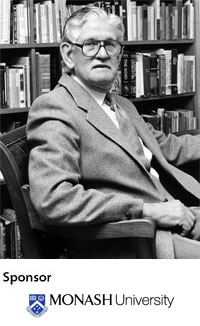
Ross Henry Day was born in Albany, WA in 1927. Day completed his secondary education at Albany High School in 1945 and then started a BSc (Hons) at the University of Western Australia (1946-49). While in his third year, Ross Day was offered a graduate assistant position in psychology, which he held throughout his honours year. In 1950 Day moved to the University of Bristol, first as an assistant lecturer (1950-51) and then research fellow (1951-55). Whilst at the University of Bristol, Ross Day completed a PhD in psychology (1952-54).
Dr Day returned to Australia and the University of Sydney as lecturer (1955-59), then senior lecturer (1959-61) and finally reader (1962-64). Monash University then offered Dr Day the foundation chair of the department of psychology, which he accepted. Professor Day was at Monash from 1965 to 1992 and, as well as establishing a strong experimental psychology department, he served as associate dean of the faculty of science from 1981-83. After retirement Professor Day became adjunct professor in psychology at La Trobe University where he continues to conduct experiments into perceptual illusions.
Interviewed by Professor Max Coltheart in 2011.
Contents
- Idyllic Albany
- Clear path to university
- Tim Marshall
- Teaching, tracking, thesis
- Attention and perception hand in hand
- Family matters
- Ten years at Sydney University
- Colleagues at home and abroad
- Move to Monash
- Human Perception: the book
- Motion After-Effect, Ames Room and the Müller-Lyer Illusion
- Post-Retirement activity
- Twists and turns of fate
My name is Max Coltheart and I am here today to interview Professor Ross Day. Ross is an experimental psychologist, Fellow of the Academy and somebody whom I have known for 53 years.
Idyllic Albany
Ross, it is always interesting to trace the career trajectories of scientists. I know that you came from a little country town. Albany, is that right?
Albany is right.
How big was Albany?
The town was small, about 3,000 people. In many ways, it was an idyllic existence. Even though it was the 1930s, which was the middle of the Depression years, we weren’t affected by the Depression. My family were bakers and well to do and my grandfather had a prominent role in civic affairs. I wasn’t aware of the poor. Somebody sent me an old photograph taken in 1935 and there I am, one of three boys in the photograph, and the only one with a tie on. All the others had rag tags and bobtails. People were out of work. But, by and large, we were given freedom. We wandered all around town. It was a safe place to be. We had regular trips to Perth for holidays and that sort of thing. So, by and large, it was an ideal existence. Not quite out of the movies but, nevertheless, we were free to do more or less what we wanted to do.
You went both to primary and secondary school in Albany. What were those schools like?
I went to three schools in Albany. The first was called the Albany Infant School, which was for my first two years of schooling – I think it might have been three. Then I went to the Albany State School and then the Albany High School. They were all within walking distance of home, so there was no long travel or having to be collected or anything of that sort.
How did you feel about school? Did you enjoy it?
I loved it. I was always the first to put my hand up – it embarrasses me to say that now. But, if we were asked a question, especially in areas like history and geography, I was always the know-all. My reputation in that regard was firmly established and then when I got to high school I was known as ‘the doc’.
At school, did you like every subject or were there special favourites?
Biology and chemistry were the two subjects I enjoyed most. Physics threw me a bit, but I still enjoyed it and we had good teachers. Because books were freely available, both at home and in the local library, I always used to go and read up on things which I had been taught in the course of the lessons.
Did your two brothers go to the same school as you?
Yes, but they didn’t last. My older brother left high school when he was 14. He wanted to be like his grandfather and make a lot of money, which in due course he did with a vengeance. My younger brother was only interested in boats and sailing. He left around that age as well so that he could engage in all the sorts of hobbies that he had on the water in his launches which he built himself.
This is like your own son, who is also interested in boats.
Yes, very much so. In fact, they have met on two or three occasions and were immediately in conversation about this and that. But my two brothers were never interested in anything academic. I went in a completely different direction – or they went in a different direction to me.
Clear path to university
Was it typically for people to go on to university from your high school? Did many do that?
I once counted the high school class, there were about 25 students. I think about eight of us went on. I have since decided that Albany High School was a very good school. One of them, whom I haven’t met for years and years, finished up in the University of Illinios. Others went into medicine and engineering. Maybe four or five of them did well, in that sort of professional sense.
When you finished high school, were there various alternatives in your mind, or was it quite clear that you were going to go on to university?
It never occurred to me to go anywhere else. My father was not an easy man to get on with. He was, by and large, uneducated in the formal sense but well read. He was very reserved. I don’t think I ever heard him laugh aloud. He had a brother who was a distinguished ophthalmologist in Perth and who had studied in London. I think that Uncle John became an example to me, an exemplar of the sorts of things that I wanted to do. I hadn’t formulated any ideas to do with medicine, although it was often talked about in the family.
So you went on to do a BSc at the University of Western Australia. And, I suppose, to study biology and chemistry. What other subjects did you study?
In my first year, I did physics, chemistry and biology. I did psychology in my first year because I had read a lot of it in magazines when I was at school – God knows what sort of psychology it was – so I wanted to study it some more. I also wanted to do botany. I had five first-year subjects and botany was added on. You were allowed to do a first year subject in your second year. I passed all of those subjects and then became more involved in psychology because the teaching was good. I know some of it was pretty low-level stuff. When Tim Marshall came along I discovered something called ‘experimental psychology’, that is where I took off.
In psychology at the University of Western Australia, was the first year a mixture of practical classes and lectures?
Yes. I went up to the university in 1946 when the ex-servicemen were flooding into all of the universities. I seem to remember Sydney University had 2,000 students doing psychology in 1946 and 1947 and for the few years after that. So there wasn’t space to have the formal practical classes which I later set up when I was at Monash. At Sydney, even in the time when you and I were there, a good deal of the work was in a tutorial form. You gave demonstrations, but you didn’t have any actual practical work until third year. That was the same in Western Australia.
Tim Marshall
I know that Tim Marshall made a big impression on you when you were at Western Australia. Why was that?
First of all, even though he was a very incoherent man, he had gone to London in the years before the war to study at University College.
To study psychology?
Yes. Tim graduated in psychology from Western Australia, where the psychology was at a very low level and where the head of the school was a reader. He finished his degree in London and then the war broke out. This was during the period when we were called the British Empire, so Tim went into the air ministry. He was concerned with the selection of various categories of men for the Royal Air Force. His interest was in crew. I think the big aircraft were just coming along - the Lancasters – and ‘bomb aimers’ were one of his specialties. There were probably hundreds and hundreds of people doing those selections at the time. When he came back, he was more interested in what he had been doing before the war than in what he had done during it and he took up that work again. As far as I can remember noone else was interested.
What was Tim Marshall interested in? What work did he do?
He had done his work on visual dark adaptation. He had published two papers, one in the British Journal of Ophthalmology, and one of them had got quite a lot of publicity. It had been mentioned five times in subsequent papers. I read this, and I knew nothing about the eye.
You read it when you were in first year, is that right?
No. He came along when I was in second year. I went up in 1946 and he appeared on the horizon in late 1947, and that’s when I got to know him.
So Tim was basically an experimental psychologist.
He was, yes. He invited me to do my honours with him, or I asked him whether I could – I can’t remember which way it went. I was switched on even more by that because he had set up a lab which, even by present standards, was pretty good. I mean, there were no electronics but certainly lots of quite cunning electrics. There was one technical officer whose name was ‘Whizzy’ something-or-other – that was his nickname – who was very adept in the workshops at making things. Tim probably took up 80 per cent of his time in getting this lab set up.
You have mentioned that Tim Marshall was rather incoherent. Were you and he, nevertheless, able to communicate effectively?
He could to me personally. I am sorry if this movie is being seen by one of his two sons, who are now well grown up, but it’s true to say that he was among one of the most incoherent lecturers I have ever heard. When he gave lectures he asked me to listen to at least three practice runs. But even then he got it wrong. I don’t know what it was about him. I mean, I knew the language and I had read a lot in it and I knew what he was getting at. It was essentially rods and cones and the way in which the information at the retinas was absorbed and transmitted. His original work for a PhD was outstanding and he got top marks for it. As soon as he came back to Western Australia, he started to do this experimental work.
Teaching, tracking, thesis
So you got an honours degree in psychology at Western Australia. At that point in your life, what were your options?
I finished my honours degree at the end of 1949 and I was asked to stay on. When I was in my third year, I was appointed by Tim Marshall to a staff position. It was called a graduate assistantship and there was only ever one in the department. I got a salary, 600 quid a year or something. It was quite handsome. I had never had money like that before in my life.
I have always had the impression that Tim had mistaken me for someone else. Many years later, when I got to know him well and we were colleagues, he visited and stayed with us when we lived in Sydney. I tackled him about it and said, ‘Do you remember when you appointed me?’ and he did. I said, ‘Did you think I was someone else?’ and he wouldn’t give me an answer!
So I see you were already a staff member even though an undergraduate. Did you just continue that after graduating?
What I did was to continue my degree. I got first-class honours and came top of the honours year. That led Tim to talk with some of his colleagues in Britain and I was offered two jobs, one in Manchester working in hearing and somebody in Bristol.
Were these teaching positions?
They were teaching positions. The one in Bristol was because somebody had gone abroad for a year and I could fill in for that time, so I did. It was a very small department. I think there were only five people in it. The enrolment in psychology was anywhere between 18 and 22, I would say.
You went overseas for two or three years?
I went overseas, in all, for five years, in 1950. I came home in 1955 to the University of Sydney.
While you were at Bristol in a teaching position, you also did a PhD.
Yes. I did it while I was teaching and my salary was paid by the air ministry. The air ministry had suddenly come to know psychology because of the Cambridge successes in it. They established and gave jobs to individuals in six universities, of which Bristol was one, so that someone could follow through on some of the early findings.
This was on applied psychology and not pure experimental?
No directives were ever given. But the big deal was visual tracking. For one of the tests I had the SMA3. It was an electronic device which had a circular television screen and a joy stick and you had another thing here (indicates). The dot on the screen could either go in a predetermined regular course or be random but always at the same velocity. Although you could vary the velocity been tests. I chose to look into tracking under different degrees of difficulty as well as regular situations – where you could judge what was going to happen next. That was the PhD. Now, how that applied to aircraft I don’t know.
That wasn’t your problem.
It wasn’t my problem. I presented the thesis. George Drew, who was head of the department, never helped me at all. I had great difficulty in writing the preface saying that I owed a great deal to my supervisor. But I made some bow in George’s direction. He was a lazy man. He was later head of department at University College London.
Yes. I came across him then when I was Head of the Board of Studies there.
He succeeded Roger Russell in that job.
When you were doing your PhD at Bristol, did you get much intellectual input from your supervisor?
The Experimental Psychology Society had just begun and was publishing a journal – which is still going. They had two conferences a year and I went regularly to them. I met lots of people and exchanged ideas with them. It was very scholarly. It wasn’t a drunken rort, as so many of those occasions have become. I built up contacts with various people and listened to their work. By and large, I got as much out of that sort of activity as I did out of the department.
Was Richard Gregory in the department?
No. Richard Gregory, who died recently, became one of my best friends. John Brown was on the staff at Bristol and he and Richard had been together in Cambridge. So Richard came down regularly. This was well before Richard went to Bristol on a permanent posting. Do you remember the illusory effect with the bricks along a wall called the Cafe Wall Illusion? I discovered the cafe wall before Richard did, but he never accepted that.
It was in some coffee stop in Bristol.
Yes, it was a coffee shop. It was a fish and chip shop at one stage. Anyhow, he got in first. When Richard had published that paper, I followed up with another one in the journal Perception. John Brown also had an effect on me. He was still writing his PhD thesis when he was on the staff in Bristol.
So Bristol, in general, was a good place for you to spend those few years, even though it was a very small department.
It was a very good university. There is no question about that. Because it was relatively small, in principle I was in the Department of Philosophy! GC Field was head of philosophy, he was an eminent philosopher, and psychology was a subdepartment. Now, never the twain did meet. Field never interfered with psychology and certainly he was so eminent that George never would have interfered with him. But I got to know a good deal beyond psychology.
How was your PhD examined? What was the process?
By the usual British method. It was submitted. I should say and I will say it again – while George Drew was very helpful and got me all the things that I wanted, including money for bits and pieces of equipment – he did not have very much intellectual input. Not as I have always done and I know that you have done as a supervisor. I have always interacted with the person or been shoulder to shoulder in the lab, as I was with Tim, for example. I was disappointed about that. So I did it my own way, as Frank Sinatra once said.
Who were your examiners?
Oh God, there was an internal examiner and an external examiner. I can’t remember the name of the external examiner. I spent a good deal of time last night trying to remember it. He was quite well known in experimental psychology circles and he worked in applied areas.
What was the experience of being examined like? Was it pleasant or unpleasant?
With the examination, first of all, the thesis was sent to this external examiner. He then came down to Bristol from where he was, somewhere in Wales, having read the thesis. This was the standard British procedure. Then he and the head of school, George Drew, examined me for a whole morning. I think this was probably required by the rules, although a good deal of that time was not spent in talking about psychology. Then there was a break in the middle for morning tea and I left and spent a terrible two hours wondering what was going to happen. I got the impression that they weren’t very impressed with my brilliancies. Then they called me back in – I went in trembling – and they said that they were pleased to say that my dissertation was appropriate for the degree of PhD and they congratulated me. The external examiner said, ‘But I would draw your attention to page 45 line 3, I think there might be a little problem there,’ and it was a spelling error.
What is your opinion about this particular method of examining PhD theses?
It’s pretty thorough. We ranged over the whole area of experimental psychology. I had gone and read the great volume by Woodworth called Experimental Psychology. It is no longer read by most people. I had read that through and some of the questions I got were, in fact, from that. That might even have been a practice among examinees too, but I came across it on my own initiative.
Attention and perception hand in hand
So your examiners weren’t just quizzing you about your own research?
No. It was a bit Oxonian in that sense. They kept coming back to what significance I attached to tracking behaviour: ‘Is it something which could be applied?’ After all, you don’t go around following a little spot on a screen. But one thing did come out of that, and the examiner was very interested in it. You could have an arrangement whereby, in a random fashion, a little red spot would come on the screen and, as quickly as possible, you had to pull this little lever on the side of the cockpit. The difficulty of the input which you were tracking was analysed with anticipation of this with it actually occurring and when there was none. So it was interesting from the point of view of getting down to the nitty-gritty of attention.
I think these are still questions that people are interested in working on right now.
Yes, exactly. It interests me a great deal. When I was a lad, perception was something which nobody really understood. It began to loom as a major issue over the years I have worked in perception and read in it deeply. I then made my own observations that you never see, hear or feel anything if you are not attending. I pointed this out to my students a year or so ago. I said that they would all have had the experience of driving to the university and, when they had got halfway there, they would have no memory whatever of having passed a particular intersection or that set of red lights. Even though they had behaved properly, they couldn’t remember the details because they weren’t attending to that particular feature of the intersection or that particular vehicle coming towards them. This was my breakthrough in the last 15 years, so to speak, that attention and perception are inextricably intertwined with each other. You can’t have one without the other. That sounds like the name of a popular song!
Family matters
There you were in 1955, having graduated with a PhD. What were the possible options then and were you always intending to come back to Australia?
I applied for a position, and family matters came into this. We had a baby – and we still have, at the age of nearly 60 – and we were so bloody cold. We were poor. The salaries then were awful. We had a little top-floor flat. It was quite pleasant but the heating was terrible. I remember going to the nursing home to see my first born, with the snow up to my knees. I arrived frozen in that particular position. I thought, ‘I can’t bear much more’, I have always felt the cold. Then I saw this advertisement for a lectureship in the University of Sydney, so I applied for it. I went to London to be examined, where there was some reluctance to appoint me. The person in London who was examining for the University of Sydney said that I suffered from asthma. Well, I used to as a child, but I didn’t really have any. But he thought this was an ill omen and I might collapse with an asthmatic attack before my first class, with implications for the university. I managed to convince George Drew, who was my chief referee, that that was all nonsense and I got the job.
Before we talk about your move to Sydney, perhaps we should backtrack a little and talk about your wife, Grecian. Did you meet her when you were an undergraduate?
We were in the same hall of residence. Immediately after the war, because of the huge influx of personnel from the forces, the University of Western Australia opened up a whole set of buildings for accommodation. These buildings had been put on university land, under national emergency regulations, to house the crews flying aircraft out of Perth searching for submarines. They were not quite Quonset huts but they were long corridors, and four of those were made over for undergraduates. Another two were set up just across the way as the beginnings of the women’s college, which now has been going in Western Australia for the last 50 or 60 years.
Grecian was one of the people who was invited to the university, because she was in the forces. She was in the women’s college and I was in this men’s college, called the university hostel. We all ate together. That was the point. She was an undergraduate. She had joined the forces because after a year, she would receive the £3.10 a week. All people who had worked in the Australian Women’s Army Corps, or in the AIF, were remunerated. Her mother couldn’t have kept her, so she joined the forces in order to get that benefit.
What did she think about the trip to England?
We didn’t go together. I went first to check out England and I found that it actually existed and that there were places that you could live in relative comfort. She followed after. We were married eight or nine months after we were engaged.
While you were there, you had your first child.
That is right, yes.
Ten years at Sydney University
Around 1956, you moved to the University of Sydney?
It was in January 1955, the year of the great floods in the Hunter River Valley, the last lot of severe floods. I stepped out of a tram and found myself up to my waist in water. But, yes. I went on to Sydney to find a place to live and Grecian stayed in Western Australia with my parents, who were in that stage of child or baby worship. She came on afterwards.
You were a lecturer at the University of Sydney initially.
Lecturer first. I was there for 10 years almost exactly. I stayed on for an extra two months, so I got the benefits of being in this job for 10 years.
When you moved to Sydney, what did you do about setting up a lab?
I really didn’t have a lab. I did things which were easily done in my room. I was interested in motion after-effects. To produce motion after-effects all you need is a rotating thing or something which is moving in an aperture under different conditions of illumination. We moved from the main university site across Parramatta Road to what was a commercial organisation. A factory – down the steps and up the steps. I had a lab there and expanded this work with motion and other sorts of after-effects.
Were you mostly teaching perception at Sydney?
No. I taught everything. You reminded me once about the embarrassment I felt when I couldn’t get something right in a lecture. I was a bit nervous because the students were pretty sharp.
And the classes were fairly big, I imagine.
Yes, very big. I was okay for lectures in the Wallace Lecture Theatre, which I have since discovered holds 685 students. Only a few of us were thought to be capable to lecture in Wallace by the head of the department, Bill O’Neil. I don’t know where he got his information from. But some were hopeless and couldn’t cope. If the students didn’t like you, they would bowl the dustbin lids down the aisles. They didn’t do that to me. They did it to some other people whose names I shan’t mention. All I had was this huge expanse of blackboard and a bit of chalk. That was all one had to use to lecture on the very complex issues and experimental situations which we were accustomed to in the study of human perception. We had nothing like a presentation on a screen of the structure of the visual system. It all had to be by word. They would all scribble away. Danny Latimer was one of my students in those classes. He will give you an account of what it was like.
I still give lectures, although not very many these days, only about eight every year to a second-year group. What worries me now is that there they all are, with their feet up, listening to me. They know that, when they get home or in a few months when they are going to sit for an examination, all that they have heard me talking about will be on the web. I have my slides, my overheads and all the usual paraphernalia of the modern lecture theatre on web CT. They will just dial it up at home. They probably watch it while lolling on their beds! I don’t criticise that, because they do go and look at it. But, at one time, they would come away from my lecture and all they had were their lecture notes – and no doubt they swapped them from time to time. From my standpoint, from examining the essays, the quality of the students and the sort of stuff they turn up with in their honours year is really not very different in standard to what I recall from those distant ancient days, when I had my bit of chalk. In fact, at one stage I had to buy some chalk.
Colleagues at home and abroad
In your 10year period at Sydney, who were the people you particularly liked talking to there?
Dick Champion was the person who was closest to me, because he was very experimental. He gradually withdrew from science. But for the whole time that I was there, he was the person who was closest to me in interests. Bob Pollack, who was an American, had very similar interests to mine.
He arrived at about the same time as you did, I think.
Yes, a year or so before. He was very helpful. Even though I disagreed with him on a whole lot of issues, there is no question that he was a person I could go and talk with. He had very firm ideas, many of which I questioned. Nevertheless, we engaged in scholarly discourse. He and Gordon Hammer were my friends.
Was Hammer a clinical psychologist?
He was not so much clinical. He and Bill O’Neil were interested in selection, essentially – in intelligence. The nature of human intelligence was a major issue in those days and it had all sorts of applications for schooling and for the development of tests. It was a very active group. But the person who stood out head and shoulders above everyone else was Bill O’Neil.
What was special about him?
First of all, he was known to often have dislikes of people on his own staff. Then again, I can relate to that because all of us do at some time or another. But he was as much a philosopher as he was a psychologist. His main contribution to me was to put me in touch with issues like the nature of human consciousness and some of the philosophical principles which one must follow.
Which you’re still interested in?
Yes, very much so. He was very coherent.
Unlike Tim Marshall.
Yes. He was very clear. He was the opposite number to Tim Marshall. Bill put into one of his books that the moon looks larger at the horizon than it does at its zenith, especially when it is just coming over the horizon. It is called ‘the moon illusion’. It is an illusion because what gets onto the eye is exactly the same, and the distance along the ground and to the dome of the sky is also constant. Why then is the size of the moon greater at the horizon than it is when it’s up top? I now know what the answer to that is. It is because you take distance into account. The apparent distance to the ‘dome of the sky’ – if I can call it that – is slightly less. That gives rise to the appearance of it being larger because it seems further away at the horizon. That, by and large, is it.
During the period that you were at Sydney, did you take any sabbatical leave?
Yes. I went to the USA to Brown University in Rhode Island. I had got a small emolument from Sydney and I wrote to the head of the school at Brown. They offered me a quite considerable income for a year.
Was this to teach at Brown?
Not to teach, but to undertake research with Lorrin Riggs. I was attached to his unit. He made the remarkable discovery that, when you are looking at something, even though you think your eyes are perfectly steady, there is always a tremor – a very small visual angle. This was brilliant as a bit of research. What Lorrin did was to put a little mirror onto one part of an old-fashioned contact lens. The lens sat over the eye, rather than just on the front of them. It was very uncomfortable. I was one of his subjects in a group of experiments. The little mirror is then reflected onto a screen so that every time the eye moves. What you are looking at, this little reflection from the small mirror is projected on to the screen.
He was the man who did that?
Yes. There was a group in the University of Reading that published the same year, but the two groups took equal honours for it. I met the British group a year or so later. But Lorrin published that in the Journal of the Optical Society of America. It became a set piece, it was so cleverly done. I worked with him on that. What he taught me was how to do intricate experiments and to do them with enormous care. So I took that message with me when I went to Monash, where I had much more money and much more control over my own future.
Did you choose Brown because you already knew about the work of Riggs?
I had read two or three of his papers, yes, and I thought, ‘How very clever this is.’ I made some inquiries and found that Brown was among the top experimental departments in the United States. It came up, along with California, Harvard and a few others, as the place to go to do experimental research. By which I mean research in experimental psychology. Since I had always worked in the visual system, with a bow occasionally to other systems, I wrote to Lorrin and he was only too pleased to have me. He had a large grant from one of the agencies. He also had three people working with him, and he allocated one of them to me.
How long was it when you came back to Sydney from Brown and moved to Monash?
I was in the United States in 1961 and I went to Sydney in 1955. So going to Brown was the sabbatical after six years, with a whole year off, as was the common practice. So I came back to Sydney at the beginning of 1962 and was there until 1965, when I was appointed to Monash.
Move to Monash
So you moved to Monash, where you started up a completely new department with a very experimental psychology bent.
Yes. I did well at the interview, I later discovered. We all find these things out eventually. I insisted that psychology should be treated as an experimental discipline and funded in the same way as chemistry, physics, biology, etc.
Also located in the faculty of science.
Entirely in the faculty of science.
That was a first for Australia, I think.
Yes. To my surprise, money was slopping around your ankles in those days because it was during the great rise of the universities. Under RG Menzies they were well funded. Whoever speaks ill of Bob Menzies incurs my wrath because he did a great deal for the universities. So not only did I have all of this money but also the university allocated a large amount to build a department. It was especially built for the practices of experimental work and not only in my area but also in other areas. We were on top of botany in one large building. I once asked the vice-chancellor, Louis Matheson, why he put botany and psychology together in the one building. It seemed to be so bizarre. He said, ‘When you don’t know each other, you don’t squabble,’ which is probably true.
In all, I had 28 years there – not all in that building, but certainly 25 of them. I was on a contract for as long as my appointment lasted. I was head of school. They could do that then. I took the view that the way to establish and run departments was that one should have units working in separate areas. I don’t mean geographical areas but as separate entities.
So you mean that you didn’t try to cover the whole of psychology.
Certainly not the whole of psychology, as it is generally understood. I don’t think the word ‘psychoanalysis’ was ever uttered there – at least not in my hearing. It would have been disastrous for the person if I had.
So I established my group and this is not in any order of importance – Ken Forster came along and started all of that quite outstanding work in the general area of psycholinguistics. There was also Bill Webster and Dexter Irvine, who were in the auditory system. And there was John Bradshaw, a loner, in essentially what nowadays we would call neuropsychology – it didn’t have a name then. They all thrived. They all got grants.
I was then invited to become a member of the Australian Research Grants Committee. It’s the ARC now. The tour of duty was for three years, but they asked me to stay on for another three years. So for six years I was on the ARC. I saw just what the physicists were getting and I thought that psychology ought to get a bit more. I didn’t lean on anybody, but I gave the impression that they really ought to think of psychology as an experimental discipline rather than some treatment procedure for people with emotional problems – not that I deny that some people do. But every department which was starting up then was clinically oriented. There is very little experimental work done in a lot of universities now.
How did you manage to combine your first major administrative job without losing contact with your research?
I had two research assistants. One of whom stayed with me for a very long time and ran the lab, actually he has now died some years ago. I always had a group of about four or five graduate students, not to mention honours students. But that was the same for all of these groups. People were coming from overseas to work with me as well. Like any department, whether it’s in chemistry, physics or earth sciences, you build up a bit of a reputation. You publish some papers, people become interested in your work, they ask to come and they ask if we have any money to support them. In those halcyon days we did. So they would come. Nick Wade was a British Commonwealth Universities’ Scheme graduate. He worked with me for four years altogether and he did his PhD with me. There were a number of other people of that ilk.
Human Perception: the book
You wrote a book called Human Perception. When did you write that?
I went to Monash in 1965 and that book was commissioned as one of a group of books. I was the first to finish one of them, which was in about 1967 or 1968.
At the same time, you were starting up a completely new department?
Yes, I also wrote the book. In order to get it done within the deadline I put two hours a day aside and, frequently, weekends as well. I had to do all the business of writing a book. You have to get permissions, reread what you are talking about and so on. I have been under pressure from time to time to update it. But there just wasn’t time to do it. I was always so much involved in some other area and also not being a full-time writer and with running a department. So I never did. But I still refer to it. I sent my mother a copy of the book, the only time I ever sent her anything that I had ever done. She never had any idea of what I did. She was in her mid- or late-70s then, and she wrote back and said, ‘Thank you for the book, I enjoyed reading it very much. But, if you look on page 145, first line from the bottom, I think you’ve made a mistake.’
The same old story.
That’s true. I have got the letter still.
Motion After-Effect, Ames Room and the Müller-Lyer Illusion
When you think back about the research that you’ve done, what are the things that you are most proud of?
Three or four things that I have done were firsts. One of them involves the motion after-effect. If you have a pattern of bars moving up or down within an aperture and you stop the motion, they appear to be moving in the opposite direction. Nick Wade and I looked at the Falls of Foyers in southern Scotland, which was the first mention of motion after-effect in 1832. We did a lot of work on it. Quite casually, one afternoon when I was working with one of my graduate students, we put out the lights and all you could see was this little aperture with the bars in it moving up and down and, when we stopped it, nothing happened. We were pretty tired, as we had been looking at it all day planning an experiment. So I said, ‘Let’s come tomorrow morning,’ which was a Saturday. We came in the next day and the same thing happened. The answer seems simple now, it is relative movement. If you don’t have anything stationary to relate to, there are just bars moving in space, moving relative to you rather than to the surround, you don’t get an effect.
That’s quite important. You could think what happens is that there are cells sensitive to upward movement and cells sensitive to downward movement and you tire out one group of cells and disturb the imbalance.
Yes.
If that is the explanation, then you should still get the effect in the eye.
That is still referred to. About two or three years ago now, a new book was published on motion after-effects and that gets a real wrap-up. Of course, that had all sorts of implications for the way that visual systems work. I am very pleased about that. That was a high point. Ed Strelow was a very good graduate student and he and I shared the paper which might have been my first paper in Nature, of which there have been about four or five over the years. He moved out of psychology and became an attorney in California. But it certainly put him on the map and it certainly put me on the map.
So that’s the first of the things that you particularly like about your work.
The second thing was that very curious phenomenon that occurs when you look through an aperture into a room. The back wall is in this direction (indicates) and the floor is up and down and so on. If you take the front off, the room’s all higgledy piggledy. If you look through a little aperture in the wall, so that you see the inside of the room only, rather than the outside, it looks like a normal room. So a person standing against the back wall looks hugely bigger than somebody in the near space [Ames room].
One of my last experiments at Monash before I left was with a girl who did her honours year and then her PhD with me. We studied this Ames room very carefully and discovered that it was another instance of perceptual constancy. I haven’t mentioned perceptual constancies, which have always interested me. They are effects which remain absolutely constant under certain conditions. The point is that once you block off all the surrounds, you are just looking at the space itself. Again, it is a referential process or experience, and that also got a good deal of publicity in the literature.
What about the work that you’ve done in the area of geometrical illusions?
I think I shall die in an illusory set of circumstances. They have fascinated me all my life. I became interested in them before I had a lab at Monash, and they were phenomena that you could do fairly easily in a room or even at home, if you wanted to. For example if you draw two lines of equal length and you arrange them at an acute angle to each other like that (indicates) and then compare them with the same system so that it is an obtuse angle, the two lines look very much longer than with the acute angle. Now, of course, this is the Müller-Lyer illusion in its fundamental form. Noone had ever bothered to read the original paper by Müller-Lyer. I had it translated and sent to Richard Gregory, who published it straight away. That was a long time ago now. Here are two lines, that are joined together at an acute or an obtuse angle and they look completely different.
Now, this brings it right up to current work. If you leave a little tiny gap between the two lines, you don’t get the illusion. So the gap is the critical thing. Think of the number of times in the real world where you see situations or have to do something, where you have gaps rather than joins, I think this is a significant discovery. Again, it is something which came up when I was messing about. I just happened to come across it. And there is a paper which I am writing at the moment which has come out of it.
So you started off working on dark adaptation and then you worked on tracking for your PhD. But later you worked on geometrical illusions. When did that work begin in your career?
When I went to Sydney, I didn’t have a laboratory and there was nobody working in my area of perception and perceptual processes – and it was so easy. There was an old gramophone in the department which I could slow down and then look at the motion after-effect. Here was an illusion that you got as a result of extended stimulation of a system. Then, when George Singer was in Sydney, he and I became interested in the same effects in the haptic system. All of the geometrical illusory effects that are associated with vision, like the one that I have just described, also occur in the haptic sense. That is, in the sense of touch. For example, with the Müller-Lyer illusion – and that classical figure with inward and outward directed fins at each end – if you move your finger backwards and forwards across that and you don’t see anything, the one which is between the outward director feels extraordinarily longer as you are moving at a constant speed than the ones which occur with the inward directed angles.
So the haptic system and the visual system are in almost complete harmony with each other. I published that work, some of it relatively recently. Most of the illusions which I have studied, both with those little gaps and with variants of the Müller-Lyer effect get around to very fundamental things like this, which tells you something about the importance of joints in judging the world around you. Things that join together take on the property of being a large assembly. But, if you leave just little tiny gaps which are minimal, it is much reduced.
So it was lucky for you that there was no experimental laboratory in Sydney when you arrived.
In a way it was, yes.
Post-Retirement activity
Monash was a very successful psychology department, but eventually did you begin to think about retiring?
I didn’t think about retiring, I never gave a thought to it. But at Monash in the 1990’s you had to retire at the age of 65. The last thing I wanted was to retire and then stay on in the same school. People within that same school wanted to go off in all sorts of different directions and to change the kind of directions I had gone in and the sorts of things that I had developed. So it seemed to me imperative that I not be in the same department. So I withdrew from Monash altogether. By that time I was on the Council of La Trobe University. It was at the time when Mr Justice McGarvey, who later became Governor of Victoria, was chairman of Council. Anyhow, he took over and kept me on the Council for some time. So, when I retired, the second Vice-Chancellor of La Trobe, John Scott, invited me to an honorary position.
So I cast my blessing on La Trobe rather than on Monash. However, I was only away from Monash for a matter of a year and I was asked to come back. I like to say ‘on a rescue mission’, but it wasn’t that at all. Nowadays animal welfare is an absolutely key issue and so much research is done with animals. Some of it was dreadful and cruel, and then it got better. Monash now has an animal welfare committee which oversees the work. It monitors the work of, in all, about ten or eleven AECs. All of the units, both within the university itself and the outposts of empire, have their AECs. It is made up of four categories of people and usually they are in groups of up to about eight or nine. The then Vice-Chancellor asked me to serve as chair of this overriding committee, which I still do and they pay me for that.
When you arranged to move to La Trobe, did that involve any explicit duties for you?
No. They asked me to. But, since it is not remunerated, I do what I want.
Did you have to set up a new laboratory at La Trobe?
Yes. I have a lab. I have had it since I went there. I also have regular honours and graduate students there and have them now.
So you haven’t really retired.
No.
You are still doing research and some teaching?
I’m still doing research and I’m still publishing. One of my daughters or grandchildren, I forget which, pointed out to me some time ago that I have now be been in a university teaching for over 60 years. Now, whether you can get a prize for this or not, I don’t know. There has to be something.
Twists and turns of fate
Can you imagine having had a different career or a different profession?
I never thought about that. If I did, it would probably have been in history, only because I have written and semi-published – at least privately published – a family history. I thoroughly enjoyed doing it, as I knew I would. It took a long time, 12 or 15 years, to get it all together. But it is now out there for a poised and impatient world to read. Grecian is an historian and taught history at various schools. An enormous number of books which we now have in our house are history books. So history is something I think I could have followed up on or engaged in with the same sort of interest as I did experimental psychology, if I had ever been swayed in that direction.
So you enjoyed experimental psychology so much that you never even thought of some kind of midcareer change?
No, no. There are certain biological changes, of course, but not intellectual ones! Having started off on that track a long time ago I didn’t change. But you don’t plan these things in advance. I didn’t plan on studying attention and perception originally but did different things early on. In my years in Britain, when I was with the Air Ministry, I was involved in commenting on various human factors and features of aircraft and aircraft control as the big jets were coming on. So, when I came back to Australia, I got involved with Ron Cumming, Russ Baxter and John Lane in designing the head-up display for landing aircraft at the right angle in fog and in other hazardous visual conditions. That was my applied work and it was essentially experimental. I could have gone in that sort of direction after I had completed that work, but other things beckoned.
But that would have been applied experimental psychology.
It was applied experimental psychology, yes. If anybody were to ask me at a social gathering, as they often do, ‘What do you do in life?’ and you are stupid enough to say that you’re a psychologist they will say, ‘I have a friend who’s got a problem’, the “friend” is always them. But, under those sorts of circumstances, if I talk about the work I do, they don’t think of that as psychology at all. It comes as a great surprise that people do these sorts of things. When I ask the question: ‘What sort of people do you think they are?’ some might say ‘engineering’, but that doesn’t quite fit the bill.
When I’m asked by a taxi driver what I do, I say, "I’m a cognitive scientist."
I made a terrible error once. I was on an aircraft travelling to Britain and sat down next to a rather pleasant lady. In the usual way, we fell into a conversation and she then asked me what I did. I couldn’t bear the thought of ‘psychologist’, so I said, ‘I’m a biologist’ – I might have been a bit more specific. She said, ‘That’s very interesting. Do you know my son?’ He turned out to be quite eminent.
Your career trajectory as a scientist seems to be somewhat random, but I don’t think that is unique to you. I think that’s quite common in science. I wonder what you think about that?
It has been entirely accidental. The fact that Tim Marshall arrived in the Department of Psychology in the University of Western Australia in 1948 and the fact that he knew somebody in Britain who was interested in having me on the staff for a year when someone in his department was on sabbatical leave. None of these things were planned, you just blow with the wind. But, in running through all of that, there is a particular group of interests. Now, whether you create those interests or whether they are there for you to find and study, I don’t know.
Thank you very much, Ross. That was a fascinating account.
I have enjoyed myself immensely. Thank you for asking the questions and allowing me to remember things that I had almost forgotten.
Dr Max Day, ecologist
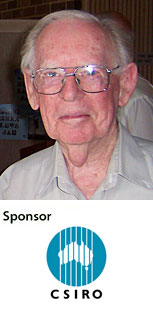
Dr Max Day studied botany and zoology at the University of Sydney, receiving a BSc in 1937. He left Australia for Harvard University in 1938 where he worked as a biological assistant and a Lehman Fellow. He was awarded a PhD in 1941 for his work on termites of the genus Stolotermes. After completing his PhD, Dr Day lectured in cytology and parasitology at Washington University, Missouri. After World War II, he worked as the scientific liaison officer at the Australian Scientific Research Liaison Office in Washington, DC; a position he was twice seconded to (1944–47 and 1955–57). In 1947 Dr Day returned to Australia and to the Division of Entomology in the CSIRO where he stayed for many years, holding a variety of positions. He was employed first as a research officer and then through various steps to chief research officer and finally served as assistant chief from 1963 to 1966. He was a member of the CSIRO Executive from 1966 to 1976. He served as the first chief of the CSIRO Division of Forest Research from 1976 to 1980. He was elected as a Fellow of the Australian Academy of Science in 1956.
Interviewed by Dr Max Blythe in 1993.
Contents
- Family survival through 'interesting' times
- Natural history to the rescue
- A first successful encounter with termites
- Following termites through South Africa to America
- Procuring war supplies
- Married life and scientific liaison
- Back to Australia
- Working on myxomatosis
- The social and academic sides of scientific liaison
- Back again to CSIRO
Family survival through 'interesting' times
Max, you were born in Sydney towards the end of 1915, an interesting time. Tell us about your parents.
I really didn't know my father very well: at the age of nine I was sent to boarding school, and while I was there he was killed in a car accident. He was an architect, like his father, who was himself the son of a builder in the UK.
My grandfather came to Australia in the late 1800s. A couple of the buildings he designed are on the Australian Heritage List, including the King's School buildings in Parramatta, originally built for Sir James Burns, of Burns Philp – a very wealthy and influential person in New South Wales. We have discovered that another Heritage List building my grandfather designed is a bank in Townsville, at the other end of the Burns Philp shipping line. He was obviously a successful architect, but by the time I knew him he was old, cantankerous and not doing well at all.
My mother was an absolutely charming lady who had been born in Noumea, New Caledonia, and spoke French before she spoke English. Her father was the British Consul in Noumea and was somehow involved in the nickel mines, a very big operation. She lived into her 90s, a very ripe age.
You were close to your mother as a child?
Very, because when she was widowed – having been so looked after that she had never even signed a cheque – I was 11. My father's insurance and our house, which had to be sold right after his death, were all she had to provide for my two younger sisters and me.
My father had built a beautiful home in Vaucluse, one of the nice suburbs of Sydney. There was a marvellous view to Manly from the front of the house, and up the Harbour from the west side – no Bridge and no Opera House, of course, but magnificent clouds to the west of Sydney. A well-known photographer named Harold Cazneaux took a magnificent photograph from my sleep-out, or verandah, of the 18-footers on Sydney Harbour on a Sunday afternoon. All the local ferries used to load up passengers to watch the 18-footers race, with their balloon sails. Cazneaux maintained that that photograph could take a prize in any salon in Europe.
One of my mother's brothers, in particular, helped her a great deal. Then, however, the Depression hit. My mother had put most of her available funds into housing, but the Moratorium Act allowed people who had no jobs to pay no rent and so for all that period she got nothing for the houses she owned. We were really very, very poor. Indeed, for everybody in Australia that was a grim time.
Weren't you sent to boarding school because you were said to be a 'difficult child'?
Well, that was the myth, shall we say. Hayfield – which has now disappeared – was a very good boarding school, a sort of prep school for King's, mainly for young kids from the age of about nine to 12.
When you became bereft of your father you were supported for a short time by a man called Lewis, I believe, who was quite important in your life.
He was. It happened that while I was at the prep school, the American fleet came in to Sydney Harbour, and because our home looked out over the Harbour I invited a fellow student, David Lewis, to see the fleet come in. Almost immediately after this, my father was killed and David invited me to Bowral, a delightful Southern Tablelands town where the Lewises had a beautiful home and horses. I went up there for a number of vacations. My schoolboy friend's father, Arthur Lewis, was a very interesting Indian civil servant who had decided that his children should be brought up in Australia. He was a Greek scholar, a scholar in the true sense of the word, very religious, and he rather took over as a surrogate father in some respects. He encouraged me to do Greek at school – which was a disaster but I still don't regret my one year of doing that. He had a great impact on me as a small boy.
That family all went back to England after Arthur Lewis had retired from the Indian Civil Service. The eldest son – a marvellous young man – was killed in the war but I believe the daughter still lives in Scotland and David, my friend, became a GP in England. To my regret, though, I have lost touch with them.
Natural history to the rescue
You went on to Shore, not to King's after all.
Yes. When my father died, we moved in with my grandmother at Wahroonga. That was a terrible period, in a way, because all her sons, my uncles, had been damaged in various ways by the First World War and they had all come to live in this little house which my father had designed for an elderly lady and her maid. With my grandmother, the three brothers, my mother and her three kids living in this house, it got a bit overcrowded. And one of the brothers had terrible malaria and used to scream out with delirium in the middle of the night.
Living at Wahroonga meant that Shore was the obvious place to go. Also, as far as I know, my father and uncle had been to Shore too. I didn't enjoy it, for a whole variety of reasons. I guess a lot of boys don't like school much. In retrospect, it was the wrong school for me. I was not well taught and I didn't get on there at all well. Those were not the happiest years of my life.
You've described them in your writings as an unmitigated disaster.
True. But although the school didn't have much of a scientific focus, it did have one redeeming feature: a young teacher from the UK started a natural history club. Mind you, he didn't know a lot about the Australian scene, whereas by then we knew quite a lot, so I think we taught him rather than the other way round.
Would your interest in natural history stem, perhaps, from your happier early days in the bushland around your home in Vaucluse?
Yes. I think I was a naturalist from birth. In the family archives is a letter on the back of a laundry bill, asking Santa Claus for a butterfly net and a killing bottle, and a note in my father's handwriting, 'Max's first letter'. And the house had a shed at the back, where you could say I had a sort of natural history museum – the odd bluetongue lizard and a few Australian artefacts.
One of your fellow-members of the natural history club at Shore was Doug Waterhouse. Didn't you make friends with him on a train?
You're quite right. I was collecting butterflies, and the camphor laurels along behind Shore contained a lot of one of the Sydney swallowtails which feeds on those trees. As I was taking the caterpillars I had collected home in my straw boater, a student sitting opposite me – Doug Waterhouse – recognised them and said, 'Oh, if you're interested in butterflies, my uncle knows all about those.' His uncle was G A Waterhouse, a marvellous man who had an engineering degree and had been in the Mint in Sydney until he retired early to devote his life to the study of Australian butterflies. He was the honorary curator of Lepidoptera in the Australian Museum, where his own collection, at that stage by far the best collection of Australian butterflies, eventually went. And he lived in the same Sydney suburb as I did.
G A Waterhouse was extraordinarily good to me as a young child. Regularly on Saturdays he used to take Doug and me (and, frequently, his own son) around the Sydney area collecting. They had a house at Woodford, just on the lower side of the Blue Mountains, where we stayed occasionally, and we would go north as far as the Hawkesbury River and south as far as Bulli. At the end of the day he would take anything from our collections that was really any good, but in exchange he gave us material from around Australia, so that as kids of 16 or 17 we not only knew the Sydney sandstone insect fauna very well but had some knowledge of biogeography, the distribution of insects.
So G A Waterhouse gave us this early introduction to entomology. And I really owe my start to him – he was the one who told my mother that there was a job in science, that we should go to the university and do entomology.
A first successful encounter with termites
With that encouragement you went to Sydney University. What was it like?
My pass in the Leaving was just enough to get me to university. It was wonderful there. I did botany and zoology, mainly. We had a biological society which I was secretary of for a while, and that was a great show. We went on field trips; we had an excellent grounding in biology – as I found out later when I moved on. And I did a fourth year Honours course in entomology, under Tony Woodhill as lecturer.
I was keen to do things outside the ordinary science course, for example a course in bacteriology at the School of Tropical Medicine because I wanted to learn about the way termites digested cellulose and how they lived in a termite mound. I guessed that the composition of the gas inside the mound must be rather different, so I analysed it for what turned out to be my first scientific paper. It's now known that they produce a lot of methane, but I simply wanted to analyse for carbon dioxide and oxygen.
I met Frankie Cotton, a Professor of Physiology who was a medical doctor, a good sportsman and an excellent physiologist who did a tremendous lot for sports physiology. (He was one of the first sports physiologists, getting people on treadmills and that sort of thing.) He gave me the run of his gas analysis equipment in the medical school, and that was a great experience. In retrospect, I probably did a very good Honours thesis.
Having scraped into university, you got a Medal – and so did Doug Waterhouse.
As far as I know, that was the first time that two people had shared a Medal. But obviously we were seen as both doing well.
And your terrific friendship has never stopped.
Well, we were at school together, we went to the university – and graduated – together, we took our first job together, and although our paths have since diverged a bit, the friendship continues.
While at university you had the chance to do a project which led to a publication, and also to work for CSIR for your first time. Tell me about those opportunities.
The project was instigated by a Senior Fellow. He was an extraordinarily interesting man – one of the casualties of the Second World War – who stimulated us to participate with him in a very risky venture: going out in a rotten boat to the Five Islands off the coast near Port Kembla, where we set out to do ecology. The islands were and still are very interesting. Part 1 of an analysis of their flora and fauna was published but parts 2, 3 and 4 never saw the daylight. In fact, we published an early aerial photograph of the islands, which has since been sought after.
And you went to CSIR to study a pest.
Again from the influence of G A Waterhouse, I guess, Doug Waterhouse and I were given a summer job at the little town of Maroopna. Some parasites were being brought in to control the oriental fruit moth, which was attacking peaches in the Goulburn Valley, Victoria. We and a number of other young people who had been brought there were given the job of attempting to culture these parasites and then to release them. The moth never did become a terribly serious pest, but I don't think our work was very influential in controlling it.
The work did, however, give us an indication of CSIR, and of course I think we were being tested for jobs. As soon as we graduated we were both employed in the Division of Economic Entomology, as it then was, and so in 1938 I came to Canberra. We were to work on two of the major projects going on at the time: Doug Waterhouse was put into the blowfly section and I was put into the termite section – as was natural, since I had done a thesis on termites.
Following termites through South Africa to America
You were only at CSIR for a few months, because something incredible happened.
I got out a little paper on the environment in the termite mound, and then an unexpected development: Lemuel Roscoe Cleveland, a professor from Harvard University, came to look at Australian termites. Being a recently appointed young chap in this field, I was given to him as a personal assistant. And after three or four months of that, he said that just before he left Harvard University to come out to Australia his personal assistant there had resigned. Would I like to come back and work for him, with half time to do courses at the university!
In Australia we were looking at termite protozoa, the cellulose-digesting organisms in the gut of the termite. Cleveland had made a huge reputation by being the first person to learn how to get rid of the protozoa, thereby showing that they were essential for the digestion of cellulose. That is a difficult thing to digest and these fascinating organisms do it for most of the groups of termites. We made slides of these things, and later – back in Cambridge, Massachusetts – we studied them in great detail.
Cleveland asked me to go to South Africa on my way to Massachusetts. He had come to Australia via New Zealand, and had collected a particular group of termites which has an interesting distribution: New Zealand, the east coast of Australia and South Africa. This is a Gondwanaland distribution, from when the ancient continents were joined through the Antarctic, South Africa and so on. He wanted to collect the ones in South Africa but he didn't want to travel there because he had his wife and family with him. Instead I collected these things, in a small South African town called George. And I remember very well that the director of the little forestry school there was very kind and gave me not only accommodation but also, after dinner, a tumbler full of sherry. He said it was good for me, and I'm sure it was, but until then I certainly hadn't had sherry by the tumblerful.
Your boat trip via South Africa to America must have seemed the journey of a lifetime.
Going from Australia to South Africa wasn't all that pleasant. In fact, it was really ghastly: the little Themistocles did eight knots going downhill. Going from South Africa to London, with a lot of young students who were returning to their colleges in England, turned out to be delightful.
The trip from Liverpool to Boston, on the other hand, was unbelievable. The Jews were fleeing Europe in great numbers, and the ship was absolutely crammed. We ran into huge storms in the North Atlantic – it couldn't have been a worse four days.
I arrived only a few days after the 1938 hurricane, a truly devastating one, had gone up the coast of New England, flattening Boston. Cleve had a delightful little house in the suburb of Jamaica Plain, where I think he said 35 trees were blown down in the yard. He met me at the ship and I stayed the first night in his house. This was the city where Edison first used electricity, yet as Cleve said, he had to show me to my room with a candle. It was not a good introduction to Boston. But he then arranged for my accommodation, and I worked very closely with him for the following three years.
What were you working on with Cleveland in America?
For the first year I was his personal assistant and spent a huge amount of time staining the slides which we had made in Australia. I tried a technique which hadn't ever been tried before – one of the silver stains which are used for Bodian's technique – and it worked remarkably, showing up a lot of structures which we hadn't seen very clearly before. But although he was very generous, financially it was a fairly difficult time.
The second year I was there, he arranged for me to get a Lehman Fellowship. That paid $700, of which $400 went in tuition before I saw it and so I was living on about $300 a year plus what I could make during the summers with kindly professors who gave me work.
But he had arranged some studies for you to broaden your biological education.
Well, I did courses at Harvard – and I was immediately enrolled as a postgraduate student, which I hadn't originally thought of but which they said was essential. That meant I could take courses 'for credit' and also participate in their excellent system of 'auditing' courses. That is to say, if there was a perceived gap in your knowledge, you were told to sit in on a course in invertebrate palaeontology or invertebrate anatomy or whatever it was, without having to take the exams, to fill the gap. That was a very good way of learning. I didn't have the pressure of the examination to worry about, yet I learned from marvellous people like Alfred Sherwood Romer, on invertebrate structures, and others in so many fields – things I'd never dreamed about from Sydney which were then appearing as major topics. In endocrinology, progesterone had just been purified, one of the few hormones understood at that stage. That was a hugely developing field. Cytology was tremendously exciting. The plant cytologists, in particular, had just learned how to break chromosomes with X-rays, neutrons, gamma rays, and so I was with the little group of students who were into that area during such extraordinary opportunities as when Sturtevant came into the group for a year as a visiting professor.
Harvard was abuzz.
Oh yes. And I had come from Australia, where facilities were poor, into a lab where everything was provided, the fitting-out was luxurious. There was a lot more money around than we would ever have conceived of. When I was at the University of Sydney, the budget for zoology was about £25 a year – all of which went on the Thistle, a vessel which the professor, who was interested in plankton and marine biology, used to run. We had virtually no money to run the department.
Tell me a bit more about Cleveland, a remarkable man.
After his work on termite protozoa he got into cytology in a big way, and did a great deal on the structure of chromosome. He had the best conceivable Zeiss microscopes. In fact, if Zeiss came out with something new, the agent would come and ask Cleveland to test it, and provide him with all the best equipment – polarising equipment, for example. So we were able to do as well as anybody.
What kind of a person was he?
Tall, gangling in stature, a hardworking, delightful, generous person. The family was extremely good to me in many ways – taking me with them one year on a vacation up to Canada. There was his wife Dorothy, who came to Australia and is now 88, their son, and Cleve's daughter Elaine, from a previous marriage, whom he worshipped. I remember her as a gorgeous little girl with beautiful golden curls. She was obviously highly intelligent and married a doctor in Boston, but her death in her 20s had a devastating effect on both Dorothy and Cleve.
I couldn't have asked for a better mentor. I had started work on insect endocrinology, which was then an important topic, but when I was about halfway into a thesis, a Swede named Hanstrom brought out a whole book doing nearly everything I had done and planned to do. I was pretty devastated – a limited time ahead and now, in 1939, the European war had started and I had no way of getting back to Australia. (The Pacific war was not on at this stage, but nevertheless travel was restricted for civilians.) Thinking I couldn't go any further, I did a Masters degree and then with this fellowship was able to stay on and complete a doctorate.
But because Hanstrom had published his book I just didn't know what I was going to do until Cleveland said, 'Well, you've done all the Stolotermes material' – that was the stuff that he, and then we, had collected in the east coast and that I had collected in South Africa – 'Write it up.' So I did my thesis, with him as my senior supervisor. And it was a complete change.
That was a marvellous three years. I was in an extraordinary group of students. You might say that we all worked like slaves: 8 o'clock in the morning till midnight was a regular day. I think we learned as much from each other in this very active group as we did from our professors, because we were all at the cutting edge and could benefit by our interactions.
On getting your doctorate and finishing the work that Cleveland had so generously set up for you, you were invited to go down to St Louis. Why was that?
At a growth symposium – these were high-powered small groups of people who got together – I had met F O Schmidt, the professor in charge of the Department of Zoology at Washington University in St Louis, and told him that in studying the marvellous termite protozoa we had seen that the mytotic spindle was birefringent. Schmidt had been struggling with the material at his disposal to try and find some birefringents in this mytotic spindle; now we had shown it clearly. So immediately after the meeting he came down to our lab and saw these things. The upshot was that because he was going to head up a department at MIT and his position in cytology at Washington University would be vacant, I was appointed as a junior lecturer there.
I was at Washington University for one year, during which I was in the lab one Sunday afternoon, listening to a symphony concert on the radio, when President Roosevelt interrupted to say that Pearl Harbor had been bombed. This was at the time it was actually happening! It was unbelievable. And so the sky fell in for everybody.
It was a 7th of December you were never going to forget.
Yes, indeed. I think nobody will forget it. 'A date which will live in infamy' was Roosevelt's expression. I was teaching medical students – mainly pre-meds, as they were at that stage – and all these kids wanted to go immediately and join up: 'Our country has been devastated. We're going to do our bit.' I said to them, 'You're a privileged group of people. Don't go and join the army right now just because this has happened. The country's going to need doctors. That's where your job is. Complete your training.' I think a whole group of kids suddenly got a bit of a jolt.
Procuring war supplies
Things then changed again for you.
Well, very soon a young man with whom I had been at prep school rang me. He had been doing business administration at Harvard but had immediately gone to Washington, and now told me I had to go there too. So within a fortnight I had packed up and left Washington University to go to Australian War Supplies Procurement, an organisation which was charged with doing with all the purchasing for Australia, for the defence forces, for health, everything.
Most of the purchases were under Lend Lease, and Australia benefited tremendously. I knew enough about the scientific area that it was not difficult for me to fit into the job of purchasing officer in scientific equipment. It was a very exciting and demanding period. Without any administrative experience I was thrown into a pressure situation. I was given a secretary and had to learn how to dictate; we were under great pressure all the time because as orders flowed in from Australia you had to get them filled.
I'll just tell you one story to illustrate the problems. Australia was instructed to produce penicillin, so a young veterinary officer named Bazeley was pulled out of a tank somewhere and told, 'You are to produce penicillin in Australia.' He immediately flew to the United States – where everything was extremely formal and you had to go through all the channels. Normally I would have to have a very official document as an order. But Bazeley wrote on the back of envelopes and sent these in.
To get out all the equipment required to set up the production of penicillin in Australia doesn't sound too difficult, but it turns out that one of the things you needed was centrifuges – which were produced by a company that was under presidential order to do nothing but produce bilge pumps for the projected Normandy landing. How to get centrifuges out of a company which was not allowed now to produce them, when Bazeley wanted them tomorrow?
It was a very good lesson, actually, because finally – after I had been struggling to get these things through and making no progress whatever – a young purchasing officer in the Marine Department said, 'Why don't you go to the top?' He gave me the name of some chap I didn't know, I telephoned the number, and the admiral in charge of the Marines answered the phone. When I told him the story he was very abrupt: 'Well, I don't know everything that's going on around here. Thank you,' and he put up the phone. Shortly after, the young purchasing officer I had been dealing with said to me, 'What happened? Things have really begun to buzz around here. You're going to get your centrifuges.' So, go direct to the top.
And that message was pretty valuable later on when you had a major executive role with CSIRO.
Yes indeed. I remember that when Frosty Hill, of the Ford Foundation, came out to Australia we asked him, 'How do you get things done in these Middle East countries, where things are pretty hard?' His comment was, 'Yeah, we've found a way of doing these things. We go direct to the King.'
Married life and scientific liaison
We must bring in a very important step in your life – your marriage to Barbara. You were a married man during those last stages of your American story.
You're quite right. My wife was then secretary (and, if I may say so, a very efficient secretary) to Sir Charles Hambro, the head of the British Raw Materials Mission in Washington. They were doing things like buying uranium. She used to work late, and by the time our first child was on the way I used to get annoyed at how hard she had to work. But we never discussed our work between us. Then, the day the atomic bomb was dropped, the front page of the Washington Post had the news together with a large photograph of General Groves, who ran the Manhattan Project, as it was called. And Barbara said, 'Oh, he comes into the office every week.' She didn't know what uranium was used for, such was the compartmentalisation of what was being done. Secrecy was paramount in all these things.
Your work continued but it can't have been easy at times. For one thing, Lend Lease arrangements changed.
It was certainly a pressure time, but then an instruction came from higher up that nothing could be lend-leaseable that wouldn't be in the front line within 18 months. Of course scientific research couldn't get into the front line in 18 months, so immediately my job fell away. However, as part of being in touch with the Australian people through the war supplies operation I had been exchanging a great deal of information with the Australian Scientific Liaison Office. That was being operated under the aegis of CSIR, and entirely on radar, in which Australia was making big progress. But the time came when things other than radar needed to be discussed, and consequently I switched from war supplies procurement to the Australian Scientific Liaison Office. So, having had to resign from CSIR in about 1939 in order to stay in America, I was back in it again, this time as a locally employed officer.
Back to Australia
Max, those remarkable years were followed by more in Australia – new jobs, new excitement. You've travelled under a very golden cloud.
Well, I've been lucky in all sorts of respects. But I am reminded of a comment by the famous golfer Gary Player, 'The more I practise, the luckier I get.'
I came back in '47 and immediately went into the insect physiology group of the CSIR Division of Entomology. The topic I selected was the way by which clothes moths could digest keratin. During the war years Australia built up a gigantic stockpile of wool which couldn't be exported and the worry was that clothes moths and domestic beetles would get to it in storage. So the control of those pests was seen as of pretty major importance. Very few organisms can digest wool. Keratin is a very indigestible material, with multiple disulphide links which are hard to break. So how did the insect do it? That was an interesting project for a few years, but I didn't solve the problem.
Before long, however, the head of the virus section left and the Division Chief, A J Nicholson, asked me if I would take on that section. I switched from the physiology section to viruses, and immediately began to ask: What is involved in specificity? How can one mosquito transmit yellow fever, if another species can't? And because yellow fever wasn't around to study, I did it with leafhoppers and aphids – plant viruses were easier to handle. So that was my topic for a few years.
Working on myxomatosis
What caused you to change to the topic of myxomatosis?
Myxomatosis was brought into Australia in 1950. At a meeting here in Canberra, a man I had never met came up to me and said, 'I've just recently been appointed to the Chair of Microbiology at the National University. I am going to study myxomatosis. We believe it might be mosquito-borne. Would you be interested in taking on the mosquito side of it while I do the biology?' This was Frank Fenner, a very remarkable person, and that was the beginning of a friendship that has lasted ever since. Frank is a superb collaborator, and for the next five years we worked on the mechanisms of transmission of myxomatosis.
There was a long background to myxo being brought into Australia. Dame Jean McNamara, a polio expert, had kept pressing the government to do something about introducing this disease to control rabbits. Rabbits had always been a serious problem in Australia, but during the war years, when there was no manpower available, absolutely staggering numbers built up – an enormous plague of rabbits. It is really hard now to appreciate how many there were in Australia, but hundreds of millions of pairs of carcases per annum (they were sold in pairs, for some reason) were exported, mainly to the UK, without any effect on the population. And for every rabbit that was sent overseas, probably four or five more were fed to the dogs or eaten by the locals. Every large, and sometimes small, pastoral station had rabbit trappers, generally permanently on the property. It was a huge business. It is never possible to estimate properly how many were killed in the year that myxo was brought in, but if you went into the countryside there was a smell everywhere of dead flesh. It was unbelievable.
Rabbit trapping was one of the most exhausting jobs I could conceive of. One of my uncles had a property up at Quirindi, where I used to stay occasionally as a boy, and I went out with the rabbit trappers. They would go at 4 o'clock in the afternoon, each carrying 50 steel traps over his shoulder. It nearly killed you to carry these things, but there was a 15 year-old kid who could set one of these traps in his hand as he walked along, whereas I couldn't even set it by standing on it.
At 8 o'clock you would go out and collect the rabbits, and reset the traps. You would carry the rabbits over your shoulder – which is just about as difficult as carrying traps – and then park them. At 10 o'clock, or later, you would go out for the second catch. This time you were doing it in complete darkness, and if you trod on a trap it would cut your foot off. Yet these people could walk in the dark straight to the traps they had set, take the rabbits out and carry them and the traps as well. And then you had to take those rabbits in to the cooler during the day. Can you imagine a tougher job?
Myxo was brought in by the wildlife research section of CSIRO, as it became, under Francis Ratcliffe, and was liberated in about May at the little town of Gunbar. How it was transmitted was not yet known. August, through the winter, despondent, cold and wet – they came back to Canberra and issued a press statement: 'It hasn't worked. Nothing happened.' The myxo killed the rabbits in the warrens where it had been introduced, but it didn't spread.
Three weeks after they got back to Canberra it was reported at Corowa, miles from where they had released it. Then that summer it spread 1000 miles in one direction, 700 miles in another. Nobody knew how it was being spread. It was going so fast that although the Division was planning to go to Macquarie Marshes, in northern New South Wales, to get ahead of the disease and watch it come through, before they had left Canberra it was already 200 miles past Macquarie Marshes.
We still don't know quite how it spread so fast, but it was clearly mosquitoes which were moving. This was a bad year for mosquitoes – a lot of rain. Other species of mosquitoes were also transmitting Murray Valley encephalitis, and so overnight CSIRO went from being seen as the saviour of our country (everybody in Australia knew about myxomatosis; it was a huge thing) to a killer. People were dying. A few deaths from Murray Valley encephalitis. And when Lord Casey, the then Minister, said, 'Myxomatosis and encephalitis are different viruses,' the Parliament said to him, 'Prove it.' Macfarlane Burnet, Frank Fenner and Ian Clunies-Ross – who was then the Chairman, and took this matter extremely seriously and was very worried by it – were all inoculated by Burnet or Frank with myxoma, to demonstrate that it wasn't a killer. This was not known about for quite a long while, though.
Of course, we really didn't know an awful lot about myxoma, and I still recall being bitten by a mosquito which I knew was carrying the virus and feeling a little queasy the next morning, wondering whether there might have been a stage of development.
What were you able to find out about the spread of myxomatosis?
Whereas the Americans believed that the myxo virus – like yellow fever and some other viruses – multiplied in the vector, in the mosquito, we believed the transmission was purely mechanical. We turned out to be right, but we had a lot of work to do to demonstrate that myxo was being transmitted by a different mechanism. I had been sensitised to the idea of mechanical transmission because that is the way a lot of the aphids transmit their viruses. The aphid people talk about persistent viruses and non-persistent, the non-persistent ones being affected as though it is a mechanical operation. And that is the way myxo was being spread. We took a long time to demonstrate it unequivocally, but we did.
The work was intense but fascinating. All the ecology was being done by the Division of Wildlife Research, we were doing the lab stuff, and it meshed well together. Any mosquito species which feeds on a rabbit is capable of being a vector. Different strains of the virus which were showing up behaved differently, and we were able to demonstrate how it was that some of the less virulent strains were spreading by comparison with the very virulent ones, which were killing 99 per cent of the rabbits while the others were much less affected.
Myxo is still an important feature in the Australian landscape but it goes in a cyclical way. It will kill a group of rabbits, die out there, then spread and appear somewhere else. But it is hard now to realise just how many rabbits there used to be. You couldn't drive the hundred kilometres south to Cooma, as I did regularly, without seeing a dead rabbit – as soon as you had passed one, there was another one in view, squashed on the road. Now you can do that trip 20 times without seeing one. The impact of that unbelievable change goes even further: it has done more to arrest soil erosion, more for regeneration of various species of plants, for the wool clip, which alone increased tremendously, than any other single thing that has ever happened.
The social and academic sides of scientific liaison
After all that effort you went back to the States, didn't you?
By the time the work on myxo came to an end, we had grandparents at both ends of the earth, and Barbara's parents in Montreal were elderly and longing to see their grandchildren. So when the opportunity to go back to the Liaison Office came up and I was fortunate to be appointed, I went back to Washington for two years, 1955–57.
That was a very different job from the wartime one – much more pleasant, because it was not under the same pressure, but without quite the same intensity. CSIRO was then running scientific liaison offices in London, Washington, Tokyo and Moscow, quite a big overseas operation. The main purpose, instead of the great exchange of secret documents there had been during the war years, was to look after Australian visitors and ensure that they made the best use of their time. We each in our liaison job had a good knowledge of the local community in our various countries and we could help a visitor, especially a young person.
I remember Gordon Ada making his first trip overseas and staying with us in Washington, for example, during that period. But nobody made as much impact as Macfarlane Burnet: when he came to Washington, I would get phone calls for two months in advance and for a fortnight after he had left, everybody wanting to see him. He was amazing, a world statesman. Nobody else has ever approached that.
The job gave you an opportunity to learn a lot about CSIRO, because the chiefs of most divisions would come through, you'd look after them, you would meet them at the aircraft; a lot of impecunious younger people would stay with us. It was an opportunity to learn a lot about their science and about ours, because our range of contacts was very large.
Immense intelligence gathering opportunities.
Yes, it was like the Delphic Oracle!
Back again to CSIRO
What awaited you in CSIRO when you came back in 1957?
Unlike the period immediately after the war, for some reason I found it exceedingly difficult to get back to research – maybe I was getting old, or the science had moved on a bit and I wasn't up with it to the same extent. But I did find one very important feature, insect tissue culture, really fascinating.
When I got into the virus section I decided that we needed to get insect tissues in permanent, long-term culture, in the way that had proved so fruitful for animal viruses. But it turned out that insect tissue culture was extremely difficult. To do the job I employed Tom Grace, a young man who became a delightful assistant and later did a doctorate in Frank Fenner's department. To cut the story short, he succeeded in getting insect tissue culture – that is, permanent strains, long-term development – going for the first time. But it took 10 years.
He had decided that the only way to do it was to use a medium which approached insect haemolin, rather than going with the sort of media which had been used for vertebrates as nearly everybody thought should be done. We did a lot of work on the composition of the medium, and for years and years Tom just kept plugging away, slowly improving it. Eventually, on Tom's behalf I took some of these cell cultures to a marvellous old boy, Dr Charles Pomerat, who had taken movies of cancer cells in California. He took some superb time-lapse pictures of Tom's cultures and in about 1962 I was able to show the film at a congress on insect pathology in Paris. It demonstrated for the first time that this was really possible.
Insect tissue culture now is quite big business, and Grace's Medium is still in the literature all the time. Tom has recently been greatly honoured by an award for which the previous recipient was Louis Pasteur. (Tom quite modestly said, 'Pasteur last year, me this year.') He is now retired and lives on the South Coast.
How did you get into CSIRO administration?
Well, by that time Nicholson had retired as Chief of the Division of Entomology, Doug Waterhouse was Chief and I was Doug's Assistant Chief. At the end of 1965 Fred White, who was then the Chairman of CSIRO, asked me to join the Executive. Fred was a great man, a physicist who used to be Chief of the Division of Radiophysics, and very direct. So when I said to Fred, 'I really don't know a lot about administration of research. I think I should go down to Mount Eliza for a course in public administration,' he just looked at me and said, 'You don't know much about the job, do you? I want you to recognise good science, and when you see it support it.'
That's a pretty interesting instruction, when you realise that CSIRO at that stage had 40 divisions and sections spread over the whole country, with bits overseas, and had about 7000 staff, about 12,000 scientists in every field of science except a few things like human health, exploratory geology, atomic energy, for which there were other organisations. To recognise good science was easy in entomology; to do it in plant physiology, soil science, fisheries, all the other areas which became your concern, was an entirely different matter. CSIRO was not a pure research organisation; we were set up in order to assist Australian industry. In addition to knowing something about the science and recognising good science, you had to know something about all the industries that those divisions were serving – wheat, cotton, anything that was going.
So you had a human management problem. To us, there was no other issue as important as selecting and appointing the right person. At that stage, 70 per cent of our research staff came from overseas. The Chiefs would make a recommendation, but the Executive took the decision of whether that person was to be appointed and at what level. Every year we sat for three days looking at promotion of every scientist in the organisation, and so you had to know these people intimately. You had to be able to speak. There was a Chairman and four members of the full-time Executive, and we had the 40 divisions split up between us. So you had to know the industry, the science and a large slice of human management.
Before we finish, I believe you want to say something about a life in science.
I think scientists have been extremely lucky, in that they see themselves as doing something to make life better for people. And biologists have an opportunity to keep doing what they like doing most. One of my physics friends, when he was a scientist, operated a great telescope. He thinks that biologists are fortunate – he can't do his sort of research without expensive machinery but biologists can. A lot of people envy us the opportunity to continue working.
Even at this time you are working on something that I find quite phenomenal. You have given me a beautiful picture which I am taking back to put on my wall in the UK. I know you can't possibly do it justice in a few minutes, but perhaps you would tell me briefly what it is about, because it says something of the story.
Those remarkable little structures, which are called brochosomes – 'mesh of a net' bodies – were described years ago by Americans who were looking for viruses in insects and found these things without knowing what they were. Leafhoppers produce them in their excretory organs, excrete them, and then pick up each little drop of excreta on their hind legs and spread it over the body. These things are produced in billions and are extraordinarily abundant, found even at an altitude of 36 kilometres above the Earth on the impactors which atmospheric physicists use to sample the small particles in the atmosphere. People from Harwell who were using these impactors said that over the fields of Oxford there was one in every 5 litres of air.
My question is: Why does the bug go to all the trouble of producing such immense numbers of these things? They are remarkably stable, with about as strong and stable a structure as you can devise for a thing of this size – one-tenth the diameter of a human red blood cell, extremely minute. What is the bug doing it for?
My guess, about which I spoke in Greece a month ago, is that these are carriers, vectors, of insect pheromones. They are hollow, they've got minute holes in the bottom of these little cups and they might be seen as carrying a pheromone. It would be very interesting to see if we could verify that.
Max, as we draw to a close, I must refer to the number of friendships you have made, which is an important part of your career. And I look forward to talking to you in greater detail on another occasion about the CSIRO Executive years.
I hope so, because that very important period in what Fred White calls the Golden Age of CSIRO certainly needs to be talked about.
Thank you very much for talking to me today.
Further information is available on the following Fellows of the Academy who were mentioned in this interview transcript:
- Professor Gordon Ada
- Sir Macfarlane Burnet (1899-1985)
- Sir Ian Clunies Ross (1899-1959)
- Professor Frank Fenner
- Dr Douglas Waterhouse (1916-2000)
- Sir Frederick White (1905-1994)

Professor Richard Stanton, geologist
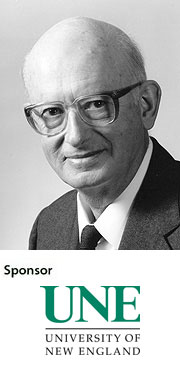
Professor Richard Stanton was born in 1926. He studied geology and mathematics at the New England University College of the University of Sydney at Armidale, which later became the University of New England (UNE). Professor Stanton worked for a time as an exploration geologist with Broken Hill South Ltd before returning to the University of Sydney in 1950. In 1952 he was awarded an MSc and in 1956 a PhD in geology. During his studies, he was involved in the first systematic geological mapping of the Solomon Islands. Professor Stanton took up a National Research Council of Canada two year post-doctorate fellowship at Queen’s University, Ontario, and then returned to Armidale and joined the Department of Geology at UNE. He remained at the UNE until 1986. During his time there he took sabbaticals to Harvard (1966–67) and Oxford (1978–1980). His research has for the most part been concerned with the ways in which metallic ore deposits have been formed and the geological setting in which they now occur on the various continents. This field of study is referred to as ‘economic geology’.
Interviewed by Professor Ken Campbell in 2008.
Contents
- Introduction
- A fascination with crystals but not much study time
- New focus and growth in undergraduate geology
- From the academic scene to mineral exploration
- An intriguing distribution of ore deposits
- A PhD on a regional pattern of mineralisation
- Unexpectedly dispatched to the Solomon Islands
- An essential insight into volcanic island arcs
- Canadian coincidences and a geological principle
- Back to Australia, with some fruitful connections
- Establishing a family and a beautiful home
- A reluctant but highly successful author
- From early speculation to recognition of processes
- Contributions to science and society
Introduction
Professor Richard Stanton’s research has, for the most part, been concerned with the ways in which metallic ore deposits have formed, and the geological settings in which they now occur in the various continents. It is a field of study generally referred to as ‘economic geology’, which (as it is generally understood in the geological environment) mostly involves the application of already established geological principles to the discovery of new ore deposits. It is very much an applied science, with very strong commercial applications.
But Professor Stanton’s work is distinctive, in that it has involved not only the application of established principles to the discovery of ore deposits, but the development of new principles of geological science that may be applied to the search for ore. His work is perhaps most appropriately thought of as pure science, and indeed it is pure science that has to be easily applied. The study of ore-forming minerals has found application in most aspects of geological and applied sciences – and in the whole aspect of economics – in Australia and around the world.
His work has ranged over large areas – for example, the role of volcanism and sedimentation in the formation of a very important class of ore deposits known as massive sulphide deposits; the association of these with volcanic island arcs; the ways in which the metals, such as copper, zinc and lead, are concentrated in volcanic lavas; the physical and chemical mineralogy of the ores; and, added to these, the nature of the association of volcanic massive sulphide ores with small, iron-rich sedimentary accumulations known as banded iron formations. Also, he has addressed the nature and result of the processes by which the ores may be metamorphosed (modified) during their deep burial in large sedimentary accumulations that later become parts of the continents that we inhabit today.
Professor Stanton’s work has opened up many new fields of study, and has influenced geological research and mineral exploration throughout the world.
A fascination with crystals but not much study time
We are here today because you became a scientist, and a geologist in particular. Was this influenced by your early life, by your family, by your schooling, just by general inclination – or perhaps by a combination of all these?
Well, I suppose natural inclination and my schooling both played a part, but there has been a very strong element of chance in the whole thing.
As far as inclination was concerned, from a very early age I was interested in the natural world. With my parents I travelled a lot when I was very young. (As it happens, I was born of English parents at a time when they were temporarily abroad.) Some of my earliest recollections are of the sea, of travelling by boat, new coastlines, seeing new countries, and I became very interested in scenery and coastlines such as the chalk cliffs of southern England, particularly in the area near Hastings. I collected butterflies, bugs, seashells and, I'm rather ashamed to say, birds' eggs. I also collected minerals. I remember being particularly fascinated by crystals, and collecting some quartz crystals. I was also very interested in some of the coloured minerals: the copper minerals azurite and malachite, and so on. So I suppose there was a natural inclination towards natural science.
As far as schooling was concerned, my first year of secondary schooling was in England. Our science master – a man named Scott, quite a colourful character and very interesting – did experiments that impressed me, and I clearly remember looking at butterflies' wings, petals and so forth under the microscope. He used to take us out into the countryside quite often, where I caught newts in ditches and found moorhens' nests, with their eggs, out on the marshes. So that year was largely biological. It was very interesting. I enjoyed it, but there were other things I enjoyed too.
I had the major part of my secondary schooling in Sydney. I was fortunate enough to go to North Sydney High School, one of the three great selective high schools in New South Wales. The others were Sydney High School, and Fort Street. Of these, Fort Street has become known as having produced a lot of distinguished lawyers, whereas Sydney High and North Sydney produced distinguished medicos and scientists.
My science master at North Sydney High School was a physicist named Monk, an Englishman. He was a quietly enthusiastic, very clear teacher. Interestingly, in a period of about six years from 1938 to 1942 or '43 he taught six boys who ultimately became Fellows of the Australian Academy of Science – distinguished physicists, botanists, myself a geologist. I'd be very surprised if any other science master in the country could say the same thing. He was a very fine teacher.
The element of chance will probably come out much more in the present interview. But my school career, I suppose, didn't particularly indicate that I would become a scientist. I wasn't studious at all. I played a great deal of sport. I became quite a well-known competitive swimmer; I played representative schoolboy rugby; I ran, and did all sorts of other things.
On one occasion in my final year our headmaster, RF Harvey, who was quite famous and was a formidable individual who demanded very high standards generally, was going through the work of each member of the class. I remember standing up in class and he looked at me with almost an air of resignation and said, 'Stanton, you're a boy with a lot of latent ability. The trouble is, you keep it latent.'
I know that a lot of Fellows of the Academy had a very early predisposition towards science and did very well at school, went to the university and had distinguished careers, and then went on to become distinguished scientists. I wasn't like that at all. Well, I suppose many people would say I was a fairly normal sort of schoolboy. I was lucky, in a way, in that I was one of those people who seem to be able to do little work but somehow get away with it in the examinations.
New focus and growth in undergraduate geology
Having finished school you went to Armidale, to the New England University College of the University of Sydney, to begin undergraduate science. What induced you to go to Armidale, when you lived in Sydney and Sydney University was not far away?
That immediately brings out the whole business of chance. Although I wasn't a studious, academically inclined schoolboy at all, it was always assumed in the family that one day I'd go to the university. As I recollect, the assumption was that I would probably do either medicine or science. Then one afternoon in 1943, when I was in my final year at school, the headmaster appeared at the classroom door and told us that he had some brochures from a newly established university college, a new branch of the University of Sydney, that had been set up in 1938. He had some brochures, and if any of the boys were interested, there was a copy available. I was interested in anything that was going, I suppose, so I indicated I was interested. And I can remember opening this thing up, being quite impressed by it, and saying to the boy next to me, 'If I did science, this is a place I'd rather like to go to.'
Well, I finished school, the beginning of 1944 came and I found myself included in the university quota of people selected to do accelerated wartime courses. (How on Earth this happened, goodness only knows – as I say, I 'got away with it' as far as examinations were concerned.) But I was more interested in joining the navy and training as a midshipman. I knew that in this training one did maths, physics and chemistry, and so on, and that was fine. When I went along, however, and inquired about doing a midshipman's course, I was advised that the navy just then seemed to have more men than ships to put them in, and as I'd been selected for the university quota perhaps it would be a good idea if I did a year at the university and then came back to do a midshipman's course and enter naval service.
I immediately thought that the thing to do was a first year of science. My mind turned to the New England University College, and I decided that I'd do a year of science there and then go into the navy. I thought, 'If and when I return from service, having done first year science I'll be able to enter either medicine or science.' As it turned out, by 1945 the war was coming towards a close – although there were still some nasty things to happen – and I didn't go into the navy. I remained a science student and continued on at the university college.
Do you recollect any particular events or circumstances during your undergraduate years that you think had a notable effect on your development as a scientist?
Most certainly there were influences on my development as a scientist, and on my going into geology. The first thing was that we were required to do four subjects in our first year. Naturally I was going to do mathematics, physics and chemistry, so I was looking for a fourth subject. A very enthusiastic young lecturer in geology tried to persuade me that the perfect choice for that fourth subject was geology, and as I'd always been mildly interested in minerals, and particularly crystals, I entered Geology I in the hope of doing something on crystals. As it turned out, I proceeded on to a double major in geology and mathematics.
The second influential experience was that I fell in with a small group of people, chiefly mathematicians and physicists, who were very academically inclined, and I quickly learned from them that study was enjoyable. I'd spent all my time on sport and so forth, and all of a sudden I began to realise that intellectual endeavour was a pleasurable activity. I also learned from these people to a certain extent how to think like a mathematician – although I would never have made a great mathematician, learning to think like that was very valuable for me. I have felt ever since then that everybody who does science should do at least one year of university mathematics, not so much to learn mathematical operations as simply to learn how to think mathematically. It is a very good discipline for any scientist to have had.
The third influence was that in my second year I had polio, which really put an end to my sporting career and consequently directed me more into doing academic work.
The fourth thing was perhaps not as tangible as the others. In third-year mathematics when we were, I think, doing differential geometry, we were set some examples to be done between lectures. There was one particular example that none of us could solve, so at the beginning of the next lecture we asked our lecturer whether he would mind doing it for us on the board – which he did. And he attacked this problem in a way that none of us had thought of, in such a way that the whole thing just dropped out. As he reached this most elegant solution he turned to the class and said to us, 'Isn't that beautiful?' I can remember thinking to myself, 'Yes, it is beautiful.'
To that point in my life I'd understood many forms of beauty: beautiful scenery, beautiful paintings, prose, poetry, beautiful girls of course! But this was what one might call pure intellectual beauty, and it was the first time I'd really understood that. I looked at it and thought, 'That really is beautiful.' Ever since, I have understood that and greatly enjoyed elegant solutions to scientific problems. A beautiful example, I suppose, is something like the elucidation of the DNA structure – something that when you look at it, when it is solved, is beautifully simple, but its simplicity has a great elegance.
From the academic scene to mineral exploration
Having completed your BSc in Armidale and been appointed to a demonstratorship at the University of Sydney, early in 1947, you decided after a few months to abandon an academic career and go into industry. You joined the mineral exploration staff of Broken Hill South Ltd, one of the major companies at Broken Hill. Why was that?
Well, I quite enjoyed demonstrating. There were large postwar classes at that stage, and the Sydney University Department of Geology was a very good one, one of the very best or perhaps the best in the country. But after I had been there for a while it seemed to me that, although the department had very able people, one member of staff was doing this and another member of staff was devoted to doing that, and there didn't seem to be any overall sense of purpose.
I was young, admittedly, and perhaps my judgment of the atmosphere there was harsh and unjust, but I suppose by that time I had developed into the sort of individual who liked to feel that he was moving toward some sort of purpose, that there was something that he was aiming to solve, something generally that he was aiming for. So I found myself in a somewhat disconcerting situation.
This was immediately after the war, however, in a period of intense postwar reconstruction, as it was called. There had been enormous damage from bombing in Germany and France, and Britain had suffered terribly. A great deal of reconstruction, rebuilding, was required. That in turn required raw materials, of which an important part was metals, and the metals came from the mineral industry, from mines.
In Australia we had some very large mines, and we profited very greatly from this whole business of increased demand stemming from postwar reconstruction. But although we had some very large deposits, it was realised that we would soon require many more, and so there quickly developed a whole new activity called mineral exploration: the application of scientific – that is, geological – principles to the systematic, scientific search for more ore deposits.
Up to that time, most ore deposits had been found by prospectors who simply searched over the surface, but they had little scientific background. Now, however, it was immediately seen that geology could be applied, in a systematic way, to searching for new deposits. And this opened up a whole new area of opportunity for geological graduates. There was a great surge in mineral exploration activity, which I thought looked very exciting, and so I decided to depart from the academic scene and to go into mineral exploration.
An intriguing distribution of ore deposits
I went to Broken Hill, and I spent the first few months actually working in the mines there. I quickly found that although the work was interesting geologically, the mining life was very rough. There were many very fine human beings among the miners, but it was a very rough and ready existence in an environment that I wasn't used to at all.
Then I was sent to Far North Queensland, to work up along the spine of Cape York Peninsula – north of Chillagoe and Mungana, up round Maytown, the Cooktown hinterland. I worked there under very rough conditions. I didn't have a vehicle; I got around either on my own two feet or on a horse. I was isolated, and my living conditions were quite dreadful. After about 15 months there I began to think that while mineral exploration had looked exciting, it really wasn't the life for me, and again I considered perhaps turning round and doing medicine.
Anyway, I returned to New South Wales and was given the job of looking at an old copper mine at Burraga, about 50 miles south of Bathurst. The idea was to examine the old mining area geologically and then do a careful, small-scale, fine-scale geological map of the area, 30 feet to the inch, to find whether one could see geological indication of any extensions or repetitions of an old ore body that had been worked about 50 years earlier.
I worked away on this, certainly in much pleasanter country than Far North Queensland, but I can remember feeling after a while that I was doing the work on such a fine scale that I really couldn't see the wood for the trees. There was something about it that I found not satisfying.
Chance intervened again, however. Every now and then I used to have to travel up from Burraga to Bathurst by bus. And as I looked out the window of the bus one day, I noticed every now and again, a little way off the road, a little old mine-working. There might be a little spoil heap, a little heap of slag or a little poppet head, indication of a mine shaft. Over the distance of 50 miles I guess there were perhaps seven, eight or nine of these.
The next time I was travelling on the bus I was on the lookout for these little mines, and after we'd passed three or four I began to think to myself that the rocks round each of them looked rather similar. That interested me, and the next weekend I got out there on an old pushbike I had. I pedalled round and looked at these mines, and sure enough the rocks were similar. In every case they were volcanic rocks of a particular type. I'd been working on a very fine, detailed scale, but I began to wonder whether there might be a very broad pattern to ore occurrence – whether, if one looked on a large scale, the ore deposits might be seen to occur in a distinct pattern related to the geological features of the area concerned. I had never seen any reference to the idea of a broad regional pattern of ore occurrence, and I thought it would be something interesting to look at one day.
Anyway, at that time (right at the end of 1949, beginning of 1950) Professor Cotton, at the University of Sydney – who apparently had been keeping his eye on me – asked me if I would like to return to the university. There was a teaching fellowship vacant and would I by any chance be interested in taking this up? Well, I'd found mineral exploration really not to my liking, and I quickly thought that if any time would be right for a move out of it, at least for the time being, this was it. I thought I could go back to the university, do a certain amount of teaching, do further courses myself, and perhaps, in any spare time I might have, take up that business of the regional pattern of mineralisation. Perhaps I could get back to the area and have a look at it in more detail. So I accepted Professor Cotton's invitation and went back to the university.
A PhD on a regional pattern of mineralisation
The broad aspects of the Bathurst trip stimulated you to take a certain kind of approach to mineral exploration, and you asked Sydney University if you could do a masters degree. Having completed a masters degree, you then embarked on a PhD, a degree which was just being introduced into Australian universities. At the end of the 1940s there weren't too many PhDs around, so yours must have been one of the early PhDs in geology to be offered by Sydney University.
Ahh, yes, it would have been. I think the first geological PhD at Sydney University was that obtained by GF Joklik, who was a member of staff of the Bureau of Mineral Resources at the time and had a scholarship to the university. The second was that of TG Vallance, a petrologist. Then I think mine followed his.
When I returned to the university, I had barely heard of PhDs; I didn't really know what a PhD was. But I was persuaded to embark on this, and clearly the subject that presented itself for research was the business of a regional pattern of mineralisation, as illustrated in the Bathurst–Burraga area.
At that stage, as you say, PhDs were new to Australia, and there was probably a period of settling down. These days, in most cases, somebody wanting to do a PhD either is given a subject for their research or asks a potential supervisor for a subject. In those days, that was unheard of. If you didn't know what you wanted to do for your PhD, what business had you asking if you could do a PhD? You were expected to know what you wanted to do. And in my case, of course, I did.
Another difference is that supervision was not nearly as formal and as systematic as it is now; it was much looser in those days and, in fact, in my case one could say that it was infinitely loose. It might be hard to believe, but during the whole period of my PhD candidature I didn't have a single conversation with my supervisor on the subject of my research. I wasn't sure that this was quite right, and perhaps I was a wee bit uneasy about it, but in many ways I wasn't unhappy. I was really quite content to make my own way. In retrospect, it may have been a very good thing, because I had nobody else's ideas imposed on mine. I think I could discipline myself quite well, as a supervisor might have been expected to discipline me intellectually. I developed my ideas, I had no feeling of intellectual insecurity, I was happy to quietly go along and do the degree essentially unsupervised. I completed it early in 1954, and I submitted my thesis in June 1954.
Two things came out of doing my PhD that I suppose you could say began to set me on my way as an earth scientist. Firstly, in the course of the research I found very definitely that there was a regional pattern. In the area that I worked on – something over 1000 square kilometres – there were about 40 of these small ore deposits that had been worked in earlier times. Examining the ore, I found it was always stratified; it occurred in laminations. It occurred in sedimentary rock, and you could see the sedimentary bedding in it. If you look carefully at this illustration you can see very, very fine sedimentary bedding that in this case has been severely contorted.
Not only was it a feature of the ores that they were very finely laminated, but in the regional sense they always occurred associated with one or other of two distinct types of volcanic rock. In addition, they always seemed to occur in areas where there were little masses of limestone among the other rocks. This limestone was substantially coralline and you could see that it really represented little reefs, and I was beginning to come to the conclusion from the pattern of ore occurrence that, however the ores had formed, they now seemed to occur in sedimentary rocks that had been laid down on the seaward side of little coral reefs that had developed round old volcanic islands. So the first thing was that I'd found this interesting pattern of occurrence over quite a large area.
A second very influential thing transpired about a year after I began this work: Dr WR Browne, reader in geology at the University of Sydney, gave the Clarke Memorial Lecture of the Royal Society of New South Wales, under the title 'Metallogenic epochs and ore regions in the Commonwealth of Australia'. I went along to this, and although I suspect that most of the audience was bored stiff, in the light of the work I'd been doing it was really quite fascinating to me.
Browne talked about the occurrence of ore deposits throughout Australia and the fact that many of them seemed to occur in distinct regions. You had these regions that might be, say, 300, 400, 500 miles long, and perhaps 100 to 200 miles wide, each containing a number of ore deposits. The ore deposits, which might have been lead-zinc ores, or copper ores, or gold ores, all bore similarities – they seemed to have developed at about the same time, to be about the same age, and they had many similarities of form. Browne referred to these periods as 'metallogenic epochs', and these areas that they seemed to occur in as 'metallogenic regions'.
This was immediately interesting to me because I had found this regional pattern of ore occurrence in the Bathurst–Burraga area. Browne was talking about metallogenic, or metallogenetic, regions and I thought, 'Perhaps there's something to what I've been doing. Browne has been talking about these regions in a very loose sort of way. Perhaps I've found and delineated one of them and I'm showing it up in more geological detail.' This was very encouraging.
Unexpectedly dispatched to the Solomon Islands
Your PhD candidature was, I understand, interrupted by field work in the Solomon Islands, in late 1950 and early 1951. Indeed, you carried out the first systematic geological mapping ever done in that part of the world, and subsequently you were responsible for the mapping of the first of the Solomon Islands to be completely surveyed in this way! I believe that your going there was rather unexpected but highly influential in your subsequent career, and that the story of your being sent there is quite amusing. Perhaps you could tell us something about this episode.
[laugh] Well, it is certainly amusing in retrospect; it may not have been quite so amusing at the time. Towards the end of 1950 I was moving along with the geological mapping required for my PhD work and I was beginning to see a pattern developed. One could say that my PhD was developing well, and I was really quite pleased with it. I was thinking in terms of devoting the coming long vacation, from Christmas into January and part of February, to getting on with the mapping and perhaps getting the major part of the field work done.
In late September or early October, however, I was walking along a corridor in the Department of Geology at the University of Sydney and I encountered the professor's secretary. (There was a new professor by that time.) Immediately his secretary saw me she said, 'Oh, Professor Marshall wants to see you.' I thought, 'Oh dear, what've I done that I shouldn't have done, or what haven't I done that I should have done?'
In some trepidation I went along and knocked on his door and looked in. When he saw me, 'Oh,' he said, 'Stunton,' – he was a Geordie from Newcastle-on-Tyne – 'you're just the man I wanted to see. A great opportunity has just come up, wonderful opportunity, the sort of thing that only happens once in a lifetime, once in a generation.' He went on like this for some time, saying, 'A great opportunity for teamwork, team research in the Solomon Islands,' and finishing with, 'I'd like you to be one of the team.'
[sigh] Normally I would have jumped at the idea of going to the Solomon Islands, but here I was embarked on my PhD and it seemed to be going very well. Mind you, it was actually Marshall who had persuaded me to do the PhD. He was ostensibly my supervisor. I immediately responded that it was very kind of him to think of me in this connection, that it was a wonderful opportunity and the sort of thing that I would normally leap at, but being embarked on my PhD, which was going very well, I thought perhaps I really should stick with that. 'Oh,' he said, 'Stunton, it's a wonderful opportunity, the sort of thing that only ever comes up once in a lifetime. Tremendous opportunity for team research. As a matter of fact,' he said, 'you're booked on the plane on the 8th of December.' So that was that. I went to the Solomons.
I should say at this point that the Solomon Islands constitute a geological entity which since that time, over the last 50 or 60 years, has become of enormous interest and importance in geological studies generally. A festoon of islands about 600 miles long and 150 to 200 miles wide, the Solomons are referred to as a volcanic island arc.
There are a number of these in different parts of the world, and most of us are familiar with them at least as geographical entities – for example, the beautiful sweep of Sumatra and Java, and those volcanic islands going right round to Timor, about which we hear a lot these days, constitute a volcanic island arc. The string of islands of the Aleutians, sweeping round from Alaska towards Russia, that beautiful arcuate sweep of islands, they are all volcanoes in a volcanic island arc, as are the Kuriles, extending from the Kamchatka Peninsula to Japan. Japan itself is constituted of a number of old island arcs. The sweep of the islands of the West Indies, particularly the Lesser Antilles, they are all volcanic island arcs. The Solomons are a volcanic arc, and so are New Britain, with its curved structure of volcanoes, Vanuatu, the Tonga-Kermadec chain and so on. So the Solomons constituted a geological entity, a problem that was destined eventually to become extremely important geologically.
An essential insight into volcanic island arcs
Well, I caught the plane on the 8th of December 1950. Most of the journey was in an unlined freighter DC3, not very comfortable, very cold when one got up in the air, and it took about four days to get from Sydney through New Guinea and New Britain, eventually to the Solomon Islands.
I had been there, I suppose, just four or five days when I began, I thought, to realise that I was in a modern analogue of the geological situation that I'd found in the Bathurst area of New South Wales. As I said a little while ago, it had occurred to me that the ore deposits there seemed to occur in sedimentary rocks that had accumulated on the seaward side of small coral reefs that had formed around volcanic islands.
Well, as I looked at the Solomons festoon I realised that, although there were a number of larger islands, there were many small islands that consisted of one or two volcanoes surrounded by fringing reefs. Most of the volcanoes were dormant, but some of them were still in a stage of degassing: they were giving off hot springs, little fumaroles, and so on.
When most people think of volcanic activity, they think in terms of really catastrophic eruption – the emission of large quantities of lava and volcanic dust and so on – and what most people don't realise is that a very major component of what is emitted is actually gas. Of course, we realise that many of these eruptions are explosive, and this is due to the gas content of the molten lava.
The composition of the gases is generally complex, and in many cases the gases contain volatile compounds of metals such as copper, zinc and lead, and many other elements.
We are reasonably familiar with the idea of this sort of degassing happening on the surface round volcanoes, but we must remember that with marine volcanoes the main bulk of the volcano is covered by the sea, and so a great deal of this gaseous emission occurs actually on the sea floor round the volcanoes.
The gases of course rise, are emitted onto the sea floor; the gases themselves are generally hot and concentrated, acid – or at least the solutions that derive from them are – and they immediately encounter the cold alkaline waters of the sea. And they precipitate the mineral matter that they contain (including metals) as a sort of apron round the degassing orifice.
Three things, I suppose, immediately occurred to me, looking about. The first was that perhaps the area I had been interested in in New South Wales – between Bathurst and Burraga, and perhaps extending southwards towards Canberra and northwards towards Mudgee, say – perhaps that in fact had been an old island arc, the scene of marine volcanic activity, a volcanic island festoon, about 360 million years ago, because that was the age of the rocks concerned.
The second thing that occurred to me was that perhaps the ore bodies that I'd observed in that area had been formed in the way I have just suggested, around individual volcanic islands.
And the third thing that occurred to me (which was perhaps more important, certainly quite as important as the others) was that the area in New South Wales, say extending down to Canberra and north to Mudgee, was the same order of size as the Solomon Islands – that is, the same order of size of the average volcanic island festoon. Now, if ore bodies had formed in this way round the individual islands, we would have a number of ore bodies along the length of the festoon. Perhaps, therefore, the metallogenetic regions that Dr WR Browne had talked about in that lecture that I'd been to in 1949 were in fact old volcanic island arcs, volcanic island festoons, that had now become parts of continents.
Canadian coincidences and a geological principle
Next you took up a National Research Council of Canada postdoctorate fellowship at Queen's University, in Ontario. What did you do during the two-year lectureship of the award, and how did it influence your thinking about geological problems?
Well, Canada had for years been one of the countries in which ore deposit geology was extensively studied. It was a country that one immediately thought of if one wanted to advance one's studies in ore deposit research.
But as to what brought it about: I submitted my thesis in 1954 and the degree was awarded in 1955. I immediately published my work, in two papers: one, a very small paper in the Australian Journal of Science, in April 1955; the other, a very large, comprehensive paper in the very well-known international journal Economic Geology, in November 1955. This turned out, quite fortuitously, to be very interesting timing.
Mineral exploration in Canada was and is very heavily influenced by the seasons. The long winter, of course, is far too cold to be out in the field. So the Canadian geologists and mineral exploration geologists go out into the field and work all the summer, they come in to the office in the autumn with all their results, and they work in the office over the winter. November, when my major paper was published, was exactly the time when the Canadians were coming in from the field to do their period of winter office work – and on their desks was the latest copy of Economic Geology, with my paper in it.
Next thing, right at the end of 1955, I received a letter from a man named Sullivan, in a very big American firm, Kennecott Copper. He was head of their Toronto office, and was running all their mineral exploration in Canada. His letter said that he had been most interested to read this paper of mine on the mineralisation in the Bathurst district of New South Wales, because during that last summer his firm had begun to find some extremely interesting, major-scale mineralisation in the Bathurst district of New Brunswick, in the Maritimes of eastern Canada. He said that if I ever came to Canada, that was something I should go and look at.
I applied for and got a Canadian National Research Council postdoctorate fellowship, and one of the first things I did was to go and look at the Bathurst mineralisation in Canada. But I found I was to work under a Professor JE Hawley, whose speciality was the nickel ores of Sudbury, at that time the great nickel occurrence in the world. So I finished up working on both the Sudbury nickel and the Bathurst, New Brunswick, deposits for the next couple of years. I learned a great deal about nickel deposits. It was interesting, but nickel was not something that I continued on with.
Sullivan, when he wrote to me, had said that there was a great coincidence: not only were the names of the two Bathurst districts the same, but, judging from my paper, the types of ore and the geological environments in them were very similar. When I went out to Bathurst, New Brunswick – initially spending about a month there – I realised the similarity was simply uncanny. It began to be clear that you had here a matter of geological principle. Since you had similar geological histories, similar geological environments, where in both cases old volcanic island arcs had been developed and the ores, of course, developed in association with them, but in two parts of the world that were antipodes with respect to each other, there was a principle involved.
My work then was quickly recognised throughout the North American exploration world, and if you could say that I eventually acquired an international reputation, I suppose that was the beginning of it.
Back to Australia, with some fruitful connections
You returned to Australia to accept a post in the University of New England, the new university that had developed from the New England University College and had received its autonomy in 1954. Why on Earth did you go back to Armidale? And after 28 years on the staff of the University of New England, finally as a professor, what are some of your thoughts on being back at Armidale after Canada?
Well, first of all in my going there, I suppose I have to admit that there was a certain amount of sentiment involved. I'd been an undergraduate at the old New England University College. It had been a very happy and interesting time. It was at that time that I first began to see the fascination – the excitement, I suppose – of science.
I wasn't overfond of large cities; I rather liked the country. And the thought of working away under relatively quiet conditions with a small group of like-minded people appealed to me. That probably wasn't the most important part of the reasons for my going there, but I have to admit that it played a part.
I suppose the most important reason was that at that time the standards of the university were very high. It was a very good small institution. It had been an intrinsic part of the University of Sydney, Australia's oldest and best-known university at the time; it had been a part of that, it had inherited its very high standards.
A number of its early appointees were very good. JM Somerville, in physics, was outstanding; RH Stokes, in chemistry, was a world-famous solution chemist; NCW Beadle, in botany, was probably Australia's great classical botanist. And the small group in the Department of Geology that I was to join – and, of course, you were one of them – was very promising.
So it was very attractive.
A third reason – a third attraction – was that there was an opportunity here to be in, so to speak, on the ground floor of the development of an altogether new institution. It had had 20 years of history, but it was still very young. There was the opportunity to help build an institution that, though one could never tell, perhaps would one day become great.
And there were a number of others who clearly thought this way. There was NH Fletcher, in physics, very able and of course a Fellow of this Academy; JV Evans, a very good veterinary physiologist; NTM Yeates, who came as the professor of animal science – and who else can I think of? – but anyway people of that general level.
It was very attractive. As I say, it looked to be an opportunity to, in a way, be part of the early history of an institution that would one day be very well known and perhaps be a great university.
And [there was] GL McClymont, the nutritional biochemist, an outstanding man. And there were a number of others, of course, in the Faculties of Arts and Economics, who were also outstanding men and who were attracted to the idea of contributing to the early development of an outstanding institution.
As the palaeontologist on the staff at Armidale, I too found the absence of other members of staff with similar interests meant that communication with like-minded researchers was very limited. In my case, coming to Canberra to work with people in the Bureau of Mineral Resources and at the Australian National University and in the Institute of Advanced Studies was a tremendous advantage to me. However, you had communication with mining companies, which allowed you to keep your research interests going.
Oh yes, it certainly did. I quickly developed ties with a number of the major Australian mining firms, and I retained the connections that I had made in Canada. Over the years I had very good relations with the mining firms and found the connections very stimulating. The mining companies themselves began to develop research groups with which I interacted. These people were very good in supplying me with material and talking about geological problems. The mining companies were very generous in funding my research, and I must say that they never tried to influence what I did, never imposed their interests on me. Contrary to the impressions of many people, they never asked for their 'pound of flesh'. They were happy that I should simply work on with whatever interested me.
The most interesting and influential and helpful connection I had was with Haddon King, who was director of exploration and research with Zinc Corporation at Broken Hill and, ultimately, CRA (and then, I think, for a little while after it became Rio Tinto.) He was an international figure, very well known and respected, and had a very good research group which I worked along with very happily. They were most helpful, and I look back on my tie with industry as being very fruitful.
Establishing a family and a beautiful home
Within about a year of your arrival at the university, you had met and married Alison Meyers, and you bought a small property on the margin of Armidale. Your three children of the marriage are all graduates and continuing with their professional careers. But the house that you built at Armidale is now surrounded by wonderful trees. Your planting and growing of some hundreds of trees has made your old home one of the landmarks of the area. What motivated all this planting?
Yes, I certainly did meet and marry my wife, and we had three children who have all turned out interestingly, professionally. And yes, I did buy a small property just on the edge of Armidale, beginning immediately to do a lot of planting. The reasons for that are probably threefold.
First of all, I come of a very long line of farmers. My family on my mother's side have been farmers continuously for well over 500 years. From my first recorded ancestor I think there are 17 generations of us – I am the first one born off the land – so I have farming very much in my blood, and I've always loved simply growing things.
The second reason may stem from my early years in England. As a youngster I was greatly impressed by some of the beautifully laid out estates and gardens in England, the work of such fine landscape architects as Capability Brown. Indeed, I have since recognised that in a way I was a frustrated landscape architect: landscape architecture is one of the things I'd have loved doing.
I hope the third reason doesn't sound excessively romantic. I've always been interested in creating something beautiful. Keats's words, 'A thing of beauty is a joy for ever: Its loveliness increases' impressed me greatly as quite a small child, and I always wanted to create something that was lovely – for my own enjoyment, for the enjoyment of people close to me, and for the enjoyment of everyone. You say that the place is now a landmark. Well, I think a lot of people know it, and I would like to think that a lot of people enjoy it.
A reluctant but highly successful author
In 1966–67 you took sabbatical leave at Harvard, in the United States, and among other things you did there, you began writing your first book, Ore Petrology – a very interesting topic, because it put ore generation in a petrological context. What led you to embark on book writing, and on that subject in particular?
Well, I'd never regarded myself as a book writer. A great-uncle of mine had written a book on the nature of wool, its technology and so on, but the thought of writing a book myself had never entered my head. Then in 1964, when I was in Armidale and well before I went to Harvard, there turned up one day a representative of McGraw-Hill. This is a New York firm but the representative was from its Melbourne office. He said that he'd been told I could write an interesting book. What about it? My response was that I'd never thought of writing a book, I wasn't a book writer, I was a research man and I really wasn't interested in writing a book. So that was that.
He reappeared about six months later and asked whether I had thought any more about writing a book. I said I hadn't. And probably towards the end of 1965 he turned up once again: had I thought any more about it? I said no, I hadn't.
Anyway, early in 1966 I set off for Harvard and began my work there, and in no time I began to receive mail from Armidale redirected to me in Cambridge, Massachusetts. In the first or second batch of mail, lo and behold, here was a letter from McGraw-Hill Melbourne to me in Armidale: had I thought any more about writing the book?
Thinking to myself, 'This is the last thing I'm going to bother myself with,' almost in triumph I wrote back a letter saying I was now at Harvard, I was engrossed in research, I had no time to think about writing a book, and I was sorry, but essentially I had no intention of giving any further thought at all to the book. I posted off the letter and thought, 'Well, that's fixed that.'
About 10 days or a fortnight later, there was a knock on my door at Harvard. I said, 'Come in,' and a chappie appeared, said, 'Good afternoon,' and announced that he was a representative of McGraw-Hill in New York! Had I thought any more about writing the book? I didn't know what to do, I was so taken aback. But, after he had visited me two or three times, he managed to persuade me to, well, just try writing two or three chapters of a book. These people are experts in applied psychology and know from long experience that once a person has done that, and found they can do it relatively easily, they are trapped. And that happened to me. I wrote the first three or four chapters, and found this was easy and really very interesting.
By then I'd thought of developing the book in such a way as to bring a new message to ore geology – to bring together some of the thoughts I'd been having on ore types and ore occurrence, and to illustrate that there was a whole range of ore types just as there was a whole range of ordinary rock types, that these various ore types were all the result of readily identifiable petrological processes, each ore type being characteristic of a particular sort of petrological environment, and that in fact the study of ores fell perfectly naturally and well into the study of petrology, the study of rocks in general. So I finished writing the book, and it was a very interesting affair.
McGraw-Hill books at the time were well known to be very expensive, and I told the McGraw-Hill representative I would write the book only if he could guarantee that it would be published at a price that could be afforded by the people that I would write it for. He said, 'Oh well, it could be $15,' which I thought was a bit expensive. It came out at $19.50.
But also I had asked him how many copies he thought it would sell. He said, 'Oh well, it could be 5000,' but to my amazement it sold 18,000! And I have been given to understand that there were about twice that number of complete xerox copies, so probably there are somewhere between 50,000 and 60,000 copies of the book throughout the world. The idea just seemed to catch on, and I think ever since then people have looked at ores in a rather different way.
As a matter of fact, I had a very nice letter from the very famous professor of economic geology at the University of California at Berkeley at that time, one Professor Meyer. He was really the doyen of international economic geology, but he thanked me for writing the book – which I thought was rather quaint – and more particularly said that he thought it had changed the way the world looked at ore deposits. That was perhaps the nicest compliment I could have.
From early speculation to recognition of processes
At the same time as all this was going on, you continued your interest in the Solomon Islands, and certainly in volcanic island arc research, particularly in association with JD Bell at Oxford. He had worked with you on the island group of New Georgia in 1959, and you spent two years at Oxford with him during 1978–80. I understand you still continue your association with him.
Yes, in one of those very good connections that one makes from time to time in science. It's another side of science. People think of science as something quite dispassionate, separated from personalities and human affairs, but now and again in the course of being a scientist one finds oneself associated with people that one forms not only a natural scientific connection with but also a very pleasant personal association. And this was the case with David Bell.
We worked together, completely isolated out in the field, in the New Georgia group of the Solomon Islands, for about three months in 1959. He was a very fine Oxford graduate, a very good geologist. He began work as my assistant, in his first job after he'd got his Oxford PhD – or DPhil, as Oxford call them. He was an excellent person to work with technically, but also a very good person to have working with one personally. He was a most amenable person. One could work along with him very easily, discuss things with him very easily.
The work I have done with him has been a very minor part of my work overall, but we have certainly continued on with an unbroken thread of island arc volcanic petrology. It has been very interesting scientifically, and our scientific and personal friendship has continued on in a very spontaneous way for almost 50 years. This is a side of scientific life that a lot of us find very rewarding.
On the basis of that work you have published a second book, Ore Elements in Arc Lavas, published by Oxford University Press. This book connects the work on volcanic massive sulphide ores begun in the Bathurst district, when you were a young PhD student, with your more recent work on the behaviour of the metals in volcanic lavas. Am I correct in thinking that this has been the concluding phase of all that began with that series of coincidences around 1948 to 1950 – your being sent to work in the Bathurst district by Broken Hill South in 1948, hearing a lecture by WR Browne in 1949, and embarking on your first work in the Solomon Islands in 1950?
Well, I'm not sure that I would like to say that it was necessarily the concluding phase. I appreciate that I'm getting pretty ancient, but I hope I still have a little ahead of me! Certainly my work that was incorporated in the book, and my work since, has been an enormous advance on that early work. I have continued on with a line of work that began in those early days. It's been a very fruitful line, and I suppose we have now reached a stage where we can see the whole thing in a much more sophisticated way.
When I first looked at the Bathurst rocks, I speculated on what might have occurred, how the ores might have formed. When I first went to the Solomons, I actually saw in a modern environment how they may have formed, that that particular kind of ore deposit was generated by volcanic hot spring activity in the sedimentary environment in volcanic island arcs.
Hot springs are derived from volcanic melts that exist for long periods of time beneath the surface of volcanic areas, and it is the giving off of gas and liquids from this molten material that eventually gives rise to the hot springs. We say that these volcanic melts, as they rise within the Earth, degas. That is, they lose their gas. And it is these gases that eventually become fumaroles and hot springs.
That degassing, you could say, can be likened to the top being taken off a lemonade bottle or a beer or champagne bottle. As the melt rises within the Earth's crust, beneath the surface of the Earth, the pressure on the melt decreases. This means that the gas that was in solution in the melt begins to bubble off – just as when you take the top of a lemonade bottle, the gas that was dissolved in the lemonade bubbles off and fizzes over. So these volcanic melts, when they rise beneath the surface of the Earth, begin to effervesce, they begin to bubble, and the bubbles rise up through the overlying rocks, eventually to form hot springs.
In some cases these gases, as they bubble through the melt, collect metals from the melt. So one becomes very interested in the processes going on in a melt that is cooling, that is crystallising, and that at the same time is losing some of its gas. This is the work that I've been involved in, I suppose over the last 30 or 40 years, incorporating the work in that book Ore Elements in Arc Lavas. The early work indicated the surface processes, and what I've been concerned with since has been looking at the subterranean processes that ultimately lead to the surface processes that I observed and the formation of ores.
Contributions to science and society
In summary, we might reflect on what you consider to be the main contributions you have made to science – and to the wider world of knowledge – by your research. Further, since ore deposits have had major effects on the economy, you might like to comment on the effects your work has had on Australian society and, in fact, the society of the whole world.
Well, I suppose it is often the case with scientists that it is their early work that has been, perhaps, particularly notable and has led on to a large part of the work that they have done through the rest of their professional lives.
I think, looking back, I would have to say that my early recognition of the idea – or of the principle – that many ore deposits formed in association with the development of volcanic island arcs was probably the most important and influential single thing that I ever did. It led on to all sorts of ramifications, of course.
That was a very simple picture. It led on to all sorts of aspects that were very interesting and, of course, much more complex. And it certainly led on to the discovery of enormous quantities of metallic ore.
It would be wrong to say that I was entirely responsible for the latter. Well, certainly the original germ of the idea was mine, but many other people came in after that and contributed. And, of course, through their efforts many new ore deposits were found.
Certainly this has had a very considerable effect on society. If we had not been able to discover new resources as we have been able to, with the efficiency that we have been able to, the industrialisation of society over the last 40 or 50 years could never have taken place. And so, in a very fundamental way, I suppose, that early recognition, that early discovery, has led to substantial effects on the wellbeing and progress of society generally.
That work led on to a lot of observational and experimental work on the microstructures of ores. This was certainly relevant scientifically – it told us a great deal more about the formation of the ores and the way in which they had been affected by subsequent geological events. Certainly our greater understanding of the microstructures of ores enabled us to design methods of treatment of the ores much better. I did a great deal of work on the chemistry of the ores, including their isotopic chemistry, and what this told us about the derivation of the ores.
I suppose my work gradually became more closely related to what one might call material science – the physics and chemistry of materials – than to what we generally think of as field geology.
I suppose it would be close to the truth to say of my science that it was pure science, easily applied. As I often said to my students, of science, 'If it's true, one day it will be useful.' I hope that the work I have done has been close to the truth. I think quite a lot of it has been useful. And I'd like to think that it would lead on to a great deal more science, and that it should be increasingly useful.
Thank you very much, Professor Stanton. I think that's a very good way to end this interview, with the importance of science to all aspects of social organisation at the present time. Thank you very much for your contribution.
Professor Elspeth McLachlan, physiologist
Elspeth McLachlan received a BSc Hons from the University of Sydney in 1963, then went to London where she worked as a test pharmacologist for Roche Products, screening anti-hypertensive drugs, before moving to the library of the British Museum. She began teaching at the University of Sydney in 1970. The University of Sydney awarded her a PhD in 1973. From 1974 to 1982, McLachlan worked at Monash University in the physiology department.
In 1984 McLachlan moved to the Baker Medical Research Institute in Melbourne where she remained until 1988. She then became professor and head of the department of physiology and pharmacology at the University of Queensland. In 1993 she moved to Sydney as Conjoint Professor, Prince of Wales Medical Research Institute. Since 1999 she has also been the director of the Centre for Research Management, National Health and Medical Research Council. McLachan was awarded a DSc by the University of Sydney in 1994.
Interviewed by Professor David Hirst in 2000.
Contents
- A wake-up call: coming home to science
- A much needed trigger
- An attraction to the autonomic nervous system
- Tying new insights back into the body
- The getting of experimental wisdom
- Broadening and grounding the experimental approach
- Inspiration and support
- To teach or not to teach?
- How and when to collaborate with clinicians
- Becoming internationalised
- Communication and internationalisation
- Inspiration, persistance and humour
- The need for thinking-space
- Can women expect to succeed in science?
- Contributions to be proud of
- 'Eureka!' moments
- The making of new medicines
- Vital implications of the autonomic nervous system
A wake-up call: coming home to science
Just what made you want to be a scientist, Elspeth?
I don’t think I wanted to be a scientist, or that the concept of science as a career ever occurred to me until I was nearly 30. When I was young I thought – like everybody, I suppose – that I would just get married and have lots of children. Then I ended up not getting married and I wondered what would happen next, what sort of job I would get.
I’d had lots of jobs continuously from the day I left university – absolutely no problems about that. I did what everybody did in the ’60s, and went to England. First I got a job in London as a test pharmacologist for Roche Products, screening anti-hypertensive drugs. That was pretty horrifying, because they were even more archaic in their technology than the University of Sydney practical classes. I moved off as soon as I could, into a job in the library of the British Museum.
But you must have been interested in science, even to go into Roche pharmacology. There must have been some questions there that interested you.
No. I did my university course because I had decided at 16, when I was leaving school, that I didn’t want to do medicine after all. I didn’t really want to face a medical course and the responsibilities that being a practising clinician puts on you.
It’s funny, because for me it was quite the opposite. For no good reason I was determined to be a pharmacologist from about the age of 16, when I barely knew what the word meant. I had a career mapped out which I achieved by the time I was 32.
Did you want to be a pharmacologist because you thought you would get a job in a drug company and earn lots of money, or to do university work?
I thought it would be interesting to find out how body function was altered by chemicals. (This was way before the hippie era.) Actually, in those times we didn’t have to think of a career – there were opportunities everywhere to do anything we wanted to do in the ’60s.
That is true at any time. It’s a question of how much time and effort you put into preparing yourself for what you end up doing. And I think it’s bad to choose too early. Was your decision influenced by your experiences at school, perhaps with good biology teachers?
No, I had hopeless biology teachers. But the subject matter was interesting. Tell me, though: if you were enjoying life in England, why did you come back to Australia?
Oh, the Swinging ’60s was great but I didn’t want to live in Europe any more, doing the same thing for the rest of my life. Australia was my home and I was going to settle down. So I came back, and for a while I worked in industry in Australia. At that time I didn’t want to get my hands dirty, and the idea of having to go back to the sorts of experiments I had done – on anaesthetised animals, with lots of blood everywhere – was a bit threatening. I had quite enjoyed sitting at a nice big desk in the British Museum and talking to people, and I thought it would be nice to just keep doing that sort of thing. So I worked in Johnson & Johnson, again for only a few months, doing more or less clerical work associated with specifications, regulations – which turned out to be intensely boring.
After a very short time I realised that, in this country anyway, there were at that time no real jobs or careers for somebody with my biological science training except in laboratories. You could go into a drug company and sell drugs to doctors – which wasn’t quite my scene – or you could go and do research. I had enjoyed research quite a lot when I was doing Honours, so I went back to that as a thing to do.
But your PhD was a long step away from what you had done in Honours, wasn’t it?
Oh yes. I had had five years away from that, so I wasn’t interested in it. I had worked in various labs doing different kinds of things, and it was really more a question of meeting the right person to trigger me.
A much-needed trigger
Who was the right person, then?
Max Bennett, believe it or not. He showed me what the world of doing professional science is like. Previously I had been working mostly in university and hospital laboratories as somebody’s research assistant, and although the questions were very important and the experiments we did were very good, we didn’t have much output. It wasn’t very well directed. Instead of answering very important questions or intermingling with the world, it was all done as if in a back room. Max gave me the view that you could actually become part of the science community, in which case you had to be professional and do things the way that real scientists did them.
What I said I wanted to do at that time was the thing that you ended up doing: looking at the control of the cardiac pacemaker by the vagus and the sympathetic nerves. I spent six months mucking about, with absolutely no skill, trying to do the dissection of the pacemaker with the vagus nerve and the sympathetic nerves and everything, and they always died. You know about that, don’t you?
Yes, I do. I was lucky, I had a very good trained hand – Graham Campbell used to do all the dissections for me.
Well, I’d never done a dissection. I could do that now, I’m sure, even without your people showing me, but I had no training in skills or experience at all in doing that kind of thing.
Max persuaded you to do experiments on ganglia. You were given a very good problem and you solved it incredibly well.
Max was very good, letting me muck about with these stupid dissections for a while, and then he said, ‘Okay, that’s enough of that. Now you’re going to start poking these ganglia.’ The first year was very difficult for me, I must admit, because I had no electrophysiological training either. He just showed me mechanically what to do, but I didn’t understand very much until I had been doing it for about a year and gradually things started to fall into place.
I don’t know if it was Max who put me onto the thing that most turned me on at that time. It might have been because I knew Steve Redman that I got very interested in trying to work out how sympathetic neurons integrated information along their dendritic trees (in the same way that Steve was working at that time on motor neurons in the spinal cord). It seemed to me we should be able to use the same principles, and, as it turns out, we can. But I’ve only just now, after 30 years, got to the stage where we have some model of how we might begin. One can do much more elegant things in motor neurons – simply because the neurons are much larger and you can do more with them than with sympathetic ones. So I never really solved that problem, and integration still has a number of very interesting questions for me.
An attraction to the autonomic nervous system
I came to Australia because of its great strength in the autonomic nervous system in the early ’70s. That must have been about when you started work on it.
I started in 1970, but I had been working on cardiovascular innervation for some time. The cardiovascular control side of autonomic physiology was already in existence; it has been quite strong in this country for a long time. But you are referring to the burgeoning of Geoff Burnstock, Mollie Holman and Mike Rand in Melbourne, and the offshoot of their students – Max was one – who became the seeds of groups all over the country working in autonomic physiology.
I wanted to ask you about your PhD. Was it planned out that you were going to do your first degree, and you did that, and then you were going to do your second degree and so you did that? Is that the way it worked?
I was a spectacularly poor student. No-one wanted me as a PhD student. I was eventually taken on by the head of department in Leeds, Professor Wood, whose sole aim was to become the Dean of Medicine so he didn’t care what I did. On the basis that I’d not much clever thought, I decided I would learn a good technique. So I taught myself electrophysiology, making intracellular recordings from the skeletal neuromuscular junction. Professor Wood decided then that I should be supported, so he bought me all the equipment and I did the first intracellular recordings in a converted toilet in the basement. At the time I didn’t realise the virtue of that.
Yes – a concrete floor, nice and solid. No movement, absolutely perfect.
Funnily enough, the whole of my life has been characterised by good luck. For no intellectual reasons whatsoever but just to learn electrophysiology, I started working on how to block neuromuscular transmission with local anaesthetics. I had no idea of the ramifications of the project, but it worked out very well. It was the first demonstration that you could modify the kinetics of junctional currents, synaptic currents. And it was a complete fluke.
Did all your intellectual input, apart from the Dean of Medicine drifting in and out, come from reading?
Yes. And reading about two New Zealanders who were working in Australia was one reason I wanted to come here. Liley worked with Eccles and had at that time done the most work on mammalian neuromuscular junction. I found his papers very inspirational for their simplicity. The other person was John Hubbard. I’ve never actually met either of them.
Tying new insights back into the body
Your success hasn’t depended on good luck as much as mine did, but some people have been big influences. Steve Redman must have been one of them.
He was. When I first met him – socially – he was an electrical engineering student.
The lowest of the low!
And a rather odd one because he was doing a PhD somewhere, and I didn’t know electrical engineers did PhDs. But he then turned out to be working in neurophysiology and that was fascinating to me. I was mainly in cardiovascular physiology and came into neurophysiology with Max – through the back door. Discovering that Steve was doing something that was related to what I doing was very interesting. He has been a major influence on me, and I think on you too.
Definitely. When I arrived at Monash, suddenly all these ridiculous little circuit diagrams that people drew came to life. I had thought this was an abstract mass of little value other than as entertainment for electrical engineers, but sitting in with Steve, seeing the experiments, seeing the data coming in, was a great revelation. One could see how they could be applied and how they mattered in body function. Actually, a lot of what he taught me about motor neurones I have subsequently used on smooth muscle, where arterioles behave like a branching tree – smooth muscles are interconnected so you need complex modelling to understand them.
The refinements that Steve brought were unbelievable, and I agree there was a big need for you to follow that pathway. But in another sense the information transfer that you described is what matters, and that is the thing we need nowadays to tie home, back into body physiology.
That’s what I was going to say. I think the thing that characterises you and me from a lot of other people who work in this area is that both of us, in our own different ways, are always trying to get things back into the body – working in a cellular sense and quite analytically on single cells and interpreting what ion channels do in membranes, but all the time trying to keep your eye on what those channels might do if still attached to a body. A lot of people in science don’t do that.
The getting of experimental wisdom
You jumped over your work with Bernard Ginsburg in Edinburgh, before you came to Monash. I had a little time with Bernard Ginsburg too. I think your time with him was pretty formative for you.
It was very formative. In my PhD I had worked entirely by myself. But Bernard, although he had arthritis and so couldn’t dissect, insisted on sitting in at every experiment while the data was being collected – which means you have to talk. And by talking you become educated, you widen your mind. So now when young students come in, I try and work with them for a year. They might think my approach is somewhat archaic, but the emphasis one gives them, the educational values they absorb simply by talking to someone who’s been around, that is beyond price. And you’ve adopted this hands-on approach with your students.
Yes, I have certainly tried to do that. It’s not always easy to get them to sit still long enough, but that is the way to a depth of understanding. As an Honours student or beginning a PhD, your understanding of the literature is so superficial, really, that it’s difficult to get to know what it means, as opposed to merely trotting out, over and over again, phrases that you’ve picked up and read.
The biggest problem in collecting data is to know when you have done the experiment properly. The repetition is very important but so is the basic experimental design, and you can only gain that by sitting with people and watching them do it. When you’re a young person it’s pointless reading a paper and saying this, this and this. When you are of our antiquity, life becomes a bit easier. At the start one’s got to be shown what to do, to be educated in technical skills and taught to critically analyse data.
In our area that’s so true. I find it very frustrating talking with people who work with primarily biochemical types of techniques, which often are automated to the extent that they are done repetitively – you don’t know what the outcome will be until some considerable time later, so you do a sequence of steps according to a recipe book, like cooking. Then you put the cake in the oven and you’ve got to wait to bring out the cake and see whether it’s worked. Obviously you’ve got to be a good technician to be able to get the cake to work, but once you’ve worked out how to do that recipe you just do it again and again.
Our experiments don’t work like that. Because you’re interacting with living cells, quite often you see something which doesn’t fit the recipe and you have to do something different to respond to it. That’s so much harder for the young people to do: they can’t see when it has gone wrong as easily as we can. We can walk past an experiment, see something on the oscilloscope screen and say, ‘Hey, just a minute. That one’s different. There’s something going on here,’ when they’ve been worrying that they were doing the recording wrong or that the knob wasn’t turned the right way. In their neurophysiological experiments, they are expecting unusual technical things but not unusual biology.
In molecular biology, a lot of the techniques now are so standardised that people simply gather data. You build into the variance of your experiment the errors introduced by your technicians or the errors of your equipment, and you just keep on doing enough experiments to bring the variance down. We don’t do that. We throw out the experiments because they’re actually bad data and we can see that. But a young person often can’t see it. It’s very difficult to get them to understand the concept.
In our field as well it’s creeping in, with a lot of the sophisticated computer collection routines, that people are measuring data, seeing currents changing, and assuming it’s changing correctly. There is a detachment from the experiment. That is something we’ve got to guard against very, very strongly. Science is becoming more of a career than an interest and a number of powerful people don’t do any experiments. This is a major problem facing science – in Australia, certainly America and probably Europe.
Yes, and quite a lot of results come out that are probably not very useful because of that. They get published by big names but are delusive in their meaning. It is a concern but I don’t see how we’re going to get round it, because science is getting bigger and more of an industry.
We have to find a way around it, though, because the skills of the people leaving are experimental skills. Some of us can administrate efficiently in certain areas, but we’re not trained administrators; we are experienced scientists. It is something that I think you in your present position at the National Health and Medical Research Council are going to have to look at.
Very carefully.
Broadening and grounding the experimental approach
When you arrived at Monash University and then we collaborated, that was a dream come true for me. You were the darling of the physiological society, a marvellous inspiration, and you brought the skills you had learned from Max Bennett. Then you picked up skills from Archie McIntyre and Bob Porter. They were magnificent leaders of a department.
They certainly were. It was a very exciting department to be in. It has been very interesting, moving around, to see what other people thought of it at that time. There was a great deal of jealousy within Australian physiology that the Monash department had so many people in it who all got on so well and were so productive and doing lots of different things. Although it was big in autonomic neurophysiology, there were also a lot of other groups in neurophysiology and other kinds of physiology, and we all knew what was going on in the department. It was terrific, a very broadening experience for me intellectually to be able to find out so much. People were willing to communicate about what they were doing and were excited about what they were doing, and about wanting to be the best at what they were doing.
That’s right. And we were the best.
We certainly were the best at the time, absolutely.
You have talked about the narrowness of approach of a number of scientists. Monash showed me, and you as well, I think, that one shouldn’t study just an area but a discipline. The things that I learned from Steve, Archie, Bob, were in fields where I never intended to work, and then the messages brought home were of great use within the area I studied.
True. And the other thing about that period was that we were involved in a lot of teaching, and it had to be broader than the areas each of us was researching – or sometimes, in my case, largely not in the areas I was researching. Having to learn the information from other people’s research in the department in these different areas and to be able to communicate to students about them was a very broadening experience. It really helped to give a perspective on how to design my own experiments, an ability to see the things that are relevant rather than little side-issues.
I completely agree with you. The things I learned from Bob about motor control were very important messages in looking at neuronal firing, which are applicable through the autonomic nervous system. You can go on to kidney and blood flow, neuronal control of blood flow, ionic balance in the CSF, ionic balance in the blood – all these things I knew nothing about before I arrived at Monash, yet they are key in understanding the functioning of any system, back in the body.
Inspiration and support
How did you enjoy your time at Monash, especially with Mollie Holman?
It was terrific. It was wonderful for me because I met you.... We had a lot of things going for us because of Mollie’s influence on the group. There were six or seven people all more or less interested in the same kinds of things. It was probably a very unusual situation in a university department to have quite so many people with overlapping interests and with a nice ability to be independent people at the same time as being part of the group. The concept of a research group nowadays is a senior scientist and some various levels of other people, like a little pyramid, under them. It wasn’t really like that at all, was it?
No. I found Mollie quite inspirational. The freedom she gave us made a very big impression on me. We were all allowed to do what we wanted and she’d go off and battle for money for us. She didn’t expect much back from me; she just enjoyed interaction. And I think you became more anatomical during that unique time.
Well, I think that came rather later on. I’d always been rather interested in it, because I did it in Honours. The thing I did, by myself, when I got stuck on the physiology – which was in fact bordering on being too difficult to go any further with – was to say, ‘I don’t understand the system. I wonder how it’s made up, what are the building blocks.’ At about that time I started the combination of anatomy/physiology which I still do.
But I’d like to talk more about what we gained out of that system at Monash. We had people working on different bits of the gut, people working on the vas deferens and people working on ganglia, on all sorts of little different bits of the body, but we were all interested in the same general problems. And we had those amazing sessions when we used to sit round with glasses of sherry. They were very good times.
That’s right. But I remember there being bottles – no, flagons – of sherry.
I suppose you’d call those sessions ‘journal clubs’ now. But we didn’t talk about articles very often, did we? We mostly talked about problems.
Problems, and what we were actually doing. That was really very good, because someone would come in with a completely different approach. Sometimes it would be a technical support solution, sometimes an intellectual solution. And Mollie was there as a group leader, much like a cheer leader, providing drive and inspiration but not directing us.
She used to come and give answers, though. Because of her wide experience she could definitely help with the answers to the problems. She was able to give of her experience verbally and we all learned a lot: ‘Oh, I hadn’t thought of it that way. That’s a useful thing.’
I don’t know why that was. It could be just because of the youth of the university: we were all employed at the same time, we were all working at the same time in the lab.
The university had recently expanded quite a lot and then it was stable for a long period. We all came in and had to get our own grants, which were pretty small at first.
Yes! But we didn’t need them, in fact. The department was very supportive. That’s been a big change in the system. When I look through the universities now I see very, very little support for research. One absolutely has to get grants. But quite substantial pieces of equipment could be bought from departmental funds in those days.
Everything except the odd item. I remember my operating microscope – it was the first thing I ever got and it was very exciting – and my oscilloscope, that I still use. But all the other bits and pieces, the department provided. Some of them were old, somebody else had had them before, but you could always put together a rig. You didn’t have to get it all together yourself, chasing around as some people have to now to find money to buy all the little bits and pieces.
And the departments provided good solid support in the workshops. That was one of the things that Bob encouraged – the electronics workshop, the mechanical workshop.
To teach or not to teach?
But then you left Monash to work at the Baker Institute. That must have been your first time in a research institute.
That was my first time in pure research. I was 40 years of age before I started any full-time research – all the way through I’d always worked, always had lecturing positions. Even as a PhD student I was a lecturer in the department, with a huge teaching load. For six months as an NHF fellow I didn’t have to teach, but that was fairly brief. So it was an amazing thing to me, when I was in a position to drive a research program, to be able to go and do it all the time. And the same thing happened to you: you went to the John Curtin School and suddenly left all the teaching behind you, and it was a terrific thing. Didn’t you notice that?
Oh, I noticed it. But neither of us stayed where we went to.
No. For various reasons those places aren’t always the same as we thought they were going to be. My period at the Baker was very successful, though, and I left there because I was leaving Melbourne. And I think the reason you left the John Curtin School was that Canberra was inconvenient for you. So it was more for personal reasons than because of the institution. I think you would have been able to get what you wanted, because the facilities were there.
The facilities were magnificent, but it still worries me that the institutes are separated from the teaching. You mentioned earlier that spending some time teaching was very beneficial for your research efforts. That’s a very big plus about doing research in a department rather than an institute.
It was very important. But I taught for 20 years and stopped, and I really would hate to go back and do that now. In the last five or six years since I’ve been at the Prince of Wales Medical Research Institute I have had an appointment at the University of New South Wales and so I’ve always been teaching. This year will be, probably, the first ever when I haven’t given some undergraduate lectures. They have been trivial – very few recently but I can still teach quite well and I think the experience of doing it for a long time was very important, whether or not you do it continuously forever. Don’t you think that’s what it is?
Actually, I disagree with you. I think that in the institutes one forgets the real world – the students. Undergraduates make one remember how little one knows, and that’s a very important facet of being a research scientist. I think in an institute there is a tendency to take on a view that problems are too small, the answers are known, when often they’re not.
I wouldn’t say that. The thing I like is that in the last few years I have been involved more in communicating with practising clinicians in a teaching role. Effectively, it’s a teaching role. I might be telling them about some of my recent research, but I have to present it just as I would an undergraduate lecture. They’ve been much more enjoyable to teach: rather than imagined problems or problems that come out of some textbook interpretation of the world, they actually come back with a real problem and ask you to try and solve it. That’s one thing we get quite a lot of at the institute.
Medical practitioners will ring up out of the blue and say, ‘I’ve had half a dozen cases of this. I don’t understand it. It’s something to do with autonomic function.’ It is fascinating to me that they hadn’t thought it was going to be something simple to explain, but only because they don’t think about the nervous system in the way that you or I think about the nervous system. They think about it in the way that they learned in their textbook 25 or 30 years ago and so they are not prepared to consider the other aspects that we now know a lot about and that are completely absorbed into our understanding of how the nervous system works. It would be nice to write that book that I’m probably not going to write until I retire!
How and when to collaborate with clinicians
What do you think of the big move nowadays towards collaboration with clinicians?
I wish it would work. I think the demands on clinicians’ time are very hard to get over. Quite a lot of people 20 years ago would have an afternoon or two or a day off a week when they could interact with somebody in a research sense, and many of the professors of medicine in universities had research teams that they actively interacted with. Nowadays they don’t interact with them very much at all. They have a senior scientist who runs the lab, does the experiments and so on, and they come and discuss the data. They have some intellectual input, of course, and like Mollie they have the wise input into other people’s experiments, but they don’t have time to get the practical involvement. And I don’t know how to give them the time.
At the National Health and Medical Research Council we are looking at trying to buy some time for them, but to set it up to work is very difficult. You would know that from your experience with Meng Chong Ngu. As a practising clinician who wanted – and still wants – very much to do research, he found that, even though he had time set aside for him, his clinical job at the hospital involved being called away by telephone to a patient in the middle of his day off, and he had to go. It’s impossible to get over that psychological aspect of your work. Even though in theory somebody else can deal with it, in practice you do it.
Funnily enough, though, one of the most successful collaborations I had was with a clinician, Gerry Silverberg, a magnificent surgeon from Stanford. The questions he raised that would never have occurred to me were very, very exciting. The collaborations have to exist somehow. The thing about talking to a clinician is you know their opinions are correct: the person really does have a cerebral artery spasm, say. It’s a very important aspect that we need to bring into medical research, but I agree, I don’t know how we’re going to do it.
Well, that worked because he actually, physically went somewhere to do research. He went to the other end of the world for six months. So maybe we have to buy people periods like that. And maybe the Australian clinicians have to go overseas.
Probably, and we have to attract American and European clinicians to come here.
I have had the relationship with Germany for a long time. Ralf Baron is now Professor of Neurology, and although he had a year in San Francisco last year he’s also planning to come back for two to three months to do a small project with us. If they can engineer to get away physically, they can get immersed enough to do something very useful.
Becoming internationalised
We have said that people coming to us is useful. How have your travels overseas helped? You touched briefly on Bernard Ginsburg.
That was a sabbatical year, the first time I’d ever been away as a scientist. We went to Edinburgh and I worked in Bernard’s lab. Bob Martin was there, and to have two great classical neuromuscular junction neurophysiologists in the lab at the same time was for me marvellous, a very exciting experience. Bernard was the intellectual and didn’t actually get his hands on, but Bob Martin was very much the hands-on person. He made a wonderful little voltage clamp out of a cigar box, with all the wires held together with little bits of matchstick. It was terrible, because the circuit used to oscillate all the time when a bit of match had moved. Eventually I went away and bought all these BNC plugs and rewired the whole thing, and it was wonderful – we never lost any experiments after that.
I would never have been able to build the cigar box clamp; he was the one with the skills in electronics that allowed him to do that. But in a practical sense I’m quite good at getting things to work professionally, and we got some very nice results out of that time of nearly a year. I enjoyed that very much. That was really my first 'post-doc', even before the Baker – the first time I had a period doing nothing but research. It was in somebody else’s lab and I had the great experience of having two very great scientists to interact with, and it was good fun.
Was that before or after Wilfrid Jänig's time?
That was where I met Wilfrid. He was passing through Edinburgh, I think to visit Alan Brown, who was the great spinal cord person at the Royal (Dick) School of Veterinary Studies, and to give a lecture. I went to his seminar, and knowing his work and his interest in sympathetic efferents I talked to him afterwards, and the next day he came over to the lab and we talked for seven hours, I think, continuously.
At that time he understood English but spoke it in very broken German. It was very noticeable to me over the next five years, as we communicated more and more, that his English advanced a long way. The manuscripts he used to write at that time were hysterically unreadable until he started sending them to me to translate from Ginglish into English. We still write three or four times a week to each other.
Wilfrid probably had the biggest influence on me over the longest time. He kept up the physiology side, whereas I’d been rather cellular for a long time when I was working with you and through the Monash systems. Although we knew it had to be important physiologically, he actually forced me much more to work in that direction. And he made sure I got invited to all sorts of meetings. I met people and became known, and therefore now get invited more – through him, not through anybody else. He more than anybody else internationalised me: previously, nobody ever knew who I was. I could never go to meetings because my lectures at Monash were always in the middle of the northern summer. Do you remember that wonderful meeting in Japan that you and Christopher (Bell), Graham Campbell and all went off to?
That was a tremendous meeting.
I was supposed to go as well – my first such invitation – but I couldn’t because of my lectures. I was very disappointed. When in 1979 I had the opportunity at last to meet all these people, Wilfrid said to me, ‘Oh yes, we didn’t invite you to that symposium last year because no-one had met you.’ I said, ‘Well, how could anybody meet me? I was on the other side of the world.’ This extraordinary European view was firmly embedded, that you couldn’t say hello to somebody or write them a letter because you hadn’t been introduced.
That’s when I realised how important it is to send people around the world just to say hello, because people know you exist but unless they have met you they won’t communicate with you. Mind you, I haven’t found it a restriction: I write to people I have never met about their work, and they always respond very warmly. But I think we have always done that from Australia because we lacked the opportunity to go.
I had a European childhood, and I still would be reluctant to write to someone I hadn’t spoken to. I realise it’s idiocy, but it is still a part of me. But I am interested to notice, as I get older, that I’m the person who is always approached for speakers to talk at the smooth muscle meetings. I think it is very important for you and for me that we retain those personal links so that we can ensure our young scientists get international exposure.
That’s right, and to be able to send them to the right people overseas.
Communication and internationalisation
You say you are approached about smooth muscle, but I find it really sad that nobody who works in the central nervous system pays any attention to the work we do in the autonomic nervous system. I think the work I’ve done in the autonomic nervous system is better and more important than a lot of the work I have done in the areas where people think of me. A lot of international people think I work in pain. I have never worked in pain but I have done a lot of work that is applicable to neurophysiology in general. But people won't read it because it is 'autonomic'.
In fact, some of the experiments we did together were ground-breaking, such as the localisation of calcium channels on dendrites, which is now a common aspect of all CNS synapses, and changes in synaptic efficacy during development, which is a well-known phenomenon in the central nervous system.
But how many times do they quote you?
It doesn’t matter – we know we did it first! And the good ones in the CNS know we did it first. But our system is easier to analyse than the central nervous system, whose complexity makes it very difficult to analyse at a cellular level, and I do think sometimes the people in the central nervous system are losing sight of the big question, looking for micro-domains when the big questions are still about how the telephone directory is connected.
That’s largely a methodology problem, isn’t it? Everybody’s got a certain set of skills now which can be learnt – patch clamping you can go and learn to do, and pathway tracing, noise analysis and various things like that – and can just be applied to the system you’re working on. It is very much a micro approach. In the central nervous system, particularly. One synapse – one connection between one neuron and another – is not a very important connection really. Not many people are working on networks and how the networks integrate.
Actually, I find the work of the Japanese the most interesting. A lot of them are doing very impressive work on the central nervous system’s organisation – how the cortex responds to inputs and so on during behaviour. They’re very innovative with techniques to record local blood-flow changes in regions of the brain associated with particular functions. In particular, to record flow and to record electrically from nerve cells at the same time is fantastic. You go to Japan a lot, don’t you?
I go to Japan once or twice a year if I can. I find tremendous inspiration from there, but I find the Japanese an enigma: they will work very hard, and on a very complex problem, but they often don’t seem to worry about telling the world. I don’t know whether there’s a language problem, but many of them present their data only in Japanese meetings. I have said to them, ‘You’ve got to start giving the presentations in English, you’ve got to put the posters up in English, have English slides. You’ve got magnificent scientists but it’s absolutely no use being a big fish in a small pond,’ and the answer is, ‘Japan is what matters.’ I have had numerous arguments with the international secretary of the Japanese Physiological Society.
That’s really interesting, because the Japanese I work with are all acutely conscious of the need to communicate in English. I think the main reason they ask me there is to talk to them in English and make them talk in English, and correct their papers for them. (I’ve done a lot of that as an exercise both for the Germans and for the Japanese in internationalising their science.) But the general attitude might be a bit different. I haven’t been to many different places in Japan and I’ve never been to one of those Japanese meetings, although I know they conduct them in Japanese. That’s natural, though. The German physiological meeting is held in German, and why shouldn’t it be? I don’t see any harm in that. They just need to have some scheme in Japan – because the language problem is much worse for them – to have more regular interaction, to improve the English of the young ones coming through and give them more confidence and experience. Some of the students are fantastic.
My recommendation to them is to try and organise themselves to leave the country for, say, three months every second year as the Thais do, to go to live in an English-speaking lab to keep up their English. Most of them have had their year or two as post-docs in an English-speaking environment, but then they tend to slip back a bit.
Inspiration, persistence and humour
But tell me: what about somebody like Tomita? Is he still active? He spent all that time at Oxford and in Melbourne, and he has no problem with the English language.
Tadao Tomita is magnificent. He was my inspiration and the only reason I did any work in smooth muscle, because he wrote the first paper analysing cable properties in smooth muscle. I was working with Bernard in an area of darkness and greyness, and suddenly there was light and inspiration. Shortly before he retired I spent some time with him which reinforced my idea of what a good research scientist is. Even though he had got cataracts and could barely see, every day he would do his own experiment. And every day he would look and say, ‘This response is odd,’ but he would get it over and over again so he knew it was correct and it had to be analysed.
It’s as if that lucky trip has set me up for my next few years research, I think, recording from interstitial cells, which I first started with Tadao. I went into the laboratory and he said, ‘There are two types of cells in this preparation.’ When I asked, ‘Why have you just discovered them? You’ve been working on it for 20 years,’ he said, ‘Yes, but there are two and I only get one, once a month, in 30 impalements.’
So you had to find out how to get them more often in order to keep the input up?
Exactly. So I used my methods of recording to gather multiple recording from a preparation on a daily basis. That was a tremendous help.
Is it because you managed to combine your – shh, dirty word – anatomy to identify where these cells were, that you could get a greater success rate with interstitial cells?
You know as well as I do that if you can see what you’re doing with a living system you can record from it. If you simply pin the preparations and look at them with a very good microscope, you can isolate different cell types and pick up small visual clues – although recently I’ve become more of an anatomist and now can see them alive with a c-kit stain.
That’s good. And then you can go straight for it.
That’s exactly right. I do go back and see Tomita, but he’s retired and is now in charge of the Red Cross in the Kansai area. He says that means he merely rubber-stamps things all the time, but I’m quite sure that’s not right. Tomita was definitely a big influence on me. He was a very analytical person, very clever, and he’d got a remarkably good sense of humour. Your sense of humour has always been magnificent too. Has it helped you out?
It makes me survive intact on bad days.
The need for thinking-space
Although Tomita’s retired, you still go back to Japan. Are the other people there as inspirational, or are you doing this more as a kind of legacy of what he gave you?
They’re not as inspirational, because they didn’t have the good start that Tomita had. He worked with Edith Bülbring, who gave those Japanese incredible power within the system. She said, ‘These people are really very great.’ She taught them in the Oxford system, where they had time to sit down and think. Many of the present-day Japanese I visit have the same intellectual skills but they have spent a lot of time in Japan where they have simply had to work very, very hard. This is a problem still that the Japanese face.
I encourage them to come and work in my lab, and I insist that they work from 9 till 5 and then go home and think about the work in the evening. Then they will talk to me and to other people about the work. I’m talking about quite senior professors, and I think that gradually they are realising, perhaps like the whole of the Japanese nation, that the work ethic is good but it needs space for thinking. That’s one aspect of Australia that is magnificent. People talk about this as being an easy-going country, but Australians work very hard over short periods. They play hard, but they have plenty of time to think, and we should never get that out of our system.
That’s absolutely right. Encouraging the young people to think goes back to what you were saying: they think it’s a career and not an interest. They only think about it as a job that they do 9 to 5, perhaps with, ‘Oh, there’s a few papers I should be reading this evening,’ but not necessarily considering it as an interest they should ponder on in the evenings, thinking about what the data were like.
The sociable aspect of Australia is very good. We touched on it with Mollie and the sherry-drinking sessions. We may have behaved in a totally disgusting way, but it was a time to sit down and argue. If one’s science is a hobby, which it should be, then one does find it interesting, does talk about it. I believe a lot of young people are tainted by school and still think, ‘Well, we shouldn’t talk about that now. It’s like doing our exams.’ Our educational system has become too driven by examinations.
That’s true. People don’t realise during their doctoral studies that they’re actually developing as an individual person. They think they’re just ticking off the next step in the career path.
Well, were you a very successful undergraduate?
I was in the beginning, because my parents were very good at encouraging me to study. (I went home, quite a long way from university, every day.) I was also very lucky in that I could swot for exams at the last minute and pass them pretty easily. University was relatively easy but I did work hard in third term. You had to jam everything in for that one exam, and I suppose I was quite lucky that I could get it out again – but two months later it was all gone. In fact, I tell my students now that there’s no point in their swotting up for exams. When I went to start teaching after five years, I had to relearn things that I had passed exams with high marks in. I would read the book and think, ‘This is amazing. Isn’t it interesting, it works like that!’ It had completely disappeared from my brain that I’d ever known the details.
It is fascinating to me how your mind can dispose of things that you really understand quite well and that theoretically should be a building block for something that you carry with you. One reason why I’m a great believer in mature-age PhD students is that even if they’re not particularly bright, by that time they have got over that hump of shoving information in, letting it vomit out again and shoving more in. They’ve worked out better how to collect information and keep the bits that are necessary for a job or something that they’ve had to develop skills for, so when they come into the laboratory they want to learn the skills of the lab and of the science they’re working on. And they retain it. So even though they may not make great intellectual leaps, it is much easier to teach them and they seem to develop very easily. We usually get people for PhDs at an age of 21 or 22 or 26, when they’re only just learning that. The beginning of a PhD is usually very difficult, I find, not only in coming out of the university system of exams into lab work but also in maturing personally. Somebody who has had a job for five years is nearly always much more receptive to science.
Can women expect to succeed in science?
While you’ve been working in science, have many problems been created because you are a woman? When I was first elected to the Academy, there were only three women. It was outrageous. It’s definitely still a male-dominated field, yet among the young people I am working with, it seems the women are the next generation.
It’s interesting that for me a lot of the problems have come from being a woman of my generation. My expectations that I would get married and have children didn’t mean I wouldn’t work, but they meant a career such as I have ended up having would never be the way to fill in my time. I think there is a problem for most women who have children to be able to do as much as I have, because there isn’t time. You have to be fantastically well organised and have lots of support systems, either financially or personally, to fit in as much science and teach and do the other things that I’ve had to do in my life.
It’s not that one is more important than the other, but I think it explains a lot why women are under-represented in the Academy. Most of the men who get into the Academy are tending towards 50 years of age. Things were not very well organised for women of that vintage, so when we were young we didn’t achieve as much as most of the men. We had to be very unusual people – perhaps people from academic backgrounds who had a lot of support in that way, or simply very dedicated. I hold in enormous awe the women in the Academy that I’ve met. They’re all far better than I am, and intellectually amazing – as are, in fact, nearly all the men. It is a group that I feel very honoured to be amongst, because they really are an amazing collection of people. You always meet interesting people who have done interesting things.
I was very lucky. People were very supportive. That was a period when women didn’t go in the direction of careers as much, but nothing would have stopped me if I had wanted a career in medicine. It wasn’t that any outside influences limited me; I opted out. There were plenty of women in the medical course, and I don’t remember anything as impeding me in getting jobs or whatever.
I think the hardest time was when I went to Queensland as head of department. That was the first time I struck such a situation in my actual job, but it probably happens to men, too: when you become a head of department, an authority figure, for the first time, you suddenly stand apart from the people you work with. I’ve never felt like that about them – I’ve always just felt they were somebody I happen to work with. But they regard you in a different way, and I was very conscious of them regarding me in a different way particularly because I was a woman: ‘Don’t pay any attention to her, she’s a silly old bag,’ or, ‘The old woman says this.’ I got the feeling from odd people, not everybody, when I went to that position, that you could be more dismissive of a woman in an authority position than you could of a man. That was a bit difficult to take. But I can’t say that being a woman impeded me in achieving.
I don’t agree with you at all. I still think there’s an immense prejudice against women succeeding. Partly it is because they actually bear the child. But then there is a definite feeling that women aren’t strong enough to lead. That is obviously totally and utterly wrong, but there is a strong feeling in the community which appears in business and in academia. I don’t know how we make steps forward to alter that.
In biological sciences and in medicine there have been a lot of women. And in the Academy we have powerful women leaders in biological sciences. In the other areas of science it’s much harder: in chemistry and physics there are very few women, and Dorothy Hill was unusual as a geologist.
I’ve often voiced the view – and been laughed out of court – that it would be a perfectly reasonable approach that a woman who takes time off and has a child has five papers added to her CV. Our society needs children, we depend upon children, biologically the women have to carry the child. And that’s all there is. Yet there seems to me to be no move in that direction whatsoever.
That’s true, but my feeling, looking at the younger women that I know now – many of them very successful – is that a lot of support systems are in place now that people can use, provided they can earn, to help them have the time in science much more easily. It’s not only having a child, it’s actually the time that you have to spend with the child afterwards that interferes with what might be a free-range thinking exercise in science. And I can see that there are a lot of people able now to juggle with this arrangement.
To get back to what you were saying, there’s no doubt that a lot of the brightest young ones are women, and it is interesting that even some of the bright ones quite often don’t see themselves as going necessarily on to the top. They don’t feel that’s particularly important. I must say I never thought it was particularly important. I only ended up in those jobs because they were there. It wasn’t because I had any ambition to become a head of department or anything like that; I just did it because it was the next thing that was offered.
The same thing applies to most men. But there is a natural tendency to look for a man to lead a department.
Probably there is. You have had a head of department who is female, haven’t you?
We have indeed. It is a major breakthrough for Melbourne. This is the first woman Professor of Zoology, and it seems to work well. I’m very happy about it, but probably my attitude is somewhat coloured because my wife, Christine, was quite a leader in industry and certainly found glass ceilings along the way.
She broke through them, though.
Yes, largely. She could only do that because I was an academic. Had I been a businessman, she would have failed. An academic can work erratic hours and can provide more at-home support, which gives her more freedom.
Contributions to be proud of
I wanted to ask you two scientific questions. First, looking back on what you’ve achieved, which particular contribution do you feel proudest of? And that is not necessarily what other people think of.
The contributions I feel proudest of, without doubt, are being involved in work with you, with a number of collaborators, that showed that the autonomic nervous system was organised – structured. The little piece that I was involved with was how the nerves communicated with the target muscles. When I started I was told that the autonomic nervous system was simply a hormonal system: it went up and down with stress. What has become increasingly apparent is that the autonomic nervous system is organised, and perhaps even better than the somatic nervous system. Everything is tightly controlled. There is very little room for mistake. The nerves communicate with specific muscles, telling them what to do. One of the enjoyments of working with you has been in parallel: you have done the same with the central nervous system processing pathways. That makes me feel very proud, and I’m sure you feel proud of your part in the central nervous system.
Yes, but I was thinking slightly differently, about trying to take cellular things back into the body. The two sets of experiments that I think back on – although they weren’t particularly nice at the time – were the ones that we did together way back in the ’70s, getting beautiful recordings from the spinal cord which other people largely didn’t believe. There weren’t very many, but they showed the answer to a lot of questions. Now all the people working in that system are finding out in a very complicated way, using modern techniques in isolated preparations, that what we got in the whole animal was actually right. So I was very proud of that, which was taking cellular physiology back into the animal.
The other experiments – which also hardly anybody has paid any attention to – were those I did in ganglia, where we recorded in anaesthetised animals from intact ganglia and looked at the patterns of integration. I think there’s always a suspicion that we are dissecting out things that no longer are real, but we were really only able to interpret those patterns because of all the experience we had had in isolated preparations. Again we didn’t get very many recordings, but the ones we got revealed all sorts of things which we can now say about how the system is working in the body and how a lot of the things that we find out in isolated preparations do reflect what is happening in the body. Conceptually, what I like most is that I contributed at different levels.
The only thing I haven’t really done properly – and you haven’t either, yet – is to record from smooth muscle, a blood vessel in vivo. We did record some things, but not enough.
I spent three months in Tucson trying to do that, working in a very good circulation laboratory, but they couldn’t keep the preparations alive, which was absolutely amazing to me. It certainly is a big problem that needs answering.
Perhaps one of us will manage to do it before we go.
It is still a very interesting aspect. My present work is almost doing that in an organ bath. I’m managing to record from interstitial cells and seeing them communicating with muscle cells. Doing paired recording enables one to look at communication between different cell types, and it really is the future of physiology, especially cellular physiology. Getting to know all the little pieces and putting it back together, together, together is where the future is going to be.
We are quite lucky, really, because the systems we work in have big signals and we can do without these massive computers to handle all the signals that arise.
‘Eureka!’ moments
Secondly, what exciting scientific moment in an experiment – it doesn’t have to be the most important – flashes through your mind as the one when you did a ‘Eureka!’?
I always forget these things. When they go, they go. But a magnificent moment was working with Narelle Bramich and suddenly discovering that Otto Loewe, who discovered chemical transmission, had found an antagonist that blocked a unique population of adreno receptors. It was the first conclusive pharmacological proof I’d had that sub-synaptic receptors differed from extrajunctional receptors. We had an agent which would block all the other putative transmitters – wouldn’t block the purines but would selectively block the novel sets of adreno receptors onto their nerve terminal.
And most recently it was putting one electrode into an interstitial cell and then another into smooth muscle cells and seeing the communication, seeing one cell driving another, putting current through one electrode, artificially communicating and showing that the lines of communication were fully open. That was my moment.
So they are largely technical things?
Yes. Science is dominated by technical findings. You don’t have to be clever, you just have to be able to measure well. If you can design the experiment and make a good measurement, then you get an insight. What was your moment of joy, then?
I’ve had a couple. One that I will always remember was when I looked down the microscope and saw sympathetic nerve terminals in dorsal-root ganglia. I didn’t believe it would be possible, so it was very exciting to see another one of Wilfrid’s predictions come true. He had said, ‘Somewhere we’ve got to have a situation where after nerve injury the sympathetic nerves somehow become associated with sensory nerves. Let’s have a look and see where this happens,’ and I had said, ‘Oh well, okay, I’ll do the dissection, I’ll do the histology for you, etc. etc.’ But then it was just amazing – and amazing that it worked at all, because you have to look at a particular time, and however it was that we guessed the right time, but the very first one I did provided some of the best pictures. It was so exciting. I thought it must be wrong, but when you do it again and again it’s always the same. I remember calling people in and saying, ‘Come and have a look at these,’ until everyone in the lab had actually seen them and been convinced that it was real.
A lot of people in other parts of the world didn’t think it was real, but they certainly do now, because other people have confirmed it. Ed Perl, with his particularly acerbic nature, said to me at a meeting in Kyoto, ‘I would never have believed it if your name hadn’t been on it.’ I was very flattered by that.
The other thing I really enjoyed, even though this is absolutely trivial and scientifically not important, was the experiments that James Brock and I did with ciguatoxin. That was a revelation too, to see what a nerve toxin can do to nerve terminals. When you actually see with the microelectrode how the nerves are releasing transmitter and changing the responses of blood vessels or ganglia, it just explains so obviously all of the clinical symptoms which had been a great mystery before. You know, when the symptoms of fish poisoning are diarrhoea, nobody gets very excited about it because they presume it’s due to some inflammatory process irritating the mucosa and producing the sorts of bacterial endotoxins that cause increases in gut contractions. But in practice in this case the toxin goes zap, straight through at incredibly low concentrations – we were down to 10 picomole. It zaps straight for the nerve terminal, spews out all this transmitter, and you can sit and watch it for hours – great fun, absolutely wonderful. Not a particularly important scientific finding, but such a nice way to see how something functions in the body so simply on just one or two systems, and having quite profound effects on the whole behaviour of a person. So a lot of science is quite fun.
Those experiments are the excuse I claim for not bothering to measure from a blood vessel in vivo. You did it, more or less, in the organ bath, inducing natural firing patterns in the nerve. They give completely different responses from the artificial ones we generate with stimulators, et cetera, but you did generate a natural firing pattern with your small doses of toxin.
Yes. If only that toxin was more available, we could have done a whole lot more. It’s too difficult to get quantities of it – and it’s a real nuisance, once you put it in your system. You’ve got to throw out everything from your organ bath and start all over again, because those molecules, so few of them, lurk around for a very long time.
The making of new medicines
There seems to be a trend – it goes in waves – to look for toxins like this to make new medicines. Do you think it is a way forward in science?
I suppose it is, because if we know what the channels are and the receptors that are activated, if they are specific, then it is better than combinatorial chemistry to find a natural compound from whose chemistry you can actually identify the right part which activates the receptor. The problem with even the combinatorial chemistry and the way that drugs are developed now, including the genetic techniques, is they all seem to be even more blockbuster than they used to be. The idea that knocking out a particular receptor or activating a particular receptor for one particular symptom is not going to affect all the rest of the body is to me mind-blowing. It is amazing to me that even Viagra works without causing people to faint much more often than it does. It is a quite dangerous compound to release, yet it seems to be pretty effective with a lot of people without having problems.
A lot of that is fortuitous, in that the way the drug companies test things is not logical but rather random. They find a compound that they think might work in a system and whack it through behavioural tests in animals, and if the animals don’t fall over then it’s probably okay to try it in people. It all seems a bit haphazard. It gets things onto the market quicker, but it doesn’t seem very safe. I would like to know a little bit more about whether the receptors are different in different tissues, so that you can target the one which is only in the gut and not the one which is also in the heart or the brain, say, and get all these difficult side effects. One of the major problems of clinical medicine is drug interactions and side effects of particular compounds – which differ in different people. That is inevitable, I think.
Vital implications of the autonomic nervous system
Which of your work do you think has been clinically most useful? I’ve enjoyed finding things about the body, but somewhere along the line we have to use the information to make people’s lives better. For example, your work on pain is going to be of profound clinical value in the future.
I’m not sure that my work on pain will be of profound value. The big amount of work that has been done in the last five years on nerve injury induced pain is very important, because what was happening used to be very mystical. People weren’t doing the right kinds of experiments, and now they are. I must say it’s nice to be still doing experiments in that area, where you can do lots of new things still. Because I come from the autonomic nervous system, I tend to look at it a completely different way from the people who come to it from sensory neurophysiology – that is most of those who work in the pain field. They are a particular type of person. I feel rather out of it.
I think the people I have helped have been the doctors or even the patients that I could talk to about their individual cases. I do get phone calls from patients with pain. I can’t care for them, but I can often give them a pretty plausible explanation of what has happened, which often is as much as they need. Since the autonomic nervous system is involved with so many bits of the body, if there is a symptom which seems unrelated to where they think the disease is, and either the medical people or the patients are confused, it can often help when you say, ‘Look, I’m sorry, there’s a reflex there. It’s an ordinary standard reflex. We can demonstrate it in any anaesthetised animal. This wiring is probably in your body anyway. We can’t just take it away. It’s going to do that response.’ That’s why we want to do work in spinal patients who have disconnected autonomic nervous systems with funny reflexes. A lot of these funny reflexes are really there, and it’s just because you have removed the control of the wiring diagram that it goes haywire in a lot of pathological states.
To drift off at this point: I’ve always been obsessed with being anti-teleological. I think that in the autonomic nervous system particularly there is a very strong push from the broader medical scientists, medical practitioners, to think of the autonomic nervous system or even the whole of the body as being perfectly evolved to control the body, otherwise why would we be here – everything must have come through evolution. But I have an absolute conviction that we have a long, long way to go before our bodies are perfectly evolved, and it is so arrogant to think that everything we are now is there for a purpose. I’m sure you would know that too, from your own work, and any pharmacologist must recognise that if you know where a receptor is, you can introduce a chemical into the body that activates that receptor, even though the receptor might never have been activated by that chemical or, probably, any other that we know of in the body.
That’s right, but I have a different view of evolution, that it is not to maximise design but to minimise danger. If parts of the body, receptors, are left, then providing they’re not activated and in the way, why bother to remove them? As you know, when you denervate a muscle it very rapidly changes and responds to a whole bevy of different pharmacological agents. As soon as the innervation comes in, if those receptor sites remain it will be disaster, so the body suppresses them. But if they weren’t dangerous, I am quite sure the body would leave them functioning.
Yes – but only if it doesn’t actually produce a problem which prevents you from reproducing. Evolutionarily, many things that we now see in the inefficiencies of our body are actually things which occur long after reproduction age, and they are not going to stop us.
Thank you, Elspeth. It has been nice to catch up with you again. I have missed our times together.