





Professor Peter Doherty, immunologist

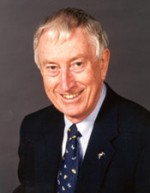
Peter Doherty was born in 1940 in Brisbane. He attended veterinary school at the University of Queensland, and went on to complete his PhD at Edinburgh University. He took up a post-doctoral position with the John Curtin School of Medicine Research, where he researched how the body’s immune cells protect against viruses. He made a breakthrough in discovering the role of T cells in the immune system, for which, he received the Nobel Prize in Medicine in 1996, and was named Australian of the Year in 1997. Doherty currently splits his time between researching at St Jude Children’s Research Hospital in Tennessee and working in the Department of Microbiology and Immunology at the University of Melbourne.
Interviewed by Roger Beckman in 1996.
Contents
- Introduction
- Early life
- The discovery
- The significance of the discovery
- Science in general
- The present and the future
The Australian Academy of Science interviews Nobel Laureate, Professor Peter Doherty
Imagine going to a school where you're not allowed to do biology because you happen to be a boy; and now imagine that, despite that restriction, you decide to study Veterinary Sciences at the University of Queensland because you reckon it's doing something useful; and suppose that just eleven years after leaving University you make a more-or-less accidental discovery of such importance to medicine that you go on, years later, to receive the highest honour in all science – the Nobel Prize.
Too good to be true? Not at all. Meet Professor Peter Doherty, a fellow of the Australian Academy of Science, who did just that and became Australia's eighth Nobel Laureate in science.
The Nobel Committee in Stockholm recently announced that he and Dr Rolf Zinkernagel, from Switzerland, had won the 1996 Nobel Prize in medicine and physiology for work that they did together 23 years ago in Canberra. Although Professor Doherty now works at the St Jude Children's Research Hospital in the USA, the prize-winning discovery was made in 1973 at the John Curtin School of Medical Research at the Australian National University, showing that Australian scientific research can rank with the best in the world.
A completely down-to-earth, unassuming Australian, Peter Doherty was instrumental in making one of the most profound discoveries of the last 50 years in the burgeoning field of immunology. It has given us a clearer understanding of the intricate mechanisms at work in our bodies and its massive implications extend to the treatment of many terrible diseases. It's no exaggeration to say that a whole new field of science has extended from this one discovery. No wonder many are hailing Doherty's Nobel Prize as one of the greatest days in Australian science for decades.
In a recent visit to Australia shortly after the announcement of the award, Roger Beckmann spoke to Peter Doherty on behalf of the Australian Academy of Science about his early life, the process of scientific research and the nature of his own discovery.
Early life
It all started in the suburbs of Brisbane, where the young Doherty attended the local government schools.
AAS: What were you like at school?
PD: Looking back on it, I think I was a dreamy kind of kid and perhaps a bit quiet – my head was always in a book. I had no particular feeling for science; in fact, I was quite inclined towards literary pursuits, although I also did the standard physics and chemistry courses – biology was forbidden for boys. Although I enjoyed reading, I knew I wanted to do something more practical with my life. I didn't want to spend hours analysing poetry at University, although it might be fun, when there were more important issues to think about – like feeding the world.
AAS: You were accelerated by a year at school, weren't you?
PD: Yes, and as a result I ended up going to University at 17. It was quite a shock.
AAS: How did you get interested in biological sciences?
PD: I became interested in disease partly through talking with my elder cousin, Ralph Doherty, who was working as a virologist. And then when I went to an Open Day at the Vet School at the University of Queensland I decided that I'd like to be a vet.
AAS: Not a Nobel Laureate?
PD: Not at all! Far from it, in fact. I was going to save the world by helping to produce more food by being an agricultural vet.
AAS: So what happened?
PD: By the time I had qualified as a vet I realised that food production was more a matter of agricultural economics and politics than of cows and sheep. I had to work for the Queensland Government for a few years. I was 'bonded' to them in return for my time at University. And then I became interested in virology and immunology through reading the books of Sir Macfarlane Burnet [another Australian Nobel Laureate in Medicine and Physiology]. And I knew by then that 'cat and dog' vetting was not really for me.
AAS: So generations of sick blue heelers or galahs with injured wings have had to manage without you. What did you do instead?
PD: I went to Edinburgh University to do a PhD on virus infection of sheep brains. When I'd completed that, I came back to Australia where I was offered a job with CSIRO. But instead I decided to take up a post-doctoral position with the John Curtin School of Medical Research because there was interesting work there on immunity to virus infections. And the dogs and galahs probably did better without me!
The discovery
AAS: So what exactly was the discovery that you and Rolf Zinkernagel made back in 1973-4 and how did you go about it?
PD: Well, of course, you don't set out to make a discovery. What you are doing is checking a hypothesis – strictly speaking, you try to falsify a hypothesis. In our case, there was a certain amount of serendipity involved. We started out looking at ways of assaying [measuring the activity of] killer T-cells. We wanted to know how T-cells recognise and respond to viruses in mice. Bob Blanden at the School was then working on the cytotoxic T-cell response to the ectromelia virus in mice. Rolf Zinkernagel worked with him, learning several techniques, including T-cell assays. As Bob's lab got a bit crowded, Rolf moved into my lab. Rolf loved to sing grand opera, and I was the only guy with sufficient musical taste to have him in the lab!
AAS: And then?
PD: Well, sure enough, we found killer T-cells in mice infected with a lymphocytic choriomeningitis virus called LCMV. And, in the lab, we could get these T-cells to kill the virus-infected cells. But then we connected this work up with the system of transplantation antigens – something which hadn't really been done before.
AAS: In what way?
PD: Other people had suggested that there was some kind of relationship between the immune response genes, which map in the region of the major histocompatibility [transplantation] antigens and the susceptibility of mice to LCMV. Certain mouse strains, carrying particular histocompatibility antigens, were more susceptible to the virus, others less so. We did experiments to see whether the activity of the killer T-cells correlated in any way with the type of major histocompatibility antigens (MHC) in the mouse from which the T-cells came.
AAS: And did it?
PD: Well, yes, but not as we had supposed. It turned out, quite unexpectedly, that killer T-cells from one mouse were not active against virus-infected cells from another mouse – which of course, would have a different class of MHC antigens. In other words, the MHC antigens were certainly having an effect. In fact, the killer T-cells were not doing any killing of virus-infected cells unless the infected cells were showing the 'right' MHC antigens that the killer T-cells expected.
AAS: So the thing that decides whether or not a virus-infected cell is eliminated by these T-cells is not only the fact of having virus antigens on the outside, but also the possession of the 'correct' variant of the MHC antigens?
PD: Exactly. The MHC antigens have to be of the same sort as the individual that the T-cells come from. This means that what the killer T-cells are recognising is two things – virus antigens and MHC antigens. Virus antigen by itself is 'invisible' unless it is there with the MHC antigens; and it can't be with any old MHC antigens, it has to be with the MHC type of that individual (or inbred strain of mouse in the case of our work).
And incidentally all this work was only possible because the inbred mouse strains with different but consistent MHC types already existed.
AAS: So one piece of research always builds on what's gone before...
The significance of the discovery
AAS: After grappling with immunology enough to appreciate your discovery in simple form, people may now cry 'so what – what's the big deal?' So can you tell us the significance of all this?
PD: I'll try....The fact that cytotoxic T-lymphocytes – the killer T-cells – cannot usually recognise foreign antigens unless these antigens are paired with MHC antigens is pretty fundamental.
AAS: That's what you called MHC restriction, isn't it? It's in every textbook now...
PD: It shows us that the immune system can recognise a third state – altered self – as well as self and non-self. When a virus has infected a cell and the cell is displaying viral antigens in addition to its own, it has become altered self. That's what's recognised and dealt with, rather than the viral antigens per se. The point is that the body treats altered self in much the same way as non-self. A virally modified cell is destroyed in the same way that a transplanted cell from another individual would be.
AAS: And what does that tell us?
PD: It gives us a biological role for the MHC system. People were wondering why the body should have a system for combating transplanted tissue when this state clearly never arises in nature. We suggested that the recognition of alloantigens – MHC antigens differing from your own – was there not to frustrate transplant surgeons but to help the body 'see' altered self.
AAS: But wouldn't it be easier just to see the viral antigen on an infected cell, rather than recognise the virus antigen in combination with the MHC antigens as an altered self?
PD: But altered self recognition allows the body to conduct surveillance on its own cells. A cell's antigens can be changed not just in virus infections but in certain cancers, for instance.
AAS: And such cells could be destroyed before they spread and threaten the whole organism?
PD: If all is working well, yes.
AAS: So you found a biological role for the MHC antigens....
In fact, Doherty and Zinkernagel had opened up a whole new highway that led to major advances of great significance to clinical medicine. Many common and severe diseases depend on the function of the cellular immune system and thus on the mechanisms for specific recognition. Viral disease is only one part of the story; various long-term inflammatory illnesses such as rheumatism, rheumatoid arthritis, multiple sclerosis and even diabetes involve damage caused by the cellular immune system, probably as a result of altered self. Certain forms of cancer, where the body's cells escape the controls on their multiplication, are also a form of altered self. And we are now in a position to explain better the associations between tissue types (ie, HLA) and susceptibility to various diseases. Knowing a person's HLA-type it is possible to give a statistical likelihood of their developing certain diseases, based on the observed correlations between HLA-type and disease. Why particular tissue types are associated with a greater propensity towards certain conditions is under investigation.
Science in general
AAS: You have obviously been successful in science. Can I ask what qualities are necessary?
PD: You've got to be very persistent and totally absorbed in what you do. You need to have an open mind, and be prepared to drop one line of inquiry and follow another if it looks interesting. We never set out to make our discovery – we weren't aiming in that direction at all. But when we found something unexpected we followed it.
AAS: Would you recommend science as a career?
PD: You're certainly not likely to make a fortune doing it. There are easier ways to make a living. But it has to be one of the most interesting pursuits. I love immunology because I love puzzling out complex, intricate systems.
AAS: Professor Kevin Lafferty, the Director of the John Curtin School, has described your prize as 'a triumph for curiosity-led research.' I take it you'd agree with that?
PD: Absolutely. Conceptually-driven research, as opposed to end-use driven research, is what is likely to yield some of the biggest benefits. But with this stuff you can't be sure where it will end up. Real curiosity-led work cannot be confined by a short time-horizon and doesn't guarantee an outcome. Plenty of research leads up blind alleys. But you have to know that those blind alleys are there in order to find the right pathway. Of course, that doesn't mean you don't need applied research – it's essential – but you need to get the balance right between the two. Many governments, with their short time horizons, tend to favour the applied side too much.
AAS: How do we keep basic research going?
PD: It's probably best funded through peer-reviewed grants from funding agencies. There is also a need for block grants to research institutes, though these must be subject to careful scrutiny by scientific peers. Of course, the funding must be regularly reviewed. But privately-funded basic research is also very strong. St Jude has a budget of about $150 million a year, much of which comes through private fund-raising.
AAS: Your prize-winning work was done fairly quickly and cheaply, wasn't it?
PD: In a sense, yes. Today everything is much more sophisticated and expensive. The main thrust of our prize-winning work was done in about 6 months, but we needed the strains of inbred mice that had been developed over many years. Had those not been available we couldn't have done our work.
AAS: You did the research in 1973, and it's taken 23 years for all this to be rewarded, although the research was already being used by many other scientists within a few years and you have won other prizes before this.
PD: I think it shows that the benefits of basic research can sometimes take a while to be recognised. Also, the molecular basis of the 'altered self' model took another 10-15 years to work out.
AAS: But the benefits are no less real for all that.
PD: Exactly.
AAS: And you can't always tell which bit of basic research will turn out to be of fundamental significance for application in the future?
PD: Yes.
AAS: How does Australian science rate in world terms?
PD: It has a good reputation, but obviously we're not a large country in terms of wealth and population. We can't keep up with the United States. But certain institutions and individuals in Australia are among the best in the world at what they do. And if you've come through an Australian PhD you can probably cope with anything.... There is a real need to spend more money on basic science. That is, research aimed at understanding mechanisms rather than developing technological applications.
The present and the future
AAS: On this brief visit you've already been the guest of honour at a reception by the Prime Minister at Parliament Houseand you've had a one-on-one meeting with the Minister for Science. Professor Gustav Nossal, the President of the Academy, has said that your life will never be the same again now that you have won the Nobel. You'll be invited to every conference, your volume of mail will expand tenfold. How do you feel about that?
PD: It's a good point – if somewhat frightening. I don't want to turn into a talking head and an A-grade waffler....
AAS: But naturally your opinion will be sought on many things, just as we are doing now.
PD: I shall have to watch what I say.
AAS: Your prize is worth a lot of money, but I gather that a fair whack goes straight to the US tax department?
PD: Yes, but that's fine by me. Taxes help pay for research, after all.
AAS: You've got plenty of your own research still going. Will there be any more major breakthroughs?
PD: Well, it would be nice to make another big hit, but very few people actually do.
AAS: What is your current research at St Jude concentrating on?
PD: We're looking at certain cancer-causing viruses. We're also studying a model of a human virus – the Epstein-Barr virus or EBV – which can infect anyone but is a particular problem in people with AIDS because of their compromised immune system. A particular mouse virus has many characteristics in common with EBV and we're seeing how the immune system deals with it.
I'm also interested in cell-mediated immunity to respiratory viruses - particularly influenza and parainfluenza.
AAS: The chances of making major breakthroughs are still as high as ever?
PD: Well, there's still plenty we don't know that's waiting to be unravelled. There's an awful lot to be done in terms of understanding human disease
AAS: And there are few aims worthier than that.
The Academy would like to thank Professor Doherty for his time and help in the preparation of this article.
November 1996
Related sites
- Nobelförsamlingen Karolinska Institutet
The Nobel Prize in Physiology or Medicine 1996 - Access Excellence
Immunologists recognized - Nobel Australians (Australian Academy of Science)
1996 Nobel Prize in Physiology or Medicine

Dr Jean Youatt, chemist
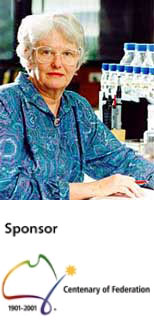
Chemist
Jean Youatt was born in 1925 in China, where her parents were missionaries. The family was interned there from 1941-45. At the internment camp she was taught mathematics by one of the other internees, and received a school certificate from Oxford University. Youatt received a BSc from the University of Melbourne in 1949 and then an MSc. It wasn't possible to do a PhD in Australia at that time so Youatt went to the University of Leeds where she received her PhD in 1954.
Youatt moved to Malaya with her husband and worked with a US Army unit that was doing research into new viral diseases. On her return to Australia, she worked at the University of Melbourne on the drug isoniazid (isonicotinic acid hydrazide), which was used to treat tuberculosis. In 1962, Youatt became a lecturer in chemistry at Monash University, where she continued her work on isoniazid. In 1968, during a study leave in Seattle, she became interested in the fungus, Allomyces. Her interest was primarily in how the chemical environment of the fungus controlled its development. Youatt spent 1987 in Aberdeen where she worked on investigations into how fungal hyphae grew. In 1990 Youatt retired and moved to the Biology Department at Monash, where she continued her research.
Interviewed by Ms Nessy Allen in 2000.
Contents
- A migratory early life
- Establishing an early interest in science
- Internment in China
- A daunting prospect: filling in the science background
- Developing resourcefulness: a microbiology MSc
- A PhD based on bucketsful of autotroph cultures
- Living in Malaya, married and overqualified
- Becoming acquainted with isoniazid
- Seeking a more interdisciplinary environment
- Hyphal growth cycles: getting Allomyces to 'jump through hoops'
- Investigating why hyphae grow this way and not that
- Chelator specificity: upsetting the assumptions
- Questions of reputation, responsibility and opportunity
- Administrative and professional puzzles
- Lighting the way for others
Jean, although you are Australian, you weren't born here. Would you tell us about your background?
I was born in 1925 in China, where my parents were missionaries – my father from Australia in 1898 and my mother from the UK in 1920. My father married twice: there were two boys and two girls in the first family, and I was the eldest of the second family, with two younger brothers. However, we never lived all together. Only the youngest of the first family lived with us for any length of time.
You came back to Australia a couple of times. Why was that?
It was a difficult time. When the first Communist uprisings began in central China, my parents had to evacuate to the coast because it was so dangerous. I was only small but I am told that we stayed down in Shanghai for a while, and then my father was asked to go to England and also Australia, doing what the mission called 'deputation work'. We were away for quite a time, and had hardly got back when we were asked to go to Australia again. So I came to Australia twice before I even turned four. After that we stayed put in Melbourne, from 1929 till 1937.
I went to many schools. I managed to squeeze seven into two years, just as I was starting high school. It was hard. I changed syllabuses from Victoria to New Zealand, New South Wales and Victoria, and then to the Oxford Certificate in China. They didn't fit together – I had gaps all over the place – and I became a connoisseur of teachers and teaching. Some teachers just did everything that I thought a teacher shouldn't do. But Epsom Girls' School, in Auckland, and McRobertson, in Melbourne, had really good teachers. Everywhere else I went was very patchy.
Establishing an early interest in science
Were you interested in science when you were young?
Yes. I remember sitting in the classroom, aged probably seven or eight, when we had a visit from someone named Cox, from the Victorian Museum, who brought things out and talked to the class. My father must have known him, because we met up with him again at Mornington on our summer holidays. He took us to Fossil Beach, showing us where to find fossils and crystals and nice things like that, and also to his house, where he had a funnel-web spider and some lizards in a bath. Really, my interest started through that one person.
Then my half-brother visited from Sydney and brought me a child's version of Fabre's Book of Insects, which fascinated me. And I was given a little microscope when I was still quite young. Later I read biographies such as Madame Curie's and Louis Pasteur's, and especially got interested in Louis Pasteur. That's when I thought microbiology would probably be what I wanted to do. I would still have been under 12 at that stage.
Did your parents encourage your interest in science?
Yes, they did. Scientists, and biologists in particular, usually think that people like my father, who defined himself as a fundamentalist, would be hostile to science. But I found more hostility from biologists to religion than vice versa. My father was actually very keen on science, and my older half-sister said he used to look forward to the arrival of papers in China so he could hear the latest that was going on. He was perfectly accepting of the idea that I would study science.
My father transferred me from a small private school to the state school system when he realised that my brothers were being taught maths better than I was.
Mother valued tertiary education and wanted it for me – though not science specifically. She had wanted to be a doctor before she went to China and resented being allowed to take only two years' paramedical training.
Apart from maths, did you take science at any of your schools? Did any of your teachers encourage you in it?
I had part of a year of chemistry at Hornsby High, in Sydney – I loved the teacher there, who suited me very well – and a little bit in New Zealand. But we had to go back from Sydney to China, and there it was just general science, School Certificate level. It didn't have enough of anything in it, really, for what I needed later.
In Australia I was only 13 or 14 and I think it was too early for my teachers to encourage me in science. In China they didn't think much of science; they thought girls should be teachers or nurses, and if I wanted to go to university it would be much better if I did Arts. But it didn't shift the position, because that had been established when I was much younger.
You were interned in China for four years. Did that ordeal influence your character and your life?
I think the major influence was my father. He had been in China during the Boxer Rebellion, when 200 missionaries were killed, and his obsession with martyrdom had a profound effect on my childhood. But he died when I was 13.
In 1941, after Pearl Harbor, we were enclosed by the Japanese, first in our own compound and then in another small one, and finally all shifted to a big one for the whole of north China. There were a lot of children to be looked after, and at the age of 16 and 17 I had to do quite hard physical work, with lots of washing and mending and things like that.
It was very difficult to go on with our education. The camp had assembled a sort of library, but the only science text in it was a 1910 botany which I thought was probably not worth learning. Somebody said they would teach us some chemistry but without a textbook that proved too hard. But then I found a Miss Hancock, from Yuencheng University (Peking), who was a lovely person and liked teaching – she was keen to have someone to teach, but the camp had 1600 people and it took us a while to find each other. She was an excellent teacher of maths, and the year I had with her made a huge difference when I did get back to Australia.
A daunting prospect: filling in the science background
Finally, after the war, you arrived at Melbourne University. How did you catch up on the specific sciences that you hadn't studied?
It was very daunting. I went in to ask if I could enrol in science. Because I had not actually matriculated to Oxford University, I had to write and ask if they would enrol me at Oxford with only an exemption from matriculation. (I was eligible for that because in their School Certificate I had got straight As.) But all this came through very late, when term at Melbourne was about to start. Having the exemption meant it was assumed I was capable of doing the courses without the background, but it didn't mean I had done the work. Then, when I realised how much more everybody else knew than I did, I didn't dare let on – I thought I might be told to leave. I had to do it by myself, and it was a very hard year: all work and no play.
Were there any women members of staff – or anyone at all – who helped?
I didn't ask them. I did have a friend, Nancy Hayward, who had known my sister-in-law in London. She came out to be a lecturer in microbiology, and was a pleasant and helpful person. She asked me later why ever I hadn't told her about it, but I really didn't feel I could tell anybody.
The women on the academic staff were almost entirely demonstrators. I had a woman demonstrator in first year, but no woman lecturer. I don't think things have changed that much!
Did you ever feel any discrimination in those days?
Not as an undergraduate. The discrimination comes later, I've learnt – nobody minds who they teach, but it's different when they want jobs.
Developing resourcefulness: a microbiology MSc
After graduating in early 1949, you went straight on to do an MSc. What subjects had you graduated in?
In chemistry and microbiology. I had been torn between microbiology and biochemistry, but in the end the timetable determined it.
Which of those was your MSc in?
Microbiology. I had been cheeky enough to go and ask Professor Trikojus if I could do a Master's degree in biochemistry, learning some biochemistry at the same time. But he said no, so it had to be microbiology. (Oddly enough, in England a little later I did a PhD in a biochemistry department, and did learn some biochemistry there.)
I worked with Vic Skerman, predominantly on the effects of oxygen. He had the only polarograph in the university – people these days wouldn't believe how bad the equipment was then in Melbourne. We did two major kinds of experiment, showing that it was just about impossible to stir enough oxygen into cultures for them to keep aerobic, and also trying to find out how much oxygen could be tolerated by the three anaerobes that caused tetanus, gangrene and botulism. We were using cysteine, thioglycollic acid and ascorbic acid to take out the oxygen, and then finding when the organisms could begin to grow again as the oxygen levels came up.
Did you get much help with your MSc from your supervisor?
It was good that first year with Vic: we were in the same lab and talked about things, and worked together on some of the experiments. (Vic had a lot of interests, and I did all sorts of odds and ends. It was sheep dips and everything!) But at the end of the year he got the Chair in Queensland. I was in a mess because the two universities wouldn't sort it out. Queensland wouldn't give me credit for what I had done at Melbourne, Melbourne wouldn't let me finish in Queensland, and Vic went off with all the apparatus I had been using. So I moved into a corner of another lab, sat down and thought about what I could do for the rest of the time. I had to work with very little equipment and, from the department, no supervision. But I did go across to the Biochemistry Department once or twice and talk to Jack Legge and Bill Rawlinson, who were helpful. I learned that you have to seek the help you need where you can find it.
A PhD based on bucketsful of autotroph cultures
Why did you do an MSc instead of going straight on to a PhD?
You couldn't do a PhD in Australia at that time. It was introduced, in fact, while I was away doing my PhD at Leeds.
Why Leeds?
It was the time they called 'Austerity' in England, so it was difficult to get in anywhere. They were trying to settle their war debts – they still had rationing and so on – and the universities were very hard pressed for money. I went off to some interviews, but people would not be able to give you an instant answer because they didn't know what the money situation was. Then I met a friend of a half-brother who lived in England. He and the professor at Leeds wanted to isolate an autotroph in a process they were interested in, so when he heard from me that I had done a literature review on autotrophs he suggested that I go to Leeds. I still had to try to find some money in the time it took to get a grant, and a Brisbane businessman – a Mr Hubener, the father of one of the microbiology staff members – helped out. I'm very grateful but, amazingly, I've never met him. I did get an offer later that would probably have suited my career better, but I had said I would go to Leeds so I did.
There I worked on an autotrophic organism which broke down thiocyanate. I was rather surprised recently to find that my PhD work was still being cited, because the autotroph is still being used for dealing with industrial waste. In England it was breaking down the thiocyanate in gasworks liquor, in the days when gas was made from coal – it had to be removed before they could discharge the waste water. It was hard to isolate because it was a strict autotroph, and it was even harder to keep in pure culture. It didn't grow in very great quantities so I used to produce it by the bucketful, which physically was quite hard. I grew 80 litres a week to support my experiments.
Was your supervisor helpful this time?
Well, Howard Rogers was appointed to a job down in London within weeks of my arrival in Leeds, and my other nominal supervisor, Professor Haphold, told me – years later – that, noticing I was rather independent, he left me to my own devices! But it was easier there. We 12 postgraduate students shared things with each other, and the department had staff members from different disciplines. In that, Leeds differed very much from Australia: people just came from all over the place to work together, so it was a very interdisciplinary school. But I also walked up the hill to the Chemistry Department to see Professor Challenger about sulphur chemistry, and by that stage I was pretty well used to going and finding someone to help.
I did meet Howard again once, though. Before I could publish anything about this culture I had to take it live, by hand, to lodge it in a type culture collection – they had to have a living culture and it was very hard to send it to them – and Howard arranged to meet me in the refreshment rooms at Victoria Station! That was it.
So you never really had a mentor?
No. Professor Haphold would have been a mentor for me, had I not married and left. He gave me an Honours student to supervise when I was still doing my PhD, and offered me a temporary lectureship, but at that stage I felt I had to go to Malaya, where my husband had gone. I am sure he would have helped, had I still been around.
Living in Malaya, married and overqualified
After you finished the PhD in 1954, the normal thing would have been to do some postgraduate work.
Normally, yes, I would have gone on to something like that. Before I ever went to England a contact had been set up for me in the USA, where I would have gone if I hadn't found something in the UK. It would have been difficult. I had a birth certificate showing 'Born in China', and in the McCarthy era people who had been born in China sometimes couldn't even get a permit to go to America. Anyway, I had got married, and Gordon, my husband, had gone to Malaya. It was compulsory for all university graduates in those days to do two years' military training or, alternatively, they could declare conscientious objection or they could do two years in the Colonial Service. He chose two years in the Colonial Service.
Arriving in Malaya, I made some inquiries and found a US Army unit was doing research into new viral diseases. They interviewed me, thought I was overqualified, but after a whole month decided that maybe they would put up with that. So I started to work with them. (The two people that they recruited without any qualms were a BSc from South Africa and a nurse.) They kept coming to take a look at what I was doing down in my lab, to make sure I wasn't doing any research of my own. They did have some justification: I was growing leptospirae and I'd have loved to try and devise a medium of my own. But I didn't, I was good.
Becoming acquainted with isoniazid
When you returned to Australia, in 1955, what happened about jobs?
It was harder now, and for the first time I ran into what I felt was discrimination. I had a telegram from Professor Rubbo saying he had 'suitable' work, and my idea of suitable work was either a lectureship or some research. Instead it was a routine public health laboratory. When I said, 'Can't I have a better job than this?' I was quite explicitly told, 'You're married. You're going to have children. You won't be able to work.' I was terribly disappointed, and after nine months of such unscientific stuff I was so frustrated that I said I couldn't do it anyway, even if I didn't have something else to do. So I resigned from that. Professor Rubbo then produced a research job, which was much more to my taste. It was funded by the National Health and Medical Research Council to work on the drug isoniazid – isonicotinic acid hydrazide – used to treat tuberculosis.
Initially I was a research assistant and later a research fellow. I stayed on that subject at Melbourne University till I left there in the beginning of 1962, and for some time afterwards as well.
It was enjoyable work, although any safety officer these days would have an absolute fit at the things we did. We worked with toxic chemicals with no fume hood, and I worked with open cultures of BCG, the organism that is used for vaccination, in the same lab with people who were working with virulent human tuberculosis. It really was a very unsafe situation, but I still was able to get quite a lot done.
I was particularly concerned with trying to explain how isoniazid worked. There were one or two theories around, but I showed that they couldn't be right and I set up some criteria for how I would know the right one when I found it. I had to find something that isoniazid would do at very low concentration (the organisms were extremely sensitive to this drug) and that other isomers didn't do at all. I did find that coloured substances were being produced by the organism in the presence of isoniazid. I tried to find out what they were, but they had terribly difficult properties: they were unstable, they wouldn't extract into solvents and so on. While I was wondering what next to do about it, I moved to Monash University.
Seeking a more interdisciplinary environment
Why did you go to Monash?
I got fed up with annually renewed grants. If you had to order something to be made, and it was going to take more than a year, you wouldn't even know whether you would still be there next year when the thing became available. After a number of years of that I said, 'No more,' and I applied for a lectureship at Monash. It was to teach biochemistry from a chemistry department, which really appealed to me because of my background at Leeds. I thought Australian biochemistry was not chemical enough, and Leeds had been such a good example of people coming in from different disciplines and working together. (Even now I think biological scientists in Australia don't get nearly enough chemistry. I could talk for several hours on why I think that!) And no other school in Australia was teaching biochemistry from a base of chemistry.
At a very early stage, however, Monash was persuaded to hand the course over to the professor of biochemistry in the medical faculty. I was offered a choice of moving across to the Biochemistry Department to go on teaching biochemistry, or staying in chemistry to start teaching chemistry. I liked the people I was working with and Professor Brown had said to me he was quite happy for me to go on doing microbiological research, so I chose to stay with the chemistry.
I kept working on the isoniazid, although I hadn't intended to. When I first went to the Chemistry Department, I hadn't really planned what I was going to do, because clearly I was going to be pretty busy for a while, setting up new courses and things. When I gave a seminar to the chemists, however, they said they could easily find out what these coloured substances were and so I was persuaded to start in again – I was back to buckets of cultures. But it was about 20 years too early: the equipment that they thought would solve the problem was not sophisticated enough in the early 1960s. We failed to identify the compounds but I showed that there was an enzyme involved. Deciding I couldn't push it any further at that stage, I decided to write a review of what both I and other people had done. I put quite a lot of effort into that, writing to lots of people to fill in gaps so that if they had forgotten to put something in their papers I could still make it a pretty complete account. I submitted that and then went off on study leave to think about something new to do.
Were there any problems with getting research funding for the isoniazid work?
There hadn't been, but people were beginning to say that we didn't have a tuberculosis problem in Australia any more – that it had been largely solved through public health measures. Although it was and still is a major health problem all round the rest of the world, I got a bit nervous about whether or not the work would go on. But mainly my decision was made because I was getting no further with identifying the crucial molecules for answering the problem.
Hyphal growth cycles: getting Allomyces to 'jump through hoops'
So what did you decide to go on to after that?
My study leave was in Seattle. I went there in 1968 to learn a bit about microbial genetics, but ended up doing some chemical work for them instead. One person there was working on Allomyces, a fungus which sounded interesting, and during an International Botany Congress I attended an informal meeting where a young geneticist was very keen to get a team of people working on Allomyces. I decided I could be in that, because it didn't require anything I wouldn't have access to in the Chemistry Department, and I liked the idea of a number of us being able to work with this fungus.
Fungi were new for me. I had always worked with bacteria, where all you see is a little dot or dash, but these things grew like little trees: they had roots and branches and produced different kinds of fruiting structures. Looking down the microscope, you could actually watch what was happening; you could then take samples away and analyse them to see chemically what was happening. I decided this was the nicest combination of things I could possibly get. On my way back I visited Berkeley and got cultures from Professor Emerson – he had first worked with these organisms and was a very nice, encouraging man – and from Dr Machlis. Then I headed off back to Australia, and started to work with Allomyces.
Was that a good choice of project for someone in the Chemistry Department?
Yes, it was. I had to get extra funding, but I switched at that stage from the National Health and Medical Research Council to the Australian Research Grants Committee, because it wasn't a medical research subject. This dear little organism is a good one: it doesn't harm anybody or anything. I did all sorts of things with it, but I became predominantly interested in how its chemical environment controlled its development – and, as some friends at Aberdeen subsequently said, 'teaching it to jump through hoops'. I knew how to make it do things to order, which was very useful.
Some of my results were controversial, though. Just studying various aspects of this organism, I realised that I had moved – almost accidentally, I suppose – into what the biologists know as growth cycles, when a cell goes through a series of changes and then divides. A cell cycle is the time between one nuclear division and the next. The literature said that fungi grew exclusively at the apex but I observed that Allomyces in each cycle alternated between growth at the apex and growth at the base of the hypha. Terry O'Brien, in the Botany Department, who was always very helpful, explained to me how heretical this was and said we would have to be very careful about recording it, to make sure that we established very clearly what was happening.
Terry had what we needed for time-lapse photography, and a very bright student turned up who was interested in doing it: Ann Cleary, who had done both botany and chemistry. So it was possible, with the things I knew about managing the organism, for us to make a time-lapse film of these events. I wrote a paper and sent it off.
Mr Bennett, at CSIRO, rang me up and said, 'One of the overseas referees says not to publish your paper because he doesn't believe it. But I'm going to publish it, because you've got your data there.' That was nice, but over the next few days I began to think, 'If this one doesn't believe it, perhaps I've got to go and show a few people or they won't believe it either.' That was about 1986. I began to think of somewhere to go, asked for study leave, and went off to Aberdeen the next year.
Investigating why hyphae grow this way and not that
Why did you choose Aberdeen?
I had looked around to see who was working on growth in other fungal organisms and found that three people in one department had published. In particular, one person working there (Neil Gow) had theories about how hyphae grew. He was measuring the tiny, tiny electric currents that flow into and out of growing cells. I realised that my organism was the perfect one for testing his theory that these currents determined the direction of growth: the current should reverse and flow the other way when the fungus switched from growing at the tip to growing at the base. I wrote off to them that I had this organism, and they invited me across.
It was difficult to grow Allomyces exactly as Neil needed for the experiments. His vibrating probe electrode was very fragile and under the microscope had to be moved close to a single hypha. The hyphae had to be firmly attached to the agar medium on which they grew so that the vibrating electrode would not shake them loose. The organisms had to be well separated and facing in the right direction. I had to use chemotropism to make them grow in the right direction and eventually we were able to take the measurements. Bad luck for Neil, they didn't reverse. He was rather disappointed, because that wrecked his theory.
Besides that main work, at times when Neil was away I did all sorts of other things. Before I left I wrote it all up, and we published a paper on what I had done. But when I went back to Monash I was getting rather close to retirement age and wanted to finish up a lot of other things, so I put the Aberdeen work out of my mind and just went back to my own program.
Weren't you invited to return to Aberdeen in 1990? I think the Australian Department of Industry, Technology and Commerce gave you some international cooperative research money.
Yes. Professor Graham Gooday had written to me, saying that they would really like me to come back and check out another theory for Neil – but that they couldn't produce any money. Well, it was difficult: Australian universities don't usually let you go on leave in your last year before retirement, and I was going to have to find the money. Then the Department in Canberra gave me a grant and the university agreed I could go, but I could only take two months. I just had too much else to do.
This time, Neil wanted to see whether, even though the currents didn't reverse when the direction of growth reversed, maybe the flow of certain ions would reverse instead. Again it needed special equipment, but nothing like as hard to set up this time as previously – except that Neil was too busy and I had to go and find another person who could do the same thing. I couldn't come back and tell the government I hadn't done the work after all. But again it was disappointing for Neil.
Chelator specificity: upsetting the assumptions
That time I felt even more like a wet-blanket. They were using the compounds we call chelators and assuming that they were specific for calcium; they didn't really want to know about it when I said they weren't. We had great difficulty in agreeing what we were going to publish because of the calcium question. I came back to Monash in quite a dilemma and started thinking what I should do about the calcium story.
I asked one of my chemistry colleagues at Monash to write a computer program for us to calculate the concentrations of ions other than calcium, and I started looking up the literature and writing to people. Gradually I got sucked in more and more, but it was very disillusioning. I couldn't believe that anything could have gone so badly wrong as that whole biological literature on calcium. And when I wrote to people I got a fairly hostile response. The first time I tried to write something about it, I entitled the paper 'Do fungi need calcium?' and referees wrote back, 'Of course they need calcium! She's not allowed to ask this question.' That was what I was dealing with.
By then I had moved across to the Biology Department, and, being retired, I wasn't very inclined to do anything more about calcium. But editors said that I had to do some more experiments. It was very hard to get the work published. Referees wouldn't read papers properly and they would just say they didn't believe it – a whole mountain of papers on the subject couldn't all be wrong. But they were wrong, because right at the beginning, in about 1960, someone had made a statement and everybody else had followed it without checking. It was quite a disaster.
When the compound that most of them were using initially – EGTA – was first synthesised, all the stability constants for a whole stack of cations had been published. Had people looked in the literature, they would have found that EGTA was a more effective binder of iron, zinc and manganese ions, for which there were well-known functions in cells, than of calcium. And the way they were using it, they were going to make the cells deficient in these other essential ions and not necessarily in calcium at all. For all of that long time since someone started the ball rolling, people had been saying EGTA was specific for calcium, yet it was known not to be.
I went through each one of a whole lot of other chelators that people were using and found that although they didn't always have a complete range of stability constants, in all of them calcium was less well bound than other important ions. Yet everyone was behaving as if that were not so, and when I did my review of the literature it was just amazing to be constantly reading 'This is specific for…'. I wrote the review when I found they were actually beginning to define another chelator as specific for manganese, and I thought, 'It's got to stop somewhere.'
I couldn't get the first paper published in the Journal of General Microbiology, because the referees were all in the calcium 'clique'. But in the end I wrote to another journal, saying that the paper had been refused by the Journal of General Microbiology and asking them, 'Please will you at least have one chemist as a referee, who'll understand what I'm talking about?' And so I managed to get two experimental papers published about the problems in the use of EGTA. Getting the review published went more smoothly: the outside cover of Critical Reviews in Microbiology said that they liked controversy.
Have you managed to persuade people of this now?
Some. One group in America repeated what I had done with another organism, getting exactly the same results. When I sent them my second paper, telling how some of the chelates were actually toxic and therefore it was even harder to use them, they wrote back that they had found the same thing themselves. And a number of people would go so far as to say, 'Yes, we've been pretty careless and we've assumed too much that what is true of mammalian cells is true of plants and microbes. We'll be more careful in future.' But I found recently from the Citation Index that some of the diehards, even though they're still citing my review, aren't actually doing any of the things I said needed to be done. I think it is going to take some time.
Questions of reputation, responsibility and opportunity
You retired in 1990 but you have already said you did not stop working.
No. I moved over to the Department of Ecology and Evolutionary Biology – which I think has just changed its name again. (All around the world people keep changing the names of their biology departments, and it's hard to keep track.) I did sundry things there, but I was still working on this calcium stuff and I was helping out with some other fungal work. One of my friends broke her working wrist, and I did some work with her for a while when she couldn't use it. And I had contacts with students and things like that.
You established your international reputation in the Allomyces area, didn't you?
There aren't very many people working with Allomyces, but yes, I think I could say my name would be associated with it now. In fact, in 1994 after a conference in Canada, I spent two weeks in California because Professor Bartnicki Garcia was sceptical about whether the non-apical hyphal growth could be true, even though I now had the people in Aberdeen saying it was. He was also wanting to do some experiments with micro-organisms in a kind of microcell. So I showed him the phenomenon and how to set up the culture.
What effect did it have on you that referees, in particular, just refused to believe what you were writing?
I found it terribly disillusioning. It doesn't fit in with my idea of what science is like or about. I'm currently helping a woman from Shanghai with a business ethics course that she is doing from the University of Queensland, and from my experience I would agree with the idea that we should introduce ethics courses into science faculties. A lot of issues need to be handled – and not just the obvious ones like faking results or pinching other people's data but also the responsibility of referees to be open-minded and do a proper job, read things carefully, and the supervision of students and also, from some of the gossip I've heard, reading PhD theses carefully. There are a lot of these things that just relate to responsibility.
For the life of me I don't know where we stand with respect to women in science. Not long ago I was having some disagreement at Monash because I said, 'I don't go out to schools persuading girls to do science. If they've caught the bug I will do anything I can to help them, but if they haven't, it's not a good bug to catch if you are married or if you want to be, and particularly if you want to have a family.' Some of my colleagues were quite cross, saying their graduate students were getting good jobs, so I said, 'Well, tell me about them.' Their reply was, 'Oh, they're reps for this or that company, and they love having their new car,' so I said, 'Yes, and where's that going? Find me a woman chemist in Australia who has a good job, and who has had a family and children without that being really difficult to do.' They haven't come back.
Administrative and professional puzzles
Your administrative skills are legendary at Monash University, especially in connection with the science timetable but also in general.
Well, it's one of those things. Monash only started in 1961, and in 1964 I was asked to look after the first-year laboratories and tutorials. All the students had four tutorials a week in those days. No university, we were told, had ever grown as fast as Monash did, and I found unbelievable confusion. With a class of 300 they had over-enrolled by 100 students and so there was a lot of reorganisation to do. I said we would have to cycle experiments so that the rare equipment was shared, but people said, 'Oh, you can't do that.' I did get chemistry practical classes sorted out.
By then I had become aware that although classes began in March, it was June before the registrar sent out accurate class lists. So I started an unofficial faculty enrolment – did it solo the first year, and got the other departments in to help for a couple of years until it became faculty policy – and from doing that I went to giving individual students their timetables so that both they and we knew where they had to be. The faculty eventually took that over too and it was done by computer. Oh, and then the chairmen were all planning to build one big lecture theatre. But I said they would need six small ones. When they said, 'Prove it,' I had to write notional timetables for the year 1970 with all the additional courses we were supposed to have.
So I had quite an impact on a lot of people. That's why the legend happened, really. I went on doing timetables as required until I retired. I like doing timetables. I don't like getting the information, I don't like persuading people to accept the results, but the timetable itself is a nice puzzle.
Yet you were never promoted, Jean, despite your very impressive list of publications – a book and some 60 research articles. People are promoted in universities on much less than that. Was it because you stayed in the Chemistry Department when they stopped teaching biochemistry that you never became associate professor?
I think it was a major reason. People seemed eventually to be very confused as to what I was. Chemists couldn't quite see me as a chemist and often introduced me as a microbiologist, and when I spent my study leaves in microbiology departments for a change of air I was always introduced as a chemist. I did twice go and see professors about promotion, but I got no encouragement at all and I didn't know then what to do. To this day I don't know what the process is. I didn't know you could go ahead and apply anyway, so I just gave up. But that was part of my upbringing too: I had the reverse of assertiveness training.
You and your departmental colleagues were working in very different areas. They didn't quite know what you were doing, did they?
No, except on odd occasions when I'd come round to the stage of wanting to identify some unknown molecule that had cropped up in my cultures. That was something they could relate to, but the rest was total mystery.
You have a very strong social conscience and have helped with various community projects. Can you say something about those?
Well, I worked on Lifeline emergency telephones for four years, back in the '70s. And among other things I have written some submissions on social issues, such as for the Victorian inquiry into dying with dignity. While I was still teaching, I did a little bit of language tutoring under the Home Tutor Scheme – not as enjoyable as what I'm doing now with Holmesglen TAFE, because I get tertiary educated, professional people who need to upgrade their English for the sake of their work. I learn new things with them, like tax law and business ethics, as I said before.
In universities, I understand, you much preferred research to teaching, but you have a reputation as an excellent and dedicated teacher.
I do like teaching. It's funny, my two half-sisters said, 'Don't, whatever you do, be a teacher,' but perhaps it is a good idea to be a scientist first. I see it as research: you have to find out what the problem for your student is. I like trying to work out how to solve a problem for somebody. And I had memories of my first year at Melbourne, when it was such a struggle, so I used to look out for students trying to do the same sort of thing. I suppose that's where the reputation came from.
And perhaps from a book you wrote.
I got interested in programmed education. I experimented on a first-year class with some drafts and I was very impressed – I had to plead with them to go home, which is rather different from giving a lecture. So I started to write a course for our first-year organic chemistry course. It became a joint effort in the end, and it was published in book form. We used it for quite a long time, 20-odd years.
You went to a lot of trouble to locate those students who needed help, and always made time available to them.
It arose when I was first looking after first year. I saw a lot of enrolment data and looked through it for what kind of students we had. I had thought that my problem was a peculiar one just caused by the war and so on. But to my surprise I found that some students in first year had either failed chemistry at HSC or hadn't done it, and I knew how difficult that was going to be. So I experimented over time, trying to find ways of helping them. It was very difficult because, like me, they didn't really want to let on that they were having a problem. But in the end – 1967, I think – I put out a questionnaire to the first-year students. They asked for the impossible: someone sitting in the library eight hours a day, ready to answer their questions. As next best, Mrs Williams, in the department, set up a resource centre where they could go, not eight hours a day but any lunchtime, and get questions answered as they arose. They didn't have to identify what their problem was; they could just go in with their question. That is the best solution we have been able to find.
And you yourself helped them a lot.
When I first went there, we were all told not to encourage students to come and consult us privately, because it would waste too much of our time. But I never ever found any student who abused that. I used to tell them where I was and say, 'You might come at a time when I'm in the middle of an experiment, and if I ask you then to come back some time else, it's not a put-off. It just means I will see you but right this minute I can't.' And that worked. It had been unnecessary for people to worry that students would make a nuisance of themselves. They didn't.
So, having never had a mentor, you have acted as one to others.
To some, yes. On one particular occasion, in 1975, I went to the university at Aberystwyth, and the professor there reminded me that I had given him some very good advice when he was the Honours student I looked after in Leeds. It's interesting, students don't always have an appreciation of how academics are going to view something. He was their top student and he wanted to go to somewhere like Oxford or Cambridge, but he was scared that if he asked the professor to support him in transferring to do a PhD at Oxford he would somehow get himself into hot water. And I said, 'I don't think so. I think Professor would be very proud of you and would like to show off his product.' So Gareth plucked up his courage and went to Oxford with Professor Happold's blessing. I'd forgotten the incident, but he told me it had really set him on the right path, because he then went to a very good lab in America and so on – which is the way things work. See, I knew what people should do, but I didn't know how to do it for myself!
Jean, you have obviously made an enormous contribution to at least three disciplines. Thank you very much indeed for participating in this interview.
Professor Louis Davies (1923-2001), physicist
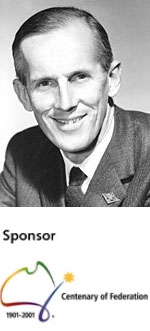
Physicist
Professor Louis Davies received a BSc Hons from the University of Sydney in 1948 and was awarded a Rhodes Scholarship to study plasma physics at Oxford University, for which he received a DPhil in 1951. Returning to Australia, he joined the Division of Radiophysics of CSIRO. In 1958 Professor Davies visited the Bell Laboratories on a Commonwealth Fund Fellowship. After returning to work at CSIRO for several years, he became chief physicist at Amalgamated Wireless Australasia (AWA) from 1960–85. He combined this position with a professorship of electrical engineering at the University of New South Wales from 1965-84.
Interviewed by Professor David Craig in 1999.
Contents
- Foundations: country towns, medical practice, courageous battles and music
- Rolling practical into scientific education
- A flying mathematician
- Marriage, a Rhodes Scholarship and a family
- Plasma constraint
- A continuing sports thread
- From microwave noise to newfangled transistors
- Back to CSIRO, to transistor physics
- Once more to Bell Laboratories, to zone refining
- 'Please do some research in semiconductors'
- Researching microelectronics and optical fibres
- Patenting a portfolio of inventions
- The spectrum linking basic science and commercial exploitation
- Applying solar energy
- Director and grazier – with soil physics on the side
- Service and honours in the technological sciences
- Matters of personal satisfaction
Foundations: country towns, medical practice, courageous battles and music
Lou, could we begin with your early years and your family background?
I was born in Sydney but at only about six months of age I moved to Aberdeen, in the Upper Hunter, where my father was general manager of the local meatworks. In those days Aberdeen was a three-pub town of about a thousand people, with a police station and a public school, which I attended. Because of the numbers there were only three classes: 1st/2nd combined, 3rd/4th, and 5th/6th.
Davies is a Welsh name, isn’t it?
Yes. My grandfather was born in Carmarthen, Wales. He studied medicine at Liverpool University, then came out and set up practice in Esk, Queensland, where my father was born. Grandfather was a highly qualified medico for those days, particularly in a part of the world like Esk. He died from TB when Dad was only about 18 months old and the family had a very rough time economically.
I think your father became a soldier in the First War.
Yes, in the 7th Australian Light Horse Regiment, which initially was on Gallipoli. When he arrived, the regiment was re-forming south of Cairo. They then fought principally against the Turks, right across the Suez and up through Syria and Palestine to Amman, north-east of Jerusalem. He had quite a long stint, about four years, ending up as adjutant of the regiment.
And your mother?
My mother was born in Dunedin, New Zealand, and had quite a distinguished career. She was a concert pianist who trained at the Conservatorium in Sydney, and later she became a brilliant contract bridge player. She is still alive, aged 100 – for which she has had a letter from the Queen, the Governor-General, the Prime Minister, the Premier, everyone.
Rolling practical into scientific education
After the Aberdeen primary school you went to a number of secondary schools.
Yes. The first was Muswellbrook District Rural School, where we had very practical subjects – woodwork, metalwork, agriculture I and II. My agriculture teacher used to stray well beyond the syllabus and get us interested in all sorts of things. I became a Junior Farmer and developed a great interest in horses (I learnt to plough behind a horse) and chooks. But I’ve never been really fond of chooks. Then I went to Maitland High and later to Shore, in Sydney.
Where does the science and engineering in your life start?
Well, engineering not till I left Shore, after the Leaving Certificate. But I think I was always interested in science. I had an interest in electricity. We had a wonderful man working around the home in Aberdeen who used to subscribe to Popular Mechanics and was forever making – out of quite impossible bits of material – motors, generators, etc., all of which fired one’s interest a bit. And my parents provided me with a couple of chemistry sets while I was at Muswellbrook and Maitland high schools. I used to construct flying model aircraft, too. So it was a good background.
Mathematics was probably always my strong subject at school. I had the great good fortune to have good teachers at Shore. Particularly, L C Robson, the headmaster, taught me for two of my four years there, and I also remember an experiment in which Clem Tiley got us to measure the mechanical equivalent of heat – it came to me as a bolt from the blue that mechanical work could be transformed into heat.
Part of the Year 1 class at
Muswellbrook District Rural
School in 1935.
(Lou Davies is in the middle.)
You began at the University of Sydney in 1941, but the war was on and you wanted to be involved.
Yes. At the end of 1941 the Japanese attacked Pearl Harbor and a lot of us enlisted. The university manpower officer, bless him, wanted me to become a radar officer but I thought it would be much more exciting to get into aircrew. I enlisted and passed the medical tests, but you had to queue up to get in. So for nine months I lived at home and worked in the meatworks, at first in the office and then, when they found I had some engineering experience, with the chief engineer.
Leading Aircraftsman Davies, RAAF, with
his father, Major L W Davies, MC; Aberdeen,
NSW, April 1943. (Note the gas producer unit
attached to rear of vehicle, enabling it to run
on producer gas – a wartime measure.)
One went into the Air Force as an aircrew trainee, being then sent to pilots’ or observers’ or wireless operator/airgunners’ school. I was sent off to the observers’ school at Cootamundra, where I learnt to navigate. After a bombing and gunnery course at Evans Head and an astronavigation course at Parkes, I was commissioned and went to general reconnaissance school at Bairnsdale and then Operational Training Unit at Sale. There we formed a crew in the Australian-made Beaufort aircraft in which we later flew with 1 Squadron from Gould strip, near Batchelor, south of Darwin. We made reconnaissance flights looking for Japanese shipping as far out as south of Java, or off Merauke in New Guinea. Occasionally we were let loose to drop some bombs on the Japanese in places in Timor like Dili and Koepang. The most useful thing we did was to drop stores to our troops in the hills in the eastern end of Timor.
In 1945 you resumed university mathematics.
By then I was in a transport squadron. The University of Sydney had a wonderful scheme of external studies for members of the armed forces, and so I did Mathematics II, advanced, in 1945 – sitting for the exams in a tent in Morotai, near the equator, in the middle of a coconut plantation. Something must have clicked, because I actually got a Credit. I felt very proud of myself.
Pilot Officer L W Davies,
RAAF (commissioned
27 May 1943).
Marriage, a Rhodes Scholarship and a family
1945 was also the year of your marriage, wasn’t it?
Yes. June and I were married in September 1945. We had known each other since we were about 12, having both grown up in the Aberdeen area. June lived well out of town and had a governess for her primary schooling but she then went to boarding school in Sydney, and later became an Army driver at Victoria Barracks.
Because of the war one could be awarded the Rhodes Scholarship even though one were married, and those three years in Oxford with June, from 1948 to ’51, were some of the most influential and rewarding (as the Americans would say) years of my life.
Your first child was born in Oxford. Tell us about your children.
They have all done pretty well. Our elder son, Sandy, did rural science at the University of New England and is national sales manager of a metals company, making good use of his academic background. Our second son, Gordon, is the genius of the family. He is a senior systems analyst, responsible for one of the products of a very successful local Australian software company, and seems to fly a great deal to countries from India to Korea. Our daughter, Fiona, did a Bachelor of Applied Science at the University of New South Wales in textile technology, and is now a very successful consultant in commercial textiles. All three are married, with children.
In Oxford you worked at the Clarendon. What were your main research activities?
I studied for a DPhil degree – that is a PhD in every other university except Heidelberg, I think – in plasma physics. I worked with Peter Thonemann, an Australian who had some brilliant ideas about possibilities for thermonuclear fusion. He thought that one could constrain a plasma by subjecting it to a longitudinal magnetic field, preventing the ions from escaping laterally. He devised a technique using the radiation which is emitted by electrons in the plasma when they recombine with ions in the vapour of the element caesium, and so for three years I did various experiments on caesium discharges with a longitudinal magnetic field – provided by a generator which the laboratory had bought very cheaply from the Birmingham Tramways.
My supervisor was Dr Heinrich Kühn, a spectroscopist, because my study involved looking spectroscopically at the light emitted from the caesium discharge when the electrons recombined with the ions. Regrettably, the results of my experiments showed that a longitudinal magnetic field had quite the reverse effect on constraining a plasma. As far as I am aware at this stage (I did the experiments a long time ago) that is due to the instabilities which are generated in the plasma when you subject it to magnetic fields. But a lot of thermonuclear fusion research during the succeeding 50 years has been aimed at trying to constrain plasmas – with ever more expensive pieces of equipment, as far as I can see.
At Oxford you continued your sports interests which had begun at school, didn’t you?
Yes. I had never been much good at moving at speed but with my long legs I was able to do reasonably well for a young boy in the high jump, first at Maitland and then at Shore, where finally I jumped in the State junior championships and came second, I think. It was a long while ago!
I rowed at Shore, first of all in the House Tub Fours. We used to row down on Sydney Harbour and get ourselves mixed up with all sorts of huge ships. In 1940, at the shed at Gladesville, I rowed in the Second Four, which I am happy to say won their race. But that was the first year for some time at Shore in which the Eight and the First and Second Fours weren’t all won by the School – we missed out on the Eight.
At Sydney University I went on with athletics, getting involved also in the hop-step-and-jump, a strange event of Irish origin in which physicists, strangely enough, always seem to have done well. The world record is held by a British physicist.
Competing in the high jump, Sydney
Church of England Grammar
School, 1940.
And in the RAAF?
At Bairnsdale, where I was in general reconnaissance school, there was an opportunity to row. Bairnsdale in early days was a great force in Australian rowing. There were a couple of Eights down in the shed there, so eight of us with a cox got together in the RAAF station. We put the commanding officer in at no.2, where he wouldn’t do too much harm to the rowing, to ensure that we got some time off to row. We used to row from Bairnsdale down to Lake Wellington, cook some chops and drink some beer, and row back again. And we had a couple of competitive regattas with neighbouring Air Force stations.
Didn’t you come back to high-jumping in Oxford?
Yes. There were one or two episodes of high-jumping in the Air Force, but in Oxford it was great fun and also I found over there that you had much more chance of getting worthwhile trips. The Oxford and Cambridge team went to the United States and Greece; with the English and Welsh team I went to Belfast; and I had a trip with the Oxford and Cambridge team to Dublin – all of which broadened one’s mind.
From microwave noise to newfangled transistors
How was it that you were appointed to CSIRO?
I came back from Oxford without a job but hoping to carry on with some aspect of plasma physics. But being offered only a very poorly paid job in that field, and having a wife and child to support, I looked instead for a strong group of physicists to join. That quite clearly was the Division of Radiophysics of CSIRO, in Sydney. I had previously been in touch with Dr Bowen, the Chief of the Division, and now I had a long discussion there with Dr Joe Pawsey, the Deputy Chief, who offered me a job in the Radioastronomy Group. The pay was at the absolute bottom of the scale but I accepted it gratefully and worked on getting myself up to speed in radioastronomy.
Reading a theoretical paper on the origin of microwave noise from the atmosphere of the sun, I thought we could make something approximating to that in the lab. With the help of the neighbouring Division of Electrotechnology, I got some experiments started on looking at the noise radiation from the positive column of a gas discharge, or plasma. We did some microwave measurements and then became interested in doing them at considerably lower frequencies. We had the equivalent of a resonating garbage can with a gas plasma in the middle of it, from which we managed to learn some interesting facts about electron interactions in a plasma, at the same time providing some reinforcement to the theory of the origin of microwave radiation in the solar atmosphere.
At the end of those studies, Taffy Bowen said to me in the lab one day, ‘Lou, I would like you to do some work on these newfangled transistors and germanium’ – of which at that stage they were all made, germanium being an elemental semiconductor. I was initially a little reluctant, but he said he could arrange for me to go to Bell Telephone Laboratories in the United States, where the transistor had been invented only five years previously, in 1948. (He had established a firm friendship with Dr Jim Fisk, head of the Bell Telephone Labs.) So poor Shockley, Brattain and other members of technical staff were saddled with this guy from Down Under for a whole day each, introducing me to some of the mysteries of solid-state physics as exemplified by germanium and transistor work.
That trip actually extended longer than two weeks, I think.
It certainly did! Six weeks altogether. Taffy Bowen had said, ‘You’ll have financial support for about two weeks, but make it last as long as you can!’ I managed to establish contact with Dr Malcolm Hebb, head of the research labs of General Electric Company, in Schenectady, New York. Our friendship then lasted for many long years. Also, at lunch there on my first day I happened – to my great delight – to meet Irving Langmuir, one of the alumni of Dr Hebb’s laboratory. He was a famous physicist on many counts and a Nobel Prize winner who turned out to have some interest in the way Australians had coped with the problems of prickly pear, a cactus. Well, in my youth I had seen quite a lot of prickly pear around Aberdeen, with the unsuccessful attempts to use cochineal against it and finally the Cactoblastis successes, so Langmuir and I had a long conversation about that. We corresponded for a while afterwards and I sent him some material from CSIRO. That was an interesting and very rewarding departure from my main purpose for being in the States.
Experimental set-up for zone
-refining of germanium (three
molten zones), CSIRO
adiophysics Laboratory, 1953
Close-up view of germanium
ingot in graphite crucible,
undergoing zone-melting
purification (CSIRO
Radiophysics Laboratory, 1953).
Set-up for experimental growth of
silicon single crystal (CSIRO
Radiophysics Laboratory, 1957).
Back to CSIRO, to transistor physics
Tell us something of the Radiophysics Division of CSIRO to which you returned.
Taffy Bowen was Chief of the Division, one of his particular interests being rainmaking. The research and support staff included Joe Pawsey, Jack Piddington, who is a Fellow of the Academy, Paul Wild, Chris Christiansen, Bernie Mills, Maston Beard, who had a great deal to do with the first CSIRO automatic computer, Trevor Pearcy, who was in one sense the brains behind its software, and Brian Cooper, who also had a lot to do with the device. That was a great group of research workers to be involved with.
I came back from the US armed with two essential precursors to making transistors: the technologies for purifying germanium and for growing single crystals of germanium. Brian Cooper and I set up a section on transistor physics and devices, in which I was responsible for purifying the materials, making the transistors and trying to develop physical interests in that material, and Brian was responsible for the testing of the transistors and for designing and building devices which would use them. Through that, CSIRO made a very positive contribution to industry in Australia.
We started off in 1953, very soon after the development of a junction transistor. The course of lectures on it which we gave was attended by about 150 people from a lot of local industry and government instrumentalities such as the then Long Range Weapons Establishment, and we later had visits from individuals from each of four companies in Australia – AWA, STC, Philips Australia and Ducon – who worked with us and absorbed some of the day-to-day problems of working in the transistor field. Brian and I wrote a book based on our lectures (probably the first book about the transistor ever written) which was published in 1953 by the Division’s publications section. Later it became a recommended textbook for the University of New South Wales electrical engineering course but neither of us ever seemed to have the time to write a version of the book for commercial publication to meet the increased demand.
You had an association with Neville Fletcher in CSIRO, didn’t you?
Yes. Neville joined us when the section had been going about three years, and made a number of contributions to transistor physics. He had had a very distinguished career at Harvard and had been working for a transistor company in Waltham, where he had established the major guiding principle in power transistor design.
Once more to Bell Laboratories, to zone refining
You went to Bell Laboratories again in 1958.
Yes. I was awarded a Commonwealth Fund Fellowship – they were called Harkness Fellowships for a long while afterwards until, unfortunately, they were discontinued – which gave me a great opportunity to work in a group of distinguished scientists, many of them in the semiconductor area. Bell Labs at that stage had 15,000 people, about 5,000 being research workers of roughly PhD or equivalent level. I joined the group of 150 who were in really basic research, at Murray Hill. I did some experimental work on hot electrons in silicon, trying to measure their temperature from the distribution in wavelength of the light emitted by these hot electrons.
By that stage Shockley had left the lab and Bardeen had gone off to the University of Illinois, I think, and was on the way to winning his second Nobel Prize, in superconductivity; but Walter Brattain was still there, a great guy. I had a lot of contact with him, but perhaps most with Dick Haynes. The Shockley-Haynes experiment was the basic indicator of the way in which one injects non-equilibrium carriers into semiconductors – in order, in those days, to get bipolar transistor action going. The Shockley-Haynes demonstration, that one could put a bunch of carriers into a semiconductor and move that bunch around with electric fields, was really the background to the whole of transistor physics at that stage.
Your work connected with early zone refining, didn’t it?
Yes. On my first visit I had heard quite a bit about zone refining. The principle is that you take an ingot or bar of the material to be purified, melt not the whole lot but just a zone of it, and then move that zone along the bar. As it moves along, it collects impurities and deposits them all up at the last end to solidify, except for impurities which have a distribution coefficient the other way, and finish up at the first end. Either way, you end up with pure material in the middle. In germanium in that stage, the purity levels were one part in 109 or better. That was about three orders of magnitude better than any impurity levels previously considered.
Earlier on you had shown, however, that there is an ultimate distribution beyond which you can’t go.
That was an interesting story. In the United States there was quite a lot of discussion among metallurgists and others that there was no ultimate distribution, that the thing would oscillate backwards and forwards. When Bill Pfann spoke to the paper on that distribution which I gave in the United States, he said that poor old Davies, out in Australia, hadn’t heard that news so he simply went ahead and developed the theory of this ultimate distribution. I have always been quite proud of it because it used quite complex mathematical functions called confluent hypergeometric functions, which I haven’t personally seen applied elsewhere in physics.
Am I right in thinking you proved experimentally the correctness of this theory?
Yes. By artificially doping an ingot with gallium, an element which had a fairly high distribution coefficient, one could actually put the ultimate distribution into the ingot by giving it something like 10 or 20 passes and then measure the content of gallium electrically over about four orders of magnitude, and it was to my mind in remarkably good agreement with experiment. There was another aspect of it that I didn’t ever publish. The same distribution applies to the height of an ingot, because germanium expands when it freezes and the expansion or the level of the ingot follows the same rule. And sure enough, if you look at an ingot you will see a distribution of height at the end of it which follows very closely the theoretical distribution of the impurity as well.
‘Please do some research in semiconductors’
In the next career change you went to AWA, with responsibility for much of their scientific activity. Could you say a bit about that?
When I came back to CSIRO from the Commonwealth Fund Fellowship I spent some time writing up the results of the Bell Labs experimental work. Then pressure came from Taffy Bowen to think about leaving the Division of Radiophysics because he would really like someone in my position to work on developing low-noise receivers for the giant radiotelescope which was about to be constructed at Parkes. Sir Lionel Hooke, the Chairman of AWA, had been exerting pressure on me for a couple of years to work in AWA, so in about 1960 I decided to make the switch. That worked out very well.
I became Chief Physicist, with a lab in the same building as the Amalgamated Wireless Valve Co. They made quite a wide range of receiving valve types, principally for the commercial radio and television products of AWA, as well as picture tubes and also power valves for transmitters – television transmitters and the like – which continued a long tradition of excellence that had pervaded the valve company. For example, during the war they made magnetrons, and I believe that at Ashfield they made the only L-band magnetrons anywhere in the world.
Sir Lionel had said, ‘Please do some research in semiconductors.’ The valve company had just begun making transistors locally in Rydalmere, Sydney. At first they brought in most of the components but ultimately they made all their own, encapsulated them and then developed all the reliability aspects that one needed to take full advantage of the much improved reliability of semiconductor devices over valves.
Did they do their own purifications of the materials?
No, they didn’t ever get as far back as making their own crystals. From our work at CSIRO I knew how to do it, so we were able to make an informed decision not to do it. If you do everything yourself, very often you end up becoming commercially unattractive and losing money.
Researching microelectronics and optical fibres
Then you became Chief Scientist of AWA. What were your responsibilities?
I took on the responsibilities of the AWA Research Laboratory, which had a very long and honourable history, about six months after the death of the previous Chief Scientist, Jim Rudd. Also, AWA set up AWA Microelectronics, first as an adjunct to the valve company and then in its own right. That group made the first integrated circuits in Australia (before I became general manager of it) and together with Nucleonics or Telectronics it put together the first implantable cardiac pacemakers to have integrated circuits in them and consequently were highly reliable. I don’t think they lost a single patient because of an electronic device failure in any of the many devices which they made, over many years.
The research lab continued to be responsible for the semiconductor physics work which I had brought with me and for the optical fibre work which by then had started in the company, but it also did quite a lot of work in electronics, telecommunications and defence communications. Optical fibre became a substantial part of the work. We started with hollow optical fibres filled up with dry-cleaning fluid – saturated hydrocarbons – which Graeme Ogilvie, a scientist in the CSIRO Tribophysics Division, had worked out would not absorb much light. So, if one made hollow tubes – kilometres long, taking a long while to fill from one end with liquid – those fibres would be of considerably lower transmission loss than the current versions of optical fibres with their solid cores. We made an experimental telecommunications system in Australia, setting it up at the Australian National University in Canberra because of the laws relating to access to communication in the public domain across roadways and so forth. We rapidly learnt one important aspect of liquid-filled optical fibres: unless both ends are at the same height, the liquid fairly rapidly drains out – in spite of the difficulty of getting it in there! Anyway, that was in a sense a minor exercise.
We then got into the business of developing and making optical fibres with solid cores. Being the only facility in Australia which could do it, we did quite a lot of defence and general commercial work. Perhaps one mistake was that as a company we didn’t move into cabling the optical fibres. No-one who was in telecommunications really wanted to buy fibres, they wanted to buy cables containing fibres. Ultimately AWA, Metal Manufactures and an American company, Corning, formed a company called Optical Wave Guides (Australia). Later, when I was a director of AWA, we sold our interests in that – primarily the equipment and know-how that we had developed in the lab – for about $13 million. That made me feel quite comfortable with the previous work of the laboratory.
Patenting a portfolio of inventions
You have a very long list of patents, perhaps even as many as your original papers. Several patents are to do with surface acoustic wave developments. Would you like to talk about that?
Surface acoustic waves are rather like miniature earthquakes on the surface of piezoelectric crystals. If you take a quartz crystal and at one end put an interdigital structure of electrodes, it is possible to send out waves which go in both directions from the transducer, although you can change the pattern in ways which ensure that most of the wave goes in only one direction. And down the other end of the crystal you can have a detector. In this way it is possible to set up delay lines which have very substantial bandwidths. For a long while there was quite a lot of useful and interesting physics to be done and, because it was a brand-new field, quite a lot of inventive work could be carried out: we didn’t know how the surface of the crystal moved, what was the best form of transducer, how to make filters which worked in the ways that one wanted them to. Unfortunately, surface acoustic waves have lost a lot of their interest because of the advances in digital electronics and because one can now simulate the same performance with a silicon device which one can make much more readily. Silicon chips have as many as a million devices on them these days.
Would you tell us about your work on electrets?
Electrets are permanently polarised dielectrics, an interesting electrostatic version of a magnet. We became involved because of AWA’s interest in devising a better version of the microphone in the telephone than the early carbon-button microphone – invented, perhaps, by Alexander Graham Bell. After working quite a while on that, we discovered that if you anodised aluminium and kept the anodising voltage on it when you removed it from the fluid, you ended up with an electret, with quite astounding voltages. It was possible to make electrets which had the equivalent of about 3,000 volts of biased voltage in them. They made an absolutely wonderful electret microphone.
How long would that potential difference be maintained?
Well, it lasted as long as you didn’t allow any charges in the atmosphere to get near it. When we had large volumes, ours used to decay, I think because of the cosmic radiation generating electron-ion pairs in the nearby atmosphere. Once the volume of the microphone was brought down, they seemed to last for quite acceptable lengths of time. Certainly electret microphones are quite common these days.
We also made electret loudspeakers, which worked very well at high frequencies but not so well at low frequencies, where of course you have to have very large areas. That was an interesting development, basically letting physicists loose to follow their noses in an area – with some constraints. Obviously, if we could develop electret microphones or loudspeakers, they would have been of great interest to AWA.
Which of your patents have been the most durable?
Certainly the electret microphone has endured, but I don’t think that AWA ended up making much money out of the rights it had. AWA’s interest, as I understood it, was to have a portfolio of inventions which it could use in its negotiations with other companies on the exchange of intellectual property. We were certainly encouraged to make sure that any worthwhile idea was sent up to the patent department to be looked at. But I still have a note from our then chief of patents, ‘Herewith a copy of your most recent patent. I was somewhat surprised to receive it and I hope we never have to defend it in court’ – very frank, I thought!
The spectrum linking basic science and commercial exploitation
You now have a Chair in the University of New South Wales, and you have had high posts in industry. What are your reflections on the relation between basic science and commercial exploitation?
They go together. In industry, people sometimes lose sight of the fact that they are working on ideas or products or processes which would not have existed if someone, somewhere, had not been let loose to work on what they wanted to. That certainly became clear to me when, under a somewhat informal arrangement between the Vice-Chancellor of the University of New South Wales and Sir Lionel Hooke, I was let off the leash by AWA – or, more accurately, rented out – for two days a week as Professor of Electrical Engineering and head of the Department of Solid-State Electronics in the university. One could work on some things in a fairly fundamental way in AWA, but other things such as solar energy and aspects of surface acoustic wave devices were better left to university research, so in a sense I had the best of both worlds. It was certainly hard work. My wife used to say, ‘He spends three days a week in AWA, two days a week at the university, and weekends alternately.’
You mentioned that Bell Labs had 5000 scientists, of whom 150 were in basic science. Did you feel that sort of balance was appropriate?
It seemed to be appropriate for Bell Labs 40 years ago. It is changing with time. Basic research, particularly in physics, involves more and more expensive equipment which means that more and more funds have got to be provided if that work is to be done, and it is a bigger drain on the provider. Naturally, governments are becoming resistant to the idea of keeping the same level of basic research going as before. In my retired state, for example, I am trying to devise some experimental work which I can do at negligible cost, or very close to it, while living out in the country!
I suppose we should be persuading government to support basic science in Australia.
Sure. Certainly it should not be cut to zero. In Bell Telephone Labs, somewhere around 2 to 3 per cent of the total R&D expenditure – even allowing for the extraordinary expenditure on equipment that would be needed in the applied areas, like new ways of making semiconductor devices or research in developing compound semiconductor transistors such as gallium arsenide – seemed to be quite appropriate to their activities. How that would work out on the Australian scene today I have not really calculated, but I suspect that Australia has spent well above that level in relation to the total government expenditure on research and development. It is the lack of expenditure other than by governments that has made life more difficult for the country to achieve an appropriate level of research, I think.
Lou, you have been interested for a long time in solar energy, in several different connections. Would you like to sketch for us how that has worked out for you?
I guess my first interest in solar energy arose from very early days of direct conversion to electricity using a p-n junction in a semiconductor. I think the first person to do so was Gerald Pearson, who was at Bell Telephone Labs when I was there. Since then there have been a lot of developments in that part of the conversion.
When I was in the AWA research lab I had some ideas on a different form of silicon-metal contact and managed to get a grant from the then Australian Research Grants Committee to do some work in that. It became pretty obvious that I would not be able to get the work done nearly as rapidly at AWA as I could at the University of New South Wales, so the ARGC agreed to the transfer of the grant there. Then Martin Green, in my department, joined me and, so to speak, took off with the baton. He and his colleague were awarded the Australia Prize this year for their outstanding developments in increasing the efficiency of conversion of solar energy to electricity and also because of the vastly deeper insights that they have into what is actually going on in the semiconductor structure when the sunlight hits it.
I also got interested in solar energy generally and other forms of conversion – principally mechanical through heating. I used to give a course of lectures at the university on solar energy conversion, doing quite a bit of work on biological techniques – plant growth, basically, or conversion into firewood, to put it into straightforward technology.
Broadly speaking, do you think the Martin Green approach is the most promising way forward in solar energy?
Well, solar energy has always had niche applications. There are many isolated repeater stations for cross-country microwave transmission and so forth which benefit from photovoltaic cells. But one always has to have storage associated with it for when the sun is not shining, mainly during night or heavy cloud – although even under heavy cloud conditions there is probably 25 to 30 per cent of the energy still falling on the cell. As the price of solar cells comes down, the potential applications for it increase, and they increase still further as the prices of coal and oil go up.
There is in Australia quite an extended range of tidal opportunities, which the French have shown work very well in generating electricity. The problem for us is that it is all up on the north-west coast, around Broome and Derby, where there aren’t any industries to use it. Once a way has been worked out to convert the electricity generated up there into a useful product, like aluminium or some other material that is readily transported, then it may take off. I am never too sure about heat applications, other than solar energy for architectural heating and so on.
Do you mean in capturing the sun’s rays and concentrating them?
Yes. If you are not dealing with direct sunlight but tracking and concentrating, you collect only about 70 per cent of the energy that is falling; the other 30 per cent comes from scatter in the rest of the sky. I think that ultimately, when we run out of stored energy resources like coal and oil, we will have to switch to nuclear generation or solar energy generation.
Director and grazier – with soil physics on the side
You have carried your experience into directorships in some commercial activities and also pursued new interests in a change of lifestyle. Could you tell us about those?
After I retired from AWA I was invited back onto the board, retiring as a director (as required under the company’s articles) at the age of 72. I also served on the board of the subsidiary company, Radio 2CH Pty Ltd, which was an interesting time and convinced me very early in the piece that a DPhil in physics has very little to do with running a radio company!
I had earlier been appointed to the board of Ludowici, a public company that has been around for 150 years or thereabouts. It once was in the business of making leather gloves and blacksmiths’ aprons but is now thinking in a much more high-tech oriented way, so I was invited to provide some technological input. Ludowici is strongly involved in mineral processing, as well as rubber and plastics, and also it has a controlling interest in Hawk Packaging, a New Zealand company which uses very sophisticated engineering techniques to convert waste paper into useful products. You put waste paper in one end of the machine, and apple trays – about 60 million a year – or wine trays or egg cartons come out the other.
In a somewhat different twist, in 1978 you became a grazier.
Yes. There is a subtle distinction on the Australian scene between a grazier and a farmer. As a farmer would say, a grazier sits on the front verandah, watches his cattle or sheep, as the case may be, going past and notes the new arrivals as they arrive. My wife and I certainly don’t have a tractor and we don’t farm. We breed beef cattle, which we can still cope with on foot, with a bit of input from our elder son and his family, who live fairly close by. It is an activity which gives you a lot of fun and there is always something to do. And, as a general rule, it doesn’t matter terribly if it doesn’t get done today!
But you have some soil physics on the side.
That’s correct. Firstly, I happened to get myself appointed to a committee of the Environmental Protection Agency in New South Wales, which was looking at the hazards that might ensue if one were to spread sewage sludge on or under the ground – or put it on the ground and then plough it in, which would be of no interest to anyone running pastures and a grazing facility. The experiment on our place was to inject sewage sludge under about 15 hectares of our pastures for three years, during which a researcher from the Department of Agriculture took kidney fat samples from our stock (slaughtered nearby).
Would they have been looking for residues of heavy metals, such as cadmium, from the sewage sludge?
Yes. Copper and zinc are the two major ones, owing to the plumbing that most of the sewage runs through. Zinc in particular can’t be allowed to rise to very high levels. The other concerns are principally pathogens like tapeworm eggs and some hydrocarbons, such as from tins of Dieldrin and so on which some people tip down the sewerage system. That can be disastrous.
The venture worked out well. In addition, I have some mad ideas, I suppose, on ways of coping with soil acidity other than the current ones, which are basically spreading lime and making use of its neutralising properties.
Service and honours in the technological sciences
Your activities have included being partly instrumental in establishing the Academy of Technological Sciences. How did that come about?
The Australian Industrial Research Group, a group of research directors in Australian companies which still meets quarterly, decided that there should be some organisation like the Australian Academy of Science which would provide an incentive for people to do well in the applied sciences and engineering. The originator of the idea, Alan Butement, who was then with Plessey, and five others – Bill Whitton, Bob Ward from BHP, Keith Farrer from Kraft, myself and Howard Warner – had quite a number of discussions with the Academy of Science but ultimately it became evident that there was very little prospect of the Academy admitting applied scientists and engineers in any large numbers.
So we moved to set up the Academy of Technological Sciences – and Engineering, as it later came to be known. The Chairman was Sir Ian McLennan, who did a wonderful job in steering everyone towards getting the organisation up and running. It has made a number of useful contributions over the years, assessing a lot of topics and giving advice to the government. I was on the committees for two useful reports which it generated: the Espie committee on high finance basically led to the establishment of the management investment company set-up in this country, and the Madigan committee on space science – like another space science committee I was on – produced some wonderful recommendations, most of which were accepted except those relating to the finance. Consequently nothing really ever came of them.
You have received many honours. In particular, my attention was attracted to your Fellowship at the Institute of Electrical and Electronics Engineers, based in New York. What would you say motivated them to elect you?
Well, it arose because for many years I had been a senior member of the Institute, which is not just a United States organisation but extends worldwide. It makes a very valuable contribution by publishing widely in the whole field of electronics and power engineering. Professor Brian Anderson, who is currently President of the Australian Academy of Science, asked whether I would consent to having my name put up for the contributions I had made in zone refining of semiconductors for transistor manufacture, for the work I had done on plasmas in semiconductors, and also to some extent, I guess, for some way-out experiments we had done in my lab in AWA. And so, surprisingly, I found myself elected a Fellow of the Institute.
Would those contributions have included your work on electronic heating in metals?
I suppose so. We were looking at hot electrons in metals, which one could basically make a cold cathode from. Normally one has to heat the cathode in a valve and it emits electrons. If you could heat the electrons only, rather than the metal, that would lead to increased life, overcoming one of the principal stumbling-blocks for valve engineering – or tube engineering, as the Americans would call it.
Matters of personal satisfaction
In a career of such unusual variety and distinction, what has given you the most personal satisfaction?
The first thing was the work on zone refining, arriving at the ultimate distribution – mainly because everyone else thought it was impossible. By applying appropriate mathematical techniques which I had been taught at school and at the University of Sydney, however, I was able to surmount it. I was reasonably pleased too about my work on electron-hole plasmas in semiconductors, because not too many people had worked on that area before, and on electrets, which till then had been for the most part neglected in device physics or in finding practical uses for this physical phenomenon.
Then there have been contributions which are ongoing through the work of others. Our CSIRO lab was the first to get moving in the transistor field, by which we certainly provided a useful service to industry. AWA was the first in the optical fibre area, as far as both fabrication and optical fibre telecommunications were concerned. Now called photonics, that has become the new growth area of electronics and telecommunications.
Last but not least are the PhD students I had working with me – I hesitate to say that I ‘trained’ them because I think I learnt more from them than they learnt from me. Some have had very distinguished careers. Sitthichai Pookaiyaudom, for example, a Thai student whom I first encountered in the third year of his undergraduate course, did a PhD on surface acoustic wave devices. He then went back to Bangkok and started his own electronics company and later his own university. He is now the President of the Mahanakorn University of Technology, which I understand has about 12,000 engineering students, mostly electrical engineers. The last time I spoke to him he surprised me by saying, ‘We’ve just launched a satellite – but only a small one.’ Apparently it has been designed and put together with components from the Radio Shack (a relatively cheap source of electronic components in the United States) and then launched as an add-on to someone else’s large satellite. His students then have the tremendous opportunity to track the satellite as it is going over, using their own frequencies and their own technologies.
Lou, may I say how much I have enjoyed this conversation with you about your outstanding career. Thank you very much.
Well, it is very kind of you. I have enjoyed trying to put thoughts together and answering some of the difficult questions you have asked me. It seems to me it all happened a long while ago.
Dr Harvey Millar, biochemist
Biochemist
Dr Harvey Millar received a PhD in the Division of Biochemistry and Molecular Biology at the Australian National University. His doctoral research looked at the regulation of electron transport pathways in plant mitochondria, during both normal plant growth and during symbiotic nitrogen fixation with the aid of rhizobium bacteria.
He worked at the University of Oxford investigating plant mitochondrial function. It was here that he was introduced to proteomics (the study of all the proteins expressed at the same time by an organism) as a tool for identifying genes associated with particular physiological phenomena. At the University of Western Australia he is developing proteomics of plants and plant mitochondria in an attempt to better understand plant respiration and how it responds to stress conditions such as chilling, salinity and oxidative damage.
Interviewed by Ms Marian Heard in 2001.
Contents
- Family environment
- School years: the springboard into science beyond books
- University science: plant respiration and a mentor's insights
- Oxford studies in mitochondrial proteomics
- Joining a Perth-based critical mass of researchers
- Practical applications: harnessing plant energy for better crops
- Commercialisation: funds versus scientific freedom?
- Communication: a vital skill, excitement shared, new paths to tread
- Facets of a committed life
- Looking ahead: promoting and enjoying scientific exploration
Harvey, where did you grow up?
I was born in Canberra, and I grew up on the edge of the suburbs there – just down the road from a nature reserve. I've got an older brother, who used to beat me fairly effectively in cricket, and a younger sister. (I could probably beat her in cricket fairly effectively.) We went to school quite close to home, within five minutes' walk, right from primary school through to the end of college at 18.
I enjoyed the outdoors, and I spent a lot of time in our large back garden with my Dad, who was an avid gardener. Also, I was very interested in making and mending and breaking things – pulling apart toasters and clocks and that sort of thing.
Did your parents, with their professional backgrounds, influence your childhood?
Yes. My father is a research computer scientist at the Australian National University; my mother was a maths teacher and has now moved into business teaching. I think they had quite a big influence, largely in terms of thinking that learning and finding things out were important. It was a very good environment for a future scientist to grow up in, being pushed along and enthused about finding out new things.
School years: the springboard into science beyond books
You became involved in debating at primary school, and stayed with that right throughout your schooling?
I really enjoyed debating. My parents would probably have a different take on my reasons, but I greatly enjoyed the process of argument, even from late primary school when we had a 'parliament' – perhaps because we were in Canberra – and different parties and so on. I was always the one trying to form a coalition to take over the government and that sort of thing, on various classroom issues. I kept doing debating throughout high school into college, and especially enjoyed the opportunity to make arguments, to argue with other people and to explore different opinions.
When did science emerge as one of your wide range of school interests?
Science per se, probably in high school. A number of teachers there supported me strongly in doing science and I was very interested in it. Certainly I enjoyed science and mathematics, and I also had a real interest in history, which probably influenced me to think about natural events and things that have happened. But it probably wasn't until college – years 11 and 12 – that science really started to take off for me.
At college I had a great chemistry teacher called Anna Binning, who was very enthusiastic and very interested in a number of the students there having an opportunity to see what science was like in the real world, outside the classroom. I think her main interest was in biochemistry. I remember her recounting to me a story that while she was at a stop-work meeting for teachers, she saw some clover in the lawn, pulled it out and found little nodules on its roots. Realising that the nodules were involved in the process called nitrogen fixation, which she knew somebody in CSIRO had worked on, she contacted CSIRO and said it would be a great project for us to get involved in. And so I went occasionally for a few days' work in a lab there with a scientist, Alan Gibson. That sparked my enthusiasm for science and a recognition that it wasn't all in books but was very practical. You could find out things that weren't in books – things that were new.
University science: plant respiration and a mentor's insights
After finishing year 12, you went on to your science degree at the Australian National University. What subjects did you study?
My first year was probably fairly standard: physics, maths, chemistry, some biology. But pretty soon I decided that chemistry and physics were a bit dry for me, the lectures for mathematics were far too early in the morning, and biology was definitely the answer. The biology lecturers were really enthusiastic and enjoyable; the science seemed to be really new – everything was just being published, just being discovered – and that caught my imagination.
You went on to do Honours and a PhD, also at the ANU.
I did, yes, in David Day's laboratory. During my Honours and then a PhD – again linked with CSIRO – I looked at a process within respiration in plants. To describe that a little bit: we tend to understand respiration in terms of our own breathing as a gas exchange. So we breathe in oxygen, we breathe out carbon dioxide and water. But in fact that process of using the oxygen and producing the CO2 and water is happening in every cell of our bodies. This process of making energy happens in most organisms, and in plants we were looking at how the process is regulated – how the plant actually makes its energy, when it makes it and what it uses it for.
Was your Honours and PhD supervisor important as a mentor during this time?
He was indeed. I met David Day when he lectured me as an undergraduate, in second year. (I really enjoyed his lectures, even though he seemed to think I wasn't very interested in them.) He asked me to work in his lab for a summer project at the end of my second year, and said he would pay me. 'Well, this is great,' I thought, and taking up his offer sparked a lasting friendship.
I learnt a lot from him, especially about how science works. The key thing was that science unpublished is science half-done, because science is really about communication. It is all very well to find something out, but if you don't tell people about it you haven't fulfilled your job as a scientist.
Oxford studies in mitochondrial proteomics
What did you do after completing your PhD?
I stayed on in Canberra for a few months, finishing various pieces of work at ANU, and then a few opportunities came up for me to go to Europe on a research fellowship. In the end, I went on a Human Frontier Fellowship to work in a plant respiration lab in Oxford.
There we started to use some tools that I hadn't used previously. A key one was an attempt to move away from the usual very reductionist approach of looking at just a couple of the elements of respiration. The challenge I found there was to work at a holistic level in a plant (or any organism, for that matter) – that is, to take these broad approaches but also to understand how things work at a molecular level.
The technique or approach we were using was proteomics, which may sound odd but has a history in the understanding of genomics. For many years people have realised that you can take a gene which is the blueprint for making a particular protein, and sequence the gene – that is, work out exactly everything that is in it, its entire blueprint. More recently, scientists have found that you don't have to work on just one gene from an organism; you can work on all of its genes and thereby sequence its whole genome. The study of that whole genome is called genomics. This is now possible in a number of model systems – plant systems, bacteria, viruses, worms, flies, and now even humans themselves as the human genome has been sequenced.
But people have realised that the blueprint for everything that an organism could possibly do doesn't actually tell you what the organism is doing at a particular time in a particular place. That is where proteomics comes in: it is a study of all the proteins – a study of everything that a plant or animal, whatever it might be, is doing at a particular time. So that's what we were trying to do.
Why is this work important?
First, it is very important that we understand how genomes work, and how organisms actually use their genetic information to cope with the environment they are in. And, second, our particular interest in respiration was to understand how it is that plants provide the energy they need, at exactly the time when they need it.
One critical thing is that the place where respiration actually happens is in the little structures inside the cells called mitochondria. These are what are 'doing' respiration. People have found out recently that these are involved not only in producing energy but in the decision of cells to die. Often a cell makes a strategic decision to die for the good of the whole organism. Mitochondria have been called 'the breath of life and the kiss of death', and understanding how they and their proteome respond to different conditions is quite important in understanding how plants really tick.
Was Oxford different from Australia to work in?
Very different. Some things were the same, but one of the major differences was that it was really out in the world arena. Australia can tend to be a little isolated, although the negative side of that is starting to be overcome with email and other sorts of communication. In Oxford you had major speakers coming through all the time; you were always meeting new people. There is a dynamic movement of scientists in Europe that I certainly didn't experience as much when I was a PhD student in Australia. Also, that university is very old and has a lot of history – which can be a little hard for an Australian, because we tend to be so pragmatic. We don't do things because they've been done for 1000 years; we tend to question. But it's certainly intriguing to see that in operation. I enjoyed it.
Joining a Perth-based critical mass of researchers
What did you move on to after Oxford?
My wife and I came back to Australia – to Perth, where a critical mass of researchers involved in plant respiration seemed to be turning up. For example, one of the people I had planned to work with in Europe had actually come to Perth as professor of plant sciences, and I knew another researcher who was there working in the area of respiration. And then my old PhD supervisor, David Day, applied for and was offered the chair of biochemistry at the University of Western Australia, so he came over as well. We now have quite a large group – three or four academics and about 20 students – all working in this area, and that's a really enjoyable environment to be in. I'm very glad we came back.
And your work at UWA is also in the field of proteomics?
It is, yes. We're trying to understand, on a larger scale, what is in mitochondria. What are these respiring systems in plants? What can they do? What are their limitations? So we're really trying to expand that work in proteomics. Technical advances in the last few years have made that a lot easier, as have some major equipment grants from the government to buy the machinery we need to identify those proteins.
Practical applications: harnessing plant energy for better crops
Does your present work have applications that could be used in Australia?
Yes. Our main focus at the moment is to understand, at a basic level, what is going on in the system. But we see the application in terms of understanding how plants cope with stress and respond to it. To think about agriculture from the broader perspective: often you have the problem that some plants don't grow as well in an ideal environment as they could. People are certainly trying to improve that, to make plants better able to cope with ideal environments. But a lot of the problems in agriculture are, in fact, problems with how your crop copes in a bad year, when it is under stress.
We're trying to understand how respiration, the provision of the energy which is vital for plant growth, is actually responding to stress conditions. We're looking at chilling stress, at drought, salinity and things like that, to understand how the plants respond.
We're also quite interested in germination, to understand how plants establish themselves when the seed has just germinated and a lot of energy is needed. One of the key traits that people are looking for in breeding plants is what they call 'early vigour' – the ability to grow really rapidly at the beginning – because with that they can overcome weeds, they can get going early so as not to flower too late in the season and so on.
Commercialisation: funds versus scientific freedom?
What are your thoughts on the commercialisation of science?
We have found positives and negatives. The positives can be in terms of gaining greater research funding. We've found it difficult to get enough research funding from the federal government for the sort of research we do. We have quite significant funding from them, but there is a cap beyond which it is very difficult to go, and so commercialisation becomes imperative – not only to prove to public agencies that our research truly is going somewhere, but also because we need funds to continue the research. A lot of our research is getting very expensive. In addition, because a lot of the techniques we use and the approaches we are taking are used also by medical scientists, we have to pay a premium on the use of that technology. So yes, we are certainly working towards goals of commercialising our science.
The negative is that if you commercialise things you can lose some of the freedom to follow avenues of research. The scientist tends to be interested in what they are doing and wants to follow on for the sake of the science, to understand what's really going on in the system. Commercial pressures tend to be more toward what will actually make the money. So we have to try to balance that.
Communication: a vital skill, excitement shared, new paths to tread
What skills do you think are needed in science today?
One really important area of skill is collaboration, the realisation that science has become something that's very difficult to do on your own. The days of being able to sit by yourself and do science have largely (though not completely) gone, and so there is a need to collaborate – immediately where you are, and internationally. To recognise that we are all working together is a vital skill. It's about communication with different cultures, different people.
There is also a vital need to communicate in general, because in science we are publicly funded. We have an obligation to tell the community about our work. That is not only for ethical reasons, so they can consider whether they think what we're doing is reasonable, but also just because they're paying us. However, society doesn't have an obligation to listen. We are competing in an environment where the media is always trying to get people's attention. As scientists we need to be much better at communicating with the public at large, sharing our enthusiasm with them as well as giving them the facts of what we're doing, what we've done.
What are the rewarding or exciting aspects of a career in science?
The thing that drives scientists – certainly it drives me, anyway – is an interest in finding out what is new. I like to think of us as explorers. There is an obvious macro-level of exploration such as climbing mountains or going to the moon, but what we're doing is micro-exploring. That's very rewarding. You're finding out things which are new, which nobody knows, and bringing them back to tell people about them, and even as a little boy I was really thrilled to find out something new and then to be able to go and tell people about it. Now I can do that and get paid for it.
The other key thing is the chance to travel, which you can do in science more readily, maybe, than in many other professions, and the opportunity to meet people from a very diverse range of countries. You can talk to people across cultures about your interest in a particular area of science. The camaraderie, the friendship, which you can build in that way is a great reward.
What are some of your interests outside research?
My wife and I have a 10-month-old baby, Jessica, who is the focus of our life. (Indeed, my current hobby could probably be said to be nappy-changing.) My family is very important to me, and is one of the key reasons for coming back to Australia. Linda and I love this country and the lifestyle, the environment and the opportunity here. This is a great place to grow up. I enjoyed it, and the opportunity to grow up here made a real difference for me and probably set me on the road I'm on. So I want that for our children as well.
Linda and I are both committed Christians and very actively involved in our church. My science has been influenced by my belief that everything is not here by accident, that there is reason to it all. I think a recognition of a creator God behind what we are doing in science has real impact for how we interpret our science and also the ethics and the considerations that we think about in doing science. Many people seem to think that science is ethically neutral, but I don't agree. I think that as members of the community we all have an obligation to recognise what we are doing and to make a value judgment as to whether it is a good thing for us to be doing.
As to my other hobbies, woodturning is a major interest for me. I've always been very involved in woodwork, influenced by my father and my grandfather, although I don't get much time for it at the moment. Also, my wife is a musician, and I end up being the sound recordist for her at times. I don't have any musical ability but I do have a technical background, so that's what I'm useful for there.
Looking ahead: promoting and enjoying scientific exploration
You enjoy working where you are at the moment, in the university system. Where do you see yourself in 10 years' time?
Ten years is a long time. I do enjoy being in a university research environment, especially seeing students move from being undergraduates to doing postgraduate studies and then out into the scientific community. That's a very rewarding thing to be doing and to be involved in. And I enjoy the academic freedom to follow the research that we want to do – providing we can find funding to do it. So I suspect I would still be in a university environment.
But the university system is changing rapidly – it will be interesting to see where it is in 10 years' time – and companies are becoming very important in the provision and development of the technologies that we use. I think that in the future, universities and companies will have much greater connection in the way they operate. I suspect I may well have some involvement in both those spheres.
Professor Robert Street (1920-2013), physicist
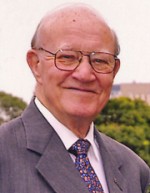
Physicist
Professor Robert Street was born in 1920 in Wakefield in Yorkshire, United Kingdom. His life in physics has indeed been a magnetic one. In 1941 Professor Street received a BSc (special) from the University of London. He began his career during WWII working at the Air Defence Research and Development Establishment researching ‘absolute measurement of power’. In 1944 and 1948 respectively, he received an MSc researching wave mechanics and a PhD on absolute measurement of power from the University of London. After the end of WWII, Professor Street was appointed as an Assistant Lecturer in Physics at the University of Nottingham. In 1954 he became a senior lecturer at Sheffield University. In 1960 Professor Street moved to Australia to become the foundation Professor of Physics at Monash University. In 1966 he earned a DSc from the University of London. In 1974 he was appointed as Director of the Research School of Physical Sciences at the Australian National University. From 1978 until his retirement in 1986 Professor Street was Vice-Chancellor of the University of Western Australia.
Interviewed by David Salt in 2005.
Contents
- Family background and early life
- School years: Important mentors in science
- Wartime: Marriage, radar research and wave mechanics
- Magnetism research at Nottingham and Sheffield
- Across the world to the new Monash University
- Directing ANU physics research
- A return to magnetism, but now in Western Australia
- Practical applications and developments
- Biomagnetism
- Research opportunities and rewards
Family background and early life
Robert, you were born in 1920 into a family where both your grandfathers and your father worked in the coalmines. What was it like, living in a mining community?
I was born in Wakefield, in the West Riding of Yorkshire. This was a market town and also the centre of administration of the local county council, but most of all it was the centre of the West Riding coalmining industry.
My father was one of the miners who volunteered to take part in a voluntary rescue team – each mine had a team which would always be deployed when there were fires or explosions underground. I think he must have caught somebody's eye, because by the time I was born he had been invited to be in the permanent team of the West Riding Mines Rescue Station. So he moved away from being an active coalminer.
This meant that we were to some extent protected from the difficulties of the Depression of the late '20s. Whereas the miners were subject to all the economic forces involved with the reduced demand for coal, my father had a guaranteed means of living and a 'tied' house, one that went with his job.
On the other hand, his was a very dangerous profession.
It was. The permanent mines rescue team were the first to be called out to go underground whenever there were disastrous events. There was always a fear that they would never come back again, and I know of at least one member of that team who was killed underground. It was a very distressing period for my family as a whole, and particularly for my mother – yet she never showed it to us children.
My brother and I were fortunate. Our parents provided us with a serene and stimulating childhood.
Your brother seems to have embraced the thrill of danger too, becoming a professional pilot.
Well, yes. He was a Royal Air Force officer during the Second World War: he flew Spitfires over Europe and then went out to Burma to fly against the Japanese. After the war he continued his RAF career in the Middle East. He also took part in the Berlin airlift when that city was cut off by the Wall and a constant procession of aircraft had to carry in everything, including coal. On retirement he joined the training establishment of BOAC (which became British Airways) and later he was concerned with flying as part of the oil discoveries in the North Sea. He had an adventurous life and now lives in Portugal.
And minerals were a part of his life, as they had been a part of your father's and grandfathers' lives and were to be a part of yours. For you the link was science.
School years: important mentors in science
Even at the age of 12 your stated ambition was to become a professor of physics. What factors in your childhood turned you on to science so much?
I have always thought that in almost any endeavour, if you can discover things for yourself – even though they've already been known for many, many years – this is a real encouragement to continue. That is what happened to me when I was 12.
In those days physics and chemistry were taught as separate subjects, and I became anxious to know what physics was meant to be about. It seemed pointless. Even looking it up at home in Arthur Mee's Children's Encyclopaedia didn't help.
Then in one of our physics lessons the teacher talked about temperature scales and put the question, 'How do you convert from Centigrade to Fahrenheit?' All of a sudden, for some strange reason, it occurred to me exactly how you should do it. I wanted to tell the teacher but he said, 'No, wait until next time.' I rushed out, saw the headmaster outside and couldn't wait to tell him that I had discovered the transformation from Fahrenheit to Centigrade! This might seem trivial now, but it was when I decided I'd become a professor of physics. [Laughs]
That headmaster was quite inspiring, a role model for you.
He was indeed. He was a mentor whom I remember very favourably. I was reasonably good at mathematics, in which he took quite an interest, and he was very encouraging. Looking back, I think maybe I was rather different, unusual – perhaps what would be known nowadays as a nerd. [Laughs] But I just felt interested in doing these things.
The other inspiring figure in those early years, I believe, was your father.
Oh, very much so. My father of all people was the real role model for me. When I was eight or ten I would go down with him to his workshop in the cellar (houses always used to have cellars, for example as a place to store coal, and as a cool area for food), where he taught me how to use simple hand tools – planes, saws, all these things, but not chisels. More importantly, he taught me to look after them. We built all sorts of things, including crystal wireless sets and valve sets. In those days our houses had gas but no electricity, and the valve sets had to be driven by great big 'accumulators', lead acid cells, with 120-volt dry batteries for the high voltage. The soldering was done with a soldering iron which quite often was heated by gas. Or, in emergency, you could stick it into the kitchen fire to heat it up.
You used to have to rely on yourself to make the things you needed, and I have always been grateful to my father for teaching me those skills.
Your knowledge of physics flowered at Hanley High School. You greatly enjoyed being there, and you were inspired by many of your teachers. Can you share with us some of those memories?
Well, again I had two role models. The headmaster, EG Laws, was an Oxford graduate in chemistry and taught us in the 'upper sixth'. I should explain that the sixth was divided into lower sixth, sixth form and upper sixth as three years of specialisation in science, classics or whatever. Laws conducted tutorials as a method of teaching and we were expected to teach ourselves. Every week you had to write full-length essays which he would read and criticise. He taught me a great deal about chemistry and about how to study.
The other very important person was the man in charge of physics. He was a Birmingham University graduate who was very interested in the experimental side of physics, and he let me have the run of the laboratory – I don't think I wrecked much, but he was very tolerant anyway. I was able to observe the Sun's Fraunhofer lines and the absorption lines of sodium and potassium. Somehow I failed to anticipate Alan Walsh's development of atomic absorption spectroscopy as an important analytical tool!
At school I found that my ability to make things, to put things together, enabled me to fudge up, say, a spectrometer to look at the Sun, to have a mirror to reflect and hold the position of sunlight on the slit of the spectrometer. We had a good metal workshop there, very much in the pattern of a 19th century workshop, I suppose. It had a gas engine which worked on ordinary town gas and was a marvel. This drove a series of axles, pulleys and belts which powered drilling machines, lathes and so on. So we were able to make quite a bit of ancillary equipment to do these off-syllabus experiments.
In your father's workshop and then at high school you would be learning by experience the fundamental properties of materials – how they perform and what can happen if you do the wrong thing – rather than simply plugging electrical equipment into a power point or getting something off a computer. And you could actually see how the lathes, the cogs, the mechanisms worked, where today's scientists might just buy a black box off the shelf. Perhaps they no longer have a hands-on, intuitive feel for how to produce the mechanism that gives them the result.
Oh, some people do. We have been talking about a time, up to 75 years ago, when life in general was very different and the technology was very, very different. That became especially clear after the war. And nowadays we do get a picture of 'big science'. It is not unusual to find letters in Physical Review Letters, for example, with many tens of authors listed.
But there are other places in physics where the individual imagination to make things work is still a very useful skill. That's the kind of thing I've been engaged in for most of my life. To me, experimental science has always been an important part of any scientific endeavour.
Wartime: Marriage, radar research and wave mechanics
You had hoped that you might attend Oxford or Cambridge University, but instead you found yourself studying in Bristol. How did that come about?
Well, my headmaster at Hanley was a great one for letting people go for Oxford and Cambridge scholarships. These were big events in Oxford and Cambridge, held twice a year, where groups of colleges set scholarship examinations and then pupils from all kinds of school were in residence for a week to do these examinations. I tried one in Cambridge but was not successful, so I went to the group of college examinations in New College, Oxford, where I was fortunate enough to be awarded an Open Exhibition in natural sciences. (I think I must have been noted as a possible award winner, because part way through the week I was asked to go and meet the master of New College, HAL Fisher, who was a well-known historian. I was enormously impressed by all this.)
I found, however, that I could not go up to Oxford in September 1939 as intended, because I couldn't meet the Latin qualification. My preliminary school had been too small to offer classics subjects – Latin and Greek – and so when I went to Hanley I could not take Latin at high school level. In order to get into Oxford I tried and failed two or three times to pass the supplementary examinations called Responsions. I gave up when my translation from Latin into English depicted a troop of Roman soldiers as crossing a river 'disguised as waterlilies'. That was unreal!
So you began studying a Bachelor of Science in physics at King's College, London, with the Second World War breaking out. Can you tell us about your experiences?
When eventually it was clear that I could not go to Oxford, I made a late application to go to King's College, which I entered in January 1940, not in The Strand but in Bristol. Because of the bombing, King's College had been evacuated from London to Bristol – just when Bristol itself was about to become very much a bombing target.
As you walked at night (we were very foolhardy in many cases) you could hear the shrapnel from the anti-aircraft shells tinkling away on the pavements. We never got hit. And there were great fires in Bristol. The King's College library, in the Great Hall of Bristol University, was just burnt out one night. The whole thing went up in flames. Often when you looked out over Bristol you could see fires all over the place.
It could be very difficult to sleep at night, so you went and slept where you might think there would be shelter. It was an interesting psychological exercise not to be afraid of all these things, and on the whole we took little notice of the war. It must have been more awkward for the people who were trying to teach us than it was for us young people.
Also during the war you met and married your wife.
Oh yes, we met in Bristol. It was during an air raid, I think. (Great unifying events, air raids. You get to talk to people, I suppose to keep your spirits up.) She was doing history at King's College. Incidentally, in Bristol she had digs in the place where Alan Nunn May used to be. He taught me optics in the physics course. Later he was convicted for giving away atomic bomb secrets to the Russians. So you could say my wife had a physics connection too.
When my wife completed her degree in 1942 she was sent to Bletchley Park, where the Foreign Office had its code-breaking operations. I was told that I wasn't to ask her what she did there, and I never have. And she's never told me.
At King's College did you do a two-year or a three-year degree?
It was called a BSc Special. The idea was to get people through these science degrees as quickly as possible so they could then go out either into the forces or into defence establishments where their knowledge of physics could be useful. Having entered the university in January 1940, I had five terms of tuition before I went away from there in 1941. The degree was only awarded the following year, when I was considered to have done my time.
After university, where did you go to work?
Well, various committees toured the universities as part of recruiting people for the armed forces or to go in for the scientific war effort. One such committee – which included CP Snow, the novelist, a very impressive man at the time – came to Bristol to interview physics students. The result of my interview was that I was directed to the Air Defence Research and Development Establishment, in Christchurch, on the south coast of England. When I got there the chief superintendent was JG Cockcroft, after whom a building here at ANU is now named.
I was put into the basic research group, led by CW Oakley. (He was one of the people who, after the war, developed scanning electron microscopy.) There were many other people, mostly from Cambridge, Oxford and other universities, who had been seconded from their posts to work on radar in this defence establishment.
What was your main task there for the war effort?
It was to work on 'absolute measurement of power' at centimetric wavelengths. The radars were operating at frequencies corresponding to wavelengths of 10 centimetres and 3 centimetres, which were called centimetric wavebands. My job was to develop techniques for measuring the power output of the signal generators used to calibrate the receivers that were incorporated in the radar sets of all kinds.
After the war you were able to extend this work and publish it as a PhD thesis.
Yes, I did. Again I was fortunate, because the klystron which I used as the power source was in fact made by Oliphant, a well-known name. It was called a VFO7 – which puzzled me until I learned that 'VFO' stood for 'valve for Oliphant'. The government were interested in continuing this work of absolute power measurement after the war and they made available the equipment, including the VFO7s, which enabled me to continue the work and to get a PhD for it at Nottingham.
Another interest which you began to develop during the war was in material science, looking specifically at the nature of crystal–metal contacts in radar equipment. Can you tell us a little about that?
An essential part of the whole radar system was the 'crystals': a carborundum crystal and a wire contact. Without those, it would have been impossible to get the sensitivity you require for centrimetric radars.
Actually, the device is similar to the kind of things we used for making crystal sets: it is a crystal, with just a point of contact, and it works because the electrons in crystals and solids behave not as ordinary particles but as waves. The way in which they are described is called 'wave mechanics', and it was obvious at that time that wave mechanics had quite a bit to do with the fundamental understanding not only of these semiconductors (as they are called) but also of many other solid-state devices.
This fascinated me, and from talking to one or two people during the war I decided to learn some more about wave mechanics. In particular, a man who was a very great encouragement to me from my days at King's College, HT Flint, suggested that in my spare time – if I had any – I should study wave mechanics. And he offered to help me do this for an external MSc of London University.
That was an interesting episode and I learnt sufficient about wave mechanics to get me an MSc in 1944. But I never did really understand how it was responsible for the behaviour of point contacts on semi-conductors.
You commented that you were very close to devising a transistor. Was that connected to this particular work?
[Chuckles] Well, it could have been, but you know how people exaggerate, don't you? If I'd understood the wave mechanics business of the point contacts, just maybe in a million years I would have put two wires onto that crystal to see whether the current through one affected the current through the other. Nowadays it seems such an obvious thing to do, as they did in Bell Telephone Labs, to produce the point contact transistor.
When people first developed the transistor, did they recognise it as the gateway to a more modern age?
I really don't know. But I knew the people who were involved. They were interested in magnetism as well, as I was later. It would have been a very interesting question to ask. I'm afraid my life is full of questions I never asked and should have done.
You have mentioned the evacuation of King's College from London to Bristol. Didn't you experience another move while you were working on the English coast?
Yes. At one stage during the war, paratroopers of the Scottish Border Regiment raided Bruneval, a town in France where the Germans had placed radar equipment on a cliff overlooking the [English] Channel. This was a bit of a nuisance for people flying aeroplanes over from Britain, so it was decided to go over there and take away the important parts of the equipment for us to learn more about them. Interestingly, the raiders got away with it, dismantling the things which they needed to bring back and returning to England by submarine. We had one or two of those bits to play with, but mainly they went to the Telecommunications Research Establishment (TRE), in Malvern.
Then somebody had the very sensible thought, 'If we can do that to Bruneval, what's to stop the Germans from doing it to Christchurch?' A weekend exercise, when we were told to stay out of harm's way in the labs (we worked on Saturdays and Sundays) indicated that the local Home Guard, the 'Dad's Army', even with the locally based battalion of soldiers, could not defend us against an attack from the sea or from the air. They couldn't do anything to stop our equipment from being pinched by raiders from overseas.
So in about a week's time the whole of the road system from Christchurch up to Malvern, in almost the exact middle of England, was occupied by Pickford's moving vans, with all the equipment – everything – piled up and sent off to be reassembled. And the army were absolutely magnificent in moving us up to Malvern. That was an interesting event. People certainly got things done in those days.
Although you have said that in many ways you weren't aware of the war, the fact is that everything you were doing might be changed within a few days. The buildings or the city you were in might suddenly not be there. Perhaps you took the possibility of such change for granted, simply because you were living your life as part of the war.
That's a good thought, yes.
Magnetism research at Nottingham and Sheffield
After the war, I suppose, things seemed likely to be more stable. And in a sense this is when your academic research life took off.
Very much, yes.
You were appointed assistant lecturer in physics at the University College, Nottingham, and began investigating the effects of magnetic fields on the mechanical properties of magnetic materials, the delta-E effect. Can you tell us about this work?
When I went to Nottingham the person in charge was LF Bates, one of Rutherford's students. He was very interested in the magnetic properties of materials, and had made some significant contributions. He suggested that I might be interested in magnetism, and suggested the topic of the delta-E effect.
If you have a rod of a ferromagnetic material, such as iron, you can drive it in resonance, you can make it ring, by using coils in various ways. And the Young's modulus – the mechanical properties of the material – is affected by a magnetic field which you apply. We were interested to look at what this could tell us about the way in which the process of magnetisation occurs in those materials.
So we assembled the equipment we needed. We made solenoids in the workshop, and Bates (who had worked for the Admiralty during the war, on degaussing of ships) was able to get a whole bank of lead acid cells as a power source. We built those up and had charging devices to provide the steady current that we needed for our solenoids and the electromagnets. Also, Bates was interested in permanent magnets and had a connection with the Sheffield manufacturers of Alnico, which was the best material for making permanent magnets in those days. So he got us Alnico rods from the manufacturers.
At that time the government was always very supportive of university research, and commercial firms went out of their way to help.
We set out to measure the resonance I have mentioned, but no matter what we did, we found that whenever we changed the magnetic field, the signals were not nice and steady but were varying. They went off rapidly to start with but then became slower and slower. This was a real puzzle. We chased after this, doing all sorts of experiments, and eventually we found that the mechanical property, the Young's modulus, was varying in time following a sudden change in applied magnetic field.
This led to a lifelong obsession with studying and trying to understand the time dependence of magnetisation, because it tells you quite a lot about what's going on inside a magnetic material. And time dependence, as we saw later, occurs in all sorts of ways in all sorts of systems.
Were you the only people working on time dependence?
No, but our early work continued to be referred to for many years after it was first published. In 1949, Patrick Blackett, a Nobel Prize winner, in Manchester University, had the idea that the magnetic field of astronomical bodies might be related directly to their angular momenta. The Sun has a magnetic field, the Earth has a magnetic field, and for some reason he thought that perhaps the magnetic moment, the magnetic field, of these objects was related to the spinning of the object on its axis. He could only work on the Earth to investigate this, so he began to investigate if the Earth's magnetic field decreased with depth below the surface – a consequence of his hypothesis.
He made many measurements of the Earth's magnetic field down coalmines. He found that his original idea was wrong. But he did find that rocks all around him down there were magnetised. It was later shown that rocks contain a record of the Earth's magnetic field and this in turn was used as data on the drift of continents over geological time.
Now we come to the main question: How does the rock maintain its record of what happened to it when it was laid down or when it came out of a volcano? You've got to understand that there is a process which has lasted for many, many millions of years. How can this be? The time dependence, the stability, of these rocks is obviously of very great importance.
This was being studied by Louis Néel, in Grenoble, in 1949. He discovered that if particles in rocks were small enough and if the material was of a proper kind, then at a sufficiently low temperature you could maintain the magnetisation that had been induced at the high temperature. So he asked, 'What is the stability at low temperature?' And he published a paper on this, entitled 'Time dependence of small particles'.
Néel's work on small particles was quite unknown to us, just as our work on bulk materials was unknown to him. It was interesting that these things happened at much the same time.
Which is a common theme in so much science.
It is indeed. Later I disagreed with the way he presented some of his findings, but I had a long correspondence with him and I knew him quite well in France. He got a Nobel Prize for magnetism.
Your time in Nottingham, then, was very productive for you. I suppose it was the base upon which you did everything subsequently.
Yes.
In 1954 you took up the position of senior lecturer at Sheffield University, where you made a series of low-temperature studies that required the building of a hydrogen liquefier.
To liquefy hydrogen you have to compress it and pass it through heat exchangers. Then it comes through a Joule-Kelvin valve, and you get liquefaction. So you take your hydrogen from cylinders and you put it into compressors.
All we had were air compressors, with fins on, like a motorcycle cylinder. But when you compress hydrogen it's a different proposition from compressing air, because when you compress a gas you heat it, and in the case of hydrogen that heat is really quite large. So although the compressor wasn't quite glowing, it was pretty hot. And we put these compressors under the floor of the room where we had the hydrogen liquefier. We had no hydrogen detectors; it has always seemed to me a great tribute to the people who made the joints in all the piping that they didn't leak hydrogen, because if they had leaked I'm sure I wouldn't be here now, and neither would half the university. It would have been a big explosion, I think.
The professor there was Sucksmith, a very significant figure in magnetism from way back. And I well remember the occasion, very late at night, when the liquefier started liquefying and we got the liquid hydrogen out. Without realising how late it was, I thought it would be a good idea to telephone Sucksmith at home – and he never showed in any way that he was upset at being wakened and told, 'There's a hydrogen liquefier up the road, working.' That was quite an event.
I suppose that in the past you would have used liquid nitrogen in order to work on materials at low temperatures, and in the future you'd probably be using not liquid hydrogen but liquid helium and so on.
Very much so, and even measuring in microkelvins. Magnetism is one of many phenomena where doing things becomes simpler at lower temperatures. So there was a need in the laboratory for our liquefier, and it was also used by another researcher, John Crangle, who was very interested in low-temperature properties of materials.
Across the world to the new Monash University
After several years at two universities in England, and having produced some landmark papers on magnetism and its time dependency, in 1960 you moved to Australia to become the foundation professor of physics at Monash University. That must have been a big leap into the unknown. What possessed you?
Well, I discussed with Sucksmith whether I should apply for the position. He seemed somewhat disillusioned with what was going on in universities in England at the time: there was to be a great expansion, with technical colleges and so on being upgraded to university status. I suspect that Sucksmith thought this was a dilution of the ideal that he and many others had been brought up with and held dear, that a university filled an almost sacred role, one where research should not be displaced entirely by first-degree giving. And perhaps he had reached an age where people tend to become disillusioned with, say, the management of a university. Perhaps all this had combined to make him a 'grumpy old man'.
Anyway, he said he really didn't see much in the way of a future for promotion in the university system, and encouraged me to apply for a professorship with this new university. And very quickly I was asked to attend an interview in Manchester, just over the hill from Sheffield. That started off extremely well even though Louis Matheson, the newly-appointed vice-chancellor of Monash University, appeared for the interview a little late – he was dressed in cricket flannels, because he'd just got away from a cricket match where he'd been batting!
It turned out that he was a charismatic person, filled with the fire of doing something very much worth while in building a university from scratch. Talking to him I found it an extremely appealing proposition. But it was a tremendous leap for me and my family. Australia was unknown to us, beyond the image and the example that Matheson was projecting.
Before making a definite decision I was invited to come out, as they said, 'to enable you to look us over'. I was enormously impressed by the enthusiasm of these people, who had been drawn from many walks of life. The academic as well as the professional and technical staff all seemed to be intent on getting a university up and running in something like four months. And that's what happened. The university opened its doors in February 1961 with 350 students, in about four faculties. (So you can see how small it was.) It went on from there exponentially, until now Monash is one of the really big universities, and an outstanding one.
This was the first of the 'new' universities which came out of Menzies' initiative of reforming the university system of Australia. There was a sort of bipartite arrangement in running universities in those days, and Bolte, the then Premier of Victoria, was very supportive of Monash – no matter what problems he may have had with students later on. Everybody was supportive. It was a delight not to be penny-pinching the whole time but to be able to ask for the buildings and equipment that would make it good.
That seems a far cry from today's economic rationalist times.
It was a different world, completely. And the idea did appeal to me, to build a new university, being supported financially in every way. Strange as it seems now, all you had to do was to ask. So I asked for all sorts of things: a helium liquefier to avoid the possibility of blowing ourselves up with hydrogen, electron microscopes, big magnets, equipment to put in the laboratories, lecture theatres, all these things –and they were there in abundance. We had it very easy.
It strikes me that many of your decisions, including the move to Australia, are based as much as anything else on the feelings of people you respect. Your decisions have been driven by the people you have met and taken advice from, people who have inspired you, rather than the prospect of doing specific research.
Yes. My father started off this kind of feeling in me, and since then many people that I can identify have really cheered me on and encouraged me. It's been very important.
You came out to Australia in November 1960, bringing your wife and your two young children. What was it like to be living in Melbourne in those first years?
Marvellous! Oh, we were very fortunate. People probably realised the kind of difficulties that we would experience in coming to a different environment, and they looked after us well. I've never regretted coming out here. Our daughter and son went to excellent schools and had really very good lives, I think. We have done very well and Australia has been good to us.
And I would suggest that Australia has done well from having you here. To look just at your time at Monash University: above and beyond university science and teaching, you were involved with science education through the development of the Victorian physics curriculum, science communication through an ABC TV science program, professional development through the Australian Institute of Physics, and science policy and funding through work with the Australian Atomic Energy Commission, the National Standards Commission, the Metric Conversion Board and the ARGC, which was the precursor to the ARC [the Australian Research Council].
Admittedly, that was over several years, but still each one of those would have required a significant time investment. What was driving you at this time?
Well, I suppose it was youth. It didn't seem to me to be at all busy, but now you say it, there were a lot of things going on, which is quite extraordinary. [Laughs]
I didn't even list all of them!
When you're interested in things you do them – that's really what was happening.
In particular, have you any memories of the time with the Australian Atomic Energy Commission, in terms of what Australia was doing with its atomic policy?
Oh yes. Philip Baxter, a very distinguished chemical engineer, was the chairman of the Atomic Energy Commission and was another very busy man. He had an ABC TV program called Science Question Time, where I appeared quite regularly (it was fun), and so I knew him reasonably well from that and other kinds of meetings.
He asked whether I would go on a committee to advise the government on the use of atomic energy in Australia. He was very keen for Australia to be involved with atomic energy, and we as a group considered the possibilities of building a nuclear power reactor at Jervis Bay. That is part of the Australian Capital Territory, so it seemed there would be very little in the way of Commonwealth–state argument about the idea.
But almost overnight Mr McMahon, as Prime Minister – who until that time had been reasonably supportive, I understand – decided that it would not go ahead. I think this was a great disappointment to Philip Baxter, who had set his heart on it and did believe, I think, that it would be in the best interests of Australia.
It is very interesting to speculate where we would have been now, if that reactor had been built. There are arguments for and against, of course.
Science and technology and politics have always been strange bedfellows.
[Chuckles] Very, yes.
Directing ANU physics research
In 1974 you were appointed as director of the Research School of Physical Sciences (RSPhysS), at the Australian National University (ANU). This wasn't the happiest of times for you. Can you tell us what the problem was here?
'Not the happiest of times' is probably a correct description. I really knew nothing at all about ANU, and nothing about how the research school was organised and run. I would say I knew more about Australia when we came to Monash than I did about ANU when I came here. I wasn't aware of all the intersecting streams of events and internal politics. In particular, I should have discussed in far more detail the history leading up to the directorship being vacant. Why did that vacancy occur? Was it management initiated, or a personal decision? I didn't ask about any of these things.
I had been asked by the deputy vice-chancellor whether I would submit my name to be director here, and I really wondered why, because there were so many people in the RSPhysS who were obvious candidates. They were grounded in the culture. I thought maybe my invitation to apply was part of the well-known principle of getting someone from outside to gauge the internal people against. But it wasn't. I came up from Melbourne for an interview and very surprisingly I was offered the job – and surprisingly quickly.
But I was very much an outsider, and I soon discovered that none of the people looking after the various divisions in the research school were in favour of my appointment as director.
Because the school was research-only from its inception, it would have been a very different place from Australian university departments which had responsibilities for both teaching and research.
Yes, very different, but at first I was not really aware of the prevailing ethos. In a teaching university the objective is to develop students at the undergraduate and postgraduate levels. Everybody has a concern over the quality being exercised by their fellows and is willing to help them out if need be. Here the departments were all very separate – whether by design or not, I don't know – with separate goals and no reason to collaborate in any way whatsoever. They were separate entities with, as I came to see it, no unifying principle or endeavour, no common purpose.
I had the rather naïve idea that maybe if the researchers were involved in undergraduate teaching there could be two advantages: they could help students in the School of General Studies to see subjects from a different perspective, and an important spin-off would be to attract undergraduate students to the postgraduate work that was going on. In an attempt to implement this idea I went over to the School of General Studies and asked whether they'd be interested in courses on magnetism. They said yes, so I was very pleased to prepare lectures (which I enjoyed doing) even though that had to be fitted in at 4 o'clock in the morning, and to give a course on magnetism to the senior undergraduate people. But no-one else in the research school followed that suggestion. I have often thought it could have been to their own advantage.
You were looking, I suppose, for a unified endeavour such as probably existed at Monash when you were growing it from a small base. It would definitely have been the feeling in wartime England when everyone was pulling for the same outcome.
Oh yes, that's all true. But you can't blame people for wanting to take every advantage of their circumstances. Good luck to them. It was certainly a different environment from what I would have expected, though.
You found special challenges in relation to astronomy, I think.
Yes. As time went on, astronomy seemed to be one of the difficult things, a source of tension. Balancing that, however, is the successful setting up of the Anglo-Australian Telescope.
The UK and Australia had agreed to set up a magnificent optical telescope in Australia. But there was a great deal of tension between the two governments about whether this would be fully a joint UK–Australia endeavour. The site which was chosen for the telescope was Mount Siding Spring, which is the home of the ANU facility – again very nice instruments – with Olin Eggen as director. I think the university management was hoping that the Anglo-Australian Telescope would really be an ANU creature, but the UK were not in favour of that because the telescope could easily be taken over and the whole spirit of cooperation could disappear.
When I was appointed as director of the research school, Fred White (who was on the University Senate) asked me to establish contact with Olin Eggen – because, I later realised, White had it in mind that somebody or something had to settle the tension between the parties. And then the Australian Minister for Science appointed me as the third Australian member of the six-member UK–Australia committee. There was a rotating chairman, who at that time was Fred Hoyle. The other British people were the Astronomer Royal for Scotland and an administrator from the UK Ministry for Science. With me in our group were Paul Wild, a later chairman of CSIRO, and Hugh Ennor, the permanent head of the Department of Science and Education.
Between us we were able to come to agreements which resulted in the magnificent Anglo-Australian Telescope, which was opened by Prince Charles – a splendid occasion. I think it has more than justified its existence and the money that was spent on it, and its reports attest to the collaboration between UK and Australian astronomers. It really has been quite remarkable, one of the great success stories of science in Australia.
So there were highs as well as lows during your time at ANU?
Yes, there were. I must say, in particular, that Ernest Titterton – my predecessor at the Research School of Physical Sciences – was very supportive of me as director. I appreciated his support very much.
A return to magnetism, but now in Western Australia
Following your time at ANU, in 1978 you took up the position of vice-chancellor at the University of Western Australia (UWA). Your move from Canberra across to Perth must have been almost as big as from England out to Australia. Can you tell us about it?
Again I was responding to an invitation, and I was enormously impressed by the people there. The real driver of it was the chancellor of the university, Lawrence Jackson, the Chief Justice of the Supreme Court. He was a most delightful man who always claimed that the only function of the chancellor of a university was to appoint the vice-chancellor. I was very pleased that he appointed me!
I was very pleased also to be part of that university, and never regretted going over there. It was a long-established institution and the people involved took a jealous pride in its being the only free university in Australia. (University education was provided by the state, and by the university. Of course, that's changed these days.) Everybody I met in the university and in the outside community looked upon it as a real benefit to them and cherished it. I felt that people supported it in ways which were quite unknown in other parts of Australia, and everywhere there was a warm welcome as though you were doing something worth while for them.
Was that for you, or for the vice-chancellor of a respected institution, or both?
Oh, I would say both. [Chuckles] The other thing about it is that my wife was received in exactly the same way. So it wasn't just respect for the office of Vice-Chancellor but a real friendship, which has lasted all these years afterwards.
You retired in 1986, but then an earlier chapter of your scientific career reopened for you. Could you tell us how that came about?
During the time I was vice-chancellor, I used to read Physical Review Letters quickly before passing it on to people who had more pressing need for it. Consequently I kept reasonably well aware of developments, though not in detail.
In this way I heard of the discovery of a new range of permanent magnet materials – things like neodymium, iron and boron – based on 'rare-earth' materials, which are not rare at all. These materials, in alloy form, produce extremely powerful magnets, so powerful that if you have a reasonably sized one and you're not careful, you can trap your thumb and break your finger. They come together with a really big bang. I recalled that in 1949 we'd established that the more powerful permanent magnets are, the more pronounced will be the time-dependence effects.
So I got in touch with CSIRO, where two students of mine from Monash who were interested in magnetism were working, and asked whether CSIRO had facilities for making measurements on these permanent magnet materials. They said yes, so I went over and we measured the magnetisation of some samples of these materials as the magnetic field was varied, just as we'd done in the old days. Now, however, the lab was much more automated than in the past.
And one night (all these things, it seemed, happened at night) there we were in the lab measuring, for the first time, the magnetisation of a rare-earth permanent magnet when the magnetic field had been changed. We sat and marvelled as, sure enough, the pen on the chart recorder went shooting across and then gradually moved more and more slowly. That particular process is a logarithmic variation with time – it starts fast and then goes more and more slowly, but never ends. We had predicted in 1949 that it would vary according to a logarithm of time, and there it was. We just sat there watching it, over and over again.
Did it make you feel proud, that basically your theory was the right one?
No, not really. We were just marvelling that we could say what was going to happen and then see it happening!
The new breed of supermagnets that were being fabricated gave you the impetus to set up a magnetics laboratory in 1988, so in effect after being vice-chancellor you were going back into the research stream – and in a field you had helped to pioneer after the war.
That's right. After we did that work in CSIRO, papers were published which led the Australian Research Council (ARC) to support us very well indeed. We were able to buy equipment and build up a laboratory in the Physics Department which we called the magnetics lab.
And again a very important component of that was the technical staff, the laboratory manager, who made all these things possible. Also, one day when I was there a girl came in and said she would like to do postgraduate research. I asked, 'Are you interested in working on magnetism?' She said yes, and that's how Liesl Folks came down into the magnetics laboratory. She really made that place. She worked very well indeed, she was a very good organiser, she encouraged everybody. She read their theses, told them where it was wrong, all this kind of thing. She and Rob Woodward, between them – with ARC support – built up this magnetics laboratory. That's how it happened.
The work in CSIRO opened up new possibilities for you, it seems.
Yes, it did. At about that time, Paul McCormick, the professor of material and mechanical engineering in UWA, was interested in 'mechanochemical processing' (MCP), which I will explain. Suppose you want to make an alloy of something. You try and induce a chemical reaction causing A to combine with B and form an alloy AB. The alloy will be formed if the energy of the product is lower than the sum of the individual energies of the beginning material, and the usual way to bring this process about is to melt the two things together – once you start heating them, thermal energy is produced and you get the alloy.
Paul McCormick's idea was that you should initiate this process by high-energy ball milling: you should take these products together and ball mill them. The energy required to produce the combination would be provided mechanically and not by heat. While the difference may sound trivial, it means that you can really control the speed at which the reaction occurs – if you put in diluents of various kinds, you can slow the reaction. And if you put in diluents of different kinds, you can change the shape of the particles, you can change their size. He had done a great deal of work on this MCP to investigate all these propositions.
With the work going on in the magnetics lab that I'd founded, we were becoming more and more interested in permanent magnet materials in fine particle form. So it was very good indeed that we could collaborate with Paul McCormick – and it was a very close collaboration – to produce materials which had potential as permanent magnets. We took patents out on this, and the whole thing was quite an exciting exercise. I would say Paul McCormick has been the last in the line of my encouragers.
Practical applications and developments
You have also been associated with the company Advanced Nanotechnology, which was an early driver of nanotechnology in Australia and was known for its 'invisible sunscreen'. Could you talk about your association there?
A company called Argyle, in Western Australia, had a deposit of rare earths, and the possibility was that they would be interested in developing these deposits for permanent magnets – which we'd been working away on. The science man of that company was Frank Honey, and I well remember a meeting with him outside the engineering school where Paul McCormick said, 'Would you like to be a member of a company called APT (Advanced Powder Technology)?' We said yes, he said, 'That will cost you $1,000. Done.'
In fact, I don't know where his vision for this came from, but that beginning proved to be quite remarkable, because the university took the proposal on and there were investments from all over the place. In January of this year the company changed its name to Nanotechnology and was floated on the stock exchange – very successfully, I think. It has been really an interesting commercial scientific venture.
It is held up, actually, as one of the first examples of successful nanotechnology in practice. Yet the product it is probably best known for is a sunscreen!
It is a bit of an irony, because with the MCP technique, where you know a lot about how to make particles of specific sizes and shapes, magnets are no longer of interest. The initial connection has disappeared.
This new product contains nanoparticles of zinc oxide, a sunscreen protection screen for use on the face, making the sunscreen transparent to visible light. So you don't have to be seen with zinc cream over your face, and the nano zinc is more efficient than the ordinary visible cream. It has been marketed in Italy and France, and is also used in cosmetics which are sold in Australia.
I believe another suggested use of mechanochemical processing is for safely destroying toxic wastes.
Oh yes. We wrote a letter to Nature stating that any chemical process which has this chemical characteristic, that the product has a lower energy than the things you are starting with, will go with mechanical processing. And by adding diluents of various kinds you can control the speed, and maybe in some cases the quality, the composition, of the final product.
We looked at PCBs – toxic materials that are used in transformers and are awfully difficult to get rid of – and highly poisonous insecticides, which also pose a very great disposal problem. (For example, how do you destroy DDT? If you burn it you may get dioxins, and all that kind of thing.) We did a large number of experiments with typical examples of toxic wastes of various kinds, and we showed by mass spectrometry, which was the nicest way of determining the composition of the end products, that in very many cases you could reduce the toxic material to completely harmless simpler materials. Possibly you could even use mechanochemical processing to destroy nerve gases, which are genetically similar to some of the other toxic materials. Of course, we didn't try that one.
What is more, you would no longer need to transport those toxic materials around. Quite a number of dangerous insecticides are stored away in farm buildings, usually in leaky cans, and it would not be good to try and transport them. Paul McCormick's vision was that you could put a ball mill on the back of a truck and take that, together with your various bits and pieces, to the site where these things were being stored. And there you would just ball mill them to make this chemical reaction.
Although that was written up in a Nature letter, nothing much happened. We approached a few people, including CRA Ltd, but this was not mainstream and so they were not interested.
More recently, however, you have been working as a research mentor at CRA. Is this in connection with the magnetics lab, or with you as an individual?
With me as an individual, I think. CRA – which has now been re-absorbed into the Rio Tinto group – had a research facility called Advanced Technology Development (ATD), at Technology Park, Bentley, in Perth. And it happened that Ian Smith, the father of a PhD student of mine in the magnetics lab at UWA, was there. Ian had come from Queensland University, where he had been impressed by the way in which companies got mentors from a university environment to go and talk about their work to the company people who were involved in the research programs. He asked whether I would like to do that.
I thought that was a pretty good idea, especially as one or two of my PhD students were working for CRA ATD. So I used to go there once a week, and anybody who wanted to talk about anything would come for a discussion. Quite a few interesting ideas came out of that.
Did any actual projects result from those discussions?
Oh yes. One which I think we were very pleased with addressed the problem of deterioration of railway lines in the Pilbara. The Hamersley Iron Company digs out iron ore in huge quantities and runs it down from inland to the coast in huge trains of very heavily loaded trucks. The trains themselves can be kilometres long, and the haulage distance can be as much as 400 kilometres. I have been up there to see this myself, and it is quite an amazing enterprise.
But the rail lines are really very badly hurt when these trucks are coming down. You can always tell which way is the coast, from the direction of the little corrugations you can feel by running your finger over the rail. If a rail breaks and a two-kilometre train comes off the line, you have a real problem.
The company was very interested in the possibility of automatically evaluating the defects in those rails. So Libby Feutrill, a PhD graduate who was one of my research students at the magnetics lab, and Sid Hay were given the job of how to detect defects in rails when you're travelling in a railcar or research vehicle at 80 kilometres an hour. (If you're going to run up and down 400 kilometres, you don't want to spend too long on it.)
Anyway, what we decided was a very simple thing. A rail is made of iron, or steel. If you run a high-energy permanent magnet over the rail, you will magnetise it and any defect will have a stray field associated with it. So what you do is to follow that magnetising magnet by a system of detectors, which you can arrange across the rail so that every time a stray field is detected you can record where in the rail the defect is. You can also tell how far along the rail that defect has occurred, because these rails are welded and every weld has a characteristic signal.
So you know from your continuous record where the detector was, where the defect was and how it was distributed across the rails. You can just run this thing up a rail to give a complete picture of the defects existing at that time. And you can, if you wish, compare that with a record previously taken: you can see the amount of deterioration and identify, before the rail breaks, the parts that could fail and should be replaced.
Would that apply to any steel structure?
Oh yes, so long as you can move something over it. Previously the Hamersley people were using ultrasonics and the echoes from defects. But to do that at 80 kilometres an hour is not very easy. This proved remarkably easy.
It was patented, I believe.
Yes. All these things become, quite properly, the property of the company, and what they do with them has to be driven by commercial interests. So I don't really know what happened to it all, or whether it is still being used. But there was a suggestion that maybe it could be applied to the British rail system, where things were falling off rail tracks and causing losses.
Certainly it had a potential. But these things never fully realise their total potential as you see it initially. Always little snags occur.
Biomagnetism
Magnetism, I suppose, entwines our very being and our world around us. You have worked on a couple of projects in biomagnetism in recent years. Can you tell us how that came about?
All these things evolve – starting off with permanent magnets, we can end up with sunscreen. The magnetics lab, since its foundation, has evolved in different ways, and one way has been towards biomagnetism, the use of magnetic techniques in medicine, in biology. We have had two significant involvements with that.
The first one arose from a beautiful idea developed by Tim St Pierre, who worked in the lab. The principle is very simple. Magnetic resonance imaging (MRI) is a very good technique for imaging the internal structures of human bodies. It works because there are protons in the water that is contained in the body, and if you apply a magnetic field you can excite a proton into resonance; it will rotate. The idea of MRI is that you can detect that resonance signal and find where it was emitted, and thus you can plot the density of protons in the human body to get a pattern of what's going on. It is a very useful diagnostic tool.
Tim St Pierre thought, 'well, protons, when they are excited into resonance, do something else: they decay. They rotate and then they gradually slow down.' He noted that when protons are near iron, the rate of decay is increased – protons near iron deposits will decay more rapidly than others. He suggested that all you need to do is to change the protocol of the system's data collection, to measure not only frequency and location but the rate at which the thing relaxes. And he called this 'relaxometry'.
Now, why is this interesting and important? Well, there is a whole range of iron overload diseases, chiefly iron overload in the liver. And when he modified slightly the data collection of an MRI machine to look on relaxometry, sure enough, he got a three-dimensional pattern of the distribution of iron in the liver.
The importance of this is that the only other way of detecting iron in the liver is through a biopsy. You drill a little hole, take a cork borer, as it were, and pull out a sample. That is not very nice. It also is very localised – you might be near a whole great heap of iron but you won't find it if you've put in the probe in the wrong way. MRI, however, can give you a three-dimensional picture.
So now a company called Inner Vision Biometrics has been set up to work in this field. It will supply the modified sequence of pulses for a standard MRI to collect that information, and now the clever bit comes: 'You get our system of pulses, you collect the data, you send it by email to us, and we will analyse it and let you have the results in 24 hours, anywhere in the world.' That seems to me a stroke of genius.
And is that actually what's happening at the moment?
It is, and the company has been very successful. What is more, iron overload in the liver is prevalent in Mediterranean countries, particularly in Egypt, where the disease is of such distribution that the government supports any treatment for it. Once you get government support, the shares in the company go up!
Biomagnetism has also been applied in a treatment for liver cancer, I think.
Yes. That too began in the lab, in response to an idea that a professor of surgery at UWA had developed while he was still in Melbourne. He took small proteins in the form of microspheres and directed them through the vascular system to various places, including the liver. So by drug control he could deposit these microspheres in people's liver cancers. He then moved on to load the microspheres with yttrium – which can be made radioactive at Lucas Heights – because radioactive materials can destroy cancer.
Now came a further idea. If you heat any cell to above 45 degrees Celsius it dies. Would it be possible to heat the cancer, perhaps using radioactive treatment and heat treatment jointly? If so, how do you get the heat?
Well, you put in microspheres which have a core of magnetic material. You see, when you have a magnetic material and you cycle it through with a magnetic field, it heats. So you have now a non-invasive way of treating liver cancer. By putting your patient in the middle of a system of coils, perhaps, to produce varying magnetic fields, you heat the microspheres that you have loaded with magnetic materials and deposited in the liver cancer cells.
The original work on the processes responsible for the heating when you are applying magnetic fields was done in the laboratory by PhD students, and then of course it was taken over and developed medically, commercially, in this way. A company operating the process floated on the stock exchange quite some time ago.
So there would be a world of applications there, most of which probably haven't even been thought up yet.
I think that's so.
Do you still have much involvement with the magnetics lab?
Oh, I go in. The real problem is that the young are getting much too clever these days!
Research opportunities and rewards
Robert, do magnetic materials still hold a lot of untapped potential, say for an early-career researcher looking to make a mark in the world?
Yes. An interesting case in point came up from the biological side of things. I was told that at the bottom of smelly pools, almost anywhere in the world, there are a whole series of bacteria which you can see under the microscope and which are magnetotactic: they respond to the direction of a magnetic field. That seems to me quite remarkable. It's not the same as iron filings going and attaching themselves to a permanent magnet. These bacteria know which way the field is oriented.
I've spent many an hour looking at these magnetotactic bacteria under a microscope – which is easy to do, even with a very simple microscope, because some of them are quite big – and watching them respond to a little magnet. You see them swimming one way, and when you turn the magnet over they swim back the other way, and so on. The poor little things become completely confused.
The real problem is: how do they get that way? They assemble within themselves molecules of magnetite, but how do they know which way the little magnets in those molecules are oriented? You see, on their back they've got a little motor of hairlike cilia, which rotate and drive the bacteria in one particular direction only. (I don't think they've got reverse.)
Now, in the northern hemisphere the Earth's magnetic field dips downwards; in the southern hemisphere it rears upwards out of the surface. And these magnetotactic bacteria differ in the north and the south. The motor is on one end in the northern hemisphere and on the other end in the southern hemisphere. They need to find their way up or down in the water, but how do they assemble the little magnets which enable them to find the proper direction?
I think that initially half of them must have their magnets pointing in a direction which means that they'll be able to swim upwards; the other half, unfortunately, must be made so that they have their magnets pointing the other way and they can only swim downwards. If that is so, and if the bacteria need nutrients which occur above the level of the slime – oxygen, for example – the first half will live, the others will die. I think it's as simple as that.
The next thing we can ask is, 'Well now, here I have a system of beautifully regular magnetic particles. They're all very similar in size. What can I do with them?' Of course, if you're interested in time-dependent magnetisation, you say, 'All right, I'm going to apply a pulse of magnetic field. And if it's big enough and long enough, I'll reverse the magnetisation of the bacteria.' Then you can easily see which ones have been reversed, because they begin to swim in the opposite direction to the rest. Now you have a technique for studying time-dependent magnetisation in a natural material, the bacteria.
Not only does this fascinate me but it fascinates PhD students, who can think of new applications. It is interesting that once you get into this biological area, you have an expanded range of people – women – who are ideally suited to this kind of thinking, whereas I suspect that the male of the species tends not to want to be bothered too much about it. So what has happened in the magnetics lab is that girls are a significant proportion, possibly 50 per cent, of the people who come and work on these problems. They're there the whole time, and I think in the biological area it really is quite amazing.
Possibly this field is just opening up, even as we speak.
I agree, yes. And now courses on biomagnetism are being given in the university.
It seems to me that there's a genetic connection here with biomagnetism in these bacteria. At the moment, the common ways to filter out engineered bacteria from those that don't pick up a gene are to use either pesticide resistance or fluorescence, glowing in the dark. To have a magnetic gene might be another way to do this, and could be a whole field unto itself.
Do you want to do a PhD in biomagnetism? [Chuckles]
That kind of thinking, for example in brainstorming sessions, can be quite important. For example, who would ever have thought that you could study time-dependent magnetisations in colonies of bacteria? Yet it does tell you useful information about not only the bacteria but the physical mechanisms in the magnetic cores as well. And now you're saying that there is another dimension which takes it out of the magnetic core and uses that as a genetic marker. I think many people could find that appealing.
Earlier you were saying that Australia has been very good to you, and I think our conversation has highlighted the fact that you have made enormous contributions to Australia. In 1985 you were awarded an Order of Australia, and I believe that this year your daughter was also awarded an AO. Can you tell us a bit about that?
Well, her citation was for services to medicine. She is a haematologist at the Alfred Hospital and a professor at Monash, and very much involved with haemophilia on an international scale. The other thing that she was awarded the AO for was management of transfusion related diseases – things like AIDS and hepatitis, which are very much blood related. So she has done a great deal.
In addition, she's been very active as an examiner in the colleges of physicians and pathologists, and she's taken this kind of activity overseas to the Philippines and other such places where people wish to qualify and then come and practise in Australia. I think her view is that she goes over there to help them achieve this kind of ambition, and also to make certain that their qualifications are up to a proper standard. We are very proud of her.
My final question is more about the arc of your life. You were born in a coalmining community and you now live as a scientific elder in a mining state in a mineral-based country, where there are many mineral-connected applications of the work you are doing. Do you think that the young Robert Street in Wakefield, Yorkshire, wanting at the age of 12 to become a professor of physics, would be happy with the pathway that you've walked down to become a scientific statesman in Perth, Western Australia?
I can tell you exactly what he thinks! I've been very, very fortunate and I wouldn't have changed one item of it for anything. Somebody, I think, has already said that this is rather a childlike existence. I think it is, and as soon as you lose the idea of wonder at very simple things happening to you, you may as well go and be a grumpy old man somewhere else. Life has been very good to our family.
Robert, thanks for reflecting with us today on your 'magnetic career'.

Dr Guy White (1925-2018), physicist
Physicist
Guy Kendall White was born in Sydney in 1925 but spent his early years in country New South Wales. In 1935 he moved to Rose Bay, Sydney where he attended Scots College. After high school, White completed a BSc (Hons 1) (1942-45) and an MSc (1946-47), both from the University of Sydney. During his university holidays, White worked at CSIRO’s National Standards Laboratory on wartime projects. In 1947 he took up a CSIR Overseas Studentship to attend Oxford, graduating with a PhD in 1950.
White returned to Australia as a research officer at the CSIRO Division of Physics (1950-53). White moved continents again in 1953, this time to the National Research Council, Ottawa. Here he worked as a post-doctoral fellow (1953-54) and then associate research officer (1955-58). The warm weather lured White back to the CSIRO Division of Physics where he worked as a principal research scientist (1958-62), senior principal research scientist (1962-69) and chief research scientist (1969-90). While at CSIRO, White visited the prestigious Bell Laboratories in New Jersey as invited visiting scientist (1965-66) and the Universities of Oxford and Leeds as a senior visiting scientist (1976). The latter enabled him to update a new edition of his widely used text on Experimental Techniques in Low-Temperature Physics. Upon retirement, White was made an honorary fellow of the CSIRO Division of Materials Science and Engineering (formally the Division of Telecommunications and Industrial Physics) (1990 – 2008).
Interviewed by Professor Neville Fletcher in 2010.
Contents
- Landless Country Boy
- Scots City Boy
- Summertime physics job
- Super-cool at Oxford
- Friends and fun at Oxford
- A few thousand miles from the grapevine
- Canada eh?
- Low temperature expansion in a warmer climate
- Negative expansion
- Unpopular changes
- Busy retirement
- Life beyond science
- Advice to broaden the mind
I am Neville Fletcher and I am interviewing Guy White for the Australian Academy of Science. Good morning, Guy. It is nice to be talking to you. We have known each other for a very long time, haven’t we?
I hate to think how long.
It goes back to 1950, I think.
In your case, you have been well preserved over all these years.
Landless Country Boy
You started as a country boy in New South Wales, didn’t you?
More or less, yes. My family were all country farmers on Dad’s side. James White arrived with sheep for the Australian Agricultural Company back in 18241825 and he stayed with them for a few years. Then he got friendly with Dr Bowman, who was the head of the Australian Agricultural Company. He got some very good land grants for his six sons along the Upper Hunter, in Muswellbrook, Denman and Murrurundi. The trouble is that one son, my grandfather, decided to go into the church. So I had no land. His brothers sent him to Oxford as that was before Sydney University opened. My grandfather did his BA at Oxford and came back to be a rector and then Archdeacon of Muswellbrook for 40 years.
So Dad and his brothers had no land and they had to make their own way. A couple of them went to university and one did medicine. Another did engineering and one did law. But, there must have been a depression in the eighties, and dad got a job as an overseer for one of his relations, the Bettingtons. They had properties out at Merriwa. He was looking after sheep until the First World War and he then went to a Light Horse Regiment in Gallipoli and Sinai. By the time he came back, he was 48. After a while, in 1924, he got married and I was born a year or so later. But I spent all of my holidays up in the bush.
My Dad tried orcharding after the First World War in Terrigal, which was a lovely little village in those days. It had a few fishermen but nobody else there. But the orchard failed when the depression arrived. He said that you couldn’t give away oranges then. He lost the orchard in 1930, when I was about five or six. He then got a job with his brother out on the Barcoo on a property called Albilbah. It is out beyond Blackall about 100 or 150 km. He had a job there and he stayed there for the rest of his working life. But there were no quarters there for married people and no school. So Mum and I moved down to Sydney when I was about nine or ten.
So you became a city boy rather than a country boy.
My mother had had one or two jobs, looking after houses of old friends of hers up in the Dungog area and up at Goondiwindi. That’s where I learnt to ride when I was about six. I became a fair horseman by the time that I was about ten. My relations and friends were always glad to have me on the place. Particularly when the war arrived and their sons were all away at the war and they wanted somebody who knew how to handle a reasonably young horse and a mob of cattle or sheep. I rather liked it. Incidentally, it gave me an interest in geology, although I never became a geologist.
Eventually you decided on a career in science. Did that start at high school or somewhere else?
Scots City Boy
When I was about ten, in 1935, we came down to Sydney and rented an inexpensive little flat in Rose Bay. With the help of friends of Mum’s or aunts, they managed to afford for me to go to Scots College. It was a school nearby. I wasn’t a boarder. I was a day boy. I think people of my mother’s generation would have thought about careers in medicine, engineering, dentistry or law. I wasn’t very keen on any of those, but at Scots I had a very good teacher in science. You might have met him once before he died, Michael Simmons, he was very well known. He was a PhD from London University and he used to come to all the AIP physics lectures. In those days, health restrictions weren’t so great and you could do interesting experiments. You could drop bits of sodium into water and see it go ‘whoof’. I think he excited me in physics, and particularly in chemistry, although I lost that a little bit after first year at the university.
There was also a geology teacher at Scots who was very good. He used to take us on excursions. In those days, boys’ schools unfortunately didn’t do any botany or zoology, only the girls’ schools did. I mistakenly dropped French after the intermediate exams and did geology for two years and I loved it. I did a year in geology at university, but there were no jobs for geologists. That was before the days of the nickel boom and Poseidon, so there were no jobs for geologists. I stuttered then, and I still do a little bit, so I decided that I didn’t want to be a teacher. I wasn’t the teacher type, I think.
Summertime physics job
So physics grabbed you while you were at university, did it?
Yes. I found firstyear organic chemistry a bit dull, but physics gradually grabbed my interest. That was largely influenced when, by the end of second or third year, I got a vacation job at the National Standards Lab. It was only 300 or 400 yards away in Sydney University. Of course, it was moved later. At that time there were some very good people there. When they first started the Standards Facility in CSIRO there were graduates in physics in Australia but there were very few jobs. You had to wait for a professor to die. As a result, when the National Standards Lab (NSL) started to recruit in 1939 they got some very good people. They got university medallists from various universities around Australia, people like Beattie Steele and various others. They were fun to work with. I worked one summer in photometry and one summer in heat, measuring and controlling the temperatures of oil baths for wartime. These were wartime jobs, essentially. The photometry was measuring the filters that were used by aircraft pilots. The pilots needed to have particular types of filters in plane spotting. They needed to pick out Zeros or Japanese aircraft that were approaching against a sunny background. Anyway, photometry was fun. Ron Giovanelli was the head of that group. But the next summer I worked in the heat section under Alan Harper, who was later ‘Mr Metrication’. I learnt quite a bit there about how to make little thermocouples and temperature
He was the one who led Australia into the metric system.
Yes, he was the chief executive officer. I won’t say that he was the brains behind it, but he was the driving force.
So you had this summer job at CSIRO. Then, you wanted to go on to a PhD. There were no PhDs being offered in Australia, so what led you to Oxford?
Two or three things. I had done my masters degree in Sydney in an aspect of nuclear physics. It was using a plasma source to produce deuterons which you fired at other deuterons and produced neutrons. John Carver was with me there. He was a year behind me, but he helped me with measuring counters for detecting deuterons. But I wasn’t grabbed by nuclear physics in particular. It was fun and I learned quite a lot about highvacuum techniques, but that was that. The powers that be in the NSL realised that, with wartime work being over, they had to find some longterm strategic jobs, which ultimately would also be helpful to industry. One area they picked was solar physics. This was because Ron Giovanelli was a theorist in flares on the sun – why you get sun spots and all this sort of thing.
That was one field. The other was largely influenced by George Briggs who was the chief at the time. Although he had been a nuclear man at Cambridge with Rutherford, George thought that there was nobody in Australia who knew much about lowtemperature physics. Except that liquid oxygen was used in welding plants and that it was made by CIG at Alexandria. But there was no feeling for anything below liquid air temperatures. With the space age coming and rocketry for various things being developed, it was thought that this was an area in Australia where there ought to be a laboratory that knew something about it. So they set out to make a helium liquefier, which they did. It is the only homemade one. The rest were those invented by Sam Collins at MIT during the war and then made commercially by Arthur D Little. By the late 1950s they had sold hundreds of them. But Australia had no dollars in those days, so our lab, with a very good workshop, made it by the same design. Dear old Sam Collins, who designed this, was a great guy, an ex-farmer but a very good engineer. He and Howard McMahon, who was the head of Arthur D Little, gave the drawings to NSL. They knew that we had no dollars for buying a liquefier. When I got back from Oxford in 1950 it was just in working order.
Super-cool at Oxford
Getting back to Oxford, the fact was that CSIR were offering studentships in various areas. Some of the guys in CSIR went to work with Oliphant in Birmingham on nuclear physics, but I decided that nuclear physics wasn’t for me. I did get shortlisted for an 1851 scholarship, but I decided that a bird in the hand was worth two in the bush. I knew that with the help of Harper and Briggs, I was assured of a CSIR studentship in learning about cryogenics and low temperatures. That is, how you liquefied helium, how you liquefied hydrogen, how you poured liquid oxygen, etc. So I gladly accepted it. My theoretical colleague, who was a year behind me, Paul Klemens, also got a studentship to do theoretical work at Oxford.
Oxford at that time was the key low-temperature lab. Cambridge had a good one, but it was much smaller. There was also the Kamerlingh Onnes’ laboratory at the University of Leiden in Holland, where helium was first liquefied. The war years had chopped it to pieces. They had almost stopped a lot of their work. Mind you, they became a very good lab afterwards. But Oxford was the key place. Partly because they had got three guys I admired very much who had all left Berlin. They had all trained under Walter Nernst, a famous thermo-dynamicist. He developed the third law of thermodynamics and various other things. Nernst was a kingpin in Berlin and a friend of Bismarck’s. Lindemann trained under him – he was an Englishman. But Nernst had three other very good students who all had Jewish backgrounds, Simon, Mendelssohn and Kurti. They all wisely decided to leave Germany, although Simon had gone first to a chair at Breslau. They all accepted the financial support and jobs that were offered at Oxford, partly through Lindemann. Lindemann – or Lord Cherwell, as he was later – had a friend who was the head of ICI in Britain and they had funds. So a lot of other people with Jewish backgrounds came from Germany – Peierls was one and there were various others. Some stayed in England and some went on to America. But it was during that period of 193233 up to 193637 that migration certainly helped physics in England and in the States.
Was your time at Oxford a really great one?
Oh yes, it was fun. Food was a bit scarce and rationing survived for years after I left there – but it was fun. There were so many other things to do, apart from working with your liquid helium until two or three in the morning and then cycling home in the dark. There were a lot of very good people there. A lot of them had been servicemen who had been held up by the war but some were younger ones. There were people who afterwards were Fellows of the Royal Society and had chairs in various places around the world. It was a very stimulating atmosphere.
What sort of lowtemperature work was being done at Oxford that you were a part of?
The nominal head of the lab was Lord Cherwell, but he spent half of his time in London helping Churchill or something. Simon – later, Sir Francis Simon – was my supervisor. He said, ‘We don’t know very much about properties of materials. We’ve done a bit of work in the liquid helium range’, which is between one and four degrees absolute and where you use a little bath of liquid helium that you dip things into. ‘But there’s a whole range from there up to 100 degrees absolute liquid oxygen temperatures that we don’t know very much about. We don’t really know how the electrical conductivity and the thermal conductivity at these temperatures behave.’ He said, ‘I’ve got somebody working on phased transitions in solid hydrogen and there’s another man working on the effect of pressure on the melting point of helium. Kurti is in charge of the high magnetic field studies looking at what happens to magnetic impurities and various things. Why don’t you do this?’ But first he said, ‘I’d like you to try building a slightly larger helium liquefier. We have a hydrogen liquefier here and everyone has their own individual little helium liquefiers made by what’s called a Simon technique.’ In this technique you compress helium in a little bomb at very high pressures and then expand it quickly and you are left with a bit of liquid. Simon said ‘But we also have another type of liquefier in which you use the Joule-Kelvin effect’. In this one you again compress helium but then you let it dribble through a little valve very slowly. Some will cool and some will liquefy and you will have liquid helium.
When you do it in a glass vessel you can actually observe the liquid helium and the funny things it does when it becomes a super fluid. It becomes a super fluid when you cool it down below 2.2 degrees absolute, or -271oC. This was most exciting. The thing that you first see is that it bubbles away like water in a kettle – it bubbles everywhere. But then you pump on it and reduce the pressure and it cools down. Then suddenly ‘wham’, it is absolutely still and quiet. You could hardly see it because there are no bubbles in it any longer. By that time it has become what is called ‘superfluid helium’ or ‘helium-2’ and it has perfect thermal conductivity. This means that any evaporation takes place at the surface. It is of a uniform temperature all the way through. Whereas in a kettle, and in ordinary helium, you get spots where little bubbles appear and the bubbles come up through that spot. But, once you cool helium below this so-called ‘lambda transition’ it becomes a superfluid. The word ‘lambda’ is a Greek letter (Λ) and its use signifies that one of the properties goes to this lambda shaped curve, thus they called it a ‘lambda transition’. You see it first after you have spent hours waiting for your liquid hydrogen and then waiting for the helium to cool down. You suddenly see it there and the helium becomes absolutely transparent and you can hardly see it any longer. I still get an excitement out of seeing it change. Actually, as I said, to see it you have to have a glass-tailed Dewar. You have another glass thermos around the Dewar, which nowadays contains liquid nitrogen but in those days we used to use liquid oxygen. Nowadays, people wouldn’t allow liquid oxygen around Dewar with liquid hydrogen so close.
Was that a long job?
With about 20 or 30 guys all doing some aspects of low temperature research, you had to wait your turn in the day to get your big Dewar of liquid hydrogen, which is the pre-coolant for the helium. You might get some at 10 o’clock in the morning or you might not get it until three or four in the afternoon. If you got it in the afternoon, you would probably work through until two or three o’clock in the morning. Once you got the liquid hydrogen, you then used that to cool the compressed helium and, when that liquefied in half an hour or so, you finally got enough liquid helium to do the experiment.
My experiments were measuring the rate at which the superfluid helium flowed through very fine channels. We were measuring the viscosity of the liquid helium, either the superfluid or the ordinary fluid, as it went through the channels. Actually, if it were an ordinary fluid, it wouldn’t flow through at all. But, once it was super fluid, it would go through. Also it has a funny habit. Imagine a little glass cylinder or glass test tube full of liquid helium – once it becomes superfluid helium, it forms a film up over the glass and comes over the edge and drips off the bottom. You can’t actually see it, because it is only about 100 atoms thick – but you can measure the drips as they come off the bottom. One of the interests in those days was to find out how the liquid helium did this, why it did it, what the forces were that drove it up and down again and did it matter whether it was a glass surface, a platinum surface or polished or etched glass. My first job was to make a helium liquefier and then pursue the flow rates. So the first papers I wrote were on that area.
Friends and fun at Oxford
I guess there were other distinguished researchers there working on similar things.
Yes, on similar things. In my room there was a guy named Keith McDonald, whom I worked with later in Canada. He was a Fellow of the Royal Society by the time he was 38, but sadly he died of central motor neurone disease when he was 42. He had been away in the war for a little while and he had worked as a scientist at Shrivenham, the defence laboratory in the south of England. I worked in the same room with Keith. The only problem was that his music was Gilbert and Sullivan. He would sing Gilbert and Sullivan all day. You might quite like it, but I am an early jazz man. Anyway, Keith and I got on very well. There was another Canadian guy, Jim Brown, who was there on a scholarship. Also young Graham Hercus came over two or three years afterwards – his father was a professor in Melbourne. And there was Jorgen Olsen from Zurich who did a lot of very fine work on superconductors and who is a very old friend still – or was, until he died recently. There was a group of about five or six. We shared one rather big laboratory, where we had room for our ‘cryostats’ or ‘liquefiers’. We used to wander off and have lunch together at the nearest pub.
Actually, for the first year or two I used to lunch in Magdalen college. I was rather fortunate. At Sydney University, the lecturer who tried to teach me thermodynamics, without much success, was Malcolm Fraser (JM Fraser) – he was no relation to the ex-PM. He had been to Oxford and he was an old friend of one of the senior men in Magdalen College. He said, ‘I’ll get you into Magdalen. It really is one of the nicest places’ – and now I would agree. It is one of the most beautiful buildings in England. He got me into there. He said, ‘Via that, you’ll easily get into the Clarendon Laboratory’, which is the research laboratory where I worked under Sir Francis Simon.
Did you enjoy all that extra social life while you were there?
Yes. I joined the swimming club – I was captain of it for a while. An old friend of mine, Lloyd Williams, who was in CSIRO ceramics, he was very good. He was a Rhodes Scholar. He was a very good swimmer and also a very good oarsman. He worked in CSIRO at Fishermen’s Bend for years. I was captain of swimming one year and he was president the next year. We both swam together. Peter Treacy, ex-Sydney Uni and later ANU, swam for the opposition – Cambridge. Every year you would have the main competition in the year in each sport. If you competed in that, you would get a Blue. So Lloyd and I used to swim against Peter Treacy down in the big pool into London. Afterwards they had us dress up in ‘black tie’ and have a very good dinner. That was always fun.
That’s very Oxford like.
During the year you went swimming against other schools and London clubs. And, except for the cold exercise of cycling up to the pool, which was where the Oxford Temple Cowley car-works were, there was lots of fun. Also, there were various clubs that you could join. You could try the socialist club, the labour club or the something-else club. There were functions that you could go to or a ‘law moot’ and hear discussions.
It sounds like an interesting time. I guess that the stuff you did really shaped the rest of what you were going to do for the rest of your life, didn’t it?
A few thousand miles from the grapevine
In 1950, you came back to CSIRO.
Yes. I think you were asking about whether I had to think about where I was going. But actually I was at Oxford on a CSIRO studentship, so there was a guaranteed position back there. At the same time Paul Klemens, who was a year behind me, came back to the same CSIRO lab. Another man named John Rayne, also went on a CSIRO studentship to the Chicago Institute of Metals, where he also did lowtemperature work. He was looking at elastic constants, bulk moduli. That is, how the moduli of elasticity vary at very low temperatures. He also measured their heat capacity. He came back to the CSIRO lab, so we were a nice little group working on related problems. Not measuring the same things but things which all joined together: conductivity, heat capacity, and measuring metallic strength by sound waves. At the time I arrived back in Australia in 1950, the National Standards Laboratory liquefier was just beginning to function. It had a couple of teething problems which we solved, so I was able to get on.
I had some good advice before I left Oxford from my supervisor, dear old Simon. He was always wandering the world, speaking somewhere else, so I didn’t see him very often, except at Sunday afternoon tea. I would go around and Lady Simon would provide afternoon tea. But, before I left, Simon said, ‘White, I would not try to do work on the properties of liquid helium or super conductivity. You are too far away. The main work on that is here. And in Leiden, Harvard, MIT and Cambridge. But there is all this other work on the transport properties. That is, the thermal properties of materials over the whole temperature range, that we don’t know very much about. We know a little bit about the transport properties right down the bottom of the temperature range and a little bit up high, but we don’t know very much in between. There you have a wide open field and it doesn’t matter if you’re a few thousand miles from the grapevine.’
That was good advice, wasn’t it, and it shaped what you were then going to do?
Yes, it did. He sort of shaped this. I got a real technical interest in measuring things, especially in terms of the aerospace age. People didn’t realise, that if you pick about five bits of copper off the shelf – one very high, one very pure and one ‘free machining’ copper, etc – at low temperatures the thermal conductivity can differ by a factor of a thousand. And these low temperatures are what you have up in space. This diagram here shows the thermal conductivity up this axis against temperature. The temperature is in what is called a ‘logarithmic scale’. It goes from one degree absolute, or -272oC, running up to 100 degrees absolute (-173oC) and up to higher temperatures. All these curves here represent the thermal conductivity of various types of copper. They show the enormous difference in their conductivities. At high temperatures they tend to come together but at low temperatures, where the conductivity is dominated by impurities, they are all vastly different. As I say, there is a factor of about a thousand between here and here (indicates). This is an ultra-pure copper – copper which probably has only impurities of one part in a million. Whereas down here we have other coppers, some of which contain up to half a per cent of tellurium. There is one here called ‘free machining’ copper.
Firstly, I looked at copper, silver, gold, magnesium and aluminium to get a feeling for those. I looked at their electrical resistance and tried to tie it in with what Klemens was doing in the theoretical area. Before the war, John Bardeen and Rudolph Peierls had done some work on this, as well as Dick Makinson at Cambridge. Incidentally, John Barbeen was the only man who ever won two Nobel Prizes in the one subject. Anyway, they had a simple theory using the scattering of waves that would determine the thermal conductivity and electrical conductivity in these metals. That is, scattering similar to sound waves or lattice waves. They worked out a theory of what it would be like at low and high temperatures. It turned out, when you went to measure them, that the theory was quite right. But the ratio of high temperatures and low temperatures was different by a factor of four or five. Klemens eventually explained this in terms of what are called ‘Umklapp processes’, as when the electron collides with a phonon. ‘Umklapp processes’ is German for ‘flip-over processes’.
It is a bit like Bragg reflection in X-rays. When you see an ocean wave coming against a wall, it reflects backwards. But if it hits a post, it just gets broken up into little bits. That’s really what Bragg reflection for X-rays is like, and these conductivities in metals are the same sorts of processes. This had been neglected in the early theories.
Your main interest was in the experimental part, finding out what happened, but there were other people around you who did the theory and worked that out.
Yes. John Rayne was interested in the heat capacity, which is related to these things as the heat in a metal also controls how much heat it carries around. We worked quite separately with our own things, but we interacted. Ron Kemp was involved in it, to a certain extent. In that he had done a lot of hard work on making the helium liquefier. Later on, Bogle came back from overseas and we interacted too.
Given that you were doing this practical stuff, if I were to ask you a modern question, I’d say, "Did you invent anything that made a lot of money for somebody?"
Not directly. As far as I was concerned, that was the justification for doing curiosity work using cryogenics. The message was already getting back to me from the States that they wanted to know how the physical properties of brasses, stainless steels and various things behaved when you were up at four degrees Kelvin or so in space.
But one hoped also that Australian industry would get interested, but there wasn’t much interest. Lou Davies, who was making very nice silicon crystals, was persuaded by Taffy Bowen to leave CSIRO and go and join AWA. Lou had learnt at Oxford how to grow silicon crystals. He had built up a nice little group in CSIRO and NSL for doing it, but then he disappeared and was wafted away to AWA. That work lasted for a while in AWA but, as you’ve pointed out, they thought they weren’t going to make money out of it and eventually they forgot it.
Canada eh?
Despite the fact that America was the leader in the space race in those days, you didn’t go to America; you went to Canada instead.
I had had three years in the National Standards Lab, from 1950 to 1953, but I was a bit tired. Thermal conductivity and electrical resistance were being tied together very nicely and I had a very good theorist to work with and there were interesting people to talk to. But I had itchy feet and I wanted to travel. I had been up to an ANZAAS conference and met Hertzberg’s offsider in the National Research Council in Ottawa, Dr Howlett. He said, ‘We’re just setting up a low-temperature group in Ottawa in the National Research Council of Canada. I’ve got some very good people. I’ve got MacDonald and we’re already a going concern there. You ought to think about it. We have these postdoctoral fellowships.’ They had a much more regular scheme than CSIRO had. Every year they advertised at least 100 to 200 postdoctoral fellowships. In my case, I was later invited to join the staff there.
But you didn’t take the job. You decided to come back?
Well, I did join the staff. But I said, ‘I’ve got to go back to Sydney. I’ve got a Colombo Plan student, a very good one.’ His name was Sreedhar and he later was the head of the NPL in New Delhi. Before I left, I said, ‘We have done copper. Why don’t you have a look at iron, titanium and one or two other things that we can get nice pure and ordinary crystals of?’ He was actually doing some of these measurements. We also had quite a good technical assistant, Ron Tainsh. I said ‘He could help you with this. The helium is all there. Go ahead. You know how to do it now.’ So I disappeared to Ottawa in August.
But, before the year ended Dr Herzberg, who was the head of the division, said to me, ‘Guy, why don’t you think about taking up a staff post here as a research associate.’ It is like our old research scientist or research officer in CSIRO. He said, ‘There’s a permanent position here.’ I explained that I had a duty back in Sydney where Sreedhar and Ron were doing jobs. I said, ‘Give me six months. I’ve got to go back and tidy up these loose ends. I’ve got some other people coming in there who will continue on with some of this work and there are sabbatical physicists who will want to come.’ So I went back to Sydney and we tidied up some of the papers that we were doing.
Looking back over your long research career in lowtemperature science, what do you think was the most productive or the most interesting thing that you did during that time?
I think my most productive time was when I returned to Canada. I went back to Canada and spent three years there. I had two small children there. The Canadian climate is not conducive to babies in nappies. You spend five minutes wrapping them up for 20 degrees below zero and then they come back inside again. This was a bit hard on my wife at that time. We didn’t have money there then. We couldn’t get money out to buy a house, so we decided we would come back to Australia and buy something in Sydney. Whoever was on the executive at the time said, ‘Guy, any time that you want to come back, you’re always most welcome.’ So having filled three years as a Research Associate at the National Research Council in Ottawa, and having had a previous one-year doctorate, I thought, ‘Let’s get back to the warmer climate again.’
Low temperature expansion in a warmer climate
So I came back at the end of 1958 to the National Standards Lab. Paul Klemens was still there and so was John Rayne. They left within the next three or four years, seduced away by Westinghouse. Dr Carl Zener of the Westinghouse Laboratories in Pittsburgh had the idea that they could make money out of super conductors. That turned out to be a dead loss and they closed it up. But, before I came back, actually before I left Ottawa, I was a bit sick of just measuring thermal conductivities and electrical resistance, although there are all sorts of little oddities you get. Some things have a particular thermal mode or optical mode, which makes them behave differently, or they have a magnetic transition. All these guys are measuring heat capacities and they are measuring them very, very accurately down to low temperatures. But what we needed to do is to also look at the thermal expansion at the same time. You not only have the heat in there, but you also have magnetic effects, depending on the material. Nobody had ever managed to measure the expansion at low temperatures or, at least, at the scale that you can measure the heat capacity. They can measure the heat capacity to parts in a billion, but nobody could do the same for thermal expansion.
I talked to Clayton Swenson, an old mate at Ames Lab in Iowa, and he was trying one method using an inductance that had problems because it is affected by magnetic properties. My other friend Olsen in the E.T.H Lab in Zurich was using an optical lever device. But that had mechanical junctions which automatically affect the measurements. We wanted to measure expansion down to the angstrom unit level, down to the thickness at an atom level. Then, I started talking to Mel Thompson and I read one or two of his papers which had a completely different objective. He produced a theorem with Doug Lampard, a Fellow of the Academy, who was at CSIRO. Anyway, they produced this theorem which would connect very accurate electrical capacity measurements with length, and this was very important in standards. He said, ‘I’ve developed a thing called a three-terminal capacitor, with which you get rid of the stray capacitances. All you are doing is getting two surfaces and you are only looking at those surfaces. You are not worried about all the other leads. You get those two surfaces and you can actually measure the capacitance between those two little metal plates to parts in ten to 100 million. If you make that space nice and small, I can actually measure movements of a picometre.’ A picometre is ten to the minus twelve of a metre or 10 to the minus 10 of a centimetre (10-10), which is about a tenth or a 100th the thickness of an atom.
This is a material here (indicates) and we want to know how much it expands and contracts at very low temperatures. We do it by measuring the gap in between this material (indicates) and the surface above it which is a very tiny gap of very small fractions of a millimetre. We either heat it or cool it and, as this gets hotter or colder, this gap will change. And we can measure changes in that gap to a few parts in a billion. This material here may be a bar of copper, it may be a bar of silicon or it could be a glass, it could be any one of a number of things. Some are of technical interest and some are just of fundamental interest. All the rest of this apparatus would be surrounded by liquid helium. This is a vacuum, like a thermos flask, that surrounds the material. There are also platinum and germanium thermometers, for measuring the temperature of the copper cell. The cell contains the material that we want to know more about. We have another little chamber on top, which will be filled up with liquid helium or liquid oxygen, and we can reduce the pressure to control the temperature. We can control the temperature of the whole system, anywhere to a thousandth of a degree over quite a wide range of temperature.
This developed what is called the ‘capacitance expansion gauge’, which was then reproduced by lots of people in the next ten to 15 years. But that first one depended upon an electrical bridge in which you compare two fixed capacitors. Imagine four arms here (indicates). You have your unknown capacitance in the middle, which is the thing that you want to measure. You have a fixed capacitance here (indicates) made out of invar or some material that you keep at a fixed temperature. Then all that you had to do was get rods. I had a very good technician who could polish those rods with absolutely flat ends. With those rods, when they were put into the capacitance cell, I could measure changes in that at low temperatures right down to one degree absolute, where the expansion is very small. At that temperature the heat capacity is very small, but the capacitance, the thermal expansion coefficient, will only change by a fraction of an atomic diameter. At room temperature, if you change the temperature of a bar of copper or steel by ten degrees it changes length by a part in 10,000. Whereas at low temperatures, a change of one degree will mean that the material will only change length by a fraction of an atomic diameter, which is the actual spacing between the rods. The fact that the surface of the rod is slightly rough doesn’t matter. It is not really atomically flat, but it averages out.
So, for the first time we were able to detect how much the magnetic impurities and electrons contribute, not just the vibrations of the sound waves, which die away. When you get to low temperatures the impurities contribute almost nothing. But there is still a gas of electrons, if it is a metal, or in some materials there are magnetic impurities. I could pursue those right down to one degree. Later on, we found that there were some peculiar materials which have an impurity in them where they have a little bump that goes right down to a hundredth or a thousandth of a degree. We made a dilution refrigerator which takes you down below normal helium temperatures. It still uses helium, but it depends upon mixing the helium-3 isotope and the helium-4 isotope and getting them to flow. We won’t go into the details of it. But the main thing anyway, to cut a long story short, is that you can measure expansions right down to that sort of a subatomic level and we could then compare them with the heat capacities. In some materials, like the rare earths, where you get the little magnets lining up in some way, the bump in expansion would be at two degrees absolute and sometimes it was at 30 degrees absolute. You get sharp little kinks there. All these have some significance in understanding how they behave.
John Rayne and I collaborated. He was first in Pittsburgh and then at Carnegie Mellon University. He was making crystals which have a spiral structure like a chain. There are magnetic nickel atoms distributed along the chain and they start to order and interact with each other at 40 or 50 degrees absolute. You get a broad peak in some of these properties. But, down at very low temperatures, you get an even weaker reaction between the chains themselves and you observe a sharp little kink, and this was fundamentally interesting. But, in the case of the rare earths, it is also probably technically interesting.
I was surprised to hear the other day that the Chinese have monopolised the rare earth industry with the resources in the Gobi Desert. I thought our Western Australian sands and Roxby Downs still had a fairly large proportion of the rare earths. Rare earths such as yttrium, terbium and neodymium are the metals that go into television screens and other electronics. They have these very peculiar magnetic interactions controlling them.
Negative expansion
Some of the materials that you measured actually had negative thermal expansions over the temperature range that you studied. What was the importance of those?
A famous lattice dynamist and theorist who was Professor of Applied Mathematics in Imperial College, named Maurice Blackman, suggested a theory years ago. He said, ‘Where you have atoms in a very open structure, such as only having four nearest neighbours, there ought to be room for it to expand in some directions and contract in others. Unlike a copper atom which might have twelve neighbours, or eight nearest neighbours in something else.’ My model of this is a guitar string. After all, you have got a guitar string held between two points. If I pluck the guitar string, it pulls these points in.’ It expands in this direction (indicates), but it actually pulls things in, in the other direction. This is what is called a ‘transverse mode of vibration’ and it is important in silicon and the semi-conducting materials: gallium arsenide and
gallium phosphide. With these, each atom is what’s called ‘tetrahedrally bonded’. It has just four neighbours and it has a very open structure. Actually, silica – glass – has a somewhat similar structure and thus pure silica also has a negative expansion. At low temperatures, that wavy mode that’s transverse – not the one that pushes in and out here (indicates) but the one that goes sideways this way – it has a pulling-in effect here (indicates). It pulls in and produces a contraction in one particular direction. This contraction dominates at low temperatures in those semi-conducting materials, as well as in vitreous silica and in a number of minerals.
This diagram illustrates that silicon itself at low temperatures contracts initially and then begins to expand. Vitreous silica is much the same. There are combinations of materials which were produced some years ago where you can get a zero expansion over a certain range. These are of technical interest and were made by Corning and Schott-Mainz and are
used, for example, in modern stove tops. With the one that Corning produced, they have added a little bit of titanium dioxide to the silicon dioxide. It has a big negative expansion at low temperatures but they have tailored it and heat-treated it so that it has zero expansion around room temperature, which is what they want for a stove top. You can tailor materials to get a very low expansion so that it doesn’t crack. So the materials are carefully doped and heated in the right way. But they are basically silica or a silicate with certain additives that produce this behaviour.
It is interesting to see such a common practical application of research which goes right back to fundamentals.
Unpopular changes
Essentially, nearly all your career has been spent in CSIRO. Over that time there have been quite a lot of changes, particularly the move out of the Sydney University site up to West Lindfield. What can you say about the effect of some of those changes?
Sydney University had a registrar at one stage who wanted to get rid of the workshops that we had at the back of the National Standards Laboratory (NSL) in the Sydney University grounds. At the same time the government had this ground at Lindfield, which was used during the war for an elementary flying training school. After the war, all those huts were used for a migrant hostel in West Lindfield or Bradfield Park, as it’s sometimes called. The Commonwealth government were anxious to get rid of it. There were one or two people in CSIRO – and I won’t blame Fred Lehany for it – who said, ‘What we want is more space for a big highvoltage test laboratory. It’s got to be about 100 feet high and be a great big thing so that you can test sparks that are 100,000 volts.’ Mel Thompson and I and various others were a part of the architectural planning committee. Mel and I both said, ‘Why the hell do we want this thing there?’ We only had one customer and that was the State Electricity Authority. We said ‘If they want one of these, why don’t they build it? Why should we move up there? We’ll lose some of our nearby industrial contacts in Waterloo and Alexandria. We’ll also lose the contacts we have had with the university engineering department, the physics department and the maths department.’ A lot of our people at NSL were giving part-time lectures. John Collins was giving lectures in Prof Bullen’s Department and I was giving some in cryogenics. But it was that general interaction in the university grounds that we didn’t want to lose in moving up to Woop Woop at Lindfield. There were little technical advantages to moving. A new building would have better, more sophisticated air-conditioning.
Also we became far more visible to the politicians. Before they moved CSIRO HQ to what some of us liked to call ‘Tombstone Territory’, head office was in 314 Albert Street in Melbourne. The politicians started to say, ‘You’ve got this big building up there, this building here, another there and that there – what are you producing for all this?’ People were starting to breathe down our necks. The move certainly didn’t help our relationships with industry. We had contacts with the firms out in Alexandria, particularly for thermal insulation – a dirty subject at the moment – and temperature measurement. In that Waterloo-Alexandria area there were a lot of people. One guy used to go out there and test the vibrations on their equipment and advise them on this. At Lindfield, we lost that contact. I think we lost a lot. That lab got so expensive that they had to split off part of it which became the National Measurement Institute.
It has all changed, hasn’t it?
Yes. I don’t think it was a positive move.
Busy retirement
You have been retired from CSIRO now for quite a number of years. What have you found to occupy your time and fill in your interests over that time?
When I officially retired in 1990, I was made an Honorary Fellow. I think this happened because the work of the people in the SQUID unit – that is super-conductivity – applied to mining operations. SQUIDS are very delicate instruments for detecting very small changes in magnetism. You can fly a suitably designed super-conducting SQUID across a potential mineral bearing deposit and detector ores. For quite a while, they liked to have my cryogenic experience in the background, although I am not a SQUID person really. Cathy Foley was running the group. Actually, preceding her was Graham Sloggett, who sadly died. Graham was going to use those SQUIDS for magneto-cardiography and magneto-encephalography. In other words, he was going to use these magnetic detectors for studying the brain and also the heart etc. But I think when he died some of the impetus in that direction was lost. On the other hand, they did continue on FOR mineral exploration. That has been a long slow job. I was able to help them in some areas. Mind you, some of them were fairly difficult. Consider a SQUID flying in a drogue behind a plane, where it is away from all the metal of the plane. But you want to control it. We are using these hightemperature super conductors and we need to control them at say 61 degrees absolute with a liquid nitrogen bath. How do we keep that under control? If we want to put it down 1,000 fathoms into the ocean to do it, how on earth do we manage to control it, because the nitrogen will evaporate all the time? There were those sorts of technical questions, some of which I don’t think they have solved yet. But I was able to help them occasionally in this sort of area.
At the same time I was on the board of a journal called Cryogenics and also the International Journal of Thermophysics, in which I had quite an interest. Also, one of my major international interests was in CODATA. I became a great believer, from the fairly careful work we were doing on these physical properties, that what you really want is somebody to do an evaluation of the different materials. It’s no good as an engineer being shown a book in which there are 100 different graphs of the thermal-conductivity of steel. They are all quite different because they are different steels. The engineer wants to know which graphs are the useful ones. When I went through this, I found that the reliable ones nearly all came from laboratories where you had very good temperature measurement facilities. NSL was one, the Canadian National Research Council and the National Bureau of Standards (or NIST) in Washington were others. There are also one or two university labs where they do very good temperature measurements. Including the one that Swenson runs in Ames Iowa, and the National Physical Laboratory in Teddington. Most of the errors that you find in the DATA are usually due to the fact that temperatures haven’t been measured or controlled properly but particularly measured accurately.
I did quite a bit of work on producing and evaluating DATA. One of the jobs I was persuaded to do by my friend Olsen from the E.T.H Lab in Zurich. He had done enough of this and said, ‘Would you act as editor for Landolt-Bornstein?’ Springer had been producing for 100 years volumes of evaluated things on every possible aspect of physics and chemistry etc. Olsen said, ‘Would you edit and co-author a major part of a volume on thermal conductivity?’ The chief editor was a professor named Madelung. I went and talked to him, but he didn’t know anything about solid state physics. So I produced – with the help of Klemens – a theoretical chapter. A German guy I know produced another chapter on alloys. Anyway, that was quite a lot of work for a while. So there are those sorts of things to fill a retirement.
I was also asked to give talks in various parts of the world. For quite a while I liked going to Europe. They have a European Conference on Thermophysical Properties, which is held every two years. I got quite interested in high-temperature properties as well as low-temperature properties. There are oddities that you get up near the melting point, for example ‘superionic conductivity’ in things like strontium fluoride. There are various things like that that I became concerned with. In fact, I have only just resigned my editorship of Cryogenics. I was one of the first editors and one of the only
surviving editors I gather. I retired from it last year. They still send me free copies, but I find that now much more of the journal is concerned with cryocoolers. Cryocoolers are individual little refrigerators. You don’t have to bother to produce liquid helium. They use compressors and expanders of various types. There can be thermoacoustic vibrations. They are particularly very handy in space and you don’t have to produce large thermoses full of liquid helium. Some of the next generation – in fact, probably the present generation – of MRI machines are being cooled already by cryocoolers. In other words, mechanical refrigerator compressors. You don’t have to pour in liquid helium once every six months, as you do with the present magnetic resonance imaging.
Life beyond science
We have concentrated on the scientific aspects of your life – which, after all, are the main purpose of this set of interviews. What else have you done? I know you have moved to Tasmania. What other things have interested you and occupied you in your life?
Golf, tennis and swimming. The trouble is that about five or six years ago I tore a shoulder rotator. One is so badly torn that the ‘orthopods’ are not terribly keen to try to fix it. I think I can still go back to golf again when this knee is right. But tennis is out, and I used to love it. I used to belong to – it sounds like an anomaly – the Rose Bay Surf Club. It has a little private surf club over in Bondi. A lot of its members are fellow golfers from the Royal Sydney Golf Club. They built it back in 1926 so that members could go over there and have breakfast and then go off to work. I used it for years and years. But, since I buggered up the shoulder, I can’t catch a wave any more. It is important that you keep your shoulders up high. I wasn’t a board rider, I was a body surfer.
The reason we moved to Hobart was that I met Belinda. I met her at an Academy function over lunch one day about 12 years ago. We had met at Sydney University before that. She used to be deputy director (Programmes) for International House, which was for foreign students. She worked there for a year or two and eventually became a student adviser at Monash and she got married. But at any rate, to cut a long story short, we had both separated in our own ways. She had four children and I had three, they are all grown up. We met here one day over an Academy lunch at the AGM. She was looking for Robyn Williams, I think, to buttonhole him in the queue. And Belinda said, ‘Good heavens, I recognised the character over there, but he used to have a beard.’ That was me.
So we got together again and we lived in Canberra for a year, when you kindly organised that I was a visiting scientist and had an office here in ANU. She continued on with some work for the Science Summer School. She was really there – not fund raising so much as building partnerships with companies. After Rio Tinto pulled the plug on them financially, she had the job over the next five years of building up partnerships with other companies to finance the summer school. She is a good organiser and she rapidly managed to raise a quarter of a million or so a year from major companies. She has now retired from this. But she was still doing it when we went down to Hobart.
The reason we moved to Hobart was that we had children in Melbourne, Sydney, Canberra and London, and they were grown up and had got on with their own lives. They can come down to see us, if they want to. Actually, Belinda has just had her first grandchild about three days ago here in Canberra. Her son is in Defence. She had found a house down in Hobart years ago by chance, when she was visiting there, which was just near the Bellerive Oval. She is a sportaholic, even more than I am, and we could walk to the cricket. She, unfortunately, is an AFL supporter, whereas I’m rugby. But I can still go to watch her games and we can enjoy these things together. We are both going up to the test cricket. She is a member of the Melbourne Cricket Ground and I’m a member of the Sydney Cricket Ground, and we’ll spend Christmas and New Year up there. Then she’s driving for the Tennis Open in Melbourne all through January. I was going to a Wagga conference. Wagga is a conference that was started in 1977 for solid state physicists in Australia to get together. In those days, quite a lot of solid state physics research went on at Monash, particularly, and the University of New South Wales. Monash didn’t start until 1961, when Bob Street came out from the UK. Solid state physics then spread to the University of New South Wales, the ANU et cetera. So we decided that we would have this annual conference in February at Sturt University, which was equidistant from CSIRO, Monash, the University of NSW, Lucas Heights etc. Anyway, I think I probably went to my last one last year.
It sounds like an interesting life and it sounds like Hobart is a great place to live.
We are at Bellerive and it suits us. It is very dry and has the lowest rainfall of any city in Australia, except for Adelaide. We are right beside the water and yet it’s dry because all the moisture drops on the mountains in the southwest. Transport is very easy. Instead of taking an hour and a half from Rose Bay to get to Lindfield, I can go to the University of Tasmania in 15 minutes. The trouble is that at the University of Tasmania people talk mainly astronomy, but anyway. We like it there.
Advice to broaden the mind
Finally, do you have any wise advice for young people who want to enter careers in science?
Funnily enough, Belinda and I were discussing this over dinner last night. I said, ‘My idea is that you tell them, “The main thing is to keep your options open, but those options ought to include the basic things, which are some maths – you don’t have to be a highclass mathematician – and some physics, enough to understand”.’ You don’t have to understand the Big Bang particularly, but you do want to understand how the electric light works, how your stove works, how you insulate the floor or the ceiling, etc. Even simple thermodynamics in the way that sustainability comes into this. ‘You want to keep those options open. Even if you decide to be a medico, you will still need them, particularly in modern medicine. If you’re going to be a geologist or something, you’ll still need these sorts of things. Even lawyers need to understand how the world works and how we live.’ I suppose that was part of the advice: to keep the options open, try new things every now and again and have a sideline. Do a little bit of Chinese or French, whatever it happens to be. That was one of the other small things from my Oxford stage. Gib Bogle, another Rhodes scholar from New Zealand and three or four others including myself went to a ‘heute abend’ class for about six months, where you learn elementary German. I have forgotten most of it now. But those sorts of things were fun – if one had time to do those one night a week. We weren’t in the lab every night of the week.
Thanks very much, Guy. This has been a most interesting interview, and I’m sure that those people who watch it will enjoy it and learn from your experiences. Thank you.
Sir Geoffrey Badger, organic chemist
Sir Geoffrey Badger
Introduction
Sir Geoffrey was born in 1916 in South Australia. He was educated at Geelong College, Victoria. After receiving his Intermediate Certificate he received a Diploma of Industrial Chemistry from the Gordon Institute of Technology. Sir Geoffrey received a BSc in chemistry with honours from the University of Melbourne. Between 1938–40 Sir Geoffrey studied to receive a PhD from the University of London. In 1941 he began his science career at Imperial Chemical Industries (ICI) as a research chemist developing anti-malarial drugs. From 1943–46 he was an officer in the Royal Navy, before returning to ICI on a research fellowship. In 1949 he returned to Australia, as a senior lecturer in chemistry at the University of Adelaide and became a professor of chemistry in 1955. In 1964 he moved to CSIRO as a member of the executive team. Sir Geoffrey returned to the University of Adelaide as in 1966 as deputy vice–chancellor and in 1967 became vice–chancellor until 1977. From 1974–78 Sir Geoffrey served as President of the Australian Academy of Science 1974-78. From 1977 until his retirement in 1982, Sir Geoffrey was chairman of the Australian Science and Technology Council.
Interviewed by Professor Bob Crompton in 1997.
I'm interested in the early influences which took your life in the direction of a career in science and particularly organic chemistry. Tell me about your early life.
I was born in Port Augusta, South Australia, in 1916. My family moved to Geelong when I was four, so I went to North Geelong state school and then at the age of about 12 I went to Geelong College, from prep school through to the Intermediate Certificate.
Did someone at the College turn your interest to science?
Yes, the science master, whom the schoolboys called 'Rats' Lamble. I was not especially turned towards chemistry during that time, but it was my best subject and so everyone thought that I ought to be a chemist. My father was Secretary of the Federal Woollen Mills and he naturally thought that as a chemist I too would work in industry. Some people in scientific positions in industry advised him that I should go to the Gordon Institute of Technology, which is in Geelong and is named after General Gordon of Khartoum. After three years there I qualified for the Diploma of Industrial Chemistry, but then I wanted to go on to the University of Melbourne.
Because the diploma had given me first year status at university, I went straight into second year. As I was not going to be able to live at home in Geelong, the family was particularly anxious that I should manage to live in college. I gained a scholarship of about 50 pounds a year which helped me to go to Trinity College in Melbourne, where I did the BSc in chemistry before going on to honours chemistry.
What was called honours in those days was a masters degree, requiring work for 15 months and a research project. I did that under the guidance of Associate Professor Bill Davies, an Englishman from Manchester who had worked in the lab at Oxford and whose enthusiasm for research was very great.
Did you go straight on to a PhD in Melbourne?
No. PhD studies weren't available in Australia until 1949. During my honours project year I got more and more interested in research, and then Louis Fieser's book about the steroids and the cancer-producing compounds came out. I thought, 'That sounds something that I could get really interested in,' but Fieser worked at Harvard and although he was very distinguished, in my youth I didn't fancy the idea of going to America.
However, another very well-known research establishment was the Chester Beatty Research Institute, at the Royal Cancer Hospital (as it was called then) in London. With the help of Professor Davies I wrote a letter to J.W. Cook, the professor of chemistry there, asking if he would take me as a PhD student. When he wrote back saying yes, all I had to do was find the money! The University of Melbourne was paying me a small scholarship of about 100 pounds a year during my last year and agreed that I could continue to receive that for the first year in London. That was a great help but my father had to fork out for the travel to England, which took a month in those days.
It was in 1938, wasn't it, that you went over there?
Yes. I had all sorts of advice on how to tip the stewards, including that you should always tip the bedroom steward first so that he would look after you in the expectation that he would get another lot when you finished. And it worked: I did have a very good steward who looked after me. But arriving in Naples was a bit touchy because Chamberlain had just gone to see Hitler at Berchtesgaden for the first time and people were a bit edgy as to whether war would be declared while we were at anchor in Naples. Fortunately Chamberlain came back holding up his piece of paper and saying, 'Peace in our time,' so we were saved for the time being.
When I got to London I called at the institute to give my regards to Professor Cook and with his permission I went off on a week's tourism. I went round to see Buckingham Palace and the Horse Guards – all the sorts of things that people from Australia do in London – and it was marvellous. Mind you, the other scientists in the institute didn't know I was doing that. They seriously believed I had 'got the wind up' and gone back to Australia, and were surprised when I turned up at the end of the week all ready for work.
And you were at the University of London between 1938 and 1941.
Yes. I got the PhD within two years, as early as possible, because we didn't know whether the place was going to be bombed!
What was the topic of your research and your thesis?
The institute had been working on cancer-producing compounds, isolating the cancer-producing substances from coal tar. By the time I got there, although there was a bit of that work still to be done, people were beginning to think that if some chemicals would produce cancer, maybe other chemicals would inhibit its growth. So my first paper, written with J.W. Cook, was entitled 'The synthesis of growth inhibitory compounds, Part 1'. I got up to about five or six parts in that series, on synthesising substances which tested both for cancer-producing activity and for inhibition of tumours. Taking mice and rats which had been injected with a little bit of cancerous tissue and had developed tumours, we injected compounds to see whether the tumour size regressed. It was a very primitive method of testing but it did show that it was going to be possible.
Is it necessary to ingest the coal tar substance in order to develop cancer?
No. People working in coal tar used to get skin-cancers, and cancer of the scrotum was found especially in chimney sweeps. Unless you wash soot off, it's on your skin for a long time. The main substance in coal tar had been isolated by the Chester Beatty people before I arrived and a lot of work had been done to show how cancer-producing that was and how many related substances were also cancer-producing. The aim was to find out what causes the substance to be cancer-producing.
When you're looking for the reverse effect you've got a huge range of organic chemicals to choose from. How did you even begin to find something that would inhibit cancerous growth?
People all over the world were beginning to inject jolly near anything that could be extracted (from plants, trees and so on) into mice with tumours, to see whether the tumours regressed. It was a matter of trial and error, but there was sense in what we were trying to do in London, which was to modify cancer-producing substances to make them act in reverse.
While you were in London war in fact did break out, in 1939.
Yes. During that time some volunteer ladies used to put on a luncheon in the hospital, for people from the hospital and from the institute. One of my institute colleagues and I were sitting having our lunch one day when a lady opened the shutters and said, 'For anyone who is interested, France has fallen.' Deadly silence.
Being in one of the so-called reserved occupations, you completed your period in London University. But then in 1941 you went to ICI as a research chemist, didn't you?
Yes. Since I was by now a scientist (with a PhD, even) I thought I ought to do something for the war effort and I wrote to ICI, in the Manchester suburb of Blackley, to ask whether they could use my services. I was appointed at 325 pounds a year, on the strength of which I got married. My wife, Edith, and I had our honeymoon in Huddersfield, where I went around another ICI factory trying to learn a little bit about industrial chemistry while she was left wondering what to do. Anyway, after three weeks there we rented a furnished house in Manchester, where we had three years.
I had indicated that I was interested in medicinals, and at that time there was a need for anti-malarials. One of my first jobs was not in the speculative research section but the process labs, beginning to work out the process for manufacturing a hundredweight of sulphamerazine, as it was called – sulphadimethyldiazine, in formal terms. That was not only a sulpha drug but had some anti-malarial activity, and apparently the boys in Burma were screaming out for it. So I made the first ton of this medicinal, and did several other things while I was there. But I thought that I ought to do something a bit more active.
Did you manage to join the forces?
No. I had already been interviewed but they had said, 'Go back and do your scientific work.' But when an advertisement in Nature said that the Navy wanted men with at least two years of university mathematics, I inquired and was asked to go for an interview. I had a medical inspection and an interview all in the same day, and the next day I was offered Acting Temporary Instructor Lieutenant Royal Navy. That meant I was going to start in about a month's time. What I had to do was to get myself an officer's uniform - even though I was only an acting temporary instructor – and go for three months training in the University of Bristol. We were billeted at Wills Hall, named for the tobacco people who provided it as a college for Bristol. During that time I also had a week at the Royal Naval College at Greenwich, which was a fantastic experience. I'd never seen the college before and it was beautiful. It was initially intended as a hospital for broken down sailors – arms broken, blown off and all that sort of thing.
After graduating at Bristol I was given a week's leave and told then to report for duty at the HMS Dauntless, which was then in Inverkeithing, next door to Edinburgh. When I joined the Navy my wife had gone back to her parents in London, which became my headquarters too whenever I was on leave, so I got used to leaving London by train at about 7 o'clock at night and arriving in Inverkeithing at 4 o'clock the next morning. Then I had to make my way from the station to the harbour and get myself on board the Dauntless.
I had to teach both coastal and some astronomical navigation to new recruits into the Navy who were likely specimens, shall we say, for officer rank. I was part of the selection committee, too. I remember distinctly one young man who I thought was very, very bright, but not at navigation. He had done matriculation with five languages, so although he wasn't going to be an executive officer with the ability to teach navigation to young officer recruits I suggested that he might be selected for training as a Japanese interpreter. I was delighted when that suggestion was accepted, and I learned later that he had passed the exam and was an interpreter in the Pacific.
That work went on till 1946, didn't it?
Yes, till after the victory, and then I was looking for a job. You could get out of the services by accelerated discharge and once the war was over there didn't seem any point in my staying in the Navy. I wanted to get back to organic chemistry. My former professor from London had now moved to Glasgow as the Regius Professor of Chemistry, and when I told him that I wanted to get out he said, 'Well, I will write to the Admiralty.' He also pointed out that ICI had made a grant of money for new scholarships to enable people from the forces to get back into the work, just as I wanted to do. So I was one of the first recipients of the ICI research fellowships. I think I got 550 pounds a year – I was going up! My wife and I moved up to Glasgow, where we got a rented flat. We had three years there, during which time I was engaged not only in my own research but in helping my professor supervise his students, so effectively I had about 10 research students.
Was this back to anti-cancer drugs?
No. Some of them were heterocyclic, which means that in the ring system they've got a nitrogen or a sulphur atom, and we were looking at the general properties and the synthesis of organic substances, and so forth.
In 1949 you accepted an appointment as senior lecturer at the University of Adelaide. So you must have had a yen to come back to Australia. Did you respond to an advertisement?
I didn't see an advertisement. In those days there would have been about five professors of chemistry in Australia, and I wrote to every one of them and said, 'Have you got any vacancies or are you likely to have any? Here I am, an eager young man.' I had a letter back from the professor of chemistry in Adelaide, Alexander Killen Macbeth (who was Northern Irish by origin). I was still in Glasgow, where Professor Macbeth had a physics friend to whom he wrote to say, 'Can you look out for this bloke Badger and see whether he's all right,' and I was eventually offered the job. The vice-chancellor at the time, A.P. Rowe, an Irishman, had been appointed as the first full-time salaried vice-chancellor of the University of Adelaide. I was his first appointment to the academic staff, so I guess he was pretty touchy as to whether I was going to be any good or not.
You had a very rapid academic rise in Adelaide, being promoted to reader in 1951 and appointed professor in 1955. I was there at that time and I remember that the department was for the first time to have two professors and it grew enormously in strength.
Yes. When Macbeth, the only professor, was going to retire, the university decided then to have two professors – one from the physical and inorganic part of chemistry and one from the organic. So I was appointed to the chair of organic chemistry and Dennis Jordan was appointed to the chair of physical and inorganic chemistry about nine months later.
Were your own research interests more or less a continuation of what you'd been doing, or at a new slant?
Well, I came to the university full of enthusiasm for research and I managed to pass on that enthusiasm to the third-year class. The next year I had 12 students doing research for the honours degree, whereas the other side of chemistry had two, so I think that was a successful transfer of enthusiasm. We worked during that time on the cancer-producing substances, their properties and their reactions, and on various other cancer-producing compounds of course, and some chemicals from plants for their biological activity. Also we did a lot of spectroscopy and physical organic chemistry, as it was called. Before long we had just on 30 PhD students in organic chemistry alone.
That's a tremendous achievement, an outstanding success for a small university like Adelaide. Tell me about the book you wrote there.
Its title was Structures and reactions of the aromatic compounds. It was a review of the whole field of aromatic compounds, why they had this aromatic property and relative stability and so forth. It was published by Cambridge University Press and was very well received, with some very good write-ups.
Did you have some sort of vision for the department to work on a particular research area, or did you just want to build up the overall strength in organic chemistry?
Well, both. We not only worked on the aromatic compounds but also tried to find useful substances from plants and that sort of thing. There were also various other synthetic projects and before long we had a new one too, the desulphurisation reaction. It was already known that if a substance has sulphur in its ring system, its structure, and then you cook it up with a bit of Raney nickel you can desulphurise it – take the sulphur out of the molecule altogether. (Raney nickel is activated nickel produced from the alloy so that it has lots of hydrogen together with it.) We did quite a lot of work with that and the possibility of obtaining quite rare substances, which would be very difficult indeed to make in any other way.
As a by-product of this work, when on one occasion one of my research students decided to use pyridine as a solvent for the reaction and desulphurisation, to our enormous surprise he found that he'd isolated another substance from the liquid, which turned out to be dipyridine (two pyridines joined together, at the alpha position, as it were). This was a real breakthrough that had commercial application very soon afterwards. Although we didn't know about it, ICI wanted to have a good method to make dipyridine for a weed killer. The company read about this reaction in one of my papers, did some more work on it, showed that the process could be made continuous and made tons of dipyridine by this method. They improved our process and took out a patent on the improvement.
Your term as professor of organic chemistry in Adelaide finished in 1964 when you took up an appointment on the executive of CSIRO, just until 1966 when you were invited to return to Adelaide as deputy vice-chancellor. How long were you deputy vice-chancellor?
Henry Basten, who was vice-chancellor by then, was due to retire in about six months. I was deputy vice-chancellor until then, but when his position was advertised I applied for it and was selected.
Perhaps your appointment as deputy vice-chancellor was made with a view to your becoming the vice-chancellor after his retirement, and also to give you a training period.
I think it was, yes. They just wanted to 'see whether he's all right'. But I got on very well with Henry Basten. I was vice-chancellor for 10 years: a five-year term and a renewal for five years more. Then I thought that was enough.
That's a long spell as vice-chancellor in any period, but that was a period of great unrest among the student population, not only in Australia but worldwide. You had the task of steering the University of Adelaide through that very tricky period. How did you go about it?
The unrest was initiated, I think, by the Vietnam war, which young people didn't agree with and in which they didn't want us to be involved. A lot of students in Adelaide – as elsewhere – were very upset by this and if you want to put your finger on a bad decision by the politicians, it was their decision to conscript two out of every 10. If you were unlucky and chosen as one of the two you thought, 'Oh, what a bloody awful business.'
That was just the fuse, wasn't it?
Yes. But apart from that it was an emotional time. There were all sorts of meetings on the university lawns, which I used to attend in order to listen to what was said but without ever saying anything myself. I was recognised, of course. My stand was that universities must have freedom of speech so the students were free to say whatever they damn well liked about the government or the war or anything, but I was anxious to protect the fabric of the university and to protect its tradition of scholarship. I was always willing to listen to what the students had to say and I often had students come to my office to moan about not only the war but various social conditions, and I guess I got known as someone they could talk to.
That was certainly the impression that outsiders had as well. During that time you pushed for some changes in university governance, such as more involvement of students in university affairs. Would you like to say something about that?
In the old days, by and large, the members of the university council were very respectable gentlemen who had made their name in their own professions and so forth, and it can't be said that they understood the modern student. Instead, by and large, they detested him - or her, because there were a lot of females involved in the dissenting group. The students were very keen that students and staff should be represented in the university governance. By staff they didn't mean only professors, who had a fair chance of getting elected under the old system and were sometimes on the council. I couldn't see anything wrong with this major change, I may say, and eventually it got through the council. So a lot of the council had to give up their seats because someone else was elected, and there are still students on the council.
During your time there was also a change in departmental governance. Previously only full professors would have been heads of department, but now non-professorial heads are quite frequent at Adelaide and probably other universities.
Yes, but that change was not with my support. If a professor is chosen for his ability in his subject, he really ought to be suitable to run a department and to look after the younger members of that department. But that aspect can't be undertaken by, for example, a senior demonstrator as head of department.
Let's look at the highlights of your achievements during your 10 years as vice-chancellor of the University of Adelaide.
Well, having a relatively quiet rebellion I think was good. In addition, I very strongly promoted research in the university and helped people get study leave when they needed to go overseas, to gain experience. And I was an advocate for more research money from the Commonwealth government. Indeed, I had been one of the original members of the Australian Research Grants Committee.
We'll return to the ARGC in a few minutes. I was surprised to find that you were instrumental in forming the Centre for Studies in Aboriginal Music. Could you say something about that?
Well, in the music department we had a young lady (Anglo-Saxon, not Aboriginal) who was a specialist in Aboriginal music and so forth. Because she used to tell me that something ought to be done to foster it, I went with her and her husband on a trip to the Indulkana in Central Australia, a few hundred miles north of Adelaide, where we camped out, visited Aborigines and listened to their music. Consequently, every now and then a musical lady from the Elder Conservatorium in Adelaide would bring half a dozen of the Aboriginal elders into my office (all of them would sit on the floor, so I had to too) and we would talk about various things.
Eventually I suggested that we ought to take an interest in recording and analysing Aboriginal music as a university subject. When I put the project up to the education committee (in some fear and trembling that they would think it was a lot of nonsense), they eventually agreed on the basis that it wasn't going to be a degree subject. At first I was very keen that the study should be done within one of the buildings of the university, but the Aborigines decided they would prefer to be outside the university grounds because they would feel diffident in this white-man's territory. So it was set up in a house in North Adelaide, where it served a very useful purpose in bringing the benefits of Aboriginal music to the attention of Anglo-Saxons, most of whom had never even thought about it before.
When you made your first trip into Central Australia, were the Aborigines living essentially in tribal conditions?
By and large they were living in houses, provided for them by the Department of Aboriginal Affairs, which were halfway between a European style house and an Aboriginal dwelling, with dirt floors and so on, and they'd have dogs around the place. They weren't warlike or anything like that, but they were preserving their Aboriginal culture.
Let's come back to your time on the ARGC.
Strangely enough, Malcolm Fraser appointed me as a member of the Australian Research Grants Committee when he set it up. He said he wanted a non-university person, somebody just outside the system, and even though he knew damn well I'd previously been in the University of Adelaide for 20 years or so, he appointed me as the only non-university person. He did know my anxiety to promote research, however, and that by that time I had joined CSIRO.
That membership came to an end quite rapidly because of your appointment as deputy vice-chancellor of the university, I believe.
Yes. I didn't think it was appropriate for me to remain on the committee if I was now going to be a senior official at one university. I would have to press the case for Adelaide, but people would think I was pressing it more than was proper. But let me say that the Australian Research Grants Committee owed its success to Bob Robertson, who'd been appointed chairman and had put in a word to have me appointed to it. We had become good friends at Adelaide when he was professor of botany.
Did you have any role in determining how things should take place in the ARGC or was that pretty well laid down by the time you joined?
Oh, no. We used to have arguments about how we should handle the situation. The committee would meet but we always went from one university to another to interview the people who had applied. The grant money wasn't only for scientific research. A little did go to the social sciences. We had a social scientist on the committee and also a humanist.
You were on council [of the Australian Academy of Science] for about 11 years in total, including as secretary for physical sciences from 1968 to 1972 and as president from 1974 to 1978, and in this context you played a part in the Science and Industry Forum. I understand that you were able to get very senior people in industry and in the financial sector together to meet the scientists. Did that contribute to the success of the forum?
Yes, and holding the meetings in Thredbo meant that the chief executives weren't always on the telephone. They were really isolated and had to spend a quiet weekend, with a good dinner as well as the formal meeting on the Saturday, and a mountain walk, for example, on the Sunday.
Out of the forum discussions came the germ of the idea for the formation of an Australian science and technology council to inform government science policy, didn't it?
I think the initiative came first from Macfarlane Burnet but it was carried on by Bob Robertson, the then president of the Academy, and I was involved as Secretary for Physical Sciences. Fred White, during his time as chairman of CSIRO, had raised the question of a government advisory committee, and had doubtless discussed it with politicians. When I became President, I sent a Presidential letter (in two versions) to every member of parliament and various other people to make a positive suggestion that a committee should advise government on how to spend science and technology money. Both the Forum and the Fellows of the Academy discussed the matter but not everyone was in favour, as many scientists don't want to get too mixed up with government. Malcolm Fraser was invited to address the members of the Forum at the second meeting in Thredbo, in a speech which we subsequently published, saying that he was not convinced that such an advisory body was a good idea. But eventually he decided to form it.
The Whitlam Government had set up an interim ASTEC, but almost immediately afterwards they lost office. When Mr Fraser came into power he didn't like the terms of reference that had been given to the committee, but after a lot of discussion with him and with Bob Robertson and others, eventually he agreed to set up a new committee with his terms of reference. I think it was very successful. The situation has changed a good deal since then and it's not working the same way at all now, but it worked well in those days.
What were the essential differences in what the Labor and the Liberal governments wanted to do?
I think the main trend of Mr Whitlam's terms of reference was social benefits and not necessarily scientific or commercial and technological benefits. Mr Fraser focused more on developing science and technology.
And you were the first chair of ASTEC?
Yes, of the permanent ASTEC. Louis Mathieson had been appointed by the Whitlam Government as the first chair of the interim ASTEC, which was still an interim body when I was appointed to it. Once Malcolm Fraser took over, legislation established a permanent ASTEC with a new membership and I was reappointed, this time as chair.
What were some of the important issues that ASTEC then took on board?
One very important thing is the place of basic research, but if a body consisting just of scientists says that we ought to spend two million dollars on a new optical telescope, the government won't be convinced. That is why I would like to emphasise the great desirability of having tycoons as well as scientists on the advisory body. If people like Brian Loton, Arvi Parbo and John Wilson (all of whom were on the committee) say that they are convinced, the government thinks that perhaps it should go along with the idea.
You gave a presidential address to the Academy on the place of basic research, which you championed. While you were vice-chancellor of the University of Adelaide, you were made an Officer of the Order of Australia in the first honours list for the Order, which was established in 1975, 'for your distinguished service in the fields of university administration, education and science'. Then you were knighted in the birthday honours of 1979. Are you happy about that?
Oh, I'm happy about that. I imagine the knighthood was largely for my work in setting up ASTEC.
In 1982 you retired as chair of ASTEC, but you have by no means retired from active involvement in many other spheres. What are some of the highlights of the years since you 'retired'?
I retired from ASTEC because I had to have open-heart surgery and needed to avoid stress. By then I had retired from the university and from the government part-time employment for which I used to visit Canberra for two days every week. As I had been visiting every other state for scientific purposes, also, I had been away from home quite a bit.
I've got a few other interests, one of which is the explorers of Australia and of the Pacific. Since my time in the Navy I had become quite proficient in navigation. In The Explorers of the Pacific I dealt with nearly all the major explorers of the Pacific, having had a marvellous time holidaying on various islands in the Pacific and taking photographs to illustrate the book. That book has recently gone into a second edition as a paperback, and I'm now writing The Explorers of Australia: The Early Years. I have to say 'the early years' because there are at least 250 explorers who would deserve to be mentioned to take it up to date, and quite a lot of exploration is happening right now. For instance, the defence scientists have recently been using laser beams, I think, to take under-sea photographs of the coral reefs that Captain Bligh had to pass in an open boat, and they have published the results. Quite a lot of other work done since the early Cook and Flinders explorations needs attention, too. Although nearly all the early explorers wrote their own account of their exploration (and doubtless got good royalties from it), and many of those accounts are available in facsimile, there aren't many Australians now who would be willing to read them in 25 or more volumes. Something more condensed is necessary, but it's impossible in a single volume to mention seriously every explorer of Australia.
It must be a lot of work for you to read all the original material.
Yes, but there is a different perspective. For example, in the old days many of the explorers used to get scurvy and no-one knew why, because vitamins had not yet been recognised. John McDouall Stuart, for example, had scurvy and had to be carried down from the Northern Territory for miles on a litter suspended between two horses. That was the most comfortable way in which he could get back to Adelaide.
In those days dysentery was not uncommon and when people went to the East Indies for supplies they sometimes used to pick up all sorts of horrible diseases there too, because they went to pretty grubby places. Smallpox was another problem, being detected in Australia about a year after the First Fleet's arrival. People thought, 'How did that get here? We didn't have any in the First Fleet. Maybe the French introduced it.' Although the French had arrived at about the same time, I don't know that there's been any evidence that the French fleet had any smallpox. The present feeling is that smallpox was introduced to Australia by the Macassans, who live in the Indonesian islands. They came to Northern Australia every year to fish for trepang, a sea cucumber which has a great sale in China, apparently. Then doubtless they would pass the disease on to the Aborigines up there, and the Aborigines on their walkabouts would pass it on to the next tribe and so on, and now people think it got to Sydney about one year after the First Fleet arrived.
How far has your second book on the explorers progressed?
I've got about 11 chapters, with a few more to do before I revise it all. I will then get it typed professionally, because I don't use a word-processor and I can't bear to type it again myself.
Unfortunately, we don't have time to explore your fellowship of the Australian Academy of Technological Sciences, or your presidencies of both the RACI and ANZAAS. Among the many other things we could take up is your influence in plotting the future directions of the then South Australian Institute of Technology. What was that about?
I was appointed to a small committee to make suggestions on how the Institute of Technology ought to be run. There were about six campuses, including on North Terrace and at the Levels next door to the University of Adelaide. Although not everything in our report was accepted, the institute did become the University of South Australia and there is now a big campus at the west end of North Terrace, with a whole series of modern buildings, all about six storeys high. They look too much the same for my taste, actually, and there's no open grass in the middle where all the students can sit and moan as I think they ought to be able to. But the university does take research seriously and is doing a lot more research than before.
Your interest in industry went beyond the technological aspects. During your vice-chancellorship in Adelaide you were interested in promoting industry in South Australia and also in encouraging company managers to involve the work force in decisions. Would you like to tell me about that?
Dunstan, the Premier during that time, asked me to chair a committee on what was called worker participation in management. That took a bit of time. We had quite a good committee, and the Dunstan Government accepted our report. Worker participation in management did happen in some companies, though it may not have filtered through to all the big companies. One place where it worked all right was Fletcher Jones, but using Australian tailors and so forth was much more expensive than getting people in Indonesia and Thailand to do the work. In fact, the shirt I'm wearing at the moment was made in Indonesia.
We have skipped over your role in founding the Friends of the Art Gallery of South Australia, and your involvement in the selection committees for the Churchill Fellowship and the Queen Elizabeth II Fellowship. Also, you took a leading part, didn't you, in both the state and eventually the federal affairs of the Order of Australia Association, and became its federal president.
Yes.
Our time is up and we must leave it there. Very many thanks for coming, Geoff, and for sharing with us so much of your long and varied career.
© Australian Academy of Science
Dr Tracy Dawes-Gromadzki, ecologist
Ecologist
Dr Tracy Dawes-Gromadzki completed an honours degree in ecology at the Flinders University of South Australia. In 1999 she received a PhD for her research into the role of predation and nutrients in the distribution and structuring of terrestrial arthropod communities.
In 1999 she was awarded a postdoctoral fellowship at the Tropical Ecosystem Research Centre of the CSIRO Division of Sustainable Ecosystems. Her work there focused on the biology and ecology of termites - they are a poorly understood but vital part of the Australian tropical savannas. Part of her work was developing an effective termite sampling method.
She was promoted to Research Scientist in 2001. Using descriptive studies and manipulative field experiments, she investigates how terrestrial invertebrate communities function. Areas of particular interest to her are the relationship between macroinvertebrate diversity and various ecosystem processes, and the impact of human-made disturbances on this relationship and the potential use of termites as a tool to aid in the restoration of degraded landscapes.
Interviewed by David Salt in 2002.
Contents
- Early life and childhood memories
- First and foremost an ecologist
- Termite contributions to tropical savannas
- Southern termites are important too
- How do you catch termites?
- An offer too good to refuse: attracting termites into degraded landscapes
- Vital steps toward a sustainable Australia
- The more creepy crawlies in the soil, the better?
- Following the academic trail into ecology
- Collaboration and communication for rewarding research
- An inspiring mentor
- Golden opportunities: work and play in the Top End
- Is science a place for women?
- A beckoning path: understanding environmental processes
Early life and childhood memories
Tracy, would you tell us about your early life?
I was born in Adelaide, South Australia, in 1972. I'm from a family of four, with a younger sister, Robyn, who is a nurse in Adelaide. My parents are now retired, but Mum was a high school teacher and Dad was a bricklayer. Our family has had a variety of pets over the years, but mainly dogs – some of which were strays that Dad kept finding at various job sites – as well as cats, fish, birds and, unfortunately at one stage, rats (courtesy of Robyn!).
Mum and Dad worked really hard to take my sister and I away on many different family trips during school holidays. These included camping in the Flinders Ranges and along the Murray River, trips to Mount Buller where we saw snow for the first time, a trip across the Nullarbor to the Great Australian Bight where we climbed down caves, and trips to Singapore and Africa. Most of my Dad's family reside in Zimbabwe and South Africa and the most different and exciting family holiday was when Mum and Dad took my sister and I over there to meet our cousins, aunties, uncles and grandparents for the first time. I was 12 and it was my first overseas trip. Even today I remember that trip so vividly – meeting the family but also seeing elephants, zebras, lions and hippos in the wild for the first time!
What are your memories of your school years?
Generally I enjoyed school, both intellectually and socially. I was, and still am to a certain extent, a perfectionist, and always wanted to succeed and do things to the best of my ability. Mum and Dad were always extremely supportive of me in anything that I did. Looking back I think they must have also been abnormally patient, as my perfectionist nature with respect to my schoolwork and sporting interests must have driven them crazy! In my final year at school I was school captain and captain of athletics and was awarded the Year 12 geography prize.
First and foremost an ecologist
Tracy, you are a soil ecologist and you are often referred to as an expert on termites. How would you describe yourself?
First and foremost I would describe myself as an ecologist – I am interested in looking at the interactions between plants, animals and the environment, and how these systems work. But yes, my job description is a soil ecologist, and I have worked on termites and a variety of other invertebrates.
Termites are often known as white ants, but they’re not really ants at all, are they?
No. They are white and they do look very similar to an ant, and the big termite mounds that scatter the Northern Territory landscape tend to be called anthills. But although ants often nest in termite mounds, the actual termites are not related to ants at all. Their closest relative is the cockroach!
Termite contributions to tropical savannas
You are based in Darwin with CSIRO. How important are termites in the Northern Territory?
Termites are a really critical component of the ecosystem, particularly in tropical regions and definitely in the tropical savannas which cover about a quarter of the Australian continent. Tropical savannas are big landscapes where you’ve got trees with an understorey of grass, and in Australia they stretch from Townsville right across to Darwin and through to Broome in the Kimberleys.
In these systems, termites are very important in keeping the environment healthy. They play a crucial role in decomposing and cycling nutrients through the system, and they also burrow and tunnel and feed through the soil, helping to aerate it and so revitalise or recondition it. The termites are also a critical food source for a lot of our Top End fauna. Our environment would be very different if the termites weren’t there doing their thing.
How do termites fit into the food chain?
Towards the bottom of it. Termites are major decomposer insects – the major decomposer insects in the tropics. There are thousands of them in one square metre of soil. At the base of the food chain you have got all the plants, and by feeding on dead plant material the termites help recycle nutrients through the system. A lot of energy and nutrients are locked up in that plant material, waiting to be released, and when the termites feed on the plant material they themselves become little nutrient/food packages for the rest of the organisms in the environment: other insects, spiders and smaller lizards. As they feed on the termites, they attract larger and larger animals into the system.
Unlike most insects in the tropics, termites are available all year round. A lot of insects in the Northern Territory, for example, flourish at the end of the wet season and then die off, but the termites continue to be active throughout the dry season. So they are crucial as a reliable food source for other animals.
I have heard that the total biomass of termites in northern Australia is more than all the other grazers – cows, kangaroos and so on – put together.
That’s right. That’s where our savannas differ from African ones. In the tropical savannas of Africa, the main herbivores are the major grass feeders – the elephants, the giraffes, all those big animals that we imagine grazing the plains of Africa – whereas in the tropical savannas, termites are the major grass feeders. Their biomass can exceed that of the residing mammals and domestic livestock.
Southern termites are important too
In southern Australia, termites are thought of mainly as a pest species. Do they play an important ecosystem role in the south?
The termites that you come across in southern Australia are often eating their way through someone’s home, so it is not surprising that they are regarded as pests. But termites do play an important role in southern Australia. They have their greatest impact in the tropical savannas of northern Australia, where their diversity is the greatest and their abundance is the highest – they outnumber all the other insects there – but even in southern Australia some species are really important in the natural environment, again for recycling nutrients and maintaining the health of the environment. In the south, however, termites make up a smaller proportion of the soil creatures, so earthworms and ants probably play a more important role.
How many different types of termite are there?
Across Australia we have around 350 different species or types of termites. Of those, only around 20 are actually pests, and only a handful are the ones that cause serious damage. Even the pest species, though, still play a really important role in the natural environment: recycling the nutrients, providing a food source for a lot of animals that burrow through the soil, and helping to keep our natural environments healthy.
How do you catch termites?
What is the nature of your work with termites?
My present work focuses on how important termites, as well as other soil creatures such as earthworms and ants are in maintaining the actual health of our northern tropical environments by recycling nutrients, revitalising the soil, providing important food sources. All the animals running around in the soil play a really important role in keeping the soils healthy. And if the soils are healthy, that’s a good start for the environment to be in a healthy state.
How do you catch termites – with small tweezers?
We do! That’s one of the easiest, or least difficult, ways to collect termites. Unlike a lot of other insects, termites are very difficult to sample in the environment. For such creepy crawlies as ants, for example, we bury plastic jars in the soil with the lids off, and put the preservative agent in the bottom. The ants just run along the surface and drop into these vials – a really easy way of catching them. For grasshoppers we sweep nets like big butterfly nets through the grass, collecting spiders at the same time.
But termites are really difficult, because they live in a variety of habitats: in mounds, in dead wood, under the soil. So you need a variety of techniques to sample them in the environment. For example, we do open up mounds and I pick the termites out with the tweezers; I get an axe, break open any dead wood on the ground and pick them out with tweezers. And we use a range of baits, putting wooden stakes and even toilet rolls (which they love) on the ground for them to feed on.
An offer too good to refuse: attracting termites into degraded landscapes
I understand there is an exciting possibility of using termites to rehabilitate land. How might that work?
One aspect of my research at the moment is looking at whether we can use termites as a management tool, to kick-start the restoration process in degraded landscapes like disused mine sites, or very bare areas that have been so severely overgrazed that when the cattle are removed, the system can’t bounce back – even with sufficient rainfall and no grazing, the system is still in a degraded state. You have hard soils, there’s no grass, the trees are gone, the area is in quite an unhealthy state. So the idea is to try and introduce termites into that landscape to start increasing its health.
But because it’s really hard to physically go out and collect termites and dump them into a landscape, we have to attract them there by using their food resources. There is quite a range of feeding strategies amongst the termites. Most people think of them as wood feeders, but we also have termites that feed on grass, on litter or on soil, and the idea is that we put patches of attractive food resources down in the bare, degraded landscape. I am using straw to try and attract grass-feeding termites, and bits of wood to attract wood-feeding termites.
Termites that are attracted in to start feeding on all that dead plant material – the straw and the wood – help to recycle the energy and nutrients that are locked up in it: unless something comes along and breaks it down, those nutrients remain inaccessible to the rest of the system. And as the termites start burrowing and creating tunnels through the soil and setting up nests, that starts aerating the soil, a bit like earthworms in your garden at home breaking up the soil and reconditioning it. Then, because the nutrients are cycling through and the termites are creating lots of holes in the soil, water can get into the soil more easily, rather than running off the surface, and a much more attractive environment is created for plants to start growing. And if the plants start growing, that attracts other insects in. So we have a flowthrough effect, from the termites conditioning the environment and improving its health, up through the food chain. You get other insects moving in and then lizards come in, and birds and so forth.
Have you actually set up some test sites to work on this?
Yes. For a year now I have been setting up some really basic test sites, the first in Australia for this type of work. (A couple of preliminary studies have been done on the African savanna systems, which have a lot of similarities with the Australian ones.) And I’ve found already that termites are actually moving into the areas where the food resources have been put out, so it’s looking good.
Vital steps toward a sustainable Australia
Would you say that ecosystems research is an important component in developing a sustainable Australia?
Yes, particularly in the north. In northern Australia we are lucky that many of our landscapes are quite pristine or at least in very good condition compared with southern Australia, so it is a golden opportunity for us to understand how these ecosystems work. Such an understanding is essential if we want to come up with management practices that can utilise that land in a sustainable way. In southern Australia it is obvious, from the level of degradation and the salinity that we see, that a lot of mistakes have been made. If we’d understood beforehand a bit more about how these ecosystems work, it might have helped us to improve and maintain the sustainability of these systems. In the north, where the land is in much better condition, we’ve still got that chance.
But the challenge for us is to tell people the significance of our research, when often people want instant results. We can’t come up with appropriate land management practices unless we know how the system works to start with.
In my case, I need to know how all the creatures in the soil are helping keep the environment healthy. We know in general that termites and ants and earthworms are important for a healthy environment, but we don’t know whether the termites help in one particular way, perhaps as a food source, the earthworms in another way, perhaps in keeping the soil healthy, and the ants in a different way again. They all may help in slightly different ways, but we don’t know yet. We need to understand the particular contributions of all those little creatures in the soil, and how they work together to keep the environment healthy, before we can go on to understand how cattle grazing or any other disturbances – fire, for example – may affect groups of termites or earthworms or ants and how the whole system is affected. And then, hopefully, we can come up with ways to keep those landscapes sustainable and to conserve the biodiversity – the diversity of insects, birds, spiders, animals in general, and plants – in that system.
The more creepy crawlies in the soil, the better?
Do you think we value the biodiversity of the soil as much as we should?
Probably not. Slowly, I think, people have become more aware that we need healthy soils if we are going to have a healthy environment. Quite often the focus in an area has been just on water, say, or the vegetation, but it is becoming more recognised that we really need to focus on making sure the soils are healthy. Healthy soils become healthy by having lots of soil creepy crawlies in them that help cycle nutrients and water through the system. When we talk about a healthy environment, we really mean one where lots of nutrients are cycling through the system, and water is being captured by the environment and recycled through the system. If that environment is holding on to its nutrients and water, then it provides great conditions for animals and plants to live there.
Changing people’s perceptions is a very gradual process, particularly because it can be difficult to understand what is going on in soil ecology. It is underground, where you can’t see a lot of the processes that are happening. That certainly presents us with a challenge, but to have healthy environments you must have healthy soil, and achieving that begins with looking at the invertebrates in the soil and how they may contribute to its health.
So if someone wanted to make a big difference to Australia’s future, you would recommend a career in soil ecology?
I would! What is going on in the soil is vital.
Following the academic trail into ecology
What got you into ecology, then? Have you been into insects since you were a little kid?
I have to admit I wasn’t one of those that ran round with a bug-catcher, I wasn’t totally interested in insects. Going through school I always hated writing long English essays but I tended to enjoy the science subjects and developed a general interest in science. I started a Bachelor of Science degree at Flinders University in 1990. I met my future husband, Adam, in orientation week!
I really enjoyed ecology topics at university, especially the ecosystem ecology – looking at how plants and animals interact in the environment, understanding the processes that are going on and what keeps the environment healthy, and then looking at factors that can lead to a decline in the health of the environment. So it wasn’t so much insects that I was interested in, but more the processes that were going on in the environment.
Adam did an honours degree in marine biology and during a year break between my honours and PhD we both worked as fisheries research assistants which was great fun. This involved looking at the by-catch from prawn trawlers, which we also got to go on!
Then it was just a natural progression. Through my PhD I was interested in looking again at how systems tick and what can lead to an environment becoming unhealthy. And it happened that I worked in the mid‑north of South Australia on an insect community, looking at the interactions between different insects, at predators on those insects and at how a variety of factors influence the interactions among the different groups of insects.
Adam and I were married in 1995 and moved to Darwin in 1999 at the end of my PhD so I could take up a post-doctoral position with CSIRO. Adam completed a Bachelor of Education while I was doing my PhD and had a job lined up at Darwin High School when we arrived.
What courses would you advise a student who wanted to become an ecologist to take?
Well, obviously courses vary from university to university, but I think things have changed a bit since I went through, in that there’s much more variety in the courses. I went through by doing a Bachelor of Science, which was quite general and so gave me a broad taste of the different areas of science – in my first year I did a bit of biology, a bit of chemistry and a bit of Earth science, which I really enjoyed – but still allowed me to specialise into those ecology topics as I went through my degree and then on to honours and a PhD. There is even more variety now than when I went through, ranging from a BSc to environmental management. I think the important thing is to look into all the options. There is nothing wrong with being a bit broad to start with, because only so much can be covered at school level and among the wider choices available at university you might come across something you hadn’t considered before.
Collaboration and communication for rewarding research
What other skills outside of science are important to researchers today?
Communication is really important. People must to be able to communicate to each other about what they are researching and also its significance. Collaboration is a big one as well. In the past, I think, many people have been quite protective of the research they are doing, and probably a little bit unwilling to share ideas, but I think the nature of research and science in general is changing. More people realise that you need to partner up, to collaborate, to share ideas – a mutual, two‑way thing makes it much easier to achieve the goals that people are setting. So if I am working in an area similar to one that somebody else is working in, it is great to be able to bounce ideas off each other, to exchange ideas, and to work collaboratively on projects.
That’s one of the great things: I’m with CSIRO but also with the Tropical Savannas Cooperative Research Centre, which funds this new project to look at how important termites and other soil creatures are in maintaining the health of the environment, and then the impacts of disturbances. The Tropical Savannas CRC is really keen for collaborative research to take place, so even though I am with CSIRO I get to work with people from a range of research organisations, which is fantastic. Collaboration and being able to communicate to those people is very important.
What is the most rewarding aspect of your work?
It is hard to single out one aspect, but I do particularly enjoy working with a great group of people on such an important issue as trying to achieve sustainable development of the north. The work I do is looking at the creatures in the soil and assessing how important they are; someone else is looking at the trees; someone else is looking at the water and how it moves through the landscape. So each of us has a specialist area. But then you put it all together and it paints a bigger picture. That’s really rewarding, to be able to work with other people and to share ideas – knowing that it is for a good cause.
An inspiring mentor
Have any role models or mentors been important to your development in science?
Fortunately, throughout my time at university and also through CSIRO and working with other people, I’ve been around really good people, many of them older and more experienced than myself. In general I have been surrounded by some very good scientists, who are always willing to share ideas, who let me bounce ideas off them and point me in the right direction.
A particular great influence early on was my supervisor through my honours and also my PhD, Professor Mike Bull, from Flinders University. He was always very open‑minded and very helpful. He was the one that really got me interested in ecology in the second and third years of my BSc, when he took a lot of the ecology topics: ecosystem ecology, community ecology. He sparked my interest in understanding the processes behind what’s going on, in looking at how different organisms interact in the environment – not so much focusing on a particular type of insect or a particular tree species, for example, but standing back and looking at the environment as a whole, at how it is working and what makes it tick. A lot of his lifetime’s work has been looking at lizards, but if people ask him, ‘Who cares about lizards? Who cares what’s going on? What’s the significance?’ he says that what matters is not so much the organism you’re working on but the processes you are trying to understand, and how things interact. That view sparked my interests, and led to my love for the theories behind what’s going on.
Golden opportunities: work and play in the Top End
Darwin is seen as a frontier town. Is it a good place for an aspiring young ecologist?
It’s a great place for an ecologist to work and to start a career. For me the opportunity to go there after my PhD was a fantastic turning point. Because in northern Australia we have been lucky enough to avoid a lot of the environmental mistakes that have happened further south, we have a golden opportunity to learn from those mistakes and to make sure that before we get to a degraded stage we understand the system, so that we can go about trying to develop ways to make sure that we use the landscape in a sustainable way. In the north we have such a unique landscape, much of it still in relatively good condition, and such a unique flora and fauna, that it is a terrific place for an ecologist to work.
Can you pursue other interests, away from science, in the Top End?
Oh yes. I really enjoy outdoors, camping, a range of things – lots of travelling when I can, even just camping holidays or getting out and going for drives. Up in the Territory we’re very lucky, in that we get good weather most of the year round, and it’s nice to go for drives over to Kakadu, for example, or to Broome. And I enjoy reading and exercising and movies, and things like that.
Is science a place for women?
Do you think science is a place for women?
Absolutely. For a variety of reasons, science has traditionally been thought of as a male domain, I guess you could say. But over the last few years more and more women have been going into science, doing university honours and even PhDs. That is great, but I think the major problem at the moment is that we tend to get quite a big drop‑out between PhD and a postdoctoral fellowship or finding a job somewhere.
A lot of that drop‑out is probably family-related, because science traditionally has not been an easy discipline to get back into after being out of it for a while. You have to keep publishing your work, you have to be very active in keeping the research going. Nowadays, though, employers and other people are becoming aware of the difficulties for women who have decided to take a break to start a family but then want to get into science again, and ways are being found to facilitate that. It’s definitely going in the right direction.
A beckoning path: understanding environmental processes
Do you think you will still be studying termites in 10 years’ time?
I don’t know. The work I am doing at the moment is extremely interesting and I am really enjoying it.
The first two years I had with CSIRO were more termite focused. We don’t know much about termites in Australia at all, apart from the pest side of things; we don’t know a lot about the good things they do in the environment. So my first couple of CSIRO years was mainly contributing to knowing a bit more about termites, including looking at how we go about sampling them effectively, because there hasn’t been much work even done on that.
Now I’m looking not just at termites but also at the role of other soil creatures – earthworms, ants, spiders, beetles. I am thinking of all these invertebrates as a whole, looking at how important they are to keeping the environment healthy and also at the effects of disturbances, particularly cattle grazing. That is a big concern in the north, because it may be that intense cattle grazing will disrupt a lot of the soil creatures. In areas where the cattle grazing is really heavy, the ants might drop out, or the earthworms, or the termites might disappear. That may then have an effect on the health of the environment, because if you don’t have many creatures in the soil, the soil health is going to decrease and there will be a flowthrough effect.
So, in future, it may be that I’m not working specifically on termites. But, hopefully, I will still be working in the area of trying to understand the impacts that humans have on the environment and trying to conserve the biodiversity in an environment while also allowing sustainable production to happen – trying to get that fine line between production from the environment, through cattle grazing or whatever, and conserving the animals that are there, making it all work in a sustainable way.
Professor John Lovering, geologist
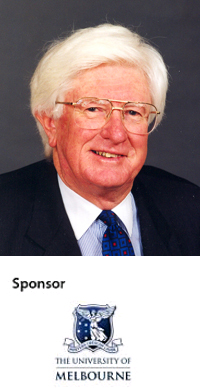
Geologist
John Francis Lovering was born in Sydney in 1930. After finishing at Canterbury Boys High School, Lovering accepted a New South Wales cadetship at the Australian Museum to attend the University of Sydney. He graduated in 1951 with a BSc (Hons) and began work as assistant curator of Mineralogy and Petrology at the Australian Museum (1951-55). Meanwhile, Lovering completed an MSc (1953) at the University of Sydney. In 1953 Lovering went to work at Caltech in the USA. While here, Lovering worked towards his PhD which was awarded in 1956.
Lovering returned to Australia to take up a position as research fellow (1956-60), then fellow (1960-64) and finally senior fellow (1964-69) in Geophysics and Geochemistry at the Australian National University. In 1969 he became professor of geology (1969-87) and head of the School of Earth Sciences (1975-87) at the University of Melbourne. During this time he also served as dean of the Faculty of Science (1983-85) and deputy vice-chancellor (research) (1985-87), as well as being a member of the Australian Antarctic Research Expeditions in 1978 and 1987. In 1987 Lovering was made emeritus professor at the University of Melbourne and moved to Adelaide to become vice-chancellor and professor of geology at Flinders University (1987-95).
Selected audio from this interview is available from ABC Radio National's The Science Show website Australian scientific superstars No.2 - John Lovering
Interviewed by Professor Robyn Williams 20 July 2010.
Contents
- Father and Mother
- Terrible and terrific teachers
- From ornithology to geology
- Speedy PhD at Caltech
- Broadcasting the lunar landing
- Moon rock analysis
- Dean of Science
- Vice Chancellor of Flinders
- Worthy organisations
- Controversies
- Mr Stripes in Antarctica
- Family life
- Surprises for the future?
This is an interview with Professor John Lovering about his work in geology, his time as Dean of Science at the University of Melbourne and as Vice-Chancellor at Flinders University in Adelaide.
Father and Mother
John, you grew up in Sydney; was it a scientific household?
My father was in the Post-Master General Department and very much involved with the telephone sections. He also worked with the early ABC as a technician and could tell some wonderful stories about what they did in those early days. There was a bit of electronics and science around the house but not overly so. It was only as I went through school and got older that I started to get interested in scientific things.
But did you have any practical inspiration from your father’s work? Did he introduce you to machines and tell you how they worked and prepare you for all that IT cleverness?
The answer to that is: no, he wouldn’t let me. He was a bit of an obsessive person with regard to his own equipment. That was a pity, because I could have learnt a lot from him, I’m sure. He was very much involved in amateur radio in those very early days – we are talking about the twenties and thirties – and he did a lot of work in radio transmission technologies.
What about your mother?
My mother was a very fine mother and looked after the family – including my eldest sister and youngest sister. She didn’t have any great formal training, but she was a great mother.
You would be amazed at how many other Fellows say exactly the same thing.
I am glad to hear it.
Terrible and terrific teachers
What was the crisis about your primary school, of all things?
I was five years old and it was time to go to school. The local school was Ashbury Public School in Sydney. Ashbury is now an inner suburb but in those days, it was a bit far to the west. So off I went with my mother in hand – or at least I was in her hand – and was put into the kindergarten class. The teacher who ran that class – I won’t say what her name was – had actually taught my mother at a previous school elsewhere in Sydney, when my mother was a child. I think the problem was that I was the first child of a child that she had taught, and I think she started to realise time was getting on a little bit for her and she seemed to take it out on me in some way. She certainly didn’t take to me as a human being and I hated school, I hated going to kindergarten. There are many stories that my elder sister tells about me being dragged off to school and carrying on very badly and not enjoying it at all. It was a terrible time; I remember it well.
Isn’t it amazing that you remember it after all these years?
Oh, yes; and I will never forgive that woman for the way she treated me. But luckily I finally got out of kinder and went to first class, as it was known in those days. The teacher there was a Mrs Vera Lyons and she was just marvellous. She really cared about the young kids she had and, for some reason, she took a great shine to me. I blossomed under Mrs Lyons’s tutelage and I think she gave me the great love that I have for knowledge and education in general. I really think she is the most wonderful teacher that I had in those early days. Without her, I don’t know what would have happened, quite frankly. I think, if I had been under my kindergarten teacher for a while, I could have been quite a different person.
Isn’t it interesting that a person, such as Mrs Lyons, can reveal to you the kind of potential that you might have?
I don’t know how they work it out, but she did. There was a wonderful opportunity, after I had been over in America, done my PhD and come back to the ANU. I heard from my eldest sister, Beryl, who had gone back to a reunion day at the school, that Mrs Lyons was there and she had asked about me. She had said, ‘Where is my John?’ Beryl had told her that I was now in Canberra. She said, ‘Get him to come in and see me next time he’s in Sydney,’ and I did that with my wife and young family. It was wonderful to see her again and I will never forget that afternoon we spent with her; it was terrific.
Did you ever tell her what she meant to you?
Oh, yes. I did, and I think she liked me telling her that.
Then it was off to Canterbury Boys High. Did you meet John Howard there?
John Howard came after me, so I can’t say that I did. But high school was the time when I started to become interested in science. I had been given a chemistry set for a birthday at one stage by my father. I really enjoyed the experiments and I started to get fascinated by chemistry. Sure enough, along came a chance to start to do chemistry at high school and I really blossomed in that too; that was just terrific.
Any particular teachers?
To be honest, I can’t remember their names now, but there was one that I did have quite a bit of a relationship with. Some that I didn’t – and I remember quite specifically the ones that I didn’t. But, by and large, they were all good. Canterbury High was a very good school in those days – it probably still is, but it certainly was then – and they had very good teachers. It was during the war and they were very dedicated people. There were a lot of interactions between the boys that were there too, and there was competition and it was all good fun; it bolsters up one’s growth.
Was it a strain trying to keep up at all?
No. I have always liked competition, as a matter of fact. A certain amount of it is always good; it stirs up the blood and keeps the brain moving. It can be a bit wearing but, if you are going to play in the competitive game you have got to play it well.
From ornithology to geology
Then you wanted to go on to higher things at university. How did birds become so pivotal in this story?
While I was at high school, I became interested not just in chemistry but also in natural sciences in general – ‘natural history’, as it was called in those days. I am not quite sure how the connection was made but, through radio, there was a man called Crosby Morrison who ran a magazine called Wildlife. He had these radio programs about Australian natural history – birds, animals and plants. He was a fascinating broadcaster and I used to listen to his program every Saturday night at a quarter past seven. I really got caught up in it all, and I would save my money and buy his magazine once a month. I was listening to him speak on birds as part of this as well as my chemical side of interest too.
My family was not particularly rich and they could not afford to send me to university. But there were exhibitions in those days that allowed you to get a certain amount of money to go to the university, depending on your leaving certificate exam results. I got an exhibition, but it was not enough to keep you going. It paid for your books and it paid for your tuition but nothing else. I noted in the newspaper an advertisement for the Australian Museum in Sydney calling for cadets and there was a cadetship in ornithology. The idea was that they would pay your way through university and give you a salary of 30 shillings a week and you would work with the Museum in the holidays. Then, when you got your degree, you would become a member of staff. I thought, ‘Oh, this sounds pretty good to me,’ so I applied.
We had to do a formal examination. There was this room in Sydney and we all went and did the exam. There were lots and lots of people in it – lots of ex-servicemen because it was just after the war. It was a general exam on knowledge, science and whatever; it was not specifically on birds, thank goodness, because I did not know a great deal about birds. As for the results, I didn’t hear anything for a while. Then finally, we got a phone call from the Museum saying, ‘I am sorry. You didn’t get the ornithology post, because the chap that got it is an ex-serviceman and has been working on birds for many, many years. He is really quite an expert in his own right. But we thought, looking at your history, that you might be interested in one in geology – in mineralogy and petrology.’ I was not quite sure what geology was in those days. I had a quick look in the dictionary to see what it was about and said, ‘Yeah that sounds interesting. I think I’ll think about that,’ and I came back the next week and said, ‘Yes, I think I’d like to do it.’ I went to the Museum and had a look at the gallery. It did look fascinating, so I said, ‘Okay, we’ll go along with that,’ and I became a cadet in mineralogy and petrology for my term at the University of Sydney, doing my honours degree in geology and in chemistry.
What if they had said ‘herpetology’ or ‘botany’ instead?
Good question, Robyn! I do not know. In some ways I wish they had said, ‘We’re going to start you working in fundamental biology,’ and maybe I would have become much more relevant these days than I am now. I mean, here I am, a physical scientist, and very few people want to be physical scientists any more. It is all biology and the exciting stuff there. I have never done anything in that area at all; I am totally ignorant on that. That is a terrible thing, but there it is.
Isn’t it a paradox, given Australia’s history, that half the geology departments around the country have been closed down in recent times?
There were not many students going into geology, and the geology departments have become amalgamated with all sorts of other departments in various universities. I think Melbourne, my old department there, is still the only one that is mainly geology, but even it is now combined with meteorology. This is probably not a bad thing, because it is all part of the science of the Earth as a whole. As long as there is a good connection, that is not so bad. And, as long as the training in solid Earth geology is still strong, I think we can cope with the changes. But it is a bit sad to see the old geology departments closing down; and that very few of the old professorships of geology exist any more.
When you were training, were you a reductionist, looking only at the chemistry? Or were you a rock chopper out on the mountainside? And how did meteorites come into all of this?
Well, perhaps I will back step a tiny bit and say how I first really started to get interested in the possibility of geology, before I really knew what it was, before I went to Canterbury Boys High School. In those days, as a young kid, we used to play out in the street in Sydney; it was quite safe to do so. All the kids in the street would play together on the roadway. There was only a small part in the middle of the road that was sealed and on either side there was just crushed rock. That crushed rock was dolerite from Prospect Hill in Sydney. I remember one day I picked up a piece of rock and looked at it – I think I was going to throw it at somebody because we used to throw rocks at each other. There was this white vein running through the rock and sticking out of the white vein were these cubes of what looked like gold. I said, ‘Look, I’ve found gold!’ All the kids came running and we looked at this, and it did look like gold. I took it into class the next day and showed it to my science teacher and he said, ‘No, it’s not gold; it’s fool’s gold.’ It was iron pyrites. But that was something that really started to trigger off an interest in geology, even before I became a geologist.
Speedy PhD at Caltech
What about the University of Sydney; how did that proceed?
I was certainly much more interested in the chemical side of geology, the solid rock side, and certainly not into palaeontology or even in soft rock geology. My main interest was the evolution of the Earth as a whole, the solid Earth and the hard rock side of things. My honours degree was based on a petrological problem down in Marulan in New South Wales. When I finished my honours degree and came to work with the Museum, I decided that I would like to do a bit more work. But I wanted to move into another area and that was into stratigraphy, starting to look now at soft rocks. So I had come from hard rocks to soft rocks. I did a part-time masters degree on the stratigraphy of the Wianamatta Group, that is the topmost Triassic rocks around the Sydney Basin. That study was the first time that the new stratigraphic code, the new way of classifying sedimentary rocks into sedimentary sequences, was used in Australia.
At the Museum, I was learning lots about mineralogy and at the same time going into the field and collecting mineral samples, where appropriate, and dealing with the public on questions about material that they would bring in. Then correspondence came in from Harrison Brown, who was Professor of Geochemistry at Caltech (the California Institute of Technology) and one of the early pioneers in this field. He wanted some pieces of iron meteorite to do trace element studies. He was looking at the evolution of iron meteorites, which you could see from their trace element contents. I was asked by my boss in the Museum to go and cut samples off the iron meteorites for this work. As I was doing that, I thought, ‘I don’t know why this fellow is going to do this work; I’d quite like to do this.’ So I wrote him a letter and said, ‘I’m preparing these samples for you and I’d quite like to come over and work on them,’ and he said, ‘That’s a good idea; I’ll get you a scholarship,’ which he did. So over I went – originally just to work on the samples and not to do a PhD. I had not really thought about a PhD, because PhDs were not common in those days; we are talking about 1952 or 1953.
I got there and I started working. I used emission spectrography to look at the trace elements, gallium and germanium, in iron meteorites, which is a particularly interesting assemblage. I spent a year essentially working on that and doing a few undergraduate courses at the same time. At the end of the year, he said, ‘Your work is going so well, I think you’ve got to stay and do a PhD.’ I said, ‘Oh, that’s good,’ so I stayed. Luckily, because I had had that masters training in Sydney, I came to Caltech with extra experience in geology. Things went very well with the analytical work and that allowed me to finish a PhD in essentially two years. Afterwards, I came back to the Museum and it wasn’t long after that that I was inveigled into the new Department of Geophysics at the Australian National University in Canberra.
Caltech is a really amazing place. Some people have said that it’s so elite that even the people in security have Nobel Prizes. In fact, a friend of mine went there and had a really miserable time. How did you get on?
Certainly competitive but, as I have mentioned, I don’t mind being competitive. I found it a most wonderful place to be; it was so exciting. We are talking 1953; I was there until the end of 1955.
Was that before the jet propulsion lab was set up?
Oh, no. The jet propulsion lab was there then.
It wasn’t concerned with outer space then?
No, it wasn’t. Then, it was a jet propulsion lab. That was what they were working on: the physics and engineering of jet propulsion. It was the most stimulating place for a young geologist from Australia. In Australia there had been a tendency in one’s university life not to argue the toss with your mentors and the staff of your department. They were sort of semi-gods to some extent; in those days they were thought to be anyway. Then I went straight into this environment where there was lots of competition and argument between students and the staff. People didn’t take everything from their lecturers as being God-given.
Did you meet any of the superstars at Caltech, like Nobel Prize winner Linus Pauling?
All of them; and Feynman was just a terrific character.
Tell me.
When I finally decided that I was going to do a PhD, I had to do some more graduate study work, including some courses, and there was one course where I had to write a term paper. From my iron meteorite work, I had got some ideas on how iron meteorites may well have evolved in a common source. So I went along to Harrison Brown and said, ‘I need someone to talk to me about the physics of crystallisation of iron nickel-rich melts,’ and he said, ‘Well, I don’t know about that, but there’s Feynman in physics, who knows everything about everything.’ I said, ‘I’ll go and see him.’ He was a fascinating man to talk with. He didn’t know anything about meteorites or iron-rich melts and crystallisation; but, with knowing the basic and solid state physics of what was going on, he could certainly make a contribution. I got a lot out of those discussions. As a grad student, you could go and talk to Feynman and Linus Pauling. Beno Gutenberg, the great geophysicist, was there too and you could talk with him. It was just the most fantastic place.
I don’t suppose Murray Gell-Mann was there yet?
No, he wasn’t.
Broadcasting the lunar landing
Moving forward to 1969 and those fantastic moon shots, with Apollo 11 flying to the moon and landing there, how did you come to be chosen to be in the live studio for the commentary with Peter Pockley at that time?
First of all, how did I get to be chosen? When the NASA program for the lunar exploration got some publicity, I thought ‘this is fantastic stuff’. Having worked on and with meteorites at ANU, the next logical thing would be to look at any rocks coming back from the moon. So I wrote to the people I knew in NASA, I happened to know some people there, and said, ‘When you’re looking for people to work on the lunar rocks, I’d like to be considered.’ At the appropriate time, when we were getting closer to the first launch of Apollo 11, there was a formal call around the world for people who were interested in working on the lunar rocks to put in proposals. This was another very competitive thing: everybody who was in any sort of vague business of looking at meteorites and anything exciting with lunar rocks or any rocks of any sort wanted to be in it. We had the technologies. I had been working at ANU on the use of electron microprobes. The microprobes could go in and analyse micron or micrometre sized particles in rocks or meteorites to determine the chemical composition of their minerals in great detail. So obviously I had the technology to start working on these things; we had one of the most innovative electron microprobe labs in the world.
There was some publicity about me getting chosen as a principal investigator for the samples, so, come the time for the launch of Apollo 11, it was reasonable for the ABC to think, ‘Well, here’s the character that’s going to work on them; get him in.’ I was one of about four people that were there. There we were, the landing time was the middle of the day. We were all sitting in the studio in Sydney and watching things starting to happen and hearing the voices coming back and seeing them getting out of the vehicle – oh, it was just mind blowing stuff – and then trying to interpret what they were seeing. It was not always easy, because I think they were pretty excited themselves, reasonably enough. It was exciting to be part of it all.
Some people thought that, when they landed on the moon, they would sink into the dust and disappear. Were you surprised by what happened?
That was the Tommy Gold theory. He had come up with this theory that the ‘seas’ on the moon were these great unstable dust holes and you would sink down forever. Actually, we did know a little bit better than that from some of the unmanned landers, which showed that it wasn’t quite like that. By that stage, we knew that they weren’t going to really disappear, but I guess you’re never too sure what is going to happen on the moon.
There you are, sitting in the live studio, a geologist with no necessary background in broadcasting. How did you know what to say about the rocks that they were picking up?
That is a very good question, Robyn. I am not sure that what I said at the time was particularly accurate, from what we know subsequently. But I really don’t think that that mattered. The important thing was the interaction between the people there, all of them being very interested in what was going on and excited by the prospect of this incredible situation of a human being walking around on the moon.
Who was in the studio; was Peter Pockley there?
Peter Pockley and Earle Hackett, the chap from Western Australia, the medical guy that you often use on your program.
The late Earle Hackett now.
He was there. There was a bloke from our NASA people here in Australia talking about the engineering side of things. It was great fun; it really was. It was just terrific.
I have often thought back to how cynical we were about Apollo and the moon shots, thinking, ‘The military is involved.’ and it was all very naff. But, my God, it really was exciting, wasn’t it?
Those of us who were there and experienced it will never forget it. I know that many years later, when I was Vice-Chancellor at Flinders University in South Australia, I did some first-year lecturing in geology to keep a hand on real teaching – so that the academics couldn’t tell me that I was too far above that now. Anyway, I was talking about the lunar experience and the work and I remember in class one day, getting into the actual landing and what was found. I looked around the room and said, ‘How many of you saw this or were there when it happened?’ One person had; it was an older student. The rest of them had no idea of what I was talking about; the excitement of that period and the wonder of it all. No-one will ever have it, unless they were there.
Moon rock analysis
So you were getting back material from the moon and examining it; what exactly were you looking for?
Actually getting the material was exciting too because I had to go across and pick up the first samples from Apollo 11 myself. They didn’t want to send it by any other process. I went over there; we went to the lunar lab in Houston and Cape Canaveral and they brought me into this room and brought out these samples of moon rock. We couldn’t touch them at the time, but you could have them in their containers. Remember, they put it into quarantine for a couple of weeks, until they decided that it wasn’t going to give us all some terrible disease. When I actually saw the stuff and handled it, they had just got it out of quarantine. Suddenly, you could see, ‘God, it’s basalt; it’s nothing.’ There were breccias as well, broken-up rock; but the really fresh stuff was this wonderful lunar basalt. Like anything you could have seen on earth. At least in a hand specimen it looked like the basalt you get all around Melbourne. There was nothing exciting, until you started to look in detail and then you could see all the differences of a lunar environment. But just seeing that thing was quite unbelievable.
Even the chemistry of these rocks was different, wasn’t it?
The basic chemistry was just like a basaltic rock on Earth, but there were differences. One of the major ones was that they were very high in titanium, so there were lots of ilmenite and titanium minerals in the basalts. But we did a lot of work, as did a lot of other people, on the chemistry of the lunar rocks, the mineralogy and the detail of it all. We know a great deal about the detail of it and how it all fits together in many ways. But, in some ways, we knew it all then anyway; we knew more about it than we did about the Earth, in some respects.
One interesting thing was that two minerals were found on the moon, just moon minerals, and one we found in our group here in Australia; this was a mineral that we called tranquillityite, after the Sea of Tranquillity. There was another little competitive bit here that you might be interested in. We used to have these lunar conferences where once a year we would all get together in Houston and everybody would give talks on all the stuff they had found the year before. These were people from all over the world, all of the groups involved in this stuff. Everybody was trying to show how clever they were with all the clever things they had found. There was this mineral—little tiny things that were no more than 50 micrometres long and sort of 20 wide, tiny grains tucked away interstitially between the major mineral grains in the basalts. There was this little phase we found. I won’t go into the detail of how we found it, but we analysed it in great detail. We got CSIRO people to come in with us. They managed to pick out these little tiny grains and we were able to determine the structure of it all in great detail.
We went across to the moon rock conferences and started to listen to what was going on. A lot of people there found this mineral, but they didn’t know what it was. They had the chemistry, they had some good analyses of it, but nobody had done the structure, except for our group, through CSIRO people. We were able to beat the lot of them in terms of knowing all about it and characterising it. So we got to name it and the American groups got quite irritated; nevertheless, we had the data. We all joined together on a paper—I think there were something like 20odd people on this paper—but we were the lead authors and we got to name ‘tranquillityite’.
It just so happens that I was at the ANU, with Ross Taylor – I hope I don’t put him in the poo – and I’ve actually held some moon rock in my hand.
I went to Melbourne with my group. Ross Taylor, Bill Compston and Ted Ringwood were the groups that stayed here in Canberra and did a great deal of work on the lunar rocks.
And Ted Ringwood had a theory, which he published in Nature, about the origins of the moon. He suggested that some mighty great impact way back at the beginning, blasted something into space, which then became the moon. Do you go along with that theory?
I’m not really in the game much any more, but I think that’s the current view again – that it’s a piece torn off the Earth by an early stage impact.
You were involved with many of the Apollo missions right through.
Right to the end, yes. In fact, for Apollo 17 launch, I was in America on a Fulbright and I was invited to come down and watch Apollo 17 go.
1972.
That was the one that had the geologist on board, Harrison ‘Jack’ Schmitt, who was actually at Caltech when I was there. He had been an undergraduate student there, whereas I was a graduate student. My family was with me, three young kids and my wife. I was with NASA in Maryland, and we drove down to see it go off, which was again another one of these incredible experiences that I will never forget. We were sitting five kilometres away from the firing site. It was the only night launch of an Apollo and five kilometres away there was this little rocket sitting, all bathed in lights. We were waiting for it to go off; there were lots of delays, with one thing and another. But, finally it was going to go.
We were sitting on top of a bus so that we would get a good view and we were looking across the flat territory to where it was. The next thing you knew, the engines had fired and there was this huge light flash that just about blinded you with its strength. We didn’t hear anything yet; it was too far away for us to hear anything. Then we heard this incredible sound. Like a whole lot of fire crackers going off. On television it doesn’t sound quite the same at all; you don’t hear the ‘crack, crack, crack’ noise of the engines. Then slowly this rocket started to rise up and, as it was going up, there were flames going everywhere and there was sound. Then the shock waves hit us. We were on this bus and the whole thing was sort of rocking backwards and forwards. It was the total experience, believe me. Then you would think, ‘Poor old Jack Schmitt is going off on the top of this thing.’ There it was and, in the next couple of days, we could see him doing his geology on the moon. It was just marvellous.
Dean of Science
Then you went to the University of Melbourne and became Dean of Science. Did you manage to retain a little bit of work at the bench?
I did. I went to Melbourne in 1969 as Professor of Geology. It was a great time to go because that was when money was starting to be put into the university system. Certainly my connections with the lunar program helped us to get a lot of research money. I was able to get an electron probe laboratory set up of our own, which was a really first-class laboratory; it was the leader in the world in its day. It was the first totally computer driven electron microprobe in the world. We were able to create a department in this new sort of geology, this new system of chemical–geophysical activity, where you are not just mapping rocks. Sure, mapping rocks is important, but you have to understand the detail of what’s going on; so you need to know a lot about what they are made of and how they got that way. We developed an exciting program in that activity and a whole lot of other things spawned off from that.
Then being a dean: what was it like?
In 1985 I was still hands on as well as running the department. 1969 to 1985 were my most productive years, I guess, after I left ANU, although that was a productive time too. I was asked by the Vice-Chancellor at Melbourne, who at that stage was David Caro, if I would become Dean of Science. They were having a problem; they were moving to a new system in which the faculties were going to handle the budgets for the various departments. The central money would go to the faculties and then the faculties would carve it up to the constituent departments of those faculties. They needed somebody who was going to be able to control the faculty in a way that the deans had not been able to in the past. They wanted someone who was in a position to be able to do that and with some sort of experience. He was a very persuasive man and he was one of many people that I really have a great deal of respect for,
so I accepted that job.
That was the beginning of the end for me in research, in as much as my groups kept working and I had only a marginal connection with them and what was going on, which was a bit sad in some ways. But that’s the way you go, you know. I had been in bench research activity for – I don’t know – 30odd years and you’ve got to grow with these things. Generally, when the occasion has arisen and things have come before me, I have taken them and not run away from them.
But could you keep up with the science while all that was going on?
I could keep up with what was going on, but I wasn’t doing it myself any more; everybody else was – my students were. That was and still is, to some extent, irritating, but I had other things that came out of the administrative side. Having spent two years as Dean of Science, I was asked whether I would take on the new role of Deputy Vice-Chancellor of Research, running research in the structure of the university. I did that for another couple of years and enjoyed that in its way. Melbourne University is a great university and I really did enjoy my time there.
Vice Chancellor of Flinders
Then another opportunity arose. You can’t help yourself with some of these things; you’ve got to keep moving on. The option came of becoming Vice-Chancellor at Flinders University in South Australia, which was and is a very good research university, one of the younger ones. That happened in 1987. Then from 1987 until 1995, I was Vice-Chancellor at Flinders and developed that institution with a whole lot of new faculties and growth. It was a great growth period in many ways, although it was also a difficult time because it was the time of the Dawkins’s university changes with amalgamations and whatever, and I didn’t enjoy all that sort of activity. But, never mind, that did have to happen.
Way back, when I first went to Flinders University, I was taken straight to the Vice-Chancellor’s offices because at that time they were being occupied by student rebels who had occupied the entire admin building. Were they still rambunctious and rebellious when you turned up?
That Vice-Chancellor was the second Vice-Chancellor of Flinders. The first one was Peter Karmel, a great man in Australian tertiary higher education. The second one was Roger Russel and he had a terrible time. It was in the sixties and there was all that sixties turbulence that struck all the universities to some extent. But Flinders was one of the new ones; it only started in 1966. It was a very difficult time for him. I really do feel for that man.
I had troubles during my time with some student activity but nothing serious. Why did it change? The whole system seemed to slow up at the end of the sixties, didn’t it? You were part of that, Robyn, and you can tell me too why it changed. But it did change and, for whatever reason, students became much more focused on their own needs for education and getting a job, and competition for them became important too. I mean, it is such a competitive business now with the young, which really didn’t happen in my day. I was one of the lucky generations born in the 1930s, in the Great Depression, when there weren’t a lot of us. So that our group was being buoyed up by all the young ones coming underneath us and it was so much easier for us and the competition was nothing like it is now.
It was the Dawkins revolution. John Dawkins, when he was Minister for Education in Hawke’s government, turned over the universities and the colleges of education more than almost any other single force in generations. How did you cope with that?
It was an extremely difficult time. There I was, a new Vice-Chancellor, coming into Flinders University about two weeks before the Dawkins green paper came out with this whole new restructuring of the universities and the pressure on amalgamations between various constituent parts of the system. Suddenly, before I had time to establish myself within the university, we were forced into looking for amalgamations with other institutions in Adelaide in a way that I thought was just crazy; but you were pushed into it.
I think it did a lot of damage to the system, quite frankly. We had quite a good system at that stage. We had a higher education system of universities that were largely research oriented systems; we had the colleges of advanced education, which were very strong teaching institutions and doing a first rate job at that; and we had the technological institutions, which were very fine organisations training people in those sorts of technological skills. The system worked perfectly well. But, for all sorts of reasons, there were pressures on him, as the minister, to up the status of each of these or at least certainly the colleges and the institutes of technology. There were certain pressures on him to up their status in the system.
So that everyone is equal.
The fact is that they were equal but they were different; they were different but equal. For whatever reasons, people felt that they were not ‘equal’ or that there were various grades of ‘equalness’. I can see the pressures that were on him, but I think it was a pity. He could have raised the status of all the institutions within their own specialties in the way they were operating instead of trying to make everybody the same, that is, research universities. I think that has been not a terribly successful operation. Now it is ironing itself out, but certainly at the time, it was extremely difficult to try to manage it all and it caused a lot of angst. And, in terms of the individuals that were there at the time as part of it all, it was very stressful.
Do you think we’ve come out of that and things have settled down and we’ve adjusted?
I think it has. I have really been out of the university cut and thrust since 1994 or 1995. After getting involved in natural resources management activity, I’ve really been out of university politics, so I’m not sure how settled down it really is. Certainly the older established universities are still trying to stake their claim for pre-eminence in various ways and everybody else is still trying to get up there too; it’s still going on, I think.
Let me ask you a John Dawkins type question. He always felt that the really bright young people who are committed to science – people like you, John – will do it anyway because they have to. But what about all the others? What about the rest of us, the 50 per cent of the population who might do it? Have we lost them or managed to succeed with them?
I think that is what did happen before, where the colleges of advanced education taught the various sciences in that way and the institutes of technology did it in their way. You had a selection there, as a young person, as a student, to say, ‘Am I going to go in this direction or am I going to go in this other direction and go into the more academic side of higher education?’ The ability was there, I believe, to do it. I think the problem was that the status was not there in each of these areas, and people do concern themselves with status. I think that does happen, whether you like it or not, whether they should or not. I do feel that Dawkins missed an opportunity to raise the status of each of these parts of the system without trying to push them all together.
And with science, you can’t just do it with a pencil and paper; you need equipment, infrastructure and special staff. Is that what spread everything so thin?
It certainly went a long way to causing troubles. Everybody wanted to be doing research in their field, whatever it was – science, social sciences or anything else – and everybody needed all the support structures that could allow them to do that, and that costs huge amounts of money. I think it was a mistake to try to do that.
But they did say that some of the universities would do only teaching and wouldn’t do research. How did that work out?
Everybody now is still supposed to do research as well. If you want to be seen as a university of the highest quality, you have to have a research profile as well.
Worthy organisations
Okay, that was in the nineties. Since then, you have been involved in any number of committees and worthy organisations; how has that panned out?
When I was in Adelaide as Vice-Chancellor at Flinders, I was asked by the Premier to chair a body that had all the heads of all the departments concerned with natural resources management in the state. This body was to argue out issues within that group and then come back to government and say, ‘This is what we think we want to do. We have all had the discussions and we have come up with a way that we think is the way you want to handle ‘water,’ or ‘this issue’ or whatever in natural resources management—animal protection, biology, biodiversity and so on. They needed somebody who could come in from outside the Public Service system. They asked me if I would chair that body. I thought, ‘That sounds interesting.’ This again is my belief: you should always take on things that people ask you to do and see how you go with them. So I did it.
I had the heads of all the departments. There were people trying to preserve natural resources of one sort or another and there were people who could be accused of trying to ‘rape and pillage’ it. It was a very fascinating group of people and they were all there to do their best for their own departments. We would have very frank and full discussions at our meetings. They were all professionals so they all would come up with their points of view; they would argue them out and I would keep order in all of this and make sure that everybody had the opportunity to present what they believed was important. Then we would usually come up with a consensus answer for whatever the issue was that we could get general agreement on. I could go back to the government then and say, ‘Well, in this issue, which is a controversial one, the departments are prepared to go this way or that way.’ This worked really very well. It worked well for the Premier and the politicians, because they didn’t have to argue the matter out in their own cabinet; we sort of argued it out for them and they just got a fait accompli. They had to put their own stamp on it all but they didn’t have to have the basic arguments. So they rather liked that.
Were you a pragmatist or were you more of a greeny?
Oh, Robyn, how I could define myself as that, I don’t know! As you would remember, going back to where I began, I had always had an interest in the natural world and, if you have an interest in the natural world, you do care about all the various parts of it. Even though I had never done a biological subject in my life and still haven’t for that matter, one still has an understanding that we are part of this fantastic system of life and it’s something that we all want to continue. For all sorts of reasons, we want to see it keep on going, and it is an exciting thing to be part of. So my view was: sure, we have got to mine materials to keep the material wealth of the country progressing, but we have also got to do all of these things remembering that we have to preserve the importance of what the environment means to us. That is not always easy to do and sometimes you have to make compromises. But that’s what we have to do, because people aren’t going to stop doing each of these things. Provided that you can argue out the issues, you can usually come around to an outcome that people can accept; they may not always like it, but they can accept it. Which, after all, is what we are supposed to be doing within the way we govern ourselves? But often it seems to be hard to do, for all sorts of reasons that I don’t understand.
But, just use your own words, people who ‘rape and pillage’ were there; how did you manage them?
That is an interesting thing, and it came up again when I was President of the Murray Darling Basin Commission; there was a similar situation there. As I said, we had all the heads of the department in this committee in South Australia. They were all professional managers and they all understood that they had to compromise on some issues. You have to give and take a little bit on these things. That’s the way that you can work it, provided that you have the right environment where people do not feel threatened. Rather than an environment where they feel that they have to be acting in a machismo sort of way. Part of that,
I found, was to keep a certain lightness of touch at our meetings. Where there was an opportunity to add even a little bit of semi-levity, sometimes it would help to break up some situations. I have found that to be a very useful procedure in many activities that I have been involved in.
You found that most of the people involved could be reasonable?
They could, yes, because they were professionals.
What sorts of activities are you still maintaining at the moment?
Not a large number of things now. I finally finished my activities with being President of the Murray Darling Basin Commission, as I was for five years, and then on the board of one of our major rural water companies in Victoria. All I do now really is that I’m back in my old department in Melbourne. We moved from Adelaide back to our old house in Melbourne.
You kept it on, did you?
Oh, my word, and very sensibly too. I would never have got back in again if I had sold it. I have an appointment at the university still and I have a room next to my old offices in the department. I run some committees for the university, things where they want somebody who is independent now and not a member of any faculty and who knows, from their experience in the University, where ‘the bodies are buried’!
I have been in Melbourne since 1969, apart from my period away in Adelaide for eight years, so it’s like being back home again. They use me when they have some problems where they need that sort of person, and I am very happy to do it. I chair their Office for Environmental Programs, which is the very exciting program they have for all their environmental graduate studies in Melbourne, which has been really successful. That is really all I do these days in terms of work in that sense. I also do a few things for the academies, but not a lot.
Controversies
The world has changed dramatically since those early days when you began. At that stage, most of the science of the world was overseas. We now do two per cent of it, which seems large compared to what it was like. How do you view the situation of science in Australia now, in 2010?
I have said that I like a bit of competition, and I do; but it is now a very competitive world in every issue that you can be involved in. Also, there are no barriers between timing and there are no barriers between where you are at any given time. You are totally immersed in the world as a whole. How young people cope with all of this I really don’t understand, and I often feel sorry for them. Certainly, when you have to add to it all the activities that you’re supposed to do through things like Twitter and Facebook—and I’ve no idea why this is necessary; but it appears to be extremely necessary for people to have this social media.
The boundaries between the sciences are largely disappearing, which is great, because it means that there are no boundaries to how you can now look at your own subject. If you have the ability and the time to move on to other areas, you can. All of that is exciting. Lots of advances are made by people who cross their boundaries and bring into this new area a whole new way of looking at things. The ability to do great things is there now, in a way that perhaps we did not have. I look back and see what seems to be now, the rather amateurish way that we carried on our research, to some extent. Now it is a different world. I do read some of the international geological journals now and I wonder at the abilities that they have to do things that we could never ever dream of doing. They are now normal technologies that everybody uses! As I say, these are the things that make you a little jealous and you wish that you were starting off again.
What about some of the controversies in science like climate change, which I know you have tried to avoid being involved in the public discussion? But of some of those controversies over the years, which ones have struck you as the most significant?
The major activity that I was ever involved in on a side issue, as I recall, was the whole business of continental drift and ocean floor spreading. It is something that I think a lot of people find interesting. When I was a student, the idea of the continents drifting was one that had been put up by Alfred Wegener back in the late twenties. He was taken by the way that the continents could be pushed together in a mosaic, and this was interesting. But most people thought he was mad. There was no mechanism for this to happen; there was no way that this could happen. The early geophysicists said, ‘There’s no way that you can do this and the whole thing is nonsense.’
When I was a student, we were taught that continental drift was this semi-crazy suggestion of this German geologist many years ago, and that was that. Mind you, the Southern Hemisphere geologists did tend to think, ‘No, there’s something more in this than you think. When we look at our paleontological evidence across boundaries, we can see that there are animals that were in this continent similar to those in that continent at this time of geological evolution.’ The Southern Hemisphere people tended to think, ‘There must be something in this continental drift.’ I remember when I was at Caltech Sam Carey from Tasmania turned up one day and they got him to give a talk. Right from the early days he was a great continental drift man.
He believed that the Earth is expanding.
That was later on. That was where he was wrong. But he certainly believed in the drifting before it became popular. He gave this talk and the Caltech guys rubbished him. I was terribly embarrassed about it. It didn’t seem to worry Sam terribly much. It was a typical Caltech thing, somebody would come in and you had to knock them down. I got quite irritated at all of this. I was the only Australian geologist around the place and I got the full brunt of it as well. But that didn’t matter; I was not in the game. This was in 1953, and the Americans and most of the Europeans rubbished continental drift.
The next thing you know, people suddenly started getting this paleomagnetic evidence that showed that something funny was going on between the continents. When you plotted the polar wandering paths from various continents, they were all different; but, when you put the things together, they all came together. Lots of British geophysicists were involved in this paleomagnetic field – Blackett and so on. Then, they started looking at the oceans. We had the ability to start to look to the depths of the ocean floors and the sorts of rocks that were there. The evolution of the oceans became incredibly important where you could see these mid oceanic ridges, where volcanic activity and seismic activity was evidenced. You had the boundaries of the oceans where there was more seismic activity but of a different sort. When they started to date these rocks in the ocean floor, you could suddenly see that the oceans were expanding from the middle and then being subducted around the edges.
The whole thing of continental drift and ocean floors all came together in this wonderful piece of integration of evolution of the Earth’s surface and ocean crust. Up until then, as a student, I had always found it difficult to see what geology was all about; because it was all lots of little descriptive things, but none had ever come together in one integrative manner. Suddenly, the thing that people said could never happen – that is continents drifting – could happen and there was a mechanism for it to happen. This is the worry that I have now when people say, ‘We know what’s going on; the science is all settled.’ We thought the science was settled when we said that continents could not drift, but we were wrong.
What about Professor Sam Carey in Tasmania and his amazing theory of the expanding Earth. Is there any truth in that at all?
I don’t believe there is and I could never understand why Sam went along with it so strongly. When I was at Melbourne, I got Sam to come across and give a talk about it at one stage because I really wanted to try to find out what he was on about. He was also trying to say that there was evidence in the other parts of the solar system about planets expanding, and I didn’t see where he had got that from at all.
So Sam came over and gave a talk. I remember it very well. It was a Geological Society talk that I organised. If you knew Sam, you would know that he was a very interesting guy, a very dynamic speaker and a great character. Sam was going on about the expanding Earth and about subduction. He did not believe in subduction; he thought that it was nonsense. He suddenly got up and said, ‘I defy anybody in this room to say that subduction is a process that’s going on.’ Everybody was looking around and noone was game to do anything, including me, I have to say. Sam was just wonderful in that sort of thing.
But the fact is, we have really good evidence that subduction does go on; you can actually see it happening in the seismic data. One has two dimensional data of these things dipping down beneath these subduction areas in the Earth. If anything was self-evident I thought that was about it. Now, that is in a general sense and I will not go into the detail. Why Sam never saw that I really do not know, but it was a pity because he was a great champion of continental drift in the days when it was totally unpopular all over the world.
Then there is Tommy Gold; you mentioned his name a little while ago. Tommy Gold believed that, as far down as you would like to go, kilometres upon kilometres, you will still find bacteria and they are producing oil. Now, that is another wild idea; what do you make of that?
Yes, I remember that. I knew Tommy Gold when I was at Caltech as a student. He used to come over there quite often and we used to have lunch at the Athenaeum Club, which was a staff club. It was really fantastic. There you were, as a little lowly graduate student, and you could come and have lunch on these little roundtables, which would sit about six people. You would have Tommy Gold and you would have a Nobel Prize winner from somewhere. It was just a fantastic place to be. I remember Tommy being there and going on about this stuff.
I could never understand why you needed to go into these inorganic origins of oil given that we knew the biological evidence of the origin of oil. I think there is no doubt that a lot of the surface oil or petroleum in the Earth is biological in origin; I think you can see it through a lot of isotopic evidence and other things. But I often wonder whether some of this very deep seated oil, which they are now starting to find, could be stuff that has come from deeper down. I don’t know. All I know is that there are very complex organic compounds that have been inorganically formed. We have done quite a bit of work on the building blocks of our solar system that we see represented in the carbonation chondrites. If that was indeed the material from which the Earth evolved, then maybe there is some hydrocarbon material coming from depth. I really don’t know, Robyn. I just wonder whether there is a possibility of two origins for some of the petroleum deposits in the world – the more surficial ones that may be biologically oriented and some of the deeper ones that people now are starting to find. But I really don’t know.
But there is no doubt that there are bugs all the way down?
I would have thought there were, but I just don’t know. It is not my area and I haven’t really spent any time on it. But these days I do think, ‘I’ve got to keep my mind open on a few things,’ because surprises keep coming up all the time in science. You think you have it all handled and you don’t.
Mr Stripes in Antarctica
Now, John, is it true that they call you the ‘Silver Fox’?
That was when I was at the university in Melbourne. Yes, they did indeed. ‘Mr Stripes’ was another name they gave me. I used to wear stripy shirts and the students used to call me ‘Mr Stripes’ as well.
So you are the original Silver Fox?
Bob [Prime Minister Bob Hawke] and I are the same age, so we may have been called that at the same time.
I know that you have done lots and lots of research on Antarctica, but did you actually go there?
Yes. I had two trips there as part of the Australian National Antarctic Research Expeditions; one was in 1978 and the other one was in 1987. When I was at Melbourne, I had had a visit from Bob Tingey from the Bureau of Mineral Resources here in Canberra. He was the Bureau’s person looking at Antarctic geology and he had spent quite a bit of time down there. The Bureau used to handle most of the geological work for the Antarctic Division. He came and gave us a talk at Melbourne and I got quite excited about it. I had not really known much about Antarctica; geologists by and large don’t, because it’s mostly covered in ice. But there are outcrops around the coast and in the mountains, and they had done a lot of work on them. It was just fascinating, this whole environment.
It seemed to me, looking for new areas for us to get into at Melbourne, that here was an opportunity to develop a program looking at Antarctic science, in particular the geological aspects. Also, we had students available to get involved in Antarctic research in a way that the Bureau did not. I set up a program in the University, trying also to bring in biologists as well to handle biological programs down there, and we set up our geological ones. The first of the two trips I had down there were really to get acquainted with what we could do geologically, what the limitations were and what things we could actually contribute to. Quite a bit of work was done in that regard. That was the first one, where the entire expedition was all in the Australian areas, Mawson’s hut, for example. We had a great time looking at the area where Mawson did all his geology and all his exploration and then, later on, at the rest of the Australian bases around the coast.
Overall I got to see all the Australian bases as well as Heard Island and Macquarie Island. Heard Island was an exciting experience because it is the only Australian volcano. Australians reckon that we own Heard Island and there is this great volcano on Heard Island. It is the only one that we have in Australia territory that is active. I remember when we went there, we arrived and we couldn’t see a thing, it was all under cloud. They said, ‘You’ll never see the volcano; forget about it.’ So we spent the day there. We spent some time whizzing around in a helicopter, trying to collect rocks and do some things. Then we came back to the ship to leave that evening. Just as we were about to go, the cloud drifted away and there was this volcano that started at sea level and went up to 10,000 feet or something. It is just huge. If you had turned around suddenly to see it, you wouldn’t have believed it, because it just came straight up out of the sea. It was just marvellous.
We set up this geological program, which was carried on largely by Professor Chris Wilson at Melbourne and his students. He had a lot of students down there and they have done a great deal of really first-class geological work. He has just retired recently, so I hope it is not going to come to an end; but it may have reached its end for a whole lot of other reasons.
We had the Bureau of Mineral Resources doing some geological work. They were doing great work, but there was only a limited number of them. And I thought ‘Why not bring in all the other universities we could and get them to contribute to this?’ That was an exciting time to start to bring in other institutions as well as the Antarctic Division people themselves, which it was my idea to do. There are all these resources out there and people are fascinated by Antarctica, so why don’t we use them? I put this to Barry Jones, who at the time was the Minister for Science and was responsible for Antarctic activity. They agreed to set up an Antarctic Science Advisory Committee, which would provide research funds to help these other institutions to do research down there.
The first chair of that was David Caro actually, my old boss at Melbourne. He did it for a couple of years and then, when he retired, they asked me to do it. I then spent quite a bit of time setting up in more detail that ability for the all of the universities in Australia to contribute to Antarctic science. That was a great outcome for Antarctic science. Australia made a major contribution as a result of that money that we were able to prise out of the Antarctic Division’s budget, which they were never very happy about, I have to say. But still, in all good grace, they did make it available.
There was some discussion back in the eighties that maybe Antarctica should be exploited for oil; I think Phillip Law was even proposing some of this. Were you involved in that?
Not really, except that I certainly used it as a lever to get support. I have to say that this is being a bit naughty here; this is being a bit of a ‘raper and pillager’. It allowed me to get some support to do some of our research down there. There is the Lambert Graben, which runs down from the continent to the ocean. It is a great dropped part of the earth’s crust and it is very likely that was quite a big sedimentary basin in its time. It could easily have some interesting deposits down there. So I used the possibilities of that to get support for our activities in the Lambert Graben.
But I have to say that it would be a great tragedy in all sorts of ways to start mining in that environment. You would certainly be very concerned about doing that these days and it probably would have been even worse in those days. Luckily, cool heads prevailed and everybody decided to put a moratorium on exploration for economic deposits down there, and I think that was very wise.
Family life
We haven’t mentioned your wife, also a geologist, and three kids.
My wife, Kerry, was at Sydney University when I was doing my honours year. She was a bright young first year and I thought she looked rather interesting and we got together. When I went to Caltech in 1953, she was doing her honours degree in geology. She finished her honours degree while I was over there and then she thought she would like to come to America too. She got a scholarship to do a masters degree in geology at UCLA, which was fairly close to Caltech although not all that close. So she came over and we got married in America. That was pretty adventurous, when I think about it, considering that I didn’t have a lot of money and was on a scholarship; and neither did she and she was on a scholarship too. But we did and she used to commute to UCLA every day from Pasadena. She did her masters and I did my PhD.
When I was writing up my PhD, she did a bus trip right around America all by herself. For the month that I was writing it all up, or the major period when I was writing it up. She just went off all by herself and did this trip. I don’t know whether you can do it now, but you could do it then – in Greyhound buses all the way around America.
You have been married now for more than half a century.
Yes, 56 years now. One of my daughters, Erin, did a PhD in immunology at Melbourne and now works with CSL. My eldest son, Matthew, is a film and television man and has done various things for the ABC. And my youngest son, Adam, is a barrister. So they are a mixed scrum. I have three grandchildren now, two girls and a little boy, and it’s an exciting time.
Matthew has gone back to where your father began.
He has in many ways. He has lots of similarities to my father but even more to his maternal grandfather. Kerry’s father was RD FitzGerald, the Australian poet, and Matthew has a lot of Bob FitzGerald in him too, which is fascinating. He is very much that sort of writer, creative person.
It sounds like a wonderfully fulfilled life with no hiccups along the way.
We have had hiccups. We had a stillborn child at one stage of the game; it was a difficult time for us both. But, by and large, we have been very lucky. As I said earlier on, we were the lucky generation, that generation born in the thirties. We were not old enough to go to the Second World War and we were too old to go to the Korean War or were committed to other things by then and didn’t have to go. So we missed all of that side of things.
With all the expansions that took place in universities and the economic expansion of Australia and of the world in general, the affluence started to push you along. After those difficult days in the thirties, when we were kids and you didn’t have much at all, suddenly everybody has everything – more than they would want, it would seem. They don’t really realise the way it can be and the way it was back in those days. Still, we had a great life; even then it wasn’t all that bad.
Surprises for the future?
A final question: given all the surprises that you have alluded to during this long interview, do you think there will be as many surprises for young people, especially young people in science, in the future?
I think there will be. When you look back in history you can see that so many surprises have come up, not just the ones we have talked about from a geological point of view. The universe is an amazing place and we still don’t know a lot about it. There is so much still to find out about the details of how the human body works. Certainly at my time of life, when you are looking at all the things that can go wrong, you find what an amazing thing the body is. People are finding more and more of the detail of what goes on, and that detail is again sort of unbelievable. How can science evolve to this detail, where the mechanisms that operate within your body can keep you alive for 80 years or more? It’s just amazing. How that’s all going to evolve, I’m sure I don’t know. But, in my lifetime, it has all evolved in a way that you can now expect to live for 80 years, which just 20, 30, 40 years ago you couldn’t.
And you look 50.
Indeed!
Dr Phillip Law (1912-2010), antarctic explorer
Antarctic explorer
Dr Phillip Law was born in Tallangatta, Victoria in 1912. His family moved to Hamilton, Victoria where he attended Hamilton High School. Law was educated at Ballarat Teachers' College and worked as a secondary school teacher in Hamilton and Geelong before beginning study at the University of Melbourne. He received his MSc in physics in 1941. During World War II, Law continued his research at the University of Melbourne with various wartime projects. In 1947 and 48 Law was involved in the Australian National Antarctic Research Expeditions (ANARE) trip to Macquarie Island and Antarctica. He was appointed leader of ANARE and director of the Antarctic Division of the Department of External Affairs in 1949. He personally led 23 voyages to Antarctica and the sub-Antarctic regions, and directed ANARE activities that resulted in the mapping of 4000 miles of coastline and 800,000 square miles of territory. In 1954 he founded the Mawson, Davis and Casey bases in Antarctica. Law resigned from the Department of External Affairs in 1966 to become the executive vice-president of the Victoria Institute of Colleges. He held this position until 1977.
Interviewed by Professor John Swan in 1999.
Contents
- Embracing an adventurous life
- Early travels for science – optical instruments and cosmic rays
- 'My eyes were on Antarctica'
- Science or logistics? A difference of view
- Matters of support and authority
- The International Geophysical Year – opportunities and complications
- From nothing onwards – development by design
- Vital support
- Big success for a little nation
- Contributions under the Antarctic Treaty
- Coming in from the cold
- A council for a new institute
- 'I'm the Vice-President. What do I do?'
- Building blocks – getting it together
- Letting the awards fit the studies
- Colleges or universities? A matter of philosophy
- A fundamental change in tertiary education administration
- Bringing home marine studies in Bass Strait
- Young scientific voices in the wilderness
- Hazardous experiences
- The benefits of accumulating interests
- The courage to take the break
Dr Phillip Law is a very eminent Australian, best known perhaps for his work in Antarctic exploration between 1947 and 1966. He directed the activities of the Australian National Antarctic Research Expeditions (ANARE) in that time, and he and his colleagues were able to fully map more than 3000 miles of coastline and some 800,000 square miles of territory. Dr Law has also been eminent in tertiary education, in marine science and in public life. (Portrait by Ian Toohill.)
Phillip, I think it is true to say that your life and your achievements have been very well documented in writing. You wrote a book with Bechervaise, ANARE: Australia's Antarctic Outposts (published in 1957); you have written three autobiographies and there are two biographies of you by Kathleen Ralston. The Royal Society of Victoria has published the proceedings of your 80th birthday symposium held on 29 April 1992, and Tim Bowden has written a history of Australians in Antarctica, 1947 to 1997, The Silence Calling . But perhaps here we can concentrate more upon the facts behind the story – your motivations and how you overcame obstacles.
You began life as a country boy, born in Tallangatta, Victoria in 1912 and educated at Hamilton High School. And from 1929 to 1938 you were a secondary school teacher. During one of those years you completed first year science at Melbourne University, and incidentally became the novice and open lightweight boxing champion. You went on to embrace a very adventurous life. How did that come about?
Oh, it goes right back to my childhood, John. Even before my teenage years I got interested in mountains. I lived at Hamilton, and every school holiday my brother and I went to the nearby Grampians walking, riding bicycles, taking packhorses. From that sort of mountaineering and bushwalking I graduated to ice and snow. I began skiing in the 1930s with my elder brother, and over the years concentrated mainly on Mount Hotham and Mount Kosciuszko, in the Australian Alps.
In one very hairy experience, Bruce Osborne (one of my fellow-teachers at Melbourne Boys High School) and I decided we would be the first people to climb Mount Kosciuszko on skis in the middle of winter. It was a desperate, stupid attempt. We had appalling weather, with snow right down to the river at the bottom. We went up the Hannell Spur from Geehi, pushing our way through broken-down trees covered in snow, up to our thighs in wet snow, got out onto the snow above the treeline, scrambled our way up to the top of Mount Townsend – and then were hit by a blizzard. We got behind the rocks, stripped off our soaking wet clothing, changed into warm woollen clothing, made our way all the way down again to the river, waded through the river, and got back to our hut in teeming rain. Bruce said to me, 'What would have happened if one of us had sprained an ankle?' It was a lesson to me that you never go with only two people. It was quite absurd and very stupid. But nobody has yet climbed Kosciuszko on skis from Geehi in mid-winter.
As a skier I began to read the heroic era Antarctic books about Scott and Shackleton and Mawson. Long before I went to Antarctica I'd read all the Antarctic literature and had become interested, but it was only good luck that gave me entry to a visit to Antarctica itself when Australia began to set up an expedition in 1947. I heard rumours about it but I didn't know how to get at it, because there was nothing in the papers. I was on the point of writing to ask Sir Douglas Mawson, whom I'd never met but knew to be a professor at Adelaide, what was going on, when my professor – Professor Martin, of the Physics Department at Melbourne University, who was an adviser on science to the government of the day – said, 'I've just come down from Canberra, Law, and they're having trouble finding a chief scientist for this Antarctic expedition.' When I said, 'Good gracious, have you mentioned my name? I'd love to go,' he replied, 'Oh, you wouldn't be interested in that, would you?' 'Ah, I'd give my right arm,' I told him. So he rang up, three weeks later I had an interview, and five weeks later I was the chief scientist of this new expedition. And then it was just luck again when, at the end of that year (1948), the man leading the expedition, Group Captain Stuart Campbell, went back to his air activities with the Civil Aviation Department and I took over as leader. I then ran it until 1966.
Early travels for science – optical instruments and cosmic rays
To go back a little: you completed a BSc and then an MSc in physics at Melbourne University, 1939–41, and continued your research under Professor Laby with various wartime projects. You were secretary to the famous Optical Munitions Panel, later known as the Scientific Instruments and Optical Panel. The demise of this war effort, when a wonderful opportunity to establish a postwar scientific instrument industry was seemingly lost, is apparently shrouded in some mystery. What went wrong?
I don't quite know. It is a pity that we didn't move into an optical industry, because the start had been quite phenomenally successful. Things that had taken other countries 50 or 100 years to develop were developed within five years. We made optical glass and various firms made optical instruments, but at the end of the war it all seemed to collapse and three or four years later there was very little left. But as part of the research into the deterioration of optical instruments in the tropics, due to fungus growing over the lenses, the Army had sent me up – as a civilian – on a scientific mission to New Guinea. I had three months going round all the battle fronts, not only carrying out experiments on the instruments but writing a report on the Army technical sections that were set up to service optical instruments like binoculars and gun sights.
From December 1947 to March 1948 you were involved in the ANARE expedition in the Wyatt Earp to Macquarie Island and Antarctica. Later in 1948 you made a trip to Japan on the Duntroon. Would you like to speak about those two expeditions?
Yes. Professor Martin set up a cosmic ray group to study cosmic rays before the expeditions began, but when the expeditions began he decided that it would be a good opportunity to do cosmic ray work at Heard Island, Macquarie Island and Antarctica. I was put in charge of the logistical arrangements to get all this going with a team of people – setting up, for example, a little hut at Mount Hotham to test the equipment in the snow and cold conditions. When the Wyatt Earp sailed from Melbourne, I was on board with my cosmic ray equipment.
It was a shambles of a trip. The Wyatt Earp was a crummy little wooden ship. It broke down halfway to Antarctica and we had to come all the way back to Melbourne to have it repaired. And when we got down the second time, it was so late in the season that we were unable to get within 60 miles of the coast of Antarctica. Apart from doing a running survey of the Balleny Islands, we did nothing except my cosmic ray work and some marine oceanography.
When I got back, I decided that the purpose of the cosmic ray work on that trip was to do latitude determinations on cosmic rays, and I felt it would be interesting to extend the latitude work up over the equator. I was able to persuade the Australian Army to allow me onto a ship that was going to Japan to pick up the occupation troops and bring them home, and so with my cosmic ray equipment I was able to get records across the equator as far north as Japan.
You became a Commonwealth public servant, being appointed leader of ANARE and Director of the Antarctic Division of the Commonwealth Department of External Affairs. That was no desk job in Canberra, because from 1949 to 1966 you led the annual relief voyages to resupply the ANARE stations on Macquarie and Heard Islands, and at Mawson, Davis and Wilkes stations in Antarctica. Also, you personally led 23 voyages to Antarctica and the sub-Antarctic regions, 11 of which explored the coast of the Australian Antarctic Territory from Oates Land in the east to Enderby Land in the west. How did you establish that effort?
The story is long and complex. In 1949, within a month of moving to the barracks where we had our headquarters, I was going to Heard Island on a big LST (Landing Ship Tank), later called the Labuan, which was run as a naval vessel. So I had the experience, as a young bloke, of being under naval command, experiencing the hurricanes that you can have on that trip and the very difficult landing operations at a place like Heard Island – and later the same thing at Macquarie Island, with really hairy landings in a beach fronted with heavy surf, rocks and a shingle beach, in desperately bad weather. We came ashore in Army DUKWs (amphibious trucks) loaded at the side of the ship with equipment, a very hazardous business with the ship rolling and the DUKW moving up and down in the swell. All this was great adventure stuff, but my eyes of course were on Antarctica.
Stuart Campbell had failed to find a ship anywhere to go down to Antarctica in, except for the Wyatt Earp, which we proved was quite hopeless. So for the first few years I simply ran the Heard and Macquarie Island stations. But being a physicist I was interested in their geophysics – the meteorology, geomagnetism, seismology, cosmic rays, aurora, all these studies, as well as the biological work with penguins, seals and flying birds. So there was no boredom about this. But all the time my eyes were focused on Antarctica.
Finally, in 1953, I was informed by our shipping agents in London that a Danish shipping company, Lauritzens, had built an icegoing ship called Kista Dan to service the lead mines on the heavily iced-up east coast of Greenland. I thought, 'They can only do that in summer, so in winter that ship will be lying idle. Why don't we charter their ship in winter and bring it to the Australian summer for our Antarctic work?' Lauritzens agreed, and I was then able to go to the government with a plan to set up a station in Antarctica using the Kista Dan.
Do you feel that the leadership qualities you brought to those expeditions were formed in any way by your family background and your early boyhood experiences?
I'm sure that my bushwalking, mountaineering and skiing experiences helped, as did my experiences as a teacher, particularly in the disciplinary aspects of running an expedition. And I think as a physicist I was particularly well qualified, because physics is such a fundamental study that it enables you to talk technically to the radio people, the scientists, the people who build the huts, the electricians, the meteorologists and so on. So adventure plus technical background plus intense curiosity, plus a liking of my fellow men and the comradeship of the Antarctic fellows, was all part of this parcel of qualifications.
Science or logistics? A difference of view
The ANARE activities that you directed, along the coast and then inland, resulted in the mapping of 3000 miles of coastline and 800,000 square miles of territory. Your predecessor, Mawson, achieved perhaps 800 miles of territory and coastline, so there is no doubt that the postwar efforts were dramatically greater in extent and achievement. But to do that you must have had great support. Was the government always supportive of these adventures and opportunities to explore widely?
Yes. I must say that the early motivation of the government was purely territorial. We had a claim in Antarctica based upon Mawson's work, and the government, in supporting the expeditions, wanted to consolidate that claimed territory. So it was a question of our landing on unknown coasts, raising the flag and claiming territory for the Queen (or the King, as the case might be). The whole idea behind it was the possible ultimate value of Antarctic territory from a commercial point of view: for whaling, fishing, minerals and so on.
The Department of External Affairs was not at all interested in the scientific work, but I was just as interested in the science as in the exploration – they both stemmed from avid curiosity. The same curiosity that makes a scientist is the curiosity that makes an explorer. I had this wonderful job, this two-edged career, satisfying my curiosity in both those fields of work.
The biggest problems I had over that period related to the Department's belief that the scientific work should be done by CSIRO, the universities and the government departments and not the Antarctic Division, which should be purely a logistical organisation. I kept pointing out that unless the division itself did scientific work, the focus on science would be too vague and there would not be the same coordination and cohesion as if the division itself was actively involved in science. In some areas of science the Antarctic Division had to pick up the work, because there was no-one else in Australia who could do it. That applied particularly to glaciology – we had no glaciologist in Australia doing work other than ours; aurora work; some of the upper atmosphere stuff and the cosmic rays. Even biology. I had great difficulty getting support from the universities in the early days. So in the first couple of years I was acting as supervisor of the biological work, simply using my general knowledge as a scientist to direct these young undergraduates in what they should do.
In 1960 you learnt that you had been awarded the Royal Geographical Society's Founder's Medal, a very great honour. Previous recipients had included David Livingstone, Richard Burton, Robert O'Hara Burke, Eyre, Sturt, Leichhardt, Captain Scott and Sir Douglas Mawson. Were your friendly bureaucrats in the Department of External Affairs pleased?
It was a strange situation and I get the idea that there was a bit of personal jealousy. I was invited by the Royal Geographical Society to come to London to receive the award, but when I asked the Department whether I could do this, they refused. They said Lord Casey was in London and could accept on my behalf. He duly did that. But about a month later I received by post a scrubby-looking package that had obviously been opened and then resealed. Inside was my Founder's Gold Medal, which had been sent out in the diplomatic bag. The people in Canberra had opened it and just sealed it up – no letter with it, no congratulations or anything. It was all a bit weird.
Matters of support and authority
It seems that the Minister for External Affairs played an important role.
Yes. In the early part of my work I had the good fortune to have R G Casey as my Minister. That was important for a number of reasons. First, when most of the ministries moved to Canberra, Casey refused to leave his Melbourne office at the top of Collins Street, and I was able to see him every two or three weeks. That made it very easy to get action, because Casey was very enthusiastic and, better still, he was an airman: he had a flying licence and he was very keen on aircraft. We persuaded him to get the RAAF to set up an Antarctic flight, and I arranged for them to winter over in Antarctica with aircraft. (Since the Casey era there have been no aircraft stationed at our Mawson station.) Having aircraft stationed there made a huge difference to the sorts of aerial photography we were able to carry out, and we also used the aircraft on my ships each year to survey the coast with photo flights.
Casey was an adventurer and supported me to a degree that the Department itself didn't. He was also the Minister for CSIRO, so he had a deep interest in science as well. Altogether, I think the Casey–Law era was the brightest part of the whole spectrum of work that we carried out.
You certainly recognised your Minister's contribution. In 1965 to 1969 you established a new station on the mainland – replacing the Wilkes base inherited from the Americans – which was named Casey, and I believe a range of mountains was named the Casey Range. How did you get permission for that naming? Is approval for establishing place names covered by the Antarctic Treaty?
No. We were faced with applying names to various features during the exploration of Heard Island, even before we went to Antarctica. I found I was the sole authority for naming things there, and I could see that in Antarctica the same situation would arise. I felt it was quite wrong that a single person should have such overall authority, so I asked Casey to set up a place names committee. He set up a six-man committee, with me as chairman, to look at appropriate names for all new features.
In the Antarctic this became a very complex problem, because exploration of Australian Antarctic Territory had partly been done by some Americans, Norwegians, French and British, and by ourselves, and one had to check the history and make sure that the first people to discover and map a feature could have their name on it. There was a lot of come-and-go of checking on old place names and putting new ones in, making sure particularly that one collaborated with the place names committees of other nations to get an overall general acceptance of place names, without different sorts of names from every different country.
I gather there was an ANARE planning committee, comprising representatives of a wide range of Commonwealth government departments, the three Armed Services, the CSIRO, and at various times the Australian Academy of Science and also universities. That is an interesting mix. Did the committee function well?
That committee was set up in a fairly simple form in 1947 and then developed fully in 1949, in my era. It was very powerful, because it had the status of heads of departments and heads of Commonwealth sections, as well as very senior people from the Army, Air Force and Navy. The Department wanted to be making the decisions but found that it was very hard to deny the recommendations of the committee and consequently disliked it. But I found the committee invaluable. Mawson was on it, and Captain J K Davis and the people you have mentioned, and they were solidly behind me in what I wanted to do. Most of what we achieved was due to the immense clout that this planning committee had, in the final analysis, with government. Towards the end, the Department finally achieved what they wanted – to get rid of it – by the simple expedient of not calling it. I was not the convenor, and if they did not call it together for a meeting, there was nothing I could do. So I was eventually defeated on that issue.
The International Geophysical Year – opportunities and complications
On the scientific side, one of the greatest things gaining me government support was the occurrence of the International Geophysical Year, 1957–58. Planning for it began in 1955–56, with a national committee in each of 11 countries. Our committee was called the Australian National Committee for the IGY (ANCIGY); there was also an international committee called, in French, CSAGI. As part of the planning, on one occasion I led a delegation to Barcelona, where the nations in the IGY were meeting to plan the scientific work. They had various meetings, both before and during the IGY.
The IGY cropped up during the Cold War. It was apparent that Russia was going to come down, intent upon setting up stations in Australian territory. Having explored various aspects of our coastline, I considered that the two best places other than Mawson for setting up stations were the Vestfold Hills and the islands in Vincennes Bay, called the Windmill Islands by the Americans. I was afraid the Russians would go to those places, so I persuaded the government to allow me to set up Davis station in the Vestfold Hills, and the Americans set up one of their stations in the Windmill Islands area. So the two best places other than Mawson in 4000 miles of coast were covered by the Americans and ourselves. That meant the Russians had to go elsewhere.
My love of the Windmill Islands area was finally gratified, because at the end of the IGY the Americans were overstretched and decided to close some of their stations, including their Wilkes station in the Windmill Islands. American scientists came to me and pleaded with me to take it over so that the scientific work there could continue. So I went to our Australian government and said, 'The Americans are willing to give us this station. We should take it over.' The American Congress didn't want to give it to us but at length they decided, particularly in talks with Casey, that it should be a joint Australian/American station. This was against my wishes – I thought it should be a completely Australian station. And ultimately that is what it became, because this collaborative idea didn't really work out and after a couple of years the Americans lent it to us in perpetuity. So we took over Wilkes station and ran it for a few years, until finally it was smothered in snow and ice which had built up over the years and we had to abandon it. We built a new one a couple of kilometres away and called it Casey.
Years later, Casey itself was rebuilt, so we have got Casey Part II now. We are still running Mawson, Davis, Casey II and Macquarie Island. But Heard Island we closed down some years back.
From nothing onwards – development by design
Phillip, from my reading, one of the highlights of your ANARE period would have to be the efficient logistical background to those very complex operations. Would you like to comment on that?
Yes. This was a case of developing from nothing onwards. We had to design all sorts of different aspects of what we were into. The logistics behind an Antarctic Division is an immense array of different disciplines – the choice of radio sets, tractors, the design of food for sledging purposes and also for station purposes, the design of clothing. We were the first to design modern clothing for Antarctic work, because we were down there before the IGY started, before the big nations came in. I thought that in the IGY our clothing was superior to that of the Americans and others because it was all done by collaborative discussion between the boys and myself, tossing ideas round, selecting the best things. Our design of Antarctic clothing proved over years to be the best.
The question of vehicles was very difficult. In the early days, we started dog-sledging and man-hauling, but then you had to get vehicle-hauled devices. The only vehicle available for over-snow travel of that sort was a Weasel – a Studebaker vehicle with tracks, designed by the Americans for the Norwegian campaigns of the war. The campaigns didn't ever come off, the vehicles were left in France, and a French expeditioner, Paul-Emile Victor, began using them in Greenland and then in Antarctica. From him we learnt that these were available, but we found that, although they were fine as scout cars, they were no good for pulling: their transmissions would break down. They were never designed as towing vehicles.
If we were going to tow things, we thought, we had better get something which was designed for towing. So we switched from Weasels to tractors. We homed in on Caterpillar tractors and started with D4 Caterpillars. This revolutionised the travel, because you could have a Caterpillar tractor with a tractor train of things behind it – a sledge full of fuel, sleds full of scientific equipment, a little scientific cabin for housing the drilling mechanism for ice-core work, a live-in caravan so you didn't have to put tents up. Tractor trains became used then all over Antarctica for international work.
The biggest tractor train effort in my day was run by the men at Wilkes, under Bob Thompson. He went on a tractor journey to Vostok, a deserted Russian station in the heart of Antarctica, at a height of about 13,000 feet and very cold. That was 900 miles from Wilkes to Vostok and 900 miles back – 1800 miles with the tractor going at about three miles an hour. The Caterpillars on that trip ran at temperatures lower than any tractor in the world had ever operated. This was great stuff.
We were the first people in Antarctica to design huts which gave individuals private cubicles. Before that, everything was on a bunkhouse design. We were the first to build an aircraft hangar in Antarctica. It's still there. And so on.
We even designed a publications system. All the scientific information coming from our stations had to be disseminated round the world in scientific publications. Some were the traditional publications in subject areas, but we decided that we needed a lot of other publications of a more general nature. So we set up a system of ANARE Reports, which were divided into sections. We appointed a publications officer to look after all this, and I was the editor of the scientific publications of the Reports for several years until my chief scientist, Fred Jacka, took it over. Over the years, a great spread of ANARE Reports has surfaced as a result of that publications system.
The intricate detail and design in a variety of areas were a key to success in Antarctic work – quite apart from the design of Antarctic programs and all the Antarctic equipment necessary for those, which is another matter again.
What sort of scientific support in Australia did you have for your programs?
Various government departments were fundamentally important to the success of this work. The most obvious one was the Bureau of Meteorology. Our weather comes up from Antarctica, so meteorology is the most obvious scientific work to be attacked there. Antarctic meteorology is fundamental to studying the weather patterns in the southern part of Australia.
The National Mapping Office provided the surveyors and directed the mapping of the results of their explorations. All the Antarctic maps and the place names work that we did on them finished up with that office for map production.
The Bureau of Mineral Resources was a most important government department, handling the geophysics and the geology – particularly in the early days, when we had hopes of getting minerals of value from the Antarctic. They handled the major geophysical work from the IGY also – geomagnetism and seismology.
Then there was the Ionospheric Prediction Service, a small unit which set up ionospheric measuring devices in stations to help to predict the sort of frequencies you needed for the best radio transmission possibilities, which are concerned with reflections from our ionosphere.
I should also mention CSIRO and the universities. As time went on, the universities became more and more involved. In the early days they didn't know enough about Antarctica and missed the opportunity to get into it, but now they are scrambling over each other for a place in the Antarctic work because it is proving so profitable.
Big success for a little nation
With regard to the development of the scientific programs themselves, in the early days things were quite primitive. You were at the first level of scientific difficulty, in the sense that almost everything you touched was fresh and new, and even the simplest things were not known – not even the life histories of the penguins or the dates they laid their eggs. Now everything has gone to a sort of third level of difficulty: biology is all about genetics, physiology and so on, not about life histories of animals. And in physics it has gone the same way.
The cosmic ray work still runs on. We, at Mawson, have the longest-running permanent cosmic ray observations in Antarctica. Mawson, actually, is the longest-running permanently occupied Antarctic station. The British were in Antarctica before we were, but their little early meteorological stations have now been either closed down or moved to other places and Mawson remains as the oldest established station. We started Mawson with 10 people; we started Davis with six or seven. Then all our stations developed and the programs developed, and they averaged finally 25 to 30 people at each station. Davis has just recently replaced Mawson as the main station. It's all been a matter of evolution and development, and very dramatic.
I think that for a little nation Australia has done particularly well. For example, during the IGY we ran the most successful scientific station of all the nations, mainly because we had been down there for three or four years beforehand. Most of the people who came down in the IGY as a one-off start had their instruments break down for various reasons and had all sorts of problems, whereas we had ironed the bugs out of our systems. Naturally, over the years the heavyweight Russians and Americans overran us in this sense. But in those early days, really, we were the most successful.
Contributions under the Antarctic Treaty
How did the Antarctic Treaty come about, Phillip?
The International Geophysical Year of 1957–58 proved so valuable that there was a general desire amongst the nations to see it continue in perpetuity. There was a further problem, in that most nations in Antarctica were there in the hope of ultimately some sort of pay-off in profitable exploitation of minerals, marine resources and so on. But till then it had been a matter of colonial expansion, of claims and so on. Early in the Treaty it looked as though there would be friction between those who had claims and those who hadn't, or those who had claims that overlapped, like Chile, the Argentine and Britain. The idea developed that perhaps with a treaty some of those problems could be ironed out.
The Treaty began after the IGY, in 1959, at a meeting in Canberra. There was finally a decision to freeze the claims situation by saying, 'If you have a claim, you can still recognise it. If you don't recognise claims, you can still not recognise them.' However, nothing in the way of exploration from then on would provide any grounds to make a claim – any exploration I did after the Treaty was signed would not count as a further addition to our territorial claim. That solved the problem, particularly between Britain, Chile and Argentina.
The scientists themselves had decided also to set up some sort of organisation following the IGY, to help coordinate Antarctic programs, set goals for the future and so on. So the Scientific Committee on Antarctic Research (SCAR) began meeting from 1958 onwards. The two international bodies – the scientific one, SCAR, and the Treaty one, the Antarctic Treaty – continued after the IGY and became tremendously important. I had the good fortune to be at a number of SCAR meetings because I was the national representative, and I also attended several of the Treaty meetings in the early days, particularly in the formative days when we were drawing up the conditions of the Treaty and making sure it worked all right.
For example, I was able to suggest that in SCAR and the Treaty, as well as in all the working groups they had on the subject areas and so on, there should be working groups in logistics, because the development of the huts, the clothing, the tractors, the movement of the aircraft and so on was a vital background to any success in the scientific work. I felt that the international meetings should include that sort of topic. So that was one contribution I made to those systems.
In 1966, at the age of 54, you took a very different path. You resigned from the Department of External Affairs and all involvement with ANARE, and became Executive Vice-President of the newly established Victoria Institute of Colleges – the VIC, as it quickly became known. How did that come about?
Well, over the years I was getting more and more frustrated by the reluctance of the Department of External Affairs to grant us the right in the Antarctic Division to carry out scientific work. They had several committees of review look at it, and nothing was ever really properly settled. But the main bone of contention from my point of view was the refusal of the Commonwealth Public Service Board to allow me to appoint senior scientists to head up the various sections. It was clear to me that, in order to get continuity and effective research, we had to have a senior supervisor in each discipline: someone in atmospheric physics, someone in glaciology, someone in biology – the things that the Antarctic Division were doing. And they had to be appointed at salaries equal to what the CSIRO called the big-S salaries. That is, they had to be on parity with CSIRO and university salaries, so that we could attract people of sufficient seniority to get high-quality scientific work done.
By 1966, practically all exploration had finished. The only attraction to me from then on would be the development of scientific programs, but the Public Service Board steadfastly refused. Their deputy director said to me in one case, 'I know you're right, Phil. But if we give this to you, we'll have to give it to the Met Bureau and the Bureau of Mineral Resources, and the precedent would be impossible for us. So we're not going to give it to you.' I realised that was the end of the road for me. (Incidentally, 20 years later the Antarctic Division did get it.)
There were subsidiary points, such as my continual absence from home. My wife was getting a bit tired of my being away from home six months of every year, and I was getting tired of never being here for the swimming season and never seeing my wife in a summer frock. And I had always been interested in the academic side of life: for a number of years I had been on the councils of Melbourne University and La Trobe University. So I thought I would look out for an academic administrative job.
The Law luck worked for me here when Nel, reading the newspaper one Saturday morning, said, 'Here's a job for you, Phil.' It was the advertisement for the Vice-President of the VIC. Reading that advertisement, I could see that if I had dictated it myself to suit my qualifications, I couldn't have done it better. So I knew practically from the time I sent the application in that I would get that job.
I understand that the VIC was established by the Bolte government to coordinate the activities of 16 tertiary institutes of technology – formerly technical schools. It was then, under your tutelage, run by a council. How did you go about establishing a functioning council for a body like that?
The VIC arose out of an interesting Commonwealth committee which was chaired by Sir Leslie Martin, my old professor. The Martin report (as it became known) on the future of tertiary education in Australia recommended that another edifice of tertiary education be set up, a pyramid of tertiary education which provided an alternative to the pyramid of the universities.
Victoria was different from any other State, in that it had six or seven technical colleges. These formed the basis for the VIC structure. Most of the other States had a predominance of teachers colleges and only one institute of technology, but the teachers colleges had not been given much attention under the Martin report. Shortly after the VIC was established, the State government set up the State College of Victoria, embracing the six or seven teachers colleges. So there were the VIC and the State College, each being part of what were called colleges of advanced education.
The colleges of advanced education throughout Australia were run by a Commonwealth commission – just as there was a Universities Commission, so there was a Commission on Advanced Education. We adopted a leadership role in the development of the colleges of advanced education in Australia.
After the Martin report, the State government had set up a council whose chairman was Sir Willis Connolly, the head of the State Electricity Commission. He had also been nominated – in an honorary role, unpaid – as President of the VIC. The President was to be like the chancellor of a university: chairman of the council, but not running the everyday operations. The council decided to advertise for a Vice-President, and in that role I was to be the administrative head of the structure.
'I'm the Vice-President. What do I do?'
My big problem was that I came into this with nothing to work on. When I went in to Melbourne as the new Vice-President on 26 April, the day after Anzac Day, I stood on a street corner and said, 'I'm the Vice-President. What do I do?' No office, nothing. So I went down to the Antarctic Division and looked up the files of when we had recently moved premises. Using what we had done with estate agents and things like that, I was able to get some accommodation in a State Savings Bank building on the corner of Swanston and Little Bourke Streets. I had three rooms, and the people who had vacated them had left a table, a chair and a hat-stand. So I was in business.
I walked down to the Elizabeth Street Post Office to get them to put a telephone on. When they did that, I rang up and got some furniture delivered. Then I rang up the Commonwealth Employment Agency and got them to send some girls so I could pick a typist. When I got a typist, I told her to go and buy a typewriter. So we built the thing up.
There were the monthly meetings of the council and I had to appoint a registrar and a business manager. Then gradually I accumulated a team, and finally I set up a board of studies as something like the professorial board at a university. And I had to develop a philosophy for the VIC: in what ways was it going to be different from a university and what were our objectives, both practical and philosophical?
At the beginning, all the technical colleges were under the Education Department, so the big task was to get them out of the Department. But the Director of Education didn't want to lose them. He was trying to procrastinate, saying, 'Don't let's hurry this. Let's spread it over five years.' I said, 'No. I might be dead by then. I want it done in 12 months.' So that was the first big struggle.
The second big struggle was to get the Premier to change the Act. Being very cognisant of the Act of Melbourne University and the Act of La Trobe, I could see deficiencies in the rush Act that the government and the council had set up – particularly in regard to autonomy, the separation from ministerial control and the functions of our board of studies. That was so fundamental that we made it a platform, an issue, for the coming State election. The director of RMIT and I managed to get front-page news, three weeks before the election, demanding that the government rewrite the VIC Act to change the board of studies. And we got that through.
Building blocks – getting it together
You certainly brought about changes, both to the scope of the colleges in the VIC and to the awards made at the end of college study.
The VIC operation was immensely successful, but the organisation was exceptionally complex. We had a proliferation of committees. We had course development committees involved in designing courses and also course assessment committees involved in making sure their standards were adequate. In setting these up, I was careful to employ numerous people from universities so that our standards and the excellence of our courses would be at the university level generally. There was a whole set of logistical committees – the finance committee and, particularly, the buildings committee – because that period was one of great affluence in capital funds. Some years ago, looking at the capital funds for the whole of Australia in tertiary education, I found they were below the level that we in the VIC had in one year at the height of our career. For example, we built seven new university-style campuses and we created two completely new colleges.
I personally had considerable impact on the creation of the two new colleges – the Victorian College of the Arts and the Lincoln Institute of Health Sciences – because they arose from similar situations. In each case, small colleges had approached me for affiliation, colleges that had been in existence but leading a hand-to-mouth existence and wanting the continuity of Commonwealth funding which they thought they could get if they could become affiliated with the VIC. But being so small they had no chance of becoming affiliated, so I said, 'Why don't we join them together to make a big institute, and then we can affiliate them.'
In the case of the Victorian College of the Arts we had a nucleus, the National Gallery Art School, so that gave me an arts centre. Then a decaying music centre, the Albert Street Conservatorium – dying on the vine – applied for affiliation. I thought, 'Now, if we can put Music and Art in, we can invent a new one called Drama and then drag in the Australian Ballet Company.' That happened, and the Victorian College of the Arts is now a very successful organisation.
In the same way with the health studies, there were three therapy schools. Each one had been going for 50 or 60 years under its own council, but I could see that if we put them all together and then brought the College of Nursing in as well, we would have a decent affiliation, a big group. And that also worked.
But it was hard work knocking the heads of all these council members together to make them give up their autonomy and join in. Over the years it was an interesting study in administration, to get those two things going.
As well as building the new campuses, we rebuilt all the old ones. Then there was the administrative point of staffing in the colleges. In the old technical colleges the principal was a Pooh-Bah, doing everything. He combined the jobs of a vice-chancellor, a registrar and a business manager. For example, the man at Caulfield used to open all the mail and distribute it round the departments. So I had to restructure every administration in every college.
I also made sure that I sat on the site selection committee for each of the new campuses. We put the Gordon Institute on a new campus out on the Colac Road, in an area of expanding residential living. The Geelong Grammar School ran a political campaign to try and get it put at Corio, next to their school, but that was in an industrial area with no room for expansion and would have been hopeless. The decision to put it out at Colac was vital, and again has proved very successful.
I was very annoyed, though, when they set up the fourth university. We had already put up a number of buildings for that Geelong campus, including student residences, and they took it from us. So the Gordon Institute ceased to exist there and the site became Deakin University. I now have a sort of prime interest in Deakin University, having been responsible for the site and for the early buildings on it.
Letting the awards fit the studies
At the start of the VIC, the institutes of technology were only able to offer certificates and diplomas to their graduates, but the VIC rapidly transformed those institutions into fully tertiary, autonomous, council-governed institutions which offered diplomas, degrees and, I believe, even higher degrees based on postgraduate research. Looking back, was it a success?
The escalation from diplomas to degrees was a very interesting move. I could see that we would always be second-rate if we did not get university-level degrees. So there were two big fights: one on getting degrees established; the other on getting parity with university salaries so the people we employed to run these degrees got adequate seniority and status. Both those were won in the long run, but the degree fight was particularly interesting in the way it developed.
The Australian Commission on Advanced Education set its face steadfastly against degrees in colleges of advanced education, so we decided to try it out. We chose the Pharmacy College as the spearhead of our attack, because that college was already, everyone agreed, at degree standard. But for jealousies and opposition from the medical fraternity, it would have been incorporated into Melbourne University years ago.
I notified the Commission in Canberra that we intended to award a degree at the Pharmacy College. It replied saying that we must not do that, and if we did it would cut all funds to the College. I knew that the pharmacy people had an immensely strong lobby in Canberra, though, and realised there was no way the Commission could chop the funds for the College and get away with it. We kept persisting, and a couple of days before the ceremony we got a telegram from Canberra saying we could go ahead. So that was the first degree at any college of advanced education in Australia. Thereafter, not only did my colleges follow suit but the CAE systems in the other states also followed. So by the time I finished in the VIC, the CAE structure had reached this degree standard.
I also pushed for higher degrees, but we decided quite early not to have a PhD. I had all sorts of reservations personally about the PhD as it existed and I felt we would do better to keep away from that, particularly to underline our difference from the universities. But we did need a higher degree in research in our various technological disciplines – engineering, applied chemistry and so on. We made a rule that we would only have Masters degrees by research, except in one discipline, business administration. It is pretty obvious that you can't do that by research so there we allowed coursework for a degree. But we refused to have coursework Masters degrees in all the other disciplines.
Colleges or universities? A matter of philosophy
The whole philosophy of the VIC system was directed towards technology and industry. Everything we did was down the hard end of the spectrum of studies, leaving the pure research absolutely for the universities. We maintained that division very strenuously, but the Dawkins action which amalgamated all the universities and colleges of advanced education absolutely destroyed that philosophy.
There were two major deficiencies or defects in what happened with the Dawkins plan. Firstly, most States had five or six teachers colleges, with only one institute of technology. I think that when the amalgamation occurred all over Australia, the predominance of teachers colleges through Australia caused a dilution of standards in the universities. There is no doubt that the standards in the teachers colleges were lower. Certainly in Victoria it was proved later that the standards in the State College of Victoria were not as high as in the VIC, because they had a structure of course assessments which was not up to the quality of the committees that we had.
The other bad result of the Dawkins decision, besides diluting the university system, was that it diluted the technological emphasis that we had in the VIC. For example, the head of the applied chemistry department in one of the colleges complained bitterly to me about how the technological–industrial trend in his department had been 'purified' when it was taken over by the university concerned.
A fundamental change in tertiary education administration
You have told us of a number of fields in which you were an innovative administrator. But before you embarked on the VIC challenge, you were much involved in a committee of investigation into administration of the University of Melbourne. Why was that needed, and what was the outcome?
That prompted a very important transition throughout Australia. All our universities used to have a vice-chancellor and a registrar – no other top poppies in their administration – and then the professors. The registrar was another Pooh-Bah, doing everything. In Melbourne University, over a number of years, the administration degenerated because the registrar very nicely decided that the university was for academic purposes, not for administration. So as money became tight he made sure the scholastic side of the university operated all right but he did not put money into building up the administration. Noteworthy as that attitude was, the administration suffered to the point where finally I could see, as a member of the council of Melbourne University, that the administration just wasn't coping. For example, in those days salaries were paid to academics once a month only, but some were being paid two or three weeks late because the registrar's office could not cope with the pressure. So I, as a young council member, had the temerity to produce a motion that the whole administration of Melbourne University be reviewed.
Well, I ran into opposition from the then Vice-Chancellor, Sir George Paton, and the registrar, Frank Johnston, neither of whom wanted this. They thought they could just subtly sideline me, so the first thing they did was to make me chairman of the working group set up to do the review, thinking that out of sheer laziness we would never get anywhere. But I pushed on very vigorously. The second thing George Paton tried to do was to have Frank Johnston made the secretary of my working group. I refused bluntly, saying, 'This is one of the men we are investigating. He can't be on the committee.' So we had a young fellow called Ian Barrah, who was well known in the registrar system there, as our secretary.
We had some very noteworthy people on my committee, including Len Weickhardt, who later became Chancellor of Melbourne University; Sir Clive Fitts, the top physician in Melbourne, a very influential man; and the headmaster of Melbourne Boys High School, George Langley, also very influential. It took us about two years, but we completely transformed the administration structure of Melbourne University, bifurcating the responsibilities. We proposed an academic registrar to look after the academic side of things, and a business manager to look after the financial side of the university. Then we advertised for a business manager and we appointed Ray Marginson, who then did a great job for the next 15 or 20 years.
That system then spread to every university in Australia. I introduced it to all my colleges when I was restructuring them, reducing the load of the principal and putting under him the registrar and the business manager. This move was fundamental in the administration of tertiary education right throughout Australia.
I can certainly confirm that it was adopted at Monash, where I was for 20 years.
Bringing home marine studies in Bass Strait
From 1967 to 1969 you were President of the Royal Society of Victoria. At that time you chaired a committee which lasted right through to 1977 – a committee to establish an institute of marine science. When the Victorian Institute of Marine Sciences then came into existence, you were its foundation President from 1978 to 1980. Would you like to talk a bit about that?
Yes. I had been involved in looking at marine science over a number of years. Sir Frederick White, as the chairman of CSIRO, had felt for quite some time that marine science was not adequately being catered for. At one stage he even suggested to me that I might take on the job of being director of the CSIRO division on marine science. I was not interested in doing that, but I had always watched what was happening in that field and could see that, with our huge coastline, there was quite a large deficiency of operation in terms of marine science in Australia generally.
When Harold Holt, the Prime Minister, was drowned in 1967, a group from Monash University came to see me. Realising the need for more marine science in Australia, they thought that the Commonwealth should set up a centre for marine science in south-east Australia, as a mirror image of the one they had recently set up at Townsville. The Commonwealth government had already indicated that it intended to proliferate these round the coast of Australia. This group reckoned that this one should be set up as the Harold Holt Institute, a memorial to Harold Holt. It so happened that John Gorton, by then the Prime Minister, didn't particularly like Harold Holt and didn't see any reason to have a memorial to him. So he scrubbed the idea.
Then we thought, 'Well, we don't have to call it the Harold Holt. We'll call it the Victorian Institute of Marine Science.' They set up a committee of some quite influential people, including yourself, John, with me as chairman, to try and get this thing established. The preliminary committee, working with the Royal Society, got a Victorian Act passed to establish it and a council was set up then under the Act. I was the first chairman. I won't go into the very interesting history now, but you will remember that one of the first things we did was to initiate a major study on Bass Strait. We had found that the only people in the world who knew anything about Bass Strait from a marine science point of view were the Taiwanese and the Russians, so this long and very valuable study on Bass Strait was carried out – and a number of other things.
But unfortunately our major plan, to have the institute established on Point Nepean peninsula, did not succeed. I had even got permission from the Army to have a hunk of their Army establishment down there, if I could get this through the Commonwealth. But the Commonwealth boys blocked us off in various directions. So the headquarters office was set up in Melbourne, with a field station at Queenscliff.
Young scientific voices in the wilderness
You were later, from 1978 to 1980, the foundation President of the Australia/New Zealand Scientific Exploration Society. How did that come about?
Two people in Melbourne had been in the British Schools Exploration Society when they were teenagers in England, and they wanted to set up something similar here. So they came and asked me would I be the president of a group to set this up. I agreed, and we worked pretty hard to get it going. The idea was to send young matriculation-level students, or first year university students, away for five weeks over a Christmas vacation to do scientific studies in some wilderness area under PhD-type people that we would enlist from the universities. So a PhD-type bloke in, say, botany would have eight or 10 of these young people under him, and they would tackle a job nominated for them by a government department or CSIRO or a museum.
The sort of places we would tackle would be places where no scientific work had been done. For example, scientists like their comfort as much as anyone else and they would prefer to work in the jungles of Queensland in the dry season, not in the wet season when there are mosquitoes and leeches and floods. So we would send these poor kids into the middle of the jungle near Cairns, in the midst of the wet season, and make them put up with all these hardships and get the work done. This worked supremely well for a number of years, but unfortunately it collapsed about two years ago and is no longer in existence.
In view of your adventurous life, from your rock-climbing as a schoolboy in the Grampians to your Antarctic adventures, would you like to talk about risks? What were the greatest hazards down south?
One of the reasons for writing my third autobiography, You Have to be Lucky, was to overcome the tendency of people to believe that it was only dangerous in the days of the old explorers like Scott and Shackleton and Mawson – that today it is all easy and there is nothing to it. In my view, the greatest hazards in Antarctica are not on the surface. Surface travel by dog-sledge or hand-hauled sledge or tractor is one of the safest ways of exploring. There are crevasses, but there are means you can adopt to identify and avoid crevasses, and precautions you can take against such accidents. Very few people, following Mawson, have ever fallen and been killed in a crevasse.
The highly dangerous areas of activity in Antarctica are at sea, either in ships or in small boats or landing craft, and in the air. There have been more people killed in the air or from aircraft accidents in Antarctica than from anything else, except fire. I have had a lot of hairy experiences, particularly in small boats and on pontoons and making landings on rough coasts, and in very desperate situations on ships caught in hurricanes. If a ship sinks, you lose a lot of people in one go.
Two of my experiences on ships in hurricanes were particularly hair-raising, but in aircraft I have had about five experiences from which I was lucky to survive. In one, after we had been flying for three hours we came back to where the ship should be, thinking we would find it quite easily because we had left it in a pool of open water a mile wide. But when we got back we couldn't find the ship. We radioed it and the captain said, 'I'm sorry, but the pack-ice closed in and covered the pool. The pool isn't there any more.' We realised that if we crash-landed somewhere the ship would never find us, because it wouldn't know whether to look north, south, east or west. So we were flying round trying desperately to think of some way of finding the ship.
Finally, I radioed the ship, 'Get every pair of binoculars on board, give them to the men and then assemble them on that monkey island above the bridge. Divide the sky into sectors and let each man look for us in one sector.' One bloke picked us up as a spot in the sky and then they were able to talk us in by radio, but we still had the problem of landing. We were on an Auster aircraft, mounted on floats, and you can't land on pack-ice on floats. So we had the ship go full steam ahead: it could only move at about half a knot in the pack-ice but its vigorous churning produced a pool in its wash astern. And our fine pilot put us down into this 50-yard stretch of water. We finished up with the propeller just about hitting the stern of the ship, and with about five minutes' petrol left.
That is just one example. In one terrible experience, the ship, owing to a mistake, nearly struck an iceberg because the radius of curvature of its track was wrong. It glided down the side of the iceberg, two metres away from the face. If it had scraped the face, we would have had 150 tons of ice fall on the ship and wreck it. So there was plenty happening in those days.
The benefits of accumulating interests
Of your main recreations, you have spoken already about your skiing interests. I believe that at 87 years old you still play tennis. And your ability to play the piano and the piano accordion became a leadership skill. Who taught you music?
The Law family had a tradition of teaching themselves music. I had an elder brother who taught himself to play about five different instruments and was a professional musician as well as a schoolteacher for many years. I earned my way through university playing saxophone. My main instrument was clarinet, but I taught myself piano. Because I didn't own a piano, I then bought a piano accordion, which I used on every voyage to provide music for the blokes, with singalong sessions.
I know you are still active in the affairs of the Academy of Science and the Academy of Technological Sciences and Engineering, and you wrote your autobiographies after your so-called retirement from the VIC. Do you have any advice or encouragement for young people of today, and perhaps even for people facing early retirement?
Well, it is a question of developing interests. Young people are always told they should develop interests which will sustain them through their lives. One of the problems is that if you are really curious and inquisitive and mentally active you accumulate more interests than you can handle. These commitments grow bigger as you get older, and by the time you retire you find yourself just as busy as you were before, trying to attend to all these things you have got yourself involved in.
I think that is very healthy: instead of lying down with the vegetables, just watching TV and reading books, you are vigorously rushing round trying to catch up with your programs. That is certainly my case. I still have a number of things I want to achieve before I die, and time is crowding in on me a bit.
Also, I really would like to mention the phenomenal luck I have had through my life – not only luck in surviving all the incidents that are written up in my Lucky book but luck in circumstance, being at the right place at the right time. I've often said that if I had got into Antarctic work 10 years earlier or 10 years later I'd have died of frustration without achieving anything. If I were in education at the moment I would be dreadfully frustrated. I just happened to be in the VIC when the wave was breaking that picked me up and hurled me ashore. It was great and exciting and fascinating, but I was damn lucky to be right there just when it was happening.
And I was lucky in the woman I married, who broadened and enriched my life in so many ways. She put up with all those years of my absence because she was able to do her own thing – painting – and be quite content alone. And yet, when I was here, she was able to support me in every possible way, being an ornamental Vice-President's wife in every respect.
Luck is very important. If you are unlucky, often you don't get to first base. I have seen bad luck just slash its way through a whole family. Many people strive valiantly and don't get anywhere because they don't get the breaks. On the other hand, if you are lucky you have got to be able to put the input into it which makes use of the breaks as they come. First you have got to have the courage to take the break. Some people look at the chance and shear off because they are not game to make the jump.
For example, when I got my first job as chief scientist in the Antarctic Division, all my friends said, 'You're a bloody fool, Law, leaving a tenure position in the university to take on a job like this.' But I had the vision that this Antarctic thing was going to develop. I couldn't see any way that it could fall in a heap, and so I was quite happy to make the jump. Some people would say, 'Well, if you don't take these chances when they occur, you don't have the luck.' So it is a mixture of luck and the courage to jump, you might say. This is the advice I would give to kids: if you happen to have the luck, just make use of it.