





Dr Elizabeth Truswell, geologist

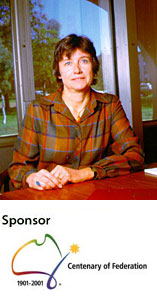
Elizabeth Marchant Truswell was born in 1941 in Kalgoorlie, Western Australia. During her undergraduate studies she discovered the field of palynology (the study of fossil and living pollen grains and plant spores), which allowed her to combine a love of botany with geology. After completing her BSc in 1962 at the University of Western Australia, she worked for a time as a consultant to Western Australian Petroleum.
Truswell received a British Commonwealth Scholarship in 1963 and went to Cambridge University, where she was awarded a PhD in 1966. On her return to Australia she again worked for Western Australian Petroleum (1969-1971).
In 1971-73 Truswell was a postdoctoral research scientist at Florida State University, USA, where she became interested in deep-sea drilling and how it relates to Antarctic floral history. In 1973 Truswell moved to Canberra to take up a position with the Bureau of Mineral Resources, now Geoscience Australia (GA). She remained with GA until 1996. Since leaving GA, Truswell has returned to an earlier interest in art and in particular to an exploration of the interaction between art and science. She has exhibited works at the Canberra School of Arts.
Interviewed by Professor Ken Campbell in 2000.
Contents
- Early years
- University of Western Australia
- Western Australian Petroleum
- Cambridge
- Back to Australia
- Bureau of Mineral Resources
- CRC on Coastal Zone Estuaries and Waterways
- Evolution of Australian forests
- Antarctic work
- International connections
- Later career as an artist
Early years
Elizabeth, you were born in Kalgoorlie and your father was a mine surveyor working underground and also on surface works. This seems to be an ideal background for somebody who is going to be a geologist.
That’s right, Ken. I spent my early years, until I was about seven, in Kalgoorlie, but I don’t think that I was aware of the rocks at that stage. I was very much aware of the hot local environment, but not the rocks as such.
Your father took you on walks through the bush, during which you enjoyed the native flora and fauna. Do you think any of this experience has stood with you during the later parts of your life, for example, in your regard for the environment?
I think that’s very much the case. After we moved from Kalgoorlie my father took a job working with Country Water Supplies in the southwest of Western Australia and I accompanied him often on school holidays, walking through the bush. I certainly became very aware of, and very keenly interested in, the flora and vegetation at that stage.
You did most of your primary and secondary schooling in Perth. Were you good at all your subjects or did you find that there were some that really outshone all the others?
I was reasonably good at most of my school subjects, but I was very interested in biology; we had a very inspiring biology teacher. I liked geography, I liked languages and art – we had a particularly good, if somewhat eccentric, art teacher. We did a lot of still life, a lot of flower painting and I did a lot of imaginative stuff as well.
Did you do some other work in art, in addition to the work that you did at school?
I took art classes, on weekends. Once I was at university I did weekend and some night art classes.
Do you think that your artistic and biological capacities go hand in hand, or do you think that there are some other attributes about science that attract you?
I think I’ve always had a capacity to see things in three dimensions, but more strongly I feel that I have very much a visual memory. I tend to remember things in terms of images and pictures. And I feel the same as far as geology’s concerned, if there’s a particular narrative quality about it. Geology is very much about telling stories and I think that that’s something that’s always appealed to me about the subject.
So it’s more or less history really.
Very much so, and I think this is something that translates into art very readily.
Your father was trained as a surveyor and your mother was a school teacher. Did they expect you to succeed academically?
I think they did. They both had had their own education curtailed because of the depression years. My father left school at 14 and finished his education at night school, at the School of Mines in Kalgoorlie, and my mother did short courses in teaching that were then available.
Did you plan to go to university after you had finished secondary school?
I think once I was in high school I assumed I was going to go to university. I think my parents assumed that too, although there was never any pressure to do so. But for a long time I felt that biology was where I was going to end up and university was part of that.
University of Western Australia
Most geologists didn’t study geology at school, either because it wasn’t offered or because they wanted to do something else, but you took it up at university because of a good teacher, Basil Balme.
Geology wasn’t available at my high school. I took it up at university very much as a fill-in subject. When I started I did zoology, botany and chemistry and I needed another subject, and geology was an obvious choice. But once embarked on that I found that I did have some very inspiring teachers at the University of Western Australia. Basil Balme was very much an influence; he was a pioneer of palynology in Australia and he showed me that I could combine botany, which I particularly loved, with geology, and that there were opportunities in the combination of those two subjects.
I remember doing first year geology and it was ‘Learn this, this, this, this and this and you’ll be all right’. Did he have that kind of approach?
No, he didn’t have that approach at all, but that approach was certainly there. Our first experience of geology was to launch into crystallography and learn the crystal faces and formulae by rote, but Basil’s teaching in historical geology was very much based on his own experiences. He’d recently been working with the British Coal Board and he had a wealth of stories about the way in which palynology then was being used, and a lot of anecdotal and very humorous stories about working in the coal fields in Britain.
Most science students coming to university want to concentrate on some specific aspect, but you diversified your undergraduate work and took up anthropology.
I did anthropology from my second year at university and I was very fortunate in that at UWA there were some major figures in Australian anthropology. Ronald Berndt, who was a giant of Australian anthropology, and Peter Lawrence, who subsequently went on to head the Department of Anthropology in Sydney, were both very keen and enthusiastic teachers in their different ways. And what I gained from anthropology was quite an eye opener – I became aware that the culture that I’d grown up in was really just one of any number of cultures and there were as many ways of viewing the world as there were communities within it.
Western Australian Petroleum
After completing your honours thesis in Carboniferous palynology you worked in the Canning Basin. This meant a lot to you because you felt that applied work was very important.
Having finished my honours degree and then having worked on a consultant basis for a local oil company, Western Australian Petroleum, I felt there was something almost magical in the sense that the knowledge that I had was readily and quickly applied. When the company was drilling, as it was very actively at that time, my ability to provide them with age determinations on the rocks that they were drilling through was essential to their day to day work. I think that was quite intoxicating for a very young graduate.
One of the most interesting parts of your experience confronted you now. You had to make a decision about whether you’d go on with science or go full time into painting – and you chose science. This must have been a pretty critical time in your life.
At that stage I was enjoying my consulting work for Western Australian Petroleum, but I was also painting. I thought that the only way I could decide whether I was going to stick with geology, or make a shift and go to art school full time, was to put in an application for a Commonwealth Scholarship to take me to England to go on with the palynology. And I felt that if that succeeded then that’d make the decision for me. If I failed to get the scholarship I would go to art school. I got the scholarship. The die was cast.
Cambridge
You were in Cambridge from 1963 to 1966 and you began working on Cretaceous palynology. Where did you work in England?
Largely on the south coast, on the Isle of Wight and across into Dorset. The work had its applied side, in the sense that there was a need to document closely the pollen and spores of this particular time interval, which would increase its applications. However, it was also a very critical part of the geological record in that it documented the first appearance of the flowering plants and the first recognition we had that they were coming to be as important as they are. This particular part of the sequence contained that record.
The geology of the English Channel has been worked on for many, many years. Did you find the previous work that had gone on there very useful?
The sense of human history involved in the gathering of information was something that fascinated me. The sequences I collected on the Isle of Wight had been documented by one of the early geological pioneers – Gideon Algernon Mantell. Mantell’s portrait used to stare down at me from the staircase in the Sedgwick Museum in Cambridge, where I had my office, and I was quite delighted that I could go down to the Isle of Wight, take his published sections, and still recognise almost bed for bed the sections that he’d described in the 1840s.
I think this brings up an important aspect of geology, that work well done stays well done and is useful forever after.
Yes, very much so. And I think it’s part of science, this sense that you are doing new work, but it’s very much building on work that’s already happened, and that you’re standing on the shoulders of the people who’ve gone before. That’s a wonderful feeling.
Living in Cambridge meant a great deal to you in ways other than academic.
My experiences in Cambridge were extremely rich and diverse. My supervisor, Norman Hughes, was an extremely interesting and kindly person who took me under his wing. And one couldn’t help but be interested in the environment – I lived in digs that faced across the river from a house that had been owned by members of the Darwin family. There was an enormously stimulating environment generally; music in Cambridge was something that I was extremely interested in and enjoyed. And the science that was going on – some of my PhD colleagues were studying sea floor spreading and the significance of the patterns of magnetic reversals on the sea floor – that was very exciting. Things were happening in biology – I heard Francis Crick lecture. I was interested in the theological debates that were going on, particularly within the Anglican Church. Oh, there was so much it was very hard not to be distracted from one’s own studies.
Back to Australia
When you came back to Australia you worked with Western Australian Petroleum (WAPET) again. How did you adjust mentally to this change from a theoretical biological approach in Cambridge to a practical application to geological problems?
The experience of Cambridge is one that takes a while to get over and coming back to Perth I felt was back into a much more humdrum kind of existence generally. The work that I was doing with WAPET was very much applied. You would see extremely exciting things happening in the geological record in the spore and pollen assemblages that you were looking at on a day to day basis, but there simply wasn’t the opportunity to take it beyond the very minimal kind of information that the company needed. You tuck it away in the back of your mind and hope you’ll get an opportunity to come back to it later.
Bureau of Mineral Resources
After a short time with WAPET you moved to Canberra, to the Bureau of Mineral Resources, now the Australian Geological Survey Organisation (AGSO), as a palynologist. You must have done a lot of other interesting things there besides palynology.
Yes, I did, but my role in AGSO was very much as a biostratigrapher. My official role was involved in developing an Australian time scale. From my point of view it was looking after the palynology that supported that time scale. But I did actually end up looking after the palaeontological group there, a very diverse group of people who contributed their own expertise in different fossil organisms. The development of an Australian time scale uses the evolution of life as one facet and relates it then to other forms of dating, such as radiometric dating and reversals of the Earth’s magnetic field. This was certainly the key element of the work that I was involved in there.
But whereas working with a company meant that I didn’t have the opportunity to develop the interesting biological aspects of the work that I was doing, I certainly did have the chance to do that with AGSO. The bushfire work, for example, came from a CSIRO organised conference on bushfires in Australia. The organiser of the conference asked for somebody who could comment on the record of fire in Australia and how far back in time we could identify bushfires as being a significant part of the Australian environment. So I was able to put together what I knew on that.
Biogeography was something else that happened as part of the information that was available to me. One could see a particular genus of plants that had become abundant in the Australian Tertiary, for instance, and know that there were very similar forms in Antarctica and in South America. Looking at things like the wider distribution of particular elements of the Australian flora was certainly a spin-off from the work I was doing.
During your latter phase of development in AGSO you were put in charge of the Environmental Section. What do you think the geological contributions to environmental studies are at the present time?
The Environmental Section in AGSO was set up to explore the ways in which a national geological survey might contribute to understanding and management of some of the key environmental problems in Australia. One of the obvious ones is the relationship of geology to soils. There’s a lot of rethinking going on now about how people regard Australian soils, very much a shift away from a taxonomic descriptive approach to soil science to one that understands soil processes and the way those soil processes can be translated into a landscape scale. Obviously an understanding of the bedrock geology is something that is very crucial to this whole process of understanding soils.
There’s a marvellous direct relationship between bedrock geology and geomorphology, or the development of landscape, and the growth and fertility of Australian forests. When we were setting up this group we had discussions with the New South Wales Department of Forestry. We discovered that they had been trying to use geological maps in their attempts to understand the way in which forests grew, and they were having great difficulty in finding geological maps that were at the scales that they needed for their own work. But the relationship that they described to us was a fairly direct one. They found that the bedrock geology contributed very clearly to the growth of forests. The direct nutrient supply to those forests and the way in which those nutrients were made available depended very much on things like slopes, on the rapidity or otherwise of erosion, the accumulation of sediments derived from those slopes and from the bedrock geology under the slopes. They were able to show us figures that clearly show this relationship between bedrock, geomorphology and forest growth.
So that was just one area. The other was the contribution of geology to understanding coastal issues – sedimentation in estuaries, the way sediment is related to pollutants, the way sediment is related to nutrient supply in the offshore and in estuaries and to issues like coastal erosion. There’s a very clear need for geological input in understanding processes on our coasts.
CRC on Coastal Zone Estuaries and Waterways
This leads us to the Cooperative Research Centre on Coastal Zone Estuaries and Waterways, of which you’re a board member. This work is very interesting because it applies science to immediate problems that people are facing, not only in Australia but also in the islands of the south Pacific and southern Asia. You must find that exciting.
Yes, I do indeed. This is a new CRC; it was only set up in 1999 and so it’s been going for just over a year. At the moment it’s Queensland based, but the intention is that it will become national as it develops. Its interests are in looking at a wide range of problems that relate to the Australian coastal zone, such as pollution within estuaries. It has recently been involved in an audit of Australian estuaries, classifying them in terms of how pristine or otherwise they are. It is interested in pollution in urban areas; it has had quite a considerable involvement with pollution problems in southeast Queensland. One of the partners in the CRC is the Brisbane City Council; they’ve been looking at issues of pollution in Moreton Bay, of turbidity in the Brisbane River; they are moving on to Port Curtis to looking at problems of heavy industry located in those areas.
One of the CRC’s themes is called citizen science and it focuses on how communities can best become involved, how they can become aware of the problems, how they can have input into the kind of science that is needed to solve the problems and the way in which that science can become part of policy making at the local level. It is at the local level in Australia that these problems are managed.
And it is also interested in problems in the South Pacific islands, flooding in Bangladesh, the rising sea level, and so on. These are issues that are outside Australia but nevertheless of great interest to Australian science.
That’s right. Unesco has very strong interests in those areas too. Unesco has programs operating in the Pacific that look at those problems specifically – issues like how the limited pockets of groundwater in the Pacific islands will be influenced by sea level. Will they change as sea levels rise?
Evolution of Australian forests
When did eucalypt forests arrive in Australia, and how long did they take to spread?
Eucalyptus pollen is rather difficult to distinguish from pollen of the rest of the large Myrtaceae family to which it belongs, a lot of which are tropical rainforest groups, so the fossil record is hard to read. As far as we can tell, eucalyptus pollen has been around since the Oligocene interval in the Tertiary, which is some 30 to 40 million years old. But it was a relatively minor component of the vegetation until very recently, maybe as recently as the Pleistocene. So the last 2 million years was the time when the eucalypts came to dominate the Australian vegetation and the reasons for it have been much debated. We know that they are very resistant to fire and it’s possible that once man had arrived here and was using fire then this was a great encouragement to the eucalypts. Their spread is certainly a recent one, geologically, so they’re a new phenomenon in the Australian environment.
The rapid shifts in climate through the Pleistocene are well documented and we are beginning to get national pictures of fairly fine time intervals in the Pleistocene. Apart from the pollen record, we can document the charcoal record. The record of fires shows up in the sediments as increases or decreases in the amount of charcoal particles that are present. There’s a very interesting record in Lake George, close to Canberra, where the record of fire and of vegetation is reasonably well understood. We see at round about 120,000 years ago increases in fire, these have been used to suggest very early human occupation. I don’t think that that old data is very widely accepted, but certainly the record of fire, the record of vegetation shifts in response to climate, is reasonably well known.
Antarctic work
One of the most interesting parts of your work has been to do with the material that has come off Antarctica and been preserved in the sea. When did you become interested in deep sea drilling?
My introduction to the deep sea drilling project came during a postdoctoral fellowship I had to the US. I was at Florida State University and they were heavily involved; they are in fact a repository for storage of some of the cores from the Ocean Drilling Program, or the Deep Sea Drilling Program as it was then. While I was there I became very interested in that program and I had the chance to go on one of their first cruises to Antarctica.
I was interested in the sea floor spreading history between Australia and Antarctica – particularly the way the modern marine environments around Antarctica had developed. South of the Antarctic Convergence, where there is a dramatic temperature change in the surface waters, the predominant biota is siliceous (silica forming organisms, diatoms, radiolarians); north of the Convergence we meet the calcareous organisms. And that boundary is easy to determine in the sedimentary record – I first became aware of it on the cruise to Antarctica. As we drilled holes I pinned up around my cabin the logs showing the distribution of these siliceous and calcareous organisms, and it became very apparent that this boundary was moving rapidly northwards through time as the climates changed.
The cold waters generated around Antarctica sink to the bottom and then they move northwards, right through to the north Atlantic. These are one of the major drivers of the ocean currents and of the distribution of heat on a global basis. This generation of Antarctic bottom water is an area that is even now not well understood and is the subject of much of the work of the Antarctic Cooperative Research Centre in Hobart.
By drilling holes in the sea floor you’ve been able to infer something about Antarctic floral history.
Almost any recent mud that one dredges up around Antarctica will contain pollen of a variety of ages. A lot of it is pollen of the more recent part of the Antarctic vegetation, of the Tertiary, pollen that’s very similar to much of the Australian Tertiary records. The record of the Antarctic muds is both intriguing and very frustrating. It gives us a kind of catalogue of the plants that once grew on Antarctica, but because the glacial action has been so strong, pollens of different ages tend to be mixed up together as the sediments have been churned up by the advance and retreat of ice shelves, so it’s very hard. While we now have quite a good record of what grew on Antarctica we have a much less clear understanding of when it grew there.
We do have a couple of sections where borehole information is better than average. A very recent cruise of the Ocean Drilling Program off Prydz Bay, east Antarctica, has given us a good section where we have a feel for the most recent Antarctic vegetation. The vegetation there was probably a fairly stunted version of much of the cool temperate Tasmanian vegetation, dominated by the southern beeches and some of the southern conifers, with a minor component of ferns and a few very interesting things like the sundews, the carnivorous plants that are very widespread in Australia. We know that they were there as part of that Antarctic vegetation.
At what time was this?
This is the Eocene period, so you’re looking at 40, 45 million years ago. It’s very hard from the information we have to know exactly when that vegetation was wiped out by increasing cold and by the growth of the ice cap. Our guess now is that it probably didn’t persist much beyond that. It may have persisted locally into the more recent period, the Oligocene, possibly even the Miocene, but we’re looking at an elimination of it probably around 20 million years ago, although there are some very controversial much younger beds there too.
But the other way we’ve been able to use the distribution of pollen around Antarctica is to pinpoint the rocks underneath the ice that might be the source of that pollen. And we were able to do this on one occasion where we had a good coverage of samples right across the Ross Sea. We were able to chart the percentages of pollen in those samples and find out that it was concentrated in a couple of great tongues on the eastern edge of the Ross Sea. Working with glaciologists from Cambridge, particularly David Drewry, we were able to pinpoint from those high pollen densities particular ice streams that were feeding down through the Ross Ice Shelf. We could look at the source of those ice streams and say ‘Well, somewhere here under the ice shelf we have Cretaceous and Tertiary beds that are being eroded.’
And they’ve been finding these Cretaceous plant fossils, stems, trees, in the Trans-Antarctic Mountains, I understand.
That’s right. There are a couple of places. We’ve got a good record of Cretaceous woods in the Antarctic Peninsula area, where the trees grew at very high latitudes. There is in fact a fossil forest preserved at a locality called Alexander Island on the Antarctic Peninsula where Tim Jefferson, who was then a PhD student at Cambridge, was able to document the spacing of trees at these high latitudes. He was able to suggest that quite large trees flourished at these latitudes, but they could only flourish if they were widely enough spaced so that they didn’t shade each other out at the very acute inclination of the sun’s rays at those high latitudes.
And the other, the Trans-Antarctic Mountains occurrence that you mentioned, is an extremely controversial series of beds that now occur very high in the mountains. These contain accumulations of fossil leaves very close to one of the Tasmanian beeches – these are deciduous beeches. There are beds there in the Trans-Antarctic Mountains that contain what look like autumn leaf deposits of this particular beech. They are associated with woods that look like twigs at first glance but further study of them has shown that they are not twigs, but tree trunks. So these were knee high beech forests. There is a huge amount of controversy surrounding the age of these forests, but the first estimate was that they are as young as roughly 2 million years. Almost certainly they were the last remnants of the Antarctic vegetation.
International connections
Having left AGSO you didn’t seek other geological employment, but you did maintain contact with various international bodies, such as Unesco, that were concerned with global problems.
While I didn’t seek other geological employment I’ve always been very reluctant to give up geology and I have maintained some research. Unesco has a number of science programs and it has for the last 25 years been running a very successful Earth science program, the International Geological Correlation Program, which provides small amounts of money for projects that deal with geology on a global basis. It provides enough money for people to maintain contact and to run projects, particularly with links to developing countries. Those projects cover the whole field of geology, from mineral exploration through to environmental problems. There’s been a particular focus in the last few years on problems related to water, so there’s been a strong encouragement for people to set up hydrogeological projects under this IGCP heading. Australia has had a very strong input to that program, right from its inception in the early 1970s. For a long time BMR, or AGSO, has provided funds for Australian scientists, so I began my involvement as part of an Australian committee that has overseen the funding from this end. Then I moved to the Paris-based Unesco board which was responsible for overseeing the program on a world basis.
Later career as an artist
Tell us about your work at the Canberra School of Art. I understand that you think art and science are interrelated in a specific way.
Well, art and science have been very closely linked right through their history. The divisions between them are fairly recent. If you look back to people like Leonardo da Vinci, there you had an artist who was really pushing back the boundaries of science. His interest in anatomy and mechanical phenomena was very scientific. After the Renaissance was a time when artists began to serve the interests of science. If you think of the early voyages of exploration to the Pacific, to Australia, artists were then employed directly by scientists and were responsible to them for documenting the wonders of the New World. It’s a very interesting study to look at the kind of tensions some of these early artists experienced between serving their scientific masters or serving the navigators. For instance on Cook’s major voyage, when he circumnavigated Antarctica at high latitudes, the young artist William Hodges was responsible directly to Cook, who was encouraging him to produce paintings that served the cause of navigation, to produce coastal profiles. However, the artists on Cook’s earlier voyage were responsible not to him but to Joseph Banks, so there was perhaps more of an emphasis there on the natural history records that they were documenting. So this interaction between art and science has a very long history and a very interesting one and I’m particularly keen to explore that further.
I also find that in the practice of art, now becoming more of a practising artist myself, there’s a huge similarity between the processes of working in art and science. One accumulates a great amount of information before generating a painting or a scientific paper and the processes are fairly similar. There’s the accumulation of information, the phase of wondering where it’s going, then some kind of revelation, of seeing what that information can be translated into, and all of it, I think, is a response to the natural world. It is using different languages, but it is fulfilling that same need to respond to nature in one way or another.
Could you tell us a little bit about the translation from a scientific observation of the world to an artistic world?
I feel that becoming an artist later in life I have a great deal of experience to draw on, which makes it much easier to take up art on a full time, serious basis. Over the last year I’ve been involved in a struggle to produce a series of paintings that really do reflect something of the understanding that I have as a scientist of landscapes of the past. I guess the unique view that geology brings to an understanding of the world is an acute awareness of change, the fact that landscape is something that is changing very rapidly. I’ve been trying to develop paintings that show old landscapes underlying modern ones, that landscape is something of many layers and that underneath the present landscape is always the imprint of an earlier landscape.
I’ve tried to attack this problem in a number of ways. One of them has been a fairly straightforward set of drawings that is my understanding of what the ancient Antarctic forests might have looked like. I’ve actually drawn those on top of photocopies and collages of some of my own scientific papers, so there’s that sense of a scientific understanding of landscape interfacing with the landscape itself. In other paintings I’ve had to try to find some metaphor for this changing landscape and in that case I’ve actually drawn on the Antarctic fossil woods. I have made paintings that had their origin in the tree rings, because here is a metaphor for change, for time, for landscape, plus a lot of visual interest that one develops through those paintings.
From your love of the native flora as a child, the history of the Australian flora, application of studies to petroleum environments, environmental studies, studies of the history of Antarctic floras based on material from deep sea cores, to the representation of living forms in various artistic ways, you’ve had a very full and interesting life, Elizabeth. Thank you.
Dr Douglas Waterhouse (1916-2000), entomologist
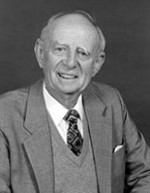
Dr Douglas Waterhouse was born in Sydney, Australia and from a very early age the world of entomology made a great impression on him. He received a BSc and MSc from the University of Sydney and in 1938 established a career at CSIR (now CSIRO) where he remained until his retirement in 1981. Throughout his career Dr Waterhouse made significant research contributions to the blight of Australian sheep farming, the sheep blowfly. During the Second World War he researched extensively on controlling malaria outbreaks affecting soldiers in Papua New Guinea. Between the early 1950s and 1960s Dr Waterhouse received a DSc and became Chief of the CSIRO Division of Entomology.
Interviewed by Dr Max Blythe in 1993.
Contents
- Early imprinting
- Beginning entomology
- University days
- Hindering the sheep blowfly
- At war – against the mosquitoes
- Happily married
- A Cambridge studentship: more blowflies
- Moth-proofing wool
- Updating Tillyard
- CSIRO Entomology: so many challenges
- Integrated pest management: dung beetles 1, bushflies 0
Early imprinting
You were born in Sydney in 1916, into a very interesting, supportive family. I have a feeling that you may have been imprinted with natural history quite early.
Well, my mother used to relate that, because I was fairly sickly as a young child, she took her complaining second son out in a pram to try and get him to sleep one day. She stopped to get a pebble out of her shoe, and all of a sudden I stopped complaining. She looked up, and there the pram had stopped just opposite a low wattle tree. I had put out my hand and picked a weevil off a wattle branch. Normally you would expect an insect to be crushed in the tight little hand, but this armour-plated insect survived and I went to sleep. Subsequently, when we went out my mother would collect one of these beetles and let me hold it.
That weevil was called Chrysolobus spectabilis and happens to have been one of the first insects that Sir Joseph Banks collected when he landed in Botany Bay on 29 April 1770. The specimen that he collected is now in a drawer in the British Museum of Natural History, in London. And with that weevil I too started my collecting.
Tell me about your parents. I think they were linguists.
My mother was born in Kilmarnock, Scotland. She graduated from Glasgow University in French and German and then taught both languages at Dundee. During vacations she went to the Continent – at that time, for a woman to have such Continental travel and training in languages was rather unusual. Dad had graduated from Sydney University with first-class honours in English, French and German, and also had taught for several years at schools in Sydney. When he went over to the Continent to study phonetics and become more fluent in French, German and Italian, he met my mother in a house run by the Mott family in Seine, France, where a number of people were studying phonetics to improve their pronunciation.
Dad then came back to Australia and they had a long correspondence courtship. They eventually married in Scotland in 1912, had a honeymoon on the Continent, and settled back in Sydney. I was the second of their four sons, and it so happened that my mother was the middle of her mother’s three children and my father was the middle of three sons.
Your father had a phenomenal success story, receiving awards for his linguistic work and eventually becoming Professor at Sydney, didn’t he?
Yes. He was recognised in France, he got the Goethe Gold Medal from Germany and he was knighted by King Umberto of Italy for the contributions that he had made to teaching Italian in Sydney University.
I think that on the Continent he met and dealt with both Hitler and Mussolini.
Correct, yes, both in 1934. He was in Berlin at the time of the Putsch and had half an hour or more with Hitler, which he has recorded in some detail in his memoirs.
From his language career your father turned to plants and horticulture, and popularised camellias worldwide, I believe.
He had always had a hobby interest in landscape architecture. When he retired, he started to look into means of propagation of camellias, which were one of the plants which had a very effective form. He looked into the origin of camellias, which come from South-East Asia and China, and he looked into the nomenclature, bred a number of varieties, wrote widely about them and stimulated a renewed interest in them.
He died at 96½ and, up to a couple of months before he died, he was still very active and writing half a dozen letters a day by hand, and was then the president of an international camellia research society. I hope to emulate him.
Tell me more about your mother. I think she was an equally exciting person, and closer to you when you were a boy.
Very much so. She devoted her time to her four children, helped us with our homework, gave us wise sayings like, ‘Only the best is good enough.’ But if you were having a tough time with maths or something like this in your homework, she would say, ‘Plodders win through.’ She motivated us in an extremely good way. It was only when we all left home that she had time to take up her own interest in simple flower arrangements. Under the influence of a grand master of ikebana, a Japanese form of floral arrangement, she became the first president of the ikebana group that was established in Sydney.
Beginning entomology
Let’s go on to the link with your uncle, who was a very distinguished writer on Australian butterflies.
Uncle Athol was Dad’s older brother, and he and Dad used to help their mother, my grandmother, to collect shells on Sydney Harbour. They both got from her an interest in bush rambles and in nature, and in 1903 at the age of about 25 Athol published the first comprehensive list of Australian butterflies. At that time he was an engineer-chemist in the Sydney Mint, but when the Mint changed from Sydney to Melbourne he got early retirement and could then work full-time on his hobby of butterflies. For his very interesting early work on natural hybridisation in the field of butterflies he got a Doctor of Science from Sydney University.
My uncle encouraged me early on to look at insects, but when I was eight or nine he started to take a more active interest in my hobby, giving me a glass-fronted case with butterflies in it. This stimulated me further and I put more beetles in bottles and even stuck ordinary household pins through insects. This probably horrified him, because he then gave me a cyanide killing bottle and a folding cane butterfly net to collect insects. And my parents, at my next birthday, gave me fine entomological pins, forceps, pinning boards and various other equipment. This I am sure got me afloat.
During your preparatory school years, living in Gordon, you continued your love of natural history and went out regularly into the Hawkesbury sandstone bush, collecting. Were you on your own?
We went out ourselves, but particularly with our father on Sunday mornings. Gordon, on the North Shore line, is in the middle of the Hawkesbury sandstone, and in those days there was still an enormous amount of bushland around us. It contained very varied and fascinating flora and fauna, and in particular it was rich in wildflowers. Our father showed us different sorts of boronias, orchids and flannel flowers, and two of the plants that are influenced greatly by insects – the trigger plant, which lets off a trigger when an insect comes and uses this for pollination, and a sticky plant called Drosera, which traps insects and digests them to obtain their nitrogen supplies.
But in your teens you were plucked from spending a lot of time in that wonderful environment to become more and more taxed with schooling.
Yes. When Turramurra College folded up, I did my last half year of primary schooling and then all my secondary schooling at Shore. I was a reasonable pupil there but not very good at sport, so I didn’t enjoy school. In those days you had to be in the First VIII of rowing or the First XV of football or the First XI of cricket. I could play tennis reasonably well, but that was regarded as pretty sissy in those days. Some of us did, however, manage to encourage a master to set up a natural history society and then we could go out occasionally on various trips.
On one occasion when I was secretary of the Natural History Society, I offered to arrange for the New South Wales government entomologist, named Gurney, to come to speak. We were all waiting in the school library at about 7 o’clock on the appointed evening for him to turn up and show us some interesting specimens, and nothing happened. By a quarter past, the boys were saying, ‘Oh, you blew it. You organised him to come at the wrong time,’ and even the master was getting a bit cross with me. So I rang the man’s home, where his wife said, ‘Well, he had dinner early and went upstairs to change, but he forgot where he was going and got into bed. I thought it was funny that he hadn’t said goodbye to me.’ When he did turn up at school – and gave an interesting talk – I knew from his head (which seemed to be half as large as usual) and his somewhat vague look that he must be a great scientist. Most of the other boys said it confirmed their opinion that entomologists were a bit crazy.
At Shore you became friends with Max Day, who is also a Fellow of the Academy, who has told me that he has vivid recollections of happy meetings and bushwalking and collecting with you in those days, and he went to university at the same time as you. Your careers have paralleled quite a lot.
Yes, even to this day, and he lives 100 metres from where I do now. We met in our first year in high school, and when my Uncle Athol invited me to go out collecting I suggested that Max, who lived closer to Uncle Athol than I did, should come along. He was a regular collecting companion with Athol, but also he and I used to go collecting together. If we got anything particularly interesting, though, Athol would say he thought he might have that for his collection, all of which has ended up in the Australian Museum, in Sydney.
University days
Doug, you passed your school leaving exams well enough to get an Exhibition scholarship and go to Sydney University.
The Exhibition was useful because it provided free education. My school subjects were somewhat restricted. I did four languages – English, French, Latin and German – and maths I and maths II, but I couldn’t do more than one science subject, either chemistry or physics, and there was no biology, because that was only in girls’ schools. When I went to Sydney University I did chemistry, which was good, and then physics, botany and zoology. Zoology in particular was a great stimulation and of very great interest.
What was it like when you and Max Day went to Sydney University?
My father was a professor at the university and so at home I had already met some of the university professors, including the head of the Zoology Department, Professor Dakin. Max and I were able to go on a very important Rover Scout expedition to Mungo, about 100 kilometres or so north of Newcastle on the Myall Lakes, to study a patch of brush rainforest there. The university Rover Scout group was at that time led by the Professor of Botany, Professor Osborn, who was a charming person with an extraordinary way of speaking when he was lecturing. Many others of the 25 or 30 people there became firm friends, including Sir Rutherford (Bob) Robertson. Max and I were there during our September vacation as probably the only first-years present, with half a dozen professors and a range of people from zoology, botany, geography, geology and so on. Getting to know them under those circumstances made all the difference, because we were invited into the senior student and staff tea room, which was a little common room behind the zoology museum. This meant that the Zoology Department became our spiritual home; we met visitors there and we managed to talk to the staff on informal terms. I’m sure it made an enormous difference to us.
Your course unfolded with great success, with you going on to entomology and an honours project in your fourth year. Tell me about Woodhill in that regard.
Tony Woodhill was the senior lecturer in entomology, who probably hasn’t been given due credit for his contributions to teaching at Sydney University, where he spent almost all of his career. He was a rather quiet, shy person, very kindly, with a pleasant smile. His lectures were full of meat but he wasn’t flamboyant and didn’t give rise to stories that could be told about him as they could about all of the other staff. But he stimulated and taught all of the entomologists that were required by the Commonwealth and by New South Wales over a very long period, something like 1930 to 1955.
Our group included Max Day and also Margaret Cumpston, who has continued in malaria work since then. The group was a very stimulating one and there were several more advanced students who interacted with us extremely effectively. Woodhill encouraged us to select our own honours project, and I selected a primitive aquatic insect in the Megaloptera. This was a study of the larva, not only its morphology and fine structure – its histology – but also its respiration. It had some interesting lateral processes from its abdomen, and the question was whether these were gills or just ornamentation.
You completed your degree with first-class honours and a medal, but while you were still at university you’d made links with CSIR – which in about 1950 changed title to CSIRO. Perhaps you’d tell me about how that link accessed a future career for you.
At the end of our third year Max and I were invited to become what was called then ‘student labourers’. You were given £2 a week and you had to find your way to the job, which for us was down in the Goulburn Valley, in central Victoria, helping to breed up parasites. One was Macrocentrus ancylivora and the other was a species of Glypta, and they were meant to help to control the peach-tip moth. You had to go out and collect the larvae of the peach-tip moth, put them into cages with the parasites and let the parasites attack them. We bred up lots of these parasites and they were liberated, but unfortunately they didn’t become established. The moth can now be controlled by using its sex pheromone. The sex pheromone of the female, which takes the males in to where the females are, can be synthesised and put out in little tubes, one per tree, when the trees are pruned. When the males emerge, the tubes keep on putting out the pheromone into the air and so the scent is everywhere and the males are confused. They don’t find the females, the females aren’t mated, and only sterile eggs are laid. This is a very effective method of control.
Hindering the sheep blowfly
Our work in the Goulburn Valley led to us being invited again in the next vacation, this time to Canberra. Max became involved with termites, which he had studied for his honours, and I was assigned to the blowfly section, under Dr Ian Mackerras. He was deputy at that stage to Dr Nicholson, who was Chief of the Division of Entomology and had himself spent several years on sheep blowfly work. Because my initial period was only going to be for six or eight weeks, I was given a piece of equipment called an olfactometer, to test out the way in which the sheep blowfly, Lucilia cuprina, was attracted to materials. However, when the person who had been doing this work in CSIR suddenly resigned and the position was advertised, Ian Mackerras suggested that I might apply. Within a few weeks I was offered the job and accepted it – and having arrived on 2 January 1938 I was, in effect, there for the rest of my life, or at least until I retired in 1981 at 65. You might say that I am a stick-in-the-mud – but very happily so.
Your work on the Australian sheep blowfly is really a big story with quite a background. Economically, the sheep blowfly was an enormous problem.
Yes. It was estimated at that time to be causing losses of £4 million per annum, which was an enormous sum – equivalent now, after inflation, to at least two or three hundred million dollars.
If the sheep blowfly lays its eggs on the fleece or on the skin of a sheep, the eggs hatch and the young larvae abrade the surface of the skin with their mouth-parts. This causes serum to emerge, and the larvae feed on that and keep on scraping. If no further flies come to the wound, the temperature of the sheep rises, the wool stops growing and the larvae fall off when fully grown. When the wool starts growing again there is a thin area of fibre, termed a break, where it had stopped and that greatly reduces the value of the fleece. If more eggs are laid, the wound gets larger and larger. Often bacteria then come in, septicaemia sets in and the sheep dies. It is necessary to do something to prevent death or, if possible, catch the strike early enough so that a break won’t occur.
What was the standard practice in 1938?
The standard practice was to cut the wool from over the strike wound and, using the back of garden shears, scrape out all the maggots, which would fall on the ground. You would then put on a dressing, which often contained an arsenical so that if a few larvae remained behind they would feed on that and be killed, or any further young larvae hatching would also get a stomach poison. But sometimes this caused necrotic wounds and so it wasn’t very good.
However, I looked at what mechanism there was for absorption of poisons in the digestive tract. On the wound in the sheep, the pH is near neutral, sometimes alkaline, certainly no more acid than pH 6.5. By feeding larvae with indicators, however, you could show very clearly that in the centre of the digestive tract there is a very acid region, down to pH 3 to 3.5. The question then was what happened in absorption of anything, including poisons, as it went down through the digestive tract. By using histochemical reactions I could show iron in the cells of this acid region: this was the region where iron was absorbed. Then I looked at other metals, including copper because copper salts were sometimes used in these dressings. I found copper was also absorbed there, but by different cells.
Then the question arose: could one use an arsenical or other compound which would be soluble and absorbed in the acid region of the digestive tract, but not become soluble in the much more alkaline or neutral pH of the wound? The first experiments didn’t show promise, but that particular line was then halted anyway by the discovery that borax and boric acid were very effective stomach poisons for the larvae. They were bland for all the wound tissues; they were bacteriostatic. In fact, we now know that they inhibit the proteolytic enzymes which the blowfly larvae use to digest the tissues. So, we had an effective stomach poison.
The next question then was: where did the main population of the sheep blowfly breed? If, as was assumed at the time, they bred largely in dead sheep and that was the main source, then it didn’t matter if you scraped the maggots out of the wound onto the ground. If they were more than half grown they could produce fertile flies. But some experiments that I did then showed that, from each of the wounds on an average, you would get perhaps 1200 adult flies, whereas if you put dead sheep out on trays and collected all of the maggots you would sometimes get no sheep blowflies at all, just plenty of other blowflies. This was partly because they couldn’t get enough food in competition with other species and partly because, when you get a heaving mass of maggots in a carcass, the temperature goes up and this affects many of the processes of Lucilia cuprina more than other species, so that they didn’t survive. It became clear that the very time-consuming process of burying these carcasses or burning them (even though that might be good on other grounds), didn’t have any effect on the sheep blowfly population. The population was almost entirely bred on the surface of the sheep.
The next thing then was to develop a contact poison, or a mixture of poisons, which would kill the maggots very quickly; and then to cut the fleece down to about an inch over the surface, put the dressing on and hope to kill all of those maggots. This was quite a challenge, although just at this time two people in Cambridge – Professor Wigglesworth and Dr Hurst – had done some very interesting work. The cuticle of an insect has got a lipid layer on the surface and then a thicker inner layer, which is protein but it is largely aqueous. What is necessary is to have something, perhaps a mixture, that will go through the lipid layer and then through the protein layer, but without being too damaging to the sheep.
Eventually a mixture of orthodichlorbenzene, kerosene and lysol – which sounds horrible – was found to have this effect. It could be put onto the sheep wound, and as soon as it got there the maggots would be killed and stand out dead, but the wound was not unduly affected. Into this witch’s brew was put boric acid, and there was an inert clay carrier. This led to a dressing called BKB, which was widely used for quite a long time. After the war it was temporarily supplanted by DDT and other chlorinated hydrocarbons, until those were no longer permitted. But BKB did achieve the purpose at that particular time.
At war – against the mosquitoes
The war broke into your early years at CSIR.
Yes. Ian Mackerras enlisted the day that war was declared – he was NX18, the 18th person from New South Wales. Having a medical degree, he went overseas as a medical pathologist. When he came back to Australia he was asked to set up a series of malaria control units, because at that stage Japan had come into the war and it looked as if Australia would be involved to the near north or further north. I volunteered to join these and was accepted, but interestingly enough the Army decided that the CSIR facilities at Black Mountain were far more extensive and appropriate, so it would be better for me to remain out of uniform and do research there. But when there was anything to be tested in the field, I would don uniform, be called up, and go out and use Army facilities. I believe this was an extremely effective way of using my abilities.
To begin with, I was testing oils for spraying onto mosquito breeding grounds which are bodies of water – oils which would spread very effectively, even though there might be surface films there already. I also had to test materials which might be used for mosquito sprays and housefly sprays to stop transmission of diseases. It was thought that our pyrethrum supplies, which at that stage came from Kenya, might easily be cut off, so it was a matter of testing any possible alternatives. It was particularly important to get a good mosquito repellent. Citronella oil had a reputation from earlier use in World War I and at other times in the Middle East, but when we tried it against mosquitoes in New South Wales it had almost no effect at all – plenty of smell but a very short-lasting effect.
I tested essential oils from many of the Australian trees, and one which proved to be an extremely effective repellent was from Huon pine, which is particularly common in Tasmania. The oil of Huon pine contains methyl eugenol and was used at that stage during grinding of lenses for telescopes and other optical equipment. The next step was to test it out in the field, but to my great disappointment half of the army volunteers became nauseated within about 10 or 15 minutes after it was applied to their face. The other half, including me, were totally unaffected, but it had to be dropped.
For my tests I would sit in a large muslin cage in a room, along with a thousand or so mosquitoes, and have a substance on each leg, another one on an arm and so on. This work got into the press, and as a result we got many letters suggesting all sorts of materials and mixtures to be tested. As a matter of course I tested all of these and all of their ingredients.
The Standard Oil Company wrote to us about two preparations that they had used in oil exploration in South America. One was dimethyl phthalate and the other was diethyl phthalate, and the company had about 35 per cent of these materials in two separate repellents. It so happened that, within our limited capacity to manufacture chemicals in Australia at that time, we could manufacture the phthalates. A friend of mine in Sydney, Herman Slade – who now lives half his time in Vanuatu and half in Australia – had one of the first stainless steel kettles and was making dibutyl phthalate. This was used as a plasticiser for the fabric of aircraft wings, to make them smooth and glossy. He made a series for me of these phthalates – dimethyl, methylethyl, diethyl and all the way up to dibutyl.
I found that the diluted dimethyl phthalate was a good repellent but the pure dimethyl phthalate was quite outstanding. It gave protection against voracious mosquitoes for probably an hour and a half, under conditions as hot as you could get. So immediately I got in touch with a colleague, Captain Bob McCulloch, who tested it out under field conditions up near Newcastle, where there were hordes of mosquitoes, and it was equally effective. Major Mackerras dispatched us immediately up to Cairns, where at that time there was a lot of malaria transmission – it has since been cleared up. We found the repellent just as effective against those malaria mosquitoes.
The next stage was to test it out under conditions in Papua New Guinea which might be experienced if war came as close as that. So I was sent up to a little village at the mouth of the Lakekamu River, which is near the Fly River on the southern shores of New Guinea, where the malaria rate and the number of mosquitoes was the highest known at that stage in New Guinea. Most of the time, children there died from massive malaria mosquito bites; the inheritance of a degree of resistance from their mothers didn’t protect them except for about four or five weeks at the end of the dry period each year, when they could survive. By day, resting on the jungle floor you would find it absolutely peppered with these mosquitoes and, if at dusk you stood and waved a mosquito net round, you could collect one or two hundred mosquitoes every minute. It was really an excellent place for this sort of work.
We didn’t know at the time whether or not the strain of malaria was Atebrin resistant. Fortunately, I took half as much again Atebrin as I needed. I became as yellow as if I had had jaundice, and I remember hearing Tokyo Rose saying over the radio, ‘Don’t take your Atebrin. If you go home you’ll not only be sterile but you’ll be impotent!’ (This was the sort of attempt made by Japan to discourage the Australian troops from taking their Atebrin.) Anyway, I was protected even though I had probably well over a thousand bites from these malaria-carrying mosquitoes. The malaria strain was clearly Atebrin sensitive.
The dimethyl phthalate, later called Mary, stood up under these conditions just as well as it had before, despite the ‘mights’ – it might not have worked or it might have caused nausea or we mightn’t have been able to synthesise it.
Were you trying it with any of the troops you were involved with?
No, I did this myself. To expose yourself like this, there was a risk. There was a signal station on the other side of the river, but I was there with two entomological colleagues who had been doing work on malaria rates and who confirmed my experimental work. When I got back to Land Headquarters in Melbourne, Major-General Burston, who was the Director-General of Medical Services, Ian Mackerras and Bill Keogh, who was the Director of Pathology, were all sufficiently impressed that they gave very high priority to the production of this material. It then was used by the Australian forces, and I think later by some of the American forces, for the rest of the Pacific War, and it remains a very effective repellent.
What an unusual sight you must have been in New Guinea at that time, without rifles or other weapons, doing your experiments. You were a captain by then, weren’t you?
Yes, and normally you would have an entourage, or at least a staff sergeant. To go up into these areas, normally there’s nobody more senior than a lieutenant. Although at Headquarters captains were a hundred to a penny, out there a captain is really quite senior, and in the ship that I went on from Port Moresby to Lalapipi I found that I was by far the most senior officer. The captain of the ship was a warrant officer and they had some very battle-hardened troops from the Middle East, under the command of a sergeant. I remember we set off at midnight on a Saturday night and at 7 o’clock on the Sunday morning the captain asked me whether I was going to have a church service. I thought twice, beckoned the battle-hardened sergeant round the other side of the cabin and said, ‘Look, you know more about this than I do. You’re going to come and tell me what orders I have to give you.’ So he went back and said, ‘The Captain says we’ll have a five-minute church service. Now get busy.’ Later on, when they started on using their .303s to shoot sharks, I went round the back of the cabin and he came around to me; he didn’t ask me anything but just went back and said, ‘The Captain says you’d bloody-well better stop that.’ So we got on extremely well.
But I didn’t even have a staff sergeant. I didn’t have kitbags – because I had bottles of this, that and the other, and pipettes and measuring cylinders. I went around these parts with two suitcases. This made me look a bit peculiar, but I guess I was sufficiently peculiar that the troops didn’t mind me. In fact, after a while they got quite interested in what I was doing – even though it was clear that I didn’t know much about fighting.
Happily married
You came back to CSIR in 1945, after the war. By then you were already married, with one child, so let’s put your wife into the story. She was only 18 when you met and decided to get married, and you were quite senior by then.
Yes. She was stunning. She’s always been terrific – very understanding and a great support – and she’s had to put up with me going around the world, often without her. She doesn’t like flying, but she has been around several times with me.
Your wife helped you in some of your research projects.
Yes, in the early days. In fact, I met her in one of the early blowfly experiments, before the war, when she had joined CSIR as an assistant while waiting to be admitted as a nurse. She came out in the field and helped with one of the experiments to measure the density of the flies in the field. Later on, she was a willing helper in allowing mosquitoes to feed on her arms when we were developing mosquito cultures and so on. She also later – but not with me – became involved in some moth-proofing operations when there were big stores of wool and there had to be a means of protecting these against clothes moths and carpet beetles.
And that’s a marriage that still goes on very happily.
Yes – 50 years next March.
Before you could get on with your work at CSIR, you had some time in England. Because of the economy at the time, your wife would have had to go for two years or not at all, so she didn’t go with you. Would you like to explain that to me?
Because I was only going for a year, if she had come with me she would have had to stay on for a period because transport was very limited and she couldn’t get any guarantee that she’d be able to return with me. So she stayed behind for almost a year, while I went to Cambridge and then had a most fascinating trip back through the United States and Canada, looking at quite a number of laboratories and meeting people who were to make or were already making extremely important developments and discoveries.
A Cambridge studentship: more blowflies
How was it that you went to Cambridge?
I was offered a one-year studentship overseas, which led me to go with a number of other trip-deferred students to England. In the same cabin aboard ship was David Craig (a Fellow of the Academy), on the bunk above me, and others on that ship included Gordon Ada (a Fellow of the Academy) and Ed Salpeter, a Corresponding Member of the Academy and an eminent physicist. We lectured to each other on the way over and worked quite hard during the six-week, fairly slow journey to England. We left from Sydney and didn’t call at any other Australian port, and it was a month before we landed in Aden and Port Said as our only stops before England.
At Cambridge you worked in Wigglesworth’s unit. Much earlier you had been fired up by some of Wigglesworth’s publications on insect physiology, I think.
He is the father of insect physiology in the world. He had not only written a small Methuen book but later Principles of Insect Physiology, and stimulated work in all fields of insect physiology around the world. His group in Cambridge was supported by the Agricultural Research Council, and not surprisingly he had attracted to the group some of the brightest brains of the day. It was a particularly stimulating environment at the time. Any one of those that were there could be said to have had quite fascinating and original ideas and developments, and many were subsequently elected as Fellows of the Royal Society.
When you got there, you were going to do some research on peritrophic membranes?
Yes. It was a matter of selecting something which I could do in the time that I was there, but which enabled me to attend lectures and to visit other groups in the UK. It was more important to absorb the atmosphere and the interaction with other people than to write another paper, which could be done elsewhere. I still have the weekly letters I used to write back to the boys in the lab to share my experiences.
Keilin and a whole range of other people were doing exciting things in Cambridge at that time, and this continued with the peritrophic membrane of the blowfly.
That’s quite so. The peritrophic membrane is a cylinder, in the case of the blowfly, and is produced at the beginning of the midgut. There’s a secretion ring which squeezes out, as it were, a plastic tube which fits all the way down and surrounds the food being passed down the gut. I was interested to know what function this had in permitting or preventing the passage of material from the food out into the surrounding epithelium, which is where things are absorbed and get into the body. Anything that is taken up by the cells has to pass through this first, and in some insects you have to know how parasites get through it. The malaria parasite, in the case of the mosquito, has to go through the peritrophic membrane before it can penetrate the cells. This membrane varies a bit from one insect group to another, but it has a very interesting structure and obviously has an important function.
Doug, the short time you were in Cambridge robbed you of a chance to do a PhD there, but a DSc would come a bit later, in 1952.
Fortunately, yes. Although a PhD would have been nice – at that stage there were no PhDs given in Australian universities and the people who had them had got them from overseas – there wasn’t quite the same peer pressure. But really it was a question of what was more important, to get a degree or to get the experience which would enable me to do a wider range of research and to have stimulation. Although I guess it was sad that I couldn’t spend two years there, it didn’t worry me that much.
So you came back to CSIR and continued your blowfly work.
Yes. We thought that there were still improvements that we could make. I studied excretion in blowflies, and I also thought that perhaps we could do even better than boric acid, so I looked at the fine structure in the digestive system and a variety of other things like this.
Moth-proofing wool
But just as the ’50s were approaching you diverted some of your energies to looking at wool storage problems.
After the war, rayon, nylon and other synthetic fibres became available in much larger quantities and were much cheaper. This was posing a particular threat to wool, and three divisions of CSIRO were set up to look at the properties of wool, particularly any which were disadvantageous. One of them was that wool would felt, so it was necessary to have a way to wash it more easily and even in washing machines. Another question was whether you could permanently pleat it. Also, the synthetics were not digestible by clothes moths and carpet beetles as wool was, and it was then that I got involved in wool digestion. Why was it that, of all animals, only insects could digest wool, and of these only a small group of clothes moths, carpet beetles and the lice that live on birds? This was a mere handful of the five or 10 million insects – perhaps a few hundred at most.
The principal protein of which wool is made is keratin, the material which is the main constituent of hair, fingernails, feathers and so on. It had been known from work by two Danish scientists that clothes moth larvae had very alkaline conditions in their digestive tract – a pH of 10 – and also very reducing conditions. It was a matter of knowing how important those two factors were, or what other factors there were that enabled these wool-digesting insects to do so, and whether the factors could be interfered with in some effective way to produce moth-proofing.
So their enzymes were operating in these amazing reducing conditions?
Yes. I found that the highly alkaline conditions were not really important, because they were characteristic of all lepidopterous larvae. For instance, you could chop up wool finely and put some cabbage juice with it, and the larva of the cabbage white butterfly would eat it quite happily. It would pass unchanged through the pH 10 or thereabouts in the digestive tract, so alkalinity by itself wasn’t important.
It turned out that the very reducing conditions were what mattered. You could measure this by feeding dyes which changed colour according to the oxidation-reduction potential, and the value in the clothes moth larval midget was minus 300 millivolts. The reason this was important was that one of the main amino acids in keratin is cysteine, which has two sulfur groups which are joined together in an –SS– linkage. If you have reducing conditions, you can cleave that. Once that bond is cleaved, normally you get two –SH groups formed, and this cleaved wool then can be digested by many insects. It’s interesting that, in permanent waving of hair, you cleave it in a similar fashion, put the hair into whatever position you want and oxidise it again to restore the linkage, but the linkages then are in a different spatial relationship and you get a permanent crimp. One of the things that we thought of was to put, in between the two –SH groups (ie, –S-X-S–), something which wouldn’t be cleaved by the reducing conditions. We would then have a permanent moth-proofing. The insects’ digestive system wouldn’t work any more.
But quite apart from that, in the process we found that there was another enzyme which cut off the –SH groups. Consequently, if you put in things which would otherwise be poisonous, like mercury, lead and arsenic, they formed insoluble sulphides. You could see this happening, because lead and copper sulphides are black, arsenic red or yellow, and antimony red, and so on. So the insects have a built-in mechanism for protecting themselves against quite a number of the inorganic poisons. You could even get protection against fluorine, because they have calcium granules and can produce insoluble calcium fluoride. They also have a mechanism for protection against barium.
Anyway, it became clear that inorganic poisons were not going to be of any use; you would have either to go to organic poisons or alter the structure of the keratin molecule. But just at that time, empirical tests on a whole range of insecticides showed that dieldrin was a very effective moth-proofing agent. It was, in fact, used for the next 20 or so years until chlorinated hydrocarbons became unacceptable on environmental grounds.
So again your work was cut short, this time by dieldrin coming in. Let me now just mention the goblet cells in the intestine, which you looked at quite a lot. They were a storage repository for the kind of things that were being put into complexes.
Yes. Although you get insoluble sulphides, some of these can be rendered into colloidal form by the amino acids and polypeptides that are either in the digestive juices or released during digestion. We looked at how the colloidal materials were taken up in these special cells in the gut. You could get larvae which you’d fed on these poisons and tell what they’d fed on by looking through the semi-transparent cuticle at those accumulations. But when they moulted, those were cast off. So it is clearly a form of storage excretion.
Updating Tillyard
From about 1954 to 1960 you were Assistant Chief of the Entomology Division.
Yes. That broadened my interests. I had responsibility for insect physiology and toxicology and veterinary entomology and some responsibility also for biological control, which was quite important to my later career. The administrative chores weren’t really as onerous as I thought they were then, and certainly not nearly as onerous as the enormous load of administration that is now on my successor.
The head of the Division was Nicholson, whom you’d started with.
Yes. He was an outstanding theoretician, particularly in population dynamics, and a very clear thinker. He was a very shy person, though, and he wasn’t an empire builder – he was relatively loath to take the opportunities that were occurring at that time for getting more staff and facilities. Although there was a slight increase in support for the Division, there was not nearly as much as in the neighbouring Division of Plant Industry, where the Chief at that time was Dr Frankel, later Sir Otto Frankel, who took every opportunity that came his way and built up an extraordinarily effective and outstanding team of researchers in the Division of Plant Industry.
Did you feel a bit frustrated at that time, that opportunities were being missed?
No, not frustrated. There were so many things to do that I accepted the situation quite happily.
What about your wish at that time to update Tillyard’s Insects of Australia and New Zealand?
That was one of the things that I had been keen on. Tillyard’s Insects of Australia and New Zealand was almost a bible to me. It was published in 1926, when I was just 10, and I was given a copy shortly afterwards and gradually understood more and more of it. But by the 1950s an enormous amount of additional information had been acquired, and in any case even in the ’20s no one person could have accomplished an effective spread over the whole spectrum of entomological activities. I was very keen for the group of colleagues that we had to rewrite Tillyard and bring it up to date, but Nicholson didn’t really feel that this was an appropriate thing for the Division to undertake and said he was pretty sure that the Executive wouldn’t agree to it. So we didn’t do it until later, after I became Chief.
One of the first things was to find a general editor. Ian Mackerras had left the Division shortly after the war to become the first Director of the Queensland Institute of Medical Research, but in the early ’60s he was close to retirement and I managed to persuade him to come back to Canberra to be the general editor, which he did in a spectacularly thorough and effective way. Indeed, the Executive was quite happy to allow significant resources to be diverted to the Division. It took almost 10 years to amass the different contributions, by 30 contributors, mostly from within the Division but quite a number from elsewhere in Australia and even overseas. It proved to be a spectacularly effective textbook for Australia and was used widely overseas too.
CSIRO Entomology: so many challenges
That remarkable addition to the literature was published in about 1970. Let’s return to your career in 1960, when you took over from Nicholson on his retirement. What were your main areas of interest in your years as Chief of the Entomology Division?
Perhaps I should start by saying that already in the middle to latish ’50s there were many people, myself included, who were recognising that modern, synthetic, postwar insecticides weren’t going to be the solution to all insect problems – that we would need to invoke all other possible methods for insect control and only use pesticides when it was highly advantageous to use them. The other methods were cultural methods – such as planting early to avoid pests or rotating crops in such a way that the pests of one crop couldn’t continue with the next crop and therefore were likely to die out or to go down in numbers – or the use of resistant varieties of crops or, most importantly, the use of biological control, because all of our important agricultural crops in Australia are introduced and almost all of our weeds are introduced. Often the insect pests have come in without the natural enemies that keep them in control overseas. If you can bring in these natural enemies – after tests to show that it is safe – in what is called classical biological control, you can then expect the natural enemies to reduce the population below a level at which damage would occur. One example of biological control is the use of myxomatosis, which was studied by Frank Fenner and Max Day, and the biological control of prickly pear is well known.
It was clear that a great deal more had to be learnt about our insect pests. My proposal, called 'New Perspectives in Insect Control', suggested something like 150 additional appointments to the staff of the Division, about 50 of them research people – there were at that stage only about 30 or 35 research people. Fortunately, it was a good case and I must have argued it effectively before the Executive, which by that stage included Otto Frankel. Over the next 15 years we trebled the size of the Division and, according to the economists, got an extremely good return for the money.
But there were many other things that I was interested in. I was involved not only nationally but internationally in the field of integrated pest management. I became involved also in the establishment of the Australian Biological Resources Study, which was started only just in time, to help to improve the balance and amount of work going on in insect taxonomy. We probably know of – have named – only 50 or 60 thousand of the perhaps two or three or four or five hundred thousand insects that are in Australia, and you can’t have sound environmental impact evaluations or establish national parks effectively and so on without knowing more about what is there. There are more beetles – 20,000 or so – than all of the vertebrates in Australia. Insects have a great diversity.
There were lots of other aspects, probably too many to deal with in this interview. It was a very challenging and exciting time, and I wouldn’t mind doing it again.
Integrated pest management: dung beetles 1, bushflies 0
You got deeply into studying fly physiology.
Yes. I kept on trying any repellents that became available because, although dimethyl phthalate was effective against biting insects – mosquitoes, fleas, bugs, March flies and so on – it had no effect at all on another worrying but non-biting insect, the Australian bushfly. There is a story of how Australians are always very friendly, because when you see them in the bush they’re doing what is called the ‘Barcoo salute’. That doesn’t mean that they’re waving at you, but just waving the flies off their nose. The bushfly has been particularly troublesome but eventually we did manage to get a repellent which is effective against it, and which is still in use. However, one of my later projects, dealing with the dung beetle, has helped to reduce the fly’s importance in a number of areas in Australia. This is because the main breeding ground of the bushfly for the past 200 years has been the dung pads produced by cattle.
In fact, integrated pest management has been a great theme of your work in these latter years, more recently with a deep commitment to biological control mechanisms.
Well, they’re environmentally sound. Classical biological control is really putting back a missing link, one which was left out when a pest organism was brought in. The story of the dung beetle illustrates what I call biological control. When Captain Phillip came, in 1778, he brought with him five cows and two bulls. But it wasn’t realised at that stage that there were no organisms which were adapted to dispersing the big dung pads they produce. Now there are 25 or 30 million cattle, and there are 12 dung pads a day, on average, dropped by these animals. Each bovine produces enough to cover about a tenth of an acre a year, and in Australia they sometimes last for a long time. Overseas, where the cattle originated and evolved, there are many dung beetles which disperse the dung.
If there are 12 dung pads a day per bovine, that means that there is one dung pad every two hours. So, if we’ve been talking for an hour, and we have one dung pad for every two cattle, and if there are 30 million cattle, then 15 million dung pads have been deposited while we’ve been talking! And these have to be dispersed where they lie. On the ground they smother the pasture just where the cattle are. Around the periphery of each pad there’s tall green grass which has got too high a nitrogen content for the cattle to eat unless they’re really very hungry, so it puts out of action a great deal of pasture. One of the projects has been to bring dung beetles in from Africa to disperse the dung pads. We have now brought in 20 or 30 or so and a number have been established. We probably need about 100 of the 2,000 kinds that are native south of the Sahara. It’s one of the many instances of missing links which have been left out, but which we will have to re-establish when we move plants or animals from one continent to another.
Doug, it’s been great to talk to you about all these things today, and I’ve been fascinated. Thank you very much.
Thank you, Max.

Professor Pamela Rickard (1928-2002), biochemist
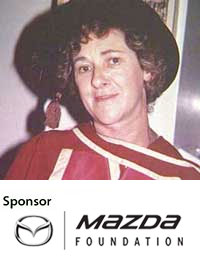
Pamela Rickard was born in 1928 in Sydney. After completing her intermediate certificate at high school, she spent five years working in the library of the Daily Telegraph newspaper and another five years working as a legal secretary before deciding to attend university. Rickard was awarded a mature-age scholarship to the University of Sydney and received her BSc in 1957, majoring in biochemistry and microbiology. Soon after graduation she took up a teaching fellowship in biochemistry at the New South Wales University of Technology, now called the University of New South Wales. The position also enabled her to receive an MSc in 1961 from that institution. Her thesis research concerned the iron-containing pigments involved in fungal respiration.
Rickard studied the biosynthesis of porphyrins at University College Hospital Medical School, University of London and received her PhD in 1964.
In 1964 Rickard returned to the University of New South Wales and spent her working life there. She was initially a postdoctoral fellow in the School of Biological Sciences before being appointed to a lectureship in biochemistry in 1965. In 1981 she was appointed foundation chair of biotechnology and served as head of the school until her retirement in 1988 when she was awarded emeritus professor status.
Interviewed by Ms Marian Heard in 2001.
Contents
- An intellectual undercurrent
- Exploratory by-ways
- Joining the science flow
- 'So this is porphyrin'
- 'The Vampire' attacks porphyria
- A flood tide of enthusiasm
- Developing biotechnology
- Yeast cytochromes and the Crabtree effect
- Pioneering work on yeast metabolism
- Moving on to enzyme technology projects
- New approaches to producing ethanol
- Research teamwork for knowledge and outcomes
- The thrill of teaching
- Widening ripples in the pool of knowledge
- Encouragements received and shared
- Contributions recognised and enduring
An intellectual undercurrent
Pamela, perhaps we could begin with your family background.
I was an only child, born in Sydney in 1928. My father was a journalist and my mother was a housewife. She would have liked a career, preferably as a doctor, but coming from a large family – she was one of 11 – she had no opportunity to do any study.
Were your parents interested in science?
Not particularly. But they were both avid readers and read widely – everything from English literature to comparative religion, and popular science written for the layman was included along the way. I was very lucky, I grew up in an intellectual atmosphere.
My parents didn't really encourage me to become a scientist. My mother would have liked me to have been a doctor, but I wasn't interested in medicine. (I didn't like sick people. If I was going to study anything, it was going to be the normal rather than the abnormal.) I was interested in science, though, particularly biological sciences. In my early years I always liked botanical things – flowers and plants in general.
Did your teachers encourage you in science?
The only science subjects available at the school I went to were botany and of course mathematics. I don't think the teachers singled anyone out for encouragement. It was wartime when I was at high school and the classes were very large, usually about 40, and I don't think the teachers had time to give special attention to a particular person.
Because of the war we weren't encouraged to go on at school. I would have liked to go to Fort Street Girls' School but zoning prevented that option and I was allocated to an Intermediate high school. Consequently I left high school after only three years, the time it took to get the Intermediate Certificate.
Exploratory by-ways
You didn't feel strongly about science or having a career?
No, I had no ambitions at that stage. I was very romantic: I wanted to get married and to have six children. You see, I resented being an only child, and a house filled with children seemed very appealing.
Like a lot of other young girls at the time, I did a secretarial course. But I didn't actually become a secretary. Instead I worked in the library of the Daily Telegraph newspaper, where my father was a journalist. (Sometimes newspaper libraries are called 'morgues'.) There the papers are cut up into their individual stories, classified and filed away to be available later for reference. If there was an earthquake, for example, the journalists needed access to all the previous reports on earthquakes. Incidentally, I did this work with the Intermediate Certificate; now you need a university degree and a postgraduate diploma in librarianship!
After about five years I realised that a friend of mine was finding her job as a legal secretary very fascinating so I thought I'd give that a go for a change, and I became a legal secretary for the next five years. I enjoyed that thoroughly.
So how did you complete your secondary education?
I went to the TAFE college at night and did two years' study for the Leaving Certificate. I wasn't planning to go to university, but the careers adviser at the college said it would be a good idea if I did go, and encouraged me to apply for a mature-age scholarship to Sydney University – and I got one.
Joining the science flow
So then you decided to become an academic?
Oh no, that was not my plan! I just thought, 'Well, if I go to university, what will I study?' I knew I didn't want to do secretarial work any more but I had always been interested in cooking (as well as science) and I fancied becoming a dietitian. For that I had to do a science degree, with particular emphasis on biochemistry in second year. I was dreading this subject, because everyone had told me it was rather horrendous – challenging yet boring. But I loved it, and I majored in biochemistry and microbiology.
After I graduated, in 1957, the only way I could do a course in dietetics was to go to Newcastle Hospital. But when I mentioned this at the university, Professor Vincent – the professor of microbiology – didn't think it was a good idea at all. He rang my mother and said, 'Do what you can to discourage her from becoming a dietitian – she'll be a glorified cook.' (He apologised afterwards for going over my head, not realising I was a mature-age scholar nine years older than my peers.) He had some money available for a half-time position in his department and encouraged me to become a research assistant there and study for a Masters degree.
There was a change of path, though. I had also applied for other positions, and six weeks after I started in the Microbiology Department at the University of Sydney, I was actually offered a teaching fellowship in biochemistry at the NSW University of Technology. It was appealing to accept that, because it was in biochemistry rather than in microbiology, that was where my main interest lay. I was very grateful when Professor Vincent accepted my change of mind in his usual gentlemanly style – we remained friends for decades after. During that teaching fellowship I was able to do a Masters Qualifying, which enabled me then to enrol for a Masters degree in biochemistry at the NSW University of Technology rather than a Masters degree in microbiology at Sydney University.
What sorts of other positions had you applied for?
I applied for one at Royal North Shore Hospital, as a research assistant in the porphyrin research lab. When I got there for an interview, they spent three hours trying to convince me that I should go back to secretarial work and become secretary to the head of the department. They even called in the director of the hospital to persuade me, but I'd spent three years at university to get away from a typewriter and I wasn't going back to one!
'So this is a porphyrin'
What was your Masters thesis about?
Its title was The iron-containing pigments of certain fungi, with special reference to those concerned with respiration. Those particular pigments are very important large molecules called cytochromes. They are responsible for the final stages of metabolism in most living organisms and are essential to the life of organisms that depend on oxygen.
My Masters degree supervisors were Professor Bernhard Ralph, who was head of the then School of Biological Sciences, and Dr Frank Moss, who had come to the NSW University of Technology after prior medical research at Sydney University. Dr Moss instigated and encouraged my study of the respiratory pigments. He had been interested in cytochromes for some years – and my interest in them lasted for the next 20 years. The interest in fungi came from Professor Ralph, whose long-term interest in wood-rotting fungi arose from their ecological significance. He and Frank Moss speculated that perhaps the very slow growth of these fungi was in some way related to their respiratory activity, and hence their cytochrome concentration. So you could say this study combined the interests of the two supervisors.
Did you find what you were asked to look for?
I surveyed a range of wood-rotting fungi and measured their cytochrome concentrations, but although they all proved to contain cytochromes, there was nothing really noteworthy and those results were not published. The interesting thing that did come out, though, was that one of these wood-rotting fungi accumulated porphyrin, a precursor of the cytochromes. This was a coincidence, because it was in the porphyrin lab of Royal North Shore Hospital that I had been offered the job as secretary to the head of porphyrin research about three years before. Porphyrins had found me again!
My supervisors were not familiar with porphyrins; they hadn't heard of them. But when I found this unusual pigment in amongst the cytochromes they introduced me to Dr John Falk, of CSIRO in Canberra. He recognised it as a porphyrin and advised me.
So in 1961 your Masters degree was conferred by the University of New South Wales. What do you consider you had gained from your studies?
I gained a Masters degree and a grounding in research methodology, a knowledge of cytochromes and a very good knowledge, by this time, of porphyrins.
'The Vampire' attacks porphyria
Was it John Falk who encouraged you to go to London for a PhD?
Yes, he had worked in London with a Professor Claude Rimington, a world authority on porphyrins, and he encouraged me to further my porphyrin studies in the same way. So I applied to go there and he supported my application.
Then I thought, 'If I'm going to go halfway round the world, I might as well do a PhD while I'm about it.' Very luckily for me, Professor Rimington had a Rockefeller Scholarship which was to pay a student's living expenses and university fees during studies for a PhD under his supervision. He offered it to me, and I said, 'Yes, please!'
And what was the title of your PhD thesis?
Take a deep breath: The biosynthesis of porphyrins, with special reference to those concerned with transformation of porphobilinigen into cyclic pyrrolic structures. I concentrated on porphyrin biosynthesis because porphyrins were precursors to cytochromes, in which I had an interest, and because I had wanted to know more about them ever since they had turned up in that wood-rotting fungus.
Professor Rimington's expertise was particularly directed to porphyria, a nasty disease in human beings which results from a dysfunction of the biosynthetic pathway to cytochromes and other pigments, causing porphyrins to accumulate. King George III had porphyria, which caused the madness for which he is known. And eventually porphyria is fatal.
It was of interest, then, to get more information on the biosynthetic pathway so that it might be useful in finding some sort of treatment or even cure for the condition of porphyria. I worked with human red blood cells because they make porphyrins, and I needed about 100 millilitres of blood every Monday morning to do my experiments. They were cheeky enough to call me The Vampire! To get 100 millilitres of blood, I had to have it taken by a medically qualified person, so that was done by one of the doctors over at the hospital. And I was very lucky. One day I took one of the lads in the laboratory – I think he was doing a Masters degree – over with me and he got a crush on one of the nurses. So it was no trouble to obtain my blood samples after that: every Monday morning he said, 'I'm ready to go over to the hospital!'
Did you enjoy being in London, and taking part in the activities there?
Oh yes. It was great – the theatres, the ballet, the opera, the galleries. And I was particularly keen to visit Kew Gardens, which I did on several occasions. Also, it was a marvellous jumping-off place to go to other parts of Britain for long weekends, and in the summer holidays I always went to the Continent.
A flood tide of enthusiasm
What did you do after you were awarded your PhD?
I finished in 1963 and it was awarded in 1964. Afterwards I came back to Australia. Frank Moss had offered me a position as a postdoctoral fellow, back in the School of Biological Sciences.
I loved the University of New South Wales (previously known as the NSW University of Technology). It was founded in 1949 as the first university built since 1911 and the first 'second university' in any city in Australia. The people there really had the pioneering spirit. To me, other universities seemed by comparison a bit moribund – which is probably being a bit unfair, but I loved that pioneering spirit and the challenge which arose because the community didn't really accept this second university in their city. For most people it was Sydney University or nothing, and to be part of the team making it socially acceptable was great.
There was a general sense of enthusiasm throughout the university but particularly, I think, in our school. Professor Ralph was an absolute dynamo of energy and Frank Moss was equally enthusiastic; their attitude was infectious and rubbed off on me.
So you felt that your career was beginning there?
Oh yes. I think that was the beginning of the snowball effect. In 1965, after one year as a postdoctoral fellow, I applied for and was successful in gaining a lectureship in biochemistry, a permanent position. That meant I needed to supervise research students. The methods I had built up during the postdoctoral fellowship were then put into operation with the research students we attracted.
Developing biotechnology
I understand that the school was re-formed in 1966 as a new Department of Biotechnology and Biochemical Engineering.
Yes, with just three of us: Professor Ralph, Dr (later Associate Professor) Moss, and myself. Getting it started was quite a challenge. We were only the third department of biotechnology in the world, and certainly the first in Australia. The department remained the only one in Australia for about 25 years – although after its fifth name change it is now the Department of Biotechnology.
So you were partly responsible for establishing a department which is still there today, still at the forefront of research and teaching in biotechnology in Australia.
It is. It was realised back in the '60s that there was a need for biologists to be trained in the technological application of biology in, for example, the pharmaceutical, agricultural and food industries. In the decades that followed, the need for biologists trained as technologists grew and grew, as did the discipline of biotechnology, to the point where it became known as a 'sunrise industry'. Because of such fast development over those decades, we had to keep up with the advances. The school has done that and it has grown. It has an establishment now of 15 people on the lecturing staff and they are still working hard to keep up with the rapid changes in biotechnology.
What is the difference, or maybe the relationship, between biotechnology and genetic engineering?
Genetic engineering is a facet of biotechnology. There is a great deal of interest and activity in genetic engineering these days – the media are fascinated by its very name – but for its application it depends on the fundamentals of biotechnology.
Yeast cytochromes and the Crabtree effect
Your research, I think, was concentrated mainly in two areas: first on yeast biochemistry and physiology, and later on enzyme technology.
That's right. The early research was in yeast biochemistry and physiology. Frank Moss was very interested in studying the synthesis of cytochromes in yeast, so that's what I contracted to do when I came back from London. Frank had always done his studies qualitatively, using reflectance spectrophotometry. But we realised it was necessary to turn it into a quantitative technique so that we could compare concentrations under various conditions, and I played a major role in achieving this. It took about 12 months to get the data together to establish a quantitative reflectance spectrophotometric method, but that method was then used by several workers for many years afterwards.
What findings came out of the yeast work as it continued?
Well, we had started this on Frank's assumption that it would be shown that yeast cytochromes were inversely sensitive to oxygen and that more cytochromes would be formed when the oxygen concentration was low. This is true of human haemoglobin: when we go up onto a high mountain we produce more haemoglobin to compensate for the low oxygen concentration. Frank considered it would be true of cytochromes as well, because they are related to haemoglobin in molecular structure. He thought that if we starved yeast of oxygen by keeping the oxygen very low, the cytochromes would increase in concentration.
Actually, it wasn't true for yeast. The cytochrome concentration didn't vary very much with oxygen concentration. But we had expanded the work considerably to look at the effect of other variants on cytochromes and other metabolic parameters. And the first very interesting thing we found was that in all cases a phenomenon known as the Crabtree effect occurred. This is the repression of synthesis of cytochromes at high concentrations of glucose, which we were using, or of any sugar.
Pioneering work on yeast metabolism
What other findings came out of this study?
We found that the glucose, as well as repressing cytochrome synthesis, inhibited cytochrome activity and, in addition, enhanced synthesis of the fermentation enzymes and activated them during fermentation. You see, all yeasts have two means of metabolising glucose or any other carbon source – either they take it right through to carbon dioxide by utilising oxygen, or they only partly metabolise it by producing alcohol. And to go right through to utilising oxygen, cytochromes are involved. Some yeasts prefer one way, utilising oxygen; others prefer to only go as far as alcohol.
We had thought that the various species might have different control mechanisms, particularly in their synthesis of cytochromes, but there weren't any fundamental differences. We concluded that presumably the differences between the various species were just a matter of degree of control.
We published a total of 11 papers on this, with a mass of information on a wide range of yeast metabolic parameters. Because industries such as brewing, wine-making, industrial alcohol production and baking all utilise yeasts, they were interested in these studies that we were conducting. In fact, we got some financial backing from them.
I should hope so! Was this a very active area of research?
Not in Australia. There was some work on yeast metabolism going on overseas but we were the only people in Australia working on it, and I think our results were of fundamental importance to the understanding of yeast metabolic control.
During the course of this study you took sabbatical leave in 1970-71.
Yes. I had three months in London, and it was nice to get back there again for a while. Also, I had five months at Johns Hopkins University, in Baltimore.
Under a mutual agreement, my biochemist host at Johns Hopkins allowed me to use his very special spectrophotometer for some yeast work that I was doing and as a quid pro quo I got his continuous-culture apparatus working. It had been there in mothballs for about 18 months since he bought it as a commercial apparatus, but I had had a lot of experience with continuous culture and I got it going about a week before Christmas. Being a continuous culture it was going all the time, and as Christmas Day approached, h invited me to midday Christmas dinner and after dinner with him and his wife and family he said, 'Now we'll go back to the lab and take some samples from the continuous culture'! He was quite devoted to newly operational apparatus.
Moving on to enzyme technology projects
What about your research on enzyme technology?
That came later, in the '70s. It started with a study of the use of enzymes in enhancing juice extraction from grapes, especially non-traditional wine-grapes. There was a glut of sultana grapes at the time, and one idea was to use them for production of cask wine, in particular. Because they don't give up their juice as readily as the traditional varieties, the industry was looking to enzymes which break down the pectin in the grape so that the juice would be more readily released. I did a survey of a range of commercial enzyme preparations, with a view to determining which were the most efficient at releasing the juice. Lindeman's financed these studies and provided all the grape samples from their vineyards. And one of my students continued this work after I retired.
The next project I became interested in was the use of enzymes to break down ligno-cellulosic waste, the fibrous waste from certain industries such as the sugarcane industry. Because of the oil crisis in the early '70s (we've had several more since – they come and go) some people suggested running cars on ethanol or a blend of ethanol and the precious petroleum. It was realised that if we could break the ligno-cellulosic waste down to its component sugars, they could be fermented to alcohol, which in turn could be used as a petrol extender. Noel Dunn and Peter Gray had already started this work, and I joined them. We were supported by NERDDC, the National Energy Research, Development and Demonstration Council.
What other projects did you work on?
One small project was very interesting: applying enzymes in the process of breaking down animal waste to produce gelatin. By getting the conditions just right with this enzymic breakdown we were able to produce high-quality gelatin that can be used to encapsulate capsules in the pharmaceutical industry. This was work-in-confidence with the gelatin industry so it wasn't published, but it was one of the research staff who did the work under my supervision. He got his MSc Biotech, and the company got its process optimised.
Also, by this stage Professor Ralph was interested in biological transformations that were applicable to the mining industry. I did some work with him, and about half a dozen papers were published out of that.
New approaches to producing ethanol
Let's return to your project on the use of enzymes to break down ligno-cellulosic waste. I think there are two phases in the process. Did you work on both phases?
Yes. The two phases are the digestion of the ligno-cellulose to its components, and then taking the sugars released and fermenting them to alcohol. The total cellulose consists of 60 per cent simple cellulose and 40 per cent hemicellulose. The hemicellulose is a much more recalcitrant polymer to break down than the simple cellulose, and moreover not as much work had been done on it. My special role was to take over the study of the hemicellulosic fraction of the cellulosic waste – first its digestion and then the fermentation of its sugars to alcohol. This was rather challenging, because cellulose simply digests to glucose but hemicellulose produces other sugars that are not as easily fermented.
Tell me about the digestion phase.
Noel Dunn, who is a genetic engineer, had manipulated a bacterial strain to digest the cellulosic fraction of the total cellulose. Taking his mutant strain I found it was active towards the hemicellulosic fraction – it behaved the same way towards hemicellulose as it did towards cellulose in being more active than its parent strain. Then I was able to optimise the conditions for maximum digestion of the hemicellulosic fraction.
And the fermentation phase?
I worked on that in tandem with the digestion phase. Not very much was known about the fermentation to alcohol of the sugars that are released from hemicellulose except that it was more difficult to ferment them than to ferment glucose. I attacked this part of the problem by screening environments rich in cellulosic waste materials, and from those environments I isolated Candida tropicalis, a strain of yeast which was active in fermenting these sugars. The interesting feature was that it only fermented them in tandem with fermenting glucose, and it was even more interesting that the ideal mixture of glucose and these other sugars was the same as occurs in nature in the total cellulose. This might seem obvious, but everyone had been looking at either the fermentation of the glucose or the fermentation of the non-glucose. No-one had mixed the two together and found that the best situation was to ferment them together.
I should say that by the time we had done this work, the panic was over and it wasn't taken up industrially. But only this month, 20-odd years later, there was an announcement in the press that the federal government was putting $8 million into development of a process for blending petroleum with 10 per cent alcohol produced from waste biomass!
Research teamwork for knowledge and outcomes
Would it be true to say that your research contributions led to better understanding and use of enzymes and of micro-organisms, especially yeast, by industry?
Oh yes. I didn't do it single-handedly, but I did write a fundamental review as early as 1974 on the use of enzyme technology in industry. I was a great believer in teamwork, and I collaborated with people in my own department as well as other departments and schools at the university, particularly Chemical Engineering but also Chemistry and Physics to some extent.
So you would have had a number of PhD students working under you?
Yes indeed. It was, of course, the PhD and other research students, and the support staff – some of them in the school, some of them supported by grants – who did all the hands-on work.
The grants, by the way, came from industry, from the Australian Research Grants Committee (ARGC), and from NERDDC. There was some money from CSIRO, too.
Would you say your work was always in applied science, or did you carry out pure research?
The early days were pure research, knowledge for knowledge's sake, and very much encouraged. The yeast work was all fundamental research, really – just understanding how yeasts' metabolic mechanisms work and particularly how they are controlled. But throughout the '70s when I started the enzyme work, that was always with a mission. It was part of a general shift in science to emphasise outcomes.
The thrill of teaching
Which did you enjoy more, research or teaching?
Ah, teaching. I think I was doing teaching for industry's sake rather than research for industry's sake, especially in my teaching fellowship days.
I discovered teaching when I was seven years of age. From the age of five to seven I was taught at home by my mother, who was pretty thorough in her methods. When I then went to a private school, St Catherine's, the teacher realised that my arithmetic was pretty good so she left me in charge of the class quite often while she went and had a cup of tea – and I thought that was lovely.
Was this interest rekindled at university?
Yes, when I went to the NSW University of Technology (later renamed University of New South Wales) as a teaching fellow in 1957. I was really interested in the teaching that I did at that stage, mainly because of the students who were converting diplomas from the technical college to degrees at the new university (still only eight years old). Among them were some rather senior people who were working in industry but who hadn't done any biochemistry for their diploma, so biochemistry was a popular subject to take in the conversion to a degree. I enjoyed that teaching because the people were senior and keen.
One person who only had a diploma got his degree, became a lecturer in our department and ended up as a professor at ANU, so it was a very important conversion course. Our department, together with other departments in the university, was innovative and believed in in-service training. Of course, that involved quite a bit of evening work, and often the night classes went till 9 o'clock.
I understand that you were such a good teacher that even in the 1960s you were attracting biotechnology students from prestigious Japanese universities.
I'm not going to take all the credit for that. It is true that they were coming from Japan. The point is that biotechnology was a new discipline – new to Australia, new globally. Because of our special interest (we were the only department offering this course in Asia) we attracted a lot of students from Pakistan, Japan, Korea and, especially, Indonesia. They were supported by our government with the Colombo Plan and later AUIDP, the Australian Universities International Development Programme.
Biotechnology was burgeoning and changing rapidly, and we had to keep abreast of the literature to pick up all the developments. As time went on we were able to expand our staff and to bring in geneticists and chemical engineers.
Widening ripples in the pool of knowledge
At what level did teaching start in the department?
It started with a postgraduate biochemical engineering diploma. The three of us – Bernhard Ralph, Frank Moss and myself – had two objectives: to teach biotechnology, and to teach biology and biochemistry to engineering graduates.
My first teaching assignment was to teach biochemistry to engineering graduates. That was very rewarding because, for example, there were civil engineers working with the Water Board who could not understand the biochemical transformations in some of the papers they read. I developed a crash course in biochemistry, only 42 lectures long, and the students often came to me afterwards and said, 'Oh, it's great, I understand those papers now.'
Next we took Honours students and gave them biotechnology research projects. Then we started a formal Masters, an MSc Biotech, which involved biotechnology subjects such as my particular subject, protein technology (including enzyme technology).
Interest in the discipline of biotechnology was growing all through this period, so we went down into the undergraduate years. We gave two units of biotechnology to third year undergraduates, and eventually an introduction to biotechnology to second year science students. So we went down, down, down, teaching biotechnology at earlier and earlier stages of university education.
Did you prefer teaching the undergraduate students or the postgraduates?
Oh, the postgraduates. But over my career I went the full spectrum, because although I preferred postgraduate teaching, I did once give some radio courses in biology. These were designed as bridging courses for students coming from high school to university, and they were taped and used over and over again by the Radio University station. It was very nice to keep getting royalty payments.
Did you ever lecture overseas?
Yes. In 1978 I was one of several science academics invited by the Chinese government to give a series of lectures at research institutes and universities. I went back to China in 1986 as one of a group of biotechnologists; we conducted a workshop at Wushi for academics and students who came to that city for it. I went on from Wushi up to Shandong and gave a couple of lectures up there, as well.
Also, in 1984 I was invited to give a plenary lecture to the Malaysian conference in biotechnology, in Penang.
Encouragements received and shared
You have had a very unusual career, I think, for a woman of your generation, and particularly one who started in academia so late. Do you feel you were ever discriminated against in your career?
No, I don't. I had been told that for a woman to get anywhere in any position she had to work seven times harder than a man. I don't think it was true then, and I certainly don't think it's true today.
Did you ever have a mentor?
Not as such, but a lot of people encouraged me and influenced my life. There was Professor Vincent, back at Sydney University, Professor Ralph, Professor Moss, Dr Falk and of course Professor Rimington, in London.
My best encouragement, though, came from my husband, a businessman and the most supportive, wonderful person that any woman scientist could possibly marry. He was very ambitious for me – to the point one day when he said, 'You ought to apply for an associate professorship.' I told him you couldn't do that until you had been on the senior lecturer scale for six years, and I'd only been there for four years. 'You're ready for it,' he said. I didn't think I was, but he nagged and nagged until I hurled the scrubbing-brush that I had in my hand across the laundry floor and said, 'Well, I'll make out the application and you just see what happens to it!' He was right, and I got accelerated promotion.
So you had married, relatively late and (unusually for a woman scientist) to a non-scientist, and now you were moving up in the university world. I think that after six years you became the first woman professor in a science faculty at the university.
Yes. When Professor Ralph retired in 1980, I was appointed as head of department and ran the department in that capacity for 18 months. During that time, the Chair that he vacated was advertised as the Chair of Biotechnology. (He had always retained its title as it was in his original appointment, the Chair in Biochemistry, but on his retirement it was changed.) I didn't apply, but it wasn't filled after the first advertisement and the second time it was advertised I was encouraged by my colleagues and also by the dean of the faculty to apply.
I was appointed in 1981 as the foundation professor of biotechnology, but not the foundation head of biotechnology – that had been Bernhard Ralph. By then, however, the job of running the school wasn't new to me. In getting the foundation Chair of Biotechnology I think I really was the right person in the right place at the right time.
I have heard that you ran a very friendly department. Did you enjoy the administration?
I did, but it was very time-consuming. I ran the school democratically. I liked getting the opinions of the rest of the staff, and we had regular staff meetings. I was probably ahead of my time in debunking the concept of god-professor – nowadays the idea of running departments and schools democratically is much more widely accepted.
Contributions recognised and enduring
At the same time you were on a number of professional committees.
Yes. I was on ARGC at one stage, and also on one of the subcommittees of NERDDC, the Synthetic Liquid Fuels Subcommittee. I understood and so could assess the applications for conversion of biomass to synthetic liquid fuels, and could advise my fellow members of the committee. Also, I was on the Scientific Advisory Board of the Australian Journal of Biotechnology.
When you retired, the university conferred on you the honour of an emeritus professorship.
Yes. That's usually conferred after 10 years in a Chair. I'd only been in the Chair seven years but I had been with the university over 30 years, and I was absolutely delighted when they gave me the emeritus professorship.
You mentioned that in your retirement you continued with studies of enzymes in the wine industry. Did you go on with any other work as well?
I continued to supervise my students who hadn't completed their degrees and were still doing research. Also, I wrote a short history of the School of Biotechnology. And after several more years I became a foundation committee member of the Alumni Associates of the university, which is my current interest.
The alumni associates are retired staff members. The regular alumni are graduate students of the university, but before Alumni Associates was formed, a person might work at the university for many years – sometimes decades – and have no further contact with the university unless they were an emeritus professor. Now we invite all retired members of staff to become alumni associates, join in our activities and keep in touch with the university. My job with that committee was to form a database of retired staff and keep it up to date. Although not completely comprehensive, it was the biggest database of retired staff that the university had, and even the Vice-Chancellor had to use it in order to send out invitations to ex-members of staff. I have since handed it over to the university and it is on the computer of the alumni office.
Pamela, you have played a large part in developing aspects of your discipline and you made major contributions which were of fundamental importance to industry. It's been a great pleasure talking to you. Thank you very much for participating in this interview.
Professor Ben Gascoigne (1915-2010), astronomer
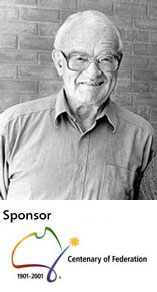
Sidney Charles Bartholomew Gascoigne, known as Ben, earned a BSc at the University College of Auckland (now the University of Auckland). A travelling scholarship took him to the University of Bristol, where he received his PhD.
In 1941 Gascoigne came to Australia to join a team working in optical munitions at the Commonwealth Solar Observatory, Mount Stromlo (near Canberra). After the war he continued at Mount Stromlo, conducting astronomical research. He had a particular interest in stellar evolution, the scale used to measure distance and faint star photometry.
Among Gascoigne's most important achievements was his work in establishing the Anglo-Australian Telescope at Siding Spring, New South Wales. Commissioned in 1974, the 150-inch telescope is part of the Anglo-Australian Observatory. He was honoured with an Order of Australia in 1996 for his service to Australian astronomy.
Interviewed by Professor Bob Crompton in 2000.
Contents
- Introduction
- New Zealand family tales
- Through school to university, via hard work and keenness
- A mistaken scholarship attempt leads to a lucky choice
- The pleasure of solving a long-standing optical physics problem
- An unscheduled but rewarding return to New Zealand
- Optical munitions, with some bridge games on the side
- Settling in among Mount Stromlo's characters
- The Commonwealth Time Service
- Woolley's Stromlo telescopes
- Strong advocacy and a satisfying outcome
- The significance of the Magellanic Clouds
- The Cepheids: establishing the astronomical surveyor's baseline
- Cepheid colours, galaxy dust and a triumphant insight
- Astronomical anecdotes
- The benefits of Bok's graduate school
- Globular clusters: what went on when the Galaxy began
- Cluster measurements: solving the riddle
- Where, oh where, can we site an Anglo-Australian Telescope?
- Taking the AAT from a gleam in the eye to a 150-inch mirror
- The Siding Spring telescope materialises
- Deliverance: a near miss, and a handicap overcome
- Into retirement: hanging up the astronomer's hat
- Putting on the astronomical historian's cap
- The inspired art of an enduring partnership
Introduction
Professor Gascoigne is a distinguished astronomer, well known internationally for his pioneering work on Cepheid variables and star clusters, and for his central role in the establishment of the Anglo-Australian Telescope.
Born in New Zealand in 1915, he took his first degrees at the University College of Auckland, now the University of Auckland, where he was awarded a travelling scholarship which took him to the University of Bristol. A gifted mathematician, he first saw his future as an academic mathematician, but later became attracted to theoretical physics. In Bristol, circumstances changed his interest yet again, this time to optical physics.
Although slowly converging on his eventual career path, it was not until he had given some years of wartime service to optical munitions, first in New Zealand and then at Mount Stromlo, in Australia, that Ben Gascoigne finally embarked on astronomy.
During this interview he will describe his early years and the circuitous path that eventually led to astronomy and his distinguished contributions to it. Among the most important of his achievements was his work in specifying and commissioning the 150-inch telescope at Siding Spring, the Anglo-Australian Telescope. No-one is better placed to detail the history of that project, about which he has written extensively.
Now an Emeritus Professor of the ANU, Professor Gascoigne was honoured with an Order of Australia in 1996. He is an Honorary Fellow of the Astronomical Society of Australia, and is justifiably proud to be the first Australian to be elected an Associate of the Royal Astronomical Society. He is also the first person to be elected as an Honorary Member of the Optical Society of Australia.
History was one of Professor Gascoigne's early passions, and in his retirement he has continued to write extensively on the history of Australian astronomy. He has also devoted much of his time to assisting his late wife, the distinguished artist Rosalie Gascoigne, including cataloguing her extensive works of art. This interview will conclude with some reminiscences of their life together.
New Zealand family tales
Ben, may we begin with some family history? I understand you are a New Zealander by birth.
Yes. My mother's forebears came out to New Zealand by ship in 1840. Later, in 1870, my father's parents were passengers on the Piako; perhaps they met on board. Anyway, they were married in New Zealand.
I believe that the 1840 ship was greeted by Maori warships.
Well, with some other ships it went to Wellington, which was just pristine country with no buildings there at all, and when they anchored off the shore they were greeted by three Maori canoes – their crews, in full wartime regalia and chanting their hakas and so forth, paddled out and circled around the ships. Perhaps because a small advance party of Edward Gibbon Wakefield's company had been there before, the welcome was friendly, but I don't suppose the Europeans could have been certain of that for some little time!
The voyage of the Piako too has a story. It was one of the first iron-built ships, which was just as well because just off the coast of South America the luggage caught fire. Luckily, the hull and the decks didn't catch, but it was very alarming and everyone had to abandon ship. Some other ships picked them up and no-one was lost, but they couldn't land at the nearest town – Pernambuco, also known as Recife – because there was a cholera epidemic on, with about 300 people dying each day. Instead, they established a camp on an island about nine miles up a nearby river, where food was taken up to them more or less daily from one of the towns. The ship had been saved, however, by the resourcefulness of the captain, who sank the ship to put the fire out and then refloated it. He sent back to London for a set of interior fittings to replace the ones that had been lost in the fire, and nine weeks later they all set off again and landed in Lyttelton.
Not many families would start off in a new country that way. Your father began his professional life as a teacher, didn't he?
Yes, he did. He taught at three or four schools, one of which was in Levin, a small town south of Palmerston North; at a Maori boys' school, Te Aute College (a very famous Rugby school); and at Napier Boys' High School. Levin was where my mother had been born and raised, and my parents were married in Levin just at the outbreak of World War I before going to live in Napier, where I was born in November 1915. Later, my father's brother-in-law persuaded him to join his wholesale dealership in hardware goods such as motor machine parts and bicycles, so we moved to Palmerston North for about five years. Then, when I was about eight, my father got a similar, better post in Auckland and so we went up there.
Through school to university, via hard work and keenness
Were you in Auckland right through your primary, secondary and tertiary education?
Yes, until I left for Bristol.
Where did you do your secondary schooling?
At Auckland Grammar, a big school of 900-odd boys. It had the name for being the best academic school in the country, so I was lucky. The four forms – 3rd, 4th, 5th and 6th – were divided into sub-forms such as 3A, 3B and 3C. I was in the A forms all the way up because right from my early boyhood I was a clever one, the pride of the family.
I didn't go straight from 5A to 6A, though. Being in the top few of 5A I should have done so, but I was beguiled by the writings of John Galsworthy, H.G. Wells, J.B. Priestley and co., and I didn't do all that well in the end-of-year examinations. To my great indignation I found myself in 6B instead. 6A was the scholarship form, so I determined to get a university entrance scholarship from where I was in 6B, which I don't think had been done before. I worked like fury, and a few weeks later I was restored to my 'rightful' place in 6A. That was a useful lesson and I didn't stop working in that way, so I came second for the year in 6A. In fact, I also got a scholarship a year early. I took that lesson to heart, deciding that if I worked hard enough I could do almost anything. That has stood me in good stead.
And so you went to university at the then Auckland University College. How did you choose which subjects to do there?
Well, I wasn't any good at the languages, French and Latin. In my scholarship year I dropped Latin and took history instead, and I was very keen on history all the way through. When I went up to university, I had to choose essentially between doing a BA in history and doing a BSc in mathematics and associated subjects. Because I had a bad stammer all through the early part of my life, I thought it was going to be easier to get a job if I had a science degree, and so I opted for maths, with chemistry. I had to have one more subject, so I chose physics. I hadn't done physics at school but I found I was a dab hand at it – I sailed to the top of the class and remained there all through university. I was very keen on both physics and maths.
A mistaken scholarship attempt leads to a lucky choice
You have told me that one of the people who were very influential in your life was your professor of mathematics.
Yes, H.G. Forder. In fact, there were only two on the staff. The other one was Keith Bullen, who eventually became the applied maths professor in Sydney. He was good, too, but Forder was a brilliant and inspiring teacher, especially for people who were keen on mathematics. The syllabus was undemanding, and having plenty of time on my hands I ranged far and wide beyond the syllabus. Whittaker and Watson was my chosen pasture in those days. One of the chapters was on theta functions – functions of two variables – which I enjoyed, working out all the examples. But it was years before I met them again, when Rodney Baxter gave me the reprint in which they occurred, and I thought, 'Ah! I know what those are.'
At that stage you were quite enthralled with quantum mechanics too, weren't you? That would have been in its very early days.
Yes. I must have read Sommerfeld's book; there weren't many books on it at that time. I got particularly fascinated later by the Mott and Massey book on atomic collisions, but we'll come to that.
I think your choice of subjects almost caused you to miss out entirely on a travelling scholarship. Why was that?
There were only two travelling scholarships, one in arts and one in science. Because I was taking a degree in science, taking my honours in mathematics, in my science scholarship application I put down maths as my subject. But it turned out that for the purposes of the award of these scholarships, maths counted as an arts subject. I should have entered for the arts scholarship, and so I missed out – even though they had pencilled my name in, I heard. I was very upset, but luckily I was able to get a bit of money for another go. I applied for a second honours degree, in physics, and this time I got a First all right and a Michael Hyatt Baker scholarship.
The scholarship was named for a young man from Bristol who had been travelling the world but was killed in the Napier earthquake of 1928. His parents set up the scholarship in his memory, for study at the University of Bristol, so I found myself going to Bristol instead of Cambridge, where I had always set my heart on going to do mathematics. But in the long run Bristol was a lucky choice for me.
The pleasure of solving a long-standing optical physics problem
The scholarship placed no restriction at all on which subject I did, but at that time there was no effective maths at Bristol and so for me it had to be physics. Mott was there then, and when he asked me what I wanted to do, I said how fascinated I had been by his book. He said, 'Oh no, that's long past. We're into the theory of metals now. You can come along to the class and see how you get on.' But when I went along I found the metal theory didn't appeal to me at all – it was about semiconductors, which I was totally unaware of, and lattice dislocations and things like that – and I saw that he had 17 PhD students who would be my rivals. I thought, 'Even if I do get a PhD out of this, I'm never going to make it against this lot.' So I went back to Professor Tyndall and asked if anything else was available.
Bristol was very much a place for experimental physics, but I was still very much a theorist, with no practical physics at all. The professor in Auckland used to wince when I walked past the cupboard in which the good instruments were kept! Anyway, it was agreed that I could get into work in astronomy, in which I was interested, by way of an astronomical optical problem.
Didn't that PhD subject bring you your first research success?
Yes. At first I was most unhappy to find myself in such a dry subject as geometrical optics, which was then a very out-of-the-way and despised subject. There were two people well into doing optics at Bristol, however, and later the department became quite celebrated as the Bristol School of Optics. One of those people was Dr C.R. Burch, an extraordinary man, a master of physics of all types except quantum physics. He was interested in making big mirrors, in particular, and he had made one for University College, London, using a method of his own to test it. I think it was an 18-inch.
Since about 1850 the Foucault knife-edge test has been familiar to everybody who makes big mirrors, but there wasn't any diffraction theory of it. Burch had a particular problem that he thought might be explained by such a theory, and so he asked me if I would like to have a go. Now, the great Lord Rayleigh had tried this but had never got beyond the perfect mirror, and the great Dutch optician, Zernike, had been able to solve it only for very small errors on the surface of the mirror, so small that they really didn't matter in practice. To my great surprise I came up with an exact solution of the knife-edge problem, and I was able to show Burch's surmise was correct. I was very pleased that that turned out well.
Burch was a practical man who worked with his hands a lot – making his ultraviolet microscopes, reflecting microscopes – and I picked up many odds and ends about optics from him. He showed me all sorts of ways of testing mirrors and many optical devices. I think those things, which came by the way, were just as important as my thesis.
An unscheduled but rewarding return to New Zealand
Then it was back to New Zealand and to Rosalie. Perhaps you could digress there and say how you first met her.
We had been to the same primary school, where I was two years ahead of her. Although I met her socially, because we lived in the same suburb, nothing much came of that until she went up to university (two years after me) and we began to see each other again – especially in my fifth year, when I was doing that unexpected second honours degree in physics. I became quite decided that she was the girl I wanted to marry, but then I went off to England. The war broke out when I was about halfway through my time in Bristol, and thinking that if I stayed in England I would never be able to get back and might never see her again, I put in for the one last ship that was leaving. Although we left just before the Battle of Britain, on the whole journey home we never heard a word about it, and to find out about it when I landed in Sydney was a great surprise.
On the ship home I fell in with an abstract artist, Carl Plate, who was going back to Sydney. After a crash course he gave me in abstract art all the way home, I finished up very keen on abstract art and the sort of art that Carl did. Although I went back to Auckland, of course, through him I had become very much aware of the existence of art and of art galleries. I had met a few artists and I knew that there was an art community, into which I was able to introduce Rosalie when we got married.
Optical munitions, with some bridge games on the side
In New Zealand, this being at the beginning of the war, your first job was in optical munitions. Is that right?
Yes. The small physics department, like physics departments all over the place at that time, was enlisted to help with the war effort, in particular with military optics – mostly gun sights, rangefinders, binoculars and so on. My first job was a practical one, making a little gun sight for a trench mortar. It was a single piece of glass, only about two inches long: when you looked in one end you saw a V projected against the landscape. Actually, it was quite effective. And so I had to organise a little workshop at the railways workshops, out of Auckland, with a staff of four. Oh, this was fascinating. I could see what was going on in the main workshops; they'd demonstrate their big steam hammers to me and so forth – my first contact with industry.
You didn't stay very long, Ben. I understand that you wrote to Woolley, who was at Mount Stromlo doing work similar to what you were doing in New Zealand.
Yes. As a member of a team working on optical munitions I was privy to various reports that came in, and I read one from the then Commonwealth Solar Observatory which described their entry into the optical munitions business. This was on a far bigger scale than anything I could have got into in New Zealand, and so I wrote to Woolley with a sketch of what I had done and asked if there would be a position for me. He wrote back very promptly and enthusiastically because he had heard that I had been working with Dr Burch, 'who of course was well known in the astronomical profession'. He offered me a job, and as soon I could get a release, over I went. I wasn't yet married to Rosalie, not on the sort of pay I was getting in New Zealand. But the Mount Stromlo salary was about £350, which was not bad in those days.
My introduction to Canberra and to Woolley was interesting. The little old train meandered through the landscape and past stations like Mount Fairy and Bungendore, and eventually pulled up at what I presumed was Canberra because everybody got out. This tall figure that I was going to know so well came striding across: 'I'm Woolley. Do you play bridge?' I said, 'Well yes, I do.' 'Contract?' And I was off to a good start.
Settling in among Mount Stromlo's characters
You had some very interesting experiences in those optical workshops at Stromlo, both scientifically and also because of the people you met.
I did. We were the one place in Australia which could build a whole instrument from the initial layout and optical design through to the optical and mechanical manufacture, the assembly and testing. We made one-offs to see how they would go, and things for the Army Inventions Directorate, for example. Also occasional small batches of 20 or 50. As a training ground for a budding optical astronomer it would have been hard to beat. When I began there, it was not clear whether I was to be an experimentalist or a theorist; certainly I began as a designer, but I moved on. I got some incredible experience there – even if none of it was in theory at all. And I finished up quite practical, especially with a screwdriver.
It was one of your first experiences of multiculturalism, wasn't it?
Yes. Woolley's charter was to make optical fire control instruments such as sighting telescopes and artillery directors, gun sights and rangefinders, not only the mechanical parts but the optical parts too. Very few people in Australia had any background in that, but at about that time the notorious ship Dunera arrived with a load of refugees – mostly, but not entirely, Jewish – who had fled from Europe to England, only to be shipped off to Australia when the war broke out. Thinking that some of them might well have some optical skills, Woolley went up to their camp at Hay, interviewed a number of them and hired about six for Stromlo.
We were living up on the mountain at that time, in a kind of barracks for single men which could house these European people as well as about four or so of us Australians and New Zealanders. Stromlo was a very isolated place, with little transport into town and certainly no motor transport. Because of petrol rationing you got enough petrol for only about two trips a month, so we all had bicycles. Living and working in such close quarters we got to know each other very well, and this was a great success. We all made good friends – some of mine have lasted to this day – and it was a very educational experience because of the odd hint or remark about problems in Europe. They seldom spoke of their experiences in any detail, but we were all aware of them.
On the weekends we would go for picnics or walks down to the Murrumbidgee, or go on our bicycles over into the ranges, but the refugees were confined to the ACT and when we rode out to the border between the ACT and New South Wales they would get down on their hands and knees, creep out and reach a hand over the border, just to touch foreign soil! They were funny, a very witty lot on the whole. It was a great experience.
Who else can you tell us about?
Well, I began work up on Stromlo designing an anti-aircraft gun sight. After I finished this design, the need arose for a department for testing and inspecting pieces, made in part by the optical shop and in part by the machine shop. This grew into an assembly place for whole telescopes, in which I found myself second-in-command to Cla Allen, a celebrated solar physicist who was on the permanent staff there. We recruited an incredible range of people from all sites and all ranks of life. The oldest one, Herb Willetts, was about 75. He had been the chief engineer on the Victorian Railways and insisted on doing his bit for the war by sweeping out the machine shop every day. He was a great old boy and we really respected him. Allen left for other duties within a few months, and I was put in charge.
Another unusual person was a man from Scotland who had worked with the firm who built the Barr and Stroud rangefinder, so he was handy. But he wasn't very energetic. He was a bit of what we used to call a 'pointer' when I was young. He would say, 'When you're walking from one section to another, always carry a piece of paper in your hand, because that makes it look as if you're going on purpose. A slide rule isn't a bad idea, either.' Little comments like that really upset us, though.
And through Unity Cunningham, a member of the Cunningham family, from Lanyon, near Tharwa, we were once or twice invited to have a Sunday afternoon cup of tea with one of her distant relatives, Sir Robert Garran [Australia's first Solicitor-General]. She was looking after him in his old age. He was a grand old boy, knitting camouflage netting and things like that while he sat by the fire. He wouldn't let a minute go by; he was determined to do something towards the war effort.
The Commonwealth Time Service
How did it become your task to set up the Commonwealth Time Service at Stromlo?
That had been run from the Melbourne Observatory until about '42, when the then director, Dr Baldwin, retired. Woolley knew about time services, having had charge of the one at Greenwich, and was keen for us to take it over. Part of the reason was that the Army Engineers needed good time for longitude determinations. I had that job for a couple of years, and it was a nice one. We built a little transit telescope for measuring the instant at which the standard time stars crossed the meridian, this was our primary data. We collaborated too with the Post Master General's laboratories and their quartz clocks.
Would you tell us your story about the transit instrument?
Woolley said we would need to build our own, and we did so, using as a base the frame in which an old surveying instrument had sat. Kurt Gottlieb (our engineer from Czechoslovakia) and I would make drawings and then march in to show them to Woolley. He would look at them, puff away at his pipe and say, 'Very good, carry on.' We'd go back in a couple of weeks and report progress, same response. And then one day we marched in and said, 'Well, we think we've finished. Would you like to come out tonight and try it?' It worked perfectly, but he was furious that we had completed it all 'without consulting him'! We'd been consulting him all right but he'd never taken any notice. I'm sure he made a good story of it afterwards, though.
Actually, making this transit telescope after all our experience in military optics was a breeze. We'd made military instruments that were far more demanding, except that some components had to be really accurately machined. But the place was up to that.
Woolley's Stromlo telescopes
Woolley had come out initially to establish stellar astronomy in Australia. What was taking place at Mount Stromlo between the end of the war and when his era there finished in about 1957?
We had to start from a long way down, because there wasn't much to begin with. The telescopes were all old and hadn't been used for years. Everything had to be overhauled, reconditioned and refurbished. The youngest and biggest of our telescopes, the 30-inch reflector, only went back to about 1930 but it was rather an amateur telescope which had been given to us by the then President of the Royal Astronomical Society, an engineer named Reynolds. It was a glass reflector, chemically silvered, but we were able to have it aluminised fairly soon when Arthur Hogg built a tank in which we could aluminise pieces as large as that.
We also had the old 50-inch, which we had inherited as the 48-inch Great Melbourne Telescope. Melbourne had acquired it in about 1868, when it was the biggest working telescope in the world, but its use was very limited. In particular, it couldn't be used for photography, which began in about 1880, and so it sank into disuse. We bought it as scrap at the end of the war and although we could use quite a bit of the mounting we really had to rebuild the whole thing, putting in new optics and new controls. It all took quite some time.
Tell us the later story about its speculum mirror.
We had inherited two mirrors with our telescope, both of the copper-tin alloy speculum. Speculum had the problem that while it could take a high polish, it tarnished rather quickly and had to be repolished. Two mirrors were provided so that when the one in use became tarnished it could be swapped for the other, ready polished. The first mirror lasted a surprisingly long time, but the second suffered an unfortunate event: in the optical shop one day someone saw it teetering on edge, and it fell to the floor and smashed irredeemably. Speculum is notoriously brittle. Disaster! Knowing that Woolley had a violent temper, our two optical technicians wondered how they could give him news of this without losing their jobs. Eventually they plucked up courage, just before knocking-off time, and told him the bad news. But to their surprise and relief he just leant back and laughed his head off. The fragments of tin and copper were sold for more than we had paid the Victorian government for the whole telescope (it had been purchased as scrap).
Before long, though, in about 1956, we got a 74-inch. Woolley had approached the prime minister, Chifley, about this fairly soon after the war, but came away rueful about getting approval for it. He said Chifley agreed to the 74-inch so readily that he thought he could have got a 100-inch without any trouble at all! Building it took a long time and it wasn't finally erected until after Woolley left. We had to learn how to use it because no-one on the staff had never used a big telescope – we had hardly even seen one – and then the primary mirror turned out to be astigmatic and had to go back, being replaced for a while.
It hadn't been tested properly, but I must say that it is all too easy for big mirrors to go astigmatic if they are not held properly while they are being figured. Also, if they are tested along a horizontal path where the air can layer, with hot air on top and cold air below, this can simulate the effect of astigmatism – and by the time you have polished it out, the mirror really is astigmatic.
Strong advocacy and a satisfying outcome
I understand that in that period between the end of the war and Woolley's departure you had Colin Gum, one of your very distinguished scholars, working with you.
Yes, I did. Cla Allen was his original supervisor, but then Cla left to take up a position in England and so I inherited Colin. The topic Cla had put him onto was to look for H-alpha regions, where the hydrogen in between stars is illuminated by very hot stars with lots of ultraviolet to excite the red H-alpha line. That turned out to have great importance, because it had been found in other galaxies that these regions lie preferentially along spiral arms and so if you could work out how far away they were you would have a good chance of tracing the spiral arm in our Galaxy. This in fact is exactly what happened, but it wasn't known at the time when Colin began his work.
Colin discovered about 60 or 80 H-alpha regions in the southern part of the sky, which hadn't been surveyed for this at all. Among these was the great Gum Nebula – since named after him – in the constellation Vela. It turned out to be the remnant of a supernova which had gone off only a few hundred years before, and all these pieces were still expanding. An H-alpha picture of this remnant is huge, spectacular.
There was a very exciting moment when it was realised that while Colin was tracking one arm of the nebula, someone in America was tracking the other arm. But by then Colin's thesis had been submitted. What happened then?
Well, after he had written his thesis he had to go into hospital for medical treatment. During the year he was away, I had to supply all the references, and found that looking them up was a tedious and difficult job – I finished up knowing an awful lot about H-alpha regions myself! When Colin put his thesis in, the two examiners were Woolley and a Professor Plaskett at Oxford. Woolley came in one day and said, 'Gum has failed his PhD.' I think Plaskett was the snag, because he couldn't have known anything about the subject, but I don't think Woolley read the thesis properly, anyway. I don't want to sound too critical of Woolley, because he did a great deal for the Observatory, but he did have these idiosyncrasies. I was most indignant and very distressed that Colin had failed, because I thought he was really good. When I told my wife about it, saying that somebody would have to take it up with Woolley, she said, 'Well, you know who it has to be, don't you?' I knew too. Oh dear!
After lunch that day I dragged back up the hill, knowing I had a real job on my hands. Woolley hated having errors pointed out to him. He was a very powerful personality who could get very angry: his face would turn black, and he was very quick with his tongue, with counter-arguments. He would have been an excellent lawyer, I always thought he may have missed his profession. Anyway, I marched in and battled away as best I could until we were interrupted – I was truly thankful for that and went home, the matter quite unresolved. Next day I was back again, batting away, and I thought I made a bit of progress. And on the third day Woolley agreed to appoint a third examiner, Cla Allen, who was by that time in London. And so Colin got his PhD.
From then on, when the staff had little grievances and so forth they wanted to air to Woolley, I was always the elected spokesman! I had established my position.
The significance of the Magellanic Clouds
At this point I want to take a rather different tack and treat three themes: the Cepheid variables, globular clusters, and your part in the Anglo-Australian Telescope, which you were extremely influential in establishing. To introduce the theme of the Cepheid variables: What is the significance of the Magellanic Clouds, Ben?
They have figured very largely in southern hemisphere astronomy. Not only are they objects of the first importance in themselves, but they are a long way south and can't be seen from the north. The point about the Clouds is that they are by a long way the nearest galaxies outside our own. They are small galaxies – the Large Cloud is about a tenth the mass of our Galaxy. They contain an enormous variety of objects of all types, all at the same distance, which makes it easier to compare them. This is a huge advantage in astronomy, where the distance problem is always with us.
Our Galaxy is a flat, plate-shaped object with quite a dense central nucleus about which it spins. We are about halfway out from the centre, about 25,000 light years. Beyond us it thins out and gets very diffuse, with no well-defined edge – an overall diameter of, say, 100,000 light years. The Large Cloud is 180,000 light years away, the Small Cloud a little further; relatively speaking, they really are quite close neighbours.
You speak as a true astronomer, Ben: a couple of million miles is absolutely nothing to you, is it?
That's right. It's about 10 light-seconds. I must say that the Large Cloud turned out also to be a flat object, on a tilt. You can measure the difference between the near side and the far side of the tilt – as in fact I did, to my great pleasure. It is rotating, in the same way as the Galaxy is rotating. The Large Cloud is not dissimilar in this way but it is quite asymmetric, whereas the Galaxy is pretty regular. But however asymmetric, it is flat. And then Andromeda, the nearest external galaxy, comparable to our own Galaxy – is about 10 times as far away as either the Large Cloud or the Small Cloud.
Is it unusual in the universe to have clouds like this that are not nebulae?
It used to be thought so, but the picture is changing steadily as we go along. There is a great number of small, isolated galaxies now, of all types. The Clouds are exceptional, perhaps, in that they are pretty young. It has turned out that they are younger on the whole than our Galaxy. Others are quite old and are rather like globular clusters blown up. We'll be coming onto that later.
The Clouds are very significant. They are associated with the Galaxy, and it is surmised that in time they will fall into the Galaxy by gravitational attraction and just be absorbed by it. For galaxies to grow by cannibalisation is a process which has been recognised only in recent years – more or less since I stopped doing astronomy – and it is now seen increasingly as fairly common.
The Cepheids: establishing the astronomical surveyor's baseline
So what are the Cepheid variables, and what is their significance?
The Cepheids are very important in astronomy, especially for estimating the distances of remote objects such as the Andromeda Nebula and indeed the Magellanic Clouds. To get these distances right is the basis of the whole astronomical distance scale. This is, in a way, the surveyor's baseline from which the rest of the universe is measured.
Cepheids are important for this because they are intrinsically bright stars – among the brightest stars around, many thousands of times brighter than the sun – and they are easily recognisable, because they pulsate and so they vary. They go in and out, in and out, and as they do, their light varies by a factor of two or three, which can be picked up a very long way away. Even in a faint star you can see if it is varying by that much. The periods of Cepheids range from about three days up to 30 days, and a 30-day Cepheid will be about 10 times as bright as a three-day Cepheid. This makes them very attractive to theorists, too, who like playing around with information like that. What also makes Cepheids so useful is that you can determine how bright the ones in the Galaxy are, because you know their distances from other arguments – which we haven't got time to go into here but are good arguments.
The problem which I had been thinking of was measuring colours of the Cepheids in the Large Cloud. The Magellanic Clouds had been the province of Harvard Observatory for the whole of the century. They can't be seen from the northern hemisphere, but Harvard had set up an observatory in Peru (later in South Africa). Harvard began work on Cepheids in about 1908, discovering lots of them in the Large Cloud, and that is when they discovered the famous period-luminosity law. But Harvard measured them only in blue light. They had never measured colours. Besides, the Harvard data that looked so good from 1950 were obtained by methods that were okay in 1910 but hadn't changed their methods at all, and they just weren't up to scratch. It wasn't going to be hard to improve on the Harvard observations.
When you are comparing objects at different distances, the inverse square law holds. That is to say, if you shift a lamp to twice as far away as it was, it is then only a quarter as bright. If you shift it to three times as far away, it is only a ninth as bright, and so on. But if you know the candle-power of the lamp, its output in watts, you can work out how far away it is. Well, that is the way Cepheids work. We see all these Cepheids in the Magellanic Clouds, we know their period so we can correct for the period-luminosity law, and we know how bright they are, therefore we know how far away the Magellanic Clouds are.
Cepheid colours, galaxy dust and a triumphant insight
However, there is one major complication. There is dust within galaxies, though there is very much less between galaxies. Certainly within our flat Galaxy there are not only stars and a fair amount of gaseous hydrogen, but also a lot of dust. It is a very visible component of the Galaxy. The Southern Coalsack, well-known in the night sky as a big black hole in the Milky Way, does not represent an absence of stars in that direction, it is rather a cloud of dust obscuring the stars beyond it. The effect of this dust is to make your lamp look fainter, and before you can use it as an accurate distance indicator you must work out how much dust there is between you and it.
This is made possible because dust has another property: not only does it make your light look fainter, it also makes it look redder. If you can measure the colour of a star and it appears redder than you know it really is, you can use the amount by which it has been reddened to correct for the absorption by the dust. Measuring the colours of Cepheids is therefore very important. The question of their intrinsic colours – what were the colours of unreddened Cepheids – worried astronomers for a long time. Although they knew the distances of the ones in the Galaxy, they didn't know how much dust there was.
Just as I was wondering how best to tackle this, two Americans from the famous Lick Observatory turned up – Gerry Kron and Olin Eggen (Eggen later became the director of the Mount Stromlo Observatory). Gerry was an electronic instrumentalist, a type then new in astronomy. He was astronomy's leading expert with photoelectric cells, and in particular he had brought along some recently-developed multiplier cells, he knew just how good they were. His own program was to measure the colours of all the red dwarfs in the southern part of the sky. He had already measured all those in the north, but some of the most interesting ones are in the south and he wanted to complete the sample.
He thought he would do this on the 30-inch, and since it would have been a two-man job he asked if I would like to team up with him. He said, 'We can measure my stars from May till August, say, and then we can measure yours. But don't do yours with photography. One of my photoelectric cells should just about handle this.' The stars I wanted to measure were up to that time the faintest which anybody had measured with a photocell, and the trick was going to be to pick them out, to recognise them, in the crowded fields of the Magellanic stars. If you have a map showing 100 stars, and you know one of them is a Cepheid, how do you find it in a telescope?
I really didn't think I would be able to do this, so I used to go up and practise on part-cloudy nights when nobody wanted the telescope. I found it wasn't as hard to do as I would have thought. You hop from star to star and then eventually, 'There it is, for sure.' And so we teamed up and went in to Woolley to ask for some time on the 30-inch. He said, 'Well, you can have the next nine months all to yourselves' – this is on the biggest telescope in the place! – 'but then you, Gascoigne, get no more time for a year.' It was the best bargain I ever struck in my life. Gerry and I got to work doing his red dwarfs in the winter, and the Magellanic Cloud Cepheids in the spring. We could measure them all right, and they turned out to be astonishingly blue, much bluer than the ones in the Galaxy. It was really hard to believe that the ones in the Galaxy were reddened as much as all that, but we pressed on regardless. I did most of the analysis, and after quite a while I thought, 'Let's assume that the ones in the Galaxy are the same colours, are as blue, as the ones in the Clouds' – instead of being yellowish, as they seemed to us – 'and see what happens.' And that was the way to go.
Are the ones in our Galaxy more red-shifted than the ones in the Magellanic Cloud simply because we are looking through a relatively small distance of dust to get to the Magellanic Cloud?
Yes. The galactic Cepheids are in the galactic plane, while the Magellanic Cepheids are well above it. If you assumed the Galactic Cepheids did have the same colours as those in the Clouds, and if you assumed that we knew their distances correctly, it followed from our work that they were four times as bright as had previously been thought. This was startling, because it meant that the Magellanic Clouds were twice as far away as was previously thought, and if then the baseline is twice as long, the size of the universe is doubled. This was not altogether a new result. Walter Baade had proposed the same thing a year or so previously, but on quite different evidence and talking about the Andromeda Nebula, whereas we were talking about the Magellanic Clouds. At least we were able to give him good solid confirmation, and also greatly to strengthen the position of the Magellanic Clouds as distance indicators. By now we knew enough about them to be pretty confident about the answers they gave.
When suddenly all this dropped into place, after I had been working away at it for quite a while, measuring more Cepheids in our own Galaxy and some in the Large Cloud, the feeling of triumph, the great feeling that I had really done something, was wonderful. I had joined the professional astronomers. Not only that, but I truly understood a problem, a proper problem.
Astronomical anecdotes
I think you have another story to illustrate such a feeling of achievement.
Yes. It is about Ed Purcell, a Harvard astronomer who got a Nobel Prize for predicting the existence of the 21-centimetre hydrogen line in the Galaxy. On one occasion, after he had given us a talk at Mount Stromlo, we were standing around outside and chatting to him. This was the time when Hanbury Brown was putting up his interferometer at Narrabri, but nobody could understand the Hanbury Brown experiment. (I remember even Oliphant coming up one day to ask me, 'Ben, can you explain the Hanbury Brown experiment to me?' I had to say no, I couldn't. It was most humiliating.) Ed Purcell told us that he had been worrying about the Hanbury Brown experiment for weeks and weeks, and then suddenly one day, when he had just walked inside and sat down on the sofa, he sat bolt upright and said, 'By God! I understand the Hanbury Brown experiment.' He went on to say, 'And on that day I felt I really had achieved something.' And I thought, 'That's the key sentence.' I feel that's a good scientific story: achieving understanding is the essence of what you want to do.
And even if sometimes another person has understood – in this case, Hanbury Brown knew exactly what he was doing – the important thing is your triumph of understanding and really feeling it as your own, isn't it?
Sure, that's true. It can be very hard to master something that seems clear to somebody else. I had several programs on Cepheids and worked on them for about 15 years, and I observed the light curves of about 50 all told.
Another anecdote you have told me concerns the generosity of Kron some years later, after a bushfire at Stromlo which destroyed the shop and a lot of other things.
Yes indeed. That bushfire wiped the workshop out – being impregnated with oil and grease, it went up like a torch. At one point, a cylinder of oxygen which had been in there for oxyacetylene work must have ignited. It exploded with a terrific roar, and came flying out through a double brick wall, with its thick steel walls peeled back by the power of the explosion as if you had peeled a banana.
Woolley had agreed that when Kron left, the workshop would build for me a copy of his photometer (with which we had been working) but once the workshop had gone it was going to take forever to replace it and so Gerry said, 'We'll make you one and send it out.' That was a most handsome gift, for which I was extremely grateful. It made a great deal possible for me. And it was a vote of confidence, which I didn't mind in the least.
The benefits of Bok's graduate school
We must by now be up to the time when the Commonwealth Observatory became part of the Australian National University, with Bart Bok as the first director under the new regime. Had Bok arrived when all this Cepheid work was going on?
Yes, he arrived just before the end of this work. I took the final paper in to show him.
He was very influential in building a strong graduate school, wasn't he?
That's so. He arrived in March 1957, just as Parliament was voting to have the Observatory transferred to the ANU. That was a great thing for the Observatory. It made us much freer, in that we didn't have to go through governmental channels if we wanted to buy anything. I don't think Bok could ever have conducted the site survey if we had had to get approval for every move we made.
What he was keenest on doing was to build up a graduate school, which he did with great success. He went around universities all over the country, lecturing the third-year undergraduates in physics and telling them what a wonderful thing astronomy was, and how he had all these scholarships available up on Stromlo. His enthusiasm was infectious and we recruited people that way, including some very good ones such as Ron Ekers. He built up the graduate school and in most years we would appoint three or four students for a four-year course – or shorter if you were lucky – so that we usually had a good dozen or 15 of them around.
At that time Radiophysics had been going great guns – they had discovered flares on the sun; John Bolton had been discovering his extragalactic sources; they had done all that work with the hydrogen line and worked out where the spiral arms really lay; and Bernie Mills had made those great catalogues with his first Cross and so forth. They seemed to produce something wonderful every month. We got sick of it, and we wanted more than anything else to overhaul them. Well, we began to do that when Bok turned up, and I have since thought that one thing we had, that Radiophysics didn't have, was the graduate school. There is nothing like a bunch of clever, uninhibited young students to keep their elders and betters on their toes. In fact, Watson-Watt, who was so prominent in radar work in the war, was once asked how the permanent officers in the Air Force got on with the rather unconventional scientific people who were building their radar. He answered that they got on 'in spite of the typical scientific virtues of irreverence and insubordination'. And that's just what we found too: this irreverence and insubordination sure did keep the graduate staff on their toes.
A key day came during a joint symposium for which Radiophysics came down to Canberra early in about 1963, when Bok had been here for a while. During the coffee break after the morning session, Leonard Searle – a very good member of our staff who went on to be director of Mount Wilson – came up to me and asked how we were going. I said I thought we were going very well, to which he replied, 'Yes. I think so too, I'd say we're ahead on points.' That was a great day for me. We had overhauled them at last.
Globular clusters: what went on when the Galaxy began?
Ben, we must leave the Cepheids now and go on to the second of those themes, clusters. As before, what are they, what is their significance, and what were you aiming to find with them?
I was getting to the point where I couldn't do much more on Cepheids. Once I had done what I knew I wanted to do, that was about the end of it. Also, the 74-inch from Grubb Parsons was just about coming on stream, and I wanted a project for it.
The Magellanic Clouds are very rich in clusters, and like the Cepheids they are all at the same distance. The problem with working on clusters in the Galaxy is that you never know how far away they are. There are three or four other unknowns that you want to work out about a cluster – the size and the helium abundance, the age, things like that – but if you don't know the distance it is ever so much harder.
To get anywhere with the clusters in the Magellanic Clouds you needed the 74-inch. The great Walter Baade once said that when you've got a big telescope, the best problems are always those at the very edge of what your telescope will do. I knew that this was going to be at the very edge of what the 74-inch would do, and so I had a Baade-type project myself.
Essentially, a cluster is just a group of many thousands of stars, relatively confined in the universe, isn't it?
Yes. In fact, I used to think of a cluster like a swarm of bees, which are very much grouped together without anything much around them, and which do tend to move from place to place as a unit.
Let me tell you what you can do with clusters. It's always assumed that they formed out of a primordial cloud of material at more or less the same time, so all the stars in one cluster are the same age that is a great simplification. As to what you can get from a cluster, first of all you can make quite a good determination of what that age is, and secondly you can have a pretty good go at the metal abundance. You find out that old clusters had low metal abundances; young clusters are rich in metals. People talk about globular and open clusters. I am not very interested in open clusters, which are younger, but globular clusters are quite spectacular objects. There's 100-odd known in the Galaxy, and they are about as old as the Galaxy itself.
One of the great clues to how the Galaxy evolved is that something went on that formed all these globular clusters near the beginning but has never done so again. Knowing of all these clusters in the Clouds, I thought I would try to find what went on there. With clusters, the technique is to measure the magnitudes and colours of as many member stars as you can, or of stars which you adjudge to be members. Once you have made the measurements, if you plot the magnitude against the colour you get certain characteristic patterns which tell you the age and things like that. And so I picked out nine or 10 of these clusters.
While Gerry Kron was out with me, when we had a bit of spare time in which we could measure the total magnitude of a relatively big and easy object like a cluster. When we had measured their magnitudes and colours, we found they divided into two of neat groups of red ones and blue ones. I was after the red ones. This was interesting. The blue clusters were young, and it meant that in the clouds, unlike the Galaxy, there were both young and old clusters.
Cluster measurements: solving the riddle
For this purpose I had to be able to measure very faint stars, and an American astronomer, Harold Johnson, had just developed a very good faint-star photometer which was an improvement on Kron's. (It was about 10 years after Kron's.) This could measure the light from the star and from the adjacent sky at the same time. The March sky is quite bright, and when you are measuring a faint object you are measuring it against an appreciable background which can contribute up to 90 per cent of the total signal. You have to be able to subtract this background out, because all you want is the little bit that is left. The Johnson two-beam photometer enabled you to do this. Reading a description of one, I went in to Bok and I told him it was exactly what I wanted. 'Do you think we can get one?' I asked. Some money had turned up that the Physics School didn't seem to have any use for, extraordinarily enough, and so Bok said, 'Sure. Go right ahead.' Bok was good that way; with some others of the senior staff it would have been much more difficult. So I went ahead and I got the Johnson photometer.
He was certainly an enthusiast, and he could pick a horse, too. You became the international expert on faint-star measurement, didn't you?
I suppose I did. To measure faint stars you take both photographic plates, which go rather deeper than the photocell – you have to have a plate anyway before you can see what's there, because you've got no hope at all with the naked eye – and then measure the plates. Then you can interpolate from measuring the diameters of the images on the plates with the magnitudes of the stars you have measured photoelectrically, and this will give you magnitudes of the program stars. You get blue plates and yellow plates, and the difference between the two gives you the colour of the two.
The first cluster I tried wasn't old at all but about 'intermediate' age – only about 4 billion years old, whereas the really old clusters are, say, 12 billion years old. This was a new kind of cluster, as most of them were. And the ones in the Small Cloud were rather older than the ones in the Large Cloud – something like Small Cloud, 4 billion years; Large Cloud; 2 billion years. The Small Cloud clusters were metal-poorer, with about a quarter as many metals in their envelopes as stars in the Galaxy, whereas the Large Cloud clusters had about half. This is all very interesting. It is grist to the mill of people who work out models of how galaxies evolved from the primordial murk.
That job was a lot of hard work, and I was pleased that it came out as well as it did. It has become a great industry in recent years. A lot of people with the big telescopes, such as the four metres, and the new detectors especially, can do all this much better than I could. But by and large my stuff seems to stand up not too badly.
Where, oh where, can we site an Anglo-Australian Telescope?
The third of our themes is Siding Spring and the Anglo-Australian Telescope. The tale goes back quite a way, doesn't it, to the necessity for an alternative site to Stromlo, because of interference by lights at night.
Bok saw this problem as soon as he arrived, and he instituted a great search program. We selected high peaks from maps and toured all over – not only this State, but also South Australia and Western Australia – and we finished up with Siding Spring.
I was in the first lot that went up to that part of New South Wales. Harley Wood, the New South Wales government astronomer, was very keen on it. He was a powerful ally because he had good friends in the State public service and they trusted him. We drove to Mount Kaputar, outside Narrabri, and then to Coonabarabran. We had a look at Siding Spring from a distance, but at that time the height was stated to be only 2800 feet and we were looking for something higher. We kept on going, looking at various mountains out of Condobolin and elsewhere, and Siding Spring dropped out of sight.
A couple of years later Ted Dunham, a member of our staff, found out that the height of Siding Spring was actually rather over 4000 feet. He thought we ought to go back for another look, so back we went with a local surveyor's engineer as guide. We had to climb the last bit on foot. Ted had a bad ankle, and I was ahead of him. That made me the first astronomer to set foot on Siding Spring. I liked the look of the place right away, partly because it had such good features for astronomy – for example, the north and west faces had sheer cliffs that were very good for draining away the cold air – and because of its beautiful outlook, on the edge of the national park. It really is a wonderful place to be. So we went back and told Bart that he should put it on the program.
Did you run tests there to see whether it was as suitable as it looked on paper?
Yes, we set up regular testing. Arthur Hogg organised people to camp up there in tents for a week or so at a time. You measure the ordinary meteorological things like cloud cover and wind, but you also test a quality called 'seeing'. That is the extent to which a star image which ought to be very small and pointlike is degraded by atmospheric turbulence. It is a complicated effect which varies greatly, not only between sites but on the one site at different times, and it is very important astronomically. It governs the efficiency of a telescope. If you have a small but clear image you can go much fainter than if the image is blurred.
Eventually the decision was for Siding Spring. Len Huxley, the vice-chancellor of ANU, had a hand in this. He was very proud to see Siding Spring chosen and developed as an astronomical site, and I believe he would have been a whole lot prouder if he were still around, because within 15 years it had become one of the major sites in the world. You see, we got the Anglo-Australian Telescope and the UK Schmidt, and our own 40-inch, and quite a few other, lesser telescopes. That's a lot.
Ordering a 40-inch was one of the first things Bok did when he arrived. I seem to have spent a large part of my life playing around with telescopes, and I got the job of specifying what we wanted and convincing Professor Mark Oliphant that it was the one we ought to have. It was American but he was very keen that we should stay with England. I managed to talk him round, though, and it was erected on Siding Spring in about 1963. That was a very successful telescope.
Taking the AAT from a gleam in the eye to a 150-inch mirror
That brings us to the AAT itself, Ben. Was it Woolley who first pushed for that?
Indeed yes. I remember being present at conversations between Woolley and Mark Oliphant, who was very keen on building a 200-inch in the Physics workshop. But in view of the amount of engineering that would have been required, that was a hopeless proposition. After Woolley went to England he revived the project and word was sent out to the Academy here to look for support. There was opposition by the biological lobby to such an 'enormous' amount of money going into an optical telescope, and we were told, 'All you astronomers want to do is keep up with the astronomical Joneses.' But all we wanted was to be the astronomical Joneses, which in fact we became.
Bok backed the project strongly and helped to persuade the Academy of its value, and Woolley got some money to send a group of four British astronomers out here. They had a look at all possible sites, and at the Parkes dish. Then we drew up a case for the AAT, including, as an example, a suite of four or six programs that astronomers could go out and do right then and there, if only we had a telescope the size of the AAT. (As it happened, by the time the AAT was finished, the sensitivity of detectors and instrumentation had advanced to such a degree that that whole program could have been carried out on the 40-inch.) The proposal was submitted to both the Royal Society and to the Academy, and after a long, involved process it was agreed on in about April '67.
One of the first things was to set up a technical committee – Hermann Wehner, our engineer, and myself from the Australian side; and Professor Roderick Redman, the director of the Cambridge Observatory, and John Pope, the engineer at Greenwich, from the British side. This was a good committee.
We began by touring round to find what to make the mirror of. There were three competing materials: Pyrex, which got ruled out, various kinds of quartz, and Cer-Vit. That is a quartz-like substance but it is different in additives and manufacturing processes, especially the heat treatment after pouring. After a lot of agonising we settled on Cer-Vit. In fact, I remember that we staggered up to our hotel late at night after yet more lengthy discussions, and when I got up in the morning I said, 'Look, I know I haven't had much sleep, but I don't care what you fellows say, I'm settling for Cer-Vit.' 'Oh,' they said, 'that's what we all think too.'
The Siding Spring telescope materialises
With a choice of sizes, obviously you go as big as you possibly can. What made you go for 150 inches?
Politically, we thought, that was about as much as the market would stand. There's a big difference in price between the 150- and the 200-inch, just in the cost of the mirror blank alone, and we thought we could do as well with 150. In fact, the original proposal was 120, but I argued with Woolley and Bok that at least we ought to go for 150, because then the observer at the prime focus can ride in the cage. You see, the cage has to be big enough to accommodate the observer, regardless of the size of the telescope, and the size of the cage being fixed, it takes much more out of the beam if it's 120-inch than if it's 150. Nowadays, of course, they've got the very elaborate 2dF arrangement which can take the spectra of 400 objects at the one time, that goes in the cage and leaves no room for anyone. Observing from the cage is now quite unusual.
Where did the mirror and the telescope mount come from?
The blank for the mirror was American, but it was figured in England by Grubb Parsons, the great British telescope builders. In fact, they built the whole of the tube assembly. The mount was made by the Japanese, who did all the mechanical tracking mechanism. Mitsubishi did the driving control system. They did a miraculous job.
The computer control system was done here, in house – a big job. It became obvious that the optics and the mounting were first class, but the real tour de force was the computer control system. It was the first such example of computer control, and it rocked people that you could move such a big telescope any way you wanted to. Also that you could point and drive it with such incredible accuracy. Paul Wild's Culgoora radioheliograph, with a hard-wired system, was finished in 1966, and in '67 our technical committee decided to go for the computer control system. Actually, it was a leap in the dark, because the computers then available would not have done it. We had to count on bigger ones coming available. On the whole we had good support, including from Fred Hoyle. The British were convinced by the success in England of a computer controlled radiotelescope, but of course the demands of an optical telescope are much greater.
We have had some compliments on the AAT. One was from Glen Haslem, an English radioastronomer, who was so impressed by seeing how accurately it set and drove and all the things you could do with it that he announced, 'Oh, Ben, that telescope's wonderful. It's just like a radiotelescope!' Which to him, at any rate, was high praise. And Virginia Tinsley, a very prominent astronomer, told Robyn Williams during an interview that when the number of references which are made to papers published from each telescope – the impact factor – is added up, we are on top and have been for some time.
I must say this: I worked for several years with the project office – with not only senior engineers but junior ones too, about 24 people all told – and the spirit, the feeling in that office was remarkable. Everybody was absolutely determined that this job was worth the best that they could do. One of the draftsmen actually said, 'This is the best job I'm ever going to have in my life, and I'm going to make the most of it.' I used to think that people building the great Gothic cathedrals might well have been motivated by the same feeling. It wasn't only a good job but it had a noble purpose. It was a wonderful thing to be associated with – the high point in my life.
Deliverance: a near miss, and a handicap overcome
It is actually very lucky that you are here giving us this interview, because I remember the story of you stepping off into infinity, as it were, when the telescope was being built. Would you tell us about that?
Well, that was lucky. Inside the dome, at the same height as the wheels that the dome runs on, there is an internal catwalk with a tubular safety rail. Before we put up the last section of this rail, it was lying on the floor. I was 'nominally' in charge of the project then – not much in charge because everyone seemed to do what they bloody well wanted! – and so I went around warning everybody, 'Don't forget, don't go wandering around up there tonight.' But while we were taking a plate of the Omega Cen[tauri] cluster, I went outside to the outer catwalk. I must have walked around and along, out one door and in another, and when I came back and felt around for the rail it wasn't there. I just walked right over and dropped 20 feet onto the floor below.
The carriage into which they lower the mirror when they want to aluminise it was beneath me. They lower the mirror onto this carriage, the carriage moves it away, the crane picks it up and drops it down a hatch into the aluminising tank on the floor below. This thing has big bolts on it, two feet high, one at each corner, and I only just missed one of them. If I'd landed on that, it would have been curtains. I felt I had used up a seven years supply of good luck all in one go.
This may seem a slightly cruel comment, but it's a wonder that dropping so far didn't cure your stammer! In later years you did manage to control it remarkably well. How did you do that?
I found myself at dinner one night sitting next to Mrs Cherry, wife of Professor Tom Cherry who became President of the Academy. Finding out that she was associated with a group of hospital therapists, I plucked up courage (I was morbidly sensitive about my stammer at that time), and asked if she knew anyone who could help me. She did, a Mrs Roma Bottomley of the Royal Alexandra Hospital. I went up to Sydney to see her, she agreed to take me on, and that was great because I knew she was good straight away. I was with her a couple of years, maybe more, at one visit a fortnight. She must have despaired of me at times, but I never did, I knew I was on the right track, and I was quite determined I wasn't going to give up. I thought the family, especially my wife, had suffered enough from it in the past – as I suppose I had too – and they weren't going to suffer any more. I improved slowly, but it took quite a few years – ten perhaps.
Eventually – and extraordinarily – the first time I really came good was when I was attending the celebrations around the Tercentenary of Greenwich Observatory. The celebrations included a symposium at which, to my surprise, I was asked to speak. My paper was to be followed by one from the great Allan Sandage, who is not only an astronomer of the highest class but a very good speaker. I didn't like this at all. I marched out like a condemned man ascending the gallows – but as soon as I was on the steps up to the stage I felt, 'I'm going to be all right.' And I was. It was wonderful.
I talked and talked. The audience was full of knights of the realm and directors of this and professors of that. I had never had to speak to such a high-class audience, so it was lucky I really had something to talk about. I could see that the end of my allocated time was approaching and my chairman, Sir William McCrea, was looking up in a meaningful way. But I couldn't bear to stop this magic fluency and I wasn't going to give up a minute of it! Eventually old Bill had to stand up and wave his arms for me to stop. But that was a fine experience, a great day in my life. I had been improving, sure, but it's a rather up and down thing. That day, though, really altered things for me and since then it's been very much better.
Into retirement: hanging up the astronomer's hat
You returned to astronomy at Stromlo for a few years before you retired.
That's right. I could have stayed on with the AAT – the Board had offered me a job in Sydney – but by then I felt I'd seen enough of the telescope and it was time for a change. I wanted to see somebody else have a go, and certainly the people who followed me were much more electronically and computer literate than I was. Also, my wife Rosalie's art depended very much on her living in Canberra and having access to a wide expanse of country. To move to Sydney would have ended her art career. I had hoped to clean up the cluster problem with the big telescope, but I came back here.
Actually I found I had got a bit sick of clusters, but by then I couldn't do anything else. It was too late to start, and also astronomy was changing – in the instrumentation, the new electronic detectors being 20 times as sensitive as the photographic plate, in the methods of reduction, with big computers and multi-object equipment like the 400-object spectrograph they've got up there now. The time was when a working astronomer would feel pretty pleased with himself if by the end of his whole observing life he could have produced 1000 or so spectra. But now you could just about do that in one night. It certainly alters things.
The other way in which it is changing is that stars are getting exhausted as objects for study. People really understand stars now, and all their different varieties and ways of behaviour have been pretty well investigated. The interest was shifting very much to galaxies – the normal galaxies, like our own spiral – and also to radio sources and cosmology. That's where the great majority of papers are coming from now. I could never have worked my way into that. Surprisingly, I had no qualms when it finally came to hanging up my hat.
Putting on the astronomical historian's cap
Now we come to the two strands of the period after your retirement: your return to your early love of history, and assisting your wife in her work as an artist, particularly by cataloguing her artwork.
Yes. When I at last came to retire, Rosalie said, 'You've had your turn. It's my turn now.' But you are right about the history of astronomy in Australia. I do have a number of publications now in that area.
As part of the celebrations associated with the 200th anniversary of the First Fleet, someone had decided that there should be a book on the history of science in Australia. Rod Home, Professor of the History and Philosophy of Science at Melbourne, was made editor, and prompted, I suspect, by Paul Wild, asked me if I would do a chapter on astronomy in Australia post World War II. 'Yes', I said, rather flattered, and duly produced a chapter which I haven't heard much of since, and don't think much of now. It's a good subject though. After the war, astronomy in Australia rose from the ashes to make us in a surprisingly short time one of the leading astronomical countries around, certainly in radio-astronomy, and it is really interesting trying to work out how this came about. Anyway, it got me in. And I must add, really we have maintained our leading position pretty well.
Then I became interested in the old Melbourne 48-inch telescope, which became the 50-inch at Mount Stromlo, and with which I had a lot to do. Why was it such a flop? And how did Melbourne get it in the first place? It seemed incredible that in the 1860s the local government of such a town as Melbourne then was – 10,000 miles from 'civilisation' and all – should approve a proposal for the biggest telescope in the world. These questions fascinated me, and I began burrowing around, sometimes in quite unexpected places, and gradually worked out how it must have happened.
First, how did Melbourne get it? It's a long story, in which personalities abound, as they always seem to with big telescopes. The first director of the Melbourne Observatory was Robert Ellery, a major figure in his day. Previously he had been in charge of the much smaller observatory at Williamstown, where one of his (unpaid) assistants, a certain George Verdon (later Sir George), became very interested in astronomy. Also in politics, before long he was elected to the newly formed State parliament, and within about a year had become State Treasurer, as well as a member of the new Observatory Council. So when Ellery came up with a proposition for however much was needed to buy this 48-inch telescope, which was to be the biggest in the world, no less, he could count on support in the right places. There is more to it than this, much more, but not now.
Why was it a flop? Because it was designed for one purpose only – making hand-and-eye pencil drawings of galaxies. This is a hopeless technique because galaxies are so faint, especially their faint outer extensions, which is where most of the interest lies. They can be seen only with a thoroughly dark-adapted eye, but then you have to light up the paper so that you can see what you are drawing, and you end up drawing not what you can see, but what you think you just saw. David Malin has said that the hand can draw only what the eye can remember, and the eye can remember only what the memory has stored. That's two steps, and you lose a lot at each step. Actually the observers were surprisingly good, and produced some very pretty, delicate drawings – as good as were made anywhere – but drawings of this sort had little impact on the subject, and within fifteen years it had become clear that the way to go was by photography. The Melbourne telescope could not be adapted for photography, or for anything else for that matter, and gradually fell into disuse. It did make a few photographs of the moon, quite famous in their day as the best taken up to that time, but the moon was a special case because it was so bright, and exposures could be kept down to a couple of seconds. Longer exposures were precluded by mechanical considerations – irregularities in the drive and bearing, inadequacies of the control system.
After World War II the telescope came to Mount Stromlo where, thoroughly overhauled mechanically and equipped with new mirrors and a new drive and controls, it came into regular, serious use at last – ninety years after its first installation. It has had a couple more re-buildings since, and is now going better than ever – making a major contribution to a really critical, front-line problem.
I was pleased with this last publication. It was a lot of work, but I think I got it right where many previous people had got it wrong.
The inspired art of an enduring partnership
Considering Rosalie's enormous reputation in the art world by the time she died, she had entered the field very late in life, hadn't she?
Yes indeed. Her first truly commercial show – her entry into the art world – was held in Sydney in 1976, when she was 59 and had already been in Australia 33 years. It was an immediate success – works being acquired by five public galleries, no less. From then on her progress was meteoric, and she rose to heights she could never have imagined. By the time she died, in 1999, she was being hailed as one of the great Australian landscape artists of the twentieth century – someone who had altered the way Australians see their country, like Fred Williams. A great deal has, of course, been written about her and I don't want to add to it unnecessarily, but my life became so intertwined with hers that I feel I should say something.
First then, she wasn't a painter, and her methods were quite foreign to painting. What she did was to construct assemblages from objects which had been shaped by natural processes like bleaching, ageing, weathering, and decay. Her materials were strictly regional – very much of the Monaro. She found them in Monaro paddocks and rubbish dumps, old cottages, abandoned mines and river banks. Her inspiration came from the Monaro too, but what she tried to convey was not so much the appearance of our local countryside, rather its feeling – the response it aroused in the viewer. She was self-taught, a true original, and she wasn't a traditionalist, nor of the avant-garde, though her art was very much an art of the present. She has described it as 'allusive and elusive': in many ways it was an art-form she created herself. And however high-flown some of this may sound, in practice her work had a transparency, a simplicity, and an intensity which attracted quite a remarkable response from the public – sometimes from most unexpected quarters.
What part did I have in this? On the creative, imaginative side – none. Once she had put her assemblages together, my job was to fix them so that they stayed put. This involved a unique kind of joinery where nothing was straight, or flat, or square, sometimes warped and sometimes not all that sound, and where I had to glue, screw, nail, dowel, or just tie up with wire, whatever the situation demanded. I also introduced her to machine hand-tools, for which she didn't have much aptitude, but she soon picked up what she needed. My great success was a commercial-grade bandsaw I found in Fyshwick. Safe, quiet and quick, she got clever with it, and was soon using it to saw away at her multitudinous soft-drink crates to her heart's content (and to considerable effect). My other contribution was to realise early on that we should photograph everything that left the house. Those albums have turned out to be unexpectedly useful, not to say valuable.
So, the latter part of my life took a totally unexpected turn. Never, ever, had I seen myself ending up as a combination of artist's handyman, cook, and archivist. And never, ever, did I think that I would some day say to myself, as I did when squaring up the panels of one of her best-known works, Monaro, 'who else in Australia would be entrusted to attack a wonderful work like this with a six-inch circular saw?'. Working with Rosalie could be profoundly satisfying, and I can only say fortunate the man who can claim a place not only in the vital and exciting world of the astronomers, but equally in the vital and exciting world of art.
Ben, I would like to read two marvellous sections from a paper called 'The Artist in Residence', which you wrote in March this year – a delightful piece of whimsical writing, with a lot of interest to it:
'Monaro' is another case in point. It is made of the slats from 40 or 50 Schweppes crates, all of which had to be cleaned and dismantled and the broken or useless pieces rejected. The remainder had to be sawn with the bandsaw into those narrow strips. The bandsaw turned out to have one supreme unexpected virtue: it couldn't cut straight lines – not properly straight. It had a marked tendency to follow the grain in grainy wood. I don't think Rosalie ever consciously worked out what was happening, just took advantage of it, but it certainly made 'Monaro' possible, and the rather similar 'Great Long Paddock'.
I began this article with one quotation. I will end with another. Rosalie was giving a talk to students at the Canberra Art School. The lady who told me this was present. At the end, a student asked, 'What is the most important thing you need if you are setting out to be an artist?' Rosalie replied, 'A partner with enough money to keep you for the rest of your life.' At least I satisfied that criterion.
With that, Ben, we can see you made an enormous contribution to Rosalie as well as to astronomy. Thank you very much for a fascinating interview.
Thank you, Bob, and thank you for being so patient.
Professor Frank Gibson (1923-2008), biochemist
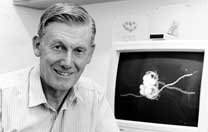
Professor Frank Gibson was born in 1923 in Melbourne, Victoria. In 1937 he started work in the Bacteriology Department at the University of Melbourne. In 1939 he moved to the newly created Bacteriology Department at the University of Queensland as a technical officer. At the beginning of 1947 Professor Gibson returned to the University of Melbourne, from where he earned his BSc in 1949. He was awarded an Australian National University scholarship to study for a doctorate at Oxford. His work on the biochemistry of amino acids included the use of normal and mutant bacterial cells, resulting in the completion of a DPhil in 1953. On his return to Australia in 1953, he took up a senior lectureship at the University of Melbourne. It was during this time that he and his research group discovered chorismic acid occurred. In 1967 Professor Gibson took up the Chair of Biochemistry at the Australian National University's John Curtin School of Medical Research. He continued to explore the biochemistry of chorismic acid and its many, and important, metabolites. Since retiring in 1988, he continued collaborating with colleagues on projects using computers to study the structure of various proteins.
Interviewed by Dr Max Blythe in 1993.
Contents
- Finding something suitable to do
- The move into bacteriology
- Jack of all trades: junior technician, university demonstrator and science student
- A strange war
- Resuming work with acridines
- A family move to Oxford
- Of vitamins, pathways and bacterial mutants
- An interesting DPhil oral
- One Saturday morning: an unexpected insight into pathways
- The dramatic discovery of chorismic acid
- Who'll come a-moving to Canberra with me?
- Oxidative phosphorylation
- Molecular modelling
- Home and away: 'doing the next thing'
Finding something suitable to do
Frank, you were born in 1923 in Melbourne. Tell me about your family life.
My mother was of Scots and English extraction and my father of Irish extraction, and we were definitely working class. My father was trained to be a glazier originally, but after he came back from the First World War he worked for the Adelaide Steamship Company as a wharf labourer and eventually foreman stevedore, unloading coal ships.
That was a tough job.
It was. I remember that during the Depression he would sometimes work 72 hours at a time as the foreman. But we were very much shielded from that and I never felt the effects of the Depression very much at all. My mother held the family together – I had two sisters, and we were all a very tightly knit family. We had no car, and I recall that the big events in my life were a pair of skates and a bicycle. I guess the fact that I don't have many memories of that time means we were very happy.
What was going to school like for you?
I was a pretty mediocre student, I guess. As a very small student I got into trouble because I hadn't taken my homework books home for six months or something like that. Another time I got 22 per cent for algebra, but after a stern lecture from my father I got 96 per cent the next term. I really wasn't very worried about schoolwork.
I think my parents' idea was that I would become a white-collar worker rather than a labourer, so they encouraged me to become a draughtsman. I went off after primary school to a technical college for about two years, but it wasn't a great success. I was not a very good artisan, I'm afraid. I could never keep the drawing paper clean, I made an electric iron that didn't work, and all sorts of things like that.
The move into bacteriology
Then several people from the technical college went to work in the Bacteriology Department at Melbourne University, where Harold Woodruff was department head. Almost as an act of charity, I think, he would take in boys from technical college, rather than high school, as laboratory technicians. A friend of mine went and then a few months later another opportunity arose, I went up for an interview and I got the job. I remember being asked what Sunday School I went to. Luckily, I said Methodist – I had gone there once – and it turned out he was a staunch Methodist. Whether that got me the job or not, at least it was the right thing to say. That was 1937: I started work at 14.
There is no question that somehow I had already become interested in science. I used to get and read a series which came out in parts, called The Science of Life, by Huxley, Wells and that crowd, and I managed to get a microscope (not much more than a toy) for which my sister tells me I used to pay a penny to get a drop of blood from her and a friend. But I don't know whether that's fact, fiction or family myth.
What kind of a world did you go into?
I thought it a very happy world. The department had almost a conveyor belt: as a technician you came in at the beginning, took the specimens down town to the Public Health Department, ran the messages and collected the lunches, and washed test tubes. When someone left, you would be promoted to plugging test tubes – and after six months you would become a very good judge of how much cotton wool to put in the neck of a tube. You moved on to the media room, making up bacteriological media, and then into either a teaching lab, helping prepare the materials for the classes and so forth – this was quite a big department for its day, teaching medicine, dentistry, agriculture, science – or one of the research labs.
Perhaps by luck, I was put into a research lab. That involved simple, routine laboratory manipulations, or setting the coal fire in the winter. I was working for Syd Rubbo, who later became head of the department. Adrien Albert was the collaborator in Sydney who even then used to send acridines to Melbourne for bacteriostatic testing and so forth.
After work we would go down and get fish and chips, and come back. It was a very happy place to work, because there were quite a few technicians, all fairly young and all doing courses – and in those days it didn't seem any hardship to do four nights a week at night school.
I was encouraged to start a Diploma of Chemistry in the Working Men's College, now the Royal Melbourne Institute of Technology. There were no biology courses; the idea was that you did chemistry. So I did chemistry I and chemistry II, a bit of scientific German, and maths and physics. But while I was doing chemistry II, I came off my bicycle and knocked all my front teeth out. So I had rather a traumatic year – for example, I couldn't use a pipette because it was too painful – and I failed chem II at technical college.
Jack of all trades: junior technician, university demonstrator and science student
In about 1939, David Gray (Syd Rubbo's brother-in-law, a veterinary surgeon) was to start up the new Bacteriology Department in the University of Queensland and needed an offsider. One of the perks of the job was that they would pay fees and give time off, if necessary, for subjects in the university's night courses – you could do at least the first two years of a science course at night, over four years.
I was encouraged to apply for the job but once I was in Queensland I had the slight barrier of needing to matriculate. There was no way I could have matriculated to the University of Melbourne, but the University of Queensland went through all my papers and gave me my one term of scientific German as a language. And I had passed Leaving English, which was the matriculation English in those days at Melbourne, as part of the Chem Diploma course at the tech. Finally, the university decided that to matriculate I would have to do physics, maths and chemistry at Leaving level – which was very good, because they were the three subjects I knew most about – and then said that chemistry and physics would do. So I spent a year doing that. I went on to university after matriculating, and started chemistry, biology and so forth. That was once again four nights a week, I think, after work.
Was Bacteriology a good new unit to work in?
It was a pretty small show, only two of us. David Gray wasn't there very much (he was out at the Veterinary School) so I prepared the materials and did demonstrating to medical and science students – usually you wouldn't expect a junior technician to be demonstrating to them as I was. Later on we expanded, getting another technician so there were three of us in the department. We went like that for some time.
A strange war
While you were getting your matriculation, war was beginning. It proved a strange war for you.
It wasn't exactly my war. Firstly I went into the Volunteer Defence Corps, the Australian equivalent of 'Dad's Army'. I was put into the intelligence section, but that wasn't a great success because I could never remember the Morse Code and so communications were limited.
Some people were conscripted for service within Australia, although they were later used in New Guinea. Because my father had been in the AIF, the overseas force, and one of my best friends in Melbourne was in the Air Force and another was a Commando, I thought it would be a good idea to be in the Services. As a laboratory technician I was in a reserved occupation, but by some bureaucratic misdemeanour I was actually called up, conscripted. I was put into the Brisbane showgrounds and as soon as I was there I thought, 'I'm in. This is it.' I sent my father a telegram asking his permission to join the AIF, he sent back his permission, and I was enrolled.
I didn't get into any of the more glamorous sections, because they said, 'Oh, you're a laboratory technician,' and I had to admit that. I ran dead in all the right tests they give you when you first go into the Army, but to no effect. I had to go into the Medical Corps, where they made me a stretcher-bearer. People are very heavy to be carried round, and I didn't like that much.
Then the university started trying to get me out. This developed into a major operation. I was writing letters saying (probably very foolishly) I wanted to stay in, and the university was writing, 'We want him back.' After a while I was hauled up before the officer commanding the Medical Corps in Queensland, and eventually I was sent out on leave. I spent the next six months or so, while they thought things over, in uniform but back in the Medical School. Then they threw me out altogether. I finished up with 286 days 'active service in Australia' – which was enough to get a War Service home.
Resuming work with acridines
So you were back at Queensland University. You prospered fairly well, but after year 2 you decided to go back to Melbourne.
Yes. I was getting 51 per cent all the time in my courses, because I used to go either surfing or bushwalking – which was almost unheard of in Queensland at the time. I used to walk in the rainforest of south-eastern Queensland and climb the mountains there. We went away practically every weekend, and I used to take a week off before the exams. These days, with continuous assessment, you couldn't do that, but it was absolutely wonderful even if I wasn't doing very well in my courses. I did get some decent marks in chemistry II, however, after Cec Williams (a friend who was a pharmacy lecturer up there) pointed out the error of my ways.
After four years, during which I had done first and second year science, I wanted to major in biochemistry and bacteriology. The bacteriology school in Melbourne had got even bigger since I had left it, so I went back to Melbourne and started to work there, becoming a senior demonstrator after a time. I spent two years studying while I worked – they let me do bacteriology I and II in the same year, which was quite good as I'd had enough years in bacteriology then to cope with that, and then biochemistry. I did reasonably well in those subjects, and then I got my BSc.
I became a junior lecturer for a while and then started to do a bit of independent research, back with the acridines. It had occurred to me that the acridine nucleus was very much like the riboflavin nucleus, and they might be acting as metabolic analogues. If I remember rightly, I was able to show there was a correlation between how the substituents on the acridines resembled the flavin and the degree of inhibition of bacterial growth. I published that.
Actually, my first publication had been a little note in the Australian Photographer, some years before. Being interested in photography, I had taken a photograph of a wedding. It was very much underexposed and so I developed some concoction to intensify it. That first publication is completely lost – I've never seen it since. I do remember, though, that the editor insisted on removing the word 'wedding' and putting in 'a social occasion', as if there were something wrong about photographing a wedding.
When you were working with the acridines, was Rubbo still giving you his support?
Yes. I was doing some work in collaboration, but I was given a pretty free hand. Then I applied for an ANU scholarship, although there was still nowhere to do PhDs in Australia. At first my application was rejected because I didn't have an honours degree of any sort – just my BSc plus one research paper – but a couple of months later I got a letter out of the blue saying they'd thought it through again. I'm not quite sure of the background to that. Syd Rubbo might have been involved, and maybe Florey (who was in charge, essentially, of the PhD scholars who went to England). Anyway, there was great jubilation all round and the family were quite excited.
Actually, a sidelight which I haven't thought of for probably 40 years was that when the scholarship was announced, the Melbourne Herald said that 'Ralph Gibson' had been given it. Ralph Gibson was a well-known Communist in Melbourne, and my father was so irate that he marched me into the Herald office to demand a retraction.
A family move to Oxford
And so you went off to Oxford. By that time you had a wife to go with you.
Yes. I married my first wife, Margaret Burvill, in 1949, not long before my scholarship was announced. She was a Queensland graduate whom I had met briefly – I demonstrated to her – in Queensland. Then, when I came back to Melbourne, she was working in the Rubbo laboratory with Adrien Albert. She had done some very nice work on the motive action of 8-hydroxyquinoline, oxine, and had published quite a lot with Rubbo and Albert – much more than I had published. We did some work together on low-level resistance to streptomycin, which didn't add up to much in the end but was thought good enough for a note in Nature.
When we went over to Oxford, my wife cast around and inquired at the Dunn School and in Hinshelwood's physical chemistry laboratory. She was offered a job in the Dunn School but also she was offered a job with the possibility of doing a DPhil in Hinshelwood's lab, and so she went to work there.
It must have been exciting to arrive in Oxford and meet Florey for the first time.
Yes. I remember very distinctly going in to see Florey. He explained that I was going to work over with D D Woods (which I knew already) and that he would take me over there. Then he explained the structure of the university, saying that I would have to become a member of a college before I went through the university. When he asked what college I would like to become a member of, being completely naive and knowing nothing about Oxford or colleges I didn't say 'Balliol,' or anything like that. I thought and said, 'Well, I'd rather like an old one.' 'Oh,' he said. 'My college is Lincoln, 1427. Will that do?' I said, 'I think it will do,' and so I became a member of Lincoln – not that I had much to do with Lincoln, which was mainly a conduit for getting money out of me. There was no Middle Common Room, I was married, so I lived out.
For a start we lived in Headington but later on we got a few rooms overlooking High Street, just opposite St Mary's, which was very good. It used to be an inn, apparently, and it had a nice big bow window, a little bearpit in the back, and a set of spiral steps you fell down to get downstairs – all the right things.
Of vitamins, pathways and bacterial mutants
What was it like to work with D D Woods?
Working for D D Woods was great. He was a great scholar and a wonderful supervisor. I thought we might not get on very well to start with, because soon after I arrived I said, 'Now, you won't mind if I take 10 days off to go skiing at Easter, will you?' He sort of looked at me and said, 'Well, I don't pay your salary,' turned on his heel and walked off. But he really was great.
June Lascelles and Bill Murrell were there, so there was quite an Australian and New Zealand connection, but for a while I could not say I felt completely at home. It seemed to me that whenever I'd go there, at about nine, I'd find people at work. Then, because it was in December–January, it would get dark at about three but it felt like midnight. And when I left, at half past five, people were still at work. We did settle into a good routine, but it seemed a bit foreign at the time.
What did you do for your DPhil?
D D Woods was interested in folic acid metabolism and function, and vitamin B12 function. Vitamin B12 and folic acid were thought to be concerned in the biosynthesis of the amino acid methionine, and I was put onto that project. Luckily, it worked out quite well and we found that serine was the source of the methyl for the methionine. It didn't have a great impact on the scientific world. We had one short communication at a meeting, but D D Woods wasn't well and when I left the work it hadn't been written up. It wasn't published till seven years later, by which time everyone knew that serine was the source. But the joy of doing it was all that really mattered.
That DPhil work says a lot about the rest of your career. It sets marks. You were using bacterial mutants, weren't you, coming in on a new wave of discovery.
Yes. It was the era when studies on bacterial nutrition had led to the idea of a way to work out pathways, in particular with tryptophan in the case of bacteria and several pathways in Neurospora. Beadle and Tatum had shown that it seemed that when you got a mutation in a gene you blocked a single enzymic step, and also that if that step was blocked, then the intermediate preceding the step might pile up and you could isolate and identify it. Then Lederberg's work with bacterial mutants had shown a further way to study pathways, which now were starting to be built up. Tryptophan was one of the first ones. This was very exciting.
I was interested in vitamin B12 function and folic acid function as well as the actual pathway, and I found that you could either grow the organisms in very limiting vitamin or find some mixture of compounds that replaced the vitamin. So you could make vitamin-deficient cells by having a mutant which could not form that vitamin. Then you could add the vitamin and see whether it functioned and so forth.
That was a terrific manipulation of metabolism. You really liked bacterial cells, I think. Perhaps that stemmed from your bacteriology laboratory days.
Well, in Oxford I was exclusively working with cell suspensions – growing up whole cells, washing them and using them. I had very little experience before I finished my DPhil with smashed cells and enzyme preparations. That came later.
An interesting DPhil oral
After you wrote the thesis up, you were examined by an internal examiner, Rudolph Peters, and an external examiner, Hans Krebs. I believe Krebs was late.
Yes. I got all dressed up in subfusc – white bow tie, dark suit and everything – but when I turned up at about 9 o'clock for the appointment, I got a message that Krebs had been delayed and wouldn't arrive till about 11. Needing something to read for the next couple of hours, I walked in to the lab of June Lascelles, who had a row of green Penguin mysteries on her shelf. But when I pulled one out at random, it was called Death in a White Bow Tie. I threw it down and walked out.
The oral was interesting. I became an observer of the polite interaction between Krebs and Peters: very much a case of 'After you,' 'No, after you.' Peters came in with bits of paper stuck out all the way through the thesis, to ask me questions. That gave me a shock, but it was fairly obvious after a short time that neither of them had worked in that field, so in a sense I was on top.
Wasn't Krebs was a bit mystified by what you had achieved on the biochemical pathway, looking at intermediates without viable manometry?
Yes. When Krebs handed back my thesis as he left, he said, 'All this without manometry.' Oddly enough, during the next few months while Margaret finished her DPhil, I did learn manometry in the microbiology lab – Bill Murrell did quite a lot of it.
One Saturday morning: an unexpected insight into pathways
You re-established your link with Melbourne, which had been an important place for a long time.
Yes. I enjoyed Oxford and developed good links there. But some time before I was due to leave, I had two letters. One was from Syd Rubbo, saying that Frank Fenner was intending to offer me a job but that he also wanted to offer me one. (These were the halcyon days when you were offered jobs.) Frank Fenner was offering me a job as a Fellow in the John Curtin School of Medical Research, in Canberra; Syd Rubbo's job was back in Melbourne as a senior lecturer. Because I like teaching and also because virology – which is what Frank Fenner's department was concerned with – was a bit of a foreign field for me, in 1953 I went back to Melbourne.
You went back on to related pathways. Tell us about your 'one Saturday morning' experiment.
Well, it did things, even if they were all the wrong things. I was interested in one-carbon transfers, having been working with that in Oxford. I had an idea that anthranilic acid could be converted to indole, which is a step on the tryptophan pathway known because of the use of mutants. That ostensibly is an addition of one carbon atom. In Oxford I did an experiment where I added serine to anthranilic acid and showed that indole was formed. So I thought, 'Ah, I will go with this. I can go back and work on the same general area, studying one-carbon transfers.'
When I did the same sort of thing in Melbourne and did the controls, I found that if I used glucose and ammonia I got just as much indole formed as if I had serine present. That showed me I never used the library, or I would have discovered that that was not the way indole was made – Yanofsky had shown some time earlier that it was made by the addition of a five-carbon ribose fragment to anthranilic acid. But the interesting thing was that it meant that by incubating glucose and ammonia with a mutant that was blocked after indole, you could get indole formed. It allowed you to study the whole pathway. You could look for mutants with other compounds being produced.
Was this drawing on your early work on antibiotics?
Yes. Initially I was interested in whether antibiotics inhibited any steps in the pathway. From the early work on the acridines I was very interested in the motive action of antibiotics, and also the book by Work and Work on the basis of chemotherapy had a big influence on me. We spent quite a lot of time mucking around with antibacterial action. It didn't really get very far – it was a diversion, I suppose – but it did lead us on to really thinking about the biochemistry of the pathway. We then started to isolate mutants which were forming various compounds. We would generate the mutants, in the sense that you treat them with a mutagen and then look for mutants which will grow on some media and not on others. It was fun, especially in those days when there were plenty of novel mutants to be found.
The dramatic discovery of chorismic acid
Tell me more about that way into the pathway, Frank.
We were interested in the early part of the pathway. There had been a lot of work done by Davis and Sprinson in two groups working in the United States, and the pathway was starting to be established. It was known that there was a so-called common pathway which led from carbohydrate and branched out to three different amino acids, phenylalanine, tryptophan and tyrosine, and then possibly to para-aminobenzoic acid and possibly to folic acid. The big mystery was where the pathway branched.
We started to study the pathway, using mutants blocked at various points near where the branch-point might have been – eventually deciding that if we could make a multiple mutant, blocked all the way round the branch-point compound, that should pile up. In theory it wasn't possible to do that – the reasons get a bit complicated – but we did the experiment the best way we could and found that a compound did pile up. We extracted the compound into ether, looked at the spectrum and knew we had a new compound being formed. Great jubilation.
Was the discovery of that the greatest moment of all?
Yes. There have been some good ones, but seeing that was one of the best because it came in so dramatically. One minute it wasn't there, and next minute there was the spectrum in front of your eyes.
I remember very distinctly that Margaret was the one who actually ran the spectrum. Soon after that she became ill and had to leave the lab, and then I spent a lot of time trying to isolate the compound. I wasted a tremendous amount of time. Because no-one had ever found it before and everything, I thought it must be so labile that it had to be treated very delicately, very gently, or it would break up. So I ran all sorts of exotic columns. I remember doing some very dangerous things like, in a very poorly ventilated room, running columns of powdered sucrose and ether. Safety committees would never let you do things like that now.
Anyway, I lived through that, and eventually found that you could put the compound onto ion exchange columns and get it off, provided you did things very quickly and cold, even though it was unstable. It spontaneously broke down into one of the intermediates in phenylalanine biosynthesis and also into para-hydroxybenzoic acid. Getting this compound opened up a Pandora's box: we could look at the pathway to the three amino acids and so on. We knew para-aminobenzoic acid (PABA) probably came from that compound, and we were able to show that. Then we started to look at other compounds also, and later in Canberra we did a lot more.
Why was the compound called chorismic acid? I must say I love that name.
My father-in-law, a clergyman in the Church of England, was a Greek scholar. I wrote to him outlining the situation – that we had a pathway and a branch-point – and he suggested several words from a Biblical quotation which I think has to do with St Barnabas and the young St Luke. That they 'parted asunder' was the important thing, and he suggested 'apochorismate' or 'chorismic' or words like that. I chose 'chorismic', because 'apo' has chemical connotations and one could confuse it.
And it is in the biochemistry literature for all time.
Yes, I assume so. It would be a bit hard for anyone to pirate it now.
Who'll come a-moving to Canberra with me?
You were given a Personal Chair in Melbourne and you built up a really significant team, didn't you?
One of the great things at that point was the people I had working with me. I had some fantastic graduate students – Margaret was working with us and there were several others who have made names for themselves, such as Jim Pittard, later head of the Microbiology Department in Melbourne University, Dick Cotton, who is now deputy director of the Murdoch Institute in Melbourne; Ian Young, who is head of the Division of Biochemistry and Molecular Biology in the John Curtin School of Medical Research, at the ANU; and Graeme Cox, who has been working with me for about 35 years. He is now my boss, a professor in the ANU. Several of those people have given Biochemical Society named lectures and so forth. It was a great team.
But then you got a chance to change jobs. How did that come about? And I believe your research family wanted to move with you to Canberra.
I got a summons from Sir Hugh Ennor, whom I knew only by name as head of the Biochemistry Department at the John Curtin School, although I think he was the Deputy Vice-Chancellor at the ANU at that time. He asked if he could see me at 'Menzies Hotel, breakfast,' and I went along, with no idea what this Sir Hugh Ennor could want with me. He said they were trying to fill the Chair of Biochemistry in the John Curtin School. Would I let my name go forward? I had never thought of myself as anything but a bacteriologist, so to have someone calling me a biochemist gave me quite a turn.
I thought about it, and I came up. The decision was not easy, because my wife was ill and anyway I was settled in Melbourne. But I decided to let my name go forward, and I was offered the job and took it. When I went back to the lab I said, 'I've been offered this job in Canberra, and they say that I can bring someone with me if I want to. Does anyone want to go?' I think five people came, which was great because it meant the work could just go on as before. We had just a short problem of setting up and then away we went. I must say that I have never regretted coming to Canberra. It's a very good place both for work and for play.
In Canberra your work then flooded out into some quite exciting areas.
That's right. One of the good things about the job here was that, as Hugh Ennor pointed out to me, the department was very small. Although there were at that time four research groups including us and we were very crowded, we had a good laboratory manager and the head of such a small department virtually had no teaching. You could just carry on at the bench, really, which was great.
Graeme Cox and Ian Young were here, and we found that chorismic acid was the precursor of ubiquinone, one of the compounds involved in electron transport. We started to study the biosynthesis of that by isolating mutants, isolating the compounds and so forth, and eventually Ian Young took that on. With some radioactive tracing experiments by Graeme Cox, we found that chorismic acid was also the source of vitamin K, the source of which was completely unknown.
Also, we started working again on phenolic compounds – dihydric phenols – that were produced by mutants. Jim Pittard (who was originally an MSc student) had looked at a number of them while we were in Melbourne, but although a lot of them were produced we could not work out what they were for. Jim had shown the compound 2,3-dihydroxybenzoic acid, but now Graham Cox identified 2,3-dihydroxybenzoylserine and eventually showed that the important compound was one which we called enterochelin but is now known in the literature as enterobactin. And that turned out to be important in iron transport in bacteria. So not only were we able to work on these compounds but in the case of the iron-binding compounds we were able to postulate a pathway for the uptake of iron, using these compounds, and in the case of ubiquinone to postulate a mechanism of action – how it worked in two particular places in the pathway of electron transport. That time was not only productive, it was very exciting.
Didn't you then make a new departure, getting into bacterial genetics in a big way?
Yes. That had arisen just before we left Melbourne. Jim Pittard went away to work with Adelberg in the States, and came back imbued with the new bacterial genetics. Then we started not only to isolate mutants but to map them and carry out transductions to purify the mutants we had. I think since that time we have taken up with all the new techniques that have arisen in bacterial genetics, right up to site-directed mutagenesis and PCR and so forth.
Oxidative phosphorylation
Becoming interested in oxidative phosphorylation, as we did next, was a bit of a shock because it was a field we knew nothing about – an obviously very controversial field and one which occupied some of the big biochemists of the time. The interesting thing was that until almost 1970 very few had used E. coli, in particular, or any bacteria, to study oxidative phosphorylation in detail. I think the reason was firstly that all the dominant figures in the field were eukaryotic specialists, and secondly that those people who had done a little bit of work on oxidative phosphorylation in bacteria had shown that the so-called P/O ratios are very low, therefore the organisms are pretty inefficient – and who'd want to look at those anyway?
We tackled it from a different angle. We had looked at ubiquinone mutants, and these had deficient respiration, and we had a lot of mutants which were deficient in respiration but were not ubiquinone-deficient. Therefore, there was something else wrong with them. Examining some of those, we found that some of them lacked ATP-ase activity and so we were led to look at the ATP-ase. Virtually nothing had yet been done about ATP-ase in E. coli or bacterial cells, although quite a lot was known in the mammalian system and it was known to be a complex, with many subunits. So we started to isolate various mutants and identified, I think, seven out of the eight genes that were concerned with this process. We then started to work on function.
To bring that right up to date: Graeme Cox developed a theory which suggested that the function of ATP-ase, or the mechanism of action, was one in which there was a rotational model, with the α and β subunits at the top and a central rotating core inside. This was novel. A rotating model had been mentioned by Boyer, but that was rotating the whole α and β subunits. That model – which we are still working on – seems to be holding up even now, although getting definitive proof is very difficult.
That really is an enzyme complex – classical, and one of the most important of all.
Yes, and I think that the bacterial work that we did – and that a lot of others have done since then, because it became fashionable to work on E. coli and quite a number of labs took that up with oxidative phosphorylation – has given a lot of insights into the process which had been used by people in the eukaryotic field to work on their aspects of it. E. coli is a wonderful laboratory tool because you can work so quickly and easily with it and get results.
Molecular modelling
I think you're still enjoying your research, perhaps studying your great stocks of mutants. Or is your work now mainly administrative?
Certainly I have thousands of mutants, but I don't do any lab work now – nor any administrative work at all. I spend most of my time in front of a computer.
When Robin, my second wife, spent a year with me back in Oxford, she gave me a BBC microcomputer – 32K and a television screen – for my 60th birthday. After we returned to Canberra I started to play with that, using it to set up the computing for her business as a solicitor. (Having a small child, she was working from home.) I became further interested, starting to use PCs and then Macs, and so when I retired I thought, 'Well, the best thing I can do to further the work of the group is to go into computing.' I was encouraging people to go into molecular graphics; we bought a workstation; and now that we have state-of-the-art software and a good workstation I spend most of my time doing molecular modelling and working as a Visiting Fellow – along with a few committees of various sorts and so on.
Molecular modelling must be wonderful. Isn't it time-consuming, though?
Very time-consuming. I realise now that it is as much experimental science as any other, especially when you are modelling compounds, proteins, for which a structure is not known by X-ray crystallographic techniques. You can drag in files and put structures of known proteins up on the screen, but when you are dealing with proteins where you don't even know whether it's an alpha helix or beta strand, then it gets more difficult – although if you are modelling membrane proteins it is not so bad, because you can assume that they are going to be alpha helical. So we model parts of the ATP-ase complex and also model the various mutants and see what happens.
Home and away: 'doing the next thing'
You have done a lot of overseas travel, making contacts with many people in your field and playing an ambassadorial role. And some very exciting people have come here to work with you. Has this been an important part of your life?
It has been quite an important part, arising mainly from the times spent in Oxford. The second time, in 1982–83, was under rather different conditions from the first, because I was by then a Fellow of Lincoln.
You got value from Lincoln that time, did you?
Very much so, yes. It was a great experience, quite useful – and certainly different from being a student and not seeing the college. I went to the main department a fair bit, whereas in the early days contact with the main department was not encouraged. (So I used to sneak into the library late in the afternoon and get the jam and bread they had left, I remember. But that's another story.) I met Norman Heatley over there, among others. I saw quite a lot of Henry Harris during lunchtimes at Halifax House, and I worked with Joel Mandelstam.
There have also been visits to the States, where I made some very firm friends, and probably as a result we've had people like Charlie Yanofsky out here, Ed Reich and Fred Crane, and Simon Silver. Quite a few people have come out to work in the lab and it's been very valuable.
Frank, it's been marvellous to talk with you about all these things. What a career.
Well, it just evolved – we used the techniques that came along, as they applied to our problem. My life has been just a matter of doing the next thing. I never feel I have had to make any serious choices. It's been as simple as that, and it's been enjoyable.
And it shows. Thank you very much.
Professor Neville Fletcher, physicist
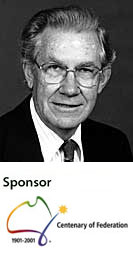
Neville Fletcher was born in Armidale, NSW in 1930. He was educated at Armidale Demonstration School (1935-41) and at Armidale High School (1942-46). He attended New England University College, which was part of Sydney University, receiving a BSc in 1951. Fletcher then went to Harvard University where he gained a PhD in 1955 for his research on impurity levels in semiconductors.
Fletcher returned to Australia in 1956 to work in the Radiophysics Division of CSIRO. After 4 years at CSIRO, Fletcher moved to the University of New England where he was a senior lecturer in physics (1960-63) and then professor of physics (1963-83). Here his research interests included musical acoustics and studies on the physics of ice and water.
In 1983 Fletcher was appointed director of CSIRO's Institute of Physical Sciences, a position he held until 1987. When he completed his term as director, he remained at CSIRO as a chief research scientist until 1995.
Interviewed by Professor David Craig in 1999.
Contents
- Forebears: clergymen, convicts, missionaries and mathematicians
- Educational experiments and encouragement
- Hello cloud physics, goodbye 'arcs and sparks'
- A theoretical thesis on semiconductors
- Churches and children
- Another brush with transistors
- Redeployment to cloud physics
- Recollections of CSIRO colleagues
- Beware slippery ice!
- Interests and excitement in musical acoustics
- A rare honour
- 'Music has always been central to what I've been doing'
- Professorial and other administrative roles
- A CSIRO directorship
- Universities and CSIRO as two big forces in research
- Cooperative extension of research efforts
- Flights cancelled by golf
- Academy outreach and interaction
- The story of a remarkable school science program
Forebears: clergymen, convicts, missionaries and mathematicians
May we begin by talking about your family background?
I am descended from a lot of Methodist clergymen on one side and Irish convicts on the other, which makes life interesting. My bit of the Fletcher family, when they came to Australia via New Zealand in about the 1860s, were not themselves Methodist clergymen but did have a strong Methodist background. The other side of my family were Moffatts, from England, and Ryans and Glasses, both from Ireland. In the 1840s the ‘Fighting Ryans’ had a battle with another family on the way home from the country fair and one of the other family got killed, so seven Ryan cousins got transported to Australia for seven years. Then Bridget Ryan came out to Australia when her brother Malachy was on his ticket-of-leave, she married a Moffatt who was from England, and those are where my maternal family comes from.
You had a celebrated forebear, William Horner. Can you tell us about him?
William Horner was a schoolmaster; with his own school in Somerset. One of his sons was a Methodist missionary in the same place as a Fletcher who was also a Methodist minister. My Fletcher ancestor got ill, they went back home to England, and he subsequently married his friend’s sister, Mary Horner. So that’s where the Horners came into it. My grandfather gave all his children the name Horner and that went on to my generation.
The elder Horner, who would be something like my great-great-grandfather, was a mathematician – probably an amateur one, because he was basically a school headmaster – who in about 1816 published a paper in the Philosophical Transactions of the Royal Society about the finding of roots of polynomial equations. Indeed, his method is still used for computing these roots. And another Horner, as a young man, came to Sydney University in the 1880s as a lecturer in mathematics. Maybe my interest in things mathematical and physical has come down in my family.
Educational experiments and encouragement
Where were you at school?
I went to a good school in Armidale, a small town in those days. It called itself a cathedral city because it did have two cathedrals, but the population was only 7,000. I went to Armidale Demonstration School – so named because of the Teachers’ College which had been opened in 1928 on the hill above Armidale. The close connection between the school and the college meant we had good teachers and a few educational experiments going on. We learned interesting things like bookbinding and paper-making as well as standard things. Then it was on to Armidale High School.
What got you started in science?
I guess I was always interested in things mechanical and electrical. From primary school age I remember little steam engines and things that we seem to have got from somewhere. In high school I became interested in electricity and radios – crystal sets and so on. Of course, in those days radios were nice macroscopic things: you could hold the valves, they were all put together by bits of wire wrapped around terminals and so on. And out of one’s pocket-money one could buy old, derelict radios and get bits to be put together to make other radios. I thought it would be nice to be a radio engineer but the university in Armidale had Science and Arts, not engineering, so I did physics and maths instead. In retrospect I think that was the right thing to do. I enjoyed physics and maths more than I would have enjoyed doing the nuts and bolts of engineering.
In the high school, did you have good teachers in physics and maths?
I remember my high school teachers as good teachers. Armidale was an educational place even in those days. The university college had started in 1938, so by the time I started high school in 1941 there were people doing a diploma of education and things of that sort. My teachers certainly encouraged me. Because I was good at maths, particularly, they used to let me sit up the back of the room and do my maths honours sums while the other people were doing the standard work in the front.
Hello cloud physics, goodbye ‘arcs and sparks’
Your next move was to university.
That’s right. The university college at Armidale was part of Sydney University, having been established just
outside Armidale in ‘Booloominbah’, a beautiful big mansion donated to the university specifically for the purpose. It had been built in 1888. By the time I was interested in going to university, in 1947, there were just under 200 students there and about 30 people on the staff. It was the obvious place to go. We were very lucky. Although there were not many staff, they were very good. Jack Somerville, who was head of physics and mathematics, had done very well at Sydney University and then gone to Cambridge to do mathematics,
and I had the general feeling that the ultimate thing was to go to Cambridge and do mathematics.
We had to do Sydney University exams. I didn’t really get to know the Sydney University students at all except for Max Kelly, who was in my year when I actually went to Sydney for one term of maths honours. It was interesting to see how the main bit of Sydney worked.
You shared a Medal with Brian Robinson and Stewart Turner. Do you keep in touch with them still?
That was the Medal in Physics, which was the next year. Stewart is at ANU, and for a time I was in CSIRO Radiophysics, where Brian was. We keep more or less in touch and I see them now and then, although Brian not for a while.
You had your first contact with CSIRO as an undergraduate, I think.
Yes. Jack Somerville arranged for me to get a CSIRO summer scholarship, so I worked at what was then the National Standards Laboratory for about 10 or 12 weeks over the summer vacation at the end of third year. I went back again at the end of fourth year. Working there was really very nice. I got to know a lot of people, some of whom I have kept in touch with – Guy White was then a young research scientist, and Alan Harper subsequently led Australia’s change to the metric system.
What were you working on then?
Rather strangely, I had been given a project related to the cloud physics effort that was going on in Radiophysics, which was at the other end of the building. The idea was to look into the production of ice crystals by firing dry ice pellets through clouds and collecting the little crystals. I don’t know that we found out anything very earth-shattering about what was going on.
I got a fellowship to go to Harvard after that but before I went I had a little eight months or so at the end of my undergraduate degree when I was actually able to do some research projects for Jack Somerville. He was working on transient arcs, ‘transient’ meaning things that lasted five, 10, up to 100 microseconds. They were tiny arcs, a few tenths of a millimetre across, which would just expand, and he was interested in the way they did so. I built a Kerr cell camera, a multiple-cell camera that would take three photographs, each about a microsecond in exposure, which I could spread over a couple of hundred microseconds to watch this tiny arc expanding. That was interesting, but it was my last such contact with ‘arcs and sparks’.
A theoretical thesis on semiconductors
How did it happen that you went to Harvard?
At the end of undergraduate work I had applied for all the scholarships that came up – a scholarship at Cambridge, in England, because that was where one thought of going, and also a Frank Knox Memorial Fellowship in Harvard. Frank Knox had been Secretary to the Navy for Roosevelt and his widow established these fellowships in his honour, initially to bring English people to America on study visits to get degrees at Harvard. Later, other bits of the Commonwealth came in, and this was the first year Australia had a go. I was lucky enough to get it. Dr Madgwick, who was the warden of the University College in Armidale, said he thought the thing that gave me a little edge, when everyone who applied had a University Medal, first-class honours and so on, was that I played the flute, playing concertos with the orchestra and so on.
That one-year Frank Knox Fellowship to Harvard got me there and carried with it a Fulbright grant which paid the fares, so I was set up for a year. After that I got a CSIRO studentship for one year, and the third year I actually worked for a living, four days a week, finishing my thesis in the rest of the time.
What were the highlights of your Harvard period?
Harvard, like other American universities, always had coursework requirements, and we got very good coursework. I just did it for one year, during which we had people like Schwinger, who got the Nobel Prize for quantum electrodynamics, and Norman Ramsey, who talked to us about nuclear physics (he subsequently got a Nobel Prize as well), with other exciting people around like Pound, Purcell and so on. They gave good lecture courses and you had a really wide spread of things you could do. It was an excellent environment.
I decided to do a theoretical thesis, partly because I was probably going to have to do the second year slightly part-time, when it would have been hard to do an experimental sort of thesis. Making use of my background in maths and physics I worked with Harvey Brooks, who was a theoretician, and did a thesis about impurity levels in semiconductors. During the second year, 1953, I had a part-time job as a research engineer at a factory that not only made transistors but actually had a research laboratory as well, transistors being pretty new – they were only invented in ’49 or thereabouts. That was great and kept things going, and in third year I worked four days a week in this factory. I was called Assistant Director of Development, which was a really nice title, and it was even nicer that for my four days they paid me twice what I was getting on the Frank Knox Fellowship and I could have a few trips for the company and so on.
I was developing power transistors, which were new in those days. I think the most powerful transistor you could buy anywhere was about 100 milliwatts, but the ones I developed got up to about 2½ watts, so it was a reasonably big step. I got a patent on that and was able to use the basic work as another bit of my thesis.
Churches and children
I think you were married in Harvard.
Yes. Eunice, my wife, was from Maitland. We were in the same year at Armidale, where she did languages. We got to meet each other through the Methodist Church, because though my bit of the family weren’t clergymen-like, they were staunch Methodists and I got into the habit of going to church every Sunday, and Eunice’s family were also Methodists. Ultimately I played the organ and we both sang in the choir, and things like that.
Would you say you were a staunch Methodist?
Um, no. I can’t remember any time when I actually believed in God. I suppose I didn’t think of it for a long time. I was staunch in that I had to go to Sunday School – where I seem to remember having arguments with people – and to church, and I enjoyed the music. I still enjoy the music, and the architecture of cathedrals when I have seen them in England, but I can’t say I have ever been a religious person.
Well, at the end of Eunice’s degree she became a schoolteacher, teaching French and German. I went off to America, initially for a year, but when I discovered I could stay on longer, she threw in the schoolteaching job and came to America. We were married in Harvard University chapel, which was very pleasant, and had another two years in America together.
What do your children do now?
The eldest one, Robin, was particularly interested in Japanese. She went to Japan for a year at the end of high school, and then did a degree in Asian studies at ANU and worked in the Japan Secretariat at Foreign Affairs and so on for a year or two. Then she married Ben Schutte, a biologist from ANU, and they lived in Melbourne for a while when Ben was doing a degree in chiropractic. They are now back in Canberra with our two grandsons. The second daughter, Anne, did biological sciences at ANU and then went to Melbourne. Now, having been a laboratory manager for the Macfarlane Burnet Medical Centre, she is resources manager in biological sciences at Monash University. And our son John, the youngest of the three, did engineering at the University of New South Wales and worked then for Fairlight, which made music and video synthesisers. He had a great time but when Fairlight fell on slightly hard times he went into a communications company, JNA Technology – which has now been taken over by Bell Labs – where he makes multiplexers and such things for Telecom and others. John is married to a lawyer called Kelly and they have two daughters. So we have two grandsons and two granddaughters.
Another brush with transistors
After your PhD in Harvard you came back to Sydney to join CSIRO.
I came back to work in the Radiophysics Division, which had developed from wartime radar to radioastronomy, cloud physics, computers – it had the first computer in Australia, CSIRAC. Radiophysics was at the other end of the building where I had worked in the National Measurement Lab during the long vacation a couple of times and so I knew what was going on there. In fact, it was the Chief of the Division, Taffy Bowen, who organised a studentship for me at Harvard for a while when I became involved in transistors. So it seemed natural in 1956 to go back there.
At first, being in Sydney was pretty grim. It was awfully hard to get a place to live and we ended up having one room, use of kitchen and bath, with an old lady who was going senile. We were actually applying for an immigrant visa to go back and live in America, I was talking to people at General Electric about jobs and so on, and we probably would have gone, except the waiting list for an immigrant visa from Australia was 10 years. But by a year later we had a house to live in, and our first daughter, and things were fine.
In the Radiophysics Lab I worked initially on transistors. AWA was just getting into the transistor business and CSIRO was working altruistically – as it did for Australian industry in those days – developing background in transistor physics. Lou Davies was running our little group, in which Brian Cooper was also involved on the more electronic side. We grew crystals, made transistors and developed different sorts of things. I worked on things such as high-current diodes and high-power transistors, as I had been doing in America, and we made some progress with them.
When I had worked in the Transistor Group for a bit under two years, AWA bought a turnkey operation – from America, I guess – for their transistor manufacture and no longer needed the Australian research. Taffy Bowen decided to close down the group and ‘redeploy’ everyone. (That was a good word even in those days.) He said to me, ‘Would you like to be a radioastronomer or a cloud physicist? Tell me on Monday.’
Redeployment to cloud physics
Cloud physics looked interesting because there were microphysical problems about nucleation and growth of ice crystals. I didn’t really want to be a radioastronomer – they spent all their time out in the field, at night and so on. I remember either Bernie Mills or Chris Christiansen saying that as far as radioastronomy went, ‘PhD’ meant ‘Post-hole Digger’. I wasn’t really keen on that. So being redeployed to cloud physics was good, because ice is a very interesting substance. As an odd coincidence, the crystal structure of ice is very much like that of germanium and silicon, out of which you make transistors. It is even a semiconducting material, but with protons carrying the current instead of electrons.
I got involved with the nucleation process. Clouds are water droplets, which are very tiny – 10 microns or so in diameter – and hence colloidally stable. They just go round each other, they don’t collide and form raindrops except in maritime clouds, which have fewer but bigger droplets in them and can produce shower rain. The big clouds that develop over the continent have tiny drops which are stable. For rain, the cloud has to grow up so that the top gets ice crystals in it. The ice crystals are more stable at temperatures way below zero Celsius, where they grow until they fall down, gradually become drops, collect more things and fall out the bottom. So the crucial stage is getting ice crystals in the top.
The idea of rainmaking was to inject ice crystals artificially, one way being to drop lumps of dry ice through at minus 80ºC and cause freezing of the droplets at whatever temperature there happened to be below zero. (In the ordinary course of events they wouldn’t begin to freeze much until minus 20, 30 or so.) The other way was to put silver iodide smoke into the cloud. Silver iodide is another material that has a crystal structure very much like ice, and this structure will cause water drops to freeze at minus 4 or thereabouts, forming ice crystals so that the rain process can go on. Interestingly, this science-fiction-like silver iodide effect was found by Bernie Vonnegut, who worked for General Electric in the United States and whose brother, Kurt Vonnegut, is a famous science fiction author.
I was concerned with the process by which silver iodide nucleates these ice crystals from water drops. For a couple of years I managed to do a lot of interesting things and get some handle on just what was going on, and Taffy got me started on writing a book about ice and water and clouds. But there was an increasing emphasis on field experiments, because all this theory wasn’t much good unless you went out and actually made clouds rain. I wasn’t keen on seeding clouds, collecting the statistics and so on, just as I hadn’t wanted to be a radioastronomer digging post-holes. So I began to look around for something else to do, giving up on cloud physics and the CSIRO at the beginning of 1960.
Recollections of CSIRO colleagues
Do you have any recollections of Lou Davies at CSIRO at that time?
Yes. Lou was far-sighted. His particular interest was trying to develop very thin germanium coatings on glass, with the idea that they could make solar cells. That’s hard to do – the glass is amorphous, you only get microcrystalline cells and so on – but it is the way people are beginning to do it now. When the Transistor Group was dissolved, Lou went to AWA to head up their research department and became Chief Scientist there, so his expertise in the semiconductor field was transferred to industry in that way and not lost to Australia.
And Chris Christiansen?
Chris and Bernie Mills were around all the time but they both left CSIRO fairly shortly after I did, I think partly because they had their own particular instruments – Chris had the Chris Cross, a set of antennas (dishes) arranged in a cross, and Bernie had the Mills Cross – but Taffy Bowen was interested in having one big parabolic telescope, the Parkes Telescope. After a decision about what was possible, Paul Wild went on developing the radioheliograph; Taffy, with Frank Kerr and other people, went on with the development of the Parkes Telescope; and in the early 1960s Bernie and Chris moved to Sydney University, where they were able to get money to build up their particular instruments. In retrospect that was probably quite good, because Australia got not only the big paraboloid, which has certainly been most valuable, and Paul’s radioheliograph, but also Chris’s and Bernie’s telescopes – a great diversity.
Beware slippery ice!
Changing career, you went back to Armidale.
That’s right. I applied to ANU for a senior lectureship that had been advertised, and came up for an interview. One of the people I had asked to be a referee was Jack Somerville, at the University of New England. (The university college had become a full-fledged university in 1954.) He wrote a reference but at the same time he sent me a job offer for a position which had been advertised but not yet filled. So I went up to Armidale in 1960 – nominally to be a senior lecturer in theoretical physics, but with a free hand in just what I would do. I haven’t ever regretted my decision to go there.
The university still had only about 300 or 400 internal students, but it had a very large number of external students doing Arts – though not Science – degrees by correspondence. It was the first university in Australia to have such a distance learning arrangement, which had been a condition of its establishment. A new physics building started being built soon after I got there, to replace a big science building that fortunately, perhaps, burnt down. It had been built just after the war with the Commonwealth reconstruction training scheme as a horrible corrugated fibro, two-storeys-and-a-basement thing, similar to one still being used at Sydney University.
I did a little bit for the arcs and sparks people but basically I wanted to follow up some things which I had found out about ice as a solid-state material but which I hadn’t really had time for at CSIRO. The ice research began to build up and after a year or two I put in for a grant from the US National Science Foundation. I had been interested in the surface of ice, which is funny – you can ski on it, you can skate on it, it’s sort of slippery, whereas you can’t ski and skate on sand, for example. Like Michael Faraday I thought ice surfaces had a liquid layer on them, and I worked out a theory for just why, from the molecular thermodynamics point of view, an ice crystal ought to have a liquid layer at a temperature below the freezing point. I worked out also how thick it ought to be: only 10 to 100 molecular layers, just enough to make a difference. Having thought of some ways that one could investigate that experimentally, I applied to the National Science Foundation as about the only place you might get money, and I got enough money to appoint a research fellow and have a PhD student working on the project.
When I got this grant, the local newspaper asked me what it was about, so I said, ‘Well, now, ice is a funny sort of substance: it’s slippery on the surface. I’m interested in investigating this slippery layer.’ The little thing that appeared in the local paper got picked up with a bigger slab in the Sydney papers, because it was unusual to get money from America in those days, and ‘slippery ice’ was kind of interesting. Then someone sent me a clipping from an American newspaper that had picked it up: ‘I see that the National Science Foundation have given some clown in Australia $10,000 to tell them why ice is slippery. For one quarter of that amount, I’m willing to tell them why water is wet.’ I learnt that you have to be a bit careful what you say to the media!
Interests and excitement in musical acoustics
You did most of your science at the University of New England, including work on the physics of music. Would you tell us about that?
In 1966, after quite a long time in Armidale working on solid-state physics I got a grant from the Australian Research Grants Committee (which later became the Australian Research Council) for more work on ice. Then I broadened that to ice and related materials, a reasonably big program in which I suppose half a dozen people did PhDs with me. That initial grant was made in the ARGC’s first year of operation, and I had either one or two grants from them throughout the whole of the time I was at New England, which was very nice of them.
ARGC/ARC will support anything if you can persuade them that it is worth doing, you are able to do it, and it is interesting and exciting. I managed to persuade them that there were some interesting and exciting things to do in musical acoustics, and that I was the right person to do them. So in 1972 I got a grant from ARGC to start doing some work in musical acoustics, particularly organ pipes. People had been building organs for maybe 2000 years – the Romans had things about like that – yet when you looked at it carefully you still didn’t know exactly how an organ pipe worked, just how it produced the sound. And if you really know how, say, an organ pipe works, that means if someone gives you the dimensions of it and tells you how hard you are blowing it, you ought to be able to calculate what it will sound like. If you can’t do that, you don’t really understand it. So the objective was to find out in detail how these things worked.
That expanded to organ pipes, flutes, other sorts of musical instruments, and again it turned out to be something that students were interested in. I had four students who did PhDs in musical acoustics. You might say, ‘What’s the use of a PhD in that field? There aren’t many jobs in that.’ And that’s true, but all these people have found jobs in which they have used the general sort of classical physics that you get in musical acoustics. Suszanne Thwaites is in charge of the acoustics section at National Measurement Laboratory; John Martin, in Queensland, is in charge of technology for the Education Department; and Kathy Legge is a senior lecturer in instrumentation at La Trobe University, in Bendigo. Only Richard Parncutt has kept on in the field, continuing his psycho-acoustics at an English university.
That is how I started doing musical acoustics, and I have gone on doing it. I have gone on doing some things about solid-state physics too, even some things about ice, keeping all these trails going a little bit, but for the last 10 or 15 years most of my interest has been in various aspects of acoustics. It had the slight advantage, when I left New England to go to CSIRO, that it was the sort of thing that I could do in such spare time as I had on the weekends, unlike something that involved a lot of lab work.
A rare honour
Of your many awards, which include fellowship of two academies and membership in the Order of Australia, the Silver Medal of the American Acoustical Society is particularly interesting. Can you say something about it?
As well as my research, the award arose from the writing of a fat book (about 760 pages) on the physics of musical instruments. I wrote it with Tom Rossing, an American colleague, and it is thick with mathematics. I really thought it was too mathematical for anyone to want to buy it, but there have turned out to be hordes of mathematicians, engineers and physicists who are also interested in musical instruments, so this book has sold like hot cakes. It is produced by Springer-Verlag in New York, and after several reprintings and a soft-cover issue, it has gone through now into the second edition – which itself has been reprinted after only about eight months. It is something that physical science people are really interested in.
I might interpolate that I also wrote a book about biological acoustics, which is not nearly as thick with mathematics but seems to be thick enough to frighten off the biologists, who have been not buying it in droves!
The American Acoustical Society gives out a few particular medals, the Gold Medal being for service to the Society. There are five or six Silver Medals in various areas of acoustics, and just last year I was honoured by being given the Silver Medal for musical acoustics. That has been given about 12 times before in the history of the Society, and it really is an honour to have my name up among those others.
‘Music has always been central to what I’ve been doing’
Doing musical acoustics might be said to arise from your having a long history of interest in music, as do many physicists. Would you sketch that career for us?
When I was just six or seven I learnt the piano, on which I got to be moderately competent without really liking to play it. But then Victor McMahon started school flute bands, with little five-key flutes. After being the flute player for Dame Clara Butt and eventually playing in the Sydney Symphony Orchestra, he went to the Department of Education to be in charge of school music. All sorts of people, including Don Burrows, got started with school flute bands. I liked the school flute.
Then Lois Kesteven started the Armidale Municipal Orchestra. Being the best of the kids playing the flute at the Demonstration School, I got in the orchestra to play the flute – an E flat flute, actually, so all the music had to be transposed for me to play it. I went on with the flute, later getting a seven-key one in C which would play standard flute music and finally graduating to a proper flute, with keys all along it. During the summer vacations I went to Sydney and usually had one or two lessons there from Victor McMahon. It was great.
In Harvard was there a musical life that you took part in?
Yes. I played the flute in the Harvard-Radcliffe Orchestra, a very good orchestra named partly for the girls’ college. It actually came from a society with a glorious name, the Pierian Sodality of 1808. (I gather a sodality is something like a friendship society.) This orchestra was big, it was competitive to get in, we had very good conductors – people like the concert master of the Boston Symphony would come and conduct us for a concert – and we went on tours to Washington and so on. They had very good people, and it was really great. I played a concerto with them and I had some flute lessons from James Pappoutsakis, in the Boston Symphony, but I didn’t get involved formally with any lectures. Actually, I did get to be a good flute player.
I have also played the organ. In the Methodist church in Armidale we had a really good 'Father' Willis organ from 1879 that had been originally built for St Stephen’s Presbyterian Church in Sydney but had come to Armidale around the 1930s. I got organ lessons from Tom Brown, one of the very good organists we had in Armidale, and I became a moderate sort of organist, playing the Toccata and Fugue in D Minor and things like that. I would play with a lot of verve but with occasional wrong notes, I’m afraid. I played the organ in a couple of churches in America, too.
When I came back to Sydney I played the flute in the Pro Musica Orchestra at Sydney University, and then in Armidale I got back to playing the organ a bit and the flute; I also taught flute. When we got a music department started at the university I did some tutoring of the students who were doing flute. That was really interesting. Music has always been central to what I’ve been doing.
I did get involved with a few other instruments. When our elder daughter wanted to play the oboe, we got one and I taught myself how to play it so that I could teach her. The second daughter then wanted to play the clarinet, but thank goodness there was a clarinet teacher in Armidale and I didn’t have to learn to play that. And our son wanted to play the bassoon, so we got one of those and I taught myself how to play it and then taught him. He turned out to be a very good bassoon player, playing in orchestras in Sydney and so on.
Professorial and other administrative roles
In New England you were appointed a personal professor. How did that come about?
That was in 1963, when I’d been in Armidale for about three years. I was happy, having had two job offers at that stage from America – despite my failure to get an immigrant visa 10 years before. Shockley Transistor Products, in Silicon Valley, had rung up to offer me a job there, and Clevite, the people I had worked for previously, had also offered me a job. And so I was feeling a bit swell-headed, I suppose. Having been three years in Armidale as senior lecturer, I decided that maybe I should apply to become an associate professor, which you were allowed to do after three years. So I told Jack Somerville, the head of the department, that I was thinking of putting that in. He said, ‘Ah yes, well, don’t do anything for a little while and we’ll just see.’ I didn’t know what he meant by that, but it turned out that he was going to propose me for a Personal Chair.
Just before anything further happened, I got a job offer from the State University of New York, for a Chair in cloud physics. I wasn’t really interested in going back to cloud physics but it was nice to have that telegram – the longest one I’d ever seen. (Telegrams used to come out on teleprinters and this one had many pages, stuck together.) I guess that clinched things: I got appointed to a Personal Chair in physics, the first Personal Chair appointment at New England and the only one for the next eight or 10 years. Unfortunately, Jack Somerville died about a year after that. I then ran the department for a little while but when Syd Haydon, who was associate professor, was appointed to Jack Somerville’s established Chair we used to take three years about in being head of department.
You had other administrative roles there, didn’t you, such as being Professorial Board Chairman.
Yes. I was Dean of the Faculty of Science for two years (they were all two-year elected terms), Chairman of the Professorial Board for a couple of years, and Pro-Vice-Chancellor for four years which overlapped Professorial Board chairmanship. I had a close relationship with Zelman Cowen during his time as Vice-Chancellor, after which Alec Lazenby took over from him.
You had a hand in the Department of Music, didn’t you?
That would have been while I was Chairman of the Professorial Board. A department of drama had recently been established at the university and was doing well, so I pushed for a department of music there too, and people agreed. Cecil Hill came from England to start that department up and it was very successful. It had a lot of students and it dealt in practical music, musicology, history, composition and all the things that a music department ought to deal with. Cecil was really devoted to the department but when eventually the Chair in music was advertised he didn’t get it and he left the department. He had had trouble getting on with other people, but, to be fair, there were people of influence in the Faculty of Arts who thought that playing musical instruments was a bit unacademic and all you ought to do was to write papers about it. Nevertheless, he has left a good memorial behind him.
A CSIRO directorship
And then you went back to CSIRO, in a senior post as Director of the Institute of Physical Sciences.
Yes. We went to Armidale in 1960, and in the early 1980s we began to wonder whether to stay in Armidale for ever or to go somewhere else. ‘If we are going to go somewhere else,’ we thought, ‘we need to go soonish.’ In your 50s you can still hope to move, but if you leave it till your 60s, no, making a move is very difficult.
As it turned out, in about 1980 I received an unexpected phone call from Paul Wild, who was then Chairman of CSIRO, offering me the position of Director of the Institute of Physical Sciences. That was one of the five institutes into which CSIRO had just been reorganised. The position looked very attractive but I had not yet decided it was time to leave Armidale and so I ummed and aahed, eventually saying no. I guess I just had cold feet; I wasn’t really sure about taking the plunge. But over the next couple of years I began to wonder whether I had made a mistake and should have taken that opportunity.
John Philip took the job of Director of the Institute but meant to do it for a limited time only, and in about 1982 the position was advertised again. I applied for it this time, it was offered to me and I took it. So at the beginning of 1983 I came back to CSIRO, but in Canberra, which was actually the sort of place we’d always thought would be great to live in. We didn’t really want to live in Sydney again. We had left there in the first place because travelling between Caringbah (near Cronulla) and the Radiophysics Laboratory at Sydney University by train, walking at the two ends, took me about an hour and 10 minutes, and when Radiophysics got moved up to Epping it was going to take nearly 2½ hours to get there. I wasn’t aiming to have four to five hours’ travel every day. If we were going to leave Armidale, the places that were attractive were Canberra and Adelaide, and to come to Canberra seemed great.
The new position was a complete change for me. Despite my previous role as a Deputy Vice-Chancellor and so on, here I would be doing administration and management full-time. It was fun and enjoyable, actually. I had a good start. Rosalind Dubs was Institute secretary and I had a couple of other good people working with me. Paul Wild was Chairman and towards the end Keith Boardman took over. They were five good years but, after the Institutes were reorganised to be much more industry-focused, I didn’t really know that I wanted to go on as Director.
I guess I could have thought of going on to be director of the Environment part of CSIRO, but I didn’t really know about the biological aspects. I put in a token application for Information Technology, which again I didn’t know a lot about, but I knew Bob Frater was interested in that and I was rather relieved when he got it. I had discussed with CSIRO a fall-back position that I could go on being a Chief Research Scientist, staying on in Canberra rather than going to Radiophysics or Applied Physics in Sydney, or to Chemical Physics or something of that sort in Melbourne. So I stayed on in Canberra, with an office at ANU, and did collaborative work with people in those other divisions. That worked out very well and I got quite a lot of things done, one way and another.
Universities and CSIRO as two big forces in research
From your strong university background and then the CSIRO connection, how would you sum up the relationship between university-type fundamental research and applications to industrial innovation?
When I started off in CSIRO, the long-term view was towards helping Australian industry. That was what it was all about. But in parallel with that there was a lot of pretty fundamental research going on in various divisions. The universities weren’t doing a lot, at least in physics, even though Harry Messel came and stirred everything up in Sydney University in the mid-1950s, so CSIRO covered both the industry stuff and the long-term strategic research. In some divisions those were in pretty near equal quantities, but Chemical Physics, for instance, despite their success in developing atomic absorption spectroscopy and things like that, were a pretty fundamental division. Since that time the universities have changed. Because of the existence of ARGC and then ARC, they have been able to expand what they do in research and we now have two big forces in research: the universities on the one hand, and CSIRO on the other.
It made sense for CSIRO to go more towards the industry end of things, not to be involved much with basic research but certainly to keep on with what is now called strategic research, because if you concentrate on today’s problems you are not ready for the next decade’s problems. It takes decades to get things developed and into industry. CSIRO has to beware of focusing on problems that are too short-range. Certainly it should use its expertise to try and solve today’s problems, but the focus ought to be on what industry is going to be doing for the next 20 or 30 years, asking what is the technology that is going to be needed.
If CSIRO is taking that role, it is up to the universities to concentrate on the strategic and fundamental end of the scale. Otherwise, there will be nobody to do that. Sure, in the university scene you are going to discover things that can be useful to industry, maybe things that can start up a new bit of industry. People in universities should follow those up and try to build them into something, try to transfer them to industry. But that ought to be a spin-off, not the main rotating wheel that keeps everything going. There is perhaps too much of a push these days towards universities getting industry funding for most of what they do. It is good to get some industry funding, but the primary job in the universities is to understand where things go in the long term.
Cooperative extension of research efforts
The cooperative research centre system started in 1991. Did you observe any impact?
By the 1990s there had not been much getting together as far as the universities were concerned, but it was beginning to happen. For instance, Bruce Cornell – a physicist who did NMR – was starting up the Australian Membrane Biotechnology Research Institute, AMBRI, at CSIRO Food Research. That was looking at making membrane biosensors to detect very small concentrations of material. It had several industries involved, such as AWA because of the microelectronics, various pharmaceutical-type industries, and Nucleus, the medical technology people who did the bionic ear, the heart pacemaker and so on. I was helping out with some things that I could do because of my background. As a combination of industry and CSIRO, with Sydney University and ANU involvement as well, it was a model cooperative research centre without being called one. Ultimately that became one of the cooperative research centres that the government started in the early 1990s. It ran its full seven years and looks like developing into something that could have a big commercial outcome for Australia.
Those CRCs have changed the way a lot of industrially-oriented research is carried out, although not only that sort of research is done – environmental, public-good sort of research is done by the atmospheric and some of the agricultural people and the Antarctic CRC, for instance. They have all brought interested users, mostly in industry but also public-good people, together with universities and CSIRO. That has been very good from many points of view. There are perhaps dangers, in that it tends to take a lot of very good people out of the universities because they get caught up with the way things are done in the CRC. There has to be a balance between CRC research, individual research in universities and team research. I guess I have always been an individual research man, doing things by myself or with one or two people. I had students working with me but I have almost never been part of a research team.
Flights cancelled by golf
Meanwhile, you were engaging in the exciting sideline of learning to fly.
That’s right. I guess learning to fly is exciting. I didn’t like flying when I was youngish because I used to get sick, but the Armidale airport was on a hill just outside the town so we saw little aeroplanes flying around all the time. One day I went for a trial flight with John Brereton, a friend in the Zoology Department who had been a squadron leader flying Catalina long-range reconnaissance aircraft in the war and was chief instructor of the aeroclub. That got me hooked on the idea of small-aircraft flying so I joined the aeroclub, did all my training, and got a private pilot’s licence and even a night-flying instrument rating. That was great fun, and I actually made use of it a bit in teaching.
The first-year physics topic of things sliding down inclined planes with friction is important, straightforward and fairly easy but awfully dull. So in my first-year physics course, instead of the students looking at things sliding down rough inclined planes, we did aeroplanes. All the physics is the same but with lift and drag instead of the normal friction reaction, and you can work out what happens. They seemed to enjoy that. I wrote a little book about it, and for the informal term exam at the end of the course I gave a prize: a nice flight in the aeroplane for the people who came first, second and third. We would go out over the gorges and look at the country. I think they enjoyed that but some said maybe it should have been a punishment for the people who came last, second last and third last!
I enjoyed flying. I flew a few different sorts of aeroplanes, to various places, but not a huge amount. The real fun was learning to fly and taking short flights from Armidale down to the coast – a picturesque flight of an hour or so over the gorges down to the sea – especially with visitors. Then I had a heart attack and under the rules I had to give up flying for three years, at the end of which it really didn’t seem worth going back. Flying had got more expensive, I got more busy, and so on.
Actually, my heart attack came from playing golf (golf is bad for heart attacks). In Armidale there was by tradition a golf match every year between the academics and the technical staff in the department. The first time, I got around in 93 – which doesn’t sound too bad until you realise there were only nine holes. Next year I played golf and I got around in 86. I was improving. But I missed the next year. Then in the fourth year I played and had a heart attack. Obviously, if you are going to do this you have to do it regularly. I haven’t played golf since then.
Academy outreach and interaction
Let us now turn in another direction. You have had a strong Academy of Science connection, in part as Secretary Physical Sciences. Would you tell us about that?
I was elected to the Academy in 1976, and within a couple of years I was put on the Academy Council, becoming Secretary for Physical Sciences shortly afterwards. I travelled down from Armidale to Canberra for meetings and so on but it was not until I came to CSIRO in ’83 that I could be closely involved in many other activities.
That was an interesting time, with lots of things going on. The Web of Life was established as a very successful school text in biology and people were contemplating other educational texts. Because these were mostly in the physical sciences – the chemistry one was under way and the geology one was also under development – I was aware of what was going on and talked to the people involved, but Jack Deeble used to look after those educational projects in his capacity as Director of Special Projects in the Academy.
Lloyd Evans was President of the Academy for my first couple of years, during which our main push was for interaction between the Academy and the scientific societies in New South Wales, with a big meeting at the Academy where a lot of the presidents and secretaries of the scientific societies talked to us about things we could do for science in general. The Federation of Scientific and Technological Societies (FASTS) has taken over the role of linking and furthering the aspirations of societies in a semi-political sense, but the Academy did develop close links with the societies. We have always had national committees and society representation, but it was good to have direct interaction with people on that occasion.
Arthur Birch then became President.
That’s right, yes. Arthur’s term as President coincided with the last couple of years of my term as Sec A. That was the beginning of a time of change and expansion for the Academy, whose secretariat offices were by then divided between the Dome and Canberra House, in Civic. Shortly afterwards we were able to acquire what was then Beauchamp House (now Ian Potter House), a lovely building next door. That made a huge difference to the Academy, but it happened after my days as Sec A.
The story of a remarkable school science program
Would you like to talk about the Academy’s primary school science project?
The Academy decided to follow its projects in senior secondary science with something for the primary school level, where attitudes and basic skills in science tend to develop. We felt that a whole-school approach was needed, to provide not just resource materials but a program that could be followed by primary school teachers who were not really familiar with science or technology and might lack confidence to teach it.
Luckily, BSCS, the people in America who had developed The Web of Life, had received about $7 million from the National Science Foundation to develop such a program. By about the stage at which I came in, the Academy had decided to adapt that program to Australian needs, as its approach was right and the experiment-based materials were very good. In each session the kids would begin with almost undirected play, experimenting a little bit to see what was going on. Then they would have the fundamental principles explained to them so they saw how it all fitted together; and, building on that, they would try something else. But we decided to change the areas covered. We would keep science and technology but the health part of the BSCS program was covered elsewhere, so we decided to replace it with environment – and particularly the Australian environment. We had an advisory committee of people from most of the State Education Departments and a team of experienced primary school teachers in Perth did some of the actual rewriting of the material, with Denis Goodrum, from Edith Cowan University, directing the project. Rewriting the materials in preliminary form took about a year.
My job included working in particular with Maureen Swanage, our Managing Editor, to make sure that materials flowed right and fitted together, to make sure that the science was right and to write some of the background science material for the schoolteachers, and then – with Maureen and Nancy Lane – to look at the general running of the total program.
The trial was really extensive and getting it going was a mighty exercise. We were aiming to have 30 schools in it, but when we called for expressions of interest we had 250 schools clamouring to be involved. That was great. We ended up picking about 36 and they ran the program for a year. We produced printed materials for their 600 teachers and 12,000 children, and kits of experimental equipment. Although the experimental equipment was basically straightforward things like magnets and eye-droppers, it might not have been easy for a school to find 30 eye-droppers and so the kits were all made up here – people came in during the school vacations and packed up the big boxes to go out to the schools. Even taking part in the trial required a pretty big commitment. Every teacher, and the headmaster and the librarian, had to give up some weekends to go to in-service courses. Schools had to use the materials for a whole year and then produce reports on them so that we could revise them.
On the basis of the feedback, the whole thing was rewritten. Some bits needed a lot of rewriting because the experiments didn’t quite work the way they were meant to; some of them were fine. We took care that the set of materials should be inclusive, showing the experiments and note-taking being done by both girls and boys, and with a mix of faces – some dark, some Asian-looking, some Caucasian-looking. And then the whole program got rolling. As well as supplying things for the teachers and workbooks for the kids, we’ve now got 300 experienced teachers around Australia who are trained to go out and give in-service courses. Also, small remote schools can buy videos to replace visits by trainers.
The program has worked extremely well and has gone a long way. We had hoped to have a quarter to a third of the schools in Australia using it within about 10 years, but it turns out that getting an exact figure is not as easy as counting the number of books bought for the children, because school budgets are so straitened that some schools buy only one copy and photocopy it. In Western Australia, where the project team was located, over 85 per cent of all the primary schools are using the materials. In Canberra it is over 80 per cent of all the schools. New South Wales and Victoria, unfortunately, are still down around the 25 per cent mark, partly because of strongly-held differences between those States about what ought to be in the syllabus. We are working on that. Altogether, around 3000 schools in Australia are using the materials, which is about at our target level. We will keep pressing on, because the program has had a remarkable effect.
Will something similar be needed for secondary school science?
It is going to be important, because students at the junior secondary level are beginning to be critical of what their elders do and again establishing attitudes. Developing a coordinated program for that level and getting it accepted could be more difficult than it was for the primary schools, where there was almost a blank field. At junior secondary level, different States and different teachers have firm ideas about what they want to do in science and technology. The Academy is putting together a consortium of people to look at it, and now that’s something for the next few years.
Neville, I’d like to thank you very much for all you have told us.
Thank you, David.
Professor Bill Compston, isotope geochemist
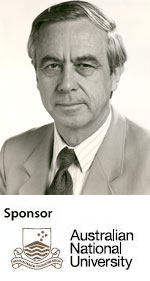
Professor Bill Compston
Introduction
Professor William (Bill) Compston is a renowned geophysicist who began his research career fingerprinting and dating rocks at the University of Western Australia before moving to the Research School of Earth Sciences at the Australian National University. He was a principal investigator dating lunar rock samples that were collected by Apollo 11, but is best known for his work developing the Sensitive High Resolution Ion Micro Probe (SHRIMP).The SHRIMP is a great achievement for Australian geology and was used to identify the world's oldest mineral, found in Western Australia. Bill is a Visiting Fellow at the Australian National University and has received many awards, including the Flinders Medal, the Mawson Medal and the Centenary Medal. He is a Fellow of the Australian Academy of Science, the Australian Academy of Technological Sciences and Engineering and the Royal Society of London.
Bill, you were born in 1931 in Western Australia, a state founded on its mineral wealth, and your mother came from the WA goldfields. But I believe your connection to geology and minerals goes back even further.
Well, my mother’s and my father’s antecedents that we know of went to the Victorian goldfields, but with an interest in finding gold rather than studying it. They both arrived in the same year, 1855, and got off the ship at Portland.
Do you have any early memories of living in the west?
Oh, lots of them. As a small child I lived with my mother and father at his butcher’s shop. My schooling was a happy time for me. I always found that I was doing well at school and it didn’t require too much trouble. (I guess I didn’t muck up as much as the other children.) But during the Second World War we had to go to Toodyay, which is about 50 or 60 miles – in the old measure – from Perth, to get away from the military preparations all round Fremantle.
My father died in 1943, after which my mother managed his shop until eventually she couldn’t do so any longer and she sold it. Then we had a holiday visiting relatives in Melbourne. But we were, in effect, trapped in Melbourne, because although we got a train passage out from Perth to Melbourne we couldn’t get one back, on account of the war.
I believe you developed a love of piano playing and music during your school years.
Ah yes. I started learning the piano when I was about seven or eight, still living at my original home. Then it tailed off because I didn’t do my practice, but I took it up again as a Leaving Certificate subject at high school. That was a bit different, and practice used up a couple of hours each day – rather to the resentment, I think, of the people at school who wanted me to play in a sporting team.
You studied for a Bachelor of Science at the University of Western Australia, where you first took up the study of geology. What attracted you to this subject?
Well, I did it rather than do the fourth subject that everyone else did, which was botany or biology, and because my brother had interested me in the topic. When we were in Melbourne during the war he was also there, in the Army. Having a science degree (in geology) from West Australia, he was attached to some ordnance section to defuse hand grenades and things like that. But he took me round to the various geological ‘monuments’ in Melbourne – well-known rock outcrops, mainly fossils – and I found that very interesting.
I enjoyed geology at university. As a qualitative subject it was a matter of remembering all the names of rocks and minerals, for example, which was fairly straightforward. And I enjoyed the field trips and field camps. So I kept doing it.
Do you have fond memories of your undergraduate years, and the people you were with?
Oh yes. All memories tend to get rosy as the time goes on. I made some very good friends and connections as an undergraduate. Unfortunately, the best friends have died, which is upsetting.
Through my wife, who had been to Perth Modern School, I got in with a group of people from there. (She was in the same year as I was at the university, from first year onwards. By coincidence, one of her subjects also was geology.) This was a group of people who liked to do well, and that spurred me on to emulating them. It was very good for all of us, I think. We talked to each other about mutual problems in physics or mathematics – How do you understand this, that or the other?’ – and that’s the best way to learn.
I believe you also played classical music quite loudly.
That’s right! At lunchtimes, a couple of days a week, we would – by permission – use the big music system in Winthrop Hall to play records selected by one of the group who was especially fond of music and knowledgeable about it. We’d turn it up as loud as possible so we couldn’t hear anything else. That was our escape. And that’s what people do in their cars these days, isn’t it?
Your PhD was also at the University of Western Australia, on carbon isotope variations in rocks. What do variations in carbon isotopes tell you about rocks?
Well, plants manage to ‘fix’ carbon from the atmosphere: they absorb CO2. But they fractionate the light carbon isotopes, so the isotopic composition of carbon in plants is lighter than the average isotopic composition in the ocean and the atmosphere. This becomes a ‘fingerprint’. If inside a mineral you find a shred of something, say of graphite, which has a very light isotopic composition, it might have had a biogenic origin. So that was the interest.
This sort of study was just beginning after the Second World War, essentially led by the chemists and physicists who had been involved in or on the fringes of the Manhattan Project around Chicago. In that program they had been studying how to measure isotope ratios properly and why these were different, and as they finished and went back to the universities they spread ideas of what you can do with various sorts of isotope ratios.
One of the people who knew about all of this was Sir Mark Oliphant, who came as a founding professor of the Australian National University in its original form. He carried the message to various state universities that if we wanted to get involved with something new in departments where there was both a physics and a geological background, then it would be very good to do things like isotope dating and isotope fingerprinting. And Peter Jeffery, my supervisor, took up that stimulus.
What memories do you have of your supervisor during this time?
Well, Peter Jeffery supervised a lot of people besides me who are now in this field. Perhaps the best known are John de Laeter and Malcom McCulloch, who was a couple of years after me at the university, in the Physics Department. (Both are Fellows of this Academy.)
Peter Jeffery himself was a strange mixture of boyish enthusiasm and good physics judgment, with a practical knowledge of things as well. As a young man you tend to think that older people don’t know much, and it takes you a little while to realise that is not so. It took me about 20 years after leaving to appreciate just what he had done for me in not allowing me to give up when things got too hard, and deliberately making me do simple things of a technical nature so I would learn about them. You see, we were never taught electronics at school or at university beyond book learning, sitting down on a bench and taking lecture notes. It is quite another thing to go into the laboratory and have to fix something up, and that is one of the many things that Peter showed us.
Peter was also inspirational. He wasn’t content with anything that was second-best, and he insinuated it into us, without our knowing it, that we had always to try and do the very best, no matter how trivial the task was. He never wanted to hear that term ‘good enough’.
You gained a Fulbright Scholarship to spend a year across at the California Institute of Technology, didn’t you?
Yes. The Fulbright was a travel scholarship, and at Caltech I was offered a research fellowship because I was in that particular field. There I continued to work on fingerprinting, this time with oxygen isotopes. The carbon and the oxygen isotopes in the hydrological and the atmospheric cycle are all fractionated by the same processes but they all give a slightly different reaction to it, and it is best to have them both present at once if you can.
Why is it important to have a well-defined fingerprint of a rock, using carbon and oxygen isotope variations?
It allows us, in the case of oxygen isotopes, to deduce the temperature at which calcitic shells were formed in the past. So, if we go back 250 million years, we can tell that a certain mollusc grew at a certain temperature. There was even the thought that you could trace the annual temperature range of the water, but we now know that other factors also influence the apparent temperature of the molluscs: the water’s salinity changes and then, in turn, so does the oxygen composition of the water.
Our goal, though, was to work out palaeo-temperatures. It was known by that time, or very soon afterwards, that in the past there had been very big global temperature changes – natural changes, not man induced. (It wasn’t until later that carbon dioxide and the global warming effect were blamed.)
I should mention that before I left the United States I went across and spent three months in Washington DC at a branch of the Carnegie Institute called the Department of Terrestrial Magnetism (DTM). They no longer do terrestrial magnetism but they use modern analytical techniques including the determination of uranium and lead, and rubidium and strontium, and potassium and argon, by various sensitive and accurate methods to date rocks. I went there to learn those methods, and I was taught by a group of people such as Tom Aldrich and George Wetherill. The place was led by a former scientist, Merle Tuve, who was also involved in the Manhattan Project.
The Carnegie Institute, at that time, was like the Australian National University in its early days: funded by a block grant from the mother organisation, with no need to consult anyone else about what it would be doing. It chose to appoint scientists that it thought were good investments for their science ability, and it allowed them to do what they thought was best.
Then it was back to the University of Western Australia, this time as a lecturer in physics. But you were also given the research task of working out how to date whole rocks, using rubidium–strontium ratios. Could you tell us about this work?
Yes. In Perth I instituted the dating technology that I had learned at DTM. Peter Jeffery himself had been there earlier and so he was interested in it, and the task I was given was to develop the radioactive decay of the element rubidium, which gives off an electron to become strontium-87. That becomes a geochronometer if you can manage to measure the rubidium-87 that is left and the amount of new strontium-87 that is formed.
We were working on the local rocks – always a good start, because they are easy to access and the local geologists are happy to help. But the answers we got from the separated minerals were unexpected.
We worked on the minerals biotite and muscovite, which are micas but are rich in alkalis, including rubidium. Muscovite, in particular, is always low in common strontium, so that is a good mineral for the purpose. It is technically easy to do the analysis, but the micas were all giving the wrong answer, according to the geologists.
We weren’t sure that it was wrong, so we decided to try taking a set of 'whole-rock' samples instead. The picture was that the micas lost their radiogenic strontium – it diffused out, possibly because of later thermal events impressed upon the rocks. But how far away did it go? If it went into the nearby minerals, it should still be enclosed in the whole-rock sample. We set out, therefore, to test what an array of whole-rock samples would give. Lo and behold, they gave 2500 million years; the micas gave about 600 or 700 million years; and the geologists, who had this instinct that the rocks should be very old, were proved correct.
It was our good fortune that nobody else in the world had actually done that particular experiment. The Americans were stunned, I think, that they hadn’t done it or thought of it. In fact, the South Africans, at the Bernard Price Institute, had started working on whole rocks just a year or so before, but they had the misfortune to work on unmetamorphosed rocks where the mica ages in the whole rocks were the same. So their results didn’t command much interest, whereas ours did. And our results became a letter to Nature.
We had another letter to Nature when we showed that the strontium that was lost from the mica was in fact retained by adjacent plagioclase – you could separate the feldspar and show that it was grossly enriched in strontium-87. (It had to be somewhere, and it was in the plagioclase.) That was a great start for the laboratory in Perth and for myself as well.
You didn’t stay in Perth, however. I gather that Professor Jaeger, the head of the ANU Department of Geophysics, actually came across in the early ’60s and headhunted you for the ANU.
Well, ‘headhunted’ is the modern term; it would have been much more discreet in those days. I think it was our success in the laboratory in Perth that led Professor Jaeger to try to persuade me to come to Canberra and concentrate on research.
Were you keen to take up his invitation?
Yes, I was. ANU was regarded with a bit of awe – people hadn’t yet seen it as a big rival for funding and students. It had a reputation as a great place to go to because it was on the rise. And indeed it was, so there was not much reason for me not to go there.
I believe there were family in Canberra already, including your brother who originally got you interested in geology.
That’s right. I had two brothers and my mother living in Canberra.
Could you tell us about your work at the ANU during the 1960s?
The first thing was to get a mass spectrometer that would be suitable for the analysis of solid samples. Professor Jaeger had access to a mass spectrometer which was being used by John Richards to look at the lead isotope ratios in galenas, in ore minerals. But that, like most mass spectrometers, was a gas machine and the decision was to convert it totally to solid-source work for the rubidium–strontium studies. So that was the first job.
We bought a conversion kit from the Metropolitan Vickers Company, in Britain, which had made the mass spectrometer. (Through Oliphant’s ties with the British atomic energy establishments, he knew which of the various companies made what, and knew the people in charge. And the old boy network was very strong.)
So you had access to good technology at ANU?
Well, as good as it was anywhere at that time. The Americans would say theirs was better, of course, but this was the British equivalent.
What is the process by which you would actually make an isotope ratio?
First, whether the sample is a whole rock or a separated mineral, you have to dissolve it chemically – with clean reagents, in a clean atmospheric environment. Second, you have to add a known amount of isotope ‘tracer’. This doesn’t mean a radioactive tracer but a tracer that has a characteristic isotope ratio itself, so that you can use it to determine the amount of the rubidium-87 or the strontium-87. And the tracer has to mix fully with the sample.
Then you have to separate out the rubidium from the strontium and from everything else in the dissolved mineral, and that is done by ion exchange columns. (The chemists did a lot of chemistry and discovered this. Everything was given a huge fillip by the Second World War.) The process involves putting the sample on the top of a glass column which is packed with a brown organic resin with the capacity to absorb cations at different strengths. But you can flush the cations out progressively, like a chromatographic removal. You pour on acid of the right normality from the top and then you start the sample ions moving down, and you can separate out the rubidium and, later, the strontium. You collect these different fractions and dry them down, and you are left with them as a little bit of white powder at the bottom.
To measure the rubidium and strontium you have to pick this powder up in a drop of water – they’re all water soluble – and put it on a strip, a filament, of the metal rhenium. Rhenium is the best: it is a noble metal and it is inert. You mount the filament, by spot-welding, between two metal prongs and you dry everything down by heating it with a current. The whole assembly fits into the mass spectrometer and so you can put the filament, together with the dried-out small powder, into the machine and pump it down to create a vacuum.
When you heat the filament up again, the samples first melt on top and then start to evaporate. In a lot of black magic by way of detailed chemistry, which no-one pretends to understand, eventually the alkalis and the alkaline earths evaporate, partly as ions. And it is the electrically charged ions, evaporating in vacuum, that we can operate on. We extract them by electric fields and mass analyse them – that is, we accelerate them and send them through a magnet which bends their path according to their momentum and so separates them according to their mass.
You gained an international reputation for your ability to do this many-stepped process.
Well, we were lucky. Actually, three or four years after I went to ANU, Professor Jaeger bought us a much larger American mass spectrometer. This was funded in part by the Bureau of Mineral Resources, which had entered into an agreement with Professor Jaeger to help conduct an Australia-wide survey of the ages of various rocks that they were mapping. You see, we had very little knowledge of the absolute ages of rocks in Australia. Unless there were fossils, no-one really knew how old they were.
In 1969 your ANU laboratory, along with a handful of others around the world, was selected to undertake rubidium–strontium dating of lunar rock samples collected by Apollo 11. How did it feel to be selected for this competition?
It was very satisfying, very exciting. I should emphasise that word ‘dating’. I was a principal investigator for a small group of people who were doing the dating and chemistry of the lunar rocks and minerals by certain techniques. Other principal investigators in Canberra – Ted Ringwood and Ross Taylor – worked on other aspects of the geochemistry of minerals, by other techniques.
I understand that the various laboratories were told, ‘You are going to be given a sample of lunar rocks. You will have three months to do your analysis and then you are to come to an examination, all together, and orally present your results in 10 or 15 minutes, against all the other labs.’ A better international scientific competition I’d be hard-pressed to identify.
It was a terrific competition. I don’t think there has been one so intense since. (Maybe when the Martian samples come back there will be a similar carry-on.) It was very exciting, and it allowed us to meet all sorts of famous names involved with aspects of lunar science. We were happy with our results, but it had been a struggle. Instead of three months, we had more like two. The samples had to be released from the lunar sample handling laboratory in Houston; the package had to come out by diplomatic courier, in someone’s attaché bag; and it then had to be handed to us and received by an approved person. Also, we had to have a safe all set up and ready, where only lunar samples would be allowed, nothing else. We were not used to living like that, but that’s what we had to do. And we upgraded our laboratories because you must have a clean environment, clean reagents and a reliable mass analyser.
How did you do in this international competition?
It was like an intense examination, and I was nervous beforehand. But fortunately we found out that we had the ‘right’ answers, answers that agreed for the age of the lunar basalts with results obtained by the best US laboratory plus a couple of others. So we were confident that we were not going to make fools of ourselves, in the first place.
I used the old-fashioned petrological term ‘mesostasis’ – which the Americans had forgotten – meaning the low melting point fraction: the last fraction of a magma to crystallise, because it has a low fusion point. That is where the uranium concentrated, and the alkalis. We realised that that was where the rubidium had to be, and we were looking for rubidium-rich parts of these lunar basalts. And we were fortunate enough to find that this mesostasis adhered to ilmenite, which is a heavy mineral and doesn’t have anything much else in it. We could make a concentrate of ilmenite and know that we would have a lot of the mesostasis sticking to it, so that’s what we did.
Well then, how old were the lunar samples?
We got 3.8 billion years, 3800 million – essentially the same age as the Caltech group got, at 3700-odd million. But there were complications: there is more than one age of lunar basalt, and also a lot of the samples were of the lunar soil, which is a hotch-potch of fragments of older rocks. You would get a mixed age out of those, which added to the confusion.
Because we stayed in this program for several years we learned that some lunar rocks are, indeed, 4.4 billion years old.
What does this tell us about the Moon?
The Moon, we learned from the history of the rocks, had an initial primitive crust with an age of just over 4.4 billion years, principally made of anorthite, a calcic feldspar. (Being so rich in this feldspar, the crust rock is called anorthosite.) It floated on the top of what looks to be a lunar magma ocean, which cooled fairly rapidly because there is no enclosed atmosphere on the Moon – it is looking out at cold space.
The basalts themselves are the product of later internal heating, because the core of the Moon, or its lower parts, will contain radioactive elements. When the solar system first formed, there was a lot of short-lived radioactivity. For example, aluminium has an isotope at mass 26 that is radioactive and it decays to magnesium-26, generating heat as it does so. When this sort of thing happens inside any planet, the heat has to build up, the temperature rises and you can have a second phase of internal melting. And so the mare basalts, in the lunar ‘oceans’, came out at later times as the temperature rose.
It was found that the mare basalts range from probably 4.2 billion years down to probably about 3.2 billion. It was always known, from the astronomical observations and the crater history, that the mare basalts were younger, because they have a much lower density of craters than the so-called lunar highlands – the original crust. But how much younger? This was the question people wanted answered. The broad observation that the lunar basalts were episodic was confirmed, but we also discovered that there was a whole hierarchy in their age. (Of course, I am using ‘we’ collectively. Lots of people have contributed to this story.)
If the older rocks were 4.4 billion years old, roughly the age of the Earth, does that mean our planet has always had a moon?
Well, you are straying off into theory now. The relationship of the Moon to the Earth was, and still is, a rather famous problem. Ted Ringwood and his lunar science group – especially David Green – worked on the geochemistry of the Moon as a whole and compared it with the geochemistry of particular elements of the Earth. They certainly felt that the Moon could be formed from material that was evaporated from the Earth and recondensed around it. But in the current theory a huge, younger impacter collided with the Earth and melted it, and the Moon spun off as part of that event.
That brings us to the SHRIMP. What is this machine, and how did it get such a name?
This is a mass analyser, and its name is formed from the first letters of Sensitive High Resolution Ion Micro Probe as a sort of a pun: whereas real shrimps are small, our SHRIMP is large. Steve Clement and I realised that we had to build the machine as large as possible, in order to achieve high resolution simultaneously with high sensitivity.
Could you explain what you mean by high resolution and high sensitivity?
To do that I have to go back a bit. At the time of the first lunar science meeting in Houston, we were fed up with the labour of keeping on top of the chemical technology to get the tiny amounts of lunar minerals analysed cleanly. At that time we became aware of a new type of analysis method that used a process the physicists call ‘sputtering’. You direct a focused beam of ions to the mineral you want to analyse, and this bores in (at a slow rate, actually) to the target and emits fragments of the target – ions as well as neutral molecules – which can be mass analysed. If you have a mass spectrometer and if you can extract these charged particles electrically and send them into a mass analyser, then you can measure the isotope ratios for an in situ analysis of even a very small amount of material.
That is exactly analogous to the way the electron microprobe works, which was discovered not very long before the middle 1960s, and it featured a great deal in lunar sample analysis because it let you take a polished thin section and put your electron beam on this, that and the other spot. And we all thought, ‘Wouldn’t it be marvellous if we could do the same thing for the isotope ratios?’
The electron beam analysis can’t measure isotope ratios; it doesn’t distinguish the isotopes of one chemical element from another. But a mass spectrometer is built for that purpose. So it was decided that that would be a great thing to use.
So the process of thinking that led to the SHRIMP began in Houston?
Yes, in a way. That was where we heard that someone was working on an instrument for microanalysis which used the sputtering process. He was at that first lunar science meeting but we didn’t actually meet him then. (Incidentally, he didn’t publish his ages on the lunar samples until the next year or the year after, but he did get approximately the right answers.)
The first analyses used a small mass spectrometer to look at the ions that were sputtered, but if you are looking at lead, mass 206, for example, you get interference from other molecules which have the same nominal mass. A fragment of hafnium and silicon, a fragment of zirconium and silicon and oxygen, will all land at mass 206. You can’t afford to ignore them, you have to correct for them. The people using the small ion probe corrected for them by ‘peak stripping’: they looked at a mass where these interferences were dominant, and figured out how much of the main interference had to be under the adjacent lead peak. That technology worked quite well if you had a lot of lead in the target you were trying to analyse. But it was found fairly soon not to work well for terrestrial rocks and minerals, which were younger and did not have enough radiogenic lead to stand out above these interferences.
So we realised – as did others, no doubt, around the world – that you had to have a high mass resolution instrument that would make use of a very convenient property of atomic nuclei: the nuclei of different elements have slightly different masses. That means that a molecule of hafnium and silicon won’t have exactly the same nuclidic mass as lead-206. If you have a mass spectrometer that operates at about resolution 5000, you can separate the two, and that’s the way to go instead of peak-stripping.
Then we had the mass spectrometer companies saying, ‘Oh yes, our machine can do resolution 5000. Just buy one of our machines and attach it to your source, and the sample handling mechanism, and you’ll get what you want.’ When Steve Clement and I looked into the problem, however, we realised that the small commercial machines would not have high enough sensitivity.
To obtain high resolution you have a narrow object slit and then you focus the beam onto a narrow detector slit. But every time you narrow a slit, you are in danger of truncating the beam. If you cut off a lot of the beam, you just don’t have very many ions per second to be detected. So you really need a machine with as wide an object slit as possible, and a collector slit that is wide enough for all those ions to go through into the DC amplifier or the ion counter that you use as a detector.
Steve Clement, being a physicist, applied a technology that the particle physics people had developed called beam transport theory. It was quite clear that to avoid truncation you had to be very careful as to the size of slits, the angle of divergence and the relative locations of different parts of the mass analyser. That led to our particular design idea. We realised that you had to have as big a magnet as possible for a mass spectrometer. The normal big mass spectrometers at the time were 30 centimetres turning radius, and we made it 100 centimetres – which is probably nothing by present-day physics or engineering standards, but in the early 1970s it was the biggest we felt we could engineer.
The requirements for the magnet are that the gap has to be uniform to one in 10,000 and the iron has to be uniform magnetically. None of these are simple things, of course.
So by resolution you are talking about the capacity to identify atomic mass accurately?
Yes. And to separate them.
And sensitivity refers to the fact that you are using only a small number of atoms to make this determination?
Yes. You need high sensitivity to get precision as well. The more counts of anything that you can get per second, the higher the precision will be.
You wanted to create a machine called SHRIMP, which theoretically was possible but would be very difficult to make and had never been made before. And you yourselves were not magnet manufacturers. Yet you were given the go-ahead to try and put this contraption together. That was a pretty big gamble, I’d say.
Well, we had built a previous mass spectrometer of our own. While Steve Clement was here as a PhD student he used beam transport theory to work out the best sort of small mass spectrometer that we could have for our lunar sample analyses. And we used it.
I think the SHRIMP go-ahead was a matter of confidence in us by our Director, Professor Anton Hales. We had to fight against advice that he got from people who said we would never be able to do it, and the mass spectrometer manufacturers were each busy saying that their machine would produce the high resolution and it ought to work. We had to say, ‘Well, for this and that reason we don’t accept that. We feel the need to go ahead and do it this way.’
How many other university departments around Australia would have the capacity to embark on a gamble like this?
No geology departments, even though they are very interested in rock geochemistry and age and are the chief users of chemical analyses for minerals and rock ages. They start by getting other people, a laboratory like ours, to do their ages for them. Then they graduate to buying their own mass analysers – small mass spectrometers – and doing it themselves. But they don’t have the workshop capacity to do a job like this.
We had the great advantage of being a part of the School of Physical Sciences: it is the tradition of physicists that they have a big workshop, their business being to build experimental apparatus (which they do very well). When we separated from physical sciences, part of the arrangement was that we would take a fraction of their workshop because Professor Jaeger and Mervyn Paterson were great users of workshops. They had high pressure and rock deformation apparatus that required a building and a lot of engineering maintenance.
The Australian National University was the only place in Australia, in the early 1970s, where this building enterprise could be done. There has been a huge advance since then, however.
Building the SHRIMP was a really major project which took over five years. What were the big challenges you had to overcome?
Because we had no experience in building magnets we hadn’t realised, for example, how much a magnetic field depends on the previous cycle of current through the windings of the magnet. We knew about the problem of hysteresis, that you have to always approach the field you want from the same direction, and we always did that. But there is another phenomenon that is annoying. The shape of the effective magnetic field changes slightly with the absolute value of the field itself. The better the magnet, the less is this effect, but at first we were just not conscious of it. And so we could not understand why, although our magnet was perfectly focused at, say, mass 200, when we got up to mass 254 (uranium oxide) it would be slightly out of focus. That was perhaps the lowest morale point of the whole exercise, because we couldn’t see what we were doing wrong.
However, we didn’t give up. We discovered that if we put a mechanical bellows between the collector slit and the rest of the machine, and drove the collector slit – with all the detector on it – to and fro to preset positions, it stayed in focus. The focal point still varied, but we could not cope with it.
Then we learned that the commercial manufacturers knew about this problem. One of them, at least, fitted an electrostatic lens between the magnet and the detector, and varied its strength according to the magnet field to keep the focus. But they didn’t tell anyone, because they thought it might be deemed a defect in their magnet design. Consequently, we had been busy rediscovering the wheel. And it slowed us down, of course.
We first tested the instrument not with a sputter source but with a thermal ionisation source, a solid source. The Research School of Chemistry very kindly lent us one of their disused electron bombardment sources that we turned into a solid source, and we used thermal ions to check out the focusing. In about 1979 we realised that it was actually achieving the hoped-for performance.
But there were a whole lot of mechanical things that we had to get going too: getting the sample in and out of the vacuum reproducibly, getting the visual optics to work – you have to be able to look at the sample while it’s in the target, and we had a high-magnification reflecting microscope that was fixed in the instrument, which we had to get to focus properly. All these little things are technically soluble but each one demands a certain amount of expertise. That meant practice and experimentation if we were to get on top of everything.
I suppose that building the SHRIMP as you did, rather than buying it as five black boxes from various manufacturers, meant you had the capacity to troubleshoot the problems.
That’s right. People are scared to take apart anything that is made and sold as a working thing – whereas we, having built every single bit, put it together ourselves, had very little hesitation in stopping it, letting the air in and pulling it all apart. We had to.
Did the SHRIMP live up to its promise?
Yes. We wanted to allow a safety factor of 2 and aim to operate at 10,000 resolution with full transmission. In fact, it operated at about 5500 resolution at full transmission, which is very good and quite adequate. We seemed to lose only a very small fraction of the extracted secondary ions in the whole transmission operation. And it had very much higher sensitivity than any of the small mass spectrometers.
Our competitors, in the meantime, had got going with commercial small mass analysers, but they turned out to have far too little sensitivity. They were also restricted to using old zircons and had much less precision than we could get. So our machine was more or less automatically recognised as the correct solution. Eventually even the commercial manufacturers accepted what we were saying and built large ion microprobes.
As I understand it, the SHRIMP was built to look for zircons. You have mentioned the use of zircons found in ore bodies or rocks as time markers. What is special about zircons for this purpose?
Several things are special. First of all, uranium atoms fit easily into the zircon site in the crystal lattice. They have the same ionic radius as the zirconium, so when the zircon is crystallising, any atoms of uranium that are in the melt will slide into the growing mineral.
In contrast, lead doesn’t fit well. It has a different ionic radius and a different charge balance. So the mineral zircon strongly excludes lead. That is a very good feature, because we have to measure the amount of common lead that is in the mineral we are analysing to obtain the radiogenic lead correctly. The ion probe measures the total mass of lead-207, and the total lead-206, but each of those two isotopes starts off with a little bit of common lead-207 and a little bit of common lead-206. The less you have of the common lead the better, and that is why zircon is such a good thing.
Also, zircon is tough physically and is chemically stable, so it doesn’t dissolve during low-grade metamorphism and it stands up to being weathered out of an igneous rock and trundled down the rivers into beach sands, where it is incorporated in younger rocks. There are people now analysing the ages of zircons in sedimentary rock to get an idea of the set of rocks that were being weathered, say, 3 billion years ago when a given sandstone was deposited.
What is the importance of being able to age zircons?
Well, this is the way you discover how old rocks are. From studies of zircons by the conventional method, some zircons looked as if they were of multiple ages within a single grain. It was certainly widely recognised that the zircons within rocks called gneisses, many of which were originally sedimentary rocks but had been re-melted, had to be a mixture of old zircons and young zircons formed at the time of reheating. The traditional methods were not suitable for these – they had to use a lot of zircon and so people had to try to identify the new zircons and hand-pick them out from the old ones. This is a very tedious and generally unsuccessful process, so those zircon methods were actually measuring mixtures of ages in minerals and result in age that are neither one thing nor the other.
What we urgently wanted were single, within-grain analyses. We discovered very early on that a single zircon would be a mixture of an older core and a later mantle of younger zircon, perhaps 1000 million years later. But we couldn’t tell this in advance. Later another imaging technique, cathodoluminescence, was developed by various people – with electron bombardment you get luminescence excited – and we discovered that different parts of the zircon luminesced differently. These outlined complex growth patterns within single zircons.
So some zircon grains are actually composites of an old core and a younger skin around the edges, and the SHRIMP can pick them out, analyse bits of individual grains and tell you how old those grains are, by the ratio of uranium to lead?
Yes, that’s all true. We hadn’t realised what a great success the SHRIMP would be for zircons when we built it. And although we did apply it mainly for zircon dating, we also applied it for the study of sulfur isotope ratios in ore bodies and a range of other geological problems.
Has the SHRIMP led you to any headline-producing discoveries?
Yes, again as a result of good fortune. Derek Froude, from New Zealand, was doing a PhD with me, and the problem I gave him was to look at all the old sedimentary rocks in the Archean of Australia, get the zircons out of them and find out whether there are any older than about 3.7 billion years. (At the time, those were the oldest known igneous or sedimentary rocks in the world.) So he collected rocks, collaborating with various other geologists and geological surveys who knew the area. And at Mount Narryer, in the Murchison district of West Australia, about 100 kilometres inland from Shark Bay, he hit upon a metasedimentary rock that had plenty of zircons, one of which was about 4.1 billion years old. This was astounding. Also, it commanded world attention, which does a huge amount of good for the lab – and for everyone’s ego!
I remember the day when the minerals were analysed. There were several students running the instrument, which we had elected to run more or less on a 24-hour basis because there was so much to be done and because we were still getting it under control. You kept it running unless something went wrong and you had to stop and fix it. You certainly didn’t stop and turn it off to have dinner at night; you got someone else to run it.
When Derek saw that the computer output said 4.1 billion he couldn’t believe it and he didn’t tell anyone at first in case he had done something wrong. So he did it again. This time he got the same answer, and then he found a couple of others and felt confident that this was right. And another student, running the instrument for him for a while, also hit on one of these. This was the big excitement.
This happened in the early ’80s, just after the machine really became operational, and it was published in 1983. It had a huge impact – the public as well as scientists all round the world seem to be interested in world records, and this was the oldest mineral fragment found. So it hit the headlines all round the world.
As the oldest piece of Earth?
Yes. We even got into the New York Times when Walter Sullivan, a famous science reporter at the time, wrote an article on it.
For a few years afterwards we searched the locality where this metasediment was found, to see if igneous rocks remained which had that age. But we couldn’t find anything. If anything is ever found now, it will only be by accident because it’s not going to be different for the geologists to look at. And it doesn’t have to be in Australia, of course. It could be a sliver of old gneiss from India or Antarctica.
But another sliver of the same geological sequence was found further to the north and to the east of Mount Narryer, at Jack Hills. This was the work of a visitor we had, Bob Pidgeon, who worked on the geology of the Jack Hills region with field geologist, Simon Wilde. Isaac Asimov, the science fiction writer and science reporter, wrote about that discovery – a measure, I guess, of its global interest. The age record is now held by zircons from that site.
People are still working on the very old zircons. The oldest zircon that we know about now is about 4.4 billion years; it has crept up. There seems to be a big clump of zircons around 4.2 billion, and then a few that stretch out to 4.4. We can’t find any chemical difference between those sorts of zircons but they are still of great interest to people doing terrestrial geochemistry, because the zircons themselves enclosed other minerals within them as they grew and these other minerals give you a taste of what was in the magma.
The SHRIMP, clearly, is important to an understanding of the earliest ages of our planet. We talk about ‘the SHRIMP’ as if it is a single machine but I believe that now, some decades on, there are several SHRIMPs. Is that right?
Oh yes. The original SHRIMP was doing fine, but even though we were using it full-time there was never enough time. We realised that it would be good to have a second instrument for our own purposes. Commercial mass spectrometer manufacturers were getting into the act – the French were offering their machine, the British were offering one – and it was put to us that we should probably build a commercial prototype.
John de Laeter, who was at Curtin University in West Australia, said he thought he could get the funds to buy a SHRIMP if we would build one. So we decided to build one commercially, and that was when we liaised with ANUTECH, who set up a company called Australian Scientific Instruments for the purpose.
We started to design this second machine about nine years after SHRIMP I started to work, so we were able to put in all sorts of engineering and electronic changes. You have to realise that the electronics industry has changed hugely. Although there were transistors in the mid-’70s when our group in electronics at the Research School designed SHRIMP I, and the thing is filled up with knobs that you twist manually, the amount of computer control is very small, really just to control the magnet through its own dedicated computer. The electronics group realised that for a commercial machine they had to totally redesign the electronics, not simply to be fashionable but because you couldn’t buy the old parts any more. They had to design for the use of components that could be replaced if they failed, as well as for possible future instruments.
Also, people these days want computer control for everything, so whereas we had been considering putting all sorts of things under computer control, now we actually did it. And computers keep changing, and are much faster. We made use of all of this change in designing SHRIMP II.
So SHRIMP II is the commercial prototype. Hasn’t there been another version since that?
Well, SHRIMP II is the one that we sell. We have another model called the SHRIMP RG, meaning reverse geometry, that is not currently offered for sale. It is being used full-time but it is more complex and we still have to master certain aspects of it.
What does ‘reverse geometry’ mean?
That is an essential ingredient for a design feature to give us a lot more mass resolution at the same sensitivity. It arises from fairly recent work by a Japanese theoretician, Matsuda. I should mention that the detailed design of the mass analysers is based on his designs. In 1974 he first published the theoretical designs of families of mass analysers, one of which he built to show that it worked. They actually met all of our requirements but we faced the problem of finding the best solution to using what is called an electrostatic analyser.
This is needed because the machines we have to build are all double-focusing. The ions that are sputtered from the target have a range of starting energies up to 100 electron volts or more, and so you need an energy analyser – essentially, an electrostatic condenser that bends the beam in a particular way and makes an energy spectrum at its output.
There are advantages in using what we’ll call a spherical mass analyser but you have got to have curvature on each of these plates; they are fractions of a sphere. That is very hard to make and it was very hard to machine in 1975, whereas a cylindrical mass analyser would be more tractable in terms of machining. (Now you can get computer-controlled milling machines that will produce a cylindrical analyser.)
Anyway, that was the first constraint we had to overcome, as well as various combinations of the turning radius of the electrostatic analyser, the turning radius of the magnet, the drift length of the beam here and there – all of these ion optical components that influence the beam’s shape and divergence. Because Matsuda had discovered how to predict the optimum combinations, we decided to adopt one of his solutions. We wrote to Matsuda and with his help we went ahead.
To answer your question about the new model: he then produced a later set of solutions for higher-focusing machines that didn’t lose sensitivity, and we decided to try that. They proved to be much trickier to manage.
It is good that those weren’t the ones that he came up with in the first place.
That’s right!
So the SHRIMP RG is the current state of the art but as a research instrument, to figure out how it could be done better before being offered commercially. Your commercial machine, however, now exists in laboratories around the world. How many SHRIMPS are there?
We have now sold two to West Australia and we have three ourselves, counting the new model. And there will be another six overseas.
I suppose that makes the instrument one of the success stories in the commercialising of ANU technology, and also a benchmark for this type of work.
That’s right. Crazy as it may seem, ‘to SHRIMP’ is now a verb in the official geological dictionary.
Though you are retired, you still have an active interest in the SHRIMP project. I believe you even operate it from time to time.
Yes, I have operated it a number of times since retiring, though not in the past couple of years. I am now occupied with writing up the results and assessing the nature of the data, its fine structure, in terms of instrumental effects that we all need to know about to get still higher accuracy and precision. I’ll give you an example.
The SHRIMP operates as old-fashioned flame photometers used to operate: you have a standard sample and that gives a signal, then you compare the height of that signal with the signal from your sample, and the ratio of the two essentially gives the amount of the element in the sample. That is how our SHRIMP works. Essentially, as the primary standard we use a standard zircon whose age has been determined by the old-fashioned isotope-dilution method which is the only accurate way of determining the absolute value of the age.
What we have noticed quite recently is that if you plot all the ages of the standard and the sample versus time, for some samples they both go up and down slowly with time. That is an unwanted machine effect which we hadn’t noticed before. (It depends on how you put the data out; you can do it in ways that obscure this.) We had previously included the effect in the variation of the standard, and used the standard deviation as a measure of the quality of the run.
But we can do better than that, because you can allow quite easily for a time variation, even quite a complicated one, by using mathematical methods for finding the fine structure in scattered data. That is what we are now writing up.
I believe you are also taking a step back, looking at our understanding of geochronology in general – times of rocks from the earliest onward – and trying to appreciate the implications of our different dating schemes.
Dating has always been about understanding what has gone on in the geological record. The palaeontologists recognise a number of global extinction events in the past 600 million years, and the latest thing we have worked on is the extinction of the Permian faunas, at the Permo-Triassic boundary. This is a phenomenon that had been seen for a long time, and the question is exactly when it happened and how long it took.
There are lots of interesting zircon problems associated with that, because in dating these sediments you look at the ages of interbedded volcanics but the volcanics themselves can have complications. They can contain zircons inherited in the source region of the volcanics, or the volcanics may be volcanic tuffs, or ashes, with older detrital material mixed in. You have to be able to analyse single grains to get the answers.
There are standard methods of doing this and it is now possible to work on single zircons by orthodox isotope-dilution chemistry. But people using such methods hadn’t realised how complicated these ashes were. Secondly, systematic errors between laboratories seem to be showing up – they haven’t got their isotope tracers calibrated as well as they thought.
So it is an interesting time of life for this fine structure in zircon dating.
I believe that you place a very high value on unselfish cooperation in scientific research. None of your overseas colleagues working on the lunar sample dating, however, divulged their results publicly during the international competition. This confirmed a long-held belief, I think, that some regard science more as cut-throat competition than cooperation.
Yes, exactly. And it’s getting more so now because of the requirement to get external funds, which means that people are jealous about what they say they are going to do and they extol their own reputation as much as possible. It tends to make people more isolated and less communicative.
Your scientific career has been studded with achievements and breakthroughs, and yet you describe your career as having been a ‘fortunate’ one. What do you mean by that?
I think we were lucky to find the very old terrestrial zircons, for example. By contrast, a colleague of mine in Britain – Jim Long, one of the pioneers in the focusing of ion beams and applying it to geology – was just plain unlucky with his choice of samples and got sidetracked on analysing pitchblende. Pitchblende is of great interest to the ore deposits people if they want to mine uranium, but it recrystallises very easily so it loses its age very readily. The difficulty is to unscramble these age losses within the target from the errors you might be making in developing your ion microprobe analysis. But he worked with his own primary column and imaging and targeting, and with a small commercial mass analyser, and he got stuck on the problem of low sensitivity. That problem is the reason we went in this other direction. And we have been vindicated.
You knew you were taking the hard road in the creation of SHRIMP, so I suppose it is good to be vindicated. But I have the idea that you feel fortunate in the timing of your career, not just in the samples that you were looking at.
That’s correct. First there was the connection with the end of the Manhattan Project, when all of those scientists went back to universities at the end of the Second World War and spread their knowledge of what you can do with isotope ratios, how to measure them better – this was all new, and I came along just after that had started to happen. So that was fortunate.
We were very fortunate with our discovery of total-rock Rb-Sr analyses, whereas the South Africans were unlucky and didn’t use the right samples. And none of the Americans had thought of doing total-rock work. (When we did it, they saw its value and a whole lot of labs took it up.)
I won’t say we were lucky to get the right age for the lunar samples. We did well on that, and it paid off.
I think my election to this Academy was a consequence of our rubidium–strontium work in West Australia and at ANU. The SHRIMP came after that and, well, I guess we were lucky to be in a place like the ANU, with such a big workshop capacity. Otherwise, there wouldn’t have been enough confidence that we could do it and it simply would not have started.
And then, yes, we were lucky to find the old zircons.
Your scientific career has always co-existed with your family life. While you were doing your PhD you married and had a child. That would have made for a very busy PhD.
Yes. I give three points of advice to my graduate students when they first arrive: never marry if you’re doing a PhD; if you do marry, never have children; and never leave the university without actually writing and submitting your thesis. I managed to violate all of those rules! When I went overseas on the Fulbright Scholarship, I had to travel at a certain time in order to get in that year’s batch. But I hadn’t submitted my thesis, so I had to finish it at the California Institute of Technology, semi-surreptitiously, in my spare time. And there wasn’t much spare time, I can tell you.
I tell my graduate students about this and they think it is funny. They can’t see why a person would have wanted to do any of those things anyway, but they discover after three or four years that they are very happy to finish their thesis.
I believe that throughout your career, your wife and family have played an important support role.
Yes, an absolutely fundamental role. My wife was herself a scientist, educated in physics and maths as well as geology, so she could appreciate what we were up against and what we were trying to do. She was very helpful and tolerated the absences from home that were necessary. Stress can destroy marriages, of course. Well, she didn’t let it destroy our marriage, and I’m forever grateful for that.
And my wife is intensely loyal to me. If you were to interview her she would tell you very fervently some 'political' things about my career that I wouldn't want you to hear!
Could you have guessed all this when you were students together?
Oh, I didn’t think that far ahead. I’m not one of those terribly organised people who lay out the career that they are going to have. I wish I were.
Had you done that, though, you might have missed some of your opportunities.
That’s right. I think you’ve got to have the freedom to pursue a possibility. If you get stuck too rigidly on a schedule, on a program – as people are in danger of doing now – then you can miss things. The environment we had at ANU allowed us to explore channels, by ourselves and through students. You didn’t involve a student if it was deemed altogether too risky, too stupid. But ‘stupid’ things need to be explored, because they’re not all stupid.
Bill, I think that ANU, Australia and the world of geochronology are very fortunate that you have played such an important role in this field. Thank you for giving us your time today to talk about it.
Dr Gretna Weste (1917-2006), botanist
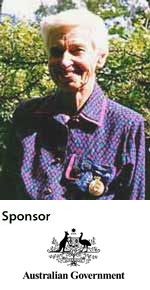
Gretna Margaret Weste was born in 1917 in Dumfries, Scotland. She completed a BSc (1938), MSc (1939) and PhD (1968) at the University of Melbourne. Dr Weste became a leading Australian plant pathologist, with expertise in jarrah dieback. Dr Weste published over 100 research papers and provided advice to national and regional parks with dieback problems. She was Senior Associate in the School of Botany at the University of Melbourne and, after her retirement, continued to work there on a voluntary basis supervising postgraduate research students and lecturing to final year undergraduate students. Dr Weste passed away in 2006.
Interviewed by Professor Nancy Millis in 2000.
Contents
- Inspired to be a botanist
- Why is reaction wood different?
- Woman's place: a science masquerade, and family priorities
- Updating biology teaching
- Why and how would take-all fungus infect Australian wheat?
- Phytophthora cinnamomi: only a few dead grass trees, or the whole show?
- Cinnamon fungus incursions: a result of disturbance or invasion?
- Where does the fungus come from, and how?
- How does the disease spread (or fail to)?
- The credit due to research students
- How does that dastardly fungus spread, survive and cause disease?
- What does the fungus do to kill plants?
- Dieback, then comeback: how does regeneration occur?
- Professional contributions
- Walking together
Inspired to be a botanist
I have the great pleasure of talking with Principal Fellow, Associate Professor Gretna Weste, of the Botany School at the University of Melbourne – a very old friend. Gretna, as one Aussie to another: were you actually born in Australia?
No, I was born in Scotland, although my parents were Australian. My father, who had an MSc in chemistry and a postgraduate diploma, was a volunteer chemist in World War I. He went over and did a month in various labs, including one at Cambridge with Lord Rutherford, and then went up to Gretna, a town about 20 miles from Gretna Green. Hence my name: I was born at a munitions factory where they were making explosives for the war – not a bit romantic! I turned two on the boat in which we came back to Australia after the war.
I think you lived in a fairly open part of Melbourne, with not many neighbours.
We had a huge, very old timber house in Surrey Hills, with several levels, and four blocks of land, most of which was wild. My young brother and I played cowboys and Indians and all that sort of thing. We didn’t really know our neighbours.
My parents were very keen on camping, and would hire a greengrocer’s van and horse and take off to the hills for three weeks. When I was still only five and my brother was four, we went down to Wilsons Promontory. You had to catch the train to Foster and then drive in a jinker out along the beach. We camped at Darby River (the river was too deep for us; we were dipped in) and moved on to Tidal River. We walked across to Sealers Cove, each carrying a blanket on our backs, and camped the night. I don’t remember any track, but I remember very clearly the place where we slept. It was good fun.
My mother was a country lass who became a nurse. She was very interested in the bush and in plants, and that’s probably what inspired me. When I was eight we went up Mount Buller – my brother and I each carrying our blanket again, and my parents carrying my baby sister up – and the flowers there were so beautiful that I decided then and there to be a botanist. And I’ve never changed.
Did your school encourage you to include science among your interests?
At Mont Albert State School I was chiefly distinguished because I was bigger and older than the others – I got through the work and talked, which got me into trouble. And I got the strap for not being able to draw. After a couple of years there, I went to a small private school and studied ordinary subjects, with no science. When that school closed, I got a scholarship to Methodist Ladies’ College – but I still didn’t do science: by then the Depression was upon us and I had to get a scholarship. I got a senior government scholarship, a Queen’s scholarship and an Exhibition in botany. I should say I was keen on sport. I was mad on playing basketball (now called netball) and I was in the team.
Why is reaction wood different?
At the time you went to university, not many people – particularly not women – were given a good grounding in basic science. How did you take botany, your first love, into a science degree?
Well, I matriculated in arts subjects – English literature, French, history and so on, with some botany and biology. When I went up to the university, with my scholarship and my Exhibition to keep me, I had to pick up physics, chemistry and maths. I enjoyed them, particularly the physics, and I did quite well in the first year. (When later I was on the staff, I always acted to keep the opportunities open, not to set rigid prerequisites. Plenty of people are bright enough to have the ability to pick things up, and why shouldn’t they have that chance?)
I was interested in chemistry as well as botany – how things worked, rather than taxonomy. I did zoology in second year, but as an extra subject I did chemistry and then agricultural chemistry, which is such a good adjunct to botany and which I thoroughly enjoyed. Our lecturer in that, Mr (later Professor) Leeper, was wonderful, the best lecturer I ever had. I graduated with first class honours, exhibitions and a Howitt natural history scholarship, and then I went on to do an MSc in reaction wood.
What on earth is reaction wood? Does it mean your axe is too blunt?
No. I worked at CSIRO Forest Products, which had found in cutting timber that the wood from a curved side of a branch behaved completely differently from wood that was straight up and down. In softwoods it is called compression wood and it is well known to occur on the inner side, but my MSc was the first work on hardwoods.
In all my research I’ve worked on a question-and-answer principle. I took as my problem: Why is this wood different? Why is it behaving so differently? I cut down all the curved tops of trees that I could find. My father had some land up at Olinda, so I had the trees there cut down; I got Nothofagus and blackwoods everywhere I went, and I got some logs sent to me from the Forestry and Timber Bureau in Canberra. We found out that the wood had a completely different structure. It had an inner lining and was extremely tough – it had to stand the strain of bearing the heavy crown on a bent, curved axis, instead of having it supported by the roots up and down. That was quite interesting and quite important.
I did that work in 1938, taking out my MSc in 1939. In those days you couldn’t do a PhD in Melbourne; you had to go overseas. But that was not a time to go overseas, because war was imminent.
Woman’s place: a science masquerade, and family priorities
What came then?
I got a job as a research officer in the Forest Commission. They were very worried about all their pulpwood, which had been killed (but not burnt) in some terrific fires in 1939. Mountain ash is highly susceptible to decay, so how were they going to preserve it? We did experiments to find out what was decaying and how we could prevent further damage.
Shortly after I got there, however – appointed with a letter as a research officer – I was told I was a temporary typist. That was the only rate for a woman, unless you were a medico: you had to be a ‘temporary typist’. I appealed to the Public Service Board, which came up and looked at all my research equipment – no typewriter – and said, ‘Yes, she’s a temporary typist.’ So from 1939 to ’42, that’s what I was. And every now and then the Chairman used to come through and say, ‘You are doing typing and shorthand, aren’t you, Gretna?’ I always changed the subject rapidly.
In 1941 I committed my second crime, I got married. (The first crime was being a temporary typist not able to type.) So of course I had to get out. Since war was on by then and things were pretty tough, I stayed home and had three children.
Tell us about your children.
They’ve all done science. The boy is an exploration geologist, for which he has worked all over the place. One girl is a cytogeneticist working in the haematology lab at the Hobart Hospital with leukaemia patients. Quite often it is found that their leukaemia is not cancer but is caused by an aberrant chromosome. She has to sort all that out: having worked out the patients’ chromosomes, with her staff she grows the platelets and the leucocytes, the white corpuscles, and other parts of their blood and works it all out.
The other daughter is now an embryologist in the UK, working for the IVF team at Leeds General Infirmary – their Dickensian name for a hospital! They inject a single sperm of a father-to-be into the mother’s egg – so it has the right parents – grow it and put it back in the woman. She then has her own baby, from her own egg and her husband’s sperm. That is proving very successful, as it needs to be: they don’t get paid unless a certain percentage of implants results in pregnancy. My daughter has been working in that field for some time and is in charge of the unit, even officially in charge, although it is in a hospital and she is not a doctor.
Like being a ‘temporary typist’ when you’re a scientist?
Exactly, yes – these hidebound ideas persist. Anyway, I continued to be needed at home. My husband had a tremendous lot of ill health and he had to retire early. He was ill for a long time before he died.
Updating biology teaching
Caring for your husband as well as the three kids would seem to be a pretty full-time occupation, but you came back to the School of Botany. When did you do that?
In 1961 the Professor of Botany (Professor Turner), the Associate Professor (Dr McLennan) and the senior lecturer in mycology each rang me up separately and said, ‘We want you to come back now. Come back as a senior demonstrator and be prepared to do the lab work, set up the classes for Peter Thrower, and demonstrate in first-year biology, preparing all the material for the classes.’ I was told, ‘It’s a full-time job,’ and I said, ‘Oh – yes.’ Then, ‘You can go home after school when you haven’t got a class, and you can take the school holidays out of your annual leave.’ ‘Ohh,’ I said, ‘I’d love that!’ And then, ‘You’ll be expected to work for your PhD, any spare time you’ve got.’ To which I said, ‘O-o-oh, how wonderful!’ They could now give a PhD in Melbourne, which they hadn’t been able to do when I departed from Botany. So I went back.
I started off doing exactly what they said. But very soon I began lecturing in the Biology I course, going from assistant lecturer to lecturer to senior lecturer to reader to coordinator of biology, and I really enjoyed it. It was a big challenge: three lectures, one early in the morning – 9 o’clock – one at midday and one in the evening, 5.30 to 6.30, and big classes. And very often the prof had something else to do, so you had to take his lecture as well as yours.
In such a busy life, with things at home as well, you found room to make some great improvements on the descriptive botany of old.
Well, I instituted a number of changes in Biology I. For example, instead of the students just sitting doing descriptive work in the lab, I introduced little experiments whereby they had to measure things and draw conclusions from them. (And they always used to say, ‘What answers should we get?’) Also, I instituted tutorials on a problem basis. Each of the 15 or so students in the tutorial class had to write a paragraph on a problem I had set, to show whether they had understood the lectures. Then the demonstrator or lecturer taking the tute could go ahead, explaining what hadn’t been clearly understood. And I put in carrels for self-help for those that had got behind or not understood, or had missed classes.
Why and how would take-all fungus infect Australian wheat?
What was the subject of your PhD research, and who was your supervisor?
Peter Thrower left to become professor in Hong Kong, so I didn’t have a supervisor. Professor Turner said, ‘I’ll be your supervisor, as long as you never come near me or ask me any questions, because I know nothing about your subject’ – which was take-all in wheat. That is a root fungus.
The farmers were having great problems. Whole bands of the field were ‘lodging’ (that is, the plants were collapsing) and the ears were ‘whiteheads’, they had no grain in them. A new virus, barley yellow dwarf, had just been discovered and people were not sure whether it or the take-all fungus was causing all this damage. This was part of my problem.
Robert Koch, last century, had established certain postulates: you had to isolate the fungus from a plant with the symptoms, you had to grow it separately on agar jelly, and then you had to put it back in a healthy plant, get the same symptoms and re-isolate. If you did all that, you fulfilled Koch’s postulates and you had proved your cause. I did it with the take-all fungus, which I found was causing the damage, not barley yellow dwarf. Take-all fungus was a worldwide problem in wheat fields. But why was it infecting these great swathes of wheat in Australia?
The old practice in farming all over the world had been to burn the stubble after a wheat crop, but farmers in Australia weren’t burning it, they were turning the sheep onto it. The sheep would eat the top and leave that stubble sitting there where the fungus was. I found that that fungus needs light to produce its spores. Using cross-gradients of light and temperature, I found it needed blue light of quite a high value, 3000 ergs per centimetre per second. And in the swathes in the paddock, with the stubble eaten down, it was certainly getting all the light it needed and so it was producing lots of spores.
How then was it infecting the new wheat crop? I got photographs of these spores being produced and demonstrated that they were infecting the new wheat crop – and I found it was producing certain enzymes which were killing the plants. They started to grow, but then they collapsed as the fungus took over their roots.
I’ve always based my research on asking a question, thinking up several possible explanations and devising experiments to find which one was right, with perhaps one final experiment to prove it, and then publishing it. So I put in my PhD thesis in 1968.
Phytophthora cinnamomi: only a few dead grass trees, or the whole show?
Did you continue with the fungi, perhaps that same one?
Well, in 1970 Phytophthora cinnamomi, the cinnamon fungus, had been found in the Brisbane Ranges. Agriculture said, ‘Take-all is an agricultural problem. You do a botany problem,’ so I switched very happily to the cinnamon fungus. That’s where the jobs and the grants lay.
The cinnamon fungus affects 70 to 80 per cent of the understorey of our open forests, our dry sclerophyll forests. It cuts a great swathe through our native plants, killing them all. The grass trees are the most obvious: they just turn turtle. They go an orange–brown colour and collapse – looking like an old girl with a wig over her head. They don’t recover. And 45 per cent of the stringy-bark eucalypts die too, so it really has a very big effect. The fungus was causing great problems in jarrah in Western Australia, but in those days Western Australia seemed even further from Melbourne than now, and it wasn’t till 1965 that cinnamon fungus was isolated as the cause.
I took the research dignitaries from the Forest Commission up to see the disease in the Brisbane Ranges, but they laughed: ‘Fancy, Gretna’s worried about a few dead grass trees!’ Of course they were only interested in the trees, just as the Western Australians only considered jarrah. They didn’t worry about the understorey. I was worried about the whole show, a whole ecosystem, and specially any plants that are rare, or endemic, at risk of extinction. They’ve lost 17 Banksias in Western Australia due to the cinnamon fungus.
Cinnamon fungus incursions: a result of disturbance or invasion?
Anyway, a group working in Canberra – ANU and CSIRO Plant Industry – said that the cinnamon fungus was a common soil component found in the soil everywhere, and the disease resulted from the forest being upset. They said bad management and disturbance – construction, roads, logging – were causing disease. When I went up to the Brisbane Ranges to look, I saw 70 to 80 per cent of the plants dead or dying, but healthy plants on the other side of a sharp boundary. The disease, the deaths, spread downhill in a swathe where the water went, and on either side of it was a completely healthy band. Thinking about all that, I decided it was much more like a foreign, infectious invader than disturbance, because I could see disturbance without any associated disease.
So I followed Koch’s postulates again. I isolated the fungus onto an agar jelly, I put it back into healthy seedlings and into healthy mature plants, and I got the symptoms and re-isolated the fungus. Then, with my spade, I dug a whole series of plots in the forest. In some I properly disturbed the soil; into others I put washed threads of the cinnamon fungus. A disturbance didn’t do any harm at all, no disease came. But where the washed threads of the cinnamon fungus had been added, disease symptoms appeared and spread downhill, and I could re-isolate downhill from it. (I did this in an area that was going to be infected anyway.)
You said you used ‘washed threads’. Did you grow up the fungus in the laboratory, wash it free of any nutrients and then put it into the soil so that you artificially introduced the fungus?
Yes – just carrying out Koch’s postulates, but in the field. The results absolutely proved that I was right, it was an overseas invader. With these results I got a research grant from the ARGC (the Australian Research Grants Committee), but unfortunately it was taken from the people in Canberra. They weren’t very pleased about that.
I took the matter to the Forest Commission, the National Parks and the shire engineers, and I published it and gave talks on it, because if the fungus was an infectious agent it was very important that we act immediately not to spread it, that we introduce hygiene. The Forest Commission and the National Parks believed me and took notice of what I said, but the shire engineers laughed in my face and took no notice, so that was that.
Then the Canberra group published an article – in a prestigious overseas journal – saying they’d found the fungus in an area that had never been disturbed by man. They gave a map reference, and then some bushwalkers from Canberra, mathematicians, exclaimed that it had cattle grazing and a goldmine in it, and a fire protection road through it. They said they knew the area well, and it wasn’t undisturbed bush. The editors of the overseas journal rang me up, and I had to support the mathematicians. That was a very unfortunate incident. I’m sorry for the group – now! – about it all.
Where does the fungus come from, and how?
If we take it that we are dealing here with a pathogen that, like many of our pests, has been brought into the Australian ecosystem, how might it have come?
This would be speculation; I’ve not done any work on it. All the early pioneers who came to Australia brought their plants from home. That’s why we’ve all got English gardens. We don’t know what they brought in the soil or the roots. Also, Kelso (the conservator of forests) set up the first forestry plantations in Western Australia. In 1927 he established a pine plantation, but the pines just wouldn’t grow until some soil containing the right fungi for the roots – good fungi, that is – was brought in. But what else was brought in with it? Again we don’t know, do we? So those are two ways that pathogens could have come in. Thirdly, the cinnamon fungus doesn’t mind seawater. It was originally isolated from the mountains of Western Sumatra, Western Borneo, where it caused a decay, a canker, in the cinnamon tree, which is why it’s called cinnamon fungus. The zoo spores can swim in seawater and could have come over in a bit of debris. We’re not really far away from that area.
There are marine fungi. Another Phytophthora is the potato blight, but that only has one or two hosts, whereas the cinnamon fungus has a couple of thousand. And there are also quite harmless Phytophthoras which live in seawater.
How does the disease spread (or fail to)?
What is the significance of the Wilsons Promontory invasion?
Well, after this we set up permanent plots, with controls, in the Brisbane Ranges, Wilsons Promontory and the Grampians, and at Narbethong – that has now been cultivated but the other areas are still there – and we still monitor them; last month we did the Grampians. From the plots we found out a whole lot of things about the way the disease spread and what harm it was doing. We isolated the fungus from the plots and watched the disease go from an aggressive phase of killing everything off, into resistant vegetation of sedges. Sedges and grasses are resistant – they simply form new roots when a root gets damaged, and don’t get a disease – and tea-tree’s partly resistant. The bush looked an absolute mess: no flowers, no honey, no pollen, just these sedges that are wind-pollinated (the pollen contains no nutrients), half-dead tea-tree, and grasses. That’s about it. Also there was a timber loss, so it was quite serious.
From Wilsons Promontory we know the story of how the disease got into all these national parks. In 1962 a low loader had been brought in, carrying a bulldozer to fight fires on the Five Mile Road. And the bulldozer, without being cleaned off, was parked in a gravel pit. But it had been in Yarram, where there was a lot of cinnamon fungus. The enemies to the cinnamon fungus are the soil micro-organisms, and we’ve done a lot of research on what happens: by virtue of numbers the microbial organisms eat the cinnamon fungus, antagonise it, compete with it and generally get rid of it if they can. But in a soil such as in the Brisbane Ranges, Wilsons Promontory and the Grampians there are very few soil microbes: in the Brisbane Ranges a gram of soil – which would cover about half of a five cent piece – contains only about 10,000 micro-organisms.
A question was bothering me, though: Why doesn’t the cinnamon fungus do its damage in the wet forests? It’s a water mould, it likes water. Why doesn’t it kill the mountain ash, which is susceptible? So I went up to the Forest Commission at Kallista and asked for somebody to show me all the dead trees in Sherbrooke Forest. A forester took me round to see them, and I noticed they’d all been killed by lightning – you could see the lightning scar down the trunk – until we got to Burnham Beeches, a garden area opposite Sherbrooke which has a lot of azaleas and rhododendrons, and they harbour the cinnamon fungus. (It doesn’t usually kill them, but it causes a lot of dieback and yellowing.) The swimming spores had come under the culvert, under the road that separates Burnham Beeches from Sherbrooke Forest, and it had killed six huge mountain ash there. The mountain ash were also suffering from soil compaction because cars had been parking there, and tree roots need air – oxygen – to absorb water and minerals.
The cinnamon fungus had spread into Sherbrooke just a little bit, and a sign was up: ‘Area being revegetated’. But we couldn’t isolate the fungus. That area has 1012 or 1014 micro-organisms per gram of soil, and they were providing a great biological control for the cinnamon fungus. That’s why it doesn’t grow in wet forests.
The credit due to research students
By now I had research students, so all my findings from now on are with the help of research students. The papers have been published with their authorship as first author and they are a combination of the research students with me. So you have to give them all credit.
Indeed, one always does. Research students are a tremendously important part of the university experience and I always feel that people who have taken PhD students as their scholars have a second family.
They’re a delight. I’ve had great fun with my research students, especially as we all had to go up and look at these plots and do the recording. One of them used to bring his banjo and play bush ballads to us. They have remained mycologists: one is working in Western Australia, one is in Queensland, another is at Deakin University – they’ve gone to various jobs and they keep in touch.
You’ve obviously infected them very badly, Gretna.
How does that dastardly fungus spread, survive and cause disease?
You have told us some ways this fungus can be spread, and something of the natural controls on it. What do you believe, however, from your collective studies, is the process by which these organisms affect an intact forest?
We asked ourselves: How are they spreading? How are they surviving? How are they causing disease? We found that usually the fungus is brought in on infected gravel which has no carbon content and therefore practically no micro-organisms in it – the fungus can survive very well, thank you, without any bacteria or other soil micro-organisms to compete with it. By growing the fungus in fabric brightener, on agar jelly, we could then see it, and we found that it produced swimming spores which were carried along in water and chemically attracted to any root. They would encyst on the root and then they’d produce a germ tube which was chemically attracted again into the root’s centre. All roots were penetrated by the fungus, but it didn’t produce disease in resistant plants like sedges or the resistant eucalypts. (The stringy-bark ash group are the only eucalypts susceptible to the disease.)
We wondered why the disease appears seasonally, in the spring and autumn. By continually measuring temperature and moisture content on all our plots, we found that the disease disappears in the cold of winter. Well, what happens to it? It disappears in the dry of summer. So, what happens to it? With the fabric brightener we could find out: it lives inside roots over the winter period and survives as resistant spores. It makes swimming spores which come in the spring, and resistant spores which come in the autumn.
How does the fungus make those two kinds of spores, and where?
The swimming spores are produced in spherical sporangia which form on the outside of the root only 24 hours after a root is infected, as long as the conditions are wet. Then they swim away and infect another root. They need water for forming, water for swimming and water for infection. But if they don’t find another root, they can produce a resistant spore in turn. The whole fungus’s life history is very adaptable; it can change according to conditions.
The resistant spores are produced inside the threads of the fungus, inside the root or in the soil. They can survive quite well in the soil. I’ve grown them in brightener, so they’re bright yellow or bright green, and planted them on little bits of nylon mesh in soil at various different water contents and in gravel and even in glass beads, and watched them: they produce lots more spores and threads of fungus, and some sporangia and some swimming spores. So the whole life cycle can take place for a short time without a host, as long as there are no soil microbes to compete with it.
What does the fungus do to kill plants?
Perhaps you could tell us how the cinnamon fungus kills the plants.
This was a great worry to us. If you take a beautiful flowering gum, which is susceptible, cut off half its roots and stick it in soil, it will grow. But if you get one or two roots infected with the cinnamon fungus it dies. What does the cinnamon fungus do to kill such plants? They look as if they’re dying of drought.
We tested the roots, we watched their behaviour. The resistant plants encase the fungal threads in cork or wood – lignin – or callose, they encase the threads and so put the fungus out of action, and they make new roots. Sedges and grasses can continually make new roots, so they have no worry. But what happens in the susceptible plants? Well, the roots have membrane damage, so they leak a lot of nutrients and water out of them, and we found they increase their respiration rate. We examined all these things, and none of them answered.
Then one of my research students found that the roots lost their power to transport water, so the plants really were dying of drought after all. Within two days of infection, before any decay was evident, all water transport within the root was stopped – just like that. Measuring with pressure bombs and things, we found it was stopped. We tried two eucalypts for those experiments, and it didn’t happen with the resistant eucalypt, only with the susceptible. Another research student took over from there and he found how the cinnamon fungus had this far-reaching effect of stopping all water transport: it interfered with two hormones of the root, cytokinins and abscisic acid. And with modern molecular techniques, ELISA, he was able to measure the significant drop in these hormones.
That’s fascinating. I’ve noticed that when you see a set of infected trees collapse in a heap, it is almost always after about three days of very hot weather and then a really strong north wind. Boom, they’re gone.
Yes, the water stress plays a big part – because they’re dying of drought. In wet conditions they can keep on surviving.
Dieback, then comeback: how does regeneration occur?
In the longer term, after an area has been infected and recovers to a very much more limited species distribution, does it ever regain any of its former diversity?
Yes, it does, although I must say I hadn’t expected it would. From 1970 to 1985, every second year we used to go up and survey all our plots in the various forests, and out of every single soil sample we took – 354, for instance, from the Grampians – we got Phytophthora. We have to bait for it, it’s not an easy thing to do, but we got 100 per cent from all the infected plots. (Nothing from the controls, of course.) Whether we surveyed the Grampians, the Brisbane Ranges or Wilsons Prom, it was the same: we got 100 per cent. And we also got it from all the different plots. So it was a dense population of pathogen and it was widely distributed. The plants just died off. The number of species declined, the cover declined, there was a lot of bare ground and the sedge. That was the aggressive phase and the disease then went into the resistant phase, with sedges and tea-trees – very boring looking.
Then it began to decline. From 1985 to 1994 we isolated the pathogen from, perhaps, only 15 per cent of the soil samples and of the plots. So there was less fungus and it was less widely distributed. And we got some regeneration, even though it was a very, very little bit. In 1994 I went up to the Brisbane Ranges, where Dr Ashton had set up big plots for his research students (for something quite different), and we measured 148 metres by 148 metres. It was very hard to isolate the fungus, but there were nine new Xanthorrhoeas – grass trees, an indicator plant – coming up in 9 years. And some other plants, not all, were back too.
From 1997 to 2000 there has been a massive regeneration, not only of the grass trees but of all the susceptible plants, including the ones we thought had disappeared. The seed must have been in the ground and they’ve all come up. The question is: Why? What’s doing this?
You may recall that the fungus was declining anyway. It had run out of susceptible roots to kill; it had no food supply and couldn't survive the winter and the dryness. But occasionally we’d still isolate it there. This amazing regeneration came up in amongst where the fungus was, and some of the plants got sick and died but others didn’t. We found dense regeneration, whole populations of susceptible plants. Maybe the soil micro-organisms had got extra active, but I think it’s the dryness. We have had three and a half years of drought, and the cinnamon fungus is a water mould, needing water to spread it. But our native plants are well adapted for dryness. If you try to grow Xanthorrhoea from seed, you’ve got to keep it practically dry, with no more than the slightest bit of moisture. It won’t tolerate wetness. So I think the dryness has benefited these plants and also discouraged the pathogen.
The only worry now is for the rare endemic plants. We’ve examined the ones in the Brisbane Ranges and found that of the six there, four are susceptible. I’ve got a new research student coming next month to replace a PhD student who has just finished, and we’re going to see how susceptible the endemics in the Grampians are.
I’m delighted to hear that latest piece of news. During your story of only sedges being left, I had been reminded rather sadly of La Belle Dame sans merci.
Professional contributions
Gretna, over the years you have made quite a contribution to the phytopathology community in Australia and internationally. Would you tell us something of that?
International plant pathologists have never seen such a disease kill a whole forest, and they find it extraordinary. Overseas plants have evolved in competition with that fungus and developed resistance and so on, whereas it was new to ours and literally felled them. So I’ve given a lot of talks overseas and been invited to a lot of special conferences and to give review papers. I was the organising chairman of the Fourth International Plant Pathology Congress, in 1983, and I also organised a Phytophthora workshop at the University of Melbourne, to which we had about 2000 visitors. That was a lot of hard work – even though I had just retired.
That’s what you call retirement, is it!
And I got my DSc in that year. I put in a thesis with my published papers.
Congratulations. DSc by publication is a very great distinction.
I got the Medal of the Order of Australia in 1989, and then in 1989–90 I was asked to do a survey of the threat of the cinnamon fungus to the endemic floras right through each state of Australia. I spent a year or two doing this, going to each state, and I put in a very full report, 250 pages, which they’d guaranteed to publish. (I was not allowed to publish it.) But they never published it; it’s suppressed. I must have offended somehow – perhaps the West Australians didn’t want all their troubles exposed in this way. I’ve never asked what became of it but I think it is used as a resource. I’ve found that when you don’t publish, people use your results but they don’t feel they have to acknowledge them – great!
In 1994 the Australasian Plant Pathology Society, of which I was a foundation member, made me an honorary member and I had to write a review for their silver jubilee issue. And in 1999 I was made patron of the Australasian Mycological Society and they said I had to give a lecture as patron. Well, I have trouble remembering fungal names – I’m not a taxonomist, I never have been. So I rang up a cartoonist and asked could he draw a cartoon of an old girl with a sieve instead of a brain so that the fungal names went through, down into a black hole from which they just bounced up occasionally. He did that, without ever having seen me, and I showed that delightful cartoon in the lecture.
Walking together
I hear you’re something of an organiser of walks. And a hip replacement a little time ago doesn’t seem to have stopped you walking.
Oh, I’ve had two hip replacements, most successful. I once broke an ankle bushwalking, and that was much more trouble. Anyway, in 1975, just after my husband died, the Melbourne University Staff Association approached me to lead a bushwalking group. Being coordinator of biology at that stage, I said yes, I would, provided they didn’t have any committees, any annual meetings, any annual reports, anything, but simply turned up on the walks – which I would lead. (I would do a reconnoitre first to make sure they were safe and it was walkable.) So for 22 years I did that, one walk a month. We took the university's overseas visitors and showed them the Australian bush, and I enjoyed that very much. We’re now having our 25th birthday, but we’ve expanded to include alumni and we have three leaders who take it in turns.
Finally, would you tell us about the amateur fungal researcher you assisted?
He’d been a motor mechanic, and he’d got the textbooks and bought himself a microscope. He really did some very good work on subterranean fungi and cup fungi. I’m no taxonomist, as I’ve said before, but I had to write his papers – otherwise, since he had no qualifications, they never would have been accepted. I got the references for him and I used to go up and visit him, but I didn’t do any of the actual work. There were 22 papers came out of that, which took a lot of my time. It was just another little bit of service to mycology, but it was worth doing.
What a great thrill for him, to have his work appropriately recognised in good journals. Thank you, Gretna, for talking to us about so many fascinating topics.
Professor Paul Korner (1925-2012), cardiovascular physiologist
Paul Korner was born in 1925 in Moravská Ostrava in Czechoskovakia (now the Czech Republic). At age 13, Korner, along with his mother, father and brother, fled to England to escape the Nazis. After spending a year in England the family emigrated to the safety of Australia. Korner completed his secondary schooling at Barker College in Hornsby, NSW as dux of the school. He enrolled in a medical degree at the University of Sydney in 1943, which he finally completed in 1951, having taken some time out from his medical studies to finish a BSc (1946) and an MSc (1947). Korner went on to the Kanematsu Research Institute at Sydney Hospital in 1952, after spending a year as a medical resident at Royal Prince Alfred Hospital. During this time he was working on the link between hypoxia and pulmonary capillary permeability. From the Kanematsu Institute he travelled to the Royal Postgraduate Medical School, London, in 1954 and then on to Harvard where he developed his experimental skills further.
Upon return to Australia he took up a senior lecturer position at the University of Sydney (1956–60), followed by the offer of foundation chair in physiology at the University of New South Wales (1960–68), the foundation Scandrett professor of cardiology at the University of Sydney (1968–74) and then the director of the Baker Medical Research Institute in Melbourne (1975–90). During his career Korner tackled a number of scientific questions in the fields of exercise physiology, circulatory control and hypertension; about which he has written the definitive book, Essential Hypertension and Its Causes: Neural and Non-Neural Mechanisms.
Professor Paul Korner AO MD Hon DSc (UNSW) MD (hc) (Melb) FAA passed away on 3 October 2012.
Interviewed by Professor John Chalmers in 2008.
Contents
- Early life in Czechoslovakia
- Coming to Australia
- School days at Barker
- An interest in Medicine
- A first taste of scientific research
- Masters of Science at the University of Sydney
- Meeting Jennifer and a working honeymoon
- Scientific influences and conflicts
- Critical career decisions
- Professor of Physiology at the University of New South Wales
- Professor of Cardiology at the University of Sydney
- Universities vs. research institutes
- The BOOK
- The causes of essential hypertension
- Additional significant achievements
- Advice to young scientists
Early life in Czechoslovakia
Hello, Paul. It’s great to be here with you today, and to be doing this interview of your life in science for the Academy, so I’m looking forward to it. I wonder if I could start by asking you about your early life in Czechoslovakia.
Yes. When we left Czechoslovakia, I was 13, so I remember quite a bit about it. I was born in a place called Moravska Ostrava, which is in north-eastern Moravia. It’s a town like Newcastle—a steel and coal town. Its other attribute was that it’s about 70 kilometres from the German border. It was largely a Czech town, about 20 per cent of its population was German; it was not like the Sudetenland. My father was an architect and he was Czech, and my mother was Hungarian. Neither spoke each other’s language, which is very understandable, and so the language that was spoken in the house was largely German. We used to have nannies who were all Czech, so thus we were all brought up bilingually.
That’s fascinating about the language, because I had the same, where my mother spoke French, because her mother was Italian, her father was English, and the language they had in common was French.
Good. Yes, well, it works out like that. And it, of course, worked out like that to a great degree in the Austro-Hungarian Empire, where these sorts of marriages were not uncommon. Anyway, we had quite a comfortable childhood. My father was quite a successful architect—at least successful in the 1920s, until the Great Depression came along. I went, first of all, to a primary school, which was largely Czech, and then I went to a high school, a Gymnasium, which was largely German, and I went up to about the third year of that before we left. My main memories of my early childhood were really our holidays, which were always very, very nice. We’d go skiing to a mountain range.
Was it in summer or winter?
Both winter and summer. We would go skiing in the winter and not skiing in the summer. Most of them were fairly close to where we lived. Up to 1933, the advent of Hitler, we would sometimes go in the summer holidays to a property owned by one of my uncles, who was the finance director of the big steel mill nearby, which was owned by the Rothschild family. The Austrian Rothschild family had a fair bit to do with the wellbeing of the Korners because my uncle, the eldest brother of my father, was their solicitor and my other uncle was their finance director, and my father, as an architect, got a lot of work through them. Anyway, we went to his property in Germany, in Saxony, not far from the Czech frontier, where he had a property and we used to meet the Korner cousins, which I very much liked. That all stopped in 1933, with the advent of Hitler, because the family was Jewish—very non-observant but Jewish enough for the Germans. And then we used to go on trips along the Danube and into Hungary or into Romania, where my mother had spent her youth. Anyway, they were lovely periods.
We were really not aware of what was happening in Germany with the Nazis. We were aware of the Great Depression in Czechoslovakia because my father’s busy office in the twenties had employed about 12 architects in it and, during the thirties, when the big depression came, it employed one architect because he didn’t have the heart to fire him, and he prepared a stamp collection for my father; there was absolutely no work at all then.
Paul, can you remember much about the time of Hitler, the start of the Second World War and leaving Czechoslovakia?
Yes. The first thing that happened, of course, was that Hitler marched into Austria, the so-called Anschluss, and one of my mother’s brothers, on about day three of the occupation of Austria, went into prison just as a cleanup of the Jews. My mother went by herself to Vienna by train to see if she could get him out and she was quite successful; all these things cost a fair bit of money in terms of bribing the right kind of Nazi officials. Anyway, he came to stay with us for a few weeks and then went to Hungary, where he was born, and later came to Australia. So that was that. That was March 1938.
And in May 1938, we suddenly woke up one day to find a partial mobilisation order of the Czech army, with tanks in the street and a lot of brouhaha, because the Czech government had misinterpreted some German troop movements near the frontier, which was close to where we lived, and thought they were about to be invaded. The Czech army was really quite strong in those days and the German generals were really not keen on a war with Czechoslovakia at the time that that happened.
Anyway, my mother at that stage said, ‘This is it,’ you know, ‘time to go,’ and my father said, ‘Oh, how can you say that? Haven’t we just shown them what we can do?’ My father was really always the charmer in the family and my mother always made the big decisions. So she said, ‘Well, you can stay, if you like, but I’m going with the children,’ and, as was his custom, he would always come along with us in the end. And so we left in 1938. It was really also very difficult to actually officially leave because you weren’t allowed to take any money out. Anyway, they managed all that through their Rothschild connection and we left in August ’38. It was the first time my younger brother and I had been in Prague. We then went by plane from there to Switzerland, to a place called Montreux, near the Lake of Geneva, and that was where I think most of the seven Korner uncles and three Korner aunts met for the last time together. All but two went either to the USA, England or Australia, and the two that remained finished in Auschwitz—and one of their children, fortunately, survived.
Coming to Australia
What was the pull to Australia? How did that happen?
Well, again, we went from Montreux for a year to England first because, I mean, you couldn’t just travel to Australia or to anywhere without getting quite a lot of paperwork done. And my father was rather hoping to go to the USA, where his eldest brother, whom he really was very fond of, lived. And my mother thought Australia would be better because (a) it was very far away and (b) her brother lived there (that she had gone to rescue from Vienna). So we went to Australia, anyway, to cut a long story short.
We left England in August ’39, in the middle of August ‘39 and we arrived by a Dutch ship in Colombo on September the 3rd, which was a couple of days after the outbreak of World War II. The ship that we were meant to be changing to, a P&O liner, to come to Australia didn’t come, because it had been requisitioned to carry troops to the Middle East from India. So, from the point of view of my brother and myself, it was a wonderful six weeks in Colombo; from the point of view of my parents, it was more anxiety provoking.
But one of the strange things in relation to my life in science is that one of our fellow passengers was Bernard Katz, originally from Leipzig. He had escaped the Nazis, because he was Jewish, and had worked with AV Hill in London. He had not done much medicine, but what little skills he had were called upon in Colombo when various passengers got boils and carbuncles, and he did his best with those. We got to know him quite well and kept up. When he later heard that I was going into science, he really was always very interested in what I was doing and very nice to me.
So, Paul, you ended up arriving in Australia. Can you recall the difficulties, some of the cultural issues, in getting to a new country, coming out to Australia, and maybe some of the good things?
Yes. The problems for my parents were considerably greater than they were for me. We all spoke quite good English. I mean, my father was a fantastic linguist, really, and my mother spoke, in addition to Hungarian and German, she spoke quite good Italian and she spoke quite good French. And they all spoke quite good English. I had learned English in Czechoslovakia from the age of about nine or ten, from what I thought at the time was an old Scottish lady, but she was probably in her 40s. So I spoke some English and we’d been to school in England. And that was actually quite instrumental in our choice of school in Sydney. The headmaster of our English school was an Australian, and he had been a master at Barker and recommended that I go there. And it wasn’t a bad place to go to. It had people from the city, people from the country, and I got to know, I think, probably what Australians were like more quickly than certainly my parents did.
School days at Barker
Looking back on your school days, would you like to tell us a little bit about that and playing rugby?
Well, let me start with the positives. I was quite good, of course, on the academic school work. And I was particularly good in English actually because we had an absolutely brilliant school teacher in English who taught me how to analyse Shakespeare, and I’ve never really looked back from that.
As regards my sporting activities, I did football and I did cricket, but I think my overall cricket score in my four years of school would have been under 20; but I tried. I was quite a good swimmer. My father, for a reason that I will never understand, thought I ought to learn boxing. Well, I went to class number one and I got absolutely macerated by a giant of about seven foot high. And I thought once was enough [laugh], so I never reappeared there again. I used to go to their nice school grounds, get books out of the library and read. I had forgotten that at the end of term reports were due and my master was kind enough to say that ‘This boy has absolutely no temperament for boxing,’ and that was very correct.
An interest in Medicine
I like it. Looking back, when did you decide you were going to do medicine? Was it an easy decision?
No. It was really before I left Czechoslovakia, funnily enough. I used to read a lot as a child—I mean, more than current children tend to do—and I read a book by Paul De Kruif called Microbe Hunters, which was a novel around the discovery of yellow fever. I thought that was absolutely wonderful and I really wanted to be a doctor, and preferably one who did research. And somehow or other, that stayed with me all the time, and the only thing that I really was worried about once we came to Australia was, would I be able to do well enough at school to get into medicine, because in those days after war broke out there was a limit, just as there is now, on the number of people who can enter medical school.
Did Katz have an influence there?
No. Katz was at that time at the Kanematsu Institute that he had joined, where Sir John Eccles was the Director. That was the golden period of the Kanematsu Institute—Eccles, Katz and Stephen Kuffler. After about two years in that job, which in a sense started to convert Eccles from his view about chemical transmission—but only started—Katz then joined the RAAF and went into the radar division of that and then returned to the Kanematsu just after the end of the war and married an Australian. [brief laugh]
So you had decided that you were doing medicine, but you were already heading towards science and research?
No, at that stage I was just heading towards medicine. I liked the idea of research, but I didn’t really know enough about it, and I knew enough to know that these novels that I had read tended to romanticise it a little bit.
A first taste of scientific research
When did you know that you were heading for a life of science? Was it early or was it after you started medicine?
Again, medicine one and medicine two I quite liked, but there was no evidence that the people who were teaching us were doing much research. The only one that I’d heard about doing research was Frank Cotton, who taught us physiology. He had been basically the inventor, on the Allied side, of the antigravity suit, the so-called g suit, and was working on that at the University of Sydney. His prototypes were then being tizzed up by the RAAF, the RAF and the US Air Force and went into the Allied armamentarium as anti-gravity suits for fighter pilots, to prevent blackouts.
So at the end of year two I asked him, greatly daring, could I get a holiday job for his research— ‘I’d really like to find out a little bit more about it.’ So I couldn’t get a job with the g-suit, because there were too many other people involved in that, but he said he was interested in the physiology of exercise. He had got a drawing of a little device for recording blood pressure about four to six times a minute, or even more often if you were diligent, and asked whether I could see if I could get that going and, if that worked, we could start trying it out on people who were exercising on the stationary bicycle. So that’s how I got into the technology of research.
By the end of the holidays, when I went to go back to medicine, we had just got everything going and had got a few results but nothing definite. So at that stage I thought, ‘Well, maybe I ought to do a little bit more.’ My parents didn’t think it was a great idea to interrupt my medical course, but I did talk with the Dean and with Professor Hugh Ward, who was one of the wise old men of the faculty, ‘What it would be like to interrupt medicine?’ The long and the short of it was that, at the end of med three, I was allowed to interrupt it for a couple of years. In the first year, I did a BSc honours course—there wasn’t a BSc (Med) in those days—and then in the second year I really consolidated on that and did a masters course, where I basically wrote quite a good thesis on exercise. And then I resumed my medical course again.
Masters of Science at the University of Sydney
Tell us about those years in the Masters of Science with Geoffrey Kellerman and whoever else?
Well, Geoffrey Kellerman was the only other person there. He was susceptible to chilblains and really felt very hurt about that. So he thought, once I had started stirring about whether one could interrupt their course, that he would also do that, and we were in it together. He worked on a completely different research problem, but he was a wonderful person to actually be there because he was very, very quick on the uptake—really one of the brightest people that I’ve come across, and the sorts of courses that we attended were largely do-it-yourself courses. We did a course in science mathematics, which wasn’t difficult, but I felt and he felt that we ought to learn a little bit more about data analysis as we were going to get data. So we did a course in statistics, which again was just very fortunate. It was an extension course, done by Dr Helen Newton Turner, who herself was an architect. But she had worked as an assistant to the great statistician and geneticist R. A. Fisher, Sir Ronald Fisher. Because there were just two of us, we got the courage to read his book called Statistical Methods for Research Workers and The Design of Experiments. Which would read as follows, it said, ‘It may easily be seen that X equals Y’—or something like that. Geoffrey could usually see it before I could, but it would take both of us about two or three weeks to work out these ‘easily be seen’ phrases, and we really learned a lot about statistics. And, it stood me in good stead for a long time.
It sure did. But I remember Geoffrey Kellerman particularly from when John Uther and I were doing our Bachelor of Medical Science review. We interrupted our course, and Geoffrey used to be one of our main torturers, because he would come in every two or three weeks to have a cup of coffee with you and have a chat and en passant would get the two students and ask them some question like, ‘If it is easy, how would you prove it?’
Yes, and he later became Professor of Biochemistry at Newcastle University. He was a very brilliant person, but he somehow knew too much to succeed in research.
Can you recall what made you choose to go into physiology?
Cotton was one of the very few people in the University of Sydney at that time who were really doing any research. He taught me quite a lot. He was not an imposing figure. He had been a champion swimmer in his youth, which is why he was interested in exercise, but he was really one of the main figures. I mean, there were people like Hugh Ward, who had been an associate professor at Harvard in Hans Zinsser’s Department of Microbiology. He, in an attack of patriotism, had returned to Australia. Really the funding of everything was just so deplorable in those days that they didn’t get much done, but they got a little bit done. Interestingly enough, the bacteriology department was also the department where Gus Nossal, Don Metcalf and Jacques Miller, who were also Sydney graduates, were inspired into their career in research.
But that inspiration was by Pat de Burgh. Was Pat de Burgh already around when you were there?
Pat de Burgh was Hugh Ward’s senior lecturer in those days. But Hugh Ward had a very considerable horizon. I got to know him later on because he, like I did, lived in Hunters Hill and we saw each other on the ferry. But, even long before that, he was a person you always wanted to consult on difficult problems, and then he would give you a pretty good resume of the pros and cons.
He seemed to have an influence on you in relation to doing the MSc, but you hadn’t done microbiology yet.
No. The person who sent me to him was the Dean, Sir Harold Dew, who said, ‘Well, you know, I don’t really know about all this, but talk to Hugh Ward.’ So I had to find out who Hugh Ward was and went on from there.
Meeting Jennifer and a working honeymoon
Let’s change tack. Maybe you can tell us about meeting Jennifer. How did that happen—getting married, having a family, and that sort of time?
That started off as what you might call a one-horse romance. I met her when I was about 19, a medical student, and she was a school girl of about 16. What happened was that I was in the Burragorang Valley, spending my summer holidays with two colleagues. I would never have met her but for the fact that, in the boarding house that she was staying at, a horse had died outside and was gradually decomposing, with the usual results. Her mother was in South Australia visiting her various sisters and Jennifer was meant to be chaperoned by her father and brother and his fiancée, who did a reasonable job of it.
Anyway, we met. She came from a very musical household and we had common interests in classical music and literature. And, the three of us all vied for her interest and favours for quite a while. Anyway, in the end, she ditched the other two and stayed with me. That went on through my medical course. She graduated; she went from school to arts and did very well there in anthropology. At the time I was doing my MSc, she was working in the anthropology museum and she came and occasionally was a subject in our blood pressure experiments.
Then, when I finally graduated in 1950, we married about three days later. At that stage that was very much frowned upon by the hospital authorities where I was about to become a resident, but I had fortunately not asked whether they approved of it or not and so we lived through our first year, me as a resident and she at home with her mother.
One of the things I recall from doing a Bachelor of Medical Science review was talk that, on some very critical occasion—it can’t have been just after you got married; maybe it was your honeymoon—you were writing your MD thesis. When did that happen?
Well, I hadn’t written up my MSc thesis as my work and I thought I’d really better do something about that. So I started writing a few sketches of it on my honeymoon, but I didn’t actually get very far in, you’ll be glad to know. I did my residency and then I went eventually to the Kanematsu Institute, which Eccles had long left and where now Colin Courtice had become the Director. He looked at my MSc thesis and said, ‘Why haven’t you written any of this up?’ So I muttered and said, ‘Well, I haven’t had time and I’ve got married and I’ve been a resident in the hospital’—and he said, ‘Oh, what’s that got to do with it?’ He gave me a job as a junior NHMRC Fellow and helped me write all of it up. Really, it was also a salutary throw-away remark that I’ve never forgotten, that really it is no use doing work unless you actually write it up.
Scientific influences and conflicts
Who have been some of the major figures to have influenced your life in science?
Well, at the University of Sydney, it was people like Frank Cotton and Hugh Ward. Then later on, Ruthven Blackburn who, at the time I was doing some of my postdoctoral work, had become the head of the clinical research unit at Prince Alfred. I then later met him as my boss, when he was Professor of Medicine and I became Professor of Cardiology. He was a very impressive figure, not so much for his research but for his grasp on clinical medicine and his capacity to teach clinical medicine in a really interesting way. Then, of course, there were my various overseas friends.
One of the people that have been both a model and an antagonist in a way is Arthur Guyton. You might like to talk a bit about that.
I got an invitation to go to the international physiological congress in Tokyo, to talk on some of our work in hypoxia that we had started to publish in decent journals, the Journal of Physiology and in Circulation Research. I even had to have voice tests, with these characters in the vanguard looking on, to get my talk prepared.
Anyway, I went to Tokyo and I decided then that, after I really got the course going at the University of New South Wales in physiology, I would take three months’ sabbatical; I felt I could take that much time off. So I went, first of all, to visit Björn Folkow, about whom I had read a lot, in Sweden, in Göteborg, and then Arthur Guyton who was already then making waves as the coming man in circulatory control. Arthur was professor of physiology in Jackson, Mississippi and had written a very interesting article on how cardiac output was regulated—was it by the heart; was it by the peripheral circulation—and I thought I would learn something from him. After being in Sweden, in London and after visiting my old mentor Cliff Barger in Boston, I went to Jackson, Mississippi, for six weeks, and what a culture shock that was. That was in 1965 and there was still very much a racial divide. It was just changing slightly, but it hadn’t yet changed in the Guyton household. So that was one aspect of him that was really quite extraordinary.
But he really was one of those people who had thought like an engineer. He wanted originally to become a neurosurgeon but he had been damaged and paralysed in the last big polio epidemic and he had to give that up and become a physiologist. He had started to think about how the system worked as a whole. At that stage he had really only thought about cardiac output. Where he was interested in our work and I was interested in what he was doing, because one of the things that regulates the peripheral circulation a lot is hypoxia, which we were all working on at that time.
He also gave me a preview of his next big opus on how blood pressure was controlled and especially how hypertension developed I was terribly impressed with all that. It was basically that all longterm blood pressure regulation happened through the kidney. That the fundamental cause of hypertension was a salt overload in a defective kidney. He’d worked out how this affected the whole circulatory control system and built a computer model of that. I returned very convinced of the rightness of his cause, and we had Guyton morning, noon and night for several years, before I actually started trying to verify some of his hypotheses and found that, like so many hypotheses on hypertension, that one too had feet of clay.
What happened in terms of your relationship with him?
We got on very well during my first visit. When I started finding faults with his idea, we had a long correspondence and I sent him all our exact data. He put it through his computer and he said, ‘Yes, well, this one isn’t behaving like the theory says it should, so there must be something wrong with your experiments rather than with the theory.’ We had this discussion also at meetings of the International Society of Hypertension. The one that sticks most in my mind was one we had in Göteborg, where I had a fairly sympathetic audience to my cause. At the end, Guyton said, ‘Well, it must be the rabbit in your work that really behaves quite abnormally.’ Franz Gross, one of the other big figures in the hypertension field, who was chairing that session, said, ‘Well, in clinical hypertension we often do get people who do not really behave like they should. How do you explain that?’
That is quite an episode in your scientific life.
It was a negative episode in some ways, because Guyton’s theory, once you thought about it, didn’t even really work for renal hypertension, because it is much more complicated than his theory allowed. His other big error in that theory is that it put an almost negligible role in the autonomic nervous system for longterm control; though in his books he did allow that it might play a role, but he was very opposed to it.
How about Cliff Barger? I know that you spent seven months with him at Harvard.
He had a very big role, he taught me how to handle conscious animals to a better degree than I had known before—though I had been working on conscious animals before that but—that they really had to be pain free and that one had to be very careful of how one handled them. But what I most got out of Harvard was the fantastic teaching courses they were running, which were something that was absolutely unknown in Australia. In my first job as the first Professor of Physiology at the University of New South Wales, they were keen to have me there and one of the carrots that they dangled was that there would be enough money available to introduce this kind of course in Australia. We did these courses and the reason why they worked was that all of us, (the entire staff and all the people who were there for research purposes—research students and higher degree students), they all helped in the practical classes. As a result there were very few failures in the preparations and the students got an enormous amount out of it. It was Harvard and Cliff Barger specifically who really was responsible for all of that.
Tell me, Paul, what do you think of the modern courses which are evolving around Australia with the graduate medical programs and mature age students? Might you have liked to have put such a course in at UNSW?
Well, my life hasn’t really been all in research. At Sydney University, after New South Wales, I was Professor of Cardiology and I was considered one of those professors who had a lot of spare time because I wasn’t the head of a department, other than in cardiology at Prince Alfred. I was chairman of the curriculum committee for a few years, and we tried to make the sixyear medical course into a fiveyear medical course. We did that, and it didn’t really work, because people didn’t really like the idea of having to drop things from their subjects. It worked in Newcastle, where my colleague, the then Dean of [Medicine at] Sydney, David Maddison, had gone and he managed to sell it to them. But I personally think that the course that is in now—that threeyear general science or arts course, followed by a fouryear graduate medical program, which is the American style course—is a much better idea. If I were to have my time all over again, I would have liked to have done a really proper science course rather than the two years research that I had, and learned some proper chemistry and learned some proper physics. I might have then become quite a good physiologist.
How about Horace Smirk from Otago?
Yes. In my exercise days, I rediscovered a reflex that is actually very important in regulating the circulation in exercise arising from the metabolising active muscle, and it’s called the muscle chemoreflex. I hadn’t known about Horace at all. He was at that stage actually Professor of Pharmacology in Egypt, because the London establishment didn’t really like him; he was an Englishman. Then he went to become Professor of Medicine at Dunedin, and he was the first one who really treated patients with very severe hypertension with these ganglion blocking drugs. Anyway, Horace was very interested in what we had done, and he and I had a good relationship all his life. He was really one of the big figures in hypertension and probably has never been recognised sufficiently.
I’m not sure. I would have thought that he is seen as one of the giants. Sure, there are others, but—
He was never seen as one of the giants by people like George Pickering, [Sir George Pickering, Professor of Medicine, Oxford] which kind of hurt Horace.
Because he was in the colonies, so you wouldn't expect Pickering to. But I think an awful lot did see him as that.
I agree. I saw him as one of the giants
It is interesting that you have interacted with some of the giants of the last 50 years. Horace Smirk is one in the clinical field; Arthur Guyton is another; Folkow himself. Tell us about Björn, you had a long relationship with Björn Folkow over the years.
Yes. My first relationship with him was when I went to Göteborg, Sweden, and I was very impressed with his work on neural control – all in anaesthetised preparations – including these diving ducks that got a bit like seals; they can redistribute all of their blood flow to the brain and heart and cut it off everywhere else. He learned to use our thermodilution method for measuring their cardiac output. I saw the human side of Björn when he said, ‘we’ll go up here on the rocks near Göteborg.’ We went up the rocks and he knew where he was going and I slipped into this icy water in the North Sea. So he took me out, wrapped me in something that was in the boot of his car, drove me home and poured an aquavit and a beer, and I said, ‘What do I want the beer for?’ and he said, ‘Drink this and you’ll find out.’ And I drank that and I thought I was going to start burning. And then the beer chaser was absolutely de rigueur. So we’ve been friends ever since.
We will come back to maybe talk about the book, Björn Folkow was going to do the book with you. So you obviously did an awful lot together.
Björn was a wonderful person to know. In the sixties and seventies he was absolutely on top of the autonomic nervous system control field and he started his very interesting work on structural changes in the blood vessels in response to hypertension, which I then took up. I thought we had so many things in common that, when I started writing this book, we would get on quite well together.
What was a problem was that Björn is about four or five years older than I am, and he really thought that physiology had reached its peak in the seventies, and that it was downhill all the way, all this modern biology was not really his scene. It is a pity because, if you really look at the history of physiology, people have said this from about 1850 onward. First, when biochemistry came along, everybody shouted, ‘Wally, wally’ [‘Woe, woe’]; then, when pharmacology came along, it was the end of civilisation as we know it! It is a great pity, because he still is a very bright guy; he just cannot bear the thought of having to say, ‘Well, maybe we if go a bit further this way some of the conclusions we drew were a bit simplistic’. His other great attribute was that he was the last surviving person in Sweden—and, I think, in the whole of Europe—who actually used the golf-ball typewriter. He used it single space, writing in between the spaces for his corrections, and you couldn’t really work with him on that kind of basis. So we agreed, reasonably amicably, to part and I finished the book.
Critical career decisions
Looking back, Paul, what are two or three of the decisions that have been the most critical in your scientific life?
I think the first one was when I had graduated in medicine and had done just one year as a junior hospital resident and I thought, ‘Should I or shouldn’t I do a second year?’—and in some ways it would have been good if I had done a second year. I’ve never been very pleased with that decision. But the really good decision I made at that time was about not going back to the physiology department to do more work on exercise. Ruthven Blackburn thought I might go to the clinical research unit and work with him. But at that stage Colin Courtice offered me this position down at Sydney Hospital, at the Kanematsu Institute. It was a good thing for me to have gotten away from the University of Sydney. At the Kanematsu Institute Colin had been at Oxford for several years (he was reader of physiology in Oxford) and that had rubbed off on him and it rubbed off on all of us. We had a lot of freedom there to design our own experiments. But he really also taught us a lot about how to have good laboratory order.
So that is one critically important one.
That was one. The other one was, as TS Eliot once said in his Murder in the Cathedral, ‘The greatest treason is to do the right thing for the wrong reason.’ I did that when I got very disappointed with the University of New South Wales. I had a problem with them over a famous examination—their examination system in physiology—and I resigned in a huff. Out of the kindness of the Australian scientific community, they found a job for me as Professor of Cardiology at the University of Sydney. That was an enormous milestone in my career, to actually have the opportunity to do some clinical research and to translate some of my earlier, rather esoteric work into patients.
Professor of Physiology at the University of New South Wales
Paul, we were talking earlier about the University of New South Wales. Would you like to think back and tell us a little more about that and maybe how you would handle it now?
We had a very good department at New South Wales. There was a final exam and you either passed or you didn’t. Not just in the final exam, but the whole course. In one year, we failed about 30 per cent of the students, normally we had failed about 25 per cent of the students, and they deserved it. But at that stage the university was a bit embarrassed because they had said, ‘There’s such a huge number of people coming in, we can’t cope with it in our teaching hospital at Prince Henry; we need another hospital,’ and they had their eyes on St Vincents. But by this rather large failure rate, that argument fell apart, because there weren’t so many students coming through. Anyway they said, ‘You must let more people through.’ We looked at it all fairly carefully and we said, ‘Well, no, we aren’t going to. The committee is not going to tell us what to do.’ Ian Darian-Smith was the other professor in the department, of course, and he also agreed with all that. We both resigned. No sooner had we resigned than the university caved in and said, ‘Oh, yes; you were right all the time.’
At that stage I really had had enough of it. The foolishness of it was that I hadn’t looked for another job at that stage. I didn’t think it would be all that difficult to find one, not in Australia, because there just weren’t any at that time, but in the USA. However, Jennifer didn’t want to go to the USA and I didn’t really want to go there either. Half of me didn’t want to go there because of the Vietnam War and our children were becoming,..
You had two teenage boys who would have been drafted.
Yes, two boys who would have probably been drafted. So that was against that.
Professor of Cardiology at the University of Sydney
I could have probably gone to Canada. But, just when everything really looked at its blackest, there came this job of Professor of Cardiology at Sydney, due to philanthropists Mr and Mr Scandrett, who gave money for that chair. Ruthven Blackburn and I had known each other quite well for years, but he thought this was really an opportunity to get research into cardiology. Very few people of that time would have taken that kind of decision. It was, in a sense, the furthest I had ever travelled. If I had gone to America to another physiology department, it would have been child’s play compared with the amount of work I had to do to look like a cardiologist, as your wife, Alexandra, my registrar, found out. Anyway, she was very nice about it, Alexandra.
She recalls, with great fondness, having to show you an electrocardiogram and, when you looked at it upside down, she wasn’t sure whether that it was because you were just so brilliant that you could read it upside down or whether you didn’t know the difference!
I am not going to comment on that now. Anyway, it was a wonderful opportunity. I think the department became an absolute buzz of research activity. One of my biggest surprises was that no sooner had I arrived, you wanted to come back (I think you were at that stage in the USA doing your post-graduate work). And the number of really bright registrars from Prince Alfred who queued up to come was far beyond anything that I had expected. Even people like Peter Sleight, from Oxford, were interested in coming there. So that was good. I think it really started my work on the clinical physiology of hypertension, which hasn’t really looked back since then.
Paul, when you were at RPA, the coronary care unit got going. Tell us about that, because you were head of department and had to make those decisions.
Yes. Well, the question was should we or should we not build a coronary care unit. I asked my very supportive clinical colleagues should we or should we not, and they said, ‘Oh no, it’s a bit of a waste of money. We really do treat these patients pretty well.’ Fortunately, I really did look up the literature on that. The introduction of coronary care units had been one of the great revolutions in cardiology because all that happened in a coronary care unit is that you monitored people’s electrocardiograms after they had had a heart attack and, if any rhythm disturbance looked like it had happened or was about to happen, the coronary care sisters could actually give some anti-arrhythmic agents, and they had saved enormous numbers of lives. So I showed them all that and they said, ‘Oh well, maybe we ought to have one.’
Anyway, we got one, and the most dramatic thing I have ever seen in my life was the in-hospital mortality after heart attacks dropped from double figures to about two or three per cent in the first year of its operation. I was pleased that I had made the right decision there, my clinical colleagues were pleased that I had made the right decision there, and it really was great. It just shows that you need to read the literature.
Universities vs. research institutes
Paul, you’ve had a fascinating time heading three very different organisations over your career. One was as foundation Professor of Physiology at the University of New South Wales, another was the Scandrett Professor of Cardiology at the Hallstrom at RPA, the first Professor of Cardiology at the University of Sydney, and then finally moving to Melbourne to head the Baker Medical Research Institute. Would you like to maybe talk about those different experiences and a little bit about the way the different contexts shaped the science that you were doing?
It’s not an easy question to answer because so much depends on the person who goes into these jobs. But, in general, if you are in a university department, you’ve got teaching commitments and you’ve got research commitments. If you’re in a clinical department, you’ve got all that and on top of it, is the fact that you are the role model for patient care in the hospital and, therefore, your time for doing research is even less than in a basic science department.
Now, if you are in a research institute, your whole reason for being there is to do research. If you want to do other things, that’s your privilege or misfortune, but you’ve got to do good research. In a university department, you really have to tackle problems that can be tackled within the time constraints and even if you do have good research assistants and higher degree students, you can’t run programs that go for five or 10 years. In a research institute, you probably ought to be doing some of that; but you should also be looking at broad problems in science. For example, what are the causes of hypertension, and what are the mechanisms. That creates a problem there because you have probably more senior researchers than you would ever have in a clinical department, but each researcher wants to be recognised for his/her own individual work.
We sometimes accentuate this through our grant giving bodies. But, on top of that, if you are the institute’s director and want to tackle these broad problems in science, you’ve got to get people interested in doing some collaborative kind of work and they’ve got to feel that there’s something in it for them. That’s really a juggling act and quite an art, and I tried to have it both ways at the Baker Institute, where, on the whole, it did work. Many of our researchers are now recognised in their own right and we did manage to do collaborative programs, especially in the hypertension field.
Do you think you would ever have got to working on hypertension if you hadn’t moved to the Hallstrom and RPA?
I very much doubt it, in the sense that at the Hallstrom we actually did clinical physiological experiments on humans, which I couldn’t have done in a physiology department, and people hadn’t done them and it again set the fashion of how you approach this kind of problem.
Then we became slightly more courageous at the Baker Institute, where one of the real pieces of luck that I had was that one of the young persons who wanted to come at the end of his postdoctoral period was Murray Esler. He came and said, ‘I’ve had an idea about trying to work out a method for measuring sympathetic activity in humans’ which is basically similar to assaying plasma hormone production, and I said, ‘Oh, that sounds good.’ Then Murray came along and he did not write new papers for about two or three years. He collaborated on a few things that another person there, Garry Jennings, and I were doing together, but I did manage to see that it really had to work in the end. We were not putting any pressure on him to write papers; we were just putting pressure on him to get the best possible opportunities for actually demonstrating his method, and he did demonstrate it, and it has been an absolute winner ever since.
That spill-over technique in humans, looking at regional sympathetic activity, has really been the hallmark at the Baker.
Yes. Murray did the theoretical part of it. But, again, he and Garry Jennings, who was the person who had green fingers on all these things and could pass catheters into the most unlikely places, were an absolutely terrific team.
Do you think that is one of the things about the research institute: that you can scale things up and get teams with multiple skills in a way which you can’t dream of in a basic department or even a clinical department?
Yes, that is absolutely correct. The other person along those lines that came to the Baker, and we all benefited from that, was Julie Campbell and her husband Gordon. Julie is now in Queensland. She really has green fingers, and not only in growing cabbages, which she is very good at, but in growing cells. She really put that on to the map at the Baker Institute. One of the areas where it really benefited the sorts of things that Jim Angus, our pharmacologist, and I were interested in was how to grow endothelial cells so that one could try to find out what was this endothelium dependent relaxing factor. Anyway, Jim was hoping he would discover that and win the Nobel Prize, but he didn’t. But the method that he used for growing cells was actually used by Moncada, the final discoverer that this was nitric oxide, and it is really entirely to Julie Campbell’s credit.
It is fascinating; as we go through discussing your life in science, an awful lot of people who have been through your hands being mentored by you have ended up as Fellows of the Academy. I am thinking of Murray, Julie, Jim, etc. Looking back, what are two or three of the scientific achievements that you value most?
I think I ran three quite good departments, but what I think is the best thing that I have ever done is my book on the causes of essential hypertension.
The BOOK
I am not sure if we should call it ‘the book’ or ‘the Bible’, but still.
I would like to call it the Bible, John; thank you for that. The sad thing about all this is that when I was Director of the Baker Institute I had been saying to myself, ‘I really must get all this together. We are again working as though we were in a university, little bits at a time. It’s not coming together enough.’
I didn’t have time to do it then and I probably should have done it. But when I retired 18 years ago, at the end of 1990, as happens to retirees, people say, ‘Oh, you’ve got a lot of spare time; you can go on this, that and the other committee.’ I did a bit of that for about three years and I finished some experiments that I wanted to finish at the Baker by travelling down to Melbourne. But then I said, ‘Well, this is it. You’re getting on.’ I tried to write this book with Björn, and that was about three or four years down the gurgler because it wasn’t really getting the right vibes. Then in the end I did it. I took about 12 years over it, mainly because I had to learn so much myself.
Tell us, what it was about the book or what was the essence of your having to go and learn new stuff? You weren’t just writing your own stuff up?
One of the things that I learned from Arthur Guyton, even though I disagreed with his specific interpretation of the theory, was that you had to look at the whole system; that was undoubtedly correct. I then went along to my various engineering friends and said, ‘What is the simplest kind of thing that is not a linear system like Arthur Guyton used, because that obviously doesn’t work’.
Can you explain what you mean by a ‘linear system’?
A linear system is just a simple feedback system, where the properties of the controller never change. That is basically what Arthur Guyton used by insisting that the kidney was the cause of hypertension. Anyway, I talked to people like Brian Anderson, the former President of the Academy, who was quite helpful. Then I found one in my suburb in Hunters Hill. Everything happens in Hunters Hill. Barry Thornton, who is Professor of Applied Mathematics at UTS, really helped me to work out, not a system as complicated as some of these nonlinear systems are, but what is called an adaptive control system. This takes into account that, in hypertension, the environment as well as the genetic factors are very important in its development. So I had to learn about control theory.
Then, notwithstanding that Björn didn’t like it, I had to learn a fair bit of molecular biology because, even at the simple level that I used, you really needed to know some of it. But I then went through the various components of the system, of which the initiator is basically the nervous system. In the process, I not only dealt with hypertension but I also dealt with several important aspects of normal circulatory control, and it’s got a new few ideas on that. So, at the end of it, I had really put all of that together. I must say that it’s been quite well reviewed and I’m quite pleased with it.
You asked me, ‘What would you do if you had your time all over again?’ What I probably should have done, we got our block grant institute funding, which started in 1983. I probably should have taken off a year in about 198485 and actually drafted out some of this. Whether I could have done it is another matter. But it would have been very good if I had, because then we could have actually tested some of these things out experimentally.
In retrospect, you probably couldn’t. Given the amount of time that you spent doing research into areas where you weren’t expert, to do that while you were in that post would have been very near impossible.
The causes of essential hypertension
But summarise, if you can: what is the essence that comes out of the book?
The essence of it is that mental stress is one of the really important drivers of essential hypertension. The three important things are mental stress, high-salt intake and obesity. But stress is often the initiator. It works through the central nervous system initially. The cortex perceives, ‘Is it stress, is it severe stress? Can I do something about it?’ If there is a lot of doubt and uncertainty in the system, you get what is called the defence response. That basically gets you ready to kick somebody into the moosh, or run away, whichever is the wisest thing to do.
Everybody gets stress and everybody gets this kind of response, so what is different about hypertension? In hypertension, what happens is that the stress behaves like a memory neurone. The brain somehow remembers the stress and it sensitises some of the connections between the cortex and the hypothalamus so that very low levels of stress, levels that most people wouldn’t regard as stressful, actually give you this response. Once you’ve got that, it stays with you for a long time because there are changes in your synaptic structure. The person, who discovered this, was the Nobel Prize winner in the year 2000, Eric Kandel. I had been reading some of his work before he received the Nobel Prize and thought ‘this must really about be it’. There is not much evidence in the literature, but there is quite compelling evidence in the literature that that is how it really works, that gives you permanent hypertension.
Thanks to Murray, we found out that in people with mild hypertension you get your maximum neural activity at that point of time. So, as blood pressure keeps going up in the course of a normal untreated hypertensive’s life span, there must be other things in the system that give an additional rise in blood pressure. The other things are really quite complex systems. They include Björn Folkow’s structural changes, which we of course also worked on quite a lot ourselves. They include things like these endothelial factors, like nitric oxide, that diminish, and other local factors that cause constriction. In the end, having triggered these other factors into operation, you gradually destroy a lot of the peripheral organs, including the kidney, the brain and the myocardium. So, in other words, what triggers hypertension is the nervous system, and what kills you is the periphery.
Tell me: the obesity story, how do you weave that in?
I think obesity is one of the really overdone things in the press. It doesn’t really cause a huge rise in blood pressure, but it causes some very nasty complications. It gives you, in the end, type 2 diabetes. If you get diabetes plus hypertension, you get slightly different complications to the ones that I have just been talking about, but you get very serious diabetic complications added to hypertension, which is also a deadly mix. So it is the combination of diabetes plus hypertension that accounts for the adverse effects of obesity.
An interesting question about obesity is: how is it linked to hypertension? Long before obesity become fashionable, one of the things you couldn’t help noticing is that, in any series of hypertension, the people were always, even the so-called lean hypertensives, up to two, three or five kilos heavier than the normal-tensive age-matched controls. What I think happens is that people, when they get stressed, start eating too much. In most people, the system that regulates energy balance keeps that in check and their weight doesn’t really go up. But in about 40 per cent of people the cortex manages to ignore this, for reasons that are not well understood.
Mine certainly does!
Well, it does. You keep yourself in check now, thanks to your wife, Alexandra.
Where do the genes fit into all of this? You said that you had to do a lot on the molecular biological and genetic side of it.
There is absolutely no doubt that, roughly speaking, if you look at the blood pressure variation in the population, about 30 per cent is due to genetic factors and about 60 to 70 per cent to environmental factors, yet the genes are absolutely critical in the whole story. So the question really is: what do they do? Again, I wish I knew the answer to that. One possibility is: why are these neurones that sensitise the response to stress between the cortex and the hypothalamus, why are these synapses sensitisable? Normally, the autonomic nervous system can be conditioned to do things, but they don’t even behave like memory neurones, where the stimulus can become smaller and smaller to elicit the response. So, possibly, it must be a developmental set of genes that do this. There may also be genes, in relation to what you mentioned about obesity, that allow you to ignore the messages from your energy balance. These are examples of these nonlinear systems that I was talking about earlier.
The other thing is salt. If you eat too much salt, according to the Guyton theory, blood pressure is meant to be going up through the kidney, and it will do that in people with renal impairment. But in people with normal kidneys, which most of the initial hypertensives are, it doesn’t do that; it goes through the brain. The permeability of the blood-brain barrier to salt increases so that, in the end, the question is: what genetic factors are involved in making the blood-brain barrier leak here? Again, these are the sorts of things that are not known. One reason why I would have liked to have started this book earlier is that we could have probably found some of these things out by now.
Additional significant achievements
We might have got to it. Apart from putting it together in the book, what are three or four of the individual components, in terms of scientific discovery and achievement, which you think you look back on with the greatest pleasure?
One is the work that you were initially involved in; on how the autonomic nervous system is controlled in oxygen lack. I started it because it appeared a soluble problem. It would give you a definite answer. There weren’t too many factors involved in it, and we worked through a lot of them at the University of New South Wales and then back at Sydney. That, I think, still stands today as a very interesting piece of work. It even has clinical applications in relation to obstructive sleep apnoea. The theory that I developed about how it all worked, in the years before I even knew how to spell ‘obstructive sleep apnoea’, has in fact given probably the best explanation of obstructive sleep apnoea that there is. One of the people again who helped me in this was an English physiologist, Michael Daly, who came out to Melbourne to help us put the final touches on some of that work.
Did that hypoxia stuff originate in the Cotton days, with g-suits?
No, that initiated in the Colin Courtice era, when I was meant to be working out what oxygen lack does to pulmonary oedema. It makes animals more susceptible to pulmonary oedema because they get an acute cardiac failure response, and I worked all that out. That’s one of the things.
The other thing on which I did a lot over the years, and which still is probably amongst the best things, is how baroreflexes work in the whole intact organism. They are actually incredibly important in analysing this kind of complex system, because they are connected to so many regulatory areas in the brain that, whenever some of these parameters of the control system alter, you find it out in the changes in baroreflexes.
Perhaps one of the other things that I discovered was that a lot of the operations of the brain are comparing one thing with another thing, and that it simply can’t just work through straight synaptic connections. Probably one of the important areas in that is the cerebellum, which has more nerve cells in it than the rest of the brain put together. It is very stereotyped. I still remember Sir John Eccles coming to me once. He was one of my great supporters when I became Professor of Physiology at a very young age. He said, ‘Paul, I’ve worked out all of the connections in the cerebellum; there is nothing more to be said about it.’ Well, we are still wondering what’s to be said about it. But it is very stereotyped in its action and it is an ideal organ for comparing A with B. It does that in relation to exercise. It says, ‘Are the commands we are telling the muscles about how quickly to exercise, are they being carried out?’ If not, we will try to bring them around. That is all done through the cerebellum, and not only through the cerebellum, but that is one of the organs. It does things like, in hypoxia, ‘Is the respiration doing enough to keep the oxygen just up a bit, or do we have to whack it up a bit more?’
Interesting. I wonder if you could relive it, would you do anything differently?
Well, that would have been the most useful. But I don’t know. After all, in one's lifetime one can’t do things differently once they are done. But what I would have done, is in my last three years as director of the Baker Institute I had a double job, I was also chairman of the board of the Alfred Hospital. That was probably one of the most stupid things I’ve done. Everybody said to me, ‘Don’t do it, Paul.’ Somehow out of, I don’t know, feeblemindedness or vanity or whatever, I did it. I mean, I managed. We didn’t go backwards, we went slightly forward. But it really wasn’t worth the effort and my time would have been much better spent if I had said no to that.
Advice to young scientists
Going back to that University of New South Wales episode, if you were advising the young professor of physiology who was contemplating a similar action today and he said, ‘You’ve been through it,’ what advice would you give him?
In a sense, this is the ‘blind watchmaker’. I did the thing that one shouldn’t have done, because, on the whole, with a young family, as we had, it really took a terrible risk for them. I probably could have done quite a reasonable stint as a general practitioner if everything else had failed. Anyway, it didn’t come to that, thank God. So there is an element of chance and certainly it’s been that in my career.
It led to you becoming Professor of Cardiology, which then set you off.
Yes. It really opened up a new world for me.
But it was traumatic.
It was traumatic, hence the role of stress—and you really know what you’re talking about.
Paul, I wonder also, if you had a young scientist who had just finished their doctoral phase and was embarking on a postdoctoral phase and a life in science, what advice might you give that young man or woman?
That is a difficult question. What I would really probably advise is, first of all, ‘Is there anything you really want to find out?’ A lot of them, of course, don’t know what they want to find out, and that’s a pity, because it often helps. At least if you know that you want to find out something in the cardiovascular field it is something. The other thing to do is to actually shop around for a good mentor. In Australia I think it’s beginning to happen, but it hasn’t happened yet. You were one of the great shoppers-around in your young days and I think to beneficial effect, and it illustrates that point.
But one of the real problems I think is that, at the stage young people are making their most critical decision, which is who to work with for that doctorate, they do not have the equipment to make a good decision. It’s luck.
Yes.
You don’t know enough about the process of science, nor can you find out enough about your proposed supervisor to know if that person is a good scientist. That is difficult enough, but to know if they are going to be a good supervisor is very difficult.
It is.
And it is the most critical decision you make, because that first supervisor has such a huge influence. In my case, it was you; in your case, maybe Courtice. It’s interesting.
I knew that Frank Cotton at Sydney was the only person I could see who did any research, but I didn’t want to go back to him because he just didn’t have that charisma. So I tried the next-best in Sydney, and it worked out very well for me.
One of the other things might be: during the course of a career, what would you stress, beyond having made the right decision and got started, what would you tell the young scientist?
A lot of young scientists that I know do research because it helps them to get a career job, and that’s not a good approach. On the whole, even if it works out that way, you really want to have something that interests you burningly, and that never should stop. It hasn’t quite yet stopped with me yet, anyway.
That’s for sure. Paul, thank you so much for joining in this interview. It’s been great fun discussing your life with you. It’s always fun having a talk with you. I would like to thank you very much.
I’ve enjoyed it too. Many thanks.
Dr Jean Laby (1915-2008), physicist
Jean Laby was born in 1915 in Melbourne, Victoria. She received a BSc in 1939, an MSc in 1951 and a PhD in 1959, all from the University of Melbourne. Laby was employed by the University in 1940 to work in the Department of Natural Philosophy, later named the Physics Department. Serving initially as a part-time demonstrator she was appointed to the position of lecturer in 1959. Her research was in the area of cosmic rays and wind studies. While continuing as a lecturer at the University of Melbourne, from 1961-80, Laby also held a position as senior lecturer at the RAAF Academy at Point Cook, Victoria. During this time her research included radar meteorology and balloon-borne cameras as well as cosmic radiation measurements. From 1972-80 Laby was involved in the Climatic Impact Assessment Program. In collaboration with the University of Wyoming, she measured atmospheric aerosols, ozone and water vapour in the stratosphere. Dr Laby passed away in 2008.
Interviewed by Ms Nessy Allen in 2000.
Contents
- Introduction
- 'I was always interested in science': like father, like daughter
- Gaining useful skills and contacts
- Laying the foundations of a career
- Cosmic rays and high-altitude balloons
- What goes up must be tracked until it comes down
- Criss-crossing the world in not enough days
- The balloons join the Air Force and the research goes on
- The Climatic Impact Assessment Program
- Opportunities and some recognition
Introduction
Dr Jean Laby was probably Australia's sole woman atmospheric physicist of her generation. Indeed, in an era when it was rare for a woman to be a scientist at all, she was one of the very few who took up what was considered to be the most masculine of the sciences, physics. The fact that she had to endure unequal treatment, which very few women would tolerate today, may partly be explained by her choice. Her research was highly specialised and entailed working under very difficult physical conditions, demanding qualities of sheer courage and determination. These she possessed in abundance. During her career she attracted large research grants for work in the southern hemisphere to supply wind data, to assess the effects of supersonic transport and to measure aerosol particles up to the stratosphere.
'I was always interested in science': like father, like daughter
For a girl to become a physicist in Australia before World War II was very unusual. Do you think your father influenced you in that direction? Perhaps you would tell us about your parents.
My father was born in Creswick, Victoria. At 29 he became professor of physics at Victoria College, Wellington, New Zealand, where my mother was born. They were married in London, and returned to New Zealand soon afterwards. They stayed there until my father was appointed professor of natural philosophy – now called physics – at the University of Melbourne. In 1931 he became a Fellow of the Royal Society of London where he developed the practical teaching and promoted research. According to Sir Mark Oliphant, it was the best university school of physics in the southern hemisphere.
Where did you live?
I was born in 1915, in Parkville (near the university), and my sister was born in South Yarra. I remember us living in South Yarra, where we used to go for walks in the nearby Botanical Gardens. Just inside the gate was a pond into which my father used to put his walking-stick and show us that it appeared bent – the effect of refraction. Later we moved to the university grounds. Living there was quite good for me as a child because the grounds were very extensive, and when I was an undergraduate it was convenient to go to lectures. Also it suited my father very well, because he could work at night.
Quite often my sister and I would go with him at night to his department. I remember one occasion when we were there preparing for the lecture he was to give next morning. The experiment was to put a tennis ball into a container of liquid air (which is very cold) and then to try to bounce it, when it would just smash. But unfortunately the ball wasn't at the right temperature, and so when he tested the bounce it didn't break – it came back, hit a flask on the desk and broke it! On other occasions he spent many hours inspecting all areas of the department and showed particular interest in the workshop, and how the work was progressing.
Were you interested in science at school?
Oh yes, I was always interested in it. I went to Melbourne Church of England Girls' Grammar School, where I studied physics, chemistry and mathematics up to matriculation. The school had what was called the Howard system: the subjects were divided into six units and you could take all six or only one or two, according to your preference, so you could get much further ahead in some subjects than in others, which I did in science and mathematics. Although my father didn't directly influence my choice of subjects, he saw to it that I had a good teacher of physics, because when a rather elderly teacher retired he ensured that she was replaced by a more up-to-date one, Elizabeth Pownall, a recent MSc graduate of natural philosophy. Actually, when I matriculated I thought I might do either architecture or physics at university, but finally chose to do physics. That meant going to my father's lectures, but I was much too nervous to enjoy them very much.
Were there any women on the staff of the Department of Natural Philosophy?
Yes, there were two women senior demonstrators, Misses Natalie Allen and Edith Nelson. They were there for many years before being promoted to lecturer. Miss Allen gave some short courses of lectures as well as demonstrating.
Gaining useful skills and contacts
You mentioned architecture. During your undergraduate course in Melbourne you took graphics – architectural drawing – in the School of Engineering. Why was that?
My father thought it was a better subject to do than mixed mathematics, which was rather the same as physics. You had to draw all sorts of things, either freehand or with a steel pen that needed great care and attention. I wasn't any good at free-hand drawing. I had a much too shaky hand. I was the only girl in the class, and at first they never called my name on the roll – because, they said, it was so obvious I was there. Having so many male students around made it very difficult to get to the piece of railway line or whatever you were supposed to be measuring and drawing, but one day another student, Rupert Leslie, brought out a piece of line so that I could draw it. He became a friend for life! I gave up doing the subject anyway, shortly after.
I went also to the Working Men's College (now the RMIT) and learnt to blow glass. It was useful to be able to do that because a lot of apparatus was made of glass at that time. That was a night class, and when the boilermakers appeared for the next class we had to make a hasty retreat with our hot glass.
I think that through your father you met Lord Rutherford.
Yes, when we went to England with my father in 1936. I met Lord Rutherford first at a lecture he gave at the Royal Institution and then later at a Royal Society soiree.
Also, in Cambridge, where he lived, there was a very big meeting of academics assembled for the congress of the Universities of the British Empire which my father attended, and we had breakfast with him then.
Laying the foundations of a career
You graduated in 1940 with a major in physics. Did your father help you to choose a career?
No. He thought I should do that on my own, and left me to my own devices. I answered a newspaper advertisement for a job at the Weather Bureau. I went there for an interview and they showed me around, but they were a bit concerned: beds were provided for the observers to sleep on between taking observations at night, and they didn't quite know how I would fit into that situation. I gather they didn't expect a woman to apply for the job, but eventually I did get it.
I didn't take up the position, though, because by this time the war had started and most of the young physics graduates were employed by the Optical Munitions Panel to produce optical instruments for the forces. Consequently there was a shortage of demonstrators in the Department of Natural Philosophy and I was chosen to become a part-time demonstrator.
You also had something to do with the Optical Munitions Panel, didn't you?
Yes. There was no glass available in Australia of good enough quality for optical instruments, so the Optical Munitions Panel decided to investigate the manufacture of suitable glass in Australia. Professor Hartung, the professor of chemistry, devised a method to do this, and from it optical lenses and 'flats', very flat pieces of glass, were made. The lenses were then made into various instruments in the Natural Philosophy Department, and I had to keep separate costs for each of these things they did so an account could be sent.
In 1946 I asked the interim head of the department, Dr Hercus, if I could do some research. At his suggestion I worked on the measurement of the conductivity of water. For some years conductivity measurements had been made of gases, but there were extra problems with liquids. For this work I obtained an MSc.
Cosmic rays and high-altitude balloons
What did you do next?
At that time Dr V D Hopper offered me the opportunity to work on the cosmic ray project which he was doing with a group of others. I knew him quite well, as he used to come and help my father with the revision of his book, tables of physical and chemical constants, and I used to help with that too. Even when we went on holidays my father sometimes didn't stop work, and Vic and I used to help him then with the revision also.
How did you detect the cosmic rays?
We used nuclear emulsions, which were thick layers of photographic emulsion on a thin glass plate. They were exposed to cosmic radiation by sending them up into the atmosphere, using balloons because aeroplanes did not get quite high enough.
There were two different types of balloons: expandable neoprene, which was an artificial rubber, and non-expandable plastic ones, which were not commercially available. You could make those yourself but they needed an enormous room and were very difficult to deal with (you had to test that there were no leaks at the joins and so on) so we didn't use them. We used neoprene on the whole.
How big were these balloons?
The neoprene ones were about 3 to 6 metres in diameter, but they got up to 10-plus metres in the atmosphere when they expanded. The plastic ones were a different order of magnitude altogether, with diameters of hundreds of metres, and had to be launched by quite different methods. It took a team of people with trucks, cranes and goodness knows what to get everything into position, and the use of an aerodrome runway for launch.
How did you modify your balloons so that they would stay up for long periods?
The balloons were filled with hydrogen to make them ascend and as they went up into the more rarefied atmosphere they expanded and ultimately got to a stage where they burst – and that was the end of the flight. Our group, working together, devised a valve at the neck to keep them from bursting. The valves consisted of a metal tube with a ping-pong ball in the top to form a seal, the bell was attached to the top of the balloon by a length of string just less than the bursting diameter. A soft spring held the ping-pong ball down until the string unwound from the outside of the tube; when it reached the set height, the string lifted the valve and let out some of the hydrogen; and the balloon then just went on at that constant level.
Because the balloons would remain at a level height and float like that for hours, they gave our plates a very long exposure to the cosmic rays. The plates had to be recovered and then they were developed. They produced black grains where the rays had been through the emulsion and you could determine their properties from these, examining them under a microscope. We could also compare the results at different altitudes, varying the height at which we wanted the level flights by adjusting the length of the string. The longer the string, the higher the balloon would go, so long as it remained under the bursting diameter.
I understand that by 1952 your balloons reached above 24 kilometres and stayed there for about three hours, and by 1953 you got them up to 38 kilometres.
Yes. It was quite an achievement, I guess. In fact, the manufacturers of the balloons in America didn't believe the heights we got. (I once saw how they used to predict the diameter at which the balloons would burst: it was done just by blowing them up gradually in an enormous room, to bursting point, measuring this size.)
What goes up must be tracked until it comes down
Where did you launch the cosmic ray flights from?
Somewhere in Victoria, around Melbourne. For any of the balloon flights that were going to be in the air for a long time, the wind patterns would determine where you needed to launch them and where they were expected to end up. We needed somewhere good for recovery on landing – not in a forest or the sea. So on the day before a flight, we let a balloon off on its own, without any load, and then calculated what the winds were up to the required height, and forecast its trajectory.
After the pre-flight to forecast the wind, we had to prepare the balloon. That necessitated putting the valve in with the string and attaching it to the top of the balloon, before boiling the neoprene balloons (which performed better when they were boiled) and putting them in a plastic bag to take to the launch site the next day. Then we obtained from the weather bureau their forecasts as to where the skies would be clear of clouds so we could use our theodolites. Later on, the weather bureau were very cooperative and allowed us to use their radar at Laverton, which made it a much simpler operation, a different story altogether: there was only one place around Melbourne – the Laverton station – to operate for the tracking. That meant for tracking you were some distance from where the balloon was launched, and to find the balloon on the radar was sometimes difficult, particularly not knowing the exact time of release.
What did you have to carry with you to the launching site?
To launch the balloon with the cosmic ray equipment we had to go quite a distance to the selected spot. We had to take the two theodolites, the hydrogen cylinders, balloons, timers, maps of course, and radio communication, to wherever it was – and all this had to be packed up and put on a truck. A team of three or four would go out. The theodolites were set up a few miles apart, in sight of each other. They were aligned by using flashing mirrors between the two and were then ready to observe the flight when the balloon was launched. You kept it in sight, taking minute readings, until the load was dropped off. The load was unhooked from the balloon by the unwinding of an alarm clock, so that had to be set at the right time beforehand.
Later the government set up the HIBAL launching station, near Mildura, to launch the much bigger plastic type balloons for scientists from overseas, as well as Australia. We used to provide the wind information, using flights with our balloons with the valves because they went up much higher than the ordinary meteorological balloons and the plastic type balloons would be going much higher. I would do a flight the day before as a wind forecast. Some of these flights were very long and I assisted the bureau observers by using the radar for some of the many hours needed in order to track the balloon throughout its flight, sometimes from pre-sunrise and sometimes right through the night as well.
Criss-crossing the world in not enough days
Didn't you go to South Africa to continue your work on the cosmic rays?
Yes. Vic Hopper had obtained some large research grants from the Nuffield Foundation – one in 1956 of about £3000, and another one of £5000, with which we could go to South Africa and South America for further work.
We set off in 1959 by ship, taking a van with us. We took two or three weeks to get to Cape Town, where we had a few flights, and then we went northwards in the van and also a car which the Nuffield Foundation had given us in Cape Town. I drove that. We stopped at Potchefstroom, where some South African scientists were interested in flying balloons, and showed them how to launch a balloon and so forth before we continued to Pretoria. But unfortunately that one was never recovered, because in calculating its descent time they thought it would land directly underneath where it started to come down, instead of allowing for the descent pattern of winds.
After some flights in Pretoria, we went further north to Beira, in Mozambique, for Dr Hopper's wife and sons to catch a ship home. (They had accompanied us so far on this trip.) We then returned to Cape Town.
Unfortunately, the ship we were booked on to go on to South America had been wrecked in a typhoon, so we began to run late on our program. The next ship took another few weeks to get to Rio de Janeiro and then although the people in South America were trying to be helpful, nothing ever got done. There was great trouble in getting the van off the ship: they kept it strung up on a hoist on the ship for hours and we knew if you were not standing on the wharf to take possession, it, or its contents, would have been quickly disposed of. We spent a few days on that 'activity' – by which time my leave had run out and I had to return home. So I got back on the same ship and returned to Cape Town. In Cape Town the Customs people had charged us duty on any of our balloons that we had flown and lost. They thought they were toys, which were highly dutiable! Having paid the duty on the balloons we didn't take home, I tried to explain they were not toys and to get a refund, without success.
Your group concentrated on intensive field work during International Geophysical Year (1957–58) as well, didn't you?
Yes. We increased the number of balloon flights to determine the winds to maximum heights and we also studied all our cosmic ray flights, also we provided valved balloons for the weather bureau to conduct flights at several stations to achieve greater heights. The results of those flights were analysed and published.
And the balloons went higher and higher?
Well, yes. I think our highest went to 154,000 feet (about 47 kilometres).
The balloons join the Air Force and the research goes on
By 1961 Professor Martin was responsible for setting up the Royal Australian Air Force Academy at Point Cook, about 30 kilometres from Melbourne. What was your connection with the academy?
Dr Hopper was appointed professor of physics and dean of university studies at the academy and he asked me to join the staff as a senior lecturer, which I did. We then had an office there as well as one at the university.
We still continued research on the measurement of cosmic radiation, as well as a few minor projects with radar meteorology and balloon-borne cameras. We got a photograph of Port Phillip Bay from a balloon directly above it – and setting the camera to make the exposure just when the balloon was over the bay took a bit of calculating!
Were there any other women academic members of staff in your department?
No. But just before I retired, there was one other woman, Elizabeth Sonnenberg in the mathematics department.
What would you say about the physical conditions in which you worked at the University of Melbourne and also at the Point Cook Academy?
The rooms we were given at the University of Melbourne were terrible: dirty, and smelly. But at Point Cook it was a different story. The rooms were very good, you got a doormat (if you were of a certain status), and I had a wardrobe with a holder for my swords.
Travelling between the two places took about 30 to 45 minutes. Telephone communication between the two places was difficult because the Air Force used to start at 8am and had lunch at 11am, whereas the University of Melbourne started at 9am, with lunch at 1pm. There was not a great deal of time in which to communicate with colleagues between the two places, and besides, you couldn't dial directly: you had to get the Air Force telephone exchange to put you through to the university.
I believe that not long after the academy was set up, there were rumours that it would close down.
Yes. It was quite awkward, because a lot of the staff felt that they would be better to get another position and also it was very difficult for new students to come for research without knowing whether the academy would close before they finished their PhD. I stayed, and fortunately the academy wasn't closed down until a few years after I retired. The Australian Defence Force Academy was set up in Canberra for the Army and Navy as well as the Air Force.
The Climatic Impact Assessment Program
In 1972 you became involved in the Climatic Impact Assessment Program of the United States Department of Transportation, funded by the United States Office of Naval Research.
That's right. It was a global study of aerosols in the atmosphere, and the department of physics in the University of Wyoming, in Laramie, asked me to take part in providing the data for the southern hemisphere area. They had devised a dust-sonde to measure the aerosols, which were of particles two sizes: greater than 0.3 and greater than 0.5 micron. They were to supply this instrument and I would fly it in Australia. For quite a while John Gras, a post-graduate student, cooperated with these flights until he went to the CSIRO. I continued the flights with the help of a technician, although we continued to cooperate with the resulting data.
I think you sampled the atmosphere to the lower stratosphere, about 30 kilometres up.
Yes, we went as high as we could get. These flights were carried out with plastic balloons for greater height (with the heavier leads). We measured the two sizes of aerosols, water vapour, ozone, and the atmospheric pressure and wind patterns. Then we analysed the records – some were on paper charts and others on recorded tape, and these had to be hand read and measurements made from them to get the figures to feed into a programmable electronic calculator – for the final results tabulated by hand.
The aim was to assess the transport of particles that could have been put out by the supersonic transports, to see what effect this would have on the atmosphere. We wanted to establish whether there was a transfer of air between the two hemispheres over the equator. Some nuclear testing was being carried out at this time above ground, and information was needed on how far and in what direction radioactive material could travel.
Weren't there military implications to this kind of work?
Well, there was no constriction on us at all. We freely published anything we found.
What did this program involve in Australia?
The dust-sondes and subsidiary equipment had to be transported to Mildura and Longreach, Queensland, for their flights. Getting the equipment to Mildura wasn't so hard. Originally we used to pack it all into a hired van and put it – van and all – on the train, which got there reasonably quickly overnight. Longreach was somewhat harder. Because of the airline timetable I had to spend overnight in Brisbane, and sometimes the airlines wouldn't let me leave the equipment in the airport. So I had to trolley it to a locker for storage, collect it from there at dawn next day, and get it onto the aircraft for a 6am flight to Longreach.
Afterwards, of course, it all had to be repacked and brought back. The dust-sondes were sent back to America to be calibrated, for return to Australia for another flight.
The balloons, a larger plastic type, were launched by the team at HIBAL at Mildura and Longreach and we had to set up receiving equipment and recalling for receiving of signals transmitted from the balloon. This took quite a lot of work too. The balloons were tracked by the weather bureau radar and HIBAL recovered the equipment.
Opportunities and some recognition
Didn't you go to Laramie for some work with the University of Wyoming group?
Yes, for two study leaves and several shorter visits. I worked on the dust-sonde instruments and eventually learned how to calibrate them so that I didn't have to send them back to Laramie all the time. And among other programs I did a test of a device being used – to measure water vapour, which showed it was not reliable.
After that I maintained and calibrated dust-sondes in Melbourne. Laramie is 5000 feet high, with very clean air, but in Melbourne University I was working right next to the tramline and in a not very clean building, so it was rather difficult, as it was necessary to see the sonde was not contaminated with dust before calibration.
Your work must have created great interest, because in 1975 you were awarded a $US25,000 contract by the United States Office of Naval Research, in collaboration with the Division of Cloud Physics of CSIRO.
Yes. I went to ONR in Washington for discussions, and was awarded the contract. The CSIRO group had developed a different method of measuring from the Wyoming dust-sonde, and our work gave both unique data on the stratospheric aerosols and a valuable cross-check of the validity of the two techniques – the one using in situ light scatter and the other, electron microscope analysis of collected particles. For the first time these two methods were demonstrated to be in agreement.
Analysis of the southern hemisphere aerosol data provided interesting and unique information on atmospheric circulation, particularly of inter-hemisphere transport. When there was a volcanic eruption, this provided material that could be checked with the dust-sondes and so we could make deductions about the stratospheric transport methods. That was then applied to the exhaust gases of supersonic aircraft, and an estimate could be made of their residence time and their trajectory.
How long did you go on with this work?
Till 1980, when I retired from the academy. But in 1981 I made one last visit to Laramie to discuss all the results of this work. And in 1998 the Laramie group came to Mildura to make some flights to check whether layers of higher concentration of aerosols could still be found in the lower part of the atmosphere. (These had been detected in September and October of several different years.) At their invitation I went to Mildura and participated in a minor way in the flights, which took place at about midnight when aircraft activity had ceased.
Did you ever feel discriminated against because you were a woman – apart from the fact that your name was not even called out at lectures in architectural drawing?
No, not really. But sometimes the Air Force cadets, when they came into the lectures in the morning, would say, 'Good morning, sir.' And at other times, when I went to physics society meetings, they would say, 'Lady and gentlemen…'
Although you were never promoted beyond senior lecturer – nor given any reasons why not – you have a record of publications in world-class journals, working with first-rate physicists and attracting huge sums of money for research. Your contributions to this field have been enormous and your world-class work has been acknowledged by many, including Dr John Gras, Principal Research Scientist in the Division of Atmospheric Research at CSIRO, who is an expert in your field. Thank you very much indeed, Jean, for participating in this interview.