





Professor John Carver (1926-2004), physicist

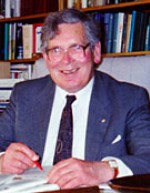
Physicist
John Carver was born in Sydney in 1926. He received a BSc in 1947 and an MSc in 1948 from the University of Sydney. Carver then went to England (1949 to 1953) to study for his PhD at the Cavendish Laboratory, University of Cambridge. From 1953 to 1961 he was a research fellow, fellow and then senior fellow at the then Research School of Physical Sciences at the ANU. In 1961 Professor Carver was appointed elder professor and head of the department of physics at the University of Adelaide, a position he held until 1978. It was here that his involvement with space-related research began. Working collaboratively with the government facilities at Woomera, he developed scientific rocket payloads to study the absorption of radiation in the atmosphere and the evolution of the Earth's atmosphere more generally. In 1967 he provided the scientific payload for WRESAT, the first Australian satellite, launched from Woomera. Professor Carver returned to the ANU as professor of physics and director of the Research School of Physical Sciences in 1978, a position from which he retired in 1992. Upon his retirement he was appointed emeritus professor and served the ANU as deputy vice-chancellor and director of the Institute of Advanced Studies from 1993 to 1994. Professor Carver passed away on Christmas Day 2004.
In addition to his work within the academic world, Professor Carver contributed to a number of influential national and international bodies. From 1977 to 1982 he was chairman of the Radio Research Board of Australia and from 1983 to 1986 he was chairman of the Anglo-Australian Telescope Board.
Interviewed by Professor Bob Crompton in 1997.
Contents
- Introduction
- Forging early links with science
- University physics and mathematics
- The fascinating entry into nuclear physics
- Journeying on an ANU scholarship
- Settling in for a Cambridge doctorate
- A fiery incident: working on photodisintegration of the deutron
- Moving back – and up – to an ANU accelerator
- Using a little synchrotron to study a giant resonance
- The Adelaide-Woomera link
- Rocket-borne experiments
- Not a Woomera failure at all: launching WRESAT 1
- Accumulated space research experience
- Solving an atmospheric absorption problem
- Feet on the ground: sensible academic management
- Restructuring an ANU research school
- Reorganising the nuclear, electronic and information sciences links
- Adding fields of research
- Working to position ANU for the future
- Beyond academia to peaceful uses of outer space
- Don't mention the crashed satellite!
- There must be a limit to space junk
- The management of cooperative star-gazing
- Influential advice on science, technology and engineering
- The Anutech venture
- Commercialising optical fibres and space equipment
- The Director's cut: more work on the Lyman-alpha line
- Modelling how the Earth's atmosphere evolved
- Which came first, life or the ozone screen?
- How long can Earth keep its cool?
Introduction
Professor Carver's scientific work includes research in nuclear and atomic physics. His academic career spans 18 years as the Elder Professor of Physics at the University of Adelaide and 15 years as the Director of the Research School of Physical Sciences and Engineering at the Australian National University. In addition, he has served on a number of influential national and international committees. His work has been recognised by his being made a Member of the Order of Australia in 1986 and by fellowships of this Academy and the Academy of Technological Sciences and Engineering.
Forging early links with science
John, I wonder if you can identify any links in the chain of events – perhaps going back to your very early years – that drew you into a career in science, and particularly into physics. You were born and brought up in Sydney, I think.
I was. Looking back, of course, one can invent reasons for how things occurred, but I was always fascinated by science. As a boy I liked playing with mechanical things, particularly Meccano – a great thing in those days, although my grandchildren prefer rather inferior products such as Duplo. My father was very much a handy person round the house, and I learnt a lot of carpentry from him. My grandfather, Harry Heath, had an electrical shop in Rose Bay and as I grew up I spent quite a bit of time there, especially in the workshop at the back, where I learnt a bit about repairing various electrical things like toasters and irons. (Things used to be brought in for repair in those days; it rarely happens now.) And I also could repair some radio sets. Radio fascinated me, and the shortwave radio we listened in to avidly.
At Fort Street Boys' High School it had been customary for everybody to do law, but by my time a lot of the bright people were going into science. Some of our teachers were good, some bad. Our physics master was a very good teacher and a quite good soccer player who used to kick schoolbags from one end of the room to the other! He taught us to appreciate doing difficult things. In those couple of years we did a lot of laboratory work – complicated and brightening – during which he used to blow down your ear and say, ‘You’re better than Newton, son.’ I’ve never been sure whether or not he really meant such things.
My latter schooldays and my university days were during the war, when science – physics, in particular – was a very important and glamorous subject. A lot of us felt that if we couldn’t get into science, we might try engineering or medicine.
University physics and mathematics
Which university did you go on to?
The University of Sydney, which was then the only university in Sydney. It was a pretty good place, but only a small core of what it is now. Victor Bailey was the head of the Department of Physics during the interregnum between Professor von Willer, who had just retired but was still teaching, and Harry Messel’s appointment some years later. Dick Makinson was another important teacher and researcher there.
I was so pleased to be at university to do physics and mathematics. We had a pretty good teaching course, quite intensive. One had two streams each of mathematics and physics. Particularly in mathematics, if you took on the upper stream you got two to three lectures a day, every day, you got twice as much lecturing material as in the pass class, and you really had to work hard at it.
In first year I did maths, physics, chemistry and geology, but in second year I did physics, mathematics and a subject called subsidiary physics, which included useful things like workshop practice and engineering drawing design, some extra physics lectures and some extra physics laboratory work. (I always had a horror of doing any drawings after that year: we had to draw a spherometer, the most objectionable object I’d ever met.) The subsidiary physics course provided quite good training, in some ways an introduction to research, because we had to set up a Millikan’s experiment. We spent a full term, a third of the year, on getting it going – putting in as many hours as we could spare and using homemade bits and pieces which included a big electric arc light. We measured the energy change and got the charge nicely quantised. It was all very beautiful; I was certainly pleased with the experiment.
Third year was another important time. The group of people a few years ahead of us had been whipped off from their courses after two years of science, to be turned into radar officers – and then they had very responsible jobs, because Australia did most of the radar throughout the Pacific war. In our third year, at the end of the war, they all came back. They might have been only a few years older than we were, but in maturity they were a lifetime older. There was a certain degree of rivalry between the two groups, symbolised by this little incident. These other fellows wore their uniforms for the first few weeks until they got some civvy clothes, and a lieutenant left his Naval cap on the bench in the lecture room. But when my friend Ray Mitchell took the cap out and gave it him, his response was, ‘Oh, thank you, sonny.’ That didn’t do too much to improve relations for a while! (After some time, though, we all became friends and welded into one group.)
We benefited from a very intensive course of electronics in that year, using the equipment that had been built in the radar officers’ training course. The techniques were still fairly new, but the staff had taught the Sydney radar training courses – and physicists are adaptable people, as we soon learnt. There was never a thought that you couldn’t do anything, and the people who put together the radar training course actually put together all the small two-inch oscilloscopes which everyone used. Phil Guest, who was then a lecturer or senior lecturer, organised the practical course. The ex-radar officers, of course, were miles ahead of us in learning that technology and we had to work like blazes to get anywhere near their knowledge.
The fascinating entry into nuclear physics
We went on into honours year, where the pattern in Sydney was to join a research group and then spend a fair amount of time at lectures. We had very enjoyable courses in relativity and quantum mechanics, and spectroscopy and atomic physics, because Bailey was particularly interested in electricity in gases – so we had 3rd and 4th year courses in that subject. After the honours year you would do an MSc in the following year and write a thesis on it. (Then waited around for six months before going off to some other country, usually England, to do a PhD. There was no PhD in Sydney until just as I was leaving.)
I joined the nuclear physics research group, a pretty active, well-balanced group in which we were all working for an MSc. Dick Makinson looked after the whole thing, but Guy White was the Führer of the group. It was a Sydney tradition to have almost a do-it-yourself education system. There were always a few bright students who would be not so far ahead of you that you didn’t get to know them, and we’d all been teaching one or two years below us as we went through – I started teaching first-year class when I was in second year, in the labs. I enjoyed it and it brought money, which was badly needed in the pocket. Besides Guy White there were quite a few other very bright people. Peter Thoneman had come on a fellowship and had built a plasma ion source which turned out to be an extremely important device, because some years later the basic principles of it were taken over into almost every accelerator in the world. Peter Treacy was one year ahead of me, doing nuclear physics, and Paul Klemens and Clive Coogan had done well in solid state physics.
There are two ways you could have gone: instrumentation for nuclear physics, and actually doing nuclear physics experiments. What were the main experiments?
We were trying to get an accelerator going that would be a neutron source. (I suspect it didn’t ever get going properly, though.) One of the good things we did, which was extremely valuable to me, was to make loads and loads of different sorts of Geiger counters. Kurt Landecker taught us glassblowing and most of us became quite proficient amateur glassblowers, using a technique in which the glassware was always held in retort stands and clamps and we moved the flame. That’s very non-U; proper glassblowers like to have the flame fixed and move the glass. I never could do that, but building so many different sorts of Geiger counters stood me in good stead later.
Did any of Bailey’s electricity and gases stuff help you in your experiments?
Yes. A particular filling gas caused Guy a lot of trouble, in that the counter seemed to be very low efficiency, with methylene bromide in it. I worried about this, and after he left I built a number of counters filled with this obnoxious gas. I realised that there was something gobbling up the electrons: it was, in fact, an electron attaching gas. That fascinated me and I developed a little theory as to how it would go on. I made some devices that allowed one to measure electron attachment coefficients by coincidences between a chamber which had the attaching gas in it and one which didn’t. That was delightful, and I published it with Guy in Nature as our first paper. And that came about because Bailey had drummed into us all sorts of jolly things about electricity and gases. Bailey was a marvellous little man – an eccentric, with a tremendous opinion of his own abilities, enormous enthusiasm and strong hatreds. We laughed at him, but we enjoyed him. He certainly taught us that we could do anything and we should be very competent physicists.
Journeying on an ANU scholarship
That takes us on to the ANU scholarship you won. There wasn’t yet an Australian National University physically to go to so, like other ANU PhD scholars, you went across to England to do your DPhil course. How were you aware that such arrangements existed, and how did you select your university?
Well, in Sydney the pattern had been formed that every year people seemed to go off on scholarships to Britain. A lot of the staff had been there and come back. Mathematics was even worse than Physics in that sense, being entirely staffed by people who had done their maths in Sydney, had gone off to Cambridge and got a PhD and had then come back and joined the staff. Such good scholarships seemed to me to offer a wonderful opportunity.
I met Mark Oliphant for the first time when he visited Sydney while I was a student there. He’s always been impressive, but he looked very formidable to me – and about 110 years old. (He would have been about 45 or 48, I suppose.) He was strong but very likeable. He talked and listened to what you had to say, and that was nice.
He was at that stage still at Birmingham but looking at how to develop the school at ANU, so I talked with him about scholarships. I think they were advertised; certainly the staff – Makinson and Bailey – told me about them. Bailey, in his usual arrogant, extravagant way, asked where we wanted to go. I told him I thought of joining Oliphant, that there were a number of places like Birmingham and Glasgow as well as Oxford and Cambridge. Bailey said there wasn’t going to be any nonsense like that. No student of his was going to Manchester or Liverpool or Glasgow: ‘Go to Oxford or Cambridge, otherwise it will be just like going from Sydney to Sydney.’ You had to move up the line. Probably that was why there was a very tight ship out of the Sydney Physics Department, mainly to Cambridge and just a few to Oxford. But Cambridge was stronger than Oxford in nuclear physics.
Oliphant of course took a slightly different view. He was trying to place the students around with some of his mates at provincial English universities. He had himself recruited a very good team of Australians in Birmingham, but I heard enough on the grapevine to think that Birmingham might be mixing concrete for a while. Much as I admired Oliphant, I thought it would be better to go to Cambridge.
In 1949 the only way to get out of Sydney was by ship so, with several other graduate students, we sailed off on the Orontes for our great journey. We went the standard route through Suez to Britain. It didn’t strike me as strange at that time, although looking back on it I find it rather interesting that, at every port where we stopped, there was a Union Jack and British soldiers on the ground. But we didn’t stop at any ‘foreign’ places: Colombo and Aden were British.
Jim Roberts and I were travelling together on the Orontes. He was going to Cambridge on a studentship for the Council for Scientific and Industrial Research, to do theoretical work. There were several other students in the company of the ship. All of us who were potential research students in different subjects – going to do PhDs, first-class honours and all the rest of it – were in the tourist class. The ANU gave me £75 for my passage to Britain, which was adequate. (I paid £79, actually.) Quite a few of my other friends, mainly those who hadn’t perhaps done quite so well academically but were journeying to join the long-range weapons establishment, were in the first class, wearing bow ties every night.
At Colombo we were joined by a group of Ceylonese students, most of whom were also going off to Cambridge but a few to London and Oxford. We became very close, in some cases, lifelong friends with them, mainly because I and the other Australians had a good supply of 'Kwells', the anti-seasickness pills. They hadn’t heard of this magic, and they badly needed it for a little while!
Settling in for a Cambridge doctorate
After a happy journey we got to Cambridge, a beautiful place but confusing for a stranger. But Peter Treacy met us both there, which was rather comforting. He had gone to Cambridge just the year before me and seemed to be getting on all right. He had taken an ‘1851 Exhibition’, a very prestigious scholarship.
I then had to work out how to join some experimental group. They had there a sort of Dutch auction, quite a funny business: you spent the first couple of weeks wandering around the lab, talking to people, with supervisors trying to attract students, students trying to pick the best supervisor. There were some very good people doing a lot of physics, but the place was no longer Rutherford’s and had no really tight organisation. Eventually I discovered that the brightest young person in the department was Denys Wilkinson, only a few years older than I but already beginning to be a bit of a name. (Unfortunately, he had suffered a serious neutron cataract. He had taken leave from nuclear physics for a year or two, during which time he had become quite an expert birdwatcher. He was even thinking of making a career as an ornithologist.)
I went next to see the professor, Otto Frisch. He was a wonderful man but a complete eccentric, and as lazy as can be. He had great ideas but he didn’t like taking on too many responsibilities. There are lots of stories about him. His favourite trick was to keep a dirty old pair of trousers in the bottom drawer of his desk. If things got too difficult in an interview with a research student – in other words, if he was being pushed to actually do something – he used to reach down, pull the drawer open and take out these dirty trousers: ‘I’ve got to go to the cleaners.’
Frisch confirmed my views about Wilkinson, whom I went to see at home. He was in bed with the worst dose of flu I’d ever seen, but pale though he was, he talked wonderful sense and was very enthusiastic about the sort of things we would be able to do. My only worry was whether he’d last long enough to get me right through my PhD. Just for the record: Sir Denys, as he became, is still going strong and is likely to go on for decades.
A fiery incident: working on photodisintegration of the deuteron
So you teamed up with Wilkinson?
Yes, and that got me on a very good route. I became his proper, legal research student. We worked on photodisintegration of the deuteron and then of some other material. We had three working accelerators, two high-tension sets and a small cyclotron, and a Van de Graaff machine was being built. Nobody with any sense would go into building the Van de Graaff, so that was left to honours people who were making sacrifices, really. The cyclotron was a very small one, not particularly interesting, but the high-tension sets that we used – despite being the original old-style Cockcroft-Walton machines – were pretty good. Denys had the one called HT2, and we managed to work on that with a couple of technicians.
We had no delusions that this accelerator was going to last for ever. We only wanted to do some quick experiments with it over the next three or four years and get going. The pattern of things was that each of the research students would be doing some particular experiment on the accelerator, often involving the building of counters or a system like that. I was given a room and a desk down on the ground floor, but thanks to Denys I also had a room set up as a lab in the old part of the Cavendish. Knowing I needed to build some counters, I began by putting together a good vacuum system and a pumping system to build ion chambers of some sort.
Next I built a high-pressure proportional counter filled with deuterium. It was quite a fearsome device, with a side-arm in which you could circulate the deuterium. The deuterium was filled through palladium tubes at the back, I dropped a piece of sodium in the side-arm of the counter, and when everything was raring to go I would get hold of a Bunsen torch and heat up the side-arm to fire the sodium all over it, and then circulate the gas with a convection heater to take out the last bit of oxygen. It was extremely pure stuff. I had one accident with that, when the end blew off at one stage and I had a glorious fire of deuterium gas at high pressure and sodium. But apart from that it all went pretty well. That was my main system.
It was an unusual counter. As is common, it had a very fine wire down the centre. But it was quite novel – no other counters operated at this sort of pressure – and I wanted to have only one insulator, just in one end, and then a wire with a plumb-bob on the end of it. You had to set it up in the vertical. We had 100 yards to go from the attic of the old Cavendish, where I had built it, down to the ground floor, out in the rough corridor and then across the courtyard to where our accelerator was. But I always got it there eventually, and didn’t break the wire.
What was the experiment for which you built the counter?
It was photodisintegration of the deuteron. By having a high-pressure chamber and exposing it to gamma-rays from an accelerator, one could disintegrate the deuteron so the photo protons went off and were detected in the proportional counter.
I did a lot of that, and we measured it as a function of energy by looking at the gamma-rays of different energies. That was a very successful experiment. When the standard textbook of that time, Blatt and Weisskopf’s book, came out, I was pleased to see my points were in the diagrams. (In fact, I watched all the half a dozen points I provided; it’s a truly fundamental measurement.) When the points were first put into review papers, our papers with my name on them were always quoted. Gradually they got into reviews of reviews and textbooks – the quotation usually was the last review but you could still see the same points. I’d like to have them luminous or something.
I think there are about seven papers with your name and Wilkinson’s on them from that time.
It was a very productive period and all good fun. We had a happy time. I was there about three and a half years in all.
Moving back – and up – to an ANU accelerator
When you returned to Australia, in 1953, you were one of the very early staff members of the then Research School of Physical Sciences.
At Cambridge, Oliphant had called a few meetings of the various ANU research students, and we went to Birmingham – Stuart Butler and a few others were there. Oliphant talked about some of his ideas of what going to be built in Canberra, and I must say most of us actually believed that all this was going to happen: when we came to Canberra in two or three years’ time the accelerator would be built and we’d all discover the anti-proton, get Nobel Prizes and retire for the rest of our lives.
I met Ernie Titterton, the first appointed professor of nuclear physics, while I was in Cambridge. He had been at Birmingham before going away to Los Alamos, where he had done a lot of the electronic triggering for the first bombs. When he came back he ran a photo plate group at Harwell, and he used to come and irradiate some photo plates at our accelerator.
I came home on the Himalaya, the ANU paying more to get me back than the £75 they sent me over on because academic staff members were entitled to first-class passages. Consequently I learned to tie a bow tie – you do it with one hand – and had a grand time. And then I got to Canberra.
I had some vague memory of visiting Canberra as a lad, when we came up with my father by car. But when I made the long train journey from Sydney to Canberra and arrived at the little stop, I did wonder slightly whether this really was the national capital. I was then picked up by somebody from the administration of the university and put in Brassey House, where there was a lot of unmarried staff. (I met my wife in Canberra, but not until later when she came out from England.)
Ernest Titterton looked after me in nuclear physics. We had a small Philips set – quite nice, and more reliable than the Cockcroft-Walton set at Cambridge.
Was the so-called Oliphant Building there then?
No. The Cockcroft Building was there, more or less. We had the accelerator on a lower level, with a small building which was later encompassed by the tandem accelerator building. The Cockcroft-Walton sets were marvellous, rather beautiful machines like a cinematic scientist’s dream: tall towers and sparks and so on. Both in Cambridge and in Canberra I spent a lot of times crouched in the corner of the room, watching to see where the spark went as somebody wound up the Cockcroft-Walton set to its highest voltage – because they invariably break down. (They often broke down at 2 o’clock in the morning when you were trying to run them.)
Another great advantage of Canberra was that we had some decent ladders and devices for climbing up to the top, whereas in Cambridge we had the most ropy, broken ladders. In the best of times I hated going up them, but to go up in the middle of the night when you could not be sure that somebody had properly earthed the accelerator was pretty awful.
Using the detector which I had brought (along with a few other useful things in my pockets) back to Canberra, I went on with my photodisintegration work, continuing much of what I had done in Cambridge. I could do as good a job here and the facilities were literally as good as they had been. But I also did some different things, arising from my old interest in being able to make ion chambers and Geiger counters. I could make a Geiger counter, say, with a tantalum cathode, expose it to the radiation and produce photo-induced radioactivity in it. That was a very efficient way of actually detecting the reactions.
Using a little synchrotron to study a giant resonance
What work in that period were you proudest of?
Well, it would have been with our little 33 MeV synchrotron, in the basement of the Oliphant Building where the tunnel runs through, linking the two buildings. It had been at Harwell and was a gift. I would hardly call it a commercial machine – electron synchrotons – but people at Malvern designed and constructed several. We ended up with a 33 MeV machine which came to us in loads and loads of packages, and it was a fiendish job to get it together and working. Ronnie Edge was one of those who had helped to pack up the machine in Britain and reassemble it in Canberra.
We did a lot of good work with that machine. At that time most photodisintegration work had been with a number of 22 MeV betatrons around the world. Our work had been done in Cambridge and then at ANU using discrete gamma-ray sources, from about 4 MeV up to 18 MeV (we were about the only people to do that) but you could do only a limited number of things with that. With the 33 MeV machine we had a little window of 10 MeV or so above the limits that the betatrons could get to, in the middle of the tails of the giant resonances – which I should explain.
I have talked about photodisintegration work with the deuteron, but in the heavy nuclei there is a giant resonance which moves systematically through the periodic table: all the neutrons move against all the protons in the nucleus, so you get some very simple behaviours. It is relatively easy to interpret theoretically, and we did a lot of interpretation on it. As the neutrons move against all the protons, that gives you a dipole resonance, with this collective motion making it quite strong. It was good to be able to see it move systematically to lower and lower energies as you got to heavier and heavier nuclei.
In the tail above the giant resonance, you can get not just one neutron emitted but two, three, four or five, and so there are a lot of things one can measure, looking at the competition with the emission of neutrons and protons and so on.
Was the tandem accelerator in operation during that time?
No. It started just as my period there was ending and it got running soon afterwards. The synchrotron had a failure shortly after I left, and was dissembled and sent off to Perth to be put together again.
Did you work at all on the machine at the end of the Cockcroft, where my lab was?
No, not really, except for a little bit with Reg Mills and one or two other people there. It was a smaller high-tension set which was mainly used as a neutron source – a very powerful one. But it was burnt up in the fire which destroyed a fair amount of that building.
I was at the ANU in Canberra from 1953 to ’61, with a year’s study leave in 1958-59 during which I went off to Harwell and resumed contact with all the people I’d been with in the Cavendish. I had a very productive year there, mainly writing papers with Arnold Jones, and working with staff in Hangar 8, led by Dr Bretscher. We did a lot of the inverse of photodisintegration: instead of doing (gamma, n) we did (n or p, gamma) and (d, gamma).
Harwell was at that time a very nice place. Peter Thoneman had set up there and had a fusion reactor called ZETA going which was overblown in publicity, unfortunately. ZETA was supposed to have been the answer to all fusion problems – and John Cockcroft, who was then Director at Harwell, really believed then that it was. But unfortunately it wasn’t, and people in Hangar 8 showed that the companion neutrons were not thermal neutrons at all. ZETA was a highly classified object at that stage.
Your first period at ANU, John, ended when you were appointed to the Elder Chair of Physics, in Adelaide. That brought a great switch in your scientific interests, didn’t it?
I blame it all on Mark Oliphant, actually. He had been asked to find someone to fill the Chair in Adelaide, and he put my name forward and encouraged me to go. I had a number of long talks with him about it. He said, ‘You’re just the right age to do it’ – because I was just the age at which he’d gone to Birmingham.
In Canberra my vision of what could happen in nuclear physics really depended on the big successes we might have had in the particle physics area. The failure of the big accelerator project meant that most of these aspirations had to be abandoned. We were not to be the discoverers of the anti-proton. I soon realised that doing quantum mechanical problems in nuclei was no more interesting than doing them in atoms and molecules. I was interested in nuclei originally with my deuteron photo work because that was one of the fundamental forces, and the measurement was basic to new science. Although important nuclear physics work was to go on in laboratories such as ours had become – and we had to cut down to a lower energy group – it was not fundamentally opening up new insights on the structure of matter. That required you to be in a higher league.
There was no opportunity to do nuclear physics in Adelaide, and in my view it would have been very foolish to try to set it up. Moving the synchrotron there would have been possible but it would have occupied all our efforts to observe things. Anyway, I wasn’t unhappy about the idea of doing atomic and molecular physics, because I always thought a lot about it – I suppose partly because of my background in Sydney on some of those problems. So I felt that a change could be good. (It wasn’t as big a change as some people think, since I had nearly always worked on photo-effects in nuclei and I now worked on photo-effects in atoms and molecules, and I was always looking for things like the giant resonances.)
Adelaide had a great advantage which I did not think had been exploited enough: it was right next to one of the biggest physical laboratories in the country, the Weapons Research Establishment (as it was then), with the work at Woomera. So I had no difficulty in saying that if anyone was to do anything sensible in Adelaide, they had to have an advantage – and the advantage was this enormous defence establishment, which wanted some involvement with universities and by comparison with the university system had money pouring out of its ears. When I went to talk to people in Adelaide I put that sort of proposition to them and found many of them wanted to have a strong connection like that. I had a very good welcome from Bill Boswell, who was the director at Salisbury and Woomera and controlled vast sums of money and resources. Also, I made contact with John Knott, the Secretary to the Department of Supply, in Melbourne, and he was on side too.
We were then able to do experiments using half a dozen rockets a year from the establishment out at Salisbury, pretty good stuff. Some at least of the research students found it quite exciting work. We had to build a group of people in Adelaide, but that was a good time to go into trying something new because the universities were again in an expanding mood.
You were switching, too, from an institute which was training PhD students but primarily involved with research, to a more conventional university with both teaching and research.
Yes. Being appointed Elder Professor meant very much taking over the shop, in that the professor in those days controlled all the moneys. In Adelaide it was probably worse – or better – in that sense than almost anywhere else in the country. I was also chief examiner in physics at the schools, and sat on the Public Examinations Board of the University of Adelaide. So you not only controlled everything that was done in the Physics Department, but in principle you controlled the whole teaching of physics in the state. I took all those things seriously and spent a lot of time going round the schools, talking to students. We had a formal arrangement to examine their laboratory notebooks, and we used to do a lot of that.
There was a team of very good people around – people like David Sutton, Graham Elford and Stan Tomlin. I was just about the youngest member of staff when I was appointed to that job. And I must say I enjoyed every minute of it. The teaching I had not done before, but I had done a lot of tutorial work in Cambridge and I had always demonstrated in labs, so I didn’t find it too overwhelming. But I must say it was a lot of work, and looking back through my notes I wonder how I managed to get through as much as I did. (Well, I managed partly by writing my lectures for the next week on sunday night!)
What was the topic for your initial work with the rockets, and how did you select it? And is it true that the laboratory experiments were pretty well in tandem with the airborne or high-altitude ones?
I looked for simple things to do, and they were pretty simple. We took the absorption of ultraviolet radiation in the atmosphere as the problem, because that was close to the sorts of things I understood, and I rationalised it a lot. The typical absorption thing was the Lyman-alpha radiation function. That radiation was very important because it is the fundamental line of the simplest atom and the dominant radiation when you’re off the Earth. Absorption of all those radiations into the Earth’s atmosphere, in the UV, is what starts off the photochemistry of the atmosphere and the whole plethora of problems that come from that. It was relatively simple to make some detectors. Initially we made Lyman-alpha detectors, which were very like the little Geiger counter I had set up – little cylinders with a rod in the middle and a window in the front. By varying the window and the gas we could make detectors which picked out particular bits of the UV.
The very first experiment we did was on the absorption in the atmosphere of Lyman-alpha radiation from the sun. That turned out nicely and gave a rather simple way of measuring the molecular oxygen density profile over a certain range in the atmosphere. The detectors we built for that – again like little versions of Geiger counters – were filled with a gas which provided one limit on the wavelength, and their window in the front could be varied from lithium fluoride or magnesium fluoride right up to quartz and sapphire, providing the other wavelength limit. So they were bandpass devices. We also built lots of ways of testing the detectors, taking a portable UV source up to the range to test them before they were flown in the rocket.
After a number of such experiments in the daylight, mainly getting molecular oxygen, we were very interested in doing similar experiments at night. We had a rather delightful set of experiments which used the full moon as the light source. Out of that we got the reflectivity of the moon in the UV, which was not very well known, and then using that we worked in the peak of the ozone band absorption, about 2500 Ångstroms, and we got ozone distributions at night, high in each tail. One reason for doing that at night was that light has to be very much in photochemical equilibrium and not dominated by transport as the ozone is lower down, particularly during the day.
We spent a few years on this program, doing a lot of experiments but not as many as I would have liked. I always tried to get seasonal and diurnal variations, but we could instrument only about five or six rockets a year – the limit of what the Salisbury people would fire for us. Ideally one would have liked to let off 20 rockets in one day; we never reached that level of power. But we made a lot of the measurements with Brian Rofe's group at WRE and got out a fair amount of data about UV radiation absorption in the Southern Hemisphere.
Not a Woomera failure at all: launching WRESAT 1
In about 1965-66 there was a big Redstone rocket left over from a Woomera program to study re-entry into the atmosphere, and the good-hearted Americans offered it to the Australians who had been working with them, saying that Australia could probably put a satellite in orbit with it. The WRE people at Salisbury said 'yes', and would I be prepared to provide the experimental package? I said of course we would. I knew we had some very good infrastructure as a basis for testing, including a big vacuum tank – big enough to hold the whole satellite – which I had got built with money from the ARC [Australian Research Council]. But after we’d all accepted, the Americans told us we had to do it all in 12 months because then they would have to go home. So Brian Horton and the rest of the university team worked very hard in collaboration with the Salisbury people, and it was all done in 12 months.
As usual I was up there for the launch. Going to launches of rockets is a funny business: most of the people who are there have strong emotional involvement with the rocket but can’t do anything at the time it is to be fired. On the day the rocket was scheduled for firing, the firing schedule went right down to the last minute but then had to be cancelled because things hadn’t worked quite as they should. Everything was put off to the following day and it was very disappointing to go home that night without having fired the rocket. And the press, who all had been there, called it another one of those Woomera failures. By the time we went out the next day, though, the American crew – a pretty tough lot of rednecks – had belted the rocket in a few places and it went off beautifully, with a great roar.
In those early days, 1967, we were the third country to launch our own satellite from our own site. We were front page on every newspaper in Australia. There was a wonderful feeling of delight when it went up. We were able to read the instruments from quite early on in the flight and we could see that everything was working, and then it came round again and you knew it really was in orbit!
Was anyone doing telemetry for you?
Oh yes. Loads of people around the world tracked it for us; we were able to collect data quite continually. And another marvellous thing was that people were so cooperative and friendly about it. Despite all the occasional criticism there has been of Defence Science, when they had this challenging thing to do in a defined time they were wonderful. They would break any rule and do anything to help. If you said you needed batteries to power the thing, and all the paperwork hadn’t gone through, they would nevertheless get them in from the States – and off it went. That was a great thrill and I was very pleased.
Were the scientific results up to what you hoped?
Yes. I would have liked even more data, of course. The flight lasted just a few days at about 200 or 300 kilometres, until eventually its battery power failed and it was brought down by atmospheric drag, doing a re-entry over Ireland.
Accumulated space research experience
Are you disappointed that Australia hasn’t gone further with satellite work and space research generally?
I am. We missed a lot of opportunities, and we could have built on WRESAT. Its formal name was WRESAT 1, on the assumption that 2, 3, 4 and 5 might come after it. The US in fact offered us some more Redstones, but the powers that be – in their wisdom – decided there wasn’t anything in it for them. It is a great pity. Perhaps we didn’t have as much scientific skill as we needed, but we could have easily built that up. We had certainly built up a tremendous amount of technological skill in handling the rockets, tracking them, knowing what to do with everything. Woomera was the third busiest range in the world at that stage.
In building the satellite itself you must have had to deal with problems such as the need to be awfully careful about outgassing rates in whatever materials you used. Many of those things you had to discover, I guess, by trial and error.
Yes, and nothing succeeds like success. There were a lot of things we wouldn’t have had to bother about later on, having worked out what to do with this first one. We had to find ways of testing for vibration – we used motor vehicle testing arrangements – and we had to test it on temperature, pressure and cycling. I had the nice big vacuum tank which Ewen McKenzie had built in the lab in Adelaide; I had designed it long enough so that we could get our rocket nose cones in it but also fat enough so we could put in balloon payloads. (We were doing a lot of balloon work in the department at that time too.) It turned out to be just big enough to take the WRESAT rocket nose cone, the actual satellite, which was about a metre and a half long.
People were really on the top of a wave at that stage, and an awful lot could have been done. I have always argued, like a lot of other people, that Australia is the country which has got most to gain, in some ways, from the use of space. We have done pretty well out of it on the communications side, and we’ve got a lot of remote sensing and meteorological data. We still get free meteorological data from Japanese, American and occasionally Russian satellites. I can’t believe that we won’t at some stage have to pay the piper for these things. The right way to ensure that we continue to get the benefits, and at reasonable cost, is by being involved in the science and the technology. That’s been a very hard message to get through.
Is anyone else in Australia building anything to go into other people’s satellites?
There’s not much of that now. It may come good again. There is a proposal to set up a Cooperative Research Centre for space work, and that might get somewhere. But to make the most of an opportunity to do something that brings together a whole host of the technologies available in the country, you’ve got to start appointing some young people in those areas and keep the work coming for them. At the moment, the people who have most knowledge of space technology are joining the retired list.
Solving an atmospheric absorption problem
How complementary have the lab experiments and the airborne ones been?
They’re very complementary, perhaps best illustrated by one experiment. I mentioned that we measured the absorption of Lyman-alpha radiation in the atmosphere. The Lyman-alpha is a very fundamental line of any star, being the fundamental line of hydrogen. It is quite a broad line from our sun and has in it quite a bit of structure which means that its absorption in the atmosphere depends not only on the absorbing medium, the molecular oxygen, but also on the shape of the cross-section over the line itself. Nobody has had the resolution to go and make measurements at each point on this broad line. The cross-section across that broad line tends to be dependent on the temperature, which changes in the upper atmosphere according to height.
So in the lab we built a big six-metre monochrometer – a beautiful machine – and as our first experiment we looked at the structure of the Lyman-alpha line and, point by point, at the absorption cross-section of oxygen over the shape of that line. We also looked at its temperature dependence. When we got all that out and understood it, it was perfectly applicable to the atmospheric problem and resolved a lot of anomalies. I’d had arguments for years with people who said there were other absorbers in the atmosphere, because it wasn’t turning out right when they measured the Lyman-alpha absorption. But once this temperature-dependent cross-section was put in, we got all that beautifully sorted out. I reckon that dealing with any problem which solves another big problem is a pretty good experiment.
We had quite a wide group of good people involved in that, especially Brenton Lewis, Don McCoy, Alistair Blake, Steve Gibson and Mohamad Ilias, who is now in Penang, Malaysia. Since then we’ve moved some of the work to the ANU, where we made quite a feature later on of measuring temperature dependence of absorption cross-sections to learn about their systems.
I was pleased about the strength and quality of the research students that used to come through in Adelaide. I don’t think a year went by without one or two – occasionally three – graduates in the honours class whom I would consider as good as you would find anywhere in the world. Brilliant people. Alistair Blake, Gerald Haddad, John Bahr, and Jim Gardiner were some of the earliest research students we had. They did some exciting work on photo-electron spectroscopy, which we started off in Adelaide. At that time most people were using just discrete sources. We found a way of marrying up the photo-electron spectrometer with our one-metre monochrometer and we were able to scan through it from 500 Ǻngstroms upwards. That was exciting work and I’d like to see some more done with it.
We had techniques of understanding the behaviour of excited states by looking at the spectrum, resolving all the rotational states and being able to understand why in some cases you’d go to a wide number of vibration numbers and in others you wouldn’t. This was a means of determining the characteristics of the excited states, and it is a measure then of the overlap between that state and the ground state. We did a lot of work on the properties of the virtual states in the oxygen spectrum, because that laboratory work is today relevant to the absorption problems in the atmosphere.
Feet on the ground: sensible academic management
You referred earlier to taking over the whole department in Adelaide, with the new experiences which that involved. Did you find that as time went on you were drawn more and more into higher-level administration in the university?
I have always enjoyed running things, although I would not quite describe my style as administration. I was pleased to be able to manage the Physics Department, and we had regular meetings of the faculty and somewhat less regular meetings of the whole school, which involved the students as well.
Also, as a head of department, I was automatically a member of the Education Committee, as it is called in Adelaide. That was the controlling body on academic issues, which in other universities would be called a professorial or an academic board. I then became Chairman of that committee, having been Dean of Science beforehand. (We had a system that the deans and the chairmen, when they were going out, had to look for someone to take on the job.) I enjoyed my two years in that job.
There was a lot to run in Adelaide. Most of the time I was there the university administration was very good indeed, with a sensible separation of academic and non-academic matters. There was no sense in letting the Education Committee act as a committee for parking and similar matters. The non-academic or business matters were mostly decided by one person, Vic Edgeloe, the Registrar, who seemed to have the whole staffing and financial side of the university in his head. Most of our academics, I think – certainly most heads of departments – were content to accept his decisions and statements about what was going on in the management side. To me, putting issues of management and business through the collegiate academic stream would have led to a tremendous amount of time-wasting and argument.
On the other side of things, I think there was a clear understanding that the academic matters – things to do with examinations and student progress, the appointments to academic staff, the sort of research programs that people were going to carry out – would be decided by academics themselves. We distributed research moneys through a small research committee which was entirely academic. All those things were well done, with limited bureaucratic involvement.
There were certain crucial things that somebody running a large department like Physics had to do. One of the most demanding was to work out the lecturing timetable and the allocation of lecturing and teaching duties. I always did that myself, asking help from people to put things together, and when I finally got what I thought was a balanced scheme I’d put it to all the staff members. It is very important that one person takes a real interest in that. You’ve got to recognise that some people need more time for research but others get a bit tired of that side and see their future instead as doing worthwhile things in the development of laboratory courses, in particular. I think we had a relatively happy arrangement which gave a wide range of possibilities in how you divide your time up.
Restructuring an ANU research school
The time in Adelaide came to an end in 1978, when you were appointed as Director in what was then the ANU Research School of Physical Sciences. Perhaps you would say something about the perceived challenges and opportunities which led you to make a number of major changes – ultimately even to the name of the school.
I have great affection for the school and for the ANU. Not to be too modest about it, I thought that I could do a better job as Director than anyone else could, because of my background in the school and my experience. Although I realised that not everybody would share my vision about it, being fairly determined I tried to bring out my idea of how the place should go – and mostly I did bring it out.
Fundamental was the idea that the school should be seen as integral and valuable to the Australian nation. I believe that was the original premise on which it was sold to the nation in the 1950s, when Australia wanted to be increasingly involved in nuclear matters and so the nuclear physics side of the school’s work was dominant. Oliphant was out of the top drawer for that sort of work, and determined to achieve it. Things were very different in ’78 when I came back. It was not that any of the work was not important or that some of it was not extremely relevant, but a lot of people outside the school did not see the importance or the relevance. And a lot of people within the school didn’t think it was important to make the relevance more apparent.
I felt we could move towards a lot of work which here we would call good physics but which in American universities would often be part of the engineering schools. At the same time I thought that the structure, and some appointments, needed to be changed. I wanted to make the school relevant to the nation and to be accepted that way by everybody. I didn’t want to chop out anything much, but to make changes by rearrangement. This would take a long time, so you had to be consistent in where you wanted to go and also to be willing to change in the light of the opportunities that came up.
There’s a fair account of it in the book Fire in the Belly, which Trevor Ophel wrote. Not everything he said there is quite the way I would want to put it, but I think the basic ideas of getting ourselves strong in what I call the core areas of physics nowadays – the atomic and molecular work, the laser and EME [electronic materials engineering] work, the nuclear physics – are all central to the aims of the school. I wanted to bring that out.
One way of getting ourselves some protection and being seen as more relevant was to bring in engineering in a more obvious and publicised way, so I recruited Brian Anderson, whom I thought was first-class, the best academic engineer in the country. His strong views about engineering may not be shared by all members of the school, but bringing him and system engineering in did give the school a new complexion.
We had a small addition in computing science, as well. That was an important area to keep in the university, and if we hadn’t set up that small group the university as a whole might have lost Richard Brent, who was far and away the best academic computing scientist in the country.
Reorganising the nuclear, electronic and information sciences links
Were engineering and computing science the only areas of change?
No, there was quite a bit more reorganisation. I tidied up and formed AMPL [the Atomic and Molecular Physics Laboratory]. Even though the electron physics and diffusion research units could operate perfectly independently, they were so much smaller than the other groups in the school that it was very hard to see them represented properly on Faculty Board and elsewhere. So I put those groups together with my own UV physics group as a sort of federation, hoping they would continue to flourish with independent programs and independent moneys but cooperatively enough to have their views put by a head of the department or of the laboratory. The optics group could probably have gone in as part of a highly successful empire, but because optics seemed very important and had shown some flashes of genius, I decided to set up an optics centre.
I deliberately didn’t use the name ‘department’ for most of these new groupings, because I hoped to have a more fluid structure and more fluid links with industry than that word suggests. But some of the existing departments felt very strongly that they wanted to retain that kind of name.
Then EME was set up to bring in a group which would, in my view, be able to draw on all the techniques of not only our basic science groups but also surface science, which is applied mathematics, and atomic and molecular physics and laser physics, and link us in with the Australian industrial base. I think it is doing that, but it’s got a hard road to go.
We’ve now formed another school out of the information sciences and engineering groups. That was strongly opposed by some people outside the school who believed it should be delayed until after the institute review that we were having. I was fairly sure that if we waited till after that review we’d have nothing, so I pushed very hard and sold all my proprietary capital rights in getting that. I hoped it would grow. I thought we were going to get a substantial amount of extra funds from the government at that time. I believe everybody would realise, when they think about it, that the industrial base of the future is going to depend very much on information sciences and the engineering that goes with it.
Do you think the Research School of Physical Sciences and Engineering will revert to Physical Sciences, or even change entirely to Engineering?
We need to keep both aspects in the title of the school in order to have a future in which physics and physical sciences and also engineering of that mechanical and electronic sort are strong. They are both required in building the future industrial base of the country and I am quite sure that we have to look firmly at that.
Because there are problems in Australia, a number of our universities have already run their physics departments down to a level where they can barely survive. It is vitally important that this school survives and flourishes, and in my view we should be looking now to an expansion of its work. We should be adding, say, a materials science group of a strict sort to complement the bits that have now dropped out of the solid state, and once again I think the only way to do it is to have in mind a researcher to bring here. I’d be totally opposed to handing over money for a development in, say, solid state or materials science and just advertising, hoping the best man comes along. We seem unable to do that very well. We need to get a person so good that you can march him off to the Vice-Chancellor and say, ‘Look, this guy wants to come and work here. All he needs is $5 million a year and a few staff, and we’ve got him.’ What is needed is something very attractive, like that, but it’s difficult to get.
We are breaking in some nice new work: the controlled atom, nanotechnology type of work is obviously going to be of great importance in the future, and we should welcome getting into that. There have been a lot of new techniques developed in the school. One that is close to my heart is the laser spectroscopy applications to the UV; Ken Baldwin, Brenton Lewis and Steve Gibson have combined forces to bring in a level of resolution and study that I never thought would be possible to do in the UV. That work is away out ahead of anything else in the world in that field, and we should keep it there.
My own view of the school, and of any large scientific organisation, is that you have got to be able to accommodate people of all sorts of eccentricities. If you want brilliant people, some of them will be quiet and taciturn and want to just get on with their work all the time – and we’ve got some good examples of that. You don’t want to push those people to go out and earn money for you. That’s the last thing we would do. And you’ve got some others who are high flyers and write, who often irritate the rest of their colleagues by their brashness and the enthusiasm with which they sell their stuff. But you need those people, if they are bright enough, to come in. You must be willing to tolerate a range of eccentricities, paid for by the talent that they bring.
Working to position ANU for the future
You were the Director of the research school for 15 years, longer than anyone else, and the enthusiasm with which you were reappointed on two occasions says a lot for the way you steered the ship. At the end of that period, when you were 65, you didn’t retire but were appointed to be acting Deputy Vice-Chancellor of ANU and the Director of the Institute [of Advanced Studies] for a couple of years. Would you say something about your time in those two final positions?
Well, it was a bit of a revelation. I enjoyed the work over there. I found that I didn’t have as detailed knowledge of the whole performance of the institute as I had in the research school, and I set about trying to get that sort of information. It’s absolutely necessary for the top brass in a university to know how the bits operate. I needed much more than two years to influence the way the place would develop as an institute, but I tried – and I made some progress, I think.
I had certain views as to how not only our school but the others should be managed and I wanted to see a comparable level of efficiency everywhere in the operation. I wanted to encourage more graduate students in the university, and we did a little bit along that line. The ANU has great strength in its relationship with government; the social science schools have been able to do some of that very well. And we’ve provided our share of ambassadors and provided our level of training to staff extremely well and very usefully.
Also I did something which I hope will continue in the future: our school split off the information sciences and technology from the engineering school. We also at an early time split off earth sciences. The observatories in my time became essentially an independent group, as did mathematics, in a rather novel way of interaction with the Faculties. That’s the way to go. There should be perhaps a few more bodies in the institute and the future might be to have rather smaller schools, more like the size of the schools that we managed to split off, though they need to grow a bit.
I think the institute is very weak in the humanities. I would have wanted to spend quite a bit of money in developing the humanities research centre into a more substantial operation, and I would like to have seen some separation amongst the social scientists between those groups that are more interested in development and the pressing future of the countries to the north of us and those who go through the scholarly business of the history of some of these areas.
I had hoped that we would have secured the land on the [Acton] peninsula for a national science park – a marvellous way of linking with the main business interests of the country. (We are already strengthening our links with the other Australian academics.) That site is quite a magnificent asset and we are very foolish if we don’t put something down on the bits of it we still control.
The ANU is now 50 years old, which is still young for a university. It’s got to take some crucial decisions about how it is going to finance itself. My belief is that we will not get a further substantial increase in government handouts from either party in Australia. We will have good relations with both of them, but we will have to find ways of increasing the funding and expanding it, doing that because it is what’s needed and it makes us more useful and more effective.
Beyond academia to peaceful uses of outer space
You have done some very distinguished work outside academia, becoming a member of a number of influential national and international bodies. You were Chairman of the UN Scientific and Technical Sub-Committee on the Peaceful Uses of Outer Space; a bureau member of COSPAR, the ICSU Committee on Space Research; the Chair of the Radio Research Board in Australia; the Chair of the Anglo Australian Telescope Board; and also a member and, for a time, Deputy Chair of ASTEC [the Australian Science, Technology and Engineering Council]. And there are a number of others as well. We could spend a long while talking about all of them, but our time is somewhat limited so perhaps we can talk about just three.
Was anything particularly difficult to deal with but important while you were Chair of the Scientific Technical Sub-Committee on the Peaceful Uses of Outer Space?
Well, it was a very interesting committee to be associated with. It is a member of a threesome, or troika, in the UN system: the Committee on the Peaceful Uses of Outer Space and its two sub-committees. One of those is a committee on legal matters concerned with outer space. The other, which I was associated with for some 25 years from 1970 and became Chairman of, was on the scientific and technical matters concerned with the peaceful uses of outer space.
Before I took over, David Martyn had been Chairman of the sub-committee since it was started. The main committee traditionally was always chaired by somebody from a neutral type of country, mainly Austria. The legal sub-committee was chaired by somebody from Eastern Europe, often a Czech or a Pole, and the scientific and technical sub-committee was always chaired by an Australian – I guess as part of the other half of the world. The troika system which survived in these committees was a legacy of Khruschev.
We used to meet every year. The agenda often had a certain sameness about it, but occasionally it had some real excitement. We spent a lot of time working out and discussing, for example, matters concerned with remote sensing and the access rights of states to data taken over their territory. Those matters were fairly harmoniously handled, and what happens now in practice around the world with regard to sharing of remote sensed data is very much as we argued the pattern out.
Don’t mention the crashed satellite!
One exciting matter concerned the crash on Canadian territory, in about 1975, of a Soviet satellite – a radar sensing device which had been tracking American naval ships. It was supposed to operate for a certain time in orbit, and like others in the Cosmos class of satellites it would then be propelled into a higher orbit, at a couple of thousand kilometres, where it could remain for a long time until its radioactivity had died sufficiently. (It had a nuclear reactor aboard as its power source because a substantial amount of power was needed to enable it to operate 24 hours a day, in both the dark and the light.) The transfer from the operating orbit to the higher orbit was a fairly safe procedure, but on this occasion it didn’t work. To put a short tale on it: the reactor and the various other bits of radioactive debris finally entered the atmosphere and landed, mostly over Canada. The Canadians were not particularly pleased.
That happened just before one of our meetings was due to start, and all through this two- or three-week meeting we had a long discussion about the use – and particularly the misuse – of nuclear power sources in space. Most of the arguments and problems and hurts were ventilated through this meeting, which had more ambassadors in it than I had ever seen before in a UN body, and at the end we had certain broad resolutions on the essence of the procedure: nuclear power sources could be used in space, provided all proper precautions were taken. It was a typical UN statement that you can do something if you do something else.
To my amusement, at the end of the whole operation the Soviets objected to any inclusion of this item in the report that we wrote up, because it hadn’t been on our agenda! But there was an agenda item called Other Matters, and we had spent almost the whole time talking about nothing else. Finally they did have to agree that it went into the report as prepared.
Gradually, over some years, we worked through the use of nuclear power sources in space. By the time I finally left the committee, we had some resolutions on principles to be adopted about the use of nuclear power sources in space and the care that needed to be taken. Those were accepted by the main committee and by the General Assembly, and are now the guiding principles for that operation. That was an example of the very sensible way in which the committee worked.
If those guidelines had been in place before that satellite went up, would it have made any difference? Or was there just an unforeseeable technical fault?
I think the pressure in them, including pressure as to notification, would have made a difference. No words on paper can ever stop accidents completely, and there have been two or three other accidents. But the subsequent history has shown that people have learned from these accidents. They have also learned to put in place a framework of principles which assures you of what should be done and gives you a standard by which you can measure certain things. All those things would have been valuable.
There must be a limit to space junk
A paper you wrote about the problem of debris in outer space made me realise there’s far more than I would have expected. Your committee discussed that, I suppose.
Space debris is a topic which a number of us were trying to get onto the formal agenda of the United Nations because it could be a serious long-term problem. We really have significantly polluted the environment. There are about 10,000 tracked objects on which registration papers, as you might say, are kept and which are regularly tracked by groups around the world. There are also very many more objects – little ones like dust, specks of paint, and some like grains of sand.
Already there have been occasional accidents or notable events – the odd chip in the windscreen of a shuttle which is possibly attributable to collision with space debris. A number of unfortunate events early on in the business led to a lot of pollution, with rocket stages being left in orbit but not properly vented of fuel, and much later exploding and putting a large number of objects into orbit. There is quite a peak in low Earth orbits of such debris, along with lost screwdrivers and so on.
It’s important to keep these things in perspective, though. Space is still vastly empty, even with the numbers of objects we have put into it. But there are certain size ranges in which the artificial debris is significantly bigger than the micrometeorites which we now chart and which sometimes can be picked up by radar. We do need to track it.
Fortunately, the geostationary orbit is as yet fairly clean, but it is a limited resource. A communications satellite has to use up some fuel to maintain its orbit – because there are little perturbations, it is all the time going up and down along the orbit it wants to be on. I believe that at the end of the satellite’s mission, when it has made its owners their substantial amount of money, instead of those owners maintaining it in the orbit for, say, another six months they should use a little bit of the remaining fuel to boost the satellite to a higher orbit where it will be well out of the way. Many operators do that. Australia I think has always done so.
That is gradually becoming recognised as good housekeeping practice but I believe it should be mandatory. The chance of an accidental collision in the geostationary orbit, even with the present entry, is still quite small. But if there were a collision, how would one ever clean it up? And if suddenly several thousands or tens of thousands of objects were released up there as the remains from the explosion of a large satellite, that contamination would be very difficult to deal with – in a region of the Universe which is particularly commercially important.
The management of cooperative star-gazing
Let’s return to Earth, John, to your time on the Anglo Australian Telescope Board.
I joined that board, a very enjoyable one, after I came back to the ANU. The university and the telescope had had a somewhat rocky history, with people wanting to have control of things. I believe that the border had settled down when I was involved in it. As a joint operation between Australia and the British it gave great strength to Australia – not least because when one government was trying to reduce its expenditure the other government would say, ‘Well, we’re paying up. Why don’t you pay up also?’ Harrie Massey, who was on the board for a long time, was a master of that particular stratagem, and a number of us who watched him in operation may have used it ourselves when we needed to.
The operation proved a valuable investment for world astronomy, and it gave Australian and British astronomers access to a telescope which is a quite splendid instrument and has been kept valuable by some of the board’s decisions. The last decision which I was associated with was to go to the wide-field objective, which has now been brought into the use of the telescope. That enables one to do substantial surveys, which combined with the ability to take a broad plate instead of just a simple spectrum at one point, say, are useful for statistical work on the distribution of clusters of galaxies and that sort of thing. Any rate, the observatory has kept up its standards, with enough funds to buy and re-equip its detecting systems and to remain as a competitive four-metre instrument.
The control and steering of the instrument was absolutely first-rate, right from the word go, so presumably they’ve never had to do much to that.
Several things had to be upgraded and done, so it has not been inexpensive. The instrumentation had to be fixed up, the computing power needed to be changed. It was one of the first telescopes to be computer-driven, and its computer was ancient and rather ignorant. And in the time I was with the board we brought the Schmidt telescope, which had been managed separately by the UK Science Research Council, formally into the observatory. That and some financial rearrangement ensured that the British would remain partners in the observatory for some significant time.
We can learn a lot from the Anglo-Australian Telescope, which in itself is an asset. It has done wonderful observational work and it provides a model by which we should learn ways to progress big science in other fields. I am disappointed that it was, at least at that time, the only international science facility we were properly involved in – and a bi-national facility rather than a large international one. We need to keep our place in the big sciences, particularly. We need to do them cooperatively with other countries and it would be very nice to have some more international facilities in this country which we could share with others.
Influential advice on science, technology and engineering
You were a long-time member, and between 1981 and ’86 also Deputy Chair, of ASTEC. What were the most important topics of discussion during that period?
ASTEC, in the time that I was with it, was a very influential and powerful body – mainly through Geoff Badger’s chairmanship – which did a lot of good for science and technology in Australia. We wrote advice, really on all scientific matters, directly to the Prime Minister and through to the Cabinet.
One of the important matters was another astronomical proposal, the Australia Telescope, which came up for funding in a year which was particularly tight. I can’t remember a year that wasn’t very tight financially, but I remember that year as a particularly bad one in which all sorts of havoc was being run in the universities and scientific laboratories as they were again threatened with cuts to staff and with projects being cut out. Under such pressure it was pretty hard to fund something as exotic and extravagant as a large expansion of the country’s radioastronomy work. Nevertheless ASTEC, very wisely in my view, took the decision to put the funding of the Australia Telescope right up to the top of the list, at the expense of all other recommendations that were put in. And it was granted. It’s like having work done round your house: sometimes you remember the job long after you forget the costs. That instrument has proved to be marvellous and has attracted back into Australia some very good scientists such as Ron Ekers, who was associated with us in Adelaide early on. Combined with other major instruments in this country it has kept Australia right at the forefront of astronomy.
Perhaps the physicists ought to take a lesson from the astronomers. There has always been a tension between optical astronomy and radioastronomy, but they put their house in order and decided to go for the Australia Telescope on this occasion, even though they might have wanted support for an optical telescope elsewhere. They go in batting hard for whatever they decide as a community, and it seems they get it. The physicists haven’t learned yet to do that quite so effectively.
No, unfortunately. The astronomers have done it in a very statesmanlike way, and I must say my support has always been with the arguments that they put rather than with some of the arguments that have come from experimental physics. As far as I am concerned, physics and astronomy are the same subject, but I do think that by operating so collectively the astronomical community has managed to achieve a lot more. We have now to look at other major activities, including high energy accelerators, synchroton radiation, nuclear research reactors and high flux neutron sources.
It’s no longer the responsibility of ASTEC, is it, since the new fund was created for major capital equipment.
I would sadly say that ASTEC is a shadow of its former self. The influence it had resides elsewhere now. But even though you may have set up a major equipment fund, and have some objects which you think are large at the time, there’s always the problem of the items that are too big to be dealt with by your fund. So I think you will always need to have special pleading and special arguments for the very significant, really major items.
You have long been an advocate of close relations between physics and industrial applications. During your period at the research school its structure and name were changed to include engineering, and also Anutech, the ANU’s commercial and technical arm, was formed. Was that your idea too?
Yes, it was. Other people might also have had ideas about forming a company, but I had an opportunity to do so when Steve Kaneff received a substantial grant from the New South Wales Energy Authority to build some solar stations. I felt that would be much better done in an industrial/management scene than directly through the university. I’ve always believed that physics should be a useful and valuable science. Its interactions, not only with industry but with the other parts of science, have always interested me enormously. I think we should look at science, physics and industry as one web. From my perspective I still see physics as the core of all that, but it must reach out and show people that it is useful. That is why I was rather keen that we got a company – but it was Council that found its name. I’m not sure that I even provided the original $2.
That was probably in 1980. The company has grown to much finer things than when it started in my office. John Morphett had the office next door, as laboratory manager, and Jill Todd was his assistant. Until just recently they were the people who ran the company as a company. John guided its growth from a $2 company to the $X million company that it is now.
These days, it not only deals with technical things but also sells to other users the ANU’s expertise in various areas, doesn’t it?
It does. I have never thought our school should get into routine consulting work, but we do look for support for work we want to do in major areas. In getting outside support you have to find a neat balance, being sure that it is for things which the groups want to do by their own initiative. While you can be encouraged in certain directions by the availability of funds, you’ve got to watch out that you are not perverting the whole course of what the laboratory is about.
I think we have been very fortunate in that. We have been able to develop some fundamental lines of new work in lasers and optical sciences, particularly, which are filled with applications. And then we’ve been able to get groups into the school who are interested in using some of that work and drawing on some of that technology in an applied way. EME, for example, has acted as a bridge to industry and to outside development, drawing on a very wide range of the school’s basic scientific knowledge and skills, not least on the nuclear accelerators themselves.
Commercialising optical fibres and space equipment
You have had a more direct link with some commercial activities. Could you tell me something about those?
We’ve had two or three companies which have done well out of the school. AOFR (which we originally called Australian Optical Fibres Research but now just uses the initials) was formed under a government scheme that gave a grant of $5 million, originally, to exploit some fundamental work which Alan Snyder had done in the school. Inspired by his knowledge of insect vision, he had proposed certain applications in the use of physical fibre optics – very esoteric links.
Scott Rashleigh, who had been in the ANU at some stage, was brought back from the United States with vast skill in fibre optics in order to set up this company and he has been its leader ever since. For the first few years a ‘guiding committee’ helped to steer the company through the canyons of the Canberra bureaucracy which was initially supporting it. Ian Ross and I were both on that joint committee, and I believe it helped the company along quite a bit. The company has now celebrated its new location in Symonston. It is one of the success stories of Australian scientific technology industry, a world leader in the production of optical couplers.
These new high-tech companies can run on their own momentum for a little while but they need always to have something new coming along to follow their bread-and-butter work. So they need to spend a considerable amount of money on research.
That’s very true. We are fortunate to have people of the calibre of Scott Rashleigh, who has held his own in the academic community, the applied science research community and now industry itself. It has been a major help that he so well understands the need to keep up the R&D – particularly the D – side as the company grows.
A company that came out of the ANU even more directly was Auspace, which arose from astronomy work which Don Mathewson and others were trying to get going at the Mount Stromlo Observatory. I was very supportive of it, because it coincided exactly with my own view of the sorts of astronomical developments in space that we could participate in. We were close to a great success on that. Don Mathewson had great enthusiasm and energy, managing to give a rebirth to the Australian space industry.
Perhaps the bravest people of all were the group – led by Ted Stepinski, who had been the chief of electronics at the observatories – that went out and actually formed Auspace. Having got under way by making satellite components and picking up spacecraft contracts wherever they could, they have progressed now to operate entirely in the commercial world. Mainly it has been instrumentation work. For example, they built UV-detecting instruments which were flown in the space shuttle and qualified them as a company capable of making instruments for space use. Their high-grade skills have caused the Australian Space Board and others to put quite an amount of work their way. They are now doing consulting work and developmental work for the defence departments, and are generally a small space company with the potential to develop a long way further. I was pleased to be chairman of that company for quite some years.
The Director’s cut: more work on the Lyman-alpha line
I’d like to return to your own physics research. Wasn’t it customary for ANU to encourage the Director of your research school to continue his research interests?
Yes. One of the first things I did on my return to Canberra was to set up a UV laboratory, which was originally called the Director’s Unit. I didn’t like that title so it was changed to the Ultraviolet Physics Unit. (It later became part of AMPL.) I was able to make a couple of appointments there. When I was interviewed for the directorship, I said I would need two academic appointments, one tenured and one non-tenured, and a couple of technicians and the usual background. And that was forthcoming.
A lot of good science has come out of those laboratory experiments on vacuum UV and your continuing interest in the formation of the early atmosphere. Would you like to say something about what has come out of the work of the unit and your atmospheric modelling?
This work follows on from what I was doing in Adelaide, which was very much directed towards studying in the laboratory the problems of UV absorption in atmospheres. When coming to Canberra I was fortunate to attract Brenton Lewis to the group, and we set up a two-metre instrument in the laboratory which has been extremely valuable for this sort of study.
By way of example of what we were measuring, the absorption of the solar Lyman-alpha line is one of the most important things in starting off the photochemistry in the atmosphere. That broad line has got wings on it and a hole in its middle, due to the absorption of the line by cold hydrogen on the way to us from the sun – so, a rather complicated shaped line.
We also used rocket experiments to measure regularly the absorption of that broad line in the atmosphere, but there were always some peculiar inconsistencies between the laboratory data and what you get in the actual atmospheric experiments. Some people argued that this was due to other absorbers in the atmosphere. There was some truth in that, but I don’t believe it was by any means the whole story. I was fairly convinced that it was due to the complexities of doing broadband absorption work and neglecting what happened to the radiations that went through the absorber. With these broad absorption lines, as you go through the atmosphere the radiation effect hardens, because you absorb first the part of the spectrum which has the highest absorption cross-section and then as you go passing down through the absorber you are left with much harder radiation – radiation which is less absorbed – than you had before.
So one of the things we did in Adelaide and later expanded in Canberra was to study these general problems of the hardening of the radiation as it goes through absorbers and the temperature dependence of the radiation. The resulting host of new information solved a number of these practical problems and also gave a handle on the basic spectroscopy, which I think is now getting to be very well understood.
Modelling how the Earth’s atmosphere evolved
You have spoken about studying molecular oxygen. Has oxygen been the only subject of your temperature dependence work?
No, although molecular oxygen has taken a lot of our time. Some years ago we did some work on carbon dioxide, looking again at temperature dependence of the line – a much more complicated problem, because there are loads and loads of lines, not terribly simplified. It turns out that the temperature dependence of each of all those lines (due to different rotational populations) is important if you’re trying to model the properties of the early Martian atmosphere. We had a lot of work on that sort of thing. At present some of the most exciting work in the lab involves the use of laser UV techniques to get very high-resolution studies of the absorption spectrum of gases like molecular oxygen. That has led us to understand almost the complete spectrum for the UV of that gas.
I have been very interested in the problems of how the Earth’s atmosphere evolved. It hasn’t always had such a rich oxygen base. Also, the theories of the solar system all assume that the sun’s light source is a result of nuclear actions at the centre, and when modelling or theorising about those actions nuclear physicists believe that the sun has brightened considerably since it first joined the main sequence – that is, since the planets were formed. The belief is that during the Earth’s history the sun has been brightening, perhaps by as much as 30 or 40 per cent since it began.
You would think, if that were the case, that in its early history the Earth would be extremely cold and covered with glaciers. Geologists tell us that is not the case. In fact, glaciations are very rare throughout the Pre-Cambrian. You don’t get any until about 2½ billion years ago. I have models of the atmosphere to explain the times of glaciations, at least in the broad area, on time scales of, say, tens and hundreds of millions of years. That sort of model can be tied in quite well with what is known about the couplings to the rate of outgassing of the Earth and the way it changes with plate tectonics. Using some of the laboratory information that we have about absorption by gases, I have been factoring-in a greenhouse which was very much richer in carbon dioxide than the atmosphere is now – so the greenhouse effect was much larger.
It was much larger because it was colder, was it?
It was colder but we were not frozen, so there must have been a much bigger greenhouse effect. And other people have suggested this. My efforts have gone into trying to make an evolving model which is a fairly continuous history of the thing.
Which came first, life or the ozone screen?
There are a lot of quite serious side problems in this. As well as a broad account of the climate, it would be nice to know what the composition of the atmosphere was throughout time. Was there any oxygen in the atmosphere before there was an substantial amount of life? Was there any abiotic production of oxygen? (You can produce it by photo-associating hydrogen and water vapour and letting the hydrogen escape, so the oxygen remains in the atmosphere.)
One reason that’s so interesting is that an atmosphere with no oxygen in it will have no ozone in it either, and you get a much altered penetration of UV. All the UV in the 2,500-Ǻngstrom band can reach the surface. It’s hard to see how living things would develop under such a bombardment, because the ozone – which requires oxygen to be present to form it – and DNA have very similar absorption cross-sections in this 2,500-Ǻngstrom region where the solar UV is very intense. That has led a few people to speculate that perhaps some sort of protective ozone screen was essential if living things were to develop.
When Alistair Blake and I did some modelling of that, some years ago, we found another remarkable thing. If you look at the ozone screens produced by atmospheres with only a small amount of oxygen in them, you find that you can reduce the oxygen to about one per cent of its present level without much effect at all on the ozone screen. So you don’t need to produce much oxygen for a substantial amount of ozone. The details of the photochemistry are enormously complicated, but as you reduce the amount of oxygen, so the absorption of the UV occurs progressively lower in the atmosphere.
One very important reaction in this chain is that if you split the oxygen up to form the ozone, it’s got to be done with an oxygen molecule and another body – any body will do – to take part in the collision, just to conserve the momentum. And the third body you could take as being, say, nitrogen. Of course, as you go lower in the atmosphere, so the density of these third bodies increases and you get essentially the same ozone screen but at a lesser height of the atmosphere. In detail it’s quite different, but in effect you have provided a screen. So if you can get even a little less than one per cent of the present oxygen abiotically, you can have quite an effect on the way that life might have evolved.
Most people still don’t believe that our atmosphere did go through that abiotic production phase. I, with a few others, have always believed that it really is an interesting possibility. I persist in trying to find ways in which you can produce sufficient abiotic oxygen to get an effective ozone screen.
How long can Earth keep its cool?
Does any of your work impinge on the ozone hole crisis?
Well yes, in the sense that we can do some modelling of that, but we haven’t done much on it. It does give you a different perspective, though, if you look at the future of the Earth’s temperature. The control mechanism that has kept the Earth in a reasonable equable set of temperatures for, say, the last thousand million years or so has been such that although the outgassing rate may have changed a bit as the temperature tried to go up, the weathering rate of carbon dioxide also increased and so it pulled the temperature down again, because the carbon dioxide was absorbed into the rocks. Similarly, if the temperature was too low, the weathering rates changed to release some more carbon dioxide. So, through a set of glaciations and non-glaciations, you had a reasonable sort of stability.
I do not think that control mechanism can continue very effectively in the future, because the amount of carbon dioxide is already too low for that. The temperature will try to go up as the solar flux continues to increase in intensity – remember that the increase in the solar flux is due to the nuclear breakup – and the control mechanism that has served us so well in the past will again try to reduce the carbon dioxide. But the carbon dioxide is already much lower than is convenient for a good controller, and if that control mechanism tries to continue to operate, the CO2 level in the atmosphere may well go down and down. If it reaches, say, about a third or a quarter of its present level, the biosphere takes that very badly. The greatest damage to the Earth will come from a reduction in CO2 in an attempt to maintain this equable temperature, rather than from a increase in the temperature. Taking a very long view (over millions rather than tens of years) I think the most worrying possibility is of the CO2 being much less, trying to go much lower than it is now and consequently much lower than is needed to maintain a satisfactory biosphere.
Well, that’s a natural experiment that we’re not going to see the results of. Thank you very much indeed, John, for sharing a few of the highlights of your distinguished scientific career.

Professor Robin Stokes, chemist
Robert (Robin) Stokes was born in England in 1918 and moved to New Zealand at age five. Stokes earned a BSc (1938), MSc (1940) and DSc (1949) from the Auckland University College and a PhD (1950) from the University of Cambridge. During the war (1941-45) Stokes worked as a chemist and chief chemist at the Colonial Ammunition Company, New Zealand. He then moved to Australia to take up a position as lecturer in Chemistry at the University of Western Australia. In 1948 Stokes went to the University of Cambridge as an Imperial Chemical Industries fellow. From 1950 to 1955, he was senior lecturer and reader in chemistry at the University of Western Australia. In 1955 Stokes definitive book Electrolyte Solutions, which he co-authored with Professor Robert Robinson, was first published. Also in 1955, he moved to the University of New England, as the foundation professor of chemistry, a position which he held until his retirement in 1979. Stokes was made emeritus professor from 1980.
Interviewed by Professor Ken Marsh 23 April 2009
Contents
- A family of scientists and childhood memories
- High school experiments in photography and explosives
- University days
- Lab romance and the outbreak of war
- Moving across sea and desert to the University of Western Australia
- A PhD at Cambridge studying diffusion in liquids
- Return Down-under to conductance of electrolytes
- Writing of the definitive text Electrolyte Solutions
- A fiery start at the University of New England
- Busy and productive lab
- A health scare
- “Retirement” and life outside of science
- Advice to young scientists
Introduction
My name is Ken Marsh. I started my research with Robin Stokes in 1961, completing my masters and PhD under his supervision and then accepted a lectureship at the University of New England in 1966. In 1983 I moved to Texas A&M University to be Director of the Thermodynamics Research Centre. I retired from that position in 1997, moved to the University of Canterbury and retired from there in 2006. I have been editor of the American Chemical Society’s Journal of Chemical & Engineering Data since 1991. While at the University of New England, Robin and I developed many new techniques for the measurement of the thermodynamic properties of fluids and fluid mixtures.
A family of scientists and childhood memories
Robin, I always thought that you were a New Zealander, but I understand now that you were born in England.
I was born in Southsea, England. Not that I ever lived in Southsea, but my mother happened to be there at the time, waiting for my father to be demobilised from the army after the First World War. In my family, people tend to get born in rather unusual places. My mother was born in the Lofoten Islands, which are inside the Arctic Circle, off the coast of Norway. The reason for this was that her mother happened to be there at the time; she was accompanying her husband, who was a chemist in a whale oil factory. On the way home, incidentally, she was shipwrecked, but it didn’t seem to cause any great problems and she was back in England safely in time to grow up.
I understand that, on your father’s side, you are related to Sir George Stokes of viscosity fame and President of the Royal Society.
My father was John Whitley Gabriel Stokes and he was named partly after Sir George Gabriel Stokes. The names John and Whitley are also standard names in the Anglo-Irish family that they have belonged to since the 1680s or so. If you look through the family tree, there were Johns and Whitleys and Gabriels everywhere.
I also understand you are related to the famous Irish surgeon William Stokes.
He was the man after whom the Cheyne-Stokes breathing is named. This is the erratic sort of breathing you get just before you die. So it is an interesting thing to have in your background.
I understand also that your father and mother’s families were involved in science and engineering.
On my father’s side, there were numerous mathematicians, physicists, surveyors and so on, mostly in Trinity College Dublin. On my mother’s side, I know for two generations before her they were industrial chemists. One of my mother’s forebears—it was either her father or her grandfather - was working in one of Nobel’s early dynamite factories and got blown up and lost an eye in the process. That is the nearest anybody in my family ever came to a Nobel Prize!
What about your father?
He was brought up in the English branch of the family. They had moved back to England and he was born in Herefordshire and had a typical English upbringing of public school. Then he went to Cambridge and did a degree in civil engineering and for most of his life he was surveying railways in one country or another—in Spain and in Argentina and later on, in New Zealand. He met my mother in Argentina, where he was surveying railways and she was accompanying her parents with some of their business interests there.
Then you moved to New Zealand.
Yes, I was only four or five when we left and I can remember little bits about the trip. I can distinctly remember the passage through the Panama Canal. The trip used to take about six weeks by sea in those days and I can also remember stopping at Pitcairn Island, which was a regular stop on the way across the Pacific, and being sold local trinkets by the inhabitants. But, apart from that, I don’t really remember much about the trip and very little about my early life in England. Except one memory, of falling down the stairs, bump, bump, bump, and the agony of wondering if you’ll ever get to the bottom, which is something that doesn’t happen too much in Australian houses, thank goodness, because we mostly don’t have any great number of stairs.
You spent your early life in Murchison.
Oh yes. Murchison was a little—I won’t call it a one-horse town, because there was a total population of about 300, and there were several horses. It was a little town at the back of nowhere mostly doing rather impoverished dairying, because there was a butter factory. Rather astonishingly for that time, there was a hydroelectric power plant which supplied a town of 300 people, in the outback! It wouldn’t happen in Australia, would it? And this was back in the 1920s. What had happened was that a German engineer had come to live in New Zealand after the war and he was responsible for building this hydroelectric plant himself and making a living out of selling electricity to the population of Murchison. We were there in Murchison because my father was surveying a railway at that time, which was intended to go from Nelson across the mountains to the west coast; so he was away from home a lot.
We had the electricity put on to our little house, and I had a bit of early experience in electrical instrument design. I was about seven or eight and I had seen the electricians working on putting this thing together and I thought I could build something in the way of a little electric lamp myself. I had seen the lamp bulbs with the filament in them, so I made my own little electric lamp out of a scrap of flex. It blew the fuse and I was very unpopular because, of course, nobody except the electrician knew how to change a fuse. That was really my first experiment.
You left Murchison in 1928. That was a sensible move.
It was, yes, because Murchison was almost completely destroyed by an earthquake the year after we left. It even changed the course of the river and destroyed most of the houses. Out of that population of 300, 10 people were actually killed by the earthquake, so you can tell how severe it was. It was really one of the worst—if it had occurred in a city, it would have been an absolute major disaster; but there it didn’t do all that much harm, I suppose. Yes, it was good not to have been there.
You then moved to Auckland and you completed your primary schooling there.
Yes. When we went to Auckland, my father, who was a government civil engineer, was put on to being the site engineer when they were building the New Zealand Air Force base at Hobsonville, which is about 15km or so up the harbour from Auckland city. Hobsonville School was not a success. It was certainly the worst school I have ever had any association with. The headmaster, I am sure, was clinically insane. He used to spout nonsense most of the day to the children. On one occasion he got annoyed with one of the boys, and the punishment in those days was a strap on the hand. This boy was standing there, being strapped on the hand by the headmaster for a long time until the headmaster gave up exhausted. It was really an appalling sight. Anyway, that was all long ago and it doesn’t happen these days, I am sure.
But after that, my brother and I were both sent to a school in the city, which was much better; the Wellesley Street primary school. There, the education generally was fairly good, but there was one deficiency and that was in science education. I remember one thing that was good. They showed us a lovely old experiment of taking a kerosene can and boiling up water in it until the steam pours out. You then screw the cap on it and let the thing cool and the whole tin collapses under the pressure of the atmosphere. This is a very nice demonstration of atmospheric pressure—and that I remember very well. But I also remember the headmaster giving us a lecture on combustion. He told us that, when things burn, they burn in oxygen and he went on to say that the sun was a very large fire which is drawing oxygen from the earth and that this was the reason why, if you lit a fire in the sunshine, the fire would go out, because the sun was taking the oxygen away. Words fail me.
I gather at that stage you became a Meccano builder.
I was very fond of Meccano, it was a fascinating hobby. It is surprising how many scientists do attribute their leanings in later life to having played and built things out of Meccano in their childhood. I was fairly successful with it and, in fact, I won one or two international prizes for models that I built, because you could build a model and take a photograph of it and send an explanation of it to the Meccano magazine in London and, if you were lucky, win a prize. And I won prizes twice, which I thought was really great.
Science fiction also took your interest.
This was about 1928 or 1929, and the first science fiction magazines in America were just coming out. I think Amazing Stories was one of the first and there was another one called Astounding Stories, which later I think transmogrified into what is now Analog Science Fiction (previously Astounding Science Fiction). I immensely enjoyed these stories and they had in those days a didactic quality about them; they were teaching you about basic science as well as making stories. So I learned at that age, 11 or so, quite a lot about things like the structure of atoms and electrons and protons and electric currents and all that. It was delivered as part of the story and very well done in some of those early stories. Anyway, it certainly hooked my imagination on scientific things.
High school experiments in photography and explosives
You won a scholarship then to Auckland Grammar.
Yes. At the end of my primary years, I was lucky to get a small scholarship. It didn’t pay a great deal, but then this was at the height of the depression and any sort of contribution to expenses was extremely welcome. It did pay for all my books and the very small term fees that one had to pay there, so it was a considerable relief. At that time, my father was actually unemployed. The depression had resulted in a lot of people being laid off, and he was one of them, during several years of my secondary education. Auckland Grammar School was really a very good school. It had first-class teachers, all graduates in their particular fields, which wasn’t the normal thing at every school in those days. In the university examinations it usually topped the field in the country. But you must remember that we are talking about a country which at that time had a population of 1¼ million, so being top of that wasn’t such a tremendous achievement perhaps; but, nevertheless, it was something to be quite pleased about.
And you took up photography at that period.
That was soon after I started at secondary school. My father had an old folding camera. This was a very nice Kodak f.8 folding camera with a particularly good lens, and I had a lot of fun taking photographs with that. I didn’t have a proper darkroom at home, but I was very small and I used to climb up a step ladder into the top cupboard in the wardrobe and develop my films in there, it was quite a good darkroom. Later on I set up enlarging facilities and things in my bedroom, which I just used at night when one didn’t have to worry about too much light getting in.
You were fairly small at that age and not very keen on sport and you took a job as a lab boy.
Yes, well, not only small, but I also had a very nasty temper and, of course, I used to get into rages. This is a wonderful sport for the other boys, to bully me until I got into a rage and raced around screaming, and I didn’t like this at all. However I found it was possible to escape by becoming a lab boy and doing work in the laboratories to get things ready for classes. By doing this, I was able to be out of the playground all the time and for a period after school and also during the sport periods and the compulsory military drill, marching you around with a little rifle on your shoulder. Altogether, it was a great opportunity to learn a lot of chemistry as well—and physics; I was in both the labs.
I gather that you enjoyed making explosives.
I don’t know a boy that doesn’t really, if he’s given the chance. There were some explosions that were a routine part of the demonstrations that the masters used to give. One was nitrogen triiodide, which you can make very easily in a lab by just crushing up iodine crystals with concentrated ammonia and letting it dry. This is an interesting explosive. It is extremely sensitive; it blows up if you touch it, which is quite handy for demonstrations of sensitivity and that sort of thing. It makes a tremendous noise but does hardly any harm. On one occasion, I had prepared a sample of this the previous night for a demonstration the following morning. It was in a filter funnel and I was carrying it around from the preparation room into the classroom and it blew up in my face with a tremendous bang. This was during a school assembly period, and it really shook the whole building with sound but it didn’t do any harm. Even though the thing blew up in my face—even the glass funnel wasn’t broken. It was just noise. It did interrupt the prayers, but then they started up again, with more enthusiasm.
I gather that one explosion was when the students were marching around.
Oh, yes. That was not a demonstration; that was me fiddling around with things. I knew what I was doing and I knew that it wouldn’t do any real harm. This was a potassium chlorate and red phosphorus explosion, which I was trying out in a fume cupboard. It really did go off with a tremendous bang and the windows shook. Again, even the fume cupboard windows weren’t broken; it was mainly noise. But it was heard outside the school, where the cadets were marching to and fro. One of the masters came tearing in to pick up the bodies and found me looking very innocent, giving some entirely erroneous explanation of what the sound was due to.
University days
At the end of secondary school, you were awarded a prestigious scholarship.
Yes. There was a scholarship called the Gillies scholarship, which was a privately endowed scholarship that enabled you to study science at the university. So I sat for the scholarship and then I found I’d won it from reading the newspaper some weeks later. The newspaper said that the university senate had awarded me this scholarship, with the reservation that I should check my entry form because it said that I was not born in New Zealand. And, sure enough, on investigation, in this form it said, ‘Were you born in New Zealand?’ and I said no. But it didn’t say anywhere, and nobody told me, that this meant that you couldn’t be eligible for the prize. So I’d spent all this time working for it and I got very cross indeed about this. It turned out all right in the end because I got a better scholarship for the university later on anyway. And the man who did get this scholarship was one who probably wouldn’t have been able to get the university scholarship; so no grudges were borne.
At university you had to decide between science and languages.
Well, I had been very good at the language side. I was very good at English essays and I think I was first or second in the country in the university examination for Latin and French, both of which I enjoyed very much. I had also been doing very well in chemistry and physics but not so well in mathematics. My mathematics education had got interrupted by one of these failures to understand something at a particular point in the course, and it did set me back probably about a year in my grasp of mathematics; I came good later. I had this decision to make: would I study science or would I study arts, in particular, languages? What decided me in the end was that I had a contemporary at the school who was rather better than me at almost everything—just a little bit, one or two per cent. He decided to take languages—classical languages; he was going to do Latin and Greek. And I said, ‘Well, if I go into the Arts side, I’ll be continually competing with him and just falling short; whereas, if I go to the sciences, I’ve got a better chance of getting subsequent scholarships and so on because he won’t be competing with me.’
This may be a rather eccentric reason for making one’s mind up, but it seemed a practical one to me at the time, so I did that. Later on, my younger sister was faced with the same choice and she was unable to decide. I pointed out to her that, if you do science, you can still become a teacher; whereas, if you do an arts course, about the only thing you can do in New Zealand is be a teacher—but, if you do science, you have chances in science as well. And she agreed with that and she did a very successful course in biological sciences and later became a rather well-known ecologist in New Zealand; she’s still going strong in that capacity.
In 1936, you took a summer job doing chemistry at a gasworks.
Yes. We had a coal gasworks in Auckland at that time; it was the only source of gas for heating. Again I was very fortunate to get a job like that in the vacation because it was still a state of severe depression. They wanted somebody to assist the chemist over the summer period, and I got this job. It started at about 10 or 15 shillings a week and gradually built up over the years until I was earning the massive sum of about £3:10 a week in the last year in which I did it, which was really quite respectable. It was a great help in building up funds for the coming academic year too, although I did have a scholarship, but the scholarship was £60 a year—that is $120 in current terms and, of course, this money was different money in those days. During my university years, one could get a good threecourse meal for one shilling and fourpence in a particular tearoom down in the town, which was much favoured by those at the university. That is equal to 16c, isn’t it? It was very good value.
I gather that at the gasworks you had your first introduction to thermodynamics.
Mostly I was doing titrations of ammonia liquor and viscosity of tars and things like that. But the chemist in charge was a very good chemist. He actually hadn’t graduated, but he knew an awful lot of chemistry and was a very wellinformed man. The manager of the gasworks had been reading the engineering journals for gasworks and came across an account of a process by which you can actually make methane by combining carbon dioxide with hydrogen. Anyway, he said, ‘Methane—well, we want to get methane in our gas; we know this has very good calorific value.’ So he called up the chemist and gave an explanation to him about this and said, ‘We want to get more methane into our gas, Mr Stansfield; you should tell us how to do that,’ and Stansfield said, ‘Well, yes, it’s true you can get more methane in the gas by doing this, but you have spend more energy in doing so than you would get back by burning the methane’. This is one of the laws of thermodynamics: you get nothing for nothing. And the manager said, ‘Well, Mr Stansfield, why do you think we employ people like you if not to get around little difficulties of that sort?’ That was the end of thermodynamics for the manager.
Robbie Robinson was at the Auckland University College at that time. What was his influence on your starting a career in electrolytes?
He was a profound influence and remained so for all my life. He was a lecturer who had come out from England relatively recently, he’d been there two or three years when I got to know him. He had a passion for exact measurement and a great interest in solutions, particularly solutions of electrolytes. He had studied under Harned at Yale, which at that time was the main centre for electrolyte work in the States. He had some basic equipment of absolute first-class quality—very little of it, but just enough. He had one really good fivefigure-accuracy potentiometer, and one really good automatic aperiodic balance. These were the sorts of basic tools for doing all the work, plus a large thermostat which can be put up anywhere with ordinary facilities.
He was developing the isopiestic method for measuring vapour pressures of solutions and applying it to electrolytes. This was a technique which had been invented in Auckland by a student a few years before; this student hadn’t followed it up a great deal, but he was clearly a very original man himself, Donald Sinclair. When Robinson came, he saw the potential in this technique for doing high-precision work on electrolytes, and developed the technique into the form that it still has today. Robinson was also doing highly accurate measurements of electromotive forces. This was the work he put me on for my honours year and I was pretty successful in applying it, and got completely hooked by that sort of work myself.
That involved you with a lot of calculations.
It did. With the isopiestic work, for instance, you were weighing a lot of these small dishes, calculating compositions of the solutions in them and then doing further calculations based on that. In those days we didn’t have any calculators and it was all done by using logarithm tables. We used fourfigure logarithm tables for doing all of the multiplications and divisions. I suppose people these days still know in theory that this is possible, but it is never done in practice, because we have calculators to do it. But to do a multiplication you had to take the number, look up its log in the log tables and take the other number that you wanted to multiply it by and look up its log, add the two together by hand and then, from the result, you look back into the log tables to see what number that corresponds to.
Doing that all the time, you got remarkably quick at it and also you learned a lot of logarithms by heart. They just came up so often with things that you were using all the time that you just knew them. For instance, I still know quite a few. I’ll give you an example of that. Do you know how the economists and politicians are always going on about the importance of getting back to one per cent annual growth and how you can’t really have a stable society without having one per cent annual growth? Well, one per cent growth can be expressed as 1.01. I can remember that the logarithm of 1.01 is 0.0043. Suppose we go on having this “stable” society for a thousand years and we multiply 0.0043 by 1,000 and get 4.3. Now, 0.3 is the log of 2, and the 4 means the 2 is multiplied by 10,000. So, at the end of 1,000 years, it means that we need 20,000 new planets to accommodate that annual growth. I don’t think we can do that.
Lab romance and the outbreak of war
You met Jean Wilson in 1939.
Yes. Well, she was a year behind me in the university entrance; nevertheless, with the way the syllabus was organised, we had some classes that we both went to. I very quickly realised that she was a great rarity—somebody who had the same sort of interests as me and the same general outlook on life, and it was just encountering a kindred spirit.
I gather Robbie Robinson put you both in the same lab together.
Robinson only had one lab to share and Jean was in the year after mine but I was still doing some work in the year after my honours. Jean was doing her honours year and, if you’re working in the same lab, it’s pretty inevitable that you end up getting married or something equivalent these days.
You were conscripted into the New Zealand Army at the end of 1940.
Yes. Right throughout the war New Zealand had conscription and I knew my turn would come up soon, and it did come up at the end of 1940. I had been doing a mathematics honours course during that year and doing some chemistry research as well. But my number came up and I was duly sworn into the army. But then they realised that they needed people with chemical qualifications to be elsewhere other than in the army. There was an ammunition manufacturing company in Auckland which was very much in need of a scientist and they pulled me out of the army and put me on to being a chemist at this ammunition company. The funny thing is that I can’t remember exactly how my removal from the army came about; but I don’t think I was ever formally sworn out of the army, so I am probably still AWOL.
The ammunition company was a small family firm which had been going for many years and was now being very rapidly expanded to produce small arms ammunition for the army. Its work was not much with explosives; it bought in the cordite and percussion caps from elsewhere and just used those in the manufacture. They were doing almost entirely metal forming work, drawing brass cartridges and the various shaping operations needed for those and assembling the bullets with the lead cores. I had to learn quite a lot about metallography because the drawing process for making cartridge cases is really quite complex and there were as many as 20 operations to get a finished cartridge case out of a piece of brass sheet. It was very much involved with annealing after the drawing processes and making sure you’d got the right crystal structure at every stage.
So I learned about metallography, especially for nonferrous metals; and this was very interesting, because I’d never done any of that in my chemistry degree. Metallography was in some of the engineering courses but certainly not in the chemistry courses. I became quite skilled at polishing metal surfaces and etching them to see the crystal structure and that kind of thing.
So this experience served you well in later life.
Yes. I think I really got a lot from those years working in the factory. One thing I learned in particular was that the whole success of these things depends on the skill of the craftsmen working on the machines. I don’t so much mean the actual women on the production line who are operating the machines—although they were a pretty remarkable lot too. They could sit there talking about almost anything, meanwhile dipping their hands into a bucket of partly finished cartridge parts and coming up with five in each hand. They would then put them into the next machine, and just go on talking, while they were doing this quite automatically; it was an amazing sight.
It was the skilled technicians, and particularly machinists in the workshop where the tools for drawing and pressing tools and so on, were being made. These people really impressed me with their mastery of the machines they used and their understanding of what to do. At that stage they were mostly working without any blueprints or any diagrams to show them what they had to do; they just knew from experience how these things were done. Later on we had to organise it a bit so that there were blue prints, but it was amazing how much was depending on just the skill and memory of those craftsmen.
In 1942 you married Jean.
Yes. By that time, there had been a scare about an invasion from the Japanese and the factory had been moved from Auckland down to a rural site in Hamilton, about 150 kilometres south of Auckland. There, we were set up in a rather rural surrounding, with little low buildings on each side of the road for containing those various stages of the operation. In 1942 we got married. Actually, by that time Jean had become a full-time, but temporary, lecturer to replace Robinson, who had gone to America to do some war work there—Canada, I think. Jean was continuing with some of the research work that we were always doing. But I was living in Hamilton and we just used to visit each other at weekends.
I gather that at the marriage you gave each other an unusual wedding present.
We were both very much interested in the calculations involved in doing all this work and we had had an introduction to the utility of having a mechanical calculator. We’d been lent one by a man we got to know who had come out from Europe just before the war. He had a little German calculator which was not a wellknown make but it was a wonderful thing for us because it could do all these multiplying calculations we used to do by logs, very quickly by hand. So we wanted very much to have one of these for ourselves. We advertised in the paper to see whether anybody had one of these for sale. Sure enough, somebody did turn up with a Marchant hand calculator and so we latched on to this and we gave it to each other for a wedding present, which seemed ideal. Some people thought it was a bit eccentric. My father didn’t see the point at all; in fact, he said something caustic about people who have to give their wives a multiplying machine. Anyway, we did value that and used it for many, many years afterwards as our main tool of calculation. In fact we were still using it long after we came to Armidale.
This example is just multiplying two fourfigure numbers together. We have, let’s say, 1234 and we multiply it by the reverse, say, 4321. So the one goes in that place, the two goes there, the three goes there and the four goes there—and 4321 times 1234 gives you 5332114. Division is slightly more complicated. But the great virtue of this for our calculations was that a great many operations had to be done by multiplying two fourdigit numbers together and adding that product to the product of the previous ones, doing this for a whole series of numbers to do numerical integration. The beauty of this is that the previous total stays there and you don’t clear it, and you just add the next one to it and automatically it accumulates the totals. So it can be quite quick even for that operation. It is probably just as quick as trying to do it on a small hand calculator today. It can be capable of eightdigit accuracy in the multiplier and nine digits that way, and the product register I think 15 digits, so you’ve got plenty of accuracy. This kind of thing was the basis of all sorts of calculation until the electronic calculators came into the picture.
Moving across sea and desert to the University of Western Australia
At the end of the war, you were offered a position at the University of Western Australia. I gather that you went by flying boat.
Oh yes. The air connection to Australia in those days was by big flying boats, which I think were a civil version of the Catalina flying boat. The flying boat was a wonderful way to travel by air. It was slow—they only did about 80 miles an hour but they had this enormous hull in which a couple of dozen passengers could walk about freely and sit down at tables to have their meals and even have beds to lie down on if they wanted to rest. At 80 miles an hour it was a fairly long trip, even across the Tasman. But it was really a most interesting way to fly. They went on going from Sydney for many years afterwards. Then, of course, when we landed in Sydney it was a matter of hopping in a series of small planes like DC3s and putting down at several points across the desert to get more fuel to fly to Western Australia. I came by myself because we had to arrange for things like housing and so on when we got there. So Jean stayed behind with our child Helen and she followed me later on by ship, when I had found somewhere to live, which didn’t take very long.
At the University of Western Australia, you started the immense task of evaluating the activity coefficients of electrolytes.
We had done a lot of work ourselves and Robinson and his succession of research students had done a great deal in this direction, but it still hadn’t been coordinated. And other people too were using the technique a little. We wanted to get an overview of all this work and try to systematise it and develop some sort of theory for what was going on in these electrolyte solutions. So I did a lot of compilation and recalculation of all of the results to put them on a common basis—defining what the vapour pressure standards were—and just began to see at that stage the outline of what was to be a major part of my ideas about these solutions.
A lot of the theory of solutions at that time was concerned with very dilute solutions; in fact, some people called them slightly polluted water. But the theory worked best in those—the Debye-Huckel theory, which really was a theory for very dilute solutions. But, of course, the things of importance and interest in real life are not dilute solutions but very often extremely concentrated ones. This isopiestic method had taken us right through the concentrated region up to saturation of the solution where you couldn’t dissolve any more. These are the things that matter to industry particularly.
The behaviour there was quite different from anything the theory of dilute solutions could predict or cope with.
When investigating the concentrated solutions I found an interesting feature in the activity coefficient properties, which are a guide to the energy of the ions in solution. The activity coefficients in dilute solutions start off at unity then go down as the concentration increases and then turn up and go up to extraordinarily high values in very concentrated solutions. I think the highest value we found in a concentrated solution was in uranyl perchlorate, which has an activity coefficient of something like 1600 in the concentrated solutions. Formally speaking, that means that the ions were about that much more active than you would expect them to be.
I realised that these high values always occurred when you had ions which were thought to be strongly interacting with the water and becoming, what are called hydrated ions. Now, rather curiously at that time, hydrated ions had been known about since the 19th century, and people knew that there must be something of this sort. But somehow the theory of hydrated ions had become unfashionable and people were concentrating on physical approaches, like the Debye-Hückel theory for dealing with interactions between the ions. But it didn’t really have anything to say about the interactions between the ions and the water in which they were dissolved. Water, of course, is the reason why they dissolve in the first place.
So I found that spectacularly high results were occurring in these concentrated solutions where the ions were strongly hydrated, and I was able to develop a properly based thermodynamic theory of what happens if ions are hydrated like that; some of the water is combined with the ions themselves. This was the first time it had been formally and successfully treated by proper thermodynamics, and I was able to combine the thermodynamics of hydrated ions with the Debye-Hückel theory. This resulted in a pretty simple theory which accounted for the whole behaviour of electrolyte activities right from dilute solutions up to saturation in many cases. So it was really quite an important development.
At the same time that I was having this idea in Perth, Robinson in Auckland had been working on a different approach, which started from the very concentrated end. His idea was that, in these extremely concentrated solutions—and I mean they can be very concentrated; there can be one water molecule for every ion in some cases—his idea was that you would treat this by thinking of a lattice work of ions, positive and negative ions alternating in the lattice, rather like the solid crystal, but with water being adsorbed on the ions in this lattice by something similar to an adsorption process of water on other materials. He treated this by the standard isotherm for adsorption, which is called the Brunauer-Emmett-Teller isotherm. It reproduced these concentrated solution results extremely successfully, and has been very widely used since, as one of the best approaches to extremely concentrated solutions. These two ideas were clearly very closely associated and we published them in a joint paper in 1948. It became one of the major papers in changing people’s views on hydrated ions and, as it were, bringing hydrated ions up to date and making them fashionable again. That paper has been quoted a couple of thousand times probably on its own. It has had a very big influence on the electrolyte field.
Shortly after you arrived in Western Australia, you joined the Australian Chemical Society and were awarded the Rennie Medal. This led to other awards as well.
This was a very fortunate event. I hadn’t been in Australia very long, but I had quite a few published papers at that time because of the work I had been doing in Auckland, and some of what I had done in Perth had been published too. The local branch of the Australian Chemical Institute (now the Royal Australian Chemical Institute), which I joined almost as soon as I arrived in Australia, asked to nominate people for the Rennie Medal. The Rennie medal is awarded to young researchers under the age of 30 or 35 and has no restriction on the work having been done in Australia. So they nominated me for work that I’d mostly done in New Zealand; and, lo and behold, I got this medal, which was rather unexpected. But that was very nice.
This emboldened the institute later on, when they got a circular from the Royal Institute of Chemistry in London, to suggest people for one of their very prestigious medals, which is called the Meldola Medal. This was to be awarded again for research work by a young research worker with an age limit and another interesting restriction, which echoes the case of the scholarship I had in New Zealand: the chemist must be of British birth. I was of British birth and had quite a few publications, so they nominated me. Rather to my surprise, I got that one as well. That was the only time that this medal from the Royal Institute of Chemistry in London had been awarded to anybody outside the British Isles. This was a bit of a novelty and is certainly a thing which has stood me in very good stead in subsequent life.
A bit further after that again, Imperial Chemical Industries was offering fellowships for people to do postgraduate research in England. This notice came around to the branch and they drew this to my attention and said, ‘Why don’t you apply for this? You might get this.’ So I duly applied and I got this one! I began to realise that one of the reasons for this success was that I’d had a bit over a year in Auckland, before the war started, to do some more research after honours. I had also managed to fit in bits and pieces in Auckland during the war, for part of the time, so I had quite a few publications; whereas most of my contemporaries, in England particularly, had been very much engaged on war work and hadn’t got any time for publications. So I was, in that sense, just very lucky, and that luck seems to have been with me a good deal of my life actually.
A PhD at Cambridge studying diffusion in liquids
You went to Cambridge on the fellowship and did a PhD.
Jean and I went over by sea and, at that stage, we had two children, Helen and Anne, we arrived in Cambridge about a day after Christmas, I think, in a blinding snow storm. Luckily, a friend of ours had found a little place for us to live in a village about five miles outside Cambridge. It was almost impossible to get any family accommodation in Cambridge, because the place was chock-a-block with students living in and out of college and it was very hard to find anything for a family.
To go to Cambridge, you have to be a member of a college, so I applied to Pembroke College on the basis that Sir George Gabriel Stokes had been Master there and a professor in Cambridge; he was extremely well known there. So I just mentioned that I did have some distant connection with him and they welcomed me with open arms. The college treated me extremely well. I couldn’t live in college because of my family commitments, but they were really very kind to us and gave us a lot of help during that period.
There you developed the stirred diaphragm cell method.
When I got there, I didn’t really know what I was going to work on. I went on for a few months finishing some calculations in connection with the work I had been doing in Perth. This took two or three months, while I was looking around. Incidentally, that calculating machine I was using all the time, made a tremendous impression: here was a man who actually had his own calculating machine. The theoretical chemists in Lennard-Jones’ group used to borrow it from me to do their calculations. At that time, as a matter of fact, the development of the first stored-program computer, called EDSAC, was being developed by Maurice Wilkes in the mathematics and computing section there, and I had a little contact with that during its development. Wilkes gave some lectures on computing and, for these lectures, everybody was provided with a hand calculator—because, of course, the computer wasn’t working yet—and he talked about computer programming, and that was all very interesting.
Well, after this couple of months, I decided that an interesting field to work on would be diffusion in liquids. Diffusion in liquids is very closely connected with two of my other interests, which were the thermodynamic properties of solutions and electrical conductivity. The difference between diffusion and conduction in an electrolyte solution is that in diffusion the ions are all moving one way from a concentrated solution to a dilute solution, whereas in conduction, of course, positive ions move one way and negative ions move the other. But there is clearly a very strong relationship between these two processes and more data was urgently needed on diffusion.
There were very few reliable data. At that time people were realising the importance of diffusion, in connection with the theory as well as practice, and lots of reviews were being written. In the chemical literature there were several reviews on diffusion, and they all reviewed the same things and there was hardly any experimental data to review. Except a few very recent measurements in very dilute solutions, which were being done at Yale, they all went over the same old ground. It was clear that there was a very strong need for the actual measurements, so I decided to do this.
One of the methods that had been tried was this diaphragm cell, in which there was a sintered-glass diaphragm in the middle of a cylindrical cell and solutions diffused through the diaphragm from one side to the other. The diaphragm is a device to stop the liquid from mixing mechanically and just let the ions go through so that the liquids don’t actually mix into each other mechanically at all. This had been used and had worked moderately well, but it had some difficulties. One of these was that there was a layer formed near the surface of this sintered-glass diaphragm, which was stagnant, and its immediate thickness was not calculable, so you didn’t really know the distance the ions were diffusing over. I was trying out various things about the effect of the angle at which the cell was tilted and whether, if the denser solution was on top, would it still work? and, if it was underneath, would it not work because of the formation of these layers? If you had the stronger solution underneath, you would get a bit of liquid going through but then staying on the diaphragm because it was heavier than the lighter liquid on top; whereas, if you put the cell the other way up and it was difficult to be sure that you weren’t getting actual liquid flowing through the diaphragm instead of just diffusing.
I was playing around with this and John Agar was interested in what I was doing at the time. I had just started to work on this for a PhD, and John (who ended up being my supervisor) suggested that it might be possible to stir it magnetically. At that time this was a pretty revolutionary suggestion because magnetic stirrers were quite scarce. When you wanted to stir something, you stirred it with a stirring rod. These little magnetic stirrers that are used everywhere in labs now were pretty rare and we didn’t have one anywhere in the Cambridge labs. But this idea was clearly what we wanted. So I found a way of making the stirrers using little bits of tubing, with a bit of iron wire inside, and made these rotate by having a big horseshoe magnet rotating around the outside of the cell. This made all the difference to the whole principle. You could still have the denser solution underneath, so that it didn’t have this liquid falling through by gravity, and the less dense solution on top, so it was gravitationally stable, and you could then get rid of this effect of the layers of liquid accumulating near the glass diaphragm by having these magnetic stirrers going around stirring the whole thing up so that each compartment was kept uniform in composition. This meant that the thing was a complete success in terms of measuring diffusion coefficients.
I did a lot of measurements on simple electrolytes with this stirred cell and got them into publication before the end of my second year. All the simple 1:1 electrolytes that have ions of a noble gas structure I measured, over the next year or so. It was a very slow process because these diaphragm cells have to run for three or four days to get enough diffusion occurring to make a useful difference to the concentration. What you do is know the concentrations to start with, then you set the diffusion process up and, after a few days, you measure the concentrations again. You find that the concentrated solutions become more dilute and the dilute ones become more concentrated. But it needed some pretty accurate measurement of the concentration to be able to calculate this with sufficient accuracy.
So I was spending most of my time—in between the three- or four-day periods of doing that diffusion, doing a lot of very exacting quantitative analysis to determine the concentrations in those cells after the process had gone on for a while. This meant a lot of weight titrations, particularly, to get enough accuracy.
Again, Cambridge didn’t have at that time an aperiodic balance, at least not one that I could get at. I needed one right on the spot to do all my analyses, because I was weighing all the time. I couldn’t just walk across a quadrangle carrying these things and come back again each time I wanted to weigh something. Luckily, ICI came up with a gift of an aperiodic balance and that made the whole thing much better.
Return Down-under to conductance of electrolytes
When you returned to Western Australia as a senior lecturer you continued the diffusion studies.
Yes. Western Australia still didn’t have a PhD course, so I had no PhD students, but I had some very good students for the BSc with honours; that was a threeyear BSc course and a fourth year for the honours year. I particularly remember John Hall. We built a cell for a Goüy diffusiometer out of perspex. This is an extremely precise piece of engineering, normally done with milling machines and highprecision tools. But he made this thing by hand entirely, cutting out all the pieces and getting them to uniform thickness and polishing them and so on—and it was very successful. For the optical system, we did rather well too.
After the war, in Cambridge, one could buy exwar equipment for ridiculous prices, and one of the things I had bought was an aerial reconnaissance camera. This had—I forget whether it was an F 2 or 2.5 lens of 8-inch focal length. Imagine the size of it. It was a great saucer of a lens and, furthermore, as it was used for aerial work, it was perfectly corrected for infinity. So it was ideal for the main collimating lens for the Goüy optical diffusion method and it worked very well. We made a very successful Goüy optical diffusion apparatus by essentially the efforts of one extremely capable honours student. I even brought the finished thing over to Armidale when we came there later and we did more diffusion measurements.
In Perth, I began doing some measurements on conductance of electrolytes. I mean, I’d been using conductance measurements that other people had done as an important part of the theoretical development, but I hadn’t really done any myself with any accuracy. Again there was an extraordinary lack of data for solutions at high concentrations — the kinds of solutions that are always turning up in industrial processes and so on, even of the concentration of sea water—hardly any really accurate data. Of what there was, most had been done with rather inferior equipment around the 1890s, and in 1950 I wanted to know the conductance of one molar sodium chloride solution and there was really no good data for it. Good data up to about one-tenth molar was typical of the electrolyte data at that time because, again, all the interest had been in checking the Debye-Hückel theory and finding an explanation of behaviour in dilute solutions, whereas I wanted to know about concentrated solutions. So I decided to get some measurements going myself.
I found some old, very accurate conductance bridge equipment meant for measuring the resistance of post office lines. It was a thing called the ‘post office box’, which was extremely precise, with an accuracy of one in 50,000 of the resistances. In other words, it was the basis of the measurements. Furthermore, it was non-inductively wound so that you could use it with an alternating current, as needed for the conductance measurements. So we set this up and did quite a lot of good, accurate measurements on that. Soon afterwards, we got enough funds to get one of the classic conductance bridges at the time, the Leeds and Northrup conductance bridge. This conductance bridge was in general use in most of the research laboratories where electrolyte solutions were being studied. This is a very precise bridge, indeed it had one in 100,000 precision. This was then used for more of the measurements. When I left Perth, a lot more measurements were done by John Chambers on many more concentrated solutions, and they are an important part of the data base for these things now.
Writing of the definitive text Electrolyte Solutions
Robbie Robinson moved to Singapore while you were in Western Australia and you started writing Electrolyte Solutions.
That was a book that we planned to write; we had been planning it for a little while before and, while I was in Perth and he was in Singapore, we got down to it. There was an extremely good airmail service, almost overnight there at that time. We started writing this book and decided to call it just Electrolyte Solutions.
Robbie produced an original draft which I felt was too similar to the classic work of Harned and Owen, which wasn’t surprising because he had been very heavily under the influence of Harned particularly. I wanted to have something more readable; one thing about Harned and Owen was that it’s a very fine book but it’s hard to read. We decided on a different structure in which we had a chapter on experimental work, saying how things were done, a chapter, for instance, on conductance and how you measure it and then another chapter on how you interpret those results once you’ve got them, on the theory side. We did that a lot and had chapters over several topics—the first half of the book, more or less, and this proved to be a pretty good way of looking at it.
This book was published just before I left Western Australia. It took us a couple of years at least in the writing, I suppose, and a great deal of airmail went to and fro from Singapore. Robbie got all the typing done in Singapore, where he had a very expert typist. It was all typed out on that thin India paper, which made the airmail cheap and so proofs were shooting to and fro like that between Perth and Singapore very effectively, not quite as quickly as email but very nearly. The book actually got into publication before I left Perth.
During that work, you found there were serious calculation errors in some of the other published work.
That was another rather interesting one. I’m not sure whether that was while writing that book or during my first stay in Perth in 1946 and 1947. Anyway, it was certainly while I was in Perth. I was working on lanthanum chloride, again calculating the correct values for the activity curve, for instance, just checking through calculations on other people’s work. Lanthanum chloride had been studied by some extremely accurate electromotive force measurements combined with measurements of the transference numbers by what was regarded as the most refined and exact school of study of electrolyte solutions in the world, the Rockefeller Institute in New York. It was primarily a medical research institution, but they had some interest in electrolytes because of electrolytes in blood.
They’d got these two extremely capable, brilliant experimental workers on electrolyte solutions and they were doing really fundamental work and getting extremely accurate results. We’d used their work on other electrolytes extensively in getting our standard data for the isopiestic method. Their work on lanthanum chloride had shown anomalous behaviour which nobody understood, in the way the activity curve results approached the limiting results, according to the Debye-Hückel theory. In all other electrolytes studied, the activity coefficients had gone to this limiting Debye-Hückel result from above, whereas, with lanthanum chloride, the results were approaching it from below. This was extremely anomalous and nobody could explain why it was occurring. There was no lack of theorists who were providing brilliant explanations of why it was so, but I found that these results couldn’t be combined sensibly with the isopiestic results that we’d got. The results were for dilute solutions, but they would not join up with our isopiestic results, which were for solutions from about 0.1 molar up.
So I got to work on getting right back to the fundamentals of their calculation and going right through everything. Luckily, all their raw data was published in the papers, so I could actually go through it. I found that these people, for whom I had enormous respect and who were undoubtedly the premier research workers in the field, had made a serious mistake in their algebra. To put it briefly, a numerical integration at one stage of the calculations had to be done and, let’s say, instead of integrating ydx, they had integrated xdy. That, as any mathematician will realise is not the same thing by any means. So all the results were wrong, all their calculations were wrong and the published results they’d got for lanthanum chloride were wrong, and this was the explanation for why it was showing this anomalous behaviour.
I wrote off to them rather urgently and pointed this out and got a most embarrassed letter back from them saying, ‘Thanks very much for telling us this; we’ll publish a correction as quickly as possible’—and they did. Some years later when I was visiting New York, I went to see them. I happened to arrive on foot in a pouring rainstorm and, of course, all the taxis were taken up by people who wanted to get out of the rain too, and I didn’t know how to get a taxi in New York. So I walked to the place and got drowned in the process and, when I arrived there, they treated me like a king.
A fiery start at the University of New England
You moved to the University of New England in 1955. What drew you there?
It’s always flattering to be ‘invited to apply’, which is a pretty fair indication that they want you. There weren’t that many chairs going, of course, and I hadn’t really thought particularly of being a professor and head of department, but I imagined I could do it. Of course, the increase in salary was very attractive. At that time a professorial salary, which I think had just been put up to £2,000 a year, put one in about the top one per cent of taxpayers in the country. It was a very different sort of scale of things.
The environment in Armidale also attracted me. It is an extremely pleasant place to live. I really did not want to live in a big city. In Perth we’d lived outside of the city in the very pleasant suburb of Nedlands. But I really didn’t want to have a life where I had to commute into a central university somewhere. In Armidale, you don’t have to commute anywhere, because everywhere is within 10 minutes of everywhere else. I just liked the idea of starting up afresh really.
There was, in fact, a department here and quite a good department. It had been there since the very early days of the University College in 1938 and it was staffed by some very good and capable people. One of them was Noel Riggs, who had been a co-lecturer with me in Perth in 1946 and 1947; he was one of those appointees too. We’d also been at Cambridge at the same time. He’d been here as a lecturer in organic chemistry and was, I think, largely responsible for getting them to invite me to come as the professor. We came over in August 1955, just in time for some of the nice cold weather. We moved into this house very quickly; I’d selected it previously, in fact. So this change in our life came off quite quickly.
I found the atmosphere of the rapidly growing University of New England very, very stimulating. When I arrived, we had 300 students and 100 staff. It sounds utterly disproportionate and it was, because clearly, if you’re going to expand your student numbers, you have to have the staff first before you can think of offering new courses. So there was this large imbalance in the number of staff to students. That changed fairly quickly and the staffstudent ratio approached more normal sorts of values, but they were good for quite a long time.
So we went about setting up the department. There was one great setback in 1958. We had built a little wooden building to house physical chemistry, which was built during my first year here. Adjacent to it there was quite a big building made of a steel frame and asbestos walls, and this housed nearly all the science faculty. There was organic chemistry and physics and botany and zoology and some odds and ends of other subjects too, all housed in this one large building. Some new laboratories were being installed for organic chemistry too; they were being completely rebuilt and they were just about finished. In February 1958, I got up in the morning and looked out towards the university and saw a great plume of smoke rising up and realised it was right on the site of my new building. So we rushed out in the car to see what was going on and found this old building, called the Belshaw building, was well alight and there was no hope of recovering anything.
There were great explosions going on from exploding gas cylinders and a lot of general excitement. We were very concerned that the flames would spread to the closely adjacent new physical chemistry building, and we were racing around there with pieces of rubber tubing connected to the taps to spray down the walls to stop them from firing. One of our lecturers, Ray Stimson, got up in the eaves in the roof with some of his students and stopped the embers from getting in to set the place on fire; so that building came through it all right. But the destruction was pretty dreadful because nearly all the science departments had been completely wiped out and students had lost their honours theses and a lot of research work was lost. We also had the prospect of starting up a new term in a few weeks time.
There was a vast amount of racing around, trying to organise spaces where people could have classes and laboratories and so on. Luckily, one new building in the rural science faculty was under construction and we were able to use that for firstyear chemistry and physics until the buildings and destroyed things could be replaced. We started up the new term only three weeks late, which was pretty good going.
It was certainly an object-lesson to all of us to be extremely careful about fire in the future. As a result, all the university buildings were fitted with fire sprinklers and a ring main was put in right around all the university buildings to provide plenty of water. There had been a shortage of water available for the fire engine to put things out. Not that I think they could have; the fire had too much of a hold, and it was a fire going on inside an asbestos walled building designed to keep the heat in, which is not going to be easily stopped. But we’ve had no major fires or fires of any sort since.
You enjoyed showing interesting demonstrations.
I could always get the attention of my first-year class when talking about chemical reactions by having an ordinary party balloon filled with a mixture of hydrogen and oxygen, which is sufficiently light to make it float in air and letting it up on the end of a string somewhere near the ceiling and then igniting it with a taper tied to a long blackboard pointer. It goes off with a wonderful bang and the students really get to understand that a chemical reaction can result in a lot of energy production.
Another one I used to do, in talking about the laws of thermodynamics and energy and entropy, involved a pair of coffee tins. One of them is what I call the energy tin. That one, if you put it at the top of a sloping board, it runs downhill, as one might expect. But the other one I call the entropy tin; I put that at the bottom of the hill and it runs up of its own accord. I tried to keep the subject interesting in various ways like that. Thermodynamics is generally regarded as an extremely dry subject, but things in it can be fun.
Busy and productive lab
I arrived in Armidale in 1961 to start my graduate work with you. At that time, there were a number of visitors and they were exciting times. Do you have any memories of those visitors?
One of the first was John Agar who had been my supervisor in Cambridge. He was very interested in something I’d recently discovered. I hadn’t discovered it, but I had discovered one of its unexpected effects. That was that the Soret effect of thermal diffusion, in which John was very interested. It could be responsible for quite significant errors in conductance measurements, unless you knew about it. There was a paper on the Soret effect which I think has affected some people’s way of doing conductance measurements.
We got ideas from a lot of people. Loren Hepler, I remember particularly. Jean, Loren and I set up a system for measuring changes of volume on mixing dilute electrolytes with water. This sounds like a fairly boring thing to do but, in fact, it’s got a lot of theoretical interest. One needs to work on extremely dilute solutions and we devised a method of doing this. Ordinarily it’s done by just measuring the density of the dilute solution, comparing it with the density of water and doing some calculations on that. Of course, the more dilute the solution is, the nearer the densities of water and the solution are together. When they get very close, it’s not sufficient to work to a typical ordinary density measurement of about one part in 10 to the fifth. You have to work to much higher accuracies—one part in 10 million. You can’t do this by direct measurement of densities, no matter what method you use.
We had a means of directly measuring the volume change by the movement of water in a capillary tube when a small amount of concentrated solution is mixed with a large amount of water. This involved some manipulations, to first get the whole system to a very constant temperature, much better than a thousandth of a degree. And then to pull off the lid on a capsule containing the concentrated solution so that it mixed up with the bulk. It could then be stirred to make sure that it was uniform and you then observed the volume change in this capillary tube.
We had considerable discussions; Jean and I particularly just differed on how the lid should be pulled off. Nothing could be going through the wall to pull it off. Jean said, ‘You could do this with a magnet,’ and I said, ‘But I don’t think any magnet we’ve got could be strong enough.’ She said, ‘Well, try it anyway.’ So we tried it. There was a little bit of ordinary iron connected to the lid. I got a great big magnet which came from a resonant cavity magnetron, as used in radar things during the war. We brought this magnet up to it and, sure enough, it pulled the lid off. It also pulled the iron armature, which we were using to do the pulling, right through the wall of the flask and broke the whole thing. So I was quite convinced that it was strong enough. We just reconstructed it, of course, and proceeded to do all the measurements very successfully, but being a little more careful in how we handled the magnet. I realised that I should always take my wife’s advice on what would work.
I also met my wife, Barbara, while we were both doing conductance measurements in your laboratory and we were fighting over the thermostat. This must have amused you and brought back some memories.
It did indeed. Well, Jean and I didn’t greatly fight over the things in the thermostat because we’d found a modus operandi. But I know that you and Barbara with that oil bath were much more restricted in volume and the space you could get things into. I wasn’t surprised. I know contiguity—especially when people are of similar spirits - is very liable to lead to a bit of romance; my romance lasted 61 years and I hope yours will do the same!
The unique feature about Armidale and the chemistry department at UNE was the access to excellent electronic and technical staff.
I mentioned earlier my impressions about the importance of the craftsmen and technicians in keeping things going and making things. We were very fortunate in Armidale. We had a superb mechanical technician named Colin Tuxford. He was a fitter and turner, but also for very fine work he was unequalled. He is now unfortunately dead. But he was really out of this world in his ability to just take your rough sketch of an idea and produce very quickly a perfectly working piece of apparatus.
As for glass-blowing, the first glass blower we had was John Clack, who was quite good; but Lloyd Hodges, who is still alive and still doing work for the university in glass blowing, could make almost anything out of glass. He was just so skilful it was really impressive. In making those calorimeters, for instance, he could take these little stainless steel paddles, which Colin Tuxford had made and seal them up inside a glass vessel without melting or scorching any of the metal. He was really quite exceptional, and he was one of the people who made the kind of work we did with the calorimeters possible. We just could not have done it without them.
We also had the help of a series of extremely good research assistants, mostly women, who were qualified through laboratory assistant courses. These women were very good at actually running the apparatus and doing the routine parts of the experiment. Some of our calorimeters, you may remember, were originally based on a design which was computer controlled but, because of the higher precision of our equipment, this didn’t offer quite the same promise of operating well. We found that the women could do far better than any computer could in controlling the progress of the operation and, furthermore, of course, they were able to do all the preparatory work, which no computer could do. So for many years we had research grants from the research grants committee which enabled us to employ these research assistants, who again were very important in making the large output we had possible at all. I am thinking particularly of Marion Adamson, Marion Costigan and Carol Burfitt; and Allan Richards was another very good man we had.
For my PhD, you suggested that I change fields and work on solutions of non-electrolytes and mixtures of non-electrolytes, particularly mixtures with large and small molecules.
This came about really because I’d been thinking about the entropy of mixing of large ions with small ions and with water. This is a very complicated problem because of the electric charges on the ions as well. I thought we could shed some light on it by working with large and small molecules which are not electrically charged—typical organic molecules. We used this large bulky molecule, octamethylcyclotetrasiloxane, with small molecules like hexane and benzene. There was probably a difference of at least two times in the diameter of these roughly spherical molecules, so I thought it should help to get some information. I thought you could do some measurements of vapour pressures and, by doing these at different temperatures; we could arrive at the entropy of mixing of these molecules. So I set you up to do that and then went away to America for a year and left you to it. You proceeded by yourself very successfully to follow up on this idea and had an apparatus in full production before I came back!
Then we got more interested in the non-electrolyte mixtures themselves, which proved to be just as interesting, in many ways, as electrolytes had been to us, and extended our work into working with measuring the heats of mixing in calorimeters. Then we followed up with changes of volume, which we found could also be studied in a continuous method. This was all based ultimately on the idea that an American chemical engineer named van Ness had had, working at Rensselaer Polytechnic in New York State. His idea was that you could do the mixing at a constant temperature by mixing slowly and at the same time adding or subtracting heat from the mixture by suitable devices, either heaters or cooling devices, and accurately measuring the amount of heat you added or removed to keep the temperature constant. This idea of his just transformed the whole field of calorimetry overnight, by getting rid of all the sources of error at once.
I was very impressed with this and we followed that up in developing our calorimeters, which were different in design but followed the same basic idea that the mixing should be done at a constant temperature rather than allowing the temperature to rise or fall through the mixing or fall and then measuring the fall or rise. We went on to devise all sorts of other apparatus for measuring different physical properties based on the same idea; changes of volume, changes in dielectric constant. It branched out and became a very big investigation and a very successful one, resulting in Armidale becoming established as a centre for non-electrolyte work at that time. Partly that resulted in you [Professor Ken Marsh] later on going to Texas A&M and becoming Director of the Thermodynamics Research Center to compile for them great masses of thermodynamic data, which you are still very active in and very successful in.
What sparked your interest in thermodynamics of alcohol solutions in nonpolar solvents?
I’d been interested in these earlier from some more or less rough calculations I’d done in Perth looking at some results which had been published in the Australian Journal of Chemistry. Solutions of alcohol in nonpolar liquids like benzene and cyclohexane. The explanation of these results was clearly that the alcohol molecules were only there as single molecules in extremely dilute solutions. At any ordinary concentration, the alcohol molecules would be grouped and stuck together in pairs or triples or even larger groups. I wanted to go into this properly. We did a lot of measurements of high accuracy on the thermodynamic properties of the alcohols—several alcohols, but mainly ethanol—in various different organic solvents and found a lot of interesting relations between the nature of the solvent and the results that one got there.
In particular, I was able to work out quite detailed models of what happens in very dilute solutions, where perhaps you start with almost only single molecules and, as the solution gets more concentrated, you have pairs or dimers forming. Then the really interesting thing was that, at a certain concentration, which is usually about the lowest concentration which most of the previous measurements had gone, you quite suddenly start getting much more association. I’m pretty sure—and we were led to this conclusion by looking particularly at the dielectric constant data— that this is due to the sudden appearance at this concentration of rings of associated alcohol molecules, which, when a ring is formed, if it is not strained, has extra energy and entropy loss. This tends to make itself seen in the vapour pressure data very clearly. I was able to interpret this behaviour of the alcohol solutions rather well in terms of an associated model in which the ring formation is taken into account properly. That made a great difference; otherwise, the very dilute solution behaviour cannot be reconciled with the behaviour at higher concentrations, where most of the work had been done. So that was my reason for that and it certainly interested me and I hope other people.
A health scare
In early 1978, you were diagnosed with lung cancer. And you’d been smoking from a very early age.
I had. I took up smoking at university, as a student, and I had been smoking quite heavily. I was smoking a lot of roll-your-owns and pipe smoking. In 1978, I’d been in a car accident and they looked at my lungs amongst other things and found this patch of what looked very suspicious indeed. So the local radiographer told my GP, and he was very concerned and sent me off to St Vincent’s Hospital in Sydney. The head thoracic surgeon there was equally concerned and said, ‘The only way to deal with this is to have a lung out.’ So they had me on the operating theatre table, ready to go, and I was put under anaesthetic. I woke up from the anaesthetic and I still had my lung. The surgeon explained that they’d had a last minute look and found that the lesion had disappeared. In fact, it was a lesion caused not by cancer at all but by a partial collapse of the lung from being thrown against the seat belt in the car when the accident occurred.
I was greatly relieved, as you may imagine, and it’s coloured my whole attitude to life, having had a scare like that. I stopped smoking, of course. The surgeon described to me the horrible condition which my lungs were in. He’d been looking with the remote vision thing at the lesion and he didn’t see the lesion but he saw a pretty nasty collection of corrosion in my lungs from smoking. So I gave up that completely—and I didn’t have any difficulty in giving it up. I didn’t want to get lung cancer; I’d been near enough to that. So my lungs have been in a good state ever since. But it did alter my views on life generally.
“Retirement” and life outside of science
You retired at the end of 1979 from your professorship.
I decided in some ways that I didn’t want to be spending all my life just doing the same thing—not that I had any great plans to do anything else. I didn’t want to finish up being a senior administrator or somebody writing the history of science, which I knew very little about and didn’t feel like writing. So I retired and just went on pottering about, doing some more measurements of the same sort to keep me out of mischief for about another 10 years. Then I really did totally retire and stopped doing chemistry altogether, and I went on with other activities like electronics and my computer and playing chess and playing bridge and the other things that have kept me quite happy since.
Perhaps you should say a few words about Jean and your three daughters.
Jean was an enormous part of my life, as you can imagine, and we worked together for many years on all sorts of problems, even after we came to Armidale. She wasn’t able to work with me in England, but she certainly worked with me in Perth. The two children went with us to England and we had a third one in England, Jenny, the youngest one. As soon as we got back to Perth, things were a bit busy and she just couldn’t help me much. When we came to Armidale, the children got bigger and went to school, and she came back to give me all sorts of assistance in the lab. There were a number of joint papers published with her in Armidale, including that one I mentioned with Loren Hepler.
We went to America, to Wisconsin, on a Fulbright Fellowship in 1965 and I stayed on into 1966, and she was giving me invaluable help there. For one thing, she was typing up papers for me, which was always a great help because a lot of people couldn’t read my writing; also she helped me quite a lot in the lab there. I was at a place called the Enzyme Institute in the University of Wisconsin at Madison. It’s not that I know anything about enzymes or biological things generally, but there was a man there, Lou Gosting, who was making a huge and very elaborate optical diffusion apparatus, in order to study mixtures of more than just two components, mixtures with two solutes in a liquid, usually water. This was deemed to be of biological interest and so he was doing these measurements there.
The idea of the relevance of diffusion measurements to biological things is partly of course that you get diffusion across synaptic junctions in nerve systems. That’s ultimately a diffusion-controlled reaction but on a very small scale so it goes pretty fast. But also it was a means of getting at the molecular weight and the dimensions, roughly, of some very large polymer molecules; it is difficult to get these things in other ways and it certainly has contributed something to that.
Anyway, he was building this apparatus but it wasn’t finished, and I hoped it would be while I was there but it was not. So we did other things, including some freezing point measurements on urea solutions because I was interested in the association problem; and Jean helped me with those. These involved some rather extreme weather conditions. They had a cold room at zero Fahrenheit and they had another cold room at zero Celsius and the room at zero Fahrenheit was really cold. In order to avoid heat losses in the freezing point measurements, we decided we would simply work in the room which was at zero Celsius, so we were close to the freezing point all the time and minimised the heat losses. But working in a room at zero Celsius is not entirely pleasant and we shivered, but we got the work finished. Jean was helping me in that lab and she was very worried when I had to go occasionally into the zero Fahrenheit room to get samples of stuff that I wanted to use for seeding. She was very concerned that I would get shut up in there, but I didn’t.
After we came back from Madison, she didn’t go on with any more research work. She felt that she was unable to keep up any more, so she went and used her chemical knowledge in making beautiful pots and became an extremely skilled potter, particularly in making very beautiful glazes. Lots of her friends have got samples of her work and there are quite a lot around this house, and a large amount was sold. It’s not often that you can have a hobby that you can actually recover your losses on by selling things. So that was very nice aspect of her life.
She died at the end of 2003 ultimately from a heart attack, but she’d been going downhill with Alzheimer’s for some months and I’d been nursing her rather concernedly in those last years. We had three daughters, who are all still with us. In fact, two of my daughters are retired now—it makes me feel old—and the youngest one is not very far from it. But none of them were scientists. They all were madly interested in books and literature and all did degrees in that area. Two of them became librarians and the other one became an archivist. There are four grandchildren and I’m expecting that the scientific gene will pop up again in due course.
Advice to young scientists
Do you have anything to say finally as words of advice for budding scientists?
Experiences I have had during my life have made me think that one of the best pieces of advice you could give to anybody in this field is: if you think you’ve got some strange results, don’t start theorising as to why this could happen; first, go over every detail of your calculations with great care and make sure that you really have got this effect before you say anything about it. Check your results very carefully before you commit yourself to saying anything in public. A lot of people could have benefited by this advice.
Thank you, Robin, for this very interesting interview. We wish you all the best in the future; thank you very much again.
Well, thank you, Ken. We’ve been associated for well over 40 years now, haven’t we, and I’m considerably in your debt for many reasons. Thank you.
Professor Marcela Bilek, physicist
Professor Marcela Bilek
Introduction
Professor Marcela Bilek received a BSc (Hons) from the University of Sydney in physics and computer science. While studying, she spent a year at the IBM Asia-Pacific Headquarters in Tokyo, Japan, working on computer networks.
After completing a PhD in engineering at the University of Cambridge, she remained there as a research fellow at Emmanuel College. During this time she continued her research and established collaborations with a number of international institutions. These include Technische Universität Hamburg-Harburg, where she developed an undergraduate degree program in general engineering science and the Plasma Applications Group at Lawrence Berkeley Laboratory, USA, where she investigated pulsed vacuum arc plasma deposition and ion implantation techniques.
In November 2000 she became Professor of Applied Physics at the University of Sydney. Her research interests include plasma processing of materials and how new technologies might be applied to produce biocompatible materials.
Interviewed by Ms Marian Heard in 2001.
Marcela, you came to Australia as a young child. What led to that?
I was born in Prague, in the Czech Republic, in January 1968. The Prague Spring was in full swing that year. Alexandr Dubček was putting in a lot of reforms (similar to those of Gorbachev later on in the Soviet Union) to free up the economy – still under a Communist regime but with freedom of speech coming in. But the Soviet Union, understandably, felt threatened. They certainly didn't want to lose the Eastern European countries as a buffer zone between their border and the West. So in August 1968 – although I can't remember it, being then only a few months old! – the Russians invaded, removed Dubček and his group of leaders, and put in their own puppet regime.
My mother and I were in Prague when that happened, but my father was not. He used to sell Czech machinery, doing commercial deals overseas, and fortunately he was in Bangkok at the time. And because my mother still had the right to go out and see him, that is just what she did.
After we had been in Bangkok for a while, however, my father was recalled to Prague. He certainly wasn't an ideological Communist, and he was quite outspoken about his views, so he realised it would be dangerous for him and also his family if he went back. I'm sure we wouldn't have had a good education had we grown up there, because of my father's attitudes to the political situation. Actually, his mother, from Prague, helped to prompt the decision not to go back. Although she knew she would never see him again, she said that to stay away would be better for him. So my parents applied for political refugee status in Australia – immigration. We arrived here when I was almost five, almost ready to start school.
Would you say your parents laid the foundations for your interest in science?
Not particularly in science, but in the quest for knowledge, in wanting to learn about how the world works and to understand what makes things tick. I guess science encompasses that. Definitely my father was always interested in that sort of thing, and in educating us.
We'd go hiking with my father quite often when we were young, and during these walks he'd ask us, 'Why do you think this happens? How does this work?' and he wouldn't always give us an answer. He'd say, 'No, no, you have to go look it up.' He speaks a number of languages, and he would use words in English that we didn't understand. We'd say, 'What does that mean?' and he'd say, 'Well, go look it up.' He was teaching us to do our own research, our own problem-solving.
I think my parents also laid the foundations for my strong interest in outdoor activities. There was the hiking, and we had a caravan and a boat – my parents would take us out to Wyangala Dam, where we spent every school holidays and did a lot of outdoor activities. And I just kept doing that.
I loved bushwalking, and abseiling – I joined a group when I was a teenager, and I actually taught abseiling in the Bicentennial program. Also, when I went to Japan I took up mountain-climbing. Cycle touring is great, as well; I did a lot of that to get round and see Europe.
When you started primary school in Sydney, how did you cope with not being able to speak English?
Fairly well, I think. I don't remember having a problem with it. But I do remember that I was sometimes confused as to why my comrades at school could understand some things that I said but not others – I was obviously starting to speak a mixture of Czech and English. My father could understand English and my mother was gradually learning it, so we used dual languages at home.
What influence did your teachers have?
I think my high school teachers were particularly important. I had excellent teachers for chemistry, physics and mathematics: probably the core subjects in establishing my future interests and career. They certainly weren't put off by the fact that I would often ask questions that they didn't know the answers to. They would go through the books and try and explain them. My high school years were a really good experience.
You then enrolled in a combined science and law degree at the University of Sydney, but after one year converted to just science. Why was that?
It was basically because, as the degree progressed, you had to narrow down the number of subjects that you took. In the first year it was four, so I had three science subjects and one law subject. To maintain a science–law degree I had to continue with a law subject, and that meant I would have to select a science subject to remove. But I was very interested in the science subjects, and I didn't want to remove any of them. I discovered that the one I really wanted to remove was law, so I dropped that and continued with mathematics, physics and computer science.
You topped your course, and after your second year IBM offered you a job in Japan. That must have been a wonderful experience.
Going to Japan was a real windfall. As soon as I got the letter I knew I wanted to go, because I'd always been interested in other cultures and particularly some of the Asian cultures.
So I intermitted my degree after the second year and spent a year in IBM's Asia–Pacific headquarters in Tokyo, working on computer networks. I helped them transfer their whole accounting base from Japan to an American headquarters, which involved quite a lot of work in software as well as some of the hardware features.
And in Japan you found time to do things outside your work.
Yes. I wasn't going to waste a minute while I was over there. Mountain-climbing with the club which I joined was a great experience. Not only did I get to climb some of the most beautiful mountains in Japan, but it helped me to progress quite quickly with my Japanese – I was often stuck on cliff faces or on iced-over cliffs with somebody yelling instructions at me in semi‑Japanese English, and so I thought, 'Better learn Japanese quickly.'
After that year in Japan, you came back to the University of Sydney and finished your degree, majoring in physics and computer science. What work did you do next, for your Honours?
The Honours in physics at that time was half by coursework – for which I did a number of courses, mostly compulsory but some elective – and half by thesis. For the thesis, actually, I worked in the Electron Microscope Unit; I was 'outsourced' from Physics. I worked on electron microscopy on a technique for studying heterostructures (basically very thin layers of alternating materials) which Telstra was interested in at the time for communications devices.
Part of the project was computational as well. In the electron microscope, the electrons are dispersed and the signal is coming from a volume that is larger than a point source. To analyse an interface, which could be stepped or could be smeared, you need to remove or deconvolve that. My computational side was to try and determine what the scale of that was, with the aim of removing it from the image so we could see what the real interfaces looked like.
Why is this work important?
It is important in electronic device applications. These devices operate quite differently, depending on whether the interface is sharp or is actually smeared or graded. We wanted to make techniques by which we could make precisely the interfaces required for the optimum device operation.
What did you do after Honours?
I decided that I wanted some time out in industry, to see my work applied to something. I knew that I would want to come back and do a PhD, but not straight away, not until I had seen what the application of science out in the real world was like. So I sent out letters to various companies and other institutions in Australia who I knew were doing research work and would employ people at my level. I got a number of offers, including from BHP, CRA and the Defence Science Technology Organisation (DSTO). I ended up going to the CRA site in Melbourne – at that time called Comalco Research Centre – basically because the project I would be working on was in aluminium smelting and the work I would be doing was to try and make smelting cells more efficient. This was particularly attractive because of my interests in the environment and in preserving it: aluminium smelting is a very high energy-usage industry, and small savings there would translate to very large savings in total electricity consumption by these plants.
Did you find that working in industry was quite different from being in a university?
In some ways, yes. It can be great working in industry, providing that your research goals are aligned with those of the company. When I started, that was definitely the case and it was an exciting area in which to do research work. But of course that can change if the company, for example, gets bought out by somebody else and suddenly the aims change. I know that this happened after I left, and a lot of my colleagues, to their frustration, have found that suddenly their research is stopped and they are asked to do something else.
After 2½ years in Melbourne working for Comalco, you won a scholarship to the University of Cambridge to do your PhD. What did you work on there?
On a similar area, but moving a little bit to the plasma side. I was constructing systems to manipulate plasma beams so that we could extract the right sort of densities and the right sort of ion energies to make structures such as those I'd been looking at in my Honours year. I was looking in particular at making amorphous silicon, for silicon transistors, and I studied quite closely a system called a vacuum cathodic arc. That is a metal-based plasma system, based on striking an electronic spark between a metal cathode and an anode. And then I worked on using magnetic fields to bend the beam and manipulate it and select the appropriate energies for the depositions.
In Cambridge, as in Japan, there would have been some recreational experiences.
Yes. I really enjoyed being in Cambridge. It is a very small town but it is full of international students and international scholars, so it was an incredibly rich cultural environment, with every activity under the sun – there was a club for absolutely everything. For a while I actually rowed. But I wasn't keen on the 5.30 am practice sessions, particularly in winter when it was snowing outside and we weren't allowed to wear gloves because we couldn't hold the oars. So after a term I decided to give that a miss.
But I still needed to have some exercise, having grown up in Australia and always having been outdoors – cycling, hiking. Suddenly it was too cold in England for these activities, so I thought I'd look for something indoors.
I discovered a ballroom dancing club and went along to one of the sessions to see what it was like. But it happened to be a selection session for the ballroom dancing team that would represent the university. They slapped a number on my back and said, 'Get out there,' and out I went. I had done some ballet before, so I had fairly good poise and I was able to spin. That seemed to be enough – the boys just threw you around – and I got selected for the team. It was great. I had a wonderful time doing that. The hard training gave me the exercise I wanted, and it was an opportunity to travel around: we competed all over England and also had some trips to America through that.
As I mentioned, I did some cycle tours too. When my research was going on track – which I made sure it was, because I definitely wanted to do these tours – I would take a month off for a trip somewhere in Europe. For my longest trip I started in Prague (to go back to my roots) and cycled into Poland, across the southern end of Poland down into Slovakia, through Slovakia in a zig‑zag across the mountains down into Hungary and then out through the northern part of Hungary into Austria, and back again to Prague – about 2500 kilometres in total. With four of us, that took a month.
After your PhD you stayed on in Cambridge with a research fellowship.
Yes. I was keen to stay on in the Cambridge work environment, so towards the end of my PhD I applied to a number of the colleges for a research fellowship. And I was successful at the one I really wanted, Emmanuel College. It's the most beautiful college, in central Cambridge and only about 30 seconds from the bus station – which suited me fine, because I started to do a lot of international work and often had to go to the airport. With the research fellowship I could stay on, continuing my research, and also establish a number of collaborations and so on in the international work.
The biggest of those collaborations – at Lawrence Berkeley Laboratory, in the US – ran for about four years and I am still working with the same people, the Plasma Applications Group. That was headed by Ian Brown, an Australian scientist who has been in the US for about 40 years and is married to an American. I met him at a conference and he was quite interested in the work that I was doing, and the equipment that he had complemented very much what I was doing in Cambridge. I didn't have access to the same equipment, so I would spend three to four months a year over there working with that group, and then I would take the data back and write papers with Ian from Cambridge.
I was of the view that when I worked in somebody's laboratory I should always put their name on whatever paper I wrote, even if they weren't particularly involved in the research. And of course I would take it over for them to read. But I remember that when I brought one to Ian with my name and his name on it, his response was, 'Oh, that's so kind of you! You don't need to do this. I didn't really contribute.' I respect him very much for that attitude.
Would you say that Ian Brown was an important mentor for you?
Yes. Obviously there were many, but he does stand out. He was certainly very encouraging all the way through. I still communicate with him and work with him, and send him grant applications, for example, for his comments.
And you spent a year in Germany as well?
That's right. The specific job in Germany was to formulate and set up a course called General Engineering Science, which was to be taught in English. I took up the position because I felt that at that point in my career I probably could use some teaching experience. In Cambridge I had done some supervision of students, and tutorials and the odd lecture here and there, but I was always provided with the materials up front and I knew exactly what to do, and so it was minimal work. I had no idea what I was in for in Germany: preparing all the courses from scratch and then teaching them all as well was a terrible workload, really difficult. But I'm glad I did it. It was good experience.
You also completed a MBA part-time. What made you do this course?
Basically, while I was working in Cambridge I could see a pattern – which I think was happening in all the institutions I was involved with – of pressure to earn money from outside, from industry, as opposed to the regular government-funded research. Most of the departments I was working in were actually successful in establishing some sort of a contract with a company. (For example, I was involved in one with Motorola, in the US.) So the establishment wasn't the problem. But there were often serious problems in completing the project, sometimes so bad that there would be negative statements afterwards.
The companies would say, 'We're not going to work with these people again. They didn't deliver on what we expected.' Having looked at how that was proceeding, I discovered that really the problem was the communication aspect. In a sense, the two sides weren't speaking the same language. And the researchers went away with a bad feeling, thinking, 'How do they expect us to do what they want when they didn't tell us?' Both sides felt they had been short-changed, and it was simply because the communication wasn't good enough. So I thought the only way to solve this was to learn the business language, to speak 'Business', if you like. That was my motivation for doing the MBA.
After Cambridge you had a number of options. Why did you choose to return to Australia and take up the Chair of Applied Physics at the University of Sydney?
The biggest factor was that my parents were here, and having been away from them for 10 years – if you count the time in Melbourne as well as overseas – I hadn't really seen them very much. The small breaks I had didn't often give me time to fly back to Australia, so I would end up going to my relatives in Prague instead. I realised my parents weren't getting any younger and it would be nice to spend some time with them.
The appointment itself was very prestigious. You are the first female professor in physics at Sydney University, and to achieve this at only 32 is remarkable. Has the combination of being young and female caused any additional challenges for you?
Certainly no challenges in the way of discrimination. I have never, throughout my whole career, felt discriminated against. But it has, I suspect, increased the workload above what it would have been if I had been male. For example, there are rules that on selection committees you need to have a woman, and as there are so few women in physics I get a lot of phone calls from our university and others to sit on selection committees and to do other such tasks.
Do you find challenges in juggling your research, teaching and administrative roles?
Just that there's too much work altogether! The really unfortunate thing is that the teaching and administration tasks – which have immovable deadlines – always take priority. Lectures have to be given on certain dates, marks have to be in; similarly, administrative tasks have to be done, otherwise things don't proceed. So it's the paper-writing and the research that get shelved. I'm still coming to terms with how to get around that, because I certainly don't want my research to suffer.
Your work is clearly a very important part of your life. Are you still able to pursue any of your other interests?
I still am interested in dancing, but now I do it only socially. My workload makes it totally impractical to compete. Cycling and hiking are still things I like very much, and camping out, a bit of horse-riding, that sort of thing, although I get to do that less and less nowadays.
What research are you currently working on?
I have a number of projects going. I have just received an Australian Research Council Discovery Grant (which until recently would have been called a Large Grant) for a project in biomaterials, so again in the area of plasma processing of materials. I am looking at using very high biases, very high-energy ions, to produce films and materials that are biocompatible and also very robust, able to stay on the substrates. That is important for coating devices that go into the body, like artificial hearts, artificial hips, those kinds of things.
Biophysics is new and very exciting, and research in various areas of it is happening around the world. Would you say you were up with that game?
Well, I'm certainly interested in getting into that game, which is an important one in pushing the frontiers of medicine. All these devices are significant in prolonging lives. For example, even though we can do heart transplants, there are not enough organs to go round and people are still dying. If we had a pump to implant as an artificial heart, for example, it could save a lot of lives.
Of course, I don't have a biological background, but I am working very closely – on a number of projects – with people who do have that but not the physics background. It's certainly very exciting for me, because I am learning a lot about the bio area that I didn't know. Actually, I like projects where I learn as I go.
I think another of your current research projects involves vacuum-glazing. That is now being sold as a commercial product, isn't it?
Yes. The vacuum-glazing is not so much my project as one I have inherited from my predecessor, Professor Collins. It is basically his work at the University of Sydney, where he developed this technology over some 20 years while he was Professor of Applied Physics.
Essentially, two panes of glass are brought together to be held about 0.2 millimetres apart by very small stainless steel pillars. The gap is then sealed on the outside and the air in it is removed. The idea is that a very good thermal insulator is formed. Most of the heat that escapes from buildings gets out through the windows, and this technique could be used to replace double-glazing in cold climates such as Europe. It is also very good as an insulator against noise. So it has a lot of applications.
It has found a market in Japan, where despite the relatively cold climate most of the buildings have single-glazing, without the wide frames to accommodate traditional double-glazing. A commercial product is being produced in Japan by Nippon Sheet Glass and being sold there, fairly successfully, under the trademark SPACIA. There are still technical problems or performance aspects, however, that require improvements before it can break into large markets like the US and Europe.
When I took on this professorship I had to decide whether to keep the project going or to stop it. I decided to keep it going, simply because it was starting to yield royalty returns and it finally had the potential to be a really important product in a number of large markets. I have kept on some postdocs who worked on it, and I'm continuing to push it through. I hope to see it become a very widely accepted product.
If students were thinking of a career in science, what skills would you advise them are most important for that?
It's certainly very important to be interested in knowledge and learning, if you are to do well in science, because it is about discovering things and developing things. To be a logical thinker is a help, and problem-solving is a paramount skill.
The main thing is probably inquisitiveness, the desire just to learn. The biggest challenge is communication, which is becoming more and more important with the trend towards having to work closely with industry.
Enrolments in physics, chemistry and mathematics have been declining. How might this be turned around?
From my experience in a number of different cultures I think the fundamental problem in cultures like Australia, the US and the UK is that there isn't a great deal of respect for science as a profession. It is highly respected in countries like India and China, and in Eastern Europe, where I've come from – and even more so in Germany. When the top students leave with their HSC score, they listen to what's around them. I was told, 'Oh, you've got to go into medicine. That's what somebody with your sort of score does.' The attitude here is that the way to success is through medicine, law or a high-flying business career. If we want to see more enrolments, particularly of the brighter students, we need society's perception to turn around to a view of science as a very important, interesting and well-regarded career. The key is communication with the community, for example through the sort of promotion work you are doing.
Are there exciting aspects of a career in science?
Definitely, especially the discovery element, the fact that we are doing work that we don't necessarily know the answer to. It is never repetitive – well, except for the admin tasks, but we cope with that. It is exciting to be working towards finding out the answers to how things work.
Where do you see yourself in 10 years' time?
That's a difficult question, and had you asked me at any other time in my life I wouldn't have been anywhere near right. I've pretty much given up guessing!
I'll certainly be still doing some discovery sort of job, like the research. I love the fact that I am always learning in my job, and I'll be doing something like that. I really can't say whether I will stay in academia or go back to industry – I'll just follow the opportunities as they come. But it's got to be interesting.
© Australian Academy of Science
Professor Marilyn Renfree, physiologist
Marilyn Renfree was born in 1947 in Brisbane, Queensland. She received a BSc in 1968 a PhD in 1972 and a DSc in 1988 all from the Australian National University. In 1972-73 Renfree was a Fulbright Postdoctoral Fellow in the Department of Zoology at the University of Tennessee, where she investigated human uterine proteins and the factors affecting them. In 1973‑74 she was a Ford Foundation Research Fellow at the Institute of Animal Genetics, University of Edinburgh.
Returning to Australia, Renfree became a foundation staff member at Murdoch University in Western Australia, holding the positions of lecturer (1974-78), senior lecturer (1978-80) and associate professor of animal biology in reproductive physiology (1980-82). Renfree moved to Monash University in 1982. She was a senior fellow from 1982-83 and a National Health and Medical Research Council principal research fellow in anatomy from 1984-1991. In 1991 Renfree was appointed to her current position, Ian Potter Chair of Zoology and Head of Department, University of Melbourne. Her central research focus is to understand the control of reproduction and development in mammals.
Interviewed by Dr Hugh Tyndale-Biscoe in 2000.
Contents
- Sources of enthusiasm
- Insisting on biology
- Combining biochemistry, fieldwork and determination
- Nocturnal encounters with tammars
- Maternal-fetal interactions
- The influence of the marsupial placenta
- The importance of supportive encouragement
- Embryonic diapause
- The 'possum lady from Australia
- A conundrum solved and research tools gained
- A genetics sojourn in Edinburgh
- Back to Australia and marsupials
- Old days, old ways
- The marsupials came in one by one: a second colony
- The control of lactation
- What is a mammal doing, falling in a hole?
- The fascination of honey possums
- B-i-g life moves
- Birth sequences and consequences
- Marsupial babies rule too, OK
- Sex determination and differentiation in marsupials
- Closure of the inguinal canal
- Brownie points: a new responsibility, further recognition, and the valuable research goes on
Sources of enthusiasm
Marilyn, could we start this interview by hearing a bit about your family background and the influences that set you on the path to marsupial biology?
I was born in Brisbane, where my parents had moved during the war years. My father was at that time a lawyer in the Department of Supply, but later he became the Commonwealth Crown Solicitor and so I grew up in Canberra. We moved there when Canberra was still a big country town, long before Lake Burley Griffin, and I went to school and university there. I still think of it very much as home.
I went to the Canberra Girls' Grammar School, not far from where we lived, and did a somewhat unusual set of subjects for someone who was to go on in science. For my Leaving Certificate I did French, German, English, geography, maths and biology, but I only took up biology after Intermediate, having done some physics and chemistry before that time. At that stage we didn't have a biology teacher at school and so they recruited a certain Mrs Nicholson to come and teach biology to the fourth- and fifth-year students. Mrs Nick, as she was fondly known, had the enormous challenge of teaching us the five-year syllabus in those last two years of high school, to get us ready for the Leaving Certificate. Every lesson, and often on Saturday mornings, she used to trot us off to the old Institute of Anatomy. Three things there have stuck in my mind: the platypus collection, including a model platypus burrow; the psychology chart, where you looked at different coloured numbers to see whether you were colour blind; and Phar Lap – not only his heart but the whole horse, stuffed.
Mrs Nick was a very important person for me – and she was absolutely deadeye with a piece of chalk. If you were chattering in class, she would pick up a small piece of chalk and throw it at you: pretty effective at shutting you up. She was a remarkable person, a Doctor of Science at a time when very few women in Australia had doctorates, let alone a higher doctorate. She was terribly enthusiastic about her science and biology, and she brought a lot of additional interest to it through her husband, A J Nicholson, the famous population biologist. (He was Chief of the CSIRO Division of Entomology, working mainly on blowflies.)
My big sister Bev provided me with another important link with science. She was Frank Fenner's technician when he was developing the myxomatosis program, and also a technician in the John Curtin School of Medical Research. While I was quite young I often used to visit her in the John Curtin School, and many years later, between school and university, I worked there myself for a short time.
The other important influence was my father, who loved the Australian bush and bushwalking. Having grown up in Melbourne, he told lots of stories of hiking all over Mount Donna Buang and the Dandenongs and elsewhere as a boy. He was a King's Scout and did lots of excursions – all by train and on foot, as there were no cars to go in. He always was very interested in birds and he had Cayley's big book, What Bird is That?, with the question mark over the bird on the front. I certainly love the bush, and always love being outside.
Perhaps that influence extended to your sporting activities, especially at university.
Well, I've scuba dived almost as long as I can remember, and I was lucky enough to win the Australian universities underwater championship. I was on the cross-country ski team – actually, I had been on the downhill ski team but I hurt my knee quite badly, upon which I was told, 'That's all right, we need someone on the cross-country team'! Also, I played basketball pretty regularly, and I've always done a lot of swimming. So sport has been pretty important.
Insisting on biology
Did you yourself choose biology as your preferred university subject?
Absolutely. I had no doubt that I wanted to do some sort of biology. But I hadn't done the normal science subjects, and people said I wouldn't be able to do science at university if I hadn't done chemistry. I said 'Why not?' and to ANU's credit they allowed students to enrol in chemistry at university, not having done it in their Leaving Certificate. And so I did first-year biology. I don't know if ANU still allow that, but it is something I'm trying to change here so that students who have a non-physical and chemical type background will be allowed to do science and at least have a chance of passing that chemistry. I don't think that at third-year or fourth-year high school you know what you want to do for the rest of your life.
Some other people in Mrs Nick's class came through with you, didn't they, and you all came out on that first trip to Booligal.
Yes. There were Robyn Henderson and probably two or three others, and Beth Crichton. She had been a year ahead of me but came into my class to repeat fifth year – because she was too young, I think. We all went on to ANU, and Beth and I remained in the same class through our entire undergraduate degree.
I had forgotten about that wonderful excursion – 'Hay, hell and Booligal'. Spending two weeks in the bush with all of these terrific, enthusiastic staff members was the highlight of our undergraduate degree. I remember Tim Marples saying, 'Call me Tim,' and Dick Barwick saying, 'Call me Dick,' and Hugh saying nothing. We discussed it amongst ourselves, and Robyn Henderson and I were delegated to go and ask, 'Dr Tyndale-Biscoe, what may we call you?' And you looked very stern and said, 'You may call me Dr Biscoe.'
Combining biochemistry, fieldwork and determination
You did the third year, and then there was a choice of Honours. Was that when you took the fateful step to work on marsupials?
Yes. The course at ANU was terrific – 100 per cent biology, effectively, once you got through first year. I had a number of favourite subjects. Biochemistry was certainly one of the areas that I really loved, and also the reproduction and development course. So when, at the end of third year, we had to talk to supervisors and decide what we wanted to do, I announced that I wanted to do biochemistry and fieldwork. Everybody laughed and said, 'No, that's impossible.' In the end we came to some arrangement with you and Chris Bryant, and in effect I did do biochemistry and fieldwork – and I'm still doing it. That approach was certainly not the traditional one; perhaps it was way ahead of its time.
It was a good mix. Unlike a number of your contemporaries whom I tried to persuade to do Honours, you didn't suffer from the idea that as a woman you should not go on to a higher degree, did you?
Well, I didn't suffer from it, but my father was somewhat traditional and didn't expect me to go to university. He expected my brother to go to university, but although my sister and I could if we wanted to, it was not really the done thing. When I said I'd like to do university science, he said, 'All right, you can have one year, and we'll see how you go.' At the end of that first year I picked up a scholarship and supported myself through the rest of university – he didn't have to pay after that. Once I showed him I could pass, and I picked up the scholarship and so on, he was very pleased and enthusiastic and supportive from then on.
In the climate of the time you didn't go around announcing to people outside your actual class that you were doing science, and you didn't admit that you were doing a higher degree. When I was a PhD student, I would never have dreamt of telling some boy that I'd met at a party that I was doing a PhD: I 'worked in the Zoology Department'. But within the department I don't think I ever suffered any form of discrimination at all.
Nocturnal encounters with tammars
For your PhD work, you picked the tammar.
The PhD project was an extension of my Honours project, which had been to look at the composition of the fetal fluids of the tammar. I wanted to go on and look at the maternal fetal influences. There were 12 tammars in your little colony of tammars at the time and you very generously said I could do this project, using half of the tammars: I could have six and you would have six. When I said that was not enough, you said, 'All right, off you go to Kangaroo Island and catch some.' So I gathered together three of my friends, Roland Scollay, Ross Davey and Peter Temple-Smith, and we went off to Kangaroo Island.
The only contact there that we had was Joy Davis, a lady who lived on a farm on Kangaroo Island and had been supplying you with small numbers of tammars. She took me under her wing and showed me how she snared them, a very good way of getting males, but I soon realised it just didn't work for females – and I needed females. Joy said there was no other way, that this was how they'd always been caught, so I came home and then returned with my three friends, netting and all sorts of other things. We sewed sinkers all around the edge of nets to make throwing nets, and we put netting along the fences and tried to chase the tammars into it, but we couldn't catch one. The days were going by, soon the Great Supervisor was coming to see how we'd got on, and we still didn't have any tammars.
We decided to try hand netting so Joy's son Peter Davis, who was about my age, said maybe he could help us. Using a broom handle and some fencing wire that Peter spot-welded for us into a hoop, we constructed a big butterfly net, and when we went out that night we were able to catch about 15 tammars. But only two of them were females. So Hugh arrives the next day: 'How have you got on?' 'Good. We know how to catch them now.' 'How many have you got?' 'Two.' 'What! What have you been doing all this time?'
After you'd assured yourself that there was no other way of catching them, though, I seem to remember we got 25 females when we went out that first night. That was the seed of the colony which eventually, years later, grew to be six or seven hundred in Canberra. It was 300 by the time I left.
And you're still taking your students back and doing the same sort of thing, but now you have a proper laboratory there.
A couple of years ago we built a caravan, which we call the Wallavan, to serve two purposes. We tow it into the middle of a paddock and set it up, and then we can go out and collect samples from the animals and process them in our mobile laboratory. We can run two or three microscopes in the van, we have fluorescent lights, a cold light source, we have liquid nitrogen cryoshippers – it's much better than sitting under a tree on a camp table and getting insects down the back of your neck.
Or having the whole thing blown away by a storm.
Yes, it's quite sophisticated now. The fact that we're actually doing molecular biology in the middle of a paddock at night is of great interest to our overseas colleagues.
Maternal-fetal interactions
So now we've got the background. What did you do for your PhD?
I was looking at every aspect of maternal-fetal interactions: what was coming from the mother to the fetus and what was passing from the fetus back to the mother. We made a beginning on the hormonal control of that and the role of the corpus luteum, which is the structure in the ovary that secretes progesterone, the hormone of pregnancy. Geoff Sharman had shown originally – and you, in subsequent work – how critical the corpus luteum in marsupials was in two ways: to hold the embryo in the state of suspended animation that we call embryonic diapause, and then, once it started going, for pregnancy. We were able to stimulate reactivation after diapause by giving progesterone injections as Sharman had done but carried that all the way through to full term – the first time that had been done.
I was also very interested in just how the placenta was functioning: whether it was an endocrine organ and an organ of physiological exchange. Every textbook you picked up till then talked about 'placental mammals', meaning eutherian mammals – you and me, and sheep, cows, goats and dogs. But marsupials, by inference, didn't have a functional placenta. I was able to show that marsupials have a fully functional placenta, which does produce hormones. Some of that work was followed up later, subsequent to my PhD.
The most interesting thing was the maternal recognition of pregnancy, the influence the placenta had on the mother. That too had been denied for marsupials; only important, advanced mammals like us could do that. I was able to show that the placenta, in the presence of the fetus, stimulated the uterus it was growing in to elaborate and proliferate.
Just a point there: the wallaby has two uteri, one of which is pregnant.
Yes. All marsupials have two separate uteri, but in kangaroos and wallabies there's only one baby. In any one pregnant cycle one of the uteri becomes gravid, and it is sitting right next to another uterus in the same hormonal environment that can act as a 'control'. This control system is a biologist's dream. I was able to show that the endometrium on the gravid uterus elaborated much more than on the contralateral side – it made different proteins, it was heavier, it produced all sorts of things. That resulted in a letter to Nature, so the first paper published from my PhD was a Nature publication.
There was still considerable disbelief, however, particularly by our colleague Geoff Sharman and by my husband-to-be, Roger Short. I remember giving a seminar at Edinburgh in the Institute of Animal Genetics, where I was working with Anne McLaren, when Geoff Sharman was visiting Roger Short. (Roger was the Director of the Medical Research Council Unit of Reproductive Biology in Edinburgh.) Geoff and Roger came and sat up the back, chatting to each other through the whole seminar, with little looks going backwards and forwards. As soon as I finished, it was clear from the questions that came that they didn't believe a word of it. But I had the last laugh.
The influence of the marsupial placenta
What did you find that demonstrated the role of the placenta, the transport of the materials?
The placenta absolutely regulates what gets across it – no surprise now, but until that time no-one had demonstrated it in any marsupial. So the proteins, the amino acids, the glucose, waste products like urea, were all different in composition from the concentrations in the maternal serum, and they were different in each fetal compartment. The fetus itself is surrounded by an amnion, and the composition of that fluid is different from the composition of the yolk sac fluid which was right around it. And then there's another compartment that would be just as big, called the allantois. That is an extension of the embryonic bladder and acts as a place for storing the excretory products, so it's very high in urea. The fact that all of these three compartments – the amnion, the yolk sac and the allantois – are so different showed us quite dramatically that marsupials are just like any other mammal: they have a fully functional placenta and they are able to regulate precisely what goes from mother to fetus.
Not long after my PhD I was able to establish, in collaboration with Brian Heap (who was then at Cambridge, at Babraham), that the placenta synthesises progesterone in very small amounts, and it doesn't make any oestrogen that we know of. So it is similar to the placentas of other animals. Marsupial pregnancy is about the same length as the oestrous cycle, so in a sense there's never been selection for the placenta to continue producing hormones. That function is taken by the corpus luteum, which is so critical for marsupial pregnancy. In recent years, though, my colleague Geoff Shaw and I have shown unequivocally that the marsupial placenta synthesises a number of hormones – particularly, significant quantities of prostaglandin. That's critical for parturition, in fact, and we think we know now how that works. More recently, Laura Parry, a postdoctoral fellow in my group, has shown that the placenta also synthesises relaxin. So it is a placenta in every definition of the word; it's just that we didn't have the techniques to study it.
The importance of supportive encouragement
Although Geoff Sharman and Roger Short were sceptical of your results, you did have a champion at that time, Professor Amoroso, or 'Amo'.
Amo was just the loveliest person. He worked in Cambridge, but was from Trinidad and always called himself an 'Afro-Saxon'. Two weeks ago I visited Trinidad for the first time, and to have that link, to see where Amo grew up, was fantastic. He visited us in Australia in about 1970, before I finished my PhD, and then again for the International Conference of Comparative Reproduction in '72.
Because his interest was comparative placentation, he was fascinated by what I was doing with the tammar and in looking at these embryos. No-one else had previously done any physiological studies of marsupial embryos. He was very supportive, and I've always tried to remember just how valuable the interest of a very senior and important person is. I think a lot of important people don't understand what an influence it can have on your life if only they will say a nice thing to you – 'Gosh, that's exciting. Isn't that interesting.' I've always admired Amo for making time for students. He was almost like a grandfather figure in the background, and many years later when I went to Cambridge for a short sabbatical with Brian Heap I was fortunate enough to co-author (with Amo and Brian) Amo's paper on the evolution of viviparity. That turned out to be his last paper.
Embryonic diapause
That was a nice echo of your PhD work. Would tell us some more about that work?
I was interested in embryonic diapause, in which the embryo is in 'suspended animation'. It grows to become a blastocyst of about 100 cells, which then stays completely unchanged for 11 months.
The tammar is an unusual species because it's a seasonally breeding marsupial. All of the females carry a blastocyst in their uterus while they have a young in the pouch. The pouch young weans in about October but the blastocyst stays quiescent, undividing, until just before Christmas – the longest day in the southern hemisphere which is about 22 December. Then nearly all of the female wallabies on Kangaroo Island reactivate and they give birth about a month later, on or about 22 January: within a week, between 22 January and 1 February, they go from having no new young in the pouch to having a young in the pouch. We showed during my PhD that about 85 per cent of females will give birth at that time of the year, about 10 per cent have unfertilised eggs and only the remaining five per cent haven't ovulated. It's a highly successful means of reproduction.
The only day of the year when they're not actually pregnant is the day they give birth. We used to think they all mated eight hours after giving birth, but one of my PhD students, Carl Rudd, subsequently showed that the majority of matings were about an hour after birth. Ovulation occurs 40 hours after birth, so it's only on the day that they give birth that they don't actually have a new conceptus in the uterus and so are not pregnant.
The new conceptus in the uterus, which is first a fertilised egg, cleaves into two cells, four cells and so on, and grows up to be about 100 cells. If the young in the pouch is still sucking, that 100-cell embryo stays completely quiescent. If you remove the sucking stimulus – if the pouch young is lost in the wild or if, for experimental purposes, you remove it – the embryo reactivates and starts growing again. So we can time all stages of pregnancy very precisely because we're starting at a blastocyst stage, the 100-cell stage, and going on from there. The hormonal and photoperiodic control of that diapause has been the subject of a great deal of work and several PhDs now, in both our laboratories, to understand how that works.
The 'possum lady from Australia
Let's go now to the end of 1972, when you took up a postdoctoral fellowship in the United States. Why did you make that choice?
Actually, I finished my PhD in March and worked in Zoology at ANU for six months as a research assistant, funded by a CSIRO grant. During that time I was able to write up all my papers, which was enormously valuable. It's very difficult to write up things when you go on somewhere else.
During my PhD I had been in contact with Joe Daniel at the University of Tennessee. He worked on both uterine secretions – the subject of my PhD – and embryonic diapause in seals, particularly on uterine proteins and their role in embryonic diapause. Marsupials aren't unique in having embryonic diapause – about 96 species of mammals, on last count, have diapause. About 33 of those are marsupials: almost all of the kangaroos and wallabies and one or two others that we will touch on later. Of the other mammals, there are seals, bears, badgers, skunks, polar bears, rodents – a large number of rats and mice – some bats, only one ungulate (the roe deer), and that's pretty much it. Joe Daniel was interested in having me go there for a postdoc, so I applied for a Fulbright Fellowship and was lucky enough to get one to go and work with him.
What project did you do?
The project that was paying me, supported partly by a grant from the National Institutes of Health (NIH), was to work on human uterine proteins and on the influence of melatonin on the uterine secretions. That's interesting because of what we subsequently did with melatonin and seasonal breeding, and because of Roger's work. We were also to look at human uterine flushings, so I did plenty of electrophoresis and learnt tissue culture. I did a lot of culturing work there. We had human cell lines, looking at whether there were growth promoting or growth inhibiting factors in the uterine secretions – in this case it was a model system, the tissue culture, but with a view to how that would stimulate early embryonic growth.
Probably the most valuable thing I did there was to learn how to write a grant application, because Joe had me helping him with his NIH applications. If I'd done nothing else for the rest of my stay there, that would be an enormously valuable experience, the thing that really made a difference to my career. But being a marsupial person at heart, I couldn't bear to be in a place where there were all those opossums – 'possums – skulking around, without doing something with them. With Joe's complete support I became 'the 'possum lady from Australia'. We advertised in the local newspaper and I got all these phone calls from Tennessee hillbillies, 'Are you the 'possum lady from Australia? I've got a 'possum in my henhouse.' I'd trot off in my car and knock on the door: 'Y-e-s?' I'd say, 'I've come to collect the 'possums,' and the door would open wider. There'd be a gun in one hand and a dog in the other! 'Sure.' Because I came from so far away, I was totally immune from danger. Had I come from the next valley, I would have been shot at – it's just amazing, exactly like the films. In fact, I've whitewater canoed on the river that the film Deliverance was filmed on.
So I'd go out to the henhouse or the garage or wherever it was, and there'd be a 'possum curled up. I'd pick it up, put it in my bag and take it back to the department. They had given me a cage on the roof of the Zoology building which had been an aviary, and I put my 'possums in there. So it was outside. Nobody in America ever keeps any animals outside, and they all said I'd never get them to breed. But they bred like steam, I had no trouble at all. The only thing I had to be really careful about was that I wasn't up there at dusk or at night when the campus police were driving by, with their pistols on their hips, because I would have been a silhouette on the roof of the building and they would definitely have shot first and asked questions later. It's a very different way of life in some parts of the US, for sure.
A conundrum solved and research tools gained
What I did in Tennessee was really to repeat and extend the work of Carl Hartmann, an eminent reproductive biologist. At the turn of the century we knew more about reproduction in marsupials than in eutherian mammals, and Hartmann was one of the people up to the 1930s that contributed to our understanding of ovarian function and endocrinology in primates and humans – but he set the scene for all of our work, however, in that all his early work was on marsupials, on Didelphis.
I wanted to solve a little conundrum in the literature. Hartmann had said that the corpus luteum was needed for pregnancy, because he'd taken it out early in gestation and showed, as you subsequently showed with the tammar and the quokka, that pregnancy fails if you take it out early. But I knew, from work by you and Geoff Sharman and some others, that it was likely to be needed only in the first couple of days – probably they could then go all the way through pregnancy. So I took the corpus luteum out at all different stages and showed, indeed, that they were just like all the other marsupials: they could go through pregnancy, once pregnancy had taken hold. It was nice to get that exception out of the literature.
I also tried with Joe to do some culture of the embryos. At that time Denis New, in Cambridge, had managed to culture Didelphis embryos from primitive streak stage through to beyond the head fold stage. We've subsequently done that here with wallabies: we can actually grow them through to a fairly well developed embryo, certainly a head fold stage, as Lynne Selwood has now done so successfully with Sminthopsis. I think it would be possible to culture a marsupial embryo entirely through pregnancy – and what a fantastic model system that would be for understanding embryonic development, teratogens and so on. But because we didn't have a hypothesis when we put that up to the National Health and Medical Research Council (NHMRC), we couldn't get funded to develop the techniques. We did do some culture and we tried to do some blastocyst culture, but nobody yet has cracked the system for getting a marsupial blastocyst to grow. We can get them to go from later stages, but we can't get the blastocyst to grow. And that was true of the opossum as well. If they were a bit later you could get them to go, but at that early stage you couldn't.
In all three projects there – the uterine proteins, the endocrinology of opossum, and the culture – I learnt techniques and approaches that complemented what I'd done in my PhD and provided me with a lot of tools to go on with.
A genetics sojourn in Edinburgh
You went from there to Edinburgh, didn't you?
Yes, on a Ford Foundation Fellowship. I went to work with Anne McLaren in the Institute of Animal Genetics, in the old King's Buildings at the University of Edinburgh. The department was led by the famous Waddington, who was very much in charge of a fine genetics group. That was where I started to learn a little bit about genetics. Of course, it was entirely a mouse lab – no opportunity in Edinburgh to work on marsupials. I did some work on mice and a little bit of work with John Hearn on the uterine proteins in marmosets. John had done his PhD at ANU just behind me, and then when he finished he went to work with Roger Short. So John was in Roger's labs in Edinburgh and I was in Anne McLaren's lab. That was a very nice time, because we were very good friends and it allowed me to get to know that unit as well as Anne McLaren's. In Anne's unit I worked on alphafetoprotein, a protein specific to fetuses that has a number of growth promoting activities. Amongst other things I repeated on the mouse what I'd done on the tammar, and that was the first time that anyone had looked at fetal fluids in any of the mouse compartments.
They're different in the mouse, though, aren't they?
Very different, but still quite tightly regulated, just as in the tammar. Of course, the mouse has a highly invasive placenta, like a human's. I did some more embryo culture work there with Hugh Hensleigh, an American postdoc. We got mouse blastocysts to develop outgrowth of the trophoblast. That was very interesting. I published a couple of papers from that time with Anne.
That was the start of a very long and fantastic friendship with Anne. By the time I finished my PhD I had two scientific heroes, Anne McLaren and Roger Short. Before that I didn't know Roger personally at all, except for the episode when he'd sat up the back of my seminar and 'cast nasturtiums' at what I was saying.
Back to Australia and marsupials
Having worked with Anne, whom you obviously admired, presumably you could have stayed in Britain as so many Australian scientists have done. Yet you chose to return to Australia.
Yes. In the same week that Anne moved her whole lab to London to establish the Medical Research Council Mammalian Development Unit, I left to take up a new lectureship at Murdoch University, in Perth.
I was always very keen to come back to Australia. I'm terribly nationalistic. I really love living in Australia: it's a fantastic country and there is nowhere else quite like it. I love visiting other countries, where I've learnt and benefited enormously, but Australia has a special way of life – quite apart from the fact that I happen to work on Australian animals. Also, one of the conditions of my Fulbright Fellowship required me to come back to Australia for at least as long as I'd had the Fulbright. So I would have had to come back for at least a year.
I have to say that Perth was about as far away as I could imagine being; it hadn't really come into my range of thinking. But a lectureship in invertebrate biology was advertised, and another in vertebrate biology. I applied (amongst 300 candidates), I was interviewed – in the staff club in Edinburgh, if I remember rightly – by Bob Dunlop, the Dean of the Vet School, and I got one of the two positions.
In Perth, presumably, you could have taken up any field of research you fancied. Yet you returned to marsupials. In America and Britain did you encounter any prejudice against marsupial research as being a sideline, not really central to research?
Certainly that attitude was held, and probably still is, in many places. In fact, that must have been the time when I got to know John Rasweiler, who is a bat researcher but in Obstetrics and Gynaecology at Cornell Medical School. He and I used to joke that we were going to set up 'The Institute for Funny Animal Research', and he was going to work on bats and I would work on marsupials – because that's how we felt people viewed anything that wasn't a mouse (or a rat) or a sheep or a primate. My field very much was reproduction, but in Australia you weren't anybody in that unless you worked on sheep. Australians have made a disproportionately important contribution to reproductive physiology because we grew up 'on the sheep's back'. Our world pre-eminence in reproduction comes from our ability to capitalise on the sheep industry and manipulate sheep reproduction. Working on something like marsupials was not viewed the same way.
At Murdoch I was in a school of Environmental and Life sciences and I did about half of my teaching in the newly established vet school there, so it certainly would have been possible to do almost anything, but especially sheep. But somehow I never considered it; I just assumed I would build up a colony of marsupials. Murdoch was a wonderful campus for that, because there were 600 acres of pine plantation.
Old days, old ways
When I arrived at Murdoch at the end of 1973 – we took in my first students in '74 – there was no campus, no university. We were put into the Noalimba migrant centre, where three blocks were still full of British migrants and three blocks belonged to Murdoch University. One was the rooms where those of us who had arrived from out of state or from out of country lived, and the other two were our offices. We didn't have labs, just all these converted bedrooms.
I can give two examples of the conditions we were working under. The photocopiers had been put in the men's toilet in one of these blocks. You could see the migrants looking at all these women walking in and out of the men's toilet with sheafs of paper, and wondering what the heck went on!
The other example arose from life at Murdoch being one long meeting. During my nine years there I would have been on 45 committees, and chairman of about 20 of those, so it was an enormous administrative load. I don't know how we did it. I'm glad I was young, because I didn't really think about it, but I would never do it twice. Right from the start we had innumerable meetings: How do you plan a university? How many subjects could a student fail before being asked to show cause as to why they should be allowed to continue? What regulations would we have for a PhD? How many courses would we have? How would we design the degree?
One night we went in to dinner at about 6.15, having had one of these enormous meetings. (Dinner was in the cafeteria for the migrant centre, and if you were going to have 'late' dinner – late being 6 o'clock instead of 5 – you had to write your name on a list.) We all trooped in and as everyone was served and it came to my turn, the lady with her big serving spoon said, 'You know, dearie, the late dinners are for the men who work.' She didn't realise what she'd bitten off when she said that!
Did women members of staff there have good support from their colleagues?
I was the only woman for a long time. I had variable support – very good at the most senior levels, but not at the middle levels. That was the first place where I met any discrimination. I really did meet a lot of discrimination at Murdoch: I had outside research grants, I had a lot of students, I was the wrong sex, the wrong age.
The marsupials came in one by one: a second colony
In returning to work on marsupials, what did you study?
The university gradually built on its 600 acres of pine plantation, but I got in pretty early. There were three 'chiefs' when I arrived there and I was the third 'Indian', so I was able to persuade them to give me about 20 acres of land at the bottom end of campus. In those days CSIRO still gave grants to university people, and with a grant which gave me a four-wheel drive vehicle and fences I put up a colony at Murdoch, which was fantastic. By the time I left, we had three or four hundred animals.
Because tammars are still classified as vermin on Kangaroo Island, they were the obvious choice. By then there was 15 years of work on tammars, making them the best understood of the macropods. Quokkas, which had been Geoff Sharman's original animal when he was in Western Australia and yours when you were there, don't breed as well as tammars. They are less amenable, and it's harder to get permits because the quokka is very highly protected – it's almost extinct on the mainland. So it was just easier to go to Kangaroo Island and collect animals. As well as the tammar colony at Murdoch, I had some grey kangaroos and I also got agile wallabies. I did also have quokkas later.
Tom Spence, the director of Perth Zoo, said the zoo had too many agile wallabies and would have to cull them, and he offered me some agile wallaby material. I didn't want any tissue, but I told him I'd love to have the animals. The zoo people said, 'You'll never be able to catch them and take them across because they suffer from capture myopathy, muscle wastage. If you catch them they get terribly stressed and they go into tetany. They lie down and die.' I thought we could probably catch them by using our techniques, so I said, 'What do we lose? If we try and we're successful, we'll know within the first animal or two. Can't we have a go, instead of you anaesthetising and killing them?' So Greg Wallace and Ross Young (my PhD students at the time) and I went over to the zoo with our nets and our bags, and we caught one animal at a time. We caught all 35 that they wanted to get rid of, transported them over to Murdoch and had them in our colony for the next five years. We simply handled them in the same way as tammars, and we never had a moment's trouble. The zoo people were just flabbergasted.
The control of lactation
So did you use the agiles for your experiment on lactation because you had them?
Yes, and because they bred the whole year round and they had concurrent asynchronous lactation. The agile wallaby has the same type of reproductive pattern as the tammar, but it doesn't have a seasonal reactivation. The blastocyst reactivates when the young gets big enough to leave the pouch, becoming a young at foot. It then sucks less frequently than when it's in the pouch, and the sucking stimulus decreases over time as the baby gets bigger. When the sucking stimulus gets infrequent enough, the blastocyst reactivates and you get another one born. So in the agile wallaby and many of the kangaroos you can have a young at foot which will suck from one mammary gland; one in the pouch, which will be anything from bean size to hand size, sucking from another mammary gland; plus the blastocyst in the uterus waiting its turn. The remarkable thing is that the two adjacent lactating mammary glands are producing milk of totally different compositions and yet they're in the same hormonal environment. It's like your left breast and your right breast producing two milks of totally different compositions – different amounts of protein, of fat, of carbohydrate – and different in volume.
Understanding the control of lactation has been a continuing interest of mine. We have an awful lot still to learn about the control of lactation, which will apply to all mammals, and we've been doing quite a bit of that, both directly and indirectly, since the agile wallaby study. Dennis Lincoln, a neurophysiologist who took over as director of the Mammalian Reproductive Unit in Edinburgh when Roger left, came to Murdoch and worked on neuropeptides, particularly oxytocin. We were able to show that the two glands have differing sensitivities to mesotocin, the marsupial equivalent to oxytocin. If we stimulated electronically an electrode in the mesotocinergic neurons of the brain, we could get a milk ejection with exquisitely sensitive and small amounts of stimuli. So the two glands react differently to the hormone and to the sucking stimulus. We were able to show that the little one got its milk by sucking. The stimulus from its tiny, baby, pouch-young suck resulted in a milk ejection but it didn't cause the big gland to milk eject, because it needed a bigger stimulus. If the big baby put its head in the pouch to have a drink, the little one got a drink whether it wanted one or not. Yet the opposite didn't happen, because if the little one sucked, the big gland was insensitive. Had they had the same sensitivity, then the pouch would have filled up with milk and the little one would have drowned. It is a fantastic mechanism. And subsequently, here at Melbourne, we showed a few years ago that the oxytocin receptor concentration is quite different in the two sets of glands too. So that parallels the prolactin receptor story.
What is a mammal doing, falling in a hole?
Tell us about the other marsupial you worked on in Western Australia.
Not long after I arrived in Western Australia, Pat Woolley came to visit me. Pat was then a senior lecturer at La Trobe University, but had been a demonstrator to me when I was a student at ANU. She has always worked predominantly on dasyurid marsupials, the small mouse-like marsupials, and she had come over to the west to catch the dibbler. That had been rediscovered on one of the state reserves down in the south-west corner, after being thought to be extinct. Pat had confirmed that there were about 20 in this particular location, and she used to come over fairly regularly on fieldwork. She knew that area very well, having grown up at Denmark, in Western Australia.
So with Ross Young, my first PhD student, I went to help Pat in the field down near Mount Manypeaks, east of Albany, and I met my first dibbler. It was all very exciting – and there was beautiful countryside and spectacularly coloured water, and coastal heathlands full of wildflowers. It was very hot, of course, and full of bush flies and what have you. I was always in enormous admiration of Pat: no matter what the temperature and what the conditions, she always looked immaculate in the field. I've never looked immaculate in the field, I'm afraid.
I got chatting to one of the farmers on the property where we were catching dibblers, and he said, 'What about these honey possums, or honey mice?' Well, I had heard a little about them as being very interesting and very rare, and I remembered stories that 'Naughty Troughty' – Ellis Troughton, a famous biologist – used to tell. The farmer said, 'Yeah, whenever we're putting in a new fence, we push down the bush and we put our posthole digger through, and it puts a posthole in the sand plain every 20 metres or whatever. We come along the next morning and we have to take all these honey possums out of the holes. They fall in holes.' This was the most remarkable thing. What's a mammal doing, falling in a hole?
The fascination of honey possums
I just filed that piece of information away and Pat went back to Melbourne, but when I got talking to the people in the museum it turned out that there were hardly any specimens of honey possums in the museum. I started looking up the literature and decided, 'I think I can catch these.' So I bought myself a posthole digger, one of those hand augers. (I always tease people by saying my arms are different lengths because I dug so many holes, and you'd be surprised how many people believe that.)
I teamed up with Ron Wooller, one of the other young lecturers in the department, who was a bird person. He was working on honeyeaters, also in the same area. I said, 'Hey Ron, I need an ecologist. I've discovered how I can catch honey possums, and you might be interested because I could do the reproduction and you could do the ecology.' So for five days a month, every month for the next five years, we went down to Mount Manypeaks and trapped honey possums. We would put in grids consisting of postholes dug in the sand plain – we're talking about very thick scrub here, with roots and things like that, so it wasn't all that easy to do. At first I would buy number 10 tins, the very big tins for fruit or soup, take out the bottoms and put the tins in the top of the hole, because it had to be slippery enough that the honey possums didn't climb out. The Rolls Royce version of those was PVC pipes. We got several hundred metres of PVC piping, cut up into lengths.
I don't suppose you've ever tried to carry 300 pieces of slippery PVC pipe. Just to get them on the road down to Albany we had to devise a special way of carrying them – they were so slippery they kept falling off the truck. Anyway, we carried them through the scrub, put them in the holes in the ground, and then left them in permanently, covering the holes with a square piece of galvanised iron. Every month we'd open up all the traps, just by taking the piece of galvanised iron off the top, and then the next morning when we came along we would find that, sure enough, honey possums had fallen in. There's the sniffle, sniffle, oops! theory and there's the zoom, zoom, plop! theory for why they go in the holes, but to this day I have no idea why they do it.
What were they doing on the ground?
Well, we have observed them a fair bit in the banksia scrub, and they do jump across at tree level but they also come down and run across to a flowering tree and then run up to the next one. They like to nest in quite nice little hollows in the tops of the blackboys, the Xanthorrhoeceae plants, which don't usually join on by an aerial route to anything else. Plus there's a lot of ground-dwelling banksias. Banksia nutans is one species which isn't a bright coloured, bird attracting banksia; it's a cryptic brown but beautifully smelly banksia – it smells like coffee – with its flowers pointing downwards. It's clear it is mammal pollinated. I think they're using all of those flowers, because they live on nectar and pollen.
I had the idea that honey possums might have embryonic diapause, mainly because in the reproductive tract of kangaroos and wallabies, the birth canal is open after the first baby is born. In all other marsupials, connective tissue grows across that median vagina and it closes. Honey possums are like kangaroos and wallabies in having an open birth canal. Now, there is no scientific reason in the world why having that character should go with having embryonic diapause. Call it intuition, but I thought, 'There probably is something in this.' There were other observations which were consistent with diapause, and Bowley's paper from Western Australia in 1939 had concerned diapause in pygmy possums. So I went looking, once I learned how to catch them, and sure enough they had embryonic diapause. We now know very well that not only the honey possum has diapause but so do most of the other pygmy possum species, as you had suggested some time ago.
The honey possum was really a very exciting study. They're beautiful little animals, with three GT stripes down their backs. They're a matriarchal society, females are dominant – very good animals for a female scientist to work on! The females weigh 10 grams and the males are about seven to eight grams. But the most amazing thing of all was that they give birth to the smallest young of any mammal ever described. You were there when we found the first litter of neonates – one of the very few we ever found, in fact – less than five milligrams in weight. And yet they have the biggest sperm of any mammal, 360 microns, and five per cent of a male's body weight is testes. They're a remarkable species. We have published several papers on them but there's still much more to do and I'd love to get some more honey possums.
B-i-g life moves
After your nine years at Murdoch, you made the big life moves.
Yes, b-i-g life moves! I gave a paper at a conference – I suspect it was the International Endocrine Congress in Melbourne, in about 1980, for which my group had come over. And Roger Short had come from Edinburgh. I don't know quite how or why it happened, but over the next 18 months or so we conducted a courtship between Edinburgh and Perth, and we were married in Canberra in January 1982.
In association with that international congress, you and I ran a conference to which we brought all the embryonic diapause people from around the world. That was published in 1981. Do you remember?
That was only the second international conference on embryonic diapause, and Roger came to that. Maybe that was where it started. Geoff Shaw composed a limerick from that meeting:
Anyway, I then put my lab in Murdoch on hold and went to Edinburgh. I had got a Royal Society Fellowship to work there for a year, and I honestly didn't know whether I would come back to Australia or not. We had two amazing offers from Oregon – Roger was offered the directorship of the Primate Center there and they offered me a chair in physiology and a mythical amount of dollars. We turned it down because on the US west coast we would have been the maximum distance from both our families. So we went back to Edinburgh and wondered. Then David de Kretser and Geoff Thorburn created two positions for us, offering Roger a personal chair in physiology at Monash University.
In 1982 we came back to Monash. They created a research fellowship for me, which then allowed me to apply for an NHMRC Fellowship, so for almost 10 years after that I had an NHMRC Principal Research Fellowship at Monash. That was a wonderful time, because it was full-time research. And at Monash I set up another wallaby colony, my third. It was in a small area of land where we were only ever able to keep about 150 tammars.
Birth sequences and consequences
Three important things happened at Monash. One was the birth of my two daughters, Tamsin and Kirsten, in 1983 and 1986. Had I not been in a full-time research position, it would have been really difficult juggling teaching with raising a young family.
Secondly, we began several studies. My NHMRC Fellowship paid me a grant to look, in collaboration with Roger, at the contraceptive effects of breastfeeding. We did a big study on breastfeeding women, in association with the Nursing Mothers' Association of Australia. That was a fantastic study; they were wonderful people.
We showed that if you breastfed actively and on demand, rather than for 10 minutes each side every four hours or every eight hours as the dogma was at the time, the contraceptive effects were very great – probably better than a condom. That has led on to all sorts of other things that Roger has subsequently followed up. I remember taking Tammy, who was at that time still very much a breastfed baby, into our NHMRC interview. I think she's their youngest interviewee ever! She was as good as gold (fortunately!).
You and I wrote our book between my daughter number one and daughter number two. It had a three-year gestation, I suppose. That was a really exciting time, and even though you were in Canberra and I was in Melbourne, it was just such fun exchanging those ideas. Each of us took responsibility for a different chapter and would send it off to the other. I'm still very proud of that book. My group call it 'The Bible', but it's now a bit out of date, of course. I need to do something about that in the near future.
The third thing at Monash, which led us into a whole new line of research, was that Dione Gilmour, of the ABC Natural History Unit, approached me and said, 'We want to get some footage of birth of a kangaroo or a wallaby. Can you help us?' We said it would be difficult but yes, we'd do it. David Parer and his wife, Liz Parer-Cook, who are the best wildlife photographers and sound people anywhere – even David Attenborough acknowledges the high standard of their work – spent sizeable parts of the next four breeding seasons filming the birth of the tammar. This was for The Nature of Australia, a series to celebrate Australia's bicentenary in 1988. It took us four years to get the 'film in the can', and then they used five minutes of the footage! That taught me an important lesson too, and I subsequently made, with David's help, a little 11-minute film that we use for research and teaching purposes on the birth of the tammar.
That ABC project was wonderful, because we were forced to set up a system and learn the signals from the animals that they were going to give birth. We discovered that when they were about to give birth, we could pick them up and hold them half in a sack, with just their heads covered, and the whole birth process would go on. So all of that footage was taken with me holding the wallaby and David filming.
In order to get something ourselves from that filming process, we decided to take blood samples. That opened the door to the technique that we now have used over and over again for getting blood samples right throughout the entire period of parturition, and in doing so we have discovered almost the entire hormonal sequence that controls birth. Prostaglandin goes up, mesotocin goes up, they trigger birth, and within an hour after birth they're both down again. Oestrogen goes up eight hours after birth – that wasn't so new, but we now know the precise relationship to the prostaglandin peak. Progesterone falls. And we have subsequently gone on to show that the signal for birth comes from the fetal adrenal, and that fetal cortisol is synthesised by the fetal adrenal. In a link that we're pretty sure of, but not yet 100 per cent sure, it acts via the PGHS system – the cyclo-oxygenases and prostaglandin synthase systems. The cortisol switches those enzymes on, which puts the prostaglandin peak up, the muscles contract and the baby is born. That is, the signal comes from the fetal adrenal, via the fetal circulation, to the placenta and to the endometrium. So both endometrial tissue and placental tissue make the prostaglandin.
Marsupial babies rule too, OK
That links in with your studies of marsupial maternal-fetal interactions. And then there is prostaglandin's effect on behaviour, which we discovered one evening.
That's right. When we thought that prostaglandin was the most important signal and you thought prolactin was, we said, 'Right, let's get together and do this experiment.' Geoff Shaw and Terry Fletcher went up to Canberra to work with you and Lyn Hinds. Geoff noticed that the animals that were given injections of prostaglandin all sat down on their tails, with their tails forward in what we now know is the birth posture.
They were like broody hens.
But the controls just stood there. Geoff followed that up, showing that there's a clear dose-response curve: if you give a lot of prostaglandin you get a long period when the animal sits in the birth posture with its tail between its legs and licks its pouch, getting ready for birth. The ultimate proof was giving it to males – the males sit down in the birth posture and busily lick their scrotums. We've now defined parturition in extraordinary detail for a marsupial, and it's very like the system we see in sheep.
That presents another interesting parallel. For 150 years people dismissed the marsupial young as being incapable of doing anything when it was born.
And even though the marsupial is only giving birth to a bean, a 400 milligram baby, that baby is still telling the mother, 'Hey, it's time for me to come out.' The fact that the baby can redirect the whole of maternal physiology shows again that they're perfectly good mammals in every sense of the word.
Sex determination and differentiation in marsupials
That takes us on to the other exciting work you've done with your colleagues, on sex determination and differentiation in marsupials.
It has been the most exciting and unique aspect of our work, and has attracted enormous international interest. It started in 1985-6 when I was trying to complete my embryology – which has got diverted and still isn't complete. I was doing a lot of scanning electron microscopy, and these tiny little fetuses have to be dissected very carefully to get them just right for good images in the scanning EM. One day I was sitting at the microscope preparing the specimen, for some reason targeting the gonads and the reproductive system, when I saw little lumps in the region where the scrotum would be. Well, the dogma had been that you couldn't tell the sex of a marsupial until 10 days after birth. I had believed that, I had taught my students that, I'm sure you had told me that, we put that in our book. It may have been Geoff Sharman who originated it, because you couldn't easily see a scrotum or a pouch until about eight to 10 days after birth.
When I told Roger I could see scrotal bulges in these embryos, he said, 'Rubbish, it can't possibly be.' I said to him, 'It is, it's a scrotum. I'll show you,' and that was the start of the sex differentiation work. Meanwhile, Geoff Shaw, who had done a PhD with me had gone to Queensland, but we recruited him back to my lab, and O Wai-Sum, who had done her PhD originally with Roger in Edinburgh, came as a visitor from Hong Kong. In 1988 we published four very important papers, one on the morphology of the scrotum and the mammary gland in the neonate, one on the hormone treatment of young, one on the mechanism that might control it and one on MIS, the Mullerian inhibitory substance.
We were able to show that in the fetus, males have two little scrotal bulges either side of the phallus and females have four little dots which are going to be the mammary glands. At this stage the gonad is undifferentiated, a gonadal ridge. On the day of birth it's still an undifferentiated gonad, with scrotal bulges in the male and four mammary glands in the female. No XX animal ever has a scrotum and no XY animal ever has a pouch; it's exclusive according to the sex.
That's not the way the scrotum develops in eutherian mammals, where it depends on the hormones. It requires testosterone to masculinise the labio-scrotal folds to form a scrotum in the male and the labia in the female. That's totally hormonal dependent, but we had no hormones in the fetus or the newborn, because the gonad wasn't formed at all. That observation completely overthrew the dogma which had existed for the previous 50 years, that all of sexual differentiation depends on having a testis: once you've got a testis everything else happens – you get a scrotum, you get a penis, you get a prostate.
By 10 days after birth, when the testis is producing lots of testosterone, it looks like the stage which we thought was when we could first tell the sex. The bulges have moved together into the midline for the scrotum, and the pouch can be seen. We then gave hormones to neonates, but we still couldn't get them to make a scrotum. The work has gone on from there, showing that the scrotum and pouch are controlled by a gene or genes on the X chromosome, and we're now on the search for the genes that do that. We actually have a PhD student looking at that project at the moment. Just in the last year we've discovered an androgen – a male hormone – which is a testosterone metabolite that is probably a key hormone in male differentiation in all mammals. That has not been recognised before. So marsupials are once again proving that they're magnificent animals as a biomedical model, and we're rewriting textbooks on this stuff. It's very exciting work.
It is a nice vindication of your decision at the beginning of your career to work on marsupials: you can elucidate fundamental principles in mammalian biology.
Absolutely. There's just so much to learn from these animals on our doorstep, and our North American colleagues are very envious that we have so many. Of course there are marsupials in South America, but very few people work on them because there is not the same variety and they are not such amenable animals for research.
Closure of the inguinal canal
So, where next?
There's mountains of work to be done on the sex differentiation story. We're taking very much a molecular approach combined with an endocrine approach, and that's not so common. Geneticists tend to work on just the genes and the sequence of the genes and their structure. I'm interested in what the genes are doing. We are interested in the differentiation events, not the sex determining events, and in combining the genes and hormones – which genes are switching on which hormones, how the hormones are working.
One little anecdote I can tell you concerns the study we have going with John Hutson at Royal Children's Hospital. In looking at all of this we were interested also in testicular descent. In the embryo the testes develop high up in the abdomen and, although there's differential growth, they end up by going down towards a gap in the body wall called the inguinal canal, passing through it into the scrotum and remaining in the scrotum for the rest of the mammal's life. We've worked with John Hutson on some aspects of this, and he was saying, 'I really need a model for closure of this inguinal canal. We think we know the hormone or the growth factor that closes it, but I can only test it in culture.' He could get inguinal canals from boys whose canals he closed at surgery – it's the most common developmental abnormality in man and if the testes don't descend, the testes can become necrotic and cancerous. Then not only is the boy infertile, but he has a potential cancer later. So it's very important that the inguinal canal closes, and inguinal hernia is very common.
I said to John that I thought tammars closed their inguinal canal, and he said, 'What! There is no mammal so far described, other than humans, that has a closed inguinal canal, not even other primates.' I said, 'Well, if it is so unusual, I'd better go and have a look.' We had a dead wallaby so we put a probe up the inguinal canal, trying first one way and then another, but we couldn't get it through. We now know that, effectively, the canal is closed, and I think it's closed because they have an upright posture and they hop. We know that it is not closed in other marsupials, such as brush-tail possums. We tested that straight away. We already know from the respiratory physiologists' work that a kangaroo disconnects its normal breathing control of the diaphragm and uses its guts as a piston to breathe when it's hopping, so it has a very efficient mechanism there. If you're getting a piston to work the diaphragm, imagine the pressure on the poor little inguinal canal if it were open-ended. The guts would go through there, they'd have hernias and they'd be dead. So I think what causes the difference is upright posture – bipedalism in humans and hopping in kangaroos.
Brownie points: a new responsibility, further recognition, and the valuable research goes on
An extensive review of the Zoology Department at the University of Melbourne, and recommendations that there should be greater emphasis on developmental biology in the school, led to your being appointed to the Chair.
That's right. The job was advertised in 1990, when I was still at Monash. My salary at that stage was coming from my ability to get grants, which depended entirely on whether I was lucky enough to get a committee which saw value in using marsupials as a biomedical model. I suppose about half of the people, about half of the time, couldn't see any reason why an Australian mammal might tell us anything about medical research. It was always very much on a knife edge as to whether we would get funded or not. Roger was going to be due for retirement within a few years of that time and I thought, 'Well, we've got two young children. If my grant doesn't get up and Roger is retired, it'll be awfully difficult educating them on one pension.' When I started my NHMRC Fellowship, there was no pension, no superannuation associated with it; that only came in during the last year. I'd lost my superannuation from Murdoch when I left there, because I was on a non-pensionable arrangement. So I thought I had better throw my hat in the ring at Melbourne University, and was lucky enough to be offered the job. I moved over here in 1991.
Then Roger, a week before he was due to retire in '95, resigned and took up a professorial fellowship at Royal Women's Hospital. So now we're both at Melbourne University, but we still live close to Monash. That gives me a long drive every day, which I don't enjoy much, but Zoology is a wonderful department and we've built it up to be one of the strongest departments on marsupial biology anywhere in Australia. And of course it still has its other strengths – marine biology, evolutionary and behavioural biology, and neuroscience, although that really is not so strong as it used to be. It was established by Burnstock when he was the head of department, and a number of those people have actually moved elsewhere in the university and elsewhere in Australia. We still have an active neuroscience research group, but largely funded by NHMRC, and the students aren't so interested in that as they are in conservation, reproduction and development, and behaviour.
So you find the students are still quite interested in studies on Australian fauna?
Yes, both the marine fauna and the terrestrial fauna, particularly marsupials. One of the things I've done is to encourage long field courses, much like our Booligal trip but different in some aspects. We run a week-long field course on marsupials and monotremes, and there are two summer week-long courses in marine biology, one on marine ecology and one on marine invertebrate biology. The students just love those three courses, which are the most popular ones and also very important for teaching biology.
There is a huge demand but you can only deal with small numbers. We have quotas of 35 for the marine courses and 40 for the marsupial one, because you can't transport larger numbers, you can't take them to the field sites, you can't sleep them, you can't do the field. If we could cope with 100 students, there would be more than 100 students who would want to do each of those. But even at the level we're able to run it at, it's one of the things that lead to graduate students and honours students, and it's a reason why this department has one of the best reputations for students, not only in the university but in Australia. We did very well on the course experience evaluation questionnaire, being one of very few departments singled out for Brownie points. It's been great fun building that up, and it's good to see that now we have also got a very large graduate school in the department.
Your career is still progressing in a splendid way and I hear that just this last week you've been awarded a medal in America. What is that?
It is the Gold Conservation Medal for 2000, awarded by the Zoological Society of San Diego. Such hugely eminent people as George Schaller, Jane Goodall, David Attenborough, the Duke of Edinburgh and E O Wilson have been awarded this, and I don't feel I belong in that category at all. But it was a great honour and a wonderful recognition, for me and my students and colleagues, of the value of marsupial research and that you can do it if you put your heart into it.
It's a great recognition, and you've been a tremendous advocate of marsupial studies. Thank you very much for talking to us today.
Professor Stephen Angyal, carbohydrate chemist
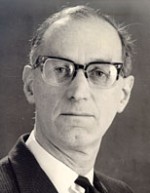
Professor Stephen Angyal
Professor Stephen Angyal is a carbohydrate chemist whose research has
shed light on many aspects of carbohydrate chemistry. Born in Hungary, he received a PhD from the University of Science (Budapest) and worked as a research chemist in the pharmaceutical industry prior to arriving in Australia. He was employed as a research chemist in both Sydney and Melbourne
before being appointed as a junior lecturer at the University of Sydney. It
was there that he began his lifelong investigation into the chemistry of inositols. He moved to the University of New South Wales (then the New South Wales University of Technology) in 1953 and remained there for the rest of his working life. He was appointed Professor of Chemistry and also served the University as Dean of Science. He was awarded the University's first Doctor of Science in 1964.
Interviewed by Mr David Salt in 2004.
You were born in Budapest at the beginning of the First World War, a very turbulent time in world history. Do you have any memories of your early childhood?
I remember very little. I know we moved about because of the war, when my father was an army medical officer who would be placed in different positions. And when we returned to Budapest we had to move out again because of the Romanian occupation. Then came the Communists, but I remember little of them. I have not much memory of my very young days until I got to school and started having lessons.
Would you say your father was a role model to you?
Yes, very much so. I have very good memories of my father. He was a medical doctor with a private practice, but he also gave lectures at the university. He was very intelligent and very kind, and obviously a good doctor. Patients thought a lot of him and used to say that he cured them when he talked to them, even before they took the medicine. He was a wonderful man who was very nice to me and helped me in many ways. He talked to me a lot, and we went for walks during which he would tell me stories of what he had read, before giving me the books to read for myself. I had a very close connection to him.
Did he want you to become a doctor also?
Yes, but to spend all my life with sick people just didn't appeal to me. I don't know what attracted me to science instead. I had a classical education – lots of Latin and Greek – with very little science, and my schoolteachers in science were quite uninspiring. At first I was attracted to mathematics, which seemed interesting, but after one year of mathematics I decided this logical solving of problems that I couldn't really see was too difficult. I was also taking chemistry and physics, so I thought I would continue with chemistry. But I had no role model for chemistry, nobody to particularly inspire me to do it.
Was the science education at university any more inspiring than at school?
No, it wasn't. It was a four-year course, essentially designed for high school teachers. You didn't really get going in chemistry until the PhD, but even then my supervisor was not very inspiring – even though he had once worked with Emil Fischer, who was the famous carbohydrate chemist. (He got carbohydrate chemistry going, and was the one who first determined the structure of the sugars.)
The PhD was very much of a routine job: my supervisor told me exactly what to do. But then we got a compound we didn't expect, and that's where it became interesting. Nevertheless, when I finished the work and had found out what this unknown compound was, I said that I was not going to work with carbohydrates any more – there were no more problems, they had all been done. Nowadays we perceive many more problems in carbohydrate chemistry than ever before!
When you finished your course, your first job was at Chinoin Pharmaceutical Works, as a research chemist.
Yes. Industry wasn't very strong in Hungary, so just to get a job was a great thing. This was a big company, and is still the biggest pharmaceutical company in Hungary. The owner, Dr Emil Wolf, thought that research and business were closely connected in the pharmaceutical industry. I once heard him say, 'Business is not very good. Let's engage a few more research chemists' – exactly the opposite to what many pharmaceutical companies are doing. It was a question of always developing and testing new drugs, changing the way the drugs are used, and he spent most of his time in the laboratory. Unless he had to go to his office, for example to sign something, he was so much in the laboratory that every morning a barber came and shaved him there. I learned from him that research is the most important thing.
Wouldn't it be good if more of our chief executives were practising researchers who spent more time in the laboratory than in the boardroom?
Yes. Also, we had some really first-class chemists who could easily have been university professors but preferred to work in the industry. I liked my job there.
A lucky change of location
You decided to emigrate to Australia but before you could leave, the Second World War broke out and you were called up. How did you make it to Australia?
It was sheer luck. I had obtained a permit to go to Australia, just in case. We knew that with Hitler about, things might not be so good. Actually, when the war broke out, we all said, 'Fine, it's over now. England and France have decided to stand up. Why worry about Hitler?' But they didn't, of course. I realised that if I stayed, then I would be left to fight on Hitler's side, or go to Russia or something like that. Anyway, after my year's compulsory military training I had finished up as a reserve officer, and therefore as soon as the war broke out I was called in to the army. I said, 'Well, that's that. I'm stuck now.' Fortunately, Hungary managed to keep out of the war. (I've been very lucky in many of these things.) And as soon as they sent us home, a month later, I packed and went. I had the permit already in my pocket, so quite legally – no problem – I left Hungary and went to Australia in 1940.
But even in that you were very lucky, because you came across on the last Italian ship that actually got to Australia.
That's right, the Lloyd Triestino Viminale. After that Mussolini joined Hitler and no more Italian boats arrived in Australia.
Why did you choose Australia?
The main reason was that the waiting list to get to America was very, very long, but I had a cousin who was either more pessimistic or saw further ahead than I, and he had gone to Australia a couple of years earlier and set up business. He could fix up things like accommodation and money and all that for me. In central Europe in those days we didn't know much about Australia, but – let's be quite frank about it – it was as far as I could go!
My first impressions of Australia were that it was wonderful: the climate and the sea and the way people moved about, the freedom and all that. I recall the boat stopped at Perth and then Adelaide and in Melbourne, everywhere. Adelaide was very hot, something like 110°F. I didn't mind that at all, it was such a lovely place. I liked this country very much. The only thing, it was hard to get a job. There weren't any jobs in chemistry, particularly not for a recently arrived foreigner.
You ended up in Sydney. How did you manage to get work?
I met a Hungarian called Andrew Ungar, who came out with licences from foreign companies to market their things. On the way he thought maybe one ought also to make some pharmaceuticals which were not made in Australia yet. I talked to him, and then since I had free time I joined him. He set up a small laboratory in a garage, and I went there and did a little bit of work. Ultimately we formed a company, Andrews Laboratories, in which I invested £100. I was doing freelancing work – analysis and advice and information for pharmaceuticals – but there wasn't much pharmaceutical industry here at all in those days.
It was mainly a matter of getting known by people. I went regularly to lectures and so on at Sydney University, so I knew everybody there. I even went to the technical college, where there was a strong chemistry department. So I just familiarised myself with what was going on.
Very shortly you moved down to Melbourne to take up a job as a research chemist for the Nicholas company. How did you get that job?
That was a very interesting story. At the university I often talked to Dr Lions, who was one of the strong organic chemists, and he mentioned that the university was doing pharmaceutical work so that if we were cut off from overseas supplies we could make our own essential pharmaceuticals. In that process he made a new drug called sulfathiazole – those were the days when the sulfanilamides came in, mainly marketed as sulfapyridine, and this was a modification of it – but it happened that in Chinoin I had also made sulfathiazole. So I told him that.
A few days later, a newspaper article reported that the university was helping the pharmaceutical industry, and mentioned that Dr Lions had made a compound sulfathiazole, a new drug. 'And by the way,' it continued, 'curiously enough a recent arrival from Hungary, a Dr Angyal, has also made sulfathiazole.' The next day I had a phone call from the general manager of Nicholas, 'Do you know how to make sulfathiazole?' When I replied, 'Of course I know how to make sulfathiazole,' he said, 'Well, come down to Melbourne and we may discuss a job.' And that's how I got the job: out of the blue. It was a really good job, too – £10 a week – but sulfathiazole was never mentioned again in the five years I spent there.
I think you worked on the synthesis of a whole series of vitamins, to figure out how they could be produced on a commercial scale.
Yes. The management of Nicholas knew absolutely nothing about pharmaceuticals or chemistry, and I was only a research chemist. Although the company started with old Nicholas making aspirin, by that stage they weren't making any chemicals. Even the aspirin that they marketed was made by Monsanto. But since the company marketed shark liver oil for the vitamin A content, they said, 'Well, it is just as well if we produce vitamin B, C, D and so on,' and they put me onto vitamin B. After about six months on this, they said, 'Forget it. It's too complicated. Let's make vitamin C.' Then they found that CSIRO was already making vitamin C. So we made vitamin D. And then we went to vitamin K. None of them were ever marketed, so it was really a waste of time. But I learned a lot of chemistry doing that.
In 1946 you moved back to Sydney to take up a job, at quite a pay cut, as a junior lecturer at the University of Sydney. Why was it important to you to take up a university position?
To put it simply, the research potential in Nicholas was very low. I couldn't choose my own research problems, and I was always diverted by the time I started moving. University was the only place with a future for research.
That is if research was what you wanted. Many people choose to go into industrial processes, where you can make a lot of money.
I wasn't so interested in money. I wanted to do some interesting work, something inspiring that would keep me really going. At Nicholas I was just hanging about, and it didn't get better, it got worse.
And Sydney was a place you wanted to be?
Well, I liked Sydney better than Melbourne. From the first nine months I spent in Sydney – much of it at Bondi beach, because I didn't have a job – I thought Sydney was a lovely place. So it was a good opportunity to come back. But really it was just that there was a lectureship vacant and advertised.
There weren't so many universities then, only one in each state, and a lectureship vacancy was quite rare, but there were only two applicants. (The other one was a foreigner too.) The reason was very simple. Today, 30 people apply if a university lecturer job is advertised. But in those days Australian universities didn't grant PhDs, and when their students finished and wanted to do research they all went off to England or some other countries. During the war they couldn't do that, so afterwards a stream of young chemists – all those who would apply for lectureships – went off overseas. That was extremely lucky for me.
You worked at Sydney University for five years. What was important for you about being there?
First of all, I got a firm basis in university life – I lectured a lot – and also I could do the research I was interested in, and I started developing first one line and then another. Of course, I had lost a lot of years. Usually academic researchers started at 22 or 23, but because of the war and emigration I was 32 when I really got going in research. But I wanted to get going, and this was an opportunity.
During that time, I think, you realised carbohydrate chemistry was still an open field – the big problems really hadn't been solved – and started working on inositols.
Yes. That was the first subject I picked. It was readily available and there was only one person in the world who was working seriously on it. The inositol group of compounds are related to carbohydrates. During my industrial work, when I worked with vitamins, for some odd reason it was believed that one of the inositols was part of the vitamin B group. It isn't, but it is very widespread in nature, and as I looked at it I saw that little was known about its chemistry. I thought, 'When I get into a position where I can do research of my own, I will look at these inositols.'
Eventually, much later, they turned out to be very important compounds. After I retired, it was found that one inositol derivative is an essential part of the human nervous system. All the basic work I did, building up the knowledge of the field, was essential then to understanding the chemistry of inositols.
You put together your knowledge of inositols in the next phase of your career, at the University of New South Wales. But before that, in 1952, you took a year of study leave in Cambridge. That was a pivotal time for your career, wasn't it?
Well, the main significance was in meeting many chemists. Australia is at the end of the world and travelling still took three weeks on the boat. I knew very few of the world's leading chemists, but in that year I met many of them, particularly those in the fields I was interested in – sugar and inositols – in England. Then I was lucky enough to get a Carnegie grant to America, for two months travelling; and from Cambridge I travelled in Europe. So I met all the people of interest in my field and all the really famous chemists. I was no longer isolated at the end of the road, but part of the international community. I kept in contact, and I sent students to those people and they sent some students to work with me.
Another important thing I went to the first Carbohydrate Symposium, in Birmingham. They continued regularly, every two years. I have been involved in the organisation right from the beginning and ultimately I organised one in Sydney – another continuing active connection. If you work in isolation you get stuck, or you do something that somebody else is already doing. You have to keep in touch and know who does what, and what is happening where, and that I got during that year.
While you were in Cambridge you were offered the next big phase of your career, an associate professorship at the University of New South Wales – known then as the New South Wales University of Technology.
It wasn't an actual offer; there was a job advertised and I applied for it. That was a very big step forward, because in those days lecturers had no way of being promoted to senior lecturer until there was a vacancy. If you were a lecturer, you just had to wait. (Now you can be promoted to associate and even professor.) I went straight to associate professor.
Wasn't this university regarded as the 'new kid on the block'?
Yes. Not many people were interested in the job, because the university wasn't regarded very highly. Most people said, 'We have got a university. What do we need a second one for?' It was called a university of technology because it focused on nothing else but science and engineering. And chemistry was about the strongest of all the schools. The departments were taken over from the technical college, where chemistry was very well developed. I kept in touch with them, so I knew what was going on there and that they were good people. I thought there was really good potential in the job.
Indeed, the university was nicknamed the University of Chemistry, wasn't it? I suppose it suited your background and your outlook that science needed to have an application and to be relevant to the wider world.
Yes. And obviously the people who knew about it regarded it as a promising institution, because at the same time another associate professorship was advertised in inorganic chemistry, and that was given to Ronald Nyholm, who became Sir Ronald and a very famous chemist and finished up as professor in London. So the good people did go there. It is now the second major university in Sydney.
This was really where your research on inositols took off. What was special about this group of compounds? What did you do with them?
They are closely related to sugars – the sugars are ring compounds, with six-membered rings, and so are the inositols – but in many aspects they differ from them. They are well known in nature, but not all of them. One is widely spread in nature. There are nine possible inositols, depending on the shape of the molecule, but two of them were still unknown and we were the first to make them so you had the complete group.
When you have got all the possible compounds and all the different variations, you can study which physical, physiological and chemical reactions differ just because of the shape. This seemed a neglected area – a natural product, an interesting compound but not studied sufficiently – and I thought, 'Let's go.' That was in the early '50s.
As soon as we started going we found some reactions which are applicable to sugars, and then we found a very interesting reaction which allowed us to measure the energy of various sugars. And once we had that, we applied it to sugars and so I branched off to carbohydrates. But I kept on developing inositol chemistry, publishing about 50 papers on it. So later, when inositols became biologically important, we had all the chemistry on a firm basis.
You had started getting into the new field of conformational analysis. Would you say this was the key to understanding the inositols?
It was. It is about studying the shapes of the molecules. We knew the structure of the molecule, nicely written down on paper, but that didn't indicate the shape, yet it turns out that how the compound reacts depends on its shape. Other molecules have to approach it, it has to fit against other molecules. The theory became so important that several books were written on it – I wrote the carbohydrate part in one of them – and the two people who introduced it won Nobel Prizes.. But now there are no separate books because it has become an essential part of organic chemistry.
I realised that the inositols are ideal compounds for studying the shape and then purely by chance I discovered a reaction which was relevant to carbohydrates. Previously we hadn't understood why compounds react the way they do. Even more important than the shape is the energy contained in each of these compounds. And that is what I approached now: I could for the first time really define the energies of the different shapes, which then explained why they take up the shape that they do. Applying that unexpected reaction to carbohydrates solved one of the problems in carbohydrate chemistry, and that is when I got back suddenly to carbohydrate chemistry. Ever since, I have found there are still plenty of problems.
What is it like, being the father of the research in this group of compounds, important ingredients of our nervous system?
It is very interesting, because at first when you start talking about it people say, 'Oh, what's this all about?' and then it turns out to be quite important.
In 1960 you were appointed as the Professor of Organic Chemistry at the University of New South Wales, one of the highest offices at the university. You never really sought high positions in managerial authority, but in 1970 you were appointed the Dean of Science, having previously been the head of school. So you were one of the main authority figures guiding the university.
Actually, by then the university was pretty well settled. Professor Baxter had built it up in a marvellous fashion, very quickly, against quite a bit of opposition from academics who thought it was all too quick. But by the time I became Dean, we were not putting up many more new activities; it was mainly a question of consolidating – and teaching the students, who were coming in increasing numbers.
There were lots of changes, because originally we had colleges in Newcastle and Wollongong, and then at Broken Hill. I regularly visited Broken Hill – most interesting – and I went to a graduation ceremony there which had more officials present than graduating students. Professor Baxter's idea was that the university should have colleges all over New South Wales, but fortunately that didn't come about. It would have been very cumbersome to operate.
By 1970 it was fairly smooth going and all those difficulties we have now at the university, getting so serious, weren't in sight yet. As Dean I had mainly routine jobs to face, rather than very difficult problems.
You must have been popular, because I think that although you had intended to be Dean for only a couple of years, you were talked into staying on for 10 years.
Well, the Vice-Chancellor, Rupert Myers, and I knew each other quite well; we have always been good friends and we see things very much in the same way. And somehow I must have appeared to be the most suitable man for the job.
What contribution has the University of New South Wales made to Australia and the international scene in science?
A very great contribution, in various fields. For example, its electrical engineering people are in the lead in utilisation of solar energy, and the school of optometry has been very active – it is the only one in New South Wales, and maybe in Australia. We started a school of business administration, which was frowned upon in those days but now most universities have such a thing. That school is now shared with Sydney University, which came along to ask to become part of it. And the same applies to many, many other fields.
Of course, we had things which looked interesting and didn't get anywhere. We had a school of nuclear engineering in the days when it was thought that Australia might be going to have a nuclear industry, but that has gone out. We had a school of traffic engineering, but we no longer need a separate school for that. We had the first school of food technology, which was very important but is not quite so important now. So we are willing to vary things.
We had aeronautical engineering; that too is now not so important, but the main engineering schools are still very important. And in the Faculty of Arts, a new school of music – which was never planned for – came about simply because we had Roger Covell and he built it up. It is doing a wonderful job.
Helga, your wife, was also a prominent player at the University of New South Wales. She was your longest and most productive collaborator, wasn't she?
Yes, and still is.
I think you met and married her in Melbourne.
Yes. I met her in 1941, and in early '42 we married. That was very, very lucky. Having just come to a foreign country and with an uncertain future, the last thing I ever thought about was getting married. But once we started going together, well, that was that. I said, 'It's the best thing I can do,' and got married.
What role, then, did Helga play at the University of New South Wales?
When we started there, the university was rather small. Everybody on the staff knew everybody; all the wives knew each other. Then later the wife of Rupert Myers, the Vice-Chancellor, set up a group so that the wives could help their husbands overcome the severe financial problems. Whatever we wanted to do, we found, 'We can't. The government doesn't give money for that.' We weren't at a stage yet where industry supported us very much, so these women got together to raise money. At first they had dinners. Then they had productions, and a concert, and an exhibition and all kinds of other things, even lecture courses – all for money. Their biggest venture has been the book fair every two years, and now every year. Ultimately they raised a couple of million dollars for purposes for which money could not readily be raised otherwise.
Helga was also very active in the social angle, bringing newcomers' wives in, inviting them to come and join us and so on. About a dozen of the wives left over from those days still meet regularly every month, and they still give some help to the university.
Then Helga was involved in the music school, which set up the Australia Ensemble – undoubtedly Australia's best chamber music group. She had a lot to do with developing that ensemble and was in its advisory committee, a kind of a governing body, for about 25 years.
You have actively pursued connections with the international scientific community to make sure that Australia is part of the network, arranging to bring some of the world's best chemists on visits and promoting a free flow of ideas between Australia and the rest of the world. You have also been – with the help of your wife Helga – a prodigious organiser of scientific conferences.
Well, the conferences are important as a method of communication and contact. In the early days there were separate groups working in science here and there and not contacting each other much, and you read in the literature what they did. The literature is so big now that it is impossible to keep up with it all, and it is more and more important actually to meet those people, to hear what they are talking about and discuss problems. There is a lot of international collaboration, which in those days was very difficult but now is very easy. Somebody flies here, or sends you an email, so you can have a lot of international cooperation. Whereas in 1952, the year I spent in Europe, there was only one chemical conference, now even in Australia there are at least two every week.
I was very much at the beginning of Australia's contribution. You have got all these trees and plants containing chemicals which are not found anywhere else, and in the 1950s, '60s and '70s most Australian chemists worked on these things. I was on the organising committee which arranged the first international symposium on natural products, in Sydney, and these conferences have been held every two years since then.
I have already mentioned my involvement in the organising committees of the carbohydrate symposia, the first of which was held in Birmingham. Ultimately I organised one in Sydney and I found it very interesting, because there is a need to pick the right speakers, to guide them to give the right kind of talks, and then to try to bring the right people here, to keep them in contact with each other – the publications, abstracts and all that, and the way it is organised are all important. And usually you come back from these conferences with ideas. That's the point of it: you get new ideas by listening to what those people have to say.
Many scientists, while acknowledging that the conferences are valuable, would do anything to get out of actually organising them. Not many are prepared to put their hand up and say, 'Yes, I will help organise them.' To have done so many of them, you and Helga must really enjoy the organising work.
I enjoyed it, but it is a hell of a lot of work. Helga helped me very much with the big one we had in Sydney. I had a team of people with me and we thought that with a bit of work we would get it going, but it was continuous hard work for about six months. It was worth while doing it, but it was a full-time job and I couldn't have done it until I retired.
Helga also used to help with the ladies' programs, which were very important so that the ladies would enjoy seeing the country and learning about it all, and would more or less talk their husbands into going to the conferences.
But it is completely different now: there are so many of them and they are so large that it is mainly done by professional conference organisers. The International Carbohydrate Symposium we had two years ago was in Cairns, mainly in the hands of commercial organisers. We told them what to do, but the details – the bookings and the finances, the printing and all that – were done by commercial people. It is getting too big now to be handled by amateurs, as we were.
But good amateurs, I think. This is not just about exchanging scientific ideas; it is about building relationships and forming friendships.
Tell us about the Andrews Lectures.
This started purely by coincidence, as so many of these things do. When we had the natural products symposium here in Australia I thought it would be a good opportunity to get one of the speakers who were coming to stay on for a couple of months as a visiting professor. But although I asked several, none of them could come for long enough. Ultimately, Professor Ewart Jones, from Oxford University, said he could come for three weeks and give a lecture course. That was successful and I said, 'Well, why not do it again?' The next visiting lecturer was picked in an amusing way. We had here a famous American, Carl Djerassi, who had developed the contraceptive pill. He was a very enterprising fellow, and when I asked him what he thought about the idea of having regular visiting lecturers he said, 'It's a wonderful idea, provided I be the next one.' So I agreed.
The lecture series evolved, and I found it very interesting. Again organising it was a lot of work for me: selecting the lecturers, arranging the travelling, getting the money, organising the program. Since my retirement, the University Chemical Society does this. It has been highly successful and we have really brought out good people, including four Nobel Prize winners. Amongst them all – some have died by now – there is quite a record of chemistry. And it is still going; we will have the next one this year.
Nowadays there are quite a few such lectures; most of the universities have something similar. But this was the first one. Probably we still bring the best people out, because it has got the name and reputation now. If you show any potential Andrews Lecturers the list of past lecturers, they say, 'Oh, wow.' They regard it highly.
I think the name Andrews Lectures had something to do with the first project you were involved with when you came to Australia.
Yes. I had to raise money for the original lecture – not a lot of money, about $500, whereas nowadays we need about $5,000 each time – and since Andrew Ungar and I have remained friends and he had the money, I asked him. And when I thought about a name I felt that Angyal Lecture would not be very good, nor would Ungar Lecture, so we decided to name it after his firm, Andrews Laboratories.
Stephen, when you started out, your training was more in the area of industrial research – training on the job, almost – but you have spent most of your career in academic research. Would you like to make any observations on the difference between industrial and academic research?
There is a very basic difference. Industrial researchers have to produce results according to the aims of the company for which they are working. The company has to make money. If it sets out, say, to develop a drug, that means your job is to develop it. You can't branch off to anywhere else. In university research you can take advantage of any chance developments – and these are very important in science: you do something and something else turns up. You need the prepared mind, as Pasteur said, to pick up the chance when something unexpected turns up, to say, 'Look, that's interesting. It's even more important than what I am doing,' and to branch off to that. You can do that at the university.
That means you can't plan your career in advance. You may get a university job and say, 'I'm going to do this in 20 years' time,' but really you have got no idea what you are going to do in 20 years' time. And that varies tremendously from one researcher to another. Recently I have been reading several books on the life of important scientists, mainly chemists, including quite a few Nobel Prize winners. I recall clearly that one American said, 'I have been changing the direction of my research every 10 years. I can't hold on to the same thing. Something else turns up' – and he got the Nobel Prize. Yet Merrifield, for example, worked on peptides all his career, from beginning to end, and he got the Nobel Prize too. So we can't prescribe it, but it is very important to look out for the quite unexpected things that might turn up.
So an ingredient of important academic research is always to have the capacity to follow up on a chance discovery?
Yes, very much so. It may not always work everywhere. A chance discovery may be made by a student who does not recognise it; in such a case the supervisor needs to recognise that this is something unexpected, something that can be explored. I would say most of the really important things in science, most of the important methods we have now in chemistry, have been discovered and developed by chance. People didn't set out to do this. Nuclear magnetic resonance, which is absolutely basic to organic chemistry now, started with people doing something in physics, not at all related to chemistry. When I came back in 1958 from my second study leave, during which I worked in America, I wrote a report (which I still keep) saying, 'I've come across nuclear magnetic resonance. This may have some interesting uses, but it is so expensive' – $10,000 – 'it is not worth us buying it.' We couldn't do without it now!
You have seen a lot of change, both in the world around you and in the way science is done. What are some of the changes you have witnessed in the practice of science?
There are a lot of differences. One is instrumentation. We have now got instruments, such as nuclear magnetic resonance, whereby we can determine the structure of a molecule in a day. In the 1940s, to determine the structure of such a very important compound as cholesterol took five or six years of work by five or six large teams. You could do it in a few days now. That means you can study compounds which are so complicated that nobody would ever have thought of studying their structure then. I am talking about the really important things in the body, such as the proteins and DNA. We just didn't have the methods for handling them in those days.
Also, calculations have now been evolved whereby we can work out the best structure of the compound. A compound will take up what is energetically the best structure. We can work out the energies of different structures so we can probably determine the compound's structure purely by calculation, even without experimental work. We have got facilities like X-ray crystallography – one can determine the structure of a pretty complicated compound just by doing an X-ray picture – and computers with which we can calculate from those X-ray data the structure of the compound. Without computers we could never have done those calculations.
This has made a tremendous difference to carbohydrate chemistry. The carbohydrates in the body are very complex substances. There are several different sugars attached to each other, and they can be attached in different ways. You can take two ordinary sugars and connect them in 20 different ways. With three, you have got about 300 different ways. In these compounds occurring in the body, there are six, seven, eight, nine or 10 sugars, arranged in different ways: there are millions of possibilities.
To approach these structures 30 or 40 years ago was hopeless. To build them up was even more hopeless, whereas now carbohydrate chemistry is all about building up these complex sugars. We can figure out what we want to build up and we can develop methods to do it. What we do now is first of all to make the ones which occur in various parts of nature – in bacteria, in the body, in plants – and then to modify them slightly.
The modification may have two effects: to enhance the function of the molecule or to oppose it. If it opposes it, that will stop organisms from using it. If it enhances it, the result will be better than the natural compound and we can use it. And now we can synthesise those. Even 20 years ago I would have said that it is so complex that we would need a huge team just to make one compound; now you need a few people to make several compounds, because the methods have improved so much.
You have recognised and shed light on many of the big problems in carbohydrate chemistry through conformational analysis and an understanding of the energies of the different configurations and the way they work together. Is carbohydrate chemistry still a wide open field today, when people are starting to look at how these things actually work in our body and how to make small modifications to change the functionality?
Very much so. The interesting thing is that 30 or 40 years ago most of the carbohydrate papers were in the two journals about carbohydrates – seldom was there one in the general chemical journals – whereas now you find carbohydrate papers in every chemical journal. It was a fairly isolated area but now it is at the centre of organic chemistry. The Journal of Carbohydrate Chemistry is getting bigger and bigger all the time, with lots of work published there.
Is it a case of the more we learn, the more we discover there is to learn?
Yes. Now it is really what happens to these carbohydrates in the body. You look at different plants and different animals, at the endless variation of different carbohydrates here, there and everywhere. If I started again I would become a biochemist. In those days we still needed to know more fundamental chemistry; now we have got that. Now it is the application in biological systems, which the biochemist does. And even the biochemist doesn't do it alone but works with a bacteriologist, a physiologist and a few other people.
Perhaps another thing that has changed about science, then, is that it is harder to do science by yourself: your knowledge is part of a team approach, and you need skills from different areas.
Yes.
You have written hundreds of important scientific papers, but you say that 'The Composition and Conformation of Sugars in Solution', published in 1965, was one of your most successful papers. Why was it special?
The reason, I think, is that it was a summary of much work we had done with inositols, which of course many people didn't know applied to carbohydrates. Many carbohydrate problems were solved with the knowledge we gained from inositols. It was well known that when dissolved in water, most sugars will turn into several compounds. What wasn't very well known until later was how much of each compound is formed from each sugar – and why it is, wasn't known at all. The knowledge we gained from the inositols explained this. We applied it to sugars, and then you could predict that this sugar would give so much of one compound and that would give so much of the other. And that is very basic knowledge of the sugars.
In this article I just summarised the results, very clearly. They were already all available – nothing new in it – but this was a summary, easily read by chemists and giving the whole story.
So this was really a synthesis of a lot of your work and why it was important?
Not only mine, no. It was a summary, all together, of recent work in carbohydrates, and how recent work shaped our outlook on carbohydrates.
That paper was complimented for its lucid style and the ease with which it could be read. Has communicating your science been important to you?
It is important. Some scientific papers are very hard to read, and people read them only if they have to. But this was meant to be a popular one, to be read by everybody. There weren't any very difficult concepts in it, but we gave a general idea of what is going on and why.
You started academic research comparatively late, you are largely self-educated and you claim that you have little imagination, in that you have not generated fantastic new inventions. What is it about your approach to science, then, that has allowed you to make such a monumental contribution?
Maybe two things: looking into details, looking at problems and saying, 'Well, this is not really solved. We do not quite understand that,' and also picking up things which have been mentioned here or there without anybody ever following them up. I developed things which were undeveloped and I figured out the details and – most important – the explanation of many things. There were lots of facts known and stated but the connection wasn't established. We didn't know why these things might have happened. So my contribution has been in rounding out and firming up the knowledge, forming a base on which others then can build. That applies particularly with carbohydrates, where I published several reviews, mostly on the conformation and the composition. If anybody now wants to look at conformation and composition, they look at my reviews. I summarised it and rounded it out.
If you could choose, would you enter science today, having access to a lot of sophisticated technology but being required to specialise in a very small field and often to be a small part of a larger team, or in the days when a person had a greater overview of the entire field and could choose the direction in which to travel?
I think it used to be easy, in a way. It was more interesting too, when you could see the whole field and all the possibilities, and it didn't depend so much on other people. But the way the world develops, it is different now. You do need the instrumental people and the theoretical people, and ideally you need to work in a team.
Science is so tremendously large now that you can't see the whole thing; you can't see the large parts of it. In a team, the biochemist looks at this, the physiologist looks at that and the X-ray person looks at something else, and together they present the knowledge. It would be very difficult for a single person to have a proper outlook over the whole field. I am afraid the position is getting more and more complex.
Yet it is wonderful, because the insights that they bring in this multidisciplinary type approach are astounding, compared with what could have been achieved only 10 or 20 years ago.
Oh yes, the opportunities are wonderful. The very basic operations of life we don't understand at all, even now. I mean, an egg starts going. What governs which part of the egg will be what? When the human being starts with a sperm, what determines that there will be eyes and ears and what colour the eyes will be and the hair? It is all written down in the basic molecules, and we are not even beginning to understand that. It is fascinating, but there is a lot more to learn about it.
Are we actually on the cusp of making some major breakthroughs, or are all the major breakthroughs behind us? Are we just making incremental improvements on what we already know?
It is both. There are incremental improvements but there are still major breakthroughs coming. We don't understand the very basic way that life develops. When a bird comes out of the egg, there is nothing left in the shell. All the white and all the yellow has become some part of the bird. How that process is governed, we don't understand.
I am sure that many of the discoveries made in future years will actually be based on the information and the understanding that you have given us through your life.
Well, not only I, but the people who worked out the basic chemistry. It's all chemistry, but what governs the reactions during the growth process, I don't know. There is a tremendous amount of information in DNA. Whether you have black hair or white hair or no hair is all in the DNA, but how that is governed we are only just beginning to understand.
Thank you very much, Stephen, for sharing with us your insights and memories of your life.
It was a pleasure.
© Australian Academy of Science
Professor Ron Brown (1927-2008), chemist
Ron Brown studied at the University of Melbourne, where he received a BSc in 1946. He completed a PhD at Kings College, University of London, in 1952. He then was an assistant lecturer in chemistry at University College London from 1952 to 1953. In 1953 Brown returned to the University of Melbourne as a senior lecturer in general chemistry and in 1959 became a reader in theoretical chemistry. In that same year he became foundation professor of chemistry at Monash University and remained in this position until his retirement in 1992. Over a long career, Brown worked in many areas of chemistry including spectroscopy, theoretical chemistry, astronomy, molecules and life in space. Among other things he discovered the tricarbon monoxide molecule and another called propadienone, which was kinked when it had been predicted to be straight.
Interviewed by Professor John Swan in July 2008.
Contents
- A developing interest in science and marriage
- The unexpected foundations of a scientific career
- Theoretical chemistry and microwave spectroscop
- Moving on to radio astronomy
- Pioneering chemistry at Monash University
- Highlights of a diverse scientific life
- Satisfying personal and family pastimes
A developing interest in science and marriage
I have been asked to interview Professor Ron Brown, a fellow chemist, a friend and a former colleague at Monash University. Ron, what drew you to a career in science, and especially chemistry, physics and mathematics? Was it family, a friend, a schoolteacher or something else?
Ah, it was not anything very specific. It was more or less accidental. All those long years ago I borrowed some astronomy books from, I think, the very good library at the school we were attending, Scotch College (we had been moved from my own school, Wesley College) and that got me interested in astronomy. Also, because I was one of those who could cope with mathematics and physics, I became interested in science in general. That's where it all started, not with chemistry – although, before I had finished secondary education, I had set up a home chemistry set in the laundry of my mother's house, much to her apprehension, shall we say.
Did your family understand your interest in science? Was there any scientific background among your parents or grandparents?
Not a scientific background but, funnily enough, I think it was my grandparents more than anyone else who influenced me. We were living in Prahran, in what is now inner Melbourne. In the summer in particular, having no air-conditioning or anything like that, like many households in Melbourne we used to go out into the front garden of our home in the evening, sit on a rug (on the lawn, in our case), and generally chat. When we were lying back on the rug and looking up at the sky, my grandparents used to ask me questions like, 'Well, now, you're studying these things at school' – which we weren't – 'what are those stars? Does anyone know what they are?' et cetera. And by the accident of having borrowed a book on astronomy I started to answer their questions, if I could. Mostly I couldn't, but I was stimulated to try to find out the answers that I couldn't give them, and so I studied astronomy by means of popular astronomy books out of the school library.
I well remember that when I was an undergraduate at Monash with you, you had quite exceptional talents in mathematics and physics, in addition to chemistry. Did all those various abilities contribute to your later research?
I think they were really bound together by the structure of educational systems. When you approached senior levels of your schooling you had the choice between geography and chemistry or history and physics. I chose chemistry and physics, partly because I wasn't so interested in geography and history but also because I noticed that I was getting better results in chemistry and physics than in an arts-type subject. So I focused on those. But, in my school days and early university days, my star subject was physics – in fact, I think I got the Exhibition in physics in my year 12 exams, for Melbourne University – and people thought, I suppose, that when I was at the university I would go on in physics. They were rather surprised that, although I had even better results in first-year physics than in first-year chemistry, I enrolled for second-year chemistry rather than following physics. Indeed, one of the senior staff members of Melbourne's physics department chose to come over and find me in the chemistry department to ask why, when I got such excellent results in physics, did I not go ahead and major in physics? Well, as it turned out, I actually finished my chemistry major and then informally did third-year physics, without sitting for the exam, and also third-year maths. So I ended up with what amounts to major-type studies in chemistry and physics and maths.
I recall giving a lecture some years ago at a very highly-regarded secondary school for girls where I found your wife Mary was the senior teacher in physics, a scientific discipline that attracted you both.
Yes, indeed. I met Mary at Melbourne University. She was, I think from memory, two years behind me. I met her in the table tennis club, of all places. I had been slow to attend a meeting of the club and, as people know, if you're late to attend a meeting you find you've been appointed to one of the least attractive jobs – in this case, as treasurer. One day in the table tennis club the door opened and two very attractive girls came in. I thought, 'Well, I've got to talk to them as treasurer,' and the treasurer's job didn't seem so bad after all! One of the girls was just a gorgeous creature, and now she is my wife and the mother of our three children.
Mary was doing a physics degree, and I think one of the reasons I went along to study final-year physics and maths was that she was doing the final-year physics. This was, if you like, the accidental way in which I finished a major in physics.
The unexpected foundations of a scientific career
When you and I graduated at Melbourne, there was no PhD program. Where did you go for further higher degree study? Who did you work with?
I did go on to a masters, but by the time I finished that and graduated there was, as you say, nowhere in Australia to turn for a PhD. You would have to go overseas. I did not have any immediate intention of going overseas, because we didn't have the money to do it. I therefore had an arrangement with Melbourne University that I would stay on as a very junior teacher, and I assumed that ultimately, years away, I would have enough publications to get a doctorate.
But then I was fortunate enough to get a scholarship in the physical sciences, offered by the freshly generated ANU, Australian National University. (There was one scholarship in the physical sciences and one in the humanities.) That created quite a problem, however, because once it all had been publicised that I was going off on this fellowship to study in England for a PhD and would then return to ANU, the university suddenly pointed out that they had no future for chemists or anything except physicists or certain branches of the humanities. For a day or so, I was devastated by this news.
Then Sir Leslie Martin, the head of physics at Melbourne, called me and said, 'Brown, there's a bit of a tangle over this fellowship, but I've discussed it with ANU and they've agreed that you can have the fellowship as long as you agree not to hold them to employing you, if and when you come back to Australia.' So I got what amounted to a non-existent fellowship to go to England to do my PhD – which I did at Kings College in London.
After your success at Kings College and University College, what brought you back to Australia?
I was away for several years. I had to stay at Kings for 18 months, long enough to be eligible to submit my thesis for a PhD, which was based largely on work that I'd done even before I left Melbourne. Then I was fortunate enough to get a junior lectureship appointment at University College, in the famous department that Sir Christopher Ingold headed. At that stage I thought I was going to continue my career indefinitely in England or in Europe, but quite out of the blue I received an urgent cable from Melbourne University to say that the opening of the academic year was fast approaching and they had no-one to teach first year medical students. They offered me a very senior appointment, as long as I would catch an aircraft to Australia – this was at a time, remember, when people travelled by ship, not by plane – in time for the start of academic term. They would give me this senior appointment and, since we'd bought a house in London, they'd pay all the costs of moving out of the house and back to Australia.
I was unsure about this, but I noticed that my wife, in particular, was rather homesick; she missed her family, especially her father. So she and I decided we would return to Australia. When I went along to Sir Christopher Ingold to see if he would release me from my appointment before the end of the academic year, he very generously said, 'Brown, if you really want to go back to Australia, I will be content to terminate your appointment, though we shall miss you,' and I thanked him very much. Then he said, 'But remember, if you go back to Australia, it'll be the end of your scientific career.' Thus I headed back to 'end my scientific career' in Australia.
Theoretical chemistry and microwave spectroscopy
Perhaps, Ron, we could now hear something about the research and discoveries which made you so well known not only in chemistry but also in physics and astronomy, especially in theoretical chemistry and in microwave spectroscopy and radio astronomy.
Looking back, I think it is amusing how many of the things that you have mentioned cropped up by accident. For example, when I was, I think, in my final undergraduate year, we were encouraged to think of the various scholarly societies. And because I seemed to be a bit more interested in physical chemistry – although not entirely physical – someone encouraged me to join the Faraday Society, a society in England. I joined and had to pay an annual fee (a junior fee, I think). Then I found that there were journals coming, and I felt I had to read them because it was my money that I'd spent on them and I couldn't just cast them aside, even though most of them were rather meaningless to me. But one paper by a couple of scientists, Coulson and Longuet-Higgins, had a lot of mathematics in it which, to my surprise, I could follow. More or less just for the hell of it, I tried to reproduce the results that they had published and I found I could. I became rather swollen-headed about this and thought, 'I'm as good as they are.'
I started to do other calculations of that ilk and then realised that I could write a paper and send it to the Faraday Society. Because I was a member, I suppose, they looked kindly on me and they published these papers. So I was rather rapidly thought of as a theoretical chemist, although, having no-one in Melbourne who knew anything about theoretical chemistry and chemical quantum mechanics, I had to buy books instead. I can clearly remember that there were two books on chemical quantum mechanics which I bought – I had to import them from America during the war – and struggled through as they were quite difficult reading. By the time I'd got through them I knew a bit about chemical quantum mechanics, so I thought, 'I'm now going to be a theoretical chemist.' That was phase one In fact, the first decade of my career, roughly, was focused on theoretical chemistry: chemistry plus mathematics, you might say.
Then I found that most of the things we were predicting about molecules, which was what theoretical chemistry in its early days used to do, were very difficult to test against direct experiments. You had to make a rather tortuous connection. Through dipole moments, which indicate how unbalanced the electric charges in a molecule are, these unbalanced charges could be measured and calculated. That was all very well, but the things I was working on had very low values of dipole moments, and the traditional methods of chemists measuring dipole moments didn't work at all well. I hunted about and – again by accident – came across a book on microwave spectroscopy, written by physicists rather than chemists, which showed that you could measure these very small dipole moments. While I was in Melbourne, however, I couldn't do anything more than read about it.
When I went to London I found, first at Kings and then at University College, no interest at all in these sorts of chemical measurements, except that a colleague at University College, Jim Millen, had decided to build for himself a microwave spectrometer. I thought, 'Well, if I can get it going, with him, he may let me do some measurements that I'd like to do.' I had no thought of being a specialist in microwave spectroscopy but just of getting these measurements. So I helped him for the best part of a year to assemble this spectrometer. It was something you had to build for yourself; you couldn't buy a commercial one – there was no such thing.
But, of course, I left London to come back to Melbourne, where it seemed that no-one knew anything about microwave spectroscopy nor wished to become involved in it. When the opportunity to join a new university and set up a new department of chemistry sprang up, however, I thought, 'I will seize this opportunity, if I can, because then I may be able to marshal enough resources to build my own microwave spectrometer.' And indeed, with a lot of struggle, we managed to do that.
Moving on to radio astronomy
So you have told me about working in theoretical chemistry and microwave spectroscopy. What caused you to move on to radio astronomy?
The next phase, of moving from microwave spectroscopy, in which we ultimately specialised, to radio astronomy was again a total accident. One day the phone rang in my room and the call was from a scientist, a radio astronomer, from Harvard in Massachusetts, United States. He said, 'Professor Brown, I understand that you have equipment to make certain measurements. I've found you are the only person on Earth who can work in that particular frequency range, and we want some measurements made for our radio telescopes. Would you agree to make them?' And he said, 'It's a very competitive thing, so would you mind transmitting the results that you get to me by telephone? It's too urgent to wait for you to write.' So I said, 'Well, yes, we have the equipment and I think I can find someone who will make the effort to make the measurements.' We did this and sent the information overseas.
After we'd done this a while, I thought, 'I know essentially how a radio telescope operates. It's just a very large radio set, with an antenna that costs millions of dollars to build. It's gigantic and it picks up radio signals from space, but the frequency of those signals is in the range nowadays used by television rather than by radio; it's in the centimetre wavelength range. So that's the easy part.' To tune the telescope to the particular frequency is rather like tuning in to what in those days was 3AR or 3LO. If you knew the frequency of 3AR, you could tune your radio set to it and you got the signal. It's like that with molecules in space. The molecules emit radio signals. If you know the right frequency, you can tune in and, hence, detect a particular molecule in space. For example, suppose you have a little amino acid. If you know the frequencies that it transmits, you can tune your radio telescope to those frequencies and see if there are any molecules of it out there. Now, the difficult part is to measure the frequencies. Once you've got them, then the radio astronomy part, apart from the complexities of the actual telescope – which tends to be run by radio engineers rather than scientists, anyhow – is trivial. You tune it in and see if there is a signal or not. So I thought, 'Well, we can do that.'
After lengthy negotiations with CSIRO, it was agreed that we could jointly do this work using the Parkes radio telescope. I went up to Parkes to join in the observations to search for molecules in space and, over the years of doing it, I became sufficiently au fait with the telescope that I was one of the few people to be allowed on odd occasions to operate it myself rather than leaving it to the engineers. But that work was done mainly because I had a very clever and able colleague, Dr Peter Godfrey, who was a first-rate physical scientist and knew about radio waves and centimetre waves.
That's how we got into radio astronomy. And radio astronomy was dealing with molecules, like amino acids and others, because radio astronomers were looking for the first elementary building blocks of life – to see whether the building blocks of life could be detected out in space rather than just down here on Earth.
So, you see, those apparently quite disparate fields within my career were all linked together by accidental connections – apart from the microwave spectroscopy, which I decided I wanted to get into because of theoretical chemistry. It is a weird story when I look back on it.
Pioneering chemistry at Monash University
You have briefly mentioned Monash University. Perhaps you could now say a few words about your very significant role as one of the foundation professors at Monash to create an entire new, vibrant chemistry department from scratch.
Well, John, it started when the government decided to have a second university in Melbourne. Very soon you recommended that the university, sensibly, be named after Sir John Monash, and the positions of the first group of office bearers, shall we say – the vice-chancellor, the registrar, the librarian and four professors of science, because science was going to be the first set of subjects that were taught – were advertised. I inquired and was encouraged to apply. After a good deal of being interviewed and talked to by various people, I was offered and accepted the chair. So I happened to become, again by accident, the first professor appointed to Monash University.
At that stage, when you went out to Monash what you saw was the remains of the Talbot Epileptic Colony. It was a big plot of land on high ground – it turned out to be high ground consisting of clay – and what amounted to a farm and a few buildings. We had to demolish a lot of the remains of the colony and start putting up new buildings. In doing so, we quickly discovered that we were on deep clay, because we dug a trench for the underground plant room under the science buildings but over the first Easter, when everyone had gone away for the holiday, there was heavy rain. When we came back, the brickwork of the long trench for the underground part of the central science building had fallen in, and a morass of clay slip and bricks had to be got out by hand as you couldn't get earthmoving equipment into a place which was deep, wet clay. That was an interesting experience. (The builders were very good, in that they recovered the time that was lost in all this digging out and rebuilding, and finished the buildings on time to open the university as scheduled.)
So I was in on the construction of a university. Every building that was built in those early years I wandered over, wearing Wellington boots because of the clay and protective clothing because it was a messy thing. And I saw it from that start. I had to start a department from scratch, which again I found was a daunting job because you discover that you have nothing on campus except what you order. Every chemist would remember to order test tubes and beakers and flasks. But they don't remember that, if you want a nut and bolt to bolt something together, or a piece of wood to use as a stand or to prop something up, you've got to go and buy it. So that early year or two was spent trying to remember all the fiddly little bits and pieces that you assume are present in a flourishing chemistry department. They are only going to be present if you go and buy them.
All of that, together with appointing staff from scratch, was a very exciting time. There was no time for research; it was all just pressing on with getting the university, and the chemistry department, open. Then, getting such a tiny little chemistry department operating – I had two other staff members and myself in the first year – was quite a challenge. Bringing the spirit of a chemistry department alive is a great challenge which all new university departments have to face, but I don't think many people had thought just how difficult that job would be.
Anyhow, that led me to fight very hard to make us a respectable chemistry department. Indeed, some of the things I did in my career were done not through particular self-interest in this or that bit of chemistry but in the hope that it would say to others, 'Here we have a respectable chemistry department.' For example, we had the first NMR machine in Australia, for nuclear magnetic resonance – which everyone knows about now because it is used in hospitals to scan people but in those days was a tool that organic chemists particularly wanted to use. I spent some personal time getting that activity going within the department, not because I had any intention of following it on but so that a junior staff member would be encouraged to run with it. Yes, exciting times. I had to be a jack-of-all-trades to get the department going.
Highlights of a diverse scientific life
Ron, would you like to sum up some of the highlights of your life in science?
It's difficult to pick things out, because I seem to have done a motley array of things, but in retrospect I suppose I am proudest that I achieved competence in theoretical chemistry unassisted. I was a sort of 'solo job' – whereas other people had relied on being linked to older scientists who had got involved in quantum mechanics and so on, I had to do it just from books. So that's one little highlight.
To get microwave spectroscopy going was another highlight because, again, we were on our own in Australia. There was no-one we could turn to and say, 'Could we look at your spectrometer?' We had to work it out for ourselves. We ultimately were working in ranges that no-one else was. We were using an insignificant-looking little gadget called a klystron, which generates very short wavelength microwaves, millimetre waves. The waves have to come out of the output cavity through a rectangular hole, and their wavelength therefore has to be small enough to go through that very little hole. With klystrons of this sort – and we had a whole range of them to cover all different frequencies – we could cover the millimetre and centimetre range very completely, and that made us very versatile.
I am rather proud of that and some of the highlights in that area, such as that we were able to identify another oxide of carbon. It's perhaps rather trendy to mention that achievement now, when everyone is concerned about carbon dioxide in the atmosphere. Another two other oxides of carbon were known, carbon monoxide and carbon suboxide, but we managed to add a fourth molecule to that little 'triumvirate', as you might say: C3O, three carbon atoms and one oxygen. It is a very unstable oxide. You can't put it in a bottle and store it on a shelf to show people. We would expect it to be colourless, so you wouldn't see much. And it's a gas, as far as we know, at room temperature. For me it was a highlight to identify that by microwaves, to show that it is definitely C3O and to know its shape – atoms in a line.
One of the little 'holy grails' in microwave spectroscopy was to get the spectrum of an amino acid. All the different microwave groups wanted to get the frequencies that are transmitted by an amino acid in space – so they can hunt for it, of course. After much trying, we finally succeeded in getting the first signals from any amino acid: the simplest one, glycine. While we were trying, I visited various microwave groups around the world and several of them confessed to me that they'd tried in vain and had given up; it was beyond them to do it. But we managed to do it and feel rather proud of that.
There are several other molecules that we were pleased to identify this way. One that chemists know but other people wouldn't is benzyne. (That is not 'benzene' badly pronounced; it's a different molecule with less hydrogen in it than benzene.) We were able to get the microwave spectrum of benzyne, to identify it; in other words, to show conclusively that benzyne existed as a sixmembered ring, with six carbons in a ring and four hydrogens. That was a triumph for us – and in saying so I use the plural because all of this work is done with a team. The team at that stage had an extremely able post-doctoral fellow who came out from Switzerland to work with us. Thanks to his skill and persistence, apart from anything else, I think, he managed to succeed in doing that.
Another molecule that I am rather proud we produced is hydrogen isocyanide. Everyone who reads Agatha Christie knows that all respectable murderers who are going to poison someone use hydrogen cyanide, HCN. But you can rearrange the hydrogen, the carbon and the nitrogen so that the nitrogen is in the middle, the hydrogen at one end and the carbon at the other. That is a different molecule from hydrogen cyanide. We were able to generate that in the lab in a way that no-one had used before – very simply, in fact, just by heating hydrogen cyanide, except that you have to heat it to about 1,000 degrees centigrade and you have to spray it out of little nozzles so that it's chilled by supersonic expansion, and then you can detect its spectrum. We not only did that but went to radio telescopes and identified the different isotopic forms of carbon isocyanide. So that was another highlight.
Satisfying personal and family pastimes
It's interesting to see you sitting there as the suffering interviewee being filmed, because I happen to know just how good you yourself are at photography, and at film making generally. Would you like to talk about that and perhaps your other hobbies?
Once again, when I look back on my life, I'm amazed at how many things seemed to have happened by accident. I was a moderately keen amateur photographer, having been given a Box Brownie very early in my life, as many of us were – although in general not everyone had cameras in those days. I took family photos, and this led on to the point where, because Mary and I were to be married the day before we were leaving on a ship to sail to England, I said to her, 'This is a great occasion in our lives, so we ought to record it.' And I persuaded her to spend some princely sum – £20 or something – to buy a cinecamera. For me that was the start of making cinefilms, travel-type family cinefilms. I managed ultimately to get very good equipment which was, essentially, often used by professionals. I obtained very good quality in the cinefilm, not because of any skill of my own but rather because I was fortunate in having very good equipment. I made many, many reels of 16-millimetre film and even, on one occasion, showed the film in a full-scale cine theatre in South London, so I know that the quality of the images produced by my camera was very good. And that is how I came to have such a camera around.
Back in Melbourne, then, after we'd been in England for some years, I was working with a colleague, Tom O'Donnell, who was very, very skilled with semi-microscale equipment. It had been decided we'd teach all the students semi-micromanipulations, but – think about it! – showing a class of 200 how to manipulate minute little bits of equipment is not a trivial task. I had the idea that my camera could do close-ups superbly, so how about if we made a little instructional film? So we made an instructional film and distributed it to several different international universities as well as a few other places around Australia. A rather battered old copy of that film still exists, but the semi-micro technique seems to me to have vanished from the chemistry syllabus.
You haven't mentioned skiing, sailing, camping, travel or badminton.
I suppose I'd have to say that those started because I happened to have a father who was a famous athlete. He was the John Landy of his era, pre-First World War. He was Australasian champion in the one mile – in those days it was 'Australasia': Australia and New Zealand – and he was cross-country champion at a number of distances. I think I was his great disappointment when, at school, I showed that I was not suited for long distance running, mainly because I got asthma very readily. But I was enough encouraged, especially in athletics, that I did finally manage to do sprinting and hurdles, and long jump and hop, step and jump.
My mother got me interested in tennis – and she was rather ashamed of the fact that I played left-handed, saying things like, 'Oh, a gentleman only plays with his right hand,' so I knuckled down and learned to play tennis right-handed. Then everyone around the little community I lived in noticed that I had a pretty good eye for ballgames, and I was encouraged to play cricket. With the Second World War, however, athletics, cricket et cetera rather faded from the scene, and it was only after the war that I resumed sport.
Badminton, the only sport that I really excelled at, was again another accident in my life. My boyhood closest friend said to me, when we were in our early teens, 'How about coming with me up to the local church hall?' I looked astonished, because neither of us were church attendees, and he said, 'Oh, you get the birds up there.' When I asked how, he said, 'Well, there's a thing that they play in the church hall – badminton, they call it – and it's girls playing much more than boys. They're really good to meet.' So he dragged me off to badminton and I fairly soon found that I was pretty adept at it.
The local church hall wasn't strong enough competition for me, really, but my one and only aunt pointed
out that in her girlhood she had played badminton at St Stephens in Richmond, which she said had a better class of badminton. And so they did. Somehow I was persuaded to go over there, and I managed to advance through the ranks. By the time I got to London, I was good enough to be in the London University and the Kings College badminton teams. Then, before we left London, I became eligible to play county badminton and I became a member of the Surrey badminton team. I saw a bit of southern England, playing county-level badminton, and when we came back to Australia I continued with the game here. In fact, just as Monash was starting I was elected president of the Victorian Badminton Association. So I have been heavily involved in badminton over the years.
I should mention that one rather different highlight of my life is that we used skiing as a very satisfying relaxation from science. All my family – two boys and a girl, and my wife and I – became capable skiers and enjoyed many interesting holidays on the slopes, including places in the United States like Aspen and Vail and other places in Colorado and elsewhere. That was one of our pastimes.
These days, having almost retired – I say 'almost' because I still go out to Monash about once a week and join in a little bit of continuing research – I tend to spend my time playing tennis. I don't play very well, I'm no star on the tennis court, but it keeps me physically active and brings me into contact with a number of very good friends, and that's the way I pass my time.
Ron, I am really very honoured to be able to sit here and interview you, to hear of such an extraordinary and interesting career. Thank you very much.
Thank you, John, for being such a kindly and helpful interviewer.
Professor Hugh Possingham, mathematical ecologist
Professor Hugh Possingham
Introduction
Professor Hugh Possingham completed a DPhil at Oxford University in 1987 on 'A model of resource renewal and depletion'. He has held appointments at Stanford University, the Australian National University, the University of New South Wales and the University of Adelaide, doing research on the application of mathematical and computational tools to understanding ecological systems.
In 2000 he took up a joint appointment between the Departments of Zoology and Entomology, and Mathematics at the University of Queensland and in 2001 became the Foundation Director of the University's Ecology Centre.
Possingham has done pioneering work on the viability of populations of endangered species and the application of decision theory to conservation biology. He has made contributions to marine, behavioural, population and community ecology and is also a vocal conservation spokesperson and consultant to government on ecological planning issues.
Hugh, let's begin with what led you into science.
It was probably because from about the age of 12 I started birdwatching. My father and I would go out and look at birds in the desert or around our beach house at Victor Harbor, in South Australia, talking a lot about the birds we saw. Once you identified them you'd start to think about what they were doing, and then sometimes when you went back to the same place you'd see the same birds but sometimes you didn't, or certain birds would appear to be in the same habitat, or using the same plants and trees, in different places. Slowly we went beyond what they were and what they were doing, to why they were doing that and why they were in those places – and that is ecology. So, from a reasonably early age, we started thinking about ecological questions.
One of the early things that changed my life was reading a book by Martin Cody called Bird Communities. My father gave it to me because I was interested in birds, and although it had no coloured pictures or anything like that I found it was full of discussions about bird communities around the world, which Cody said were the same in the same habitat. In the Mediterranean woodlands of Chile, South Africa and southern California, or Australia, you actually get completely different birds but the communities are structured and organised in almost entirely the same way – two or three flycatchers, some birds that hammer at wood or pick at bark. Cody understood all this largely through mathematical equations. He was using mathematics to understand convergent evolution of bird communities, why there was always a certain number of species of each type in each place. That was a first sign to me that mathematics was useful, and useful to what I was passionate about.
Let's zoom forward and talk about your current position, to which those early interests have brought you.
I direct the Ecology Centre at the University of Queensland, as a professor of both mathematics and zoology and entomology. This centre cuts across the university, trying to coordinate ecological research regardless of which department or school you're in. My position is unusual, in that not many Australian academics are actually 50/50 in two completely different departments, much less two completely different faculties. I don't know why Australian universities tend to have such a compartmental view of science and to like people to be in their boxes. But times change, and now a lot more people are interested in interdisciplinary science, mixing and matching very fruitfully across disciplines like mathematics and ecology.
What sorts of investigations are you and the Ecology Centre currently involved in?
We are doing research on a wide variety of things. Something I'm fairly interested in at the moment is marine park system design. When I was at the University of Adelaide, together with one of my former PhD students, Ian Ball, we started working on how you could optimally design and construct reserve systems. Given information about the species and the habitats in a landscape, we asked, how can you efficiently achieve conservation goals such as viable populations of all the rare and threatened species?
This is an optimisation problem. You could just take everything, but people are not going to allow Australia to be one big national park. And you don't want to get all of the same habitat, or so much of one habitat that you can't get enough of other habitats. In the end, you're trying to find an efficient way to minimise your total costs but still achieve all these conservation objectives. So we formulated that mathematically.
Our mix of maths and ecology, together with relatively simple ideas, is now widely used and has had a very big impact, particularly in the United States.
Tell us about your interest in marine park design.
We were looking at terrestrial landscapes but then we found, most intriguingly, that those same models and algorithms, solution methods, can be applied very well in the marine sector. Marine park design is booming all around the world. All the countries of the planet seem to be wanting a marine park system. And Australia is in there: the Great Barrier Reef Marine Park Authority is using our software to work out how to efficiently redesign the entire marine park, to take it up from the 5 per cent that is conserved at the moment. Also, the Nature Conservancy, as the second biggest non-government conservation organisation in the world, uses our software for all its eco-regional planning.
On land, for several years we have been trying to work out what is a viable population. This is work that I started a long time ago with David Lindenmayer on the viability of Leadbeater's possum, a small endangered marsupial in the mountain ash forests of Victoria. We make computer models of the dynamics of the population, putting in fire, logging, and the birth, movement and death of the possums, and simulate different scenarios of forest management to work out what scenario will ultimately deliver a population of possums that can persist into the future. We've adapted the technologies and now we've got more exciting computer graphics, using geographic information systems – basically, coloured maps in a machine.
With support from the Australian Koala Foundation we (Jonathan Rhoes and Clive McAlpine) are applying these ideas to koalas. We can ask how Port Stephens Shire in New South Wales or Noosa Shire in Queensland, say, can have a development plan that allows some development in the shire, so people can build houses and still conserve koala habitat. You're not going to be able to conserve it all. What are the critical patches? Are there certain sizes of patch that are essential? For example, are little patches useless, so you may as well get rid of them? Is any patch below 100 hectares useless? If so, you need to concentrate your efforts to conserve big patches. How important are corridors between patches? We know roads can increase koala mortality. Where can somebody put in a road, or widen one, with least impact on the koala population? We hope to deliver planning tools to the local and State governments to help them decide how they can most efficiently have koalas in 100 years' time.
What is it about this kind of work that keeps you motivated and interested?
I suppose it would be the combination of science with trying to solve real problems. A lot of ecology involves pure ecologists asking fairly theoretical questions about the world, such as why crimson rosellas are so red, or how they have evolved or why their numbers fluctuate so much. These are interesting questions and we need fundamental science, but it doesn't actually allow you to solve any problems. If crimson rosellas weren't doing as well as they are, knowing they are red would not mean we could save them. Such knowledge doesn't tell you exactly what to do to conserve them – nor how to conserve and manage functioning landscapes and ecosystems.
To turn ecology into theoretical applied ecology we need to put a mathematical, decision-theory layer over it. To manage populations and ecosystems we need to be able to predict the future. To predict the future we need models. To be able to manage a landscape or a population of a threatened species such as kangaroos you need to be able to say, 'If we do this, that will happen to the population. If we do that, the population is likely to do something else.' You can use the model to predict the future and therefore choose the best management decision to help you get to the future you want.
What I find motivating is that adding the modelling, the predicting, on top of the basic ecological science enables you to make management decisions and so to make the world a better place. Hopefully, in 100 years' time, at the end of this century, we will still be able to see koalas in Noosa Shire and Leadbeater's possum in Victoria's mountain ash forests. If we can't, then I suppose we will have failed.
Did you have any mentors, or role models?
Yes, at different parts of my life I did have people who inspired me to keep going, and it is always useful to gain ideas from somebody a few steps ahead of you. Having both parents involved in science and mathematics was very encouraging.
My early years at university were crucial for where I went as a scientist. I wanted to do science at university, but science is very broad! I didn't really know what I wanted to do, so like most first-year students I tended to think largely about the opposite sex and not particularly about my subjects. I drifted on into second year, doing zoology, biochemistry and applied maths – largely as an accident of timetabling. I still had no real plan; I was just doing what was interesting, things I could do reasonably well. But by the end of second year you've got to start making some decisions, because you then have to specialise: by third year you're doing only two subjects, and in fourth year you're focusing on just one.
I was still passionate about ornithology, so zoology seemed the logical place to end up. But Professor Elliott in biochemistry and Professor Ren Potts in maths both gave me very, very inspiring lectures during second year (I was ready to be excited by biochemistry, but up to that point I had seen mathematics as just something I probably should be doing, and not at all exciting). Also in second year I had some maths lecturers such as Ren Potts, Charles Pearce and Bill Henderson who made their subject come to life as a real thing which was enabling me to solve real problems. I learnt about applied maths, how to model complicated systems, how to model things like traffic management – how you can use maths in managing traffic and controlling traffic lights, or to understand the behaviour of birds. Eventually the biochemistry disappeared and I turned my mathematical skills back to ecology.
Would you recommend maths to anyone wanting to make a difference in ecology and conservation?
Oh, definitely. I think many people go into biology for the unfortunate reason that although they like science, they hate maths. If they liked maths they'd probably do physics or engineering, or possibly chemistry. People who think they don't really like maths are often good at it but just have a crisis of confidence. Biology fills up with a lot of very good scientists who are not strong statistically, mathematically or confident with computers.
Yet as disciplines mature they become more mathematical. It's almost unavoidable. Mathematics adds rigour and definition to theories and frameworks for understanding the world. Physics and then chemistry quickly embraced mathematics, and today everything in physics involves a huge amount of maths. Homo sapiens has done business for thousands of years, but in the last 100 or so years economists have had to become very mathematical. Nash, who was portrayed in A Beautiful Mind, is a good example. This mathematician's work has had profound influence on the discipline of economics and in a whole series of other areas of the social sciences and even ecology.
Biology is in that phase. Of the biological disciplines, ecology is probably the most mathematical and theoretical, the most physics-like. I think that as people who are interested in biotechnology, biochemistry, molecular biology, immunology, learn more about these things, they will find their discipline becoming more and more mathematical. They will have to build models of their systems. Already there is the discipline of bio-informatics – understanding genes, how cells function. We are starting to model those things, and all biologists will soon need at least an understanding of models and mathematics.
What skills outside of science are necessary if a scientist is to make it these days?
They are probably the networking and communication skills. I often tell my graduate students that there is no point in just doing your PhD and writing a thesis, expecting it to be read. It is generally true in life that doing your work is only half the job – the other half is to tell people what you did, otherwise nobody will believe it happened and it will be of no use to anybody. (Or somebody else will take the credit for it.) If you discover or invent something, you've got to communicate it. You can either write well about it, or speak effectively, preferably both.
A lot of the great science being done is not well communicated. The scientist may think, 'I understand this now. I've made this great discovery. I'll write a little paper on it, and that's my job done. I know what I've done.' She publishes her paper in an obscure journal and maybe 3 years later somebody reads it and says, 'That's interesting,' does more work, 10 years later it's seen as having been really important, and after 20 years it's useful. You can cut through all that if you are willing to take the work you've done out to people, show how it is relevant; write about it – not just in scientific journals but through the media, the more popular magazines – and give talks, public lectures, papers at conferences.
Unfortunately, some of the people who really like science don't like talking. They prefer solving problems in a lab or solving mathematical problems, often because they don't think their communication skills are very good. Well, in the end they're going to have to work at learning all those things, because they are essential.
Is it important for a developing scientist to get overseas experience?
Yes, at some stage. It gives you an enormous number of advantages. But it's not good if, when you come back from overseas, people think you must be good because some cultural cringe says that Australians can only become real scientists by going away. I don't think the quality of the science overseas is any higher than here. In fact, in ecology and conservation, I'd say Australia is the world leader per capita. It is true that the United States and also Europe have 20 times as many people as we have in the science discipline, and those countries have a lot more money. But without doubt we have some of the best conservation ecologists in the world. Americans know that, and they come here all the time to learn from us.
Again networking is one of the key features. People don't read your papers unless they've seen you. They don't know who you are, they don't know whether you're good or bad unless they've heard you give a talk at a conference. So even if you don't work overseas for a while, going to overseas conferences is essential for networking, talking about your science, convincing people that it's interesting. If nobody picks up on what you have done, people reinvent things because they don't know your work exists. Publishing papers and books does not guarantee that the entire world knows what you do. Nobody can look at all the million or so scientific papers written every year; it's very easy to get lost in the volume of science. Ultimately, doing the science has to be accompanied by a little bit of a networking and advertising game.
Having spent time in both the United Kingdom and the United States, do you notice any difference from Australia in the way they do science?
To a certain extent, yes. I did my PhD in Oxford and then a postdoctoral research period at Stanford straight afterwards. I visit the United States frequently, probably twice a year, and less frequently I visit Europe. For my discipline – mathematical ecology, ecology and conservation – the United States is probably where most of the things happen, aside from Australia.
The big difference, I suppose, is in the level of interaction. My experience in the United Kingdom and some parts of Europe is that people tend to work on their own problems. They have small groups – maybe one academic and a couple of PhD students – and they tend to be fairly distant. They don't necessarily like talking much about science. At Oxford we had lots of friends, but typically you didn't talk about your work. And we were in colleges, where your friends tended to have nothing to do with maths and biology. Doing my work was very much like a 9 to 5 job – you'd turn up at 9am, go to the library, read, think, write, write computer programs, solve problems and go home at 5. That was it.
Going to Stanford was a culture shock for me. It seemed that people arrived at 7am and worked till 10pm, with no obvious lunch or coffee breaks. In England, not to have a tea break is considered unacceptable. They have lots of breaks and social events, though again not talking about work. In America, if they had those breaks they'd then talk about work, at their parties they'd talk about work. Sporting events were organised around groups at work. You became so immersed in the system that it was almost impossible to escape – which may be going too far. The Americans are very, very serious and the competition for jobs in the United States as ecologists or mathematicians, any sort of scientist, is quite intense. They worry a lot about those things, and I find the intensity of competition consumes their life.
In Australia we are probably like a hybrid of the United States and the United Kingdom. Our original academic culture was British, more laid-back, gentlemanly science, but the world has changed a lot. The American way of doing science is coming to dominate – bigger groups, bigger pyramids, a lot more networking and communication. You notice at conferences that the Americans generally explain themselves well, they want to talk to you, they network aggressively.
What are your interests outside of maths and ecology? What do you do when you get away from work?
I do a lot of things that anybody else does. I spend a lot of time watching TV, which upsets my third-year maths class. Recently they were yawning in one of my tutorials so I asked, 'Were you all up last night watching Survivor, or Big Brother?' and they said, 'No, we don't have TVs,' or 'We don't watch TV.' When I said I did, they told me to get a life!
If I'm with my family, one of the things we like doing is playing games. I obsessively play games. I played a lot of chess when I was young, and I can't resist a new board game. At the moment we're absorbed in Warhammer, which has little soldiers – it takes you days to paint them – and a great fat rule book about how you battle with these soldiers and move them around on the landscape. Effectively, it's an enormous strategy game – chess with dice. My 12-year-old and 11-year-old son and daughter love it; it's been our obsession for the last five months. We talk about it all the time. And the game has chewed up about $600 worth of books and little soldiers and paints.
As well as having amusement value, the game is interesting for the strategies. You can see the children working on strategy and on understanding all the rules. They're continually optimising. They've got to work out, 'Well, here's my cavalry, here's my cannon and here's my spearmen. How far shall I move them? Shall I shoot them and at what? What shall I do to maximise the chance that I'm going to beat the other person?' They learn a lot by facing this plethora of decisions, all with the one final clear objective: winning the game.
There's chance in the game, too. Through the dice they learn about the randomness of the world. Much of my research involves stochastic modelling. In a classical physical system, if you move this here it happens – there's not a lot of stochasticity. But in ecology randomness is important. If you think you've got a policy for managing kangaroos, there might be a 3-year drought and 90 per cent of all the kangaroos in Australia might die. Games that combine chance and strategy are a good way of learning how to manage the world – managing species or a big company. If you're managing BHP you have stochastic events imposed upon you: the stock market goes up and down, oil prices go up and down, some of your senior staff suddenly leave. Ultimately you're playing a game, trying to optimise the company's profits and make the company grow, but in an uncertain world. All those wargame strategy skills are very applicable to life.
What do you think about computer games? We hear about children spending enormous amounts of time these days playing them.
Well, I play a lot of computer games when the TV gets too boring. Often I'll still be sitting there at 1am playing against people on the other side of the world. My children play computer games a lot too, but they're both also in sports teams. There is a balance there, because they need to keep physically active if they are not to become couch potatoes. As somebody who is in science and maths I've happily picked up on computer games, but I am interested in my children's capacity to play some of them. Regardless of my desire to win, in certain games – especially the spatial, individual-based games – they annihilate me. I can't win, and that annoys me; because I'm good at games I think I should be able to beat my children at anything!
I think their ability to relate to the computer or Nintendo, PlayStation, whatever it is, their capacity to put themselves inside a simulation, is better because they grew up with three-dimensional graphics. When they move their joystick they actually believe they're in there, I think. It's almost as though they're destined to be able to deal with virtual reality. You didn't see three-dimensional simulations, individual-based games, until maybe 7 or 8 years ago. It's very, very recent that the graphics have been good enough. And so my capacity to play those games is limited.
You've been enormously successful in your career to this point. Where do you think you might be in 10 years' time?
I don't know. I'd be disappointed to know. I like thinking about the future – I'm not particularly interested in the past – but if I knew what I was going to be doing in 10 years' time then I might as well not do it. In fact, the more I think I know what I'm going to do, the less likely I am to do it.
Being just under 40, I figure that I've got at least a good 5 or 10 years in active research, thinking, working with people, solving problems. I like the discovery and problem-solving aspects of what I do, and I like making a difference.
However, I was a full professor at the age of 32. In the research scene that can be the end of your formal career path. When your wife's father or your aunts and uncles ask, 'What do you do now? Where's your next promotion?' it seems there is nothing. So do you just sit there for 30 years as a professor? I suppose there are other things to do – taking more administrative roles and more senior roles in universities, positions overseas, even looking outside to places like CSIRO or more political positions. I wouldn't close the door on anything that was interesting.
The question will be how much I really like doing science, and how much I want to change the world. Maybe I'm better changing the world as a scientist for the rest of my life rather than by more political or administrative activities. I don't know.
© Australian Academy of Science
Professor Ross Taylor, geochemist
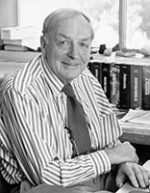
Professor Ross Taylor was born in Ashburton, New Zealand in 1925. He was educated at Wakanui Primary School and Ashburton High School. In 1948 he received a BSc and in 1951 an MSc Hons, both from the University of New Zealand. In 1954 he received a PhD from Indiana University. From there he went to Oxford University where he taught and worked with Louis Ahrens, setting up a spectrograph laboratory. In 1958, Professor Taylor took up an appointment as senior lecturer in geochemistry at the University of Cape Town, South Africa. In 1961, he moved to the Australian National University as senior fellow in geophysics. In 1962 he was appointed as a professorial fellow in the Research School of Earth Sciences, also at the Australian National University. In 1969 and 1970 Taylor was responsible for carrying out initial chemical analyses of lunar samples brought back to Earth by Apollo 11 and 12. Taylor's work with lunar samples led to his interest in the evolution of the Moon. More recently, he extended this interest in planetary origins to look at the evolution of the solar system.
Interviewed by Professor Bob Crompton in 2000.
Contents
- Introduction
- Taking off from a good background
- Building a chemistry base
- Applying trace element chemistry to geology
- Trace element emission spectroscopy, in a new laboratory
- Teaching and practising geochemistry, in a second new laboratory
- A university incensed
- Moving on to spark-source mass spectrometry, in the next new laboratory
- Conflicting theories about tektites
- How and where tektites originate
- What the 'seven blind men' might think of the continental crust
- Nature's grinding wheel and the andesite model
- The uniqueness of the Earth
- Prophetic words
- Preparing for lunar rocks to land in yet another new laboratory
- Handling the lunar samples
- Quarantine tales
- The geochemical evolution of the Moon
- An answer to how the Moon arose
- Having a go at the solar system
- Matters of honour
- The extreme age and fascination of meteorites
Introduction
Professor Ross Taylor is a New Zealander by birth. Having majored in both chemistry and geology, and completed an MSc at the Christchurch campus of the then University of New Zealand, he went on to the University of Indiana to take his PhD in geochemistry. He was then appointed to the staff at Oxford, and soon secured a tenured position. A more senior appointment lured him to the University of Cape Town, where, as in Oxford, he established a laboratory for the analysis of trace elements in rocks, using emission spectroscopy. He was also given the responsibility of establishing the Geochemistry Department at that university.
After some 10 years in the northern hemisphere, he headed closer to home again, having accepted John Jaeger's invitation to come to the ANU, where he remained until his retirement in 1990. Again it was his role to establish a laboratory for trace element analysis of minerals, first using emission spectroscopy but later spark-source mass spectroscopy.
Through his wide-ranging studies of the evolution of the Earth's continental crust and of lunar geology, Professor Taylor has become an internationally recognised and honoured expert in his field of geochemistry. An early high point was his work on the origin of tektites, to be followed by his highly acclaimed studies of the geology of the Moon. He was one of a team of 12 international scientists invited by NASA to make a preliminary analysis of lunar samples recovered by the Apollo 11 and 12 missions. This was followed by his appointment as a NASA principal investigator, and in that role a further 20 years' study of the composition of lunar rock samples. It culminated in his proposal of a model for the geochemical evolution of the Moon that remains to this day as the standard model.
His work goes on since his retirement, and we will hear more about that in this interview. His scientific achievements are published in over 200 papers and in seven books.
The international recognition of Professor Taylor's work includes a DSc from Oxford and election as a Foreign Associate of the US National Academy of Sciences. He is also an Honorary Fellow of the Royal Society of New Zealand, and the recipient of medals and awards from a number of learned societies. And above our heads circles an asteroid designated 5670 Rosstaylor, named in his honour.
In this interview we will follow his distinguished career from its beginnings in New Zealand right up to the present day, when he continues to make important contributions to the subjects which fascinate him.
Taking off from a good background
Ross, perhaps you would start by telling us how your family came to be in New Zealand, where you were born, and about your early childhood.
My grandfather emigrated from Northern Ireland to New Zealand as a boy of about 20. After goldmining and a few other adventures along the way, he set up a farm which is now in the fifth generation of the family. He had 13 children altogether, my father being the youngest. My father also became a farmer and so I was brought up on a farm, which was a very good, satisfactory background – very peaceful, and you learn the virtues of hard work.
My family insisted that my two brothers and I received a good education. My mother had been a primary school teacher and so she coaxed us along in school. We went to the small country school, which had about 40 pupils separated into two class groups of four years. The two teachers seemed to cope quite all right with this.
I believe you had a brush with appendicitis in those early years.
Yes, at the age of 10, I developed it very quickly overnight. The doctor came down from the local town on a house call, had a look at me and went away again, but then in response to calls by my mother he came again and took me in the back of his car up to the hospital. Those were the days before penicillin, and the appendix had already burst, so I was in trouble I didn't know about. Anyway, he operated and being a good doctor he managed to save me from 'another place'.
When you went on to high school, did any mentors particularly excite your interest in science, or was that almost a natural bent?
All the teachers at the local high school had Masters degrees from the university and the quality of the teaching was really very high: one received very good education in English and Latin, maths, and so on. Our Scottish chemistry teacher was very good and he taught us classical chemistry very effectively. I always liked chemistry, but I couldn't say I was particularly excited by that more than anything else. I did receive a science prize in the sixth form, however, which triggered me into doing science later.
During this time the Second World War was on, preoccupying almost everybody's attention. Like almost all of my contemporaries I was very keen to become a member of the Air Force – in retrospect, that was exceedingly dangerous. We were obviously seduced by the propaganda. I inherited a certain distrust of these large organisations from my father, who had been in the First World War. Having survived the disaster at Passchendaele, he had lost any faith he might have had previously in the British High Command's ability to conduct battles. But being so preoccupied I did enlist in the Air Force, even though the war was coming to an end – and my elder brother was an Air Force pilot, flying Sunderlands in the Atlantic.
Building a chemistry base
After that, it was on to the University of New Zealand.
Yes. I thought I had better do Science at the university. I'd never thought to do Arts but I had some inkling of doing Law. Fortunately, I chose to do chemistry.
In those days, it was just one university, wasn't it?
Yes, with several different campuses. I was at Canterbury University College, in Christchurch: a very interesting place, with about 2,000 students and a highly qualified academic staff for such a small university. One lecturer in particular was Karl Popper, a refugee from Vienna who somehow spent the war years in Christchurch – the University of London seized him after the war. I attended one or two of the lectures he used to give, and I regret not having heard more of them. Our geology professor, Professor Allen, was fascinated and became a friend of Popper's. He used to give us secondhand Popper in his lectures and I thought, 'This is what I've come to a university to find out about.'
The chemistry and physics were very well taught, very efficient, but geology fascinated me more, particularly perhaps because of this philosophical bent and also because it opened up the vista of the geological history of the planet, which I had not really known anything about. I'd always been interested in history (which I still read for pleasure and also as a reminder not repeat the mistakes of the past) and so this led me to major in geology as well as chemistry.
There were a couple of well-known physicists at the university, MacLeod and White. Could you tell us something about them?
Duncan MacLeod was the acting professor. He was famous because he had invented the MacLeod gauge. He was a very good lecturer but hopeless at doing mathematics on the blackboard. He always got it wrong, and all the students used to complain. Realising it was all in the textbook anyway, though, I used to take the textbook to the lecture and follow what he was talking about. His explanations of gas laws and wave theory were very high quality, and I learned a lot.
Professor Fred White had been snatched off during the war to CSIRO, in Sydney. His name was still on the door and his imminent return was eagerly awaited, like the Second Coming, but he never made it back.
Chemistry won out over geology for a while, I understand, because you went into a chem lab in a freezing works as a holiday job. Did you learn anything there?
Yes, indeed. There was a lot of pressure in the laboratory, which looked at the by-products from the freezing works, such as tallow and blood-and-bone. We were the central lab for half a dozen freezing works around New Zealand, and every morning, in the mail, samples came in. The rule was that the results went out at 4 o'clock in the afternoon, so I had to work quickly and accurately and to get the right answers. It was in great contrast to the usual dishevelled state of university laboratories, and I actually learned to do chemistry properly there. I worked at that, off and on, for a couple of years. It was a good training ground, good discipline.
Applying trace element chemistry to geology
Nevertheless, you went on to do an MSc in geology. Who was your mentor then?
This was Professor Allen, Popper's friend. It involved a large amount of field work and mapping large areas of unmapped country, and I learned a great deal about the difference between doing geology in the field and reading about it in the university. The thesis was titled 'The Geology of the Stonyhurst Area of North Canterbury'. One had to wander all over that hundred square miles – a very interesting area – mapping and unravelling the structure. One of my pieces of unfinished business is that I have never actually published the thesis.
It was very much straight geology, not geochemistry, wasn't it?
It was classical geological mapping, but very good training. In geology, sampling is always a problem. There are so many variables, so many possibilities in picking up samples. The Earth is so big, relative to what you can analyse in the laboratory, that you have to be very careful in the selection of samples and to have almost an intuitive field sense for what is critical, which many geologists develop as a result of this work. Looking at the country, you must be able to decide which area to get the sample from.
You went off after that to do a PhD in the United States. Where did you go, and why, and what did you do there?
After the Masters degree I wanted to get into university teaching. Research hadn't really come into it very much at that point. Looking around, I realised I needed to get a PhD. The tradition was to go to England, usually to Cambridge, to do a DPhil, but I could see a lot of very good geology coming out of America. One of my former teachers from Christchurch was over there – he had been a PhD student with Goldschmidt, the founder of geochemistry, but because of the war he had left Norway for Sweden, eventually returning to New Zealand, where I met him. By this time he had gone to Indiana University as a professor. I wrote to him and he said, 'Well, why don't you come here? You can do a degree in geochemistry.' He suggested I do some work on trace elements, as they had a very good spectrographic laboratory set-up at Indiana. None of this was then available in New Zealand.
Chemistry interested me, but from the way that chemistry had been taught to us – it was a very cut-and-dried subject – everything seemed to be done and I could see very few new openings. And the field geology I had been doing was standard field geology that people had done for 100 years. Of course it's much easier to see all this in hindsight, but I had an intuitive feeling that it was better to go into new fields, and geochemistry was obviously opening up. So I went off to Indiana and learned how to operate spectrographs and do trace element analysis, which made sense by putting together the chemistry and the geology as geochemistry.
How old was the field of geochemistry, Ross, when you went to Indiana?
It started about 1930, with Goldschmidt working in Göttingen and subsequently in Oslo. The first textbook appeared in 1950, just a year before I got to Indiana. Then my first job as a graduate student was to proofread Brian Mason's new textbook, and I realised I was suddenly right up to date. I've always told my students subsequently to pick the right PhD supervisor, because without much effort you find yourself up at the cutting edge of the subject.
For my thesis I worked on the trace element chemistry of the Banks Peninsula volcanoes, immediately adjacent to Christchurch. I collected a whole set of samples and took them over to Indiana to work on the chemistry of them. Mainly that taught me the techniques: I thought I made rather more geological breakthroughs in my Masters degree thesis than in my doctorate thesis – which did get published, about 20 years later. But this was still trace element chemistry on geological materials, rather than geochemistry.
Trace element emission spectroscopy, in a new laboratory
After you graduated in 1954, you left Indiana for Oxford. Who influenced that?
Curiously, there was again an Oslo connection. Brian Mason went off to a museum job in New York, having recruited one of his friends to fill in for a couple of semesters at Indiana: Henrich Neuman, a mineralogist from Oslo – a very sophisticated, educated European, very nice to talk to. I was rather aghast when he suggested I should go to Oxford, which had Bill Wager, who amongst other things had almost got to the top of Mount Everest in 1933 and was a geologist, and Louis Ahrens, who was the leading expert (having just published a textbook) on trace element spectroscopy. This was obviously a glittering place to go to, and it was with some fear and trepidation that I wrote to Wager. I got a very nice letter back offering me a demonstratorship, like a junior lecturer job, there. I discovered subsequently that Neuman had written independently – you learn some of these things later on in life.
What was the mix – mostly lecturing, or some lecturing and some research?
It was a fairly heavy lecturing load, but at the same time Ahrens wanted a laboratory set up. He'd arrived there from MIT only a year or so before. My job was to set up their spectrograph (in a bare room) and get the laboratory properly organised and operating. The whole set-up was a bit primitive, but it worked. Hilger spectrographs were actually very good instruments. And so I had teaching, tutorials and running this lab, which had a lot of students through it. I was very busy.
In a way you were lucky to be thrown in at the deep end to teach, which is so necessary in an academic job, as well as to establish a laboratory, which was useful for your future career.
Well, yes. I wasn't married at the time, and so one just worked days, evenings, weekends. Actually, I needed a fair bit of time to do all these things.
After about 18 months in Oxford, you were offered a tenured post which you held for your remaining years there. It was a real feather in your cap, to get a tenured position so soon.
It was certainly very nice, and I left only with a great deal of regret. I still have a very soft spot for Oxford, and the tie I am wearing is the Geology Department tie.
Did you meet and marry Noel in Oxford?
Yes. She had come from West Australia and was doing a PhD with Dorothy Hodgkin, the organic crystallographer, on a very complicated organic crystal structure. In those days they had to go down to Teddington to run the stuff through the National Physical Laboratory's very primitive computers. Nowadays it's a routine thing, but then it called for a great deal of judgment: if you were not on the right track you wasted months. We were married in 1958, just before leaving Oxford.
Teaching and practising geochemistry, in a second new laboratory
Where next, and who was your link this time?
I went to Cape Town, where by then Louis Ahrens was a professor in the Chemistry Department. He was South African by birth and very much attached to the country. Cape Town is a beautiful place, if you exclude the politics, and he found the living there much more to his liking than in either MIT or Oxford. Ultimately, though, he might have been much better in the American scene, where he had real competition. He was arguably the leading geochemist in the younger generation, and South Africa was too much of a backwater for him. He was much too big a fish in that small pond; he should have stayed where the action was.
What were your responsibilities in Cape Town?
I moved into the Geology Department and, with a couple of assistants, set up a separate small Department of Geochemistry. We taught courses in geochemistry and again I set up a laboratory, around another Hilger spectrograph. Eventually we got new buildings and so on, which also kept me very busy for the next three years. Having developed the techniques of trace element analysis, I looked around for interesting projects to work on. I started to work on tektites and I was working on minerals as well – feldspars, particularly, and various rock types. And then there were students with their research projects. So there were a whole lot of things going on.
Were you now really beginning to use chemistry for geological purposes?
Yes. It was rather difficult getting good science data from these instruments, but once you had all the techniques straightened out you could look at some of the many geological problems. I enjoyed the fact that almost everything you looked at was new – nobody had done it before.
Once you have worked out the compositions, very accurately, what does the geochemistry then tell you about the geology?
Until you know the actual composition of the rocks, you have no idea where they or the material in them came from. As you delve into the history of rocks on the surface of the Earth, finally you discover that the elements in them have come through many cycles of repeated extractions from the interior of the Earth. You can then map all these things through trace element chemistry – and also with isotopic systems, which I never really got into but which tell you the ages. It just opens up an entirely new approach to the evolution of the Earth that had formed.
A university incensed
You were in South Africa in the late '50s, very early '60s. Political topics such as apartheid became prominent worldwide later on. Were they already to the fore in South Africa itself?
Yes, very much. The notorious Nationalist government, having got into power in 1948 by defeating Smuts, had set about implementing their policy of apartheid. One realised that the Boer War was still going on in South Africa – these, effectively, were the Boers. There was still a profound division between the English and the Afrikaners, to the extent that Cape Town was an English university whereas Stellenbosch, 30 miles away, was an Africaner university where Afrikaans was spoken, and there was almost no contact between the two. The government decided that there should be complete separation of the races and started carving up the multiracial districts in Cape Town and segregating people, incensing the university by saying it could not have black students any more.
Unlike many demonstrations in universities, this was the students and staff together, rather than the students against the staff, wasn't it?
Very much so, yes. Everybody was united on this. We had many protest meetings, and signed petitions, and every few months there was uproar about what the government was trying to do next. Eventually separate universities were set up for the coloured and then the black population. Everything was rigidly divided by race.
I thought this was a crazy situation. Many of the South Africans, having grown up with it, accepted it to some extent. However, I found more discussion on these matters at the University of Cape Town than in America, Oxford or Canberra. What constituted university freedom, what universities were supposed to be doing and the question of university independence were endlessly discussed, and pamphlets about them were written and distributed around. So there was a very active political environment, totally opposed to the government policy.
The university succeeded ultimately by various tricks: black students were allowed in under the grounds that there were no other facilities in the country where they could be taught particular subjects, and so on. One way and another, the university survived with probably a 10 per cent black population, until very recently.
One good thing about being in a university is that you are portable. I thought, 'Well, I don't really have to live in this community. I don't have to put up with this and I wouldn't want to bring up a family in this environment.' One could see disaster of some sort coming – within about five years, I thought, but curiously enough the country remained in that condition for the next 20 or more years.
Moving on to spark-source mass spectrometry, in the next new laboratory
Who drew you further south?
I received an offer from John Jaeger, who was setting up the Geophysics Department in physical sciences at the Australian National University and was interested in setting up trace element geochemistry. I had never met Jaeger, but he had offered a professorship in geochemistry to my mentor in Cape Town, Louis Ahrens, who after a lot of soul-searching had turned it down. I let it be known that I would be interested in coming here anyway, so then Jaeger offered me a job. I thought it was too good an offer to turn down – but I'd no sooner arrived here when I received an offer of a Readership in mineralogy at Oxford, one or two steps up from my old job, basically. I pondered for a long time before deciding to stay here.
Chewing the end of your pencil, no doubt! What were your first responsibilities here?
I set up another laboratory, with a spectrograph in it. Fortunately, as a student in Indiana I'd learnt the nuts and bolts of doing this, and by now I was used to it. But here, in 1961, it was easier because money was much more readily available, so I could buy the really fancy stuff. Where always I had struggled on with hand-to-mouth funding – a few hundred pounds a year – here I could buy the most expensive equipment. It was very nice to get the right stuff at last.
I worked on the spectrographs but we were reaching the end of what we could do with them. Their detection limits were only perhaps a part per million for many elements and there were a lot of elements we just couldn't reach. We needed some other technique. There were various options available, such as neutron activation, but then I discovered that spark-source mass spectrographs were being built in the solid-state electronics industry for trace element analyses of semiconductors and so on, and I decided we could adapt that instrument to do geological samples. They were not so very different.
I'm only used to gas mass spectrometers. How does a spark-source work?
In basic spectrographic analysis you have a direct-current arc and a powder; you ignite the sample and you look at the atomic spectra. In the spark-source, the sample is compressed into small electrodes and you use a 25 kV spark which erodes the sample and ionises the atoms. These then go into a mass spectrometer and you get a mass spectrum at the end. The one we had was a nice big double-focusing mass spectrograph, which used a photographic plate. You got the whole periodic table out on it in each photographic plate. For various reasons we could only really look at elements above about mass 80, but that was the area which was very interesting, the area we couldn't reach with other techniques. The lighter elements were mostly easy to reach by spectrographic techniques, X-ray fluorescence or various other techniques.
Just because they were more abundant?
Yes. These were less abundant elements, such as the rare earths, uranium, thorium, hafnium, tungsten – lots of nice elements which you can do a lot with geochemically, once you have established the precise analyses. I have brought with me four such plates: one from a lunar sample, one from a tektite, one from a sample from the deep crust, and one of loess, the windblown sediment of which the most famous example is the Yellow River regions in China – very thick deposits of windblown clay from the Ice Age. Together these give an average sample of the upper crust of the Earth, which is one of the things I was always looking for. My students mounted this little exhibit and gave it to me at my retirement. It remains one of my treasures.
Conflicting theories about tektites
At the ANU you pursued further your interest in tektites, didn't you?
Yes. I'd been rather an earthbound geologist until, when Harold Urey was on sabbatical leave at Oxford, he used to come over and talk to the Geology Department people at morning tea about the Moon and tektites and all sorts of other things. That triggered my interest.
Tektites are tiny glassy objects which you find scattered on the surface of the Earth. I have here one with a little flange on it and one looking like a teardrop. They result from localised meteorite or asteroid impacts and occur in only four or five localities,. The ones in Australia, for example, cover most of the country, as in most of Indonesia and a lot of South East Asia, so these so-called strewn fields of tektites are very widespread. But they are still localised.
I understand that there was quite a heated controversy on the origin of tektites. What were the two conflicting theories?
Harold Urey had at that time woken up interest in the Moon. His great contribution was to wake up interest in the chemistry of the solar system as opposed to its dynamics. So people started looking at tektites. There was no obvious source for those that were found, so the idea arose that they had perhaps been blasted off the Moon by, say, meteorite impact or perhaps volcanoes. Some people had even worked out which crater on the Moon they'd come from. Of course, if they were samples from the Moon, they would be of extraordinary interest. Anyway, an argument broke out whether tektites were from the Moon or from the Earth. People very rapidly split into two camps, and at some of the meetings we had some rather heated exchanges.
The advantage of the trace element spectrography was that you saw data for a lot of elements. I had done a lot of analyses of tektites, looking very carefully at them and comparing spectrographic plates of granite and basaltic lavas on the Earth with those of tektites, and they seemed to me to be very similar to terrestrial rocks. So in 1963, at the University of Pittsburgh – one of my first international meetings on tektites – I got up and gave my paper saying what I thought. And people said, 'Oh, you're in the terrestrial camp, are you?' I said, 'No, I'm just trying to understand where they come from.' One was put willy-nilly into this camp, and the lunar people then attacked one quite viciously, saying, 'These are perfectly reasonable samples from the Moon.' This controversy went on for several years, right up until the first Moon landing.
In 1969 I went to a meeting on tektites held by Corning Glass, who had research laboratories to study glasses. Tektites are extremely dry, with almost zero water content. This fascinated the glass chemists, because in industry it is very difficult to get the final water out of glass. At the end of the meeting Brian Mason – my PhD supervisor, who was there as chairman – said, 'Well, in about three months we're going to know the answer to this, so why don't we take a vote?' The vote was 50/50 for lunar versus terrestrial origin, and to this day I retain a residual distrust of people who voted for the lunar origin. But it was a very vicious scientific controversy, because obviously the stakes were quite high. I was a bit astounded to find myself in the middle of all this, because by about 1962 I had firmly come to the conclusion that they had to be terrestrial rocks.
How and where tektites originate
What is the origin of tektites, then? How do they come to be like they are?
Chemical analysis of the glass shows that they are basically sedimentary, basically shaly sandstones. Those in a small area in Europe, particularly, another area in America and one on the Ivory Coast turned out to be associated with a meteorite impact crater. Tektites from a crater in Germany are found in Czechoslovakia, two or three hundred kilometres away. They are the spray from the impact. As the meteorite hits, it explodes like a bomb, and molten sediment or soil or whatever from the crater is sprayed out, almost like water from a hose. The spray then solidifies into droplets which fall down.
The ones in Australia have come from above the equator, from somewhere (not yet located) in Cambodia. They have been thrown up above the atmosphere and then re-entered it at about five kilometres a second. The flanges which developed on them look just like the flanges of a spacecraft re-entering the atmosphere, and actually the same rather flat, saucer shape was used for the design of re-entry modules. There had been a lot of work on tektites, trying to answer how these things could have come in through the atmosphere at high velocity – which was one reason people said they come from the Moon.
There's no contamination from the material of the original meteorite?
There is a very small amount of it present, but so small as to be almost invisible. Because the meteorites are coming at probably 20 kilometres a second, the explosive energy is so high that the amount of contamination is really very low. It is even difficult to find it around obvious meteorite craters. Most of the energy goes into blowing the hole in the ground.
Does the composition of the rock in Cambodia tell you that our tektites originated there?
We know from the isotopic signature giving us the dates, and also because there are various streaks of tektites across Australia. In an area of West Australia the heavy tektites, above about 100 grams or so, lie in a line. Projected back, the lines would meet in Cambodia, or somewhere about the Ho Chi Minh Trail – very awkward places to find. And probably the crater has been filled in with sediment. It's about three-quarters of a million years old, and these craters vanish very quickly. A 90-kilometre crater at the mouth of Chesapeake Bay 34 million years ago produced tektites which finished up in Texas and Georgia, but the crater has totally vanished, filled in – only found by geophysical research.
Would you say the argument is over? Are the non-terrestrial people quiet now?
Well, somebody said that the people had to die off before the argument would subside. One of my friends and I had to write a paper about five years ago pointing out, with reference to another paper which had been published talking about a lunar origin, that the whole thing had been dead for 30 years. It tells you a lot about the human component in science.
What the 'seven blind men' might think of the continental crust
At about that time you began to work on the growth of the Earth's continental crust. Did you coin the term 'andesite model' for the outcome of that work?
Yes. In the way of these things, I became stuck with the label. Once I got this mass spectrograph running, we could analyse rare earth elements, for example. Then one of my friends – another Oslo person – turned up and said, 'Well, this is a beautiful looking instrument, a lovely toy. What are you going to do with it?' And there's a lot to be said for being given these pieces of advice.
At that point we were worrying about the chains of explosive volcanoes around the Pacific, the famous 'Ring of Fire'. There was again a famous controversy, this time over whether the continental crust had always been here and had just split apart, whether there had been originally a complete cover of granite around the Earth, or whether the thing had grown slowly through geological time. People were adopting absolutely poles-apart positions about continental drift versus unmoving continents.
It's a feature of studying natural history, I think. The problems are so large and so complicated, and the scale on which you have to look at them so big, that you can't easily arrive at the answer and so people divide into camps. The story of the seven Indian blind men examining the elephant – they each find some different part of the elephant – is a very good analogy for a lot of geological problems. As somebody said, what is revealed truth in Cambridge is only a bad joke in Oxford. I got interested in the continental crust for just such reasons.
Rather early in the game, we did some analyses of andesite volcanoes, which are beautiful symmetrical cones like Mount Fujiyama, and are very explosive, like Mount St Helens. They are named from the Andes, and the rock type of which they are made – andesite – is actually very close to the composition of the continental crust. At that time I was working also on the problem of establishing the composition of the crust, because it is very diverse, and this got me into trying to work out a sampling mechanism to look at the crust. One way would have been just to run about, collecting several hundred thousand samples and analysing them all, but there has to be an easier way around these problems.
Nature's grinding wheel and the andesite model
You have said that the key is in the sedimentary record.
Yes. It became clear that there were lots of sedimentary rocks – muds, shales, sandstones – sitting around because Nature has already done this work for you. It's eroded away the rocks, dumped them in the ocean and mixed them all up along the way, basically just as geochemists used to take rocks in the laboratory, grind them up and analyse them, but on a very large scale. So you can go out and pick up a shale or a sandstone and it is telling you something about where it came from, the history of this large area and so on. Traditionally in geochemistry, people worked on igneous rocks – basalt, lavas, granite, gneiss, relatively simple systems that people could understand. Sediments such as all this mud and sand were thought to be just rather messy and were not worked on very much. It turned out, though, that things like the rare earth elements were astonishingly uniform. You could pick up a shale in Australia, one in Europe and one in America, and they had identical patterns in them.
Nature was doing the sampling for you, providing a mechanism so you could go beyond the detailed sampling to some overall average. You could get a handle on what the crust was made of and then you could say, 'Well, what's making it?' When you looked around, here were these nice volcanoes pushing this stuff up out of the mantle with about the right composition. And this is how the andesite model arose.
So Nature has provided the grinding wheel which you yourself don't then have to use. Is andesite very similar in composition to the sedimentary rocks?
There are similarities, yes. It became apparent that the stuff coming out of the volcanoes is effectively made into the crust, but then you get a lot of melting within the crust itself, usually from the amount of radioactive elements in it and probably also because of lavas coming up underneath it. Then granites tend to form.
To a non-geologist the crust is almost something you can see. What is the thickness of the crust you're talking about?
The continental crust is 40 kilometres thick. The oceanic crust is only five kilometres thick: basaltic lava coming from the mid-ocean ridges, spreading out and diving down at the ocean deep, back into the mantle. Part of that gets remelted on the way, and this is where the andesite comes from. Then that remelts again within the crust. Typically, if you go out and sample the upper crust you come out with granite, which is another stage more evolved than this andesite. But the whole crust together is an andesite composition, fractionated into an upper and lower crust. This andesite model has survived ups and downs over the years, and is actually in fairly good shape.
The uniqueness of the Earth
Does that model also apply to other planets?
No. This is the interesting thing about the Earth in comparison with the other planetary surfaces. Of the rocky planets, Mercury may be similar (we don't know much about it) but Mars and Venus are typically covered with basaltic lava. Basaltic lavas are what you get in a rocky planet when the mantle starts melting – due to heat from radioactivity, say. In the case of Venus, basaltic lava has covered the planet, and Mars is pretty well covered with it as well. On the Earth, the reason why the lava comes up along the mid-ocean ridges, travels along on this conveyor belt and dives back down into the mantle, getting recycled to produce the continental crust, is probably the water content. Without that we could have been stuck with barren plains of basalt everywhere – no continents, no ore deposits, and so on.
So this mechanism of recycling depends on water content rather than the physical size of the planet. But why would we have more water?
It's one of those chance events. We are just lucky to have it. Mars's very small amount was lost; it has a little bit of water but not enough. Either Venus never had it or it boiled away in an early greenhouse. We don't have very much water, in fact – only about 500 parts per million in the bulk Earth. As somebody says, it's so small we could ignore it to a first approximation except that we're here because of it. It is what makes the Earth unique. The continental crust of the Earth and granite are probably unique in the solar system.
For such a degree of uniqueness to be just chance sounds a bit unlikely. It must be connected, surely, with the size or with the origin of the solar system.
This would perhaps be viable, except that we have Venus as the twin planet – the same size, same density. To a first order, the Earth and Venus are the same planet. And yet they are wildly different, as different as Dr Jekyll and Mr Hyde.
This is proximity to the sun, then, is it?
Slightly, but not really. It's just that Venus has a thick atmosphere of carbon dioxide so it acts as a hot-house. The surface temperature is something like 470º centigrade, and if it had oceans earlier on, the water boiled away. (There may not have been water, of course. That's another argument we have.) I'm not really an atmospherics expert, but probably the primitive atmosphere on the Earth was lost through large collisions, during one of which the Earth melted and the Moon formed.
Prophetic words
In 1967 you took another period of study leave, this time at the University of California, San Diego. There you met Urey for the second time and he said some prophetic words to you, didn't he?
Yes. It was Harold who had got me interested in tektites. He was a very authoritative person, a homespun philosopher in the great American tradition who loved to give advice to younger people. In his deep voice he used to say, 'I'm just a simple country boy from Indiana, but it seems to me…' He told me, 'Ross, you must always work in important problems' – great advice, if you can identify which problems are important.
Harold was the person who persuaded NASA to go to the Moon. He was a formidable figure. He had a Nobel Prize for discovering deuterium and had worked on the atom bomb during the war as a physical chemist. Afterwards, deciding that he was too far out of touch with physical chemistry, he looked around for something else to work on and discovered the Moon and meteorites. Somebody said he had a love affair with the Moon. He continually talked about it and explained that it was a primitive object: if we went to it we would discover how the solar system was formed. He had sufficient clout to be on all the NASA committees, and using his personality and reputation he persuaded NASA, in effect, that they should mount a mission to the Moon.
The Moon turned out not to be quite what Harold thought it was. That disappointed him greatly, but it did teach us a great deal about the origin of the solar system.
Preparing for lunar rocks to land in yet another new laboratory
About two years after those prophetic words, you became involved with the lunar missions. How did that come about?
There's lots of serendipity and chance in people's careers. I guess a couple of things came together. Some years previously, Louis Ahrens had asked me to be a co-author on a second edition of his book on spectrographic analysis. I had jumped at such an incredible opportunity for a young person and so I became known as someone who knew about spectrographic analysis. The other thing was my interest in tektites.
On a Christmas card, I think, I told my friend Robin Brett (who had come from Adelaide and was with the US Geological Survey) that I was going to the March 1969 conference on tektites – the one where they took the vote. Robin said, 'I'm now down in Houston, where NASA have taken me on as the chief of the geochemistry branch. We are getting ready for the lunar sample return. Why don't you come and see what we're up to? You can easily come by Houston on your trip.' So I went, and he arranged for me to stay there for about a month.
One day, one of the NASA chiefs called me into his office and talked about the spectrographic laboratory which was being built to receive the lunar samples. I had seen it and talked to the people there, and I knew they were in trouble. Typically of the American system, NASA had subcontracted the running of the laboratory to Brown & Root, a big construction company which had dug some of the Snowy Mountain tunnels – a very efficient company at tunnel digging. They had hired a bunch of technicians to run the spectrograph, but these poor people had no idea how to analyse rocks, because it was a real art. Obviously, Robin Brett had Machiavellian plans when he invited me to Houston, because there I was asked would I run the laboratory for the lunar mission.
So I had to call my wife and tell her about this. She had been expecting me to be home in a month, and we were halfway through building a house. We had just got the walls up when I left. Being a scientist herself, she understood and said, 'Of course you have to stay.' So I settled down with about three months to prepare for the lunar samples, and when I did come home she had finished the house.
What did you have in Houston in the beginning – just the instrument and the building?
Yes. These people had got the instrument operating, but that was all there was. There were no standards. In that business you needed calibration standards very similar to what you were analysing because of various matrix effects. The ideal standard was one which had an identical composition to the sample – and as you deviated from that, you got into increasing trouble. So if you were trying to analyse a limestone using a granite as standard you got wildly erroneous results.
And so you had to have a stab at what the Moon was going to be.
I got together all sorts of standards and things, all the little bits and pieces that make a laboratory run, including some which my very good assistant here sent me from our lab. A lot of these scientific things turn on what appears to be trivia – the sort of mortars you use or the way you mix the samples. We had to mix in internal standards and there were whole problems with mixing procedures, and all the detail. This is what makes the difference, but it is hardly ever written down. I got the lab into shape just as we got the first samples. I was running on about three hours' sleep a night, so it was useful to have developed stamina by growing up on a farm.
Handling the lunar samples
It must have been very exciting for you, Ross, to see the first lunar samples come in and start work on them.
One of the ironic things when I got to look at the first samples was that the bitter controversy about the origin of tektites added to my fascination to see actually what turned up.
I suppose you had to get information quickly to the press and make sure that what you were telling them was the truth. Doing such precise science under pressure isn't easy.
It was even worse than I expected. We thought we were in fairly good shape for the first samples, which we got in at about noon. It takes only a few minutes to run a sample on the spectrograph; then you have to develop the plates, dry them, look at them on the densitometer, and examine the spectra against wave-length standards and so on to see which lines are present. We did that – and I realised there was something rather fishy with the results. The samples had been extraordinarily difficult to handle. The spectra were very complicated because the samples had about 20 per cent iron, for which the atomic spectra are hundreds of lines. They also had a lot of chromium, a lot of titanium, all these transition elements with lots of atomic spectral lines. We had to fight our way through a real forest of stuff, looking for interferences and so on. And these concentrations were much more than what we were used to looking at in terrestrial rocks.
Are these mass spectra or emission spectra?
These are emission spectra, for which, between about 2,000 and about 10,000 Ångströms, there are 100,000 potential lines. So you needed good dispersion instruments and good knowhow, to see that you weren't being fooled. Clearly something was wrong, and then I realised there was a weak chromium interference on our internal standard line, which was crucial for all of the data. So we had to rapidly find another internal standard line and recalibrate everything. People were hammering at the door, with their hand out for the results, and we were in the midst of this crisis in the lab. You had to know exactly what to do and to do it very quickly.
I'd had by this stage about 15 years' experience in the business, so I realised what the trouble was. You could tell you had an interference. You looked for another chromium line about the same intensity somewhere near, and if that was showing, then you knew you had the interference. The nice thing about spectrographic analyses is that you could be absolutely certain what you were dealing with, and you could say whether elements were present or absent.
Finally, at about 4 o'clock in the afternoon, Robin Brett, who was waiting for the data, ran off and gave it to the press. But even as I was giving it to him, I said, 'No, stop. I don't like the sodium value.' I went back, did a five-minute recalibration and looked at it: 'No, it's not 2½ per cent, it's half a per cent sodium,' which was the right answer. And so the first results appeared in the papers. One's whole professional career was riding on not making any mistake with those samples.
Quarantine tales
I'd like to read an extract from a speech which was given by John A Wood, who had made the case for your presentation of the Leonard Medal in Dublin in July 1998.
I should say that John Wood is a very distinguished geophysicist, an author of books on the origin of the solar system, a very good friend of mine at that fortuitous time.
He told this story when he was introducing you for the presentation:
'Those were exhilarating times in the Apollo program, and also bizarre times. Samples from the first three missions had to be opened in a sealed glovebox to protect the world from infection by hypothetical lunar microbes. One of the gloves in the box tore while Ross was working near it, theoretically exposing everyone in the room to deadly lunar pathogens. Protocol was that everyone exposed to lunar germs had to be put into quarantine for two weeks.
'However, the quarantine officer on duty was Robin Brett. Robin told Ross he was going to have to sound the spill alarm, but he would delay doing so for a short time so Ross would have a chance to escape the room before the quarantine was imposed. Egress was through the men's room, and as Ross was on his way out through it the quarantine police, suited up in bio-isolation garments, were on their way in. If they encountered Ross, the game was up, but Ross was way ahead of them. As a thoughtful student of military history, he had made a contingency plan to cover a situation like this. He rushed into a small compartment that was near at hand, closed the door, and hid until the quarantine police had stormed past.'
Is that true or false, Ross?
It's reasonably true, although it improves with every telling, particularly by Robin Brett. But I should take the opportunity to assure everybody I didn't put the world at risk due to this exposure to lunar germs.
This was the Apollo 12 mission, three months after the first mission, Apollo 11. There were bizarre features of working under these circumstances, and it was very difficult. Whenever they had spill alarms – sometimes hourly – you had to put on a gas mask until they decided that the alarm was false. (Doing analytical work in a gas mask has to be experienced!) The quarantine officials had masks of very superior quality which were not issued to the ones 'in the trenches'. They had to come by, of course, and tell you what to do, but there was no way they could be heard, so they had to take the mask off to tell you what to do and then put it back on again.
The quarantine had been breached, however, on the initial sample return. When the capsule landed in the ocean, they came with the helicopter, put a flotation ring around the capsule and opened it. They got the astronauts out, took them by helicopter to the deck of the aircraft carrier, and put them in a sealed caravan which was then flown to Houston, because they were worried lest the capsule sink or something. The safety of the astronauts overrode everything else.
The problem was that the lunar dust was extremely dry, so the static charge was very high and the dust stuck to everything – you could take a vial of lunar dust, turn it upside down and it would stay in the vial. The astronauts' clothes were coated with it, the inside of the capsule was coated with it, and as they opened the capsule, the whole Pacific Ocean was exposed to lunar soil. At that point the quarantine already had gone. What we were putting up with was, effectively, a public relations exercise, as was widely understood in the laboratory.
The geochemical evolution of the Moon
You remained a consultant for NASA for 20 years, didn't you?
Yes, as what they called a principal investigator. NASA were very good about issuing lunar samples. They decided very early that the samples would be available to anybody in the world who was sufficiently qualified and applied to work on them. There were two or three hundred principal investigators at various times working on the samples – the distribution of them is almost a reflection of gross national product. NASA have about 800 lbs of samples from Apollo 11, 12, 14, 15, 16 and 17, and a lot of it even now has not been looked at. About half has been put into storage for future work and so on.
There were lots of different samples, but they fall into two basic types. The dark areas on the Moon which make the pictures of the Man in the Moon are lava flows on the surface, mostly filling hollows excavated by large impacts. The white areas are basically a very thick crust, anywhere between 60 and 100 kilometres thick and mostly of feldspar, which is a very unusual composition. This answered another puzzle about the Moon, because on terrestrial analogues people thought these white areas were probably something like granite. We learned that terrestrial analogues were very dangerous: everything in the Moon is a bit different.
I think much of your work on the evolution of the Moon after its creation arose from your study leave at Houston in 1973-74.
Yes. The chemistry of the samples was very complicated. They had lots of strange features relative to terrestrial chemistry: in the lavas there was lots more iron, chromium, titanium and so on, and the highland (white-crust) samples, were mostly feldspar, but in the crust there were also very high concentrations of elements such as thorium and uranium. All this was a great puzzle, because nothing fitted anybody's previous ideas about how the Moon had been formed. Certainly it wasn't a primitive object; it was obviously a very fractionated object, unlike what Harold Urey had wanted. So everyone was busy analysing, and producing endless amounts of data – we had thousands of pages of papers dealing with analytical details of the Moon, but no broad overview. The director of the Lunar and Planetary Institute at Houston asked me to try to make some sense of it all, and so I sat down at Houston for a year and tried to work out exactly what all this stuff meant: how the Moon had come to have a thick crust of feldspar, how these lava flows had come into existence and so on. And I produced a model of its geochemical evolution.
We soon realised you had to start with a completely molten Moon, which was a very strange, worrying thing – how did you melt it? Then, having melted it, you went through a crystallisation sequence: you started forming minerals like olivine, which sank to the bottom, and feldspar, which floated to the top. And you did a gigantic differentiation of a fractionation moon, so you finished up with a crust like icebergs of feldspar, floating on a liquid which then slowly crystallised underneath. From that, subsequently, a little bit of radioactive heating in it produced lava which came out and flooded over the top of the white crust, producing the dark markings on the Moon. That's pretty much the standard model now, but like all these things it survives intense amounts of criticism – from some of my nearest colleagues, actually.
An answer to how the Moon arose
If that model depends on an initial molten state for the Moon, what is your theory of its origin?
This was a great puzzle. We continued working for another 10 years or so on the details and examining this model of evolution. To this day people still produce large amounts of data from the lunar samples, but by 1984 people began to say, 'This is all very well, but how did the Moon arise? Now you know what it's made of and what happened to it, what's it doing there?' The Moon is unique in the inner solar system. Mars has two tiny moons, Mercury doesn't have one at all, Venus doesn't have one. What is the Moon doing there, how did it get there and why is it different in density from the Earth? (It is about half the density of the Earth.) This is a classical problem known from at least the 19th century: how do you get two bodies close together differing in density by a factor of two? Everyone had a model to make, but none of these models worked and survived the funny chemistry we began to find.
Did the fact that the chemistry was so different trigger the unseating of some of the earlier models?
That was one of the triggers. Another was supplied by Al Cameron, a nuclear physicist who had come up with a model for the nuclear synthesis, the elements, at the same time as Burbidge, Burbidge, Fowler and Hoyle had produced their papers. Cameron worked it out when he was in Canada with the Atomic Energy Commission, and he possibly should have had a Nobel Prize as well as Willy Fowler. He said that because the Earth–Moon system is spinning very rapidly, you have to hit it with something very big, the size of Mars, to produce the angle of momentum of the system. Because there were so many ideas floating around, we thought we'd better have a conference – as you do when you have an insoluble problem.
The next question was where the conference should be held. An old version of the origin of the Moon is that it came out of the Pacific Ocean. In fact, a paper in Nature in 1881 said that it is perfectly obvious: there's a big hole where the Pacific Ocean is and there's a ring of volcanoes around it where the Earth is still trying to 'heal' itself from this event, so somehow the Moon spun out of there. We thought if we had a conference in Hawaii, in the middle of the Pacific Ocean, we might get some special insight. And it certainly worked – Cameron's model became the only model in town. His idea took a lot of swallowing, but then it produced desirable effects. It melted the Earth and it produced your molten Moon.
Was it fully molten?
Yes. There still were some arguments because some people would like it half-molten, but it's almost certainly been fully molten. It has even been fairly well established now that there is a tiny iron core in the Moon – not very big, about three or four per cent of the Moon. So in Cameron's model you hit the Earth with something the size of Mars, at a glancing angle, and what spins out into orbit is not bits from the Earth but bits from most of the impactor. (Some of it falls back on the Earth.) The iron core of this body, however, rams back into the Earth. You're left with a ring of silicate debris out in orbit, from which the Moon is collected and forms rather quickly. This explains how you get a Moon which is essentially rock, low density, sitting along with the Earth, which has a large iron core and a high density.
All this gathers, under gravity, in less than a day, while everything is still at very high temperature – which explains why the Moon is bone-dry. We can't find a trace of water on the Moon at all. And it explains another strange thing about its chemistry: it is depleted not only in water but also in elements like lead, thallium, bismuth, which are volatile at about 1,000º centigrade. These too have gone, leaving the Moon composed of rather refractory materials.
All the rest just boiled away?
Yes. So you need a high-temperature event, which Cameron supplied with his model, but the dynamical problems are still being argued about.
Having a go at the solar system
Back in Australia you continued to work on the continental crust, and about five years before you retired you decided to extend your work to the evolution of the other planets. What set you on this new tack?
Well, as one gets close to retirement the options are to continue working as you did when you were post-doc, or to take some broader view of things, to try to arrive at some overall answer – although that is a well-known trap and one has to be careful in these matters. I wrote to the director of the Lunar and Planetary Institute in Houston, suggesting that I come there again on sabbatical and work on another book, using their very good facilities for producing books. He said, 'Yes, you can certainly come here and do that, but you're not allowed to write another book about the Moon.' In order, then, to do something a bit different, I thought somewhat brashly that I would have a go at the solar system. By this time we had a lot more data from the Pioneer and Voyager missions to the outer planets – a vast amount of data not only from the Moon but from Jupiter, Saturn, Uranus, Neptune and the satellites and so on. I started to try to put all this together, and found that the solar system seemed to be a very untidy place. For example, although the planets were more or less in circular orbits, they all rotated at different speeds, they were tilted at different angles, none of the satellites looked like one another.
I came to the view that chance events in the shape of large impacts and so on during the formation of the system had been the dominating influence. Chance became the theme of the book, eventually – that the solar system was not something you produced by sitting down with a large enough computer and putting all the physics and chemistry constants into it, but rather there were very many chance events intervening. You had random events, like the origin of the Moon, which were unpredictable, and such strange things as Venus rotating very slowly backwards (it takes 243 days for one rotation), and Uranus lying on its side, with its rings of satellites in equatorial orbit around it. And, later on, new planets were discovered which didn't bear any resemblance to our present system.
My view was quite well received, and a number of astronomers told me that they liked the book. I was very pleased to hear this, because stepping out into areas where one has very little expertise could be quite dangerous.
You have a lot of expertise, I would say. I think you now have seven books altogether, in addition to 225 or more papers.
Yes. This is one of the advantages of working at the Australian National University at the time I was there, when one was hired to do research. I always took this rather seriously. Having been in teaching departments, and seeing the problems that my friends have in other universities – with students and most of the time taken up with other matters – I recognised this as a wonderful opportunity to work.
The first book was on spectrochemical analysis, with Louis Ahrens. Then I wrote a small one, just after the Apollo missions, and one at Houston in 1975, explaining my model for lunar evolution. I did another edition of that and then I worked with one of my students to write a book on the continental crust – its chemistry and the chemistry of the sediments. That book is constantly referred to. (I have learned that you must put lots of data into books if you want people to refer to them.)
Then I wrote a book on the solar system and I am now working on its second edition. A couple of years ago I wrote a more popular book called Destiny or Chance, which was about whether the solar system arose by a series of chance events or was a pre-ordained thing you could just pull out of some computer program. Unfortunately, perhaps, the more I think about that, the larger the number of chance events I think there have been.
On your retirement there was the Taylor Colloquium on the differences and similarities between the planets of the solar system.
Yes, and also on planetary crusts, the continental crust and so on. I have kept one foot on the Earth and one on the Moon!
Matters of honour
In recognition of your contributions to geochemistry and geology you have been given a number of prizes and awards, including the Goldschmidt Medal of the Geochemical Society of America and, in 1988, the Leonard Medal of the Meteoritical Society. Whether John Wood is your friend or foe I'm not sure, in view of the two stories he told in the citation for that award. The second of those related to a keynote talk you were asked to give at a plenary session of one of the earliest lunar science conferences. Wood told in agonising detail how Robin Brett, expecting you to be easily flustered when you spoke, arranged for you to be tricked into thinking an attractive young woman was about to climb onto the stage and, as you were beginning to talk, unbutton her trenchcoat and 'flash' you.
As Wood put it, 'What would Ross do? We don't give Leonard Medals to people who couldn't handle such a situation. Ross just said, "First slide, please," and the room was plunged into darkness.'
That's a true story. I thought there had to be some way to handle this problem.
In addition to being a Fellow of this Academy, you are an Honorary Fellow of the Royal Society of New Zealand and – perhaps the greatest honour of all – in 1994 you were elected as a Foreign Associate of the US National Academy of Sciences. That is a high honour, not given to many Australians.
About 15, I think. It came totally out of the blue. I was really astounded by it.
Another honour came your way in 1997, when an asteroid was named after you: 5670 Rosstaylor. The citation says it is equal to 1985 VF2. What do all those names for one asteroid mean?
The asteroids are numbered in sequence of discovery, No. 1 being Ceres, discovered in 1801. About 12,000 have now been discovered. They are assigned a number when the orbital elements are sufficiently well established so that the asteroid can be recovered. The man who found Ceres lost it again, and it was recovered by Olbers, who was famous for his paradox: why is the sky dark at night? This asteroid is No. 5670 in sequence of discovery, and it was picked up in 1985 by Gene Shoemaker. It is about 30 kilometres in diameter. The shape is not too clear at the moment, but Gene Shoemaker said its surface area is big enough for a decent sized New South Wales sheep station, if only you could get the sheep there. It is sitting at about three astronomical units from the Earth in a moderately eccentric orbit – which I find slightly amusing.
Gene Shoemaker and his wife were asteroid and cometary discoverers. Gene was a geologist, responsible basically for establishing the meteoritic origin of large-impact craters on the Earth. (There were very large arguments about that when I was a student.) By about 1960 Gene had decided that the big crater in Arizona, for example, was formed by an impact of a meteorite and not some kind of internal explosion of the Earth. He then established the principles for geological mapping of the Moon and so on. Tragically, though, only a couple of months after this he was killed in a car accident out in West Australia, where he was looking at meteorite craters – for the past dozen years or so, with his wife, he had done a lot of mapping in the outback in Australia, amongst a host of other activities. His loss was irreparable.
The extreme age and fascination of meteorites
You have also an interest in meteorites, I believe.
Yes. At one point I was President of the Meteoritical Society. Meteorites, which come from the asteroid belt, are of great interest as the oldest objects we can get our hands on in the solar system. Mostly, meteorites are broken-off bits of asteroids, and a number of them have iron cores. I have with me one which is a mixture of an iron core and rocky, olivine crystals from the mantle of a small body which had formed like a very small-scale analogue to the Earth. These date right back to the beginning of the solar system, having formed within, probably, three or four million years of the beginning of the solar system. So the great fascination of meteorites is their extreme age. They tell us about events. There's a great gap on the Earth of another 500 or so million years before we find any rocks at all. We find rocks on the Moon filling that gap back to within perhaps 100 million years of the formation of the system, which makes the Moon very useful.
That piece has really large pieces of iron right throughout it.
Some of the iron meteorites are extremely massive pieces, and what's nice about this one is that it has the mixture with the olivine crystals. These are probably the most spectacular meteorites. When a meteorite hits, explodes and blows the crater, its main mass vaporises. But bits are blown off the meteorite or bits come off it as it comes through the atmosphere, and so there are usually lots of bits of meteorite scattered around the craters. This piece is from a small crater, probably less than the size of this building, in the middle of Kansas.
Ross, you've had a very prolific and extremely interesting career. Thank you very much for sharing some of it with us.
Well, it's interesting to think of the areas you find yourself working on. Just being led from one area into the next, just following your nose, you can finish up in the middle of the solar system.
Professor Peter Bishop (1917-2012), visual neurophysiologist
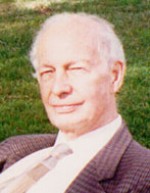
Professor Peter Bishop was born in 1917 in Tamworth, New South Wales. He received a BMBS (Bachelor of Medicine, Bachelor of Surgery) from the University of Sydney in 1940. He served in the Navy during World War II then went to England where he began his work in neurophysiology. In 1950 he returned to the University of Sydney where he continued his work on the electrical stimulation of the optic nerve. He became Professor of Physiology in 1955. In the 1960s Bishop began studies into how an eye forms an image, and he and his colleagues developed a mathematical model of the visual system of a cat. He became interested in the ability of people to see in three dimensions, and found that nerve impulses from the two eyes go back to the same cell in the brain. Bishop was Professor and Head of the Department of Physiology in the John Curtin School of Medical Research at the Australian National University between 1967 and 1982. Peter Bishop passed away in June 2012.
Interviewed by Dr Max Blythe in 1996.
Contents
- Going to school
- A medical student in the family
- An awakening interest in neuroanatomy
- Marriage and a naval episode
- To England on a postgraduate fellowship
- Beginning in clinical neurology
- A close encounter with neurophysiology
- Applications and referrals
- A first neurophysiology project
- What to study next
- Researching in Australia, with student assistance
- Professor of Physiology
- The neurophysiology of vision
- Studying visual discrimination and stereopsis
- Interpreting the visual system and hence the brain itself
- Technical contributions to research
- Spatial frequency
- A life's work
- Beyond the bench experiments
- Looking back, looking forward
Going to school
You were born in Tamworth, New South Wales, in 1917, into a fascinating family with interesting roots. Would you like to tell me about your early life?
I was the second eldest of five in the family. I don't remember anything of Tamworth but I remember going to the local state school in Waratah. When I was seven my father became district surveyor in Armidale and so we moved there. I went to the demonstration school (the primary school) in Armidale, where I had to spend an extra year, in year 7, to avoid being in the same class as my elder brother. After that I went to the Armidale High School and subsequently to Barker College from '32 to '34.
You made a brave trip coming down to Barker all alone, very independent.
Armidale is about 360 miles north of Sydney. I was 14 when I went to the boarding school, travelling down on the train on my own to Hornsby and carrying my bag from the station to Barker College. Hornsby is an outlying suburb of Sydney. 1932 was at the height of the Depression so the school was very small – only 78 students. The schooling that I had was not very good and I sat for the leaving certificate twice to get a Commonwealth scholarship. My family couldn't afford to send me to university unless I got a Commonwealth scholarship but after an extra year at Barker College I gained the award of an Exhibition, as they were called.
A medical student in the family
Let's talk about that family that couldn't afford to send you to university without an Exhibition, and about your background.
My grandfather, Herbert Orlebar Bishop, came out to Australia in 1870. He got a job in Queensland as a line repairer, repairing the telegraph wires. Subsequently, working for the postal service, he went to places like Cunnamulla, which is a long way west of Brisbane, and Port Douglas, way up north in Queensland. So my father, who was born in 1877, had virtually no schooling at all until, at the age of 12, he went down to the state school at Yeppoon, near Rockhampton. Subsequently he went to Toowoomba Grammar School, but he never had any real education. He had an apprentice type training for entry into the New South Wales Lands Department.
But he was anxious for you to get a good education.
My father was very helpful. But after the age of 14 when I went down to Barker College I saw very little of my family. I think my mother had the bigger influence on me, though.
She pushed you towards medicine when you might have chosen another career?
Yes. Maths and physics were my best subjects and I wanted to do engineering, but my mother was keen for me to be a doctor. She had no idea of research work or of what one did at a university. She imagined that I was going to be a specialist in Macquarie Street. It didn't turn out that way, though.
An awakening interest in neuroanatomy
In 1935 I started off in medicine at Sydney University. Of the subjects at university, the only one that attracted me was not physiology but neuroanatomy. When I dissected a brain, holding it in my hand, I realised that this had belonged to a person who was just like me, had the same thoughts and feelings as I had, even though now it was just a lump of meat. That experience determined me to do something about finding out how the brain worked. From then on there was never any doubt that I would work somehow on the brain.
Towards the end of my medical course I wrote an article called 'The Nature of Consciousness', which had an important influence. It was published in the Sydney University Medical Journal and it drew me to the attention of Dr Abbie and Professor Burkitt. I became very friendly with the people in the Department of Anatomy. I graduated in 1940. Incidentally, we graduated early because of the war, which had started in 1939. I was known to be interested in the brain and so when a position of resident medical officer in the neurosurgical unit came up, with many doctors now in the armed forces, I got the job. It was then that I became associated with Gilbert Phillips and with Sir Harold Dew, who was the Professor of Surgery and a founder of neurosurgery in Australia.
That began my work in neurosurgery. Incidentally, since neurosurgery was part of the neuropsychiatry block, I was also in charge of psychiatry.
What did you think of the medical course at Sydney?
Unfortunately, medical courses are not very inspiring to do, because there are so many subjects and you have to study them at a fairly elementary level. All you really learn during the medical course is how to use the terms. You really don't know much until after you've graduated and started working in hospitals. The anatomy department was my main interest as far as the medical course was concerned.
Would you say that nowhere was there any course or tutor to prepare you for what was actually to come? You did it alone, gripped by your own ideas and following your own intuition?
That's right, for my whole career.
Marriage and a naval episode
In surgery you met a rather special nurse.
Yes, Hilare Louise Holmes, who was a theatre nurse in the neurosurgical theatre. We met afterwards and frequently later on. We were married in February 1942. I had been called up to the Navy in January 1942, as a surgeon lieutenant, and so immediately after we were married I went to sea.
First of all I served on a cruiser, HMAS Adelaide, mostly in the Indian Ocean. Then I served on the destroyer Quiberon. I was with the Royal Navy then, in the Far Eastern fleet. We used to convoy ships from the Atlantic round the Cape and up to Mombasa. After about 18 months with the Quiberon I came back to Sydney and then went up to Madang, on the north coast of New Guinea.
During those war years at sea, your fascination with the brain continued and you kept a brain under your bunk, I think.
That's right. I found that time during the war very tedious, just convoys down the Atlantic and up in the Indian Ocean, so I did a lot of dissections of brains while I was still in the Navy.
So the brain was your field? You got to know the brain pretty well?
Extremely well, but that's all I really did know. I knew relatively little about the other parts of the body but I knew quite a lot about the structure of the brain – not too much about how the brain worked, though. That's quite a different thing.
To England on a postgraduate fellowship
You applied for a fellowship with a postgraduate medical group, but in the meantime you worked with Dew and Phillips.
I got a fellowship to study in Oxford under the neurosurgeon Sir Hugh Cairns, but I couldn't get back from Madang until about May 1946. Then, for a very short time, I was in Dew's department at Sydney University. With my wife and children we sailed for England in July 1946.
With two children by then, so you had your hands full.
By then we had two girls, aged two and a half and one. We went non-stop from Fremantle to Southampton. The men and women returning from service in the Far East were segregated in the ship. I slept in a 14-berth cabin and my wife had a cabin to herself because she had these two small children. When we got to Southampton, we had to get to Oxford. I had never been in London before and I thought I'd go across country, but that was a horrendous trip. The ship berthed at 10 o'clock in the morning and we didn't get to the hotel in Oxford until after 11 o'clock at night.
Beginning in clinical neurology
Cairns imagined that I was there to train in neurosurgery and he said to me that I should do a bit of clinical neurology first. So he arranged for me to go down to Queen's Square, and I became clinical clerk to Sir Charles Symonds.
Did you have time to get to know Cairns?
Not really. He and Lady Cairns seemed not too pleased about bringing two children as young as they were to Oxford, which was full of returning servicemen. We couldn't get suitable accommodation there and they seemed to feel that we were a bit of an imposition. Anyhow, we got a cottage high on the Downs, in Wiltshire. On the survey map it was called Bishop's Barn. I gather it may have been a tithe barn, possibly connected with the Bishop of Winchester, I presume, although I don't really know.
Once settled, you found yourself working at Queen's Square.
Yes, I had nine months at Queen's Square, an absolutely fascinating place. There were people I'd read about but never imagined I'd be associated with them. I was a clinical clerk, with the job of seeing the patients immediately they came in and writing up their history, so as to be ready to tell the honorary, Sir Charles Symonds, all about the history when he came. I learned a lot about clinical neurology.
Symonds would have been a rather prestigious figure.
Oh yes. A large crowd would follow his ward rounds.
A close encounter with neurophysiology
It was at Queen's Square that I met George Dawson. I went down into the basement one day and saw him working with electronic equipment to record EEGs, electroencephalograms, from the scalps of myoclonic patients. I asked if I could go in to watch what he was doing, and it wasn't long before he said, 'Well, why don't you be the patient?' He was trying to see whether it was possible to stimulate peripheral nerves and make extra-scalp EEG recordings. He had electrodes stimulating my ulna nerve at the elbow and wrist, and recording electrodes on my scalp. It got a bit painful.
George Dawson was a very remarkable person. He was one of the very early people doing electroencephalograph recordings in a clinical setting. He was interested in myoclonus because people with myoclonus have tremendous jerks, or muscle spasms, which cause big potentials in the brain that can be recorded from outside the skull. But my evoked potentials were sufficiently large to be recorded too. He was a specialist in averaging techniques. He would average a whole lot of cathode ray tube traces: of course, the more you average the more you build the trace up. But my recordings from the skull were sufficiently large that they didn't need averaging. It was the first time in the world that anyone had stimulated peripheral nerves and recorded from the scalp of normal subjects. When he wrote this up in 1947 he used the recordings from my scalp for his paper.
The influence of George Dawson was pretty seminal.
Absolutely. When I went in there to watch the experiment and then became the subject of the experiment, I realised that I wasn't cut out to be a neurosurgeon but that this was the sort of work I wanted to do. I could see then that this was a way of getting a lead on what the brain did. So I decided then not to go back to Cairns in Oxford but to do laboratory work.
Applications and referrals
I went and saw Professor Carmichael, who was the director of the research at Queen's Square, and asked him whether I could get a job possibly working with George Dawson. Carmichael asked me, 'How old are you?' I said I was 30. He asked, 'What research work have you done?' and when I said I had never done any, he said to me, 'I think it is rather late to be considering a research career at the age of 30.' He should have given me a job: I was being paid for from Sydney, so it wouldn't cost him a penny, and I was keen to work. Anyhow, he didn't see any way in which he could take me on.
He referred me to Lovett Evans, who was Professor of Physiology at University College, London. He was very nice and friendly but he said to me, 'You want to do neurophysiology, but I'm going to retire next year. Neurophysiology these days is all valves and electronics and I know nothing about that.' Because I told him that neurophysiology was what I wanted to do, not neuroanatomy, he told me to go and see J.Z. Young, who had just come down from Oxford to take the chair of anatomy at University College, London. So I duly went and saw J.Z. and he took me on immediately.
A first neurophysiology project
J.Z. Young gave me a big empty room up on the 4th floor of the anatomy building, which seemed to me to be part of A.V. Hill's biophysics research unit, and he suggested the project I should work on. Apparently he had read that you could train rabbits and get electroencephalographic changes in the brain as a result of the training, and he asked me to do something about confirming it. I was 30, I had an empty room, I knew nothing about electronics, and that was my project.
You started to do something about electronics, though, quite quickly.
Oh, yes. I obviously had to do something about it, so I went to Northampton Polytechnic three nights a week for two years to learn electronics. But of course I couldn't wait – I had to start building my equipment. Fortunately I had the help of Eric Harris, in the biophysics research unit, who used to come in each morning, spend half an hour or so with me and then whiz-off. He was remarkable. He was building a mass spectrometer, even making all his own valves. But unfortunately mass spectrometers became commercially available almost immediately after he got his instrument to work. I learnt a lot from him. In fact, as a result of all that I wrote seven papers about electronics, some in collaboration with Harris, and they were published in the leading journals. But I worked pretty damned hard, as you can imagine.
There was a bit of that engineering background coming out.
I suppose so. By that stage I'd realised that the project that J.Z. Young had set was beyond me and it was not very suitable, so I thought I'd use the rather primitive DC amplifier that I'd made to see if I could record potentials in the frog's tectum (mid brain). I started by introducing electrodes to try and see whether there are different steady potentials between the cellular layers in the optic tectum. But as soon as you damage the nervous system you get big potentials, and the big potentials I recorded were due largely to damage of the nervous system rather than the function of the optic tectum. Also, the electrodes I used were metallic, being steel electrodes, and you get big electrode potentials because of the difference in potential between the saline solution and the metal. Anyhow, that was a flop but it did enable me to start using the very primitive DC amplifier that I had developed.
What to study next
I was determined to go back to Sydney, but I thought that the hospital there would not be very thrilled if I worked on frogs so I had better work on a mammal. The mammal of choice is the cat or the monkey but very little work was being done then on monkeys. Because I'd worked on the tectum (which is concerned with vision) in the frog, I thought I would start working on the visual system in the cat. I looked up the literature to see what people were doing on the visual system in the cat and I found that at that time nearly all the neurophysiology work in the world was concerned with nervous conduction (conduction along nerves) and synaptic transmission (transmission through nuclei). There was virtually no systems physiology, looking at how the brain as a whole worked.
In the literature I looked at the work of two people, Bishop and O'Leary, who came from Washington University, St Louis. They were using electrical stimulation of the optic nerve. Their interest in the optic nerve was not how it worked in vision but rather what sort of nerves it contained, what their conduction velocities were, what their fibre diameters were.
So they were charting the properties of a mixed nerve?
That's right. Bishop and O'Leary were colleagues with Gasser and Erlanger, who had got the Nobel Prize just a couple of years before that, in 1944, for their work on the conduction in different fibres in a peripheral nerve in the frog. What Bishop and O'Leary were doing now was trying to see what different fibres there were in the optic nerve, which is the main nerve from the back of the eye into the brain. The optic nerve is a central tract, not a peripheral nerve, and this was the first study of conduction velocity in a central tract. So that's why I started using electrical stimulation of the optic nerve.
By that time I had developed the DC amplifier to a much more sophisticated level and I determined to keep on working on the amplifier design, and finally the paper was published in America in the Review of Scientific Instruments. But during this time, as well as publishing these papers about electronics, I did manage to do a bit of neurophysiology research. I worked on the synaptic transmission in the lateral geniculate nucleus, which is a way station between the optic nerve and the cerebral cortex, and the recordings that I made from the lateral geniculate nucleus using microelectrodes were subsequently published in the Proceedings of the Royal Society.
During the three years of your fellowship in London, you changed direction dramatically from what you went to do, yet no-one ever questioned that. You went your own way and did anything you wanted.
That's right. I was in London for nearly four years and I had this fellowship for the first three years. The postgraduate committee in Sydney had imagined that I was being trained as a neurosurgeon. I decided not to do that. Off my own bat, without referring it to the committee in Australia, I went to Lovett Evans and subsequently to J.Z. Young, and then I reported what I had done. And they accepted all this. They didn't query it, which is very surprising considering that I could have stayed in England all my life and never come back to Australia. They were very tolerant and sympathetic. I don't think that would ever happen now.
Researching in Australia, with student assistance
Towards the end of my time at University College, the National Health and Medical Research Council, in Australia, gave me £1000 to buy bits and pieces to bring back to Australia. When I came back to Australia early in 1950 I went into the Department of Surgery at the University of Sydney, because Sir Harold Dew had been one of my main mentors in getting the fellowship in the first place. He gave me four empty rooms and I started building everything all over again. I had brought some equipment from University College, London, but it was not much, mostly bits and pieces.
What happened then was very important. I realised that I would have to have people to help me. A new degree called the Bachelor of Science (Medical), BSc (Med), had just been introduced, in 1949. Arriving back in Australia I thought this was wonderful, and although I wasn't a member of the Faculty of Medicine I put up a proposition to the faculty that I could take some of these students. In the first year, 1950-51, I took four, and of course I had to work enormously hard to get some equipment made for these people to work on.
The first work that we did was the same electrical stimulation of the optic nerve as I'd been doing already in London, because it gave me the opportunity of studying the properties of the fibres in a central tract, which could be quite different from a peripheral nerve. Incidentally, one of those four students became a neurosurgeon and subsequently dean of the faculty.
One of the other students was working with me on a stereotaxic map of a particular part of the brain, namely the thalamus, using cadavers. As soon as bodies came in to the mortuary at the medical school, whenever they came in, even on Sunday, I would go in there. We'd take the bodies out, bore little holes in the skull and put needles through the brain. We'd x-ray the skull so that we could see where the needles were, and then perfuse the corpse with formalin to harden the brain. A day or two later we'd take the brain out, and we could locate the particular part of the brain because of where the needle holes were. We never published that. It was not as professionally done as it was subsequently in other parts of the world, but that was the first such work that was done anywhere in the world at that time.
You gave your new unit a rather impressive name.
Yes. Without asking anyone we simply put the name on the door: Brain Research Unit.
These students, who were doing this fourth year study for one year, for the Bachelor of Science (Medical), were a tremendous help to you.
That's right. They were a tremendous help to me. They worked very hard. I couldn't have done all this on my own. All this time too I had to build the equipment. I had a technician but I had to tell him a lot about the electronics.
You were soon publishing.
Oh yes. Every year from then on I was publishing something in international journals, mostly in the Journal of Neurophysiology, an American journal. Nearly all the work I did for the first four or five years after I came back concerned electrical stimulation experiments of the optic nerve.
And you were looking at signals in the geniculate nucleus and charting that in a more and more refined way. Then you got promoted and everything changed.
Professor of Physiology
I had become a senior lecturer in 1951, and then in 1954 I became Professor of Physiology, beginning work as head of the department in 1955. That was a tremendous change for me. Administration never worried me but I had a tremendous teaching load to cope with. The department consisted only of myself and two others, and about 800 students. We had courses in the Faculty of Medicine, Faculty of Dentistry, Faculty of Science, Faculty of Veterinary Science. We had courses for physiotherapy, speech therapy, occupational therapy and all the different postgraduate courses – diploma of dermatology, obstetrics and gynaecology and so on.
Being responsible for all these courses, and with just two other academic staff members, I engaged a lot of fairly recent graduates who were starting out in medical practice. We had a large number of them as part-timers. At the beginning, there were over 200 students in the second year of the medical course, quite apart from all the other students, and every year after that another 100 students were added. At one stage I had 620 students in the second year of the Faculty of Medicine and about 400 in third year, as well as students in dentistry and all the other courses. We finished up in about 1962 having 1500 students doing physiology. I still did my research work but I had to do it at a somewhat reduced level than before.
You were concentrating still on these Bachelor of Science (Medical) people but you started to appoint research fellows as well.
In 1952 I had two research fellows. One was Jim Lance, who subsequently became Professor of Neurology at the University of New South Wales, having started the first department of neurology in Australia. He came to me as a research fellow and worked with me on the properties of the fibres in the pyramidal tract, which is the big motor tract coming from the cerebral cortex down to operate all the muscles. In addition I had all those BSc (Med) students, one of whom was Jim McLeod. He subsequently became Professor of Medicine and is just now at the stage of retiring from the University of Sydney. Another one, Bill Levick, is now a Professor at the Australian National University, in the John Curtin School of Medical Research, and a Fellow of the Royal Society. He became an expert in dissecting single fibres in the frog or toad sciatic nerve.
So in the 1950s you made enormous progress from those four rooms to a massive teaching load and a total kind of development of research that was against all the tides and the pressures of teaching.
I just liked doing it all. I worked damned hard, of course, but that never worried me.
During that time you started to appoint one or two significant senior lecturers.
That's right. I got the chair in 1955, and in 1956 I appointed two senior lecturers. One was Paul Korner and the other was Dr Liam Burke. Both subsequently became professors. They were both in London at that time. Paul Korner was working with Professor McMichael; Liam Burke was working with Bernard Katz. Bernard Katz had the laboratory opposite me at University College so I became very friendly with him during my time there. In Australia those two people helped me enormously, but the student numbers grew even faster than the number of staff members. The university wasn't terribly sympathetic. I tried to get a quota introduced – after all, to finally have 1500 students doing physiology, something had to give.
But towards the end of the 1950s Prime Minister Robert Menzies set up a committee of inquiry into tertiary education in Australia, and this committee recommended that there should be another medical school in New South Wales. As soon as the second medical school was started at the University of New South Wales, the whole question of introducing quotas at Sydney University could be tackled. The big problem then, especially with a Labor government in power at the time, was that to be turning away students from a university was not very acceptable. So that at first the university wasn't too keen on introducing quotas in the medical school.
The neurophysiology of vision
With a fairly burgeoning department and all kinds of research interests going along, you took a world trip.
In 1958 I was invited to go to a conference in Paris in honour of Henri Piéron, who was the leading psychologist in France at the time. Going to Paris became a trip round the world. From Paris I went to Denmark and Sweden, across to England and up to Edinburgh, and then over to America. I went to Johns Hopkins University, in Baltimore, especially to see Steve Kuffler, who was an Australian and well-known for his very important work in vision. It was at Johns Hopkins that I met Hubel and Wiesel.
Hubel and Wiesel were just starting out on their career together (subsequently they got the Nobel Prize for their work) and I watched them doing an experiment using a multibeam ophthalmoscope. That's a very complicated instrument that Kuffler had used in 1952-53 to study the cat retina. He was the first person to determine the receptive fields of retinal ganglion cells in the cat. The multibeam ophthalmoscope was an instrument with which you could look into the cat's eye and direct a microelectrode under direct vision to a particular part of the retina.
To see Hubel and Wiesel using the multibeam ophthalmoscope to stimulate the cat's eye with spots of light made a considerable impact on me, because for the first time I realised that the visual system was there for seeing things, not for stimulating the optic nerve electrically. It was for seeing objects in the external world, so the thing to do was to work with the intact eye. You can study important properties by stimulating the optic nerve electrically but the more important and interesting thing is to study how the visual system works, how animals are able to actually see things. That's why Hubel and Wiesel used the multibeam ophthalmoscope. When I went back to Sydney I determined to stop doing the sort of work I had been doing and build a multibeam ophthalmoscope. It took me about 18 months to develop this equipment, for which I had to learn optics and all about lenses.
When we finally got the multibeam ophthalmoscope to work, I realised that although it was good for what Kuffler used it for, it was very constraining and just not suitable for the sort of thing I wanted to do. In fact, what Hubel and Wiesel did was to throw the multibeam ophthalmoscope away and actually wave things in front of the cat and record the impulses in the brain. Very simple!
But they did that after you had left and brought the idea of the multibeam ophthalmoscope back with you.
Yes. By the time they published their paper in 1959 (a tremendously important paper at the very beginning of their career) I had realised that the multibeam ophthalmoscope was an unsuitable instrument for the sort of work I wanted to do. All you do is put an anaesthetised cat in front of a screen, move objects on a tangent screen and then record from the impulses in the brain that the animal is actually seeing the objects. At about that time I had moved from the Department of Surgery, where I began all this work, to the Department of Physiology, in a different part of the university. I had new laboratories built in the Department of Physiology, and by then I knew that I should use these screens and not the multibeam ophthalmoscope.
The paper that Hubel and Wiesel published in 1959 was virtually the beginning of all work on the neurophysiology of vision. Before that time brain research was largely done neuroanatomically - you would cut out a part of the brain and see what could be done without that bit of brain. Visual neurophysiology effectively began in 1959.
I think there was also a very exciting work written on what the frog's eye tells the brain.
That was a very seminal paper by Jerry Lettvin and colleagues. Its impact was that if you wanted to work on the visual system you should use objects that the animal would be interested in, rather than electrical stimulation. It was a big watershed. They didn't follow it up much, but Hubel and Wiesel went on and did tremendous work.
Studying visual discrimination and stereopsis
In the 1960s your whole work was turned over to charting the course of the transmission of impulses in the visual system, through the geniculate nucleus towards the cerebral cortex?
We started off by plotting the projection of the visual field onto the lateral geniculate nucleus, finding where the different fibres go to in the nucleus. To do that, I realised, I would have to know much more about the eye itself and how it forms an image, and that was the real beginning of my work on the visual system. That's when we started to study the cat's eye in detail and I developed, with my colleagues, the schematic eye for the cat. A schematic eye is a mathematical model of an average eye. That had been done for the human eye by Gullstrand, way back before the First World War, but we were the first to prepare a schematic eye for any animal.
And that was absolutely essential in showing the relationship between visual input, optical stimulation, and what was coming through to the geniculate nucleus.
Well, you have to know what the optic nerve gives to the lateral geniculate, because the optic nerve joins the eye to the lateral geniculate nucleus. That was the beginning of the work. In the late 1960s I became interested in stereopsis, which is the ability to see in depth, to see that one object is further away than another object. We started single cell recording from the cerebral cortex - the visual parts at the back of the brain, the occipital lobe. Hubel and Wiesel had already done this as well. What was new was the realisation that the two eyes send impulses up to the brain that, by coming together on a single cell in the striate cortex, could form the basis for stereopsis. We started by studying the properties of the receptive fields. A receptive field is that little patch in the visual world – the outside world – that each cell keeps a watch on. Each cell is concerned with a little area in the visual world – that's its receptive field. The impulses from the two eyes go back to a single cell (the same cell) in the cerebral cortex, so that in effect that cell in the cerebral cortex looks out through both eyes at a little area we call a receptive field, and its special job is to report to the rest of the brain what is happening in that little area.
That little view of the world.
Yes. What the cells in the brain, in the cortex, do at that stage in the visual system is not to record seeing an actual object but rather to report to the rest of the brain the individual features of that object – geometrical properties such as lines and edges, corners and so on. A cell in the brain looks out through both eyes at the two receptive fields, one for each eye, and the cell's job is to report individual features of objects in those two little areas, which have to have exactly the same properties because they have to report the same features of the external object - they must be capable of recording a line at a particular angle, and edges and so on.
What we did in the 1960s was to study what happens when the two receptive fields come together. So, if cells in the cortex are going to report a particular feature in the external world, the two receptive fields have to be in register. They can't be separate because the cell would be reporting different features. What we did was to study how the responses of the cells in the cortex change as a result of the two receptive fields being in register.
Furthermore, in stereopsis or depth perception, a cell has to be able to report that, when the two receptive fields come into register, the feature of the object is closer to or further away from the fixation point, the point that the animal or human is actually looking at. It can do this with extraordinary precision, as a result of a property called receptive field disparity. When the two receptive fields are a bit out of register, the brain can tell the change in the visual angle that occurs. The human brain can do that to about 10 seconds of arc. In laboratory conditions humans can even do it to 2 or 3 seconds of arc. That's quite an incredible property. The human brain can tell when these two receptive fields are in register and when they're out of register even by 10 seconds of arc, and that 10 seconds of arc represents an image difference on the retina of the two eyes of about 1 micron, which is one thousandth of a millimetre and not much greater than the wavelength of light. Light has a wavelength of about half a micron. To do experiments to determine these things required very high precision work.
Interpreting the visual system and hence the brain itself
Were you putting electrodes into single cells?
We recorded from single cells in the brain. We recorded extracellularly, not intracellularly, with tungsten and glass electrodes. By pushing the electrodes into the cerebral cortex you can get right next to a single cell and record the electrical currents that are actually flowing in the extracellular fluid. They can be quite biggish potentials (most of them are microvolts but they can be up to a millivolt) and by recording from the cell you are able to determine what is happening to that cell – whether it's firing or not firing. When it's firing strongly you know that the two receptive fields are in register and you can tell that the feature must have been either further away from the fixation point or closer to it, and that's how we got the lead on stereopsis.
Does memory play a part when we're looking at distant objects and so on?
No. There are various kinds of depth perception. Memory plays a part in some kinds of depth perception but not at all in the kinds I'm talking about now. And that's terribly important, because we know virtually nothing about memory or how memories are stored. No, this kind of depth perception takes place in the very early stages in the visual system. People often think that because the animal is anaesthetised none of this can happen, it can't see anything. That is true, but of course a lot of the early happenings in the retina, optic nerve and cerebral cortex all take place before consciousness. To have consciousness you've got to have memory. When you're conscious of something, you're recognising something, and that means you must be remembering something. So memory and consciousness go hand-in-hand.
Memory and consciousness are problems that are far too difficult for me to work on at this stage. We know very little about the nature of consciousness. Even though I wrote a paper about it as a student, we know practically nothing about the nature of consciousness and we know very little about the nature of memory. So all these events that I've been describing have happened prior to consciousness. They are hard-wired. You don't need a learning procedure to do it.
To summarise: stereopsis has been the great core of your work since the later '60s and you're still working on it, in a total commitment of nearly 30 years to looking at units of visual discrimination in the optical cortex areas and trying to trace what is happening from the eye back to the responses on that cortex.
Most of my work has been done in the striate cortex as the first receiving area in the cerebral cortex, but I have been interested also in the lateral geniculate nucleus.
And you have never stopped being interested in that particular relay.
Well, in retirement I still have an appointment at Sydney University and I go up one day a week to my office there. But I don't do laboratory work anymore; I just do what I call thought experiments. I read the journal papers and then try to work out how the brain must have done these things. Although I don't know much about the higher cortical levels, I certainly know a lot about the earlier stages in the brain, so I try to work this out. I have two papers in press at the moment, for international journals. But the thought experiments that I've been doing may not be very welcome because I've proved that a lot of the work that's being done needs to be changed a little.
Technical contributions to research
In your 30 years of research, there have been great strides in getting the electrodes and working up the techniques. There was a lot of engineering involved, a lot of electronics.
In 1967 I succeeded Sir John Eccles at the John Curtin School, and I didn't have to do any teaching from then on. That was a very big break. The John Curtin School, at the Australian National University, was in the Institute of Advanced Studies, which had been set up in the late 1950s as a place for training PhD students. Of course, it never worked out that way, but that was the idea. I was very fortunate to arrive at that stage because Canberra in 1967 was still a pretty isolated country town and so the John Curtin School had to have its own workshop to do everything, including electrical wiring, cabinet making, fitting and turning. So there was a very big workshop available to me, with lathes, drilling machines and so on, and I had the opportunity of developing all the equipment that was necessary in the main workshops. I was fortunate too in having two very able technical people who were specialists in electronics and fitting and turning for fine-instrument making. We finished up having seven fully-equipped laboratories. I had the ability then to invite people from various countries in the world to Canberra, and we had quite a number of people coming out each year to work with us.
The work, particularly in relation to stereopsis, became more and more technical and complex. We'd already shown how, when the two receptive fields of a cortical cell come together in register, the cell responses change dramatically. It is this change in the response that enables the brain to decide whether a particular object feature is closer to or further away from the fixation point. It's quite remarkable that the properties of the two receptive fields of each cell in the cortex are so much the same. The receptive fields respond, say, only when an object moves from left to right, or at a particular angle and so on. It is essential that the two receptive fields of a given cortical cell are responding to - reporting – one and the same feature of the object in the external world. It would not be much good if each receptive field was responding to a different object feature. To be responding to the same object feature the two receptive fields of the cortical cell must have exactly the same response properties.
Spatial frequency
We also studied in much greater detail what is called spatial frequency analysis. The properties of the receptive fields can be thought of in spatial frequency terms. I will try to explain this a bit more: Gabor, who got the Nobel Prize in 1971 for studying this in hearing, pointed out that if you want to be sure you have heard, say, a middle C, you have to listen to several cycles of the middle C. Then, however, you can't say precisely when that note occurred, so there's a big problem in saying both when a note occurred and what the note was.
You have exactly the same thing in the visual system, which is able to work out the spatial frequencies – visual cycles now, instead of auditory ones. To respond to a line or an edge you need very high spatial frequencies – that is, many visual cycles. If you cut out these high spatial frequencies the object becomes blurred; it doesn't have any high-frequency properties. But of course the more spatial frequencies you're able to respond to, the less certain you are where that object was, so you have exactly the same problem in knowing both where an object is and what it is. You have to make a compromise, and that's what we studied in great detail.
One way of thinking of stereopsis is to consider the spatial phase - that is, how the spatial frequencies are in phase or out of phase. In sound they have to be in phase for us to be certain of middle C. The high frequencies have to be in phase or out of phase, just like the spatial receptive fields in the visual system being in register or out of register.
We weren't the first people to think of the visual system in terms of spatial frequencies. That had been done mainly in Cambridge, in England. One of the people doing it was Janusz Kulikowski, who came out to work with me and that's how we started doing the spatial frequency analysis in the John Curtin School.
A life's work
You have made a most enormous journey into vision, looking at it from so many angles over so many years. It's become your life's work and day by day you still research it. Yet when for weeks on end you would work slavishly at the bench and on experiments, your family to some extent had to pay a price for that.
They did indeed. The experiments we did in the John Curtin School would go on for four and five days at a time, when I would work every day from 9 o'clock till midnight. I didn't go on after midnight simply because if I worked all through the night I couldn't go on the next day. So I went home at midnight, had a few hours' sleep and was back in the lab again at 9 o'clock ready to go on with the experiment. But I liked the work.
Once an animal was anaesthetised and the job was going, the animal was a dying entity and you had to work on, I suppose.
The big problem with biological work in higher animals is that, if it is intended that they not recover from the anaesthetic, from the time you anaesthetise the animal it is actually dying. You have to keep the animal in as good condition as you properly can. There is quite a lot of technique and work required to maintain the fluid balance and the fluid levels of the animal, keep its temperature up, make sure that it is able to breathe in and out and all the rest of it. But the animal is gradually dying, and the condition of the animal finally determines when you have to stop.
Let's return to the dedication of your family, particularly Hilare, your wife, who supported you in an incredible way over the years.
Yes. My wife virtually ran the home for me. She not only managed all the financial affairs – gave me pocket-money, in effect - but also entertained all the people that came from abroad to work with me. She would meet the families, see them into their homes, and have the fridge stocked ready for them. And of course we entertained the whole department – 60 or 70 people – once or twice a year and always at Christmas. She saw to all that.
It was a family business?
Yes, but the price was that because I worked so hard they saw very little of me. All my children have done well. My elder daughter married a cardiac surgeon; sadly, he died just recently. My second daughter is a senior member of the immigration department in Canberra. My son Rod, who is now 40, is a Sydney University graduate. He's an emergency medicine specialist at Nepean Base Hospital.
Beyond the bench experiments
You became a Fellow of the Australian Academy of Science in 1967, and a Fellow of the Royal Society in 1977. Then, in 1993, you had the great honour of becoming a winner of the Australia Prize. That must have been a great tribute.
I guess so. Anyhow, it's very nice to be recognised in that way. Sydney University have also been very kind to me. They gave me an honorary degree and also made me a life member of the Faculty of Medicine. I don't attend the faculty meetings – at my age it would be a bit pointless, I guess.
We have had many trips abroad. We've lived in Japan twice. I was at the Massachusetts Institute of Technology in '63, and St John's College, Cambridge, invited me there as an overseas visiting fellow in 1986 and we had a year in Cambridge. After I retired I spent six months at the Catholic University of Leuven, in Belgium, working with a former colleague, Guy Orban, who's now one of the leading neurophysiologists in Europe. I subsequently worked in Zurich, Switzerland, with Esther Peterhans, who had also worked previously with me in Canberra. So we've had many interesting trips. I was also on the Council of the International Union of Physiological Sciences, and as a result I attended all the international congresses from 1968 till I retired in 1977. So there were a lot of interesting outside activities as well as working in the laboratory.
Looking back, looking forward
I can't see you ever actually retiring. The thought experiments still go on. Let's recall that third year in medical school when you first handled a brain and felt, 'This has got to be the destiny'. Has it been as fulfilling as you hoped then?
I think so, but I would have liked to work on the nature of consciousness and the nature of memory. I realised very early in the piece that those are enormously difficult problems. I think they are partially soluble but not in my time, anyhow.
Those are problems for another year.
Another century. Certainly I feel I've done something that's on the way towards solving these major problems, but it's only the beginning. The brain is unquestionably the last frontier. We seem to know most things about the physical world now. We haven't quite got to integrating gravity with the other atomic forces, but it won't be long, I think, before that can be done. But the brain, the nature of consciousness, is a very, very tough problem.
It's been marvellous for me to have this opportunity to spend time with you to learn something of your interests. For all that you've conveyed to me of your work, many thanks.
Professor David Curtis, neurophysiologist
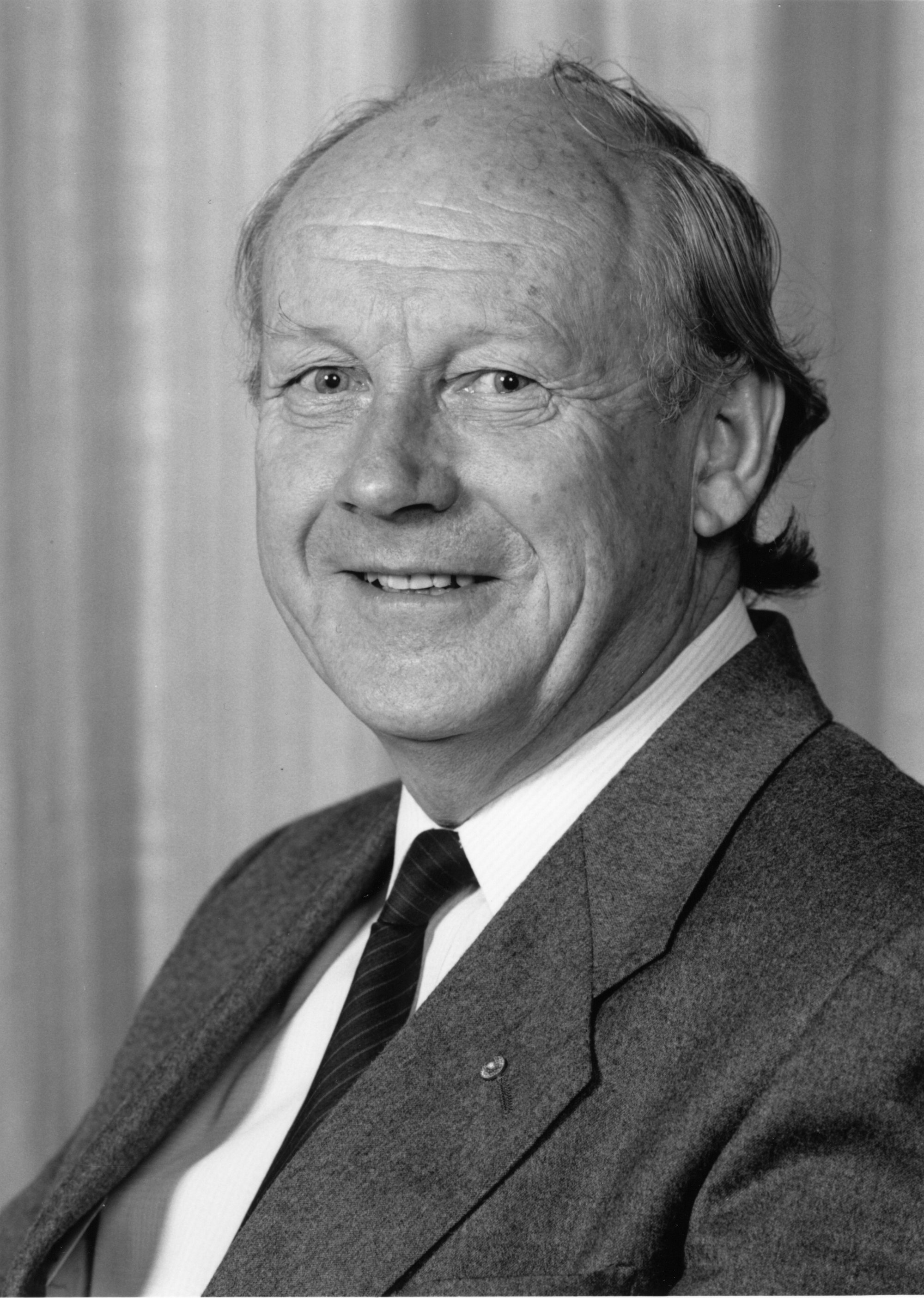
Professor David Curtis
Professor David Curtis was born in 1927 in Melbourne. He received a Bachelor of Medicine and Bachelor of Surgery (MBBS) from the University of Melbourne in 1950. After completing his medical training he spent from 1951 to 1953 as a resident medical officer at the Royal Melbourne Hospital and from 1953 to 1954 as a registrar at the Alfred Hospital in Melbourne. In 1954 Professor Curtis moved to the Australian National University (ANU) where he remained for the rest of his career. While at the ANU he held appointments in the John Curtin School of Medical Research's Department of Physiology of research scholar (1954–56), research fellow (1956–1957), fellow (1957–1959), senior fellow (1959–1962), professorial fellow (1962–1966), professor of pharmacology with a personal chair (1966–1968) and professor of neuropharmacology (1968–1973). In 1973 he became Foundation Head of the John Curtin School's Department of Pharmacology, a position he held until 1988. A reorganisation of the School in 1988 saw Professor Curtis appointed successively as head of the Division of Neuroscience, and in 1989 as Director and Howard Florey professor of medical research, a position he held until his retirement in 1992. Upon retirement he was appointed Emeritus Professor and University Fellow.
Professor Curtis was President of the Australian Academy of Science from 1986 to 1990.
Interviewed by Dr Max Blythe in 1993.
Contents
- Family background: no biology
- School: mathematics and science but still no biology
- Medical school: biology at last, plus billiards and snooker
- Linking theoretical and clinical medicine
- 'You watched that technique'
- Playing around with tetanus toxin
- Pharmacological tunes
- Exploiting acetylcholine
- Fitting excitants into the amino acid collection
- Using antagonists to investigate transmitters
- Practices and limitations in animal use
- Transmitter release mechanisms: the odd effect of baclofen
- An appreciation of Jack Eccles
- Collaborations and contributions
- Disturbing times at the John Curtin School
- New directions at the Academy of Science
Family background: no biology
David, you were born in Melbourne in 1927 – a child of the ’30s, really. Tell me about your parents and your early years.
I was a child of the Depression. We lived comfortably but we weren’t very well off. My father was a communication engineer for the PMG’s Department, and of course Public Service salaries took a crash during the Depression. Both my grandfathers were building contractors, and I grew up with a family workshop both at home and with grandparents. I guess the decision to do medicine was somewhat strange, because I didn’t do any biology at all until I went to university.
Were you close to your family?
I was very close to my mother and father. It was quite a wrench to leave home to go to university and then to be completely separate during the three resident years at hospital. My younger brother did agricultural science and now lives in Sydney. Both parents came from very large families, and we had so many cousins and second cousins that we never met a lot of them. But the contacts we did have were great. It was a very nice family to be born into.
School: mathematics and science but still no biology
And you went to school at Melbourne High School in its classical days?
Yes, when that and University High were the only selective high schools in Melbourne. We did one year at the main school building until the war broke out, when the school was turned into naval headquarters for Victoria. What an ideal place: the school was next to the major railway lines, so if anything had ever happened the naval headquarters and the railway lines would have gone!
Did any particular people on the staff turn your mind towards your future career?
I had a leaning towards mathematics, I think largely because of primary school and central school teaching, and I was fortunate to have masters at Melbourne High in mathematics, applied maths, physics and chemistry who were very distinguished teachers. The school had a reputation in those science subjects, and also in geology, for getting Exhibitions at the examinations. The idea was that if you didn’t get the Exhibition at the end of the year, the school was in disgrace.
The mathematics master, Black, later had a very distinguished career in the Air Force Academy, which belonged to Melbourne University. Ferris, the physics master, eventually became the senior physics teacher at Scotch College. And Richards was an outstanding chemist who had a PhD but decided to remain teaching. Fortunately, in fifth and sixth years at high school we had the same masters going through. There were good labs and good assistance – excellent support all round.
Medical school: biology at last, plus billiards and snooker
You took those mathematical and scientific foundations with you to medical school at Melbourne University.
Yes. In those days at the end of the war, to get into the major schools at the university you had to matriculate in particular subjects. Having the right kind of subjects, I could do either engineering or medicine, and I couldn’t make up my mind between them. I was offered a scholarship for engineering, but just the day before that I was offered one for medicine, and I had already signed the letter.
I still had a yearning, in first year, to attend – illegally – some of the mathematics lectures, but there really wasn’t time. And I was having to catch up on biology. Biology wasn’t taught in boys schools then, being something that girls did. So zoology and botany in first-year medicine were really the first introduction to a biological career.
First year was relatively simple, because this was a transition period from the old Leaving Honours years to Matriculation, and our high school teaching had been at a much higher level than first-year medical physics and chemistry. The year was largely spent catching up on biology and learning to play billiards and snooker – which was a wonderful thing later, during off hours at hospital.
Did you enjoy the biological sciences?
I did enjoy the biology, even though it was fairly pedestrian in those days. Anatomy was superb, biochemistry was superb, physiology wasn’t the most brilliant department and I survived that. My chief fame in two years of physiology, I guess, was to have written an essay that was so bad that one of the demonstrators thought she should show it to the professor, Panzy Wright. Later on he was a very great friend of mine, but I never reminded him about that.
Syd Sunderland, who was an outstanding neuroanatomist, was the major influence on me. He gave brilliant lectures in neuroanatomy, which was just beginning to get together the wiring of the system. Nothing was known about how it worked. I think my interest in the nervous system developed from that kind of beginning, because the physiology was very primitive at that stage.
Linking theoretical and clinical medicine
You went on to the clinical courses. Was Melbourne University a good place to be in?
It was an excellent place. On the results of your preclinical years you could select the hospital you wanted, and I was chosen for the Royal Melbourne, just across the road from the university. So you could still keep university life while you were at the hospital, whereas in the outerlying hospitals – particularly the Alfred Hospital, at the other end of town – that wasn’t so easy. There was only one medical school in Melbourne at that time, so we had a year of 160. I think 120 graduated. It was a very good period. Because of the war the six-year course had been condensed down to five years: the course wasn’t changed but we lost a lot of vacations. That was five years’ hard work, but it was fascinating and it gave the opportunity in the last couple of years to spend more and more time at the hospital.
What kind of people made impact on you in the clinical field at that stage?
During my two years at the Royal Melbourne – the first year as a junior resident, the second as a senior resident – there were a few general surgeons and general physicians that put me off surgery and medicine as a career for ever. I did a couple of locums in general practice at odd times, I enjoyed working with patients and I was fascinated by clinical medicine, but I decided that sick people weren’t going to be my problem forever.
The interest in the nervous system was reinforced by good contacts such as with Graham Robertson, the hospital neurologist. He’d spent a period at Queen Square and was a colleague of Denny-Brown’s. The neurosurgeon was Reg Hooper, another Australian, who trained with Cairns and then came back to Melbourne. They were very supportive. They had to put up, for the first time ever, with having a junior resident in there running their 30-bed ward, whereas they’d always had registrars or much more senior people. They invited me back for the next year – a good sign, I thought. The hospital was very friendly, with a very good atmosphere and good people to work with.
‘You watched that technique’
Largely, if you were going to go on in clinical medicine or clinical surgery, you had to sit for either the College of Surgeons or the College of Physicians, doing first-part examinations and second-parts. Most of us during our second-year residency were attending lectures at odd times for the first part, and the university had a lecture series to which it invited people to come.
In about 1952, during my second year, Jack Eccles was invited down to Melbourne to give a lecture. I’d never heard the likes of that before: it was on the latest kind of work being done on the nervous system – work still in press and being published. I don’t think many people understood it, but I’d been doing a lot of reading from Sherrington and Eccles and all of those books, on stuff which seemed to have been building up naturally to this development. I think I was the only one who asked any questions at Eccles’s lecture and then stayed to talk to him.
We got chatting, and I inquired simply what were the chances of doing this kind of research – and particularly of coming up to Canberra, because he was then just setting up with the ANU. He asked me who I was working with at the hospital and how I was enjoying it, but his answer to my simple question was, ‘When can you start?’ Well, I could have started the following day, but I had an obligation to finish that year at the hospital. Then delays in building the laboratories here in Canberra caused me to spend another year in Melbourne. I landed a job at the Alfred Hospital – again as neurological and neurosurgical registrar – in a very distinguished group.
The neurologist was Leonard Cox, a self-trained neurologist; his assistant was John Game, who had spent some time at Queen Square; and the neurosurgeon was Hugh Trumble, who had been a general surgeon. When orthopaedics became a discipline, he became the orthopaedic surgeon, and then when neurosurgery became necessary he became the neurosurgeon. He was incredible – an outstanding person, a genius as a surgeon. He didn’t like buying instruments but he liked making them and he made all his own. He called them ‘jiggers’, and a lot of them didn’t have other names.
And you watched that technique.
You watched that technique, and you had to know which jigger he wanted when he wanted a jigger! His theatre sister was fine; she knew it all. But if you were operating with him at the weekend when there was a lass that wasn’t used to it, it was, ‘Not that jigger, girl. That other bloody jigger!’
So it wasn’t wasted time, but very exciting?
That’s so. It was full-time work, none of this 40-hour or 60-hour week.
I am impressed that the Alfred and the Royal Melbourne had such good neurology and neurosurgery teams.
Neurosurgery and neurology has been very well established in Australia. Sydney had the first Chairs in neurology, but the standards in Melbourne have been very high too. For many years the neurosurgeons and neurologists used to have their annual general meetings in Canberra, and I’ve kept in touch with people there. Douglas Miller, for example, is a very old friend. I’m a member or an honorary member of both the societies, as well.
Playing around with tetanus toxin
You came then to Eccles two years later.
We came here on February 16, 1954. The labs were still building. They were prefabricated huts that were only going to be there for a couple of years, but they’re still there. They were ideal for the kind of work we could do, because we could take walls down, cut holes in the floor and so on. We worked in those huts till ’57, when the new building was opened.
Who had Jack Eccles got with him at that time?
Jack had very few people. It was a problem of not knowing exactly when the labs were going to be finished. Eventually, Paul Fatt went back to Bernard Katz at University College, and Sven Landgren, a Swede from the Karoline Institute, went back to Sweden and then had the Chair at Umeå, a very northern university there. Vernon Brooks joined us a bit later on from Canada, and went back to London, Ontario. In the workshop, the electronics engineer was Jack Coombs, an outstanding person who had been senior lecturer in physics in Dunedin when Eccles was there. It was a stage after the war when a lot of surplus equipment was becoming available from the Services, so it was really the beginnings of using cathode ray oscilloscopes and electronic devices, and Jack designed all of the early equipment for Eccles. A lot of the things that we did in those days were impossible anywhere else because they just didn’t have the equipment. We had a very good engineering shop, we were able to design our own frames for animals and manipulators, and with my engineering interest I was able to join in with that. I learnt a lot there.
Perhaps you’d tell me a little bit about your PhD studies.
I started on a PhD in February, and I put in my thesis in just under two years, I think. The work was a combination. The main technique that Eccles and Coombs really pushed into neurophysiology was the use of glass microelectrodes to record from single cells, so I was able to get that technique fairly quickly. Then we looked at some of the simple kinds of things that were needing to be done.
With Brooks and Eccles we became interested in tetanus toxin. Eccles’s work in New Zealand in 1949 and the ’50s had established fundamental differences between synaptic excitation and inhibition, and we had known for some time that strychnine, which is a convulsant, had a very specific effect in blocking inhibition. Before that it was not clear what it did, because it could have enhanced excitation, but we had a nice pharmacological tool to dissect inhibition. Because tetanus is a similar convulsant to strychnine, although much more subtle, we then played round with tetanus toxin for a while. We showed that it did much the same as strychnine, but we weren’t quite aware in those early days precisely what it was doing. (We developed other techniques later on.)
Then we had a minor incursion into trying to isolate transmitters from brain. We used to go out in the early hours of the morning to the abattoirs at Queanbeyan, collect fresh brain, freeze it and bring it back here, and try and find transmitters. The idea was to fractionate these and then to find out what these fractions did to the nervous system. It was a waste of time, really, although it taught us a lot of how not to do things. We didn’t understand much about biochemistry and the biochemists didn’t understand much about the nervous system. With all of the departments being new and developing, everybody wanted to go and do their own thing rather than get into multidisciplinary research.
The aspirations were right?
No, I think a lot of it was just basic pigheadedness and ignorance. We wanted to look at the brain, but it was the wrong way to do it. A lot of these transmitters are destroyed within milliseconds, and there’s no way you can collect it like this.
Pharmacological tunes
What did you do after your PhD?
I was working closely with Jack. By about 1958 I had developed a technique for administering very small amounts of drugs near particular cells. That was really a development from some of the work that Katz had been doing in London, but also Bill Nastuck had started it up in America. It’s a matter of having a compound in aqueous solution in a glass pipette, of knowing something about its nature and fixing the pH so that the bit you are interested in is either an anion or a cation, controlling it by means of electrical currents to stop it leaking out, and passing it out when you want it.
I was fortunate that double-barrel electrodes (just two tubes fused together) had been developed by Paul Fatt, who was working with Eccles. They were using these electrodes to record from cells – one barrel to record and the other to pass current through. They were pretty crude electrodes but later we persuaded the glassblower to take a round tube and put a partition in it, and then pull it down so we had a theta glass. By the time we were wanting to look at the pharmacology of single cells we were getting greedy, so eventually an English glassblower made for us five-barrel electrodes: a centre one with four around it. By the mid-’60s we were even more greedy, and it was easy to put six around a single one and have sevens. We developed the idea of cementing another electrode on the outside of this so that we could have a single or a double barrel inside a cell and the six or seven outside to play pharmacological tunes on it and get lots of information.
Exploiting acetylcholine
It was a good period. Other people were investigating the mechanism of synaptic excitation and inhibition, and electron microscopy was developing, so that you could appreciate what was going on at synapses with the morphological machinery; but also neurochemistry was developing. Neurochemistry, to me, is two disciplines. One is the design of organic compounds to affect the nervous system. The other is really neuro-biochemistry, understanding what is going on in the living brain. We didn’t make major contributions to that aspect but it was being done elsewhere. It was a matter of refining analytical techniques, of being able to look at the concentrations of particular compounds, like some of the amino acids in a certain area, and then to do this after lesions had been made to particular pathways and see if the amount of a particular substance fell.
We were able to exploit acetylcholine because of experiments which Eccles, Fatt and Koketsu – a Japanese who was visiting the department – had done here in the early ’50s. There was a little system in the spinal cord that could have involved acetylcholine. The motor neurone sends its messages to muscle in the periphery with acetylcholine, and just before the motor axons leave the spinal cord a little collateral goes back and tickles up some cells. Paul Fatt had the brilliant idea, ‘Well, if acetylcholine is released at the far end, it is likely to be released at this little terminal,’ so they went looking for these cells. They were able to show that, if they administered drugs intravenously or intra-arterially, the pharmacology of that synapse was similar to the neuromuscular junction. But unfortunately acetylcholine itself, which is the transmitter, didn’t get through the blood-brain barrier, so there was a gap.
Rose Eccles – Jack Eccles’s daughter – had come back from doing a PhD in Cambridge and had become interested in this, so we looked at that system first. In retrospect we were very lucky, because it was a ten million to one chance that the system was acetylcholine, but we could play pharmacological cadenzas on that cell, developing our technique.
Fitting excitants into the amino acid collection
David, I know you got very interested in amino acid transmitters, and they have been a major part of your work.
The amino acids came into it when Geoff Watkins joined us. We built on biochemical knowledge obtained in the States, by Gene Roberts and his people, of the possibility that gamma-aminobutyric acid might be a transmitter. It was shown very simply to be an important inhibitory transmitter in Crustacea, and in Crustacea strychnine is not a convulsant but picrotoxin is. (That is another drug that was used clinically for convulsive therapy.) With the Roberts story of this GABA perhaps being a transmitter in the crayfish, and with a lot of GABA in the human brain, we had a beginning, because we knew picrotoxin convulsed cats and people.
But we had great problems there, because we could show that GABA had an inhibitory effect on cells when we squirted it out of our electrodes but we could never get picrotoxin to block it. We were well aware of the problem: because it is not ionised, it doesn’t come out of the electrodes. That story had to wait to be developed till the early ’70s: after Geoff Watkins had left us and Graham Johnson had arrived, we stumbled upon bicuculline as another convulsant, which was a very effective GABA antagonist. But before that, with Geoff Watkins, we had become interested in all of the amino acids we could lay our hands on. I should think I’ve got the largest collection of useless amino acids in the world, still in my cupboards.
We were able to show that GABA and glycine and related neutral amino acids – where the acidic group was carboxylic or sulphonic or sulphinic – inhibited cells, and that the dicarboxylic acids related to aspartate and glutamate were excitants. And that was something. The excitatory effect was new. We weren’t aware of it, but a Japanese called Hayashi had thrown a massive amount of glutamic acid into the cerebral cortex of dogs some years before and they convulsed. We could have used tap water or potassium chloride or anything, but it was interesting that this was a compound which was known to be in brain and excited cells. We didn’t know about this for some time, but we went on looking and collecting amino acids. They were fascinating but we just didn’t think they were very important – we were a bit naive, a bit stupid.
I’d thought that cholinergic and adrenergic transmitters were the be-all and end-all.
The work with acetylcholine showed us that that was wrong, in the spinal cord anyway: only this Renshaw cell synapse was cholinergic – using acetylcholine – whereas acetylcholine didn’t affect anything else. A major turning point was in ’65-’66, when an American group reported that the amount of glycine in the spinal cord fell remarkably if they destroyed a lot of the inhibitory interneurones. This immediately linked glycine up as a possible inhibitory transmitter. They also showed that glycine affected neurones the same way as the inhibitory transmitter. We rapidly confirmed that, but in addition we had strychnine up our sleeve, knowing it should be doing something in that system. It very clearly blocked the effect of glycine.
Using antagonists to investigate transmitters
That put us back into business on gamma-aminobutyric acid, because that led, in another five or six years, to bicuculline and a lot of alkaloids that were not glycine antagonists but were antagonists of GABA. This was useful for our chemical colleagues, because we were able to analyse the glycine receptors and GABA receptors not only by playing tunes on them with a number of glycine and GABA analogues but also through the effects of strychnine-like and bicuculline-like compounds. Some very fascinating chemistry came out of that.
Penicillin, for example, is a GABA antagonist, and it was known a long time ago that in patients where penicillin had been used for, say, a cerebral abscess and had leaked out into the cerebrospinal fluid, this was a convulsant. Fortunately, penicillin doesn’t get through the blood-brain barrier, so it doesn’t normally have this action.
It is exciting to find critical areas like the brain massively regulated by amino acid transmissions.
Well, the story with the excitant amino acids was also confused. We didn’t think they could be transmitters because there’s so much of them around. The brain contains a massive amount of glutamate – it’s about 10 millimole if you just boil a bit of brain – and it seemed to be evenly distributed. Aspartate is distributed unevenly, and that gave us a clue. But with Watkins and then with Johnson we were able to use a vast number of other glutamate and aspartate analogues, some of which were naturally-occurring compounds, whereas others had been synthesised to be conformationally restricted, because glutamate and aspartate are very flexible. It dawned on us when we were finding different sensitivities for different neurones to a group of amino acids where we knew the structure, and we tried to relate this to the idea that glutamate might be the excitory transmitter for primary afferent fibres coming into the spinal cord and aspartate could be the transmitter for cells that belong inside the brain.
Geoff Watkins went back to England in ’65, taking it up as his life work to develop antagonists for glutamate and aspartate. We kept on working with Johnson and also with the group in Denmark led by Krogsgaard-Larsen, but the Watkins group was far ahead. Eventually they and other groups have developed very specific antagonists, so that glutamate and aspartate now are recognised as the most important transmitters.
For years I used to call acetylcholine and noradrenaline and dopamine, 5-hydroxytryptamine, minor transmitters, and of course this upsets anybody who’s working on them. But most cholinergic synapses in the brain are muscarinic and atropine is an antagonist. Although animals are as psychologically disturbed as we are by atropine, they can still walk around and do things, whereas if you give an animal either bicuculline or strychnine they’re convulsing and they’re different citizens altogether. And the amino acid antagonists, if they get through the blood-brain barrier, are very powerful depressants.
So there are major and minor systems, and really these other transmitters play background themes. They are very important, of course. For example, dopamine is a transmitter in parkinsonism and needs to be replaced with L-dopa. But they are a background regulatory mechanism.
Practices and limitations in animal use
You mentioned parkinsonism. Have you kept a strong interest in neurology and in drugs that might be used as inhibitors in important clinical contexts?
Yes. I keep aware of the neurological literature and attend neurological meetings and international meetings. We kept well away from parkinsonism because our animal facilities in those days did not enable us to have monkeys or higher primates, and it is impossible in cats and most other laboratory animals to produce anything like parkinsonism. The way L-dopa works is still a very confusing story, not by any means clear-cut. But it works, particularly with the decarboxylase inhibitors. The fashion now is neuronal transplantation, which seems to be a complete waste of time.
I know there is a big lobby against the use of animals, but a lot of this very sophisticated research would never have come anywhere without the use of animals.
You really can’t investigate and understand the brain unless you have got the brain in a reasonably intact animal. We have always been careful of our animals, and in 1969 the NHMRC published the first code of practice for the use of animals for experimental purposes. That was prepared by a committee led by Archie McIntyre, who was then chairman of the Department of Physiology in Monash. I have been on several committees that have since revised it and brought it more up to date, and the CSIRO and the state agricultural departments have been brought into the system. So there is now a booklet accepted all over Australia about the care and use of animals in experiments and in teaching, even including the breeding of animals and the training of technicians. Until recently we really haven’t had major problems in Australia with animal liberation, even though Singer at Monash has created quite a stir with it. I think Australia has been much more aware of the problems than, say, the UK or the United States.
Transmitter release mechanisms: the odd effect of baclofen
By the ’80s I think you had begun to work with some drugs that reduced inhibition.
We became interested in transmitter release mechanisms. Once you have got the transmitter, the way to do something about, say, a deficiency or an excess is to understand the release mechanism. We had earlier looked at baclofen, a drug which Ciba-Geigy developed in the early 1960s and patented, thinking it was a GABA analogue that would get through the blood-brain barrier. A lot of these amino acids, including glutamate, don’t get through the barrier – which is just as well. Having developed this drug they found it had fairly specific effects on spinal reflexes, and in clinical trials it was found to be effective in patients with spasticity from spinal cord problems. It is used clinically now in multiple sclerosis and when there is spinal cord injury after trauma. It is no use at all in cerebral spastics, because the mechanism is entirely different.
We became interested in this because it was a GABA analogue but it didn’t seem to do what GABA did. We showed that it wasn’t activating the bicuculline-sensitive GABA receptors. And then in the late 1970s we were able to get hold of the optical isomers. We had realised with the amino acids that sometimes there were vast differences between the two optical isomers. It is not so apparent with glutamate and aspartate, but with some of the N-methyl derivatives and some of the other more complicated ones there is a marked difference. We, and others, found that it was the minus-baclofen which was important. At that stage, we and some other groups found that it was specifically reducing the amount of certain transmitters, particularly the transmitters released from the terminals of sensory fibres. That has now led us into a major investigation of the properties of synaptic terminals within the spinal cord, and we feel that baclofen is having an effect of reducing the amount of calcium passing into those terminals, that then leads to reduced transmitter release.
That opens up an important range of prospects for clinical care.
Yes. This drug is useful, but I think this observation can be built upon to design drugs which will have similar effects but at other synapses. The nervous system, or the spinal cord, has got two major kinds of synapses apart from their being excitatory and inhibitory. It’s got the terminals of cells that grew out of the neural crest. These cells are essentially outside the spinal cord and fibres grow in, so the cells are used to an extracellular environment very different from what is in the brain. And the other cells that develop from the neural tube stay in the nervous system and talk to each other. There seems to be a difference in the transmitter release processes of these two types of cells. There is no doubt that both involve calcium, because we can block them with fairly non-specific calcium antagonists like cadmium and some of the heavy metals. But baclofen has an odd effect on these cells.
I’m still working on that, although I don’t think I’ll ever solve it. The Ciba-Geigy people are fascinated by it too. We’ve just finished a study of a vast number of antagonists of baclofen, which are quite remarkable compounds that usually don’t have any effect on normal animals.
An appreciation of Jack Eccles
Perhaps you could tell us about some people from those research years, beginning with Eccles.
I worked with Eccles from early ’54 through to about ’57-’58, until our interests diverged: he stayed in straight neurophysiology and processes there – after the spinal cord he became interested in the thalamus, the cerebellum and cortex – and we moved more into the chemical direction. He was not easy to work with but incredibly kind to me. He held my hand at the beginning, and after that there were no real restrictions placed on what I wanted to do. It was a stage when the department was expanding, when there was an adequate amount of money for equipment and for people. Each of the departments in the John Curtin medical school had a structure of about 11 people, but it would go up and down. He was able to attract a remarkable number of people from abroad to do PhDs or post-docs with him, and even after we diverged he was very supportive of my plans to develop neuropharmacology, to get chemical colleagues to come into the then department of physiology. He is an incredible, outstanding person.
What kind of a personality did he wield at the bench and in his administrative work?
Administration was always done very quietly; we didn’t see much of it. It was remarkable that he was developing this department virtually at the same time he was developing the Academy as one of the Founding Fellows. Mark Oliphant was President. They were meeting very regularly to plan this building and were interacting with the government to get the Academy accepted as a source of advice. Also, Jack was on the governing body of University House.
It was an incredibly active period for him but he had his finger on the pulse in the lab and was always there for experiments. But in those days, although we started experimenting at, say, 8 o’clock in the morning, the animal wasn’t into the recording room till after dinner at night, so there was all day to get it ready. Now if I can’t get it in by lunchtime I don’t think it’s worth working on any further! Once a cat is anaesthetised, it is not quite the same animal as you started with, and this affects the brain and transmission processes.
We used to work all night then. We lived about three or four miles away but we didn’t have a car till we’d been here three or four years, and many a time I’d ride home in the frosty morning, about 6 o’clock, having worked from the previous 8, and then have a shower and breakfast, go back and again work all day. We’d do that two or three times a week, and Jack would be doing that as well. It was an incredible learning experience. But having lived in a hospital environment, when I only had every third Wednesday afternoon off and one weekend in four, from noon on Saturday till 9 o’clock on Sunday night, this was easy, I thought! And you were doing what you liked to do, at your own rate. You weren’t at the beck and call of everybody else.
You have stayed friends with Eccles over the years.
Yes. He went to the States – Chicago and later Buffalo, where I visited him – and then he settled in Switzerland. Until recently we have kept in touch and he has been interested in what we are doing. I went to his 90th birthday celebrations this May, in Frankfurt, but he wasn’t very well. I think his health is not as good as it might be.
Collaborations and contributions
Another memorable person you have worked with is Katz.
Yes. Bernard was interesting. He was passing through Colombo when war was declared, and was nearly incarcerated there. He worked with Eccles in Sydney at the Kanematsu Institute, and was then in the Australian Air Force as a radar officer out in one of the forward islands. Bernard came out from England on a quick trip around Australia, to visit some colleagues and see some old friends, when Rose Eccles and I were doing our first experiments on Renshaw cells. Bernard doesn’t like animal experimentation and all of his work has been done on isolated tissue, particularly frogs, so whenever we would start working on a cat he would go for a walk and come back when we had it all set up and covered up, and he was happy. We learnt some nice little technical tricks from him, and we’ve kept in touch ever since. He’s made some magnificent contributions to the biophysics of synaptic transmission.
I know you feel he has been a mentor in some ways.
Yes, especially through his papers and the fact that I could always write to him.
Any other people we should mention in particular?
Well, clearly Watkins and Johnson from the chemical point of view. The area has been so interesting and so diverse and wide that I don’t think one person could do the whole thing. We do the animal work and the equipment – we design a lot of our own equipment and make it, in fact – and they’ve looked after the chemical side.
These collaborations are difficult and can’t last forever. Everybody wants to do his own thing. Geoff Watkins went back to England because he wanted to live there again – first to Carshalton and then to Bristol, where he’s retired but still working (he still has an MRC grant). And Graham Johnson got the Chair of Pharmacology in Sydney in 1982. We’ve kept in touch and I’ve collaborated with other chemists, but never on site because with changes in the department and in the structure of the school there hasn’t been such an opportunity to get new people in.
Disturbing times at the John Curtin School
David, the whole of your research career has been lived at the John Curtin School. You got a personal Chair there in 1966, I think, just a year after being elected a Fellow of this Academy.
That’s right. It was a personal Chair in pharmacology. Shortly afterwards Peter Bishop took over as head of the Department of Physiology, and the personal Chair was separated from physiology and turned into neuropharmacology in about ’68. In 1973 I was appointed head of the Department of Pharmacology, which had been on the books virtually from the beginning of the school but had been delayed. Then, in ’88, the school created divisions instead of departments, and I became temporarily head of the Division of Neuroscience until I took up the directorship in 1989.
A directorship in the Institute is not an easy job. I took it on largely because the school and the university had been so good to me. It was to be until the end of 1992 (when I would be retiring) on the understanding that there was no time then to do anything dramatic about the school because the Institute of Advanced Studies was to be reviewed. There was really no way they could advertise for an external director to come in on a five- to seven-year appointment, not knowing if that might continue after the review.
A committee chaired by Sir Ninian Stephen was set up to review what the Institute had done and its place in Australian tertiary education, and to make recommendations about the future. It was thought that the review report would be in fairly general terms, but unfortunately for the medical school the report suggested very specifically that we were not playing our proper place within medical research in Australia and that the school should be separated from the university as an independent body – still on the university campus but funded for research by the National Health and Medical Research Council. That would have meant that instead of our having a block grant, the various groups and individuals would have to apply to be funded for research projects or even programs. This wasn’t accepted at all by the school and the university council was very unhappy: it would lose its autonomy in running an Australian national university, because the funding would come from a different source. There were disturbances, and concern even among people outside the university.
Through Senator Tierney, the future of the school was eventually referred to the Senate Standing Committee on Education, Employment and Training (one of the major Senate standing committees). After lots of submissions and a number of days’ sittings and inquiries, the Senate said fairly firmly that the review was not carried out properly. But on a 4:3 vote, the chairman voting with the government, it was decided to leave the funding where it was, because the minister had already transferred our $16 million from his education portfolio to the Department of Health – though not directly to the National Health and Medical Research Council, which at that stage was within the Department of Health. So the money now comes in via the Department of Health. There is to be another review of the Institute in 1995, and people are gearing up to prepare submissions. I just hope that everything will go back to the Department of Education. But perhaps in the next review another research school will be ripped out of the university.
I suppose it would be an understatement to say that in that period of preparing documents for the Senate and of the report coming out you were busily engaged.
It was a terribly busy time. There was a lot of concern among people within the school – particularly our young people but also tenured people – for their future. Although we had kept the ratio of tenured staff to non-tenured down to about 45 per cent, the proposed grants and program grants threatened to be quite a change. There was also the question of how the support staff, who had tenure within the university, were going to cope with being on three-year grants. It was a very disturbing period. You really needed to be a Mother Superior, a confessor and everything, because there was a lot of general unhappiness in the school.
New directions at the Academy of Science
I’ll turn now to a happier period: your Presidency of the Academy of Science from 1986 to ’90. That must have been an interesting and fruitful time.
It was an interesting time. I can’t really judge how fruitful it was – you can’t do that yourself. You need to look back at it from the future and see what it looks like.
A lot of things happened. We were fortunate that the negotiations for acquiring Ian Potter House had been put in motion, particularly by Bede Morris and Arthur Birch, but there were lots of things to be done with that. There were major changes in the secretariat, reorganising so that the Academy could interact a lot with government departments and with ministers – not the kind of operation I enjoy very much but we just had to do it.
There were also the beginnings of the Australian Foundation for Science, an important venture. We thought at great length about taking on responsibility for collecting $10 million for this fund, but we had to get onto it and it enabled us to expand the textbook production, particularly back into primary schools.
We were having major financial problems with the Web of Life, the biology textbook that really put the Academy on the map. It was a wonderful thing. At one stage, 85 per cent of secondary school children were using it. Then there was a revision, and we had a Disease in Society project too. But book producing is a very expensive business and it is very hard to predict the outcome. The Web of Life just fell into a hole at the beginning because it was wanted and it was inexpensive to buy. It took off, selling like hot cakes. It was and still is a superb book, which set the curriculum for biology teaching in the ’70s. But the curriculum changed and the book became less popular. The Web of Life led us into a chemistry book, a mathematics book, one for geology. Biology: The Common Threads is the new one.
I wrote a book in the ’70s called Web of Life and didn’t realise that you’d got something with the same title going over here. Everybody was saying, ‘Oh, you’ve been involved with Web of Life’ – no-one ever remembered anything of my book; it was always the Australian saga that got the reference. To sum up, though: the Academy was a very different place in 1990 from 1986.
Well, I think it would have been anyway. I had superb officers and a wonderful secretariat – and being just three minutes away I was able to continue doing research, which was the other interesting thing. But we used to have early morning meetings, we had telephone hook-ups and things. I enjoyed that period.
You have had an impressive life. I’ve enjoyed talking with you and look forward to doing so again when you come to England.