





Lawrence Walter Nichol 1935–2015

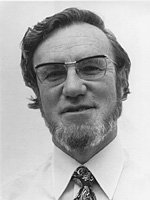
Lawrence (Laurie) Walter Nichol FAA was Vice Chancellor of the Australian National University (ANU) from 1988 to 1993, and before that, of the University of New England (UNE) from 1985 to 1988. His independent academic career began in 1963 at the ANU as a Research Fellow in the Department of Physical Biochemistry in the John Curtin School of Medical Research (JCSMR). The department was headed by Professor Alexander (Sandy) G. Ogston FRS. Thus, Laurie's career finally circled back, after overseas sabbaticals and other appointments at Australian universities, to the ANU.
Download the memoir
About this memoir
This memoir was originally published in Historical Records of Australian Science, vol. 29(1), 2018. It was written by Peter D. Jeffrey, Donald J. Winzor and Philip W. Kuchel.

Lawrence Ernest Lyons 1922–2010
Lawrie Lyons was a person of vision with a will to initiate and follow-through. This characteristic was evident in his scientific agenda, in his academic and Christian actions and in the care that he had for his family. These strands are inextricably woven in the texture of his life, some of which I have known since I met him as tutor before entering Sydney University in 1954 – but afterwards as his research student and as a friend and collaborator. It is from these perspectives that I write this biographical memoir.
Download the memoir
About this memoir
This memoir was originally published in Historical Records of Australian Science, vol. 27(1), 2016. It was written by John W. White, Research School of Chemistry, Australian National University.

Lawrence Alexander Sidney Johnson 1925-1997
Written by Barbara G. Briggs.
- Introduction
- Early life and education
- Botanist at the National Herbarium of New South Wales
- Director of the Royal Botanic Gardens, Sydney
- Family life and interests
- In retirement
- The eucalypts (Eucalyptus, Corymbia, Angophora)
- Myrtales, myrtaceae and inflorescences
- Casuarinaceae
- Proteaceae
- Restionaceae and other monocotyledons
- A wealth of plant groups
- Theory of systematics
- Ecology and conservation
- Retrospect
- About this memoir
Introduction
Lawrence Alexander Sidney (Lawrie) Johnson was a taxonomic botanist notable for the outstanding breadth of his interests and expertise, the rigour of his scientific approach, and the intensity with which he defended scientific conclusions and opinions. His major contributions came through broad synthesis so that systematic studies were integrated with evolutionary and ecological considerations. In a field often characterized by solitary workers, his investigations mostly involved colleagues, and he encouraged them to share his wide-ranging outlook while he also relied on their efforts. With colleagues he tackled many large plant groups, often delimiting taxa and resolving questions of relationships far beyond the extent that could be published in his lifetime: jointly authored publications continued to appear for some years after his death, since Ken Hill, Karen Wilson and I acknowledged that he had a substantial role in work still being finalized by each of us.
Johnson's achievements were recognized by many awards, to an extent remarkable for a scientist in the field of systematic botany and attached to one institution, the Royal Botanic Gardens Sydney, for the whole of his professional career, as Botanist (1948-72), Director (1972-85) and Honorary Research Associate (1986-97).
Since Johnson was well known for his strongly held views, passionately expressed, it was in character that, when he knew that he was terminally ill, he prepared the following statement to be read at his funeral. It sums up much of his life, with characteristic messages for those who heard it:
I have never been inclined to follow convention, and therefore will not be silent even at my own funeral. The first thing I have to say is in all sincerity to express my thanks for many opportunities to lead a satisfying life which, though not as long as I would have hoped, has been long enough for me to feel very fairly treated. These opportunities began with my deeply respected and loved parents, Sid and Emily Johnson, and my two sisters Valerie and Nancy. Teachers, especially my science teachers at school, Mr Clark and Mr Roberts, enabled me to perceive clearly in adolescence the absurdity of all forms of superstition and fanciful belief. They were followed at the University of Sydney by some outstanding teachers at that level, especially Eric Ashby (later Lord Ashby) and Sir Rutherford Robertson. These men showed me that botany was indeed a science, and I abandoned my first love, chemistry, to follow botany, although in a field very different from those of Ashby and Rutherford [Robertson].
In my first year botany lab I had the great good fortune to meet Merle, who has been the epitome of the word steadfastness throughout our subsequent lives. Our five children, Chris, Sylvia, Nicholas, Quentin and Sandy [Alexander], have borne with us, and we with them for up to 45 years, and have been a great support during my final illness. I love them all, though they may not always believe it.
Our personal friends have helped us in our lives for many years, and are immensely valued by us. On the professional side, I pay tribute to all my predecessors as Directors of the Royal Botanic Gardens, with a special tribute to Robert Henry Anderson who encouraged me to join the Sydney Botanic Gardens, and who was, as a canny Scot, a friend as well as a mentor at all times. Among many others at the RBG, my very special mention [and] appreciation must go to Dr Barbara Briggs who has been my close research and administrative colleague, and the very best personal friend since 1960. You will note that I do not say 'managerial colleague' – I have found that administrators, though they can be beastly, are not as manifestly so [as] those who call themselves managers.
Good friends and stimulating colleagues have been many throughout Australia and the world, and I am indeed sorry that I cannot continue to join in research with them. I conclude with two more saddening observations. First, the RBG has been abominably treated by politicians and botanically totally ignorant managers over the past year. This was not formerly the case and, in the days of such enlightened politicians as Neville Wran, the right sort of people were allowed to pursue the proper aims and objects of a botanic gardens. Second, a larger manifestation of these tendencies is a worldwide concentration on managerialism, a superficial approach and indeed a cruel perversion of sensible and decent management.
I have not seen an effective countering of this approach, but I can safely say that I have never met a decent managerialist yet. I hope, indeed, that some of you will live to see the change that must come.
I hope that I have not offended too many people in saying that since my eyes were opened in adolescence I have seen no reason to need religious belief, and particularly the notion of continuation of 'life' after death. I have been happy to accept death as the natural end of life, which treats some of us well, and some of us ill. It has treated me well.
I thank you all for coming and wish you satisfaction in your lives.(1)
Early life and education
Born in the Sydney suburb of Cheltenham on 26 June 1925, Lawrie was the third child of Algernon Sidney (Sid) Johnson, an accountant in the hospitals section of the New South Wales Public Service and Emily Margaret Johnson (née Manson), with older sisters Valerie and Nancy. He was early recognised as a bright child, attending Beecroft Public School and Parramatta High School. His father died when he was nine years old but his mother encouraged his academic abilities and, since early teenage years, he planned to study science, keen to understand and classify features of the world around him. Throughout his life he expressed gratitude to teachers whom he respected and who fostered his academic interests. He enjoyed the bushland then persisting around Cheltenham and Devlins Creek, but his early interest focused on chemistry and he was equal first in the State in that subject at the Leaving Certificate examination in 1941.
Enrolling at the University of Sydney, having been awarded a scholarship, he took Botany with no intention of continuing in that discipline, but the lively minds in the Botany Department at that time attracted him to the subject. He was fortunate there to meet Professor Eric Ashby (later Lord Ashby), plant physiologist Bob (later Sir Rutherford) Robertson, ecologist Noel Beadle and geneticist Newton Barber. This was a time of wide-ranging, indeed re-awakening, interest in Australia's flora and vegetation, and botanists were searching for understanding of processes of evolution and variation, seen in terms of ecology and physiology. In his final undergraduate research year he began a taxonomic revision of Casuarina (Casuarinaceae) under the supervision of Patrick Brough, but with advice and guidance from R.H. (Bob) Anderson and Joyce Vickery at the National Herbarium of New South Wales at Sydney's Royal Botanic Gardens. The project proved a far larger undertaking than his supervisor ever imagined and studies in Casuarinaceae continued among his interests throughout his career. In 1971 he was awarded a DSc by the University of Sydney.
Botanist at the National Herbarium of New South Wales
Graduating with First Class Honours in 1948, he joined the staff of the National Herbarium in Sydney. The Herbarium was the scientific arm of the Royal Botanic Gardens, administered as part of the New South Wales Department of Agriculture. During the directorship of Joseph Henry Maiden (1896-1924) the Herbarium had been founded, developed and linked to other organizations world-wide through Maiden's extensive correspondence and one visit to Britain. Maiden had been extraordinarily energetic with programmes of community lectures and taking a leading part in Sydney's emerging scientific associations. As a result the Gardens and its science had held high profile and esteem.(2) This had sadly deteriorated over subsequent decades so that Johnson joined a small group of botanists there at a time when taxonomy was unfashionable and Sydney's herbarium seemed something of a scientific backwater. An injection of young staff was, however, already starting a renewal after a less productive period.
Johnson realized the importance of collaboration with scientists elsewhere and soon developed close links with botanist colleagues Spencer Smith-White (later professor of genetics at the University of Sydney) and J.L. (Jack) Willis at the Museum of Applied Arts and Sciences (forerunner of the Powerhouse Museum) in Sydney, as well as phytochemist Howard McKern. Soon an even more productive collaboration was established with Lindsay Pryor, then Director of Parks and Gardens in the Australian Capital Territory, later foundation professor of botany at the Australian National University.
At the Herbarium he took over curatorial management of a wide range of plant groups. He and his colleagues set about improving the botanical order and information content of the collection, critically assessing the classification of many plant groups and the identification of the specimens. Through such work with the specimen collections, field studies and providing identifications for enquirers, Johnson acquired a remarkably wide knowledge of vascular plants in Australia and the rest of the world, knowledge he generously shared with others. Always he was intensely aware that the specimen collections were exemplars of the populations in nature; for this reason he sorted the collections geographically in detail, so that they would reveal trends and discontinuities in the species' distribution.
Since a responsibility of the Herbarium was to provide sources of information on the plants of New South Wales, a Flora of the State was begun, issued in segments from 1961 to 1984 (Contributions from the National Herbarium of N.S.W.-Flora Series). With hindsight this was a misguided project, scholarly and authoritative but so detailed that progress was painfully slow; too technical for non-specialist users but lacking some features of full taxonomic revisions. Good work was done for the project but progress was almost in spite of the concept of the series. Johnson's treatment of the cycads [13] was one of the first and most thorough of the series but, characteristically, he accompanied it by a more notable work on cycads world-wide [12].
Johnson's publication list and reputation among systematic botanists grew and he was in 1962 appointed as Australian Botanical Liaison Officer, a twelve-month posting to the Royal Botanic Gardens, Kew. He was a member of the Flora of Australia Committee of ANZAAS and had been part of a delegation in 1960 to the Prime Minister's Department seeking support for a national Flora project. He was later appointed to the committee that eventually led to success in that aim, the Interim Council of the Australian Biological Resources Study. During 1973-5 that Council set guidelines, helped to make clear to the Australian Government the great need for the Flora of Australia, and visited institutions in major centres to discuss biologists' needs and to promote the new projects envisaged. The Flora programme began to receive Australian Government funding in 1979 and has been acknowledged internationally as highly effective, its success partly based on the associated grants programme and the establishment of a core of editorial staff overseeing the work.
Director of the Royal Botanic Gardens, Sydney
In 1968 Johnson had been appointed as Deputy Chief Botanist, the deputy to the Botanic Gardens Director, but when Knowles Mair retired in 1970, Johnson did not seek the senior position. He had seen directors of the Gardens submerged in administrative and horticultural detail and it was only later, when he acted briefly in the position, that he realized how the directorship could be handled differently. He saw that change was possible with a clear concept of the role of the organization and a vision for its future [82]. When the position again became vacant in 1972 he was appointed to it.
Johnson was fortunate that, during much of his thirteen years as Director, Neville Wran was Premier of New South Wales. Johnson sought any opportunities to interest Wran in the Gardens. For his part, Wran still remembered his own role as counsel assisting Lionel Murphy, barrister for the Public Service Association, in a case brought by that union before the New South Wales Industrial Commission many years earlier. That case reviewed salaries of Scientific Officers in the New South Wales Public Service, and Gardens' botanists had taken a prominent role. In 1980 Wran transferred the Gardens into the Premier's Department administration, to join with museums and other cultural organizations. The Gardens was Australia's oldest continuing scientific institution, predating modern administrative structures but, since the establishment of the New South Wales Department of Agriculture, had been administered as one of its agencies. It had been seen as peripheral to Agriculture's role but was instantly 'at home' among the diverse cultural agencies.
Johnson grasped the new opportunities with energy. The Royal Botanic Gardens and Domain Trust was set up, government funding was provided for a new building to house the herbarium and scientific programmes, freeing much-needed space for education programmes, visitor services and the necessarily increasing administrative staff. Community support was fostered and channelled into an active 'Friends of the Royal Botanic Gardens' organization. An education programme for school students was initiated and, with the start of volunteer programmes, there were guided tours of the Gardens and exhibitions on botanical and biodiversity conservation themes. The first of the Tropical Centre glasshouses (the Pyramid) was completed and a larger glasshouse (the Arc) planned and funded. Preparation for the XIII International Botanical Congress in Sydney in 1981 was another commitment for much of the scientific staff.
Funding was obtained for the development of a satellite garden at Mount Tomah on the escarpment of the Blue Mountains as a State-Commonwealth bilateral programme, associated with Australia's Bicentennial celebrations. Also funded was the development of the Mount Annan Garden in Sydney's south-west, to display and conserve Australian native plant species. The Mount Tomah Garden site had been donated to the State by the Brunet family in the 1960s, to be part of the Gardens' organization, but its development had languished with few resources for development. The Mount Annan site was land previously resumed by the State Government for its scenic and open-space value and selected by the Gardens staff as highly suitable for an Australian plant garden. The documentation and vouchering of plant accessions at Mount Annan set new standards in living collections databases. Both new gardens were opened after Johnson's retirement, as part of the Bicentennial celebrations, Tomah in late 1987 and Annan in 1988; but the main elements of planning, construction and planting had been put in place in his time.
In contrast to this expansion, Johnson encouraged the Government to set up a separate administration for Sydney's large Centennial Park, hitherto part of the Gardens' responsibilities. He considered its largely recreational and open-space functions as very different from the botanical and educational roles of a botanic garden. He did, however, value Sydney's Domain as a vital buffer that surrounded the Gardens on three sides and he argued strongly against any proposed encroachments on it. With the advent of Sydney's Summer Festival, and despite some initial reluctance, he welcomed the increasing use of the Domain for open-air art exhibitions and large events such as opera and symphony concerts.
A new project was initiated, with his enthusiastic encouragement, to produce a Flora of New South Wales, in a far more user-friendly style than the earlier Flora Series. Gwen Harden was appointed as editor and project leader and the Flora was produced in four large volumes in successive years from 1990 to 1993, making information and means of identification available for more than 6,000 species of native and naturalized plants of the State.(3) Johnson was not so positive about the development of computerized databases for the herbarium collection and living plant collections data, but he accepted his staff's advice and these were established. He strongly supported women horticulturalists joining the Gardens' staff, entering an area that – unlike the scientific section – had been an all-male preserve.
Such a rapid pace of development, especially in the latter years of his directorship, transformed the organization, but the resources of funding and especially of staff were stretched thin. As a result, he regretted that there was some reduction in horticultural standards in the Gardens in Sydney, but he hoped that a period of consolidation and remedying of such problems would follow this developmental phase. Always he spoke most enthusiastically about the scientific role of the Royal Botanic Gardens, but much of his legacy there is in its new satellite gardens and community outreach.
During this time he did not abandon research but relied increasingly on co-operation with colleagues. In other cases he encouraged staff botanists to take over work in plant groups with which he had previously been concerned. He continued to be interested in Proteaceae, Myrtaceae, Cyperaceae, cycadophytes and the genus Grevillea, although colleagues Peter Weston, Peter Wilson, Karen Wilson, Ken Hill and Don McGillivray respectively took up research and established their positions as authorities in these groups, building on his earlier work in each case.
Family life and interests
On 18 November 1950 Lawrie married Merle Margaret Asta Hodge whom he had met as a first year Botany student, although Merle did not continue with her course. They subsequently lived mostly at Northbridge, a northern Sydney suburb. Merle was an outstanding support in Lawrie's career, typing many of his earlier manuscripts and tolerating his long hours at the office, especially when he maintained his research programmes despite heavy administrative responsibilities. Her support for his career was most dramatically shown when the opportunity came for him in 1962 to take the position of Australian Botanical Liaison Officer at the Royal Botanic Gardens, Kew, London, involving an absence from Sydney of fifteen months. The miserly policy of the New South Wales Government at the time did not provide adequate travelling support for dependants, although this was a man with wife and four, soon to be five, children. Merle steadfastly insisted that he should take the position while she and the children remained in Sydney. At that time they did not know that Merle would later work in an airline administration, earning opportunities for much travel by all the family. It was Merle's outstanding hospitality and concern for people that kept together a wide circle of friends, especially keeping in touch with friends from school and university days.
When Lawrie's long working hours were set aside for time with their children, Christopher, Sylvia, Nicholas, Quentin and Alexander (Sandy), they often jointly constructed magnificent large creations of meccano or set up model trains that ran on lines that looped from room to room in the house for days. At other times all the family, or one of the children with their father, went travelling back-roads and camping in the bush, rarely turning for home until dusk on the last day. There were also family summer holidays near the beach at Hat Head or South West Rocks on the north coast of New South Wales and Saturday mornings watching the sons playing soccer. Chris, Nicholas and Sandy later worked in various aspects of information technology, Chris at the University of Technology, Sydney. Quentin became a fire fighter in the New South Wales fire brigades. Sylvia's career in materials science, with a focus on ceramics, took her to California and distinguished roles at the Stanford Research Institute and NASA.
Johnson's energy and achievements did not come from an especially robust constitution. Through much of his career, Johnson suffered from an anxiety condition and his ability to sustain such a level of activity was partly a credit to modern pharmaceuticals. A whiplash neck injury resulted from a car accident while returning from a scientific conference; this frequently gave trouble but did not deter him from active fieldwork. For many years he also suffered from a persistent stomach ulcer. Earlier, during his first year as an undergraduate, a diagnosis of tuberculosis, which more severely affected his sister Nancy, had interrupted his studies. That enforced break, until he resumed his course a year later, was used to read a wide range of literature. Years later he observed that this interruption had been beneficial in the long term, broadening his knowledge in a way that would have been unlikely in the midst of studies or the demands of a career. Aided by secretaries and colleagues, through much of his career, including his busy years as Director, he managed to 'protect' time for a brief siesta after lunch on most days. Then he would customarily work far into the evening.
Apart from botany, one of Johnson's long-standing interests was in comparative languages. The processes of development, modification and migration of languages revealed many fascinating similarities to processes of biological evolution. Respect for other languages, for him, included correct pronunciation and he persevered in trying to correct the pronunciation of foreign words and botanical names by colleagues. A guide to the pronunciation of botanical names was one outcome [110]. He studied Russian at evening courses and took great interest in languages wherever he travelled. He frequently kept his colleagues amused with limericks and other verses.
Another interest fostered by evening courses was mathematics, at the time when newer mathematical concepts were beginning to be taught in schools. For some years in mid-career he took a serious interest in number theory and topology, finding that they involved satisfyingly elegant concepts. These studies stimulated him to analyse the theoretical basis of the numerical pheneticists in the 1960s and to publish his comprehensive rejection of that approach [32].
Other lifelong interests – all actively shared with Merle – were in classical music, railways (an interest dating from school days) especially historic trains, tennis with his family and younger friends, travel, and good food and wine. Visits or excursions with his grandchildren, six in the Sydney region and two in California, were also much enjoyed in later years.
In retirement
Johnson did not intend to retire in 1985 but Government policies of that time strongly favoured youth employment and he found that retirement at age 60 years (rather than the expected 65) was demanded. This was in sharp contrast to policies opposed to age-discrimination in employment implemented only a few years later. Retiring when many developments that he had started were yet to come to fruition was a bitter matter, and this coloured his view for some years.
On retirement he was appointed by the Royal Botanic Gardens Trust as Director Emeritus and as an Honorary Research Associate; facilities for research were provided. He continued to keep better informed on current scientific literature than many much younger botanists and was a source of vast knowledge and help to young staff members at the Herbarium. He greatly welcomed the development of a DNA laboratory for molecular plant systematics at the Royal Botanic Gardens and actively followed literature in this important field. He recognized that macromolecular systematics was now the most important source of new phylogenetic understanding. In conjunction with critically assessed morphology and phylogenetic reasoning, this gave systematics a new excitement for him, as well as for others.
Johnson continued to serve on the Council of the Linnean Society of New South Wales, of which he had for two terms been President, and as a member of the Rudi Lemberg Travelling Fellowship Committee of the Australian Academy of Science. He also regularly participated in international congresses, and served on committees of the International Association for Plant Taxonomy and also the International Congress of Systematic and Evolutionary Biology. Whenever possible he took the opportunity of congress excursions to gain wider familiarity with vegetation and floras world-wide. His last, a 'Southern Connections' meeting in January 1997, focusing on Southern Hemisphere biota, was in Valdivia, Chile, with a week-long excursion across the Andes. His final illness was diagnosed a few days after returning from this travel.
To continue effectively in research, Johnson required access to the collections at the Herbarium and contact with colleagues with whom he still had collaborative projects. He became increasingly out of sympathy with trends in management and priorities at the Gardens and made this apparent in often outspoken comments. The Royal Botanic Gardens and Domain Trust expressed its displeasure at these comments but let the arrangement continue since Director Professor Carrick Chambers had championed the value of his continued scientific work. After a change of senior management, however, his status as Honorary Research Associate was terminated in 1996. This 'dishonourable discharge' from the place he had served throughout his career caused him much bitterness although he was encouraged by expressions of support from colleagues within the Royal Botanic Gardens and internationally.
His status as an Associate was restored in early 1997, but by then he had received the diagnosis of brain tumours that had spread from a melanoma removed the previous year. After radiotherapy he made a brief improvement and returned for some weeks to botanical work at the Gardens. He was working on a manuscript on Eucalyptus to within a few hours of his last conscious time. He died at Royal North Shore Hospital, in the Sydney suburb of St Leonards a few days later, on 1August 1997.
The eucalypts (Eucalyptus, Corymbia, Angophora)
It is with the classification of the eucalypts that Johnson is especially associated. Eucalyptus (almost 800 species(4)), together with the allied genera Angophora (15 spp.) and Corymbia (113 spp., segregated from Eucalyptus by Hill and Johnson [118]) form Australia's most prominent tree group. Johnson took an early interest in them because of their importance in characterizing Australian plant communities. Enlisted to help when Bob Anderson was revising his Trees of New South Wales,(5) Johnson soon became the Herbarium's expert on the eucalypts and many other tree groups. Through fieldwork and study of specimens, he realised that there were many species that had not previously been recognized as distinct. These differed from others not only in their morphological features but in distribution and ecology.
Together with Lindsay Pryor from Canberra, Johnson made many field visits, eventually attempting to see as many as possible of the species in their natural habitats. With Pryor's colleague at the Australian National University, Dugal Paton, they visited remote parts of Australia using light aircraft and Dugal's expertise as a pilot with flying experience in the Second World War.
In 1971 Pryor and Johnson commented that 'It is likely that relatively few taxa still await discovery as a result of exploration in botanically little-known areas' [35], but they were proved wrong by their own further studies of existing collections as well as by much further fieldwork. Solely or with colleagues, Johnson was responsible for naming some 180 eucalypt species(4) – mostly after 1971 – and 69 new subspecies, as well as generically reclassifying 107 species; but his conclusions about eucalypts were equally influential above the species level. He sought to characterize the major groups that represent the principal lines of evolution among them. Johnson and Pryor concluded that the eucalypts consisted of some eight major groups which they informally termed subgenera and discussed [35]. This work included a classificatory listing of all the species recognized at the time, and discussions of character states and variation patterns among species. Here they recognised seven informal 'subgenera' and devised a code (comparable to an acronym of four to six letters) to indicate the classification of each species at all ranks. As noted by Brooker, 'This work which divided the genus [Eucalyptus] into seven subgenera, proved to be a milestone in Eucalyptus biology and became the benchmark for all eucalypt scholars.' (6)
The classification in that work was mutually agreed by both authors but depended most heavily on Johnson's work. He did more than anyone else until the late 1990s to distinguish the major evolutionary lineages among the eucalypts [40, 55]. His clarifying these enabled other later researchers, especially those concerned with DNA sequencing, floral development and ecological adaptation, to focus their efforts appropriately. Such subsequent investigations confirmed many relationships deduced from his morphological studies.(7) Pryor took a leading role in pointing out the ecological and distributional differences among the major groups [70], and these have been followed up by further studies by others.(8) In studies of the Myrtaceae and Myrtales, Johnson drew attention to the eucalypt lineage as one of the major ancient evolutionary branches within its large family [80].
Johnson was precise and thorough in nomenclature, orthography and typification at the predominant levels of family, genus and species and served on international committees in these areas. However, he regarded the rigid application of the rule of priority as irrelevant and time-wasting at intermediate levels that derive their significance from circumscription (content) in a particular classification. In this spirit, publishing with Pryor, he set up a formal and precise system at these levels in the classification of the eucalypts, but it was extracodical – not complying with the priority rules of the International Code of Botanical Nomenclature [35]. The Pryor and Johnson extracodical subgenera have been widely used by researchers, but were largely avoided by D.J. and S.M. Carr, with whom Johnson strongly and openly disagreed on several aspects of eucalypt relationships – though Johnson told colleagues that the areas of agreement between them actually far exceeded the areas of dispute. Johnson was disappointed that other botanists clung to those formalities that he regarded as stultifying and that the subgenera were not more widely referred to in publications. Similarly he hoped that the classificatory codes would be widely applied, since he saw them as a simple way to indicate the lineages and affinities. However, he had underestimated the extent to which new species would be recognized in the near future and the classification modified, mostly by himself and colleagues, so that the codes did not always serve as stable summaries of the classification in the way originally intended; he therefore accepted that their introduction had perhaps been somewhat premature. They were, however, very helpful references for use in activities such as herbarium curation.
Disappointed in the extent of use of the subgeneric names, and convinced that the diversity within the eucalypts was greater than within many groups of genera, Johnson for many years considered that the eucalypts should be divided into several separate genera. The prospect of eight genera, or as many as eleven, in place of Eucalyptus alarmed amateur enthusiasts concerned with Australian plants, and popular journals carried articles championing the status quo. Johnson argued to his colleagues and in print [87] that the case for recognizing separate genera, and so changing plant names, should rest on the same types of evidence, whether one was dealing with such a national icon as Eucalyptus or with less charismatic plants such as saltbushes, heaths or rushes, where extensive name-changes created no such outcry.
Eventually Johnson, with his colleague Ken Hill, concluded that the major evolutionary lineages within the eucalypts would be reasonably represented in the classification by the recognition of one new genus, Corymbia, in addition to Eucalyptus and Angophora. In a substantial paper they formally described Corymbia and transferred to it 80 species of bloodwoods and ghost gums, together with 33 newly recognised species [118]. DNA sequencing studies by Udovicic and Ladiges subsequently confirmed that Corymbia is markedly distinct from Eucalyptus and less closely allied to it than to Angophora.(7) Such genetical distinction implies a long separate evolutionary history. Corymbia has been widely adopted by botanists but opinion was not unanimous. Ian Brooker, influential eucalypt specialist at the Australian National Herbarium, CSIRO, Canberra, argued against its adoption(6) but there has been convincing endorsement, based on multiple data sets, of the distinction between Corymbia and Eucalyptus by Ladiges and Udovicic.(9)
In his work on the eucalypts Johnson was greatly assisted by Ken Hill and earlier by Don Blaxell (later Assistant Director Living Collections, Royal Botanic Gardens Sydney, and subsequently Honorary Research Associate, returning to studies on eucalypts with Hill). Expert technical assistance from Leonie Stanberg, and earlier from Lani Retter, was important to the progress of the research. Johnson's strongly held views sometimes contributed to difficult relations with other botanists, especially in the eucalypts, but younger colleagues learnt much from him and he relied on their work, especially when administrative responsibilities greatly limited his research time. As a result of this teamwork, Hill and Blaxell, with assistance from Stanberg, continued after Johnson's death to publish work that had been initiated with him [128, 134, 144].
Myrtales, myrtaceae and inflorescences
Studies on eucalypts naturally involved Johnson in questions of how this lineage related to other groups within Myrtaceae. Also, comparisons of inflorescence structures in this and other families made clear to him that some terms, such as panicle, were used to describe a variety of fundamentally different structures. Working with me, and recording observations in simple stylised diagrams, he studied inflorescences throughout a comprehensive range of Myrtaceae. In works by Troll(10) we found a more precise descriptive system than any available in English-language publications. However, our studies on trees and shrubs mostly of warm temperate and tropical regions suggested trends different from those envisaged by Troll. We suggested that undue emphasis on European cool temperate herbs had led Troll and his colleagues to mis-read the direction of some trends.
This work led to a substantial paper on Myrtaceae that included a critique of current inflorescence terminology and introduced new terms to facilitate comparison of inflorescences [61]. We realized that it would be necessary to keep publishing on inflorescences if these new concepts were to be spread more widely. The diversity in Myrtaceae had given an excellent basis for reviewing inflorescence structures, but was not sufficient to promote the general applicability of the new concepts. Some of the main concepts and terminology were taken up and applied, for example by Grimes(11) and Weston, in groups such as Fabaceae and Proteaceae, but pressure of other commitments prevented us from continuing work in interpreting inflorescence structures.
Johnson and I returned to the phylogeny of the Myrtaceae, in a study broadened to cover Myrtales [80], using the laborious procedures of the CLAX programme (see below) in its non-computerized form. This gave some novel results that have since been supported by DNA studies. These include distinguishing a Myrtacean clade including Psiloxylon, Heteropyxis and Myrtaceae within Myrtales and abandoning the subfamilies Myrtoideae and Leptospermoideae. We emphasised the lack of close relationship between the sometimes confused Eugenia and Syzygium, the distinctness and antiquity of the eucalypt lineage, and the polyphyletic nature of the assemblage of genera formerly referred to as the Chamelaucioideae. Not all the relationships postulated have survived in the DNA era, but the hypotheses provided a basis for much subsequent work(12)[125].
Casuarinaceae
As mentioned above, a revision of Casuarina was Johnson's first botanical research project. What was intended as a year's undergraduate study became a lifetime interest, although only intermittently active. As with the eucalypts, his work encompassed the levels of both species and genera. Karen Wilson became the colleague on whom he greatly depended in this work. Alone or with Wilson, he described three new genera and many new species, as well as providing treatments for international compendia, the Flora of Australia and several other Floras [64, 73, 76, 86, 88, 92, 93, 97,135].
Pressures of time when book deadlines conflicted with demanding administrative duties led to the new genera being very briefly described with little stated justification and this slowed their acceptance by other botanists. In this case the common morphological features of the family are so conspicuous that they tend to overshadow the substantial differences between the genera. Johnson's work in clarifying the species taxonomy gave a foundation for studies by Barlow of chromosome numbers and apomixis(13) and work on Casuarinaceae is being continued by Karen Wilson.
Proteaceae
Early in his career, Johnson embarked on a revision of Persoonia and realised that relationships at the generic level in Proteaceae were much in need of study. Work on Persoonia proceeded intermittently over a long period, eventually much of it being brought to publication with colleague Peter Weston taking the leading role [101, 117, 122].
Chromosome numbers had been shown by Lancaster and Smith-White(14) to be informative in elucidating evolutionary relationships in the family, so Johnson enlisted my help to determine chromosome numbers of additional genera. This led to a wide-ranging collaboration in addressing the subfamilial, tribal and generic classification and evolutionary relationships. Since Proteaceae is almost confined to the Southern Hemisphere and is represented on almost all southern land masses, clarification of relationships among the genera is highly relevant to the historical biogeography of these lands. At the time of our first publication on this subject [24], in which I took a minor role, geological opinion on plate tectonics was still divided, with a few authoritative voices arguing that continental movement was unproven. Unfortunately, this limited the nature and significance of the biogeographical conclusions that we then presented.
Returning to this subject after a decade [53], the major plate tectonic framework had been established and it was clear that Proteaceae revealed numerous intercontinental links that could be correlated with the ages of separation of the various fragments of Gondwana. Hypotheses were presented of the sequence of diversification of various lineages in relation to opportunities for migration. Since then, the techniques of DNA sequencing have become widely applied to plant phylogeny and findings based on analysis of sequence data for Proteaceae have clarified relationships, superseding some earlier conclusions and revealing additional intercontinental links.(15) Johnson welcomed the new investigations but was gratified that our hypotheses were still serving as a starting point for such new studies decades later.
As in much of Johnson's work at the upper taxonomic levels, these papers on Proteaceae are concise summaries of a great deal of information that was not presented in detail but that was rigorously compiled and critically assessed. To illustrate and describe in detail the floral structures that were dissected or fruits that were sectioned, for example, could have been useful, but it would have vastly increased the work.
Restionaceae and other monocotyledons
In the 1960s Obed Evans, formerly Senior Technician at the Botany Department of the University of Sydney, joined the Herbarium staff to assist with work on the Flora of New South Wales series. Evans worked with Johnson on New South Wales Arecaceae (Palmae), Philydraceae, Lemnaceae, Cyperaceae and Restionaceae [15, 19, 20, 21, 26, 27]. In the very large family Cyperaceae their joint work covered only Eleocharis and some Cyperus species [31, 43], but Johnson continued the study, assisted by Karen Wilson. With increasing expertise, and since Johnson had many projects on hand, Wilson soon took the dominant role and became the Australian authority on much of the Cyperaceae. Meanwhile Johnson had also taken up work on Juncaceae. When he distinguished and described 23 new Australian Juncus species [23, 98, 109], some again questioned whether he was a taxonomic 'splitter', especially since several of the new species frequently occurred together, where disturbance favoured spread of the species and masked ecological distinctions. Others experts on Juncaceae, however, such as Elizabeth Edgar at DSIR Christchurch, New Zealand, were in full agreement with his decisions. Wilson worked with Johnson on Juncaceae also and continues that study.
Johnson and Evans found that stem anatomy in Restionaceae was very informative in distinguishing species and that the species customarily included within Lepyrodia were a disparate group [21]. To gain further information, I joined in with chromosome number determinations. The results were perplexing, so Johnson and I widened the investigation to include the numerous Western Australian species. The study, begun in the early 1960s, was repeatedly set aside in favour of work on Proteaceae and Myrtaceae, but proceeded intermittently and was taken up again in the 1990s. Mostly species distinctions were clear-cut (though many were newly recognised), but settling on an adequate generic classification proved difficult, although it was clear that existing classifications were greatly at variance with relationships among the species. As a result, manuscript names or other informal names were applied and used for up to twenty years(16,) (17) and the patience of other botanists was sorely tested waiting for such names to be formalized. In particular, Cutler, studying the anatomy of Restionaceae at Kew, noted numerous discrepancies between his findings and the existing classification(18) but was largely restrained from making taxonomic changes because the Australian members were under study by Johnson and Briggs. Eventually we finalized a new generic classification of these and some allied groups, under pressure for this to be available for two book projects [132, 136]. By this time botanists at the University of Western Australia and at Kings Park and Botanic Gardens, Perth – John Pate, Kathy Meney and Kingsley Dixon – were studying reproduction, regeneration after fire, and aspects of the physiology of the species(17) and had discovered additional new taxa. Collaboration and fieldwork with these botanists and with Peter Linder from Cape Town, South Africa, proved to be very stimulating and added new dimensions to the study. Especially during field work, Pate and Johnson delighted in matching wits, with puns to the fore. As grass-like plants, lacking conspicuous flowers, and occurring mostly on low-nutrient soils, this had been an extremely neglected group until recent decades. Our studies revealed 54 species that had not been botanically named.
Describing the new genera and necessary changes to the classification of many of the named species followed after Johnson's death [126, 127, 133, 142, 143]. Descriptions of the remaining species that we had jointly distinguished, as well as preparation of a treatment of the family for the Flora of Australia, continue now with further 'Briggs and Johnson' papers expected.
In parallel with the morphological study of Restionaceae, DNA sequencing of representative species was begun, with expert advice from John Thomson and Peter Weston and assistance from Simon Gilmore, and later Adam Marchant and Carolyn Porter. Johnson enthusiastically supported this development, believing that analyses of macromolecular data gave much improved insights into phylogeny. He did not live to see the publication of the main results from this study to date,(19) but was convinced by early findings that the genera Hopkinsia and Lyginia should be excluded from Restionaceae. He therefore shares authorship of the paper establishing the new families Hopkinsiaceae and Lyginiaceae [140], members of the order Poales (as is Restionaceae) and most closely allied to Anarthriaceae; the recognition of these new families has been criticized by Chase et al.(20)
A wealth of plant groups
The groups already mentioned were major themes of Johnson's studies but, especially in his early years, he investigated a wide range of plant groups, making extensive and highly informative, but sometimes almost unreadable, annotations on the herbarium folders. In Oleaceae he published a review of the generic classification of world-wide relevance [10]. Indeed a study of the phylogeny and classification of Oleaceae more than four decades later (21) cited Johnson's work as the most recent review of the entire family and supported many of his conclusions when discussing new findings. Some other groups he investigated significantly, but then passed on his findings as notes or in discussion to others who had more prospect of bringing research to fruition. The value of such preliminary work was acknowledged by Bryan Barlow in Loranthaceae and Alma Lee in Xanthorrhoeaceae.
Johnson's accounts of the families of cycads and the Zamiaceae of Australia [12] and of the New South Wales members [13] have been mentioned. Although this was early in his career, he did not hesitate to put forward a new classification on a world-wide basis. He published a review and synopsis of the classification of the families and genera of the Cycadales throughout their range, describing a new family, Stangeriaceae, for a genus of south-east Africa, a new tribe for a genus of Central America and another tribe that included genera in Australia and Africa. Comments were made on the morphological terminology appropriate to this plant group, and the revision of the Australian species of Zamiaceae required the unravelling of complex synonomy. Johnson's work remained of sufficient note that he and colleague Karen Wilson were, decades later, asked to contribute the whole taxonomic treatment of cycads to an international collaborative project [95].
Johnson has been considered by some to be a 'splitter', applying an unduly narrow species concept, but many more Australian Zamiaceae are now recognised than in his treatment.(22) Work on cycads is being continued by his colleague Ken Hill and part, but not all, of the increase in numbers has come with new discoveries resulting from easier access to much of northern Australia.
Theory of systematics
Johnson's interest in the theory of systematics was demonstrated in his most substantial early publication [12] where he outlined the theoretical foundations that guided his study of cycads world-wide. In subsequent publications he continued to ensure that underlying assumptions were made explicit, although this was not then commonly done by botanical taxonomists.
His main theoretical contribution was in the late 1960s when taxonomy was influenced by new developments that received the name 'numerical taxonomy'. Data bases of the characters of 'operational taxonomic units' were being developed and computer processing gave new options for analysing these data. Numerical taxonomy used similarity measures to build 'trees' of relationships. Johnson entered the scene as a critic of these approaches, with added confidence from studies recently made to gain familiarity with modern mathematical concepts. He concluded that numerical taxonomy was based on false assumptions and published a detailed critique of overall similarity and general-purpose classifications [32]. This was so highly regarded that the prestigious journal Systematic Zoology took the unusual step of reprinting it with a short addendum [34]. Hull, writing more than thirty years later, observed that 'I find his objections to be as well taken now as they were then'.(23) Hull also noted that the pioneers of numerical taxonomy, Sokal and Sneath, 'would have very much liked to persuade Johnson to join with them in their efforts to improve taxonomic principles. They failed. Johnson joined no "school" of taxonomy but tended to his Eucalypts'.
Johnson rejected overall similarity but later saw that there was a better way to determine relationships between organisms, based on the common possession of evolutionary advancements (now known as synapomorphies). He developed this approach independently of the works of Willi Hennig, which he did not read until much later, if at all. He developed an algorithm and procedure for data analysis by grouping first the taxa with the largest number of synapomorphies and progressively adding those with fewer common advanced features. This sequential method, as he claimed, reflected the procedure of systematists building up a structure of relationships from the closely similar to the more dissimilar. This procedure was outlined and used, with laborious manual manipulation, to develop phylogenetic trees for parts of the Proteaceae [53] and the Myrtales and Myrtaceae [80]. His eldest son, Christopher, then a research student in computer science, produced a computerized version of the analysis procedure (termed CLAX), but this was never fully developed. Soon cladistics was becoming widely established, with its theoretical and practical basis developed by others, and Swofford was producing programmes with a range of options that could be selected to match the assumptions on which the analysis was to be based. Johnson's contribution to the demise of numerical phenetics was significant in its time, but CLAX had impact only through the contribution it made to phylogenetic understanding of the groups to which it was applied.
Johnson [90] distinguished between two scientific approaches: 'Some scientists are analysts, strongly influenced by recent philosophies of science and concerned to demonstrate their purity of method, however inadequate the method may be in its coverage of the phenomena of nature. Others are synthesists, less concerned with rigour or the appearance of it, but certainly not less concerned with truth. The latter are interested in forming a picture of what really happens, or happened, in the light of all reasonably reliable evidence that they can bring to bear.' Hull (23) observed that both sorts of scientists are needed if science is to progress and that Johnson clearly saw himself as of the second sort.
Ecology and conservation
Johnson was largely responsible for initiating ecological work in his organisation,(24) with a vegetation mapping programme that provided baseline data about the plant communities of regions surveyed. He also encouraged the Royal Botanic Gardens to submit comments on the major environmental issues of the day, such as the conservation of rainforests, better land management in the Western Division, or recommendations of specific areas to be conserved. Occasionally he had actively to support his staff when they made statements in scientific publications or to the media that displeased senior officers in other government agencies; this arose when scientific conclusions conflicted with short-sighted policies.
Strongly committed to environmental conservation, Johnson was in the vanguard in warning of issues that are only now receiving wide attention. Especially he emphasised the link between weed invasion and altered nutrient status in soils of naturally low fertility, the value of retaining remnants of native vegetation in rural areas, and the importance of safeguarding the detailed regional record of genetic diversity by using local provenances in plantings of native species.
It was characteristic of Johnson, in the Preface to a popular book, Flowers and Plants of New South Wales and Southern Queensland, not to be content with bland remarks but to give a strong message. The opportunity to get that message to a wider audience in a non-technical context was not to be missed:
On the local front, resist by all legal means the unnecessary fouling of gullies by residential or other development at their heads, leading to mineral enrichment and choking by weeds. Resist 'reclaiming' (a profoundly dishonest word) of swamps. Prevent building on headlands and unnecessary artificial revegetation of sand-dunes. Oppose clearing, mowing, planting of roadsides; let the native vegetation or even harmless 'weeds' grow – they will support a rich life of invertebrate animals and some birds and other vertebrates (though certain noxious weeds cannot be tolerated and harbour for rabbits must sometimes be destroyed). Keep even the smallest patches of native or semi-native vegetation – the large reserves alone are not enough. [54]
Another conservation message was primarily addressed to agriculturalists: 'Large areas of the Australian landscape derive much of their character from trees that are survivors from forests or woodlands previously existing in areas now mainly cleared. Many of these trees are already old, and grazing and cultivation are preventing natural establishment of their progeny' [36]. Here Johnson and Briggs argued that natural regeneration also preserves scientifically valuable information about the pre-existing vegetation and emphasised the importance of using locally collected seed in revegetation projects, in order to maintain local genetic provenances.
From the 1950s to the early 1970s, a period when National Parks and Wildlife Service organizations were lacking or embryonic in Australia, there were only a few ecologists with broad knowledge of the flora and vegetation. Systematists had been major champions of nature conservation and served in some roles that would now mostly fall to ecologists. Johnson was influential in this way, especially as an expert member of New South Wales Government committees that reviewed National Parks, State Parks and Reserves in 1967 and subsequently the Committee of Inquiry on Differences and Conflicts between Interests of Parks and Conservation Authorities, Scientific Bodies and Mining Companies (the 'Sim Committee'). His unpublished report on the conservation value of the Kurnell Peninsula was a precursor to the designation of that area as a National Park.(25) He chaired a committee of the New South Wales Government investigating the decline of planted Norfolk Island pines, a striking feature along many coastal beaches. Research commissioned by the committee found that the trees were suffering the effects of pollution by non-biodegradable detergents in wind-borne sea spray. Much later, Johnson provided information on eucalypt diversity to assist colleagues preparing a comprehensive report on the World Heritage values of the Blue Mountains west of Sydney; the area's outstanding diversity of eucalypts was a critical feature emphasised in the successful nomination for its inclusion on the World Heritage List.
Retrospect
Accounts of Johnson's life and achievements by Benson,(24) Hull(23) and Briggs(26) were included in an issue of the journal Telopea dedicated to him in 1996, his 71st year. A short obituary later appeared in Telopea.(27)
He was awarded the Clarke Medal of the Royal Society of New South Wales (1979), and the Mueller Medal of ANZAAS (1984), elected a Fellow of the Australian Academy of Science (1986), and made a Member of the Order of Australia (AM) for services to botanical science (1987), as well as holding honorary or corresponding memberships of the Linnean Society (London), the Botanical Society of America and the American Society of Plant Taxonomists. Two books on very different botanical subjects(17, 28) were dedicated jointly to Johnson and Briggs and, shortly after his death, the preface to papers from a symposium on Proteaceae dedicated the volume 'to all those people who have in one way or another been influenced by Johnson ('Grandfather Proteaceae' as dubbed at the Symposium)'.(29)
Johnson left a legacy in the Royal Botanic Gardens Sydney, which was transformed into a much more vigorous and forward-looking organization during his directorship, with satellite gardens under active development and flourishing education programmes. He was also responsible for the greatly increased breadth and quality of its scientific programmes.
Alone or with colleagues, he distinguished and described four new families of vascular plants, 33 new genera and some 286 species (including posthumous publications), also reclassifying a further 395 others. He has been criticized for being too prompt to alter classifications, thus changing plant names, and not considering sufficiently the confusion resulting for the many non-specialist users of such names. But the insight that prompted the changes, borne of much observation and critical comparison, has mostly led other experts studying the same groups to come to agree with his decisions. Colleagues are continuing to publish work initiated jointly with him; descriptions of thirty new species of Restionaceae, in particular, are yet to be published jointly.
The spectrum of plant families in which Johnson made major clarifications and improvements to classification is remarkably broad, including Casuarinaceae, Myrtaceae, Oleaceae, Proteaceae, Restionaceae and Zamiaceae. In the eucalypts, he and his colleagues delimited evolutionary lineages and systematized available information into a framework that greatly clarified this large and complex group.
In phylogenetics, Johnson's work was done mostly just before a turning point in the subject when powerful cladistic packages and macromolecular data would become widely available. As a result, hypotheses that he developed, solely or jointly, have in some instances been robustly supported but in other cases have been negated by the new data. It is a tribute to the thoroughness of his investigations, the quality of his reasoning and the scope of the questions that he tackled that his phylogenetic hypotheses for the eucalypts, Myrtaceae, Proteaceae, Oleaceae and Myrtales were all still being quoted as starting points for investigations by new approaches many years later.(7, 12,15, 21)
Johnson has been commemorated by other botanists by the naming of the following species: Baumea johnsonii K.L. Wilson (Cyperaceae), Davidsonia johnsonii J.B. Williams & G. Harden (Cunoniaceae), Eucalyptus johnsoniana Brooker & Blaxell (Myrtaceae), Grevillea johnsonii McGill. (Proteaceae), Macrozamia johnsonii D.L. Jones & K.D. Hill (Zamiaceae), Notelaea johnsonii P.S. Green (Oleaceae), Sclerolaena johnsonii (Ising) A.J. Scott (Chenopodiaceae), Typhonium johnsonianum A. Hay & S. Taylor (Araceae) and Xanthorrhoea johnsonii A.T. Lee (Xanthorrhoeaceae).
Johnson never sought research students but worked closely with colleagues in his own institution. Several of those colleagues, especially Karen Wilson, Peter Weston, Ken Hill and I, made careers for some decades there and, as a result, his influence may not have been disseminated as widely around Australia as might have happened if there had been more movement of his colleagues. Nevertheless, his reputation in Australia and internationally was strong and his team in Sydney was productive and notable for the broad synthesis that characterized their studies. In 2001, the Editorial Committee of Australian Systematic Botany determined that the journal would publish a continuing series of invited review articles critically evaluating key areas of systematic botany in Australia. Deciding to name these to commemorate a major contributor to this field, they chose the title, the Johnson Review Series.
Johnson has been seen as unduly vehement, and was certainly demanding of high standards of logical thought, clear expression and wide knowledge. He was often a stern critic but many younger botanists, in particular, referred warmly to kindness and encouragement received from him and his generosity in sharing his knowledge. Especially he supported several botanists whose views were, he believed, being rejected primarily for their unorthodoxy rather than on evidence. A very large number of publications over several decades acknowledged his constructive comment, or discussion with him.
Peter Raven, eminent botanist and Director of the Missouri Botanical Garden, U.S.A., summed up Johnson's international reputation:
Our knowledge of Australian plants has been greatly improved as a result of the industrious, intelligent and forceful career of Lawrie Johnson. He has given us new insight into several of the most important groups of plants in Australia – ones that are leading components in the vegetation, and most interesting biogeographically He was never afraid to take on difficult problems in systematics, and he made important contributions to our understanding of every group that he studied. Few have or could have accomplished so much. (30)
About this memoir
This memoir was originally published in Historical Records of Australian Science, vol.13, no.4, 2001. It was written by Barbara G. Briggs, Honorary Research Associate (formerly Senior Assistant Director Scientific), Royal Botanic Gardens, Sydney.
Numbers in brackets refer to the references, numbers in square brackets refer to the bibliography.
Acknowledgments
I am grateful for the constructive comments of Merle Johnson, Karen Wilson, Ken Hill, Peter Weston, Peter Wilson and Leonie Stanberg in preparing this account.
References
- Read by a friend since schooldays, Geoffrey Swain, at the service at Northern Suburbs Crematorium, on 8 August 1997, before Johnson was buried beside the grave of his parents.
- Gilbert, L., The Little Giant: The Life and Works of Joseph Henry Maiden (Armidale: Kardoorair Press, 2001).
- G.J. Harden (ed.), Flora of New South Wales, vols 1-4 (Sydney: University of New South Wales Press, 1990, 1991, 1992, 1993; revised editions vol.1, 2000, vol.2, 2001).
- Pers. comm. Ken Hill, from database of Hill and Leonie Stanberg.
- Anderson, R.H., The Trees of New South Wales, 3rd edition (Sydney: Government Printer, 1956).
- Brooker, M.I.H. A new classification of the genus Eucalyptus L' Hér. (Myrtaceae). Austral. Syst. Bot. 13 (2000), 79-148.
- Udovicic, F. and Ladiges, P.Y. Informativeness of nuclear and chloroplast DNA regions and the phylogeny of the eucalypts and related genera. Kew Bull. 55 (2000), 633-645; McKinnon, G. E., Steane, D.A., Potts, B.M. and Vaillancourt, R. E. Incongruence between chloroplast and species phylogenies in Eucalyptus subgenus Monocalyptus (Myrtaceae). Amer. J. Bot. 86 (1999), 1038-1046; Drinnan, A.N. and Ladiges, P.Y. Floral development in 'Symphyomyrtus group' of eucalypts (Eucalyptus: Myrtaceae). Austral. Syst. Bot. 4 (1991), 553-562.
- Noble, I.R. Ecological traits of Eucalyptus L'Hérit. Subgenera Monocalyptus and Symphyomyrtus. Austral. J. Bot. 37 (1989), 207-224; Anekonda, T.S., Criddle, R.S., Bacca, M. and Hansen, L.D. Contrasting adaptation of two Eucalyptus subgenera is related to differences in respiratory metabolism. Funct. Ecol. 13 (1999), 675-682; but also see Adams, M.A. Contrasts between Eucalyptus subgenera. Funct. Ecol. 14 (2000), 654.
- Ladiges, P.Y. and Udovicic, F. Comment on a new classification of the eucalypts. Austral. Syst. Bot. 13 (2000), 149-152.
- Troll, W., Die Infloreszenzen: Typologie und Stellung im Aufbau des Vegetationskorpers, Bd.1, 2 (Jena: Gustav Fischer, 1964, 1969).
- Grimes, J. Metamerism, heterochrony, and inflorescence morphology, with special reference to the Pithecellobium-complex (Leguminosae: Mimosoideae: Ingeae). Brittonia 44 (1992), 140-159.
- Gadek, P.A., Wilson, P.G. and Quinn, C.J. Phylogenetic reconstruction in the Myrtaceae using matK, with particular reference to the position of Psiloxylon and Heteropyxis. Austral. Syst. Bot. 9 (1996), 283-290; O'Brien, M.M., Quinn, C.J. and Wilson, P.G. Molecular systematics of the Leptospermum suballiance (Myrtaceae). Austral. J. Bot., 48 (2000), 621-628; Wilson, P.G., O'Brien, M.M., Gadek, P.A., and Quinn, C.J. Myrtaceae revisited: a reassessment of infrafamilial groups. Amer. J. Bot. (in press).
- Barlow, B.A. Chromosome numbers in the Casuarinaceae. Austral. J. Bot. 7 (1959), 230-237; Polyploidy and apomixis in the Casuarina distyla species group. Austral. J. Bot. 7 (1959), 301-320.
- Smith-White, S. Cytological evolution in the Australian flora. Cold Spring Harbor Symp. Quant. Biol. 24 (1959), 273-289.
- Hoot, S.B. and Douglas, A.W. Phylogeny of Proteaceae based on atpB and atpB-rbcL intergenic spacer region sequences. Austral. Syst. Bot. 11 (1998), 301-320; Weston, P.H., Barker, N.P. and Downs, K. A molecular phylogenetic analysis of the Proteaceae based on ITS nrDNA and rbcL cpDNA sequences. To be submitted to Austral. Syst. Bot. (in preparation).
- e.g. Linder, H. P. The gynoecia of Australian Restionaceae: morphology, anatomy and systematic implications. Austral. Syst. Bot. 5 (1992), 227-245.
- Meney, K.A. and Pate, J.S. (eds), Australian Rushes: Biology, Identification and Conservation of Restionaceae and Allied Families (Nedlands: University of Western Australia Press, 1999).
- Cutler, D. F. Juncales. In Metcalfe, C.R.(ed.), Anatomy of the Monocotyledons (Oxford: Clarendon Press, 1969).
- Briggs, B.G., Marchant, A.D., Gilmore, S. and Porter, C.L. A molecular phylogeny of Restionaceae and allies. In Monocots – Systematics and Evolution (Proc. 2nd Int. Conf. Comparative Biol. Monocots, Sydney, 1998) eds K.L. Wilson and D.A. Morrison (Melbourne: CSIRO, 2000), pp. 661-671.
- Chase, M.W., Fay, M.F. and Savolainen, V. Higher-level classification in the angiosperms: new insights from the perspective of DNA sequence data. Taxon 49(2000), 685-704.
- Wallander, E. and Albert, V.A. Phylogeny and classification of Oleaceae based on rps16 and trnL-F sequence data. Amer.J.Bot.87 (2000) 1827-1841.
- Hill, K.D. Cycadophyta, Cycadaceae, Stangeriaceae, Zamiaceae. Flora of Australia 48 (1998), 597-661.
- Hull, D.L. Rainbows in retrospect: L.A.S. Johnson's contributions to taxonomic philosophy. Telopea 6 (1996), 527-539.
- Benson, D. L.A.S. Johnson: taxonomist, ecologist, conservationistbotanist sens. lat. Telopea 6 (1996), 521-526.
- Johnson, L.A.S. and Briggs, B.G. [Vegetation of Kurnell Peninsula] Notes to map. (Unpublished manuscript, 1968), in Library, Royal Botanic Gardens Sydney.
- Briggs, B.G. L.A.S. Johnson – a botanical career. Telopea 6 (1996), 511-520.
- Briggs, B.G. Lawrence Alexander Sidney Johnson, 26 June 1925 – 1 August 1997. Telopea 7 (1997), 177-180.
- Flora of Australia 17A. Proteaceae – Grevillea (Melbourne: CSIRO, 2000).
- Douglas, A.W. Preface to papers from international symposium on Proteaceae Melbourne 1996. Austral. J. Bot. 46 (1998), 3pp.
- Letter, P.H. Raven to B.G. Briggs, 16 March 1998.
Bibliography
- Garden, J. and Johnson, L.A.S. Proposals for conservation of the names of three Australian genera. Australas. Herb. News 5 (1949), 3-5.
- Garden, J. and Johnson, L.A.S. Microstrobos, a new name for a Podocarpaceous genus. Contr. New South Wales Natl. Herb. 1 (1950), 315-321.
- Johnson, L.A.S. A hitherto undescribed Kochia (Chenopodiaceae). Contr. New South Wales Natl. Herb. 1 (1950), 343-345.
- Johnson, L.A.S. Valid publication and nomina alternativa. Australas. Herb. News 7 (1950), 1-4.
- Johnson, L.A.S. Nomenclature. Austral. J. Sci. 14 (1952), 184-186.
- Garden, J. and Johnson, L.A.S. Additional note on the proposed conservation of the generic name Pherosphaera. Taxon 3 (1954), 150.
- Johnson, L.A.S. Macadamia ternifolia F. Muell. and a related new species. Proc. Linn. Soc. New South Wales 79 (1954), 15-18.
- Johnson, L.A.S. Tropical eucalypts. Australas. Herb. News 14 (1954), 7-9.
- Johnson, L.A.S. Two new species of Persoonia. Victorian Naturalist 73 (1957), 160-161.
- Johnson, L.A.S. A review of the family Oleaceae. Contr. New South Wales Natl. Herb. 2 (1957), 395-418.
- Johnson, L.A.S. Nestegis (family Oleaceae). In O. Degener, Flora Hawaiiensis. (1958) (3pages).
- Johnson, L.A.S. The families of cycads and the Zamiaceae of Australia. Proc. Linn. Soc. New South Wales. 84 (1959), 64-117.
- Johnson, L.A.S. Zamiaceae. Flora of New South Wales. 1 (1961), 21-41.
- Pryor, L.D. and Johnson, L.A.S. The status and significance of the hybrid Eucalyptus marginata Sm. X E. megacarpa F. Muell. Austral. J. Bot. 10 (1962), 129-133.
- Evans, O.D. and Johnson, L.A.S. Palmae. Flora of New South Wales 21 (1962), 1-6.
- Johnson, L.A.S. Taxonomic notes on Australian plants. Contr. New South Wales Natl. Herb. 3: 93-102.
- Johnson, L.A.S. (1962) Studies in the taxonomy of Eucalyptus. Contr. New South Wales Natl. Herb. 3 (1962), 103-126.
- Johnson, L.A.S. and Briggs, B.G. Taxonomic and cytological notes on Acetosa and Acetosella in Australia. Contr. New South Wales Natl. Herb. 3 (1962), 165-169.
- Johnson, L.A.S. and Evans, O.D. A revision of the Restio gracilis complex. Contr. New South Wales Natl. Herb. 3 (1963), 200-217.
- Johnson, L.A.S. and Evans, O.D. Geographic races in Restio tetraphyllus Labill. Contr. New South Wales Natl. Herb. 3 (1963), 218-222.
- Johnson, L.A.S. and Evans, O.D. Intrageneric groups and new species in Lepyrodia. Contr. New South Wales Natl. Herb. 3 (1963), 223-227.
- Johnson, L.A.S. Cytological and taxonomic notes on Zamiaceae. Contr. New South Wales Natl. Herb. 3 (1963), 235-240.
- Johnson, L.A.S. New species of Juncus in Australia and New Zealand. Contr. New South Wales Natl. Herb. 3 (1963), 241-244.
- Johnson, L.A.S. and Briggs, B.G. Evolution in the Proteaceae. Austral. J. Bot. 11 (1963), 21-61.
- Johnson, L.A.S. The fruit of Eucalyptus preissiana. A corrected interpretation. Victorian Naturalist 82 (1965), 223-224.
- Johnson, L.A.S. and Evans, O.D. Restionaceae. Flora of New South Wales 25 (1966), 2-28.
- Evans, O.D. and Johnson, L.A.S. Philydraceae. Flora of New South Wales 31 (1966), 3-6.
- Johnson, L.A.S. Casuarina monilifera L. Johnson, sp. nov. In W.M. Curtis, The Student's Flora of Tasmania, 3 (Government Printer: Hobart, 1967), pp. 651-653.
- Pryor, L.D., Johnson, L.A.S., Whitecross, M.I. and McGillivray, D.J. The perianth and the taxonomic affinities of Eucalyptus cloëziana F. Muell. Austral. J. Bot. 15 (1967), 145-149.
- Briggs, B.G. and Johnson, L.A.S. The status and relationships of the Australasian species of Typha. Contr. New South Wales Natl. Herb. 4 (1968), 57-68.
- Johnson, L.A.S. and Evans, O.D. New species in Eleocharis. Contr. New South Wales Natl. Herb. 4 (1968), 70-72.
- Johnson, L.A.S. Rainbow's end: the quest for an optimal taxonomy. Presidential address. Proc. Linn. Soc. New South Wales 93 (1968), 8-45.
- Johnson, L.A.S. Biosystematics alive? – a discussion. Taxon 19 (1970), 152-153.
- Johnson, L.A.S. [Re-publication of] Rainbow's end: the quest for an optimal taxonomy (with addendum). Syst. Zool. 19 (1970), 203-239.
- Pryor, L.D. and Johnson, L.A.S. A Classification of the Eucalypts (Australian National University: Canberra, 1971).
- Johnson, L.A.S. and Briggs, B.G. Unplanted trees: the value of natural regrowth. Agric. Gaz. New South Wales 82 (1971), 34-35.
- Johnson, L.A.S. Science and non-science in systematics. 14th Int. Congr. Entomol., Abstr. (1972), 12-13.
- Johnson, L.A.S. New species and subspecies of Casuarina in Western Australia. Nuytsia 1 (1972), 261-265.
- Johnson, L.A.S. and Blaxell, D.F. New taxa and combinations in Eucalyptus – I. Contr. New South Wales Natl. Herb. 4 (1972), 284-290.
- Johnson, L.A.S. Evolution and classification in Eucalyptus. Proc. Linn. Soc. New South Wales 97 (1972), 11-29.
- Johnson, L.A.S. and Cutler, D.F. Empodisma: a new genus of Australasian Restionaceae. Kew Bull. 28 (1973), 381-385.
- Lander, N.S. and Johnson, L.A.S. A new Australian species of Maytenus. Contr. New South Wales Natl. Herb. 4 (1973), 373-376.
- Johnson, L.A.S. and Evans, O.D. Cyperus brevifolius and an allied species in Eastern Australia. Contr. New South Wales Natl. Herb. 4 (1973), 378.
- Johnson, L.A.S. and Blaxell, D.F. New taxa and combinations in Eucalyptus – II. Contr. New South Wales Natl. Herb. 4 (1973), 379-383.
- Johnson, L.A.S. and Blaxell, D.F. New taxa and combinations in Eucalyptus – III. Contr. New South Wales Natl. Herb. 4 (1973), 453-456.
- Johnson, L.A.S. New fund for research on Australian plants. Austral. Pl. 7 (1973), 171, 197.
- Johnson, L.A.S. Recent research on the classification of Australian plants. Austral. Pl. 7 (1973), 173-174.
- Lander, N.S. and Johnson, L.A.S. Australian species of Celastrus. Telopea 1 (1975), 33-39.
- Johnson, L.A.S. and McGillivray, D.J. [description of] Grevillea rivularis. (In D.J. McGillivray: Australian Proteaceae: new taxa and notes.) Telopea 1 (1975), 23.
- Briggs, B.G., Hyland, B.P.M. and Johnson, L.A.S. Sphalmium, a distinctive new genus of Proteaceae from North Queensland. Austral. J. Bot. 23 (1975), 165-172.
- Johnson, L.A.S. Comments on article 'The challenge of urban forestry'. Architecture in Australia 64 (1975), 61-62.
- Johnson, L.A.S. and McGillivray, D.J. Conospermum Sm. (Proteaceae) in eastern Australia. Telopea 1 (1975), 58-65.
- Johnson, L.A.S. and Briggs, B.G. On the Proteaceae – the evolution and classification of a southern family. Bot. J. Linn. Soc. 70 (1975), 83-182.
- Johnson, L.A.S. Preface. In Rotherham, E.R., Briggs, B.G., Blaxell, D.F. and Carolin, R.C. Flowers and Plants of New South Wales and Southern Queensland (Reed, Terry Hills, 1975), pp. 7-8.
- Johnson, L.A.S. Problems of species and genera in Eucalyptus (Myrtaceae). Plant Syst. Evol. 125 (1976), 155-167.
- Johnson, L.A.S. Review of Flora Europaea, vol. 4, edited by T.G. Tutin and others. Search 8 (1976), 289.
- Johnson, L.A.S. Newcomers to Australia scrutinised. Review of P.H. Raven and T. Engelhorn Raven, The Genus Epilobium (Onagraceae) in Australia. Syst. Bot. 2 (1977), 87-88.
- Johnson, L.A.S. A rich and unfamiliar flora. Austral. Nat. Hist. 19 (1977), 57-61.
- Johnson, L.A.S. The plant family Proteaceae. Austral. Pl. 9 (1978), 303-311.
- Johnson, L.A.S. Juncaceae – new species. In Flora of South Australia by J. M. Black, ed. J.P. Jessop, edition 3 (1) (1978), pp. 320-331.
- Briggs, B.G. and Johnson, L.A.S. Evolution in the Myrtaceae – evidence from inflorescence structure. Proc. Linn. Soc. New South Wales 102 (1979), 157-256.
- Johnson, L.A.S. and Alford, D. Royal Botanic Gardens, Sydney. Austral. Parks & Recreation, (May 1979), 25-26.
- Johnson, L.A.S. and Blaxell, D.F. New taxa and combinations in Eucalyptus – IV. Telopea 1 (1980), 395-397.
- Johnson, L.A.S. Notes on Casuarinaceae. Telopea 2 (1980), 83-84.
- Johnson, L.A.S. The scientific role of botanic gardens. Pp. 18-23 in Proc. Conf. on Development of a Botanic Gardens, Coffs Harbour Jetty (University of New England, Armidale, 1980).
- Johnson, L.A.S. and Wilson, K.L. Casuarinaceae, then and now. Abstr. XIII Int. Bot. Congr. (Sydney) (1981), 278.
- Johnson, L.A.S. and Briggs, B.G. Composition and relationships of Myrtaceae. Abstr. XIII Int. Bot. Congr. (Sydney) (1981), 132.
- Johnson, L.A.S. Eucalypts (genus Eucalyptus). In Oxford Encyclopedia of Trees of the World, ed. B. Hora (Oxford University Press, 1981), pp. 214-218.
- Johnson, L.A.S. and Briggs, B.G. Three old southern families Myrtaceae, Proteaceae and Restionaceae. In Ecological Biogeography of Australia, ed. A. Keast (The Hague:W. Junk, 1981), pp. 427-469.
- Pryor, L.D. and Johnson, L.A.S. Eucalyptus, the universal Australian. In Ecological Biogeography of Australia, ed. A. Keast (The Hague:W. Junk, 1981), pp. 501-536.
- Johnson, L.A.S. and Wilson, K.L. Juncaceae. In Flora of Central Australia, ed. J.P. Jessop (A.H. and A.W. Reed: Sydney, 1981), pp.425-427.
- Johnson, L.A.S. The Leguminosae. (Review) Science 216 (1982), 1402-1403.
- Johnson, L.A.S. Notes on Casuarinaceae II. J. Adelaide Bot. Gard. 6 (1982), 73-82.
- Johnson, L.A.S. and Briggs, B.G. Inflorescences – a further comment. Austral. Syst. Bot. Soc. Newsletter 30 (1982), 57-58.
- Rodd, A.N. and Johnson, L.A.S. 'The Royal Botanical Garden' in Sydney. Gärtn.-Meister 2 (1982), 26-29.
- Johnson, L.A.S. Casuarinaceae. In P. van Royen, The Alpine Flora of New Guinea 4 (1983), 2405-2408.
- Johnson, L.A.S. and Briggs, B.G. Myrtaceae – comments on comments: Taxon 32 (1983), 103-105.
- Johnson, L.A.S. and Wilson, K.L. Casuarinaceae (pp. 66-77) and Juncaceae (pp. 362-364) In Flowering Plants in Australia, eds B. Morley and H. Toelken (Rigby: Adelaide, 1983).
- Johnson, L.A.S. and Briggs, B.G. Myrtaceae (pp. 175-185); Proteaceae (pp. 238-244); Restionaceae (pp. 371-373); Flagellariaceae (pp. 375-376); Hanguanaceae (p. 376). In Flowering Plants in Australia, eds B. Morley and H. Toelken (Rigby: Adelaide, 1983).
- Johnson, L.A.S. and Briggs, B.G. Myrtales and Myrtaceae – a phylogenetic analysis. Ann. Missouri Bot. Gard. 71 (1984), 700-756.
- Johnson, L.A.S. and Briggs, B.G. Alexgeorgea nitens, a new combination in Restionaceae. Telopea 2 (1985), 781-782.
- Johnson, L.A.S. Whence, where, whither? the Royal Botanic Gardens in review. In Ann. Rep., Royal Botanic Gardens, Sydney 1984-1985 (1985), pp. 10-13.
- Briggs, B.G. and Johnson, L.A.S. A new species and a new genus of Restionaceae from Tasmania. Telopea 2 (1986), 737-740.
- Thompson, J. and Johnson, L.A.S. Callitris glaucophylla, Australia's 'White Cypress Pine' – a new name for an old species. Telopea 2 (1986), 731-736.
- Harden, G.J. and Johnson, L.A.S. A note on Diploglottis australis (G. Don) Radlk. Telopea 2 (1986), 745-748.
- Johnson, L.A.S. and Wilson, K.L. Casuarinaceae In Flora of South Australia by J.M. Black, edn 4, part 2, eds J.P. Jessop and H.R. Toelken (Govt Printer: Adelaide, 1986), pp. 108–113.
- Johnson, L.A.S. Aspects of the systematics of the eucalypts. Austral. Syst. Bot. Soc. Newsletter 53 (1987), 91-93.
- Johnson, L.A.S. Notes on Casuarinaceae III: the new genus Ceuthostoma. Telopea 3 (1988), 133-137.
- Wilson, K. and Johnson, L.A.S. Smilax glyciphylla. Austral. Syst. Bot. Soc. Newsletter 57 (1988), 1-3.
- Johnson, L.A.S. Models and reality: doctrine and practicality in classification. Pl. Syst. Evol. 168 (1989), 95-108.
- Adolphi, K., Seybold S. and Johnson, L.A.S. Proposal to conserve 8878 Brachycome Cass. (Asteraceae). Taxon 38 (1989), 511-513.
- Wilson, K.L. and Johnson, L.A.S. Casuarinaceae: a synopsis. In "Higher" Hamamelidae. Evolution, Systematics, and Fossil History of the Hamamelidae 2, eds P.R. Crane and S. Blackmore (Oxford: Clarendon Press, 1989), pp. 167-188.
- Wilson, K.L. and Johnson, L.A.S. Casuarinaceae. Flora of Australia 3 (1989), 100-174.
- Briggs, B.G., Johnson, L.A.S. and Krauss, S.L. The species of Alexgeorgea, a Western Australian genus of the Restionaceae. Austral. Syst. Bot. 3 (1990), 751-758.
- Wilson, K.L. and Johnson, L.A.S. Cycadatae. In The Families and Genera of Vascular Plants, I. Pteridophytes and Gymnosperms, ed K. Kubitzki (Berlin: Springer, 1990), pp. 362-377.
- Johnson, L.A.S. and Hill, K.D. New taxa and combinations in Eucalyptus and Angophora. (Myrtaceae). Telopea 4 (1990), 37-108.
- Wilson, K.L. and Johnson, L.A.S. Casuarinaceae. In Flora of New South Wales.,vol.1, ed. G.J. Harden (NSW University Press: Sydney, 1990), pp. 507-517.
- Johnson, L.A.S. New Australian taxa in Juncus (Juncaceae). In Aspects of Tasmanian Botany, Winifred Curtis Memorial Volume, ed. M.R. Banks (Royal Society of Tasmania: Hobart, 1991), pp. 35-46.
- Johnson, L.A.S., and Briggs, B.G. The two Tasmanian species of Calorophus. In Aspects of Tasmanian Botany, Winifred Curtis Memorial Volume, ed. M.R. Banks (Royal Society of Tasmania: Hobart, 1991), pp. 47-51.
- Krauss, S.L. and Johnson, L.A.S. A revision of the complex species Persoonia mollis (Proteaceae). Telopea 4 (1991), 185-199.
- Weston, P.H. and Johnson, L.A.S. Taxonomic changes in Persoonia (Proteaceae) in New South Wales. Telopea 4 (1991), 269-306.
- Hill, K.D. and Johnson, L.A.S. Systematic studies in the eucalypts. 2. A revision of the gimlets and related species, Eucalyptus extracodical series Salubres and Annulatae (Myrtaceae). Telopea 4 (1991), 201-222.
- Hill, K.D. and Johnson, L.A.S. Systematic studies in the eucalypts. 3. New taxa and combinations in Eucalyptus (Myrtaceae). Telopea 4 (1991), 223-267.
- Hill, K.D. and Johnson, L.A.S. Systematic studies in the eucalypts. 4. New taxa and combinations in Eucalyptus (Myrtaceae). Telopea 4 (1991), 321-349.
- Hill, K.D. and Johnson, L.A.S. Systematic studies in the eucalypts. 5. New taxa and combinations in Eucalyptus (Myrtaceae) in Western Australia. Telopea 4 (1992), 561-634.
- Briggs, B.G. and Johnson, L.A.S. Systematics and evolution of Australian Restionaceae – a changing scene. In Southern Temperate Ecosystems: Origin and Diversification, conf. abstr. (1993), p. 26.
- Briggs, B.G, Johnson, L.A.S., Porter, C. and Krauss, S.L. Resolving polyphyletic assemblages in east Gondwanan Restionaceae. XV Int. Bot. Cong., Yokohama, Abstr. (1993), p. 235.
- Briggs, B.G. and Johnson, L.A.S. Classification of Australian and other non-African Restionaceae. In Monocotyledons: An International Symposium, Abstracts (Royal Botanic Gardens Kew, 1993), p. 23.
- Johnson, L.A.S. New species of Juncus (Juncaceae) in eastern Australia. Telopea 5 (1993), 309-318.
- Hall, N. and Johnson, L.A.S. The Names of Acacias of New South Wales with a Guide to Pronunciation of Botanical Names (Royal Botanic Gardens: Sydney, 1993).
- Wilson, K.L., Johnson, L.A.S and Bankoff, P. Juncus. In Flora of New South Wales., vol.4, ed. G.J. Harden (NSW University Press: Sydney, 1993), pp. 266-289.
- Johnson, L.A.S. and Wilson, K.L. Casuarinaceae. In The Families and Genera of Vascular Plants, II, ed K. Kubitzki (Berlin: Springer, 1993), pp. 237-242.
- Johnson, L.A.S. and Briggs, B.G. Calorophus erostris (C.B. Clarke) L.A.S. Johnson & B.G. Briggs, comb. nov. (Restionaceae). P. 425 In Curtis, W.M. and Morris, D.I., The Student's Flora of Tasmania, part 4B (St. David's Park Publishing: Hobart, 1994).
- Johnson, L.A.S. and Morris, D.I. Allocasuarina duncanii, a new species in Allocasuarina section Cylindropitys (Casuarinaceae). Telopea 5 (1994), 793-794.
- Hill, K.D. and Johnson, L.A.S. Systematic studies in the eucalypts. 6. A revision of the coolibahs, Eucalyptus subgenus Symphyomyrtus section Adnataria series Oliganthae subseries Microthecosae (Myrtaceae). Telopea 5 (1994), 743-771.
- Johnson, L.A.S. The names of acacias – let's get it straight. Austral. Pl. 17 (1994), 375.
- Weston, P.H. and Johnson, L.A.S. Three new species of Persoonia (Proteaceae) from Queensland. Telopea 6 (1994), 31-37.
- Hill, K.D. and Johnson, L.A.S. Systematic studies in the eucalypts. 7. A revision of the bloodwoods, genus Corymbia (Myrtaceae). Telopea 6 (1995), 185-504.
- Johnson, L.A.S. Sense and Systematics. S. African J. Sci. 92 (1996), 303-308.
- Smith, G.F. and Johnson, L.A.S. South African plant systematics: needs, priorities and actions. S. African J. Sci. 92 (1996), 314-320.
- Briggs, B.G. and Johnson, L.A.S. Classification and southern connections in Restionaceae. Southern Temperate Biota and Ecosystems, 2nd Southern Connection Congr. Abstr. (1997), p.93.
- Weston, P.H. and Johnson, L.A.S. Persoonia hindii (Proteaceae), a new species from the Newnes Plateau, New South Wales. Telopea 7 (1997), 199-203.
- Williams, C.A., Harborne, J.B., Greenham, J., Briggs, B.G. and Johnson, L.A.S. Flavonoid evidence and the classification of the Anarthriaceae within the Poales. Phytochemistry 45 (1997), 1189-1196.
- Johnson, L.A.S. Proteaceae – where are we? Austral. Syst. Bot. 11 (1998), 631-633.
- Conti, E., Graham, S.A., Litt, A., Wilson, P.G., Briggs, B.G., Johnson, L.A.S. and Sytsma, K.J. Interfamilial relationships in Myrtales: molecular phylogeny and patterns of morphological evolution. Syst. Bot. 22 (1997), 629-647.
- Briggs, B.G. and Johnson, L.A.S. Georgeantha hexandra, a new genus and species of Ecdeiocoleaceae (Poales) from Western Australia. Telopea 7 (1998), 307-312.
- Briggs, B.G. and Johnson, L.A.S. New genera and species of Australian Restionaceae (Poales). Telopea 7 (1998), 345-373.
- Hill, K.D. and Johnson, L.A.S. Systematic studies in the eucalypts. 8. A review of the Eudesmioid eucalypts, Eucalyptus subgenus Eudesmia. Telopea 7 (1998), 375-414.
- Williams, C.A., Harborne, J.B., Greenham, J., Briggs, B.G. and Johnson, L.A.S. Flavonoid patterns and the revised classification of Australian Restionaceae. Phytochemistry: 49 (1998), 529-552.
- Linder, H.P., Briggs, B.G. and Johnson, L.A.S. Anarthriaceae. In The Families and Genera of Vascular Plants IV, ed K. Kubitzki (Berlin: Springer, 1998), pp. 19-21.
- Linder, H.P., Briggs, B.G. and Johnson, L.A.S. Ecdeiocoleaceae. In The Families and Genera of Vascular Plants IV, ed K. Kubitzki (Berlin: Springer, 1998), pp.195-197.
- Linder, H.P., Briggs, B.G. and Johnson, L.A.S. Restionaceae. In The Families and Genera of Vascular Plants IV, ed K. Kubitzki (Berlin: Springer, 1998), pp. 425-445.
- Briggs, B.G. and Johnson, L.A.S. New combinations arising from a new classification of non-African Restionaceae. Telopea 8 (1998), 21-31.
- Johnson, L.A.S. and Hill, K.D. Systematic studies in the eucalypts. 9. A review of series Sociales (Eucalyptus subgenus Symphyomyrtus, section Bisectaria, Myrtaceae). Telopea 8 (1999), 165-218.
- Xia Nianhe, Johnson, L.A.S. and Wilson, K.L. Casuarinaceae. In Z.-Y. Wu and P.H. Raven (eds) Flora of China 4 (1999).
- Briggs, B.G. and Johnson, L.A.S. A guide to a new classification of Restionaceae and allied families. In Australian Restionaceae – Biology, Identification and Conservation, eds K.A. Meney and J.S. Pate (University of Western Australia Press: Nedlands, 1999) pp. 25-56.
- Meney, K.A., Pate, J.S., Dixon, K.W., Briggs, B.G. and Johnson, L.A.S. Conservation of Australian Restionaceae. In Australian Restionaceae – Biology, Identification and Conservation, eds K.A. Meney and J.S. Pate (University of Western Australia Press: Nedlands, 1999) pp. 465-479.
- Linder, H.P., Briggs, B.G. and Johnson, L.A.S. Restionaceae-a morphological phylogeny. In Monocots-Systematics and Evolution (Proc. 2nd Int. Conf. Comparative Biol. Monocots, Sydney 1998) eds K.L. Wilson and D.A. Morrison (CSIRO: Melbourne, 2000), pp. 653-660.
- Harborne, J.B., Williams, C.A., Briggs, B.G., and Johnson, L.A.S. Flavonoid patterns and the phylogeny of the Restionaceae. In Monocots-Systematics and Evolution (Proc. 2nd Int. Conf. Comparative Biol. Monocots, Sydney 1998) eds K.L. Wilson and D.A. Morrison (CSIRO: Melbourne, 2000), pp. 672-675.
- Briggs, B.G. and Johnson, L.A.S., Hopkinsiaceae and Lyginiaceae, two new families of Poales in Western Australia, with revisions of Hopkinsia and Lyginia. Telopea 8 (2000), 477-502.
- L.A.S. Johnson and Wilson, K.L. Juncus edgariae (Juncaceae) a new species from New Zealand, Telopea 9 (2001), 399-402.
- Briggs, B.G. and Johnson, L.A.S. The genus Desmocladus (Restionaceae) and new species from the south of Western Australia and South Australia. Telopea 9 (2001), 227-245.
- Briggs, B.G.and Johnson, L.A.S. New species of Harperia, Loxocarya, Onychosepalum, Platychorda and Tremulina (Restionaceae) in Western Australia. Telopea 9 (2001), 247-257.
- Hill, K.D., Johnson, L.A.S. and Blaxell, D.F. New taxa and combinations in Eucalyptus section Dumaria (Myrtaceae) Telopea 9 (2001), 259-318.
- Wilson, K.L. and Johnson, L.A.S. The genus Juncus (Juncaceae) in Malesia and allied septate-leaved species in adjoining regions. Telopea 9 (2001), 357-397.
(Further joint publications are in preparation by Johnson's former colleagues.)
Kenneth James Le Couteur 1920–2011
Kenneth James Le Couteur was born in St Helier, Jersey, on 16 September 1920 and died in Canberra on 18 April 2011. He had a distinguished career as a theoretical physicist in the United Kingdom and in Australia as the Foundation Professor of Theoretical Physics in the Research School of Physical Sciences of the Australian National University. He was internationally recognised for his significant contributions to the statistical model of excited nuclei and the extraction of beams from proton synchrocyclotron accelerators.
Download the memoir
About this memoir
This memoir was originally published in Historical Records of Australian Science, vol. 23(2), 2012. It was written by B. A. Robson, Department of Theoretical Physics, Research School of Physics and Engineering, Australian National University.
Kenneth Hedley Lewis Key 1911–2002
Ken Key was distinguished for his work on the ecology and taxonomy of Australian locusts and grasshoppers. He and his team established the fundamental causes of locust outbreaks in eastern Australia, and provided the basic knowledge necessary for radical control. He showed that phase changes occur in other Orthoptera also, and his critique of the phase theory profoundly influenced the outlook of locust workers throughout the world. In addition to being a recognised authority on physical ecology, he contributed to an understanding of colour variation and made significant advances in general taxonomy. He left copious notes and records covering his studies, including a detailed statement on which this memoir is based and to which some additions and a few corrections have been made.
Download the memoir
About this memoir
This memoir was originally published in Historical Records of Australian Science, vol. 15(1), 2004. It was written by M. F. C. Day and D. C. F. Rentz.
Kenneth Baillieu Myer 1921-1992
Written by Derek Denton.
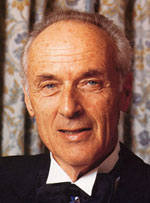
Introduction
Kenneth Baillieu Myer was elected to the Fellowship of the Australian Academy in April 1992, under the provision for special election of people who are not scientists but have rendered conspicuous service to the cause of science. Myer was a significant figure in Australian history by virtue of his contribution to the origins or early development of major national institutions, most notably the Howard Florey Laboratories of Experimental Physiology and Medicine, the School of Oriental Studies at the University of Melbourne, the Victorian Arts Centre and the National Library of Australia. He successfully fostered new research in organizations such as the Division of Plant Industry of the CSIRO and helped build the Oriental Collection of the Art Gallery of New South Wales.
A philanthropic life
One of Australia's great citizens, Kenneth Baillieu Myer, and his wife Yasuko died in a light plane crash in Alaska on 30 July 1992. Ken had been elected to the Fellowship of the Australian Academy of Science in April 1992 under the provision for 'special election' of people who are not scientists but who are judged to have rendered conspicuous service to the cause of science.
Kenneth Myer was an exceptional man who had a discernable impact on the arts, science and learning in Australia. This reflected his imagination and powerful impetus to create, which stemmed from a real curiosity. This generated his enthusiasm for science and an appetite to associate with and participate in the process of scientific discovery. He sought to understand the context – biological, medical or physical – of the investigations with which he identified. Although he was not formally trained in technology or biomedical science, this was no impediment to his wish to grasp the essence of a research investigation, and how it might alter basic knowledge and also have practical implications.
Kenneth Myer was rich and generous. His attitudes and philosophical outlook were not those of many, given his background and education. These circumstances were 'Establishment', with the connotation of wealth and power and the embrace of social structures that add up to a settled state of affairs. Notwithstanding this, elements of his outlook on life and society were non-conformist and, to a degree, socialist.
The customary pattern of biography in this journal centres on contributions to knowledge and the influence of discoveries. This includes the impact of the scientist in question on the academic world and community, illustrated by a comprehensive bibliography of publications. Kenneth Myer's impact was different. There are many people in Australia who have made large fortunes or built upon an inheritance, and who have departed the scene and left little behind in a public sense. Their presence and passing were unremarkable. By contrast, an account of Kenneth Myer's life illuminates how a lay person can participate in the progressive unravelling of a scientific problem, spurred on by an impatience to surmount obstacles – intellectual, organizational and financial.
This happened in several instances with Kenneth Myer and resulted in his taking the initiative. Thus in his major act of philanthropy, the creation of the Howard Florey Laboratories of Experimental Physiology and Medicine, he conceived a plan that involved both his brother, Baillieu Myer, and another highly influential figure in Australia, Sir Ian Potter. The creation of the Howard Florey Laboratories was the first major philanthropic exercise for all three, and perhaps its success set a pattern for what might benefit Australian science in the future. Recounting aspects of how they became involved may act as a paradigm in relation to future instances whereby imaginative citizens become philanthropists of science. The key element was the emergence of a sense of identification with the process of scientific discovery – the sense of being a participant in events. For Kenneth Myer, this sense of deep involvement coupled with his personal philanthropy was also operative in the case of the National Gallery and Arts Centre in Victoria, the National Library of Australia, the Art Gallery of New South Wales, the Division of Plant Industry of CSIRO, and the University of Melbourne.
Kenneth Baillieu Myer was born on 1 March 1921, the eldest son of a Jewish-Russian immigrant to Australia, Simcha Baevski. Simcha changed his name to Sidney Myer shortly after founding the family business. He married Marjory Merlyn Baillieu and they had four children – Kenneth, Neilma, Baillieu, and Marigold. All four children were born in the USA, where Sidney Myer had substantial business interests. In an interview with John Edwards, published in the Financial Review – one of the rare interviews Kenneth Myer gave, which provided key source material for this biography – Ken states that from 1920 until 1928, it was a toss-up whether his father would make his major interest in California or in Australia. In 1929, he decided to come back to Australia.
While in California, Kenneth Myer attended the local primary school in San Mateo, about twenty miles south of San Francisco. He did not see a great deal of his father because of the latter's preoccupation with his business, sport and travel. He had strong memories, however, of his father as a very warm and tremendously energetic man. Sidney was always doing something.
Sidney Myer started in business with a small clothing shop in Bendigo, Victoria, and progressed to Melbourne's Bourke Street in 1911, where he took competitors by storm with his unconventional marketing methods. Despite the fact that at times the enterprise was at risk, within a short time he demolished the Bourke Street site of Wright and Neil and built the Myer Emporium, which became one of Australia's largest stores. This retail empire was the foundation of the family fortune, and Sidney Myer was most generous to the community. His benefactions to music were the foundation of what is a rich musical heritage today. He was most helpful to the poor during the Depression of the 1930s. His great Christmas Dinner in 1933 for ten thousand pensioners and unemployed brought him much fame. The Premier of Victoria, Sir Stanley Argyle, was moved to comment at the time of Sidney Myer's death in 1934 that 'a transcending trait in his character was his deep humanitarianism'. Sidney Myer's philanthropy did not stop with his death, for in his will he left ten per cent of his estate of one million pounds to a trust for charitable philanthropic and educational needs in the community 'in which I made my fortune'.
Kenneth Myer was thirteen when his father died. He later stated that 'If you are the eldest male in the family at age thirteen you have a much stronger feeling of responsibility at an earlier age than is normal'. He stressed that his mother had a great influence on him in amplifying the memory and legend of his father. She had very strong principles and inculcated an attitude of community duty.
Ken had been sent to be a boarder at Geelong Grammar School, an experience that he did not enjoy. He found it an artificial society, somewhat difficult for a sensitive boy. He was shy and felt himself to be a loner. Though he worked hard, he was not a great achiever. An important influence on him at the school was William McKay, the music master, who was later to become Sir William McKay, responsible for the Queen's music at Westminster Abbey. This association generated a deep interest in music. There was also an art master who gave him a good insight into painting, and he studied the classics, Ancient Greek and Latin.
In 1939, Ken succeeded in passing the entrance examination for Modern Greats at Oxford, but when he was in New York on his way there, the Second World War broke out and the Warden of New College advised him not to proceed to Oxford. He went instead to Princeton University and had interesting experiences there. In these early days of the war, Ken encountered a somewhat hostile atmosphere in the university. Many of his fellow students regarded the war as imperialist, and Ken came under attack for trying to defend the stand that Australia and Great Britain were taking. He felt unable to deal with the isolationist outlook of the more sophisticated East Coast students, particularly the girls. One exception was a Belgian, daughter of a professor. But there were compensations. He travelled often to New York, a journey of forty-five minutes by train.
After a year at Princeton, Ken returned to Australia and joined the Royal Australian Navy, the RAN, in the anti-submarine service. He spent six years in the navy, much of the time on destroyers. He became good friends with several of his colleagues and felt that life on destroyers was very close to nature and the sea. He became a navigator, which involved long hours contemplating the cosmos, and this had some bearing on his life-long fascination with the natural world and his philosophical cast of mind. His attachment to the earth and to trees and flowers had started in his parents' garden at Cranlana, followed by frequent trips to visit his maternal grandmother in the Dandenong Ranges near Melbourne. Some of his tours of duty as an anti-submarine officer were in Papua New Guinea, and he was awarded a Distinguished Service Cross for his role in an attack by HMAS Arunta on a Japanese submarine that had torpedoed a merchant ship, Malaita, outside Port Moresby. While in the navy he worked in the North Atlantic, in Greece, and in Yugoslavia supplying Marshal Tito's forces. He also received a Distinguished Service Medal for torpedoing a German submarine in the Adriatic Sea while serving as a Lieutenant in the British navy, having temporarily transferred from the RAN to the Royal Navy in mid-1943. Later he served in the occupation forces in Shanghai, Hong Kong and Tokyo. This was his first exposure to Asia.
In 1947 Ken married Prudence Boyd and they subsequently had one daughter and four sons – Joanna, Michael, Philip, Martyn and Andrew. All have shared some of Kenneth Myer's interest in philanthropy, particularly in the arts and sciences, and in giving help to the disadvantaged. Prudence Boyd was a law student at the University of Melbourne when they met, and they married fifteen months later, after her graduation. John Edwards asked Ken about Prudence. He said 'she was definitely of an academic bent, and set very high standards. She was very interested in things of the mind. Not gregarious and not interested in sport. She had been a great help to him.' Prudence set very high standards for the children, and generated an intellectual attitude in the family. In 1976 Ken and Prudence were divorced, and he married Yasuko Hiraoka in 1979.
Following the war, after contemplating a life on the land, Ken entered the Myer Emporium, and was a Director from 1948 to 1985. He was Deputy Chairman and Managing Director, 1960-1966; then Chairman, 1966-1976, and a non-executive Director, 1976-1985. He was a Director of Coles-Myer, the retail-store conglomerate formed by the amalgamation of the Myer Emporium with the Coles group of companies, 1985-1989.
Kenneth Myer was a great innovator in the retail industry and won the International Retailers Award in 1970. He was a director of the National Retail Merchants Association of the USA from 1969 to 1979. During his period of leading the Myer Emporium, there was major expansion into Melbourne's big suburban shopping centres such as Chadstone and Eastland, and also the Target discount stores were set up.
In whatever capacity he was involved, whether in business or in his wide-ranging public life, Ken established warm and enduring friendships with the people with whom he came into contact, in libraries, museums and art galleries, in broadcasting, in medical and scientific research, and in many other spheres. Those friendships were built on a respect for particular skills and expertise and a recognition that people mattered.
Kenneth Myer's first community involvement when he returned from the war was as Honorary Secretary of the National Gallery Society of Victoria from 1948 to 1953. From 1958 to 1980 he was a member of the Victorian Arts Centre Building Committee, and Chairman from 1965 to 1980. When the building of the Arts Centre was complete, he became Chairman of the Victorian Arts Centre Trust from 1980 to 1989. These formal roles ratify his influence in benefiting Melbourne and the nation in the construction of the Arts Centre on the old Wirth's Circus site in St Kilda Road. The magnificent complex of the National Gallery of Victoria, the Concert Hall, and the State Theatre and Drama Theatres have altered the texture of life in Melbourne. Close by, the Australian Ballet Centre has been built, incorporating the Australian Ballet and the Australian Ballet School. Also nearby is the Victorian headquarters of the Australian Opera. Ken's enthusiasm and role in negotiating funding from the State Government was pivotal. As a private benefactor, his influence on the architecture and internal organization was evident. He gave unstinting support to the project's architect, Roy Grounds, who was charged, after a competition, with the responsibility of building the Centre. This close working relation is perhaps epitomized by an anecdote.
One Sunday morning after Ken and I had been playing tennis, we were having a drink at his house in Albany Road, Toorak, when Roy Grounds came in. I do not remember the exact date, but it was very early in the building process. With Roy was a domestic wicker clothes basket, and over this a towel. When unveiled on the lounge-room floor, the basket proved to be full of strangely shaped polystyrene blocks which Roy, on his knees, set out on the floor. Then with great enthusiasm, he stood up and said: 'this is the Victorian Arts Centre'. Ken was delighted and they began a discussion in which Grounds described how the theatres would be buried, since there were foundation problems arising from the state of the soil adjacent to the Yarra River.
An early decision that reflected Ken's and Ian Potter's commercial judgement was the decision to place a large car park under the National Gallery, in the hope that it would contribute to the finances of the Centre and also provide easy access in and out of the entire complex. That this was a fantastic advantage is evident to those who have struggled overseas in attending Covent Garden, the Paris Opera, or the Bolshoi Theatre. The only major disappointment for Ken and Roy Grounds in the execution of the complex was the inability to complete, as conceived, the major spire that was planned for the open space on top of the State Theatre complex. This was to incorporate the headquarters of the Australian Ballet and the Australian Ballet School, but Government funds, though generous, were not adequate to allow this to be built. A fine portrait of Kenneth Myer by Wes Walters is in the foyer of the State Theatre.
National Library of Australia
Having been a member of the Interim Council of the National Library of Australia in 1960 and a founding member of the statutory Council established in 1961, Myer served as Chairman of the Council from 1974 to 1982.
Myer's role in the National Library has been described warmly by John Thompson, one-time director of the Library's Australian Collection and Services. 1 The reflections within that essay, including quotations from the first Kenneth Myer Lecture, given by E. G. Whitlam, are a most valuable record of Ken's impact on that fine institution.
Thompson records that Arthur Ellis, subsequently Librarian of the University of Western Australia, remembered Ken 'chiefly because of his enthusiasm for most things and especially for those that were new and which caught his imagination', while Harrison Bryan, the Library's former Director-General, observed that as Chairman of the Council,
Myer was meticulous, hardworking and utterly exhausting. He would arrive at meetings primed by hours of discussion beforehand, with his papers scored and rescored with the coloured felt pens he used. He was completely in control at Council meetings and remorseless in eliciting all the facts of our operations. I found him an excellent chairman to work with, in that, despite his restless energy and his wholehearted commitment to the Library, he never sought to interfere in its day to day workings or to pre-empt in any other way the proper role of the Director-General.
Thompson also records that
In his role as Chairman of the National Library of Australia Council, Ken Myer worked hard to bring the institution into the computer age. While he always honoured and respected the great collecting tradition of the Library – indeed, he stated that the collections represented the heart of the institution – he had been shocked in 1968, at the time of the opening of the new building, to hear the perception of a distinguished American visitor that the National Library, though admirable in many ways, was stranded in the eighteenth century. He referred to the management of its procedures, the handling of information and the provision of services to the nation.
This view jolted Myer into the realization that the Library should embrace the new technology and the opportunities that computers offered to streamline procedures and to deliver more efficient and effective service. The interest that he took in this became the hallmark of his term as Chairman. That same interest continued in the Library long after Ken's formal association with the institution had come to an end.
Myer's other great contribution to the National Library of Australia – and to the many other institutions and causes with which he was associated – was his personal and unstinting generosity. Harrison Bryan noted that Ken Myer was the most generous of men – generous with his money, generous with his time and generous with his friendships. At the National Library, he made major donations to a General Trust Fund that was established on his initiative to give the institution and its Director-General some financial flexibility not always possible under traditional public service arrangements. In fact, two separate capital donations were provided to fund the Australian Libraries Summit in 1988 and the conference 'Towards Federation 2001: Linking Australians and their Heritage', organized by the National Library in March 1992.
An earlier instance of Ken Myer's generosity that fuelled what became a major initiative for Australian librarianship was described by Arthur Ellis, who remembered that in 1970, after he presented a paper to Council on how the Library might proceed with plans for an on-line national bibliographical system, Ken Myer provided the funds that enabled two senior members of the Library's staff to travel to the state of Washington in the USA to inspect the Washington Library Network (WLN) and to appraise its possible application to the Australian situation.
At that time, overseas travel was not always easy for personnel of institutions such as the National Library. It was characteristic of Myer that, having discerned the possible advantages for Australia of the WLN system, he should seek to save time and to cut through red tape by providing the means by which this important reconnaissance could be undertaken. The WLN system was eventually purchased by the National Library and provided the necessary software infrastructure to enable the Library to create its successful Australian Bibliographic Network. That network should be acknowledged as one of Ken Myer's many memorials.
In several reminiscences of Ken Myer that have been given in the years since his death, a common theme has been his friendliness, his qualities of personal warmth and his appreciation of people. At the National Library, the establishment of a scheme of long-service awards for staff was based on a suggestion by Ken, who was familiar with a similar scheme in the Myer group of companies. That scheme now operates in the National Library with the full support of the Council and it provides another tangible expression of the contribution Myer made to the Library's development as a major national institution.
During his early years on the National Library's Council, Ken had a close relationship with the then Chairman, Sir Peter Crisp, Chief Justice of Tasmania. After each Council meeting, they would spend the weekend trout fishing at Lake Eucumbene with friends. An early element in Ken's promoting of the transition of the Library from a traditional repository of documents to an electronic-age information centre was his association with Dr Martin Cummings of the International Office of the US National Institutes of Health in Washington. Cummings had been involved in the grant from the National Institutes of Health to me at the time the idea of building the Howard Florey Laboratories was conceived. He became Director of America's National Medical Library and was instrumental in the development of Medlars as an international data-retrieval system. Australia followed Sweden in a reciprocal arrangement with the USA that allowed full access to the database of the National Medical Library in Washington. Other elaborations of this system came later, but the development was consistent with Ken's desire that the Australian facilities should be first class. With his interest in architecture, Ken also exerted a powerful influence in the planning of the National Library's building, possibly the most elegant structure on the shores of Canberra's Lake Burley Griffin.
On Australia Day 1976, Ken Myer was in the second batch of Companions of the Order of Australia to be appointed, his service to the National Library being specifically cited. In 1989, the Australian Libraries and Information Association gave him its Redmond Barry Award, which goes to a person not employed in a library who has rendered outstanding services to the promotion of a library and to the practice of librarianship.
There is a story worth telling apropos the National Library that illustrates how Ken's enthusiasm could sometimes lead to a minor disaster. It involved a major loss of opportunity for the support of medical research. It was at the time following Australia's 1972 general election when Gough Whitlam with one other member of his party assumed government of the country for a short period before the remainder of the new Cabinet was formally installed. Earlier, Ken, Ian Potter, Colin Syme and Andrew Grimwade had presented to the then Prime Minister, William McMahon, a brief prepared by Sir Gustav Nossal and myself outlining the parlous state of support for medical research in Australia compared with not only the United States but also Canada, the Scandinavian countries, the UK, France and Germany. The brief showed that, considered as a percentage of gross domestic product, Australian research funding ranked very low. McMahon had said that he would consider doing something about it but did nothing, and his disappointment with this caused Ken to sign a public letter suggesting it was time for a change of government – a letter that caused a temporary rift in his family. Whitlam was now Prime Minister and Dr H. C. ('Nugget') Coombs was Pro-Chancellor of the Australian National University and resident in the Chancellor's apartment at University House. He invited Whitlam to dinner, together with Ken and me. The intention was unambiguous: to ask the new Prime Minister for a dramatic increase in the national funding of medical research. The circumstances, with Coombs as Whitlam's principal economic adviser and Whitlam's political indebtedness to Ken, could not have been better.
However, Ken had that day met up with a major figure in the Swedish National Library, and they had enthusiastically discussed the electronic linking of libraries all over Europe for exchange of information. They both arrived for dinner with a projector and slide show. Given that the Prime Minister had probably been up since 5 am, responsible for running the country almost single-handedly, it was not difficult to see that he was finding it difficult to keep his eyes open, notwithstanding the avalanche of enthusiasm. Ken was wonderfully unstoppable, and 'Nugget' and I looked at one another with some measure of despair. Despite the purpose of the dinner, medical research never came up and the chance of altering the national situation passed. As years went by, real improvement has occurred on a piecemeal basis, but the opportunity of persuading Gough Whitlam to make the quantum jump in relation to medical research becoming a national priority passed.
Community and urban interests
Ken Myer also took active interest in urban planning, architecture and the ambience in which a community conducts its daily affairs. He was President of the Town and Country Planning Association of Victoria, 1953-1958, a member of the founding Council of the Australian Institute of Urban Studies in 1967, and also, in 1971, a member of the Australian National Capital Planning Committee. He cared greatly for the welfare and aesthetics of the Royal Botanical Gardens in Melbourne and it was his habit to walk or picnic there whenever possible. He had a wide knowledge of botany and took delight in educating his friends about trees and flowers.
Ken's other public services include serving on the Committee of Economic Enquiry (the Vernon Committee) set up by Prime Minster Menzies in 1962, which reported to the Government in 1965. Ken described it as a deeply interesting experience. It was hard work, equivalent to a postgraduate course in Economics. He was much depressed by the failure of the Government to use the Report.
He also served on the Universities Commission (Chair, Sir Leslie Martin) from July 1962 for three years, and was very enthusiastic about its function.
There is no doubt that he got great pleasure from music. Sidney Myer, who was instrumental in founding the Melbourne Symphony Orchestra, had delighted in organizing open-air concerts in the Botanical Gardens that were free to everyone. After his death, Ken, with his brother Bails, his mother, his cousin Norman and his sister Neilma brought about the construction of the Sidney Myer Music Bowl in the Kings Domain. Concerts and, later, theatrical performances of ballet and opera took place there, and still do. The opening night in 1959 was a great occasion. The Bowl was given by Ken to the people of Victoria and Australia, with the Prime Minister, R. G. Menzies, accepting and the people of Melbourne attending en masse. The next night, Ken with wife and friends had a picnic dinner on the grass and listened to Mozart under the stars, together with thousands of other Melbournians. He was delighted – it worked.
The Myer Foundation
The Sidney Myer Fund reflected Sidney Myer's desire that a significant portion of his fortune should continue to bestow benefit on the community and provide a generous distribution from the Myer family. In addition, in 1958, Ken and his brother Baillieu Myer founded the Myer Foundation, of which Ken was President until his death. This formalized and augmented substantially the policy of personal donation that they had both followed. It was set up on the same institutional basis as the Rockefeller Foundation in the USA, with the object of 'the benefit of mankind'. The first two major benefactions made by the Myer Foundation were support for the building of the Howard Florey Laboratories of Experimental Physiology and Medicine, as will be described in detail below, and the establishment of a Chair and Department of Oriental Studies at the University of Melbourne. This latter far-sighted gesture reflected Ken's rapidly growing interest in Asia. His collecting proclivities in the arts from an early stage were largely centred on oriental art, no doubt influenced by the great family collection of Chinese ceramics. In 1958 he and Prudence made a visit to China, which at that time was an unusual thing to do. He was exceedingly curious to see what was happening, as the information available was limited. This was the forerunner of many subsequent visits and resulted in him being one of the most informed members of the Australian public in this area.
The Myer Foundation, together with the Sidney Myer Fund, is now a major force in the support of the arts and community projects in Australia. The existence of the Sidney Myer Fund and the settlement on the Myer Foundation with his brother, did not inhibit Ken from continuing his own personal donations to causes that attracted him. This was exemplified by donations of money and objects for the Japanese Gallery of the Art Gallery of New South Wales. The Director, Edmund Capon, has described this as the finest collection of Japanese art in Australia.
The Howard Florey Institute of Experimental Physiology and Medicine
His support for the building of the Howard Florey Laboratories of Experimental Physiology and Medicine was arguably the most significant philanthropic decision Ken made, particularly as he was a prime mover for it.
Ken's first involvement with science was his enthusiasm for the work of the Ionic Research Unit in the Department of Physiology at the University of Melbourne. This began informally when Ken and I met in 1954 on the tennis court at the home of Sir Norman Myer, then Chairman of the Myer Emporium. A close friendship developed with both him and his brother Baillieu ('Bails') Myer, and over the succeeding years we all spent considerable time together. Over three years, we discussed the way a surgical preparation in sheep had successfully reproduced the distortions of body fluid chemistry and evoked regulatory mechanisms that I had seen in a patient in the Royal Melbourne Hospital. The unique results there had been reported in Nature in 1948. 2 Our sheep parotid fistula preparation (an innovation in ruminants that derived from Pavlov's preparation in dogs) had opened up new avenues of medical enquiry into the control of body fluid composition and the organization of instinctive systems of ingestive behaviour in the brain. A major aspect of the work became the control of aldosterone secretion – the salt-retaining hormone. Ken fully understood this to be of great medical importance since disorders of salt balance were implicated in high blood pressure and dropsy of heart, liver and kidney disease.
Parenthetically, another issue needs mention. Ken and his wife Prudence both had an interest in the land (Prue's father had been Chairman of the Australian Wool Board) and both were intrigued by our hypothesis. This was that the change of sodium-to-potassium ratio of the sheep saliva with increasing body sodium deficit was a mechanism that emerged during evolution, and permitted ruminant types of animals (pastoral and wild game) to adapt to the extensive sodium-deficient regions of the planet. In effect, the animal as it became depleted of salt was using potassium, the cation abundant in grass and herbage, to replace sodium in order to operate its digestive system with the copious volumes of saliva that were required.
A crucial step in unravelling the control of aldosterone was the development of the idea of having a transplanted adrenal gland in the neck of sheep. By circulating the blood of a salt-deficient animal to this transplant, it was shown that there was an unidentified hormone in the blood that controlled aldosterone secretion. This evoked international media interest that had an impact in Australia and generated an editorial in the British Medical Journal3.
Ken Myer was enthused by these developments since he had a clear conceptual grasp of the biology and medicine involved. Apart from visits to the laboratories, he often called in at my house to hear the latest results. Several things now happened in quick succession. John Coghlan, who had joined the Unit, had found in the international literature an abstract describing a new radioisotope method for estimating adrenal steroids in adrenal-vein blood. This was of vital importance to us. Ken, when told that it involved buying a Packard liquid scintillation spectrometer costing £10,000, immediately provided the funds and supported Dr Coghlan's going to the USA to learn the methodology.
By this time Ken, his brother Bails and Sir Ian Potter, the distinguished stock broker and financier, had all visited the Department of Physiology laboratories more than once to see the sheep on which the experiment was being carried out and to discuss the growing implications of the data for medical science. Following one such visit, a dinner party was held in 1958 that was attended by Ken and Bails Myer, Sir Ian Potter, Colin Syme, who was Chairman of BHP and President of the Walter and Eliza Hall Institute of Medical Research, Professor R. D. ('Pansy') Wright, Head of the Department of Physiology, Dr H. C. Coombs of the Reserve Bank, who by this stage had first-hand knowledge of the experiments, and myself. The discussion covered the paucity of provision for medical research in Australia at governmental level. During the course of the evening, Coombs remarked that the experimental work in the Department of Physiology, with its attested international success, now required a really good laboratory to follow it out. No more was said, but the next week Coombs invited Ken and Prudence Myer to spend a weekend in Canberra at the Australian National University, when he showed Ken the John Curtin School of Medical Research. This was an imposing building. Coombs's percipient planting of the seed was notable, but possibly the outcome surprised even him. On the Monday night after the weekend, Myer rang me and asked: 'How much would it cost to build an internationally first-class laboratory for long-term survival experiments on animals, such as you are working on?' The answer I gave was a quarter of a million pounds, and Myer's immediate response was: 'I know somebody who has some of that'. He named his accountant, Arnold Hancock. Ken then suggested that a dinner be held later in the week with Sir Ian Potter. This occurred on the Wednesday night, with Baillieu Myer, Professor R. D. Wright, the Dean of the Faculty of Medicine, Sir Sydney Sunderland, and myself present. Ken proposed to Sir Ian that they undertake to raise 150,000 pounds of the funds required, and that they between them put in 100,000 pounds. Sir Ian immediately agreed to go halves, and then went further and suggested that the whole amount be underwritten by them, so that it would be possible for the scientists to go ahead and plan the building immediately. An architect, Barry Patten, was chosen by the Friday night and a site identified in the grounds of the University of Melbourne on which to build the laboratories. It fell to Professor Wright to persuade his colleagues in the Faculty, as well as the Vice-Chancellor, to let this building be constructed on what was then the women's hockey field of the University. This was situated in the south-west corner of the university campus, and anteceded the new Medical Centre that was later built there. Wright had a good ally in Sir Leslie Martin, the recently appointed first Chairman of the Australian Universities Commission, and the University agreed. Given this flying start, I made an approach to the Rockefeller Foundation whose Director of Medical Sciences, Dr Robert Morison, noted that Australia had been sitting on its hands for twenty years as far as the Foundation was concerned, and that this was a welcome new move. Within five minutes he agreed to provide 50,000 pounds. Sir Ian Potter then approached the Prime Minster, Sir Robert Menzies, who agreed that the Commonwealth would contribute 100,000 pounds. A contribution by the University made it possible for construction of the laboratories to embody fully the plan worked out by the architect and scientists. When it was constructed, the building represented possibly the finest facility in the world for long-term survival experiments on large animals. The National Institutes of Health in Washington made the same observation on its character in 2004, in the course of making a grant to the scientists then working there.
The University of Melbourne, having agreed that the proposed ten-floor laboratories would be built, suggested that the building might be named after Myer and Potter. Ken, on the other hand, proposed that it would be consonant with the whole spirit of the enterprise if it were named for a distinguished Australian who had made a major contribution to medical knowledge. Howard Florey, President of the Royal Society, was well-known personally to the scientists in the group, and in particular to Professor Wright. Myer and Potter were warm to the notion that the laboratories might be named after Florey, who was due to visit Australia to undertake experimental work in the Department of Physiology. When asked, Florey consented. At the opening ceremony on 30 August 1963, he expressed his warm appreciation in characteristic fashion. The Prime Minister dedicated the building and Florey responded by stating:
This is a red letter day because those who have generously provided the wherewithal have stood aside and allowed this splendid building to be named after me, although I have been, for so long, absent from Australia. I am very sensible of this honour. It is an honour which comes to few people, and an honour I particular appreciate receiving because it comes before I am completely dead.
He added:
The value of a laboratory such as this is that it will make discoveries, and that in the ambience of a university it has a maximum chance of stimulating the powers of enquiry of young men and women yet to come. There are always some whom a university will influence and educate to appreciate the beauty of experiments carefully planned, elegantly executed and clearly described.
Once occupied in 1962, the Howard Florey Laboratories of Experimental Physiology and Medicine progressed satisfactorily, working well with the University of Melbourne and the National Institutes of Health (NIH) in Washington. NIH support exceeded, three- to four-fold, that supplied by Australia's National Health and Medical Research Council. This meant that the Laboratories were largely American-supported. Furthermore, the staffing and activity exceeded that of the Department of Physiology itself.
Future funding of the Laboratories was brought to a head in 1967 by the Bureau of the Budget in the USA, which, because of America's gold reserve situation, decided to cut back on foreign research grants. It appeared that within three months there would be no funds to support about twenty people in the Howard Florey Laboratories. Bridging finance was provided by the Myer family, Sir Ian Potter, and the Reserve Bank of Australia. It was clear that the survival of what had been established depended on developing an independent base that would allow the Laboratories to seek support on a state, national and international basis, in a way that would not have been possible within the framework of a University department.
Kenneth Myer played a major role in the developments that led to the establishment of The Howard Florey Institute of Experimental Physiology and Medicine by incorporation through an Act of the Victorian Parliament in 1971. Discussions among those who had played a major role in establishing the Laboratories focused on the principle that Sir Ian Potter epitomized with the statement: 'We don't want a university sherry party committee. We want responsibility.' This embodied the view that if those concerned were going to give major time, effort and finance, they should have formal responsibility for the future of the enterprise. The Act of Incorporation was modelled on the Constitution of Harvard College. The Trustees were defined as a self-perpetuating group who had perpetual succession, with each remaining in office until death or by compounding with their creditors or going insane or resigning. In the event of a Trustee dropping out, the other Trustees had the right to nominate a successor. This gave a continuity of responsibility and an institutional memory. The model appeared to have served Harvard well for more than 300 years. Ken was enthusiastic about this Constitution, which was somewhat novel for the Australian scene.
The Act establishing the Howard Florey Institute envisaged its having nine Originating Members, namely Kenneth Myer, Baillieu Myer, Sir Ian Potter, Dr H. C. Coombs, Sir John Phillips, Dame Hilda Stevenson, Professor R. D. Wright, Mr Evelyn de Rothschild and me. The Act also specified that the Commonwealth of Australia, through the National Health and Medical Research Council, might nominate two members to the Board. The Victorian Government and the University of Melbourne similarly were each to have two members. The Act also provided for the appointment of Members at Large of the Institute, in addition to the Originating Members, and the Board had the power to nominate three additional members of the Board from the Members at Large, who were mainly citizens who had helped in either the scientific or the material development of the Institute. With great help from Sir Ernest Coates, Director of the State Treasury, the Act was introduced into the Victorian Parliament in 1971 by the then Premier, Sir Henry Bolte, and was supported by all parties. Kenneth Myer was elected President of the Institute, and thus Chairman of the Board, and he continued in this role until his death in July 1992. I was appointed Founding Director.
Within a year of its Incorporation, the Institute was awarded an Institutional Block Grant by Australia's National Health and Medical Research Council. This was the second so given, the first having been awarded to the Walter and Eliza Hall Institute of Medical Research. It enabled the Institute to invite Dr Hugh Niall and Dr Geoffrey Tregear, who ran the Peptide Laboratory of the Massachusetts General Hospital of Harvard University, to return to Australia, where they initiated programmes not only on peptide sequencing and synthesis but on cloning, gene sequencing and synthesis. This led to the sequencing, cloning and synthesis of the relaxin gene in several species, including man, and made the Institute a leading centre for molecular biology. This development was fully supported by Kenneth Myer, who gave me every assistance and also provided financial help through the Myer Foundation.
The resulting body of basic biomedical knowledge underpinning aspects of clinical development is an enduring legacy of Kenneth Myer's to scientific endeavour. In his will, he made a bequest to the Howard Florey Institute that is currently worth nearly three million dollars. He was succeeded as President of the Institute by his brother Baillieu Myer and more recently by his son Martyn who became President in 2004.
The Division of Plant Industry of CSIRO
Given Kenneth Myer's fascination with botany and plants, it was natural that he should have developed an interest in the work of the CSIRO Division of Plant Industry. His enthusiasm was matched by that of Yasuko who, as an established painter of flowers on ceramics, had a deep fascination with plants. Conjointly, they were powerful advocates of the research of the Division led by Dr Jim Peacock, and they also played an important role in the commercialization of the Division's research by providing post-doctoral fellowships. One of these was directed to drought-induced genes in plants, which in turn helped to develop drought resistance in Australian crops. The genetic manipulation of plants was a paramount consideration. Ken personally supported the development of the Gene Shears Company, and also provided support for a Master of Science position in the Division's Biotechnology Program. Ken also arranged, through the Myer Foundation, for the data-basing of the specimen collection of the Division's herbarium, thereby computerizing the details of more than fifty thousand samples of Australia's plants. Just a few weeks prior to his and Yasuko's tragic death, he spoke of the privilege it had been to support the Plant Industry Fellowship Scheme. If Australia wished to add value to its agricultural and food-processing industries, he said, it must invest in more applied research projects. Jim Peacock speaks of Ken as a man with remarkable vision, but also as a warm human being with a great smile and boundless enthusiasm and energy, who inspired all who had the privilege of meeting or dealing with him.
Chairmanship of the Australian Broadcasting Corporation
When Kenneth Myer was invited in 1983 to become the Chairman of the Australian Broadcasting Corporation (ABC), he asked one or two of his friends whether they thought he should take it on. The response he received was affirmative and enthusiastic. His friends recognised from his National Library experience and his involvement in experimental science that he had an enormous enthusiasm for technology. He therefore could serve as a powerful advocate for the embattled national broadcasting system. A large number of people felt that Australia was well served by the ABC, and were loyal to it. The ABC's portfolio of television, Radio Australia, and the national medium wave and FM radio programmes was almost unrivalled – the only parallel was the British Broadcasting Corporation (BBC). This was in Kenneth Myer's mind when he accepted the invitation that, in time, had an unhappy outcome. Ken's enthusiasm was set against the fact that his circumstances of life had accustomed him to things going his way. Being chairman of the Myer Emporium for a considerable period did not help to temper that orientation.
When he first entered the ABC, he and his wife Yasuko visited the many areas of its activities. Ken was full of questions and clearly to the forefront of his mind were things the Government might be persuaded to do, to strengthen the functions of the ABC technologically. Arguably, there could not have been a better advocate for the Corporation in this regard, had other matters not overwhelmed him.
The best recounting of the problems that arose is in a book written by the then staff representative on the Board of the ABC, Tom Molomby. 4 Molomby was a barrister who had been involved with the ABC at a production level for a number of years before becoming the staff representative on the Board. He precipitated Ken's resignation from the chairmanship, and what he says gives an interesting insight into Ken Myer's character. Despite the great qualities I have attempted to bring out in this account of his life, occasionally his judgment could veer off course, and Molomby's reflections convey facets of Ken's cast of mind known to friends and family. He did not care for confrontation and was deflected from what could have been a constructive outcome for the ABC because he came into conflict with members of the Board experienced in the law and journalism. Ken defended his Chief Executive Officer, Geoffrey Whitehead, when evidence from some quarters indicated that this was not a good cause.
Molomby's book recounts differences between Board members and the Chief Executive Officer, and the fact that Ken failed to resolve the issue. Molomby, with his legal background, was strongly of the view that the Chief Executive Officer was unable to deny him as a Board member access to crucial documents that should have been available to all Board members and not just to a selected group. Ultimately he took Whitehead to court and won the case. In a debate within the Board, Ken took the view that the Board should pay the legal costs of both parties, and asserted that that had always been the understanding. Molomby denied this and stated that had such a proposal come up, he, because of his intense interest in the issue, would have remembered it. The argument became too much for Ken Myer's patience and he left the meeting amid signs of considerable emotion – he walked home, conveyed his resignation to the Government, and never returned. He left the next day for Tokyo. This occurred in April 1986.
This was an unhappy episode when viewed against Ken's creative involvement in so many other areas, but perhaps it reflected the conflicting forces in a body such as the ABC. The professional capacities underpinning the position of those involved were different from what he had encountered in other contexts, and he was unable to manage them with the same success and equanimity that had attended his involvement in other institutions. His great strength was in the creative process, with the setting up of institutions or the modifying of them in circumstances that gave him a major role, rather than in situations where strong political forces were operative. It is interesting to conjecture what might have happened, had he accepted Gough Whitlam's invitation to become Governor-General of Australia.
The light plane accident in Alaska that terminated Ken's and Yasuko's lives was a terrible tragedy for his family, his close friends, and a wide circle who admired him immensely and were captivated by his infectious grin and laugh, his wilder enthusiasms, and his extraordinary charm. A predominant element in his life was his great delight in nature and his joy in being in wild, remote places. He revelled in fly fishing, at which he was skilled, and though he seemed depressed when he failed to catch anything, it was obvious that the rushing rivers and forest more than compensated. The rivers and lakes of Australia's Snowy Mountains were the main setting, but Alaska became a great attraction. The rivers and mountains there were on a much grander scale, and the big fish in the rushing waters excited him immensely.
Ken, with his brother Baillieu and his sisters, amplified the course set by their parents in philanthropy. Succeeding generations of the Myer family have followed this path. Without doubt Ken Myer changed Australia for the better.
About this memoir
This memoir was originally published in Historical Records of Australian Science, vol.18, no.1, 2007. It was written by Derek Denton, Department of Physiology, University of Melbourne, Australia.
References
- Thompson, J. K. (1962). Kenneth Baillieu Myer: An Appreciation. National Library of Australia News November 1992, 7-10.
- 2. Denton, D. A. (1948). Renal regulation of extracellular fluid. Nature 162(4120), 618.
- Denton, D. A., Goding, J. R. & Wright, R. D. (1959). Control of adrenal secretion of electrolyte active steroids. British Medical Journal 2(5150), 447-456.
- Molomby, T. (1991). Is There a Moderate on the Roof? (Heinemann: Melbourne.)
Keith Edward Bullen 1906-1976
Written by A.L. Hales.
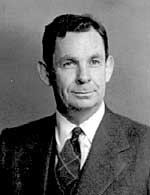
- Introduction
- Cambridge, 1931-1934: The travel times of seismic waves
- The Jeffreys-Bullen travel time tables
- The variation of density within the Earth and the ellipticity corrections
- The free oscillations of the Earth: Model A" and model HB1
- Standard Earth models
- The compressibility-pressure hypothesis
- The precursors to the DEF branch of PKP
- Bullen and mathematics
- General
- About this memoir
Introduction
Keith Edward Bullen was born at Auckland, New Zealand, on 29 June 1906. He attended schools in the Auckland area, completing his schooling at Auckland Grammar School in 1922; he earned recognition as a National Scholar, and was awarded the Eric Astley Prize for mathematics and science and a University Entrance Scholarship. From 1923 to 1925 he was a full-time student at Auckland University College and graduated BA in 1925, his major subjects being pure and applied mathematics. He was first in New Zealand in the final year examinations for the BA degree. In 1925 he became a master at Auckland Grammar School, but continued part-time studies at Auckland University College, being awarded the degree of MA with first class honours in mathematics at the end of 1927. In 1928 he became lecturer in mathematics at Auckland University College, but continued his studies for a BSc degree in physics at the University of New Zealand obtaining first class honours in that degree. In September 1931 he took leave from Auckland University College to study at St John's College, University of Cambridge, returning in 1934 to his post as lecturer and later senior lecturer in mathematics at Auckland University College. The work for his Cambridge PhD was completed while at Auckland. In 1940 he moved to Melbourne, Australia, as senior lecturer in mathematics. He was awarded a special MA degree by the University of Melbourne in 1945 shortly before he was appointed Professor of Applied Mathematics at the University of Sydney, serving in this post until his retirement in 1971. Bullen was awarded an honorary DSc by the University of Auckland in 1963 and another by the University of Sydney in 1976. After his retirement from Sydney he taught at the International Institute of Seismology and Earthquake Engineering in Tokyo and at the University of British Columbia.
Bullen was awarded many medals and honours by societies in Australia and abroad, being elected a fellow of the Royal Society of London in 1949, a foreign associate of the US National Academy of Sciences in 1961, and pontifical academician in 1968. He was a foundation fellow of the Australian Academy of Science, a member of the Council of the Academy 1955-57, and Matthew Flinders Lecturer and Medallist in 1969.
The William Bowie Medal of the American Geophysical Union was awarded Bullen in 1961, the Arthur Day Medal of the Geological Society of America in 1963, and the Gold Medal of the Royal Astronomical Society in 1974.
Cambridge, 1931-1934: The travel times of seismic waves
Bullen went to St John's College, Cambridge in 1931, and as was customary at that time he began to read for the mathematical tripos. However, Bullen saw little chance of being able to stay at Cambridge for more than two years, nor of being able to return to Cambridge after he had gone back to New Zealand. He was, therefore, anxious to make a start in research while at Cambridge. After a month or two he became a research student, with Harold Jeffreys as his supervisor. Jeffreys was working on the revision of the travel time of the seismic waves from earthquakes and Bullen worked with Jeffreys on this project throughout his years in Cambridge.
At that time the standard travel times used for the determination of the time of origin and of the location of the foci of earthquakes were those of Zoeppritz as modified by H.H. Turner. It was known that there were errors in these tables of as much as 20 seconds. The improvement of travel times is necessarily an iterative process for the earthquake is located using a set of travel times, the residuals from that set of travel times are then used to determine a second set of travel times; the earthquake is then relocated using the second set of travel times, and so on. Iterations of this kind are tedious and time consuming and were especially so in the days of mechanical calculators. It was on tasks such as these that Bullen spent his years in Cambridge. Jeffreys remarks of this period that 'Bullen's energy was phenomenal'.
Bullen's first paper with Jeffreys was a Nature letter on the subject of the corrections to the travel times of P (compressional) waves from earthquakes. It was followed by two papers dealing with the method of calculation of distance in seismology.
The Earth is an oblate spheroid, the polar and equatorial radii being 6356 and 6378 km respectively. In calculating the distance travelled by earthquake waves from a source to the observing station it is necessary to allow for the ellipticity of the Earth. It can be shown that the distance is more accurately determined if the positions of the source and the station are expressed in terms of geocentric latitude (the angle subtended at the centre of the Earth) rather than geographic latitude. This also facilitates model calculations which are carried out for the sphere of volume equal to that of the spheroid. This sphere has a radius of 6371.2 km. Travel time tables too are calculated for this sphere. T'he travel times on the spheroid differ from those on the sphere because of two other effects, the first due to the difference in the lengths of the ray path for the sphere and spheroid and the second because of the ellipticity of the surfaces of equal velocity within the spheroid. The use of geocentric instead of geographic latitudes results in differences in P travel times of the order of a few seconds and the two ellipticity effects mentioned to about 1 second. Both effects are therefore relatively minor. However in calculating the ellipticity corrections it was necessary to determine the variation of density with radius. It was in calculating the density distribution in the Earth as a step towards evaluating the relatively minor ellipticity correction that Bullen made the discovery which established his reputation and became, as he himself said in the preface to The Earth's Density, 'a developing story which has fascinated the author over much of his working life'. I will discuss the ellipticity correction and Bullen's papers on the density distribution within the Earth later in the article.
The Jeffreys-Bullen travel time tables
Bullen returned to New Zealand about the end of 1934, but the collaboration with Jeffreys in the preparation of travel time tables continued until the Jeffreys-Bullen tables were published in 1940. Bullen also published separately an account of the work on the travel times of the phases which had been reflected at the surface of the Earth.
The J-B travel time tables have stood the test of time remarkably well. Beginning about 1960 careful studies in which some systematic effects, for example regional variations in the travel times, have been eliminated have shown that the errors in the travel times from 30° to 100° arc distance are less than about 3 sec. Even now some of the systematic differences have not been satisfactorily determined and explained. At distances between 0° and 20° the observed times in continental shield or platform regions differ from the J-B times as much as 6 seconds. However, it is not yet possible to estimate with certainty how much correction to the J-B tables is required for the average Earth in the distance range 0° to 20°.
The variation of density within the Earth and the ellipticity corrections
Jeffreys showed that the calculation of the ellipticity correction to the travel times of seismic waves involved a term dependent on the ellipticities of the internal strata of equal density (and of course velocity). Adams & Williamson had shown that if any region of the Earth were chemically homogeneous and the seismic velocities Vp and Vs, were known it was possible to calculate the variation of density within that region from the equation
where G is the gravitational constant, M the mass inside the sphere of radius

k being the incompressibility and r the density at radius r. It was pointed out by Birch that equation 1 applied only if the temperature were adiabatic, but the correction required for any conceivable excess of the actual temperature gradient over the adiabatic is very small.
Bullen's procedure was therefore to calculate the mass and the moment of inertia of the crust, then, assuming an initial value for r at the base of the crust of 3.32 gms/cm3 corresponding to dunite, to integrate equation 1 numerically to the mantle-core boundary at a depth of 2900 km. The masses and moments of inertia of the crust and mantle were then subtracted from the known mass and moment of inertia of the Earth to obtain Mc and Ic, the mass and moment of inertia of the core. He found that
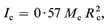
where Rc is the radius of the core. This required that the density of the core was greater at the core-mantle boundary than at the centre of the Earth. He remarked that this was 'out of the question both on general grounds and also in view of the strong evidence of lack of rigidity of the central core'. After examining the possible sources of error he concluded that the mantle could not be chemically homogeneous all the way from the crust to the core. In view of seismological evidence for the probable existence of a velocity discontinuity at 400 km he calculated the value of the density at a depth of 400 km required to reduce the constant 0.57 in equation 2 to less than 0.40, the value which applies in the case of a sphere of uniform density. After some further manipulation the density distribution given in column 2 of Table 1 was found. It is interesting to note that this first model of the density variation within the Earth was calculated using Gutenberg's 1929 velocities. This model was the progenitor of the model A series of models, but was never given an identification, nor used by Bullen thereafter.
Table 1: Bullen's density distributions
Once the densities had been calculated it was possible to calculate the variation of g, and of pressure with depth and also the ellipticities of the strata of equal density. It was also possible to determine the variation of the incompressibility and rigidity or shear modulus as a function of depth within the Earth.
Bullen states explicitly that in the 1936 and 1937 papers, 'the hypothesis of a first order discontinuity in density corresponding to the 20° discontinuity was used'. In the 1936 paper he remarks 'the discontinuity being assumed to occur at about 350 km'. In a later paper Bullen stated that the density increase at the discontinuity was 10 percent.
By 1940 Bullen had developed the lettered zonation of the Earth which was the basis of most of his subsequent work on the density variation within the Earth. In the 1940 paper they were as follows:
Layer A: The crust, thickness 33 km
Layer B: Upper mantle, 33-413 km depth
Layer C: Upper mantle transition zone, 413-984 km depth
Layer D: Lower mantle, 984-2400 km depth
In the 1940 paper Bullen followed Jeffreys in regarding the 20° discontinuity as a second order discontinuity, i.e. as a change in the rate of change of velocity with depth rather than the step increase of the 1936 and 1937 papers. The density change was spread throughout region C, hence the name transition zone. In the 1940 paper the density was tabulated down to the core-mantle boundary. It was followed by a paper in which densities were calculated for the core, now split into outer and inner cores and layers E, F and G. The outer boundary radii of layers E, F and G were 3471, 1398, and 1250 km respectively. In the 1942 paper Bullen recognized the uncertainties in the density distribution in the core. Accordingly, he considered two hypotheses:
- that the density varied smoothly throughout the inner and outer core, the density at the centre of the Earth being 12.3, and
- that there was a substantial increase in density between the inner and outer cores, the density at the centre of the Earth being 22.3.
Quite clearly Bullen regarded these as extreme cases, and in 1942 he tabulated the mean density distribution for the two hypotheses. The individual distributions corresponding to hypotheses (i) and (ii) were first tabulated explicitly in 1947. The 1942 core densities are given in Table 1 as are the density distributions corresponding to the hypotheses (i) and (ii). Bullen remarks, 'The model corresponding to hypothesis (i) has been called model A´; and a model midway between hypotheses (i) and (ii), model A.'
Bullen's work on the density distribution within the Earth established him as one of the leading geophysicists of his era and led during the 1950s to his wielding considerable influence in international geophysics.
The free oscillations of the Earth: Model A" and model HB1
In the early 1960s two developments occurred which bore on the density distribution within the Earth and led to Bullen returning to the development of density models for the Earth, the major focus of his early research. One of the constraints on the density distribution within the Earth is the moment of inertia. For many years the accepted value of the moment of inertia, I, was 0.3335Ma2, M being the mass and a the radius of the Earth. Early analyses of the orbits of artificial satellites showed that a significant revision of this relation was required and by 1963 it was clear that I was 0.3308Ma2. It then became necessary to revise the earlier determinations of density.
The second development was that following the great Chilean earthquake of May 22 1960, it was established that free oscillations of the Earth with periods as long as 54 minutes could be observed. The importance of this development was that previously the observational data constraining models of the elastic constants and density within the Earth were, apart from the mass and movement of inertia, the velocities of seismic body waves determined from the travel times of seismic waves. These velocities Vp and Vs, are related to the elastic constants k, incompressibility and m, shear modulus, and the density, r, by the equations:

There are thus two equations for three unknowns. In constructing density models as Bullen had done in the 1930s and 1940s it was necessary to make use of the additional constraint imposed by the use of the Adams-Williamson equation, and assume a value for the density at the top of the mantle selected on the basis of models of the chemical composition of the mantle. The calculated periods of the free oscillations of the Earth depend on the same three quantities, k, r, m, as the velocities Vp and Vs, but not in the same way. The dependence on the three parameters varies with the mode of the free oscillation. Thus a powerful new procedure for testing earth models was available.
Early comparisons for the calculated and observed free periods showed that minor modifications of the density distributions were necessary. It was suggested by MacDonald & Ness that the shear velocity in the lower mantle should be changed, but this modification was not consistent with the observed travel times of S waves. Landisman, Sato & Nafe suggested instead a modification to the density in the lower half of the mantle. This modification was characterized by a super-adiabatic temperature gradient in that region. This was regarded as physically improbable, and Dorman, Ewing & Alsop suggested that the radius of the core should be increased from the Jeffreys value of 3473 km to 3488 km.
Bullen and his graduate student of that period, Ray Haddon, embarked on a lengthy analysis of the models which were in accord with the free oscillation data. The first stage in that analysis was the construction of model A", a modification of model A´ to be consistent with the satellite-derived value of the moment of inertia, 0.3308Ma2. Bullen & Haddon confirmed that if the core radius were increased by 15-20 km the requirement of a super-adiabatic temperature gradient in the lower mantle could be avoided. In a series of papers they developed model HB1. This model fitted the data available in 1967, but not the additional data which became available in the early 1970s. It is quite similar to the model A´ or the first of Bullen's density models in the 1936 paper.
Bullen and Haddon's procedure in developing model HB1 was based on successive approximation. They began with model A" and by trial and error modified the model until the data available were fitted. Bullen remarks that 'an advantage of well-conducted successive approximation over some other procedures is that, broadly speaking, new parameters are introduced into model representations only where statistically demanded by the observational evidence' and that 'the user of successive approximation can always be in close touch with the fine details contributing to the improvements being made.' Other procedures used in the inversion of the observational data were the Monte Carlo procedure and generalized inversion procedures. Bullen thought that Monte Carlo models were 'biased against simplicity' and that a user of Monte Carlo procedures was out of touch with important details of the process because the acceptance or rejection of models was carried out inside a computer.
Generalized inversion procedures do not produce unique models, but for some purposes it is an advantage to have single models corresponding to particular sets of data. Thus generalized inversion procedures have frequently been applied using some additional criteria such as the 'credibility' criterion of Backus and some 'smoothness' requirement. In general the models developed in this way are close to the starting model for the inversion. Almost all starting models derive from, and are close to, Bullen's A models, and thus Bullen's density contributions still dominate our views of the density distribution within the Earth. It is not clear to me, and I am sure Bullen would agree, that the bounds of the acceptable density distributions within the Earth have been explored adequately.
Bullen himself continued to believe that 'successive approximation is likely to be indispensable towards securing the most reliable models, but with [generalized inversion theory] playing an increasing auxiliary role'.
The development of the Bullen density distributions is summarized in Table 1. It is remarkable how similar are the 1936 and HB1 models. In fact even the most recent of the models obtained by inversion of the free oscillation data do not differ very significantly from Bullen's 1936 model.
Standard Earth models
In 1971 the International Union of Geodesy and Geophysics created a Standard Earth Committee to develop a standard Earth model and appointed Bullen as chairman. Bullen attached great importance to this development and devoted a chapter of The Earth's Density to a discussion of optimum and standard Earth models. Bullen recognized that ultimately a three-dimensional model would be necessary, but he saw the development of a spherically symmetric model in which p, apart from the effect of ellipticity, was a function of r alone, as the immediate goal. He commented that 'many Earth models are being produced which are at best, minor variants of others'. He was frustrated, and in a degree exasperated, because the committee did not make much progress towards the acceptance of a standard model. He remarked:
The task of the committee has proved to be more complex than had been anticipated, partly for the reason that prima donnas performing simultaneously on different keys are slow to produce harmony, partly because of widespread failure to appreciate the difference between a standard and an optimum model.
If he had lived to 1979 he would have been even more disappointed to know that the committee has not yet completed its labours. It is possible, but by no means certain, that finality will be achieved at the meetings of the committee at the General Assembly of the Union in Australia in December 1979.
The compressibility-pressure hypothesis
In 1946 Bullen pointed out in a letter to Nature that the incompressibility k was 6.5 x 10¹² dynes/cm2 just above the mantle core boundary and 6.2 x 10¹² dynes/cm12 just below. He remarked, 'The suggestion therefore arises that at the very high pressures obtaining in the Earth's deep interior...the compressibility of a substance may be largely independent of its particular chemical constitution.' A number of inferences based on this hypothesis were made, notably that it would follow 'with a high degree of probability that the inner part of the central core below a depth of 5000 km beneath the Earth's outer surface, is solid'. He pointed out that if this were so it might be possible to identify S waves through the inner core and introduced the notation PKJKP for these phases. So far PKJKP waves have not been identified with certainty. However, analysis of free oscillation data has confirmed this suggestion of Bullen's.
In the letter to Nature, Bullen used the phrase 'largely independent of'. Later he wrote 'essentially independent of' and developed a model based upon the hypothesis that k and its derivative dk/dp 'may in the actual Earth change continuously across the core boundary'. This was the basis for the model known as model B, the density for which is given in Table 1.
The hypothesis requires that there should be an abnormally large density gradient in the lowest 200 km of the Earth's mantle (Layer D") and in the Earth's inner core so that these two regions would not be chemically homogeneous.
From 1949 Bullen wrote a number of papers dealing with the constitution of the terrestrial planets. Both Ramsey and Bullen proposed, independently of each other and on different grounds, that the lower mantle material undergoes a phase transformation to a higher density metallic phase of the same chemical composition at the mantle-core boundary. Ramsey's case for this hypothesis rested on solid-state physics arguments whereas Bullen based his support on the fact that using model B it was possible to fit the observed facts not only for the Earth, but also for the other terrestrial planets.
For many years Bullen's research was concerned very much with questions related to the density distributions in the Earth and other planets, and the inferences which could be made if the compressibility pressure hypothesis were valid. These subjects are discussed at length in his book The Earth's Density published in 1975. He was sensitive to the emphasis in this book on his own contributions to the subject and sought to disarm criticism of the book on this score in the preface, writing:
Perhaps I should apologize also for making considerable reference to my own work. I have done this because: first, in a subject rather difficult to expound in all its intricacies, I felt I could contrive the best coherence by basing many of the developments on my own approaches, at least in the first approximations; secondly, I would like this book to help correct numerous recent distortions of detail in my past writings (a phenomenon which of course by no means afflicts only myself in this era of scientist population explosion); thirdly, since the book may be my last major effort on the subject, I have sought to make the account of my work as unambiguous as possible. I hope these reasons will help to counter any suggestion that I regard my contributions are more significant than they really are.
The book will probably be found rather more cautious in its attitude to uncertainties than are many current writings. There is a strong tendency for modern writers (including some notable contributors) in the Earth sciences to be unduly black and white in their pronouncements – rather over-ready to 'prove' and 'disprove' and to declare the 'beliefs' and misbeliefs' of themselves and others in contexts where cautious assessments in terms of probability would be wiser. (This tendency is not confined to the Earth sciences.) Here, I have striven to avoid words such as 'proof', 'true', 'false', 'right', 'wrong', 'valid', 'invalid' except in formal deductive arguments. In inductive arguments, I have sought to 'infer', not 'deduce'; I have been at pains to distinguish between 'mathematical models' and 'facts', not only with density distributions and the like, but also with (so-called) physical 'laws', and so on. Perhaps vainly, I cherish the hope that my pattern of writing may make a modest contribution towards improving the appreciation of some points of scientific inference that need to be specially heeded in geophysics.
The paragraphs quoted reflect Bullen's attitude and philosophy remarkably well. He showed that he was aware of other points of view, he would examine them, he would on occasion modify his own point of view but only if the evidence for so doing was very strong (for example, by 1968 he had recognized that Birch's Murnaghan finite strain theory implied lesser differences in incompressibility as the pressure increased, and he no longer used the compressibility-pressure hypothesis in the narrow sense of the 1949 paper; until this stage was reached he pursued his own concept vigorously).
Bullen's early work on the density distribution within the planets was centred on his compressibility-pressure hypothesis. However, beginning in 1973 he wrote a series of papers which modified a hypothesis of Sorotkin that the Earth's outer core consisted of Fe2O. In Bullen's modification the smaller planets have cores consisting of Fe alone, the intermediate planets outer cores of Fe2O and inner cores of Fe, while the largest planets have cores of Fe2O alone. This hypothesis is of interest because quite recently Ringwood has suggested Fe2O as a possible constituent of the core, though not, as in Bullen's hypothesis, the major constituent.
The section in The Earth's Density dealing with this topic provides another good example of Bullen's philosophy. After discussing models of Mars and Venus based on the Fe2O hypothesis Bullen wrote:
Observational evidence on the seismic velocity distributions in Mars may be forthcoming before too long, and, as with Venus, would assist very much in discriminating between various ideas on the internal structure. It seems desirable to await well-based evidence of this type rather than clutter up the literature with excessive complex speculation. The legions of speculative papers on properties of the Moon, later shown to be quite futile by evidence from artificial satellite observations, provide a salutary illustration.
(Also pertinent is a recent geochemical scramble to produce papers about the Moon's deep interior using data from early samples of materials gathered at the surface. Perhaps it is not too great an exaggeration to liken the scramble to aspiring to infer the Earth's internal structure by digging up one's backyard and performing chemical experiments on the diggings.)
The precursors to the DEF branch of PKP
In 1954 there was a series of nuclear explosions at Bikini in the Marshall Islands. Father Burke-Gaffney of Riverview Observatory near Sydney noted that there were pulse-like arrivals on the Riverview records at times which might correspond to the arrival times of the seismic waves from the Bikini explosions. Together he and Bullen explored this possibility. In their first paper they noted that the arrivals from the four blasts were separated by whole numbers of minutes. They argued that this was unlikely unless the shots had been fired at some well defined time, for example, the beginning of the minute. They then showed that using an approximate location based on information in a Gutenberg paper about a 1946 explosion the P travel times at Riverview and other stations which had reported P arrivals in their bulletins were within a second or two of the J-B travel times.
They noted another fact about the bulletin readings for these explosions. At three stations, Pretoria, Kimberley, and Tamanrasset, the PKP readings were all significantly early with respect to the DEF branch in Jeffreys notation (or PKIKP, the phase which had traversed the inner core). Bullen wrote to me and asked me whether the South African records had been misread. Clearly this was not the case. The early arrivals were real and there was a larger amplitude second arrival at about the time expected for PKIKP. Burke-Gaffney & Bullen interpreted these early arrivals as diffractions from the caustic on the BC branch at 142 degrees. Bolt, a student of Bullen at the time of the Burke-Gaffney & Bullen papers, pursued the question of the precursors for some years thereafter. Bolt concluded that the precursor observations could be explained by two successive jumps in velocity in the outer core between 100 and 200 km above the inner core. Other authors proposed even more complex models of the velocity distribution in the lowest 500 km of the outer core as is shown in Figure 12.1 of The Earth's Density. These complex models have been abandoned. The early precursors to PKIKP, first noted by Burke-Gaffney and Bullen, are now interpreted in terms of scattering at the core-mantle boundary, an explanation first suggested by Ray Haddon.
The Bikini explosions occurred while Bullen was president of the International Association of Seismology and Physics of the Earth's Interior. He was greatly impressed by the potential of these large explosions for seismology and in 1955 wrote to the president of the Royal Society of London, and to the Academies of Science in Washington and Moscow proposing 'that for seismological and other experimental purposes one or more atom bombs be exploded during the International Geophysical Year'. He also devoted part of his presidential address to the International Association of Seismology and Physics of the Earth's Interior in 1957 to a plea that information on explosions should be announced timeously so that they could be used for scientific purposes. This plea had an immediate effect for before the meeting ended Bullen received a telegram from the chairman of the US Atomic Energy Commission announcing a forthcoming explosion.
Bullen and mathematics
Although his early leaning had been towards pure mathematics it was not long before mathematics had become to Bullen a tool rather than an end. He described himself once 'As an applied mathematician whose work leads him to put context first and mathematics second (but of course a very close second)...' and he remarked upon another occasion:
I think that most of us have met the type of mathematician who is so dazzled by the beauty of his mathematics that he applies it blindly to all and sundry without adequate analysis of the premises on which he bases his deductions, the type whose mind has been made over-rigid by pure mathematics! An important feature of applied mathematics is that it tends to correct this type of mind and, when well taught, to focus needed attention on the problem of initial premises.
Although he gave an address at the inaugural meeting of the Australian Mathematical Society he never became a member of the society and confessed that he had some doubts whether 'it was wise to link applied mathematics with pure mathematics in this middle twentieth century'. However he did regard good training in basic mathematics as essential for the training of applied mathematicians, scientists, and engineers and devoted a good deal of his time to promoting the need for good teachers of mathematics and good training mathematics programmes in schools. As always with Bullen he made his point of view crystal clear. There should be no easy options in mathematics in schools. For a time too, he was Chief Examiner in mathematics for New South Wales. This was no small task to undertake while running a large department and actively engaged in research.
General
Bullen wrote prolifically. There are 290 papers in his list of publications. The topics are diverse: apart from the many research papers there are scientific biographies, articles in encyclopedias and dictionaries of science, and articles on education, especially mathematical education.
His first book, Introduction to the Theory of Seismology, was published by the Cambridge University Press in 1947 and has been a standard text for seismology ever since. The third edition was published in 1975 and Turkish, Chinese, and Russian translations were published in 1960, 1965, and 1965 respectively. Two other books closely related to his teaching at Sydney, Introduction to the Theory of Dynamics and Introduction to the Theory of Mechanics were published in 1948 and 1949. An eighth edition of the latter was published in 1971. His short monograph, Seismology, was published by Methuen in 1954. The International Institute of Seismology and Earthquake Engineering published his notes for a lecture course on theoretical seismology in 1972. His last book, The Earth's Density, was published in 1975; it covers a wider range of geophysics than its title would suggest because the problem of the Earth's density distribution is so intimately related to seismological information on the interior of the Earth. Surprisingly perhaps there is only one reference to the revolution in the Earth sciences over the past twenty years as a result of which continental drift is generally accepted, and this reference is a casual one in a brief paragraph about the expanding Earth hypothesis.
In spite of the handicap of deafness Bullen played a very considerable role in international geophysics. He served as president of the International Association of Seismology and Physics of the Earth's Interior, as vice-president of the International Union of Geodesy and Geophysics, and as vice-president of the International Scientific Committee for Antarctic Research, and on a number of committees concerned with seismology and geophysics.
He was a very effective member of committees being always well informed on the papers and quietly persistent in discussion. In these activities I sometimes thought that he turned his deafness to advantage for, especially when in the chair, he appeared not to hear remarks which would have diverted discussion to what were, in his view, side issues.
In Australian geophysics too he played a significant role, serving for five years as chairman of the Australian National Committee for the International Geophysical Year and also for five years as chairman of the Australian National Committee for Antarctic Research.
At Sydney he taught courses in all the years of the undergraduate programme. In all his teaching he laid special emphasis on the importance of scientific method and the estimation of the reliability of data by statistical methods. Bullen regarded his role in Sydney as one of training students in all branches of applied mathematics rather than the development of a geophysics school. In his twenty-five years at Sydney he had only two PhD students in geophysics. To some extent this was because he thought it was to the advantage of students to go abroad for specialized training after completing their undergraduate degrees. Many of the students who majored in applied mathematics at Sydney did in fact do so.
Bullen's energy was, as Jeffreys remarked, phenomenal. This was true not only of his vocation, science, but also of his avocations. He was indefatigable as a tourist in his earlier days and later as a coin collector. After long days at scientific meetings, or on committees, he would spend many hours seeking out coin shops or other coin collectors.
He was always kind and courteous at meetings and ever willing to talk to the scientists, young and old, who wished to take advantage of his wide knowledge of seismology and scientific method.
Bullen married Florence Mary Pressley (known as Mary) in Auckland in 1935 and they had two children, John born in Auckland in 1936, and Anne born in Melbourne in 1943.
About this memoir
This memoir was originally published in Records of the Australian Academy of Science, vol.4, no.2, 1979. It was written by A.L. Hales, Director of the Bernard Price Institute, Geophysical Research University, Witwatersrand (1954-1962); Head, Geoscience Division, Southwest Center for Advanced Studies (later the University of Texas, Dallas) (1962-1973); and Director, Research School of Earth Sciences, Australian National University (1973-1978). Elected to the Academy in 1976.
Keith David Cole 1929–2010
Keith Cole grew up in Cairns, attended the local high school, and became the first in his family to attend university. Trained in physics and mathematics, he taught in secondary schools before joining the 1956 Australian National Antarctic Research Expedition to Macquarie Island as Auroral Physicist. This was the start of his lifelong career in space physics, exploring primarily the space environment of the Earth. He had a remarkable ability to identify the important physical processes underlying many phenomena, often when only limited data or observations were available. Thus early in his career he correctly explained several puzzling phenomena, particularly in the ionosphere and thermosphere, and quickly established himself as a leader in space physics, a position he maintained throughout his career. He also made very significant contributions as an educator (he was a Foundation Professor of Physics at La Trobe University) and through leadership positions in national and international science organisations.
Download the memoir
About this memoir
This memoir was originally published in Historical Records of Australian Science, vol. 25(1), 2014. It was written by Peter L. Dyson and David J. Cole.
Joseph Mark Gani 1924–2016
Joe Gani, as he was universally known, was born in Cairo, Egypt, on 15 December 1924 and died in Canberra on 12 April 2016. A visionary leader, mentor, and brilliant organiser, he created the Journal of Applied Probability, and was Chief of the Commonwealth Scientific and Industrial Research Organisation (CSIRO) Division of Mathematics and Statistics.
A distinguished academic career included posts at the Universities of Sheffield, Kentucky, California at Santa Barbara, and the Australian National University. His numerous research contributions are dominated by stochastic modelling, especially epidemic theory.
Download the memoir
Supplementary material
About this memoir
This memoir was originally published in Historical Records of Australian Science, vol. 30(1), 2019. It was written by Eugene Seneta.
John Stewart Turner 1908-1991
Written by David H. Ashton and Sophie C. Ducker.
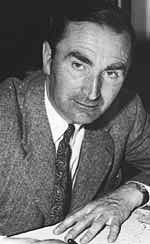
- Family background and education
- Cambridge years
- The University of Melbourne
- The war effort
- Important botanical initiatives
- Post-war changes
- Physiological research
- Ecological research
- John Turner and public education
- Turner's vision for conservation and heritage
- University achievements
- Family life and retirement
- About this memoir
Family background and education (1)
John Stewart Turner was born in Middlesborough, England on 9 September 1908, second son of Thomas Stewart and Ellen Turner (née Spice). His father was a Government inspector of armour plate. Apart from an older brother he had one sister and two younger brothers. His early childhood was spent in Stockport, Cheshire, where the family lived in a big rambling house with a large garden wonderfully suited to playing games and going for secret walks.
John's first school was the Stockport Primary School in Cheshire. Here an elderly Scottish teacher encouraged him and was responsible for his getting a scholarship to secondary school, namely the Boys' High School at Sheffield. At Sheffield, where the family had moved, they frequently walked and picnicked in the Derbyshire dales. Later, bicycle excursions were very much in fashion and took John and his friends far into the countryside. Bicycles were ridden daily to school but were also great on holiday trips to the Lake District, to Cambridge, and to the seaside.
As a boy he played the piano and sang with his family. He enjoyed going to concerts and to the opera and when the teachers arranged Shakespeare's plays John was involved, mostly backstage. All members of the Turner family were interested in drawing and painting and John liked particularly to make pencil sketches. A sketch-book was his steady companion on hikes and bicycle rides.
During some school holidays the Turner children were invited and stayed with relatives in London, where they visited the Kew Gardens. They had a grandfather who had been head gardener at a large estate and later started a nursery in London.
Botany was not a school subject, but there were some dedicated teachers who taught the subject to small groups of interested students during weekends. These sessions were often out in the countryside and later in life Turner remarked frequently how much he owed to these masters. He was very much interested in the world about him, especially in nature: he collected tadpoles, newts, birds' eggs and, in particular, plants. Although he was shy of adults he was always teaching and demonstrating to his brothers, sister and other children the wonderful things to be found in the garden and the countryside.
From an early age John and his brothers and sister were great readers, and many a tale Turner had read in his youth was cited and retold more than half a century later to his friends in Australia. It was a delight to be in the company of John Turner, especially for me [SCD], as, being bilingual, I was not so fluent in English. It was one of the greatest pleasures to listen to him recalling episodes from books or from his life. He was a wonderful story teller, painting the scene with good words in vivid colours. When in high spirits he often broke into a ditty. Words flowed easily from John Turner, both spoken and from his pen.
Cambridge years
In 1927 Turner went up to Cambridge, having won in 1925 the undergraduate State Scholarship to Selwyn College. He took an Honours degree in the Natural Sciences Tripos after three years, reading for Part I Botany, Chemistry and Zoology, and for Part II in Botany. He was placed First Class in the Intercollegiate Examination and in both parts of the Tripos. During the years 1930 to 1934 he carried out research in plant physiology under the supervision of F.F. Blackman, F.R.S., holding during this time, a renewed State Scholarship (1931), a grant from the Department of Scientific and Industrial Research (1932) and the University Frank Smart (1933) and University Allen (1934) Studentships. A thesis embodying some of his research and entitled 'On the relation between respiration and fermentation in excised carrot tissue, with special reference to the effect of sodium mono-iodoacetate on the metabolism of tissue slices'(2) was accepted for the degree of Doctor of Philosophy in 1936. His essay discussing this subject was awarded the University Gedge Prize, which was open to physiologists and biochemists in the University. Turner was a member of Selwyn College, Cambridge, during his undergraduate and postgraduate years.
In the years 1934 and 1935, Turner was Demonstrator in Botany at the Botany School in Cambridge and, from 1936 to 1938, Senior Demonstrator. His love of the outdoors allowed him to develop ecology as a counterpoise to laboratory experimentation. He organized very successful botany excursions to the oakwoods of Killarney and the alpine Cairngorms of Scotland in close association with two first-rate ecologists in the Botany School, A.S. Watt and P.W. Richards. He also carried out field work on fenlands with his life-time friend Harry Godwin (later Professor Sir Harry Godwin). Turner published his first paper on the fens in 1933.
The University of Melbourne
In November 1937 Turner applied to the University of Melbourne for the Chair of Botany and was appointed by University Council on 3 March 1938.(3) He arrived in Melbourne on the ship Strathaird on 8 August 1938 and was met by Dr Ethel I. McLennan, the long-standing Associate Professor who had been in charge of the department for the preceding year, and the Senior Lecturer, Dr Reuben Patton.
One of the youngest professors to be appointed to a chair at the University of Melbourne, Turner took up his position as Professor of Botany and Plant Physiology later in August 1938. He succeeded the foundation professor, Alfred James Ewart (1872-1937) who was appointed in 1906 when the School was first housed in the Zoology Department. Under Ewart's guidance the first Botany School was built and the new building opened in November 1929. For its time, the building was very modern, and reflected the taste of both Ewart and McLennan, who held the position of Associate Professor while the School was being built. The School had not only a large lecture theatre, a constant temperature room, up-to-date sterilizers, glasshouses and a wonderful library, but was furnished very tastefully entirely from Tasmanian Blackwood (Acacia melanoxylon). The benches, the cupboards, and all the furniture made of Australian timber were for seventy-five years a showpiece and the pride of Australian workmanship.
Turner must have liked what he saw in the Botany School. In an early letter to Professor W. Stiles in Birmingham he wrote: 'Ewart has built up a very fine school and the laboratory is very well planned and well equipped. And we rejoice in the possession of quite a large and very fine garden at the back'.(4)
Professor Sam (later Sir Samuel) Wadham, Turner's predecessor as demonstrator at Cambridge University, became a close and valuable friend in a neighbouring department across the System Garden. Wadham had been appointed to the chair of Agriculture at Melbourne in 1926 and was able to introduce him to the scientific community and to point out the state of the countryside under the effects of a century of exploitation. He introduced Turner to the problems and importance of catchments and the consequences of mismanagement.
Not long after his arrival in Australia, in January 1939, Turner attended the Australian and New Zealand Association for the Advancement of Science in Canberra. This was an important occasion for him in more ways than one. He drove up to Canberra with several members of his staff who introduced him during the journey to the Australian vegetation, for Turner an unknown botanical environment. The vegetation was strange and new, his familiar flora echoed only as weeds, horticultural species, or cosmopolitans of strand habitats. He was never completely at home with the new flora, so many times more diverse than that of Britain, but with his solid grounding in European botany, he soon mastered it sufficiently. He was assisted in his endeavours by the best of teachers in the Australian flora, Ethel McLennan. During this stage, Turner was delighted to see European weeds; they were, so to speak, the old friends from back home.
The trip to Canberra was also important because Turner hosted it for his former colleague from Cambridge, Professor F.T. Brooks and, in his letters of invitation, showed the pride and interest he had in his newly adopted country. It was also a crucial test for Turner because it was one of the hottest summers ever, with raging bushfires all over south-eastern Australia. He never forgot this and when he took students and visitors out in later years he would often point to reminders of the 1939 summer.
The war effort
Turner had brought with him from England elegant equipment to continue the plant physiology work which he had done in Cambridge. However, less than a year after his arrival in Australia, war broke out, and the School under his leadership diverted all its energy towards the war effort. Turner drew ably on the personnel in the University and assembled different working groups in his Department. He made Ernst A.F. Matthaei (1904-1966), who had trained at Zeiss and the University of Jena, officer-in-charge of a small workshop where graticules for sighting telescopes and binoculars were made. After Japan entered the war in December 1941 and the theatre of war moved to the Pacific, the Botany workshop and staff were enlarged to accommodate an additional wartime effort to stem bio-deterioration of instruments. It was necessary to 'tropic-proof' equipment against fungal infections which occurred even within optical instruments. As part of this effort, fungi growing on optical equipment were cultured and assessed. This involved the mycologist Ethel McLennan, the physicist J.S. Rogers and the microscopist Ernst Matthaei. Turner was the head of this team. The publication 'Tropic proofing of optical instruments by a fungicide' (with E.I. McLennan, J.S. Rogers and E. Matthaei), and later the report The Tropic Proofing of Optical Instruments, published by the Australian Ministry of Munitions, are both classics in this field and show the importance of the work in the Department under Turner's direction.
The other very important war work undertaken in the Botany School occurred following the discovery of penicillin, the antibiotic substance produced by a soil fungus. This stimulated world-wide research during the later years of the Second World War into the soil fungi, including in Turner's department where work commenced to investigate the then completely unknown soil microflora of Victoria and to test the isolates for antibiotic activity. In addition, in the closing months of the war, a collection of soil mould cultures was brought to Melbourne from the Northern Regional Research Laboratory of the Department of Agriculture at Peoria, Illinois, to be housed and curated in the Botany School. This occurred due to Turner's contact with F.G. Morgan at the Commonwealth Serum Laboratories in Melbourne, who visited the Botany School in November 1943. The two men developed a plan for collaborative research on penicillin and antibiotically active fungi found in the future. Staff at the Botany School were to undertake the mycological side of penicillin production. The overall supervision of this aspect was to be by Ethel McLennan working with two assistants. The team was also to undertake a new survey of Australian moulds and larger fungi to determine if more organisms could be found that yielded antibiotics. To fund this research, Turner secured grants from the National Health and Medical Research Council and the National Research Council. These arrangements are documented in his correspondence with H.L. Cumpston, the Commonwealth Director-General of Health.(4) The School became a hive of industry with the project teams overcrowding the building. Financed to a large degree by munitions funding, a new wing was added to the Botany School. It housed two new laboratories, one for mycology and one for the optical work. A large number of papers was published during this period, on the mycological work in particular, and this could not have been undertaken but for the overall involvement of J.S. Turner.
The extent of his care and commitment can be judged by his correspondence, as exemplified by a letter from Turner to the Director of Rationing:
Dear Sir,
Following my letter of 8th September, you were good enough to grant me a permit to buy 3 lbs. of sugar for this laboratory during each month, October, November and December, 1942.
We are still using sugar in these quantities, largely for research on war problems, and I would be grateful for a further supply of monthly ration tickets.
Yours sincerely,
[signed J. S. Turner]
Professor of Botany
Director of Rationing
Flinders Lane
Melbourne C.1.
The sugar was required for the preparation of culture media in which to grow the fungi. Every ounce of sugar and malt-extract used by the assistant [SCD] during the process had be accounted for.
The full involvement of the Botany School in the war effort can best be judged by a letter written by Turner to the then University Registrar, Mr. F.H. Johnston:
14th June, '43.
Dear Mr. Johnston,
re request from Scientific Liaison Bureau
The following work pertaining to the war is going on in this department. Some of it is production, but coupled with this is research into the various problems that arise from time to time.
- Ruling and etching of graticules (information available on acid proof resists, and on ruling machines, properties of glass in relation to etching (O.M.P.).( 5)
- Photographic production of graticules (O.M.P.).
- Photo etching of graticules (also see under Chemistry Department( 6) (O.M.P.).
- Optical cleaning and assembly of binoculars (Army).
- Growth of fungi on optical components of instruments (O.M.P. and Scientific Liaison Bureau).
- Control of timber rotting by fungi (Forestry Commission; Broken Hill Pty. Ltd.).
- Production of mannitol by native shrubs (with C.S.I.R.).
- Growth, and hyoscine and hyoscyamine content of Duboisia (with Physiology School of University).
- Control of virus diseases on vegetable crops (with Department of Agriculture, for Army).
- Survey of Australian fungi as sources of the drug Penicillin (suggested by Dr Kellaway, of Walter & Eliza Hall Institute).
It is difficult to appreciate fifty years later the importance and the commitment of Turner and his Department towards the war effort. The goal in the University of Melbourne, and indeed in Australia at large, was to win the war. All other occupations and research were of no significance compared to the final victory. It has been said frequently that in a totalitarian state like Germany the war effort was more serious than in the other countries during the war. Observations show that this was not so, and that elsewhere too there was a total commitment towards the war effort, as exemplified by the Botany School led by Turner.
Important botanical initiatives
On 2 March 1945, the Miss M.M. Gibson Trust, later known as The Maud Gibson (Gardens) Trust, was established. This was to be a Research Trust to aid the National Herbarium of Victoria. The first Trust Committee comprised the Professor of Botany at the University of Melbourne as Chairman, the Director of the Gardens, Mr A.W. Jessep, as Secretary, Mr Russell Grimwade, Mr F. Grassick and Mr A.G.M. Mitchell. Turner chaired this important committee until his retirement. On the death of Grimwade in 1955, he selected his friend Professor S. Wadham to fill the vacancy on the committee. The Trust was a welcome vehicle that allowed Turner to set in motion some important botanical projects for Victoria. James H. Willis, Government Botanist at the National Herbarium, wrote the two-volume Flora of Victoria (published by the University of Melbourne) under the auspices of the Gibson Trust. Miss Margaret Stones, the internationally recognized Australian flower painter, who owed much of her fame to early recognition by Turner, was brought out from England with Trust funding to illustrate the vanishing flora of Victoria's basalt plains. Turner also arranged for Dr Ronald Melville, head of the Australian section at the Kew Herbarium, Royal Botanic Gardens, London, to be financed to study the Australian flora for a year.
Post-war changes
After the war, there was a tremendous influx of students taking Botany due to the many returned servicemen and women entering the university. This brought about a completely changed atmosphere in the Department, effected not only by the rapid growth in student numbers, most of whom were relatively older students, but above all by the arrival of new staff and a subsequent rearrangement of classes and duties.
Turner had inherited a department of older staff who were used to the authoritarian, volatile personality of Professor A.J. Ewart. To this extent his job was difficult, but he initiated changes in structure and outlook. The complement of staff and the courses taught were completely remodelled according to Turner's ideas and wishes. When Turner took up his appointment, every staff member in the Department was older than he: Dr Ethel McLennan, Dr Reuben Patton, Dr B.J. Grieve; only the junior tutor, Dr Eileen Fisher was almost his age. After the war he selected new staff fostered by his former friends in England. This gave him a feeling of superiority, because he was no longer the 'new boy' and, in particular, no longer the only staff member who had not been born and bred in Australia. Turner got on with the teaching and research he had originally planned to do on his arrival in Australia.
Some other important changes occurred in the Botany School at this time. There was a change of strength of leadership, direction and student control, from McLennan to Turner. There was also a change of research thrust to physiological and ecological work. Turner also moved to foster more personal community and environmental interests outside the University.
Physiological research
Plant physiological research was resumed with great vigour after the war and, with Vera Hanly (later Vines) as his research assistant, Turner made great advances into the physiological processes of respiration and fermentation. At this time he collaborated with his great friend Dr Bob Robertson (now Sir Rutherford Robertson) in research on salt respiration. During this period and the following decades John Turner wrote numerous thoughtful reviews on the direction and perspectives of plant physiology - in particular the pasteur effect, photosynthesis, starch and phosphorus metabolism.
New physiological work was also developed by two of the bright post-graduates of that time, both returned soldiers: Dr (then Mr) Kingsley Rowan and the late Mr Bert Overell. The research later led to a valuable liaison with scientists in the Commonwealth Scientific and Industrial Research Organisation (CSIRO) Fruit Physiology Research Unit. Turner's interests continued on the effect of oxygen on photosynthesis with Dr Ed Brittain, and on protoplasmic streaming with Judy Kelso, Stella Ovenden (later Dr Stella Thrower) and Mr (later Dr) Garth Everson. In the latter work he employed optical equipment developed by Mr Ernst Matthaei.
An early and important appointment after the war was that of Dr David Goodall. He was the first of a long line of plant physiologists engaged by Turner to fulfil his interest in plant physiology and at the same time his commitment to the title of Professor of Botany and Plant Physiology. Goodall provided an enormous stimulus to research in nutritional physiology and later became a world leader in quantitative ecology. He had a direct and important impact on the ecological assessment of the Bogong High Plains (see later).
After the departure of Dr Goodall in the early 1950s, two further English plant physiologists were appointed: Dr Denis Carr who taught the Science students - due to the increase in student numbers, courses had to be duplicated and diversified - and Dr Tom Neales who initially was to teach the Agriculture students only but later taught whole plant physiology to both streams of students. Neales' research in this branch of botany flourished at a time when Carr had left the Department and Turner's interests were more ecologically directed. Rowan and Neales represented plant physiology teaching and research in the Botany School until recently. The historical connotation of the Professorship of Plant Physiology in the Botany School ceased with Turner's retirement in 1974.
Ecological research
Early in the war years, Turner was fortunate in having in the department a first-rate junior botanist Maisie Fawcett (later Carr), who had completed her Master's degree several years before. She was unable to continue research involving microscopic studies for medical reasons. Turner created the opportunity for her to study the effects of grazing, fire and rabbit depredations on soil erosion in the Hume Catchment, as the first field officer for Victoria's newly created Soil Conservation Board. She was based at Omeo and travelled the area by car, foot and on horseback, finally producing a penetrating and careful report of catchment conditions. The work led directly to investigations of the important subalpine and alpine areas of the Bogong High Plains which were earmarked for hydro-electricity development. Turner threw his weight and influence behind this work, and in 1945-6 was instrumental in obtaining funding to study the ecological problems of catchment maintenance under a regime of summer cattle grazing. He was an overseer of this work and its power base and organized logistical support from within the Botany School to help Fawcett in regular assessments of vegetation by point quadrats. Fenced plots established by her in 1944 and 1945 proved to be ecological benchmarks, and are still being monitored today. Turner missed few of the excursions into the High Plains, trips which were made the more enjoyable by his good spirits and camaraderie. He resented keenly the suggestion later made by D.J. Carr (1989)(7) that he was just another notable person who attended some of the High Plains field excursions.
In 1959 Turner co-authored two papers on the progress of the High Plains work with Stella G.M. (Maisie) Carr. She later developed themes of dynamics based on the pivotal work of A.S. Watt in Cambridge. In 1964 Turner met the costs of Carr's impending visit to re-assess the progress of the work, and also of relatively mundane items such as re-fencing of the plots before the return of the cattle to the High Plains.
In the late 1940s, Turner saw the need for ecological research nearer to Melbourne and the need to communicate this to the public, and for such study to be of direct use in land management. From Wadham he had heard of the magnificent Mountain Ash forests at Wallaby Creek on the Great Divide immediately north of Whittlesea. The effects of past fires had created large areas of dense young forest as well as areas of brackenland and scrub. The water supply for Melbourne is derived from this and similar areas to the east. Therefore, a knowledge of water use by different sorts and different ages of vegetation was an important basic study. John Brookes, an ex-serviceman, proved to be an ideal choice to study such water relations which he did in 1948 under the co-supervision of Associate Professor Leeper from Agricultural Chemistry. The work indicated the importance of fog drip and the large water use by young forest. It led subsequently to extensive research by hydrologists of the Melbourne and Metropolitan Board of Works (now regrettably called 'Melbourne Water'). The tract of mature, non-regenerating Mountain Ash in the Wallaby Creek catchment was of particular significance. Turner believed that the key to the stability of the vegetation was its ability to regenerate. It fell to David Ashton to spend the subsequent forty years studying this and the post-fire vegetation dynamics.
John Turner also regarded as essential descriptions of vegetation close to Melbourne and in 1948 persuaded Trevor Clifford (later Professor) to study eucalypt distributions in the Dandenong Ranges and to relate these and the associated flora to soils and climate. He also started others on ecological programmes at this time: heathlands (R. Winkworth) and dry eucalypt woodland (C. Elliott). Turner once confided that he wished he had made every student study the plant ecology of a different area in much the same way as Professor Edwin Hills had done in Geology. In this way the ecology of the state would have been all but covered in the span of his professorship.
In 1950, after a sabbatical year in the United Kingdom, Turner arranged with the CSIRO to finance a reciprocal sabbatical year for Dr A.S. (Sandy) Watt from Cambridge. This was a master stroke, for it stimulated Australian ecologists to focus attention on stability and regeneration - cornerstones in ecology.
John Turner was a renewed man on field trips and his camaraderie, Gilbert and Sullivan doggerel and sense of fun are legendary among his old students and staff. His outlook undoubtedly promoted loyalty and cohesiveness in the Department. He was instrumental in raising money and having a Botany Laboratory, named McLennan, built at Tidal River, Wilson's Promontory, in 1960 and opened in 1961. Here, generations of students went on memorable excursions that involved floristic, heathland productivity, dune succession, and algal studies of both the rocky shore and river.
Turner represented Australia at international scientific meetings on two occasions: in 1964 in Paris for the International Biological Program, and in 1972 in Banff for the Eleventh International Union for the Conservation of Nature and Natural Resources.
John Turner and public education (8)
No less important but less recognized than Turner's scientific achievements are his many contributions to public education.(9) He was one of the pioneers of science education in Australian schools. At the outset of mass secondary education in the 1940s, Turner and Samuel Wadham attempted to crystallize the ideal of a popular science curriculum for the compulsory years that had its roots in children's common experiences and that sought to elucidate the general principles observable in nature without emphasizing traditional academic divisions. The introduction of a prescribed General Science syllabus in Victoria to replace five specialized subjects (Physics, Chemistry, Physical Science, Botany, and Animal Biology) for the new Intermediate Examinations in 1943 was decisive in the formation of a community of science educators in Australia.(10) Turner wrote a text for the course, General Science for Australian Schools, and introduced a new undergraduate course structure for Science at Melbourne that permitted a broader scientific preparation for science teachers.
Turner was the first President of the Science Teachers' Association of Victoria(11) and for twenty-five years chaired the General Science Standing Committee of the Schools Board that controlled both the syllabus and the examinations. All Australian states adopted a General Science syllabus during that period.
In 1945 Turner introduced Biology as a senior school subject in Victoria, replacing both Botany, and Animal Morphology and Physiology. He chaired the Biology Standing Committee of the Schools Board for thirty years, culminating in the production, through the Australian Academy of Science, of 'The Web of Life'(12) course that completely re-conceived the purpose, structure and function of biology teaching in Australia. In his inaugural address to the Australian Association of Scientific Workers in 1940, entitled 'Biology in Schools', Turner expressed his concern that in Victoria just before the war, fewer than two hundred boys in any year studied any biological subject at Year 10 or beyond. His achievements are a testimony to his commitment to public education and nature conservation. That he was able to bring these together is remarkable. His fine aesthetic sensibilities and skills as writer and diplomat for science made this accomplishment possible. Writing of this mission he concluded:
I have tried to bring home a sense of the miracle of evolution. I have argued that our environmental problems are not to be solved by a return to mysticism but by scientific investigation and a change of heart - a renewal of an old tradition of stewardship. Preaching the virtues of conservation would be unnecessary if only we could open people's eyes to the interest, the beauty and majesty of the planet on which we live: only if we love a place do we wish to save it.
Turner's vision for conservation and heritage
In the mid-1950s and beyond, Turner became increasingly involved in conservation issues. He was concerned with what natural resources still existed and the best way to protect them from commercial development. He was very clear that proper conservation required ecological research to sustain it. This required money and money required persuasion of people in high places. In this regard he was supremely successful. He was not an aggressive extrovert but rather a backroom person who, through much diplomacy, set up the right climate for progress to be made. This was invaluable for the conservation cause.
In 1952 Turner became a foundation member of the Victorian National Parks Association, which began as a sub-committee of the Field Naturalists' Club of Victoria. He became the Association's Vice-President from 1969 to 1973 and was on its Council from 1960 to 1975. In 1954 the Australian Academy of Science was established and two years later John Turner was elected to its fellowship and was a member of its Council from 1967 to 1970. The Academy was instrumental in focusing conservation issues, especially those involving the High Country of south-eastern Australia. Turner was chairman of the committee that, in 1957, was instrumental in publishing a paper describing the effects of sheep and cattle grazing in the alpine and sub-alpine zones. In 1961 he and A.B. Costin, R.L. Crocker and J.W. Evans published a paper on the proposal to establish a primitive area in the Kosciusko National Park.
The conservation movement received a great impetus in the 1960s. In 1965 the Australian Conservation Foundation was established, Turner being one of the eighteen people involved with its inception. He resigned in 1973 after politicization of the Executive Council. The Foundation promoted important conservation studies such as that on Norfolk and Phillip Islands by himself, R.D. Hoogland and C.N. Smithers. He was without doubt influential in the directions taken by the Conservation Council of Victoria which was set up in 1969 following the public awareness and debate centred around the conservation status of the Little Desert in Victoria. In the 1970s many conservation initiatives bore fruit. John Turner and John Landy were early members of the Victorian Land Conservation Council set up in 1970, an impartial body the aim of which was to assess the best use of land for future generations. It began operating in 1971. Turner's influence led to the proclaiming of an Act of Parliament for the preservation of reference areas in each major plant community, an idea well ahead of its time. He was similarly influential in the setting up of the Environmental Studies Association by D.M. Calder and I. Hore-Lacy, with its main aim directed at conservation education through public courses and school curricula.
Turner's activities on public matters were wide-ranging since he was intensely interested in the heritage - whether natural or historic - of human activities. The National Trust (Victoria) was set up in 1956 and he was one of the original ex officio members. In 1964 the Trust acquired 'Como', an early mansion in inner Melbourne, and created an awareness of Victoria's nineteenth-century heritage. From 1968 Turner was chairman of the Como gardens sub-committee and, with landscape and garden consultants, advised on the grounds, purchases and employees at Como. His interest in landscape was very deep and almost passionate. In 1960 the Landscape Preservation Council of the National Trust was set up. He was a founding member and the chairman from its inception. Likewise, in 1972, he was on the Landscape Classification Committee and in 1973 he became its chairman. In this year he was commissioned by the Northern Territory Administration to report on ecological, aesthetic and social problems at Gove. In 1976 he and Professor George Seddon reported to the State Electricity Commission of Victoria on the landscape assessment of the new brown coalfields proposed in the La Trobe Valley. Much earlier, he was involved with the Scientific Sub-committee of the National Gallery of Victoria (1943) and was on the Civic Advisory Panel for the City of Melbourne (1955).
Turner also threw his weight behind smaller, local conservation issues such as the Albert Park Protection League, the Blackburn Tree Preservation Society, the Beaumaris Tree Preservation Society, the Native Plant Preservation Society and the Heytesbury Historical Society. The most important of these was the Save the Dandenongs League. Turner had become interested very early in the Dandenong Ranges east of Melbourne because of the beauty of their scenery, gardens and forests. It was clear after the war that they were under threat from runaway development, and no doubt he was also influenced by the benefits of sensible control in England in such places as the Lake District. In 1950 Turner and a prominent conservationist, Miss May Moon, set up the League and subsequently lobbied hard for conservation and aesthetics. He was president of the League from 1970 to 1972. A plaque commemorating his role in this movement was erected at Kalorama in 1993.
Turner still maintained his interests in plant physiology and ecological research but in the decade before his retirement in 1973, he became increasingly involved in the conservation movement and was uncompromisingly demanding that exploitation be accountable and fully restorative. He saw landscape in terms of beauty as well as science. He was a staunch advocate of the revegetation of much agricultural land in the most sensitive way possible, for he was well aware of the salinity problem that had developed as a result of uncontrolled agricultural practice before and between the last wars.
In 1938, soon after his arrival in Australia, Turner joined the Royal Society of Victoria. He was president of the Society in 1951 and 1952, and became a life member in 1981. In 1941 he also became a valued member of the Wallaby Club, a convivial group of intellectual ramblers. He was elected president of the Club in 1962 and became a life member in 1982. In both groups, Turner was therefore in contact very early with important and influential members of the community. He joined the Melbourne Club in the year of his retirement, 1973.
University achievements
As well as his many important and time-consuming activities outside the University including conservation, heritage and literary interests, Turner maintained a high profile within the academic sphere. His university activities included a full teaching load which, in the early years, embraced the whole of first-year Botany. His research activities tapered off in the 1960s and he wrote more reflective papers and reviews. Administration in an enlarged Department and University increased. He was Chairman of the Professorial Board and a member of the University Council in 1953 and 1954, acting Vice-Chancellor in 1953, and Dean of Science in 1944-46 and 1967-1968. He was on the Board of Forestry Education from 1954 to 1973, having regularly examined at the Creswick Forestry School since the war years. He frequently acted as examiner for other universities in the 1950s and 1960s, in New Zealand (Auckland and Dunedin), Malaysia and Hong Kong. He was on the Grounds Committee of the University of Melbourne from its inception in 1958 until his retirement in 1973. He was largely responsible for the remodelling of the precincts into the showpiece they are today. Turner's literary interests took him to Melbourne University Press for which he was Chairman of the Board of Management from 1963 to 1973.
In 1960, with the departure of Dr and Mrs Carr to Queen's University, Belfast, John Turner saw the need for new directions and new staff in the Botany School. Dr Ray Specht was hired, a brilliant ecologist from Adelaide who was interested in ecosystems and productivity, and under this new influence physiology and ecology were blended in Melbourne. In 1965 he left the Department to take up the chair of botany in Brisbane. Turner replaced him with Dr Peter Attiwill who provided a great boost to both the teaching and research of environmental physiology and the processes of forest ecology. Dr (later Professor) Carrick Chambers brought in much expertise in general botany and electron microscopy, Dr Malcolm Calder provided a link between plant physiology and conservation with his expertise in population plant biology, and Sophie Ducker laid the foundations of an important phase of phycological research in Victoria. With the new staff appointments, new horizons of botanical science were introduced, stimulating students and influencing school curricula. Many post-graduates from the Department in this decade subsequently were appointed to the staff of other Australian universities.
Turner's myriad administrative duties required attendance at many weighty and important meetings. Yet even in these he retained a human touch and sense of humour. On the back of his agenda notes for what was probably a long session on Physics Projects for a sub-committee of the Australian Academy of Science, he wrote an apology for Gray's Elegy:
Dusk tolls
Herds flee
Hinds scoot
Not me.Light dims
No row
Bug skims
Snores cow.From tower
Owl's hoot
Bower's ours
Yor scoot.'Neath trees
Turf clad
Tight squeeze
Lies dad.No fire
No fuss
No sire
No buss.
In John Turner's professional life there were three main streams: plant physiology, education in schools and universities, and ecology and conservation in their broadest interpretation. An analysis of his publications shows the shift in emphasis with the years: in the 1940s and 1950s, Turner was committed to his great scientific interest, plant physiology. However, the subsequent two decades revealed his deep interest in ecology and conservation and the care of our heritage for the future. His attitude is best exemplified by his closing remarks in 'The Decline of the Plants':
Reserves for our fauna and flora are with some difficulty conjured out of Governments wherever the land is of little use for any other purpose. The probable fate of the Kosciusko Tops indicates only too clearly that it will be long (and often too late) before the people and their Governments come to recognise such reserves as competing for land on equal terms with agriculture, forestry or secondary industry.
Family life and retirement
On his retirement in 1973 John Turner threw his weight into the problems confronting the Land Conservation Council. In 1982 the Turners moved to Castlemaine, and here John's love of art flourished to its fullest extent. He gave lectures to the University of the Third Age and developed expertise with scraperboard and lino and wood cuts. To his great satisfaction, he successfully exhibited his work in local galleries in the 1980s. Until his death he was promoting to the civic leaders of Castlemaine a new vision of their landscapes and streetscapes.
At the outbreak of the Second World War Turner's fiancee Kaye Jones was still completing her studies in Cambridge, but she later came to Australia in a darkened ship to be married, at Christmas 1939, in Melbourne. John and Kaye were keen and assiduous gardeners. Together they toured much of the countryside appreciating landscapes, old buildings and gardens as well as savouring the joy of wildflowers and birdlife. He loved music, played the piano, and painted landscapes until ten days before his death. Above all he was a family man absorbed with the successes and lives of his children, Peter and Sue, both graduates of the University of Melbourne, and of his several grandchildren.
On his retirement, at the beginning of January 1974, Turner was awarded in the New Year Honours list the OBE for 'Service to Botany'. There are several letters in his correspondence congratulating him on this occasion, all of which echo the sentiment that 'Service to Botany' should read 'Service to the people of Victoria towards the preservation of their natural heritage'. Turner was awarded a Doctor of Laws honoris causa by Melbourne University in 1987.
John Turner died in the Alfred Hospital in Melbourne on 9 May 1991. After an Anglican service in Castlemaine he was cremated and his ashes scattered.
As a professor of botany, John Turner's greatest success lay in his choice of people for the right job and in his vision for research directions. His appreciation of the needs of future generations for conservation and for contact with the earth and with living things was profound. In his department at the University he may have often appeared to look outwards, but the coherence of his staff ensured the Department's very successful functioning. The benefit to Victorian and Australian botany and to conservation in the broadest sense from his public-spirited activity may never be fully appreciated. He stimulated many to do their best and his clear thinking and lucid writing were some of the finest attributes he passed on to generations of students. John Turner will be missed by many as an elder statesman in his field, and as a trusted link between conservationists and resource managers. In conservation and education he was enormously influential. His epitaph may well read: look, think, and see the present in order to conserve the future.
About this memoir
This memoir was originally published in Historical Records of Australian Science, Vol.9, No.3, 1993. It was written by David H. Ashton and Sophie C. Ducker, retired Readers from the School of Botany, University of Melbourne.
Notes
- (1) Information about John Turner's early life was supplied by his sister, the late Mrs. K. Logan.
- (2) Letter, dated 6 March 1992, from G. Waller, Manuscripts Department, Cambridge University Library.
- (3) Council Notes, Melbourne University.
- (4) Turner Collection, Melbourne University Archives.
- (5) Optical Munitions Panel
- (6) Professor E.J. Hartung, Head of the Chemistry Department, was very much involved with the Botany School in both the graticule work and the forays of the larger fungi for antibiotic production.
- (7) Carr, D.J., Aust. Syst. Bot. Soc. Newsletter, 58 (1989), 21-27. See also L. Gillbank, 'Scientific exploration of the botanical heritage of Victoria's Alps: nineteenth and twentieth-century contributions of Ferdinand Mueller and Maisie Fawcett', pp. 211-234 in Babette Scougall, ed., Cultural Heritage of the Australian Alps (Canberra, 1992).
- (8) This summary of John Turner's contribution to public education has been supplied by Dr. R.A. Fawns, Institute of Education, University of Melbourne.
- (9) Fawns, R.A., 'The Maintenance and Transformation of School Science', Ph.D. Thesis, Monash University, 1987.
- (10) Fawns, R., 'General science and the community of science teaching', Australian Science Teachers Journal, 34(2) (1988), 80-84.
- (11) Anon., 'Professor John Turner: first President of the Science Teachers' Association of Victoria' (Obituary), LabTalk, 36(1) (1992), 3-5.
- (12) Morgan, D.G., (ed.), Biological Science: The Web of Life (Canberra: Australian Academy of Science, 1967).