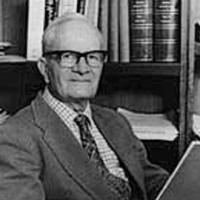


Sir

Alan Walsh

FTSE FAA FRS

Alan Walsh
Image Description
Distinguished for his fundamental contributions to spectroscopic optics and method, molecular structure and spectrochemistry. His multiple-pass principle, which is a landmark in spectrometer design, has stimulated advances in all branches of spectroscopy, exemplified by his own contributions to infra-red and Raman spectroscopy and to atmospheric ozone spectrophotometry. Other contributions include echelette zone plates for far infra-red spectroscopy and a general-purpose spectroscopic light source unit. His method of recording atomic absorption spectra has provided a new approach to spectrochemical analysis and has been extended to the measurement of iaotopic abundances and atomic resonance line oscillator strengths.

Please contact fellowship@science.org.au to request any updates to the data.

Professor

Ian McCarthy

FAA

Ian McCarthy
Image Description
Professor McCarthy is distinguished for his work on nuclear, atomic and molecular scattering and reaction processes. McCarthy's early work was on the nuclear optical model and direct interaction mechanisms. Subsequently he applied the same methods to the interpretation of (e,2e) reactions on atoms and molecules, leading to determinations of the momentum distribution of the struck electrons. The Flinders University group has become one of the leaders in (e,2e) spectroscopy.

Expertise type

  • Physics
  • Quantum Physics

Please contact fellowship@science.org.au to request any updates to the data.

Professor

Warrick Couch

FAA

Warrick Couch
Image Description
Warrick Couch has undertaken world-leading research in the areas of galaxy evolution and cosmology. He has made fundamental contributions to understanding the impact the environment has on galaxy evolution. This includes pioneering work on tracking changes in star formation activity and morphology in cluster galaxies with cosmic time, which established that these galaxy properties have been fundamentally transformed within these dense environments over the last 5–8 billion years. He was also a founding member of the Supernova Cosmology Project that was one of the two teams awarded the 2007 Gruber Cosmology Prize for discovery of an accelerating universe.

Fields of research

51 PHYSICAL SCIENCES
  • 5101 ASTRONOMICAL SCIENCES

For full list of research codes, please visit the ARC Website .

Expertise type

  • Astronomy
  • Cosmology
  • Galaxy Evolution
  • Physics

Please contact fellowship@science.org.au to request any updates to the data.

Dr

Brian Boyle

FAA

Brian Boyle
Image Description
Dr Brian Boyle has played a world-leading role in the study of cosmology. In the late 1980s/early 1990s, he changed the paradigm on our understanding of the cosmological evolution of quasars, initially in the optical and later in the X-ray domain. He also played a major role in uncovering the origin of the cosmological X-ray background, including leading the team which first identified star forming galaxies as a major constituent of the X-ray background. More recently he led the team responsible for creating the largest ever sample of quasars. This led to a number of breakthroughs, including a direct determination of the black hole mass function and the clustering of quasars at high redshift.

Fields of research

51 PHYSICAL SCIENCES
  • 5101 ASTRONOMICAL SCIENCES

For full list of research codes, please visit the ARC Website .

Expertise type

  • Astronomy
  • Cosmology
  • Physics
  • Quasars

Please contact fellowship@science.org.au to request any updates to the data.

Professor

Keith Nugent

AO FAA

Keith Nugent
Image Description
Professor Nugent is a distinguished optical physicist who has been singularly creative from the earliest age. Some of his achievements are: I. Penumbra! imaging of hot plasma neutrons, in collaboration with Lawrence Livermore Laboratory. 2. Lobster-Eye X-ray imaging yielding an all-sky x-ray telescope for a NASA collaboration. 3. Phase determination in x-ray optics, which he solved by extracting phase from intensity measurements on two planes, is of importance to synchrotron radiation imaging. His other work involves contributions to x-ray holography, coherence measurement and near field optics. Much of Nugent's work has been devoted to problems of neutron and x-ray optics for which refractive materials are not available.

Expertise type

  • Biophysics
  • Optics
  • Physics
  • Synchrotron Science

Please contact fellowship@science.org.au to request any updates to the data.

Emeritus Professor

Jeremy Mould

FAA

Jeremy Mould
Image Description
Professor Mould is among the world's leading astronomers. He is distinguished for his studies of stellar populations and observational cosmology. He was the first to show that the dwarf spheroidal galaxies had a star formation history extending over billions of years, in contrast to the view at the time that these galaxies are pure sample of the oldest stars in the Universe. He pioneered the dynamical study of velocity deviations from the smooth Hubble expansion in the local Universe. He leads a very large international project to measure the Hubble Constant with the Hubble Space Telescope.

Fields of research

51 PHYSICAL SCIENCES
  • 5101 ASTRONOMICAL SCIENCES

For full list of research codes, please visit the ARC Website .

Expertise type

  • Astronomy
  • Cosmology
  • Physics
  • Stellar Evolution

Please contact fellowship@science.org.au to request any updates to the data.

Professor

David Pegg

FAA

David Pegg
Image Description
Pegg is internationally renowned for his breadth of theoretical work in fundamental physics, which ranges from the interaction of electromagnetic radiation with atoms and nuclei to the nature of time. In particular, he originated a powerful unitary transformation technique for investigating field-atom interactions. With experimental colleagues he invented a variety of pulse sequences in NMR which are now routinely used worldwide. In quantum optics he formulated, with Barnett, the quantum theory of phase based on a Hermitian operator, a procedure which had been deemed not possible but is now well accepted for examining the phase properties of light.

Expertise type

  • Physics
  • Quantum Mechanics
  • Theoretical Physics

Please contact fellowship@science.org.au to request any updates to the data.

Professor

Dan Haneman

FAA

Dan Haneman
Image Description
Professor Haneman has an international reputation for his work on the structure and electronic properties of semiconductor surfaces. He pioneered photoemission and LEED measurements on surfaces cleaved in UHV, and developed the well-known "buckled surface" model for the reconstructed atomic arrangement of Ge and Si surfaces. He pioneered the application of EPR to surfaces of semiconductors; made the first experimental determination of the surface electron wave functions and hence determined the correct surface structure of A1Sb and Ga As; made substantial contributions to the theory of the photo-electro­chemical cell; and discovered the phenomenon of field-enhanced conductivity in amorphous silicon super lattices.

Expertise type

  • Semiconductors
  • Physics

Please contact fellowship@science.org.au to request any updates to the data.

Professor

John Sanders

FAA

John Sanders
Image Description

Please contact fellowship@science.org.au to request any updates to the data.

Dr

Leo Clarebrough

OAM FAA

Leo Clarebrough
Image Description
Clarebrough is distinguished for his contributions to physical metallurgy and metal physics. In particular he has studied atomic sized defects in metals and their relationship with macroscopic properties such as strength and plasticity. He developed high precision differential calorimetry for defect studies in many areas including a classical analysis of order-disorder phenomena in brass. More recently he has been in the forefront of the direct observation of defects by electron microscopy. The rigorous analysis of such observations, based on his contributions, is now in international usage.

Please contact fellowship@science.org.au to request any updates to the data.