




2025 Thomas Davies grant recipients to study plants, pollution, soil and marine ecosystems

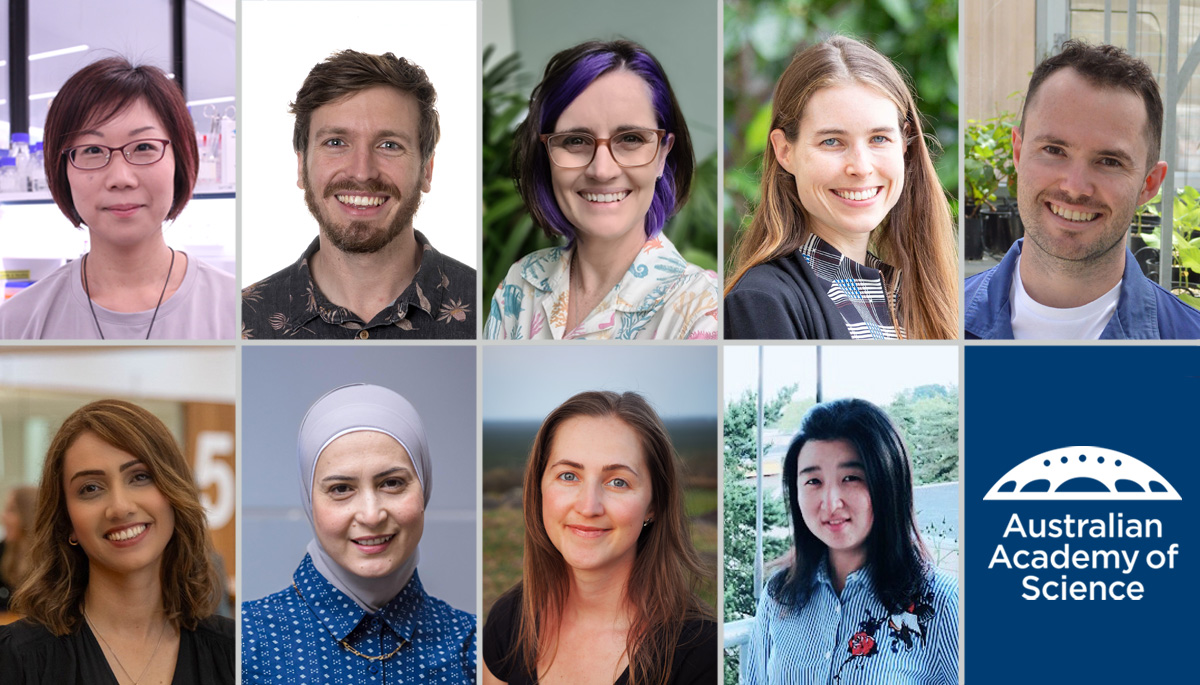
Top row from left: Dr Satomi Hayashi, Dr Julian Greenwood, Dr Amanda Dawson, Dr Anne Sawyer, Dr Joseph Pegler Bottom row: Dr Shima Ziajahromi, Dr Zeinab Khalil, Dr Eve Maunders, Dr Qi Yang
Nine early-and mid-career researchers have received this year’s Thomas Davies Research Grant for Marine, Soil and Plant Biology.
Grant recipients
Dr Amanda Dawson, CSIRO
Decoding the biological passport: tracing microplastic journeys using the ecocorona composition
“I am deeply honoured to receive the Thomas Davies grant. This award will significantly advance the research I have been working on at CSIRO to develop a microplastic biological passport – a tool that could revolutionise our ability to track and understand the environmental journey of microplastics. By studying the unique biological signatures that form on microplastics in various environments, I aim to develop a reliable approach for tracing their sources and movement. This work holds exciting potential for improving environmental monitoring and protection practices. I am grateful for this support and look forward to making impactful contributions to environmental science with this grant.”
Dr Julian Greenwood, Australian National University
Establishing a transient assay to rapidly assess resistance responses in canola
“I’m very excited to be a recipient of the Thomas Davies research grant and I look forward to putting it towards the improvement of canola disease resistance. Canola is the third most important crop in Australia, but its production is under constant threat of disease. The fungal disease, Blackleg, is the most devastating disease of canola in Australia with estimated yield losses of 10 to 15 percent each year. The interaction between Blackleg disease and canola disease resistance is poorly understood and there is no method to quickly assess the function of new and existing canola immune receptors. This grant will support the establishment of a method to rapidly assess resistance responses in single canola cells called protoplasts.”
Dr Satomi Hayashi, Queensland University of Technology
Unveiling a native Australian plant’s defence: identifying the novel resistance gene against Tomato Yellow Leaf Curl Virus
“I am pleased and deeply honoured to receive the 2025 Thomas Davies research grant, with the possibilities it opens up for my career development and potential to make a lasting impact in the scientific community. Tomato Yellow Leaf Curl Virus (TYLCV) poses a significant threat to the global tomato industry, with the potential to devastate entire fields if not properly managed. We have identified wild isolates of the Australian native plant Nicotiana benthamiana that exhibit a strong near-immune response to TYLCV infection. I aim to identify novel TYLCV resistance genes and explore the mechanisms of resistance they provide. I hope that the insights gained from this study will enhance our understanding of disease resistance, contributing to sustainable and lasting resistance in field crops.”
Dr Zeinab Khalil, University of Queensland
Soil microbial innovations for sustainable agrochemicals and plant pathogen control
“I am truly honoured to receive the 2025 Thomas Davies award. This recognition provides a significant boost to my research, which focuses on discovering sustainable antifungal agents from soil microbes through the Soils for Science initiative. By leveraging cutting-edge genomic and metabolomic tools, we aim to contribute to global efforts in safeguarding food security and promoting environmentally friendly agricultural practices.” Find out more about Soils for Science.
By leveraging cutting-edge genomic and metabolomic tools, we aim to contribute to global efforts in safeguarding food security and promoting environmentally friendly agricultural practices.Dr Zeinab Khalil
Dr Eve Maunders, University of Queensland
Investigating developmental dialogues in a marine sponge holobiont
“I am delighted to receive the 2025 Thomas Davies research grant, which will support my research investigating interactions between animals and their microbiome and how these relationships shape the health and development of host organisms. By exploring vulnerability to symbiotic breakdown on coral reefs, this work will help to inform conservation strategies aimed at preserving or restoring microscopic allies, thereby protecting the biodiversity and vitality of marine ecosystems.”
Dr Joseph Pegler, University of Newcastle
Understanding the mechanism(s) by which plant constituents sequester per- and poly-fluoroalkyl substance (PFAS) from contaminated water
“I feel incredibly honoured to be awarded the Thomas Davies grant. This study will investigate plant constituents which sequester PFAS in contaminated water samples. PFAS are a diverse family of fluorinated organic chemicals that have been widely used for over 70 years, and are now considered serious environmental contaminants. This understanding will contribute to the development of novel plant-based PFAS remediation approaches that could be employed in contaminated environments and counter the burden of PFAS exposure for individuals.”
Dr Anne Sawyer, University of Queensland
Development of RNA-based controls for Phytophthora cinnamomi
“I am very excited to receive a 2025 Thomas Davies research grant. It will enable us to progress our research on ribonucleic acid (RNA) as a novel spray-on vaccine to protect plants from Phytophthora, a soilborne pathogen that causes dieback of native vegetation and major yield losses in crops such as avocado, pineapple, macadamia and stone fruit. This grant will help us gain a better understanding of the mechanism of RNA-mediated disease protection, enabling us to design more effective RNA sprays to control this destructive pathogen.”
The Thomas Davies research grant will enable us to progress our research on ribonucleic acid (RNA) as a novel spray-on vaccine to protect plants from Phytophthora.Dr Anne Sawyer
Dr Qi Yang, CSIRO
Uncovering microbial indicators: a sensitive and reliable approach to soil health measurement
“I am thrilled to receive the 2025 Thomas Davies grant, which will allow me to delve into innovative methods for assessing soil health through microbial indicators. This project targets a critical need in agriculture – developing reliable and practical measures of soil function and resilience in Australia’s unique agricultural environment. I hope these measures will help guide farmers in creating more resilient and productive agricultural systems, and I am honoured to have the support of the Academy in this endeavour.”
Dr Shima Ziajahromi, Griffith University
Fate and behaviour of biosolid-derived microplastics in Australian agricultural soils: lab-scale experiments and field evidence
“I’m honoured to receive this award and grateful for the recognition of my work. Australian wastewater treatment plants produce thousands of tonnes of treated sewage sludge – called biosolids – every year, which are widely used to fertilise agricultural soils. While biosolids are beneficial for soil health, they also introduce emerging contaminants such as microplastics into the soil, which pose risks to soil ecosystems. This support will allow me to further my research on the fate of biosolid-derived microplastics in soils, aiming to provide a clearer understanding of the scale of soil microplastic pollution. I hope this research can contribute to science-based decision-making to minimise and control microplastic pollution.”
About the award
The Thomas Davies Research Grant for Marine, Soil and Plant Biology funds projects by early-and mid-career researchers in the fields of marine, soil and plant biology. Annual grants of up to $20,000 each are funded through a generous philanthropic bequest from the estate of the late Thomas Lewis Davies to the Australian Academy of Science.
Applications for the Academy’s 2026 awards and funding opportunities are now open.
Collaborative grants set to generate global science and technology innovation
Joint Australian Academy of Science and Australian Academy of Technological Sciences and Engineering (ATSE) media release
The Australian Academy of Technological Sciences and Engineering (ATSE), in collaboration with the Australian Academy of Science, will deliver $6.3 million in grants to strengthen science and technology collaboration with regional neighbours through the second round of the Australian Government’s $40 million Global Science and Technology Diplomacy Fund.
Announced by the Hon Ed Husic MP, Minister for Industry and Science, the grants of up to $1 million each are available to Australian researchers and businesses to partner with counterparts in Indonesia, Malaysia, Singapore, Thailand, Vietnam, New Zealand, Japan, the Republic of Korea and Brazil.
This second round of the grants builds on the success of the initial round in 2024, through which 9 innovative and ambitious groups are partnering with science and industry colleagues around the world.
The focus of the scheme remains on national priorities of advanced manufacturing, AI, quantum computing, hydrogen production and RNA vaccines.
With applications open from today, the scheme aims to grow international collaboration in our region, and drive innovation and commercialisation in priority areas.
ATSE CEO Kylie Walker said Australia has the ability to lead our region in delivering practical solutions to our biggest challenges.
“These grants create links between Australia’s STEM leaders and global partners, building new technologies from a foundation of international collaboration. A grant through this scheme will boost the capabilities of researchers, industries and new businesses across many countries, all while strengthening international science and technology cooperation,” Ms Walker said.
Australian Academy of Science Chief Executive, Anna-Maria Arabia said the Global Science and Technology Diplomacy Fund will support international scientific collaboration and diplomacy precisely when it is needed the most.
“The high-quality applications received in the first round illustrate the power of international science collaboration enabling research and innovation that no single country can achieve on its own,” Ms Arabia said.
The Academies have a strong commitment to international engagement with a long history of global initiatives successfully delivering results for Australian science and technology.
ATSE and the Academy of Science are proud to partner to deliver this initiative, funded by the Australian Government Department of Industry, Science and Resources.
The learned academies will draw on their expert Fellowships to rigorously assess applications.
Expressions of interest can be submitted through the glodip.org.au website. The deadline for submission is 4 May 2025.
An information session on 19 March will provide an opportunity to learn about the program. Please register to find out more.
More information
Read our media release announcing the recipients of the first round.
Academy recognises new research using Traditional knowledges to care for Country
Two researchers, Dr Mitchell Gibbs and Associate Professor Shannon Kilmartin-Lynch, have received the 2025 Australian Academy of Science’s Aboriginal and Torres Strait Islander Scientist Award.
The award recognises research by Aboriginal and Torres Strait Islander PhD students and early- and mid-career scientists in the physical and biological sciences, and supports interdisciplinary and sociocultural research.
This year’s award will support outstanding projects in habitat restoration and sustainable engineering.
Global collaborations between First Nations people for habitat restoration
Dr Mitchell Gibbs, University of Sydney
Despite the growing awareness of the value of incorporating Traditional knowledges and perspectives into habitat restoration and management, uptake and application of these practices has been slow, according to University of Sydney researcher and Dunghutti man through kinship, Dr Mitchell Gibbs.
Dr Gibbs is a geoscientist who draws on Traditional knowledge and practices to support the restoration of marine ecosystems in collaboration with First Nations communities and owner groups.
Sydney’s Botany Bay, known as Gamay to local First Nations people, once supported an abundance of oysters. These oyster reefs played an important role in the area’s marine ecology and as a sustainable food source for Gamay people, but were exploited to near extinction during the early days of European settlement.
Speaking to Indigenous Elders and knowledge holders, Dr Gibbs was able to learn traditional management practices passed down through oral and lived histories while sharing his own ecological research and insights. He worked closely with Indigenous groups and organisations to develop a community-driven approach to shellfish restoration and put it into action with the Gamay Rangers and the La Perouse Local Aboriginal Land Council.
“Bringing Indigenous communities to the forefront of restoration will then make sure that those communities are getting that recognition and acknowledgement for that knowledge and for the amount of knowledge that is held within communities.” Dr Gibbs said.
First Nations’ habitat restoration programs such as these are being done across the globe and Dr Gibbs’ current project aims to bring together international expertise and establish cross-continental collaboration between Indigenous restoration communities.
“The project that we're doing, especially with the Gamay Rangers, is bringing people from the United States and hopefully people from New Zealand as well, to come to Australia and talk about the restoration projects that they've done.
“We’ll start talking about the importance of Indigenous restoration, which will bring just so much more life, I hope, to what restoration should be through an Indigenous sense,” Dr Gibbs said.
Utilising Traditional knowledges to improve sustainability of concrete
Associate Professor Shannon Kilmartin-Lynch, Monash University
Caring for Country was a major motivation for the path Associate Professor Shannon Kilmartin-Lynch took in civil engineering.
“There are many different aspects in civil engineering that you can look at. For me, looking at sustainability, it’s a different way that I can care for Country myself. It’s taking out waste streams, its minimising CO2 outputs, it’s efforts to clean up different litter waste that’s on Country … every little step makes a difference.”
Associate Professor Kilmartin-Lynch is a Yowong-Illam-Balluk and Natturak Balluk man, belonging to the Taungurung people in Victoria’s North-East Kulin Nations.
His research aims to reduce the ecological footprint of cement and concrete construction by identifying materials that are incorporated or substituted to increase sustainability without compromising strength.
His team was able to process used coffee grounds, an abundant waste material, into a charcoal-like substance called biochar, which, when added to concrete in place of sand, resulted in a material that was 30 per cent stronger. The increased strength also reduces the amount of cement necessary.
Associate Professor Kilmartin-Lynch says it’s great to be able to increase concrete strength while reducing the amount of sand used in the process.
“We’re limiting the CO2 from sand mining. We're limiting natural resources that need to be mined … If we can stop that from happening even on a smaller scale or even if it’s ten per cent or fifteen per cent, each little step makes a long way in terms of reducing the CO2 emissions.”
His next project aims to integrate Indigenous engineering knowledge and practices into concrete production. It will explore whether native plant resins, traditionally used to attach spearheads and repair canoes, could be incorporated into concrete to increase durability or repair cracking in existing structures.
He hopes that applying the resin along with Indigenous engineering insight to modern engineering problems will help showcase the ingenuity and resourcefulness of Indigenous peoples in a way that encourages incorporating diverse perspectives into modern practices.

2026 awards and funding opportunities now open
Applications for the Academy’s 2026 funding opportunities are now open and close 1 June 2025, while nominations for honorific awards close 1 May. See more about the Academy’s 2026 awards and funding opportunities.
2025 Moran Award to fund studies of science education and Australia’s nuclear science history
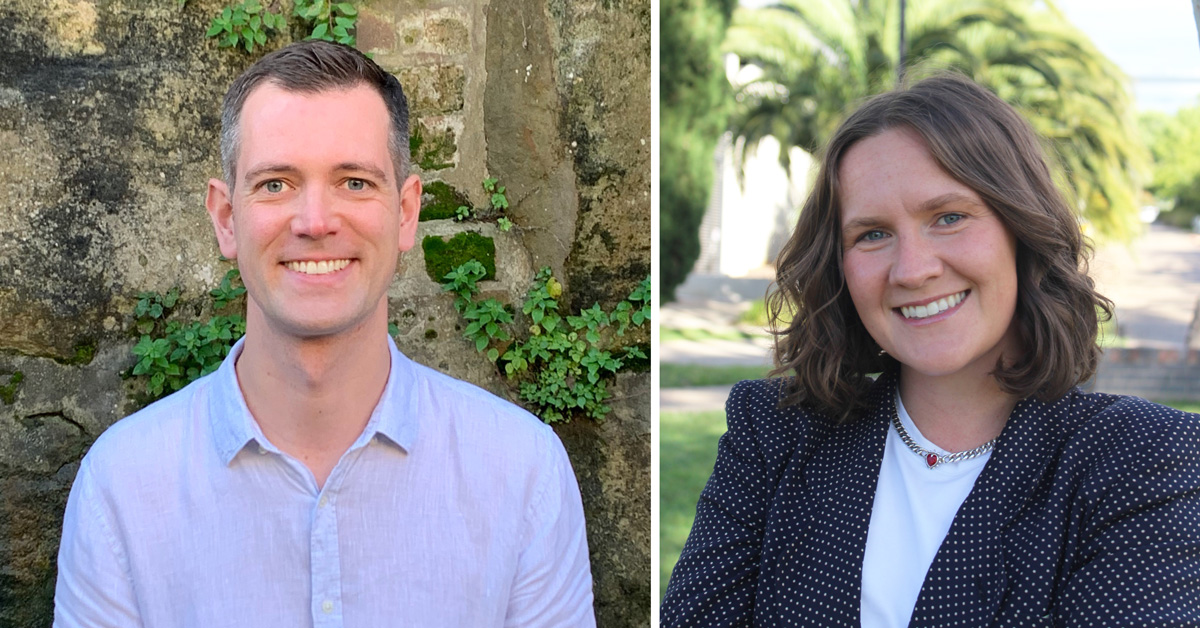
Dr Joel Barnes and Dr Jess Urwin have received the 2025 Moran Award for History of Science Research
Dr Joel Barnes from the University of Queensland and Dr Jess Urwin from the University of Tasmania are the recipients of the Australian Academy of Science’s 2025 Moran Award for History of Science Research.
Dr Joel Barnes, University of Queensland
Cultural anthropology and human evolution in the Australian classroom: science, pedagogy and politics
Dr Barnes will be supported by funds from the award to research the work of the influential Sydney primary school teacher Margaret Simpson (1937–2014), who was inspired by the American-made upper primary resource Man: A Course of Study (MACOS) to create a similar pedagogical tool for Australian students. MACOS was an inquiry-based resource in which children investigated the nature of human beings in an evolutionary frame, considering their continuities with and distinctiveness from non-human animals.
Simpson created People of the Western Desert, which used ethnographic films of two Pintupi families of central Australia to teach anthropological knowledge of Aboriginal cultures at a time of significant change in Australian Indigenous-settler relations.
The kit was widely taught across New South Wales and the Australian Capital Territory and used in some schools across other states. While controversies over MACOS’s secular and evolutionary vision of the human, especially in Queensland, have been widely examined, Simpson’s adaptation of MACOS’s pedagogical methods and inquiry questions to the Australian social and political environment has received little attention from historians.
This award will support archival research trips to Sydney and Canberra and help facilitate the donation of relevant privately held archival collections to a suitable public archive.
“I’m honoured to receive the Moran Award for History of Science Research, which will enable me to explore the teaching of cultural anthropology and human evolution in Australian classrooms in the 1970s and 1980s,” Dr Barnes said.
Dr Jess Urwin, University of Tasmania
Radioactive roots and routes: tracing the imperial scientific networks of Australian radioactive minerals, 1940s–1960s
Dr Urwin’s project seeks to account for the role played by key figures in Australian science in Australia’s searches for, exploitation of, and attempts to export radioactive materials in the mid-20th century.
British archives (held in the National Archives in London) show that Professor Mark Oliphant, for example, was integral to the British Government’s investment in Australian radioactive mineral prospecting during and after World War II and was highly influential in encouraging the Australian state and federal governments to establish a home-grown radioactive mineral industry in the 1940s and ’50s.
Yet few scholars – if any – have considered the role of reciprocal imperial scientific networks in encouraging the exploitation and exportation of radioactive minerals across the British Empire. Fewer still have accounted for Australia’s role in this imperial exchange. This project seeks to rectify that, contributing to topical discussions of Australian uranium politics across the 20th century.
“I am delighted to have been selected as one of the recipients of the Moran Award, the generous funds from which will allow me to travel to consult the Academy of Science’s Fenner Archives and other collections related to the history of uranium in Australia,” Dr Urwin said.
“I plan to use this award to access the papers of scientists and others – many of which are held by the Academy – who were instrumental in developing nuclear science in Australia during the mid-20th century. These collections offer a window into the various roles – political, cultural, and scientific – played by Australian scientists in negotiations between Britain and Australia over uranium export and Commonwealth nuclear development more broadly.”
About the award
The Moran Award for History of Science Research is aimed at postgraduate students and other researchers with expertise in the history of Australian science. Its purpose is to support access to archives that record the history of science in Australia, especially by younger researchers, and it can be used towards travel and accommodation costs. The award is biennial, and will next open for applications in February 2026.
The Academy’s 2026 awards and funding opportunities are now open. Find out more.
2025 Max Day awardees to investigate ecosystem productivity and microplastics
The Australian Academy of Science has announced Rebecca Greening and Dr Nina Wootton from the University of Adelaide as the recipients of this year’s Max Day Environmental Science Fellowship Award.
Rebecca Greening, University of Adelaide
Soil function and ecosystem productivity: A comparative analysis between a century of regeneration and livestock-grazed arid South Australia
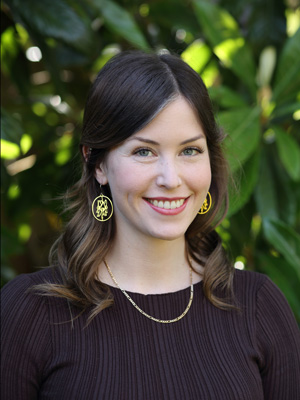
Rebecca Greening
There is insufficient scientific knowledge about how to sustainably manage Australia’s arid rangelands for livestock grazing, resulting in continued declines in native biodiversity. Despite the well-documented pervasive effects of livestock on plants and animals, the impacts on soil microbial communities and the essential role they play in ecosystem function and services are not well understood in arid ecosystems.
Ms Greening’s project adopts a multidisciplinary approach to examine how livestock affect soil function and ecosystem productivity in arid South Australia. By comparing a century-old livestock-excluded reserve to nearby areas with high- and low-intensity livestock grazing, the project will determine how soil biochemical cycling changes in the presence of livestock. Additionally, greenhouse experiments will determine how livestock indirectly affect primary productivity through soil ecological processes. The project will fill a crucial knowledge gap, facilitating the implementation of sustainable management strategies and restoration techniques to support pastoral activities with positive biodiversity outcomes.
“I was so surprised to be awarded the Max Day Fellowship. This opportunity will not only open new doors for my project and career but also highlight the value of the TGB Osborn Vegetation Reserve, which is celebrating its 100th anniversary since its establishment in 1925,” Ms Greening said.
Dr Nina Wootton, University of Adelaide
Plastic to Plate? An interdisciplinary study of microplastic pollution in traditional food sources and ecosystems in North-East Arnhem Land
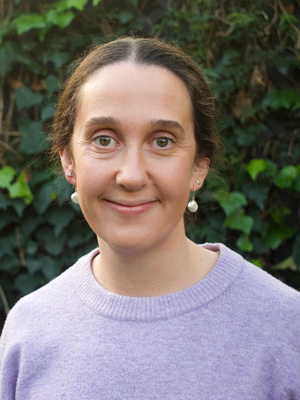
Dr Nina Wootton
Plastic and microplastic pollution are an escalating environmental concern with serious implications for both ecosystems and human health. Dr Nina Wootton’s research aims to investigate the presence and impact of microplastics in traditional food sources such as fish, mussels, mud crabs and turtles in north-east Arnhem Land. By integrating ecological and social sciences, this interdisciplinary study works with the Yolŋu Traditional Owners to fill critical knowledge gaps and provide actionable insights for mitigating pollution and protecting Indigenous food sources and the broader environment.
“I am incredibly grateful and humbled to receive the 2025 Max Day Environmental Science Fellowship Award. Being recognised with such a prestigious award is a career highlight, and I deeply appreciate the generous donors who make this work possible,” Dr Wootton said.
“As an early career researcher, securing funding for meaningful projects can be challenging, so I’m especially thankful for this opportunity. This award not only supports my current project but also opens doors for future initiatives that connect science, policy and industry for more sustainable environmental practices.”
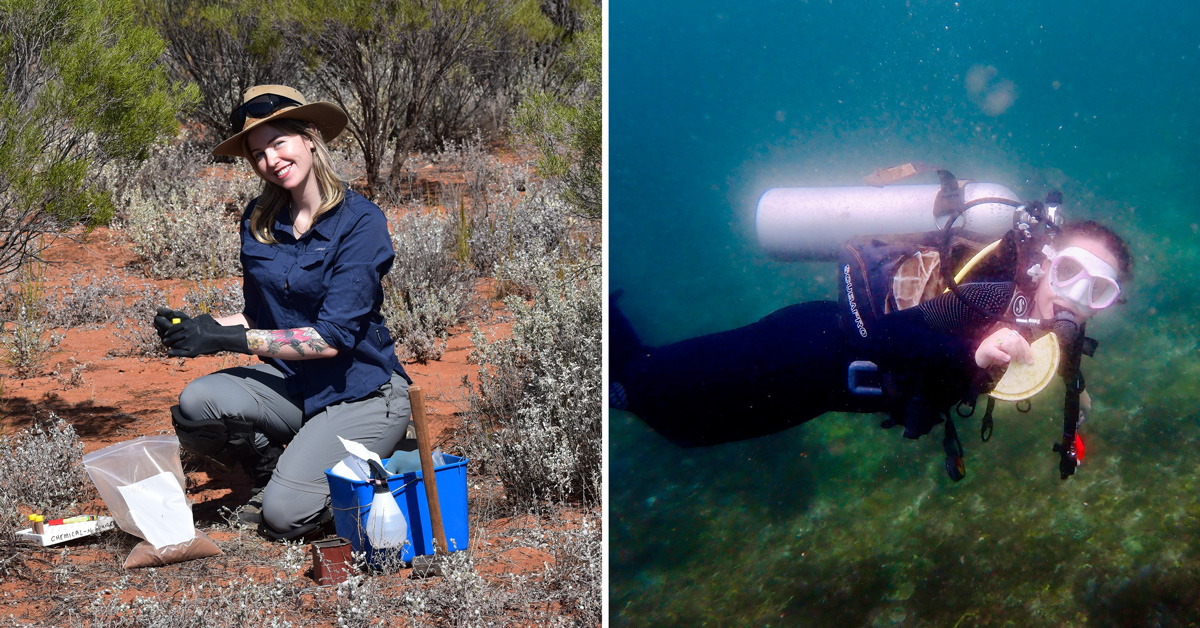
Highly commended
Another three researchers and their projects were highly commended for their 2025 Max Day Environmental Science Fellowship Award applications:
- Miss Natalie Grassi, Murdoch University: 'Does fragmentation impede Malleefowl movement?'
- Dr Laura Burchill, University of Melbourne: 'Bacteria-derived nature-based solutions for algal blooms'
- Miss April Sturm, Murdoch University: 'What are the impacts of urbanisation and climate change on freshwater turtle hatchlings (Chelodina oblonga), and can ex-situ conservation actions improve recruitment?'
About the award
The Max Day Environmental Science Fellowship Award assists PhD students and early career researchers working on the conservation of Australia’s flora and fauna, ecologically sustainable resource use, environmental protection and ecosystem services using an interdisciplinary approach.
The award is named in honour of the late Dr Maxwell Frank Cooper Day AO FAA, who spent a lifetime championing entomology, conservation and forestry, as well as helping other scientists.
Scientists call for urgent investment in science infrastructure and education
Australia’s leading scientists are calling on the Australian Government to urgently invest in the nation’s supercomputing capability and boost science and mathematics education as critical priorities of the 2025–26 Budget.
The Australian Academy of Science’s 2025–26 Pre-Budget Submission says Australia is facing increasing challenges that demand strategic investment in science to secure supply chains, strengthen defence and cybersecurity, accelerate energy transition, adopt new technologies and support our health and wellbeing.
There are no plans to replace or update our two national supercomputers that cannot meet the growing demands of science, defence, industry and society. Australia urgently needs to invest $200 million a year over 10 years to bring Australia’s supercomputing up-to-date and keep it there.
Up-to-date high-performance computing and data matter because they provide climate intelligence that helps Australia prepare for and respond to natural disasters, farmers to boost their agricultural yields, defence to undertake military surveillance at our borders, and society to benefit from advances in drug discovery.
Meanwhile, science and maths skills are vital for navigating the 21st century. Participation in science and maths in school years requires teachers who can teach skilfully and with confidence.
‘Teaching Towards 2030’ is the Academy’s education plan that builds on a 30-year track record of delivering evidence-based professional learning to science and maths teachers from Foundation to Year 10. Academy education programs support teachers in their vital role of shaping future generations, giving them tools to manage the modern classroom and diverse student learning needs. Investment can be scaled starting at $13 million over four years.
The Australian Academy of Science 2025–26 Pre-Budget Submission calls for the government to:
- provide $200 million per year for 10-year investment in high-performance computing and data together with the development of a long-term strategy to meet our future needs, rather than taking a just-in-time funding approach to critical infrastructure
- support Teaching Towards 2030, the Academy’s plan to scale its proven education programs – Primary Connections, resolve Maths, and Science Connections – that invest in science and maths teacher capability and confidence
- establish an Australian Institute for Earth System Science to provide climate intelligence – observations, process-based understanding, and advances in predictive models – needed by government and industry to inform their decisions. This is estimated to cost $20 million annually
- sponsor Australia’s membership in the Belmont Forum and participation in the forum’s Ocean Collaborative Research Actions in 2025, to lead and shape global research efforts on challenges presented by climate and environmental change. A $2 million one-off investment is expected to generate $10 million in benefits for Australia.
Three researchers receive 2025 Margaret Middleton Fund Award to advance native fauna studies

The Academy is pleased to announce the awardees of its 2025 Margaret Middleton Fund for endangered Australian native vertebrate animals, which supports early-career ecology researchers focused on endangered Australian native animals.
The recipients are Dr Patrick Finnerty from the University of Sydney, Dr Emily Hoffmann from the University of Western Australia, and Emmeline Norris from James Cook University.
Dr Patrick Finnerty: eastern quolls
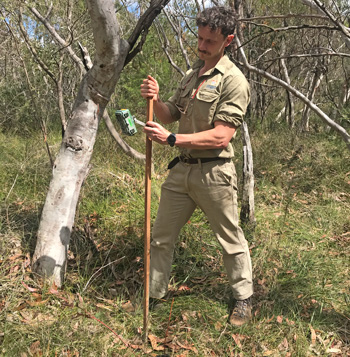
Dr Finnerty researching the reintroduction of eastern quolls to the Australian mainland.
Dr Patrick Finnerty was “absolutely thrilled” to hear that his project was selected for the 2025 Australian Academy of Science’s Margaret Middleton Fund Award.
“These funds will be invaluable in aiding our research into bolstering endangered eastern quoll reintroduction success beyond-the-fence in mainland Australia. We are at a critical tipping point for many native vertebrate animals within Australia, and having the Academy support this research underscores its commitment to vital conservation work in Australia,” Mr Finnerty said.
His research focuses on reintroducing endangered eastern quolls (Dasyurus viverinnus) into predator-free safe havens and exploring a myriad of beyond-the-fence reintroduction tactics and tools, which is regarded as a critical stepping stone for future rewilding success across mainland Australia. This means they are reintroduced into the broader landscape – beyond the safety of predator-proof fences.
Dr Finnerty’s research underscores the urgent need to identify new strategies to restore endangered eastern quoll populations in Australia. Once widespread, the eastern quoll has become extinct across the mainland. A primary driver of the quolls decline was, and continues to be, predation by ever increasing numbers of introduced red foxes and feral cats. The overall aim of the project is to reintroduce a population of eastern quolls within the predator-free fenced Bannockburn Rewilding Sanctuary at Jervis Bay on the New South Wales south coast, with the goal of aiding future beyond-the-fence recovery efforts. Ultimately, the project will not only advance our understanding of eastern quoll ecology but allow us to explore ways to bolster the success of similar reintroduction programs ‘beyond the fence’ within Australia.
In 2023, Dr Finnerty was the recipient of the Academy’s Max Day Environmental Science Fellowship Award, which supports early-career researchers working on the conservation of Australia’s flora and fauna, the ecologically sustainable use of resources, and the protection of the environment and ecosystem services.
Dr Emily Hoffmann: sunset frogs
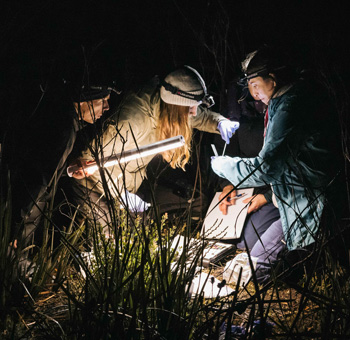
Dr Hoffmann and colleagues researching the impact of prescribed burning practices on the sunset frog in southwest Australia. Photo: Holly Winkle
Dr Hoffmann received this year’s award for her research ‘Frogs on fire: Rapid assessment of fire impacts on an endangered peatland endemic to inform prescribed burn practices’.
“I am incredibly grateful to receive the 2025 Margaret Middleton Fund Award. These funds will support a rapid assessment of the recent fire that affected over 30% of the limited distribution of sunset frogs. As an endangered relictual species confined to a small area of peatlands in southwest Australia, understanding the relationship between these frogs, their unique habitats and increasing fire is essential for their conservation,” Dr Hoffmann said.
Fire is a key process shaping Australia’s ecosystems, yet the response of most biota to fire, particularly frogs, remains poorly understood. The endangered sunset frog (Spicospina flammocaerulea) is restricted to a small area of peatlands in southwest Western Australia – one of the most rapidly drying regions of Australia with an increasing risk of fire.
In April 2024, a fire burned over one-third of the species’ entire distribution. Dr Hoffmann’s project aims to assess the impact of recent fires on both sunset frog populations and their threatened peatland habitats, and to explore possible interactions with drought and disease.
Emmeline Norris: spectacled flying-foxes
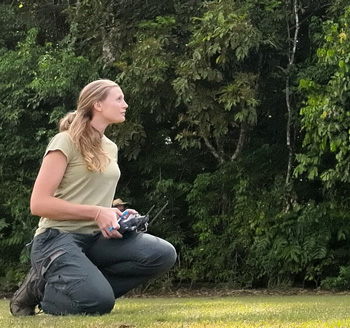
Ms Norris operating a drone at Tolga in Far North Queensland as part of her research to better estimate flying-fox populations.
Emmeline Norris is undertaking research that is utilising drone-based thermal imagery to accurately estimate abundance of the endangered spectacled flying-fox (Pteropus conspicillatus), and to model population trajectories.
“I am deeply honoured to receive the Margaret Middleton Fund from the Australian Academy of Science. This award will advance my research to establish a standardised, drone-based thermal imaging protocol for censusing the endangered spectacled flying-fox in north Queensland’s tropical forests,” Ms Norris said.
“By producing more robust population estimates, this project aims to strengthen conservation strategies for the endangered spectacled flying-fox, contributing to the resilience of tropical forest ecosystems and supporting national priorities for biodiversity conservation.”
The endangered spectacled flying-fox – an important species for pollination and seed dispersal in tropical north Queensland – is estimated to have experienced population declines of over 75% in the past two decades. Traditional methods for monitoring endangered spectacled flying-fox populations, like manual ground counts, have struggled with accuracy due to the dense and inaccessible nature of their habitats.
Ms Norris’s project aims to improve how researchers monitor and estimate abundance of spectacled flying-fox populations by developing a new method using drones equipped with thermal cameras. This technology may allow for more precise counts without disturbing the animals, and can reach areas that are otherwise difficult to access.
In enhancing our understanding of endangered spectacled flying-fox population trends, this research will help inform effective conservation strategies to ensure species persistence and the health of the ecosystems they support. The study also involves collaboration with local Indigenous ranger groups, ensuring the methods developed are culturally sensitive and inclusive.
About the Margaret Middleton Fund
The Margaret Middleton Fund for endangered Australian native vertebrate animals was established in 2000 with Dr Margaret Middleton, who donated generously to this fund for many years. Dr Middleton was a long-time supporter of the Academy and early-career scientists, with the fund supporting more than 90 projects to date.
Applications for the Academy's 2026 awards and funding opportunities are now open.
Discussion paper shows Australia needs R&D reform urgently
A discussion paper released today as part of the Government’s Strategic Examination of R&D is a much-needed wake-up call for the nation according to Australia’s leading scientists.
The Academy has been calling for a comprehensive cross-portfolio and cross-sectoral review of the R&D system since 2018 and is pleased that it is underway. The Academy will make a formal submission to the review.
The review findings must be a critical guide to any party that forms government after the 2025 federal election.
The paper highlights the central role that R&D plays in driving productivity and prosperity and the urgent need for Australia to be prepared to reform an inefficient, lacking-in-scale system that lacks any semblance of strategic organisation.
The evidence in the discussion paper is alarming, especially given our nation’s need to confront many pressing challenges, Australian Academy of Science President Professor Chennupati Jagadish said.
“The paper clearly illustrates that investing in science is beneficial and crucial to our national interest.
“In today’s complex and ever-changing geostrategic environment, exacerbated by supply chain issues and emerging technologies, a robust scientific approach is essential for navigating national challenges. Incremental adjustments have been and will be insufficient as leading R&D countries have shown.
“Instead, we must develop an R&D system that maximises our research talent and current investments while adequately incentivising the entire R&D pipeline,” Professor Jagadish said.
Professor renowned for expunging fake research receives David Vaux Fellowship

Professor Jennifer Byrne’s career has diverted from cancer research to research integrity. Image: supplied
The Academy is delighted to announce Professor Jennifer Byrne from the University of Sydney and NSW Health Pathology as the 2025 recipient of the David Vaux Research Integrity Fellowship Award.
The funding award, launched in 2023, recognises individuals who have led efforts to foster and promote integrity in science. The award honours Professor David Vaux AO FAA FAHMS, who has championed scientific research integrity in Australia.
Professor Byrne has an international reputation for finding problematic research articles. She began this work accidentally after noticing strange patterns in published cancer papers. Since then, she has systematically addressed the problem of fake research by co-creating software to detect potentially faked papers; writing to journals requesting responses to papers with critical errors; mentoring students to research the issue; raising awareness of problematic research in the media; and regularly bringing together publishers and researchers to discuss the problems and potential solutions.
Her career has diverted from cancer research to research integrity. Professor Byrne heads the Publication and Research Integrity in Medical Research (PRIMeR) group at the University of Sydney.
“I’m delighted to have been chosen as the recipient of the 2025 David Vaux Fellowship. I thank my colleagues Professor Adrian Barnett and Pranujan Pathmendra for their nomination,” Professor Byrne said.
“This award recognises my team members in the PRIMeR group and would not have been possible without funding from the United States Office of Research Integrity, the NHMRC and the University of Sydney.
“I look forward to visiting different Australian research centres during 2025 and 2026 and engaging with students and researchers at all career stages.
“I hope to raise awareness of contemporary issues affecting scientific publications, including research paper mills and undeclared use of generative artificial intelligence. I also look forward to participating in key discussions of publication integrity at international conferences and bringing this knowledge back to Australian researchers and policymakers,” she said.
Professor Byrne plans to use the award funds to give presentations on research integrity at different centres across Australia, where she will meet with early career researchers to discuss their concerns about their careers and research integrity. She will also travel to international conferences to share her work with a broader audience.
Dates and locations of Professor Byrne’s public lectures in Australia will be published on the Academy website once confirmed.
The David Vaux Research Integrity Fellowship Award is a biennial award. Nominations for the next round will open in February 2026.
Visit the Academy’s awards and opportunities to find out about our honorific awards and funding opportunities.
Recipients awarded 2025 Early-and Mid-Career Researcher Mobility Grants for outstanding research
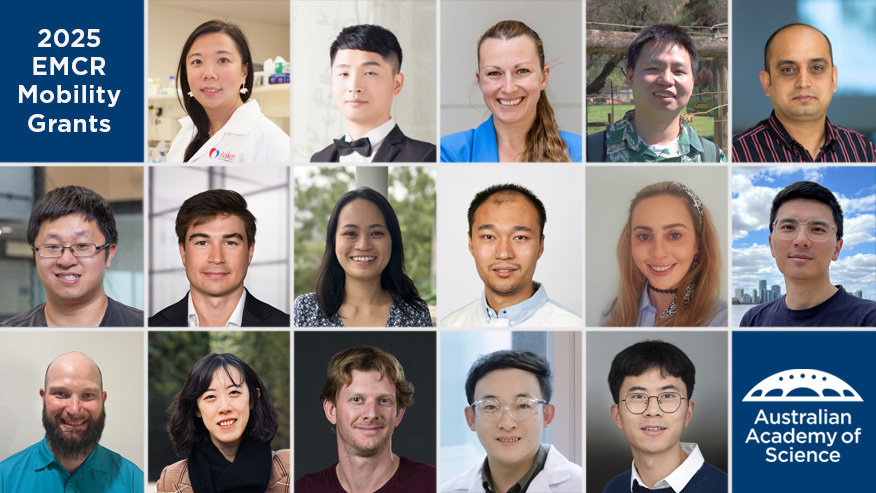
The recipients of the 2025 EMCR Mobility Grants.
The Australian Academy of Science is pleased to announce the recipients of the 2025 Early- and Mid-Career Researcher (EMCR) Mobility Grants.
Just over $110,000 has been awarded to 16 Australian EMCRs to collaborate with leading researchers at major science and technology organisations across Europe.
The grants, valued at up to $7,500 each, are made possible by the generous support of the Rod Rickards Fellowships and the Bede Morris Memorial Fund, and by a generous donation from the French Embassy in Australia.
Of the 16 EMCR recipients, ten have been funded by the Rod Rickards Fellowships.
The recipients’ research covers a diverse range of topics, from discovering new fungicides to the creation of nanoparticles loaded with mRNA to target and reduce inflammation.
Among the recipients is Dr Hana Starobova from the University of Queensland.
Dr Starobova’s research focuses on understanding how motor disabilities develop in some people following lifesaving cancer therapy – and how these changes to motor function could be treated.
“The award of the mobility grant will allow me to visit one of the best research groups studying motor neuropathies in cancer patients, the Experimental Neurology Unit at the School of Medicine and Surgery, University of Milano-Bicocca, Monza [in Italy],” Dr Starobova said.
“Here, I will learn new methodologies to assess neuronal damage from field-leading experts. This will increase my capacity to study this problem and help me to develop future collaborations.”
The EMCRs who have received grants funded by the Rod Rickards Fellowships are:
- Dr Chaohao Chen, Australian National University – Electrically pumped on-chip super-resolution imaging
- Dr Jue Hou, RMIT University – Metal-organic framework/polyamide hybrid membranes for lithium-ion extraction
- Associate Professor Arnold Ju, University of Sydney – Textile-based bioelectronic sensors for rapid coagulation assessment
- Dr Sally Lau, James Cook University – Decoding the genomic basis underpinning Southern Ocean ecosystem resilience to change
- Dr Weilun Li, Monash University – Revealing defects and their critical roles in the performance of halide perovskites by low dose transmission electron microscopy
- Dr Hana Starobova, University of Queensland – Chemotherapy-induced motor neuropathy: towards improved understanding of motor neuron dysfunction during chemotherapy
- Associate Professor Xiaowei Wang, University of Melbourne – Advanced 19F MRI techniques: imaging mRNA-loaded nanoparticles for inflammation therapy
- Dr James Watson, UNSW University – Rethinking hydrocarbons in a low carbon future: exploring the role of highly charged metal-alkane complexes in the conversion of fossil fuels to high value and more sustainable products
- Dr Ping Yun, University of Western Australia – Thinking ahead, explore the tolerant mechanism for the combination of flooding and salt stresses
- Dr Jinxin Zhao, Monash University – Advancing antimicrobial strategies against life-threatening ‘superbug’ Pseudomonas aeruginosa: an integrated systems pharmacology and evolutionary biology approach.
The following researchers have been awarded a 2025 EMCR Mobility Grant supported by the Bede Morris Memorial Fund and a generous donation by the French Embassy in Australia:
- Dr Lucy Gloag, Australian National University – Nanoparticle supported single-atom catalysts for magnetically induced CO2 conversion
- Dr David Leaver, Charles Sturt University – Unlocking mechanisms of sterol diversity to identify critical target sites for discovery of high-value antifungals
- Dr Thibault Renoir, University of Melbourne – Stimulate discussion and collaborations about preclinical models of neurodegenerative and psychiatric disorders and learn new techniques to study the mechanisms mediating the effects of exercise and treatment with psychedelics
- Dr Chutian Shu, Curtin University - Carbon solubility in the mantle mineral majorite: implications for deep Earth carbon cycling
- Dr Dinesh Subedi, Monash University – Bacteriophages as a solution to bacterial antibiotic resistance
- Dr Jiali Zhai, RMIT University – Inverse mesophase structure insights of ionisable lipid nanoparticles as mRNA delivery platforms.
Dr Jinxin Zhao’s research tackles the urgent global health threat of antimicrobial resistance, focusing on the multidrug-resistant Pseudomonas aeruginosa. This dangerous pathogen, identified as a high-priority superbug by the World Health Organization, causes severe and hard-to-treat lung infections.
“Being awarded this grant is an incredible honour and a pivotal milestone in my career. It empowers me to pursue groundbreaking research that addresses an urgent global medical need while contributing to the fight against antimicrobial resistance,” Dr Jinxin Zhao said.
“This funding not only provides the resources necessary to carry out innovative and impactful work but also positions me as an emerging independent researcher. Ultimately, this grant represents an opportunity to make a meaningful impact in science and public health, fulfilling my commitment to addressing one of the most critical challenges of our time.”
About the Rod Rickards Fellowships
The Rod Rickards Fellowships were created in 2009 by the family of Professor Rod Rickards FAA to commemorate his significant contributions to Australian science through exceptional achievements in chemistry and biology. Since their inception in 2010, these Fellowships have been awarded to 40 distinguished Australian EMCRs. This prestigious program enables these researchers to travel to Europe and engage in collaborative research projects within the fields of chemistry or biology at leading-edge institutions.
About the Bede Morris Memorial Fund
The Bede Morris Memorial Fund was established to honour the legacy of Professor Bede Morris FAA, one of Australia’s most eminent medical scientists. Since the early 1990s, this fund has supported Australian researchers by facilitating travel and collaboration with researchers in France. In recent years, the focus of the fund has shifted towards supporting Australian EMCRs, specifically contributing to their travel expenses to France for research endeavours in any field of the natural sciences.
The Academy extends special thanks to the French Embassy in Australia for their generous donation that supported two additional grants under the Bede Morris Memorial Fund.
More information on the EMCR Mobility Grants
EMCRs are also encouraged to apply for the Australia-Scotland Fund (open for applications until 19 March 2025)