




Scientists say Defence Research Centres a step in the right direction

The Australian Academy of Science has welcomed recognition of the need for greater coordination across the national science system articulated in Australia’s Defence Innovation, Science and Technology Strategy.
The Strategy was launched this week by Deputy Prime Minister and Defence Minister Richard Marles.
It outlines mechanisms for collaboration and coordination to grow Australia’s science system and accelerate innovation into capability—through strategic partnerships, programs like STaR Shot 2.0 and a proposal to establish Defence Research Centres co-designed with universities.
Academy President Professor Chennupati Jagadish said scientific capability and investment in research and development (R&D) enables Australia’s national security, sovereignty and diplomacy—securing our nation’s economy and wellbeing in a complex, uncertain world.
“The Strategy’s focus on the broader Defence innovation, science and technology ecosystem and how crucial collaboration across the sector will be in delivering these ambitions is important,” Professor Jagadish said.
“The priorities articulated in the Strategy send an important signal to the research sector on opportunities for coordination and collaboration, notably in the AUKUS Pillar II advanced capabilities areas.”
Professor Jagadish said the creation of the Defence Research Centres is a step in the right direction for providing a secure environment to enable Defence science research.
“The principle of the Defence Research Centres to explore potential dual-use outcomes is also an important opportunity to deliver additional benefits to Australians,” Professor Jagadish said.
“The proposed centres represent a change in our research architecture and system and so the Australian Government must consider the resource implications of implementing such changes for the sector.
“The Academy stands ready to assist in the implementation of this strategy and looks forward to seeing how it may be able to build further capability in the sector.”
Respect, include and celebrate: a vision for reconciliation in Australia’s science community
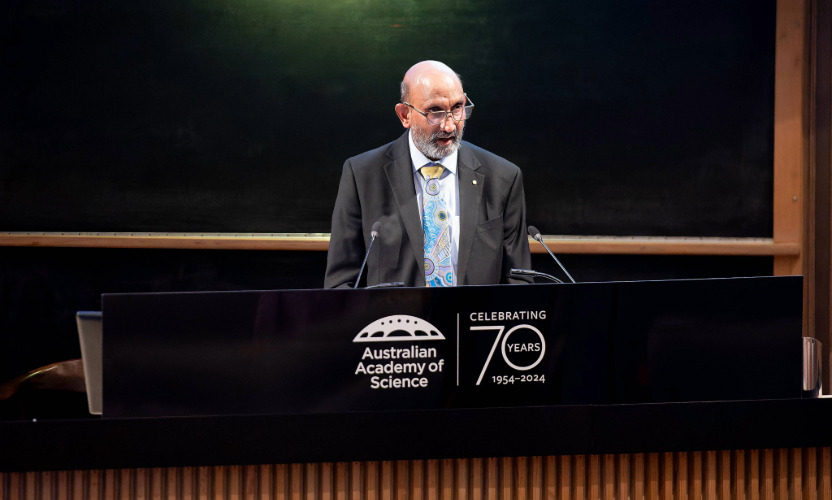
In a gathering of its Fellows, and early- and mid- career researchers from across the nation and the Asia-Pacific region, the Australian Academy of Science has launched its Innovate Reconciliation Action Plan (RAP) as part of its 70th anniversary celebrations at Science at the Shine Dome 2024.
The Academy’s new Innovate RAP outlines practical steps to respect and celebrate Traditional Knowledges of Australia’s First Nations Peoples to build a stronger, more innovative, and sustainable nation and world.
President of the Academy Professor Chennupati Jagadish said the Innovate RAP is a significant milestone for the Academy, coming after the successful completion of commitments in the Academy’s Reflect RAP.
“Securing our nation’s future economic and social prosperity will be driven by embracing skills, knowledges and experiences from a diverse range of people,” Professor Jagadish said.
“Our work will recognise Traditional Knowledges in Australia’s scientific and technological knowledge systems.
“I thank all those who developed this Reconciliation Action Plan, including the Reconciliation Action Plan Working Group, Academy Council, Fellows and staff.”
Academy Chief Executive, Anna-Maria Arabia said the Academy recognises the process of reconciliation is continuous and seeks to overcome challenges and learn from mistakes of the past.
“Through our efforts to progress reconciliation and adopt better practices, we aim to model and encourage diversity and inclusion throughout Australia’s science sector.”
Launch of the Innovate RAP
The Academy’s Innovate RAP was launched during the afternoon session of Science at the Shine Dome on 10 September, where Indigenous researchers from the RAP Working Group and the Academy’s EMCR Forum discussed reconciliation actions in the STEM sector.
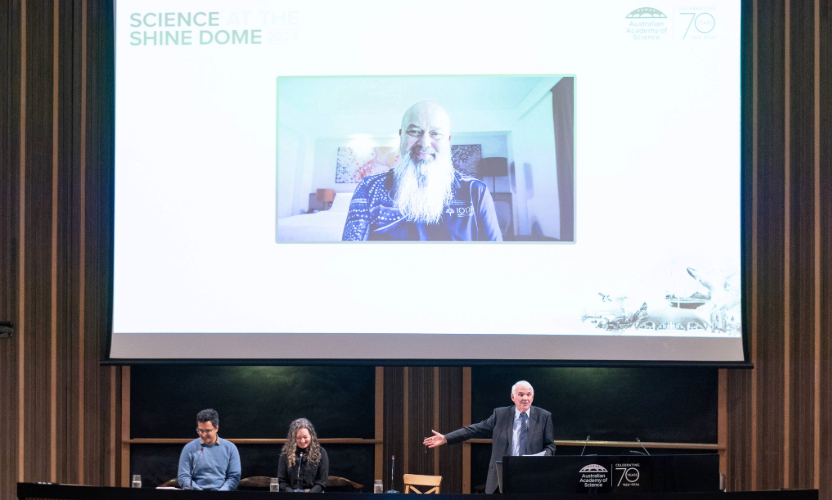
Academy Fellow Professor John Patrick introduced panel members Michelle Hobbs, Dr Jordan Pitt and Professor Bradley Moggridge.
“Reconciliation is everyone’s business,” Professor Patrick said.
Bidjara descendant Ms Hobbs from Griffith University, joint recipient of the 2023 Aboriginal and Torres Strait Islander Scientist Award, spoke about connecting to Country while conducting research.
She said we can move forward by working with communities and co-designing research projects.
“When you give communities the opportunity to weigh-in to aims and outcomes [of research] you’re giving them direct involvement and agency in being involved and for there to be tangible benefits to the community as well,” Ms Hobbs said.
Birri Gubba man Dr Jordan Pitt from the University of Sydney said when it comes to Indigenous Knowleges, it is not about finding a needle in the haystack, but rather the whole haystack is important.
“What you might think is important in your scientific research might not be what community thinks is important, which is something to be aware of when trying to engage [with community].”
Kamilaroi water scientist Professor Bradley Moggridge from the University of Technology Sydney, who is a member of the Academy’s RAP working group, said there have been improvements in the Academy’s reconciliation actions since the launch of the Reflect RAP, including courage in the conversations and leading by example.
Professor Moggridge made several recommendations beyond those in the Innovate RAP, including increasing the number of Indigenous Fellows in the Academy, and enabling Indigenous scholars to lead projects through the Academy.
“I would also love to see an Indigenous Knowledges National Committee at the Academy,” Professor Moggridge concluded.
Academy Fellow receives prestigious research award valued at $2.4m
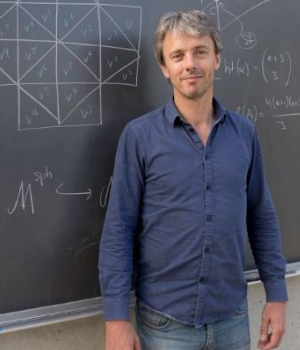
Professor Geordie Williamson FRS FAA
Academy Fellow Professor Geordie Williamson FAA FRS has become the first Australian to receive the Max Planck-Humboldt Research Award, for his use of algorithms in mathematics.
Since 2018, this joint research award, endowed with €1.5 million (A$2.4 million) from the Max Planck Society and the Alexander von Humboldt Foundation, has recognised researchers outside Germany “who stand out for their promising future potential and innovative research project”.
Professor Williamson, who is Director of the Sydney Mathematical Research Institute, uses artificial intelligence (AI) for his fundamental work in mathematics. He is a leader in the branch of mathematics exploring higher dimensional space using linear algebra, known as representation theory.
As part of the collaboration with researchers from the University of Bonn and the Max Planck Institute for Mathematics, made possible by this award, Professor Williamson will tackle various mathematical problems with the help of artificial intelligence.
This includes investigating a problem in knot theory: the fact it is often impossible to recognise whether knotted structures are actually knotted. This leads to the question: does the knot remain intact when you pull on the ends of the cord, or does it unravel?
One aim of the project is to identify these cases in a simple way so that uninteresting cases can be quickly filtered out and the researchers can focus on the real knots.
When elected to the Australian Academy of Science in 2018 for his outstanding contributions to science, Professor Williamson became the Academy’s youngest living Fellow.
At the time of his election, Professor Williamson said he had been invited to work at the Max Planck Institute in Bonn and the Institute of Advanced Study at Princeton in New Jersey—but preferred to stay in Australia to work.
The award will be presented on 3 December in Berlin.
An earlier iteration of this award was received by Academy Fellows Professor Bruce Kemp in 2000 and Professor Colin Masters in 1991.
Celebrating the recipients of the 2024 Prime Minister’s Prizes for Science
The Australian Academy of Science looks forward to congratulating the recipients of the 2024 Prime Minister’s Prizes for Science.
The recipients are being announced by the Prime Minister and the Minister for Industry and Science at Parliament House on Tuesday 8 October 2024.
More about the official prizes event can be found at the Department of Industry, Science and Resources.
Celebrate online with the Academy
In a long-standing tradition, the following morning, the Academy is hosting a breakfast in honour of the recipients of the 2024 Prime Minister’s Prizes for Science. This event will recognise the 2024 recipients, as well as the teachers awarded Highly Commended in the teaching categories.
You are invited to watch the livestream of the formalities on this web page.
Event details
Date: Wednesday 9 October
Time: 8.15am–9.00am AEDT
Venue: Online livestream
Cost: Free

This event is supported by the Australian Government Department of Industry, Science and Resources through the Prime Minister’s Prizes for Science.
Combating misinformation with science
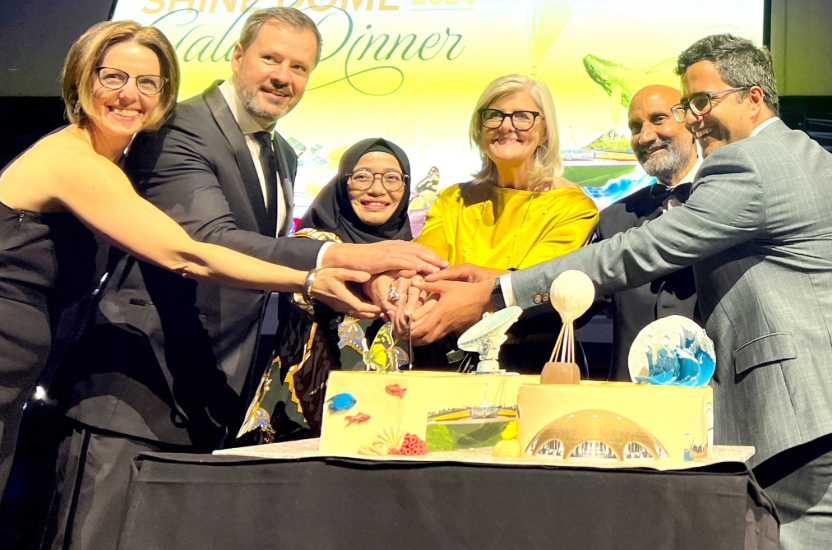
Chief Executive Anna-Maria Arabia, Minister for Industry and Science Ed Husic MP, Dr Lilis Mulyani, Governor-General of Australia, Her Excellency the Hon Sam Mostyn AC, Academy President Chennupati Jagadish AC and Dr Jordan Pitt cut the cake at the 2024 Science at the Shine Dome Gala Dinner.
The Australian Government’s announcement to introduce legislation to counter misinformation and disinformation supports longstanding concerns expressed by the Australian Academy of Science.
The Academy's President, Professor Chennupati Jagadish, told an audience of over of 400 guests at the organisations 70th anniversary gala dinner this week that we live in a time when geopolitical tensions are escalating and in a world of information ubiquity.
“Where evidence-based information is drowned out by mis- and disinformation, and reliable and independent sources of knowledge are increasingly rare,” Professor Jagadish said.
“The more polarised the world becomes, the more we need science and evidence based on science. We make better decisions when we have science on our side.
“The more uncertain our times, the more we need robust, evidence-based institutions. The more volatile the world, the more we need science to guide our actions.”
Read the President’s full gala dinner speech.
Misinformation and disinformation are seen by many experts as the leading global risk of the next two years.
Among the guests at the Academy’s gala dinner were Australia’s Governor-General, Her Excellency the Hon Sam Mostyn AC and federal politicians including the Minister for Industry and Science Ed Husic MP and the Shadow Minister for Science and the Arts, Paul Fletcher MP.
We have also heard from keynote speaker the Hon Ed Husic MP, Minister for Industry and Science (@industrygovau) and the Hon Paul Fletcher, Shadow Minister for Science and Arts (@PaulFletcherMP). #ShineDome24 pic.twitter.com/1D2CRI3bWw
— Australian Academy of Science (@Science_Academy) September 11, 2024
Minister Husic told the audience that in a world where mis- and disinformation is rising, people understand and trust in Australian science.
“And they are right to. It’s something we’ve all got to work together to nurture,” Minister Husic said.
Three early-career researchers to pitch their innovative ideas at Falling Walls Lab in Germany
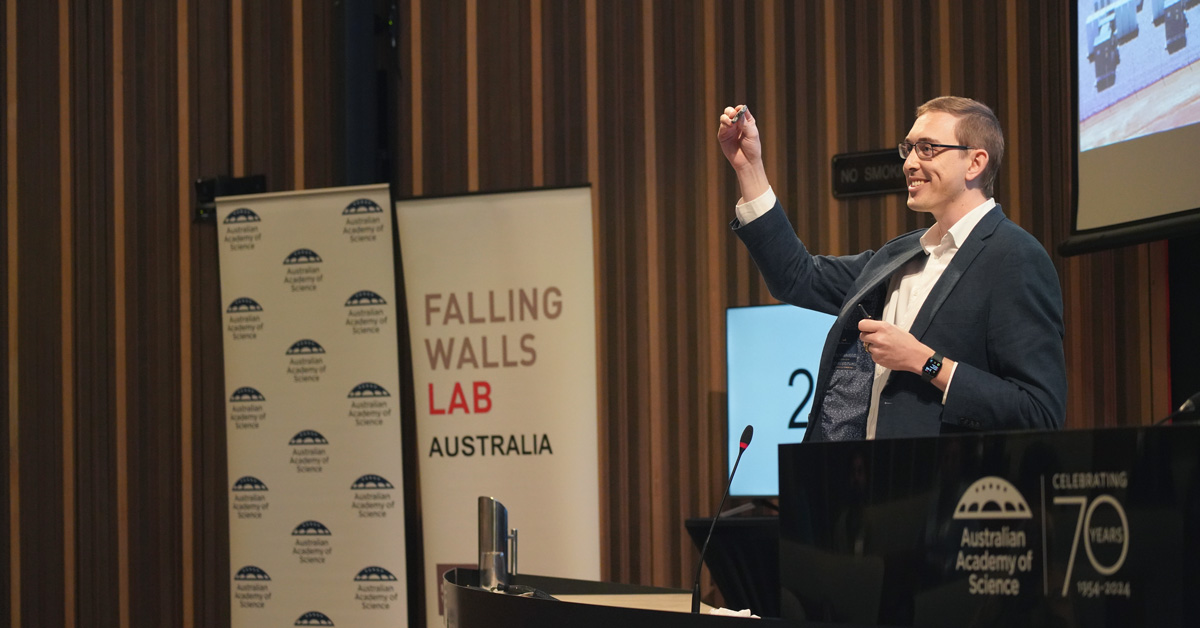
Dr Jacob Martin is the winner of the ninth Falling Walls Lab Australia event, recently hosted by the Australian Academy of Science.
Dr Martin spoke about ‘breaking the wall’ of green graphite. He is a lecturer in physics and astronomy at Curtin University and his research focuses on carbon materials science for energy storage materials and decarbonisation.
Second place was awarded to Dr Natasha de Alwis, a postdoctoral researcher in the Therapeutics Discovery and Vascular Function Group at the University of Melbourne. Dr de Alwis spoke about therapies in pregnancy, presenting her research on developing novel therapeutic strategies to prevent and treat pregnancy complications, particularly preeclampsia and fetal growth restriction.
Third place was awarded to Pratyush Ravichander, a third-year PhD candidate at the University of Queensland, who spoke about ‘breaking the wall’ of RNA-based fungicides. Mr Ravichander is passionate about sustainable agriculture and building global food security.
The three winners were selected from 16 emerging innovators, winners of the state labs held in Adelaide, Brisbane, Melbourne, Perth and Sydney. Each participant had just three minutes to make their pitch in front of a jury of eminent academics and leaders, chaired by Australia’s Chief Scientist Dr Cathy Foley.
Falling Walls Lab Australia is organised by the Australian Academy of Science in association with the Embassy of the Federal Republic of Germany in Australia, and with the support of event partners Merck Group and EURAXESS Worldwide Australia and New Zealand.
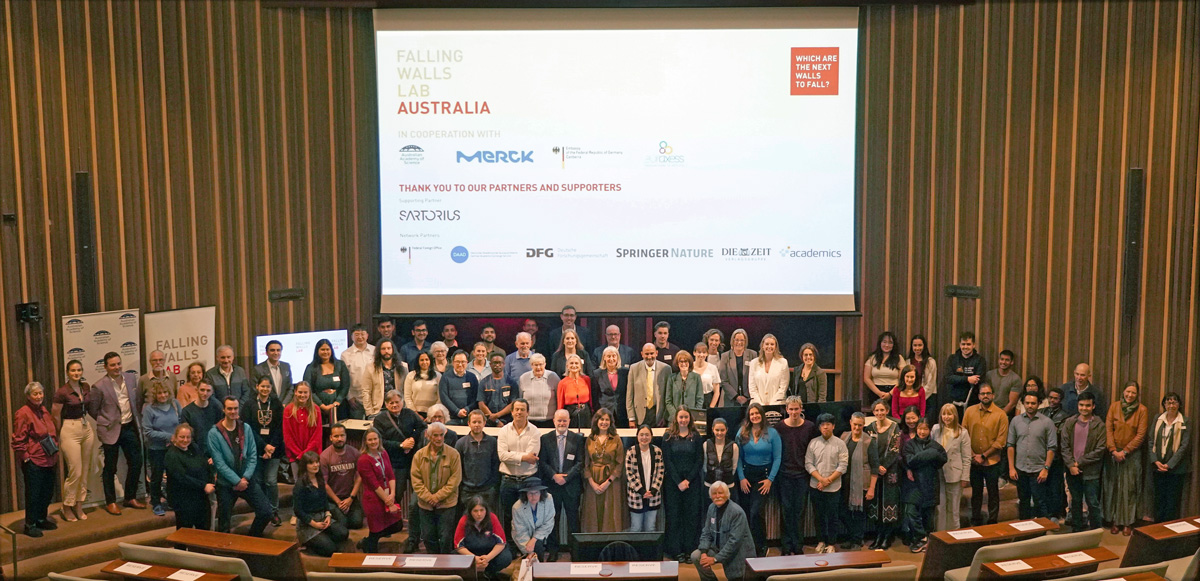
Winners to represent Australia in Berlin
The three winners will represent Australia in Berlin on 7 November, among 97 other finalists selected from Falling Walls Labs across the globe.
The Falling Walls Science Summit is an annual conference that fosters discussion on research and innovation and promotes the latest scientific findings among a broad audience from all parts of society. The Lab is an international forum for the next generation of outstanding innovators and creative thinkers.
Find out more about the international Falling Walls Lab
Watch the Falling Walls Lab Australia finale
Transcript: Science at the Shine Dome 2024 Gala Dinner speech
Delivered 11 September 2024 at the National Arboretum (Canberra)
Australian Academy of Science President, Professor Jagadish AC
Seventy years ago, when Sir Mark Oliphant, returned to Australia after World War II, and established the Academy and the ANU, he did so at a time of great social reconstruction. When Australia was building institutions and structures necessary for a young nation to prosper. He recognised the value of evidence-based institutions critical for a stable and forward-thinking democracy.
At the time, HC Coombs—a public servant and first Governor of the Reserve Bank—spoke about the need to bring to bear the full power of the research and technology sector to meet our national ambitions. And the need for the research sector to step up to the national challenge.
From this era were born institutions like the Australian Academy of Science.
The Academy was established to bring science to the service of the nation. The mission has not changed in 70 years. If anything, it has become more critical than ever.
Many have likened the post-pandemic period to the post-war period. A time for reconstruction. A time when we must bring to bear the full power of the research and technology sector to meet our national ambitions.
To strengthen our national security. To grow our industrial base so we can diversify our economy. To decarbonise our world as rapidly as possible.
Friends, we live in a time when geopolitical tensions are escalating.
We live in a region at the centre of those tensions. And we live in a world of information ubiquity. Where evidenced based information is drowned out by mis- and dis-information. Where reliable and independent sources of knowledge are increasingly rare.
These conditions have shown us that we must again step up to the national challenge.
And step up, boldly.
The more polarised the world becomes, the more we need science. The more uncertain our times, the more we need robust, evidence-based institutions. The more volatile the world, the more we need science to guide our actions.
We make better decisions when we have science on our side.
The pandemic has shown us that in times of uncertainty, we relied on evidence. Evidence drawn from decades of investment in scientific discovery.
Patient capital that delivers when we need it the most.
The pandemic has also shown us how critical it is to develop sovereign capability.
To build a nation that is more self-reliant.
When we think of sovereign capability our minds often turn to the need to have advanced manufacturing plants on our soil, so we aren’t at the back of the supply chain queue.
That thinking has seen investment in mRNA manufacturing on our shores and unparalleled investment to seed a quantum industry in Australia.
But less often do we think of sovereign capability in terms of our people.
The scientists who will imagine, discover and deliver jobs and industries that will diversify our economy.
The scientists who will drive productivity.
The scientists who are needed to strengthen national security.
Those scientists are in this room.
A workforce brimming with scientists.
A workforce ready and able to bring to bear the full power of the research and technology sector to meet our national ambitions.
A workforce that jumped into collective action to step up to the challenge of the pandemic.
A workforce that delivered a vaccine in 12 months, and in doing so got people back to work and the wheels of the economy turning again.
A workforce nurtured and propelled.
Just as it was in the post war period.
Except, today, it isn’t.
Early career researchers in this room face unprecedented barriers to career progression.
Senior scientists—skilled and able to meet national ambitions—compete for a diminishing pool of funds and operate in a system that is fragmented, lacking in strategy and drowning in bureaucracy.
Winning a research grant is no longer a sign of success or an enabler to advance our nation.
Rather, it is a challenge to find additional funding sources to fill the gap created by indirect costs of research.
It can and must be different.
We have seen the philanthropic sector step up in bold and visionary ways.
Recognising the power and creativity that is unleashed when researchers are given seven years of funding and asked to do what they do best.
And what the nation needs them to do. And trains them to do.
Philanthropists like the Snow family, the Cumming family, the Perrin family and others are leading the way.
Gifts that support Australian scientific discovery, but also leverage international investment recognising that science is a global endeavour.
Generous gifts from individuals like Academy Fellow Professor Cheryl Praeger and her husband Dr John Henstridge who have enabled scientists in our region to spark collaborations in Australia.
They too recognise that science knows no borders and that we need all the available talent.
May I acknowledge Tom Snow who is with us this evening, as well as Cheryl and John.
These are visionaries who have stepped up to a national need.
They do not displace government investment, but they eloquently show us how it should be done, it can be done, and it must be done.
Speaking of science that knows no borders, may I also acknowledge the vision of Science Minister Husic in assisting the Academy lead scientific cooperation across the Asia-Pacific region.
I am pleased to share with you Minister, that through the Academy’s leadership role that you enabled via a $10.3 million dollar investment in 2022, we have made a significant contribution to the establishment of a Pacific Academy of Sciences that will give Pacific scholars agency and a voice in shaping their destiny.
A strong and stable Pacific means a strong and stable region.
And that is in Australia’s interests.
The Pacific Academy of Sciences will be launched next month in Samoa as part of the Commonwealth Heads of Government Meeting.
And I am so proud of the Australian Academy of Science’s role in assisting in its establishment.
I am also proud of the amendments the Academy was able to achieve to the Defence Trade Control Act that was updated to enable Australia to meet its AUKUS obligations.
The Academy’s sustained advocacy has enabled Australia to strike a better balance between strengthening our national security whilst preserving open international scientific collaboration that benefits our nation.
Friends, I have spent some time recently visiting Fellows across Australia.
I did not find self-indulgent scientists, tickling their minds on the tax-payers’ purse in some disconnected way.
Rather I saw, time and time again, scientists across Australia talk to me about how they are solving real world problems experienced by everyday Australians.
I did not see ivory towers.
I saw humility.
Creativity.
A steadfast pursuit to make our world easier and cheaper to live in, and more sustainable.
A generation of scientists wanting to put Australia first.
A generation of scientists forging collaborations across the world in the knowledge that we can’t do it alone.
A generation of scientists making sure Australia has a seat at the table.
Positioned to take advantage of collective global knowledge.
Positioned, so when it matters, we aren’t at the back of the queue.
But a generation of scientists swimming against the tide.
And a generation starting to tire.
When our Academy began its calls for a comprehensive root and branch review of the R&D system in 2018, we did so because we need the conditions to bring to bear the full power of the research and technology sector to meet our national ambitions.
We can and we must.
Whether we will, lies in the hands of decision makers—some of which are sitting on my table.
We cheered loudly when Minister Husic, with the support of Treasurer Chalmers, enabled the budget measure that will see a strategic examination of the research and development system.
A once in a generation opportunity to look at the whole system—across government, business, higher education and philanthropy—and ask how can it be shaped for success?
What structures, systems, incentives, connections do we need to bring to bear the full power of the research and technology sector to meet today’s national ambitions?
We must get this right because businesses ready to advance their work rely on it.
Because an economy vulnerable to shocks, needs diversification.
Because flatlining productivity needs to be boosted by ideas and innovation.
We are a smart country with smart people.
Together we can do it.
You as legislators and funders.
Our Fellows as knowledge generators.
The Academy as knowledge brokers so that knowledge can help shape actions.
Together we can give hope to the next generation.
Together we can take the handbrake off scientific discovery and innovation.
Minister Husic and Mr Fletcher you have shown us you can do it.
Minister, you have delivered the National Reconstruction Fund to focus on science and technology priorities that will supercharge industry transformation and you are driving private investment to match government investment in these areas.
You are successfully seeding a quantum industry in Australia.
And other parts of the Australian Government are driving investment into large scale renewable energy solutions so we can decarbonise quickly.
We applaud these actions.
The Leader of the Opposition, as Health Minister delivered the Medical Research Future Fund.
Imagine for a minute the power of a long-term science-wide investment fund that supports all of research and takes the pressure off future budgets.
We are in terms of overall investment in R&D edging close to the bottom of the pack.
It is no place to be for a nation as creative, ambitious and prosperous as ours.
It is no place to be for a nation whose every single stated national ambition requires science and technology.
Our ambition to be a secure nation.
Our ambition to be a self-reliant nation.
Our ambition to be a sustainable nation.
This, my friends requires more science, not less.
And it requires the Academy to be the best it can be.
To continue to lead and lift the sector.
And to continue to bring science to the service of the nation.
Independently.
Reliably.
Respectful of all knowledge sources.
Basing our advice on evidence.
And championing excellence in science.
It’s the Academy way.
It is what we have always done
And it is what we will always do.
I invite you now to charge your glasses, and to be up standing to join me in a toast to excellence in Australian science.
President’s address and launch of Academy Innovate Reconciliation Action Plan
Australian Academy of Science President, Professor Chennupati Jagadish AC PresAA FREng FTSE
Fellows, colleagues, honoured guests—good afternoon.
Congratulations and a warm welcome to our newly admitted Fellows.
Our Fellows are the brains trust of our nation.
You are among the nation’s most distinguished scientists.
Since the Academy was established 70 years ago, 982 Fellows have been elected to it.
Our Fellowship currently stands strong at 614.
Aside from the scientific work you do, our Fellows contribute their expertise to the Academy, so science can be heard.
And so, your knowledge can inform the actions of our decision makers, whether they be in our parliaments, boardrooms, courtrooms, in our classrooms and in our homes.
The 19 years since I was elected to the Academy have flown by.
But I still vividly recall the deep satisfaction at being recognised by my peers for my contributions to science.
I imagine you feel the same today.
I was one of 15 Fellows elected in 2005.
Among them was microbiologist Professor Ruth Hall. She was the only woman elected that year.
How times have changed.
For the better.
Election to the Academy remains a fair and rigorous process.
Today, we have better ways to ensure we remove barriers to election experienced by under-represented groups.
We continually review these processes—whether they apply to the election of Fellows or to awardees—so that we can assess the diverse contributions of candidates.
We know that diversity is more than gender diversity and there is still much work to be done, especially around recognising achievement across our Indigenous scholars. I will come back to this later.
Since our inception, we have had a steadfast commitment to building a Fellowship that reflects the contemporary balance of disciplines and the breadth of the scientific community.
This commitment is reflected in the Academy’s new strategic plan, which I will also talk more about later.
As a national academy we have a responsibility to model, promote and influence best practice in the conduct of science.
Not just within our Fellowship, but across the science sector in Australia.
It is our collective role to set standards for science and to pursue scientific excellence in all that we do.
In listening to Fellows’ presentations, you have already had a taste of the extraordinary scientific talent we have in our nation.
I spend much of my time looking at nanostructures and observing the world at a different scale.
So, the opportunity to sit in this grand hall and hear about the wonders of our universe, how viruses multiply, novel ways to create clean energy, and the complexity and importance of the soil beneath our feet, is truly mind blowing.
On Thursday we will hear from our awardees including emerging scientific leaders. I have no doubt I will be inspired again and reminded of why it is critically important for all of us to work to remove career barriers that might prevent the world benefiting from their creativity and discoveries.
Science at the Shine Dome is one, if not the only, conference in Australia, where you can listen to Australia’s most distinguished scientists share their expertise across every discipline.
Scientists of all ages and backgrounds—people passionate about shifting the frontiers of knowledge—come together to share, network, collaborate and to inspire each other.
Another reason I love Science at the Shine Dome is this place and all it stands for.
The Shine Dome is the home of Australian science.
A big, bold concept.
At its opening, it was described as “unconventional and futuristic”.
It still is.
To this day, the Shine Dome remains an architecturally significant building, made greater by its occupants.
Following the Shine Dome’s refurbishment in 2001, then-Prime Minister John Howard said of the building:
“…. all of you will see it as a fitting physical reminder of the centrality of science and all that goes with it in the national life of our country.”
It is a fitting reminder of the importance of science.
It has inspired many.
It continues to inspire me and many others.
More recently, newly elected Fellow Professor Arthur Georges nicely captured the inspiration that the Shine Dome evokes for many of us. He said:
"My father realised that I had an interest in science. He was a politician, and he brought me to Canberra often and one year, he took me across to show me the Shine Dome.
“He explained that it was the centre of academic life for scientists. As is anyone who sees it for the first time, I was really impressed. But back then in 1968, it was really out of the ordinary. That memory stayed with me forever.”
May more politicians bring their children here.
And I invite you to do the same.
As the Academy celebrates its 70th anniversary, the majestic Shine Dome celebrates its 65th.
Discussions to establish an Academy began in 1951 at a meeting in Canberra to talk about the future of science and technology in Australia.
Sir Mark Oliphant said, when seeking to convince others of the possibility of an Australian academy:
“If science for its own sake was to have coherence, there must be a means whereby that coherence could be expressed.”
Because of the great talent and growing capability of Australian scientists, Oliphant was inspired to establish a new scientific identity closer to home.
And so, he did.
Oliphant became the Academy’s first President.
It truly is a privilege to be serving you as the Academy’s 20th President, building on the work of those who have come before me.
The 1950s were a time of post-war reconstruction when HC Coombs—a public servant and first Governor of the Reserve Bank—spoke about the social reconstruction.
It was a time when Australia built structures that recognised the value of evidence and institutions necessary for a stable democracy.
Coombs spoke about the need to bring to bear the full power of the research and technology sector to meet our national ambitions.
The need for the research sector to step up to the national challenge.
From this era were born institutions like the Australian Academy of Science and the ANU where I spent most of my academic life.
Not just established, but uniquely positioned to bring science to the service of the nation.
Our 70 years since illustrate an enviable record of achievement in shaping Australian science, its system and its people.
In our current geopolitical climate, amidst the pandemic, and to steer our way through climate change, I put to you that the need for the research sector to step up to the national challenge is as great as ever.
It is this changing environment, and the role science can and must play that has informed our strategic plan.
The Strategic Plan identifies three priorities:
- scientific leadership
- mobilising and transforming the Academy
- sustained strategic engagement.
In terms of scientific leadership, the Academy can and must continue to play a leading role in shaping the Australian scientific landscape.
Just as it was our scientific leadership that led to the establishment of national parks in Australia, the establishment of national astronomy infrastructure that sees Australia positioned today as a world leader in this discipline, and the founder of SAGE Science in Australia Gender Equity, it is our scientific leadership that means today we lead scientific cooperation efforts across the Asia-Pacific region via the International Science Council Regional Focal Point for Asia and the Pacific (ISC RFP-AP).
Consider for a moment the value of this mechanism to enable science diplomacy in amingst the geopolitical turmoil of our region and our time.
In this leadership role we have been able to make a significant contribution to the historic establishment of a Pacific Academy of Sciences.
An academy designed to bring together the region’s expertise and empower local scholars to be part of solutions in their region and unite as a voice for science.
An academy designed to move away from a model that sees their region as a net importer of knowledge—rather, drawing on the unique knowledge of its own people to provide the Pacific with agency and a voice in shaping its destiny.
It will be launched next month in Samoa as part of the Commonwealth Heads of Government Meeting.
And I am so proud of the Australian Academy of Science’s role in assisting its establishment.
Early this year, it was the Academy’s scientific leadership and sustained advocacy that secured protections for international research collaborations that are critical for our national interest.
Australia’s Defence Export Controls framework has undergone significant change to enable license-free movement of goods, technology and services both within Australia and between AUKUS partners—that is, the UK and the US.
When first proposed, the framework and legislative changes did not adequately balance security risks with open collaboration and created an overly restrictive regime for research collaborations between countries outside of the AUKUS agreement.
The Academy strongly advocated for and achieved legislative amendments that provide protections for the license-free exchange of fundamental research between nations.
In addition, the definition of fundamental research is now enshrined in legislation, providing protections from possible future political maneuvers to change the definition without parliamentary scrutiny.
Frankly, the Academy held strong when others in the sector were willing to accept changes that would have placed at risk Australia’s ability to engage knowledge vital to discovery research.
These hard-fought amendments strike a better balance between protecting Australia’s national security while ensuring collaboration can continue to serve our national interest.
At the heart of the second strategic priority—mobilising and transforming the Academy—is you, our Fellows.
Together we have reviewed the National Committees, so they are poised for action, able to respond to the changing needs of disciplines.
Together we have re-designed our governance structures, aligned our resources and positioned ourselves to have the greatest possible impact. Together, we have recognised the need to significantly lift our engagement with Fellows, Ministers, early- and mid-career researchers, industry leaders, teachers, students and the broader community.
Together we are building a membership of the Academy that reflects the breadth of the modern scientific enterprise.
You might ask, why are National Committees, governance, engagement and disciplinary breadth important?
Because developing scientific advice and advocating for science to the highest offices of the land demands excellence in our fellowship, operations, systems and structures.
Because our ability to mobilise the unique assets of the Academy—the heart of which is you, our Fellowship—is critical to bring science to the service of the nation.
Because our ability to influence the journey of students studying science and maths and the teachers guiding them requires discipline and leadership.
Because our ability to empower the next generation of researchers and remove barriers that hold them back is vital for our future.
And because we must always ensure our independence remains uncompromised.
This relies on a growing investment corpus sufficient to sustain the Academy’s activities.
We are ambitious for this nation.
We are ambitious for science.
We recognise that we need to operate at a greater scale.
And that is why we are redoubling our efforts to attract philanthropic support to grow our corpus and enable us to bring science to the service of the nation at the scale the current times demand.
We can. We must. And we will.
Our Strategic Plan also identifies a key challenge, namely: to deliver sought-after scientific advice that influences Australians’ actions and contributes to global science.
That advice is drawn from your expertise.
It is valuable because the Academy is non-partisan.
It is valuable because we do not carry vested interests.
It is valuable because we are not beholden to any single institution.
And it is valuable because we have no skin in the game—except a better Australia.
Our only interest is ensuring expert evidence is shaping the decisions and actions of our people so the nation advances and everyone benefits.
It’s a bold and challenging mission.
Over the last few years, we have provided sought-after independent scientific advice in areas as diverse as:
- artificial Intelligence
- Great Barrier Reef sustainability
- the management of long COVID
- national security matters
- national environmental law
- criminal justice outcomes
- technological transfer
- STEM skill development
- research infrastructure policy.
But there are many pressing issues that require scientific advice.
We have successfully argued the case for a wholesale review of Australia’s outdated R&D system.
The strategic examination of Australia’s R&D system was announced in the May Budget.
This review is the first step to align national efforts across the whole of government, industry, universities and philanthropy to create an environment where investment in R&D is coherent, strategic and scaled.
To inform this government review, the Academy is developing a 10-year plan to demonstrate how science needs to evolve to achieve our national ambitions.
The plan, titled ‘Australian Science, Australia’s Future: Science 2035’, being led by Science Policy Secretary Ian Chubb, is assessing the capability of Australia’s science system, its ability to compete and collaborate globally, and its contribution to the nation’s economy, security, health and quality of life.
The Academy is convening experts from within our Fellowship and across the research and innovation sector to inform this initiative.
This 10-year plan will be published next year.
Just outside in the Jaeger room you will find a booth where you can learn more about our work and contribute to it.
Fellows, we do a lot, but there is more to be done to bring science to the service of the nation at the scale the current times demand.
Our new strategic direction and the changes we are undertaking are designed to position us and ready us to—in the words of HC Coombs—bring to bear the full power of the research and technology to meet our national ambitions.
We must. We can. We will.
You have heard our mission and our strategic objectives, and I am hoping that many in the audience are asking themselves, how can I contribute.
Every part of the Academy benefits and our impact is greatest when we work closely with you.
There are many ways in which you can contribute—some more time consuming, others less so.
You can contribute:
- by providing your expertise to influence policy and Academy activities
- by serving on one of the 19 National Committees for Science, which steer and shape scientific disciplines
- by nominating outstanding individuals for Fellowship, for Council membership, and for awards
- by joining the Academy’s Council, the highest decision-making body of the organisation
- by attending the AGM and having your say
- by being active in Fellows’ activities in your state or territory
- by actively engaging with and providing mentorship to early and mid- career researchers: they are our future. This year we have over 100 early- and mid- career researchers here. Take some time to say hello to them
- by representing Australia internationally at global gatherings or on the governing committees of global bodies such as the international scientific unions
- by proposing ideas for and reviewing our science communication content
- by supporting our education programs.
This list is by no means exhaustive.
Executive Committee members oversee the Academy on your behalf and each carry portfolio responsibilities linked to the functions of the Academy.
Let me put some faces to names. It is important that you know who Council members are and who you can turn to at any moment to ask questions or have input.
Please welcome to the stage:
- Professor Ivan Marusic, the Secretary for Physical Sciences
- Professor Bob Graham, the Secretary for Biological Sciences
Ivan and Bob also serve as Vice-Presidents of the Academy.
- Professor Marilyn Anderson is the Treasurer and unfortunately is unable to be with us today
- Professor Frances Separovic, the Foreign Secretary
- Professor Ian Chubb, the Secretary for Science Policy
- Professor Lyn Beazley, the Secretary for Education
- Professor Jim Williams is the Spokesperson for Integrity
- And we will soon be appointing a Spokesperson for Engagement
These individuals work closely with and oversee the work of the Secretariat to guide all of the Academy's activities. We also have some of our Council members with us.
I’d also like to acknowledge the Academy Fellows who serve as Regional Chairs and Co-Chairs, some of whom I’ve visited recently on my tour around Australia.
Regional chairs play an important role in bringing together Fellows at a state and territory level and facilitating engagement with the broader Academy.
Could you please join me in thanking them for their contributions.
Fellows, I conclude this part of my President’s address by reminding you this is your Academy.
The more we work together, the greater our impact will be.
Ian Potter House across the car park is available for your use at any time, even when you are in Canberra on non-Academy business.
It includes office and meeting facilities, a Fellows’ lounge, a place to connect or simply rest a bag.
The Academy’s staff are always available to assist.
Colleagues, thank you for your time and attention today and I look forward to more conversations with you during the rest of Science at the Shine Dome.
Reconciliation
I’d now like to move to the launch of the Academy’s Innovate Reconciliation Action Plan.
At its heart, reconciliation is about strengthening relationships between Aboriginal and Torres Strait Islander peoples and non-Indigenous peoples, for the benefit of all Australians.
As a champion of our Reconciliation Action Plan, I know that the Academy’s contribution to reconciliation will be most widely felt when we strengthen the participation of our Fellowship in our journey.
That’s why I chose this occasion to launch the Academy’s Innovate RAP—to be amongst you, our Fellows, and to share with you our learnings and to engage you in our next steps.
The Innovate RAP is a significant milestone for the Academy, coming after the successful completion of commitments in our Reflect RAP.
The Innovate RAP reflects the work, deliberations, thinking and reflections of the RAP Working Group over the last 18 months.
I thank them for their commitment and for challenging our thinking.
I particularly thank our Indigenous advisers Dr Katrina Wruck and Associate Professor Bradley Moggridge.
And Academy Fellows Professors Professors John Patrick, Halina Rubenstein-Dunlop and Trevor Lithgow. As well as Academy staff who participate in the RAP working group.
To launch the Academy’s Innovate RAP, it is my pleasure to welcome to the podium Professor John Patrick, Fellow of the Academy.
John has been a tremendous guide for me, sharing with honesty his engagement with Traditional Owners, and speaking about how his research has been enriched by Indigenous engagement.
John will share a few words then engage in a discussion with Indigenous early- and mid-career researchers from the RAP Working Group and from the Academy’s EMCR Forum.
Before I hand over to John, could you please join me in thanking Anna-Maria Arabia, Melissa Abberton and the Academy secretariat team for putting together a great Science at the Shine Dome.
- More about Science at the Shine Dome 2024
- Watch the livestreams
- Visit the event website
- Follow the action on X (formerly Twitter): #ShineDome24 and Academy.
Academy Fellows celebrated at 2024 Eureka Prizes

Recipients of this year's Eureka Prizes included (clockwise from top left) Academy Fellows Professor Gordon Smyth, Professor Kate Jolliffe, Professor Surinder Singh, Professor David Keith and Professor Calum Drummond.
Five Academy Fellows have been acknowledged for excellence in research, innovation and leadership at the 2024 Australian Museum Eureka Prizes award night held on 4 September in Sydney.
Professor Gordon Smyth
Professor Gordon Smyth was awarded the Eureka Prize for Excellence in Research Software for the development of the world’s most downloaded software package of its type – Limma – which has been used to make biomedical discoveries published in more than 70,000 scientific papers.
Limma helps identify and interpret changes in DNA material, significantly improving the confidence in statistical information used in biomedical research. Professor Smyth is a leading statistician and bioinformatician and was elected to the Academy in 2021.
Professor Surinder Singh
The Eureka Prize for Sustainability Research was awarded to the Sustainable Omega-3 Oil Team from CSIRO and Nuseed, including Professor Surinder Singh.
The team was recognised for their innovative production and commercialisation of omega-3 long-chain polyunsaturated fatty acids from canola crops, which could save the need for unsustainable harvests of wild-caught fish and double the world’s supply of omega-3.
Professor Kate Jolliffe
Professor Kate Jolliffe was recognised for her exemplary research and leadership with the prize for Outstanding Mentor of Researchers.
Professor Jolliffe has made world-leading contributions to the fields of supramolecular and organic chemistry, in addition to supporting the foundation of the international ‘Women in Supramolecular Chemistry’ network. Her committed mentorship has resulted in more than 150 researchers appointed to senior academic and industry roles.
Congratulations to Academy Fellow Professor @kate_jolliffe who has been awarded the @UTSresearch Eureka Prize for Outstanding Mentor of Researchers. @Sydney_Uni @Sydney_Science #EurekaPrizes https://t.co/jcupD5KpT8 pic.twitter.com/BYIIS9NKUw
— Australian Academy of Science (@Science_Academy) September 4, 2024
Professor David Keith
Conservation scientist Professor David Keith’s significant contributions to his field saw him awarded the Eureka Prize for Excellence in Botanical Science.
Professor Keith led the development of biodiversity risk assessment ‘Red List’ methods and a global ecosystem typology which were adopted as global standards by the International Union for the Conservation of Nature (IUCN).
Professor Calum Drummond
The prize for Leadership in Science was awarded to 2024 Fellow Distinguished Professor Calum Drummond for his commitment to research and innovation ecosystem reform.
His research has advanced our understanding of key factors governing molecular assembly and particle and surface interactions in liquids, and has enabled the development and application of advanced high-performance materials.
Professor Drummond will be officially inducted into the Academy of Science Fellowship at this year’s Science at the Shine Dome, held in Canberra from 9 to 12 September.
The Academy congratulates all recipients and nominees of the Australian Museum Eureka Prizes.
Artificial intelligence proposals find the middle ground
The Australian Academy of Science welcomes the release of the Australian Government’s proposals paper for introducing mandatory guardrails for AI in high-risk settings, and a voluntary AI safety standard.
The documents are an important next step in the Australian Government’s Safe and responsible AI in Australia consultation and are consistent with our international commitments through the Bletchley and Seoul declarations.
Academy President Professor Chennupati Jagadish said AI is transforming science and our society, which is why the Academy has advocated for a national strategy and guidelines for the responsible use of AI.
“Regulation of AI should not limit innovation but rather create a safe and ethical framework for science and society to prosper,” Professor Jagadish said.
“A solid regulatory framework is essential to ensure Australia is prepared for the transformation AI is bringing, and this can be provided through the urgent introduction of the proposed mandatory guardrails.
“The proposals, including to introduce an Australian AI Act, is a major step in the right direction to develop laws and regulations that appropriately address the opportunities, challenges and risks of AI.
“It is important that any regulatory environment is adaptable and can anticipate the adoption of AI and guide its safe and responsible use, and that progress to introduce mandatory guardrails is made swiftly.
“Time is of the essence. Australia needs to progress the development of anticipatory regulation in AI and other areas of emerging science.”
The Academy will publish a full response to the consultation on proposed guardrails in the coming weeks.
“We will continue to convene expertise to assist the Australian Government in guiding the responsible adoption of AI for the benefit of all Australians,” Professor Jagadish said.
The Academy is optimistic that Australia can lead in AI and related sciences if the Australian Government:
- develops a national strategy for the uptake of AI in the science sector, including scaling up investment in fundamental AI science
- ensures that Australia’s AI capability doesn’t rely on other nations by uplifting our sovereign high-performance computing facilities
- implements the UNESCO Recommendation on Open Science (since AI is trained on available data, keeping scientific data and peer-reviewed publications behind paywalls impacts the ability of these systems to leverage the most reliable information).
Read the Academy’s submission to the consultation process and our statement on the government’s interim response.