




Latest ABS stats show national investment in R&D has fallen again

Figures released today by the Australian Bureau of Statistics show that despite Australia’s reliance on science and research and development (R&D) to navigate a challenging economic landscape, overall national investment in R&D continues its 14-year decline.
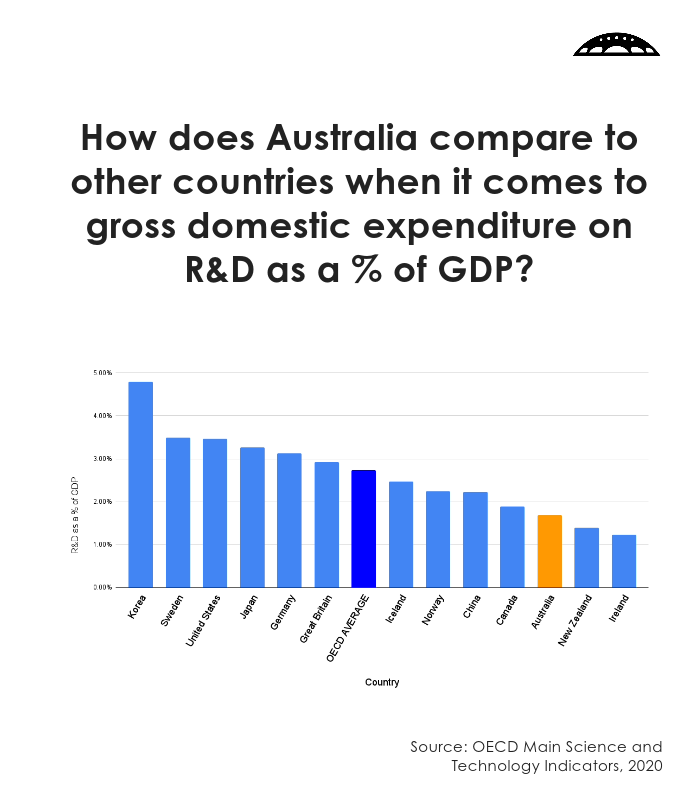
National investment in science and research across the economy—business, government and universities—fell from 1.80% in 2019/20 to 1.68% in 2021/22.
Australian Academy of Science President Professor Chennupati Jagadish said Australia’s capacity to respond to the challenges presented in the Intergenerational Report is diminishing.
“Australia urgently needs to develop a 10-year plan to boost government, higher education and business investment in R&D, so we are equipped to manage a large-scale energy transition, an ageing population, and develop critical national security technology,” Professor Jagadish said.
“If investment in R&D continues to decline by 0.1% of GDP per year, in five years’ time Australia will be among the lowest of OECD countries.
“Conversely, if Australia increased investment in R&D by 0.1% of GDP each year, we would reach the OECD average in 10 years if the average stayed the same.
“Increasing investment in R&D across all sectors—business, universities and governments—is necessary to improve productivity, boost the knowledge economy, and create new jobs and industries.
“Australia has one of the world’s least differentiated economies. We remain vulnerable when our prosperity relies on such a narrow range of industries.
“It is imperative we improve Australia’s economic complexity, which can be driven by a more strategic focus on science and research—the fuel for innovation and industry growth,” Professor Jagadish concluded.
Eureka Prizes recognise excellence in science and science engagement

Academy honorific award recipient Professor Renae Ryan AM (left) and Academy Fellow Professor Toby Walsh FAA (right).
Australian Academy of Science honorific award recipient Professor Renae Ryan AM and Academy Fellow Professor Toby Walsh FAA are among the 19 individuals and teams recognised at the 2023 Australian Museum Eureka Prize awards for excellence in Research and Innovation, Leadership, Science Engagement and School Science, held on 23 August in Sydney.
Professor Walsh received the Celestino Eureka Prize for Promoting Understanding of Science, awarded for sharing expertise with a broad audience – informing, enthusing and engaging the public on scientific topics.
Scientia Professor of Artificial Intelligence at UNSW and Fellow of the Academy since 2016, Professor Walsh is a world-renowned researcher and leading voice on the topic of artificial intelligence (AI).
He has helped shape the conversation around the ethical implementation of AI – making regular appearances on TV and radio to talk about the impacts of AI and robotics. He writes regularly for print and online media and has authored two books on AI for a general audience.
Professor Ryan of the University of Sydney was awarded the Eureka Prize for Outstanding Mentor of Young Researchers presented by the University of Technology Sydney.
The award recognises an individual scientist who has helped develop the next generation of Australia’s researchers.
Professor Ryan, who received the Academy’s Nancy Millis Medal for Women in Science earlier this year, is a sought-after supervisor and mentor and a passionate advocate for gender equity, diversity and inclusion. She has played a central role in improving diversity in STEM, leading university-wide initiatives to increase representation and foster a more inclusive and supportive academic environment.
The following Fellows were shortlisted for Eureka Prizes:
Professor Kate Joliffe FAA and Professor Maria Forsyth AM FAA FTSE were shortlisted for the Eureka Prize for Outstanding Mentor of Young Researchers for their dedicated commitment to mentorship, and Professor David Keith FAA was shortlisted for the Australian Institute of Botanical Science Eureka Prize for Excellence in Botanical Science.
The evening also saw young citizen scientists recognised for their curiosity and creativity in science communication. Among the awardees was young Darcy, who won the University of Sydney Sleek Geeks Science Eureka Prize – Secondary Prize for his video explaining chlorophyll. Darcy is also the son of an Academy staff member, who was undoubtedly very proud of the budding scientist.
The Academy congratulates all the prize winners and finalists in this year’s Eureka Prizes.
The Australian Museum Eureka Prizes are hosted annually to celebrate outstanding scientific achievement and shine a light on the incredible work being done in science and science engagement in Australia.
See the full list of 2023 Eureka Prize winners and read more about the Academy Fellows recognised in 2021 and 2022.
Major ARC reforms will strengthen Australia’s research capability
The Australian Academy of Science applauds the announcement today by Federal Education Minister Jason Clare that he will accept all 10 recommendations of the review of the Australian Research Council (ARC) Act (2001).
Academy President Professor Chennupati Jagadish said the reforms will create a far more robust and research-oriented system.
“Limiting the unrestricted use of ministerial discretion to veto properly assessed and reviewed research proposals is a particularly significant reform and something that will bring great relief to our nation’s research community,” Professor Jagadish said.
“When the integrity of Australia’s research system is compromised by perceived or actual political interference, there are real costs for the research sector and indeed for the nation – by eroding trust and damaging the relationships researchers have with industry, the Australian community, and international partners.
“The establishment of a board as the accountable authority for the organisation will strengthen and modernise the governance of the ARC.
“Appointees to this board must have extensive experience in the research system.”
The Academy thanks Professors Sheil, Dodds and Hutchinson for their work on this review and the Education Minister for comprehensively responding to the review.
We look forward to working with the ARC and the Australian Government to ensure the amendments to the Act are appropriate.
Much more to be done to improve diversity in STEM
The President of the Australian Academy of Science has welcomed the draft recommendations of the Diversity in STEM review, released today by the Australian Government, which highlights the task at hand while showcasing progress made.
Academy President Professor Chennupati Jagadish said we need all the available STEM talent if we are to address the challenges of our time.
“Much work has been done to improve diversity in STEM, but there is much more still to do to deliberately and strategically improve diversity in STEM and ensure we are attracting, training and retaining all of the available talent,” Professor Jagadish said.
In the Academy’s submission, it was strongly recommended that the diversity in STEM review build on the Women in STEM Decadal Plan and its recommendations to take a whole-of-STEM sector approach.
“We have learned much from our work on the Women in STEM Decadal Plan. The Academy is pleased to see the review adopt a similar focus to all dimensions of diversity on leadership, accountability, evaluation, workplace culture, visibility, and education,” Professor Jagadish said.
The review has presented draft recommendations that bring us closer to achieving unified national actions aimed at enhancing diversity in STEM.
The draft review report acknowledges the benefits and impacts of measures that are a direct result of the recommendations in the Women in STEM Decadal Plan, including: the establishment of the STEM Equity Monitor; the Evaluation and Program Implementation tools developed by the Women in STEM Ambassador; and the Australian Academy of Technology and Engineering (ATSE)’s Diversity & Inclusion Toolkit for small and medium enterprises (SMEs).
The Academy supports recommendations to build on the strong foundations and systemic changes enabled by the Women in STEM Ambassador.
The Academy also supports efforts to expand Science in Australia Gender Equity (SAGE) across STEM including using government funding levers to incentivise transformative and systemic improvements that SAGE accreditation has enabled to date.
Tools like the STEM Equity Monitor provide valuable data to inform decision-making and should be expanded to give us a comprehensive picture of diversity in STEM in Australia and track progress.
“This review confirms that to break down persistent barriers faced by under-represented communities, the STEM sector —government, academia, educators and industry— needs to push in the same direction and harness the opportunities in the Women in STEM Decadal Plan designed to reach gender equity by 2030,” Professor Jagadish said.
“I wholeheartedly agree that Australia’s diverse population is our strength, and I applaud the focus on maximising participation of underrepresented groups,” he said.
The Academy thanks the panel for their work, and looks forward to assisting the Australian Government to deliver the outcomes when the final report is released.
Academy’s work in diversity
The Australian Academy of Science is a leader in diversity and inclusion. Earlier this year the Academy made a submission to the Diversity in STEM Review.
In 2019, the Academy led the production of the Women in STEM Decadal Plan with the Australian Academy of Technology and Engineering.
The Academy founded and helped to establish Science in Australia Gender Equity (SAGE).
Climate change impacts on the Great Barrier Reef could become irreversible
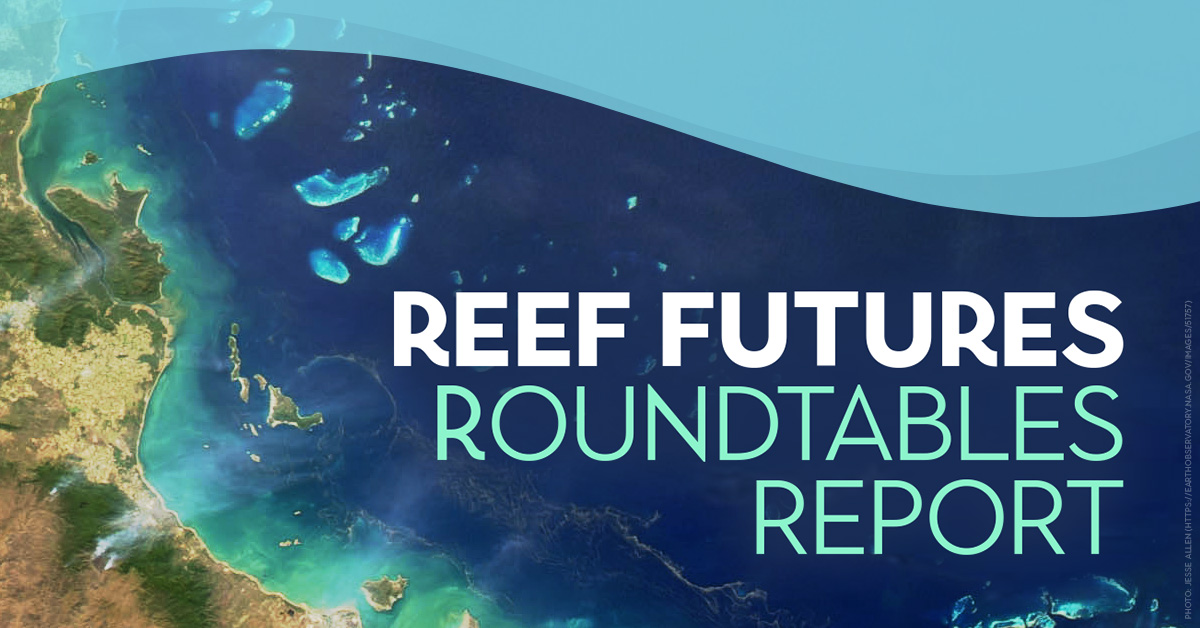
The Great Barrier Reef is likely to face impacts from climate change that could become irreversible around mid-century regardless of whether global emissions stabilise, according to a new report by the Australian Academy of Science.
The report explores possible futures for the Great Barrier Reef (GBR) under different emissions scenarios. It also identifies evidence-based strategies and areas of opportunity to manage the Reef ecosystem in the face of unrelenting climate change.
It found flow-on effects from climate impacts to cultures and customs are rapidly changing and mostly unknown, making it difficult to prioritise where to intervene to protect areas of high cultural value to Traditional Owners.
The report says this could be improved by ensuring transdisciplinary knowledge is integrated into prioritisation processes.
The Department of Climate Change, Energy, the Environment and Water engaged the Academy as an independent scientific adviser to convene three roundtable discussions to assess the likely outcomes for the GBR in three climate scenarios: near-term, and both low-emissions and high-emissions trajectories in the medium-term.
A total of 84 multidisciplinary experts joined the roundtable discussions: the first on climate impacts on functions of the GBR, the second on interventions and the third on the future of the GBR.
The report has been delivered to the Reef 2050 Plan Independent Expert Panel. They have considered it in their advice to government on the current and likely health and resilience of the GBR in the face of climate impacts and potential reef interventions.
President of the Australian Academy of Science Professor Chennupati Jagadish said the report makes clear that climate change is the primary threat to this global icon and its connected systems.
“It reminds us that sticking to that path we are currently on, simply because we started on it, will not offer the best solution for the Great Barrier Reef,” Professor Jagadish said.
“It highlights that in the medium-term, there are opportunities to slow the decline in the health of the reef, however this requires Australia to take further action now.”
The report also identifies other opportunities, including:
- a comprehensive review of GBR management—this may offer opportunities to streamline processes that are currently decentralised to create a management setting that is fit for purpose and agile enough to react to a changing climate. The report highlights that the management system was established before there was understanding of how climate change would impact the GBR
- relevant research organisations could form a consortium to agree on sector-wide data standards and sharing arrangements. Such agreements would support better integration of existing and future research efforts
- filling gaps in knowledge in the high emissions scenario—if these gaps were filled, including an improved understanding of how different ecological functions might be impacted, communities could be better prepared for the anticipated disruptions to lives and livelihoods
- standardising and centralising socio-ecological data could aid GBR management. Of particular importance will be understanding differing opinions between groups as to what values, regions or functions are most important for preservation or protection. If we can’t save everything, what we can save needs to be communicated and understood by all
- developing suitable regulations and laws which do not rely on political involvement to be implemented in full. Doing so will secure a more evidence-informed system for the benefit of the GBR.
- Traditional Knowledges could provide a framework for managing a changing and adapting GBR. Indigenous peoples have adapted to a changing GBR, however, the rate of change that is being and will be experienced is unprecedented. Indigenous participants suggested that there is an opportunity to address the decline of GBR values in a more profound and connected way, using a collaborative approach founded in Traditional Knowledge.
The Reef Traditional Owners are supported by the Australian and Queensland Governments to build a taskforce to operationalise the Reef 2050 Traditional Owner Implementation Plan’s actions in a collaborative co-design approach.
A full list of opportunities in the report can be found on page 30.
The report concludes:
“Truthful, open, and clear communication with the public is needed to prepare Australians for what is to come, given the GBR will continue to change as the environment becomes more challenging for its habitats and species.
“Clear communication is also important to garner support for necessary management interventions to protect the GBR to the greatest extent possible.”
Australia’s leading scientists respond to Universities Accord Interim Report
The Australian Academy of Science welcomes the Australian Universities Accord Interim Report and thanks the panel, including the chair Professor Mary O’Kane, for their diligent work.
The ambition inherent in this report is vast. The future it charts is one where we move from a mass university system to a universal tertiary education system—just as we have a universal school education system and are charting a path towards universal childcare.
To tackle our shared challenges, we need to consider innovative solutions that move beyond past debates and that challenge the status quo. The Academy is pleased that the panel and the Minister for Education are open to rethinking the current funding system, which can discourage universities from offering STEM undergraduate courses.
While the report recognises the inherent instability in our broken system for funding university research, the proposed directions are limited. Proposals for increased investment in the Australian Research Council, renewing NCRIS, and increasing PhD stipend rates are useful.
However, they do not address the fundamentals—the inherent instability of asking universities to rely on international and domestic student fee revenue to fund Australia’s research base.
Australia desperately needs a holistic review of the fundamentals that underpin the science and research system. Universities are a critically important part of Australia’s research ecosystem, but only a part.
In an era where the Australian Government’s investment in science, research and innovation is the lowest on record at 0.49% of GDP, these recommendations will fail to shift the dial or even offer a pathway to reverse this concerning decline.
Australian science needs real policy reform to ensure that we maintain and grow essential national capabilities to address the challenges of a perilous world—from pandemic preparedness to natural climate-induced disasters, to managing geopolitical instability.
Reform is needed that charts a clearer vision for the role that universities play in the Australian and global knowledge system and how university research can boost productivity growth.
Acknowledging that there is ongoing work within the government to modernise policy settings for the science system, Australia still lacks a whole-of-government and society plan to improve Australia’s record-low level of research and development investment.
The Academy continues to call for an independent review of the entire science and research system and looks forward to working with the government and the Universities Accord panel to create a modern research enterprise able to support and advance science in Australia and, in doing so, support our economy and wellbeing.
Statement regarding June 2023 cuts to Australian space programs
Space-derived activities and services underpin much of Australia’s economic, environmental and national security yet are predominantly delivered by foreign entities.
Supporting Australian space activities has several benefits: it mitigates sovereign risk; it aligns with advanced manufacturing strategies; it supports science and ultimately will help diversify Australia’s narrow economic base.
Australia’s future in space depends on a commitment to the underpinning science. Without science, we limit our options, becoming an importer of the knowledge and technology we need for our own wellbeing.
While acknowledging the Australian Government’s ongoing commitment to the future of the Australian Space Agency, the Australian Academy of Science is disappointed with the decision to cancel the National Space Mission for Earth Observation (NSMEO).
The Australian space science community identified an ongoing Earth observation satellite program as a national priority in Australia in Space: a decadal plan for Australian space science 2021–2030.
With its focus on Earth observation and climate science, the NSMEO would have benefited multiple Australian research areas that contribute to understanding the impact of climate change on Australia, and generated data that assist with natural disaster mitigation, weather forecasting, and water resource management.
The NSMEO would have required developing sovereign Australian capability, with flow-on benefits to other areas of Australian space science.
A government commitment to a national space program will contribute to—and benefit from—Australian industry and science.
Press conference transcript: Science central in overturning Australia’s greatest miscarriage of justice
The following is a transcript of a press conference given by the President, Professor Chennupati Jagadish AC PresAA FREng FTSE and Chief Executive, Anna-Maria Arabia of the Australian Academy of Science, in response to the pardon of Kathleen Folbigg announced earlier today.
Professor Chennupati Jagadish: So, the Australian Academy of Science has been the independent scientific advisor to Kathleen Folbigg’s case since 2019. Today we warmly welcome the announcement of the Attorney-General’s unconditional pardon by the governor of New South Wales of Kathleen Folbigg. And we are relieved that science has been heard, and we particularly would like to take this opportunity to thank our Academy Fellow Professor Carola Vinuesa FRS FAA, who has really brought to the attention of the Academy this particular case and her science and has shown much integrity, ensuring that science has been heard by the justice system. And it's a great day for science today because of the fact that the justice system has taken into consideration the scientific evidence in determining the pardon of Kathleen Folbigg.
Anna-Maria Arabia: I too am absolutely relieved that Kathleen Folbigg has been pardoned. It's been an absolute privilege for the Australian Academy of Science to have acted as an independent scientific advisor to this inquiry. We know that science is moving at a rapid pace, and we need to find mechanisms for a more science-sensitive legal system to be created. The DPP at the second inquiry into the case of Kathleen Folbigg noted how critical it was to have scientific evidence come from reliable and independent sources, such as the experts the Australian Academy of Science was able to convene. The Attorney-General Michael Daley this morning said that we must find mechanisms to ensure that cases can be reviewed, particularly when there is new evidence that comes to light. I could not agree more. The question must now be asked, how do we create a more science-sensitive legal system bringing to bear new complex and emerging science routinely every day, not just in exceptional cases. The Australian Academy of Science very much looks forward to working with Attorney-General Daley to look at ways that this can be developed and implemented. In fact, this case has enormous implications for the justice system of every Australian State and Territory.
Journalist: So were you calling for an overhaul or a review of Australia's legal system and how it can properly incorporate scientific evidence for trials?
Anna-Maria Arabia: We are calling for law reforms such that the legal system can be more science-sensitive. We need new and emerging science to be able to inform decision making. Science needs to inform decisions wherever they are made, including in the justice system. So, we do need ways – particularly when all of the appeals mechanisms have been exhausted, as was the case with Kathleen Folbigg – for that science to be heard. But also in other cases where we do need independent experts to come forward and quite independently put their scientific evidence to inform decision-making. Science is complex. We don't need scientists put into a boxing ring up against each other. We need a way in which science can be heard fairly, transparently, and independently by the justice system.
Journalist: Do you have any ideas on how that would work or any suggestions to, to kind of kick-start conversation about how you go about doing that?
Anna-Maria Arabia: In terms of creating a system where new science can be heard after all of the appeals mechanisms have been exhausted, other countries have adopted a criminal case review commission. It's been a very successful model in like-minded countries like the UK, Canada, New Zealand. There is an opportunity for Australia to implement such a system or something similar.
Journalist: And how concerned are you that there are similar cases of people being wrongfully accused of killing their children when at the time the science wasn't understood or we weren't aware of genetic factors at play?
Anna-Maria Arabia: There are myriad cases where there have been pleas for pardons and other such things based on new evidence coming to light. There are too many for anyone to look at in an ad-hoc way. This is why something like a criminal case review commission could look at those cases independently and determine whether a new process is required, whether that's an inquiry, or another court process of some variety. So, we do need a system where those cases can be looked at on a case-by-case basis to determine whether they need to be opened again.
Journalist: And are there any specific cases that you are aware of that you believe need to be reviewed?
Anna-Maria Arabia: There are no cases that I'm aware of at this time that would be analogous to this one. I haven't looked at all of the cases though.
Journalist: Something you touched on, this might be a bit out-of-left field. Is there a broader tension here between how scientists decide what they think is true and how the justice system decides what it thinks is true? Do you think this case strikes up?
Anna-Maria Arabia: Scientists go about advancing knowledge and they do so using a time-honoured process called the peer review system. Through that, knowledge emerges and is published and made available to everyone. There is great integrity in that process that allows evidence to be shared with everyone. The justice system can take that evidence and hear from expert witnesses as they are called to the justice system. We do not always have a system where the most qualified or the most expert person is made available to that system. That's a real opportunity for law reform. The independent selection of scientific experts so they can bring to bear their knowledge in an unfettered way would be an enormous advancement for our nation.
Journalist: So you would be calling for a better system to be put in place to make sure that the right people are being put forward for the legal systems. That kind of thing?
Anna-Maria Arabia: The second inquiry into Kathleen Folbigg showed how important it was to get the most qualified and expert scientists before the Commissioner and Counsel Assisting and all the parties of the inquiry. That was important so that the inquiry could hear most comprehensively from world experts. We had experts from Australia, but also from around the world to bring the most up-to-date knowledge for that inquiry to consider. This was a remarkable moment in our history where science was comprehensively put by the most qualified experts in the world. It has been critical to having science heard in this case.
The above transcript has been lightly edited for reasons of coherence and accuracy, but all efforts have been made to retain the integrity of the original interview.
More information
Watch the video about the role of science in the case of Ms Folbigg.
Science central in overturning Australia’s greatest miscarriage of justice
The Australian Academy of Science welcomes today’s finding by former Chief Justice of NSW Tom Bathurst AC KC of reasonable doubt regarding the convictions of Kathleen Folbigg.
Commissioner Bathurst’s findings have enabled the NSW Attorney General Michael Daley to recommend to the NSW Governor that Kathleen Folbigg be unconditionally pardoned.
The Australian Academy of Science, which acted as an independent scientific adviser to the Second Folbigg Inquiry, applauds the NSW justice system for having so comprehensively heard science.
Academy President Professor Chennupati Jagadish said, “I am relieved that an unconditional pardon to Kathleen Folbigg has been granted and that science has been heard.”
The representative of the Director of Public Prosecutions (DPP) at the Inquiry noted the importance of ensuring that new scientific evidence received by the Inquiry was obtained from independent and reliable sources.
The NSW Attorney General also noted that it is appropriate that NSW have the mechanisms to re-consider these matters in the light of new evidence.
The question must now be asked: how do we create a system where complex and emerging science can inform the justice system more readily?
Academy Chief Executive Anna-Maria Arabia said the Academy looks forward to working with the NSW Attorney General to develop and implement a more science-sensitive legal system so that a miscarriage of justice of this magnitude never be repeated.
“This case has implications for the justice systems of every Australian state and territory,” Ms Arabia said.
“There is a critical role for independent scientific advice in the justice system, particularly where there is complex and emerging science.”
Ms Folbigg was convicted in 2003 of the murder of three of her children, infliction of grievous bodily harm on one child and the manslaughter of her first born.
The Second Inquiry into Ms Folbigg’s convictions is believed to be one of the first times worldwide that a learned academy has acted as an independent scientific adviser during a public inquiry into an individual’s criminal convictions.
The Academy would like to acknowledge the contributions of many of the scientific experts from across the world who were called to give evidence at the Inquiry.
In particular, we would like to acknowledge Academy Fellow Professor Carola Vinuesa FAA FRS. Her research with 26 co-authors, in a leading international medical journal, led to the establishment of this Second Inquiry.
More information
Read a transcript of a press conference given by Professor Jagadish and Ms Arabia in response to the pardon of Kathleen Folbigg.
How did science and research feature in the Federal Budget?
The Australian Academy of Science welcomes the Albanese Government’s ongoing support for science and research in the 2023–24 Federal Budget.
This is a ‘business as usual’ budget for science, continuing to invest in Australian universities, science agencies, national research infrastructure, training scientists, supporting business research and development (R&D) and the broader science system.
Australian Academy of Science President Professor Chennupati Jagadish said despite this spending, Australia’s overall investment in science remains lamentable.
“Figures released in late April show that the Australian Government’s investment in science, research and innovation is the lowest on record at 0.49% of GDP,” Professor Jagadish said.
“Reversing the downward trend of government investment in R&D is not the work of any single budget.
“It will take a decade or more of commitment and effort from government, industry and the higher education sector to boost total investment in R&D. Work must start today.”
Professor Jagadish said the Academy was disappointed to see that the Australian Government’s flagship initiative to invest in international collaboration, the Global Science and Technology Diplomacy Fund, has been earmarked for reductions over the forward estimates.
Acknowledging that there is ongoing work within the government to modernise policy settings for the science system, Australia still lacks a whole of government and society plan to improve Australia’s dwindling level of research and development investment.
It will take a decade or more of commitment and effort from government, industry and the higher education sector to boost total investment in R&D. Work must start today.
The Academy has recommended two key actions with which we can get started—formalising policy to get a national target to lift R&D from 1.79% to 3% and an independent review of the entire science and research system.
The budget makes worthwhile investments in recognition of the value that science brings to the nation—economically, socially, and culturally—including:
- $4.5 billion in science and research through universities in 2023–24 and $3.3 billion to support research and development in industry
- more than $3.5 billion in the science agencies like CSIRO, including welcome ongoing funding for the Australian Institute of Marine Science (AIMS) and Questacon: Australia’s National Science and Technology Centre
- funding to establish Environment Protection Australia, Environment Information Australia, review the Murray Darling Basin Plan and reform our failing environmental laws
- other necessary investments in science advice through the National Science and Technology Council, supporting the National Reconstruction Fund, Quantum science and responsible artificial intelligence.
The Academy looks forward to working with government to create a modern research enterprise able to support and advance science in Australia and to support our economy.
Federal Budget 2023-24 science and research snapshot
The Academy has developed an interactive data report that provides a snapshot of the Australian Government’s science and research expenditure estimated in the Federal Budget.