




Proceedings of National RNA Science and Technology Roundtable released

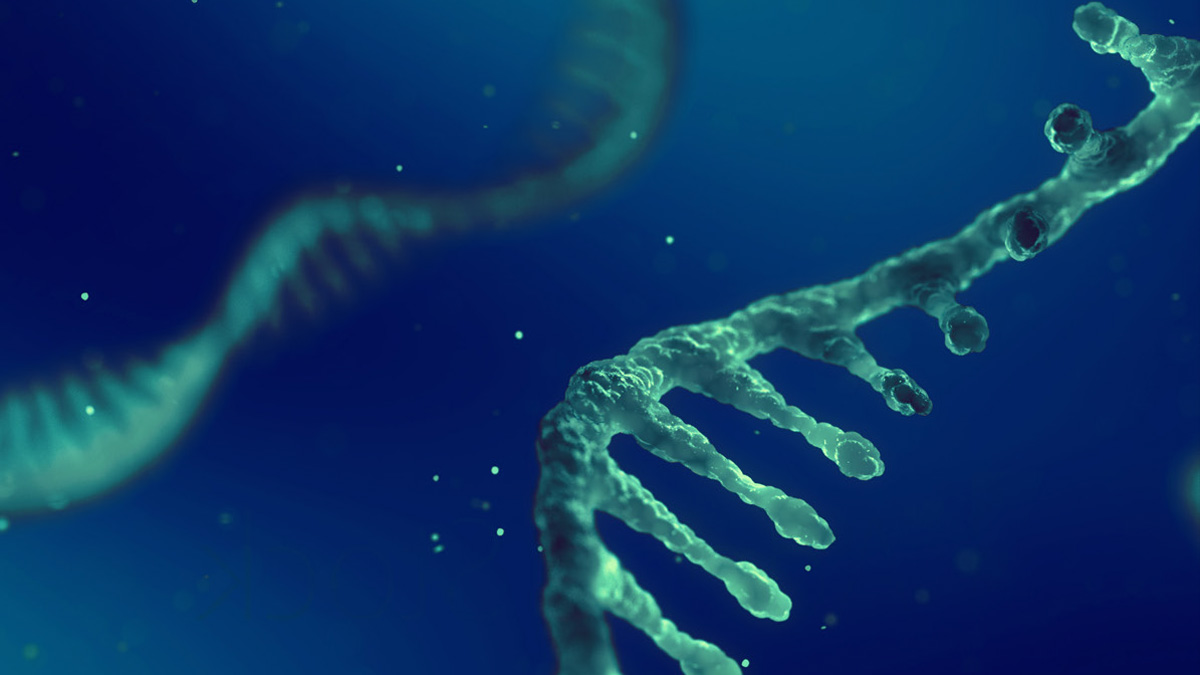
An illustration of a single strand of ribonucleic acid. Along with DNA and proteins, RNA is one of the three major biological macromolecules essential for all known forms of life. Image adapted from illustration by nobeastsofierce on Adobe Stock.
The full proceedings of a national roundtable to identify Australia's RNA science and technology priorities have been released.
The roundtable was held on Thursday, 29 July 2021, hosted by the Australian Academy of Science and the Australia and New Zealand RNA Production Consortium.
The proceedings, aimed at policymakers and science funders, detail the discussions about how Australia can play a leading role in the global ecosystem of RNA science and harness the opportunities for Australian industry to develop RNA-based products and services for global markets.
"This roundtable was a step forward in presenting a united voice on RNA science and technology in Australia: what we are capable of and what we have the potential to achieve," said Professor John Shine, President of the Australian Academy of Science, in the foreword to the proceedings.
The group, comprising 38 experts in RNA biology and biotechnology from the Australian university and research sectors along with industry, has called on Australia to play a leading role in the global ecosystem of RNA science and harness the opportunities for Australian industry to develop RNA-based products and services for global markets.
Associate Professor Archa Fox from the University of Western Australia, co-chair of the the roundtable, said that “Now is the time to be bold.”
Professor John Mattick from UNSW Sydney and Professor Trent Munro from the University of Queensland were also co-chairs.
The agreed recommendations from the roundtable include:
- a national mission for the whole RNA science and technology pipeline in Australia, driven by strategic investment and prioritisation across funding schemes, providing sustainable, long-term funding for projects from fundamental research to translation,
- a local mixed RNA manufacturing ecosystem, including pilot facilities, production of pre-clinical trial components and sovereign manufacturing capability to support clinical trials, and
- schemes to build capacity in entrepreneurial and translation expertise, including facilitating greater mobility between research and industry.
Read the full roundtable proceedings.
Read the full statement from the roundtable.
Moran Award to help study history of mining toxicity and environmental justice
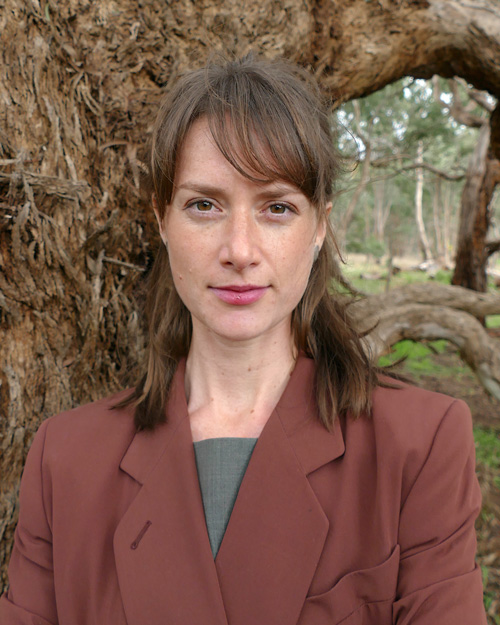
Dr Lilian Pearce from the Centre for the Study of the Inland at La Trobe University. Photo: supplied
Dr Lilian Pearce from the Centre for the Study of the Inland at La Trobe University is the recipient of the Academy’s 2022 Moran Award for History of Science Research.
She receives the award for her proposal entitled ‘Toxic Legacies, Contaminated Communities: A history of lead poisoning and power in Broken Hill’.
Dr Pearce says the project will explore the ways that mining toxicity has been understood, resisted, managed and silenced by Australian mining communities and industries.
The award funding will go towards a case study considering mining toxicity within an environmental justice framework in Broken Hill, one of four case studies planned.
The other studies include a study of arsenic in Central Victoria, mercury in the West Coast of Tasmania and uranium in the Northern Territory.
Dr Pearce's work will look to inform current debates about legacy mines, ongoing issues of responsibility and rehabilitation, and contemporary controversial approvals for mines across the nation.
Dr Pearce said that she is especially grateful for the chance to seek out the voices of women in the archives.
“Women have played a crucial role in advocating for industrial, environmental, and public health reforms in Australia.”
This research draws on her earlier work in Broken Hill connecting ecological restoration work in mining communities to issues of environmental and public health.
The Moran Award for History of Science Research provides up to $5000 in funding each year, and is aimed at postgraduate students and other researchers with expertise in the history of Australian science. Applications for the 2023 award will open in early 2022.
Our most vulnerable risk being left behind as Australia adapts to climate change
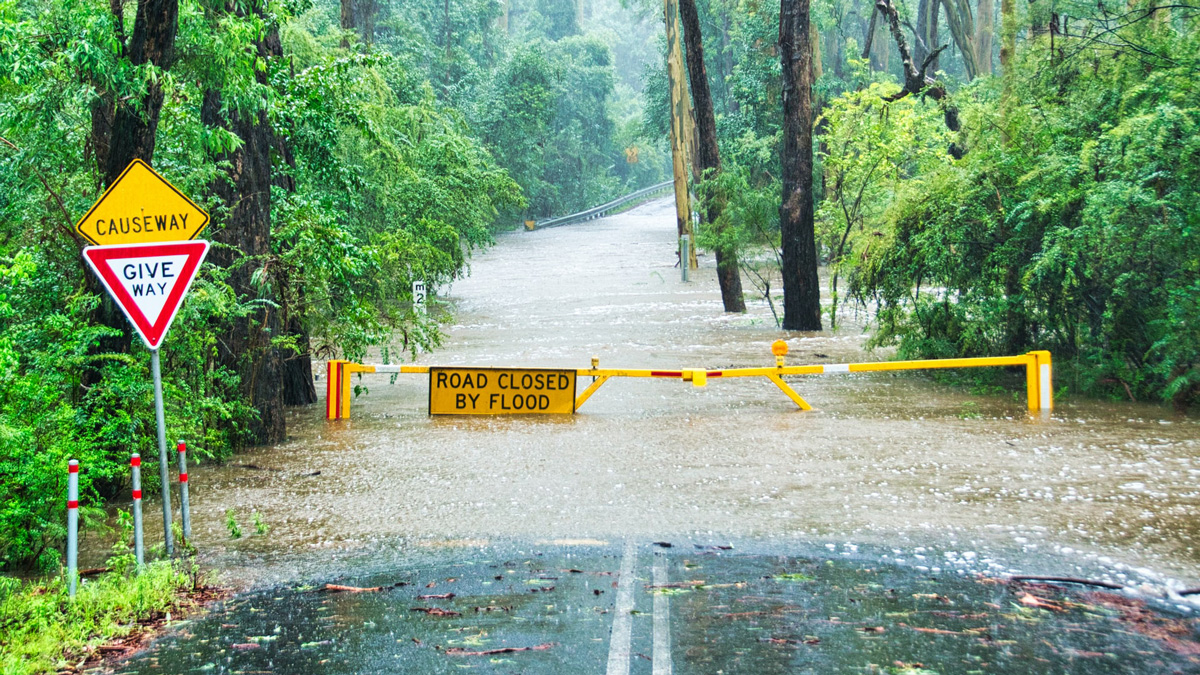
Image adapted from photo by Phillip Flores.
‘Adapt to protect communities and natural habitats’ - that’s one of the four goals of COP26 which is just around the corner. But is Australia’s current approach to climate adaptation sustainable and equitable?
Not according to the Director of Future Earth Australia, Dr Tayanah O'Donnell. She says more work needs to be done both at a community level and on a national scale to ensure science underpins the design of adaptation responses.
“Science is needed to ensure local and regional climatic variation and related community needs are well understood, and to ensure that most vulnerable in society are not left behind as Australia adapts to a changing environment,” says Dr O'Donnell.
And with COP26 looming, an imminent Australian Government National Climate Resilience and Adaptation Strategy, and an IPCC Working Group II (impacts, adaptation, and vulnerability) report all occurring in the next six months, the need is urgent.
“A scientific approach is needed to support an approach to adaptation that is nuanced to particular geographies and attuned to specific community needs,” says Dr O'Donnell.
“The research needed is wide-ranging: science, the social sciences, the humanities, and First Nations knowledge perspectives in equal measure.”
The work required to ensure future generations of Australians can cope with climate change in a sustainable and equitable manner will be mapped out in a new national strategy currently under development by Future Earth Australia, called a ‘National Strategy for Just Adaptation’.
Dr O'Donnell says the strategy will build on the successful model used to create earlier national strategies on sustainable oceans and coasts and sustainable cities and regions.
“We are assembling an Expert Working Group of leading climate adaptation researchers and practitioners from across specialist fields to provide strategic oversight into the strategy.”
The strategy will be launched in March 2022. The working group will be co-chaired by Mr Bhiamie Williamson (ANU), a Euahlayi man from north-west New South Wales, Professor Petra Tschakert (University of Western Australia) and Dr Mark Stafford-Smith (CSIRO). Other working group members will be announced soon.
“The strategy will build on a series of climate adaptation events and consultation workshops conducted over 2020/2021, including the Reimagining Climate Adaptation Summit,” says Dr O’Donnell.
Dr O'Donnell says while measures announced in this year’s Federal Budget to help Australians withstand and adapt to climate change are welcome, disaster recovery must not be the sole focus of climate adaptation.
“There must be a broader approach as we prepare and adapt to climate change. As climate impacts will affect every part of society and our economy, this task requires that all sectors – public, private, not-profit, community, and research – come to the table,” says Dr O'Donnell.
“Future Earth Australia is well positioned to continue to lead the necessary cross-sectoral and community engagement work needed to underpin an equitable pathway forward."
Quotes from Co-Chairs
“Climate change adaptation presents a unique opportunity to walk alongside Indigenous peoples and create a more just and sustainable future” – Mr Bhiamie Williamson
“Just climate adaptation means addressing the root causes of systemic injustices and recognising disadvantaged and vulnerable individuals and groups as part of desirable, dignified and fair solutions” – Professor Petra Tschakert
“With the impacts of climate change becoming ever more apparent, it has become urgent to revitalise the community of adaptation researchers and practitioners in Australia.” – Dr Mark Stafford-Smith
Future Earth Australia is a program of the Australian Academy of Science.
STEM Women Asia launched to the world
STEM Women Asia has been launched—providing an online directory of women in Asia and Oceania working in science, technology, engineering and mathematics (STEM).
Led by the Australian Academy of Science (the Academy), STEM Women Asia has been developed in partnership with the Association of Academies and Societies of Sciences in Asia (AASSA) and the InterAcademy Partnership (IAP).
Building on the success of the Academy’s successful Australian version of the STEM Women platform which hosts 3,300 profiles of women, STEM Women Asia extends the STEM Women platform to women in Asia and Oceania.

Emeritus Professor Cheryl Praeger, Academy Fellow and Chair of the Women in Science and Engineering Committee of AASSA. Photo: Australian Academy of Science
“STEM Women Asia aims to promote gender equity in STEM by showcasing the breadth of scientific talent in the region and by enabling a diverse range of women to connect with exciting opportunities to progress their careers and personal capabilities,” said Emeritus Professor Cheryl Praeger, Academy Fellow and Chair of the Women in Science and Engineering Committee of AASSA, who oversaw the delivery of the project.
“IAP recognises that women face many barriers to building a STEM career. By creating a profile, STEM Women Asia can increase their visibility to the world and help them access career and development opportunities and join a growing community,” said Professor Krishan Lal, IAP Co-Chair.
Launched with 293 profiles of women from 30 countries across Asia and Oceania already listed on the directory, the Academy and its partners hope to grow the exciting opportunity offered by STEM Women Asia as a platform to increase the representation of all women at all stages of their STEM career.
“This project would not have been possible without the support of the many academies and science organisations from Turkey, India, Thailand, Korea, Nepal, Pakistan and Sri Lanka, who have helped us reach their networks of women in STEM,” said Professor Yoo Hang Kim, President of AASSA.
Dr Pawarat Nontasil from the National Electronics and Computer Technology Center in Thailand is an inaugural member of STEM Women Asia. “I joined STEM Women Asia because I would like to be a mentor for women scientists, and I am supportive of anyone in STEM,” she said.
I hope that STEM Women Asia will be a platform for empowering more Asian women and girls in science.Dr Suchana Apple Chavanich at Chulalongkorn University in Thailand
STEM Women Asia links a diverse range of women with opportunities to progress their careers and personal capabilities such as speaking at conferences, being part of committees and boards, being nominated for awards and being interviewed in the media. Users of the database can search for women in STEM based on their expertise, location and other search fields. Users can create their own shortlist and then message experts directly.
If you a woman scientist from a country in Asia or Oceania and you wish to create a profile on STEM Women Asia check the eligibility criteria here.
A recent report led by the Australian Academy of Science and supported by the Australian Government, found the COVID-19 pandemic had exacerbated existing gender inequity in the Asia-Pacific STEM Workforce. STEM Women Asia is a practical way to break down barriers women face and support women to stay in STEM.
For more information about STEM Women Asia, email: hello@stemwomen.asia.
About the project partners
InterAcademy Partnership (IAP)
Under the umbrella of the InterAcademy Partnership (IAP), more than 140 national, regional and global member academies work together to support the vital role of science in seeking evidence-based solutions to the world’s most challenging problems. In particular, IAP harnesses the expertise of the world’s scientific, medical and engineering leaders to advance sound policies, improve public health, promote excellence in science education, and achieve other critical development goals. IAP’s four regional networks—AASSA, EASAC, IANAS, and NASAC—are responsible for managing and implementing many IAP-funded projects and help make IAP’s work relevant around the world.
Association of Academies and Societies of Sciences in Asia (AASSA)
The Association of Academies and Societies of Sciences in Asia is a non-profit international organisation with science, technology and innovation (STI) interests. It consists of scientific and technological academies and science societies in Asia and Oceania. Its current membership is 32 national academies and societies of sciences from 30 countries and one regional academy of engineering and technology.
Australia’s Digital Future—a nation of users or leaders?
Australia risks becoming a laggard among the world’s top technologically driven nations without a stronger investment in digital technology-based research, innovation and workers, according to a new summary for policymakers published today.
While countries such as the USA, United Kingdom, France and Canada are prioritising digital technologies as a strategy to bolster competitiveness in the emerging ‘digital economy’, Australia is falling behind. Digital innovation accounts for only 7.4 per cent of Australia’s GDP compared to the 11.2 per cent average enjoyed by the OECD.
The summary, by the Australian Academy of Science and the Australian Academy of Technology and Engineering, calls on the Australian Government to make emerging digital technologies a national science and innovation priority.
It says while the COVID-19 pandemic has accelerated the prioritisation of emerging digital technologies in Australia, they must now be recognised as an independent growth sector.
The summary also recommends research and innovation in emerging digital technologies be included in the Australian Government’s 2021 Research Infrastructure Roadmap.
It looks at emerging digital technologies including artificial intelligence (AI), the internet of things (IoT), augmented and virtual reality, blockchain and 5G. It also provides examples of the benefits being seen by other countries that have prioritised investment in science and technology research and development, and in particular in digital technologies.
Professor Shazia Sadiq, Chair of the Australian Academy of Science’s National Committee for Information and Communication Sciences, says while the Australian Government’s investment in key digital capabilities, through its digital economy and modern manufacturing strategies is welcomed, more needs to be done.
“We call on the Australian Government to recognise the importance of building scientific capability behind the digital economy, both in investment and narrative,” says Sadiq, who is also Professor of Computer Science at the University of Queensland and a Fellow of the Australian Academy of Technology and Engineering.
“While it is difficult to predict what future innovations might look like, a strong national focus on fundamental science and engineering behind emerging digital technologies will allow Australia to stay ahead of the curve in a dynamic and fast evolving landscape.”
The summary says the next wave of emerging digital technologies, such as autonomous vehicles, smart micro-grids, 6G and quantum computing, will further disrupt and transform many sectors.
Professor Mike Miller, Chair of the Digital Futures Forum at the Australian Academy of Technology and Engineering, says Australia is at a crossroads in the development of a strong digital technology economy.
“We have strengths in emerging digital technology research and development, but opportunities for sector growth and sovereign capability are nascent and require coordinated and strategic support,” says Professor Miller.
The summary points to Australia’s looming shortage of digitally-skilled workers and says the growing demand for this workforce is expected to increase by 100,000 between 2018 and 2024.
“To grasp the opportunities presented by a growing emerging digital technologies sector, Australia must address the digital divide to ensure equity of access to the benefits delivered by digital technologies, and to meet the skill requirements for a future digital workforce,” says Professor Miller.
“Australia’s emerging digital technology capabilities must receive this support in order for the nation to remain internationally competitive and ensure that scientific leadership is adequately harnessed in shaping our collective digital future.”
The new summary for policymakers follows the publication of a strategic plan in 2019 outlining Australia’s potential as a digital nation.
“It is profoundly wrong to deny justice by denying science”
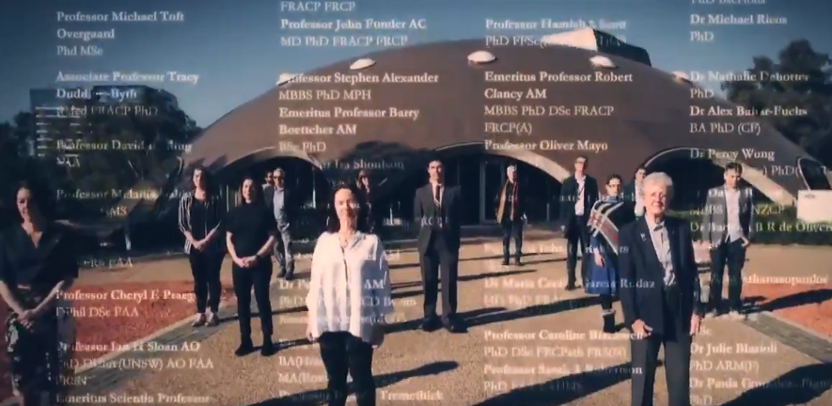
Some of the 90 scientists who signed a petition earlier this year calling for Kathleen Folbigg to be pardoned. Image: 60 Minutes Australia
Leading Australian scientists have today renewed their call for Kathleen Folbigg’s pardon and release from jail.
Despite conclusive scientific and medical evidence that points to natural causes of death for all four of her children, Ms Folbigg remains incarcerated, almost 18 years after she was sent to jail.
The renewed call comes almost six months after 90 eminent scientists submitted a petition to the Governor of NSW, the Honourable Margaret Beazley AC, who awaits advice from the NSW Attorney-General, Mark Speakman.
In April, the Australian Academy of Science offered to facilitate for the NSW Attorney-General a briefing by scientists with expertise in genetics and statistics, to explain the new genetic evidence that had been uncovered.
The NSW Attorney-General declined that briefing and instead requested the new evidence be submitted via Ms Folbigg’s legal representatives, which occurred in June.
This includes new peer-reviewed genetic findings by an international team of 27 scientists published in a top international cardiology journal, Europace, in November 2020. It showed two of the children had genetic mutations that predisposed them to sudden death in childhood from lethal heart arrythmias. Forensic pathologists had declared natural causes of death for the other two children.
Australian Academy of Science President, Professor John Shine is among the petition signatories and says there is very reasonable doubt about Ms Folbigg’s conviction.
“The NSW Attorney-General now has sufficient medical and scientific evidence before him that provides an alternative explanation for the deaths of the Folbigg children, that carries more weight than the circumstantial evidence used to convict her,” Professor Shine said.
“Our offer to the NSW Attorney-General to facilitate a scientific briefing stands. These matters can appear complex to a non-scientific audience.
“We also call on the federal and state and territory attorneys general to consider legal reform that would empower the judiciary to identify the most qualified expert to provide evidence for any given case.
“To ensure miscarriages of justice like this are prevented in the future, it is imperative that evidence heard by the courts is accurate; is delivered by the most qualified expert; and draws on the most up-to-date science. This is particularly important in rapidly moving areas such as human genetics.
“We urge the NSW Attorney-General to expedite this matter and advise the NSW Governor to pardon Kathleen Folbigg and release her from jail,” Professor Shine said.
Petition signatory Australian Nobel Laureate and Corresponding Member of the Australian Academy of Science, Professor Elizabeth Blackburn said it was profoundly wrong to deny justice by denying science.
“Do those who would deny Kathleen Folbigg’s right to scientific evidence deny that the planet Earth revolves around the sun?” said Professor Blackburn.
Watch the 60 Minutes story in which the science behind the case is explored.
Australian nutritional researcher wins international 2021 ASPIRE Prize
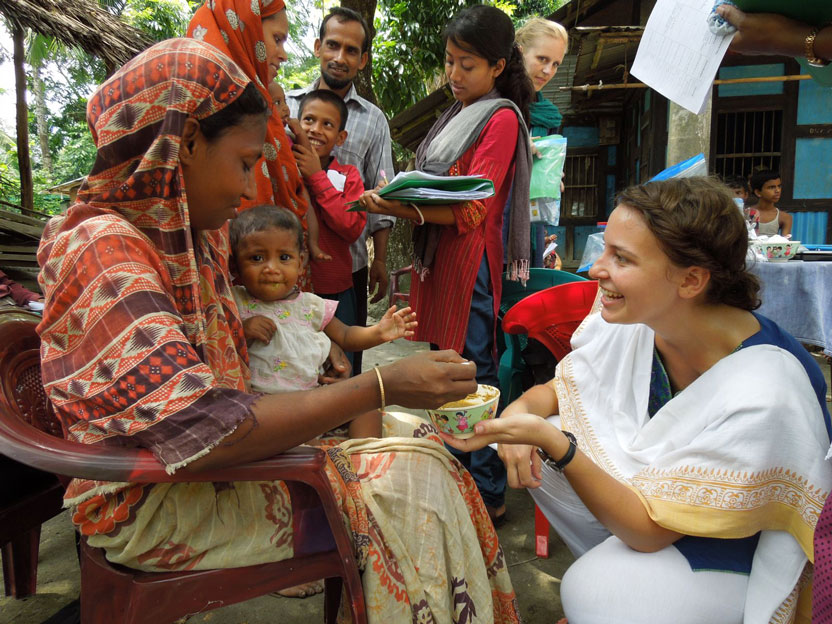
A young Bangladeshi child tasting the complementary food developed by Dr Bogard. Photo: WorldFish
Ever heard of a nutritious fish-based chutney tailor-made for pregnant and lactating women? It might not sound that appealing to a Western-based palate, but the product developed by nutrition scientist Dr Jessica Bogard is helping to address widespread malnutrition among women in Bangladesh.
For this and other innovations to increase access to healthy and sustainable foods for vulnerable people in low- and middle-income countries, Brisbane-based Dr Bogard from CSIRO is the recipient of the prestigious 2021 ASPIRE prize.
The prize, valued at US$25,000, recognises young scientists from Asia–Pacific Economic Cooperation (APEC) member economies who have demonstrated a commitment to excellence in innovation, research and education. Dr Bogard was nominated for the prize by the Australian Academy of Science. The winner was announced overnight at a virtual award ceremony hosted by New Zealand.
As well as the chutney, Dr Bogard has also developed a complementary food for infants and young children aged from 6 to 23 months. Both products were based on traditional recipes and improved using local nutrient-rich ingredients. Testing of the products in a large acceptability and feasibility trial found that such products were an effective and culturally acceptable way to improve nutrient intake.
The products were also deemed suitable for local production and distribution with flow-on benefits for income and livelihoods. The production model has been scaled to other regions in Bangladesh and through WorldFish and other partners the concept has been expanded to other countries in Asia and Africa.
The development of the products are part of Dr Bogard’s broader research on strategies to increase production and consumption of healthy and sustainable diets.
Dr Bogard becomes the third Australian to win the prize since its inception in 2011. In 2013 Associate Professor Carissa Klein won the prize for her work on sustainable ocean development, and in 2018 Professor Madhu Bhaskaran won the prize for her work on electronic devices and sensors.
Since 2011, ASPIRE has recognised scientists under the age of 40 who are working in APEC member economies and have demonstrated a commitment to excellence in scientific research and cooperation with other APEC scientists.
Each member economy was invited to nominate one scientist under the age of 40 to be considered for the 2021 ASPIRE Prize.
Director of SKA Project recognised with Honorary Membership of the International Astronomical Union

Mr David Luchetti, Honorary Member of the IAU. Source: Department of Industry, Science, Energy and Resources
The Australian Academy of Science congratulates Mr David Luchetti, who has been selected as an Honorary Member of the International Astronomical Union (IAU) for his tireless work championing and facilitating Australian astronomy in the government.
Mr Luchetti has been a key advocate for Australian astronomy and has played a central role in facilitating Australia’s engagement with a number of large scale international astronomy projects.
For the past six years he has directed the Square Kilometre Array (SKA) Project, an intergovernmental project to build the world’s largest radio telescope. The SKA telescope is one of the largest scientific endeavours in history, with the infrastructure co-hosted between South Africa and Australia.
Mr Luchetti is currently leading negotiations on behalf of the Australian Government on an Indigenous Land Use Agreement with the Wajarri Yamatji for the location of the SKA telescope in Western Australia. This agreement will better develop cultural ties and bring a wide range of benefits to the Wajarri community. Previously, Mr Luchetti represented Australia on the European Southern Observatory Council and has provided advice to the government on infrastructure needs for astronomy research in Australia.
“Mr Luchetti has worked tirelessly with the astronomy community for many years. He has successfully communicated government expectations to the community in terms of industry and community engagement, and has worked helpfully with the astronomy community in its endeavours to engage with international partners on world-class astronomical projects,” said the Chair of the Academy’s National Committee for Astronomy, Professor Lister Staveley-Smith.
“His endeavours in supporting Australia on the international scientific stage have been first class and have been well beyond normal duties.”
The IAU is an international organisation of leading astronomers from around the world. The Academy is Australia’s National Adhering Organisation to the International Astronomical Union, through the National Committee for Astronomy (NCA). Mr Luchetti was nominated for recognition by the NCA to acknowledge and thank him for his work with the committee and the astronomy community in general.
Food-themed scienceXart has fun remote learning activities for primary students
With many students learning remotely during stay-at-home restrictions, parents, carers and teachers are looking for new ways to keep children engaged in science while learning in the home environment. Looking for something for your primary aged students this month? scienceXart is for you!
To celebrate the UN’s International Year of Fruits and Vegetables, the Academy’s National Committee for Nutrition together with Dietitians Australia are running a science-based art competition for the month of August. scienceXart: food for thought calls all primary school students to think about nutritional science and how the food they eat powers their bodies.
The scienceXart challenge
The challenge: enter the competition by designing a plate of food and writing a description of up to 100 words explaining the science behind the design. What’s even better, by entering students have a chance to win an awesome hydroponic indoor garden for their classroom.
This is a fun and easy activity for children to complete at home with resources they have around the house. Get creative and design a super funky plate!
The Academy has designed a series of activity plans for students from Foundation to Year 6. These plans are suitable for learning at home or can be facilitated in the classroom. Activities address learning to identify fruits and vegetables, exploring the benefits of vitamins, and meal planning.
See all the details at the scienceXart website
Looking for more ideas for learning science at home?
The Academy’s education program, Primary Connections, has curated a selection of tasks tailored for primary students who are engaging in supervised learning while at home. The tasks are hands-on, and address a range of science topics including the physical, chemical and biological sciences, and Earth and space. There’s sure to be something budding scientists will enjoy.
President’s statement on the IPCC Working Group 1 Report
The evidence is overwhelming: human activities, particularly the burning of fossil fuels and the destruction of forests, are rapidly changing Earth’s climate in every region and across every climate system.
This is the main thrust of the Intergovernmental Panel on Climate Change (IPCC), Working Group 1 report (The Physical Science Basis) prepared by over 200 scientists.
The report also reveals how, as the driest inhabited continent, Australia is highly vulnerable to the impacts of global warming. Recent events, including the scale and intensity of the summer bushfires of 2019–20, and the severe coral bleaching impacting the Great Barrier Reef that occurred in three of five years from 2016, demonstrate just two of the consequences of a warming planet for Australia’s people, economy, and environment.
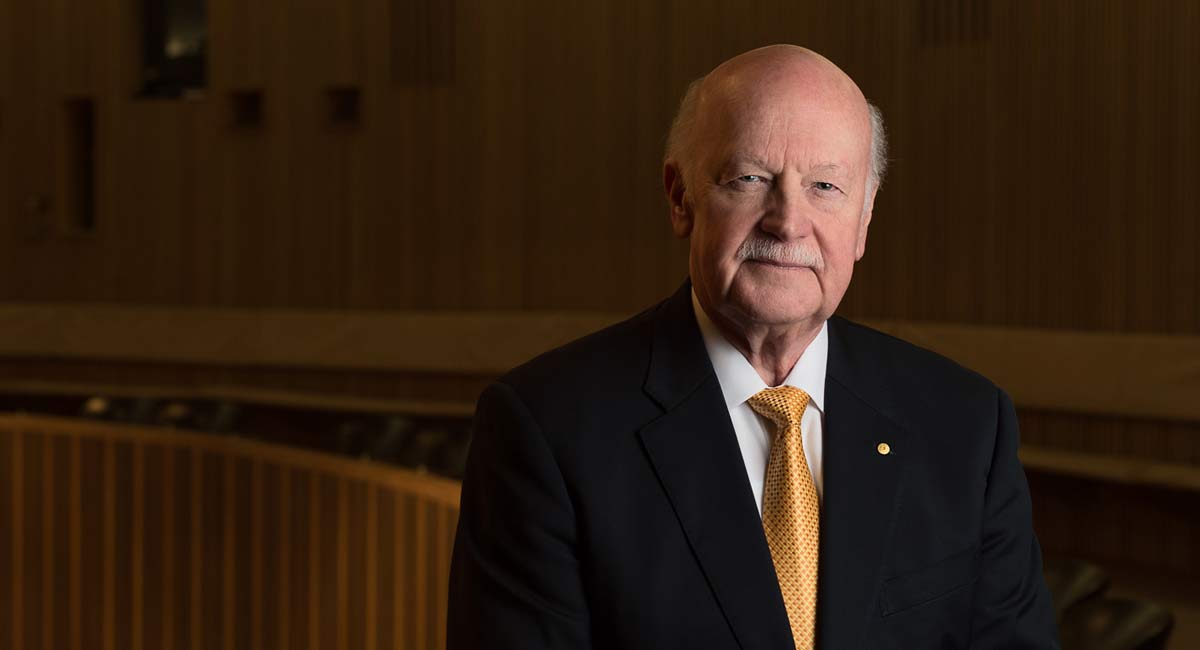
Academy President Professor John Shine
All countries have to act. Some have, some haven’t. It is in Australia’s national interest for us all to act quickly. We have much to lose if we don’t, and much to gain if we do. The evidence tells us we must move beyond our current commitments and do more. Only through collective real, rapid and large-scale greenhouse gas emission reductions can we lessen the scale of the impacts of global warming.
Whilst the IPCC report is sobering and the Code Red warning is real, the situation is neither hopeless nor insurmountable. But it is urgent. As with the COVID-19 pandemic, science has solutions. As the IPCC report concluded “Every tonne of CO2 emissions adds to global warming”, we can limit future warming by limiting Australian and global emissions of carbon dioxide from human activity today. Every nations’ actions count.
The Australian Academy of Science in March this year released a report on the risks to Australia of a three degrees warmer world. The Academy’s report shows Australia can become a clean energy exporter and potentially a global renewable energy superpower. It highlights Australia’s relative advantage with its abundant natural resources for solar and other renewable energy generation, as well as significant deposits of new economy minerals critical for developing batteries and other low emission technologies.
Today, Australia must again harvest our investment in science and technology, as we did urgently to fight COVID-19. We have enormous resources for the next wave of innovative technologies. We can and must grasp the exciting economic opportunities presented by the new economy. As a smart and agile nation with a skilled workforce, we can immediately scale up existing technology, and lean on our industrial base and plentiful renewable energy resources to enable greater emission reductions.
I often hear that the challenge of climate change is too hard, too big, too overwhelming, and not immediate, thereby not demanding the same urgency the pandemic has required. These excuses fail to recognise how far we have come, the available technologies, the urgency so clearly manifest in this IPCC Report, the willingness of the voting public to do their bit and their growing expectation that all our leaders do theirs.
Professor John Shine AC PresAA FRS
President
Australian Academy of Science