




Fellow’s donation set to change the lives of upcoming scientists

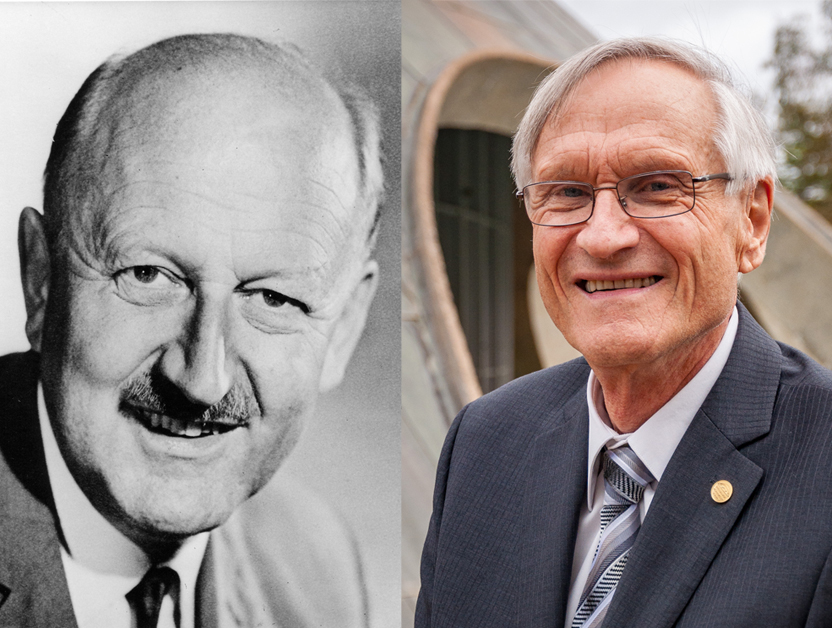
Professor Horace Barber FAA FRS and Professor Michael Barber AO FAA FTSE.
A generous donation by Academy Fellow Professor Michael Barber is set to make an enormous difference to the career trajectory of young or emerging scientists by enabling the Academy to engage two science policy interns in the coming months, ensuring gender diversity amongst them. He has also pledged a further donation the following financial year.
Professor Barber, whose donation of $25,000 will be applied in the 2020–21 financial year, hopes that the internship will provide policy, political and social insight and networking opportunities for talented scientists who are keen to understand the broader context in which science operates. He also hopes that his donation will inspire others to support the valuable work of the Academy.
Elected to the Academy in 1992, Professor Barber has served on committees and supported international relations. He has been elected to Council several times, including advising on science policy, and is currently the Academy’s Treasurer. He is also a member of the Development Advisory Committee which supports the Academy’s partnerships and fundraising activities.
This story, however, goes back even further for Professor Barber. He proudly speaks of his father Professor Horace Barber, also a Fellow of the Academy who was elected in 1958 in the founding years of the organisation. This rare father–son duo is a remarkable example of intergenerational dedication to research and service to science.
Professor Michael Barber is internationally known for his substantial contributions to the mathematical development of statistical mechanics. His father, Professor Horace Barber, was distinguished for his contribution to plant cytogenetics.
“The donation from Professor Barber comes at a time when defining decisions are being made by the government about Australia’s future—decisions that will shape our lives well beyond COVID-19,” Academy Chief Executive, Anna-Maria Arabia said.
“Fellows and other leading experts have worked with the Academy to find ways to serve the country by providing the best scientific information available to support decision-makers at this critical time. They inspire me every day.
“The Academy thanks Professor Barber for being among the visionary Australians who recognise and support our work. With his help the Academy is providing evidence to inform decision making at the highest levels to improve our national wellbeing and provide strong national leadership to build a society that is guided by and enjoys the benefits of science.”
The science policy internship will be announced on our website, once open for applications.
Queen’s Birthday honours for five Academy Fellows
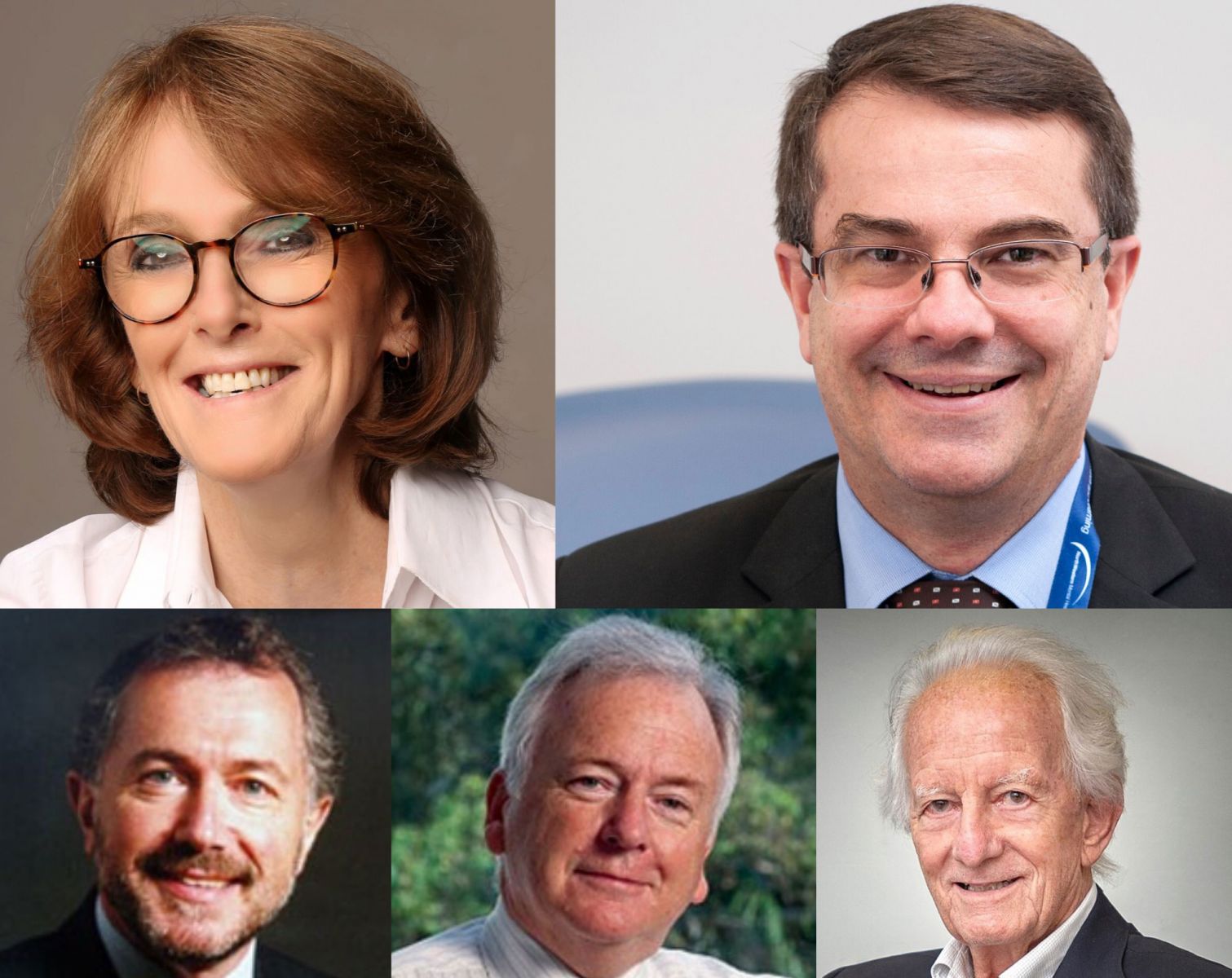
(rear from left) Dr Cathy Foley and Professor Andrew Roberts. (front from left) Emeritus Professor Robert Baxter, Emeritus Professor Perry Bartlett and Professor Marcello Costa.
Five Academy Fellows have been recognised in this year’s Queen’s Birthday honours, receiving the Order of Australia for their outstanding service or exceptional achievements.
Three are among those named as Officers in the General Division of the Order of Australia.
Emeritus Professor Perry Bartlett AO FAA is recognised for distinguished service to neuroscience research, and to people living with dementia, motor neurone disease and spinal cord injury.
Professor Marcello Costa AO FAA is recognised for distinguished service to higher education and to medical research, in the field of neurophysiology and to professional scientific bodies.
Dr Cathy Foley AO PSM FAA FTSE is recognised for distinguished service to research science, to the advancement of women in physics and to professional scientific organisations. Dr Foley was elected a Fellow of the Academy this year.
Two Academy Fellows have been named Members of the Order of Australia.
Emeritus Professor Robert Baxter AM FAA is recognised for significant service to medical research, to endocrinology and to tertiary education.
Professor Andrew Roberts AM FAA FAHMS is recognised for significant service to medical research, to haematology and to cancer organisations. Professor Roberts was also elected a Fellow of the Academy this year.
Global Science TV launches 1st episode—Can the world tackle climate change with COVID-19 urgency?

The coronavirus pandemic has proven the world is capable of a global response to address a crisis. But why haven’t we seen the same type of swift action on climate change? And can we expect our leaders to pay as much attention to scientific advice for other challenges as we emerge from the pandemic?
Former President of Ireland and UN High Commissioner for Human Rights, Mary Robinson, and President of the International Science Council, Daya Reddy, discuss these issues in the inaugural episode of Global Science published online this week.
Global Science is an initiative of the International Science Council (ISC) and the Australian Academy of Science. The ISC is a non-government organisation with a unique global membership that brings together 40 international scientific unions and associations and over 140 national and regional scientific organisations, including academies and research councils.
Global Science builds on the Australian Academy of Science’s established and leading science communication effort which has shown there is a thirst for accurate and engaging science content.
By tapping into the ISC’s extensive network, each fortnight Global Science will broadcast interviews with the world’s best scientists and some of our greatest thinkers. Hosted by Australian journalist and clinical psychologist Nuala Hafner, the 20-minute conversational episodes will entertain and inform viewers on the most notable scientific issues that society faces today.
Australian Academy of Science Chief Executive Anna-Maria Arabia said the Academy is proud to be partnering with the International Science Council on the initiative.
“It is absolutely crucial that people understand the role of science during this time of crisis and beyond. Global Science will tackle the big questions of our time with the world’s leading scientific voices,” Ms Arabia said.
“The Academy has amassed 2.3 million followers on Facebook from only 9000 followers just over two years ago. I am delighted that in partnership with the International Science Council, we can expand our capability to allow leading global scientific voices to be heard at a time when we need more science, not less.”
In addition to the interview with Mary Robinson and Daya Reddy, the first episode of Global Science also explores how scientists accounted for the universe’s missing matter, in an interview with Associate Professor Jean-Pierre Macquart from Curtin University.
An upcoming episode will feature an interview with one of the ‘fathers of the Internet’, Vinton Cerf.
Watch the first episode below:
Subscribe and follow
Science academies around the world call on governments for a sustainable recovery from COVID‑19
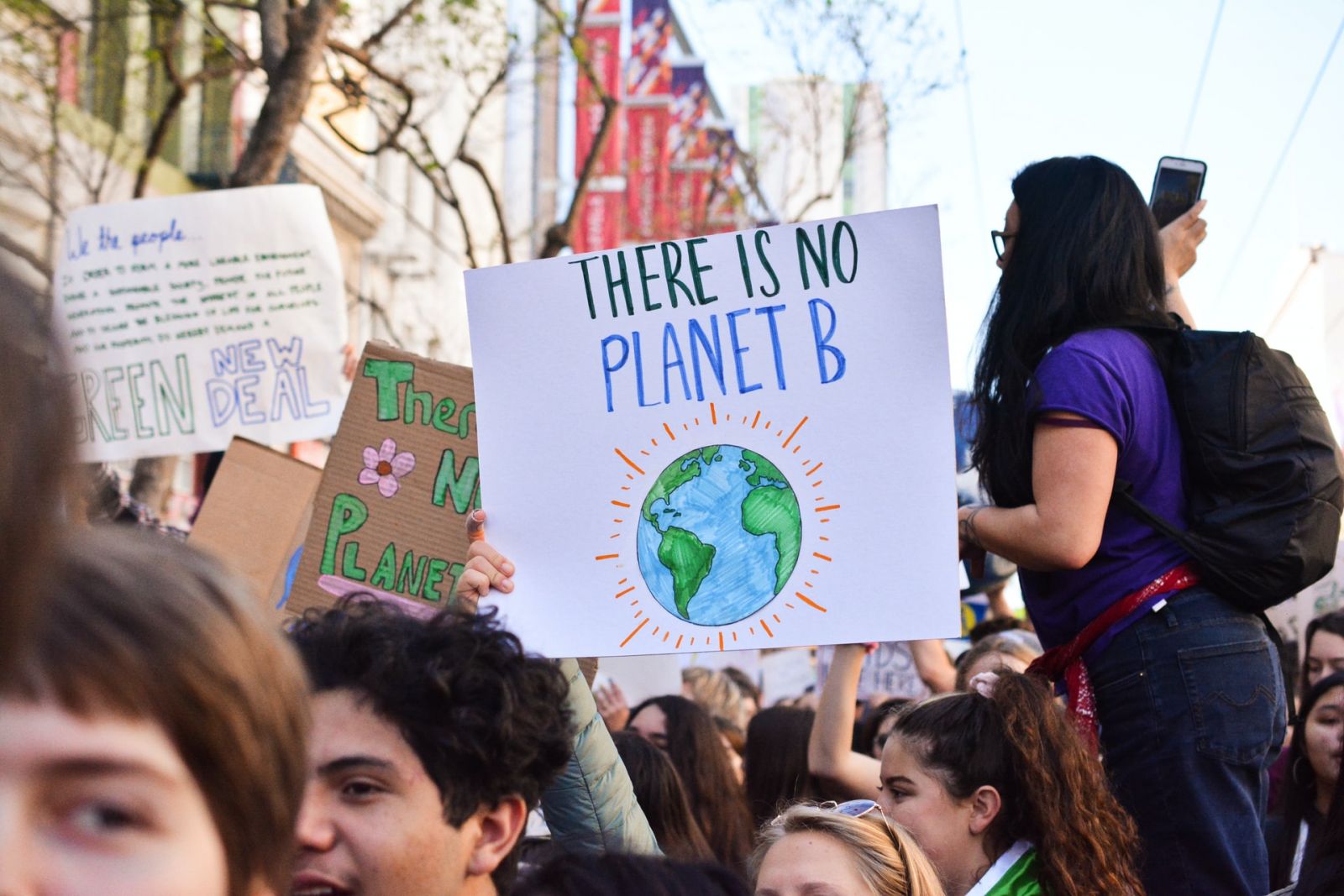
Today, to mark World Environment Day, the Australian Academy of Science joins with 17 other academies of the Commonwealth to call on governments to ensure a sustainable recovery from the COVID‑19 pandemic.
The consensus statement calls for Commonwealth governments to use next year’s COP26 climate conference as an opportunity to work together to tackle the ongoing crises of climate change and biodiversity loss, and to ensure that global economic recovery from the COVID‑19 pandemic is environmentally sustainable across the Commonwealth and globally.
...the global pandemic does not change the fact that the world also continues to face an ever-growing environmental emergency.
From the statement:
"COVID-19 has had a profound impact across the globe, affecting health and health services, impacting the global economy, and exacerbating social and economic inequalities. Global cooperation and effective policy are essential for tackling the virus and for ensuring a successful economic recovery. But the global pandemic does not change the fact that the world also continues to face an ever-growing environmental emergency. Indeed, COVID-19 has highlighted the importance of governments working together and we must build on this global response to address the climate crisis.
"On the occasion of World Environment Day, and in a month when Commonwealth leaders would have gathered in Kigali for the Commonwealth Heads of Government Meeting (CHOGM), we therefore call on governments to continue to address the joint challenges of climate change and biodiversity loss, and to ensure that global economic recovery from the pandemic is environmentally sustainable across the Commonwealth and globally. Delivering action on the urgent and interlinked challenges of climate change, biodiversity loss and sustainable energy provision presents economic, social and environmental opportunities for the whole Commonwealth.
We call on Commonwealth Heads of Government to:
- Use the opportunities of COP26 and COP15 to coordinate discussions on the joint challenges of climate change and biodiversity and recognise their inherently interlinked nature
- Work with the global research community to identify scientific and holistic approaches for addressing climate change and biodiversity without causing unintended damage
- Grasp the opportunity of a decarbonised economy and its benefits for people and life on Earth
- Ensure a resilient and environmentally sustainable recovery from COVID‑19.
Academy President Professor John Shine, said science has underpinned Australia’s successful efforts to halt the COVID-19 pandemic.
“Governments need to ensure that scientific evidence underpins their approach to addressing the growing impacts of climate change and biodiversity loss on humanity," said Professor Shine.
“As the consensus statement notes, failure to tackle these combined challenges in the increasingly narrowing timescale required will pose significant risks to human development and welfare, escalate societal inequalities, and impact all Commonwealth countries, particularly those that are most vulnerable.
“Recognising different capacities, challenges and priorities, the approaches of each nation will not be the same—but they must be informed by the best available scientific evidence.”
The statement has been signed by 18 national academies from across the Commonwealth, representing big and small nations around the globe:
- Academy of Science of South Africa
- African Academy of Sciences
- Akademi Sains Malaysia
- Australian Academy of Science
- Cameroon Academy of Science
- Caribbean Academy of Science
- Cyprus Academy of Sciences
- Indian National Science Academy
- National Academy of Sciences of Sri Lanka
- Pakistan Academy of Sciences
- Royal Society of Canada
- Royal Society of Edinburgh
- Royal Society Te Apārangi (New Zealand)
- Rwanda Academy of Science
- The Royal Society
- Singapore National Academy of Sciences
- Uganda National Academy of Sciences
- Zambia Academy of Sciences
Further reading
- The Australian Academy of Science’s Australian climate science capability review characterises Australia’s current climate science capability and identifies how well the climate science sector is positioned to meet current and future demands for weather and climate knowledge.
- The Australian Academy of Science’s science of climate change publication explains the current situation in climate science, including where there is consensus in the scientific community and where uncertainties exist.
Discover resources and opportunities for women in STEM
The Academy’s STEM Women directory is now host to a growing collection of resources and opportunities aimed at increasing the attraction, retention and progression of girls and women in STEM.
Search and discover a range of mentor programs, articles and tools to increase diversity at conferences and events, an array of girl in STEM programs, advice and case studies on changing workplace culture, local STEM networks and much more.
“STEM Women’s expanded functionality provides a place to share resources and opportunities that women in STEM have found advantageous to their own career,” said Louise Moes, Academy Diversity and Inclusion Manager.
“Many of the published resources were collected through a STEM Women community survey we conducted last year, and we thank those who shared their experience and resources.”
As a collaborative database, individuals and organisations can suggest resources and opportunities that will be reviewed and uploaded by the STEM Women team.
Are you a woman in STEM? Create a profile on STEM Women to gain access to monthly email updates on the latest resources and opportunities on STEM Women.
Visit stemwomen.org.au to learn more.
Academy reports national progress in diversity and inclusion during 2019
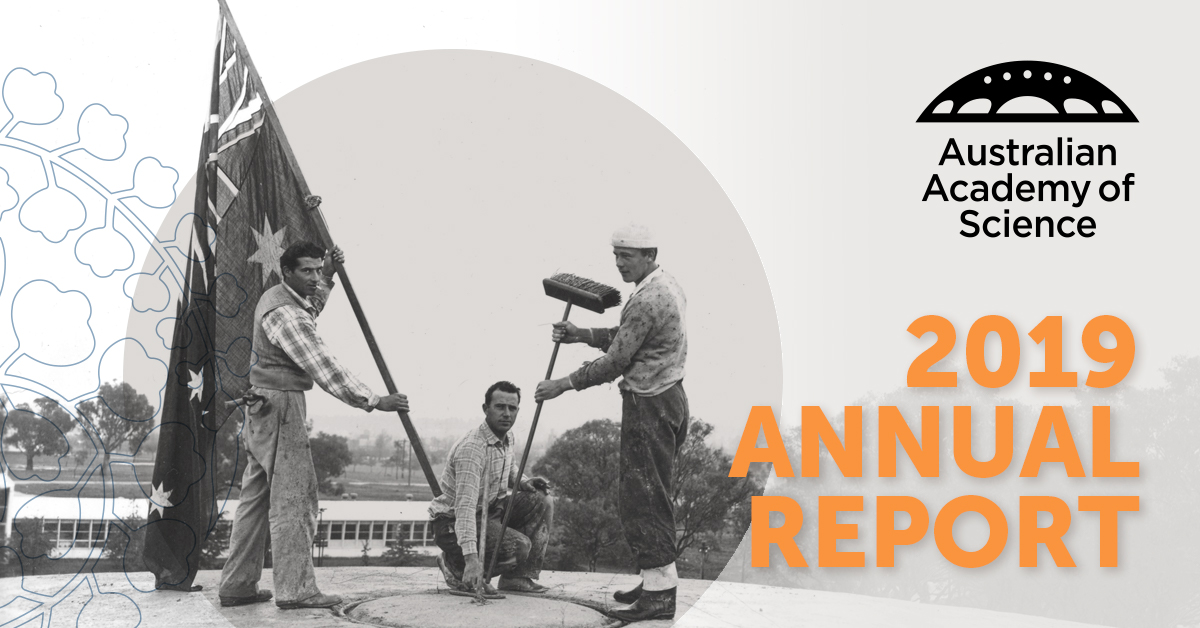
In 2019, the Academy celebrated its 65th year and the 60th year of the Shine Dome. The cover shows dome construction workers at a ‘richtfest’ party, celebrating the completion of the concrete phase of the dome’s construction. Photo courtesy of Eric Lipponen, photographer unknown
National progress in diversity and inclusion in the science sector was one of the many achievements highlighted in the Academy’s recently published annual report for 2019.
Guided by the priorities of Fellows and led by the Academy Council, major achievements included the launch of three major women in STEM initiatives, support for nearly 5000 early- and mid-career researchers, and the publication of a Reconciliation Action Plan.
“The annual report demonstrates the Academy’s national leadership role in diversity and inclusion,” said Academy President Professor John Shine.
“After broad national consultation, and working with other organisations, we published the Women in STEM Decadal Plan and encouraged organisations to publish their progress implementing the plan. In August we initiated an online directory, STEM Women, which has done a lot to make women more visible.
“The Academy Council also took the ‘panel pledge’ to further strengthen the positive influence we can have on diversity.”
Academy Fellows received many Australian and international honours and awards, with Professor Cheryl Praeger being awarded the Prime Minister’s Prize for Science.
Early in 2019 the Academy produced a scientific report on the causes of the mass fish kills in the Darling River.
“The report was widely circulated and re-affirmed our ability to respond quickly with credible, expert information needed to inform decisions,” Professor Shine said.
Support for early- and mid-career researchers included specific professional development events tailored to their needs, networking opportunities, and funding to attend events. A particular highlight was the success of Rhys Pirie, who became the first Australian to win Young Innovator of the Year at the global Falling Walls competition in Berlin.
Global activities
Global activities included the announcement of $1 million by the Science and Industry Endowment Fund to continue funding young scientists to attend the Lindau Nobel Laureate and Heidelberg meetings for a further 10 years. Funding for collaborative international research managed by the Academy totalled nearly $1.5 million, and the Academy was able to quantify the many benefits returned to Australia through its membership of global science organisation, the International Science Council.
The Academy reached out to Australians through many public events around the country. We finished the year with 2.1 million followers on Facebook and produced a successful measles vaccination campaign on behalf of the Australian Government.
“Our education programs continued to help teachers and students be inspired by mathematics and science, and our first event connecting Fellows with Year 12 students was an energising experience for all,” Professor Shine said.
The Academy, through its National Committees, published 10-year plans to guide the future of nutrition science and information and communication sciences. It also published a Q&A booklet for all Australians on genetic modification, and Future Earth Australia published a strategy to achieve sustainable cities and regions in Australia by 2030.
Donations, partnerships and grants
The Academy’s work was enhanced through partnerships with the philanthropic sector, governments, industry, and a range of others in the STEM sector.
“Donations, partnerships and grants played a crucial part in the impacts we made during the year. The annual report is an excellent example of just how much our creative and determined organisation can achieve,” he said.
Academy Council takes Panel Pledge to encourage gender diversity
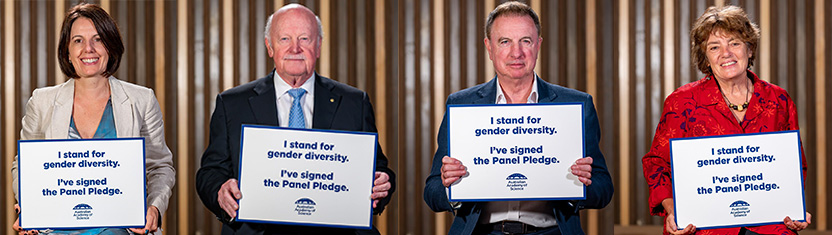
(L to R) Academy Chief Executive Anna-Maria Arabia and Council members Professor John Shine, Professor David Day and Professor Louise Ryan have signed the Panel Pledge, along with the all Council members.
All Academy Council members have signed the Panel Pledge, making a public commitment to only participate in events where efforts have been taken to ensure women have meaningful representation.
Each Academy Council member holds a significant leadership role and is held in high esteem in their respective fields. Through the Panel Pledge each Council member is now empowered to speak up and create change across the events that they are involved in.
With more than 20 Council members and observers taking the pledge, the impact across the Australian science sector is already being seen. Most recently, a Council member was made aware of an all-male committee at a research institute and highlighted this needed to be addressed.
Signing the Panel Pledge is one of the priorities outlined in the Academy’s Women in STEM Decadal Plan Champion’s response.
In addition, based on feedback from February’s Catalysing Gender Equity 2020 conference, the Academy will create a collection of existing resources and case studies to assist events and conferences in improving their gender balance which will be hosted on STEM Women.
Change is a collaborative effort and Council and the broader Academy encourage all those in STEM to consider how taking the Panel Pledge may have a positive influence on diversity and inclusion in their own networks. To learn more contact diversity@science.org.au.
Pandemic risks wiping out hard-won gains by women in STEM
Hard-won gains for women’s advancement in the science, technology, engineering and maths (STEM) workforce are now at risk of a major setback due to the COVID-19 pandemic.
Even before the pandemic hit, women were under-represented in STEM. Early evidence from during the shutdown suggests women in the STEM sector have suffered even greater job losses than men.
It also points to women carrying a greater share of responsibilities for caring and distance learning duties during isolation.
Australia’s scientific and technical services industry recorded job losses of 5.6% from mid-March to mid-April 2020, with jobs down 6.3% for women compared with 4.8% for men in this field.
The findings are in a research report requested by the Minister for Industry, Science and Technology, the Hon Karen Andrews MP, published today.
The report was produced by the Rapid Research Information Forum, a group of 35 research sector lead organisations. The forum is chaired by Australia’s Chief Scientist, Dr Alan Finkel, and its operations are led by the Australian Academy of Science.
Lead author Professor Emma Johnston AO FTSE, Dean of Science at UNSW Sydney, said the peer-reviewed report confirms an urgent need for STEM employers to closely monitor and mitigate the gender impact of the pandemic on jobs and careers—or the hard work over many years to recruit and retain more women in STEM could be undone.
“The challenges are likely to be most acute for women in STEM with children under 12,” Professor Johnston said.
“The combination of juggling working from home while supervising distance learning for children has made women’s well documented ‘double burden’ even greater again.”
Science & Technology Australia (STA) and the Australian Academy of Technology and Engineering (ATSE) collaboratively led the women in STEM RRIF report.
ATSE Chief Executive Officer, Kylie Walker said diversity in the workforce is integral to higher quality and more resilient STEM research and application.
“The diverse perspectives that women bring to the STEM sector enable and drive better outcomes for scientific and technology-based industries,” Ms Walker said.
Science & Technology Australia CEO Misha Schubert said job insecurity was even more of a risk for women than men in the STEM workforce.
“With casual and short-term contract jobs likely to be the first to go, women are at particular risk—with women in STEM one and a half times more likely to be in insecure jobs,” she said.
The co-authors agreed the report was a reminder to STEM employers about the need for them to be vigilant on gender equity or they risk losing their hard-won gains.
The report synthesises the available evidence base on this matter, has been informed by experts and has been peer reviewed. Details of the report’s contributors can be found in the report’s appendix.
Read this latest report and all others from the RRIF.
The Rapid Research Information Forum (RRIF) was convened and is chaired by Australia’s Chief Scientist, Dr Alan Finkel. It benefits from operational support and leadership from the Australian Academy of Science, and is a collaboration of the participant organisations, listed below.
Forum member organisations
• Australia’s Chief Scientist (Chair) • Australian Academy of Science • Australian Academy of Health and Medical Sciences • Australian Academy of Technology and Engineering • Academy of the Social Sciences in Australia • Australian Academy of the Humanities • Royal Society Te Apārangi (New Zealand) • Australian Council of Learned Academies • State and Territory Chief Scientists • Chief Science Advisor to the Government of New Zealand • Scientific expert members of the National Science and Technology Council • CSIRO • Universities Australia • Science & Technology Australia
Australia's top scientists elected as Fellows of the Academy
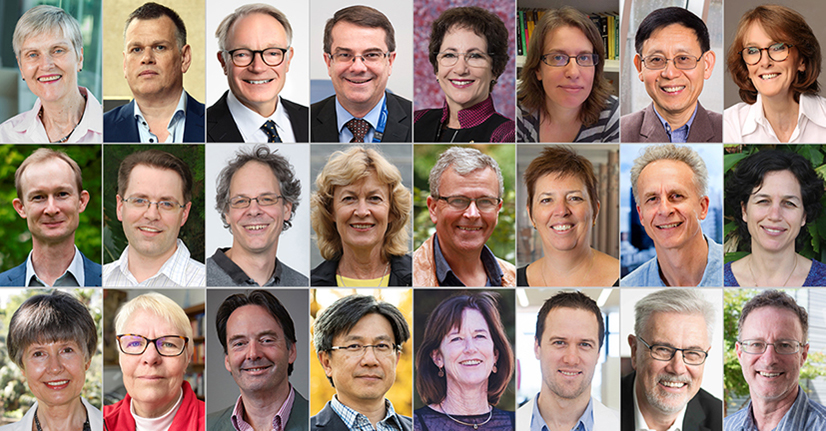
An Australian scientist who identified the cause of mass frog extinctions across the globe is among a group of scientists being acknowledged today for their outstanding contributions to science.
Associate Professor Lee Berger’s research into the frog chytrid fungus, described as the worst disease ever to impact global biodiversity, has changed wildlife conservation practices around the world.
Associate Professor Berger is one of 24 scientists elected a Fellow of the Australian Academy of Science.
The new Fellows also include Professor Lidia Morawska, whose work on airborne particulate matter has aided air quality research around the world, and Professor Justin Marshall, whose pioneering research into the colour vision of animals has improved the performance of digital cameras.
Other new Fellows’ contributions include being the first to commercialise quantum communication, describing how climate change impacts the frequency of El Niño events and developing new treatments for antibiotic-resistant ‘superbugs’.
Australian Academy of Science President, Professor John Shine AC, congratulated the new Fellows for making significant and lasting impacts in their scientific disciplines.
“These scientists were elected by their Academy peers following a rigorous evaluation process,” said Professor Shine.
Women make up 42% of this year’s new Fellows.
“The number of women in this year’s elected Fellows reflects the Academy’s work to apply best practice in our nomination and election processes.
“We encourage the STEM sector to continue to nurture diversity in all its forms, so that the STEM workforce reflects the composition of our society,” Professor Shine said.
Over the past five years, 34% of the Fellows elected have been women. Following this year’s election, the Fellowship stands at 559 Fellows, 90 of whom are women.
The new Fellows for 2020 are:
ACT
- Professor Ping Koy Lam FAA – Quantum physicist, Australian National University
WA
- Professor Ryan Lister FAA – Epigeneticist, University of Western Australia
- Professor Harvey Millar FAA – Plant biochemist, University of Western Australia
- Professor Robyn Anne Owens FAA FTSE – Mathematician (computer vision), University of Western Australia
QLD
- Professor Adèle Green AC FAA FAHMS – Epidemiologist, QIMR Berghofer Medical Research Institute
- Professor Justin Marshall FAA – Marine biologist, University of Queensland
- Professor Lidia Morawska FAA – Aerosol physicist, Queensland University of Technology
- Professor Alan Rowan FAA – Physical organic chemist, University of Queensland
VIC
- Associate Professor Lee Berger FAA – Biologist, University of Melbourne
- Professor Linda Blackall FAA – Microbiologist, University of Melbourne
- Dr Wenju Cai FAA – Climatologist, CSIRO Oceans and Atmosphere
- Professor Peter Currie FAA – Stem cell biologist, Monash University
- Professor Andrew Cuthbertson AO FAA FTSE FAHMS – Chief Scientific Officer and Director, CSL Limited (Special Election)
- Professor Aurore Delaigle FAA – Statistician, University of Melbourne
- Professor Andrew Roberts FAA FAHMS – Clinical haematologist, Walter and Eliza Hall Institute of Medical Research
NSW
- Professor Tim Bedding FAA – Astrophysicist, University of Sydney
- Dr Annabelle Bennett AC FAA – Chancellor, Bond University (Special Election)
- Dr Cathy Foley FAA FTSE – Chief Scientist, CSIRO (Special Election)
- Professor Gary Froyland FAA – Mathematician (dynamical systems and optimization), UNSW Sydney
- Professor Kevin Galvin FAA FTSE – Chemical engineer, University of Newcastle
- Professor Kate Jolliffe FAA – Organic chemist, University of Sydney
- Professor Ian Paulsen FAA – Microbiologist, Macquarie University
- Dr Simon Poole AO FAA FTSE – Director of Business Development, Cylite Pty Ltd (Special Election)
- Dr Jenny Stauber FAA FTSE – Ecotoxicologist, CSIRO Land and Water
More information
Fellows of the Australian Academy of Science are among the nation’s most distinguished scientists, elected by their peers for ground-breaking research and contributions that have had clear impact.
The Australian Academy of Science was founded on 16 February 1954 by Australian Fellows of the Royal Society of London, with the distinguished physicist Sir Mark Oliphant as founding President. The first woman elected to the Academy was Dorothy Hill in 1956.
Information about criteria for ordinary and special election to the Academy can be found at science.org.au/fellowship/election-academy.
COVID-19 impacts on Australian research workforce predicted to be significant
Australia’s research workforce will be severely impacted by the COVID-19 pandemic and the effects are likely to be felt for an extended period. Universities in particular have been dealt a double blow by the pandemic.
A new research report published today details how a dramatic drop in international student fees and business research spending will impact the sector significantly in the next six months and beyond.
University job losses of up to 21,000 full time equivalent (FTE) positions are projected over the next six months of which an estimated 7,000 could be research-related academic staff.
Research interruptions and travel and visa restrictions suggest that more than 9,000 international research students will not resume their research in 2020, according to the report’s authors.
The report’s authors are concerned that women, early-career researchers and recent graduates will disproportionately experience negative impacts.
The report was produced by the Rapid Research Information Forum, a group of 35 research sector lead organisations. The forum is chaired by Australia’s Chief Scientist, Dr Alan Finkel, and its operations are led by the Australian Academy of Science.
The Australian Academy of Technology and Engineering (ATSE) led the workforce report.
ATSE Chief Executive Officer, Kylie Walker said industry sectors may experience a reduced capacity to innovate given that universities perform approximately 43% of all applied research in Australia.
“A decline in innovation may limit economic growth by slowing the development of new technology, skills, and efficiency gains in service and production processes,” Ms Walker said.
The report also found:
- Income to universities, medical research institutes, publicly funded research agencies, CRCs, and the industrial sector is suffering from the loss of foreign students and a sharp decline in business research spending and philanthropy.
- These impacts are greater than during the 2008 global financial crisis and are being observed internationally.
- To try and make ends meet as budgets contract, universities are reducing the number of casual teachers and increasing the teaching loads of permanent staff, further limiting their research capacity.
The rapid research brief responds to a request for advice from the National COVID-19 Coordination Commission on what impact the pandemic is having and likely to have on Australia’s research workforce, and whether we will have the research workforce capability to support our recovery efforts.
The report synthesises the evidence base on this matter, has been informed by relevant experts and has been peer reviewed. Details of the report’s contributors can be found in the report’s appendix.
Background information
The Rapid Research Information Forum was launched on 29 April. The first four published reports respond to questions posed by the Minister for Health, the Hon Greg Hunt MP; and the fifth to the Minister for Education, the Hon Dan Tehan MP.
The RRIF will answer a range of questions in upcoming reports at the request of Industry, Science and Technology Minister the Hon Karen Andrews MP; and Health Minister the Hon Greg Hunt MP.
The growing list of questions includes:
- COVID-19 vaccines and treatments being developed globally that are regarded as having most promise (including national and international collaborations and consortia), and what are the mechanisms for action for each of these?
- What motivates people to download and continue to use the COVIDSafe app?
- What impact is the COVID-19 epidemic having on women in the STEM workforce?
- How long does the SARS-CoV-2 virus remain viable on different surfaces, particularly cotton, wool, other common textile blends, cardboard, plastic, stainless steel and copper?
Read all the reports of the forum
Rapid Research Information Forum member organisations
- Australia’s Chief Scientist (Chair)
- Australian Academy of Science
- Australian Academy of Technology and Engineering
- Australian Academy of Health and Medical Sciences
- Academy of the Social Sciences in Australia
- Australian Academy of the Humanities
- Royal Society Te Apārangi (New Zealand)
- Australian Council of Learned Academies
- State and Territory Chief Scientists
- Chief Science Advisor to the Government of New Zealand
- Scientific expert members of the National Science and Technology Council
- CSIRO
- Universities Australia
- Science & Technology Australia