




Strong collaboration between scientists and manufacturing industry key to our economic recovery


With business spending in manufacturing research and development (R&D) falling over the past decade, a new focus on science and R&D in the Morrison Government’s manufacturing strategy has been welcomed by Australia’s leading science body.
The Australian Academy of Science says the strategy’s focus on increased collaboration between manufacturing and Australian scientists is important and plays to our nation’s strengths.
The Academy’s Secretary for Science Policy, Professor David Day FAA, says as a nation we have to look to where we have a comparative advantage, not just a competitive advantage, and the Government’s manufacturing strategy promises to do that.
“Resources technology and critical minerals are key priority areas announced in today’s manufacturing strategy and today in his Press Club speech the Prime Minister highlighted the increasing international demand for critical minerals,” Professor Day says.
“The Academy’s 10 year plan for Australian Geoscience, launched in 2018, highlighted the need to ensure the right infrastructure is in place to know how and where to explore for the critical resources needed for Australia’s future.”
One of the proposals in the Academy plan is to develop a ‘downward-looking telescope’ that could look at least 300 km beneath Earth’s surface to unlock Australia’s hidden mineral wealth.
Professor Day says manufacturing is a major funder of R&D in Australia.
“However, business investment in manufacturing R&D has been declining in the last decade from almost $5.5 billion to $4.6 billion (in current prices), so this new investment into revitalising Australian manufacturing, supported by Australian science and technology, cannot come soon enough.
Professor Day says the current and looming job losses from universities and other research institutes are of great concern and it is imperative that opportunities are created within the manufacturing sector to redeploy the early- and mid-career researchers losing their current positions.
"We have invested heavily in these people and they represent an opportunity to turbo-charge the manufacturing sector with fresh people, ideas and innovation.
“As a nation we invest more than $1 billion a year training PhD graduates so we should grasp this opportunity to enrich and develop a new high-tech industrial workforce,” Professor Day says.
The Academy’s Federal Budget submission includes a number measures to take advantage of and complement the Government’s new manufacturing strategy including:
- initiatives to encourage researchers to move into industry, such as internships or investment incentives for the private sector to hire people with PhDs. This could involve implementing a recommendation of the 2016 Review of the R&D Tax Incentive, which argued that incentive should also apply to the cost of employing new STEM PhD or equivalent graduates in their first three years of employment.
- initiatives to encourage researchers to start up their own companies.
- reforms of intellectual property laws to reduce barriers for researchers starting their own companies and capitalising on their research discoveries and inventions.
“If this strategy is to succeed, as an economy we will need to deepen our investment in STEM skills and research collaboration to provide the scientifically literate workforce and ideas to succeed and prosper in a post pandemic world,” Professor Day says.
“A modern, growing, manufacturing sector working hand in hand with Australian science promises to be key to our economic recovery from the recession.”
The Academy looks forward to seeing more detail on the Government’s manufacturing strategy and working with it to ensure it is underpinned and informed by science.
scienceXart: spot the maths judging panel announced
The judges of the scienceXart: spot the maths photographic competition have been announced, with a diverse mix of experts from maths, education and the arts sectors set to bring their complementary perspectives to the panel.
The panel includes representatives of the National Committee for Mathematical Sciences, national mathematics and statistics organisations, the Academy’s education program reSolve, and the National Portrait Gallery.
Nearly 1,000 entries were received for this year's scienceXArt competition. It was developed in consultation with the Academy’s National Committee for Mathematical Sciences, and tailored to align with Australian curriculum learning outcomes under expert guidance from the Academy’s reSolve education program. The 2020 competition marks the centennial anniversary of the International Mathematical Union with its mathematical and statistics theme. More information about scienceXart: spot the maths.
The judges are:
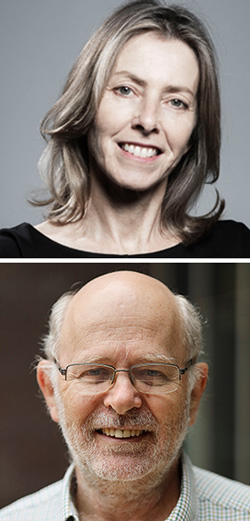
Karen Quinlan and Professor Alan Welsh, two members of the scienceXart judging panel.
- Karen Quinlan AM, Director of the National Portrait Gallery
- Professor Alan Welsh FAA, Chair, National Committee for Mathematical Sciences
- Rebecca Herbst, Statistical Society of Australia
- Dr Julia Collins, Australian Mathematical Society
- Ruqiyah Patel and Dr Kristen Tripet, reSolve.
Three of the panel members are professional mathematicians or statisticians. Professor Alan Welsh is based at the Australian National University within the Research School of Finance, Actuarial Studies and Statistics. His statistical modelling research has a wide variety of application, including ecological monitoring and sports science. Professor Welsh is Chair of the National Committee for Mathematical Sciences, which supports the Australian mathematics community and serves as a link between Australian and overseas mathematical scientists.
Representing the arts and cultural sector, Karen Quinlan, Director of the National Portrait Gallery, is bringing an artistic perspective to the judging panel. The renowned art curator is the Director of the National Portrait Gallery. Before moving to the ACT, Ms Quinlan was the Director of the Bendigo Art Gallery and Professor of Practice at the La Trobe Arts Institute.
Rebecca Herbst represents the Statistical Society of Australia, the peak national body for statisticians. The society provides a vibrant network for those working in statistical research and teaching and aims to further the study, application and good practice of statistical theory and methods in all branches of learning and enterprise.
Dr Julia Collins is a lecturer in mathematics at Edith Cowan University and the coordinator of the CHOOSEMATHS Women in Maths Network. She represents the Australian Mathematical Society, the national society of the mathematics profession. Representing all professional mathematicians in Australia, both pure and applied, the mission of the society is to promote and extend mathematical knowledge and its applications.
Kristen Tripet and Ruqiyah Patel bring their expertise in maths education to the scienceXart panel. reSolve: Mathematics by Inquiry is a national program designed to promote relevant, rigorous and engaging mathematics from Foundation to Year 10. A program of the Academy, reSolve produces resources for classroom use and professional learning resources for teachers.
Prizes for the winning entries have been curated by the reSolve team, supported by the Australian Mathematical Society and the Statistical Society of Australia (for the statistics category). Entries for the competition closed on 25 September.
Academy teams with Little Scientists to campaign for Australian STEM education
STEM is for everybody—this is the message that prominent Australians in science, technology, engineering and maths are championing as part of a joint campaign by the Australian Academy of Science and Little Scientists to promote science education.
The campaign, ‘Solving tomorrow's problems starts today’, highlights the importance of STEM education in building the problem solving and critical thinking skills that are essential for all Australians.
“We really need to prioritise STEM education because there's absolutely huge challenges facing the world: climate change, the challenge to preserve the environment and now with the pandemic, huge health challenges,” said acclaimed mathematician and Academy Fellow Professor Cheryl Praeger, recipient of the 2019 Prime Minister's Prize for Science. “All of this is going to need committed, enthusiastic young people, and they're all going to need strong STEM skills and be passionate problem solvers.”
Professor Praeger, along with celebrated mathematician and presenter Adam Spencer, features in the Academy’s ‘The Latest from Science’ webshow this week. The two mathematicians discussed how maths is shaping this century, and how we can help the younger generation fall in love with STEM.
“Even if you don't see yourself being a lifelong scientist … just bringing out more mathematical thinking and skill into the toolkit that you carry around [in your head] will carry you through the rest of your multi-career professional life,” enthused Dr Spencer, who is a best-selling author and a self-described “maths geek”.
The importance of supporting teachers
The mathematicians highlighted the importance of facilitating excellent STEM learning outcomes by supporting teachers through STEM education and professional development programs, such as the Academy’s education programs Primary Connections, Science by Doing and reSolve: Maths By Inquiry, as well as Froebel Australia’s Little Scientists program. Little Scientists partners with community leaders in early STEM learning and administers the certification program, Little Scientists House.
A diverse group of Science & Technology Australia STEM ambassadors, awardees of the Prime Minister’s Prize for Excellence in Science Teaching, and Little Scientist network partners have also reached out to the Minister for Education and other members of parliament to ensure that investment in STEM education remains a key focus for the government in the upcoming federal budget.
Academy resources invaluable for students
STEM educators Dr Marj Colvill, Dr Ken Silburn and Sarah Chapman, all recipients of the Prime Minister’s Prize, said the Academy resources have been invaluable in assisting educators to provide creative, innovative and engaging learning experiences for primary and secondary students.
“In a year in which we face unprecedented national and global challenges, it has never been clearer how important it is to sustain the STEM pipeline,” said Dr Silburn. “I have seen the awe and captivation that students have when they are presented with science being taught as a hands-on subject by experienced, well-resourced and trained teachers.”
Experts call for a national conversation on the use of data in Australian professional sport

Australia has a historic opportunity to set forward-looking data governance standards to anticipate and respond to the largely unchecked acceleration of data capture, aggregation and analytics in Australian professional sport, according to leading experts.
The lack of oversight in how data is being collected has implications for athletes’ rights and protections, the organisational practices of sporting organisations and third-party tech vendors, and the state and stakes of fair competition in professional sport.
The issue will be examined by an Expert Working Group announced today by the Australian Academy of Science and supported by Minderoo Foundation. The project is being coordinated in collaboration with the newly established Minderoo Tech & Policy Lab at the University of Western Australia, which is directed by domain experts in data in health and sport.
The Expert Working Group and associated sub-groups will establish the current baseline of data collection practices and expectations in Australian professional sport, and set the stage for future recommendations regarding standards, regulation and oversight.
It will include distinguished experts in sport science, data science, law, ethics, social sciences and humanities, and include Fellows of the Academy.
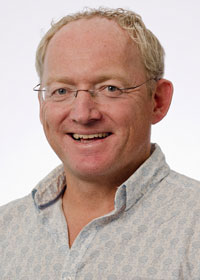
Academy Fellow and UNSW Professor Toby Walsh, Chair of the Expert Working Group. Photo: supplied
Academy Fellow and UNSW Professor Toby Walsh is Chair of the Expert Working Group. He said despite the rapid increase in the use of performance and other data in professional sport, integrity, privacy, access and other issues around the use of data weren’t being properly analysed.
“While sports data provides many benefits such as improving performance and reducing injury, there are significant risks to the rights of athletes, such as their privacy and the power relationships between athletes and sporting clubs,” Professor Walsh said.
“This certainly isn’t about hitting the brakes on the use of data in professional sport but ensuring its responsible use. Australia is well-placed to be an international leader in this space.”
Co-directors of the Minderoo Tech & Policy Lab are Associate Professor of Law and Technology at UWA’s Law School, Julia Powles, and Associate Professor Jacqueline Alderson, a sports biomechanist who leads national and international data and AI/machine learning in sport projects. They said the establishment of the group will initiate a public policy conversation about an issue as significant as the issue of drugs in sport.
“Currently, there are few formalised processes in place to approve or oversee data collection and use in Australian professional sport,” said Dr Powles.
“The exponential increase in invasive, high-resolution data collection and data-informed practices not only on the sporting field but in nearly every aspect of the everyday life of athletes has dramatic implications throughout and beyond sporting careers.
“A national conversation about these issues is long overdue—both for sport itself, and for larger questions of data use in workplace settings,” said Dr Powles.
Including the athlete perspective will be crucial to the success of the overall project. AFL player Matt de Boer from the GWS Giants said he was excited to be involved in the initiative.
“Data collection and use in modern sport represents a huge part of our professional careers and needs to be carefully managed taking into account multiple perspectives,” said Mr de Boer.
Former Hockeyroo triple Olympian and current AFLW High Performance Manager Kate Starre has witnessed firsthand the rise of data collection and analytics in sport over the past 25 years. “Data is important, but we need to ensure that it always serves athletes and the performance teams around them.”
Long-term health impacts of bushfires still unknown

The underlying biological mechanisms for how bushfire smoke causes and exacerbates health issues are poorly understood, which limits our ability to help those affected—including pregnant women, who may be more vulnerable.
With the 2020 bushfire season upcoming and the tragedy of the Black Summer bushfires still fresh, experts have called for knowledge gaps on the adverse effects on people’s physical and mental health to be addressed.
The recommendations are part of a bushfire expert brief, After the bushfires: addressing the health impacts, published today by the Australian Academy of Science and the Australian Academy of Health and Medical Sciences (AAHMS).
The brief was informed by contributions from Fellows from both academies as well as other experts, including through a roundtable organised by AAHMS.
“Pregnant women tend to breathe at a faster rate, which may make them more vulnerable to smoke exposure,” said Professor Caroline Homer, Co-Program Director of Maternal, Child and Adolescent Health at Burnet Institute.
“Some research has linked extended exposure to fine particle pollution from fires to unwanted pregnancy outcomes such as pre-term births and lower birth weight, but our understanding of these impacts is currently limited.
We also do not know whether fine particles and other toxins are transferable through breast milk to babies, or how heat stress or the stress of an emergency may affect infants.Professor Caroline Homer
Other groups including children, people with a disability, people who are homeless, people with pre-existing health conditions and Aboriginal and Torres Straits Islands communities are also more vulnerable to the health impacts of bushfire.
It is not just our bodies that are impacted: much is to be learnt about mental health impacts, particularly on first responders and vulnerable communities.
A range of psychological factors results from the processing of trauma following bushfire events, with people located at or near a bushfire and those further away experiencing mental health issues.
Some of the common mental health impacts include anxiety, depression, substance abuse and post-traumatic stress disorder (PTSD). Impacted communities may also see heightened suicidal risk, increased substance abuse and domestic violence. Heightened levels of anxiety may also cause acute stress in the broader population.
“Overseas data suggest that long-term mental health outcomes from trauma can be considerable,” said Scientia Professor Helen Christensen, Director and Chief Scientist at the Black Dog Institute.
“However, appropriate long-term follow-up of Australian first responders is crucial if we are to provide adequate support through the full range of mental health impacts, some of which may not emerge for many years.”
Long-term follow-up of Australian first responders is crucial if we are to provide adequate support through the full range of mental health impacts.
“Climate models anticipate more bushfires in coming decades, and that those fires will be more intense than in the past,” said Professor Tony Capon, Director of the Monash Sustainable Development Institute, who attended the AAHMS roundtable which formed the basis of this brief.
“There is a pressing need to improve the prevention, preparedness for, and management of bushfires. And, to better mitigate and manage the health impacts of increased fire risk, including the provision of appropriate information and support for patients, health professionals and communities,” said Professor Capon.
This joint brief with the Australian Academy of Health and Medical Sciences is part of a series by the Australian Academy of Science. Earlier briefs are Soil health after bushfires and Monitoring wildlife recovery. Future briefs will cover topics including ecosystem services and remote sensing and data availability.
Travel grant awards announced for three early-career geoscientists

Image: Brent Kane via Pexels CC-0
Three geoscientists working in tectonics, water flow of aquifers and the evolution of the lithosphere and mantle are the recipients of the 2019 round of the 34th International Geological Congress Travel Grant Scheme announced recently.
The researchers will use the travel grant to attend international conferences and conduct field and laboratory work in collaboration with researchers in the UK, US and Canada. They will share a funding pool of around $15,000.
The recipients announced by the Australian Geoscience Council (AGC) and the Academy are:
- Dr Derya Gürer—Lecturer, University of Queensland, whose research relates to tectonics and the evolution of Earth's lithosphere at various spatio-temporal scales.
- Dr Dylan Irvine—Senior Lecturer, Flinders University, whose research involves measurements of water temperature to determine water flow, including flow in aquifers and the interaction between groundwater and surface water.
- Dr Timothy Chapman—Postdoctoral Research Fellow, University of New England, who investigates the formation and evolution of the lithosphere and mantle using a mix of igneous and metamorphic petrology.
2020 round now open
The next round for this travel grant funding is now open for Australian and New Zealand geoscientists in the early stages of their careers.
Opportunities the grant may allow include undertaking field work in appropriate areas, visiting and working with appropriate international experts, inspecting appropriate mines or other geoscientific features such as type localities, and contributing to professionally organised geoscientific conferences or conventions. To find out more, read about previously awarded Travel Grants.
In acknowledgement that travel restrictions brought about by the COVID19 pandemic have affected plans, the closing date for which the proposed travel must be taken has been extended. In addition to travel delay, 2020 applicants for the grants are encouraged to detail innovative ways they can conduct their international research, laboratory and field work as part of their applications.
The travel grants are made possible through a trust fund administered by the AGC and the Academy, which was initiated after the 34th International Geological Congress in Brisbane in August 2012.
Three winning ideas for Australia as Falling Walls Lab goes digital
Watch the full livestream of Falling Walls Lab Australia 2020 above.
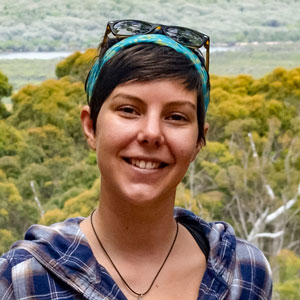
First place winner, Dr Jessica Hamilton. Photo: supplied

Second place winner, Mr Alan Robertson. Photo: supplied

Third place winner, Mr Andrew Law. Photo: supplied
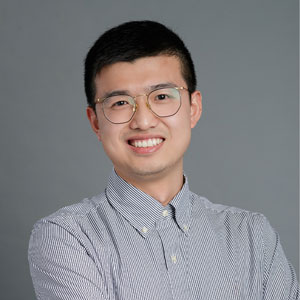
People's Choice winner, Dr Dashen Dong. Photo: supplied
Environmental geochemist Dr Jessica Hamilton from ANSTO is the winner of the fifth Falling Walls Lab Australia event, hosted online yesterday by the Australian Academy of Science in partnership with the Embassy of the Federal Republic of Germany in Canberra and EURAXESS Australia and New Zealand.
Second place was awarded to Alan Robertson from ClearSky Genomics, while Andrew Law from the Garvan Institute of Medical Research took third place.
The People's Choice winner selected via a survey of audience members was Dr Dashen Dong, Research Fellow at RMIT.
The event featured ten contestants from across Australia presenting their ideas, research and initiatives on the theme ‘Which walls will fall next?’.
Three-minute pitch
Each participant had three minutes to make their pitch in front of a jury of eminent academics and leaders from business chaired by the President of the Academy, Professor John Shine.
Dr Hamilton's winning pitch was on breaking the wall of recycling CO2 in mining. She has developed a relatively low-cost, low-energy-input process to make valuable products from mining wastes. This process could help lead to carbon-neutral mining operations.
Alan Robertson spoke about breaking the wall of genomics for doctors. His pitch was for a doctor/patient-focused genome browser, to help make genomics and its advantages accessible to all patients.
Andrew Law, third place winner, spoke on breaking the wall of ineffective cancer treatments. His pitch, a human-body analogue called ALTEN, helps doctors know in advance the effectiveness of cancer treatments, allowing for personalised healthcare and better outcomes for cancer patients.
People's Choice winner, Dr Dashen Dong, pitched an idea to break the wall of aged care monitoring using soft electronic sensors. This aims to improve the quality of life in aged care and reduce anxiety of families.
Winners to compete internationally
The top three ranked presenters of the Lab will each receive $1000 prize money, high-quality online science communication training led by European experts and provided by EURAXESS Researchers in Motion, and a professional video created by the Academy’s own production team.
The video will be shared with the influential audience of judges and participants of Falling Walls Berlin and on the Academy’s social media platforms which have more than 2.4 million followers.
These winners’ videos will then compete against 90 others selected by international Labs and the Falling Walls nomination process, and a panel of judges will decide on 10 finalists who will take part in the digital live event ‘Emerging Talents Category Day’ on 4 November as part of Falling Walls Remote 2020: The Breakthroughs of the Year.
The Emerging Talents winner will pitch their breakthrough project on the grand stage during the virtual live Falling Walls Day of 9 November in front of an audience of industry leaders, decision-makers, investors and international media.
Jury members
The event organising partners are grateful for the involvement of the jury members for Falling Walls Lab Australia:
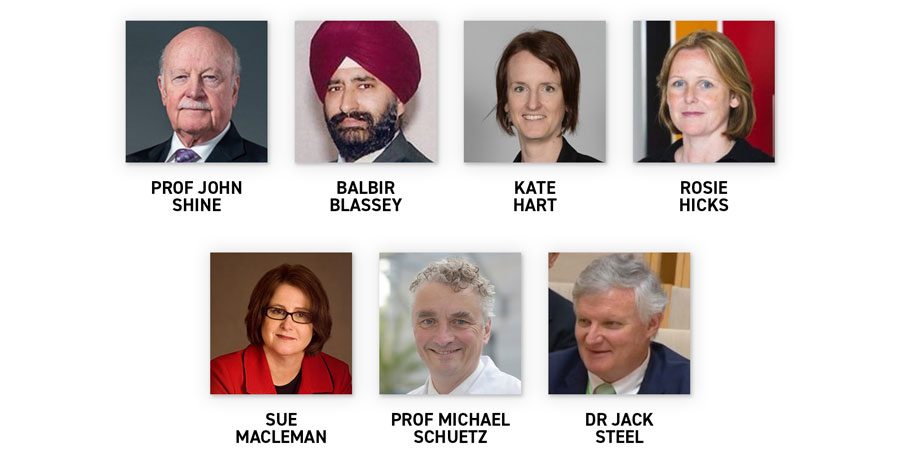
- Professor John Shine AC PresAA FRS—President, Australian Academy of Science
- Mr Balbir Blassey—Head of Corporate R&D Operations, 3M Australia
- Ms Kate Hart—Partner ANZ, A.T. Kearney Australia
- Ms Rosie Hicks—Chief Executive Officer, Australian Research Data Commons
- Ms Sue MacLeman—FAICD FATSE FACPP - Chair, MTPConnect
- Professor Michael Schuetz—Director, Jamieson Trauma Institute
- Dr Jack Steele—Director Science Impact and Policy, CSIRO.
Read the event program booklet (PDF).
About Falling Walls Lab
Each year, the Falling Walls Foundation supports scientific organisations around the world to host a Falling Walls Lab. This international forum promotes interdisciplinary connections between aspiring academics, innovators, entrepreneurs, investors and professionals known for their excellent work.
Falling Walls Lab is a challenging and inspiring format for emerging bright minds, giving them a unique chance to become the next big success story in innovation. In 2019, Australian researcher Rhys Pirie took out first place at the Falling Walls Lab Finale in Berlin and was named 2019 Young Innovator of the Year. Read a follow-up interview with Mr Pirie six months after winning the competition.
The Falling Walls Foundation is a non-profit organisation in Berlin dedicated to the support of science and the humanities. It was established in 2009, 20 years after the fall of the Berlin Wall. At its heart is the question ‘Which are the next walls to fall?’ as a result of scientific, technological, economic and sociological breakthroughs.
The intersection of scientific and legal proof draws a big audience
The Australian Academy of Science and the Australian Academy of Law jointly sponsored a symposium on the reception, quality and evaluation of scientific evidence in Australian courts during National Science Week.
The online event was moderated by the Hon Justice Virginia Bell AC, Judge of the High Court of Australia, and drew an estimated audience of around 600. It was the third year the two academies have held a joint event and the first time it was held fully online.
The panel eminent panel members were:
- The Hon Justice Mark Weinberg AO QC, Reserve Judge of the Supreme Court of Victoria and Formerly a Judge of the Federal Court of Australia
- Professor David Balding FAA, Professor of Statistical Genetics, University of Melbourne
- Tim Game SC, Senior Counsel Forbes Chambers, Principal Practice in Criminal Law Professor
- Professor Carola Vinuesa FAA, Professor of Immunology and Co-Director, Centre for Personalised Immunology, Australian National University.
“There's clearly an appetite for these events that reaches around Australia and the globe, and the volume of registrations for tonight demonstrates a real appetite to continue this collaboration between the two academies,” said the President of the Australian Academy of Science, Professor John Shine.
“It's at that intersection of the Academy of Science and the Academy of Law where I think a lot of very important issues arise and can be constructively discussed with society. And we certainly won't let this pandemic slow us down in that respect.”
Oceans and bushfire events feature in National Science Week
Oceans and bushfires were the focus of two National Science Week events this month, with the Academy hosting webinars which explored how science can help us improve the health of our oceans and manage bushfires. We thank the experts involved, and all those who joined us online.
Innovations to save our oceans
On Monday evening over a live webinar, an expert panel discussed the issues affecting our oceans and provided tangible solutions. We were joined by Academy Fellow Professor Ove Hoegh-Guldberg from the University of Queensland, Jemma Purandare from Griffith University and Dr Beth Fulton from CSIRO Oceans and Atmosphere.
Climate change and ocean warming, biodiversity loss, and marine pollution were just some of the problems that were discussed in the panel discussion and the following Q&A.
The panellists emphasised that there are individual actions that people can take, such as sorting recycling well and eating sustainably-produced seafood, but there are also technologies that can be harnessed better, such as on-water solar and wind power for renewable energy.
The event made it clear that we have an opportunity during the economic recovery post-COVID-19 to invest in the infrastructure and technologies for our future, rather than in old, emissions-heavy projects.
Fighting bushfires with science
On Thursday of National Science Week we were joined by Sandra Whight, an ecologist with more than 25 years’ experience as a firefighter and operational decision-maker and now with the Bureau of Meteorology, along with Associate Professor Michael-Shawn Fletcher, an Indigenous scientist at the University of Melbourne who specialises in fire ecology, climatology and geology.
The two experts discussed technologies such as satellite imagery and helicopter ‘water bombs’, the impact of severe fires on local ecosystems, and how we can continue to improve fire management systems.
While short-term predictions are hard to make, Ms Whight said that Australians need to understand that fire is part of our lives and land, but we need to work together to understand and respond to extreme catastrophic fire conditions.
Associate Professor Fletcher emphasised the need to make use of the scientific and cultural toolkits available to prepare for the dire predictions for future fire seasons across Australia and the globe.
A year of championing the vision for women in STEM
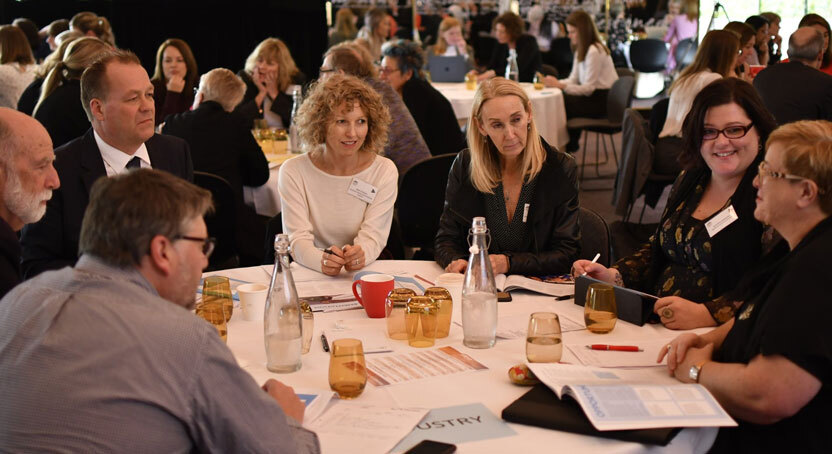
Organisations from across the STEM sector coming together to progress the Women in STEM Decadal Plan.
In just one year, 29 Champions have led the way by affirming their commitment to the vision of the Women in STEM Decadal Plan. The national vision aims to establish a thriving STEM-skilled workforce that is fit for the future, globally recognised, powered by a diverse and gender-balanced pipeline, and supported by an inclusive and respectful workplace culture.
The Women in STEM Decadal Plan Champions initiative was launched in August 2019, encouraging all organisations across the STEM sector to submit responses aligning their gender equity activities with the six opportunities outlined in the Women in STEM Decadal Plan. Champions’ responses are publicly available on the Women in STEM website.
A report prepared by the Academy, One Year In—Women in STEM Decadal Plan Champions, analyses the gender equity activities highlighted by Champions and key stakeholders over the past year and defines the next steps to improving gender equity.
This analysis has identified areas of positive action and increased focus for Champions. The information is important for the STEM sector as it enters the second year of implementing the decadal plan.
Findings in the report illustrate that while there has been positive action in many areas, now is not the time to lose momentum given the impact of COVID-19 on women in STEM. Substantial work is required to create systemic change across the STEM sector.
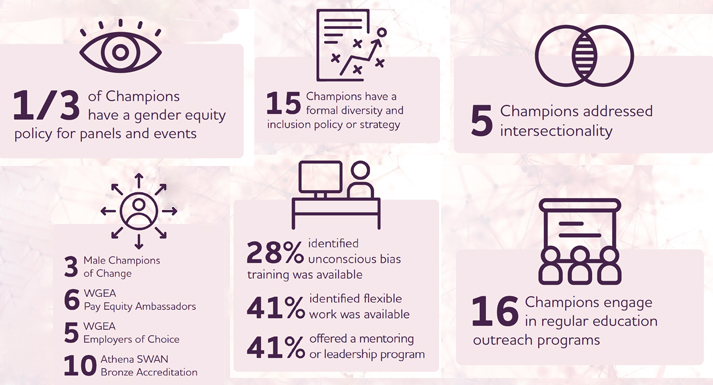
All Champions displayed visible leadership from their executive teams and demonstrated efforts to improve the visibility of women in STEM roles. All have adopted various forms of inclusive workplace practices such as flexible work, generous paid parental leave policies, domestic violence leave and unconscious bias training.
Intersectionality—which looks at how a person’s social and political identities may combine to create unique situations of privilege or discrimination—was identified as an area with minimal focus. This will be of interest to the STEM sector as emerging research identifies intersectionality as an area of growing knowledge and action.
The Academy continues to welcome new Champion responses and encourages all STEM organisations to share their actions and learnings to show their support for a fair and equitable STEM sector.