




The Australian bushfires—why they are unprecedented

In a statement on the Australian bushfires published on 10 January 2020, the President of the Australian Academy of Science, Professor John Shine, stated that ‘the scale of these bushfires is unprecedented anywhere in the world’.
Australia has extraordinarily high levels of biodiversity and is one of 17 countries with ‘megadiversity’ of plant, insect and animal life. Of the more than 600,000 predicted species in Australia, only 30% have so far been discovered, documented and named.
In terms of hectares burnt the Australian fires are the largest to affect any of the megadiverse countries—that is, larger than the 2019 Amazon and 2019 Californian fires.
Fires of greater geographical extent have occurred in Australia in the past (e.g. fires in central Australia in 1974-75 covered over 100 million hectares). However, these fires burned largely the grasslands of inland Australia. Unlike forest fires these grassland fires are less intense and the ecosystems can more rapidly recover. Also, there is far lower economic impacts or loss of life because these fires occur in vast remote landscapes.
Australian Academy of Science Fellow Professor Chris Dickman has estimated that Australia has lost at least a billion birds, mammals and reptiles this bushfire season. This figure does not include insects, bats, fish and frogs.
Australia is at risk of losing a significant proportion of its biodiversity as a result of these bushfires and because much of Australia’s biodiversity occurs only here in Australia, it’s a global loss.
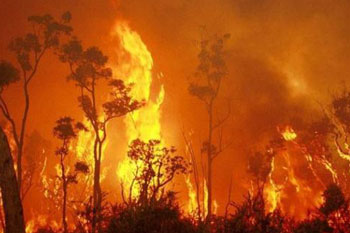
The signficant loss of unique Australian biodiversity means the bushfires are unprecedented anywhere in the world. Photo: CSIRO
On this biodiversity measure alone, the scale of these bushfires is unprecedented anywhere in the world. With many species residing in already burnt or threatened areas, the impact of the fires on species extinction will be ongoing after the bushfire season.
The combination of a number of other factors also make this fire unprecedented in Australia’s history. These include:
- the intensity of the fires early in Australia’s fire season
- current dry, warm and windy conditions
- unusual fire behaviour
- the indirect and direct impact on Australia’s environment, including greenhouse gas emissions and severe air pollution across population centres.
Fellows recognised in 2020 Australia Day honours
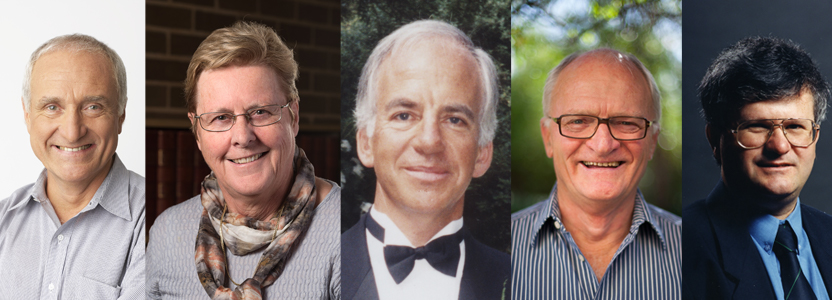
From left: Professor Robyn Williams, Professor Rachel Webster, Emeritus Professor Anthony Guttmann, Dr Brian Walker and Professor Anthony Thomas
Five Academy Fellows are among the Australians recognised in the 2020 Australia Day Honours List.
Professor Anthony Thomas received the highest honour as one of just five people Australia-wide to be appointed a Companion in the General Division of the Order of Australia (AC), which recognises ‘eminent achievement and merit of the highest degree in service to Australia or to humanity at large.’
Companion of the Order of Australia (AC)
Professor Anthony Thomas AC FAA—For eminent service to scientific education and research, particularly in the field of nuclear and particle physics, through academic leadership roles.
Officer of the Order of Australia (AO)
Dr Brian Walker AO FAA FTSE—For distinguished service to science, particularly to ecosystem ecology and research, and to professional scientific bodies.
Professor Rachel Webster AO FAA—For distinguished service to education in the field of astrophysics, to astronomical research, and to young women scientists.
Professor Robyn Williams AO FAA—For distinguished service to science as a journalist, radio presenter and author, and to education.
Member of the Order of Australia (AM)
Emeritus Professor Anthony Guttmann AM FAA FTSE—For significant service to the mathematical sciences, and to education.
Meet our STEM Women Changemakers
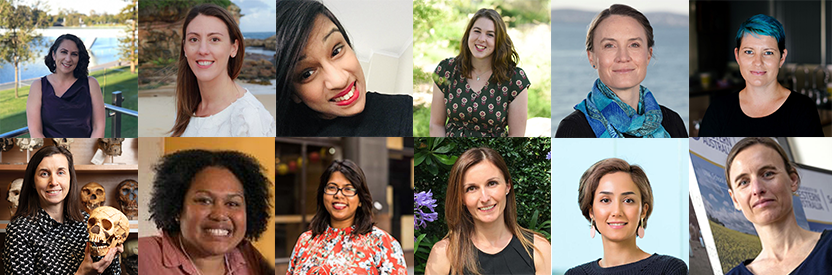
The winners of the STEM Women Changemakers grant. From L-R: Catherine Royans, Dr Emma Camp, Jerusha Mather, Jessie Panazzolo, Dr Kirsty Nash, Dr Mary McMillan, Professor Tanya M. Smith, Tishiko King, Ruwangi Fernando, Associate Professor Muireann Irish, Dr Momeneh Foroutan, and Dr Marit Kragt
The Academy has announced its inaugural group of twelve STEM Women Changemakers.
From start-up founders to organisational advocates, these women are using their knowledge, experience and networks to share their ideas and solutions for gender equity in Australian science, technology, engineering and mathematics (STEM).
The STEM Changemakers are:
- Dr Emma Camp, DECRA Research Fellow, University of Technology Sydney—who is also the recipient of the Academy’s 2020 Max Day Environmental Science Fellowship Award.
- Ruwangi Fernando, Founder of STEM Sisters
- Dr Momeneh Foroutan, Research Fellow in Computational Cancer Immunotherapy at Monash University
- Associate Professor Muireann Irish, ARC Future Fellow at the University of Sydney
- Tishiko King, Community Support Officer at Indigenous Women in Mining and Resources Australia
- Dr Marit Kragt, Associate Professor at the University of Western Australia
- Jerusha Mather, Phd Candidate at Victoria University
- Dr Mary McMillan, Senior Lecturer in Biomedical Science at the University of New England
- Dr Kirsty Nash, Founder of aKIDemic Life
- Jessie Panazzolo, Founder of Lonely Conservationists
- Catherine Royans, Swift Program Coordinator at the University of Adelaide
- Professor Tanya M. Smith, Professor at Griffith University
Thanks to the generous donation by Professor Michelle Coote of her Georgina Sweet Fellowship, the group will be supported to attend Catalysing Gender Equity 2020, a two-day outcome-driven conference in February guided by the Women in STEM Decadal Plan.
These inaugural STEM Changemakers are listed with thousands of others on STEM Women, an online directory of women in Australia working in STEM.
STEM Women aims to promote gender equity in STEM by enabling a diverse range of women to be offered exciting opportunities to progress their careers and personal capabilities.
More than 2300 women have joined STEM Women and a broad range of people and organisations are using the resource to showcase and access the depth of talent of those working in the field.
Professor Lisa Kewley awarded 2020 James Craig Watson Medal
Academy Fellow Professor Lisa Kewley has been named as the recipient of the 2020 James Craig Watson Medal by the National Academy of Sciences in Washington DC for her pioneering contributions to the study of galaxy formation and evolution.
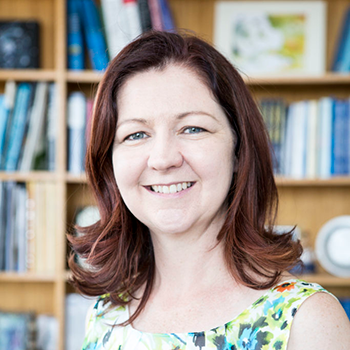
Academy Fellow Professor Lisa Kewley
She is the first person in Australia and the Southern Hemisphere to be recognised with the major US award in its 133-year history. Professor Kewley is the director of ARC Centre of Excellence for All Sky Astrophysics in 3D (ASTRO 3D) and ARC Laureate Fellow at ANU’s Research School for Astronomy and Astrophysics.
Widely cited by astronomers around the world, she produced the first models for star-forming galaxies to include a variable galactic temperature and density distribution, developed theoretical models to identify galactic power sources, and investigated oxygen distribution left by colliding galaxies, among many other accomplishments.
Professor Lister Staveley-Smith, chair of the Academy’s National Committee for Astronomy, noted that “Professor Kewley is one of Australia’s leading astronomers, and in recognition of her contributions to the discipline in this country, the Australian Academy of Science elected her as a Fellow in 2014.
"She was appointed chair of the National Committee for Astronomy from 2016 – 2018. In December 2019, Nature Astronomy published her article, Diversity and inclusion in Australian astronomy, highlighting equity programs in Australia that are having an important impact.”
She is currently looking at the oxygen history of galaxies like the Milky Way.
In an ASTRO 3D press release, Professor Kewley said that advances in technology have made it a ‘golden era’ for astronomy.
“Early in my career, I benefited from the Hubble Space Telescope and the 10 metre Keck telescopes in Hawaii.
“Students starting today are going to have access to amazing new telescopes including the James Webb Space Telescope, massive new optical telescopes in Chile and the Square Kilometre Array in Australia and South Africa. We’re going to require astronomers, engineers, data experts and artificial intelligence to use these new instruments, taking us back to the moment of the Big Bang, finding new planets and more.”
The National Academy of Sciences presents the James Craig Watson Medal every two years for outstanding contributions to the science of astronomy. She will receive the award on 26 April during the National Academy of Sciences' 157th annual meeting. Winners receive a gold-plated bronze medal, a $25,000 prize, and $50,000 to support the recipient’s research. It was established by NAS Member and Canadian–American astronomer, James Craig Watson.
Canberra’s iconic landmark damaged in hailstorms
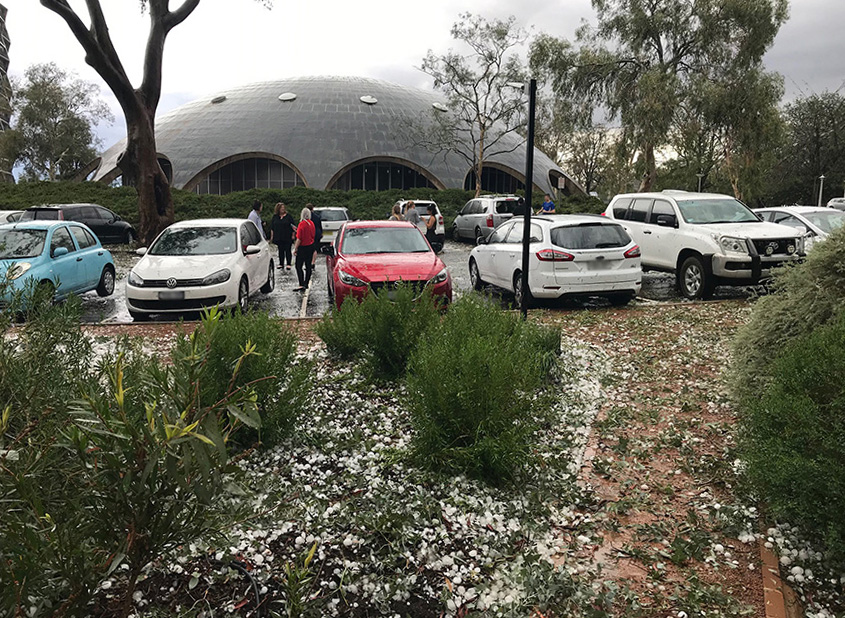
Australia’s top scientists are counting the cost of yesterday’s hailstorms after Canberra landmark the Shine Dome sustained serious damage during the extreme weather event.
The hailstorm dented the heritage listed Shine Dome’s copper roof tiles and smashed several skylights, exposing the building’s nationally significant scientific archives to the hail and rain.
The archives include the collections of some of Australia’s most famous scientists, including Australian Academy of Science Fellow, Frank Fenner best known for overseeing the eradication of smallpox, and the control of Australia's rabbit plague.
The Frank Fenner manuscript collection was added to the UNESCO Australian Memory of the World Register in 2019.
The archives also include the collection of Frank Leslie Stillwell, a geologist who formed part of the Australasian Antarctic Expedition led by Sir Douglas Mawson in 1911.
Australian Academy of Science Chief Executive Anna-Maria Arabia said there was no damage to the archives thanks to a rescue effort by staff, who formed a human chain to move the boxed archives to safety.
“The extreme weather events of the past few months have demonstrated that fire and storm damage are real and present dangers and this incident has highlighted the urgent need to accelerate the digitisation of this significant and unique historical collection,” Ms Arabia said.
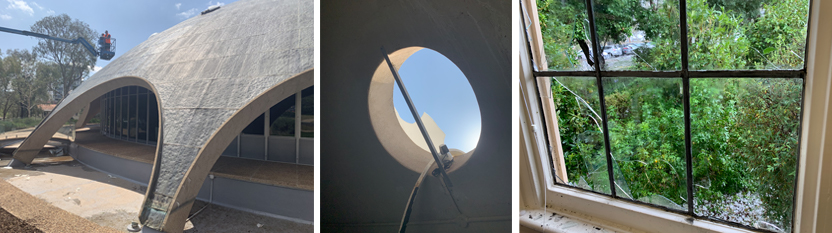
“The Academy is the only place in the world that holds these scientific collections and we continue to receive strong global interest to access the archives, with historians and researchers regularly visiting Canberra to access them.
“The Academy has been fundraising to have the archives digitised but we have not yet met our target of at least $10 million to achieve this,” Ms Arabia said.
Donate to support digitisation of the archives
The Australian Academy of Science’s historic Ian Potter House, where staff are based, also suffered extensive damage, with dozens of windows smashed, rendering the building unsafe for staff for the immediate future. Ian Potter House was placed on the ACT Heritage Register in 1998.
The vehicles of 34 staff were also severely damaged by the hailstorm and were unable to be driven home.
Statement regarding Australian bushfires
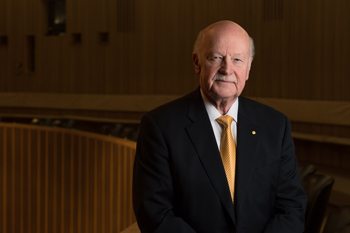
Academy President Professor John Shine
The Australian Academy of Science acknowledges the devastating impact the Australian bushfires are having—and will continue to have—on people, our environment and our economy.
The scale of these bushfires is unprecedented anywhere in the world.
The Academy extends its support and sympathy to all those who have lost loved ones and whose lives are directly and indirectly impacted. We thank the many volunteers, individuals, leaders and foreign nations for their efforts and contributions.
As an independent and authoritative scientific adviser to the parliament and to the nation, the Academy draws on the scientific expertise of Australia’s leading scientists—the Fellows of the Academy.
The scientific evidence base shows that as the world warms due to human induced climate change, we experience an increase in the frequency and severity of extreme weather events.
As a nation, we must deal with extreme weather events more effectively than we currently do. As such events become more frequent and severe, we must adapt Australia and Australians accordingly, as well as strengthen mitigation efforts.
Bushfires, along with other weather and climate challenges, pose complex and wide-ranging problems. Population growth, climate change, temperature extremes, droughts, storms, wind and floods are intersecting in ways that are difficult to untangle and address.
The good news is that there is already abundant evidence available to help us understand the environment we live in and to design and build the future we want for Australia. There has never been a more important time to draw on that scientific evidence base to help guide Australia’s short- and long-term responses to the devastating bushfires ravaging our nation and that are causing uncertainty about our future.
The Academy’s Fellows are contributing and will continue to contribute their scientific expertise to government and other decision makers in the interest of advancing our nation.
The Academy is resolute that the response to the bushfires must extend beyond the immediate and essential need to rebuild and recover.
Everything, including urban planning; building standards; habitat restoration; biodiversity and species preservation; and land, water and wildlife management will need careful and measured consideration.
We must further improve our ability to forecast changing environmental threats and continually improve climate modelling predictions. We must improve our understanding of fire behaviour and other adverse weather events, and we must continually develop new technologies, practices and behaviours to assist our nation to respond and adapt to, manage, and mitigate against such extreme events.
All the while, Australia must take stronger action as its part of the worldwide commitment to limit global warming to 1.5° C above the long-term average to reduce the worst impacts of climate change.
To have the best chance of succeeding, we must draw on all the available evidence and knowledge, including working with Aboriginal and Torres Strait Islander peoples and undertaking further research where it will have the most benefit.
The Academy is aware that Australians are looking for trustworthy information and answers about the links between climate change and the bushfires. With much misinformation in the public domain about the cause and impacts of the bushfires, we urge Australians to continue to consult reputable sources of evidence-based information such as the Australian Academy of Science, CSIRO and the Bureau of Meteorology.
In this context, visits to the Academy's website are up 30 per cent compared to the same period last year, and the top visited page is What is Climate Change? Viewing and sharing of the Academy’s video series on this matter published across social media platforms are rapidly rising.
Professor John Shine AC PresAA
President
Australian Academy of Science.
2272 women and an abundance of opportunity
Australian women in STEM are now more visible than ever with 2272 women joining STEM Women in the past five months. Many are now using the new resource to showcase the depth of talent of those working in the field.
The database was developed by the Australian Academy of Science in partnership with the CSIRO, Science & Technology Australia, and the Australian Science Media Centre, with financial support from the Australian Government.
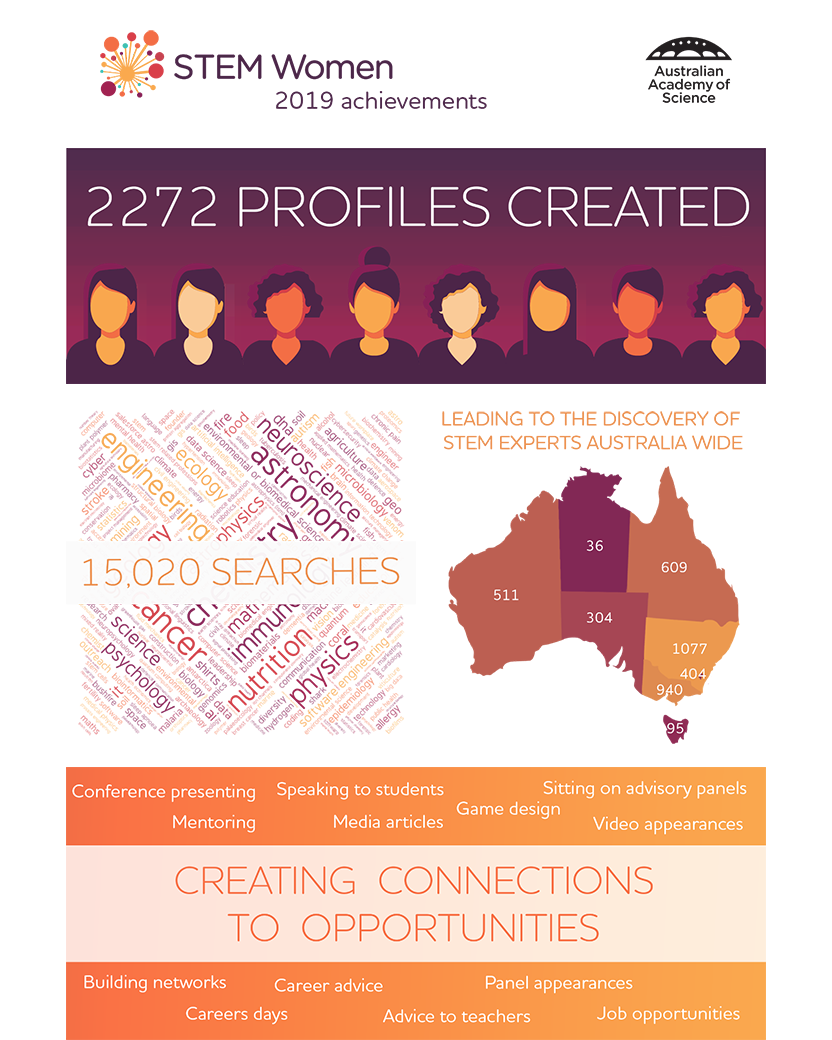
Users of the database can search for women in STEM based on their expertise, location and other search fields. Freelance science journalist Bianca Nogrady was one of the first to use the database. She contacted Professor Jenny Pringle for her article on the future of battery technology for environmental magazine, Enisa.
The 2019 Women for Media Report found women only appear as a source for news or provide expert comment in the media 24% of the time. With other journalists welcoming the database on Twitter, STEM Women is positioned as a powerful tool to help increase the visibility of STEM women in the media.
STEM Women is also designed to become a key resource for conference and event organisers across Australia. Thanks to STEM Women, the National Computational Infrastructure (NCI) delivered an all women plenary session at the Australasian Leadership Computing Symposium.
Insights into STEM careers
STEM Women has also become a go-to for teachers looking to offer their students real life insights into STEM careers. Teacher Deanna Cammisotto of Prospect Primary School used the database to organise a visit by Kaitlyn Bayly from Accenture, so her students could discover what a career in technology looks like.
ACT teacher Ryan Elwell’s searched ‘geology’ on STEM Women. He discovered Stephanie McLennan and offered her the opportunity to share with students how science and mathematics skills can be turned into a successful and exciting career.
The database also allows users to find a mentor or search for expert insight. Seven early career women have gained great advice and insight into a variety of STEM careers from clinical trials to cyber security. Co-founder of Little Literature Co, Annabel Blake discovered a number of space experts whose research will help shape a set of STEM storytelling games and workshops.
Manager of Diversity and Inclusion at the Australian Academy of Science, Ms Louise Moes, said the opportunities available through STEM Women are endless.
“More than 15,000 searches have occurred on STEM Women with ‘chemistry’ and ‘engineering’ some of the most searched terms,” Ms Moes said.
“We’re also seeing a gradual increase in the number of users as they use the database to discover what is happening across the STEM ecosystem and to find opportunities to collaborate and gain knowledge.”
To find out more about gender equity in STEM actions and initiatives register for the Catalysing Gender Equity 2020 Conference.
Marine researchers receive Max Day Awards
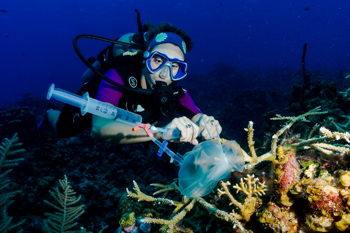
Dr Emma Camp from the University of Technology Sydney is one of the recipients of the 2020 Max Day Environmental Science Fellowship Award. Photo: Rolex/Franck Gazzola.
A new study on the Great Barrier Reef assessing how the elemental signatures of coral reefs can signal stress from pollution will be carried out by one of the recipients of the Australian Academy of Science’s 2020 Max Day Environmental Science Fellowship Award.
Dr Emma Camp will conduct her research at the University of Technology Sydney using samples of three different coral species that will be subjected to conditions mimicking polluted and non-polluted reef environments.
Dr Camp will use the award to investigate the elemental signatures of corals and how changes in these signatures might be diagnostic of environmental pollution on the Great Barrier Reef. An elemental signature is the unique proportion and concentration of elements in an organism or object and can change as the environment changes.
“This project will explore how the elemental signatures of each part of the coral responds to environmental change with the aim of identifying unique stress signatures in corals”, Dr Camp said.
“The project will enhance our understanding of biogeochemical cycling across coral environments, and how this influences coral traits and the associated costs of survival, thereby revealing the processes that govern coral reef resilience.”
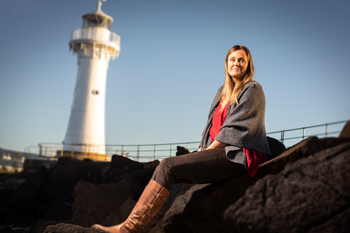
Ms Allison Broad, a PhD candidate from the University of Wollongong, received the 2020 Max Day award.
The other recipient of the 2020 award is PhD student Ms Allison Broad from the University of Wollongong. Ms Broad will study the impacts of anchor scour on the seafloor near Wollongong.
Seabed environments are the foundations for biodiversity in the marine domain and are at risk of damage from the heavy anchors and chains used by shipping vessels.
For Ms Broad’s research, specific study sites within a rocky reef habitat will be identified and assessed using remotely operated vehicles and underwater video. Assessments will be done both before and after an anchoring event by a large merchant ship (greater than 200 m in overall length) to monitor and quantify both the disturbance from anchor drop, drag and chain scour and the recovery of invertebrates, algal forests and fish assemblages.
“With the rise of the Blue Economy, it is vital that we identify how marine industries may be interacting with these seabed environments and that we manage them sustainably wherever possible,” Ms Broad said.
The award provides up to $20,000 for early-career researchers working on the conservation of Australia’s flora and fauna, the ecologically sustainable use of resources and the protection of the environment and ecosystem services.
It is named in honour of Academy Fellow, the late Dr Maxwell Frank Cooper Day AO FAA, who spent a lifetime championing entomology, conservation and forestry, as well as helping other scientists.
Four researchers were also ‘highly commended’ for the Max Day Environmental Science Fellowship Award:
- Dr Catherine Price from the University of Sydney for her project: When it takes one bite: deceiving herbivores to protect rare and threatened orchids;
- Ms Emily Scicluna from La Trobe University for her project: Using personality and cognitive assessment of individuals as a conservation tool for improving reintroduction/translocation success;
- Ms Georgia Sinclair from RMIT University for her project: Developing biomarkers of environmental exposure to poly- and perfluoroalkyl substances to improve environmental policy and health; and
- Dr Tatiana Soares da Costa from La Trobe University for her project: Fighting herbicide resistance with vitamin deprivation.
More information about the Max Day Environmental Science Fellowship Award
Academy Fellows recommend books and podcasts to enjoy this summer
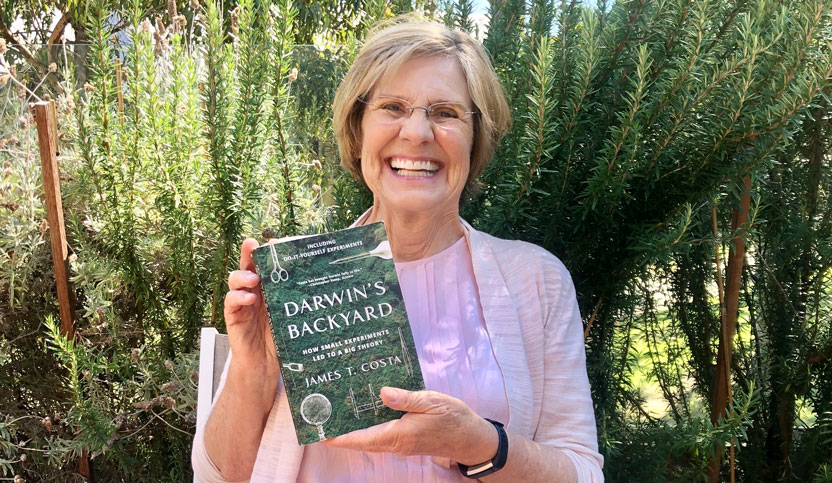
What are the biggest questions facing humanity? What are the secrets and motivations behind Darwin’s scientific journey? How might a small Australian country town react to a terrible crime event? These questions, and many more, are tackled in the Annual Fellows’ Christmas book and podcast list 2019.
As we have for the past four years, we asked our Fellows to provide their top book suggestions for the year—and this time we’ve included a few podcasts in the list too.
Of the 51 recommendations, there is sure to be something of interest for everyone. Many of the books are of a scientific bent, but they range from new release fiction and classic pieces of literature to biographies and other non-fiction.
Some are inspirational, some are eye-opening, thought-provoking or nostalgic, and others are purely great entertainment.
- See the Fellows' book and podcast list
To inject more wit, wisdom and wonder into your summer holidays, following is a sample of the 2019 list contributed by some of Australia’s most outstanding minds.
Books
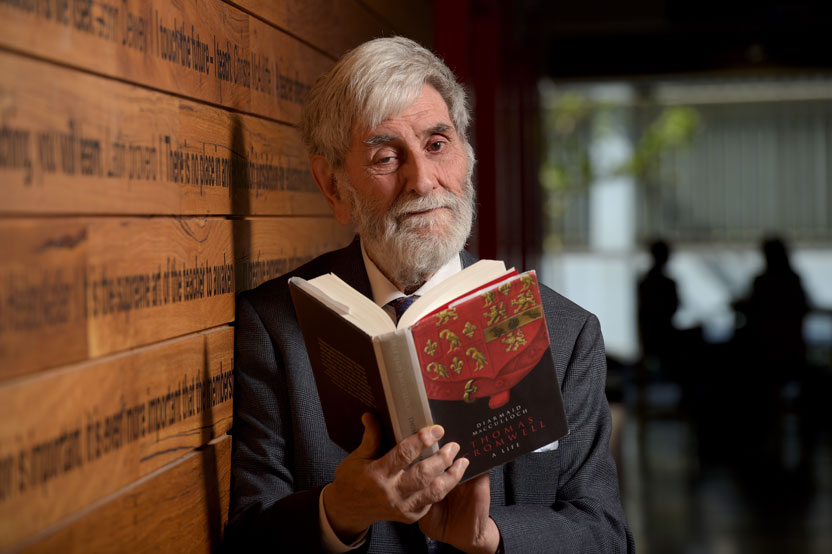
Thomas Cromwell: A Life, by Diarmaid MacCulloch
Recommended by Professor The Honourable Barry Jones AC FAA FTSE
MacCulloch is Professor of Church History at Oxford, author of The History of Christianity and an accomplished television presenter. Hillary Mantel who knows a thing or two about Thomas Cromwell writes ‘this is the biography we have been waiting for for 400 years’. MacCulloch’s scholarship, analytical and narrative gifts are outstanding and—despite the grim outcome for Cromwell and so many major characters—often amusing, even hilarious. I read it twice, first very fast, then slowly to savour every line. Don’t miss it.
Darwin's Backyard: How Small Experiments Led to a Big Theory, by James T. Costa
Recommended by Professor Lyn Beazley AO FAA FTSE
This book is a truly engaging journey from Darwin’s childhood through to Down House, his bustling home of forty years, where he kept porcupine quills at his desk to dissect barnacles, maintained a flock of sixteen pigeon breeds in the dovecote, and cultivated climbing and carnivorous plants in the study. He was truly the first ‘community scientist’, engaging naturalists, friends, neighbours, family servants, and even family as assistants in his experiments. It was from the results of these experiments that he plumbed the laws of nature and evidence for the revolutionary arguments of On the Origin of Species and his other watershed works.
The Overstory, by Richard Powers
Recommended by Professor David Celermajer AO FAA
This powerful book is about the importance of trees to the planet but is so much more than this; beautiful literature, stunning insights into what motivates humans to join a cause and some wonderful science about botany. Of the stories describing the several main characters in Part One of the book, the (partly fact-based) story of the shy but committed scientist who discovers the way that trees communicate with each other and finds love despite her isolation is one of the most splendid short stories you will ever read.
Also recommended by Professor Ian Dance FAA
Winner of the Pulitzer Prize in Fiction 2019. A collection of interlocking fables, with a central theme of trees. A fact-filled panegyric for old-growth forests in the US, and stories about those who want to preserve them.
Also recommended by Professor John Evans FAA
A weird mix of stories about trees and how humans fail to comprehend what trees achieve because our lives operate at completely different speeds.
Scrublands, by Chris Hammer
Recommended by Professor Roger Tanner FAA
Set in a fictional Riverina town at the height of a devastating drought, Scrublands is one of the most powerful, compelling and original crime novels to be written in Australia. In an isolated country town brought to its knees by endless drought, a charismatic and dedicated young priest calmly opens fire on his congregation, killing five parishioners before being shot dead himself.
The Best Australian Science Writing 2019, edited by Bianca Nogrady
Recommended by Professor Helene Marsh FAA FTSE
Thought-provoking stories, essays and poetry by Australian scientists and science writers. Topics range from astronomy to disease but concerns about the impacts of climate change dominate the book.
Podcast
Bedside Rounds, hosted by Adam Rodman MD
Recommended by Emeritus Professor Neville Nicholls FAA
Bedside Rounds is an engaging and well-researched monthly podcast on the development of modern medicine, told from a historical perspective. Recent episodes have discussed anaesthesia, syphilis, and smoking and lung cancer. The overarching focus is on epistemology—how we know.
Researcher who uncovered the sex life of marsupials awarded Academy’s most prestigious medal
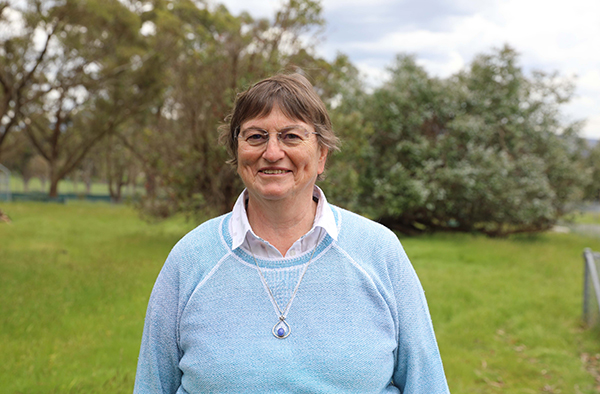
A scientist whose research has transformed our understanding of Australia’s iconic mammals has been recognised by the Australian Academy of Science. Professor Marilyn Renfree AO FAA has been awarded the Academy’s highest honour in the biological sciences—the Macfarlane Burnet Medal and Lecture.
For half a century the committed reproductive and developmental biologist and conservationist from the University of Melbourne has been using the tammar wallaby, a small macropodid marsupial native to South and Western Australia, to study their reproduction and development.
Professor Renfree has developed contraceptive strategies for kangaroos and koalas and established marsupials as unique biomedical models for understanding human reproduction.
World authority
She is now a world authority on marsupial reproduction and development and has pioneered research on some of Australia’s most iconic creatures including kangaroos, koalas and now echidnas.
And with passion for her work as strong as ever, she has no plans of slowing down. Professor Renfree has just embarked on the world’s first study of the development of the embryo and newly hatched pouch young from the echidna.
Professor Renfree said hardly anything was known about marsupials when she started out.
“I’m passionately Australian and I really wanted to work on something Australian but when I started honours I said to my prospective supervisors: ‘I wanted to do biochemistry and fieldwork.’ And they laughed at me. Well, I’m still really doing biochemistry and fieldwork.”
Her first paper published from her PhD in 1972 was a Nature publication.
In her distinguished career Professor Renfree has made numerous research breakthroughs. In research with colleagues Professor Renfree conducted the first genome sequencing of an Australian marsupial, the tammar wallaby, providing new information on their evolution.
She also showed that certain genes directly control sexual development during pregnancy and even after birth in marsupials, providing a new understanding of the relative influence of genes versus hormones in sexual differentiation in all mammals. With colleagues she also discovered a new hormone pathway that explains some human disorders of sexual development.
A biological goldmine
Professor Renfree said Australia is sitting on a biological goldmine because it is home to a unique assembly of mammals—the marsupials and monotremes.
“The impact of Australia’s recent bushfires on Australian mammals has highlighted Australia and the world’s fascination with these special animals. We really need to put more effort, time and money into conserving and doing research on them,” Professor Renfree said.
“Australia has the distinction of having the worst record of mammal extinctions of any developed country and that’s not a record you want to be proud of.”
Professor Renfree said the Academy award is a huge honour.
“I’m receiving it on behalf of all of my students, PhD students and postdocs and collaborators. Without them I could have only done a fraction of what I've done,” Professor Renfree said.
She was nominated for the medal by Professor James Angus FAA from the University of Melbourne.
“Professor Renfree is a pioneer and forward thinker who has an ability to excite and inspire scientists from around the world by providing new insights through the study of the unique evolutionary innovations in the reproductive systems of marsupials and monotremes,” Professor Angus said.
“The basic science and the clinical impact of her work for humans are as important as the direct benefits of her work for Australia’s marsupials. Her research has undoubtedly opened the eyes of the academic world and beyond to the value of these iconic Australian mammals both for their intrinsic interest and as unique biomedical models.”
Professor Renfree will receive the medal and give a lecture at the Academy’s Science at the Shine Dome event in May 2020. The Macfarlane Burnet Medal and Lecture honours the contributions to science by Sir MacFarlane Burnet OM KB MD FAA FRS Nobel Laureate.