




Academy applauds funding to boost gender equity in STEM


Fifteen Australian institutions in the SAGE program were recognised last December for their efforts to improve gender equity. More about SAGE
The Australian Academy of Science has applauded the announcement by the Morrison Government to invest $3.4 million to improve science, technology, engineering and maths (STEM) equity in Australia and boost the participation of girls and women in STEM careers.
Academy President Professor John Shine said the $1.8 million commitment to extend the Science in Australia Gender Equity (SAGE)—a partnership between the Australian Academy of Science and the Australian Academy of Technology and Engineering—was particularly significant.
“SAGE is the only transformative gender equity program of its kind in Australia designed to achieve sustained change via ongoing evaluation and a national accreditation framework,” Professor Shine said.
SAGE was set up to pilot the UK’s Athena SWAN Charter and accreditation framework in Australia. Fifteen Australian institutions were recognised for their efforts to improve gender equity, receiving the inaugural Athena SWAN Bronze Awards from SAGE in December last year.
“Australia has taken a leadership role by piloting the Athena SWAN Charter program, with countries such as Canada and the United States now following our example,” Professor Shine said.
The Australian Government’s continued support of the SAGE pilot positions Australia well and represents a strategic and forward-thinking investment that will allow the successful pilot to have greater reach and impact.
“The Academy called for a stronger commitment to equity in science as one of its key priorities for the upcoming Federal election, recognising the positive and sustained impact of SAGE,” Professor Shine said.
“Minister Andrews’ bold vision to have all eligible Australian research institutions being SAGE members and demonstrating their commitment to gender equity is commendable and achievable.”
The Academy also welcomes funding for a national digital awareness raising initiative to be supported by Australia’s Women in STEM Ambassador, Professor Lisa Harvey-Smith.
“Efforts to improve the visibility of girls and women in STEM and showcase the diverse career opportunities available by studying STEM are critically important,” Professor Shine said.
“In making these announcements, Minister Andrews has recognised that supporting women’s participation in STEM has a positive economic impact.”
“Australia needs access to all its available talent regardless of who or where they are, and we must ensure everyone takes action through the Women in STEM Decadal Plan,” Professor Shine said.
The plan was developed by the Academy of Science in partnership with the Australian Academy of Technology and Engineering. It will be launched on Monday evening, 1 April at Parliament House by the Minister for Industry, Science and Technology, Karen Andrews.
It will identify opportunities to bring about the systemic changes required to achieve gender equity in STEM and will call on leaders across the STEM ecosystem to drive action to achieve this.
Two new Corresponding Members admitted to the Academy
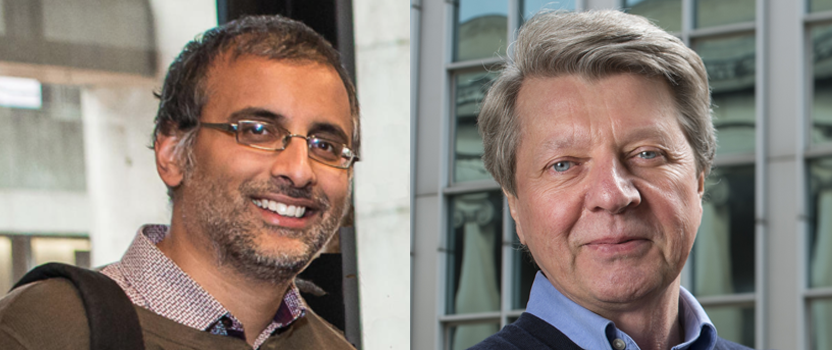
Professor Akshay Venkatesh and Professor Krzysztof Matyjaszewski, both based in the United States, have been admitted to the Australian Academy of Science for outstanding scientific contributions.
Professor Venkatesh is an Australian mathematician currently based at the Institute of Advanced Study, Princeton. His work uses number theory—the branch of mathematics that deals with the properties and relationships of numbers—as a ‘lens’ to approach a range of fields including homogeneous dynamics, arithmetic geometry and representation theory.
According to Professor Venkatesh’s citation, “He has solved many long-standing problems by combining methods from seemingly unrelated areas, presented novel viewpoints on classical problems, and produced strikingly far-reaching conjectures.”
In 2018, Professor Venkatesh won the Fields Medal—the most prestigious international award in mathematics awarded once every four years to researchers under 40.
Professor Krzysztof Matyjaszewski is a world-leading chemist at Carnegie Mellon University. His fundamental contributions have changed the face of free radical chemistry and polymer science.
In 1994, Professor Matyjaszewski invented a method of polymerisation—a chemical reaction to produce long chain-like molecules—using a copper catalyst. Called atom transfer radical polymerisation (ATRP), Professor Matyjaszewski’s method has spawned a prolific area of research and several industry developments, including the commercial production of specialty materials.
Corresponding Members of the Academy are eminent scientists not resident in Australia. They are elected based on scientific excellence, with consideration given to their connection to Australian science.
The Australian Academy of Science will announce the election of 22 distinguished Australian scientists as New Fellows, to mark the start of Science at the Shine Dome, on 28 May 2019.
Academy President urges Australia to join heritable genome editing moratorium
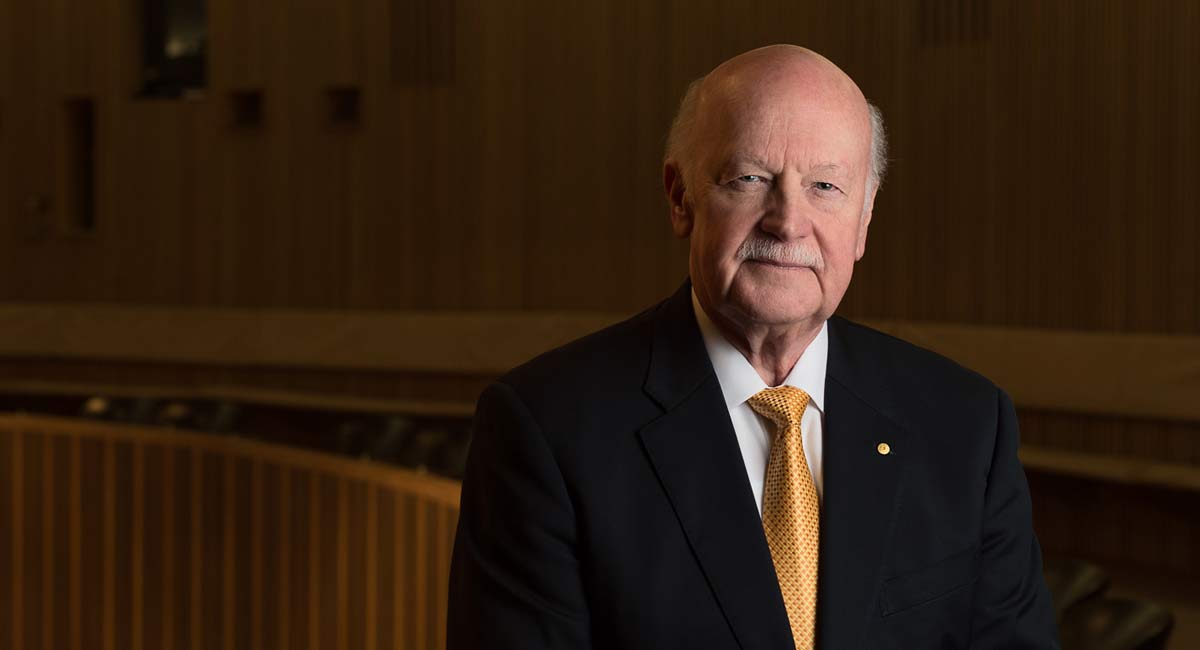
Australian Academy of Science President Professor John Shine AC FAA
The President of the Australian Academy of Science Professor John Shine AC FAA has welcomed calls for a global moratorium on all clinical uses of genetic editing of heritable human DNA.
The proposal was made by a group of eminent scientists in the journal Nature as a way of ensuring controlled development of new gene editing technology. It follows claims revealed last year that a scientist in China edited the DNA of early embryos in treatments that resulted in the birth of twins with an altered genome.
Professor Shine said that germline editing of human DNA (changing the genetic code in a way that could be inherited by future generations) has the potential to deliver revolutionary new treatments for a number of genetic diseases. However, it has not been tested in humans or shown to be safe.
“The Australian Academy of Science believes it is a matter of urgency that Australia joins other nations in considering these important issues and implementing a moratorium on heritable human gene editing in Australian universities, Medical Research Institutes, clinics and hospitals,” Professor Shine said.
Germline editing of human embryos for reproductive purposes is prohibited in Australia.
“We urge the National Health and Medical Research Council, which has responsibility for oversight of the relevant legislation, to implement a moratorium on considering legislative change to allow heritable human gene editing for reproductive purposes in Australian Universities, Institutes, clinics and hospitals,” Professor Shine said.
“Neither the scientific nor the wider community has had the opportunity to discuss the technical, scientific, medical, societal, legal and ethical issues that must be considered before any possible clinical or therapeutic use of such technologies in humans.”
To begin this consultative process, the Academy will convene a meeting of relevant stakeholders to begin discussions on the implications of possible uses of human germline gene editing and to discuss implementation of a moratorium in Australia.
S20 urges measures to tackle marine plastic pollution and other major threats
The world’s leading science academies have sent a strong message to the world that science has a crucial role in protecting coastal and marine ecosystems from very serious current and future threats.
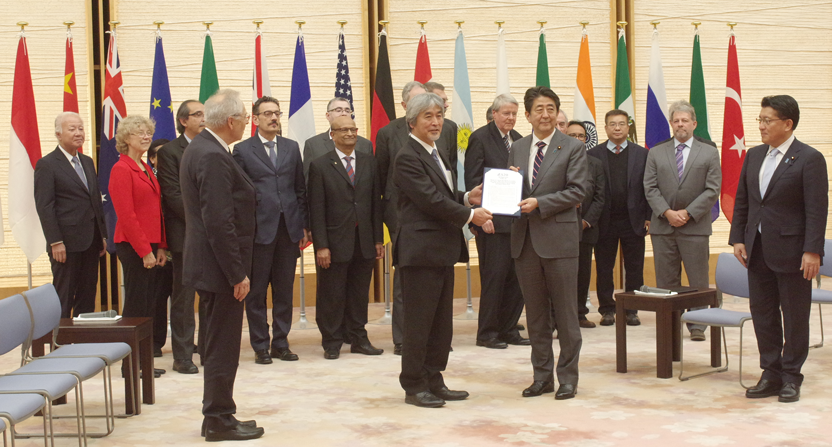
The national academies of the world’s wealthiest countries, known as the S20, produced a statement at a gathering in Japan recently outlining the greatest dangers to marine environments: plastic debris and other pollution, damaging fishing practices, and global warming, ocean acidification and ocean deoxygenation.
The statement emphasised the importance of expert research, innovation and evidence-based approaches toward resolving undesirable impacts on marine environments and ocean health that are directly linked to ecosystems and human wellbeing. It also encouraged increased recycling and energy efficient practices, as well as global collaborations at all levels with science-based target setting and follow ups to reduce stressors on coastal and marine ecosystems.
Academy Fellow Emeritus Professor Cheryl Praeger represented the Australian Academy of Science at the event, and coral reef expert Academy Fellow Professor Terry Hughes provided advice to the statement.
The statement, ‘Threats to Coastal and Marine Ecosystems and Conservation of the Ocean Environment—with Special Attention to Climate Change and Marine Plastic Waste’, was submitted to Japan’s Prime Minister Shinzo Abe.
This was the first time the S20 was held in Asia and comes ahead of the major G20 summit to be held in June in Japan.
The 2020 S20 and G20 meetings will take place in Saudi Arabia.
Fellows awarded ARC Linkage Project grants
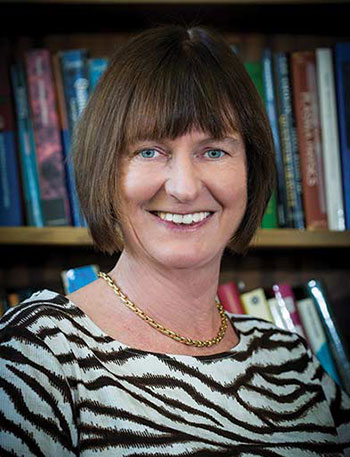
Professor Susan Scott FAA is one of five Fellows to receive ARC Linkage Projects scheme funding.
Five Fellows of the Australian Academy of Science are among the recipients of the Australian Research Council’s Linkage Projects scheme, announced by the Minister for Education Dan Tehan.
The funding for research partnerships includes:
$898,560 for the University of Western Australia to lead an international project that will test and review the success of teaching Einstein’s theories of space, time, matter, light and gravity. The research will be led by Chief Investigator Emeritus Professor David Blair FAA, Professor Susan Scott FAA and collaborators.
$440,000 for the University of Melbourne to advance the understanding of turbulent heat transfer, to allow more reliable, efficient and durable designs for energy generation. The research will be led by Chief Investigator Professor Richard Sandberg, Professor Ivan Marusic FAA and collaborators.
$430,000 for the University of Melbourne to establish the capability to manufacture application-specific semiconductor lasers. The project will use existing facilities in Australia to enhance Australia’s quantum science research and establish a viable export-dominated high-tech manufacturing business. The research will be led by Chief Investigator Professor Robert Scholten, Professor Chennupati Jagadish FAA and collaborators.
$460,000 for the Australian National University to improve the management of Australia's threatened mammals. Using new genomics methods, the project will measure the effects of small population size on genetic diversity and mutation load, in extinct as well as remnant and translocated populations. The research will be led by Chief Investigator Professor Craig Moritz FAA and collaborators.
Nominations open for Academy’s 2020 awards

2019 Moran Medal recipient, Dr Kim-Anh Lê Cao
Nominations are now open for the Academy’s 2020 honorific awards, research conferences, research awards and travelling fellowships.
These awards and funding opportunities shine a light on researchers who have made outstanding contributions to science and help to progress the advancement of science in Australia.
The awards recognise remarkable achievements in research fields including Earth sciences, biology, physics, mathematics, chemistry, global health, genetics and more.
The Academy is committed to celebrating and supporting diversity. It is seeking nominations of outstanding scientists from all career stages, backgrounds and genders, and strongly encourages more nominations of women for all awards, in particular the career and mid-career honorific awards.
In the 2019 honorific award round announced recently, the Academy recognised scientists’ discoveries across the breadth of research—from how oceanic circulation impacts the climate to pioneering biotechnological methods for sequencing crop genomes.
Dr Kim-Anh Lê Cao from the University of Melbourne was awarded the 2019 Moran Medal for her work in developing novel statistical and computational methods for biological data analysis.
‘Science informs everything we know about all the world. Trying to answer very fundamental questions about how the world is shaping our planet, I think is really what drives me.’ she said.
The closing date for honorific award nominations is 1 May 2019. The closing date to apply for research conferences, research awards and travelling fellowships is 1 June 2019.
Vale Dr Margaret Middleton—a pillar of science and the Academy
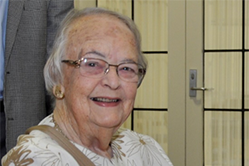
Dr Margaret Middleton on a visit to the Academy in 2014.
10 April 1928 – 2 March 2019
Dr Margaret Middleton, a committed supporter of young researchers, has died aged at the age of 90.
Dr Middleton had a long and distinguished relationship with the Academy. She became a patron of the Foundation for Science in 1992 and had an active scientific mind throughout her life—not only as an observer on the award in her name but also participating in and leading discussions responding to Colin Butler’s 2003 report on Population and Environment in Australia, joining forces on that occasion with another Academy award patron, Dr William H Gladstones.
In 1997, in consultation with Dr Middleton, plans were laid to establish the the Margaret Middleton Fund for endangered Australian native vertebrate animals. The fund offers annual science grants of up to $15,000 each to support field-based, high-quality ecological research. The objective of the grant is to provide financial support for conservation-based research of Australian ecosystems that ultimately will lead to tangible outcomes for management.
Dr Middleton worked closely with the award selection committee over the following years and read every detail in the applications. Her generous and longstanding contributions have funded 82 research projects since 2000, many of which would most likely not otherwise have been undertaken.
Research projects have ranged from investigations into vaccines against chlamydia infection in koalas, to studies confirming selective plastic ingestion by sea turtles and the disproportional ingestion of balloons, which supported the hypothesis that they ingest debris that resemble natural prey items such as jellyfish.
In 2019 the Academy awarded the Margaret Middleton Award to:
- Ms Rebecca Jane Webb, James Cook University: A novel conservation tool for controlling chytridiomycosis in Australian amphibians.
- Dr Teigan Cremona, Charles Darwin University: Can predator enclosures support recovery of small mammal populations in Kakadu National Park?
- Ms Heather Neilly, Australian Landscape Trust: Malleefowl as ecosystem engineers and drivers of restoration.
Margaret Middleton surrounded herself with an eclectic group of friends. Each and every one could tell stories about their time with Margaret and the keen mind that delighted and challenged the unwary.
The following is a memory of Margaret that I shall never forget. We were sitting in her lounge room one afternoon and got into a discussion of my involvement assisting to organise an International Wildlife Disease meeting held in Maroochydore in July 2015. I was telling her about our traditional silent auction to raise funds to support students. When she learned that my home-made crab apple and quince jellies went for $200/ jar at the auction she asked whether I had any left and if so, she’d like to try some, and support students doing wildlife disease studies. I said I’d bring a jar of each on my next visit. With that she walked into her study, came out with a cheque book and wrote a cheque to the WDA Australasian Section for $5000!! Needless to say, I was stunned! That was Margaret, a most generous individual offering support to students and their wildlife studies.Dr David Spratt at CSIRO
Margaret was a dedicated supporter of science at the Academy and a shrewd investor in its outcomes. We shall miss her wise counsel, and remember her great generosity with gratitude.Professor Andrew Holmes • Immediate past President at Australian Academy of Science
Published 11 March 2019
Top young physicists to attend Lindau Nobel Laureate Meeting
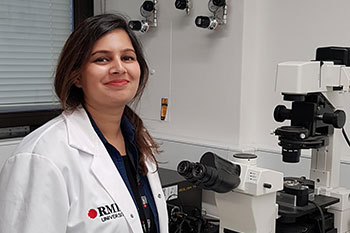
Hareem Khan—one of the ten young Australian physicists attending the Lindau Nobel Laureate Meeting.
Ten of Australia’s top young physicists, seven of them women, have earned the opportunity to attend a highly prestigious annual gathering of Nobel Laureates and emerging scientists from around the world.
The 69th Lindau Nobel Laureate Meeting in Germany will see a record 42 Nobel Prize winners—including Academy Fellow Professor Brian Schmidt—joining the young scientists at the event.
The Australian PhD candidates and postdoctoral researchers attending are:
- Dr Katie Sizeland—Postdoctoral Fellow, ANSTO, who is investigating the nanostructure and mechanical properties of collagen
- Fiona Panther—PhD Candidate, Australian National University, who is researching antimatter in the Milky Way
- Eliezer Estrecho—PhD Candidate, ARC Centre of Excellence in Future Low-Energy Electronics Technologies, who studies exciton-polariton Bose-Einstein condensates
- Dr Matthew Reeves—Postdoctoral Fellow, ARC Centre of Excellence in Future Low-Energy Electronics Technologies, who is investigating superfluid turbulence and vortex dynamics
- Dr Nora Tischler—Postdoctoral Fellow, Griffith University, who works in quantum optics and nanophotonics
- Melanie Hampel—PhD Candidate, Monash University, who works in nuclear astrophysics
- Dr Sarah Walden—Postdoctoral Fellow, Queensland University of Technology, who studies nonlinear optics and material interactions
- Hareem Khan—PhD Candidate, RMIT, who works in electrical and electronics engineering of 2D materials
- Claire Edmunds—PhD Candidate, University of Sydney, who is researching quantum computing and information
- Samuel Hinton—PhD Candidate, University of Queensland, who is researching dark matter by studying supernovae.
These researchers were nominated by the Academy and selected by the Council for the Lindau Nobel Laureate Meetings. They will receive a grant to enable their attendance at the event, that runs from 30 June to 5 July 2019, through the generous support of the Science and Industry Endowment Fund (SIEF).
The group will also take part in the SIEF Research Innovation Tour in Germany, led by renowned Australian scientist and Academy Fellow, Professor Chennupati Jagadish. The tour will showcase some of Germany’s finest research and development, while also providing opportunities to share the research done by the young scientists and encourage scientific collaboration between the two countries.
Bright stars of Australian science recognised with Academy Awards
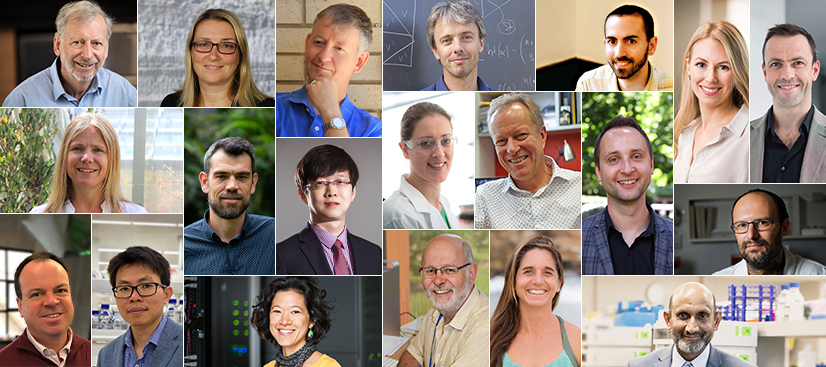
Twenty of Australia’s leading scientists and future superstars have received the Academy’s prestigious 2019 honorific awards.
Outstanding contributions to science have been recognised by the Australian Academy of Science today with 20 of Australia’s leading scientists and future superstars receiving prestigious 2019 honorific awards.
The scientists’ discoveries cross the breadth of research from how oceanic circulation impacts the climate, to the use of tools that advance the understanding of the chemistry within cells and how the body’s immune defences combat infectious disease.
Distinguished Professor Chennupati Jagadish AC FAA from the Australian National University has been awarded one of the Academy’s top honours, the Thomas Ranken Lyle Medal. He helped develop semi-conductors used in LED lights. He also designed and developed some of the world’s smallest lasers. Born in India, Professor Jagadish grew up without electricity.
“I didn’t have much light as a child and studied in front of a kerosene lamp until Year 7. That’s why I’m interested in developing technologies that will benefit humanity,” Professor Jagadish said.
Protecting crops from disease is essential for our food sources. Mid-career researcher Professor Jaqueline Batley from The University of Western Australia is studying the DNA of plants to better understand genes that lead to greater crop resilience. Her research has helped increase crop yields for canola, broccoli, cabbage and wheat. A role model for women in STEM, Professor Batley is the recipient of the Nancy Millis Medal for Women in Science.
Early-career researcher Associate Professor Anna Giacomini from the University of Newcastle has pioneered research in rock mechanics and rockfall analysis in civil and mining engineering. Her research has resulted in the design of new low-energy rockfall barriers that are now used extensively along our major corridors in Australia. Associate Professor Giancomini is one of two recipients of the John Booker Medal.
President of the Australian Academy of Science, Professor John Shine, congratulated all the award winners for their inspiring research.
“These awards highlight just some of the important and distinguished research being led by Australian scientists, who seek to address some of society’s biggest challenges. Recognising and highlighting outstanding scientific contributions is important, as award recipients are the STEM role models for the next generation,” Professor Shine said.
The Academy’s 2019 honorific awards go to:
Career honorifics (for lifelong achievement)
- David Craig Medal—Professor Peter Gill FAA, Australian National University
- Hannan Medal—Professor Alan Welsh FAA, Australian National University
- Jaeger Medal—Professor Dietmar Müller FAA, University of Sydney
- Thomas Ranken Lyle Medal—Professor Chennupati Jagadish AC FAA, Australian National University
- Matthew Flinders Medal and Lecture—Dr Richard Manchester FAA, CSIRO Australia Telescope National Facility (previously announced)
Mid-career honorifics (8–15 years post-PhD)
- Jacques Miller Medal for experimental biomedicine—Professor Nicholas David Huntington, Walter and Eliza Hall Institute of Medical Research and Monash University
- Nancy Millis Medal for Women in Science—Professor Jacqueline Batley, The University of Western Australia
Early-career honorifics (up to 10 years post-PhD)
- Anton Hales Medal—Professor Isaac Santos, Southern Cross University
- Christopher Heyde Medal—Professor Geordie Williamson FAA FRS, University of Sydney
- Dorothy Hill Medal—Dr Laurie Menviel, UNSW Sydney
- Fenner Medal—Dr Daniel Falster, UNSW Sydney
- Gottschalk Medal—Associate Professor Laura Mackay, Doherty Institute
- John Booker Medal
- Professor Changbin Yu, Australian National University and Westlake University (China)
- Associate Professor Anna Giacomini, University of Newcastle
- Le Fèvre Medal
- Associate Professor Elizabeth New, University of Sydney
- Dr Lars Goerigk, University of Melbourne
- Moran Medal
- Dr Kim-Anh Lê Cao, University of Melbourne
- Associate Professor Stephen Leslie, University of Melbourne
- Pawsey Medal—Professor Steven Flammia, University of Sydney
- Ruth Stephens Gani Medal—Dr Justin Wong, Centenary Institute of Cancer Medicine and Cell Biology
The majority of the honorific awards will be presented at the Academy’s annual celebration of science, Science at the Shine Dome on 30 May 2019. Read more about the Academy’s 2019 honorific awardees.
Know an amazing Australian scientist? Nominate them for an award. Nominations and applications are now open for the 2020 Australian Academy of Science honorific awards, research conferences, research awards and travelling fellowships.
Academy expert panel responds to findings of fish deaths assessment
The Independent Assessment of Fish Deaths interim report released by Minister David Littleproud today is a welcome contribution to the growing evidence base to help inform action to improve the health of Australia’s rivers.
The fish kill is a multifactorial issue and it is in the national interest to ensure all the available knowledge is brought to bear in assessing this concerning situation and finding appropriate solutions.
Decisions to maintain and improve Australia’s river system based on the best available science is something all Australians want to see.
The expert panel of multidisciplinary experts, convened by the Australian Academy of Science, notes that the interim report reaches similar conclusions to the expert panel’s report released earlier this week regarding declining flows.
“We note that while the terms of reference for the government panel, and hence the scope of findings and recommendations are narrower, within the common scope there is good agreement across the two reports,” Professor Moritz said.
Expert review Panel Chairman, Professor Craig Moritz FAA said the interim report’s recommendations primarily focus on monitoring and management of current flows but, as yet, do not directly assess the cause of the longer-term decline in flows down the Darling.
The expert panel will continue to work collaboratively with the government panel convened by Professor Robert Vertessy. A number of the Academy’s expert panel members are taking part in the technical workshop arranged to review the interim report on Wednesday, 27 February.
The expert panel also notes the MDBA discussion paper on Climate change and the Murray Darling Basin Plan released on February 20. This paper reflects the expert panel’s recommendation to improve forecasting of the effects of climate change on river flows and health and is very welcome.
The expert panel remain hopeful that there can be a bipartisan approach to solving the issues along the Darling.