




Transcript: Supercomputing Asia 2024 welcome by Professor Chennupati Jagadish

I would also like to begin by acknowledging the Gadigal clan of the Eora Nation as the Traditional Custodians of the land on which we are gathering today.
The Australian Academy of Science also acknowledges and pays respects to the Traditional Owners and the Elders past, present and emerging of all the lands on which the Academy operates, and its Fellows live and work. They hold the memories, traditions, cultures and hopes of Aboriginal and Torres Strait Islander peoples of Australia.
The Academy is an independent organisation of distinguished Australian scientists, championing science for the benefit of all. We deliver sought-after science advice that influences Australians’ actions and contributes to global science.
Our mission is to advance Australia as a nation that embraces scientific knowledge and whose people enjoy the benefits of science, including the new knowledge and research that would not be possible without high-performance computing and data.
Supercomputers play a crucial role in enhancing the lives of everyday Australians and boosting the economy.
Weather prediction using supercomputers allows for better preparedness and response to natural disasters.
They accelerate the discovery of new drugs, directly impacting patient care and treatment options.
Supercomputers may also help improve agricultural productivity by identifying optimal locations and species for food production to accommodate changing weather patterns, leading to increased sustainability and increased profitability.
They save lives—not least by tracking the evolution of COVID-19, enabling timely and evidence-based responses to the pandemic, and providing important learnings for future pandemics.
And they power the discovery of new technologies and innovations—creating the jobs and the industries of the future for Australians.
However, Australia has no national strategy to acquire and sustain state-of-the-art, high-performance computing and data for research—putting the country’s future prosperity and security at risk.
Without substantial and strategic investment in computing, Australia’s global standing in science and technology will be significantly impacted.
We risk falling behind in technological advancements, facing economic disadvantages, and suffering a reduction in research capabilities, including those that can help inform decision making.
Lack of investment could lead to a brain drain, national security vulnerabilities, missed international collaborations and stagnation in innovation across various sectors, including healthcare and education.
Late last year the Academy brought together a roundtable of multidisciplinary experts from fields including genomics, computational medicine, climate science, artificial intelligence and quantum physics to consider Australia’s future supercomputing needs for science.
Experts at the roundtable identified that developing a national strategy backed by at least one research exascale capability would secure Australia’s sovereign research capability and enable science to meet national and regional priorities into the future.
They also discussed Australia’s opportunity to position itself to host a next-generation computing facility for research that could be shared with regional partners—advancing science for the region and building a skilled workforce in Australia.
Today, the Academy has released the first in a series of briefs resulting from this roundtable discussion.
A problem facing Australia is that the next generation of computing requires funding that far exceeds the cost of our existing national research computing facilities—and the total National Research Infrastructure budget.
Australia, like other leading nations, needs to urgently consider future investment in high-performance computing and data to remain competitive and provide services and benefits to all Australians.
However, due to our economy’s size, reaching advanced, exascale capabilities will require a well-thought-out national strategy and may require a regional approach that includes co-investment from regional partners or collaboration with commercial partners.
Australia has a substantial interest in the prosperity of the countries in our region.
Few countries in the region have the financial and technical capacity to invest in near-exascale and exascale high-performance computing and data capabilities.
But having access to these capabilities will soon not just be a nice-to-have, but a necessity for scientists throughout the region—including to study the changing climate and impacts it is having on countries and their people.
Today’s publication is a brief for policymakers titled ‘The future computing needs of the Australian science sector’.
It is now available on our website.
I am excited to be here today and hear from many researchers about how high-performance computing is accelerating your research and hope that the discussions held here this week are productive and bring great benefits to your work.
Thank you.
70th anniversary President’s message
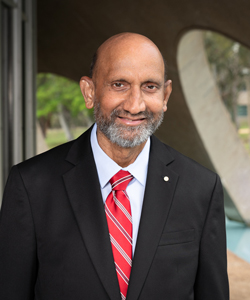
Academy President Professor Chennupati Jagadish.
Today we celebrate our 70th anniversary since the foundation of the Australian Academy of Science.
Our country has a deep reservoir of talent within the sciences, including some of the world’s most eminent researchers and professionals.
Nearly 600 Fellows are currently elected to the Australian Academy of Science for their outstanding contributions. Each Fellow is nominated by their peers and chosen through a rigorous election process. They are our national treasure.
Every day, the Academy convenes its Fellows and other researchers and draws on their expertise to bring science to the service of the nation.
We play a crucial role in translating scientific knowledge in a timely way, so it is available to inform policy decisions and actions, enabling you, and everyone in our community, to benefit.
As we enter our eighth decade we are as committed as ever to our mission to advance Australia as a nation that embraces scientific knowledge and whose people enjoy the benefits of science.
Along with other Australian Fellows of the Royal Society of London, the Academy’s first President, Sir Mark Oliphant, chose to stay in Australia rather than pursue lucrative opportunities overseas.
When asked why, he gave this reply.
“(I have a) deep confidence in the part which science can play in making us strong and prosperous, and an idea that the proper use of science within its diverse territories may point the way to a secure and good life for all.”
Seventy years on, I share that same confidence in the role of science and its potential for good.
The establishment of the Australian Academy of Science created the opportunity to recognise local talent and make their expertise available domestically and to grow recognition of Australia’s contribution on the global stage.
We strive to ensure that wherever decisions are made, they are informed by evidence, whether that be in our parliaments, courtrooms, boardrooms, classrooms or in the public square.
And we invite all Australians, from every corner of society, to collaborate with us to benefit from the value of science and share in the treasure that is our Fellowship and the knowledge they generate and share.
We closely guard our independence. It matters to us and provides great value and reassurance to you.
We are non-partisan, we do not carry vested interests, we are not a government organisation, and we are not beholden to any single institution.
We are also a leading voice on diversity in science, technology engineering and mathematics (STEM). We welcome and support diversity in our Fellowship and provide guidance to empower the STEM sector to become more diverse and inclusive.
We are committed to advancing reconciliation, to working respectfully with Aboriginal and Torres Strait Islander peoples, and increasing understanding of Traditional Knowledges.
And we actively support our future: our early- and mid-career researchers who are both shaping our world and who will be custodians of it.
Thank you for your ongoing interest in and collaboration with the Australian Academy of Science.
As we look to the future, the Academy will continue to work towards ensuring a healthy science system and make the best expertise available to the service of the nation.
Professor Chennupati Jagadish AC PresAA FREng FTSE
President, Australian Academy of Science
Related content
Slight increase in Government R&D investment welcome, but still much to be done
While there is a slight increase in Government investment in R&D from 2022-23 to 2023-24, there is much still to be done if we are to see a full turnaround in the decades-long downward trend in R&D investment. Australia’s investment remains well below the OECD average.
We need a 10-year plan to reverse our investment trend and be positioned to meet national ambitions. The long-term decline in R&D investment and Australia’s resource focused economy is leaving Australia more exposed to external pressures and shocks, as well as increasing sovereign vulnerability. This has serious consequences for national well-being, security and prosperity.
Investment is just one piece of the puzzle – our current science system lacks strategy and coherence.
In our pre-budget submission, the Academy calls for a long-term strategic roadmap for the science system to chart a path to boost R&D investment by the government and other sectors, enhance productivity and ensure that science can support national needs. These include decarbonisation, the economic and social transformation driven by AI, securing critical supply chains, adapting to climate change and developing advanced defence and national security capabilities.
Our estimate of 0.51% of GDP government investment in R&D following the last Federal Budget is an estimate based on what was released in the Budget papers.
The Academy will comment further when actual expenditure is released for 2023-24 and our snapshot will be updated for the 2024-25 Federal Budget.
This statement can be attributed to the Academy’s President, Professor Chennupati Jagadish AC PresAA FREng FTSE.
We are 70 years young – here are some things you might not know about us!
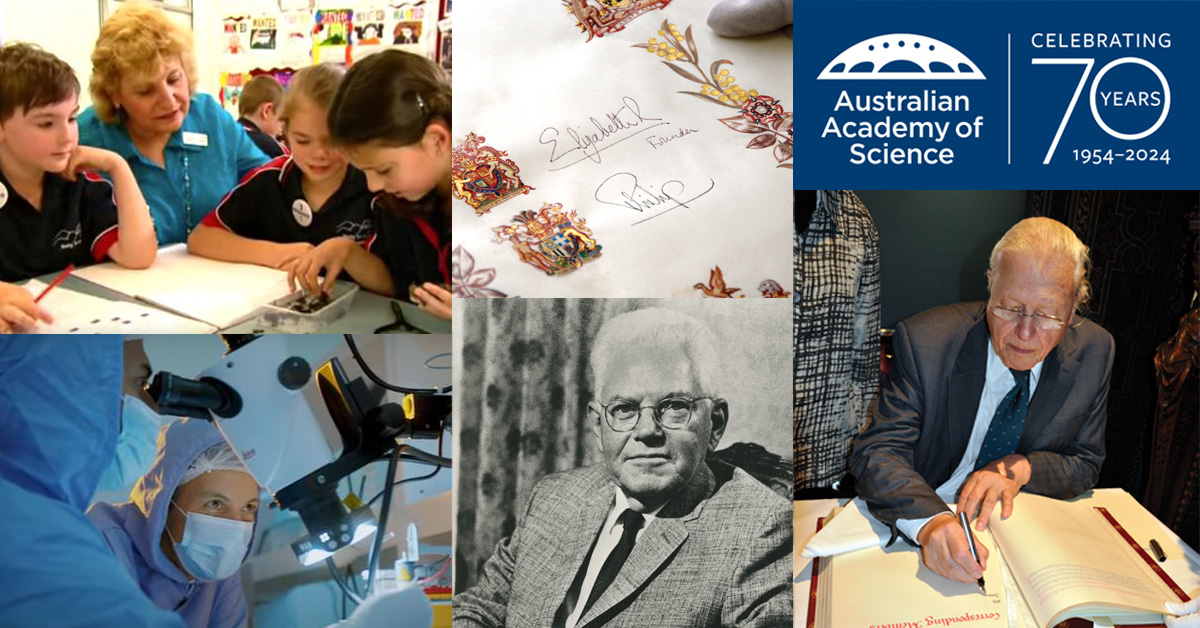
The Academy’s 70th anniversary is Friday 16 February 2024
Read on for a glimpse of who we are.
1. A right Royal Charter
As Queen Elizabeth II prepared for her first visit to Australia in 1954, it was a race against time to get a Royal Charter ready, the document that would establish the Australian Academy of Science.
A Royal Charter had not been presented in person by any monarch since King Charles II presented one to the oldest national scientific society in the world, the Royal Society of London, in 1662.
On 16 February 1954, the first 10 members of the Academy went to Government House, Canberra where Queen Elizabeth II handed Sir Mark Oliphant the Royal Charter – founding our organisation and establishing the Academy as an independent not-for-profit body with government endorsement.
2. 20 presidents
We’ve had 20 presidents since then. Our first was physicist Sir Mark Oliphant, known globally for his work in nuclear physics and microwave radar. Our current President is also a physicist, Professor Chennupati Jagadish, who is known for his work in lasers and is based at the Australian National University.
3. Home truth
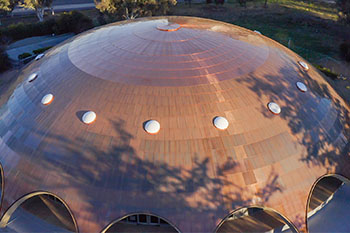
Our home, and the home of science for all Australians, is a 710-tonne National Heritage listed concrete dome. The Shine Dome’s unique mid-century design continues to fascinate visitors to Canberra and as well as being a centre for sharing science, it is available for people to enjoy – we’ve held weddings, movie and TV productions, conferences, swing dance parties and festivals in and around the building.
4. R&D review
We recognise that government investment in research and development aimed at advancing knowledge is good for society. We also know that 88% of Australians agree with us on this. Australia’s R&D system is outdated and that’s why we are calling on the Australian Government to review the nation’s R&D system.
5. Going public
We build public awareness and understanding of science. We were one of the most prominent sources of information for the public and the government during the COVID-19 pandemic. Governments and society continue to turn to the Academy and science for evidence to help make decisions and to solve the global challenges we are facing.
6. Outstanding Fellows
Sir David Attenborough is perhaps the most globally recognisable of all our nearly 600 Fellows. They’ve all been elected for their outstanding contributions to science. As an organisation we know that science benefits from diversity and that’s why we were proud to achieve gender parity in the annual election of our new Fellows in 2022 and why we continue to provide guidance to the science sector to improve diversity practices.
7. Start them young
We’re proud of our long-standing role helping to build the capability Australia’s teachers and students, and equipping our next generations with skills they’ll need in the future.
From the world-renowned Biological Science: Web of Life text first published in the 1960s to our Primary Connections, Science by Doing and reSolve programs which are used by teachers and schools across Australia every day, we’ve had a positive impact. In the past year alone, our teacher resources were downloaded over 380,000 times and we’ve had more than 700 enrolments in our online professional learning courses.
8. Shaping science
We’ve played a leading role in shaping Australia’s science landscape. This includes the establishment of national parks, Antarctic expeditions, shaping the scientific disciplines and establishing our national astronomy infrastructure.
We incubated the National Youth Science Forum and the organisation now known as Science and Technology Australia, partnered with the Australian Academy of Technological Sciences and Engineering to roll out the Science in Australia Gender Equity (SAGE) pilot, and are now incubating Water Trust Australia, amongst other achievements.
9. Going global
Since we were established, we have held Australia’s vote on the International Science Council – the global voice of, and for science. We maintain links with scientific bodies worldwide, ensuring science diplomacy plays its part in maintaining peaceful international relations. Today we lead scientific cooperation efforts across the Asia-Pacific region.
10. Science for justice
The Academy played a key role in helping to overturn one of Australia’s biggest miscarriages of justice, the case of Kathleen Folbigg. We are now working to ensure justice systems across Australia are better informed by science, to prevent future wrongful convictions.
11. Rich history
We hold a rich archival collection that provides a valuable window into the history of Australian scientific discoveries in the 19th and 20th centuries, including photos and diaries of some of Australia’s first explorers to Antarctica.
12. Research ready
We celebrate scientists through awards and support scientists to undertake research projects, travel and give lectures in Australia and abroad including through initiatives such as our Aboriginal and Torres Strait Islander Scientist Award. We’ll be announcing the 2024 recipients of our awards soon.
13. Proudly independent
Over the years, many generous donors have recognised the unique role the Academy plays in bringing science to the service of the nation and in advancing Australia as a nation that embraces scientific knowledge, so we all benefit. They have made much of our work possible and assured our independence. We are ever grateful. You can join them.
Related content
Restoring turtle habitats, protecting lizards and helping frogs with the Margaret Middleton Fund
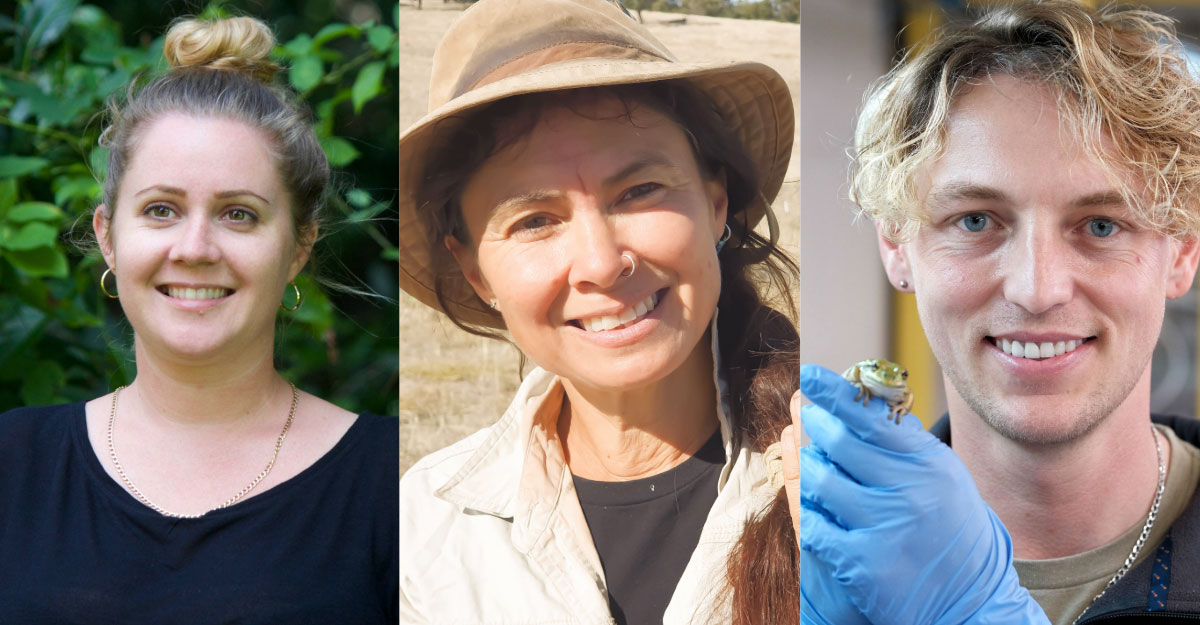
Three early-career researchers have been awarded funding for ecology projects thanks to the Margaret Middleton Fund for endangered Australian native vertebrate animals.
The fund provides grants to support emerging researchers who are conducting conservation-based research of Australian ecosystems that ultimately will lead to tangible outcomes for endangered native vertebrates.
The 2024 recipients are:
Dr Samatha Tol, James Cook University
Do green sea turtle faeces increase seagrass seed germination and seedling success through fertilisation?
Global populations of green sea turtles have been declining due to a range of factors, including climate change, fishing practices and habitat loss, and these animals are now classified as endangered. Dr Samantha Tol, an ecologist dedicated to unravelling the intricacies of marine ecosystems, wants to harness the natural contributions of these marine mega-herbivores to enhance ecosystem restoration.
“One effective indirect approach to increase sea turtle populations is the restoration of their habitat, specifically seagrass meadows,” Dr Tol said in her application.
Dr Tol will use funds from this award to measure if seagrass seed germination rates, seedling growth and survival is enhanced by the addition of nutrients from turtle faeces. By enhancing seagrass restoration efforts, Dr Tol hopes to influence the overall conservation of green sea turtles and the numerous other species that depend on seagrass for their survival.
“I am enthusiastic about the potential positive impact that this research may have on seagrass restoration efforts and, ultimately, on the conservation of the many animals which rely on this habitat, especially the vulnerable dugongs and endangered green sea turtle,” Dr Tol said.
“I am genuinely grateful for this incredible opportunity to advance our understanding of marine ecosystems and contribute to the preservation of our marine wildlife.”
Ms Deanne (Dee) Trewartha, Flinders University
Heat, water and lizards – understanding behavioural responses to translocation in an endangered, endemic Australian grassland reptile to inform conservation practices
The pygmy blue-tongue lizard is endemic to South Australia and only found in a small number of isolated locations. This is an endangered species, at a high-risk of extinction due to dwindling grasslands. One way to conserve populations of these lizards may be to move them to protected locations (known as translocation).
Ms Dee Trewartha will use time-lapse cameras to monitor different populations of translocated pygmy blue tongue lizards and assess the population differences in their thermoregulation after translocation.
“Understanding the ability of high-risk populations to persist in altered climatic conditions is vital for successful translocation and therefore for ongoing management decisions,” Ms Trewartha said.
“I am absolutely excited that our little pygmy blue tongues have been funded by this prestigious award and I hope it will raise people’s awareness of the existence and conservation needs of this endangered endemic lizard.”
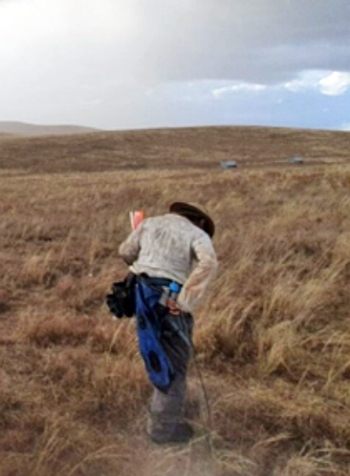
Ms Dee Trewartha in the field. Photo: supplied.
Dr Anthony Waddle, Macquarie University
Hot-spot shelters to fight amphibian chytrid epidemics
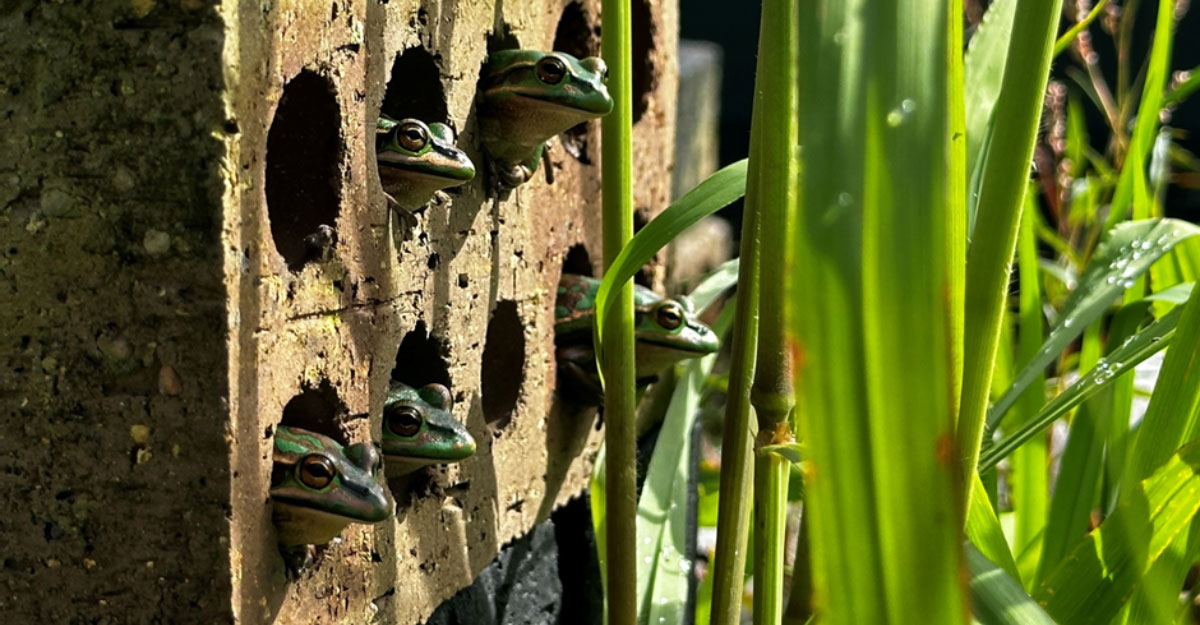
Dr Anthony Waddle will use the funding to test hot-spot shelters for protecting a wild population of green and golden bell frogs from the amphibian chytrid fungus, Batrachochytrium dendrobatidis.
The amphibian chytrid fungus is an invasive species that affects amphibians worldwide and has been implicated in the mass die-offs and species extinctions of frogs for the past several decades. Chytrid cannot be eradicated once it invades a new site.
Dr Waddle’s research efforts contribute to finding interventions that allow species to co-exist with the chytrid fungus in the environment.
“Over the past two decades, research on chytrid has created incredibly valuable foundational knowledge… but we still do not have many tools to combat the pathogen in nature,” Dr Waddle said.
“I will use this grant to test an approach that involves creating artificial habitat for frogs that exploits the pathogen’s vulnerability to high temperatures and certain frogs’ affinity to seek warm shelter sites.”
About the fund
The Margaret Middleton Fund for endangered Australian native vertebrate animals was established in 2000 with Dr Margaret Middleton, who donated generously to this fund for many years.
Dr Middleton was a long-time supporter of the Academy and early-career scientists, with the fund supporting more than 90 projects to date.
Applications for the 2025 awards open on 15 February 2024.
Academy welcomes diversity in STEM review
The Australian Academy of Science welcomes the release of the final report of the Pathway to Diversity in STEM Review.
“It is pleasing to see that the review has highlighted leadership, governance, cultural transformation and inclusive workplace environments as important priorities for improving diversity in the STEM sector,” Academy President Professor Jagadish said.
Up until now efforts to promote diversity in STEM have largely concentrated on improving the underrepresentation of women.
“We must now focus on a more expansive and systematic approach to cultivating talent and promoting the full inclusion of excellence across all dimensions of diversity.
“This includes not only women and girls, but also First Nations people, people from culturally and linguistically diverse backgrounds, people with disability, LGBTQIA+ people, neurodiverse people, people facing age-based discrimination and people living in regional, rural and remote areas.
“STEM skills are in such high demand that we must make use of all the available talent and ensure they can work in safe workplaces free of bullying, harassment and discrimination.
“STEM-qualified Australians should reflect the make-up of the community from which they are drawn, and our practices should enable a collective commitment to equitable participation and opportunity in STEM.”
The Academy welcomes the panel’s recommendation that Learned Academies, as standard setters within the science and research community, work with the academic community and Traditional Knowledge holders to build respect, awareness and better practices to weave First Nations Knowledges into science and research systems.
And that this work should be guided by First Nations people and inform the Australian Government’s actions in this area.
Professor Jagadish confirmed that the Academy, in partnership with the Australian Academy of Technological Sciences and Engineering will be working with Aboriginal and Torres Strait Island Knowledge holders to co-design and co-develop a paper on the intersection of Traditional Knowledge and the broader scientific knowledge systems in STEM.
“Our intention is to provide practical guidance to research leaders and administrators on how to meaningfully incorporate Traditional Knowledges into research methodologies and empower the research sector to be actively and routinely involved in weaving together such knowledges,” Professor Jagadish said.
The Academy welcomes the recommendation to develop a whole-of-government, long-term strategy to increase diversity and inclusion in STEM. Until such a strategy is developed to address the important findings in this review, the sector should continue to be guided by the whole-of-sector Women in STEM Decadal Plan, which lays out opportunities to achieve gender equity by 2030. These opportunities are applicable to other diversity dimensions and are consistent with the findings of the Diversity review released today.
The Academy also supports the following review recommendations:
- The establishment of a new advisory council and empowering the STEM Equity Monitor to improve data capture and analysis on underrepresented groups beyond women.
- Embedding best practice program design in all diversity in STEM programs, particularly through evaluation.
- Ensuring accountability, especially when public money is distributed.
- Concerted efforts to enhance STEM education and employment outcomes for underrepresented groups.
- Increase awareness, visibility and importance of diversity in STEM. The Academy considers that this will be most efficient if it is evidence-based, sustained and targeted. Existing projects should be leveraged, including the Academy’s STEM Women Global database.
- Further support to Science in Australia Gender Equity (SAGE) to drive cultural change in the higher education and research sector.
The Academy notes the recognition of the Women in STEM Decadal Plan and initiatives it has triggered, including the STEM Equity Monitor, National Evaluation Guide for STEM equity programs, STEM Equity Evaluation Portal, Workplace Gender Equity Implementation Guide developed by the Women in STEM Ambassador, and the Diversity & Inclusion Toolkit for small and medium enterprises by the Australian Academy of Technological Sciences and Engineering.
The Academy thanks the Review Panel for its comprehensive analysis and looks forward to the government’s response to the review later this year.
In a time of risk and opportunity, science is critical
The President of the Australian Academy of Science, Professor Chennupati Jagadish, said the Australian Government cannot build a stronger, more resilient nation with a stagnant research and development system that relies on decades-old settings.
Over the past two decades, a significant drop in R&D is leaving Australia more exposed to external pressures and shocks, as well as increasing sovereign vulnerability. There are serious consequences for national well-being, security and prosperity.
“Good intentions, just-in-time measures, ad-hoc interventions, politics and overlapping state and Commonwealth priorities have led to a research system spread over 176 programs and 14 federal portfolios,” Professor Jagadish said.
“We are left with an incoherent system band-aided to slow the bleeding but not to fix the problem. The lack of a coherent and strategic approach is yielding negative impacts.”
The Academy’s pre-budget submission published today recommends the Australian Government urgently commission a cross-portfolio, cross-sectorial review of Australia’s R&D system.
Professor Jagadish said while the University Accord final report is expected to recommend structural reform across the higher education system, Australia also desperately needs a holistic review of the fundamentals that underpin the science and research system.
“Such a review would inform a 10-year roadmap to enable R&D to power Australia’s economy and meet Australia’s ambitions,” Professor Jagadish said.
The Academy’s submission highlights some of the impacts of Australia’s poorly functioning science and research system, including:
- declining productivity – in 2020, Australia’s productivity growth was the slowest in 20 years, and Australia’s investment in R&D declined to a new low point over the same period
- a lack of understanding of whether Australia has the right scientific capacity and capability to meet national and global challenges
- a services and resource-focused economy which makes us vulnerable to economic shocks and volatile international conditions.
“Reversing the downward trend of government investment in R&D is not the work of any single budget. All levels of government, industry, universities, the research sector and philanthropy must play their part,” Professor Jagadish said.
“But a national strategy, a roadmap, and a decade of commitment to boost investment in R&D is an essential start.”
Quantum photonics pioneer tours Australia as Frew Fellow
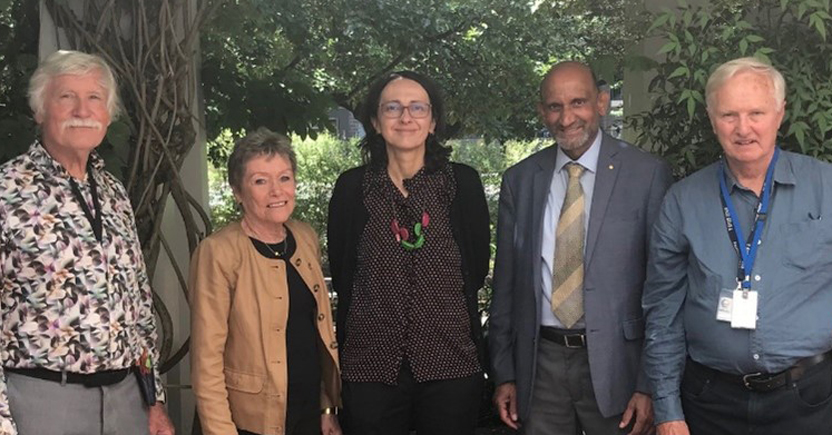
The Academy’s 2023 Frew Fellow, Professor Jelena Vuckovic, toured and lectured in Australia recently as a recipient of the Academy’s Geoffrey Frew Fellowship. The Fellowship brings distinguished overseas scientists to Australia to participate in Australian spectroscopy conferences and to visit scientific centres, and was initiated in 1970 through a personal donation from Mr G S V Frew.
Since 2015, the Australian Optical Society has generously matched the Academy’s funding support for the Geoffrey Frew Fellowship. This collaboration underscores a commitment to enhancing global scientific exchange and facilitating interactions between international scholars and their Australian counterparts.
Professor Vuckovic is a pioneer in experimental and theoretical research in nanophotonics and quantum photonics, which have found widespread use in chemistry, physics, medical imaging and manufacturing. She leads the Nanoscale and Quantum Photonics Lab at Stanford University and was the inaugural director of the interdisciplinary Q-FARM initiative. This brings university researchers from different fields together to study quantum science and engineering and to train the next generation of scientists.
Embarking on the Frew Fellowship tour, Professor Vuckovic visited key academic hubs in Sydney, Brisbane and Canberra.
Insights into scalable quantum photonic systems
The tour started in Sydney, where Professor Vuckovic engaged with the academic community at the University of Technology Sydney (UTS) and the University of Sydney. The ARC Centre for Transformative Meta-Optical Systems (TMOS) colloquium at UTS focused on scalable quantum photonic systems. At the University of Sydney, the Institute of Photonics and Optical Science (IPOS) seminar explored the theme of unlocking the power of photonics through inverse design and heterogeneous integration. Engaging with researchers and exploring state-of-the-art optics labs and nanofabrication facilities added depth to the tour.
Quantum photonics lecture
Professor Vuckovic then visited the University of Queensland, delivering a lecture on quantum photonics and inverse design. This visit offered an opportunity for discussions with colleagues and a chance to explore advanced research labs, fostering connections and collaboration.
ANZCOP-AIP plenary talk and Academy interaction
The tour concluded in Canberra, where Professor Vuckovic delivered a plenary talk at the Australian and New Zealand Conference on Optics and Photonics and the Australian Institute for Physics summer meeting hosted at the Australian National University. Addressing an audience of more than 500 physicists and optics scientists, the lecture provided insights into the forefront of quantum photonics. Discussions with Australian Academy of Science leaders were then held at the Shine Dome.
Reflecting on the journey, Professor Vuckovic was grateful for the warm reception and the opportunity to reconnect with colleagues. The visit, reminiscent of her past research in Australia, fostered scientific discussions and paved the way for future collaborations. The Frew Fellowship proved to be a remarkable chapter in advancing quantum photonics and strengthening Australian scientific ties.
Fellows celebrated in Australia Day honours
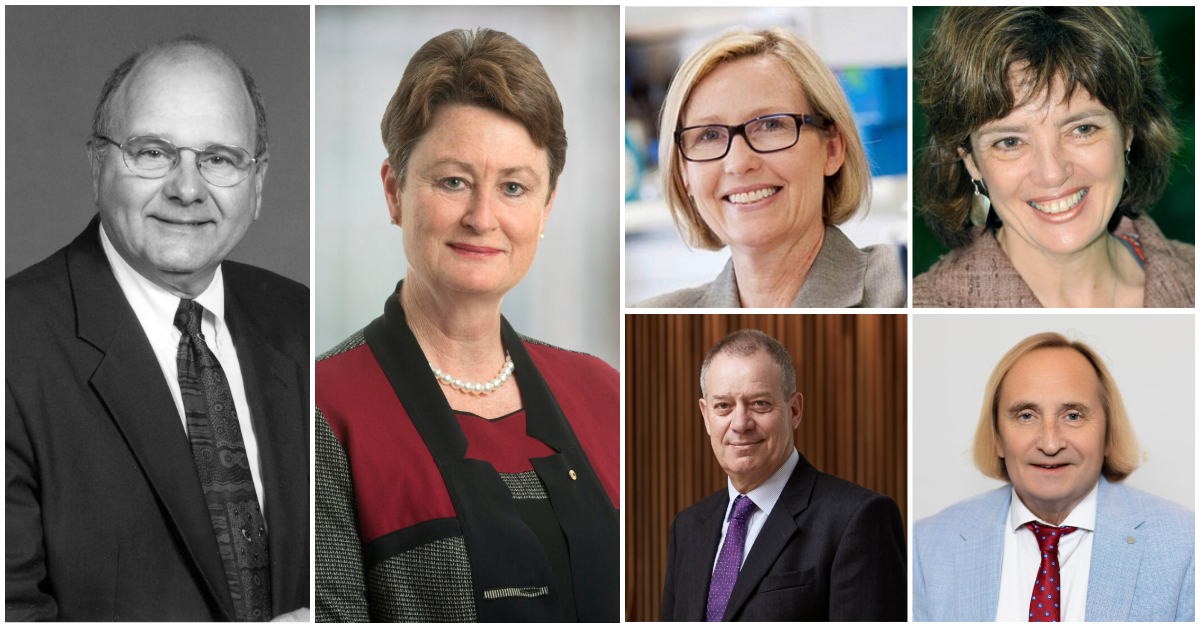
Six Academy Fellows have been recognised for their outstanding contributions to science by being named on the 2024 Australia Day honours list.
Emeritus Professor David Boger and Ms Catherine Livingstone are two of just four people to receive the highest honour, appointed to the Companion of the Order of Australia (AC) recognising their “eminent achievement and merit of the highest degree in service to Australia or to humanity at large”.
Emeritus Professor David Boger AC FAA FTSE FRS
Professor Boger is an internationally recognised expert in non-Newtonian fluid mechanics.
He is responsible for the discovery of constant viscosity elastic liquids, now known as Boger fluids, and was awarded the Prime Minister’s Prize for Science in 2005 for this pioneering work in fluid mechanics.
Professor Boger’s discovery of these ‘perfect non-Newtonian’ fluids has been used in varied research, from solving problems in large-scale mining projects to the use of fluids in nanotechnology.
Elected to the Academy in 1993, Professor Boger served as a Committee Member (1995 – 1998) and as a Council Member (1999 – 2002) of the Australian Academy of Science.
He received the Mathew Flinders Medal in 2000, an award recognising scientific research careers of the highest standing in physical science.
Professor Boger receives his AC “for eminent service to chemical engineering as a scientist, academic and researcher, particularly in the field of non-Newtonian fluid mechanics, and to the environment”.
Ms Catherine Livingstone AC FAA FTSE
Ms Livingstone, elected to the Academy in 2014, is passionate in her belief that science and technology have critical roles in the future development of Australia.
Current Chancellor of the University of Technology Sydney, her career in leadership spans science, technology, innovation and arts.
Ms Livingstone champions the technology that drives any company where she is in the leadership team.
Ms Livingstone, who was previously recognised as an Officer of the Order of Australia (AO) in 2008, now receives the highest honour “for eminent service to business, particularly through governance and strategic reform, to tertiary education, to science, technology and innovation capability development, and to the arts”.
Professor Sarah Robertson AO FAA FAHMS
A world-renowned reproductive biologist, Professor Robertson was elected to the Academy in 2016.
She is a champion of reproductive health. Her research shows that the immune system plays a vital role in the health and wellbeing of embryo development.
As a research leader at the University of Adelaide, her team continues to improve practices in reproductive medicine, developing applications for treating infertility and providing insight into early-life origins of child health.
Professor Robertson receives her AO “for distinguished service to medical research, particularly reproductive biology and immunology, and to professional societies”.
Distinguished Professor Louise Ryan AO FAA
Professor Ryan is an internationally recognised statistician for her methodological contributions to statistical methods for cancer and environmental health research.
Elected to the Academy in 2012, she is well known for her leadership ability and passion for mentoring young scientists.
Currently a Council Member of the Australian Academy of Science, Professor Ryan blends statistical research methods with applications in the real world, particularly in the health and environmental domains.
Professor Ryan receives her AO “for distinguished service to biostatistical research and methodology, to environmental science, and to professional societies”.
Professor Joseph Trapani AO FAA FAHMS
Professor Trapani is an immunologist at the Peter MacCallum Cancer Centre, researching the interaction between the immune system and cancer.
Elected in 2018, Professor Trapani is interested in harnessing the power of the immune system to devise new ways of treating cancer.
Professor Trapani receives his AO “for distinguished service to medical research, particularly immunology and the development of immune-based cancer therapies, and to the community”.
Professor Alexander McBratney AM FAA
Professor McBratney, elected to the Academy in 2016, has made major contributions to soil science and agriculture through his research on understanding the properties of soil (pedometrics), digital soil mapping and precision agriculture.
He is passionate about the sustainable use and management of the soil system.
From the University of Sydney, Professor McBratney made expert contributions to the Academy’s evidence brief on Soil conditions after bushfires, providing recommendations to governments on helping our soil recover from bushfires.
Professor McBratney receives his AM “for significant service to soil science through research and education, and to the development of digital mapping techniques”.
Australian Government’s interim AI response a sensible first step

The Australian Academy of Science supports the Australian Government’s interim response to the discussion paper for supporting responsible artificial intelligence (AI), including its plans to ensure AI is designed, developed and deployed safely and responsibly.
The Academy contributed advice to the National Science and Technology Council in March 2023 on the opportunities and risks of generative AI.
The Academy is pleased the government has built on the advice of the research sector in the interim response and identified legal, regulatory and governance measures that are needed across a range of portfolios.
The interim response is a sensible first step and the Academy welcomes a focus on avoiding unnecessary or disproportionate burdens for the research and development (R&D) sector, the community and regulators, as well as the express desire to balance innovation and competition with community safeguards that protect privacy, security and online safety.
The interim response identifies the need for Australia to continue to engage internationally to help shape global AI governance, and to identify opportunities to support the safe and responsible deployment of AI technologies in our region.
Australia has the opportunity to support regional efforts to strengthen AI governance and capability via the International Science Council Regional Focal Point for Asia and the Pacific, hosted by Australia via the Academy.
Via this network, Australia can build regional momentum behind the Bletchley Declaration, which affirms that AI should be designed, developed, deployed and used in a manner that is safe, human-centric, trustworthy and responsible.
The Academy continues to call on the Australian Government to take leadership in:
- developing a national strategy for the uptake of AI in the science sector
- investment in sovereign high-performance computing facilities to ensure Australia’s AI capability doesn’t rely on other nations
- implement the UNESCO recommendation on Open Science (since AI is trained on available data, keeping scientific data and peer-reviewed publications behind paywalls impacts the ability of these systems to leverage the most reliable information).
The Academy looks forward to continuing to convene experts and provide advice to assist the Australian Government to maximise Australia’s contribution to, and benefits from, AI.
Appropriate AI regulation coupled with strong government support for development of local technology and companies will see Australia prosper.