




One of Australia’s oldest scientists remembered

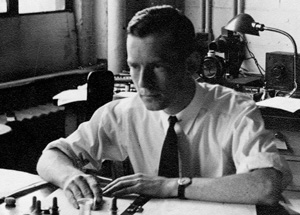
A young Max Day
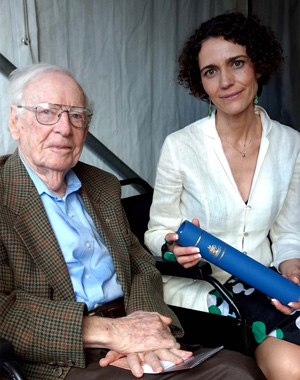
Dr Day with Dr Marta Yebra, a recipient of the inaugural Max Day Environmental Science Fellowship, in May this year.
At the ripe old age of 97, the late Dr Max Day AO FAA was still contributing to science, helping to uncover the mystery behind the scribbles on gum trees, considered by many to be an icon of the Australian bush.
Dr Day, who died on Monday 31 July at the age of 101, spent a lifetime championing the study of insects (entomology), conservation, the environment, and forestry. His research also played a major role in controlling Australia’s rabbit problem.
Dr Day was born in Sydney in 1915. He studied science at the University of Sydney and was awarded the university medal in 1937, graduating with a bachelor’s degree in science.
An ecologist and entomologist who collaborated with Australian greats of both disciplines, Dr Day was a member of the CSIRO Executive for eleven years, during which he was responsible for all the CSIRO Divisions dealing with plant and animal sciences.
Dr Day was the first Chairman of the Australian Institute of Marine Science, and coordinated the report that led to the establishment of the Institute near Townsville, North Queensland. He was the founding Head of CSIRO’s Division of Forest Research for five years which led to Australia’s international recognition for its contribution to forest research.
Dr Day also worked extensively with the CSIRO insect collection. His passion for studying insects is perhaps best described in an interview he gave with Academy Fellow Professor Robyn Williams AM FAA in 2015.
“Insects, there are so many of them. It’s a field which goes on forever.”
He applied his work on insect hormones and insect digestion to a critical study of how animal and plant viruses are spread by insects. Dr Day worked with Academy Fellow and virologist Professor Frank Fenner AC FAA FRS to control Australia's wild rabbit population using the virus that causes myxomatosis, a project he described as the most satisfying achievement of his career.
“The government introduced myxo into Australia in 1950 to control rabbits as they had become a serious problem across the country,” he told his Academy colleagues in 2015.
‘Frank, who I had never previously met, approached me at a meeting here in Canberra and said: ‘We believe myxomatosis might be mosquito-borne. Would you be interested in taking on the mosquito side of it while I do the biology?’, and so for the next five years Frank and I worked on the transmission of the myxo virus.”
Elected to the Australian Academy of Science in 1956, just two years after the Academy was founded, Dr Day was the Academy’s longest serving Fellow and one of Australia’s oldest scientists. He told his Academy colleagues that he still clearly recalls watching the then Prime Minister Sir Robert Menzies lay the foundation stone for what is now known as the Shine Dome in 1958.
Dr Day was one of the founding members of the Australian Conservation Foundation, a strong supporter of national parks, and was made an Officer of the Order of Australia (AO) in 1977.
In 2012 aged 97, Dr Day co-authored a paper with Dr Marianne Horak and others about the Ogmograptis scribbly gum moth, describing eleven new species of the moth. Even more remarkable was the recognition that different species made different scribbles.
The author of the Snugglepot and Cuddlepie books, May Gibbs, made scribbles a feature of the gumnut babies’ world, and the great Australian poet Judith Wright cemented their place in literary culture with her 1955 poem Scribbly-Gum.
Dr Day and his co-authors found that the patterns are made by the moth's various developmental stages, and change according to the stage.
“The eggs are laid on the bark and the caterpillar burrows in and then just goes around making scribbles,” Dr Day said in his 2015 interview with Professor Williams.
In May this year, Dr Day presented two early-career researchers, Mr Nicholas Leseberg and Dr Marta Yebra, with inaugural Max Day Environmental Science Fellowships, established in his honour.
Through sponsoring this award Dr Day acknowledged the support that he himself received as a young researcher to travel overseas to gain his PhD at Harvard.
Mentoring inspires donation to honour outstanding Earth sciences research
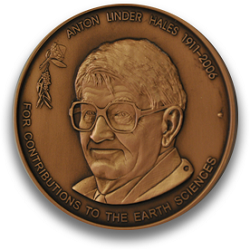
The Anton Hales Medal gives career encouragement to young earth scientists.
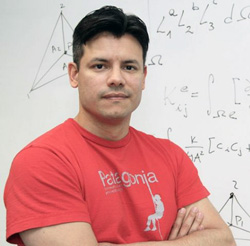
Associate Professor Juan Carlos Afonso was awarded the medal in 2017.
The Academy’s Anton Hales Medal has so far rewarded the extraordinary achievements of nine early-career researchers who are studying our planet.
The medal is named in honour of the late Professor Anton Hales FAA. Originally from South Africa, the geophysicist’s impressive career spanned three continents and covered nearly nine decades.
The first recipient in 2009 was Professor Jeffrey Walker, a leading Australian expert on the remote sensing of soil moisture.
Walker has gone on to make further significant contributions in the field, including developing algorithms to derive high resolution soil moisture imagery from the Soil Moisture Active Passive (SMAP) satellite of NASA. The orbiting observatory measures the amount of water in the top five centimetres of soil everywhere on Earth’s surface.
The ninth and most recent recipient of the Medal is Associate Professor Juan Carlos Afonso. He is at the forefront of revolutionising the way that geoscientists interpret the signals they obtain from deep in the Earth by geophysical methods.
The other recipients were rewarded for their research into fossil records, seismic data, global climate, the evolution and dynamics of the solid Earth, weather, groundwater, and seabed sediments.
Professor Hales moved to the Australian National University from the United States as foundation Director of the Research School of Earth Sciences at the age of 62.
Professor McDougall was one of the first members of staff recruited to Hales’s new school, where they worked together over the following decades. Like Hales, McDougall is also an internationally distinguished Earth scientist.
Following Hales’s death in 2006 at the age of 95, a gift from the McDougalls saw the establishment of an award named in his honour.
Known for his capacity for mentoring, the award not only honours Hales but gives career encouragement to young Earth scientists.
Max Day Award supports parrot conservation and bushfire research
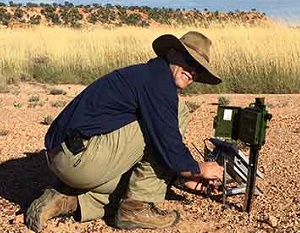
Nick Leseberg in the field in Western QLD where he’s studying the elusive Night Parrot. Photo Credit: Nick Leseberg
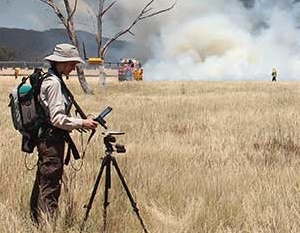
Marta Yebra characterising the spectral response of grasses during a fire experiment in Braidwood. Photo Credit: Carolina Luiz
Mr Nicholas Leseberg from the University of Queensland and Dr Marta Yebra from the Australian National University are the first two recipients of the Academy’s Max Day Environmental Science Fellowship Award.
The Max Day Award provides up to $20,000 to support early-career researchers working on the conservation of Australia’s flora and fauna, ecologically sustainable use of resources, protection of the environment and ecosystem services.
Max Day is a champion of entomology, conservation and forestry, and at 101 is the oldest and longest-serving Academy Fellow. The Academy is providing this support to early-career researchers in his honour.
PhD student Mr Leseberg will use his Max Day Award to investigate the ecology of the elusive and endangered Night Parrot, while Dr Yebra will study the moisture content of Australian forests to create models that predict bushfires.
Mr Leseberg and Dr Marta will receive their awards at the Academy’s annual signature science event Science at the Shine Dome on 24 May.
In addition to the awardees, three researchers were ‘highly commended’:
- Dr Hugo Harrison from the ARC Centre of Excellence for Coral Reef Studies at James Cook University for his project ‘Connecting reefs in the Anthropocene: managing Australia’s coral reefs for recovery and persistence’
- Dr Kerensa McElroy from CSIRO for her project ‘The ‘DNA footprint’ of near extinction: interrogating 100 years of black-throated finch decline by sequencing contemporary and historical specimens’
- Mr Max Worthington from Flinders University for his project ‘Renewable polymers for agriculture and the environment’.
More information on the awardees
Applications for the 2018 Max Day Environmental Science Fellowship Award close on 1 June.
Former Chief Scientist awarded Academy Medal
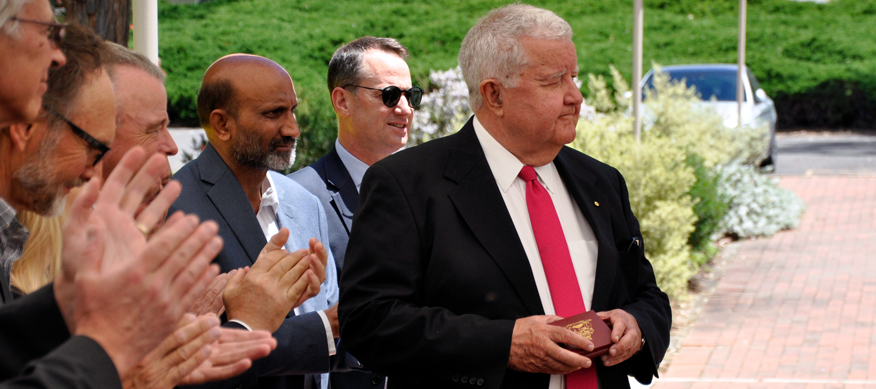
The Academy Medal was awarded to Australia’s former Chief Scientist, Professor Ian Chubb AC, at a special ceremony held at Ian Potter House on Thursday.
The event was attended by influential members of the science community to celebrate Professor Chubb’s outstanding contributions to science.
Earlier this year Academy Fellows elected Professor Chubb to join a distinguished list of past awardees including famous broadcasters, philanthropists and science communicators.
Professor Chubb’s illustrious career championing science—notably as our Chief Scientist, Vice Chancellor of the Australian National University, and president of the International Alliance of Research Universities—has provided opportunities for Australian scientists and researchers to flourish.
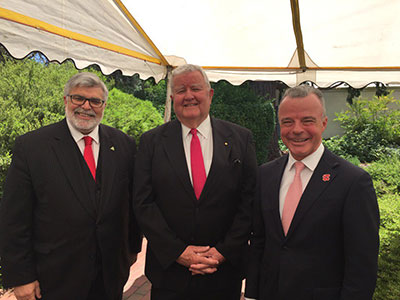
Professor Chubb joined at the event by The Hon Kim Carr, The Hon Brendan Nelson AO Photo courtesy of Belinda Robinson
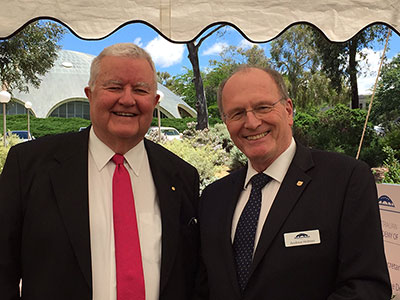
Professor Chubb joined at the event with Academy President, Professor Andrew Holmes Photo courtesy of Belinda Robinson
Nick Wormald
FAA
Expertise type
- Probability
- Graph Theory
- Optimisation of Networks
- Mathematics
- Random Graphs
- Analysis of Graph Algorithms
- Asymptotic Enumeration
- Probabilistic Combinatorics
- Random Graph Processes
- Steiner Trees
Please contact fellowship@science.org.au to request any updates to the data.
Ray Withers
FAA
Expertise type
- Materials Science
- Inorganic Chemistry
- Solid State Chemistry
- X-ray Crystallography
- Chemistry
Please contact fellowship@science.org.au to request any updates to the data.
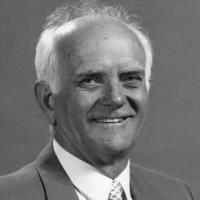
Joe Wiskich
FAA
Expertise type
- Bioenergetics
- Biology
- Botany
- Plant Biology
- Respiration
Please contact fellowship@science.org.au to request any updates to the data.
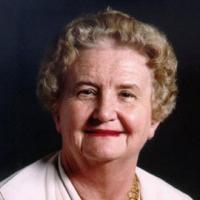
Marelyn Wintour-Coghlan
AO FAA
Expertise type
- Developmental Physiology
- Kidney Function
- Medical Sciences
- Physiology
Please contact fellowship@science.org.au to request any updates to the data.
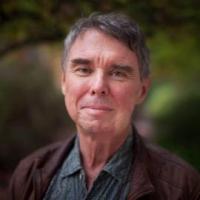
Robert Williamson
FAA
Fields of research
46 INFORMATION AND COMPUTING SCIENCES- 4602 ARTIFICIAL INTELLIGENCE AND IMAGE PROCESSING
-
4905
STATISTICS
- 490509 Statistical Theory
For full list of research codes, please visit the ARC Website .
Expertise type
- Information Theory
- Signal Processing
- Mathematical Statistics
- Probability
- Artificial Intelligence
- Computer Science
- ICT
- Machine Learning
Please contact fellowship@science.org.au to request any updates to the data.
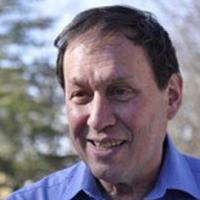
Bob Williamson
AO FAA FAHMS(Hon) FRS
Expertise type
- Medical Sciences
- Genomics
- Gene Therapy
- Science Policy
- Biotechnology
- Human Genetics
- Dementia
Please contact fellowship@science.org.au to request any updates to the data.